EP2450810A2 - Verfahren zum Extrahieren von Informationen aus einer Datenbank - Google Patents
Verfahren zum Extrahieren von Informationen aus einer Datenbank Download PDFInfo
- Publication number
- EP2450810A2 EP2450810A2 EP11189942A EP11189942A EP2450810A2 EP 2450810 A2 EP2450810 A2 EP 2450810A2 EP 11189942 A EP11189942 A EP 11189942A EP 11189942 A EP11189942 A EP 11189942A EP 2450810 A2 EP2450810 A2 EP 2450810A2
- Authority
- EP
- European Patent Office
- Prior art keywords
- data
- tables
- variables
- variable
- values
- Prior art date
- Legal status (The legal status is an assumption and is not a legal conclusion. Google has not performed a legal analysis and makes no representation as to the accuracy of the status listed.)
- Withdrawn
Links
Images
Classifications
-
- G—PHYSICS
- G06—COMPUTING OR CALCULATING; COUNTING
- G06F—ELECTRIC DIGITAL DATA PROCESSING
- G06F16/00—Information retrieval; Database structures therefor; File system structures therefor
- G06F16/20—Information retrieval; Database structures therefor; File system structures therefor of structured data, e.g. relational data
- G06F16/28—Databases characterised by their database models, e.g. relational or object models
- G06F16/284—Relational databases
-
- Y—GENERAL TAGGING OF NEW TECHNOLOGICAL DEVELOPMENTS; GENERAL TAGGING OF CROSS-SECTIONAL TECHNOLOGIES SPANNING OVER SEVERAL SECTIONS OF THE IPC; TECHNICAL SUBJECTS COVERED BY FORMER USPC CROSS-REFERENCE ART COLLECTIONS [XRACs] AND DIGESTS
- Y10—TECHNICAL SUBJECTS COVERED BY FORMER USPC
- Y10S—TECHNICAL SUBJECTS COVERED BY FORMER USPC CROSS-REFERENCE ART COLLECTIONS [XRACs] AND DIGESTS
- Y10S707/00—Data processing: database and file management or data structures
- Y10S707/99931—Database or file accessing
- Y10S707/99932—Access augmentation or optimizing
-
- Y—GENERAL TAGGING OF NEW TECHNOLOGICAL DEVELOPMENTS; GENERAL TAGGING OF CROSS-SECTIONAL TECHNOLOGIES SPANNING OVER SEVERAL SECTIONS OF THE IPC; TECHNICAL SUBJECTS COVERED BY FORMER USPC CROSS-REFERENCE ART COLLECTIONS [XRACs] AND DIGESTS
- Y10—TECHNICAL SUBJECTS COVERED BY FORMER USPC
- Y10S—TECHNICAL SUBJECTS COVERED BY FORMER USPC CROSS-REFERENCE ART COLLECTIONS [XRACs] AND DIGESTS
- Y10S707/00—Data processing: database and file management or data structures
- Y10S707/99931—Database or file accessing
- Y10S707/99933—Query processing, i.e. searching
-
- Y—GENERAL TAGGING OF NEW TECHNOLOGICAL DEVELOPMENTS; GENERAL TAGGING OF CROSS-SECTIONAL TECHNOLOGIES SPANNING OVER SEVERAL SECTIONS OF THE IPC; TECHNICAL SUBJECTS COVERED BY FORMER USPC CROSS-REFERENCE ART COLLECTIONS [XRACs] AND DIGESTS
- Y10—TECHNICAL SUBJECTS COVERED BY FORMER USPC
- Y10S—TECHNICAL SUBJECTS COVERED BY FORMER USPC CROSS-REFERENCE ART COLLECTIONS [XRACs] AND DIGESTS
- Y10S707/00—Data processing: database and file management or data structures
- Y10S707/99941—Database schema or data structure
- Y10S707/99942—Manipulating data structure, e.g. compression, compaction, compilation
Definitions
- the extraction involves evaluation of a mathematical function, e.g. a summation ("SUM(x*y)"), operating on a combination of calculation variables (x, y), e.g. the number of sold items ("Number”) and the price per item ("Price").
- SUM(x*y) a summation
- the extraction also involves partitioning the information according to classification variables, e.g. "Year” and "Client”.
- classification variables define how the result of the mathematical operation should be presented.
- the extraction of the total sales per year by client would involve evaluation of "SUM(Number*Price) per Year, Client".
- a computer program is designed to process the database and to evaluate all conceivable mathematical functions operating on all conceivable calculation variables partitioned on all conceivable classification variables, also called dimensions.
- the result of this operation is a large data structure commonly known as a multidimensional cube.
- This multidimensional cube is obtained through a very time-consuming operation, which typically is performed overnight.
- the cube contains the evaluated results of the mathematical functions for every unique combination of the occurring values of the classification variables.
- the user can then, in a different computer program operating on the multidimensional cube, explore the data of the database, for example by visualising selected data in pivot tables or graphically in 2D and 3D charts.
- the multidimensional cube after evaluation contains average quantities, e.g. the average sales partitioned on a number of classification variables, the user cannot eliminate one or more of these classification variables since a summation over average quantities does not yield a correct total average.
- the multidimensional cube must contain the average quantity split on every conceivable combination of classification variables as well, adding an extra complexity to the operation of building the multidimensional cube.
- Other quantities e.g. median values.
- the object of the present invention is to mitigate the above-mentioned drawbacks and to provide a method for extracting information from a database, which method allows the user to freely select mathematical functions and incorporate calculation variables in these functions as well as to freely select classification variables for presentation of the results.
- a method for generating a final data structure i.e. a multidimensional cube, from data in a database in an efficient way, with respect to both process time and memory requirement. Since the cube can be generated much faster than in prior-art solutions, it is possible to generate multidimensional cubes ad hoc.
- the user can interactively define and generate a cube without being limited to a very small number of mathematical functions and variables.
- the mathematical function is normally composed of a combination of mathematical expressions. If the user needs to modify the mathematical function by changing, adding or removing a mathematical expression, a new cube can normally be generated in a time short enough not to disturb the user in his work. Similarly, if the user desires to add or remove a variable, the cube can be rapidly regenerated.
- the data records of the database are first read into the primary memory of a computer so that the data can be processed off-line. This will further reduce the time for searching the database and generating the final data structure.
- the database may be stored on a secondary memory or be a remotely stored database to which the computer is connected by a modem. It is to be understood that the database thus read into the primary memory may be a selected part of a larger database or a combination of two or more databases.
- each different value of each data variable is assigned a binary code and the data records are stored in binary-coded form.
- binary coding very rapid searches can be conducted in the data tables.
- redundant information can be removed, resulting in a reduced amount of data.
- all boundary and connecting tables that include calculation variables with a need for frequency data i.e. variables for which the number of duplicates of each value is necessary for correct evaluation of the mathematical function, define a subset.
- the frequency data can be included by duplication of each value, i.e. the conversion structure will contain a link from each value of a connecting variable in the starting table to a correct number of each value of at least one corresponding selected variable in a boundary table.
- a counter may be included in the conversion structure for each unique value of each connecting variable in the starting table.
- the boundary or connecting table having the largest number of data records is elected as starting table. This tends to minimise the amount of frequency data that must be incorporated in the conversion structure, which therefore can be built more rapidly.
- a virtual data record is created by reading a data record of the starting table and by using the conversion structure to convert each value of each connecting variable in this data record into a value of at least one corresponding selected variable.
- the virtual data record will contain a current combination of values of the selected variables.
- the final data structure can be gradually built by sequentially reading data records from the starting table, by updating the content of the virtual data record based on the content of each such data record, and by evaluating the mathematical function based on the content of each such updated virtual data record. This procedure minimises the amount of computer memory that is needed for extracting the requested information from the database.
- an intermediate data structure is built based on the content of the virtual data record.
- Each data record of the intermediate data structure contains a field for each selected classification variable and an aggregation field for each mathematical expression included in the mathematical function.
- each mathematical expression is evaluated and the result is aggregated in the appropriate aggregation field based on the current value of each selected classification variable.
- Such an intermediate data structure allows the user to combine mathematical expressions with different need for frequency data in one mathematical function. By building several conversion structures incorporating corresponding frequency data, and by evaluating the data records of a starting table for each such mathematical expression based on a corresponding conversion structure, it is possible to merge the results of these evaluations in one intermediate data structure. Likewise, if the user modifies the mathematical function by adding a new mathematical expression operating on the already selected calculation variables, it is only necessary to add an aggregation field to the existing intermediate data structure, or to extend an existing aggregation field.
- the virtual data record in general is indeed virtual, i.e. it is not physically allocated any memory, during the transition from a data record of the starting table to the final data structure.
- a virtual data record can always, at least implicitly, be identified in the procedure of converting the content of a data record of the starting table into current values of the selected variables.
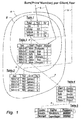
- Fig. 1 showing the content of a database after identification of relevant data tables according to the inventive method
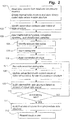
- Fig. 2 showing a sequence of steps of an embodiment of the method according to the invention.
- a database as shown in Fig. 1 , comprises a number of data tables (Tables 1-5). Each data table contains data values of a number of data variables. For example, in Table 1 each data record contains data values of the data variables "Product”, “Price” and “Part". If there is no specific value in a field of the data record, this field is considered to hold a NULL-value. Similarly, in Table 2 each data record contains values of the variables "Date”, “Client”, “Product” and “Number”. Typically, the data values are stored in the form of ASCII-coded strings.
- the method according to the present invention is implemented by means of a computer program.
- the program reads all data records in the database, for instance using a SELECT statement which selects all the tables of the database, i.e. Tables 1-5 in this case.
- the database is read into the primary memory of the computer.
- each unique value of each data variable in said database is assigned a different binary code and that the data records are stored in binary-coded form (step 101). This is typically done when the program first reads the data records from the database. For each input table, the following steps are carried out. First the column names, i.e. the variables, of the table are successively read. Every time a new data variable appears, a data structure is instantiated for it. Then, an internal table structure is instantiated to contain all the data records in binary form, whereupon the data records are successively read and binary-coded. For each data value, the data structure of the corresponding data variable is checked to establish if the value has previously been assigned a binary code.
- Tables 6-12 of Appendix A show the binary codes assigned to different data values of some data variables that are included in the database of Fig. 1 .
- the program analyses the database to identify all connections between the data tables (step 102).
- a connection between two data tables means that these data tables have one variable in common. Different algorithms for performing such an analysis are known in the art.
- all data tables are virtually connected. In Fig. 1 , such virtual connections are illustrated by double-ended arrows (a).
- the virtually connected data tables should form at least one so-called snowflake structure, i.e. a branching data structure in which there is one and only one connecting path between any two data tables in the database.
- a snowflake structure does not contain any loops. If loops do occur among the virtually connected data tables, e.g. if two tables have more than one variable in common, a snowflake structure can in some cases still be formed by means of special algorithms known in the art for resolving such loops.
- the user can start to explore the database.
- the user defines a mathematical function, which could be a combination of mathematical expressions (step 103).
- a mathematical function which could be a combination of mathematical expressions.
- the user wants to extract the total sales per year and client from the database in Fig. 1 .
- the user defines a corresponding mathematical function "SUM(x*y)", and selects the calculation variables to be included in this function: "Price” and "Number”.
- the user also selects the classification variables: "Client" and "Year”.
- the computer program identifies all relevant data tables (step 104), i.e. all data tables containing any one of the selected calculation and classification variables, such data tables being denoted boundary tables, as well as all intermediate data tables in the connecting path(s) between these boundary tables in the snowflake structure, such data tables being denoted connecting tables.
- all relevant data tables i.e. all data tables containing any one of the selected calculation and classification variables, such data tables being denoted boundary tables, as well as all intermediate data tables in the connecting path(s) between these boundary tables in the snowflake structure, such data tables being denoted connecting tables.
- the group of relevant data tables (Tables 1-3) is included in a first frame (A) in Fig. 1 .
- a subset (B) can be defined that includes all boundary tables (Tables 1-2) containing such calculation variables and any connecting tables between such boundary tables in the snowflake structure.
- Tables 1-2 boundary tables containing such calculation variables and any connecting tables between such boundary tables in the snowflake structure.
- the frequency requirement of a particular variable is determined by the mathematical expression in which it is included. Determination of an average or a median calls for frequency information. In general, the same is true for determination of a sum, whereas determination of a maximum or a minimum does not require frequency data of the calculation variables. It can also be noted that classification variables in general do not require frequency data.
- a starting table is elected, preferably among the data tables within subset (B), most preferably the data table with the largest number of data records in this subset (step 105).
- Table 2 is elected as the starting table.
- the starting table contains selected variables ("Client”, “Number”), and connecting variables ("Date”, “Product”). These connecting variables link the starting table (Table 2) to the boundary tables (Tables 1 and 3).
- a conversion structure is built (step 106), as shown in Tables 13 and 14.
- This conversion structure is used for translating each value of each connecting variable ("Date”, “Product") in the starting table (Table 2) into a value of a corresponding selected variable ("Year”, “Price") in the boundary tables (Table 3 and 1, respectively).
- Table 13 is built by successively reading data records of Table 3 and creating a link between each unique value of the connecting variable ⁇ "Date'° ⁇ and a corresponding value of the selected variable ("Year”). It can be noted that there is no link from value 4 (“Date: 1999-01-12”), since this value is not included in the boundary table.
- Table 14 is built by successively reading data records of Table 1 and creating a link between each unique value of the connecting variable ("Product”) and a corresponding value of the selected variable ("Price”).
- value 2 (“Product: Toothpaste”) is linked to two values of the selected variable (“Price: 6.5”), since this connection occurs twice in the boundary table.
- frequency data is included in the conversion structure.
- value 3 (“Product: Shampoo”).
- a virtual data record is created.
- Such a virtual data record accommodates all selected variables ("Client”, “Year”, “Price”, “Number") in the database.
- a data record is first read from the starting table (Table 2). Then, the value of each selected variable ("Client”, “Number") in the current data record of the starting table is incorporated in the virtual data record. Also, by using the conversion structure (Tables 13-14) each value of each connecting variable ("Date”, "Product”) in the current data record of the starting table is converted into a value of a corresponding selected variable ("Year”, “Price”), this value also being incorporated in the virtual data record.
- the virtual data record is used to build an intermediate data structure (Table 16).
- Each data record of the intermediate data structure accommodates each selected classification variable (dimension) and an aggregation field for each mathematical expression implied by the mathematical function.
- the intermediate data structure (Table 16) is built based on the values of the selected variables in the virtual data record.
- each mathematical expression is evaluated based on one or more values of one or more relevant calculation variables in the virtual data record, and the result is aggregated in the appropriate aggregation field based on the combination of current values of the classification variables ("Client", "Year").
- an intermediate data structure is built by successively reading data records of the starting table, by incorporating the current values of the selected variables in a virtual data record, and by evaluating each mathematical expression based on the content of the virtual data record. If the current combination of values of classification variables in the virtual data record is new, a new data record is created in the intermediate data structure to hold the result of the evaluation. Otherwise, the appropriate data record is rapidly found, and the result of the evaluation is aggregated in the aggregation field.
- the intermediate data structure is a data table associated with an efficient index system, such as an AVL or a hash structure.
- the aggregation field is implemented as a summation register, in which the result of the evaluated mathematical expression is accumulated. In some cases, e.g. when evaluating a median, the aggregation field is instead implemented to hold all individual results for a unique combination of values of the specified classification variables. It should be noted that only one virtual data record is needed in the procedure of building the intermediate data structure from the starting table. Thus, the content of the virtual data record is updated for each data record of the starting table. This will minimise the memory requirement in executing the computer program.
- the intermediate data structure has tree columns, two of which holds selected classification variables ("Client", "Year”).
- the third column holds an aggregation field, in which the evaluated result of the mathematical expression ("x*y") operating on the selected calculation variables ("Number", "Price") is aggregated.
- x*y the evaluated result of the mathematical expression
- the current values (binary codes: 0,0) of the classification variables are first read and incorporated in this data record of the intermediate data structure. Then, the current values (binary codes: 2,0) of the calculation variables are read. The mathematical expression is evaluated for these values and added to the associated aggregation field.
- the virtual data record is updated based on the starting table. Since the conversion structure (Table 14) indicates a duplicate of the value "6.5" of the selected variable “Price” for the value “Toothpaste” of the connecting variable "Product”, the updated virtual data record R2 is unchanged and identical to R1. Then, the virtual data record R2 is evaluated as described above. In this case, the intermediate data structure contains a data record corresponding to the current values (binary codes: 0,0) of the classification variables. Thus, the evaluated result of the mathematical expression is accumulated in the associated aggregation field.
- the virtual data record is updated based on the second data record of starting table.
- a new data record is created in the intermediate data structure, and so on.
- NULL values are represented by a binary code of -2 in this example.
- any virtual data records holding a NULL value (-2) of any one of the calculation variables can be directly eliminated, since NULL values can not be evaluated in the mathematical expression ("x*y").
- all NULL values (-2) of the classification variables are treated as any other valid value and are placed in the intermediate data structure.
- the intermediate data structure contains four data records, each including a unique combination of values (0,0; 1,0; 2,0; 3,-2) of the classification variables, and the corresponding accumulated result (41; 37.5; 60; 75) of the evaluated mathematical expression.
- the intermediate data structure is also processed to eliminate one or more classification variables (dimensions). Preferably, this is done during the process of building the intermediate data structure, as described above. Every time a virtual data record is evaluated, additional data records are created, or found if they already exist, in the intermediate data structure. Each of these additional data records is destined to hold an aggregation of the evaluated result of the mathematical expression for all values of one or more classification variables. Thus, when the starting table has been traversed, the intermediate data structure will contain both the aggregated results for all unique combinations of values of the classification variables, and the aggregated results after elimination of each relevant classification variable.
- the first (-1,0) of these additional data records is destined to hold the aggregated result for all values of the classification variable "Client" when the classification variable "Year" has the value "1999".
- the second (0,-1) additional data record is destined to hold the aggregated result for all values of the classification variable "Year” when the classification variable "Client” is "Nisse”.
- the third (-1,-1) additional data record is destined to hold the aggregated result for all values of both classification variables "Client" and "Year”.
- the intermediate data structure contains eleven data records, as shown in Table 16.
- the intermediate data structure accommodates more than two classification variables, the intermediate data structure will, for each eliminated classification variable, contain the evaluated results aggregated over all values of this classification variable for each unique combination of values of remaining classification variables.
- a final data structure i.e. a multidimensional cube, as shown in non-binary notation in Table 17, is created by evaluating the mathematical function ("SUM(x*y)") based on the results of the mathematical expression (“x*y") contained in the intermediate data structure (step 111). In doing so, the results in the aggregation fields for each unique combination of values of the classification variables are combined.
- the creation of the final data structure is straightforward, due to the trivial nature of the present mathematical function.
- the content of the final data structure might then (step 112) be presented to the user in a two-dimensional table, as shown in Table 18.
- the data can be presented in a pivot table, in which the user interactively can move up and down in dimensions, as is well known in the art.
- the mathematical function (a) specifies that the sales figures should be doubled for products that belong to a product group having an environment index of 'I', while the actual sales figures should be used for other products.
- the mathematical function (b) has been included for reference.
- the selected classification variables are "Environment index” and "Client”
- the selected calculation variables are "Number” and "Price”.
- Tables 20, 22 and 23 are identified as boundary tables, whereas Table 21 is identified as a connecting table.
- Table 20 is elected as starting table.
- the starting table contains selected variables ("Number”, “Client"), and a connecting variable ("Product”).
- the connecting variable links the starting table (Table 20) to the boundary tables (Tables 22-23), via the connecting table (Table 21).
- a first part (Table 24) of the conversion structure is built by successively reading data records of a first boundary table (Table 23) and creating a link between each unique value of the connecting variable ("Product group”") and a corresponding value of the selected variable ("Environment index").
- a second part (Table 25) of the conversion structure is built by successively reading data records of a second boundary table (Table 22) and creating a link between each unique value of the connecting variable ("Price group”) and a corresponding value of the selected variable (“Price”). Then, data records of the connecting table (Table 21) is read successively.
- an intermediate data structure is built by successively reading data records of the starting table (Table 20), by using the conversion structure (Table 26) to incorporate the current values of the selected variables ("Environment index", "Client”, “Number”, “Price") in the virtual data record, and by evaluating each mathematical expression based on the current content of the virtual data record.
- Table 27 displays the corresponding content of the virtual data record for each data record of the starting table. As noted in connection with the first example, only one virtual data record is needed. The content of this virtual data record is updated, i.e. replaced, for each data record of the starting table.
- Each data record of the intermediate data structure accommodates a value of each selected classification variable ("Client”, "Environment index”) and an aggregation field for each mathematical expression implied by the mathematical functions.
- the intermediate data structure contains two aggregation fields.
- One aggregation field contains the aggregated result of the mathematical expression ("x*y") operating on the selected calculation variables ("Number”, “Price”), as well as a counter of the number of such operations.
- the layout of this aggregation field is given by the fact that an average quantity should be calculated ("Avg(x*y)").
- the other aggregation field is designed to hold the lowest and highest values of the classification variable "Environment index" for each combination of values of the classification variables.
- the intermediate data structure (Table 28) is built by evaluating the mathematical expression for the current content of the virtual data record (each row in Table 27), and by aggregating the result in the appropriate aggregation field based on the combination of current values of the classification variables ("Client", "Environment index”).
- the intermediate data structure also includes data records in which the value " ⁇ ALL>" has been assigned to one or both of the classification variables.
- the corresponding aggregation fields contain the aggregated result when the one or more classification variables (dimensions) are eliminated.
- a final data structure i.e. a multidimensional cube
- a final data structure is created by evaluating the mathematical functions based on the evaluated results of the mathematical expressions contained in the intermediate data structure.
- Each data record of the final data structure as shown in Table 29, accommodates a value of each selected classification variable ("Client”, "Environment index”) and an aggregation field for each mathematical function selected by the user.
- the final data structure is built based on the results in the aggregation fields of the intermediate data structure for each unique combination of values of the classification variables.
- function (a) When function (a) is evaluated, by sequentially reading data records of Table 28, the program first checks if both values in the last column of Table 28 is equal to 'I'. If so, the relevant result contained in the first aggregation field of Table 28 is multiplied by two and stored in Table 29. If not, the relevant result contained in the first aggregation field of Table 28 is directly stored in Table 29.
- function (b) is evaluated, the aggregated result of the mathematical expression ("x*y") operating on the selected calculation variables ("Number", "Price") is divided by the number of such operations, both of which are stored in the first aggregation field of Table 28. The result is stored in the second aggregation field of Table 29.
- the present invention allows the user to freely select mathematical functions and incorporate calculation variables in these functions as well as to freely select classification variables for presentation of the results.
- join table As an alternative, albeit less memory-efficient, to the illustrated procedure of building an intermediate data structure based on sequential data records from the starting table, it is conceivable to first build a so-called join table.
- This join table is built by traversing all data records of the starting table and, by use of the conversion structure, converting each value of each connecting variable in the starting table into a value of at least one corresponding selected variable in a boundary table.
- the data records of the join table will contain all occurring combinations of values of the selected variables.
- the intermediate data structure is built based on the content of the join table. For each record of the join table, each mathematical expression is evaluated and the result is aggregated in the appropriate aggregation field based on the current value of each selected classification variable.
- this alternative procedure requires more computer memory to extract the requested information.
- the mathematical functions could contain mathematical expressions having different, and conflicting, needs for frequency data.
- steps 104-110 ( Fig. 2 ) are repeated for each such mathematical expression, and the results are stored in one common intermediate data structure.
- one final data structure i.e. multidimensional cube, could be built for each mathematical expression, the contents of these cubes being fused during presentation to the user.
Landscapes
- Engineering & Computer Science (AREA)
- Databases & Information Systems (AREA)
- Theoretical Computer Science (AREA)
- Data Mining & Analysis (AREA)
- Physics & Mathematics (AREA)
- General Engineering & Computer Science (AREA)
- General Physics & Mathematics (AREA)
- Information Retrieval, Db Structures And Fs Structures Therefor (AREA)
- Management, Administration, Business Operations System, And Electronic Commerce (AREA)
Applications Claiming Priority (2)
| Application Number | Priority Date | Filing Date | Title |
|---|---|---|---|
| SE9900894A SE516562C2 (sv) | 1999-03-12 | 1999-03-12 | Förfarande för extrahering av information från en databas |
| EP00917562A EP1177512A1 (de) | 1999-03-12 | 2000-03-10 | Verfahren zum entnehmen von informationen aus einer datei |
Related Parent Applications (1)
| Application Number | Title | Priority Date | Filing Date |
|---|---|---|---|
| EP00917562.1 Division | 2000-03-10 |
Publications (2)
| Publication Number | Publication Date |
|---|---|
| EP2450810A2 true EP2450810A2 (de) | 2012-05-09 |
| EP2450810A3 EP2450810A3 (de) | 2013-01-09 |
Family
ID=20414818
Family Applications (3)
| Application Number | Title | Priority Date | Filing Date |
|---|---|---|---|
| EP00917562A Ceased EP1177512A1 (de) | 1999-03-12 | 2000-03-10 | Verfahren zum entnehmen von informationen aus einer datei |
| EP11189942A Withdrawn EP2450810A3 (de) | 1999-03-12 | 2000-03-10 | Verfahren zum Extrahieren von Informationen aus einer Datenbank |
| EP11189938.1A Expired - Lifetime EP2450809B1 (de) | 1999-03-12 | 2000-03-10 | Verfahren zum Extrahieren von Informationen aus einer Datenbank |
Family Applications Before (1)
| Application Number | Title | Priority Date | Filing Date |
|---|---|---|---|
| EP00917562A Ceased EP1177512A1 (de) | 1999-03-12 | 2000-03-10 | Verfahren zum entnehmen von informationen aus einer datei |
Family Applications After (1)
| Application Number | Title | Priority Date | Filing Date |
|---|---|---|---|
| EP11189938.1A Expired - Lifetime EP2450809B1 (de) | 1999-03-12 | 2000-03-10 | Verfahren zum Extrahieren von Informationen aus einer Datenbank |
Country Status (7)
| Country | Link |
|---|---|
| US (1) | US7058621B1 (de) |
| EP (3) | EP1177512A1 (de) |
| JP (1) | JP4463431B2 (de) |
| AU (1) | AU3851800A (de) |
| CA (1) | CA2367181C (de) |
| SE (1) | SE516562C2 (de) |
| WO (1) | WO2000055766A1 (de) |
Families Citing this family (45)
| Publication number | Priority date | Publication date | Assignee | Title |
|---|---|---|---|---|
| SE516562C2 (sv) | 1999-03-12 | 2002-01-29 | Qliktech Internat Ab | Förfarande för extrahering av information från en databas |
| FR2876474B1 (fr) * | 2004-10-12 | 2006-12-29 | Progilys Sarl | Dispositif de traitement de donnees a definition formelle |
| US20080256099A1 (en) * | 2005-09-20 | 2008-10-16 | Sterna Technologies (2005) Ltd. | Method and System For Managing Data and Organizational Constraints |
| US7873598B2 (en) * | 2008-04-15 | 2011-01-18 | Microsoft Corporation | Slicing of relational databases |
| EP2146292B8 (de) * | 2008-07-18 | 2019-03-20 | QlikTech International AB | Verfahren und Vorrichtung zur Informationsextraktion aus einer Datenbank |
| US8463739B2 (en) * | 2008-08-28 | 2013-06-11 | Red Hat, Inc. | Systems and methods for generating multi-population statistical measures using middleware |
| US8595610B2 (en) * | 2011-01-25 | 2013-11-26 | Infineon Technologies Ag | Method, software and computer system for manipulating aggregated data |
| US9244990B2 (en) | 2011-10-07 | 2016-01-26 | Oracle International Corporation | Representation of data records in graphic tables |
| US10685005B2 (en) | 2011-11-11 | 2020-06-16 | Qliktech International Ab | Alternate states in associative information mining and analysis |
| US9779260B1 (en) | 2012-06-11 | 2017-10-03 | Dell Software Inc. | Aggregation and classification of secure data |
| US9578060B1 (en) | 2012-06-11 | 2017-02-21 | Dell Software Inc. | System and method for data loss prevention across heterogeneous communications platforms |
| US9501744B1 (en) | 2012-06-11 | 2016-11-22 | Dell Software Inc. | System and method for classifying data |
| US9390240B1 (en) * | 2012-06-11 | 2016-07-12 | Dell Software Inc. | System and method for querying data |
| US10324917B2 (en) * | 2012-10-15 | 2019-06-18 | Qliktech International Ab | Methods and systems for data management |
| US10698918B2 (en) | 2013-11-20 | 2020-06-30 | Qliktech International Ab | Methods and systems for wavelet based representation |
| US11144184B2 (en) | 2014-01-23 | 2021-10-12 | Mineset, Inc. | Selection thresholds in a visualization interface |
| US9349016B1 (en) | 2014-06-06 | 2016-05-24 | Dell Software Inc. | System and method for user-context-based data loss prevention |
| US10262021B2 (en) | 2014-06-09 | 2019-04-16 | Qliktech International Ab | Methods and systems for processing data using QR factorization |
| CN105446991B (zh) * | 2014-07-07 | 2018-10-30 | 阿里巴巴集团控股有限公司 | 数据存储方法、查询方法及设备 |
| US10326748B1 (en) | 2015-02-25 | 2019-06-18 | Quest Software Inc. | Systems and methods for event-based authentication |
| US10417613B1 (en) | 2015-03-17 | 2019-09-17 | Quest Software Inc. | Systems and methods of patternizing logged user-initiated events for scheduling functions |
| US9990506B1 (en) | 2015-03-30 | 2018-06-05 | Quest Software Inc. | Systems and methods of securing network-accessible peripheral devices |
| US9842218B1 (en) | 2015-04-10 | 2017-12-12 | Dell Software Inc. | Systems and methods of secure self-service access to content |
| US9641555B1 (en) | 2015-04-10 | 2017-05-02 | Dell Software Inc. | Systems and methods of tracking content-exposure events |
| US9842220B1 (en) | 2015-04-10 | 2017-12-12 | Dell Software Inc. | Systems and methods of secure self-service access to content |
| US9563782B1 (en) | 2015-04-10 | 2017-02-07 | Dell Software Inc. | Systems and methods of secure self-service access to content |
| US9569626B1 (en) | 2015-04-10 | 2017-02-14 | Dell Software Inc. | Systems and methods of reporting content-exposure events |
| US10536352B1 (en) | 2015-08-05 | 2020-01-14 | Quest Software Inc. | Systems and methods for tuning cross-platform data collection |
| US10157358B1 (en) | 2015-10-05 | 2018-12-18 | Quest Software Inc. | Systems and methods for multi-stream performance patternization and interval-based prediction |
| US10218588B1 (en) | 2015-10-05 | 2019-02-26 | Quest Software Inc. | Systems and methods for multi-stream performance patternization and optimization of virtual meetings |
| US11681704B2 (en) | 2016-02-01 | 2023-06-20 | Qliktech International Ab | Methods and systems for distributed data analysis |
| US10142391B1 (en) | 2016-03-25 | 2018-11-27 | Quest Software Inc. | Systems and methods of diagnosing down-layer performance problems via multi-stream performance patternization |
| EP3232342B1 (de) | 2016-04-14 | 2019-11-27 | QlikTech International AB | Verfahren und system für bidirektionale indexierungsübersicht |
| EP3239863A1 (de) | 2016-04-29 | 2017-11-01 | QlikTech International AB | System und verfahren für interaktive entdeckung von datensatzübergreifenden beziehungen |
| EP3239862B1 (de) * | 2016-04-29 | 2020-06-03 | QlikTech International AB | Verfahren und systeme für auswahlabfragesprache |
| EP3364314B1 (de) | 2017-02-15 | 2022-10-19 | QlikTech International AB | Verfahren und systeme zur indexierung unter verwendung von indexlets |
| EP3483739A1 (de) | 2017-05-12 | 2019-05-15 | QlikTech International AB | Kognitive regelmaschine |
| EP3401809A1 (de) | 2017-05-12 | 2018-11-14 | QlikTech International AB | Verfahren zum abfragen vom indizierten, partitionierten dimensions tabellen |
| EP3483738A1 (de) | 2017-05-12 | 2019-05-15 | QlikTech International AB | Indexmaschine |
| EP3401808A1 (de) | 2017-05-12 | 2018-11-14 | QlikTech International AB | Interaktive datenexploration |
| US20200073876A1 (en) | 2018-08-30 | 2020-03-05 | Qliktech International Ab | Scalable indexing architecture |
| EP3678033A1 (de) | 2019-01-07 | 2020-07-08 | QlikTech International AB | Computerimplementiertes verfahren zur indexletbasierten aggregation |
| EP3678032B1 (de) | 2019-01-07 | 2024-09-11 | QlikTech International AB | Computerimplementierte verfahren und systeme für verbesserten datenabruf |
| CN111400305B (zh) * | 2020-02-20 | 2022-03-08 | 深圳市魔数智擎人工智能有限公司 | 基于特征工程血缘关系的可回溯、可视化方法 |
| EP4548221A1 (de) | 2022-07-03 | 2025-05-07 | QlikTech International AB | Geschlossene regelkreiserzeugung von einsichten aus quelldaten |
Family Cites Families (9)
| Publication number | Priority date | Publication date | Assignee | Title |
|---|---|---|---|---|
| US5517641A (en) | 1992-05-27 | 1996-05-14 | Cdb Software, Inc. | Restartable method to reorganize DB2 tablespace records by determining new physical positions for the records prior to moving using a non sorting technic |
| US5423035A (en) | 1992-12-23 | 1995-06-06 | Hughes Aircraft Company | Method for evaluating relational database queries with automatic indexing and ordering of join components |
| US5842209A (en) | 1996-09-03 | 1998-11-24 | International Business Machines Corporation | User interface for visually depicting inner/outer/left/right joins in a database system |
| US5960428A (en) | 1997-08-28 | 1999-09-28 | International Business Machines Corporation | Star/join query optimization |
| CA2326513C (en) * | 1998-03-27 | 2009-06-16 | Informix Software, Inc. | Processing precomputed views |
| US6434545B1 (en) * | 1998-12-16 | 2002-08-13 | Microsoft Corporation | Graphical query analyzer |
| SE516562C2 (sv) | 1999-03-12 | 2002-01-29 | Qliktech Internat Ab | Förfarande för extrahering av information från en databas |
| US6356900B1 (en) * | 1999-12-30 | 2002-03-12 | Decode Genetics Ehf | Online modifications of relations in multidimensional processing |
| US6775681B1 (en) * | 2002-02-26 | 2004-08-10 | Oracle International Corporation | Evaluation of grouping sets by reduction to group-by clause, with or without a rollup operator, using temporary tables |
-
1999
- 1999-03-12 SE SE9900894A patent/SE516562C2/sv not_active IP Right Cessation
-
2000
- 2000-03-10 EP EP00917562A patent/EP1177512A1/de not_active Ceased
- 2000-03-10 WO PCT/SE2000/000482 patent/WO2000055766A1/en not_active Ceased
- 2000-03-10 EP EP11189942A patent/EP2450810A3/de not_active Withdrawn
- 2000-03-10 CA CA2367181A patent/CA2367181C/en not_active Expired - Lifetime
- 2000-03-10 AU AU38518/00A patent/AU3851800A/en not_active Abandoned
- 2000-03-10 US US09/936,500 patent/US7058621B1/en not_active Expired - Lifetime
- 2000-03-10 JP JP2000605924A patent/JP4463431B2/ja not_active Expired - Lifetime
- 2000-03-10 EP EP11189938.1A patent/EP2450809B1/de not_active Expired - Lifetime
Non-Patent Citations (1)
| Title |
|---|
| None |
Also Published As
| Publication number | Publication date |
|---|---|
| EP2450809A2 (de) | 2012-05-09 |
| EP2450810A3 (de) | 2013-01-09 |
| EP1177512A1 (de) | 2002-02-06 |
| EP2450809A3 (de) | 2013-01-02 |
| CA2367181C (en) | 2010-11-02 |
| AU3851800A (en) | 2000-10-04 |
| WO2000055766A1 (en) | 2000-09-21 |
| EP2450809B1 (de) | 2019-11-27 |
| US7058621B1 (en) | 2006-06-06 |
| JP4463431B2 (ja) | 2010-05-19 |
| SE9900894L (sv) | 2000-09-13 |
| CA2367181A1 (en) | 2000-09-21 |
| SE516562C2 (sv) | 2002-01-29 |
| JP2002539563A (ja) | 2002-11-19 |
| SE9900894D0 (sv) | 1999-03-12 |
Similar Documents
| Publication | Publication Date | Title |
|---|---|---|
| US7058621B1 (en) | Method for extracting information from a database | |
| US6662189B2 (en) | Method of performing data mining tasks for generating decision tree and apparatus therefor | |
| US6226634B1 (en) | Association rule generation and group-by processing system | |
| US7558802B2 (en) | Information retrieving system | |
| US7809758B2 (en) | Database and method of generating same | |
| US5890150A (en) | Random sampling method for use in a database processing system and a database processing system based thereon | |
| US7194456B2 (en) | Method of querying a structure of compressed data | |
| EP1217540A1 (de) | Methode zum Organisieren von Daten und zum Verarbeiten von Anfragen in einem Datenbanksystem, Datenbanksystem und Softwareprodukt zur Implementierung solcher Methode | |
| JP3452531B2 (ja) | データ・マイニングする方法およびシステム | |
| KR20010083096A (ko) | 가치-사례-연결을 통한 컴퓨터에 의해 구현되는데이터베이스 | |
| US20020093522A1 (en) | Methods of encoding and combining integer lists in a computer system, and computer software product for implementing such methods | |
| US20040215598A1 (en) | Distributed data mining and compression method and system | |
| JP2008269643A (ja) | データベース・システムでデータを編成し、問合せを処理する方法、およびそのような方法を実施するためのデータベース・システムおよびソフトウェア製品 | |
| US6976015B2 (en) | Method for extracting data from a relational database using a reduced query | |
| US20040064441A1 (en) | Systems and methods for providing structured query language optimization | |
| JP2001331509A (ja) | リレーショナルデータベース処理装置、リレーショナルデータベースの処理方法及びリレーショナルデータベースの処理プログラムを記録したコンピュータ読み取り可能な記録媒体 | |
| CN110990423B (zh) | Sql语句的执行方法、装置、设备和存储介质 | |
| US5625813A (en) | Method for performing joins between different record types in a database system | |
| US7882114B2 (en) | Data processing method and data processing program | |
| US8515983B1 (en) | Segment matching search system and method | |
| CN107609110B (zh) | 基于分类树的最大多样频繁模式的挖掘方法及装置 | |
| WO2026057998A1 (en) | Graph databases | |
| JP2002183142A (ja) | データ格納装置、データ格納方法及びデータ格納方法をコンピュータに実行させるためのプログラムを記録したコンピュータ読み取り可能な記録媒体 | |
| JPS63149728A (ja) | 索引生成方式 | |
| Zheng | Algorithms for multi-level frequent pattern minning |
Legal Events
| Date | Code | Title | Description |
|---|---|---|---|
| PUAI | Public reference made under article 153(3) epc to a published international application that has entered the european phase |
Free format text: ORIGINAL CODE: 0009012 |
|
| AC | Divisional application: reference to earlier application |
Ref document number: 1177512 Country of ref document: EP Kind code of ref document: P |
|
| AK | Designated contracting states |
Kind code of ref document: A2 Designated state(s): AT BE CH CY DE DK ES FI FR GB GR IE IT LI LU MC NL PT SE |
|
| PUAL | Search report despatched |
Free format text: ORIGINAL CODE: 0009013 |
|
| AK | Designated contracting states |
Kind code of ref document: A3 Designated state(s): AT BE CH CY DE DK ES FI FR GB GR IE IT LI LU MC NL PT SE |
|
| RIC1 | Information provided on ipc code assigned before grant |
Ipc: G06F 17/30 20060101AFI20121130BHEP |
|
| 17P | Request for examination filed |
Effective date: 20130620 |
|
| RBV | Designated contracting states (corrected) |
Designated state(s): AT BE CH CY DE DK ES FI FR GB GR IE IT LI LU MC NL PT SE |
|
| 17Q | First examination report despatched |
Effective date: 20160524 |
|
| GRAP | Despatch of communication of intention to grant a patent |
Free format text: ORIGINAL CODE: EPIDOSNIGR1 |
|
| RIC1 | Information provided on ipc code assigned before grant |
Ipc: G06F 16/28 20190101AFI20190930BHEP |
|
| INTG | Intention to grant announced |
Effective date: 20191105 |
|
| STAA | Information on the status of an ep patent application or granted ep patent |
Free format text: STATUS: THE APPLICATION IS DEEMED TO BE WITHDRAWN |
|
| 18D | Application deemed to be withdrawn |
Effective date: 20200603 |