EP2449359B1 - Particle classifier - Google Patents
Particle classifier Download PDFInfo
- Publication number
- EP2449359B1 EP2449359B1 EP10793465.5A EP10793465A EP2449359B1 EP 2449359 B1 EP2449359 B1 EP 2449359B1 EP 10793465 A EP10793465 A EP 10793465A EP 2449359 B1 EP2449359 B1 EP 2449359B1
- Authority
- EP
- European Patent Office
- Prior art keywords
- particles
- flow
- carrier
- flow channel
- aerosol
- Prior art date
- Legal status (The legal status is an assumption and is not a legal conclusion. Google has not performed a legal analysis and makes no representation as to the accuracy of the status listed.)
- Active
Links
Images

Classifications
-
- G—PHYSICS
- G01—MEASURING; TESTING
- G01N—INVESTIGATING OR ANALYSING MATERIALS BY DETERMINING THEIR CHEMICAL OR PHYSICAL PROPERTIES
- G01N15/00—Investigating characteristics of particles; Investigating permeability, pore-volume or surface-area of porous materials
- G01N15/02—Investigating particle size or size distribution
- G01N15/0255—Investigating particle size or size distribution with mechanical, e.g. inertial, classification, and investigation of sorted collections
Definitions
- Aerosol particle classifiers are Aerosol particle classifiers.
- Aerosol classifiers are used to produce a monodisperse aerosol, that is, they select a narrow range of particles from a larger distribution of particles. This method is used for many applications including; nano-particle generation, measuring distributions of particles in air, measuring the deposition of particles in filters and other devices, sampling ambient aerosols, and many others. These measurements are often done in research areas as diverse as: nano-technology, pharmaceutical research, health-effects studies, inhalation toxicology, bio-aerosol detection, filter testing, indoor-air quality studies, industrial hygiene, energy and combustion research, automotive emissions measurements, and atmospheric and climate-change research.
- the DMA classifies particles based on their electrical mobility, that is, the motion of a charged particle in an electrostatic field. By controlling the electrostatic field and the flow between two cylinders the particles are classified by their electrical mobility, which is related to the number of electric charges on the particle and the drag experienced by the particle, which is a function of the particle's size and shape. For non-spherical particles an equivalent diameter, called the electrical mobility equivalent diameter is defined for these particles, which have the same electrical mobility of a spherical particle of the same size.
- an electric charge must be placed on these particles using charging methods such radioactive-source charge neutralizers or corona discharge.
- charging methods such radioactive-source charge neutralizers or corona discharge.
- all charging methods not a single charge is placed on each particle but rather a distribution of charges are placed on the population of particles.
- particles may obtain one, two, three, or more positive charges; one, two, three, or more negative charges or no charge at all.
- the electrical mobility of the particles is a function of the number of charges on the particle and its drag. Therefore, a smaller particle with one charge will have the same electrical mobility as a larger particle with two charges.
- the aerosol sample that is classified by the DMA will not be truly monodisperse in terms of particle size, but rather it will have a mix of sizes corresponding to an integer number of charged particles.
- aerosol and particle instalments are based on measuring what is called the 'aerodynamic' diameter of the particle.
- the aerodynamic equivalent diameter is defined as the diameter of a spherical particle with a density of water that has the same terminal velocity as the actual particle Instalments that measure the aerodynamic size of particles include various kinds of impactors (Marple et al, 1991, Keskinen et al, 1992), virtual impactors (Conner, 1966), and aerodynamic lenses (Liu et al, 1995a, 1995b).
- JP H02 237657 discloses a method and device for centrifugally classifying aerosol particles.
- US 6251296 discloses a particle separation member for use with a cyclone separator.
- US 3429187 discloses a centrifugally operated device for producing a true particle size spectrum from an aerosol.
- US 4640140 discloses an aerosol sampler with cascade impaction and uniform deposition.
- Ohmura N et al. disclose in "Particle classification in Taylor vortex flow with an axial flow” in the Journal of Physics: Conference Series, Institute of Physics Publishing, Bristol, GB, vol. 14, no. 1 of 1 January 2005, pages 64-71 a particle classification phenomenon in Taylor vortex flow with axial flow.
- J.S Olfert et al. disclose in "The experimental transfer function of the Couette centrifugal particle mass analyzer" of the Journal of Aerosol Science, vol. 37, 31 December 2006, pages 1840-1852 , the experimental transfer function of the Couette centrifugal particle mass analyzer.
- apparatus for classifying aerosol particles suspended in a gas and producing a monodisperse aerosol as defined in the appended claims.
- the applicant has devised a new instrument, called the Aerodynamic Particle Classifier (APC) that provides classification of particles.
- API Aerodynamic Particle Classifier
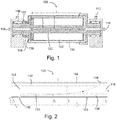
- Figs. 1 and 2 show diagrams of an exemplary embodiment of the APC, generally denoted by 100.
- the APC disclosed here comprises two concentric cylinders, an inner cylinder 102 and an outer cylinder 104 rotating in the same direction and at a similar rotational speed (normally the two cylinders would be rotating at the same rotational speed although different speeds can also be used, see below).
- the cylinders are attached to a rotating shaft 120 mounted on bearings 122 and rotated via pulley 124.
- a source of particles is connected to supply particles into suspension in the carrier fluid, in this embodiment slit 118 acting as a source.
- the particles, carried along by the aerosol flow 106 with flow rate Q a enter the gap between the two cylinders through slit 118 in the inner cylinder wall.
- a sheath flow 108 with flow rate Q sh is also introduced from a source of carrier fluid flow into the carrier flow channel between the two cylinders.
- an initial flow channel 126 acts as a source of carrier fluid by introducing the sheath flow into the carrier flow channel. It is assumed that flow is laminar and incompressible, which is a reasonable assumption for the geometry, flow rates, and gas pressure used in normal operation.
- the flow is axial in the frame of reference of the rotating cylinders, and tangential to the cylinders or to an imaginary cylinder coaxial with the cylinders; in an embodiment with cylinders rotating at different speeds the flow may still be tangential. In the absence of any centrifugal force (due to centripetal acceleration of the fluid containing the particles) the particles would travel between the two cylinders between the inner cylinder wall and the aerosol streamline 110.
- the particles experience a centrifugal force in the direction of the outer cylinder and a drag force toward the centre of rotation.
- the centrifugal force both supplies the particles into the carrier flow and imparts a component of velocity across the carrier flow.
- the particles are not pre-mixed.
- the particles will also travel in the axial direction carried along by the aerosol flow and sheath flow.
- a classification system classifies the suspended particles according to their trajectories.
- particles are classified according to whether their trajectories bring them through sampling exit 114.
- the transfer function of the instrument (the distribution of particles that leave the classifier at any given operating condition) can be found by determining the trajectory of the particles.
- a sample flow 112 with flow rate Q s exits the classifier through sampling exit 114.
- the sample flow is part of the sheath flow. The remainder of the sheath flow and the aerosol flow exit the classifier as exhaust flow 116.
- r 1 the outer radius of the inner cylinder
- r 2 the inner radius of the outer cylinder
- r 3 the outer radius of the aerosol flow
- r 4 the inner radius of the sample flow
- the largest particle i.e., the largest ⁇
- ⁇ min Q sh + Q a ⁇ 2 L r 2 2 ⁇ r 1 2 ln Q sh + Q a + Q s 1 ⁇ r 1 2 / r 2 2 Q sh + Q a ⁇ Q sh 1 ⁇ r 1 2 / r 2 2 .
- Particles with ⁇ > ⁇ max will intercept the outer cylinder wall before reaching the exit slit and will adhere to the cylinder surface, while particles with ⁇ ⁇ ⁇ min will flow past the exit slit and be carried out of the instrument with the exhaust flow.
- the particles adhere to the wall of the outer cylinder due to van der Waals forces (Friedlander, 2000) and will remain there until the cylinder is cleaned. (Like the DMA, under normal operating conditions and aerosol concentrations, the cylinder will only need to be cleaned once every few months.) Between the maximum and minimum relaxation times, only a fraction of the particles will be classified.
- a particle must migrate into the sample flow, defined by the sample streamline ( r 4 ⁇ r ⁇ r 2 ), by the time the particle has reached the end of the classifier.
- For particles with ⁇ > ⁇ min only particles with an initial radial position r c ⁇ r ⁇ r 3 will be classified, where r c is called the critical radius.
- the limiting trajectory for ⁇ > ⁇ min will be the particle that starts at r c and reaches r 4 . Substituting this condition into Eq.
- f 1 Q sh + Q a ⁇ exp ⁇ 2 ⁇ 2 L ⁇ r 2 2 ⁇ r 1 2 Q sh + Q a Q sh + Q a ⁇ Q s 1 ⁇ r 1 2 / r 2 2 Q a 1 ⁇ r 1 2 / r 2 2 ⁇ Q sh Q a .
- the particles starting at the critical radius, r c must reach r 2 by the end of the classifier.
- f 2 Q sh + Q a Q a 1 ⁇ 1 ⁇ exp ⁇ 2 ⁇ 2 L ⁇ r 2 2 ⁇ r 1 2 Q sh + Q a 1 ⁇ r 1 2 / r 2 2 .
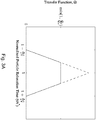
- the normalized transfer function is shown in Fig. 3A , where the normalized particle relaxation time is defined as ⁇ / ⁇ * .
- r 2 37 mm
- r 1 35 mm
- L 200 mm
- Q sh 3 L/min
- the flow rates maybe changed to vary the width of the transfer function as desired as long as the flow remains laminar.
- An example of a transfer function of the APC is shown in Fig. 3B using the given dimensions.
- this embodiment of the APC will produce a very narrow, or monodisperse, size distribution.
- the APC would be able to classify particles over an extremely wide range for example 10 nm to 10 ⁇ m using rotational speeds ranging from 20,000 to 95 rpm and smaller particle sizes could be classified by using higher rotational speeds (by comparison the DMA is typically used over a range of approximately 2.5 to 1,000 nm).
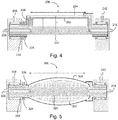
- an APC 200 is shown with a rotating flow channel (multiple flow channels may be included around the central axis, but only one is shown in the figure).
- the flow channel may be defined by an inner partial cylindrical section 202 and an outer partial cylindrical section 204 although other shapes than partial cylindrical sections are possible.
- the example, not part of the present invention, may operate in a similar way as the embodiment of Fig.
- FIG. 5 an APC 300 is shown with a flow channel defined by an inner surface 302 and an outer surface 304 which are not cylinders. This example is not part of the present invention. The surfaces may be surfaces of revolution.
- FIG. 5 may operate in a similar way as the embodiment of Fig. 1 except for the different shape of the flow channel.
- rotating shaft 320, bearings 322, pulley 324, sheath flow 308, aerosol flow 306, initial flow channel 326, sample flow 312 and exhaust flow 316 may be similar to their counterparts of Fig. 1 and cooperate similarly, except where a different shape is appropriate to accommodate the shape of the flow channel.
- the peak of the transfer function without the speed difference is already 0.95, therefore the added complexity of rotating the cylinders at slightly different speeds is mostly likely not worth the slight improvement in transfer function.
- the speed ratio must satisfy the Rayleigh criterion (i.e., it must not be the case that ( r 1 / r 2 ) 2 > ⁇ 2 / ⁇ 1 ) beyond which the flow becomes unstable, thereby disturbing the classification of the particles.
- the above description describes how the APC can be used to produce a monodisperse aerosol based on the particle's aerodynamic diameter, much like how a DMA is used to produce a quasi-monodisperse aerosol based on the particle's electrical mobility diameter.
- DMA's are often combined with a condensation particle counter (CPC) to measure the number concentration of the quasi-monodisperse aerosol.
- CPC condensation particle counter
- the voltage controlling the electrostatic field in the DMA is 'scanned' over the range of the instrument, and by completing a data inversion of the CPC data, the size distribution of the aerosol can be determined.
- This combination of DMA and CPC is normally called, a Scanning Mobility Particle Sizer (SMPS).
- SMPS Scanning Mobility Particle Sizer
- a particle counter could be placed in or connected to the particle classification system or the outlet of the particle classification system in order to detect the concentration of particles of an aerodynamic diameter or other derived metric allowing them to reach the particle counter; the acceleration provided to the flow could be varied continuously or in steps, the aerodynamic diameter (or other metric related to the aerodynamic diameter) required to reach the particle counter changing with the acceleration provided to the flow, so that the particle counter measures a spectrum of aerodynamic diameter (or other metric related to the aerodynamic diameter) versus concentration as the acceleration provided to the flow varies.
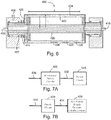
- an aerodynamic classifier 500 which may be of any of the embodiments described above, is shown with a particle counter 540.
- An initial aerosol flow 536 enters the classifier which acts on the aerosol flow to produce a classified flow 538 containing a selected portion of the aerosol particles present in the initial aerosol flow.
- the classified flow may be for example a sampling flow.
- the particle counter may be for example a condensation particle counter.
- the embodiment shown in Fig. 7A may include embodiments used to measure a spectrum of aerodynamic diameter versus concentration or other embodiments.
- a detector may comprise a conductor connected to an electrometer circuit, for example in an annular example, the detector may comprise a conducting ring connected to an electrometer. The ring may be electrically isolated from both the remainder of the surface defining the flow channel and any other detection rings which may be present. The detectors may be situated at different axial locations along the outermost surface of the flow channel. Referring to Fig.
- an APC 400 is shown having detectors 428 located in the flow channel at which particles may impact depending on their trajectory.
- the flow channel is defined by cylinders as in Fig. 1 , although other shapes would also work.
- the detectors may be rings, electrically connected to electrometer circuits, extending around the inside of the outer cylinder. No sampling exit is necessary to classify particles when detectors are used to detect impacting particles, although the detectors could also be used in embodiments with a sampling exit.
- the example, not part of the present invention, shown in Fig. 6 may otherwise operate similarly to the embodiment of Fig.
- the rotating shaft 420, bearings 422, pulley 424, sheath flow 408, aerosol flow 406, initial flow channel 426, and exhaust flow 416 may be similar to their counterparts of Fig. 1 and cooperate similarly, except that the articles of the aerosol flow are charged.
- the particles to be measured would be charged (most likely with a corona discharge-type charger or any other particle charging method, see Hinds, Aerosol Technology, Wiley, 1999 ). The charged particles would move down the classification section and impact the electrometer rings on the outer cylinder, thereby causing a measurable current in the electrometer ring, where the current is proportional to the number concentration of particles impacting the electrometer.
- an APC 400 with electrometers such as for example the APC shown in Fig. 6
- a particle charger 430 An uncharged aerosol flow 432 enters the particle charger 430 to produce a charged aerosol flow 434 comprising charged aerosol particles.
- the APC 400 operates on the charged aerosol flow 434 to classify the charged aerosol particles. By using a data inversion routine, the aerosol size distribution can be determined. Similar techniques have been used in DMA-like instruments like the differential mobility spectrometer ( Reavell et al., A fast response particulate spectrometer for combustion aerosols.
- Aerodynamic Particle Classifier APC
- APC Aerodynamic Particle Classifier
- a detailed theoretical model has been developed for the instrument.
- the model shows the instrument can have excellent classification properties (i.e. wide range, high resolution, and high penetration efficiency) without requiring particle charging.
- An APC could be combined in series with a DMA or CPMA in order to measure other important particle properties including: mobility diameter, particle mass, effective density, fractal-like dimension, and dynamic shape factor.
Landscapes
- Chemical & Material Sciences (AREA)
- Dispersion Chemistry (AREA)
- Physics & Mathematics (AREA)
- Health & Medical Sciences (AREA)
- Life Sciences & Earth Sciences (AREA)
- Analytical Chemistry (AREA)
- Biochemistry (AREA)
- General Health & Medical Sciences (AREA)
- General Physics & Mathematics (AREA)
- Immunology (AREA)
- Pathology (AREA)
- Sampling And Sample Adjustment (AREA)
- Combined Means For Separation Of Solids (AREA)
Applications Claiming Priority (2)
| Application Number | Priority Date | Filing Date | Title |
|---|---|---|---|
| US22289009P | 2009-07-02 | 2009-07-02 | |
| PCT/CA2010/000995 WO2011000088A1 (en) | 2009-07-02 | 2010-07-02 | Particle classifier |
Publications (3)
| Publication Number | Publication Date |
|---|---|
| EP2449359A1 EP2449359A1 (en) | 2012-05-09 |
| EP2449359A4 EP2449359A4 (en) | 2014-05-21 |
| EP2449359B1 true EP2449359B1 (en) | 2020-01-01 |
Family
ID=43410400
Family Applications (1)
| Application Number | Title | Priority Date | Filing Date |
|---|---|---|---|
| EP10793465.5A Active EP2449359B1 (en) | 2009-07-02 | 2010-07-02 | Particle classifier |
Country Status (5)
| Country | Link |
|---|---|
| US (1) | US8966958B2 (enExample) |
| EP (1) | EP2449359B1 (enExample) |
| JP (1) | JP5658244B2 (enExample) |
| CA (1) | CA2764522C (enExample) |
| WO (1) | WO2011000088A1 (enExample) |
Families Citing this family (8)
| Publication number | Priority date | Publication date | Assignee | Title |
|---|---|---|---|---|
| US8272253B2 (en) * | 2008-01-22 | 2012-09-25 | Ct Associates, Inc. | Particle concentration measurement technology |
| CN104122179B (zh) * | 2014-08-05 | 2017-03-22 | 云南中烟工业有限责任公司 | 一种评价电子烟烟雾量的方法 |
| US9970855B2 (en) * | 2015-10-15 | 2018-05-15 | Clarkson University | Miniature electrical aerosol spectrometer |
| US10845288B2 (en) * | 2015-11-13 | 2020-11-24 | Virginia Commonwealth University | Curved classifiers and classification methods |
| CN107702948B (zh) * | 2016-08-08 | 2020-07-31 | 北京中检维康技术有限公司 | 气溶胶采样装置 |
| US11084046B2 (en) * | 2016-10-03 | 2021-08-10 | The Government Of The United States, As Represented By The Secretary Of The Army | Aerosol concentrating apparatus for use with aerosol aging drum |
| CN113899613B (zh) * | 2021-10-08 | 2022-10-21 | 浙江大学 | 一种基于水蒸气过饱和增长技术的纳米气溶胶富集装置及方法 |
| CN119595518B (zh) * | 2024-12-19 | 2025-10-10 | 清华大学 | 一种颗粒近壁面气动力系数测量装置和测量方法 |
Family Cites Families (29)
| Publication number | Priority date | Publication date | Assignee | Title |
|---|---|---|---|---|
| US3429187A (en) * | 1967-11-22 | 1969-02-25 | Atomic Energy Commission | Ring slit conifuge |
| US3901798A (en) * | 1973-11-21 | 1975-08-26 | Environmental Research Corp | Aerosol concentrator and classifier |
| FR2557295B1 (fr) | 1983-12-23 | 1986-03-28 | Commissariat Energie Atomique | Echantillonneur d'aerosols a impaction en cascade et a depot uniforme |
| DE3615747A1 (de) * | 1986-05-09 | 1987-11-12 | Bielefeldt Ernst August | Verfahren zum trennen und/oder abscheiden von festen und/oder fluessigen partikeln mit einem wirbelkammerabscheider mit tauchrohr und wirbelkammerabscheider zur durchfuehrung des verfahrens |
| US4824738A (en) * | 1988-02-12 | 1989-04-25 | International Fuel Cells Corporation | Controlling oxygen concentrations in fuel cell cooling water loops |
| US4842738A (en) | 1988-04-29 | 1989-06-27 | Greenspan Harvey P | Centrifuge device |
| JPH0634945B2 (ja) * | 1989-03-08 | 1994-05-11 | 科学技術庁放射線医学総合研究所長 | エアロゾル粒子の連続遠心分級方法及び装置 |
| JP2799252B2 (ja) * | 1991-04-23 | 1998-09-17 | 三菱電機株式会社 | Mos型半導体装置およびその製造方法 |
| US5428220A (en) | 1993-11-29 | 1995-06-27 | The United States Of America As Represented By The Secretary Of Commerce | Aerosol mass spectrometer and method of classifying aerosol particles according to specific mass |
| US5882530A (en) * | 1997-04-30 | 1999-03-16 | The University Of Akron | Crossflow filter cyclone apparatus |
| WO1999041588A1 (en) * | 1998-02-17 | 1999-08-19 | Klaus Willeke | Aerodynamic particle size analysis method and apparatus |
| JP3086873B2 (ja) * | 1998-08-04 | 2000-09-11 | 工業技術院長 | 粒径分布測定方法及び装置 |
| JP3349965B2 (ja) * | 1998-11-05 | 2002-11-25 | 松下電器産業株式会社 | 微粒子分級方法及び装置 |
| US6698592B2 (en) * | 1998-11-13 | 2004-03-02 | Mesosystems Technology, Inc. | Virtual impactor |
| US6887710B2 (en) * | 1998-11-13 | 2005-05-03 | Mesosystems Technology, Inc. | Robust system for screening mail for biological agents |
| DE19916307C2 (de) * | 1999-04-12 | 2001-03-08 | Gsf Forschungszentrum Umwelt | Gerät zur Auftrennung des Teilchengrößenspektrums eines polydispersen Aerosols und dessen Verwendung |
| US6251296B1 (en) * | 1999-07-27 | 2001-06-26 | G.B.D. Corp. | Apparatus and method for separating particles from a cyclonic fluid flow |
| US6664550B2 (en) * | 1999-08-30 | 2003-12-16 | Sandia National Laboratories | Apparatus to collect, classify, concentrate, and characterize gas-borne particles |
| JP3558574B2 (ja) * | 1999-12-24 | 2004-08-25 | 日本電信電話株式会社 | 花粉分別方法及び装置並びに花粉飛散数計測方法及び装置 |
| US7028847B2 (en) * | 2003-05-29 | 2006-04-18 | Alstom Technology Ltd | High efficiency two-stage dynamic classifier |
| US7082811B2 (en) | 2003-08-06 | 2006-08-01 | Msp Corporation | Cascade impactor with individually driven impactor plates |
| JP4085941B2 (ja) * | 2003-09-17 | 2008-05-14 | 株式会社日立製作所 | 分析装置 |
| GB2416913A (en) * | 2004-08-07 | 2006-02-08 | Cambustion Ltd | A centrifugal particle mass analyser |
| US7298486B2 (en) * | 2004-12-30 | 2007-11-20 | Brookhaven Science Associates, Llc | Aerosol mobility size spectrometer |
| US7178380B2 (en) * | 2005-01-24 | 2007-02-20 | Joseph Gerard Birmingham | Virtual impactor device with reduced fouling |
| US8301396B1 (en) * | 2006-10-20 | 2012-10-30 | Clarkson University | Miniature ultrafine particle sensor |
| US7799575B2 (en) * | 2006-11-07 | 2010-09-21 | Genetix Limited | Flow cytometers |
| US8104362B2 (en) * | 2008-01-08 | 2012-01-31 | Texas A&M University System | In-line virtual impactor |
| US8528427B2 (en) * | 2010-10-29 | 2013-09-10 | Becton, Dickinson And Company | Dual feedback vacuum fluidics for a flow-type particle analyzer |
-
2010
- 2010-07-02 CA CA2764522A patent/CA2764522C/en active Active
- 2010-07-02 US US13/379,627 patent/US8966958B2/en active Active
- 2010-07-02 WO PCT/CA2010/000995 patent/WO2011000088A1/en not_active Ceased
- 2010-07-02 EP EP10793465.5A patent/EP2449359B1/en active Active
- 2010-07-02 JP JP2012516456A patent/JP5658244B2/ja active Active
Non-Patent Citations (1)
| Title |
|---|
| None * |
Also Published As
| Publication number | Publication date |
|---|---|
| CA2764522C (en) | 2015-09-15 |
| US8966958B2 (en) | 2015-03-03 |
| EP2449359A1 (en) | 2012-05-09 |
| US20120096924A1 (en) | 2012-04-26 |
| WO2011000088A1 (en) | 2011-01-06 |
| JP5658244B2 (ja) | 2015-01-21 |
| EP2449359A4 (en) | 2014-05-21 |
| JP2012531577A (ja) | 2012-12-10 |
| CA2764522A1 (en) | 2011-01-06 |
Similar Documents
| Publication | Publication Date | Title |
|---|---|---|
| EP2449359B1 (en) | Particle classifier | |
| Tavakoli et al. | An instrument for the classification of aerosols by particle relaxation time: Theoretical models of the aerodynamic aerosol classifier | |
| Flagan | On differential mobility analyzer resolution | |
| US8044350B2 (en) | Miniaturized ultrafine particle sizer and monitor | |
| Ehara et al. | Novel method to classify aerosol particles according to their mass-to-charge ratio—aerosol particle mass analyser | |
| US10799883B2 (en) | Method for the selective purification of aerosols | |
| US10814335B2 (en) | Selective aerosol particle collecting method and device, according to particle size | |
| US6827761B2 (en) | Particle concentrator | |
| US10675639B2 (en) | Device for collecting particles contained in an aerosol, comprising electrometres to determine nanoparticle concentration and particle size | |
| Brown | Tutorial review: Simultaneous measurement of particle size and particle charge | |
| Flagan | Differential mobility analysis of aerosols: a tutorial | |
| Flagan | Opposed migration aerosol classifier (OMAC) | |
| NZ540622A (en) | An electrostatic precipitator | |
| GB2346700A (en) | Particulate size detector | |
| JP2517872B2 (ja) | エアロゾル粒子質量分析方法 | |
| Asgharian et al. | Transport and deposition of spherical particles and fibers in an improved virtual impactor | |
| Li et al. | A miniature disk electrostatic aerosol classifier (mini-disk EAC) for personal nanoparticle sizers | |
| Chen et al. | Size classification of carbon fiber aerosols | |
| Kim et al. | Design modification of virtual impactor for enhancing particle concentration performance | |
| Roth et al. | Design and test of a particle mass spectrometer (PMS) | |
| Intra et al. | An electrical mobility spectrometer for aerosol size distribution measurement | |
| JP2008128739A (ja) | 微小粒子の粒子数計測方法及び装置 | |
| Raabe | Instruments and methods for characterizing radioactive aerosols | |
| Schmidt‐Ott | New developments in aerosol characterization from the physical point of view | |
| SU922590A1 (ru) | Спектрометр аэрозол |
Legal Events
| Date | Code | Title | Description |
|---|---|---|---|
| PUAI | Public reference made under article 153(3) epc to a published international application that has entered the european phase |
Free format text: ORIGINAL CODE: 0009012 |
|
| 17P | Request for examination filed |
Effective date: 20111215 |
|
| AK | Designated contracting states |
Kind code of ref document: A1 Designated state(s): AL AT BE BG CH CY CZ DE DK EE ES FI FR GB GR HR HU IE IS IT LI LT LU LV MC MK MT NL NO PL PT RO SE SI SK SM TR |
|
| DAX | Request for extension of the european patent (deleted) | ||
| RIC1 | Information provided on ipc code assigned before grant |
Ipc: G01N 15/00 20060101AFI20140408BHEP Ipc: G01N 15/02 20060101ALI20140408BHEP Ipc: G01N 15/06 20060101ALI20140408BHEP |
|
| A4 | Supplementary search report drawn up and despatched |
Effective date: 20140425 |
|
| 17Q | First examination report despatched |
Effective date: 20160714 |
|
| STAA | Information on the status of an ep patent application or granted ep patent |
Free format text: STATUS: EXAMINATION IS IN PROGRESS |
|
| GRAP | Despatch of communication of intention to grant a patent |
Free format text: ORIGINAL CODE: EPIDOSNIGR1 |
|
| STAA | Information on the status of an ep patent application or granted ep patent |
Free format text: STATUS: GRANT OF PATENT IS INTENDED |
|
| INTG | Intention to grant announced |
Effective date: 20190816 |
|
| GRAS | Grant fee paid |
Free format text: ORIGINAL CODE: EPIDOSNIGR3 |
|
| GRAA | (expected) grant |
Free format text: ORIGINAL CODE: 0009210 |
|
| STAA | Information on the status of an ep patent application or granted ep patent |
Free format text: STATUS: THE PATENT HAS BEEN GRANTED |
|
| AK | Designated contracting states |
Kind code of ref document: B1 Designated state(s): AL AT BE BG CH CY CZ DE DK EE ES FI FR GB GR HR HU IE IS IT LI LT LU LV MC MK MT NL NO PL PT RO SE SI SK SM TR |
|
| REG | Reference to a national code |
Ref country code: GB Ref legal event code: FG4D |
|
| REG | Reference to a national code |
Ref country code: CH Ref legal event code: EP Ref country code: AT Ref legal event code: REF Ref document number: 1220374 Country of ref document: AT Kind code of ref document: T Effective date: 20200115 |
|
| REG | Reference to a national code |
Ref country code: IE Ref legal event code: FG4D |
|
| REG | Reference to a national code |
Ref country code: DE Ref legal event code: R096 Ref document number: 602010062636 Country of ref document: DE |
|
| REG | Reference to a national code |
Ref country code: NL Ref legal event code: MP Effective date: 20200101 |
|
| REG | Reference to a national code |
Ref country code: LT Ref legal event code: MG4D |
|
| PG25 | Lapsed in a contracting state [announced via postgrant information from national office to epo] |
Ref country code: LT Free format text: LAPSE BECAUSE OF FAILURE TO SUBMIT A TRANSLATION OF THE DESCRIPTION OR TO PAY THE FEE WITHIN THE PRESCRIBED TIME-LIMIT Effective date: 20200101 Ref country code: NL Free format text: LAPSE BECAUSE OF FAILURE TO SUBMIT A TRANSLATION OF THE DESCRIPTION OR TO PAY THE FEE WITHIN THE PRESCRIBED TIME-LIMIT Effective date: 20200101 Ref country code: FI Free format text: LAPSE BECAUSE OF FAILURE TO SUBMIT A TRANSLATION OF THE DESCRIPTION OR TO PAY THE FEE WITHIN THE PRESCRIBED TIME-LIMIT Effective date: 20200101 Ref country code: NO Free format text: LAPSE BECAUSE OF FAILURE TO SUBMIT A TRANSLATION OF THE DESCRIPTION OR TO PAY THE FEE WITHIN THE PRESCRIBED TIME-LIMIT Effective date: 20200401 Ref country code: CZ Free format text: LAPSE BECAUSE OF FAILURE TO SUBMIT A TRANSLATION OF THE DESCRIPTION OR TO PAY THE FEE WITHIN THE PRESCRIBED TIME-LIMIT Effective date: 20200101 Ref country code: PT Free format text: LAPSE BECAUSE OF FAILURE TO SUBMIT A TRANSLATION OF THE DESCRIPTION OR TO PAY THE FEE WITHIN THE PRESCRIBED TIME-LIMIT Effective date: 20200527 |
|
| PG25 | Lapsed in a contracting state [announced via postgrant information from national office to epo] |
Ref country code: SE Free format text: LAPSE BECAUSE OF FAILURE TO SUBMIT A TRANSLATION OF THE DESCRIPTION OR TO PAY THE FEE WITHIN THE PRESCRIBED TIME-LIMIT Effective date: 20200101 Ref country code: HR Free format text: LAPSE BECAUSE OF FAILURE TO SUBMIT A TRANSLATION OF THE DESCRIPTION OR TO PAY THE FEE WITHIN THE PRESCRIBED TIME-LIMIT Effective date: 20200101 Ref country code: GR Free format text: LAPSE BECAUSE OF FAILURE TO SUBMIT A TRANSLATION OF THE DESCRIPTION OR TO PAY THE FEE WITHIN THE PRESCRIBED TIME-LIMIT Effective date: 20200402 Ref country code: LV Free format text: LAPSE BECAUSE OF FAILURE TO SUBMIT A TRANSLATION OF THE DESCRIPTION OR TO PAY THE FEE WITHIN THE PRESCRIBED TIME-LIMIT Effective date: 20200101 Ref country code: IS Free format text: LAPSE BECAUSE OF FAILURE TO SUBMIT A TRANSLATION OF THE DESCRIPTION OR TO PAY THE FEE WITHIN THE PRESCRIBED TIME-LIMIT Effective date: 20200501 Ref country code: BG Free format text: LAPSE BECAUSE OF FAILURE TO SUBMIT A TRANSLATION OF THE DESCRIPTION OR TO PAY THE FEE WITHIN THE PRESCRIBED TIME-LIMIT Effective date: 20200401 |
|
| REG | Reference to a national code |
Ref country code: DE Ref legal event code: R097 Ref document number: 602010062636 Country of ref document: DE |
|
| PG25 | Lapsed in a contracting state [announced via postgrant information from national office to epo] |
Ref country code: RO Free format text: LAPSE BECAUSE OF FAILURE TO SUBMIT A TRANSLATION OF THE DESCRIPTION OR TO PAY THE FEE WITHIN THE PRESCRIBED TIME-LIMIT Effective date: 20200101 Ref country code: SK Free format text: LAPSE BECAUSE OF FAILURE TO SUBMIT A TRANSLATION OF THE DESCRIPTION OR TO PAY THE FEE WITHIN THE PRESCRIBED TIME-LIMIT Effective date: 20200101 Ref country code: ES Free format text: LAPSE BECAUSE OF FAILURE TO SUBMIT A TRANSLATION OF THE DESCRIPTION OR TO PAY THE FEE WITHIN THE PRESCRIBED TIME-LIMIT Effective date: 20200101 Ref country code: SM Free format text: LAPSE BECAUSE OF FAILURE TO SUBMIT A TRANSLATION OF THE DESCRIPTION OR TO PAY THE FEE WITHIN THE PRESCRIBED TIME-LIMIT Effective date: 20200101 Ref country code: EE Free format text: LAPSE BECAUSE OF FAILURE TO SUBMIT A TRANSLATION OF THE DESCRIPTION OR TO PAY THE FEE WITHIN THE PRESCRIBED TIME-LIMIT Effective date: 20200101 Ref country code: DK Free format text: LAPSE BECAUSE OF FAILURE TO SUBMIT A TRANSLATION OF THE DESCRIPTION OR TO PAY THE FEE WITHIN THE PRESCRIBED TIME-LIMIT Effective date: 20200101 |
|
| PLBE | No opposition filed within time limit |
Free format text: ORIGINAL CODE: 0009261 |
|
| STAA | Information on the status of an ep patent application or granted ep patent |
Free format text: STATUS: NO OPPOSITION FILED WITHIN TIME LIMIT |
|
| REG | Reference to a national code |
Ref country code: AT Ref legal event code: MK05 Ref document number: 1220374 Country of ref document: AT Kind code of ref document: T Effective date: 20200101 |
|
| 26N | No opposition filed |
Effective date: 20201002 |
|
| PG25 | Lapsed in a contracting state [announced via postgrant information from national office to epo] |
Ref country code: AT Free format text: LAPSE BECAUSE OF FAILURE TO SUBMIT A TRANSLATION OF THE DESCRIPTION OR TO PAY THE FEE WITHIN THE PRESCRIBED TIME-LIMIT Effective date: 20200101 Ref country code: IT Free format text: LAPSE BECAUSE OF FAILURE TO SUBMIT A TRANSLATION OF THE DESCRIPTION OR TO PAY THE FEE WITHIN THE PRESCRIBED TIME-LIMIT Effective date: 20200101 |
|
| PG25 | Lapsed in a contracting state [announced via postgrant information from national office to epo] |
Ref country code: SI Free format text: LAPSE BECAUSE OF FAILURE TO SUBMIT A TRANSLATION OF THE DESCRIPTION OR TO PAY THE FEE WITHIN THE PRESCRIBED TIME-LIMIT Effective date: 20200101 Ref country code: PL Free format text: LAPSE BECAUSE OF FAILURE TO SUBMIT A TRANSLATION OF THE DESCRIPTION OR TO PAY THE FEE WITHIN THE PRESCRIBED TIME-LIMIT Effective date: 20200101 Ref country code: MC Free format text: LAPSE BECAUSE OF FAILURE TO SUBMIT A TRANSLATION OF THE DESCRIPTION OR TO PAY THE FEE WITHIN THE PRESCRIBED TIME-LIMIT Effective date: 20200101 |
|
| REG | Reference to a national code |
Ref country code: CH Ref legal event code: PL |
|
| REG | Reference to a national code |
Ref country code: BE Ref legal event code: MM Effective date: 20200731 |
|
| PG25 | Lapsed in a contracting state [announced via postgrant information from national office to epo] |
Ref country code: CH Free format text: LAPSE BECAUSE OF NON-PAYMENT OF DUE FEES Effective date: 20200731 Ref country code: IE Free format text: LAPSE BECAUSE OF NON-PAYMENT OF DUE FEES Effective date: 20200702 Ref country code: LI Free format text: LAPSE BECAUSE OF NON-PAYMENT OF DUE FEES Effective date: 20200731 Ref country code: LU Free format text: LAPSE BECAUSE OF NON-PAYMENT OF DUE FEES Effective date: 20200702 |
|
| PG25 | Lapsed in a contracting state [announced via postgrant information from national office to epo] |
Ref country code: BE Free format text: LAPSE BECAUSE OF NON-PAYMENT OF DUE FEES Effective date: 20200731 |
|
| PG25 | Lapsed in a contracting state [announced via postgrant information from national office to epo] |
Ref country code: TR Free format text: LAPSE BECAUSE OF FAILURE TO SUBMIT A TRANSLATION OF THE DESCRIPTION OR TO PAY THE FEE WITHIN THE PRESCRIBED TIME-LIMIT Effective date: 20200101 Ref country code: MT Free format text: LAPSE BECAUSE OF FAILURE TO SUBMIT A TRANSLATION OF THE DESCRIPTION OR TO PAY THE FEE WITHIN THE PRESCRIBED TIME-LIMIT Effective date: 20200101 Ref country code: CY Free format text: LAPSE BECAUSE OF FAILURE TO SUBMIT A TRANSLATION OF THE DESCRIPTION OR TO PAY THE FEE WITHIN THE PRESCRIBED TIME-LIMIT Effective date: 20200101 |
|
| PG25 | Lapsed in a contracting state [announced via postgrant information from national office to epo] |
Ref country code: MK Free format text: LAPSE BECAUSE OF FAILURE TO SUBMIT A TRANSLATION OF THE DESCRIPTION OR TO PAY THE FEE WITHIN THE PRESCRIBED TIME-LIMIT Effective date: 20200101 Ref country code: AL Free format text: LAPSE BECAUSE OF FAILURE TO SUBMIT A TRANSLATION OF THE DESCRIPTION OR TO PAY THE FEE WITHIN THE PRESCRIBED TIME-LIMIT Effective date: 20200101 |
|
| PGFP | Annual fee paid to national office [announced via postgrant information from national office to epo] |
Ref country code: GB Payment date: 20250610 Year of fee payment: 16 |
|
| PGFP | Annual fee paid to national office [announced via postgrant information from national office to epo] |
Ref country code: DE Payment date: 20250612 Year of fee payment: 16 |
|
| PGFP | Annual fee paid to national office [announced via postgrant information from national office to epo] |
Ref country code: FR Payment date: 20250715 Year of fee payment: 16 |