EP2444845A1 - Radiation-sensitive resin composition - Google Patents
Radiation-sensitive resin composition Download PDFInfo
- Publication number
- EP2444845A1 EP2444845A1 EP10789454A EP10789454A EP2444845A1 EP 2444845 A1 EP2444845 A1 EP 2444845A1 EP 10789454 A EP10789454 A EP 10789454A EP 10789454 A EP10789454 A EP 10789454A EP 2444845 A1 EP2444845 A1 EP 2444845A1
- Authority
- EP
- European Patent Office
- Prior art keywords
- group
- carbon atoms
- radiation
- resin composition
- acid
- Prior art date
- Legal status (The legal status is an assumption and is not a legal conclusion. Google has not performed a legal analysis and makes no representation as to the accuracy of the status listed.)
- Withdrawn
Links
- 0 CS([N-]**)(=O)=O Chemical compound CS([N-]**)(=O)=O 0.000 description 2
- YNGAAQTYYBPJIE-UHFFFAOYSA-N CC(C(OCC[N-]S(C(F)(F)F)(=O)=O)=O)=C Chemical compound CC(C(OCC[N-]S(C(F)(F)F)(=O)=O)=O)=C YNGAAQTYYBPJIE-UHFFFAOYSA-N 0.000 description 1
- IERYTBFEKUSJDN-UHFFFAOYSA-N CC(C(OCC[N-]S(C(F)(F)F)(=O)=[O]c(cccc1)c1S(c1ccccc1)c1ccccc1)=O)=C Chemical compound CC(C(OCC[N-]S(C(F)(F)F)(=O)=[O]c(cccc1)c1S(c1ccccc1)c1ccccc1)=O)=C IERYTBFEKUSJDN-UHFFFAOYSA-N 0.000 description 1
- BOEHIKMWGUNWSS-UHFFFAOYSA-N CC1CC(C)C(C[N-]S(C(F)(F)F)(=O)=O)C(C2)CC2C1 Chemical compound CC1CC(C)C(C[N-]S(C(F)(F)F)(=O)=O)C(C2)CC2C1 BOEHIKMWGUNWSS-UHFFFAOYSA-N 0.000 description 1
- RXPCIDFCSXNSMH-UHFFFAOYSA-N O=C1OC(C(C[N-]S(C(F)(F)F)(=O)=O)C(C2)C3)C3C2C1 Chemical compound O=C1OC(C(C[N-]S(C(F)(F)F)(=O)=O)C(C2)C3)C3C2C1 RXPCIDFCSXNSMH-UHFFFAOYSA-N 0.000 description 1
- OJXRGAIXTYKYSK-UHFFFAOYSA-N O=C1OC(C[N-]S(C(F)(F)F)(=O)=O)CC1 Chemical compound O=C1OC(C[N-]S(C(F)(F)F)(=O)=O)CC1 OJXRGAIXTYKYSK-UHFFFAOYSA-N 0.000 description 1
- JLOLLABTDTYBBM-UHFFFAOYSA-N O=C1OCCC(C[N-]S(C(F)(F)F)(=O)=O)C1 Chemical compound O=C1OCCC(C[N-]S(C(F)(F)F)(=O)=O)C1 JLOLLABTDTYBBM-UHFFFAOYSA-N 0.000 description 1
- UGDSOJLLMFAZBI-UHFFFAOYSA-N O=C1OCCC1C[N-]S(C(F)(F)F)(=O)=O Chemical compound O=C1OCCC1C[N-]S(C(F)(F)F)(=O)=O UGDSOJLLMFAZBI-UHFFFAOYSA-N 0.000 description 1
Classifications
-
- G—PHYSICS
- G03—PHOTOGRAPHY; CINEMATOGRAPHY; ANALOGOUS TECHNIQUES USING WAVES OTHER THAN OPTICAL WAVES; ELECTROGRAPHY; HOLOGRAPHY
- G03F—PHOTOMECHANICAL PRODUCTION OF TEXTURED OR PATTERNED SURFACES, e.g. FOR PRINTING, FOR PROCESSING OF SEMICONDUCTOR DEVICES; MATERIALS THEREFOR; ORIGINALS THEREFOR; APPARATUS SPECIALLY ADAPTED THEREFOR
- G03F7/00—Photomechanical, e.g. photolithographic, production of textured or patterned surfaces, e.g. printing surfaces; Materials therefor, e.g. comprising photoresists; Apparatus specially adapted therefor
- G03F7/004—Photosensitive materials
- G03F7/0045—Photosensitive materials with organic non-macromolecular light-sensitive compounds not otherwise provided for, e.g. dissolution inhibitors
-
- C—CHEMISTRY; METALLURGY
- C08—ORGANIC MACROMOLECULAR COMPOUNDS; THEIR PREPARATION OR CHEMICAL WORKING-UP; COMPOSITIONS BASED THEREON
- C08K—Use of inorganic or non-macromolecular organic substances as compounding ingredients
- C08K5/00—Use of organic ingredients
- C08K5/36—Sulfur-, selenium-, or tellurium-containing compounds
- C08K5/43—Compounds containing sulfur bound to nitrogen
-
- C—CHEMISTRY; METALLURGY
- C08—ORGANIC MACROMOLECULAR COMPOUNDS; THEIR PREPARATION OR CHEMICAL WORKING-UP; COMPOSITIONS BASED THEREON
- C08F—MACROMOLECULAR COMPOUNDS OBTAINED BY REACTIONS ONLY INVOLVING CARBON-TO-CARBON UNSATURATED BONDS
- C08F220/00—Copolymers of compounds having one or more unsaturated aliphatic radicals, each having only one carbon-to-carbon double bond, and only one being terminated by only one carboxyl radical or a salt, anhydride ester, amide, imide or nitrile thereof
- C08F220/02—Monocarboxylic acids having less than ten carbon atoms; Derivatives thereof
- C08F220/10—Esters
- C08F220/12—Esters of monohydric alcohols or phenols
- C08F220/16—Esters of monohydric alcohols or phenols of phenols or of alcohols containing two or more carbon atoms
- C08F220/18—Esters of monohydric alcohols or phenols of phenols or of alcohols containing two or more carbon atoms with acrylic or methacrylic acids
-
- C—CHEMISTRY; METALLURGY
- C08—ORGANIC MACROMOLECULAR COMPOUNDS; THEIR PREPARATION OR CHEMICAL WORKING-UP; COMPOSITIONS BASED THEREON
- C08F—MACROMOLECULAR COMPOUNDS OBTAINED BY REACTIONS ONLY INVOLVING CARBON-TO-CARBON UNSATURATED BONDS
- C08F220/00—Copolymers of compounds having one or more unsaturated aliphatic radicals, each having only one carbon-to-carbon double bond, and only one being terminated by only one carboxyl radical or a salt, anhydride ester, amide, imide or nitrile thereof
- C08F220/02—Monocarboxylic acids having less than ten carbon atoms; Derivatives thereof
- C08F220/10—Esters
- C08F220/12—Esters of monohydric alcohols or phenols
- C08F220/16—Esters of monohydric alcohols or phenols of phenols or of alcohols containing two or more carbon atoms
- C08F220/18—Esters of monohydric alcohols or phenols of phenols or of alcohols containing two or more carbon atoms with acrylic or methacrylic acids
- C08F220/1811—C10or C11-(Meth)acrylate, e.g. isodecyl (meth)acrylate, isobornyl (meth)acrylate or 2-naphthyl (meth)acrylate
-
- C—CHEMISTRY; METALLURGY
- C08—ORGANIC MACROMOLECULAR COMPOUNDS; THEIR PREPARATION OR CHEMICAL WORKING-UP; COMPOSITIONS BASED THEREON
- C08F—MACROMOLECULAR COMPOUNDS OBTAINED BY REACTIONS ONLY INVOLVING CARBON-TO-CARBON UNSATURATED BONDS
- C08F220/00—Copolymers of compounds having one or more unsaturated aliphatic radicals, each having only one carbon-to-carbon double bond, and only one being terminated by only one carboxyl radical or a salt, anhydride ester, amide, imide or nitrile thereof
- C08F220/02—Monocarboxylic acids having less than ten carbon atoms; Derivatives thereof
- C08F220/10—Esters
- C08F220/26—Esters containing oxygen in addition to the carboxy oxygen
- C08F220/28—Esters containing oxygen in addition to the carboxy oxygen containing no aromatic rings in the alcohol moiety
- C08F220/283—Esters containing oxygen in addition to the carboxy oxygen containing no aromatic rings in the alcohol moiety and containing one or more carboxylic moiety in the chain, e.g. acetoacetoxyethyl(meth)acrylate
-
- C—CHEMISTRY; METALLURGY
- C08—ORGANIC MACROMOLECULAR COMPOUNDS; THEIR PREPARATION OR CHEMICAL WORKING-UP; COMPOSITIONS BASED THEREON
- C08F—MACROMOLECULAR COMPOUNDS OBTAINED BY REACTIONS ONLY INVOLVING CARBON-TO-CARBON UNSATURATED BONDS
- C08F8/00—Chemical modification by after-treatment
- C08F8/34—Introducing sulfur atoms or sulfur-containing groups
-
- G—PHYSICS
- G03—PHOTOGRAPHY; CINEMATOGRAPHY; ANALOGOUS TECHNIQUES USING WAVES OTHER THAN OPTICAL WAVES; ELECTROGRAPHY; HOLOGRAPHY
- G03F—PHOTOMECHANICAL PRODUCTION OF TEXTURED OR PATTERNED SURFACES, e.g. FOR PRINTING, FOR PROCESSING OF SEMICONDUCTOR DEVICES; MATERIALS THEREFOR; ORIGINALS THEREFOR; APPARATUS SPECIALLY ADAPTED THEREFOR
- G03F7/00—Photomechanical, e.g. photolithographic, production of textured or patterned surfaces, e.g. printing surfaces; Materials therefor, e.g. comprising photoresists; Apparatus specially adapted therefor
- G03F7/004—Photosensitive materials
- G03F7/0046—Photosensitive materials with perfluoro compounds, e.g. for dry lithography
-
- G—PHYSICS
- G03—PHOTOGRAPHY; CINEMATOGRAPHY; ANALOGOUS TECHNIQUES USING WAVES OTHER THAN OPTICAL WAVES; ELECTROGRAPHY; HOLOGRAPHY
- G03F—PHOTOMECHANICAL PRODUCTION OF TEXTURED OR PATTERNED SURFACES, e.g. FOR PRINTING, FOR PROCESSING OF SEMICONDUCTOR DEVICES; MATERIALS THEREFOR; ORIGINALS THEREFOR; APPARATUS SPECIALLY ADAPTED THEREFOR
- G03F7/00—Photomechanical, e.g. photolithographic, production of textured or patterned surfaces, e.g. printing surfaces; Materials therefor, e.g. comprising photoresists; Apparatus specially adapted therefor
- G03F7/004—Photosensitive materials
- G03F7/027—Non-macromolecular photopolymerisable compounds having carbon-to-carbon double bonds, e.g. ethylenic compounds
- G03F7/028—Non-macromolecular photopolymerisable compounds having carbon-to-carbon double bonds, e.g. ethylenic compounds with photosensitivity-increasing substances, e.g. photoinitiators
- G03F7/029—Inorganic compounds; Onium compounds; Organic compounds having hetero atoms other than oxygen, nitrogen or sulfur
-
- G—PHYSICS
- G03—PHOTOGRAPHY; CINEMATOGRAPHY; ANALOGOUS TECHNIQUES USING WAVES OTHER THAN OPTICAL WAVES; ELECTROGRAPHY; HOLOGRAPHY
- G03F—PHOTOMECHANICAL PRODUCTION OF TEXTURED OR PATTERNED SURFACES, e.g. FOR PRINTING, FOR PROCESSING OF SEMICONDUCTOR DEVICES; MATERIALS THEREFOR; ORIGINALS THEREFOR; APPARATUS SPECIALLY ADAPTED THEREFOR
- G03F7/00—Photomechanical, e.g. photolithographic, production of textured or patterned surfaces, e.g. printing surfaces; Materials therefor, e.g. comprising photoresists; Apparatus specially adapted therefor
- G03F7/004—Photosensitive materials
- G03F7/039—Macromolecular compounds which are photodegradable, e.g. positive electron resists
-
- G—PHYSICS
- G03—PHOTOGRAPHY; CINEMATOGRAPHY; ANALOGOUS TECHNIQUES USING WAVES OTHER THAN OPTICAL WAVES; ELECTROGRAPHY; HOLOGRAPHY
- G03F—PHOTOMECHANICAL PRODUCTION OF TEXTURED OR PATTERNED SURFACES, e.g. FOR PRINTING, FOR PROCESSING OF SEMICONDUCTOR DEVICES; MATERIALS THEREFOR; ORIGINALS THEREFOR; APPARATUS SPECIALLY ADAPTED THEREFOR
- G03F7/00—Photomechanical, e.g. photolithographic, production of textured or patterned surfaces, e.g. printing surfaces; Materials therefor, e.g. comprising photoresists; Apparatus specially adapted therefor
- G03F7/004—Photosensitive materials
- G03F7/039—Macromolecular compounds which are photodegradable, e.g. positive electron resists
- G03F7/0392—Macromolecular compounds which are photodegradable, e.g. positive electron resists the macromolecular compound being present in a chemically amplified positive photoresist composition
-
- G—PHYSICS
- G03—PHOTOGRAPHY; CINEMATOGRAPHY; ANALOGOUS TECHNIQUES USING WAVES OTHER THAN OPTICAL WAVES; ELECTROGRAPHY; HOLOGRAPHY
- G03F—PHOTOMECHANICAL PRODUCTION OF TEXTURED OR PATTERNED SURFACES, e.g. FOR PRINTING, FOR PROCESSING OF SEMICONDUCTOR DEVICES; MATERIALS THEREFOR; ORIGINALS THEREFOR; APPARATUS SPECIALLY ADAPTED THEREFOR
- G03F7/00—Photomechanical, e.g. photolithographic, production of textured or patterned surfaces, e.g. printing surfaces; Materials therefor, e.g. comprising photoresists; Apparatus specially adapted therefor
- G03F7/004—Photosensitive materials
- G03F7/039—Macromolecular compounds which are photodegradable, e.g. positive electron resists
- G03F7/0392—Macromolecular compounds which are photodegradable, e.g. positive electron resists the macromolecular compound being present in a chemically amplified positive photoresist composition
- G03F7/0397—Macromolecular compounds which are photodegradable, e.g. positive electron resists the macromolecular compound being present in a chemically amplified positive photoresist composition the macromolecular compound having an alicyclic moiety in a side chain
-
- G—PHYSICS
- G03—PHOTOGRAPHY; CINEMATOGRAPHY; ANALOGOUS TECHNIQUES USING WAVES OTHER THAN OPTICAL WAVES; ELECTROGRAPHY; HOLOGRAPHY
- G03F—PHOTOMECHANICAL PRODUCTION OF TEXTURED OR PATTERNED SURFACES, e.g. FOR PRINTING, FOR PROCESSING OF SEMICONDUCTOR DEVICES; MATERIALS THEREFOR; ORIGINALS THEREFOR; APPARATUS SPECIALLY ADAPTED THEREFOR
- G03F7/00—Photomechanical, e.g. photolithographic, production of textured or patterned surfaces, e.g. printing surfaces; Materials therefor, e.g. comprising photoresists; Apparatus specially adapted therefor
- G03F7/20—Exposure; Apparatus therefor
- G03F7/2002—Exposure; Apparatus therefor with visible light or UV light, through an original having an opaque pattern on a transparent support, e.g. film printing, projection printing; by reflection of visible or UV light from an original such as a printed image
- G03F7/2004—Exposure; Apparatus therefor with visible light or UV light, through an original having an opaque pattern on a transparent support, e.g. film printing, projection printing; by reflection of visible or UV light from an original such as a printed image characterised by the use of a particular light source, e.g. fluorescent lamps or deep UV light
-
- H—ELECTRICITY
- H10—SEMICONDUCTOR DEVICES; ELECTRIC SOLID-STATE DEVICES NOT OTHERWISE PROVIDED FOR
- H10P—GENERIC PROCESSES OR APPARATUS FOR THE MANUFACTURE OR TREATMENT OF DEVICES COVERED BY CLASS H10
- H10P76/00—Manufacture or treatment of masks on semiconductor bodies, e.g. by lithography or photolithography
- H10P76/20—Manufacture or treatment of masks on semiconductor bodies, e.g. by lithography or photolithography of masks comprising organic materials
-
- C—CHEMISTRY; METALLURGY
- C08—ORGANIC MACROMOLECULAR COMPOUNDS; THEIR PREPARATION OR CHEMICAL WORKING-UP; COMPOSITIONS BASED THEREON
- C08F—MACROMOLECULAR COMPOUNDS OBTAINED BY REACTIONS ONLY INVOLVING CARBON-TO-CARBON UNSATURATED BONDS
- C08F220/00—Copolymers of compounds having one or more unsaturated aliphatic radicals, each having only one carbon-to-carbon double bond, and only one being terminated by only one carboxyl radical or a salt, anhydride ester, amide, imide or nitrile thereof
- C08F220/02—Monocarboxylic acids having less than ten carbon atoms; Derivatives thereof
- C08F220/10—Esters
- C08F220/12—Esters of monohydric alcohols or phenols
- C08F220/16—Esters of monohydric alcohols or phenols of phenols or of alcohols containing two or more carbon atoms
- C08F220/18—Esters of monohydric alcohols or phenols of phenols or of alcohols containing two or more carbon atoms with acrylic or methacrylic acids
- C08F220/1806—C6-(meth)acrylate, e.g. (cyclo)hexyl (meth)acrylate or phenyl (meth)acrylate
-
- C—CHEMISTRY; METALLURGY
- C08—ORGANIC MACROMOLECULAR COMPOUNDS; THEIR PREPARATION OR CHEMICAL WORKING-UP; COMPOSITIONS BASED THEREON
- C08F—MACROMOLECULAR COMPOUNDS OBTAINED BY REACTIONS ONLY INVOLVING CARBON-TO-CARBON UNSATURATED BONDS
- C08F220/00—Copolymers of compounds having one or more unsaturated aliphatic radicals, each having only one carbon-to-carbon double bond, and only one being terminated by only one carboxyl radical or a salt, anhydride ester, amide, imide or nitrile thereof
- C08F220/02—Monocarboxylic acids having less than ten carbon atoms; Derivatives thereof
- C08F220/10—Esters
- C08F220/12—Esters of monohydric alcohols or phenols
- C08F220/16—Esters of monohydric alcohols or phenols of phenols or of alcohols containing two or more carbon atoms
- C08F220/18—Esters of monohydric alcohols or phenols of phenols or of alcohols containing two or more carbon atoms with acrylic or methacrylic acids
- C08F220/1807—C7-(meth)acrylate, e.g. heptyl (meth)acrylate or benzyl (meth)acrylate
-
- C—CHEMISTRY; METALLURGY
- C08—ORGANIC MACROMOLECULAR COMPOUNDS; THEIR PREPARATION OR CHEMICAL WORKING-UP; COMPOSITIONS BASED THEREON
- C08F—MACROMOLECULAR COMPOUNDS OBTAINED BY REACTIONS ONLY INVOLVING CARBON-TO-CARBON UNSATURATED BONDS
- C08F220/00—Copolymers of compounds having one or more unsaturated aliphatic radicals, each having only one carbon-to-carbon double bond, and only one being terminated by only one carboxyl radical or a salt, anhydride ester, amide, imide or nitrile thereof
- C08F220/02—Monocarboxylic acids having less than ten carbon atoms; Derivatives thereof
- C08F220/10—Esters
- C08F220/12—Esters of monohydric alcohols or phenols
- C08F220/16—Esters of monohydric alcohols or phenols of phenols or of alcohols containing two or more carbon atoms
- C08F220/18—Esters of monohydric alcohols or phenols of phenols or of alcohols containing two or more carbon atoms with acrylic or methacrylic acids
- C08F220/1812—C12-(meth)acrylate, e.g. lauryl (meth)acrylate
-
- C—CHEMISTRY; METALLURGY
- C08—ORGANIC MACROMOLECULAR COMPOUNDS; THEIR PREPARATION OR CHEMICAL WORKING-UP; COMPOSITIONS BASED THEREON
- C08F—MACROMOLECULAR COMPOUNDS OBTAINED BY REACTIONS ONLY INVOLVING CARBON-TO-CARBON UNSATURATED BONDS
- C08F220/00—Copolymers of compounds having one or more unsaturated aliphatic radicals, each having only one carbon-to-carbon double bond, and only one being terminated by only one carboxyl radical or a salt, anhydride ester, amide, imide or nitrile thereof
- C08F220/02—Monocarboxylic acids having less than ten carbon atoms; Derivatives thereof
- C08F220/10—Esters
- C08F220/38—Esters containing sulfur
- C08F220/382—Esters containing sulfur and containing oxygen, e.g. 2-sulfoethyl (meth)acrylate
-
- Y—GENERAL TAGGING OF NEW TECHNOLOGICAL DEVELOPMENTS; GENERAL TAGGING OF CROSS-SECTIONAL TECHNOLOGIES SPANNING OVER SEVERAL SECTIONS OF THE IPC; TECHNICAL SUBJECTS COVERED BY FORMER USPC CROSS-REFERENCE ART COLLECTIONS [XRACs] AND DIGESTS
- Y10—TECHNICAL SUBJECTS COVERED BY FORMER USPC
- Y10S—TECHNICAL SUBJECTS COVERED BY FORMER USPC CROSS-REFERENCE ART COLLECTIONS [XRACs] AND DIGESTS
- Y10S430/00—Radiation imagery chemistry: process, composition, or product thereof
- Y10S430/1053—Imaging affecting physical property or radiation sensitive material, or producing nonplanar or printing surface - process, composition, or product: radiation sensitive composition or product or process of making binder containing
- Y10S430/1055—Radiation sensitive composition or product or process of making
- Y10S430/106—Binder containing
- Y10S430/111—Polymer of unsaturated acid or ester
-
- Y—GENERAL TAGGING OF NEW TECHNOLOGICAL DEVELOPMENTS; GENERAL TAGGING OF CROSS-SECTIONAL TECHNOLOGIES SPANNING OVER SEVERAL SECTIONS OF THE IPC; TECHNICAL SUBJECTS COVERED BY FORMER USPC CROSS-REFERENCE ART COLLECTIONS [XRACs] AND DIGESTS
- Y10—TECHNICAL SUBJECTS COVERED BY FORMER USPC
- Y10S—TECHNICAL SUBJECTS COVERED BY FORMER USPC CROSS-REFERENCE ART COLLECTIONS [XRACs] AND DIGESTS
- Y10S430/00—Radiation imagery chemistry: process, composition, or product thereof
- Y10S430/1053—Imaging affecting physical property or radiation sensitive material, or producing nonplanar or printing surface - process, composition, or product: radiation sensitive composition or product or process of making binder containing
- Y10S430/1055—Radiation sensitive composition or product or process of making
- Y10S430/114—Initiator containing
- Y10S430/12—Nitrogen compound containing
-
- Y—GENERAL TAGGING OF NEW TECHNOLOGICAL DEVELOPMENTS; GENERAL TAGGING OF CROSS-SECTIONAL TECHNOLOGIES SPANNING OVER SEVERAL SECTIONS OF THE IPC; TECHNICAL SUBJECTS COVERED BY FORMER USPC CROSS-REFERENCE ART COLLECTIONS [XRACs] AND DIGESTS
- Y10—TECHNICAL SUBJECTS COVERED BY FORMER USPC
- Y10S—TECHNICAL SUBJECTS COVERED BY FORMER USPC CROSS-REFERENCE ART COLLECTIONS [XRACs] AND DIGESTS
- Y10S430/00—Radiation imagery chemistry: process, composition, or product thereof
- Y10S430/1053—Imaging affecting physical property or radiation sensitive material, or producing nonplanar or printing surface - process, composition, or product: radiation sensitive composition or product or process of making binder containing
- Y10S430/1055—Radiation sensitive composition or product or process of making
- Y10S430/114—Initiator containing
- Y10S430/122—Sulfur compound containing
-
- Y—GENERAL TAGGING OF NEW TECHNOLOGICAL DEVELOPMENTS; GENERAL TAGGING OF CROSS-SECTIONAL TECHNOLOGIES SPANNING OVER SEVERAL SECTIONS OF THE IPC; TECHNICAL SUBJECTS COVERED BY FORMER USPC CROSS-REFERENCE ART COLLECTIONS [XRACs] AND DIGESTS
- Y10—TECHNICAL SUBJECTS COVERED BY FORMER USPC
- Y10S—TECHNICAL SUBJECTS COVERED BY FORMER USPC CROSS-REFERENCE ART COLLECTIONS [XRACs] AND DIGESTS
- Y10S430/00—Radiation imagery chemistry: process, composition, or product thereof
- Y10S430/1053—Imaging affecting physical property or radiation sensitive material, or producing nonplanar or printing surface - process, composition, or product: radiation sensitive composition or product or process of making binder containing
- Y10S430/1055—Radiation sensitive composition or product or process of making
- Y10S430/114—Initiator containing
- Y10S430/126—Halogen compound containing
Definitions
- the invention relates to a radiation-sensitive resin composition. More specifically, the invention relates to a radiation-sensitive resin composition that may be used for photolithography process employed in the production of semiconductor devices such as IC, liquid crystal devices, circuit boards such as thermal head, and the like.
- the chemically-amplified radiation-sensitive resin composition generates the acid in the exposed area by applying, for example, far-ultraviolet rays such as KrF excimer laser light or ArF excimer laser light, makes the solubility rate in a developer change between the exposed area and the unexposed area by reaction catalyzed with the acid, and forms the resist pattern onto the substrate.
- far-ultraviolet rays such as KrF excimer laser light or ArF excimer laser light
- An acid diffusion controller that dissociates due to an acid to lose the acid diffusion controllability has attracted attention from the view point of excellent in contrast between the exposed area and the unexposed area.
- a composition including a known acid diffusion controller that dissociates due to an acid to lose acid diffusion controllability was insufficient in terms of LWR and the pattern shape.
- the resist pattern may collapse because of insufficient adhesion to the substrate and the like, so that an accurate pattern may not be formed.
- An object of the present invention is to provide a radiation-sensitive resin composition that can form a resist pattern being small LWR and excellent in pattern shape, and an accurate pattern can be formed without collapsing the resist pattern even when the fine line patter is formed.
- the inventors have been conducted extensive studies in order to achieve the above object. As a result, the inventors found that the above object can be achieved by a composition that includes an acid-labile group-containing resin and a compound having a given sulfonamide anion structure. The finding has led to the completion of the present invention.
- the present invention provides the following radiation-sensitive resin composition.
- a radiation-sensitive resin composition including (A) an acid-labile group-containing resin (hereinafter may be referred to as “resin (A)”), and (C) a compound shown by a general formula (i) (hereinafter may be referred to as “compound (C)”), ,
- R 4 to R 8 individually represent a hydrogen atom, a hydroxyl group, a nitro group, a halogen atom, a substituted or unsubstituted alkyl group having 1 to 10 carbon atoms, a cycloalkyl group having 3 to 12 carbon atoms, or an alkoxy group having 1 to 10 carbon atoms.
- B a radiation-sensitive acid generating agent
- R 9 represents a hydrogen atom, a methyl group, or a trifluoromethyl group
- R 10 represents an alkyl group having 1 to 4 carbon atoms or a monovalent alicyclic hydrocarbon group having 4 to 20 carbon atoms
- two R 11 individually represent an alkyl group having 1 to 4 carbon atoms or a monovalent alicyclic hydrocarbon group having 4 to 20 carbon atoms, provided that two R 11 may bond to each other to form a divalent alicyclic hydrocarbon group having 4 to 20 carbon atoms together with the carbon atom bonded to two R 11 .
- the above radiation-sensitive resin composition can form a resist pattern being small LWR and excellent in pattern shape, and an accurate pattern can be formed without collapsing the resist pattern even when the fine line patter is formed.
- the resin (A) is a polymer being insoluble or scarcely soluble in an alkali, including a protecting group (acid-labile group) which dissociates due to an acid, and becoming alkali-soluble by eliminating the protecting group due to an acid.
- a protecting group ascid-labile group
- the expression "insoluble or scarcely soluble in an alkali" in this specification means such a property that 50% or more of the initial thickness remain when a film of 100 nm in the thickness having been formed by using only the resin (A) is subjected instead of a resist film formed by the radiation-sensitive resin composition including resin (A) to develop under alkaline development conditions, which employed for forming a resist pattern using a resin film formed of the radiation-sensitive resin composition.
- the resin (A) includes a repeating unit having an acid-labile group.
- the repeating unit (2) is preferable as such a repeating unit having an acid-labile group.
- alkyl group having 1 to 4 carbon atoms represented by R 10 and R 11 in the general formula (2) include a methyl group, an ethyl group, an n-propyl group, an i-propyl group, an n-butyl group, a 2-methylpropyl group, a 1-methylpropyl group, a t-butyl group, and the like.
- the monovalent alicyclic hydrocarbon group having 4 to 20 carbon atoms include cycloalkyl groups such as a cyclobutyl group, a cyclopentyl group, a cyclohexyl group, a cycloheptyl group, and a cyclooctyl group; groups having a bridged alicycle skeleton such as a dicyclopentanyl group, a dicyclopentenyl group, a tricyclodecyl group, a tetracyclododecyl group, an adamantyl group, and the like.
- divalent alicyclic hydrocarbon group having 4 to 20 carbon atoms formed by two R 11 together with the carbon atom bonded to two R 11 include a group obtained by removing one hydrogen atom from a monovalent alicyclic hydrocarbon group having 4 to 20 carbon atoms.
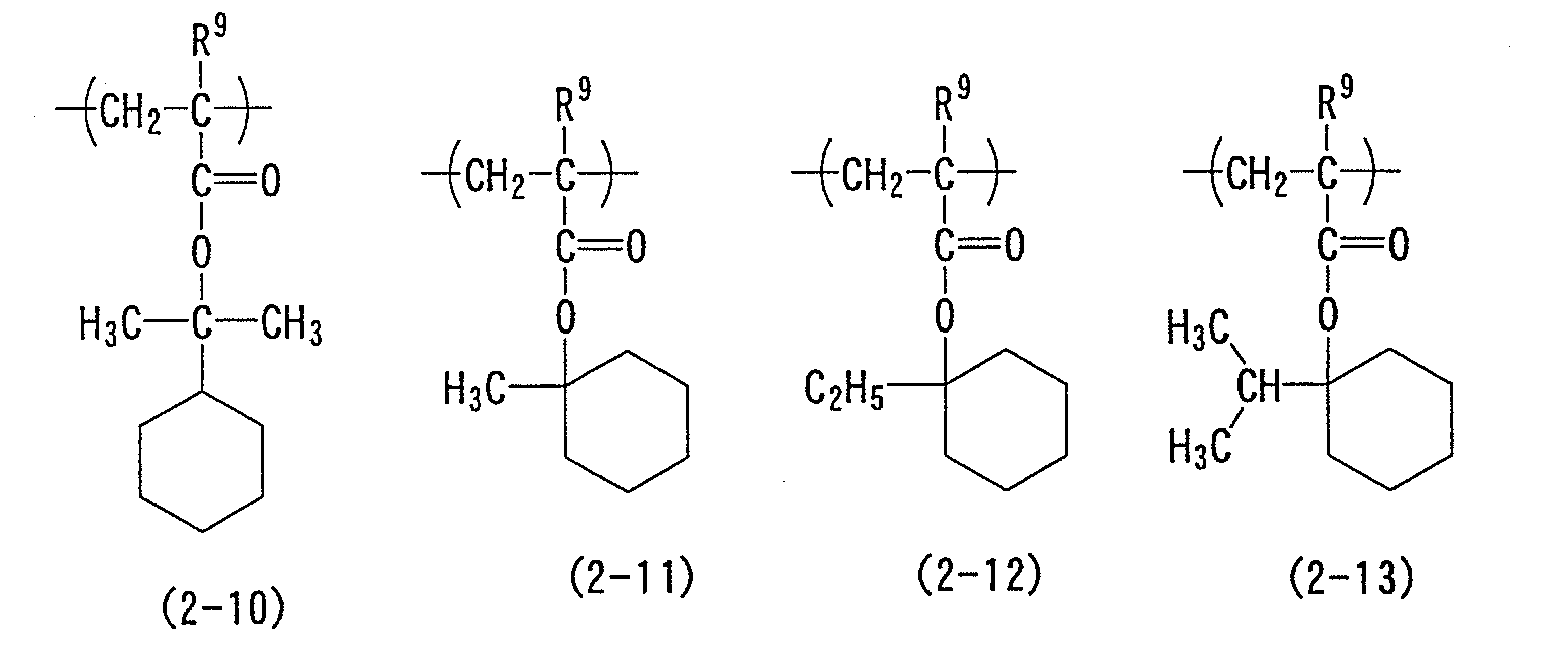
- Examples of a preferable repeating unit (2) include repeating units shown by the following general formulas (2-1) to (2-13). Note that R 9 in the general formulas (2-1) to (2-13) represents a hydrogen atom, a methyl group, or a trifluoromethyl group.
- the resin (A) may include other repeating unit.
- a preferable other repeating unit include a repeating unit having a lactone skeleton and a repeating unit having a cyclic carbonate skeleton.
- repeating unit having a lactone skeleton examples include repeating units derived from the compounds such as 5-oxo-4-oxa-tricyclo[4.2.1.0 3,7 ]non-2-yl (meth)acrylate, 9-methoxycarbonyl-5-oxo-4-oxa-tricyclo[4.2.1.0 3,7 ]non-2-yl (meth)acrylate, 5-oxo-4-oxa-tricyclo[5.2.1.0 3,8 ]dec-2-yl (meth)acrylate, 10-methoxycarbonyl-5-oxo-4-oxa-tricyclo[5.2.1.0 3,8 ]dec-2-yl (meth)acrylate, 6-oxo-7-oxa-bicyclo[3.2.1]oct-2-yl (meth)acrylate, 4-methoxycarbonyl-6-oxo-7-oxa-bicyclo[3.2.1]oct-2-yl (meth)acrylate, 7-oxo-8-
- Examples of the repeating unit having a cyclic carbonate skeleton include a repeating unit shown by the following general formula (3).
- R 9 in the general formula (3) represents a hydrogen atom, a methyl group, or a trifluoromethyl group.
- the resin (A) may include a still other repeating unit.
- the still other repeating unit include a repeating unit derived from other (meth)acrylate.
- Specific examples of other (meth)acrylate include hydroxyl group-containing (meth)acrylates, carboxyl group-containing (meth)acrylates, and the like.
- the content ratio of the repeating unit (2) in the resin (A) is preferably 20 to 80 mol%, and particularly preferably 25 to 75 mol%, based on the total repeating units included in the resin (A). If the content ratio of the repeating unit (2) is less than 20 mol%, since the sufficient solubility is not achieved, the resolution may deteriorate. On the other hand, if the content ratio exceeds 80 mol%, adhesion to a substrate may deteriorate.
- the resin (A) may be produced by polymerizing a polymerizable unsaturated monomer corresponding to each repeating unit that constitutes the desired molecular composition in an appropriate solvent in the presence of a radical initiator, a chain transfer agent, and the like. It is preferable to add the radical initiator at an amount to be sufficiently high concentration in order that a sufficient polymerization rate is achieved. However, if the ratio of additive amount of the radical initiator to the additive amount of the chain transfer agent is too high, a radical-radical coupling reaction may occur, so that an undesired non-living radical polymer may be produced.
- the molar ratio (radical initiator : chain transfer agent) of the additive amount of the radical initiator to the additive amount of the chain transfer agent is preferably set to 1:1 to 0.005:1.
- the radical initiator is not particularly limited, and includes a thermal polymerization initiator, a redox polymerization initiator, and a photopolymerization initiator.
- Specific examples of the radical initiator include peroxide initiators such as t-butyl hydroperoxide, t-butyl perbenzoate, and benzoyl peroxide; azo compounds such as 2,2'-azobis(2,4-dimethylvaleronitrile), 2,2'-azobisisobutyronitrile (AIBN), 1,1'-azobis(cyclohexanecarbonitrile), and dimethyl 2,2'-azobisisobutyrate (MAIB), and the like.
- Examples of the chain transfer agent include pyrazole derivatives, alkylthiols, and the like.
- the polymerization operation can be performed by normally method such as batch polymerization and dropwise polymerization.
- polymerizable unsaturated monomers corresponding to the repeating unit (2), the other repeating unit, and the still other repeating unit may be dissolved in an organic solvent, and polymerized in the presence of a radical initiator and a chain transfer agent to obtain the resin (A).
- An organic solvent that can normally dissolve a polymerizable unsaturated monomer, a radical initiator, and a chain transfer agent is used as the polymerization solvent.
- examples of such an organic solvent include ketone solvents, ether solvents, aprotic polar solvents, ester solvents, aromatic solvents, and linear or cyclic aliphatic solvents.
- ketone solvents include methyl ethyl ketone, acetone, and the like.
- ether solvents include alkoxyalkyl eter such as dimethyl ether, diethyl ether, tetrahydrofuran, and 1,4-dioxane.
- aprotic polar solvents include dimethylformamide, dimethylsulfoxide, and the like.
- ester solvents include alkyl acetates such as ethyl acetate and methyl acetate.
- aromatic solvents include alkylaryl solvents such as toluene and xylene, and halogenated aromatic solvents such as chlorobenzene.
- aliphatic solvents include hexane, cyclohexane, and the like.
- the polymerization temperature is normally 20 to 120°C, preferably 50 to 110°C, and more preferably 60 to 100°C.
- the polymerization may be performed under the air, but are preferably performed under an inert gas atmosphere such as nitrogen and argon.
- the polymerization time is normally 0.5 to 144 hours, preferably 1 to 72 hours, and more preferably 2 to 24 hours.
- the resin (A) may or may not include a residue derived from the chain transfer agent at the end of the molecular chain.
- the resin (A) may include part of a residue derived from the chain transfer agent at the end of the molecular chain.
- the amount of the impurity such as halogens and metals in the resin (A) keeps as low as possible, and also that the residual monomers and oligomer components in the resin (A) is defined value or less, for example, is 0.1 mass% or less determined by HPLC. This makes it possible not only to further improve the sensitivity, the resolution, the process stability, the pattern shape, and the like as the resist, but also to produce a radiation-sensitive resin composition useful for a resist of which the temporal change such as the foreign matter in the solution or the sensitivity is small.
- Method of purification of the resin (A) is as follows, for example.
- a method to remove the impurities such as metals there is a method performed by making the metals included in the solution of the resin (A) adsorb on a zeta-potential filter, a method performed by washing the solution of the resin (A) with an acidic aqueous solution such as oxalic acid or sulfonic acid to remove the metals in a chelate state, or the like.
- a method to remove the residual monomers and oligomer components till the defined value or less there is a method performed by liquid-liquid extraction method that removes residual monomers and oligomer components by washing with water, an appropriate solvent, and the like, a solution-state purification method such as ultrafiltration that extracts and removes only components having a molecular weight equal to or less than a specific value, a reprecipitation technique that removes residual monomers and the like by adding a solution of the resin (A) dropwise into a poor solvent to fix the resin (A) in a poor solvent, or solid-state purification method that washes the polymer slurry separated by filtration with a poor solvent, for example. These methods may be used in combination.
- the poor solvent is influenced by the property of resin (A) to purify
- the poor solvent used for reprecipitation technique may not be necessarily exemplified.
- the skilled person in the art may be appropriately selected depending on the properties of the polymer and the like.
- the polystyrene-reduced weight average molecular weight (hereinafter referred to as "Mw") of the resin (A) determined by gel permeation chromatography (GPC) is normally 1000 to 300,000, preferably 2000 to 300,000, and more preferably 2000 to 120,000. If the Mw of the resin (A) is less than 1000, the heat resistance as the resist may deteriorate. On the other hand, if the Mw exceeds 300,000, the developability as the resist may deteriorate.
- the ratio (Mw/Mn) of the Mw to the polystyrene-reduced number average molecular weight (hereinafter referred to as "Mn") of the resin (A) determined by gel permeation chromatography (GPC) is preferably 1 to 5, more preferably 1 to 3, and particularly preferably 1 to 1.6. Note that the molecular weight of the resin (A) may be adjusted by adjusting the ratio of the amount of monomers to the amount of the chain transfer agent.
- the acid generating agent (B) generates an acid by application of radiation.
- radiation used in this specification includes active rays such as far-ultraviolet rays (e.g., KrF excimer laser light (wavelength: 248 nm) and ArF excimer laser light (wavelength: 193 nm)).
- Examples of the acid generating agent (B) include onium salts such as sulfonium salt and iodonium salt, organic halogen compounds, and sulfone compounds such as disulfone and diazomethanesulfone.
- Specific examples of a preferable acid generating agent (B) include triphenylsulfonium salts such as triphenylsulfonium trifluoromethanesulfonate, triphenylsulfonium nonafluoro-n-butanesulfonate, triphenylsulfonium 2-(bicyclo[2.2.1]hept-2'-yl)-1,1-difluoroethanesulfonate, triphenylsulfonium perfluoro-n-octanesulfonate, triphenylsulfonium 2-(bicyclo[2.2.1]hept-2'-yl)-1,1,2,2-tetrafluoroethanesulfonate,
- 4-cyclohexylphenyldiphenylsulfonium salts such as 4-cyclohexylphenyldiphenylsulfonium trifluoromethanesulfonate, 4-cyclohexylphenyldiphenylsulfonium nonafluoro-n-butanesulfonate, 4-cyclohexylphenyldiphenylsulfonium perfluoro-n-octanesulfonate, 4-cyclohexylphenyldiphenylsulfonium 2-bicyclo[2.2.1]hept-2-yl-1,1,2,2-tetrafluoroethanesulfonate, and 4-cyclohexylphenyldiphenylsulfonium camphorsulfonate;
- 4-methanesulfonylphenyldiphenylsulfonium salts such as 4-methanesulfonylphenyldiphenylsulfonium trifluoromethanesulfonate, 4-methanesulfonylphenyldiphenylsulfonium nonafluoro-n-butanesufonate, 4-methanesulfonylphenyldiphenylsulfonium perfluoro-n-octanesulfonate, 4-methanesulfonylphenyldiphenylsulfonium 2-bicyclo[2.2.1]hept-2-yl-1,1,2,2-tetrafluoroethanesulfonate, and 4-methanesulfonylphenyldiphenylsulfonium camphorsulfonate;
- diphenyliodonium salts such as diphenyliodonium trifluoromethanesulfonate, diphenyliodonium nonafluoro-n-butanesufonate, diphenyliodonium perfluoro-n-octanesulfonate, diphenyliodonium 2-bicyclo[2.2.1]hept-2-yl-1,1,2,2-tetrafluoroethanesulfonate, and diphenyliodonium camphorsulfonate;
- bis(4-t-butylphenyl)iodonium salts such as bis(4-t-butylphenyl)iodonium trifluoromethanesulfonate, bis(4-t-butylphenyl)iodonium nonafluoro-n-butanesulfonate, bis(4-t-butylphenyl)iodonium perfluoro-n-octanesulfonate, bis(4-t-butylphenyl)iodonium 2-bicyclo[2.2.1]hept-2-yl-1,1,2,2-tetrafluoroethanesulfonate, and bis(4-t-butylphenyl)iodonium camphorsulfonate;
- 1-(4-n-butoxynaphthalen-1-yl)tetrahydrothiophenium salts such as 1-(4-n-butoxynaphthalen-1-yl)tetrahydrothiophenium trifluoromethanesulfonate, 1-(4-n-butoxynaphthalen-1 -yl)tetrahydrothiophenium nonafluoro-n-butanesulfonate, 1-(4-n-butoxynaphthalen-1-yl)tetrahydrothiophenium perfluoro-n-octanesulfonate, 1-(4-n-butoxynaphthalen-1 -yl)tetrahydrothiophenium 2-bicyclo[2.2.1]hept-2-yl-1,1,2,2-tetrafluoroethanesulfonate, and 1-(4-n-butoxynaphthalen-1-yl)tetrahydrothiophenium camphorsulfonate;
- 1-(4-n-butoxynaphthalen-1-yl)tetrahydrothiophenium salts such as 1-(6-n-butoxynaphthalen-2-yl)tetrahydrothiophenium trifluoromethanesulfonate, 1-(6-n-butoxynaphthalen-2-yl)tetrahydrothiophenium nonafluoro-n-butanesulfonate, 1-(6-n-butoxynaphthalen-2-yl)tetrahydrothiophenium perfluoro-n-octanesulfonate, 1-(6-n-butoxynaphthalen-2-yl)tetrahydrothiophenium 2-bicyclo[2.2.1]hept-2-yl-1,1,2,2-tetrafluoroethanesulfonate, and 1-(6-n-butoxynaphthalen-2-yl)tetrahydrothiophenium camphorsulfonate;
- 1-(3,5-dimethyl-4-hydroxyphenyl)tetrahydrothiophenium salts such as 1-(3,5-dimethyl-4-hydroxyphenyl)tetrahydrothiophenium trifluoromethanesulfonate, 1-(3,5-dimethyl-4-hydroxyphenyl)tetrahydrothiophenium nonafluoro-n-butanesulfonate, 1-(3,5-dimethyl-4-hydroxyphenyl)tetrahydrothiophenium perfluoro-n-octanesulfonate, 1-(3,5-dimethyl-4-hydroxyphenyl)tetrahydrothiophenium 2-bicyclo[2.2.1]hept-2-yl-1,1,2,2-tetrafluoroethanesulfonate, and 1-(3,5-dimethyl-4-hydroxyphenyl)tetrahydrothiophenium camphorsulfonate;
- bicyclo[2.2.1]hept-5-ene-2,3-dicarboxyimide compounds such as N-(trifluoromethanesulfonyloxy)bicyclo[2.2.1]hept-5-ene-2,3-dicarboxyimide, N-(nonafluoro-n-butanesulfonyloxy)bicyclo[2.2.1]hept-5-ene-2,3-dicarboxyimide, N-(perfluoro-n-octanesulfonyloxy)bicyclo[2.2.1]hept-5-ene-2,3-dicarboxyimide, N-(2-bicyclo[2.2.1]hept-2-yl-l,1,2,2-tetrafluoroethanesulfonyloxy)bicyclo[2.2.1]hept-5-ene-2,3-dicarboxyimide, N-(2-(3-tetracyclo[6.2.1.1 3,6 .0 2,7 ]dodecanyl
- the amount of the acid generating agent (B) is preferably 0.1 to 30 parts by mass, and more preferably 0.1 to 20 parts by mass, based on 100 parts by mass of the resin (A), from the view to secure the sensitivity and developability as the resist. If the amount of the acid generating agent (B) is less than 0.1 parts by mass, the sensitivity and the developability may deteriorate. On the other hand, if the amount exceeds 30 parts by mass, a rectangular resist pattern may not be obtained due to a decrease in transparency to radiation. Note that the acid generating agent (B) need not be included when the structural unit of the resin (A) or the structural unit of another polymer that may be used together with the resin (A) generates an acid by application of radiation.
- the compound (C) is shown by the general formula (i), and preferably the one which generates a weak acid having a pKa of about 3 to 8 upon exposure.
- the acid-labile group in the resin (A) for example, the acid-labile group in the repeating unit (2), has a structure that does not dissociate due to such a weak acid. Meanwhile, it is desired for the acid generated from the acid generating agent (B) upon exposure preferably to have a pKa of 2 or less.
- the compound (C) present in the unexposed area undergoes an ion-exchange reaction with the acid generated by the acid generating agent (B), and suppresses an acid diffusion phenomenon.
- the compound (C) present in the exposed area is decomposed, and loses basicity with respect to the acid generated from the acid generating agent (B). Therefore, it is possible to attain, by utilizing the radiation-sensitive resin composition including the compound (C) of the present invention, an accurate patterning without collapsing the resist pattern even in the case that a fine line patter is formed in addition to obtain the excellent contrast between the exposed area and the unexposed area.
- Examples of the linear or branched monovalent hydrocarbon group having 1 to 10 carbon atoms represented by R 1 and R 3 in the general formula (i) include a methyl group, an ethyl group, an n-propyl group, an i-propyl group, an n-butyl group, an i-butyl group, a sec-butyl group, a t-butyl group, an n-pentyl group, an i-pentyl group, an n-hexyl group, an n-heptyl group, an n-octyl group, an n-nonyl group, an n-decyl group, and the like.
- Examples of the monovalent hydrocarbon group having 3 to 20 carbon atoms that includes a cyclic structure or a partially cyclic structure include cycloalkyl groups such as a cyclopropyl group, a cyclobutyl group, a cyclopentyl group, a cyclohexyl group, and a cyclooctyl group; groups having a bridged alicycle skeleton such as a dicyclopentanyl group, a dicyclopentenyl group, a tricyclodecyl group, a tetracyclododecyl group, and an adamantyl group; alkylcycloalkyl groups such as a methylcyclohexyl group and an ethylcyclohexyl group; groups having an alkyl-substituted bridged alicycle skeleton such as a methyladamantyl group; and the groups which are not directly bonded to R 2 and bonded to R
- examples of the linear or branched monovalent hydrocarbon group having 1 to 10 carbon atoms or the monovalent hydrocarbon group having 3 to 20 carbon atoms that includes a cyclic structure or a partially cyclic structure represented by R included in the -OR group, the -OCOR group, or the -COOR group in the general formula (i) include those mentioned above in connection with R 1 and R 3 .
- Examples of a preferable compound (C) include compounds shown by the following general formulas (i-1) to (i-36). Note that X + in the general formulas (i-1) to (i-36) represents an onium cation.
- the onium cation represented by X + in the general formulas (i) and (i-1) to (i-36) is at least one of the onium cation shown by the general formula (1-1) and the onium cation shown by the general formula (1-2).
- Specific examples of the sulfonium cation shown by the general formula (1-1) include the sulfonium cations shown by the following general formulas (1-1-1) to (1-1-21).
- Specific examples of the iodonium cation shown by the general formula (1-2) include the iodonium cations shown by the following general formulas (1-2-1) to (1-2-27).
- the monovalent onium cation represented by M + in the general formulas (i) and (i-1) to (i-36) may be produced by the known method described in Advances in Polymer Science, vol. 62, pp. 1-48 (1984 ), for example.
- the amount of the compound (C) is preferably 0.001 to 20 parts by mass, and more preferably 0.001 to 12 parts by mass, based on 100 parts by mass of the resin (A). If the amount of the compound (C) is less than 0.001 parts by mass, the sensitivity as the resist and the developability of the exposed area may deteriorate. On the other hand, if the amount exceeds 20 parts by mass, the pattern shape or the dimensional accuracy as the resist may deteriorate depending on the process conditions.
- the radiation-sensitive resin composition according to one embodiment of the present invention may optionally include an additive such as other acid diffusion controller, an alicyclic additive, a surfactant, or a sensitizer.
- an additive such as other acid diffusion controller, an alicyclic additive, a surfactant, or a sensitizer.
- the compound (C) itself has acid diffusion controllability, excellent resolution, an excellent pattern shape, and excellent LWR property can be obtained even if other acid diffusion controller is not used.
- other acid diffusion controller may be used in combination with the compound (C).
- a nitrogen-containing organic compound other than the compound (C) may preferably used as the other acid diffusion controller.
- the nitrogen-containing organic compound is not particularly limited, and may be used such as mono(cyclo)alkylamines, di(cyclo)alkylamines, tri(cyclo)alkylamines, substituted alkylamines, aromatic amines, diamine compounds, polyethylenimine, polyallylamines, polymer of (2-dimethylaminoethylacrylamide), amide group-containing compounds, urea compounds, nitrogen-containing heterocyclic compounds,.
- the amount of the nitrogen-containing compound is preferably 15 parts by mass or less, more preferably 10 parts by mass or less, and particularly preferably 5 parts by mass or less, based on 100 parts by mass of the resin (A).
- the lower limit of the amount of the nitrogen-containing compound is not particularly limited. However, it is normally 0.001 parts by mass or more. If the amount of the nitrogen-containing compound exceeds 15 parts by mass, the sensitivity as the resist and the developability of the exposed area may deteriorate. On the other hand, if the amount is less than 0.001 parts by mass, the pattern shape or the dimensional accuracy as the resist may deteriorate depending on the process conditions.
- the alicyclic additive may include an acid-labile group, and is the component which further improves the dry etching resistance, the pattern shape, adhesion to a substrate, and the like.
- alicyclic additive examples include adamantane derivatives such as t-butyl 1-adamantanecarboxylate, t-butoxycarbonylmethyl 1-adamantanecarboxylate, ⁇ -butyrolactone 1-adamantanecarboxylate, di-t-butyl 1,3-adamantanedicarboxylate, t-butyl 1-adamantaneacetate, t-butoxycarbonylmethyl 1-adamantaneacetate, di-t-butyl 1,3-adamantanediacetate, and 2,5-dimethyl-2,5-di(adamantylcarbonyloxy)hexane;
- adamantane derivatives such as t-butyl 1-adamantanecarboxylate, t-butoxycarbonylmethyl 1-adamantanecarboxylate, ⁇ -butyrolactone 1-adamantanecarboxylate, di-t-butyl 1,3-adamant
- deoxycholates such as t-butyl deoxycholate, t-butoxycarbonylmethyl deoxycholate, 2-ethoxyethyl deoxycholate, 2-cyclohexyloxyethyl deoxycholate, 3-oxocyclohexyl deoxycholate, tetrahydropyranyl deoxycholate, and mevalonolactone deoxycholate; lithocholates such as t-butyl lithocholate, t-butoxycarbonylmethyl lithocholate, 2-ethoxyethyl lithocholate, 2-cyclohexyloxyethyl lithocholate, 3-oxocyclohexyl lithocholate, tetrahydropyranyl lithocholate, and mevalonolactone lithocholate; and the like.
- lithocholates such as t-butyl lithocholate, t-butoxycarbonylmethyl lithocholate, 2-e
- An alkyl carboxylate such as dimethyl adipate, diethyl adipate, dipropyl adipate, di-n-butyl adipate, or di-t-butyl adipate may be used as an additive that has the same function as that of the alicyclic additive.
- the surfactant is the component which improves the applicability, striation, developability, and the like.
- the surfactant include nonionic surfactants such as polyoxyethylene lauryl ether, polyoxyethylene stearyl ether, polyoxyethylene oleyl ether, polyoxyethylene n-octylphenyl ether, polyoxyethylene n-nonylphenyl ether, polyethylene glycol dilaurate, and polyethylene glycol distearate; commercially available products such as KP341 (manufactured by Shin-Etsu Chemical Co., Ltd.), Polyflow No. 75, Polyflow No.
- the sensitizer is a component which absorbs the energy of radiation, transmits the energy to the acid generating agent (B), and makes the amount of acid increase, and which has the effect of improving the apparent sensitivity of the radiation-sensitive resin composition.
- the sensitizer include carbazoles, benzophenones, rose bengals, anthracenes, phenols, and the like. Incidentally, these sensitizers may be used either individually or in combination.
- the amount of the sensitizer is preferably 50 parts by mass or less based on 100 parts by mass of the resin (A).
- the radiation-sensitive resin composition according to one embodiment of the present invention is normally used as a radiation-sensitive resin composition solution by dissolving the components in a solvent so that the total solid content is 1 to 50 mass%, and preferably 3 to 25 mass%, and filtering the solution through a filter having a pore size of about 0.2 ⁇ m, for example.
- Examples of the solvent used to prepare the radiation-sensitive resin composition solution include linear or branched ketones such as 2-pentanone, 2-hexanone, 2-heptanone, and 2-octanone; cyclic ketones such as cyclopentanone and cyclohexanone; propylene glycol monoalkyl ether acetates such as propylene glycol monomethyl ether acetate and propylene glycol monoethyl ether acetate; alkyl 2-hydroxypropionates such as methyl 2-hydroxypropionate and ethyl 2-hydroxypropionate; alkyl 3-alkoxypropionates such as methyl 3-methoxypropionate, ethyl 3-methoxypropionate, methyl 3-ethoxypropionate, and ethyl 3-ethoxypropionate; ethylene glycol monomethyl ether, ethylene glycol monoethyl ether, diethylene glycol dimethyl ether, diethylene glycol diethyl ether, ethylene glycol mono
- solvents may be used either individually or in combination.
- the radiation-sensitive resin composition thus prepared may suitably be used to form a resist film by spin coating or the like in the normally performed photolithography.
- Weight average molecular weight (Mw) and number average molecular weight (Mn) are Weight average molecular weight (Mw) and number average molecular weight (Mn)
- the weight average molecular weight (Mw) and the number average molecular weight (Mn) were determined by gel permeation chromatography (GPC) (standard: monodisperse polystyrene) using a GPC column manufactured by Tosoh Corporation (G2000HXL ⁇ 2, G3000HXL ⁇ 1, G4000HXL ⁇ 1) (flow rate: 1.0 ml/min, column temperature: 40°C, eluant: tetrahydrofuran).
- GPC gel permeation chromatography
- Each resin (A) was synthesized as described below.
- the monomers shown by the following formulas (M-1) to (M-7) were used to synthesize each resin (A).
- the polymer solution was cooled with water to 30°C or less, and then added to 600 g of methanol.
- a white powder that precipitated by this operation was collected by filtration.
- the residue was collected again by filtration, and then dried at 50°C for 17 hours to obtain a white powdery copolymer.
- the copolymer had an Mw of 6800 and a dispersity (Mw/Mn) of 1.38.
- the yield of the copolymer was 84.5%.
- the content ratio of repeating units derived from the respective monomers (monomer (M-1)/ monomer (M-4)/ monomer (M-6)) in the copolymer was 35.2/14.8/50.0 (mol%).
- the copolymer is hereinafter referred to as "resin (A-1)".
- Table 1 shows the type and the amount of each monomer used in Synthesis Example 5.
- Table 2 shows the Mw, the dispersity (Mw/Mn), and the yield of the resulting copolymer, and the content ratio of repeating units derived from the respective monomers in the resulting copolymer.
- a copolymer was produced in the same manner as in Synthesis Example 5, except for using the monomers shown in Table 1 in the amounts shown in Table 1.
- table 2 shows the Mw, the dispersity (Mw/Mn), and the yield of the resulting copolymer, and the ratio of repeating units derived from the respective monomers in the resulting copolymer.
- the copolymers obtained in Synthesis Examples 6 to 18 are hereinafter referred to as "resin (A-2)" to "resin (A14)".
- the radiation-sensitive resin compositions were obtained in the same manner as in Example 1, except for changing the composition as shown in Table 3.
- a silicon wafer on which an ARC29 (manufactured by Nissan Chemical Industries, Ltd.) film having the thickness of 77 nm was formed was used.
- the radiation-sensitive resin composition solution was spin-coated onto the silicon wafer using a coater/developer "Clean Track ACT 8" (manufactured by Tokyo Electron, Ltd.), and prebaked (PB) on a hot plate under the conditions shown in Table 4 to obtain a resist film having a thickness of 0.09 ⁇ m.
- the resist film was exposed via a mask pattern using an ArF excimer laser exposure device ("S306C” manufactured by Nikon Corporation) (numerical aperture: 0.78).
- the resist film was developed at 23°C for 60 seconds using a 2.38% tetramethylammonium hydroxide aqueous solution, rinsed with water, and then dried to form a positive type resist pattern.
- An exposure amount at which a line-and-space (1L1S) pattern having a diameter of 0.09 ⁇ m was formed via a mask having a diameter of 0.09 ⁇ m was determined to be an optimum exposure amount, and the optimum exposure amount was taken as the sensitivity.
- the cross-sectional shape of the line-and-space pattern having a diameter of 0.075 ⁇ m used to measure the sensitivity was observed using a scanning type electron microscope ("S-4800" manufactured by Hitachi High-Technologies Corporation).
- S-4800 scanning type electron microscope
- a case where the line-and-space pattern had a T-top shape (i.e., a shape other than a rectangular shape) was evaluated as "Unacceptable”
- a case where the line-and-space pattern had a rectangular shape was evaluated as "Acceptable”.
- a line-and-space pattern having a diameter of 0.09 ⁇ m formed on the substrate using the resist film at the optimum exposure amount was observed from above using a scanning type electron microscope ("S9380" manufactured by Hitachi Ltd.). The diameter was measured at arbitrary points, and a variation 3 ⁇ in diameter was evaluated. A case where the variation 3 ⁇ was 9.0 nm or less was evaluated as “Acceptable”, and a case where the variation 3 ⁇ was more than 9.0 nm was evaluated as "Unacceptable”.
- a line width at the maximum exposure amount at which collapsed resist pattern was not confirmed was defined as a minimum pre-collapse dimension (nm).
- the minimum pre-collapse dimension was used as an index of the pattern collapse resistance.
- a case where the minimum pre-collapse dimension was 40.0 nm or less was evaluated as "Acceptable”
- a case where the minimum pre-collapse dimension was more than 40.0 nm was evaluated as "Unacceptable”.
- the minimum pre-collapse dimension was measured using the above scanning type electron microscope.
- the radiation-sensitive resin compositions according to the present invention could form a resist pattern being small LWR, excellent in pattern shape and excellent in pattern collapse resistance (i.e., the resist pattern did not collapse even when forming a fine line pattern). Therefore, an accurate pattern could be formed.
- the radiation-sensitive resin compositions of Comparative Examples 1 and 2 that contained the nitrogen-containing organic compound (D), but did not contain the compound (C) exhibited an excellent in pattern shape, but there is still a room for improving the LWR and pattern collapse resistance.
- the radiation-sensitive resin composition of Comparative Example 3 that did not contain the compound (C) and the nitrogen-containing organic compound (D) showed large LWR, an inferior pattern shape, poor sensitivity, and there is still a room for improving the pattern collapse resistance.
- the radiation-sensitive resin composition according to the embodiments of the resent invention may suitably be used as a photoresist for which a reduction in line width of a resist pattern will be increasingly desired.
Landscapes
- Physics & Mathematics (AREA)
- Spectroscopy & Molecular Physics (AREA)
- Chemical & Material Sciences (AREA)
- General Physics & Mathematics (AREA)
- Medicinal Chemistry (AREA)
- Organic Chemistry (AREA)
- Polymers & Plastics (AREA)
- Health & Medical Sciences (AREA)
- Chemical Kinetics & Catalysis (AREA)
- General Chemical & Material Sciences (AREA)
- Inorganic Chemistry (AREA)
- Materials For Photolithography (AREA)
- Addition Polymer Or Copolymer, Post-Treatments, Or Chemical Modifications (AREA)
Abstract
Description
- The invention relates to a radiation-sensitive resin composition. More specifically, the invention relates to a radiation-sensitive resin composition that may be used for photolithography process employed in the production of semiconductor devices such as IC, liquid crystal devices, circuit boards such as thermal head, and the like.
- The chemically-amplified radiation-sensitive resin composition generates the acid in the exposed area by applying, for example, far-ultraviolet rays such as KrF excimer laser light or ArF excimer laser light, makes the solubility rate in a developer change between the exposed area and the unexposed area by reaction catalyzed with the acid, and forms the resist pattern onto the substrate.
- In the case that more precisely controls of the line width are performed, for example, in the case that the device design dimensions are equal to or less than sub-half micrometers, it has been important for a chemically-amplified resist not only that the resolution is excellent, but also that the LWR (Line Width Roughness) which is an index of a variation in line width of a resist pattern is small, and the pattern shape is a rectangular. Technology that adds a basic compound as an acid diffusion controller to adjust the diffusion rate of the generated acid has been disclosed in order to control such a fine shape (see Patent Documents 1 and 2, for example).
-
- Patent Document 1:
JP-A-H2-27660 - Patent Document 2:
JP-A-2009-53688 - An acid diffusion controller that dissociates due to an acid to lose the acid diffusion controllability has attracted attention from the view point of excellent in contrast between the exposed area and the unexposed area. However, a composition including a known acid diffusion controller that dissociates due to an acid to lose acid diffusion controllability was insufficient in terms of LWR and the pattern shape. Moreover, when a fine line pattern is formed, the resist pattern may collapse because of insufficient adhesion to the substrate and the like, so that an accurate pattern may not be formed.
- The present invention was conceived in view of the above problems. An object of the present invention is to provide a radiation-sensitive resin composition that can form a resist pattern being small LWR and excellent in pattern shape, and an accurate pattern can be formed without collapsing the resist pattern even when the fine line patter is formed.
- The inventors have been conducted extensive studies in order to achieve the above object. As a result, the inventors found that the above object can be achieved by a composition that includes an acid-labile group-containing resin and a compound having a given sulfonamide anion structure. The finding has led to the completion of the present invention.
- That is, the present invention provides the following radiation-sensitive resin composition.
- [1] A radiation-sensitive resin composition including (A) an acid-labile group-containing resin (hereinafter may be referred to as "resin (A)"), and (C) a compound shown by a general formula (i) (hereinafter may be referred to as "compound (C)"), ,
-

- [2] The radiation-sensitive resin composition according to [1], wherein X+ in the general formula (i) is at least one of an onium cation shown by a general formula (1-1) and an onium cation shown by a general formula (1-2),
-

- [3] The radiation-sensitive resin composition according to [1], further including (B) a radiation-sensitive acid generating agent (hereinafter may be referred to as "acid generating agent (B)").
- [4] The radiation-sensitive resin composition according to [1], wherein the acid-labile group-containing resin (A) includes a repeating unit shown by a general formula (2) (hereinafter may be referred to as "repeating unit (2)"),
-

- The above radiation-sensitive resin composition can form a resist pattern being small LWR and excellent in pattern shape, and an accurate pattern can be formed without collapsing the resist pattern even when the fine line patter is formed.
- The resin (A) is a polymer being insoluble or scarcely soluble in an alkali, including a protecting group (acid-labile group) which dissociates due to an acid, and becoming alkali-soluble by eliminating the protecting group due to an acid. Incidentally, the expression "insoluble or scarcely soluble in an alkali" in this specification means such a property that 50% or more of the initial thickness remain when a film of 100 nm in the thickness having been formed by using only the resin (A) is subjected instead of a resist film formed by the radiation-sensitive resin composition including resin (A) to develop under alkaline development conditions, which employed for forming a resist pattern using a resin film formed of the radiation-sensitive resin composition.
- The resin (A) includes a repeating unit having an acid-labile group. The repeating unit (2) is preferable as such a repeating unit having an acid-labile group.
- Specific examples of the alkyl group having 1 to 4 carbon atoms represented by R10 and R11 in the general formula (2) include a methyl group, an ethyl group, an n-propyl group, an i-propyl group, an n-butyl group, a 2-methylpropyl group, a 1-methylpropyl group, a t-butyl group, and the like. Moreover, specific examples of the monovalent alicyclic hydrocarbon group having 4 to 20 carbon atoms include cycloalkyl groups such as a cyclobutyl group, a cyclopentyl group, a cyclohexyl group, a cycloheptyl group, and a cyclooctyl group; groups having a bridged alicycle skeleton such as a dicyclopentanyl group, a dicyclopentenyl group, a tricyclodecyl group, a tetracyclododecyl group, an adamantyl group, and the like. Further, specific examples of the divalent alicyclic hydrocarbon group having 4 to 20 carbon atoms formed by two R11 together with the carbon atom bonded to two R11 include a group obtained by removing one hydrogen atom from a monovalent alicyclic hydrocarbon group having 4 to 20 carbon atoms.
- Examples of a preferable repeating unit (2) include repeating units shown by the following general formulas (2-1) to (2-13). Note that R9 in the general formulas (2-1) to (2-13) represents a hydrogen atom, a methyl group, or a trifluoromethyl group.

- The resin (A) may include other repeating unit. Examples of a preferable other repeating unit include a repeating unit having a lactone skeleton and a repeating unit having a cyclic carbonate skeleton.
- Examples of the repeating unit having a lactone skeleton include repeating units derived from the compounds such as 5-oxo-4-oxa-tricyclo[4.2.1.03,7]non-2-yl (meth)acrylate, 9-methoxycarbonyl-5-oxo-4-oxa-tricyclo[4.2.1.03,7]non-2-yl (meth)acrylate, 5-oxo-4-oxa-tricyclo[5.2.1.03,8]dec-2-yl (meth)acrylate, 10-methoxycarbonyl-5-oxo-4-oxa-tricyclo[5.2.1.03,8]dec-2-yl (meth)acrylate, 6-oxo-7-oxa-bicyclo[3.2.1]oct-2-yl (meth)acrylate, 4-methoxycarbonyl-6-oxo-7-oxa-bicyclo[3.2.1]oct-2-yl (meth)acrylate, 7-oxo-8-oxa-bicyclo[3.3.1]non-2-yl (meth)acrylate, 4-methoxycarbonyl-7-oxo-8-oxa-bicyclo[3.3.1]non-2-yl (meth)acrylate, 2-oxotetrahydropyran-4-yl (meth)acrylate, 4-methyl-2-oxotetrahydropyran-4-yl (meth)acrylate, 4-ethyl-2-oxotetrahydropyran-4-yl (meth)acrylate, 4-propyl-2-oxotetrahydropyran-4-yl (meth)acrylate, 5-oxotetrahydrofuran-3-yl (meth)acrylate, 2,2-dimethyl-5-oxotetrahydrofuran-3-yl (meth)acrylate, 4,4-dimethyl-5-oxotetrahydrofuran-3-yl (meth)acrylate, 2-oxotetrahydrofuran-3-yl (meth)acrylate, 4,4-dimethyl-2-oxotetrahydrofuran-3-yl (meth)acrylate, 5,5-dimethyl-2-oxotetrahydrofuran-3-yl (meth)acrylate, 2-oxotetrahydrofuran-3-yl (meth)acrylate, 5-oxotetrahydrofuran-2-ylmethyl (meth)acrylate, 3,3-dimethyl-5-oxotetrahydrofuran-2-ylmethyl (meth)acrylate, 4,4-dimethyl-5-oxotetrahydrofuran-2-ylmethyl (meth)acrylate, and the like.
- Examples of the repeating unit having a cyclic carbonate skeleton include a repeating unit shown by the following general formula (3). Note that R9 in the general formula (3) represents a hydrogen atom, a methyl group, or a trifluoromethyl group.

- The resin (A) may include a still other repeating unit. Examples of the still other repeating unit include a repeating unit derived from other (meth)acrylate. Specific examples of other (meth)acrylate include hydroxyl group-containing (meth)acrylates, carboxyl group-containing (meth)acrylates, and the like.
- The content ratio of the repeating unit (2) in the resin (A) is preferably 20 to 80 mol%, and particularly preferably 25 to 75 mol%, based on the total repeating units included in the resin (A). If the content ratio of the repeating unit (2) is less than 20 mol%, since the sufficient solubility is not achieved, the resolution may deteriorate. On the other hand, if the content ratio exceeds 80 mol%, adhesion to a substrate may deteriorate.
- Method of producing resin (A) is not particularly restricted. For example, the resin (A) may be produced by polymerizing a polymerizable unsaturated monomer corresponding to each repeating unit that constitutes the desired molecular composition in an appropriate solvent in the presence of a radical initiator, a chain transfer agent, and the like. It is preferable to add the radical initiator at an amount to be sufficiently high concentration in order that a sufficient polymerization rate is achieved. However, if the ratio of additive amount of the radical initiator to the additive amount of the chain transfer agent is too high, a radical-radical coupling reaction may occur, so that an undesired non-living radical polymer may be produced. As a result, a polymer of which the polymer properties such as molecular weight and molecular weight distribution are not controlled may be obtained. Therefore, the molar ratio (radical initiator : chain transfer agent) of the additive amount of the radical initiator to the additive amount of the chain transfer agent is preferably set to 1:1 to 0.005:1.
- The radical initiator is not particularly limited, and includes a thermal polymerization initiator, a redox polymerization initiator, and a photopolymerization initiator. Specific examples of the radical initiator include peroxide initiators such as t-butyl hydroperoxide, t-butyl perbenzoate, and benzoyl peroxide; azo compounds such as 2,2'-azobis(2,4-dimethylvaleronitrile), 2,2'-azobisisobutyronitrile (AIBN), 1,1'-azobis(cyclohexanecarbonitrile), and dimethyl 2,2'-azobisisobutyrate (MAIB), and the like. Examples of the chain transfer agent include pyrazole derivatives, alkylthiols, and the like.
- The polymerization operation can be performed by normally method such as batch polymerization and dropwise polymerization. For example, polymerizable unsaturated monomers corresponding to the repeating unit (2), the other repeating unit, and the still other repeating unit may be dissolved in an organic solvent, and polymerized in the presence of a radical initiator and a chain transfer agent to obtain the resin (A). An organic solvent that can normally dissolve a polymerizable unsaturated monomer, a radical initiator, and a chain transfer agent is used as the polymerization solvent. Examples of such an organic solvent include ketone solvents, ether solvents, aprotic polar solvents, ester solvents, aromatic solvents, and linear or cyclic aliphatic solvents.
- Specific examples of the ketone solvents include methyl ethyl ketone, acetone, and the like. Specific examples of the ether solvents include alkoxyalkyl eter such as dimethyl ether, diethyl ether, tetrahydrofuran, and 1,4-dioxane. Specific examples of the aprotic polar solvents include dimethylformamide, dimethylsulfoxide, and the like. Examples of the ester solvents include alkyl acetates such as ethyl acetate and methyl acetate. Specific examples of the aromatic solvents include alkylaryl solvents such as toluene and xylene, and halogenated aromatic solvents such as chlorobenzene.
Specific examples of the aliphatic solvents include hexane, cyclohexane, and the like. - The polymerization temperature is normally 20 to 120°C, preferably 50 to 110°C, and more preferably 60 to 100°C. The polymerization may be performed under the air, but are preferably performed under an inert gas atmosphere such as nitrogen and argon. The polymerization time is normally 0.5 to 144 hours, preferably 1 to 72 hours, and more preferably 2 to 24 hours.
- The resin (A) may or may not include a residue derived from the chain transfer agent at the end of the molecular chain. In addition, the resin (A) may include part of a residue derived from the chain transfer agent at the end of the molecular chain.
- It is preferable, of course, that the amount of the impurity such as halogens and metals in the resin (A) keeps as low as possible, and also that the residual monomers and oligomer components in the resin (A) is defined value or less, for example, is 0.1 mass% or less determined by HPLC. This makes it possible not only to further improve the sensitivity, the resolution, the process stability, the pattern shape, and the like as the resist, but also to produce a radiation-sensitive resin composition useful for a resist of which the temporal change such as the foreign matter in the solution or the sensitivity is small.
- Method of purification of the resin (A) is as follows, for example. As a method to remove the impurities such as metals, there is a method performed by making the metals included in the solution of the resin (A) adsorb on a zeta-potential filter, a method performed by washing the solution of the resin (A) with an acidic aqueous solution such as oxalic acid or sulfonic acid to remove the metals in a chelate state, or the like. In addition, as a method to remove the residual monomers and oligomer components till the defined value or less, there is a method performed by liquid-liquid extraction method that removes residual monomers and oligomer components by washing with water, an appropriate solvent, and the like, a solution-state purification method such as ultrafiltration that extracts and removes only components having a molecular weight equal to or less than a specific value, a reprecipitation technique that removes residual monomers and the like by adding a solution of the resin (A) dropwise into a poor solvent to fix the resin (A) in a poor solvent, or solid-state purification method that washes the polymer slurry separated by filtration with a poor solvent, for example. These methods may be used in combination. Incidentally, since the poor solvent is influenced by the property of resin (A) to purify, the poor solvent used for reprecipitation technique may not be necessarily exemplified. However, the skilled person in the art may be appropriately selected depending on the properties of the polymer and the like.
- The polystyrene-reduced weight average molecular weight (hereinafter referred to as "Mw") of the resin (A) determined by gel permeation chromatography (GPC) is normally 1000 to 300,000, preferably 2000 to 300,000, and more preferably 2000 to 120,000. If the Mw of the resin (A) is less than 1000, the heat resistance as the resist may deteriorate. On the other hand, if the Mw exceeds 300,000, the developability as the resist may deteriorate. The ratio (Mw/Mn) of the Mw to the polystyrene-reduced number average molecular weight (hereinafter referred to as "Mn") of the resin (A) determined by gel permeation chromatography (GPC) is preferably 1 to 5, more preferably 1 to 3, and particularly preferably 1 to 1.6. Note that the molecular weight of the resin (A) may be adjusted by adjusting the ratio of the amount of monomers to the amount of the chain transfer agent.
- The acid generating agent (B) generates an acid by application of radiation. Note that the term "radiation" used in this specification includes active rays such as far-ultraviolet rays (e.g., KrF excimer laser light (wavelength: 248 nm) and ArF excimer laser light (wavelength: 193 nm)).
- Examples of the acid generating agent (B) include onium salts such as sulfonium salt and iodonium salt, organic halogen compounds, and sulfone compounds such as disulfone and diazomethanesulfone. Specific examples of a preferable acid generating agent (B) include triphenylsulfonium salts such as triphenylsulfonium trifluoromethanesulfonate, triphenylsulfonium nonafluoro-n-butanesulfonate, triphenylsulfonium 2-(bicyclo[2.2.1]hept-2'-yl)-1,1-difluoroethanesulfonate, triphenylsulfonium perfluoro-n-octanesulfonate, triphenylsulfonium 2-(bicyclo[2.2.1]hept-2'-yl)-1,1,2,2-tetrafluoroethanesulfonate, triphenylsulfonium camphorsulfonate, triphenylphosphonium 1,1,2,2-tetrafluoro-6-(1-adamantanecarbonyloxy)hexane-1-sulfonate, and triphenylsulfonium 2-adamantyl-1,1-difluoroethanesulfonate;
- 4-cyclohexylphenyldiphenylsulfonium salts such as 4-cyclohexylphenyldiphenylsulfonium trifluoromethanesulfonate, 4-cyclohexylphenyldiphenylsulfonium nonafluoro-n-butanesulfonate, 4-cyclohexylphenyldiphenylsulfonium perfluoro-n-octanesulfonate, 4-cyclohexylphenyldiphenylsulfonium 2-bicyclo[2.2.1]hept-2-yl-1,1,2,2-tetrafluoroethanesulfonate, and 4-cyclohexylphenyldiphenylsulfonium camphorsulfonate;
- 4-methanesulfonylphenyldiphenylsulfonium salts such as 4-methanesulfonylphenyldiphenylsulfonium trifluoromethanesulfonate, 4-methanesulfonylphenyldiphenylsulfonium nonafluoro-n-butanesufonate, 4-methanesulfonylphenyldiphenylsulfonium perfluoro-n-octanesulfonate, 4-methanesulfonylphenyldiphenylsulfonium 2-bicyclo[2.2.1]hept-2-yl-1,1,2,2-tetrafluoroethanesulfonate, and 4-methanesulfonylphenyldiphenylsulfonium camphorsulfonate;
- diphenyliodonium salts such as diphenyliodonium trifluoromethanesulfonate, diphenyliodonium nonafluoro-n-butanesufonate, diphenyliodonium perfluoro-n-octanesulfonate, diphenyliodonium 2-bicyclo[2.2.1]hept-2-yl-1,1,2,2-tetrafluoroethanesulfonate, and diphenyliodonium camphorsulfonate;
- bis(4-t-butylphenyl)iodonium salts such as bis(4-t-butylphenyl)iodonium trifluoromethanesulfonate, bis(4-t-butylphenyl)iodonium nonafluoro-n-butanesulfonate, bis(4-t-butylphenyl)iodonium perfluoro-n-octanesulfonate, bis(4-t-butylphenyl)iodonium 2-bicyclo[2.2.1]hept-2-yl-1,1,2,2-tetrafluoroethanesulfonate, and bis(4-t-butylphenyl)iodonium camphorsulfonate;
- 1-(4-n-butoxynaphthalen-1-yl)tetrahydrothiophenium salts such as 1-(4-n-butoxynaphthalen-1-yl)tetrahydrothiophenium trifluoromethanesulfonate, 1-(4-n-butoxynaphthalen-1 -yl)tetrahydrothiophenium nonafluoro-n-butanesulfonate, 1-(4-n-butoxynaphthalen-1-yl)tetrahydrothiophenium perfluoro-n-octanesulfonate, 1-(4-n-butoxynaphthalen-1 -yl)tetrahydrothiophenium 2-bicyclo[2.2.1]hept-2-yl-1,1,2,2-tetrafluoroethanesulfonate, and 1-(4-n-butoxynaphthalen-1-yl)tetrahydrothiophenium camphorsulfonate;
- 1-(4-n-butoxynaphthalen-1-yl)tetrahydrothiophenium salts such as 1-(6-n-butoxynaphthalen-2-yl)tetrahydrothiophenium trifluoromethanesulfonate, 1-(6-n-butoxynaphthalen-2-yl)tetrahydrothiophenium nonafluoro-n-butanesulfonate, 1-(6-n-butoxynaphthalen-2-yl)tetrahydrothiophenium perfluoro-n-octanesulfonate, 1-(6-n-butoxynaphthalen-2-yl)tetrahydrothiophenium 2-bicyclo[2.2.1]hept-2-yl-1,1,2,2-tetrafluoroethanesulfonate, and 1-(6-n-butoxynaphthalen-2-yl)tetrahydrothiophenium camphorsulfonate;
- 1-(3,5-dimethyl-4-hydroxyphenyl)tetrahydrothiophenium salts such as 1-(3,5-dimethyl-4-hydroxyphenyl)tetrahydrothiophenium trifluoromethanesulfonate, 1-(3,5-dimethyl-4-hydroxyphenyl)tetrahydrothiophenium nonafluoro-n-butanesulfonate, 1-(3,5-dimethyl-4-hydroxyphenyl)tetrahydrothiophenium perfluoro-n-octanesulfonate, 1-(3,5-dimethyl-4-hydroxyphenyl)tetrahydrothiophenium 2-bicyclo[2.2.1]hept-2-yl-1,1,2,2-tetrafluoroethanesulfonate, and 1-(3,5-dimethyl-4-hydroxyphenyl)tetrahydrothiophenium camphorsulfonate;
- bicyclo[2.2.1]hept-5-ene-2,3-dicarboxyimide compounds such as N-(trifluoromethanesulfonyloxy)bicyclo[2.2.1]hept-5-ene-2,3-dicarboxyimide, N-(nonafluoro-n-butanesulfonyloxy)bicyclo[2.2.1]hept-5-ene-2,3-dicarboxyimide, N-(perfluoro-n-octanesulfonyloxy)bicyclo[2.2.1]hept-5-ene-2,3-dicarboxyimide, N-(2-bicyclo[2.2.1]hept-2-yl-l,1,2,2-tetrafluoroethanesulfonyloxy)bicyclo[2.2.1]hept-5-ene-2,3-dicarboxyimide, N-(2-(3-tetracyclo[6.2.1.13,6.02,7]dodecanyl)-1,1-difluoroethanesulfonyloxy)bicyclo[2.2. 1]hept-5-ene-2,3-dicarboxyimide, and N-(camphorsulfonyloxy)bicyclo[2.2.1]hept-5-ene-2,3-dicarboxyimide.
- These acid generating agents (B) may be used either individually or in combination. The amount of the acid generating agent (B) is preferably 0.1 to 30 parts by mass, and more preferably 0.1 to 20 parts by mass, based on 100 parts by mass of the resin (A), from the view to secure the sensitivity and developability as the resist. If the amount of the acid generating agent (B) is less than 0.1 parts by mass, the sensitivity and the developability may deteriorate. On the other hand, if the amount exceeds 30 parts by mass, a rectangular resist pattern may not be obtained due to a decrease in transparency to radiation. Note that the acid generating agent (B) need not be included when the structural unit of the resin (A) or the structural unit of another polymer that may be used together with the resin (A) generates an acid by application of radiation.
- The compound (C) is shown by the general formula (i), and preferably the one which generates a weak acid having a pKa of about 3 to 8 upon exposure. The acid-labile group in the resin (A), for example, the acid-labile group in the repeating unit (2), has a structure that does not dissociate due to such a weak acid. Meanwhile, it is desired for the acid generated from the acid generating agent (B) upon exposure preferably to have a pKa of 2 or less. The compound (C) present in the unexposed area undergoes an ion-exchange reaction with the acid generated by the acid generating agent (B), and suppresses an acid diffusion phenomenon. On the other hand, the compound (C) present in the exposed area is decomposed, and loses basicity with respect to the acid generated from the acid generating agent (B). Therefore, it is possible to attain, by utilizing the radiation-sensitive resin composition including the compound (C) of the present invention, an accurate patterning without collapsing the resist pattern even in the case that a fine line patter is formed in addition to obtain the excellent contrast between the exposed area and the unexposed area.
- Examples of the linear or branched monovalent hydrocarbon group having 1 to 10 carbon atoms represented by R1 and R3 in the general formula (i) include a methyl group, an ethyl group, an n-propyl group, an i-propyl group, an n-butyl group, an i-butyl group, a sec-butyl group, a t-butyl group, an n-pentyl group, an i-pentyl group, an n-hexyl group, an n-heptyl group, an n-octyl group, an n-nonyl group, an n-decyl group, and the like. Examples of the monovalent hydrocarbon group having 3 to 20 carbon atoms that includes a cyclic structure or a partially cyclic structure include cycloalkyl groups such as a cyclopropyl group, a cyclobutyl group, a cyclopentyl group, a cyclohexyl group, and a cyclooctyl group; groups having a bridged alicycle skeleton such as a dicyclopentanyl group, a dicyclopentenyl group, a tricyclodecyl group, a tetracyclododecyl group, and an adamantyl group; alkylcycloalkyl groups such as a methylcyclohexyl group and an ethylcyclohexyl group; groups having an alkyl-substituted bridged alicycle skeleton such as a methyladamantyl group; and the groups which are not directly bonded to R2 and bonded to R2 via a divalent hydrocarbon chain. Incidentally, examples of the linear or branched monovalent hydrocarbon group having 1 to 10 carbon atoms or the monovalent hydrocarbon group having 3 to 20 carbon atoms that includes a cyclic structure or a partially cyclic structure represented by R included in the -OR group, the -OCOR group, or the -COOR group in the general formula (i) include those mentioned above in connection with R1 and R3. Examples of a preferable compound (C) include compounds shown by the following general formulas (i-1) to (i-36). Note that X+ in the general formulas (i-1) to (i-36) represents an onium cation.
-


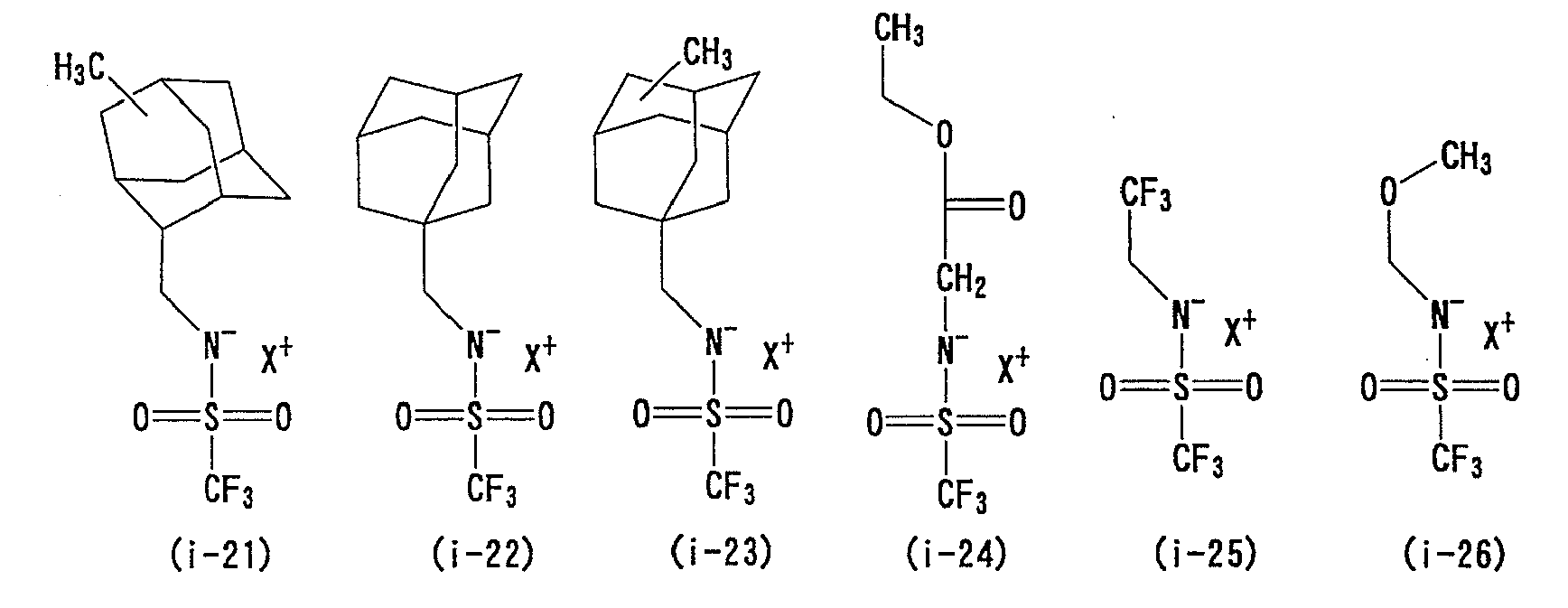
-


- It is preferable that the onium cation represented by X+ in the general formulas (i) and (i-1) to (i-36) is at least one of the onium cation shown by the general formula (1-1) and the onium cation shown by the general formula (1-2).
- Specific examples of the sulfonium cation shown by the general formula (1-1) include the sulfonium cations shown by the following general formulas (1-1-1) to (1-1-21). Specific examples of the iodonium cation shown by the general formula (1-2) include the iodonium cations shown by the following general formulas (1-2-1) to (1-2-27).
-


-


-


-
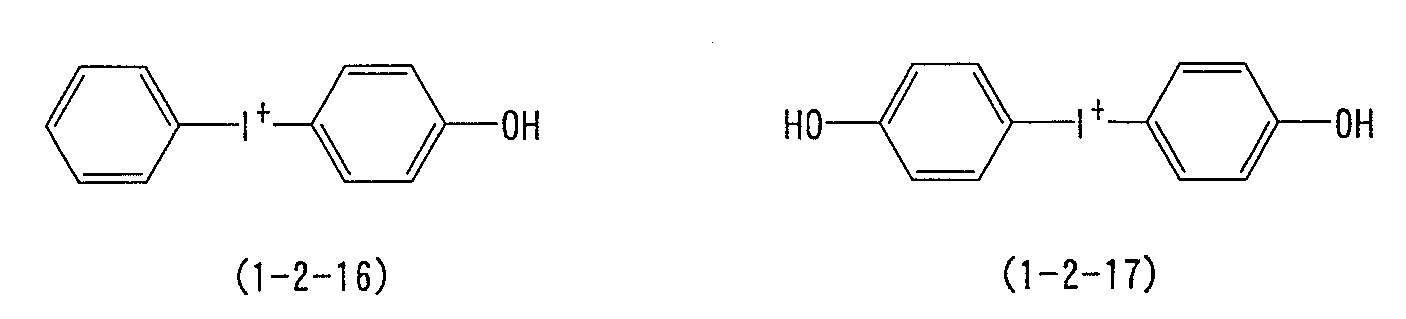


- The monovalent onium cation represented by M+ in the general formulas (i) and (i-1) to (i-36) may be produced by the known method described in Advances in Polymer Science, vol. 62, pp. 1-48 (1984), for example.
- These compounds (C) may be used either individually or in combination. The amount of the compound (C) is preferably 0.001 to 20 parts by mass, and more preferably 0.001 to 12 parts by mass, based on 100 parts by mass of the resin (A). If the amount of the compound (C) is less than 0.001 parts by mass, the sensitivity as the resist and the developability of the exposed area may deteriorate. On the other hand, if the amount exceeds 20 parts by mass, the pattern shape or the dimensional accuracy as the resist may deteriorate depending on the process conditions.
- The radiation-sensitive resin composition according to one embodiment of the present invention may optionally include an additive such as other acid diffusion controller, an alicyclic additive, a surfactant, or a sensitizer.
- Since the compound (C) itself has acid diffusion controllability, excellent resolution, an excellent pattern shape, and excellent LWR property can be obtained even if other acid diffusion controller is not used. However, other acid diffusion controller may be used in combination with the compound (C). A nitrogen-containing organic compound other than the compound (C) may preferably used as the other acid diffusion controller.
- The nitrogen-containing organic compound is not particularly limited, and may be used such as mono(cyclo)alkylamines, di(cyclo)alkylamines, tri(cyclo)alkylamines, substituted alkylamines, aromatic amines, diamine compounds, polyethylenimine, polyallylamines, polymer of (2-dimethylaminoethylacrylamide), amide group-containing compounds, urea compounds, nitrogen-containing heterocyclic compounds,.
- The amount of the nitrogen-containing compound is preferably 15 parts by mass or less, more preferably 10 parts by mass or less, and particularly preferably 5 parts by mass or less, based on 100 parts by mass of the resin (A). The lower limit of the amount of the nitrogen-containing compound is not particularly limited. However, it is normally 0.001 parts by mass or more. If the amount of the nitrogen-containing compound exceeds 15 parts by mass, the sensitivity as the resist and the developability of the exposed area may deteriorate. On the other hand, if the amount is less than 0.001 parts by mass, the pattern shape or the dimensional accuracy as the resist may deteriorate depending on the process conditions.
- The alicyclic additive may include an acid-labile group, and is the component which further improves the dry etching resistance, the pattern shape, adhesion to a substrate, and the like.
- Examples of the alicyclic additive include adamantane derivatives such as t-butyl 1-adamantanecarboxylate, t-butoxycarbonylmethyl 1-adamantanecarboxylate, α-butyrolactone 1-adamantanecarboxylate, di-t-butyl 1,3-adamantanedicarboxylate, t-butyl 1-adamantaneacetate, t-butoxycarbonylmethyl 1-adamantaneacetate, di-t-butyl 1,3-adamantanediacetate, and 2,5-dimethyl-2,5-di(adamantylcarbonyloxy)hexane;
- deoxycholates such as t-butyl deoxycholate, t-butoxycarbonylmethyl deoxycholate, 2-ethoxyethyl deoxycholate, 2-cyclohexyloxyethyl deoxycholate, 3-oxocyclohexyl deoxycholate, tetrahydropyranyl deoxycholate, and mevalonolactone deoxycholate; lithocholates such as t-butyl lithocholate, t-butoxycarbonylmethyl lithocholate, 2-ethoxyethyl lithocholate, 2-cyclohexyloxyethyl lithocholate, 3-oxocyclohexyl lithocholate, tetrahydropyranyl lithocholate, and mevalonolactone lithocholate; and the like. These alicyclic additives may be used either individually or in combination.
- An alkyl carboxylate such as dimethyl adipate, diethyl adipate, dipropyl adipate, di-n-butyl adipate, or di-t-butyl adipate may be used as an additive that has the same function as that of the alicyclic additive.
- The surfactant is the component which improves the applicability, striation, developability, and the like. Examples of the surfactant include nonionic surfactants such as polyoxyethylene lauryl ether, polyoxyethylene stearyl ether, polyoxyethylene oleyl ether, polyoxyethylene n-octylphenyl ether, polyoxyethylene n-nonylphenyl ether, polyethylene glycol dilaurate, and polyethylene glycol distearate; commercially available products such as KP341 (manufactured by Shin-Etsu Chemical Co., Ltd.), Polyflow No. 75, Polyflow No. 95 (manufactured by Kyoeisha Chemical Co., Ltd.), EFTOP EF301, EFTOP EF303, EFTOP EF352 (manufactured by JEMCO, Inc.), Megafac F171, Megafac F173 (manufactured by DIC Corporation), Fluorad FC430, Fluorad FC431 (manufactured by Sumitomo 3M Ltd.), Asahi Guard AG710, Surflon S-382, Surflon SC-101, Surflon SC-102, Surflon SC-103, Surflon SC-104, Surflon SC-105, Surflon SC-106 (manufactured by Asahi Glass Co., Ltd.); and the like. Incidentally, these surfactants may be used either individually or in combination. In addition, the amount of the surfactant is preferably 2 parts by mass or less based on 100 parts by mass of the resin (A).
- The sensitizer is a component which absorbs the energy of radiation, transmits the energy to the acid generating agent (B), and makes the amount of acid increase, and which has the effect of improving the apparent sensitivity of the radiation-sensitive resin composition. Examples of the sensitizer include carbazoles, benzophenones, rose bengals, anthracenes, phenols, and the like. Incidentally, these sensitizers may be used either individually or in combination. In addition, the amount of the sensitizer is preferably 50 parts by mass or less based on 100 parts by mass of the resin (A).
- The radiation-sensitive resin composition according to one embodiment of the present invention is normally used as a radiation-sensitive resin composition solution by dissolving the components in a solvent so that the total solid content is 1 to 50 mass%, and preferably 3 to 25 mass%, and filtering the solution through a filter having a pore size of about 0.2 µm, for example. Examples of the solvent used to prepare the radiation-sensitive resin composition solution include linear or branched ketones such as 2-pentanone, 2-hexanone, 2-heptanone, and 2-octanone; cyclic ketones such as cyclopentanone and cyclohexanone; propylene glycol monoalkyl ether acetates such as propylene glycol monomethyl ether acetate and propylene glycol monoethyl ether acetate; alkyl 2-hydroxypropionates such as methyl 2-hydroxypropionate and ethyl 2-hydroxypropionate; alkyl 3-alkoxypropionates such as methyl 3-methoxypropionate, ethyl 3-methoxypropionate, methyl 3-ethoxypropionate, and ethyl 3-ethoxypropionate; ethylene glycol monomethyl ether, ethylene glycol monoethyl ether, diethylene glycol dimethyl ether, diethylene glycol diethyl ether, ethylene glycol monomethyl ether acetate, ethylene glycol monoethyl ether acetate, propylene glycol monomethyl ether, propylene glycol monoethyl ether, n-butyl acetate, methyl pyruvate, ethyl pyruvate, N-methylpyrrolidone, γ-butyrolactone, and the like.
- These solvents may be used either individually or in combination. Among them, it is preferable to use at least one compound selected from propylene glycol monomethyl ether acetate, propylene glycol monomethyl ether, 2-heptanone, cyclohexanone, γ-butyrolactone, ethyl 2-hydroxypropionate, and ethyl 3-ethoxypropionate.
- The radiation-sensitive resin composition thus prepared may suitably be used to form a resist film by spin coating or the like in the normally performed photolithography.
- The invention is further described below by way of examples. However, the invention is not limited to the following examples. Note that in the examples and comparative examples, the unit "parts" refers to "parts by mass", and the unit "%" refers to "mass%", unless otherwise specified. The following property value measuring methods and property evaluation methods were used.
- The weight average molecular weight (Mw) and the number average molecular weight (Mn) were determined by gel permeation chromatography (GPC) (standard: monodisperse polystyrene) using a GPC column manufactured by Tosoh Corporation (G2000HXL×2, G3000HXL×1, G4000HXL×1) (flow rate: 1.0 ml/min, column temperature: 40°C, eluant: tetrahydrofuran). The dispersity (Mw/Mn) was calculated from the measurement results.
- Each polymer was subjected to 13C-NMR analysis and 1H-NMR analysis using a nuclear magnetic resonator "JNM-EX270" (manufactured by JEOL Ltd.).
- 20 g of an ion-exchange resin ("QAE Sephadex A-25" manufactured by GE Healthcare Biosciences) was swollen overnight in ultrapure water, and then introduced into a column tube. A solution prepared by dissolving 28 g of the sodium salt shown by the following formula (X-1) in methanol was introduced into the column tube charged with the ion-exchange resin to support the sulfonamide anion on the ion-exchange resin. After backflushing with a sufficient amount of methanol, a solution prepared by dissolving 5.2 g of triphenylsulfonium chloride in methanol was introduced into the column tube to perform an anion-exchange reaction. After evaporating the solvent from the resulting solution using an evaporator, the residue was dried at room temperature overnight to obtain a compound shown by the following formula (C-1) (hereinafter referred to as "compound (C-1)") (yield: 8.0 g).
-

- 20 g of above ion-exchange resin was swollen overnight in ultrapure water, and then introduced into a column tube. A solution prepared by dissolving 28 g of the sodium salt shown by the following formula (X-1) in methanol was introduced into the column tube charged with the ion-exchange resin to support the sulfonamide anion on the ion-exchange resin. After backflushing with a sufficient amount of methanol, a solution prepared by dissolving 5.6 g of diphenyliodonium chloride in methanol was introduced into the column tube to perform an anion-exchange reaction. After evaporating the solvent from the resulting solution using an evaporator, the residue was dried at room temperature overnight to obtain a compound shown by the following formula (C-2) (hereinafter referred to as "compound (C-2)") (yield: 8.2 g).
-

- 20 g of above ion-exchange resin was swollen overnight in ultrapure water, and introduced into a column tube. A solution prepared by dissolving 28 g of the sodium salt shown by the following formula (X-2) in methanol was introduced into the column tube charged with the ion-exchange resin to support the sulfonamide anion on the ion-exchange resin. After backflushing with a sufficient amount of methanol, a solution prepared by dissolving 5.8 g of triphenylsulfonium chloride in methanol was introduced into the column tube to perform an anion-exchange reaction. After evaporating the solvent from the resulting solution using an evaporator, the residue was dried at room temperature overnight to obtain a compound shown by the following formula (C-3) (hereinafter referred to as "compound (C-3)") (yield: 8.1 g).
-

- 20 g of above ion-exchange resin was swollen overnight in ultrapure water, and introduced into a column tube. A solution prepared by dissolving 28 g of the sodium salt shown by the following formula (X-3) which is prepared by deprotonating an (X-3) derivative (manufactured by Central Glass Co., Ltd.) with a metal base such as sodium hydrogen carbonate in methanol was introduced into the column tube to support the sulfonamide anion on the resin. After backflushing with a sufficient amount of methanol, a solution prepared by dissolving 5.2 g of triphenylsulfonium chloride in methanol was introduced into the column tube to perform an anion-exchange reaction. After evaporating the solvent from the resulting solution using an evaporator, the residue was dried at room temperature overnight to obtain a compound shown by the following formula (C-4) (hereinafter referred to as "compound (C-4)") (yield: 8.1 g).
-

- Each resin (A) was synthesized as described below. The monomers shown by the following formulas (M-1) to (M-7) were used to synthesize each resin (A).
-


- 8.5 g (35 mol%) of the monomer shown by the formula (M-1) (hereinafter may be referred to as "monomer (M-1)"), 5.4 g (15 mol%) of the monomer shown by the formula (M-4) (hereinafter may be referred to as "monomer (M-4)"), and 16.1 g (50 mol%) of the monomer shown by the formula (M-6) (hereinafter may be referred to as "monomer (M-6)") were dissolved in 60 g of 2-butanone. 1.2 g of dimethyl azobisisobutyronitrile was added to the solution to prepare a monomer solution. Meanwhile, a three-necked flask (200 ml) charged with 30 g of 2-butanone was purged with nitrogen for 30 minutes, and then heated to 80°C with stirring. The monomer solution was added dropwise to the flask using a dropping funnel over 3 hours. The monomers were polymerized for 6 hours from the start of addition of the monomer solution.
- After completion of polymerization, the polymer solution was cooled with water to 30°C or less, and then added to 600 g of methanol. A white powder that precipitated by this operation was collected by filtration. After the white powder thus collected was washed twice with 150 g of methanol in a slurry state, the residue was collected again by filtration, and then dried at 50°C for 17 hours to obtain a white powdery copolymer. The copolymer had an Mw of 6800 and a dispersity (Mw/Mn) of 1.38. The yield of the copolymer was 84.5%. The content ratio of repeating units derived from the respective monomers (monomer (M-1)/ monomer (M-4)/ monomer (M-6)) in the copolymer was 35.2/14.8/50.0 (mol%). The copolymer is hereinafter referred to as "resin (A-1)". Table 1 shows the type and the amount of each monomer used in Synthesis Example 5. Table 2 shows the Mw, the dispersity (Mw/Mn), and the yield of the resulting copolymer, and the content ratio of repeating units derived from the respective monomers in the resulting copolymer.
- A copolymer was produced in the same manner as in Synthesis Example 5, except for using the monomers shown in Table 1 in the amounts shown in Table 1. Incidentally, table 2 shows the Mw, the dispersity (Mw/Mn), and the yield of the resulting copolymer, and the ratio of repeating units derived from the respective monomers in the resulting copolymer. The copolymers obtained in Synthesis Examples 6 to 18 are hereinafter referred to as "resin (A-2)" to "resin (A14)".
-
TABLE 1 Resin (A) Monomer Initiator Type Type Amount (mol%) Type Amount (mol%) Type Amount (mol%) Type Amount (mol%) Amount (mol%) Synthesis Example 5 (A-1) M-1 35 M-4 15 M-6 50 - - 5 Synthesis Example 6 (A-2) M-1 35 M-3 15 M-6 50 - - 5 Synthesis Example 7 (A-3) M-1 40 M-4 10 M-6 50 - - 5 Synthesis Example 8 (A-4) M-1 50 M-6 50 - - - - 5 Synthesis Example 9 (A-5) M-3 60 M-6 40 - - - - 5 Synthesis Example 10 (A-6) M-2 15 M-3 35 M-6 50 - - 5 Synthesis Example 11 (A-7) M-2 15 M-3 35 M-5 20 M-6 30 5 Synthesis Example 12 (A-8) M-1 15 M-3 45 M-5 20 M-6 20 5 Synthesis Example 13 (A-9) M-2 15 M-3 45 M-6 40 - - 5 Synthesis Example 14 (A-10) M-1 15 M-3 45 M-5 20 M-6 20 10 Synthesis Example 15 (A-11) M-2 15 M-3 45 M-5 20 M-6 20 10 Synthesis Example 16 (A-12) M-1 60 M-6 40 - - - - 5 Synthesis Example 17 (A-13) M-1 46 M-6 51 M-7 3 - - 5 Synthesis Example 18 (A-14) M-2 15 M-3 45 M-5 40 - - 10 -
TABLE 2 Resin (A) Yield (%) Content ratio of repeating units derived from the respective monomers Mw Mw/Mn Type Type Content ratio (mol%) Type Content ratio (mol%) Type Consent ratio (mol%) Type Content ratio (mol%) Synthesis Example 5 (A-1) 84.5 M-1 35.2 M-4 14.8 M-6 50.0 - - 6800 1.38 Synthesis Example 6 (A-2) 84.3 M-1 35.1 M-3 14.7 M-6 50.2 - - 6700 1.39 Synthesis Example 7 (A-3) 82.4 M-1 39.7 M-4 9.8 M-6 50.5 - - 6700 1.41 Synthesis Example 8 (A-4) 79.8 M-1 48.9 M-6 51.1 - - - - 6900 1.35 Synthesis Example 9 (A-5) 86.2 M-3 58.2 M-6 41.8 - - - - 5700 1.58 Synthesis Example 10 (A-6) 83.2 M-2 15 M-3 34.8 M-6 50.2 - - 6700 1.43 Synthesis Example 11 (A-7) 77.3 M-2 14.6 M-3 34.6 M-5 20.1 M-6 30.7 5300 1.45 Synthesis Example 12 (A-8) 78.6 M-1 14.7 M-3 44.2 M-5 20.2 M-6 20.9 5400 1.39 Synthesis Example 13 (A-9) 67.5 M-2 15.3 M-3 44.1 M-6 40.6 - - 4000 1.32 Synthesis Example 14 (A-10) 62.5 M-1 14.2 M-3 44.7 M-5 20.2 M-6 20.9 3800 1.21 Synthesis Example 15 A-11 63.2 M-2 14.3 M-3 44 M-5 20.1 M-6 21.6 3800 1.21 Synthesis Example 16 (A-12) 71.2 M-1 55.8 M-6 44.2 - - - - 5600 1.36 Synthesis Example 17 (A-13) 72.3 M-1 44.8 M-6 52 M-7 3.2 - - 7200 1.45 Synthesis Example 18 (A-14) 62.2 M-2 14.6 M-3 44.2 M-5 41.2 - - 4100 1.22 - 100 parts of the resin (A-1) obtained in Synthesis Example 5, 8.5 parts of an acid generating agent (B-3), 4.5 parts of the compound (C-1) obtained in Synthesis Example 1, 1700 parts of a solvent (E-1), 700 parts of a solvent (E-2), and 30 parts of a solvent (E-3) were mixed to obtain a radiation-sensitive resin composition.
- The radiation-sensitive resin compositions were obtained in the same manner as in Example 1, except for changing the composition as shown in Table 3.
-
TABLE 3 Component (parts by mass) Resin (A) Acid generating agent (B) Compound (C) Nitrogen-containing organic compound (D) Ex. 1 A-1 (100) B-3 (8.5) C-1 (4.5) - Ex. 2 A-1 (100) B-3 (15.0) C-2 (4.5) - Ex. 3 A-1 (100) B-3 (15.0) C-3 (4.5) - Ex. 4 A-1 (100) B-4 (10.8) C-3 (5.0) - Ex. 5 A-1 (100) B-3 (15.0) C-4 (4.5) - Ex. 6 A-1 (100) B-1 (4.5) ; B-2 (4.0) C-1 (4.5) - Ex. 7 A-2 (100) B-3 (8.5) C-1 (4.5) - Ex. 8 A-3 (100) B-3 (8.5) C-1 (4.5) - Ex. 9 A-4 (100) B-3 (8.5) C-1 (4.5) - Ex. 10 A-5 (100) B-3 (8.5) C-1 (4.5) - Ex. 11 A-6 (100) B-5 (8.0) C-3 (2.1) - Ex. 12 A-7 (100) B-5 (8.0) C-3 (2.1) - Ex. 13 A-8 (100) B-5 (8.0) C-3 (2.1) - Ex. 14 A-9 (100) B-5 (8.0) C-3 (2.1) - Ex. 15 A-4 (100) B-3 (8.5) C-1 (2.3) D-1 (0.60) Ex.16 A-4 (100) B-3 (8.5) C-3 (2.3) D-1 (0.60) Ex. 17 A-10 (100) B-5 (8.0) C-3 (2.1) - Ex. 18 A-11 (100) B-5 (7.0) C-3 (1.0) - Ex. 19 A-11 (100) B-5 (8.0) C-3 (2.1) - Ex. 20 A-12 (100) B-5 (9.8) C-3 (2.5) - Ex. 21 A-13 (100) - C-3 (4.1) - Ex. 22 A-13 (100) - C-1 (4.6) - Ex. 23 A-13 (100) - C-4 (4.6) - Ex. 24 A-11 (100) B-6 (8.6) C-3 (2.1) - Ex. 25 A-14 (100) B-5 (8.0) C-3 (2.1) - Comp. Ex. 1 A-4 (100) B-3 (8.5) - D-1 (1.1) Comp. Ex. 2. A-5 (100) B-3 (8.5) - D-1 (1.3) Comp. Ex. 3 A-4 (100) B-3 (8.5) - - - The details of the acid generating agent (B), the nitrogen-containing organic compound (D), and the solvent (C) are shown below.
-
- (B-1): triphenylsulfonium nonafluoro-n-butanesulfonate
- (B-2): triphenylsulfonium 2-(bicyclo[2.2.1]hept-2'-yl)-1,1-difluoroethanesulfonate
- (B-3): triphenylsulfonium
2-(bicyclo[2.2.1]hept-2'-yl)-1,1,2,2-tetrafluoroethanesulfonate - (B-4): triphenylphosphonium
1,1,2,2-tetrafluoro-6-(1-adamantanecarbonyloxy)hexane-1-sulfbnate - (B-5): triphenylphosphonium 2-adamantyl-1,1-difluoroethanesulfonate
- (B-6): compound shown by the following formula (4)

-
- (D-1): N-t-butoxycarbonyl-4-hydroxypiperidine
-
- (E-1): propylene glycol monomethyl ether acetate
- (E-2): cyclohexanone
- (E-3): γ-butyrolactone
- The radiation-sensitive resin compositions of Examples 1 to 25 and Comparative Examples 1 to 3 were evaluated as described below. The evaluation results are shown in Table 4.
- When the exposure was performed by ArF light source, a silicon wafer on which an ARC29 (manufactured by Nissan Chemical Industries, Ltd.) film having the thickness of 77 nm was formed, was used. The radiation-sensitive resin composition solution was spin-coated onto the silicon wafer using a coater/developer "Clean Track ACT 8" (manufactured by Tokyo Electron, Ltd.), and prebaked (PB) on a hot plate under the conditions shown in Table 4 to obtain a resist film having a thickness of 0.09 µm. The resist film was exposed via a mask pattern using an ArF excimer laser exposure device ("S306C" manufactured by Nikon Corporation) (numerical aperture: 0.78). After performing PEB under the conditions shown in Table 4, the resist film was developed at 23°C for 60 seconds using a 2.38% tetramethylammonium hydroxide aqueous solution, rinsed with water, and then dried to form a positive type resist pattern. An exposure amount at which a line-and-space (1L1S) pattern having a diameter of 0.09 µm was formed via a mask having a diameter of 0.09 µm was determined to be an optimum exposure amount, and the optimum exposure amount was taken as the sensitivity.
- The cross-sectional shape of the line-and-space pattern having a diameter of 0.075 µm used to measure the sensitivity was observed using a scanning type electron microscope ("S-4800" manufactured by Hitachi High-Technologies Corporation). A case where the line-and-space pattern had a T-top shape (i.e., a shape other than a rectangular shape) was evaluated as "Unacceptable", and a case where the line-and-space pattern had a rectangular shape was evaluated as "Acceptable".
- A line-and-space pattern having a diameter of 0.09 µm formed on the substrate using the resist film at the optimum exposure amount was observed from above using a scanning type electron microscope ("S9380" manufactured by Hitachi Ltd.). The diameter was measured at arbitrary points, and a variation 3σ in diameter was evaluated. A case where the variation 3σ was 9.0 nm or less was evaluated as "Acceptable", and a case where the variation 3σ was more than 9.0 nm was evaluated as "Unacceptable".
- In the observation of 90 mm line-and-space pattern resolved at optimum exposure amount for the evaluation of the sensitivity, if the exposure is carried out at an exposure amount higher that the optimum exposure amount, the resulting pattern has a reduced line width, so that the resist pattern may collapse for the last time. A line width at the maximum exposure amount at which collapsed resist pattern was not confirmed was defined as a minimum pre-collapse dimension (nm). The minimum pre-collapse dimension was used as an index of the pattern collapse resistance. In particular, a case where the minimum pre-collapse dimension was 40.0 nm or less was evaluated as "Acceptable", and a case where the minimum pre-collapse dimension was more than 40.0 nm was evaluated as "Unacceptable". Incidentally, the minimum pre-collapse dimension was measured using the above scanning type electron microscope.
-
TABLE 4 PB PEB Sensitivity (mJ) Shape LWR Minimum pre-collapse dimension Temp. (°C) Time (s) Temp. (°C) Time (s) Ex. 1 110 60 95 60 46 Acceptable Acceptable Acceptable Ex. 2 110 60 95 60 63 Acceptable Acceptable Acceptable Ex. 3 110 60 95 60 46 Acceptable Acceptable Acceptable Ex. 4 120 60 105 60 46 Acceptable Acceptable Acceptable Ex. 5 110 60 95 60 46 Acceptable Acceptable Acceptable Ex. 6 110 60 95 60 48 Acceptable Acceptable Acceptable Ex. 7 110 60 105 60 48 Acceptable Acceptable Acceptable Ex. 8 110 60 105 60 46 Acceptable Acceptable Acceptable Ex. 9 110 60 105 60 43 Acceptable Acceptable Acceptable Ex. 10 110 60 115 60 46 Acceptable Acceptable Acceptable Ex. 11 100 60 95 60 49 Acceptable Acceptable Acceptable Ex. 12 100 60 95 60 53 Acceptable Acceptable Acceptable Ex. 13 100 60 95 60 50 Acceptable Acceptable Acceptable Ex. 14 110 60 105 60 55 Acceptable Acceptable Acceptable Ex. 15 110 60 105 60 44 Acceptable Acceptable Acceptable Ex. 16 110 60 105 60 48 Acceptable Acceptable Acceptable Ex. 17 100 60 95 60 48 Acceptable Acceptable Acceptable Ex. 18 100 60 95 60 46 Acceptable Acceptable Acceptable Ex. 19 100 60 95 60 49 Acceptable Acceptable Acceptable Ex. 20 100 60 110 60 48 Acceptable Acceptable Acceptable Ex. 21 100 60 150 60 50 Acceptable Acceptable Acceptable Ex. 22 100 60 150 60 50 Acceptable Acceptable Acceptable Ex. 23 100 60 150 60 52 Acceptable Acceptable Acceptable Ex. 24 100 60 90 60 44 Acceptable Acceptable Acceptable Ex. 25 100 60 90 60 48 Acceptable Acceptable Acceptable Comp. Ex. 1 110 60 105 60 45 Acceptable Unacceptable Unacceptable Comp. Ex. 2 110 60 115 60 48 Acceptable Unacceptable Unacceptable Comp. Ex. 3 110 60 105 60 <20 Unacceptable Unacceptable Unacceptable - As shown in Table 4, the radiation-sensitive resin compositions according to the present invention could form a resist pattern being small LWR, excellent in pattern shape and excellent in pattern collapse resistance (i.e., the resist pattern did not collapse even when forming a fine line pattern). Therefore, an accurate pattern could be formed. On the other hand, the radiation-sensitive resin compositions of Comparative Examples 1 and 2 that contained the nitrogen-containing organic compound (D), but did not contain the compound (C) exhibited an excellent in pattern shape, but there is still a room for improving the LWR and pattern collapse resistance. The radiation-sensitive resin composition of Comparative Example 3 that did not contain the compound (C) and the nitrogen-containing organic compound (D) showed large LWR, an inferior pattern shape, poor sensitivity, and there is still a room for improving the pattern collapse resistance.
- The radiation-sensitive resin composition according to the embodiments of the resent invention may suitably be used as a photoresist for which a reduction in line width of a resist pattern will be increasingly desired.
Claims (4)
- A radiation-sensitive resin composition comprising (A) an acid-labile group-containing resin, and (C) a compound shown by a general formula (i),

- The radiation-sensitive resin composition according to claim 1, wherein X+ in the general formula (i) is at least one of an onium cation shown by a general formula (1-1) and an onium cation shown by a general formula (1-2),

- The radiation-sensitive resin composition according to claim 1, further comprising (B) a radiation-sensitive acid generating agent.
- The radiation-sensitive resin composition according to claim 1, wherein the acid-labile group-containing resin (A) includes a repeating unit shown by a general formula (2),

Applications Claiming Priority (3)
| Application Number | Priority Date | Filing Date | Title |
|---|---|---|---|
| JP2009143360 | 2009-06-16 | ||
| JP2010004188 | 2010-01-12 | ||
| PCT/JP2010/060029 WO2010147079A1 (en) | 2009-06-16 | 2010-06-14 | Radiation-sensitive resin composition |
Publications (2)
| Publication Number | Publication Date |
|---|---|
| EP2444845A1 true EP2444845A1 (en) | 2012-04-25 |
| EP2444845A4 EP2444845A4 (en) | 2013-05-29 |
Family
ID=43356397
Family Applications (1)
| Application Number | Title | Priority Date | Filing Date |
|---|---|---|---|
| EP10789454.5A Withdrawn EP2444845A4 (en) | 2009-06-16 | 2010-06-14 | RESIN COMPOSITION SENSITIVE TO RADIATION |
Country Status (7)
| Country | Link |
|---|---|
| US (1) | US8921027B2 (en) |
| EP (1) | EP2444845A4 (en) |
| JP (1) | JP5655781B2 (en) |
| KR (1) | KR101729350B1 (en) |
| CN (1) | CN102804065B (en) |
| TW (1) | TWI416256B (en) |
| WO (1) | WO2010147079A1 (en) |
Families Citing this family (22)
| Publication number | Priority date | Publication date | Assignee | Title |
|---|---|---|---|---|
| JP2012018304A (en) * | 2010-07-08 | 2012-01-26 | Tokyo Ohka Kogyo Co Ltd | Positive resist composition and method for forming resist pattern |
| JP5659028B2 (en) * | 2010-10-22 | 2015-01-28 | 東京応化工業株式会社 | Resist composition and resist pattern forming method |
| JP5690584B2 (en) * | 2010-12-28 | 2015-03-25 | 東京応化工業株式会社 | Resist composition and resist pattern forming method |
| JP5677127B2 (en) * | 2011-02-18 | 2015-02-25 | 東京応化工業株式会社 | Resist composition and resist pattern forming method |
| JP5846888B2 (en) | 2011-12-14 | 2016-01-20 | 東京応化工業株式会社 | Resist composition and resist pattern forming method |
| JP5846889B2 (en) | 2011-12-14 | 2016-01-20 | 東京応化工業株式会社 | Resist composition, resist pattern forming method, compound |
| JP5699943B2 (en) * | 2012-01-13 | 2015-04-15 | 信越化学工業株式会社 | Pattern forming method and resist material |
| JP5807552B2 (en) * | 2012-01-13 | 2015-11-10 | 信越化学工業株式会社 | Pattern forming method and resist composition |
| JP6006999B2 (en) | 2012-06-20 | 2016-10-12 | 東京応化工業株式会社 | Resist composition and resist pattern forming method |
| JP6095347B2 (en) | 2012-12-07 | 2017-03-15 | 東京応化工業株式会社 | Resist composition and resist pattern forming method |
| JP6148907B2 (en) * | 2013-06-10 | 2017-06-14 | 東京応化工業株式会社 | Solvent development negative resist composition, resist pattern forming method |
| JP6980993B2 (en) * | 2016-10-06 | 2021-12-15 | 信越化学工業株式会社 | Resist material and pattern forming method |
| JP7031537B2 (en) * | 2018-09-05 | 2022-03-08 | 信越化学工業株式会社 | Sulfonium compound, positive resist composition, and resist pattern forming method |
| JP7334684B2 (en) | 2019-08-02 | 2023-08-29 | 信越化学工業株式会社 | Resist material and pattern forming method |
| JP7334683B2 (en) | 2019-08-02 | 2023-08-29 | 信越化学工業株式会社 | Positive resist material and pattern forming method |
| JP7351257B2 (en) | 2019-08-14 | 2023-09-27 | 信越化学工業株式会社 | Resist material and pattern forming method |
| JP7354954B2 (en) | 2019-09-04 | 2023-10-03 | 信越化学工業株式会社 | Resist material and pattern forming method |
| JP7622544B2 (en) | 2020-05-18 | 2025-01-28 | 信越化学工業株式会社 | Chemically amplified positive resist material and pattern formation method |
| JP7484846B2 (en) | 2020-09-28 | 2024-05-16 | 信越化学工業株式会社 | Molecular resist composition and pattern formation method |
| JP7850019B2 (en) * | 2021-08-31 | 2026-04-22 | 富士フイルム株式会社 | Method for producing a photosensitive or radiation-sensitive resin composition, a method for forming a pattern, and a method for producing an electronic device. |
| JP7823536B2 (en) | 2021-11-02 | 2026-03-04 | 信越化学工業株式会社 | Molecular resist composition and pattern forming method |
| KR20230092100A (en) | 2021-12-16 | 2023-06-26 | 주식회사 동진쎄미켐 | Salt compound and quencher, photoresist composition comprising the same |
Family Cites Families (24)
| Publication number | Priority date | Publication date | Assignee | Title |
|---|---|---|---|---|
| US4491628A (en) | 1982-08-23 | 1985-01-01 | International Business Machines Corporation | Positive- and negative-working resist compositions with acid generating photoinitiator and polymer with acid labile groups pendant from polymer backbone |
| JP2002006482A (en) * | 2000-06-20 | 2002-01-09 | Fuji Photo Film Co Ltd | Heat sensitive composition and original plate of planographic printing plate using the same |
| US6660446B2 (en) * | 2000-05-30 | 2003-12-09 | Fuji Photo Film Co., Ltd. | Heat-sensitive composition and planographic printing plate |
| JP4210039B2 (en) * | 2001-03-19 | 2009-01-14 | 富士フイルム株式会社 | Positive image forming material |
| JP4583790B2 (en) | 2003-06-26 | 2010-11-17 | 東京応化工業株式会社 | Positive resist composition and resist pattern forming method using the same |
| JP4724465B2 (en) * | 2005-05-23 | 2011-07-13 | 富士フイルム株式会社 | Photosensitive composition and pattern forming method using the photosensitive composition |
| JP2008026838A (en) * | 2006-06-23 | 2008-02-07 | Tokyo Ohka Kogyo Co Ltd | Positive resist composition and method for formation of resist pattern |
| US20080027246A1 (en) * | 2006-07-26 | 2008-01-31 | Andrew Bell | Process for forming perfluorinated-alkyl sulfonamide substituted norbornene-type monomers |
| JP5140354B2 (en) * | 2006-09-19 | 2013-02-06 | 富士フイルム株式会社 | Photosensitive composition, compound used for photosensitive composition, and pattern formation method using the photosensitive composition |
| US7390613B1 (en) * | 2006-12-04 | 2008-06-24 | Az Electronic Materials Usa Corp. | Photoactive compounds |
| KR20120032024A (en) * | 2007-05-23 | 2012-04-04 | 제이에스알 가부시끼가이샤 | Radiation-sensitive resin composition |
| JP2009053688A (en) * | 2007-07-30 | 2009-03-12 | Fujifilm Corp | Positive resist composition and pattern forming method |
| TW200925778A (en) | 2007-09-27 | 2009-06-16 | Jsr Corp | Radiation-sensitive composition |
| TW200919090A (en) * | 2007-10-01 | 2009-05-01 | Jsr Corp | Radiation-sensitive composition |
| TW200916965A (en) | 2007-10-01 | 2009-04-16 | Jsr Corp | Radiation-sensitive composition |
| JP5001192B2 (en) * | 2008-02-18 | 2012-08-15 | 東京応化工業株式会社 | Resist composition, resist pattern forming method, novel compound and acid generator |
| JP5047030B2 (en) * | 2008-03-26 | 2012-10-10 | 富士フイルム株式会社 | Resist composition and pattern forming method using the same |
| JP5352120B2 (en) * | 2008-05-12 | 2013-11-27 | 東京応化工業株式会社 | Resist composition, resist pattern forming method, novel compound, and quencher comprising the compound |
| TWI533082B (en) * | 2008-09-10 | 2016-05-11 | Jsr股份有限公司 | Radiation sensitive resin composition |
| KR101547356B1 (en) | 2008-11-13 | 2015-08-25 | 도오꾜오까고오교 가부시끼가이샤 | Resist composition method of forming resist pattern novel compound and acid generator |
| JP5427393B2 (en) * | 2008-11-13 | 2014-02-26 | 東京応化工業株式会社 | Resist composition and resist pattern forming method |
| JP5126182B2 (en) * | 2009-04-15 | 2013-01-23 | Jsr株式会社 | Radiation sensitive resin composition, polymer used therefor and compound used therefor |
| KR20120012792A (en) * | 2009-04-15 | 2012-02-10 | 제이에스알 가부시끼가이샤 | A radiation sensitive resin composition, the polymer used for this, and the compound used for this |
| JP5678449B2 (en) * | 2010-03-25 | 2015-03-04 | Jsr株式会社 | Radiation sensitive composition |
-
2010
- 2010-06-14 EP EP10789454.5A patent/EP2444845A4/en not_active Withdrawn
- 2010-06-14 KR KR1020127000992A patent/KR101729350B1/en active Active
- 2010-06-14 WO PCT/JP2010/060029 patent/WO2010147079A1/en not_active Ceased
- 2010-06-14 TW TW099119287A patent/TWI416256B/en active
- 2010-06-14 JP JP2011519769A patent/JP5655781B2/en active Active
- 2010-06-14 CN CN201080026410.3A patent/CN102804065B/en active Active
-
2011
- 2011-12-15 US US13/326,328 patent/US8921027B2/en active Active
Also Published As
| Publication number | Publication date |
|---|---|
| KR101729350B1 (en) | 2017-04-21 |
| JPWO2010147079A1 (en) | 2012-12-06 |
| CN102804065B (en) | 2014-07-16 |
| US20120082936A1 (en) | 2012-04-05 |
| EP2444845A4 (en) | 2013-05-29 |
| CN102804065A (en) | 2012-11-28 |
| US8921027B2 (en) | 2014-12-30 |
| JP5655781B2 (en) | 2015-01-21 |
| KR20120039628A (en) | 2012-04-25 |
| WO2010147079A1 (en) | 2010-12-23 |
| TW201115270A (en) | 2011-05-01 |
| TWI416256B (en) | 2013-11-21 |
Similar Documents
| Publication | Publication Date | Title |
|---|---|---|
| KR101729350B1 (en) | Radiation-sensitive resin composition | |
| JP5713004B2 (en) | Radiation sensitive resin composition | |
| JP5126182B2 (en) | Radiation sensitive resin composition, polymer used therefor and compound used therefor | |
| KR20120012792A (en) | A radiation sensitive resin composition, the polymer used for this, and the compound used for this | |
| JP5724798B2 (en) | Radiation-sensitive resin composition and resist film formed thereby | |
| WO2010119910A1 (en) | Radiation-sensitive resin composition, polymer used therein, and compound used therein | |
| CN102150082A (en) | Radiation-sensitive resin composition | |
| JP5741287B2 (en) | Radiation-sensitive resin composition and resist pattern forming method | |
| WO2010134477A1 (en) | Radiation-sensitive resin composition and compound | |
| JP2010237313A (en) | Radiation sensitive resin composition | |
| JP5696352B2 (en) | Radiation sensitive resin composition and polymer used therefor | |
| CN101772735B (en) | Radiation-sensitive resin composition | |
| JP5540818B2 (en) | Radiation-sensitive resin composition and polymer | |
| JP2006045387A (en) | Pyrazole derivative, chain transfer agent, acid-dissociable group-containing polymer and radiation-sensitive resin composition | |
| JP2005023234A (en) | Acrylic polymer and radiation-sensitive resin composition | |
| JP2004300403A (en) | (Meth) acrylic polymer and radiation-sensitive resin composition | |
| JP5126163B2 (en) | Radiation sensitive resin composition, polymer used therefor and compound used therefor | |
| JP2004176049A (en) | Acrylic copolymer and radiation-sensitive resin composition | |
| JP4182867B2 (en) | Radiation sensitive resin composition | |
| JP2004203898A (en) | Acrylic polymer and radiation-sensitive resin composition | |
| JP4670624B2 (en) | Radiation sensitive resin composition | |
| JP5655320B2 (en) | Radiation-sensitive resin composition and polymer used therefor | |
| JP5239287B2 (en) | Radiation sensitive resin composition | |
| JP2011215428A (en) | Radiation-sensitive resin composition and polymer used therein | |
| JP2006045136A (en) | Pyrazole derivative, chain transfer agent, acid-dissociable group-containing polymer and radiation-sensitive resin composition |
Legal Events
| Date | Code | Title | Description |
|---|---|---|---|
| PUAI | Public reference made under article 153(3) epc to a published international application that has entered the european phase |
Free format text: ORIGINAL CODE: 0009012 |
|
| 17P | Request for examination filed |
Effective date: 20111219 |
|
| AK | Designated contracting states |
Kind code of ref document: A1 Designated state(s): AL AT BE BG CH CY CZ DE DK EE ES FI FR GB GR HR HU IE IS IT LI LT LU LV MC MK MT NL NO PL PT RO SE SI SK SM TR |
|
| DAX | Request for extension of the european patent (deleted) | ||
| A4 | Supplementary search report drawn up and despatched |
Effective date: 20130503 |
|
| RIC1 | Information provided on ipc code assigned before grant |
Ipc: G03F 7/004 20060101AFI20130425BHEP Ipc: C08F 220/18 20060101ALI20130425BHEP Ipc: H01L 21/027 20060101ALI20130425BHEP Ipc: C09K 3/00 20060101ALI20130425BHEP Ipc: G03F 7/039 20060101ALI20130425BHEP |
|
| STAA | Information on the status of an ep patent application or granted ep patent |
Free format text: STATUS: THE APPLICATION IS DEEMED TO BE WITHDRAWN |
|
| 18D | Application deemed to be withdrawn |
Effective date: 20131203 |