EP2442390B1 - Batterie mit verminderter Brandgefahr - Google Patents
Batterie mit verminderter Brandgefahr Download PDFInfo
- Publication number
- EP2442390B1 EP2442390B1 EP20110179727 EP11179727A EP2442390B1 EP 2442390 B1 EP2442390 B1 EP 2442390B1 EP 20110179727 EP20110179727 EP 20110179727 EP 11179727 A EP11179727 A EP 11179727A EP 2442390 B1 EP2442390 B1 EP 2442390B1
- Authority
- EP
- European Patent Office
- Prior art keywords
- valve
- battery
- cooling liquid
- line system
- cooling
- Prior art date
- Legal status (The legal status is an assumption and is not a legal conclusion. Google has not performed a legal analysis and makes no representation as to the accuracy of the status listed.)
- Active
Links
Images


Classifications
-
- H—ELECTRICITY
- H01—ELECTRIC ELEMENTS
- H01M—PROCESSES OR MEANS, e.g. BATTERIES, FOR THE DIRECT CONVERSION OF CHEMICAL ENERGY INTO ELECTRICAL ENERGY
- H01M10/00—Secondary cells; Manufacture thereof
- H01M10/42—Methods or arrangements for servicing or maintenance of secondary cells or secondary half-cells
- H01M10/4207—Methods or arrangements for servicing or maintenance of secondary cells or secondary half-cells for several batteries or cells simultaneously or sequentially
-
- H—ELECTRICITY
- H01—ELECTRIC ELEMENTS
- H01M—PROCESSES OR MEANS, e.g. BATTERIES, FOR THE DIRECT CONVERSION OF CHEMICAL ENERGY INTO ELECTRICAL ENERGY
- H01M10/00—Secondary cells; Manufacture thereof
- H01M10/60—Heating or cooling; Temperature control
- H01M10/61—Types of temperature control
- H01M10/613—Cooling or keeping cold
-
- H—ELECTRICITY
- H01—ELECTRIC ELEMENTS
- H01M—PROCESSES OR MEANS, e.g. BATTERIES, FOR THE DIRECT CONVERSION OF CHEMICAL ENERGY INTO ELECTRICAL ENERGY
- H01M10/00—Secondary cells; Manufacture thereof
- H01M10/60—Heating or cooling; Temperature control
- H01M10/62—Heating or cooling; Temperature control specially adapted for specific applications
- H01M10/625—Vehicles
-
- H—ELECTRICITY
- H01—ELECTRIC ELEMENTS
- H01M—PROCESSES OR MEANS, e.g. BATTERIES, FOR THE DIRECT CONVERSION OF CHEMICAL ENERGY INTO ELECTRICAL ENERGY
- H01M10/00—Secondary cells; Manufacture thereof
- H01M10/60—Heating or cooling; Temperature control
- H01M10/65—Means for temperature control structurally associated with the cells
- H01M10/656—Means for temperature control structurally associated with the cells characterised by the type of heat-exchange fluid
- H01M10/6567—Liquids
- H01M10/6568—Liquids characterised by flow circuits, e.g. loops, located externally to the cells or cell casings
-
- H—ELECTRICITY
- H01—ELECTRIC ELEMENTS
- H01M—PROCESSES OR MEANS, e.g. BATTERIES, FOR THE DIRECT CONVERSION OF CHEMICAL ENERGY INTO ELECTRICAL ENERGY
- H01M10/00—Secondary cells; Manufacture thereof
- H01M10/60—Heating or cooling; Temperature control
- H01M10/65—Means for temperature control structurally associated with the cells
- H01M10/656—Means for temperature control structurally associated with the cells characterised by the type of heat-exchange fluid
- H01M10/6569—Fluids undergoing a liquid-gas phase change or transition, e.g. evaporation or condensation
-
- H—ELECTRICITY
- H01—ELECTRIC ELEMENTS
- H01M—PROCESSES OR MEANS, e.g. BATTERIES, FOR THE DIRECT CONVERSION OF CHEMICAL ENERGY INTO ELECTRICAL ENERGY
- H01M10/00—Secondary cells; Manufacture thereof
- H01M10/05—Accumulators with non-aqueous electrolyte
- H01M10/052—Li-accumulators
- H01M10/0525—Rocking-chair batteries, i.e. batteries with lithium insertion or intercalation in both electrodes; Lithium-ion batteries
-
- H—ELECTRICITY
- H01—ELECTRIC ELEMENTS
- H01M—PROCESSES OR MEANS, e.g. BATTERIES, FOR THE DIRECT CONVERSION OF CHEMICAL ENERGY INTO ELECTRICAL ENERGY
- H01M10/00—Secondary cells; Manufacture thereof
- H01M10/60—Heating or cooling; Temperature control
- H01M10/66—Heat-exchange relationships between the cells and other systems, e.g. central heating systems or fuel cells
- H01M10/663—Heat-exchange relationships between the cells and other systems, e.g. central heating systems or fuel cells the system being an air-conditioner or an engine
-
- H—ELECTRICITY
- H01—ELECTRIC ELEMENTS
- H01M—PROCESSES OR MEANS, e.g. BATTERIES, FOR THE DIRECT CONVERSION OF CHEMICAL ENERGY INTO ELECTRICAL ENERGY
- H01M2200/00—Safety devices for primary or secondary batteries
-
- Y—GENERAL TAGGING OF NEW TECHNOLOGICAL DEVELOPMENTS; GENERAL TAGGING OF CROSS-SECTIONAL TECHNOLOGIES SPANNING OVER SEVERAL SECTIONS OF THE IPC; TECHNICAL SUBJECTS COVERED BY FORMER USPC CROSS-REFERENCE ART COLLECTIONS [XRACs] AND DIGESTS
- Y02—TECHNOLOGIES OR APPLICATIONS FOR MITIGATION OR ADAPTATION AGAINST CLIMATE CHANGE
- Y02E—REDUCTION OF GREENHOUSE GAS [GHG] EMISSIONS, RELATED TO ENERGY GENERATION, TRANSMISSION OR DISTRIBUTION
- Y02E60/00—Enabling technologies; Technologies with a potential or indirect contribution to GHG emissions mitigation
- Y02E60/10—Energy storage using batteries
Definitions
- the present invention relates to a battery having a cooling device for reducing the risk of fire of the battery.
- Batteries in particular high-capacity batteries for use in the vehicle sector, such as, for example, high-capacity lithium-ion batteries, are characterized by a not inconsiderable evolution of heat during normal or normal operation. Since batteries can provide their optimal performance only in a certain temperature range, it is usually necessary to provide an active cooling device, which ensures a desired operating temperature and prevents overheating of the battery.
- thermo runaway means a thermal runaway of the battery cell or the battery, wherein the "thermal runaway” can be caused for example by excessive and later possibly self-reinforcing heat production in a battery cell. To avoid or contain a "thermal runaways" the most efficient heat dissipation is necessary.
- a commonly used cooling device in batteries uses a circulating cooling fluid to cool the battery cells.
- the cooling liquid is circulated by a pump from a heat exchanger for temperature regulation of the cooling liquid in a line system and used for cooling the battery cells. If an increased cooling capacity is required, the volume flow of cooling fluid through the pump can be increased in order to increase the heat transfer to the battery.
- Such an arrangement of battery and active cooling device is for example in JP 2010-034002 A disclosed.
- the pump fails or is impaired in its function, for example as a result of an accident, the cooling fluid can no longer be efficiently circulated, the heat transfer rate decreases and sufficient cooling power can no longer be provided. Pressure and temperature rise in the coolant until finally the bursting pressure in the piping circuit is exceeded and an explosion can occur.
- a battery is provided as defined in the claims.
- the battery comprises a housing, one or more battery cells arranged in the housing and an active cooling device for cooling the battery cells in the housing.
- the active cooling device has a cooling liquid, a line system for circulating the cooling liquid and a pump for directional movement of the cooling liquid in the line system.
- a first valve for the controllable and controllable evaporation of cooling liquid from the line system is arranged.
- the battery according to the invention is characterized in that the active cooling device additionally comprises a second and a third valve, wherein the second valve is arranged in the conduit system in the flow direction of the cooling liquid between the pump and the battery cells to be cooled; the third valve is arranged in the line system in the direction of flow of the cooling liquid between the battery cells to be cooled and the pump; wherein by closing the second and / or the third valve, a circulation of cooling liquid in the conduit system can be prevented; and, wherein the third valve is identical to the first valve and the first valve is arranged in the line system, that the circulation of the cooling liquid through the first valve, wherein the circulation of the cooling liquid in the open state in the first valve can be prevented and the first valve as 3-way valve is formed.
- the battery according to the invention is based on the finding that the formation of an overpressure in the line system can be prevented by the use of a first valve for controlled and / or controllable evaporation and by its opening in the event of a failure or a functional restriction of the pump. After opening the valve, cooling liquid can evaporate from the line system. This not only prevents the formation of an overpressure in the piping system, but it is also ensured that despite impaired pump function, a heat transfer from the battery is guaranteed, which reduces the risk of a "thermal runaway" for single, multiple or all cells of the battery.
- the battery according to the invention has a housing in which all battery cells of the battery are arranged.
- the term "housing” is understood to mean a device having an interior space which is suitable for receiving one or more battery cells.
- the housing completely encloses the battery cells contained in relation to the environment in all directions, wherein the housing closable accesses, such. B. may have doors or openings with a lid.
- a housing can not already be understood as the immediate cell casing which directly separates the electrochemical components of a single battery cell from the environment.
- the housing may be made of a material comprising or consisting of a polymer, a metal, a metal sheet and / or a ceramic.
- the housing may be made of a material which comprises aluminum or consists thereof.
- the battery according to the invention comprises one or more battery cells arranged in the housing.
- the battery according to the invention preferably has a plurality of battery cells, which may be combined to form a functional unit.
- the battery may include one or more individual battery cells or one or more battery modules, the modules each having a plurality of battery cells that are suitably connected.
- the individual battery cells of the battery can be electrically connected to one another in such a way that they are connected to desired battery module or battery architectures.
- a battery cell is understood to mean an electrochemical energy store which can store an energy by means of electrochemical processes and can provide it again if necessary.
- battery cells of any type of accumulator or battery cell can be used in the battery according to the invention.
- the battery comprises battery cells of the lithium ion cell type, in particular of the Li ion lithium ion battery type, LiPo lithium polymer battery, LiFe lithium metal battery, LiMn lithium manganese Battery, LiFePO 4 lithium iron phosphate battery, LiTi lithium titanate battery.
- the battery according to the invention is preferably a lithium-ion battery, in particular a high-capacity lithium-ion battery, particularly preferably a battery, for.
- a lithium-ion battery with a nominal capacity of ⁇ 2Ah, preferably of ⁇ 3Ah.
- the battery according to the invention has an active cooling device for cooling the battery.
- the cooling device comprises a cooling liquid, a line system for circulating the cooling liquid and a pump for directional movement of the cooling liquid in the line system.
- the cooling liquid is circulated by means of the pump directed such that a heat transfer between the battery cells and cooling liquid is made possible.
- cold coolant is introduced via the line system and distributed over the battery, that the battery cells of the battery can be cooled.
- a suitable heat exchanger for the transmission of heat energy between the battery cells of the battery and the cooling liquid may be provided, for. B. in the form of a cooling plate o. ⁇ .
- Coolant that has absorbed heat energy from the battery cells is removed from the battery and optionally fed to another heat exchanger, which cools the coolant again.
- a cooling system which may optionally be an integral part of the active cooling device of the battery according to the invention.
- the cooling system of the active cooling device may be a heat exchanger that adjusts the cooling fluid to a temperature suitable for cooling the battery cells of the battery.
- the cooling system for Cooling of the cooling liquid to be configured as a separate device that is not part of the battery according to the invention, for example, as a cooling system or air conditioning system of a motor vehicle having a battery according to the invention.
- Suitable active cooling devices are known to the person skilled in the art and are already successfully used for temperature control of batteries.
- the battery according to the invention is characterized in that in the line system of the active cooling device, a first valve is arranged, via which controllable and / or controllable cooling liquid can be evaporated from the line system.
- the first valve in the line system can be arranged and designed in such a way that cooling liquid can only evaporate out of the line system via the valve when the first valve is in the open state. If the first valve is closed, substantially no coolant can be withdrawn by evaporation from the line system.
- the conduit system may comprise an evaporation conduit which is designed such that cooling liquid can be removed from the circulation and released to the atmosphere for evaporation.
- the first valve can be arranged in this evaporation line. In the closed state of the first valve, the circulating coolant in the line system is not directly in contact with the environment via the evaporation line and thus can not be withdrawn from the circulation by evaporation. If the first valve is in the open state, coolant is in direct contact with the ambient atmosphere via one end of the evaporation line and can be withdrawn from the line system by evaporation.
- the first valve is designed as a 3-way valve.
- the first valve can be arranged in the line system such that the circulation of the cooling liquid takes place through the first valve.
- the first valve is designed as a 3-way valve, with basically two different switching paths are possible.
- the first valve is designed as a 3-way valve with a closed switching position, in which the cooling liquid circulate freely through the first valve, but can not evaporate. In the open switching position of the first valve the circulation in the pipe system is interrupted at this switching position. In any case, with the switching position of the first valve open, the evaporation of coolant from the control system is possible.
- the active cooling device of the battery according to the invention additionally has a second and a third valve.
- the second valve is located in the flow direction of the cooling liquid between the pump and the battery cells to be cooled, wherein the second valve is preferably positioned closer to the battery cells to be cooled compared to the pump.
- the third valve is located in the flow direction of the cooling liquid between the battery cells to be cooled and the pump, wherein the third valve is preferably positioned in relation to the pump closer to the battery cells to be cooled.
- the second and the third valve are embodied and arranged in the line system such that a circulation of cooling liquid in the line system is prevented by closing the second and / or the third valve.
- the cooling liquid which is located between the two valves for cooling the battery is prevented from leaving the outlet and is available for evaporation via the first valve if the valve position is appropriate.
- the first valve in the line system is arranged in the direction of flow of the cooling liquid between the second and the third valve, preferably in the flow direction between the battery cells and the third valve.
- the third valve is identical to the first valve.
- the first valve is arranged in the line system such that the circulation of the cooling liquid takes place through the first valve.
- the first valve is designed such that the circulation of the cooling liquid is prevented when the first valve is open (corresponds to the closed state of the third valve) and coolant can evaporate through the first valve. If the first valve is closed (corresponds to the open state of the third valve), the coolant can circulate freely through the first valve and there is no evaporation through the first valve.
- the first valve is designed for this purpose as a 3-way valve.
- the battery according to the invention may have a control and / or control unit, which is designed and arranged such that the first valve can be opened over it, for example when the pump fails or is impaired in its function. In particular, the function of the pump is impaired if the volume flow of cooling liquid moved by the pump is no longer sufficient for the desired cooling effect.
- the control and / or control unit may be designed and arranged such that in addition the second and optionally third valve can be closed, for example when coolant exits the line system, and possibly brought the first valve in a switching position which allows the evaporation of coolant from the piping system.
- the battery according to the invention may have additional components, for. B. a battery management system (BMS) for controlling or regulating the battery behavior.
- BMS battery management system
- the control and / or control unit for switching the first, second and / or third valves may be part of the battery management system.
- the present invention also includes a motor vehicle comprising a battery according to the invention. It is not important that the motor vehicle and battery form a structural unit, but that motor vehicle and battery according to the invention are so functionally in contact that the battery perform their function during operation of the motor vehicle can.
- the term "motor vehicle” is to be understood as meaning all driven vehicles which have a battery for supplying energy to at least one component of the motor vehicle, regardless of which drive these motor vehicles have.
- the term “motor vehicle” includes hybrid electric vehicles (HEV), plug-in hybrid vehicles (PHEV), electric vehicles (EV), fuel cell vehicles, as well as all vehicles that use a battery for at least partial supply of electrical energy.
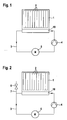
- FIG. 1 a battery is shown with active cooling device, as is known in the art.
- the battery comprises a housing 1, in which a plurality of battery cells 2 are arranged.
- the battery is cooled by an active cooling device.
- This has a cooling liquid which is circulated by means of a pump 4 in a line system 3.
- the coolant is first cooled by a cooling system 5 and then moved by the pump 4 directed by the cooling system 5 to be cooled to the battery cells 2.
- This heat transfer for example, by a heat exchanger 10, z. B. in the form of a cooling plate, supported and / or mediated.
- the heated cooling liquid is then circulated in the line system 3 away from the battery cells 2 to the cooling system 5 and cooled there again.
- FIG. 2 a first embodiment of a battery with active cooling device is disclosed.
- the battery is different from the battery FIG. 1 in that the battery has a first valve 6, which allows the controllable and / or controllable evaporation of cooling fluid from the conduit system 3.
- the first valve 6 is designed as a 2-way valve.
- the first valve 6 is arranged in an evaporation line 7.
- the evaporation line 7 is in such contact with the rest of the line system 3, that above the cooling liquid from the line system 3 with open first valve 6 with the atmosphere of the environment is directly contacted. As a result, cooling liquid can evaporate out of the line system 3 through the opened first valve 6.
- FIG. 3 a second embodiment of a battery with active cooling device is shown.
- the first valve 6 is arranged downstream of the battery cells 2 in the flow direction in the conduit system 3 and designed as a 3-way valve.
- the circulation of the cooling liquid essentially takes place through the first valve 6.
- no evaporation of cooling liquid from the line system 3 occurs through the first valve 6. Only when the first valve 6, for example when the function of the pump 4 is impaired is switched to the open state, it can evaporate over the cooling liquid from the conduit system 3.
- FIG. 4 an embodiment of a battery is shown. This is the battery FIG. 2 to which a second valve 8 and a third valve 9 have been added.
- the second valve 8 is arranged in the flow direction between the pump 4 and the battery cells 2.
- open condition For example, the circulation of cooling fluid through the second valve 8 can take place unhindered.
- closed essentially no coolant can pass through the second valve 8.
- the third valve 9 is arranged in the flow direction between the battery cells 2 and the pump 4. In the open state, the circulation of cooling fluid through the third valve 9 can take place unhindered. In the closed state, essentially no coolant can pass through the third valve 9.
- both the second valve 8 and the third valve 9 are in the closed state, then cooling liquid which is located in the flow direction between the second valve 8 and the third valve 9 can no longer escape from this portion of the conduit system 3, unless by evaporation over the opened first valve 6. If there is a leak in the line system 3 in the line system in the flow direction between the third valve 9 and the second valve 8, the valves 8 and 9 can be closed and the first valve 6 is opened. This ensures that the battery does not remain without cooling effect, since the coolant enclosed between the valves 8 and 9 can evaporate via the first valve 6 and thus provides a cooling effect.
- FIG. 5 an embodiment of the battery according to the invention is shown. This differs from the embodiment according to FIG. 4 in that no evaporation line 7 is provided, and that the third valve 9 is identical to the first valve 6 of the embodiment FIG. 3 ,
- the third valve 9 is designed as a 3-way valve, wherein the circulation of the cooling liquid is prevented in the closed state of the third valve 9 (corresponds to the open state of the first valve 6) and cooling liquid can evaporate through the third valve 9. If the third valve 9 is opened (corresponds to the closed state of the first valve 6), then the cooling liquid can circulate freely through the third valve 9 and there is no evaporation of cooling liquid from the conduit system 3 through the third valve 9.
Landscapes
- Engineering & Computer Science (AREA)
- Manufacturing & Machinery (AREA)
- Chemical & Material Sciences (AREA)
- Chemical Kinetics & Catalysis (AREA)
- Electrochemistry (AREA)
- General Chemical & Material Sciences (AREA)
- Secondary Cells (AREA)
- Battery Mounting, Suspending (AREA)
Description
- Die vorliegende Erfindung betrifft eine Batterie mit einer Kühleinrichtung zur Verminderung der Brandgefahr der Batterie.
- Batterien, insbesondere hochkapazitive Batterien für den Einsatz im Fahrzeugbereich, wie beispielsweise hochkapazitive Lithium-Ionen-Batterien, zeichnen sich durch eine nicht unerhebliche Wärmeentwicklung während des Regel- oder Normalbetriebs aus. Da Batterien ihr optimales Leistungsvermögen nur in einem bestimmten Temperaturbereich zu Verfügung stellen können, ist es meist notwendig, eine aktive Kühleinrichtung vorzusehen, die für eine gewünschte Betriebstemperatur sorgt und eine Überhitzung der Batterie verhindert.
- Unter ungünstigen Bedingungen können eine oder mehrere Zellen einer Batterie in einen "Thermal Runaway" getrieben werden. Der Begriff "Thermal Runaway" bedeutet ein thermisches Durchgehen der Batteriezelle oder der Batterie, wobei der "Thermal Runaway" beispielsweise durch übermäßige und sich später gegebenenfalls selbst verstärkende Wärmeproduktion in einer Batteriezelle hervorgerufen werden kann. Zur Vermeidung oder Eindämmung eines "Thermal Runaways" ist eine möglichst effiziente Wärmeableitung notwendig.
- Eine häufig verwendete Kühleinrichtung in Batterien bedient sich einer zirkulierenden Kühlflüssigkeit zur Kühlung der Batteriezellen. Dabei wird die Kühlflüssigkeit durch eine Pumpe von einem Wärmeübertrager zur Temperaturregulation der Kühlflüssigkeit in einem Leitungssystem zirkuliert und zur Kühlung der Batteriezellen eingesetzt. Bei Bedarf einer verstärkten Kühlleistung kann der Volumenstrom an Kühlflüssigkeit durch die Pumpe gesteigert werden, um den Wärmeübergang an der Batterie zu steigern. Eine solche Anordnung aus Batterie und aktiver Kühleinrichtung ist beispielsweise in
JP 2010-034002 A - Fällt die Pumpe jedoch aus oder ist diese in ihrer Funktion beeinträchtigt, beispielsweise durch eine Havarie, so kann die Kühlflüssigkeit nicht mehr effizient zirkuliert werden, die Wärmeübergangsrate nimmt ab und es kann keine ausreichende Kühlleistung mehr bereitgestellt werden. In der Kühlflüssigkeit steigen Druck und Temperatur an, bis schließlich der Berstdruck im Leitungskreislauf überschritten wird und es zur Explosion kommen kann.
- Erfindungsgemäß wird eine Batterie zur Verfügung gestellt, wie sie in den Ansprüchen definiert ist. Die Batterie umfasst ein Gehäuse, eine oder mehrere im Gehäuse angeordnete Batteriezellen und eine aktive Kühleinrichtung zum Kühlen der Batteriezellen im Gehäuse. Die aktive Kühleinrichtung weist dabei eine Kühlflüssigkeit, ein Leitungssystem zur Zirkulation der Kühlflüssigkeit und eine Pumpe zur gerichteten Bewegung der Kühlflüssigkeit im Leitungssystem auf. Im Leitungssystem der erfindungsgemäßen Batterie ist ein erstes Ventil zur regel-und/oder steuerbaren Verdunstung von Kühlflüssigkeit aus dem Leitungssystem angeordnet. Die erfindungsgemäße Batterie zeichnet sich dadurch aus, dass die aktive Kühleinrichtung zusätzlich ein zweites und ein drittes Ventil aufweist, wobei das zweite Ventil im Leitungssystem in Flussrichtung der Kühlflüssigkeit zwischen der Pumpe und den zu kühlenden Batteriezellen angeordnet ist; das dritte Ventil im Leitungssystem in Flussrichtung der Kühlflüssigkeit zwischen den zu kühlenden Batteriezellen und der Pumpe angeordnet ist; wobei durch Schließen des zweiten und/oder des dritten Ventils eine Zirkulation von Kühlflüssigkeit im Leitungssystem unterbindbar ist; und, wobei das dritte Ventil mit dem ersten Ventil identisch ist und das erste Ventil derart im Leitungssystem angeordnet ist, dass die Zirkulation der Kühlflüssigkeit durch das erste Ventil erfolgt, wobei die Zirkulation der Kühlflüssigkeit bei geöffnetem Zustand im ersten Ventil unterbindbar und das erste Ventil als 3-Wege-Ventil ausgebildet ist.
- Der erfindungsgemäßen Batterie liegt die Erkenntnis zugrunde, dass durch die Verwendung eines ersten Ventils zur regel- und/oder steuerbaren Verdunstung und durch dessen Öffnung im Falle eines Ausfalls oder einer Funktionseinschränkung der Pumpe die Bildung eines Überdrucks im Leitungssystem verhindert werden kann. Nach Öffnung des Ventils kann darüber Kühlflüssigkeit aus dem Leitungssystem verdampfen. Dadurch wird nicht nur die Bildung eines Überdrucks im Leitungssystem verhindert, sondern es wird auch dafür gesorgt, dass trotz beeinträchtigter Pumpenfunktion ein Wärmetransport aus der Batterie gewährleistet bleibt, der die Gefahr eines "Thermal Runaway" für einzelne, mehrere oder alle Zellen der Batterie verringert.
- Die erfindungsgemäße Batterie weist ein Gehäuse auf, in dem alle Batteriezellen der Batterie angeordnet sind. Unter dem Begriff "Gehäuse" ist dabei eine Vorrichtung zu verstehen, die einen Innenraum aufweist, der geeignet ist, eine oder mehrere Batteriezellen aufzunehmen. Bevorzugt grenzt das Gehäuse die enthaltenen Batteriezellen gegenüber der Umgebung nach allen Richtungen hin vollständig ab, wobei das Gehäuse verschließbare Zugänge, wie z. B. Türen oder Öffnungen mit Deckel aufweisen kann. Unter einem Gehäuse kann dabei nicht bereits der unmittelbare Zellmantel verstanden werden, der die elektrochemischen Bestandteile einer einzelnen Batteriezelle unmittelbar von der Umwelt trennt. Bevorzugt kann das Gehäuse aus einem Material gefertigt sein, welches ein Polymer, ein Metall, ein Metallblech und/oder eine Keramik umfasst oder daraus besteht. Besonders bevorzugt kann das Gehäuse aus einem Material gefertigt sein, welches Aluminium aufweist oder daraus besteht.
- Die erfindungsgemäße Batterie umfasst eine oder mehrere in dem Gehäuse angeordnete Batteriezellen. Die erfindungsgemäße Batterie weist dabei bevorzugt mehrere Batteriezellen auf, die zu einer funktionalen Einheit zusammengefasst sein können. Die Batterie kann eine oder mehrere einzelne Batteriezellen umfassen oder ein oder mehrere Batteriemodule, wobei die Module jeweils eine Mehrzahl an Batteriezellen aufweisen, die in geeigneter Weise verbunden vorliegen. Dazu können die einzelnen Batteriezellen der Batterie derart elektrisch leitend miteinander verbunden vorliegen, dass diese zu gewünschten Batteriemodul- oder Batteriearchitekturen verschaltet sind.
- Unter einer Batteriezelle wird dabei ein elektrochemischer Energiespeicher verstanden, der eine Energie mittels elektrochemischer Prozesse speichern und bei Bedarf wieder bereitstellen kann. Grundsätzlich können in der erfindungsgemäßen Batterie Batteriezellen jedes Akkumulator- oder Batteriezelltyps verwendet werden. Bevorzugt umfasst die Batterie Batteriezellen vom Typ der Lithium-Ionen-Zellen, insbesondere vom Typ Li-Ion-Lithium-Ionen-Akku, LiPo-Lithium-Polymer-Akku, LiFe-Lithium-Metall-Akku, Li-Mn-Lithium-Mangan-Akku, LiFePO4-Lithium-Eisen-Phosphat-Akkumulator, LiTi-Lithium-Titanat-Akku.
- Bevorzugt handelt es sich bei der erfindungsgemäßen Batterie um eine Lithium-Ionen-Batterie, insbesondere um eine hochkapazitive Lithium-Ionen-Batterie, besonders bevorzugt um eine Batterie, z. B. eine Lithium-Ionen-Batterie, mit einer nominalen Kapazität von ≥ 2Ah, bevorzugt von ≥ 3Ah.
- Die erfindungsgemäße Batterie weist eine aktive Kühleinrichtung zum Kühlen der Batterie auf. Die Kühleinrichtung umfasst eine Kühlflüssigkeit, ein Leitungssystem zur Zirkulation der Kühlflüssigkeit und eine Pumpe zur gerichteten Bewegung der Kühlflüssigkeit im Leitungssystem. Im Leitungssystem wird die Kühlflüssigkeit mittels der Pumpe derart gerichtet zirkuliert, dass ein Wärmeübertrag zwischen Batteriezellen und Kühlflüssigkeit ermöglicht ist. Dazu wird kalte Kühlflüssigkeit über das Leitungssystem herangeführt und derart über die Batterie verteilt, dass die Batteriezellen der Batterie gekühlt werden können. Dazu kann ein geeigneter Wärmeübertrager zur Übertragung von Wärmeenergie zwischen den Batteriezellen der Batterie und der Kühlflüssigkeit vorgesehen sein, z. B. in Form einer Kühlplatte o. ä. Kühlflüssigkeit, die Wärmeenergie von den Batteriezellen aufgenommen hat, wird von der Batterie abgeführt und gegebenenfalls einem weiteren Wärmeübertrager zugeführt, der die Kühlflüssigkeit wieder abkühlt. Zur Temperierung der Kühlflüssigkeit kann als solcher Wärmeübertrager beispielsweise ein Kühlsystem vorgesehen sein, welches gegebenenfalls integraler Bestandteil der aktiven Kühleinrichtung der erfindungsgemäßen Batterie sein kann. Bei dem Kühlsystem der aktiven Kühleinrichtung kann es sich beispielsweise um einen Wärmetauscher handeln, der die Kühlflüssigkeit auf eine Temperatur einstellt, die geeignet ist, die Batteriezellen der Batterie zu kühlen. Alternativ kann das Kühlsystem zur Kühlung der Kühlflüssigkeit auch als separate Vorrichtung ausgestaltet sein, die nicht Bestandteil der erfindungsgemäßen Batterie ist, beispielsweise als Kühlsystem oder Klimaanlage eines Kraftfahrzeugs, welches eine erfindungsgemäße Batterie aufweist. Geeignete aktive Kühleinrichtungen sind dem Fachmann bekannt und werden bereits erfolgreich zur Temperierung von Batterien eingesetzt.
- Die erfindungsgemäße Batterie zeichnet sich dadurch aus, dass im Leitungssystem der aktiven Kühleinrichtung ein erstes Ventil angeordnet ist, über welches regel- und/oder steuerbar Kühlflüssigkeit aus dem Leitungssystem verdunstet werden kann. Dazu kann das erste Ventil im Leitungssystem derart angeordnet und ausgeführt sein, dass über das Ventil nur dann Kühlflüssigkeit aus dem Leitungssystem verdunstbar ist, wenn das erste Ventil in geöffnetem Zustand vorliegt. Ist das erste Ventil geschlossen, so kann dem Leitungssystem im Wesentlichen keine Kühlflüssigkeit durch Verdunstung entzogen werden.
- Das Leitungssystem kann eine Verdunstungsleitung aufweisen, welche derart ausgebildet ist, dass darüber Kühlflüssigkeit aus der Zirkulation entfernt und an die Atmosphäre zur Verdunstung abgegeben werden kann. Dabei kann das erste Ventil in dieser Verdunstungsleitung angeordnet sein. Im geschlossenen Zustand des ersten Ventils steht die im Leitungssystem zirkulierende Kühlflüssigkeit über die Verdunstungsleitung nicht direkt mit der Umgebung in Kontakt und kann somit nicht der Zirkulation durch Verdunstung entzogen werden. Befindet sich das erste Ventil in geöffnetem Zustand, so steht Kühlflüssigkeit über ein Ende der Verdunstungsleitung direkt mit der Umgebungsatmosphäre in Kontakt und kann dem Leitungssystem durch Verdunstung entzogen werden. Das erste Ventil ist als 3-Wege-Ventil ausgestaltet.
- Erfindungsgemäß ist das erste Ventil derart im Leitungssystem angeordnet sein, dass die Zirkulation der Kühlflüssigkeit durch das erste Ventil erfolgt. Dazu ist das erste Ventil als 3-Wege-Ventil ausgeführt, wobei grundsätzlich zwei unterschiedliche Schaltwege möglich sind. Das erste Ventil ist als 3-Wege-Ventil ausgestaltet mit einer geschlossenen Schaltstellung, bei der die Kühlflüssigkeit frei durch das erste Ventil zirkulieren, aber nicht verdunsten kann. In der geöffneten Schaltstellung des ersten Ventils ist die Zirkulation im Leitungssystem bei dieser Schaltstellung unterbrochen. In jedem Fall ist bei geöffneter Schaltstellung des ersten Ventils die Verdunstung von Kühlflüssigkeit aus dem Leitsystem ermöglicht.
- Nun kann es vorkommen, dass z. B. durch eine Havarie nicht nur die Pumpe der erfindungsgemäßen Batterie beschädigt und in ihrer Funktion beeinträchtigt wird, sondern gegebenenfalls das Leitungssystem der aktiven Kühleinrichtung beschädigt wird, so dass Kühlflüssigkeit aus der Zirkulation austritt. In diesem Fall stünde bereits nach kurzer Zeit keine Kühlflüssigkeit zur Kühlung der Batterie mehr zur Verfügung. Indem weitere Ventile in das Leitungssystem nahe an den Schnittstellen zur Batterie integriert werden, welche bei einer Beschädigung des Leitungssystems geschlossen werden können, wird sichergestellt, dass die verbleibende Kühlflüssigkeit nicht einfach an der Stelle der Beschädigung austreten kann, sondern über das erste Ventil verdunstet und damit eine Kühlwirkung bereitstellt.
- Dazu weist die aktive Kühleinrichtung der erfindungsgemäßen Batterie zusätzlich ein zweites und ein drittes Ventil auf. Das zweite Ventil befindet sich in Flussrichtung der Kühlflüssigkeit zwischen der Pumpe und den zu kühlenden Batteriezellen, wobei das zweite Ventil bevorzugt im Vergleich zur Pumpe näher an den zu kühlenden Batteriezellen positioniert ist. Das dritte Ventil befindet sich in Flussrichtung der Kühlflüssigkeit zwischen den zu kühlenden Batteriezellen und der Pumpe, wobei das dritte Ventil bevorzugt im Vergleich zur Pumpe näher an den zu kühlenden Batteriezellen positioniert ist. Das zweite und das dritte Ventil sind derart ausgeführt und im Leitungssystem angeordnet, dass durch Schließen des zweiten und/oder des dritten Ventils eine Zirkulation von Kühlflüssigkeit im Leitungssystem unterbunden ist. Liegen das zweite und das dritte Ventil in geschlossenem Zustand vor, so ist die Kühlflüssigkeit, die sich zwischen den beiden Ventilen zur Kühlung der Batterie befindet, am Austritt gehindert und steht, bei entsprechender Ventilstellung, zur Verdunstung über das erste Ventil zur Verfügung. Dazu ist das erste Ventil im Leitungssystem in Flussrichtung der Kühlflüssigkeit zwischen dem zweiten und dem dritten Ventil angeordnet, bevorzugt in Flussrichtung zwischen den Batteriezellen und dem dritten Ventil.
- Erfindungsgemäß ist das dritte Ventil identisch mit dem ersten Ventil. In diesem Fall ist das erste Ventil derart im Leitungssystem angeordnet, dass die Zirkulation der Kühlflüssigkeit durch das erste Ventil erfolgt. Dabei ist das erste Ventil derart ausgeführt, dass die Zirkulation der Kühlflüssigkeit bei geöffnetem Zustand des ersten Ventils unterbunden ist (entspricht dem geschlossenen Zustand des dritten Ventils) und Kühlflüssigkeit durch das erste Ventil verdunsten kann. Ist das erste Ventil geschlossen (entspricht dem geöffneten Zustand des dritten Ventils), so kann die Kühlflüssigkeit ungehindert durch das erste Ventil zirkulieren und es findet keine Verdunstung durch das erste Ventil statt. Das erste Ventil ist hierzu als 3-Wege-Ventil ausgebildet.
- Die erfindungsgemäße Batterie kann eine Regel- und/oder Steuereinheit aufweisen, die derart ausgebildet und angeordnet ist, dass darüber das erste Ventil geöffnet werden kann, beispielsweise wenn die Pumpe ausfällt oder in ihrer Funktion beeinträchtigt ist. Die Pumpe ist insbesondere dann in ihrer Funktion beeinträchtigt, wenn der durch die Pumpe bewegte Volumenstrom an Kühlflüssigkeit nicht mehr für die gewünschte Kühlwirkung ausreicht. Je nach Ausführung der erfindungsgemäßen Batterie kann die Regel- und/oder Steuereinheit derart ausgebildet und angeordnet sein, dass darüber zusätzlich das zweite und gegebenenfalls dritte Ventil geschlossen werden kann, beispielsweise wenn Kühlflüssigkeit aus dem Leitungssystem austritt, und gegebenenfalls das erste Ventil in eine Schaltstellung gebracht wird, die die Verdunstung von Kühlflüssigkeit aus dem Leitungssystem erlaubt.
- Die erfindungsgemäße Batterie kann zusätzliche Komponenten aufweisen, z. B. ein Batteriemanagementsystem (BMS) zur Steuerung oder Regelung des Batterieverhaltens. Dabei kann die Regel- und/oder Steuereinheit zur Schaltung der ersten, zweiten und/oder dritten Ventile Bestandteil des Batteriemanagementsystems sein.
- Die vorliegende Erfindung umfasst auch ein Kraftfahrzeug, welches eine erfindungsgemäße Batterie umfasst. Dabei kommt es nicht darauf an, dass Kraftfahrzeug und Batterie eine bauliche Einheit bilden, sondern, dass Kraftfahrzeug und erfindungsgemäße Batterie derart funktional in Kontakt stehen, dass die Batterie ihre Funktion während des Betriebs des Kraftfahrzeugs erfüllen kann. Dabei sind unter dem Begriff "Kraftfahrzeug" alle angetriebenen Fahrzeuge zu verstehen, die eine Batterie zur Energieversorgung von mindestens einer Komponente des Kraftfahrzeugs aufweisen, unabhängig davon welchen Antrieb diese Kraftfahrzeuge aufweisen. Insbesondere umfasst der Begriff "Kraftfahrzeug" elektrische Hybridfahrzeuge (HEV), Plug-In-Hybridfahrzeuge (PHEV), Elektrofahrzeuge (EV), Brennstoffzellenfahrzeuge, sowie alle Fahrzeuge, die eine Batterie zur mindestens teilweisen Versorgung mit elektrischer Energie einsetzen.
- Ausführungsbeispiele der Erfindung werden anhand der Zeichnungen und der nachfolgenden Beschreibung näher erläutert. Es zeigen:
-
Figur 1 eine Batterie mit aktiver Kühleinrichtung nach dem Stand der Technik, -
Figur 2 eine erste Ausführungsform einer Batterie mit aktiver Kühleinrichtung, -
Figur 3 eine zweite Ausführungsform einer Batterie mit aktiver Kühleinrichtung, -
Figur 4 eine Ausführungsform einer Batterie mit aktiver Kühleinrichtung, und -
Figur 5 eine Ausführungsform der erfindungsgemäßen Batterie mit aktiver Kühleinrichtung. - In
Figur 1 wird eine Batterie mit aktiver Kühleinrichtung gezeigt, wie sie im Stand der Technik bekannt ist. Die Batterie umfasst eine Gehäuse 1, in dem mehrere Batteriezellen 2 angeordnet sind. Die Batterie wird durch eine aktive Kühleinrichtung gekühlt. Diese weist eine Kühlflüssigkeit auf, die mittels einer Pumpe 4 in einem Leitungssystem 3 zirkuliert wird. Dabei wird das Kühlmittel durch ein Kühlsystem 5 zunächst gekühlt und dann mittels der Pumpe 4 gerichtet vom Kühlsystem 5 zu den zu kühlenden Batteriezellen 2 bewegt. Dort findet eine Übertragung von Wärmeenergie zwischen den Batteriezellen 2 und der Kühlflüssigkeit statt. Dieser Wärmeübertrag kann beispielsweise durch einen Wärmeübertrager 10, z. B. in Form einer Kühlplatte, unterstützt und/oder vermittelt werden. Die aufgeheizte Kühlflüssigkeit wird dann im Leitungssystem 3 von den Batteriezellen 2 weg zum Kühlsystem 5 zirkuliert und dort wieder abgekühlt. - Im Folgenden werden einige exemplarische Ausführungsformen der beschrieben, wobei insbesondere auf die Unterschiede zur Batterie nach
Figur 1 abgehoben wird. Gleiche Bauteile werden nicht erneut beschrieben. - In
Figur 2 ist eine erste Ausführungsform einer Batterie mit aktiver Kühleinrichtung offenbart. Die Batterie unterscheidet sich von der Batterie ausFigur 1 darin, dass die Batterie ein erstes Ventil 6 aufweist, welches die regel- und/oder steuerbare Verdunstung von Kühlflüssigkeit aus dem Leitungssystem 3 erlaubt. Das erste Ventil 6 ist als 2-Wege-Ventil ausgestaltet. Dazu ist das erste Ventil 6 in einer Verdunstungsleitung 7 angeordnet. Die Verdunstungsleitung 7 steht derart mit dem restlichen Leitungssystem 3 in Kontakt, dass darüber Kühlflüssigkeit aus dem Leitungssystem 3 bei geöffnetem ersten Ventil 6 mit der Atmosphäre der Umgebung direkt kontaktierbar ist. Dadurch kann Kühlflüssigkeit aus dem Leitungssystem 3 durch das geöffnete erste Ventil 6 verdunsten. - In
Figur 3 ist eine zweite Ausführungsform einer Batterie mit aktiver Kühleinrichtung dargestellt. Hierbei ist das erste Ventil 6 in Flussrichtung im Leitungssystem 3 anschließend an die Batteriezellen 2 angeordnet und als 3-Wege-Ventil ausgeführt. Dabei erfolgt die Zirkulation der Kühlflüssigkeit im Wesentlichen durch das erste Ventil 6. Im geschlossenen Zustand erfolgt durch das erste Ventil 6 keine Verdunstung von Kühlflüssigkeit aus dem Leitungssystem 3. Erst wenn das erste Ventil 6, beispielsweise bei einer Beeinträchtigung der Funktion der Pumpe 4, in den offenen Zustand geschaltet wird, kann darüber Kühlflüssigkeit aus dem Leitungssystem 3 verdunsten. - In
Figur 4 ist eine Ausführungsform einer Batterie gezeigt. Dabei handelt es sich um die Batterie ausFigur 2 , der ein zweites Ventil 8 und ein drittes Ventil 9 hinzugefügt worden ist. Das zweite Ventil 8 ist in Flussrichtung zwischen der Pumpe 4 und den Batteriezellen 2 angeordnet. In offenem Zustand kann die Zirkulation von Kühlflüssigkeit durch das zweite Ventil 8 ungehindert statt finden. In geschlossenem Zustand kann durch das zweite Ventil 8 im Wesentlichen keine Kühlflüssigkeit mehr durchtreten. Das dritte Ventil 9 ist in Flussrichtung zwischen den Batteriezellen 2 und der Pumpe 4 angeordnet. In offenem Zustand kann die Zirkulation von Kühlflüssigkeit durch das dritte Ventil 9 ungehindert statt finden. In geschlossenem Zustand kann durch das dritte Ventil 9 im Wesentlichen keine Kühlflüssigkeit mehr durchtreten. Liegen sowohl das zweite Ventil 8 als auch das dritte Ventil 9 in geschlossenem Zustand vor, so kann Kühlflüssigkeit, die sich in Flussrichtung zwischen dem zweiten Ventil 8 und dem dritten Ventil 9 befindet, nicht mehr aus diesem Teilstück des Leitungssystems 3 entweichen, es sei denn durch Verdunstung über das geöffnete erste Ventil 6. Kommt es im Leitungssystem in Flussrichtung zwischen dem dritten Ventil 9 und dem zweiten Ventil 8 zu einem Leck im Leitungssystem 3, so können die Ventile 8 und 9 geschlossen werden und das erste Ventil 6 wird geöffnet. Dadurch ist sichergestellt, dass die Batterie nicht ohne Kühlwirkung verbleibt, da die zwischen den Ventilen 8 und 9 eingeschlossene Kühlflüssigkeit über das erste Ventil 6 verdunsten kann und somit eine Kühlwirkung bereitstellt. - In
Figur 5 ist eine Ausführungsform der erfindungsgemäßen Batterie dargestellt. Diese unterscheidet sich von der Ausführungsform nachFigur 4 darin, dass keine Verdunstungsleitung 7 vorgesehen ist, und dass das dritte Ventil 9 identisch ist mit dem ersten Ventil 6 der Ausführungsform ausFigur 3 . Dabei ist das dritte Ventil 9 als 3-Wege-Ventil ausgeführt, wobei die Zirkulation der Kühlflüssigkeit bei geschlossenen Zustand des dritten Ventils 9 unterbunden ist (entspricht dem geöffneten Zustand des ersten Ventils 6) und Kühlflüssigkeit durch das dritte Ventil 9 verdunsten kann. Ist das dritte Ventil 9 geöffnet (entspricht dem geschlossenen Zustand des ersten Ventils 6), so kann die Kühlflüssigkeit ungehindert durch das dritte Ventil 9 zirkulieren und es findet keine Verdunstung von Kühlflüssigkeit aus dem Leitungssystem 3 durch das dritte Ventil 9 statt.
Claims (7)
- Batterie umfassend ein Gehäuse, eine oder mehrere im Gehäuse (1) angeordnete Batteriezellen (2) und eine aktive Kühleinrichtung zum Kühlen der Batteriezellen (2) im Gehäuse (1), wobei die aktive Kühleinrichtung eine Kühlflüssigkeit, ein Leitungssystem (3) zur Zirkulation der Kühlflüssigkeit und eine Pumpe (4) zur gerichteten Bewegung der Kühlflüssigkeit im Leitungssystem (3) aufweist, wobei im Leitungssystem (3) ein erstes Ventil (6) zur regel- und/oder steuerbaren Verdunstung von Kühlflüssigkeit aus dem Leitungssystem (3) angeordnet ist, dadurch gekennzeichnet, dass die aktive Kühleinrichtung zusätzlich ein zweites (8) und ein drittes (9) Ventil aufweist, wobei das zweite Ventil (8) im Leitungssystem (3) in Flussrichtung der Kühlflüssigkeit zwischen der Pumpe (4) und den zu kühlenden Batteriezellen (4) angeordnet ist;
das dritte Ventil (9) im Leitungssystem (3) in Flussrichtung der Kühlflüssigkeit zwischen den zu kühlenden Batteriezellen (2) und der Pumpe (4) angeordnet ist; und wobei durch Schließen des zweiten (8) und/oder des dritten (9) Ventils eine Zirkulation von Kühlflüssigkeit im Leitungssystem (3) unterbindbar ist, wobei das dritte Ventil (9) mit dem ersten Ventil (3) identisch ist und das erste Ventil (6) derart im Leitungssystem (3) angeordnet ist, dass die Zirkulation der Kühlflüssigkeit durch das erste Ventil (6) erfolgt, wobei die Zirkulation der Kühlflüssigkeit bei geöffnetem Zustand im ersten Ventil (6) unterbindbar und das erste Ventil (6) als 3-Wege-Ventil ausgebildet ist. - Batterie nach Anspruch 1, wobei das erste Ventil (6) derart angeordnet und ausgeführt ist, dass über das erste Ventil (6) im geschlossenen Zustand dem Leitungssystem (3) keine Kühlflüssigkeit durch Verdunstung entziehbar ist, während über das erste Ventil (3) im geöffneten Zustand dem Leitungssystem (3) Kühlflüssigkeit durch Verdunstung entziehbar ist.
- Batterie nach einem der Anspruch 2, wobei das zweite (8) und/oder dritte (9) Ventil im Leitungssystem (3) näher an den zu kühlenden Batteriezellen (2) angeordnet ist als an der Pumpe (4).
- Batterie nach einem der vorhergehenden Ansprüche, wobei die Batterie zusätzlich eine Regel- und/oder Steuereinheit aufweist, die derart ausgebildet und angeordnet ist, dass das erste Ventil (6) geöffnet wird, wenn die Pumpe (4) ausgefallen oder in ihrer Funktion beeinträchtigt ist.
- Batterie nach Anspruch 4, wobei die Regel- und/oder Steuereinheit derart ausgebildet und angeordnet ist, dass das zweite (8) und/oder dritte (9) Ventil geschlossen wird, wenn Kühlflüssigkeit aus dem Leitungssystem (3) austritt.
- Batterie nach einem der vorhergehenden Ansprüche, wobei die Regel-und/oder Steuereinheit Bestandteil eines Batteriemanagementsystems (BMS) ist.
- Kraftfahrzeug enthaltend eine Batterie nach einem der Ansprüche 1 bis 6.
Applications Claiming Priority (1)
| Application Number | Priority Date | Filing Date | Title |
|---|---|---|---|
| DE201010042460 DE102010042460A1 (de) | 2010-10-14 | 2010-10-14 | Batterie mit verminderter Brandgefahr |
Publications (2)
| Publication Number | Publication Date |
|---|---|
| EP2442390A1 EP2442390A1 (de) | 2012-04-18 |
| EP2442390B1 true EP2442390B1 (de) | 2014-02-19 |
Family
ID=44862429
Family Applications (1)
| Application Number | Title | Priority Date | Filing Date |
|---|---|---|---|
| EP20110179727 Active EP2442390B1 (de) | 2010-10-14 | 2011-09-01 | Batterie mit verminderter Brandgefahr |
Country Status (3)
| Country | Link |
|---|---|
| EP (1) | EP2442390B1 (de) |
| DE (1) | DE102010042460A1 (de) |
| ES (1) | ES2452040T3 (de) |
Cited By (1)
| Publication number | Priority date | Publication date | Assignee | Title |
|---|---|---|---|---|
| EP4009507A1 (de) | 2020-12-04 | 2022-06-08 | STABL Energy GmbH | Batteriespeichersystem mit temperaturmanagement |
Families Citing this family (6)
| Publication number | Priority date | Publication date | Assignee | Title |
|---|---|---|---|---|
| DE102014202162B4 (de) | 2014-02-06 | 2025-12-31 | Volkswagen Aktiengesellschaft | Elektrische Speichereinheit für ein Kraftfahrzeug mit einer Batterie und mit einer aktiven Kühleinrichtung |
| DE102016205092A1 (de) * | 2016-03-29 | 2017-10-05 | Siemens Aktiengesellschaft | Kühlvorrichtung, Luftfahrzeug und Verfahren zum Kühlen eines Energiespeichers eines Luftfahrzeuges |
| CN106816668A (zh) * | 2017-03-22 | 2017-06-09 | 北京航盛新能科技有限公司 | 一种动力电池热失控降温灭火液冷装置、监控系统及方法 |
| DE102017216519A1 (de) * | 2017-09-19 | 2019-03-21 | Thyssenkrupp Ag | Wärmeübertragungselement, Temperiervorrichtung und Batteriegehäuse mit mindestens einem Wärmeübertragungselement |
| CN111129646B (zh) * | 2018-11-01 | 2024-04-12 | 伊利诺斯工具制品有限公司 | 冷却系统 |
| CN115853764B (zh) * | 2022-12-09 | 2026-04-14 | 东风悦享科技有限公司 | 一种电池冷却机组冷却水加注方法 |
Citations (1)
| Publication number | Priority date | Publication date | Assignee | Title |
|---|---|---|---|---|
| US4743075A (en) * | 1984-10-19 | 1988-05-10 | Alfred Teves Gmbh | Combined traction slip- and slip-controlled brake system |
Family Cites Families (4)
| Publication number | Priority date | Publication date | Assignee | Title |
|---|---|---|---|---|
| US4306000A (en) * | 1980-04-29 | 1981-12-15 | Energy Development Associates, Inc. | Method of cooling zinc halogen batteries |
| US5524681A (en) * | 1994-10-19 | 1996-06-11 | Ford Motor Company | Apparatus and method for draining and filling a battery cooling system |
| JP2010034002A (ja) * | 2008-07-31 | 2010-02-12 | Idemitsu Kosan Co Ltd | リチウム電池及びリチウム電池搭載装置 |
| CN102656740B (zh) * | 2009-12-25 | 2015-11-25 | 法雷奥日本株式会社 | 蓄电池温度调节系统的安全装置 |
-
2010
- 2010-10-14 DE DE201010042460 patent/DE102010042460A1/de not_active Withdrawn
-
2011
- 2011-09-01 ES ES11179727T patent/ES2452040T3/es active Active
- 2011-09-01 EP EP20110179727 patent/EP2442390B1/de active Active
Patent Citations (1)
| Publication number | Priority date | Publication date | Assignee | Title |
|---|---|---|---|---|
| US4743075A (en) * | 1984-10-19 | 1988-05-10 | Alfred Teves Gmbh | Combined traction slip- and slip-controlled brake system |
Cited By (3)
| Publication number | Priority date | Publication date | Assignee | Title |
|---|---|---|---|---|
| EP4009507A1 (de) | 2020-12-04 | 2022-06-08 | STABL Energy GmbH | Batteriespeichersystem mit temperaturmanagement |
| EP4009508A1 (de) | 2020-12-04 | 2022-06-08 | STABL Energy GmbH | Batteriespeichersystem mit temperaturmanagement |
| WO2022117269A1 (en) | 2020-12-04 | 2022-06-09 | Stabl Energy Gmbh | Battery storage system with temperature management |
Also Published As
| Publication number | Publication date |
|---|---|
| DE102010042460A1 (de) | 2012-04-19 |
| ES2452040T3 (es) | 2014-03-31 |
| EP2442390A1 (de) | 2012-04-18 |
Similar Documents
| Publication | Publication Date | Title |
|---|---|---|
| EP2442390B1 (de) | Batterie mit verminderter Brandgefahr | |
| DE102020107111B4 (de) | Wärmepumpenanordnung für Fahrzeuge mit einem Fahrzeugkabinenheizkreislauf und einem Batterieheizkreislauf | |
| EP2612384B1 (de) | Batterie mit einem schutz von nachbarzellen beim abblasen einer batteriezelle | |
| DE102013002847B4 (de) | Batterieanordnung für ein Fahrzeug und Verfahren zum Betreiben einer Batterieanordnung | |
| DE112007002809T5 (de) | Elektrisches Leistungszuführsystem | |
| DE102009013651A1 (de) | Kühlsystem für einen Energiespeicher aus Batteriezellen und Verfahren zur Steuerung einer aktiven Kühlung | |
| DE102011075462A1 (de) | Batteriemodul einen Batteriezellenstapel aus mindestens zwei Batteriezellen aufweisend mit einer passiven Klimatisierung sowie Kraftfahrzeug | |
| WO2018036764A1 (de) | Kühlvorrichtung für eine batteriebaugruppe sowie einheit aus einer batteriebaugruppe und einer kühlvorrichtung | |
| DE102017205193B3 (de) | Temperierungsvorrichtung für eine Batterie eines Fahrzeugs, Fahrzeug mit einer solchen Temperierungsvorrichtung und Verfahren zur Temperierung einer Batterie eines Fahrzeugs | |
| DE102021126471A1 (de) | Kühlanordnung, Kraftfahrzeugbatterie und Verfahren zum Betreiben von Kühleinheiten | |
| DE102022114012A1 (de) | Batteriemodul und elektrischer Energiespeicher zur Speicherung elektrischer Antriebsenergie für ein Fahrzeug | |
| DE102015222703A1 (de) | Ladestation zum Aufladen von Energiespeichern von Kraftwagen sowie Speichereinrichtung für einen Kraftwagen | |
| DE102021201340A1 (de) | Kühlkörper für Akkumulatorzellen sowie Akkumulator | |
| WO2019068549A1 (de) | Anordnung von batteriezellen und flugzeug mit einer derartigen anordnung | |
| DE102021109239A1 (de) | Energiespeicher-baugruppe | |
| DE102015225650A1 (de) | Verfahren zum Temperieren eines Energiesystems | |
| EP2617083A1 (de) | Batterie mit verminderter kondensatbildung durch wasserabscheidung | |
| DE102009000392A1 (de) | Klimatisierung elektrochemischer Energiespeicher mittels regelbarer Latentwärmespeicher | |
| EP2889930B1 (de) | Traktionsbatterie mit bremswiderstandsaufladegerät | |
| DE102014203644A1 (de) | Wärmetauscher und Verfahren zur Temperierung einer Batterie sowie Batteriesystem | |
| DE102011052284A1 (de) | Elektrischer Energiespeicher | |
| DE102009045012A1 (de) | Batteriesystem mit externer Prallkühlung | |
| DE102018000278A1 (de) | Batterieanordnung | |
| WO2012130576A2 (de) | Energiespeichervorrichtung mit einem solarzellenmodul und zugehöriges betriebsverfahren | |
| EP3756938A1 (de) | Temperierungssystem |
Legal Events
| Date | Code | Title | Description |
|---|---|---|---|
| PUAI | Public reference made under article 153(3) epc to a published international application that has entered the european phase |
Free format text: ORIGINAL CODE: 0009012 |
|
| AK | Designated contracting states |
Kind code of ref document: A1 Designated state(s): AL AT BE BG CH CY CZ DE DK EE ES FI FR GB GR HR HU IE IS IT LI LT LU LV MC MK MT NL NO PL PT RO RS SE SI SK SM TR |
|
| AX | Request for extension of the european patent |
Extension state: BA ME |
|
| 17P | Request for examination filed |
Effective date: 20121018 |
|
| 17Q | First examination report despatched |
Effective date: 20121213 |
|
| RAP1 | Party data changed (applicant data changed or rights of an application transferred) |
Owner name: SAMSUNG SDI CO., LTD. Owner name: ROBERT BOSCH GMBH |
|
| RIC1 | Information provided on ipc code assigned before grant |
Ipc: H01M 10/50 20060101ALI20130828BHEP Ipc: H01M 6/50 20060101AFI20130828BHEP Ipc: H01M 10/42 20060101ALI20130828BHEP Ipc: H01M 10/0525 20100101ALN20130828BHEP |
|
| GRAP | Despatch of communication of intention to grant a patent |
Free format text: ORIGINAL CODE: EPIDOSNIGR1 |
|
| INTG | Intention to grant announced |
Effective date: 20131018 |
|
| GRAS | Grant fee paid |
Free format text: ORIGINAL CODE: EPIDOSNIGR3 |
|
| GRAA | (expected) grant |
Free format text: ORIGINAL CODE: 0009210 |
|
| AK | Designated contracting states |
Kind code of ref document: B1 Designated state(s): AL AT BE BG CH CY CZ DE DK EE ES FI FR GB GR HR HU IE IS IT LI LT LU LV MC MK MT NL NO PL PT RO RS SE SI SK SM TR |
|
| REG | Reference to a national code |
Ref country code: GB Ref legal event code: FG4D Free format text: NOT ENGLISH |
|
| REG | Reference to a national code |
Ref country code: CH Ref legal event code: EP |
|
| REG | Reference to a national code |
Ref country code: AT Ref legal event code: REF Ref document number: 652931 Country of ref document: AT Kind code of ref document: T Effective date: 20140315 |
|
| REG | Reference to a national code |
Ref country code: ES Ref legal event code: FG2A Ref document number: 2452040 Country of ref document: ES Kind code of ref document: T3 Effective date: 20140331 |
|
| REG | Reference to a national code |
Ref country code: DE Ref legal event code: R096 Ref document number: 502011002166 Country of ref document: DE Effective date: 20140403 |
|
| REG | Reference to a national code |
Ref country code: IE Ref legal event code: FG4D Free format text: LANGUAGE OF EP DOCUMENT: GERMAN |
|
| REG | Reference to a national code |
Ref country code: NL Ref legal event code: VDEP Effective date: 20140219 |
|
| REG | Reference to a national code |
Ref country code: LT Ref legal event code: MG4D |
|
| PG25 | Lapsed in a contracting state [announced via postgrant information from national office to epo] |
Ref country code: LT Free format text: LAPSE BECAUSE OF FAILURE TO SUBMIT A TRANSLATION OF THE DESCRIPTION OR TO PAY THE FEE WITHIN THE PRESCRIBED TIME-LIMIT Effective date: 20140219 Ref country code: IS Free format text: LAPSE BECAUSE OF FAILURE TO SUBMIT A TRANSLATION OF THE DESCRIPTION OR TO PAY THE FEE WITHIN THE PRESCRIBED TIME-LIMIT Effective date: 20140619 Ref country code: NO Free format text: LAPSE BECAUSE OF FAILURE TO SUBMIT A TRANSLATION OF THE DESCRIPTION OR TO PAY THE FEE WITHIN THE PRESCRIBED TIME-LIMIT Effective date: 20140519 |
|
| PG25 | Lapsed in a contracting state [announced via postgrant information from national office to epo] |
Ref country code: FI Free format text: LAPSE BECAUSE OF FAILURE TO SUBMIT A TRANSLATION OF THE DESCRIPTION OR TO PAY THE FEE WITHIN THE PRESCRIBED TIME-LIMIT Effective date: 20140219 Ref country code: PT Free format text: LAPSE BECAUSE OF FAILURE TO SUBMIT A TRANSLATION OF THE DESCRIPTION OR TO PAY THE FEE WITHIN THE PRESCRIBED TIME-LIMIT Effective date: 20140619 Ref country code: CY Free format text: LAPSE BECAUSE OF FAILURE TO SUBMIT A TRANSLATION OF THE DESCRIPTION OR TO PAY THE FEE WITHIN THE PRESCRIBED TIME-LIMIT Effective date: 20140219 Ref country code: SE Free format text: LAPSE BECAUSE OF FAILURE TO SUBMIT A TRANSLATION OF THE DESCRIPTION OR TO PAY THE FEE WITHIN THE PRESCRIBED TIME-LIMIT Effective date: 20140219 Ref country code: NL Free format text: LAPSE BECAUSE OF FAILURE TO SUBMIT A TRANSLATION OF THE DESCRIPTION OR TO PAY THE FEE WITHIN THE PRESCRIBED TIME-LIMIT Effective date: 20140219 |
|
| PG25 | Lapsed in a contracting state [announced via postgrant information from national office to epo] |
Ref country code: RS Free format text: LAPSE BECAUSE OF FAILURE TO SUBMIT A TRANSLATION OF THE DESCRIPTION OR TO PAY THE FEE WITHIN THE PRESCRIBED TIME-LIMIT Effective date: 20140219 Ref country code: LV Free format text: LAPSE BECAUSE OF FAILURE TO SUBMIT A TRANSLATION OF THE DESCRIPTION OR TO PAY THE FEE WITHIN THE PRESCRIBED TIME-LIMIT Effective date: 20140219 Ref country code: HR Free format text: LAPSE BECAUSE OF FAILURE TO SUBMIT A TRANSLATION OF THE DESCRIPTION OR TO PAY THE FEE WITHIN THE PRESCRIBED TIME-LIMIT Effective date: 20140219 |
|
| PG25 | Lapsed in a contracting state [announced via postgrant information from national office to epo] |
Ref country code: CZ Free format text: LAPSE BECAUSE OF FAILURE TO SUBMIT A TRANSLATION OF THE DESCRIPTION OR TO PAY THE FEE WITHIN THE PRESCRIBED TIME-LIMIT Effective date: 20140219 Ref country code: RO Free format text: LAPSE BECAUSE OF FAILURE TO SUBMIT A TRANSLATION OF THE DESCRIPTION OR TO PAY THE FEE WITHIN THE PRESCRIBED TIME-LIMIT Effective date: 20140219 Ref country code: EE Free format text: LAPSE BECAUSE OF FAILURE TO SUBMIT A TRANSLATION OF THE DESCRIPTION OR TO PAY THE FEE WITHIN THE PRESCRIBED TIME-LIMIT Effective date: 20140219 Ref country code: DK Free format text: LAPSE BECAUSE OF FAILURE TO SUBMIT A TRANSLATION OF THE DESCRIPTION OR TO PAY THE FEE WITHIN THE PRESCRIBED TIME-LIMIT Effective date: 20140219 |
|
| REG | Reference to a national code |
Ref country code: DE Ref legal event code: R097 Ref document number: 502011002166 Country of ref document: DE |
|
| PG25 | Lapsed in a contracting state [announced via postgrant information from national office to epo] |
Ref country code: PL Free format text: LAPSE BECAUSE OF FAILURE TO SUBMIT A TRANSLATION OF THE DESCRIPTION OR TO PAY THE FEE WITHIN THE PRESCRIBED TIME-LIMIT Effective date: 20140219 Ref country code: SK Free format text: LAPSE BECAUSE OF FAILURE TO SUBMIT A TRANSLATION OF THE DESCRIPTION OR TO PAY THE FEE WITHIN THE PRESCRIBED TIME-LIMIT Effective date: 20140219 |
|
| PLBE | No opposition filed within time limit |
Free format text: ORIGINAL CODE: 0009261 |
|
| STAA | Information on the status of an ep patent application or granted ep patent |
Free format text: STATUS: NO OPPOSITION FILED WITHIN TIME LIMIT |
|
| 26N | No opposition filed |
Effective date: 20141120 |
|
| PG25 | Lapsed in a contracting state [announced via postgrant information from national office to epo] |
Ref country code: RS Free format text: LAPSE BECAUSE OF FAILURE TO SUBMIT A TRANSLATION OF THE DESCRIPTION OR TO PAY THE FEE WITHIN THE PRESCRIBED TIME-LIMIT Effective date: 20140903 |
|
| REG | Reference to a national code |
Ref country code: DE Ref legal event code: R097 Ref document number: 502011002166 Country of ref document: DE Effective date: 20141120 |
|
| PG25 | Lapsed in a contracting state [announced via postgrant information from national office to epo] |
Ref country code: IT Free format text: LAPSE BECAUSE OF FAILURE TO SUBMIT A TRANSLATION OF THE DESCRIPTION OR TO PAY THE FEE WITHIN THE PRESCRIBED TIME-LIMIT Effective date: 20140219 |
|
| PG25 | Lapsed in a contracting state [announced via postgrant information from national office to epo] |
Ref country code: MC Free format text: LAPSE BECAUSE OF FAILURE TO SUBMIT A TRANSLATION OF THE DESCRIPTION OR TO PAY THE FEE WITHIN THE PRESCRIBED TIME-LIMIT Effective date: 20140219 Ref country code: LU Free format text: LAPSE BECAUSE OF FAILURE TO SUBMIT A TRANSLATION OF THE DESCRIPTION OR TO PAY THE FEE WITHIN THE PRESCRIBED TIME-LIMIT Effective date: 20140901 |
|
| REG | Reference to a national code |
Ref country code: CH Ref legal event code: PL |
|
| PG25 | Lapsed in a contracting state [announced via postgrant information from national office to epo] |
Ref country code: SI Free format text: LAPSE BECAUSE OF FAILURE TO SUBMIT A TRANSLATION OF THE DESCRIPTION OR TO PAY THE FEE WITHIN THE PRESCRIBED TIME-LIMIT Effective date: 20140219 |
|
| REG | Reference to a national code |
Ref country code: IE Ref legal event code: MM4A |
|
| PG25 | Lapsed in a contracting state [announced via postgrant information from national office to epo] |
Ref country code: BE Free format text: LAPSE BECAUSE OF NON-PAYMENT OF DUE FEES Effective date: 20140930 |
|
| PG25 | Lapsed in a contracting state [announced via postgrant information from national office to epo] |
Ref country code: LI Free format text: LAPSE BECAUSE OF NON-PAYMENT OF DUE FEES Effective date: 20140930 Ref country code: CH Free format text: LAPSE BECAUSE OF NON-PAYMENT OF DUE FEES Effective date: 20140930 |
|
| PG25 | Lapsed in a contracting state [announced via postgrant information from national office to epo] |
Ref country code: IE Free format text: LAPSE BECAUSE OF NON-PAYMENT OF DUE FEES Effective date: 20140901 |
|
| PG25 | Lapsed in a contracting state [announced via postgrant information from national office to epo] |
Ref country code: SM Free format text: LAPSE BECAUSE OF FAILURE TO SUBMIT A TRANSLATION OF THE DESCRIPTION OR TO PAY THE FEE WITHIN THE PRESCRIBED TIME-LIMIT Effective date: 20140219 |
|
| PG25 | Lapsed in a contracting state [announced via postgrant information from national office to epo] |
Ref country code: BG Free format text: LAPSE BECAUSE OF FAILURE TO SUBMIT A TRANSLATION OF THE DESCRIPTION OR TO PAY THE FEE WITHIN THE PRESCRIBED TIME-LIMIT Effective date: 20140219 Ref country code: GR Free format text: LAPSE BECAUSE OF FAILURE TO SUBMIT A TRANSLATION OF THE DESCRIPTION OR TO PAY THE FEE WITHIN THE PRESCRIBED TIME-LIMIT Effective date: 20140520 Ref country code: MT Free format text: LAPSE BECAUSE OF FAILURE TO SUBMIT A TRANSLATION OF THE DESCRIPTION OR TO PAY THE FEE WITHIN THE PRESCRIBED TIME-LIMIT Effective date: 20140219 |
|
| PG25 | Lapsed in a contracting state [announced via postgrant information from national office to epo] |
Ref country code: HU Free format text: LAPSE BECAUSE OF FAILURE TO SUBMIT A TRANSLATION OF THE DESCRIPTION OR TO PAY THE FEE WITHIN THE PRESCRIBED TIME-LIMIT; INVALID AB INITIO Effective date: 20110901 Ref country code: TR Free format text: LAPSE BECAUSE OF FAILURE TO SUBMIT A TRANSLATION OF THE DESCRIPTION OR TO PAY THE FEE WITHIN THE PRESCRIBED TIME-LIMIT Effective date: 20140219 |
|
| REG | Reference to a national code |
Ref country code: FR Ref legal event code: PLFP Year of fee payment: 6 |
|
| REG | Reference to a national code |
Ref country code: FR Ref legal event code: PLFP Year of fee payment: 7 |
|
| REG | Reference to a national code |
Ref country code: AT Ref legal event code: MM01 Ref document number: 652931 Country of ref document: AT Kind code of ref document: T Effective date: 20160901 |
|
| PG25 | Lapsed in a contracting state [announced via postgrant information from national office to epo] |
Ref country code: AT Free format text: LAPSE BECAUSE OF NON-PAYMENT OF DUE FEES Effective date: 20160901 |
|
| PG25 | Lapsed in a contracting state [announced via postgrant information from national office to epo] |
Ref country code: MK Free format text: LAPSE BECAUSE OF FAILURE TO SUBMIT A TRANSLATION OF THE DESCRIPTION OR TO PAY THE FEE WITHIN THE PRESCRIBED TIME-LIMIT Effective date: 20140219 |
|
| REG | Reference to a national code |
Ref country code: FR Ref legal event code: PLFP Year of fee payment: 8 |
|
| PG25 | Lapsed in a contracting state [announced via postgrant information from national office to epo] |
Ref country code: AL Free format text: LAPSE BECAUSE OF FAILURE TO SUBMIT A TRANSLATION OF THE DESCRIPTION OR TO PAY THE FEE WITHIN THE PRESCRIBED TIME-LIMIT Effective date: 20140219 |
|
| RIC2 | Information provided on ipc code assigned after grant |
Ipc: H01M 10/0525 20100101ALN20130828BHEP Ipc: H01M 10/42 20060101ALI20130828BHEP Ipc: H01M 6/50 20060101AFI20130828BHEP Ipc: H01M 10/50 20060101ALI20130828BHEP |
|
| PGFP | Annual fee paid to national office [announced via postgrant information from national office to epo] |
Ref country code: ES Payment date: 20211019 Year of fee payment: 11 |
|
| REG | Reference to a national code |
Ref country code: ES Ref legal event code: FD2A Effective date: 20231026 |
|
| PG25 | Lapsed in a contracting state [announced via postgrant information from national office to epo] |
Ref country code: ES Free format text: LAPSE BECAUSE OF NON-PAYMENT OF DUE FEES Effective date: 20220902 |
|
| PG25 | Lapsed in a contracting state [announced via postgrant information from national office to epo] |
Ref country code: ES Free format text: LAPSE BECAUSE OF NON-PAYMENT OF DUE FEES Effective date: 20220902 |
|
| REG | Reference to a national code |
Ref country code: DE Ref legal event code: R081 Ref document number: 502011002166 Country of ref document: DE Owner name: SAMSUNG SDI CO., LTD., YONGIN-SI, KR Free format text: FORMER OWNERS: ROBERT BOSCH GMBH, 70469 STUTTGART, DE; SAMSUNG SDI CO., LTD., YONGIN-SI, KYONGGI-DO, KR |
|
| REG | Reference to a national code |
Ref country code: GB Ref legal event code: 732E Free format text: REGISTERED BETWEEN 20250320 AND 20250326 |
|
| PGFP | Annual fee paid to national office [announced via postgrant information from national office to epo] |
Ref country code: DE Payment date: 20250902 Year of fee payment: 15 |
|
| PGFP | Annual fee paid to national office [announced via postgrant information from national office to epo] |
Ref country code: GB Payment date: 20250904 Year of fee payment: 15 |
|
| PGFP | Annual fee paid to national office [announced via postgrant information from national office to epo] |
Ref country code: FR Payment date: 20250908 Year of fee payment: 15 |