EP2441748A2 - Novel plasticizer for a polyvinyl chloride resin - Google Patents
Novel plasticizer for a polyvinyl chloride resin Download PDFInfo
- Publication number
- EP2441748A2 EP2441748A2 EP10786327A EP10786327A EP2441748A2 EP 2441748 A2 EP2441748 A2 EP 2441748A2 EP 10786327 A EP10786327 A EP 10786327A EP 10786327 A EP10786327 A EP 10786327A EP 2441748 A2 EP2441748 A2 EP 2441748A2
- Authority
- EP
- European Patent Office
- Prior art keywords
- carbon atoms
- plasticizer
- group
- chain
- ester
- Prior art date
- Legal status (The legal status is an assumption and is not a legal conclusion. Google has not performed a legal analysis and makes no representation as to the accuracy of the status listed.)
- Withdrawn
Links
- DGCGTBRLJZJUEP-UHFFFAOYSA-N NOCC1C[IH]CCC1 Chemical compound NOCC1C[IH]CCC1 DGCGTBRLJZJUEP-UHFFFAOYSA-N 0.000 description 1
Classifications
-
- C—CHEMISTRY; METALLURGY
- C08—ORGANIC MACROMOLECULAR COMPOUNDS; THEIR PREPARATION OR CHEMICAL WORKING-UP; COMPOSITIONS BASED THEREON
- C08K—Use of inorganic or non-macromolecular organic substances as compounding ingredients
- C08K5/00—Use of organic ingredients
- C08K5/04—Oxygen-containing compounds
- C08K5/10—Esters; Ether-esters
- C08K5/12—Esters; Ether-esters of cyclic polycarboxylic acids
-
- C—CHEMISTRY; METALLURGY
- C07—ORGANIC CHEMISTRY
- C07C—ACYCLIC OR CARBOCYCLIC COMPOUNDS
- C07C69/00—Esters of carboxylic acids; Esters of carbonic or haloformic acids
- C07C69/76—Esters of carboxylic acids having a carboxyl group bound to a carbon atom of a six-membered aromatic ring
-
- C—CHEMISTRY; METALLURGY
- C07—ORGANIC CHEMISTRY
- C07C—ACYCLIC OR CARBOCYCLIC COMPOUNDS
- C07C69/00—Esters of carboxylic acids; Esters of carbonic or haloformic acids
- C07C69/74—Esters of carboxylic acids having an esterified carboxyl group bound to a carbon atom of a ring other than a six-membered aromatic ring
- C07C69/75—Esters of carboxylic acids having an esterified carboxyl group bound to a carbon atom of a ring other than a six-membered aromatic ring of acids with a six-membered ring
-
- C—CHEMISTRY; METALLURGY
- C08—ORGANIC MACROMOLECULAR COMPOUNDS; THEIR PREPARATION OR CHEMICAL WORKING-UP; COMPOSITIONS BASED THEREON
- C08K—Use of inorganic or non-macromolecular organic substances as compounding ingredients
- C08K5/00—Use of organic ingredients
- C08K5/04—Oxygen-containing compounds
- C08K5/09—Carboxylic acids; Metal salts thereof; Anhydrides thereof
- C08K5/092—Polycarboxylic acids
-
- C—CHEMISTRY; METALLURGY
- C08—ORGANIC MACROMOLECULAR COMPOUNDS; THEIR PREPARATION OR CHEMICAL WORKING-UP; COMPOSITIONS BASED THEREON
- C08L—COMPOSITIONS OF MACROMOLECULAR COMPOUNDS
- C08L27/00—Compositions of homopolymers or copolymers of compounds having one or more unsaturated aliphatic radicals, each having only one carbon-to-carbon double bond, and at least one being terminated by a halogen; Compositions of derivatives of such polymers
- C08L27/02—Compositions of homopolymers or copolymers of compounds having one or more unsaturated aliphatic radicals, each having only one carbon-to-carbon double bond, and at least one being terminated by a halogen; Compositions of derivatives of such polymers not modified by chemical after-treatment
- C08L27/04—Compositions of homopolymers or copolymers of compounds having one or more unsaturated aliphatic radicals, each having only one carbon-to-carbon double bond, and at least one being terminated by a halogen; Compositions of derivatives of such polymers not modified by chemical after-treatment containing chlorine atoms
- C08L27/06—Homopolymers or copolymers of vinyl chloride
-
- C—CHEMISTRY; METALLURGY
- C07—ORGANIC CHEMISTRY
- C07C—ACYCLIC OR CARBOCYCLIC COMPOUNDS
- C07C2601/00—Systems containing only non-condensed rings
- C07C2601/12—Systems containing only non-condensed rings with a six-membered ring
- C07C2601/14—The ring being saturated
Definitions
- the present invention relates to an ester compound using alicyclic polyhydric acid and to a plasticizer for plastics, particularly, polyvinylchloride (PVC), including the ester compound. More particularly, the present invention relates to an asymmetric ester plasticizer, which is manufactured using alicyclic polyhydric acid, alcohol having various alkyl groups and ally alcohol containing a benzene ring, and which can be used to produce a polyvinylchloride resin composition having improved physical properties, such as hardness, tensile strength and the like, as well as a high plasticizing efficiency.
- PVC polyvinylchloride
- a polyvinylchloride resin is a homopolymer of vinyl chloride or a heteropolymer including 50% or more of vinylchloride, and is a general-purpose resin which can be used in molding methods such as extrusion molding, injection molding, calendaring or the like.
- Polyvinylchloride resins are widely used to manufacture various products, such as pipes, electric wires, electric appliances, toys, films, sheets, artificial leathers, tarpaulins, tapes, food wrappers, medical appliances and the like, using the molding method.
- Such a polyvinylchloride resin can be imparted with various processing properties by suitably adding various additives such as a plasticizer, a stabilizer, a filler, a pigment and the like.
- a plasticizer is an essential additive which serves to impart various physical properties and functions, such as workability, flexibility, an electrical insulation properly, adhesivity and the like, to a polyvinylchloride resin by the addition thereof.
- low volatility is a very important factor, and is important both when it is mixed in a plastic composition and when it is practically used in molded products.
- a plasticizer must be harmless to the health so that the plasticizer can be used in the fields of foods, drinks, medicals and the like.
- a phthalate-based plasticizer is a typical example of such a plasticizer.
- ester compounds as a plasticizer for a polyvinylchloride resin.
- new ester compounds derived from glycerol can be used as plasticizers, and that these ester compounds are particularly excellent as plasticizers for a polyvinylchloride resin.
- the present invention is based on these findings.
- an object of the present invention is to provide an asymmetric ester plasticizer, which is manufactured using alicyclic polyhydric acid having physical properties equal to or more excellent than those of a conventional phthalate-based plasticizer.
- Another object of the present invention is to provide a plasticizer composition including the asymmetric ester plasticizer manufactured using the alicyclic polyhydric acid.
- Still another object of the present invention is to provide a polyvinylchloride resin including the plasticizer.
- a first aspect of the present invention provides a plasticizer, which is an ester compound represented by Formula 1 below: wherein R 1 is a substituted or unsubstituted ring-shaped (i.e. cyclic), branch-chain (i.e. branched) or straight-chain (i.e. liner or straight) alkyl group of 4 to 16 carbon atoms, and R 2 is a substituted or unsubstituted aryl group of 6 to 10 carbon atoms.
- R 1 is a substituted or unsubstituted ring-shaped (i.e. cyclic), branch-chain (i.e. branched) or straight-chain (i.e. liner or straight) alkyl group of 4 to 16 carbon atoms
- R 2 is a substituted or unsubstituted aryl group of 6 to 10 carbon atoms.
- a second aspect of the present invention provides a plasticizer composition, comprising:
- a third aspect of the present invention provides a polyvinylchloride resin composition, comprising: 100 parts by weight of a polyvinylchloride resin; and 10 ⁇ 150 parts by weight of the plasticizer composition.
- the plasticizer according to the present invention which is an ester plasticizer obtained by the esterification reaction of diols, particularly, cyclohexane diol with various carboxylic acids, is represented by Formula 1 below: wherein R 1 is a substituted or unsubstituted ring-shaped, branch-chain or straight-chain alkyl group of 4 to 16 carbon atoms, and R 2 is a substituted or unsubstituted aryl group of 6 to 10 carbon atoms.
- R 1 is a substituted or unsubstituted ring-shaped, branch-chain or straight-chain alkyl group of 6 to 10 carbon atoms
- R 2 is a substituted or unsubstituted aryl group of 6 to 8 carbon atoms. More preferably, R 1 is an octyl group or a decyl group, and R 2 is a phenyl group, a tolyl group or a xylyl group.
- a substituent group may be each independently selected from the group consisting of a branch-chain or straight-chain alkyl group of 1 to 20 carbon atoms, an alkenyl group of 2 to 20 carbon atoms, a cycloalkyl group of 3 to 20 carbon atoms and an aryl group of 6 to 10 carbon atoms, and the substituent groups of R 1 and R 2 are different or the same.
- the ester plasticizer according to the present invention is an asymmetric ester plasticizer which is prepared using alicyclic polyhydric acid, an alcohol including various alkyl groups and an aryl alcohol including a benzene ring.
- the ester plasticizer of the present invention is prepared by reacting 1,4-cyclohexane dicarboxylic acid with an acryl alcohol selectively having an alkyl group. That is, this ester plasticizer is prepared by reacting one of two dicarboxylic acids with an alcohol having an alkyl group and reacting the other thereof with an alcohol having an aryl group.
- the molar ratio of 1,4-cyclohexane dicarboxylic acid to alcohols is 1: 1.0 ⁇ 2.0, preferably, 1: 1.2 ⁇ 1.8.
- An acid catalyst for example, sodium bisulfate is preferably used.
- the catalyst which can be used in the present invention there is p-toluene sulfonic acid, sulfuric acid or the like.
- the catalyst can be used in an amount of 0.2 ⁇ 5 wt% based on a reaction mixture.
- examples of the solvent which can be used in the present invention include hexane, cyclohexane, toluene and xylene. It is preferred that the reaction temperature be 100 ⁇ 160 ⁇ .
- an alkaline reagent such as a sodium carbonate aqueous solution, a calcium carbonate aqueous solution or the like, thereto.
- the coarse ester which was obtained by phase separation, is washed with water, dewatered and then filtered to obtain the target material.
- the plasticizer of the present invention differently from the conventional phthalate-based plasticizer, has a structure in which an asymmetric ester group is bonded to cyclohexane.
- This plasticizer unlike the conventional phthalate-based plasticizer, is not harmful, and has low hardness compared to a plasticizer having a structure in which a symmetric ester group is bonded to cyclohexane, thus improving its compatibility with resin and exhibiting excellent mechanical performance.
- the plasticizer composition according to the present invention includes: 45 ⁇ 99 wt% of the ester plasticizer represented by Formula 1 above; and 1 ⁇ 55 wt% of the compound represented by Formula 2 and/or 3.
- R 3 and R 4 are each independently a substituted or unsubstituted ring-shaped, branch-chain or straight-chain alkyl group of 4 to 16 carbon atoms, and R 5 and R 6 are each independently an aryl group of 6 to 10 carbon atoms.
- R 3 and R 4 are each independently a substituted or unsubstituted ring-shaped, branch-chain or straight-chain alkyl group of 6 to 10 carbon atoms, and R 5 and R 6 are each independently an aryl group of 5 to 8 carbon atoms.
- R 3 and R 4 are each independently a hexyl group or a cyclohexyl group
- R 5 and R 6 are each independently a phenyl group, a tolyl group or a xylyl group.
- the substituent groups of R 3 , R 4 , R 5 and R 6 are each independently selected from the group consisting of a brallch-cllain or straight-chain alkyl group of 1 to 20 carbon atoms, an alkenyl group of 2 to 20 carbon atoms, a cycloalkyl group of 3 to 20 carbon atoms, and an aryl group of 6 to 10 carbon atoms, and the substituent groups of R 3 , R 4 , R 5 and R 6 are different or the same.
- the ester plasticizer according to the present invention is generally used in a polyvinylchloride resin.
- This ester plasticizer may also be applied to: chlorine-containing resins, such as polyvinyl chloride, polyvinylidene chloride, polyethylene chloride, a polyvinyl chloride acetate copolymer, a polyvinyl chloride ethylene copolymer, a polyvinyl chloride propylene copolymer, a polyvinyl chloride styrene copolymer, a polyvinyl chloride isobutylene copolymer, a polyvinyl chloride-polyvinylne chloride copolymer, polyvinyl chloride-vinyl ether copolymers, and blends thereof; and synthetic resins containing no chlorine, such as an aetylonitrile-styrene copolymer, an acrylonitrilc-styrene-butadiene terpolymer, an ethylene
- the polyvinyl chloride resin composition according to the present invention includes: a polyvinylchloride resin; and the ester plasticizer composition, wherein the amount of the ester plasticizer composition to the polyvinylchloride resin is 10 ⁇ 150 phr (i.e. 10 ⁇ 150 parts per hundred parts).
- the amount of the ester plasticizer composition in the polyvinyl chloride resin composition may be suitably increased and decreased depending on the use of the polyvinyl chloride resin composition. However, when the amount of the ester plasticizer composition is less than 10 phr, flexibility or workability, which can be exhibited by a plasticizer, cannot be realized.
- the amount thereof is more than 150 phr, it is difficult to obtain the desired mechanical properties, and the polyvinyl chloride resin composition can be eluted, which is not preferable.
- the method of preparing the polyvinyl chloride resin composition is not particularly limited, and the polyvinyl chloride resin composition may be prepared by any method well known to those skilled in the art.
- the polyvinyl chloride resin composition including the ester plasticizer according to the present invention may be used to manufacture: building materials, such as wall-finishing materials, flooring materials, window frames, wall papers, etc.; wire coating materials; interior and exterior materials for automobiles; agricultural material such as vinyl houses, tunnels, etc.; food wrappers; film forming agents, such as sealant, plastisol, paint, ink, etc.; miscellaneous goods, such as synthetic leathers, coated fabrics, horses, pipes, sheets, toys for infants, gloves, etc.; and the like.
- building materials such as wall-finishing materials, flooring materials, window frames, wall papers, etc.
- wire coating materials interior and exterior materials for automobiles
- agricultural material such as vinyl houses, tunnels, etc.
- food wrappers film forming agents, such as sealant, plastisol, paint, ink, etc.
- miscellaneous goods such as synthetic leathers, coated fabrics, horses, pipes, sheets, toys for infants, gloves, etc.; and the like.
- the tensile strength, elongation and modulus at 100% elongation of a sample were measured using a UTM, based on ASTM D412.
- a dumbbell-shaped sample was pulled at a crosshead speed of 200 mm/min, and then the tensile strength, elongation and modulus at 100% elongation of the cut point of the dumbbell-shaped sample were measured.
- the modulus at 100% elongation thereof is the tensile strength at 100% elongation thereof, and is related closely to the plasticizing efficiency.
- ester plasticizer composition is a mixture including the compound represented by Formula 1 above as a main component.
- a test sample was fabricated. That is, 100 parts by weight of a polyvinylchloride resin (LS-100, manufactured by LG Chem, Ltd.), 50 phr of the ester plasticizer composition including the compound represented by Formula 1 above as a main component, and 1 phr of a stabilizer (LFX-1 100, manufactured by Korea Daehyup Chem, Ltd.) were mixed, preheated to 185°C for 1 minute, pressed for 1.5 minutes and then cooled for 2 minutes to form a sheet having a thickness of 2 mm. Then, dumbbell-shaped test samples were fabricated using the sheet.
- LS-100 polyvinylchloride resin
- LFX-1 100 manufactured by Korea Daehyup Chem, Ltd.
- a plasticizer and a polyvinylchloride composition were prepared in the same manner as Example 1, except that para-methyl benzyl alcohol was used instead of benzyl alcohol.
- the test results thereof are shown in Table 1 below.
- a plasticizer and a polyvinylchloride composition were prepared in the same manner as Example 1, except that n-decanol was used instead of n-octanol.
- the test results thereof are shown in Table 1 below.
- Test examples were fabricated using di-2-ethylhexyl phthalate, which is most widely used, as a plasticizer in the same manner as Example 1. The above-mentioned test was conducted using the test samples, and the results thereof are shown in Table 1 below.
- Test examples were fabricated using diisononyl phthalate, which is increasingly used as an alternative to di-2-ethylhexyl phthalate, as a plasticizer in the same manner as Example 1.
- the above-mentioned test was conducted using the test samples, and the results thereof are shown in Table 1 below.
- Test examples were fabricated using trioctyl trimellitate as a plasticizer in the same manner as Example 1. The above-mentioned test was conducted using the test samples, and the results thereof are shown in Table 1 below.
- a plasticizer and a polyvinylchloride composition were prepared in the same manner as Example 1, except that isonoyl alcohol was used instead of benzyl alcohol and n-octanol.
- the test results thereof are shown in Table 1 below. [Table 1] Measured items Ex.1 Ex. 2 Ex. 3 Comp. Ex. 1 Comp. Ex. 2 Comp. Ex. 3 Comp. Ex.
Landscapes
- Chemical & Material Sciences (AREA)
- Organic Chemistry (AREA)
- Health & Medical Sciences (AREA)
- Chemical Kinetics & Catalysis (AREA)
- Medicinal Chemistry (AREA)
- Polymers & Plastics (AREA)
- Compositions Of Macromolecular Compounds (AREA)
- Organic Low-Molecular-Weight Compounds And Preparation Thereof (AREA)
Abstract
Description
- The present invention relates to an ester compound using alicyclic polyhydric acid and to a plasticizer for plastics, particularly, polyvinylchloride (PVC), including the ester compound. More particularly, the present invention relates to an asymmetric ester plasticizer, which is manufactured using alicyclic polyhydric acid, alcohol having various alkyl groups and ally alcohol containing a benzene ring, and which can be used to produce a polyvinylchloride resin composition having improved physical properties, such as hardness, tensile strength and the like, as well as a high plasticizing efficiency.
- A polyvinylchloride resin is a homopolymer of vinyl chloride or a heteropolymer including 50% or more of vinylchloride, and is a general-purpose resin which can be used in molding methods such as extrusion molding, injection molding, calendaring or the like. Polyvinylchloride resins are widely used to manufacture various products, such as pipes, electric wires, electric appliances, toys, films, sheets, artificial leathers, tarpaulins, tapes, food wrappers, medical appliances and the like, using the molding method. Such a polyvinylchloride resin can be imparted with various processing properties by suitably adding various additives such as a plasticizer, a stabilizer, a filler, a pigment and the like.
- Among the additives, a plasticizer is an essential additive which serves to impart various physical properties and functions, such as workability, flexibility, an electrical insulation properly, adhesivity and the like, to a polyvinylchloride resin by the addition thereof. In the case of a plasticizer, low volatility is a very important factor, and is important both when it is mixed in a plastic composition and when it is practically used in molded products. Further, a plasticizer must be harmless to the health so that the plasticizer can be used in the fields of foods, drinks, medicals and the like. A phthalate-based plasticizer is a typical example of such a plasticizer. However, owing to the dispute over the toxicity of regenerated plastics under laws regulating poisonous materials, it is expected that the usage of the phthalate-based plasticizer will be remarkably reduced in the future. Therefore, it is required to develop a plasticizer including an ester compound containing no phthalate as a basic backbone and having a plasticizing efficiency equal to that of the phthalate-based plasticizer.
- In order to solve the above-mentioned problems, the present inventors examined in depth the use of ester compounds as a plasticizer for a polyvinylchloride resin. As a result, they found that new ester compounds derived from glycerol can be used as plasticizers, and that these ester compounds are particularly excellent as plasticizers for a polyvinylchloride resin. The present invention is based on these findings.
- Accordingly, an object of the present invention is to provide an asymmetric ester plasticizer, which is manufactured using alicyclic polyhydric acid having physical properties equal to or more excellent than those of a conventional phthalate-based plasticizer.
- Another object of the present invention is to provide a plasticizer composition including the asymmetric ester plasticizer manufactured using the alicyclic polyhydric acid.
- Still another object of the present invention is to provide a polyvinylchloride resin including the plasticizer.
- In order to accomplish the above objects, a first aspect of the present invention provides a plasticizer, which is an ester compound represented by Formula 1 below:


- A second aspect of the present invention provides a plasticizer composition, comprising:
- 45 ∼ 99 wt% of the ester compound represented by Formula 1 above; and
- 1 ∼ 55 wt% of one or more compounds represented by Formulae 2 and 3:


- A third aspect of the present invention provides a polyvinylchloride resin composition, comprising: 100 parts by weight of a polyvinylchloride resin; and 10 ∼ 150 parts by weight of the plasticizer composition.
- When a polyvinylchloride resin is manufactured using the ester plasticizer using alicyclic polyhydric acid according to the present invention, there are advantages in that the obtained products are excellent in terms of plasticizing efficiency, and in that their physical properties, such as hardness, tensile strength and the like, can be improved.
- Hereinafter, an ester plasticizer and a polyvinylchloride resin composition including the same according to the present invention will be described in detail.
- The plasticizer according to the present invention, which is an ester plasticizer obtained by the esterification reaction of diols, particularly, cyclohexane diol with various carboxylic acids, is represented by Formula 1 below:

- Further, in the substituted R1 and R2, a substituent group may be each independently selected from the group consisting of a branch-chain or straight-chain alkyl group of 1 to 20 carbon atoms, an alkenyl group of 2 to 20 carbon atoms, a cycloalkyl group of 3 to 20 carbon atoms and an aryl group of 6 to 10 carbon atoms, and the substituent groups of R1 and R2 are different or the same.
- The ester plasticizer according to the present invention is an asymmetric ester plasticizer which is prepared using alicyclic polyhydric acid, an alcohol including various alkyl groups and an aryl alcohol including a benzene ring. For example, the ester plasticizer of the present invention is prepared by reacting 1,4-cyclohexane dicarboxylic acid with an acryl alcohol selectively having an alkyl group. That is, this ester plasticizer is prepared by reacting one of two dicarboxylic acids with an alcohol having an alkyl group and reacting the other thereof with an alcohol having an aryl group. The molar ratio of 1,4-cyclohexane dicarboxylic acid to alcohols is 1: 1.0 ∼ 2.0, preferably, 1: 1.2 ∼ 1.8. An acid catalyst, for example, sodium bisulfate is preferably used. As the catalyst which can be used in the present invention, there is p-toluene sulfonic acid, sulfuric acid or the like. The catalyst can be used in an amount of 0.2 ∼ 5 wt% based on a reaction mixture.
- Meanwhile, examples of the solvent which can be used in the present invention include hexane, cyclohexane, toluene and xylene. It is preferred that the reaction temperature be 100 ∼ 160□. After the esterification reaction, unreacted acid and the acid catalyst are neutralized by adding an alkaline reagent, such as a sodium carbonate aqueous solution, a calcium carbonate aqueous solution or the like, thereto. The coarse ester, which was obtained by phase separation, is washed with water, dewatered and then filtered to obtain the target material.
- The plasticizer of the present invention, differently from the conventional phthalate-based plasticizer, has a structure in which an asymmetric ester group is bonded to cyclohexane. This plasticizer, unlike the conventional phthalate-based plasticizer, is not harmful, and has low hardness compared to a plasticizer having a structure in which a symmetric ester group is bonded to cyclohexane, thus improving its compatibility with resin and exhibiting excellent mechanical performance.
- The plasticizer composition according to the present invention includes: 45 ∼ 99 wt% of the ester plasticizer represented by Formula 1 above; and 1 ∼ 55 wt% of the compound represented by Formula 2 and/or 3. The compound represented by Formula 2 and/or 3, which is a modified compound of the plasticizer represented by Formula 1 above, exists in the plasticizer composition.
- In Formula 2 or 3, R3 and R4 are each independently a substituted or unsubstituted ring-shaped, branch-chain or straight-chain alkyl group of 4 to 16 carbon atoms, and R5 and R6 are each independently an aryl group of 6 to 10 carbon atoms. Preferably, R3 and R4 are each independently a substituted or unsubstituted ring-shaped, branch-chain or straight-chain alkyl group of 6 to 10 carbon atoms, and R5 and R6 are each independently an aryl group of 5 to 8 carbon atoms. More preferably, R3 and R4 are each independently a hexyl group or a cyclohexyl group, and R5 and R6 are each independently a phenyl group, a tolyl group or a xylyl group.
- Further, the substituent groups of R3, R4, R5 and R6, are each independently selected from the group consisting of a brallch-cllain or straight-chain alkyl group of 1 to 20 carbon atoms, an alkenyl group of 2 to 20 carbon atoms, a cycloalkyl group of 3 to 20 carbon atoms, and an aryl group of 6 to 10 carbon atoms, and the substituent groups of R3, R4, R5 and R6 are different or the same.
- The ester plasticizer according to the present invention is generally used in a polyvinylchloride resin. This ester plasticizer may also be applied to: chlorine-containing resins, such as polyvinyl chloride, polyvinylidene chloride, polyethylene chloride, a polyvinyl chloride acetate copolymer, a polyvinyl chloride ethylene copolymer, a polyvinyl chloride propylene copolymer, a polyvinyl chloride styrene copolymer, a polyvinyl chloride isobutylene copolymer, a polyvinyl chloride-polyvinylne chloride copolymer, polyvinyl chloride-vinyl ether copolymers, and blends thereof; and synthetic resins containing no chlorine, such as an aetylonitrile-styrene copolymer, an acrylonitrilc-styrene-butadiene terpolymer, an ethylene-vinyl acetate copolymer, and blends, block copolymers and graft copolymers thereof with polyester.
- The polyvinyl chloride resin composition according to the present invention includes: a polyvinylchloride resin; and the ester plasticizer composition, wherein the amount of the ester plasticizer composition to the polyvinylchloride resin is 10 ∼ 150 phr (i.e. 10 ∼ 150 parts per hundred parts). The amount of the ester plasticizer composition in the polyvinyl chloride resin composition may be suitably increased and decreased depending on the use of the polyvinyl chloride resin composition. However, when the amount of the ester plasticizer composition is less than 10 phr, flexibility or workability, which can be exhibited by a plasticizer, cannot be realized. Further, when the amount thereof is more than 150 phr, it is difficult to obtain the desired mechanical properties, and the polyvinyl chloride resin composition can be eluted, which is not preferable. Meanwhile, the method of preparing the polyvinyl chloride resin composition is not particularly limited, and the polyvinyl chloride resin composition may be prepared by any method well known to those skilled in the art.
- The polyvinyl chloride resin composition including the ester plasticizer according to the present invention may be used to manufacture: building materials, such as wall-finishing materials, flooring materials, window frames, wall papers, etc.; wire coating materials; interior and exterior materials for automobiles; agricultural material such as vinyl houses, tunnels, etc.; food wrappers; film forming agents, such as sealant, plastisol, paint, ink, etc.; miscellaneous goods, such as synthetic leathers, coated fabrics, horses, pipes, sheets, toys for infants, gloves, etc.; and the like.
- Hereinafter, the present invention will be described in more detail with reference to the following Example. These Examples are set forth to illustrate the present invention more clearly, but the scope of the present invention is not limited thereto. In these Examples, physical properties were evaluated as follows.
- Based on ASTM D2240, one point of a sample was pressed by a needle of a hardness tester (A Type) for 5 seconds, and the hardness value of the sample was measured. The hardness values of three points of each sample were measured, and then the average value of the hardness values was obtained. Hardness is used as an index for the plasticizing efficiency.
- The tensile strength, elongation and modulus at 100% elongation of a sample were measured using a UTM, based on ASTM D412. A dumbbell-shaped sample was pulled at a crosshead speed of 200 mm/min, and then the tensile strength, elongation and modulus at 100% elongation of the cut point of the dumbbell-shaped sample were measured. The modulus at 100% elongation thereof is the tensile strength at 100% elongation thereof, and is related closely to the plasticizing efficiency.
- Maximum torque occurring at the time of mixing a polyvinylchloride resin and a plasticizer was measured using a Brabender tester.
- First, 1.0 mol of 1,4-cyciohexane dicarboxylic acid, 0.6 mol of benzyl alcohol, 0.6 mol of n-octanol, 200g of toluene (solvent), and 3.0g of sodium bisulfate (catalyst) were put into a 2L round flask provided with a stirrer and a condenser and then heated to 100°C, and then the reaction was conducted for 12 hours.
- After the reaction, unreacted acid was removed by reducing the pressure to 5 mmHg at 200°C using a vacuum pump, and a reaction product was neutralized using a sodium carbonate aqueous solution (10 wt%), washed with water, dewatered and then filtered using an adsorbent to obtain an ester plasticizer composition. The obtained ester plasticizer composition is a mixture including the compound represented by Formula 1 above as a main component.
- In order to evaluate the performance of the obtained ester plasticizer, a test sample was fabricated. That is, 100 parts by weight of a polyvinylchloride resin (LS-100, manufactured by LG Chem, Ltd.), 50 phr of the ester plasticizer composition including the compound represented by Formula 1 above as a main component, and 1 phr of a stabilizer (LFX-1 100, manufactured by Korea Daehyup Chem, Ltd.) were mixed, preheated to 185°C for 1 minute, pressed for 1.5 minutes and then cooled for 2 minutes to form a sheet having a thickness of 2 mm. Then, dumbbell-shaped test samples were fabricated using the sheet.
- The above-mentioned test was conducted using the plasticizer and test samples, and the results thereof are shown in Table 1 below.
- A plasticizer and a polyvinylchloride composition were prepared in the same manner as Example 1, except that para-methyl benzyl alcohol was used instead of benzyl alcohol. The test results thereof are shown in Table 1 below.
- A plasticizer and a polyvinylchloride composition were prepared in the same manner as Example 1, except that n-decanol was used instead of n-octanol. The test results thereof are shown in Table 1 below.
- Test examples were fabricated using di-2-ethylhexyl phthalate, which is most widely used, as a plasticizer in the same manner as Example 1. The above-mentioned test was conducted using the test samples, and the results thereof are shown in Table 1 below.
- Test examples were fabricated using diisononyl phthalate, which is increasingly used as an alternative to di-2-ethylhexyl phthalate, as a plasticizer in the same manner as Example 1. The above-mentioned test was conducted using the test samples, and the results thereof are shown in Table 1 below.
- Test examples were fabricated using trioctyl trimellitate as a plasticizer in the same manner as Example 1. The above-mentioned test was conducted using the test samples, and the results thereof are shown in Table 1 below.
- A plasticizer and a polyvinylchloride composition were prepared in the same manner as Example 1, except that isonoyl alcohol was used instead of benzyl alcohol and n-octanol. The test results thereof are shown in Table 1 below.
[Table 1] Measured items Ex.1 Ex. 2 Ex. 3 Comp. Ex. 1 Comp. Ex. 2 Comp. Ex. 3 Comp. Ex. 4 Hardness, Shore A 78 79 80 81 84 87 89 Tensile strength, Kgf/cm2 210 213 217 189 193 226 320 Elongation, % 405 390 384 370 373 373 295 Modulus, Kgf/cm2 80 81 83 85 96 117 189 Maximum torque Nm 4.5 4.5 4.3 4.6 4.5 4.4 3.9 - From the results shown in Table 1 above, it can be seen that the plasticizing efficiency of the plasticizers of Examples 1, 2 and 3 are equal to or higher than those of the conventional plasticizers of Comparative Examples 1, 2 and 3, and that the physical properties, such as tensile strength, elongation and the like, of the plasticizers of Examples 1, 2 and 3 are equal to or higher than those of the conventional plasticizers of Comparative Examples 1,2 and 3. Further, from the results of Comparative Example 4, it can be seen that the hardness of the plasticizer in which an asymmetric ester group is bonded to cyclohexane is low compared to that of the plasticizer which has a symmetric alkyl ester group, thus improving the compatibility thereof with a resin, and that the tensile strength thereof is low and the elongation thereof is high compared to the plasticizer which has a symmetric alkyl ester group, thus improving the mechanical performance thereof. Therefore, since the novel plasticizer of the present invention has high plasticizing efficiency, it is suitable for various types of molding processes depending on various uses, and it can be utilized in various fields.
- Although the preferred embodiments of the present invention have been disclosed for illustrative purposes, those skilled in the art will appreciate that various modifications, additions and substitutions are possible, without departing from the scope and spirit of the invention as disclosed in the accompanying claims.
Claims (5)
- An asymmetric ester plasticizer, represented by Formula 1 below:

- The ester plasticizer according to claim 1, wherein R1 is a substituted or unsubstituted ring-shaped, branch-chain or straight-chain alkyl group of 6 to 10 carbon atoms, and R2 is a substituted or unsubstituted aryl group of 5 to 8 carbon atoms.
- The ester plasticizer according to claim 1 or 2, wherein the substituent groups of R1 and R2 are each independently selected from the group consisting of a branch-chain or straight-chain alkyl group of 1 to 20 carbon atoms, an alkenyl group of 2 to 20 carbon atoms, a cycloalkyl group of 3 to 20 carbon atoms and an aryl group of 6 to 10 carbon atoms, and the substituent groups of R1 and R2 are different or the same.
- An ester plasticizer composition, comprising:45 ∼ 99 wt% of a compound represented by Formula 1; and1 ∼ 55 wt% of one or more compounds represented by Formulae 2 and 3:


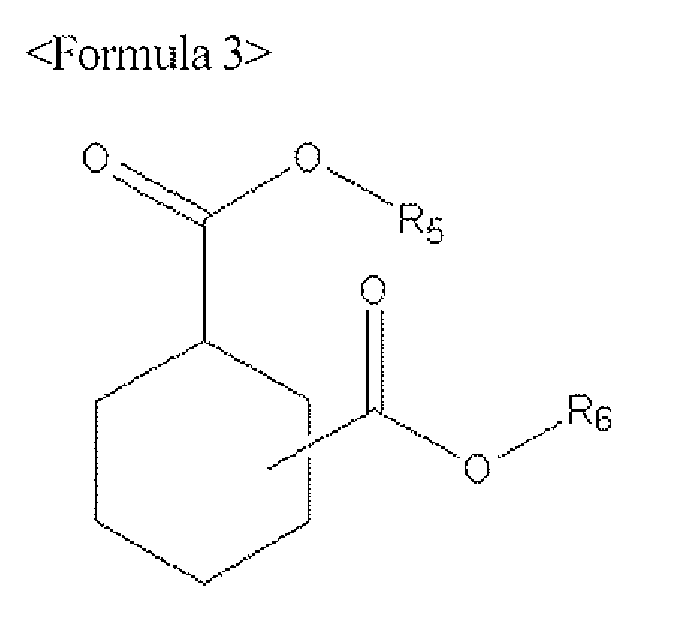
- A polyvinylchloride resin composition, comprising:a polyvinylchloride resin; andthe ester plasticizer composition of claim 4,wherein an amount of the ester plasticizer composition to the polyvinylchloride resin is 10 ∼ 150 phr.
Applications Claiming Priority (2)
| Application Number | Priority Date | Filing Date | Title |
|---|---|---|---|
| KR1020090050981A KR20100132253A (en) | 2009-06-09 | 2009-06-09 | Novel polyvinyl chloride plasticizer |
| PCT/KR2010/003609 WO2010143844A2 (en) | 2009-06-09 | 2010-06-04 | Novel plasticizer for a polyvinyl chloride resin |
Publications (2)
| Publication Number | Publication Date |
|---|---|
| EP2441748A2 true EP2441748A2 (en) | 2012-04-18 |
| EP2441748A4 EP2441748A4 (en) | 2013-01-02 |
Family
ID=43309337
Family Applications (1)
| Application Number | Title | Priority Date | Filing Date |
|---|---|---|---|
| EP10786327A Withdrawn EP2441748A4 (en) | 2009-06-09 | 2010-06-04 | NEW PLASTICIZER FOR POLYVINYL CHLORIDE RESIN |
Country Status (5)
| Country | Link |
|---|---|
| US (1) | US20120077914A1 (en) |
| EP (1) | EP2441748A4 (en) |
| KR (1) | KR20100132253A (en) |
| CN (1) | CN102459145A (en) |
| WO (1) | WO2010143844A2 (en) |
Cited By (2)
| Publication number | Priority date | Publication date | Assignee | Title |
|---|---|---|---|---|
| EP2343271A4 (en) * | 2008-09-11 | 2015-08-12 | Sk Innovation Co Ltd | NOVEL POLYVINYL CHLORIDE RESIN SOFTWARE |
| CN105646205A (en) * | 2016-01-20 | 2016-06-08 | 江南大学 | Preparation method of environment-friendly plasticizer for migration resisting and homogeneous catalysis |
Families Citing this family (5)
| Publication number | Priority date | Publication date | Assignee | Title |
|---|---|---|---|---|
| US7973194B1 (en) * | 2010-03-18 | 2011-07-05 | Eastman Chemical Company | High solvating cyclohexane dicarboxylate diesters plasticizers |
| KR102090295B1 (en) * | 2016-04-22 | 2020-03-17 | 주식회사 엘지화학 | Plasticizer and resin composition comprising the same |
| KR20200078880A (en) | 2018-12-24 | 2020-07-02 | 김영준 | System for guiding store information using technology of image recognize |
| EP3990533A1 (en) * | 2019-06-26 | 2022-05-04 | Eastman Chemical Company | High solvating mixed terephthalate ester plasticizer compositions |
| CN112812458A (en) * | 2020-12-30 | 2021-05-18 | 威海市泓淋电力技术股份有限公司 | Environment-friendly polyvinyl chloride material meeting TCO (transparent conductive oxide) requirement and preparation process thereof |
Family Cites Families (13)
| Publication number | Priority date | Publication date | Assignee | Title |
|---|---|---|---|---|
| DE1031786B (en) * | 1954-02-22 | 1958-06-12 | Dehydag Gmbh | Process for the preparation of plasticizers containing epoxy groups |
| JPS4616578Y1 (en) * | 1967-09-28 | 1971-06-09 | ||
| JP3786112B2 (en) * | 1995-12-12 | 2006-06-14 | 新日本理化株式会社 | Lubricant |
| US6300457B1 (en) * | 1996-09-23 | 2001-10-09 | Foster Miller, Inc. | Polyester/polyurethane vinyl dioxolane based coating compositions |
| DE19927978A1 (en) * | 1999-06-18 | 2000-12-21 | Basf Ag | New esters of cyclohexane-1,3- and -1,4-dicarboxylic acid, useful as toxicologically acceptable plasticizers, e.g. for PVC, obtained by hydrogenation of corresponding isophthalate and terephthalate esters |
| DE10146869A1 (en) * | 2001-09-24 | 2003-04-24 | Oxeno Olefinchemie Gmbh | Alicyclic polycarboxylic ester mixtures with a high trans content and process for their preparation |
| DE10146848A1 (en) * | 2001-09-24 | 2003-04-24 | Oxeno Olefinchemie Gmbh | Mixture of alicyclic polycarboxylic acid esters with a high cis content |
| EP2258760B1 (en) * | 2001-09-25 | 2014-06-25 | ExxonMobil Chemical Patents Inc. | Plasticised polyvinyl chloride |
| JP4366584B2 (en) * | 2002-02-18 | 2009-11-18 | 関西ペイント株式会社 | Coating composition and coating film forming method |
| DE102005028752A1 (en) * | 2005-06-22 | 2007-01-04 | Oxeno Olefinchemie Gmbh | Mixture of diisononyl esters of 1,2-cyclohexanedicarboxylic acid, process for their preparation and use of these mixtures |
| US8207253B2 (en) * | 2007-09-14 | 2012-06-26 | Eastman Specialties Holdings Corporation | Mixed aryl/alkyl diester compositions |
| KR101005704B1 (en) * | 2007-10-16 | 2011-01-05 | 주식회사 엘지화학 | 1,4-cyclohexanedicarboxylate composition for polymer resin and method for preparing same |
| US20090312470A1 (en) * | 2008-06-11 | 2009-12-17 | Ferro Corporation | Asymmetric Cyclic Diester Compounds |
-
2009
- 2009-06-04 US US13/376,646 patent/US20120077914A1/en not_active Abandoned
- 2009-06-09 KR KR1020090050981A patent/KR20100132253A/en not_active Withdrawn
-
2010
- 2010-06-04 WO PCT/KR2010/003609 patent/WO2010143844A2/en not_active Ceased
- 2010-06-04 EP EP10786327A patent/EP2441748A4/en not_active Withdrawn
- 2010-06-04 CN CN2010800255354A patent/CN102459145A/en active Pending
Cited By (2)
| Publication number | Priority date | Publication date | Assignee | Title |
|---|---|---|---|---|
| EP2343271A4 (en) * | 2008-09-11 | 2015-08-12 | Sk Innovation Co Ltd | NOVEL POLYVINYL CHLORIDE RESIN SOFTWARE |
| CN105646205A (en) * | 2016-01-20 | 2016-06-08 | 江南大学 | Preparation method of environment-friendly plasticizer for migration resisting and homogeneous catalysis |
Also Published As
| Publication number | Publication date |
|---|---|
| KR20100132253A (en) | 2010-12-17 |
| CN102459145A (en) | 2012-05-16 |
| WO2010143844A2 (en) | 2010-12-16 |
| US20120077914A1 (en) | 2012-03-29 |
| EP2441748A4 (en) | 2013-01-02 |
| WO2010143844A3 (en) | 2011-03-31 |
Similar Documents
| Publication | Publication Date | Title |
|---|---|---|
| US20110196081A1 (en) | Plasticizer and polyvinyl chloride resin composition containing same | |
| US20120136101A1 (en) | Ester-based plasticizer | |
| US20110166271A1 (en) | Plasticiser and polyvinyl chloride (pvc) resin containing the same | |
| TWI725196B (en) | Plasticizer composition, resin composition and method of preparing the same | |
| US8546604B2 (en) | Polyvinyl chloride resin plasticiser | |
| US20120077914A1 (en) | Novel plasticizer for a polyvinyl chloride resin | |
| KR101909434B1 (en) | Plasticizers for resin compositions and resin compositions including the same | |
| US20160024273A1 (en) | Low-volatility plasticizer blends | |
| KR101679654B1 (en) | Plasticizers for resin compositions and resin compositions including the same | |
| KR101150570B1 (en) | Composition of glycerides for polymer resin and method for manufacturing the same | |
| KR20150093604A (en) | Isophthalate-based ester compound and plasticizer composition comprising the same | |
| KR102108875B1 (en) | Composite plasticizer composition, and method for preparing the same, and polymer resin composition using the same | |
| TWI585135B (en) | Resin composition including plasticizer composition, and methods for preparing the same | |
| KR102354744B1 (en) | Composite plasticizer composition, and method for preparing the same, and polymer resin composition using the same | |
| EP4234621A1 (en) | Vinyl chloride resin composition | |
| DE102011111621A1 (en) | Polyalkylene glycol di-p-toluates and benzoates, their preparation and their use |
Legal Events
| Date | Code | Title | Description |
|---|---|---|---|
| PUAI | Public reference made under article 153(3) epc to a published international application that has entered the european phase |
Free format text: ORIGINAL CODE: 0009012 |
|
| 17P | Request for examination filed |
Effective date: 20120106 |
|
| AK | Designated contracting states |
Kind code of ref document: A2 Designated state(s): AL AT BE BG CH CY CZ DE DK EE ES FI FR GB GR HR HU IE IS IT LI LT LU LV MC MK MT NL NO PL PT RO SE SI SK SM TR |
|
| DAX | Request for extension of the european patent (deleted) | ||
| A4 | Supplementary search report drawn up and despatched |
Effective date: 20121204 |
|
| RIC1 | Information provided on ipc code assigned before grant |
Ipc: C08L 27/06 20060101ALI20121128BHEP Ipc: C08K 5/092 20060101ALI20121128BHEP Ipc: C08K 5/12 20060101ALI20121128BHEP Ipc: C07C 69/75 20060101ALI20121128BHEP Ipc: C07C 69/773 20060101AFI20121128BHEP |
|
| STAA | Information on the status of an ep patent application or granted ep patent |
Free format text: STATUS: THE APPLICATION IS DEEMED TO BE WITHDRAWN |
|
| 18D | Application deemed to be withdrawn |
Effective date: 20130702 |