EP2432065A1 - Procédé de structuration d'une couche polymère et procédé d'encapsulation d'une microbatterie - Google Patents
Procédé de structuration d'une couche polymère et procédé d'encapsulation d'une microbatterie Download PDFInfo
- Publication number
- EP2432065A1 EP2432065A1 EP11354044A EP11354044A EP2432065A1 EP 2432065 A1 EP2432065 A1 EP 2432065A1 EP 11354044 A EP11354044 A EP 11354044A EP 11354044 A EP11354044 A EP 11354044A EP 2432065 A1 EP2432065 A1 EP 2432065A1
- Authority
- EP
- European Patent Office
- Prior art keywords
- layer
- microbattery
- lithium
- polymerization
- support
- Prior art date
- Legal status (The legal status is an assumption and is not a legal conclusion. Google has not performed a legal analysis and makes no representation as to the accuracy of the status listed.)
- Granted
Links
Images


Classifications
-
- H—ELECTRICITY
- H01—ELECTRIC ELEMENTS
- H01M—PROCESSES OR MEANS, e.g. BATTERIES, FOR THE DIRECT CONVERSION OF CHEMICAL ENERGY INTO ELECTRICAL ENERGY
- H01M10/00—Secondary cells; Manufacture thereof
- H01M10/05—Accumulators with non-aqueous electrolyte
- H01M10/058—Construction or manufacture
- H01M10/0585—Construction or manufacture of accumulators having only flat construction elements, i.e. flat positive electrodes, flat negative electrodes and flat separators
-
- H—ELECTRICITY
- H01—ELECTRIC ELEMENTS
- H01M—PROCESSES OR MEANS, e.g. BATTERIES, FOR THE DIRECT CONVERSION OF CHEMICAL ENERGY INTO ELECTRICAL ENERGY
- H01M10/00—Secondary cells; Manufacture thereof
- H01M10/04—Construction or manufacture in general
- H01M10/0436—Small-sized flat cells or batteries for portable equipment
-
- H—ELECTRICITY
- H01—ELECTRIC ELEMENTS
- H01M—PROCESSES OR MEANS, e.g. BATTERIES, FOR THE DIRECT CONVERSION OF CHEMICAL ENERGY INTO ELECTRICAL ENERGY
- H01M10/00—Secondary cells; Manufacture thereof
- H01M10/05—Accumulators with non-aqueous electrolyte
- H01M10/052—Li-accumulators
-
- H—ELECTRICITY
- H01—ELECTRIC ELEMENTS
- H01M—PROCESSES OR MEANS, e.g. BATTERIES, FOR THE DIRECT CONVERSION OF CHEMICAL ENERGY INTO ELECTRICAL ENERGY
- H01M10/00—Secondary cells; Manufacture thereof
- H01M10/05—Accumulators with non-aqueous electrolyte
- H01M10/056—Accumulators with non-aqueous electrolyte characterised by the materials used as electrolytes, e.g. mixed inorganic/organic electrolytes
- H01M10/0561—Accumulators with non-aqueous electrolyte characterised by the materials used as electrolytes, e.g. mixed inorganic/organic electrolytes the electrolyte being constituted of inorganic materials only
- H01M10/0562—Solid materials
-
- H—ELECTRICITY
- H01—ELECTRIC ELEMENTS
- H01M—PROCESSES OR MEANS, e.g. BATTERIES, FOR THE DIRECT CONVERSION OF CHEMICAL ENERGY INTO ELECTRICAL ENERGY
- H01M50/00—Constructional details or processes of manufacture of the non-active parts of electrochemical cells other than fuel cells, e.g. hybrid cells
- H01M50/10—Primary casings; Jackets or wrappings
- H01M50/116—Primary casings; Jackets or wrappings characterised by the material
- H01M50/117—Inorganic material
-
- H—ELECTRICITY
- H01—ELECTRIC ELEMENTS
- H01M—PROCESSES OR MEANS, e.g. BATTERIES, FOR THE DIRECT CONVERSION OF CHEMICAL ENERGY INTO ELECTRICAL ENERGY
- H01M50/00—Constructional details or processes of manufacture of the non-active parts of electrochemical cells other than fuel cells, e.g. hybrid cells
- H01M50/10—Primary casings; Jackets or wrappings
- H01M50/116—Primary casings; Jackets or wrappings characterised by the material
- H01M50/117—Inorganic material
- H01M50/119—Metals
-
- H—ELECTRICITY
- H01—ELECTRIC ELEMENTS
- H01M—PROCESSES OR MEANS, e.g. BATTERIES, FOR THE DIRECT CONVERSION OF CHEMICAL ENERGY INTO ELECTRICAL ENERGY
- H01M50/00—Constructional details or processes of manufacture of the non-active parts of electrochemical cells other than fuel cells, e.g. hybrid cells
- H01M50/10—Primary casings; Jackets or wrappings
- H01M50/116—Primary casings; Jackets or wrappings characterised by the material
- H01M50/121—Organic material
-
- H—ELECTRICITY
- H01—ELECTRIC ELEMENTS
- H01M—PROCESSES OR MEANS, e.g. BATTERIES, FOR THE DIRECT CONVERSION OF CHEMICAL ENERGY INTO ELECTRICAL ENERGY
- H01M50/00—Constructional details or processes of manufacture of the non-active parts of electrochemical cells other than fuel cells, e.g. hybrid cells
- H01M50/10—Primary casings; Jackets or wrappings
- H01M50/116—Primary casings; Jackets or wrappings characterised by the material
- H01M50/124—Primary casings; Jackets or wrappings characterised by the material having a layered structure
-
- H—ELECTRICITY
- H01—ELECTRIC ELEMENTS
- H01M—PROCESSES OR MEANS, e.g. BATTERIES, FOR THE DIRECT CONVERSION OF CHEMICAL ENERGY INTO ELECTRICAL ENERGY
- H01M50/00—Constructional details or processes of manufacture of the non-active parts of electrochemical cells other than fuel cells, e.g. hybrid cells
- H01M50/10—Primary casings; Jackets or wrappings
- H01M50/14—Primary casings; Jackets or wrappings for protecting against damage caused by external factors
-
- H—ELECTRICITY
- H01—ELECTRIC ELEMENTS
- H01M—PROCESSES OR MEANS, e.g. BATTERIES, FOR THE DIRECT CONVERSION OF CHEMICAL ENERGY INTO ELECTRICAL ENERGY
- H01M6/00—Primary cells; Manufacture thereof
- H01M6/14—Cells with non-aqueous electrolyte
- H01M6/18—Cells with non-aqueous electrolyte with solid electrolyte
-
- H—ELECTRICITY
- H01—ELECTRIC ELEMENTS
- H01M—PROCESSES OR MEANS, e.g. BATTERIES, FOR THE DIRECT CONVERSION OF CHEMICAL ENERGY INTO ELECTRICAL ENERGY
- H01M6/00—Primary cells; Manufacture thereof
- H01M6/14—Cells with non-aqueous electrolyte
- H01M6/18—Cells with non-aqueous electrolyte with solid electrolyte
- H01M6/187—Solid electrolyte characterised by the form
-
- H—ELECTRICITY
- H01—ELECTRIC ELEMENTS
- H01M—PROCESSES OR MEANS, e.g. BATTERIES, FOR THE DIRECT CONVERSION OF CHEMICAL ENERGY INTO ELECTRICAL ENERGY
- H01M6/00—Primary cells; Manufacture thereof
- H01M6/14—Cells with non-aqueous electrolyte
- H01M6/18—Cells with non-aqueous electrolyte with solid electrolyte
- H01M6/188—Processes of manufacture
-
- H—ELECTRICITY
- H01—ELECTRIC ELEMENTS
- H01M—PROCESSES OR MEANS, e.g. BATTERIES, FOR THE DIRECT CONVERSION OF CHEMICAL ENERGY INTO ELECTRICAL ENERGY
- H01M6/00—Primary cells; Manufacture thereof
- H01M6/40—Printed batteries, e.g. thin film batteries
-
- H—ELECTRICITY
- H01—ELECTRIC ELEMENTS
- H01M—PROCESSES OR MEANS, e.g. BATTERIES, FOR THE DIRECT CONVERSION OF CHEMICAL ENERGY INTO ELECTRICAL ENERGY
- H01M2300/00—Electrolytes
- H01M2300/0017—Non-aqueous electrolytes
- H01M2300/0065—Solid electrolytes
- H01M2300/0068—Solid electrolytes inorganic
-
- H—ELECTRICITY
- H01—ELECTRIC ELEMENTS
- H01M—PROCESSES OR MEANS, e.g. BATTERIES, FOR THE DIRECT CONVERSION OF CHEMICAL ENERGY INTO ELECTRICAL ENERGY
- H01M2300/00—Electrolytes
- H01M2300/0088—Composites
- H01M2300/0094—Composites in the form of layered products, e.g. coatings
-
- H—ELECTRICITY
- H01—ELECTRIC ELEMENTS
- H01M—PROCESSES OR MEANS, e.g. BATTERIES, FOR THE DIRECT CONVERSION OF CHEMICAL ENERGY INTO ELECTRICAL ENERGY
- H01M4/00—Electrodes
- H01M4/02—Electrodes composed of, or comprising, active material
- H01M4/04—Processes of manufacture in general
- H01M4/0402—Methods of deposition of the material
- H01M4/0421—Methods of deposition of the material involving vapour deposition
- H01M4/0423—Physical vapour deposition
- H01M4/0426—Sputtering
-
- H—ELECTRICITY
- H01—ELECTRIC ELEMENTS
- H01M—PROCESSES OR MEANS, e.g. BATTERIES, FOR THE DIRECT CONVERSION OF CHEMICAL ENERGY INTO ELECTRICAL ENERGY
- H01M4/00—Electrodes
- H01M4/02—Electrodes composed of, or comprising, active material
- H01M4/04—Processes of manufacture in general
- H01M4/0402—Methods of deposition of the material
- H01M4/0421—Methods of deposition of the material involving vapour deposition
- H01M4/0428—Chemical vapour deposition
-
- H—ELECTRICITY
- H01—ELECTRIC ELEMENTS
- H01M—PROCESSES OR MEANS, e.g. BATTERIES, FOR THE DIRECT CONVERSION OF CHEMICAL ENERGY INTO ELECTRICAL ENERGY
- H01M4/00—Electrodes
- H01M4/02—Electrodes composed of, or comprising, active material
- H01M4/13—Electrodes for accumulators with non-aqueous electrolyte, e.g. for lithium-accumulators; Processes of manufacture thereof
- H01M4/139—Processes of manufacture
- H01M4/1391—Processes of manufacture of electrodes based on mixed oxides or hydroxides, or on mixtures of oxides or hydroxides, e.g. LiCoOx
-
- H—ELECTRICITY
- H01—ELECTRIC ELEMENTS
- H01M—PROCESSES OR MEANS, e.g. BATTERIES, FOR THE DIRECT CONVERSION OF CHEMICAL ENERGY INTO ELECTRICAL ENERGY
- H01M4/00—Electrodes
- H01M4/02—Electrodes composed of, or comprising, active material
- H01M4/13—Electrodes for accumulators with non-aqueous electrolyte, e.g. for lithium-accumulators; Processes of manufacture thereof
- H01M4/139—Processes of manufacture
- H01M4/1395—Processes of manufacture of electrodes based on metals, Si or alloys
-
- H—ELECTRICITY
- H01—ELECTRIC ELEMENTS
- H01M—PROCESSES OR MEANS, e.g. BATTERIES, FOR THE DIRECT CONVERSION OF CHEMICAL ENERGY INTO ELECTRICAL ENERGY
- H01M4/00—Electrodes
- H01M4/02—Electrodes composed of, or comprising, active material
- H01M4/13—Electrodes for accumulators with non-aqueous electrolyte, e.g. for lithium-accumulators; Processes of manufacture thereof
- H01M4/139—Processes of manufacture
- H01M4/1397—Processes of manufacture of electrodes based on inorganic compounds other than oxides or hydroxides, e.g. sulfides, selenides, tellurides, halogenides or LiCoFy
-
- H—ELECTRICITY
- H01—ELECTRIC ELEMENTS
- H01M—PROCESSES OR MEANS, e.g. BATTERIES, FOR THE DIRECT CONVERSION OF CHEMICAL ENERGY INTO ELECTRICAL ENERGY
- H01M4/00—Electrodes
- H01M4/02—Electrodes composed of, or comprising, active material
- H01M4/36—Selection of substances as active materials, active masses, active liquids
- H01M4/48—Selection of substances as active materials, active masses, active liquids of inorganic oxides or hydroxides
- H01M4/485—Selection of substances as active materials, active masses, active liquids of inorganic oxides or hydroxides of mixed oxides or hydroxides for inserting or intercalating light metals, e.g. LiTi2O4 or LiTi2OxFy
-
- H—ELECTRICITY
- H01—ELECTRIC ELEMENTS
- H01M—PROCESSES OR MEANS, e.g. BATTERIES, FOR THE DIRECT CONVERSION OF CHEMICAL ENERGY INTO ELECTRICAL ENERGY
- H01M4/00—Electrodes
- H01M4/02—Electrodes composed of, or comprising, active material
- H01M4/36—Selection of substances as active materials, active masses, active liquids
- H01M4/58—Selection of substances as active materials, active masses, active liquids of inorganic compounds other than oxides or hydroxides, e.g. sulfides, selenides, tellurides, halogenides or LiCoFy; of polyanionic structures, e.g. phosphates, silicates or borates
- H01M4/581—Chalcogenides or intercalation compounds thereof
- H01M4/5815—Sulfides
-
- H—ELECTRICITY
- H01—ELECTRIC ELEMENTS
- H01M—PROCESSES OR MEANS, e.g. BATTERIES, FOR THE DIRECT CONVERSION OF CHEMICAL ENERGY INTO ELECTRICAL ENERGY
- H01M50/00—Constructional details or processes of manufacture of the non-active parts of electrochemical cells other than fuel cells, e.g. hybrid cells
- H01M50/10—Primary casings; Jackets or wrappings
- H01M50/116—Primary casings; Jackets or wrappings characterised by the material
- H01M50/124—Primary casings; Jackets or wrappings characterised by the material having a layered structure
- H01M50/1245—Primary casings; Jackets or wrappings characterised by the material having a layered structure characterised by the external coating on the casing
-
- Y—GENERAL TAGGING OF NEW TECHNOLOGICAL DEVELOPMENTS; GENERAL TAGGING OF CROSS-SECTIONAL TECHNOLOGIES SPANNING OVER SEVERAL SECTIONS OF THE IPC; TECHNICAL SUBJECTS COVERED BY FORMER USPC CROSS-REFERENCE ART COLLECTIONS [XRACs] AND DIGESTS
- Y02—TECHNOLOGIES OR APPLICATIONS FOR MITIGATION OR ADAPTATION AGAINST CLIMATE CHANGE
- Y02E—REDUCTION OF GREENHOUSE GAS [GHG] EMISSIONS, RELATED TO ENERGY GENERATION, TRANSMISSION OR DISTRIBUTION
- Y02E60/00—Enabling technologies; Technologies with a potential or indirect contribution to GHG emissions mitigation
- Y02E60/10—Energy storage using batteries
-
- Y—GENERAL TAGGING OF NEW TECHNOLOGICAL DEVELOPMENTS; GENERAL TAGGING OF CROSS-SECTIONAL TECHNOLOGIES SPANNING OVER SEVERAL SECTIONS OF THE IPC; TECHNICAL SUBJECTS COVERED BY FORMER USPC CROSS-REFERENCE ART COLLECTIONS [XRACs] AND DIGESTS
- Y02—TECHNOLOGIES OR APPLICATIONS FOR MITIGATION OR ADAPTATION AGAINST CLIMATE CHANGE
- Y02P—CLIMATE CHANGE MITIGATION TECHNOLOGIES IN THE PRODUCTION OR PROCESSING OF GOODS
- Y02P70/00—Climate change mitigation technologies in the production process for final industrial or consumer products
- Y02P70/50—Manufacturing or production processes characterised by the final manufactured product
Definitions
- the invention relates to a method of structuring a polymer layer on a support, and more particularly to a method of encapsulating a microbattery using a polymer layer and a barrier layer.
- Lithium microbatteries generally consist of two electrodes (positive and negative) separated by an electrolyte. They further include metal current collectors, platinum or tungsten.
- the positive electrode is formed of a material having good ionic conductivity, for example titanium oxysulfide (TiOS).
- TiOS titanium oxysulfide
- the electrolyte is an electrical insulator having a high ionic conductivity such as lithium oxynitride and phosphorus (LiPON).
- the negative electrode consists of metallic lithium or a lithiated material.
- lithium-containing materials are very sensitive to air, particularly oxygen and moisture, they must be covered with an inert and watertight protective barrier.
- the control of encapsulation is a key factor that determines the efficiency over time of microbatteries.
- An encapsulation solution consists in depositing thin layers on the microbattery.
- the encapsulation device then comprises a first layer of polymer material disposed on the microbattery and a second layer of ceramic or metallic material covering the first layer.
- the layer of polymer material aims, on the one hand, to limit the defects related to the roughness of the substrate, and on the other hand, to accommodate the deformations of the microbattery during its use.
- the layer of ceramic or metal material is a protective barrier against oxygen and moisture.
- the polymer layer is generally deposited spin-coating ("spin-coating" in English) on the entire substrate while the barrier layer is formed by a physical vapor deposition (PVD) or plasma-enhanced chemical vapor deposition. (PACVD).
- PVD physical vapor deposition
- PCVD plasma-enhanced chemical vapor deposition
- the first uses a mechanical mask to define the patterns.
- effects of shading and misalignment of the masks appear and cause inaccuracy on the position or the dimensions of the pattern that one wishes to achieve.
- These effects of shading and misalignment become preponderant for microbatteries of small dimensions.
- the figure 1 represents, schematically, a photolithography operation for delimiting an encapsulation device of a microbattery 2 disposed on a support 4.
- the encapsulation device comprises a polymer layer 6 and a barrier layer 8 previously deposited on the set of the microbattery 2 and the support 4.
- a resin etching mask 10 is formed on the encapsulation device and the layers 6 and 8 are etched through the mask 10. This photolithography operation also makes it possible to establish the electrical connections. of the microbattery, partially releasing the current collectors 12 at the ends of the microbattery 2.
- the barrier layer 8 does not cover the polymer layer 6 on the flanks of the microbattery (etching flanks), as can be seen in FIG. figure 1 . Given the low level of protection of the polymer layer, oxygen and water may diffuse through the layer 6 and degrade the microbattery 2.
- the lateral protection of the microbattery becomes essential for smaller components.
- Photolithography employs a developing chemical solution to etch the encapsulation layers 6, 8 and a cleaning solution to remove the etching mask 10. These solutions may also enter the microbattery 2 and damage it. There is also an over-etching effect of the layers 6 and 8, which further decreases the lateral protection of the component. Finally, photolithography consists of a large number of steps that significantly lengthen microbattery manufacturing processes.
- This need is met by depositing a layer of lithium polymerization inhibiting material on a first zone of the support, by depositing a cationically polymerizable material on the layer of polymerization inhibiting material and on a second zone of the support, subjecting the polymerizable material to a polymerization treatment, resulting in a layer of non-solidified sacrificial material in the first zone and the layer of polymeric material in the second zone, and removing the layer of sacrificial material.
- the encapsulation process comprises depositing a layer of lithium polymerization inhibiting material on the support at the periphery of the microbattery, depositing a cationically polymerizable material. on the entire microbattery and on the layer of inhibiting material, a polymerization treatment applied to the polymerizable material, resulting in a non-solidified sacrificial material layer at the periphery of the microbattery and a layer of polymeric material covering the microbattery, the deposition of a layer forming a protective barrier on the layer of polymeric material and covering the entire microbattery, and the removal of the layer of sacrificial material and the layer of polymerization inhibiting material.
- Chain polymerization refers to the chemical reaction between reactive molecules, usually linear monomers or prepolymers, which bind to each other covalently. This chain reaction is initiated using initiators, also called initiators.
- initiators also called initiators.
- the initiators under the action of heat or ultraviolet radiation, release active centers on which the monomers are grafted.
- the active center is a radical, that is to say a chemical species having one or more unpaired electrons.
- Benzyl and azobisisobutyronitrile (AIBN) are commonly used initiators.
- the monomers concerned by this type of polymerization are, for example, acrylates or methacrylates.
- radical polymerization is inhibited by oxygen in the air. It binds to free radicals and forms peroxide radicals, which are inactive. However, it is possible to perform a radical polymerization in the presence of oxygen, using sensitizers or by increasing the intensity of the radiation.
- Cationic polymerization involves a free ion, or possibly an ion pair, as the active center.
- Primers are generally protonic acids such as sulfuric acid or triflic acid. Unlike radical polymerization, cationic polymerization is insensitive to oxygen.
- the cationic polymerization is inhibited in the presence of lithium.
- a material containing lithium has the ability to trap the ions (the active centers) vectors of the polymerization reaction. Such a material will be called later polymerization inhibitor.
- a layer 20 of polymerizable material is then deposited on the layer 16, as well as in a zone 18c of the support 4 between the zones 18a and 18b.
- This deposit is preferably made by spinning, full plate, that is to say over the entire upper surface of the support 4.
- the thickness of the layer 20 then varies between 1 and 5 microns depending on the speed of rotation .
- Other deposition methods may be employed such as screen printing, microdispersion or spraying.
- the thickness of the layer 20 is generally also between 1 and 5 microns.
- polymerizable material a solution comprising monomers (or prepolymers) and at least one initiator of cationic type.
- monomers or prepolymers
- Monomers based on vinyl ethers or heterocyclic monomers epoxides, lactones, cyclic ethers, epoxysilicones, etc.
- the epoxy monomers and vinyl ethers being particularly reactive, they will be preferred so as to obtain a rapid polymerization.
- Certain commercial products commonly known as photopolymerizable or thermosetting resins, include these monomers, in particular those marketed by Epoxy Technology under the name “OG” (OG146-178, UVO-114, OG115, OG114-4, OG146. .) and under the name “Epo-Tek” (Epo-Tek-301, Epo-Tek-354, Epo-Tek-305, Epo-Tek-H705 ).
- OG OG146-178, UVO-114, OG115, OG114-4, OG146. .
- Epo-Tek Epo-Tek-301, Epo-Tek-354, Epo-Tek-305, Epo-Tek-H705 .
- the initiator is preferably chosen from protonic acids (H 2 SO 4 , CF 3 SO 3 H), inorganic halides (BF 3 , SnCl 2, etc.) and organometallic compounds (Al (CH 2)). 3 ) 3 , Salen type complexes Certainly and organic salts (R 3 O + ).
- the initiator is generally incorporated into the abovementioned resins.
- the material is subjected to a polymerization treatment so that the initiator of the material creates ions to initiate the chain reaction.
- the material 20 is preferably subjected to a heat treatment (case of thermo-initiators) or exposed to radiation (case of photoinitiators).
- the layer 20 is exposed to ultraviolet radiation with a wavelength of between 300 and 600 nm, for a duration of less than 10 min, with a power density of the order of 100 mW / cm 2 .
- the ions of the layer 20 responsible for the initiation of the crosslinking chain react largely with the atoms of the material 16 based on lithium and can not initiate the polymerization reaction.
- the layer 20 in the zones 18a and 18b is thus left intact or weakly polymerized.
- the polymerization reaction is carried out normally.
- a pattern 22 of polymer material is then obtained at the end of the treatment.
- a layer is obtained with parts of different natures: a part with little or no polymerization located directly above the layer 16, and a part polymerized elsewhere.
- the unpolymerized portion, in contact with the material 16, is soluble in a developing solution while the polymerized portion is insoluble therein.
- the unpolymerized portion may extend over an area up to about 5 ⁇ m in height (i.e., for a layer thickness of 5 ⁇ m or less) and up to 1 ⁇ m laterally (generally between 0.2 and 1 ⁇ m on each side of layer 16).
- the stage of figure 4 consists of removing the polymerizable material left intact in the zones 18a and 18b. This removal step is preferably carried out using water, a solvent or several solvents, such as acetone or ethanol.
- the layer 16 of inhibiting material can be eliminated simultaneously, so as to leave only the desired pattern 22 on the support 4.
- the layer 26 preferably covers, in its entirety, the cathode 24.
- the deposit is, for example, made by cathode sputtering so as to obtain a LiPON layer of about 1.5 ⁇ m thickness free of defects.
- a pattern of polymerization inhibiting material 16 is formed at the periphery of the microbattery.
- the material 16 is preferably deposited on the substrate 4 around the electrolyte layer 26, so as to form a closed peripheral pattern, distinct from the layer 26.
- the pattern 16 covers, preferably, a portion of the collectors 12a and 12b, as shown in the sectional view of the figure 6 .
- the pattern 16 is, like the electrolyte 26, constituted by LiPON and its deposition is performed at the same time as the deposition of the layer 26, using a single mask.
- the stage of figure 7 corresponds to the formation of an anode 28 on the layer 26.
- the anode 28 is made of lithium metal and is deposited by evaporation under vacuum. Its thickness varies between 1 micron and 3 microns.
- a metal layer 30, for example titanium, gold, aluminum or copper, is then deposited on the upper face of the anode 28 and on a portion of the collector 12b.
- the layer 30 thus makes the electrical connection between the anode 28 and the anode collector 12b.
- This metal layer makes it possible to reduce the surface roughness of the lithium layer 28.
- the conduction of the anode current is improved with respect to a layer of lithium 28 extending to the collector 12b.
- the Figures 8 to 10 represent steps of realization of the encapsulation device of the microbattery.
- the encapsulation device comprises a layer 6 of polymer type disposed on the microbattery and a protective layer 8, or barrier layer, disposed on the polymer layer.
- the polymer layer limits defects related to the roughness of the substrate to improve the protective effect of the barrier layer. It also makes it possible to absorb the deformations of the microbattery during loads and discharges. For this, it favors the use of an insulating polymer having a high mechanical flexibility. In addition, a polymer that is easy to implement and that makes it possible to smooth the topography of the microbattery is desired. It is also preferable that the polymer is thermally stable. Indeed, the microbattery (and its encapsulation device) can be subjected to heat treatments at temperatures of the order of 260 ° C for integration on external devices.
- the epoxy-based materials respond favorably to these specificities of microbattery technology, especially the products of the aforementioned Epoxy Technology company.
- the figure 8 represents the step of forming the polymer layer 6 on the microbattery from a layer 20 of polymerizable material, as described in connection with the figure 3 .
- the layer 20 is deposited, preferably, full plate by spin coating.
- the material 20 then covers the substrate 4, the collectors 12a and 12b, the pattern 16 and the microbattery.
- the material solidifies to form a polymeric material, except in the area of the pattern 16 of inhibiting material, at the periphery of the microbattery.
- the desired polymer layer 6 is thus obtained, which largely covers the microbattery, surrounded by uncured material.
- a lateral zone 32 of the microbattery is not covered by the layer 6 since the material 20 is in direct contact with the electrolyte layer 26 in this zone. Indeed, the LiPON layer 26 prevents the polymerization of the material 20 in the same way as the pattern 16. However, this area 32 not covered by the polymer 6 has no impact on the protection of the microbattery. The tightness of the microbattery against chemical species is ensured by a barrier layer 8, formed later, which covers the entire microbattery.
- the figure 9 represents the deposition of the barrier layer 8 on the polymer layer 6 and on the areas of the microbattery not covered by the polymer.
- the material of the layer 8 is preferably selected from silicon oxide, silicon nitride, silicon oxynitride and alumina.
- the barrier layer 8 is preferably deposited in a conformal manner by PVD, CVD or ALD ("Atomic Layer Deposition"). Its thickness is between 50 nm and 300 nm.
- the material 8 is deposited along a profile, also called weft, defined by the layers of solid phase materials.
- this frame is composed of the polymer layer 6 and the electrolyte layer 26 in the zone 32.
- the uncured material 20 is not part of the frame.
- the material of the layer 8 is deposited on the upper face of the layer 6 and is inserted at the level of the flanks of the microbattery between the solid layer 6 and the material 20 remained in the liquid state or between the layer 26 and the material 20.
- the barrier layer 8 is deposited on the flanks as well as on the upper face of the microbattery. The encapsulation of the microbattery is therefore total.
- the material which has not polymerized and the inhibiting material is removed with a developing solution.
- the elimination of the LiPON layer 16 and the remaining material can be carried out using a solution of phosphoric acid (H 3 PO 4 ), followed by a rinsing with water.
- the barrier layer 8 covering the entire microbattery, development and rinsing solutions are not likely to infiltrate the microbattery and damage it. Moreover, the electrical connection of the microbattery on the front face of the substrate is facilitated. Indeed, the inhibiting material having been deposited in part on the metal collectors 12a and 12b, the latter are released during development.
- the process of encapsulation of microbattery advantageously comprises the deposition of the lithium-based inhibiting material 16 during the formation of the microbattery.
- the material 16 and the electrolyte 26 are both made of LiPON and are deposited simultaneously.
- the deposition of the inhibiting material is performed after forming the microbattery on the substrate.
- This deposit is then an additional step compared to the preferred embodiment described above.
- This embodiment variant is, for example, used when the electrolyte is a material other than the LiPON or when the anode is in a material other than lithium metal or when the cathode is in a material other than LiTiOS, LiTiS 2 and LiV 2 O 5 .
- the encapsulation process is fast and easy to implement. Indeed, it comprises a number of steps restricted compared to a conventional photolithography operation and these steps are compatible with the technologies of microelectronics.
Landscapes
- Chemical & Material Sciences (AREA)
- Chemical Kinetics & Catalysis (AREA)
- Electrochemistry (AREA)
- General Chemical & Material Sciences (AREA)
- Engineering & Computer Science (AREA)
- Manufacturing & Machinery (AREA)
- Inorganic Chemistry (AREA)
- Condensed Matter Physics & Semiconductors (AREA)
- Physics & Mathematics (AREA)
- General Physics & Mathematics (AREA)
- Secondary Cells (AREA)
- Primary Cells (AREA)
- Battery Mounting, Suspending (AREA)
- Battery Electrode And Active Subsutance (AREA)
- Micromachines (AREA)
- Sealing Battery Cases Or Jackets (AREA)
Abstract
Description
- L'invention est relative à un procédé de structuration d'une couche en polymère sur un support, et plus particulièrement à un procédé d'encapsulation d'une microbatterie à l'aide d'une couche en polymère et d'une couche barrière.
- Les microbatteries au lithium sont généralement constituées de deux électrodes (positive et négative) séparées par un électrolyte. Elles comprennent en outre des collecteurs de courant métalliques, en platine ou tungstène. L'électrode positive est formée dans un matériau ayant une bonne conductivité ionique, par exemple l'oxysulfure de titane (TiOS). L'électrolyte est un isolant électrique ayant une forte conductivité ionique tel que l'oxynitrure de lithium et de phosphore (LiPON). L'électrode négative est constituée de lithium métallique ou d'un matériau lithié.
- Les matériaux contenant du lithium étant très sensibles à l'air, et en particulier à l'oxygène et l'humidité, ils doivent être recouverts d'une barrière de protection inerte et étanche. La maîtrise de l'encapsulation est un facteur primordial qui conditionne l'efficacité dans le temps des microbatteries.
- Une solution d'encapsulation consiste à déposer des couches minces sur la microbatterie. Le dispositif d'encapsulation comprend alors une première couche en matériau polymère disposée sur la microbatterie et une seconde couche en matériau céramique ou métallique recouvrant la première couche. La couche en matériau polymère vise, d'une part, à limiter les défauts liés à la rugosité du substrat, et d'autre part, à permettre l'accommodation des déformations de la microbatterie lors de son utilisation. La couche en matériau céramique ou métallique constitue une barrière de protection contre l'oxygène et l'humidité.
- La couche polymère est généralement déposée à la tournette (« spin-coating » en anglais) sur la totalité du substrat tandis que la couche barrière est formée par un dépôt physique en phase vapeur (PVD) ou un dépôt chimique en phase vapeur assisté par plasma (PACVD).
- Afin de structurer le dispositif d'encapsulation, deux techniques sont principalement employées. La première utilise un masque mécanique pour définir les motifs. Toutefois, des effets d'ombrage et de désalignement des masques apparaissent et causent une imprécision sur la position ou les dimensions du motif que l'on souhaite réaliser. Ces effets d'ombrage et de désalignement deviennent prépondérants pour des microbatteries de faibles dimensions. On tend alors à délaisser les masques mécaniques au profit de la seconde technique, la photolithographie.
- La
figure 1 représente, de manière schématique, une opération de photolithographie pour délimiter un dispositif d'encapsulation d'une microbatterie 2 disposée sur un support 4. Le dispositif d'encapsulation comprend une couche polymère 6 et une couche barrière 8 déposées préalablement sur l'ensemble de la microbatterie 2 et du support 4. Un masque de gravure 10 en résine est formé sur le dispositif d'encapsulation puis les couches 6 et 8 sont gravées à travers le masque 10. Cette opération de photolithographie permet en outre d'établir les connexions électriques de la microbatterie, en libérant en partie les collecteurs de courant 12 situés aux extrémités de la microbatterie 2. - Cette technique de structuration ne garantit pas une protection latérale de la microbatterie. En effet, la couche barrière 8 ne recouvre pas la couche polymère 6 sur les flancs de la microbatterie (flancs de gravure), comme cela est visible sur la
figure 1 . Compte tenu du faible niveau de protection de la couche polymère, l'oxygène et l'eau risquent de diffuser à travers la couche 6 et de dégrader la microbatterie 2. - Si la dégradation de la microbatterie intervient principalement au niveau de la face supérieure pour des composants de grandes dimensions, la protection latérale de la microbatterie devient primordiale pour des composants de taille réduite. Ainsi, dans un effort de miniaturisation, il est nécessaire de recouvrir la totalité de la microbatterie avec la couche barrière pour augmenter sa durée de vie.
- La photolithographie emploie une solution chimique de développement pour graver les couches d'encapsulation 6, 8 et une solution de nettoyage pour supprimer le masque de gravure 10. Ces solutions risquent également de pénétrer dans la microbatterie 2 et de la détériorer. Il existe en outre un effet de sur-gravure des couches 6 et 8, qui diminue davantage la protection latérale du composant. Enfin, la photolithographie se compose d'un grand nombre d'étapes qui allongent de façon significative les procédés de fabrication de microbatteries.
- Les couches en matériau polymère étant déposées avec facilité sur l'ensemble d'un substrat, généralement par dépôt à la tournette, on souhaite disposer d'un procédé tout aussi simple pour structurer ces couches, notamment dans le cas d'une couche encapsulant une microbatterie.
- Il existe ainsi un besoin de prévoir un procédé simple et rapide pour structurer une couche en matériau polymère sur un support.
- On tend à satisfaire ce besoin en déposant une couche en matériau inhibiteur de polymérisation à base de lithium sur une première zone du support, en déposant un matériau polymérisable par voie cationique sur la couche en matériau inhibiteur de polymérisation et sur une seconde zone du support, en soumettant le matériau polymérisable à un traitement de polymérisation, d'où il résulte une couche en matériau sacrificiel non solidifié dans la première zone et la couche en matériau polymère dans la seconde zone, et en éliminant la couche en matériau sacrificiel.
- On prévoit également un procédé rapide et facile à mettre en oeuvre pour encapsuler une microbatterie au lithium disposée sur un support, permettant d'assurer une protection latérale de la microbatterie.
- Le procédé d'encapsulation comprend le dépôt d'une couche en matériau inhibiteur de polymérisation à base de lithium sur le support à la périphérie de la microbatterie, le dépôt d'un matériau polymérisable par voie cationique sur l'ensemble de la microbatterie et sur la couche en matériau inhibiteur, un traitement de polymérisation appliqué au matériau polymérisable, d'où il résulte une couche en matériau sacrificiel non solidifié à la périphérie de la microbatterie et une couche en matériau polymère recouvrant la microbatterie, le dépôt d'une couche formant une barrière de protection sur la couche en matériau polymère et recouvrant l'ensemble de la microbatterie, et l'élimination de la couche en matériau sacrificiel et de la couche en matériau inhibiteur de polymérisation.
- D'autres avantages et caractéristiques ressortiront plus clairement de la description qui va suivre de modes particuliers de réalisation donnés à titre d'exemples non limitatifs et illustrés à l'aide des dessins annexés, dans lesquels :
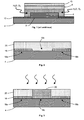
- la
figure 1 représente une structuration de couches d'encapsulation d'une microbatterie par photolithographie, selon l'art antérieur, - les
figures 2 à 4 représentent des étapes d'un mode de mise en oeuvre d'un procédé de structuration d'une couche en polymère selon l'invention, - les
figures 5 à 10 représentent des étapes d'un mode de mise en oeuvre d'un procédé d'encapsulation d'une microbatterie utilisant le procédé desfigures 2 à 4 . - La polymérisation en chaîne désigne la réaction chimique entre des molécules réactives, généralement des monomères ou des prépolymères linéaires, qui se lient entre elles de façon covalente. Cette réaction en chaîne est initiée à l'aide d'amorceurs, appelés également initiateurs. Les amorceurs, sous l'action de la chaleur ou d'un rayonnement ultraviolet, libèrent des centres actifs sur lesquels se greffent les monomères. Il existe deux principaux mécanismes de polymérisation, radicalaire ou cationique, selon la nature de ces centres actifs.
- Dans une polymérisation radicalaire, le centre actif est un radical, c'est-à-dire une espèce chimique ayant un ou plusieurs électrons non appariés. Le benzile et l'azobisisobutyronitrile (AIBN) sont des amorceurs couramment employés. Les monomères concernés par ce type de polymérisation sont, par exemple, les acrylates ou les méthacrylates.
- Il est bien connu que la polymérisation radicalaire est inhibée par l'oxygène de l'air. Celui-ci se fixe sur les radicaux libres et forme des radicaux peroxydes, qui sont inactifs. Il est toutefois possible de réaliser une polymérisation radicalaire en présence d'oxygène, en utilisant des sensibilisateurs ou en augmentant l'intensité du rayonnement.
- La polymérisation cationique fait intervenir un ion libre, ou éventuellement une paire d'ions, en tant que centre actif. Les amorceurs sont généralement des acides protoniques tels que l'acide sulfurique ou l'acide triflique. Contrairement à la polymérisation radicalaire, la polymérisation cationique est insensible à l'oxygène.
- Par contre, il a été découvert par les inventeurs que la polymérisation par voie cationique est inhibée en présence de lithium. En effet, un matériau contenant du lithium présente la faculté de piéger les ions (les centres actifs) vecteurs de la réaction de polymérisation. Un tel matériau sera appelé par la suite inhibiteur de polymérisation.
- On se propose d'utiliser ce phénomène pour rendre locale la polymérisation par voie cationique, en déposant une couche en matériau inhibiteur préalablement au dépôt d'un matériau polymérisable.
- Les
figures 2 à 4 représentent, de manière schématique, des étapes d'un mode de mise en oeuvre d'un procédé de structuration d'une couche en matériau polymère, à l'aide d'un matériau à base de lithium. - La
figure 2 représente le dépôt d'une couche 16 en matériau inhibiteur à base de lithium sur un support 4 quelconque. La couche 16 en matériau inhibiteur est, à titre d'exemple, déposée dans deux zones distinctes 18a et 18b du support. Le matériau inhibiteur est, de préférence, du lithium sous forme métallique, de l'oxynitrure de lithium et de phosphore (LiPON), de l'oxysulfure de titane lithié (LiTiOS), du disulfure de titane lithié (LiTiS2) ou du pentoxyde de vanadium lithié (LiV2O5). Le lithium métallique est, par exemple, déposé par évaporation sous vide et le LiPON peut être déposé par PVD. L'épaisseur de la couche 16 varie, de préférence, entre 50 nm et 3 µm. - Une couche 20 en matériau polymérisable est ensuite déposée sur la couche 16, ainsi que dans une zone 18c du support 4 comprise entre les zones 18a et 18b. Ce dépôt est, de préférence, réalisé à la tournette, pleine plaque, c'est-à-dire sur toute la face supérieure du support 4. L'épaisseur de la couche 20 varie alors entre 1 et 5 µm selon la vitesse de rotation. D'autres procédés de dépôt peuvent être employés comme la sérigraphie, la microdispersion ou l'aspersion. L'épaisseur de la couche 20 est généralement comprise aussi entre 1 et 5 µm.
- Par matériau polymérisable, on entend une solution comprenant des monomères (ou prépolymères) et au moins un amorceur de type cationique. Les monomères à base d'éthers vinyliques ou les monomères hétérocycliques (époxydes, lactones, éthers cycliques, époxysilicones...) peuvent être utilisés. Les monomères époxydes et éthers vinyliques étant particulièrement réactifs, ils seront privilégiés de manière à obtenir une polymérisation rapide.
- Certains produits du commerce, appelés communément résines photo-polymérisables ou thermodurcissables, comprennent ces monomères, notamment ceux commercialisés par la société Epoxy Technology sous la dénomination « OG » (OG146-178, UVO-114, OG115, OG114-4, OG146...) et sous la dénomination « Epo-Tek » (Epo-Tek-301, Epo-Tek-354, Epo-Tek-305, Epo-Tek-H705...).
- L'amorceur est, de préférence, choisi parmi les acides protoniques (H2SO4, CF3SO3H...), les halogénures inorganiques (BF3, SnCl2...), les composés orgamétalliques (Al(CH3)3, complexes de type Salen...) et les sels organiques (R3O+). L'amorceur est généralement intégré dans les résines susmentionnées.
- A la
figure 3 , le matériau 20 est soumis à un traitement de polymérisation de manière que l'amorceur du matériau crée des ions pour initier la réaction en chaîne. Le matériau 20 est, de préférence, soumis à un traitement thermique (cas des thermo-amorceurs) ou exposé à un rayonnement (cas des photo-amorceurs). A titre d'exemple, la couche 20 est exposée à un rayonnement ultraviolet de longueur d'onde comprise entre 300 et 600 nm, pendant une durée inférieure à 10 min, avec une densité de puissance de l'ordre de 100 mW/cm2 . - Dans les zones 18a et 18b, les ions de la couche 20 responsables de l'amorçage de la chaîne de réticulation réagissent en grande partie avec les atomes du matériau 16 à base de lithium et ne peuvent donc initier la réaction de polymérisation. La couche 20 dans les zones 18a et 18b est donc laissée intacte ou faiblement polymérisée. A l'inverse, dans la zone 18c dépourvue de matériau 16, la réaction de polymérisation s'effectue normalement. Un motif 22 en matériau polymère est alors obtenu à l'issue du traitement.
- En d'autres termes, on obtient lors de cette étape une couche avec des parties de natures différentes : une partie non ou peu polymérisée située à l'aplomb de la couche 16, et une partie polymérisée ailleurs. La partie non polymérisée, en contact avec le matériau 16, est soluble dans une solution de développement tandis que la partie polymérisée est insoluble dans celle-ci.
- La partie non polymérisée peut s'étendre sur une zone allant jusqu'à 5 µm de hauteur environ (c'est-à-dire pour une épaisseur de couche 20 de 5 µm ou inférieure) et jusqu'à 1 µm latéralement (généralement entre 0,2 et 1 µm de chaque côté de la couche 16).
- L'étape de la
figure 4 consiste à éliminer le matériau polymérisable laissé intact dans les zones 18a et 18b. Cette étape d'élimination est, de préférence, réalisée à l'aide d'eau, d'un solvant ou de plusieurs solvants, tels que l'acétone ou l'éthanol. La couche 16 en matériau inhibiteur peut être éliminée simultanément, de manière à ne laisser que le motif souhaité 22 sur le support 4. - Ce procédé permet donc, de manière simple, de délimiter une couche en matériau polymère. Ce procédé est précis, rapide et facile à mettre en oeuvre, contrairement aux techniques de l'art antérieur. Il est parfaitement adapté à l'industrie microélectronique, en particulier pour l'encapsulation de microbatteries utilisant une couche polymère.
- Les
figures 5 à 10 représentent des étapes d'un mode de mise en oeuvre d'un procédé d'encapsulation d'une microbatterie au lithium. Ce mode de mise en oeuvre préférentiel comprend la formation de la microbatterie. Pour délimiter les différentes couches constituant la microbatterie, des masques mécaniques peuvent être utilisés. Le procédé de structuration décrit ci-dessus permet de délimiter le dispositif d'encapsulation disposé sur la microbatterie. - La
figure 5 représente un substrat de départ 4 comprenant des collecteurs de courant cathodique 12a et anodique 12b, par exemple en titane, tungstène ou en or. Ces collecteurs de courant métalliques sont déposés sous forme de couches minces (200 nm environ), par PVD par exemple. - Une cathode 24 est ensuite déposée sur le collecteur cathodique 12a, par exemple par évaporation sous vide ou par pulvérisation cathodique. La cathode est formée dans une couche en matériau d'insertion du lithium, tel que l'oxysulfure de titane TiOS, le pentoxyde de vanadium V2O5 ou le disulfure de titane TiS2. Son épaisseur est de l'ordre de 1,5 µm.
- A la
figure 6 , une couche d'électrolyte 26, de préférence à base de LiPON, est déposée sur la cathode 24 ainsi que sur une partie du collecteur anodique 12b et sur la zone du substrat séparant les collecteurs 12a et 12b. La couche 26 recouvre, de préférence, intégralement la cathode 24. Le dépôt est, par exemple, réalisé par pulvérisation cathodique de manière à obtenir une couche en LiPON d'environ 1,5 µm d'épaisseur exempte de défauts. - Un motif en matériau inhibiteur de polymérisation 16 est formé à la périphérie de la microbatterie. Le matériau 16 est, de préférence, déposé sur le substrat 4 autour de la couche d'électrolyte 26, de manière à former un motif périphérique fermé, distinct de la couche 26. Le motif 16 recouvre, de préférence, une partie des collecteurs 12a et 12b, comme cela est représenté sur la vue en coupe de la
figure 6 . Dans cet exemple de réalisation, le motif 16 est, comme l'électrolyte 26, constitué de LiPON et son dépôt est réalisé en même temps que le dépôt de la couche 26, à l'aide d'un seul masque. - L'étape de la
figure 7 correspond à la formation d'une anode 28 sur la couche 26. De préférence, l'anode 28 est constituée de lithium métallique et est déposée par évaporation sous vide. Son épaisseur varie entre 1 µm et 3 µm. Une couche métallique 30, par exemple en titane, or, aluminium ou cuivre, est ensuite déposée sur la face supérieure de l'anode 28 et sur une partie du collecteur 12b. La couche 30 réalise ainsi la connexion électrique entre l'anode 28 et le collecteur anodique 12b. Cette couche métallique permet de diminuer la rugosité de surface de la couche de lithium 28. Par ailleurs, la conduction du courant anodique est améliorée par rapport à une couche de lithium 28 s'étendant jusqu'au collecteur 12b. - Les
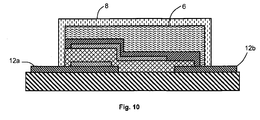
figures 8 à 10 représentent des étapes de réalisation du dispositif d'encapsulation de la microbatterie. Le dispositif d'encapsulation comprend une couche 6 de type polymère disposée sur la microbatterie et une couche 8 de protection, ou couche barrière, disposée sur la couche en polymère. - Comme décrit précédemment, la couche en polymère limite les défauts liés à la rugosité du substrat pour améliorer l'effet protecteur de la couche barrière. Elle permet également d'absorber les déformations de la microbatterie lors des charges et décharges. Pour cela, on privilégie l'utilisation d'un polymère isolant ayant une souplesse mécanique élevée. On souhaite en outre un polymère facile à mettre en oeuvre et permettant d'aplanir la topographie de la microbatterie. Il est également préférable que le polymère soit stable thermiquement. En effet, la microbatterie (et son dispositif d'encapsulation) peut être soumise à des traitements thermiques à des températures de l'ordre de 260 °C en vue de son intégration sur des dispositifs externes.
- Les matériaux à base d'époxydes répondent favorablement à ces spécificités de la technologie des microbatteries, notamment les produits de la société Epoxy Technology précédemment évoqués.
- La
figure 8 représente l'étape de formation de la couche 6 en polymère sur la microbatterie à partir d'une couche 20 en matériau polymérisable, comme décrit en relation avec lafigure 3 . - La couche 20 est déposée, de préférence, pleine plaque par dépôt à la tournette. Le matériau 20 recouvre alors le substrat 4, les collecteurs 12a et 12b, le motif 16 et la microbatterie.
- En soumettant le matériau 20 à un traitement de polymérisation, celui-ci se solidifie pour former un matériau polymère, excepté dans la zone du motif 16 en matériau inhibiteur, à la périphérie de la microbatterie. On obtient ainsi la couche de polymère 6 souhaitée, qui recouvre en grande partie la microbatterie, entourée de matériau 20 non polymérisé.
- Dans l'exemple de la
figure 8 , une zone latérale 32 de la microbatterie n'est pas recouverte par la couche 6 puisque le matériau 20 est en contact direct avec la couche 26 d'électrolyte dans cette zone. En effet, la couche 26 en LiPON empêche la polymérisation du matériau 20 au même titre que le motif 16. Toutefois, cette zone 32 non recouverte par le polymère 6 est sans incidence sur la protection de la microbatterie. L'étanchéité de la microbatterie face aux espèces chimiques est assurée par une couche barrière 8, formée ultérieurement, qui recouvre l'ensemble de la microbatterie. - La
figure 9 représente le dépôt de la couche barrière 8 sur la couche 6 en polymère et sur les zones de la microbatterie non recouvertes par le polymère. - Le matériau de la couche 8 est, de préférence, choisi parmi l'oxyde de silicium, le nitrure de silicium, l'oxynitrure de silicium et l'alumine. La couche barrière 8 est, de préférence, déposée de manière conforme par PVD, CVD ou ALD (« Atomic Layer Deposition » en anglais). Son épaisseur est comprise entre 50 nm et 300 nm.
- Lors de cette étape, le matériau 8 se dépose le long d'un profil, appelé également trame, défini par les couches de matériaux en phase solide. Dans l'exemple de la
figure 9 , cette trame est composée de la couche 6 de polymère et de la couche 26 d'électrolyte dans la zone 32. Le matériau 20 non polymérisé ne fait pas partie de la trame. - En d'autres termes, le matériau de la couche 8 se dépose sur la face supérieure de la couche 6 et s'insère au niveau des flancs de la microbatterie entre la couche 6 solide et le matériau 20 resté à l'état liquide ou bien entre la couche 26 et le matériau 20.
- Ainsi, en délimitant au préalable la couche 6 en polymère à l'aide d'un matériau inhibiteur, la couche barrière 8 se dépose aussi bien sur les flancs que sur la face supérieure de la microbatterie. L'encapsulation de la microbatterie est donc totale.
- A la
figure 10 , le matériau n'ayant pas polymérisé et le matériau inhibiteur sont éliminés à l'aide d'une solution de développement. A titre d'exemple, l'élimination de la couche 16 en LiPON et du matériau 20 restant peut être réalisée à l'aide d'une solution d'acide phosphorique (H3PO4), suivi d'un rinçage à l'eau. - La couche barrière 8 recouvrant l'ensemble de la microbatterie, les solutions de développement et de rinçage ne risquent pas de s'infiltrer dans la microbatterie et de l'endommager. Par ailleurs, la connexion électrique de la microbatterie en face avant du substrat est facilitée. En effet, le matériau inhibiteur ayant été déposé en partie sur les collecteurs métalliques 12a et 12b, ces derniers sont libérés lors du développement.
- Le procédé d'encapsulation de microbatterie, décrit en relation avec les
figures 5 à 10 , comprend avantageusement le dépôt du matériau inhibiteur 16 à base de lithium pendant la formation de la microbatterie. En effet, le matériau 16 et l'électrolyte 26 sont tous deux constitués de LiPON et sont déposés simultanément. Toutefois, il est également possible de réaliser le dépôt du matériau inhibiteur en même temps que le dépôt de l'anode, avec du lithium métallique, ou que le dépôt de la cathode avec du LiTiOS, LiTiS2 et LiV2O5. - Dans une variante de réalisation, le dépôt du matériau inhibiteur est réalisé après avoir former la microbatterie sur le substrat. Ce dépôt constitue alors une étape supplémentaire par rapport au mode de mise en oeuvre préférentiel décrit ci-dessus. Cette variante de réalisation est, par exemple, utilisée lorsque l'électrolyte est un matériau autre que le LiPON ou lorsque l'anode est dans un matériau autre que le lithium métallique ou lorsque la cathode est en un matériau autre que LiTiOS, LiTiS2 et LiV2O5.
- Le procédé d'encapsulation est rapide et facile à mettre en oeuvre. En effet, il comporte un nombre d'étapes restreint par rapport à une opération de photolithographie classique et ces étapes sont compatibles avec les technologies de la microélectronique.
Claims (10)
- Procédé de structuration d'une couche en matériau polymère (6, 22) sur un support (4) comprenant les étapes suivantes :- déposer une couche en matériau inhibiteur (16) de polymérisation à base de lithium sur une première zone (18a, 18b) du support,- déposer un matériau polymérisable (20) par voie cationique sur la couche en matériau inhibiteur de polymérisation (16) et sur une seconde zone (18c) du support,- soumettre le matériau polymérisable à un traitement de polymérisation, d'où il résulte une couche en matériau sacrificiel (20) non solidifié dans la première zone et ladite couche en matériau polymère (6, 22) dans la seconde zone, et- éliminer la couche en matériau sacrificiel (20).
- Procédé selon la revendication 1, caractérisé en ce que le matériau inhibiteur de polymérisation (16) est choisi parmi le lithium métallique, l'oxynitrure de lithium et de phosphore (LiPON), l'oxysulfure de titane lithié (LiTiOS), le disulfure de titane lithié (LiTiS2) et le pentoxyde de vanadium lithié (LiV2O5).
- Procédé selon la revendication 1, caractérisé en ce que la couche en matériau inhibiteur de polymérisation (16) est éliminée en même temps que la couche en matériau sacrificiel (20).
- Procédé selon la revendication 1, caractérisé en ce que le matériau polymérisable par voie cationique (20) est polymérisé par irradiation aux ultraviolets ou par voie thermique.
- Procédé selon la revendication 1, caractérisé en ce que le matériau polymérisable par voie cationique (20) comprend des monomères époxydes ou éthers vinyliques et un amorceur à base d'acide protonique.
- Procédé d'encapsulation d'une microbatterie (2) au lithium disposée sur un support (4), comprenant les étapes suivantes :- déposer une couche en matériau inhibiteur de polymérisation (16) à base de lithium sur le support à la périphérie de la microbatterie,- déposer un matériau polymérisable par voie cationique (20) sur l'ensemble de la microbatterie (2) et sur la couche en matériau inhibiteur (16),- soumettre le matériau polymérisable à un traitement de polymérisation, d'où il résulte une couche en matériau sacrificiel (20) non solidifié à la périphérie de la microbatterie et une couche en matériau polymère (6) recouvrant la microbatterie (2),- déposer une couche (8) formant une barrière de protection sur la couche en polymère (6) et recouvrant l'ensemble de la microbatterie (2),- éliminer la couche en matériau sacrificiel (16) et la couche en matériau inhibiteur de polymérisation (20).
- Procédé selon la revendication 6, caractérisé en ce que le matériau inhibiteur de polymérisation (16) est choisi parmi le lithium métallique, l'oxynitrure de lithium et de phosphore (LiPON), l'oxysulfure de titane lithié (LiTiOS), le disulfure de titane lithié (LiTiS2) et le pentoxyde de vanadium lithié (LiV2O5).
- Procédé selon la revendication 6, caractérisé en ce que le procédé comprend la formation de la microbatterie (2) sur le support (4).
- Procédé selon la revendication 8, caractérisé en ce que, la microbatterie (2) comportant une électrode (24, 28) en lithium métallique, en oxysulfure de titane lithié (LiTiOS), en disulfure de titane lithié (LiTiS2) ou en pentoxyde de vanadium lithié (LiV2O5), le dépôt de la couche en matériau inhibiteur (16) et le dépôt de l'électrode sont effectués lors d'une même étape.
- Procédé selon la revendication 8, caractérisé en ce que, la microbatterie (2) comportant un électrolyte (26) en oxynitrure de lithium et de phosphore (LiPON), le dépôt de la couche en matériau inhibiteur (16) et le dépôt de l'électrolyte sont effectués lors d'une même étape.
Applications Claiming Priority (1)
| Application Number | Priority Date | Filing Date | Title |
|---|---|---|---|
| FR1003726A FR2965110B1 (fr) | 2010-09-20 | 2010-09-20 | Procede de structuration d'une couche polymere et procede d'encapsulation d'une microbatterie |
Publications (2)
| Publication Number | Publication Date |
|---|---|
| EP2432065A1 true EP2432065A1 (fr) | 2012-03-21 |
| EP2432065B1 EP2432065B1 (fr) | 2014-01-01 |
Family
ID=43806960
Family Applications (1)
| Application Number | Title | Priority Date | Filing Date |
|---|---|---|---|
| EP11354044.7A Active EP2432065B1 (fr) | 2010-09-20 | 2011-09-09 | Procédé de structuration d'une couche polymère et procédé d'encapsulation d'une microbatterie |
Country Status (7)
| Country | Link |
|---|---|
| US (1) | US8962080B2 (fr) |
| EP (1) | EP2432065B1 (fr) |
| JP (1) | JP2012074373A (fr) |
| KR (1) | KR20120030323A (fr) |
| CN (1) | CN102412420A (fr) |
| ES (1) | ES2451370T3 (fr) |
| FR (1) | FR2965110B1 (fr) |
Cited By (4)
| Publication number | Priority date | Publication date | Assignee | Title |
|---|---|---|---|---|
| EP2833460A1 (fr) * | 2013-07-30 | 2015-02-04 | Commissariat à l'Energie Atomique et aux Energies Alternatives | Microbatterie au lithium protégée par un capot |
| WO2016001584A1 (fr) * | 2014-07-01 | 2016-01-07 | I-Ten | Batterie entièrement solide comprenant un électrolyte en matériau polymère solide réticule |
| EP3012886A1 (fr) * | 2014-10-22 | 2016-04-27 | Commissariat à l'Energie Atomique et aux Energies Alternatives | Dispositif électrochimique, tel qu'une microbatterie ou un système électrochrome, et son procédé de réalisation |
| US11967694B2 (en) | 2018-05-07 | 2024-04-23 | I-Ten | Porous electrodes for electrochemical devices |
Families Citing this family (8)
| Publication number | Priority date | Publication date | Assignee | Title |
|---|---|---|---|---|
| US9711793B2 (en) | 2014-04-24 | 2017-07-18 | Toyota Motor Engineering & Manufacturing North America, Inc. | Vanadium oxysulfide based cathode materials for rechargeable battery |
| US10069138B2 (en) | 2014-04-24 | 2018-09-04 | Toyota Motor Engineering & Manufacturing North America, Inc. | Vanadium oxysulfide based cathode materials for rechargeable battery |
| CN105714277B (zh) * | 2014-12-03 | 2019-08-30 | 珠海方正科技多层电路板有限公司 | 干膜、电器元件的镀金属方法和电路板的线路制作方法 |
| JP2017182945A (ja) * | 2016-03-29 | 2017-10-05 | Tdk株式会社 | 全固体リチウムイオン二次電池 |
| US11362382B2 (en) | 2016-05-09 | 2022-06-14 | International Business Machines Corporation | Simplified hermetic packaging of a micro-battery |
| CN111999979A (zh) * | 2020-07-31 | 2020-11-27 | 苏州太阳井新能源有限公司 | 一种非光刻图形化掩模的制造方法 |
| CN112448022A (zh) * | 2020-11-25 | 2021-03-05 | 上海空间电源研究所 | 一种非对称电解质电池及其制备方法 |
| CN114300742B (zh) * | 2021-12-28 | 2023-07-25 | 华中科技大学 | 一种固态电解质及其制备方法、锂离子电池及制备方法 |
Citations (2)
| Publication number | Priority date | Publication date | Assignee | Title |
|---|---|---|---|---|
| WO2008011061A1 (fr) * | 2006-07-18 | 2008-01-24 | Cymbet Corporation | Procédé et appareil de manufacture photolithographique de microbatterie à l'état solide |
| EP2166609A1 (fr) * | 2008-09-16 | 2010-03-24 | Commissariat a L'Energie Atomique | Micro-batterie au lithium comportant une couche d'encapsulation et procédé de fabrication |
Family Cites Families (3)
| Publication number | Priority date | Publication date | Assignee | Title |
|---|---|---|---|---|
| DE3567768D1 (en) * | 1984-05-04 | 1989-02-23 | Bbc Brown Boveri & Cie | Dry-etching process |
| CA2115333A1 (fr) * | 1993-02-16 | 1994-08-17 | Shigeo Hozumi | Composes polyfonctionnels a base d'ether-oxyde vinylique; composition de resine photoresist a base de ces composes |
| CN1957487A (zh) * | 2004-01-06 | 2007-05-02 | Cymbet公司 | 具有一个或者更多个可限定层的层式阻挡物结构和方法 |
-
2010
- 2010-09-20 FR FR1003726A patent/FR2965110B1/fr not_active Expired - Fee Related
-
2011
- 2011-09-08 US US13/227,812 patent/US8962080B2/en active Active
- 2011-09-09 EP EP11354044.7A patent/EP2432065B1/fr active Active
- 2011-09-09 ES ES11354044.7T patent/ES2451370T3/es active Active
- 2011-09-15 JP JP2011201306A patent/JP2012074373A/ja not_active Withdrawn
- 2011-09-19 KR KR1020110094134A patent/KR20120030323A/ko not_active Withdrawn
- 2011-09-20 CN CN2011102792020A patent/CN102412420A/zh active Pending
Patent Citations (2)
| Publication number | Priority date | Publication date | Assignee | Title |
|---|---|---|---|---|
| WO2008011061A1 (fr) * | 2006-07-18 | 2008-01-24 | Cymbet Corporation | Procédé et appareil de manufacture photolithographique de microbatterie à l'état solide |
| EP2166609A1 (fr) * | 2008-09-16 | 2010-03-24 | Commissariat a L'Energie Atomique | Micro-batterie au lithium comportant une couche d'encapsulation et procédé de fabrication |
Cited By (10)
| Publication number | Priority date | Publication date | Assignee | Title |
|---|---|---|---|---|
| EP2833460A1 (fr) * | 2013-07-30 | 2015-02-04 | Commissariat à l'Energie Atomique et aux Energies Alternatives | Microbatterie au lithium protégée par un capot |
| FR3009437A1 (fr) * | 2013-07-30 | 2015-02-06 | Commissariat Energie Atomique | Microbatterie au lithium protegee par un capot |
| US9419254B2 (en) | 2013-07-30 | 2016-08-16 | Commissariat A L'energie Atomique Et Aux Energies Alternatives | Lithium microbattery protected by a cover |
| WO2016001584A1 (fr) * | 2014-07-01 | 2016-01-07 | I-Ten | Batterie entièrement solide comprenant un électrolyte en matériau polymère solide réticule |
| FR3023418A1 (fr) * | 2014-07-01 | 2016-01-08 | I Ten | Batterie entierement solide comprenant un electrolyte en materiau polymere solide reticule |
| US10804569B2 (en) | 2014-07-01 | 2020-10-13 | I-Ten | Solid-state battery including an electrolyte made of a cross-linked solid polymer material |
| EP3012886A1 (fr) * | 2014-10-22 | 2016-04-27 | Commissariat à l'Energie Atomique et aux Energies Alternatives | Dispositif électrochimique, tel qu'une microbatterie ou un système électrochrome, et son procédé de réalisation |
| FR3027737A1 (fr) * | 2014-10-22 | 2016-04-29 | Commissariat Energie Atomique | Dispositif electrochimique, tel qu'une microbatterie ou un systeme electrochrome, et son procede de realisation. |
| US9882201B2 (en) | 2014-10-22 | 2018-01-30 | Commissariat à l'Energie Atomique et aux Energies Alternatives | Electrochemical device, such as a microbattery or an electrochromic system, and fabrication method thereof |
| US11967694B2 (en) | 2018-05-07 | 2024-04-23 | I-Ten | Porous electrodes for electrochemical devices |
Also Published As
| Publication number | Publication date |
|---|---|
| CN102412420A (zh) | 2012-04-11 |
| EP2432065B1 (fr) | 2014-01-01 |
| KR20120030323A (ko) | 2012-03-28 |
| US8962080B2 (en) | 2015-02-24 |
| ES2451370T3 (es) | 2014-03-26 |
| US20120070588A1 (en) | 2012-03-22 |
| FR2965110B1 (fr) | 2012-09-28 |
| FR2965110A1 (fr) | 2012-03-23 |
| JP2012074373A (ja) | 2012-04-12 |
Similar Documents
| Publication | Publication Date | Title |
|---|---|---|
| EP2432065B1 (fr) | Procédé de structuration d'une couche polymère et procédé d'encapsulation d'une microbatterie | |
| EP2409352B1 (fr) | Microbatterie au lithium et son procédé de fabrication | |
| EP2833460B1 (fr) | Microbatterie au lithium protégée par un capot | |
| EP2306579A1 (fr) | Procédé de formation d'une batterie lithium-ion en couches minces | |
| EP2715782B1 (fr) | Procédé de réalisation de motifs à la surface d'un substrat utilisant des copolymeres à bloc | |
| EP2166609B1 (fr) | Micro-batterie au lithium comportant une couche d'encapsulation et procédé de fabrication | |
| EP1683217B1 (fr) | Procede de fabrication d une micro-batterie au lithium | |
| EP2071657B1 (fr) | Dispositif électrochimique au lithium encapsulé | |
| EP2309581A1 (fr) | Procédé de formation d'une batterie lithium-ion verticale en couches minces | |
| FR2960346B1 (fr) | Procede de fabrication d'une batterie en couche mince et batterie ainsi realisee | |
| FR2994338A1 (fr) | Procede de formation d'une batterie de type lithium-ion | |
| EP2315294A1 (fr) | Micro-batterie au lithium munie d'une couche d'encapsulation conductrice électroniquement | |
| EP2833461B1 (fr) | Procédé de fabrication d'une microbatterie au lithium | |
| EP3047530B1 (fr) | Procede de realisation d'une microbatterie au lithium et microbatterie au lithium | |
| EP3024066A1 (fr) | Procédé d'enrichissement en espèce ionique d'une électrode d'une microbatterie | |
| FR2476912A1 (fr) | Procede d'isolement des interconnexions de circuits integres, et circuit integre utilisant ce procede | |
| FR3077681A1 (fr) | Batterie en couches minces | |
| EP3734712B1 (fr) | Dispositif de stockage et procédé de fabrication | |
| EP4164009B1 (fr) | Batterie à électrolyte solide | |
| EP4704162A1 (fr) | Dispositif de stockage et procédé de fabrication | |
| FR3079659A1 (fr) | Procede de fabrication d'un substrat donneur pour la realisation d'une structure integree en trois dimensions et procede de fabrication d'une telle structure integree |
Legal Events
| Date | Code | Title | Description |
|---|---|---|---|
| PUAI | Public reference made under article 153(3) epc to a published international application that has entered the european phase |
Free format text: ORIGINAL CODE: 0009012 |
|
| AK | Designated contracting states |
Kind code of ref document: A1 Designated state(s): AL AT BE BG CH CY CZ DE DK EE ES FI FR GB GR HR HU IE IS IT LI LT LU LV MC MK MT NL NO PL PT RO RS SE SI SK SM TR |
|
| AX | Request for extension of the european patent |
Extension state: BA ME |
|
| RIC1 | Information provided on ipc code assigned before grant |
Ipc: H01M 2/02 20060101ALI20120307BHEP Ipc: H01M 10/04 20060101ALI20120307BHEP Ipc: H01M 4/04 20060101ALI20120307BHEP Ipc: H01M 10/058 20100101AFI20120307BHEP |
|
| 17P | Request for examination filed |
Effective date: 20120914 |
|
| RIC1 | Information provided on ipc code assigned before grant |
Ipc: H01M 10/058 20100101AFI20130603BHEP Ipc: H01M 10/04 20060101ALI20130603BHEP Ipc: H01M 4/04 20060101ALI20130603BHEP |
|
| GRAP | Despatch of communication of intention to grant a patent |
Free format text: ORIGINAL CODE: EPIDOSNIGR1 |
|
| INTG | Intention to grant announced |
Effective date: 20130805 |
|
| GRAS | Grant fee paid |
Free format text: ORIGINAL CODE: EPIDOSNIGR3 |
|
| GRAA | (expected) grant |
Free format text: ORIGINAL CODE: 0009210 |
|
| AK | Designated contracting states |
Kind code of ref document: B1 Designated state(s): AL AT BE BG CH CY CZ DE DK EE ES FI FR GB GR HR HU IE IS IT LI LT LU LV MC MK MT NL NO PL PT RO RS SE SI SK SM TR |
|
| REG | Reference to a national code |
Ref country code: GB Ref legal event code: FG4D |
|
| REG | Reference to a national code |
Ref country code: CH Ref legal event code: EP |
|
| REG | Reference to a national code |
Ref country code: IE Ref legal event code: FG4D Free format text: LANGUAGE OF EP DOCUMENT: FRENCH |
|
| REG | Reference to a national code |
Ref country code: DE Ref legal event code: R096 Ref document number: 602011004454 Country of ref document: DE Effective date: 20140213 |
|
| REG | Reference to a national code |
Ref country code: AT Ref legal event code: REF Ref document number: 647940 Country of ref document: AT Kind code of ref document: T Effective date: 20140215 |
|
| REG | Reference to a national code |
Ref country code: ES Ref legal event code: FG2A Ref document number: 2451370 Country of ref document: ES Kind code of ref document: T3 Effective date: 20140326 |
|
| REG | Reference to a national code |
Ref country code: NL Ref legal event code: VDEP Effective date: 20140101 |
|
| REG | Reference to a national code |
Ref country code: AT Ref legal event code: MK05 Ref document number: 647940 Country of ref document: AT Kind code of ref document: T Effective date: 20140101 |
|
| REG | Reference to a national code |
Ref country code: LT Ref legal event code: MG4D |
|
| PG25 | Lapsed in a contracting state [announced via postgrant information from national office to epo] |
Ref country code: IS Free format text: LAPSE BECAUSE OF FAILURE TO SUBMIT A TRANSLATION OF THE DESCRIPTION OR TO PAY THE FEE WITHIN THE PRESCRIBED TIME-LIMIT Effective date: 20140501 Ref country code: LT Free format text: LAPSE BECAUSE OF FAILURE TO SUBMIT A TRANSLATION OF THE DESCRIPTION OR TO PAY THE FEE WITHIN THE PRESCRIBED TIME-LIMIT Effective date: 20140101 |
|
| PG25 | Lapsed in a contracting state [announced via postgrant information from national office to epo] |
Ref country code: AT Free format text: LAPSE BECAUSE OF FAILURE TO SUBMIT A TRANSLATION OF THE DESCRIPTION OR TO PAY THE FEE WITHIN THE PRESCRIBED TIME-LIMIT Effective date: 20140101 Ref country code: SE Free format text: LAPSE BECAUSE OF FAILURE TO SUBMIT A TRANSLATION OF THE DESCRIPTION OR TO PAY THE FEE WITHIN THE PRESCRIBED TIME-LIMIT Effective date: 20140101 Ref country code: FI Free format text: LAPSE BECAUSE OF FAILURE TO SUBMIT A TRANSLATION OF THE DESCRIPTION OR TO PAY THE FEE WITHIN THE PRESCRIBED TIME-LIMIT Effective date: 20140101 Ref country code: NL Free format text: LAPSE BECAUSE OF FAILURE TO SUBMIT A TRANSLATION OF THE DESCRIPTION OR TO PAY THE FEE WITHIN THE PRESCRIBED TIME-LIMIT Effective date: 20140101 Ref country code: CY Free format text: LAPSE BECAUSE OF FAILURE TO SUBMIT A TRANSLATION OF THE DESCRIPTION OR TO PAY THE FEE WITHIN THE PRESCRIBED TIME-LIMIT Effective date: 20140101 Ref country code: PT Free format text: LAPSE BECAUSE OF FAILURE TO SUBMIT A TRANSLATION OF THE DESCRIPTION OR TO PAY THE FEE WITHIN THE PRESCRIBED TIME-LIMIT Effective date: 20140502 |
|
| PG25 | Lapsed in a contracting state [announced via postgrant information from national office to epo] |
Ref country code: RS Free format text: LAPSE BECAUSE OF FAILURE TO SUBMIT A TRANSLATION OF THE DESCRIPTION OR TO PAY THE FEE WITHIN THE PRESCRIBED TIME-LIMIT Effective date: 20140101 Ref country code: HR Free format text: LAPSE BECAUSE OF FAILURE TO SUBMIT A TRANSLATION OF THE DESCRIPTION OR TO PAY THE FEE WITHIN THE PRESCRIBED TIME-LIMIT Effective date: 20140101 Ref country code: LV Free format text: LAPSE BECAUSE OF FAILURE TO SUBMIT A TRANSLATION OF THE DESCRIPTION OR TO PAY THE FEE WITHIN THE PRESCRIBED TIME-LIMIT Effective date: 20140101 |
|
| REG | Reference to a national code |
Ref country code: DE Ref legal event code: R097 Ref document number: 602011004454 Country of ref document: DE |
|
| PG25 | Lapsed in a contracting state [announced via postgrant information from national office to epo] |
Ref country code: EE Free format text: LAPSE BECAUSE OF FAILURE TO SUBMIT A TRANSLATION OF THE DESCRIPTION OR TO PAY THE FEE WITHIN THE PRESCRIBED TIME-LIMIT Effective date: 20140101 Ref country code: RO Free format text: LAPSE BECAUSE OF FAILURE TO SUBMIT A TRANSLATION OF THE DESCRIPTION OR TO PAY THE FEE WITHIN THE PRESCRIBED TIME-LIMIT Effective date: 20140101 Ref country code: CZ Free format text: LAPSE BECAUSE OF FAILURE TO SUBMIT A TRANSLATION OF THE DESCRIPTION OR TO PAY THE FEE WITHIN THE PRESCRIBED TIME-LIMIT Effective date: 20140101 Ref country code: DK Free format text: LAPSE BECAUSE OF FAILURE TO SUBMIT A TRANSLATION OF THE DESCRIPTION OR TO PAY THE FEE WITHIN THE PRESCRIBED TIME-LIMIT Effective date: 20140101 |
|
| PLBE | No opposition filed within time limit |
Free format text: ORIGINAL CODE: 0009261 |
|
| STAA | Information on the status of an ep patent application or granted ep patent |
Free format text: STATUS: NO OPPOSITION FILED WITHIN TIME LIMIT |
|
| PG25 | Lapsed in a contracting state [announced via postgrant information from national office to epo] |
Ref country code: SK Free format text: LAPSE BECAUSE OF FAILURE TO SUBMIT A TRANSLATION OF THE DESCRIPTION OR TO PAY THE FEE WITHIN THE PRESCRIBED TIME-LIMIT Effective date: 20140101 Ref country code: PL Free format text: LAPSE BECAUSE OF FAILURE TO SUBMIT A TRANSLATION OF THE DESCRIPTION OR TO PAY THE FEE WITHIN THE PRESCRIBED TIME-LIMIT Effective date: 20140101 |
|
| PGFP | Annual fee paid to national office [announced via postgrant information from national office to epo] |
Ref country code: ES Payment date: 20140919 Year of fee payment: 4 |
|
| 26N | No opposition filed |
Effective date: 20141002 |
|
| PGFP | Annual fee paid to national office [announced via postgrant information from national office to epo] |
Ref country code: IT Payment date: 20140930 Year of fee payment: 4 |
|
| REG | Reference to a national code |
Ref country code: DE Ref legal event code: R097 Ref document number: 602011004454 Country of ref document: DE Effective date: 20141002 |
|
| PG25 | Lapsed in a contracting state [announced via postgrant information from national office to epo] |
Ref country code: MC Free format text: LAPSE BECAUSE OF FAILURE TO SUBMIT A TRANSLATION OF THE DESCRIPTION OR TO PAY THE FEE WITHIN THE PRESCRIBED TIME-LIMIT Effective date: 20140101 Ref country code: LU Free format text: LAPSE BECAUSE OF FAILURE TO SUBMIT A TRANSLATION OF THE DESCRIPTION OR TO PAY THE FEE WITHIN THE PRESCRIBED TIME-LIMIT Effective date: 20140909 |
|
| REG | Reference to a national code |
Ref country code: CH Ref legal event code: PL |
|
| PG25 | Lapsed in a contracting state [announced via postgrant information from national office to epo] |
Ref country code: SI Free format text: LAPSE BECAUSE OF FAILURE TO SUBMIT A TRANSLATION OF THE DESCRIPTION OR TO PAY THE FEE WITHIN THE PRESCRIBED TIME-LIMIT Effective date: 20140101 |
|
| REG | Reference to a national code |
Ref country code: IE Ref legal event code: MM4A |
|
| PG25 | Lapsed in a contracting state [announced via postgrant information from national office to epo] |
Ref country code: BE Free format text: LAPSE BECAUSE OF NON-PAYMENT OF DUE FEES Effective date: 20140930 |
|
| PG25 | Lapsed in a contracting state [announced via postgrant information from national office to epo] |
Ref country code: LI Free format text: LAPSE BECAUSE OF NON-PAYMENT OF DUE FEES Effective date: 20140930 Ref country code: CH Free format text: LAPSE BECAUSE OF NON-PAYMENT OF DUE FEES Effective date: 20140930 |
|
| PG25 | Lapsed in a contracting state [announced via postgrant information from national office to epo] |
Ref country code: IE Free format text: LAPSE BECAUSE OF NON-PAYMENT OF DUE FEES Effective date: 20140909 |
|
| PG25 | Lapsed in a contracting state [announced via postgrant information from national office to epo] |
Ref country code: IT Free format text: LAPSE BECAUSE OF NON-PAYMENT OF DUE FEES Effective date: 20150909 Ref country code: NO Free format text: LAPSE BECAUSE OF FAILURE TO SUBMIT A TRANSLATION OF THE DESCRIPTION OR TO PAY THE FEE WITHIN THE PRESCRIBED TIME-LIMIT Effective date: 20140401 Ref country code: SM Free format text: LAPSE BECAUSE OF FAILURE TO SUBMIT A TRANSLATION OF THE DESCRIPTION OR TO PAY THE FEE WITHIN THE PRESCRIBED TIME-LIMIT Effective date: 20140101 |
|
| PG25 | Lapsed in a contracting state [announced via postgrant information from national office to epo] |
Ref country code: GR Free format text: LAPSE BECAUSE OF FAILURE TO SUBMIT A TRANSLATION OF THE DESCRIPTION OR TO PAY THE FEE WITHIN THE PRESCRIBED TIME-LIMIT Effective date: 20140402 Ref country code: BG Free format text: LAPSE BECAUSE OF FAILURE TO SUBMIT A TRANSLATION OF THE DESCRIPTION OR TO PAY THE FEE WITHIN THE PRESCRIBED TIME-LIMIT Effective date: 20140101 Ref country code: MT Free format text: LAPSE BECAUSE OF FAILURE TO SUBMIT A TRANSLATION OF THE DESCRIPTION OR TO PAY THE FEE WITHIN THE PRESCRIBED TIME-LIMIT Effective date: 20140101 |
|
| PG25 | Lapsed in a contracting state [announced via postgrant information from national office to epo] |
Ref country code: TR Free format text: LAPSE BECAUSE OF FAILURE TO SUBMIT A TRANSLATION OF THE DESCRIPTION OR TO PAY THE FEE WITHIN THE PRESCRIBED TIME-LIMIT Effective date: 20140101 Ref country code: HU Free format text: LAPSE BECAUSE OF FAILURE TO SUBMIT A TRANSLATION OF THE DESCRIPTION OR TO PAY THE FEE WITHIN THE PRESCRIBED TIME-LIMIT; INVALID AB INITIO Effective date: 20110909 |
|
| REG | Reference to a national code |
Ref country code: FR Ref legal event code: PLFP Year of fee payment: 6 |
|
| REG | Reference to a national code |
Ref country code: ES Ref legal event code: FD2A Effective date: 20161027 |
|
| PG25 | Lapsed in a contracting state [announced via postgrant information from national office to epo] |
Ref country code: ES Free format text: LAPSE BECAUSE OF NON-PAYMENT OF DUE FEES Effective date: 20150910 |
|
| REG | Reference to a national code |
Ref country code: FR Ref legal event code: PLFP Year of fee payment: 7 |
|
| PG25 | Lapsed in a contracting state [announced via postgrant information from national office to epo] |
Ref country code: MK Free format text: LAPSE BECAUSE OF FAILURE TO SUBMIT A TRANSLATION OF THE DESCRIPTION OR TO PAY THE FEE WITHIN THE PRESCRIBED TIME-LIMIT Effective date: 20140101 |
|
| REG | Reference to a national code |
Ref country code: FR Ref legal event code: PLFP Year of fee payment: 8 |
|
| PG25 | Lapsed in a contracting state [announced via postgrant information from national office to epo] |
Ref country code: AL Free format text: LAPSE BECAUSE OF FAILURE TO SUBMIT A TRANSLATION OF THE DESCRIPTION OR TO PAY THE FEE WITHIN THE PRESCRIBED TIME-LIMIT Effective date: 20140101 |
|
| PGFP | Annual fee paid to national office [announced via postgrant information from national office to epo] |
Ref country code: DE Payment date: 20250919 Year of fee payment: 15 |
|
| PGFP | Annual fee paid to national office [announced via postgrant information from national office to epo] |
Ref country code: GB Payment date: 20250923 Year of fee payment: 15 |
|
| PGFP | Annual fee paid to national office [announced via postgrant information from national office to epo] |
Ref country code: FR Payment date: 20250917 Year of fee payment: 15 |