EP2431920A2 - Zeichenerkennungsvorrichtung, Sortiervorrichtung, Sortiersteuervorrichtung und Zeichenerkennungsverfahren - Google Patents
Zeichenerkennungsvorrichtung, Sortiervorrichtung, Sortiersteuervorrichtung und Zeichenerkennungsverfahren Download PDFInfo
- Publication number
- EP2431920A2 EP2431920A2 EP11181155A EP11181155A EP2431920A2 EP 2431920 A2 EP2431920 A2 EP 2431920A2 EP 11181155 A EP11181155 A EP 11181155A EP 11181155 A EP11181155 A EP 11181155A EP 2431920 A2 EP2431920 A2 EP 2431920A2
- Authority
- EP
- European Patent Office
- Prior art keywords
- character
- character string
- recognition
- candidate
- unit
- Prior art date
- Legal status (The legal status is an assumption and is not a legal conclusion. Google has not performed a legal analysis and makes no representation as to the accuracy of the status listed.)
- Withdrawn
Links
Images




Classifications
-
- G—PHYSICS
- G06—COMPUTING OR CALCULATING; COUNTING
- G06V—IMAGE OR VIDEO RECOGNITION OR UNDERSTANDING
- G06V10/00—Arrangements for image or video recognition or understanding
- G06V10/40—Extraction of image or video features
-
- G—PHYSICS
- G06—COMPUTING OR CALCULATING; COUNTING
- G06V—IMAGE OR VIDEO RECOGNITION OR UNDERSTANDING
- G06V30/00—Character recognition; Recognising digital ink; Document-oriented image-based pattern recognition
- G06V30/10—Character recognition
- G06V30/24—Character recognition characterised by the processing or recognition method
- G06V30/242—Division of the character sequences into groups prior to recognition; Selection of dictionaries
- G06V30/244—Division of the character sequences into groups prior to recognition; Selection of dictionaries using graphical properties, e.g. alphabet type or font
-
- G—PHYSICS
- G06—COMPUTING OR CALCULATING; COUNTING
- G06F—ELECTRIC DIGITAL DATA PROCESSING
- G06F18/00—Pattern recognition
- G06F18/20—Analysing
- G06F18/25—Fusion techniques
- G06F18/254—Fusion techniques of classification results, e.g. of results related to same input data
-
- G—PHYSICS
- G06—COMPUTING OR CALCULATING; COUNTING
- G06V—IMAGE OR VIDEO RECOGNITION OR UNDERSTANDING
- G06V30/00—Character recognition; Recognising digital ink; Document-oriented image-based pattern recognition
- G06V30/10—Character recognition
- G06V30/14—Image acquisition
- G06V30/148—Segmentation of character regions
- G06V30/155—Removing patterns interfering with the pattern to be recognised, such as ruled lines or underlines
-
- G—PHYSICS
- G06—COMPUTING OR CALCULATING; COUNTING
- G06V—IMAGE OR VIDEO RECOGNITION OR UNDERSTANDING
- G06V30/00—Character recognition; Recognising digital ink; Document-oriented image-based pattern recognition
- G06V30/10—Character recognition
- G06V30/19—Recognition using electronic means
- G06V30/191—Design or setup of recognition systems or techniques; Extraction of features in feature space; Clustering techniques; Blind source separation
- G06V30/1918—Fusion techniques, i.e. combining data from various sources, e.g. sensor fusion
-
- G—PHYSICS
- G06—COMPUTING OR CALCULATING; COUNTING
- G06V—IMAGE OR VIDEO RECOGNITION OR UNDERSTANDING
- G06V30/00—Character recognition; Recognising digital ink; Document-oriented image-based pattern recognition
- G06V30/10—Character recognition
- G06V30/26—Techniques for post-processing, e.g. correcting the recognition result
- G06V30/262—Techniques for post-processing, e.g. correcting the recognition result using context analysis, e.g. lexical, syntactic or semantic context
- G06V30/268—Lexical context
-
- G—PHYSICS
- G06—COMPUTING OR CALCULATING; COUNTING
- G06V—IMAGE OR VIDEO RECOGNITION OR UNDERSTANDING
- G06V30/00—Character recognition; Recognising digital ink; Document-oriented image-based pattern recognition
- G06V30/10—Character recognition
Definitions
- Embodiments described herein relate generally to a character recognition apparatus, a sorting apparatus, a sorting control apparatus, and a character recognition method.
- Character recognition apparatuses such as an OCR (optical character reader) that reads characters in an image are known.
- OCR optical character reader
- a portion of characters constituting a destination address is sometimes positioned at one end of a window in a windowed letter and hidden so that some characters are missing.
- Various technologies to recognize such missing characters not to be limited to the window of a letter, have been proposed.
- a technology to recognize characters by using an estimation result obtained by estimating the height of characters in a hidden line from the height of characters in a non-hidden line is proposed.
- a technology to recognize characters by using an estimation result obtained by estimating the height of characters chipped when an underline is removed from the height of characters of a non-underlined line is proposed.
- a character recognition apparatus includes a detection unit and a recognition unit.
- the detection unit detects each character candidate from an image.
- the recognition unit recognizes each character candidate based on a plurality of character recognition dictionaries corresponding to a plurality of degrees of different character chipping.
- FIG. 1 is a block diagram exemplifying a sorting system according to the first embodiment.
- a sorting system 1 includes a transfer unit 11, a reading unit 12, a recognition unit 13, a character recognition dictionary database 14, an alignment verification unit 15, a character string verification unit 16, a character string database 17, and a sorting unit 18.
- a sorting processing unit (sorting apparatus) 1A is constituted of the transfer unit 11, the reading unit 12, and the sorting unit 18.
- a character recognition processing unit (character recognition apparatus) 1B is constituted of the recognition unit 13, the character recognition dictionary database 14, the alignment verification unit 15, the character string verification unit 16, and the character string database 17.
- the sorting system 1 may also be constituted as shown in FIG. 2 . That is, the sorting system 1 may be constituted of a plurality of units of the sorting processing unit 1A, one unit of the character recognition processing unit 1B, and a communication unit 1C.
- a sorting control processing unit (sorting control apparatus) 1D is constituted of one unit of the character recognition processing unit 1B and the communication unit 1C.
- the communication unit 1C sends information (image data of a sorted object) from the plurality of units of the sorting processing unit 1A to the character recognition processing unit 1B and also sends information (destination address information (sorting information) read and recognized from an image) from the character recognition processing unit 1B to the plurality of units of the sorting processing unit 1A.
- sorting processing can be distributed and determination processing (recognition processing) can be centralized so that overall processing efficiency can be improved.
- the transfer unit 11 is constituted of a transfer path or the like and a sorted object such as a letter and package is transferred along the transfer path.
- the reading unit 12 reads an image of the sorted object on the transfer path.
- the sorted object is a windowed letter and a portion of the character string constituting the destination address is hidden at an end of the window.
- the character recognition dictionary database 14 stores a plurality of character recognition dictionaries corresponding to a plurality of different degrees of character chipping. Further, the character recognition dictionary database 14 also stores a character recognition dictionary of complete characters without character chipping. For example, the character recognition dictionary database 14 stores N (N is a natural number) character recognition dictionaries D1, D2, ..., DN.
- the character recognition dictionary D1 (dictionary without character chipping) is a character recognition dictionary composed of a plurality of characters without character chipping.
- the character recognition dictionary D2 (dictionary of 10% character chipping) is a character recognition dictionary composed of a plurality of characters of 1% to 20% character chipping.
- the character recognition dictionary D3 (dictionary of 30% character chipping) is a character recognition dictionary composed of a plurality of characters of 21% to 40% character chipping.
- the character recognition dictionary D4 (dictionary of 50% character chipping) is a character recognition dictionary composed of a plurality of characters of 41% to 60% character chipping.
- the recognition unit 13 detects each character candidate from an image of the sorted object shown in FIG. 4 .
- the recognition unit 13 detects an image that looks like a character or character string from the image of the sorted object, detects an image that looks like a plurality of characters from the image that looks like a character or character string, and detects a plurality of character candidates from the image that looks like a plurality of characters.
- the recognition unit 13 recognizes each character candidate based on the plurality of character recognition dictionaries D1, D2, ..., DN stored in the character recognition dictionary database 14. That is, the recognition unit 13 can recognize the destination address (destination address composed of each character candidate) written on the sorted object.
- the alignment verification unit 15 verifies whether the lower end (lower side) is aligned in an orderly way when chipping of each character candidate is restored (see FIG. 6 ). In other words, the alignment verification unit 15 verifies whether the lower end (lower side) is aligned in a straight line along aligned characters when chipping of each character candidate is restored.
- the character string verification unit 16 verifies whether a character string is a character string present as character string data (address data) by using character string data (address data) stored in the character string database 17.
- the character string data includes character string patterns that may be written on a sorted object.
- the sorting unit 18 sorts sorted objects transferred by the transfer unit 11 based on destination address information (sorting information) corresponding to a character recognition result by the recognition unit 13.
- FIG. 4 is a diagram exemplifying the sorted object according to the first embodiment.
- the sorted object is, for example, a windowed letter and a portion of the character string "TARG" constituting the destination address is at an end of the window.
- the recognition unit 13 extracts each character candidate C1, C2, C3, C4 as shown in FIG. 5 from the image of the sorted object shown in FIG. 4 (S2).
- a plurality of image regions that look like characters surrounded by rectangles of a broken line shown in FIG. 5 is each character candidate C1, C2, C3, C4.
- the recognition unit 13 may extract a plurality of character candidates from one image region that looks like a character. For example, as shown in FIG. 5 , the recognition unit 13 can extract a plurality of character candidates C4a, C4b from one image region that looks like a character.
- the recognition unit 13 selects one or more character recognition candidates corresponding to each character candidate C1, C2, C3, C4 based on the plurality of character recognition dictionaries D1, D2, ..., DN (S3).
- the recognition unit 13 selects one or more character recognition candidates satisfying conditions of a predetermined similarity or more for each character candidate. If, for example, a predetermined character candidate perfectly matches the character recognition dictionary DM (1 ⁇ M ⁇ N), the predetermined character candidate is assumed to have the similarity 1000 for the character recognition dictionary DM.
- the recognition unit 13 selects one or more character recognition candidates satisfying conditions of the similarity 700 or more for each character candidate based on the plurality of character recognition dictionaries D1, D2, ..., DN.
- the recognition unit 13 selects character recognition candidates C11, C12, C13 corresponding to a character candidate C1, a character recognition candidate C21 corresponding to a character candidate C2, character recognition candidates C31, C32, C33 corresponding to a character candidate C3, and character recognition candidates C41, C42 corresponding to a character candidate C4.
- the character recognition candidate C11 corresponds to "T" of the similarity 950 (first place) for the character recognition dictionary D1 (dictionary without character chipping)
- the character recognition candidate C12 corresponds to "I” of the similarity 900 (second place) for the character recognition dictionary D4 (dictionary of 50% character chipping)
- the character recognition candidate C13 corresponds to "T” of the similarity 850 (third place) for the character recognition dictionary D2 (dictionary of 10% character chipping).
- the character recognition candidate C21 corresponds to "A" of the similarity 900 (first place) for the character recognition dictionary D3 (dictionary of 30% character chipping).
- the character recognition candidate C31 corresponds to "B" of the similarity 900 (first place) for the character recognition dictionary D3 (dictionary of 30% character chipping)
- the character recognition candidate C32 corresponds to "R” of the similarity 850 (second place) for the character recognition dictionary D3 (dictionary of 30% character chipping)
- the character recognition candidate C33 corresponds to "D" of the similarity 700 (third place) for the character recognition dictionary D1 (dictionary without character chipping).
- the character recognition candidate C41 corresponds to "G" of the similarity 850 (first place) for the character recognition dictionary D3 (dictionary of 30% character chipping) and the character recognition candidate C42 corresponds to "E” of the similarity 700 (second place) for the character recognition dictionary D2 (dictionary of 10% character chipping).
- One or more character recognition candidates (character recognition candidates C11, C12, C13) corresponding to the character candidate C1 will be called a first character recognition candidate group G1
- one or more character recognition candidates (character recognition candidate C21) corresponding to the character candidate C2 will be called a second character recognition candidate group G2
- one or more character recognition candidates (character recognition candidates C31, C32, C33) corresponding to the character candidate C3 will be called a third character recognition candidate group G3
- one or more character recognition candidates (character recognition candidates C41, C42) corresponding to the character candidate C4 will be called a fourth character recognition candidate group G4.
- the character string verification unit 16 selects one character recognition candidate from each character recognition candidate group G1, G2, G3, G4 to generate one or more character string candidates (S4).
- the character string verification unit 16 selects the character recognition candidate C11 from the first character recognition candidate group G1, the character recognition candidate C21 from the second character recognition candidate group G2, the character recognition candidate C31 from the third character recognition candidate group G3, and the character recognition candidate C41 from the fourth character recognition candidate group G4 to generate a first character string candidate (TABG).
- TABG first character string candidate
- the character string verification unit 16 selects the character recognition candidate C12 from the first character recognition candidate group G1, the character recognition candidate C21 from the second character recognition candidate group G2, the character recognition candidate C31 from the third character recognition candidate group G3, and the character recognition candidate C41 from the fourth character recognition candidate group G4 to generate a second character string candidate (IABG).
- the character string verification unit 16 selects the character recognition candidate C11 from the first character recognition candidate group G1, the character recognition candidate C21 from the second character recognition candidate group G2, the character recognition candidate C32 from the third character recognition candidate group G3, and the character recognition candidate C41 from the fourth character recognition candidate group G4 to generate a third character string candidate (TARG).
- the character string verification unit 16 selects,the character recognition candidate C12 from the first character recognition candidate group G1, the character recognition candidate C21 from the second character recognition candidate group G2, the character recognition candidate C32 from the third character recognition candidate group G3, and the character recognition candidate C42 from the fourth character recognition candidate group G4 to generate a fourth character string candidate (IARE).
- the character string verification unit 16 selects the character recognition candidate C13 from the first character recognition candidate group G1, the character recognition candidate C21 from the second character recognition candidate group G2, the character recognition candidate C33 from the third character recognition candidate group G3, and the character recognition candidate C42 from the fourth character recognition candidate group G4 to generate a fifth character string candidate (TADE).
- TADE fifth character string candidate
- the character string verification unit 16 selects the character recognition candidate C13 from the first character recognition candidate group G1, the character recognition candidate C21 from the second character recognition candidate group G2, the character recognition candidate C32 from the third character recognition candidate group G3, and the character recognition candidate C42 from the fourth character recognition candidate group G4 to generate a sixth character string candidate (TARE).
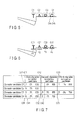
- the alignment verification unit 15 verifies whether the lower end (lower side) is aligned in an orderly way when chipping of each character string candidate is restored (S5). For example, the character recognition candidate C11 (T) constituting the fifth character string candidate is selected based on the character recognition dictionary D1 (dictionary without character chipping). Thus, the alignment verification unit 15 estimates that the character recognition candidate C11 has no chipping and estimates, as shown in FIG. 6 , a character lower end position P1 of the character recognition candidate C11.
- the character recognition candidate C21 (A) constituting the fifth character string candidate is selected based on the character recognition dictionary D3 (dictionary of 30% character chipping).
- the alignment verification unit 15 estimates that the character recognition candidate C21 has 30% chipping and estimates, as shown in FIG. 6 , a character lower end position P2 of the character recognition candidate C21.
- the character recognition candidate C33 (D) constituting the fifth character string candidate is selected based on the character recognition dictionary D1 (dictionary without character chipping).
- the alignment verification unit 15 estimates that the character recognition candidate C33 has no chipping and estimates, as shown in FIG. 6 , a character lower end position P3 of the character recognition candidate C33.
- the character recognition candidate C42 (E) constituting the fifth character string candidate is selected based on the character recognition dictionary D2 (dictionary of 10% character chipping).
- the alignment verification unit 15 estimates that the character recognition candidate C42 has 10% chipping and estimates, as shown in FIG. 6 , a character lower end position P4 of the character recognition candidate C42.
- the alignment verification unit 15 does not judge that the fifth character string candidate is an appropriate character string candidate and rejects the fifth character string candidate. As described above, the alignment verification unit 15 verifies the alignment of each character string candidate and rejects inappropriate character string candidates. In other words, the alignment verification unit 15 verifies a combination of character recognition candidates constituting each character string candidate and rejects inappropriate character string candidates.
- the character string verification unit 16 verifies whether each character string candidate not rejected by the alignment verification unit 15 is an appropriate character string based on character string data (address data) stored in the character string database 17 (S6). In other words, the character string verification unit 16 verifies a combination of character recognition candidates constituting each character string candidate based on character string data (address data) stored in the character string database 17 and rejects inappropriate character string candidates. If, for example, the fourth character string candidate (IARE) is not present in character string data, the character string verification unit 16 does not judge that the fourth character string candidate is an appropriate character string candidate and rejects the fourth character string candidate. In this manner, the character string verification unit 16 verifies whether each character string candidate is an appropriate character string and rejects inappropriate character string candidates.
- IARE fourth character string candidate
- the recognition unit 13 outputs a character string recognition result corresponding to an appropriate character string candidate based on character alignment verification results and character string verification results (S7). That is, the recognition unit 13 outputs a character string recognition result corresponding to an appropriate character string candidate that is not rejected by the character alignment verification by the alignment verification unit 15 and not rejected by the character string verification by the character string verification unit 16. In other words, the recognition unit 13 outputs a character string recognition result corresponding to an appropriate character string candidate based on a verification result of a combination of character recognition candidates constituting each character string candidate by the alignment verification unit 15 and a verification result of a combination of character recognition candidates constituting each character string candidate by the character string verification unit 16.
- the recognition unit 13 calculates an average similarity of each character recognition candidate string corresponding to the plurality of selected appropriate character string candidates and outputs a character string recognition result corresponding to a character string candidate having the maximum average similarity (optimal character string candidate).
- the present invention is not limited to the character string recognition processing described in the first embodiment.
- the method of selecting the optimal character string candidate from a plurality of appropriate character string candidates is not limited to the method described in the first embodiment.
- the first embodiment has been described to the effect that the alignment verification unit 15 rejects inappropriate character string candidates, the character string verification unit 16 further rejects inappropriate character string candidates, and the recognition unit 13 selects the optimal character string candidate from one or more appropriate character string candidates.
- the optimal character string candidate can also be selected as described below.
- the optimal character string candidate may also be selected by the recognition unit 13 comprehensively from each character string candidate based on a character alignment evaluation value of each character string candidate provided by the alignment verification unit 15 based on a character alignment verification result and a character string evaluation value of each character string candidate provided by the character string verification unit 16 based on a character string verification result.
- the recognition unit 13 may select the optimal character string candidate from each character string candidate based on one of the character alignment verification by the alignment verification unit 15 and the character string verification by the character string verification unit 16. That is, the sorting system may not be configured to require the character alignment verification by the alignment verification unit 15 and the character string verification by the character string verification unit 16.
- the recognition unit 13 may also select the optimal character string candidate from each character string candidate based on a total of similarities of each character recognition candidate string corresponding to each character string candidate. Alternatively, the recognition unit 13 may also select the optimal character string candidate from each character string candidate based on at least one of the total of similarities, character alignment verification, and character string verification.
- the first embodiment has also been described to the effect that after generation of character string candidates (S4), character alignment verification (S5) and character string verification (S6) are performed.
- character string recognition processing may be performed as described below.
- character string candidates may be generated so that character alignment verification conditions and character string verification conditions are satisfied.
- character string recognition processing in a case when the lower end of characters is hidden has been described.
- character string recognition processing in a case when one or more ends of the upper end, lower end, right end, and left end are hidden can also be realized as described below.
- the character recognition dictionary database 14 stores ((N X 4) - 3) (N: natural number) character recognition dictionaries of character recognition dictionaries D1, D21, D22, D23, D24, D31, D32, D33, D34, ..., DN1, DN2, DN3, DN4.
- the character recognition dictionary D1 is a character recognition dictionary derived from a plurality of characters without character chipping.
- the character recognition dictionary D21 (dictionary of 10% character chipping) is a character recognition dictionary derived from a plurality of characters of 1% to 20% character chipping in the upper end.
- the character recognition dictionary D22 (dictionary of 10% character chipping) is a character recognition dictionary derived from a plurality of characters of 1% to 20% character chipping in the lower end.
- the character recognition dictionary D23 (dictionary of 10% character chipping) is a character recognition dictionary derived from a plurality of characters of 1% to 20% character chipping in the right end.
- the character recognition dictionary D24 (dictionary of 10% character chipping) is a character recognition dictionary derived from a plurality of characters of 1% to 20% character chipping in the left end.
- the character recognition dictionary D31 (dictionary of 30% character chipping) is a character recognition dictionary derived from a plurality of characters of 21% to 40% character chipping in the upper end.
- the character recognition dictionary D32 (dictionary of 30% character chipping) is a character recognition dictionary derived from a plurality of characters of 21% to 40% character chipping in the lower end.
- the character recognition dictionary D33 (dictionary of 30% character chipping) is a character recognition dictionary derived from a plurality of characters of 21% to 40% character chipping in the right end.
- the character recognition dictionary D34 (dictionary of 30% character chipping) is a character recognition dictionary derived from a plurality of characters of 21% to 40% character chipping in the left end.
- the recognition unit 13 selects one or more character recognition candidates corresponding to each character candidate based on the character recognition dictionaries D1, D21, D22, D23, D24, D31, D32, D33, D34, ..., DN1, DN2, DN3, DN4.
- the alignment verification unit 15 verifies the alignment of each character candidate based on detection results of one or more ends of the upper end, lower end, right end, and left end of each character candidate.
- the first embodiment has also been described to the effect that the alignment verification unit 15 estimates the degree of chipping of each character candidate, verifies the alignment of character string candidates, and rejects inappropriate character string candidates.
- the alignment verification unit 15 can further estimate the size of each character candidate along with the degree of chipping of each character candidate and verify the alignment of character string candidates based on these estimation results to reject inappropriate character string candidates.
- a sorting system can, as described above, recognize a character string with high precision even when the height of characters of a hidden line is different from the height of characters of other lines and also can recognize a character string with high precision even when the degree of chipping caused by characters being hidden is large.
- a sorting system according to the first embodiment can also recognize a character string with high precision even when the degree of character hiding is different from character to character. Accordingly, a sorting system according to the first embodiment can sort sorted objects with high precision.
- a character recognition apparatus and a character recognition method superior in recognition of chipped characters can be provided. Also according to one of the above embodiments, a sorting apparatus and a sorting control apparatus superior in recognition of chipped characters and superior in sorting precision can be provided.
- a character string indication destination address information is positioned at an end of the window and a portion of characters is sometimes hidden and invisible. Reading the destination address information in such a case is a difficult challenge.
- the technology shown below is publicly known:
- the above method of (3) is intended only for characters of a determined size and cannot be applied to an object whose character size is unknown.
- the above method of (4) can be applied only if chipping is tiny and cannot be applied when, like hiding by a window, the size of chipping is large.
- the above method of (5) can be applied only if chipping is limited to a thin region and cannot be applied when, like hiding by a window, the size of chipping is large.
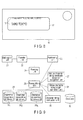
- FIG. 8 exemplifies a windowed mail such as a windowed letter that is an object to be processed according to the present embodiment.
- a windowed mail 11 has a window 12 of cellophane or the like on the front side thereof and destination address information 13 as sorting information is shown (written) inside the window 12 as a character string composed of a plurality of characters.
- the example in FIG. 8 shows a state in which a portion of the character string indicating the destination address information 13 is hidden at an upper end of the window 12.
- FIG. 9 schematically shows the configuration of a sorting apparatus to which a character recognition apparatus and a character recognition method according to the present embodiment are applied.
- a sorting apparatus performs sorting processing of the windowed mail 11 shown in FIG. 8 based on the destination address information 13 and includes a mail supply unit 21, a transfer path 22 as a transfer means, a sorting unit 23 as a sorting means, a reading unit 24 as a reading means, a recognition unit 25 as a recognition means, a dictionary unit 26, a hidden character string candidate detection/check unit 27 as a hidden character string candidate detection/check, a hidden character string height estimation unit 28 as a hidden character string height estimation means, a character string verification unit 29 as a character string verification means, and a database 30.
- the mail supply unit 21 supplies mail (for example, the windowed mail 11 shown in FIG. 9 ) to be processed one mail after another.
- the transfer path 22 transfers the mail 11 supplied from the mail supply unit 21 one mail after another.
- the sorting unit 23 performs sorting processing by destination address of the mail 11 transferred through the transfer path 22 based on a recognition result of the recognition unit 25.
- the reading unit 24 optically reads an image on the side on which the window 12 of the mail 11 transferred through the transfer path 22 is present on the transfer path 22.
- the recognition unit 25 recognizes a character string indicating the destination address information 13 from the image read by the reading unit 24.
- the dictionary unit 26 is constituted of a plurality of character recognition dictionaries 26 1 to 26 N .
- the character recognition dictionaries 26 1 to 26 N are constituted of, for example, one complete character dictionary and defective character dictionaries of each defect ratio (for example, 10%, 20%, 30%, 40%) of characters.
- the complete character dictionary is assumed to refer to a common character dictionary of character patterns without defects by hiding and the defective character dictionary is assumed to refer to a dictionary of character patterns that are cut (defective) by some tens of percentages at an upper, lower, right, or left end.
- the hidden character string candidate detection/check unit 27 detects a character portion that may be hidden to set the character portion as a hidden character string region candidate when a portion of a character string is hidden and checks whether the hidden character string region candidate is an actual hidden character string region.
- the hidden character string height estimation unit 28 checks whether any character is actually hidden in a hidden character string region detected by the hidden character string candidate detection/check unit 27 and, if the hidden character string region is determined to hide characters, estimates the height of the target character string.
- the recognition unit 25 detects whether there is any candidate in which the destination address information 13 may be hidden through the hidden character string candidate detection/check unit 27 and estimates the height of a hidden character string portion through the hidden character string height estimation unit 28 to determine individual character recognition scores by using character recognition dictionaries corresponding to a chipping ratio (defect ratio) of a character string.
- the character string verification unit 29 performs matching processing to address data in the database 30 by using character recognition scores (character recognition results) obtained from the recognition unit 25 and outputs the result to the sorting unit 23 as the final recognition result.
- the present embodiment is characterized in that hidden candidates of a character string are detected and checked and the height of the hidden character string is estimated to know the chipping ratio of characters and therefore, the following two points will be focused on and described in detail below.
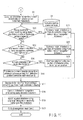
- the hidden character string candidate detection/check unit 27 detects candidates (hidden character string region candidates) of the window 13 (window frame) for the input image (S2, S3).
- Any method may be used as the method of detecting window frame candidates and, for example, the method of finding four lines of a window frame by applying Hough conversion to a differential image or if there is a temperature difference between the surface of the mail 11 and a window frame portion, the method of setting a portion in which a label of an appropriate size is detected from a concentration binary label as a window frame candidate can be used.
- reference numeral 31 indicates the upper end of a window frame
- reference numeral 32 indicates a defective character string a portion of which is defective (hidden) at the upper end 31 of the window frame
- reference numeral 34 indicates a state of contour tracking.
- the contour is tracked at each of the upper, lower, right, and left ends of the window frame (S4) and the same directional component continues at an end where no defective character string is present when each directional component is polled. If, for example, the polling directional component in the right direction is "0", that in the upper direction is “1", that in the left direction is “2”, and that in the lower direction is "3" and a search is done along the right direction from inside an edge of the window frame, the polling results in almost the right components,"0", though upper and lower components are a little mixed at the lower end of the window frame. Similarly, the polling results in almost the upper components at the right end and almost the left components at the upper end.
- the hidden character string candidate detection/check unit 27 determines that the directional component of the contour tracking is abnormal (S5). If determined to be abnormal, the hidden character string candidate detection/check unit 27 determines that the portion has a defective character string continued therein and sets the portion as an actual target region (hidden character string region) (S6).
- the hidden character string candidate detection/check unit 27 normal character recognition of the complete character dictionary is carried out on a character string present in the mail 11 (S7).
- the complete character dictionary is, as described above, a normal character dictionary without defective patterns and a defective dictionary refers to a dictionary of character patterns that are cut by some tens of percentages at an upper, lower, right, or left end.
- Dictionaries of defect ratios cut by, for example, 10% at each of upper, lower, right, and left ends may be provided and such dictionaries may have normalized images if individual character recognition is performed by template matching or may be dictionaries of a feature vector group learned with defective patterns of each category.
- the hidden character string candidate detection/check unit 27 determines that a defective character string may continue and proceeds to S6 and then sets the region as an actual target region (hidden character string region) by determining that a defective character string continues.
- edges of the window frame are likely to bed noise of subsequent processing and thus, it is more convenient to erase edge portions of an external frame while leaving only positions.
- the hidden character string height estimation unit 28 performs height estimation processing of the defective character string described below.
- a case when numbers are restrictively used as defective character dictionaries will be described in the present embodiment, but other character dictionaries may also be used.
- character recognition is repeated for each defect ratio (S9).
- Character recognition may be repeated for all candidates of upper, lower, right, and left ends, but as described above, if a defective character string region is detected by a of contour tracking (corresponding to the flow of S5), at which end of the upper, lower, right, and left ends of the window frame to detect abnormality is known and thus, it is enough to repeat character recognition in that direction using defective character dictionaries.
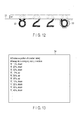
- an exclusive partial character table 34 as shown in FIG. 13 is used to make a comparison with registration content thereof.
- the exclusive partial character table 34 is created in advance before operation and registers impossible defective patterns as non-numeric characters of a target language. If characters used in English are taken as an example, a defective number pattern as shown in FIG. 14A cannot exist as a partial character of English. That is, if FIG. 14A is, for example, a commonly used character of English, the figure cannot be other than a lower 20% defect of the number "8" and thus becomes an exclusive partial character.
- FIG. 14B is, for example, a commonly used character of English, the figure may be, in addition to being a lower 70% defect of English "E", a lower 70% defect of English "F” and thus does not become an exclusive partial character.
- a height H1 (see FIG. 12 ) of a defective portion of a character string can be estimated from the defect ratio of recognition dictionaries (S11). 100% cannot exist in recognition processing and thus, limitations to move to height estimation processing may be imposed to improve accuracy such as requiring at least three characters recognized with high scores.
- the height H1 (see FIG. 12 ) of a defective portion of a character string can be estimated directly from the defect ratio of the recognition dictionary (S13).
- the height H2 of the defective portion of the character string can be estimated from the height of characters other than the hyphen because, as shown in FIG. 15 , the hyphen is commonly placed in the center height of a character (S15).
- the estimated height subtly changes depending on the language or fonts to be recognized and thus, the height may be estimated to suit the occasion.
- the key point here is that the height of a defective portion becomes detectable by recognizing a hyphen.
- the three kinds of height estimation processing from S10 to S15 may be performed independently, all performed with prioritization, or a combined height estimation value of a defective portion may be taken such as averaging each estimation result.
- the recognition unit 25 decides the defective character dictionary of what percentage defects to use from the received height estimation result (S17) and selects the decided defective character dictionary from the dictionary unit 26 to perform character recognition processing on a target character string (S18).
- the character string verification unit 29 performs matching processing to address data in the database 30 by using a character recognition result with defective character dictionaries specified in S18 (S19) and outputs the result as a final recognition result to the sorting unit 23 (S20).
- the height of a hidden portion of a character string can be found by height estimation processing with high precision and thus, character recognition can be performed effectively even if the height of the hidden character string is different from the height of other character strings, character recognition can be performed effectively even if the degree of chipping of characters by hiding is large, and further character recognition can be performed even if the hiding degree is different from character to character so that accuracy of recognition of character string can significantly be improved. Therefore, labor-saving effects are significantly improved when the above embodiment is applied to labor-saving devices such as mail sorting apparatuses.
- the embodiments are not limited to such a case and can be applied to, for example, any sorting apparatus that performs sorting processing of objects on which sorting information indicating a sorting destination is marked by a character string based on the sorting information such as securities including bank notes and mails including packages.
- a character recognition apparatus, a character recognition method, and a sorting apparatus capable of performing character recognition effectively even if the height of a hidden character string is different from the height of other character strings, performing character recognition effectively even if the degree of chipping of characters by hiding is large, and further performing character recognition even if the hiding degree is different from character to character can be provided.
Landscapes
- Engineering & Computer Science (AREA)
- Theoretical Computer Science (AREA)
- Physics & Mathematics (AREA)
- General Physics & Mathematics (AREA)
- Computer Vision & Pattern Recognition (AREA)
- Multimedia (AREA)
- Data Mining & Analysis (AREA)
- Artificial Intelligence (AREA)
- Life Sciences & Earth Sciences (AREA)
- Bioinformatics & Cheminformatics (AREA)
- Bioinformatics & Computational Biology (AREA)
- Evolutionary Biology (AREA)
- Evolutionary Computation (AREA)
- General Engineering & Computer Science (AREA)
- Computational Linguistics (AREA)
- Character Discrimination (AREA)
Applications Claiming Priority (3)
| Application Number | Priority Date | Filing Date | Title |
|---|---|---|---|
| JP2010208607A JP5601948B2 (ja) | 2010-09-16 | 2010-09-16 | 文字認識装置、区分装置、区分制御装置、及び文字認識方法 |
| JP2010208493 | 2010-09-16 | ||
| JP2011191506A JP2012084132A (ja) | 2010-09-16 | 2011-09-02 | 文字認識装置、文字認識方法および区分装置 |
Publications (1)
| Publication Number | Publication Date |
|---|---|
| EP2431920A2 true EP2431920A2 (de) | 2012-03-21 |
Family
ID=44862442
Family Applications (1)
| Application Number | Title | Priority Date | Filing Date |
|---|---|---|---|
| EP11181155A Withdrawn EP2431920A2 (de) | 2010-09-16 | 2011-09-13 | Zeichenerkennungsvorrichtung, Sortiervorrichtung, Sortiersteuervorrichtung und Zeichenerkennungsverfahren |
Country Status (4)
| Country | Link |
|---|---|
| US (1) | US20120072013A1 (de) |
| EP (1) | EP2431920A2 (de) |
| KR (1) | KR20120029351A (de) |
| CN (1) | CN102402682A (de) |
Cited By (1)
| Publication number | Priority date | Publication date | Assignee | Title |
|---|---|---|---|---|
| CN117291926A (zh) * | 2023-11-27 | 2023-12-26 | 北京阿丘科技有限公司 | 字符缺陷检测方法、设备及计算机可读存储介质 |
Families Citing this family (14)
| Publication number | Priority date | Publication date | Assignee | Title |
|---|---|---|---|---|
| DE102012020608B4 (de) * | 2012-10-19 | 2018-10-25 | Audi Ag | Kraftwagen mit einer Eingabevorrichtung zur Handschrifterkennung |
| CN105051723B (zh) * | 2013-03-22 | 2017-07-14 | 德国邮政股份公司 | 包装件的识别 |
| JP6203084B2 (ja) * | 2014-03-06 | 2017-09-27 | 株式会社東芝 | 配達物区分処理システム、および配達物区分処理方法 |
| KR101635675B1 (ko) * | 2014-08-13 | 2016-07-01 | 최승규 | 파쇄된 문서를 복구 하는 장치 및 방법 |
| GB2549240A (en) * | 2015-01-06 | 2017-10-18 | What3Words Ltd | A method for suggesting one or more multi-word candidates based on an input string received at an electronic device |
| WO2016181470A1 (ja) * | 2015-05-11 | 2016-11-17 | 株式会社東芝 | 認識装置、認識方法およびプログラム |
| CN105537131B (zh) * | 2015-12-14 | 2018-05-18 | 上海邮政科学研究院 | 一种基于多样化信息协同的邮件分拣系统 |
| JP6808330B2 (ja) * | 2016-02-26 | 2021-01-06 | キヤノン株式会社 | 情報処理装置、情報処理方法、及びプログラム |
| CN106529899A (zh) * | 2016-09-28 | 2017-03-22 | 王建勇 | 一种基于工作流的中文实体标准化方法 |
| CN106650718A (zh) * | 2016-12-21 | 2017-05-10 | 远光软件股份有限公司 | 凭证图像识别方法及装置 |
| JP6783671B2 (ja) * | 2017-01-13 | 2020-11-11 | 株式会社東芝 | 区分システム、認識支援装置、認識支援方法、および認識支援プログラム |
| JP7114892B2 (ja) * | 2017-12-13 | 2022-08-09 | 京セラドキュメントソリューションズ株式会社 | 画像形成装置 |
| CN110674876A (zh) * | 2019-09-25 | 2020-01-10 | 北京猎户星空科技有限公司 | 一种字符检测方法、装置、电子设备及计算机可读介质 |
| KR20230164347A (ko) * | 2022-05-25 | 2023-12-04 | (주)그리드원 | Ocr 대상 문자열에 대한 문자열 보정 방법 및 상기 문자열 보정 방법을 수행하는 컴퓨팅 장치 |
Family Cites Families (5)
| Publication number | Priority date | Publication date | Assignee | Title |
|---|---|---|---|---|
| JP2000148906A (ja) * | 1998-11-10 | 2000-05-30 | Hitachi Ltd | 文書認識装置および郵便区分機 |
| US6735337B2 (en) * | 2001-02-02 | 2004-05-11 | Shih-Jong J. Lee | Robust method for automatic reading of skewed, rotated or partially obscured characters |
| CN100409251C (zh) * | 2005-08-26 | 2008-08-06 | 富士通株式会社 | 用于退化文字行的字符识别装置和方法 |
| CN100535931C (zh) * | 2006-09-06 | 2009-09-02 | 中国科学院自动化研究所 | 一种多分辨率退化字符自适应识别系统及方法 |
| CN101276327B (zh) * | 2007-03-27 | 2010-06-23 | 富士通株式会社 | 地址识别装置 |
-
2011
- 2011-09-12 US US13/229,881 patent/US20120072013A1/en not_active Abandoned
- 2011-09-13 EP EP11181155A patent/EP2431920A2/de not_active Withdrawn
- 2011-09-15 KR KR1020110092890A patent/KR20120029351A/ko not_active Ceased
- 2011-09-16 CN CN2011102744008A patent/CN102402682A/zh active Pending
Non-Patent Citations (1)
| Title |
|---|
| None |
Cited By (2)
| Publication number | Priority date | Publication date | Assignee | Title |
|---|---|---|---|---|
| CN117291926A (zh) * | 2023-11-27 | 2023-12-26 | 北京阿丘科技有限公司 | 字符缺陷检测方法、设备及计算机可读存储介质 |
| CN117291926B (zh) * | 2023-11-27 | 2024-03-05 | 北京阿丘科技有限公司 | 字符缺陷检测方法、设备及计算机可读存储介质 |
Also Published As
| Publication number | Publication date |
|---|---|
| KR20120029351A (ko) | 2012-03-26 |
| US20120072013A1 (en) | 2012-03-22 |
| CN102402682A (zh) | 2012-04-04 |
Similar Documents
| Publication | Publication Date | Title |
|---|---|---|
| US20120072013A1 (en) | Character recognition apparatus, sorting apparatus, sorting control apparatus, and character recognition method | |
| US7120302B1 (en) | Method for improving the accuracy of character recognition processes | |
| CN109658584B (zh) | 一种票据信息识别方法及装置 | |
| JP4727732B2 (ja) | 車両番号認識装置 | |
| JP6203084B2 (ja) | 配達物区分処理システム、および配達物区分処理方法 | |
| JP5621777B2 (ja) | 単語認識装置、方法及びプログラムが格納された非一時的なコンピュータ可読媒体並びに発送物区分装置 | |
| CN103186940A (zh) | 号码识别装置以及号码识别方法 | |
| JP2003109007A (ja) | 帳票様式分類装置、帳票様式分類方法、帳票様式分類プログラムおよび画像照合装置 | |
| JP5601948B2 (ja) | 文字認識装置、区分装置、区分制御装置、及び文字認識方法 | |
| US9582713B2 (en) | Apparatus and method for recognizing media and financial device | |
| EP1704932A2 (de) | Vorrichtung zur Addresserkenung | |
| US6556701B1 (en) | Method of and apparatus for extracting dotted line, and storage medium thereof | |
| JP2012084132A (ja) | 文字認識装置、文字認識方法および区分装置 | |
| RU2280284C2 (ru) | Способ определения неплатежных банкнот, полученных посредством склеивания частей различных банкнот и фальшивых банкнот | |
| US20020046663A1 (en) | Stamp detecting device, stamp detecting method, letter processing apparatus and letter processing method | |
| JPH0773267A (ja) | 誤りを識別し補正する方法および装置 | |
| JP5178851B2 (ja) | 宛先認識装置 | |
| US20180200760A1 (en) | Sorting system, recognition support apparatus, recognition support method, and recognition support program | |
| JPH06318246A (ja) | 紙葉類認識装置 | |
| JP2599320B2 (ja) | 紙葉類認識装置 | |
| CN115497114A (zh) | 一种卷烟物流收货票据的结构化信息提取方法 | |
| CN106650714A (zh) | 一种纸钞的冠字号识别方法及其装置 | |
| TWI549099B (zh) | 紙鈔序號辨識方法 | |
| CN114651290A (zh) | 用于处理有价文件、尤其钞票的设备和方法以及有价文件处理系统 | |
| JP6098065B2 (ja) | 画像検査装置、画像検査方法、及びプログラム |
Legal Events
| Date | Code | Title | Description |
|---|---|---|---|
| PUAI | Public reference made under article 153(3) epc to a published international application that has entered the european phase |
Free format text: ORIGINAL CODE: 0009012 |
|
| 17P | Request for examination filed |
Effective date: 20110913 |
|
| AK | Designated contracting states |
Kind code of ref document: A2 Designated state(s): AL AT BE BG CH CY CZ DE DK EE ES FI FR GB GR HR HU IE IS IT LI LT LU LV MC MK MT NL NO PL PT RO RS SE SI SK SM TR |
|
| AX | Request for extension of the european patent |
Extension state: BA ME |
|
| STAA | Information on the status of an ep patent application or granted ep patent |
Free format text: STATUS: THE APPLICATION HAS BEEN WITHDRAWN |
|
| 18W | Application withdrawn |
Effective date: 20120905 |