EP2431830A2 - Regeleinrichtung für ein wärmetechnisches Gerät - Google Patents
Regeleinrichtung für ein wärmetechnisches Gerät Download PDFInfo
- Publication number
- EP2431830A2 EP2431830A2 EP11181739A EP11181739A EP2431830A2 EP 2431830 A2 EP2431830 A2 EP 2431830A2 EP 11181739 A EP11181739 A EP 11181739A EP 11181739 A EP11181739 A EP 11181739A EP 2431830 A2 EP2431830 A2 EP 2431830A2
- Authority
- EP
- European Patent Office
- Prior art keywords
- control device
- voltage
- electrical components
- shutdown
- components
- Prior art date
- Legal status (The legal status is an assumption and is not a legal conclusion. Google has not performed a legal analysis and makes no representation as to the accuracy of the status listed.)
- Granted
Links
Images

Classifications
-
- G—PHYSICS
- G05—CONTROLLING; REGULATING
- G05D—SYSTEMS FOR CONTROLLING OR REGULATING NON-ELECTRIC VARIABLES
- G05D23/00—Control of temperature
- G05D23/19—Control of temperature characterised by the use of electric means
-
- H—ELECTRICITY
- H02—GENERATION; CONVERSION OR DISTRIBUTION OF ELECTRIC POWER
- H02J—ELECTRIC POWER NETWORKS; CIRCUIT ARRANGEMENTS OR SYSTEMS FOR SUPPLYING OR DISTRIBUTING ELECTRIC POWER; SYSTEMS FOR STORING ELECTRIC ENERGY
- H02J3/00—Circuit arrangements for AC mains or AC distribution networks
- H02J3/12—Arrangements for adjusting voltage in AC networks by changing a characteristic of the network load
- H02J3/14—Arrangements for adjusting voltage in AC networks by changing a characteristic of the network load by switching loads on to, or off from, the networks, e.g. progressively balanced loading
-
- H—ELECTRICITY
- H02—GENERATION; CONVERSION OR DISTRIBUTION OF ELECTRIC POWER
- H02H—EMERGENCY PROTECTIVE CIRCUIT ARRANGEMENTS
- H02H1/00—Details of emergency protective circuit arrangements
- H02H1/06—Arrangements for supplying operative power
-
- H—ELECTRICITY
- H02—GENERATION; CONVERSION OR DISTRIBUTION OF ELECTRIC POWER
- H02H—EMERGENCY PROTECTIVE CIRCUIT ARRANGEMENTS
- H02H3/00—Emergency protective circuit arrangements for automatic disconnection directly responsive to an undesired change from normal electric working condition with or without subsequent reconnection ; integrated protection
- H02H3/02—Details
- H02H3/04—Details with warning or supervision in addition to disconnection, e.g. for indicating that protective apparatus has functioned
-
- H—ELECTRICITY
- H02—GENERATION; CONVERSION OR DISTRIBUTION OF ELECTRIC POWER
- H02H—EMERGENCY PROTECTIVE CIRCUIT ARRANGEMENTS
- H02H3/00—Emergency protective circuit arrangements for automatic disconnection directly responsive to an undesired change from normal electric working condition with or without subsequent reconnection ; integrated protection
- H02H3/24—Emergency protective circuit arrangements for automatic disconnection directly responsive to an undesired change from normal electric working condition with or without subsequent reconnection ; integrated protection responsive to undervoltage or no-voltage
- H02H3/247—Emergency protective circuit arrangements for automatic disconnection directly responsive to an undesired change from normal electric working condition with or without subsequent reconnection ; integrated protection responsive to undervoltage or no-voltage having timing means
-
- H—ELECTRICITY
- H02—GENERATION; CONVERSION OR DISTRIBUTION OF ELECTRIC POWER
- H02J—ELECTRIC POWER NETWORKS; CIRCUIT ARRANGEMENTS OR SYSTEMS FOR SUPPLYING OR DISTRIBUTING ELECTRIC POWER; SYSTEMS FOR STORING ELECTRIC ENERGY
- H02J2105/00—Networks for supplying or distributing electric power characterised by their spatial reach or by the load
- H02J2105/40—Networks for supplying or distributing electric power characterised by their spatial reach or by the load characterised by the loads connecting to the networks or being supplied by the networks
- H02J2105/42—Home appliances
-
- Y—GENERAL TAGGING OF NEW TECHNOLOGICAL DEVELOPMENTS; GENERAL TAGGING OF CROSS-SECTIONAL TECHNOLOGIES SPANNING OVER SEVERAL SECTIONS OF THE IPC; TECHNICAL SUBJECTS COVERED BY FORMER USPC CROSS-REFERENCE ART COLLECTIONS [XRACs] AND DIGESTS
- Y02—TECHNOLOGIES OR APPLICATIONS FOR MITIGATION OR ADAPTATION AGAINST CLIMATE CHANGE
- Y02B—CLIMATE CHANGE MITIGATION TECHNOLOGIES RELATED TO BUILDINGS, e.g. HOUSING, HOUSE APPLIANCES OR RELATED END-USER APPLICATIONS
- Y02B70/00—Technologies for an efficient end-user side electric power management and consumption
- Y02B70/30—Systems integrating technologies related to power network operation and communication or information technologies for improving the carbon footprint of the management of residential or tertiary loads, i.e. smart grids as climate change mitigation technology in the buildings sector, including also the last stages of power distribution and the control, monitoring or operating management systems at local level
- Y02B70/3225—Demand response systems, e.g. load shedding, peak shaving
-
- Y—GENERAL TAGGING OF NEW TECHNOLOGICAL DEVELOPMENTS; GENERAL TAGGING OF CROSS-SECTIONAL TECHNOLOGIES SPANNING OVER SEVERAL SECTIONS OF THE IPC; TECHNICAL SUBJECTS COVERED BY FORMER USPC CROSS-REFERENCE ART COLLECTIONS [XRACs] AND DIGESTS
- Y04—INFORMATION OR COMMUNICATION TECHNOLOGIES HAVING AN IMPACT ON OTHER TECHNOLOGY AREAS
- Y04S—SYSTEMS INTEGRATING TECHNOLOGIES RELATED TO POWER NETWORK OPERATION, COMMUNICATION OR INFORMATION TECHNOLOGIES FOR IMPROVING THE ELECTRICAL POWER GENERATION, TRANSMISSION, DISTRIBUTION, MANAGEMENT OR USAGE, i.e. SMART GRIDS
- Y04S20/00—Management or operation of end-user stationary applications or the last stages of power distribution; Controlling, monitoring or operating thereof
- Y04S20/20—End-user application control systems
- Y04S20/222—Demand response systems, e.g. load shedding, peak shaving
Definitions
- the invention relates to a control device for a thermo-technical device for heating and / or cooling according to the preamble of claim 1.
- a generic heat engineering device for heating and / or cooling in a heating or cooling system has at least one control device for controlling and regulating the operation. This usually affects almost all components of a heating or cooling system. These include, for example, the control device itself, burners, blowers, pumps, compressors, preheating devices, remote control devices and various actuators. Both the control device itself and the components include power-consuming electrical components, which are supplied with mains voltage. All active electrical components are therefore connected to the control device. This is done in each case to an associated output to a microprocessor, via the respective mains voltage can be switched on or off, for example, with a small device voltage via relay. On control devices of thermal equipment, but also on components display and controls are also known. There are also service facilities for signal transmission, optionally with remote monitoring.
- switched-mode power supplies have become more and more prevalent, because they can be adapted, for example, to the particular grid voltage at the installation site, and thus also standby losses can be minimized.
- the secondary-side device extra-low voltage serves to supply electrotechnical components, regulating and switching devices as well as regulating, switching on and off electrotechnical components connected to the control device at associated outputs.
- switching power supplies have the property that the secondary voltage is not proportional to the primary voltage, as is otherwise the case with a linear power supply.
- mains voltage monitoring devices in conjunction with a switching power supply to protect the plant operation or a generic control device, it is therefore possible that on the secondary side, the device extra low voltage is no longer in the normal range, although the primary-side mains voltage monitoring detected no abnormalities.
- the invention is therefore based on the object to optimize the reliability and robustness of a thermal device for heating and / or cooling, in particular with regard to mains voltage fluctuations.
- thermo-technical device for a thermo-technical device is characterized in that the mains voltage on the primary side of the switching power supply and the device extra-low voltage the secondary side are measured and evaluated, and that at least one connected to the control device electrical component is switched off when at least one of the measured voltage values falls below predetermined voltage thresholds for individual connected components and components.
- independent voltage threshold values can be predetermined for the electrical components connected to associated outputs and / or are activated with the occupancy of an output by a component from stored values during the installation.
- a shutdown sequence and / or a prioritization for the electrical components connected to associated outputs can be specified and / or stored in order to obtain the best possible system function or the best possible comfort in the event of a shutdown.
- connection of further electrical components is blocked if at least one other component has been switched off beforehand because it has fallen below an assigned voltage threshold. This can prevent further possible power-on peaks.
- individual, independent time periods for the duration of falling below an associated voltage threshold value from the first detection to the shutdown can be predetermined for the electrical components connected to associated outputs and / or are stored with the assignment of an output by a component Values activated during installation. Depending on the sensitivity of the individual components, it is thus possible to filter out voltage drops of a very short duration without a switch-off reaction occurring. These are times in the millisecond range.
- the reclosing after a previous shutdown for falling below an associated voltage threshold is delayed according to the invention by individual, independent periods for the waiting time between shutdown and reclosing can be specified for the connected to outputs outputs electrical components and / or with the assignment of an output by a Component can be activated from stored values during installation.
- An example this is a compressor of a heat pump, which requires a waiting time of several minutes after a shutdown to start optimally again.
- electrical components connected to associated outputs with safety relevance for the heating or cooling device or a connected heating or cooling system are switched off last.
- These include, for example, circulating pumps in heating or cooling circuits and monitoring functions in connection with temperature sensors, for example to ensure the frost protection of a system, or components for the combustion automation.
- a shutdown of electrical components is entered because of falling below an associated voltage threshold in a fault and / or history memory.
- this is preferably done only at a higher frequency, in particular when a predefinable number of shutdowns in a predeterminable period is exceeded, to distinguish real electrical errors from possibly only a one-time and random occurring network fluctuation. This facilitates the evaluation in case of service.
- the shutdown of electrical components is signaled for falling below an associated voltage threshold for at least the duration of the shutdown to reflect the operator to the current control time correctly the operating state, and to misinterpretation, for example by perception switched off components, the same excluded.
- a maintenance or fault signal which is intended in particular as an action request for users and / or service personnel, preferably only when a predetermined number of shutdowns in a predeterminable period is exceeded.
- the reliability and robustness of a thermal device for heating and / or cooling, in particular with regard to mains voltage fluctuations optimized.
- voltage thresholds that can be predefined as a device extra-low voltage
- at least one electrotechnical component connected to the control device is switched off.
- the maximum reliability and for the entire system the maximum Functionality and thus to ensure maximum comfort for a plant user.
- the requirements of the individual components can be specified so that the control device can automatically prioritize which components have the highest sensitivity if the voltage is too low and - depending on the current operating state of the device and system - must first be switched off.
- the invention provides security for installer and operator, helps prevent component damage due to low operating voltage and generally helps to quickly detect and avoid electrical errors.
- the control device R for a heating device for heating and / or cooling essentially comprises a mains voltage supplied switching power supply NT, which provides on the secondary side device extra-low voltage, shown here by way of example with 12 V.
- This is used to supply electrical components, control and switching devices for regulating, switching on and off of the control device R to associated, connected by the control device R outputs A1, A2, A3 connected electro-technical Components K1, K2, K3, which are supplied with mains voltage. Also connected is a display D as a display, operating and service device, optionally with remote monitoring.
- the mains voltage S1 on the primary side of the switching power supply and the device extra-low voltage S2 on the secondary side are measured and evaluated by the control device R.
- At least one electrotechnical component K1, K2, K3 connected to the control device R is switched off if at least one of the measured voltage values S1, S2 falls below predefinable voltage threshold values for individual connected components and components K1, K2, K3.
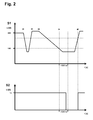
- Fig. 2 shows schematically and by way of example the voltage curve of the mains voltage S1 and the device extra-low voltage S2 at the output for the connected to the control device R components K1, K2, K3.
- the mains voltage curve S1 begins at 230 V, before a brief voltage drop follows in the period between t1 and t2. This remains in the voltage curve for the device extra-low voltage S2 without consequences, since of so short duration that no influence on connected components K1, K2, K3 is to be expected.
- the mains voltage S1 drops continuously and reaches at the time t4 a predetermined for a connected component K1, K2, K3, for this critically classified, characteristic voltage value S1 of 180 V.
- runs from this falls below the voltage threshold one predefinable period of time for the permissible duration of a shortfall from the first detection to the shutdown of a component K1, K2, K3.
- 500 ms are assumed here. In this period, at least one component K1, K2, K3 is turned off, so that the device extra low voltage S2 drops from 12 V to zero.
Landscapes
- Engineering & Computer Science (AREA)
- Physics & Mathematics (AREA)
- General Physics & Mathematics (AREA)
- Automation & Control Theory (AREA)
- Power Engineering (AREA)
- Control Of Resistance Heating (AREA)
- Domestic Hot-Water Supply Systems And Details Of Heating Systems (AREA)
- Emergency Protection Circuit Devices (AREA)
- Safety Devices In Control Systems (AREA)
Abstract
Description
- Die Erfindung betrifft eine Regeleinrichtung für ein wärmetechnisches Gerät zum Heizen und/oder Kühlen nach dem Oberbegriff des Patentanspruches 1.
- Eine gattungsgemäßes wärmetechnisches Gerät zum Heizen und/oder Kühlen in einem Heiz- oder Kühlsystem besitzt mindestens eine Regeleinrichtung zum Steuern und Regeln des Betriebes. Dies betrifft in der Regel fast alle Komponenten eines Heiz- oder Kühlsystems. Dazu gehören beispielsweise die Regeleinrichtung selbst, Brenner, Gebläse, Pumpen, Kompressoren, Vorwärmungseinrichtungen, Fernbedienungseinrichtungen sowie diverse Stellglieder. Sowohl die Regeleinrichtung selbst als auch die Komponenten umfassen Strom verbrauchende elektrotechnische Bauteile, welche mit Netzspannung versorgt werden. Alle aktiven elektrotechnischen Komponenten sind daher an die Regeleinrichtung angeschlossen. Dies erfolgt jeweils an einen zugeordneten Ausgang an einem Mikroprozessor, über den beispielsweise mit einer Gerätekleinspannung über Relais die jeweilige Netzspannung zu- oder abgeschaltet werden kann. An Regelgeräten von wärmetechnischen Geräten, aber auch an Komponenten sind außerdem Anzeige- und Bedienelemente bekannt. Zudem gibt es Serviceeinrichtungen zur Signalübermittlung, wahlweise mit Fernüberwachung.
- Insbesondere sogenannte Schaltnetzteile haben sich immer mehr durchgesetzt, weil diese sich zum Beispiel an die jeweilige Netzspannung am Aufstellort anpassen lassen und damit auch Standby-Verluste minimiert werden können. Die sekundärseitige Gerätekleinspannung dient zum Versorgen von elektrotechnischen Bauteilen, Regel- und Schalteinrichtungen zum sowie Regeln, Ein- und Ausschalten von an das Regelgerät an zugeordneten Ausgängen angeschlossenen elektrotechnischen Komponenten.
- Auf Spannungsschwankungen reagieren die angeschlossenen Komponenten unterschiedlich. Dies hängt mit ihrer Bauart zusammen. So sind bei Unterschreitung der üblichen Netzspannung zum Beispiel Pumpen relativ unproblematisch und Kompressoren von Wärmepumpensystemen besonders anfällig, weil diese kurzzeitiges Takten, insbesondere auf der Kältemittelseite, nicht vertragen und dadurch beschädigt werden können.
- Reine Netzspannungsüberwachungseinrichtungen sind aus dem Stand der Technik bekannt. Dabei wir ausschließlich die Primärseite einer Regeleinrichtung überwacht. Sinkt die Netzspannung nun unter einen festen Schwellwert, wird möglicherweise die gesamte Regeleinrichtung und somit die gesamte damit in Verbindung stehende Anlage abgeschaltet. Gleiches geschieht auch, wenn sekundärseitig die Gerätekleinspannung soweit abfällt, dass einzelne Relais selbsttätig, aber leider unkontrolliert arbeiten. Bei Heizungssystemen kommt es dann zu Komforteinbußen durch ausbleibende Wärme- oder Kälteversorgung, Frostgefahr durch fehlende Umwälzung in Heizkreisläufen oder Verunsicherung von Nutzern bzw. Bedienern durch Abschaltung von Regelungskomponenten, insbesondere von Anzeigevorrichtungen. Anrufe bei Fachfirmen und Serviceeinsätze, besonders in Regionen mit relativ instabilen Stromnetzen, sind dann die Folgen.
- Schaltnetzteile haben aber die Eigenschaft, dass die Sekundärspannung nicht proportional der Primärspannung folgt, wie es ansonsten im Zusammenhang mit einem linearen Netzteil der Fall ist. Bei einer Verwendung Netzspannungsüberwachungseinrichtungen in Verbindung mit einem Schaltnetzteil zur Absicherung des Anlagenbetriebes bzw. einer gattungsgemäßen Regeleinrichtung ist es daher möglich, dass auf der Sekundärseite die Gerätekleinspannung nicht mehr im normalen Bereich liegt, obwohl die primärseitige Netzspannungsüberwachungseinrichtungen keine Auffälligkeiten detektiert.
- Umgekehrt kann es im Zusammenhang mit Schaltnetzteilen vorkommen, dass auf der Sekundärseite die Gerätekleinspannung im normalen Bereich liegt und alle elektronischen Bauteile und zugeordneten Ausgänge ausreichend versorgt sind, gleichzeitig aber auf der Primärseite die Netzspannung soweit abgefallen ist, dass einzelne Relais der angeschlossenen Komponenten schließen oder ins Ein-/Aus-Takten geraten und -wie bereits erwähnt - dadurch Störungen oder langfristige Schädigungen an Komponenten auftreten können.
- Der Erfindung liegt daher die Aufgabe zu Grunde, die Betriebssicherheit und Robustheit eines wärmetechnischen Gerät zum Heizen und/oder Kühlen, insbesondere im Hinblick auf Netzspannungsschwankungen, zu optimieren.
- Erfindungsgemäß wurde dies mit den Merkmalen des Patentanspruches 1 gelöst. Vorteilhafte Weiterbildungen sind den Unteransprüchen zu entnehmen.
- Die Regeleinrichtung für ein wärmetechnisches Gerät ist dadurch gekennzeichnet, dass die Netzspannung auf der Primärseite des Schaltnetzteils und die Gerätekleinspannung auf der Sekundärseite gemessen und ausgewertet werden, und dass mindestens eine an das Regelgerät angeschlossene elektrotechnische Komponente abgeschaltet wird, wenn mindestens einer der gemessenen Spannungswerte vorgebbare Spannungs-Schwellwerte für einzelne angeschlossene Bauteile und Komponenten unterschreitet.
- In einer bevorzugten Ausführungsform sind für die an zugeordneten Ausgängen angeschlossenen elektrotechnischen Komponenten jeweils einzelne, unabhängige Spannungs-Schwellwerte vorgebbar und/oder werden mit der Belegung eines Ausgangs durch eine Komponente aus hinterlegten Werten bei der Installation aktiviert.
- Vorteilhafterweise ist eine Abschalt-Reihenfolge und/oder eine Priorisierung für die an zugeordneten Ausgängen angeschlossenen elektrotechnischen Komponenten vorgebbar und/oder hinterlegt, um im Falle einer Abschaltung noch die bestmögliche Anlagenfunktion bzw. den bestmöglichen Komfort zu erhalten.
- Bei einer weiteren Ausführungsform ist die Zuschaltung von weiteren elektrotechnischen Komponenten blockiert, wenn vorher mindestens eine andere Komponente wegen Unterschreitung eines zugeordneten Spannungs-Schwellwertes abgeschaltet wurde. Damit können weitere sich möglicherweise ergebende Einschalt-Spitzen verhindert werden.
- In noch einer weiteren Ausführungsform sind für die an zugeordneten Ausgängen angeschlossenen elektrotechnischen Komponenten jeweils einzelne, unabhängige Zeitspannen für die Dauer einer Unterschreitung eines zugeordneten Spannungs-Schwellwertes vom ersten Detektieren bis zur Abschaltung vorgebbar und/oder werden mit der Belegung eines Ausgangs durch eine Komponente aus hinterlegten Werten bei der Installation aktiviert. Je nach Empfindlichkeit der einzelnen Komponenten ist es damit möglich, Spannungsabfälle von ganz kurzer Dauer auszufiltern, ohne dass eine Abschaltreaktion eintritt. Hierbei handelt es sich um Zeiten im Millisekundenbereich.
- Die Wiedereinschaltung nach einer vorhergegangenen Abschaltung wegen Unterschreitung eines zugeordneten Spannungs-Schwellwertes wird erfindungsgemäß verzögert, indem für die an zugeordneten Ausgängen angeschlossenen elektrotechnischen Komponenten jeweils einzelne, unabhängige Zeitspannen für die Wartezeit zwischen Abschaltung und Wiedereinschaltung vorgebbar sind und/oder mit der Belegung eines Ausgangs durch eine Komponente aus hinterlegten Werten bei der Installation aktiviert werden. Ein Beispiel hierzu ist ein Kompressor einer Wärmepumpe, welcher eine Wartezeit von mehreren Minuten nach einer Abschaltung benötigt, um wieder optimal zu starten.
- Vorteilhafterweise werden an zugeordneten Ausgängen angeschlossene elektrotechnische Komponenten mit Sicherheitsrelevanz für das Heiz- oder Kühlgerät oder ein angeschlossenes Heiz- oder Kühlsystem zuletzt abgeschaltet. Dazu gehören beispielsweise Umwälzpumpen in Heiz- oder Kühlkreisen und Überwachungsfunktionen im Zusammenhang mit Temperaturfühlern, beispielsweise um den Frostschutz einer Anlage zu gewährleisten, oder auch Komponenten für die Feuerungsautomation.
- Generell wird eine Abschaltung von elektrotechnischen Komponenten wegen Unterschreitung eines zugeordneten Spannungs-Schwellwertes in einen Fehler- und/oder Historienspeicher eingetragen.
- Vorzugsweise erfolgt dies aber nur bei größerer Häufigkeit, insbesondere bei Überschreiten einer vorgebbaren Zahl von Abschaltungen in einem vorgebbaren Zeitraum, um wirkliche elektrische Fehler von eventuell einer nur einmalig und zufällig aufgetretenen Netzschwankung zu unterscheiden. Dies erleichtert die Auswertung im Servicefall.
- Weiterhin wird in einer Anzeige- und Bedieneinrichtung die Abschaltung von elektrotechnischen Komponenten wegen Unterschreitung eines zugeordneten Spannungs-Schwellwertes mindestens für die Dauer der Abschaltung signalisiert, um den Bediener zum aktuellen Kontrollzeitpunkt korrekt den Betriebszustand wiederzuspiegeln, und um Fehlinterpretationen, beispielsweise durch Wahrnehmung abgeschalteter Komponenten, gleich auszuschließen. Dagegen wird ein Wartungs- oder Störungssignal, welches insbesondere als Handlungsaufforderung für Nutzer und/oder Servicepersonal gedacht ist, vorzugsweise erst bei Überschreiten einer vorgebbaren Zahl von Abschaltungen in einem vorgebbaren Zeitraum ausgegeben.
- Mit der Erfindung werden die Betriebssicherheit und Robustheit eines wärmetechnischen Gerätes zum Heizen und/oder Kühlen, insbesondere im Hinblick auf Netzspannungsschwankungen, optimiert. Sobald die Spannung aus dem Netz und/oder sekundärseitig als Gerätekleinspannung vorgebbare Spannungs-Schwellwerte unterschreitet, wird mindestens eine an das Regelgerät angeschlossene elektrotechnische Komponente abgeschaltet. Somit ist es erfindungsgemäß gezielt möglich, für einzelne angeschlossene Bauteile und Komponenten die maximale Betriebssicherheit und für die gesamte Anlage die maximale Funktionsfähigkeit und somit auch maximalen Komfort für einen Anlagennutzer zu gewährleisten. Die Anforderungen der einzelnen Komponenten sind vorgebbar, so dass die Regeleinrichtung automatisch priorisieren kann, welche Komponenten die höchste Empfindlichkeit bei zu niedriger Spannung aufweisen und - passend zum jeweils aktuellen Betriebszustand von Gerät- und System - zuerst abzuschalten sind.
- Insbesondere in Verbindung mit dem Einsatz von Schaltnetzteilen ergeben sich erfindungsgemäß gegenüber dem Stand der Technik, der nur eine Komplettabschaltung eines Gesamtsystems bei Netzspannungsunterschreitung kennt, deutliche Vorteile für den Heiz-oder Kühlgeräte-Betrieb. Auch ein Betreiber oder Nutzer des wärmetechnischen Gerätes oder des Heiz- oder Kühlsystems wird auf die Unregelmäßigkeit hingewiesen. Dies kann in einem ersten Schritt nur vorübergehend, also nur bei kurzzeitiger Abschaltung mindestens einer Komponente, oder in einem zweiten Schritt auch als Stör- oder Wartungsmeldung, wenn sich eine Abschaltungshäufung ergibt.
- Die Erfindung bringt Sicherheit für Installateur und Betreiber, hilft Komponentenschädigungen durch eine zu niedrige Betriebsspannung zu verhindern und hilft generell, elektrische Fehler schnell zu erkennen bzw. zu vermeiden.
- Die Zeichnung stellt ein Ausführungsbeispiel der Erfindung dar. Es zeigt:
- Fig. 1:
- schematisch eine Spannungsversorgung in einer Regeleinrichtung eines wärmetechnischen Gerätes und
- Fig. 2:
- schematisch den Spannungsverlauf der Netzspannung sowie der Gerätekleinspannung am Ausgang für eine an der Regeleinrichtung angeschlossenen Komponenten.
- Gemäß
Fig. 1 umfasst die Regeleinrichtung R für ein wärmetechnisches Gerät zum Heizen und/oder Kühlen im Wesentlichen ein mit Netzspannung versorgtes Schaltnetzteil NT, welches auf der Sekundärseite Gerätekleinspannung, hier beispielhaft mit 12 V gezeigt, bereit stellt. - Diese dient zum Versorgen von elektrotechnischen Bauteilen, Regel- und Schalteinrichtungen zum Regeln, Ein- und Ausschalten von an die Regeleinrichtung R an zugeordneten, von der Regeleinrichtung R geschalteten Ausgängen A1, A2, A3 angeschlossenen elektrotechnischen Komponenten K1, K2, K3, welche mit Netzspannung versorgt werden. Angeschlossen ist weiterhin ein Display D als Anzeige-, Bedien- und Serviceeinrichtung, wahlweise mit Fernüberwachung.
- Die Netzspannung S1 auf der Primärseite des Schaltnetzteils und die Gerätekleinspannung S2 auf der Sekundärseite werden gemessen und von der Regeleinrichtung R ausgewertet. Es wird mindestens eine an das Regelgerät R angeschlossene elektrotechnische Komponente K1, K2, K3 abgeschaltet, wenn mindestens einer der gemessenen Spannungswerte S1, S2 vorgebbare Spannungs-Schwellwerte für einzelne angeschlossene Bauteile und Komponenten K1, K2, K3 unterschreitet.
-
Fig. 2 zeigt schematisch und beispielhaft den Spannungsverlauf der Netzspannung S1 sowie der Gerätekleinspannung S2 am Ausgang für die an der Regeleinrichtung R angeschlossenen Komponenten K1, K2, K3. Über die Zeit betrachtet beginnt der Netzspannungsverlauf S1 mit 230 V, bevor im Zeitraum zwischen t1 und t2 ein kurzzeitiger Spannungsabfall folgt. Dieser bleibt im Spannungsverlauf für die Gerätekleinspannung S2 ohne Folgen, da von so kurzer Dauer, dass kein Einfluss auf angeschlossene Komponenten K1, K2, K3 zu erwarten ist. - Ab dem Zeitpunkt t3 fällt die Netzspannung S1 kontinuierlich ab und erreicht zum Zeitpunkt t4 eine für einen angeschlossene Komponente K1, K2, K3 vorgegebenen, für diese als kritisch eingestuften, charakteristischen Spannungswert S1 von 180 V. Erfindungsgemäß läuft ab dieser Unterschreitung des Spannungs-Schwellwertes eine vorgebbare Zeitspanne für die zulässige Dauer einer Unterschreitung vom ersten Detektieren bis zur Abschaltung einer Komponente K1, K2, K3. Beispielhaft sind dafür hier 500 ms angenommen. In dieser Zeitspanne wird mindestens eine Komponente K1, K2, K3 abgeschaltet, so dass auch die Gerätekleinspannung S2 von 12 V auf Null abfällt.
- Sobald die Netzspannung S1 wieder steigt und in t5 einen vorgegebenen Schwellwert für die Einschaltung einer Komponente K1, K2, K3 erreicht hat, tritt wieder Normalbetrieb ein. Am Display D wird somit die Abschaltung einer Komponente K1, K2, K3 wegen Unterschreitung eines zugeordneten Spannungs-Schwellwertes mindestens für die Dauer der Abschaltung, also bis zum Zeitpunkt t5, signalisiert. Erst bei Überschreiten einer vorgebbaren Zahl von Abschaltungen in einem vorgebbaren Zeitraum wird ein Wartungs- oder Störungssignal ausgegeben.
Claims (10)
- Regeleinrichtung (R) für ein wärmetechnisches Gerät zum Heizen und/oder Kühlen mit einem mit Netzspannung (S1) versorgten Schaltnetzteil (NT) und sekundärseitiger Gerätekleinspannung (S2) zum Versorgen von elektrotechnischen Bauteilen, Regel- und Schalteinrichtungen zum Regeln, Ein- und Ausschalten von an die Regeleinrichtung an zugeordneten Ausgängen angeschlossenen elektrotechnischen Komponenten (K1, K2, K3), welche mindestens teilweise mit Netzspannung (S1) versorgt werden, sowie mit mindestens einer Anzeige-, Bedien- und Serviceeinrichtung, wahlweise mit Fernüberwachung, dadurch gekennzeichnet, dass die Netzspannung (S1) auf der Primärseite des Schaltnetzteils (NT) und die Gerätekleinspannung (S2) auf der Sekundärseite gemessen und ausgewertet werden, und dass mindestens eine an das Regelgerät angeschlossene elektrotechnische Komponente (K1, K2, K3) abgeschaltet wird, wenn mindestens einer der gemessenen Spannungswerte vorgebbare Spannungs-Schwellwerte für einzelne angeschlossene Bauteile und Komponenten (K1, K2, K3) unterschreitet.
- Regeleinrichtung (R) nach Anspruch 1,
dadurch gekennzeichnet, dass für die an zugeordneten Ausgängen angeschlossenen elektrotechnischen Komponenten (K1, K2, K3) jeweils einzelne, unabhängige Spannungs-Schwellwerte vorgebbar sind und/oder mit der Belegung eines Ausgangs (A1, A2, A3) durch eine Komponente (K1, K2, K3) aus hinterlegten Werten bei der Installation aktiviert werden. - Regeleinrichtung (R) nach Anspruch 1 oder 2,
dadurch gekennzeichnet, dass eine Abschalt-Reihenfolge und/oder eine Priorisierung für die an zugeordneten Ausgängen (A1, A2, A3) angeschlossenen elektrotechnischen Komponenten (K1, K2, K3) vorgebbar und/oder hinterlegt ist. - Regeleinrichtung (R) nach einem der Ansprüche 1 bis 3,
dadurch gekennzeichnet, dass die Zuschaltung von weiteren elektrotechnischen Komponenten (K1, K2, K3) blockiert ist, wenn vorher mindestens eine andere Komponente (K1, K2, K3) wegen Unterschreitung eines zugeordneten Spannungs-Schwellwertes abgeschaltet wurde. - Regeleinrichtung (R) nach einem der Ansprüche 1 bis 4,
dadurch gekennzeichnet, dass für die an zugeordneten Ausgängen (A1, A2, A3) angeschlossenen elektrotechnischen Komponenten (K1, K2, K3) jeweils einzelne, unabhängige Zeitspannen für die Dauer einer Unterschreitung eines zugeordneten Spannungs-Schwellwertes vom ersten Detektieren bis zur Abschaltung vorgebbar sind und/oder mit der Belegung eines Ausgangs (A1, A2, A3) durch eine Komponente (K1, K2, K3) aus hinterlegten Werten bei der Installation aktiviert werden. - Regeleinrichtung (R) nach einem der Ansprüche 1 bis 5,
dadurch gekennzeichnet, dass für die an zugeordneten Ausgängen (A1, A2, A3) angeschlossenen elektrotechnischen Komponenten (K1, K2, K3) jeweils einzelne, unabhängige Zeitspannen vorgebbar sind und/oder mit der Belegung eines Ausgangs (A1, A2, A3) durch eine Komponente (K1, K2, K3) aus hinterlegten Werten bei der Installation aktiviert werden, welche die Wiedereinschaltung nach einer vorhergegangenen Abschaltung wegen Unterschreitung eines zugeordneten Spannungs-Schwellwertes verzögern. - Regeleinrichtung (R) nach einem der Ansprüche 1 bis 6,
dadurch gekennzeichnet, dass an zugeordneten Ausgängen (A1, A2, A3) angeschlossene elektrotechnische Komponenten (K1, K2, K3) mit Sicherheitsrelevanz für das wärmetechnische Gerät oder ein angeschlossenes Heiz- und/oder Kühlsystem zuletzt abgeschaltet werden. - Regeleinrichtung (R) nach einem der Ansprüche 1 bis 7,
dadurch gekennzeichnet, dass die Abschaltung von elektrotechnischen Komponenten (K1, K2, K3) wegen Unterschreitung eines zugeordneten Spannungs-Schwellwertes in einen Fehler- und/oder Historienspeicher eingetragen wird. - Regeleinrichtung (R) nach einem der Ansprüche 1 bis 8,
dadurch gekennzeichnet, dass die Abschaltung von elektrotechnischen Komponenten (K1, K2, K3) wegen Unterschreitung eines zugeordneten Spannungs-Schwellwertes nur bei größerer Häufigkeit, insbesondere bei Überschreiten einer vorgebbaren Zahl von Abschaltungen in einem vorgebbaren Zeitraum, in einen Fehler- und/oder Historienspeicher eingetragen wird. - Regeleinrichtung (R) nach einem der Ansprüche 1 bis 9,
dadurch gekennzeichnet, dass die Abschaltung von elektrotechnischen Komponenten (K1, K2, K3) wegen Unterschreitung eines zugeordneten Spannungs-Schwellwertes in einer Anzeige- und Bedieneinrichtung mindestens für die Dauer der Abschaltung signalisiert wird, und dass bei Überschreiten einer vorgebbaren Zahl von Abschaltungen in einem vorgebbaren Zeitraum ein Wartungs- oder Störungssignal ausgegeben wird.
Priority Applications (1)
| Application Number | Priority Date | Filing Date | Title |
|---|---|---|---|
| PL11181739T PL2431830T3 (pl) | 2010-09-21 | 2011-09-19 | Urządzenie regulacyjne dla urządzenia grzewczego |
Applications Claiming Priority (1)
| Application Number | Priority Date | Filing Date | Title |
|---|---|---|---|
| DE102010046223A DE102010046223A1 (de) | 2010-09-21 | 2010-09-21 | Regeleinrichtung für ein wärmetechnisches Gerät |
Publications (3)
| Publication Number | Publication Date |
|---|---|
| EP2431830A2 true EP2431830A2 (de) | 2012-03-21 |
| EP2431830A3 EP2431830A3 (de) | 2013-02-20 |
| EP2431830B1 EP2431830B1 (de) | 2014-03-05 |
Family
ID=44651387
Family Applications (1)
| Application Number | Title | Priority Date | Filing Date |
|---|---|---|---|
| EP11181739.1A Active EP2431830B1 (de) | 2010-09-21 | 2011-09-19 | Regeleinrichtung für ein wärmetechnisches Gerät |
Country Status (5)
| Country | Link |
|---|---|
| EP (1) | EP2431830B1 (de) |
| DE (1) | DE102010046223A1 (de) |
| DK (1) | DK2431830T3 (de) |
| ES (1) | ES2465230T3 (de) |
| PL (1) | PL2431830T3 (de) |
Families Citing this family (2)
| Publication number | Priority date | Publication date | Assignee | Title |
|---|---|---|---|---|
| CN111503720B (zh) * | 2020-04-17 | 2021-10-29 | 华北电力大学 | 一种基于电压监测的电采暖设备控制方法及系统 |
| CN113757764A (zh) * | 2021-09-07 | 2021-12-07 | 湖南索尔科技有限公司 | 电采暖功率分配系统 |
Family Cites Families (3)
| Publication number | Priority date | Publication date | Assignee | Title |
|---|---|---|---|---|
| DE3332368A1 (de) * | 1983-09-08 | 1985-03-28 | Olympia Werke Ag, 2940 Wilhelmshaven | Schaltungsanordnung zum erzeugen eines netzspannungs-ausfallsignals in einem primaer getakteten schaltnetzteil |
| US5691870A (en) * | 1995-11-07 | 1997-11-25 | Compaq Computer Corporation | Circuit for monitoring and disabling power supply signals to a microprocessor in a computer system utilizing secondary voltage regulators |
| DE19718160A1 (de) * | 1997-04-29 | 1998-11-05 | Siemens Ag | Mikroprozessor-Steuervorrichtung mit Unterspannungsschutz |
-
2010
- 2010-09-21 DE DE102010046223A patent/DE102010046223A1/de not_active Withdrawn
-
2011
- 2011-09-19 ES ES11181739.1T patent/ES2465230T3/es active Active
- 2011-09-19 PL PL11181739T patent/PL2431830T3/pl unknown
- 2011-09-19 EP EP11181739.1A patent/EP2431830B1/de active Active
- 2011-09-19 DK DK11181739.1T patent/DK2431830T3/da active
Non-Patent Citations (1)
| Title |
|---|
| None |
Also Published As
| Publication number | Publication date |
|---|---|
| ES2465230T3 (es) | 2014-06-05 |
| EP2431830B1 (de) | 2014-03-05 |
| PL2431830T3 (pl) | 2014-08-29 |
| DK2431830T3 (da) | 2014-06-16 |
| EP2431830A3 (de) | 2013-02-20 |
| DE102010046223A1 (de) | 2012-03-22 |
Similar Documents
| Publication | Publication Date | Title |
|---|---|---|
| EP2208215B1 (de) | Schaltanordnung und verfahren zum ansteuern eines elektromagnetischen relais | |
| WO2010018018A1 (de) | Elektrische anlage | |
| EP2356729B1 (de) | Anordnung umfassend wenigstens zwei stromversorgungseinheiten und wenigstens eine strom verbrauchende komponente, computersystem sowie verfahren zur steuerung einer anordnung | |
| WO2015106869A1 (de) | Überlast-überwachungsvorrichtung und verfahren zur überlast-überwachung | |
| DE69221693T2 (de) | Leistungsbedarfsregelung | |
| EP3753080A1 (de) | Überwachungssystem sowie netzüberwachungsschaltung | |
| EP2431830B1 (de) | Regeleinrichtung für ein wärmetechnisches Gerät | |
| EP3721519B1 (de) | Fehlabschaltsicheres betriebsverfahren für eine dezentrale energieerzeugungsanlage | |
| EP4148510B1 (de) | Verfahren zum überwachen und steuern einer stromverteilung in einer anlage | |
| EP0064642B1 (de) | Elektrische Sicherheitseinrichtung für die Steuerung einer Druckmaschine | |
| DE102011081766A1 (de) | Netzüberwachungsvorrichtung | |
| EP0464423A1 (de) | Anordnung zum Steuern des Gesamtenergieverbrauches eines Elektrizitätsabnehmers | |
| AT509836A2 (de) | Elektronische sicherung | |
| DE102005052042A1 (de) | Verfahren und Anlage zur Steuerung eines Verdichters | |
| EP3306329B1 (de) | Verfahren zum zentralen überwachen von zustandswechseln einer anzahl von komponenten für hochspannungsanlagen ab 1 kv aufwärts | |
| EP3599689A1 (de) | Verfahren zum betreiben eines elektrischen netzes | |
| WO2015139713A1 (de) | Verfahren zum betreiben eines motors | |
| DE102020120991A1 (de) | Textilmaschine | |
| DE102018118065A1 (de) | Verfahren zum Betreiben einer Maschine mit einer Motorschutzeinrichtung | |
| WO2011054658A2 (de) | Verfahren und vorrichtung zur optimierung des energieverbrauchs einer einrichtung mit einer vielzahl elektrischer verbraucher | |
| DE102008014161B4 (de) | Elektrisches Haushaltsgerät zum Erwärmen von Wasser, insbesondere elektrischer Durchlauferhitzer | |
| DE10159034B4 (de) | Netzteil für einen sicherheitsrelevanten Schaltkreis | |
| DE102008063816A1 (de) | Schutzeinrichtung | |
| DE102018221630B3 (de) | Stromversorgungseinheit für eine Mehrzahl an Rechensystemen | |
| WO2020165207A1 (de) | Energiequelle für ein gleichspannungsnetz, verfahren zum betrieb einer solchen energiequelle, gleichspannungsnetz mit einer mehrzahl solcher energiequellen und verfahren zum betrieb eines solchen gleichspannungsnetzes |
Legal Events
| Date | Code | Title | Description |
|---|---|---|---|
| PUAI | Public reference made under article 153(3) epc to a published international application that has entered the european phase |
Free format text: ORIGINAL CODE: 0009012 |
|
| AK | Designated contracting states |
Kind code of ref document: A2 Designated state(s): AL AT BE BG CH CY CZ DE DK EE ES FI FR GB GR HR HU IE IS IT LI LT LU LV MC MK MT NL NO PL PT RO RS SE SI SK SM TR |
|
| AX | Request for extension of the european patent |
Extension state: BA ME |
|
| PUAL | Search report despatched |
Free format text: ORIGINAL CODE: 0009013 |
|
| AK | Designated contracting states |
Kind code of ref document: A3 Designated state(s): AL AT BE BG CH CY CZ DE DK EE ES FI FR GB GR HR HU IE IS IT LI LT LU LV MC MK MT NL NO PL PT RO RS SE SI SK SM TR |
|
| AX | Request for extension of the european patent |
Extension state: BA ME |
|
| RIC1 | Information provided on ipc code assigned before grant |
Ipc: H02P 1/00 20060101ALI20130116BHEP Ipc: G01R 19/165 20060101ALI20130116BHEP Ipc: G06F 1/28 20060101ALI20130116BHEP Ipc: H02J 3/00 20060101ALI20130116BHEP Ipc: G05D 23/19 20060101AFI20130116BHEP Ipc: H05B 1/02 20060101ALI20130116BHEP Ipc: H02H 3/24 20060101ALI20130116BHEP |
|
| 17P | Request for examination filed |
Effective date: 20130820 |
|
| RBV | Designated contracting states (corrected) |
Designated state(s): AL AT BE BG CH CY CZ DE DK EE ES FI FR GB GR HR HU IE IS IT LI LT LU LV MC MK MT NL NO PL PT RO RS SE SI SK SM TR |
|
| GRAP | Despatch of communication of intention to grant a patent |
Free format text: ORIGINAL CODE: EPIDOSNIGR1 |
|
| RIC1 | Information provided on ipc code assigned before grant |
Ipc: H02H 3/247 20060101ALI20131125BHEP Ipc: G05D 23/19 20060101AFI20131125BHEP Ipc: G06F 1/28 20060101ALI20131125BHEP Ipc: H02H 1/06 20060101ALI20131125BHEP Ipc: H02P 1/00 20060101ALI20131125BHEP Ipc: G01R 19/165 20060101ALI20131125BHEP Ipc: H02H 3/04 20060101ALI20131125BHEP Ipc: H05B 1/02 20060101ALI20131125BHEP Ipc: H02J 3/14 20060101ALI20131125BHEP Ipc: H02H 3/24 20060101ALI20131125BHEP Ipc: H02J 3/00 20060101ALI20131125BHEP |
|
| INTG | Intention to grant announced |
Effective date: 20131211 |
|
| GRAS | Grant fee paid |
Free format text: ORIGINAL CODE: EPIDOSNIGR3 |
|
| GRAA | (expected) grant |
Free format text: ORIGINAL CODE: 0009210 |
|
| AK | Designated contracting states |
Kind code of ref document: B1 Designated state(s): AL AT BE BG CH CY CZ DE DK EE ES FI FR GB GR HR HU IE IS IT LI LT LU LV MC MK MT NL NO PL PT RO RS SE SI SK SM TR |
|
| REG | Reference to a national code |
Ref country code: GB Ref legal event code: FG4D Free format text: NOT ENGLISH |
|
| REG | Reference to a national code |
Ref country code: CH Ref legal event code: EP |
|
| REG | Reference to a national code |
Ref country code: AT Ref legal event code: REF Ref document number: 655277 Country of ref document: AT Kind code of ref document: T Effective date: 20140315 |
|
| REG | Reference to a national code |
Ref country code: IE Ref legal event code: FG4D Free format text: LANGUAGE OF EP DOCUMENT: GERMAN |
|
| REG | Reference to a national code |
Ref country code: DE Ref legal event code: R096 Ref document number: 502011002286 Country of ref document: DE Effective date: 20140417 |
|
| REG | Reference to a national code |
Ref country code: ES Ref legal event code: FG2A Ref document number: 2465230 Country of ref document: ES Kind code of ref document: T3 Effective date: 20140605 |
|
| REG | Reference to a national code |
Ref country code: DK Ref legal event code: T3 Effective date: 20140610 |
|
| REG | Reference to a national code |
Ref country code: SE Ref legal event code: TRGR |
|
| REG | Reference to a national code |
Ref country code: NL Ref legal event code: VDEP Effective date: 20140305 |
|
| PG25 | Lapsed in a contracting state [announced via postgrant information from national office to epo] |
Ref country code: LT Free format text: LAPSE BECAUSE OF FAILURE TO SUBMIT A TRANSLATION OF THE DESCRIPTION OR TO PAY THE FEE WITHIN THE PRESCRIBED TIME-LIMIT Effective date: 20140305 Ref country code: NO Free format text: LAPSE BECAUSE OF FAILURE TO SUBMIT A TRANSLATION OF THE DESCRIPTION OR TO PAY THE FEE WITHIN THE PRESCRIBED TIME-LIMIT Effective date: 20140605 |
|
| REG | Reference to a national code |
Ref country code: LT Ref legal event code: MG4D |
|
| PG25 | Lapsed in a contracting state [announced via postgrant information from national office to epo] |
Ref country code: FI Free format text: LAPSE BECAUSE OF FAILURE TO SUBMIT A TRANSLATION OF THE DESCRIPTION OR TO PAY THE FEE WITHIN THE PRESCRIBED TIME-LIMIT Effective date: 20140305 Ref country code: CY Free format text: LAPSE BECAUSE OF FAILURE TO SUBMIT A TRANSLATION OF THE DESCRIPTION OR TO PAY THE FEE WITHIN THE PRESCRIBED TIME-LIMIT Effective date: 20140305 |
|
| REG | Reference to a national code |
Ref country code: PL Ref legal event code: T3 |
|
| PG25 | Lapsed in a contracting state [announced via postgrant information from national office to epo] |
Ref country code: RS Free format text: LAPSE BECAUSE OF FAILURE TO SUBMIT A TRANSLATION OF THE DESCRIPTION OR TO PAY THE FEE WITHIN THE PRESCRIBED TIME-LIMIT Effective date: 20140305 Ref country code: HR Free format text: LAPSE BECAUSE OF FAILURE TO SUBMIT A TRANSLATION OF THE DESCRIPTION OR TO PAY THE FEE WITHIN THE PRESCRIBED TIME-LIMIT Effective date: 20140305 Ref country code: LV Free format text: LAPSE BECAUSE OF FAILURE TO SUBMIT A TRANSLATION OF THE DESCRIPTION OR TO PAY THE FEE WITHIN THE PRESCRIBED TIME-LIMIT Effective date: 20140305 |
|
| PG25 | Lapsed in a contracting state [announced via postgrant information from national office to epo] |
Ref country code: NL Free format text: LAPSE BECAUSE OF FAILURE TO SUBMIT A TRANSLATION OF THE DESCRIPTION OR TO PAY THE FEE WITHIN THE PRESCRIBED TIME-LIMIT Effective date: 20140305 Ref country code: BG Free format text: LAPSE BECAUSE OF FAILURE TO SUBMIT A TRANSLATION OF THE DESCRIPTION OR TO PAY THE FEE WITHIN THE PRESCRIBED TIME-LIMIT Effective date: 20140605 Ref country code: RO Free format text: LAPSE BECAUSE OF FAILURE TO SUBMIT A TRANSLATION OF THE DESCRIPTION OR TO PAY THE FEE WITHIN THE PRESCRIBED TIME-LIMIT Effective date: 20140305 Ref country code: IS Free format text: LAPSE BECAUSE OF FAILURE TO SUBMIT A TRANSLATION OF THE DESCRIPTION OR TO PAY THE FEE WITHIN THE PRESCRIBED TIME-LIMIT Effective date: 20140705 Ref country code: EE Free format text: LAPSE BECAUSE OF FAILURE TO SUBMIT A TRANSLATION OF THE DESCRIPTION OR TO PAY THE FEE WITHIN THE PRESCRIBED TIME-LIMIT Effective date: 20140305 Ref country code: CZ Free format text: LAPSE BECAUSE OF FAILURE TO SUBMIT A TRANSLATION OF THE DESCRIPTION OR TO PAY THE FEE WITHIN THE PRESCRIBED TIME-LIMIT Effective date: 20140305 |
|
| PG25 | Lapsed in a contracting state [announced via postgrant information from national office to epo] |
Ref country code: SK Free format text: LAPSE BECAUSE OF FAILURE TO SUBMIT A TRANSLATION OF THE DESCRIPTION OR TO PAY THE FEE WITHIN THE PRESCRIBED TIME-LIMIT Effective date: 20140305 |
|
| REG | Reference to a national code |
Ref country code: DE Ref legal event code: R097 Ref document number: 502011002286 Country of ref document: DE |
|
| PG25 | Lapsed in a contracting state [announced via postgrant information from national office to epo] |
Ref country code: PT Free format text: LAPSE BECAUSE OF FAILURE TO SUBMIT A TRANSLATION OF THE DESCRIPTION OR TO PAY THE FEE WITHIN THE PRESCRIBED TIME-LIMIT Effective date: 20140707 |
|
| PLBE | No opposition filed within time limit |
Free format text: ORIGINAL CODE: 0009261 |
|
| STAA | Information on the status of an ep patent application or granted ep patent |
Free format text: STATUS: NO OPPOSITION FILED WITHIN TIME LIMIT |
|
| 26N | No opposition filed |
Effective date: 20141208 |
|
| REG | Reference to a national code |
Ref country code: DE Ref legal event code: R097 Ref document number: 502011002286 Country of ref document: DE Effective date: 20141208 |
|
| PG25 | Lapsed in a contracting state [announced via postgrant information from national office to epo] |
Ref country code: LU Free format text: LAPSE BECAUSE OF FAILURE TO SUBMIT A TRANSLATION OF THE DESCRIPTION OR TO PAY THE FEE WITHIN THE PRESCRIBED TIME-LIMIT Effective date: 20140919 Ref country code: MC Free format text: LAPSE BECAUSE OF FAILURE TO SUBMIT A TRANSLATION OF THE DESCRIPTION OR TO PAY THE FEE WITHIN THE PRESCRIBED TIME-LIMIT Effective date: 20140305 |
|
| PG25 | Lapsed in a contracting state [announced via postgrant information from national office to epo] |
Ref country code: SI Free format text: LAPSE BECAUSE OF FAILURE TO SUBMIT A TRANSLATION OF THE DESCRIPTION OR TO PAY THE FEE WITHIN THE PRESCRIBED TIME-LIMIT Effective date: 20140305 |
|
| REG | Reference to a national code |
Ref country code: IE Ref legal event code: MM4A |
|
| PG25 | Lapsed in a contracting state [announced via postgrant information from national office to epo] |
Ref country code: BE Free format text: LAPSE BECAUSE OF NON-PAYMENT OF DUE FEES Effective date: 20140930 |
|
| PG25 | Lapsed in a contracting state [announced via postgrant information from national office to epo] |
Ref country code: IE Free format text: LAPSE BECAUSE OF NON-PAYMENT OF DUE FEES Effective date: 20140919 |
|
| PG25 | Lapsed in a contracting state [announced via postgrant information from national office to epo] |
Ref country code: SM Free format text: LAPSE BECAUSE OF FAILURE TO SUBMIT A TRANSLATION OF THE DESCRIPTION OR TO PAY THE FEE WITHIN THE PRESCRIBED TIME-LIMIT Effective date: 20140305 |
|
| PG25 | Lapsed in a contracting state [announced via postgrant information from national office to epo] |
Ref country code: GR Free format text: LAPSE BECAUSE OF FAILURE TO SUBMIT A TRANSLATION OF THE DESCRIPTION OR TO PAY THE FEE WITHIN THE PRESCRIBED TIME-LIMIT Effective date: 20140606 Ref country code: MT Free format text: LAPSE BECAUSE OF FAILURE TO SUBMIT A TRANSLATION OF THE DESCRIPTION OR TO PAY THE FEE WITHIN THE PRESCRIBED TIME-LIMIT Effective date: 20140305 |
|
| PG25 | Lapsed in a contracting state [announced via postgrant information from national office to epo] |
Ref country code: HU Free format text: LAPSE BECAUSE OF FAILURE TO SUBMIT A TRANSLATION OF THE DESCRIPTION OR TO PAY THE FEE WITHIN THE PRESCRIBED TIME-LIMIT; INVALID AB INITIO Effective date: 20110919 |
|
| REG | Reference to a national code |
Ref country code: FR Ref legal event code: PLFP Year of fee payment: 6 |
|
| REG | Reference to a national code |
Ref country code: FR Ref legal event code: PLFP Year of fee payment: 7 |
|
| PG25 | Lapsed in a contracting state [announced via postgrant information from national office to epo] |
Ref country code: MK Free format text: LAPSE BECAUSE OF FAILURE TO SUBMIT A TRANSLATION OF THE DESCRIPTION OR TO PAY THE FEE WITHIN THE PRESCRIBED TIME-LIMIT Effective date: 20140305 |
|
| REG | Reference to a national code |
Ref country code: FR Ref legal event code: PLFP Year of fee payment: 8 |
|
| PG25 | Lapsed in a contracting state [announced via postgrant information from national office to epo] |
Ref country code: AL Free format text: LAPSE BECAUSE OF FAILURE TO SUBMIT A TRANSLATION OF THE DESCRIPTION OR TO PAY THE FEE WITHIN THE PRESCRIBED TIME-LIMIT Effective date: 20140305 |
|
| PGFP | Annual fee paid to national office [announced via postgrant information from national office to epo] |
Ref country code: ES Payment date: 20181024 Year of fee payment: 8 |
|
| PGFP | Annual fee paid to national office [announced via postgrant information from national office to epo] |
Ref country code: DK Payment date: 20190920 Year of fee payment: 9 |
|
| PGFP | Annual fee paid to national office [announced via postgrant information from national office to epo] |
Ref country code: PL Payment date: 20190912 Year of fee payment: 9 |
|
| PGFP | Annual fee paid to national office [announced via postgrant information from national office to epo] |
Ref country code: AT Payment date: 20190918 Year of fee payment: 9 |
|
| PGFP | Annual fee paid to national office [announced via postgrant information from national office to epo] |
Ref country code: CH Payment date: 20190924 Year of fee payment: 9 |
|
| PGFP | Annual fee paid to national office [announced via postgrant information from national office to epo] |
Ref country code: TR Payment date: 20200915 Year of fee payment: 10 |
|
| REG | Reference to a national code |
Ref country code: ES Ref legal event code: FD2A Effective date: 20210128 |
|
| PGFP | Annual fee paid to national office [announced via postgrant information from national office to epo] |
Ref country code: IT Payment date: 20200930 Year of fee payment: 10 |
|
| REG | Reference to a national code |
Ref country code: DK Ref legal event code: EBP Effective date: 20200930 |
|
| REG | Reference to a national code |
Ref country code: CH Ref legal event code: PL |
|
| REG | Reference to a national code |
Ref country code: AT Ref legal event code: MM01 Ref document number: 655277 Country of ref document: AT Kind code of ref document: T Effective date: 20200919 |
|
| PG25 | Lapsed in a contracting state [announced via postgrant information from national office to epo] |
Ref country code: ES Free format text: LAPSE BECAUSE OF NON-PAYMENT OF DUE FEES Effective date: 20190920 |
|
| PG25 | Lapsed in a contracting state [announced via postgrant information from national office to epo] |
Ref country code: CH Free format text: LAPSE BECAUSE OF NON-PAYMENT OF DUE FEES Effective date: 20200930 Ref country code: AT Free format text: LAPSE BECAUSE OF NON-PAYMENT OF DUE FEES Effective date: 20200919 Ref country code: LI Free format text: LAPSE BECAUSE OF NON-PAYMENT OF DUE FEES Effective date: 20200930 |
|
| PG25 | Lapsed in a contracting state [announced via postgrant information from national office to epo] |
Ref country code: DK Free format text: LAPSE BECAUSE OF NON-PAYMENT OF DUE FEES Effective date: 20200930 |
|
| PG25 | Lapsed in a contracting state [announced via postgrant information from national office to epo] |
Ref country code: IT Free format text: LAPSE BECAUSE OF NON-PAYMENT OF DUE FEES Effective date: 20210919 |
|
| PG25 | Lapsed in a contracting state [announced via postgrant information from national office to epo] |
Ref country code: PL Free format text: LAPSE BECAUSE OF NON-PAYMENT OF DUE FEES Effective date: 20200919 |
|
| PG25 | Lapsed in a contracting state [announced via postgrant information from national office to epo] |
Ref country code: TR Free format text: LAPSE BECAUSE OF NON-PAYMENT OF DUE FEES Effective date: 20210919 |
|
| REG | Reference to a national code |
Ref country code: DE Ref legal event code: R084 Ref document number: 502011002286 Country of ref document: DE |
|
| PGFP | Annual fee paid to national office [announced via postgrant information from national office to epo] |
Ref country code: GB Payment date: 20250923 Year of fee payment: 15 |
|
| PGFP | Annual fee paid to national office [announced via postgrant information from national office to epo] |
Ref country code: FR Payment date: 20250922 Year of fee payment: 15 |
|
| PGFP | Annual fee paid to national office [announced via postgrant information from national office to epo] |
Ref country code: SE Payment date: 20250922 Year of fee payment: 15 |
|
| PGFP | Annual fee paid to national office [announced via postgrant information from national office to epo] |
Ref country code: DE Payment date: 20251121 Year of fee payment: 15 |