EP2415722A2 - Ausweitung der Seltenerdionenemissionsbandbreite in phosphatbasierten Lasergläsern - Google Patents
Ausweitung der Seltenerdionenemissionsbandbreite in phosphatbasierten Lasergläsern Download PDFInfo
- Publication number
- EP2415722A2 EP2415722A2 EP11176815A EP11176815A EP2415722A2 EP 2415722 A2 EP2415722 A2 EP 2415722A2 EP 11176815 A EP11176815 A EP 11176815A EP 11176815 A EP11176815 A EP 11176815A EP 2415722 A2 EP2415722 A2 EP 2415722A2
- Authority
- EP
- European Patent Office
- Prior art keywords
- mol
- glass
- laser
- sio
- teo
- Prior art date
- Legal status (The legal status is an assumption and is not a legal conclusion. Google has not performed a legal analysis and makes no representation as to the accuracy of the status listed.)
- Granted
Links
Images



Classifications
-
- H—ELECTRICITY
- H01—ELECTRIC ELEMENTS
- H01S—DEVICES USING THE PROCESS OF LIGHT AMPLIFICATION BY STIMULATED EMISSION OF RADIATION [LASER] TO AMPLIFY OR GENERATE LIGHT; DEVICES USING STIMULATED EMISSION OF ELECTROMAGNETIC RADIATION IN WAVE RANGES OTHER THAN OPTICAL
- H01S3/00—Lasers, i.e. devices using stimulated emission of electromagnetic radiation in the infrared, visible or ultraviolet wave range
- H01S3/14—Lasers, i.e. devices using stimulated emission of electromagnetic radiation in the infrared, visible or ultraviolet wave range characterised by the material used as the active medium
- H01S3/16—Solid materials
- H01S3/17—Solid materials amorphous, e.g. glass
- H01S3/175—Solid materials amorphous, e.g. glass phosphate glass
-
- C—CHEMISTRY; METALLURGY
- C03—GLASS; MINERAL OR SLAG WOOL
- C03C—CHEMICAL COMPOSITION OF GLASSES, GLAZES OR VITREOUS ENAMELS; SURFACE TREATMENT OF GLASS; SURFACE TREATMENT OF FIBRES OR FILAMENTS MADE FROM GLASS, MINERALS OR SLAGS; JOINING GLASS TO GLASS OR OTHER MATERIALS
- C03C3/00—Glass compositions
- C03C3/04—Glass compositions containing silica
- C03C3/062—Glass compositions containing silica with less than 40% silica by weight
-
- C—CHEMISTRY; METALLURGY
- C03—GLASS; MINERAL OR SLAG WOOL
- C03C—CHEMICAL COMPOSITION OF GLASSES, GLAZES OR VITREOUS ENAMELS; SURFACE TREATMENT OF GLASS; SURFACE TREATMENT OF FIBRES OR FILAMENTS MADE FROM GLASS, MINERALS OR SLAGS; JOINING GLASS TO GLASS OR OTHER MATERIALS
- C03C3/00—Glass compositions
- C03C3/04—Glass compositions containing silica
- C03C3/062—Glass compositions containing silica with less than 40% silica by weight
- C03C3/064—Glass compositions containing silica with less than 40% silica by weight containing boron
- C03C3/068—Glass compositions containing silica with less than 40% silica by weight containing boron containing rare earths
-
- C—CHEMISTRY; METALLURGY
- C03—GLASS; MINERAL OR SLAG WOOL
- C03C—CHEMICAL COMPOSITION OF GLASSES, GLAZES OR VITREOUS ENAMELS; SURFACE TREATMENT OF GLASS; SURFACE TREATMENT OF FIBRES OR FILAMENTS MADE FROM GLASS, MINERALS OR SLAGS; JOINING GLASS TO GLASS OR OTHER MATERIALS
- C03C3/00—Glass compositions
- C03C3/12—Silica-free oxide glass compositions
- C03C3/16—Silica-free oxide glass compositions containing phosphorus
- C03C3/17—Silica-free oxide glass compositions containing phosphorus containing aluminium or beryllium
-
- C—CHEMISTRY; METALLURGY
- C03—GLASS; MINERAL OR SLAG WOOL
- C03C—CHEMICAL COMPOSITION OF GLASSES, GLAZES OR VITREOUS ENAMELS; SURFACE TREATMENT OF GLASS; SURFACE TREATMENT OF FIBRES OR FILAMENTS MADE FROM GLASS, MINERALS OR SLAGS; JOINING GLASS TO GLASS OR OTHER MATERIALS
- C03C3/00—Glass compositions
- C03C3/12—Silica-free oxide glass compositions
- C03C3/16—Silica-free oxide glass compositions containing phosphorus
- C03C3/19—Silica-free oxide glass compositions containing phosphorus containing boron
-
- C—CHEMISTRY; METALLURGY
- C03—GLASS; MINERAL OR SLAG WOOL
- C03C—CHEMICAL COMPOSITION OF GLASSES, GLAZES OR VITREOUS ENAMELS; SURFACE TREATMENT OF GLASS; SURFACE TREATMENT OF FIBRES OR FILAMENTS MADE FROM GLASS, MINERALS OR SLAGS; JOINING GLASS TO GLASS OR OTHER MATERIALS
- C03C4/00—Compositions for glass with special properties
- C03C4/0071—Compositions for glass with special properties for laserable glass
-
- H—ELECTRICITY
- H01—ELECTRIC ELEMENTS
- H01S—DEVICES USING THE PROCESS OF LIGHT AMPLIFICATION BY STIMULATED EMISSION OF RADIATION [LASER] TO AMPLIFY OR GENERATE LIGHT; DEVICES USING STIMULATED EMISSION OF ELECTROMAGNETIC RADIATION IN WAVE RANGES OTHER THAN OPTICAL
- H01S3/00—Lasers, i.e. devices using stimulated emission of electromagnetic radiation in the infrared, visible or ultraviolet wave range
- H01S3/14—Lasers, i.e. devices using stimulated emission of electromagnetic radiation in the infrared, visible or ultraviolet wave range characterised by the material used as the active medium
- H01S3/16—Solid materials
- H01S3/1601—Solid materials characterised by an active (lasing) ion
- H01S3/1603—Solid materials characterised by an active (lasing) ion rare earth
- H01S3/1611—Solid materials characterised by an active (lasing) ion rare earth neodymium
-
- H—ELECTRICITY
- H01—ELECTRIC ELEMENTS
- H01S—DEVICES USING THE PROCESS OF LIGHT AMPLIFICATION BY STIMULATED EMISSION OF RADIATION [LASER] TO AMPLIFY OR GENERATE LIGHT; DEVICES USING STIMULATED EMISSION OF ELECTROMAGNETIC RADIATION IN WAVE RANGES OTHER THAN OPTICAL
- H01S3/00—Lasers, i.e. devices using stimulated emission of electromagnetic radiation in the infrared, visible or ultraviolet wave range
- H01S3/14—Lasers, i.e. devices using stimulated emission of electromagnetic radiation in the infrared, visible or ultraviolet wave range characterised by the material used as the active medium
- H01S3/16—Solid materials
- H01S3/1601—Solid materials characterised by an active (lasing) ion
- H01S3/1603—Solid materials characterised by an active (lasing) ion rare earth
- H01S3/1618—Solid materials characterised by an active (lasing) ion rare earth ytterbium
-
- H—ELECTRICITY
- H01—ELECTRIC ELEMENTS
- H01S—DEVICES USING THE PROCESS OF LIGHT AMPLIFICATION BY STIMULATED EMISSION OF RADIATION [LASER] TO AMPLIFY OR GENERATE LIGHT; DEVICES USING STIMULATED EMISSION OF ELECTROMAGNETIC RADIATION IN WAVE RANGES OTHER THAN OPTICAL
- H01S3/00—Lasers, i.e. devices using stimulated emission of electromagnetic radiation in the infrared, visible or ultraviolet wave range
- H01S3/23—Arrangements of two or more lasers not provided for in groups H01S3/02 - H01S3/22, e.g. tandem arrangements of separate active media
- H01S3/2308—Amplifier arrangements, e.g. MOPA
Definitions
- the invention relates to the use of phosphate-based glasses as a solid state laser gain medium.
- the invention relates to broadening the emission bandwidth of rare earth ions used as lasing ions in a phosphate-based glass composition. The broadening of the emission bandwidth is believed to be achieved by the hybridization of the glass network.
- Phosphate laser glasses are well known for use as a host matrix for high average power and high peak energy laser systems. See, for example, Payne et al. (US 5,663,972 ) which discloses the use of Nd-doped phosphate laser glasses described as having broad emission bandwidths. Hayden et al. (US 5,526,369 ) also discloses Nd-doped phosphate laser glasses.
- the laser glass is said to desirably have a narrow emission bandwidth (less than 26 nm) to improve extraction efficiency.
- the emission of the laser is narrow compared to the emission bandwidth, and thus, the emitted light at wavelengths outside of the narrow bandwidth at which the laser operates is effectively wasted. For this reason, narrow emission bandwidths are desirable.
- the glasses disclosed herein are suitable for achieving pulselengths of less than 100 fsec and output energies above 100 kJ.
- a key to short pulses is to find gain materials with broad emission bandwidth for the laser transition.
- Bandwidth X Pulse Duration > 0.44.
- Transition metal doped crystals offer broad emission bandwidth.
- the Hercules laser described in Laser Focus World, April 2008, pp. 19-20 uses Ti doped sapphire crystals.
- APG-1 glass can serve as a comparison example during development of new broadband gain materials.
- the commercial glass IOG-1 a conventional phosphate glass with a narrow bandwidth emission curve, can also be utilized for comparison purposes.
- APG-1, APG-2, and IOG-1 doped with Nd and/or Yb are commercial laser glasses sold by Schott North America, Inc. With respect to lasing ions, the inventors determined that Yb has a broader emission bandwidth than Nd, and as such, it may be an optimal lasing ion in an exowatt laser.
- the invention also relates to a method for lowering the nonlinear refractive index and/or lowering the thermal expansion of glasses disclosed herein which contain Nd as the rare earth dopant, by replacing at least some of the Nd with Yb, and optionally further replacing at least some of the La therein with Yb, and optionally adding further Yb.
- the reason La can additionally be at least in part replaced with Yb is that it is common practice to adjust the lasing ion content in a neodymium doped laser glass through the use of La, an ion that does not exhibit laser activity.
- the sum of the Nd plus La is held constant, thus as the Nd content is varied for particular applications the impact on all optical and physical properties is minimized by using La as the substituted ion (all of the lanthanides behave in a similar manner within the glass structure).
- the lower nonlinear index (n 2 ) means high laser energies are possible without damage to the laser glass and other optical components within the laser system from the laser beam. This is a consequence of the refractive index of glass increasing with the intensity level of the laser beam. As a result, when a laser beam passes through glass it is self-focused within the glass by an increasing amount with larger values of nonlinear index. Damage occurs when the electric field associated with the focused laser light exceeds the dielectric break-down of the glass, leading to the appearance of needle-like tracks both within the laser glass and in optical components down stream from the laser glass location within the laser system.
- the lower thermal expansion means the repetition rate of the laser can be higher without breaking the glass from thermal shock.
- the temperature of the laser glass increases because a portion of the pump energy is converting to heat within the glass. This increase in temperature is undesirable for various reasons, including the fact that there is typically a reduction in the amount of laser gain as the temperature of the gain media becomes higher (e.g. the laser glass absorbs an increasing amount of the laser intensity).
- the outside surfaces can be cooled by air or liquid coolant but since glass is a poor thermal conductor, the inside remains hot, setting up a thermal gradient between the center of the glass and the cooled surfaces.
- the glass surfaces are subjected to tensile stress, which can then cause damage to the glass, e.g., lead to breakage of the glass by thermal shock.
- This tensile stress is lessened as the coefficient of thermal expansion is lowered. So, a glass with lower expansion is less susceptible to damage.
- Nd has many advantages also, for example, Nd is a four level laser, whereas Yb is a two level laser (because of the width of these energy levels Yb can act somewhat like a four level laser) that makes it more difficult to achieve laser action in a Yb doped gain media.
- Nd is pumped more efficiently by flashlamps (which emit in the same spectral region) then Yb (since Yb has only a single absorption feature in the infrared portion of the spectrum).
- one way around this problem is to sensitize the Yb with transition metals such as Cr that have absorption bands in the visible portion of the spectrum and can transfer absorbed flashlamp energy to Yb in the gain media.
- the McCumber method is another recognized technique used to get laser properties that only uses the absorption curve of the glass, as discussed in, for example, Miniscalco and Quimby, Optics Letters 16(4) pp 258-266 (1991 ).
- a weakness of the McCumber technique is that it fails to give clear results where the glass has little or no absorption to begin with, in the case of Yb this occurs at the long wavelength end of the emission curve. (It is an incidental point to note that the McCumber analysis is not applicable to Nd because Nd does not have significant absorption at any wavelength within the main emission band of interest at nominally 1 ⁇ m.)
- Judd-Ofelt analysis is the preferred method and is recognized by the laser materials community but suffers (for Yb) from this self absorption / radiation trapping.
- comparing the results of Judd-Ofelt with McCumber is believed to give an indication of the reliability of the Judd-Ofelt results. This is described in L.R.P. Kassab et al., Journal of Non-Crystalline Solids 348 (2004) 103-107 .
- a radiation trapping coeffcient rtc
- a value close to zero is an indication that the Judd-Ofelt analysis is not strongly influenced by self absorption and radiation trapping. For this reason, there are two sets of laser properties provided in the data tables for Yb containing glasses.
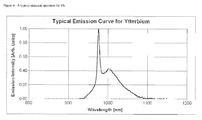
- a typical emission curve for Yb is provided in figure 4 .
- the Yb ⁇ FWHM values are either about 10nm or about 60nm. The smaller values are exactly this case, the larger values are when this 980nm peak is not as dominant. As a result the ⁇ FWHM value is not always a reliable indicator of the emission bandwidth for Yb. Nd does not have this problem, as one can see in a typical Nd emission curve in Figure 5 .
- the second method divides every point on the emission curve by the total area under the curve.
- the result called a linewidth function
- ⁇ eff the effective bandwidth
- the prior art glass APG-2 has a phosphate network.
- the inventors found that introduction of one or more oxide network forming oxides (SiO 2 , B 2 O 3 , TeO 2 , Nb 2 O 5 , Bi 2 O 3 , WO 3 , and/or GeO 2 ) into the phosphate predominant network in an amount of at least 1 mol % or above, e.g., 2 mol % or above, broadened, or at least offered a broader distribution of, the local chemical environments (in terms of the degrees of ligand field asymmetry and bond covalency) for lasing ion's (Yb 3+ or Nd 3+ for example) in the glass.
- oxide network forming oxides SiO 2 , B 2 O 3 , TeO 2 , Nb 2 O 5 , Bi 2 O 3 , WO 3 , and/or GeO 2
- the P-O-P network is hybridized with Si-O-Si, B-O-B, Te-O-Te, etc., and the lasing ions can be dissolved in the molten glass and be stabilized by forming bonding with different network formers.
- the ligand field around the lasing ions from the different network environments varies.
- the emission spectra of lasing ions is broadened as compared with pure phosphate network glasses.
- the laser glass compositions according to the invention relate to phosphate based glasses, e.g., a glass containing 35 mol % to about 65 mol% of P 2 O 5 , preferably about 45 mol % to about 60 mol %, which is hybridized by the addition of at least one, optionally two, three, four or more of non-phosphate oxide network formers, i.e., SiO 2 , B 2 O 3 , TeO 2 , Nb 2 O 5 , Bi 2 O 3 , WO 3 , and/or GeO 2 , and doped with one or more lasing rare earth elements 58 through 71 in the periodic table, e.g., Yb, Nd, Er, Pr, Sm, Eu, Tb, Dy, Ho and Tm, etc., preferably Yb, Nd, Er and Pr, and more preferably Yb and Nd.
- non-phosphate oxide network formers i.e., SiO 2 , B 2 O 3 , TeO 2
- rare earth elements can be used alone or in combination of one or more different ions.
- the sum of one or more non-phosphate network formers is at least 1 mol %, preferably, between 1.4 to 35 mol %, more preferably between 2.0 mol % to 28 mol %.
- the one or more lasing rare earth elements are present preferably at about 0.25 to about 5 mol %.
- the Sb 2 O 3 content is >0 to 1 mol %, more preferably 0.3 to 0.4 mol %.
- a preferred range for Al 2 O 3 content is 3.5 to 6.0 mol %, preferably 3.5 to 5.0 mol %.
- Also preferred is a 1.0 to 4.0 mol % of La 2 O 3 content.
- the phosphate laser glass composition is doped with a rare earth element as defined above, for example, Nd and/or Yb, and comprises (based on mol %): P 2 O 5 40.00 - 65.00 SiO 2 0.00 - 18.00 B 2 O 3 0.00 - 12.00 Al 2 O 3 2.00 - 8.00 Li 2 O 0.00 - 20.00 K 2 O 0.00 - 20.00 Na 2 O 0.00 - 20.00 MgO 0.00 - 15.00 CaO 0.00 - 5.00 BaO 0.00 - 15.00 TeO 2 0.00 - 5.00 Nd 2 O 3 0.50 - 3.00 and/or Yb 2 O 3 La 2 O 3 0.00 - 5.00 Nb 2 O 5 0.00 - 5.00 Sb 2 O 3 0.00 - 2.00 wherein the composition contains at least 1.00 mol% of a non-phosphate network former, e.g., at least 1.00 mol% of TeO 2 , at least 1.00 mol% of SiO 2 , at
- the phosphate laser glass composition is doped with Yb, and comprises (based on mol %): P 2 O 5 49.00 - 57.00 SiO 2 0.00 - 10.00 B 2 O 3 0.00 - 5.00 Al 2 O 3 2.00 - 6.00 Li 2 O 1.00 - 18.00 K 2 O 1.00 - 18.00 Na 2 O 0.00 - 10.00 MgO 1.00 - 12.00 CaO 0.00 - 3.00 BaO 1.00 - 12.00 TeO 2 0.00 - 4.00 Yb 2 O 3 1.00 - 2.50 La 2 O 3 0.50 - 3.00 Nb 2 O 5 0.00 - 4.00 Sb 2 O 3 0.20 - 0.50 wherein the composition contains at least 1.00 mol% of a non-phosphate network former, e.g., at least 1.00 mol% of TeO 2 , at least 1.00 mol% of SiO 2 , at least 1.00 mol% of B 2 O 3 , or at least 1.00 mol% of Nb
- the phosphate laser glass composition according to the invention contains 1.00 - 18.00 mol% of SiO 2 , for example, 1.20 - 15.00 mol% of SiO 2 or 1.25 - 10.00 mol% of SiO 2 .
- the phosphate laser glass composition according to the invention contains 1.10 - 12.00 mol% of SiO 2 and 1.10 - 12.00 mol% of B 2 O 3 , for example, 1.20 - 11.00 mol% of SiO 2 and 1.20 - 10.00 mol% of B 2 O 3 , or 1.25 - 10.00 mol% of SiO 2 and 1.25 - 8.00 mol% of B 2 O 3 .
- the phosphate laser glass composition according to the invention contains 1.50 - 8.00 mol% of Nb 2 O 5 , for example, 1.60 - 6.50 mol% of Nb 2 O 5 , or 1.70 - 5.50 mol% of Nb 2 0 5 .
- the phosphate laser glass composition according to the invention contains 1.50 - 7.00 mol% of Nb 2 O 5 and 1.10 - 18.00 mol% of SiO 2 , for example, 1.60 - 6.00 mol% of Nb 2 O 5 and 1.20 - 15.00 mol% of SiO 2 , or 1.70 - 4.50 mol% of Nb 2 O 5 and 1.25 - 12.00 mol% of SiO 2 .
- the phosphate laser glass composition according to the invention contains 1.50 - 3.70 mol% of Nb 2 O 5 , 1.10 - 18.00 mol% of SiO 2 and 1.10 - 12.00 mol% of B 2 O 3 , for example, 1.60 - 3.60 mol% of Nb 2 O 5 , 1.20 - 15.00 mol% of SiO 2 and 1.20 - 11.00 mol% of B 2 O 3 , or 1.70 - 3.55 mol% of Nb 2 O 5 , 1.25 - 12.00 mol% of SiO 2 and 1.25 - 10.00 mol% of B 2 O 3 .
- the glass compositions should not contain entities that could lead to crystallization, for example, it was determined that levels of Ta 2 O 5 above about 1 mol% can lead to crystallization of Ta-P phases, and as such, high levels of Ta 2 O 5 should be avoided from the glasses.
- the phosphate laser glass composition according to the invention exhibits an effective emission bandwidth for Yb 3+ ( ⁇ eff ) of at least 39.50 nm, for example, 40.00 - 54.00 nm or 42.00 - 54.00 nm or 42.40 - 53.50 nm and an effective emission bandwidth for Nd 3+ ( ⁇ eff ) of at least 32.00nm, for example 32.00 - 36.50 nm or 33 - 35 nm.
- the phosphate laser glass composition according to the invention exhibits an effective emission bandwidth for Yb 3+ ( ⁇ eff ) of at least 39.50 nm, e.g., >40.00 nm or >47.00 nm or >52.00 nm; and an effective emission bandwidth for Nd 3+ ( ⁇ eff ) of at least 32.00 nm, for example >34.00 nm or >36.00 nm.
- any of the disclosed glasses may be further sensitized with transition metals such as Cr, e.g., Cr 2 O 3 . In some instances this makes the glasses more useable in a flashlamp pumped laser system.
- the glass contains a maximum of 4 weight percent, especially a maximum of 2 weight percent, of conventional additives or impurities, such as refining agents (e.g., As 2 O 3 and Sb 2 O 3 ) and antisolarants (e.g., Nb 2 O 5 ).
- the glass composition may contain halides to help dry the melt of residual water and to help in the refining of the glass.
- the glass composition may contain up to 9 wt% F, preferably not more 5 wt%, and, up to 5wt% Cl, although Cl is less preferred than F.
- the glasses according to the invention can also be prepared without a lasing ion.
- the glasses according to the invention prepared without a lasing ion can be used as a cladding glass in a laser waveguide device.
- the resultant transition metal-doped glass can serve as an edge cladding glass in certain laser system designs.
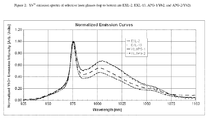
- the Yb 3+ emission spectra of selective laser glasses are provided.
- the emission spectra of APG-1/Yb and APG-2/Yb are presented as representatives of typical phosphate laser glasses.
- the top data line to the bottom data line are in the following order EXL-2/Yb, EXL-13/Yb, APG-1 doped with Yb (Yb:APG-1), and APG-2 doped with Yb (Yb:APG-2).
- raw emission spectra were used that had been first curve fitted with a spline function to reduce the noise level.
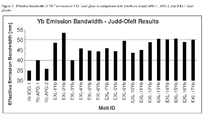
- Table 2 and Figure 3 summarize the effective bandwidth results for Yb doped glasses.
- the relative bandwidth broadening listed in Table 2 is based on a comparison of a bandwidth of 38 nm, i.e., the average of the bandwidths for APG-1 ad APG-2.
- Relative to ⁇ eff of APG-1 and APG-2 the newly designed EXL glasses showed significant improvement on band broadening, i.e., many EXL glasses have demonstrated the bandwidth wider than APG-1 and APG-2 glasses by more than 10 nm.
- the network hybridization approach according to the invention provides clear significant improvements in Yb bandwidth.
- the bandwidths presented in Figure 3 are determined by using the Judd-Ofelt analysis. All of the EXL glasses as shown in Figure 3 have effective emission bandwidths of about 40 nm or larger.
- Nd doped examples used an approach of reducing the amount of P 2 O 5 (the dominant glass former in all the examples with Yb and Nd). While not being bound to any specific theory, it is believed that based on these data, that Nd preferentially locates in the glass structure near P, so even with network hybridization the local environments around Nd are not greatly varied. Lowering the P 2 O 5 content in the glasses is thus an attractive path for creating Nd-doped glasses with broader emission bandwidth.
- the P 2 O range is 35 to 55 mol %, preferably 40 to 50 mol %, and more preferably 40-48 mol %.
- the SiO 2 content in these glasses is higher, e.g., 8-20 mol %, preferably 10-15 mol %.
- higher amounts of B 2 O 3 are used, for example, about 8-12 mol%, e.g., 10 mol%.
- Tables 1a, 3a and 4a use SiO 2 , B 2 O 3 , Nb 2 O 5 , and/or TeO 2 as the other glass formers
- the particular compositions selected in Table 5a were only doped with Nd, and the results of emission bandwidth were not particularly broad. However, based on these data, one would fully expect that these same glasses doped with Yb would provide a broad emission bandwidth.
- Table 1a Table 1a .
Landscapes
- Chemical & Material Sciences (AREA)
- Engineering & Computer Science (AREA)
- Materials Engineering (AREA)
- Chemical Kinetics & Catalysis (AREA)
- General Chemical & Material Sciences (AREA)
- Geochemistry & Mineralogy (AREA)
- Life Sciences & Earth Sciences (AREA)
- Organic Chemistry (AREA)
- Physics & Mathematics (AREA)
- Electromagnetism (AREA)
- Optics & Photonics (AREA)
- Plasma & Fusion (AREA)
- Glass Compositions (AREA)
- Lasers (AREA)
Applications Claiming Priority (1)
| Application Number | Priority Date | Filing Date | Title |
|---|---|---|---|
| US12/851,947 US8526475B2 (en) | 2010-08-06 | 2010-08-06 | Broadening of rare earth ion emission bandwidth in phosphate based laser glasses |
Publications (3)
| Publication Number | Publication Date |
|---|---|
| EP2415722A2 true EP2415722A2 (de) | 2012-02-08 |
| EP2415722A3 EP2415722A3 (de) | 2012-04-04 |
| EP2415722B1 EP2415722B1 (de) | 2018-10-10 |
Family
ID=44674236
Family Applications (1)
| Application Number | Title | Priority Date | Filing Date |
|---|---|---|---|
| EP11176815.6A Active EP2415722B1 (de) | 2010-08-06 | 2011-08-08 | Ausweitung der Seltenerdionenemissionsbandbreite in phosphatbasierten Lasergläsern |
Country Status (5)
| Country | Link |
|---|---|
| US (1) | US8526475B2 (de) |
| EP (1) | EP2415722B1 (de) |
| JP (1) | JP5916313B2 (de) |
| CN (1) | CN102515512B (de) |
| LT (1) | LT2415722T (de) |
Cited By (3)
| Publication number | Priority date | Publication date | Assignee | Title |
|---|---|---|---|---|
| RU2629499C2 (ru) * | 2012-11-28 | 2017-08-29 | Шотт Корпорейшн | Ультраширокополосные лазерные стекла для короткоимпульсных лазеров с высокой пиковой мощностью |
| WO2021137950A3 (en) * | 2019-11-26 | 2021-09-02 | Corning Incorporated | Magnesium aluminosilicate glasses with high fracture toughness |
| EP4524117A1 (de) * | 2023-09-12 | 2025-03-19 | The Penn State Research Foundation | Niedrigschmelzende glaszusammensetzungen, artikel und verfahren zur herstellung davon |
Families Citing this family (11)
| Publication number | Priority date | Publication date | Assignee | Title |
|---|---|---|---|---|
| US8486850B2 (en) * | 2010-09-13 | 2013-07-16 | Schott Corporation | Aluminophosphate glass composition |
| US9118166B2 (en) * | 2012-11-28 | 2015-08-25 | Schott Corporation | Tuning rare earth ion emission wavelength in phosphate based glasses using cerium oxide |
| US9834469B2 (en) * | 2016-02-02 | 2017-12-05 | Schott Corporation | Aluminophosphate glass composition |
| CN106316138A (zh) * | 2016-08-24 | 2017-01-11 | 华南理工大学 | 一种近红外发光碲量子点掺杂光纤及制备方法 |
| CN106746611A (zh) * | 2017-01-05 | 2017-05-31 | 中国科学院上海光学精密机械研究所 | 具有较大负热光程系数和高增益的磷酸盐激光钕玻璃 |
| CN109354402B (zh) * | 2018-10-15 | 2021-06-18 | 南京豪祺新材料有限公司 | 一种镱铒共掺磷酸盐玻璃及其制备方法与用途 |
| US11524918B2 (en) | 2018-11-26 | 2022-12-13 | Owens Corning Intellectual Capital, Llc | High performance fiberglass composition with improved specific modulus |
| EP4361112A3 (de) | 2018-11-26 | 2024-12-11 | Owens Corning Intellectual Capital, LLC | Hochleistungsglasfaserzusammensetzung mit verbessertem elastizitätsmodul |
| CN111170633A (zh) * | 2020-01-20 | 2020-05-19 | 广东工业大学 | 一种铥镱共掺磷酸盐上转换发光玻璃及其制备方法和应用 |
| CN114644456A (zh) * | 2022-03-09 | 2022-06-21 | 中国科学院上海光学精密机械研究所 | 一种磷酸盐激光玻璃 |
| CN116120928B (zh) * | 2023-02-20 | 2024-03-08 | 山东大学 | 一种超宽带发射近红外荧光粉及其制备方法 |
Citations (5)
| Publication number | Priority date | Publication date | Assignee | Title |
|---|---|---|---|---|
| US5526369A (en) | 1992-10-07 | 1996-06-11 | Schott Glass Technologies, Inc. | Phosphate glass useful in high energy lasers |
| US5663972A (en) | 1995-04-03 | 1997-09-02 | The Regents Of The University Of California | Ultrafast pulsed laser utilizing broad bandwidth laser glass |
| US6194334B1 (en) | 1999-06-18 | 2001-02-27 | Corning Incorporated | Tellurite glasses and optical components |
| US6656859B2 (en) | 1999-10-12 | 2003-12-02 | Corning Incorporated | Tellurite glasses and optical components |
| US6859606B2 (en) | 2002-11-27 | 2005-02-22 | Np Photonics, Inc. | ER3+ doped boro-tellurite glasses for 1.5 μm broadband amplification |
Family Cites Families (18)
| Publication number | Priority date | Publication date | Assignee | Title |
|---|---|---|---|---|
| JPS5116446B1 (de) * | 1971-05-21 | 1976-05-24 | ||
| JPS5342333B2 (de) * | 1975-03-18 | 1978-11-10 | ||
| JPS52125519A (en) * | 1976-04-15 | 1977-10-21 | Hoya Glass Works Ltd | Fluorophosphate glass for laser having small nonlinear refraction index and good aciddproofness |
| JPS5372027A (en) * | 1976-12-09 | 1978-06-27 | Hoya Glass Works Ltd | Hazeeproof glass for spectacle |
| JPS5443220A (en) * | 1977-09-09 | 1979-04-05 | Hoya Glass Works Ltd | Laser glass having optical length with little or no temperature dependency |
| US4248732A (en) * | 1978-02-14 | 1981-02-03 | Kigre, Inc. | Laser phosphate glass compositions |
| JPS60191029A (ja) * | 1984-03-13 | 1985-09-28 | Hoya Corp | レ−ザガラス |
| JPS6321240A (ja) * | 1986-07-12 | 1988-01-28 | Hoya Corp | 燐酸塩レーザーガラスファイバー |
| US4875920A (en) * | 1987-12-04 | 1989-10-24 | Kigre, Inc | Ion-exchangeable phosphate glass compositions and strengthened optical quality glass articles |
| US4962067A (en) * | 1989-07-14 | 1990-10-09 | Kigre, Inc. | Erbium laser glass compositions |
| US5053165A (en) * | 1989-07-26 | 1991-10-01 | Hoya Optics, Inc. | Glass of improved thermal shock resistance for high average power solid state laser system |
| JPH07108790B2 (ja) * | 1990-03-26 | 1995-11-22 | ホーヤ株式会社 | レーザーガラス |
| US6853659B2 (en) * | 2002-08-28 | 2005-02-08 | Schott Glass Technologies, Inc. | Laser system utilizing highly doped laser glass |
| CN1402028A (zh) * | 2002-09-06 | 2003-03-12 | 中国科学院上海光学精密机械研究所 | 稀土元素掺杂的玻璃双包层光纤及其制备方法 |
| US7115536B2 (en) * | 2003-03-05 | 2006-10-03 | Schott Glass Technologies, Inc. | Rare earth containing P2O5-WO3-Na2O glass for laser applications |
| RU2263381C1 (ru) * | 2004-05-25 | 2005-10-27 | Открытое акционерное общество "Лыткаринский завод оптического стекла" | Лазерное фосфатное стекло |
| CN101117271B (zh) * | 2007-07-25 | 2010-12-15 | 中国科学院上海光学精密机械研究所 | 镱铋共掺的磷酸盐基光学玻璃及其制备方法 |
| JP5310061B2 (ja) | 2009-02-13 | 2013-10-09 | 旭硝子株式会社 | レーザー用ガラス、ファイバレーザーおよび2重クラッド光ファイバ |
-
2010
- 2010-08-06 US US12/851,947 patent/US8526475B2/en active Active
-
2011
- 2011-08-05 JP JP2011171648A patent/JP5916313B2/ja active Active
- 2011-08-08 CN CN201110227246.9A patent/CN102515512B/zh active Active
- 2011-08-08 LT LTEP11176815.6T patent/LT2415722T/lt unknown
- 2011-08-08 EP EP11176815.6A patent/EP2415722B1/de active Active
Patent Citations (5)
| Publication number | Priority date | Publication date | Assignee | Title |
|---|---|---|---|---|
| US5526369A (en) | 1992-10-07 | 1996-06-11 | Schott Glass Technologies, Inc. | Phosphate glass useful in high energy lasers |
| US5663972A (en) | 1995-04-03 | 1997-09-02 | The Regents Of The University Of California | Ultrafast pulsed laser utilizing broad bandwidth laser glass |
| US6194334B1 (en) | 1999-06-18 | 2001-02-27 | Corning Incorporated | Tellurite glasses and optical components |
| US6656859B2 (en) | 1999-10-12 | 2003-12-02 | Corning Incorporated | Tellurite glasses and optical components |
| US6859606B2 (en) | 2002-11-27 | 2005-02-22 | Np Photonics, Inc. | ER3+ doped boro-tellurite glasses for 1.5 μm broadband amplification |
Non-Patent Citations (6)
| Title |
|---|
| E. DESURVIRE: "Erbium Doped Fiber Amplifiers", 1994, JOHN WILEY AND SONS |
| J.H. YANG: "Mixed Former Effects: A Kind of Compositions Adjusting Method of Er-doped glass for broadband amplification", CHIN. PHYS. LETT., vol. 19, no. 10, 2002, pages 1516 - 1518 |
| L.R.P. KASSAB ET AL., JOURNAL OF NON-CRYSTALLINE SOLIDS, vol. 348, 2004, pages 103 - 107 |
| LASER FOCUS WORLD, April 2008 (2008-04-01), pages 19 - 20 |
| M.D. PERRY, G. MOUROU: "Terrawatt to pettawatt subpicosecond lasers", SCIENCE, vol. 264, 1994, pages 917 - 924 |
| MINISCALCO, QUIMBY, OPTICS LETTERS, vol. 16, no. 4, 1991, pages 258 - 266 |
Cited By (4)
| Publication number | Priority date | Publication date | Assignee | Title |
|---|---|---|---|---|
| RU2629499C2 (ru) * | 2012-11-28 | 2017-08-29 | Шотт Корпорейшн | Ультраширокополосные лазерные стекла для короткоимпульсных лазеров с высокой пиковой мощностью |
| WO2021137950A3 (en) * | 2019-11-26 | 2021-09-02 | Corning Incorporated | Magnesium aluminosilicate glasses with high fracture toughness |
| US11827556B2 (en) | 2019-11-26 | 2023-11-28 | Corning Incorporated | Magnesium aluminosilicate glasses with high fracture toughness |
| EP4524117A1 (de) * | 2023-09-12 | 2025-03-19 | The Penn State Research Foundation | Niedrigschmelzende glaszusammensetzungen, artikel und verfahren zur herstellung davon |
Also Published As
| Publication number | Publication date |
|---|---|
| US8526475B2 (en) | 2013-09-03 |
| JP2012066996A (ja) | 2012-04-05 |
| CN102515512B (zh) | 2016-05-04 |
| EP2415722B1 (de) | 2018-10-10 |
| CN102515512A (zh) | 2012-06-27 |
| EP2415722A3 (de) | 2012-04-04 |
| JP5916313B2 (ja) | 2016-05-11 |
| US20120033694A1 (en) | 2012-02-09 |
| LT2415722T (lt) | 2019-01-10 |
Similar Documents
| Publication | Publication Date | Title |
|---|---|---|
| EP2415722A2 (de) | Ausweitung der Seltenerdionenemissionsbandbreite in phosphatbasierten Lasergläsern | |
| US8361917B2 (en) | Rare earth aluminoborosilicate glass composition | |
| Jackson | The spectroscopic and energy transfer characteristics of the rare earth ions used for silicate glass fibre lasers operating in the shortwave infrared | |
| EP2436659B1 (de) | Aluminiumphosphat-Glaszusammensetzung | |
| EP2738144B1 (de) | Lasergläser mit ultrabreiter Bandbreite für Kurzpuls- und Spitzenleistungslaser | |
| Tanabe et al. | Broad-band 1.5 μm emission of Er3+ ions in bismuth-based oxide glasses for potential WDM amplifier | |
| JPH0640743A (ja) | 高エネルギーレーザーに有用なリン酸塩ガラス | |
| US6413891B1 (en) | Glass material suitable for a waveguide of an optical amplifier | |
| EP2743238B1 (de) | Abstimmung der Emissionswellenlänge von Seltenerdionen in phosphatbasiertem Glas mittels Ceroxid | |
| EP0665992A1 (de) | Phosphatglas für hochenergielaser | |
| EP2746233B1 (de) | Erweiterung der Ionenemissionsbandbreite seltener Erden, Erhöhung des Emissionsquerschnitts und/oder Verschiebung der Spitzenemissionswellenlänge in ND-dotierten Aluminat- oder Silkatgläsern | |
| Zhou et al. | Broadband near-infrared emission from Bi-doped aluminosilicate glasses | |
| Cho et al. | Improvement of 4I11/2→ 4I13/2 Transition Rate and Thermal Stabilities in Er3+‐Doped TeO2‐B2O3 (GeO2)‐ZnO‐K2O Glasses | |
| Pucilowski et al. | EMISSION BANDWIDTH IN PHOSPHATE BASED LASER GLASSES |
Legal Events
| Date | Code | Title | Description |
|---|---|---|---|
| AK | Designated contracting states |
Kind code of ref document: A2 Designated state(s): AL AT BE BG CH CY CZ DE DK EE ES FI FR GB GR HR HU IE IS IT LI LT LU LV MC MK MT NL NO PL PT RO RS SE SI SK SM TR |
|
| AX | Request for extension of the european patent |
Extension state: BA ME |
|
| PUAI | Public reference made under article 153(3) epc to a published international application that has entered the european phase |
Free format text: ORIGINAL CODE: 0009012 |
|
| PUAL | Search report despatched |
Free format text: ORIGINAL CODE: 0009013 |
|
| AK | Designated contracting states |
Kind code of ref document: A3 Designated state(s): AL AT BE BG CH CY CZ DE DK EE ES FI FR GB GR HR HU IE IS IT LI LT LU LV MC MK MT NL NO PL PT RO RS SE SI SK SM TR |
|
| AX | Request for extension of the european patent |
Extension state: BA ME |
|
| RIC1 | Information provided on ipc code assigned before grant |
Ipc: H01S 3/17 20060101ALI20120228BHEP Ipc: C03C 3/062 20060101AFI20120228BHEP Ipc: C03C 3/068 20060101ALI20120228BHEP Ipc: C03C 3/17 20060101ALI20120228BHEP Ipc: C03C 3/19 20060101ALI20120228BHEP |
|
| 17P | Request for examination filed |
Effective date: 20121002 |
|
| RAP1 | Party data changed (applicant data changed or rights of an application transferred) |
Owner name: SCHOTT CORPORATION |
|
| 17Q | First examination report despatched |
Effective date: 20130701 |
|
| GRAP | Despatch of communication of intention to grant a patent |
Free format text: ORIGINAL CODE: EPIDOSNIGR1 |
|
| STAA | Information on the status of an ep patent application or granted ep patent |
Free format text: STATUS: GRANT OF PATENT IS INTENDED |
|
| RIC1 | Information provided on ipc code assigned before grant |
Ipc: H01S 3/17 20060101ALI20180529BHEP Ipc: C03C 3/17 20060101ALI20180529BHEP Ipc: C03C 3/068 20060101ALI20180529BHEP Ipc: H01S 3/16 20060101ALI20180529BHEP Ipc: C03C 4/00 20060101ALI20180529BHEP Ipc: C03C 3/062 20060101AFI20180529BHEP Ipc: H01S 3/23 20060101ALI20180529BHEP Ipc: C03C 3/19 20060101ALI20180529BHEP |
|
| INTG | Intention to grant announced |
Effective date: 20180615 |
|
| GRAS | Grant fee paid |
Free format text: ORIGINAL CODE: EPIDOSNIGR3 |
|
| GRAA | (expected) grant |
Free format text: ORIGINAL CODE: 0009210 |
|
| STAA | Information on the status of an ep patent application or granted ep patent |
Free format text: STATUS: THE PATENT HAS BEEN GRANTED |
|
| AK | Designated contracting states |
Kind code of ref document: B1 Designated state(s): AL AT BE BG CH CY CZ DE DK EE ES FI FR GB GR HR HU IE IS IT LI LT LU LV MC MK MT NL NO PL PT RO RS SE SI SK SM TR |
|
| REG | Reference to a national code |
Ref country code: GB Ref legal event code: FG4D |
|
| REG | Reference to a national code |
Ref country code: CH Ref legal event code: EP Ref country code: AT Ref legal event code: REF Ref document number: 1051021 Country of ref document: AT Kind code of ref document: T Effective date: 20181015 |
|
| REG | Reference to a national code |
Ref country code: IE Ref legal event code: FG4D |
|
| REG | Reference to a national code |
Ref country code: DE Ref legal event code: R096 Ref document number: 602011052719 Country of ref document: DE |
|
| REG | Reference to a national code |
Ref country code: NL Ref legal event code: MP Effective date: 20181010 |
|
| REG | Reference to a national code |
Ref country code: AT Ref legal event code: MK05 Ref document number: 1051021 Country of ref document: AT Kind code of ref document: T Effective date: 20181010 |
|
| PG25 | Lapsed in a contracting state [announced via postgrant information from national office to epo] |
Ref country code: NL Free format text: LAPSE BECAUSE OF FAILURE TO SUBMIT A TRANSLATION OF THE DESCRIPTION OR TO PAY THE FEE WITHIN THE PRESCRIBED TIME-LIMIT Effective date: 20181010 |
|
| PG25 | Lapsed in a contracting state [announced via postgrant information from national office to epo] |
Ref country code: IS Free format text: LAPSE BECAUSE OF FAILURE TO SUBMIT A TRANSLATION OF THE DESCRIPTION OR TO PAY THE FEE WITHIN THE PRESCRIBED TIME-LIMIT Effective date: 20190210 Ref country code: ES Free format text: LAPSE BECAUSE OF FAILURE TO SUBMIT A TRANSLATION OF THE DESCRIPTION OR TO PAY THE FEE WITHIN THE PRESCRIBED TIME-LIMIT Effective date: 20181010 Ref country code: HR Free format text: LAPSE BECAUSE OF FAILURE TO SUBMIT A TRANSLATION OF THE DESCRIPTION OR TO PAY THE FEE WITHIN THE PRESCRIBED TIME-LIMIT Effective date: 20181010 Ref country code: PL Free format text: LAPSE BECAUSE OF FAILURE TO SUBMIT A TRANSLATION OF THE DESCRIPTION OR TO PAY THE FEE WITHIN THE PRESCRIBED TIME-LIMIT Effective date: 20181010 Ref country code: BG Free format text: LAPSE BECAUSE OF FAILURE TO SUBMIT A TRANSLATION OF THE DESCRIPTION OR TO PAY THE FEE WITHIN THE PRESCRIBED TIME-LIMIT Effective date: 20190110 Ref country code: LV Free format text: LAPSE BECAUSE OF FAILURE TO SUBMIT A TRANSLATION OF THE DESCRIPTION OR TO PAY THE FEE WITHIN THE PRESCRIBED TIME-LIMIT Effective date: 20181010 Ref country code: AT Free format text: LAPSE BECAUSE OF FAILURE TO SUBMIT A TRANSLATION OF THE DESCRIPTION OR TO PAY THE FEE WITHIN THE PRESCRIBED TIME-LIMIT Effective date: 20181010 Ref country code: NO Free format text: LAPSE BECAUSE OF FAILURE TO SUBMIT A TRANSLATION OF THE DESCRIPTION OR TO PAY THE FEE WITHIN THE PRESCRIBED TIME-LIMIT Effective date: 20190110 Ref country code: FI Free format text: LAPSE BECAUSE OF FAILURE TO SUBMIT A TRANSLATION OF THE DESCRIPTION OR TO PAY THE FEE WITHIN THE PRESCRIBED TIME-LIMIT Effective date: 20181010 |
|
| PG25 | Lapsed in a contracting state [announced via postgrant information from national office to epo] |
Ref country code: PT Free format text: LAPSE BECAUSE OF FAILURE TO SUBMIT A TRANSLATION OF THE DESCRIPTION OR TO PAY THE FEE WITHIN THE PRESCRIBED TIME-LIMIT Effective date: 20190210 Ref country code: AL Free format text: LAPSE BECAUSE OF FAILURE TO SUBMIT A TRANSLATION OF THE DESCRIPTION OR TO PAY THE FEE WITHIN THE PRESCRIBED TIME-LIMIT Effective date: 20181010 Ref country code: SE Free format text: LAPSE BECAUSE OF FAILURE TO SUBMIT A TRANSLATION OF THE DESCRIPTION OR TO PAY THE FEE WITHIN THE PRESCRIBED TIME-LIMIT Effective date: 20181010 Ref country code: RS Free format text: LAPSE BECAUSE OF FAILURE TO SUBMIT A TRANSLATION OF THE DESCRIPTION OR TO PAY THE FEE WITHIN THE PRESCRIBED TIME-LIMIT Effective date: 20181010 Ref country code: GR Free format text: LAPSE BECAUSE OF FAILURE TO SUBMIT A TRANSLATION OF THE DESCRIPTION OR TO PAY THE FEE WITHIN THE PRESCRIBED TIME-LIMIT Effective date: 20190111 |
|
| REG | Reference to a national code |
Ref country code: DE Ref legal event code: R097 Ref document number: 602011052719 Country of ref document: DE |
|
| PG25 | Lapsed in a contracting state [announced via postgrant information from national office to epo] |
Ref country code: CZ Free format text: LAPSE BECAUSE OF FAILURE TO SUBMIT A TRANSLATION OF THE DESCRIPTION OR TO PAY THE FEE WITHIN THE PRESCRIBED TIME-LIMIT Effective date: 20181010 Ref country code: IT Free format text: LAPSE BECAUSE OF FAILURE TO SUBMIT A TRANSLATION OF THE DESCRIPTION OR TO PAY THE FEE WITHIN THE PRESCRIBED TIME-LIMIT Effective date: 20181010 Ref country code: DK Free format text: LAPSE BECAUSE OF FAILURE TO SUBMIT A TRANSLATION OF THE DESCRIPTION OR TO PAY THE FEE WITHIN THE PRESCRIBED TIME-LIMIT Effective date: 20181010 |
|
| PLBE | No opposition filed within time limit |
Free format text: ORIGINAL CODE: 0009261 |
|
| STAA | Information on the status of an ep patent application or granted ep patent |
Free format text: STATUS: NO OPPOSITION FILED WITHIN TIME LIMIT |
|
| PG25 | Lapsed in a contracting state [announced via postgrant information from national office to epo] |
Ref country code: RO Free format text: LAPSE BECAUSE OF FAILURE TO SUBMIT A TRANSLATION OF THE DESCRIPTION OR TO PAY THE FEE WITHIN THE PRESCRIBED TIME-LIMIT Effective date: 20181010 Ref country code: SK Free format text: LAPSE BECAUSE OF FAILURE TO SUBMIT A TRANSLATION OF THE DESCRIPTION OR TO PAY THE FEE WITHIN THE PRESCRIBED TIME-LIMIT Effective date: 20181010 Ref country code: SM Free format text: LAPSE BECAUSE OF FAILURE TO SUBMIT A TRANSLATION OF THE DESCRIPTION OR TO PAY THE FEE WITHIN THE PRESCRIBED TIME-LIMIT Effective date: 20181010 Ref country code: EE Free format text: LAPSE BECAUSE OF FAILURE TO SUBMIT A TRANSLATION OF THE DESCRIPTION OR TO PAY THE FEE WITHIN THE PRESCRIBED TIME-LIMIT Effective date: 20181010 |
|
| 26N | No opposition filed |
Effective date: 20190711 |
|
| PG25 | Lapsed in a contracting state [announced via postgrant information from national office to epo] |
Ref country code: SI Free format text: LAPSE BECAUSE OF FAILURE TO SUBMIT A TRANSLATION OF THE DESCRIPTION OR TO PAY THE FEE WITHIN THE PRESCRIBED TIME-LIMIT Effective date: 20181010 |
|
| PG25 | Lapsed in a contracting state [announced via postgrant information from national office to epo] |
Ref country code: TR Free format text: LAPSE BECAUSE OF FAILURE TO SUBMIT A TRANSLATION OF THE DESCRIPTION OR TO PAY THE FEE WITHIN THE PRESCRIBED TIME-LIMIT Effective date: 20181010 |
|
| PG25 | Lapsed in a contracting state [announced via postgrant information from national office to epo] |
Ref country code: LU Free format text: LAPSE BECAUSE OF NON-PAYMENT OF DUE FEES Effective date: 20190808 Ref country code: LI Free format text: LAPSE BECAUSE OF NON-PAYMENT OF DUE FEES Effective date: 20190831 Ref country code: MC Free format text: LAPSE BECAUSE OF FAILURE TO SUBMIT A TRANSLATION OF THE DESCRIPTION OR TO PAY THE FEE WITHIN THE PRESCRIBED TIME-LIMIT Effective date: 20181010 Ref country code: CH Free format text: LAPSE BECAUSE OF NON-PAYMENT OF DUE FEES Effective date: 20190831 |
|
| REG | Reference to a national code |
Ref country code: BE Ref legal event code: MM Effective date: 20190831 |
|
| PG25 | Lapsed in a contracting state [announced via postgrant information from national office to epo] |
Ref country code: IE Free format text: LAPSE BECAUSE OF NON-PAYMENT OF DUE FEES Effective date: 20190808 |
|
| PG25 | Lapsed in a contracting state [announced via postgrant information from national office to epo] |
Ref country code: BE Free format text: LAPSE BECAUSE OF NON-PAYMENT OF DUE FEES Effective date: 20190831 |
|
| PG25 | Lapsed in a contracting state [announced via postgrant information from national office to epo] |
Ref country code: CY Free format text: LAPSE BECAUSE OF FAILURE TO SUBMIT A TRANSLATION OF THE DESCRIPTION OR TO PAY THE FEE WITHIN THE PRESCRIBED TIME-LIMIT Effective date: 20181010 |
|
| PG25 | Lapsed in a contracting state [announced via postgrant information from national office to epo] |
Ref country code: MT Free format text: LAPSE BECAUSE OF FAILURE TO SUBMIT A TRANSLATION OF THE DESCRIPTION OR TO PAY THE FEE WITHIN THE PRESCRIBED TIME-LIMIT Effective date: 20181010 Ref country code: HU Free format text: LAPSE BECAUSE OF FAILURE TO SUBMIT A TRANSLATION OF THE DESCRIPTION OR TO PAY THE FEE WITHIN THE PRESCRIBED TIME-LIMIT; INVALID AB INITIO Effective date: 20110808 |
|
| PG25 | Lapsed in a contracting state [announced via postgrant information from national office to epo] |
Ref country code: MK Free format text: LAPSE BECAUSE OF FAILURE TO SUBMIT A TRANSLATION OF THE DESCRIPTION OR TO PAY THE FEE WITHIN THE PRESCRIBED TIME-LIMIT Effective date: 20181010 |
|
| P01 | Opt-out of the competence of the unified patent court (upc) registered |
Effective date: 20230516 |
|
| PGFP | Annual fee paid to national office [announced via postgrant information from national office to epo] |
Ref country code: LT Payment date: 20250723 Year of fee payment: 15 Ref country code: DE Payment date: 20250820 Year of fee payment: 15 |
|
| PGFP | Annual fee paid to national office [announced via postgrant information from national office to epo] |
Ref country code: GB Payment date: 20250820 Year of fee payment: 15 |
|
| PGFP | Annual fee paid to national office [announced via postgrant information from national office to epo] |
Ref country code: FR Payment date: 20250829 Year of fee payment: 15 |