EP2407457A1 - Process for producing diamine derivative - Google Patents
Process for producing diamine derivative Download PDFInfo
- Publication number
- EP2407457A1 EP2407457A1 EP10750831A EP10750831A EP2407457A1 EP 2407457 A1 EP2407457 A1 EP 2407457A1 EP 10750831 A EP10750831 A EP 10750831A EP 10750831 A EP10750831 A EP 10750831A EP 2407457 A1 EP2407457 A1 EP 2407457A1
- Authority
- EP
- European Patent Office
- Prior art keywords
- compound
- tertiary amine
- represented
- following formula
- production process
- Prior art date
- Legal status (The legal status is an assumption and is not a legal conclusion. Google has not performed a legal analysis and makes no representation as to the accuracy of the status listed.)
- Granted
Links
- 0 C[C@@](C[C@](CCCO*)C(N(C)*)=O)NC(OC(C)(C)C)=O Chemical compound C[C@@](C[C@](CCCO*)C(N(C)*)=O)NC(OC(C)(C)C)=O 0.000 description 3
- AKTZBAPUNGDCRZ-UHFFFAOYSA-N CC(CC1)=CC=C1S(O)(=O)=O Chemical compound CC(CC1)=CC=C1S(O)(=O)=O AKTZBAPUNGDCRZ-UHFFFAOYSA-N 0.000 description 1
Images
Classifications
-
- C—CHEMISTRY; METALLURGY
- C07—ORGANIC CHEMISTRY
- C07D—HETEROCYCLIC COMPOUNDS
- C07D213/00—Heterocyclic compounds containing six-membered rings, not condensed with other rings, with one nitrogen atom as the only ring hetero atom and three or more double bonds between ring members or between ring members and non-ring members
- C07D213/02—Heterocyclic compounds containing six-membered rings, not condensed with other rings, with one nitrogen atom as the only ring hetero atom and three or more double bonds between ring members or between ring members and non-ring members having three double bonds between ring members or between ring members and non-ring members
- C07D213/04—Heterocyclic compounds containing six-membered rings, not condensed with other rings, with one nitrogen atom as the only ring hetero atom and three or more double bonds between ring members or between ring members and non-ring members having three double bonds between ring members or between ring members and non-ring members having no bond between the ring nitrogen atom and a non-ring member or having only hydrogen or carbon atoms directly attached to the ring nitrogen atom
- C07D213/60—Heterocyclic compounds containing six-membered rings, not condensed with other rings, with one nitrogen atom as the only ring hetero atom and three or more double bonds between ring members or between ring members and non-ring members having three double bonds between ring members or between ring members and non-ring members having no bond between the ring nitrogen atom and a non-ring member or having only hydrogen or carbon atoms directly attached to the ring nitrogen atom with hetero atoms or with carbon atoms having three bonds to hetero atoms with at the most one bond to halogen, e.g. ester or nitrile radicals, directly attached to ring carbon atoms
- C07D213/72—Nitrogen atoms
- C07D213/75—Amino or imino radicals, acylated by carboxylic or carbonic acids, or by sulfur or nitrogen analogues thereof, e.g. carbamates
-
- C—CHEMISTRY; METALLURGY
- C07—ORGANIC CHEMISTRY
- C07D—HETEROCYCLIC COMPOUNDS
- C07D513/00—Heterocyclic compounds containing in the condensed system at least one hetero ring having nitrogen and sulfur atoms as the only ring hetero atoms, not provided for in groups C07D463/00, C07D477/00 or C07D499/00 - C07D507/00
- C07D513/02—Heterocyclic compounds containing in the condensed system at least one hetero ring having nitrogen and sulfur atoms as the only ring hetero atoms, not provided for in groups C07D463/00, C07D477/00 or C07D499/00 - C07D507/00 in which the condensed system contains two hetero rings
- C07D513/04—Ortho-condensed systems
Definitions
- the present invention relates to a process for industrially producing an optically active diamine derivative that is important for production of a compound (A) as an activated blood coagulation factor X (FXa) inhibitor or a pharmacologically acceptable salt thereof, or a hydrate thereof.
- a compound (A) as an activated blood coagulation factor X (FXa) inhibitor or a pharmacologically acceptable salt thereof, or a hydrate thereof.
- Compound (A) represented by the following formula or a pharmacologically acceptable salt thereof, or a hydrate thereof is a compound that exhibits an FXa inhibitory effect, as disclosed in Patent Literatures 1 to 3, and is useful as preventive and/or therapeutic drugs for thrombotic and/or embolic diseases.
- a compound (1), an optically active diamine derivative, described in the scheme shown below is known as an intermediate for the production of compound (A) as an FXa inhibitor or a pharmacologically acceptable salt thereof, or a hydrate thereof.
- the pamphlet of International Publication No. WO 2007/106759 discloses a process for producing compound (1), comprising adding a compound (3) to an excessive amount of a tertiary amine to neutralize the salt and then adding a compound (2) to the mixture [Scheme A].
- Boc represents a tert-butoxycarbonyl group.
- an object of the present invention is to solve these problems and to provide a novel process for industrially producing compound (1) that is an important synthetic intermediate for production of compound (A).
- the present inventors have conducted diligent studies with the aim of avoiding the drastic reduction in yield caused by solidification of the reaction system, which is a problem in the conventional process for producing compound (1), and obtaining a novel process for industrially producing compound (1).
- the present inventors have completed the present invention by finding that: the order of addition is important in which compound (2) is first treated with the tertiary amine and subsequently, compound (3) is added thereto; and an effective process involves adding the tertiary amine in divided portions to prevent decomposition of the free form of compound (2).
- the present invention provides (1) to (21) shown below.
- compound (1) that is an intermediate for production of compound (A) useful as an FXa inhibitor can be produced at stable yields as high as 93 to 95% by avoiding a reduction in reaction yield caused by solidification of the reaction system, which is a problem of the conventional process.
- the production process of the present invention is useful as a process for producing compound (A) useful as an FXa inhibitor.
- FXa inhibitor is preferably, for example, compound (A) described above.
- Compound (A) may be a free form (free base) or a hydrate thereof or may be a pharmacologically acceptable salt or a hydrate of the salt.
- Examples of the pharmacologically acceptable salt of compound (A) include hydrochloride, sulfate, hydrobromide, hydroiodide, phosphate, nitrate, benzoate, methanesulfonate, 2-hydroxyethanesulfonate, p-toluenesulfonate, acetate, propanoate, oxalate, malonate, succinate, glutarate, adipate, tartrate, maleate, fumarate, malate, and mandelate.
- the salt of compound (A) is preferably hydrochloride or p-toluenesulfonate, particularly preferably p-toluenesulfonate.
- Compound (A) or a salt thereof, or a hydrate thereof is preferably N 1 -(5-chloropyridin-2-yl)-N 2 -((1S,2R,4S)-4-[(dimethylamino)carbonyl]-2- ⁇ [(5-methyl-4,5,6,7-tetrahydrothiazolo[5,4-c]pyridin-2-yl)carbonyl]amino ⁇ cyclohexyl)ethanediamide; N 1 -(5-chloropyridin-2-yl)-N 2 -((1S,2R,4S)-4-[(dimethylamino)carbonyl]-2- ⁇ [(5-methyl-4,5,6,7-tetrahydrothiazolo[5,4-c]pyridin-2-yl)carbonyl]amino ⁇ cyclohexyl)ethanediamide hydrochloride; N 1 -(5-chloropyridin-2-y
- optically active amide derivative compound (1) of the present invention can be produced by performing the procedures of [Step 1] and [Step 2] in the order as shown in the following scheme: wherein Boc represents a tert-butoxycarbonyl group.
- Examples of the C2-C4 nitrile solvent used in the [Step 1] can include acetonitrile, propionitrile, and butyronitrile. Among them, the reaction solvent is preferably acetonitrile.
- Organo-tertiary bases generally used can be used as the tertiary amine according to the present invention.
- Examples thereof can include alkylamines comprising identical or different C1 to C8 alkyls, 1-(C1-C3 alkyl)pyrrolidine, 1-(C1-C3 alkyl)piperidine, 4-(C1-C3 alkyl)morpholine, 1,8-diazabicyclo[5.4.0]undec-7-ene (DBU), 1,5-diazabicyclo[4.3.0]non-5-ene (DBN), di(C1-C3 alkyl)aniline, and 4-di(C1-C3 alkyl)aminopyridine.
- alkylamines comprising identical or different C1 to C8 alkyls
- 1-(C1-C3 alkyl)pyrrolidine 1-(C1-C3 alkyl)piperidine
- 4-(C1-C3 alkyl)morpholine 4-(C1-C3
- the tertiary amine is preferably trimethylamine, triethylamine, ethyl(diisopropyl)amine, 1-methylpiperidine, 1-ethylpiperidine, 4-methylmorpholine, N,N-dimethylaniline, or N,N-diethylaniline, or the like.
- Step 1 is the step of treating compound (2) with a tertiary amine in a C2-C4 nitrile solvent to prepare a neutralized compound (2a) represented by the following formula:
- [Step 1] More specific examples of preferable aspects of [Step 1] can include [Step 1 (Method A)] to [Step 1 (Method C)] shown below.
- Methods A and B are preferable.
- [Step 2] in the present invention is the step of adding, to the mixed solution of [Step 1], compound (3) represented by the following formula: wherein Boc represents a tert-butoxycarbonyl group.
- Boc represents a tert-butoxycarbonyl group.
- the point in time when the addition of compound (3) is initiated in Method C is preferably within 15 minutes after the addition of the tertiary amine, more preferably at the completion of the addition of the tertiary amine, even more preferably concurrently with the addition of the tertiary amine at the point in time when the addition of 1/5 or more of the total amount of the tertiary amines added has been completed.
- Method A or B an additional tertiary amine is added to the mixed solution of [Step 2] with the internal temperature of the mixed solution set to 50 to 65°C, and then, the reaction mixture is stirred at 60 to 80°C. After the completion of the reaction, the reaction mixture is cooled, and water is added thereto for crystallization. The resulting crystals are collected to obtain compound (1).
- the amount of the additional tertiary amine added in Methods A and B is stoichiometrically preferably in the range of 3.23 to 4.32 molar equivalents with respect to compound (2) [the total amount of the tertiary amines added is stoichiometrically 4.9 to 6.5 molar equivalents with respect to compound (3)].
- the reaction mixture is stirred at 60 to 80°C.
- the stirring time is preferably 6 hours or longer, more preferably approximately 6 to 24 hours.
- the endpoint of the reaction may be determined by confirming the sample in the reaction solution using equipment of HPLC or the like.
- Method A is particularly preferable.
- a specific aspect of the production of the compound (1) using Method A is as follows:
- the reaction mixture is cooled. Water is added thereto, and the mixture is stirred to complete crystallization.
- the cooling of the reaction mixture is performed preferably at 0 to 60°C, more preferably 0 to 50°C.
- the amount of water added is preferably in the range of 6 to 11 parts by volume with respect to 1 part by weight of the compound (3) [6 to 11 (v/w)].
- the procedure of obtaining crystals of compound (1) after the crystallization is performed such that the precipitated crystals are cooled to complete crystallization, and the resulting crystals are collected by filtration, washed with water, and then dried.
- the procedure of obtaining the precipitated crystals can be performed by collecting the crystals by filtration under normal pressure or reduced pressure.
- the crystallization temperature is preferably -10 to 35°C.
- the amount of water for washing the crystals is preferably approximately 5 parts by volume with respect to 1 part by weight of the compound (3) [5 (v/w)].
- Compound (2) used in [Step 1] can be produced as shown below. Specific examples of the production can include a process described in Reference Example 2. Specifically, compound (2) can be produced by adding a commercially available aniline derivative compound (2b) and a compound (2c) into a C2-C4 nitrile solvent with stirring.
- Examples of the C2-C4 nitrile solvent used in this reaction can include acetonitrile, propionitrile, and butyronitrile. Acetonitrile is preferable.
- the amount of the solvent used is preferably in the range of 10 to 17 parts by volume with respect to 1 part by weight of compound (2b) [10 to 17 (v/w)].
- the amount of the compound (2c) used is stoichiometrically preferably in the range of 1.06 to 1.21 molar equivalents with respect to the compound (2b).
- the reaction temperature is preferably in the range of 40 to 80°C.
- the reaction time is preferably 1 hour longer, more preferably approximately 1 to 7 hours. Compound (2) thus produced can be isolated by allowing compound (2) to crystallize and collecting the crystals by filtration.
- the crystallization temperature is preferably in the range of -25 to 35°C.
- the crystals of compound (2) can be isolated by collection by filtration. When compound (2) is then used in [Step 1], compound (2) collected by filtration may be used in a dry state (dry form) after drying under normal pressure or reduced pressure or may be used in a wet state (wet form).
- Patent Literature 1 or 3 A known process disclosed in Patent Literature 1 or 3 may be used as a process for producing compound (A) useful as an FXa inhibitor or compound (A-a) (mono-p-toluenesulfonate monohydrate of compound (A)) using compound (1) of the present invention. Specifically, these compounds can be produced as shown in the following scheme and Reference Examples 4 and 5 described later:
- Boc represents a tert-butoxycarbonyl group.
- Boc represents a tert-butoxycarbonyl group.
- Boc is as defined above.
- a 28% aqueous ammonia solution (5 ml) was added to (1S,3S,6R)-N,N-dimethyl-7-oxabicyclo[4.1.0]heptane-3-carboxamide (1 g) at room temperature. After stirring at 40°C for 5 hours, the solvent was concentrated under reduced pressure to obtain a crude form of (1S,3R,4R)-3-amino-4-hydroxy-N,N-dimethylcyclohexanecarboxamide (1.18 g). The obtained crude form was dissolved in water (5 ml).
- Ms represents a methanesulfonyl group; and Boc is as defined above.
- Methanesulfonyl chloride 159.07 g was added to a solution of tert-butyl ⁇ (1R,2R,5S)-5-[(dimethylamino)carbonyl]-2-hydroxycyclohexylcarbamate (214.59 g) in 4-methyl-2-pentanone (MIBK) (1875 ml) at room temperature.
- MIBK 4-methyl-2-pentanone
- Boc is as defined above.
- Sodium azide (7.14 g) and dodecylpyridinium chloride (7.80 g) were added to a solution of (1R,2R,4S)-2-[(tert-butoxycarbonyl)amino]-4-[(dimethylamino)carbonyl]cyclohexylmethanesulfonate (20.0 g) in N,N-dimethylacetamide (DMAC) (40 ml) at room temperature.
- DMAC N,N-dimethylacetamide
- Boc is as defined above.
- Sodium azide (7.14 g)and dodecylpyridinium chloride (7.80 g) were added to a solution of (1R,2R,4S)-2-[(tert-butoxycarbonyl)amino]-4-[(dimethylamino)carbonyl]cyclohexylmethanesulfonate (20.0 g) in toluene (100 ml) at room temperature.
- the reaction mixture was stirred at 60°C for 72 hours.
- water was then added, and the organic layer was washed with a saturated aqueous solution of sodium bicarbonate and water and then separated.
- Triethylamine (169 ml) was added to a suspension of tert-butyl ⁇ (1R,2S,5S)-2-amino-5-[(dimethylamino)carbonyl]cyclohexyl ⁇ carbamate oxalate (1) (100.1 g) in acetonitrile (550 ml) at 60°C.
- Ethyl [5-chloropyridin-2-yl]amino](oxo)acetate monohydrochloride 82) (84.2 g) was added thereto at this temperature, and the mixture was stirred for 6 hours and then stirred at room temperature for 16 hours.
- Methanesulfonic acid (66 ml) was added to a suspension of tert-butyl [(1R,2S,5S)-2-( ⁇ [(5-chloropyridin-2-yl)amino](oxo)acetyl ⁇ amino)-5-(dimethylaminocarbanyl)cyclohexyl]carbamate (1) (95.1 g) in acetonitrile (1900 ml) at room temperature, and the mixture was stirred at this temperature for 2 hours.
- N 1 -(5-Chloropyridin-2-yl)-N 2 -((1S,2R,4S)-4-[(dimethylamino)carbonyl]-2- ⁇ [(5-methyl-4,5,6,7-tetrahydrothiazolo[5,4-c]pyridin-2-yl)carbonyl]amino ⁇ cyclohexyl)ethanediamide (A) (6.2 g) was dissolved in methylene chloride (120 ml). To the solution, a 1 mol/L solution of p-toluenesulfonic acid in ethanol (11.28 ml) was added, and the mixture was stirred at room temperature. Then, the solvent was distilled off.
- Boc represents a tert-butoxycarbonyl group.
- 2-Amino-5-chloropyridine (2b) (5.0 g) was added to acetonitrile (60 ml).
- Ethyl oxalyl chloride (2c) (5.9 g) was added thereto at 50°C, and the mixture was stirred at this temperature for 2 hours.
- the reaction solution was cooled, and crystals were collected by filtration at 10°C to obtain ethyl[5-chloropyridin-2-yl]amino](oxo)acetate monohydrochloride (2) (9.8 g).
- Condition State of solidification Rate of formation of compound (1) (Condition 1): 1.0 Rate of formed Impurity X (%) Condition 1 Not solidified 1.0 0.1 Condition 2 Heavily solidified before addition of compound (2) 0.9 0.5 Condition 3 Solidified after addition of compound (2) 0.99 0.1
- Test Example 1 demonstrated that the conventional process, which involved initially adding compound (3), has the risk of causing a reduction in quality of compound (1) (Condition 2 of Test Example 1).
- the rates of formation of compound (1) and Impurity X were determined under Condition 1 of Test Example 1 as well as (Condition 4) or (Condition 5) shown below for the purpose of confirming the influence of change in the order in which compound (3), compound (2), and triethylamine were added, on the yield and quality of compound (1).
- the results are shown in Table 2.
- Condition Rate of formation of compound (1) 1.0 Rate of formation of Impurity X (%) Condition 1 1.0 0.1 Condition 4 0.75 15.9 Condition 5 1.0 ⁇ 0.1
- the production process of the present invention can be used as a novel process for industrially producing compound (A) useful as an FXa inhibitor or a pharmacologically acceptable salt thereof, or a hydrate thereof.
Landscapes
- Chemical & Material Sciences (AREA)
- Organic Chemistry (AREA)
- Pharmaceuticals Containing Other Organic And Inorganic Compounds (AREA)
- Pyridine Compounds (AREA)
- Organic Low-Molecular-Weight Compounds And Preparation Thereof (AREA)
- Nitrogen And Oxygen Or Sulfur-Condensed Heterocyclic Ring Systems (AREA)
Abstract
Description
- The present invention relates to a process for industrially producing an optically active diamine derivative that is important for production of a compound (A) as an activated blood coagulation factor X (FXa) inhibitor or a pharmacologically acceptable salt thereof, or a hydrate thereof.
- Compound (A) represented by the following formula or a pharmacologically acceptable salt thereof, or a hydrate thereof is a compound that exhibits an FXa inhibitory effect, as disclosed in Patent Literatures 1 to 3, and is useful as preventive and/or therapeutic drugs for thrombotic and/or embolic diseases.
-

- A compound (1), an optically active diamine derivative, described in the scheme shown below is known as an intermediate for the production of compound (A) as an FXa inhibitor or a pharmacologically acceptable salt thereof, or a hydrate thereof. The pamphlet of International Publication No.
WO 2007/106759 discloses a process for producing compound (1), comprising adding a compound (3) to an excessive amount of a tertiary amine to neutralize the salt and then adding a compound (2) to the mixture [Scheme A]. -

- wherein Boc represents a tert-butoxycarbonyl group.
-
- Patent Literature 1: International Publication No.
WO 2004/058715 - Patent Literature 2: International Publication No.
WO 2003/016302 - Patent Literature 3: International Publication No.
WO 2003/000680 - Patent Literature 4: International Publication No.
WO 2007/106759 - The production process disclosed in the pamphlet of International Publication No.
WO 2007/106759 has been found to deposit a gel of a compound (3a) (obtained by the neutralization of compound (3) with the tertiary amine), which then hardens and solidifies the reaction system and makes stirring difficult. As a result, it has been demonstrated that, disadvantageously, reaction yields are drastically reduced due to the increased formation of by-products. Furthermore, it has also been demonstrated that the prevention of such solidification is exceedingly difficult.
Thus, an object of the present invention is to solve these problems and to provide a novel process for industrially producing compound (1) that is an important synthetic intermediate for production of compound (A).
The present inventors have conducted diligent studies with the aim of avoiding the drastic reduction in yield caused by solidification of the reaction system, which is a problem in the conventional process for producing compound (1), and obtaining a novel process for industrially producing compound (1).
As a result of studies over the years, the present inventors have completed the present invention by finding that: the order of addition is important in which compound (2) is first treated with the tertiary amine and subsequently, compound (3) is added thereto; and an effective process involves adding the tertiary amine in divided portions to prevent decomposition of the free form of compound (2). - The present invention provides (1) to (21) shown below.
- (1) A process for producing a compound (1) represented by the following formula:

- [Step 1]: treating a compound (2) represented by the following formula:

- [Step 2]: then adding, to the mixed solution of [Step 1], a compound (3) repres

- [Step 1]: treating a compound (2) represented by the following formula:
- (2) The production process according to (1), wherein the C2-C4 nitrile solvent is acetonitrile.
- (3) The production process according to (1) or (2), wherein the amount of compound (2) is stoichiometrically 1.10 to 1.27 molar equivalents with respect to compound (3).
- (4) The production process according to any one of (1) to (3), wherein the tertiary amine is one or two or more selected from the group consisting of tri(C1-C4 alkyl)amines, 1-(C1-C3 alkyl)piperidine, and 4-(C1-C3 alkyl)morpholine.
- (5) The production process according to any one of (1) to (3), wherein the tertiary amine is one or two or more selected from tri(C1-C4 alkyl)amines.
- (6) The production process according to any one of (1) to (3), wherein the tertiary amine is triethylamine.
- (7) The production process according to any one of (1) to (6), wherein [Step 1] comprises adding compound (2) represented by the following formula:

- (8) The production process according to any one of (1) to (6), wherein [Step 1] comprises adding the tertiary amine into the C2-C4 nitrile solvent and subsequently adding thereto compound (2) represented by the following formula:

- (9) The production process according to (7) or (8), wherein the addition of compound (2) or the tertiary amine is performed at 45°C or lower.
- (10) The production process according to (7) or (8), wherein the addition of compound (2) or the tertiary amine is performed in the range of 0 to 35°C.
- (11) The production process according to any one of (1) to (10), wherein the amount of the tertiary amine added in [Step 1] is stoichiometrically 0.87 to 1.08 molar equivalents with respect to compound (2).
- (12) The production process according to any one of (1) to (11), further comprising adding an additional tertiary amine after the procedure of [Step 2].
- (13) The production process according to (12), wherein the amount of the additional tertiary amine added is stoichiometrically in the range of 3.02 to 4.53 molar equivalents with respect to compound (2).
- (14) The production process according to (12) or (13), wherein the addition of the additional tertiary amine is performed at 50 to 65°C.
- (15) The production process according to any one of (12) to (14), further comprising stirring the reaction mixture at 60 to 80°C after the addition of the additional tertiary amine.
- (16) The production process according to (15), wherein the stirring time is 6 hours or longer.
- (17) The production process according to (15), wherein the stirring time is in the range of 6 to 24 hours.
- (18) A process for producing a compound (1) represented by the following formula:

- [Step 1] : treating a compound (2) represented by the following formula:

- [Step 2]: then adding, to the mixed solution of [Step 1], a compound (3) represented by the following formula:

then adding an additional tertiary amine at stoichiometrically 3.23 to 4.32 molar equivalents with respect to compound (2) at 50 to 65°C, and stirring the reaction mixture at 60 to 80°C for 6 hours or longer.
- [Step 1] : treating a compound (2) represented by the following formula:
- (19) The process for producing compound (1) represented by the following formula according to (1):


- (20) A process for producing a compound (A-a) represented by the following formula:
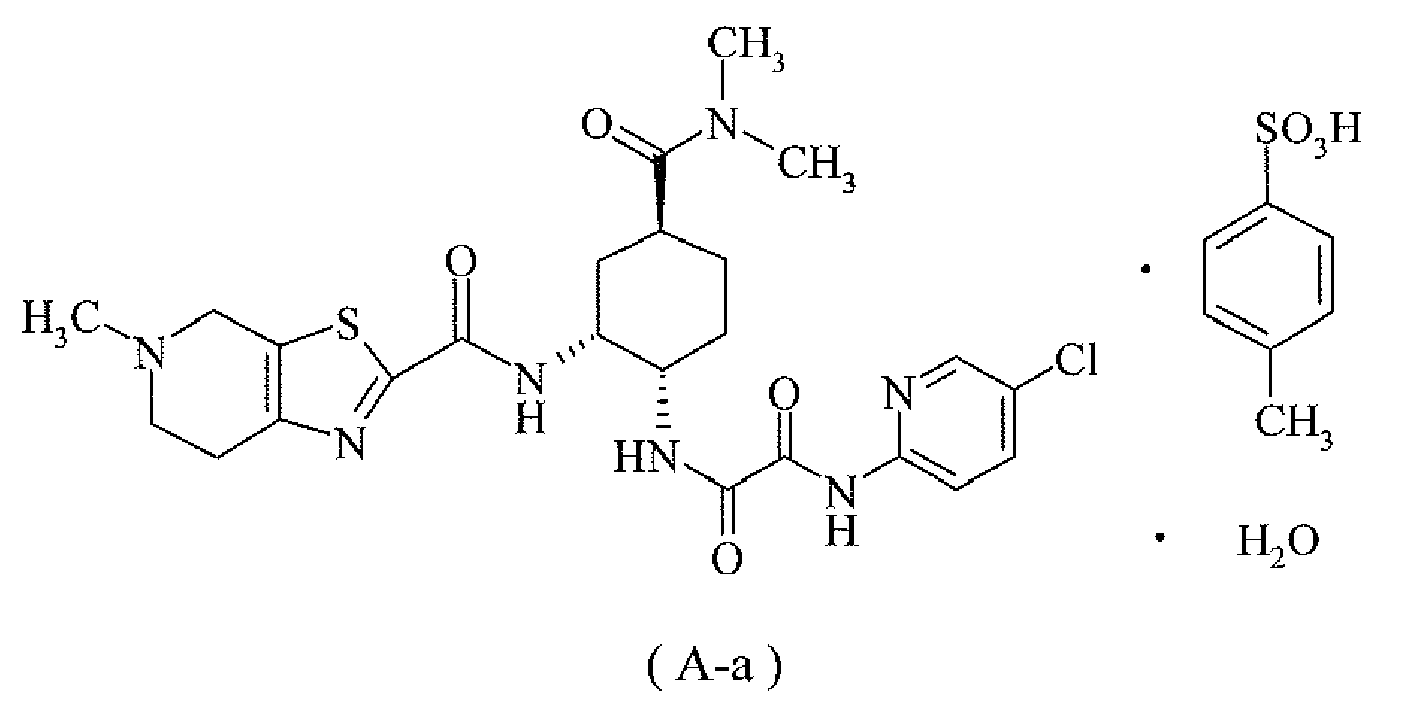
- (21) A process for producing a compound (A-a) represented by the following formula:

- deprotecting a Boc group in compound (1) represented by the following formula:
wherein Boc represents a tert-butoxycarbonyl group, to obtain a compound (7) represented by the following formula or a salt thereof:

and
treating compound (A) with p-toluenesulfonic acid or a hydrate thereof to obtain compound (A-a).
- deprotecting a Boc group in compound (1) represented by the following formula:
- According to the present invention, compound (1) that is an intermediate for production of compound (A) useful as an FXa inhibitor can be produced at stable yields as high as 93 to 95% by avoiding a reduction in reaction yield caused by solidification of the reaction system, which is a problem of the conventional process. Thus, the production process of the present invention is useful as a process for producing compound (A) useful as an FXa inhibitor.
-
- [
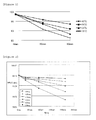
Figure 1] Figure 1 is a diagram showing the time-dependent residual rate of 2-[(5-chloropyridin-2-yl)amino]-2-oxoacetate ((2a); free form of compound (2)) exposed to 45°C, 55°C, 65°C, or 75°C after addition of triethylamine at 4.3 molar equivalents with respect to compound (2) to confirm the stability of compound (2a). - [
Figure 2] Figure 2 is a diagram showing the time-dependent residual rate of 2-[(5-chloropyridin-2-yl)amino]-2-oxoacetate ((2a); free form of compound (2)) exposed to 60°C after addition of compound (2) (500 mg) to acetonitrile (3 ml) and addition of triethylamine at 1 to 2 molar equivalents with respect to compound (2) to confirm the stability of compound (2a). - Hereinafter, the present invention will be described in detail.
- The specific "FXa inhibitor" according to the present specification is preferably, for example, compound (A) described above. Compound (A) may be a free form (free base) or a hydrate thereof or may be a pharmacologically acceptable salt or a hydrate of the salt.
- Examples of the pharmacologically acceptable salt of compound (A) include hydrochloride, sulfate, hydrobromide, hydroiodide, phosphate, nitrate, benzoate, methanesulfonate, 2-hydroxyethanesulfonate, p-toluenesulfonate, acetate, propanoate, oxalate, malonate, succinate, glutarate, adipate, tartrate, maleate, fumarate, malate, and mandelate.
- The salt of compound (A) is preferably hydrochloride or p-toluenesulfonate,
particularly preferably p-toluenesulfonate. - Compound (A) or a salt thereof, or a hydrate thereof is preferably N1-(5-chloropyridin-2-yl)-N2-((1S,2R,4S)-4-[(dimethylamino)carbonyl]-2-{[(5-methyl-4,5,6,7-tetrahydrothiazolo[5,4-c]pyridin-2-yl)carbonyl]amino}cyclohexyl)ethanediamide; N1-(5-chloropyridin-2-yl)-N2-((1S,2R,4S)-4-[(dimethylamino)carbonyl]-2-{[(5-methyl-4,5,6,7-tetrahydrothiazolo[5,4-c]pyridin-2-yl)carbonyl]amino}cyclohexyl)ethanediamide hydrochloride; N1-(5-chloropyridin-2-yl)-N2-((1S,2R,4S)-4-[(dimethylamino)carbonyl]-2-{[(5-methyl-4,5,6,7-tetrahydrothiazolo[5,4-c]pyridin-2-yl)carbonyl]amino}cyclohexyl)ethanediamide mono-p-toluenesulfonate; or N1-(5-chloropyridin-2-yl)-N2-((1S,2R,4S)-4-[(dimethyla.mino)carbonyl]-2-{[{5-methyl-4,5,6,7-tetrahydrothiazolo[5,4-c]pyridin-2-yl)carbonyl]amino}cyclohexyl)ethanediamide mono-p-toluenesulfonate monohydrate, particularly preferably N1-(5-chloropyridin-2-yl)-N2-((1S,2R,4S)-4-[(dimethylamino)carbonyl]-2-{[(5-methyl-4,5,6,7-tetrahydrothiazolo[5,4-c]pyridin-2-yl)carbonyl]amino}cyclohexyl)ethanediamide mono-p-toluenesulfonate monohydrate (A-a).
-

- Hereinafter, the production process of the present invention will be described in detail.
- The optically active amide derivative compound (1) of the present invention can be produced by performing the procedures of [Step 1] and [Step 2] in the order as shown in the following scheme:

- [Step 1]: the step of treating compound (2) represented by the following formula:

- [Step 2]: compound (3) represented by the following formula:

is added to the mixed solution of [Step 1] to produce compound (1). - Examples of the C2-C4 nitrile solvent used in the [Step 1] can include acetonitrile, propionitrile, and butyronitrile. Among them, the reaction solvent is preferably acetonitrile.
- Organo-tertiary bases generally used can be used as the tertiary amine according to the present invention. Examples thereof can include alkylamines comprising identical or different C1 to C8 alkyls, 1-(C1-C3 alkyl)pyrrolidine, 1-(C1-C3 alkyl)piperidine, 4-(C1-C3 alkyl)morpholine, 1,8-diazabicyclo[5.4.0]undec-7-ene (DBU), 1,5-diazabicyclo[4.3.0]non-5-ene (DBN), di(C1-C3 alkyl)aniline, and 4-di(C1-C3 alkyl)aminopyridine. Among these, the tertiary amine is preferably trimethylamine, triethylamine, ethyl(diisopropyl)amine, 1-methylpiperidine, 1-ethylpiperidine, 4-methylmorpholine, N,N-dimethylaniline, or N,N-diethylaniline, or the like.
- Hereinafter, [Step 1] and [Step 2] performed subsequently thereto will be described in detail.
- [Step 1] is the step of treating compound (2) with a tertiary amine in a C2-C4 nitrile solvent to prepare a neutralized compound (2a) represented by the following formula:

- More specific examples of preferable aspects of [Step 1] can include [Step 1 (Method A)] to [Step 1 (Method C)] shown below.
- [Step 1 (Method A)]: "adding compound (2) into a C2-C4 nitrile solvent and then adding a tertiary amine thereto at 45°C or lower".
- [Step 1 (Method B)]: "adding a tertiary amine into a C2-C4 nitrile solvent and then adding compound (2) thereto at 45°C or lower".
- [Step 1 (Method C)]: "adding compound (2) into a C2-C4 nitrile solvent, then heating the mixture to a range of 50 to 65°C, and adding a tertiary amine thereto".
- Among Methods A to C, Methods A and B are preferable.
- [Step 2] in the present invention is the step of adding, to the mixed solution of [Step 1], compound (3) represented by the following formula:

In this context, when Method C is adopted, the shorter the interval from completion of the addition of the tertiary amine to initiation of the addition of compound (3) is, the more greatly reduction in the yield of compound (1) caused by solidification of the reaction solution can be avoided. The point in time when the addition of compound (3) is initiated in Method C is preferably within 15 minutes after the addition of the tertiary amine, more preferably at the completion of the addition of the tertiary amine, even more preferably concurrently with the addition of the tertiary amine at the point in time when the addition of 1/5 or more of the total amount of the tertiary amines added has been completed. - When Method A or B is adopted, an additional tertiary amine is added to the mixed solution of [Step 2] with the internal temperature of the mixed solution set to 50 to 65°C, and then, the reaction mixture is stirred at 60 to 80°C.
After the completion of the reaction, the reaction mixture is cooled, and water is added thereto for crystallization. The resulting crystals are collected to obtain compound (1).
The amount of the additional tertiary amine added in Methods A and B is stoichiometrically preferably in the range of 3.23 to 4.32 molar equivalents with respect to compound (2) [the total amount of the tertiary amines added is stoichiometrically 4.9 to 6.5 molar equivalents with respect to compound (3)]. - This addition of the additional tertiary amine converts compound (3) which is an oxalate to compound (3a) which is a free base (free form).
-

After the addition of the additional tertiary amine, the reaction mixture is stirred at 60 to 80°C. In this context, the stirring time is preferably 6 hours or longer, more preferably approximately 6 to 24 hours. Moreover, the endpoint of the reaction may be determined by confirming the sample in the reaction solution using equipment of HPLC or the like. - In the present invention, Method A is particularly preferable. A specific aspect of the production of the compound (1) using Method A is as follows:
- Compound (2) is added to acetonitrile, and triethylamine is added thereto at stoichiometrically 0.87 to 1.08 molar equivalents with respect to compound (2). To the mixed solution, compound (3) is then added. To the reaction mixture, additional tertiary amine is subsequently added at stoichiometrically 3.23 to 4.32 molar equivalents with respect to compound (2) at 50 to 65°C, and the mixture is stirred at 60 to 80°C for 6 hours or longer to produce compound (1).
- After the completion of the reaction, the compound (1) is isolated and purified. Next, the procedure of isolating compound (1) as crystals will be described.
- The reaction mixture is cooled. Water is added thereto, and the mixture is stirred to complete crystallization. In this context, the cooling of the reaction mixture is performed preferably at 0 to 60°C, more preferably 0 to 50°C. The amount of water added is preferably in the range of 6 to 11 parts by volume with respect to 1 part by weight of the compound (3) [6 to 11 (v/w)].
- The procedure of obtaining crystals of compound (1) after the crystallization is performed such that the precipitated crystals are cooled to complete crystallization, and the resulting crystals are collected by filtration, washed with water, and then dried. In this context, the procedure of obtaining the precipitated crystals can be performed by collecting the crystals by filtration under normal pressure or reduced pressure. The crystallization temperature is preferably -10 to 35°C. The amount of water for washing the crystals is preferably approximately 5 parts by volume with respect to 1 part by weight of the compound (3) [5 (v/w)].
- Compound (2) used in [Step 1] can be produced as shown below. Specific examples of the production can include a process described in Reference Example 2. Specifically, compound (2) can be produced by adding a commercially available aniline derivative compound (2b) and a compound (2c) into a C2-C4 nitrile solvent with stirring.
-

- Examples of the C2-C4 nitrile solvent used in this reaction can include acetonitrile, propionitrile, and butyronitrile. Acetonitrile is preferable. The amount of the solvent used is preferably in the range of 10 to 17 parts by volume with respect to 1 part by weight of compound (2b) [10 to 17 (v/w)]. The amount of the compound (2c) used is stoichiometrically preferably in the range of 1.06 to 1.21 molar equivalents with respect to the compound (2b). The reaction temperature is preferably in the range of 40 to 80°C. The reaction time is preferably 1 hour longer, more preferably approximately 1 to 7 hours. Compound (2) thus produced can be isolated by allowing compound (2) to crystallize and collecting the crystals by filtration. The crystallization temperature is preferably in the range of -25 to 35°C. The crystals of compound (2) can be isolated by collection by filtration. When compound (2) is then used in [Step 1], compound (2) collected by filtration may be used in a dry state (dry form) after drying under normal pressure or reduced pressure or may be used in a wet state (wet form).
- A known process disclosed in Patent Literature 1 or 3 may be used as a process for producing compound (A) useful as an FXa inhibitor or compound (A-a) (mono-p-toluenesulfonate monohydrate of compound (A)) using compound (1) of the present invention. Specifically, these compounds can be produced as shown in the following scheme and Reference Examples 4 and 5 described later:
-

- wherein Boc represents a tert-butoxycarbonyl group.
- Next, the present invention will be described in detail with reference to the Examples. However, the present invention is not intended to be limited to these in any way.
- Tetramethylsilane was used as the internal standard for the nuclear magnetic resonance (NMR) spectra. Abbreviations showing multiplicity represent s=singlet, d=doublet, t=triplet, q=quartet, m=multiplet, and brs=broad singlet.
-

-

A 28% aqueous ammonia solution (5 ml) was added to (1S,3S,6R)-N,N-dimethyl-7-oxabicyclo[4.1.0]heptane-3-carboxamide (1 g) at room temperature. After stirring at 40°C for 5 hours, the solvent was concentrated under reduced pressure to obtain a crude form of (1S,3R,4R)-3-amino-4-hydroxy-N,N-dimethylcyclohexanecarboxamide (1.18 g). The obtained crude form was dissolved in water (5 ml). To the solution, di-tert-butyl dicarbonate (1.93 g) and a 10 N aqueous sodium hydroxide solution (1.5 ml) were then added at room temperature. After stirring at 40°C for 2 hours, the mixture was subjected to extraction with 4-methyl-2-pentanone (MIBK) (5 ml) three times, and the extraction solvent was distilled off under reduced pressure. To the residue, 4-methyl-2-pentanone (MIBK) (3 ml) was added, and the mixture was stirred at room temperature. The precipitated crystals were collected by filtration and then dried to obtain the title compound (1.26 g).
1H-NMR (CDCl3) δ: 1.44 (9H, s), 1.48-1.59 (2H, m), 1.77-1.78 (2H, m), 1.86-1.97 (1H, m), 2.11-2.17 (1H, m), 2.78-2.83 (1H, m), 2.92 (3H, s), 3.02 (3H, s), 3.53-3.60 (1H, m), 3.94 (1H, br.s), 4.52-4.68 (1H, m). -

Methanesulfonyl chloride (159.07 g) was added to a solution of tert-butyl {(1R,2R,5S)-5-[(dimethylamino)carbonyl]-2-hydroxycyclohexylcarbamate (214.59 g) in 4-methyl-2-pentanone (MIBK) (1875 ml) at room temperature. To the reaction solution, triethylamine (170.62 g) was added at room temperature, and the mixture was stirred at this temperature for 1 hour. To the reaction solution, water was added, and then, the organic layer was separated. The solvent was concentrated under reduced pressure. Then, to the concentrated residue, MIBK (750 ml) was added, and the mixture was stirred at room temperature for 3 hours. The precipitated crystals were collected by filtration and dried to obtain the title compound (242.57 g).
1H-NMR (CDCI3) δ: 1.45 (9H, s), 1.58-1.66 (1H, m), 1.67-1.76 (1H, m), 1.84-1.96 (2H, m), 2.04-2.15 (1H, m), 2.17-2.26 (1H, m), 2.75-2.81 (1H, m), 2.94 (3H, s), 3.04 (3H, s), 3.07 (3H, s), 4.00-4.08 (1H, m), 4.69-4.82 (2H, m). -

Sodium azide (7.14 g) and dodecylpyridinium chloride (7.80 g) were added to a solution of (1R,2R,4S)-2-[(tert-butoxycarbonyl)amino]-4-[(dimethylamino)carbonyl]cyclohexylmethanesulfonate (20.0 g) in N,N-dimethylacetamide (DMAC) (40 ml) at room temperature. After stirring at 60°C for 72 hours, water and ethyl acetate were added to the reaction solution. The organic layer was washed with a saturated aqueous solution of sodium bicarbonate and water, and then, the solvent was concentrated under reduced pressure. To the concentrated residue, an n-hexane-ethyl acetate (5:1) mixed solvent (300 ml) was added, and the mixture was stirred at room temperature for 1 hour. Crystals were collected by filtration. The procedure of adding an n-hexane-ethyl acetate (5:1) mixed solvent (300 ml) to the obtained crystals, followed by stirring and crystal collection by filtration was repeated twice to obtain the title compound (4.6 g).
1H-NMR (CDCI3) δ: 1.46 (9H, s), 1.55-1.74 (3H, m), 1.75-1.82 (1H, m), 2.02-2.12 (2H, m), 2.74-2.83 (1H, m), 2.93 (3H, s), 3.02 (3H, s), 3.72-3.78 (1H, m), 4.07-4.13 (1H, m), 4.61-4.66 (1H, m). -

Sodium azide (7.14 g)and dodecylpyridinium chloride (7.80 g) were added to a solution of (1R,2R,4S)-2-[(tert-butoxycarbonyl)amino]-4-[(dimethylamino)carbonyl]cyclohexylmethanesulfonate (20.0 g) in toluene (100 ml) at room temperature. The reaction mixture was stirred at 60°C for 72 hours. To the reaction solution, water was then added, and the organic layer was washed with a saturated aqueous solution of sodium bicarbonate and water and then separated. To the organic layer, methanol, and then 7.5% Pd-C and ammonium formate were added, and the mixture was stirred at 40°C for 1 hour. Pd-C was filtered off, and then, the solvent was concentrated under reduced pressure. To the residue, aqueous acetonitrile (200 ml) and anhydrous oxalic acid (4.94 g) were added, and the mixture was stirred at room temperature for 17 hours. Crystals were collected by filtration. The obtained crystals were added to acetonitrile (200 ml), and the mixture was stirred at 40°C for 24 hours. The obtained crystals were collected by filtration and dried to obtain the title compound (12.7 g).
1H-NMR (D2O) δ: 1.30 (9H, s), 1.37-1.49 (2H, m), 1.63 (1H, t, J=2.7 Hz), 1.72-1.83 (3H, m), 2.77 (3H, s) 2.80 (1H, t, J=12.4 Hz), 2.96 (3H, m), 3.32 (1H, d, J=12.2 Hz), 4.10 (1H, br). -

- Ethyl oxalyl chloride (2c) (11.7 g) was added to a suspension of 2-amino-5-chloropyridine (2b) (10.0 g) in acetonitrile (120 ml) at 50°C, and the mixture was stirred at this temperature for 2 hours. The reaction solution was cooled, and crystals were collected by filtration at 10°C, washed with acetonitrile (40 ml), and then dried under reduced pressure to obtain the title compound (2) (19.7 g).
-

Triethylamine (169 ml) was added to a suspension of tert-butyl {(1R,2S,5S)-2-amino-5-[(dimethylamino)carbonyl]cyclohexyl}carbamate oxalate (1) (100.1 g) in acetonitrile (550 ml) at 60°C. Ethyl [5-chloropyridin-2-yl]amino](oxo)acetate monohydrochloride 82) (84.2 g) was added thereto at this temperature, and the mixture was stirred for 6 hours and then stirred at room temperature for 16 hours. To the reaction solution, water was added, and the mixture was stirred at 10°C for 1.5 hours. The deposited crystals were collected by filtration and dried to obtain the title compound (106.6 g, 85.4%).
1H-NMR (CDCI3) δ: 1.25-1.55 (2H, m), 1.45 (9H, s), 1.60-2.15 (5H, m), 2.56-2.74 (1H, br.s), 2.95 (3H, s), 3.06 (3H, s), 3.90-4.01 (1H, m), 4.18-4.27 (1H, m), 4.70-4.85 (0.7H, br), 5.70-6.00 (0.3H, br.s), 7.70 (1H, dd, J=8.8, 2.4 Hz), 7.75-8.00 (1H, br), 8.16 (1H, br.d, J=8.8 Hz), 8.30 (1H, d, J=2.4 Hz), 9.73 (1H, s). -

- Methanesulfonic acid (66 ml) was added to a suspension of tert-butyl [(1R,2S,5S)-2-({[(5-chloropyridin-2-yl)amino](oxo)acetyl}amino)-5-(dimethylaminocarbanyl)cyclohexyl]carbamate (1) (95.1 g) in acetonitrile (1900 ml) at room temperature, and the mixture was stirred at this temperature for 2 hours. To the reaction solution, triethylamine (155 ml), 5-methyl-4,5,6,7-tetrahydro[1,3]thiazalo[5,4-c]pyridine-2-carboxylic acid hydrochloride (8) (52.5 g), 1-hydroxybenzotriazole (33.0 g), and 1-ethyl-3-(3-dimethylaminopropyl)carbodiimide hydrochloride (46.8 g) were added under ice cooling, and the mixture was stirred at room temperature for 16 hours. Triethylamine and water were added thereto, and the mixture was stirred for 1 hour under ice cooling. Then, crystals were collected by filtration to obtain the title compound (103.2 g).
1H-NMR (CDCI3) δ: 1.60-1.98 (3H, m), 2.00-2.16 (3H, m), 2.52 (3H, s), 2.78-2.90 (3H, m), 2.92-2.98 (2H, m), 2.95 (3H, s), 3.06 (3H, s), 3.69 (1H, d, J=15.4 Hz), 3.75 (1H, d, J=15.4 Hz), 4.07-4.15 (1H, m), 4.66-4.72 (1H, m), 7.40 (1H, dd, J=8.8, 0.6 Hz), 7.68 (1H, dd, J=8.8, 2.4 Hz), 8.03 (1H, d, J=7.8 Hz), 8.16 (1H, dd, J=8.8, 0.6 Hz), 8.30 (1H, dd, J=2.4, 0.6 Hz), 9.72 (1H, s).
MS (ESI) m/z: 548 (M+H)+. -

- N1-(5-Chloropyridin-2-yl)-N2-((1S,2R,4S)-4-[(dimethylamino)carbonyl]-2-{[(5-methyl-4,5,6,7-tetrahydrothiazolo[5,4-c]pyridin-2-yl)carbonyl]amino}cyclohexyl)ethanediamide (A) (6.2 g) was dissolved in methylene chloride (120 ml). To the solution, a 1 mol/L solution of p-toluenesulfonic acid in ethanol (11.28 ml) was added, and the mixture was stirred at room temperature. Then, the solvent was distilled off. To the residue, 15% hydrous ethanol (95 ml) was added, and the mixture was dissolved by stirring at 60°C. Then, the mixture was cooled to room temperature and stirred for 1 day. The precipitated crystals were collected by filtration, washed with ethanol, and then dried under reduced pressure at room temperature for 2 hours to obtain the title compound (7.4 g).
1H-NMR (DMSO-d6) δ: 1.45-1.54 (1H, m), 1.66-1.78 (3H, m), 2.03-2.10 (2H, m), 2.28 (3H, s), 2.79 (3H, s), 2.91-3.02 (1H, m), 2.93 (3H, s), 2.99 (3H, s), 3.13-3.24 (2H, m), 3.46-3.82 (2H, m), 3.98-4.04 (1H, m), 4.43-4.80 (3H, m), 7.11 (2H, d, J=7.8 Hz), 7.46 (2H, d, J=8.2 Hz), 8.01 (2H, d, J=1.8 Hz), 8.46 (1H, t, J=1.8 Hz), 8.75 (1H, d, J=6.9 Hz), 9.10-9.28 (1H, br), 10.18 (1H, br), 10.29 (1H, s).
MS (ESI) m/z: 548 (M+H)+.
Anal.: C24H30ClN7O4S·C7H8O3S·H2O
Theoretical: C;50.43, H;5.46, N;13.28, Cl;4.80, S;8.69. Found: C;50.25, H;5.36, N;13.32, Cl;4.93, S;8.79.
mp (dec.): 245-248°C. -

2-Amino-5-chloropyridine (2b) (5.0 g) was added to acetonitrile (60 ml). Ethyl oxalyl chloride (2c) (5.9 g) was added thereto at 50°C, and the mixture was stirred at this temperature for 2 hours. The reaction solution was cooled, and crystals were collected by filtration at 10°C to obtain ethyl[5-chloropyridin-2-yl]amino](oxo)acetate monohydrochloride (2) (9.8 g). - The ethyl[5-chloropyridin-2-yl]amino](oxo)acetate monohydrochloride (2) (8.48 g) thus obtained was suspended in acetonitrile (50 ml). To the suspension, triethylamine (3.17 g) was added at 10°C, and subsequently, tert-butyl {(1R,2S,5S)-2-amino-5-[(dimethylamino)carbonyl]cyclohexyl}carbamate oxalate (3) (10.0 g) was added thereto. Triethylamine (10.9 g) was added thereto at 60°C, and the mixture was stirred at 70°C for 7 hours. The reaction solution was cooled, and water (90 ml) was added thereto. Crystals were collected by filtration at 10°C, washed with water (50 ml), and then dried under reduced pressure to obtain the title compound (1) (11.6 g).
- Reaction procedures were performed according to the conventional process described in Reference Example 3. The production yield of compound (1) in the solidified reaction system and the rate of formation of Impurity X* as by-product were evaluated and determined under (Condition 1) to (Condition 3) shown below. The results are shown in Table 1.
*Impurity X as by-product has a structure represented by the following formula:
- (Condition 1): The conventional process shown in Reference Example 3 was performed under conditions in which the system was controlled to prevent solidification (controllable because of its small scale). Specifically, compound (3) (500 mg) was suspended in acetonitrile (2.5 ml) . To the suspension, triethylamine (0.7 g) was added, and immediately thereafter, compound (2) (0.425 g) was quickly added. The temperature of the reaction mixture was raised to 75°C, and the mixture was stirred for 7 hours. The rate of formation of compound (1) under these conditions was defined as "1.0".
- (Condition 2): Compound (3) (500 mg) was suspended in acetonitrile (2.5 ml). To the suspension, triethylamine (0.7 g) was added, and then, the mixed solution was left standing with its temperature set to 55°C for 1 hour to solidify the system. After 1 hour, compound (2) (0.425 g) was added thereto. Then, the temperature of the reaction mixture was raised again to 75°C, and the mixture was stirred for 7 hours [the same as (Condition 1) except that the reaction system was solidified].
- (Condition 3): Compound (3) (500 mg) was suspended in acetonitrile (2.5 ml). To the suspension, triethylamine (0.7 g), and subsequently compound (2) (0.425 g) were added, and then, the mixed solution was left standing with its internal temperature set to 55°C for 1 hour to solidify the system. After 1 hour, the temperature of the reaction mixture was raised again to 75°C, and the mixture was stirred for 7 hours.
-
[Table 1] Condition State of solidification Rate of formation of compound (1)
(Condition 1): 1.0Rate of formed Impurity X (%) Condition 1 Not solidified 1.0 0.1 Condition 2 Heavily solidified before addition of compound (2) 0.9 0.5 Condition 3 Solidified after addition of compound (2) 0.99 0.1 - HPLC conditions; Column: Shiseido CAPCELL PAK CN UG120 (4.6x250 mm); Detection: UV 254 nm; Column temperature: 40°C; Flow rate: 1.0 ml/min.; Mobile phase: acetonitrile/0.02 M phosphate buffer (pH=7.0)=3/7.
- In the system solidified before the addition of compound (2) (Condition 2), the reduced rate of formation of compound (1) and the increased formation of Impurity X were observed based on poor stirring. In the system solidified after completion of the addition of compound (2) (Condition 3), such solidification had little influence on the yield of compound (1) and the rate of formation of Impurity X.
- The results of Test Example 1 demonstrated that the conventional process, which involved initially adding compound (3), has the risk of causing a reduction in quality of compound (1) (Condition 2 of Test Example 1). The rates of formation of compound (1) and Impurity X were determined under Condition 1 of Test Example 1 as well as (Condition 4) or (Condition 5) shown below for the purpose of confirming the influence of change in the order in which compound (3), compound (2), and triethylamine were added, on the yield and quality of compound (1). The results are shown in Table 2.
- (Condition 4): Compound (3) (500 mg) and compound (2) (0.425 g) were suspended in acetonitrile (2.5 ml). To the suspension, triethylamine (0.7 g) was added with the internal temperature of the mixed solution set to 60°C. Then, the internal temperature of the reaction mixture was raised to 75°C, and the mixture was stirred for 7 hours.
- (Condition 5): Compound (2) (0.425 g) was suspended in acetonitrile (2.5 ml). To the suspension, triethylamine (0.7 g) was added with the internal temperature of the mixed solution set to 60°C. Then, compound (3) (500 mg) was added thereto. The internal temperature of the reaction mixture was raised to 75°C, and the mixture was stirred for 7 hours (Example 2).
-
[Table 2] Condition Rate of formation of compound (1) Condition 1: 1.0 Rate of formation of Impurity X (%) Condition 1 1.0 0.1 Condition 4 0.75 15.9 Condition 5 1.0 <0.1 - HPLC measurement value of a diluted solution of the whole amount after reaction; evaluated with the area % of compound (3) under current conditions defined as 100%; HPLC conditions; Column: Shiseido CAPCELL PAK CN UG120 (4.6x250 mm); Detection: UV 254 nm; Column temperature: 40°C; Flow rate: 1.0 ml/min.; Mobile phase: acetonitrile/0.02 M phosphate buffer (pH=7.0)=3/7.
- When compound (3) and compound (2) were initially mixed and subsequently, triethylamine was added thereto as shown in (Condition 4), the rate of formation of Impurity X was drastically increased. This may be due to the elimination of the Boc group in compound (3). On the other hand, (Condition 5) resulted in high yields of compound (1) and a low rate of formation of Impurity X (Example 2), although some disadvantages were seen: an amorphous portion was observed in compound (3) due to the vapour of the added triethylamine; and fuming occurred along with the formation of hydrochloride of triethylamine and made compound (3) difficult to add. These test results demonstrated that a favorable yield and quality of compound (1) are obtained when compound (2) is initially added.
- The influence of the interval from completion of the addition of triethylamine (TEA) to initiation of the addition of compound (3) was investigated in detail under Condition 5 (Example 2) of Test Example 2. The results are shown in Table 3.
- In the same way as in Condition 5 (Example 2) of Test Example 2, compound (2) (0.425 g) was suspended in acetonitrile (2.5 ml). To the suspension, triethylamine (0.7 g) was added with the internal temperature of the mixed solution set to 60°C. To the mixed solution, compound (3) (500 mg) was added under Conditions 5-1 to 5-5 (Examples 3 to 7) shown in Table 3. The internal temperature of the reaction mixture was further raised to 75°C, and the mixture was stirred for 7 hours. Then, the rates of formation of the compound (1) and Impurity X were determined.
-
[Table 3] Condition Addition of compound (1) after addition of TEA Rate of formation of compound (1) (%) Impurity X (%) 5-1 Immediately after addition of TEA 100 <0.1 5-2 Approximately 15 minutes after addition of TEA 99 <0.1 5-3 Approximately 30 minutes after addition of TEA 98 <0.1 5-4 Approximately 60 minutes after addition of TEA 95 <0.1 5-5 Concurrently (after the point in time when the addition of 1/4 of TEA was completed) 100 <0.1 - HPLC measurement value of a diluted solution of the whole amount after reaction; evaluated with the area % of compound (1) under current conditions defined as 100%; HPLC conditions; Column: Shiseido CAPCELL PAK CN UG120 (4.6x250 mm); Detection: UV 254 nm; Column temperature: 40°C; Flow rate: 1.0 ml/min.; Mobile phase: acetonitrile/0.02 M phosphate buffer (pH=7.0)=3/7.
- The longer the interval from completion of the addition of triethylamine to initiation of the addition of compound (3) was, the more largely the rate of formation of compound (1) was reduced.
- 2-[(5-Chloropyridin-2-yl)amino]-2-oxoacetate (2a) (free form of compound (2)) was tested for its stability. To compound (2), triethylamine was added at 4.3 molar equivalents with respect to compound (2), and then, the time-dependent residual rate of compound (2a) was determined at 45°C, 55°C, 65°C, and 75°C. The results are shown in
Figure 1 . - As shown in
Figure 1 , in the presence of a great excess of triethylamine, the residual rate of compound (2a) was decreased with an increase in temperature. This result suggests that the decomposition of compound (2a) is influenced by the presence of an excessive amount of triethylamine and the temperature. - Based on the results of Test Example 4 showing that the presence of a great excess of triethylamine promoted the decomposition of compound (2a), compound (2a) was evaluated for its stability by decreasing the amount of triethylamine added.
- To compound (2) (500 mg), acetonitrile (3 ml) was added, and triethylamine was added thereto in a range of stoichiometrically 1 to 2 molar equivalents with respect to compound (2). The residual rate of compound (2a) was determined at 60°C. The results are shown in
Figure 2 . - When triethylamine was added at 1.5 molar equivalents, only approximately 0.3% of compound (2a) was decomposed per 1 hour. This demonstrated that the decomposition of compound (2a) seen in Test Example 4 can be avoided by decreasing the amount of triethylamine added.
- It was demonstrated that the decomposition of compound (2a) can be avoided by the amount of triethylamine added. Next, whether the system was solidified by adding triethylamine at 1.07 to 1.15 molar equivalents to compound (2) and further adding compound (3) was evaluated under Conditions 6 and 7 (Examples 8 and 9) and Condition 8 (Comparative Example).
Compound (2) (8.5 g) was added to acetonitrile (50 ml), and triethylamine shown in Table 4 was added thereto with stirring at 10°C. After completion of the addition, compound (3) (10 g) was added thereto, and the flowability of the system was tested by visual observation. -
[Table 4] Condition First amount of triethylamine added
(vs. molar equivalent of compound (2))Stirring flowability 6 1.07 parts by molar weight O 7 1.10 parts by molar weight Δ 8 1.15 parts by molar weight × - The results demonstrated that as long as triethylamine is added at 1.10 molar equivalents or less, the system is not solidified even after addition of compound (3) and can be stirred without problems. Moreover, when triethylamine was added at low temperatures, only slight fuming occurred and no amorphous portion attributed to the vapour of triethylamine was observed in compound (3).
- The rates of formation of compound (1) and Impurity X obtained by adding triethylamine in divided portions and the presence or absence of heavy fuming caused by the addition of triethylamine were tested under Condition 9 (Comparative Example) and Conditions 10 to 12 (Examples 10 to 13).
Compound (2) (8.5 g) was added to acetonitrile (50 ml), and triethylamine was added thereto in a first amount shown in Table 5 with stirring at 10°C. After completion of the addition, the compound (3) (10 g) was added thereto, and then, triethylamine was added in a second amount at 60°C (total amount of triethylamines: 5.2 molar equivalents with respect to compound (2)). -

- Even when triethylamine was added in divided portions, the yield and quality of the compound (1) were favorable.
- The production process of the present invention can be used as a novel process for industrially producing compound (A) useful as an FXa inhibitor or a pharmacologically acceptable salt thereof, or a hydrate thereof.
Claims (21)
- A process for producing a compound (1) represented by the following formula:
 [Step 1]: treating a compound (2) represented by the following formula:
 [Step 2]: then adding, to the mixed solution of [Step 1], a compound (3) represented by the following formula:
- The production process according to claim 1, wherein the C2-C4 nitrile solvent is acetonitrile.
- The production process according to claim 1 or 2, wherein the amount of compound (2) is stoichiometrically 1.10 to 1.27 molar equivalents with respect to compound (3).
- The production process according to any one of claims 1 to 3, wherein the tertiary amine is one or two or more selected from the group consisting of tri(C1-C4 alkyl)amines, 1-(C1-C3 alkyl)piperidine, and 4-(C1-C3 alkyl)morpholine.
- The production process according to any one of claims 1 to 3, wherein the tertiary amine is one or two or more selected from tri(C1-C4 alkyl)amines.
- The production process according to any one of claims 1 to 3, wherein the tertiary amine is triethylamine.
- The production process according to any one of claims 1 to 6, wherein [Step 1] comprises adding compound (2) represented by the following formula:

- The production process according to any one of claims 1 to 6, wherein [Step 1] comprises adding the tertiary amine into the C2-C4 nitrile solvent and subsequently adding thereto compound (2) represented by the following formula:

- The production process according to claim 7 or 8, wherein the addition of compound (2) or the tertiary amine is performed at 45°C or lower.
- The production process according to claim 7 or 8, wherein the addition of compound (2) or the tertiary amine is performed in the range of 0 to 35°C.
- The production process according to any one of claims 1 to 10, wherein the amount of the tertiary amine added in [Step 1] is stoichiometrically 0.87 to 1.08 molar equivalents with respect to compound (2).
- The production process according to any one of claims 1 to 11, further comprising adding an additional tertiary amine after the procedure of [Step 2].
- The production process according to claim 12, wherein the amount of the additional tertiary amine added is stoichiometrically in the range of 3.02 to 4.53 molar equivalents with respect to compound (2).
- The production process according to claim 12 or 13, wherein the addition of the additional tertiary amine is performed at 50 to 65°C.
- The production process according to any one of claims 12 to 14, further comprising stirring the reaction mixture at 60 to 80°C after the addition of the additional tertiary amine.
- The production process according to claim 15, wherein the stirring time is 6 hours or longer.
- The production process according to claim 15, wherein the stirring time is in the range of 6 to 24 hours.
- A process for producing a compound (1) represented by the following formula:
 [Step 1]: treating a compound (2) represented by the following formula:
 [Step 2]: then adding, to the mixed solution of [Step 1], a compound (3) represented by the following formula:
then adding an additional tertiary amine at stoichiometrically 3.23 to 4.32 molar equivalents with respect to compound (2) at 50 to 65°C, and stirring the reaction mixture at 60 to 80°C for 6 hours or longer. - The process for producing compound (1) represented by the following formula according to claim 1:

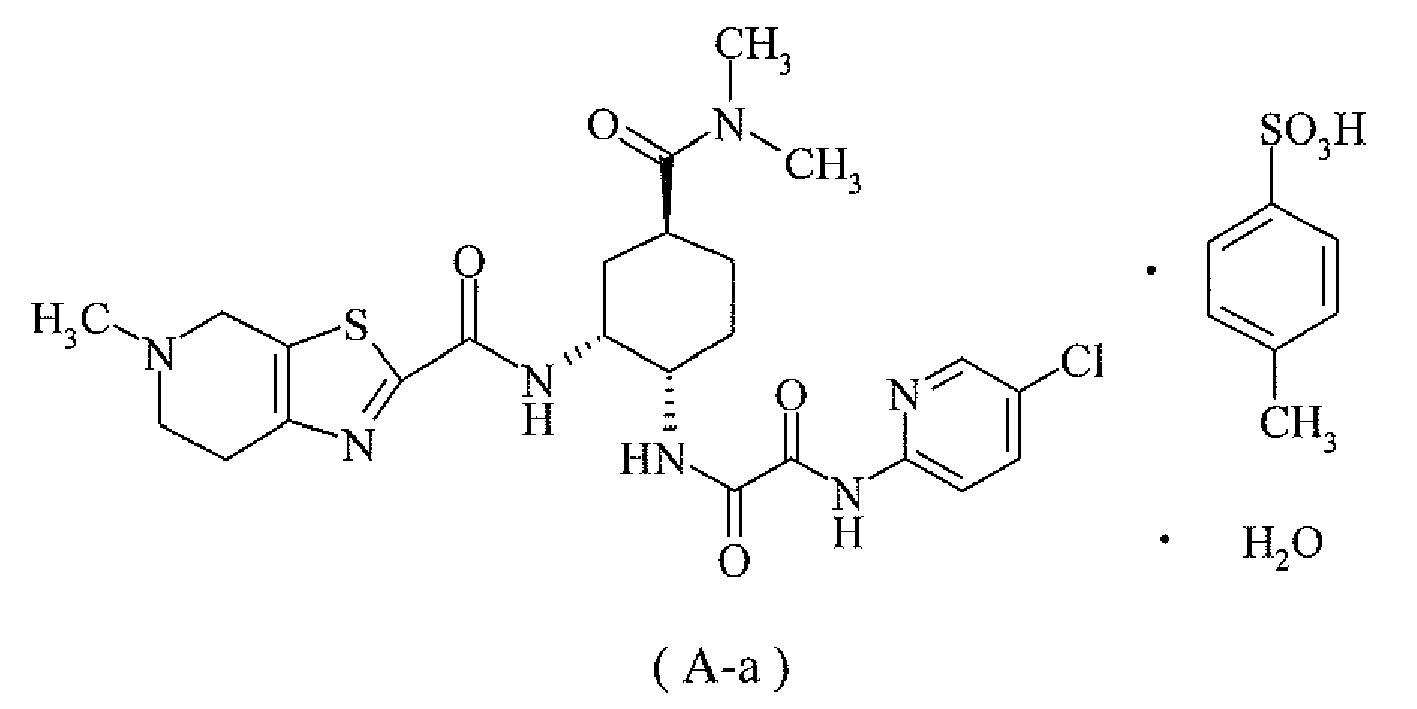
- A process for producing a compound (A-a) represented by the following formula:

- A process for producing a compound (A-a) represented by the following formula:
 deprotecting a Boc group in compound (1) represented by the following formula:
 condensing the compound (7) with a compound (8) represented by the following formula:
 treating compound (A) with p-toluenesulfonic acid or a hydrate thereof to obtain compound (A-a).
Applications Claiming Priority (2)
| Application Number | Priority Date | Filing Date | Title |
|---|---|---|---|
| JP2009057031 | 2009-03-10 | ||
| PCT/JP2010/053905 WO2010104078A1 (en) | 2009-03-10 | 2010-03-09 | Process for producing diamine derivative |
Publications (3)
| Publication Number | Publication Date |
|---|---|
| EP2407457A1 true EP2407457A1 (en) | 2012-01-18 |
| EP2407457A4 EP2407457A4 (en) | 2012-08-22 |
| EP2407457B1 EP2407457B1 (en) | 2015-04-22 |
Family
ID=42728367
Family Applications (1)
| Application Number | Title | Priority Date | Filing Date |
|---|---|---|---|
| EP20100750831 Active EP2407457B1 (en) | 2009-03-10 | 2010-03-09 | Process for producing diamine derivative |
Country Status (6)
| Country | Link |
|---|---|
| US (1) | US8357808B2 (en) |
| EP (1) | EP2407457B1 (en) |
| JP (1) | JP5666424B2 (en) |
| CN (1) | CN102348688B (en) |
| ES (1) | ES2542236T3 (en) |
| WO (1) | WO2010104078A1 (en) |
Cited By (3)
| Publication number | Priority date | Publication date | Assignee | Title |
|---|---|---|---|---|
| WO2018011823A1 (en) * | 2016-07-13 | 2018-01-18 | Mylan Laboratories Limited | Salt of amine-protected (1s,2r,4s)-1,2-amino-n,n-dimethylcyclohexane-4-carboxamide |
| ES2722854A1 (en) * | 2018-02-14 | 2019-08-19 | Moehs Iberica Sl | PROCEDURE TO PREPARE N - ((1R, 2S, 5S) -2 - ((2 - ((5-CHLOROPIRIDIN-2-IL) AMINO) -2-OXOACETIL) AMINO) -5- (DIMETHYL CARBAMOIL) CYCLHEXIL) CARBAMATE OF THIRD -BUTYL (Machine-translation by Google Translate, not legally binding) |
| EP3993792A4 (en) * | 2019-07-04 | 2023-07-26 | Glenmark Life Sciences Limited | Process for preparation of edoxaban |
Families Citing this family (25)
| Publication number | Priority date | Publication date | Assignee | Title |
|---|---|---|---|---|
| NZ597109A (en) | 2007-03-29 | 2013-01-25 | Daiichi Sankyo Co Ltd | Tablet composition having favorable dissolution property useful as an anticoagulant |
| WO2010104106A1 (en) | 2009-03-13 | 2010-09-16 | 第一三共株式会社 | Method for producing optically active diamine derivative |
| CN102791719B (en) * | 2010-03-19 | 2015-07-29 | 第一三共株式会社 | Crystal of diamine derivative and preparation method thereof |
| CN103333091A (en) * | 2011-12-08 | 2013-10-02 | 成都苑东药业有限公司 | Anticoagulation diamine derivative |
| KR102371784B1 (en) * | 2014-02-18 | 2022-03-07 | 다이이찌 산쿄 가부시키가이샤 | Method for producing inhibitor of activated blood coagulation factor x (fxa) |
| CN104761571B (en) * | 2015-03-10 | 2017-03-08 | 山东科兴生物制品有限公司 | A kind of synthetic method of Yi Dushaban |
| CN106316889B (en) * | 2015-06-15 | 2020-07-10 | 上海阳帆医药科技有限公司 | Preparation method of edoxaban intermediate |
| CN107033163A (en) * | 2015-07-16 | 2017-08-11 | 浙江海正药业股份有限公司 | A kind of Yi Dushaban is to benzene methanesulfonic acid salt novel crystal forms and its preparation method and application |
| TWI571460B (en) | 2016-03-14 | 2017-02-21 | 中化合成生技股份有限公司 | Process for producing diamine derivative |
| CN105753888B (en) * | 2016-04-05 | 2017-09-01 | 乐普药业股份有限公司 | A kind of free state Yi Dushaban preparation method |
| US10301322B2 (en) | 2016-12-27 | 2019-05-28 | Apotex Inc. | Processes for the preparation of edoxaban and intermediates thereof |
| CN106866452B (en) * | 2017-03-17 | 2018-10-30 | 浙江天宇药业股份有限公司 | A kind of synthetic method and intermediate product of Yi Dushaban intermediates |
| CN108484641B (en) * | 2018-06-08 | 2019-04-02 | 北京阳光诺和药物研究有限公司 | The preparation method of Yi Dushaban tosilate monohydrate |
| KR102087080B1 (en) * | 2018-06-08 | 2020-03-10 | 주식회사 가피바이오 | The fabrication method of intermediate for fabricating edoxabane and the fabrication method of edoxabane |
| JP2022008191A (en) * | 2020-06-20 | 2022-01-13 | エーザイ・アール・アンド・ディー・マネジメント株式会社 | Method for preparing tert-butyl n-((1r, 2s, 5s)-2-((2-((5-chloropyridin-2-yl)amino)-2-oxoacetyl)amino)-5-(dimethylcarbonyl)cyclohexyl)carbamate |
| CN111606827B (en) * | 2020-06-23 | 2022-10-25 | 内蒙古京东药业有限公司 | Method for preparing chiral amine intermediate of edoxaban |
| CN111763169B (en) * | 2020-06-30 | 2023-06-27 | 浙江苏泊尔制药有限公司 | Improved preparation method of idexaban intermediate |
| KR102577696B1 (en) * | 2020-11-16 | 2023-09-14 | 주식회사 보령 | Method for Preparing Edoxaban Tosylate or Its Hydrates |
| CN112940012B (en) * | 2021-05-17 | 2021-09-03 | 上海翰森生物医药科技有限公司 | Preparation method of edoxaban and intermediate thereof |
| CN115477659B (en) * | 2021-06-15 | 2026-03-17 | 山东新时代药业有限公司 | An intermediate compound of edoxaban |
| WO2023223346A1 (en) | 2022-05-16 | 2023-11-23 | Mylan Laboratories Limited | An improved process for the preparation of edoxaban intermediate |
| WO2024053350A1 (en) * | 2022-09-09 | 2024-03-14 | 株式会社カネカ | Method for producing aminoazide compound, diamine compound, and edoxaban |
| CN118146145A (en) | 2022-12-05 | 2024-06-07 | 浙江华海药业股份有限公司 | A preparation method of edoxaban and its intermediates |
| CN116102465B (en) * | 2023-02-17 | 2024-07-16 | 珠海市海瑞德生物科技有限公司 | Process for producing optically active diamine compound |
| CN116462610A (en) * | 2023-03-29 | 2023-07-21 | 南京桦冠生物技术有限公司 | Crystal form of optically active diamine derivative salt and preparation method thereof |
Family Cites Families (21)
| Publication number | Priority date | Publication date | Assignee | Title |
|---|---|---|---|---|
| US5149855A (en) | 1989-12-26 | 1992-09-22 | Mitsubishi Rayon Co., Ltd. | Process for racemizing optically active carboxylic acid esters |
| US5055600A (en) | 1990-04-24 | 1991-10-08 | Rockwell International Corporation | Glycidyl azide polymer (gap) synthesis by molten salt method |
| US5677469A (en) | 1995-05-18 | 1997-10-14 | Sepracor, Inc. | Process for resolving chiral acids with 1-aminoindan-2-ols |
| JPH11180899A (en) | 1997-12-15 | 1999-07-06 | Mitsui Chem Inc | Production of active methylenealkylated compound |
| JP3680203B2 (en) | 1999-06-01 | 2005-08-10 | 東洋化成工業株式会社 | Process for producing 4-acetylaminobenzenesulfonyl azide |
| JP2001151724A (en) | 1999-11-19 | 2001-06-05 | Kuraray Co Ltd | Method for producing optically active 2,2,4-trimethyl-3-cyclohexenecarboxylic acid |
| TWI290136B (en) | 2000-04-05 | 2007-11-21 | Daiichi Seiyaku Co | Ethylenediamine derivatives |
| WO2003000657A1 (en) * | 2001-06-20 | 2003-01-03 | Daiichi Pharmaceutical Co., Ltd. | Diamine derivatives |
| RU2319699C2 (en) | 2001-06-20 | 2008-03-20 | Дайити Санкио Компани, Лимитед | Derivatives of diamines |
| AU2002328596B2 (en) | 2001-08-09 | 2007-09-20 | Daiichi Pharmaceutical Co., Ltd. | Diamine derivatives |
| ES2393996T3 (en) | 2002-12-25 | 2013-01-04 | Daiichi Sankyo Company, Limited | Antithrombotic diaminocyclohexane derivatives |
| PE20130200A1 (en) | 2003-04-08 | 2013-03-09 | Novartis Ag | PHARMACEUTICAL COMPOSITION CONTAINING AN S1P RECEPTOR AGONIST AND A SUGAR ALCOHOL |
| KR101215213B1 (en) | 2003-11-12 | 2012-12-24 | 다이이찌 산쿄 가부시키가이샤 | Process for producing thiazole derivative |
| AR057035A1 (en) | 2005-05-25 | 2007-11-14 | Progenics Pharm Inc | SYNTHESIS OF (R) -N-METHYLNTREXONE, PHARMACEUTICAL COMPOSITIONS AND USES |
| CA2621640C (en) * | 2005-09-16 | 2013-10-29 | Daiichi Sankyo Company, Limited | Optically active diamine derivative and process for producing the same |
| WO2007106759A2 (en) | 2006-03-14 | 2007-09-20 | Applied Materials, Inc. | Method to reduce cross talk in a multi column e-beam test system |
| JP4227629B2 (en) | 2006-04-28 | 2009-02-18 | 達實 小野 | Dry baking equipment for painting using superheated steam |
| EP2074116A2 (en) | 2006-10-09 | 2009-07-01 | Cipla Limited | Process for preparing trityl olmesartan medoxomil and olmesartan medoxomil |
| NZ597109A (en) | 2007-03-29 | 2013-01-25 | Daiichi Sankyo Co Ltd | Tablet composition having favorable dissolution property useful as an anticoagulant |
| TW200909437A (en) | 2007-06-21 | 2009-03-01 | Daiichi Sankyo Co Ltd | Process for the preparation of diamine-derivatives |
| SI2371830T1 (en) * | 2008-12-17 | 2014-01-31 | Daiichi Sankyo Company, Limited | Method for producing diamine derivative |
-
2010
- 2010-03-09 WO PCT/JP2010/053905 patent/WO2010104078A1/en not_active Ceased
- 2010-03-09 ES ES10750831.9T patent/ES2542236T3/en active Active
- 2010-03-09 CN CN201080011057.1A patent/CN102348688B/en active Active
- 2010-03-09 JP JP2011503828A patent/JP5666424B2/en active Active
- 2010-03-09 EP EP20100750831 patent/EP2407457B1/en active Active
-
2011
- 2011-09-09 US US13/228,928 patent/US8357808B2/en active Active
Cited By (5)
| Publication number | Priority date | Publication date | Assignee | Title |
|---|---|---|---|---|
| WO2018011823A1 (en) * | 2016-07-13 | 2018-01-18 | Mylan Laboratories Limited | Salt of amine-protected (1s,2r,4s)-1,2-amino-n,n-dimethylcyclohexane-4-carboxamide |
| ES2722854A1 (en) * | 2018-02-14 | 2019-08-19 | Moehs Iberica Sl | PROCEDURE TO PREPARE N - ((1R, 2S, 5S) -2 - ((2 - ((5-CHLOROPIRIDIN-2-IL) AMINO) -2-OXOACETIL) AMINO) -5- (DIMETHYL CARBAMOIL) CYCLHEXIL) CARBAMATE OF THIRD -BUTYL (Machine-translation by Google Translate, not legally binding) |
| WO2019158550A1 (en) * | 2018-02-14 | 2019-08-22 | Moehs Iberica, S.L. | Method for preparing tert-butyl n-((1r,2s,5s)-2-((2-((5-chloropyridin-2-yl)amino)-2-oxoacetyl)amino)-5-(dimethylcarbamoyl)cyclohexyl)carbamate |
| EP3752488B1 (en) | 2018-02-14 | 2023-03-08 | Moehs Ibérica, S.L. | Method for preparing tert-butyl n-((1r,2s,5s)-2-((2-((5-chloropyridin-2-yl)amino)-2-oxoacetyl)amino)-5-(dimethylcarbamoyl)cyclohexyl)carbamate |
| EP3993792A4 (en) * | 2019-07-04 | 2023-07-26 | Glenmark Life Sciences Limited | Process for preparation of edoxaban |
Also Published As
| Publication number | Publication date |
|---|---|
| CN102348688B (en) | 2014-07-09 |
| CN102348688A (en) | 2012-02-08 |
| JP5666424B2 (en) | 2015-02-12 |
| ES2542236T3 (en) | 2015-08-03 |
| EP2407457A4 (en) | 2012-08-22 |
| EP2407457B1 (en) | 2015-04-22 |
| JPWO2010104078A1 (en) | 2012-09-13 |
| WO2010104078A1 (en) | 2010-09-16 |
| US8357808B2 (en) | 2013-01-22 |
| US20120041206A1 (en) | 2012-02-16 |
Similar Documents
| Publication | Publication Date | Title |
|---|---|---|
| EP2407457B1 (en) | Process for producing diamine derivative | |
| EP2589590B1 (en) | Process for preparation of optically active diamine derivative salt | |
| US9175012B2 (en) | Method for producing optically active diamine derivative | |
| JP5801011B2 (en) | Method for producing optically active diamine derivative | |
| HK1220977A1 (en) | Method for producing (1s,4s,5s)-4-bromo-6-oxabicyclo[3.2.1]octan-7-one | |
| WO2010131663A1 (en) | Oxamide derivative | |
| US20170260138A1 (en) | Process for producing diamine derivative | |
| HK1184134B (en) | Process for preparation of optically active diamine derivative salt | |
| HK1184134A (en) | Process for preparation of optically active diamine derivative salt | |
| EP3323808A1 (en) | Novel method for producing 1-(acyloxy)alkyl carbamate derivative |
Legal Events
| Date | Code | Title | Description |
|---|---|---|---|
| PUAI | Public reference made under article 153(3) epc to a published international application that has entered the european phase |
Free format text: ORIGINAL CODE: 0009012 |
|
| 17P | Request for examination filed |
Effective date: 20110810 |
|
| AK | Designated contracting states |
Kind code of ref document: A1 Designated state(s): AT BE BG CH CY CZ DE DK EE ES FI FR GB GR HR HU IE IS IT LI LT LU LV MC MK MT NL NO PL PT RO SE SI SK SM TR |
|
| DAX | Request for extension of the european patent (deleted) | ||
| A4 | Supplementary search report drawn up and despatched |
Effective date: 20120724 |
|
| RIC1 | Information provided on ipc code assigned before grant |
Ipc: C07D 513/04 20060101ALI20120718BHEP Ipc: C07D 213/75 20060101AFI20120718BHEP |
|
| 17Q | First examination report despatched |
Effective date: 20130214 |
|
| GRAP | Despatch of communication of intention to grant a patent |
Free format text: ORIGINAL CODE: EPIDOSNIGR1 |
|
| INTG | Intention to grant announced |
Effective date: 20140820 |
|
| GRAS | Grant fee paid |
Free format text: ORIGINAL CODE: EPIDOSNIGR3 |
|
| GRAA | (expected) grant |
Free format text: ORIGINAL CODE: 0009210 |
|
| AK | Designated contracting states |
Kind code of ref document: B1 Designated state(s): AT BE BG CH CY CZ DE DK EE ES FI FR GB GR HR HU IE IS IT LI LT LU LV MC MK MT NL NO PL PT RO SE SI SK SM TR |
|
| REG | Reference to a national code |
Ref country code: GB Ref legal event code: FG4D |
|
| REG | Reference to a national code |
Ref country code: CH Ref legal event code: EP |
|
| REG | Reference to a national code |
Ref country code: AT Ref legal event code: REF Ref document number: 723128 Country of ref document: AT Kind code of ref document: T Effective date: 20150515 |
|
| REG | Reference to a national code |
Ref country code: IE Ref legal event code: FG4D |
|
| REG | Reference to a national code |
Ref country code: DE Ref legal event code: R096 Ref document number: 602010024148 Country of ref document: DE Effective date: 20150603 |
|
| REG | Reference to a national code |
Ref country code: ES Ref legal event code: FG2A Ref document number: 2542236 Country of ref document: ES Kind code of ref document: T3 Effective date: 20150803 |
|
| REG | Reference to a national code |
Ref country code: NL Ref legal event code: VDEP Effective date: 20150422 |
|
| REG | Reference to a national code |
Ref country code: AT Ref legal event code: MK05 Ref document number: 723128 Country of ref document: AT Kind code of ref document: T Effective date: 20150422 |
|
| REG | Reference to a national code |
Ref country code: LT Ref legal event code: MG4D |
|
| PG25 | Lapsed in a contracting state [announced via postgrant information from national office to epo] |
Ref country code: NL Free format text: LAPSE BECAUSE OF FAILURE TO SUBMIT A TRANSLATION OF THE DESCRIPTION OR TO PAY THE FEE WITHIN THE PRESCRIBED TIME-LIMIT Effective date: 20150422 |
|
| PG25 | Lapsed in a contracting state [announced via postgrant information from national office to epo] |
Ref country code: LT Free format text: LAPSE BECAUSE OF FAILURE TO SUBMIT A TRANSLATION OF THE DESCRIPTION OR TO PAY THE FEE WITHIN THE PRESCRIBED TIME-LIMIT Effective date: 20150422 Ref country code: HR Free format text: LAPSE BECAUSE OF FAILURE TO SUBMIT A TRANSLATION OF THE DESCRIPTION OR TO PAY THE FEE WITHIN THE PRESCRIBED TIME-LIMIT Effective date: 20150422 Ref country code: PT Free format text: LAPSE BECAUSE OF FAILURE TO SUBMIT A TRANSLATION OF THE DESCRIPTION OR TO PAY THE FEE WITHIN THE PRESCRIBED TIME-LIMIT Effective date: 20150824 Ref country code: NO Free format text: LAPSE BECAUSE OF FAILURE TO SUBMIT A TRANSLATION OF THE DESCRIPTION OR TO PAY THE FEE WITHIN THE PRESCRIBED TIME-LIMIT Effective date: 20150722 Ref country code: FI Free format text: LAPSE BECAUSE OF FAILURE TO SUBMIT A TRANSLATION OF THE DESCRIPTION OR TO PAY THE FEE WITHIN THE PRESCRIBED TIME-LIMIT Effective date: 20150422 |
|
| PG25 | Lapsed in a contracting state [announced via postgrant information from national office to epo] |
Ref country code: IS Free format text: LAPSE BECAUSE OF FAILURE TO SUBMIT A TRANSLATION OF THE DESCRIPTION OR TO PAY THE FEE WITHIN THE PRESCRIBED TIME-LIMIT Effective date: 20150822 Ref country code: LV Free format text: LAPSE BECAUSE OF FAILURE TO SUBMIT A TRANSLATION OF THE DESCRIPTION OR TO PAY THE FEE WITHIN THE PRESCRIBED TIME-LIMIT Effective date: 20150422 Ref country code: GR Free format text: LAPSE BECAUSE OF FAILURE TO SUBMIT A TRANSLATION OF THE DESCRIPTION OR TO PAY THE FEE WITHIN THE PRESCRIBED TIME-LIMIT Effective date: 20150723 Ref country code: AT Free format text: LAPSE BECAUSE OF FAILURE TO SUBMIT A TRANSLATION OF THE DESCRIPTION OR TO PAY THE FEE WITHIN THE PRESCRIBED TIME-LIMIT Effective date: 20150422 |
|
| REG | Reference to a national code |
Ref country code: DE Ref legal event code: R097 Ref document number: 602010024148 Country of ref document: DE |
|
| PG25 | Lapsed in a contracting state [announced via postgrant information from national office to epo] |
Ref country code: EE Free format text: LAPSE BECAUSE OF FAILURE TO SUBMIT A TRANSLATION OF THE DESCRIPTION OR TO PAY THE FEE WITHIN THE PRESCRIBED TIME-LIMIT Effective date: 20150422 Ref country code: DK Free format text: LAPSE BECAUSE OF FAILURE TO SUBMIT A TRANSLATION OF THE DESCRIPTION OR TO PAY THE FEE WITHIN THE PRESCRIBED TIME-LIMIT Effective date: 20150422 |
|
| REG | Reference to a national code |
Ref country code: FR Ref legal event code: PLFP Year of fee payment: 7 |
|
| PLBE | No opposition filed within time limit |
Free format text: ORIGINAL CODE: 0009261 |
|
| STAA | Information on the status of an ep patent application or granted ep patent |
Free format text: STATUS: NO OPPOSITION FILED WITHIN TIME LIMIT |
|
| PG25 | Lapsed in a contracting state [announced via postgrant information from national office to epo] |
Ref country code: SK Free format text: LAPSE BECAUSE OF FAILURE TO SUBMIT A TRANSLATION OF THE DESCRIPTION OR TO PAY THE FEE WITHIN THE PRESCRIBED TIME-LIMIT Effective date: 20150422 Ref country code: RO Free format text: LAPSE BECAUSE OF NON-PAYMENT OF DUE FEES Effective date: 20150422 Ref country code: PL Free format text: LAPSE BECAUSE OF FAILURE TO SUBMIT A TRANSLATION OF THE DESCRIPTION OR TO PAY THE FEE WITHIN THE PRESCRIBED TIME-LIMIT Effective date: 20150422 Ref country code: CZ Free format text: LAPSE BECAUSE OF FAILURE TO SUBMIT A TRANSLATION OF THE DESCRIPTION OR TO PAY THE FEE WITHIN THE PRESCRIBED TIME-LIMIT Effective date: 20150422 |
|
| 26N | No opposition filed |
Effective date: 20160125 |
|
| PG25 | Lapsed in a contracting state [announced via postgrant information from national office to epo] |
Ref country code: SI Free format text: LAPSE BECAUSE OF FAILURE TO SUBMIT A TRANSLATION OF THE DESCRIPTION OR TO PAY THE FEE WITHIN THE PRESCRIBED TIME-LIMIT Effective date: 20150422 |
|
| PG25 | Lapsed in a contracting state [announced via postgrant information from national office to epo] |
Ref country code: BE Free format text: LAPSE BECAUSE OF FAILURE TO SUBMIT A TRANSLATION OF THE DESCRIPTION OR TO PAY THE FEE WITHIN THE PRESCRIBED TIME-LIMIT Effective date: 20150422 |
|
| PG25 | Lapsed in a contracting state [announced via postgrant information from national office to epo] |
Ref country code: MC Free format text: LAPSE BECAUSE OF FAILURE TO SUBMIT A TRANSLATION OF THE DESCRIPTION OR TO PAY THE FEE WITHIN THE PRESCRIBED TIME-LIMIT Effective date: 20150422 Ref country code: LU Free format text: LAPSE BECAUSE OF FAILURE TO SUBMIT A TRANSLATION OF THE DESCRIPTION OR TO PAY THE FEE WITHIN THE PRESCRIBED TIME-LIMIT Effective date: 20160309 |
|
| REG | Reference to a national code |
Ref country code: CH Ref legal event code: PL |
|
| REG | Reference to a national code |
Ref country code: IE Ref legal event code: MM4A |
|
| PG25 | Lapsed in a contracting state [announced via postgrant information from national office to epo] |
Ref country code: CH Free format text: LAPSE BECAUSE OF NON-PAYMENT OF DUE FEES Effective date: 20160331 Ref country code: LI Free format text: LAPSE BECAUSE OF NON-PAYMENT OF DUE FEES Effective date: 20160331 Ref country code: IE Free format text: LAPSE BECAUSE OF NON-PAYMENT OF DUE FEES Effective date: 20160309 |
|
| REG | Reference to a national code |
Ref country code: FR Ref legal event code: PLFP Year of fee payment: 8 |
|
| PG25 | Lapsed in a contracting state [announced via postgrant information from national office to epo] |
Ref country code: SE Free format text: LAPSE BECAUSE OF FAILURE TO SUBMIT A TRANSLATION OF THE DESCRIPTION OR TO PAY THE FEE WITHIN THE PRESCRIBED TIME-LIMIT Effective date: 20150422 |
|
| PG25 | Lapsed in a contracting state [announced via postgrant information from national office to epo] |
Ref country code: MT Free format text: LAPSE BECAUSE OF FAILURE TO SUBMIT A TRANSLATION OF THE DESCRIPTION OR TO PAY THE FEE WITHIN THE PRESCRIBED TIME-LIMIT Effective date: 20150422 |
|
| REG | Reference to a national code |
Ref country code: FR Ref legal event code: PLFP Year of fee payment: 9 |
|
| PG25 | Lapsed in a contracting state [announced via postgrant information from national office to epo] |
Ref country code: HU Free format text: LAPSE BECAUSE OF FAILURE TO SUBMIT A TRANSLATION OF THE DESCRIPTION OR TO PAY THE FEE WITHIN THE PRESCRIBED TIME-LIMIT; INVALID AB INITIO Effective date: 20100309 Ref country code: CY Free format text: LAPSE BECAUSE OF FAILURE TO SUBMIT A TRANSLATION OF THE DESCRIPTION OR TO PAY THE FEE WITHIN THE PRESCRIBED TIME-LIMIT Effective date: 20150422 Ref country code: SM Free format text: LAPSE BECAUSE OF FAILURE TO SUBMIT A TRANSLATION OF THE DESCRIPTION OR TO PAY THE FEE WITHIN THE PRESCRIBED TIME-LIMIT Effective date: 20150422 |
|
| PG25 | Lapsed in a contracting state [announced via postgrant information from national office to epo] |
Ref country code: TR Free format text: LAPSE BECAUSE OF FAILURE TO SUBMIT A TRANSLATION OF THE DESCRIPTION OR TO PAY THE FEE WITHIN THE PRESCRIBED TIME-LIMIT Effective date: 20150422 Ref country code: MT Free format text: LAPSE BECAUSE OF FAILURE TO SUBMIT A TRANSLATION OF THE DESCRIPTION OR TO PAY THE FEE WITHIN THE PRESCRIBED TIME-LIMIT Effective date: 20160331 Ref country code: MK Free format text: LAPSE BECAUSE OF FAILURE TO SUBMIT A TRANSLATION OF THE DESCRIPTION OR TO PAY THE FEE WITHIN THE PRESCRIBED TIME-LIMIT Effective date: 20150422 |
|
| PG25 | Lapsed in a contracting state [announced via postgrant information from national office to epo] |
Ref country code: BG Free format text: LAPSE BECAUSE OF FAILURE TO SUBMIT A TRANSLATION OF THE DESCRIPTION OR TO PAY THE FEE WITHIN THE PRESCRIBED TIME-LIMIT Effective date: 20150422 |
|
| P01 | Opt-out of the competence of the unified patent court (upc) registered |
Effective date: 20230502 |
|
| PGFP | Annual fee paid to national office [announced via postgrant information from national office to epo] |
Ref country code: ES Payment date: 20250403 Year of fee payment: 16 |
|
| PGFP | Annual fee paid to national office [announced via postgrant information from national office to epo] |
Ref country code: GB Payment date: 20260202 Year of fee payment: 17 |
|
| PGFP | Annual fee paid to national office [announced via postgrant information from national office to epo] |
Ref country code: DE Payment date: 20260128 Year of fee payment: 17 |
|
| PGFP | Annual fee paid to national office [announced via postgrant information from national office to epo] |
Ref country code: IT Payment date: 20260220 Year of fee payment: 17 |
|
| PGFP | Annual fee paid to national office [announced via postgrant information from national office to epo] |
Ref country code: FR Payment date: 20260209 Year of fee payment: 17 |