EP2405239A1 - Positioning system, communication device, positioning method - Google Patents
Positioning system, communication device, positioning method Download PDFInfo
- Publication number
- EP2405239A1 EP2405239A1 EP11168817A EP11168817A EP2405239A1 EP 2405239 A1 EP2405239 A1 EP 2405239A1 EP 11168817 A EP11168817 A EP 11168817A EP 11168817 A EP11168817 A EP 11168817A EP 2405239 A1 EP2405239 A1 EP 2405239A1
- Authority
- EP
- European Patent Office
- Prior art keywords
- information
- vehicle
- section
- communication
- pnd
- Prior art date
- Legal status (The legal status is an assumption and is not a legal conclusion. Google has not performed a legal analysis and makes no representation as to the accuracy of the status listed.)
- Withdrawn
Links
Images







Classifications
-
- G—PHYSICS
- G01—MEASURING; TESTING
- G01S—RADIO DIRECTION-FINDING; RADIO NAVIGATION; DETERMINING DISTANCE OR VELOCITY BY USE OF RADIO WAVES; LOCATING OR PRESENCE-DETECTING BY USE OF THE REFLECTION OR RERADIATION OF RADIO WAVES; ANALOGOUS ARRANGEMENTS USING OTHER WAVES
- G01S19/00—Satellite radio beacon positioning systems; Determining position, velocity or attitude using signals transmitted by such systems
- G01S19/38—Determining a navigation solution using signals transmitted by a satellite radio beacon positioning system
- G01S19/39—Determining a navigation solution using signals transmitted by a satellite radio beacon positioning system the satellite radio beacon positioning system transmitting time-stamped messages, e.g. GPS [Global Positioning System], GLONASS [Global Orbiting Navigation Satellite System] or GALILEO
- G01S19/42—Determining position
- G01S19/45—Determining position by combining measurements of signals from the satellite radio beacon positioning system with a supplementary measurement
-
- G—PHYSICS
- G01—MEASURING; TESTING
- G01C—MEASURING DISTANCES, LEVELS OR BEARINGS; SURVEYING; NAVIGATION; GYROSCOPIC INSTRUMENTS; PHOTOGRAMMETRY OR VIDEOGRAMMETRY
- G01C21/00—Navigation; Navigational instruments not provided for in groups G01C1/00 - G01C19/00
- G01C21/26—Navigation; Navigational instruments not provided for in groups G01C1/00 - G01C19/00 specially adapted for navigation in a road network
-
- G—PHYSICS
- G01—MEASURING; TESTING
- G01C—MEASURING DISTANCES, LEVELS OR BEARINGS; SURVEYING; NAVIGATION; GYROSCOPIC INSTRUMENTS; PHOTOGRAMMETRY OR VIDEOGRAMMETRY
- G01C21/00—Navigation; Navigational instruments not provided for in groups G01C1/00 - G01C19/00
- G01C21/26—Navigation; Navigational instruments not provided for in groups G01C1/00 - G01C19/00 specially adapted for navigation in a road network
- G01C21/34—Route searching; Route guidance
- G01C21/36—Input/output arrangements for on-board computers
- G01C21/3688—Systems comprising multiple parts or multiple output devices (not client-server), e.g. detachable faceplates, key fobs or multiple output screens
Definitions
- the present disclosure relates a positioning system, a communication device, and a positioning method.
- navigation devices have been in widespread use, each of which shows a route from a current position to a destination based on position information acquired by a GPS (Global Positioning System) and the like.
- GPS Global Positioning System
- most of car navigation devices mounted on vehicles were each used by being fixed to the vehicle (hereinafter, referred to as fixed-navigation device).
- PND Personal Navigation Device
- the navigation device provides many of the functions that the navigation device provides become realizable by using a compact electronic component. Accompanied therewith, the function that the navigation device provides becomes realizable as a function of a portable device such as a mobile phone and a smartphone.
- navigation devices there is a navigation device that can provide position information to even a place not reached by a radio wave of the GPS by autonomous navigation using, in addition to absolute position information using the GPS, information of a relative position based on speed information, angular velocity information, and the like which are acquired from a sensor and the like (for example, JP 2010-078595A ).
- a positioning system which includes a communication device including a connector configured to engage with a connector provided to a vehicle, a vehicle communication section configured to receive vehicle speed information or travelling distance information of the vehicle from the vehicle via the connector, and an information processing device-communication section configured to transmit, to an information processing device, transmission information based on the vehicle speed information or the travelling distance information acquired by the vehicle communication section, and the information processing device including a communication section configured to receive the transmission information from the communication device, and a position calculation section configured to calculate a current position based on the vehicle speed information or the travelling distance information.
- the communication device which is set by being engaged with the connector of the vehicle can acquire the vehicle speed information or the travelling distance information from the vehicle. Then, the communication device transmits the transmission information based on the acquired vehicle speed information or travelling distance information to the information processing device.
- the information processing device which has received the transmission information transmitted from the communication device can calculate the current position based on the vehicle speed information or the travelling distance information included in the transmission information.
- the accuracy of the vehicle speed information or the travelling distance information acquired from the vehicle is higher than the accuracy of speed information of the vehicle indirectly acquired by an acceleration sensor. Accordingly, the positioning system can calculate position information having higher accuracy than that of information of a relative position based on a detection value of the sensor.
- the information processing device may further include a navigation section configured to show a route to a destination using the calculated position information.
- the connector provided to the vehicle may be a connector for fault diagnosis.
- the communication device may further include an angular velocity detection sensor configured to acquire an angular velocity of the vehicle.
- the information processing device-communication section may transmit, as the transmission information to the information processing device, the angular velocity acquired by the angular velocity detection sensor and the vehicle speed information or the travelling distance information.
- the communication device may have a shape such that the connector is fixed on the connector provided to the vehicle when the connector engages with the connector provided to the vehicle.
- a communication device which includes a connector configured to engage with a connector provided to a vehicle, a vehicle communication section configured to receive vehicle speed information or travelling distance information of the vehicle from the vehicle via the connector, and an information processing device-communication section configured to transmit, to an information processing device, transmission information based on the vehicle speed information or the travelling distance information acquired by the vehicle communication section.
- the communication device may further include an angular velocity detection sensor configured to acquire an angular velocity of the vehicle.
- the information processing device-communication section may transmit, as the transmission information to the information processing device, the angular velocity acquired by the angular velocity detection sensor and the vehicle speed information or the travelling distance information.
- the communication device may further include a position calculation section configured to calculate a current position based on the angular velocity acquired by the angular velocity detection sensor and the vehicle speed information or the travelling distance information.
- the information processing device-communication section may transmit the position information as the transmission information to the information processing device.
- the information processing device-communication section may communicate wirelessly with the information processing device in accordance with a short range wireless communication standard.
- a positioning method of a positioning system which includes a communication device that is provided inside a vehicle by a connector being engaged with a connector provided to the vehicle and that includes a vehicle communication section and an information processing device-communication section, and which includes an information processing device that includes a communication section configured to communicate with the information processing device-communication section and a position calculation section configured to calculate a current position
- the positioning method including receiving, by the vehicle communication section, vehicle speed information or travelling distance information of the vehicle from the vehicle via the connector, transmitting, by the information processing device-communication section, transmission information based on the vehicle speed information or the travelling distance information acquired by the vehicle communication section, to the information processing device, receiving, by the communication section, the transmission information, and calculating, by the position calculation section, the current position based on the vehicle speed information or the travelling distance information.
- FIG. 11 is a configuration diagram of a fixed type navigation device of the past which is used by being fixed to a vehicle.
- FIG. 12 is a configuration diagram of a PND of the past, which is a portable navigation device (PND) and does not have an autonomous navigation function.
- FIG. 13 is a configuration diagram of a PND of the past which has an autonomous navigation function.
- a fixed type navigation device 900 of the past (hereinafter, referred to as fixed-navigation device 900) is a navigation device used by being fixed and mounted on a vehicle 300, and mainly includes a GPS antenna 912, a vehicle speed pulse detection section 914, an angular velocity detection sensor 916, an input section 902, a display section 904, a storage section 906, a GPS processing section 932, a speed calculation section 942, a position calculation section 944, an angle calculation section 946, and a navigation section 950.
- the fixed-navigation device 900 can also acquire position information by autonomous navigation in addition to the position information acquired by the positioning using the GPS.
- information indicating a travelling azimuth and a travelling distance of a vehicle is necessary.
- the autonomous navigation positioning generally uses information of speed of the vehicle 300 (hereinafter, referred to as vehicle speed information) and information of an angle calculated from an angular velocity acquired by the angular velocity detection sensor 916.
- vehicle speed information information of speed of the vehicle 300
- the fixed-navigation device 900 performs the positioning by the autonomous navigation using vehicle speed information calculated from a vehicle speed pulse signal acquired from the vehicle 300.
- the vehicle speed pulse signal used here is a signal corresponding to rotation speed of a wheel of the vehicle 300, and there can be obtained relatively accurate vehicle speed information.
- the fixed-navigation device 900 acquires the vehicle speed pulse signal to be used in the vehicle 300 via a branch wire using a caulking metal 309, for example. Since there is necessitated wiring for acquiring the vehicle speed pulse signal, special knowledge is necessary for the attachment of the fixed-navigation device 900. Accordingly, the attachment of the fixed-navigation device 900 is generally performed by a person who has the special knowledge at a store that sells the fixed-navigation device 900, and once attached, the fixed-navigation device 900 is used as it is, as fixed.
- a portable navigation device 800a of the past (hereinafter, referred to as PND 800a) is obtained by improving the fixed-navigation device 900 such that the fixed-navigation device 900 can be easily attached and can also be carried around and used.
- the PND 800a does not have a positioning function using the autonomous navigation.
- the navigation section 850 performs the navigation using position information based on GPS positioning information calculated from a GPS reception signal. Since the wiring for acquiring the vehicle speed pulse signal is unnecessary, the PND 800a can be easily attached and detached.
- the PND 800a is held by a cradle 14 which is attached to a dashboard of the vehicle 300 via a suction cup 16 and is mechanically and electrically connected to the cradle 14. Since the PND 800a can be easily attached to and detached from the cradle 14, a user can detach the PND 800a and use the PND 800a also for walking.
- the PND 800a does not have the positioning function using the autonomous navigation, it is difficult to acquire position information at a place where it is difficult to receive a GPS signal. Accordingly, it is difficult for the PND 800a to continue the positioning inside a tunnel. Further, it generally requires some time to receive the GPS signal after activating the navigation device. Accordingly, it is difficult for the PND 800a to perform the positioning immediately after the activation.
- the fixed-navigation device 900 is configured in a manner to be able to perform the positioning even at immediately after the activation by using the positioning using the autonomous navigation.
- the PND 800a in which the positioning function using the autonomous navigation is omitted in order to simply facilitate the attachment is remarkably inferior in the accuracy of current position information.
- a PND 800b, which achieves both the autonomous navigation function and the easiness of attachment, is developed for compensating for the defect.
- the PND 800b includes, in addition to the configuration of the PND 800a, an acceleration detection sensor 813, an angular velocity detection sensor 816, a speed calculation section 842, a position calculation section 844, and an angle calculation section 846.
- the PND 800b differs in having the acceleration detection sensor 813 in place of the vehicle speed pulse detection section 914.
- the PND 800b can realize the positioning function using the autonomous navigation by using the vehicle speed information.
- the wiring between the PND 800b and the vehicle 300 is unnecessary, and hence, the PND 800b can be easily attached and detached.
- the PND 800 that has so far been provided has been improved such that the PND 800 can be easily attached and detached, and also can provide a function equivalent to the function of the fixed type navigation device by performing the positioning by the autonomous navigation using a sensor.
- the PND 800b calculates vehicle speed from detection information of the acceleration detection sensor 813 and uses the vehicle speed for the autonomous navigation.
- the vehicle speed information calculated from acceleration information detected by the sensor is inferior in accuracy compared to that of the vehicle speed information based on a vehicle speed pulse. Consequently, particularly in the case where a state in which a GPS signal is not received continues for a long time, positioning errors accumulate, and it is difficult to retain the positioning accuracy.
- the OBD-II connector is a connector used for connecting an on-board diagnostic system called OBD-II (On-Board Diagnosis) with a vehicle, and the OBD-II connector is also called a fault diagnosis connector or a vehicle diagnosis connector.
- OBD-II On-Board Diagnosis
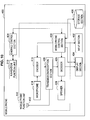
- FIG. 1 is a configuration diagram of a navigation system 10 according to the first embodiment.
- the navigation system 10 includes a communication device 100a which has a connector 110 that engages with a fault diagnosis connector of a vehicle 300, and a navigation device 200a which is portable.
- the vehicle 300 mainly includes a power train 302, an information display section 306, and a vehicle control section 304, and is equipped with a connector 308 for fault diagnosis.
- the connector 308 is the OBD-II connector described above. It is required by law that a new vehicle is equipped with the OBD-II from 1996 in the US and from 2006 in Japan, and hence, all the new vehicles currently on sale in the US and Japan are each equipped with the OBD-II.
- the communication device 100a mainly includes the connector 110 configured to engage with the connector 308 of the vehicle 300, a vehicle communication section 102 configured to communicate with the vehicle 300 via the connector 110, a navigation device-communication section 104 configured to communicate with the navigation device 200a, and a control section 106 configured to control entire movement of the communication device 100a.
- the connector 110 is a fault diagnosis connector that is called the OBD-II connector described above.
- the connector 308 of the vehicle 300 side has a pin alignment corresponding to the connector 110 in order to engage with the connector 110.
- the communication device 100a has a shape such that the connector 110 is fixed on the connector 308 of the vehicle 300 when the connector 110 engages with the connector 308 of the vehicle 300.
- the positional relationship between the two objects alters owing to the change in the shape of the cable.
- the connector 110 of the communication device 100a is formed in an integrated manner with a casing of the communication device 100a, the positional relationship between the casing of the communication device 100a and a casing of the vehicle 300 is not altered and is in a fixed state.
- the vehicle communication section 102 communicates with the vehicle 300 via the connector 110, and receives vehicle speed information or travelling distance information of the vehicle 300. In the present embodiment, hereinafter, there will be described an embodiment in which the vehicle speed information of the vehicle 300 is received.
- the vehicle communication section 102 regularly transmits an acquisition request for acquiring the vehicle speed information to the vehicle 300, and receives the vehicle speed information transmitted from the vehicle 300.
- the navigation device-communication section 104 communicates with the navigation device 200a, and has a function of an information processing device-communication section which transmits, to the navigation device 200a, transmission information based on the vehicle speed information acquired by the vehicle communication section 102.
- the transmission information is the vehicle speed information itself.
- the navigation device-communication section 104 may transmit the transmission information using radio communication.
- the navigation device-communication section 104 can perform communication in accordance with a standard of short range wireless communication such as Bluetooth (registered trademark).
- the control section 106 controls entire operation of the communication device 100a.
- the control section 106 periodically acquires information from the vehicle 300 by controlling the vehicle communication section 102, for example. Further, the control section 106 transmits the vehicle speed information acquired via the connector 110 to the navigation device 200a by controlling the navigation device-communication section 104.
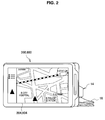
- the navigation device 200a (hereinafter, referred to as PND 200a) according to the first embodiment of the present disclosure represents a PND having an external appearance as shown in FIG. 2 , for example.
- FIG. 2 is an external view of the navigation device (PND) 200 according to the first to third embodiments of the present disclosure. Further, since a PND 800 of the past also has the same external appearance, FIG. 2 is also an external view of the PND 800 of the past.
- the PND 200a is a portable navigation device which has functions of showing a route to a destination and providing a user with various pieces of information each associated with position information.
- the PND 200a has a display section 204, and is held by a cradle 14 which is attached to a dashboard of a vehicle 300 via a suction cup 16.
- the PND 200 can be easily attached to and also detached from the cradle 14.
- the PND 200a has a function of acquiring a current position, and also stores map data. Therefore, the PND 200a can display on the display section 204 the information of the current position in a superimposed manner on a map.
- the PND 200a mainly includes an input section 202, a display section 204, a storage section 206, and a navigation function unit 210a.
- the input section 202 accepts an operation instruction from the user, and outputs the operation contents to the navigation function unit 210a.
- Examples of the operation instruction input by the user include setting a destination, enlarging/reducing the scale of a map, setting a vocal guidance, and setting a screen display.
- the input section 202 may be a touch screen which is provided in an integrated manner with the display section 204.
- the input section 202 may have a physical configuration such as a button, a switch, and a lever, which is provided separately from the display section 204.
- the input section 202 may be a signal reception section which detects a signal indicating an operation instruction by the user transmitted from a remote controller.
- the display section 204 is a display device which outputs a screen in which information indicating a current position is superimposed on map data.
- the display section 204 may be a display device such as an LCD (Liquid Crystal Display) and an organic EL (Electroluminescence) display.
- the storage section 206 is a storage medium which stores a program for the PND 200a to operate and map data.
- the storage section 206 may be, for example, a storage medium such as a non-volatile memory such as a Flash ROM (or Flash Memory), an EEPROM (Electrically Erasable Programmable Read-Only Memory), and an EPROM (Erasable Programmable ROM), a magnetic disk such as a hard disk and a disc-like magnetic disk, an optical disk such as a CD (Compact Disc), a DVD-R (Digital Versatile Disc Recordable), and a BD (Blu-Ray Disc (registered trademark)), and an MO (Magneto Optical) disk.
- a non-volatile memory such as a Flash ROM (or Flash Memory), an EEPROM (Electrically Erasable Programmable Read-Only Memory), and an EPROM (Erasable Programmable ROM)
- a magnetic disk such as a hard disk and a disc
- the navigation function unit 210a is a configuration for realizing a navigation function, and mainly includes a GPS antenna 212, a communication section 214, an angular velocity detection sensor 216, and a control section 230a.
- the control section 230a includes arithmetic processing means such as a CPU (Central Processing Unit).
- the control section 230a mainly includes a GPS processing section 232, a position calculation section 242, an angle calculation section 244, and functions of a navigation section 250.
- the GPS antenna 212 is capable of receiving GPS signals from multiple GPS satellites, and inputs the received GPS signals to the GPS processing section 232.
- the GPS signals received here include orbital data indicating orbits of the GPS satellites and information such as transmission time of the signals.
- the GPS processing section 232 calculates position information indicating the current position of the PND 200a based on the multiple GPS signals input from the GPS antenna 212, and supplies the navigation section 250 with the calculated position information. Specifically, the GPS processing section 232 calculates a position of each of the GPS satellites from the orbital data obtained by demodulating each of the multiple GPS signals, and calculates a distance between each of the GPS satellites and the PND 200a from a difference between a transmission time and a reception time of the GPS signal. Then, based on the calculated positions of the respective GPS satellites and the distances from the respective GPS satellites to the PND 200a, a current three-dimensional position, which is absolute position information, is calculated.
- the navigation section 250 is capable of executing navigation processing based on the position information supplied by the GPS processing section 232.
- the PND 200a may be impossible for the PND 200a to perform the positioning using the GPS. Consequently, the PND 200a is also capable of executing, mainly when it is difficult to receive the GPS signals, navigation processing by using relative position information obtained by the autonomous navigation.
- the communication section 214, the angular velocity detection sensor 216, the position calculation section 242, and the angle calculation section 244 are used for acquiring the relative position using the autonomous navigation.
- the PND 800b of the past had, in place of the communication section 214, the acceleration detection sensor 813 and the speed calculation section 842 for calculating the vehicle speed information from the detection value of the acceleration detection sensor 813 (refer to FIG. 13 ).
- the PND 200a according to the first embodiment of the present disclosure attempts to acquire more accurate vehicle speed information, which can be obtained from the vehicle 300.
- the communication section 214 has a function of communicating with an external device via wire or radio.
- the communication section 214 mainly has functions of a wired or wireless interface for being connected to an external device and a communication processing section configured from a circuit and the like for processing received information or information to be transmitted.
- the communication section 214 has a function as a reception section which receives the transmission information transmitted from the communication device 100a by the control of the control section 230a.
- the transmission information is the vehicle speed information that the communication device 100a has acquired from the vehicle 300.
- the communication section 214 passes the received transmission information to the position calculation section 242.
- the angular velocity detection sensor 216 is a detection device for detecting an angular velocity.
- the angular velocity detection sensor 216 is a sensor having a function of detecting, as a voltage value, a yaw rate ⁇ z which is a variable velocity (angular velocity) of the rotation angle when the PND 200a is rotated.
- the angular velocity detection sensor 216 detects the yaw rate at a sampling frequency of 50 Hz, for example, and inputs data indicating the detected yaw rate to the angle calculation section 244.
- the angle calculation section 244 calculates an angle ⁇ of when the PND 200a is rotated by multiplying the yaw rate ⁇ z input from the angular velocity detection sensor 216 by a sampling frequency (here, for example, 0.02 s), and inputs angle data indicating the angle ⁇ to the position calculation section 242.
- a sampling frequency here, for example, 0.02 s
- the position calculation section 242 has a function of calculating relative position information of a current position based on the speed V indicated by the vehicle speed information input from the communication section 214 and the angle ⁇ calculated by the angle calculation section 244. Specifically, the position calculation section 242 calculates an amount of change from the position at the last calculation to the current position based on the speed V and the angle ⁇ . Then, the position calculation section 242 calculates current position information from the amount of change and the last position. After that, the position calculation section 242 supplies the navigation section 250 with the position information of the current position.
- the navigation section 250 has a function of showing a route to a destination based on the relative position information calculated on the basis of the vehicle speed information acquired from the vehicle 300.
- the navigation section 250 mainly has functions of a position information acquisition section 252, a destination setting section 254, a route search section 256, and a route guidance section 258.
- the position information acquisition section 252 acquires position information of the PND 200a.
- the position information acquisition section 252 may acquire the position information from either the GPS processing section 232 or the position calculation section 242.
- the position information acquisition section 252 acquires the absolute position information from the GPS processing section 232, and when it is difficult for the GPS processing section 232 to calculate the position information, that is, when it is difficult for the GPS antenna 212 to receive GPS signals, the position information acquisition section 252 acquires current position information based on the relative position information from the position calculation section 242.
- the position information acquisition section 252 may acquire corrected position information by performing map matching processing using the absolute position information acquired from the GPS processing section 232 and the relative position information acquired from the position calculation section 242.
- the destination setting section 254 sets a destination, which is a place that the user wants to arrive at, from operation information input by the user using the input section 202, for example.
- the destination setting section 254 generates, for example, a screen for searching for the destination from addresses, names, telephone numbers, or genres, or a screen for selecting the destination from the registration points that are registered by the user beforehand, and causes the display section 204 to display the screen. Then, the destination setting section 254 acquires the operation information performed to the screen display by the user using the input section 202, and sets the destination.
- the route search section 256 has a function of searching for a route from the current position of the PND 200a input from the position information acquisition section 252 to the destination set by the destination setting section 254.
- the route guidance section 258 has a function of showing a route to a destination.
- the route guidance section 258 notifies the user of the route to the set destination in accordance with the route acquired by the search performed by the route search section 256, using a display, audio, and the like.
- the route guidance section 258 causes the display section 204 to display information of the route to the destination superimposed on a map.
- the route guidance section 258 may cause the display section 204 to display an arrow or the like superimposed on the map, which indicates a route leading to the destination.
- FIG. 3 is a sequence diagram showing operation of the navigation system according to the first embodiment.
- the communication device 100a acquires vehicle speed information from the vehicle 300 (S102). In this case, the communication device 100a acquires the vehicle speed information by the vehicle communication section 102 via a fault diagnosis connector. Then, the communication device 100a transmits, by the navigation device-communication section 104, the acquired vehicle speed information to the PND 200a (S104).
- the PND 200a detects an angular velocity by the angular velocity detection sensor 216 (S106).
- the angular velocity detection sensor 216 inputs the detected angular velocity to the angle calculation section 244.
- the angle calculation section 244 calculates an angle ⁇ of rotation of the PND 200a based on the angular velocity input from the angular velocity detection sensor 216 (S108). Note that, in FIG. 3 , although the angular velocity detection processing in Step S106 and the angle calculation processing in Step S108 are performed after acquiring the vehicle speed information from the communication device 100a in Step S104, the angular velocity detection processing in Step S106 and the angle calculation processing in Step S108 may also be performed in parallel with the vehicle speed information- acquisition processing.
- the position calculation section 242 determines an amount of change from a position at the last calculation to a current position based on the vehicle speed information received from the communication device 100a and the angle information input from the angle calculation section 244. Then, the position calculation section 242 calculates current position information from the amount of change and the last position (S110). That is, the position information calculated here is the relative position information calculated based on the amount of change from the position at the last positioning. Note that the positioning operation using the autonomous navigation described here is continuously performed each time the communication device 100a regularly acquires the vehicle speed information.
- the communication device 100a regularly acquires the vehicle speed information from the vehicle 300, and supplies the PND 200a with the acquired vehicle speed information. Since the vehicle speed information is acquired depending on rotation of the wheel in the vehicle 300, the accuracy of the vehicle speed information is high compared to the accuracy of vehicle speed information acquired using an acceleration detection sensor, for example.
- the PND 200a can calculate, by using the highly accurate vehicle speed information, position information of relatively highly accurate relative position using the autonomous navigation, in the position calculation section 242. Therefore, the PND 200a can enhance the accuracy of the autonomous navigation compared to that of a PND which acquires vehicle speed information using an acceleration detection sensor of the past.
- the PND 200a is easily detachable, the possibility is high that an attachment positional relationship between a sensor and the vehicle 300 changes each time at the beginning of using the PND 200a. Accordingly, it is necessary that the PND 200a perform correction processing every time after activation (the same applies to the PND 800b).
- the correction processing is generally performed using GPS positioning information as a reference value. As described above, it requires some time after the activation until it reaches a state where it is possible to receive the GPS signal. During the time after the activation until it reaches the state where it is possible to receive the GPS signal, the fixed-navigation device 900 starts navigation using the autonomous positioning, by using the last stop position as a reference point. However, since it is necessary that the PND 200a perform correction processing of a sensor after it reaches the state where it is possible to receive the GPS signal, it is difficult to start the navigation immediately after activating the PND 200a.
- the present disclosure proposes a navigation system 20 according to a second embodiment.
- FIG. 4 is a configuration diagram of the navigation system 20 according to the second embodiment. Note that, in the description below, the description that is the same as the first embodiment will be omitted, and the description will be made mainly on the differences.
- the navigation system 20 differs in that it is the communication device 100, not the PND 200, that includes the angular velocity detection sensor.
- a control section 106 of a communication device 100b regularly acquires vehicle speed information from the vehicle 300 using a vehicle communication section 102, and also acquires information of an angular velocity from an angular velocity detection sensor 108. Then, the control section 106 causes a navigation device-communication section 104 to transmit the acquired vehicle speed information and angular velocity information to a PND 200b.
- the PND 200b performs the positioning using the autonomous navigation based on the vehicle speed information and the angular velocity information received from the communication device 100b via a communication section 214. That is, the communication section 214 supplies a position calculation section 242 with the received vehicle speed information and supplies an angle calculation section 244 with the received angular velocity information. Then, the angle calculation section 244 calculates an angle ⁇ of rotation of the PND 200b based on the angular velocity information detected by the angular velocity detection sensor 108 provided to the communication device 100.
- the PND 200b calculates, in the position calculation section 242, relative position information based on the vehicle speed information acquired from the communication device 100b and the angular velocity acquired by the angular velocity detection sensor 108 of the communication device 100b. After that, the PND 200b shows a route to a destination based on the relative position information.
- FIG. 5 is a sequence diagram showing the positioning operation using the autonomous navigation of the navigation system 20.
- the communication device 100b acquires vehicle speed information from the vehicle 300 (S202). With this, the communication device 100b detects an angular velocity by the angular velocity detection sensor 108 (S204). Then, the communication device 100b transmits the vehicle speed information and the angular velocity information to the PND 200b as transmission information (S206).
- the PND 200b calculates an angle ⁇ of rotation of the PND 200b based on the angular velocity information received in Step S206 (S208), and calculates the relative position information of the PND 200b based on the calculated angle ⁇ and the vehicle speed information transmitted from the communication device 100b (S210).
- the communication device 100b regularly acquires the vehicle speed information from the vehicle 300, and supplies the PND 200b with the acquired vehicle speed information.
- the communication device 100b since the communication device 100b includes the angular velocity detection sensor 108, the communication device 100b acquires the angular velocity information by the angular velocity detection sensor 108, and supplies the PND 200b with the acquired angular velocity information.
- the PND 200b can calculate current position information based on the vehicle speed information and the angular velocity information supplied from the communication device 100b.
- the angular velocity detection sensor 108 is provided inside the communication device 100b.
- an angular velocity detection sensor was provided inside the PND body. Accordingly, as described above, since it was necessary to perform correction processing every time the PND body was attached, it was difficult to perform the positioning immediately after the activation.
- the angular velocity detection sensor 108 is provided inside the communication device 100b.
- the communication device 100b has a shape such that the communication device 100b body is fixed on top of a connector 308 of the vehicle 300 by engaging the connector 308 with a connector 110.
- the PND 200b is mainly used by being detached and carried around, it is assumed that the communication device 100b is usually used without being detached and is fixed on top of the connector 308.
- the positioning can be started immediately after activating the PND 200b, based on the position information at the time vehicle 300 stopped last time.
- the vehicle 300 is parked and stopped at a place where it is difficult to receive a GPS signal, such as an underground car park, and starts to move after that, there may be a case where it is difficult to use the positioning using the GPS for a while after the starting of the vehicle 300. In such a case, the configuration of the present embodiment is effective.
- FIG. 6 is a configuration diagram of the navigation system 30 according to the third embodiment.
- FIG. 7 is a sequence diagram showing positioning operation using the autonomous navigation of the navigation system 30.
- the navigation system 30 differs in that the communication device 100 further includes a configuration for the positioning using the autonomous navigation. That is, in addition to the angular velocity detection sensor 108, a control section 106 of a communication device 100c includes functions of an angle calculation section 1062 and a position calculation section 1064.
- the PND 200b can acquire the vehicle speed information and the angle information without waiting for a time period necessary for the correction processing.
- it takes a long time to establish communication between the communication device 100b and the PND 200b there is a possibility that it is difficult to perform accurate positioning. That is, in the case where the communication is not established at the time when the vehicle 300 starts moving, it is difficult for the PND 200b to acquire the vehicle speed information and the angular velocity information, and to perform the positioning using the autonomous navigation. In this case, the PND 200b cannot acquire position information at all until the positioning using the GPS is started.
- the communication device 100c includes functions of the angle calculation section 1062 and the position calculation section 1064. With such a configuration, even in the case where it takes a long time to establish communication between the communication device 100c and a PND 200c, the communication device 100c can calculate the position information using the autonomous navigation. Accordingly, the PND 200c can acquire the position information using the autonomous navigation as soon as the communication between the communication device 100c and the PND 200c is established.
- the communication device 100c acquires vehicle speed information from the vehicle 300 (S302). After that, the angular velocity detection sensor 108 detects angular velocity information (S304), and the angle calculation section 1062 calculates an angle ⁇ of rotation of the PND 200c based on the detection value obtained by the angular velocity detection sensor 108 (S306).
- the position calculation section 1064 calculates a position of the vehicle 300 based on the vehicle speed information acquired by the vehicle communication section 102 and the angle ⁇ calculated by the angle calculation section 1062 (S308).
- the communication device 100c transmits, by the navigation device-communication section 104, the relative position information calculated by the position calculation section 1064 to the PND 200c (S310).
- the transmission information transmitted by the communication device 100c is the relative position information calculated by the position calculation section 1064.
- the communication device 100c temporarily stores, in a storage section (not shown), the position information obtained by performing the positioning last time by the position calculation section 1064. Further, as described above, in order to be able to perform the positioning immediately after the activation, it is desirable that the communication device 100c stores, in a storage section (not shown), position information obtained immediately before the vehicle 300 is stopped. In this case, when the positioning using the GPS can be performed at the stop point, the position information using the GPS may be acquired from the PND 200c.
- "easiness of attachment” is an item showing whether or not the fixation to a vehicle, the wiring, and the like are easy.
- a wiring is necessary for the fixed-navigation device 900 to acquire the vehicle speed pulse signal. Consequently, the attachment of the fixed-navigation device 900 is basically performed by a person who has the special knowledge and skill of drawing out a signal wire and it is difficult to be performed by a user, and once the fixed-navigation device 900 is fixed, it is not detached when being used.
- the PND 800 of the past can be easily attached to a dashboard via a suction cup and a cradle and easily detached from the dashboard, and can be carried around and used in a pedestrian mode. Further, it is easy to attach the PND 800 of the past which has been used in one vehicle to another vehicle and to use the PND 800 of the past in the other vehicle.
- the PND 200 involves additional work for the attachment, when compared to the case of the PND 800 of the past, in that it is necessary to additionally attach the communication device 100 in order to use the PND 200.
- the wiring is unnecessary, and once the communication device 100 is attached, the communication device 100 is left attached to the connector 308 of the vehicle 300, and only the PND 200 body can be detached and brought out or can be used in another vehicle.
- “autonomous accuracy” is an item showing the accuracy of the positioning using the autonomous navigation.
- the fixed-navigation device 900 acquires the vehicle speed information based on the vehicle speed pulse signal depending on rotation of the wheel in the vehicle 300. Accordingly, the fixed-navigation device 900 can maintain high autonomous accuracy compared to that of the PND 800b which acquires the vehicle speed information using the acceleration obtained by the acceleration detection sensor. Further, the PND 800a does not have the function of autonomous navigation.
- the PND 800b performs the positioning using the autonomous navigation by using the acceleration detection sensor, but it is difficult that the detection value obtained by the acceleration detection sensor maintains the accuracy of ground movement amount.
- the PND 200a, the PND 200b, and the PND 200c each use the position information based on vehicle speed information or travelling distance information acquired from the vehicle 300.
- the position information based on the vehicle speed information and the travelling distance information acquired from the vehicle 300 has high accuracy compared to the position information based on the detection value obtained by the acceleration detection sensor. Further, the position information based on the vehicle speed information and the travelling distance information acquired from the vehicle 300 is considered to have accuracy equal to the position information based on the vehicle speed pulse signal used in the fixed-navigation device 900.
- the GPS disturbance suppression is an item showing whether or not the disturbance can be suppressed. Since the PND 800a does not have the function of the positioning using the autonomous navigation, it is difficult to suppress the disturbance of the GPS positioning result.
- the fixed-navigation device 900, the PND 800b, the PND 200a, the PND 200b, and the PND 200c each have the function of the positioning using the autonomous navigation. Therefore, in the case where the reception conditions of the GPS signal is not good, the GPS positioning result can be corrected by using the result obtained by the positioning using the autonomous navigation.
- positioning continuation inside tunnel, etc. is an item showing, when the autonomous navigation is operable, whether or not the positioning is continuable for a certain length of time even in a place where it is difficult to receive a GPS signal. Since the PND 800a does not have the function of the autonomous navigation, it is difficult to continue the positioning in the place where it is difficult to receive a GPS signal. The PND 800b can continue the positioning using the function of the autonomous navigation. However, as described above, the PND 800b is inferior in autonomous accuracy compared to the fixed-navigation device 900 and the PND 200. Therefore, when errors accumulate, there is a case where it is difficult to maintain sufficient accuracy.
- the fixed-navigation device 900, the PND 200a, the PND 200b, and the PND 200c can perform the positioning using the autonomous navigation with relatively high accuracy, they can continue the positioning with a certain level of accuracy for a long period of time, compared to the PND 800b.
- the "positioning immediately after power is turned on” is an item showing whether or not it is possible to perform the positioning immediately after the navigation device is activated. Since the PND 800a does not have the function of the positioning using the autonomous navigation, it is difficult to perform the positioning immediately after the activation, until the positioning using the GPS is started. Further, as for the PND 800b and the PND 200a, it is necessary to correct the sensor each time the PND body is attached. Therefore, it is difficult to perform the positioning immediately after the activation.
- the fixed-navigation device 900 although it is necessary to correct the sensor at the time of the attachment for the first time, it is unnecessary to perform the correction each time the fixed-navigation device 900 is activated once the fixed-navigation device 900 is attached. Further, even when the fixed-navigation device 900 moves during the time the positioning using the GPS is not possible, the fixed-navigation device 900 is capable of starting the positioning using the autonomous navigation by using the last stop position as a reference point.
- the communication device 100b has the angular velocity detection sensor. Accordingly, in the same manner as the fixed-navigation device 900, it is unnecessary to perform the processing of correcting the sensor each time the PND 200b is activated. Therefore, the PND 200b can start the positioning immediately after the activation, under the condition that the communication with the communication device 100b is established before the vehicle 300 starts moving.
- the PND 200c acquires the position information from the communication device 100c which further has the function of the autonomous navigation. Therefore, even when the communication between the PND 200c and the communication device 100c is not established before the vehicle 300 starts moving, the positioning using the autonomous navigation is started in the communication device 100c.
- the navigation devices according to the first to third embodiments of the present disclosure can also be implemented as a mobile phone. That is, the transmission information from the communication device 100 may be received by the mobile phone, and the navigation based on the transmission information may be performed.
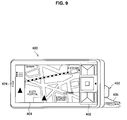
- a mobile phone 400 which represents a navigation device in this case, has an external appearance as shown in FIG. 9 , for example. That is, it is possible to cause the mobile phone 400 to function as the navigation device, by holding the mobile phone 400 by a cradle 403 on a dashboard of the vehicle 300 via a suction cup 405.
- the mobile phone 400 includes a navigation function unit 210, a display section 404, an input section 402, a storage section 406, a mobile phone function unit 410, and an overall control section 434.
- the mobile phone function unit 410 is connected to the display section 404, the input section 402, and the storage section 406. In fact, although it is simplified in the drawing of FIG. 10 , the display section 404, the input section 402, and the storage section 406 are also each connected to the navigation function unit 210. Note that, since the detailed configuration of the navigation function unit 210 has been specifically described in FIGS. 1 , 4 , and 6 , the description thereof will be omitted here.
- the mobile phone function unit 410 has a configuration for realizing a communication function and an e-mail function, and includes a communication antenna 412, a microphone 414, an encoder 416, a transmission/reception section 420, a speaker 424, a decoder 426, and a mobile phone control section 430.
- the microphone 414 collects sound and outputs the sound as an audio signal.
- the encoder 416 performs digital conversion and encoding of the audio signal input from the microphone 414 in accordance with the control of the mobile phone control section 430, and outputs audio data to the transmission/reception section 420.
- the transmission/reception section 420 modulates the audio data input from the encoder 416 in accordance with a predetermined system, and transmits the modulated audio data to a base station of the mobile phone 400 from the communication antenna 412 via radio waves. Further, the transmission/reception section 420 demodulates a radio signal received by the communication antenna 412 and acquires audio data, and outputs the audio data to the decoder 426.
- the decoder 426 performs decoding and analog conversion of the audio data input from the transmission/reception section 420 in accordance with the control of the mobile phone control section 430, and outputs an audio signal to the speaker 424.
- the speaker 424 outputs the audio based on the audio signal supplied from the decoder 426.
- the mobile phone control section 430 supplies the decoder 426 with received data from the transmission/reception section 420, and causes the decoder 426 to decode the received data. Then, the mobile phone control section 430 outputs e-mail data obtained by the decoding to the display section 404 and causes the display section 404 to display the e-mail data, and also records the e-mail data in the storage section 406.
- the mobile phone control section 430 causes the encoder 416 to encode the e-mail data which is input via the input section 402, and transmits the encoded e-mail data via radio waves through the transmission/reception section 420 and the communication antenna 412.
- the overall control section 434 controls the mobile phone function unit 410 and the navigation function unit 210. For example, in the case of receiving a phone call while the navigation function unit 210 is executing a navigation function, the overall control section 434 may temporarily switch its function from the navigation to a verbal communication carried out by the mobile phone function unit 410, and, when the call ends, may cause the navigation function unit 210 to restart the navigation function.
- the navigation device using the mobile phone is particularly preferred in the case of providing information which is customized for an individual user. Even in the case where the vehicle itself is shared between two or more people, there can be provided individualized information. For example, in the case where there is private information such as a history of destinations, it is free from worry about the private information being seen by another person when it is recorded in the mobile phone, and the information can be further used in another vehicle.
- the communication device 100c has a function of enhancing positioning accuracy of the navigation device using the mobile phone in the case of being used on the vehicle. Therefore, the navigation device using the mobile phone can use highly accurate positioning information with a communication function only.
- the navigation device is the PND or the mobile phone
- the present disclosure is not limited thereto.
- Other devices each having a navigation function are within the scope of the present disclosure.
- the method of calculating the travelling azimuth from information of the detected angular velocity is not limited thereto.
- the steps written in the sequence diagrams may of course be processed in chronological order in accordance with the stated order, but may not necessarily be processed in the chronological order, and may be processed individually or in a parallel manner. It is needless to say that, in the case of the steps are processed in the chronological order, the order of the steps may be changed appropriately according to circumstances.
Landscapes
- Engineering & Computer Science (AREA)
- Radar, Positioning & Navigation (AREA)
- Remote Sensing (AREA)
- Physics & Mathematics (AREA)
- General Physics & Mathematics (AREA)
- Automation & Control Theory (AREA)
- Computer Networks & Wireless Communication (AREA)
- Navigation (AREA)
- Traffic Control Systems (AREA)
- Position Fixing By Use Of Radio Waves (AREA)
Abstract
There is provided a positioning system including a communication device which includes a connector configured to engage with a connector provided to a vehicle, a vehicle communication section configured to receive vehicle speed information or travelling distance information of the vehicle from the vehicle via the connector, and an information processing device-communication section configured to transmit, to an information processing device, transmission information based on the vehicle speed information or the travelling distance information acquired by the vehicle communication section, and the information processing device which includes a communication section configured to receive the transmission information from the communication device, and a position calculation section configured to calculate a current position based on the vehicle speed information or the travelling distance information.
Description
- The present disclosure relates a positioning system, a communication device, and a positioning method.
- In recent years, navigation devices have been in widespread use, each of which shows a route from a current position to a destination based on position information acquired by a GPS (Global Positioning System) and the like. Of those, most of car navigation devices mounted on vehicles were each used by being fixed to the vehicle (hereinafter, referred to as fixed-navigation device). On the other hand, there have recently appeared navigation devices that can be attached and detached easily, and can be carried around (hereinafter, referred to as PND (Personal Navigation Device)).
- In addition, with improvements in electronics technology, many of the functions that the navigation device provides become realizable by using a compact electronic component. Accompanied therewith, the function that the navigation device provides becomes realizable as a function of a portable device such as a mobile phone and a smartphone.
- Among navigation devices, there is a navigation device that can provide position information to even a place not reached by a radio wave of the GPS by autonomous navigation using, in addition to absolute position information using the GPS, information of a relative position based on speed information, angular velocity information, and the like which are acquired from a sensor and the like (for example,
JP 2010-078595A - However, there was an issue that there were many portable navigation devices, such as a PND, which did not have an autonomous navigation function, and, even if a portable navigation device did have the autonomous navigation function, an accuracy of the autonomous navigation of the portable navigation device was lower compared with an accuracy of the autonomous navigation of a fixed-navigation device. In light of the foregoing, it is desirable to provide a navigation system, a vehicle information communication device, and a navigation method, which are novel and improved, and which are capable of enhancing the accuracy of position information obtained by the autonomous navigation of an information processing device such as a portable navigation device when mounted on a vehicle.
- Various respective aspects and features of the invention are defined in the appended claims. Combinations of features from the dependent claims may be combined with features of the independent claims as appropriate and not merely as explicitly set out in the claims.
- According to an embodiment of the present disclosure, there is provided a positioning system which includes a communication device including a connector configured to engage with a connector provided to a vehicle, a vehicle communication section configured to receive vehicle speed information or travelling distance information of the vehicle from the vehicle via the connector, and an information processing device-communication section configured to transmit, to an information processing device, transmission information based on the vehicle speed information or the travelling distance information acquired by the vehicle communication section, and the information processing device including a communication section configured to receive the transmission information from the communication device, and a position calculation section configured to calculate a current position based on the vehicle speed information or the travelling distance information.
- According to such a configuration, the communication device which is set by being engaged with the connector of the vehicle can acquire the vehicle speed information or the travelling distance information from the vehicle. Then, the communication device transmits the transmission information based on the acquired vehicle speed information or travelling distance information to the information processing device. The information processing device which has received the transmission information transmitted from the communication device can calculate the current position based on the vehicle speed information or the travelling distance information included in the transmission information. Here, the accuracy of the vehicle speed information or the travelling distance information acquired from the vehicle is higher than the accuracy of speed information of the vehicle indirectly acquired by an acceleration sensor. Accordingly, the positioning system can calculate position information having higher accuracy than that of information of a relative position based on a detection value of the sensor.
- The information processing device may further include a navigation section configured to show a route to a destination using the calculated position information.
- The connector provided to the vehicle may be a connector for fault diagnosis.
- The communication device may further include an angular velocity detection sensor configured to acquire an angular velocity of the vehicle. The information processing device-communication section may transmit, as the transmission information to the information processing device, the angular velocity acquired by the angular velocity detection sensor and the vehicle speed information or the travelling distance information.
- The communication device may have a shape such that the connector is fixed on the connector provided to the vehicle when the connector engages with the connector provided to the vehicle.
- According to an embodiment of the present disclosure, there is provided a communication device which includes a connector configured to engage with a connector provided to a vehicle, a vehicle communication section configured to receive vehicle speed information or travelling distance information of the vehicle from the vehicle via the connector, and an information processing device-communication section configured to transmit, to an information processing device, transmission information based on the vehicle speed information or the travelling distance information acquired by the vehicle communication section.
- The communication device may further include an angular velocity detection sensor configured to acquire an angular velocity of the vehicle.
- The information processing device-communication section may transmit, as the transmission information to the information processing device, the angular velocity acquired by the angular velocity detection sensor and the vehicle speed information or the travelling distance information.
- The communication device may further include a position calculation section configured to calculate a current position based on the angular velocity acquired by the angular velocity detection sensor and the vehicle speed information or the travelling distance information. The information processing device-communication section may transmit the position information as the transmission information to the information processing device.
- The information processing device-communication section may communicate wirelessly with the information processing device in accordance with a short range wireless communication standard.
- According to another embodiment of the present disclosure, there is provided a positioning method of a positioning system which includes a communication device that is provided inside a vehicle by a connector being engaged with a connector provided to the vehicle and that includes a vehicle communication section and an information processing device-communication section, and which includes an information processing device that includes a communication section configured to communicate with the information processing device-communication section and a position calculation section configured to calculate a current position, the positioning method including receiving, by the vehicle communication section, vehicle speed information or travelling distance information of the vehicle from the vehicle via the connector, transmitting, by the information processing device-communication section, transmission information based on the vehicle speed information or the travelling distance information acquired by the vehicle communication section, to the information processing device, receiving, by the communication section, the transmission information, and calculating, by the position calculation section, the current position based on the vehicle speed information or the travelling distance information.
- According to the embodiments of the present disclosure described above, it is possible to enhance the accuracy of position information obtained by the autonomous navigation of a portable positioning device when mounted on a vehicle.
- Embodiments of the invention will now be described with reference to the accompanying drawings, throughout which like parts are referred to by like references, and in which:
-
FIG. 1 is a configuration diagram of a navigation system according to a first embodiment of the present disclosure; -
FIG. 2 is an appearance example of a navigation device (PND) according to the first embodiment; -
FIG. 3 is a sequence diagram showing positioning operation using autonomous navigation of the navigation system according to the first embodiment; -
FIG. 4 is a configuration diagram of a navigation system according to a second embodiment of the present disclosure; -
FIG. 5 is a sequence diagram showing positioning operation using autonomous navigation of the navigation system according to the second embodiment; -
FIG. 6 is a configuration diagram of a navigation system according to a third embodiment of the present disclosure; -
FIG. 7 is a sequence diagram showing positioning operation using autonomous navigation of the navigation system according to the third embodiment; -
FIG. 8 is a table of a comparison of respective navigation systems; -
FIG. 9 is an appearance example of a case where the navigation device according to the first to third embodiments represents a mobile phone; -
FIG. 10 is a configuration diagram of a case where the navigation device according to the first to third embodiments represents the mobile phone; -
FIG. 11 is a configuration diagram of a fixed-navigation device of the past; -
FIG. 12 is a configuration diagram of a PND (without autonomous navigation function) of the past; and -
FIG. 13 is a configuration diagram of a PND (with autonomous navigation function) of the past. - Hereinafter, preferred embodiments of the present disclosure will be described in detail with reference to the appended drawings. Note that, in this specification and the appended drawings, structural elements that have substantially the same function and structure are denoted with the same reference numerals, and repeated explanation of these structural elements is omitted.
- Further, in this specification and the appended drawings, there are some cases where multiple structural elements that have substantially the same function and structure are distinguished from one another by being denoted with different alphabets after the same reference numerals. For example, multiple structures that have substantially the same function and structure are distinguished from one another like
navigation device 200a andnavigation device 200b, as necessary. Note that, in the case where it is not particularly necessary to distinguish the multiple structural elements that have substantially the same function and structure from one another, the multiple structural elements are denoted with the same reference numeral only. For example, in the case where it is not particularly necessary to distinguish thenavigation device 200a from thenavigation device 200b, they are each simply referred to as navigation device 200. - Note that the description will be given in the following order.
- 1. Outline
- 2. First embodiment (example where communication device acquires and transmits vehicle speed information and the like)
- 3. Second embodiment (example where communication device includes angular velocity detection sensor)
- 4. Third embodiment (example where communication device calculates relative position)
- 5. Performance comparison
- 6. Modified example
- First, in order to describe a background in achieving the present disclosure, there will be described navigation devices of the past shown in
FIGS. 11 to 13 , respectively.FIG. 11 is a configuration diagram of a fixed type navigation device of the past which is used by being fixed to a vehicle.FIG. 12 is a configuration diagram of a PND of the past, which is a portable navigation device (PND) and does not have an autonomous navigation function.FIG. 13 is a configuration diagram of a PND of the past which has an autonomous navigation function. - Note that, hereinafter, although the description will be made taking as an example a case of a navigation device, the present disclosure is not limited to such an example. The present disclosure is applicable to all information processing devices each using position information.
- First, referring to
FIG. 11 , a fixedtype navigation device 900 of the past (hereinafter, referred to as fixed-navigation device 900) is a navigation device used by being fixed and mounted on avehicle 300, and mainly includes aGPS antenna 912, a vehicle speedpulse detection section 914, an angularvelocity detection sensor 916, aninput section 902, adisplay section 904, astorage section 906, aGPS processing section 932, aspeed calculation section 942, aposition calculation section 944, anangle calculation section 946, and anavigation section 950. - By the way, the fixed-
navigation device 900 can also acquire position information by autonomous navigation in addition to the position information acquired by the positioning using the GPS. For the positioning using the autonomous navigation, information indicating a travelling azimuth and a travelling distance of a vehicle is necessary. Accordingly, the autonomous navigation positioning generally uses information of speed of the vehicle 300 (hereinafter, referred to as vehicle speed information) and information of an angle calculated from an angular velocity acquired by the angularvelocity detection sensor 916. Here, the fixed-navigation device 900 performs the positioning by the autonomous navigation using vehicle speed information calculated from a vehicle speed pulse signal acquired from thevehicle 300. Note that the vehicle speed pulse signal used here is a signal corresponding to rotation speed of a wheel of thevehicle 300, and there can be obtained relatively accurate vehicle speed information. - The fixed-
navigation device 900 acquires the vehicle speed pulse signal to be used in thevehicle 300 via a branch wire using acaulking metal 309, for example. Since there is necessitated wiring for acquiring the vehicle speed pulse signal, special knowledge is necessary for the attachment of the fixed-navigation device 900. Accordingly, the attachment of the fixed-navigation device 900 is generally performed by a person who has the special knowledge at a store that sells the fixed-navigation device 900, and once attached, the fixed-navigation device 900 is used as it is, as fixed. - Next, referring to
FIG. 12 , aportable navigation device 800a of the past (hereinafter, referred to asPND 800a) is obtained by improving the fixed-navigation device 900 such that the fixed-navigation device 900 can be easily attached and can also be carried around and used. - In order to be portable, the
PND 800a does not have a positioning function using the autonomous navigation. Thenavigation section 850 performs the navigation using position information based on GPS positioning information calculated from a GPS reception signal. Since the wiring for acquiring the vehicle speed pulse signal is unnecessary, thePND 800a can be easily attached and detached. - For example, as shown in
FIG. 2 , thePND 800a is held by acradle 14 which is attached to a dashboard of thevehicle 300 via asuction cup 16 and is mechanically and electrically connected to thecradle 14. Since thePND 800a can be easily attached to and detached from thecradle 14, a user can detach thePND 800a and use thePND 800a also for walking. - However, since the
PND 800a does not have the positioning function using the autonomous navigation, it is difficult to acquire position information at a place where it is difficult to receive a GPS signal. Accordingly, it is difficult for thePND 800a to continue the positioning inside a tunnel. Further, it generally requires some time to receive the GPS signal after activating the navigation device. Accordingly, it is difficult for thePND 800a to perform the positioning immediately after the activation. For example, in order that the fixed-navigation device 900 compensates for the defect, the fixed-navigation device 900 is configured in a manner to be able to perform the positioning even at immediately after the activation by using the positioning using the autonomous navigation. - In recent years, although there has appeared a mobile phone that can be used as a car navigation device, when the mobile phone does not have the positioning function using the autonomous navigation, the mobile phone also has the same issue as the
PND 800a. - As described above, the
PND 800a in which the positioning function using the autonomous navigation is omitted in order to simply facilitate the attachment is remarkably inferior in the accuracy of current position information. APND 800b, which achieves both the autonomous navigation function and the easiness of attachment, is developed for compensating for the defect. - Referring to
FIG. 13 , thePND 800b includes, in addition to the configuration of thePND 800a, anacceleration detection sensor 813, an angularvelocity detection sensor 816, aspeed calculation section 842, aposition calculation section 844, and anangle calculation section 846. Compared to the fixed-navigation device 900, thePND 800b differs in having theacceleration detection sensor 813 in place of the vehicle speedpulse detection section 914. - With such a configuration, there can be acquired vehicle speed information from a detection value obtained by a sensor in place of the vehicle speed pulse signal. Accordingly, the
PND 800b can realize the positioning function using the autonomous navigation by using the vehicle speed information. In addition, when the acceleration is detected using the sensor, the wiring between thePND 800b and thevehicle 300 is unnecessary, and hence, thePND 800b can be easily attached and detached. - As described above, the PND 800 that has so far been provided has been improved such that the PND 800 can be easily attached and detached, and also can provide a function equivalent to the function of the fixed type navigation device by performing the positioning by the autonomous navigation using a sensor.
- Nevertheless, however, there is a point that the portable navigation device is inferior to the fixed type navigation device in navigation accuracy. The
PND 800b calculates vehicle speed from detection information of theacceleration detection sensor 813 and uses the vehicle speed for the autonomous navigation. However, the vehicle speed information calculated from acceleration information detected by the sensor is inferior in accuracy compared to that of the vehicle speed information based on a vehicle speed pulse. Consequently, particularly in the case where a state in which a GPS signal is not received continues for a long time, positioning errors accumulate, and it is difficult to retain the positioning accuracy. - In consequence of this, for the PNDs according to the first to third embodiments of the present application which will be described below, there is considered that vehicle speed information which can be acquired via an OBD-II connector is used for the positioning using the autonomous navigation. The OBD-II connector is a connector used for connecting an on-board diagnostic system called OBD-II (On-Board Diagnosis) with a vehicle, and the OBD-II connector is also called a fault diagnosis connector or a vehicle diagnosis connector.
- Here, with reference to
FIGS. 1 to 3 , there will be described a navigation system according to a first embodiment of the present disclosure.FIG. 1 is a configuration diagram of anavigation system 10 according to the first embodiment. - The
navigation system 10 according to the first embodiment includes acommunication device 100a which has aconnector 110 that engages with a fault diagnosis connector of avehicle 300, and anavigation device 200a which is portable. - The
vehicle 300 mainly includes apower train 302, aninformation display section 306, and avehicle control section 304, and is equipped with aconnector 308 for fault diagnosis. Theconnector 308 is the OBD-II connector described above. It is required by law that a new vehicle is equipped with the OBD-II from 1996 in the US and from 2006 in Japan, and hence, all the new vehicles currently on sale in the US and Japan are each equipped with the OBD-II. - The
communication device 100a mainly includes theconnector 110 configured to engage with theconnector 308 of thevehicle 300, avehicle communication section 102 configured to communicate with thevehicle 300 via theconnector 110, a navigation device-communication section 104 configured to communicate with thenavigation device 200a, and acontrol section 106 configured to control entire movement of thecommunication device 100a. - The
connector 110 is a fault diagnosis connector that is called the OBD-II connector described above. Theconnector 308 of thevehicle 300 side has a pin alignment corresponding to theconnector 110 in order to engage with theconnector 110. - The
communication device 100a has a shape such that theconnector 110 is fixed on theconnector 308 of thevehicle 300 when theconnector 110 engages with theconnector 308 of thevehicle 300. For example, in the case where two objects are connected to each other via a cable, the positional relationship between the two objects alters owing to the change in the shape of the cable. On the other hand, however, since theconnector 110 of thecommunication device 100a is formed in an integrated manner with a casing of thecommunication device 100a, the positional relationship between the casing of thecommunication device 100a and a casing of thevehicle 300 is not altered and is in a fixed state. - The
vehicle communication section 102 communicates with thevehicle 300 via theconnector 110, and receives vehicle speed information or travelling distance information of thevehicle 300. In the present embodiment, hereinafter, there will be described an embodiment in which the vehicle speed information of thevehicle 300 is received. In accordance with the control of thecontrol section 106, thevehicle communication section 102 regularly transmits an acquisition request for acquiring the vehicle speed information to thevehicle 300, and receives the vehicle speed information transmitted from thevehicle 300. - The navigation device-
communication section 104 communicates with thenavigation device 200a, and has a function of an information processing device-communication section which transmits, to thenavigation device 200a, transmission information based on the vehicle speed information acquired by thevehicle communication section 102. In the present embodiment, the transmission information is the vehicle speed information itself. The navigation device-communication section 104 may transmit the transmission information using radio communication. For example, the navigation device-communication section 104 can perform communication in accordance with a standard of short range wireless communication such as Bluetooth (registered trademark). - The
control section 106 controls entire operation of thecommunication device 100a. Thecontrol section 106 periodically acquires information from thevehicle 300 by controlling thevehicle communication section 102, for example. Further, thecontrol section 106 transmits the vehicle speed information acquired via theconnector 110 to thenavigation device 200a by controlling the navigation device-communication section 104. - The
navigation device 200a (hereinafter, referred to asPND 200a) according to the first embodiment of the present disclosure represents a PND having an external appearance as shown inFIG. 2 , for example.FIG. 2 is an external view of the navigation device (PND) 200 according to the first to third embodiments of the present disclosure. Further, since a PND 800 of the past also has the same external appearance,FIG. 2 is also an external view of the PND 800 of the past. - The
PND 200a is a portable navigation device which has functions of showing a route to a destination and providing a user with various pieces of information each associated with position information. ThePND 200a has adisplay section 204, and is held by acradle 14 which is attached to a dashboard of avehicle 300 via asuction cup 16. The PND 200 can be easily attached to and also detached from thecradle 14. - The
PND 200a has a function of acquiring a current position, and also stores map data. Therefore, thePND 200a can display on thedisplay section 204 the information of the current position in a superimposed manner on a map. - Referring to
FIG. 1 again, thePND 200a mainly includes aninput section 202, adisplay section 204, astorage section 206, and anavigation function unit 210a. - The
input section 202 accepts an operation instruction from the user, and outputs the operation contents to thenavigation function unit 210a. Examples of the operation instruction input by the user include setting a destination, enlarging/reducing the scale of a map, setting a vocal guidance, and setting a screen display. - Further, the
input section 202 may be a touch screen which is provided in an integrated manner with thedisplay section 204. Alternatively, theinput section 202 may have a physical configuration such as a button, a switch, and a lever, which is provided separately from thedisplay section 204. Further, theinput section 202 may be a signal reception section which detects a signal indicating an operation instruction by the user transmitted from a remote controller. - The
display section 204 is a display device which outputs a screen in which information indicating a current position is superimposed on map data. Thedisplay section 204 may be a display device such as an LCD (Liquid Crystal Display) and an organic EL (Electroluminescence) display. - The
storage section 206 is a storage medium which stores a program for thePND 200a to operate and map data. Note that thestorage section 206 may be, for example, a storage medium such as a non-volatile memory such as a Flash ROM (or Flash Memory), an EEPROM (Electrically Erasable Programmable Read-Only Memory), and an EPROM (Erasable Programmable ROM), a magnetic disk such as a hard disk and a disc-like magnetic disk, an optical disk such as a CD (Compact Disc), a DVD-R (Digital Versatile Disc Recordable), and a BD (Blu-Ray Disc (registered trademark)), and an MO (Magneto Optical) disk. - Further, the
navigation function unit 210a is a configuration for realizing a navigation function, and mainly includes aGPS antenna 212, acommunication section 214, an angularvelocity detection sensor 216, and acontrol section 230a. Thecontrol section 230a includes arithmetic processing means such as a CPU (Central Processing Unit). In addition, thecontrol section 230a mainly includes aGPS processing section 232, aposition calculation section 242, anangle calculation section 244, and functions of anavigation section 250. - The
GPS antenna 212 is capable of receiving GPS signals from multiple GPS satellites, and inputs the received GPS signals to theGPS processing section 232. Note that the GPS signals received here include orbital data indicating orbits of the GPS satellites and information such as transmission time of the signals. - The
GPS processing section 232 calculates position information indicating the current position of thePND 200a based on the multiple GPS signals input from theGPS antenna 212, and supplies thenavigation section 250 with the calculated position information. Specifically, theGPS processing section 232 calculates a position of each of the GPS satellites from the orbital data obtained by demodulating each of the multiple GPS signals, and calculates a distance between each of the GPS satellites and thePND 200a from a difference between a transmission time and a reception time of the GPS signal. Then, based on the calculated positions of the respective GPS satellites and the distances from the respective GPS satellites to thePND 200a, a current three-dimensional position, which is absolute position information, is calculated. - In this way, the
navigation section 250 is capable of executing navigation processing based on the position information supplied by theGPS processing section 232. However, in the case where it is difficult to receive the GPS signals from the GPS satellites, it may be impossible for thePND 200a to perform the positioning using the GPS. Consequently, thePND 200a is also capable of executing, mainly when it is difficult to receive the GPS signals, navigation processing by using relative position information obtained by the autonomous navigation. - Of the configuration of the
PND 200a shown above, thecommunication section 214, the angularvelocity detection sensor 216, theposition calculation section 242, and theangle calculation section 244 are used for acquiring the relative position using the autonomous navigation. - The
PND 800b of the past had, in place of thecommunication section 214, theacceleration detection sensor 813 and thespeed calculation section 842 for calculating the vehicle speed information from the detection value of the acceleration detection sensor 813 (refer toFIG. 13 ). In place of the vehicle speed information acquired by using theacceleration detection sensor 813 and thespeed calculation section 842 of the past, thePND 200a according to the first embodiment of the present disclosure attempts to acquire more accurate vehicle speed information, which can be obtained from thevehicle 300. - The
communication section 214 has a function of communicating with an external device via wire or radio. Thecommunication section 214 mainly has functions of a wired or wireless interface for being connected to an external device and a communication processing section configured from a circuit and the like for processing received information or information to be transmitted. - The
communication section 214 has a function as a reception section which receives the transmission information transmitted from thecommunication device 100a by the control of thecontrol section 230a. In the present embodiment, the transmission information is the vehicle speed information that thecommunication device 100a has acquired from thevehicle 300. Thecommunication section 214 passes the received transmission information to theposition calculation section 242. - Further, the angular
velocity detection sensor 216 is a detection device for detecting an angular velocity. The angularvelocity detection sensor 216 is a sensor having a function of detecting, as a voltage value, a yaw rate ωz which is a variable velocity (angular velocity) of the rotation angle when thePND 200a is rotated. The angularvelocity detection sensor 216 detects the yaw rate at a sampling frequency of 50 Hz, for example, and inputs data indicating the detected yaw rate to theangle calculation section 244. - The
angle calculation section 244 calculates an angle θ of when thePND 200a is rotated by multiplying the yaw rate ωz input from the angularvelocity detection sensor 216 by a sampling frequency (here, for example, 0.02 s), and inputs angle data indicating the angle θ to theposition calculation section 242. - The
position calculation section 242 has a function of calculating relative position information of a current position based on the speed V indicated by the vehicle speed information input from thecommunication section 214 and the angle θ calculated by theangle calculation section 244. Specifically, theposition calculation section 242 calculates an amount of change from the position at the last calculation to the current position based on the speed V and the angle θ. Then, theposition calculation section 242 calculates current position information from the amount of change and the last position. After that, theposition calculation section 242 supplies thenavigation section 250 with the position information of the current position. - The
navigation section 250 has a function of showing a route to a destination based on the relative position information calculated on the basis of the vehicle speed information acquired from thevehicle 300. Thenavigation section 250 mainly has functions of a positioninformation acquisition section 252, adestination setting section 254, aroute search section 256, and aroute guidance section 258. - The position
information acquisition section 252 acquires position information of thePND 200a. The positioninformation acquisition section 252 may acquire the position information from either theGPS processing section 232 or theposition calculation section 242. For example, when theGPS processing section 232 can calculate the position information, the positioninformation acquisition section 252 acquires the absolute position information from theGPS processing section 232, and when it is difficult for theGPS processing section 232 to calculate the position information, that is, when it is difficult for theGPS antenna 212 to receive GPS signals, the positioninformation acquisition section 252 acquires current position information based on the relative position information from theposition calculation section 242. - Alternatively, the position
information acquisition section 252 may acquire corrected position information by performing map matching processing using the absolute position information acquired from theGPS processing section 232 and the relative position information acquired from theposition calculation section 242. - The
destination setting section 254 sets a destination, which is a place that the user wants to arrive at, from operation information input by the user using theinput section 202, for example. Thedestination setting section 254 generates, for example, a screen for searching for the destination from addresses, names, telephone numbers, or genres, or a screen for selecting the destination from the registration points that are registered by the user beforehand, and causes thedisplay section 204 to display the screen. Then, thedestination setting section 254 acquires the operation information performed to the screen display by the user using theinput section 202, and sets the destination. - The
route search section 256 has a function of searching for a route from the current position of thePND 200a input from the positioninformation acquisition section 252 to the destination set by thedestination setting section 254. - The
route guidance section 258 has a function of showing a route to a destination. In the case where the destination is set by thedestination setting section 254, theroute guidance section 258 notifies the user of the route to the set destination in accordance with the route acquired by the search performed by theroute search section 256, using a display, audio, and the like. For example, theroute guidance section 258 causes thedisplay section 204 to display information of the route to the destination superimposed on a map. Further, in the vicinity of a place from which several roads branch off from one another, such as an intersection, theroute guidance section 258 may cause thedisplay section 204 to display an arrow or the like superimposed on the map, which indicates a route leading to the destination. - The positioning operation using the autonomous navigation of the
navigation system 10 which has been described above will be described next with reference toFIG. 3. FIG. 3 is a sequence diagram showing operation of the navigation system according to the first embodiment. - First, the
communication device 100a acquires vehicle speed information from the vehicle 300 (S102). In this case, thecommunication device 100a acquires the vehicle speed information by thevehicle communication section 102 via a fault diagnosis connector. Then, thecommunication device 100a transmits, by the navigation device-communication section 104, the acquired vehicle speed information to thePND 200a (S104). - After that, the
PND 200a detects an angular velocity by the angular velocity detection sensor 216 (S106). The angularvelocity detection sensor 216 inputs the detected angular velocity to theangle calculation section 244. Theangle calculation section 244 calculates an angle θ of rotation of thePND 200a based on the angular velocity input from the angular velocity detection sensor 216 (S108). Note that, inFIG. 3 , although the angular velocity detection processing in Step S106 and the angle calculation processing in Step S108 are performed after acquiring the vehicle speed information from thecommunication device 100a in Step S104, the angular velocity detection processing in Step S106 and the angle calculation processing in Step S108 may also be performed in parallel with the vehicle speed information- acquisition processing. - Then, the
position calculation section 242 determines an amount of change from a position at the last calculation to a current position based on the vehicle speed information received from thecommunication device 100a and the angle information input from theangle calculation section 244. Then, theposition calculation section 242 calculates current position information from the amount of change and the last position (S110). That is, the position information calculated here is the relative position information calculated based on the amount of change from the position at the last positioning. Note that the positioning operation using the autonomous navigation described here is continuously performed each time thecommunication device 100a regularly acquires the vehicle speed information. - As described above, in the
navigation system 10, thecommunication device 100a regularly acquires the vehicle speed information from thevehicle 300, and supplies thePND 200a with the acquired vehicle speed information. Since the vehicle speed information is acquired depending on rotation of the wheel in thevehicle 300, the accuracy of the vehicle speed information is high compared to the accuracy of vehicle speed information acquired using an acceleration detection sensor, for example. ThePND 200a can calculate, by using the highly accurate vehicle speed information, position information of relatively highly accurate relative position using the autonomous navigation, in theposition calculation section 242. Therefore, thePND 200a can enhance the accuracy of the autonomous navigation compared to that of a PND which acquires vehicle speed information using an acceleration detection sensor of the past. - However, since the
PND 200a is easily detachable, the possibility is high that an attachment positional relationship between a sensor and thevehicle 300 changes each time at the beginning of using thePND 200a. Accordingly, it is necessary that thePND 200a perform correction processing every time after activation (the same applies to thePND 800b). The correction processing is generally performed using GPS positioning information as a reference value. As described above, it requires some time after the activation until it reaches a state where it is possible to receive the GPS signal. During the time after the activation until it reaches the state where it is possible to receive the GPS signal, the fixed-navigation device 900 starts navigation using the autonomous positioning, by using the last stop position as a reference point. However, since it is necessary that thePND 200a perform correction processing of a sensor after it reaches the state where it is possible to receive the GPS signal, it is difficult to start the navigation immediately after activating thePND 200a. - Accordingly, in order to solve the above issue, the present disclosure proposes a
navigation system 20 according to a second embodiment. - With reference to
FIG. 4 , there will be described anavigation system 20 according to a second embodiment of the present disclosure.FIG. 4 is a configuration diagram of thenavigation system 20 according to the second embodiment. Note that, in the description below, the description that is the same as the first embodiment will be omitted, and the description will be made mainly on the differences. - Compared to the
navigation system 10 according to the first embodiment, thenavigation system 20 differs in that it is the communication device 100, not the PND 200, that includes the angular velocity detection sensor. - A
control section 106 of acommunication device 100b regularly acquires vehicle speed information from thevehicle 300 using avehicle communication section 102, and also acquires information of an angular velocity from an angularvelocity detection sensor 108. Then, thecontrol section 106 causes a navigation device-communication section 104 to transmit the acquired vehicle speed information and angular velocity information to aPND 200b. - On the other hand, the
PND 200b performs the positioning using the autonomous navigation based on the vehicle speed information and the angular velocity information received from thecommunication device 100b via acommunication section 214. That is, thecommunication section 214 supplies aposition calculation section 242 with the received vehicle speed information and supplies anangle calculation section 244 with the received angular velocity information. Then, theangle calculation section 244 calculates an angle θ of rotation of thePND 200b based on the angular velocity information detected by the angularvelocity detection sensor 108 provided to the communication device 100. - The
PND 200b calculates, in theposition calculation section 242, relative position information based on the vehicle speed information acquired from thecommunication device 100b and the angular velocity acquired by the angularvelocity detection sensor 108 of thecommunication device 100b. After that, thePND 200b shows a route to a destination based on the relative position information. - The positioning operation using the autonomous navigation of the
navigation system 20 will be described next with reference toFIG. 5. FIG. 5 is a sequence diagram showing the positioning operation using the autonomous navigation of thenavigation system 20. - First, the
communication device 100b acquires vehicle speed information from the vehicle 300 (S202). With this, thecommunication device 100b detects an angular velocity by the angular velocity detection sensor 108 (S204). Then, thecommunication device 100b transmits the vehicle speed information and the angular velocity information to thePND 200b as transmission information (S206). - The
PND 200b calculates an angle θ of rotation of thePND 200b based on the angular velocity information received in Step S206 (S208), and calculates the relative position information of thePND 200b based on the calculated angle θ and the vehicle speed information transmitted from thecommunication device 100b (S210). - As described above, in the
navigation system 20, thecommunication device 100b regularly acquires the vehicle speed information from thevehicle 300, and supplies thePND 200b with the acquired vehicle speed information. With this, since thecommunication device 100b includes the angularvelocity detection sensor 108, thecommunication device 100b acquires the angular velocity information by the angularvelocity detection sensor 108, and supplies thePND 200b with the acquired angular velocity information. ThePND 200b can calculate current position information based on the vehicle speed information and the angular velocity information supplied from thecommunication device 100b. Here, the angularvelocity detection sensor 108 is provided inside thecommunication device 100b. In thenavigation system 10 according to the first embodiment or the navigation system of the past, an angular velocity detection sensor was provided inside the PND body. Accordingly, as described above, since it was necessary to perform correction processing every time the PND body was attached, it was difficult to perform the positioning immediately after the activation. - On the other hand, in the
navigation system 20, the angularvelocity detection sensor 108 is provided inside thecommunication device 100b. As described above, thecommunication device 100b has a shape such that thecommunication device 100b body is fixed on top of aconnector 308 of thevehicle 300 by engaging theconnector 308 with aconnector 110. Further, while thePND 200b is mainly used by being detached and carried around, it is assumed that thecommunication device 100b is usually used without being detached and is fixed on top of theconnector 308. - Accordingly, as long as the
communication device 100b is not detached and is fixed, the correction operation immediately after the activation is unnecessary. Accordingly, there can be achieved an effect that the positioning can be started immediately after activating thePND 200b, based on the position information at thetime vehicle 300 stopped last time. In particular, in the case where thevehicle 300 is parked and stopped at a place where it is difficult to receive a GPS signal, such as an underground car park, and starts to move after that, there may be a case where it is difficult to use the positioning using the GPS for a while after the starting of thevehicle 300. In such a case, the configuration of the present embodiment is effective. - Here, with reference to
FIGS. 6 and7 , anavigation system 30 according to a third embodiment of the present disclosure will be described.FIG. 6 is a configuration diagram of thenavigation system 30 according to the third embodiment. Further,FIG. 7 is a sequence diagram showing positioning operation using the autonomous navigation of thenavigation system 30. - Compared to the
navigation system 20 according to the second embodiment, thenavigation system 30 differs in that the communication device 100 further includes a configuration for the positioning using the autonomous navigation. That is, in addition to the angularvelocity detection sensor 108, acontrol section 106 of acommunication device 100c includes functions of anangle calculation section 1062 and aposition calculation section 1064. - In the configuration of the
navigation system 20 according to the second embodiment, since the correction processing immediately after activating thePND 200b is unnecessary, thePND 200b can acquire the vehicle speed information and the angle information without waiting for a time period necessary for the correction processing. However, in the case where it takes a long time to establish communication between thecommunication device 100b and thePND 200b, there is a possibility that it is difficult to perform accurate positioning. That is, in the case where the communication is not established at the time when thevehicle 300 starts moving, it is difficult for thePND 200b to acquire the vehicle speed information and the angular velocity information, and to perform the positioning using the autonomous navigation. In this case, thePND 200b cannot acquire position information at all until the positioning using the GPS is started. - In order to solve such an issue, in the
navigation system 30 according to the present embodiment, thecommunication device 100c includes functions of theangle calculation section 1062 and theposition calculation section 1064. With such a configuration, even in the case where it takes a long time to establish communication between thecommunication device 100c and aPND 200c, thecommunication device 100c can calculate the position information using the autonomous navigation. Accordingly, thePND 200c can acquire the position information using the autonomous navigation as soon as the communication between thecommunication device 100c and thePND 200c is established. - Referring to
FIG. 7 , first, thecommunication device 100c acquires vehicle speed information from the vehicle 300 (S302). After that, the angularvelocity detection sensor 108 detects angular velocity information (S304), and theangle calculation section 1062 calculates an angle θ of rotation of thePND 200c based on the detection value obtained by the angular velocity detection sensor 108 (S306). Theposition calculation section 1064 calculates a position of thevehicle 300 based on the vehicle speed information acquired by thevehicle communication section 102 and the angle θ calculated by the angle calculation section 1062 (S308). Thecommunication device 100c transmits, by the navigation device-communication section 104, the relative position information calculated by theposition calculation section 1064 to thePND 200c (S310). - That is, in the
navigation system 30, the transmission information transmitted by thecommunication device 100c is the relative position information calculated by theposition calculation section 1064. Note that, thecommunication device 100c temporarily stores, in a storage section (not shown), the position information obtained by performing the positioning last time by theposition calculation section 1064. Further, as described above, in order to be able to perform the positioning immediately after the activation, it is desirable that thecommunication device 100c stores, in a storage section (not shown), position information obtained immediately before thevehicle 300 is stopped. In this case, when the positioning using the GPS can be performed at the stop point, the position information using the GPS may be acquired from thePND 200c. - With reference to
FIG. 8 , performances of the following will be compared to one another: the fixed-navigation device 900 of the past, thePND 800a of the past, thePND 800b of the past, thePND 200a according to the first embodiment of the present disclosure, thePND 200b according to the second embodiment of the present disclosure, and thePND 200c according to the third embodiment of the present disclosure. - The above devices are compared to one another in terms of five items, "easiness of attachment", "autonomous accuracy", "GPS disturbance suppression", "positioning continuation inside tunnel, etc.", and "positioning immediately after power is turned on".
- First, "easiness of attachment" is an item showing whether or not the fixation to a vehicle, the wiring, and the like are easy. As described above, a wiring is necessary for the fixed-
navigation device 900 to acquire the vehicle speed pulse signal. Consequently, the attachment of the fixed-navigation device 900 is basically performed by a person who has the special knowledge and skill of drawing out a signal wire and it is difficult to be performed by a user, and once the fixed-navigation device 900 is fixed, it is not detached when being used. Compared thereto, the PND 800 of the past can be easily attached to a dashboard via a suction cup and a cradle and easily detached from the dashboard, and can be carried around and used in a pedestrian mode. Further, it is easy to attach the PND 800 of the past which has been used in one vehicle to another vehicle and to use the PND 800 of the past in the other vehicle. - As for the PND 200, it involves additional work for the attachment, when compared to the case of the PND 800 of the past, in that it is necessary to additionally attach the communication device 100 in order to use the PND 200. However, the wiring is unnecessary, and once the communication device 100 is attached, the communication device 100 is left attached to the
connector 308 of thevehicle 300, and only the PND 200 body can be detached and brought out or can be used in another vehicle. - Next, "autonomous accuracy" is an item showing the accuracy of the positioning using the autonomous navigation. The fixed-
navigation device 900 acquires the vehicle speed information based on the vehicle speed pulse signal depending on rotation of the wheel in thevehicle 300. Accordingly, the fixed-navigation device 900 can maintain high autonomous accuracy compared to that of thePND 800b which acquires the vehicle speed information using the acceleration obtained by the acceleration detection sensor. Further, thePND 800a does not have the function of autonomous navigation. ThePND 800b performs the positioning using the autonomous navigation by using the acceleration detection sensor, but it is difficult that the detection value obtained by the acceleration detection sensor maintains the accuracy of ground movement amount. ThePND 200a, thePND 200b, and thePND 200c each use the position information based on vehicle speed information or travelling distance information acquired from thevehicle 300. The position information based on the vehicle speed information and the travelling distance information acquired from thevehicle 300 has high accuracy compared to the position information based on the detection value obtained by the acceleration detection sensor. Further, the position information based on the vehicle speed information and the travelling distance information acquired from thevehicle 300 is considered to have accuracy equal to the position information based on the vehicle speed pulse signal used in the fixed-navigation device 900. - Further, there are many cases where, in the GPS, a positioning result is largely disturbed in the case where the reception conditions of a GPS signal is not good, and the "GPS disturbance suppression" is an item showing whether or not the disturbance can be suppressed. Since the
PND 800a does not have the function of the positioning using the autonomous navigation, it is difficult to suppress the disturbance of the GPS positioning result. On the other hand, the fixed-navigation device 900, thePND 800b, thePND 200a, thePND 200b, and thePND 200c each have the function of the positioning using the autonomous navigation. Therefore, in the case where the reception conditions of the GPS signal is not good, the GPS positioning result can be corrected by using the result obtained by the positioning using the autonomous navigation. - Further, "positioning continuation inside tunnel, etc." is an item showing, when the autonomous navigation is operable, whether or not the positioning is continuable for a certain length of time even in a place where it is difficult to receive a GPS signal. Since the
PND 800a does not have the function of the autonomous navigation, it is difficult to continue the positioning in the place where it is difficult to receive a GPS signal. ThePND 800b can continue the positioning using the function of the autonomous navigation. However, as described above, thePND 800b is inferior in autonomous accuracy compared to the fixed-navigation device 900 and the PND 200. Therefore, when errors accumulate, there is a case where it is difficult to maintain sufficient accuracy. Since the fixed-navigation device 900, thePND 200a, thePND 200b, and thePND 200c can perform the positioning using the autonomous navigation with relatively high accuracy, they can continue the positioning with a certain level of accuracy for a long period of time, compared to thePND 800b. - Further, the "positioning immediately after power is turned on" is an item showing whether or not it is possible to perform the positioning immediately after the navigation device is activated. Since the
PND 800a does not have the function of the positioning using the autonomous navigation, it is difficult to perform the positioning immediately after the activation, until the positioning using the GPS is started. Further, as for thePND 800b and thePND 200a, it is necessary to correct the sensor each time the PND body is attached. Therefore, it is difficult to perform the positioning immediately after the activation. - On the other hand, as for the fixed-
navigation device 900, although it is necessary to correct the sensor at the time of the attachment for the first time, it is unnecessary to perform the correction each time the fixed-navigation device 900 is activated once the fixed-navigation device 900 is attached. Further, even when the fixed-navigation device 900 moves during the time the positioning using the GPS is not possible, the fixed-navigation device 900 is capable of starting the positioning using the autonomous navigation by using the last stop position as a reference point. - Further, as for the
PND 200b, thecommunication device 100b has the angular velocity detection sensor. Accordingly, in the same manner as the fixed-navigation device 900, it is unnecessary to perform the processing of correcting the sensor each time thePND 200b is activated. Therefore, thePND 200b can start the positioning immediately after the activation, under the condition that the communication with thecommunication device 100b is established before thevehicle 300 starts moving. - Further, the
PND 200c acquires the position information from thecommunication device 100c which further has the function of the autonomous navigation. Therefore, even when the communication between thePND 200c and thecommunication device 100c is not established before thevehicle 300 starts moving, the positioning using the autonomous navigation is started in thecommunication device 100c. - Further, the navigation devices according to the first to third embodiments of the present disclosure can also be implemented as a mobile phone. That is, the transmission information from the communication device 100 may be received by the mobile phone, and the navigation based on the transmission information may be performed.
- A
mobile phone 400, which represents a navigation device in this case, has an external appearance as shown inFIG. 9 , for example. That is, it is possible to cause themobile phone 400 to function as the navigation device, by holding themobile phone 400 by acradle 403 on a dashboard of thevehicle 300 via asuction cup 405. - With reference to
FIG. 10 , a functional configuration of themobile phone 400 will be described. Themobile phone 400 includes anavigation function unit 210, adisplay section 404, aninput section 402, astorage section 406, a mobilephone function unit 410, and anoverall control section 434. - The mobile
phone function unit 410 is connected to thedisplay section 404, theinput section 402, and thestorage section 406. In fact, although it is simplified in the drawing ofFIG. 10 , thedisplay section 404, theinput section 402, and thestorage section 406 are also each connected to thenavigation function unit 210. Note that, since the detailed configuration of thenavigation function unit 210 has been specifically described inFIGS. 1 ,4 , and6 , the description thereof will be omitted here. - The mobile
phone function unit 410 has a configuration for realizing a communication function and an e-mail function, and includes acommunication antenna 412, amicrophone 414, anencoder 416, a transmission/reception section 420, aspeaker 424, adecoder 426, and a mobilephone control section 430. - The
microphone 414 collects sound and outputs the sound as an audio signal. Theencoder 416 performs digital conversion and encoding of the audio signal input from themicrophone 414 in accordance with the control of the mobilephone control section 430, and outputs audio data to the transmission/reception section 420. - The transmission/
reception section 420 modulates the audio data input from theencoder 416 in accordance with a predetermined system, and transmits the modulated audio data to a base station of themobile phone 400 from thecommunication antenna 412 via radio waves. Further, the transmission/reception section 420 demodulates a radio signal received by thecommunication antenna 412 and acquires audio data, and outputs the audio data to thedecoder 426. - The
decoder 426 performs decoding and analog conversion of the audio data input from the transmission/reception section 420 in accordance with the control of the mobilephone control section 430, and outputs an audio signal to thespeaker 424. Thespeaker 424 outputs the audio based on the audio signal supplied from thedecoder 426. - Further, in the case of receiving an e-mail, the mobile
phone control section 430 supplies thedecoder 426 with received data from the transmission/reception section 420, and causes thedecoder 426 to decode the received data. Then, the mobilephone control section 430 outputs e-mail data obtained by the decoding to thedisplay section 404 and causes thedisplay section 404 to display the e-mail data, and also records the e-mail data in thestorage section 406. - Further, in the case of transmitting an e-mail, the mobile
phone control section 430 causes theencoder 416 to encode the e-mail data which is input via theinput section 402, and transmits the encoded e-mail data via radio waves through the transmission/reception section 420 and thecommunication antenna 412. - The
overall control section 434 controls the mobilephone function unit 410 and thenavigation function unit 210. For example, in the case of receiving a phone call while thenavigation function unit 210 is executing a navigation function, theoverall control section 434 may temporarily switch its function from the navigation to a verbal communication carried out by the mobilephone function unit 410, and, when the call ends, may cause thenavigation function unit 210 to restart the navigation function. - In recent years, there has appeared a mobile phone that can be used as a car navigation device, and when the communication device 100 according to the embodiments of the present disclosure is used, there can be realized a function equivalent to that of the fixed type navigation system of the past also by using the mobile phone. In this case, when the
communication device 100c described in the third embodiment and the mobile phone is used in combination, for example, it is preferred because the mobile phone is only to have a communication function for receiving a result obtained by the positioning using the autonomous navigation from the communication device 100. - The navigation device using the mobile phone is particularly preferred in the case of providing information which is customized for an individual user. Even in the case where the vehicle itself is shared between two or more people, there can be provided individualized information. For example, in the case where there is private information such as a history of destinations, it is free from worry about the private information being seen by another person when it is recorded in the mobile phone, and the information can be further used in another vehicle. In this case, the
communication device 100c has a function of enhancing positioning accuracy of the navigation device using the mobile phone in the case of being used on the vehicle. Therefore, the navigation device using the mobile phone can use highly accurate positioning information with a communication function only. - It should be understood by those skilled in the art that various modifications, combinations, sub-combinations and alterations may occur depending on design requirements and other factors insofar as they are within the scope of the appended claims.
- For example, in the embodiments above, although the navigation device is the PND or the mobile phone, the present disclosure is not limited thereto. Other devices each having a navigation function are within the scope of the present disclosure.
- Further, in the embodiments above, although there is described, as a method of calculating the travelling azimuth used for the autonomous navigation, the method of calculating the travelling azimuth from information of the detected angular velocity, the present disclosure is not limited thereto. For example, there may be considered a method of directly detecting a travelling azimuth, in place of the angular velocity, by using a geomagnetic sensor, for example.
- Note that in the present specification, the steps written in the sequence diagrams may of course be processed in chronological order in accordance with the stated order, but may not necessarily be processed in the chronological order, and may be processed individually or in a parallel manner. It is needless to say that, in the case of the steps are processed in the chronological order, the order of the steps may be changed appropriately according to circumstances.
- The present disclosure contains subject matter related to that disclosed in Japanese Priority Patent Application
JP 2010-153906 - In so far as the embodiments of the invention described above are implemented, at least in part, using software-controlled data processing apparatus, it will be appreciated that a computer program providing such software control and a transmission, storage or other medium by which such a computer program is provided are envisaged as aspects of the present invention.
Claims (11)
- A positioning system comprising:a communication device which includes
a connector configured to engage with a connector provided to a vehicle,
a vehicle communication section configured to receive vehicle speed information or travelling distance information of the vehicle from the vehicle via the connector, and
an information processing device-communication section configured to transmit, to an information processing device, transmission information based on the vehicle speed information or the travelling distance information acquired by the vehicle communication section; andthe information processing device which includes
a communication section configured to receive the transmission information from the communication device, and
a position calculation section configured to calculate a current position based on the vehicle speed information or the travelling distance information. - The positioning system according to claim 1,
wherein the information processing device further includes a navigation section configured to show a route to a destination using the calculated position information. - The positioning system according to claim 1,
wherein the connector provided to the vehicle is a connector for fault diagnosis. - The positioning system according to claim 3,
wherein the communication device further includes an angular velocity detection sensor configured to acquire an angular velocity of the vehicle, and
wherein the information processing device-communication section transmits, as the transmission information to the information processing device, the angular velocity acquired by the angular velocity detection sensor and the vehicle speed information or the travelling distance information. - The positioning system according to claim 1,
wherein the communication device has a shape such that the connector is fixed on the connector provided to the vehicle when the connector engages with the connector provided to the vehicle. - A communication device comprising:a connector configured to engage with a connector provided to a vehicle;a vehicle communication section configured to receive vehicle speed information or travelling distance information of the vehicle from the vehicle via the connector; andan information processing device-communication section configured to transmit, to an information processing device, transmission information based on the vehicle speed information or the travelling distance information acquired by the vehicle communication section.
- The communication device according to claim 6, further comprising
an angular velocity detection sensor configured to acquire an angular velocity of the vehicle. - The communication device according to claim 7,
wherein the information processing device-communication section transmits, as the transmission information to the information processing device, the angular velocity acquired by the angular velocity detection sensor and the vehicle speed information or the travelling distance information. - The communication device according to claim 7, further comprising
a position calculation section configured to calculate a current position based on the angular velocity acquired by the angular velocity detection sensor and the vehicle speed information or the travelling distance information,
wherein the information processing device-communication section transmits the position information as the transmission information to the information processing device. - The communication device according to claim 6,
wherein the information processing device-communication section communicates wirelessly with the information processing device in accordance with a short range wireless communication standard. - A positioning method of a positioning system which includes a communication device that is provided inside a vehicle by a connector being engaged with a connector provided to the vehicle and that includes a vehicle communication section and an information processing device-communication section, and which includes an information processing device that includes a communication section configured to communicate with the information processing device-communication section and a position calculation section configured to calculate a current position, the positioning method comprising:receiving, by the vehicle communication section, vehicle speed information or travelling distance information of the vehicle from the vehicle via the connector;transmitting, by the information processing device-communication section, transmission information based on the vehicle speed information or the travelling distance information acquired by the vehicle communication section, to the information processing device;receiving, by the communication section, the transmission information; andcalculating, by the position calculation section, the current position based on the vehicle speed information or the travelling distance information.
Applications Claiming Priority (1)
| Application Number | Priority Date | Filing Date | Title |
|---|---|---|---|
| JP2010153906A JP2012018001A (en) | 2010-07-06 | 2010-07-06 | Positioning system, communication device, and positioning method |
Publications (1)
| Publication Number | Publication Date |
|---|---|
| EP2405239A1 true EP2405239A1 (en) | 2012-01-11 |
Family
ID=44510682
Family Applications (1)
| Application Number | Title | Priority Date | Filing Date |
|---|---|---|---|
| EP11168817A Withdrawn EP2405239A1 (en) | 2010-07-06 | 2011-06-06 | Positioning system, communication device, positioning method |
Country Status (4)
| Country | Link |
|---|---|
| US (1) | US8676505B2 (en) |
| EP (1) | EP2405239A1 (en) |
| JP (1) | JP2012018001A (en) |
| CN (1) | CN102313553A (en) |
Cited By (1)
| Publication number | Priority date | Publication date | Assignee | Title |
|---|---|---|---|---|
| FR3024901A1 (en) * | 2014-08-14 | 2016-02-19 | Peugeot Citroen Automobiles Sa | METHOD FOR ESTIMATING THE LOCATION OF A VEHICLE |
Families Citing this family (17)
| Publication number | Priority date | Publication date | Assignee | Title |
|---|---|---|---|---|
| JP5902919B2 (en) * | 2011-11-09 | 2016-04-13 | 任天堂株式会社 | Information processing program, information processing apparatus, information processing system, and information processing method |
| TWI486613B (en) | 2012-02-14 | 2015-06-01 | Htc Corp | Method for reporting location information and mobile device and computer readalbe recording medium |
| JP6012204B2 (en) * | 2012-03-06 | 2016-10-25 | 株式会社メガチップス | POSITIONING SYSTEM, TERMINAL DEVICE, PROGRAM, AND POSITIONING METHOD |
| JP6069952B2 (en) * | 2012-08-24 | 2017-02-01 | 富士通株式会社 | Positioning method of mobile terminal device, control program, mobile terminal device |
| CN103344979B (en) * | 2013-06-17 | 2015-08-12 | 上海大学 | The unmanned plane search localization method of a kind of wilderness target |
| CN103344980B (en) * | 2013-07-05 | 2016-01-20 | 鲍晓东 | Navigation method, system and vehicle-mounted mobile navigation terminal |
| CN103471601B (en) * | 2013-09-22 | 2015-10-28 | 泰斗微电子科技有限公司 | A kind of onboard combined navigation method and navigational system |
| JP6156083B2 (en) * | 2013-11-13 | 2017-07-05 | トヨタ自動車株式会社 | Vehicle position estimation method |
| CN103674027A (en) * | 2013-12-10 | 2014-03-26 | 沈阳美行科技有限公司 | Method for providing signals for vehicle-mounted inertial navigation based on vehicle diagnose interface |
| JP6315974B2 (en) * | 2013-12-18 | 2018-04-25 | 株式会社ユピテル | System and program |
| US9574882B2 (en) * | 2014-09-19 | 2017-02-21 | Autoliv Asp, Inc. | Automotive OBD-II device generating navigational information |
| JP6476925B2 (en) * | 2015-01-30 | 2019-03-06 | カシオ計算機株式会社 | INFORMATION PROCESSING APPARATUS, LOCATION UPDATE METHOD, AND PROGRAM |
| CN104835353A (en) * | 2015-05-04 | 2015-08-12 | 南京邮电大学 | Cooperation relative positioning method based on INS and GNSS pseudo-range double difference for VANET |
| CN110831835A (en) * | 2017-06-30 | 2020-02-21 | 川崎重工业株式会社 | Driving position determination system of railway vehicle, driving position determination device and driving position determination method |
| EP3673235A1 (en) * | 2017-08-23 | 2020-07-01 | Innovative Dragon Ltd. | Navigation method and navigation device |
| CN110873572A (en) * | 2018-08-30 | 2020-03-10 | 腾讯大地通途(北京)科技有限公司 | A realization method of rear-mounted vehicle navigation, rear-mounted navigation terminal and storage medium |
| US10706619B2 (en) * | 2018-09-12 | 2020-07-07 | Toyota Motor Engineering & Manufacturing North America, Inc. | Systems and methods for extending detachable automobile sensor capabilities for environmental mapping |
Citations (5)
| Publication number | Priority date | Publication date | Assignee | Title |
|---|---|---|---|---|
| US20050134503A1 (en) * | 2003-10-06 | 2005-06-23 | Colley Jaime B. | Method and system for a data interface for aiding a satellite positioning system receiver |
| US20090234582A1 (en) * | 2008-03-11 | 2009-09-17 | Microsoft Corporation | On-Board Diagnostics Based Navigation Device For Dead Reckoning |
| FR2931285A1 (en) * | 2008-05-15 | 2009-11-20 | Peugeot Citroen Automobiles Sa | Vehicle i.e. motor vehicle, has transmitter for transmitting dead reckoning navigation data to portable satellite positioning navigation system, and standardization processing unit for standardizing transmitted navigation data |
| JP2010078595A (en) | 2008-08-29 | 2010-04-08 | Sony Corp | Velocity calculating device, velocity calculation method, and navigation device |
| JP2010153906A (en) | 2007-11-05 | 2010-07-08 | Hitachi Kokusai Electric Inc | Substrate processing apparatus, displaying method thereof, and method for manufacturing semiconductor device |
Family Cites Families (5)
| Publication number | Priority date | Publication date | Assignee | Title |
|---|---|---|---|---|
| JP2003240564A (en) * | 2002-02-19 | 2003-08-27 | Hcx:Kk | Map display device, navigation device, map display method, and map display program |
| US7711483B2 (en) * | 2005-11-15 | 2010-05-04 | Sirf Technology, Inc. | Dead reckoning system |
| JP2007292505A (en) * | 2006-04-21 | 2007-11-08 | Mitsubishi Electric Corp | Portable navigation system |
| MX2010001545A (en) * | 2007-08-08 | 2010-08-04 | Procon Inc | Automobile mileage notification system. |
| US7584030B1 (en) * | 2008-05-09 | 2009-09-01 | Neil John Graham | Wireless automotive data link connector |
-
2010
- 2010-07-06 JP JP2010153906A patent/JP2012018001A/en active Pending
-
2011
- 2011-06-06 EP EP11168817A patent/EP2405239A1/en not_active Withdrawn
- 2011-06-28 CN CN2011101764305A patent/CN102313553A/en active Pending
- 2011-06-28 US US13/170,396 patent/US8676505B2/en not_active Expired - Fee Related
Patent Citations (5)
| Publication number | Priority date | Publication date | Assignee | Title |
|---|---|---|---|---|
| US20050134503A1 (en) * | 2003-10-06 | 2005-06-23 | Colley Jaime B. | Method and system for a data interface for aiding a satellite positioning system receiver |
| JP2010153906A (en) | 2007-11-05 | 2010-07-08 | Hitachi Kokusai Electric Inc | Substrate processing apparatus, displaying method thereof, and method for manufacturing semiconductor device |
| US20090234582A1 (en) * | 2008-03-11 | 2009-09-17 | Microsoft Corporation | On-Board Diagnostics Based Navigation Device For Dead Reckoning |
| FR2931285A1 (en) * | 2008-05-15 | 2009-11-20 | Peugeot Citroen Automobiles Sa | Vehicle i.e. motor vehicle, has transmitter for transmitting dead reckoning navigation data to portable satellite positioning navigation system, and standardization processing unit for standardizing transmitted navigation data |
| JP2010078595A (en) | 2008-08-29 | 2010-04-08 | Sony Corp | Velocity calculating device, velocity calculation method, and navigation device |
Cited By (1)
| Publication number | Priority date | Publication date | Assignee | Title |
|---|---|---|---|---|
| FR3024901A1 (en) * | 2014-08-14 | 2016-02-19 | Peugeot Citroen Automobiles Sa | METHOD FOR ESTIMATING THE LOCATION OF A VEHICLE |
Also Published As
| Publication number | Publication date |
|---|---|
| US8676505B2 (en) | 2014-03-18 |
| US20120010778A1 (en) | 2012-01-12 |
| JP2012018001A (en) | 2012-01-26 |
| CN102313553A (en) | 2012-01-11 |
Similar Documents
| Publication | Publication Date | Title |
|---|---|---|
| US8676505B2 (en) | Positioning system, communication device, positioning method | |
| JP5985788B2 (en) | Information processing device | |
| US8744755B2 (en) | Navigation device, navigation method and program | |
| US8849564B2 (en) | Route comparison device, route comparison method, and program | |
| US8788232B2 (en) | Altitude estimation apparatus, altitude estimation method, and program | |
| US20110208421A1 (en) | Navigation device, navigation method, and program | |
| JP5648447B2 (en) | Tour route generating device, tour route generating method, and program | |
| US6807484B2 (en) | Navigation system, hand-held terminal, data transfer system and programs executed therein | |
| JP6035915B2 (en) | Direction display device and direction display system | |
| US9268474B2 (en) | Information processing apparatus, method, and non-transitory computer-readable medium to control display of a map | |
| US20150138241A1 (en) | Position information providing device, position information providing method, position information providing system, and program | |
| JP2013003048A (en) | Route search apparatus, route search method, and program | |
| US9131890B2 (en) | Information processing apparatus, information processing method, program, and recording medium | |
| WO2019181161A1 (en) | Portable terminal device | |
| JP2011220861A (en) | Navigation system, on-vehicle navigation device and mobile terminal | |
| JP2003194571A (en) | Portable terminal | |
| JP4534497B2 (en) | Navigation device | |
| JP2006275520A (en) | Navigation device, method, and program | |
| JP4515857B2 (en) | Navigation device, navigation method, and navigation program | |
| JP5025175B2 (en) | Map display device and map display program | |
| JP2004109000A (en) | Car navigation system, car navigation device and key | |
| JP2011106849A (en) | Portable navigation device and program |
Legal Events
| Date | Code | Title | Description |
|---|---|---|---|
| 17P | Request for examination filed |
Effective date: 20110621 |
|
| AK | Designated contracting states |
Kind code of ref document: A1 Designated state(s): AL AT BE BG CH CY CZ DE DK EE ES FI FR GB GR HR HU IE IS IT LI LT LU LV MC MK MT NL NO PL PT RO RS SE SI SK SM TR |
|
| AX | Request for extension of the european patent |
Extension state: BA ME |
|
| PUAI | Public reference made under article 153(3) epc to a published international application that has entered the european phase |
Free format text: ORIGINAL CODE: 0009012 |
|
| 17Q | First examination report despatched |
Effective date: 20141024 |
|
| STAA | Information on the status of an ep patent application or granted ep patent |
Free format text: STATUS: THE APPLICATION IS DEEMED TO BE WITHDRAWN |
|
| 18D | Application deemed to be withdrawn |
Effective date: 20160105 |