EP2402503A1 - Prozess zur Herstellung eines Zelluloseproduktes - Google Patents
Prozess zur Herstellung eines Zelluloseproduktes Download PDFInfo
- Publication number
- EP2402503A1 EP2402503A1 EP10167860A EP10167860A EP2402503A1 EP 2402503 A1 EP2402503 A1 EP 2402503A1 EP 10167860 A EP10167860 A EP 10167860A EP 10167860 A EP10167860 A EP 10167860A EP 2402503 A1 EP2402503 A1 EP 2402503A1
- Authority
- EP
- European Patent Office
- Prior art keywords
- clay
- process according
- anionic
- suspension
- drainage
- Prior art date
- Legal status (The legal status is an assumption and is not a legal conclusion. Google has not performed a legal analysis and makes no representation as to the accuracy of the status listed.)
- Withdrawn
Links
- 238000000034 method Methods 0.000 title claims abstract description 60
- 230000008569 process Effects 0.000 title claims abstract description 57
- 238000004519 manufacturing process Methods 0.000 title claims abstract description 19
- 239000004927 clay Substances 0.000 claims abstract description 74
- 239000000725 suspension Substances 0.000 claims abstract description 59
- 239000011229 interlayer Substances 0.000 claims abstract description 23
- 239000000126 substance Substances 0.000 claims abstract description 21
- XLYOFNOQVPJJNP-UHFFFAOYSA-M hydroxide Chemical compound [OH-] XLYOFNOQVPJJNP-UHFFFAOYSA-M 0.000 claims abstract description 15
- 230000001627 detrimental effect Effects 0.000 claims abstract description 12
- 239000007900 aqueous suspension Substances 0.000 claims abstract description 7
- 239000000945 filler Substances 0.000 claims abstract description 5
- 125000000129 anionic group Chemical group 0.000 claims description 63
- VYPSYNLAJGMNEJ-UHFFFAOYSA-N Silicium dioxide Chemical compound O=[Si]=O VYPSYNLAJGMNEJ-UHFFFAOYSA-N 0.000 claims description 43
- 230000014759 maintenance of location Effects 0.000 claims description 40
- 229920006317 cationic polymer Polymers 0.000 claims description 31
- 239000002245 particle Substances 0.000 claims description 25
- 125000002091 cationic group Chemical group 0.000 claims description 23
- 239000010410 layer Substances 0.000 claims description 22
- 239000000377 silicon dioxide Substances 0.000 claims description 20
- 229920000620 organic polymer Polymers 0.000 claims description 17
- GDVKFRBCXAPAQJ-UHFFFAOYSA-A dialuminum;hexamagnesium;carbonate;hexadecahydroxide Chemical group [OH-].[OH-].[OH-].[OH-].[OH-].[OH-].[OH-].[OH-].[OH-].[OH-].[OH-].[OH-].[OH-].[OH-].[OH-].[OH-].[Mg+2].[Mg+2].[Mg+2].[Mg+2].[Mg+2].[Mg+2].[Al+3].[Al+3].[O-]C([O-])=O GDVKFRBCXAPAQJ-UHFFFAOYSA-A 0.000 claims description 14
- 229910001701 hydrotalcite Inorganic materials 0.000 claims description 14
- 229960001545 hydrotalcite Drugs 0.000 claims description 14
- 229910052751 metal Inorganic materials 0.000 claims description 14
- 239000002184 metal Substances 0.000 claims description 14
- 239000000463 material Substances 0.000 claims description 13
- 239000000203 mixture Substances 0.000 claims description 12
- 229910052782 aluminium Inorganic materials 0.000 claims description 5
- 150000001450 anions Chemical class 0.000 claims description 5
- 229910052742 iron Inorganic materials 0.000 claims description 4
- 229910052748 manganese Inorganic materials 0.000 claims description 4
- 229910052759 nickel Inorganic materials 0.000 claims description 4
- 239000004411 aluminium Substances 0.000 claims description 3
- XAGFODPZIPBFFR-UHFFFAOYSA-N aluminium Chemical compound [Al] XAGFODPZIPBFFR-UHFFFAOYSA-N 0.000 claims description 3
- 229910052733 gallium Inorganic materials 0.000 claims description 3
- 229910052749 magnesium Inorganic materials 0.000 claims description 3
- 229910052719 titanium Inorganic materials 0.000 claims description 3
- 229910052790 beryllium Inorganic materials 0.000 claims description 2
- 229910052793 cadmium Inorganic materials 0.000 claims description 2
- 229910052791 calcium Inorganic materials 0.000 claims description 2
- 229910052804 chromium Inorganic materials 0.000 claims description 2
- 229910052802 copper Inorganic materials 0.000 claims description 2
- 229910052738 indium Inorganic materials 0.000 claims description 2
- 229910052720 vanadium Inorganic materials 0.000 claims description 2
- 229910052725 zinc Inorganic materials 0.000 claims description 2
- 239000011777 magnesium Substances 0.000 claims 2
- FYYHWMGAXLPEAU-UHFFFAOYSA-N Magnesium Chemical compound [Mg] FYYHWMGAXLPEAU-UHFFFAOYSA-N 0.000 claims 1
- 229910021645 metal ion Inorganic materials 0.000 claims 1
- 229920000642 polymer Polymers 0.000 description 47
- 239000000123 paper Substances 0.000 description 32
- 239000000178 monomer Substances 0.000 description 23
- -1 terpeniods Substances 0.000 description 18
- HRPVXLWXLXDGHG-UHFFFAOYSA-N Acrylamide Chemical compound NC(=O)C=C HRPVXLWXLXDGHG-UHFFFAOYSA-N 0.000 description 17
- 125000003118 aryl group Chemical group 0.000 description 16
- 239000003795 chemical substances by application Substances 0.000 description 15
- 238000004061 bleaching Methods 0.000 description 13
- 239000000047 product Substances 0.000 description 13
- 239000002253 acid Substances 0.000 description 11
- 150000001875 compounds Chemical class 0.000 description 11
- 150000003839 salts Chemical class 0.000 description 10
- 229920002554 vinyl polymer Polymers 0.000 description 10
- 229920002472 Starch Polymers 0.000 description 9
- 235000019698 starch Nutrition 0.000 description 9
- XLYOFNOQVPJJNP-UHFFFAOYSA-N water Substances O XLYOFNOQVPJJNP-UHFFFAOYSA-N 0.000 description 9
- 229920001131 Pulp (paper) Polymers 0.000 description 7
- 239000000654 additive Substances 0.000 description 7
- 229920002678 cellulose Polymers 0.000 description 7
- 235000010980 cellulose Nutrition 0.000 description 7
- 230000009467 reduction Effects 0.000 description 7
- 238000004513 sizing Methods 0.000 description 7
- 125000000391 vinyl group Chemical group [H]C([*])=C([H])[H] 0.000 description 7
- 235000014113 dietary fatty acids Nutrition 0.000 description 6
- 239000000194 fatty acid Substances 0.000 description 6
- 229930195729 fatty acid Natural products 0.000 description 6
- 150000004665 fatty acids Chemical class 0.000 description 6
- 238000004537 pulping Methods 0.000 description 6
- 229910021647 smectite Inorganic materials 0.000 description 6
- NIXOWILDQLNWCW-UHFFFAOYSA-M Acrylate Chemical compound [O-]C(=O)C=C NIXOWILDQLNWCW-UHFFFAOYSA-M 0.000 description 5
- ZAMOUSCENKQFHK-UHFFFAOYSA-N Chlorine atom Chemical compound [Cl] ZAMOUSCENKQFHK-UHFFFAOYSA-N 0.000 description 5
- 150000001399 aluminium compounds Chemical class 0.000 description 5
- 229920006318 anionic polymer Polymers 0.000 description 5
- 239000001913 cellulose Substances 0.000 description 5
- 238000006243 chemical reaction Methods 0.000 description 5
- 239000000460 chlorine Substances 0.000 description 5
- NIXOWILDQLNWCW-UHFFFAOYSA-N Acrylic acid Chemical compound OC(=O)C=C NIXOWILDQLNWCW-UHFFFAOYSA-N 0.000 description 4
- 244000303965 Cyamopsis psoralioides Species 0.000 description 4
- 240000008042 Zea mays Species 0.000 description 4
- 235000002017 Zea mays subsp mays Nutrition 0.000 description 4
- 150000003926 acrylamides Chemical class 0.000 description 4
- 229910052801 chlorine Inorganic materials 0.000 description 4
- 238000009833 condensation Methods 0.000 description 4
- 230000005494 condensation Effects 0.000 description 4
- 125000004985 dialkyl amino alkyl group Chemical class 0.000 description 4
- 239000011146 organic particle Substances 0.000 description 4
- 229920001282 polysaccharide Polymers 0.000 description 4
- 239000005017 polysaccharide Substances 0.000 description 4
- 238000001179 sorption measurement Methods 0.000 description 4
- SMZOUWXMTYCWNB-UHFFFAOYSA-N 2-(2-methoxy-5-methylphenyl)ethanamine Chemical compound COC1=CC=C(C)C=C1CCN SMZOUWXMTYCWNB-UHFFFAOYSA-N 0.000 description 3
- UHOVQNZJYSORNB-UHFFFAOYSA-N Benzene Chemical compound C1=CC=CC=C1 UHOVQNZJYSORNB-UHFFFAOYSA-N 0.000 description 3
- WSFSSNUMVMOOMR-UHFFFAOYSA-N Formaldehyde Chemical compound O=C WSFSSNUMVMOOMR-UHFFFAOYSA-N 0.000 description 3
- CERQOIWHTDAKMF-UHFFFAOYSA-N Methacrylic acid Chemical compound CC(=C)C(O)=O CERQOIWHTDAKMF-UHFFFAOYSA-N 0.000 description 3
- HEMHJVSKTPXQMS-UHFFFAOYSA-M Sodium hydroxide Chemical compound [OH-].[Na+] HEMHJVSKTPXQMS-UHFFFAOYSA-M 0.000 description 3
- 244000061456 Solanum tuberosum Species 0.000 description 3
- 235000002595 Solanum tuberosum Nutrition 0.000 description 3
- 235000012211 aluminium silicate Nutrition 0.000 description 3
- 239000000440 bentonite Substances 0.000 description 3
- 229910000278 bentonite Inorganic materials 0.000 description 3
- SVPXDRXYRYOSEX-UHFFFAOYSA-N bentoquatam Chemical compound O.O=[Si]=O.O=[Al]O[Al]=O SVPXDRXYRYOSEX-UHFFFAOYSA-N 0.000 description 3
- VTYYLEPIZMXCLO-UHFFFAOYSA-L calcium carbonate Substances [Ca+2].[O-]C([O-])=O VTYYLEPIZMXCLO-UHFFFAOYSA-L 0.000 description 3
- 230000000052 comparative effect Effects 0.000 description 3
- 239000002270 dispersing agent Substances 0.000 description 3
- 238000002474 experimental method Methods 0.000 description 3
- 239000000706 filtrate Substances 0.000 description 3
- 239000010954 inorganic particle Substances 0.000 description 3
- 238000005259 measurement Methods 0.000 description 3
- 150000002739 metals Chemical class 0.000 description 3
- 125000001624 naphthyl group Chemical group 0.000 description 3
- 125000001997 phenyl group Chemical group [H]C1=C([H])C([H])=C(*)C([H])=C1[H] 0.000 description 3
- 238000006116 polymerization reaction Methods 0.000 description 3
- 150000004804 polysaccharides Chemical class 0.000 description 3
- 239000002002 slurry Substances 0.000 description 3
- 238000012360 testing method Methods 0.000 description 3
- 239000002023 wood Substances 0.000 description 3
- 229920001285 xanthan gum Polymers 0.000 description 3
- RSWGJHLUYNHPMX-UHFFFAOYSA-N Abietic-Saeure Natural products C12CCC(C(C)C)=CC2=CCC2C1(C)CCCC2(C)C(O)=O RSWGJHLUYNHPMX-UHFFFAOYSA-N 0.000 description 2
- 239000005995 Aluminium silicate Substances 0.000 description 2
- QGZKDVFQNNGYKY-UHFFFAOYSA-N Ammonia Chemical compound N QGZKDVFQNNGYKY-UHFFFAOYSA-N 0.000 description 2
- IJGRMHOSHXDMSA-UHFFFAOYSA-N Atomic nitrogen Chemical compound N#N IJGRMHOSHXDMSA-UHFFFAOYSA-N 0.000 description 2
- BVKZGUZCCUSVTD-UHFFFAOYSA-L Carbonate Chemical compound [O-]C([O-])=O BVKZGUZCCUSVTD-UHFFFAOYSA-L 0.000 description 2
- 229920002101 Chitin Polymers 0.000 description 2
- 229920001661 Chitosan Polymers 0.000 description 2
- 229920001353 Dextrin Polymers 0.000 description 2
- 239000004375 Dextrin Substances 0.000 description 2
- 229920001503 Glucan Polymers 0.000 description 2
- 240000005979 Hordeum vulgare Species 0.000 description 2
- 235000007340 Hordeum vulgare Nutrition 0.000 description 2
- MHAJPDPJQMAIIY-UHFFFAOYSA-N Hydrogen peroxide Chemical compound OO MHAJPDPJQMAIIY-UHFFFAOYSA-N 0.000 description 2
- 240000003183 Manihot esculenta Species 0.000 description 2
- 235000016735 Manihot esculenta subsp esculenta Nutrition 0.000 description 2
- 229920000057 Mannan Polymers 0.000 description 2
- UFWIBTONFRDIAS-UHFFFAOYSA-N Naphthalene Chemical compound C1=CC=CC2=CC=CC=C21 UFWIBTONFRDIAS-UHFFFAOYSA-N 0.000 description 2
- 240000007594 Oryza sativa Species 0.000 description 2
- 235000007164 Oryza sativa Nutrition 0.000 description 2
- KFSLWBXXFJQRDL-UHFFFAOYSA-N Peracetic acid Chemical compound CC(=O)OO KFSLWBXXFJQRDL-UHFFFAOYSA-N 0.000 description 2
- KHPCPRHQVVSZAH-HUOMCSJISA-N Rosin Natural products O(C/C=C/c1ccccc1)[C@H]1[C@H](O)[C@@H](O)[C@@H](O)[C@@H](CO)O1 KHPCPRHQVVSZAH-HUOMCSJISA-N 0.000 description 2
- PPBRXRYQALVLMV-UHFFFAOYSA-N Styrene Chemical compound C=CC1=CC=CC=C1 PPBRXRYQALVLMV-UHFFFAOYSA-N 0.000 description 2
- QAOWNCQODCNURD-UHFFFAOYSA-L Sulfate Chemical compound [O-]S([O-])(=O)=O QAOWNCQODCNURD-UHFFFAOYSA-L 0.000 description 2
- GWEVSGVZZGPLCZ-UHFFFAOYSA-N Titan oxide Chemical compound O=[Ti]=O GWEVSGVZZGPLCZ-UHFFFAOYSA-N 0.000 description 2
- 241000209140 Triticum Species 0.000 description 2
- 235000021307 Triticum Nutrition 0.000 description 2
- 238000002441 X-ray diffraction Methods 0.000 description 2
- 235000005824 Zea mays ssp. parviglumis Nutrition 0.000 description 2
- 235000016383 Zea mays subsp huehuetenangensis Nutrition 0.000 description 2
- MZVQCMJNVPIDEA-UHFFFAOYSA-N [CH2]CN(CC)CC Chemical group [CH2]CN(CC)CC MZVQCMJNVPIDEA-UHFFFAOYSA-N 0.000 description 2
- 238000010521 absorption reaction Methods 0.000 description 2
- 150000007513 acids Chemical class 0.000 description 2
- 230000000996 additive effect Effects 0.000 description 2
- 238000004220 aggregation Methods 0.000 description 2
- 230000002776 aggregation Effects 0.000 description 2
- 125000002877 alkyl aryl group Chemical group 0.000 description 2
- 125000000217 alkyl group Chemical group 0.000 description 2
- 229910000323 aluminium silicate Inorganic materials 0.000 description 2
- 229940077746 antacid containing aluminium compound Drugs 0.000 description 2
- 125000003710 aryl alkyl group Chemical group 0.000 description 2
- 125000001797 benzyl group Chemical group [H]C1=C([H])C([H])=C(C([H])=C1[H])C([H])([H])* 0.000 description 2
- 230000015572 biosynthetic process Effects 0.000 description 2
- 150000007942 carboxylates Chemical class 0.000 description 2
- 238000004140 cleaning Methods 0.000 description 2
- 235000005822 corn Nutrition 0.000 description 2
- 230000001419 dependent effect Effects 0.000 description 2
- 235000019425 dextrin Nutrition 0.000 description 2
- OSVXSBDYLRYLIG-UHFFFAOYSA-N dioxidochlorine(.) Chemical compound O=Cl=O OSVXSBDYLRYLIG-UHFFFAOYSA-N 0.000 description 2
- 239000000835 fiber Substances 0.000 description 2
- 239000013505 freshwater Substances 0.000 description 2
- 239000000976 ink Substances 0.000 description 2
- 150000002500 ions Chemical class 0.000 description 2
- NLYAJNPCOHFWQQ-UHFFFAOYSA-N kaolin Chemical compound O.O.O=[Al]O[Si](=O)O[Si](=O)O[Al]=O NLYAJNPCOHFWQQ-UHFFFAOYSA-N 0.000 description 2
- 239000004816 latex Substances 0.000 description 2
- 229920000126 latex Polymers 0.000 description 2
- 235000009973 maize Nutrition 0.000 description 2
- LUEWUZLMQUOBSB-GFVSVBBRSA-N mannan Chemical class O[C@H]1[C@@H](O)[C@H](O)[C@@H](CO)O[C@H]1O[C@@H]1[C@@H](CO)O[C@@H](O[C@@H]2[C@H](O[C@@H](O[C@H]3[C@H](O[C@@H](O)[C@@H](O)[C@H]3O)CO)[C@@H](O)[C@H]2O)CO)[C@H](O)[C@H]1O LUEWUZLMQUOBSB-GFVSVBBRSA-N 0.000 description 2
- 238000012986 modification Methods 0.000 description 2
- 230000004048 modification Effects 0.000 description 2
- PSZYNBSKGUBXEH-UHFFFAOYSA-N naphthalene-1-sulfonic acid Chemical compound C1=CC=C2C(S(=O)(=O)O)=CC=CC2=C1 PSZYNBSKGUBXEH-UHFFFAOYSA-N 0.000 description 2
- 229910052757 nitrogen Inorganic materials 0.000 description 2
- 239000001814 pectin Substances 0.000 description 2
- 229920001277 pectin Polymers 0.000 description 2
- 235000010987 pectin Nutrition 0.000 description 2
- 125000000286 phenylethyl group Chemical group [H]C1=C([H])C([H])=C(C([H])=C1[H])C([H])([H])C([H])([H])* 0.000 description 2
- 238000012643 polycondensation polymerization Methods 0.000 description 2
- 229920002635 polyurethane Polymers 0.000 description 2
- 239000004814 polyurethane Substances 0.000 description 2
- 239000000843 powder Substances 0.000 description 2
- 239000003223 protective agent Substances 0.000 description 2
- 229920005989 resin Polymers 0.000 description 2
- 239000011347 resin Substances 0.000 description 2
- 235000009566 rice Nutrition 0.000 description 2
- RMAQACBXLXPBSY-UHFFFAOYSA-N silicic acid Chemical compound O[Si](O)(O)O RMAQACBXLXPBSY-UHFFFAOYSA-N 0.000 description 2
- 235000012239 silicon dioxide Nutrition 0.000 description 2
- 239000008107 starch Substances 0.000 description 2
- BDHFUVZGWQCTTF-UHFFFAOYSA-M sulfonate Chemical compound [O-]S(=O)=O BDHFUVZGWQCTTF-UHFFFAOYSA-M 0.000 description 2
- 229910021653 sulphate ion Inorganic materials 0.000 description 2
- 239000000454 talc Substances 0.000 description 2
- 229910052623 talc Inorganic materials 0.000 description 2
- 239000010936 titanium Substances 0.000 description 2
- KHPCPRHQVVSZAH-UHFFFAOYSA-N trans-cinnamyl beta-D-glucopyranoside Natural products OC1C(O)C(O)C(CO)OC1OCC=CC1=CC=CC=C1 KHPCPRHQVVSZAH-UHFFFAOYSA-N 0.000 description 2
- 238000004879 turbidimetry Methods 0.000 description 2
- 238000011144 upstream manufacturing Methods 0.000 description 2
- 238000005406 washing Methods 0.000 description 2
- JNYAEWCLZODPBN-JGWLITMVSA-N (2r,3r,4s)-2-[(1r)-1,2-dihydroxyethyl]oxolane-3,4-diol Chemical class OC[C@@H](O)[C@H]1OC[C@H](O)[C@H]1O JNYAEWCLZODPBN-JGWLITMVSA-N 0.000 description 1
- JAHNSTQSQJOJLO-UHFFFAOYSA-N 2-(3-fluorophenyl)-1h-imidazole Chemical compound FC1=CC=CC(C=2NC=CN=2)=C1 JAHNSTQSQJOJLO-UHFFFAOYSA-N 0.000 description 1
- WROUWQQRXUBECT-UHFFFAOYSA-N 2-ethylacrylic acid Chemical compound CCC(=C)C(O)=O WROUWQQRXUBECT-UHFFFAOYSA-N 0.000 description 1
- AGBXYHCHUYARJY-UHFFFAOYSA-N 2-phenylethenesulfonic acid Chemical compound OS(=O)(=O)C=CC1=CC=CC=C1 AGBXYHCHUYARJY-UHFFFAOYSA-N 0.000 description 1
- ZOXJGFHDIHLPTG-UHFFFAOYSA-N Boron Chemical compound [B] ZOXJGFHDIHLPTG-UHFFFAOYSA-N 0.000 description 1
- 229920002134 Carboxymethyl cellulose Polymers 0.000 description 1
- 239000004155 Chlorine dioxide Substances 0.000 description 1
- 229920000896 Ethulose Polymers 0.000 description 1
- 239000001859 Ethyl hydroxyethyl cellulose Substances 0.000 description 1
- GYHNNYVSQQEPJS-UHFFFAOYSA-N Gallium Chemical compound [Ga] GYHNNYVSQQEPJS-UHFFFAOYSA-N 0.000 description 1
- 239000001828 Gelatine Substances 0.000 description 1
- 229920002907 Guar gum Polymers 0.000 description 1
- 229920002488 Hemicellulose Polymers 0.000 description 1
- 241000446313 Lamella Species 0.000 description 1
- 229920000877 Melamine resin Polymers 0.000 description 1
- 229910003023 Mg-Al Inorganic materials 0.000 description 1
- CBENFWSGALASAD-UHFFFAOYSA-N Ozone Chemical compound [O-][O+]=O CBENFWSGALASAD-UHFFFAOYSA-N 0.000 description 1
- 229910019142 PO4 Inorganic materials 0.000 description 1
- 239000004372 Polyvinyl alcohol Substances 0.000 description 1
- OFOBLEOULBTSOW-UHFFFAOYSA-N Propanedioic acid Natural products OC(=O)CC(O)=O OFOBLEOULBTSOW-UHFFFAOYSA-N 0.000 description 1
- 229920002125 Sokalan® Polymers 0.000 description 1
- 229930182558 Sterol Natural products 0.000 description 1
- RTAQQCXQSZGOHL-UHFFFAOYSA-N Titanium Chemical compound [Ti] RTAQQCXQSZGOHL-UHFFFAOYSA-N 0.000 description 1
- XSQUKJJJFZCRTK-UHFFFAOYSA-N Urea Chemical compound NC(N)=O XSQUKJJJFZCRTK-UHFFFAOYSA-N 0.000 description 1
- QCWXUUIWCKQGHC-UHFFFAOYSA-N Zirconium Chemical compound [Zr] QCWXUUIWCKQGHC-UHFFFAOYSA-N 0.000 description 1
- NJSSICCENMLTKO-HRCBOCMUSA-N [(1r,2s,4r,5r)-3-hydroxy-4-(4-methylphenyl)sulfonyloxy-6,8-dioxabicyclo[3.2.1]octan-2-yl] 4-methylbenzenesulfonate Chemical compound C1=CC(C)=CC=C1S(=O)(=O)O[C@H]1C(O)[C@@H](OS(=O)(=O)C=2C=CC(C)=CC=2)[C@@H]2OC[C@H]1O2 NJSSICCENMLTKO-HRCBOCMUSA-N 0.000 description 1
- YKTSYUJCYHOUJP-UHFFFAOYSA-N [O--].[Al+3].[Al+3].[O-][Si]([O-])([O-])[O-] Chemical compound [O--].[Al+3].[Al+3].[O-][Si]([O-])([O-])[O-] YKTSYUJCYHOUJP-UHFFFAOYSA-N 0.000 description 1
- 150000001252 acrylic acid derivatives Chemical class 0.000 description 1
- 229910052783 alkali metal Inorganic materials 0.000 description 1
- 150000001340 alkali metals Chemical class 0.000 description 1
- 150000004703 alkoxides Chemical class 0.000 description 1
- 125000005250 alkyl acrylate group Chemical group 0.000 description 1
- 150000001350 alkyl halides Chemical class 0.000 description 1
- 125000003275 alpha amino acid group Chemical group 0.000 description 1
- 229910021529 ammonia Inorganic materials 0.000 description 1
- 150000003863 ammonium salts Chemical class 0.000 description 1
- 150000008064 anhydrides Chemical class 0.000 description 1
- 150000001449 anionic compounds Chemical class 0.000 description 1
- 229920001586 anionic polysaccharide Polymers 0.000 description 1
- 150000004836 anionic polysaccharides Chemical class 0.000 description 1
- 239000008346 aqueous phase Substances 0.000 description 1
- 150000001502 aryl halides Chemical class 0.000 description 1
- JXLHNMVSKXFWAO-UHFFFAOYSA-N azane;7-fluoro-2,1,3-benzoxadiazole-4-sulfonic acid Chemical compound N.OS(=O)(=O)C1=CC=C(F)C2=NON=C12 JXLHNMVSKXFWAO-UHFFFAOYSA-N 0.000 description 1
- KCXMKQUNVWSEMD-UHFFFAOYSA-N benzyl chloride Chemical compound ClCC1=CC=CC=C1 KCXMKQUNVWSEMD-UHFFFAOYSA-N 0.000 description 1
- 229940073608 benzyl chloride Drugs 0.000 description 1
- 229910052796 boron Inorganic materials 0.000 description 1
- 238000005282 brightening Methods 0.000 description 1
- 239000011575 calcium Substances 0.000 description 1
- 235000010216 calcium carbonate Nutrition 0.000 description 1
- 239000004202 carbamide Substances 0.000 description 1
- 239000001768 carboxy methyl cellulose Substances 0.000 description 1
- 235000010948 carboxy methyl cellulose Nutrition 0.000 description 1
- 150000001732 carboxylic acid derivatives Chemical class 0.000 description 1
- 239000008112 carboxymethyl-cellulose Substances 0.000 description 1
- 230000015556 catabolic process Effects 0.000 description 1
- 150000001768 cations Chemical class 0.000 description 1
- 238000007156 chain growth polymerization reaction Methods 0.000 description 1
- 150000001793 charged compounds Chemical class 0.000 description 1
- 238000004182 chemical digestion Methods 0.000 description 1
- 239000007795 chemical reaction product Substances 0.000 description 1
- 235000019398 chlorine dioxide Nutrition 0.000 description 1
- 229910001902 chlorine oxide Inorganic materials 0.000 description 1
- NEHMKBQYUWJMIP-NJFSPNSNSA-N chloro(114C)methane Chemical compound [14CH3]Cl NEHMKBQYUWJMIP-NJFSPNSNSA-N 0.000 description 1
- ZTUMLBMROBHIIH-UHFFFAOYSA-N chloromethylbenzene;2-(dimethylamino)ethyl 2-methylprop-2-enoate Chemical group ClCC1=CC=CC=C1.CN(C)CCOC(=O)C(C)=C ZTUMLBMROBHIIH-UHFFFAOYSA-N 0.000 description 1
- CEJFYGPXPSZIID-UHFFFAOYSA-N chloromethylbenzene;2-(dimethylamino)ethyl prop-2-enoate Chemical compound ClCC1=CC=CC=C1.CN(C)CCOC(=O)C=C CEJFYGPXPSZIID-UHFFFAOYSA-N 0.000 description 1
- 229910052681 coesite Inorganic materials 0.000 description 1
- 238000001246 colloidal dispersion Methods 0.000 description 1
- 239000008119 colloidal silica Substances 0.000 description 1
- 239000000084 colloidal system Substances 0.000 description 1
- 239000000356 contaminant Substances 0.000 description 1
- 229920001577 copolymer Polymers 0.000 description 1
- 229910052906 cristobalite Inorganic materials 0.000 description 1
- LDHQCZJRKDOVOX-NSCUHMNNSA-N crotonic acid Chemical compound C\C=C\C(O)=O LDHQCZJRKDOVOX-NSCUHMNNSA-N 0.000 description 1
- GUJOJGAPFQRJSV-UHFFFAOYSA-N dialuminum;dioxosilane;oxygen(2-);hydrate Chemical compound O.[O-2].[O-2].[O-2].[Al+3].[Al+3].O=[Si]=O.O=[Si]=O.O=[Si]=O.O=[Si]=O GUJOJGAPFQRJSV-UHFFFAOYSA-N 0.000 description 1
- 150000001991 dicarboxylic acids Chemical class 0.000 description 1
- 238000007865 diluting Methods 0.000 description 1
- 125000000118 dimethyl group Chemical group [H]C([H])([H])* 0.000 description 1
- 239000006185 dispersion Substances 0.000 description 1
- 238000006073 displacement reaction Methods 0.000 description 1
- GRWZHXKQBITJKP-UHFFFAOYSA-L dithionite(2-) Chemical compound [O-]S(=O)S([O-])=O GRWZHXKQBITJKP-UHFFFAOYSA-L 0.000 description 1
- 239000000975 dye Substances 0.000 description 1
- 230000000694 effects Effects 0.000 description 1
- 150000002148 esters Chemical class 0.000 description 1
- UYMKPFRHYYNDTL-UHFFFAOYSA-N ethenamine Chemical class NC=C UYMKPFRHYYNDTL-UHFFFAOYSA-N 0.000 description 1
- 235000019326 ethyl hydroxyethyl cellulose Nutrition 0.000 description 1
- 235000010944 ethyl methyl cellulose Nutrition 0.000 description 1
- 239000003925 fat Substances 0.000 description 1
- 125000002485 formyl group Chemical class [H]C(*)=O 0.000 description 1
- 229920000159 gelatin Polymers 0.000 description 1
- 235000019322 gelatine Nutrition 0.000 description 1
- 239000003292 glue Substances 0.000 description 1
- 150000002314 glycerols Chemical class 0.000 description 1
- 239000000665 guar gum Substances 0.000 description 1
- 235000010417 guar gum Nutrition 0.000 description 1
- 229960002154 guar gum Drugs 0.000 description 1
- 239000010440 gypsum Substances 0.000 description 1
- 229910052602 gypsum Inorganic materials 0.000 description 1
- 239000011121 hardwood Substances 0.000 description 1
- KWLMIXQRALPRBC-UHFFFAOYSA-L hectorite Chemical compound [Li+].[OH-].[OH-].[Na+].[Mg+2].O1[Si]2([O-])O[Si]1([O-])O[Si]([O-])(O1)O[Si]1([O-])O2 KWLMIXQRALPRBC-UHFFFAOYSA-L 0.000 description 1
- 229910000271 hectorite Inorganic materials 0.000 description 1
- 239000012943 hotmelt Substances 0.000 description 1
- SMWDFEZZVXVKRB-UHFFFAOYSA-O hydron;quinoline Chemical compound [NH+]1=CC=CC2=CC=CC=C21 SMWDFEZZVXVKRB-UHFFFAOYSA-O 0.000 description 1
- 150000004679 hydroxides Chemical class 0.000 description 1
- 230000006872 improvement Effects 0.000 description 1
- 229910052500 inorganic mineral Inorganic materials 0.000 description 1
- 230000003993 interaction Effects 0.000 description 1
- 150000002561 ketenes Chemical class 0.000 description 1
- 239000002655 kraft paper Substances 0.000 description 1
- 229940094522 laponite Drugs 0.000 description 1
- 229920005610 lignin Polymers 0.000 description 1
- XCOBTUNSZUJCDH-UHFFFAOYSA-B lithium magnesium sodium silicate Chemical compound [Li+].[Li+].[OH-].[OH-].[OH-].[OH-].[OH-].[OH-].[OH-].[OH-].[OH-].[OH-].[OH-].[OH-].[Na+].[Na+].[Mg+2].[Mg+2].[Mg+2].[Mg+2].[Mg+2].[Mg+2].[Mg+2].[Mg+2].[Mg+2].[Mg+2].[Mg+2].[Mg+2].[Mg+2].[Mg+2].[Mg+2].[Mg+2].O1[Si](O2)([O-])O[Si]3([O-])O[Si]1([O-])O[Si]2([O-])O3.O1[Si](O2)([O-])O[Si]3([O-])O[Si]1([O-])O[Si]2([O-])O3.O1[Si](O2)([O-])O[Si]3([O-])O[Si]1([O-])O[Si]2([O-])O3.O1[Si](O2)([O-])O[Si]3([O-])O[Si]1([O-])O[Si]2([O-])O3.O1[Si](O2)([O-])O[Si]3([O-])O[Si]1([O-])O[Si]2([O-])O3.O1[Si](O2)([O-])O[Si]3([O-])O[Si]1([O-])O[Si]2([O-])O3 XCOBTUNSZUJCDH-UHFFFAOYSA-B 0.000 description 1
- VZCYOOQTPOCHFL-UPHRSURJSA-N maleic acid Chemical compound OC(=O)\C=C/C(O)=O VZCYOOQTPOCHFL-UPHRSURJSA-N 0.000 description 1
- 239000011976 maleic acid Substances 0.000 description 1
- 239000004579 marble Substances 0.000 description 1
- JDSHMPZPIAZGSV-UHFFFAOYSA-N melamine Chemical compound NC1=NC(N)=NC(N)=N1 JDSHMPZPIAZGSV-UHFFFAOYSA-N 0.000 description 1
- FQPSGWSUVKBHSU-UHFFFAOYSA-N methacrylamide Chemical compound CC(=C)C(N)=O FQPSGWSUVKBHSU-UHFFFAOYSA-N 0.000 description 1
- LVHBHZANLOWSRM-UHFFFAOYSA-N methylenebutanedioic acid Natural products OC(=O)CC(=C)C(O)=O LVHBHZANLOWSRM-UHFFFAOYSA-N 0.000 description 1
- 229920003087 methylethyl cellulose Polymers 0.000 description 1
- 239000011707 mineral Substances 0.000 description 1
- 235000010755 mineral Nutrition 0.000 description 1
- 239000012764 mineral filler Substances 0.000 description 1
- 150000007522 mineralic acids Chemical class 0.000 description 1
- 238000002156 mixing Methods 0.000 description 1
- 229910052901 montmorillonite Inorganic materials 0.000 description 1
- 239000010813 municipal solid waste Substances 0.000 description 1
- 125000004957 naphthylene group Chemical group 0.000 description 1
- 239000002736 nonionic surfactant Substances 0.000 description 1
- 229910000273 nontronite Inorganic materials 0.000 description 1
- 230000003287 optical effect Effects 0.000 description 1
- 150000007524 organic acids Chemical class 0.000 description 1
- 230000001151 other effect Effects 0.000 description 1
- 230000001590 oxidative effect Effects 0.000 description 1
- 239000011087 paperboard Substances 0.000 description 1
- 239000013618 particulate matter Substances 0.000 description 1
- 150000002978 peroxides Chemical class 0.000 description 1
- ISWSIDIOOBJBQZ-UHFFFAOYSA-N phenol group Chemical group C1(=CC=CC=C1)O ISWSIDIOOBJBQZ-UHFFFAOYSA-N 0.000 description 1
- 125000000843 phenylene group Chemical group C1(=C(C=CC=C1)*)* 0.000 description 1
- NBIIXXVUZAFLBC-UHFFFAOYSA-K phosphate Chemical compound [O-]P([O-])([O-])=O NBIIXXVUZAFLBC-UHFFFAOYSA-K 0.000 description 1
- 239000010452 phosphate Substances 0.000 description 1
- UEZVMMHDMIWARA-UHFFFAOYSA-M phosphonate Chemical compound [O-]P(=O)=O UEZVMMHDMIWARA-UHFFFAOYSA-M 0.000 description 1
- 229920003023 plastic Polymers 0.000 description 1
- 239000004033 plastic Substances 0.000 description 1
- 229920000058 polyacrylate Polymers 0.000 description 1
- 239000004584 polyacrylic acid Substances 0.000 description 1
- 230000000379 polymerizing effect Effects 0.000 description 1
- 229920005862 polyol Polymers 0.000 description 1
- 150000003077 polyols Chemical class 0.000 description 1
- 229920002451 polyvinyl alcohol Polymers 0.000 description 1
- 229940068984 polyvinyl alcohol Drugs 0.000 description 1
- 235000019422 polyvinyl alcohol Nutrition 0.000 description 1
- 239000002244 precipitate Substances 0.000 description 1
- 229940088417 precipitated calcium carbonate Drugs 0.000 description 1
- 239000011164 primary particle Substances 0.000 description 1
- 238000005086 pumping Methods 0.000 description 1
- JUJWROOIHBZHMG-UHFFFAOYSA-O pyridinium Chemical compound C1=CC=[NH+]C=C1 JUJWROOIHBZHMG-UHFFFAOYSA-O 0.000 description 1
- 125000001453 quaternary ammonium group Chemical group 0.000 description 1
- 239000013074 reference sample Substances 0.000 description 1
- 238000007670 refining Methods 0.000 description 1
- 239000000523 sample Substances 0.000 description 1
- 229910000275 saponite Inorganic materials 0.000 description 1
- 239000011122 softwood Substances 0.000 description 1
- 229940032147 starch Drugs 0.000 description 1
- 125000004079 stearyl group Chemical group [H]C([*])([H])C([H])([H])C([H])([H])C([H])([H])C([H])([H])C([H])([H])C([H])([H])C([H])([H])C([H])([H])C([H])([H])C([H])([H])C([H])([H])C([H])([H])C([H])([H])C([H])([H])C([H])([H])C([H])([H])C([H])([H])[H] 0.000 description 1
- 238000007155 step growth polymerization reaction Methods 0.000 description 1
- 150000003432 sterols Chemical class 0.000 description 1
- 235000003702 sterols Nutrition 0.000 description 1
- 229910052682 stishovite Inorganic materials 0.000 description 1
- 125000001424 substituent group Chemical group 0.000 description 1
- RINCXYDBBGOEEQ-UHFFFAOYSA-N succinic anhydride Chemical class O=C1CCC(=O)O1 RINCXYDBBGOEEQ-UHFFFAOYSA-N 0.000 description 1
- LSNNMFCWUKXFEE-UHFFFAOYSA-L sulfite Chemical compound [O-]S([O-])=O LSNNMFCWUKXFEE-UHFFFAOYSA-L 0.000 description 1
- 125000001273 sulfonato group Chemical group [O-]S(*)(=O)=O 0.000 description 1
- BDHFUVZGWQCTTF-UHFFFAOYSA-N sulfonic acid Chemical compound OS(=O)=O BDHFUVZGWQCTTF-UHFFFAOYSA-N 0.000 description 1
- 238000004381 surface treatment Methods 0.000 description 1
- 230000008961 swelling Effects 0.000 description 1
- 238000003786 synthesis reaction Methods 0.000 description 1
- 150000003505 terpenes Chemical class 0.000 description 1
- 235000007586 terpenes Nutrition 0.000 description 1
- 125000001302 tertiary amino group Chemical group 0.000 description 1
- 230000000930 thermomechanical effect Effects 0.000 description 1
- 239000004408 titanium dioxide Substances 0.000 description 1
- 238000004448 titration Methods 0.000 description 1
- 125000003944 tolyl group Chemical group 0.000 description 1
- VZCYOOQTPOCHFL-UHFFFAOYSA-N trans-butenedioic acid Natural products OC(=O)C=CC(O)=O VZCYOOQTPOCHFL-UHFFFAOYSA-N 0.000 description 1
- LDHQCZJRKDOVOX-UHFFFAOYSA-N trans-crotonic acid Natural products CC=CC(O)=O LDHQCZJRKDOVOX-UHFFFAOYSA-N 0.000 description 1
- 150000003626 triacylglycerols Chemical class 0.000 description 1
- 229910052905 tridymite Inorganic materials 0.000 description 1
- 125000002348 vinylic group Chemical group 0.000 description 1
- 239000003643 water by type Substances 0.000 description 1
- 239000001993 wax Substances 0.000 description 1
- 239000000230 xanthan gum Substances 0.000 description 1
- 235000010493 xanthan gum Nutrition 0.000 description 1
- 229940082509 xanthan gum Drugs 0.000 description 1
- 125000006839 xylylene group Chemical group 0.000 description 1
- 229910052726 zirconium Inorganic materials 0.000 description 1
Images
Classifications
-
- D—TEXTILES; PAPER
- D21—PAPER-MAKING; PRODUCTION OF CELLULOSE
- D21H—PULP COMPOSITIONS; PREPARATION THEREOF NOT COVERED BY SUBCLASSES D21C OR D21D; IMPREGNATING OR COATING OF PAPER; TREATMENT OF FINISHED PAPER NOT COVERED BY CLASS B31 OR SUBCLASS D21G; PAPER NOT OTHERWISE PROVIDED FOR
- D21H17/00—Non-fibrous material added to the pulp, characterised by its constitution; Paper-impregnating material characterised by its constitution
- D21H17/63—Inorganic compounds
- D21H17/67—Water-insoluble compounds, e.g. fillers, pigments
- D21H17/68—Water-insoluble compounds, e.g. fillers, pigments siliceous, e.g. clays
Definitions
- the present invention relates to a process for the production of a cellulosic product which comprises treating cellulosic fibres with a clay having 3R 1 stacking and interlayers which comprise hydroxide.
- Pulp suspensions are widely used for making cellulosic products such as, for example, pulp and paper and apart from cellulosic fibres also contain compounds which have a negative impact on the production process. Such compounds are found in cellulosic suspensions originating from both virgin pulp and recycled pulp.
- pitch examples include wood resins such as lipophilic extractives (fatty and resin acids, sterols, stearyl esters, triglycerides), and also fats, terpenes, terpeniods, waxes, etc.
- wood resins such as lipophilic extractives (fatty and resin acids, sterols, stearyl esters, triglycerides), and also fats, terpenes, terpeniods, waxes, etc.
- the compounds having a negative influence on the paper making process mainly consist of glues, hot-melt plastics, inks, and latex among others; compounds commonly referred to as stickies.
- the suspension also contains charged contaminants such as salts and various wood polymers of which the charged, low-charged or non-charged compounds compete with the cellulose with respect to adsorption of and interaction with added performance chemicals such as drainage and retention aids, sizing agents, etc.
- anionic trash is referred to as anionic trash.
- talc has been widely used for adsorbing pitch and stickies.
- clays have been employed for reducing the impact of detrimental compounds.
- Japanese laid-open patent application No. 1985-94687 relates to a pitch-adsorbing agent containing hydrotalcite.
- WO 2004/046464 describes a process for the production of a cellulosic product wherein use is made of a clay having 3R 2 stacking which allows for adsorption and removal of disturbing and detrimental substances.
- the object of the present invention is to provide a process which allows for improved adsorption and removal of disturbing and detrimental substances. Surprisingly, it has now been found that this objective can be realized when cellulosic fibres are treated with a clay having 3R 1 stacking and interlayers which comprise hydroxide and optionally also carbonate.
- the present invention relates to a process for the production of a cellulosic product which comprises:
- slurries containing clays having 3R 1 stacking and interlayers which comprise hydroxide are more stable and easier to process than slurries which contain clays having 3R 2 stacking, such as those, for instance, described in WO 2004/046464 .
- the present invention further relates to a cellulosic product obtainable by the process according to the present invention.
- the cellulosic product produced is preferably pulp and/or paper.
- the present invention also relates to a process for the production of a cellulosic product which comprises (i) providing an aqueous suspension containing cellulosic fibres; (ii) adding to the suspension a clay having 3R 1 stacking and interlayers which comprise hydroxide, and, optionally, one or more drainage (dewatering) and retention aids; and (iii) dewatering the obtained suspension.
- the addition to cellulosic suspensions of a clay having 3R 1 stacking and interlayers which comprise hydroxide in conjunction with additives used for pulp and paper making not only allows for adsorption and removal of disturbing substances, but also improves the performance of the additives used in the process, as compared to the situation when the clay is not added.
- additives for which improved performance is observed include retention and dewatering aids, sizing agents, etc.
- the clay is used together with one or more drainage and retention aids comprising at least one cationic polymer.
- the present invention provides improved drainage (dewatering) and retention in pulp and paper making processes as well as improved sizing in paper making processes, while simultaneously further reducing the content of disturbing and detrimental substances in the cellulosic suspension.
- the clay according to the invention can be derived from naturally occurring clays, chemically and/or physically modified naturally occurring clays, and synthetic clays.
- Naturally occurring clays normally have an essentially crystalline structure.
- synthetically obtained clays may also additionally contain amorphous material having essentially the same chemical composition as the crystalline structures.
- the amount of amorphous material present in synthetic clay depends mainly on the reaction parameters used.
- the term "clay”, as used herein, refers to clays having an essentially crystalline structure and also to clays containing both crystalline and amorphous structures.
- Clays are characterized by a layered structure wherein atoms within the layers (lamellae) are cross-linked by chemical bonds, while the atoms of adjacent layers interact mainly by physical forces.
- the layers of the clay may be non-charged or charged depending on the types of atoms present in the layers. If the layers are charged, then the space between these layers, also designated as the interlayer space, will contain ions which have the opposite charge to the charge of the layers.
- anionic clay refers to clays having negatively charged layers and cations present in the interlayer space. Usually, the ions in the interlayer space are exchangeable.
- the layer or lamella of the clay suitably comprises at least two different metal atoms having different valences.
- one metal atom is divalent and the other metal atom is suitably trivalent.
- the layer may also comprise more than two metal atoms.
- the charge of the layer is governed by the ratio of metal atoms having different valences. For instance, a higher amount of trivalent metals will render a layer having an increased density of the positive charge.
- the clay of the invention comprises layers containing divalent and trivalent metals in a ratio so that the overall charge of the layers is cationic, and the interlayers comprise anions. In other words, the layers essentially consist of divalent and trivalent metals in such a ratio that the overall charge of the layers is cationic.
- Preferred synthetically produced and naturally occurring clays according to the invention can be characterized by the general formula: [M m 2+ M n 3+ (OH) 2m+2n ] X n/z Z- bH 2 O, wherein m and n, independently of each other, are integers having a value such that m/n is in the range of from 1 to 10, preferably 1 to 6, more preferably 2 to 4, and most preferably have values around 3; b is an integer having a value in the range of from 0 to 10, suitably a value from 2 to 6, and often a value about 4; X n/z Z- is an anion wherein z is an integer from 1 to 10, preferably from 1 to 6; M 2+ is a divalent metal atom selected from the group consisting of Be, Mg, Cu, Ni, Co, Zn, Fe, Mn, Cd, and Ca; and M 3+ is a trivalent metal atom selected from the group consisting of Al, Ga, Ni, Co, Fe, Mn, Cr
- Suitable cationic clays according to the invention include hydrotalcite, pyroaurite, stichtite, takovite, reevesite, desautelsite, meixnerite, iowaite, etc.
- examples of terms also used to describe these clays include hydrotalcite-like compounds and layered double hydroxide compounds. Preferably, use is made of hydrotalcite.
- the clay has a specific stacking, namely a 3R 1 stacking, and has interlayers which comprise hydroxide; this type of clay is also referred to herein as "3R 1 -OH clay" (see S.P. Newman, W. Jones, P. O'Connor, D. Stamires Synthesis of the 3R2 polytype of a hydrotalcite-like mineral in J. Mater. Chem. 2002, 72, 153-155 ).
- the 3R 1 -OH clay is preferably cationic, and the clay can be any of those mentioned above.
- the 3R 1 -OH clay suitably has a three-layer repeating unit.
- the 3R 1 stacking polytype of clay has a different layer arrangement/stacking than the 3R 2 clay as described in WO 2004/046464 , herein also referred to as "3R 2 clay".
- the 3R 1 and 3R 2 clays can be distinguished from each other in X-ray diffraction/reflections patterns by the intensities of the 107 and 108 d hkl reflections.
- the 3R 2 clay has a stronger d hkl 107 reflection close to 45° 2 theta (according to Drits and Bookin (A.S. Bookin, V.A. Drits, Clays Clay Miner, 41:551 and A.S. Bookin, V.I. Cherkashin, V.A.
- the clay having 3R 1 stacking and interlayers which comprise hydroxide is added to an aqueous suspension containing cellulosic fibres in a process for the production of cellulosic products such as pulp and paper. It has been observed that if the 3R 1 -OH clay is added to such a suspension, improved removal of disturbing substances such as pitch and stickies is achieved over the addition of conventional clays having a 3R 2 stacking.
- the clay is suitably mixed with cellulosic fibres by being added to an aqueous suspension containing cellulosic fibres (herein also referred to as "aqueous cellulosic suspension” and “cellulosic suspension”) either as a slurry (suspension) or as a powder which can be easily dispersed in water.
- aqueous cellulosic suspension and “cellulosic suspension”
- the suspension or powder of clay may further also contain other components such as, for example, dispersing and/or protecting agents, which can contribute to the overall effect of the clay.
- Such agents can have a non-ionic, anionic or cationic character.
- suitable protective agents or colloids include water-soluble cellulose derivatives, e.g.
- suitable dispersing agents include non-ionic agents, e.g. ethoxytated fatty acids, fatty acids, alkyl phenols or fatty acid amides, ethoxylated and non-ethoxylated glycerol esters, sorbitan esters of fatty acids, non-ionic surfactants, polyols and/or their derivatives; anionic agents, e.g.
- cationic agents e.g. esterquats obtained by reacting alkanolamines with mixtures of fatty acids and dicarboxylic acids, optionally alkoxylating the resulting esters and quaternizing the products, quaternized fatty acid amides, betaines, dimethyl dialkyl or dialkylaryl ammonium salts, and cationic gemini dispersing agents.
- the clay can be added at any point in the cellulosic product production process starting from the point where wood chips are disintegrated up to the point in the process where dewatering of the cellulosic suspension takes place.
- the cellulosic product can be in any form such as, for example, in the form of a web or sheet, e.g. pulp sheets and paper sheets.
- the clay is added to a cellulosic suspension of a pulp making process.
- the clay can be added prior to or after the pulping process, which can be a kraft, mechanical, thermo-mechanical, chemomechanical, chemo-thermo-mechanical pulping process.
- the clay can be added just before the pulping process or directly to the pulping process, for instance to the digester.
- it is preferred that the clay is added to the cellulosic suspension subsequent to chemical digestion, for instance downstream of the brown stock washer, or after refining of the (chemo-)mechanical pulp.
- the cellulosic pulp is bleached in a multistage bleaching process comprising different bleaching stages and the clay can be added to any bleaching sequence.
- suitable bleaching stages include chlorine bleaching stages, e.g. elementary chlorine and chlorine dioxide bleaching stages, non-chlorine bleaching stages, e.g. peroxide stages like ozone, hydrogen peroxide, and peracetic acid, and combinations of chlorine and non-chlorine bleaching and oxidizing stages, optionally in combination with reducing stages such as treatment with dithionite.
- the clay can be added directly to the cellulosic suspension during a bleaching stage, preferably to the mixer upstream of the bleaching tower, at any point between the bleaching and washing stages, and also to a washing stage where the clay may be partly or wholly removed, e.g. in the displacement section.
- the clay is added to a cellulosic suspension of a paper making process.
- the clay can be added to the cellulosic suspension at any point of the paper making process, such as to the thick stock, the thin stock, or to the white water before it is recycled, e.g. upstream of the thin stock feed box.
- the clay is added to the thick stock.
- the cationic clay can also be added at more than one point of the pulp and/or paper making processes.
- the clay can be added in the process for pulp production, and optionally also in the process for paper production, and one or more drainage and retention aids can be added in the process for paper production.
- Such processes can include dewatering the cellulosic suspension containing clay, diluting the suspension obtained, adding to the diluted suspension one or more drainage and retention aids and dewatering the suspension containing the drainage and retention aids.
- paper includes not only paper and the production thereof, but also other cellulosic fibre-containing sheet or web-like products, such as for example board and paperboard, and the production thereof.
- the process can be used in the production of paper from different types of aqueous suspensions of cellulosic (cellulose-containing) fibres, and the suspensions should suitably contain at least 25% by weight and preferably at least 50% by weight of such fibres, based on a dry substance.
- the cellulosic fibres can be based on virgin and/or recycled fibres, and the suspension can be based on fibres from chemical pulp such as sulphate, sulphite, and organosolve pulps, mechanical pulp such as thermo-mechanical pulp, chemo-thermo-mechanical pulp, refiner pulp, and ground wood pulp, from both hardwood and softwood, and can also be based on recycled fibres, optionally from de-inked pulps, and mixtures thereof. If recycled fibres are used, the suspended, recycled fibres are commonly treated in order to separate the non-fibre components such as, for example, printing inks and various paper surface treatment compounds, e.g. latex, from the fibres. In a preferred embodiment, the clay is suitably added to such a de-inking treatment process.
- the clay is suitably added to the cellulosic suspension in an amount of from about 0.01 % by weight to about 5% by weight, preferably form about 0.05% by weight up to about 2% by weight, calculated as dry clay on a dry cellulosic suspension.
- the present invention also relates to a process for the production of cellulosic products, e.g. pulp and paper, which comprises adding to the suspension a clay having 3R 1 stacking and interlayers which comprise hydroxide, and optionally one or more drainage (dewatering) and retention aids.
- the drainage and retention aids comprise at least one cationic polymer.
- the drainage and retention aid comprises a cationic polymer and an anionic material.
- suitable anionic materials include anionic microparticulate materials, e.g. anionic inorganic and organic particles, and anionic organic polymers, e.g. anionic vinyl addition polymers such as anionic acrylamide-based polymers. It is preferred that the clay and the drainage and retention aids are used in a process for the production of paper.
- drainage and retention aid refers to a component (agent, additive) which when added to an aqueous cellulosic suspension,gives better drainage and/or retention than is obtained when said component is not added.
- cationic polymer refers to an organic polymer having one or more cationic groups, preferably an overall cationic charge.
- the cationic polymer may also contain anionic groups, and such polymers are commonly also referred to as amphoteric polymers.
- the cationic polymer according to the invention can be derived from natural and synthetic sources.
- suitable cationic polymers derived from natural sources include polysaccharides, e.g. starches, guar gums, celluloses, chitins, chitosans, glycans, galactans, glucans, xanthan gums, pectins, mannans, dextrins, preferably starches and guar gums.
- suitable starches include potato, corn, wheat, tapioca, rice, waxy maize, barley, etc.
- suitable synthetic cationic polymers include chain-growth polymers, e.g.
- the cationic polymer is selected from polysaccharides, e.g. starches, and vinyl addition polymers, e.g. acrylamide-based polymers, and mixtures thereof.
- the cationic polymer may also comprise aromatic groups which can be present in the polymer backbone or, preferably, the aromatic groups can be a pendent group attached to or extending from the polymer backbone or be present in a pendent group that is attached to or extending from the polymer backbone (main chain).
- aromatic groups include aryl, aralkyl and alkaryl groups, e.g. phenyl, phenylene, naphthyl, naphthylene, xylylene, benzyl and phenylethyl; nitrogen-containing aromatic (aryl) groups, e.g. pyridinium and quinolinium, as well as derivatives of these groups, preferably benzyl.
- Suitable cationic organic polymers having an aromatic group examples include those described in International Patent Application Publication Nos. WO 99/55964 , WO 99/55965 , WO 99/67310 , and WO 02/12626 , which are hereby incorporated herein by reference.
- Examples of cationically charged groups that can be present in the cationic polymer as well as in monomers used for preparing the cationic polymer include quaternary ammonium groups, tertiary amino groups, and acid addition salts thereof.
- chain-growth polymer refers to a polymer obtained by chain-growth polymerization, also referred to as chain reaction polymer and chain reaction polymerization, respectively.
- suitable cationic chain-growth polymers include vinyl addition polymers prepared by the polymerization of one or more monomers having a vinyl group or ethylenically unsaturated bond, for example a polymer obtained by polymerizing a cationic monomer or a monomer mixture comprising a cationic monomer.
- Suitable cationic monomers include diallyidialkyl ammonium halides, e.g. diallyldimethyl ammonium chloride, acid addition salts and quaternary salts of dialkylaminoalkyl (meth)acrylate, e.g. quaternary monomers obtained by treating dimethylaminoethyl (meth)acrylate, diethylaminoethyl (meth)acrylate, and dimethylaminohydroxypropyl (meth)acrylate, and dialkylaminoalkyl (meth)acrylamides, e.g.
- diallyidialkyl ammonium halides e.g. diallyldimethyl ammonium chloride
- acid addition salts and quaternary salts of dialkylaminoalkyl (meth)acrylate e.g. quaternary monomers obtained by treating dimethylaminoethyl (meth)acrylate, diethylaminoethyl (meth)acryl
- Preferred cationic monomers include dimethylaminoethylacrylate benzyl chloride quaternary salt and dimethylaminoethylmethacrylate benzyl chloride quaternary salt.
- the cationic monomer can be copolymerized with one or more non-ionic and/or anionic monomers.
- Suitable copolymerizable non-ionic monomers include (meth)acrylamide; acrylamide-based monomers like N-alkyl (meth)acrylamides, N, N-dialkyl (meth)acrylamides, and dialkylaminoalkyl (meth)acrylamides, acrylate-based monomers like dialkylaminoalkyl (meth)-acrylates, and vinylamides.
- Suitable copolymerizable anionic monomers include acrylic acid, methacrylic acid, and various sulphonated vinylic monomers such as styrene sulphonate.
- Preferred copolymerizable monomers include acrylamide and methacrylamide, i.e. (meth)acrylamide, and the cationic or amphoteric organic polymer preferably is an acrylamide-based polymer.
- the weight average molecular weight of the cationic polymer can vary within wide limits dependent on, inter alia, the type of polymer used, and usually it is at least about 5,000 and often at least 10,000. More often, it is above 150,000, normally above 500,000, suitably above about 700,000, preferably above about 1,000,000 and most preferably above about 2,000,000.
- the upper limit is not critical; it can be about 200,000,000; usually it is 150,000,000 and suitably 100,000,000.
- Anionic inorganic microparticulate materials that can be used according to the invention include anionic silica-based particles and anionic clays of the smectite type. It is preferred that the anionic inorganic particles are in the colloidal range of particle size.
- anionic silica-based particles i.e. particles based on SiO 2 or silicic acid
- such particles are usually supplied in the form of aqueous colloidal dispersions, so-called sols.
- suitable silica-based particles include colloidal silica and different types of polysilicic acid, either homo- or copolymerized.
- the silica-based sols can be modified and contain other elements, e.g. aluminium, boron, nitrogen, zirconium, gallium, titanium and the like, which can be present in the aqueous phase and/or in the silica-based particles.
- Suitable silica-based particles of this type include colloidal aluminium-modified silica and aluminium silicates.
- Drainage and retention aids comprising suitable anionic silica- based particles include those disclosed in U.S. Patent Nos. 4,388,150 ; 4,927,498 ; 4,954,220 ; 4,961,825 ; 4,980,025 ; 5,127,994 ; 5,176,891 ; 5,368,833 ; 5,447,604 ; 5,470,435 ; 5,543,014 ; 5,571,494 ; 5,573,674 ; 5,584,966 ; 5,603,805 ; 5,688,482 ; and 5,707,493 ; which are hereby incorporated herein by reference.
- Anionic silica-based particles suitably have an average particle size below about 100 nm, preferably below about 20 nm, and more preferably in the range of from about 1 to about 10 nm.
- the particle size refers to the average size of the primary particles, which may be aggregated or non-aggregated.
- the specific surface area of the silica-based particles is suitably above 50 m 2 /g and preferably above 100 m 2 /g. Generally, the specific surface area can be up to about 1,700 m 2 /g and preferably up to 1,000 m 2 /g.
- the specific surface area is measured by means of titration with NaOH in a well-known manner, e.g. as described by G. W. Sears in Analytical Chemistry 28 (1956): 12, 1981-1983 and in U.S. Patent No. 5,176,891 .
- the given area thus represents the average specific surface area of the particles.
- the anionic silica-based particles have specific surface area within the range of from 50 to 1,000 m 2 /g, preferably from 100 to 950 m 2 /g.
- Sols of silica-based particles of these types also encompass modifications, for example with any of the elements mentioned above.
- the silica-based particles are present in a sol having a S-value in the range of from 8 to 50%, preferably from 10 to 40%, containing silica-based particles with a specific surface area in the range of from 300 to 1,000 m 2 /g, suitably from 500 to 950 m 2 /g, and preferably from 750 to 950 m 2 /g, which sols can be modified as mentioned above.
- the S-value can be measured and calculated as described by Iler & Dalton in J. Phys. Chem. 60 (1956), 955-957 .
- the S-value indicates the degree of aggregation or microgel formation and a lower S-value is indicative of a higher degree of aggregation.
- the silica-based particles are selected from polysilicic acid, either homo -or copolymerized, having a high specific surface area, suitably above about 1,000 m 2 /g.
- the specific surface area can be within the range of from 1,000 to 1,700 m 2 /g and preferably from 1,050 to 1,600 m 2 /g.
- the sols of modified or copolymerized polysilicic acid can contain other elements as mentioned above.
- polysilicic acid is also referred to as polymeric silicic acid, polysilicic acid microgel, polysilicate, and polysilicate microgel, which all are encompassed by the term polysilicic acid used herein.
- Aluminium-containing compounds of this type are commonly also referred to as polyaluminosilicate and polyaluminosilicate microgel, which are both, encompassed by the terms colloidal aluminium-modified silica and aluminium silicate used herein.
- the drainage and retention aids comprise anionic clay of the smectite type.
- suitable smectite clays include natural clays such as montmorillonite/bentonite, hectorite, beidelite, nontronite and saponite, as well as synthetic smectite-like clays such as laponite, etc., preferably bentonite, and especially bentonite which after swelling preferably has a surface area of from 200 to 800 m 2 /g.
- Suitable anionic clays include those disclosed in U.S. Patent Nos. 4,753,710 ; 5,071,512 ; and 5,607,552 , which are hereby incorporated herein by reference. Also mixtures of anionic silica-based particles and anionic clays of the smectite type can be employed.
- the drainage and retention aids comprise cationic polymer and anionic organic polymer.
- Anionic organic polymers according to the invention contain one or more negatively charged (anionic) groups. Examples of groups that can be present in the polymer as well as in the monomers used for preparing the polymer include groups carrying an anionic charge and acid groups carrying an anionic charge when dissolved or dispersed in water, the groups being collectively referred to herein as anionic groups, such as phosphate, phosphonate, sulphate, sulphonic acid, sulphonate, carboxylic acid, carboxylate, alkoxide, and phenolic groups, i.e. hydroxy-substituted phenyls and naphthyl.
- Groups carrying an anionic charge are usually salts of an alkali metal, alkaline earth or ammonia.
- Anionic organic particles that can be used according to the invention include cross-linked anionic vinyl addition polymers, suitably copolymers comprising an anionic monomer like acrylic acid, methacrylic acid, and sulfonate or phosphonated vinyl addition monomers, usually copolymerized with non-ionic monomers like (meth)acrylamide, alkyl (meth)acrylates, etc.
- Useful anionic organic particles also include anionic condensation polymers, e.g. melamine-sulfonic acid sols.
- anionic polymers that can form part of the drainage and retention system include anionic step-growth polymers, chain-growth polymers, polysaccharides, naturally occurring aromatic polymers and modifications thereof.
- step-growth polymer refers to a polymer obtained by step-growth polymerization, also referred to as step-reaction polymer and step-reaction polymerization, respectively.
- the anionic organic polymers can be linear, branched or cross-linked.
- the anionic polymer is water-soluble or water-dispersable.
- the anionic organic polymer also contains one or more aromatic groups.
- the aromatic group of the anionic polymer can be present in the polymer backbone or in a substituent group that is attached to the polymer backbone (main chain).
- suitable aromatic groups include aryl, aralkyl, and alkaryl groups and derivatives thereof, e.g. phenyl, tolyl, naphthyl, phenylene, xylylene, benzyl, phenylethyl, and derivatives of these groups.
- anionic chain-growth polymers examples include vinyl addition polymers comprising an anionic monomer having carboxylate groups like acrylic acid, methacrylic acid, ethylacrylic acid, crotonic acid, itaconic acid, maleic acid, and salts of any of the foregoing, anhydrides of the diacids, and sulfonate vinyl addition monomers, such as sulfonate styrene, usually copolymerized with non-ionic monomers like acrylamide, alkyl acrylates, etc., for example those disclosed in U.S. Patent Nos. 5,098,520 and 5,185,062 , the teachings of which are hereby incorporated herein by reference.
- anionic aromatic step-growth polymers include condensation polymers, i.e. polymers obtained by step-growth condensation polymerization, e.g. anionic polyurethanes and condensates of an aldehyde such as formaldehyde with one or more (aromatic) compounds containing one or more anionic groups, and optionally other comonomers useful in condensation polymerization such as urea and melamine.
- condensation polymers i.e. polymers obtained by step-growth condensation polymerization, e.g. anionic polyurethanes and condensates of an aldehyde such as formaldehyde with one or more (aromatic) compounds containing one or more anionic groups, and optionally other comonomers useful in condensation polymerization such as urea and melamine.
- anionic step-growth polymers examples include anionic benzene-based and naphthalene-based condensation polymers, preferably naphthalene-sulphonic acid-based and naphthalene-sulphonate-based condensation polymers.
- anionic polysaccharides include starches, guar gums, celluloses, chitins, chitosans, glycans, galactans, glucans, xanthan gums, pectins, mannans, dextrins, preferably starches, guar gums, and cellulose derivatives, suitable starches including potato, corn, wheat, tapioca, rice, waxy maize, and barley, preferably potato.
- anionic organic polymers examples include those described in U.S. Patent Nos. 4,070,236 and 5,755,930 ; and International Patent Application Publication Nos. WO 95/21295 , WO 95/21296 , WO 99/67310 , WO 00/49227 , and WO 02/12626 , which are hereby incorporated herein by reference.
- the weight average molecular weight of the anionic polymer having aromatic groups can vary within wide limits dependent on, inter alia, the type of polymer used, and usually it is at least about 500, suitably above about 2,000, and preferably above about 5,000.
- the upper limit is not critical; it can be about 200,000,000, usually about 150,000,000, suitably about 100,000,000, and preferably about 10,000,000.
- the drainage and retention aid can also comprise low molecular weight, highly cationically charged, organic polymers and/or inorganic aluminium compounds.
- the drainage and retention aid comprises a cationic polymer and an anionic inorganic microparticulate material, suitably anionic silica-based particles or anionic clay of the smectite type.
- the drainage and retention aid comprises a cationic polymer and an anionic vinyl addition polymer, suitably an anionic acrylamide-based polymer.
- the drainage and retention aid comprises a cationic polymer comprising aromatic groups.
- the drainage and retention aid comprises a cationic polymer comprising aromatic groups and an anionic polymer comprising aromatic groups.
- the cationic polymer is cationic starch or a cationic acrylamide-based polymer.
- the components of drainage and retention aids can be added to the cellulosic suspension in conventional manner and in any order.
- an anionic microparticulate material it is preferred to add the cationic polymer to the suspension before adding the microparticulate material, though the reverse order of addition may be used as well.
- a shear stage which can be selected from pumping, mixing, cleaning, etc.
- anionic compound after that shear stage.
- an LMW cationic organic polymer and/or an aluminium compound such components are preferably introduced into the suspension prior to introducing the cationic polymer and the anionic component, if used.
- the LMW cationic organic polymer and the cationic polymer can be introduced into the suspension essentially simultaneously, either separately or in admixture, e.g. as disclosed in U.S. Patent No. 5,858,174 , which is hereby incorporated herein by reference.
- the clay according to the invention can be added to the suspension prior to or after the addition of the drainage and retention aid.
- the cationic clay is added prior to the addition of drainage and retention aid and other performance chemicals.
- the clay is added to the thick stock or the thin stock, and the drainage and retention aid is added to the thin stock.
- the clay can also be added to the recycled white water. If two or more drainage and retention aids are used, i.e. a cationic polymer together with an anionic material, e.g.
- the clay may be added to the cellulosic suspension (stock) prior to, after or in between the addition of the drainage and retention aids, or together with any of the drainage and retention aids.
- the clay may also be added at several locations in the process, e.g. to the thick stock and again to the thin stock prior to the addition of the drainage and retention aid.
- the drainage and retention aid(s) according to the invention can be added to the stock to be dewatered in amounts which can vary within wide limits depending on, inter alia, the types and number of components, the type of cellulosic suspension, the salt content, the types of salts, the filler content, the type of filler, the point of addition, the degree of white water closure, etc.
- the retention and drainage aid(s) are added in amounts that give better drainage and/or retention than is obtained when the components are not added.
- the cationic polymer is usually added in an amount of at least about 0.001% by weight, often at least about 0.005% by weight, based on the dry cellulosic suspension, and the upper limit is usually about 3% and suitably about 1.5% by weight.
- cationic polymer Commonly applied addition amounts of cationic polymer are from about 0.01% up to about 0.5% by weight.
- Anionic materials e.g. anionic silica-based particles, anionic clays of the smectite type, and anionic organic polymers, are usually added in an amount of at least about 0.001 % by weight, often at least about 0.005% by weight, based on the dry cellulosic suspension, and the upper limit is usually about 1.0% and suitably about 0.6% by weight.
- LMW cationic organic polymers when using LMW cationic organic polymers in the process, they can be added in an amount of at least about 0.001% by weight, based on the dry cellulosic suspension.
- the amount is in the range of from about 0.07 up to about 0.5%, preferably in the range from about 0.1 up to about 0.35%.
- the total amount introduced into the stock to be dewatered depends on the type of aluminium compound used and on other effects desired from it. It is for instance well known in the art to utilize aluminium compounds as precipitants for rosin-based sizing agents.
- the total amount added is usually at least about 0.05% by weight, calculated as Al203 and based on the dry cellulosic suspension.
- the amount is in the range of from about 0.5 up to about 3.0%, preferably in the range from about 0.1 up to about 2.0%.
- additives which are conventional in papermaking can of course be used in combination with the additive(s) according to the invention, such as, for example, dry strength agents, wet strength agents, optical brightening agents, dyes, sizing agents like rosin-based sizing agents and cellulose-reactive sizing agents, e.g. ketene dimers and succinic anhydrides, etc.
- the cellulosic suspension, or stock can also contain mineral fillers of conventional types such as, for example, kaolin, china clay, titanium dioxide, gypsum, talc, and natural and synthetic calcium carbonates such as chalk, ground marble, and precipitated calcium carbonate.
- the process can also be useful in the manufacture of paper from cellulosic suspensions having high conductivity.
- the conductivity of the suspension that is dewatered on the wire is usually at least 1.0 mS/cm, suitably at least 2.0 mS/cm, and preferably at least 3.5 mS/cm.
- Conductivity can be measured by standard equipment such as, for example, a WTW LF 539 instrument supplied by Christian Berner.
- the values referred to above are suitably determined by measuring the conductivity of the cellulosic suspension that is fed into or present in the head box of the paper machine or, alternatively, by measuring the conductivity of white water obtained by dewatering the suspension.
- the present invention further encompasses paper making processes where white water is extensively recycled, or recirculated, i.e. with a high degree of white water closure, for example where from 0 to 30 tons of fresh water are used per ton of dry paper produced, usually less than 20, suitably less than 15, preferably less than 10, and notably less than 5 tons of fresh water per ton of paper.
- the present invention also relates to the use of a clay having 3R 1 stacking and interlayers which comprise hydroxide for removing disturbing and detrimental substances such as pitch and stickies from an aqueous cellulosic pulp suspension
- HTE High Throughput Experiments
- the reaction product so obtained was filtered and the filtrate was measured with UV-Vis.
- turbidimetry measurements (a method for determining the concentration of a substance in a solution by measuring the loss in intensity of a light beam through a solution that contains suspended particulate matter) were performed.
- the HTE experiments were performed on a Chemspeed ASW2000 automated synthesizer workstation.
- the UV absorption of the filtrate was measured off-line with a UV-Vis spectrometer.
- the UV-Vis measurements of the HTE experiments and the turbidimetry measurements were carried out on a Varian Cary1 UV-Vis spectrometer. The samples were measured in a 5 mm cuvet against a demiwater reference sample.
- the absorption value used for determination of the efficiency of the test was determined on either 280 nm or 320 nm.
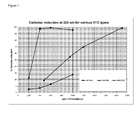
- the UV reduction was calculated as (A(carbotac)-A(filtrate)/A(carbotac))*100%. It will be understood that the Carbotac reduction is a measure to indicate the clay's effectiveness in the reduction of disturbing and detrimental substances such as pitch and stickies. The results obtained in Carbotac reduction are shown in Figure 1 (— ⁇ —).
- Example 2 This Example was carried out in a similar manner as Example 1, except that no HCT 3R 1 -OH was used but instead use was made of a HTC 3R 2 -OH (a HTC having 3R 2 stacking and interlayers which comprise hydroxide, see e.g. WO 2004/046464 ).
- the HTC 3R 2 -OH was prepared according to the procedure described in Example 2 of US 6,468,488 . The results obtained in terms of Carbotac reduction are shown in Figure 1 (— ⁇ —).
- Example 2 was carried out in a similar manner as Example 1, except that no HCT 3R 1 -OH was used but instead use was made of a HTC 3R 1 -CO 3 (a commercial sample of Alcamizer 1, ex Kisuma Chemicals BV, a HTC having 3R 1 stacking and interlayers which comprise carbonate, see e.g. WO 2004/046464 ).
- the results obtained in terms of Carbotac reduction are shown in Figure 1 (— ⁇ —).
Landscapes
- Chemical & Material Sciences (AREA)
- Dispersion Chemistry (AREA)
- Inorganic Chemistry (AREA)
- Paper (AREA)
Priority Applications (1)
| Application Number | Priority Date | Filing Date | Title |
|---|---|---|---|
| EP10167860A EP2402503A1 (de) | 2010-06-30 | 2010-06-30 | Prozess zur Herstellung eines Zelluloseproduktes |
Applications Claiming Priority (1)
| Application Number | Priority Date | Filing Date | Title |
|---|---|---|---|
| EP10167860A EP2402503A1 (de) | 2010-06-30 | 2010-06-30 | Prozess zur Herstellung eines Zelluloseproduktes |
Publications (1)
| Publication Number | Publication Date |
|---|---|
| EP2402503A1 true EP2402503A1 (de) | 2012-01-04 |
Family
ID=42985204
Family Applications (1)
| Application Number | Title | Priority Date | Filing Date |
|---|---|---|---|
| EP10167860A Withdrawn EP2402503A1 (de) | 2010-06-30 | 2010-06-30 | Prozess zur Herstellung eines Zelluloseproduktes |
Country Status (1)
| Country | Link |
|---|---|
| EP (1) | EP2402503A1 (de) |
Cited By (1)
| Publication number | Priority date | Publication date | Assignee | Title |
|---|---|---|---|---|
| KR20150103146A (ko) * | 2012-12-28 | 2015-09-09 | 날코 컴퍼니 | 제지 공정에서 유기 증착 제어를 위한 음이온성의 친지질성 글리세롤-기반 폴리머 |
Citations (37)
| Publication number | Priority date | Publication date | Assignee | Title |
|---|---|---|---|---|
| US4070236A (en) | 1974-11-15 | 1978-01-24 | Sandoz Ltd. | Paper manufacture with improved retention agents |
| US4388150A (en) | 1980-05-28 | 1983-06-14 | Eka Aktiebolag | Papermaking and products made thereby |
| JPS6094687A (ja) | 1983-10-28 | 1985-05-27 | 栗田工業株式会社 | 製紙用ピツチ吸着剤 |
| US4753710A (en) | 1986-01-29 | 1988-06-28 | Allied Colloids Limited | Production of paper and paperboard |
| WO1989003863A1 (en) * | 1987-10-19 | 1989-05-05 | J.M. Huber Corporation | Cationic clays and uses in paper and paints |
| US4927498A (en) | 1988-01-13 | 1990-05-22 | E. I. Du Pont De Nemours And Company | Retention and drainage aid for papermaking |
| US4954220A (en) | 1988-09-16 | 1990-09-04 | E. I. Du Pont De Nemours And Company | Polysilicate microgels as retention/drainage aids in papermaking |
| US4961825A (en) | 1984-06-07 | 1990-10-09 | Eka Nobel Ab | Papermaking process |
| US4980025A (en) | 1985-04-03 | 1990-12-25 | Eka Nobel Ab | Papermaking process |
| US5071512A (en) | 1988-06-24 | 1991-12-10 | Delta Chemicals, Inc. | Paper making using hectorite and cationic starch |
| US5098520A (en) | 1991-01-25 | 1992-03-24 | Nalco Chemcial Company | Papermaking process with improved retention and drainage |
| US5127994A (en) | 1988-05-25 | 1992-07-07 | Eka Nobel Ab | Process for the production of paper |
| US5176891A (en) | 1988-01-13 | 1993-01-05 | Eka Chemicals, Inc. | Polyaluminosilicate process |
| US5185062A (en) | 1991-01-25 | 1993-02-09 | Nalco Chemical Company | Papermaking process with improved retention and drainage |
| US5368833A (en) | 1989-11-09 | 1994-11-29 | Eka Nobel Ab | Silica sols having high surface area |
| WO1995021295A1 (en) | 1994-02-04 | 1995-08-10 | Allied Colloids Limited | Process of making paper |
| WO1995021296A1 (en) | 1994-02-04 | 1995-08-10 | Allied Colloids Limited | Process of making paper |
| US5447604A (en) | 1989-11-09 | 1995-09-05 | Eka Nobel Ab | Silica sols, a process for the production of silica sols and use of the sols |
| US5470435A (en) | 1994-03-14 | 1995-11-28 | E. I. Du Pont De Nemours And Company | Process for preparing water soluble polyaluminosilicates |
| US5534057A (en) * | 1995-01-13 | 1996-07-09 | J. M. Huber Corporation | Process for treating kaolin clays for pitch control and the treated clays |
| US5543014A (en) | 1994-03-14 | 1996-08-06 | E. I. Du Pont De Nemours And Company | Process for preparing water soluble polyaluminosilicates |
| US5571494A (en) | 1995-01-20 | 1996-11-05 | J. M. Huber Corporation | Temperature-activated polysilicic acids |
| US5573674A (en) | 1995-10-27 | 1996-11-12 | General Chemical Corporation | Activated silica sol |
| US5584966A (en) | 1994-04-18 | 1996-12-17 | E. I. Du Pont De Nemours And Company | Paper formation |
| US5603805A (en) | 1992-08-31 | 1997-02-18 | Eka Nobel, Ab | Silica sols and use of the sols |
| US5607552A (en) | 1992-08-31 | 1997-03-04 | Eka Nobel, Ab | Aqueous suspensions of colloidal particles, preparation and use of the suspensions |
| US5755930A (en) | 1994-02-04 | 1998-05-26 | Allied Colloids Limited | Production of filled paper and compositions for use in this |
| US5858174A (en) | 1995-07-07 | 1999-01-12 | Eka Chemicals Ab | Process for the production of paper |
| WO1999055965A1 (en) | 1998-04-27 | 1999-11-04 | Akzo Nobel N.V. | A process for the production of paper |
| WO1999067310A1 (en) | 1998-06-24 | 1999-12-29 | Akzo Nobel N.V. | Ionic polyurethanes |
| WO2000049227A1 (en) | 1997-11-24 | 2000-08-24 | Nalco Chemical Company | Selective retention of filling components and improved control of sheet properties by enhancing additive pretreatment |
| WO2002012626A1 (en) | 2000-08-07 | 2002-02-14 | Akzo Nobel N.V. | A process for the production of paper |
| US6468488B1 (en) | 1999-08-11 | 2002-10-22 | Akzo Nobel N.V. | Mg-Al anionic clay having 3R2 stacking |
| US6593265B2 (en) | 2001-02-09 | 2003-07-15 | Akzo Nobel N.V. | Process for the preparation of anionic clay |
| WO2004046464A1 (en) | 2002-11-19 | 2004-06-03 | Akzo Nobel N.V. | Cellulosic product and process for its production |
| US20040140074A1 (en) * | 2002-11-19 | 2004-07-22 | Marek Tokarz | Cellulosic product and process for its production |
| WO2005111306A1 (en) * | 2004-05-18 | 2005-11-24 | Akzo Nobel N.V. | Board comprising hydrotalcite |
-
2010
- 2010-06-30 EP EP10167860A patent/EP2402503A1/de not_active Withdrawn
Patent Citations (40)
| Publication number | Priority date | Publication date | Assignee | Title |
|---|---|---|---|---|
| US4070236A (en) | 1974-11-15 | 1978-01-24 | Sandoz Ltd. | Paper manufacture with improved retention agents |
| US4388150A (en) | 1980-05-28 | 1983-06-14 | Eka Aktiebolag | Papermaking and products made thereby |
| JPS6094687A (ja) | 1983-10-28 | 1985-05-27 | 栗田工業株式会社 | 製紙用ピツチ吸着剤 |
| US4961825A (en) | 1984-06-07 | 1990-10-09 | Eka Nobel Ab | Papermaking process |
| US4980025A (en) | 1985-04-03 | 1990-12-25 | Eka Nobel Ab | Papermaking process |
| US4753710A (en) | 1986-01-29 | 1988-06-28 | Allied Colloids Limited | Production of paper and paperboard |
| WO1989003863A1 (en) * | 1987-10-19 | 1989-05-05 | J.M. Huber Corporation | Cationic clays and uses in paper and paints |
| US4927498A (en) | 1988-01-13 | 1990-05-22 | E. I. Du Pont De Nemours And Company | Retention and drainage aid for papermaking |
| US5176891A (en) | 1988-01-13 | 1993-01-05 | Eka Chemicals, Inc. | Polyaluminosilicate process |
| US5127994A (en) | 1988-05-25 | 1992-07-07 | Eka Nobel Ab | Process for the production of paper |
| US5071512A (en) | 1988-06-24 | 1991-12-10 | Delta Chemicals, Inc. | Paper making using hectorite and cationic starch |
| US4954220A (en) | 1988-09-16 | 1990-09-04 | E. I. Du Pont De Nemours And Company | Polysilicate microgels as retention/drainage aids in papermaking |
| US5368833A (en) | 1989-11-09 | 1994-11-29 | Eka Nobel Ab | Silica sols having high surface area |
| US5447604A (en) | 1989-11-09 | 1995-09-05 | Eka Nobel Ab | Silica sols, a process for the production of silica sols and use of the sols |
| US5098520A (en) | 1991-01-25 | 1992-03-24 | Nalco Chemcial Company | Papermaking process with improved retention and drainage |
| US5185062A (en) | 1991-01-25 | 1993-02-09 | Nalco Chemical Company | Papermaking process with improved retention and drainage |
| US5607552A (en) | 1992-08-31 | 1997-03-04 | Eka Nobel, Ab | Aqueous suspensions of colloidal particles, preparation and use of the suspensions |
| US5603805A (en) | 1992-08-31 | 1997-02-18 | Eka Nobel, Ab | Silica sols and use of the sols |
| WO1995021295A1 (en) | 1994-02-04 | 1995-08-10 | Allied Colloids Limited | Process of making paper |
| WO1995021296A1 (en) | 1994-02-04 | 1995-08-10 | Allied Colloids Limited | Process of making paper |
| US5755930A (en) | 1994-02-04 | 1998-05-26 | Allied Colloids Limited | Production of filled paper and compositions for use in this |
| US5543014A (en) | 1994-03-14 | 1996-08-06 | E. I. Du Pont De Nemours And Company | Process for preparing water soluble polyaluminosilicates |
| US5470435A (en) | 1994-03-14 | 1995-11-28 | E. I. Du Pont De Nemours And Company | Process for preparing water soluble polyaluminosilicates |
| US5584966A (en) | 1994-04-18 | 1996-12-17 | E. I. Du Pont De Nemours And Company | Paper formation |
| US5534057A (en) * | 1995-01-13 | 1996-07-09 | J. M. Huber Corporation | Process for treating kaolin clays for pitch control and the treated clays |
| US5571494A (en) | 1995-01-20 | 1996-11-05 | J. M. Huber Corporation | Temperature-activated polysilicic acids |
| US5688482A (en) | 1995-01-20 | 1997-11-18 | J. M. Huber Corporation | Temperature-activated polysilicic acids and their use in paper production processes |
| US5707493A (en) | 1995-01-20 | 1998-01-13 | J.M. Huber Corporation | Temperature-activated polysilicic acids in paper production |
| US5858174A (en) | 1995-07-07 | 1999-01-12 | Eka Chemicals Ab | Process for the production of paper |
| US5573674A (en) | 1995-10-27 | 1996-11-12 | General Chemical Corporation | Activated silica sol |
| WO2000049227A1 (en) | 1997-11-24 | 2000-08-24 | Nalco Chemical Company | Selective retention of filling components and improved control of sheet properties by enhancing additive pretreatment |
| WO1999055965A1 (en) | 1998-04-27 | 1999-11-04 | Akzo Nobel N.V. | A process for the production of paper |
| WO1999055964A1 (en) | 1998-04-27 | 1999-11-04 | Akzo Nobel N.V. | A process for the production of paper |
| WO1999067310A1 (en) | 1998-06-24 | 1999-12-29 | Akzo Nobel N.V. | Ionic polyurethanes |
| US6468488B1 (en) | 1999-08-11 | 2002-10-22 | Akzo Nobel N.V. | Mg-Al anionic clay having 3R2 stacking |
| WO2002012626A1 (en) | 2000-08-07 | 2002-02-14 | Akzo Nobel N.V. | A process for the production of paper |
| US6593265B2 (en) | 2001-02-09 | 2003-07-15 | Akzo Nobel N.V. | Process for the preparation of anionic clay |
| WO2004046464A1 (en) | 2002-11-19 | 2004-06-03 | Akzo Nobel N.V. | Cellulosic product and process for its production |
| US20040140074A1 (en) * | 2002-11-19 | 2004-07-22 | Marek Tokarz | Cellulosic product and process for its production |
| WO2005111306A1 (en) * | 2004-05-18 | 2005-11-24 | Akzo Nobel N.V. | Board comprising hydrotalcite |
Non-Patent Citations (3)
| Title |
|---|
| G. W. SEARS, ANALYTICAL CHEMISTRY, vol. 28, no. 12, 1956, pages 1981 - 1983 |
| ILER; DALTON, J. PHYS. CHEM., vol. 60, 1956, pages 955 - 957 |
| S.P. NEWMAN; W. JONES; P. O'CONNOR; D. STAMIRES: "Synthesis of the 3R2 polytype of a hydrotalcite-like mineral", J. MATER. CHEM., vol. 72, 2002, pages 153 - 155 |
Cited By (1)
| Publication number | Priority date | Publication date | Assignee | Title |
|---|---|---|---|---|
| KR20150103146A (ko) * | 2012-12-28 | 2015-09-09 | 날코 컴퍼니 | 제지 공정에서 유기 증착 제어를 위한 음이온성의 친지질성 글리세롤-기반 폴리머 |
Similar Documents
| Publication | Publication Date | Title |
|---|---|---|
| US20080011438A1 (en) | Cellulosic product and process for its production | |
| AU748735B2 (en) | A process for the production of paper | |
| JP4518492B2 (ja) | 紙、厚紙、およびボール紙の製造方法 | |
| AU771731B2 (en) | Cellulose products comprising silicate and processes for preparing the same | |
| EP2122051B1 (de) | Verfahren zur herstellung von cellulosehaltigen produkten | |
| AU2010266518B2 (en) | Papermaking and products made thereby with high solids glyoxalated-polyacrylamide and silicon-containing microparticle | |
| RU2300597C2 (ru) | Целлюлозный продукт и способ его получения | |
| NZ238803A (en) | Production of paper by adding to mechanical stock a colloidal siliceous material and a water-soluble anionic polymer then a non-ionic high m.w. polyelectrolyte | |
| EP4623154A1 (de) | Wasserlösliche terpolymere mit amphoterer emulsion, verfahren zu ihrer herstellung und verfahren zu ihrer verwendung als retentions- und entwässerungshilfsmittel | |
| US8052841B2 (en) | Process for manufacturing of paper | |
| EP1105573A1 (de) | Ein mikroteilchensystem für papierherstellungsverfahren | |
| EP2402503A1 (de) | Prozess zur Herstellung eines Zelluloseproduktes | |
| AU2003276798B2 (en) | Cellulosic product and process for its production | |
| HK1183073A (en) | Process for manufacturing paper or board | |
| HK1183072A (zh) | 酸性水在造纸中的用途 | |
| NO893578L (no) | Metode for aa redusere bek ved masse- og papirfremstilling. |
Legal Events
| Date | Code | Title | Description |
|---|---|---|---|
| AK | Designated contracting states |
Kind code of ref document: A1 Designated state(s): AL AT BE BG CH CY CZ DE DK EE ES FI FR GB GR HR HU IE IS IT LI LT LU LV MC MK MT NL NO PL PT RO SE SI SK SM TR |
|
| AX | Request for extension of the european patent |
Extension state: BA ME RS |
|
| PUAI | Public reference made under article 153(3) epc to a published international application that has entered the european phase |
Free format text: ORIGINAL CODE: 0009012 |
|
| STAA | Information on the status of an ep patent application or granted ep patent |
Free format text: STATUS: THE APPLICATION HAS BEEN WITHDRAWN |
|
| 18W | Application withdrawn |
Effective date: 20120109 |