EP2401689B1 - Verbesserte diagnose von leberfibrose oder leberzirrhose - Google Patents
Verbesserte diagnose von leberfibrose oder leberzirrhose Download PDFInfo
- Publication number
- EP2401689B1 EP2401689B1 EP10707497.3A EP10707497A EP2401689B1 EP 2401689 B1 EP2401689 B1 EP 2401689B1 EP 10707497 A EP10707497 A EP 10707497A EP 2401689 B1 EP2401689 B1 EP 2401689B1
- Authority
- EP
- European Patent Office
- Prior art keywords
- fibrosis
- fibrometer
- lse
- liver
- index
- Prior art date
- Legal status (The legal status is an assumption and is not a legal conclusion. Google has not performed a legal analysis and makes no representation as to the accuracy of the status listed.)
- Active
Links
Images


Classifications
-
- A—HUMAN NECESSITIES
- A61—MEDICAL OR VETERINARY SCIENCE; HYGIENE
- A61B—DIAGNOSIS; SURGERY; IDENTIFICATION
- A61B5/00—Measuring for diagnostic purposes; Identification of persons
- A61B5/41—Detecting, measuring or recording for evaluating the immune or lymphatic systems
- A61B5/414—Evaluating particular organs or parts of the immune or lymphatic systems
- A61B5/416—Evaluating particular organs or parts of the immune or lymphatic systems the spleen
-
- A—HUMAN NECESSITIES
- A61—MEDICAL OR VETERINARY SCIENCE; HYGIENE
- A61B—DIAGNOSIS; SURGERY; IDENTIFICATION
- A61B5/00—Measuring for diagnostic purposes; Identification of persons
- A61B5/42—Detecting, measuring or recording for evaluating the gastrointestinal, the endocrine or the exocrine systems
- A61B5/4222—Evaluating particular parts, e.g. particular organs
- A61B5/4244—Evaluating particular parts, e.g. particular organs liver
-
- G—PHYSICS
- G16—INFORMATION AND COMMUNICATION TECHNOLOGY [ICT] SPECIALLY ADAPTED FOR SPECIFIC APPLICATION FIELDS
- G16H—HEALTHCARE INFORMATICS, i.e. INFORMATION AND COMMUNICATION TECHNOLOGY [ICT] SPECIALLY ADAPTED FOR THE HANDLING OR PROCESSING OF MEDICAL OR HEALTHCARE DATA
- G16H50/00—ICT specially adapted for medical diagnosis, medical simulation or medical data mining; ICT specially adapted for detecting, monitoring or modelling epidemics or pandemics
- G16H50/20—ICT specially adapted for medical diagnosis, medical simulation or medical data mining; ICT specially adapted for detecting, monitoring or modelling epidemics or pandemics for computer-aided diagnosis, e.g. based on medical expert systems
-
- A—HUMAN NECESSITIES
- A61—MEDICAL OR VETERINARY SCIENCE; HYGIENE
- A61B—DIAGNOSIS; SURGERY; IDENTIFICATION
- A61B8/00—Diagnosis using ultrasonic, sonic or infrasonic waves
- A61B8/08—Clinical applications
-
- A—HUMAN NECESSITIES
- A61—MEDICAL OR VETERINARY SCIENCE; HYGIENE
- A61B—DIAGNOSIS; SURGERY; IDENTIFICATION
- A61B8/00—Diagnosis using ultrasonic, sonic or infrasonic waves
- A61B8/48—Diagnostic techniques
- A61B8/485—Diagnostic techniques involving measuring strain or elastic properties
Definitions
- This invention relates to an improved diagnosis method of liver fibrosis or cirrhosis, through combination of at least one FibroMeter and at least one Fibroscan, in an individual, especially in an individual suffering from a condition involving significant or severe fibrosis or cirrhosis.
- the method of the invention leads to scores called SF or C-index and optionally to combination thereof.
- Liver biopsy is the historical means in order to diagnose liver disease in patients. However, since liver biopsy is invasive and expensive, non-invasive diagnosis of liver fibrosis has gained considerable attention over the last 10 years as an alternative to liver biopsy.
- the first generation of simple blood fibrosis tests combined common indirect blood markers into a simple ratio, like APRI (5) or more recently FIB-4 (6).
- the second generation of calculated tests combined indirect and/or direct fibrosis markers by logistic regression, like Fibrotest (7), ELF score (8), FibroMeter (9), Fibrospect (10), and Hepascore (11).
- WO03073822 describes a non-invasive method for the diagnosis of liver disease and its severity, by measuring levels of specific variables, including biological variables and clinical variables, and combining said variables into mathematical functions to provide a score, often called "score of fibrosis".
- the method of WO03073822 is also useful for monitoring the efficacy of a treatment of a liver disease or condition.
- a further non-invasive diagnosis method of liver fibrosis is to use physical methods, for example ultrasonographic elastometry (12) in order to collect data useful for the diagnostic of fibrosis, such as for example " Liver Stiffness Evaluation” (LSE).
- ultrasonographic elastometry (12)
- LSE Liver Stiffness Evaluation
- liver biopsy has been combined into sequential algorithms in order to increase the diagnostic accuracy and limit the rate of liver biopsy (13-16).
- These sequential algorithms are usually based on a stepwise diagnosis including blood tests as a first step, followed by liver biopsy for the remaining grey zone of indeterminate cases.
- clinical applicability of these multiple-step sequential algorithms is difficult.
- liver biopsy is still required in 20 to 50% of patients.
- the diagnostic target of the present invention can be:
- liver fibrosis is an on-going process, and that there is a important medical need for continuing to improve the diagnosis of liver fibrosis and to improve the monitoring of the treatment of a liver disease or condition. Moreover, due to price and invasiveness of biopsy, there is still a need to reduce liver biopsy requirement.
- the diagnostic methods are appreciated by their performance, i.e. their ability to correctly classify the tested individuals, as to their fibrosis development.
- the Applicant surprisingly realized that combining scores from blood tests and data issued from imaging means, resulted in a score having an incredibly high diagnostic performance (accuracy).
- the Applicant compared for the first time the diagnostic accuracy of imaging data, such as for example liver stiffness evaluation, and 5 blood tests, and compared their accuracy to the accuracy of their synchronous combination, either in a large population of patients with various causes of liver diseases or conditions (see example 2) or in an homogeneous population in terms of cause, such as for example patients suffering from chronic hepatitis C (see example 1).
- LSE Liver Stiffness Evaluation
- the Applicant has found that the combination of diagnostic information from FibroMeter and data from FibroscanTM, i.e., LSE data, provided several advantages and unexpected accurate results for the diagnosis of liver fibrosis, from significant fibrosis to severe fibrosis and cirrhosis.
- the Applicant has also set up a first algorithm, called Angers SF-algorithm, combining scores from blood test and Fibroscan data, appeared to be, at the date of priority of the present application, the best solution among known alternatives to the Applicant, such as high correct classification and low liver biopsy requirement, reflected by a low liver biopsy/accuracy ratio.
- Angers SF-algorithm a first algorithm
- the present invention thus relates to a non-invasive method leading to a score obtained by a binary logistic regression, combining FibroMeter score and Fibroscan data for assessing, with a high accuracy, the presence or the severity of fibrosis in an individual.
- the synchronous combination set forth in the invention results in the accumulation of FibroMeter and Fibroscan advantages, in the subtraction of their drawbacks, thereby significantly increasing the single diagnostic accuracy for liver fibrosis.
- the method of the invention includes repeating several times, at least twice, the method, in order to obtain at least two scores.
- the method of the invention may also include, in a further step, the combination of at least two scores as described hereabove (i.e. two scores obtained by a binary logistic regression, combining FibroMeter score and Fibroscan, data), said combination being implemented in an algorithm based on the diagnostic reliable intervals (see for example table 5 of example 1). Carrying out this further step leads to three new scores/classifications called F ⁇ 2 index, F ⁇ 3 index, F4 index) for the non-invasive diagnosis of fibrosis. Implementing this further step is of high industrial interest, and results in extended accuracy.
- the invention also relates to a method wherein the combination through a mathematical function, of at least one FibroMeter and of at least one data issued from Fibroscan, is performed at least twice and the at least two resulting scores are combined in an algorithm based on the diagnostic reliable intervals.
- the method of the invention improves the diagnostic accuracy and markedly reduces the biopsy requirement in algorithms.
- This invention therefore relates to a method of diagnosing the presence and/or severity of a liver pathology and/or of monitoring the effectiveness of a curative treatment against a liver pathology in an individual, comprising the combination, of at least one blood test and at least one data issued from a physical method of diagnosing liver fibrosis, i.e., ultrasonographic elastometry (like Fibroscan or ARFI) data, said combination being performed through a mathematical function.
- the medical imaging data are LSE data.
- the mathematical function is known to one skilled in the art.
- the mathematical function preferably is a binary logistic regression.
- the method of the invention includes:
- the combination is a synchronous combination.
- Synchronous combination is a one-step combination of data of step a) and data of step b) into a new score usually by binary logistic regression.
- Performance of synchronous combination is carried out as follows: the results of the FibroMeter and the data from FibroscanTM, such as for example LSE data, are recorded in a first step. Then, their values are computerized to obtain the combined score.
- the Applicant noticed that, unexpectedly, the score resulting from the implementation of the method of the invention, attesting the presence or the severity of a liver disease or condition, resulting from the synchronous combination of a FibroMeter and LSE data from a physical method, obtained through Fibroscan, had an improved accuracy and, consequently, decreased the biopsy requirement in sequential algorithms (for diagnosis of significant fibrosis: biopsy requirement ⁇ 20%, for diagnosis of cirrhosis: biopsy requirement ⁇ 10%).
- the accuracy of the method of the invention is higher than 75%, preferably 80 to 99%, more preferably 85 to 95%, even more preferably around 90%. The accuracy means the number of patients correctly classified.
- the liver disease or condition is significant porto-septal fibrosis, severe porto-septal fibrosis, centrolobular fibrosis, cirrhosis, persinusoidal fibrosis, the fibrosis being from alcoholic or non-alcoholic origin.
- the individual is a patient with chronic Hepatitis C.
- the blood test is a FibroMeter score.
- FIBROMETERTM is a family of blood tests the content of which depends on the cause of chronic liver disease and the diagnostic target with details in the following table: FibroMeter Age Sex A2M AH PI PLT AST Urea GGT Bili ALT Fer Glu F virus x x x x x x x x x x AOF virus x x x x x x F alcohol x x x x AOF alcohol x x x x X A2M : alpha2-macroglobulin, HA: hyaluronic acid, PI: prothrombin index, PLT;platelets, Bili: bilirubin, Fer: ferritin, Glu: glucose ; F fibrosis score (Metavir), AOF : area of fibrosis, NAFLD : non alcoholic fatty liver disease
- the data are LSE data.
- the data are issued from a Fibroscan.
- This score corresponds to the p logit wherein p is the probability of presence of a significant or severe fibrosis, or of cirrhosis.
- a lesion for example significant fibrosis
- a diagnostic threshold generally equal to 0,5 or equal to maximal Youden index (Se + Spe -1) or equal to maximal diagnostic performance (unless otherwise specified).
- coefficients that may be used in the binary regression of the method of the invention are the following: 3.9066 FM + 0.1870 FS - 2.8345, Where FM: FibroMeter value, FS: Fibroscan value.
- coefficients that may be used in the binary regression of the method of the invention are the following: 3.6128 FM + 0.1484 FS - 6.4999
- coefficients that may be used in the binary regression of the method of the invention are the following: 3.3135 FM + 0.1377 FS - 4.2485.
- FM FibroMeter value
- FS Fibroscan value.
- beta coefficients with 95% confidence intervals specifically observed in chronic viral hepatitis C may be for example: Diagnostic target FibroMeter Fibroscan Constant Significant fibrosis (Metavir ⁇ F2) 3.90657157 (2.73122696 ; 5.08191618) 0.18702583 (0.08912122 ; 0.28493045) -2.83445806 (-3.68641133 ; - 1.98250480) Severe fibrosis (Metavir ⁇ F3) 3.31347460 (2.09369314 ; 4.53325606) 0.13767514 (0.08253199 ; 0.19281830) 4.24854774 (-5.18908296 ; - 3.30801253) Cirrhosis (Metavir F4) 3.61284547 (1.49920710 ; 5.72648384 0.14837243 0.09607115 ; 0.20067372) -6.49993316 (-8.28162434 ; -4.71824198) wherein
- the blood score is the FibroMeter score and the physical method data are LSE data through ultrasonographic elastometry, i.e., Fibroscan.
- the FibroMeter was always identified as the first independent predictor of significant fibrosis despite a slightly lower AUROC than LSE. Indeed, the FibroMeter provided the highest diagnostic accuracy in logistic regression. In addition, the FibroMeter might be the most accurate and robust among common blood tests (18).
- the synchronous combination of FibroMeter and LSE was the most accurate for the diagnosis of significant fibrosis as well as for cirrhosis.
- the presence or severity of liver disease or condition is diagnosed in two steps, first step being the FibroMeter blood test and second step being collecting data from a physical method, preferably LSE data, and wherein the combination of FibroMeter blood test and said data is performed through logistic regression.
- the liver biopsy/accuracy ratio may range from 0.10 for cirrhosis to 0.22 for clinically significant fibrosis ; whereas this ratio ranges from 0.25 to 0.51 in classical algorithms without synchronous combination.
- the method of the invention leads to a significant fibrosis score, called significant fibrosis-index (SF-index).
- SF-index significant fibrosis-index
- This score was set up by using results from experimentations in a group of patients with both blood tests (preferably FibroMeter) and imaging data (preferably LSE data).
- the method of the invention leads to a cirrhosis score, called C-index implementing the method of the invention, for the diagnosis of patients with cirrhosis.
- the Applicant noticed that the method of the invention provided a significantly higher AUROC than the blood test or physical data, for example LSE, alone, especially for the diagnosis of significant fibrosis, and a gain in predictive values for cirrhosis (see for example Table 4 of Example 2).
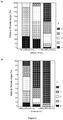
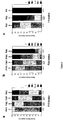
- SF-index inherited the lowest misclassification rate provided by each single test in each fibrosis stage: the blood test in F0/1 stages, and LSE in F ⁇ 2 stages (see for example Figure 1 ). Moreover, the SF-index resolved 66% of discordant cases between the blood test and LSE (see for example Table 5 of Example 2). Finally, SF-index significantly increased the rate of patients included in the interval of ⁇ 90% predictive values (see for example Table 6 of Example 2). Therefore, SF-index induced a highly significant lower rate of Liver Biopsy than the blood test or LSE in sequential algorithm. Moreover, the three simple intervals of reliable diagnosis determined by SF-index (F0/1, F1 ⁇ 1, and F ⁇ 2) provided a non-invasive diagnosis in 100% of the population with 90.6% accuracy without liver biopsy requirement (see for example Figure 3a ).
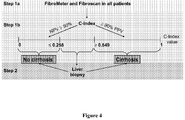
- the C-index although it afforded no apparent significant gain in accuracy for cirrhosis diagnosis compared to LSE alone (see for example Table 3, 4 of Example 2 ), it did provide two advantages: 1) it resolved 68.4% of discordant cases between LSE and the blood test (see for example Table 5 of Example 2 ), and 2) the patient rate with ⁇ 90% predictive values was significantly higher than with LSE or blood test alone (see for example Table 6 of Example 2 ), thus resulting in a very low rate of Liver Biopsy required in the algorithm (9%). Finally, the C-index allowed for a non-invasive diagnosis of cirrhosis in 100% of patients, with 90.3% accuracy, by considering three intervals of reliable individual diagnosis: no cirrhosis, F ⁇ 2, and cirrhosis, without liver biopsy requirement.
- the Applicant showed that the Padova algorithm had a significantly higher diagnostic accuracy for significant fibrosis than the Bordeaux and Angers algorithms.
- this accuracy was mainly due to the high rate of required Liver Biopsy.
- the rates of required Liver Biopsy and of correctly classified patients among those not requiring Liver Biopsy are more appropriate descriptors than overall diagnostic accuracy.
- the Angers algorithm provided the best solution between high diagnostic accuracy (91.9%) and the lowest rate of required Liver Biopsy (20.2%).
- a part of apparently misclassified patients provided by an algorithm are in fact attributable to the misclassification of Liver Biopsy used as the reference (sampling error and observer variability).
- the method of the invention significantly increases the diagnostic accuracy of tests for significant fibrosis, and increases the reliability of individual diagnosis via predictive values for significant fibrosis and cirrhosis.
- the combination resolves discordant results between non-invasive tests and reduces non-concordant results with liver biopsy (LB). It also decreases the LB requirement in the traditional diagnosis of significant fibrosis or cirrhosis when they are the unique binary diagnostic targets.
- the new method of reliable individual diagnosis which adds an intermediate diagnostic target to the previous binary diagnostic target, suppresses or considerably diminishes any LB requirement.
- a simple sequential algorithm including the synchronous blood test score + imaging data combination, provided high diagnostic accuracy while lowering LB requirement, notably to less than 10% for cirrhosis diagnosis.
- the method of the invention may also include, in a further step, the combination of a SF-index and a C-index in an algorithm based on the diagnostic reliable intervals (see for example table 5 of example 1).
- liver fibrosis tests were performed: Fibroscan (FS), Fibrotest, FibroMeter (FM, for significant fibrosis or cirrhosis), Hepascore, Fib4, and APRI.
- FS Fibroscan
- FM FibroMeter
- Hepascore Fib4
- APRI APRI
- Reference for liver fibrosis was Metavir F staging. Fibrosis tests independently associated with significant fibrosis (F ⁇ 2) or cirrhosis (F4) were identified by stepwise binary logistic regression repeated on 1000 bootstrap samples of 349 patients.
- the exploratory set included 349 patients. 132 patients from the 512 of the Fibrostar study were already included in the exploratory set. We thus removed these patients from the validation set which finally included 380 patients.
- the characteristics of both exploratory and validation sets are detailed in the Table 1 of Example 1. Among the 2 groups, 93.5% of liver biopsy were considered as reliable.
- Cirrhosis - The fibrosis tests most frequently selected by the 1000 bootstrap multivariate analyses were also LSE and FibroMeter ( Table 2 of Example 1 ). The regression score of F4-index including these 2 fibrosis tests and specifically designed for the diagnosis of cirrhosis was: 3.6128 FibroMeter + 0.1484 LSE result - 6.4999. F4-index had a higher AUROC than FM and LSE, but the difference was significant only with FibroMeter ( Table 3 of Example 1 ).
- F ⁇ 3-index provided 4 IRD (F ⁇ 2, F2 ⁇ 1, F ⁇ 2, F ⁇ 3; Figure 1b ) which well classified 91.7% of patients without any liver biopsy performed.
- the first classification was derived from both F ⁇ 2- and F ⁇ 3-indexes used with their IRD ( Table 5 of Example 1 ).
- Classification A included 6 classes: F0/1, F1/2, F2 ⁇ 1, F2/3, F ⁇ 2, and F ⁇ 3. It provided 86.2% diagnostic accuracy in the exploratory set.
- the second classification was derived from the IRD of F ⁇ 2- and F4 indexes ( Table 5 of Example 1 ).
- the third classification was derived from the IRD for significant fibrosis of FibroMeter, and those for severe fibrosis of LSE ( Table 5 of Example 1 ). Results of FibroMeter and LSE RDI were discordant in 2 patients which had thus undetermined diagnosis ( Table 5 of Example 1 ).
- Example 1 Patients characteristics at inclusion All Set p Exploratory Validation Patients (n) 729 349 380 - Male sex (%) 61.3 60.2 62.4 0.531 Age (years) 51.7 ⁇ 11.2 52.1 ⁇ 11.2 51.3 ⁇ 11.2 0.347 Metavir F (%): ⁇ 10 -3 - 0 4.0 1.4 6.3 - 1 37.7 30.7 44.2 - 2 25.8 35.5 16.8 - 3 17.6 20.6 14.7 - 4 15.0 11.7 17.9 0.020 Significant fibrosis (%) 58.3 67.9 49.5 ⁇ 10 -3 Reliable biopsy (%) 93.5 92.6 94.2 0.391 LSE result (kPa) 10.0 ⁇ 7.9 9.9 ⁇ 8.1 10.1 ⁇ 7.7 0.755 IQR/median ⁇ 0.21 (%) 66.9 66.2 67.6 0.700 LSE: liver stiffness evaluation; kPa: kilopascal; IQR: interquartile range Table 2 of Example
- Stepwise binary logistic regressions were performed on 1000 bootstrap samples of 349 subjects from the exploratory set.
- the table depicts the number of times any fibrosis test was selected across the 1000 multivariate analyses. For each diagnostic target, LSE and FibroMeter were the mostly selected variables.
- Cut-offs for NPV ⁇ 90% and PPV ⁇ 90% were calculated in the exploratory set and tested in the validation set and the whole population.
- Cut-offs for NPV ⁇ 95% FibroMeter: ⁇ 0.757, Fibroscan: ⁇ 14.5, F4-index: ⁇ 0.244; cut-offs for PPV ⁇ 90%: Fibroscan: ⁇ 34.1, F4-index: ⁇ 0.817; Cut-offs for PPV ⁇ 95%: Fibroscan: ⁇ 35.6, F4-index: ⁇ 0.896.
- Example 1 Implementation of 3 new classifications for the non invasive diagnosis of fibrosis, derived from the interpretation of the interval of reliable diagnosis of several fibrosis tests (F ⁇ 2- and F ⁇ 3 indexes, F ⁇ 3- and F ⁇ 4 indexes, FibroMeter and Fibroscan).
- the new classifications are depicted in italic (into brackets: rate of well classified patients in each class of the new classification according to liver biopsy results). Grey cells correspond to discordant results.
- liver fibrosis evaluation was considered as reliable when biopsy length was ⁇ 15 mm and/or portal tract number ⁇ 8 (17).
- LSE FibroScan®, EchoSensTM, Paris, France
- LSE conditions were those recommended by the manufacturer, as detailed elsewhere (21, 22).
- LSE was stopped when 10 valid measurements were recorded.
- the LSE result was expressed in kPa and corresponded to the median of all valid measurements performed within the LSE. Interquartile range (kPa) was defined as previously described (21).
- diagnostic cut-off values of fibrosis tests were calculated according to the highest Youden index (sensitivity + specificity -1). This technique allows maximizing the diagnostic accuracy with equilibrium between a high sensitivity and a high specificity by selecting an appropriate diagnostic cut-off.
- the diagnostic cut-off is here the values of blood test or LSE that distinguishes the patients as having or not the diagnostic target (significant fibrosis or cirrhosis).
- AUROC receiver operating characteristic curve
- Sample size was determined to show a significant difference for the diagnosis of significant fibrosis between FM and synchronous combination in the exploratory population.
- ⁇ risk 0.05
- ⁇ risk 0.20
- significant fibrosis prevalence 0.70
- AUROC correlation 0.70
- a bilateral test the sample size was 159 patients for the following hypothesis of AUROC: FM: 0.84
- synchronous combination 0.90.
- the software programs used for statistical analyses were SPSS for Windows, version 11.5.1 (SPSS Inc., Chicago, IL, USA) and SAS 9.1 (SAS Institute Inc., Cary, NC, USA).
- the characteristics of the 390 patients are summarized in Table 1 of Example 2.
- Mean age of patients was 52.4 years, 67.9% were male, and 74.4% had significant fibrosis.
- 89.5% of patients had a liver biopsy considered as reliable.
- Liver Stiffness Evaluation failure occurred in 12 patients (overall failure rate: 3.1%).
- 332 had all 5 blood tests and LSE available.
- Table 1 of Example 2 Patient characteristics at inclusion.
- LSE AUROC was significantly higher than that of Hepascore, FIB-4, and APRI for the diagnosis of significant fibrosis, and was not significantly different from FibroMeter and Fibrotest AUROCs.
- Table 2 of Example 2 AUROCs of blood tests and liver stiffness evaluation (LSE) as a function of diagnostic target, in the 332 patients having all 5 blood tests and LSE available.
- SF-index AUROCs were not significantly different between groups A and B.
- SF-index AUROC was significantly higher than that of FibroMeter (FM) or Liver Stiffness Evaluation (LSE) in the whole population.
- Figure 1 shows that SF-index had the better performance profile: its misclassification rate was significantly lower than LSE in Metavir F ⁇ 1 stages and significantly lower than FM in Metavir F ⁇ 2 stages.
- Discordances between LSE and FM - Discordances between fibrosis tests for the diagnostic target were calculated according to the diagnostic cut-off determined by the highest Youden index.
- FM and LSE were concordant in 279 (73.0%) patients of whom 88.9% were correctly classified according to liver biopsy (F ⁇ 1: 77.0%, F ⁇ 2: 94.3%).
- FM and LSE were discordant in the 103 (27.0%) remaining patients of whom 68 (66.0%) were correctly classified by SF-index according to liver biopsy results (Table 5 of Example 2).
- SF-index correctly classified 316 (82.7%) patients and improved correct classification (i.e., discordances between FM and LSE resolved by SF-index) in 33 (8.6%) patients.
- New sequential algorithm - SF-index included significantly more patients than FM or LSE in the classical intervals of ⁇ 90% predictive values (see Appendix for precise definition), especially in the ⁇ 90% NPV interval (Table 6 of Example 2).
- SF-index with ⁇ 90% predictive values in 81.7% of patients and liver biopsy required in the remaining 18.3% of patients, a correct diagnosis of significant fibrosis based on liver biopsy was obtained in 91.9% of patients (Table 6 of Example 2).
- This two-step sequential algorithm was called Angers SF-algorithm ( Figure 2 ).
Landscapes
- Health & Medical Sciences (AREA)
- Life Sciences & Earth Sciences (AREA)
- Engineering & Computer Science (AREA)
- Biomedical Technology (AREA)
- Medical Informatics (AREA)
- Public Health (AREA)
- General Health & Medical Sciences (AREA)
- Pathology (AREA)
- Surgery (AREA)
- Molecular Biology (AREA)
- Gastroenterology & Hepatology (AREA)
- Veterinary Medicine (AREA)
- Animal Behavior & Ethology (AREA)
- Physics & Mathematics (AREA)
- Heart & Thoracic Surgery (AREA)
- Biophysics (AREA)
- Vascular Medicine (AREA)
- Immunology (AREA)
- Endocrinology (AREA)
- Physiology (AREA)
- Databases & Information Systems (AREA)
- Epidemiology (AREA)
- Data Mining & Analysis (AREA)
- Primary Health Care (AREA)
- Investigating Or Analysing Biological Materials (AREA)
- Ultra Sonic Daignosis Equipment (AREA)
Claims (6)
- Verfahren zum Diagnostizieren des Vorhandenseins und/oder der Schwere einer Leberpathologie und/oder zum Überwachen der Effektivität einer heilenden Behandlung einer Leberpathologie in einem Individuum, die zu einer Maßzahl führt, umfassend:a) Durchführen, aus einer Blutprobe eines Individuums, von mindestens einem FibroMeter,b) Durchführen von mindestens einem Fibroscan, um mindestens ein Datum der Lebersteifheitsbewertung (LSE) zu sammeln, undc) Kombinieren des mindestens einen FibroMeters und des mindestens einen LSE-Datums in einer mathematischen binären logistischen Regressionsfunktion mit der Formel p = 1/(1+exp(-a0-a1x1-a2x2)), wobei a0 eine Konstante ist, x1 und x2 unabhängige Variablen sind, die dem FibroMeter-Wert, erhalten in Schritt a), und dem Fibroscan-Wert, erhalten in Schritt b), entsprechen, und a1 und a2 Koeffizienten sind, assoziiert mit dem FibroMeter-Wert und dem Fibroscan-Wert, was zu einer neuen Maßzahl für die Diagnose des Vorhandenseins und/oder der Schwere einer Leberpathologie und/oder zum Überwachen der Effektivität einer heilenden Behandlung einer Leberpathologie in einem Individuum führt,wobei die Leberpathologie eine bedeutende porto-septale Fibrose, schwere porto-septale Fibrose, zentrolobuläre Fibrose, Zirrhose, perisinusoidale Fibrose ist, wobei die Fibrose nicht alkoholischen Ursprungs ist.
- Verfahren nach Anspruch 1, wobei die Leberpathologie eine bedeutende Fibrose ist, und wobei die Konstante a0 -2,8345 mit einem 95%-Vertrauensintervall von [-3,6864; -1,9825] ist, der Koeffizient a1, assoziiert mit dem FibroMeter-Wert, 3,9066 mit einem 95%-Vertrauensintervall von [2,7312; 5,0819] ist und der Koeffizient a2, assoziiert mit dem Fibroscan-Wert, 0,1870 mit einem 95%-Vertrauensintervall von [0,0891; 0,2849] ist.
- Verfahren nach Anspruch 1, wobei die Leberpathologie eine schwere Fibrose ist, und wobei die Konstante a0 -4,2485 mit einem 95%-Vertrauensintervall von [-5,1891; -3,3080] ist, der Koeffizient a1, assoziiert mit dem FibroMeter-Wert, 3,3135 mit einem 95%-Vertrauensintervall von [2,0937; 4,5332] ist und der Koeffizient a2, assoziiert mit dem Fibroscan-Wert, 0,1377 mit einem 95%-Vertrauensintervall von [0,0825; 0,1928] ist.
- Verfahren nach Anspruch 1, wobei die Leberpathologie eine Zirrhose ist, und wobei die Konstante a0 -6,4999 mit einem 95%-Vertrauensintervall von [-8,2816; -4,7182] ist, der Koeffizient a1, assoziiert mit dem FibroMeter-Wert, 3,6128 mit einem 95%-Vertrauensintervall von [1,4992; 5,7265] ist und der Koeffizient a2, assoziiert mit dem Fibroscan-Wert, 0,1484 mit einem 95%-Vertrauensintervall von [0,0961; 0,2007] ist.
- Verfahren nach einem der Ansprüche 1 bis 4, wobei das Individuum ein Patient mit chronischer Hepatitis C ist.
- Verfahren nach einem der Ansprüche 1 bis 5, wobei die Kombination durch eine mathematische binäre logistische Regressionsfunktion von mindestens einem FibroMeter und mindestens einem LSE-Datum, ausgegeben vom Fibroscan, mindestens zweimal durchgeführt wird, und die mindestens zwei sich ergebenden Maßzahlen in einem Algorithmus, basierend auf den verlässlichen diagnostischen Intervallen, kombiniert sind.
Applications Claiming Priority (2)
| Application Number | Priority Date | Filing Date | Title |
|---|---|---|---|
| US15565909P | 2009-02-26 | 2009-02-26 | |
| PCT/EP2010/052506 WO2010097472A1 (en) | 2009-02-26 | 2010-02-26 | Improved diagnosis of liver fibrosis or cirrhosis |
Publications (2)
| Publication Number | Publication Date |
|---|---|
| EP2401689A1 EP2401689A1 (de) | 2012-01-04 |
| EP2401689B1 true EP2401689B1 (de) | 2018-05-09 |
Family
ID=42167629
Family Applications (1)
| Application Number | Title | Priority Date | Filing Date |
|---|---|---|---|
| EP10707497.3A Active EP2401689B1 (de) | 2009-02-26 | 2010-02-26 | Verbesserte diagnose von leberfibrose oder leberzirrhose |
Country Status (7)
| Country | Link |
|---|---|
| US (1) | US9585613B2 (de) |
| EP (1) | EP2401689B1 (de) |
| JP (1) | JP5887141B2 (de) |
| CN (1) | CN102334122B (de) |
| BR (1) | BRPI1008488A2 (de) |
| ES (1) | ES2683631T3 (de) |
| WO (1) | WO2010097472A1 (de) |
Families Citing this family (30)
| Publication number | Priority date | Publication date | Assignee | Title |
|---|---|---|---|---|
| US20170082603A1 (en) * | 2009-02-26 | 2017-03-23 | Universite D'angers | Diagnosis of liver fibrosis or cirrhosis |
| EP2498195A1 (de) * | 2011-03-11 | 2012-09-12 | Centre Hospitalier Universitaire d'Angers | Nichtinvasives Verfahren zur Beurteilung des Vorhandenseins oder der Schwere von Leberfibrose basierend auf einer neuen detaillierten Klassifizierung |
| EP2727520B1 (de) * | 2011-06-29 | 2019-08-21 | Inner Mongolia Furui Medical Science Co., Ltd | Vorrichtung und system zum nachweis von leberfibrose |
| EP2600266A1 (de) * | 2011-12-02 | 2013-06-05 | Biopredictive | Verfahren zur Diagnose von fibrotischen Erkrankungen |
| JP6075973B2 (ja) * | 2012-06-04 | 2017-02-08 | 富士通株式会社 | 健康状態判定装置およびその作動方法 |
| EP2684513A1 (de) | 2012-07-13 | 2014-01-15 | Universite D'angers | Verfahren zur Bereitstellung zuverlässiger, nichtinvasiver Diagnosetests |
| CA2891281C (en) * | 2012-11-12 | 2023-11-28 | The Regents Of The University Of Colorado, A Body Corporate | Disease severity index for assessment of chronic liver disease and method for diagnosis of three distinct subtypes of primary sclerosing cholangitis |
| WO2014083480A1 (en) | 2012-11-30 | 2014-06-05 | Koninklijke Philips N.V. | Tissue surface roughness quantification based on image data and determination of a presence of disease based thereon |
| RU2016107170A (ru) * | 2013-08-02 | 2017-09-07 | Экоусенс | Неинвазивная система для вычисления достоверной, стандартизованной и полной оценки человека или животного |
| DE102013216362A1 (de) * | 2013-08-19 | 2015-02-19 | Siemens Healthcare Diagnostics Products Gmbh | Analyseverfahren zur Klassifikationsunterstützung |
| CN105581777B (zh) * | 2014-11-06 | 2018-08-28 | 香港中文大学 | 使用皮肤色度测量法筛选维生素d不足的方法 |
| FR3036943A1 (fr) * | 2015-06-02 | 2016-12-09 | Echosens | Dispositif non invasif de detection de lesion hepatique |
| WO2017210147A1 (en) | 2016-05-29 | 2017-12-07 | Wei Jia | Liver disease-related biomarkers and methods of use thereof |
| JP7007361B2 (ja) * | 2016-08-01 | 2022-01-24 | センター ホスピタリア ユニバーシタイア ダンガース | 複数標的線維症検査 |
| KR101914655B1 (ko) | 2017-01-24 | 2018-11-02 | 이화여자대학교 산학협력단 | 대장선종의 진단을 위한 정보제공방법 |
| EP3373012A1 (de) | 2017-03-07 | 2018-09-12 | Biopredictive | Verfahren zur diagnose von arzneimittelinduzierter leberverletzung |
| US12360113B2 (en) | 2017-10-16 | 2025-07-15 | Biopredictive | Method of prognosis and follow up of primary liver cancer |
| EP3470843A1 (de) | 2017-10-16 | 2019-04-17 | Biopredictive | Verfahren zur prognose von primärem leberkrebs |
| CN108185990B (zh) * | 2017-12-28 | 2020-11-20 | 杭州筹图科技有限公司 | 一种连接pt和cv的纤维间隔的识别方法及装置 |
| CN108378870B (zh) * | 2018-01-19 | 2020-10-02 | 无锡海斯凯尔医学技术有限公司 | 组织炎症活动度训练装置 |
| CN108309348B (zh) * | 2018-01-19 | 2020-10-30 | 无锡海斯凯尔医学技术有限公司 | 组织纤维化检测装置 |
| CN108095767B (zh) * | 2018-01-19 | 2020-10-02 | 无锡海斯凯尔医学技术有限公司 | 组织炎症活动度检测装置 |
| EP3599615A1 (de) * | 2018-07-27 | 2020-01-29 | Biopredictive | Verfahren zur diagnose von lebersteatose |
| CN110265139A (zh) * | 2019-02-01 | 2019-09-20 | 中国医药大学附设医院 | 肝纤维化评估模型、肝纤维化评估系统及其评估方法 |
| WO2021051335A1 (zh) * | 2019-09-19 | 2021-03-25 | 北京大学人民医院(北京大学第二临床医学院) | 丙肝肝纤维化特征信息提取方法及装置 |
| CN111783792B (zh) * | 2020-05-31 | 2023-11-28 | 浙江大学 | 一种提取b超图像显著纹理特征的方法及其应用 |
| KR102647669B1 (ko) * | 2020-07-31 | 2024-03-14 | 고려대학교 산학협력단 | Mr 기반의 비알코올 지방간염 진단을 위한 정보제공방법 |
| CN114300119A (zh) * | 2021-12-07 | 2022-04-08 | 泰州市人民医院 | 基于Multi-Cnn-Former的肝部疾病检测训练方法与系统 |
| CN115602319B (zh) * | 2022-12-07 | 2023-03-10 | 南方医科大学南方医院 | 一种无创肝纤维化评估装置 |
| GB2630963A (en) * | 2023-06-15 | 2024-12-18 | Intelligent Ultrasound Ltd | Apparatus for analysing medical images |
Family Cites Families (25)
| Publication number | Priority date | Publication date | Assignee | Title |
|---|---|---|---|---|
| US7668661B2 (en) * | 2000-04-28 | 2010-02-23 | Siemens Healthcare Diagnostics Inc. | Liver disease-related methods and systems |
| ES2288962T3 (es) | 2000-04-28 | 2008-02-01 | Bayer Aktiengesellschaft | Diagnostico de fibrosis hepatica con algoritmos de marcadores sericos. |
| ES2259291T3 (es) * | 2000-08-21 | 2006-10-01 | Assistance Publique, Hopitaux De Paris | Metodo de diagnostico de enfermedad fibrotica que utiliza marcadores bioquimicos. |
| US6631330B1 (en) * | 2000-08-21 | 2003-10-07 | Assistance Publique-Hopitaux De Paris (Ap-Hp) | Diagnosis method of inflammatory, fibrotic or cancerous disease using biochemical markers |
| US6986995B2 (en) | 2002-02-28 | 2006-01-17 | Prometheus Laboratories, Inc. | Methods of diagnosing liver fibrosis |
| EP1541090B1 (de) * | 2002-07-31 | 2019-05-15 | Hitachi, Ltd. | Ultraschalldiagnosesystem und verfahren zur anzeige von verzerrungsverteilung |
| ES2543160T3 (es) * | 2003-01-14 | 2015-08-17 | Vib Vzw | Un marcador de suero para medir fibrosis hepática |
| FR2870348B1 (fr) | 2004-05-14 | 2010-08-27 | Univ Angers | Methode pour diagnostiquer la presence et/ou la severite d'une pathologie hepathique chez un sujet |
| ES2303925T3 (es) * | 2004-08-12 | 2008-09-01 | F. Hoffmann-La Roche Ag | Metodo para diagnosticar la fibrosis hepatica. |
| ES2282780T3 (es) * | 2004-08-12 | 2007-10-16 | F. Hoffmann-La Roche Ag | Metodo para el diagnostico de la fibrosis hepatica. |
| US7860656B2 (en) * | 2005-02-03 | 2010-12-28 | Assistance Publique-Hopitaux De Paris (Ap-Hp) | Diagnosis method of hepatic steatosis using biochemical markers |
| US7856319B2 (en) * | 2005-02-03 | 2010-12-21 | Assistance Publique-Hopitaux De Paris (Ap-Hp) | Diagnosis method of alcoholic steato-hepatitis using biochemical markers |
| CN1841068A (zh) * | 2005-03-31 | 2006-10-04 | 深圳益生堂生物企业有限公司 | 肝纤维化相关血清标志物检测蛋白芯片 |
| US7307423B2 (en) * | 2005-05-05 | 2007-12-11 | Wisconsin A.Umni Research Foundation | Magnetic resonance elastography using multiple drivers |
| ES2288358B1 (es) * | 2005-07-01 | 2008-11-16 | Proyecto De Biomedicina Cima, S.L. | Marcadores de fibrosis. |
| EP1960004A4 (de) * | 2005-11-11 | 2011-04-20 | Breathid 2006 | Atemtestgerät und -verfahren |
| US7766833B2 (en) * | 2005-11-23 | 2010-08-03 | General Electric Company | Ablation array having independently activated ablation elements |
| US8676511B2 (en) * | 2006-03-24 | 2014-03-18 | Gary Jeffrey | Method and system for predicting liver fibrosis and related pathologies |
| US8118744B2 (en) * | 2007-02-09 | 2012-02-21 | Duke University | Methods, systems and computer program products for ultrasound shear wave velocity estimation and shear modulus reconstruction |
| WO2008144391A1 (en) * | 2007-05-16 | 2008-11-27 | Mayo Foundation For Medical Education And Research | Portal vein pressure measurement using elastography |
| WO2009074628A1 (en) * | 2007-12-13 | 2009-06-18 | INSERM (Institut National de la Santé et de la Recherche Médicale) | Polypeptides, cyclic polypeptides and pharmaceutical comprising thereof for non invasive specific imaging of fibrosis |
| WO2009137354A1 (en) * | 2008-05-05 | 2009-11-12 | Mayo Foundation For Medical Education And Research | Method for assessing the probability of disease development in tissue |
| US7981627B2 (en) * | 2008-07-17 | 2011-07-19 | Ramot At Tel-Aviv University Ltd. | Methods for diagnosing and monitoring liver diseases |
| US20100049029A1 (en) * | 2008-08-20 | 2010-02-25 | Hong Kong Applied Science And Technology Research Institute Co., Ltd. | Piezoelectric magnetic resonance elastograph (mre) driver system |
| ES2621838T3 (es) * | 2008-11-18 | 2017-07-05 | Universite D'angers | Método in vitro no invasivo para la cuantificación de lesiones hepáticas |
-
2010
- 2010-02-26 WO PCT/EP2010/052506 patent/WO2010097472A1/en not_active Ceased
- 2010-02-26 ES ES10707497.3T patent/ES2683631T3/es active Active
- 2010-02-26 EP EP10707497.3A patent/EP2401689B1/de active Active
- 2010-02-26 CN CN201080009537.4A patent/CN102334122B/zh not_active Expired - Fee Related
- 2010-02-26 US US13/203,397 patent/US9585613B2/en active Active
- 2010-02-26 JP JP2011551498A patent/JP5887141B2/ja not_active Expired - Fee Related
- 2010-02-26 BR BRPI1008488A patent/BRPI1008488A2/pt not_active Application Discontinuation
Non-Patent Citations (1)
| Title |
|---|
| E. NGUYEN-KHAC ET AL: "Assessment of asymptomatic liver fibrosis in alcoholic patients using fibroscan: prospective comparison with seven non-invasive laboratory tests", ALIMENTARY PHARMACOLOGY & THERAPEUTICS., vol. 28, no. 10, 1 November 2008 (2008-11-01), GB, pages 1188 - 1198, XP055304318, ISSN: 0269-2813, DOI: 10.1111/j.1365-2036.2008.03831.x * |
Also Published As
| Publication number | Publication date |
|---|---|
| ES2683631T3 (es) | 2018-09-27 |
| WO2010097472A1 (en) | 2010-09-02 |
| US20110306849A1 (en) | 2011-12-15 |
| EP2401689A1 (de) | 2012-01-04 |
| JP5887141B2 (ja) | 2016-03-16 |
| BRPI1008488A2 (pt) | 2017-05-30 |
| CN102334122A (zh) | 2012-01-25 |
| JP2012518507A (ja) | 2012-08-16 |
| US9585613B2 (en) | 2017-03-07 |
| CN102334122B (zh) | 2018-04-27 |
Similar Documents
| Publication | Publication Date | Title |
|---|---|---|
| US9585613B2 (en) | Diagnosis of liver fibrosis and cirrhosis | |
| Loomba et al. | Advances in non-invasive assessment of hepatic fibrosis | |
| Tapper et al. | Noninvasive imaging biomarker assessment of liver fibrosis by elastography in NAFLD | |
| Friedrich-Rust et al. | Real-time elastography for noninvasive assessment of liver fibrosis in chronic viral hepatitis | |
| Ferraioli et al. | Noninvasive assessment of liver steatosis in children: the clinical value of controlled attenuation parameter | |
| Friedrich‐Rust et al. | Performance of acoustic radiation force impulse imaging for the staging of liver fibrosis: a pooled meta‐analysis | |
| US20170082603A1 (en) | Diagnosis of liver fibrosis or cirrhosis | |
| Bohte et al. | Non-invasive evaluation of liver fibrosis: a comparison of ultrasound-based transient elastography and MR elastography in patients with viral hepatitis B and C | |
| Friedrich‐Rust et al. | Acoustic radiation force impulse imaging for non‐invasive assessment of liver fibrosis in chronic hepatitis B | |
| Yashima et al. | Acoustic radiation force impulse elastography for noninvasive assessment of chronic pancreatitis | |
| Dawod et al. | Non-invasive testing in metabolic dysfunction-associated steatotic liver disease | |
| Ying et al. | Clinical utility of acoustic radiation force impulse imaging for identification of malignant liver lesions: a meta-analysis | |
| Kiani et al. | Acoustic radiation force impulse imaging for assessing liver fibrosis in alcoholic liver disease | |
| CN103517668B (zh) | 基于新的详细分类来评估肝纤维化的存在或严重度的无创性方法 | |
| Balakrishnan et al. | Liver and spleen stiffness measurements by point shear wave elastography via acoustic radiation force impulse: intraobserver and interobserver variability and predictors of variability in a US population | |
| Shao et al. | Steatosis grading consistency between controlled attenuation parameter and MRI-PDFF in monitoring metabolic associated fatty liver disease | |
| Friedrich-Rust et al. | Point shear wave elastography by acoustic radiation force impulse quantification in comparison to transient elastography for the noninvasive assessment of liver fibrosis in chronic hepatitis C: a prospective international multicenter study | |
| EP2786287B1 (de) | Verfahren zur diagnose von fibrotischen erkrankungen | |
| Conti et al. | Assessment of liver fibrosis with elastography point quantification vs other noninvasive methods | |
| Yoneda et al. | Advances in ultrasound elastography for nonalcoholic fatty liver disease | |
| Thiele et al. | Contemporary use of elastography in liver fibrosis and portal hypertension | |
| Lakshmana et al. | Value of shear wave elastography in the evaluation of chronic kidney disease | |
| Castera et al. | Noninvasive diagnosis of liver fibrosis in patients with chronic hepatitis C | |
| Vidal-González et al. | Assessment of non-alcoholic fatty liver disease by non-invasive methods: present and future perspectives | |
| Huang et al. | Diagnostic accuracy of tissue Doppler echocardiography for patients with acute heart failure |
Legal Events
| Date | Code | Title | Description |
|---|---|---|---|
| PUAI | Public reference made under article 153(3) epc to a published international application that has entered the european phase |
Free format text: ORIGINAL CODE: 0009012 |
|
| 17P | Request for examination filed |
Effective date: 20110926 |
|
| AK | Designated contracting states |
Kind code of ref document: A1 Designated state(s): AT BE BG CH CY CZ DE DK EE ES FI FR GB GR HR HU IE IS IT LI LT LU LV MC MK MT NL NO PL PT RO SE SI SK SM TR |
|
| DAX | Request for extension of the european patent (deleted) | ||
| 17Q | First examination report despatched |
Effective date: 20160928 |
|
| STAA | Information on the status of an ep patent application or granted ep patent |
Free format text: STATUS: EXAMINATION IS IN PROGRESS |
|
| GRAP | Despatch of communication of intention to grant a patent |
Free format text: ORIGINAL CODE: EPIDOSNIGR1 |
|
| STAA | Information on the status of an ep patent application or granted ep patent |
Free format text: STATUS: GRANT OF PATENT IS INTENDED |
|
| INTG | Intention to grant announced |
Effective date: 20171206 |
|
| GRAS | Grant fee paid |
Free format text: ORIGINAL CODE: EPIDOSNIGR3 |
|
| GRAA | (expected) grant |
Free format text: ORIGINAL CODE: 0009210 |
|
| STAA | Information on the status of an ep patent application or granted ep patent |
Free format text: STATUS: THE PATENT HAS BEEN GRANTED |
|
| AK | Designated contracting states |
Kind code of ref document: B1 Designated state(s): AT BE BG CH CY CZ DE DK EE ES FI FR GB GR HR HU IE IS IT LI LT LU LV MC MK MT NL NO PL PT RO SE SI SK SM TR |
|
| REG | Reference to a national code |
Ref country code: GB Ref legal event code: FG4D |
|
| RIN1 | Information on inventor provided before grant (corrected) |
Inventor name: BOURSIER, JEROME Inventor name: CALES, PAUL |
|
| REG | Reference to a national code |
Ref country code: CH Ref legal event code: EP Ref country code: AT Ref legal event code: REF Ref document number: 998199 Country of ref document: AT Kind code of ref document: T Effective date: 20180515 |
|
| REG | Reference to a national code |
Ref country code: IE Ref legal event code: FG4D |
|
| REG | Reference to a national code |
Ref country code: DE Ref legal event code: R096 Ref document number: 602010050478 Country of ref document: DE |
|
| REG | Reference to a national code |
Ref country code: NL Ref legal event code: MP Effective date: 20180509 |
|
| REG | Reference to a national code |
Ref country code: LT Ref legal event code: MG4D |
|
| REG | Reference to a national code |
Ref country code: ES Ref legal event code: FG2A Ref document number: 2683631 Country of ref document: ES Kind code of ref document: T3 Effective date: 20180927 |
|
| PG25 | Lapsed in a contracting state [announced via postgrant information from national office to epo] |
Ref country code: FI Free format text: LAPSE BECAUSE OF FAILURE TO SUBMIT A TRANSLATION OF THE DESCRIPTION OR TO PAY THE FEE WITHIN THE PRESCRIBED TIME-LIMIT Effective date: 20180509 Ref country code: BG Free format text: LAPSE BECAUSE OF FAILURE TO SUBMIT A TRANSLATION OF THE DESCRIPTION OR TO PAY THE FEE WITHIN THE PRESCRIBED TIME-LIMIT Effective date: 20180809 Ref country code: NO Free format text: LAPSE BECAUSE OF FAILURE TO SUBMIT A TRANSLATION OF THE DESCRIPTION OR TO PAY THE FEE WITHIN THE PRESCRIBED TIME-LIMIT Effective date: 20180809 Ref country code: SE Free format text: LAPSE BECAUSE OF FAILURE TO SUBMIT A TRANSLATION OF THE DESCRIPTION OR TO PAY THE FEE WITHIN THE PRESCRIBED TIME-LIMIT Effective date: 20180509 Ref country code: LT Free format text: LAPSE BECAUSE OF FAILURE TO SUBMIT A TRANSLATION OF THE DESCRIPTION OR TO PAY THE FEE WITHIN THE PRESCRIBED TIME-LIMIT Effective date: 20180509 |
|
| REG | Reference to a national code |
Ref country code: DE Ref legal event code: R079 Ref document number: 602010050478 Country of ref document: DE Free format text: PREVIOUS MAIN CLASS: G06F0019000000 Ipc: G16Z0099000000 |
|
| PG25 | Lapsed in a contracting state [announced via postgrant information from national office to epo] |
Ref country code: LV Free format text: LAPSE BECAUSE OF FAILURE TO SUBMIT A TRANSLATION OF THE DESCRIPTION OR TO PAY THE FEE WITHIN THE PRESCRIBED TIME-LIMIT Effective date: 20180509 Ref country code: HR Free format text: LAPSE BECAUSE OF FAILURE TO SUBMIT A TRANSLATION OF THE DESCRIPTION OR TO PAY THE FEE WITHIN THE PRESCRIBED TIME-LIMIT Effective date: 20180509 Ref country code: NL Free format text: LAPSE BECAUSE OF FAILURE TO SUBMIT A TRANSLATION OF THE DESCRIPTION OR TO PAY THE FEE WITHIN THE PRESCRIBED TIME-LIMIT Effective date: 20180509 Ref country code: GR Free format text: LAPSE BECAUSE OF FAILURE TO SUBMIT A TRANSLATION OF THE DESCRIPTION OR TO PAY THE FEE WITHIN THE PRESCRIBED TIME-LIMIT Effective date: 20180810 |
|
| REG | Reference to a national code |
Ref country code: AT Ref legal event code: MK05 Ref document number: 998199 Country of ref document: AT Kind code of ref document: T Effective date: 20180509 |
|
| PG25 | Lapsed in a contracting state [announced via postgrant information from national office to epo] |
Ref country code: PL Free format text: LAPSE BECAUSE OF FAILURE TO SUBMIT A TRANSLATION OF THE DESCRIPTION OR TO PAY THE FEE WITHIN THE PRESCRIBED TIME-LIMIT Effective date: 20180509 Ref country code: EE Free format text: LAPSE BECAUSE OF FAILURE TO SUBMIT A TRANSLATION OF THE DESCRIPTION OR TO PAY THE FEE WITHIN THE PRESCRIBED TIME-LIMIT Effective date: 20180509 Ref country code: DK Free format text: LAPSE BECAUSE OF FAILURE TO SUBMIT A TRANSLATION OF THE DESCRIPTION OR TO PAY THE FEE WITHIN THE PRESCRIBED TIME-LIMIT Effective date: 20180509 Ref country code: RO Free format text: LAPSE BECAUSE OF FAILURE TO SUBMIT A TRANSLATION OF THE DESCRIPTION OR TO PAY THE FEE WITHIN THE PRESCRIBED TIME-LIMIT Effective date: 20180509 Ref country code: AT Free format text: LAPSE BECAUSE OF FAILURE TO SUBMIT A TRANSLATION OF THE DESCRIPTION OR TO PAY THE FEE WITHIN THE PRESCRIBED TIME-LIMIT Effective date: 20180509 Ref country code: CZ Free format text: LAPSE BECAUSE OF FAILURE TO SUBMIT A TRANSLATION OF THE DESCRIPTION OR TO PAY THE FEE WITHIN THE PRESCRIBED TIME-LIMIT Effective date: 20180509 Ref country code: SK Free format text: LAPSE BECAUSE OF FAILURE TO SUBMIT A TRANSLATION OF THE DESCRIPTION OR TO PAY THE FEE WITHIN THE PRESCRIBED TIME-LIMIT Effective date: 20180509 |
|
| REG | Reference to a national code |
Ref country code: DE Ref legal event code: R097 Ref document number: 602010050478 Country of ref document: DE |
|
| PG25 | Lapsed in a contracting state [announced via postgrant information from national office to epo] |
Ref country code: SM Free format text: LAPSE BECAUSE OF FAILURE TO SUBMIT A TRANSLATION OF THE DESCRIPTION OR TO PAY THE FEE WITHIN THE PRESCRIBED TIME-LIMIT Effective date: 20180509 |
|
| PLBE | No opposition filed within time limit |
Free format text: ORIGINAL CODE: 0009261 |
|
| STAA | Information on the status of an ep patent application or granted ep patent |
Free format text: STATUS: NO OPPOSITION FILED WITHIN TIME LIMIT |
|
| 26N | No opposition filed |
Effective date: 20190212 |
|
| PG25 | Lapsed in a contracting state [announced via postgrant information from national office to epo] |
Ref country code: SI Free format text: LAPSE BECAUSE OF FAILURE TO SUBMIT A TRANSLATION OF THE DESCRIPTION OR TO PAY THE FEE WITHIN THE PRESCRIBED TIME-LIMIT Effective date: 20180509 |
|
| REG | Reference to a national code |
Ref country code: CH Ref legal event code: PL |
|
| PG25 | Lapsed in a contracting state [announced via postgrant information from national office to epo] |
Ref country code: MC Free format text: LAPSE BECAUSE OF FAILURE TO SUBMIT A TRANSLATION OF THE DESCRIPTION OR TO PAY THE FEE WITHIN THE PRESCRIBED TIME-LIMIT Effective date: 20180509 Ref country code: LU Free format text: LAPSE BECAUSE OF NON-PAYMENT OF DUE FEES Effective date: 20190226 |
|
| REG | Reference to a national code |
Ref country code: BE Ref legal event code: MM Effective date: 20190228 |
|
| REG | Reference to a national code |
Ref country code: IE Ref legal event code: MM4A |
|
| PG25 | Lapsed in a contracting state [announced via postgrant information from national office to epo] |
Ref country code: LI Free format text: LAPSE BECAUSE OF NON-PAYMENT OF DUE FEES Effective date: 20190228 Ref country code: CH Free format text: LAPSE BECAUSE OF NON-PAYMENT OF DUE FEES Effective date: 20190228 |
|
| PG25 | Lapsed in a contracting state [announced via postgrant information from national office to epo] |
Ref country code: IE Free format text: LAPSE BECAUSE OF NON-PAYMENT OF DUE FEES Effective date: 20190226 |
|
| PG25 | Lapsed in a contracting state [announced via postgrant information from national office to epo] |
Ref country code: BE Free format text: LAPSE BECAUSE OF NON-PAYMENT OF DUE FEES Effective date: 20190228 |
|
| PG25 | Lapsed in a contracting state [announced via postgrant information from national office to epo] |
Ref country code: TR Free format text: LAPSE BECAUSE OF FAILURE TO SUBMIT A TRANSLATION OF THE DESCRIPTION OR TO PAY THE FEE WITHIN THE PRESCRIBED TIME-LIMIT Effective date: 20180509 |
|
| PGFP | Annual fee paid to national office [announced via postgrant information from national office to epo] |
Ref country code: ES Payment date: 20200322 Year of fee payment: 11 Ref country code: IT Payment date: 20200225 Year of fee payment: 11 |
|
| PG25 | Lapsed in a contracting state [announced via postgrant information from national office to epo] |
Ref country code: MT Free format text: LAPSE BECAUSE OF NON-PAYMENT OF DUE FEES Effective date: 20190226 Ref country code: PT Free format text: LAPSE BECAUSE OF FAILURE TO SUBMIT A TRANSLATION OF THE DESCRIPTION OR TO PAY THE FEE WITHIN THE PRESCRIBED TIME-LIMIT Effective date: 20180910 |
|
| PG25 | Lapsed in a contracting state [announced via postgrant information from national office to epo] |
Ref country code: CY Free format text: LAPSE BECAUSE OF FAILURE TO SUBMIT A TRANSLATION OF THE DESCRIPTION OR TO PAY THE FEE WITHIN THE PRESCRIBED TIME-LIMIT Effective date: 20180509 |
|
| PG25 | Lapsed in a contracting state [announced via postgrant information from national office to epo] |
Ref country code: IS Free format text: LAPSE BECAUSE OF FAILURE TO SUBMIT A TRANSLATION OF THE DESCRIPTION OR TO PAY THE FEE WITHIN THE PRESCRIBED TIME-LIMIT Effective date: 20180909 |
|
| PG25 | Lapsed in a contracting state [announced via postgrant information from national office to epo] |
Ref country code: HU Free format text: LAPSE BECAUSE OF FAILURE TO SUBMIT A TRANSLATION OF THE DESCRIPTION OR TO PAY THE FEE WITHIN THE PRESCRIBED TIME-LIMIT; INVALID AB INITIO Effective date: 20100226 |
|
| PG25 | Lapsed in a contracting state [announced via postgrant information from national office to epo] |
Ref country code: IT Free format text: LAPSE BECAUSE OF NON-PAYMENT OF DUE FEES Effective date: 20210226 |
|
| REG | Reference to a national code |
Ref country code: ES Ref legal event code: FD2A Effective date: 20220513 |
|
| PG25 | Lapsed in a contracting state [announced via postgrant information from national office to epo] |
Ref country code: MK Free format text: LAPSE BECAUSE OF FAILURE TO SUBMIT A TRANSLATION OF THE DESCRIPTION OR TO PAY THE FEE WITHIN THE PRESCRIBED TIME-LIMIT Effective date: 20180509 |
|
| PG25 | Lapsed in a contracting state [announced via postgrant information from national office to epo] |
Ref country code: ES Free format text: LAPSE BECAUSE OF NON-PAYMENT OF DUE FEES Effective date: 20210227 |
|
| P01 | Opt-out of the competence of the unified patent court (upc) registered |
Effective date: 20230530 |
|
| PGFP | Annual fee paid to national office [announced via postgrant information from national office to epo] |
Ref country code: DE Payment date: 20240219 Year of fee payment: 15 Ref country code: GB Payment date: 20240219 Year of fee payment: 15 |
|
| PGFP | Annual fee paid to national office [announced via postgrant information from national office to epo] |
Ref country code: FR Payment date: 20250228 Year of fee payment: 16 |
|
| REG | Reference to a national code |
Ref country code: DE Ref legal event code: R119 Ref document number: 602010050478 Country of ref document: DE |
|
| GBPC | Gb: european patent ceased through non-payment of renewal fee |
Effective date: 20250226 |
|
| PG25 | Lapsed in a contracting state [announced via postgrant information from national office to epo] |
Ref country code: DE Free format text: LAPSE BECAUSE OF NON-PAYMENT OF DUE FEES Effective date: 20250902 |
|
| PG25 | Lapsed in a contracting state [announced via postgrant information from national office to epo] |
Ref country code: GB Free format text: LAPSE BECAUSE OF NON-PAYMENT OF DUE FEES Effective date: 20250226 |