EP2395040A1 - Fluorinated dicarboxylic acid derivative and polymer obtained therefrom - Google Patents
Fluorinated dicarboxylic acid derivative and polymer obtained therefrom Download PDFInfo
- Publication number
- EP2395040A1 EP2395040A1 EP10743804A EP10743804A EP2395040A1 EP 2395040 A1 EP2395040 A1 EP 2395040A1 EP 10743804 A EP10743804 A EP 10743804A EP 10743804 A EP10743804 A EP 10743804A EP 2395040 A1 EP2395040 A1 EP 2395040A1
- Authority
- EP
- European Patent Office
- Prior art keywords
- group
- atom
- general formula
- polymer
- substituted
- Prior art date
- Legal status (The legal status is an assumption and is not a legal conclusion. Google has not performed a legal analysis and makes no representation as to the accuracy of the status listed.)
- Withdrawn
Links
- 229920000642 polymer Chemical class 0.000 title claims abstract description 190
- 150000001990 dicarboxylic acid derivatives Chemical class 0.000 title claims abstract description 84
- 125000003118 aryl group Chemical group 0.000 claims abstract description 89
- 125000000962 organic group Chemical group 0.000 claims abstract description 42
- 150000008065 acid anhydrides Chemical class 0.000 claims abstract description 30
- 150000001875 compounds Chemical class 0.000 claims abstract description 30
- 238000006068 polycondensation reaction Methods 0.000 claims abstract description 27
- 125000002915 carbonyl group Chemical group [*:2]C([*:1])=O 0.000 claims abstract description 23
- 230000009257 reactivity Effects 0.000 claims abstract description 8
- -1 hydroxycarbonyl group Chemical group 0.000 claims description 82
- 229910052731 fluorine Inorganic materials 0.000 claims description 66
- 125000001153 fluoro group Chemical group F* 0.000 claims description 61
- 229910052801 chlorine Inorganic materials 0.000 claims description 48
- 125000001309 chloro group Chemical group Cl* 0.000 claims description 48
- 125000002887 hydroxy group Chemical group [H]O* 0.000 claims description 47
- 125000004435 hydrogen atom Chemical group [H]* 0.000 claims description 37
- 125000004122 cyclic group Chemical group 0.000 claims description 33
- 125000004432 carbon atom Chemical group C* 0.000 claims description 32
- 229910052717 sulfur Inorganic materials 0.000 claims description 31
- 238000006798 ring closing metathesis reaction Methods 0.000 claims description 30
- 150000002009 diols Chemical class 0.000 claims description 28
- 150000004985 diamines Chemical class 0.000 claims description 27
- 150000002148 esters Chemical group 0.000 claims description 25
- 125000003545 alkoxy group Chemical group 0.000 claims description 24
- 229910052757 nitrogen Inorganic materials 0.000 claims description 24
- 125000004433 nitrogen atom Chemical group N* 0.000 claims description 24
- 125000004430 oxygen atom Chemical group O* 0.000 claims description 24
- 125000004434 sulfur atom Chemical group 0.000 claims description 24
- 125000003277 amino group Chemical group 0.000 claims description 23
- 125000004093 cyano group Chemical group *C#N 0.000 claims description 23
- 125000000623 heterocyclic group Chemical group 0.000 claims description 23
- 230000018044 dehydration Effects 0.000 claims description 22
- 238000006297 dehydration reaction Methods 0.000 claims description 22
- 125000003178 carboxy group Chemical group [H]OC(*)=O 0.000 claims description 19
- 125000000217 alkyl group Chemical group 0.000 claims description 13
- 125000006165 cyclic alkyl group Chemical group 0.000 claims description 13
- 125000000449 nitro group Chemical group [O-][N+](*)=O 0.000 claims description 13
- ZCYVEMRRCGMTRW-UHFFFAOYSA-N 7553-56-2 Chemical group [I] ZCYVEMRRCGMTRW-UHFFFAOYSA-N 0.000 claims description 12
- WKBOTKDWSSQWDR-UHFFFAOYSA-N Bromine atom Chemical group [Br] WKBOTKDWSSQWDR-UHFFFAOYSA-N 0.000 claims description 12
- 125000002723 alicyclic group Chemical group 0.000 claims description 12
- 125000004453 alkoxycarbonyl group Chemical group 0.000 claims description 12
- 125000003709 fluoroalkyl group Chemical group 0.000 claims description 12
- 229910052740 iodine Inorganic materials 0.000 claims description 12
- 125000000472 sulfonyl group Chemical group *S(*)(=O)=O 0.000 claims description 12
- NAWXUBYGYWOOIX-SFHVURJKSA-N (2s)-2-[[4-[2-(2,4-diaminoquinazolin-6-yl)ethyl]benzoyl]amino]-4-methylidenepentanedioic acid Chemical compound C1=CC2=NC(N)=NC(N)=C2C=C1CCC1=CC=C(C(=O)N[C@@H](CC(=C)C(O)=O)C(O)=O)C=C1 NAWXUBYGYWOOIX-SFHVURJKSA-N 0.000 claims description 9
- 125000004104 aryloxy group Chemical group 0.000 claims description 9
- 229910002091 carbon monoxide Inorganic materials 0.000 claims description 8
- 229910052799 carbon Inorganic materials 0.000 claims description 7
- 125000006297 carbonyl amino group Chemical group [H]N([*:2])C([*:1])=O 0.000 claims description 7
- IPZJQDSFZGZEOY-UHFFFAOYSA-N dimethylmethylene Chemical compound C[C]C IPZJQDSFZGZEOY-UHFFFAOYSA-N 0.000 claims description 7
- 125000000816 ethylene group Chemical group [H]C([H])([*:1])C([H])([H])[*:2] 0.000 claims description 7
- 229910052760 oxygen Inorganic materials 0.000 claims description 7
- 125000003258 trimethylene group Chemical group [H]C([H])([*:2])C([H])([H])C([H])([H])[*:1] 0.000 claims description 7
- 125000000325 methylidene group Chemical group [H]C([H])=* 0.000 claims 2
- 150000001991 dicarboxylic acids Chemical class 0.000 claims 1
- 239000004065 semiconductor Substances 0.000 abstract description 6
- ZMXDDKWLCZADIW-UHFFFAOYSA-N N,N-Dimethylformamide Chemical compound CN(C)C=O ZMXDDKWLCZADIW-UHFFFAOYSA-N 0.000 description 125
- 239000011521 glass Substances 0.000 description 87
- 229920006254 polymer film Polymers 0.000 description 84
- SECXISVLQFMRJM-UHFFFAOYSA-N N-Methylpyrrolidone Chemical compound CN1CCCC1=O SECXISVLQFMRJM-UHFFFAOYSA-N 0.000 description 78
- 239000000758 substrate Substances 0.000 description 64
- 238000005259 measurement Methods 0.000 description 57
- 239000002904 solvent Substances 0.000 description 54
- 238000006243 chemical reaction Methods 0.000 description 47
- IAZDPXIOMUYVGZ-UHFFFAOYSA-N Dimethylsulphoxide Chemical compound CS(C)=O IAZDPXIOMUYVGZ-UHFFFAOYSA-N 0.000 description 44
- 239000010408 film Substances 0.000 description 41
- 238000000034 method Methods 0.000 description 38
- 230000008569 process Effects 0.000 description 37
- 239000004952 Polyamide Substances 0.000 description 35
- 229920002647 polyamide Polymers 0.000 description 35
- HEMHJVSKTPXQMS-UHFFFAOYSA-M Sodium hydroxide Chemical compound [OH-].[Na+] HEMHJVSKTPXQMS-UHFFFAOYSA-M 0.000 description 27
- 230000015572 biosynthetic process Effects 0.000 description 27
- 239000003960 organic solvent Substances 0.000 description 27
- 238000006116 polymerization reaction Methods 0.000 description 27
- XLYOFNOQVPJJNP-UHFFFAOYSA-N water Substances O XLYOFNOQVPJJNP-UHFFFAOYSA-N 0.000 description 27
- 239000000706 filtrate Substances 0.000 description 26
- 238000003786 synthesis reaction Methods 0.000 description 26
- 239000012299 nitrogen atmosphere Substances 0.000 description 25
- NGNBDVOYPDDBFK-UHFFFAOYSA-N 2-[2,4-di(pentan-2-yl)phenoxy]acetyl chloride Chemical compound CCCC(C)C1=CC=C(OCC(Cl)=O)C(C(C)CCC)=C1 NGNBDVOYPDDBFK-UHFFFAOYSA-N 0.000 description 24
- ZMANZCXQSJIPKH-UHFFFAOYSA-N Triethylamine Chemical compound CCN(CC)CC ZMANZCXQSJIPKH-UHFFFAOYSA-N 0.000 description 24
- 238000004293 19F NMR spectroscopy Methods 0.000 description 23
- 238000004528 spin coating Methods 0.000 description 23
- VEXZGXHMUGYJMC-UHFFFAOYSA-N Hydrochloric acid Chemical compound Cl VEXZGXHMUGYJMC-UHFFFAOYSA-N 0.000 description 22
- 239000012044 organic layer Substances 0.000 description 20
- FYSNRJHAOHDILO-UHFFFAOYSA-N thionyl chloride Chemical compound ClS(Cl)=O FYSNRJHAOHDILO-UHFFFAOYSA-N 0.000 description 20
- 0 Cc1c(C)c(*)ccc1 Chemical compound Cc1c(C)c(*)ccc1 0.000 description 19
- 238000002360 preparation method Methods 0.000 description 19
- WEVYAHXRMPXWCK-UHFFFAOYSA-N Acetonitrile Chemical compound CC#N WEVYAHXRMPXWCK-UHFFFAOYSA-N 0.000 description 18
- HEDRZPFGACZZDS-MICDWDOJSA-N Trichloro(2H)methane Chemical compound [2H]C(Cl)(Cl)Cl HEDRZPFGACZZDS-MICDWDOJSA-N 0.000 description 18
- 239000010410 layer Substances 0.000 description 17
- HEDRZPFGACZZDS-UHFFFAOYSA-N Chloroform Chemical compound ClC(Cl)Cl HEDRZPFGACZZDS-UHFFFAOYSA-N 0.000 description 16
- JUJWROOIHBZHMG-UHFFFAOYSA-N Pyridine Chemical group C1=CC=NC=C1 JUJWROOIHBZHMG-UHFFFAOYSA-N 0.000 description 16
- 238000005160 1H NMR spectroscopy Methods 0.000 description 15
- VEXZGXHMUGYJMC-UHFFFAOYSA-M Chloride anion Chemical compound [Cl-] VEXZGXHMUGYJMC-UHFFFAOYSA-M 0.000 description 15
- 238000010438 heat treatment Methods 0.000 description 15
- 239000000126 substance Substances 0.000 description 15
- CZDYPVPMEAXLPK-UHFFFAOYSA-N tetramethylsilane Chemical compound C[Si](C)(C)C CZDYPVPMEAXLPK-UHFFFAOYSA-N 0.000 description 15
- CYRMSUTZVYGINF-UHFFFAOYSA-N trichlorofluoromethane Chemical compound FC(Cl)(Cl)Cl CYRMSUTZVYGINF-UHFFFAOYSA-N 0.000 description 15
- 229940029284 trichlorofluoromethane Drugs 0.000 description 15
- ZAFNJMIOTHYJRJ-UHFFFAOYSA-N Diisopropyl ether Chemical compound CC(C)OC(C)C ZAFNJMIOTHYJRJ-UHFFFAOYSA-N 0.000 description 14
- OFOBLEOULBTSOW-UHFFFAOYSA-N Malonic acid Chemical compound OC(=O)CC(O)=O OFOBLEOULBTSOW-UHFFFAOYSA-N 0.000 description 14
- IISBACLAFKSPIT-UHFFFAOYSA-N bisphenol A Chemical compound C=1C=C(O)C=CC=1C(C)(C)C1=CC=C(O)C=C1 IISBACLAFKSPIT-UHFFFAOYSA-N 0.000 description 14
- 239000003795 chemical substances by application Substances 0.000 description 14
- 239000002253 acid Substances 0.000 description 13
- 238000004519 manufacturing process Methods 0.000 description 13
- RYGMFSIKBFXOCR-UHFFFAOYSA-N Copper Chemical compound [Cu] RYGMFSIKBFXOCR-UHFFFAOYSA-N 0.000 description 12
- YZCKVEUIGOORGS-OUBTZVSYSA-N Deuterium Chemical compound [2H] YZCKVEUIGOORGS-OUBTZVSYSA-N 0.000 description 12
- YMWUJEATGCHHMB-UHFFFAOYSA-N Dichloromethane Chemical compound ClCCl YMWUJEATGCHHMB-UHFFFAOYSA-N 0.000 description 12
- 229910052805 deuterium Inorganic materials 0.000 description 12
- 125000001495 ethyl group Chemical group [H]C([H])([H])C([H])([H])* 0.000 description 12
- 125000002496 methyl group Chemical group [H]C([H])([H])* 0.000 description 12
- 229920000728 polyester Polymers 0.000 description 12
- 125000001570 methylene group Chemical group [H]C([H])([*:1])[*:2] 0.000 description 11
- 229920002577 polybenzoxazole Polymers 0.000 description 11
- 238000005660 chlorination reaction Methods 0.000 description 10
- 239000007787 solid Substances 0.000 description 10
- UHOVQNZJYSORNB-UHFFFAOYSA-N Benzene Chemical compound C1=CC=CC=C1 UHOVQNZJYSORNB-UHFFFAOYSA-N 0.000 description 9
- RTZKZFJDLAIYFH-UHFFFAOYSA-N Diethyl ether Chemical compound CCOCC RTZKZFJDLAIYFH-UHFFFAOYSA-N 0.000 description 9
- KWYUFKZDYYNOTN-UHFFFAOYSA-M Potassium hydroxide Chemical compound [OH-].[K+] KWYUFKZDYYNOTN-UHFFFAOYSA-M 0.000 description 9
- QAOWNCQODCNURD-UHFFFAOYSA-N Sulfuric acid Chemical compound OS(O)(=O)=O QAOWNCQODCNURD-UHFFFAOYSA-N 0.000 description 9
- 238000009833 condensation Methods 0.000 description 9
- 230000005494 condensation Effects 0.000 description 9
- 230000000052 comparative effect Effects 0.000 description 8
- 238000004817 gas chromatography Methods 0.000 description 8
- 239000002244 precipitate Substances 0.000 description 8
- 125000002023 trifluoromethyl group Chemical group FC(F)(F)* 0.000 description 8
- KURKJXZWCPWPFX-UHFFFAOYSA-N 2,2-difluoroacetyl chloride Chemical compound FC(F)C(Cl)=O KURKJXZWCPWPFX-UHFFFAOYSA-N 0.000 description 7
- 150000001408 amides Chemical class 0.000 description 7
- 229910052802 copper Inorganic materials 0.000 description 7
- 239000010949 copper Substances 0.000 description 7
- 239000000178 monomer Substances 0.000 description 7
- 229920006122 polyamide resin Polymers 0.000 description 7
- 229920006149 polyester-amide block copolymer Polymers 0.000 description 7
- UMJSCPRVCHMLSP-UHFFFAOYSA-N pyridine Natural products COC1=CC=CN=C1 UMJSCPRVCHMLSP-UHFFFAOYSA-N 0.000 description 7
- 238000007363 ring formation reaction Methods 0.000 description 7
- YEJRWHAVMIAJKC-UHFFFAOYSA-N 4-Butyrolactone Chemical compound O=C1CCCO1 YEJRWHAVMIAJKC-UHFFFAOYSA-N 0.000 description 6
- WFDIJRYMOXRFFG-UHFFFAOYSA-N Acetic anhydride Chemical compound CC(=O)OC(C)=O WFDIJRYMOXRFFG-UHFFFAOYSA-N 0.000 description 6
- WMFOQBRAJBCJND-UHFFFAOYSA-M Lithium hydroxide Chemical compound [Li+].[OH-] WMFOQBRAJBCJND-UHFFFAOYSA-M 0.000 description 6
- OKKJLVBELUTLKV-UHFFFAOYSA-N Methanol Chemical compound OC OKKJLVBELUTLKV-UHFFFAOYSA-N 0.000 description 6
- ATHHXGZTWNVVOU-UHFFFAOYSA-N N-methylformamide Chemical compound CNC=O ATHHXGZTWNVVOU-UHFFFAOYSA-N 0.000 description 6
- 238000005481 NMR spectroscopy Methods 0.000 description 6
- NBIIXXVUZAFLBC-UHFFFAOYSA-N Phosphoric acid Chemical compound OP(O)(O)=O NBIIXXVUZAFLBC-UHFFFAOYSA-N 0.000 description 6
- 238000004458 analytical method Methods 0.000 description 6
- 239000002585 base Substances 0.000 description 6
- JFDZBHWFFUWGJE-UHFFFAOYSA-N benzonitrile Chemical compound N#CC1=CC=CC=C1 JFDZBHWFFUWGJE-UHFFFAOYSA-N 0.000 description 6
- 239000003054 catalyst Substances 0.000 description 6
- PBWZKZYHONABLN-UHFFFAOYSA-N difluoroacetic acid Chemical compound OC(=O)C(F)F PBWZKZYHONABLN-UHFFFAOYSA-N 0.000 description 6
- IRSJDVYTJUCXRV-UHFFFAOYSA-N ethyl 2-bromo-2,2-difluoroacetate Chemical compound CCOC(=O)C(F)(F)Br IRSJDVYTJUCXRV-UHFFFAOYSA-N 0.000 description 6
- JBFHTYHTHYHCDJ-UHFFFAOYSA-N gamma-caprolactone Chemical compound CCC1CCC(=O)O1 JBFHTYHTHYHCDJ-UHFFFAOYSA-N 0.000 description 6
- 230000006872 improvement Effects 0.000 description 6
- 125000005647 linker group Chemical group 0.000 description 6
- AMXOYNBUYSYVKV-UHFFFAOYSA-M lithium bromide Chemical compound [Li+].[Br-] AMXOYNBUYSYVKV-UHFFFAOYSA-M 0.000 description 6
- KWGKDLIKAYFUFQ-UHFFFAOYSA-M lithium chloride Chemical compound [Li+].[Cl-] KWGKDLIKAYFUFQ-UHFFFAOYSA-M 0.000 description 6
- 239000002994 raw material Substances 0.000 description 6
- 238000001953 recrystallisation Methods 0.000 description 6
- DLYUQMMRRRQYAE-UHFFFAOYSA-N tetraphosphorus decaoxide Chemical compound O1P(O2)(=O)OP3(=O)OP1(=O)OP2(=O)O3 DLYUQMMRRRQYAE-UHFFFAOYSA-N 0.000 description 6
- YCKRFDGAMUMZLT-UHFFFAOYSA-N Fluorine atom Chemical compound [F] YCKRFDGAMUMZLT-UHFFFAOYSA-N 0.000 description 5
- 239000003377 acid catalyst Substances 0.000 description 5
- 150000001412 amines Chemical class 0.000 description 5
- 150000001732 carboxylic acid derivatives Chemical class 0.000 description 5
- 239000011248 coating agent Substances 0.000 description 5
- 238000000576 coating method Methods 0.000 description 5
- 150000005690 diesters Chemical class 0.000 description 5
- 238000004090 dissolution Methods 0.000 description 5
- 239000011737 fluorine Substances 0.000 description 5
- 229920002313 fluoropolymer Polymers 0.000 description 5
- 239000000463 material Substances 0.000 description 5
- 239000011347 resin Substances 0.000 description 5
- 229920005989 resin Polymers 0.000 description 5
- QPFMBZIOSGYJDE-UHFFFAOYSA-N 1,1,2,2-tetrachloroethane Chemical compound ClC(Cl)C(Cl)Cl QPFMBZIOSGYJDE-UHFFFAOYSA-N 0.000 description 4
- FAYAIBPFYZDHEP-UHFFFAOYSA-N 2-(3,5-dibromophenyl)-1,1,1,3,3,3-hexafluoropropan-2-ol Chemical compound FC(F)(F)C(C(F)(F)F)(O)C1=CC(Br)=CC(Br)=C1 FAYAIBPFYZDHEP-UHFFFAOYSA-N 0.000 description 4
- AFVFQIVMOAPDHO-UHFFFAOYSA-N Methanesulfonic acid Chemical compound CS(O)(=O)=O AFVFQIVMOAPDHO-UHFFFAOYSA-N 0.000 description 4
- IMNFDUFMRHMDMM-UHFFFAOYSA-N N-Heptane Chemical compound CCCCCCC IMNFDUFMRHMDMM-UHFFFAOYSA-N 0.000 description 4
- ZCQWOFVYLHDMMC-UHFFFAOYSA-N Oxazole Chemical compound C1=COC=N1 ZCQWOFVYLHDMMC-UHFFFAOYSA-N 0.000 description 4
- CDBYLPFSWZWCQE-UHFFFAOYSA-L Sodium Carbonate Chemical compound [Na+].[Na+].[O-]C([O-])=O CDBYLPFSWZWCQE-UHFFFAOYSA-L 0.000 description 4
- UIIMBOGNXHQVGW-UHFFFAOYSA-M Sodium bicarbonate Chemical compound [Na+].OC([O-])=O UIIMBOGNXHQVGW-UHFFFAOYSA-M 0.000 description 4
- FAPWRFPIFSIZLT-UHFFFAOYSA-M Sodium chloride Chemical class [Na+].[Cl-] FAPWRFPIFSIZLT-UHFFFAOYSA-M 0.000 description 4
- 239000012190 activator Substances 0.000 description 4
- RDOXTESZEPMUJZ-UHFFFAOYSA-N anisole Chemical compound COC1=CC=CC=C1 RDOXTESZEPMUJZ-UHFFFAOYSA-N 0.000 description 4
- 239000004760 aramid Substances 0.000 description 4
- 229920003235 aromatic polyamide Polymers 0.000 description 4
- 239000007810 chemical reaction solvent Substances 0.000 description 4
- USIUVYZYUHIAEV-UHFFFAOYSA-N diphenyl ether Chemical compound C=1C=CC=CC=1OC1=CC=CC=C1 USIUVYZYUHIAEV-UHFFFAOYSA-N 0.000 description 4
- 238000004821 distillation Methods 0.000 description 4
- 238000006460 hydrolysis reaction Methods 0.000 description 4
- 229910052751 metal Inorganic materials 0.000 description 4
- 239000002184 metal Substances 0.000 description 4
- LQNUZADURLCDLV-UHFFFAOYSA-N nitrobenzene Chemical compound [O-][N+](=O)C1=CC=CC=C1 LQNUZADURLCDLV-UHFFFAOYSA-N 0.000 description 4
- CTSLXHKWHWQRSH-UHFFFAOYSA-N oxalyl chloride Chemical compound ClC(=O)C(Cl)=O CTSLXHKWHWQRSH-UHFFFAOYSA-N 0.000 description 4
- XHXFXVLFKHQFAL-UHFFFAOYSA-N phosphoryl trichloride Chemical compound ClP(Cl)(Cl)=O XHXFXVLFKHQFAL-UHFFFAOYSA-N 0.000 description 4
- BWHMMNNQKKPAPP-UHFFFAOYSA-L potassium carbonate Chemical compound [K+].[K+].[O-]C([O-])=O BWHMMNNQKKPAPP-UHFFFAOYSA-L 0.000 description 4
- LXEJRKJRKIFVNY-UHFFFAOYSA-N terephthaloyl chloride Chemical compound ClC(=O)C1=CC=C(C(Cl)=O)C=C1 LXEJRKJRKIFVNY-UHFFFAOYSA-N 0.000 description 4
- JOXIMZWYDAKGHI-UHFFFAOYSA-N toluene-4-sulfonic acid Chemical compound CC1=CC=C(S(O)(=O)=O)C=C1 JOXIMZWYDAKGHI-UHFFFAOYSA-N 0.000 description 4
- WSLDOOZREJYCGB-UHFFFAOYSA-N 1,2-Dichloroethane Chemical compound ClCCCl WSLDOOZREJYCGB-UHFFFAOYSA-N 0.000 description 3
- BCHZICNRHXRCHY-UHFFFAOYSA-N 2h-oxazine Chemical compound N1OC=CC=C1 BCHZICNRHXRCHY-UHFFFAOYSA-N 0.000 description 3
- VHRUBGMVTWPUHL-UHFFFAOYSA-N 5-(1,1,1,3,3,3-hexafluoro-2-hydroxypropan-2-yl)benzene-1,3-dicarboxylic acid Chemical compound OC(=O)C1=CC(C(O)=O)=CC(C(O)(C(F)(F)F)C(F)(F)F)=C1 VHRUBGMVTWPUHL-UHFFFAOYSA-N 0.000 description 3
- XEKOWRVHYACXOJ-UHFFFAOYSA-N Ethyl acetate Chemical compound CCOC(C)=O XEKOWRVHYACXOJ-UHFFFAOYSA-N 0.000 description 3
- LYCAIKOWRPUZTN-UHFFFAOYSA-N Ethylene glycol Chemical compound OCCO LYCAIKOWRPUZTN-UHFFFAOYSA-N 0.000 description 3
- FXHOOIRPVKKKFG-UHFFFAOYSA-N N,N-Dimethylacetamide Chemical compound CN(C)C(C)=O FXHOOIRPVKKKFG-UHFFFAOYSA-N 0.000 description 3
- 239000004642 Polyimide Substances 0.000 description 3
- DNIAPMSPPWPWGF-UHFFFAOYSA-N Propylene glycol Chemical compound CC(O)CO DNIAPMSPPWPWGF-UHFFFAOYSA-N 0.000 description 3
- RWRDLPDLKQPQOW-UHFFFAOYSA-N Pyrrolidine Chemical compound C1CCNC1 RWRDLPDLKQPQOW-UHFFFAOYSA-N 0.000 description 3
- YXFVVABEGXRONW-UHFFFAOYSA-N Toluene Chemical compound CC1=CC=CC=C1 YXFVVABEGXRONW-UHFFFAOYSA-N 0.000 description 3
- 238000010521 absorption reaction Methods 0.000 description 3
- 229910000147 aluminium phosphate Inorganic materials 0.000 description 3
- 238000004132 cross linking Methods 0.000 description 3
- 238000000605 extraction Methods 0.000 description 3
- 238000001914 filtration Methods 0.000 description 3
- GAEKPEKOJKCEMS-UHFFFAOYSA-N gamma-valerolactone Chemical compound CC1CCC(=O)O1 GAEKPEKOJKCEMS-UHFFFAOYSA-N 0.000 description 3
- GNOIPBMMFNIUFM-UHFFFAOYSA-N hexamethylphosphoric triamide Chemical compound CN(C)P(=O)(N(C)C)N(C)C GNOIPBMMFNIUFM-UHFFFAOYSA-N 0.000 description 3
- 230000002209 hydrophobic effect Effects 0.000 description 3
- 150000002596 lactones Chemical class 0.000 description 3
- 238000012544 monitoring process Methods 0.000 description 3
- 125000001997 phenyl group Chemical group [H]C1=C([H])C([H])=C(*)C([H])=C1[H] 0.000 description 3
- 229920001721 polyimide Polymers 0.000 description 3
- 230000035484 reaction time Effects 0.000 description 3
- 150000003839 salts Chemical class 0.000 description 3
- 238000006467 substitution reaction Methods 0.000 description 3
- PAPBSGBWRJIAAV-UHFFFAOYSA-N ε-Caprolactone Chemical compound O=C1CCCCCO1 PAPBSGBWRJIAAV-UHFFFAOYSA-N 0.000 description 3
- HZAXFHJVJLSVMW-UHFFFAOYSA-N 2-Aminoethan-1-ol Chemical compound NCCO HZAXFHJVJLSVMW-UHFFFAOYSA-N 0.000 description 2
- MSTZGVRUOMBULC-UHFFFAOYSA-N 2-amino-4-[2-(3-amino-4-hydroxyphenyl)-1,1,1,3,3,3-hexafluoropropan-2-yl]phenol Chemical compound C1=C(O)C(N)=CC(C(C=2C=C(N)C(O)=CC=2)(C(F)(F)F)C(F)(F)F)=C1 MSTZGVRUOMBULC-UHFFFAOYSA-N 0.000 description 2
- RXKKIYVNEFSODD-UHFFFAOYSA-N 5-(1,1,1,3,3,3-hexafluoro-2-hydroxypropan-2-yl)benzene-1,3-dicarbonyl chloride Chemical compound FC(F)(F)C(C(F)(F)F)(O)C1=CC(C(Cl)=O)=CC(C(Cl)=O)=C1 RXKKIYVNEFSODD-UHFFFAOYSA-N 0.000 description 2
- QGZKDVFQNNGYKY-UHFFFAOYSA-N Ammonia Chemical compound N QGZKDVFQNNGYKY-UHFFFAOYSA-N 0.000 description 2
- HTVITOHKHWFJKO-UHFFFAOYSA-N Bisphenol B Chemical compound C=1C=C(O)C=CC=1C(C)(CC)C1=CC=C(O)C=C1 HTVITOHKHWFJKO-UHFFFAOYSA-N 0.000 description 2
- QGLBZNZGBLRJGS-UHFFFAOYSA-N Dihydro-3-methyl-2(3H)-furanone Chemical compound CC1CCOC1=O QGLBZNZGBLRJGS-UHFFFAOYSA-N 0.000 description 2
- ROSDSFDQCJNGOL-UHFFFAOYSA-N Dimethylamine Chemical compound CNC ROSDSFDQCJNGOL-UHFFFAOYSA-N 0.000 description 2
- QUSNBJAOOMFDIB-UHFFFAOYSA-N Ethylamine Chemical compound CCN QUSNBJAOOMFDIB-UHFFFAOYSA-N 0.000 description 2
- YLQBMQCUIZJEEH-UHFFFAOYSA-N Furan Chemical group C=1C=COC=1 YLQBMQCUIZJEEH-UHFFFAOYSA-N 0.000 description 2
- BAVYZALUXZFZLV-UHFFFAOYSA-N Methylamine Chemical compound NC BAVYZALUXZFZLV-UHFFFAOYSA-N 0.000 description 2
- YNAVUWVOSKDBBP-UHFFFAOYSA-N Morpholine Chemical compound C1COCCN1 YNAVUWVOSKDBBP-UHFFFAOYSA-N 0.000 description 2
- ATUOYWHBWRKTHZ-UHFFFAOYSA-N Propane Chemical compound CCC ATUOYWHBWRKTHZ-UHFFFAOYSA-N 0.000 description 2
- KAESVJOAVNADME-UHFFFAOYSA-N Pyrrole Chemical compound C=1C=CNC=1 KAESVJOAVNADME-UHFFFAOYSA-N 0.000 description 2
- WYURNTSHIVDZCO-UHFFFAOYSA-N Tetrahydrofuran Chemical compound C1CCOC1 WYURNTSHIVDZCO-UHFFFAOYSA-N 0.000 description 2
- 229910052783 alkali metal Inorganic materials 0.000 description 2
- 150000001339 alkali metal compounds Chemical class 0.000 description 2
- 150000001340 alkali metals Chemical class 0.000 description 2
- 238000010640 amide synthesis reaction Methods 0.000 description 2
- 239000003849 aromatic solvent Substances 0.000 description 2
- WGQKYBSKWIADBV-UHFFFAOYSA-N benzylamine Chemical compound NCC1=CC=CC=C1 WGQKYBSKWIADBV-UHFFFAOYSA-N 0.000 description 2
- IMHDGJOMLMDPJN-UHFFFAOYSA-N biphenyl-2,2'-diol Chemical group OC1=CC=CC=C1C1=CC=CC=C1O IMHDGJOMLMDPJN-UHFFFAOYSA-N 0.000 description 2
- PXKLMJQFEQBVLD-UHFFFAOYSA-N bisphenol F Chemical compound C1=CC(O)=CC=C1CC1=CC=C(O)C=C1 PXKLMJQFEQBVLD-UHFFFAOYSA-N 0.000 description 2
- HQABUPZFAYXKJW-UHFFFAOYSA-N butan-1-amine Chemical compound CCCCN HQABUPZFAYXKJW-UHFFFAOYSA-N 0.000 description 2
- DKPFZGUDAPQIHT-UHFFFAOYSA-N butyl acetate Chemical compound CCCCOC(C)=O DKPFZGUDAPQIHT-UHFFFAOYSA-N 0.000 description 2
- YCIMNLLNPGFGHC-UHFFFAOYSA-N catechol Chemical compound OC1=CC=CC=C1O YCIMNLLNPGFGHC-UHFFFAOYSA-N 0.000 description 2
- 230000008859 change Effects 0.000 description 2
- 238000004040 coloring Methods 0.000 description 2
- 238000004440 column chromatography Methods 0.000 description 2
- 238000001816 cooling Methods 0.000 description 2
- PAFZNILMFXTMIY-UHFFFAOYSA-N cyclohexylamine Chemical compound NC1CCCCC1 PAFZNILMFXTMIY-UHFFFAOYSA-N 0.000 description 2
- 125000002933 cyclohexyloxy group Chemical group C1(CCCCC1)O* 0.000 description 2
- 238000011161 development Methods 0.000 description 2
- 230000018109 developmental process Effects 0.000 description 2
- JQVDAXLFBXTEQA-UHFFFAOYSA-N dibutylamine Chemical compound CCCCNCCCC JQVDAXLFBXTEQA-UHFFFAOYSA-N 0.000 description 2
- 125000001301 ethoxy group Chemical group [H]C([H])([H])C([H])([H])O* 0.000 description 2
- 125000000524 functional group Chemical group 0.000 description 2
- 230000026030 halogenation Effects 0.000 description 2
- 238000005658 halogenation reaction Methods 0.000 description 2
- IXCSERBJSXMMFS-UHFFFAOYSA-N hydrogen chloride Substances Cl.Cl IXCSERBJSXMMFS-UHFFFAOYSA-N 0.000 description 2
- 229910000041 hydrogen chloride Inorganic materials 0.000 description 2
- 230000007062 hydrolysis Effects 0.000 description 2
- 125000001449 isopropyl group Chemical group [H]C([H])([H])C([H])(*)C([H])([H])[H] 0.000 description 2
- XGZVUEUWXADBQD-UHFFFAOYSA-L lithium carbonate Chemical compound [Li+].[Li+].[O-]C([O-])=O XGZVUEUWXADBQD-UHFFFAOYSA-L 0.000 description 2
- 229910052808 lithium carbonate Inorganic materials 0.000 description 2
- 238000002844 melting Methods 0.000 description 2
- 230000008018 melting Effects 0.000 description 2
- 229940098779 methanesulfonic acid Drugs 0.000 description 2
- UZKWTJUDCOPSNM-UHFFFAOYSA-N methoxybenzene Substances CCCCOC=C UZKWTJUDCOPSNM-UHFFFAOYSA-N 0.000 description 2
- 238000002156 mixing Methods 0.000 description 2
- 230000004048 modification Effects 0.000 description 2
- 238000012986 modification Methods 0.000 description 2
- 125000001624 naphthyl group Chemical group 0.000 description 2
- 150000007530 organic bases Chemical class 0.000 description 2
- 125000002971 oxazolyl group Chemical group 0.000 description 2
- 125000006340 pentafluoro ethyl group Chemical group FC(F)(F)C(F)(F)* 0.000 description 2
- 150000003021 phthalic acid derivatives Chemical class 0.000 description 2
- 125000003367 polycyclic group Chemical group 0.000 description 2
- 239000011736 potassium bicarbonate Substances 0.000 description 2
- 235000015497 potassium bicarbonate Nutrition 0.000 description 2
- 229910000028 potassium bicarbonate Inorganic materials 0.000 description 2
- 229910000027 potassium carbonate Inorganic materials 0.000 description 2
- 235000011181 potassium carbonates Nutrition 0.000 description 2
- TYJJADVDDVDEDZ-UHFFFAOYSA-M potassium hydrogencarbonate Chemical compound [K+].OC([O-])=O TYJJADVDDVDEDZ-UHFFFAOYSA-M 0.000 description 2
- 229940086066 potassium hydrogencarbonate Drugs 0.000 description 2
- WGYKZJWCGVVSQN-UHFFFAOYSA-N propylamine Chemical compound CCCN WGYKZJWCGVVSQN-UHFFFAOYSA-N 0.000 description 2
- GHMLBKRAJCXXBS-UHFFFAOYSA-N resorcinol Chemical compound OC1=CC=CC(O)=C1 GHMLBKRAJCXXBS-UHFFFAOYSA-N 0.000 description 2
- 229910000030 sodium bicarbonate Inorganic materials 0.000 description 2
- 235000017557 sodium bicarbonate Nutrition 0.000 description 2
- 229910000029 sodium carbonate Inorganic materials 0.000 description 2
- 235000017550 sodium carbonate Nutrition 0.000 description 2
- 238000003756 stirring Methods 0.000 description 2
- 125000005931 tert-butyloxycarbonyl group Chemical group [H]C([H])([H])C(OC(*)=O)(C([H])([H])[H])C([H])([H])[H] 0.000 description 2
- VZGDMQKNWNREIO-UHFFFAOYSA-N tetrachloromethane Chemical compound ClC(Cl)(Cl)Cl VZGDMQKNWNREIO-UHFFFAOYSA-N 0.000 description 2
- GETQZCLCWQTVFV-UHFFFAOYSA-N trimethylamine Chemical compound CN(C)C GETQZCLCWQTVFV-UHFFFAOYSA-N 0.000 description 2
- RIOQSEWOXXDEQQ-UHFFFAOYSA-N triphenylphosphine Chemical compound C1=CC=CC=C1P(C=1C=CC=CC=1)C1=CC=CC=C1 RIOQSEWOXXDEQQ-UHFFFAOYSA-N 0.000 description 2
- 239000002966 varnish Substances 0.000 description 2
- FKTXDTWDCPTPHK-UHFFFAOYSA-N 1,1,1,2,3,3,3-heptafluoropropane Chemical group FC(F)(F)[C](F)C(F)(F)F FKTXDTWDCPTPHK-UHFFFAOYSA-N 0.000 description 1
- BYEAHWXPCBROCE-UHFFFAOYSA-N 1,1,1,3,3,3-hexafluoropropan-2-ol Chemical group FC(F)(F)C(O)C(F)(F)F BYEAHWXPCBROCE-UHFFFAOYSA-N 0.000 description 1
- SOZFIIXUNAKEJP-UHFFFAOYSA-N 1,2,3,4-tetrafluorobenzene Chemical compound FC1=CC=C(F)C(F)=C1F SOZFIIXUNAKEJP-UHFFFAOYSA-N 0.000 description 1
- DXBHBZVCASKNBY-UHFFFAOYSA-N 1,2-Benz(a)anthracene Chemical group C1=CC=C2C3=CC4=CC=CC=C4C=C3C=CC2=C1 DXBHBZVCASKNBY-UHFFFAOYSA-N 0.000 description 1
- BBOLNFYSRZVALD-UHFFFAOYSA-N 1,2-diiodobenzene Chemical compound IC1=CC=CC=C1I BBOLNFYSRZVALD-UHFFFAOYSA-N 0.000 description 1
- GEYOCULIXLDCMW-UHFFFAOYSA-N 1,2-phenylenediamine Chemical compound NC1=CC=CC=C1N GEYOCULIXLDCMW-UHFFFAOYSA-N 0.000 description 1
- FQYTUPYMTLWOOF-UHFFFAOYSA-N 1,3,4,6-tetramethylcyclohex-4-ene-1,3-diamine Chemical compound CC1C=C(C)C(C)(N)CC1(C)N FQYTUPYMTLWOOF-UHFFFAOYSA-N 0.000 description 1
- YWDUZLFWHVQCHY-UHFFFAOYSA-N 1,3,5-tribromobenzene Chemical compound BrC1=CC(Br)=CC(Br)=C1 YWDUZLFWHVQCHY-UHFFFAOYSA-N 0.000 description 1
- XHRFDEOAZQGXMM-UHFFFAOYSA-N 1,3-diiodo-5-methoxybenzene Chemical compound COC1=CC(I)=CC(I)=C1 XHRFDEOAZQGXMM-UHFFFAOYSA-N 0.000 description 1
- SFPQFQUXAJOWNF-UHFFFAOYSA-N 1,3-diiodobenzene Chemical compound IC1=CC=CC(I)=C1 SFPQFQUXAJOWNF-UHFFFAOYSA-N 0.000 description 1
- WZCQRUWWHSTZEM-UHFFFAOYSA-N 1,3-phenylenediamine Chemical compound NC1=CC=CC(N)=C1 WZCQRUWWHSTZEM-UHFFFAOYSA-N 0.000 description 1
- LFMWZTSOMGDDJU-UHFFFAOYSA-N 1,4-diiodobenzene Chemical compound IC1=CC=C(I)C=C1 LFMWZTSOMGDDJU-UHFFFAOYSA-N 0.000 description 1
- FRASJONUBLZVQX-UHFFFAOYSA-N 1,4-dioxonaphthalene Natural products C1=CC=C2C(=O)C=CC(=O)C2=C1 FRASJONUBLZVQX-UHFFFAOYSA-N 0.000 description 1
- CBCKQZAAMUWICA-UHFFFAOYSA-N 1,4-phenylenediamine Chemical compound NC1=CC=C(N)C=C1 CBCKQZAAMUWICA-UHFFFAOYSA-N 0.000 description 1
- SOHGRTUCDJZJLB-UHFFFAOYSA-N 1,5-diaminonaphthalene-2,6-diol Chemical compound OC1=CC=C2C(N)=C(O)C=CC2=C1N SOHGRTUCDJZJLB-UHFFFAOYSA-N 0.000 description 1
- BOKGTLAJQHTOKE-UHFFFAOYSA-N 1,5-dihydroxynaphthalene Chemical compound C1=CC=C2C(O)=CC=CC2=C1O BOKGTLAJQHTOKE-UHFFFAOYSA-N 0.000 description 1
- 125000004066 1-hydroxyethyl group Chemical group [H]OC([H])([*])C([H])([H])[H] 0.000 description 1
- GPYDMVZCPRONLW-UHFFFAOYSA-N 1-iodo-4-(4-iodophenyl)benzene Chemical group C1=CC(I)=CC=C1C1=CC=C(I)C=C1 GPYDMVZCPRONLW-UHFFFAOYSA-N 0.000 description 1
- MQCPOLNSJCWPGT-UHFFFAOYSA-N 2,2'-Bisphenol F Chemical compound OC1=CC=CC=C1CC1=CC=CC=C1O MQCPOLNSJCWPGT-UHFFFAOYSA-N 0.000 description 1
- VILCJCGEZXAXTO-UHFFFAOYSA-N 2,2,2-tetramine Chemical compound NCCNCCNCCN VILCJCGEZXAXTO-UHFFFAOYSA-N 0.000 description 1
- 125000004206 2,2,2-trifluoroethyl group Chemical group [H]C([H])(*)C(F)(F)F 0.000 description 1
- ZEZJPIDPVXJEME-UHFFFAOYSA-N 2,4-Dihydroxypyridine Chemical compound OC=1C=CNC(=O)C=1 ZEZJPIDPVXJEME-UHFFFAOYSA-N 0.000 description 1
- IFFLKGMDBKQMAH-UHFFFAOYSA-N 2,4-diaminopyridine Chemical compound NC1=CC=NC(N)=C1 IFFLKGMDBKQMAH-UHFFFAOYSA-N 0.000 description 1
- VOZKAJLKRJDJLL-UHFFFAOYSA-N 2,4-diaminotoluene Chemical compound CC1=CC=C(N)C=C1N VOZKAJLKRJDJLL-UHFFFAOYSA-N 0.000 description 1
- 229940075142 2,5-diaminotoluene Drugs 0.000 description 1
- FHLAEIKEWHOIOJ-UHFFFAOYSA-N 2,6-diaminonaphthalene-1,5-diol Chemical compound OC1=C(N)C=CC2=C(O)C(N)=CC=C21 FHLAEIKEWHOIOJ-UHFFFAOYSA-N 0.000 description 1
- VZNVXDCVTDLKJU-UHFFFAOYSA-N 2,6-diaminopyridine-3,5-diol Chemical compound NC1=NC(N)=C(O)C=C1O VZNVXDCVTDLKJU-UHFFFAOYSA-N 0.000 description 1
- ZQQOGBKIFPCFMJ-UHFFFAOYSA-N 2-(trifluoromethyl)benzene-1,4-diamine Chemical compound NC1=CC=C(N)C(C(F)(F)F)=C1 ZQQOGBKIFPCFMJ-UHFFFAOYSA-N 0.000 description 1
- WWSJZGAPAVMETJ-UHFFFAOYSA-N 2-[4-[2-(2,3-dihydro-1H-inden-2-ylamino)pyrimidin-5-yl]-3-ethoxypyrazol-1-yl]-1-(2,4,6,7-tetrahydrotriazolo[4,5-c]pyridin-5-yl)ethanone Chemical compound C1C(CC2=CC=CC=C12)NC1=NC=C(C=N1)C=1C(=NN(C=1)CC(=O)N1CC2=C(CC1)NN=N2)OCC WWSJZGAPAVMETJ-UHFFFAOYSA-N 0.000 description 1
- LPZOCVVDSHQFST-UHFFFAOYSA-N 2-[4-[2-(2,3-dihydro-1H-inden-2-ylamino)pyrimidin-5-yl]-3-ethylpyrazol-1-yl]-1-(2,4,6,7-tetrahydrotriazolo[4,5-c]pyridin-5-yl)ethanone Chemical compound C1C(CC2=CC=CC=C12)NC1=NC=C(C=N1)C=1C(=NN(C=1)CC(=O)N1CC2=C(CC1)NN=N2)CC LPZOCVVDSHQFST-UHFFFAOYSA-N 0.000 description 1
- UTYHQSKRFPHMQQ-UHFFFAOYSA-N 2-amino-4-(3-amino-4-hydroxyphenoxy)phenol Chemical compound C1=C(O)C(N)=CC(OC=2C=C(N)C(O)=CC=2)=C1 UTYHQSKRFPHMQQ-UHFFFAOYSA-N 0.000 description 1
- KZLDGFZCFRXUIB-UHFFFAOYSA-N 2-amino-4-(3-amino-4-hydroxyphenyl)phenol Chemical group C1=C(O)C(N)=CC(C=2C=C(N)C(O)=CC=2)=C1 KZLDGFZCFRXUIB-UHFFFAOYSA-N 0.000 description 1
- PZSYWQSQWUHYRT-UHFFFAOYSA-N 2-amino-4-(3-amino-4-hydroxyphenyl)sulfanylphenol Chemical compound C1=C(O)C(N)=CC(SC=2C=C(N)C(O)=CC=2)=C1 PZSYWQSQWUHYRT-UHFFFAOYSA-N 0.000 description 1
- SWVGTEHKRAHYIV-UHFFFAOYSA-N 2-amino-4-[(3-amino-4-hydroxyphenyl)-difluoromethyl]phenol Chemical compound C1=C(O)C(N)=CC(C(F)(F)C=2C=C(N)C(O)=CC=2)=C1 SWVGTEHKRAHYIV-UHFFFAOYSA-N 0.000 description 1
- UHIDYCYNRPVZCK-UHFFFAOYSA-N 2-amino-4-[2-(3-amino-4-hydroxyphenyl)propan-2-yl]phenol Chemical compound C=1C=C(O)C(N)=CC=1C(C)(C)C1=CC=C(O)C(N)=C1 UHIDYCYNRPVZCK-UHFFFAOYSA-N 0.000 description 1
- ZGDMDBHLKNQPSD-UHFFFAOYSA-N 2-amino-5-(4-amino-3-hydroxyphenyl)phenol Chemical group C1=C(O)C(N)=CC=C1C1=CC=C(N)C(O)=C1 ZGDMDBHLKNQPSD-UHFFFAOYSA-N 0.000 description 1
- KHAFBBNQUOEYHB-UHFFFAOYSA-N 2-amino-5-(4-amino-3-hydroxyphenyl)sulfonylphenol Chemical compound C1=C(O)C(N)=CC=C1S(=O)(=O)C1=CC=C(N)C(O)=C1 KHAFBBNQUOEYHB-UHFFFAOYSA-N 0.000 description 1
- RCYNJDVUURMJOZ-UHFFFAOYSA-N 2-amino-5-[(4-amino-3-hydroxyphenyl)methyl]phenol Chemical compound C1=C(O)C(N)=CC=C1CC1=CC=C(N)C(O)=C1 RCYNJDVUURMJOZ-UHFFFAOYSA-N 0.000 description 1
- ZDRNVPNSQJRIRN-UHFFFAOYSA-N 2-amino-5-[2-(4-amino-3-hydroxyphenyl)-1,1,1,3,3,3-hexafluoropropan-2-yl]phenol Chemical compound C1=C(O)C(N)=CC=C1C(C(F)(F)F)(C(F)(F)F)C1=CC=C(N)C(O)=C1 ZDRNVPNSQJRIRN-UHFFFAOYSA-N 0.000 description 1
- XBQRPFBBTWXIFI-UHFFFAOYSA-N 2-chloro-4-[2-(3-chloro-4-hydroxyphenyl)propan-2-yl]phenol Chemical compound C=1C=C(O)C(Cl)=CC=1C(C)(C)C1=CC=C(O)C(Cl)=C1 XBQRPFBBTWXIFI-UHFFFAOYSA-N 0.000 description 1
- BFSVOASYOCHEOV-UHFFFAOYSA-N 2-diethylaminoethanol Chemical compound CCN(CC)CCO BFSVOASYOCHEOV-UHFFFAOYSA-N 0.000 description 1
- 125000000954 2-hydroxyethyl group Chemical group [H]C([*])([H])C([H])([H])O[H] 0.000 description 1
- OBCSAIDCZQSFQH-UHFFFAOYSA-N 2-methyl-1,4-phenylenediamine Chemical compound CC1=CC(N)=CC=C1N OBCSAIDCZQSFQH-UHFFFAOYSA-N 0.000 description 1
- VEORPZCZECFIRK-UHFFFAOYSA-N 3,3',5,5'-tetrabromobisphenol A Chemical compound C=1C(Br)=C(O)C(Br)=CC=1C(C)(C)C1=CC(Br)=C(O)C(Br)=C1 VEORPZCZECFIRK-UHFFFAOYSA-N 0.000 description 1
- YMTYZTXUZLQUSF-UHFFFAOYSA-N 3,3'-Dimethylbisphenol A Chemical compound C1=C(O)C(C)=CC(C(C)(C)C=2C=C(C)C(O)=CC=2)=C1 YMTYZTXUZLQUSF-UHFFFAOYSA-N 0.000 description 1
- CKNCVRMXCLUOJI-UHFFFAOYSA-N 3,3'-dibromobisphenol A Chemical compound C=1C=C(O)C(Br)=CC=1C(C)(C)C1=CC=C(O)C(Br)=C1 CKNCVRMXCLUOJI-UHFFFAOYSA-N 0.000 description 1
- ZAXCZCOUDLENMH-UHFFFAOYSA-N 3,3,3-tetramine Chemical compound NCCCNCCCNCCCN ZAXCZCOUDLENMH-UHFFFAOYSA-N 0.000 description 1
- RKSBPFMNOJWYSB-UHFFFAOYSA-N 3,3-Bis(4-hydroxyphenyl)pentane Chemical compound C=1C=C(O)C=CC=1C(CC)(CC)C1=CC=C(O)C=C1 RKSBPFMNOJWYSB-UHFFFAOYSA-N 0.000 description 1
- BDSPLIQKGRTNCG-UHFFFAOYSA-N 3,4-dimethylcyclohexa-1,5-diene-1,3-diamine Chemical group CC1C=CC(N)=CC1(C)N BDSPLIQKGRTNCG-UHFFFAOYSA-N 0.000 description 1
- LJGHYPLBDBRCRZ-UHFFFAOYSA-N 3-(3-aminophenyl)sulfonylaniline Chemical compound NC1=CC=CC(S(=O)(=O)C=2C=C(N)C=CC=2)=C1 LJGHYPLBDBRCRZ-UHFFFAOYSA-N 0.000 description 1
- ZBMISJGHVWNWTE-UHFFFAOYSA-N 3-(4-aminophenoxy)aniline Chemical compound C1=CC(N)=CC=C1OC1=CC=CC(N)=C1 ZBMISJGHVWNWTE-UHFFFAOYSA-N 0.000 description 1
- UVUCUHVQYAPMEU-UHFFFAOYSA-N 3-[2-(3-aminophenyl)-1,1,1,3,3,3-hexafluoropropan-2-yl]aniline Chemical compound NC1=CC=CC(C(C=2C=C(N)C=CC=2)(C(F)(F)F)C(F)(F)F)=C1 UVUCUHVQYAPMEU-UHFFFAOYSA-N 0.000 description 1
- DKKYOQYISDAQER-UHFFFAOYSA-N 3-[3-(3-aminophenoxy)phenoxy]aniline Chemical compound NC1=CC=CC(OC=2C=C(OC=3C=C(N)C=CC=3)C=CC=2)=C1 DKKYOQYISDAQER-UHFFFAOYSA-N 0.000 description 1
- NPVLUNVCARVDIJ-UHFFFAOYSA-N 3-[3-amino-5-(trifluoromethyl)phenyl]-5-(trifluoromethyl)aniline Chemical group FC(F)(F)C1=CC(N)=CC(C=2C=C(C=C(N)C=2)C(F)(F)F)=C1 NPVLUNVCARVDIJ-UHFFFAOYSA-N 0.000 description 1
- MFTFTIALAXXIMU-UHFFFAOYSA-N 3-[4-[2-[4-(3-aminophenoxy)phenyl]-1,1,1,3,3,3-hexafluoropropan-2-yl]phenoxy]aniline Chemical compound NC1=CC=CC(OC=2C=CC(=CC=2)C(C=2C=CC(OC=3C=C(N)C=CC=3)=CC=2)(C(F)(F)F)C(F)(F)F)=C1 MFTFTIALAXXIMU-UHFFFAOYSA-N 0.000 description 1
- NYRFBMFAUFUULG-UHFFFAOYSA-N 3-[4-[2-[4-(3-aminophenoxy)phenyl]propan-2-yl]phenoxy]aniline Chemical compound C=1C=C(OC=2C=C(N)C=CC=2)C=CC=1C(C)(C)C(C=C1)=CC=C1OC1=CC=CC(N)=C1 NYRFBMFAUFUULG-UHFFFAOYSA-N 0.000 description 1
- LLFGZROEMIBSBS-UHFFFAOYSA-N 3-[4-[2-[4-[3-amino-5-(trifluoromethyl)phenoxy]phenyl]-1,1,1,3,3,3-hexafluoropropan-2-yl]phenoxy]-5-(trifluoromethyl)aniline Chemical compound FC(F)(F)C1=CC(N)=CC(OC=2C=CC(=CC=2)C(C=2C=CC(OC=3C=C(C=C(N)C=3)C(F)(F)F)=CC=2)(C(F)(F)F)C(F)(F)F)=C1 LLFGZROEMIBSBS-UHFFFAOYSA-N 0.000 description 1
- WCXGOVYROJJXHA-UHFFFAOYSA-N 3-[4-[4-(3-aminophenoxy)phenyl]sulfonylphenoxy]aniline Chemical compound NC1=CC=CC(OC=2C=CC(=CC=2)S(=O)(=O)C=2C=CC(OC=3C=C(N)C=CC=3)=CC=2)=C1 WCXGOVYROJJXHA-UHFFFAOYSA-N 0.000 description 1
- RXNYJUSEXLAVNQ-UHFFFAOYSA-N 4,4'-Dihydroxybenzophenone Chemical compound C1=CC(O)=CC=C1C(=O)C1=CC=C(O)C=C1 RXNYJUSEXLAVNQ-UHFFFAOYSA-N 0.000 description 1
- YBRVSVVVWCFQMG-UHFFFAOYSA-N 4,4'-diaminodiphenylmethane Chemical compound C1=CC(N)=CC=C1CC1=CC=C(N)C=C1 YBRVSVVVWCFQMG-UHFFFAOYSA-N 0.000 description 1
- DPYROBMRMXHROQ-UHFFFAOYSA-N 4,6-diaminobenzene-1,3-diol Chemical compound NC1=CC(N)=C(O)C=C1O DPYROBMRMXHROQ-UHFFFAOYSA-N 0.000 description 1
- NCLVCCNBKRLETR-UHFFFAOYSA-N 4,6-diaminocyclohexane-1,3-diol Chemical compound NC1CC(N)C(O)CC1O NCLVCCNBKRLETR-UHFFFAOYSA-N 0.000 description 1
- NZGQHKSLKRFZFL-UHFFFAOYSA-N 4-(4-hydroxyphenoxy)phenol Chemical compound C1=CC(O)=CC=C1OC1=CC=C(O)C=C1 NZGQHKSLKRFZFL-UHFFFAOYSA-N 0.000 description 1
- RQCACQIALULDSK-UHFFFAOYSA-N 4-(4-hydroxyphenyl)sulfinylphenol Chemical compound C1=CC(O)=CC=C1S(=O)C1=CC=C(O)C=C1 RQCACQIALULDSK-UHFFFAOYSA-N 0.000 description 1
- HLBLWEWZXPIGSM-UHFFFAOYSA-N 4-Aminophenyl ether Chemical compound C1=CC(N)=CC=C1OC1=CC=C(N)C=C1 HLBLWEWZXPIGSM-UHFFFAOYSA-N 0.000 description 1
- BEKFRNOZJSYWKZ-UHFFFAOYSA-N 4-[2-(4-aminophenyl)-1,1,1,3,3,3-hexafluoropropan-2-yl]aniline Chemical compound C1=CC(N)=CC=C1C(C(F)(F)F)(C(F)(F)F)C1=CC=C(N)C=C1 BEKFRNOZJSYWKZ-UHFFFAOYSA-N 0.000 description 1
- VHLLJTHDWPAQEM-UHFFFAOYSA-N 4-[2-(4-hydroxyphenyl)-4-methylpentan-2-yl]phenol Chemical compound C=1C=C(O)C=CC=1C(C)(CC(C)C)C1=CC=C(O)C=C1 VHLLJTHDWPAQEM-UHFFFAOYSA-N 0.000 description 1
- WUPRYUDHUFLKFL-UHFFFAOYSA-N 4-[3-(4-aminophenoxy)phenoxy]aniline Chemical compound C1=CC(N)=CC=C1OC1=CC=CC(OC=2C=CC(N)=CC=2)=C1 WUPRYUDHUFLKFL-UHFFFAOYSA-N 0.000 description 1
- REYSHDMIUDQSOG-UHFFFAOYSA-N 4-[3-(4-hydroxyphenyl)hexan-3-yl]phenol Chemical compound C=1C=C(O)C=CC=1C(CC)(CCC)C1=CC=C(O)C=C1 REYSHDMIUDQSOG-UHFFFAOYSA-N 0.000 description 1
- JCRRFJIVUPSNTA-UHFFFAOYSA-N 4-[4-(4-aminophenoxy)phenoxy]aniline Chemical compound C1=CC(N)=CC=C1OC(C=C1)=CC=C1OC1=CC=C(N)C=C1 JCRRFJIVUPSNTA-UHFFFAOYSA-N 0.000 description 1
- HHLMWQDRYZAENA-UHFFFAOYSA-N 4-[4-[2-[4-(4-aminophenoxy)phenyl]-1,1,1,3,3,3-hexafluoropropan-2-yl]phenoxy]aniline Chemical compound C1=CC(N)=CC=C1OC1=CC=C(C(C=2C=CC(OC=3C=CC(N)=CC=3)=CC=2)(C(F)(F)F)C(F)(F)F)C=C1 HHLMWQDRYZAENA-UHFFFAOYSA-N 0.000 description 1
- KMKWGXGSGPYISJ-UHFFFAOYSA-N 4-[4-[2-[4-(4-aminophenoxy)phenyl]propan-2-yl]phenoxy]aniline Chemical compound C=1C=C(OC=2C=CC(N)=CC=2)C=CC=1C(C)(C)C(C=C1)=CC=C1OC1=CC=C(N)C=C1 KMKWGXGSGPYISJ-UHFFFAOYSA-N 0.000 description 1
- FQEHXKKHEIYTQS-UHFFFAOYSA-N 4-[4-[2-[4-[4-amino-2-(trifluoromethyl)phenoxy]phenyl]-1,1,1,3,3,3-hexafluoropropan-2-yl]phenoxy]-3-(trifluoromethyl)aniline Chemical compound FC(F)(F)C1=CC(N)=CC=C1OC1=CC=C(C(C=2C=CC(OC=3C(=CC(N)=CC=3)C(F)(F)F)=CC=2)(C(F)(F)F)C(F)(F)F)C=C1 FQEHXKKHEIYTQS-UHFFFAOYSA-N 0.000 description 1
- XTWDQSWAGNIVAJ-UHFFFAOYSA-N 4-[4-[4-(4-amino-2,3,5,6-tetrafluorophenoxy)-2,3,5,6-tetrafluorophenyl]-2,3,5,6-tetrafluorophenoxy]-2,3,5,6-tetrafluoroaniline Chemical group FC1=C(F)C(N)=C(F)C(F)=C1OC1=C(F)C(F)=C(C=2C(=C(F)C(OC=3C(=C(F)C(N)=C(F)C=3F)F)=C(F)C=2F)F)C(F)=C1F XTWDQSWAGNIVAJ-UHFFFAOYSA-N 0.000 description 1
- PSFVXVFYZFVWCI-UHFFFAOYSA-N 4-[4-[4-(4-aminophenoxy)-2,3,5,6-tetrafluorophenyl]-2,3,5,6-tetrafluorophenoxy]aniline Chemical group C1=CC(N)=CC=C1OC1=C(F)C(F)=C(C=2C(=C(F)C(OC=3C=CC(N)=CC=3)=C(F)C=2F)F)C(F)=C1F PSFVXVFYZFVWCI-UHFFFAOYSA-N 0.000 description 1
- HYDATEKARGDBKU-UHFFFAOYSA-N 4-[4-[4-(4-aminophenoxy)phenyl]phenoxy]aniline Chemical group C1=CC(N)=CC=C1OC1=CC=C(C=2C=CC(OC=3C=CC(N)=CC=3)=CC=2)C=C1 HYDATEKARGDBKU-UHFFFAOYSA-N 0.000 description 1
- UTDAGHZGKXPRQI-UHFFFAOYSA-N 4-[4-[4-(4-aminophenoxy)phenyl]sulfonylphenoxy]aniline Chemical compound C1=CC(N)=CC=C1OC1=CC=C(S(=O)(=O)C=2C=CC(OC=3C=CC(N)=CC=3)=CC=2)C=C1 UTDAGHZGKXPRQI-UHFFFAOYSA-N 0.000 description 1
- PJWQLRKRVISYPL-UHFFFAOYSA-N 4-[4-amino-3-(trifluoromethyl)phenyl]-2-(trifluoromethyl)aniline Chemical group C1=C(C(F)(F)F)C(N)=CC=C1C1=CC=C(N)C(C(F)(F)F)=C1 PJWQLRKRVISYPL-UHFFFAOYSA-N 0.000 description 1
- XPAQFJJCWGSXGJ-UHFFFAOYSA-N 4-amino-n-(4-aminophenyl)benzamide Chemical compound C1=CC(N)=CC=C1NC(=O)C1=CC=C(N)C=C1 XPAQFJJCWGSXGJ-UHFFFAOYSA-N 0.000 description 1
- FWGMAXCLEUPEEQ-UHFFFAOYSA-N 4-naphthalen-1-ylnaphthalen-1-amine Chemical compound C12=CC=CC=C2C(N)=CC=C1C1=CC=CC2=CC=CC=C12 FWGMAXCLEUPEEQ-UHFFFAOYSA-N 0.000 description 1
- KZSXRDLXTFEHJM-UHFFFAOYSA-N 5-(trifluoromethyl)benzene-1,3-diamine Chemical compound NC1=CC(N)=CC(C(F)(F)F)=C1 KZSXRDLXTFEHJM-UHFFFAOYSA-N 0.000 description 1
- HJSYPLCSZPEDCQ-UHFFFAOYSA-N 5-[2-(3-amino-4-methylphenyl)-1,1,1,3,3,3-hexafluoropropan-2-yl]-2-methylaniline Chemical compound C1=C(N)C(C)=CC=C1C(C(F)(F)F)(C(F)(F)F)C1=CC=C(C)C(N)=C1 HJSYPLCSZPEDCQ-UHFFFAOYSA-N 0.000 description 1
- BVKZGUZCCUSVTD-UHFFFAOYSA-M Bicarbonate Chemical compound OC([O-])=O BVKZGUZCCUSVTD-UHFFFAOYSA-M 0.000 description 1
- YIVXUNDGKVYNGW-UHFFFAOYSA-N CC(C)Oc1ccc(C(C)(C)c(cc2)ccc2OC(C(c2ccc(C(C(C)=O)(F)F)cc2)(F)F)=O)cc1 Chemical compound CC(C)Oc1ccc(C(C)(C)c(cc2)ccc2OC(C(c2ccc(C(C(C)=O)(F)F)cc2)(F)F)=O)cc1 YIVXUNDGKVYNGW-UHFFFAOYSA-N 0.000 description 1
- KGWIBJYXRZEWBX-UHFFFAOYSA-N CCNc(cc(C(C(F)(F)F)(C(F)(F)F)c(cc1NC(C(c(cc2)ccc2-c2ccc(C(C(C)C=O)(F)F)cc2)(F)F)=O)ccc1O)cc1)c1O Chemical compound CCNc(cc(C(C(F)(F)F)(C(F)(F)F)c(cc1NC(C(c(cc2)ccc2-c2ccc(C(C(C)C=O)(F)F)cc2)(F)F)=O)ccc1O)cc1)c1O KGWIBJYXRZEWBX-UHFFFAOYSA-N 0.000 description 1
- UXENVTRZEZFJPW-UHFFFAOYSA-N CCOC(C(c1c(C(C(OCC)=O)(F)F)cccc1)(F)F)=O Chemical compound CCOC(C(c1c(C(C(OCC)=O)(F)F)cccc1)(F)F)=O UXENVTRZEZFJPW-UHFFFAOYSA-N 0.000 description 1
- YEGGEOPNVQLRFV-UHFFFAOYSA-N COc1cc(C(C(O)=O)(F)F)cc(C(C(O)=O)(F)F)c1 Chemical compound COc1cc(C(C(O)=O)(F)F)cc(C(C(O)=O)(F)F)c1 YEGGEOPNVQLRFV-UHFFFAOYSA-N 0.000 description 1
- UGFAIRIUMAVXCW-UHFFFAOYSA-N Carbon monoxide Chemical compound [O+]#[C-] UGFAIRIUMAVXCW-UHFFFAOYSA-N 0.000 description 1
- BVKZGUZCCUSVTD-UHFFFAOYSA-L Carbonate Chemical compound [O-]C([O-])=O BVKZGUZCCUSVTD-UHFFFAOYSA-L 0.000 description 1
- WSFDNTMCFUSSDT-UHFFFAOYSA-N Cc(c(C)c(cc1)OC)c1OC Chemical compound Cc(c(C)c(cc1)OC)c1OC WSFDNTMCFUSSDT-UHFFFAOYSA-N 0.000 description 1
- PTSSKYUSCIALKU-UHFFFAOYSA-N Cc(c(C)c1)ccc1C(OC)=O Chemical compound Cc(c(C)c1)ccc1C(OC)=O PTSSKYUSCIALKU-UHFFFAOYSA-N 0.000 description 1
- GTGFOXPQJMACHW-UHFFFAOYSA-N Cc(c(OC)c1OC)c(C)c(OC)c1OC Chemical compound Cc(c(OC)c1OC)c(C)c(OC)c1OC GTGFOXPQJMACHW-UHFFFAOYSA-N 0.000 description 1
- LVUBSVWMOWKPDJ-UHFFFAOYSA-N Cc(cc1)c(C)cc1OC Chemical compound Cc(cc1)c(C)cc1OC LVUBSVWMOWKPDJ-UHFFFAOYSA-N 0.000 description 1
- VCFFLBDRLPCAPF-UHFFFAOYSA-N Cc(cc1OC)c(C)cc1OC Chemical compound Cc(cc1OC)c(C)cc1OC VCFFLBDRLPCAPF-UHFFFAOYSA-N 0.000 description 1
- NEIZZQDXDSARAZ-UHFFFAOYSA-N Cc1c(C(C(F)(F)F)(C(F)(F)F)O)c(C(C(F)(F)F)(C(F)(F)F)O)c(C(C(F)(F)F)(C(F)(F)F)O)c(C(C(F)(F)F)(C(F)(F)F)O)c1C Chemical compound Cc1c(C(C(F)(F)F)(C(F)(F)F)O)c(C(C(F)(F)F)(C(F)(F)F)O)c(C(C(F)(F)F)(C(F)(F)F)O)c(C(C(F)(F)F)(C(F)(F)F)O)c1C NEIZZQDXDSARAZ-UHFFFAOYSA-N 0.000 description 1
- HUGIPQMGELKTBZ-UHFFFAOYSA-N Cc1c(C(C(F)(F)F)(C(F)(F)F)O)ccc(C(C(F)(F)F)(C(F)(F)F)O)c1C Chemical compound Cc1c(C(C(F)(F)F)(C(F)(F)F)O)ccc(C(C(F)(F)F)(C(F)(F)F)O)c1C HUGIPQMGELKTBZ-UHFFFAOYSA-N 0.000 description 1
- WOQUUOYJFNZJEC-UHFFFAOYSA-N Cc1c(C(CO)(F)F)c(C(CO)(F)F)c(C(CO)(F)F)c(C(CO)(F)F)c1C Chemical compound Cc1c(C(CO)(F)F)c(C(CO)(F)F)c(C(CO)(F)F)c(C(CO)(F)F)c1C WOQUUOYJFNZJEC-UHFFFAOYSA-N 0.000 description 1
- RHBFNDZWVNCNDD-UHFFFAOYSA-N Cc1c(C(CO)(F)F)ccc(C(CO)(F)F)c1 Chemical compound Cc1c(C(CO)(F)F)ccc(C(CO)(F)F)c1 RHBFNDZWVNCNDD-UHFFFAOYSA-N 0.000 description 1
- YDMIERWWIIXFME-UHFFFAOYSA-N Cc1c(C(F)(F)F)c(C(F)(F)F)c(C(F)(F)F)c(C(F)(F)F)c1C Chemical compound Cc1c(C(F)(F)F)c(C(F)(F)F)c(C(F)(F)F)c(C(F)(F)F)c1C YDMIERWWIIXFME-UHFFFAOYSA-N 0.000 description 1
- UHOAZXIWGLMOEX-UHFFFAOYSA-N Cc1c(C(F)(F)F)ccc(C(F)(F)F)c1C Chemical compound Cc1c(C(F)(F)F)ccc(C(F)(F)F)c1C UHOAZXIWGLMOEX-UHFFFAOYSA-N 0.000 description 1
- JKQIXXKEJLHDKS-UHFFFAOYSA-N Cc1c(C(OC)=O)c(C(OC)=O)c(C(OC)=O)c(C(OC)=O)c1C Chemical compound Cc1c(C(OC)=O)c(C(OC)=O)c(C(OC)=O)c(C(OC)=O)c1C JKQIXXKEJLHDKS-UHFFFAOYSA-N 0.000 description 1
- RAORERGXFZPJNV-UHFFFAOYSA-N Cc1c(C)c(C(C(F)(F)F)(C(F)(F)F)O)ccc1 Chemical compound Cc1c(C)c(C(C(F)(F)F)(C(F)(F)F)O)ccc1 RAORERGXFZPJNV-UHFFFAOYSA-N 0.000 description 1
- JCPGNLWVFWTOPR-UHFFFAOYSA-N Cc1c(C)c(C(CO)(F)F)ccc1 Chemical compound Cc1c(C)c(C(CO)(F)F)ccc1 JCPGNLWVFWTOPR-UHFFFAOYSA-N 0.000 description 1
- PYYGLVVBCSDDHD-UHFFFAOYSA-N Cc1c(C)c(C(F)(F)F)cc(C(F)(F)F)c1 Chemical compound Cc1c(C)c(C(F)(F)F)cc(C(F)(F)F)c1 PYYGLVVBCSDDHD-UHFFFAOYSA-N 0.000 description 1
- VERXMJNGDGKQBH-UHFFFAOYSA-N Cc1c(C)c(C(F)(F)F)ccc1 Chemical compound Cc1c(C)c(C(F)(F)F)ccc1 VERXMJNGDGKQBH-UHFFFAOYSA-N 0.000 description 1
- QXOJQTCYUSKLFV-UHFFFAOYSA-N Cc1c(C)c(C(OC)=O)cc(C(OC)=O)c1 Chemical compound Cc1c(C)c(C(OC)=O)cc(C(OC)=O)c1 QXOJQTCYUSKLFV-UHFFFAOYSA-N 0.000 description 1
- CASQRVMMWAYGHI-UHFFFAOYSA-N Cc1c(C)c(CO)ccc1CO Chemical compound Cc1c(C)c(CO)ccc1CO CASQRVMMWAYGHI-UHFFFAOYSA-N 0.000 description 1
- GAOOOWSRSMRHPB-UHFFFAOYSA-N Cc1c(C)c(OC)cc(OC)c1 Chemical compound Cc1c(C)c(OC)cc(OC)c1 GAOOOWSRSMRHPB-UHFFFAOYSA-N 0.000 description 1
- BLMBNEVGYRXFNA-UHFFFAOYSA-N Cc1c(C)c(OC)ccc1 Chemical compound Cc1c(C)c(OC)ccc1 BLMBNEVGYRXFNA-UHFFFAOYSA-N 0.000 description 1
- VJCLMIHZYOGKDZ-UHFFFAOYSA-N Cc1c(C)cc(C(C(F)(F)F)(C(F)(F)F)O)c(C(C(F)(F)F)(C(F)(F)F)O)c1 Chemical compound Cc1c(C)cc(C(C(F)(F)F)(C(F)(F)F)O)c(C(C(F)(F)F)(C(F)(F)F)O)c1 VJCLMIHZYOGKDZ-UHFFFAOYSA-N 0.000 description 1
- DDLQAOJQQSJPIH-UHFFFAOYSA-N Cc1c(C)cc(C(C(F)(F)F)(C(F)(F)F)O)cc1 Chemical compound Cc1c(C)cc(C(C(F)(F)F)(C(F)(F)F)O)cc1 DDLQAOJQQSJPIH-UHFFFAOYSA-N 0.000 description 1
- FTVXIWUHJUPSSJ-UHFFFAOYSA-N Cc1c(C)cc(C(CO)(F)F)c(C(CO)(F)F)c1 Chemical compound Cc1c(C)cc(C(CO)(F)F)c(C(CO)(F)F)c1 FTVXIWUHJUPSSJ-UHFFFAOYSA-N 0.000 description 1
- BQAIAATZZMXTCA-UHFFFAOYSA-N Cc1c(C)cc(C(CO)(F)F)cc1 Chemical compound Cc1c(C)cc(C(CO)(F)F)cc1 BQAIAATZZMXTCA-UHFFFAOYSA-N 0.000 description 1
- HXQGZVBEYKTGIR-UHFFFAOYSA-N Cc1c(C)cc(C(F)(F)F)c(C(F)(F)F)c1 Chemical compound Cc1c(C)cc(C(F)(F)F)c(C(F)(F)F)c1 HXQGZVBEYKTGIR-UHFFFAOYSA-N 0.000 description 1
- XBHTYKIYEUHMIA-UHFFFAOYSA-N Cc1c(C)cc(C(F)(F)F)cc1 Chemical compound Cc1c(C)cc(C(F)(F)F)cc1 XBHTYKIYEUHMIA-UHFFFAOYSA-N 0.000 description 1
- BMODQQWZCVNPKL-UHFFFAOYSA-N Cc1c(C)cc(C(OC)=O)c(C(OC)=O)c1 Chemical compound Cc1c(C)cc(C(OC)=O)c(C(OC)=O)c1 BMODQQWZCVNPKL-UHFFFAOYSA-N 0.000 description 1
- VSODREOTHFONSP-UHFFFAOYSA-N Cc1c(C)cc(CO)c(CO)c1 Chemical compound Cc1c(C)cc(CO)c(CO)c1 VSODREOTHFONSP-UHFFFAOYSA-N 0.000 description 1
- URCHRJCOHVMJKM-UHFFFAOYSA-N Cc1c(CO)c(CO)c(CO)c(CO)c1C Chemical compound Cc1c(CO)c(CO)c(CO)c(CO)c1C URCHRJCOHVMJKM-UHFFFAOYSA-N 0.000 description 1
- DNJONOJGAZRHMS-UHFFFAOYSA-N Cc1cc(C(C(F)(F)F)(C(F)(F)F)O)cc(C(C(F)(F)F)(C(F)(F)F)O)c1C Chemical compound Cc1cc(C(C(F)(F)F)(C(F)(F)F)O)cc(C(C(F)(F)F)(C(F)(F)F)O)c1C DNJONOJGAZRHMS-UHFFFAOYSA-N 0.000 description 1
- DICBXMOMEVQZNZ-UHFFFAOYSA-N Cc1cc(C(CO)(F)F)cc(C(CO)(F)F)c1C Chemical compound Cc1cc(C(CO)(F)F)cc(C(CO)(F)F)c1C DICBXMOMEVQZNZ-UHFFFAOYSA-N 0.000 description 1
- YNTKDLNTHIYFCL-UHFFFAOYSA-N Cc1cc(CO)cc(CO)c1C Chemical compound Cc1cc(CO)cc(CO)c1C YNTKDLNTHIYFCL-UHFFFAOYSA-N 0.000 description 1
- RQTXEJYGOHZSIW-UHFFFAOYSA-N Cc1cccc(C(OC)=O)c1C Chemical compound Cc1cccc(C(OC)=O)c1C RQTXEJYGOHZSIW-UHFFFAOYSA-N 0.000 description 1
- MQJKPEGWNLWLTK-UHFFFAOYSA-N Dapsone Chemical compound C1=CC(N)=CC=C1S(=O)(=O)C1=CC=C(N)C=C1 MQJKPEGWNLWLTK-UHFFFAOYSA-N 0.000 description 1
- RPNUMPOLZDHAAY-UHFFFAOYSA-N Diethylenetriamine Chemical compound NCCNCCN RPNUMPOLZDHAAY-UHFFFAOYSA-N 0.000 description 1
- PIICEJLVQHRZGT-UHFFFAOYSA-N Ethylenediamine Chemical compound NCCN PIICEJLVQHRZGT-UHFFFAOYSA-N 0.000 description 1
- AVXURJPOCDRRFD-UHFFFAOYSA-N Hydroxylamine Chemical compound ON AVXURJPOCDRRFD-UHFFFAOYSA-N 0.000 description 1
- DGAQECJNVWCQMB-PUAWFVPOSA-M Ilexoside XXIX Chemical compound C[C@@H]1CC[C@@]2(CC[C@@]3(C(=CC[C@H]4[C@]3(CC[C@@H]5[C@@]4(CC[C@@H](C5(C)C)OS(=O)(=O)[O-])C)C)[C@@H]2[C@]1(C)O)C)C(=O)O[C@H]6[C@@H]([C@H]([C@@H]([C@H](O6)CO)O)O)O.[Na+] DGAQECJNVWCQMB-PUAWFVPOSA-M 0.000 description 1
- 229920000271 Kevlar® Polymers 0.000 description 1
- 229920000106 Liquid crystal polymer Polymers 0.000 description 1
- WHXSMMKQMYFTQS-UHFFFAOYSA-N Lithium Chemical compound [Li] WHXSMMKQMYFTQS-UHFFFAOYSA-N 0.000 description 1
- CSNNHWWHGAXBCP-UHFFFAOYSA-L Magnesium sulfate Chemical compound [Mg+2].[O-][S+2]([O-])([O-])[O-] CSNNHWWHGAXBCP-UHFFFAOYSA-L 0.000 description 1
- UEEJHVSXFDXPFK-UHFFFAOYSA-N N-dimethylaminoethanol Chemical compound CN(C)CCO UEEJHVSXFDXPFK-UHFFFAOYSA-N 0.000 description 1
- 239000004677 Nylon Substances 0.000 description 1
- CTQNGGLPUBDAKN-UHFFFAOYSA-N O-Xylene Chemical compound CC1=CC=CC=C1C CTQNGGLPUBDAKN-UHFFFAOYSA-N 0.000 description 1
- YGYAWVDWMABLBF-UHFFFAOYSA-N Phosgene Chemical compound ClC(Cl)=O YGYAWVDWMABLBF-UHFFFAOYSA-N 0.000 description 1
- 206010034972 Photosensitivity reaction Diseases 0.000 description 1
- 239000006087 Silane Coupling Agent Substances 0.000 description 1
- XUIMIQQOPSSXEZ-UHFFFAOYSA-N Silicon Chemical compound [Si] XUIMIQQOPSSXEZ-UHFFFAOYSA-N 0.000 description 1
- KYPYTERUKNKOLP-UHFFFAOYSA-N Tetrachlorobisphenol A Chemical compound C=1C(Cl)=C(O)C(Cl)=CC=1C(C)(C)C1=CC(Cl)=C(O)C(Cl)=C1 KYPYTERUKNKOLP-UHFFFAOYSA-N 0.000 description 1
- FZWLAAWBMGSTSO-UHFFFAOYSA-N Thiazole Chemical group C1=CSC=N1 FZWLAAWBMGSTSO-UHFFFAOYSA-N 0.000 description 1
- YTPLMLYBLZKORZ-UHFFFAOYSA-N Thiophene Chemical group C=1C=CSC=1 YTPLMLYBLZKORZ-UHFFFAOYSA-N 0.000 description 1
- GSEJCLTVZPLZKY-UHFFFAOYSA-N Triethanolamine Chemical compound OCCN(CCO)CCO GSEJCLTVZPLZKY-UHFFFAOYSA-N 0.000 description 1
- 238000000862 absorption spectrum Methods 0.000 description 1
- GTDPSWPPOUPBNX-UHFFFAOYSA-N ac1mqpva Chemical compound CC12C(=O)OC(=O)C1(C)C1(C)C2(C)C(=O)OC1=O GTDPSWPPOUPBNX-UHFFFAOYSA-N 0.000 description 1
- 230000009471 action Effects 0.000 description 1
- MOLCWHCSXCKHAP-UHFFFAOYSA-N adamantane-1,3-diol Chemical compound C1C(C2)CC3CC1(O)CC2(O)C3 MOLCWHCSXCKHAP-UHFFFAOYSA-N 0.000 description 1
- 239000000654 additive Substances 0.000 description 1
- 230000032683 aging Effects 0.000 description 1
- 150000008044 alkali metal hydroxides Chemical class 0.000 description 1
- 150000001350 alkyl halides Chemical class 0.000 description 1
- 229910021529 ammonia Inorganic materials 0.000 description 1
- 239000000908 ammonium hydroxide Substances 0.000 description 1
- 125000005577 anthracene group Chemical group 0.000 description 1
- 239000003963 antioxidant agent Substances 0.000 description 1
- 230000003078 antioxidant effect Effects 0.000 description 1
- 150000004984 aromatic diamines Chemical class 0.000 description 1
- 125000001584 benzyloxycarbonyl group Chemical group C(=O)(OCC1=CC=CC=C1)* 0.000 description 1
- VCCBEIPGXKNHFW-UHFFFAOYSA-N biphenyl-4,4'-diol Chemical group C1=CC(O)=CC=C1C1=CC=C(O)C=C1 VCCBEIPGXKNHFW-UHFFFAOYSA-N 0.000 description 1
- AEWGGPYHSLODJJ-UHFFFAOYSA-N bis(3-amino-4-hydroxyphenyl)methanone Chemical compound C1=C(O)C(N)=CC(C(=O)C=2C=C(N)C(O)=CC=2)=C1 AEWGGPYHSLODJJ-UHFFFAOYSA-N 0.000 description 1
- TUQQUUXMCKXGDI-UHFFFAOYSA-N bis(3-aminophenyl)methanone Chemical compound NC1=CC=CC(C(=O)C=2C=C(N)C=CC=2)=C1 TUQQUUXMCKXGDI-UHFFFAOYSA-N 0.000 description 1
- ZLSMCQSGRWNEGX-UHFFFAOYSA-N bis(4-aminophenyl)methanone Chemical compound C1=CC(N)=CC=C1C(=O)C1=CC=C(N)C=C1 ZLSMCQSGRWNEGX-UHFFFAOYSA-N 0.000 description 1
- ZFVMWEVVKGLCIJ-UHFFFAOYSA-N bisphenol AF Chemical compound C1=CC(O)=CC=C1C(C(F)(F)F)(C(F)(F)F)C1=CC=C(O)C=C1 ZFVMWEVVKGLCIJ-UHFFFAOYSA-N 0.000 description 1
- ANUZKYYBDVLEEI-UHFFFAOYSA-N butane;hexane;lithium Chemical compound [Li]CCCC.CCCCCC ANUZKYYBDVLEEI-UHFFFAOYSA-N 0.000 description 1
- 239000000919 ceramic Substances 0.000 description 1
- 125000005578 chrysene group Chemical group 0.000 description 1
- PMMYEEVYMWASQN-IMJSIDKUSA-N cis-4-Hydroxy-L-proline Chemical compound O[C@@H]1CN[C@H](C(O)=O)C1 PMMYEEVYMWASQN-IMJSIDKUSA-N 0.000 description 1
- 239000011362 coarse particle Substances 0.000 description 1
- 238000005260 corrosion Methods 0.000 description 1
- 230000007797 corrosion Effects 0.000 description 1
- 239000003431 cross linking reagent Substances 0.000 description 1
- VKIRRGRTJUUZHS-UHFFFAOYSA-N cyclohexane-1,4-diamine Chemical compound NC1CCC(N)CC1 VKIRRGRTJUUZHS-UHFFFAOYSA-N 0.000 description 1
- 125000000113 cyclohexyl group Chemical group [H]C1([H])C([H])([H])C([H])([H])C([H])(*)C([H])([H])C1([H])[H] 0.000 description 1
- 125000001511 cyclopentyl group Chemical group [H]C1([H])C([H])([H])C([H])([H])C([H])(*)C1([H])[H] 0.000 description 1
- 238000010511 deprotection reaction Methods 0.000 description 1
- OCXGTPDKNBIOTF-UHFFFAOYSA-N dibromo(triphenyl)-$l^{5}-phosphane Chemical compound C=1C=CC=CC=1P(Br)(C=1C=CC=CC=1)(Br)C1=CC=CC=C1 OCXGTPDKNBIOTF-UHFFFAOYSA-N 0.000 description 1
- ASWXNYNXAOQCCD-UHFFFAOYSA-N dichloro(triphenyl)-$l^{5}-phosphane Chemical compound C=1C=CC=CC=1P(Cl)(C=1C=CC=CC=1)(Cl)C1=CC=CC=C1 ASWXNYNXAOQCCD-UHFFFAOYSA-N 0.000 description 1
- ZBCBWPMODOFKDW-UHFFFAOYSA-N diethanolamine Chemical compound OCCNCCO ZBCBWPMODOFKDW-UHFFFAOYSA-N 0.000 description 1
- HPNMFZURTQLUMO-UHFFFAOYSA-N diethylamine Chemical compound CCNCC HPNMFZURTQLUMO-UHFFFAOYSA-N 0.000 description 1
- 125000001028 difluoromethyl group Chemical group [H]C(F)(F)* 0.000 description 1
- WEHWNAOGRSTTBQ-UHFFFAOYSA-N dipropylamine Chemical compound CCCNCCC WEHWNAOGRSTTBQ-UHFFFAOYSA-N 0.000 description 1
- 230000000694 effects Effects 0.000 description 1
- 230000008030 elimination Effects 0.000 description 1
- 238000003379 elimination reaction Methods 0.000 description 1
- 229920006351 engineering plastic Polymers 0.000 description 1
- 238000005516 engineering process Methods 0.000 description 1
- 230000007613 environmental effect Effects 0.000 description 1
- 150000002170 ethers Chemical class 0.000 description 1
- 125000003754 ethoxycarbonyl group Chemical group C(=O)(OCC)* 0.000 description 1
- SVKIMHMLZLVVOD-UHFFFAOYSA-N ethyl 3-[2-(3-ethoxy-1,1,2,2-tetrafluoro-3-oxopropyl)phenyl]-2,2,3,3-tetrafluoropropanoate Chemical compound CCOC(=O)C(F)(F)C(F)(F)C1=CC=CC=C1C(F)(F)C(F)(F)C(=O)OCC SVKIMHMLZLVVOD-UHFFFAOYSA-N 0.000 description 1
- 238000001704 evaporation Methods 0.000 description 1
- 230000008020 evaporation Effects 0.000 description 1
- 239000000945 filler Substances 0.000 description 1
- 239000000446 fuel Substances 0.000 description 1
- 150000004820 halides Chemical class 0.000 description 1
- 125000005843 halogen group Chemical group 0.000 description 1
- 230000002140 halogenating effect Effects 0.000 description 1
- 125000006341 heptafluoro n-propyl group Chemical group FC(F)(F)C(F)(F)C(F)(F)* 0.000 description 1
- 150000002391 heterocyclic compounds Chemical class 0.000 description 1
- VBZWSGALLODQNC-UHFFFAOYSA-N hexafluoroacetone Chemical compound FC(F)(F)C(=O)C(F)(F)F VBZWSGALLODQNC-UHFFFAOYSA-N 0.000 description 1
- 230000003301 hydrolyzing effect Effects 0.000 description 1
- XLYOFNOQVPJJNP-UHFFFAOYSA-M hydroxide Chemical compound [OH-] XLYOFNOQVPJJNP-UHFFFAOYSA-M 0.000 description 1
- 125000004029 hydroxymethyl group Chemical group [H]OC([H])([H])* 0.000 description 1
- 125000002883 imidazolyl group Chemical group 0.000 description 1
- 238000007654 immersion Methods 0.000 description 1
- 239000003999 initiator Substances 0.000 description 1
- 125000000959 isobutyl group Chemical group [H]C([H])([H])C([H])(C([H])([H])[H])C([H])([H])* 0.000 description 1
- 125000005929 isobutyloxycarbonyl group Chemical group [H]C([H])([H])C([H])(C([H])([H])[H])C([H])([H])OC(*)=O 0.000 description 1
- 125000005932 isopentyloxycarbonyl group Chemical group 0.000 description 1
- 125000005928 isopropyloxycarbonyl group Chemical group [H]C([H])([H])C([H])(OC(*)=O)C([H])([H])[H] 0.000 description 1
- ZLTPDFXIESTBQG-UHFFFAOYSA-N isothiazole Chemical group C=1C=NSC=1 ZLTPDFXIESTBQG-UHFFFAOYSA-N 0.000 description 1
- 239000004761 kevlar Substances 0.000 description 1
- GKQPCPXONLDCMU-CCEZHUSRSA-N lacidipine Chemical compound CCOC(=O)C1=C(C)NC(C)=C(C(=O)OCC)C1C1=CC=CC=C1\C=C\C(=O)OC(C)(C)C GKQPCPXONLDCMU-CCEZHUSRSA-N 0.000 description 1
- 239000007788 liquid Substances 0.000 description 1
- 238000006138 lithiation reaction Methods 0.000 description 1
- 229910052744 lithium Inorganic materials 0.000 description 1
- 239000012567 medical material Substances 0.000 description 1
- 229910044991 metal oxide Inorganic materials 0.000 description 1
- 150000004706 metal oxides Chemical class 0.000 description 1
- 125000000956 methoxy group Chemical group [H]C([H])([H])O* 0.000 description 1
- 125000001160 methoxycarbonyl group Chemical group [H]C([H])([H])OC(*)=O 0.000 description 1
- 125000002950 monocyclic group Chemical group 0.000 description 1
- 125000004108 n-butyl group Chemical group [H]C([H])([H])C([H])([H])C([H])([H])C([H])([H])* 0.000 description 1
- 125000001280 n-hexyl group Chemical group C(CCCCC)* 0.000 description 1
- 125000000740 n-pentyl group Chemical group [H]C([H])([H])C([H])([H])C([H])([H])C([H])([H])C([H])([H])* 0.000 description 1
- 125000004123 n-propyl group Chemical group [H]C([H])([H])C([H])([H])C([H])([H])* 0.000 description 1
- OKBVMLGZPNDWJK-UHFFFAOYSA-N naphthalene-1,4-diamine Chemical compound C1=CC=C2C(N)=CC=C(N)C2=C1 OKBVMLGZPNDWJK-UHFFFAOYSA-N 0.000 description 1
- PCILLCXFKWDRMK-UHFFFAOYSA-N naphthalene-1,4-diol Chemical compound C1=CC=C2C(O)=CC=C(O)C2=C1 PCILLCXFKWDRMK-UHFFFAOYSA-N 0.000 description 1
- KQSABULTKYLFEV-UHFFFAOYSA-N naphthalene-1,5-diamine Chemical compound C1=CC=C2C(N)=CC=CC2=C1N KQSABULTKYLFEV-UHFFFAOYSA-N 0.000 description 1
- XTBLDMQMUSHDEN-UHFFFAOYSA-N naphthalene-2,3-diamine Chemical compound C1=CC=C2C=C(N)C(N)=CC2=C1 XTBLDMQMUSHDEN-UHFFFAOYSA-N 0.000 description 1
- JRNGUTKWMSBIBF-UHFFFAOYSA-N naphthalene-2,3-diol Chemical compound C1=CC=C2C=C(O)C(O)=CC2=C1 JRNGUTKWMSBIBF-UHFFFAOYSA-N 0.000 description 1
- GOGZBMRXLADNEV-UHFFFAOYSA-N naphthalene-2,6-diamine Chemical compound C1=C(N)C=CC2=CC(N)=CC=C21 GOGZBMRXLADNEV-UHFFFAOYSA-N 0.000 description 1
- MNZMMCVIXORAQL-UHFFFAOYSA-N naphthalene-2,6-diol Chemical compound C1=C(O)C=CC2=CC(O)=CC=C21 MNZMMCVIXORAQL-UHFFFAOYSA-N 0.000 description 1
- HBJPJUGOYJOSLR-UHFFFAOYSA-N naphthalene-2,7-diamine Chemical compound C1=CC(N)=CC2=CC(N)=CC=C21 HBJPJUGOYJOSLR-UHFFFAOYSA-N 0.000 description 1
- DFQICHCWIIJABH-UHFFFAOYSA-N naphthalene-2,7-diol Chemical compound C1=CC(O)=CC2=CC(O)=CC=C21 DFQICHCWIIJABH-UHFFFAOYSA-N 0.000 description 1
- 125000006344 nonafluoro n-butyl group Chemical group FC(F)(F)C(F)(F)C(F)(F)C(F)(F)* 0.000 description 1
- 229920001778 nylon Polymers 0.000 description 1
- 230000003287 optical effect Effects 0.000 description 1
- 229920000620 organic polymer Polymers 0.000 description 1
- 239000012785 packaging film Substances 0.000 description 1
- 238000004806 packaging method and process Methods 0.000 description 1
- YJVFFLUZDVXJQI-UHFFFAOYSA-L palladium(ii) acetate Chemical compound [Pd+2].CC([O-])=O.CC([O-])=O YJVFFLUZDVXJQI-UHFFFAOYSA-L 0.000 description 1
- 239000002245 particle Substances 0.000 description 1
- 238000000059 patterning Methods 0.000 description 1
- 125000005582 pentacene group Chemical group 0.000 description 1
- JQQSUOJIMKJQHS-UHFFFAOYSA-N pentaphenyl group Chemical group C1=CC=CC2=CC3=CC=C4C=C5C=CC=CC5=CC4=C3C=C12 JQQSUOJIMKJQHS-UHFFFAOYSA-N 0.000 description 1
- 125000002080 perylenyl group Chemical group C1(=CC=C2C=CC=C3C4=CC=CC5=CC=CC(C1=C23)=C45)* 0.000 description 1
- YNPNZTXNASCQKK-UHFFFAOYSA-N phenanthrene Chemical group C1=CC=C2C3=CC=CC=C3C=CC2=C1 YNPNZTXNASCQKK-UHFFFAOYSA-N 0.000 description 1
- 239000005011 phenolic resin Substances 0.000 description 1
- UYWQUFXKFGHYNT-UHFFFAOYSA-N phenylmethyl ester of formic acid Natural products O=COCC1=CC=CC=C1 UYWQUFXKFGHYNT-UHFFFAOYSA-N 0.000 description 1
- UHZYTMXLRWXGPK-UHFFFAOYSA-N phosphorus pentachloride Chemical compound ClP(Cl)(Cl)(Cl)Cl UHZYTMXLRWXGPK-UHFFFAOYSA-N 0.000 description 1
- FAIAAWCVCHQXDN-UHFFFAOYSA-N phosphorus trichloride Chemical compound ClP(Cl)Cl FAIAAWCVCHQXDN-UHFFFAOYSA-N 0.000 description 1
- 230000036211 photosensitivity Effects 0.000 description 1
- 239000003504 photosensitizing agent Substances 0.000 description 1
- 125000000612 phthaloyl group Chemical group C(C=1C(C(=O)*)=CC=CC1)(=O)* 0.000 description 1
- 125000001388 picenyl group Chemical group C1(=CC=CC2=CC=C3C4=CC=C5C=CC=CC5=C4C=CC3=C21)* 0.000 description 1
- 239000002798 polar solvent Substances 0.000 description 1
- 229920003223 poly(pyromellitimide-1,4-diphenyl ether) Polymers 0.000 description 1
- 229920001230 polyarylate Polymers 0.000 description 1
- 229920002959 polymer blend Polymers 0.000 description 1
- 239000002861 polymer material Substances 0.000 description 1
- 150000003109 potassium Chemical class 0.000 description 1
- 239000000843 powder Substances 0.000 description 1
- 238000010248 power generation Methods 0.000 description 1
- 230000001376 precipitating effect Effects 0.000 description 1
- 239000000047 product Substances 0.000 description 1
- 239000001294 propane Substances 0.000 description 1
- 125000001436 propyl group Chemical group [H]C([*])([H])C([H])([H])C([H])([H])[H] 0.000 description 1
- AOHJOMMDDJHIJH-UHFFFAOYSA-N propylenediamine Chemical compound CC(N)CN AOHJOMMDDJHIJH-UHFFFAOYSA-N 0.000 description 1
- 125000006239 protecting group Chemical group 0.000 description 1
- 125000003373 pyrazinyl group Chemical group 0.000 description 1
- 125000003226 pyrazolyl group Chemical group 0.000 description 1
- 125000005581 pyrene group Chemical group 0.000 description 1
- PBMFSQRYOILNGV-UHFFFAOYSA-N pyridazine Chemical group C1=CC=NN=C1 PBMFSQRYOILNGV-UHFFFAOYSA-N 0.000 description 1
- ZZYXNRREDYWPLN-UHFFFAOYSA-N pyridine-2,3-diamine Chemical compound NC1=CC=CN=C1N ZZYXNRREDYWPLN-UHFFFAOYSA-N 0.000 description 1
- GGOZGYRTNQBSSA-UHFFFAOYSA-N pyridine-2,3-diol Chemical compound OC1=CC=CN=C1O GGOZGYRTNQBSSA-UHFFFAOYSA-N 0.000 description 1
- 125000005554 pyridyloxy group Chemical group 0.000 description 1
- 125000000714 pyrimidinyl group Chemical group 0.000 description 1
- 125000000168 pyrrolyl group Chemical group 0.000 description 1
- 125000001453 quaternary ammonium group Chemical group 0.000 description 1
- 238000011160 research Methods 0.000 description 1
- 230000004044 response Effects 0.000 description 1
- 125000002914 sec-butyl group Chemical group [H]C([H])([H])C([H])([H])C([H])(*)C([H])([H])[H] 0.000 description 1
- 125000005930 sec-butyloxycarbonyl group Chemical group [H]C([H])([H])C([H])([H])C([H])(OC(*)=O)C([H])([H])[H] 0.000 description 1
- 238000007086 side reaction Methods 0.000 description 1
- 229910052710 silicon Inorganic materials 0.000 description 1
- 239000010703 silicon Substances 0.000 description 1
- 229910052708 sodium Inorganic materials 0.000 description 1
- 239000011734 sodium Substances 0.000 description 1
- 238000005507 spraying Methods 0.000 description 1
- 125000001424 substituent group Chemical group 0.000 description 1
- HXJUTPCZVOIRIF-UHFFFAOYSA-N sulfolane Chemical compound O=S1(=O)CCCC1 HXJUTPCZVOIRIF-UHFFFAOYSA-N 0.000 description 1
- YBBRCQOCSYXUOC-UHFFFAOYSA-N sulfuryl dichloride Chemical compound ClS(Cl)(=O)=O YBBRCQOCSYXUOC-UHFFFAOYSA-N 0.000 description 1
- 125000000999 tert-butyl group Chemical group [H]C([H])([H])C(*)(C([H])([H])[H])C([H])([H])[H] 0.000 description 1
- 125000005934 tert-pentyloxycarbonyl group Chemical group 0.000 description 1
- 125000006158 tetracarboxylic acid group Chemical group 0.000 description 1
- 125000005579 tetracene group Chemical group 0.000 description 1
- 239000010409 thin film Substances 0.000 description 1
- IMFACGCPASFAPR-UHFFFAOYSA-N tributylamine Chemical compound CCCCN(CCCC)CCCC IMFACGCPASFAPR-UHFFFAOYSA-N 0.000 description 1
- 125000005580 triphenylene group Chemical group 0.000 description 1
- YFTHZRPMJXBUME-UHFFFAOYSA-N tripropylamine Chemical compound CCCN(CCC)CCC YFTHZRPMJXBUME-UHFFFAOYSA-N 0.000 description 1
- 239000008096 xylene Substances 0.000 description 1
Classifications
-
- C—CHEMISTRY; METALLURGY
- C07—ORGANIC CHEMISTRY
- C07C—ACYCLIC OR CARBOCYCLIC COMPOUNDS
- C07C59/00—Compounds having carboxyl groups bound to acyclic carbon atoms and containing any of the groups OH, O—metal, —CHO, keto, ether, groups, groups, or groups
- C07C59/40—Unsaturated compounds
- C07C59/58—Unsaturated compounds containing ether groups, groups, groups, or groups
- C07C59/64—Unsaturated compounds containing ether groups, groups, groups, or groups containing six-membered aromatic rings
-
- C—CHEMISTRY; METALLURGY
- C07—ORGANIC CHEMISTRY
- C07C—ACYCLIC OR CARBOCYCLIC COMPOUNDS
- C07C57/00—Unsaturated compounds having carboxyl groups bound to acyclic carbon atoms
- C07C57/52—Unsaturated compounds having carboxyl groups bound to acyclic carbon atoms containing halogen
- C07C57/58—Unsaturated compounds having carboxyl groups bound to acyclic carbon atoms containing halogen containing six-membered aromatic rings
-
- C—CHEMISTRY; METALLURGY
- C07—ORGANIC CHEMISTRY
- C07C—ACYCLIC OR CARBOCYCLIC COMPOUNDS
- C07C69/00—Esters of carboxylic acids; Esters of carbonic or haloformic acids
- C07C69/62—Halogen-containing esters
- C07C69/65—Halogen-containing esters of unsaturated acids
-
- C—CHEMISTRY; METALLURGY
- C07—ORGANIC CHEMISTRY
- C07C—ACYCLIC OR CARBOCYCLIC COMPOUNDS
- C07C69/00—Esters of carboxylic acids; Esters of carbonic or haloformic acids
- C07C69/66—Esters of carboxylic acids having esterified carboxylic groups bound to acyclic carbon atoms and having any of the groups OH, O—metal, —CHO, keto, ether, acyloxy, groups, groups, or in the acid moiety
- C07C69/73—Esters of carboxylic acids having esterified carboxylic groups bound to acyclic carbon atoms and having any of the groups OH, O—metal, —CHO, keto, ether, acyloxy, groups, groups, or in the acid moiety of unsaturated acids
- C07C69/734—Ethers
-
- C—CHEMISTRY; METALLURGY
- C08—ORGANIC MACROMOLECULAR COMPOUNDS; THEIR PREPARATION OR CHEMICAL WORKING-UP; COMPOSITIONS BASED THEREON
- C08G—MACROMOLECULAR COMPOUNDS OBTAINED OTHERWISE THAN BY REACTIONS ONLY INVOLVING UNSATURATED CARBON-TO-CARBON BONDS
- C08G63/00—Macromolecular compounds obtained by reactions forming a carboxylic ester link in the main chain of the macromolecule
- C08G63/68—Polyesters containing atoms other than carbon, hydrogen and oxygen
- C08G63/682—Polyesters containing atoms other than carbon, hydrogen and oxygen containing halogens
-
- C—CHEMISTRY; METALLURGY
- C08—ORGANIC MACROMOLECULAR COMPOUNDS; THEIR PREPARATION OR CHEMICAL WORKING-UP; COMPOSITIONS BASED THEREON
- C08G—MACROMOLECULAR COMPOUNDS OBTAINED OTHERWISE THAN BY REACTIONS ONLY INVOLVING UNSATURATED CARBON-TO-CARBON BONDS
- C08G63/00—Macromolecular compounds obtained by reactions forming a carboxylic ester link in the main chain of the macromolecule
- C08G63/68—Polyesters containing atoms other than carbon, hydrogen and oxygen
- C08G63/682—Polyesters containing atoms other than carbon, hydrogen and oxygen containing halogens
- C08G63/6824—Polyesters containing atoms other than carbon, hydrogen and oxygen containing halogens derived from polycarboxylic acids and polyhydroxy compounds
- C08G63/6826—Dicarboxylic acids and dihydroxy compounds
-
- C—CHEMISTRY; METALLURGY
- C08—ORGANIC MACROMOLECULAR COMPOUNDS; THEIR PREPARATION OR CHEMICAL WORKING-UP; COMPOSITIONS BASED THEREON
- C08G—MACROMOLECULAR COMPOUNDS OBTAINED OTHERWISE THAN BY REACTIONS ONLY INVOLVING UNSATURATED CARBON-TO-CARBON BONDS
- C08G69/00—Macromolecular compounds obtained by reactions forming a carboxylic amide link in the main chain of the macromolecule
- C08G69/42—Polyamides containing atoms other than carbon, hydrogen, oxygen, and nitrogen
-
- C—CHEMISTRY; METALLURGY
- C08—ORGANIC MACROMOLECULAR COMPOUNDS; THEIR PREPARATION OR CHEMICAL WORKING-UP; COMPOSITIONS BASED THEREON
- C08G—MACROMOLECULAR COMPOUNDS OBTAINED OTHERWISE THAN BY REACTIONS ONLY INVOLVING UNSATURATED CARBON-TO-CARBON BONDS
- C08G73/00—Macromolecular compounds obtained by reactions forming a linkage containing nitrogen with or without oxygen or carbon in the main chain of the macromolecule, not provided for in groups C08G12/00 - C08G71/00
- C08G73/06—Polycondensates having nitrogen-containing heterocyclic rings in the main chain of the macromolecule
-
- C—CHEMISTRY; METALLURGY
- C08—ORGANIC MACROMOLECULAR COMPOUNDS; THEIR PREPARATION OR CHEMICAL WORKING-UP; COMPOSITIONS BASED THEREON
- C08G—MACROMOLECULAR COMPOUNDS OBTAINED OTHERWISE THAN BY REACTIONS ONLY INVOLVING UNSATURATED CARBON-TO-CARBON BONDS
- C08G73/00—Macromolecular compounds obtained by reactions forming a linkage containing nitrogen with or without oxygen or carbon in the main chain of the macromolecule, not provided for in groups C08G12/00 - C08G71/00
- C08G73/06—Polycondensates having nitrogen-containing heterocyclic rings in the main chain of the macromolecule
- C08G73/10—Polyimides; Polyester-imides; Polyamide-imides; Polyamide acids or similar polyimide precursors
- C08G73/1039—Polyimides; Polyester-imides; Polyamide-imides; Polyamide acids or similar polyimide precursors comprising halogen-containing substituents
-
- C—CHEMISTRY; METALLURGY
- C08—ORGANIC MACROMOLECULAR COMPOUNDS; THEIR PREPARATION OR CHEMICAL WORKING-UP; COMPOSITIONS BASED THEREON
- C08G—MACROMOLECULAR COMPOUNDS OBTAINED OTHERWISE THAN BY REACTIONS ONLY INVOLVING UNSATURATED CARBON-TO-CARBON BONDS
- C08G73/00—Macromolecular compounds obtained by reactions forming a linkage containing nitrogen with or without oxygen or carbon in the main chain of the macromolecule, not provided for in groups C08G12/00 - C08G71/00
- C08G73/06—Polycondensates having nitrogen-containing heterocyclic rings in the main chain of the macromolecule
- C08G73/22—Polybenzoxazoles
Definitions
- the present invention relates to a novel fluorinated dicarboxylic acid derivative and a novel polymer obtained therefrom.
- Polyesters, polyamides, polyimides and polybenzoxazoles have been developed as high-reliability organic polymer materials and have a large market in the field of electronic devices, engineering plastics for automotive and aerospace uses, environmental technologies such as photovoltaic power generation systems and fuel cells, medical materials and optical materials.
- Various kinds and forms of such polymers including polyamides typified by Nylon and Kevlar (tradenames), polyarylates used as liquid crystalline polymers, polyimides typified by Kapton (tradename) and polybenzoxazoles typified by Zylon (tradename), are already put into practical use.
- Polymerization processes depend on the combination of monomers.
- a process of polycondensation of a dicarboxylic acid with a diol in the presence of a condensation agent or a process of conversion of a dicarboxylic acid to an acid chloride or ester followed by polycondensation of the acid chloride or ester with a diol.
- a process of polycondensation of a dicarboxylic acid with a diamine in the presence of a condensation agent or a process of conversion of a dicarboxylic acid to an acid chloride or ester followed by polycondensation of the acid chloride or ester with a diamine.
- the polyimide there can be used a process of polymerization of a diamine with a tetracarboxylic dianhydride followed by dehydration ring closure of the polymerization product.
- the polybenzoxazole there can be used a process of polycondensation of a dicarboxylic acid with a bisaminophenol in the presence of a condensation agent or a process of conversion of a dicarboxylic acid to an acid chloride or ester followed by polycondensation of the acid chloride or ester with a bisaminophenol.
- aromatic polyesters, aromatic polyamides and derivatives thereof in the field of printed circuit boards, semiconductors and displays because of their high reliability and good dimensional stability.
- aromatic polyester and polyamide materials are required to attain not only higher reliability such as lower water absorption but also improved electrical characteristics such as lower dielectric constant.
- the introduction of a fluorine atom into aromatic polymers leads to improvements in polymer performance, such as hydrophobic and lipophobic properties, low water absorption, corrosion resistance, transparency, photosensitivity, low refractive index and low dielectric constant, without sacrificing high reliability.
- the fluorinated aromatic polymers have thus been developed and put into practical use in a wide range of material fields, notably advanced material fields. Further, it has been attempted to introduce fluorine into diamine monomers for condensed polymers.
- Patent Document 1 discloses a fluorinated aromatic polyamide that combines visible light transparency with dimensional stability by the introduction of a trifluoromethyl group directly to an aromatic ring of the rigid polyamide framework. By the effect of such fluorine introduction, the polymerization reaction can proceed even in an organic solvent although it has typically been necessary to carry out the polymerization reaction in sulfuric acid.
- the application of the fluorinated aromatic polyamide is however limited as the framework of the aromatic polyamide is so rigid that the polyamide needs to be heated at a high temperature of 280°C or higher to form a flexible film thereof.
- Patent Document 2 discloses a rigid, fully aromatic polyester that combines light transparency in the 850 nm band range with high thermal resistance by the substitution of all of hydrogen atoms with a fluorine atom or a trifluoromethyl group.
- the polymerization temperature needs to be 300°C or higher to increase the polymerization degree of the polyester.
- Non-Patent Document 1 discloses a dicarboxylic acid monomer in which carboxyl groups are bonded to the ortho positions of a fully fluorinated benzene ring via fluorinated methylene groups, but makes no mention about the production of a polymer from the dicarboxylic acid monomer.
- Non-Patent Document 2 discloses bis(2-ethoxycarbonyl-1,1,2,2-tetrafluoroethyl)benzene but also does not make any mention about the production of a polymer therefrom.
- Each of the fluorinated aromatic polymers of Patent Documents 1 and 2 exhibits very high reliability and tends to have a high curing temperature as mentioned above.
- the present inventors have made extensive researches to solve the above problems and, as a result, have invented a novel fluorinated dicarboxylic acid or fluorinated dicarboxylic acid derivative in which carboxyl groups are bonded to an aromatic ring via a fluorinated methylene group and a novel polymer obtained therefrom.
- the polyester and polyamide of Patent Documents 1 and 2 are each obtained by polycondensation of a phthalic acid derivative in which two carboxyl groups are directly substituted on an aromatic ring. The curing (polymerization) reaction of such a phthalic acid derivative proceeds at a temperature exceeding 250°C.
- the fluorinated dicarboxylic acid of the present invention in which the carboxyl groups are bonded to the aromatic ring via the difluoromethylene groups, undergoes polymerization by heating at 250°C or lower so that the resulting polymer can form a film (thin coating film) with a low dielectric constant and good flexibility.
- the present inventors have further found that a heterocyclic polymer obtained by partial ring closure of the polyester or polyamide of the present invention also combines a low dielectric constant with good flexibility.
- the present invention includes the following aspects.
- AOCF 2 C-Q-CF 2 COA' (M-1) where Q represents a divalent organic group having a substituted or unsubstituted aromatic ring; each of CF 2 COA and CF 2 COA' is bonded to a carbon atom of the aromatic ring; a hydrogen atom on the aromatic ring may be substituted with either a fluorine atom, a chlorine atom, a hydroxyl group, an amino group, a nitro group, a cyano group, a hydroxycarbonyl group, a C 1 -C 6 straight, branched or cyclic alkyl group (whose hydrogen atom may be substituted with a hydroxyl group or a fluorine atom), a C 1 -C 6 straight, branched or cyclic alkoxy group, a C 1 -C 6 straight, branched or cyclic alkoxycarbonyl group or a substituted or unsubstituted monovalent aromatic ring group; and A and A' each independently represent
- the divalent organic group Q is a divalent organic group of the following general formula (a): where Ar 1 each independently represent a substituted or unsubstituted aromatic ring; a hydrogen atom on the aromatic ring may be substituted with either a fluorine atom, a chlorine atom, a hydroxyl group, an amino group, a nitro group, a cyano group, a hydroxylcarbonyl group, a C 1 -C 6 straight, branched or cyclic alkyl group (whose hydrogen atom may be substituted with a hydroxyl group or a fluorine atom), a C 1 -C 6 straight, branched or cyclic alkoxy group, a C 1 -C 6 straight, branched or cyclic alkoxycarbonyl group or a substituted or unsubstituted monovalent aromatic ring group; Y 1 represents a single bond, or a divalent group made up of either one,
- the divalent organic group Q is a divalent organic group of the following general formula (b): where Ar 2 each independently represent a substituted or unsubstituted aromatic ring; a hydrogen atom on the aromatic ring may be substituted with either a fluorine atom, a chlorine atom, a hydroxyl group, an amino group, a nitro group, a cyano group, a hydroxycarbonyl group, a C 1 -C 6 straight, branched or cyclic alkyl group (whose hydrogen atom may be substituted with a hydroxyl group or a fluorine atom), a C 1 -C 6 straight, branched or cyclic alkoxy group, a C 1 -C 6 straight, branched or cyclic alkoxycarbonyl group or a substituted or unsubstituted monovalent aromatic ring group; and Y 2 each independently represent a single bond, or a divalent group made up of either
- R 2 represents a divalent organic group having at least one kind selected from an alicyclic ring, an aromatic ring and a heterocyclic ring and may contain a fluorine atom, a chlorine atom, an oxygen atom, a sulfur atom or a nitrogen atom; a part of hydrogen atoms of R 2 may be substituted with a fluorine atom, a chlorine atom, an alkyl group, a fluoroalkyl group, a carboxyl group, a hydroxyl group or a cyano group; a part of carbon atoms of R 2 may be replaced by an oxygen atom, a sulfur atom, a nitrogen atom, a carbonyl group or a sulfonyl group; and m represents a positive integer.
- R 1 represents a divalent organic group having at least one kind selected from an alicyclic ring, an aromatic ring and a heterocyclic ring and may contain a fluorine atom, a chlorine atom, an oxygen atom, a sulfur atom or a nitrogen atom; a part of hydrogen atoms of R 1 may be substituted with a fluorine atom, a chlorine atom, an alkyl group, a fluoroalkyl group, a carboxyl group, a hydroxyl group or a cyano group; a part of carbon atoms of R 1 may be replaced by an oxygen atom, a sulfur atom, a nitrogen atom, a carbonyl group or a sulfonyl group; and m represents a positive integer.
- the fluorinated polymer such as polyester or polyamide of the present invention meets the requirement for low-temperature curability, in particular, the requirement to obtain a sufficient polymerization degree even by heating at 250°C or lower as strongly demanded in response to the decrease in the thermal resistance of semiconductor chips.
- the resulting film of the fluorinated polymer exhibits good flexibility and excellent electrical characteristics (low dielectric constant) and can be used as a protection film.
- the heterocyclic compound obtained by ring closure of the polyester or polyamide of the present invention also combines a low dielectric constant with good flexibility and can be used as a protection film.
- the fluorinated dicarboxylic acid and derivative thereof is significantly useful for the production of such a fluorinated polymer.
- fluorinated dicarboxylic acid derivative may include a fluorinated dicarboxylic acid.
- the fluorinated dicarboxylic acid derivative of the present invention is represented by the following general formula (M-1) or (M-2). [Chem. 16] AOCF 2 C-Q-CF 2 COA' (M-1) [Chem. 17] DOCF 2 C-Q-CF 2 COD' (M-2)
- CF 2 COA and CF 2 COA' may be bonded to the same carbon atom or different carbon atoms of the aromatic ring; and CF 2 COD and CF 2 COD' may be bonded to the same carbon atom or different carbon atoms of the aromatic ring.
- CF 2 COD and CF 2 COD' are not bonded to adjacent carbon atoms of the same aromatic ring as the bonding of two carboxylic moieties to adjacent carbon atoms of the aromatic ring leads to poor polymerizability of the fluorinated dicarboxylic acid derivative and makes it difficult to obtain the polymer from the fluorinated dicarboxylic acid derivative.
- Q represents a divalent organic group having a substituted or unsubstituted aromatic ring.
- This divalent organic group is an organic group obtained by elimination of two hydrogen atoms from any compound having one or two or more aromatic rings.
- the aromatic ring is a monocyclic or polycyclic ring of 4 to 20 carbon atoms.
- Y represents, as a linking group between the aromatic rings, a single bond, or a divalent group made up of either one, or two or more of the same kind or different kinds, selected from the group consisting of CH 2 , CH 2 CH 2 , CH 2 CH 2 CH 2 , O, S, C(CH 3 ) 2 , C(CF 3 ) 2 , SO 2 , CO, NH, COO (ester) and CONH.
- the aromatic rings may be bonded by a plurality of these linking groups.
- aromatic ring examples include a benzene ring, a naphthalene ring, an anthracene ring, a tetracene ring, a pentacene ring, a phenanthrene ring, a chrysene ring, a triphenylene ring, a tetraphene ring, a pyrene ring, a picene ring, a pentaphene ring, a perylene ring, a pyrrole ring, a furan ring, a thiophene ring, an imidazole ring, an oxazole ring, a thiazole ring, a pyrazole ring, an isooxaxole ring, an isothiazole ring, a pyridine ring, a pyrimidine ring, a pyrazine ring and a pyridazine ring.
- a hydrogen atom on the aromatic ring may be substituted with either a fluorine atom, a chlorine atom, a hydroxyl group, an amino group, a nitro group, a cyano group, a hydroxylcarbonyl group, a C 1 -C 6 straight, branched or cyclic alkyl group (whose hydrogen atom may be substituted with a hydroxyl group or a fluorine atom), a C 1 -C 6 straight, branched or cyclic alkoxy group or a C 1 -C 6 straight, branched or cyclic alkoxycarbonyl group.
- Examples of the C 1 -C 6 straight, branched or cyclic alkyl group are methyl, ethyl, n-propyl, n-butyl, n-pentyl, n-hexyl, isopropyl, isobutyl, sec-butyl, tert-butyl, cyclopentyl and cyclohexyl.
- hydroxyl-substituted alkyl group examples include hydroxymethyl, 1-hydroxyethyl, 2-hydroxyethyl, 3-hydroxy-n-propyl, 4-hydroxy-n-butyl, 5-hydroxy-n-pentyl, 6-hydroxy-n-hexyl, hydroxycyclopentyl and hydroxycyclohexyl.
- fluorine-substituted alkyl group examples include monofluoromethyl, difluoromethyl, trifluoromethyl, pentafluoroethyl, 2,2,2-trifluoroethyl, pentafluoroethyl, heptafluoro-n-propyl, heptafluoroisopropyl and nonafluoro-n-butyl.
- hydroxyl- and fluorine-substituted alkyl group examples include difluorohydroxymethyl, 2-hydroxy-1,1,2,2-tetrafluoroethyl, 1,1-difluoro-2-hydroxyethyl and 2,2,2-trifluoro-1-hydroxy-1-(trifluoromethyl)ethyl.
- Examples of the C 1 -C 6 straight, branched or cyclic alkoxy group are methoxy, ethoxy, n-propoxy, isopropoxy, n-butoxy, isobutoxy, sec-butoxy, tert-butoxy, n-pentoxy, isopentoxy, sec-pentoxy, tert-pentoxy, n-hexoxy, isohexoxy, cyclopentoxy and cyclohexoxy.
- Examples of the C 1 -C 6 straight, branched or cyclic alkoxycarbonyl group are methoxycarbonyl, ethoxycarbonyl, n-propoxycarbonyl, isopropoxycarbonyl, n-butoxycarbonyl, isobutoxycarbonyl, sec-butoxycarbonyl, tert-butoxycarbonyl, n-pentoxycarbonyl, isopentoxycarbonyl, sec-pentoxycarbonyl, tert-pentoxycarbonyl, n-hexoxycarbonyl, isohexoxycarbonyl, cyclopentoxycarbonyl and cyclohexoxycarbonyl.
- divalent organic group Q having the substituted or unsubstituted aromatic ring is a divalent organic group of the following general formula (a) where the aromatic ring is represented by Ar 1 and the linking group Y is represented by Y 1 .
- Ar 1 each independently represent the substituted or unsubstituted aromatic ring.
- a hydrogen atom on the aromatic ring may be substituted with either a fluorine atom, a chlorine atom, a hydroxyl group, an amino group, a nitro group, a cyano group, a hydroxylcarbonyl group, a C 1 -C 6 straight, branched or cyclic alkyl group (whose hydrogen atom may be substituted with a hydroxyl group or a fluorine atom), a C 1 -C 6 straight, branched or cyclic alkoxy group, a C 1 -C 6 straight, branched or cyclic alkoxycarbonyl group or a substituted or unsubstituted monovalent aromatic ring group.
- Y 1 represents, as the linking group, a single bond, or a divalent group made up of either one, or two or more of the same kind or different kinds, selected from the group consisting of CH 2 , CH 2 CH 2 , CH 2 CH 2 CH 2 , O, S, C(CH 3 ) 2 , C(CF 3 ) 2 , SO 2 CO, NH, COO (ester) and CONH.
- p represents an integer of 0 to 3. Two uncombined hands are bonded to the same carbon atom or different carbon atoms of the aromatic ring in the formula.
- the following aromatic ring structures are specific examples of the divalent organic group of the general formula (a) in the case where p is 0.
- the dotted lines represent the substitution positions of CF 2 COA and CF 2 COA' or the substitution positions of CF 2 COD and CF 2 COD'. It is noted that, in the case of the general formula (M-2), two difluoromethylene groups are not bonded to adjacent carbon atoms of the aromatic ring, i.e., the dotted lines do not start from adjacent carbon atoms of the aromatic ring.
- the amino group may be a protected amino group.
- a protection group for the amino group there can be used tert-butoxycarbonyl, benzyloxycarbonyl, 9-fluorenylmethyloxycarbonyl, 2,2,2-trichloroethoxycarbonyl, allyloxycarbonyl, phthaloyl, p-toluenesulfonyl, 2-nitrobenzenesulfonyl or the like.
- divalent organic group Q having the substituted or unsubstituted aromatic ring is a divalent organic group of the following general formula (b) where the aromatic ring is represented by Ar 2 and the linking group Y is represented by Y 2 .
- Ar 2 each independently represent the substituted or unsubstituted aromatic ring.
- a hydrogen atom on the aromatic ring may be substituted with either a fluorine atom, a chlorine atom, a hydroxyl group, an amino group, a nitro group, a cyano group, a hydroxycarbonyl group, a C 1 -C 6 straight, branched or cyclic alkyl group (whose hydrogen atom may be substituted with a hydroxyl group or a fluorine atom), a C 1 -C 6 straight, branched or cyclic alkoxy group, a C 1 -C 6 straight, branched or cyclic alkoxycarbonyl group or a substituted or unsubstituted monovalent aromatic ring group.
- Y 2 each independently represent, as the linking group, a single bond, or a divalent group made up of either one, or two or more of the same kind or different kinds, selected from the group consisting of CH 2 , CH 2 CH 2 , CH 2 CH 2 CH 2 , O, S, C(CH 3 ) 2 , C(CF 3 ) 2 , SO 2 , CO, NH, COO (ester) and CONH.
- the divalent organic group of the following general formula (b) is not however limited to the above examples. Among others, the following are particularly preferred.
- a and A' each independently and D and D' each independently represent a hydroxyl group, a fluorine atom, a chlorine atom, a bromine atom, an iodine atom, a C 1 -C 6 straight, branched or cyclic alkoxy group or a C 6 -C 10 substituted or unsubstituted aryloxy group and may form an active ester moiety with a CO group (carbonyl group) in the formula.
- Examples of the C 1 -C 6 straight, branched or cyclic alkoxy group are methoxy, ethoxy, n-propoxy, isopropoxy, n-butoxy, isobutoxy, sec-butoxy, tert-butoxy, n-pentoxy, isopentoxy, sec-pentoxy, tert-pentoxy, n-hexoxy, isohexoxy, cyclopentoxy and cyclohexoxy.
- methoxy and ethoxy are preferred.
- Examples of the C 6 -C 10 substituted or unsubstituted aryloxy group are phenoxy, o-tolyloxy, m-tolyloxy, p-tolyloxy, p-hydroxyphenoxy, p-nitrophenoxy, polychlorophenoxy, 1-naphthoxy, benzyloxy and pyridyloxy. Among others, p-nirtophenoxy is preferred.
- succinimidoxy group an o-phthalimidoxy group etc. that can form an active ester moiety with a CO group (carbonyl group).
- a hydroxyl group, a chlorine atom, a succinimidoxy group and an ethoxy group are particularly preferred as A and A' and as D and D'.
- Examples of the acid anhydride of the fluorinated dicarboxylic acid of the general formula (M-1) are those derived from the fluorinated dicarboxylic acid in which AOCF 2 C and A'OCF 2 C are bonded to adjacent carbon atoms of the aromatic ring.
- AOCF 2 C-Q-CF 2 COA' (M-1)
- the organic group Q can have various substituents as mentioned above.
- the polymer when having a hydroxyl group, a carboxyl group, an alkoxy group, a hexafluoroisopropanol group or an amino group that serves as a cross-linking site, can form a three-dimensional cross-linking structure by the action of a cross-linking agent for improvement in resin performance.
- the polymer when having a nitro group or a protected amino group, can form a three-dimensional cross-linking structure by modification or deprotection of such a nitro or protected amino group.
- the fluorinated dicarboxylic acid of the present invention is represented by the following general formula (M-3).
- Q has the same definition as in the general formula (M-1).
- Specific examples of Q of the general formula (M-3) are the same as those of the general formula (M-1).
- the above novel fluorinated dicarboxylic acid derivative can be prepared with reference to Journal of Fluorine Chemistry, 2004, Vol. 125, P. 509-515 etc.
- a dihalogenoaryl compound preferably a diiodoaryl compound
- X 1 , X 2 , X 3 and X 4 each independently represent a halogen atom; and R represents a C 1 -C 6 straight, branched or cyclic alkyl group or a C 6 -C 10 substituted or unsubstituted aryl group.
- the bis(alkoxycarbonyldifluoromethyl)aryl compound can be produced by any known process with the use of copper as will be exemplified later.
- the amount of the halogenodifluoroacetic acid ester reacted with the dihalogenoaryl compound is generally 1.8 to 3 mol, preferably 1.9 to 2.2 mol, more preferably substantially 2 mol, per 1 mol of the dihalogenoaryl compound. If the amount of the halogenodifluoroacetic acid ester is less than 1.8 mol, the dihalogenoaryl compound cannot be entirely consumed in the reaction.
- the amount of the halogenodifluoroacetic acid ester is 3 mol or more, there preferentially occurs a side reaction so that the yield of the target bis(alkoxycarbonyldifluoromethyl)aryl compound becomes lowered.
- the amount of the copper used for the reaction of the dihalogenoaryl compound is generally 1 to 20 mol, preferably 2 to 15 mol, more preferably 3 to 10 mol, per 1 mol of the dihalogenoaryl compound.
- the copper is preferably used in particle form. It is however undesirable that the copper is of coarse particle size. Further, it is preferable to activate the copper by any known process such as treatment with an aqueous hydrochloric acid solution etc. before use.
- the reaction is performed in a solvent.
- Suitable examples of the reaction solvent are polar solvents such as acetonitrile, N,N-dimethylformamide, N,N-dimethylimidazolidinone, dimethyl sulfoxide and sulfolane. Particularly preferred are N,N-dimethylformamide and dimethyl sulfoxide. These solvents can be used solely or in combination of two or more thereof.
- the reaction temperature is generally in the range of room temperature to 100°C, preferably 40 to 80°C, more preferably 50 to 60°C.
- the reaction time varies depending on the reaction temperature, but is generally in the range of several minutes to 100 hours, preferably 30 minutes to 50 hours, more preferably 1 to 20 hours. It is desirable to determine the time at which the raw material i.e. dihalogenoaryl compound has been consumed as the end of the reaction while monitoring the progress of the reaction by any analytical means such as nuclear magnetic resonance (NMR) or gas chromatography.
- NMR nuclear magnetic resonance
- the bis(alkoxycarbonyldifluoromethyl)aryl compound can be obtained by ordinary operation such as extraction or recrystallization.
- the bis(alkoxycarbonyldifluoromethyl)aryl compound may be purified by distillation, recrystallization etc. as needed.
- the hydrolysis of the bis(alkoxycarbonyldifluoromethyl)aryl compound will be explained. There is no particular limitation on the process of hydrolysis of the bis(alkoxycarbonyldifluoromethyl)aryl compound.
- the bis(alkoxycarbonyldifluoromethyl)aryl compound can be hydrolyzed by any known process as will be exemplified later.
- the hydrolysis reaction is performed in the presence of a base as a catalyst.
- a base there can be used a hydroxide, a bicarbonate or a carbonate of at least one kind of alkali metal, an ammonia or an amine.
- alkali metal compound are sodium hydroxide, potassium hydroxide, lithium hydroxide, sodium hydrogencarbonate, potassium hydrogencarbonate, sodium carbonate and potassium carbonate.
- amine examples include methylamine, dimethylamine, trimethylamine, ethylamine, diethylamine, triethylamine, propylamine, dipropylamine, tripropylamine, butylamine, dibutylamine, tributylamine, cyclohexylamine, benzylamine, morpholine, pyrrole, pyrrolidine, pyridine, ethanolamine, diethanolamine, triethanolamine, N,N-dimethylaminoethanol, N,N-diethylaminoethanol, ethylenediamine, diethylenetriamine, triethylenetetramine, 1,2-propylenediamine, dipropylenetriamine, tripropylenetetramine and quaternary ammonium hydroxide salts thereof.
- alkali metal compounds such as sodium hydroxide, potassium hydroxide, lithium hydroxide, sodium hydrogencarbonate, potassium hydrogencarbonate, sodium carbonate and potassium carbonate are preferred.
- alkali metal hydroxides such as sodium hydroxide and potassium hydroxide.
- the mol ratio of the base used relative to bis(alkoxycarbonyldifluoromethyl)aryl compound is generally 0.01 to 10, preferably 1.0 to 5, more preferably 1 to 3.
- the hydrolysis reaction is performed in the presence of water.
- the mol ratio of the water used relative to the bis(alkoxycarbonyldifluoromethyl)aryl compound is generally 1 or higher. There is no upper limit on the mol ratio of the water used relative to the bis(alkoxycarbonyldifluoromethyl)aryl compound. However, the efficiency of the reaction deteriorates with the use of too large amount of water.
- the mol ratio of the water used relative to the bis(alkoxycarbonyldifluoromethyl)aryl compound is preferably 100 or lower, more preferably 50 or lower.
- An organic solvent may be used in combination with water as needed.
- the organic solvent used is preferably immiscible with water and capable of extracting the bis(hydroxycarbonyldifluoromethyl)aryl compound produced in the reaction from the aqueous layer.
- Examples of such an organic solvent are: esters such as ethyl acetate and n-butyl acetate; ethers such as diethyl ether; and alkyl halides such as methylene chloride and chloroform.
- the amount of the organic solvent is generally 5 parts by mass or more, preferably 10 parts by mass or more, more preferably 20 to 90 parts by mass, per 100 parts by mass of the sum of the water and organic solvent.
- the reaction temperature is generally in the range of 0 to 100°C, preferably 5 to 80°C.
- the reaction time is generally in the range of 10 minutes to 16 hours, preferably 30 minutes to 6 hours. It is desirable to determine the time at which the raw material i.e. bis(alkoxycarbonyldifluoromethyl)aryl compound has been consumed as the end of the reaction while monitoring the progress of the reaction by any analytical means such as nuclear magnetic resonance (NMR) or gas chromatography.
- NMR nuclear magnetic resonance
- the bis(hydroxycarbonyldifluoromethyl)aryl compound can be obtained by ordinary operation such as extraction or recrystallization.
- the bis(hydroxycarbonyldifluoromethyl)aryl compound may be purified by column chromatography, distillation, recrystallization etc. as needed.
- the halogenation of the bis(hydroxycarbonyldifluoromethyl)aryl compound will be next explained. There is no particular limitation on the process of halogenation of the bis(hydroxycarbonyldifluoromethyl)aryl compound.
- the bis(hydroxycarbonyldifluoromethyl)aryl compound can be halogenated by any known process. For example, the following chlorination process can be adopted.
- the bis(hydroxycarbonyldifluoromethyl)aryl compound is chlorinated by contact with an chlorination agent in the presence or absence of a solvent under heating.
- chlorination agent examples include general-purpose chlorination agents such as thionyl chloride, sulfuryl chloride, phosgene, oxalyl chloride, phosphoryl chloride, phosphorous trichloride, phosphorous pentachloride, dichlorotriphenylphosphorane and dibromotriphenylphosphorane.
- thionyl chloride, phosphoryl chloride and oxalyl chloride are preferably used because of low cost and high reactivity.
- the amount of the chlorination agent is generally 1.6 to 20 mol, preferably 2 to 10 mol, per 1 mole of the bis(hydroxycarbonyldifluoromethyl)aryl compound.
- reaction solvent used as long as the reaction solvent is inert under the chlorination reaction conditions.
- the reaction solvent are benzene, toluene, xylene, methylene chloride, 1,2-dichloroethane, chloroform and carbon tetrachloride.
- the chlorination agent such as thionyl chloride
- the chlorination agent also serves a solvent so that there is no need to use the solvent separately.
- the chlorination reaction temperature is generally in the range of 25 to 200°C, preferably 30 to 120°C.
- the reaction time is generally in the range of 10 minutes to 16 hours, preferably 30 minutes to 6 hours. It is desirable to determine the time at which the raw material i.e. bis(hydroxycarbonyldifluoromethyl)aryl compound has been consumed as the end of the reaction while monitoring the progress of the reaction by any analytical means such as nuclear magnetic resonance (NMR) or gas chromatography.
- NMR nuclear magnetic resonance
- the bis(hydroxycarbonyldifluoromethyl)aryl compound can be obtained by ordinary operation such as extraction or recrystallization.
- the bis(hydroxycarbonyldifluoromethyl)aryl compound may be purified by column chromatography, distillation, recrystallization etc. as needed.
- the polymer of the present invention is obtained by polycondensation of the fluorinated dicarboxylic acid derivative of the general formula (M-1) or the acid anhydride of the fluorinated dicarboxylic acid with a polyfunctional compound having two to four reactive groups corresponding in reactivity to carbonyl moieties of the fluorinated dicarboxylic acid derivative or acid anhydride.
- AOCF 2 C-Q-CF 2 COA' M-1
- Q, A and A' have the same meanings as above.
- the reactive groups of the polyfunctional compound reactive with the carbonyl moieties there can be used a hydroxyl group, an activated hydroxyl group, an amino group, an activated amino group and the like.
- the polyfunctional compound needs at least two reactive groups.
- the reactive groups of the polyfunctional compound can be of two or more kinds, it is preferable that two of the reactive groups of the polyfunctional compound are of the same kind.
- the fluorinated dicarboxylic acid derivative has two CF 2 CO groups and, in some cases, may have three or more functional groups including these CF 2 CO groups. These functional groups are utilized effectively for the production of the polymer. It is preferable to utilize the reactivity of the CF 2 CO groups preferentially.
- m indicates the number of repeating monomer units (the degree of polymerization) It is preferable that m is 5 to 10000, more preferably 10 to 1000.
- the polymer of the present invention is obtained in the form of a polymer mixture whose polymerization degree ranges over a certain width.
- the weight-average molecular weight of the polymer is generally preferably 1000 to 5000000, more preferably 2000 to 200000.
- the polymerization degree and molecular weight of the polymer can be controlled to a desired level by adjusting the after-mentioned polymerization conditions as appropriate.
- the fluorinated dicarboxylic acid derivative of the general formula (M-1) or the acid anhydride of the fluorinated dicarboxylic acid can be converted to a polyester of the following general formula (6) by contact of the fluorinated dicarboxylic acid derivative or acid anhydride with a diol of the following general formula (2) in a given temperature range.
- AOCF 2 C-Q-CF 2 COA' M-1
- Q, A and A' have the same meanings as above.
- the diol of the general formula (2) will be now explained.
- the diol may be in the form of an activator having an activated group to react with the carboxyl moiety for improvement in reactivity.
- an activator examples include alkali metal (lithium, sodium, potassium) salts of the diol (e.g. dialkoxide).
- R 1 represents a divalent organic group having at least one kind selected from an alicyclic ring, an aromatic ring and a heterocyclic ring and may contain a fluorine atom, a chlorine atom, an oxygen atom, a sulfur atom or a nitrogen atom.
- a part of hydrogen atoms of R 1 may be substituted with a fluorine atom, a chlorine atom, an alkyl group, a fluoroalkyl group, a carboxyl group, a hydroxyl group or a cyano group.
- a part of carbon atoms of R 1 may be replaced by an oxygen atom, a sulfur atom, a nitrogen atom, a carbonyl group or a sulfonyl group.
- m represents a positive integer.
- diol 1,4-cyclohexanediol, 1,3-adamantanediol, catechol, 1,3-benzenediol, 2,2'-dihydroxybiphenyl, 4,4'-dihydroxybiphenyl, 2,2'-methylenediphenol, 4,4'-methylenediphenol, ethylene glycol, propylene glycol, 2,2-bis(4-hydroxyphenyl)-propane, 2,2-bis(4-hydroxyphenyl)-3-methylpropane, 2,2-bis(4-hydroxyphenyl)-butane, 3,3-bis(4-hydroxyphenyl)-pentane, 2,2-bis(4-hydroxyphenyl)-4-methylpentane, 3,3-bis(4-hydroxyphenyl)-hexane, 2,2-bis(3-chloro-4-hydroxyphenyl)-propane, 2,2-bis(3,5-dichloro-4-hydroxyphenyl)-propane, 2,2-bis(3,5-d
- the polyester of the present invention can be produced by any known process with no particular limitation. It is feasible to produce the polymer of the general formula (6) by direct dehydration condensation of the fluorinated dicarboxylic acid of the general formula (M-3) and the diol of the general formula (2) in the presence of a condensation agent.
- a metal salt such as lithium bromide or lithium chloride as a polymer dissolution accelerator, a dehydrator such as sulfuric acid, phosphoric acid or phosphorus pentoxide, or an acid acceptor such as amine may be used.
- polyester production process are: a process of reacting the fluorinated dicarboxylic acid or derivative thereof etc. with the diol in no solvent system by dissolving (melting) at 150 to 350°C, preferably 200 to 300°C; and a process of reacting the fluorinated dicarboxylic acid or derivative thereof etc. with the diol in an organic solvent under high-temperature conditions (150 to 350°C, preferably 200 to 300°C).
- the most convenient process is to conduct polycondensation of the fluorinated dicarboxylic acid derivative of the general formula (M-1) (where A and A' are each independently a fluorine atom, a chlorine atom, a bromine atom or an iodine atom) or the acid anhydride of the fluorinated dicarboxylic acid with the diol of the general formula (2) by mixing in an organic solvent.
- the ratio between the total mol number of the fluorinated dicarboxylic acid derivative of the general formula (M-1) or the acid anhydride of the fluorinated dicarboxylic acid and the total mol number of the diol in the polymerization process is generally in the range of 0.5 to 1.5, more preferably 0.8 to 1.2.
- the molecular weight of the resulting polymer can be increased as the mole number ratio is closer to 1.
- the organic solvent there is no particular limitation on the organic solvent as long as both of the raw material components can be dissolved in the organic solvent.
- the organic solvent are: amide solvents such as N,N-dimethylformamide, N,N-dimethylacetamide, N,N-methylformamide, hexamethylphosphoric triamide and N-methyl-2-pyrrolidone; aromatic solvents such as benzene, anisole, diphenyl ether, nitrobenzene and benzonitrile; halogenated solvents such as chloroform, dichloromethane, 1,2-dichloroethane and 1,1,2,2-tetrachloroethane; and lactone solvents such as ⁇ -butyrolactone, ⁇ -valerolactone, ⁇ -valerolactone, ⁇ -caprolactone, ⁇ -caprolactone and ⁇ -methyl- ⁇ -butyrolactone.
- the polyester can attain a high polymerization degree by the use of the above amide solvent as the amide solvent itself serves as an acid acceptor.
- polyamide may include a polyamide diol, a highly fluorinated polyamide and a polybenzoxazole or heterocyclic polymer obtained by ring closure of the polyamide diol or highly fluorinated polyamide as will be explained below.
- the fluorinated dicarboxylic acid derivative of the general formula (M-1) or the acid anhydride of the fluorinate dicarboxylic acid can be converted to a polyamide of the general formula (7) by contact of the fluorinated dicarboxylic acid derivative or acid anhydride with a diamine of the general formula (3) in a given temperature range.
- AOCF 2 C-Q-CF 2 COA' M-1
- Chem. 54 H 2 N-R 2 -NH 2 (3)
- Q, A and A' have the same meanings as above.
- the diamine of the general formula (3) will be now explained below.
- the diamine may be in the form of an activator having an activated group to react with the carboxyl moiety for improvement in reactivity.
- Examples of such an activator are diamines with trialkylsilylamino groups (where three alkyl groups selected from methyl, ethyl, propyl and i-propyl and may be the same as or different from each other).
- R 2 represents a divalent organic group having at least one kind selected from an alicyclic ring, an aromatic ring and a heterocyclic ring and may contain a fluorine atom, a chlorine atom, an oxygen atom, a sulfur atom or a nitrogen atom.
- a part of hydrogen atoms of R 2 may be substituted with a fluorine atom, a chlorine atom, an alkyl group, a fluoroalkyl group, a carboxyl group, a hydroxyl group or a cyano group.
- a part of carbon atoms of R 2 may be replaced by an oxygen atom, a sulfur atom, a nitrogen atom, a carbonyl group or a sulfonyl group.
- m represents a positive integer.
- Suitable specific examples of the diamine of the general formula (3) are 1,4-diaminocyclohexane, 3,5-diaminobenzotrifluoride, 2,5-diaminobenzotrifluoride, 3,3'-bis(trifluoromethyl)-4,4'-diaminobiphenyl, 3,3'-bis(trifluoromethyl)-5,5'-diaminobiphenyl, bis(trifluoromethyl)-4,4'-diaminodiphenyl, bis(fluoroalkyl)-4,4'-diaminodiphenyl, dichloro-4,4'-diaminodiphenyl, dibromo-4,4'-diaminodiphenyl, bis(fluoroalkoxy)-4,4'-diaminodiphenyl, diphenyl-4,4'-diaminodiphenyl, 4,4'-bis(4-aminotetrafluorophenoxy)
- the polyamide of the present invention can be produced by any known process with no particular limitation. It is feasible to produce the polymer of the general formula (7) by direct dehydration condensation of the fluorinated dicarboxylic acid of the general formula (M-3) and the diamine of the general formula (3) in the presence of a condensation agent.
- a metal salt such as lithium bromide or lithium chloride as a polymer dissolution accelerator, a dehydrator such as sulfuric acid, phosphoric acid or phosphorus pentoxide, or an acid acceptor such as amine may be used.
- polyamide production process examples include: a process of reacting the fluorinated dicarboxylic acid or derivative thereof etc. with the diamine in no solvent system by dissolving (melting) at 150 to 400°C, preferably 200 to 350°C; and a process of reacting the fluorinated dicarboxylic acid or derivative thereof etc. with the diamine in an organic solvent under high-temperature conditions (150 to 400°C, preferably 200 to 350°C).
- the most convenient process is to conduct polycondensation of the fluorinated dicarboxylic acid derivative of the general formula (M-1) (where A and A' are each independently a fluorine atom, a chlorine atom, a bromine atom or an iodine atom) or the acid anhydride of the fluorinated dicarboxylic acid with the diamine of the general formula (3) by mixing in an organic solvent.
- the ratio between the total mol number of the fluorinated dicarboxylic acid derivative of the general formula (M-1) or the acid anhydride of the fluorinated dicarboxylic acid and the total mol number of the diamine in the polymerization process is generally in the range of 0.5 to 1.5, more preferably 0.8 to 1.2.
- the molecular weight of the resulting polymer can be increased as the mole number ratio is closer to 1.
- the organic solvent there is no particular limitation on the organic solvent as long as both of the raw material components can be dissolved in the organic solvent.
- the organic solvent are: amide solvents such as N,N-dimethylformamide, N,N-dimethylacetamide, N,N-methylformamide, hexamethylphosphoric triamide and N-methyl-2-pyrrolidone; aromatic solvents such as benzene, anisole, diphenyl ether, nitrobenzene and benzonitrile; halogenated solvents such as chloroform, dichloromethane, 1,2-dichloroethane and 1,1,2,2-tetrachloroethane; and lactone solvents such as ⁇ -butyrolactone, ⁇ -valerolactone, ⁇ -valerolactone, ⁇ -caprolactone, ⁇ -caprolactone and ⁇ -methyl-y-butyrolactone.
- the polyester can attain a high polymerization degree by the use of the above amide solvent as the amide solvent itself serves as an acid acceptor.
- the fluorinated dicarboxylic acid derivative of the general fomula (M-1) can be polymerized to a polyamide diol of the general formula (8) by contact of the fluorinated dicarboxylic acid derivative with a diaminodiol of the general formula (4) in a given temperature range.
- R 3 represents a quaternary organic group having at least one kind selected from an alicyclic ring, an aromatic ring and a heterocyclic ring and may contain a fluorine atom, a chlorine atom, an oxygen atom, a sulfur atom or a nitrogen atom.
- a part of hydrogen atoms of R 3 may be substituted with a fluorine atom, a chlorine atom, an alkyl group, a fluoroalkyl group, a carboxyl group, a hydroxyl group or a cyano group.
- a part of carbon atoms of R 3 may be replaced by an oxygen atom, a sulfur atom, a nitrogen atom, a carbonyl group or a sulfonyl group.
- m represents a positive integer.
- diaminodiol of the general formula (4) are 2,4-diamino-1,5-cyclohexanediol, 2,4-diamino-1,5-benzenediol, 3,3'-dihydroxy-4,4'-diaminobiphenyl, 3,3'-diamino-4,4'-dihydroxybiphenyl, bis(3-amino-4-hydroxyphenyl)ketone, bis(3-amino-4-hydroxyphenyl)sulfide, bis(3-amino-4-hydroxyphenyl)ether, bis(3-hydroxy-4-aminophenyl)sulfone, 2,2-bis(3-amino-4-hydroxyphenyl)propane, 2,2-bis(3-hydroxy-4-amionophenyl)propane, bis(3-hydroxy-4-aminophenyl)methane, 2,2-bis(3-amino-4-hydroxyphenyl)hexaflu
- the polyamide diol of the present invention can be produced by any known process with no particular limitation. It is feasible to produce the polymer of the general formula (8) by direct dehydration condensation of the fluorinated dicarboxylic acid of the general formula (M-3) and the diaminodiol of the general formula (4) in the presence of a condensation agent.
- the polymer of the general formula (8) by reaction of the fluorinated dicarboxylic acid derivative of the general formula (M-1) where A and A' each independently represent a fluorine atom, a chlorine atom, a bromine atom, an iodine atom, a C 1 -C 6 straight, branched or cyclic alkoxy group or a C 6 -C 10 substituted or unsubstituted aryloxy group, or the acid anhydride of the fluorinated dicarboxylic acid derivative, with the diaminodiol of the general formula (4).
- a metal salt such as lithium bromide or lithium chloride as a polymer dissolution accelerator, a dehydrator such as phosphoric acid or phosphorus pentoxide, or an acid acceptor such as amine may be used.
- the polyamide diol can be produced by the same process with the use of the same solvent as the polyamide of the general formula (7).
- polyamide phenol resin polyamide diol
- polybenzoxazole resin of the general formula (9) by dehydration ring closure.
- R 3 has the same meaning as in the general formula (4).
- the dehydration ring closure can be conducted by any known process, without particular limitation, with the use of various means such as heating, acid catalyst or basic catalyst for accelerated dehydration conditions.
- the ring closure temperature can be set to 80 to 400°C and is preferably set to 150 to 350°C.
- the heating time is generally of the order of 30 minutes to 2 hours although it suffices that the heating time is of the order of 10 minutes to 10 hours. If the ring closure temperature is 150°C or lower, the resulting film of the polybenzoxazole may unfavorably deteriorate in strength due to low ring closure rate.
- the resulting film of the polybenzoxazole may face a problem of coloring or embrittlement.
- the acid catalyst used are p-toluenesulfonic acid and methanesulfonic acid.
- Examples of the base catalyst used are triethylamine and pyridine.
- the resin can be modified to show large changes in performance, such as improvement of thermal resistance, change of solubility, decrease of refractive index or dielectric constant and development of hydrophobic and lipophobic properties.
- the fluorinated dicarboxylic acid derivative of the general fomula (M-1) can be polymerized to a highly-fluorinated polyamide resin of the general formula (10) by contact of the fluorinated dicarboxylic acid derivative with a hexafluoroisopropanol-substituted diaminodiol of the general formula (5) in a given temperature range.
- R 4 represents a quaternary organic group having at least one kind selected from an alicyclic ring, an aromatic ring, a condensed polycyclic aromatic ring and a heterocyclic ring and may contain a fluorine atom, a chlorine atom, an oxygen atom, a sulfur atom or a nitrogen atom.
- a part of hydrogen atoms of R 4 may be substituted with a fluorine atom, a chlorine atom, an alkyl group, a fluoroalkyl group, a carboxyl group, a hydroxyl group or a cyano group.
- a part of carbon atoms of R 4 may be replaced by an oxygen atom, a sulfur atom, a nitrogen atom, a carbonyl group or a sulfonyl group.
- m represents a positive integer.
- hexafluoroisopropanol-substituted diaminodiol of the general formula (5) are exemplified as follows.
- the hexafluoroisopropanol-substituted diaminodiol is not however limited to these compounds in the present invention.
- the polymerization reaction process There is no particular limitation on the polymerization reaction process and conditions of the highly-fluorinated polyamide.
- the elementary reaction of the polymerization is amide formation
- the highly-fluorinated polyamide can be produced by the same process under the same conditions with the use of the same solvent as the polyamide of the general formula (7).
- the thus-obtained highly-fluorinated polyamide resin of the general formula (10) may be further converted to a heterocyclic polymer of the general formula (11) by dehydration ring closure.
- R 4 has the same meaning as in the general formula (5).
- dehydration ring closure there is no particular limitation on the conditions of the dehydration ring closure.
- various means such as heating, acid catalyst or basic catalyst are usable for accelerated dehydration conditions.
- the dehydration ring closure can be performed by any known process, without particular limitation, with the use of various means such as heating, acid catalyst or basic catalyst for accelerated dehydration conditions.
- the ring closure temperature can be set to 80 to 400°C and is preferably set to 150 to 350°C.
- the ring closure reaction can be completed at substantially about 250°C. If the ring closure temperature is 150°C or lower, the resulting film of the heterocyclic polymer may unfavorably deteriorate in strength due to low ring closure rate. If the ring closure temperature is 350°C or higher, the resulting film of the heterocyclic polymer may face a problem of coloring or embrittlement.
- Examples of the acid catalyst are p-toluenesulfonic acid and methanesulfonic acid.
- Examples of the base catalyst are triethylamine and pyridine.
- the highly-fluorinated polyamide resin of the general formula (10) at a temperature of 80 to 400°C after applying a solvent solution of the polyamide resin to various articles.
- the treatment temperature is preferably set to 150 to 350°C.
- the polyamide resin can be converted by ring closure to the heterocyclic polymer of the general formula (11) at substantially about 250°C. By such cyclization (dehydration ring closure), the resin can be modified to show large changes in performance, such as improvement of thermal resistance, change of solubility, decrease of refractive index or dielectric constant and development of hydrophobic and lipophobic properties.
- the heterocyclic polymer of the general formula (11) has trifluoromethyl groups on its heterocyclic structure and thus exhibits a lower dielectric constant, lower water absorption and higher transparency than those of the polybenzoxazole of the general formula (9).
- the polyester or polyamide of the present invention can be used in varnish form by dissolving in an organic solvent or can be used in powder form, film form or solid form. At this time, additives such as antioxidant, filler, silane coupling agent, photosensitizer, photopolymerization initiator and sensitizer may be added to the fluorinated polymer as needed.
- additives such as antioxidant, filler, silane coupling agent, photosensitizer, photopolymerization initiator and sensitizer may be added to the fluorinated polymer as needed.
- the polymer is used in varnish form, it is feasible to apply the polymer vanish to a substrate of glass, silicon wafer, metal, metal oxide, ceramic, resin etc. by ordinary process such as spin coating, spray coating, flow coating, immersion coating or brush coating.
- the polymer is formed into a film (coating) with desired performance by heating after the application process and increasing the polymerization degree of the polymer.
- the film-forming reaction temperature is preferably 300°C or lower, more preferably 250°C or lower, although the film-forming reaction can proceeds at a temperature of the order of 150 to 350°C.
- the polyamide of the general formula (8) or (10) can be subjected to ring closure by heating and thereby converted to the heterocyclic polymer of the general formula (11).
- organic solvent used in the above applications are: amide solvents such as N,N-dimethylformamide, N,N-dimethylacetamide, N,N-methylformamide, hexamethylphosphoric triamide and N-methyl-2-pyrrolidone; lactone solvents such as ⁇ -butyrolactone, ⁇ -valerolactone, ⁇ -valerolactone, ⁇ -caprolactone, ⁇ -caprolactone and a-methyl- ⁇ -butyrolactone; and concentrated sulfuric acid.
- amide solvents such as N,N-dimethylformamide, N,N-dimethylacetamide, N,N-methylformamide, hexamethylphosphoric triamide and N-methyl-2-pyrrolidone
- lactone solvents such as ⁇ -butyrolactone, ⁇ -valerolactone, ⁇ -valerolactone, ⁇ -caprolactone, ⁇ -caprolactone and a-methyl- ⁇ -butyrolactone
- the filtrate was separated into an organic layer and an aqueous layer.
- the organic layer was sequentially washed with diluted hydrochloric acid, water and saturated sodium chloride solution, dried, and then, subjected to vacuum concentration. With this, 54 g of 1,4-benzenediacetic acid- ⁇ , ⁇ 4 , ⁇ , ⁇ 4 -tetrafluoro-1,4-diethyl ester was obtained as an yellow oily substance (yield: 82%, purity: 74%).
- the solution was further stirred for 1 hour at room temperature and separated into an organic layer and an aqueous layer by the addition of 100 mL of diisopropyl ether.
- the aqueous layer was extracted twice with 100 mL of diisopropyl ether.
- the extracted organic layers were combined, and then, subjected to vacuum concentration. With this, 8.2 g of ⁇ , ⁇ 4 , ⁇ , ⁇ 4 -tetrafluoro-1,4-benzenediacetic acid was obtained as a pale yellow solid substance (yield: 70%, purity: 90%).
- the filtrate was separated into an organic layer and an aqueous layer.
- the organic layer was sequentially washed with diluted hydrochloric acid, water and saturated sodium chloride solution, dried, and then, subjected to vacuum concentration. With this, 49 g of 1,3-benzenediacetic acid- ⁇ , ⁇ 3 , ⁇ , ⁇ 3 -tetrafluoro-1,3-diethyl ester was obtained as an yellow oily substance (yield: 51 %, purity: 52%).
- the solution was further stirred for 1 hour at room temperature and separated into an organic layer and an aqueous layer by the addition of 100 mL of diisopropyl ether.
- the aqueous layer was extracted twice with 100 mL of diisopropyl ether.
- the extracted organic layers were combined, and then, subjected to vacuum concentration. With this, 4.5 g of ⁇ , ⁇ 3 , ⁇ , ⁇ 3 -tetrafluoro-1,3-benzenediacetic acid was obtained as a pale yellow solid substance (yield: 47%, purity: 95%).
- the solution was further stirred for 1 hour at room temperature and separated into an organic layer and an aqueous layer by the addition of 100 mL of diisopropyl ether.
- the aqueous layer was extracted twice with 100 mL of diisopropyl ether.
- the extracted organic layers were combined, and then, subjected to vacuum concentration. With this, 8.1 g of 5-methoxy- ⁇ , ⁇ 4 , ⁇ , ⁇ 4 -tetrafluoro-1,3-benzenediacetic acid was obtained as a pale yellow solid substance (yield: 75%, purity: 88%).
- the solution was further stirred for 1 hour at room temperature and separated into an organic layer and an aqueous layer by the addition of 50 mL of diisopropyl ether.
- the aqueous layer was extracted twice with 50 mL of diisopropyl ether.
- the extracted organic layers were combined, and then, subjected to vacuum concentration. With this, 1.5 g of 2,2'-(diphenyl-4,4'-diyl)bis(2,2-difluoroacetic acid) was obtained as a pale yellow solid substance (yield: 86%, purity: 80%).
- Example 2 In the same manner as in Example 1 using 25 g (76 mmol/1.0 eq) of 1,2-diiodobenzene, 23 g (362 mmol/4.8 eq) of copper metal powder, 250 mL of dimethyl sulfoxide (DMSO) (dehydrated) and 42 g (204 mmol/2.7 eq) of ethyl bromodifluoroacetate, 26 g of 1,2-benzenediacetic acid- ⁇ , ⁇ 2 , ⁇ , ⁇ 2 -tetrafluoro-1,2-diethyl ester was obtained as an yellow oily substance (yield: 80%, purity: 75%).
- DMSO dimethyl sulfoxide
- Example 2 In the same manner as in Example 2 using 20 g (purity: 75%, 47 mmol) of the diester obtained in Reference Example 1, 50 ml of water and 13 g (155 mmol/3.3 eq) of 48% aqueous sodium hydroxide solution, 11 g of ⁇ , ⁇ 2 , ⁇ , ⁇ 2 -tetrafluoro-1,2-benzenediacetic acid was obtained as a pale yellow solid substance (yield: 75%, purity: 87%).
- Example 5 In the same manner as in Example 5 using 10 g (purity: 87%, 33 mmol/1.0 eq) of the dicarboxylic acid obtained in Reference Example 2, 20 mL of acetonitrile and 12 g (100 mmol/3.0 eq) of thionyl chloride, 9 g of ⁇ , ⁇ 2 , ⁇ , ⁇ 2 -tetrafluoro-1,2-benzenediacetyl chloride was obtained as a pale yellow solid substance (yield: 84%, purity: 93%).
- the reacted solution was separated into an organic layer and an aqueous layer by the addition of 400 mL of 2N hydrochloric acid.
- the aqueous layer was extracted with 100 mL of isopropyl ether.
- the extracted organic layers were combined, dried with anhydrous magnesium sulfate, concentrated by an evaporator, and then, subjected to distillation. With this, 23 g of 1-[2,2,2-trifluoro-1-hydroxy-1-(trifluoromethyl)ethyl]-3,5-dibromobenzene was obtained.
- the yield was 60%.
- the polymer 1 (1.00 g) was mixed with N,N-dimethylformamide (DMF) (4.00 g) to prepare a uniform solution.
- the prepared solution was filtered.
- the filtrate was applied by spin coating to a glass substrate and heat treated in a nitrogen atmosphere at 80°C for 30 minutes, at 150°C for 30 minutes and at 250°C for 1 hour, thereby forming a polymer film on the glass substrate.
- the polymer film was separated from the glass substrate and obtained as a shape-retaining, flexible transparent film.
- the thickness of the polymer film was about 10 ⁇ m.
- the capacity of the polymer film was measured according to JIS K6911 at a frequency of 100 kHz using a Precision LCR meter HP-4284 manufactured by Hewlett-Packard Company.
- Example 10 In the same manner as in Example 10 using the acid chloride ( ⁇ , ⁇ 3 , ⁇ , ⁇ 3 -tetrafluoro-1,3-benzenediacetyl chloride) obtained in Example 6 in a net amount of 3.03 g (10.0 mmol), 2.28 g (10.0 mmol) of bisphenol A and 20 g of N-methyl-2-pyrrolidone (NMP), 3.99 g of polymer 2 was obtained (yield: 87%). The specific viscosity measurement results of the polymer 2 are indicated in TABLE 1.
- the polymer 2 (1.00 g) was mixed with N,N-dimethylformamide (DMF) (4.00 g) to prepare a uniform solution.
- the prepared solution was filtered.
- the filtrate was applied by spin coating to a glass substrate and heat treated in a nitrogen atmosphere at 80°C for 30 minutes, at 150°C for 30 minutes and at 250°C for 1 hour, thereby forming a polymer film on the glass substrate.
- the polymer film was separated from the glass substrate and obtained as a shape-retaining, flexible transparent film. The properties of the polymer film are indicated in TABLE 1.
- Example 10 In the same manner as in Example 10 using the acid chloride (5-methoxy- ⁇ , ⁇ 3 , ⁇ , ⁇ 3 -tetrafluoro-1,3-benzenediacetyl chloride) obtained in Example 9 in a net amount of 3.33 g (10.0 mmol), 2.28 g (10.0 mmol) of bisphenol A and 20 g of N-methyl-2-pyrrolidone (NMP), 4.21 g of polymer 3 was obtained (yield: 86%).
- NMP N-methyl-2-pyrrolidone
- the polymer 3 (1.00 g) was mixed with N,N-dimethylformamide (DMF) (4.00 g) to prepare a uniform solution.
- the prepared solution was filtered.
- the filtrate was applied by spin coating to a glass substrate and heat treated in a nitrogen atmosphere at 80°C for 30 minutes, at 150°C for 30 minutes and at 250°C for 1 hour, thereby forming a polymer film on the glass substrate.
- the polymer film was separated from the glass substrate and obtained as a shape-retaining, flexible transparent film. The properties of the polymer film are indicated in TABLE 1.
- the polymer 3 (1.00 g) was mixed with N,N-dimethylformamide (DMF) (4.00 g) to prepare a uniform solution.
- the prepared solution was filtered.
- the filtrate was applied by spin coating to a glass substrate and heat treated in a nitrogen atmosphere at 80°C for 30 minutes, at 150°C for 30 minutes and at 250°C for 1 hour, thereby forming a polymer film on the glass substrate.
- the polymer film was separated from the glass substrate and obtained as a shape-retaining, flexible transparent film. The properties of the polymer film are indicated in TABLE 1.
- the polymer 5 (1.00 g) was mixed with N,N-dimethylformamide (DMF) (4.00 g) to prepare a uniform solution.
- the prepared solution was filtered.
- the filtrate was applied by spin coating to a glass substrate and heat treated in a nitrogen atmosphere at 80°C for 30 minutes, at 150°C for 30 minutes and at 250°C for 1 hour, thereby forming a polymer film on the glass substrate.
- the polymer film was separated from the glass substrate and obtained as a shape-retaining, flexible transparent film. The properties of the polymer film are indicated in TABLE 1.
- Example 10 In the same manner as in Example 10 using the acid chloride obtained in Example 5 in a net amount of 3.03 g (10.0 mmol), 2.26 g (10.0 mmol) of diamine 1 and 20 g of N-methyl-2-pyrrolidone (NMP), 4.24 g of polymer 6 was obtained (yield: 93%).
- NMP N-methyl-2-pyrrolidone
- the polymer 6 (1.00 g) was mixed with N,N-dimethylformamide (DMF) (4.00 g) to prepare a uniform solution.
- the prepared solution was filtered.
- the filtrate was applied by spin coating to a glass substrate and heat treated in a nitrogen atmosphere at 80°C for 30 minutes, at 150°C for 30 minutes and at 250°C for 1 hour, thereby forming a polymer film on the glass substrate.
- the polymer film was separated from the glass substrate and obtained as a shape-retaining, flexible transparent film. The properties of the polymer film are indicated in TABLE 1.
- the polymer 7 (1.00 g) was mixed with N,N-dimethylformamide (DMF) (4.00 g) to prepare a uniform solution.
- the prepared solution was filtered.
- the filtrate was applied by spin coating to a glass substrate and heat treated in a nitrogen atmosphere at 80°C for 30 minutes, at 150°C for 30 minutes and at 250°C for 1 hour, thereby forming a polymer film on the glass substrate.
- the polymer film was separated from the glass substrate and obtained as a shape-retaining, flexible transparent film. The properties of the polymer film are indicated in TABLE 1.
- the polymer 8 (1.00 g) was mixed with N,N-dimethylformamide (DMF) (4.00 g) to prepare a uniform solution.
- the prepared solution was filtered.
- the filtrate was applied by spin coating to a glass substrate and heat treated in a nitrogen atmosphere at 80°C for 30 minutes, at 150°C for 30 minutes and at 250°C for 1 hour, thereby forming a polymer film on the glass substrate.
- the polymer film was separated from the glass substrate and obtained as a shape-retaining, flexible transparent film. The properties of the polymer film are indicated in TABLE 1.
- the polymer 9 (1.00 g) was mixed with N,N-dimethylformamide (DMF) (4.00 g) to prepare a uniform solution.
- the prepared solution was filtered.
- the filtrate was applied by spin coating to a glass substrate and heat treated in a nitrogen atmosphere at 80°C for 30 minutes, at 150°C for 30 minutes and at 250°C for 1 hour, thereby forming a polymer film on the glass substrate.
- the polymer film was separated from the glass substrate and obtained as a shape-retaining, flexible transparent film. The properties of the polymer film are indicated in TABLE 1.
- the polymer 10 (1.00 g) was mixed with N,N-dimethylformamide (DMF) (4.00 g) to prepare a uniform solution.
- the prepared solution was filtered.
- the filtrate was applied by spin coating to a glass substrate and heat treated in a nitrogen atmosphere at 80°C for 30 minutes, at 150°C for 30 minutes and at 250°C for 1 hour, thereby forming a polymer film on the glass substrate.
- the polymer film was separated from the glass substrate and obtained as a shape-retaining, flexible transparent film. The properties of the polymer film are indicated in TABLE 1.
- Example 11 In the same manner as in Example 10 using the acid chloride obtained in Example 6 in a net amount of 3.03 g (10.0 mmol), 3.66 g (10.0 mmol) of diaminodiphenol 1 and 20 g of N-methyl-2-pyrrolidone (NMP), 5.07 g of polymer 11 was obtained (yield: 85%). The specific viscosity measurement results of the polymer 11 are indicated in TABLE 1.
- the polymer 11 (1.00 g) obtained in Example 20 was mixed with N,N-dimethylformamide (DMF) (4.00 g) to prepare a uniform solution.
- the prepared solution was filtered.
- the filtrate was applied by spin coating to a glass substrate and heat treated in a nitrogen atmosphere at 80°C for 30 minutes, at 150°C for 30 minutes and at 250°C for 1 hour, thereby forming a polymer film on the glass substrate.
- the polymer film was separated from the glass substrate and obtained as a shape-retaining, flexible transparent film. It was confirmed by infrared absorption spectrum (IR) analysis that the polymer film was of polymer 12.
- IR infrared absorption spectrum
- the properties of the polymer film are indicated in TABLE 1.
- the polymer film was additionally heat treated at 300°C for 1 hour in the same manner as above. Then, the same observations and measurements were made on the polymer film.
- the polymer film was in shape-retaining, flexible transparent film form. There was no difference in the specific dielectric constant
- Example 10 In the same manner as in Example 10 using the acid chloride obtained in Example 5 in a net amount of 3.03 g (10.0 mmol), 5.30 g (10.0 mmol) of diaminodiphenol 1 prepared in the same manner as described in Japanese Laid-Open Patent Publication No. 2007-119503 and 20 g of N-methyl-2-pyrrolidone (NMP), 6.01 g of polymer 13 was obtained (yield: 79%). The specific viscosity measurement results of the polymer 13 are indicated in TABLE 1.
- the polymer 13 (1.00 g) obtained in Example 22 was mixed with N,N-dimethylformamide (DMF) (4.00 g) to prepare a uniform solution.
- the prepared solution was filtered.
- the filtrate was applied by spin coating to a glass substrate and heat treated in a nitrogen atmosphere at 80°C for 30 minutes, at 150°C for 30 minutes and at 250°C for 1 hour, thereby forming a polymer film on the glass substrate.
- the polymer film was separated from the glass substrate and obtained as a shape-retaining, flexible transparent film. It was confirmed by IR analysis that the polymer film was of polymer 14.
- the properties (specific dielectric constant) of the polymer film are indicated in TABLE 1.
- the polymer film was additionally heat treated at 300°C for 1 hour in the same manner as above. Then, the same observations and measurements were made on the polymer film.
- the polymer film was in shape-retaining, flexible transparent film form. There was no difference in the specific dielectric constant of the polymer film between before and after the additional heat treatment
- the polymer 1 (1.00 g) was mixed with N,N-dimethylformamide (DMF) (4.00 g) to prepare a uniform solution.
- the prepared solution was filtered.
- the filtrate was applied by spin coating to a glass substrate and heat treated in a nitrogen atmosphere at 80°C for 30 minutes, at 150°C for 30 minutes and at 250°C for 1 hour, thereby forming a polymer film on the glass substrate.
- the polymer film was separated from the glass substrate and obtained as a shape-retaining, flexible transparent film. The properties of the polymer film are indicated in TABLE 1.
- Example 12 In the same manner as in Example 13 using the 2,2'-(diphenyl-4,4'-diyl)bis(2,2-difluoroacetyl chloride) obtained in Example 12 in a net amount of 3.79 g (10.0 mmol), 3.36 g (10.0 mmol) of diol 1 and 20 g of N-methyl-2-pyrrolidone (NMP), 6.01 g of polymer 22 was obtained (yield: 90%). The specific viscosity measurement results of the polymer 22 are indicated in TABLE 1.
- the polymer 22 (1.00 g) was mixed with N,N-dimethylformamide (DMF) (4.00 g) to prepare a uniform solution.
- the prepared solution was filtered.
- the filtrate was applied by spin coating to a glass substrate and heat treated in a nitrogen atmosphere at 80°C for 30 minutes, at 150°C for 30 minutes and at 250°C for 1 hour, thereby forming a polymer film on the glass substrate.
- the polymer film was separated from the glass substrate and obtained as a shape-retaining, flexible transparent film. The properties of the polymer film are indicated in TABLE 1.
- Example 12 In the same manner as in Example 10 using the 2,2'-(diphenyl-4,4'-diyl)bis(2,2-difluoroacetyl chloride) obtained in Example 12 in a net amount of 3.79 g (10.0 mmol), 3.34 g (10.0 mmol) of diamine 2 and 20 g of N-methyl-2-pyrrolidone (NMP), 5.64 g of polymer 23 was obtained (yield: 90%). The specific viscosity measurement results of the polymer 23 are indicated in TABLE 1.
- the polymer 23 (1.00 g) was mixed with N,N-dimethylformamide (DMF) (4.00 g) to prepare a uniform solution.
- the prepared solution was filtered.
- the filtrate was applied by spin coating to a glass substrate and heat treated in a nitrogen atmosphere at 80°C for 30 minutes, at 150°C for 30 minutes and at 250°C for 1 hour, thereby forming a polymer film on the glass substrate.
- the polymer film was separated from the glass substrate and obtained as a shape-retaining, flexible transparent film. The properties of the polymer film are indicated in TABLE 1.
- Example 12 In the same manner as in Example 10 using the 2,2'-(diphenyl-4,4'-diyl)bis(2,2-difluoroacetyl chloride) obtained in Example 12 in a net amount of 3.79 g (10.0 mmol), 3.66 g (10.0 mmol) of dioldiphenol 1 and 20 g of N-methyl-2-pyrrolidone (NMP), 5.72 g of polymer 24 was obtained (yield: 85%). The specific viscosity measurement results of the polymer 24 are indicated in TABLE 1.
- the polymer 24 (1.00 g) was mixed with N,N-dimethylformamide (DMF) (4.00 g) to prepare a uniform solution.
- the prepared solution was filtered.
- the filtrate was applied by spin coating to a glass substrate and heat treated in a nitrogen atmosphere at 80°C for 30 minutes, at 150°C for 30 minutes and at 250°C for 1 hour, thereby forming a polymer film on the glass substrate.
- the polymer film was separated from the glass substrate and obtained as a shape-retaining, flexible transparent film. It was confirmed by IR analysis that the polymer film was of polymer 25.
- the properties of the polymer film are indicated in TABLE 1.
- Example 12 In the same manner as in Example 10 using the 2,2'-(diphenyl-4,4'-diyl)bis(2,2-difluoroacetyl chloride) obtained in Example 12 in a net amount of 3.79 g (10.0 mmol), 5.30 g (10.0 mmol) of dioldiol 1 and 30 g of N-methyl-2-pyrrolidone (NMP), 6.85 g of polymer 26 was obtained (yield: 82%). The specific viscosity measurement results of the polymer 26 are indicated in TABLE 1.
- the polymer 26 (1.00 g) was mixed with N,N-dimethylformamide (DMF) (4.00 g) to prepare a uniform solution.
- the prepared solution was filtered.
- the filtrate was applied by spin coating to a glass substrate and heat treated in a nitrogen atmosphere at 80°C for 30 minutes, at 150°C for 30 minutes and at 250°C for 1 hour, thereby forming a polymer film on the glass substrate.
- the polymer film was separated from the glass substrate and obtained as a shape-retaining, flexible transparent film. It was confirmed by IR analysis that the polymer film was of polymer 27.
- the properties of the polymer film are indicated in TABLE 1.
- the polymer 16 (1.00g) was mixed with N,N-dimethylformamide (DMF) (4.00 g) to prepare a uniform solution.
- the prepared solution was filtered.
- the filtrate was applied by spin coating to a glass substrate and heat treated in a nitrogen atmosphere at 80°C for 30 minutes, at 150°C for 30 minutes and at 250°C for 1 hour, thereby forming a polymer film on the glass substrate.
- the polymer film had a low polymerization degree, there occured many cracks in the polymer film.
- the polymer 17 (1.00 g) was mixed with N,N-dimethylformamide (DMF) (4.00 g) to prepare a uniform solution.
- the prepared solution was filtered.
- the filtrate was applied by spin coating to a glass substrate and heat treated in a nitrogen atmosphere at 80°C for 30 minutes, at 150°C for 30 minutes and at 250°C for 1 hour, thereby forming a polymer film on the glass substrate.
- the polymer film had a low polymerization degree, there occured many cracks in the polymer film.
- the polymer 18-1 (1.00 g) was mixed with N,N-dimethylformamide (DMF) (4.00 g) to prepare a uniform solution.
- the prepared solution was filtered.
- the filtrate was applied by spin coating to a glass substrate and heat treated in a nitrogen atmosphere at 80°C for 30 minutes, at 150°C for 30 minutes and at 250°C for 1 hour, thereby forming a polymer film on the glass substrate.
- the polymer film was separated from the glass substrate and obtained as a shape-retaining flexible transparent film. It was confirmed by IR analysis that the polymer film was of polymers 18-1 and 18-2 (polymer 18). Further, there occured many cracks in the polymer film so that the polymer film was not in film form.
- the polymer 19 (1.00 g) was mixed with N,N-dimethylformamide (DMF) (4.00 g) to prepare a uniform solution.
- the prepared solution was filtered.
- the filtrate was applied by spin coating to a glass substrate and heat treated in a nitrogen atmosphere at 80°C for 30 minutes, at 150°C for 30 minutes and at 250°C for 1 hour, thereby forming a polymer film on the glass substrate.
- the polymer film was separated from the glass substrate but obtained as a poor-flexibility transparent film. It was confirmed by IR analysis that the polymer film was of polymer 20.
- the properties of the polymer film are indicated in TABLE 1.
- the polymer 21 (1.00 g) was mixed with N,N-dimethylformamide (DMF) (4.00 g) to prepare a uniform solution.
- the prepared solution was filtered.
- the filtrate was applied by spin coating to a glass substrate and heat treated in a nitrogen atmosphere at 80°C for 30 minutes, at 150°C for 30 minutes and at 250°C for 1 hour, thereby forming a polymer film on the glass substrate.
- the polymer film had a low polymerization degree, there occured many cracks in the polymer film.
- PE, PA, OH-PA, oxazine and oxazole refer to polyester, polyamide, hydroxyl-containing polyamide, polybenzoxazine and polybenzoxazole, respectively.
Landscapes
- Chemical & Material Sciences (AREA)
- Organic Chemistry (AREA)
- Health & Medical Sciences (AREA)
- Chemical Kinetics & Catalysis (AREA)
- Medicinal Chemistry (AREA)
- Polymers & Plastics (AREA)
- Polyamides (AREA)
- Macromolecular Compounds Obtained By Forming Nitrogen-Containing Linkages In General (AREA)
- Organic Low-Molecular-Weight Compounds And Preparation Thereof (AREA)
- Polyesters Or Polycarbonates (AREA)
Abstract
Description
- The present invention relates to a novel fluorinated dicarboxylic acid derivative and a novel polymer obtained therefrom.
- Polyesters, polyamides, polyimides and polybenzoxazoles have been developed as high-reliability organic polymer materials and have a large market in the field of electronic devices, engineering plastics for automotive and aerospace uses, environmental technologies such as photovoltaic power generation systems and fuel cells, medical materials and optical materials. Various kinds and forms of such polymers, including polyamides typified by Nylon and Kevlar (tradenames), polyarylates used as liquid crystalline polymers, polyimides typified by Kapton (tradename) and polybenzoxazoles typified by Zylon (tradename), are already put into practical use.
- Polymerization processes depend on the combination of monomers. In the case of production of the polyester, there can be used a process of polycondensation of a dicarboxylic acid with a diol in the presence of a condensation agent or a process of conversion of a dicarboxylic acid to an acid chloride or ester followed by polycondensation of the acid chloride or ester with a diol. In the case of production of the polyamide, there can be used a process of polycondensation of a dicarboxylic acid with a diamine in the presence of a condensation agent or a process of conversion of a dicarboxylic acid to an acid chloride or ester followed by polycondensation of the acid chloride or ester with a diamine. In the case of production of the polyimide, there can be used a process of polymerization of a diamine with a tetracarboxylic dianhydride followed by dehydration ring closure of the polymerization product. In the case of production of the polybenzoxazole, there can be used a process of polycondensation of a dicarboxylic acid with a bisaminophenol in the presence of a condensation agent or a process of conversion of a dicarboxylic acid to an acid chloride or ester followed by polycondensation of the acid chloride or ester with a bisaminophenol.
- Among others, attentions are being given to aromatic polyesters, aromatic polyamides and derivatives thereof in the field of printed circuit boards, semiconductors and displays because of their high reliability and good dimensional stability. On the other hand, there has been a continuing demand for fine patterning to achieve high density packaging and thin film formation in the applications of these aromatic polyester and polyamide materials. The aromatic polyester and polyamide materials are required to attain not only higher reliability such as lower water absorption but also improved electrical characteristics such as lower dielectric constant.
- The introduction of a fluorine atom into aromatic polymers leads to improvements in polymer performance, such as hydrophobic and lipophobic properties, low water absorption, corrosion resistance, transparency, photosensitivity, low refractive index and low dielectric constant, without sacrificing high reliability. The fluorinated aromatic polymers have thus been developed and put into practical use in a wide range of material fields, notably advanced material fields. Further, it has been attempted to introduce fluorine into diamine monomers for condensed polymers. There are in practical use fluorinated aromatic polymers derived from aromatic diamine and dihydroxy monomers in each of which a fluorine atom or a trifluoromethyl group substitutes for a hydrogen atom on the aromatic ring and derived from bis(hydroxyamine) monomers each of which has a hexafluoroisopropenyl group as a central atomic group between aromatic hydroxyamines.
- Patent Document 1 discloses a fluorinated aromatic polyamide that combines visible light transparency with dimensional stability by the introduction of a trifluoromethyl group directly to an aromatic ring of the rigid polyamide framework. By the effect of such fluorine introduction, the polymerization reaction can proceed even in an organic solvent although it has typically been necessary to carry out the polymerization reaction in sulfuric acid. The application of the fluorinated aromatic polyamide is however limited as the framework of the aromatic polyamide is so rigid that the polyamide needs to be heated at a high temperature of 280°C or higher to form a flexible film thereof.
- Patent Document 2 discloses a rigid, fully aromatic polyester that combines light transparency in the 850 nm band range with high thermal resistance by the substitution of all of hydrogen atoms with a fluorine atom or a trifluoromethyl group. As the framework of the aromatic polyester is rigid, the polymerization temperature needs to be 300°C or higher to increase the polymerization degree of the polyester.
- Non-Patent Document 1 discloses a dicarboxylic acid monomer in which carboxyl groups are bonded to the ortho positions of a fully fluorinated benzene ring via fluorinated methylene groups, but makes no mention about the production of a polymer from the dicarboxylic acid monomer. Further, Non-Patent Document 2 discloses bis(2-ethoxycarbonyl-1,1,2,2-tetrafluoroethyl)benzene but also does not make any mention about the production of a polymer therefrom.
-
- Patent Document 1: International Publication No.
2004/039863 - Patent Document 2: Japanese Laid-Open Patent Publication No.
5-112635 -
- Non-Patent Document 1: Journal of Fluorine Chemistry, 8 (1976), 11-22
- Non-Patent Document 2: Journal of Fluorine Chemistry, 125 (2004), 763-765
- Each of the fluorinated aromatic polymers of Patent Documents 1 and 2 exhibits very high reliability and tends to have a high curing temperature as mentioned above. On the other hand, there has been a demand to develop a film of a high-reliability polymer curable at 250°C or lower as a protection film for a semiconductor chip where very high reliability is required due to the fact that the thermal resistance of semiconductor chips is in practice often set to 250°C or lower.
- It is accordingly an object of the present invention to provide a polycondensation polymer capable of forming a film at a relatively low temperature of 250°C or lower and showing a sufficiently low dielectric constant for use as a protection film for a semiconductor device.
- The present inventors have made extensive researches to solve the above problems and, as a result, have invented a novel fluorinated dicarboxylic acid or fluorinated dicarboxylic acid derivative in which carboxyl groups are bonded to an aromatic ring via a fluorinated methylene group and a novel polymer obtained therefrom. The polyester and polyamide of Patent Documents 1 and 2 are each obtained by polycondensation of a phthalic acid derivative in which two carboxyl groups are directly substituted on an aromatic ring. The curing (polymerization) reaction of such a phthalic acid derivative proceeds at a temperature exceeding 250°C. By contrast, the fluorinated dicarboxylic acid of the present invention, in which the carboxyl groups are bonded to the aromatic ring via the difluoromethylene groups, undergoes polymerization by heating at 250°C or lower so that the resulting polymer can form a film (thin coating film) with a low dielectric constant and good flexibility. The present inventors have further found that a heterocyclic polymer obtained by partial ring closure of the polyester or polyamide of the present invention also combines a low dielectric constant with good flexibility.
- Namely, the present invention includes the following aspects.
- [1] A polymer obtained by polycondensation of a fluorinated dicarboxylic acid derivative of the general formula (M-1) or an acid anhydride of the fluorinated dicarboxylic acid with a polyfunctional compound having two to four reactive groups corresponding in reactivity to carbonyl moieties of the fluorinated dicarboxylic acid derivative or acid anhydride:
[Chem. 1] AOCF2C-Q-CF2COA' (M-1)
where Q represents a divalent organic group having a substituted or unsubstituted aromatic ring; each of CF2COA and CF2COA' is bonded to a carbon atom of the aromatic ring; a hydrogen atom on the aromatic ring may be substituted with either a fluorine atom, a chlorine atom, a hydroxyl group, an amino group, a nitro group, a cyano group, a hydroxycarbonyl group, a C1-C6 straight, branched or cyclic alkyl group (whose hydrogen atom may be substituted with a hydroxyl group or a fluorine atom), a C1-C6 straight, branched or cyclic alkoxy group, a C1-C6 straight, branched or cyclic alkoxycarbonyl group or a substituted or unsubstituted monovalent aromatic ring group; and A and A' each independently represent a hydroxyl group, a fluorine atom, a chlorine atom, a bromine atom, an iodine atom, a C1-C6 straight, branched or cyclic alkoxy group or a C6-C10 substituted or unsubstituted aryloxy group and may form an active ester moiety together with a CO group (carbonyl group) in the formula. - [2] The polymer according to Inventive Aspect 1, wherein the divalent organic group Q is a divalent organic group of the following general formula (a):


- [3] The polymer according to Inventive Aspect 1, wherein the divalent organic group Q is a divalent organic group of the following general formula (b):

- [4] The polymer according to any one of Inventive Aspects 1 to 3, wherein the divalent organic group Q is either one of divalent organic groups of the following formulas:

- [5] The polymer according to any one of Inventive Aspects 1 to 4, wherein the polymer is of the general formula (7) obtained by polycondensation of the fluorinated dicarboxylic acid derivative or acid anhydride with a diamine of the general formula (3) as the polyfunctional compound:
[Chem. 5] H2N-R2-NH2 (3)

- [6] The polymer according to any one of Inventive Aspects 1 to 4, wherein the polymer is of the general formula (8) obtained by polycondensation of the fluorinated dicarboxylic acid derivative or acid anhydride with a diaminodiol of the general formula (4) as the polyfunctional compound:


- [7] A polymer of the following general formula (9) obtained by dehydration ring closure of the polymer of the general formula (8) according to Inventive Aspect 6:

- [8] The polymer according to any one of Inventive Aspects 1 to 4, wherein the polymer is of the general formula (10) obtained by polycondensation of the fluorinated dicarboxylic acid derivative or acid anhydride with a hexaisopropanol-substituted diaminodiol of the general formula (5) as the polyfunctional compound:


- [9] A polymer of the following general formula (11) obtained by dehydration ring closure of the polymer of the general formula (10) according to Inventive Aspect 8:

- [10] The polymer according to any one of Inventive Aspects 1 to 4, wherein the polymer is of the general formula (6) obtained by polycondensation of the fluorinated dicarboxylic acid derivative or acid anhydride with a diol of the general formula (2) as the polyfunctional compound:
[Chem. 13] HO-R1-OH (2)

- [11] A fluorinated dicarboxylic acid derivative of the general formula (M-2):
[Chem. 15] DOCF2C-Q-CF2COD' (M-2)
where Q represents a divalent organic group having a substituted or unsubstituted aromatic ring; a hydrogen atom on the aromatic ring may be substituted with either a fluorine atom, a chlorine atom, a hydroxyl group, an amino group, a nitro group, a cyano group, a hydroxycarbonyl group, a C1-C6 straight, branched or cyclic alkyl group (whose hydrogen atom may be substituted with a hydroxyl group or a fluorine atom), a C1-C6 straight, branched or cyclic alkoxy group, a C1-C6 straight, branched or cyclic alkoxycarbonyl group or a substituted or unsubstituted monovalent aromatic ring group; two difluoromethylene groups are not bonded to adjacent carbon atoms of the aromatic ring; D and D' each independently represent a hydroxyl group, a fluorine atom, a chlorine atom, a bromine atom, an iodine atom, a C1-C6 straight, branched or cyclic alkoxy group or a C6-C10 substituted or unsubstituted aryloxy group and may form an active ester moiety with a CO group (carbonyl group) in the formula. - The fluorinated polymer such as polyester or polyamide of the present invention meets the requirement for low-temperature curability, in particular, the requirement to obtain a sufficient polymerization degree even by heating at 250°C or lower as strongly demanded in response to the decrease in the thermal resistance of semiconductor chips. The resulting film of the fluorinated polymer exhibits good flexibility and excellent electrical characteristics (low dielectric constant) and can be used as a protection film. The heterocyclic compound obtained by ring closure of the polyester or polyamide of the present invention also combines a low dielectric constant with good flexibility and can be used as a protection film. Further, the fluorinated dicarboxylic acid and derivative thereof is significantly useful for the production of such a fluorinated polymer.
- Hereinafter, embodiments of the present invention will be described below. It should be understood that: the present invention is not limited to the following embodiments; and various variations and modifications can be made to the following embodiments, without departing from the scope of the present invention, based on the common knowledge of any skilled in the art and are intended to be included within the scope of the present invention.
- In the present specification, the term "fluorinated dicarboxylic acid derivative" may include a fluorinated dicarboxylic acid.
- The fluorinated dicarboxylic acid derivative of the present invention is represented by the following general formula (M-1) or (M-2).
[Chem. 16] AOCF2C-Q-CF2COA' (M-1)
[Chem. 17] DOCF2C-Q-CF2COD' (M-2)
- Herein, CF2COA and CF2COA' may be bonded to the same carbon atom or different carbon atoms of the aromatic ring; and CF2COD and CF2COD' may be bonded to the same carbon atom or different carbon atoms of the aromatic ring. However, CF2COD and CF2COD' are not bonded to adjacent carbon atoms of the same aromatic ring as the bonding of two carboxylic moieties to adjacent carbon atoms of the aromatic ring leads to poor polymerizability of the fluorinated dicarboxylic acid derivative and makes it difficult to obtain the polymer from the fluorinated dicarboxylic acid derivative.
- In the above formulas, Q represents a divalent organic group having a substituted or unsubstituted aromatic ring. This divalent organic group is an organic group obtained by elimination of two hydrogen atoms from any compound having one or two or more aromatic rings. The aromatic ring is a monocyclic or polycyclic ring of 4 to 20 carbon atoms. Further, Y represents, as a linking group between the aromatic rings, a single bond, or a divalent group made up of either one, or two or more of the same kind or different kinds, selected from the group consisting of CH2, CH2CH2, CH2CH2CH2, O, S, C(CH3)2, C(CF3)2, SO2, CO, NH, COO (ester) and CONH. The aromatic rings may be bonded by a plurality of these linking groups.
- Examples of the aromatic ring are a benzene ring, a naphthalene ring, an anthracene ring, a tetracene ring, a pentacene ring, a phenanthrene ring, a chrysene ring, a triphenylene ring, a tetraphene ring, a pyrene ring, a picene ring, a pentaphene ring, a perylene ring, a pyrrole ring, a furan ring, a thiophene ring, an imidazole ring, an oxazole ring, a thiazole ring, a pyrazole ring, an isooxaxole ring, an isothiazole ring, a pyridine ring, a pyrimidine ring, a pyrazine ring and a pyridazine ring. Among others, a benzene ring, a naphthalene ring and a pyridine ring are preferred.
- A hydrogen atom on the aromatic ring may be substituted with either a fluorine atom, a chlorine atom, a hydroxyl group, an amino group, a nitro group, a cyano group, a hydroxylcarbonyl group, a C1-C6 straight, branched or cyclic alkyl group (whose hydrogen atom may be substituted with a hydroxyl group or a fluorine atom), a C1-C6 straight, branched or cyclic alkoxy group or a C1-C6 straight, branched or cyclic alkoxycarbonyl group.
- Examples of the C1-C6 straight, branched or cyclic alkyl group are methyl, ethyl, n-propyl, n-butyl, n-pentyl, n-hexyl, isopropyl, isobutyl, sec-butyl, tert-butyl, cyclopentyl and cyclohexyl.
- Examples of the hydroxyl-substituted alkyl group are hydroxymethyl, 1-hydroxyethyl, 2-hydroxyethyl, 3-hydroxy-n-propyl, 4-hydroxy-n-butyl, 5-hydroxy-n-pentyl, 6-hydroxy-n-hexyl, hydroxycyclopentyl and hydroxycyclohexyl.
- Examples of the fluorine-substituted alkyl group are monofluoromethyl, difluoromethyl, trifluoromethyl, pentafluoroethyl, 2,2,2-trifluoroethyl, pentafluoroethyl, heptafluoro-n-propyl, heptafluoroisopropyl and nonafluoro-n-butyl.
- Examples of the hydroxyl- and fluorine-substituted alkyl group are difluorohydroxymethyl, 2-hydroxy-1,1,2,2-tetrafluoroethyl, 1,1-difluoro-2-hydroxyethyl and 2,2,2-trifluoro-1-hydroxy-1-(trifluoromethyl)ethyl.
- Examples of the C1-C6 straight, branched or cyclic alkoxy group are methoxy, ethoxy, n-propoxy, isopropoxy, n-butoxy, isobutoxy, sec-butoxy, tert-butoxy, n-pentoxy, isopentoxy, sec-pentoxy, tert-pentoxy, n-hexoxy, isohexoxy, cyclopentoxy and cyclohexoxy.
- Examples of the C1-C6 straight, branched or cyclic alkoxycarbonyl group are methoxycarbonyl, ethoxycarbonyl, n-propoxycarbonyl, isopropoxycarbonyl, n-butoxycarbonyl, isobutoxycarbonyl, sec-butoxycarbonyl, tert-butoxycarbonyl, n-pentoxycarbonyl, isopentoxycarbonyl, sec-pentoxycarbonyl, tert-pentoxycarbonyl, n-hexoxycarbonyl, isohexoxycarbonyl, cyclopentoxycarbonyl and cyclohexoxycarbonyl.
- One example of the divalent organic group Q having the substituted or unsubstituted aromatic ring is a divalent organic group of the following general formula (a) where the aromatic ring is represented by Ar1 and the linking group Y is represented by Y1.

- The following aromatic ring structures are specific examples of the divalent organic group of the general formula (a) in the case where p is 0. In the present specification, the dotted lines represent the substitution positions of CF2COA and CF2COA' or the substitution positions of CF2COD and CF2COD'. It is noted that, in the case of the general formula (M-2), two difluoromethylene groups are not bonded to adjacent carbon atoms of the aromatic ring, i.e., the dotted lines do not start from adjacent carbon atoms of the aromatic ring.


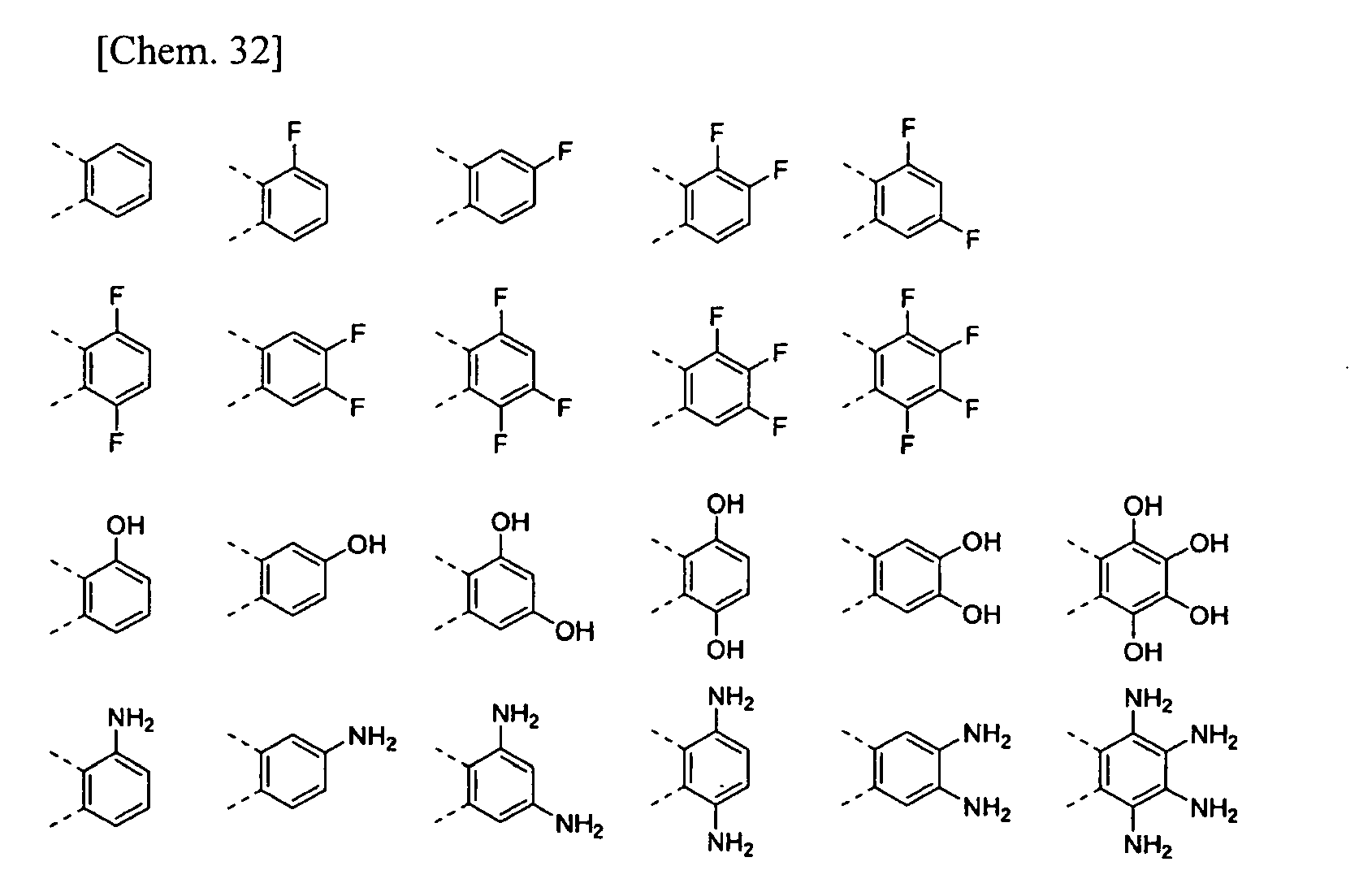


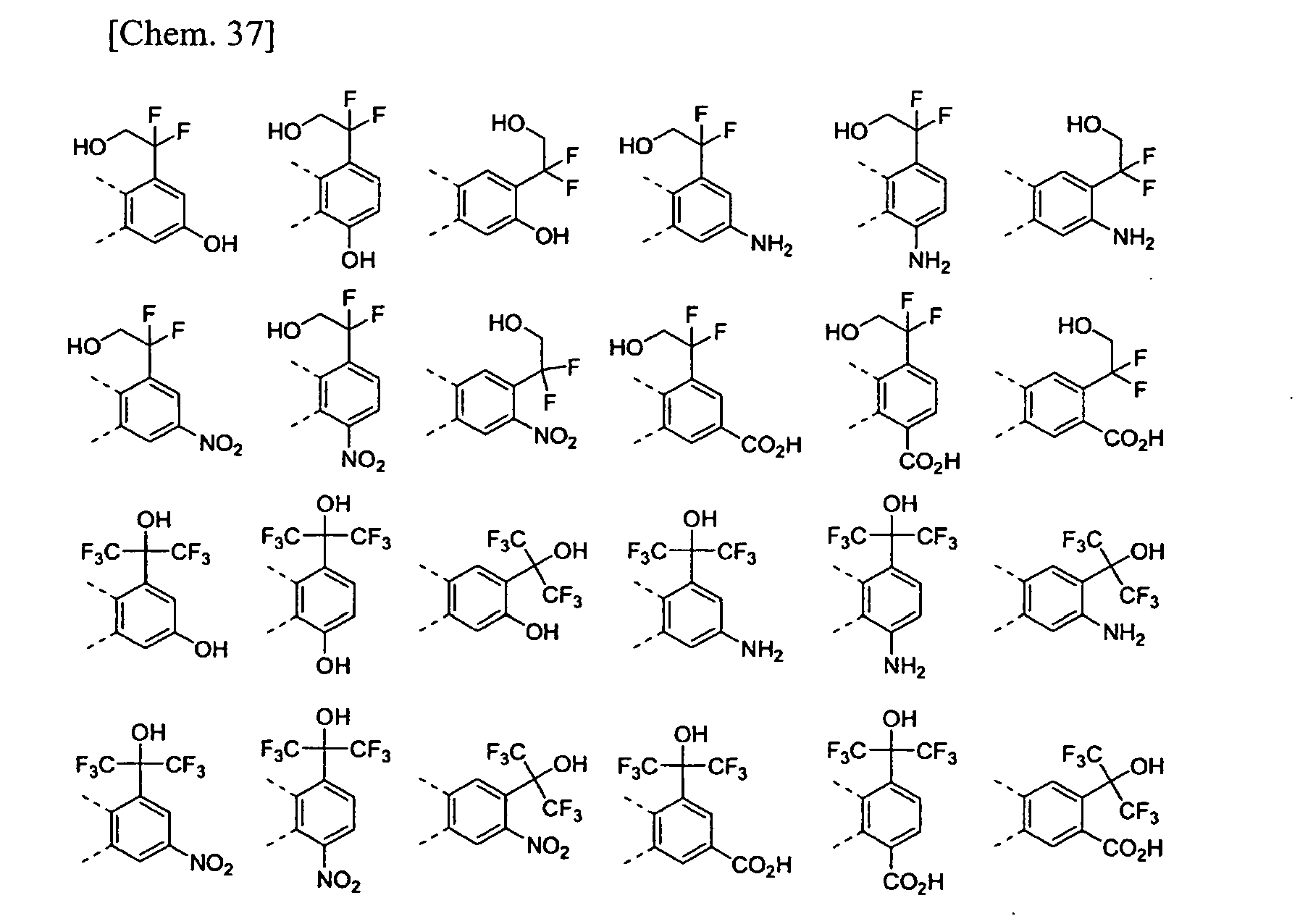


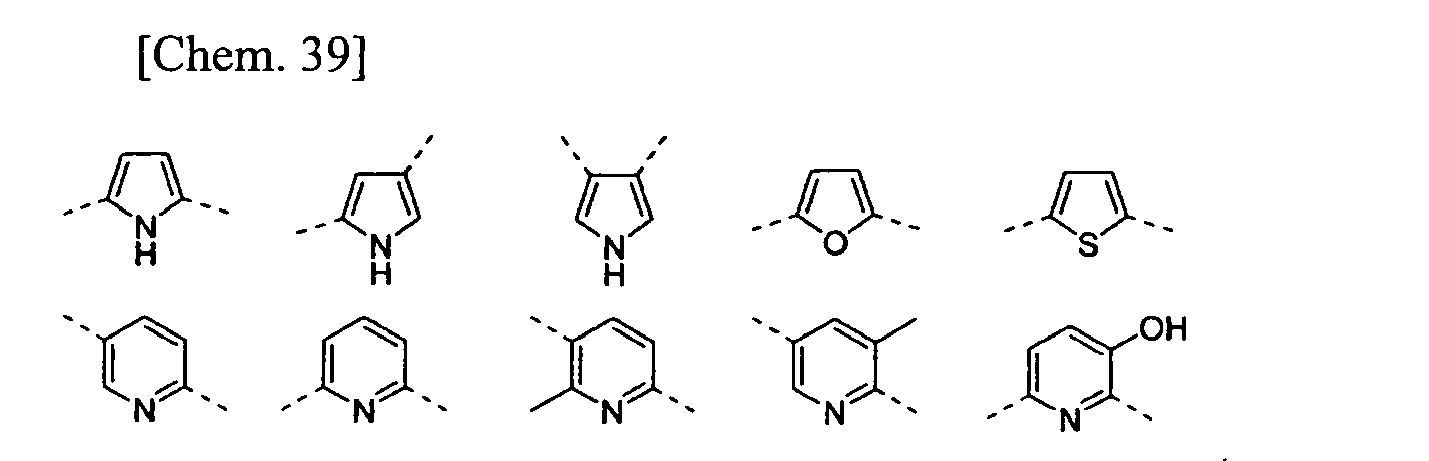
- In the substituted or unsubstituted aromatic ring structure Q, the amino group may be a protected amino group. As a protection group for the amino group, there can be used tert-butoxycarbonyl, benzyloxycarbonyl, 9-fluorenylmethyloxycarbonyl, 2,2,2-trichloroethoxycarbonyl, allyloxycarbonyl, phthaloyl, p-toluenesulfonyl, 2-nitrobenzenesulfonyl or the like.
- The following are specific examples of the divalent organic group of the general formula (a) in the case where p is 1.


- The following are specific examples of the divalent organic group of the general formula (a) in the case where p is 2.

- Another example of the divalent organic group Q having the substituted or unsubstituted aromatic ring is a divalent organic group of the following general formula (b) where the aromatic ring is represented by Ar2 and the linking group Y is represented by Y2.

- The following are specific examples of the divalent organic group of the following general formula (b).


- In the general formulas (M-1) and (M-2), A and A' each independently and D and D' each independently represent a hydroxyl group, a fluorine atom, a chlorine atom, a bromine atom, an iodine atom, a C1-C6 straight, branched or cyclic alkoxy group or a C6-C10 substituted or unsubstituted aryloxy group and may form an active ester moiety with a CO group (carbonyl group) in the formula.
- Examples of the C1-C6 straight, branched or cyclic alkoxy group are methoxy, ethoxy, n-propoxy, isopropoxy, n-butoxy, isobutoxy, sec-butoxy, tert-butoxy, n-pentoxy, isopentoxy, sec-pentoxy, tert-pentoxy, n-hexoxy, isohexoxy, cyclopentoxy and cyclohexoxy. Among others, methoxy and ethoxy are preferred.
- Examples of the C6-C10 substituted or unsubstituted aryloxy group are phenoxy, o-tolyloxy, m-tolyloxy, p-tolyloxy, p-hydroxyphenoxy, p-nitrophenoxy, polychlorophenoxy, 1-naphthoxy, benzyloxy and pyridyloxy. Among others, p-nirtophenoxy is preferred.
- As A and A' and as D and D', there can be used a succinimidoxy group, an o-phthalimidoxy group etc. that can form an active ester moiety with a CO group (carbonyl group).
- Among others, a hydroxyl group, a chlorine atom, a succinimidoxy group and an ethoxy group are particularly preferred as A and A' and as D and D'.
- Examples of the acid anhydride of the fluorinated dicarboxylic acid of the general formula (M-1) (where both of A and A' are hydroxyl) are those derived from the fluorinated dicarboxylic acid in which AOCF2C and A'OCF2C are bonded to adjacent carbon atoms of the aromatic ring.
[Chem. 45] AOCF2C-Q-CF2COA' (M-1)
- In the polycondensed polymer, the organic group Q can have various substituents as mentioned above. The polymer, when having a hydroxyl group, a carboxyl group, an alkoxy group, a hexafluoroisopropanol group or an amino group that serves as a cross-linking site, can form a three-dimensional cross-linking structure by the action of a cross-linking agent for improvement in resin performance. The polymer, when having a nitro group or a protected amino group, can form a three-dimensional cross-linking structure by modification or deprotection of such a nitro or protected amino group.
- The fluorinated dicarboxylic acid of the present invention is represented by the following general formula (M-3).
[Chem. 46] HOOCF2C-Q-CF2COOH (M-3)
In the general formula (M-3), Q has the same definition as in the general formula (M-1). Specific examples of Q of the general formula (M-3) are the same as those of the general formula (M-1). - The above novel fluorinated dicarboxylic acid derivative can be prepared with reference to Journal of Fluorine Chemistry, 2004, Vol. 125, P. 509-515 etc. For example, it is feasible to prepare the fluorinated dicarboxylic acid derivative by using a dihalogenoaryl compound, preferably a diiodoaryl compound, as a starting maerial, forming a bis(alkoxycarbonyldifluoromethyl)aryl compound by reaction of the dihalogenoaryl compound with a halogenodifluoroacetic acid ester, preferably a bromodifluoroacetic acid ethyl ester, in the presence of copper, hydrolyzing the bis(alkoxycarbonyldifluoromethyl)aryl compound to a carboxylic acid and, if required, halogenating the carboxylic acid to an acid halide.
- One general scheme is indicated below (formula [1]).

- First, the production of the bis(alkoxycarbonyldifluoromethyl)aryl compound will be explained. There is no particular limitation on the process of production of the bis(alkoxycarbonyldifluoromethyl)aryl compound. The bis(alkoxycarbonyldifluoromethyl)aryl compound can be produced by any known process with the use of copper as will be exemplified later.
- There is no particular limitation on the amount of the halogenodifluoroacetic acid ester reacted with the dihalogenoaryl compound. The amount of the halogenodifluoroacetic acid ester is generally 1.8 to 3 mol, preferably 1.9 to 2.2 mol, more preferably substantially 2 mol, per 1 mol of the dihalogenoaryl compound. If the amount of the halogenodifluoroacetic acid ester is less than 1.8 mol, the dihalogenoaryl compound cannot be entirely consumed in the reaction. If the amount of the halogenodifluoroacetic acid ester is 3 mol or more, there preferentially occurs a side reaction so that the yield of the target bis(alkoxycarbonyldifluoromethyl)aryl compound becomes lowered.
- There is also no particular limitation on the amount of the copper used for the reaction of the dihalogenoaryl compound. The amount of the copper is generally 1 to 20 mol, preferably 2 to 15 mol, more preferably 3 to 10 mol, per 1 mol of the dihalogenoaryl compound. The copper is preferably used in particle form. It is however undesirable that the copper is of coarse particle size. Further, it is preferable to activate the copper by any known process such as treatment with an aqueous hydrochloric acid solution etc. before use.
- Preferably, the reaction is performed in a solvent. Suitable examples of the reaction solvent are polar solvents such as acetonitrile, N,N-dimethylformamide, N,N-dimethylimidazolidinone, dimethyl sulfoxide and sulfolane. Particularly preferred are N,N-dimethylformamide and dimethyl sulfoxide. These solvents can be used solely or in combination of two or more thereof.
- The reaction temperature is generally in the range of room temperature to 100°C, preferably 40 to 80°C, more preferably 50 to 60°C.
- The reaction time varies depending on the reaction temperature, but is generally in the range of several minutes to 100 hours, preferably 30 minutes to 50 hours, more preferably 1 to 20 hours. It is desirable to determine the time at which the raw material i.e. dihalogenoaryl compound has been consumed as the end of the reaction while monitoring the progress of the reaction by any analytical means such as nuclear magnetic resonance (NMR) or gas chromatography.
- After the completion of the reaction, the bis(alkoxycarbonyldifluoromethyl)aryl compound can be obtained by ordinary operation such as extraction or recrystallization. The bis(alkoxycarbonyldifluoromethyl)aryl compound may be purified by distillation, recrystallization etc. as needed.
- Next, the hydrolysis of the bis(alkoxycarbonyldifluoromethyl)aryl compound will be explained. There is no particular limitation on the process of hydrolysis of the bis(alkoxycarbonyldifluoromethyl)aryl compound. The bis(alkoxycarbonyldifluoromethyl)aryl compound can be hydrolyzed by any known process as will be exemplified later.
- In general, the hydrolysis reaction is performed in the presence of a base as a catalyst. As the base, there can be used a hydroxide, a bicarbonate or a carbonate of at least one kind of alkali metal, an ammonia or an amine. Examples of the alkali metal compound are sodium hydroxide, potassium hydroxide, lithium hydroxide, sodium hydrogencarbonate, potassium hydrogencarbonate, sodium carbonate and potassium carbonate. Examples of the amine are methylamine, dimethylamine, trimethylamine, ethylamine, diethylamine, triethylamine, propylamine, dipropylamine, tripropylamine, butylamine, dibutylamine, tributylamine, cyclohexylamine, benzylamine, morpholine, pyrrole, pyrrolidine, pyridine, ethanolamine, diethanolamine, triethanolamine, N,N-dimethylaminoethanol, N,N-diethylaminoethanol, ethylenediamine, diethylenetriamine, triethylenetetramine, 1,2-propylenediamine, dipropylenetriamine, tripropylenetetramine and quaternary ammonium hydroxide salts thereof.
- Among these bases, alkali metal compounds such as sodium hydroxide, potassium hydroxide, lithium hydroxide, sodium hydrogencarbonate, potassium hydrogencarbonate, sodium carbonate and potassium carbonate are preferred. Particularly preferred are alkali metal hydroxides such as sodium hydroxide and potassium hydroxide.
- The mol ratio of the base used relative to bis(alkoxycarbonyldifluoromethyl)aryl compound is generally 0.01 to 10, preferably 1.0 to 5, more preferably 1 to 3.
- In general, the hydrolysis reaction is performed in the presence of water. The mol ratio of the water used relative to the bis(alkoxycarbonyldifluoromethyl)aryl compound is generally 1 or higher. There is no upper limit on the mol ratio of the water used relative to the bis(alkoxycarbonyldifluoromethyl)aryl compound. However, the efficiency of the reaction deteriorates with the use of too large amount of water. The mol ratio of the water used relative to the bis(alkoxycarbonyldifluoromethyl)aryl compound is preferably 100 or lower, more preferably 50 or lower.
- An organic solvent may be used in combination with water as needed. There is no particular limitation on the organic solvent used. The organic solvent used is preferably immiscible with water and capable of extracting the bis(hydroxycarbonyldifluoromethyl)aryl compound produced in the reaction from the aqueous layer. Examples of such an organic solvent are: esters such as ethyl acetate and n-butyl acetate; ethers such as diethyl ether; and alkyl halides such as methylene chloride and chloroform.
- In this case, the amount of the organic solvent is generally 5 parts by mass or more, preferably 10 parts by mass or more, more preferably 20 to 90 parts by mass, per 100 parts by mass of the sum of the water and organic solvent.
- The reaction temperature is generally in the range of 0 to 100°C, preferably 5 to 80°C. The reaction time is generally in the range of 10 minutes to 16 hours, preferably 30 minutes to 6 hours. It is desirable to determine the time at which the raw material i.e. bis(alkoxycarbonyldifluoromethyl)aryl compound has been consumed as the end of the reaction while monitoring the progress of the reaction by any analytical means such as nuclear magnetic resonance (NMR) or gas chromatography.
- After the completion of the reaction, the bis(hydroxycarbonyldifluoromethyl)aryl compound can be obtained by ordinary operation such as extraction or recrystallization. The bis(hydroxycarbonyldifluoromethyl)aryl compound may be purified by column chromatography, distillation, recrystallization etc. as needed.
- The halogenation of the bis(hydroxycarbonyldifluoromethyl)aryl compound will be next explained. There is no particular limitation on the process of halogenation of the bis(hydroxycarbonyldifluoromethyl)aryl compound. The bis(hydroxycarbonyldifluoromethyl)aryl compound can be halogenated by any known process. For example, the following chlorination process can be adopted.
- In the chlorination process, the bis(hydroxycarbonyldifluoromethyl)aryl compound is chlorinated by contact with an chlorination agent in the presence or absence of a solvent under heating.
- Examples of the chlorination agent are general-purpose chlorination agents such as thionyl chloride, sulfuryl chloride, phosgene, oxalyl chloride, phosphoryl chloride, phosphorous trichloride, phosphorous pentachloride, dichlorotriphenylphosphorane and dibromotriphenylphosphorane. In particular, thionyl chloride, phosphoryl chloride and oxalyl chloride are preferably used because of low cost and high reactivity.
- The amount of the chlorination agent is generally 1.6 to 20 mol, preferably 2 to 10 mol, per 1 mole of the bis(hydroxycarbonyldifluoromethyl)aryl compound.
- There is no particular limitation on the reaction solvent used as long as the reaction solvent is inert under the chlorination reaction conditions. Examples of the reaction solvent are benzene, toluene, xylene, methylene chloride, 1,2-dichloroethane, chloroform and carbon tetrachloride. In the case of using the liquid chlorination agent such as thionyl chloride, the chlorination agent also serves a solvent so that there is no need to use the solvent separately.
- The chlorination reaction temperature is generally in the range of 25 to 200°C, preferably 30 to 120°C. The reaction time is generally in the range of 10 minutes to 16 hours, preferably 30 minutes to 6 hours. It is desirable to determine the time at which the raw material i.e. bis(hydroxycarbonyldifluoromethyl)aryl compound has been consumed as the end of the reaction while monitoring the progress of the reaction by any analytical means such as nuclear magnetic resonance (NMR) or gas chromatography.
- After the completion of the reaction, the bis(hydroxycarbonyldifluoromethyl)aryl compound can be obtained by ordinary operation such as extraction or recrystallization. The bis(hydroxycarbonyldifluoromethyl)aryl compound may be purified by column chromatography, distillation, recrystallization etc. as needed.
- One specific preparation example of the fluorinated dicarboxylic acid derivative of the present invention is as follows (scheme [2]; see Example 1).

- The polymer of the present invention is obtained by polycondensation of the fluorinated dicarboxylic acid derivative of the general formula (M-1) or the acid anhydride of the fluorinated dicarboxylic acid with a polyfunctional compound having two to four reactive groups corresponding in reactivity to carbonyl moieties of the fluorinated dicarboxylic acid derivative or acid anhydride.
[Chem. 49] AOCF2C-Q-CF2COA' (M-1)
In the above formula, Q, A and A' have the same meanings as above. - As the reactive groups of the polyfunctional compound reactive with the carbonyl moieties, there can be used a hydroxyl group, an activated hydroxyl group, an amino group, an activated amino group and the like. The polyfunctional compound needs at least two reactive groups. Although the reactive groups of the polyfunctional compound can be of two or more kinds, it is preferable that two of the reactive groups of the polyfunctional compound are of the same kind.
- The process of polymerization of the fluorinated dicarboxylic acid derivative for production of the polymer will be explained below. The fluorinated dicarboxylic acid derivative has two CF2CO groups and, in some cases, may have three or more functional groups including these CF2CO groups. These functional groups are utilized effectively for the production of the polymer. It is preferable to utilize the reactivity of the CF2CO groups preferentially.
- In the polymer of the present invention (the general formulas (6) to (11)), m (positive integer) indicates the number of repeating monomer units (the degree of polymerization) It is preferable that m is 5 to 10000, more preferably 10 to 1000. The polymer of the present invention is obtained in the form of a polymer mixture whose polymerization degree ranges over a certain width. The weight-average molecular weight of the polymer is generally preferably 1000 to 5000000, more preferably 2000 to 200000. The polymerization degree and molecular weight of the polymer can be controlled to a desired level by adjusting the after-mentioned polymerization conditions as appropriate.
- In the present invention, the fluorinated dicarboxylic acid derivative of the general formula (M-1) or the acid anhydride of the fluorinated dicarboxylic acid can be converted to a polyester of the following general formula (6) by contact of the fluorinated dicarboxylic acid derivative or acid anhydride with a diol of the following general formula (2) in a given temperature range.
[Chem. 50] AOCF2C-Q-CF2COA' (M-1)
[Chem.51] HO-R1-OH (2)

- The diol of the general formula (2) will be now explained. The diol may be in the form of an activator having an activated group to react with the carboxyl moiety for improvement in reactivity. Examples of such an activator are alkali metal (lithium, sodium, potassium) salts of the diol (e.g. dialkoxide).
- In the general formula (2), R1 represents a divalent organic group having at least one kind selected from an alicyclic ring, an aromatic ring and a heterocyclic ring and may contain a fluorine atom, a chlorine atom, an oxygen atom, a sulfur atom or a nitrogen atom. A part of hydrogen atoms of R1 may be substituted with a fluorine atom, a chlorine atom, an alkyl group, a fluoroalkyl group, a carboxyl group, a hydroxyl group or a cyano group. A part of carbon atoms of R1 may be replaced by an oxygen atom, a sulfur atom, a nitrogen atom, a carbonyl group or a sulfonyl group. Further, m represents a positive integer.
- Suitable specific examples of the diol are 1,4-cyclohexanediol, 1,3-adamantanediol, catechol, 1,3-benzenediol, 2,2'-dihydroxybiphenyl, 4,4'-dihydroxybiphenyl, 2,2'-methylenediphenol, 4,4'-methylenediphenol, ethylene glycol, propylene glycol, 2,2-bis(4-hydroxyphenyl)-propane, 2,2-bis(4-hydroxyphenyl)-3-methylpropane, 2,2-bis(4-hydroxyphenyl)-butane, 3,3-bis(4-hydroxyphenyl)-pentane, 2,2-bis(4-hydroxyphenyl)-4-methylpentane, 3,3-bis(4-hydroxyphenyl)-hexane, 2,2-bis(3-chloro-4-hydroxyphenyl)-propane, 2,2-bis(3,5-dichloro-4-hydroxyphenyl)-propane, 2,2-bis(3-bromo-4-hydroxyphenyl)-propane, 2,2-bis(3,5-dibromo-4-hydroxyphenyl)-propane, 2,2-bis(3-methyl-4-hydroxyphenyl)-propane, 2,2-bis(4-hydroxyphenyl)-1,1,1,3,3,3-hexafluoropropane, 2,6-dihydroxynaphthalene, 2,3-dihydroxynaphthalene, 2,7-dihydroxynaphthalene, 1,4-dihydroxynaphthalene, 1,5-dihydroxynaphthalene, 2,3-dihydroxypyridine, 2,4-dihydroxypyridine, 4,4'-dihydroxydiphenylether, 4,4'-dihydroxyldiphenylsulfide, 4,4'-dihydroxydiphenylsulfoxide, 4,4'-dihydroxyphenylsulfone and 4,4'-dihydroxybenzophenone. The diol is not however limited to these compounds in the present invention.
- The polyester of the present invention can be produced by any known process with no particular limitation. It is feasible to produce the polymer of the general formula (6) by direct dehydration condensation of the fluorinated dicarboxylic acid of the general formula (M-3) and the diol of the general formula (2) in the presence of a condensation agent.
- It is also feasible to produce the polymer of the general formula (6) by reaction of the fluorinated dicarboxylic acid derivative of the general formula (M-1) where A and A' each independently represent a fluorine atom, a chlorine atom, a bromine atom, an iodine atom, a C1-C6 straight, branched or cyclic alkoxy group or a C6-C10 substituted or unsubstituted aryloxy group, or the acid anhydride of the fluorinated dicarboxylic acid derivative, with the diol of the general formula (2). In this case, a metal salt such as lithium bromide or lithium chloride as a polymer dissolution accelerator, a dehydrator such as sulfuric acid, phosphoric acid or phosphorus pentoxide, or an acid acceptor such as amine may be used.
- Specific examples of the polyester production process are: a process of reacting the fluorinated dicarboxylic acid or derivative thereof etc. with the diol in no solvent system by dissolving (melting) at 150 to 350°C, preferably 200 to 300°C; and a process of reacting the fluorinated dicarboxylic acid or derivative thereof etc. with the diol in an organic solvent under high-temperature conditions (150 to 350°C, preferably 200 to 300°C). There can also be used a process of reacting the fluorinated dicarboxylic acid derivative of the general formula (M-1) with the diol in an organic solvent at a temperature of-20 to 80°C when A and A' are each independently a fluorine atom, a chlorine atom, a bromine atom or an iodine atom in the general formula (M-1). When the fluorinated dicarboxylic acid derivative has a hydroxyl group or an alkoxy group as A and A', there can be used a process of reacting the fluorinated dicarboxylic acid derivative with the diol in an organic solvent at a temperature of-20 to 80°C with the use of a polymer dissolution accelerator.
- The most convenient process is to conduct polycondensation of the fluorinated dicarboxylic acid derivative of the general formula (M-1) (where A and A' are each independently a fluorine atom, a chlorine atom, a bromine atom or an iodine atom) or the acid anhydride of the fluorinated dicarboxylic acid with the diol of the general formula (2) by mixing in an organic solvent. The ratio between the total mol number of the fluorinated dicarboxylic acid derivative of the general formula (M-1) or the acid anhydride of the fluorinated dicarboxylic acid and the total mol number of the diol in the polymerization process is generally in the range of 0.5 to 1.5, more preferably 0.8 to 1.2. As in the case of the ordinary polycondensation reaction, the molecular weight of the resulting polymer can be increased as the mole number ratio is closer to 1.
- There is no particular limitation on the organic solvent as long as both of the raw material components can be dissolved in the organic solvent. Examples of the organic solvent are: amide solvents such as N,N-dimethylformamide, N,N-dimethylacetamide, N,N-methylformamide, hexamethylphosphoric triamide and N-methyl-2-pyrrolidone; aromatic solvents such as benzene, anisole, diphenyl ether, nitrobenzene and benzonitrile; halogenated solvents such as chloroform, dichloromethane, 1,2-dichloroethane and 1,1,2,2-tetrachloroethane; and lactone solvents such as γ-butyrolactone, γ-valerolactone, δ-valerolactone, γ-caprolactone, ε-caprolactone and α-methyl-γ-butyrolactone. It is effective to perform the reaction in the coexistence of an acid acceptor such as pyridine or triethylamine with the organic solvent. The polyester can attain a high polymerization degree by the use of the above amide solvent as the amide solvent itself serves as an acid acceptor.
- In the present specification, the term "polyamide" may include a polyamide diol, a highly fluorinated polyamide and a polybenzoxazole or heterocyclic polymer obtained by ring closure of the polyamide diol or highly fluorinated polyamide as will be explained below.
- In the present invention, the fluorinated dicarboxylic acid derivative of the general formula (M-1) or the acid anhydride of the fluorinate dicarboxylic acid can be converted to a polyamide of the general formula (7) by contact of the fluorinated dicarboxylic acid derivative or acid anhydride with a diamine of the general formula (3) in a given temperature range.
[Chem. 53] AOCF2C-Q-CF2COA' (M-1)
[Chem. 54] H2N-R2-NH2 (3)
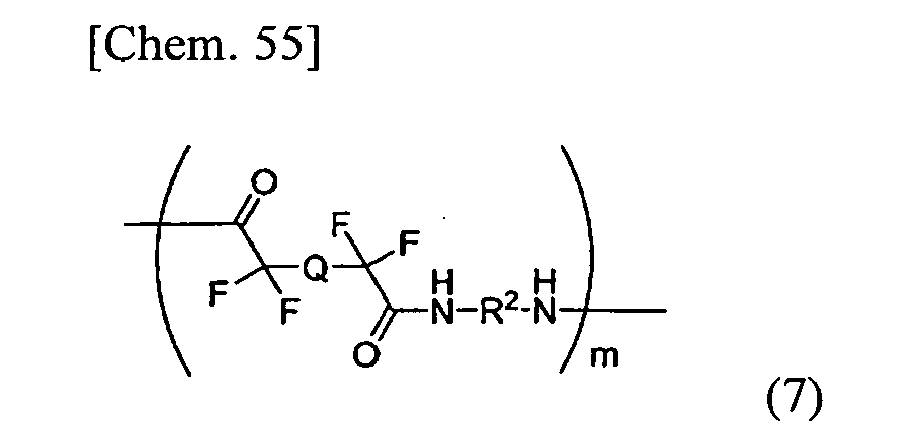
- When Q has an amino group, it is conceivable to subject the fluorinated dicarboxylic acid derivative or acid anhydride as it is but is preferable to subject the fluorinated dicarboxylic acid derivative or acid anhydride to polycondensation after protecting the amino group by the protecting group.
- The diamine of the general formula (3) will be now explained below. The diamine may be in the form of an activator having an activated group to react with the carboxyl moiety for improvement in reactivity. Examples of such an activator are diamines with trialkylsilylamino groups (where three alkyl groups selected from methyl, ethyl, propyl and i-propyl and may be the same as or different from each other).
- In the general formula (3) and in the general formula (7), R2 represents a divalent organic group having at least one kind selected from an alicyclic ring, an aromatic ring and a heterocyclic ring and may contain a fluorine atom, a chlorine atom, an oxygen atom, a sulfur atom or a nitrogen atom. A part of hydrogen atoms of R2 may be substituted with a fluorine atom, a chlorine atom, an alkyl group, a fluoroalkyl group, a carboxyl group, a hydroxyl group or a cyano group. A part of carbon atoms of R2 may be replaced by an oxygen atom, a sulfur atom, a nitrogen atom, a carbonyl group or a sulfonyl group. Further, m represents a positive integer.
- Suitable specific examples of the diamine of the general formula (3) are 1,4-diaminocyclohexane, 3,5-diaminobenzotrifluoride, 2,5-diaminobenzotrifluoride, 3,3'-bis(trifluoromethyl)-4,4'-diaminobiphenyl, 3,3'-bis(trifluoromethyl)-5,5'-diaminobiphenyl, bis(trifluoromethyl)-4,4'-diaminodiphenyl, bis(fluoroalkyl)-4,4'-diaminodiphenyl, dichloro-4,4'-diaminodiphenyl, dibromo-4,4'-diaminodiphenyl, bis(fluoroalkoxy)-4,4'-diaminodiphenyl, diphenyl-4,4'-diaminodiphenyl, 4,4'-bis(4-aminotetrafluorophenoxy)tetrafluorobenzene, 4,4'-bis(4-aminotetrafluorophenoxy)octafluorobiphenyl, 4,4'-binaphthylamine, o-, m- or p-phenylenediamine, 2,4-diaminotoluene, 2,5-diaminotoluene, 2,4-diaminoxylene, 2,4-diaminodurene, dimethyl-4,4'-diaminodiphenyl, dialkyl-4,4'-diaminodiphenyl, dimethoxy-4,4'-diaminodiphenyl, diethoxy-4,4'-diaminodiphenyl, 4,4'-diaminodiphenyl methane, 4,4'-diaminodiphenyl ether, 3,4'-diaminodiphenyl ether, 4,4'-diaminodiphenylsulfone, 3,3'-diaminodiphenylsulfone, 4,4'-diaminobenzophenone, 3,3'-diaminobenzophenone, 1,3-bis(3-aminophenoxy)benzene, 1,3-bis(4-aminophenoxy)benzene, 1,4-bis(4-aminophenoxy)benzene, 4,4'-bis(4-aminophenoxy)biphenyl, bis(4-(3-aminophenoxy)phenyl)sulfone, bis(4-(4-aminophenoxy)phenyl)sulfone, 2,2-bis(4-(4-aminophenoxy)phenyl)propane, 2,2-bis(4-(4-aminophenoxy)phenyl)hexafluoropropane, 2,2-bis(4-(3-aminophenoxy)phenyl)propane, 2,2-bis(4-(3-aminophenoxy)phenyl)hexafluoropropane, 2,2-bis(4-(4-amino-2-trifluoromethylphenoxy)phenyl)hexafluoropropane, 2,2-bis(4-(3-amino-5-trifluoromethylphenoxy)phenyl)hexafluoropropane, 2,2-bis(4-aminophenyl)hexafluoropropane, 2,2-bis(3-aminophenyl)hexafluoropropane, 2,2-bis(3-amino-4-hydroxyphenyl)hexafluoropropane, 2,2-bis(3-amino-4-methylphenyl)hexafluoropropane, 4,4'-bis(4-aminophenoxy)octafluorobiphenyl, 4,4'-diaminobenzanilide, 2,6-diaminonaphthalene, 2,3-diaminonaphthalene, 2,7-diaminonaphthalene, 1,4-diaminonaphthalene, 1,5-diaminonaphthalene, 2,3-diaminopyridine and 2,4-diaminopyridine. The diamine is not however limited to these compounds in the present invention.
- The polyamide of the present invention can be produced by any known process with no particular limitation. It is feasible to produce the polymer of the general formula (7) by direct dehydration condensation of the fluorinated dicarboxylic acid of the general formula (M-3) and the diamine of the general formula (3) in the presence of a condensation agent.
- It is also feasible to produce the polymer of the general formula (7) by reaction of the fluorinated dicarboxylic acid derivative of the general formula (M-1) where A and A' each independently represent a fluorine atom, a chlorine atom, a bromine atom, an iodine atom, a C1-C6 straight, branched or cyclic alkoxy group or a C6-C10 substituted or unsubstituted aryloxy group, or the acid anhydride of the fluorinated dicarboxylic acid derivative, with the diamine of the general formula (3). In this case, a metal salt such as lithium bromide or lithium chloride as a polymer dissolution accelerator, a dehydrator such as sulfuric acid, phosphoric acid or phosphorus pentoxide, or an acid acceptor such as amine may be used.
- Specific examples of the polyamide production process are: a process of reacting the fluorinated dicarboxylic acid or derivative thereof etc. with the diamine in no solvent system by dissolving (melting) at 150 to 400°C, preferably 200 to 350°C; and a process of reacting the fluorinated dicarboxylic acid or derivative thereof etc. with the diamine in an organic solvent under high-temperature conditions (150 to 400°C, preferably 200 to 350°C). There can also be used a process of reacting the fluorinated dicarboxylic acid derivative of the general formula (M-1) with the diamine in an organic solvent at a temperature of-20 to 80°C when A and A' are each independently a fluorine atom, a chlorine atom, a bromine atom or an iodine atom in the general formula (M-1). When the fluorinated dicarboxylic acid derivative has a hydroxyl group or an alkoxy group as A and A', there can be a process of reacting the fluorinated dicarboxylic acid derivative with the diamine in an organic solvent at a temperature of-20 to 80°C with the use of a polymer dissolution accelerator.
- The most convenient process is to conduct polycondensation of the fluorinated dicarboxylic acid derivative of the general formula (M-1) (where A and A' are each independently a fluorine atom, a chlorine atom, a bromine atom or an iodine atom) or the acid anhydride of the fluorinated dicarboxylic acid with the diamine of the general formula (3) by mixing in an organic solvent. The ratio between the total mol number of the fluorinated dicarboxylic acid derivative of the general formula (M-1) or the acid anhydride of the fluorinated dicarboxylic acid and the total mol number of the diamine in the polymerization process is generally in the range of 0.5 to 1.5, more preferably 0.8 to 1.2. As in the case of the ordinary polycondensation reaction, the molecular weight of the resulting polymer can be increased as the mole number ratio is closer to 1.
- There is no particular limitation on the organic solvent as long as both of the raw material components can be dissolved in the organic solvent. Examples of the organic solvent are: amide solvents such as N,N-dimethylformamide, N,N-dimethylacetamide, N,N-methylformamide, hexamethylphosphoric triamide and N-methyl-2-pyrrolidone; aromatic solvents such as benzene, anisole, diphenyl ether, nitrobenzene and benzonitrile; halogenated solvents such as chloroform, dichloromethane, 1,2-dichloroethane and 1,1,2,2-tetrachloroethane; and lactone solvents such as γ-butyrolactone, γ-valerolactone, δ-valerolactone, γ-caprolactone, ε-caprolactone and α-methyl-y-butyrolactone. It is effective to perform the reaction in the coexistence of an acid acceptor such as pyridine or triethylamine with the organic solvent. The polyester can attain a high polymerization degree by the use of the above amide solvent as the amide solvent itself serves as an acid acceptor.
- The fluorinated dicarboxylic acid derivative of the general fomula (M-1) can be polymerized to a polyamide diol of the general formula (8) by contact of the fluorinated dicarboxylic acid derivative with a diaminodiol of the general formula (4) in a given temperature range.


- When Q has an amino group, it is conceivable to subject the fluorinated dicarboxylic acid derivative to polycondensation as it is but is preferable to subject the fluorinated dicarboxylic acid derivative to polycondensation after protecting the amino group by the protection group.
- In the general formula (4) and in the general formula (8), R3 represents a quaternary organic group having at least one kind selected from an alicyclic ring, an aromatic ring and a heterocyclic ring and may contain a fluorine atom, a chlorine atom, an oxygen atom, a sulfur atom or a nitrogen atom. A part of hydrogen atoms of R3 may be substituted with a fluorine atom, a chlorine atom, an alkyl group, a fluoroalkyl group, a carboxyl group, a hydroxyl group or a cyano group. A part of carbon atoms of R3 may be replaced by an oxygen atom, a sulfur atom, a nitrogen atom, a carbonyl group or a sulfonyl group. Further, m represents a positive integer.
- Suitable specific examples of the diaminodiol of the general formula (4) are 2,4-diamino-1,5-cyclohexanediol, 2,4-diamino-1,5-benzenediol, 3,3'-dihydroxy-4,4'-diaminobiphenyl, 3,3'-diamino-4,4'-dihydroxybiphenyl, bis(3-amino-4-hydroxyphenyl)ketone, bis(3-amino-4-hydroxyphenyl)sulfide, bis(3-amino-4-hydroxyphenyl)ether, bis(3-hydroxy-4-aminophenyl)sulfone, 2,2-bis(3-amino-4-hydroxyphenyl)propane, 2,2-bis(3-hydroxy-4-amionophenyl)propane, bis(3-hydroxy-4-aminophenyl)methane, 2,2-bis(3-amino-4-hydroxyphenyl)hexafluoropropane, 2,2-bis(3-hydroxy-4-aminophenyl)hexafluoropropane, bis(3-amino-4-hydroxyphenyl)difluoromethane, 2,6-diamino-1,5-naphthalenediol, 1,5-diamino-2,6-naphthalenediol and 2,6-diamino-3,5-pyridinediol. The diaminodiol is not however limited to these compounds in the present invention.
- The polyamide diol of the present invention can be produced by any known process with no particular limitation. It is feasible to produce the polymer of the general formula (8) by direct dehydration condensation of the fluorinated dicarboxylic acid of the general formula (M-3) and the diaminodiol of the general formula (4) in the presence of a condensation agent.
- It is also feasible to produce the polymer of the general formula (8) by reaction of the fluorinated dicarboxylic acid derivative of the general formula (M-1) where A and A' each independently represent a fluorine atom, a chlorine atom, a bromine atom, an iodine atom, a C1-C6 straight, branched or cyclic alkoxy group or a C6-C10 substituted or unsubstituted aryloxy group, or the acid anhydride of the fluorinated dicarboxylic acid derivative, with the diaminodiol of the general formula (4). In this case, a metal salt such as lithium bromide or lithium chloride as a polymer dissolution accelerator, a dehydrator such as phosphoric acid or phosphorus pentoxide, or an acid acceptor such as amine may be used.
- There is no particular restriction on the polymerization process and conditions. As the elementary reaction of the polymerization is amide formation, the polyamide diol can be produced by the same process with the use of the same solvent as the polyamide of the general formula (7).
- The thus-obtained polyamide phenol resin (polyamide diol) may be further converted to a polybenzoxazole resin of the general formula (9) by dehydration ring closure.

- The dehydration ring closure can be conducted by any known process, without particular limitation, with the use of various means such as heating, acid catalyst or basic catalyst for accelerated dehydration conditions. In the case of performing the ring closure reaction under heating, the ring closure temperature can be set to 80 to 400°C and is preferably set to 150 to 350°C. The heating time is generally of the order of 30 minutes to 2 hours although it suffices that the heating time is of the order of 10 minutes to 10 hours. If the ring closure temperature is 150°C or lower, the resulting film of the polybenzoxazole may unfavorably deteriorate in strength due to low ring closure rate. If the ring closure temperature is 350°C or higher, the resulting film of the polybenzoxazole may face a problem of coloring or embrittlement. Examples of the acid catalyst used are p-toluenesulfonic acid and methanesulfonic acid. Examples of the base catalyst used are triethylamine and pyridine. When the polybenzoxazole obtained after the ring closure is soluble in an organic solvent, it is feasible to chemically carry out the ring closure reaction in an organic solution with the use of a dehydration agent such as acetic anhydride and an organic base such as pyridine or triethylamine.
- Further, it is feasible to subject a highly-fluorinated polyamide resin of the general formula (10) to ring closure after applying the polyamide resin to various articles. By such cyclization (dehydration ring closure), the resin can be modified to show large changes in performance, such as improvement of thermal resistance, change of solubility, decrease of refractive index or dielectric constant and development of hydrophobic and lipophobic properties.
- The fluorinated dicarboxylic acid derivative of the general fomula (M-1) can be polymerized to a highly-fluorinated polyamide resin of the general formula (10) by contact of the fluorinated dicarboxylic acid derivative with a hexafluoroisopropanol-substituted diaminodiol of the general formula (5) in a given temperature range.


- In the general formula (5) and in the general formula (10), R4 represents a quaternary organic group having at least one kind selected from an alicyclic ring, an aromatic ring, a condensed polycyclic aromatic ring and a heterocyclic ring and may contain a fluorine atom, a chlorine atom, an oxygen atom, a sulfur atom or a nitrogen atom. A part of hydrogen atoms of R4 may be substituted with a fluorine atom, a chlorine atom, an alkyl group, a fluoroalkyl group, a carboxyl group, a hydroxyl group or a cyano group. A part of carbon atoms of R4 may be replaced by an oxygen atom, a sulfur atom, a nitrogen atom, a carbonyl group or a sulfonyl group. Further, m represents a positive integer.
- Suitable specific examples of the hexafluoroisopropanol-substituted diaminodiol of the general formula (5) are exemplified as follows. The hexafluoroisopropanol-substituted diaminodiol is not however limited to these compounds in the present invention.


- There is no particular limitation on the polymerization reaction process and conditions of the highly-fluorinated polyamide. As the elementary reaction of the polymerization is amide formation, the highly-fluorinated polyamide can be produced by the same process under the same conditions with the use of the same solvent as the polyamide of the general formula (7).
- The thus-obtained highly-fluorinated polyamide resin of the general formula (10) may be further converted to a heterocyclic polymer of the general formula (11) by dehydration ring closure.
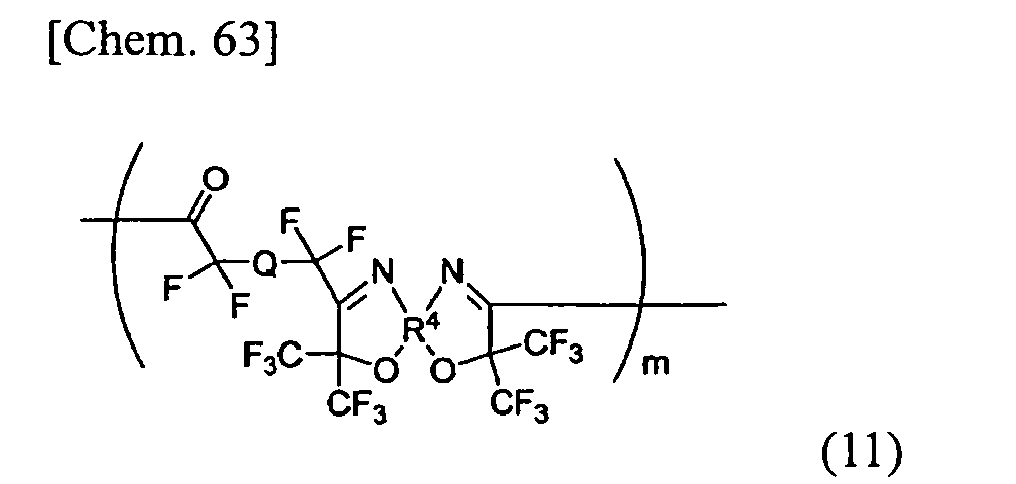
- There is no particular limitation on the conditions of the dehydration ring closure. In the dehydration ring closure, various means such as heating, acid catalyst or basic catalyst are usable for accelerated dehydration conditions.
- The dehydration ring closure can be performed by any known process, without particular limitation, with the use of various means such as heating, acid catalyst or basic catalyst for accelerated dehydration conditions. In the case of performing the ring closure reaction under heating, the ring closure temperature can be set to 80 to 400°C and is preferably set to 150 to 350°C. The ring closure reaction can be completed at substantially about 250°C. If the ring closure temperature is 150°C or lower, the resulting film of the heterocyclic polymer may unfavorably deteriorate in strength due to low ring closure rate. If the ring closure temperature is 350°C or higher, the resulting film of the heterocyclic polymer may face a problem of coloring or embrittlement. Examples of the acid catalyst are p-toluenesulfonic acid and methanesulfonic acid. Examples of the base catalyst are triethylamine and pyridine. When the heterocyclic polymer obtained after the ring closure is soluble in an organic solvent, it is feasible to chemically carry out the ring closure reaction in an organic solution with the use of a dehydration agent such as acetic anhydride and an organic base such as pyridine or triethylamine. The heterocyclic structure of the general formula (11) can be formed by dehydration ring closure under more moderate conditions than the oxazole structure of the general formula (9).
- Further, it is feasible to treat the highly-fluorinated polyamide resin of the general formula (10) at a temperature of 80 to 400°C after applying a solvent solution of the polyamide resin to various articles. At this time, the treatment temperature is preferably set to 150 to 350°C. The polyamide resin can be converted by ring closure to the heterocyclic polymer of the general formula (11) at substantially about 250°C. By such cyclization (dehydration ring closure), the resin can be modified to show large changes in performance, such as improvement of thermal resistance, change of solubility, decrease of refractive index or dielectric constant and development of hydrophobic and lipophobic properties.
- The heterocyclic polymer of the general formula (11) has trifluoromethyl groups on its heterocyclic structure and thus exhibits a lower dielectric constant, lower water absorption and higher transparency than those of the polybenzoxazole of the general formula (9).
- There are the following examples of applications of the fluorinated polymer of the present invention. The polyester or polyamide of the present invention can be used in varnish form by dissolving in an organic solvent or can be used in powder form, film form or solid form. At this time, additives such as antioxidant, filler, silane coupling agent, photosensitizer, photopolymerization initiator and sensitizer may be added to the fluorinated polymer as needed. When the polymer is used in varnish form, it is feasible to apply the polymer vanish to a substrate of glass, silicon wafer, metal, metal oxide, ceramic, resin etc. by ordinary process such as spin coating, spray coating, flow coating, immersion coating or brush coating. The polymer is formed into a film (coating) with desired performance by heating after the application process and increasing the polymerization degree of the polymer. The film-forming reaction temperature is preferably 300°C or lower, more preferably 250°C or lower, although the film-forming reaction can proceeds at a temperature of the order of 150 to 350°C. The polyamide of the general formula (8) or (10) can be subjected to ring closure by heating and thereby converted to the heterocyclic polymer of the general formula (11).
- Examples of the organic solvent used in the above applications are: amide solvents such as N,N-dimethylformamide, N,N-dimethylacetamide, N,N-methylformamide, hexamethylphosphoric triamide and N-methyl-2-pyrrolidone; lactone solvents such as γ-butyrolactone, γ-valerolactone, δ-valerolactone, γ-caprolactone, ε-caprolactone and a-methyl-γ-butyrolactone; and concentrated sulfuric acid.
- The present invention will be described in more detail below by way of the following examples. It is noted that the following examples are illustrative and are not intended to limit the present invention thereto.
-

[Properties of 1,4-benzenediacetic acid-a,a4,β,β4-tetrafluoro-1,4-diethyl ester]
1H NMR (measurement solvent: chloroform-d, standard: tetramethylsilane); δ = 7.69 (s, 4H), 4.29 (q, J =7.1Hz, 4H; CH2 of C-CH2CH3), 1.29 (t, J=7.1Hz, 6H; CH3 of C-CH2CH3). 19F NMR (measurement solvent: chloroform-d, standard: trichlorofluoromethane) ; δ = -104.68 (s, 4F). -

[Properties of α,α4,β,β4-tetrafluoro-1,4-benzenediacetic acid]
1H NMR (measurement solvent: deuterium dimethyl sulfoxide, standard: tetramethylsilane); δ = 7.75 (s, 4H).
19F NMR (measurement solvent: deuterium dimethyl sulfoxide, standard: trichlorofluoromethane) ; δ = -102.54 (s, 4F). -

[Properties of 1,3-benzenediacetic acid-α,α3,β,β3-tetrafluoro-1,3-diethyl ester]
1H NMR (measurement solvent: chloroform-d, standard: tetramethylsilane); δ = 7.85 (s, 1H), 7.73 (d, J=7.8Hz, 2H), 7.55 (t, J=7.1Hz, 1H) 4.29 (q, J=7.1Hz, 4H; CH2 of C-CH2CH3),1.30 (t, J=7.1Hz, 6H; CH3 of C-CH2CH3).
19F NMR (measurement solvent: chloroform-d, standard: trichlorofluoromethane) ; δ = -104.35 (s, 4F). -

[Properties of α,α3,β,β3-tetrafluoro-1,3-benzenediacetic acid]
1H NMR (measurement solvent: deuterium dimethyl sulfoxide, standard: tetramethylsilane); δ = 7.85-7.65 (m, 4H).
19F NMR (measurement solvent: deuterium dimethyl sulfoxide, standard: trichlorofluoromethane) ; δ = -102.30 (s, 4F). -

[Properties of α,α4,β,β4-tetrafluoro-1,4-benzenediacetyl chloride]
1H NMR (measurement solvent: chloroform-d, standard: tetramethylsilane); δ = 7.76 (s, 4H).
19F NMR (measurement solvent: chloroform-d, standard: trichlorofluoromethane) ; δ = -101.32 (s, 4F). -

[Properties of α,α3,β,β3-tetrafluoro-1,3-benzenediacetyl chloride]
1H NMR (measurement solvent: chloroform-d, standard: tetramethylsilane); δ = 7.86 (s, 1H), 7.81 (d, J=7.8Hz, 2H), 7.67 (t, J=7.1Hz, 1H).
19F NMR (measurement solvent: chloroform-d, standard: trichlorofluoromethane) ; δ = -101.10 (s, 4F). -

[Properties of 5-methoxy-1,3-benzenediacetic acid-α,α4,β,β4-tetrafluoro-1,4-diethyl ester]
1H NMR (measurement solvent: chloroform-d, standard: tetramethylsilane); δ = 6.37 (s, 2H), 6.44 (s, 1H), 4.13 (q, J=7.0Hz, 4H; CH2 of C-CH2CH3), 3.73 (s, 3H; CH3 of O-CH3), 1.30 (t, J=7.0Hz, 6H; CH3 of C-CH2CH3).
19F NMR (measurement solvent: chloroform-d, standard: trichlorofluoromethane) ; δ = -104.30 (s, 4F). -


[Properties of 5-methoxy-α,α4,β,β4 -tetrafluoro-1,3-benzenediacetic acid]
1H NMR (measurement solvent: deuterium dimethyl sulfoxide, standard: tetramethylsilane); δ = 12.30 (s, 1H; OH), 6.42 (s, 2H), 6.46 (s, 1H), 3.77 (s, 3H; CH3 of O-CH3).
19F NMR (measurement solvent: deuterium dimethyl sulfoxide, standard: trichlorofluoromethane) ; δ = -103.50 (s, 4F). -

[Properties of 5-methoxy-α,α3,β,β3-tetrafluoro-1,3-benzenediacetyl chloride]
1H NMR (measurement solvent: deuterium dimethyl sulfoxide, standard: tetramethylsilane); δ = 6.41 (s, 2H), 6.45 (s, 1H), 3.76 (s, 3H; CH3 of O-CH3).
19F NMR (measurement solvent: deuterium dimethyl sulfoxide, standard: trichlorofluoromethane) ; δ = -102.30 (s, 4F). -
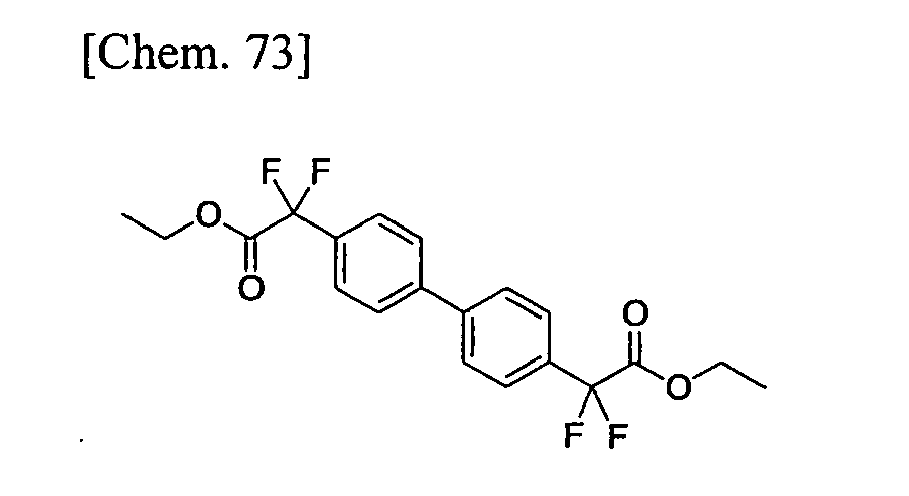
[Properties of 2,2'-(diphenyl-4,4'-diyl)bis(2,2-difluoroacetic acid)diethyl ester]
1H NMR (measurement solvent: chloroform-d, standard: tetramethylsilane); δ = 7.60 (d, J=8.5Hz, 4H), 7.56 (d, J=8.5Hz, 4H), 4.22 (q, J=7.1Hz, 4H; CH2 of C-CH2CH3), 1.22 (t, J=7.1Hz, 6H; CH3 of C-CH2CH3).
19F NMR (measurement solvent: chloroform-d, standard: trichlorofluoromethane) ; δ = -104.15 (s, 4F). -

[Properties of 2,2'-(diphenyl-4,4'-diyl)bis(2,2-difluoroacetic acid)]
1H NMR (measurement solvent: deuterium dimethyl sulfoxide, standard: tetramethylsilane); δ = 7.89 (d, J=8.5Hz, 4H), 7.69 (d, J=8.5Hz, 4H).
19F NMR (measurement solvent: deuterium dimethyl sulfoxide, standard: trichlorofluoromethane) ; δ = -102.12 (s, 4F). -

[Properties of 2,2'-(diphenyl-4,4'-diyl)bis(2,2-difluoroacetyl chloride)]
1H NMR (measurement solvent: deuterium dimethyl sulfoxide, standard: tetramethylsilane); δ = 7.75 (d, J=8.5Hz, 4H), 7.57 (d, J=8.5Hz, 4H).
19F NMR (measurement solvent: deuterium dimethyl sulfoxide, standard: trichlorofluoromethane) ; δ = -100.92 (s, 4F). -

-

-

-

[Properties of 1-[2,2,2-trifluoro-1-hydroxy-1-(trifluoromethyl)ethyl]-3,5-dibromobenzene]
1H NMR (measurement solvent: chloroform-d, standard: tetramethylsilane); δ = 7.79 (s, 3H).
19F NMR (measurement solvent: chloroform-d, standard: trichlorofluoromethane); δ = -76.0 (s, 6F, CF3). -

[Properties of
5-[2,2,2-trifluoro-1-hydroxy-1-(trifluoromethyl)ethyl]-1,3-benzenedicarboxylic acid]
1H NMR (measurement solvent: chloroform-d, standard: tetramethylsilane); δ = 9.27 (s, 1H), 8.58 (m, 1H), 8.46 (s, 2H).
19F NMR (measurement solvent: chloroform-d, standard: trichlorofluoromethane) ; δ = -73.5 (s, 6F, CF3). - Into a 50-mL glass flask, 3.5 g (10.5 mmol) of the 5-[2,2,2-trifluoro-1-hydroxy-1-(trifluoromethyl)ethyl]-1,3-benzenedicarboxylic acid obtained in Reference Example 5 and 20 ml of thionyl chloride were placed. The resulting solution reacted with stirring at 70°C for 5 hours. After the reaction, the thionyl chloride was removed by evaporation. With this, 3.8 g of 5-[2,2,2-trifluoro-1-hydroxy-1-(trifluoromethyl)ethyl]-1,3-benzenedicarboxylic acid chloride was obtained as target carboxylic acid chloride 1. The yield was 98%.
[Properties of
5-[2,2,2-trifluoro-1-hydroxy-1-(trifluoromethyl)ethyl]-1,3-benzenedicarboxylic acid chloride]
1H NMR (measurement solvent: chloroform-d, standard: tetramethylsilane); δ = 8.52 (m, 1H), 8.41 (s, 2H).
19F NMR (measurement solvent: chloroform-d, standard: trichlorofluoromethane) ; δ = -72.7 (s, 6F, CF3). -


- The polymer 1 (1.00 g) was mixed with N,N-dimethylformamide (DMF) (4.00 g) to prepare a uniform solution. The prepared solution was filtered. The filtrate was applied by spin coating to a glass substrate and heat treated in a nitrogen atmosphere at 80°C for 30 minutes, at 150°C for 30 minutes and at 250°C for 1 hour, thereby forming a polymer film on the glass substrate. The polymer film was separated from the glass substrate and obtained as a shape-retaining, flexible transparent film. The thickness of the polymer film was about 10 µm. The capacity of the polymer film was measured according to JIS K6911 at a frequency of 100 kHz using a Precision LCR meter HP-4284 manufactured by Hewlett-Packard Company. The specific dielectric constant of the polymer film was determined by the following equation based on the capacity measurement results (the same applies to the following examples). The properties of the polymer film are indicated in TABLE 1.

-

- The polymer 2 (1.00 g) was mixed with N,N-dimethylformamide (DMF) (4.00 g) to prepare a uniform solution. The prepared solution was filtered. The filtrate was applied by spin coating to a glass substrate and heat treated in a nitrogen atmosphere at 80°C for 30 minutes, at 150°C for 30 minutes and at 250°C for 1 hour, thereby forming a polymer film on the glass substrate. The polymer film was separated from the glass substrate and obtained as a shape-retaining, flexible transparent film. The properties of the polymer film are indicated in TABLE 1.
-

- The polymer 3 (1.00 g) was mixed with N,N-dimethylformamide (DMF) (4.00 g) to prepare a uniform solution. The prepared solution was filtered. The filtrate was applied by spin coating to a glass substrate and heat treated in a nitrogen atmosphere at 80°C for 30 minutes, at 150°C for 30 minutes and at 250°C for 1 hour, thereby forming a polymer film on the glass substrate. The polymer film was separated from the glass substrate and obtained as a shape-retaining, flexible transparent film. The properties of the polymer film are indicated in TABLE 1.
-


- The polymer 3 (1.00 g) was mixed with N,N-dimethylformamide (DMF) (4.00 g) to prepare a uniform solution. The prepared solution was filtered. The filtrate was applied by spin coating to a glass substrate and heat treated in a nitrogen atmosphere at 80°C for 30 minutes, at 150°C for 30 minutes and at 250°C for 1 hour, thereby forming a polymer film on the glass substrate. The polymer film was separated from the glass substrate and obtained as a shape-retaining, flexible transparent film. The properties of the polymer film are indicated in TABLE 1.
-


- The polymer 5 (1.00 g) was mixed with N,N-dimethylformamide (DMF) (4.00 g) to prepare a uniform solution. The prepared solution was filtered. The filtrate was applied by spin coating to a glass substrate and heat treated in a nitrogen atmosphere at 80°C for 30 minutes, at 150°C for 30 minutes and at 250°C for 1 hour, thereby forming a polymer film on the glass substrate. The polymer film was separated from the glass substrate and obtained as a shape-retaining, flexible transparent film. The properties of the polymer film are indicated in TABLE 1.
-

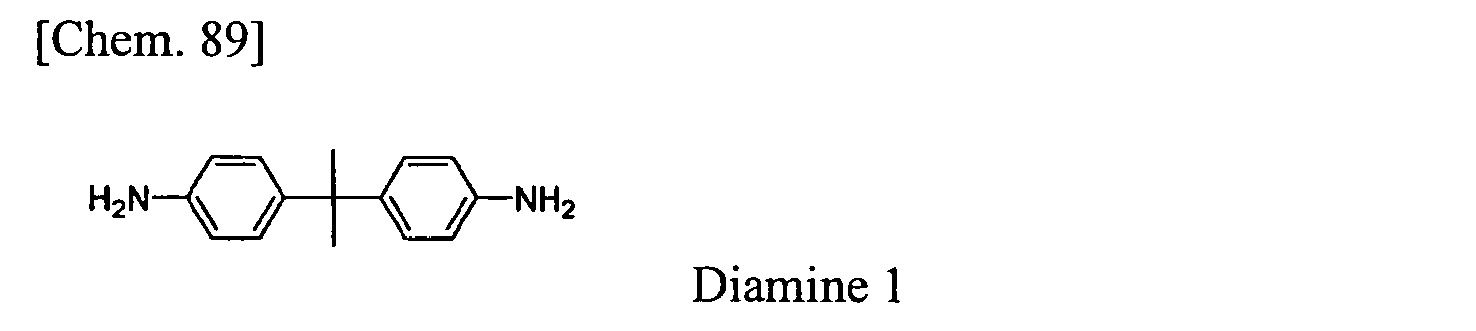
- The polymer 6 (1.00 g) was mixed with N,N-dimethylformamide (DMF) (4.00 g) to prepare a uniform solution. The prepared solution was filtered. The filtrate was applied by spin coating to a glass substrate and heat treated in a nitrogen atmosphere at 80°C for 30 minutes, at 150°C for 30 minutes and at 250°C for 1 hour, thereby forming a polymer film on the glass substrate. The polymer film was separated from the glass substrate and obtained as a shape-retaining, flexible transparent film. The properties of the polymer film are indicated in TABLE 1.
-


- The polymer 7 (1.00 g) was mixed with N,N-dimethylformamide (DMF) (4.00 g) to prepare a uniform solution. The prepared solution was filtered. The filtrate was applied by spin coating to a glass substrate and heat treated in a nitrogen atmosphere at 80°C for 30 minutes, at 150°C for 30 minutes and at 250°C for 1 hour, thereby forming a polymer film on the glass substrate. The polymer film was separated from the glass substrate and obtained as a shape-retaining, flexible transparent film. The properties of the polymer film are indicated in TABLE 1.
-


- The polymer 8 (1.00 g) was mixed with N,N-dimethylformamide (DMF) (4.00 g) to prepare a uniform solution. The prepared solution was filtered. The filtrate was applied by spin coating to a glass substrate and heat treated in a nitrogen atmosphere at 80°C for 30 minutes, at 150°C for 30 minutes and at 250°C for 1 hour, thereby forming a polymer film on the glass substrate. The polymer film was separated from the glass substrate and obtained as a shape-retaining, flexible transparent film. The properties of the polymer film are indicated in TABLE 1.
-


- The polymer 9 (1.00 g) was mixed with N,N-dimethylformamide (DMF) (4.00 g) to prepare a uniform solution. The prepared solution was filtered. The filtrate was applied by spin coating to a glass substrate and heat treated in a nitrogen atmosphere at 80°C for 30 minutes, at 150°C for 30 minutes and at 250°C for 1 hour, thereby forming a polymer film on the glass substrate. The polymer film was separated from the glass substrate and obtained as a shape-retaining, flexible transparent film. The properties of the polymer film are indicated in TABLE 1.
-


- The polymer 10 (1.00 g) was mixed with N,N-dimethylformamide (DMF) (4.00 g) to prepare a uniform solution. The prepared solution was filtered. The filtrate was applied by spin coating to a glass substrate and heat treated in a nitrogen atmosphere at 80°C for 30 minutes, at 150°C for 30 minutes and at 250°C for 1 hour, thereby forming a polymer film on the glass substrate. The polymer film was separated from the glass substrate and obtained as a shape-retaining, flexible transparent film. The properties of the polymer film are indicated in TABLE 1.
-
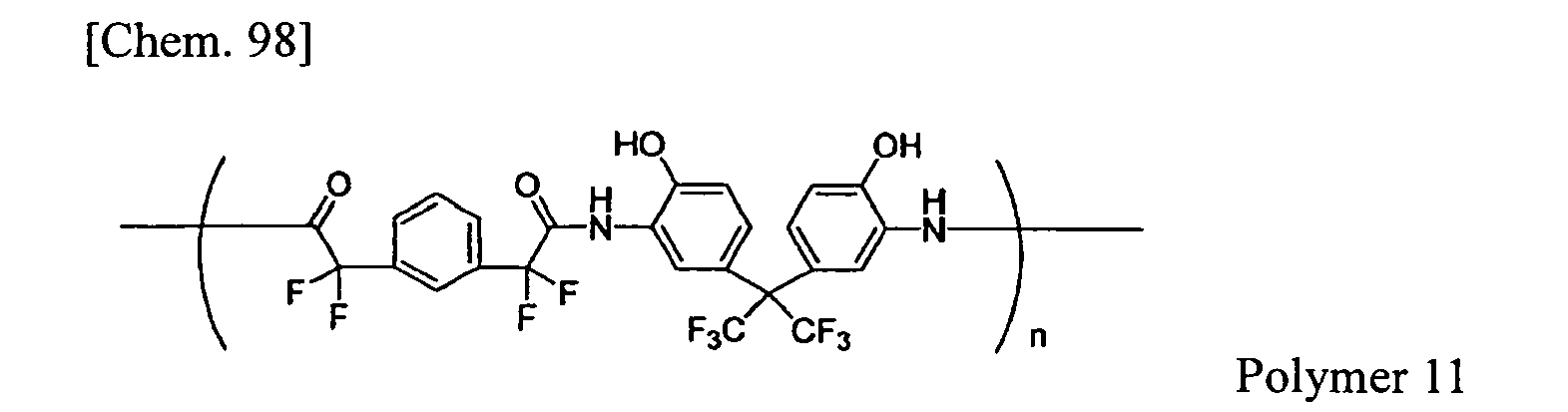

-

-


2007-119503 -

-


- The polymer 1 (1.00 g) was mixed with N,N-dimethylformamide (DMF) (4.00 g) to prepare a uniform solution. The prepared solution was filtered. The filtrate was applied by spin coating to a glass substrate and heat treated in a nitrogen atmosphere at 80°C for 30 minutes, at 150°C for 30 minutes and at 250°C for 1 hour, thereby forming a polymer film on the glass substrate. The polymer film was separated from the glass substrate and obtained as a shape-retaining, flexible transparent film. The properties of the polymer film are indicated in TABLE 1.
-
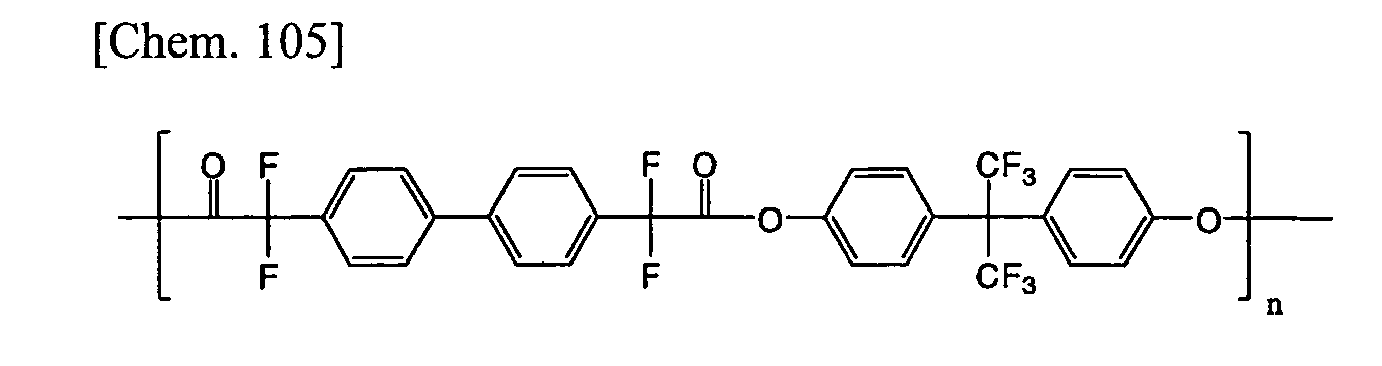
- The polymer 22 (1.00 g) was mixed with N,N-dimethylformamide (DMF) (4.00 g) to prepare a uniform solution. The prepared solution was filtered. The filtrate was applied by spin coating to a glass substrate and heat treated in a nitrogen atmosphere at 80°C for 30 minutes, at 150°C for 30 minutes and at 250°C for 1 hour, thereby forming a polymer film on the glass substrate. The polymer film was separated from the glass substrate and obtained as a shape-retaining, flexible transparent film. The properties of the polymer film are indicated in TABLE 1.
-

- The polymer 23 (1.00 g) was mixed with N,N-dimethylformamide (DMF) (4.00 g) to prepare a uniform solution. The prepared solution was filtered. The filtrate was applied by spin coating to a glass substrate and heat treated in a nitrogen atmosphere at 80°C for 30 minutes, at 150°C for 30 minutes and at 250°C for 1 hour, thereby forming a polymer film on the glass substrate. The polymer film was separated from the glass substrate and obtained as a shape-retaining, flexible transparent film. The properties of the polymer film are indicated in TABLE 1.
-

-

-

-


-

- The polymer 16 (1.00g) was mixed with N,N-dimethylformamide (DMF) (4.00 g) to prepare a uniform solution. The prepared solution was filtered. The filtrate was applied by spin coating to a glass substrate and heat treated in a nitrogen atmosphere at 80°C for 30 minutes, at 150°C for 30 minutes and at 250°C for 1 hour, thereby forming a polymer film on the glass substrate. As the polymer film had a low polymerization degree, there occured many cracks in the polymer film.
-


- The polymer 17 (1.00 g) was mixed with N,N-dimethylformamide (DMF) (4.00 g) to prepare a uniform solution. The prepared solution was filtered. The filtrate was applied by spin coating to a glass substrate and heat treated in a nitrogen atmosphere at 80°C for 30 minutes, at 150°C for 30 minutes and at 250°C for 1 hour, thereby forming a polymer film on the glass substrate. As the polymer film had a low polymerization degree, there occured many cracks in the polymer film.
-


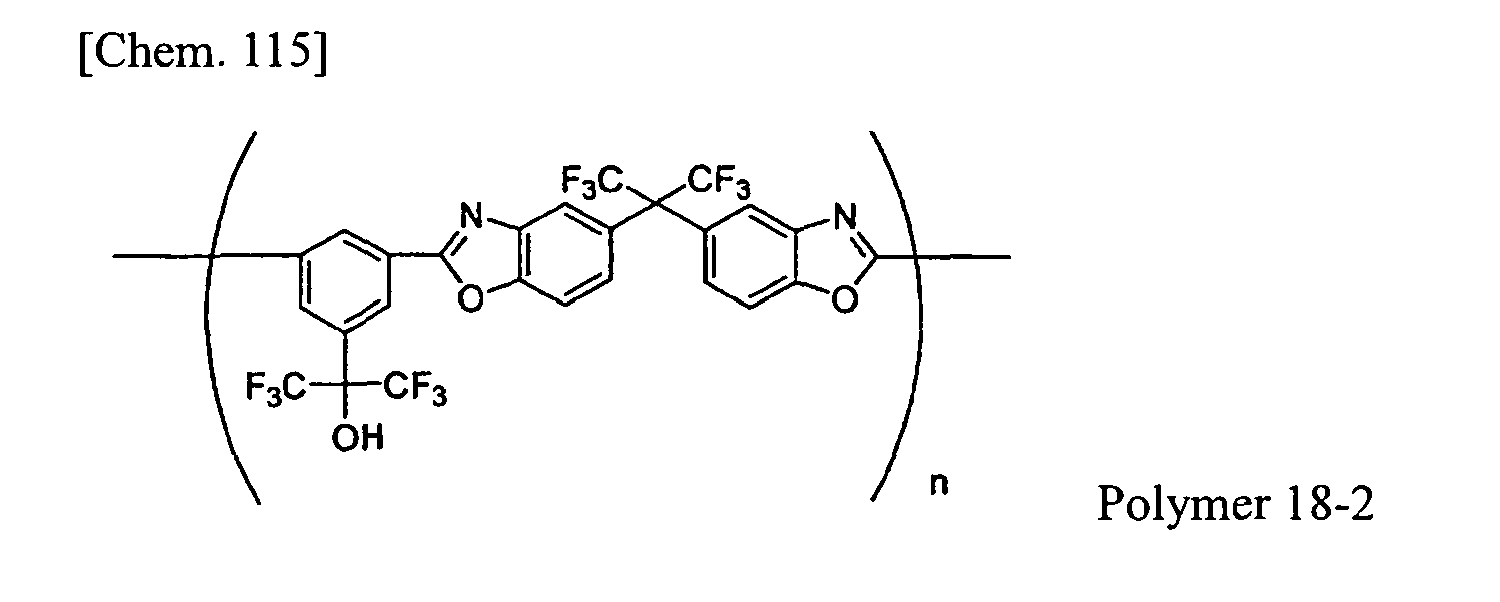
- The polymer 18-1 (1.00 g) was mixed with N,N-dimethylformamide (DMF) (4.00 g) to prepare a uniform solution. The prepared solution was filtered. The filtrate was applied by spin coating to a glass substrate and heat treated in a nitrogen atmosphere at 80°C for 30 minutes, at 150°C for 30 minutes and at 250°C for 1 hour, thereby forming a polymer film on the glass substrate. The polymer film was separated from the glass substrate and obtained as a shape-retaining flexible transparent film. It was confirmed by IR analysis that the polymer film was of polymers 18-1 and 18-2 (polymer 18). Further, there occured many cracks in the polymer film so that the polymer film was not in film form.
-


- The polymer 19 (1.00 g) was mixed with N,N-dimethylformamide (DMF) (4.00 g) to prepare a uniform solution. The prepared solution was filtered. The filtrate was applied by spin coating to a glass substrate and heat treated in a nitrogen atmosphere at 80°C for 30 minutes, at 150°C for 30 minutes and at 250°C for 1 hour, thereby forming a polymer film on the glass substrate. The polymer film was separated from the glass substrate but obtained as a poor-flexibility transparent film. It was confirmed by IR analysis that the polymer film was of polymer 20. The properties of the polymer film are indicated in TABLE 1.
-

- The polymer 21 (1.00 g) was mixed with N,N-dimethylformamide (DMF) (4.00 g) to prepare a uniform solution. The prepared solution was filtered. The filtrate was applied by spin coating to a glass substrate and heat treated in a nitrogen atmosphere at 80°C for 30 minutes, at 150°C for 30 minutes and at 250°C for 1 hour, thereby forming a polymer film on the glass substrate. As the polymer film had a low polymerization degree, there occured many cracks in the polymer film.
-
TABLE 1 Polymer Specific viscosity (30°C) Specific dielectric constant Polymer structure Film form Heating temperature Example 10 1 0.92 2.8 PE flexible 250°C Example 11 2 0.83 2.8 PE flexible 250°C Example 12 3 0.71 2.9 PE flexible 250°C Example 13 4 0.64 2.6 PE flexible 250°C Example 14 5 0.58 2.6 PE flexible 250°C Example 15 6 0.34 3.4 PA flexible 250°C Example 16 7 0.32 3.6 PA flexible 250°C Example 17 8 0.27 3.5 PA flexible 250°C Example 18 9 0.25 3.6 PA flexible 250°C Example 19 10 0.18 3.3 PA flexible 250°C Example 20 11 0.22 - OH-PA - - Example 21 12 - 2.6 oxazole flexible 250°C Example 22 13 0.23 - OH-PA - - Example 23 14 - 2.5 oxazine flexible 250°C Example 24 15 0.12 2.9 PE flexible 250°C Example 28 22 0.68 2.7 PE flexible 250°C Example 29 23 0.32 3.6 PA flexible 250°C Example 30 24 0.26 - OH-PA - - Example 31 25 - 2.7 oxazole flexible 250°C Example 32 26 0.27 - OH-PA - - Example 33 27 - 2.6 oxazine flexible 250°C Comparative Example 1 16 0.05 - PE cracked 250°C Comparative Example 2 17 0.04 - PA cracked 250°C Comparative Example 3 18 0.03 - partially oxazole cracked 250°C Comparative Example 4 19 0.13 - PA cracked - 20 - - oxazine cracked 250°C Reference Example 7 21 0.05 2.6 PA cracked 250°C Specific viscosity: measured using capillary viscometer and 97% concentrated sulfuric acid as solvent.
Specific dielectric constant: frequency: 100 kHz, film thickness: 10 µm.
Specific dielectric constant = (capacity measurement value × film thickness)/(dielectric constant under vacuum × measurement area).
PE, PA, OH-PA, oxazine and oxazole refer to polyester, polyamide, hydroxyl-containing polyamide, polybenzoxazine and polybenzoxazole, respectively. - As is clear from TABLE 1, it has been shown that the novel polymer obtained from the fluorinated dicarboxylic acid derivative according to the present invention can achive high strength and excellent electrical characteristics under relatively low temperature conditions.
Claims (11)
- A polymer obtained by polycondensation of a fluorinated dicarboxylic acid derivative of the general formula (M-1) or an acid anhydride of the fluorinated dicarboxylic acid with a polyfunctional compound having two to four reactive groups corresponding in reactivity to carbonyl moieties of the fluorinated dicarboxylic acid derivative or acid anhydride:
[Chem. 119] AOCF2C-Q-CF2COA' (M-1)
where Q represents a divalent organic group having a substituted or unsubstituted aromatic ring; each of CF2COA and CF2COA' is bonded to a carbon atom of the aromatic ring; a hydrogen atom on the aromatic ring may be substituted with either a fluorine atom, a chlorine atom, a hydroxyl group, an amino group, a nitro group, a cyano group, a hydroxycarbonyl group, a C1-C6 straight, branched or cyclic alkyl group (whose hydrogen atom may be substituted with a hydroxyl group or a fluorine atom), a C1-C6 straight, branched or cyclic alkoxy group, a C1-C6 straight, branched or cyclic alkoxycarbonyl group or a substituted or unsubstituted monovalent aromatic ring group; and A and A' each independently represent a hydroxyl group, a fluorine atom, a chlorine atom, a bromine atom, an iodine atom, a C1-C6 straight, branched or cyclic alkoxy group or a C6-C10 substituted or unsubstituted aryloxy group and may form an active ester moiety together with a CO group (carbonyl group) in the formula. - The polymer according to claim 1, wherein the divalent organic group Q is a divalent organic group of the following general formula (a):
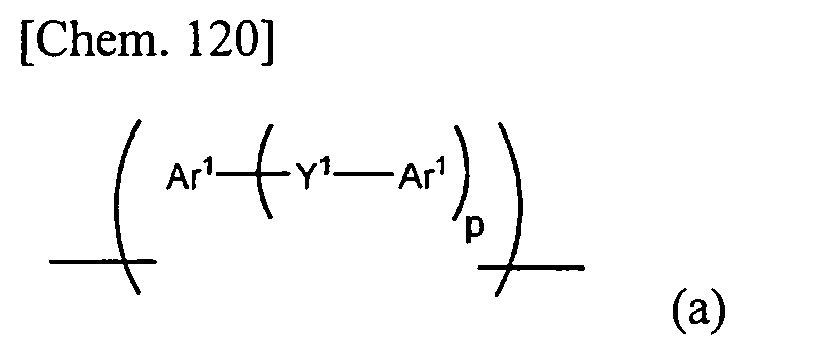
- The polymer according to claim 1, wherein the divalent organic group Q is a divalent organic group of the following general formula (b):

- The polymer according to any one of claims 1 to 3, wherein the divalent organic group Q is either one of divalent organic groups of the following formulas:

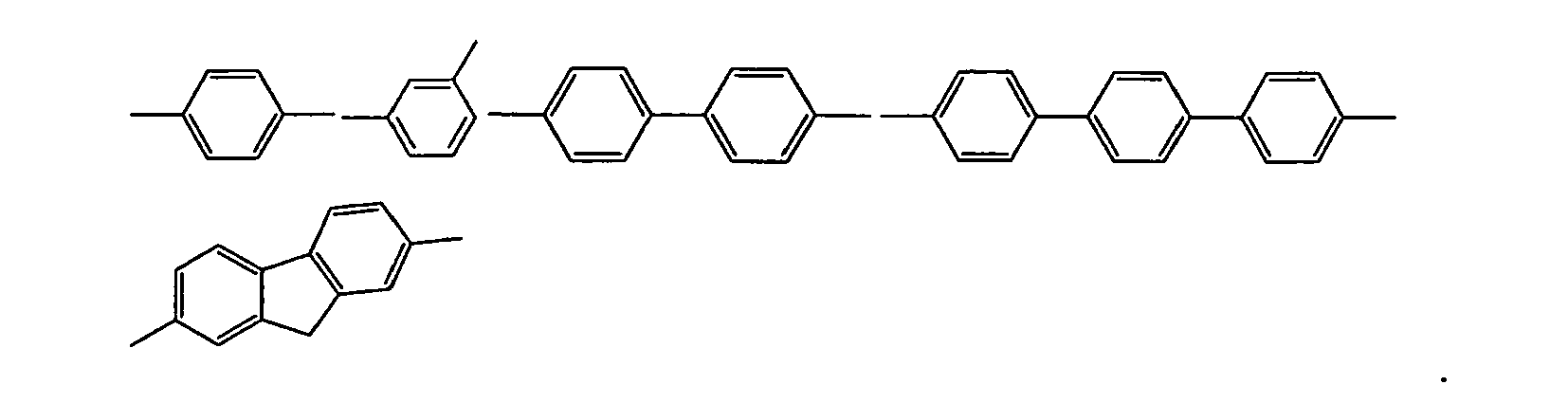
- The polymer according to any one of claims 1 to 4, wherein the polymer is of the general formula (7) obtained by polycondensation of the fluorinated dicarboxylic acid derivative or acid anhydride with a diamine of the general formula (3) as the polyfunctional compound:
[Chem. 123] H2N-R2-NH2 (3)

- The polymer according to any one of claims 1 to 4, wherein the polymer is of the general formula (8) obtained by polycondensation of the fluorinated dicarboxylic acid derivative or acid anhydride with a diaminodiol of the general formula (4) as the polyfunctional compound:


- A polymer of the following general formula (9) obtained by dehydration ring closure of the polymer of the general formula (8) according to claim 6:

- The polymer according to any one of claims 1 to 4, wherein the polymer is of the general formula (10) obtained by polycondensation of the fluorinated dicarboxylic acid derivative or acid anhydride with a hexaisopropanol-substituted diaminodiol of the general formula (5) as the polyfunctional compound:


- A polymer of the following general formula (11) obtained by dehydration ring closure of the polymer of the general formula (10) according to claim 8:

- The polymer according to any one of claims 1 to 4, wherein the polymer is of the general formula (6) obtained by polycondensation of the fluorinated dicarboxylic acid derivative or acid anhydride with a diol of the general formula (2) as the polyfunctional compound:
[Chem. 131] HO-R1-OH (2)

- A fluorinated dicarboxylic acid derivative of the general formula (M-2):
[Chem. 133] DOCF2C-Q-CF2COD' (M-2)
where Q represents a divalent organic group having a substituted or unsubstituted aromatic ring; a hydrogen atom on the aromatic ring may be substituted with either a fluorine atom, a chlorine atom, a hydroxyl group, an amino group, a nitro group, a cyano group, a hydroxycarbonyl group, a C1-C6 straight, branched or cyclic alkyl group (whose hydrogen atom may be substituted with a hydroxyl group or a fluorine atom), a C1-C6 straight, branched or cyclic alkoxy group, a C1-C6 straight, branched or cyclic alkoxycarbonyl group or a substituted or unsubstituted monovalent aromatic ring group; two difluoromethylene groups are not bonded to adjacent carbon atoms of the aromatic ring; D and D' each independently represent a hydroxyl group, a fluorine atom, a chlorine atom, a bromine atom, an iodine atom, a C1-C6 straight, branched or cyclic alkoxy group or a C6-C10 substituted or unsubstituted aryloxy group and may form an active ester moiety with a CO group (carbonyl group) in the formula.
Applications Claiming Priority (2)
| Application Number | Priority Date | Filing Date | Title |
|---|---|---|---|
| JP2009038347 | 2009-02-20 | ||
| PCT/JP2010/052425 WO2010095678A1 (en) | 2009-02-20 | 2010-02-18 | Fluorinated dicarboxylic acid derivative and polymer obtained therefrom |
Publications (2)
| Publication Number | Publication Date |
|---|---|
| EP2395040A1 true EP2395040A1 (en) | 2011-12-14 |
| EP2395040A4 EP2395040A4 (en) | 2013-08-28 |
Family
ID=42633958
Family Applications (1)
| Application Number | Title | Priority Date | Filing Date |
|---|---|---|---|
| EP10743804.6A Withdrawn EP2395040A4 (en) | 2009-02-20 | 2010-02-18 | Fluorinated dicarboxylic acid derivative and polymer obtained therefrom |
Country Status (6)
| Country | Link |
|---|---|
| US (1) | US8809451B2 (en) |
| EP (1) | EP2395040A4 (en) |
| JP (1) | JP5768320B2 (en) |
| KR (1) | KR101290226B1 (en) |
| CN (1) | CN102325824B (en) |
| WO (1) | WO2010095678A1 (en) |
Cited By (1)
| Publication number | Priority date | Publication date | Assignee | Title |
|---|---|---|---|---|
| WO2014084188A1 (en) * | 2012-11-28 | 2014-06-05 | セントラル硝子株式会社 | Fluorine-containing polymerizable monomer and polymer compound using same |
Families Citing this family (15)
| Publication number | Priority date | Publication date | Assignee | Title |
|---|---|---|---|---|
| JP5862453B2 (en) | 2011-05-30 | 2016-02-16 | セントラル硝子株式会社 | Fluorine-containing polymerizable monomer and polymer compound using the same |
| JP6330272B2 (en) * | 2012-08-30 | 2018-05-30 | セントラル硝子株式会社 | Photosensitive resin composition and pattern forming method using the same |
| US9793483B2 (en) | 2012-11-28 | 2017-10-17 | Central Glass Company, Limited | Hexafluoroisopropanol group-containing diamine, polyimide and polyamide using same, cyclized product thereof, and method for producing same |
| JP6225659B2 (en) * | 2012-11-28 | 2017-11-08 | セントラル硝子株式会社 | Diamine containing hexafluoroisopropanol group, polyimide and polyamide using the same, cyclized product thereof, and production method thereof |
| JP6547503B2 (en) * | 2014-09-12 | 2019-07-24 | セントラル硝子株式会社 | Gas separation membrane |
| CN109735925B (en) * | 2018-12-27 | 2020-11-06 | 江苏恒力化纤股份有限公司 | Polyester FDY (fully drawn yarn) easy to dye and degrade and preparation method thereof |
| CN109735930B (en) * | 2018-12-27 | 2020-10-16 | 江苏恒力化纤股份有限公司 | Full-dull polyester drawn yarn and preparation method thereof |
| CN109750369B (en) * | 2018-12-27 | 2020-05-22 | 江苏恒力化纤股份有限公司 | Feather yarn-imitated polyester fiber and preparation method thereof |
| KR20230047168A (en) * | 2020-08-05 | 2023-04-06 | 샌트랄 글래스 컴퍼니 리미티드 | Fluorinated diamine or salt thereof, method for producing fluorinated diamine or salt thereof, polyamide, method for producing polyamide, polyamide solution, cyclized polyamide, method for producing cyclized polyamide, insulating material for high-frequency electronic parts, high-frequency electronics Manufacturing method of insulating materials for components, high-frequency electronic components, high-frequency devices, and insulating materials for manufacturing high-frequency electronic components |
| CN113004514B (en) * | 2021-04-15 | 2021-09-21 | 深圳市华盈新材料有限公司 | Low-hygroscopicity PA5T and synthesis method thereof |
| CN113831522A (en) * | 2021-09-29 | 2021-12-24 | 宁夏清研高分子新材料有限公司 | Preparation method of low-dielectric high-viscosity LCP material |
| CN117285709B (en) * | 2022-06-16 | 2024-09-10 | 比亚迪股份有限公司 | A catalyst for synthesizing polyimide and its preparation method and application |
| CN115368568A (en) * | 2022-09-28 | 2022-11-22 | 国家电投集团氢能科技发展有限公司 | Perfluorinated ion exchange resin, preparation method thereof and ion exchange membrane |
| CN121752636A (en) * | 2023-09-26 | 2026-03-27 | 东丽株式会社 | Polyamide resin, photosensitive resin composition, cured product, method for producing cured product, and electronic component |
| CN117264202A (en) * | 2023-11-21 | 2023-12-22 | 黑龙江伊品新材料有限公司 | Low-water-absorption copolymerized nylon resin based on nylon 56 and preparation method thereof |
Family Cites Families (11)
| Publication number | Priority date | Publication date | Assignee | Title |
|---|---|---|---|---|
| JPH05112635A (en) * | 1991-10-23 | 1993-05-07 | Hitachi Ltd | All-fluorinated wholly aromatic polyester and optical parts using the same |
| JP3847579B2 (en) * | 2001-06-28 | 2006-11-22 | セントラル硝子株式会社 | Alicyclic fluorinated dicarboxylic acid and polymer or photosensitive material composition using the same |
| JP3904854B2 (en) * | 2001-06-28 | 2007-04-11 | セントラル硝子株式会社 | Method for producing fluorine-containing alicyclic dicarboxylic acid compound |
| JP2004143406A (en) * | 2002-08-28 | 2004-05-20 | Sekisui Chem Co Ltd | Polyester resin fine particles and method for producing polyester resin fine particles |
| JP2004143416A (en) * | 2002-08-29 | 2004-05-20 | National Cardiovascular Center | Fluorine-containing monomer and method for producing the same, and fluorine-containing polymer and method for producing the same |
| CN100343308C (en) | 2002-10-31 | 2007-10-17 | 东丽株式会社 | Alicyclic or aromatic polyamides, polyamide films, optical members made by using the same, and polyamide copolymers |
| JP2006056939A (en) * | 2004-08-18 | 2006-03-02 | Sumitomo Electric Ind Ltd | Thermoplastic fluorinated polybenzoxazole resin, its precursor, molded product, production method thereof, and resin composition |
| JP4679328B2 (en) | 2004-10-13 | 2011-04-27 | セントラル硝子株式会社 | Fluorine-containing polymerizable monomer and polymer compound using the same |
| JP5114938B2 (en) * | 2006-12-19 | 2013-01-09 | セントラル硝子株式会社 | Fluorine-containing diamine and polymer compound using the same |
| US7806275B2 (en) * | 2007-05-09 | 2010-10-05 | The United States Of America As Represented By The Secretary Of The Interior, The Bureau Of Reclamation | Chlorine resistant polyamides and membranes made from the same |
| JP5233457B2 (en) * | 2007-07-17 | 2013-07-10 | セントラル硝子株式会社 | Novel fluorine-containing dicarboxylic acid and novel polymer compound using the same |
-
2010
- 2010-02-18 WO PCT/JP2010/052425 patent/WO2010095678A1/en not_active Ceased
- 2010-02-18 US US13/201,766 patent/US8809451B2/en not_active Expired - Fee Related
- 2010-02-18 KR KR1020117021657A patent/KR101290226B1/en not_active Expired - Fee Related
- 2010-02-18 CN CN2010800087363A patent/CN102325824B/en not_active Expired - Fee Related
- 2010-02-18 EP EP10743804.6A patent/EP2395040A4/en not_active Withdrawn
- 2010-02-18 JP JP2010033260A patent/JP5768320B2/en active Active
Cited By (1)
| Publication number | Priority date | Publication date | Assignee | Title |
|---|---|---|---|---|
| WO2014084188A1 (en) * | 2012-11-28 | 2014-06-05 | セントラル硝子株式会社 | Fluorine-containing polymerizable monomer and polymer compound using same |
Also Published As
| Publication number | Publication date |
|---|---|
| KR20110127226A (en) | 2011-11-24 |
| US8809451B2 (en) | 2014-08-19 |
| EP2395040A4 (en) | 2013-08-28 |
| JP5768320B2 (en) | 2015-08-26 |
| CN102325824A (en) | 2012-01-18 |
| CN102325824B (en) | 2013-05-01 |
| JP2010215904A (en) | 2010-09-30 |
| WO2010095678A1 (en) | 2010-08-26 |
| US20110301305A1 (en) | 2011-12-08 |
| KR101290226B1 (en) | 2013-07-30 |
Similar Documents
| Publication | Publication Date | Title |
|---|---|---|
| EP2395040A1 (en) | Fluorinated dicarboxylic acid derivative and polymer obtained therefrom | |
| JP4375533B2 (en) | Method for producing solvent-soluble polyimide | |
| US6689899B2 (en) | Diamine and acid anhydride | |
| JP2012072118A (en) | Amide group-bearing alicyclic tetracarboxylic dianhydride, and resin obtained by using the same | |
| US6291635B1 (en) | Fluorine-containing polybenzoxazole | |
| KR20110010009A (en) | Method for producing polyimide, polyimide produced thereby and film made of said polyimide | |
| WO2008153287A1 (en) | Low temperature processable substituted alicyclic polyimide photo-alignment layers and method for preparing liquid crystal cells | |
| KR20020042733A (en) | Novel diamine, novel acid dianhydride, and novel polyimide composition formed therefrom | |
| KR20110010008A (en) | New polymer production method, new polymer produced thereby and film made from the polymer | |
| WO2005066242A1 (en) | Aromatic polyamic acid and polyimide | |
| JP3773445B2 (en) | Fluorine-containing alicyclic diamine and polymer using the same | |
| JP6145571B2 (en) | Novel acid dianhydride and method for producing the same | |
| KR100872676B1 (en) | Fluorinated diamine and polymer made from the same | |
| US5270432A (en) | Polybenzoxazole via aromatic nucleophilic displacement | |
| Hsiao et al. | Synthesis of soluble and thermally stable triptycene-based poly (amide-imide) s | |
| JP2025032249A (en) | Resin raw material composition | |
| Rajasekar et al. | Synthesis and properties of polyetherimides by nucleophilic displacement reaction | |
| Xie et al. | Synthesis and characterization of poly (aryl ether ketone) s with fluorinated phenyl in the side chain | |
| Tsuda et al. | Surface Wettability Controllable Polyimide Bearing o-Nitrobenzyl Group by UV Light Irradiation | |
| Guo et al. | Synthesis and properties of ortho-linked aromatic poly (ester-amide) s and poly (ester-imide) s bearing 2, 3-bis (benzoyloxy) naphthalene units | |
| JP2006206879A (en) | Fluorodiamine and polymer obtained using the same | |
| Morikawa et al. | Synthesis and characterization of novel aromatic polyimides from aromatic diamine and 3, 3''''', 4, 4'''''-p-sexiphenyltetracarboxylic dianhydride | |
| JP4957077B2 (en) | Tetracarboxylic acids or polyesterimides derived therefrom and method for producing the same | |
| JP2008163088A (en) | Ester group-containing alicyclic tetracarboxylic anhydride and process for producing the same | |
| JP2008163090A (en) | Tetracarboxylic dianhydride, method for producing the same, and polymer |
Legal Events
| Date | Code | Title | Description |
|---|---|---|---|
| PUAI | Public reference made under article 153(3) epc to a published international application that has entered the european phase |
Free format text: ORIGINAL CODE: 0009012 |
|
| 17P | Request for examination filed |
Effective date: 20110905 |
|
| AK | Designated contracting states |
Kind code of ref document: A1 Designated state(s): AT BE BG CH CY CZ DE DK EE ES FI FR GB GR HR HU IE IS IT LI LT LU LV MC MK MT NL NO PL PT RO SE SI SK SM TR |
|
| DAX | Request for extension of the european patent (deleted) | ||
| A4 | Supplementary search report drawn up and despatched |
Effective date: 20130729 |
|
| RIC1 | Information provided on ipc code assigned before grant |
Ipc: C08G 73/06 20060101ALI20130723BHEP Ipc: C08G 69/42 20060101AFI20130723BHEP Ipc: C08G 63/682 20060101ALI20130723BHEP Ipc: C07C 57/76 20060101ALI20130723BHEP Ipc: C07C 69/65 20060101ALI20130723BHEP Ipc: C07C 59/64 20060101ALI20130723BHEP Ipc: C07C 69/734 20060101ALI20130723BHEP Ipc: C07C 57/58 20060101ALI20130723BHEP |
|
| STAA | Information on the status of an ep patent application or granted ep patent |
Free format text: STATUS: THE APPLICATION IS DEEMED TO BE WITHDRAWN |
|
| 18D | Application deemed to be withdrawn |
Effective date: 20160901 |