EP2394999A1 - Aminopyrazine derivative and medicine - Google Patents
Aminopyrazine derivative and medicine Download PDFInfo
- Publication number
- EP2394999A1 EP2394999A1 EP10738621A EP10738621A EP2394999A1 EP 2394999 A1 EP2394999 A1 EP 2394999A1 EP 10738621 A EP10738621 A EP 10738621A EP 10738621 A EP10738621 A EP 10738621A EP 2394999 A1 EP2394999 A1 EP 2394999A1
- Authority
- EP
- European Patent Office
- Prior art keywords
- fluorophenyl
- pyrazin
- ethylamino
- ethyl
- diamine
- Prior art date
- Legal status (The legal status is an assumption and is not a legal conclusion. Google has not performed a legal analysis and makes no representation as to the accuracy of the status listed.)
- Granted
Links
- 0 CCC(*1)C23C1CC1C2C31 Chemical compound CCC(*1)C23C1CC1C2C31 0.000 description 12
- ZJCHMEFRWDRKIV-UHFFFAOYSA-O C=C(C=NC=CN)Nc1nc([NH2+]Cc(cc2)ccc2F)cc(-c2c[nH]nc2)c1 Chemical compound C=C(C=NC=CN)Nc1nc([NH2+]Cc(cc2)ccc2F)cc(-c2c[nH]nc2)c1 ZJCHMEFRWDRKIV-UHFFFAOYSA-O 0.000 description 1
- ZSMHKOROJLRBPI-UHFFFAOYSA-N CC(C)(C)OC(NCC(C1)CN1c1cc(Nc2ncccc2)nc(NCc(cc2)ccc2F)n1)=O Chemical compound CC(C)(C)OC(NCC(C1)CN1c1cc(Nc2ncccc2)nc(NCc(cc2)ccc2F)n1)=O ZSMHKOROJLRBPI-UHFFFAOYSA-N 0.000 description 1
- BAFPYWGOIDFNMI-UHFFFAOYSA-N CC(C1)(CN1c1cc(Nc2cnccn2)nc(NCc(cc2)ccc2F)c1)O Chemical compound CC(C1)(CN1c1cc(Nc2cnccn2)nc(NCc(cc2)ccc2F)c1)O BAFPYWGOIDFNMI-UHFFFAOYSA-N 0.000 description 1
- LYMXBZMYENDPIT-UHFFFAOYSA-N CNC(C(C#CC1)=C(NC2(CC2)c(cc2)ccc2F)N=C1Nc1ncc[n]c1)=N Chemical compound CNC(C(C#CC1)=C(NC2(CC2)c(cc2)ccc2F)N=C1Nc1ncc[n]c1)=N LYMXBZMYENDPIT-UHFFFAOYSA-N 0.000 description 1
- GHEGCZALDUFTOQ-UHFFFAOYSA-N Cc(nc1)c[n]1-c1cc(Nc2nccnc2)nc(NCc(cc2)ccc2F)c1 Chemical compound Cc(nc1)c[n]1-c1cc(Nc2nccnc2)nc(NCc(cc2)ccc2F)c1 GHEGCZALDUFTOQ-UHFFFAOYSA-N 0.000 description 1
- BYVHIMLCXNGZTF-UHFFFAOYSA-N FC(C1)(CN1c1cc(Nc2nccnc2)nc(NCc(cc2)ccc2F)n1)F Chemical compound FC(C1)(CN1c1cc(Nc2nccnc2)nc(NCc(cc2)ccc2F)n1)F BYVHIMLCXNGZTF-UHFFFAOYSA-N 0.000 description 1
- LLVBKMRCPIERMT-UHFFFAOYSA-N Fc1ccc(CNc2cc(-c3c[nH]cc3)cc(Nc3cnccn3)n2)cc1 Chemical compound Fc1ccc(CNc2cc(-c3c[nH]cc3)cc(Nc3cnccn3)n2)cc1 LLVBKMRCPIERMT-UHFFFAOYSA-N 0.000 description 1
- SRDSGSNTJCHYSE-UHFFFAOYSA-N Fc1ccc(CNc2cc(-c3c[nH]nc3)cc(Nc3nccnc3)n2)cc1 Chemical compound Fc1ccc(CNc2cc(-c3c[nH]nc3)cc(Nc3nccnc3)n2)cc1 SRDSGSNTJCHYSE-UHFFFAOYSA-N 0.000 description 1
- NFUYHDLBOOZCKZ-UHFFFAOYSA-N Fc1ccc(CNc2nc(-c3c[nH]cc3)cc(Nc3nccnc3)n2)cc1 Chemical compound Fc1ccc(CNc2nc(-c3c[nH]cc3)cc(Nc3nccnc3)n2)cc1 NFUYHDLBOOZCKZ-UHFFFAOYSA-N 0.000 description 1
- FEPPPCIMLFERBF-UHFFFAOYSA-N Fc1ccc(CNc2nc(NCc3ccncc3)cc(Nc3cnccn3)n2)cc1 Chemical compound Fc1ccc(CNc2nc(NCc3ccncc3)cc(Nc3cnccn3)n2)cc1 FEPPPCIMLFERBF-UHFFFAOYSA-N 0.000 description 1
- NSZKWSYWFIXWBW-UHFFFAOYSA-N NC(C1C=CC(c2cc(Nc3nccnc3)nc(NCc(cc3)ccc3F)c2)=CC1)=O Chemical compound NC(C1C=CC(c2cc(Nc3nccnc3)nc(NCc(cc3)ccc3F)c2)=CC1)=O NSZKWSYWFIXWBW-UHFFFAOYSA-N 0.000 description 1
- IIFVWLUQBAIPMJ-UHFFFAOYSA-N NCc(cc1)ccc1F Chemical compound NCc(cc1)ccc1F IIFVWLUQBAIPMJ-UHFFFAOYSA-N 0.000 description 1
- XFTQRUTUGRCSGO-UHFFFAOYSA-N Nc1nccnc1 Chemical compound Nc1nccnc1 XFTQRUTUGRCSGO-UHFFFAOYSA-N 0.000 description 1
- VLPDVDOLFFBJKF-UHFFFAOYSA-N O=S(c1ccccc1)(N(CC1)CCN1c1cc(NC2=NC=CNC2)nc(NCc(cc2)ccc2F)n1)=O Chemical compound O=S(c1ccccc1)(N(CC1)CCN1c1cc(NC2=NC=CNC2)nc(NCc(cc2)ccc2F)n1)=O VLPDVDOLFFBJKF-UHFFFAOYSA-N 0.000 description 1
Classifications
-
- A—HUMAN NECESSITIES
- A61—MEDICAL OR VETERINARY SCIENCE; HYGIENE
- A61K—PREPARATIONS FOR MEDICAL, DENTAL OR TOILETRY PURPOSES
- A61K31/00—Medicinal preparations containing organic active ingredients
- A61K31/33—Heterocyclic compounds
- A61K31/395—Heterocyclic compounds having nitrogen as a ring hetero atom, e.g. guanethidine or rifamycins
- A61K31/495—Heterocyclic compounds having nitrogen as a ring hetero atom, e.g. guanethidine or rifamycins having six-membered rings with two or more nitrogen atoms as the only ring heteroatoms, e.g. piperazine or tetrazines
- A61K31/4965—Non-condensed pyrazines
- A61K31/497—Non-condensed pyrazines containing further heterocyclic rings
-
- A—HUMAN NECESSITIES
- A61—MEDICAL OR VETERINARY SCIENCE; HYGIENE
- A61K—PREPARATIONS FOR MEDICAL, DENTAL OR TOILETRY PURPOSES
- A61K31/00—Medicinal preparations containing organic active ingredients
- A61K31/33—Heterocyclic compounds
- A61K31/395—Heterocyclic compounds having nitrogen as a ring hetero atom, e.g. guanethidine or rifamycins
- A61K31/495—Heterocyclic compounds having nitrogen as a ring hetero atom, e.g. guanethidine or rifamycins having six-membered rings with two or more nitrogen atoms as the only ring heteroatoms, e.g. piperazine or tetrazines
- A61K31/505—Pyrimidines; Hydrogenated pyrimidines, e.g. trimethoprim
- A61K31/506—Pyrimidines; Hydrogenated pyrimidines, e.g. trimethoprim not condensed and containing further heterocyclic rings
-
- A—HUMAN NECESSITIES
- A61—MEDICAL OR VETERINARY SCIENCE; HYGIENE
- A61P—SPECIFIC THERAPEUTIC ACTIVITY OF CHEMICAL COMPOUNDS OR MEDICINAL PREPARATIONS
- A61P1/00—Drugs for disorders of the alimentary tract or the digestive system
- A61P1/04—Drugs for disorders of the alimentary tract or the digestive system for ulcers, gastritis or reflux esophagitis, e.g. antacids, inhibitors of acid secretion, mucosal protectants
-
- A—HUMAN NECESSITIES
- A61—MEDICAL OR VETERINARY SCIENCE; HYGIENE
- A61P—SPECIFIC THERAPEUTIC ACTIVITY OF CHEMICAL COMPOUNDS OR MEDICINAL PREPARATIONS
- A61P11/00—Drugs for disorders of the respiratory system
-
- A—HUMAN NECESSITIES
- A61—MEDICAL OR VETERINARY SCIENCE; HYGIENE
- A61P—SPECIFIC THERAPEUTIC ACTIVITY OF CHEMICAL COMPOUNDS OR MEDICINAL PREPARATIONS
- A61P19/00—Drugs for skeletal disorders
- A61P19/02—Drugs for skeletal disorders for joint disorders, e.g. arthritis, arthrosis
-
- A—HUMAN NECESSITIES
- A61—MEDICAL OR VETERINARY SCIENCE; HYGIENE
- A61P—SPECIFIC THERAPEUTIC ACTIVITY OF CHEMICAL COMPOUNDS OR MEDICINAL PREPARATIONS
- A61P19/00—Drugs for skeletal disorders
- A61P19/08—Drugs for skeletal disorders for bone diseases, e.g. rachitism, Paget's disease
- A61P19/10—Drugs for skeletal disorders for bone diseases, e.g. rachitism, Paget's disease for osteoporosis
-
- A—HUMAN NECESSITIES
- A61—MEDICAL OR VETERINARY SCIENCE; HYGIENE
- A61P—SPECIFIC THERAPEUTIC ACTIVITY OF CHEMICAL COMPOUNDS OR MEDICINAL PREPARATIONS
- A61P21/00—Drugs for disorders of the muscular or neuromuscular system
- A61P21/02—Muscle relaxants, e.g. for tetanus or cramps
-
- A—HUMAN NECESSITIES
- A61—MEDICAL OR VETERINARY SCIENCE; HYGIENE
- A61P—SPECIFIC THERAPEUTIC ACTIVITY OF CHEMICAL COMPOUNDS OR MEDICINAL PREPARATIONS
- A61P29/00—Non-central analgesic, antipyretic or antiinflammatory agents, e.g. antirheumatic agents; Non-steroidal antiinflammatory drugs [NSAID]
-
- A—HUMAN NECESSITIES
- A61—MEDICAL OR VETERINARY SCIENCE; HYGIENE
- A61P—SPECIFIC THERAPEUTIC ACTIVITY OF CHEMICAL COMPOUNDS OR MEDICINAL PREPARATIONS
- A61P35/00—Antineoplastic agents
-
- A—HUMAN NECESSITIES
- A61—MEDICAL OR VETERINARY SCIENCE; HYGIENE
- A61P—SPECIFIC THERAPEUTIC ACTIVITY OF CHEMICAL COMPOUNDS OR MEDICINAL PREPARATIONS
- A61P35/00—Antineoplastic agents
- A61P35/02—Antineoplastic agents specific for leukemia
-
- A—HUMAN NECESSITIES
- A61—MEDICAL OR VETERINARY SCIENCE; HYGIENE
- A61P—SPECIFIC THERAPEUTIC ACTIVITY OF CHEMICAL COMPOUNDS OR MEDICINAL PREPARATIONS
- A61P7/00—Drugs for disorders of the blood or the extracellular fluid
-
- A—HUMAN NECESSITIES
- A61—MEDICAL OR VETERINARY SCIENCE; HYGIENE
- A61P—SPECIFIC THERAPEUTIC ACTIVITY OF CHEMICAL COMPOUNDS OR MEDICINAL PREPARATIONS
- A61P7/00—Drugs for disorders of the blood or the extracellular fluid
- A61P7/02—Antithrombotic agents; Anticoagulants; Platelet aggregation inhibitors
-
- A—HUMAN NECESSITIES
- A61—MEDICAL OR VETERINARY SCIENCE; HYGIENE
- A61P—SPECIFIC THERAPEUTIC ACTIVITY OF CHEMICAL COMPOUNDS OR MEDICINAL PREPARATIONS
- A61P9/00—Drugs for disorders of the cardiovascular system
-
- A—HUMAN NECESSITIES
- A61—MEDICAL OR VETERINARY SCIENCE; HYGIENE
- A61P—SPECIFIC THERAPEUTIC ACTIVITY OF CHEMICAL COMPOUNDS OR MEDICINAL PREPARATIONS
- A61P9/00—Drugs for disorders of the cardiovascular system
- A61P9/10—Drugs for disorders of the cardiovascular system for treating ischaemic or atherosclerotic diseases, e.g. antianginal drugs, coronary vasodilators, drugs for myocardial infarction, retinopathy, cerebrovascula insufficiency, renal arteriosclerosis
-
- A—HUMAN NECESSITIES
- A61—MEDICAL OR VETERINARY SCIENCE; HYGIENE
- A61P—SPECIFIC THERAPEUTIC ACTIVITY OF CHEMICAL COMPOUNDS OR MEDICINAL PREPARATIONS
- A61P9/00—Drugs for disorders of the cardiovascular system
- A61P9/12—Antihypertensives
-
- A—HUMAN NECESSITIES
- A61—MEDICAL OR VETERINARY SCIENCE; HYGIENE
- A61P—SPECIFIC THERAPEUTIC ACTIVITY OF CHEMICAL COMPOUNDS OR MEDICINAL PREPARATIONS
- A61P9/00—Drugs for disorders of the cardiovascular system
- A61P9/14—Vasoprotectives; Antihaemorrhoidals; Drugs for varicose therapy; Capillary stabilisers
-
- C—CHEMISTRY; METALLURGY
- C07—ORGANIC CHEMISTRY
- C07C—ACYCLIC OR CARBOCYCLIC COMPOUNDS
- C07C57/00—Unsaturated compounds having carboxyl groups bound to acyclic carbon atoms
- C07C57/02—Unsaturated compounds having carboxyl groups bound to acyclic carbon atoms with only carbon-to-carbon double bonds as unsaturation
- C07C57/13—Dicarboxylic acids
- C07C57/145—Maleic acid
-
- C—CHEMISTRY; METALLURGY
- C07—ORGANIC CHEMISTRY
- C07D—HETEROCYCLIC COMPOUNDS
- C07D401/00—Heterocyclic compounds containing two or more hetero rings, having nitrogen atoms as the only ring hetero atoms, at least one ring being a six-membered ring with only one nitrogen atom
- C07D401/14—Heterocyclic compounds containing two or more hetero rings, having nitrogen atoms as the only ring hetero atoms, at least one ring being a six-membered ring with only one nitrogen atom containing three or more hetero rings
-
- C—CHEMISTRY; METALLURGY
- C07—ORGANIC CHEMISTRY
- C07D—HETEROCYCLIC COMPOUNDS
- C07D403/00—Heterocyclic compounds containing two or more hetero rings, having nitrogen atoms as the only ring hetero atoms, not provided for by group C07D401/00
- C07D403/02—Heterocyclic compounds containing two or more hetero rings, having nitrogen atoms as the only ring hetero atoms, not provided for by group C07D401/00 containing two hetero rings
- C07D403/12—Heterocyclic compounds containing two or more hetero rings, having nitrogen atoms as the only ring hetero atoms, not provided for by group C07D401/00 containing two hetero rings linked by a chain containing hetero atoms as chain links
-
- C—CHEMISTRY; METALLURGY
- C07—ORGANIC CHEMISTRY
- C07D—HETEROCYCLIC COMPOUNDS
- C07D403/00—Heterocyclic compounds containing two or more hetero rings, having nitrogen atoms as the only ring hetero atoms, not provided for by group C07D401/00
- C07D403/14—Heterocyclic compounds containing two or more hetero rings, having nitrogen atoms as the only ring hetero atoms, not provided for by group C07D401/00 containing three or more hetero rings
-
- C—CHEMISTRY; METALLURGY
- C07—ORGANIC CHEMISTRY
- C07D—HETEROCYCLIC COMPOUNDS
- C07D413/00—Heterocyclic compounds containing two or more hetero rings, at least one ring having nitrogen and oxygen atoms as the only ring hetero atoms
- C07D413/14—Heterocyclic compounds containing two or more hetero rings, at least one ring having nitrogen and oxygen atoms as the only ring hetero atoms containing three or more hetero rings
Definitions
- the present invention relates to a new aminopyrazine derivative and a pharmaceutical composition containing the aminopyrazine derivative as an active ingredient.
- Myeloidproliferative neoplasms are a class of diseases mainly involving abnormal growth of hemocytes, which is caused by aberrant hematopoietic stem cells. Specifically, diseases such as polycythemia vera, essential thrombocythemia, and idiopathic myelofibrosis are known (see, for example, Non-patent document 1). At present, there is no available therapy for myeloidproliferative neoplasms (chronic myeloid proliferative diseases) and thus there is an earnest desire of therapeutic agent for these diseases.
- JAK2 V617F mutation a kind of JAK family tyrosine kinases (JAK2 V617F mutation)
- JAK2 V617F mutation a kind of JAK family tyrosine kinases
- the activated mutation was confirmed in about 95% of polycythemia vera patients, about 50% of essential thrombocythemia patients, and about 50% of idiopathic myelofibrosis patients (see, for example, Non-patent document 3).
- JAK2 D620E mutation another activated mutation of JAK2 (JAK2 D620E mutation) was found in a few cases of polycythemia vera patients (see, for example, Non-patent document 4). Moreover, activated mutations of c-Mpl in a thrombopoietin receptor (MPL W515L mutation and MPL W515K mutation) were found in about 10% of idiopathic myelofibrosis patients in whom JAK2 V617F was negative.
- JAK2 Since JAK2 is located downstream of the intracellular signal transduction pathway of c-Mpl, a compound having a JAK2 tyrosine kinase inhibitory activity is expected to be an active ingredient for therapeutics in treatment of diseases caused not only by JAK2-activated mutation but also by c-Mpl mutation, e.g., myeloidproliferative neoplasms (chronic myeloid proliferative diseases)(see, for example, Non-patent documents 5 and 6). JAK2-activated mutations have also been found in other than myeloidproliferative neoplasms (chronic myeloid proliferative diseases).
- JAK2 V617F mutation is found at a high rate in patients belonging to a class of myelodysplastic syndrome (RARS-T) (see, for example, Non-patent document 7).
- JAK2-activated mutation has also been found in 16 (about 9%) of 187 cases in infantile acute lymphocytic leukemia patients (see, for example, Non-patent document 8), and in about 20% of infantile acute lymphocytic leukemia patients with Down's syndrome (see, for example, Non-patent document 9).
- JAK2 tyrosine kinase generated by JAK2 fusion gene is involved in pathological formation.
- a TEL-JAK2 fusion protein was found in patients of myeloidproliferative neoplasms (acute myeloid proliferative diseases) and of acute myeloid leukemia, and a BCR-JAK2 fusion protein and a PCM1-JAK2 fusion protein were found in patients of chronic myeloid leukemia-like hematic cancer (see, for example, Non-patent document 10).
- JAK2 signal transduction pathway is involved in the growth of Bcr-Ab1-positive chronic myeloid leukemia cells, suggesting that a compound having a JAK2 tyrosine kinase inhibitory activity will be effective for imatinib-resistant chronic myeloid leukemia (see, for example, Non-patent document 11).
- the JAK2 signal transduction pathway is one of important pathways in the growth of hematic cancer cell, and thus, a compound having a JAK2 tyrosine kinase inhibitory activity is expected to have a therapeutic effect for a variety of hematic cancers (see, for example, Non-patent document 10).
- JAK2 tyrosine kinase is also involved in intracellular signal transduction of cytokine receptors or hormone receptors.
- Interleukin-6 IL-6
- IL-6 is an inflammatory cytokine which plays an important role in inflammation, immunoresponse and onset of cancers (see, for example, Non-patent documents 12, 13 and 14), and the IL-6 signal is transduced through JAK2 tyrosine kinase (see, for example, Non-patent document 15).
- IL-6 IL-6-induced inflammatory diseases
- hematic cancers e.g., multiple myeloma
- solid cancer e.g., prostatic cancer
- angiopathy e.g., pulmonary hypertension, arteriosclerosis, aneurysm, varicose vein
- JAK2 tyrosine kinase contributes to intracellular signal transduction of prolactin receptors, and the expressed amount of prolactin receptor increases in breast cancer, resulting in acceleration of the proliferation of cancer cells by prolactin (for example, Non-patent document 19).
- a compound having a JAK2 tyrosine kinase inhibitory activity exhibits a therapeutic effect for a variety of diseases such as inflammatory diseases, hematic cancers, solid cancers, and angiopathy since JAK2 tyrosine kinase is involved in transduction of extracellular stimulation.
- JAK3 is a tyrosine kinase which plays an important role in signal transduction of cytokine, and has attracted considerable attention as a target molecule of immunosuppressants since 10 or more years ago.
- compounds having a JAK3 tyrosine kinase inhibitory activity have been subjected to clinical trial as therapeutics for organ transplantation and rheumatoid arthritis (see, for example, Non-patent document 20).
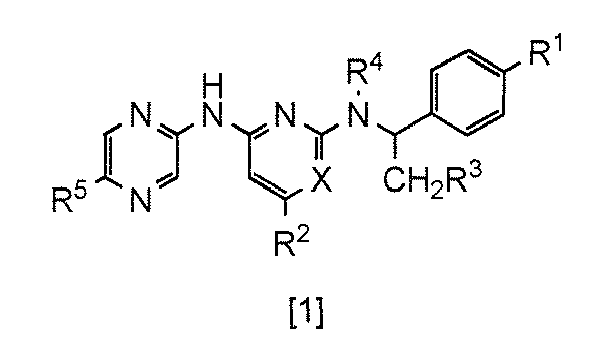
- the compound represented by the following general formula [1] (hereinafter referred to as "the compound of the invention") or a pharmaceutically acceptable salt thereof is exemplified, wherein the compound is defined by the following (I) or (II).
- the compound represented by the general formula [1], particularly the compound as defined by the following [i] or [ii], or pharmaceutically acceptable salts thereof, are preferred.
- alkylsulfonyl alkylcarbonylamino
- hydroxyalkyl alkyl
- cycloalkyl alkoxyalkyl
- alkylamino alkylamino
- dialkylamino dialkylaminoalkyl
- alkylsulfonylamino alkylsulfonyl
- alkylsulfonyl alkylsulfonyl
- alkylsulfonylamino and “monoalkylaminosulfonyl”
- Haloalkyl means, for example, a straight or branched chain alkyl of 1 to 8 carbons on which one or more of halogen atoms are substituted at any replaceable optional position (s).
- the alkyl and halogen moieties of "haloalkyl” can be exemplified by the same ones as the above “alkyl,” and “halogen", respectively.
- Cycloalkyl means, for example, those having 3 to 8 carbons, specifically including cyclopropyl, cyclobutyl, cyclopentyl, cyclohexyl, cycloheptyl, cyclooctyl, and the like.
- N-containing saturated heterocyclic group means, for example, a 5- or 6-membered saturated heterocyclic group containing one of N as a ring-constituting atom, specifically including for example 2-pyrrolidinyl, 3-pyrrolidinyl, 2-piperidinyl, 3-piperidinyl, and 4-piperidinyl.
- Optionally O-containg saturated cyclic group means, for example, a 5- or 6-membered saturated cyclic group which may contain one of O as a ring-constituting atom, specifically including for example cyclopentyl, cyclohexyl, tetrahydrofuranyl, and tetrahydropyranyl.
- the usable ligand for the palladium catalyst includes, for example, 1,1'-bis-(diphenylphosphino)ferrocene, 4,5-bis(diphenylphosphino)-9,9'-dimethylxanthene, 2-dicyclohexylphosphino-2',4',6'-triisopropylbiphenyl, ( ⁇ )-2,2'-bis(diphenylphosphino)-1,1'-binaphthyl, 2-(di-t-butylphosphino)biphenyl, bis[2-(diphenylphosphino)phenyl]ether, and tri-t-butylphosphine.
- the usable base includes, for example, sodium t-butoxide, tripotassium phosphate, and cesium carbonate.
- the reaction time depends on the kind of the starting material used and the reaction temperature, and is usually in the range of 10 minutes to 24 hours.
- Compound [12] as a starting material may be produced according to a known method ( Bioorg. Med. Chem. Lett., 14, 2004, 4249-4252 ; Org. Lett., 6, 2004, 3671-3674 ).
- the usable solvent includes, for example, hydrocarbons such as toluene, xylene; ethers such as 1,4-dioxane, tetrahydrofuran; amides such as N,N-dimethylformamide, N,N-dimethylacetamide, N-methyl-2-pyrrolidone; or a mixture of them, but there is no particular limitation as long as they have no influence on the reaction.
- the reaction is carried out at a temperature of 20°C to 200°C in the presence of a base.
- Compound [15] as a starting compound may be produced, for example, according to the following method. (wherein X 1 , R 1 , R 6 Hal 1 and Hal 2 have the same meanings as described above.)
- Compound [18] may be produced by reacting Compound [16] with an alcohol compound [17] in a suitable solvent in the presence of a base at a temperature of -20°C to 100°C.
- the usable base includes, for example, sodium hydride, sodium hydroxide, and the like.
- the usable solvent includes, for example, hydrocarbons such as toluene, xylene; ethers such as 1,4-dioxane, tetrahydrofuran; amides such as N,N-dimethylformamide, N,N-dimethylacetamide, N-methyl-2-pyrrolidone; water; or a mixture of them, but there is no particular limitation as long as they have no influence on the reaction.
- the reaction time depends on the kind of the starting material used and the reaction temperature, and is usually in the range of 30 minutes to 24 hours.
- the reaction is a condensation reaction of Compound [18] with Compound [19] using a palladium catalyst and thus may be carried out per se according to a known method.
- the usable solvent includes, for example, hydrocarbons such as toluene, xylene; ethers such as 1,4-dioxane, tetrahydrofuran; amides such as N,N-dimethylformamide, N,N-dimethylacetamide, N-methyl-2-pyrrolidone; or a mixture of them, but there is no particular limitation as long as they have no influence on the reaction.
- the reaction is carried out at a temperature of 20°C to 200°C in the presence of a base.
- the usable palladium catalyst includes, for example, tris(dibenzylideneacetone)(chloroform)dipalladium(0), tris(dibenzylideneacetone)dipalladium(0), and palladium(II)acetate.
- the amount of the palladium catalyst to be used is preferably within the range of 0.001-0.1 mole for 1 mole of the aryl halide.
- the usable ligand for the palladium catalyst includes, for example, 4,5-bis(diphenylphosphino)-9,9'-dimethylxanthene, ( ⁇ )-2,2'-bis(diphenylphosphino)-1,1'-binaphthyl, 2-(di-t-butylphosphino)biphenyl, bis[2-(diphenylphosphino)phenyl]ether, and tri-t-butylphosphine.
- the usable base includes, for example, sodium t-butoxide, tripotassium phosphate, and cesium carbonate.
- the reaction time depends on the kind of the starting material used and the reaction temperature, and is usually in the range of 10 minutes to 24 hours.
- R M , R N , R 0 and * have the same meanings as described above
- R 2 being a heteroaryl optionally substituted by one or two groups selected from the group consisting of cyano, halogen, hydroxy, alkoxy, alkylcarbonyl, carbamoyl, alkyl, cycloalkyl, (cycloalkyl)alkyl, aralkyl, hydroxycarbonyl and alkoxyalkyl (but the bonding site is limited to C.)
- R 7 and R 8 each represent hydroxy, or R 7 and R 8 are taken together to represent -O-C(CH 3 ) 2 -C(CH 3 ) 2 -O-, -O-(CH 2 ) 3 -O-, or -O-CH 2 -C(CH 3 ) 2 -CH 2 -O-; and R 9 represents a group represented by the following general formula [9 : (wherein R M , R N , R O and * have the same meanings as described above), or a heteroaryl optionally substituted by one or two groups selected from the group consisting of cyano, halogen, hydroxy, alkoxy, alkylcarbonyl, carbamoyl, alkyl, cycloalkyl, (cycloalkyl)alkyl, aralkyl, hydroxycarbonyl and alkoxyalkyl (but the bonding site is limited to C).
- the reaction may be carried out, for example, in the presence of a palladium catalyst and a base in a suitable solvent at 20-200°C.
- the usable palladium catalyst includes, for example, tetrakis(triphenylphosphine)palladium, dichlorobis(triphenylphosphine)palladium, and 1,1'-bis(diphenylphosphino)ferrocene-palladium(II) dichloride-dichloromethane complex.
- the amount of the palladium catalyst to be used is preferably within the range of 0.001-0.1 mole for 1 mole of the aryl halide.
- the usable solvent includes, for example, ethers such as tetrahydrofuran, 1,4-dioxane, 1,2-dimethoxyethane; alcohols such as methanol, ethanol; amides such as N,N-dimethylformamide, N, N-dimethylacetamide; hydrocarbons such as benzene, toluene; water; or a mixture of them, but there is no particular limitation as long as they have no influence on the reaction.
- the usable base includes, for example, sodium hydroxide, potassium carbonate, and sodium carbonate.
- the reaction time depends on the kind of the starting material used and the reaction temperature, and is usually in the range of 30 minutes to 24 hours.
- the reaction is carried out at a temperature of 20°C to 200°C in the presence of a base.
- the usable palladium catalyst includes, for example, tris(dibenzylideneacetone)(chloroform)dipalladium(0), tris(dibenzylideneacetone)dipalladium(0), and palladium(II)acetate.
- the amount of the palladium catalyst to be used is preferably within the range of 0.001-0.1 mole for 1 mole of the aryl halide.
- the usable ligand for the palladium catalyst includes, for example, 1,1'-bis(diphenylphosphino)ferrocene, 4,5-bis(diphenylphosphino)-9,9'-dimethylxanthene, 2-dicyclohexylphosphino-2',4',6'-triisopropylbiphenyl, ( ⁇ )-2,2'-bis(diphenylphosphino)-1,1'-binaphthyl, 2-(di-t-butylphosphino)biphenyl, bis[2-(diphenylphosphino)phenyl]ether, and tri-t-butylphosphine.
- the usable base includes, for example, sodium t-butoxide, tripotassium phosphate, and cesium carbonate.
- the reaction time depends on the kind of the starting material used and the reaction temperature, and is usually in the range of 10 minutes to 24 hours.
- Compound [21] as a starting compound may be produced, for example, according to the following 3 processes.
- the reaction is a cross-coupling reaction using Compound [22] and an organoborane compound [20], and thus may be carried out per se according to a known method.
- the reaction may be carried out, for example, in the presence of a palladium catalyst and a base in a suitable solvent at a temperature of 20-200°C.
- the usable palladium catalyst includes, for example, tetrakis(triphenylphosphine)palladium, dichlorobis(triphenylphosphine)palladium, and 1,1'-bis(diphenylphosphino) ferrocene-palladium(II) dichloride-dichloromethane complex.
- the amount of the palladium catalyst to be used is preferably within the range of 0.001-0.1 mole for 1 mole of the aryl halide.
- the usable solvent includes, for example, ethers such as tetrahydrofuran, 1,4-dioxane, 1,2-dimethoxyethane; alcohols such as methanol, ethanol; amides such as N,N-dimethylformamide, N,N-dimethylacetamide; hydrocarbons such as benzene, toluene; water; or a mixture of them, but there is no particular limitation as long as they have no influence on the reaction.
- the usable base includes, for example, sodium hydroxide, potassium carbonate, and sodium carbonate.
- the reaction time depends on the kind of the starting material used and the reaction temperature, and is usually in the range of 30 minutes to 24 hours.
- the usable palladium catalyst includes, for example, tris(dibenzylideneacetone)(chloroform)dipalladium(0), tris(dibenzylideneacetone)dipalladium(0), and palladium(II)acetate.
- the amount of the palladium catalyst to be used is preferably within the range of 0.001-0.1 mole for 1 mole of the aryl halide.
- the usable ligand for the palladium catalyst includes, for example, 4,5-bis(diphenylphosphino)-9,9'-dimethylxanthene, ( ⁇ )-2,2'-bis(diphenylphosphino)-1,1'-binaphthyl, 2-(di-t-butylphosphino)biphenyl, bis[2-(diphenylphosphino)phenyl]ether, and tri-t-butylphosphine.
- the usable base includes, for example, sodium t-butoxide, tripotassium phosphate, and cesium carbonate.
- the reaction time depends on the kind of the starting material used and the reaction temperature, and is usually in the range of 10 minutes to 24 hours.
- the reaction is a cross-coupling reaction using Compound [12] and an organotin compound [24], and thus may be carried out per se according to a known method.
- the reaction may be carried out, for example, in the presence of a palladium catalyst in a suitable solvent at 20-200°C.
- the usable palladium catalyst includes, for example, tetrakis(triphenylphosphine)palladium, dichlorobis(triphenylphosphine)palladium, 1,1'-bis(diphenylphosphino)ferrocene-palladium(II) dichloride-dichloromethane complex, and palladium acetate.
- the amount of the palladium catalyst to be used is preferably within the range of 0.001-0.1 mole for 1 mole of the aryl halide.
- the reaction is a cross-coupling reaction using Compound [12] and an organoborane compound [20], and thus may be carried out per se according to a known method.
- the reaction may be carried out, for example, in the presence of a palladium catalyst and a base in a suitable solvent at a temperature of 20-200°C.
- the usable reaction solvent includes, for example, ethers such as tetrahydrofuran, 1,4-dioxane, 1,2-dimethoxyethane; alcohols such as methanol, ethanol; amides such as N,N-dimethylformamide, N,N-dimethylacetamide; hydrocarbons such as benzene, toluene; water; or a mixture of them, but there is no particular limitation as long as they have no influence on the reaction.
- the usable base includes, for example, sodium hydroxide, potassium carbonate, and sodium carbonate.
- the reaction time depends on the kind of the starting material used and the reaction temperature, and is usually in the range of 30 minutes to 24 hours.
- the reaction is a cross-coupling reaction using Compound [1a] and Compound [25], and thus may be carried out per se according to a known method.
- the usable solvent includes, for example, hydrocarbons such as toluene, xylene; ethers such as 1,4-dioxane, tetrahydrofuran; amides such as N,N-dimethylformamide, N,N-dimethylacetamide, N-methyl-2-pyrrolidone; or a mixture of them, but there is no particular limitation as long as they have no influence on the reaction.
- the reaction may be carried out, for example, in the presence of a palladium catalyst and a base in a suitable solvent at a temperature of 20-200°C.
- the usable palladium catalyst includes, for example, tris(dibenzylideneacetone)(chloroform)dipalladium(0), tris(dibenzylideneacetone)dipalladium(0), and palladium(II)acetate.
- the amount of the palladium catalyst to be used is preferably within the range of 0.001-0.1 mole for 1 mole of the aryl halide.
- the usable ligand for the palladium catalyst includes, for example, 1,1'-bis-(diphenylphosphino)ferrocene, 4,5-bis(diphenylphosphino)-9,9'-dimethylxanthene, 2-dicyclohexylphosphino-2',4',6'-triisopropylbiphenyl, ( ⁇ )-2,2'-bis(diphenylphosphino)-1,1'-binaphthyl, 2-(di-t-butylphosphino)biphenyl, bis[2-(diphenylphosphino)phenyl]ether, and tri-t-butylphosphine.
- the usable base includes, for example, sodium t-butoxide, tripotassium phosphate, and cesium carbonate.
- the reaction time depends on the kind of the starting material used and the reaction temperature, and is usually in the range of 30 minutes to 24 hours.
- the reaction is a condensation reaction of Compound [26] with Compound [13] using a palladium catalyst and thus may be carried out per se according to a known method.
- the usable solvent includes, for example, hydrocarbons such as toluene, xylene; ethers such as 1,4-dioxane, tetrahydrofuran; amides such as N,N-dimethylformamide, N,N-dimethylacetamide, N-methyl-2-pyrrolidone; or a mixture of them, but there is no particular limitation as long as they have no influence on the reaction.
- the reaction is carried out at a temperature of 20°C to 200°C in the presence of a base.
- the usable palladium catalyst includes, for example, tris(dibenzylideneacetone)(chloroform)dipalladium(0), tris(dibenzylideneacetone)dipalladium(0), and palladium(II)acetate.
- the amount of the palladium catalyst to be used is preferably within the range of 0.001-0.1 mole for 1 mole of the aryl halide.
- the usable ligand for the palladium catalyst includes, for example, 1,1'-bis-(diphenylphosphino)ferrocene, 4,5-bis(diphenylphosphino)-9,9'-dimethylxanthene, 2-dicyclohexylphosphino-2',4',6'-triisopropylbiphenyl, ( ⁇ )-2,2'-bis(diphenylphosphino)-1,1'-binaphthyl, 2-(di-t-butylphosphino)biphenyl, bis[2-(diphenylphosphino)phenyl]ether, and tri-t-butylphosphine.
- the usable base includes, for example, sodium t-butoxide, tripotassium phosphate, and cesium carbonate.
- the reaction time depends on the kind of the starting material used and the reaction temperature, and is usually in the range of 10 minutes to 24 hours.
- Compound [26] as a starting compound may be produced, for example, according to the following 2 processes. (wherein X 1 , R 1 , R 13 , Hall and Hal 2 each have the same meanings as described above.)
- Compound [26] may be produced by reacting Compound [12] with Compound [25] in a suitable solvent in the presence of a base at a temperature of 20°C to 200°C.
- the usable base includes, for example, pyridine, triethylamine, N,N-diisopropylethylamine, potassium carbonate, and sodium bicarbonate.
- the usable solvent includes alcohols such as 1-butanol, 2-methoxyethanol; ethers such as tetrahydrofuran, 1,4-dioxane; amides such as N,N-dimethylformamide, N,N-dimethylacetamide; hydrocarbons such as benzene, toluene; acetonitrile; or a mixture of them, but there is no particular limitation as long as they have no influence on the reaction.
- the reaction time depends on the kind of the starting material used and the reaction temperature, and in general it is preferably in the range of 1 to 24 hours.
- Compound [26] can be produced by condensation reaction of Compound [12] with Compound [25] using a palladium catalyst per se according to a known method.
- the usable solvent includes, for example, hydrocarbons such as toluene, xylene; ethers such as 1,4-dioxane, tetrahydrofuran; or a mixture of them, but there is no particular limitation as long as they have no influence on the reaction.
- the reaction may be carried out in the presence of a base at a temperature of 20°C to 200°C.
- the usable palladium catalyst includes, for example, tris(dibenzylideneacetone)(chloroform)dipalladium(0), tris(dibenzylideneacetone)dipalladium(0), and palladium(II)acetate.
- the amount of the palladium catalyst to be used is preferably within the range of 0.001-0.1 mole for 1 mole of the aryl halide.
- the usable ligand for the palladium catalyst includes, for example, 1,1'-bis-(diphenylphosphino)ferrocene, 4,5-bis(diphenylphosphino)-9,9'-dimethylxanthene, 2-dicyclohexylphosphino-2',4',6'-triisopropylbiphenyl, ( ⁇ )-2,2'-bis(diphenylphosphino)-1,1'-binaphthyl, 2-(di-t-butylphosphino)biphenyl, bis[2-(diphenylphosphino)phenyl]ether, and tri-t-butylphosphine.
- the usable base includes, for example, sodium t-butoxide, tripotassium phosphate, and cesium carbonate.
- the reaction time depends on the kind of the starting material used and the reaction temperature, and is usually in the range of 10 minutes to 24 hours.
- R 2 being a heteroaryl optionally substituted by one or two groups selected from the group consisting of cyano, halogen, hydroxy, alkoxy, alkylcarbonyl, carbamoyl, alkyl, cycloalkyl, (cycloalkyl)alkyl, aralkyl, hydroxycarbonyl and alkoxyalkyl (but the bonding site is limited to N.)
- R 14 is a heteroaryl optionally substituted by one or two groups selected from the group consisting of cyano, halogen, hydroxy, alkoxy, alkylcarbonyl, carbamoyl, alkyl, cycloalkyl, (cycloalkyl)alkyl, aralkyl, hydroxycarbonyl and alkoxyalkyl (but the bonding site is limited to N.).
- the reaction is a condensation reaction of Compound [27] with Compound [13] using a palladium catalyst, and may be carried out in the same manner as in Process 4-2 as mentioned above.
- Compound [27] as a starting compound may be produced according to the following method. (wherein X 1 , R 1 R 14 , Hall and Hal 2 each have the same meanings as described above.)
- the reaction is a cross-coupling reaction using Compound [12] and Compound [28], and may be carried out per se according to a known method.
- the reaction may be carried out, for example, in the presence or absence of a copper catalyst in a proper solvent at a temperature of 20 to 200°C.
- the usable copper catalyst includes, for example, copper iodide and copper acetate.
- the amount of the copper catalyst to be used is preferably in the range of 0.01 to 0.2 mole for 1 mole of the aryl halide.
- the ligand for copper such as trans-N,N'-dimethylcyclohexane-1,2-diamine, trans-1,2-cyclohexanediamine, 1,10-phenanthroline, etc. may be used.
- the usable reaction solvent includes, for example, ethers such as tetrahydrofuran, 1,4-dioxane, 1,2-dimethoxyethane; alcohols such as methanol, ethanol; amides such as N,N-dimethylformamide, N,N-dimethylacetamide; hydrocarbons such as benzene, toluene; or a mixture of them, but there is no particular limitation as long as they have no influence on the reaction.
- the usable base includes, for example, tripotassium phosphate, potassium carbonate, sodium carbonate, and cesium carbonate.
- the reaction time depends on the kind of the starting material used and the reaction temperature, and in general it is preferably in the range of 30 minutes to 24 hours.
- the reaction is a condensation reaction of Compound [29] with Compound [13] using a palladium catalyst, and may be carried out in the same manner as in Process 4-2 as mentioned above.
- Compound [29] as a starting compound may be produced according to the following method. (wherein X 1 , R 1 , R 15 and Hall each have the same meanings as described above.)
- the reaction is a condensation reaction of Compound [30] with Compound [19] using a palladium catalyst, and may be carried out in the same manner as in Step 2 in the process for producing Compound [15] as a starting compound as mentioned above.
- the reaction is a hydrolysis reaction of Compound [1f] and may be carried out per se according to a known method. In general, the reaction can be carried out by hydrolyzing Compound [1f] in the presence of an acid or base to yield Compound [1g].
- the acid used in the reaction includes, for example, inorganic acids such as hydrochloric acid and sulfuric acid; the base includes, for example, inorganic bases such as sodium hydroxide and potassium hydroxide.
- the solvent usable in the reaction includes, for example, alcohols such as methanol, ethanol; ethers such as tetrahydrofuran, 1,4-dioxane; water; or a mixture of them.
- the reaction is conducted at a temperature of 0°C to 100°C, usually for a period of 30 minutes to 24 hours.
- Process 8 In the case of R 2 being (a) a saturated cyclic amino group optionally substituted by alkyl or alkylsulfonyl; or (b) an aminocarbonyl optionally substituted by one or two groups selected from the group consisting of alkyl, cycloalkyl, (cycloalkyl)alkyl, aralkyl, haloalkyl, dialkylaminoalkyl, alkoxyalkyl, and hydroxyalkyl
- X 1 , R 1 and R 5 each have the same meanings as described above;
- R 16 and R 17 are the same or different and each represents H, alkyl, cycloalkyl, (cycloalkyl)alkyl, aralkyl, haloalkyl, dialkylaminoalkyl, alkoxyalkyl, or hydroxyalkyl, or they are taken together with the adjacent N to represent a saturated cyclic amino group; said saturated cyclic amino group may optionally be substituted by alkyl or alkylsulfonyl.
- the reaction is a condensation reaction of Compound [1g] with Compound [31], and can be carried out per se according to a known method.
- Compound [1h] can be synthesized by reacting Compound [1g] as a carboxylic acid or a reactive derivative thereof with Compound [31].
- the reactive derivative of Compound [1g] includes those conventionally used in the amide condensation reaction, for example, acid halides (e.g. acid chloride, acid bromide), mixed acid anhydrides, imidazolides, active amide, and the like.
- the reaction is carried out in the presence or absence of a base using a condensing agent at a temperature of -20 to 100°C.
- the condensing agent usable in the reaction includes, for example, 1,1'-oxalyldiimidazole, 1-ethyl-3-(3-dimethylaminopropyl)carbodiimide, dicyclohexylcarbodiimide, diethyl cyanophosphate, O-(benzotriazol-1-yl)-N,N,N',N'-tetramethyluronium hexafluorophospate, and 1H-benzotriazol-1-yloxytripyrrolidinophosphonium hexafluorophosphate.
- the base usable in the reaction includes organic base, for example, triethylamine, N,N-diisopropylethylamine, N,N-dimethylanline, pyridine, and 1,8-diazabicyclo[5.4.0]-7-undecene.
- the usable solvent includes, for example, ethers such as tetrahydrofuran, 1,4-dioxane, diethyl ether; amides such as N,N-dimethylformamide, N,N-dimethylacetamide; nitriles such as acetonitrile, propionitrile; hydrocarbons such as benzene, toluene; halogenated hydrocarbons such as chloroform, methylene chloride; or a mixture of them, but there is no particular limitation as long as they have no influence on the reaction. If required, an additive may be used.
- the usable additive includes, for example, 1-hydroxybenzotriazole and 1-hydroxy-7-azabenzotriazole.
- the reaction time depends on the kind of the starting material used and the reaction temperature, and in general it is preferably in the range of 10 minutes to 24 hours.
- the amount of Compound [31] and the condensing agent is preferably, for example, in the range of 1 equimolar to 3 equimolar amount for 1 mole of Compound [1g].
- Process 9 In the case of R 2 being H, alkylcarboyl, an N-containing saturated heterocyclic group optionally substituted by alkylsulfonyl or an alkyl optionally substituted by hydroxy or alkoxy
- the reaction is a condensation reaction of Compound [32] with Compound [13] using a palladium catalyst, and can be carried out in the same manner as in Process 1 as mentioned above.
- the reaction is a cyanation reaction of Compound [1a] and can be carried out per se according to a known method.
- the reaction may be carried out using a cyano compound, for example, in the presence or absence of a palladium catalyst at a temperature of 20 to 200°C, if required under microwave.
- the usable palladium catalyst includes, for example, tetrakis(triphenylphosphine)palladium, 1,1'-bis(diphenylphosphino)ferrocene-palladium(II)dichlori de-dichloromethane complex, and tris(dibenzylideneacetone)dipalladium(0).
- the amount of the palladium catalyst to be used is preferably within the range of 0.001-0.1 mole for 1 mole of the aryl halide.
- a palladium ligand such as 4,5-bis(diphenylphosphino)-9,9'-dimethylxanthene, 2-dicyclohexylphosphino-2',4',6'-triisopropylbiphenyl, 2-dicyclohexylphosphino-2',6'-dimethoxybiphenyl, and the like may be used.
- the usable cyano compound includes copper (I) cyanide, zinc(II) cyanide, potassium cyanide, and sodium cyanide.
- the usable solvent includes, for example, ethers such as tetrahydrofuran, 1,4-dioxane; alcohols such as methanol, ethanol; amides such as N,N-dimethylformamide, N,N-dimethylacetamide, N-methyl-2-pyrrolidone; hydrocarbons such as benzene, toluene; dimethylsulfoxide; water; or a mixture of them, but there is no particular limitation as long as they have no influence on the reaction.
- the reaction time depends on the kind of the starting material used and the reaction temperature, and in general it is preferably in the range of 30 minutes to 24 hours.
- the reaction is a condensation reaction of Compound [33] with Compound [13] using a palladium catalyst, and can be carried out in the same manner as in Process 4-2 as mentioned above.
- Compound [33] as a starting compound may be produced according to the following method. (wherein R 1 , R 19 , Hal 1 and Hal 3 each have the same meanings as described above.)
- the reaction is a condensation reaction of Compound [34] with Compound [19] using a palladium catalyst, and can be carried out in the same manner as in Step 2 of Process A, Process 3-2 as mentioned above.
- the reaction is a hydrolytic reaction of Compound [1k] and can be carried out in the same manner as in Process 7 as mentioned above.
- R 20 and R 21 are the same or different, and each represents H, alkyl, cycloalkyl, (cycloalkyl)alkyl, or alkoxyalkyl, or they are taken together with the adjacent N to represent a saturated cyclic amino group.
- R 1 , R 5 , R 20 and R 21 each have the same meanings as described above.
- the reaction is a condensation reaction of Compound [1j] with Compound [36], and can be carried out in the same manner as in Process 8 as mentioned above.
- the reaction is a condensation reaction of Compound [37] with Compound [13] using a palladium catalyst, and can be carried out in the same manner as in Process 4-2 as mentioned above.
- Compound [37] as a starting compound may be produced according to the following method. (wherein X, R 1 , R 2 , R 5 , R 22 and Hall each have the same meanings as described above; and Hal 4 represents a halogen.)
- Compound [38] is allowed to react with Compound [39] in a suitable solvent in the presence of a base at 20°C to 200°C, if required under a microwave.
- the usable base includes, for example, sodium hydride, lithium diisopropylamide, and n-butyllithium.
- the usable solvent includes, for example, ethers such as tetrahydrofuran, 1,4-dioxane; amides such as N,N-dimethylformamide, N,N-dimethylacetamide; hydrocarbons such as benzene, toluene; acetonitrile; or a mixture of them, but there is no particular limitation as long as they have no influence on the reaction.
- the reaction time depends on the kind of the starting material used and the reaction temperature, and in general it is preferably in the range of 10 minutes to 24 hours.
- the reaction is a condensation reaction of Compound [40] with Compound [13] using a palladium catalyst, and can be carried out in the same manner as in Process 1 as mentioned above.
- the base usable in this reaction sodium t-butoxide is appropriate.
- Compound [40] as a starting compound may be produced according to the following method. (wherein X 1 , R 1 , R 2 , R 5 , Hal 1 and Hal 3 each have the same meanings as described above.)
- Compound [42] can be produced according to a known method ( J. Org. Chem., 65, 2000, 9059-9068 ).
- the compounds of the invention can be utilized as such as medicaments, they may also be used in a form of pharmaceutically acceptable salts according to a known method.
- Such salts include those with mineral acids, e.g. hydrochloric acid, hydrobromic acid, sulfuric acid, phosphoric acid, or with organic acids, e.g. acetic acid, citric acid, tartaric acid, maleic acid, succinic acid, fumaric acid, p-toluenesulfonic acid, benzenesulfonic acid, methanesulfonic acid, etc.
- the hydrochlorides of the compounds of the invention can be produced by dissolving the compounds of the invention in a solution of hydrogen chloride in an alcohol or ethyl acetate or diethyl ether.
- optical isomers can be obtained by optical resolution of the racemates prepared as mentioned above with an optically active acid (tartaric acid, dibenzoyltartaric acid, mandelic acid, 10-camphorsulfonic acid, etc.) utilizing their basicity according to a known method, or alternatively the optical isomers may be obtained from optically active starting compounds prepared in advance. Otherwise, they may be produced by optical resolution with a chiral column or by asymmetric synthesis.
- an optically active acid tartaric acid, dibenzoyltartaric acid, mandelic acid, 10-camphorsulfonic acid, etc.
- the compounds of the invention or pharmaceutically acceptable salts thereof are useful as medicaments.
- the pharmaceutical compositions containing the compounds of the invention or pharmaceutically acceptable salts thereof as active ingredients can be used as preventives or therapeutics for cancers (e.g. hematic cancers (e.g. polycythemia vera, essential thrombocythemia, myeloidproliferative neoplasms such as idiopathic myelofibrosis (chronic myeloid proliferative diseases), osteomyelodysplasia syndrome, acute lymphocytic leukemia, acute myeloid leukemia, chronic myeloid leukamia, multiple myeloma), solid cancers (e.g. prostatic cancer, breast cancer)), inflammatory diseases (e.g. rheumatoid arthritis, inflammatory bowel disease, osteoporosis, multiple sclerosis), and angiopathy (e.g., pulmonary hypertension, arteriosclerosis, aneurysm, varicose vein).
- the compounds of the invention or pharmaceutically acceptable salts thereof are administered as medicaments, they may be administered as such or as a pharmaceutical compositions containing, for example, 0.001% to 99.5%, preferably 0.1% to 90% of the active ingredient in (a) pharmaceutically acceptable nontoxic and inactive carrier (s) to mammals including humans.
- a pharmaceutically acceptable nontoxic and inactive carrier s
- the carrier one or more members of solid, semi-solid, or liquid excipients, fillers, and other auxiliaries for pharmaceutical formulation may be used.
- the pharmaceutical compositions of the invention may desirably be administered in a unit dosage form.
- the pharmaceutical composition may be administered through tissue, orally, intravenously, locally (percutaneously, eye drops, etc.) or rectally.
- the composition may naturally be administered in a dosage form suitable for these administration methods.
- the dose as medicament is desirably determined depending on the state of a patient, such as age, weight, the kind and condition of a disease, and administration route, and in general it is appropriate to administer in the range of 0.1 mg - 5 g/day, preferably 1 mg - 500 mg/day for an adult as the compound of the invention or a pharmaceutically acceptable salt thereof as an active ingredient in oral administration.
- the dose may be lower than the above range or if required, may be higher.
- it may be administered in a single or divided doses or intravenously continuously over 1 to 24 hours.
- the solution was washed in turn with water and brine and then dried over magnesium sulfate.
- the solvent was distilled off under reduced pressure, and then the obtained residue was purified by silica gel column chromatography to obtain 218 mg of the objective compound as white powder.
- the objective compound was obtained as pale yellow powder by the same process as in Example 16 using tetrahydro-2-pyrimidinone instead of 2-pyrrolidone MS (ESI) m/z 409 (M+H) +
- reaction soluion was diluted with ethyl acetate.
- the solution was washed with water, and then dried over magnesium sulfate.
- the solvent was distilled off under reduced pressure, and then the obtained residue was purified by silica gel column chromatography to obtain 80 mg of (S)-1- ⁇ 2-[1-(4-fluorophenyl)ethylamino]-6-(pyrazin-2-ylami no)pyrimidin-4-yl ⁇ imidazolidin-2-one as white powder.
- the obtained compound was subjected to hydrochlorination using a conventional method to obtain 56 mg of the objective compound as pale yellow powder.
- the objective compound was obtained by the same process as in Example 5 using 2-fluoropyridine-4-boronic acid instead of 4-(methylsulfonyl)phenylboronic acid.
- the objective compound was obtained as pale brown powder by the same process as in Example 7 using (S)-N 2 -[1-(4-fluorophenyl)ethyl]-6-(6-methoxypyridin-3-yl) -N 4 -(pyrazin-2-yl)pyrimidine-2,4-diamine (Example 23) instead of (S)-N 2 '-[1-(4-fluorophenyl)ethyl]-6-methoxy-N 6 '-(pyrazin-2-yl)-3,4'-bipyridine-2',6'-diamine.
- N-((R)-1- ⁇ 2-[(S)-1-(4-Fluorophenyl)ethylamino]-6-(py razin-2-ylamino)pyrimidin-4-yl ⁇ pyrrolidin-3-yl)acetamide was obtained by the same process as in Example 1 using (R)-N-(pyrrolidin-3-yl)acetamide instead of piperazin-2-one.
- the obtained compound was subjected to hydrochlorination using a conventional method to obtain the objective compound as white powder.
- the solution was washed in turn with water and brine and then dried over magnesium sulfate.
- the solvent was distilled off under reduced pressure, and then the obtained residue was purified by silica gel column chromatography to obtain 70 mg of the objective compound as colorless oil.
- N,N-dimethylformamide diethyl acetal was added to 325 mg of 1-(2,6-dichloropyridin-4-yl)ethanone, and the mixture was heated at reflux for 30 minutes.
- N,N-Dimethylformamide diethyl acetal was distilled off under reduced pressure, and to the obtained residue, 5 ml of ethanol and 91 ⁇ l of hydrazine monohydrate were added, and the mixture was heated at reflux for 1 hour. The solvent was distilled off under reduced pressure, and then the obtained residue was purified by silica gel column chromatography to obtain 320 mg of the objective compound.
- reaction soluion was diluted with ethyl acetate.
- the solution was washed with water and then dried over magnesium sulfate.
- the solvent was distilled off under reduced pressure, and the obtained residue was purified by silica gel column chromatography to obtain 1.26 g of (S)-N 2 -[1-(4-fluorophenyl)ethyl]-4-(1-methyl-1H-pyrazol-4-yl)-N 6 -(pyrazin-2-yl)pyridine-2,6-diamine as pale yellow powder.
- the objective compound was obtained as a white powder by the same process as in Example 1, Step 1 using DL-3-pyrrolidinol instead of piperazin-2-one.
- the reaction mixture was filtrated to remove precipitates, and the filtrate was concentrated under reduced pressure, and then the obtained residue was purified by silica gel column chromatography to obtain 47 mg of 1- ⁇ 2-[(S)-1-(4-fluorophenyl)ethylamino]-6-(pyrazin-2-ylami no)pyrimidin-4-yl ⁇ pyrrolidine-3-ol. Furthermore, the obtained compound was subjected to hydrochlorination using a conventional method to obtain 32 mg of the objective compound as pale yellow powder.
- the reaction solution was diluted with ethyl acetate. The solution was washed in turn with water and brine and then dried over magnesium sulfate. The solvent was distilled off under reduced pressure, and then the obtained residue was purified by silica gel column chromatography to obtain 90 mg of pale yellow oil. To the obtained oil, 2 ml of trifluoroacetic acid was added, and stirred at room temperature for 2 hours. Trifluoroacetic acid was distilled off under reduced pressure, and then the obtained residue was diluted with water and alkalified with a saturated aqueous solution of sodium bicarbonate.
- the objective compound was obtained by the same process as in Example 52 using 1-(triisopropylsilyl)-1H-pyrrole-3-boronic acid instead of a pyrimidine-5-boronic acid.
- the solvent was distilled off under reduced pressure, and then the obtained residue was dissolved in 3 ml of tetrahydrofuran, and 223 ⁇ l of diisopropylethylamine and 23 ⁇ l of acetyl chloride were added at 0°C, and the mixture was stirred at 0°C for 30 minutes.
- the reaction solution was added with water and subjected to extraction with ethyl acetate.
- the organic layer washed with brine, and dried over magnesium sulfate.
- the reaction solution was diluted with ethyl acetate.
- the solution was washed in turn with water and brine and then dried over magnesium sulfate.
- the solvent was distilled off under reduced pressure, and the obtained residue was purified by silica gel column chromatography to obtain 118 mg of (S)-6-[2-(dimethylamino)ethoxy]-N 2 -[1-(4-fluorophenyl)ethy l]-N 4 -(pyrazin-2-yl)pyrimidine-2,4-diamine.
- the obtained compound was subjected to hydrochlorination using a conventional method to obtain 101 mg of the objective compound as pale yellow powder.
- the objective compound was obtained as brown powder by the same process as in Example 1 using 1,4-dioxa-8-azaspiro[4.5]decane instead of piperazin-2-one, and using ethoxyethanol as a reaction solvent in Step 1, which was subjected to reaction at 135° C.
- the objective compound was obtained as pale yellow powder by the same process as in Example 3 using 1-benzyl-4-(4,4,5,5-tetramethyl-1,3,2-dioxaborolan-2-yl)-1 H-pyrazole instead of 1-methyl-4-(4,4,5,5-tetramethyl-1,3,2-dioxaborolan-2-yl)-1 H-pyrazole.
- the objective compound was obtained as brown powder by the same process as in Example 38 using thiomorpholin-1,1-dioxide instead of (S)-N-(pyrrolidin-3-yl)acetamide, and using 1,4-dioxane as a reaction solvent.
- the objective compound was obtained as brown powder by the same process as in Example 38 using 2-aminopyridine instead of (S)-N-(pyrrolidin-3-yl)acetamide, and using 1,4-dioxane as a reaction solvent.
- the solvent was distilled off under reduced pressure, and the obtained residue was purified by silica gel column chromatography to obtain 140 mg of a brown amorphous solid.
- 5 ml of triethyl orthoformate and 7 mg of p-toluenesulfonic acid were added, and the mixture was stirred at 60°C for 4 hours.
- the reaction solution was poured into a saturated aqueous solution of sodium bicarbonate, and the mixture was subjected to extraction with ethyl acetate.
- the organic layer was washed in turn with water and brine, and then dried over magnesium sulfate.
Landscapes
- Health & Medical Sciences (AREA)
- Chemical & Material Sciences (AREA)
- Organic Chemistry (AREA)
- Veterinary Medicine (AREA)
- Public Health (AREA)
- General Health & Medical Sciences (AREA)
- Animal Behavior & Ethology (AREA)
- Life Sciences & Earth Sciences (AREA)
- Pharmacology & Pharmacy (AREA)
- Medicinal Chemistry (AREA)
- General Chemical & Material Sciences (AREA)
- Chemical Kinetics & Catalysis (AREA)
- Nuclear Medicine, Radiotherapy & Molecular Imaging (AREA)
- Bioinformatics & Cheminformatics (AREA)
- Engineering & Computer Science (AREA)
- Epidemiology (AREA)
- Physical Education & Sports Medicine (AREA)
- Heart & Thoracic Surgery (AREA)
- Orthopedic Medicine & Surgery (AREA)
- Rheumatology (AREA)
- Cardiology (AREA)
- Hematology (AREA)
- Diabetes (AREA)
- Pain & Pain Management (AREA)
- Vascular Medicine (AREA)
- Oncology (AREA)
- Neurology (AREA)
- Immunology (AREA)
- Pulmonology (AREA)
- Urology & Nephrology (AREA)
- Pharmaceuticals Containing Other Organic And Inorganic Compounds (AREA)
- Plural Heterocyclic Compounds (AREA)
- Pyridine Compounds (AREA)
Abstract
[2]: -C(RC)(RD)(RE) {RC to RE each are H, an alkyl, etc.}
[3]: -N(RF)(RG) {RF and RG each are H, OH, amino, a (hetero) aryl, etc.}
[8]: -C(=O)RL {RL is an alkyl, OH, an alkoxy, amino, etc.}
[9]: a (substituted)phenyl;
(II) X is >C-C(=0)RB {RB is a (substituted)amino, an alkoxy, OH, etc.};
R1 is a halogen atom; R2 is H; R3 is H or OH; and R3 and R4 each are H or an alkyl.
Description
- The present invention relates to a new aminopyrazine derivative and a pharmaceutical composition containing the aminopyrazine derivative as an active ingredient.
- Myeloidproliferative neoplasms (chronic myeloid proliferative diseases) are a class of diseases mainly involving abnormal growth of hemocytes, which is caused by aberrant hematopoietic stem cells. Specifically, diseases such as polycythemia vera, essential thrombocythemia, and idiopathic myelofibrosis are known (see, for example, Non-patent document 1). At present, there is no available therapy for myeloidproliferative neoplasms (chronic myeloid proliferative diseases) and thus there is an earnest desire of therapeutic agent for these diseases.
In 2005, an activated mutation of JAK2, a kind of JAK family tyrosine kinases (JAK2 V617F mutation), was reported in a patient suffering from myeloidproliferative neoplasm (chronic myeloid proliferative disease) (see, for example, Non-patent document 2). In a subsequent study, the activated mutation was confirmed in about 95% of polycythemia vera patients, about 50% of essential thrombocythemia patients, and about 50% of idiopathic myelofibrosis patients (see, for example, Non-patent document 3). Further, another activated mutation of JAK2 (JAK2 D620E mutation) was found in a few cases of polycythemia vera patients (see, for example, Non-patent document 4). Moreover, activated mutations of c-Mpl in a thrombopoietin receptor (MPL W515L mutation and MPL W515K mutation) were found in about 10% of idiopathic myelofibrosis patients in whom JAK2 V617F was negative.
Since JAK2 is located downstream of the intracellular signal transduction pathway of c-Mpl, a compound having a JAK2 tyrosine kinase inhibitory activity is expected to be an active ingredient for therapeutics in treatment of diseases caused not only by JAK2-activated mutation but also by c-Mpl mutation, e.g., myeloidproliferative neoplasms (chronic myeloid proliferative diseases)(see, for example, Non-patent documents 5 and 6).
JAK2-activated mutations have also been found in other than myeloidproliferative neoplasms (chronic myeloid proliferative diseases). For example, it has been reported that a JAK2 V617F mutation is found at a high rate in patients belonging to a class of myelodysplastic syndrome (RARS-T) (see, for example, Non-patent document 7). JAK2-activated mutation (JAK2 R683S/G mutation etc.) has also been found in 16 (about 9%) of 187 cases in infantile acute lymphocytic leukemia patients (see, for example, Non-patent document 8), and in about 20% of infantile acute lymphocytic leukemia patients with Down's syndrome (see, for example, Non-patent document 9).
It has also been reported that the activation of JAK2 tyrosine kinase generated by JAK2 fusion gene is involved in pathological formation. For example, a TEL-JAK2 fusion protein was found in patients of myeloidproliferative neoplasms (acute myeloid proliferative diseases) and of acute myeloid leukemia, and a BCR-JAK2 fusion protein and a PCM1-JAK2 fusion protein were found in patients of chronic myeloid leukemia-like hematic cancer (see, for example, Non-patent document 10). JAK2 signal transduction pathway is involved in the growth of Bcr-Ab1-positive chronic myeloid leukemia cells, suggesting that a compound having a JAK2 tyrosine kinase inhibitory activity will be effective for imatinib-resistant chronic myeloid leukemia (see, for example, Non-patent document 11). In general, the JAK2 signal transduction pathway is one of important pathways in the growth of hematic cancer cell, and thus, a compound having a JAK2 tyrosine kinase inhibitory activity is expected to have a therapeutic effect for a variety of hematic cancers (see, for example, Non-patent document 10).
JAK2 tyrosine kinase is also involved in intracellular signal transduction of cytokine receptors or hormone receptors. Interleukin-6 (IL-6) is an inflammatory cytokine which plays an important role in inflammation, immunoresponse and onset of cancers (see, for example, Non-patent documents 12, 13 and 14), and the IL-6 signal is transduced through JAK2 tyrosine kinase (see, for example, Non-patent document 15). Diseases in which IL-6 is involved include inflammatory diseases (e.g., rheumatoid arthritis, inflammatory bowel disease, osteoporosis, multiple sclerosis), hematic cancers (e.g., multiple myeloma), solid cancer (e.g., prostatic cancer), and angiopathy (e.g., pulmonary hypertension, arteriosclerosis, aneurysm, varicose vein)(see, for example, Non-patent documents 16, 17 and 18). Further, it is known that JAK2 tyrosine kinase contributes to intracellular signal transduction of prolactin receptors, and the expressed amount of prolactin receptor increases in breast cancer, resulting in acceleration of the proliferation of cancer cells by prolactin (for example, Non-patent document 19).
Thus, it is expected that a compound having a JAK2 tyrosine kinase inhibitory activity exhibits a therapeutic effect for a variety of diseases such as inflammatory diseases, hematic cancers, solid cancers, and angiopathy since JAK2 tyrosine kinase is involved in transduction of extracellular stimulation.
JAK3 is a tyrosine kinase which plays an important role in signal transduction of cytokine, and has attracted considerable attention as a target molecule of immunosuppressants since 10 or more years ago. In fact, compounds having a JAK3 tyrosine kinase inhibitory activity have been subjected to clinical trial as therapeutics for organ transplantation and rheumatoid arthritis (see, for example, Non-patent document 20). -
- Non-patent Document 1: Van Etten, et al., 2004, Cancer Cell, 6, 547-552
- Non-patent Document 2: Robert Kralovics, et al., 2005, New England Journal of Medicine, 352, 1779-1790
- Non-patent Document 3: Peter J.Campbell, et al., 2006, New England Journal of Medicine, 355, 2452-2466
- Non-patent Document 4: L. Richeldi, et al., 2006, Leukemia, 20, 2210-2211
- Non-patent Document 5: Yana Pikman, et al., 2006, PLoS Medicine, 3, 1140-1151
- Non-patent Document 6: Animesh D, et al., 2006, Blood, 108, 3472-3476
- Non-patent Document 7: MM Ceesay,etal., 2006, Leukemia, 20, 2260-2261
- Non-patent Document 8: C. Mullighan, et al., 2009, Proceedings of the National Academy of Science U.S.A, 106, 9414-9418
- Non-patent Document 9: A. Gaikwad, et al., 2008, British Journal of Haematology, 144, 930-932
- Non-patent Document 10: Lyne Valentino, et al., 2006, Biochemical Pharmacology, 71, 713-721
- Non-patent Document 11: Ajoy K. Samanta, et al., 2006, Cancer Research, 66, 6468-6472
- Non-patent Document 12: H. Yu, et al., 2009, Nature Reviews Cancer, 9, 798-809
- Non-patent Document 13: H.Ogura, et al., 2008, Immunity, 29, 628-636
- Non-patent Document 14: R. Catlett-Falcone, et al., 1999, Immunity, 10, 105-115
- Non-patent Document 15: M. Narazaki, et al., 1994, Proceedings of the National Academy of Science U.S.A, 91, 2285-2289
- Non-patent Document 16: P. Heinrich, et al., 2003, Biochemical Journal, 374, 1-20
- Non-patent Document 17: M. Steiner, et al., 2009, Circulation Research, 104, 236-244
- Non-patent Document 18: H. Alexander, et al., 2009, Biochemical Pharmacology, 78, 539-552
- Non-patent Document 19: L. Neilson, et al., 2007, Molecular Endocrinology, 21, 2218-2232
- Non-patent Document 20: Paul S. Changelian, et al., 2003, Science, 302, 875-878
- The main purpose of the present invention is to provide a new aminopyrazine derivative. Another purpose of the present invention is to provide a pharmaceutical composition which contains such an aminopyrazine derivative as an active ingredient.
- In the present invention, the compound represented by the following general formula [1] (hereinafter referred to as "the compound of the invention") or a pharmaceutically acceptable salt thereof is exemplified, wherein the compound is defined by the following (I) or (II).


- (I):
- X represents CH or N;
- R1 represents a halogen;
- R2 represents:
- (1) H,
- (2) a halogen,
- (3) cyano,
- (4) a group represented by the following general formula [2]:

- (5) a group represented by the following general formula [3]:


- (6) a group represented by the following general formula [8]:

- (7) a group represented by the following general formula [9]:

- (8) -ORP (RP represents an alkyl optionally substituted by a group selected from the group consisting of hydroxy, dialkylamino, alkoxy, tetrahydrofuranyl, and cycloalkyl, or an optionally O-containing saturated cyclic group optionally substituted by hydroxy), or
- (9) a heteroaryl optionally substituted by one or two groups selected from the group consisting of cyano, halogen, hydroxy, alkoxy, alkylcarbonyl, carbamoyl, alkyl, cycloalkyl, (cycloalkyl)alkyl, aralkyl, hydroxycarbonyl and alkoxyalkyl;
- R3 represents H or hydroxy;
- R4 represents H or alkyl; and
- R5 represents H or alkyl;
- (II):
- X represents -CRA;
- RA represents a group represented by the following general formula [10]:

- R1 represents a halogen;
- R2 represents H;
- R3 represents H or hydroxy;
- R4 represents H or alkyl; and
- R5 represents H or alkyl.
- Among the compounds of the invention, the compound represented by the general formula [1], particularly the compound as defined by the following [i] or [ii], or pharmaceutically acceptable salts thereof, are preferred.
- [i]:
- X is CH or N; and
- R2 is:
- (1) a group represented by the following general formula [11]:


- (2) a group represented by the following general formula [8]:

- (3) a group represented by the following general formula [9]:

- (4) -ORP1 (wherein RP1 represents an alkyl optionally substituted by a group selected from the group consisting of hydroxy, dialkylamino, alkoxy, tetrahydrofuranyl, and cycloalkyl), or
- (5) a heteroaryl optionally substituted by one or two groups selected from the group consisting of cyano, halogen, hydroxy, alkoxy, alkylcarbonyl, carbamoyl, alkyl, cycloalkyl, (cycloalkyl)alkyl, aralkyl, hydroxycarbonyl and alkoxyalkyl;
- (1) a group represented by the following general formula [11]:
- [ii]:
- X is -CRA;
- RA is a group represented by the following general formula [10]:

- R2 is H.
- Among the compounds of the invention, those in which:
- X is CH;
- R2 is:
- (1) a group represented by the following general formula [11]:


- (2) a group represented by the following general formula [8]:

- (3) a group represented by the following general formula [9]:

- (4) -ORP1 (wherein RP1 has the same meaning as described above), or
- (5) a heteroaryl optionally substituted by one or two groups selected from the group consisting of cyano, halogen, hydroxy, alkoxy, alkylcarbonyl, carbamoyl, alkyl, cycloalkyl, (cycloalkyl)alkyl, aralkyl, hydroxycarbonyl and alkoxyalkyl;
- (1) a group represented by the following general formula [11]:
- Among the compounds of the invention, the following specific compounds or pharmaceutically acceptable salts thereof are preferred.
- (1) (S)-4-{2-[1-(4-fluorophenyl)ethylamino]-6-(pyrazin-2-ylami no)pyrimidin-4-yl}piperazin-2-one,
- (2) N-{(S)-1-[2-{[(S)-1-(4-fluorophenyl)ethyl]amino}-6-(pyrazi n-2-ylamino)pyrimidin-4-yl]pyrrolidin-3-yl}acetamide,
- (3) (S)-6-(3,3-difluoroazetidin-1-yl)-N2-[1-(4-fluorophenyl)et hyl]-N4-(pyrazin-2-yl)pyrimidine-2,4-diamine,
- (4) (S)-N2-[1-(4-fluorophenyl)ethyl]-4-(1-methyl-1H-pyrazol-4-yl)-N6-(pyrazin-2-yl)pyridine-2,6-diamine,
- (5) (S)-N2-[1-(4-fluorophenyl)ethyl]-N6-(pyrazin-2-yl)-3,4'-b ipyridine-2',6'-diamine,
- (6) (S)-N2-[1-(4-fluorophenyl)ethyl]-6-methoxy-N6-(pyrazin-2-yl)-3,4'-bipyridine-2',6'-diamine,
- (7) (S)-2'-[1-(4-fluorophenyl)ethylamino]-6'-(pyrazin-2-ylamin o)-3,4'-bipyridin-6-ol,
- (8) (S)-N2-[1-(4-fluorophenyl)ethyl]-4-(oxazol-5-yl)-N6-(pyrazi n-2-yl)pyridine-2,6-diamine,
- (9) (S)-6-chloro-N2-[1-(4-fluorophenyl)ethyl]-N4-(pyrazin-2-yl) pyrimidine-2,4-diamine,
- (10) (S)-N2-[1-(4fluorophenyl)ethyl]-6-[4-(methylsulfonyl)phen yl]-N4-(pyrazin-2-yl)pyrimidine-2,4-diamine,
- (11) (S)-N2-[1-(4-fluorophenyl)ethyl]-N4-(pyrazin-2-yl)-6-(1H-py razol-4-yl)pyrimidine-2,4-diamine,
- (12) (S)-2-{2-[1(4-fluorophenyl)ethylamino]-6-(pyrazin-2-ylami no)pyridin-4-yloxy}ethanol,
- (13) (S)-N2-[1-(4-fluorophenyl)ethyl]-N4-(pyrazin-2-yl)-6-(pyrid in-3-yl)pyrimidine-2,4-diamine,
- (14) (S)-N2-[1-(4-fluorophenyl)ethyl]-N4-(pyrazin-2-yl)-6-(pyrid in-2-yl)pyrimidine-2,4-diamine,
- (15) (S)-N2-[1-(4-fluorophenyl)ethyl]-N4-(pyrazin-2-yl)-6-(pyrid in-4-yl)pyrimidine-2,4-diamine,
- (16) (S)-1-{2-[1-(4-fluorophenyl)ethylamino]-6-(pyrazin-2-ylami no)pyrimidin-4-yl}pyrrolidin-2-one,
- (17) (S)-4-{2-[1-(4-fluorophenyl)ethylamino]-6-(pyrazin-2-ylami no)pyrimidin-4-yl}piperazine-2,6-dione,
- (18) (S)-1-{2-[1-(4-fluorophenyl)ethylamino]-6-(pyrazin-2-ylami no)pyrimidin-4-yl}tetrahydropyrimidin-2(1H)-one,
- (19) (S)-N2-[1-(4-fluorophenyl)ethyl]-N4-(pyrazin-2-yl)-6-(pyrro lidin-1-yl)pyrimidine-2,4-diamine,
- (20) (S)-N2-[1-(4-fluorophenyl)ethyl]-6-morpholino-N4-(pyrazin-2 -yl)pyrimidine-2,4-diamine,
- (21) (S)-1-{2-[1-(4-fluorophenyl)ethylamino]-6-(pyrazin-2-ylami no)pyrimidin-4-yl}imidazolidin-2-one,
- (22) (S)-N2-[1-(4-fluorophenyl)ethyl]-6-(oxazol-5-yl)-N4-(pyrazi n-2-yl)pyrimidine-2,4-diamine,
- (23) (S)-N2-[1-(4-fluorophenyl)ethyl]-6-(6-methoxypyridin-3-yl) -N4-(pyrazin-2-yl)pyrimidine-2,4-diamine,
- (24) (S)-N2-[1-(4-fluorophenyl)ethyl]-N4-(pyrazin-2-yl)-6-(1H-py razol3-yl)pyrimidine-2,4-diamine,
- (25) (S)-4-{2-[1-(4-fluorophenyl)ethylamino]-6-(pyrazin-2-ylami no)pyrimidin-4-yl}pyridin-2-ol,
- (26) (S)-5-{2-[1-(4-fluorophenyl)ethylamino]-6-(pyrazin-2-ylami no)pyrimidin-4-yl}pyridin-2-ol,
- (27) N-((R)-1-{2-[(S)-1-(4-fluorophenyl)ethylamino]-6-(pyrazin-2-ylamino)pyrimidin-4-yl}pyrrolidin-3-yl)acetamide,
- (28) (S)-N2-[1-(4-fluorophenyl)ethyl]-N6-(pyrazin-2-yl)-4-(1H-py razol-4-yl)pyridine-2,6-diamine,
- (29) (S)-N2-[1-(4-fluorophenyl)ethyl]-N6-(pyrazin-2-yl)-4-(1H-py razol-3-yl)pyridine-2,6-diamine,
- (30) (S)-N2-[1-(4-fluorophenyl)ethyl]-6-[3-(methylsulfonyl)phen yl]-N4-(pyrazin-2-yl)pyrimidine-2,4-diamine,
- (31) (S)-N2-[1-(4-fluorophenyl)ethyl]-4-[4-(methylsulfonyl)phen yl]-N6-(pyrazin-2-yl)pyridine-2,6-diamine,
- (32) (S)-N2-[1-(4-fluorophenyl)ethyl]-4-(1-isopropyl-1H-pyrazol -4-yl)-N6-(pyrazin-2-yl)pyridine-2,6-diamine,
- (33) N-{(S)-1-[2-{[(S)-1-(4-fluorophenyl)ethyl]amino}-6-(pyrazi n-2-ylamino)pyridin-4-yl]pyrrolidin-3-yl}acetamide,
- (34) (S)-N2-[1-(4-fluorophenyl)ethyl]-4-morpholino-N6-(pyrazin-2 -yl)pyridine-2,6-diamine,
- (35) (S)-N2-[1-(4-fluorophenyl)ethyl]-N6-(pyrazin-2-yl)-4-thiomo rpholinopyridine-2,6-diamine,
- (36) (S)-3-{2-[1-(4-fluorophenyl)ethylamino]-6-(pyrazin-2-ylami no)pyridin-4-yl}propan-1-ol,
- (37) (S)-N-(1-{2-[1-(4-fluorophenyl)ethylamino]-6-(pyrazin-2-yl amino)pyrimidin-4-yl}azetidin-3-yl)acetamide,
- (38) (S)-6-(azetidin-1-yl)-N2-[1-(4-fluorophenyl)ethyl]-N4-(pyra zin-2-yl)pyrimidine-2,4-diamine,
- (39) (S)-6-(3-fluoroazetidin-1-yl)-N2-[1-(4-fluorophenyl)-ethyl ]-N4-(pyrazin-2-yl)pyrimidine-2,4-diamine,
- (40) (S)-1-{2-[1-(4-fluorophenyl)ethylamino]-6-(pyrazin-2-ylami no)pyrimidin-4-yl}azetidin-2-one,
- (41) (S)-4-(1-ethyl-1H-pyrazol-4-yl)-N2-[1-(4-fluoro-phenyl)eth yl]-N6-(pyrazin-2-yl)pyridine-2,6-diamine,
- (42) (S)-N2-[1-(4-fluorophenyl)ethyl]-4-(1-methyl-1H-pyrazol-5-yl)-N6-(pyrazin-2-yl)pyridine-2,6-diamine,
- (43) (S)-4-[1-(cyclopropylmethyl)-1H-pyrazol-4-yl]-N2-[1-(4-flu orophenyl)ethyl]-N6-(pyrazin-2-yl)pyridine-2,6-diamine,
- (44) (S)-N2-[1-(4-fluorophenyl)ethyl]-N4-(pyrazin-2-yl)-6-(thiaz ol-5-yl)pyrimidine-2,4-diamine,
- (45) 1-{2-[(S)-1-(4-fluorophenyl)ethylamino]-6-(pyrazin-2-ylami no)pyrimidin-4-yl}pyrrolidin-3-ol,
- (46) (S)-N2-[1-(4-fluorophenyl)ethyl]-N4-(5-methylthiazol-2-yl)-N6-(pyrazin-2-yl)pyrimidine-2,4,6-triamine,
- (47) (S)-N2-[1-(4-fluorophenyl)ethyl]-N6-(pyrazin-2-yl)-4,5'-bip yrimidine-2,6-diamine,
- (48) (S)-N2-[1-(4-fluorophenyl)ethyl]-6-(2-methoxythiazol-5-yl) -N4-(pyrazin-2-yl)pyrimidine-2,4-diamine,
- (49) (S)-N2-[1-(4-fluorophenyl)ethyl]-N4-(pyrazin-2-yl)-6-(thiaz ol-2-yl)pyrimidine-2,4-diamine,
- (50) (S)-5-{2-[2-(4-fluorophenyl)ethylamino]-6-(pyrazin-2-ylami no)pyrimidin-4-yl}picolinonitrile,
- (51) (S)-1-{2-[1-(4-fluorophenyl)ethylamino]-6-(pyrazin-2-ylami no)pyrimidin-4-yl}piperidine-4-carboxamide,
- (52) (S)-5-{2-[1-(4-fluorophenyl)ethylamino]-6-(pyrazin-2-ylami no)pyrimidin-4-yl}picolinamide,
- (53) 4-{2-[(S)-1-(4-fluorophenyl)ethylamino]-6-(pyrazin-2-ylami no)pyrimidin-4-yl}piperazine-2-carboxamide,
- (54) 6-(3-aminopyrrolidin-1-yl)-N2-[(S)-1-(4-fluorophenyl)ethyl ]-N4-(pyrazin-2-yl)pyrimidine-2,4-diamine,
- (55) N-(1-{2-[(S)-1-(4-fluorophenyl)ethylamino]-6-(pyrazin-2-yl amino)pyrimidin-4-yl}pyrrolidin-3-yl)methanesulfonamide,
- (56) (S)-2-({2-[1-(4-fluorophenyl)ethylamino]-6-(pyrazin-2-ylam ino)pyrimidin-4-yl}(2-hydroxyethyl)amino)ethan-1-ol,
- (57) (S)-N4-[2-(dimethylamino)ethyl]-N2-[1-(4-fluorophenyl)ethyl ]-N6-(pyrazin-2-yl)pyrimidine-2,4,6-triamine,
- (58) 1-{2-[(S)-1-(4-fluorophenyl)ethylamino]-6-(pyrazin-2-ylami no)pyrimidin-4-yl}piperidine-3-carboxamide,
- (59) (S)-1-{2-[(S)-1-(4-fluorophenyl)ethylamino]-6-(pyrazin-2-y lamino)pyrimidin-4-yl}pyrrolidine-2-carboxamide,
- (60) (S)-N2-[1-(4-fluorophenyl)ethyl]-6-[4-(methylsulfonyl)pipe razin-1-yl]-N4-(pyrazin-2-yl)pyrimidine-2,4-diamine,
- (61) (S)-N2-[1-(4-fluorophenyl)ethyl]-N4-(pyrazin-2-yl)-6-(1H-py rrol-3-yl)pyrimidine-2,4-diamine,
- (62) (R)-1-{2-[(S)-1-(4-fluorophenyl)ethylamino]-6-(pyrazin-2-y lamino)pyrimidin-4-yl}-4-hydroxypyrrolidin-2-one,
- (63) N2-[(S)-1-(4-fluorophenyl)ethyl]-N4-(pyrazin-2-yl)-N6-[(tet rahydrofuran-2-yl)methyl]pyrimidine-2,4,6-triamine,
- (64) ((S)-1-{2-[(S)-1-(4-fluorophenyl)ethylamino]-6-(pyrazin-2-ylamino)pyrimidin-4-yl}pyrrolidin-2-yl)methanol,
- (65) ((R)-1-{2-[(S)-1-(4-fluorophenyl)ethylamino]-6-(pyrazin-2-ylamino)pyrimidin-4-yl}pyrrolidin-2-yl)methanol,
- (66) (S)-1-{2-[1-(4-fluorophenyl)ethylamino]-6-(pyrazin-2-ylami no)pyrimidin-4-yl}piperidin-4-ol,
- (67) (S)-1-{2-[1-(4-fluorophenyl)ethylamino]-6-(pyrazin-2-ylami no)pyrimidin-4-yl}azetidin-3-ol,
- (68) 1-{2-[(S)-1-(4-fluorophenyl)ethylamino]-6-(pyrazin-2-ylami no)pyrimidin-4-yl}piperidin-3-ol,
- (69) (S)-5-{2-[1-(4-fluorophenyl)ethylamino]-6-(pyrazin-2-ylami no)pyrimidin-4-yl}nicotinonitrile,
- (70) (S)-N2-[1-(4-fluorophenyl)ethyl]-N4-(pyrazin-2-yl)-6-(2H-te trazol-5-yl)pyrimidine-2,4-diamine,
- (71) (S)-N2-(2-aminoethyl)-N2-[1-(4-fluorophenyl)ethyl]-N6-(pyra zin-2-yl)pyrimidine-2,4,6-triamine,
- (72) (S)-N-(2-{2-[1-(4-fluorophenyl)ethylamino]-6-(pyrazin-2-yl amino)pyrimidin-4-ylamino}ethyl)methanesulfonamide,
- (73) (S)-N-(2-{2-[1-(4-fluorophenyl)ethylamino]-6-(pyrazin-2-yl amino)pyrimidin-4-ylamino}ethyl)acetamide,
- (74) (S)-2-{2-[1-(4-fluorophenyl)ethylamino]-6-(pyrazin-2-ylami no)pyrimidin-4-ylamino}acetamide,
- (75) (S)-4-{2-[1-(4-fluorophenyl)ethylamino]-6-(pyrazin-2-ylami no)pyrimidin-4-yl}benzamide,
- (76) (S)-3-{2-[1-(4-fluorophenyl)ethylamino]-6-(pyrazin-2-ylami no)pyrimidin-4-yl}benzonitrile,
- (77) (S)-N2-[1-(4-fluorophenyl)ethyl]-6-(furan-3-yl)-N4-(pyrazin -2-yl)pyrimidine-2,4-diamine,
- (78) ethyl (S)-1-{2-[1-(4-fluorophenyl)ethylamino]-6-(pyrazin-2-ylami no)pyrimidin-4-yl}piperidine-4-carboxylate,
- (79) (S)-5-{2-[1-(4-fluorophenyl)ethylamino]-6-(pyrazin-2-ylami no)pyrimidin-4-yl}nicotinamide,
- (80) (S)-1-{2-[1-(4-fluorophenyl)ethylamino]-6-(pyrazin-2-ylami no)pyrimidin-4-yl}piperazine-4-carboxylic acid,
- (81) (S)-2-{2-[(S)-1-(4-fluorophenyl)ethylamino]-6-(pyrazin-2-y lamino)pyrimidin-4-ylamino}-2-phenylethanol,
- (82) (S)-2-{2-[(S)-1-(4-fluorophenyl)ethylamino]-6-(pyrazin-2-y lamino)pyrimidin-4-ylamino}-3-phenylpropan-1-ol,
- (83) (R)-2-{2-[(S)-1-(4-fluorophenyl)ethylamino]-6-(pyrazin-2-y lamino)pyrimidin-4-ylamino}-4-methylpentan-1-ol,
- (84) (S)-6-[2-(dimethylamino)ethoxy]-N2-[1-(4-fluorophenyl)ethy l]-N4-(pyrazin-2-yl)pyrimidine-2,4-diamine,
- (85) (S)-1-{2-[1-(4-fluorophenyl)ethylamino]-6-(pyrazin-2-ylami no)pyrimidin-4-yl}-1H-pyrazole-4-carboxylic acid,
- (86) (S)-3-{2-[1-(4-fluorophenyl)ethylamino]-6-(pyrazin-2-ylami no)pyrimidin-4-yl}benzamide,
- (87) (S)-6-(benzo[d]1,3-dioxol-5-yl)-N2-[1-(4-fluorophenyl)ethy 1]-N4-(pyrazin-2-yl)pyrimidine-2,4-diamine,
- (88) (S)-N2-[1-(4-fluorophenyl)ethyl]-6-(2-fluoropyridin-4-yl)-N4-(pyrazin-2-yl)pyrimidine-2,4-diamine,
- (89) N2-[(S)-1-(4-fluorophenyl)ethyl]-N4-(pyrazin-2-yl)-6-[(tetr ahydrofuran-2-yl)methoxy]pyrimidine-2,4-diamine,
- (90) (S)-2-{2-[1-(4-fluorophenyl)ethylamino]-6-(pyrazin-2-ylami no)pyrimidin-4-yloxy}ethanol,
- (91) (S)-N2-[1-(4-fluorophenyl)ethyl]-N4-(pyrazin-2-yl)-N6-[2-(p yrrolidin-1-yl)ethyl]pyrimidine-2,4,6-triamine,
- (92) (S)-3-{2-[1-(4-fluorophenyl)ethylamino]-6-(pyrazin-2-ylami no)pyrimidin-4-yl}isonicotinamide,
- (93) (S)-3-{2-[1-(4-fluorophenyl)ethylamino]-6-(pyrazin-2-ylami no)pyrimidin-4-yl}isonicotinonitrile,
- (94) (S)-2-{2-[(S)-1-(4-fluorophenyl)ethylamino]-6-(pyrazin-2-y lamino)pyrimidin-4-ylamino}-3-methylbutan-1-ol,
- (95) (S)-N2-[1-(4-chlorophenyl)ethyl]-6-[4-(methylsulfonyl)pipe razin-1-yl]-N4-(pyrazin-2-yl)pyrimidine-2,4-diamine,
- (96) (1S,2S)-2-{2-[(S)-1-(4-fluorophenyl)ethylamino]-6-(pyrazin -2-ylamino)pyrimidin-4-yloxy}cyclohexanol,
- (97) (S)-N2-[1-(4-fluorophenyl)ethyl]-N4-[(5-methylpyrazin-2-yl) methyl]-N6-(pyrazin-2-yl)pyrimidine-2,4,6-triamine,
- (98) (S)-N2-[1-(4-fluorophenyl)ethyl]-N4-(furan-2-yl-methyl)-N6-(pyrazin-2-yl)pyrimidine-2,4,6-triamine,
- (99) (S)-N2-[1-(4-fluorophenyl)ethyl]-N4-(pyrazin-2-yl)-N6-[1-(p yridin-3-yl)ethyl]pyrimidine-2,4,6-triamine,
- (100) (S)-1-{2-[1-(4-fluorophenyl)ethylamino]-6-(pyrazin-2-ylami no)pyrimidin-4-yl}-4-(hydroxymethyl)piperidin-4-ol,
- (101) (S)-N2-[1-(4-fluorophenyl)ethyl]-N4-(pyrazin-2-yl)-N6-(pyri din-2-ylmethyl)pyrimidine-2,4,6-triamine,
- (102) (S)-N2-[1-(4-fluorophenyl)ethyl]-N4-(pyrazin-2-yl)-N6-(pyri din-3-ylmethyl)pyrimidine-2,4,6-triamine,
- (103) (S)-N2-[1-(4-fluorophenyl)ethyl]-N4-(pyrazin-2-yl)-N6-(pyri din-4-ylmethyl)pyrimidine-2,4,6-triamine,
- (104) (S)-2-{2-[(S)-1-(4-fluorophenyl)ethylamino]-6-(pyrazin-2-y lamino)pyrimidin-4-ylamino}-3-hydroxypropanamide,
- (105) (3S,4S)-1-{2-[(S)-1-(4-fluorophenyl)ethylamino]-6-(pyrazin -2-ylamino)pyrimidin-4-yl}pyrrolidine-3,4-diol,
- (106) N2-[(S)-1-(4-fluorophenyl)ethyl]-N4-(pyrazin-2-yl)-6-(1,4-d ioxa-8-azaspiro[4.5]decan-8-yl)pyrimidine-2,4-diamine,
- (107) (S)-8-{2-[1-(4-fluorophenyl)ethylamino]-6-(pyrazin-2-ylami no)pyrimidin-4-yl}-1,3-dioxo-8-azaspiro[4.5]decan-2-one,
- (108) (S)-4-(1-benzyl-1H-pyrazol-4-yl)-N2-[1-(4-fluoro-phenyl)et hyl]-N6-(pyrazin-2-yl)pyridine-2,6-diamine,
- (109) (S)-N2-[1-(4-fluorophenyl)ethyl]-6-[4-(phenylsulfonyl)pipe razin-1-yl]-N4-(pyrazin-2-yl)pyrimidine-2,4-diamine,
- (110) (S)-4-{2-[1-(4-fluorophenyl)ethylamino]-6-(pyrazin-2-ylami no)pyridin-4-yl}benzamide,
- (111) (S)-N2-[1-(4-fluorophenyl)ethyl]-N6-(pyrazin-2-yl)-4-(1H-py rrol-3-yl)pyridine-2,6-diamine,
- (112) (S)-N2-[1-(4-fluorophenyl)ethyl]-N6-(pyrazin-2-yl)-pyridine -2,6-diamine,
- (113) (S)-N2-[1-(4-fluorophenyl)ethyl]-6-(4-methyl-1H-imidazol-1 -yl)-N4-(pyrazin-2-yl)pyrimidine-2,4-diamine,
- (114) (S)-N2-[1-(4-fluorophenyl)ethyl]-4-(4-methoxyphenyl)-N6-(py razin-2-yl)pyridine-2,6-diamine,
- (115) (S)-4-(4-fluorophenyl)-N2-[1-(4-fluorophenyl)ethyl]-N6-(pyr azin-2-yl)pyridine-2,6-diamine,
- (116) (S)-N2-[1-(4-fluorophenyl)ethyl]-4-methyl-N6-(pyrazin-2-yl) pyridine-2,6-diamine,
- (117) (S)-1-{2-[1-(4-fluorophenyl)ethylamino]-6-(pyrazin-2-ylami no)pyrimidin-4-yl}-N-(methylsulfonyl)piperidine-4-carboxam ide,
- (118) (S)-N2-[1-(4-fluorophenyl)ethyl]-4-(furan-3-yl)-N6-(pyrazin -2-yl)pyridine-2,6-diamine,
- (119) (S)-N2-[1-(4-fluorophenyl)ethyl]-4-[4-(methylsulfonyl)pipe razin-1-yl]-N6-(pyrazin-2-yl)pyridine-2,6-diamine,
- (120) (S)-1-{2-[1-(4-fluorophenyl)ethylamino]-6-(pyrazin-2-ylami no)pyridin-4-yl}-4-(hydroxymethyl)piperidin-4-ol,
- (121) (S)-4-{2-[1-(4-fluorophenyl)ethylamino]-6-(pyrazin-2-ylami no)pyridin-4-yl}benzenesulfonamide,
- (122) (S)-N2-[1-(4-fluorophenyl)ethyl]-4-methoxy-N6-(pyrazin-2-yl )pyridine-2,6-diamine,
- (123) 4-{2-[(1S)-1-(4-fluorophenyl)ethylamino]-6-(pyrazin-2-ylam ino)pyridin-4-yl}-1λ6,4-thiomorphin-1,1-dione,
- (124) (S)-1-{2-[1-(4-fluorophenyl)ethylamino]-6-(pyrazin-2-ylami no)pyridin-4-yl}piperidin-4-ol,
- (125) (S)-1-(4-{2-[1-(4-fluorophenyl)ethylamino]-6-(pyrazin-2-yl amino)pyridin-4-yl}-1,4-diazepan-1-yl)ethanone,
- (126) (S)-N2-[1-(4-fluorophenyl)ethyl]-N6-(pyrazin-2-yl)-N4-(pyri midin-2-yl)pyridine-2,4,6-triamine,
- (127) (S)-N2-[1-(4-fluorophenyl)ethyl]-N6-(pyrazin-2-yl)-N4-(pyri din-2-yl)pyridine-2,4,6-triamine,
- (128) N2-[(S)-1-(4-fluorophenyl)ethyl]-N6-(pyrazin-2-yl)-4-(1,4-d ioxa-8-azaspiro[4.5]decan-8-yl)pyridine-2,6-diamine,
- (129) methyl (S)-2-[1-(4-fluorophenyl)ethylamino]-6-(pyrazin-2-ylamino) isonicotinate,
- (130) (S)-4-{2-[1-(4-fluorophenyl)ethylamino]-6-(pyrazin-2-ylami no)pyrimidin-4-yl}-N-methylbenzenesulfonamide,
- (131) (S)-N2-[1-(4-fluorophenyl)ethyl]-4-(4-methyl-1H--imidazol-1 -yl)-N6-(pyrazin-2-yl)pyridine-2,6-diamine,
- (132) (S)-N2-[1-(4-fluorophenyl)ethyl]-N4,N6-di(pyrazin-2-yl)pyri dine-2,4,6-triamine,
- (133) (S)-4-(cyclopropylmethoxy)-N2-[1-(4-fluorophenyl)-ethyl]-N6 -(pyrazin-2-yl)pyridine-2,6-diamine,
- (134) (S)-N2-[1-(4-fluorophenyl)ethyl]-N2-methyl-4-(1-methyl-1H-p yrazol-4-yl)-N6-(pyrazin-2-yl)pyridine-2,6-diamine,
- (135) (S)-{2-[1-(4-fluorophenyl)ethylamino]-6-(pyrazin-2-ylamino )pyridin-4-yl}methanol,
- (136) (S)-2-[1-(4-fluorophenyl)ethylamino]-6-(pyrazin-2-ylamino) isonicotinic acid,
- (137) (S)-N2-[1-(4-fluorophenyl)ethyl]-4-(2-methoxyethoxy)-N6-(py razin-2-yl)pyridine-2,6-diamine,
- (138) (S)-2-[1-(4-fluorophenyl)ethylamino]-6-(pyrazin-2-ylamino) pyrimidine-4-carbonitrile,
- (139) (S)-2-[1-(4-fluorophenyl)ethylamino]-6-(pyrazin-2-ylamino) isonicotinonitrile,
- (140) (S)-2-[1-(4-fluorophenyl)ethylamino]-6-(pyrazin-2-ylamino) isonicotinamide,
- (141) (S)-N2-[1-(4-fluorophenyl)ethyl]-6-(1,2,4-oxadiazol-3-yl)-N4-(pyrazin-2-yl)pyrimidine-2,4-diamine,
- (142) (S)-N2-[1-(4-fluorophenyl)ethyl]-4-(1,2,4-oxadiazol-3-yl)-N6-(pyrazin-2-yl)pyridine-2,6-diamine,
- (143) methyl (S)-2-[1-(4-fluorophenyl)ethylamino]-6-(pyrazin-2-ylamino) nicotinate,
- (144) (S)-2-[1-(4-fluorophenyl)ethylamino]-N,N-dimethyl-6-(pyraz in-2-ylamino)isonicotinamide,
- (145) (S)-N-[2-(dimethylamino)ethyl]-2-[1-(4-fluorophenyl)ethyla mino]-6-(pyrazin-2-ylamino)isonicotinamide,
- (146) (S)-N-t-butyl-2-[1-(4-fluorophenyl)ethylamino]-6-(pyrazin-2-ylamino)isonicotinamide,
- (147) (S)-N-ethyl-2-[1-(4-fluorophenyl)ethylamino]-6-(pyrazin-2-ylamino)isonicotinamide,
- (148) (S)-{2-[1-(4-fluorophenyl)ethylamino]-6-(pyrazin-2-ylamino )pyridin-4-yl}[4-(methanesulfonyl)piperazin-1-yl]methanone ,
- (149) (S)-{2-[1-(4-fluorophenyl)ethylamino]-6-(pyrazin-2-ylamino )pyridin-4-yl}(pyrrolidin-1-yl)methanone,
- (150) (S)-2-[1-(4-fluorophenyl)ethylamino]-N-isopropyl-6-(pyrazi n-2-ylamino)isonicotinamide,
- (151) (S)-1-{2-[(S)-1-(4-fluorophenyl)ethylamino]-6-(pyrazin-2-y lamino)pyrimidin-4-yl}azetidine-2-carboxamide,
- (152) (S)-N2-[1-(4-fluorophenyl)ethyl]-N6-(pyrazin-2-yl)-4-(tetra hydro-2H-pyran-4-yloxy)pyridine-2,6-diamine,
- (153) (S)-1-{2-[1-(4-fluorophenyl)ethylamino]-6-(pyrazin-2-ylami no)pyrimidin-4-yl}azetidine-3-carboxamide,
- (154) (S)-2-[1-(4-fluorophenyl)ethylamino]-N-(2-hydroxyethyl)-6-(pyrazin-2-ylamino)isonicotinamide,
- (155) (S)-2-[1-(4-fluorophenyl)ethylamino]-N-methyl-6-(pyrazin-2 -ylamino)isonicotinamide,
- (156) (S)-{2-[1-(4-fluorophenyl)ethylamino]-6-(pyrazin-2-ylamino )pyridin-4-yl}(morpholino)methanone,
- (157) (S)-N-benzyl-2-[1-(4-fluorophenyl)ethylamino]-6-(pyrazin-2 -ylamino)isonicotinamide,
- (158) (S)-N-cyclopropyl-2-[1-(4-fluorophenyl)ethylamino]-6-(pyra zin-2-ylamino)isonicotinamide,
- (159) (S)-{2-[1-(4-fluorophenyl)ethylamino]-6-(pyrazin-2-ylamino )pyridin-4-yl}(4-methylpiperazin-1-yl)methanone,
- (160) (S)-2-[1-(4-fluorophenyl)ethylamino]-N-(2-methoxyethyl)-6-(pyrazin-2-ylamino)isonicotinamide,
- (161) (S)-2-[1-(4-fluorophenyl)ethylamino]-N-propyl-6-(pyrazin-2 -ylamino)isonicotinamide,
- (162) (S)-N-cyclopropylmethyl-2-[1-(4-fluorophenyl)ethylamino]-6 -(pyrazin-2-ylamino)isonicotinamide,
- (163) (S)-N-cyclobutyl-2-[1-(4-fluorophenyl)ethylamino]-6-(pyraz in-2-ylamino)isonicotinamide,
- (164) (S)-N-butyl-2-[1-(4-fluorophenyl)ethylamino]-6-(pyrazin-2-ylamino)isonicotinamide,
- (165) (S)-2-[1-(4-fluorophenyl)ethylamino]-N-isobutyl-6-(pyrazin -2-ylamino)isonicotinamide,
- (166) (S)-2-[1-(4-fluorophenyl)ethylamino]-6-(pyrazin-2-ylamino) -N-(2,2,2,-trifluoroethyl)isonicotinamide,
- (167) (S)-2-[1-(4-fluorophenyl)ethylamino]-N-(3-hydroxypropyl)-6 -(pyrazin-2-ylamino)isonicotinamide,
- (168) (S)-N-(2-ethoxyethyl)-2-[1-(4-fluorophenyl)ethylamino]-6-( pyrazin-2-ylamino)isonicotinamide,
- (169) (S)-1-{2-[1-(4-fluorophenyl)ethylamino]-6-(pyrazin-2-ylami no)pyrimidin-4-yl}-N-methylazetidine-3-carboxamide,
- (170) (S)-N2-[1-(4-fluorophenyl)ethyl]-4-(methoxymethyl)-N6-(pyra zin-2-yl)pyridine-2,6-diamine,
- (171) (S)-1-{2-[1-(4-fluorophenyl)ethylamino]-6-(pyrazin-2-ylami no)pyrimidin-4-yl}-N,N-dimethylazetidine-3-carboxamide,
- (172) (S)-N-(1-{2-[1-(4-fluorophenyl)ethylamino]-6-(pyrazin-2-yl amino)pyrimidin-4-yl}azetidin-3-yl)methanesulfonamide,
- (173) (S)-1-{2-[1-(4-fluorophenyl)ethylamino]-6-(pyrazin-2-ylami no)pyrimidin-4-yl}azetidine-3-carbonitrile,
- (174) 2-(4-fluorophenyl)-2-[4-(1-methyl-1H-pyrazol-4-yl)-6-(pyra zin-2-ylamino)pyridin-2-ylamino]ethanol,
- (175) (S)-N-ethyl-1-{2-[1-(4-fluorophenyl)ethylamino]-6-(pyrazin -2-ylamino)pyrimidin-4-yl}azetidine-3-carboxamide,
- (176) (S)-N,N-diethyl-1-{2-[1-(4-fluorophenyl)ethylamino]-6-(pyr azin-2-ylamino)pyrimidin-4-yl}azetidine-3-carboxamide,
- (177) (S)-1-{2-[1-(4-fluorophenyl)ethylamino]-6-(pyrazin-2-ylami no)pyridin-4-yl}ethanone,
- (178) (S)-N2-[1-(4-fluorophenyl)ethyl]-6-(3-methoxy-azetidin-1-y 1)-N4-(pyrazin-2-yl)pyrimidine-2,4-diamine,
- (179) (S)-1-{2-[1-(4-fluorophenyl)ethylamino]-6-(pyrazin-2-ylami no)pyrimidin-4-yl}-3-methylazetidin-3-ol,
- (180) (S)-2-[1-(4-fluorophenyl)ethylamino]-N-methyl-6-(pyrazin-2 -ylamino)nicotinamide,
- (181) (S)-2-[1-(4-fluorophenyl)ethylamino]-N,N-dimethyl-6-(pyraz in-2-ylamino)nicotinamide,
- (182) (S)-2-[1-(4-fluorophenyl)ethylamino]-6-(pyrazin-2-ylamino) nicotinamide,
- (183) (S)-{2-[1-(4-fluorophenyl)ethylamino]-6-(pyrazin-2-ylamino )pyridin-3-yl}(morpholino)methanone,
- (184) (S)-N-(cyclopropylmethyl)-2-[1-(4-fluorophenyl)ethylamino] -6-(pyrazin-2-ylamino)nicotinamide,
- (185) (S)-N-(1-{2-[1-(4-fluorophenyl)ethylamino]-6-(pyrazin-2-yl amino)pyrimidin-4-yl}azetidin-3-yl)ethanesulfonamide,
- (186) (S)-1-{2-[1-(4-fluorophenyl)ethylamino]-6-(pyrazin-2-ylami no)pyrimidin-4-yl}-N-isopropylazetidine-3-carboxamide,
- (187) (S)-1-{2-[1-(4-fluorophenyl)ethylamino]-6-(pyrazin-2-ylami no)pyrimidin-4-yl}-3-(trifluoromethyl)azetidin-3-ol,
- (188) (S)-(1-{2-[1-(4-fluorophenyl)ethylamino]-6-(pyrazin-2-ylam ino)pyrimidin-4-yl}azetidin-3-yl)(pyrrolidin-1-yl)methanon e,
- (189) (S)-1-{2-[1-(4-fluorophenyl)ethylamino]-6-(pyrazin-2-ylami no)pyrimidin-4-yl}-N-(2-methoxyethyl)azetidine-3-carboxami de,
- (190) (S)-(1-{2-[1-(4-fluorophenyl)ethylamino]-6-(pyrazin-2-ylam ino)pyrimidin-4-yl}azetidin-3-yl)(piperidin-1-yl)methanone ,
- (191) (S)-(1-{2-[1-(4-fluorophenyl)ethylamino]-6-(pyrazin-2-ylam ino)pyrimidin-4-yl}azetidin-3-yl)(morpholino)methanone,
- (192) (S)-N-(cyclopropyl)-1-{2-[1-(4-fluorophenyl)ethylamino]-6-(pyrazin-2-ylamino)pyrimidin-4-yl}azetidine-3-carboxamide,
- (193) (S)-N-(cyclopropylmethyl)-1-{2-[1-(4-fluorophenyl)ethylami no]-6-(pyrazin-2-ylamino)pyrimidin-4-yl}azetidine-3-carbox amide,
- (194) (S)-1-{2-[1-(4-fluorophenyl)ethylamino]-6-(pyrazin-2-ylami no)pyrimidin-4-yl}-N-(2-hydroxyethyl)azetidine-3-carboxami de,
- (195) (S)-3-cyclopropyl-1-{2-[1-(4-fluorophenyl)ethyl-amino]-6-( pyrazin-2-ylamino)pyrimidin-4-yl}azetidin-3-ol,
- (196) (S)-1-{2-[1-(4-fluorophenyl)ethylamino]-6-(pyrazin-2-ylami no)pyrimidin-4-yl}-3-isopropylazetidin-3-ol,
- (197) (S)-1-{2-[1-(4-fluorophenyl)ethylamino]-6-(pyrazin-2-ylami no)pyridin-4-yl}azetidin-3-ol,
- (198) (S)-3-cyclopropyl-1-{2-[1-(4-fluorophenyl)ethylamino]-6-(p yrazin-2-ylamino)pyridin-4-yl}azetidin-3-ol,
- (199) (S)-1-{2-[1-(4-fluorophenyl)ethylamino]-6-(pyrazin-2-ylami no)pyridin-4-yl}-3-isopropylazetidin-3-ol,
- (200) (S)-1-{2-[1-(4-fluorophenyl)ethylamino]-6-(pyrazin-2-ylami no)pyridin-4-yl}-3-methylazetidin-3-ol,
- (201) (S)-1-{2-[1-(4-fluorophenyl)ethylamino]-6-(pyrazin-2-ylami no)pyridin-4-yl}-3-(trifluoromethyl)azetidin-3-ol,
- (202) (S)-4-(3,3-difluoroazetidin-1-yl)-N2-[1-(4-fluorophenyl)et hyl]-N6-(pyrazin-2-yl)pyridine-2,6-diamine,
- (203) (S)-N-{2-[1-(4-fluorophenyl)ethylamino]-6-(pyrazin-2-ylami no)pyridin-4-yl}acetamide,
- (204) (S)-N-{2-[1-(4-fluorophenyl)ethylamino]-6-(pyrazin-2-ylami no)pyridin-4-yl}methanesulfonamide,
- (205) (S)-1-{2-[1-(4-fluorophenyl)ethylamino]-6-(pyrazin-2-ylami no)pyridin-4-yl}urea,
- (206) (S)-4-(3-cyclopropyl-3-methoxyazetidin-1-yl)-N2-[1-(4-fluo rophenyl)ethyl]-N6-(pyrazin-2-yl)pyridine-2,6-diamine,
- (207) (S)-N2-[1-(4-fluorophenyl)ethyl]-4-(3-isopropyl-3-methoxya zetidin-1-yl)-N6-(pyrazin-2-yl)pyridine-2,6-diamine,
- (208) (S)-N2-[1-(4-fluorophenyl)ethyl]-4-(3-methoxy-3-methylazet idin-1-yl)-N6-(pyrazin-2-yl)pyridine-2,6-diamine,
- (209) (S)-N2-[1-(4-fluorophenyl)ethyl]-4-(1-methyl-1H-pyrazol-4-yl)-N6-(5-methylpyrazin-2-yl)pyridine-2,6-diamine,
- (210) (S)-N2-[1-(4-fluorophenyl)ethyl]-4-[1-(methanesulfonyl)pip eridin-4-yl]-N6-(pyrazin-2-yl)pyridine-2,6-diamine,
- (211) (S)-N-{2-[1-(4-fluorophenyl)ethylamino]-6-(pyrazin-2-ylami no)pyridin-4-yl}propionamide,
- (212) (S)-N2-[1-(4-fluorophenyl)ethyl]-4-[1-(2-methoxyethyl)-1H-pyrazol-4-yl]-N6-(pyrazin-2-yl)pyridine-2,6-diamine,
- (213) (S)-4-(1-cyclopropyl-1H-pyrazol-4-yl)-N2-[1-(4-fluoropheny 1)ethyl]-N6-(pyrazin-2-yl)pyridine-2,6-diamine,
- (214) (S)-N2-[1-(4-fluorophenyl)ethyl]-4-[1-(methoxymethyl)-1H-p yrazol-4-yl]-N6-(pyrazin-2-yl)pyridine-2,6-diamine,
- (215) (S)-6-[3-(dimethylamino)azetidin-1-yl]-N2-[1-(4-fluorophen yl)ethyl]-N4-(pyrazin-2-yl)pyrimidine-2,4-diamine,
- (216) (S)-N2-[1-(4-fluorophenyl)ethyl]-6-[3-(methylamino)azetidi n-1-yl]-N4-(pyrazin-2-yl)pyrimidine-2,4-diamine,
- (217) (S)-N2-[1-(4-fluorophenyl)ethyl]-N4-(pyrazin-2-yl)-6-[3-(py rrolidin-1-yl)azetidin-1-yl]pyrimidine-2,4-diamine,
- (218) (S)-N2-[1-(4-fluorophenyl)ethyl]-6-(3-morpholinoazetidin-1 -yl)-N4-(pyrazin-2-yl)pyrimidine-2,4-diamine,
- (219) (S)-N2-[1-(4-fluorophenyl)ethyl]-6-[3-(4-methylpiperazin-1 -yl)azetidin-1-yl]-N4-(pyrazin-2-yl)pyrimidine-2,4-diamine ,
- (220) (S)-(1-{1-[2-(4-fluorophenyl)ethylamino]-6-(pyrazin-2-ylam ino)pyrimidin-4-yl}azetzdzn-3-yl)piperidin-4-ol,
- (221) 4-{2-[(1S)-1-(4-fluorophenyl)ethylamino]-6-(pyrazin-2-ylam ino)pyrimidin-4-yl}-1λ6,4-thiomorphin-1,1-dione,
- (222) (S)-1-(1-{2-[1-(4-fluorophenyl)ethylamino]-6-(pyrazin-2-yl amino)pyrimidin-4-yl}azetidin-3-yl)urea,
- (223) (S)-(1-{2-[1-(4-fluorophenyl)ethylamino]-6-(pyrazin-2-ylam ino)pyrimidin-4-yl}azetidin-3-yl)methanol,
- (224) t-butyl (S)-(1-{2-[1-(4-fluorophenyl)ethylamino]-6-(pyrazin-2-ylam ino)pyrimidin-4-yl}azetidin-3-yl)methylcarbamate,
- (225) (S)-6-[3-(aminomethyl)azetidin-1-yl]-N2-[1-(4-fluorophenyl )ethyl]-N4-(pyrazin-2-yl)pyrimzdine-2,4-diamine,
- (226) (S)-N-[(1-{2-[1-(4-fluorophenyl)ethylamino]-6-(pyrazin-2-y lamino)pyrimidin-4-yl}azetidin-3-yl)methyl]ethanesulfonami de,
- (227) (S)-N-[(1-{2-[1-(4-fluorophenyl)ethylamino]-6-(pyrazin-2-y lamino)pyrimidin-4-yl}azetidin-3-yl)methyl]acetamide,
- (228) (S)-N2-[1-(4-fluorophenyl)ethyl]-4-[3-morpholinoazetidin-1 -yl]-N6-(pyrazin-2-yl)pyridine-2,6-diamine, and
- (229) (S)-1-(1-{2-[1-(4-fluorophenyl)ethylamino]-6-(pyrazin-2-yl amino)pyridin-4-yl}azetidin-3-yl)piperidin-4-ol.
- The compounds of the invention or their pharmaceutically acceptable salts are useful as medicaments.
The following will describe in detail each term concerned in the invention.
"Halogen" includes, for example, fluorine, chlorine, bromine and iodine.
"Alkyl" means, for example, a straight or branched chain alkyl having 1 to 8 carbons, specifically including methyl, ethyl, n-propyl, isopropyl, n-butyl, isobutyl, sec-butyl, tert-butyl, n-pentyl, isopentyl, n-hexyl, isohexyl, n-heptyl, isoheptyl, and n-octyl. In particular, those of 1 to 6 carbons are preferred, and those of 1 to 3 carbons more preferred.
The alkyl moiety of "alkylsulfonyl", "alkylcarbonylamino", "hydroxyalkyl", "(cycloalkyl)alkyl", "alkoxyalkyl", "alkylamino", "(hydroxyalkyl)amino"', "(alkoxyalkyl)amino", "dialkylamino", dialkylaminoalkyl", "(cycloalkyl)alkylamino", "alkylcarbonyl", "alkylcarbonylamino", "alkylsulfonyl", "alkylsulfonylamino", and "monoalkylaminosulfonyl" can be exemplified by the same ones as the above-described "alkyl".
"Haloalkyl" means, for example, a straight or branched chain alkyl of 1 to 8 carbons on which one or more of halogen atoms are substituted at any replaceable optional position (s). The alkyl and halogen moieties of "haloalkyl" can be exemplified by the same ones as the above "alkyl," and "halogen", respectively.
"Cycloalkyl" means, for example, those having 3 to 8 carbons, specifically including cyclopropyl, cyclobutyl, cyclopentyl, cyclohexyl, cycloheptyl, cyclooctyl, and the like.
The cycloalkyl moiety of "(cycloalkyl)alkyl", "cycloalkylamino" and "(cycloalkyl)alkylamino" can be exemplified by the same ones as the above "cycloalkyl".
"Alkoxy" means, for example, a straight or branched chain alkoxy having 1 to 8 carbons, specifically including methoxy, ethoxy, n-propoxy, isopropoxy, n-butoxy, isobutoxy, sec-butoxy, t-butoxy, n-pentyloxy, n-hexyloxy, n-heptyloxy, and n-octyloxy.
The alkoxy moiety of "alkoxyalkyl" and "(alkoxyalkyl)amino" is exemplified by the same ones as the above "alkoxy".
"Aryl" means those having 6 to 10 carbons, including for example phenyl, 1-naphthyl, and 2-naphthyl. In particular, phenyl is preferred.
"Aralkyl" means, for example, a straight or branched chain alkyl of 1 to 8 carbons on which an aryl of 6 to 10 carbons is substituted at any replaceable optional position, including for example benzyl, phenylethyl (e.g. 1-phenylethyl, 2-phenylethyl), phenylpropyl (1-phenylpropyl, 2-phenylpropyl, 3-phenylpropyl, etc.), and naphthylmethyl (e.g. 1-naphthylmethyl, 2-naphthylmethyl, etc.).
"Saturated cyclic amino group" means, for example, a 4-to 7-membered saturated cyclic amino group which may contain one of 0 or S with one or two of N as ring-constituting atoms, specifically including 1-azetidinyl, 1-pyrrolidinyl, 1-imidazolidinyl, piperidino, 1-piperazinyl, 1-tetrahydropyrimidinyl, morpholino, thiomorpholino, and 1-homopiperazinyl.
"N-containing saturated heterocyclic group " means, for example, a 5- or 6-membered saturated heterocyclic group containing one of N as a ring-constituting atom, specifically including for example 2-pyrrolidinyl, 3-pyrrolidinyl, 2-piperidinyl, 3-piperidinyl, and 4-piperidinyl.
"Optionally O-containg saturated cyclic group" means, for example, a 5- or 6-membered saturated cyclic group which may contain one of O as a ring-constituting atom, specifically including for example cyclopentyl, cyclohexyl, tetrahydrofuranyl, and tetrahydropyranyl.
"Heteroaryl" means, for example, 5- or 6-membered heteroaryl containing 1 to 4 of N, O and S as (a) ring-constituting atom (s), specifically including for example furyl (e.g. 2-furyl, 3-furyl), theinyl (e.g. 2-thienyl, 3-thienyl), pyrrolyl (e.g. 1-pyrrolyl, 2-pyrrolyl, 3-pyrrolyl), imidazolyl (e.g. 1-imidazolyl, 2-imidazolyl, 4-imidazolyl), pyrazolyl (e.g. 1-pyrazolyl, 3-pyrazolyl, 4-pyrazolyl), triazolyl (e.g. 1,2,4-triazol-1-yl, 1,2,4-triazol-3-yl, 1,2,4-triazolyl-4-yl), tetrazolyl (e.g. 1-tetrazolyl, 2-tetrazolyl, 5-tetrazolyl), oxazolyl (e.g. 2-oxazolyl, 4-oxazolyl, 5-oxazolyl), isoxazolyl (e.g. 3-isoxazolyl, 4-isoxazolyl, 5-isoxazolyl), oxadiazolyl (e.g. 1,3,4-oxadiazol-2-yl), thiazolyl (e.g. 2-thiazolyl, 4-thiazolyl, 5-thiazolyl), thiadiazolyl, isothiazolyl (e.g. 3-isothiazolyl, 4-isothiazolyl, 5-isothiazolyl), pyridyl (e.g. 2-pyridiyl, 3-pyridyl, 4-pyridyl), pyridazinyl (e.g. 3-pyridazinyl, 4-pyridazinyl), pyrimidinyl (e.g. 2-pyrimidinyl, 4-pyrimidinyl, 5-pyrimidinyl), and pyrazinyl (e.g. 2-pyrazinyl).
"Tetrahydrofuranyl" includes, for example, 2-tetrahydrofuranyl and 3-hydrofuranyl.
"Tetrahydropyranyl" includes, for example, 2-tetrahydropyranyl, 3-tetrahydropyranyl, and 4-tetrahydropyranyl. - The compounds of the invention can be produced from known compounds or from readily synthesizable intermediates, for example, according to the following processes. In producing the compounds of the invention, when the starting material has a substituent influencing the reaction, the reaction is usually carried out after preliminary protection of the starting material with a suitable protecting group according to a known method. The protecting group may be removed after the reaction completion according to a known method.
-

The reaction is a condensation reaction of Compound [12] with Compound [13] using a palladium catalyst and thus may be carried out per se according to a known method. The usable solvent includes, for example, hydrocarbons such as toluene, xylene; ethers such as 1,4-dioxane, tetrahydrofuran; amides such as N,N-dimethylformamide, N,N-dimethylacetamide, N-methyl-2-pyrrolidone; or a mixture of them, but there is no particular limitation as long as they have no influence on the reaction. The reaction is carried out at a temperature of 20°C to 200°C in the presence of a base. The usable palladium catalyst includes, for example, tris(dibenzylideneacetone)(chloroform)dipalladium(0), tris(dibenzylideneacetone)dipalladium(0), and palladium(II)acetate. The amount of the palladium catalyst to be used is preferably within the range of 0.001-0.1 mole for 1 mole of the aryl halide. The usable ligand for the palladium catalyst includes, for example, 1,1'-bis-(diphenylphosphino)ferrocene, 4,5-bis(diphenylphosphino)-9,9'-dimethylxanthene, 2-dicyclohexylphosphino-2',4',6'-triisopropylbiphenyl, (±)-2,2'-bis(diphenylphosphino)-1,1'-binaphthyl, 2-(di-t-butylphosphino)biphenyl, bis[2-(diphenylphosphino)phenyl]ether, and tri-t-butylphosphine. The usable base includes, for example, sodium t-butoxide, tripotassium phosphate, and cesium carbonate. The reaction time depends on the kind of the starting material used and the reaction temperature, and is usually in the range of 10 minutes to 24 hours.
Compound [12] as a starting material may be produced according to a known method (Bioorg. Med. Chem. Lett., 14, 2004, 4249-4252; Org. Lett., 6, 2004, 3671-3674). -

The reaction is carried out by condensing Compound [1a] with an alcohol compound [14] using a palladium catalyst. The usable solvent includes, for example, hydrocarbons such as toluene, xylene; ethers such as 1,4-dioxane, tetrahydrofuran; amides such as N,N-dimethylformamide, N,N-dimethylacetamide, N-methyl-2-pyrrolidone; or a mixture of them, but there is no particular limitation as long as they have no influence on the reaction. The reaction is carried out at a temperature of 20°C to 200°C in the presence of a base. The usable palladium catalyst includes, for example, tris(dibenzylideneacetone)(chloroform)dipalladium(0), tris(dibenzylideneacetone)dipalladium(0), and palladium(II)acetate. The amount of the palladium catalyst to be used is preferably within the range of 0.001-0.1 mole for 1 mole of the aryl halide. The usable ligand for the palladium catalyst includes, for example, 4,5-bis(diphenylphosphino)-9,9'-dimethylxanthene, 2-dicyclohexylphosphino-2',4',6'-triisopropylbiphenyl, (±)-2,2'-bis(diphenylphosphino)-1,1'-binaphthyl, 2-(di-t-butylphosphino)biphenyl, and bis[2-(diphenylphosphino)phenyl]ether. The usable base includes, for example, sodium t-butoxide and tripotassium phosphate. The reaction time depends on the kind of the starting material used and the reaction temperature, and is usually in the range of 10 minutes to 24 hours. -


The reaction is a condensation reaction of Compound [15] with Compound [13] using a palladium catalyst and thus may be carried out in the same manner as in Process 1 as mentioned above. - Compound [15] as a starting compound may be produced, for example, according to the following method.

- Compound [18] may be produced by reacting Compound [16] with an alcohol compound [17] in a suitable solvent in the presence of a base at a temperature of -20°C to 100°C. The usable base includes, for example, sodium hydride, sodium hydroxide, and the like. The usable solvent includes, for example, hydrocarbons such as toluene, xylene; ethers such as 1,4-dioxane, tetrahydrofuran; amides such as N,N-dimethylformamide, N,N-dimethylacetamide, N-methyl-2-pyrrolidone; water; or a mixture of them, but there is no particular limitation as long as they have no influence on the reaction. The reaction time depends on the kind of the starting material used and the reaction temperature, and is usually in the range of 30 minutes to 24 hours.
- The reaction is a condensation reaction of Compound [18] with Compound [19] using a palladium catalyst and thus may be carried out per se according to a known method. The usable solvent includes, for example, hydrocarbons such as toluene, xylene; ethers such as 1,4-dioxane, tetrahydrofuran; amides such as N,N-dimethylformamide, N,N-dimethylacetamide, N-methyl-2-pyrrolidone; or a mixture of them, but there is no particular limitation as long as they have no influence on the reaction. The reaction is carried out at a temperature of 20°C to 200°C in the presence of a base. The usable palladium catalyst includes, for example, tris(dibenzylideneacetone)(chloroform)dipalladium(0), tris(dibenzylideneacetone)dipalladium(0), and palladium(II)acetate. The amount of the palladium catalyst to be used is preferably within the range of 0.001-0.1 mole for 1 mole of the aryl halide. The usable ligand for the palladium catalyst includes, for example, 4,5-bis(diphenylphosphino)-9,9'-dimethylxanthene, (±)-2,2'-bis(diphenylphosphino)-1,1'-binaphthyl, 2-(di-t-butylphosphino)biphenyl, bis[2-(diphenylphosphino)phenyl]ether, and tri-t-butylphosphine. The usable base includes, for example, sodium t-butoxide, tripotassium phosphate, and cesium carbonate. The reaction time depends on the kind of the starting material used and the reaction temperature, and is usually in the range of 10 minutes to 24 hours.
-

-

R9 represents a group represented by the following general formula [9 :
or a heteroaryl optionally substituted by one or two groups selected from the group consisting of cyano, halogen, hydroxy, alkoxy, alkylcarbonyl, carbamoyl, alkyl, cycloalkyl, (cycloalkyl)alkyl, aralkyl, hydroxycarbonyl and alkoxyalkyl (but the bonding site is limited to C).)
The reaction is a cross-coupling reaction using Compound [1a] and an organoborane compound [20], and thus may be carried out per se according to a known method. The reaction may be carried out, for example, in the presence of a palladium catalyst and a base in a suitable solvent at 20-200°C. The usable palladium catalyst includes, for example, tetrakis(triphenylphosphine)palladium, dichlorobis(triphenylphosphine)palladium, and 1,1'-bis(diphenylphosphino)ferrocene-palladium(II) dichloride-dichloromethane complex. The amount of the palladium catalyst to be used is preferably within the range of 0.001-0.1 mole for 1 mole of the aryl halide. The usable solvent includes, for example, ethers such as tetrahydrofuran, 1,4-dioxane, 1,2-dimethoxyethane; alcohols such as methanol, ethanol; amides such as N,N-dimethylformamide, N, N-dimethylacetamide; hydrocarbons such as benzene, toluene; water; or a mixture of them, but there is no particular limitation as long as they have no influence on the reaction. The usable base includes, for example, sodium hydroxide, potassium carbonate, and sodium carbonate. The reaction time depends on the kind of the starting material used and the reaction temperature, and is usually in the range of 30 minutes to 24 hours. -

The reaction is a condensation reaction of Compound [21] with Compound [13] using a palladium catalyst and thus may be carried out per se according to a known method. The usable solvent includes, for example, hydrocarbons such as toluene, xylene; ethers such as 1,4-dioxane, tetrahydrofuran; amides such as N,N-dimethylformamide, N,N-dimethylacetamide, N-methyl-2-pyrrolidone; or a mixture of them, but there is no particular limitation as long as they have no influence on the reaction. The reaction is carried out at a temperature of 20°C to 200°C in the presence of a base. The usable palladium catalyst includes, for example, tris(dibenzylideneacetone)(chloroform)dipalladium(0), tris(dibenzylideneacetone)dipalladium(0), and palladium(II)acetate. The amount of the palladium catalyst to be used is preferably within the range of 0.001-0.1 mole for 1 mole of the aryl halide. The usable ligand for the palladium catalyst includes, for example, 1,1'-bis(diphenylphosphino)ferrocene, 4,5-bis(diphenylphosphino)-9,9'-dimethylxanthene, 2-dicyclohexylphosphino-2',4',6'-triisopropylbiphenyl, (±)-2,2'-bis(diphenylphosphino)-1,1'-binaphthyl, 2-(di-t-butylphosphino)biphenyl, bis[2-(diphenylphosphino)phenyl]ether, and tri-t-butylphosphine. The usable base includes, for example, sodium t-butoxide, tripotassium phosphate, and cesium carbonate. The reaction time depends on the kind of the starting material used and the reaction temperature, and is usually in the range of 10 minutes to 24 hours. - Compound [21] as a starting compound may be produced, for example, according to the following 3 processes.
-


- The reaction is a cross-coupling reaction using Compound [22] and an organoborane compound [20], and thus may be carried out per se according to a known method. The reaction may be carried out, for example, in the presence of a palladium catalyst and a base in a suitable solvent at a temperature of 20-200°C. The usable palladium catalyst includes, for example, tetrakis(triphenylphosphine)palladium, dichlorobis(triphenylphosphine)palladium, and 1,1'-bis(diphenylphosphino) ferrocene-palladium(II) dichloride-dichloromethane complex. The amount of the palladium catalyst to be used is preferably within the range of 0.001-0.1 mole for 1 mole of the aryl halide. The usable solvent includes, for example, ethers such as tetrahydrofuran, 1,4-dioxane, 1,2-dimethoxyethane; alcohols such as methanol, ethanol; amides such as N,N-dimethylformamide, N,N-dimethylacetamide; hydrocarbons such as benzene, toluene; water; or a mixture of them, but there is no particular limitation as long as they have no influence on the reaction. The usable base includes, for example, sodium hydroxide, potassium carbonate, and sodium carbonate. The reaction time depends on the kind of the starting material used and the reaction temperature, and is usually in the range of 30 minutes to 24 hours.
- The reaction is a condensation reaction of Compound [23] with Compound [19] using a palladium catalyst and thus may be carried out per se according to a known method. The usable solvent includes, for example, hydrocarbons such as toluene, xylene; ethers such as 1,4-dioxane, tetrahydrofuran; amides such as N,N-dimethylformamide, N,N-dimethylacetamide, N-methyl-2-pyrrolidone; or a mixture of them, but there is no particular limitation as long as they have no influence on the reaction. The reaction is carried out at a temperature of 20°C to 200°C in the presence of a base. The usable palladium catalyst includes, for example, tris(dibenzylideneacetone)(chloroform)dipalladium(0), tris(dibenzylideneacetone)dipalladium(0), and palladium(II)acetate. The amount of the palladium catalyst to be used is preferably within the range of 0.001-0.1 mole for 1 mole of the aryl halide. The usable ligand for the palladium catalyst includes, for example, 4,5-bis(diphenylphosphino)-9,9'-dimethylxanthene, (±)-2,2'-bis(diphenylphosphino)-1,1'-binaphthyl, 2-(di-t-butylphosphino)biphenyl, bis[2-(diphenylphosphino)phenyl]ether, and tri-t-butylphosphine. The usable base includes, for example, sodium t-butoxide, tripotassium phosphate, and cesium carbonate. The reaction time depends on the kind of the starting material used and the reaction temperature, and is usually in the range of 10 minutes to 24 hours.
-

The reaction is a cross-coupling reaction using Compound [12] and an organotin compound [24], and thus may be carried out per se according to a known method. The reaction may be carried out, for example, in the presence of a palladium catalyst in a suitable solvent at 20-200°C. The usable palladium catalyst includes, for example, tetrakis(triphenylphosphine)palladium, dichlorobis(triphenylphosphine)palladium, 1,1'-bis(diphenylphosphino)ferrocene-palladium(II) dichloride-dichloromethane complex, and palladium acetate. The amount of the palladium catalyst to be used is preferably within the range of 0.001-0.1 mole for 1 mole of the aryl halide. The usable solvent includes, for example, ethers such as tetrahydrofuran, 1,4-dioxane, 1,2-dimethoxyethane; amides such as N,N-dimethylformamide, N,N-dimethylacetamide; hydrocarbons such as benzene, toluene; or a mixture of them, but there is no particular limitation as long as they have no influence on the reaction. It is also possible to add an additive such as copper oxide or silver oxide. The reaction time depends on the kind of the starting material used and the reaction temperature, and is usually in the range of 1 to 24 hours. -


The reaction is a cross-coupling reaction using Compound [12] and an organoborane compound [20], and thus may be carried out per se according to a known method. The reaction may be carried out, for example, in the presence of a palladium catalyst and a base in a suitable solvent at a temperature of 20-200°C. The usable palladium catalyst includes, for example, tetrakis(triphenylphosphine)palladium, dichlorobis(triphenylphosphine)palladium, and 1,1'-bis(diphenylphosphino)ferrocene-palladium(II) dichloride-dichloromethane complex. The amount of the palladium catalyst to be used is preferably within the range of 0.001-0.1 mole for 1 mole of the aryl halide. The usable reaction solvent includes, for example, ethers such as tetrahydrofuran, 1,4-dioxane, 1,2-dimethoxyethane; alcohols such as methanol, ethanol; amides such as N,N-dimethylformamide, N,N-dimethylacetamide; hydrocarbons such as benzene, toluene; water; or a mixture of them, but there is no particular limitation as long as they have no influence on the reaction. The usable base includes, for example, sodium hydroxide, potassium carbonate, and sodium carbonate. The reaction time depends on the kind of the starting material used and the reaction temperature, and is usually in the range of 30 minutes to 24 hours. -

-


The reaction is a cross-coupling reaction using Compound [1a] and Compound [25], and thus may be carried out per se according to a known method. The usable solvent includes, for example, hydrocarbons such as toluene, xylene; ethers such as 1,4-dioxane, tetrahydrofuran; amides such as N,N-dimethylformamide, N,N-dimethylacetamide, N-methyl-2-pyrrolidone; or a mixture of them, but there is no particular limitation as long as they have no influence on the reaction. The reaction may be carried out, for example, in the presence of a palladium catalyst and a base in a suitable solvent at a temperature of 20-200°C. The usable palladium catalyst includes, for example, tris(dibenzylideneacetone)(chloroform)dipalladium(0), tris(dibenzylideneacetone)dipalladium(0), and palladium(II)acetate. The amount of the palladium catalyst to be used is preferably within the range of 0.001-0.1 mole for 1 mole of the aryl halide. The usable ligand for the palladium catalyst includes, for example, 1,1'-bis-(diphenylphosphino)ferrocene, 4,5-bis(diphenylphosphino)-9,9'-dimethylxanthene, 2-dicyclohexylphosphino-2',4',6'-triisopropylbiphenyl, (±)-2,2'-bis(diphenylphosphino)-1,1'-binaphthyl, 2-(di-t-butylphosphino)biphenyl, bis[2-(diphenylphosphino)phenyl]ether, and tri-t-butylphosphine. The usable base includes, for example, sodium t-butoxide, tripotassium phosphate, and cesium carbonate. The reaction time depends on the kind of the starting material used and the reaction temperature, and is usually in the range of 30 minutes to 24 hours. -

The reaction is a condensation reaction of Compound [26] with Compound [13] using a palladium catalyst and thus may be carried out per se according to a known method. The usable solvent includes, for example, hydrocarbons such as toluene, xylene; ethers such as 1,4-dioxane, tetrahydrofuran; amides such as N,N-dimethylformamide, N,N-dimethylacetamide, N-methyl-2-pyrrolidone; or a mixture of them, but there is no particular limitation as long as they have no influence on the reaction. The reaction is carried out at a temperature of 20°C to 200°C in the presence of a base. The usable palladium catalyst includes, for example, tris(dibenzylideneacetone)(chloroform)dipalladium(0), tris(dibenzylideneacetone)dipalladium(0), and palladium(II)acetate. The amount of the palladium catalyst to be used is preferably within the range of 0.001-0.1 mole for 1 mole of the aryl halide. The usable ligand for the palladium catalyst includes, for example, 1,1'-bis-(diphenylphosphino)ferrocene, 4,5-bis(diphenylphosphino)-9,9'-dimethylxanthene, 2-dicyclohexylphosphino-2',4',6'-triisopropylbiphenyl, (±)-2,2'-bis(diphenylphosphino)-1,1'-binaphthyl, 2-(di-t-butylphosphino)biphenyl, bis[2-(diphenylphosphino)phenyl]ether, and tri-t-butylphosphine. The usable base includes, for example, sodium t-butoxide, tripotassium phosphate, and cesium carbonate. The reaction time depends on the kind of the starting material used and the reaction temperature, and is usually in the range of 10 minutes to 24 hours. - Compound [26] as a starting compound may be produced, for example, according to the following 2 processes.

- Compound [26] may be produced by reacting Compound [12] with Compound [25] in a suitable solvent in the presence of a base at a temperature of 20°C to 200°C. The usable base includes, for example, pyridine, triethylamine, N,N-diisopropylethylamine, potassium carbonate, and sodium bicarbonate. The usable solvent includes alcohols such as 1-butanol, 2-methoxyethanol; ethers such as tetrahydrofuran, 1,4-dioxane; amides such as N,N-dimethylformamide, N,N-dimethylacetamide; hydrocarbons such as benzene, toluene; acetonitrile; or a mixture of them, but there is no particular limitation as long as they have no influence on the reaction. The reaction time depends on the kind of the starting material used and the reaction temperature, and in general it is preferably in the range of 1 to 24 hours.
- Compound [26] can be produced by condensation reaction of Compound [12] with Compound [25] using a palladium catalyst per se according to a known method. The usable solvent includes, for example, hydrocarbons such as toluene, xylene; ethers such as 1,4-dioxane, tetrahydrofuran; or a mixture of them, but there is no particular limitation as long as they have no influence on the reaction. The reaction may be carried out in the presence of a base at a temperature of 20°C to 200°C. The usable palladium catalyst includes, for example, tris(dibenzylideneacetone)(chloroform)dipalladium(0), tris(dibenzylideneacetone)dipalladium(0), and palladium(II)acetate. The amount of the palladium catalyst to be used is preferably within the range of 0.001-0.1 mole for 1 mole of the aryl halide. The usable ligand for the palladium catalyst includes, for example, 1,1'-bis-(diphenylphosphino)ferrocene, 4,5-bis(diphenylphosphino)-9,9'-dimethylxanthene, 2-dicyclohexylphosphino-2',4',6'-triisopropylbiphenyl, (±)-2,2'-bis(diphenylphosphino)-1,1'-binaphthyl, 2-(di-t-butylphosphino)biphenyl, bis[2-(diphenylphosphino)phenyl]ether, and tri-t-butylphosphine. The usable base includes, for example, sodium t-butoxide, tripotassium phosphate, and cesium carbonate. The reaction time depends on the kind of the starting material used and the reaction temperature, and is usually in the range of 10 minutes to 24 hours.
-

The reaction is a condensation reaction of Compound [27] with Compound [13] using a palladium catalyst, and may be carried out in the same manner as in Process 4-2 as mentioned above. - Compound [27] as a starting compound may be produced according to the following method.

The reaction is a cross-coupling reaction using Compound [12] and Compound [28], and may be carried out per se according to a known method. The reaction may be carried out, for example, in the presence or absence of a copper catalyst in a proper solvent at a temperature of 20 to 200°C. The usable copper catalyst includes, for example, copper iodide and copper acetate. The amount of the copper catalyst to be used is preferably in the range of 0.01 to 0.2 mole for 1 mole of the aryl halide. The ligand for copper such as trans-N,N'-dimethylcyclohexane-1,2-diamine, trans-1,2-cyclohexanediamine, 1,10-phenanthroline, etc. may be used. The usable reaction solvent includes, for example, ethers such as tetrahydrofuran, 1,4-dioxane, 1,2-dimethoxyethane; alcohols such as methanol, ethanol; amides such as N,N-dimethylformamide, N,N-dimethylacetamide; hydrocarbons such as benzene, toluene; or a mixture of them, but there is no particular limitation as long as they have no influence on the reaction. The usable base includes, for example, tripotassium phosphate, potassium carbonate, sodium carbonate, and cesium carbonate. The reaction time depends on the kind of the starting material used and the reaction temperature, and in general it is preferably in the range of 30 minutes to 24 hours. -

The reaction is a condensation reaction of Compound [29] with Compound [13] using a palladium catalyst, and may be carried out in the same manner as in Process 4-2 as mentioned above. - Compound [29] as a starting compound may be produced according to the following method.

The reaction is a condensation reaction of Compound [30] with Compound [19] using a palladium catalyst, and may be carried out in the same manner as in Step 2 in the process for producing Compound [15] as a starting compound as mentioned above. -

The reaction is a hydrolysis reaction of Compound [1f] and may be carried out per se according to a known method. In general, the reaction can be carried out by hydrolyzing Compound [1f] in the presence of an acid or base to yield Compound [1g]. The acid used in the reaction includes, for example, inorganic acids such as hydrochloric acid and sulfuric acid; the base includes, for example, inorganic bases such as sodium hydroxide and potassium hydroxide. The solvent usable in the reaction includes, for example, alcohols such as methanol, ethanol; ethers such as tetrahydrofuran, 1,4-dioxane; water; or a mixture of them. The reaction is conducted at a temperature of 0°C to 100°C, usually for a period of 30 minutes to 24 hours. -


The reaction is a condensation reaction of Compound [1g] with Compound [31], and can be carried out per se according to a known method. Compound [1h] can be synthesized by reacting Compound [1g] as a carboxylic acid or a reactive derivative thereof with Compound [31]. The reactive derivative of Compound [1g] includes those conventionally used in the amide condensation reaction, for example, acid halides (e.g. acid chloride, acid bromide), mixed acid anhydrides, imidazolides, active amide, and the like. In case of using Compound [1g], the reaction is carried out in the presence or absence of a base using a condensing agent at a temperature of -20 to 100°C. The condensing agent usable in the reaction includes, for example, 1,1'-oxalyldiimidazole, 1-ethyl-3-(3-dimethylaminopropyl)carbodiimide, dicyclohexylcarbodiimide, diethyl cyanophosphate, O-(benzotriazol-1-yl)-N,N,N',N'-tetramethyluronium hexafluorophospate, and 1H-benzotriazol-1-yloxytripyrrolidinophosphonium hexafluorophosphate. The base usable in the reaction includes organic base, for example, triethylamine, N,N-diisopropylethylamine, N,N-dimethylanline, pyridine, and 1,8-diazabicyclo[5.4.0]-7-undecene. The usable solvent includes, for example, ethers such as tetrahydrofuran, 1,4-dioxane, diethyl ether; amides such as N,N-dimethylformamide, N,N-dimethylacetamide; nitriles such as acetonitrile, propionitrile; hydrocarbons such as benzene, toluene; halogenated hydrocarbons such as chloroform, methylene chloride; or a mixture of them, but there is no particular limitation as long as they have no influence on the reaction. If required, an additive may be used. The usable additive includes, for example, 1-hydroxybenzotriazole and 1-hydroxy-7-azabenzotriazole. The reaction time depends on the kind of the starting material used and the reaction temperature, and in general it is preferably in the range of 10 minutes to 24 hours. The amount of Compound [31] and the condensing agent is preferably, for example, in the range of 1 equimolar to 3 equimolar amount for 1 mole of Compound [1g]. -

The reaction is a condensation reaction of Compound [32] with Compound [13] using a palladium catalyst, and can be carried out in the same manner as in Process 1 as mentioned above. -

The reaction is a cyanation reaction of Compound [1a] and can be carried out per se according to a known method. The reaction may be carried out using a cyano compound, for example, in the presence or absence of a palladium catalyst at a temperature of 20 to 200°C, if required under microwave. The usable palladium catalyst includes, for example, tetrakis(triphenylphosphine)palladium, 1,1'-bis(diphenylphosphino)ferrocene-palladium(II)dichlori de-dichloromethane complex, and tris(dibenzylideneacetone)dipalladium(0). The amount of the palladium catalyst to be used is preferably within the range of 0.001-0.1 mole for 1 mole of the aryl halide. If required, a palladium ligand such as 4,5-bis(diphenylphosphino)-9,9'-dimethylxanthene, 2-dicyclohexylphosphino-2',4',6'-triisopropylbiphenyl, 2-dicyclohexylphosphino-2',6'-dimethoxybiphenyl, and the like may be used. The usable cyano compound includes copper (I) cyanide, zinc(II) cyanide, potassium cyanide, and sodium cyanide. The usable solvent includes, for example, ethers such as tetrahydrofuran, 1,4-dioxane; alcohols such as methanol, ethanol; amides such as N,N-dimethylformamide, N,N-dimethylacetamide, N-methyl-2-pyrrolidone; hydrocarbons such as benzene, toluene; dimethylsulfoxide; water; or a mixture of them, but there is no particular limitation as long as they have no influence on the reaction. The reaction time depends on the kind of the starting material used and the reaction temperature, and in general it is preferably in the range of 30 minutes to 24 hours. -

The reaction is a condensation reaction of Compound [33] with Compound [13] using a palladium catalyst, and can be carried out in the same manner as in Process 4-2 as mentioned above. - Compound [33] as a starting compound may be produced according to the following method.


The reaction is a condensation reaction of Compound [34] with Compound [19] using a palladium catalyst, and can be carried out in the same manner as in Step 2 of Process A, Process 3-2 as mentioned above. -

The reaction is a hydrolytic reaction of Compound [1k] and can be carried out in the same manner as in Process 7 as mentioned above. -


The reaction is a condensation reaction of Compound [1j] with Compound [36], and can be carried out in the same manner as in Process 8 as mentioned above. -

The reaction is a condensation reaction of Compound [37] with Compound [13] using a palladium catalyst, and can be carried out in the same manner as in Process 4-2 as mentioned above. - Compound [37] as a starting compound may be produced according to the following method.

In this step, Compound [38] is allowed to react with Compound [39] in a suitable solvent in the presence of a base at 20°C to 200°C, if required under a microwave. The usable base includes, for example, sodium hydride, lithium diisopropylamide, and n-butyllithium. The usable solvent includes, for example, ethers such as tetrahydrofuran, 1,4-dioxane; amides such as N,N-dimethylformamide, N,N-dimethylacetamide; hydrocarbons such as benzene, toluene; acetonitrile; or a mixture of them, but there is no particular limitation as long as they have no influence on the reaction. The reaction time depends on the kind of the starting material used and the reaction temperature, and in general it is preferably in the range of 10 minutes to 24 hours. -

The reaction is a condensation reaction of Compound [40] with Compound [13] using a palladium catalyst, and can be carried out in the same manner as in Process 1 as mentioned above. As for the base usable in this reaction, sodium t-butoxide is appropriate. - Compound [40] as a starting compound may be produced according to the following method.

- Compound [42] can be produced according to a known method (J. Org. Chem., 65, 2000, 9059-9068).
- In this step, Compound [42] is subjected to the condensation reaction with Compound [43] using a palladium catalyst, and the reaction can be carried out in the same manner as in Process 1 as mentioned above.
- Though the compounds of the invention can be utilized as such as medicaments, they may also be used in a form of pharmaceutically acceptable salts according to a known method. Such salts include those with mineral acids, e.g. hydrochloric acid, hydrobromic acid, sulfuric acid, phosphoric acid, or with organic acids, e.g. acetic acid, citric acid, tartaric acid, maleic acid, succinic acid, fumaric acid, p-toluenesulfonic acid, benzenesulfonic acid, methanesulfonic acid, etc.
For example, the hydrochlorides of the compounds of the invention can be produced by dissolving the compounds of the invention in a solution of hydrogen chloride in an alcohol or ethyl acetate or diethyl ether. - Since some of the compounds of the invention have an asymmetric carbon, all of the optical isomers and their mixtures are encompassed in the invention. The optical isomers can be obtained by optical resolution of the racemates prepared as mentioned above with an optically active acid (tartaric acid, dibenzoyltartaric acid, mandelic acid, 10-camphorsulfonic acid, etc.) utilizing their basicity according to a known method, or alternatively the optical isomers may be obtained from optically active starting compounds prepared in advance. Otherwise, they may be produced by optical resolution with a chiral column or by asymmetric synthesis.
When the compounds of the invention exist in a form of geometrical isomers or tautomers, not only one of the isomers but also their mixtures are encompassed in the invention. - The compounds of the invention or pharmaceutically acceptable salts thereof are useful as medicaments. The pharmaceutical compositions containing the compounds of the invention or pharmaceutically acceptable salts thereof as active ingredients can be used as preventives or therapeutics for cancers (e.g. hematic cancers (e.g. polycythemia vera, essential thrombocythemia, myeloidproliferative neoplasms such as idiopathic myelofibrosis (chronic myeloid proliferative diseases), osteomyelodysplasia syndrome, acute lymphocytic leukemia, acute myeloid leukemia, chronic myeloid leukamia, multiple myeloma), solid cancers (e.g. prostatic cancer, breast cancer)), inflammatory diseases (e.g. rheumatoid arthritis, inflammatory bowel disease, osteoporosis, multiple sclerosis), and angiopathy (e.g., pulmonary hypertension, arteriosclerosis, aneurysm, varicose vein).
- When the compounds of the invention or pharmaceutically acceptable salts thereof are administered as medicaments, they may be administered as such or as a pharmaceutical compositions containing, for example, 0.001% to 99.5%, preferably 0.1% to 90% of the active ingredient in (a) pharmaceutically acceptable nontoxic and inactive carrier (s) to mammals including humans.
As for the carrier, one or more members of solid, semi-solid, or liquid excipients, fillers, and other auxiliaries for pharmaceutical formulation may be used. The pharmaceutical compositions of the invention may desirably be administered in a unit dosage form. The pharmaceutical composition may be administered through tissue, orally, intravenously, locally (percutaneously, eye drops, etc.) or rectally. The composition may naturally be administered in a dosage form suitable for these administration methods.
The dose as medicament is desirably determined depending on the state of a patient, such as age, weight, the kind and condition of a disease, and administration route, and in general it is appropriate to administer in the range of 0.1 mg - 5 g/day, preferably 1 mg - 500 mg/day for an adult as the compound of the invention or a pharmaceutically acceptable salt thereof as an active ingredient in oral administration. In some cases, the dose may be lower than the above range or if required, may be higher. In general, it may be administered in a single or divided doses or intravenously continuously over 1 to 24 hours. - The present invention will now be described in more detail by way of Reference Examples, Examples, Test Examples and Formulation Examples of the compound of the present invention, to which, however, the present invention is not limited.
- 2.4 g of 2,4,6-trichloropyrimidine was dissolved in 24 ml of tetrahydrofuran, and 2.0 ml of triethylamine was added at room temperature, and a solution of 2.0 g of (S)-(-)-1-(4-fluorophenyl)ethylamine in 12 mL of tetrahydrofuran was added dropwise, and then the mixture was stirred at room temperature for 9.5 hours. The reaction mixture was filtrated to remove precipitates, and then the filtrate was concentrated under reduced pressure. The residue was purified with silica gel column chromatography to obtain 1.77 g of the objective compound.
MS (ESI) m/z 286 (M+H)+ - 7.2 g of 2,4,6-trichloropyridine and 2.74 g of (S)-(-)-1-(4-fluorophenyl)ethylamine were dissolved in 25 ml of 1-butanol, and 13.7 ml of N,N-diisopropylethylamine was added thereto, and the mixture was stirred at 120°C for 42 hours. The reaction solution was air-cooled to room temperature, and then diluted with ethyl acetate. The solution was washed with water and then dried over magnesium sulfate. The solvent was distilled off under reduced pressure, and then the obtained residue was purified by silica gel column chromatography to obtain 2.57 g of the objective compound as yellow oil.
MS (ESI) m/z 285 (M+H)+ - To 734 mg of (S)-4,6-dichloro-N-[1-(4-fluorophenyl)ethyl]pyridine-2-ami ne, 343 mg of 2-aminopyrazine, 1.39 g of tripotassium phosphate, 190 mg of 4,5-bis(diphenylphosphino)-9,9'-dimethylxanthene and 170 mg of tris(dibenzylideneacetone)(chloroform)dipalladium was added 17 ml of 1,4-dioxane, the mixture was subjected to degassing and was substituted with argon, and was stirred at 100°C for 19 hours. The reaction solution was diluted with ethyl acetate. The solution was washed in turn with water and brine and then dried over magnesium sulfate. The solvent was distilled off under reduced pressure, and then the obtained residue was purified by silica gel column chromatography to obtain 654 mg of the objective compound as brown powder.
MS (ESI) m/z 344 (M+H)+ - To a solution of 150 mg of (S)-4,6-dichloro-N-[1-(4-fluorophenyl)ethyl]pyrimidine-2-a mine and 58 mg of piperazin-2-one in 1.5 ml of 1-butanol was added 183 µl of N,N-diisopropylethylamine, and the mixture was stirred at 60°C for 20 hours. The reaction solution was air-cooled to room temperature, and then diluted with ethyl acetate. The solution was washed in turn with water and brine and then dried over magnesium sulfate. The solvent was distilled off under reduced pressure to obtain 196 mg of the objective compound as white powder.
MS (ESI) m/z 355 (M+H)+ - 196 mg of (S)-4-{6-chloro-2-[1-(4-fluorophenyl)ethylamino]pyrimidin-4-yl}piperidin-2-one, 55 mg of 2-aminopyrazine, 50 mg of 2-dicyclohexylphosphino-2',4',6'-triisopropylbiphenyl, 101 mg of sodium t-butoxide and 27 mg of tris(dibenzylideneacetone)(chloroform)dipalladium were added in turn to 6 ml of degassed toluene, and the mixture was stirred at 100°C for 2 hours under argon atmosphere. The reaction solution was diluted with ethyl acetate. The solution was washed in turn with water and brine and then dried over magnesium sulfate. The solvent was distilled off under reduced pressure, and then the obtained residue was purified by silica gel column chromatography to obtain 196 mg of the objective compound as pale brown powder.
MS (ESI) m/z 409 (M+H)+ - N-{(S)-1-[2-{[(S)-1-(4-Fluorophenyl)ethyl]amino}-6-( pyrazin-2-ylamino)pyrimidin-4-yl]pyrrolidin-3-yl}acetamide was obtained by the same process as in Example 1 using (S)-N-(pyrrolidin-3-yl)acetamide instead of piperazin-2-one. The obtained compound was dissolved in methanol, and an equivalent of 1N hydrochloric acid was added thereto, and then the solvent was removed to obtain the objective compound as white powder.
MS (ESI) m/z 437 (M+H)+ - (S)-6-(3,3-Difluoroazetidin-1-yl)-N2-[1-(4-fluorophen yl)ethylamino]-N4-(pyrazin-2-ylamino)pyrimidine-2,4-diamin e was obtained by the same process as in Example 1 using 3,3-difluoroazetidine hydrochloride instead of piperazin-2-one. The obtained compound was dissolved in methanol, and an equivalent of 1N hydrochloric acid was added thereto, and then the solvent was removed to obtain the objective compound as white powder.
MS (ESI) m/z 402 (M+H)+ - 500 mg of 2,6-dichloro-4-iodopyridine, 379 mg of 1-methyl-4-(4,4,5,5-tetramethyl-1,3,2-dioxaborolan-2-yl)-1 H-pyrazole, 753 mg of potassium carbonate and 74 mg of 1,1'-bis(diphenylphosphino)ferrocene-palladium(II)dichlori de-dichloromethane complex were added in turn to a degassed mixed solvent of 7.5 ml of 1,4-dioxane and 2.5 ml of water, and the mixture was stirred at 90°C for 2 hours under argon atmosphere. The reaction solution was diluted with ethyl acetate. The solution was washed in turn with water and brine and then dried over magnesium sulfate. The solvent was distilled off under reduced pressure, and then the obtained residue was purified by silica gel column chromatography to obtain 257 mg of the objective compound.
MS (ESI) m/z 228 (M+H)+ - 257 mg of 2,6-dichloro-4-(1-methyl-1H-pyrazol-4-yl)pyridine obtained by Step 1, 164 mg of (S)-(-)-1-(4-fluorophenyl)ethylamine, 66 mg of 2-(di-t-butylphosphino)biphenyl, 271 mg of sodium t-butoxide and 25 mg of palladium acetate were added in turn to 6 ml of degassed toluene, and the mixture was stirred at 85°C for 2 hours under argon atmosphere. The reaction solution was purified by silica gel column chromatography to obtain 240 mg of the objective compound as pale yellow powder.
MS (ESI) m/z 331 (M+H)+ - 235 mg of (S)-6-chloro-N-[1-(4-fluorophenyl)ethyl]-4-(1-methyl-1H-py razol-4-yl)pyridine-2-amine, 74 mg of 2-aminopyrazine, 68 mg of 2-dicyclohexylphosphino-2',4',6'-triisopropylbiphenyl, 95 mg of sodium t-butoxide and 37 mg of tris(dibenzylideneacetone)(chloroform)dipalladium were added in turn to 6 ml of degassed toluene, and the mixture was stirred at 100°C for 1.5 hours under argon atmosphere. The reaction solution was diluted with ethyl acetate. The solution was washed in turn with water and brine and then dried over magnesium sulfate. The solvent was distilled off under reduced pressure, and then the obtained residue was purified by silica gel column chromatography to obtain 204 mg of (S)-N 2-[1-(4-fluorophenyl)ethyl]-4-(1-methyl-1H-pyrazol-4-yl)-N6-(pyrazin-2-yl)pyridine-2,6-diamine as pale yellow powder. The obtained compound was dissolved in ethanol, and an equivalent of 1N hydrochloric acid was added thereto, and then the solvent was removed to obtain the objective compound as pale yellow powder.
MS (ESI) m/z 390 (M+H)+ - (S)-N2-[1-(4-Fluorophenyl)ethyl]-N6'-(pyrazin-2-yl)-3,4'-bipyridine-2',6'-diamine was obtained by the same process as in Example 4 using 3-(1,3,2-dioxaborinan-2-yl)pyridine instead of 1-methyl-4-(4,4,5,5-tetramethyl-1,3,2-dioxaborolan-2-yl)-1 H-pyrazole. The obtained compound was dissolved in ethanol, and an equivalent of 1N hydrochloric acid was added thereto, and then the solvent was removed to obtain the objective compound as yellow powder.
MS (ESI) m/z 387 (M+H)+ - The objective compound was obtained as pale yellow powder by the same process as in Example 4 using 2-methoxy-5-pyridine boronic acid instead of 1-methyl-4-(4,4,5,5-tetramethyl-1,3,2-dioxaborolan-2-yl)-1 H-pyrazole.
MS (ESI) m/z 417 (M+H)+ - 108 mg of (S)-N2'-[1-(4-fluorophenyl)ethyl]-6-methoxy-N6'-(pyrazin-2-yl)-3,4'-bipyridine-2',6'-diamine was dissolved in 3 ml of acetonitrile, 116 mg of sodium iodide and 99 µl of trimethylsilyl chloride were added, and the mixture was stirred at 70°C for 3.5 hours under argon atmosphere. The reaction solution was diluted with ethyl acetate and water, and the pH of the mixture was adjusted to 9 by using saturated sodium bicarbonate aqueous solution. The organic layer was washed with brine, and then dried over magnesium sulfate. The solvent was distilled off under reduced pressure, and the obtained residue was purified by silica gel column chromatography to obtain 78 mg of (S)-2'-[1-(4-fluorophenyl)ethylamino]-6'-(pyrazin-2-ylamin O)-3,4'-bipyridin-6-ol as pale yellow powder. The obtained compound was dissolved in methanol, and an equivalent of 1N hydrochloric acid was added thereto, and then the solvent was removed to obtain the objective compound as pale yellow powder.
MS (ESI) m/z 403 (M+H)+ - 528 mg of 2, 6-dichloroisonicotinaldehyde (this compound was prepared by the method described in J. Chem. Soc., Chem. Commun., 1998, 1567-1568) was dissolved in 10 ml of methanol, and 586 mg of p-toluenesulfonyl methyl isocyanide and 415 mg of potassium carbonate ware added, and the mixture was stirred at 50°C for 30 minutes. The reaction solution was concentrated, and then diluted with ethyl acetate, and the organic layer was washed with a saturated aqueous solution of sodium bicarbonate and brine, and then dried over magnesium sulfate. The solvent was distilled off under reduced pressure to obtain 630 mg of the objective compound as white powder.
MS (ESI) m/z 215 (M+H)+ - 630 mg of 5-(2,6-dichloropyridin-4-yl)oxazole obtained by Step 1, 408 mg of (S)-(-)-1-(4-fluorophenyl)ethylamine, 182 mg of 2,2'-bis(diphenylphosphino)-1,1'-binaphthyl, 1.9 g of cesium carbonate and 66 mg of palladium acetate were added in turn to 30 ml of degassed toluene, and the mixture was stirred at 100°C for 1.5 hours under argon atmosphere. The reaction solution was purified by silica gel column chromatography to obtain 600 mg of (S)-6-chloro-N-[1-(4-fluorophenyl)ethyl]-4-(oxazol-5-yl) pyridine-2-amine as pale yellow powder. 10 ml of degassed toluene was added to the obtained powder, and 180 mg of 2-aminopyrazine, 180 mg of 2-dicyclohexylphosphino-2',4',6'-triisopropyl biphenyl, 254 mg of sodium t-butoxide and 98 mg of tris(dibenzylideneacetone)dipalladium were added in turn, and the mixture was stirred at 100°C for 2 hours under argon atmosphere. The reaction solution was diluted with ethyl acetate. The solution was washed in turn with water and brine and then dried over magnesium sulfate. The solvent was distilled off under reduced pressure, and then the obtained residue was purified by silica gel column chromatography to obtain 390 mg of the objective compound as pale yellow powder.
MS (ESI) m/z 377 (M+H)+ - To 1.37 g of (S)-4,6-dichloro-N-[1-(4-fluorophenyl)ethyl]pyrimidine-2-a mine (Reference Example 1), 460 mg of 2-aminopyrazine, 277 mg of 4,5-bis(diphenylphosphino)-9,9'-dimethylxanthene, 2.04 g of tripotassium phosphate and 248 mg of tris(dibenzylideneacetone)(chloroform)dipalladium, was added 30 ml of 1,4-dioxane, and the mixture was subjected to degassing and was substituted with argon gas, and then was stirred at 100°C for 2 hours. The reaction solution was diluted with ethyl acetate. The solution was washed in turn with water and brine and then dried over magnesium sulfate. The solvent was distilled off under reduced pressure, and then the obtained residue was purified by silica gel column chromatography to obtain 960 mg of the objective compound as pale yellow powder.
MS (ESI) m/z 345 (M+H)+ - 100 mg of (S)-6-chloro-N2-[1-(4-fluorophenyl)ethyl]-N4-(pyrazin-2-yl) pyrimidine-2,4-diamine, 145 mg of 4-(methylsulfonyl)phenylboronic acid, 123 mg of sodium carbonate and 17 mg of tetrakis(triphenylphosphine)palladium were added in turn to a degassed mixed solvent of 3 ml of 1,4-dioxane and 1.2 ml of water,and the mixture was stirred at 100°C for 3 hours under argon atmosphere. The reaction solution was diluted with ethyl acetate. The solution was washed in turn with water and brine and then dried over magnesium sulfate. The solvent was distilled off under reduced pressure, and then the obtained residue was purified by silica gel column chromatography to obtain 124 mg of (S)-N2-[1-(4-fluorophenyl)ethyl]-6-[4-(methylsulfonyl)phen yl]-N4-(pyrazin-2-yl)pyrimidine-2,4-diamineas white powder. The obtained compound was dissolved in methanol, and an equivalent of 1N hydrochloric acid was added thereto, and then the solvent was removed to obtain the objective compound as white powder.
MS (ESI) m/z 465 (M+H)+ - (S)-N2-[1-(4-Fluorophenyl)ethyl]-N4-lpyrazin-2-yl)-6-(1H-pyrazol-4-yl)pyrimidine-2,4-diamine was obtained by the same process as in Example 10 using t-butyl 4-(4,4,5,5-tetramethyl-1,3,2-dioxaboran-2-yl)-1H-pyrazol-1 -carbamate instead of 4-(methylsulfonyl)phenylboronic acid. Furthermore, the obtained compound was subjected to hydrochlorination using a conventional method to obtain the objective compound as white powder.
MS (ESI) m/z 377 (M+H)+ - To 150 mg of (S)-4-chloro-N2-[1-(4-fluorophenyl)ethyl]-N6-(pyrazin-2-yl) pyridine-2, 6-diamine, 187 mg of tripotassium phosphate, 84 mg of 2-dicyclohexylphosphino-2',4',6'-triisopropylbiphenyl and 46 mg of tris(dibenzylideneacetone)(chloroform)dipalladium were added 3 ml of ethylene glycol and 1.5 ml of 1,4-dioxane, and the mixture was degassed, and substituted by argon gas, and the mixture was stirred at 100°C for 13 hours. The reaction solution was diluted with ethyl acetate. The solution was washed in turn with water and brine and then dried over magnesium sulfate. The solvent was distilled off under reduced pressure, and then the obtained residue was purified by silica gel column chromatography to obtain 62 mg of (S)-2-{2-[1-(4-fluorophenyl)ethylamino]-6-(pyrazin-2-ylami no)pyridin-4-yloxy}ethanol as pale brown powder. Furthermore, the obtained compound was subjected to hydrochlorination using a conventional method to obtain 52 mg of the objective compound as yellow powder.
MS (ESI) m/z 370 (M+H)+ - 500 mg of (S)-4,6-dichloro-N-[1-(4-fluorophenyl)ethyl]pyrimidine-2-a mine (Reference Example 1), 314 mg of 3-(1,3,2-dioxaborinan-2-yl)pyridine, 927 mg of sodium carbonate and 202 mg of tetrakis (triphenylphosphine) palladium were added in turn to a degassed mixed solvent of 15 ml of toluene, 7 ml of ethanol and 10 ml of water, and the mixture was stirred at 110°C for 3 hours under argon atmosphere. The reaction solution was diluted with ethyl acetate. The solution was washed in turn with water and brine and then dried over magnesium sulfate. The solvent was distilled off under reduced pressure, and then the obtained residue was purified by silica gel column chromatography to obtain 218 mg of the objective compound as white powder.
- To 100 mg of (S)-4-chloro-N-[1-(4-fluorophenyl)ethyl]-6-(pyridin-3-yl)p yrimidine-2-diamine, 35 mg of 2-aminopyrazine, 18 mg of 4,5-bis(diphenylphosphino)-9,9'-dimethylxanthene, 129 mg of tripotassium phosphate and 16 mg of tris(dibenzylideneacetone)(chloroform)dipalladium, was added 2 ml of 1,4-dioxane, and the mixture was degassed, and substituted by argon gas, and then was stirred at 100°C for 1 hour. The reaction solution was diluted with ethyl acetate. The solution was washed in turn with water and brine and then dried over magnesium sulfate. The solvent was distilled off under reduced pressure, and then the obtained residue was purified by silica gel column chromatography to obtain 54 mg of the objective compound as white powder.
MS (ESI) m/z 388 (M+H)+ - Specific rotation [α]D 20 = -29.60° (c=0.5, methanol)
- 200 mg of (S)-4,6-dichloro-N-[1-(4-fluorophenyl)ethyl]pyrimidine-2-a mine (Reference Example 1), 0.22 ml of 2-(tributylstannyl)pyridine, 55 mg of copper oxide and 81 mg of tetrakis(triphenylphosphine)palladium were added in turn to degassed toluene, and the mixture was stirred at 110°C for 4 hours under argon atmosphere. The reaction solution was purified by silica gel column chromatography to obtain 63 mg of the objective compound as colorless oil.
- To 62 mg of (S)-4-chloro-N-[1-(4-fluorophenyl)ethyl]-6-(pyridin-2-yl)p yrimidine-2-diamine, 22 mg of 2-aminopyrazine, 22 mg of 4,5-bis(diphenylphosphino)-9,9'-dimethylxanthene, 80 mg of tripotassium phosphate and 20 mg of tris (dibenzylideneacetone)(chloroform)dipalladium, was added 2 ml of 1,4-dioxane, and the mixture was degassed, and substituted by argon gas, and then was stirred at 100°C for 2 hours. The reaction solution was diluted with ethyl acetate. The solution was washed in turn with water and brine and then dried over magnesium sulfate. The solvent was distilled off under reduced pressure, and then the obtained residue was purified by silica gel column chromatography to obtain 25 mg of the objective compound as white powder.
MS (ESI) m/z 388 (M+H)+ - Specific rotation [α]D 20 = -61.20° (c=0.5, methanol)
- The objective compound was obtained as pale yellow powder by the same process as in Example 14 using 4-(tributylstannyl)pyridine instead of 2-(tributylstannyl)pyridine.
MS (ESI) m/z 388 (M+H)+ - 100 mg of (S)-4,6-dichloro-N-[1-(4-fluorophenyl)ethyl]pyrimidine-2-a mine (Reference Example 1), 33 mg of 2-pyrrolidone, 20 mg of 4,5-bis(diphenylphosphino)-9,9'-dimethylxanthene, 149 mg of tripotassium phosphate and 19 mg of tris(dibenzylideneacetone)(chloroform)dipalladium were added in turn to 3 ml of degassed 1,4-dioxane, and the mixture was stirred at 100°C for 3 hours under argon atmosphere. The reaction solution was filtrated to remove precipitates, and the solvent was distilled off under reduced pressure, and then the obtained residue was purified by silica gel column chromatography to obtain 106 mg of the objective compound as yellow oil.
- 104 mg of (S)-1-{6-chloro-2-[1-(4-fluorophenyl)ethylamino]pyrimidin-4-yl}pyrrolidin-2-one, 33 mg of 2-aminopyrazine, 18 mg of 4,5-bis(diphenylphosphino)-9,9'-dimethylxanthene, 132 mg of tripotassium phosphate and 17 mg of tris(dibenzylideneacetone)(chloroform)dipalladium were added in turn to 3 ml of degassed 1,4-dioxane, and then the mixture was stirred at 100°C for 11 hours under argon atmosphere. The solvent was distilled off under reduced pressure, and then the obtained residue was purified by silica gel column chromatography to obtain 74 mg of the objective compound as pale brown powder.
MS (ESI) m/z 394 (M+H)+ - Specific rotation [α]D 20 = -19.60° (c=0.5, methanol)
- 182 mg of (S)-4,6-dichloro-N-[1-(4-fluorophenyl)ethyl]pyrimidine-2-a mine (Reference Example 1) and 80 mg of piperazine-2,6-dione were dissolved in 2 ml of tetrahydrofuran and 2 ml of N,N-dimethylformamide, and 122 µl of N,N-diisopropylethylamine was added thereto, and the mixture was stirred at 80°C for 32 hours. The reaction solution was air-cooled to room temperature, and then diluted with ethyl acetate. The solution was washed with water and then dried over magnesium sulfate. The solvent was distilled off under reduced pressure to obtain 136 mg of the objective compound as white powder.
- 119 mg of (S)-4-{6-chloro-2-[1-(4-fluorophenyl)ethylamino]pyrimidin-4-yl}piperazine-2, 6-dione, 34 mg of 2-aminopyrazine, 19 mg of 4,5-bis(diphenylphosphino)-9,9'-dimethylxanthene, 139 mg of tripotassium phosphate and 17 mg of tris(dibenzylideneacetone)(chloroform) dipalladium were added to 2.5 ml of degassed 1,4-dioxane, and then the mixture was stirred at 100°C for 2 hours under argon atmosphere. The reaction soluion was diluted with ethyl acetate. The solution was washed with water, and then dried over magnesium sulfate. The solvent was distilled off under reduced pressure, and then the obtained residue was purified by silica gel column chromatography to obtain 26 mg of the objective compound as pale yellow powder.
MS (ESI) m/z 423 (M+H)+ - The objective compound was obtained as pale yellow powder by the same process as in Example 16 using tetrahydro-2-pyrimidinone instead of 2-pyrrolidone
MS (ESI) m/z 409 (M+H)+ - The objective compound was obtained as a pale yellow amorphous solid by the same process as in Example 1 using pyrrolidine instead of piperazin-2-one.
MS (ESI) m/z 380 (M+H)+ - The objective compound was obtained as a pale yellow amorphous solid by the same process as in Example 1 using morpholine instead of piperazin-2-one.
MS (ESI) m/z 396 (M+H)+ - Specific rotation [α]D 20) = -25.19° (c=0.5, methanol)
- 150 mg of (S)-6-chloro-N2-[1-(4-fluorophenyl)ethyl]-N4-(pyrazin-2-yl) pyrimidine-2,4-diamine (Example 9) , 224 mg of 2-imidazolidinone, 26 mg of 4,5-bis(diphenylphosphino)-9,9'-dimethylxanthene, 185 mg of tripotassium phosphate and 23 mg of tris(dibenzylideneacetone)(chloroform)dipalladium were added in turn to 5 ml of degassed 1,4-dioxane, and then the mixture was stirred at 100°C for 2 hours under argon atmosphere. The reaction soluion was diluted with ethyl acetate. The solution was washed with water, and then dried over magnesium sulfate. The solvent was distilled off under reduced pressure, and then the obtained residue was purified by silica gel column chromatography to obtain 80 mg of (S)-1-{2-[1-(4-fluorophenyl)ethylamino]-6-(pyrazin-2-ylami no)pyrimidin-4-yl}imidazolidin-2-one as white powder. Furthermore, the obtained compound was subjected to hydrochlorination using a conventional method to obtain 56 mg of the objective compound as pale yellow powder.
MS (ESI) m/z 395 (M+H)+ Elemental analysis value (as C19H19FN8O HCl+0.5H2O+0.1C2H5OH) Calculated value (%) C: 51.88, H: 4.90, N: 25.21 Found value (%) C: 51.71, H: 4.77, N: 24.87 - 150 mg of (S)-6-chloro-N2-[1-(4-fluorophenyl)ethyl]-N4-(pyrazin-2-yl) pyrimidine-2,4-diamine (Example 9), 246 mg of 5-(tributylstannyl)-2-(triisopropylsilyl)oxazole (synthesized according to the method described in
WO2007/17096 - 122 mg of (S)-N2-[1-(4-fluorophenyl)ethyl]-N4-(pyrazin-2-yl)-6-[2-(tr iisopropylsilyl)oxazol-5-yl]pyrimidine-2,4-diamine was dissolved in 1.2 ml of tetrahydrofuran, and 0.5 ml of 1 M tetrabutylammonium fluoride tetrahydrofuran solution was added. The reaction solution was stirred at room temperature for 20 min, and then diluted with ethyl acetate. The solution was washed in turn with water and brine and then dried over magnesium sulfate. The solvent was distilled off under reduced pressure, and then the obtained residue was purified by silica gel column chromatography to obtain 60 mg of (S)-N2-[1-(4-fluorophenyl)ethyl]-6-(oxazol-5-yl)-N4-(pyrazi n-2-yl)pyrimidine-2,4-diamine as white powder. The obtained compound was subjected to hydrochlorination using a conventional method to obtain 45 mg of the objective compound as pale orange powder.
MS (ESI) m/z 378 (M+H)+ Elemental analysis value (as C19H16FN7O HC1) Calculated value (%) C: 55.14, H: 4.14, N: 23.69 Found value (%) C: 54.94, H: 3.92, N: 23.81 - (S)-N2-[1-(4-Fluorophenyl)ethyl]-6-(6-methoxypyridin-3-yl)-N4-(pyrazin-2-yl)pyrimidine-2,4-diamine was obtained by the same process as in Example 10 using 2-methoxy-5-pyridine boronic acid instead of 4-(methylsulfonyl)phenylboronic acid. Furthermore, the obtained compound was subjected to hydrochlorination using a conventional method to obtain the objective compound as pale yellow powder.
MS (ESI) m/z 418 (M+H)+ Elemental analysis value (as C22H20FN7O HC1) Calculated value (%) C: 58.21, H: 4.66, N: 21.60 Found value (%) C: 57.80, H: 4.48, N: 21.54 - Specific rotation [α]D 20 = -24.80° (c=0.5, methanol)
- (S)-N2-[1-(4-Fluorophenyl)ethyl]-N4-(pyrazin-2-yl)-6-(1H-pyrazol-3-yl)pyrimidine-2,4-diamine was obtained by the same process as in Example 10 using 1H-pyrazol-3-boronic acid instead of 4-(methylsulfonyl)phenylboronic acid. Furthermore, the obtained compound was subjected to hydrochlorination using a conventional method to obtain the objective compound as pale yellow powder.
MS (ESI) m/z 377 (M+H)+ Elemental analysis value (as C19H17FN8 HCl+0.8H2O) Calculated value (%) C: 53.41, H: 4.62, N: 26.23 Found value (%) C: 53.21, H: 4.31, N: 26.25 - Specific rotation [α]D 20 = -86.40° (c=0.5, methanol)
- The objective compound was obtained by the same process as in Example 5 using 2-fluoropyridine-4-boronic acid instead of 4-(methylsulfonyl)phenylboronic acid.
- 1 ml of 1,2-dimethoxyethane and 10% hydrochloric acid were added to 80 mg of (S)-N2-[1-(4-fluorophenyl)ethyl]-6-(2-fluoropyridin-4-yl)-N4-(pyrazin-2-yl)pyrimidine-2,4-diamine, and the mixture was stirred at 85°C for 2 hours. 0.5 ml of 10% hydrochloric acid was added thereto, and the mixture was further stirred for 2 hours. The reaction solution was diliuted with ethyl acetate and alkalified with a saturated aqueous solution of sodium bicarbonate. The mixture was subjected to extraction, and the obtained organic layer was dried over magnesium sulfate. The solvent was distilled off under reduced pressure, and then the obtained solid was washed with diethyl ether and filtrated, and then dried under reduced pressure to obtain 54 mg of the objective compound as white powder.
MS (ESI) m/z 404 (M+H)+ - The objective compound was obtained as pale brown powder by the same process as in Example 7 using (S)-N2-[1-(4-fluorophenyl)ethyl]-6-(6-methoxypyridin-3-yl) -N4-(pyrazin-2-yl)pyrimidine-2,4-diamine (Example 23) instead of (S)-N2'-[1-(4-fluorophenyl)ethyl]-6-methoxy-N6'-(pyrazin-2-yl)-3,4'-bipyridine-2',6'-diamine.
MS (ESI) m/z 404 (M+H)+ - Specific rotation [α]D 20 = -39.60° (c=0.5, methanol)
- N-((R)-1-{2-[(S)-1-(4-Fluorophenyl)ethylamino]-6-(py razin-2-ylamino)pyrimidin-4-yl}pyrrolidin-3-yl)acetamide was obtained by the same process as in Example 1 using (R)-N-(pyrrolidin-3-yl)acetamide instead of piperazin-2-one. The obtained compound was subjected to hydrochlorination using a conventional method to obtain the objective compound as white powder.
MS (ESI) m/z 437 (M+H)+ Elemental analysis value (as C22H25FN8O HCl) Calculated value (%) C: 55.87, H: 5.54, N: 23.69 Found value (%) C: 55.49, H: 5.21, N: 23.59 - Specific rotation [α]D 20 = 113.59° (c=0.5, methanol)
- 188 mg of 2,6-dichloro-4-iodopyridine, 201 mg of t-butyl 4-(4,4,5,5-tetramethyl-1,3,2-dioxaboran-2-yl)-1H-pyrazol-1 -carbamate, 284 mg of potassium carbonate and 56 mg of 1,1'-bis(diphenylphosphino)ferrocene-palladium(II)dichlori de-dichloromethane complex were added in turn to a degassed mixed solution of 3 ml of 1,4-dioxane and 1 ml of water, and then the mixture was stirred at 90°C for 5 hours under argon atmosphere. The reaction solution was diluted with ethyl acetate. The solution was washed in turn with water and brine and then dried over magnesium sulfate. The solvent was distilled off under reduced pressure, and then the obtained residue was purified by silica gel column chromatography to obtain 90 mg of the objective compound.
- Under argon atmosphere, 90 mg of 2,6-dichloro-4-(1H-pyrazol-4-yl)pyridine was dissolved in 2 ml of tetrahydrofuran, and 20 mg of 60% sodium hydride was added at 0°C, and the mixture was stirred at 0 °C for 15 minutes. Subsequently, 82 µl of (2-chloromethoxy) ethyl trimethylsilane was added to the mixture, and the mixture was allowd to warm to room temperature and stirred for 2 hours. The reaction solution was added with water and was subjected to extraction with ethyl acetate. The organic layer was washed with brine, and then dried over magnesium sulfate. The solvent was distilled off under reduced pressure, and then the obtained residue was purified by silica gel column chromatography to obtain 106 mg of the objective compound.
- 100 mg of 2,6-dichloro-4-(1-{[2-(trimethylsilyl)ethoxy]methyl}-1H-py razol-4-yl)pyridine obtained by Step 2, 44 mg of (S)-(-)-1-(4-fluorophenyl)ethylamine, 17 mg of 2-(di-t-butylphosphino)biphenyl, 70 mg of sodium t-butoxide and 6 mg of palladium acetate were added in turn to 3 ml of degassed toluene, and then the mixture was stirred at 85°C for 1.5 hours under argon atmosphere. The reaction solution was diluted with ethyl acetate. The solution was washed in turn with water and brine and then dried over magnesium sulfate. The solvent was distilled off under reduced pressure, and then the obtained residue was purified by silica gel column chromatography to obtain 70 mg of the objective compound as colorless oil.
- 68 mg of (S)-6-chloro-N-[1-(4-fluorophenyl)ethyl]-4-(1-{[2-(trimeth ylsilyl)ethoxy]methyl}-1H-pyrazol-4-yl)pyridine-2-amine obtained by Step 3, 17 mg of 2-aminopyrazine, 15 mg of 2-dicyclohexylphosphino-2',4',6'-triisopropylbiphenyl, 21 mg of sodium t-butoxide and 8 mg of tris(dibenzylideneacetone)(chloroform)dipalladium were added in turn, and the mixture was stirred at 100 °C for 1 hour under argon atmosphere. The reaction solution was purified by silica gel column chromatography to obtain 70 mg of the objective compound as colorless oil.
- To 53 mg of (S)-N2-[1-(4-fluorophenyl)ethyl]-N6-(pyrazin-2-yl)-4-(1-{[2 -(trimethylsilyl)ethoxy]methyl}-1H-pyrazol-4-yl)pyridine-2 ,6-diamine obtained by Step 4, was added a mixed solvent of 1 ml of trifluoroacetic acid and 0.1 ml of water, and the mixture was stirred at room temperature for 3 hours. The solvent was distilled off under reduced pressure, and then the obtained residue was diliuted with water and alkalified with a saturated aqueous solution of sodium bicarbonate. The reaction solution was subjected to extraction with ethyl acetate, and the organic layer was washed with water and then dried over magnesium sulfate. The solvent was distilled off, and then the obtained residue was purified by silica gel column chromatography to obtain 15 mg of the objective compound as a pale yellow amorphous solid.
MS (ESI) m/z 376 (M+H)+ - Specific rotation [α]D 20 = -103.59° (c=0.5, methanol)
- 586 mg of 2,6-dichloroisonicotinic acid was dissolved in 10 ml of dimethylformamide, and 690 mg of 1-ethyl-3-(3-dimethylaminopropyl)carbodiimide hydrochloride, 490 mg of 1-hydroxybenzotriazole, 440 mg of N,0-dimethylhydroxyamine hydrochloride and 1.67 ml of triethylamine were added, and the mixture was stirred at room temperature for 17 hours. To the reaction soluion was added a saturated aqueous solution of sodium bicarbonate, and the mixture was diluted with ethyl acetate. The mixture was washed with brine, and then dried over magnesium sulfate. The solvent was distilled off under reduced pressure, and then the obtained residue was purified by silica gel column chromatography to obtain 500 mg of the objective compound.
- 490 mg of 2,6-dichloro-N-methoxy-N-methyl isonicotinamide was dissolved in tetrahydrofuran, 2.1 ml of 3M methyl magnesium bromide tetrahydrofuran solution was added dropwise at 0°C, and the mixture was stirred at 0°C for 1 hour. To the reaction soluion was added ammonium chloride aqueous solution, and the mixture was diluted with ethyl acetate. The mixture was washed with brine, and then dried over magnesium sulfate. The solvent was distilled off under reduced pressure to obtain 325 mg of the objective compound.
- 5 ml of N,N-dimethylformamide diethyl acetal was added to 325 mg of 1-(2,6-dichloropyridin-4-yl)ethanone, and the mixture was heated at reflux for 30 minutes. N,N-Dimethylformamide diethyl acetal was distilled off under reduced pressure, and to the obtained residue, 5 ml of ethanol and 91 µl of hydrazine monohydrate were added, and the mixture was heated at reflux for 1 hour. The solvent was distilled off under reduced pressure, and then the obtained residue was purified by silica gel column chromatography to obtain 320 mg of the objective compound.
- Under argon atmosphere, 250 mg of 2,6-dichloro-4-(1H-pyrazol-3-yl)pyridine was dissolved in 6 ml of tetrahydrofuran, and 56 mg of 60% sodium hydride was added by small portions at 0°C, and the mixture was stirred at 0°C for 30 minutes. Subsequently, 0.25 ml of (2-chloromethoxy)ethyl trimethylsilane was added to the mixture, and the mixture was allowd to warm to room temperature and stirred for 2 hours. The reaction solution was added with water. The solution was subjected to extraction with ethyl acetate. The organic layer was washed with brine and then dried over magnesium sulfate. The solvent was distilled off under reduced pressure to obtain 440 mg of the objective compound.
- 100 mg of 2,6-dichloro-4-(1-{[2-(trimethylsilyl)ethoxy]methyl}-1H-py razol-3-yl)pyridine obtained by Step 4, 45 mg of (S)-(-)-1-(4-fluorophenyl)ethylamine, 17 mg of 2-(di-t-butylphosphino)biphenyl, 70 mg of sodium t-butoxide and 7 mg of palladium acetate were added in turn to 3 ml of degassed toluene, and then the mixture was stirred at 85°C for 1 hour under argon atmosphere. The reaction solution was diluted with ethyl acetate. The solution was washed in turn with water and brine and then dried over magnesium sulfate. The solvent was distilled off under reduced pressure, and then the obtained residue was purified by silica gel column chromatography to obtain 130 mg of the objective compound as brown oil.
- 130 mg of (S)-6-chloro-N-[1-(4-fluorophenyl)ethyl]-6-(1-{[2-(trimeth ylsilyl)ethoxylmethyl}-1H-pyrazol-3-yl)pyridine-2-amine obtained by Step 5, 35 mg of 2-aminopyrazine, 30 mg of 2-dicyclohexylphosphino-2',4',6'-triisopropylbiphenyl, 42 mg of sodium t-butoxide and 18 mg of tris(dibenzylideneacetone)(chloroform)dipalladium were added in turn, and the mixture was stirred at 100°C for 1 hour under argon atmosphere. The reaction solution was purified by silica gel column chromatography to obtain 95 mg of the objective compound as a brown oil.
- A mixed solvent of 3 ml of trifluoroacetic acid and 0.3 ml of water was added to 95 mg of (S)-N2-[1-(4-fluorophenyl)ethyl]-N6-(pyrazin-2-yl)-4-(1-{[2 -(trimethylsilyl)ethoxy]methyl}-1H-pyrazol-3-yl)pyridine-2 ,6-diamine obtained by Step 6, and the mixture was stirred at 60°C for 1 hour. The solvent was distilled off under reduced pressure, and then the obtained residue was diliuted with water and alkalified with a saturated aqueous solution of sodium bicarbonate. The reaction solution was subjected to extraction with ethyl acetate, and the organic layer was washed with water and then dried over magnesium sulfate. The solvent was distilled off under reduced pressure to obtain 20 mg of the objective compound as pale yellow powder.
MS (ESI) m/z 376 (M+H)+ - 1.34 g of (S)-6-chloro-N-[1-(4-fluorophenyl)ethyl]-4-(1-methyl-1H-py razol-4-yl)pyridine-2-amine synthesized by the same method as in Steps 1 and 2 of Example 4, 423 mg of 2-aminopyrazine, 154 mg of 2-dicyclohexylphosphino-2',4',6'-triisopropylbiphenyl, 544 mg of sodium t-butoxide and 74 mg of tris(dibenzylideneacetone)dipalladium were added in turn to 13 ml of degassed toluene, and the mixture was stirred at 100°C for 1 hour under argon atmosphere. The reaction soluion was diluted with ethyl acetate. The solution was washed with water and then dried over magnesium sulfate. The solvent was distilled off under reduced pressure, and the obtained residue was purified by silica gel column chromatography to obtain 1.26 g of (S)-N2-[1-(4-fluorophenyl)ethyl]-4-(1-methyl-1H-pyrazol-4-yl)-N6-(pyrazin-2-yl)pyridine-2,6-diamine as pale yellow powder. Subsequently, 1.0 g of the obtained (S)-N2-[1-(4-fluorophenyl)ethyl]-4-(1-methyl-1H-pyrazol-4-yl)-N6-(pyrazin-2-yl)pyridine-2,6-diamine was dissolved in 1 ml of methanol, and 300 mg of maleic acid was added. The reaction solution was added with 6 ml of ethyl acetate, and stirred at room temperature for 2 hours. The precipitated solid was filtered to obtain 1.1 g of the objective compound as white powder.
MS (ESI) m/z 390 (M+H)+ Elemental analysis value (as C25H24FN7O4) Calculated value (%) C: 59.40, H: 4.79, N: 19.40 Found value (%) C: 59.19, H: 4.58, N: 19.36 - Specific rotation [α]D 20 = 68.40° (c=0.5, methanol)
- (S)-N2-[1-(4-Fluorophenyl)ethyl]-6-morpholino-N4-(pyr azin-2-yl)pyrimidine-2,4-diamine synthesized in Example 20 was converted to maleate by the same method as in Example 30.
MS (ESI) m/z 396 (M+H)+ Elemental analysis value (as C24H26FN7O5) Calculated value (%) C: 56.35, H: 5.12, N: 19.17 Found value (%) C: 56.42, H: 5.07, N: 19.41 - Specific rotation [α]D 20 = 81.20° (c=0.5, methanol)
- (S)-N2-([1-(4-Fluorophenyl)ethyl]-N4-(pyrazin-2-yl)-6 -(pyridin-3-yl)pyrimidine-2,4-diamine synthesized in Example 15 was converted to maleate by the same method as in Example 30.
MS (ESI) m/z 388 (M+H)+ Elemental analysis value (as C23H20FN7O2) Calculated value (%) C: 62.02, H: 4.53, N: 22.01 Found value (%) C: 61.79, H: 4.50, N: 22.14 - Specific rotation [α]D 20 = -42.00° (c=0.5, methanol)
- N-{(S)-1-[2-{[(S)-1-(4-Fluorophenyl)ethyl]amino}-6-( pyrazin-2-ylamino)pyrimidin-4-yl]pyrrolidin-3-yl}acetamide synthesized in Example 2 was converted to maleate by the same method as in Example 30.
MS (ESI) m/z 437 (M+H)+ Elemental analysis value (as C26H29FN8O5) Calculated value (%) C: 56.52, H: 5.29, N: 20.28 Found value (%) C: 56.49, H: 5.24, N: 20.45 - Specific rotation [α]D 20 = 26.39° (c=0.5, methanol)
- (S)-N2-([1-(4-Fluorophenyl)ethyl]-N4-(pyrazin-2-yl)-6 -(1H-pyrazol-4-yl)pyrimidine-2,4-diamine synthesized in Example 11 was converted to maleate by the same method as in Example 30.
MS (ESI) m/z 377 (M+H)+ Elemental analysis value (as C23H21FN8O4+0.2H2O) Calculated value (%) C: 55.69, H: 4.35, N: 22.59 Found value (%) C: 55.32, H: 4.33, N: 22.61 - Specific rotation [α]D 20 = -51.60° (c=0.5, methanol)
- (S)-N2-[1-(4-Fluorophenyl)ethyl]-6-[3-(methylsulfonyl )phenyl]-N4-(pyrazin-2-yl)pyrimidine-2,4-diamine was obtained by the same process as in Example 10 using 3-(methylsulfonyl)phenylboronic acid instead of 4-(methylsulfonyl)phenylboronic acid. Furthermore, the obtained compound was subjected to hydrochlorination using a conventional method to obtain the objective compound as white powder.
MS (ESI) m/z 465 (M+H)+ Elemental analysis value (as C23H21FN6O2S HCl+0.5H2O) Calculated value (%) C: 54.17, H: 4.55, N: 16.48 Found value (%) C: 54.04, H: 4.35, N: 16.10 - Specific rotation [α]D 20 = -12.40° (c=0.5, methanol)
- (S)-N2-[1-(4-Fluorophenyl)ethyl]-4-[4-(methylsulfonyl )phenyl]-N6-(pyrazin-2-yl)pyridine-2,6-diamine was obtained by the same process as in Example 4 using 4-(methylsulfonyl)phenylboronic acid instead of 1-methyl-4-(4,4,5,5-tetramethyl-1,3,2-dioxaboran-2-yl)-1H-pyrazole. The obtained compound was subjected to hydrochlorination using a conventional method to obtain the objective compound as yellow powder.
MS (ESI) m/z 464 (M+H)+ Elemental analysis value (as C24H22FN5O2S HC1+0.2H2O) Calculated value (%) C: 57.24, H: 4.68, N: 13.91 Found value (%) C: 56.97, H: 4.35, N: 13.71 - Specific rotation [α]D 20 = 74.00° (c=0.5, methanol)
- Under argon atmosphere, 96 mg of 60% sodium hydride was suspended in 6 ml of N,N-dimethylformamide, and 388 mg of 4-iodo-1H-pyrazol was added at 0°C, and the mixture was stirred at 0°C for 30 minutes. Subsequently, 0.21 ml of 2-bromopropane was added and the reaction mixture was stirred at 100 °C for 2 hours. The reaction solution was added with water. The solution was subjected to extraction with ethyl acetate. The organic layer was washed with brine and then dried over magnesium sulfate. The solvent was distilled off under reduced pressure, and then the obtained residue was purified by silica gel column chromatography to obtain 328 mg of the objective compound.
- 251 mg of 2,6-dichloro-4-(4,4,5,5-tetramethyl-1,3,2-dioxaboran-2-yl) pyridine (synthesized by a method described in J.Am.Chem.Soc., 2003,125,7792-7793), 325 mg of 4-iodo-1-isopropyl-1H-pyrazole, 381 mg of potassium carbonate and 22 mg of 1,1'-bis(diphenylphosphino)ferrocene-palladium(II)dichlori de-dichloromethane complex were added in turn to a degassed mixed solvent of 6 ml of 1,4-dioxane and 2 ml of water, and the mixture was stirred at 90 °C for 2 hours under argon atmosphere. The reaction solution was diluted with ethyl acetate. The solution was washed in turn with water and brine and then dried over magnesium sulfate. The solvent was distilled off under reduced pressure, and then the obtained residue was purified by silica gel column chromatography to obtain 145 mg of the objective compound.
- 145 mg of 2,6-dichloro-4-(1-isopropyl-1H-pyrazol-4-yl)pyridine obtained by Step 2, 87 mg of (S)-(-)-1-(4-fluorophenyl)ethylamine, 34 mg of 2-(di-t-butylphosphino)biphenyl, 109 mg of sodium t-butoxide and 13 mg of palladium acetate were added in turn to 6 ml of degassed toluene, and then the mixture was stirred at 85°C for 2 hours under argon atmosphere. The reaction solution was diluted with ethyl acetate. The solution was washed in turn with water and brine and then dried over magnesium sulfate. The solvent was distilled off under reduced pressure, and then the obtained residue was purified by silica gel column chromatography to obtain 59 mg of the objective compound as pale yellow powder.
- 59 mg of (S)-6-chloro-N-[1-(4-fluorophenyl)ethyl]-4-(1-isopropyl-1H -pyrazol-4- yl)pyridine-2-amine, 19 mg of 2-aminopyrazine, 16 mg of 2-dicyclohexylphosphino-2',4',6'-triisopropylbiphenyl, 22 mg of sodium t-butoxide and 9 mg of tris(dibenzylideneacetone)(chloroform)dipalladium were added in turn to 5 ml of degassed toluene, and the mixture was stirred at 85°C for 1.5 hours under argon atmosphere. The reaction solution was diluted with ethyl acetate. The solution was washed in turn with water and brine and then dried over magnesium sulfate. The solvent was distilled off under reduced pressure, and then the obtained residue was purified by silica gel column chromatography to obtain 40 mg of (S)-N2-[1-(4-fluorophenyl)ethyl]-4-(1-isopropyl-1H-pyrazol -4-yl)-N6-(pyrazin-2-yl)pyridine-2,6-diamine as pale yellow powder. The obtained compound was subjected to hydrochlorination using a conventional method to obtain 30 mg of the objective compound as brown powder.
MS (ESI) m/z 418 (M+H)+ - Specific rotation [α]D 20 = 76.40° (c=0.5, methanol)
- 100 mg of (S)-4-chloro-N2-[1-(4-fluorophenyl)ethyl]-N6-(pyrazin-2-yl) pyridine-2,6-diamine (Reference Example 2), 112 mg of (S)-N-(pyrrolidin-3-yl)acetamide, 69 mg of 2-dicyclohexylphosphino-2',4',6'-triisopropylbiphenyl, 92 mg of sodium t-butoxide and 30 mg of tris (dibenzylideneacetone)(chloroform)dipalladium were added in turn to 6 ml of degassed toluene, and the mixture was stirred at 100°C for 2 hours under argon atmosphere. The reaction solution was diluted with ethyl acetate. The solution was washed in turn with water and brine and then dried over magnesium sulfate. The solvent was distilled off under reduced pressure, and then the obtained residue was purified by silica gel column chromatography to obtain 115 mg of N-{(S)-1-[2-{[(S)-1-(4-fluorophenyl)ethyl]amino}-6-(pyrazi n-2-ylamino)pyridin-4-yl]pyrrolidin-3-yl}acetamide as pale brown powder. The obtained compound was subjected to hydrochlorination using a conventional method to obtain 67 mg of the objective compound as brown powder.
MS (ESI) m/z 436 (M+H)+ - Specific rotation [α]D 20= 63.20° (c=0.5, methanol)
- The objective compound was obtained as brown powder by the same process as in Example 38 using morpholine instead of (S)-N-(pyrrolidin-3-yl)acetamide.
MS (ESI) m/z 395 (M+H)+ - Specific rotation [α]D 20 = -38.80° (c=0.5, methanol)
- The objective compound was obtained as brown powder by the same process as in Example 38 using thiomorpholine instead of (S)-N-(pyrrolidin-3-yl)acetamide.
MS (ESI) m/z 411 (M+H)+ - The objective compound was obtained as yellow powder by the same process as in Example 12 using 1, 3-propanediol instead of ethylene glycol.
MS (ESI) m/z 384 (M+H)+ - 100 mg of t-butyl azetidin-3-ylcarbamate was dissolved in 5 ml of methylene chloride, and 225 mg of N, N-diisopropylethylamine was added. Under ice-cooling, the reaction mixture was added with 68 mg of acetyl chloride, and stirred at room temperature for 2 days. The reaction solution was diluted with ethyl acetate, and the organic layer was washed with 5% citric acid aqueous solution and brine in turn, and dried over magnesium sulfate. The solvent was distilled off under reduced pressure to obtain 146 mg of a brown oily matter. The obtained residue was dissolved in 2.5 ml of methylene chloride, and 1 ml of trifluoroacetic acid was added thereto, and the mixture was stirred at room temperature overnight. The solvent was distilled off under reduced pressure, and then 66 mg of N-(azetidin-3-yl)acetamide trifluoroacetate was obtained. Subsequently, 33 mg of N-(azetidin-3-yl)acetamide trifluoroacetate, 148 mg of triethylamine, 100 mg of (S)-6-chloro-N2-[1-(4-fluorophenyl)ethyl]-N4-(pyrazin-2-yl) pyrimidine-2,4-diamine, 28 mg of 2-dicyclohexylphosphino-2',4',6'-triisopropylbiphenyl, 56 mg of sodium t-butoxide and 30 mg of tris(dibenzylideneacetone)(chloroform)dipalladium were added in turn to 3 ml of degassed 1,4-dioxane, and the mixture was stirred at 90°C for 2 hours under argon atmosphere. The reaction solution was diluted with ethyl acetate. The solution was washed in turn with water and brine and then dried over magnesium sulfate. The solvent was distilled off under reduced pressure, and then the obtained residue was purified by silica gel column chromatography to obtain 17 mg of the objective compound as bright golden yellow powder.
MS (ESI) m/z 423 (M+H)+ - The objective compound was obtained as a white amorphous solid by the same process as in Example 1 using azetidine hydrochloride instead of piperazin-2-one.
MS (ESI) m/z 366 (M+H)+ - The objective compound was obtained as a pale yellow amorphous solid by the same process as in Example 1 using 3-fluoroazetidine hydrochloride instead of piperazin-2-one.
MS (ESI) m/z 384 (M+H)+ - Specific rotation [α]D 20 = 84.00° (c=0.5, methanol)
- 100 mg of (S)-6-chloro-N2-[1-(4-fluorophenyl)ethyl]-N4-(pyrazin-2-yl) pyrimidine-2,4-diamine (Example 9), 41 mg of 2-azetidione, 34 mg of 4,5-bis(diphenylphosphino)-9,9'-dimethylxanthene, 123 mg of tripotassium phosphate and 30 mg of tris(dibenzylideneacetone)(chloroform)dipalladium were added in turn to 3 ml of degassed 1,4-dioxane, and the mixture was stirred at 90°C for 5 hours under argon atmosphere. The reaction mixture was filtrated to remove precipitates, and the solvent was distilled off under reduced pressure, and then the obtained residue was purified by silica gel column chromatography to obtain 58 mg of the objective compound as white powder.
MS (ESI) m/z 380 (M+H)+ - Specific rotation [α]D 20 = -62.40° (c=0.5, methanol)
- The objective compound was obtained as pale yellow powder by the same process as in Example 37 using iodoethane instead of 2-bromopropane.
MS (ESI) m/z 404 (M+H)+ - Specific rotation [α]D 20 = -83.60° (c=0.5, methanol)
- The objective compound was obtained as white powder by the same process as in Example 4 using 1-methyl-5-(4,4,5,5-tetramethyl-1,3,2-dioxaborolan-2-yl)-1 H-pyrazole instead of 1-methyl-4-(4,4,5,5-tetramethyl-1,3,2-dioxaborolan-2-yl)-1 H-pyrazole.
MS (ESI) m/z 390 (M+H)+ - The objective compound was obtained as yellow ocher powder by the same process as in Example 37 using (bromomethyl)cyclopropane instead of 2-bromopropane.
MS (ESI) m/z 430 (M+H)+ - 286 mg of (S)-4,6-dichloro-N-[1-(4-fluorophenyl)ethyl]pyrimidine-2-a mine (Reference Example 1), 411 mg of 5-(tributylstannyl)thiazole and 115 mg of tetrakis(triphenylphosphine)palladium were added in turn to degassed dimethylformamide, and then the mixture was stirred at 100°C for 5 hours under argon atmosphere. The reaction solution was diluted with ethyl acetate. The solution was washed in turn with water and brine and then dried over magnesium sulfate. The solvent was distilled off under reduced pressure, and then the obtained residue was purified by silica gel column chromatography to obtain 175 mg of (S)-4-chloro-N-[1-(4-fluorophenyl)ethyl]-6-(thiazol-5-yl)p yrimidine-2-amine as a white solid.
- To 155 mg of (S)-4-chloro-N-[1-(4-fluorophenyl)ethyl]-6-(thiazol-5-yl)p yrimidine-2-amine, 53 mg of 2-aminopyrazine, 72 mg of 4,5-bis(diphenylphosphino)-9,9'-dimethylxanthene, 196 mg of tripotassium phosphate and 81 mg of tris(dibenzylideneacetone)(chloroform)dipalladium, was added 4 ml of 1,4-dioxane, and the mixture was subjected to degassing, and substituted by argon gas, and then was stirred at 100°C for 5 hours. The reaction solution was diluted with ethyl acetate. The solution was washed in turn with water and brine and then dried over magnesium sulfate. The solvent was distilled off under reduced pressure, and then the obtained residue was purified by silica gel column chromatography to obtain 105 mg of the objective compound as pale yellow powder.
MS (ESI) m/z 394 (M+H)+ - The objective compound was obtained as a white powder by the same process as in Example 1, Step 1 using DL-3-pyrrolidinol instead of piperazin-2-one.
- 119 mg of 1-{6-chloro-2-[(S)-1-(4-fluorophenyl)ethylamino]pyrimidin-4-yl}pyrrolidin-3-ol, 40 mg of 2-aminopyrazine, 20 mg of 4,5-bis(diphenylphosphino)-9,9'-dimethylxanthene, 150 mg of tripotassium phosphate and 19 mg of tris(dibenzylideneacetone)dipalladium were added in turn to 3 ml of degassed 1,4-dioxane,and the mixture was stirred at 100°C for 2.5 hours under argon atmosphere. The reaction mixture was filtrated to remove precipitates, and the filtrate was concentrated under reduced pressure, and then the obtained residue was purified by silica gel column chromatography to obtain 47 mg of 1-{2-[(S)-1-(4-fluorophenyl)ethylamino]-6-(pyrazin-2-ylami no)pyrimidin-4-yl}pyrrolidine-3-ol. Furthermore, the obtained compound was subjected to hydrochlorination using a conventional method to obtain 32 mg of the objective compound as pale yellow powder.
MS (ESI) m/z 396 (M+H)+ Elemental analysis value (as C20H22FN7O HC1+0.25H2O) Calculated value (%) C: 55.04, H: 5.43, N: 22.47 Found value (%) C: 55.06, H: 5.12, N: 22.50 - The objective compound was obtained as pale yellow powder by the same process as in Example 16 using 2-amino-5-methylthiazole instead of 2-pyrrolidone.
MS (ESI) m/z 423 (M+H)+ - 210 mg of (S)-4,6-dichloro-N-[1-(4-fluorophenyl)ethyl]pyrimidine-2-a mine (Reference Example 1), 91 mg of pyrimidine-5-boronic acid, 304 mg of potassium carbonate and 60 mg of 1,1'-bis(diphenylphosphino)ferrocene-palladium(II)dichlori de-dichloromethane complex were added in turn to a degassed mixed solution of 3 ml of 1,4-dioxane and 1 ml of water, and the mixture was stirred at 90°C for 6 hours under argon atmosphere. The reaction solution was diluted with ethyl acetate. The solution was washed in turn with water and brine and then dried over magnesium sulfate. The solvent was distilled off under reduced pressure, and then the obtained residue was purified by silica gel column chromatography to obtain 73 mg of (S)-6-chloro-N-[1-(4-fluorophenyl)ethyl]-4,5'-bipyrimidine -2-amine as a white amorphous solid.
- To 90 mg of (S)-6-chloro-N-[1-(4-fluorophenyl)ethyl]-4,5'-bipyrimidine -2-amine, 31 mg of 2-aminopyrazine, 31 mg of 4,5-bis(diphenylphosphino)-9,9'-dimethylxanthene, 116 mg of tripotassium phosphate and 28 mg of tris(dibenzylideneacetone)(chloroform)dipalladium, was added 2 ml of 1,4-dioxane, and the mixture was subjected to degassing, and substituted by argon gas, and then was stirred at 100°C for 3 hours. The reaction solution was diluted with ethyl acetate. The solution was washed in turn with water and brine and then dried over magnesium sulfate. The solvent was distilled off under reduced pressure, and then the obtained residue was purified by silica gel column chromatography to obtain 30 mg of the objective compound as pale yellow powder.
MS (ESI) m/z 389 (M+H)+ - The objective compound was obtained as pale orange powder by the same process as in Example 49 using 2-methoxy-5-(tributylstannyl)thiazole instead of 5-(tributylstannyl)thiazole.
MS (ESI) m/z 424 (M+H)+ - 300 mg of (S)-4,6-dichloro-N-[1-(4-fluorophenyl)ethyl]pyrimidine-2-a mine was dissolved in 7 ml of tetrahydrofuran, and 0.70 ml of di-t-butyldicarbonate and 58 mg of 4-dimethylaminopyridine were added, and then the reaction mixture was stirred at room temperature overnight. The reaction solution was diluted with ethyl acetate. The solution was washed in turn with water and brine and then dried over magnesium sulfate. The solvent was distilled off under reduced pressure, and then the obtained residue was purified by silica gel column chromatography to obtain 285 mg of the objective compound as colorless oil.
- 270 mg of t-butyl (S)-4,6-dichloropyrimidin-2-yl[1-(4-fluorophenyl)ethyl]car bamate, 314 mg of 2-(tributylstannyl)thiazole and 81 mg of tetrakis(triphenylphosphine)palladium were added in turn to 5 ml of degassed toluene, and the mixture was stirred at 100°C for 3 hours under argon atmosphere. The solvent of the reaction solution was distilled off under reduced pressure, and then the obtained residue was purified by silica gel column chromatography to obtain 150 mg of the objective compound as pale yellow oil.
- 130 mg of t-butyl (S)-4-chloro-6-(thiazol-2-yl)pyrimidin-2-yl[1-(4-fluorophe nyl) ethyl] carbamate, 34 mg of 2-aminopyrazine, 35 mg of 4, 5-bis (diphenylphosphino)-9,9'-dimethylxanthene, 127 mg of tripotassium phosphate and 31 mg of tris(dibenzylideneacetone)(chloroform)dipalladium were added in turn to 4 ml of degassed 1,4-dioxane, and the mixture was stirred at 100°C for 3 hours under argon atmosphere. The reaction solution was diluted with ethyl acetate. The solution was washed in turn with water and brine and then dried over magnesium sulfate. The solvent was distilled off under reduced pressure, and then the obtained residue was purified by silica gel column chromatography to obtain 90 mg of pale yellow oil. To the obtained oil, 2 ml of trifluoroacetic acid was added, and stirred at room temperature for 2 hours. Trifluoroacetic acid was distilled off under reduced pressure, and then the obtained residue was diluted with water and alkalified with a saturated aqueous solution of sodium bicarbonate. The reaction solution was subjected to extraction with ethyl acetate, and the organic layer was washed with water and brine in turn, and then dried over magnesium sulfate. The solvent was distilled off under reduced pressure, and then the obtained residue was purified by silica gel column chromatography to obtain 25 mg of the objective compound as white powder.
MS (ESI) m/z 394 (M+H)+ - The objective compound was obtained as pale yellow powder by the same process as in Example 52 using 2-cyanopyridine-5-boronic acid pinacol ester instead of pyrimidine-5-boronic acid.
MS (ESI) m/z 413 (M+H)+ - The objective compound was obtained by the same process as in Example 1 using isonipecotamide instead of piperazin-2-one. Furthermore, the obtained compound was subjected to hydrochlorination using a conventional method to obtain the objective compound as a white powder.
MS (ESI) m/z 437 (M+H)+ - To 38 mg of (S)-5-{2-[1-(4-fluorophenyl)ethylamino]-6-(pyrazin-2-ylami no)pyrimidin-4-yl}picolinonitrile, was added t-butanol, and 60 mg of potassium fluoride supported on activated alumina was added thereto, and the mixture was stirred at 90°C for 4 hours. The reaction solution was filtrated to remove precipitates, and then the filtrate was concentrated under reduced pressure. The obtained residue was purified by silica gel column chromatography to obtain 25 mg of the objective compound as an amorphous solid.
MS (ESI) m/z 431 (M+H)+ - The objective compound was obtained as a pale yellow amorphous solid by the same process as in Example 1 using piperazine-2-carboxamide instead of piperazin-2-one.
MS (ESI) m/z 438 (M+H)+ - t-Butyl 1-{2-[(S)-1-(4-fluorophenyl)ethylamino]-6-(pyrazin-2-ylami no)pyrimidin-4-yl}pyrrolidin-3-yl carbamate was obtained by the same process as in Example 1 using 3-(t-butoxycarbonylamino)pyrrolidine instead of piperazin-2-one. 2 ml of trifluoroacetic acid was added to the obtained compound, and the mixture was stirred at room temperature for 1 hour. Trifluoroacetic acid was distilled off, and then the obtained residue was diluted with water and alkalified with a saturated aqueous solution of sodium bicarbonate. The reaction solution was subjected to extraction with ethyl acetate, and the organic layer was washed with water and then dried over magnesium sulfate. The solvent was distilled off under reduced pressure to obtain the objective compound as pale yellow powder.
MS (ESI) m/z 395 (M+H)+ - 110 mg of 6-(3-aminopyrrolidin-1-yl)-N2-[(S)-1-(4-fluorophenyl)ethyl ]-N4-(pyrazin-2-yl)pyrimidine-2,4-diamine (Example 59) was dissolved in 3 ml of tetrahydrofuran, and 91 µl of N,N-diisopropylethylamine and 21 µl of methanesulfonyl chloride were added at 0°C, and the mixture was stirred at 0°C for 1 hour. Water was added to the reaction solution, and then the reaction solution was subjected to extraction with ethyl acetate, and the organic layer was washed with water and brine in turn, and then dried over magnesium sulfate. The solvent was distilled off under reduced pressure, and the obtained residue was purified by silica gel column chromatography to obtain 92 mg of N-(1-{2-[(S)-1-(4-fluorophenyl)ethylamino]-6-(pyrazin-2-yl amino)pyrimidin-4-yl}pyrrolidin-3-yl)methanesulfonamide as a pale yellow amorphous solid. The obtained compound was subjected to hydrochlorination using a conventional method to obtain 70 mg of the objective compound as pale yellow powder.
MS (ESI) m/z 473 (M+H)+ Elemental analysis value (as C21H25FN8O2S HCl+0.5H2O+0.2CH3CO2C2H5) Calculated value (%) C: 48.88, H: 5.38, N: 20.92 Found value (%) C: 48.64, H: 5.17, N: 20.73 - (S)-2-({2-[1-(4-Fluorophenyl)ethylamino]-6-(pyrazin-2-ylamino)pyrimidin-4-yl}(2-hydroxyethyl)amino)ethan-1-ol was obtained by the same process as in Example 1 using diethanolamine instead of piperazin-2-one. Furthermore, the obtained compound was subjected to hydrochlorination using a conventional method to obtain the objective compound as white powder.
MS (ESI) m/z 414 (M+H)+ Elemental analysis value (as C20H24FN7O2 HCl+H2O) Calculated value (%) C: 52.97, H: 5.65, N: 21.62 Found value (%) C: 52.91, H: 5.45, N: 21.37 - (S)-N4-[2-(Dimethylamino)ethyl]-N2-[1-(4-fluorophenyl )ethyl]-N6-(pyrazin-2-yl)pyrimidine-2,4,6-triamine was obtained by the same process as in Example 1 using N,N-dimethylethylenediamine instead of piperazin-2-one. Furthermore, the obtained compound was subjected to hydrochlorination using a conventional method to obtain the objective compound as pale brown powder.
MS (ESI) m/z 397 (M+H)+ Elemental analysis value (as C20H25FN8 2HCl+1.5H2O) Calculated value (%) C: 48.39, H: 6.09, N: 22.57 Found value (%) C: 48.30, H: 5.81, N: 22.45 - 1-{2-[(S)-1-(4-Fluorophenyl)ethylamino]-6-(pyrazin-2 -ylamino)pyrimidin-4-yl}piperidin-3-carboxamide was obtained by the same process as in Example 1 using nipecotamide instead of piperazin-2-one. Furthermore, the obtained compound was subjected to hydrochlorination using a conventional method to obtain the objective compound as white powder.
MS (ESI) m/z 437 (M+H)+ - (S)-1-{2-[(S)-1-(4-Fluorophenyl)ethylamino]-6-(pyraz in-2-ylamino)pyrimidin-4-yl}pyrrolidin-2-carboxamide was obtained by the same process as in Example 1 using L-prolinamide instead of piperazin-2-one. Furthermore, the obtained compound was subjected to hydrochlorination using a conventional method to obtain the objective compound as yellow powder.
MS (ESI) m/z 423 (M+H)+ Elemental analysis value (as C21H23FN8O HCl+1.5H2O) Calculated value (%) C: 51.90, H: 5.60, N: 23.06 Found value (%) C: 51.89, H: 5.26, N: 22.97 - (S)-N2-[1-(4-Fluorophenyl)ethyl]-6-[4-(methylsulfonyl )piperazin-1-yl]-N4-(pyrazin-2-yl)pyrimidine-2,4-diamine was obtained by the same process as in Example 1 using 1-methanesulfonylpiperazine instead of piperazin-2-one. Furthermore, the obtained compound was subjected to hydrochlorination using a conventional method to obtain the objective compound as white powder.
MS (ESI) m/z 473 (M+H)+ Elemental analysis value (as C21H25FN8O2S HCl+1.6H2O) Calculated value (%) C: 46.90, H: 5.47, N: 20.83 Found value (%) C: 46.52, H: 5.09, N: 20.69 - The objective compound was obtained by the same process as in Example 52 using 1-(triisopropylsilyl)-1H-pyrrole-3-boronic acid instead of a pyrimidine-5-boronic acid.
- 305 mg of (S)-N2-[1-(4-fluorophenyl)ethyl]-N4-(pyrazin-2-yl)-6-[1-(tr iisopropylsilyl)-1H-pyrrol-3-yl]pyrimidine-2,4-diamine was dissolved in 3 ml of tetrahydrofuran , and 0.86 ml of 1M tetrabutylammonium fluoride/tetrahydrofuran solution was added under ice water cooling, and the mixture was stirred at room temperature for 15 minutes. The reaction solution was added with water. The solution was subjected to extraction with ethyl acetate. The organic layer was washed in turn with water and brine, and then dried over magnesium sulfate. The solvent was distilled off under reduced pressure, and then the obtained residue was purified by silica gel column chromatography to obtain 199 mg of the objective compound as pale brown powder.
MS (ESI) m/z 376 (M+H)+ - The objective compound was obtained as a pale yellow amorphous solid by the same process as in Example 16 using (R)-(+)-4-hydroxy-2-pyrrolidinone instead of 2-pyrrolidone.
MS (ESI) m/z 410 (M+H)+ - The objective compound was obtained as an amorphous solid by the same process as in Example 1 using tetrahydrofurfurylamine instead of piperazin-2-one.
MS (ESI) m/z 410 (M+H)+ - ((S)-1-{2-[(S)-1-(4-Fluorophenyl)ethylamino]-6-(pyra zin-2-ylamino)pyrimidin-4-yl}pyrrolidin-2-yl)methanol was obtained by the same process as in Example 1 using L-prolinol instead of piperazin-2-one. Furthermore, the obtained compound was subjected to hydrochlorination using a conventional method to obtain the objective compound as brown powder.
MS (ESI) m/z 410 (M+H)+ Elemental analysis value (as C21H24FN7O HCl+0.4H2O+0.5CH3OH) Calculated value (%) C: 55.04, H: 5.97, N: 20.90 Found value (%) C: 55.05, H: 5.75, N: 20.57 - ((R)-1-{2-[(S)-1-(4-Fluorophenyl)ethylamino]-6-(pyra zin-2-ylamino)pyrimidin-4-yl}pyrrolidin-2-yl)methanol was obtained by the same process as in Example 1 using D- prolinol instead of piperazin-2-one. Furthermore, the obtained compound was subjected to hydrochlorination using a conventional method to obtain the objective compound as brown powder.
MS (ESI) m/z 410 (M+H)+ Elemental analysis value (as C21H24FN7O HCl+0.4H2O+0.5CH3OH) Calculated value (%) C: 55.04, H: 5.97, N: 20.90 Found value (%) C: 54.74, H: 5.70, N: 20.70 - (S)-1-{2-[1-(4-Fluorophenyl)ethylamino]-6-(pyrazin-2 -ylamino)pyrimidin-4-yl}piperidin-4-ol was obtained by the same process as in Example 1 using 4-hydroxypiperidine instead of piperazin-2-one. Furthermore, the obtained compound was subjected to hydrochlorination using a conventional method to obtain the objective compound as pale yellow powder.
MS (ESI) m/z 410 (M+H)+ Elemental analysis value (as C21H24FN7O HCl) Calculated value (%) C: 56.56, H: 5.65, N: 21.99 Found value (%) C: 56.23, H: 5.53, N: 21.99 - (S)-1-{2-[1-(4-Fluorophenyl)ethylamino]-6-(pyrazin-2 -ylamino)pyrimidin-4-yl}azetidin-3-ol was obtained by the same process as in Example 1 using 3-hydroxyazetidine hydrochloride instead of piperazin-2-one. Furthermore, the obtained compound was subjected to hydrochlorination using a conventional method to obtain the objective compound as pale yellow powder.
MS (ESI) m/z 382 (M+H)+ Elemental analysis value (as C19H20FN7O / HCl+1.2H2O+0.2CH3OH) Calculated value (%) C: 51.72, H: 5.47, N: 21.99 Found value (%) C: 51.45, H: 5.14, N: 22.29 - 1-{2-[(S)-1-(4-Fluorophenyl)ethylamino]-6-(pyrazin-2 -ylamino)pyrimidin-4-yl}piperidin-3-ol was obtained by the same process as in Example 1 using 3-hydroxypiperidine instead of piperazin-2-one. Furthermore, the obtained compound was subjected to hydrochlorination using a conventional method to obtain the objective compound as a pale yellow powder.
MS (ESI) m/z 410 (M+H)+ Elemental analysis value (as C21H24FN7O HCl+0.9H2O+0.4CH3OH) Calculated value (%) C: 54.12, H: 6.03, N: 20.64 Found value (%) C: 53.90, H: 5.78, N: 20.93 - 300mg of 5-bromo-3-cyanopyridine, 750 mg of hexamethylditin and 185 mg of tetrakis(triphenylphosphine)palladium were added in turn to 5 ml of degassed 1,4-dioxane, and the mixture was stirred at 100°C for 3 hours under argon atmosphere. The solvent of the reaction solution was distilled off under reduced pressure, and then the obtained residue was purified by silica gel column chromatography to obtain 178 mg of the objective compound as colorless oil.
- 187 mg of (S)-4,6-dichloro-N-[1-(4-fluorophenyl)ethyl]pyrimidine-2-a mine (Reference Example 1), 175 mg of 5-(trimethylstannyl)nicotinonitrile, 25 mg of copper iodide and 75 mg of tetrakis (triphenylphosphine) palladium were added in turn to 3 ml of degassed toluene, and the mixture was stirred at 110°C for 17 hours under argon atmosphere. The reaction solution was purified by silica gel column chromatography to obtain 58 mg of (S)-5-{6-chloro-2-[1-(4-fluorophenyl)ethylamino]pyrimidin-4-yl}nicotinonitrile as colorless oil.
- 55 mg of (S)-5-{6-chloro-2-[1-(4-fluorophenyl)ethylamino]pyrimidin-4-yl}nicotinonitrile, 16 mg of 2-aminopyrazine, 15 mg of 2-dicyclohexylphosphino-2',4',6'-triisopropylbiphenyl, 21 mg of sodium t-butoxide and 8 mg of tris(dibenzylideneacetone)(chloroform)dipalladium were added in turn to 2 ml of degassed toluene, and the mixture was stirred at 100°C for 1 hour under argon atmosphere. The reaction solution was purified by silica gel column chromatography to obtain 21 mg of the objective compound as white powder.
MS (ESI) m/z 413 (M+H)+ - (S)-6-[2-(Benzyloxymethyl)-2H-tetrazol-5-yl]-N2-[1-(4 -fluorophenyl)ethyl]-N4-(pyrazin-2-yl)pyrimidine-2,4-diami ne was obtained by the same process as in Example 74 using 2-(benzyloxymethyl)-5-(tributylstannyl)-2H-tetrazole (synthesized according to the method described in Tetrahedron Lett., 2000, 41, 2805-2809) instead of 5-(tributylstannyl)nicotinonitrile.
- 50 mg of (S)-6-[2-(Benzyloxymethyl)-2H-tetrazol-5-yl]-N2-[1-(4-fluo rophenyl)ethyl]-N4-(pyrazin-2-yl)pyrimidine-2,4-diamine was dissolved in 1.5 ml of methanol, and 1.5ml of 10% hydrochloric acid was added thereto, and the mixture was stirred at 80°C for 20 hours. The reaction solution was air-cooled to room temperature, and then diluted with ethyl acetate, and the pH of the mixture was adjusted to 4 by using saturated sodium bicarbonate aqueous solution. The organic layer was subjected to extraction, and washed in turn with water and brine, and then dried over magnesium sulfate. The solvent was distilled off under reduced pressure, and then the obtained residue was washed with methanol and filtered and dried under reduced pressure to obtain 15 mg of the objective compound as white powder.
MS (ESI) m/z 379 (M+H)+ - (S)-N4-(2-Aminoethyl)-N2-[1-(4-fluorophenyl)ethyl]-N6 -(pyrazin-2-yl)pyrimidine-2,4,6-triamine was obtained by the same process as in Example 59 using t-butyl N-(2-aminoethyl)carbamate instead of 3-(t-butoxycarbonylamino)pyrrolidine. Furthermore, the obtained compound was subjected to hydrochlorination using a conventional method to obtain the objective compound as a pale yellow powder.
MS (ESI) m/z 369 (M+H)+ Elemental analysis value (as C18H21FN8 2HCl+0.5H2O) Calculated value (%) C: 48.01, H: 5.37, N: 24.88 Found value (%) C: 47.72, H: 5.51, N: 24.70 - (S)-N-(2-{2-[1-(4-Fluorophenyl)ethylamino]-6-(pyrazi n-2-ylamino)pyrimidin-4-ylamino}ethyl)methanesulfonamide was obtained by the same process as in Example 60 using (S)-N4-(2-aminoethyl)-N2-[1-(4-fluorophenyl)ethyl]-N6-(pyra zin-2-yl)pyrimidine-2,4,6-triamine instead of 6-(3-aminopyrrolidin-1-yl)-N2-[(S)-1-(4-fluorophenyl)ethyl ]-N4-(pyrazin-2-yl)pyrimidine-2,4-diamine. Furthermore, the obtained compound was subjected to hydrochlorination using a conventional method to obtain the objective compound as pale yellow powder.
MS (ESI) m/z 447 (M+H)+ Elemental analysis value (as C19H23FN8O2S HCl+H2O) Calculated value (%) C: 45.55, H: 5.23, N: 22.37 Found value (%) C: 45.61, H: 5.07, N: 22.24 - Saturated sodium bicarbonate aqueous solution and chloroform were added to 141 mg of (S)-N4-(2-aminoethyl)-N2-[1-(4-fluorophenyl)ethyl]-N6-(pyra zin-2-yl)pyrimidine-2,4,6-triamine dihydrochloride (Example 76), and the mixture was subjected to extraction. The organic layer washed with brine, and dried over magnesium sulfate. The solvent was distilled off under reduced pressure, and then the obtained residue was dissolved in 3 ml of tetrahydrofuran, and 223 µl of diisopropylethylamine and 23 µl of acetyl chloride were added at 0°C, and the mixture was stirred at 0°C for 30 minutes. The reaction solution was added with water and subjected to extraction with ethyl acetate. The organic layer washed with brine, and dried over magnesium sulfate. The solvent was distilled off under reduced pressure, and then the obtained residue was purified by silica gel column chromatography to obtain 95 mg of (S)-N-(2-{2-[1-(4-fluorophenyl)ethylamino]-6-(pyrazin-2-yl amino)pyrimidin-4-ylamino}ethyl)acetamide as white powder. The obtained compound was subjected to hydrochlorination using a conventional method to obtain 74 mg of the objective compound as pale yellow powder.
MS (ESI) m/z 411 (M+H)+ Elemental analysis value (as C20H23FN8O HCl) Calculated value (%) C: 53.75, H: 5.41, N: 25.07 Found value (%) C: 53.47, H: 5.55, N: 24.87 - (S)-2-{2-[1-(4-Fluorophenyl)ethylamino]-6-(pyrazin-2 -ylamino)pyrimidin-4-ylamino}acetamide was obtained by the same process as in Example 1 using 2-aminoacetamide instead of piperazin-2-one. Furthermore, the obtained compound was subjected to hydrochlorination using a conventional method to obtain the objective compound as pale brown powder.
MS (ESI) m/z 383 (M+H)+ Elemental analysis value (as C18H19FN8O HCl+1.2H2O) Calculated value (%) C: 49.08, H: 5.13, N: 25.44 Found value (%) C: 49.33, H: 5.45, N: 25.14 - (S)-4-{2-[1-(4-Fluorophenyl)ethylamino]-6-(pyrazin-2 -ylamino)pyrimidin-4-yl}benzamide was obtained by the same process as in Example 10 using 4-carbamoylphenylboronic acid instead of 4-(methylsulfonyl)phenylboronic acid. Furthermore, the obtained compound was subjected to hydrochlorination using a conventional method to obtain the objective compound as white powder.
MS (ESI) m/z 430 (M+H)+ Elemental analysis value (as C23H20FN7O HCl+H2O Calculated value (%) C: 57.09, H: 4.79, N: 20.26 Found value (%) C: 57.16, H: 4.68, N: 20.45 - The objective compound was obtained as a pale yellow amorphous solid by the same process as in Example 10 using 3-cyanophenylboronic acid instead of 4-(methylsulfonyl)phenylboronic acid.
MS (ESI) m/z 412 (M+H)+ - (S)-N2-[1-(4-Fluorophenyl)ethyl]-6-(furan-3-yl)-N4-(p yrazin-2-yl)pyrimidine-2,4-diamine was obtained by the same process as in Example 10 using 3-furylboronic acid instead of 4-(methylsulfonyl)phenylboronic acid. Furthermore, the obtained compound was subjected to hydrochlorination using a conventional method to obtain the objective compound as white powder.
MS (ESI) m/z 377 (M+H)+ Elemental analysis value (as C20H17FN6O HCl) Calculated value (%) C: 58.18, H: 4.39, N: 20.36 Found value (%) C: 57.88, H: 4.58, N: 20.24 - The objective compound was obtained as a pale yellow amorphous solid by the same process as in Example 1 using ethyl isonipecotate instead of piperazin-2-one.
MS (ESI) m/z 466 (M+H)+ - The objective compound was obtained as an amorphous solid by the same process as in Example 57 using (S)-5-{2-[1-(4-fluorophenyl)ethylamino]-6-(pyrazin-2-ylami no)pyrimidin-4-yl}nicotinonitrile instead of (S)-5-{2-[1-(4-fluorophenyl)ethylamino]-6-(pyrazin-2-ylami no)pyrimidin-4-yl}picolinonitrile.
MS (ESI) m/z 431 (M+H)+ - 128 mg of ethyl (S)-1-{2-[1-(4-fluorophenyl)ethylamino]-6-(pyrazin-2-ylami no)pyrimidin-4-yl}piperidine-4-carboxylate (Example 83) was dissolved in 3 ml of ethanol, 0.28 ml of 12% sodium hydroxide aqueous solution was added thereto, and the mixture was stirred at room temperature for 6 hours. Ethanol was distilled off and then the obtained residue was diluted with water and the aqueous layer was washed with diethyl ether. The aqueous layer was neutralized with a 10% hydrochloric acid to pH 7 and subjected to extraction with ethyl acetate, and the organic layer was washed with brine, and then dried over magnesium sulfate. The solvent was distilled off under reduced pressure, and then the obtained residue was washed with diethyl ether, and filtered and dried under reduced pressure to obtain 58 mg of the objective compound as white powder.
MS (ESI) m/z 438 (M+H)+ - The objective compound was obtained as brown powder by the same process as in Example 1 using (S) - (+) -2-phenylglycinol instead of piperazin-2-one, and using ethoxyethanol as a reaction solvent in Step 1, which was subjected to reaction at 135°C.
MS (ESI) m/z 446 (M+H)+ - The objective compound was obtained as brown powder by the same process as in Example 1 using L-phenylalaninol instead of piperazin-2-one, and using ethoxyethanol as a reaction solvent in Step 1, which was subjected to reaction at 135°C.
MS (ESI) m/z 460 (M+H)+ - The objective compound was obtained as brown powder by the same process as in Example 1 using D-leucinol instead of piperazin-2-one, and using ethoxyethanol as a reaction solvent in Step 1, which was subjected to reaction at 135° C.
MS (ESI) m/z 426 (M+H)+ - To 172 mg of (S)-6-chloro-N2-[1-(4-fluorophenyl)ethyl]-N4-(pyrazin-2-yl) pyrimidine-2,4-diamine, 212 mg of tripotassium phosphate, 95 mg of 2-dicyclohexylphosphino-2',4',6'-triisopropylbiphenyl and 52 mg of tris(dibenzylideneacetone)(chloroform)dipalladium was added, 4 ml of 2-dimethyl aminoethanol, and the mixture was subjected to degassing, and substituted by argon gas, and then was stirred at 100°C for 1 hour. The reaction solution was diluted with ethyl acetate. The solution was washed in turn with water and brine and then dried over magnesium sulfate. The solvent was distilled off under reduced pressure, and the obtained residue was purified by silica gel column chromatography to obtain 118 mg of (S)-6-[2-(dimethylamino)ethoxy]-N2-[1-(4-fluorophenyl)ethy l]-N4-(pyrazin-2-yl)pyrimidine-2,4-diamine. Furthermore, the obtained compound was subjected to hydrochlorination using a conventional method to obtain 101 mg of the objective compound as pale yellow powder.
MS (ESI) m/z 398 (M+H)+ Elemental analysis value (as C20H24FN7O 2HCl+1.2H2O Calculated value (%) C: 48.83, H: 5.82, N: 19.93 Found value (%) C: 48.89, H: 5.63, N: 19.86 - 500 mg of (S)-4,6-dichloro-N-[1-(4-fluorophenyl)ethyl]pyrimidine-2-a mine (Reference Example 1), 270 mg of ethyl 4-pyrazole carboxylate, 0.20 ml of trans-N,N'-dimethylcyclohexane-1,2-diamine, 780 mg of tripotassium phosphate and 100 mg of copper iodide were added in turn to 10 ml of degassed 1,4-dioxane, and the mixture was stirred at 100°C for 6 hours under argon atmosphere. The reaction solution was diluted with ethyl acetate. The solution was washed in turn with water and brine and then dried over magnesium sulfate. The solvent was distilled off under reduced pressure, and then the obtained residue was purified by silica gel column chromatography to obtain 51 mg of the objective compound as white powder.
MS (ESI) m/z 390 (M+H)+ - 50 mg of ethyl (S)-1-{6-chloro-2-[1-(4-fluorophenyl)ethylamino]pyrimidin-4-yl}-1H-pyrazole-4-carboxylate, 15 mg of 2-aminopyrazine, 12 mg of 2-dicyclohexylphosphino-2',4',6'-triisopropylbiphenyl, 17 mg of sodium t-butoxide and 7 mg of tris(dibenzylideneacetone)(chloroform)dipalladium were added in turn to 10 ml of degassed toluene, and the mixture was stirred at 100°C for 2 hours under argon atmosphere. The reaction solution was purified by silica gel column chromatography to obtain 45 mg of the objective compound as white powder.
MS (ESI) m/z 449 (M+H)+ - 2 ml of ethanol, 1 ml of tetrahydrofuran and 80 µl of 12% sodium hydroxide aqueous solution were added to 35 mg of ethyl (S)-1-{2-[1-(4-fluorophenyl)ethylamino]-6-(pyrazin-2-ylami no)pyrimidin-4-yl}-1H-pyrazole-4-carboxylate, and the mixture was stirred at room temperature for 18 hours. 160 µl of 12% sodium hydroxide aqueous solution was added thereto, and the mixture was further stirred for 3 hours. Ethanol was distilled off. The obtained residue was diluted with ethanol, and diluted with water, and the pH of the mixture was adjusted to 7 by using 10% hydrochloric acid, the mixture wassubjected to extraction with ethyl acetate, and the organic layer was washed with brine, and then dried over magnesium sulfate. The solvent was distilled off under reduced pressure to obtain 14 mg of the objective compound as white powder.
MS (ESI) m/z 421 (M+H)+ - 192 mg of (S)-3-{2-[1-(4-fluorophenyl)ethylamino]-6-(pyrazin-2-ylami no)pyrimidin-4-yl}benzonitrile (Example 81) was added to 5 ml of t-butanol, and 384 mg of potassium fluoride supported on activated alumina was added thereto, and the mixture was stirred at 80°C for 2 hours. 384 mg of potassium fluoride supported on activated alumina was added thereto, and the mixture was further stirred for 15 hours. The reaction solution was filtrated to remove precipitates, and then the filtrate was concentrated under reduced pressure, and the obtained residue was purified by silica gel column chromatography to obtain 158 mg of the objective compound as white powder.
MS (ESI) m/z 430 (M+H)+ - (S)-6-(Benzo[d]1,3-dioxol-S-yl)-N2-[1-(4-fluorophenyl )ethyl]-N4-(pyrazin-2-yl)pyrimidine-2,4-diamine was obtained by the same process as in Example 10 using 3,4-(methylenedioxy)phenylboronic acid instead of 4-(methylsulfonyl)phenylboronic acid. Furthermore, the obtained compound was subjected to hydrochlorination using a conventional method to obtain the objective compound as white powder.
MS (ESI) m/z 431 (M+H)+ Elemental analysis value (as C23H19FN6O2 HCl+H2O Calculated value (%) C: 56.97, H: 4.57, N: 17.33 Found value (%) C: 56.58, H: 4.38, N: 17.45 - The objective compound was obtained as white powder by the same process as in Example 10 using 2-fluoropyridine-4-boronic acid instead of 4-(methylsulfonyl)phenylboronic acid.
MS (ESI) m/z 406 (M+H)+ - To 200 mg of (S)-6-chloro-N2-[1-(4-fluorophenyl)ethyl]-N4-(pyrazin-2-yl) pyrimidine-2,4-diamine, 246 mg of tripotassium phosphate, 111 mg of 2-dicyclohexylphosphino-2',4',6'-triisopropylbiphenyl and 60 mg of tris(dibenzylideneacetone)(chloroform)dipalladium, 4 ml of tetrahydrofurfurylalcohol and 2 ml of 1,4-dioxane were added, and the mixture was subjected to degassing, and substituted by argon gas, and then was stirred at 100°C for 1 hour. The reaction solution was diluted with ethyl acetate and was washed in turn with water and brine and then dried over magnesium sulfate. The solvent was distilled off under reduced pressure, and then the obtained residue was purified by silica gel column chromatography to obtain 77 mg of the objective compound as pale yellow powder.
MS (ESI) m/z 411 (M+H)+ - (S)-2-{2-[1-(4-Fluorophenyl)ethylamino]-6-(pyrazin-2 -ylamino)pyrimidin-4-yloxy}ethanol was obtained by the same process as in Example 94 using ethylene glycol instead of tetrahydrofurfurylalcohol. The obtained compound was subjected to hydrochlorination using a conventional method to obtain the objective compound as pale yellow powder.
MS (ESI) m/z 371 (M+H)+ Elemental analysis value (as C18H19FN6O2 HCl) Calculated value (%) C: 53.14, H: 4.95, N: 20.66 Found value (%) C: 52.94, H: 4.95, N: 20.52 - The objective compound was obtained as brown powder by the same process as in Example 1 using 1-(2-aminoethyl)pyrrolidine instead of piperazin-2-one.
MS (ESI) m/z 423 (M+H)+ - 150 mg of (S)-6-chloro-N2-[1-(4-fluorophenyl)ethyl]-N4-(pyrazin-2-yl) pyrimidine-2,4-diamine, 235 mg of 4-cyanopyridine-3-boronic acid neopentyl glycol ester, 184 mg of sodium carbonate and 25 mg of tetrakis(triphenylphosphine)palladium were added in turn to a degassed mixed solution of 3.5 ml of 1,4-dioxane and 1.5 ml of water, and the mixture was stirred at 100°C for 5 hours under argon atmosphere. The reaction solution was diluted with ethyl acetate. The solution was washed in turn with water and brine and then dried over magnesium sulfate. The solvent was distilled off under reduced pressure, and then the obtained powder was washed with ethyl acetate, and filtered and dried under reduced pressure to obtain 31 mg of (S)-3-{2-[1-(4-fluorophenyl)ethylamino]-6-(pyrazin-2-ylami no)pyrimidin-4-yl}isonicotinamide as white powder.
MS (ESI) m/z 431 (M+H)+ - The filtrate obtained in Example 97 was distilled off under reduced pressure, and the residue was purified by silica gel column chromatography to obtain 15mg of (S)-3 -{2-[1-(4-fluorophenyl)ethylamino]-6-(pyrazin-2-ylamino)py rimidin-4-yl}isonicotinonitrile as white powder.
MS (ESI) m/z 413 (M+H)+ - The objective compound was obtained as pale yellow powder by the same process as in Example 1 using L- valinol instead of piperazin-2-one.
MS (ESI) m/z 412 (M+H)+ Elemental analysis value (as C21H26FN7O HCl+H2O) Calculated value (%) C: 54.13, H: 6.27, N: 21.04 Found value (%) C: 54.18, H: 5.91, N: 21.14 - 200 mg of (S)-4,6-dichloro-N-[1-(4-chlorophenyl)ethyl]pyrimidine-2-a mine and 119 mg of 1-methanesulfonyl piperazine were dissolved in 3 ml of 1-butanol, and 0.23 ml of N, N-diisopropylethylamine was added thereto, and the mixture was stirred at 60°C for 20 hours. The reaction solution was air-cooled to room temperature, and then diluted with ethyl acetate. The solution was washed in turn with water and brine and then dried over magnesium sulfate. The solvent was distilled off under reduced pressure, and then the obtained residue was purified by silica gel column chromatography to obtain 196 mg of the objective compound as white powder.
MS (ESI) m/z 430 (M+H)+ - 210 mg of (S)-6-chloro-N-[1-(4-chlorophenyl)ethyl]-4-[4-(methylsulfo nyl)piperazin-1-yl]pyrimidine-2-amine, 56 mg of 2-aminopyrazine, 47 mg of 2-dicyclohexylphosphino-2',4',6'-triisopropylbiphenyl, 66 mg of sodium t-butoxide and 25 mg of tris(dibenzylideneacetone)(chloroform)dipalladium were added in turn to 6 ml of degassed toluene, and the mixture was stirred at 100°C for 4 hours under argon atmosphere. The reaction solution was purified by silica gel column chromatography to obtain 120 mg of (S)-N2-[1-(4-chlorophenyl)ethyl]-6-[4-(methylsulfonyl)pipe razin-1-yl]-N4-pyrazin-2-yl)pyrimidine-2,4-diamine. Furthermore, the obtained compound was subjected to hydrochlorination using a conventional method to obtain the objective compound as pale yellow powder.
MS (ESI) m/z 489 (M+H)+ Elemental analysis value (as C21H25ClFN8O2S HCl+0.4H2O) Calculated value (%) C: 47.35, H: 5.07, N: 21.04 Found value (%) C: 47.24, H: 4.79, N: 20.97 - (1S,2S)-2-{2-[(S)-1-(4-Fluorophenyl)ethylamino]-6-(p yrazin-2-ylamino)pyrimidin-4-yloxy}cyclohexanol was obtained by the same process as in Example 94 using (1S,2S)-trans-1,2-cyclohexanediol instead of tetrahydrofurfurylalcohol. Furthermore, the obtained compound was subjected to hydrochlorination using a conventional method to obtain the objective compound as pale yellow powder.
MS (ESI) m/z 425 (M+H)+ Elemental analysis value (as C22H25FN6O2 HCl+0.2H2O) Calculated value (%) C: 56.88, H: 5.73, N: 18.09 Found value (%) C: 56.94, H: 5.53, N: 18.14 - (S)-N2-[1-(4-Fluorophenyl)ethyl]-N4-[(5-methylpyrazin -2-yl)methyl]-N6-(pyrazin-2-yl)pyrimidine-2,4,6-triamine was obtained by the same process as in Example 1 using 2- (aminomethyl) -5-methylpyrazine instead of piperazin-2-one. Furthermore, the obtained compound was subjected to hydrochlorination using a conventional method to obtain the objective compound as pale yellow powder.
MS (ESI) m/z 432 (M+H)+ Elemental analysis value (as C22H22FN9 HCl+H2O+0.5CH3OH) Calculated value (%) C: 53.84, H: 5.42, N: 25.11 Found value (%) C: 53.44, H: 5.05, N: 25.40 - (S)-N2-[1-(4-Fluorophenyl)ethyl]-N4-(furan-2-ylmethyl )-N6-(pyrazin-2-yl)pyrimidine-2,4,6-triamine was obtained by the same process as in Example 1 using furfurylamine instead of piperazin-2-one. Furthermore, the obtained compound was subjected to hydrochlorination using a conventional method to obtain the objective compound as pale yellow powder.
MS (ESI) m/z 406 (M+H)+ Elemental analysis value (as C21H20FN7O HCl+1.5H2O) Calculated value (%) C: 53.79, H: 5.16, N: 20.91 Found value (%) C: 53.85, H: 4.84, N: 20.85 - The objective compound was obtained as brown powder by the same process as in Example 1 using 1- (3-pyridyl) ethylamine instead of piperazin-2-one and using ethoxyethanol as a reaction solvent in Step 1, which was subjected to reaction at 135° C.
MS (ESI) m/z 431 (M+H)+ - 500 mg of 1-benzyl-4-(hydroxymethyl)piperidin-4-ol (synthesized according to the method described in J. Med. Chem. , 1988, 486-491) was dissolved in 10 ml of ethanol, 300 mg of 10% palladium carbon and 0.38 ml of concentrated hydrochloric acid were added thereto, and the mixture was subjected to hydrogenation at room temperature overnight. The reaction mixture was filtrated to remove precipitates, the precipitates were washed with ethanol and water, and the filtrate was concentrated under reduced pressure. The obtained residue was turned into powder by adding diethylether to obtain 374 mg of the objective compound as a white powder.
- 150 mg of (S)-4,6-dichloro-N-[1-(4-fluorophenyl)ethyl]pyrimidine-2-a mine and 97 mg of 4-(hydroxymethyl)piperidin-4-ol hydrochloride were dissolved in 3 ml of 2-ethoxyethanol, and 274 µl of N,N-diisopropylethylamine was added thereto, and the mixture was stirred at 135°C for 20 hours. The reaction solution was air-cooled to room temperature, and then diluted with ethyl acetate. The solution was washed in turn with water and brine and then dried over magnesium sulfate. The solvent was distilled off under reduced pressure to obtain 194 mg of the objective compound as brown oil.
- 100 mg of (S)-1-{6-chloro-2-[1-(4-fluorophenyl)ethylamino]pyrimidin-4-yl}-4-(hydroxymethyl)piperidin-4-ol, 32 mg of 2-aminopyrazine, 45 mg of 2-dicyclohexylphosphino-2',4',6'-triisopropylbiphenyl, 38 mg of sodium t-butoxide and 27 mg of tris(dibenzylideneacetone)(chloroform)palladium were added in turn to a degassed mixed solution of 3 ml of toluene and 2 ml of 1,4-dioxane, and the mixture was stirred at 100°C for 1 hour under argon atmosphere. The reaction solution was diluted with ethyl acetate. The solution was washed in turn with water and brine and then dried over magnesium sulfate. The solvent was distilled off under reduced pressure, and then the obtained residue was purified by silica gel column chromatography to obtain 80 mg of the objective compound as brown powder.
MS (ESI) m/z 440 (M+H)+ - The objective compound was obtained as brown powder by the same process as in Example 1 using 2- (aminomethyl) pyridine instead of piperazin-2-one, and using ethoxyethanol as a reaction solvent in Step 1, which was subjected to reaction at 135° C.
MS (ESI) m/z 417 (M+H)+ - The objective compound was obtained as brown powder by the same process as in Example 1 using 3- (aminomethyl) pyridine instead of piperazin-2-one, and using ethoxyethanol as a reaction solvent in Step 1, which was subjected to reaction at 135° C.
MS (ESI) m/z 417 (M+H)+ - The objective compound was obtained as brown powder by the same process as in Example 1 using 4- (aminomethyl)pyridine instead of piperazin-2-one, and using ethoxyethanol as a reaction solvent in Step 1, which was subjected to reaction at 135° C.
MS (ESI) m/z 417 (M+H)+ - The objective compound was obtained as white powder by the same process as in Example 1 using L-serinamide instead of piperazin-2-one, and using ethoxyethanol as a reaction solvent in Step 1, which was subjected to reaction at 135° C.
MS (ESI) m/z 413 (M+H)+ - The objective compound was obtained as yellow powder by the same process as in Example 1 using (3S, 4S) -3, 4-pyrrolidinol instead of piperazin-2-one.
MS (ESI) m/z 412 (M+H)+ - The objective compound was obtained as brown powder by the same process as in Example 1 using 1,4-dioxa-8-azaspiro[4.5]decane instead of piperazin-2-one, and using ethoxyethanol as a reaction solvent in Step 1, which was subjected to reaction at 135° C.
MS (ESI) m/z 452 (M+H)+ - 50 mg of (S)-1-{2-[1-(4-Fluorophenyl)ethylamino]-6-(pyrazin-2-ylami no)pyrimidin-4-yl}-4-(hydroxymethyl)piperidin-4-ol (Example 105) and 24 mg of N,N'-carbonyldiimidazole were dissolved in 2 ml of methylene chloride, and the mixture was stirred at room temperature for 15 minutes. The reaction solution was purified by silica gel column chromatography to obtain 52 mg of the objective compound as pale brown powder.
MS (ESI) m/z 466 (M+H)+ - The objective compound was obtained as pale yellow powder by the same process as in Example 3 using 1-benzyl-4-(4,4,5,5-tetramethyl-1,3,2-dioxaborolan-2-yl)-1 H-pyrazole instead of 1-methyl-4-(4,4,5,5-tetramethyl-1,3,2-dioxaborolan-2-yl)-1 H-pyrazole.
MS (ESI) m/z 466 (M+H)+ - (S)-N2-[1-(4-Fluorophenyl)ethyl]-6-[4-(phenylsulfonyl )piperazin-1-yl]-N4-(pyrazin-2-yl)pyrimidine-2,4-diamine was obtained by the same process as in Example 50 using 1-phenylsulfonylpiperazine instead of DL-3-pyrrolidinol. The obtained compound was subjected to hydrochlorination using a conventional method to obtain the objective compound as white powder.
MS (ESI) m/z 535 (M+H)+ Elemental analysis value (as C26H27FN8O2S HCl+1.3H2O) Calculated value (%) C: 52.53, H: 5.19, N: 18.85 Found value (%) C: 52.65, H: 5.02, N: 18.54 - 150 mg of (S)-4-chloro-N2-[1-(4-fluorophenyl)ethyl]-N6-(pyrazin-2-yl) pyridine-2,6-diamine (Reference Example 2), 108 mg of 4-carbamoylphenylboronic acid, 567 mg of cesium carbonate, 21 mg of 2-dicyclohexylphosphino-2',6'-dimethoxybiphenyl and 13 mg of tris(dibenzylideneacetone)dipalladium were added in turn to a degassed mixed solution of 3 ml of 1,4-dioxane and 0.6 ml of water, and the mixture was stirred at 100°C for 17 hours under argon atmosphere. The reaction solution was diluted with ethyl acetate. The solution was washed in turn with water and brine and then dried over magnesium sulfate. The solvent was distilled off under reduced pressure, and then the obtained residue was purified by silica gel column chromatography to obtain 39 mg of (S)-4-{2-[1-(4-fluorophenyl)ethylamino]-6-(pyrazin-2-ylami no)pyridin-4-yl}benzamide. Furthermore, the obtained compound was subjected to hydrochlorination using a conventional method to obtain 31 mg of the objective compound as orange powder.
MS (ESI) m/z 429 (M+H)+ Elemental analysis value (as C24H21FN6O 2HCl+H2O) Calculated value (%) C: 55.50, H: 4.85, N: 16.18 Found value (%) C: 55.57, H: 4.70, N: 16.25 - (S)-N2-[1-(4-Fluorophenyl)ethyl]-N6-(pyrazin-2-yl)-4-(1H-pyrrol-3-yl)pyridine-2,6-diamine was obtained by the same process as in Example 115 using 1-(triisopropylsilyl)-1H-pyrrole-3-boronic acid instead of 4-carbamoylphenylboronic acid. The obtained compound was subjected to hydrochlorination using a conventional method to obtain the objective compound as orange powder.
MS (ESI) m/z 375 (M+H)+ Elemental analysis value (as C21H19FN6 2HCl+0.4H2O) Calculated value (%) C: 55.49, H: 4.83, N: 18.49 Found value (%) C: 55.70, H: 4.80, N: 18.11 - 300 mg of 2,6-dichloropyridine, 296 mg of (S)-(-)-1-(4-fluorophenyl)ethylamine, 119 mg of 2-(di-t-butylphosphino)biphenyl, 487 mg of sodium t-butoxide and 45 mg of palladium acetate were added in turn to 6 ml of degassed toluene, and the mixture was stirred at 85°C for 2 hours under argon atmosphere. The reaction solution was diluted with ethyl acetate. The solution was washed in turn with water and brine and then dried over magnesium sulfate. The solvent was distilled off under reduced pressure, and then the obtained residue was purified by silica gel column chromatography to obtain 210 mg of the objective compound as pale yellow oil.
- 207 mg of (S)-6-chloro-N-[1-(4-fluorophenyl)ethyl]pyridine-2-amine, 86 mg of 2-aminopyrazine, 79 mg of 2-dicyclohexylphosphino-2',4',6'-triisopropylbiphenyl, 111 mg of sodium t-butoxide and 43 mg of tris(dibenzylideneacetone)(chloroform)dipalladium were added in turn to 4 ml of degassed toluene, and the mixture was stirred at 100°C for 1 hour under argon atmosphere. The reaction solution was purified by silica gel column chromatography to obtain 202 mg of (S)-N2-[1-(4-fluorophenyl)ethyl]-N6-(pyrazin-2-yl)pyridine-2, 6-diamine as pale yellow powder. Furthermore, the obtained compound was subjected to hydrochlorination using a conventional method to obtain 128 mg of the objective compound as pale orange powder.
MS (ESI) m/z 310 (M+H)+ - 200 mg of (S)-4,6-dichloro-N-[1-(4-fluorophenyl)ethyl]pyrimidine-2-a mine and 63 mg of 4-methylimidazole were dissolved in 2 ml of dimethylformamide, and 193 mg of potassium carbonate was added thereto, and the mixture was stirred at 100°C for 17 hours. The reaction solution was diluted with water, and then subjected to extraction with ethyl acetate. The organic layer was washed in turn with water and brine, and then dried over magnesium sulfate. The solvent was distilled off under reduced pressure, and then the obtained residue was purified by silica gel column chromatography to obtain 62 mg of the objective compound as a white solid.
- 60 mg of (S)-4-chloro-N-[1-(4-fluorophenyl)ethyl]-6-(4-methyl-1H-im idazol-1-yl)pyrimidine-2-amine, 19 mg of 2-aminopyrazine, 17 mg of 2-dicyclohexylphosphino-2',4',6'-triisopropylbiphenyl, 35 mg of sodium t-butoxide and 9 mg of tris(dibenzylideneacetone) dipalladium were added in turn to 2 ml of degassed toluene, and the mixture was stirred at 100°C for 2 hours under argon atmosphere. The reaction solution was diluted with ethyl acetate. The solution was washed in turn with water and brine and then dried over magnesium sulfate. The solvent was distilled off under reduced pressure, and then the obtained residue was purified by silica gel column chromatography to obtain 69 mg of (S)-N2-[1-(4-fluorophenyl)ethyl]-6-(4-methyl-1H-imidazol-1 -yl)-N4-(pyrazin-2-yl)pyrimidine-2,4-diamine. Furthermore, the obtained compound was subjected to hydrochlorination using a conventional method to obtain 48 mg of the objective compound as pale yellow powder.
MS (ESI) m/z 391 (M+H)+ - (S)-N2-[1-(4-Fluorophenyl)ethyl]-4-(4-methoxyphenyl)-N6-(pyrazin-2-yl)pyridzne-2,6-diamine was obtained by the same process as in Example 37 using 4-bromoanisole instead of 4-iodo-1-isopropyl-1H-pyrazole. The obtained compound was subjected to hydrochlorination using a conventional method to obtain the objective compound as brown powder.
MS (ESI) m/z 416 (M+H)+ Elemental analysis value (as C24H22FN5O HCl+1.5H2O) Calculated value (%) C: 60.19, H: 5.47, N: 14.62 Found value (%) C: 60.37, H: 5.08, N: 14.71 - (S)-4-(4-Fluorophenyl)-N2-[1-(4-fluorophenyl)ethyl]-N 6-(pyrazin-2-yl)pyridine-2,6-diamine was obtained by the same process as in Example 37 using 4-bromofluorobenzene instead of 4-iodo-1-isopropyl-1H-pyrazole. The obtained compound was subjected to hydrochlorination using a conventional method to obtain the objective compound as brown powder.
MS (ESI) m/z 404 (M+H)+ - 500 mg of 2,6-dichloro-4-iodopyridine, 0.51 ml of trimethylboroxine, 1.0 g of potassium carbonate and 208 mg of tetrakis(triphenylphosphine)palladium were added in turn to 6 ml of degassed dimethylformamide, and the mixture was stirred at 110°C for 3 hours under argon atmosphere. The reaction solution was diluted with ethyl acetate. The solution was washed in turn with water and brine and then dried over magnesium sulfate. The solvent was distilled off under reduced pressure, and the obtained residue was purified by silica gel column chromatography to obtain 330 mg of a pale yellow solid. The obtained solid was dissolved in 6 ml of degassed toluene, 253 mg of (S)-(-)-1-(4-fluorophenyl)ethylamine, 147 mg of bis[2-(diphenylphosphino)phenyl]ether, 244 mg of sodium t-butoxide and 40mg of palladium acetate were added in turn thereto, and the mixture was stirred at 80°C for 1 hour under argon atmosphere. The reaction solution was diluted with ethyl acetate. The solution was washed in turn with water and brine and then dried over magnesium sulfate. The solvent was distilled off under reduced pressure, and then the obtained residue was purified by silica gel column chromatography to obtain 100 mg of the objective compound as colorless oil.
- 95 mg of (S)-6-chloro-N-[1-(4-fluorophenyl)ethyl]-4-methylpyridine-2-amine, 40 mg of 2-aminopyrazine, 34 mg of 2-dicyclohexylphosphino-2',4',6'-triisopropylbiphenyl, 48 mg of sodium t-butoxide and 19 mg of tris(dibenzylideneacetone)(chloroform)dipalladium were added in turn to 6 ml of degassed toluene, and the mixture was stirred at 100°C for 1 hour under argon atmosphere. The reaction solution was purified by silica gel column chromatography to obtain 85 mg of (S)-N2-[1-(4-fluorophenyl)ethyl]-4-methyl-N6-(pyrazin-2-yl) pyridine-2, 6-diamine. Furthermore, the obtained compound was subjected to hydrochlorination using a conventional method to obtain 38 mg of the objective compound as yellow powder.
MS (ESI) m/z 324 (M+H)+ Elemental analysis value (as C18H18FN5 HCl+0.5H2O) Calculated value (%) C: 58.62, H: 5.47, N: 18.99 Found value (%) C: 58.86, H: 5.68, N: 18.61 - Under argon atmosphere, 92 mg of (S)-1-{2-[1-(4-fluorophenyl)ethylamino]-6-(pyrazin-2-ylami no)pyrimidin-4-yl}piperidine-4-carboxylic acid (Example 85) was dissolved in 2 ml of tetrahydrofuran, and 41 mg of N,N'-carbonyldiimidazole was added thereto, and the mixture was stirred at 70°C for 1 hour. The reaction solution was air-cooled to room temperature, and 80 mg of methanesulfonamide and 63 µl of 1,8-diazabicyclo[5,4,0]-7-undecene were added thereto, and the mixture was stirred at room temperature for 4 hours. The reaction solution was diluted with water, and the pH of the mixture was adjusted to 4 by using acetic acid. The reaction solution was subjected to extraction with ethyl acetate, and the organic layer was washed in turn with water and brine, and then dried over magnesium sulfate. The solvent was distilled off under reduced pressure to obtain 42 mg of the objective compound as white powder.
MS (ESI) m/z 515 (M+H)+ - The objective compound was obtained as pale yellow powder by the same process as in Example 37 using 3-bromofuran instead of 4-iodo-1-isopropyl-1H-pyrazole.
MS (ESI) m/z 376 (M+H)+ - (S)-N2-[1-(4-Fluorophenyl)ethyl]-4-[4-(methylsulfonyl )piperazin-1-yl]-N6-(pyrazin-2-yl)pyridine-2,6-diamine was obtained by the same process as in Example 38 using 1-methanesulfonylpiperazine instead of (S)-N-(pyrrolidin-3-yl)acetamide, and using 1,4-dioxane as a reaction solvent. Furthermore, the obtained compound was subjected to hydrochlorination using a conventional method to obtain the objective compound as brown powder.
MS (ESI) m/z 472 (M+H)+ - (S)-4-(2,2-Dimethyl-1,3-dioxa-8-azaspiro[4.5]decan-8 -yl)-N2-[1-(4-fluorophenyl)ethyl]-N6-(pyrazin-2-yl)pyridine -2,6-diamine was obtained by the same process as in Example 38 using 2,2-dimethyl-1,3-dioxa-8-azaspiro[4.5]decane instead of (S)-N-(pyrrolidin-3-yl)acetamide, and using 1,4-dioxane as a reaction solvent. 46 mg of the obtained compound was dissolved in 1 ml of chloroform, and 0.5 ml of 50% trifluoroacetic acid aqueous solution was added at 0°C thereto, and the mixture was stirred. The solvent was distilled off under reduced pressure, and then the obtained residue was purified by silica gel column chromatography to obtain 21 mg of the objective compound as brown powder.
MS (ESI) m/z 439 (M+H)+ - The objective compound was obtained as brown powder by the same process as in Example 37 using 4-bromobenzene sulfonamide instead of 4-iodo-1-isopropyl-1H-pyrazole.
MS (ESI) m/z 465 (M+H)+ - The objective compound was obtained as white powder by the same process as in Example 4 using 2,6-dichloro-4-methoxypyridine (synthesized according to the method described in
WO2007/21710A1 MS (ESI) m/z 340 (M+H)+ - The objective compound was obtained as brown powder by the same process as in Example 38 using thiomorpholin-1,1-dioxide instead of (S)-N-(pyrrolidin-3-yl)acetamide, and using 1,4-dioxane as a reaction solvent.
MS (ESI) m/z 443 (M+H)+ - The objective compound was obtained as brown powder by the same process as in Example 38 using 4-hydroxypiperidine instead of (S)-N-(pyrrolidin-3-yl)acetamide, and using 1,4-dioxane as a reaction solvent.
MS (ESI) m/z 409 (M+H)+ - The objective compound was obtained as brown powder by the same process as in Example 38 using N- acetylhomopiperazine instead of (S)-N-(pyrrolidin-3-yl)acetamide.
MS (ESI) m/z 450 (M+H)+ - The objective compound was obtained as brown powder by the same process as in Example 38 using 2-aminopyrimidine instead of (S)-N-(pyrrolidin-3-yl)acetamide, and using 1,4-dioxane as a reaction solvent.
MS (ESI) m/z 403 (M+H)+ - The objective compound was obtained as brown powder by the same process as in Example 38 using 2-aminopyridine instead of (S)-N-(pyrrolidin-3-yl)acetamide, and using 1,4-dioxane as a reaction solvent.
MS (ESI) m/z 402 (M+H)+ - The objective compound was obtained as brown powder by the same process as in Example 38 using 1,4-dioxa-8-azaspiro[4.5]decane instead of (S)-N-(pyrrolidin-3-yl)acetamide, and using 1,4-dioxane as a reaction solvent.
MS (ESI) m/z 451 (M+H)+ - 8.3 g of methyl 2,6-dichloroisonicotinate, 6.1 ml of (S)-(-)-1-phenylethylamine, 20.5 g of cesium carbonate, 2.1 g of (±)-2,2'-bis(diphenylphosphino)-1,1'-binaphthyl and 505 mg of palladium acetate were added in turn to 100 ml of degassed 1,4-dioxane, and the mixture was stirred at 70°C for 7 hours under argon atmosphere. The reaction mixture was purified by silica gel column chromatography to obtain 4.4 g of the objective compound as pale yellow powder.
- 4.4 g of methyl (S)-2-chloro-6-[1-(4-fluorophenyl)ethylamino]isonicotinate, 1.3 g of 2-aminopyrazine, 2.67 g of 2-dicyclohexylphosphino-2',4',6°-triisopropylbiphenyl, 5.0 g of tripotassium phosphate and 1.28 g of tris(dibenzylideneacetone)dipalladium were added in turn to 100 ml of degassed toluene, and the mixture was stirred at 100°C for 24 hours under argon atmosphere. The reaction mixture was filtrated by celite, and the filtrate was concentrated under reduced pressure, and the obtained residue was purified by silica gel column chromatography to obtain 4.9 g of the objective compound as white powder.
MS (ESI) m/z 368 (M+H)+ - (S)-4-{2-[1-(4-Fluorophenyl)ethylamino]-6-(pyrazin-2 -ylamino)pyrimidin-4-yl}-N-methylbenzenesulfonamide was obtained by the same process as in Example 10 using 4-(N-methylsulfamoyl)phenylboronic acid pinacol ester instead of 4-(methylsulfonyl)phenylboronic acid. Furthermore, the obtained compound was subjected to hydrochlorination using a conventional method to obtain the objective compound as white powder.
MS (ESI) m/z 480 (M+H)+ Elemental analysis value (as C23H22FN7O2S HCl+0.2H2O) Calculated value (%) C: 53.17, H: 4.54, N: 18.87 Found value (%) C: 52.98, H: 4.34, N: 18.84 - 1.10 g of 2,6-dichloro-4-(4,4,5,5,-tetramethyl-1,3,2-dioxaboran-2-yl )pyridine, 164 mg of 4-methylimidazole, 0.56 ml of triethylamine and 0.32 ml of pyridine were dissolved in 4 ml of methylene chloride, and 545 mg of copper acetate was added thereto, and the mixture was stirred at room temperature for 24 hours. The reaction solution was diluted with water, and chloroform and concentrated ammonia aqueous solution were added thereto, and the mixture was subjected to extraction. The aqueous layer was further subjected to extraction with chloroform, and the obtained organic layers were combined, and dried over magnesium sulfate. The solvent was distilled off under reduced pressure, and then the obtained residue was purified by silica gel column chromatography to obtain 117 mg of 2,6-dichloro-4-(4-methyl-1H-imidazol-1-yl)pyridine. Subsequently, (S)-N2-[1-(4-fluorophenyl)ethyl]-4-(4-methyl-1H-imidazol-1 -yl)-N6-(pyrazin-2-yl)pyridine-2,6-diamine was obtained by the same process as in Steps 2 and 3 of Example 4 using 2,6-dichloro-4-(4-methyl-1H-imidazol-1-yl)pyridine instead of 2,6-dichloro-4-(1-methyl-1H-pyrazol-4-yl)pyridine. The obtained compound was subjected to hydrochlorination using a conventional method to obtain the objective compound as yellow powder.
MS (ESI) m/z 390 (M+H)+ - The objective compound was obtained as brown powder by the same process as in Example 38 using 2-aminopyrazine instead of (S)-N-(pyrrolidin-3-yl)acetamide.
MS (ESI) m/z 403 (M+H)+ - 109 mg of cyclopropylcarbinol was dissolved in 2 ml of dimethylformamide, and 60 mg of 60% sodium hydride was added thereto under ice water cooling, and the mixture was stirred at room temperature for 20 minutes. To the reaction solution was added 400 mg of 2,4,6-trichloropyridine, and stirred at room temperature for 30 minutes. The reaction solution was added with water and subjected to extraction with ethyl acetate. The organic layer was washed with brine, and then dried over magnesium sulfate. The solvent was distilled off under reduced pressure, and then the obtained residue was purified by silica gel column chromatography to obtain 133 mg of the objective compound as colorless oil.
- 130 mg of 2,6-dichloro-4-(cyclopropylmethoxy)pyridine, 92 mg of (S)-(-)-1-(4-fluorophenyl)ethylamine, 36 mg 2-(di-t-butylphosphino)biphenyl, 144 mg of sodium t-butoxide and 14 mg of palladium acetate were added in turn to 2 ml of degassed toluene, and the mixture was stirred at 80°C for 15 minutes under argon atmosphere. The reaction solution was diluted with ethyl acetate. The solution was washed in turn with water and brine and then dried over magnesium sulfate. The solvent was distilled off under reduced pressure, and then the obtained residue was purified by silica gel column chromatography to obtain 122 mg of the objective compound as colorless oil.
- 112 mg of (S)-6-chloro-4-(cyclopropylmethoxy)-N-[1-(4-fluorophenyl)e thyl]pyridine-2-amine, 43 mg of 2-aminopyrazine, 67 mg of 2-dicyclohexylphosphino-2',4',6'-triisopropylbiphenyl, 51 mg of sodium t-butoxide and 36 mg of tris(dibenzylideneacetone)(chloroform)dipalladium were added in turn to 2 ml of degassed 1,4-dioxane, and the mixture was stirred at 100°C for 1.5 hours under argon atmosphere. The reaction solution was diluted with ethyl acetate. The solution was washed in turn with water and brine and then dried over magnesium sulfate. The solvent was distilled off under reduced pressure, and then the obtained residue was purified by silica gel column chromatography to obtain 103 mg of the objective compound as brown powder.
MS (ESI) m/z 380 (M+H)+ - 92 mg of (S)-6-chloro-N-[1-(4-fluorophenyl)ethyl]-4-(1-methyl-1H-py razol-4-yl)pyridine-2-amine was dissolved in 1.5 ml of tetrahydrofuran, and 17 mg of 60% sodium hydride was added thereto, and the mixture was stirred at room temperature for 10 minutes. 26 µl of methyl iodide was added thereto, and the reaction solution was subjected to microwave irradiation at 100°C for 5 minutes. 8 mg of 60% sodium hydride and 26 µl of methyl iodide were added to the reaction solution, and the reaction solution was stirred at 130°C for 10 minutes, and furthermore 17 mg of 60% sodium hydride and 26 µl of methyl iodide were added, and the mixture was stirred at 130°C for 10 minutes. The reaction solution was added with water and subjected to extraction with ethyl acetate. The organic layer was washed in turn with water and brine, and then dried over magnesium sulfate. The solvent was distilled off under reduced pressure, and then the obtained residue was purified by silica gel column chromatography to obtain 62 mg of the objective compound as pale yellow oil.
- 60 mg of ((S)-6-chloro-N-[1-(4-fluorophenyl)ethyl]-N-methyl-4-(1-methyl-1H-pyrazol-4-yl)pyridine-2-amine, 18 mg of 2-aminopyrazine, 16 mg of 2-dicyclohexylphosphino-2',4',6'-triisopropylbiphenyl, 24 mg of sodium t-butoxide and 9 mg of tris(dibenzylideneacetone)(chloroform)dipalladium were added in turn to 2 ml of degassed toluene, and the mixture was stirred at 100°C for 1 hour under argon atmosphere. The reaction solution was purified by silica gel column chromatography to obtain 60 mg of (S)-N2-[1-(4-fluorophenyl)ethyl]-N2-methyl-4-(1-methyl-1H-p yrazol-4-yl)-N6-(pyrazin-2-yl)pyridine-2,6-diamine as pale yellow oil. Furthermore, the obtained compound was subjected to hydrochlorination using a conventional method to obtain 29 mg of the objective compound as pale yellow powder.
MS (ESI) m/z 404 (M+H)+ Elemental analysis value (as C22H22FN7 HCl+2.2H2O) Calculated value (%) C: 55.10, H: 5.76, N: 20.45 Found value (%) C: 55.27, H: 5.44, N: 20.09 - 100 mg of methyl (S)-2-[1-(4-fluorophenyl)ethylamino]-6-(pyrazin-2-ylamino) isonicotinate was dissolved in 1 ml of tetrahydrofuran, 20 mg of lithium aluminum hydride was added by small portions, and the mixture was stirred at room temperature for 6 hours. The reaction solution was diluted with tetrahydofuran, and then cooled to 0°C, and 25 µl of water, 25 µl of 2N sodium hydroxide aqueous soluton, and further 75 µl of water were added, and the reaction mixture was dried over magnesium sulfate. The solvent was distilled off under reduced pressure, and then the obtained residue was purified by silica gel column chromatography to obtain 60 mg of the objective compound as pale yellow powder.
MS (ESI) m/z 340 (M+H)+ - To 500 mg of methyl (S)-2-[1-(4-fluorophenyl)ethylamino]-6-(pyrazin-2-ylamino) isonicotinate (Example 134), was added 5 ml of methanol, and 2.7 ml of 2N sodium hydroxide aqueous solution was added subsequently, and the mixture was stirred at room temperature for 6 hours. The reaction solution was diluted with ethyl acetate and water, and subjected to extraction, and 2N hydrochloric acid was added to the aqueous layer. The precipitated solid was filtered, and dried under reduced pressure to obtain 160 mg of the objective compound as white powder.
MS (ESI) m/z 354 (M+H)+ - (S)-N2-[1-(4-Fluorophenyl)ethyl]-4-(2-methoxyethoxy)-N6-(pyrazin-2-yl)pyridine-2,6-diamine was obtained by the same process as in Example 12 using 2-methoxyethanol instead of ethylene glycol. Furthermore, the obtained compound was subjected to hydrochlorination using a conventional method to obtain the objective compound as brown powder.
MS (ESI) m/z 384 (M+H)+ - To 500 mg of (S)-6-chloro-N2-[1-(4-fluorophenyl)ethyl]-N4-(pyrazin-2-yl) pyrimidine-2,4-diamine (Example 9), 197mg of zinc cyanide, 66mg of 2- dicyclohexylphosphino-2',6'-dimethoxybiphenyl and 66mg of tris(dibenzylideneacetone)dipalladium was added a mixed solution of dimethylformamide and water (99/1), and the solution was bubbled with argon gas for three minutes, and subjected to microwave irradiation at 150°C for 15 minutes. The reaction solution was diluted with ethyl acetate. The solution was washed in turn with water and brine and then dried over magnesium sulfate. The solvent was distilled off under reduced pressure, and then the obtained residue was purified by silica gel column chromatography to obtain 323 mg of the objective compound as pale yellow powder.
MS (ESI) m/z 336 (M+H)+ - The objective compound was obtained as pale yellow powder by the same process as in Example 143 using (S)-4-chloro-N2-[1-(4-fluorophenyl)ethyl]-N6-(pyrazin-2-yl) pyridine-2,6-diamine instead of (S)-6-chloro-N2-[1-(4-fluorophenyl)ethyl]-N4-(pyrazin-2-yl) pyrimidine-2,4-diamine (Example 9).
MS (ESI) m/z 335 (M+H)+ - To 500 mg of (S)-2-[1-(4-fluorophenyl)ethylamino]-6-(pyrazin-2-ylamino) isonicotinatic acid (Example 141), was added 15 ml of 7N ammonia/methanol solution and the mixture was stirred at 100 °C for 3 days in a sealed tube. The solvent of the reaction solution was distilled off under reduced pressure, and then the obtained residue was purified by silica gel column chromatography to obtain 310 mg of the objective compound as pale yellow powder.
MS (ESI) m/z 353 (M+H)+ - 150 mg of (S)-2-[1-(4-fluorophenyl)ethylamino]-6-(pyrazin-2-ylamino) pyrimidine-4-carbonitrile (Example 143) was dissolved in 5 ml of anhydrous ethanol, and 156 mg of hydroxyamine hydrochloride and 309 µl of triethylamine were added, and the mixture was refluxed for 2 hours. The reaction solution was diluted with water, and the mixture was subjected to extraction with ethyl acetate, and the organic layer was washed in turn with water and brine, and then dried over magnesium sulfate. The solvent was distilled off under reduced pressure, and the obtained residue was purified by silica gel column chromatography to obtain 140 mg of a brown amorphous solid. To the reaction solution, 5 ml of triethyl orthoformate and 7 mg of p-toluenesulfonic acid were added, and the mixture was stirred at 60°C for 4 hours. The reaction solution was poured into a saturated aqueous solution of sodium bicarbonate, and the mixture was subjected to extraction with ethyl acetate. The organic layer was washed in turn with water and brine, and then dried over magnesium sulfate. The solvent was distilled off under reduced pressure, and the obtained residue was purified by silica gel column chromatography to obtain 141 mg of (S)-N2-[1-(4-fluorophenyl)ethyl]-6-(1,2,4-oxadiazol-3-yl)-N4-(pyrazin-2-yl)pyrimidine-2,4-diamine. The obtained compound was subjected to hydrochlorination using a conventional method to obtain 67 mg of the objective compound as yellow powder.
MS (ESI) m/z 379 (M+H)+ Elemental analysis value (as C18H15FN8O HCl) Calculated value (%) C: 52.12, H: 3.89, N: 27.01 Found value (%) C: 52.33, H: 3.97, N: 26.90 - (S)-N2-[1-(4-Fluorophenyl)ethyl]-4-(1,2,4-oxadiazol-3 -yl)-N6-(pyrazin-2-yl)pyridine-2,6-diamine was obtained by the same process as in Example 146 using (S)-2-[1-(4-fluorophenyl)ethylamino]-6-(pyrazin-2-ylamzno) isonicotinonitrile instead of(S)-2-[1-(4-fluorophenyl)ethylamino]-6-(pyrazin-2-ylamin o) pyrimidine-4-carbonitrile. Furthermore, the obtained compound was subjected to hydrochlorination using a conventional method to obtain the objective compound as white powder.
MS (ESI) m/z 378 (M+H)+ - 5.0 g of methyl 2, 6-dichloronicotinate was dissolved in 50 ml of dimethylformamide, and 4.39 g of (S)-(-)-1-(4-fluorophenyl)ethylamine, 6.27 g of diisopropylethylamine and 150 mg of 4-dimethylaminopyridine were added thereto, and the mixture was stirred at 60°C for 24 hours. The reaction solution was cooled, and then diluted with ethyl acetate, and washed in turn with water and brine, and the organic layer was dried over magnesium sulfate. The solvent was distilled off under reduced pressure, and then the obtained residue was purified by silica gel column chromatography to obtain 2.83 g of the objective compound as white powder.
- 2.83 g of methyl (S)-6-chloro-2-[1-(4-fluorophenyl)ethylamino]nicotinate, 870 mg of 2-aminopyrazine, 1.06 g of 2-dicyclohexylphosphino-2',4',6'-triisopropylbiphenyl, 4.09 g of tripotassium phosphate and 475 mg of tris(dibenzylideneacetone)(chloroform)dipalladium were added in turn to 15 ml of degassed 1,4-dioxane, and the mixture was stirred at 100°C for 1 hour under argon atmosphere. The reaction solution was diluted with ethyl acetate. The solution was washed in turn with water and brine and then dried over magnesium sulfate. The solvent was distilled off under reduced pressure, and then the obtained residue was purified by silica gel column chromatography to obtain 3.14 g of the objective compound as orange powder.
MS (ESI) m/z 368 (M+H)+ - 70 mg of (S)-2-[1-(4-fluorophenyl)ethylamino]-6-(pyrazin-2-ylamino) isonicotinic acid (Example 141) was dissolved in 0.5 ml of dimethylformamide, 81 mg of dimethylamine hydrochloride, 37 mg of 1-ethyl-3-(3-dimethylaminopropyl)carbodiimide hydrochloride, 32 mg of 1-hydroxy-7-azabenzotriazole, and 0.18 ml of diisopropylethylamine were added thereto, and the mixture was stirred at room temperature for 4 hours. The reaction solution was diluted with ethyl acetate, and the organic layer was washed in turn with water and brine, and then dried over magnesium sulfate. The solvent was distilled off, and then the obtained residue was purified by silica gel column chromatography to obtain 45 mg of the objective compound as pale yellow powder.
MS (ESI) m/z 381 (M+H)+ - The objective compound was obtained as pale yellow powder by the same process as in Example 149 using N,N-dimethylethylenediamine instead of dimethylamine hydrochloride.
MS (ESI) m/z 424 (M+H)+ - The objective compound was obtained as white powder by the same process as in Example 149 using t-butylamine instead of dimethylamine hydrochloride.
MS (ESI) m/z 409 (M+H)+ - To a dimethylformamide solution of 450 mg of (S)-2-[1-(4-fluorophenyl)ethylamino]-6-(pyrazin-2-ylamino) isonicotinic acid (Example 141) and 2.2 ml of diisopropylamine was added, 1.32 g of 1H-benzotriazol-1-yloxy tripyrrolidinophosphonium hexafluorophosphate, and the mixture was stirred for 15 minutes. 520 mg of ethylamine hydrochloride was added thereto, and the mixture was stirred for 2 days. The reaction solution was diluted with ethyl acetate, and the organic layer was washed in turn with water and brine, and then dried over magnesium sulfate. The solvent was distilled off, and then the obtained residue was purified by silica gel column chromatography to obtain 390 mg of the objective compound as a pale yellow powder.
MS (ESI) m/z 381 (M+H)+ - The objective compound was obtained as pale yellow powder by the same process as in Example 152 using 1-methanesulfonylpiperazine instead of dimethylamine hydrochloride.
MS (ESI) m/z 500 (M+H)+ - As a by-product of Example 153, (S)-{2-[1-(4-fluorophenyl)ethylamino]-6-(pyrazin-2-ylamino )pyridin-4-yl}(pyrrolidin-1-yl)methanone was obtained as pale yellow powder.
MS (ESI) m/z 407 (M+H)+ - The objective compound was obtained as pale yellow powder by the same process as in Example 149 using isopropylamine instead of dimethylamine hydrochloride.
MS (ESI) m/z 395 (M+H)+ - The objective compound was obtained as brown powder by the same process as in Example 1 using (S)-azetidine-2-carboxamide (synthesized according to the method described in Chem. Phram. Bull. , 1998, 787-796) instead of piperazin-2-one, and using 1,4-dioxane as a reaction solvent in Step 2.
MS (ESI) m/z 409 (M+H)+ - (S)-N2-([1-(4-fluorophenyl)ethyl]-N6-(pyrazin-2-yl)-4 -(tetrahydro-2H-pyran-4-yloxy)pyridine-2,6-diamine was obtained by the same process as in Example 138 using tetrahydro-2H-pyran-4-ol instead of cyclopropylcarbinol. Furthermore, the obtained compound was subjected to hydrochlorination using a conventional method to obtain the objective compound as pale yellow powder.
MS (ESI) m/z 410 (M+H)+ - The objective compound was obtained as brown powder by the same process as in Example 1 using 3-azetidine carboxamide instead of piperazin-2-one, and using 1, 4-dioxane as a reaction solvent in Step 2.
MS (ESI) m/z 409 (M+H)+ - The objective compound was obtained as a red-brown powder by the same process as in Example 149 using isopropylamine instead of dimethylamine hydrochloride.
MS (ESI) m/z 397 (M+H)+ - The objective compound was obtained as pale yellow powder by the same process as in Example 149 using methylamine hydrochloride instead of dimethylamine hydrochloride.
MS (ESI) m/z 367 (M+H)+ - The objective compound was obtained as pale yellow powder by the same process as in Example 149 using morpholine instead of dimethylamine hydrochloride.
MS (ESI) m/z 423 (M+H)+ - (S)-N-Benzyl-2-[1-(4-fluorophenyl)ethylamino]-6-(pyr azin-2-ylamino)isonicotinamide was obtained by the same process as in Example 152 using benzylamine instead of dimethylamine hydrochloride. Furthermore, the obtained compound was subjected to hydrochlorination using a conventional method to obtain the objective compound as yellow powder.
MS (ESI) m/z 443 (M+H)+ - The objective compound was obtained as pale yellow powder by the same process as in Example 149 using cyclopropylamine instead of dimethylamine hydrochloride.
MS (ESI) m/z 393 (M+H)+ - (S)-{2-[1-(4-Fluorophenyl)ethylamino]-6-(pyrazin-2-y lamino)pyridin-4-yl}(4-methylpiperazin-1-yl)methanone was obtained by the same process as in Example 152 using 1-methylpiperazine instead of dimethylamine hydrochloride. Furthermore, the obtained compound was subjected to hydrochlorination using a conventional method to obtain the objective compound as yellow powder.
MS (ESI) m/z 436 (M+H)+ - The objective compound was obtained as yellow powder by the same process as in Example 152 using methoxyethylamine instead of dimethylamine hydrochloride.
MS (ESI) m/z 411 (M+H)+ - The objective compound was obtained as pink powder by the same process as in Example 152 using 1-propylamine instead of dimethylamine hydrochloride.
MS (ESI) m/z 395 (M+H)+ - The objective compound was obtained as pale yellow powder by the same process as in Example 152 using cyclopropylmethylamine instead of dimethylamine hydrochloride.
MS (ESI) m/z 407 (M+H)+ - The objective compound was obtained as red-brown powder by the same process as in Example 152 using cyclobutylamine instead of dimethylamine hydrochloride.
MS (ESI) m/z 407 (M+H)+ - The objective compound was obtained as yellow powder by the same process as in Example 152 using n-butylamine instead of dimethylamine hydrochloride.
MS (ESI) m/z 409 (M+H)+ - The objective compound was obtained as pale yellow powder by the same process as in Example 152 using isobutylamine instead of dimethylamine hydrochloride.
MS (ESI) m/z 409 (M+H)+ - The objective compound was obtained as pale yellow powder by the same process as in Example 152 using 2,2,2-trifluoroethylamine instead of dimethylamine hydrochloride.
MS (ESI) m/z 435 (M+H)+ - The objective compound was obtained as yellow powder by the same process as in Example 152 using 3-hydroxy propylamine instead of dimethylamine hydrochloride.
MS (ESI) m/z 411 (M+H)+ - The objective compound was obtained as yellow powder by the same process as in Example 152 using 2-ethoxyethylamine instead of dimethylamine hydrochloride.
MS (ESI) m/z 425 (M+H)+ - 400 mg of 1-benzhydrylazetidin-3-carboxylic acid (synthesized according to the method described in
WO2005/49602 - 150 mg of 1-benzhydryl-N-methylazetidin-3-carboxamide was dissolved in 6 ml of methanol, 535 µl of 4N hydrogen chloride ethyl acetate solution and 150 mg of 20% palladium hydroxide were added thereto, and the mixture was subjected to hydrogenation under 4 atmospheric pressures at room temperature overnight. Palladium hydroxide was filtered off, and the filtrate was concentrated under reduced pressure to obtain 150 mg of pale yellow oil. 81 mg of the obtained compound was dissolved in 5 ml of degassed 1,4-dioxane, and 81 mg of triethylamine, 184 mg of (S)-6-chloro-N2-[1-(4-fluorophenyl)ethyl]-N4-(pyrazin-2-yl) pyrimidine-2,4-diamine, 51 mg of 2-dicyclohexylphosphino-2',4',6'-triisopropylbiphenyl, 103 mg of sodium t-butoxide and 55 mg of tris(dibenzylideneacetone)(chloroform)dipalladium were added in turn thereto, and the mixture was stirred at 90°C for 3.5 hours under argon atmosphere. The reaction solution was diluted with ethyl acetate, and was washed in turn with water and brine and then dried over magnesium sulfate. The solvent was distilled off under reduced pressure, and then the obtained residue was purified by silica gel column chromatography to obtain 24 mg of (S)-1-{2-[1-(4-fluorophenyl)ethylamino]-6-(pyrazin-2-ylami no)pyrimidin-4-yl}-N-methylazetidine-3-carboxamide as yellow powder.
MS (ESI) m/z 423 (M+H)+ - 20 mg of (S)-{2-[1-(4-fluorophenyl)ethylamino]-6-(pyrazin-2-ylamino )pyridin-4-yl}methanol (Example 140) was dissolved in methylene chloride, and 59 mg of carbon tetrabromide and 47 mg of triphenylphosphine were added under ice-cooling, and the mixture was stirred for 30 minutes. Subsequently, 90 µl of 9.8 M sodium methoxide/methanol solution was added thereto, and the mixture was stirred overnight. The reaction solution was diluted with ethyl acetate and was washed in turn with water and brine and then dried over magnesium sulfate. The solvent was distilled off under reduced pressure, and then the obtained residue was purified by silica gel column chromatography to obtain 7 mg of the objective compound as yellow powder.
MS (ESI) m/z 354 (M+H)+ - The objective compound was obtained as white powder by the same process as in Example 174 using dimethylamine hydrochloride instead of methylamine hydrochloride.
MS (ESI) m/z 437 (M+H)+ - 100 mg of 1-(t-butoxycarbonyl)-3-aminoazetidine was dissolved in 5 ml of methylene chloride, and 225 mg of diisopropylethylamine was added thereto. Subsequently, 100 mg of methanesulfonyl chloride was added under ice-cooling, and the mixture was allowd to warm to room temperature and stirred overnight. The reaction solution was diluted with ethyl acetate. The solution was washed in turn with 5% citric acid aqueous solution and brine, and then dried over magnesium sulfate. The solvent was distilled off under reduced pressure to obtain 199 mg of colorless oil. The obtained oil was dissolved in 2.5 ml of methylene chloride, and 1 ml of trifluoroacetic acid was added thereto, and the mixture was stirred at room temperature overnight. The solvent was distilled off under reduced pressure to obtain yellow oil. The obtained oil was dissolved in 6 ml of degassed 1,4-dioxane, and 200 mg of (S)-6-chloro-N2-[1-(4-fluorophenyl)ethyl]-N4-(pyrazin-2-yl) pyrimidine-2,4-diamine, 55 mg of 2-dicyclohexylphosphino-2',4',6'-triisopropylbiphenyl, 111 mg of sodium t-butoxide, 294 mg of triethylamine and 60 mg of tris(dibenzylideneacetone)(chloroform)dipalladium were added in turn, and the mixture was stirred at 90°C for 3 hours under argon atmosphere. The reaction solution was diluted with ethyl acetate. The solution was washed in turn with water and brine and then dried over magnesium sulfate. The solvent was distilled off under reduced pressure, and then the obtained residue was purified by silica gel column chromatography to obtain 12 mg of the objective compound as pale yellow powder.
MS (ESI) m/z 459 (M+H)+ - 216 mg of 1-(t-butoxycarbonyl)-3-cyanoazetidine was dissolved in 2.5 ml of methylene chloride, and 1 ml of trifluoroacetic acid was added thereto, and the mixture was stirred at room temperature overnight. The solvent was distilled off under reduced pressure to obtain brown oil. The obtained oil was dissolved in 4 ml of degassed 1,4-dioxane, and 302 mg of triethylamine, 205 mg of (S)-6-chloro-N2-[1-(4-fluorophenyl)ethyl]-N4-(pyrazin-2-yl) pyrimidine-2,4-diamine, 57 mg of 2-dicyclohexylphosphino-2',4',6'-triisopropylbiphenyl, 229 mg of sodium t-butoxide and 62 mg of tris(dibenzylideneacetone)(chloroform)dipalladium were added in turn, and the mixture was stirred at 90°C for 3 hours under argon atmosphere. The reaction solution was diluted with ethyl acetate. The solution was washed in turn with water and brine and then dried over magnesium sulfate. The solvent was distilled off under reduced pressure, and then the obtained residue was purified by silica gel column chromatography to obtain 58 mg of the objective compound as pale yellow powder.
MS (ESI) m/z 391 (M+H)+ - 600 mg of 2-amino-2-(4-fluorophenyl)ethan-1-ol and 80 mg of potassium carbonate were suspended in 914 mg of diethyl carbonate, and the mixture was stirred at 130°C for 2.5 hours, and further stirred at 100°C for 2.5 hours while removing the ethanol that was generated. The reaction solution was diluted with ethyl acetate. The solution was washed in turn with water and brine and then dried over magnesium sulfate. The solvent was distilled off under reduced pressure to obtain 610 mg of the objective compound as pale yellow oil.
- 379 mg of 2,6-dichloro-4-(1-methyl-1H-pyrazol-4-yl)pyridine, 300 mg of 4-(4-fluorophenyl)oxazolidin-2-one, 192 mg of 4,5-bis(diphenylphosphino)-9,9'-dimethylxanthene, 705 mg of tripotassium phosphate and 172 mg of tris(dibenzylideneacetone)(chloroform)dipalladium were added in turn to 10 ml of degassed 1,4-dioxane, and the mixture was stirred at 90°C for 5 hours under argon atmosphere. The reaction solution was diluted with ethyl acetate. The solution was washed in turn with water and brine and then dried over magnesium sulfate. The solvent was distilled off under reduced pressure, and then the obtained residue was purified by silica gel column chromatography to obtain 212 mg of the objective compound as yellow powder.
- 80 mg of 3-[6-chloro-4-(1-methyl-1H-pyrazol-4-yl)pyridin-2-yl]-4-(4 -fluorophenyl)oxazolidin-2-one, 20 mg of 2-aminopyrazine, 20 mg of 2-dicyclohexylphosphino-2',4',6'-triisopropylbiphenyl, 41 mg of sodium t-butoxide and 22 mg of tris(dibenzylideneacetone)(chloroform)dipalladium were added in turn to 2.5 ml of degassed 1,4-dioxane, and the mixture was stirred at 90°C for 1 hour under argon atmosphere. The reaction solution was diluted with ethyl acetate. The solution was washed in turn with water and brine and then dried over magnesium sulfate. The solvent was distilled off under reduced pressure, and then the obtained residue was purified by silica gel column chromatography to obtain 34 mg of the objective compound as white powder.
MS (ESI) m/z 406 (M+H)+ - The objective compound was obtained as pale yellow powder by the same process as in Example 174 using ethylamine hydrochloride instead of methylamine hydrochloride.
MS (ESI) m/z 437 (M+H)+ - The objective compound was obtained as white powder by the same process as in Example 174 using diethylamine instead of methylamine hydrochloride.
MS (ESI) m/z 465 (M+H)+ - 535 mg of 1-(2,6-dichloropyridin-4-yl)ethanone (Steps 1 and 2 of Example 29), 391 mg of (S)-(-)-1-(4-fluorophenyl)ethylamine, 262 mg of (±)-2,2'-bis(diphenylphosphino)-1,1'-binaphthyl, 1.28 g of cesium carbonate and 63 mg of palladium acetate were added in turn to 10 ml of degassed toluene, and the mixture was stirred at 100°C for 3 hours under argon atmosphere. The reaction solution was purified by silica gel column chromatography to obtain 132 mg of the objective compound as pale yellow powder.
MS (ESI) m/z 293 (M+H)+ - 150 mg of (S)-1-{2-chloro-6-[1-(4-fluorophenyl)ethylamino]pyridin-4-yl}ethano ne, 51 mg of 2-aminopyrazine, 49 mg of 2-dicyclohexylphosphino-2',4',6'-triisopropylbiphenyl, 59 mg of sodium t-butoxide and 23 mg of tris(dibenzylideneacetone)dipalladium were added in turn to 6 ml of degassed toluene, and the mixture was stirred at 100°C for 20 minutes under argon atmosphere. The reaction solution was purified by silica gel column chromatography to obtain 77 mg of (S)-1-{2-[1-(4-fluorophenyl)ethylamino]-6-(pyrazin-2-ylami no)pyridin-4-yl}ethanone. The obtained compound was subjected to hydrochlorination using a conventional method to obtain the objective compound as yellow powder.
MS (ESI) m/z 352 (M+H)+ Elemental analysis value (as C19H18FN5O HCl+0.8H2O) Calculated value (%) C: 56.73. H: 5.16, N: 17.41 Found value (%) C: 57.06, H: 5.20, N: 17.02 - (S)-N2-[1-(4-Fluorophenyl)ethyl]-6-(3-methoxyazetidin -1-yl)-N4-(pyrazin-2-yl)pyrimidine-2,4-diamine was obtained by the same process as in Example 1 using 3-methoxyazetidine hydrochloride instead of piperazin-2-one. The obtained compound was subjected to hydrochlorination using a conventional method to obtain the objective compound as a pale yellow powder.
MS (ESI) m/z 396 (M+H)+ Elemental analysis value (as C20H22FN7O HCl+0.3H2O) Calculated value (%) C: 54.93, H: 5.44, N: 22.42 Found value (%) C: 55.14, H: 5.44, N: 22.16 - (S)-1-{2-[1-(4-Fluorophenyl)ethylamino]-6-(pyrazin-2 -ylamino)pyrimidin-4-yl}-3-methylazetidin-3-ol was obtained by the same process as in Example 1 using 3-methylazetidin-3-ol hydrochloride instead of piperazin-2-one. The obtained compound was subjected to hydrochlorination using a conventional method to obtain the objective compound as white powder.
MS (ESI) m/z 396 (M+H)+ - 1.0 g of methyl (S)-2-[1-(4-fluorophenyl)ethylamino]-6-(pyrazin-2-ylamino) nicotinate was dissolved in 60 ml of methanol, and 20 ml of 10% sodium hydroxide aqueous solution was added thereto, and the reaction solution was heated at reflux for 4 hour. The reaction solution was distilled off under reduced pressure to remove methanol. The obtained aqueous layer was washed with diethyl ether, and the pH of the mixture was adjusted to 3 by 10% hydrochloric acid. The precipitated solid was filtered, and washed with water. The obtained solid was dried under reduced pressure to obtain 880 mg of the objective compound as pale yellow powder.
- 80 mg of (S)-2-[1-(4-Fluorophenyl)ethylamino]-6-(pyrazin-2-ylamino) nicotinic acid was dissolved in 1 ml of tetrahydrofuran, 86 mg of O-(benzotriazol-1-yl)-N,N,N',N'-tetramethyluronium hexafluorophosphate salt (HBTU) and 59 mg of triethylamine were added thereto. The mixture was stirred at room temperature for 30 minutes, and then 119 µl of 2M methylamine/tetrahydrofuran solution was added thereto, and the mixture was stirred for 5 hours. The reaction solution was purified by silica gel column chromatography to obtain 45 mg of the objective compound as white powder.
MS (ESI) m/z 367 (M+H)+ - The objective compound was obtained as white powder by the same process as in Example 185 using dimethylamine hydrochloride instead of 2M methylamine/tetrahydrofuran solution.
MS (ESI) m/z 381 (M+H)+ - 2 ml of oxalyl chloride was added to 82 mg of (S)-2-[1-(4-fluorophenyl)ethylamino]-6-(pyrazin-2-ylamino) nicotinic acid (Step 1 of Example 185), and the mixture was heated at reflux for 30 minutes. The reaction solution was concentrated under reduced pressure, and 5 ml of concentrated ammonia aqueous solution was added to the obtained residue, and the mixture was stirred at 100°C for 30 minutes. The reaction solution was air-cooled to room temperature, and then diluted with ethyl acetate. The solution was washed with water and then dried over magnesium sulfate. The solvent was distilled off under reduced pressure, and then the obtained residue was purified by silica gel column chromatography to obtain 13 mg of the objective compound as brown powder.
MS (ESI) m/z 353 (M+H)+ - (S)-{2-[1-(4-Fluorophenyl)ethylamino]-6-(pyrazin-2-y lamino)pyridin-3-yl}(morpholino)methanone was obtained by the same process as in Example 185 using morpholine instead of 2M methylamine/tetrahydrofuran solution. Furthermore, the obtained compound was subjected to hydrochlorination using a conventional method to obtain the objective compound as white powder.
MS (ESI) m/z 423 (M+H)+ Elemental analysis value (as C22H23FN6O2 2HCl) Calculated value (%) C: 53.34, H: 5.09, N: 16.96 Found value (%) C: 53.18, H: 4.86, N: 16.99 - The objective compound was obtained as white powder by the same process as in Example 185 using cyclopropylmethylamine instead of 2M methylamine/tetrahydrofuran solution.
MS (ESI) m/z 407 (M+H)+ - The objective compound was obtained as pale orange powder by the same process as in Example 177 using ethanesulfonyl chloride instead of methanesulfonyl chloride.
MS (ESI) m/z 473 (M+H)+ - The objective compound was obtained as pale yellow powder by the same process as in Example 174 using isopropylamine instead of methylamine hydrochloride.
MS (ESI) m/z 451 (M+H)+ - (S)-1-{2-[1-(4-Fluorophenyl)ethylamino]-6-(pyrazin-2 -ylamino)pyrimidin-4-yl}-3-(trifluoromethyl)azetidin-3-ol was obtained by the same process as in Example 1 using 3-(trifluoromethyl)azetidin-3-ol hydrochloride (synthesized according to the method described in
US2007/275930 ) instead of piperazin-2-one. The obtained compound was subjected to hydrochlorination using a conventional method to obtain the objective compound as pale yellow powder.MS (ESI) m/z 450 (M+H)+ Elemental analysis value (as C20H19F4N7O HCl+H2O) Calculated value (%) C: 47.67, H: 4.40, N: 19.46 Found value (%) C: 48.05, H: 4.11, N: 19.23 - The objective compound was obtained as white powder by the same process as in Example 174 using pyrrolidine instead of methylamine hydrochloride.
MS (ESI) m/z 463 (M+H)+ - The objective compound was obtained as white powder by the same process as in Example 174 using 2-methoxyethylamine instead of methylamine hydrochloride.
MS (ESI) m/z 467 (M+H)+ - The objective compound was obtained as white powder by the same process as in Example 174 using piperidine instead of methylamine hydrochloride.
MS (ESI) m/z 477 (M+H)+ - The objective compound was obtained as white powder by the same process as in Example 174 using morpholine instead of methylamine hydrochloride.
MS (ESI) m/z 479 (M+H)+ - The objective compound was obtained as white powder by the same process as in Example 174 using cyclopropylamine instead of methylamine hydrochloride.
MS (ESI) m/z 449 (M+H)+ - The objective compound was obtained as white powder by the same process as in Example 174 using cyclopropylmethylamine instead of methylamine hydrochloride.
MS (ESI) m/z 463 (M+H)+ - The objective compound was obtained as pale yellow powder by the same process as in Example 174 using 2-hydroxy ethylamine instead of methylamine hydrochloride.
MS (ESI) m/z 453 (M+H)+ - (S)-3-Cyclopropyl-1-{2-[1-(4-fluorophenyl)ethylamino 1-6-(pyrazin-2-ylamino)pyrimidin-4-yl}azetidin-3-ol was obtained by the same process as in Example 1 using 3-cyclopropylazetidin-3-ol hydrochloride (synthesized according to the method described in
US2007/275930 ) instead of piperazin-2-one. The obtained compound was subjected to hydrochlorination using a conventional method to obtain the objective compound as brown powder.MS (ESI) m/z 422 (M+H)+ Elemental analysis value (as C22H24FN7O HCl+0.5H2O) Calculated value (%) C: 56.59, H: 5.61, N: 21.00 Found value (%) C: 56.35, H: 5.24, N: 20.97 - (S)-1-{2-[1-(4-Fluorophenyl)ethylamino]-6-(pyrazin-2 -ylamino)pyrimidin-4-yl}-3-isopropylazetidin-3-ol was obtained by the same process as in Example 1 using 3-isopropylazetidin-3-ol hydrochloride (synthesized according to the method described in
US2007/275930 ) instead of piperazin-2-one. The obtained compound was subjected to hydrochlorination using a conventional method to obtain the objective compound as brown powder.MS (ESI) m/z 424 (M+H)+ Elemental analysis value (as C22H26FN7O HCl+0.4H2O) Calculated value (%) C: 56.56, H: 6.00, N: 20.99 Found value (%) C: 56.81, H: 5.82, N: 20.94 - 100 mg of 3-hydroxyazetidine hydrochloride was dissolved in 2 ml of methanol, and 43 mg of sodium t-butoxide was added thereto, and the solvent was distilled off under reduced pressure. 4 ml of degassed 1,4-dioxane was added to the obtained residue, and subsequently 105 mg of (S)-4-chloro-N2-[1-(4-fluorophenyl)ethyl]-N6-(pyrazin-2-yl) pyridine-2,6-diamine (Reference Example 2) , 57 mg of 2-dicyclohexylphosphino-2',4',6'-triisopropylbiphenyl, 96 mg of sodium t-butoxide and 32 mg of tris (dibenzylideneacetone)(chloroform)dipalladium were added in turn, and the mixture was stirred at 100°C for 1 hour under argon atmosphere. The reaction solution was diluted with ethyl acetate. The solution was washed in turn with a saturated aqueous solution of ammonium chloride and brine, and then dried over magnesium sulfate. The solvent was distilled off under reduced pressure, and then the obtained residue was purified by silica gel column chromatography to obtain 78 mg of (S)-1-{2-[1-(4-fluorophenyl)ethylamino]-6-(pyrazin-2-ylami no)pyridin-4-yl}azetidin-3-ol. Furthermore, the obtained compound was subjected to hydrochlorination using a conventional method to obtain 60 mg of the objective compound as brown powder.
MS (ESI) m/z 381 (M+H)+ - (S)-3-Cyclopropyl-1-{2-[1-(4-fluorophenyl)ethylamino ]-6-(pyrazin-2-ylamino)pyridin-4-yl}azetidin-3-ol was obtained by the same process as in Example 202 using 3-cyclopropylazetidin-3-ol hydrochloride instead of 3-hydroxyazetidine hydrochloride. The obtained compound was subjected to hydrochlorination using a conventional method to obtain the objective compound as brown powder.
MS (ESI) m/z 421 (M+H)+ - (S)-1-{2-[1-(4-Fluorophenyl)ethylamino]-6-(pyrazin-2 -ylamino)pyridin-4-yl}-3-isopropylazetidin-3-ol was obtained by the same process as in Example 202 using 3-isopropylazetidin-3-ol hydrochloride instead of 3-hydroxyazetidine hydrochloride, and using toluene instead of 1,4-dioxane as a solvent. The obtained compound was subjected to hydrochlorination using a conventional method to obtain the objective compound as brown powder.
MS (ESI) m/z 423 (M+H)+ - (S)-1-{2-[1-(4-Fluorophenyl)ethylamino]-6-(pyrazin-2 -ylamino)pyridin-4-yl}-3-methylazetidin-3-ol was obtained by the same process as in Example 202 using 3-methylazetidin-3-ol hydrochloride instead of 3-hydroxyazetidine hydrochloride, and using toluene instead of 1,4-dioxane as a solvent. The obtained compound was subjected to hydrochlorination using a conventional method to obtain the objective compound as brown powder.
MS (ESI) m/z 395 (M+H)+ - (S)-1-{2-[1-(4-fluorophenyl)ethylamino]-6-(pyrazin-2 -ylamino)pyridin-4-yl}-3-(trifluoromethyl)azetidin-3-ol was obtained by the same process as in Example 202 using 3-(trifluoromethyl)azetidin-3-ol hydrochloride instead of 3-hydroxyazetidine hydrochloride, and using toluene instead of 1,4-dioxane as a solvent. The obtained compound was subjected to hydrochlorination using a conventional method to obtain the objective compound as brown powder.
MS (ESI) m/z 449 (M+H)+ - (S)-4-(3,3-Difluoroazetidin-l-yl)-N2-[1-(4-fluorophen yl)ethyl]-N6-(pyrazin-2-yl)pyridine-2,6-diamine was obtained by the same process as in Example 202 using 3,3-difluoroazetidine hydrochloride instead of 3-hydroxyazetidine hydrochloride, and using toluene instead of 1,4-dioxane as a solvent. The obtained compound was subjected to hydrochlorination using a conventional method to obtain the objective compound as brown powder.
MS (ESI) m/z 401 (M+H)+ - 1.0 g of 2, 6-dichloroisonicotinic acid was dissolved in 20 ml of t-butylalcohol, and 0.87 ml of triethylamine and 1.2 ml of diphenylphosphorylazide were added thereto, and the mixture was heated at reflux overnight. The solvent of the reaction mixture was distilled off under reduced pressure, and the obtained residue was purified by silica gel column chromatography to obtain 969 mg of the objective compound as white powder.
- 390 mg of t-butyl 2,6-dichloropyridin-4-yl carbamate, 220 µl of (S)-(-)-1-(4-fluorophenyl)ethylamine, 243 mg of bis [2-(diphenylphosphino)phenyl]ethyl ether, 199 mg of sodium t-butoxide and 67 mg of palladium acetate were added in turn to 10 ml of degassed 1,4-dioxane, and the mixture was stirred at 100°C for 10 hours under argon atmosphere. 118 µl of acetic acid was added to the reaction solution, and then the mixture was diluted with ethyl acetate. The reaction mixture was filtrated by celite to remove precipitates, and the filtrate was concentrated under reduced pressure, and the obatained residue was purified by silica gel column chromatography to obtain 210 mg of the objective compound as a white amorphous solid.
- 195 mg of t-butyl (S)-2-chloro-6-[1-(4-fluorophenyl)ethylamino]pyridin-4-yl carbamate, 61 mg of 2-aminopyrazine, 152 mg of 2-dicyclohexylphosphino-2',4',6'-triisopropylbiphenyl, 71 mg of sodium t-butoxide and 73 mg of tris(dibenzylideneacetone)(chloroform)dipalladium were added in turn to 10 ml of degassed toluene, and the mixture was stirred at 100°C overnight under argon atmosphere. 43 µl of acetic acid was added to the reaction solution, and then the mixture was diluted with ethyl acetate. The reaction mixture was filtrated by celite to remove precipitates, and the filtrate was concentrated under reduced pressure, and the obatained residue was purified by silica gel column chromatography to obtain 203 mg of the objective compound as a pale yellow amorphous solid.
- 210 mg of t-butyl (S)-2-[1-(4-fluorophenyl)ethylamino]-6-(pyrazin-2-ylamino) pyridin-4-yl carbamate was dissolved in 3 ml of methylene chloride, and 1 ml of trifluoroacetic acid was added thereto, and the mixture was stirred at room temperature for 5 hours. The reaction solution was poured into an ice-cooled saturated aqueous solution of sodium bicarbonate, and the mixture was subjected to extraction with ethyl acetate. The organic layer was washed in turn with water and brine, and then dried over magnesium sulfate. The solvent was distilled off under reduced pressure, and then the obtained residue was purified by silica gel column chromatography to obtain 151 mg of the objective compound as a pale yellow amorphous solid.
- 50 mg of (S)-N2-[1-(4-fluorophenyl)ethyl]-N6-(pyrazin-2-yl)pyridine-2,4,6-triamine was dissolved in 1 ml of methylene chloride, and 43 µl of triethylamine, 22 µl of acetic anhydride and 1 mg of 4-dimethylaminopyridine were added thereto, and the mixture was stirred at room temperature overnight. The reaction solotion was diluted with water. The solution was subjected to extraction with ethyl acetate, and the organic layer was washed in turn with water and brine, and then dried over magnesium sulfate. The solvent was distilled off under reduced pressure, and then the obtained residue was purified by silica gel column chromatography to obtain 32 mg of the objective compound as yellow powder.
MS (ESI) m/z 367 (M+H)+ - (S)-N-{2-[1-(4-fluorophenyl)ethylamino]-6-(pyrazin-2 -ylamino)pyridin-4-yl}methanesulfonamide was obtained by the same process as in Step 5 of Example 208, using methanesulfonic anhydride instead of acetic anhydride. The obtained compound was subjected to hydrochlorination using a conventional method to obtain the objective compound as yellow powder.
MS (ESI) m/z 403 (M+H)+ - 50 mg of (S)-N2-[1-(4-fluorophenyl)ethyl]-N6-(pyrazin-2-yl)pyridine-2,4,6-triamine was dissolved in 2 ml of methylene chloride, and 49 mg of N,N'-carbonyldiimidazole was added thereto, and the mixture was stirred at room temperature overnight. A saturated ammonia methanol solution was added to the reaction mixture, and the mixture was stirred at room temperature overnight. The solvent of the reaction solution was distilled off under reduced pressure, and the obtained residue was purified by silica gel column chromatography to obtain 23 mg of the objective compound as pale yellow powder.
MS (ESI) m/z 368 (M+H)+ - 300 mg of 1-benzhydrylazetidin-3-one dissolved in 3.8 ml of tetrahydrofuran was added to 2 ml of 1M cyclopropyl magnesium bromide/tetrahydrofuran solution under ice water cooling, and the mixture was allowd to warm to room temperature and stirred for 30 minutes. The reaction solution was poured into a saturated aqueous solution of sodium carbonate and the mixture was subjected to extraction with diethyl ether, and dried over magnesium sulfate. The solvent was distilled off under reduced pressure, and then the obtained residue was purified by silica gel column chromatography to obtain 334 mg of the objective compound.
- 334 mg of 1-benzhydryl-3-cyclopropylazetidin-3-ol was dissolved in dimethylformamide, and 72 mg of 60% sodium hydride was added thereto, and the mixture was stirred at room temperature for 30 minutes. 112 µl of methyl iodide was added thereto, and the mixture was further stirred at room temperature for 2 hours. To the reaction solution was added water and the mixture was subjected to extraction with diethyl ether, and dried over magnesium sulfate. The solvent was distilled off under reduced pressure, and then the obtained residue was purified by silica gel column chromatography to obtain 280 mg of the objective compound.
- 275 mg of 1-benzhydryl-3-cyclopropyl-3-methoxyazetidine was dissolved in 15 ml of methanol, and 0.70 ml of 2N hydrochloric acid and 150 mg of 20% palladium hydroxide were added thereto, and the mixture was stirred at room temperature overnight under hydrogen pressure of 3.5 kgf/cm2. The reaction mixture was filtrated to remove precipitates, and then the filtrate was concentrated under reduced pressure to obtain 146 mg of white powder. 62 mg of the obtained compound was dissolved in 2 ml of methanol, and 41 mg of sodium t-butoxide was added thereto, and the solvent was distilled off under reduced pressure. 4 ml of degassed toluene was added to the residue, and then 100 mg of (S)-4-chloro-N2-[1-(4-fluorophenyl)ethyl]-N6-(pyrazin-2-yl) pyridine-2,6-diamine (Reference Example 2), 55 mg of 2-dicyclohexylphosphino-2',4',6'-triisopropylbiphenyl, 41 mg of sodium t-butoxide and 27 mg of tris (dibenzylideneacetone) dipalladium were added in turn, and the mixture was stirred at 100°C for 1 hour under argon atmosphere. The reaction solution was diluted with ethyl acetate. The solution was washed in turn with a saturated aqueous solution of ammonium chloride and brine, and then dried over magnesium sulfate. The solvent was distilled off under reduced pressure, and the obtained residue was purified by silica gel column chromatography to obtain 47 mg of (S)-4-(3-cyclopropyl-3-methoxyazetidin-1-yl)-N2-[1-(4-fluo rophenyl)ethyl]-N6-(pyrazin-2-yl)pyridine-2,6-diamine. Furthermore, the obtained compound was subjected to hydrochlorination using a conventional method to obtain the objective compound as brown powder.
MS (ESI) m/z 435 (M+H)+ - (S)-N2-[1-(4-Fluorophenyl)ethyl]-4-(3-isopropyl-3-met hoxyazetidin-1-yl)-N6-(pyrazin-2-yl)pyridine-2,6-diamine was obtained by the same process as in Example 211, using 0.79M isopropyl magnesium bromide/tetrahydrofuran solution instead of 1M cyclopropyl magnesium bromide/tetrahydrofuran solution. Furthermore, the obtained compound was subjected to hydrochlorination using a conventional method to obtain the objective compound as brown powder.
MS (ESI) m/z 437 (M+H)+ - (S)-N2-[1-(4-Fluorophenyl)ethyl]-4-(3-methoxy-3-methy lazetidin-1-yl)-N6-(pyrazin-2-yl)pyridine-2,6-diamine was obtained by the same process as in Example 211, using 3M methyl magnesium bromide/tetrahydrofuran solution instead of 1M cyclopropyl magnesium bromide/tetrahydrofuran solution. Furthermore, the obtained compound was subjected to hydrochlorination using a conventional method to obtain the objective compound as brown powder.
MS (ESI) m/z 409 (M+H)+ - 250 mg of 2-amino-5-bromopyrazine, 0.40 ml of trimethylboroxine, 794 mg of potassium carbonate and 166 mg of tetrakis(triphenylphosphine)palladium were added in turn to 4 ml of degassed dimethylformamide, and the mixture was stirred at 110°C under argon atmosphere overnight. The reaction solution was diluted with ethyl acetate. The solution was washed in turn with water and brine and then dried over magnesium sulfate. The solvent was distilled off under reduced pressure, and then the obtained residue was purified by silica gel column chromatography to obtain 100 mg of pale yellow oil. The obtained residue was dissolved in 6 ml of degassed toluene, and 100 mg of (S)-6 -chloro-N-[1-(4-fluorophenyl)ethyl]-4-(1-methyl-1H-pyrazol -4-yl)pyridine-2-amine, 29 mg of 2-dicyclohexylphosphino -2',4',6'-triisopropylbiphenyl, 41 mg of sodium t-butoxide and 14 mg of tris (dibenzylideneacetone) dipalladium were added in turn, and the mixture was stirred at 100°C for 1 hour under argon atmosphere. The reaction solution was purified by silica gel column chromatography to obtain 90 mg of the objective compound as pale yellow powder.
MS (ESI) m/z 404 (M+H)+ - 874 mg of 2,6-dichloro-4-(4,4,5,5,-tetramethyl-1,3,2-dioxaboran-2-yl )pyridine, 1.06 g of t-butyl 4-(trifluoromethylsulfonyl oxy)-5,6-dihydropyridine-1(2H)-carbamate, 1.33 g of potassium carbonate and 26 mg of 1,1'-bis(diphenylphosphino)ferrocene-palladium(II) dichloride-dichloromethane complex were added in turn to 16 ml of degassed dimethylformamide, and the mixture was stirred at 80°C for 1.5 hours under argon atmosphere. The reaction solution was diluted with ethyl acetate. The solution was washed in turn with water and brine and then dried over magnesium sulfate. The solvent was distilled off under reduced pressure, and then the obtained residue was purified by silica gel column chromatography to obtain 631 mg of the objective compound.
- 327 mg of t-butyl 4-(2,6-dichloropyridin-4-yl)-5,6-dihydropyridine-1(2H)-car bamate was dissolved in 4 ml of methylene chloride, and 2 ml of trifluoroacetic acid was added thereto, and the mixture was stirred at room temperature for 1 hour. The reaction solution was poured into 2N sodium hydroxide aqueous solution, and the mixture was subjected to extraction with ethyl acetate. The organic layer was washed in turn with water and brine, and then dried over magnesium sulfate. The solvent was distilled off under reduced pressure to obtain 221 mg of a brown solid. The obtained solid was dissolved in 10 ml of methylene chloride, and 270 µl of triethylamine, 251 mg of methanesulfonic anhydride and 1 mg of 4-dimethylaminopyridine were added thereto, and the mixture was stirred at room temperature for 1 hour. To the reaction solution was added a saturated aqueous solution of sodium bicarbonate, and then the mixture was subjected to extraction with ethyl acetate, and the organic layer was washed in turn with water and brine, and then dried over magnesium sulfate. The solvent was distilled off under reduced pressure, and then the obtained residue was purified by silica gel column chromatography to obtain 236 mg of the objective compound as pale brown powder.
- 225 mg of 2,6-dichloro-4-[1-(methylsulfonyl)-1,2,3,6-tetrahydropyrid in-4-yl]pyridine, 104 µl of (S)-(-)-1-(4-fluorophenyl)ethylamine, 68 mg of (±)-2,2'-bis(diphenylphosphino)-1,1'-binaphthyl, 359 mg of cesium carbonate and 17 mg of palladium acetate were added in turn to 5 ml of degassed tetrahydrofuran, and the mixture was stirred at 60°C for 10 hours under argon atmosphere. The reaction solution was diluted with ethyl acetate, and filtrated to remove precipitates, and then the filtrate was concentrated under reduced pressure, and the obtained residue was purified by silica gel column chromatography to obtain 118 mg of the objective compound as pale yellow powder.
- 115 mg of (S)-6-chloro-N-[1-(4-fluorophenyl)ethyl]-4-[1-(methylsulfo nyl)-1,2,3,6-tetrahydropyridin-4-yl]pyridine-2-amine, 40 mg of 2-aminopyrazine, 53 mg of 2-dicyclohexylphosphino-2',4',6'-triisopropylbiphenyl, 40 mg of sodium t-butoxide and 26 mg of tris (dibenzylideneacetone) dipalladium were added in turn to 5 ml of degassed toluene, and the mixture was stirred at 100°C for 5 hours under argon atmosphere. The reaction solution was diluted with ethyl acetate. The solution was washed in turn with water and brine and then dried over magnesium sulfate. The solvent was distilled off under reduced pressure, and then the obtained residue was purified by silica gel column chromatography to obtain 89 mg of the objective compound as pale brown powder.
- 88 mg of (S)-N2-[1-(4-fluorophenyl)ethyl]-4-[1-(methylsulfonyl)-1,2 ,3,6-tetrahydropyridin-4-yl]-N6-(pyrazin-2-yl)pyridine-2,6 -diamine was dissolved in 5 ml of methanol, and 599 mg of ammonium formate and 18 mg of palladium hydroxide 20% on carbon were added thereto, and the mixture was heated at reflux for 3 hours. 599 mg of ammonium formate and 18 mg of palladium hydroxide 20% on carbon were added to the reaction solution, and the reaction solution was further heated at reflux for 2 hours. The reaction solution was filtrated to remove precipitates, and then the filtrate was concentrated under reduced pressure. The obtained residue was diluted with ethyl acetate. The solution was washed in turn with water and brine, and then dried over magnesium sulfate. The solvent was distilled off under reduced pressure, and then the obtained residue was purified by silica gel column chromatography to obtain 34 mg of the objective compound as pale yellow powder.
MS (ESI) m/z 471 (M+H)+ - The objective compound was obtained as a yellow amorphous solid by the same process as in Step 5 of Example 208, using propionic anhydride instead of acetic anhydride.
MS (ESI) m/z 381 (M+H)+ - The objective compound was obtained as pale yellow powder by the same process as in Example 37 using 2-bromoethyl methyl ether instead of 2-bromopropane.
MS (ESI) m/z 434 (M+H)+ - 100 mg of pyrazole, 253 mg of cyclopropylboronic acid, and 312 mg of sodium carbonate were added to 2.5 ml of 1,2-dichloroethane, and 5 ml of 1, 2-dichloroethane suspension including 267 mg of copper acetate and 230 mg of 2, 2-bipyridine, was added dropwise thereto, and the mixture was stirred at 70°C for 4 hours. The reaction solotion was diluted with ethyl acetate. The solution was washed in turn with a saturated aqueous solution of ammonium chloride, water and brine, and then dried over magnesium sulfate. The solvent was distilled off under reduced pressure to obtain 148 mg of yellow oil. The obtained oil was dissolved in 3 ml of acetonitrile, 209 mg of iodine and 451 mg of diammonium cerium(IV) nitrate were added thereto under ice water cooling, and the mixture was stirred at room temperature for 5 hours. 6 ml of 5% sodium hydrogensulfite aqueous solution was added thereto, and the mixture was stirred at room temperature for 10 minutes. The reaction solotion was diluted with ethyl acetate. The solution was washed in turn with water and brine, and then dried over magnesium sulfate. The solvent was distilled off under reduced pressure, and then the obtained residue was purified by silica gel column chromatography to obtain 167 mg of the objective compound as pale yellow oil.
- The objective compound was obtained as pale yellow powder by the same process as in Example 37 using 1-cyclopropyl-4-iodo-1H-pyrazole instead of 4-iodo-1-isopropyl-1H-pyrazole.
MS (ESI) m/z 416 (M+H)+ - The objective compound was obtained as brown powder by the same process as in Example 37 using bromomethyl methyl ether instead of 2-bromopropane.
MS (ESI) m/z 420 (M+H)+ - 156 mg of (S)-1-{2-[1-(4-fluorophenyl)ethylamino]-6-(pyrazin-2-ylami no)pyrimidin-4-yl}azetidin-3-ol (Example 79) was dissolved in 1 ml of dimethyl sulfoxide, and 571 µl of triethylamine was added thereto and cooled to 15°C. 0.5 ml of dimethyl sulfoxide suspension including 388 mg of pyridine-trisulfur oxide complex was added thereto, and the mixture was stirred at room temperature overnight. Ice and saturated ammonium chloride aqueous solution were added to the reaction solution, and the mixture was stirred for 15 minutes, and diluted with ethyl acetate, and the organic layer was washed with saturated ammonium chloride aqueous solution and water in turn, and dried over sodium sulfate. The solvent was distilled off under reduced pressure, and then the obtained residue was purified by silica gel column chromatography to obtain 50 mg of the objective compound as a brown amorphous solid.
MS (ESI) m/z 380 (M+H)+ - 300 mg of (S)-1-{2-[1-(4-fluorophenyl)ethylamino]-6-(pyrazin-2-ylami no)pyrimidin-4-yl}azetidin-3-one was dissolved in 5 ml of 1,2-dichloroethane, and 12 ml of 2M dimethylamine/tetrahydrofuran solution and 290 µl of acetic acid were added thereto, and the mixture was stirred at room temperature for 30 minutes. 340 mg of sodium triacetoxyborohydride was added thereto, and the mixture was stirred at room temperature overnight. The reaction solution was diluted with ethyl acetate. The solution was washed in turn with a saturated aqueous solution of sodium bicarbonate and brine, and then dried over sodium sulfate. The solvent was distilled off under reduced pressure, and then the obtained residue was purified by silica gel column chromatography to obtain 187 mg of the objective compound as brown powder.
MS (ESI) m/z 409 (M+H)+ - The objective compound was obtained as white powder by the same process as in Example 220 using 2 M methylamine /tetrahydrofuran solution instead of 2 M dimethylamine/tetrahydrofuran solution.
MS (ESI) m/z 395 (M+H)+ - The objective compound was obtained as white powder by the same process as in Example 220 using pyrrolidine instead of 2 M dimethylamine/tetrahydrofuran solution.
MS (ESI) m/z 435 (M+H)+ - The objective compound was obtained as white powder by the same process as in Example 220 using morpholine instead of 2 M dimethylamine/tetrahydrofuran solution.
MS (ESI) m/z 451 (M+H)+ - The objective compound was obtained as brown powder by the same process as in Example 220 using N-methylpiperazine instead of 2 M dimethylamine/tetrahydrofuran solution.
MS (ESI) m/z 464 (M+H)+ - The objective compound was obtained as white powder by the same process as in Example 220 using 4-hydroxypiperidine instead of 2 M dimethylamine/tetrahydrofuran solution.
MS (ESI) m/z 465 (M+H)+ - The objective compound was obtained as a colorless amorphous solid by the same process as in Step 1 of Example 1 using thiomorpholin-1,1-dioxide instead of piperazin-2-one.
MS (ESI) m/z 385 (M+H)+ - The objective compound was obtained as a brown amorphous solid by the same process as in Step 2 of Example 1 using 4-{6-chloro-2-[(1S)-1-(4-fluorophenyl)ethylamino]pyrimidin -4-yl}-1λ6,4-thiomorphin-1,1-dione as a starting material, and using a mixed solvent of toluene/1,4-dioxane instead of toluene as a reaction solvent.
MS (ESI) m/z 444 (M+H)+ - 105 mg of t-butyl 3-(carbamoylamino)azetidin-1-carboxylate was dissolved in 2 ml of methylene chloride, and 0.5 ml of trifluoroacetic acid was added thereto, and the mixture solution was stirred at room temperature for 30 min. The solvent was distilled off under reduced pressure and then the obtained residue was dissolved in 3 ml of 1-butanol. 108 mg of (S)-4,6-dichloro-N-[1-(4-fluorophenyl)ethyl]pyrimidine-2-a mine and 331 µl of N,N-diisopropylethylamine were added to the mixture, and the mixture was stirred at 60°C for 20 hours. The reaction solution was air-cooled to room temperature, and then diluted with ethyl acetate. The solution was washed in turn with water and brine and then dried over magnesium sulfate. The solvent was distilled off under reduced pressure to obtain 89 mg of the objective compound as white powder.
- 73 mg of (S)-1-(1-{6-chloro-2-[1-(4-fluorophenyl)ethylamino]pyrimid in-4-yl}azetidin-3-yl) urea, 25 mg of 2-aminopyrazine, 38 mg of 2-dicyclohexylphosphino-2°,4',6'-triisopropylbiphenyl, 29 mg of sodium t-butoxide and 18 mg of tris(dibenzylideneacetone)dipalladium were added in turn to 3 ml of a degassed mixed solvent of tolunene/1, 4-dioxane (1/1), and the mixture was stirred at 90°C for 1 hour under argon atmosphere. The reaction solution was diluted with ethyl acetate. The solution was washed in turn with a saturated aqueous solution of ammonium chloride and brine, and then dried over magnesium sulfate. The solvent was distilled off under reduced pressure, and then the obtained residue was purified by silica gel column chromatography to obtain 31 mg of the objective compound as brown powder.
MS (ESI) m/z 424 (M+H)+ - The objective compound was obtained as white powder by the same process as in Step 1 of Example 1 using azetidin-3-yl-methanol instead of piperazin-2-one.
MS (ESI) m/z 323 (M+H)+ - The objective compound was obtained as a brown amorphous solid by the same process as in Step 2 of Example 1 using (S)-(1-{6-chloro-2-[1-(4-fluorophenyl)ethylamino]pyrimidin -4-yl}azetidin-3-yl)methanol as a starting material, and using 1,4-dioxane instead of toluene as a reaction solvent.
MS (ESI) m/z 396 (M+H)+ - The objective compound was obtained as a brown amorphous solid by the same process as in Example 1 using t-butyl azetidin-3-ylmethyl carbamate instead of piperazin-2-one.
MS (ESI) m/z 495 (M+H)+ - 80 mg of t-butyl (S)-(1-{2-[1-(4-fluorophenyl)ethylamino]-6-(pyrazin-2-ylam ino)pyrimidin-4-yl}azetidin-3-yl)methylcarbamate was dissolved in 4 ml of dichloromethane, and 0.8 ml of trifluoroacetic acid was added thereto, and the mixture solution was stirred at room temperature for 1 hour. The solvent was distilled off under reduced pressure, and then the obtained residue was purified by silica gel column chromatography to obtain 63 mg of the objective compound as a brown amorphous solid.
MS (ESI) m/z 395 (M+H)+ - 23 mg of (S)-6-[3-(aminomethyl)azetidin-1-yl]-N2-[1-(4-fluorophenyl )ethyl]-N4-(pyrazin-2-yl)pyrimidine-2,4-diamine was dissolved in 2 ml of 1,2-dichloroethane, and 8.1 mg of ethanesulfonyl chloride and 22 µl of N, N-diisopropylethylamine were added thereto, and the mixture was stirred at room temperature overnight. The solvent was distilled off under reduced pressure, and then the obtained residue was purified by silica gel column chromatography to obtain 15 mg of the objective compound as a brown amorphous solid.
MS (ESI) m/z 487 (M+H)+ - 23 mg of (S)-6-[3-(aminomethyl)azetidin-1-yl]-N2-[1-(4-fluorophenyl )ethyl]-N4-(pyrazin-2-yl)pyrimidine-2,4-diamine was dissolved in 2 ml of 1,2-dichloroethane, and 7 µl of acetic anhydride and 11 µl of pyridine were added thereto, and the mixture was stirred at room temperature overnight. The solvent was distilled off under reduced pressure, and then the obtained residue was purified by silica gel column chromatography to obtain 20 mg of the objective compound as a brown amorphous solid.
MS (ESI) m/z 437 (M+H)+ - The objective compound was obtained as brown powder by the same process as in Example 38 using 4-(azetidin-3-yl)morpholine dihydrochloride instead of (S)-N-(pyrrolidin-3-yl)acetamide.
MS (ESI) m/z 450 (M+H)+ - The objective compound was obtained as brown powder by the same process as in Example 38 using 1-(3-azetidinyl)-4-piperidinol dihydrochloride instead of (S)-N-(pyrrolidin-3-yl)acetamide.
MS (ESI) m/z 464 (M+H)+ -
[Table 1] Examles Structural formula Examles Structural formula Examles Structural formula 1 
8 
15 
2 
9 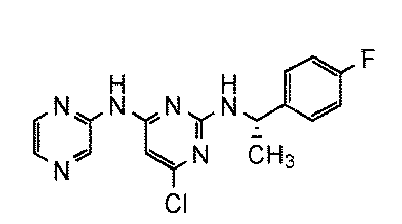
16 
3 
10 
17 
4 
11 
18 
5 
12 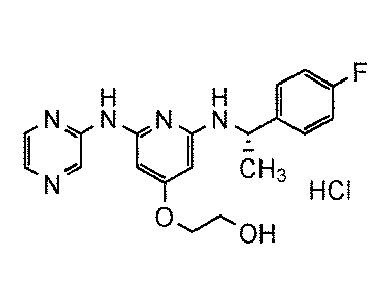
19 
6 
13 
20 
7 
14 
21 
-
[Table 2] Examles Structural formula Examles Structural formula Examles Structural formula 22 
29 
36 
23 
30 
37 
24 
31 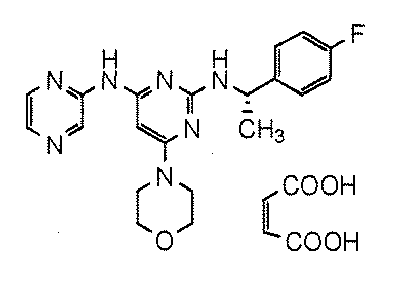
38 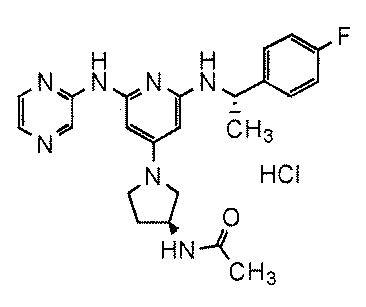
25 
32 
39 
26 
33 
40 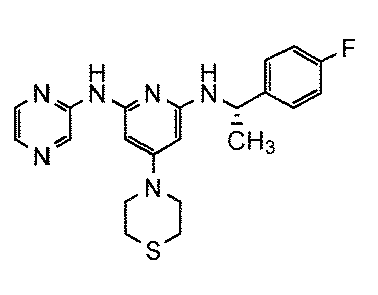
27 
34 
41 
28 
35 
42 
-
[Table 3] Examles Structural formula Examles Structural formula Examles Structural formula 43 
50 
57 
44 
51 
58 
45 
52 
59 
46 
53 
60 
47 
54 
61 
48 
55 
62 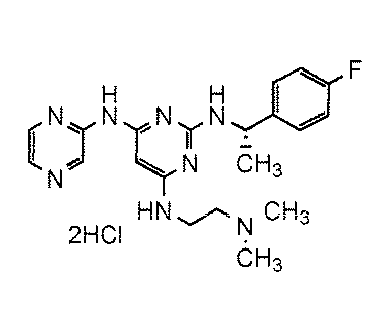
49 
56 
63 
-
[Table 4] Examles Structural formula Examles Structural formula Examles Structural formula 64 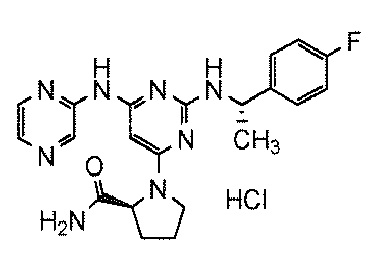
71 
78 
65 
72 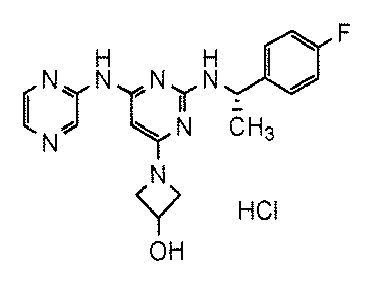
79 
66 
73 
80 
67 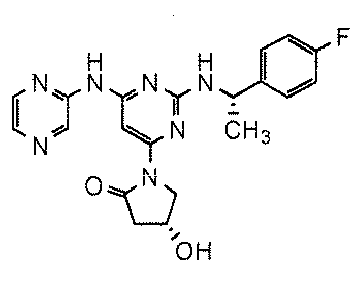
74 
81 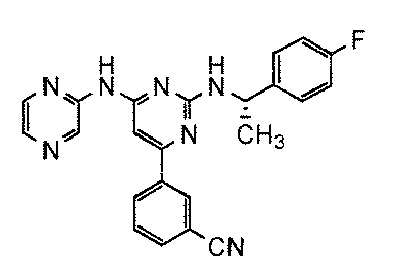
68 
75 
82 
69 
76 
83 
70 
77 
84 
-
[Table 5] Examles Structural formula Examles Structural formula Examles Structural formula 85 
92 
99 
86 
93 
100 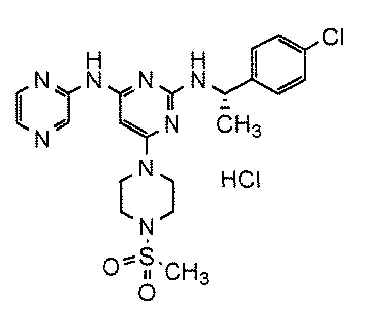
87 
94 
101 
88 
95 
102 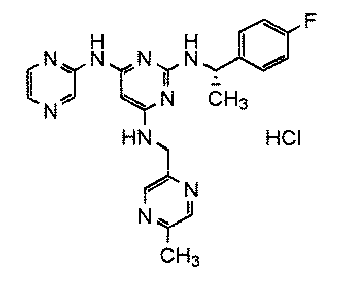
89 
96 
103 
90 
97 
104 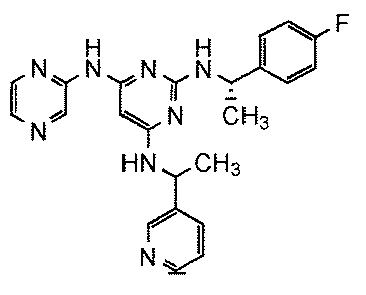
91 
98 
105 
-
[Table 6] Examles Structural formula Examles Structural formula Examles Structural formula 106 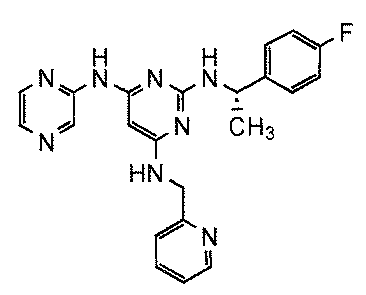
113 
120 
107 
114 
121 
108 
115 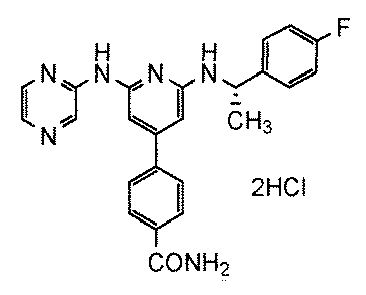
122 
109 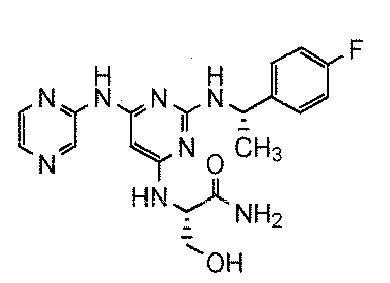
116 
123 
110 
117 
124 
111 
118 
125 
112 
119 
126 
-
[Table 7] Examles Structural formula Examles Structural formula Examles Structural formula 127 
134 
141 
128 
135 
142 
129 
136 
143 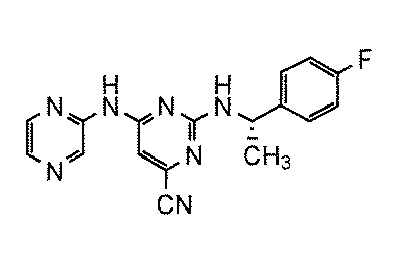
130 
137 
144 
131 
138 
145 
132 
139 
146 
133 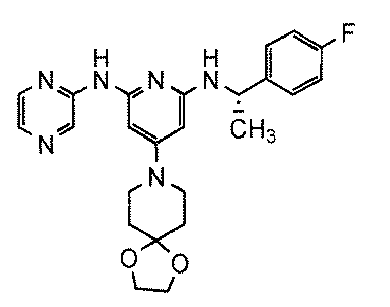
140 
147 
-
[Table 8] Examles Structural formula Examles Structural formula Examles Structural formula 148 
155 
162 
149 
156 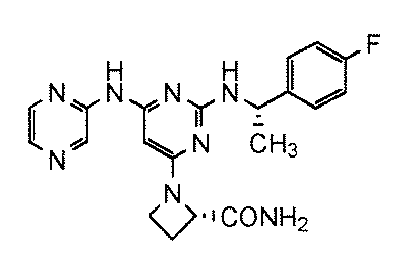
163 
150 
157 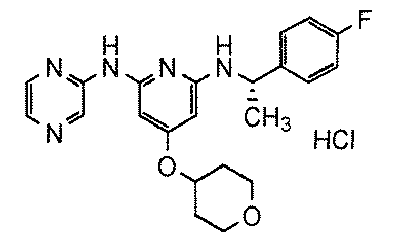
164 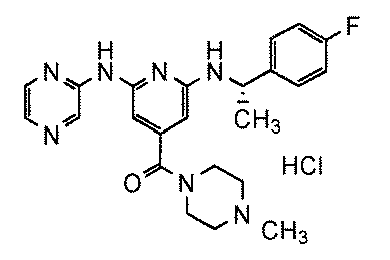
151 
158 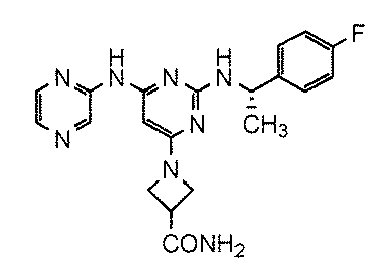
165 
152 
159 
166 
153 
160 
167 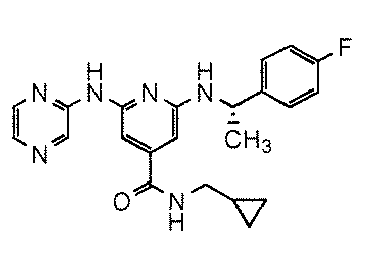
154 
161 
168 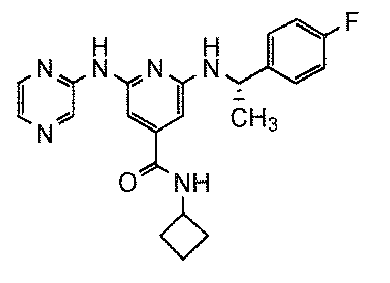
-
[Table 9] Examles Structural formula Examles Structural formula Examles Structural formula 169 
176 
183 
170 
177 
184 
171 
178 
185 
172 
179 
186 
173 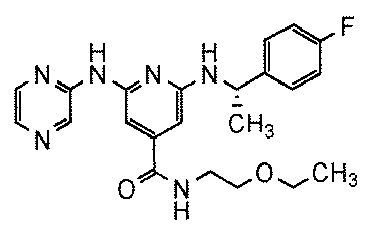
180 
187 
174 
181 
188 
175 
182 
189 
-
[Table 10] Examles Structural formula Examles Structural formula Examles Structural formula 190 
197 
204 
191 
198 
205 
192 
199 
206 
193 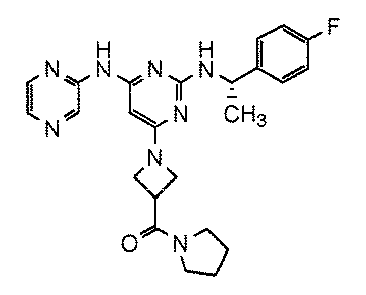
200 
207 
194 
201 
208 
195 
202 
209 
196 
203 
210 
-
[Table 11] Examles Structural formula Examles Structural formula Examles Structural formula 211 
218 
225 
212 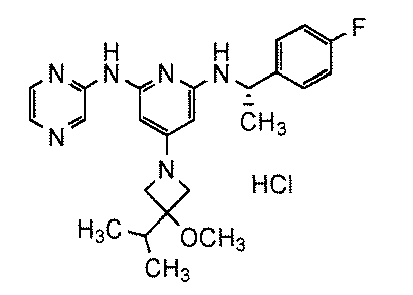
219 
226 
213 
220 
227 
214 
221 
228 
215 
222 
229 
216 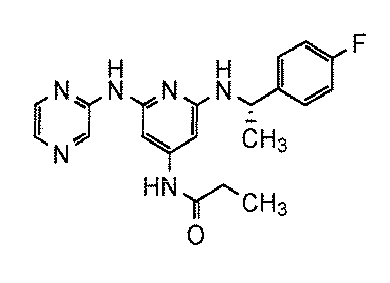
223 
230 
217 
224 
231 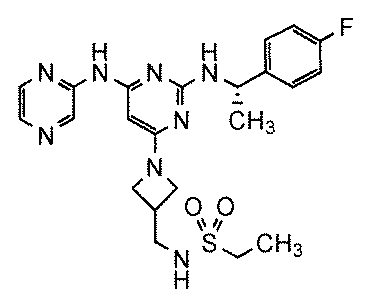
-
[Table 12] Examles Structural formula 232 
233 
234 
- The test material was dissolved in dimethylsulfoxide (DMSO) to be 10 mM, and further diluted with DMSO to be 100-fold concentrations for measurement (1000, 300, 100, 30, 10, 3, 1, 0.3, 0.1, 0.03, 0.01 µM). In addition, solutions diluted with an assay buffer up to 20 times were used as solutions of the test material. As a negative control, a solution of DMSO diluted 20 times with an assay buffer was used. As the assay buffer, 15 mM Tris-Cl (pH 7.5), 0.01 v/v% Tween-20, and 1 mM dithiothreitol were used.
- The activity was determined by ELISA. The solution of the test material (10 µl each; n=2) was placed in a streptavidine-coated 96 well plate (DELFIA Strip Plate 8 × 12 wells; Perkin Elmer), to which 20 µl each of substrate solution (625nM biotin-labeled peptide substrate, 25 µM ATP, 25mM MgCl2, 15 mM Tris-Cl (pH 7.5), 0.01 v/v% Tween-20, and 1mM dithiothreitol), was added and stirred. Finally, 20 µl each of JAK2 tyrosine kinase (Carnabioscience Co.) (diluted to 0. 75 nM with assay buffer) or JAK3 tyrosine kinase (Carnabioscience Co.) (diluted to 0.75 nM with assay buffer) was added, stirred and allowed to stand at 30°C for 1 hour. The plate was washed 4 times with a washing buffer (50 mM Tris-Cl, pH 7.5, 150 mM NaCl, 0.02 v/v% Tween-20), and then a blocking buffer (0.1% Bovine Serum Albumin, 50 mM Tris-Cl, pH 7.5, 150mM NaCl, 0.02 v/v% Tween-20) (150 µl each) was added for blocking at 30°C for 30 minutes. Blocking buffer was removed, and there was added 100 µl each of horse radish peroxidase-labeled anti-phosphorylated tyrosin kinase antibody (BD Bioscience Co.)(diluted 10,000 times with blocking buffer). The plate was incubated at 30°C for 30 minutes and then washed 4 times with a washing buffer, and 100 µl each of 3,3',5,5'-tetramethylbenzidine (Sigma-Aldrich Co.) was added to develop color for 10 minutes. 0.1 M sulfuric acid (100 µl each) was added to stop the reaction. The absorbance was measured by means of a micro-plate reader (BIO-RAD; Model 3550) at 450 nm.
- The measured absorbance was subjected to a non-linear regression analysis by means of a SAS system (SAS Institute Inc.), and the concentration (IC50) of the test material which inhibited 50% of the activity of each tyrosine kinase was estimated. Tables 13 to 18 show the results.
-
[Table 13] test material inhibitory activity to JAK2 tyrosine kinase (IC50, nM) inhibitory activity to JAK3 tyrosine kinase (IC50, nM) Example 1 0.94 45 Example 2 0.49 43 Example 3 1.2 130 Example 4 0.59 44 Example 5 0.62 62 Example 6 5.7 500 Example 7 0.42 39 Example 8 1.1 82 Example 9 16 360 Example 10 0.89 95 Example 11 0.82 36 Example 12 0.92 79 Example 13 1.3 71 Example 14 1.9 120 Example 15 1.3 72 Example 16 8.0 630 Example 17 4.4 340 Example 18 3.0 130 Example 19 2.6 59 Example 20 0.69 21 Example 21 8.7 950 Example 22 1.6 88 Example 23 4.2 210 Example 24 1.1 53 Example 25 0.97 100 Example 26 0.27 28 Example 27 0.52 42 Example 28 1.2 110 Example 29 2.0 160 Example 30 1.5 75 Example 31 0.41 26 Example 32 0.50 68 Example 33 0.40 30 Example 34 0.51 59 Example 35 2.5 440 Example 36 2.8 200 Example 37 3.2 130 Example 38 2.3 85 Example 39 0.93 90 Example 40 3.4 310 Example 41 1.1 51 Example 42 1.0 66 Example 43 1.2 130 -
[Table 14] test material inhibitory activity to JAK2 tyrosine kinase (IC50, nM) inhibitory activity to JAK3 tyrosine kinase (IC50, nM) Example 44 2.1 140 Example 45 9.0 2300 Example 46 3.7 93 Example 47 12 1300 Example 48 6.0 140 Example 49 2.3 170 Example 50 0.84 29 Example 51 3.1 51 Example 52 2.0 160 Example 53 5.9 390 Example 54 22 1800 Example 55 2.0 190 Example 56 0.79 24 Example 57 1.3 82 Example 58 0.69 26 Example 59 1.7 60 Example 60 0.71 28 Example 61 6.0 150 Example 62 2.2 65 Example 63 1.0 36 Example 64 7.0 220 Example 65 0.27 8.9 Example 66 1.8 37 Example 67 11 470 Example 68 1.5 34 Example 69 2.6 83 Example 70 1.5 65 Example 71 0.72 26 Example 72 0.96 31 Example 73 1.3 48 Example 74 3.8 230 Example 75 12 630 Example 76 2.5 57 Example 77 0.73 37 Example 78 1.4 35 Example 79 4.3 140 Example 80 1.1 60 Example 81 5.6 480 Example 82 1.7 99 Example 83 3.7 58 Example 84 2.0 170 Example 85 0.51 20 Example 86 2.4 87 -
[Table 15] test material inhibitory activity to JAK2 tyrosine kinase (IC50, nM) inhibitory activity to JAK3 tyrosine kinase (IC50, nM) Example 87 14 450 Example 88 13 200 Example 89 3.8 150 Example 90 6.1 380 Example 91 1.4 97 Example 92 9.8 460 Example 93 3.0 220 Example 94 1.7 77 Example 95 2.2 110 Example 96 1.4 33 Example 97 37 610 Example 98 19 1300 Example 99 2.4 200 Example 100 0.52 47 Example 101 11 600 Example 102 2.6 140 Example 103 4.1 310 Example 104 1.0 39 Example 105 0.55 27 Example 106 1.9 110 Example 107 0.77 56 Example 108 1.1 56 Example 109 2.4 130 Example 110 0.67 44 Example 111 1.6 110 Example 112 0.69 67 Example 113 4.9 200 Example 114 4.8 66 Example 115 2.3 210 Example 116 5.3 340 Example 117 2.7 190 Example 118 1.6 290 Example 119 28 1600 Example 120 23 1700 Example 121 2.7 170 Example 122 0.40 30 Example 123 5.4 330 Example 124 1.3 66 Example 125 1.6 130 Example 126 8.8 630 -
[Table 16] test material inhibitory activity to JAK2 tyrosine kinase (IC50, M) inhibitory activity to JAK3 tyrosine kinase (IC50, nM) Example 127 2.9 200 Example 128 0.65 46 Example 129 3.4 380 Example 130 7.7 570 Example 131 2.8 180 Example 132 7.8 350 Example 133 3.0 230 Example 134 9.2 620 Example 135 2.6 320 Example 136 1.1 170 Example 137 2.2 160 Example 138 3.4 420 Example 139 5.0 290 Example 140 1.4 61 Example 141 14 440 Example 142 1.2 66 Example 143 14 2100 Example 144 2.1 210 Example 145 0.34 36 Example 146 9.5 1400 Example 147 9.2 920 Example 148 21 810 Example 149 2.6 690 Example 150 1.7 150 Example 151 7.4 490 Example 152 0.71 93 Example 153 8.4 300 Example 154 16 340 Example 155 2.4 390 Example 156 6.7 580 Example 157 2.0 150 Example 158 0.65 39 Example 159 1.0 170 Example 160 1.0 100 Example 161 12 230 Example 162 3.4 370 Example 163 0.74 170 Example 164 12 470 Example 165 3.1 360 -
[Table 17] test material inhibitory activity to JAK2 tyrosine kinase (IC50, nM) inhibitory activity to JAK3 tyrosine kinase (IC50, nM) Example 166 2.2 380 Example 167 1.6 350 Example 168 17 1300 Example 169 3.0 500 Example 170 1.2 180 Example 171 1.9 570 Example 172 0.85 150 Example 173 1.5 200 Example 174 0.99 47 Example 175 4.9 400 Example 176 0.96 35 Example 177 0.74 87 Example 178 1.0 82 Example 179 2.6 330 Example 180 2.5 52 Example 181 2.2 56 Example 182 6.4 440 Example 183 1.8 59 Example 184 0.92 45 Example 185 4.2 380 Example 186 5.5 240 Example 187 2.4 400 Example 188 3.7 120 Example 189 12 1500 Example 190 1.2 58 Example 191 1.4 31 Example 192 1.9 120 Example 193 0.80 35 Example 194 0.79 84 Example 195 1.2 50 Example 196 0.64 35 Example 197 1.6 58 Example 198 1.6 60 Example 199 1.6 64 Example 200 0.39 26 Example 201 0.41 35 Example 202 4.7 470 Example 203 4.5 120 Example 204 8.1 220 -
[Table 18] test material inhibitory activity to JAK2 tyrosine kinase (IC50, nM) inhibitory activity to JAK3 tyrosine kinase (IC50, nM) Example 205 2.8 170 Example 206 10 360 Example 207 7.0 300 Example 208 1.4 100 Example 209 7.1 440 Example 210 3.2 180 Example 211 5.6 86 Example 212 15 160 Example 213 3.2 130 Example 214 5.5 380 Example 215 2.3 210 Example 216 1.4 49 Example 217 1.5 36 Example 218 2.2 85 Example 219 2.6 69 Example 220 0.98 24 Example 221 1.5 59 Example 222 0.75 18 Example 223 0.65 11 Example 224 1.1 16 Example 225 0.69 13 Example 226 1.1 24 Example 227 1.1 20 Example 228 1.1 19 Example 229 3.9 180 Example 230 1.2 63 Example 231 0.59 33 Example 232 0.55 32 Example 233 5.8 140 Example 234 5.4 170 - BaF3 cells into which JAK2 V617F gene was introduced (BaF3/JAK3 V617F cells) were inoculated on a 96-well plate in an amount of 1 × 10³ cells/well and allowed to stand in a CO2 incubator. Next day, the test material was added to the cells. The test material was serially diluted with DMSO to give 10mM, 6mM, 3mM, 1mM, 600 µM, 300 µM, 100 µM, 60 µM, 30 µM, or 10 µM solution. This was diluted 100 times with distilled water to give 100 µM, 60 µM, 30 µM, 10 µM, 6 µM, 3 µM, 1 µM, 600nM, 300nM, or 100nM solution. This solution of test material was added to the well in an amount of 10 µl/well. As a negative control, 1% DMSO solution was added to the well in an amount of 10 µl/well. In the above operation, the final concentration of the test material became 10 µM, 6 µM, 3 µM, 1 µM, 600nM, 300nM, 100nM, 60nM, 30nM, 10nM, or OnM (0.1% DMSO solution). The addition of the test material solution to each well was made in triplicate.
After continuous incubation for 3 days, the viable count was determined by an MTT method. The MTT method was carried out as follows. First, 10 µl each of solution containing 5 mg/ml of MTT (3-(4,5-dimethylthiazol-2-yl)-2,5-diphenyltetrazolium bromide) was added to each well. The plate was allowed to stand in a CO2 incubator for 4 hours, and then 100 µl of 0.04N HCl/2-propanol solution was added to each well to stop the reaction. The generated MTT-formazan was dissolved well with a multi-channel pipette, and the absorbance at 595 nm was measured with reference to that at 655 nm (Thermo Co.; Multiskan FC). Non-linear regression analysis was made by means of a SAS system (SAS Institute Inc.), and the concentration (IC50) of the test material which inhibited 50% of the cell growth was estimated. Table 19 shows the results. -
[Table 19] test material (IC50, nM) Example 1 83 Example 2 70 Example 4 71 Example 7 90 Example 11 100 Example 20 55 Example 24 100 Example 27 89 Example 28 94 Example 30 60 Example 31 87 Example 50 53 Example 56 81 Example 60 80 Example 65 93 Example 71 100 Example 105 60 Example 112 64 Example 152 100 Example 166 64 Example 167 63 Example 170 77 Example 200 70 Example 220 64 Example 222 66 Example 223 57 Example 224 94 Example 225 64 Example 228 89 Example 231 97 Example 232 88 - Formulaiton: Each tablet (80 mg) contains the following
Compound of Example 1 5.0 mg Corn starch 46.6 mg Crystalline cellulose 24.0 mg Methyl cellulose 4.0 mg Magnesium stearate 0.4 mg - Formulaiton: Each tablet (80 mg) contains the following
Compound of Example 2 5.0 mg Corn starch 46.6 mg Crystalline cellulose 24.0 mg Methyl cellulose 4.0 mg Magnesium stearate 0.4 mg - As mentioned above, the compounds of the invention or pharmaceutically acceptable salts thereof exhibit a high JAK2 tyrosine kinase inhibitory activity; thus, pharmaceutical compositions containing the compounds of the invention or pharmaceutically acceptable salts thereof can be used as preventives or therapeutics for cancers (e.g. hematic cancers (e.g. polycythemia vera, essential thrombocythemia, myeloidproliferative neoplasms such as idiopathic myelofibrosis (chronic myeloid proliferative diseases), osteomyelodysplasia syndrome, acute lymphocytic leukemia, acute myeloid leukemia, chronic myeloid leukamia, multiple myeloma), solid cancers (e.g. prostatic cancer, breast cancer)), inflammatory diseases (e.g. rheumatoid arthritis, inflammatory bowel disease, osteoporosis, multiple sclerosis), and angiopathy (e.g., pulmonary hypertension, arteriosclerosis, aneurysm, varicose vein).
Claims (13)
- A compound represented by the following general formula [1] or a pharmaceutically acceptable salt thereof,
wherein the compound is defined by the following (I) or (II). (I):X represents CH or N;R1 represents halogen;R2 represents:(1) H,(2) halogen,(3) cyano,(4) a group represented by the following general formula [2]:
 (5) a group represented by the following general formula [3]:


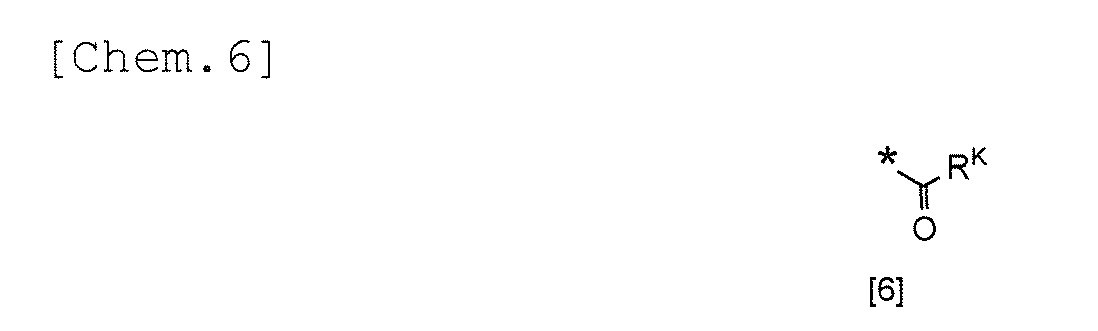
 (6) a group represented by the following general formula [8]:
 (7) a group represented by the following general formula [9]:
 (8) -ORP (Rp represents an alkyl optionally substituted by a group selected from the group consisting of hydroxy, dialkylamino, alkoxy, tetrahydrofuranyl, and cycloalkyl, or an optionally O-containing saturated cyclic group optionally substituted by hydroxy), or(9) a heteroaryl optionally substituted by one or two groups selected from the group consisting of cyano, halogen, hydroxy, alkoxy, alkylcarbonyl, carbamoyl, alkyl, cycloalkyl, (cycloalkyl) alkyl, aralkyl, hydroxycarbonyl and alkoxyalkyl;R3 represents H or hydroxy;R 4 represents H or alkyl; andR 5 represents H or alkyl;(II):X represents -CRA;RA represents a group represented by the following general formula [10]:
 R1 represents halogen;R2 represents H;R3 represents H or hydroxy;R4 represents H or alkyl; andR5 represents H or alkyl.
 - The compound or pharmaceutically acceptable salt thereof according to claim 1,
wherein the compound represented by the general formula [1] is defined by the following [i] or [ii]:[i]:X is CH or N; andR2 is:(1) a group represented by the following general formula [11] :


 (2) a group represented by the following general formula [8]:
 (3) a group represented by the following general formula [9]:
 (4) -ORP1 (wherein RP1 represents an alkyl optionally substituted by a group selected from the group consisting of hydroxy, dialkylamino, alkoxy, tetrahydrofuranyl, and cycloalkyl.), or(5) a heteroaryl optionally substituted by one or two groups selected from the group consisting of cyano, halogen, hydroxy, alkoxy, alkylcarbonyl, carbamoyl, alkyl, cycloalkyl, (cycloalkyl)alkyl, aralkyl, hydroxycarbonyl and alkoxyalkyl;[ii]:X is -CRA;RA is a group represented by the following general formula [10] :
 R2 is H.
 - The compound or pharmaceutically acceptable salt thereof according to claim 1,
wherein:X is CH;R2 is:(1) a group represented by the following general formula [11] :


 (2) a group represented by the following general formula [8]:
 (3) a group represented by the following general formula [9]:
 (4) -ORP1 (wherein RP1 represents an alkyl optionally substituted by a group selected from the group consisting of hydroxy, dialkylamino, alkoxy, tetrahydrofuranyl, and cycloalkyl), or(5) a heteroaryl optionally substituted by one or two groups selected from the group consisting of cyano, halogen, hydroxy, alkoxy, alkylcarbonyl, carbamoyl, alkyl, cycloalkyl, (cycloalkyl)alkyl, aralkyl, hydroxycarbonyl and alkoxyalkyl.
 - The compound or pharmaceutically acceptable salt thereof according to claim 1, which compound is selected from the group consisting of the following (1) to (229).(1) (S)-4-{2-[1-(4-fluorophenyl)ethylamino]-6-(pyrazin-2-ylami no)pyrimidin-4-yl}piperazin-2-one,(2) N-{(S)-1-[2-{[(S)-1-(4-fluorophenyl)ethyl]amino}-6-(pyrazi n-2-ylamino)pyrimidin-4-yl]pyrrolidin-3-yl}acetamide,(3) (S)-6-(3,3-difluoroazetidin-1-yl)-N2-[1-(4-fluorophenyl) et hyl]-N4-(pyrazin-2-yl)pyrimidine-2,4-diamine,(4) (S)-N2-[1-(4-fluorophenyl)ethyl]-4-(1-methyl-1H-pyrazol-4-yl)-N6-(pyrazin-2-yl)pyridine-2,6-diamine,(5) (S)-N2'-[1-(4-fluorophenyl)ethyl]-N6'-(pyrazin-2-yl)-3,4'-b ipyridine-2',6'-diamine,(6) (S)-N2'-[1-(4-fluorophenyl)ethyl]-6-methoxy-N6'-(pyrazin-2-yl)-3,4'-bipyridine-2',6'-diamine,(7) (S)-2'-[1-(4-fluorophenyl)ethylamino]-6'-(pyrazin-2-ylamin o)-3,4'-bipyridin-6-ol,(8) (S)-N2-[1-(4-fluorophenyl)ethyl]-4-(oxazol-5-yl)-N6-(pyrazi n-2-yl)pyridine-2,6-diamine,(9) (S)-6-chloro-N2-[1-(4-fluorophenyl)ethyl]-N4-(pyrazin-2-yl) pyrimidine-2,4-diamine,(10) (S)-N2-[1-(4-fluorophenyl)ethyl]-6-[4-(methylsulfonyl)phen yl]-N4-(pyrazin-2-yl)pyrimidine-2,4-diamine,(11) (S)-N2-[1-(4-fluorophenyl)ethyl]-N4-(pyrazin-2-yl)-6-(1H-py razol-4-yl)pyrimidine-2,4-diamine,(12) (S)-2-{2-[1-(4-fluorophenyl)ethylamino]-6-(pyrazin-2-ylami no)pyridin-4-yloxy}ethanol,(13) (S)-N2-[1-(4-fluorophenyl)ethyl]-N4-(pyrazin-2-yl)-6-(pyrid in-3-yl)pyrimidine-2,4-diamine,(14) (S)-N2-[1-(4-fluorophenyl)ethyl] -N4-(pyrazin-2-yl)-6-(pyrid in-2-yl)pyrimidine-2,4-diamine,(15) (S)-N2-[1-(4-fluorophenyl)ethyl]-N4-(pyrazin-2-yl)-6-(pyrid in-4-yl)pyrimidine-2,4-diamine,(16) (S)-1-{2-[1-(4-fluorophenyl)ethylamino]-6-(pyrazin-2-ylami no)pyrimidin-4-yl}pyrrolidin-2-one,(17) (S)-4-{2-[1-(4-fluorophenyl)ethylamino]-6-(pyrazin-2-ylami no)pyrimidin-4-yl}piperazin-2,6-dione,(18) (S)-1-{2-[1-(4-fluorophenyl)ethylamino]-6-(pyrazin-2-ylami no)pyrimidin-4-yl}tetrahydropyrimidin-2(1H)-one,(19) (S)-N2-[1-(4-fluorophenyl)ethyl]-N4-(pyrazin-2-yl)-6-(pyrro lidin-1-yl)pyrimidine-2,4-diamine,(20) (S)-N2-[1-(4-fluorophenyl)ethyl]6-morpholino-N4-(pyrazin-2 -yl)pyrimidine-2,4-diamine,(21) (S)-1-{2-[1-(4-fluorophenyl)ethylamino]-6-(pyrazin-2-ylami no)pyrimidin-4-yl}imidazolidin-2-one,(22) (S)-N2-[1-(4-fluorophenyl)ethyl]-6-(oxazol-5-yl)-N4-(pyrazi n-2-yl)pyrimidine-2,4-diamine,(23) (S)-N2-[1-(4-fluorophenyl)ethyl]-6-(6-methoxypyridin-3-yl) -N4-(pyrazin-2-yl)pyrimidine-2,4-diamine,(24) (S)-N2-[1-(4-fluorophenyl)ethyl]-N4-(pyrazin-2-yl)-6-(1H-py razol-3-yl)pyrimidine-2,4-diamine,(25) (S)-4-{2-[1-(4-fluorophenyl)ethylamino]-6-(pyrazin-2-ylami no)pyrimidin-4-yl}pyridin-2-ol,(26) (S)-5-{2-[1-(4-fluorophenyl)ethylamino]-6-(pyrazin-2-ylami no)pyrimidin-4-yl}pyridin-2-ol,(27) N-((R)-1-{2-[(S)-1-(4-fluorophenyl)ethylamino]-6-(pyrazin-2-ylamino)pyrimidin-4-yl}pyrrolidin-3-yl)acetamide,(28) (S)-N2-[1-(4-fluorophenyl)ethyl]-N6-(pyrazin-2-yl)-4-(1H-py razol-4-yl)pyridine-2,6-diamine,(29) (S)-N2-[1-(4-fluorophenyl)ethyl]-N6-(pyrazin-2-yl)-4-(1H-py razol-3-yl)pyridine-2,6-diamine,(30) (S)-N2-[1-(4-fluorophenyl)ethyl]-6-[3-(methylsulfonyl)phen yl]-N4-(pyrazin-2-yl)pyrimidine-2,4-diamine,(31) (S)-N2-[1-(4-fluorophenyl)ethyl]-4-[4-(methylsulfonyl)phen yl]-N6-(pyrazin-2-yl)pyridine-2,6-diamine,(32) (S)-N2-[1-(4-fluorophenyl)ethyl]-4-(1-isopropyl-1H-pyrazol -4-yl)-N6-(pyrazin-2-yl)pyridine-2,6-diamine,(33) N-{(S)-1-[2-{[(S)-1-(4-fluorophenyl)ethyl]amino}-6-(pyrazi n-2-ylamino)pyridin-4-yl]pyrrolidin-3-yl}acetamide,(34) (S)-N2-[1-(4-fluorophenyl)ethyl]-4-morpholino-N6-(pyrazin-2 -yl)pyridine-2,6-diamine,(35) (S) -N2-[1-(4-fluorophenyl)ethyl]-N6-(pyrazin-2-yl)-4-thiomorph olinopyridine-2,6-diamine,(36) (S)-3-{2-[1-(4-fluorophenyl)ethylamino]-6-(pyrazin-2-ylami no)pyridin-4-yl}propan-1-ol,(37) (S)-N-(1-{2-[1-(4-fluorophenyl)ethylamino]-6-(pyrazin-2-yl amino)pyrimidin-4-yl}azetidin-3-yl)acetamide,(38) (S)-6-(azetidin-1-yl)-N2-[1-(4-fluorophenyl)ethyl]-N4-(pvra zin-2-yl)pyrimidine-2,4-diamine,(39) (S)-6-(3-fluoroazetidin-1-yl)-N2-[1-(4-fluorophenyl)ethyl] -N4-(pyrazin-2-yl)pyrimidine-2,4-diamine,(40) (S)-1-{2-[1-(4-fluorophenyl)ethylamino]-6-(pyrazin-2-ylami no)pyrimidin-4-yl}azetidin-2-one,(41) (S)-4-(1-ethyl-1H-pyrazol-4-yl)-N2-[1-(4-fluorophenyl)ethy 1]-N6-(pyrazin-2-yl)pyridine-2,6-diamine,(42) (S)-N2-[1-(4-fluorophenyl)ethyl]-4-(1-methyl-1H-pyrazol-5-yl)-N6-(pyrazin-2-yl)pyridine-2,6-diamine,(43) (S)-4-[1-(cyclopropylmethyl)-1H-pyrazol-4-yl]-N2-[1-(4-flu orophenyl)ethyl]-N6-(pyrazin-2-yl)pyridine-2,6-diamine,(44) (S)-N2-[1-(4-fluorophenyl)ethyl]-N4-(pyrazin-2-yl)-6-(thiaz ol-5-yl)pyrimidine-2,4-diamine,(45) 1-{2-[(S)-1-(4-fluorophenyl)ethylamino]-6-(pyrazin-2-ylami no)pyrimidin-4-yl}pyrrolidin-3-ol,(46) (S)-N2-[1-(4-fluorophenyl)ethyl]-N4-(5-methylthiazol-2-yl)-N6-(pyrazin-2-yl)pyrimidine-2,4,6-triamine,(47) (S)-N2-[1-(4-fluorophenyl)ethyl]-N6-(pyrazin-2-yl)-4,5'-bip yrimidine-2,6-diamine,(48) (S)-N2-[1-(4-fluorophenyl)ethyl]-6-(2-methoxythiazol-5-yl) -N4-(pyrazin-2-yl)pyrimidine-2,4-diamine,(49) (S)-N2-[1-(4-fluorophenyl)ethyl]-N4-(pyrazin-2-yl)-6-(thiaz ol-2-yl)pyrimidine-2,4-diamine,(50) (S)-5-{2-[1-(4-fluorophenyl)ethylamino]-6-(pyrazin-2-ylami no)pyrimidin-4-yl}picolinonitrile,(51) (S)-1-{2-[1-(4-fluorophenyl)ethylamino]-6-(pyrazin-2-ylami no)pyrimidin-4-yl}piperidine-4-carboxamide,(52) (S)-5-{2-[1-(4-fluorophenyl)ethylamino]-6-(pyrazin-2-ylami no)pyrimidin-4-yl}picolinamide,(53) 4-{2-[(S)-1-(4-fluorophenyl)ethylamino]-6-(pyrazin-2-ylami no)pyrimidin-4-yl}piperazine-2-carboxamide,(54) 6-(3-aminopyrrolidin-1-yl)-N2-[(S)-1-(4-fluorophenyl)ethyl ]-N4-(pyrazin-2-yl)pyrimidine-2,4-diamine,(55) N-(1-{2-[(S)-1-(4-fluorophenyl)ethylamino]-6-(pyrazin-2-yl amino)pyrimidin-4-yl}pyrrolidin-3-yl)methanesulfonamide,(56) (S)-2-({2-[1-(4-fluorophenyl)ethylamino]-6-(pyrazin-2-ylam ino)pyrimidin-4-yl}(2-hydroxyethyl)amino)ethan-1-ol,(57) (S)-N4-[2-(dimethylamino)ethyl]-N2-[1-(4-fluorophenyl)ethyl ]-N6-(pyrazin-2-yl)pyrimidine-2,4,6-triamine,(58) 1-{2-[(S)-1-(4-fluorophenyl)ethylamino]-6-(pyrazin-2-ylami no)pyrimidin-4-yl}piperidine-3-carboxamide,(59) (S)-1-{2-[(S)-1-(4-fluorophenyl)ethylamino]-6-(pyrazin-2-y lamino)pyrimidin-4-yl}pyrrolidine-2-carboxamide,(60) (S)-N2-[1-(4-fluorophenyl)ethyl]-6-[4-(methylsulfonyl)pipe razin-1-yl]-N4-(pyrazin-2-yl)pyrimidine-2,4-diamine,(61) (S)-N2-[1-(4-fluorophenyl)ethyl]-N4-(pyrazin-2-yl)-6-(1H-py rrol-3-yl)pyrimidine-2,4-diamine,(62) (R)-1-{2-[(S)-1-(4-fluorophenyl)ethylamino]-6-(pyrazin-2-y lamino)pyrimidin-4-yl}-4-hydroxypyrrolidin-2-one,(63) N2-[(S)-1-(4-fluorophenyl)ethyll-N4-(pyrazin-2-yl)-N6-[(tet rahydrofuran-2-yl)methyl]pyrimidine-2,4,6-triamine,(64) ((S)-1-{2-[(S)-1-(4-fluorophenyl)ethylamino]-6-(pyrazin-2-ylamino)pyrimidin-4-yl}pyrrolidin-2-yl)methanol,(65) ((R)-1-{2-[(S)-1-(4-fluorophenyl)ethylamino]-6-(pyrazin-2-ylamino)pyrimidin-4-yl}pyrrolidin-2-yl)methanol,(66) (S)-1-{2-[1-(4-fluorophenyl)ethylamino]-6-(pyrazin-2-ylami no)pyrimidin-4-yl}pzperidin-4-ol,(67) (S)-1-{2-[1-(4-fluorophenyl)ethylamino]-6-(pyrazin-2-ylami no)pyrimidin-4-yl}azetidin-3-ol,(68) 1-{2-[(S)-1-(4-fluorophenyl)ethylamino]-6-(pyrazin-2-ylami no)pyrimidin-4-yl}piperidin-3-ol,(69) (S)-5-{2-[1-(4-fluorophenyl)ethylamino]-6-(pyrazin-2-ylami no)pyrimidin-4-yl}nicotinonitrile,(70) (S)-N2-[1-(4-fluorophenyl)ethyl]-N4-(pyrazin-2-yl)-6-(2H-te trazol-5-yl)pyrimidine-2,4-diamine,(71) (S)-N4-(2-aminoethyl)-N2-[1-(4-fluorophenyl)ethyl]-N6-(pyra zin-2-yl)pyrimidine-2,4,6-triamine,(72) (S)-N-(2-{2-[1-(4-fluorophenyl)ethylamino]-6-(pyrazin-2-yl amino)pyrimidin-4-ylamino}ethyl)methanesulfonamide,(73) (S)-N-(2-{2-[1-(4-fluorophenyl)ethylamino]-6-(pyrazin-2-yl amino)pyrimidin-4-ylamino}ethyl)acetamide,(74) (S)-2-{2-[1-(4-fluorphenyl)ethylamino]-6-(pyrazin-2-ylamin o)pyrimidin-4-ylaminolacetamide,(75) (S)-4-{2-[1-(4-fluorophenyl)ethylamino]-6-(pyrazin-2-ylami no)pyrimidin-4-yl}benzamide(76) (S)-3-{2-[1-(4-fluorophenyl)ethylamino]-6-(pyrazin-2-ylami no)pyrimidin-4-yl}benzonitrile,(77) (S)-N2-[1-(4-fluorophenyl)ethylj-6-(furan-3-yl)-N4-(pyrazin -2-yl)pyrimidine-2,4-diamine,(78) ethyl (S)-1-{2-[1-(4-fluorophenyl)ethylamino]-6-(pyrazin-2-ylami no)pyrimidin-4-yl}piperidin-4-carboxylate,(79) (S)-5-{2-[1-(4-fluorophenyl)ethylamino]-6-(pyrazin-2-ylami no)pyrimidin-4-yl}nicotinamide,(80) (S)-1-{2-[1-(4-fluorophenyl)ethylamino]-6-(pyrazin-2-ylami no)pyrimidin-4-yl}piperazine-4-carboxylic acid,(81)
(S)-2-{2-[(S)-1-(4-fluorophenyl)ethylamino]-6-(pyrazin-2-y lamino)pyrimidin-4-ylamino}-2-phenylethanol,(82) (S)-2-{2-[(S)-1-(4-fluorophenyl)ethylamino]-6-(pyrazin-2-y lamino)pyrimidin-4-ylamino}-3-phenylpropan-1-ol,(83) (R)-2-{2-[(S)-1-(4-fluorophenyl)ethylamino]-6-(pyrazin-2-y lamino)pyrimidin-4-ylamino}-4-methylpentan-1-ol,(84) (S)-6-[2-(dimethylamino)ethoxy]-N2-[1-(4-fluorophenyl)ethy 1]-N4-(pyrazin-2-yl)pyrimidine-2,4-diamine(85) (S)-1-{2-[1-(4-fluorophenyl)ethylamino]-6-(pyrazin-2-ylami no)pyrimidin-4-yl}-1H-pyrazole-4-carboxylic acid,(86) (S)-3-{2-[1-(4-fluorophenyl)ethylamino]-6-(pyrazin-2-ylami no)pyrimidin-4-yl}benzamide,(87) (S)-6-(benzo[d]1,3-dioxol-5-yl)-N2-[1-(4-fluorophenyl)ethy 1]-N4-(pyrazin-2-yl)pyrimidine-2,4-diamine,(88) (S)-N2-[1-(4-fluorophenyl)ethyl]-6-(2-fluoropyridin-4-yl)-N4-(pyrazin-2-yl)pyrimidine-2,4-diamine,(89) N2-[(S)-1-(4-fluorophenyl)ethyl]-N4-(pyrazin-2-yl)-6-[(tetr ahydrofuran-2-yl)methoxy]pyrimidine-2,4-diamine,(90) (S)-2-{2-[1-(4-fluorophenyl)ethylamino]-6-(pyrazin-2-ylami no)pyrimidin-4-yloxy}ethanol,(91) (S)-N2-[1-(4-fluorophenyl)ethyl]-N4-(pyrazin-2-yl)-N6-[2-(p yrrolidin-1-yl)ethyl]pyrimidine-2,4,6-triamine,(92) (S)-3-{2-[1-(4-fluorophenyl)ethylamino]-6-(pyrazin-2-ylami no)pyrimidin-4-yl}isonicotinamide(93) (S)-3-{2-[1-(4-fluorophenyl)ethylamino]-6-(pyrazin-2-ylami no)pyrimidin-4-yl}isonicotinonitrile,(94) (S)-2-{2-[(S)-1-(4-fluorophenyl)ethylamino]-6-(pyrazin-2-y lamino)pyrimidin-4-ylamino}-3-methylbutan-1-ol,(95) (S)-N2-[1-(4-chlorophenyl)ethyl]-6-[4-(methylsulfonyl)pipe razin-1-yl]-N4-(pyrazin-2-yl)pyrimidine-2,4-diamine,(96) (lS,2S)-2-{2-[(S)-1-(4-fluorophenyl)ethylamino]-6-(pyrazin -2-ylamino)pyrimidin-4-yloxy}cyclohexanol,(97) (S)-N2-[1-(4-fluorophenyl)ethyl]-N4-[(5-methylpyrazin-2-yl) methyl]-N6-(pyrazin-2-yl)pyrimidine-2,4,6-triamine,(98) (S)-N2-[1-(4-fluorophenyl)ethyl]-N4-(furan-2-ylmethyl)-N6-( pyrazin-2-yl)pyrimidine-2,4,6-triamine,(99) (S)-N2-[1-(4-fluorophenyl)ethyl]-N4-(pyrazin-2-yl)-N6-[1-(p yridin-3-yl)ethyl]pyrimidine-2,4,6-triamine,(100) (S)-1-{2-[1-(4-fluorophenyl)ethylamino]-6-(pyrazin-2-ylami no)pyrimidin-4-yl}-4-(hydroxymethyl)piperidin-4-ol,(101) (S)-N2-[1-(4-fluorophenyl)ethyl]-N4-(pyrazin-2-yl)-N6-(pyri din-2-ylmethyl)pyrimidine-2,4,6-triamine,(102) (S)-N2-[1-(4-fluorophenyl)ethyl]-N4-(pyrazin-2-yl)-N6-(pyri din-3-ylmethyl)pyrimidine-2,4,6-triamine,(103) (S)-N2-[1-(4-fluorophenyl)ethyl]-N4-(pyrazin-2-yl)-N6-(pyri din-4-ylmethyl)pyrimidine-2,4,6-triamine,(104) (S)-2-{2-[(S)-1-(4-fluorophenyl)ethylamino]-6-(pyrazin-2-y lamino)pyrimidin-4-ylamino}-3-hydroxypropanamide,(105) (3S,4S)-1-{2-[(S)-1-(4-fluorophenyl)ethylamino]-6-(pyrazin -2-ylamino)pyrimidin-4-yl}pyrrolidin-3,4-diol(106) N2-[(S)-1-(4-fluorophenyl)ethyl]-N4-(pyrazin-2-yl)-6-(1,4-d ioxa-8-azaspiro[4.5]decan-8-yl)pyrimidine-2,4-diamine,(107) (S)-8-{2-[1-(4-fluorophenyl)ethylamino]-6-(pyrazin-2-ylami no)pyrimidin-4-yl}-1,3-dioxo-8-azaspiro[4.5]decan-2-one,(108) (S)-4-(1-benzyl-1H-pyrazol-4-yl)-N2-[1-(4-fluorophenyl)eth yl]-N6-(pyrazin-2-yl)pyridine-2,6-diamine,(109) (S)-N2-[1-(4-fluorophenyl)ethyl]-6-[4-(phenylsulfonyl)pipe razin-1-yl]-N4-(pyrazin-2-yl)pyrimidine-2,4-diamine,(110) (S)-4-{2-[1-(4-fluorophenyl)ethylamino]-6-(pyrazin-2-ylami no)pyridin-4-yl}benzamide,(111) (S)-N2-[1-(4-fluorophenyl)ethyl]-N6-(pyrazin-2-yl)-4-(1H-py rrol-3-yl)pyridine-2,6-diamine,(112) (S)-N2-[1-(4-fluorophenyl)ethyl]-N6-(pyrazin-2-yl)pyridine-2,6-diamine,(113) (S)-N2-[1-(4-fluorophenyl)ethyl]-6-(4-methyl-1H-imidazol-1 -yl)-N4-(pyrazin-2-yl)pyrimidine-2,4-diamine,(114) (S)-N2-[1-(4-fluorophenyl)ethyl]-4-(4-methoxyphenyl)-N6-(py razin-2-yl)pyridine-2,6-diamine,(115) (S)-4-(4-fluorophenyl)-N2-[1-(4-fluorophenyl)ethyl]-N6-(pyr azin-2-yl)pyridine-2,6-diamine(116) (S)-N2-[1-(4-fluorophenyl)ethyl]-4-methyl-N6-(pyrazin-2-yl) pyridine-2,6-diamine,(117) (S)-1-{2-[1-(4-fluorophenyl)ethylamino]-6-(pyrazin-2-ylami no)pyrimidin-4-yl}-N-(methylsulfonyl)piperidine-4-carboxam ide,(118) (S)-N2-[1-(4-fluorophenyl)ethyl]-4-(furan-3-yl)-N6-(pyrazin -2-yl)pyridine-2,6-diamine,(119) (S)-N2-[1-(4-fluorophenyl)ethyl]-4-[4-(methylsulfonyl)pipe razin-1-yl]-N6-(pyrazin-2-yl)pyridine-2,6-diamine,(120) (S)-1-{2-[1-(4-fluorophenyl)ethylamino]-6-(pyrazin-2-ylami no)pyridin-4-yl}-4-(hydroxymethyl)piperidin-4-ol,(121) (S)-4-{2-[1-(4-fluorophenyl)ethylamino]-6-(pyrazin-2-ylami no)pyridin-4-yl}benzenesulfonamide,(122) (S)-N2-[1-(4-fluorophenyl)ethyl]-4-methoxy-N6-(pyrazin-2-yl )pyridine-2,6-diamine,(123) 4-{2-[(1S)-1-(4-fluorophenyl)ethylamino]-6-(pyrazin-2-ylam ino)pyridin-4-yl}-1λ6,4-thiomorphin-1,1-dione,(124) (S)-1-{2-[1-(4-fluorophenyl)ethylamino]-6-(pyrazin-2-ylami no)pyridin-4-yl}piperidin-4-ol,(125) (S)-1-(4-{2-[1-(4-fluorophenyl)ethylamino]-6-(pyrazin-2-yl amino)pyridin-4-yl}-1,4-diazepan-1-yl)ethanone,(126) (S)-N2-[1-(4-fluorophenyl)ethyl]-N6-(pyrazin-2-yl)-N4-(pyri midin-2-yl)pyridine-2,4,6-triamine,(127) (S)-N2-[1-(4-fluorophenyl)ethyl]-N6-(pyrazin-2-yl)-N4-(pyri din-2-yl)pyridine-2,4,6-triamine,(128) N2-[(S)-1-(4-fluorophenyl)ethyl]-N6-(pyrazin-2-yl)-4-(1,4-d ioxa-8-azaspiro[4.5]decan-8-yl)pyridine-2,6-diamine,(129) methyl (S)-2-[1-(4-fluorophenyl)ethylamino]-6-(pyrazin-2-ylamino) isonicotinate,(130) (S)-4-{2-[1-(4-fluorophenyl)ethylamino]-6-(pyrazin-2-ylami no)pyrimidin-4-yl}-N-methylbenzenesulfonamide,(131) (S)-N2-[1-(4-fluorophenyl)ethyl]-4-(4-methyl-1H-imidazol-1 -yl)-N6-(pyrazin-2-yl)pyridine-2,6-diamine,(132) (S)-N2-[1-(4-fluorophenyl)ethyl]-N4,N6-di(pyrazin-2-yl)pyri dine-2,4,6-triamine(133) (S)-4-(cyclopropylmethoxy)-N2-[1-(4-fluorophenyl)ethyl]-N6-(pyrazin-2-yl)pyridine-2,6-diamine,(134) (S)-N2-[1-(4-fluorophenyl)ethyl]-N2-methyl-4-(1-methyl-1H-p yrazol-4-yl)-N6-(pyrazin-2-yl)pyridine-2,6-diamine(135) (S)-{2-[1-(4-fluorophenyl)ethylamino]-6-(pyrazin-2-ylamino )pyridin-4-yl}methanol,(136) (S)-2-[1-(4-fluorophenyl)ethylamino]-6-(pyrazin-2-ylamino) isonicotinic acid,(137) (S)-N2-[1-(4-fluorophenyl)ethyl]-4-(2-methoxyethoxy)-N6-(py razin-2-yl)pyridine-2,6-diamine,(138) (S)-2-[1-(4-fluorophenyl)ethylamino]-6-(pyrazin-2-ylamino) pyrimidine-4-carbonitrile,(139) (S)-2-[1-(4-fluorophenyl)ethylamino]-6-(pyrazin-2-ylamino) isonicotinonitrile,(140) (S)-2-[1-(4-fluorophenyl)ethylamino]-6-(pyrazin-2-ylamino) isonicotinamide,(141) (S)-N2-[1-(4-fluorophenyl)ethyl]-6-(1,2,4-oxadiazol-3-yl)-N4-(pyrazin-2-yl)pyrimidine-2,4-diamine,(142) (S)-N2-[1-(4-fluorophenyl)ethyl]-4-(1,2,4-oxadiazol-3-yl)-N6-(pyrazin-2-yl)pyridine-2,6-diamine,(143) methyl (S)-2-[1-(4-fluorophenyl)ethylamino]-6-(pyrazin-2-ylamino) nicotinate,(144) (S)-2-[1-(4-fluorophenyl)ethylamino]-N,N-dimethyl-6-(pyraz in-2-ylamino)isonicotinamide,(145) (S)-N-[2-(dimethylamino)ethyl]-2-[1-(4-fluorophenyl)ethyla mino]-6-(pyrazin-2-ylamino)isonicotinamide,(146) (S)-N-t-butyl-2-[1-(4-fluorophenyl)ethylamino]-6-(pyrazin-2-ylamino)isonicotinamide,(147) (S)-N-ethyl-2-[1-(4-fluorophenyl)ethylamino]-6-(pyrazin-2-ylamino)isonicotinamide,(148) (S)-{2-[1-(4-fluorophenyl)ethylamino]-6-(pyrazin-2-ylamino )pyridin-4-yl}[4-(methanesulfonyl)piperazin-1-yl]methanone ,(149) (S)-{2-[1-(4-fluorophenyl)ethylamino]-6-(pyrazin-2-ylamino )pyridin-4-yl}(pyrrolidin-1-yl)methanone,(150) (S)-2-[1-(4-fluorophenyl)ethylamino]-N-isopropyl-6-(pyrazi n-2-ylamino)isonicotinamide,(151) (S)-1-{2-[(S)-1-(4-fluorophenyl)ethylamino]-6-(pyrazin-2-y lamino)pyrimidin-4-yl}azetidine-2-carboxamide,(152) (S)-N2-[1-(4-fluorophenyl)ethyl]-N6-(pyrazin-2-yl)-4-(tetra hydro-2H-pyran-4-yloxy)pyridine-2,6-diamine,(153) (S)-1-{2-[1-(4-fluorophenyl)ethylamino]-6-(pyrazin-2-ylami no)pyrimidin-4-yl}azetidine-3-carboxamide,(154) (S)-2-[1-(4-fluorophenyl)ethylamino]-N-(2-hydroxyethyl)-6-(pyrazin-2-ylamino)isonicotinamide,(155) (S)-2-[1-(4-fluorophenyl)ethylamino]-N-methyl-6-(pyrazin-2 -ylamino)isonicotinamide,(156) (S)-{2-[1-(4-fluorophenyl)ethylamino]-6-(pyrazin-2-ylamino )pyridin-4-yl}(morpholino)methanone,(157) (S)-N-benzyl-2-[1-(4-fluorophenyl)ethylamino]-6-(pyrazin-2 -ylamino)isonicotinamide,(158) (S)-N-cyclopropyl-2-[1-(4-fluorophenyl)ethylamino]-6-(pyra zin-2-ylamino)isonicotinamide,(159) (S)-{2-[1-(4-fluorophenyl)ethylamino]-6-(pyrazin-2-ylamino )pyridin-4-yl}(4-methylpiperazin-1-yl)methanone,(160) (S)-2-[1-(4-fluorophenyl)ethylamino]-N-(2-methoxyethyl)-6-(pyrazin-2-ylamino)isonicotinamide,(161) (S)-2-[1-(4-fluorophenyl)ethylamino]-N-propyl-6-(pyrazin-2 -ylamino)isonicotinamide,(162) (S)-N-cyclopropylmethyl-2-[1-(4-fluorophenyl)ethylamino]-6 -(pyrazin-2-ylamino)isonicotinamide,(163) (S)-N-cyclobutyl-2-[1-(4-fluorophenyl)ethylamino]-6-(pyraz in-2-ylamino)isonicotinamide,(164) (S)-N-butyl-2-[1-(4-fluorophenyl)ethylamino]-6-(pyrazin-2-ylamino)isonicotinamide,(165) (S)-2-[1-(4-fluorophenyl)ethylamino]-N-isobutyl-6-(pyrazin -2-ylamino)isonicotinamide,(166) (S)-2-[1-(4-fluorophenyl)ethylamino]-6-(pyrazin-2-ylamino) -N-(2,2,2-trifluoroethyl)isonicotinamide,(167) (S)-2-[1-(4-fluorophenyl)ethylamino]-N-(3-hydroxypropyl)-6 -(pyrazin-2-ylamino)isonicotinamide,(168) (S)-N-(2-ethoxyethyl)-2-[1-(4-fluorophenyl)ethylamino]-6-( pyrazin-2-ylamino)isonicotinamide,(169) (S)-1-{2-[1-(4-fluorophenyl)ethylamino]-6-(pyrazin-2-ylami no)pyrimidin-4-yl}-N-methylazetidine-3-carboxamide,(170) (S)-N2-[1-(4-fluorophenyl)ethyl]-4-(methoxymethyl)-N6-(pyra zin-2-yl)pyridine-2,6-diamine,(171) (S)-1-{2-[1-(4-fluorophenyl)ethylamino]-6-(pyrazin-2-ylami no)pyrimidin-4-yl}-N,N-dimethylazetidine-3-carboxamide,(172) (S)-N-(1-{2-[1-(4-fluorophenyl)ethylamino]-6-(pyrazin-2-yl amino)pyrimidin-4-yl}azetidin-3-yl)methanesulfonamide,(173) (S)-1-{2-[1-(4-fluorophenyl)ethylamino]-6-(pyrazin-2-ylami no)pyrimidin-4-yl}azetidin-3-carbonitrile,(174) 2-(4-fluorophenyl)-2-[4-(1-methyl-1H-pyrazol-4-yl)-6-(pyra zin-2-ylamino)pyridin-2-ylamino]ethanol,(175) (S)-N-ethyl-1-{2-[1-(4-fluorophenyl)ethylamino]-6-(pyrazin -2-ylamino)pyrimidin-4-yl}azetidine-3-carboxamide,(176) (S)-N,N-diethyl-1-{2-[1-(4-fluorophenyl)ethylamino]-6-(pyr azin-2-ylamino)pyrimidin-4-yl}azetidine-3-carboxamide,(177) (S)-1-{2-[1-(4-fluorophenyl)ethylamino]-6-(pyrazin-2-ylami no)pyridin-4-yl}ethanone,(178) (S)-N2-[1-(4-fluorophenyl)ethyl]6-(3-methoxyazetidin-1-yl )-N4-(pyrazin-2-yl)pyrimidine-2,4-diamine,(179) (S)-1-{2-[1-(4-fluorophenyl)ethylamino]-6-(pyrazin-2-ylami no)pyrimidin-4-yl}-3-methylazetidin-3-ol,(180) (S)-2-[1-(4-fluorophenyl)ethylamino]-N-methyl-6-(pyrazin-2 -ylamino)nicotinamide,(181) (S)-2-[1-(4-fluorophenyl)ethylamino]-N,N-dimethyl-6-(pyraz in-2-ylamino)nicotinamide,(182) (S)-2-[1-(4-fluorophenyl)ethylamino]-6-(pyrazin-2-ylamino) nicotinamide,(183) (S)-{2-[1-(4-fluorophenyl)ethylamino]-6-(pyrazin-2-ylamino )pyridin-3-yl}(morpholino)methanone,(184) (S)-N-(cyclopropylmethyl)-2-[1-(4-fluorophenyl)ethylamino] -6-(pyrazin-2-ylamino)nicotinamide,(185) (S)-N-(1-{2-[1-(4-fluorophenyl)ethylamino]-6-(pyrazin-2-yl amino)pyrimidin-4-yl}azetidin-3-yl)ethanesulfonamide,(186) (S)-1-{2-[1-(4-fluorophenyl)ethylamino]-6-(pyrazin-2-ylami no)pyrimidin-4-yl}-N-isopropylazetidine-3-carboxamide,(187) (S)-1-{2-[1-(4-fluorophenyl)ethylamino]-6-(pyrazin-2-ylami no)pyrimidin-4-yl}-3-(trifluoromethyl)azetidin-3-ol,(188) (S)-(1-{2-[1-(4-fluorophenyl)ethylamino]-6-(pyrazin-2-ylam ino)pyrimidin-4-yl}azetidin-3-yl)(pyrrolidin-1-yl)methanon e,(189) (S)-1-{2-[1-(4-fluorophenyl)ethylamino]-6-(pyrazin-2-ylami no)pyrimidin-4-yl}-N-(2-methoxyethyl)azetidine-3-carboxami de,(190) (S)-(1-{2-[1-(4-fluoraphenyl)ethylamino]-6-(pyrazin-2-ylam ino)pyrimidin-4-yl}azetidin-3-yl)(piperidin-1-yl)methanone ,(191) (S)-(1-{2-[1-(4-fluorophenyl)ethylamino]-6-(pyrazin-2-ylam ino)pyrimidin-4-yl}azetidin-3-yl)(morpholino)methanone,(192) (S)-N-(cyclopropyl)-1-{2-[1-(4-fluorophenyl)ethylamino]-6-(pyrazin-2-ylamino)pyrimidin-4-yl}azetidine-3-carboxamide,(193) (S)-N-(cyclopropylmethyl)-1-{2-[1-(4-fluorophenyl)ethylami no]-6-(pyrazin-2-ylamino)pyrimidin-4-yl}azetidine-3-carbox amide,(194) (S)-1-{2-[1-(4-fluorophenyl)ethylamino]-6-(pyrazin-2-ylami no)pyrimidin-4-yl}-N-(2-hydroxyethyl)azetidine-3-carboxami de,(195) (S)-3-cyclopropyl-1-{2-[1-(4-fluorophenyl)ethylamino]-6-(p yrazin-2-ylamino)pyrimidin-4-yl}azetidin-3-ol,(196) (S)-1-{2-[1-(4-fluorophenyl)ethylamino]-6-(pyrazin-2-ylami no)pyrimidin-4-yl}-3-isopropylazetidin-3-ol,(197) (S)-1-{2-[1-(4-fluorophenyl)ethylamino]-6-(pyrazin-2-ylami no)pyridin-4-yl}azetidin-3-ol,(198) (S)-3-cyclopropyl-1-{2-[1-(4-fluorophenyl)ethylamino]-6-(p yrazin-2-ylamino)pyridin-4-yl}azetidin-3-ol,(199) (S)-1-{2-[1-(4-fluorophenyl)ethylamino]-6-(pyrazin-2-ylami no)pyridin-4-yl}-3-isopropylazetidin-3-ol,(200) (S)-1-{2-[1-(4-fluorophenyl)ethylamino]-6-(pyrazin-2-ylami no)pyridin-4-yl}-3-methylazetidin-3-ol,(201) (S)-1-{2-[1-(4-fluorophenyl)ethylamino]-6-(pyrazin-2-ylami no)pyridin-4-yl}-3-(trifluoromethyl)azetidin-3-ol,(202) (S)-4-(3,3-difluoroazetidin-1-yl)-N2-[1-(4-fluorophenyl)et hyl]-N6-(pyrazin-2-yl)pyridine-2,6-diamine,(203) (S)-N-{2-[1-(4-fluorophenyl)ethylamino]-6-(pyrazin-2-ylami no)pyridin-4-yl}acetamide,(204) (S)-N-{2-[1-(4-fluorophenyl)ethylamino]-6-(pyrazin-2-ylami no)pyridin-4-yl}methanesulfonamide,(205) (S)-1-{2-[1-(4-fluorophenyl)ethylamino]-6-(pyrazin-2-ylami no)pyridin-4-yl}urea,(206) (S)-4-(3-cyclopropyl-3-methoxyazetidin-1-yl)-N2-[1-(4-fluo rophenyl)ethyl]-N6-(pyrazin-2-yl)pyridine-2,6-diamine,(207) (S)-N2-[1-(4-fluorophenyl)ethyl]-4-(3-isopropyl-3-methoxya zetidin-1-yl)-N6-(pyrazin-2-yl)pyridine-2,6-diamine,(208) (S)-N2-[1-(4-fluorophenyl)ethyl]-4-(3-methoxy-3-methylazet idin-1-yl)-N6-(pyrazin-2-yl)pyridine-2,6-diamine,(209) (S)-N2-[1-(4-fluorophenyl)ethyl]-4-(1-methyl-1H-pyrazol-4-yl)-N6-(5-methylpyrazin-2-yl)pyridine-2,6-diamine,(210) (S)-N2-[1-(4-fluorophenyl)ethyl]-4-[1-(methanesulfonyl)pip eridin-4-yl]-N6-(pyrazin-2-yl)pyridine-2,6-diamine,(211) (S)-N-{2-[1-(4-fluorophenyl)ethylamino]-6-(pyrazin-2-ylami no)pyridin-4-yl}propionamide,(212) (S)-N2-[1-(4-fluorophenyl)ethyl]-4-[1-(2-methoxyethyl)-1H-pyrazol-4-yl]-N6-(pyrazin-2-yl)pyridine-2,6-diamine,(213) (S)-4-(1-cyclopropyl-1H-pyrazol-4-yl)-N2-[1-(4-fluoropheny 1)ethyl]-N6-(pyrazin-2-yl)pyridine-2,6-diamine,(214) (S)-N2-[1-(4-fluorophenyl)ethyl]-4-[1-(methoxymethyl)-1H-p yrazol-4-yl]-N6-(pyrazin-2-yl)pyridine-2,6-diamine,(215) (S)-6-[3-(dimethylamino)azetidin-1-yl]-N2-[1-(4-fluorophen yl)ethyl]-N4-(pyrazin-2-yl)pyrimidine-2,4-diamine,(216) (S)-N2-[1-(4-fluorophenyl)ethyl]-6-[3-(methylamino)azetidi n-1-yl]-N4-(pyrazin-2-yl)pyrimidine-2,4-diamine,(217) (S)-N2-[1-(4-fluorophenyl)ethyl]-N4-(pyrazin-2-yl)-6-[3-(py rrolidin-1-yl)azetidin-1-yl]pyrimidine-2,4-diamine,(218) (S)-N2-[1-(4-fluorophenyl)ethyl]-6-(3-morpholinoazetidin-1 -yl)-N4-(pyrazin-2-yl)pyrimidine-2,4-diamine,(219) (S)-N2-[1-(4-fluorophenyl)ethyl]-6-[3-(4-methylpiperazin-1 -yl)azetidin-1-yl]-N4-(pyrazin-2-yl)pyrimidine-2,4-diamine ,(220) (S)-(1-{1-[2-(4-fluorophenyl)ethylamino]-6-(pyrazin-2-ylam ino)pyrimidin-4-yl}azetidin-3-yl)piperidin-4-ol,(221) 4-{2-[(1S)-1-(4-fluorophenyl)ethylamino]-6-(pyrazin-2-ylam ino)pyrimidin-4-yl}-1λ6,4-thiomorphin-1,1-dione,(222) (S)-1-(1-{2-[1-(4-fluorophenyl)ethylamino]-6-(pyrazin-2-yl amino)pyrimidin-4-yl}azetidin-3-yl)urea,(223) (S)-(1-{2-[1-(4-fluorophenyl)ethylamino]-6-(pyrazin-2-ylam ino)pyrimidin-4-yl}azetidin-3-yl)methanol,(224) t-butyl (S)-(1-{2-[1-(4-fluorophenyl)ethylamino]-6-(pyrazin-2-ylam ino)pyrimidin-4-yl}azetidin-3-yl)methyl carbamate,(225) (S)-6-[3-(aminomethyl)azetidin-1-yl]-N2-[1-(4-fluorophenyl )ethyl]-N4-(pyrazin-2-yl)pyrimidine-2,4-diamine,(226) (S)-N-[(1-{2-[1-(4-fluorophenyl)ethylamino]-6-(pyrazin-2-y lamino)pyrimidin-4-yl}azetidin-3-yl)methyl]ethane sulfonamide,(227) (S)-N-[(1-{2-[1-(4-fluorophenyl)ethylamino]-6-(pyrazin-2-y lamino)pyrimidin-4-yllazetidin-3-yl)methyl]acetamide,(228) (S)-N2-[1-(4-fluorophenyl)ethyl]-4-[3-morpholinoazetidin-1 -yl]-N6-(pyrazin-2-yl)pyridine-2,6-diamine, and(229) (S)-1-(1-{2-[1-(4-fluorophenyl)ethylamino]-6-(pyrazin-2-yl amino)pyridin-4-yl}azetidin-3-yl)piperidin-4-ol. - A pharmaceutical composition comprising the compound or pharmaceutically acceptable salt thereof described in any one of claims 1 to 4 as an active ingredient.
- The pharmaceutical composition according to claim 5, wherein the composition is useful for the prevention or the treatment of cancer, inflammatory disorder, angiopathy.
- The pharmaceutical composition according to claim 6, wherein cancer is hematic cancer or solid cancer.
- The pharmaceutical composition according to claim 7, wherein hematic cancer is myeloidproliferative neoplasm, myelodysplastic syndromes, acute lymphocytic leukemia, acute myeloid leukemia, chronic myeloid leukamia or multiple myeloma.
- The pharmaceutical composition according to claim 8, wherein myeloidproliferative neoplasm is polycythemia vera.
- The pharmaceutical composition according to claim 8, wherein myeloidproliferative neoplasm is essential thrombocythemia.
- The pharmaceutical composition according to claim 8, wherein myeloidproliferative neoplasm is idiopathic myelofibrosis.
- The pharmaceutical composition according to claim 7, wherein solid cancer is prostatic cancer or breast cancer.
- The pharmaceutical composition according to claim 6, wherein inflammatory disorder is rheumatoid arthritis, inflammatory bowel disease, osteoporosis, or multiple sclerosis.
[Claim 14]
The pharmaceutical composition according to claim 6, wherein angiopathy is pulmonary hypertension, arteriosclerosis, aneurysm or varicose vein.
Priority Applications (2)
| Application Number | Priority Date | Filing Date | Title |
|---|---|---|---|
| SI201030584T SI2394999T1 (en) | 2009-02-06 | 2010-02-05 | Aminopyrazine derivative and medicine |
| PL10738621T PL2394999T3 (en) | 2009-02-06 | 2010-02-05 | Aminopyrazine derivative and medicine |
Applications Claiming Priority (3)
| Application Number | Priority Date | Filing Date | Title |
|---|---|---|---|
| JP2009026470 | 2009-02-06 | ||
| JP2009276133 | 2009-12-04 | ||
| PCT/JP2010/051722 WO2010090290A1 (en) | 2009-02-06 | 2010-02-05 | Aminopyrazine derivative and medicine |
Publications (3)
| Publication Number | Publication Date |
|---|---|
| EP2394999A1 true EP2394999A1 (en) | 2011-12-14 |
| EP2394999A4 EP2394999A4 (en) | 2012-10-10 |
| EP2394999B1 EP2394999B1 (en) | 2014-01-29 |
Family
ID=42542181
Family Applications (1)
| Application Number | Title | Priority Date | Filing Date |
|---|---|---|---|
| EP10738621.1A Active EP2394999B1 (en) | 2009-02-06 | 2010-02-05 | Aminopyrazine derivative and medicine |
Country Status (19)
| Country | Link |
|---|---|
| US (2) | US8673891B2 (en) |
| EP (1) | EP2394999B1 (en) |
| JP (1) | JP5263304B2 (en) |
| KR (1) | KR101677778B1 (en) |
| CN (1) | CN102307869B (en) |
| AU (1) | AU2010211672B2 (en) |
| BR (1) | BRPI1008661B8 (en) |
| CA (1) | CA2751695C (en) |
| DK (1) | DK2394999T3 (en) |
| ES (1) | ES2453474T3 (en) |
| HR (1) | HRP20140265T1 (en) |
| MX (1) | MX2011008243A (en) |
| MY (1) | MY155374A (en) |
| PL (1) | PL2394999T3 (en) |
| PT (1) | PT2394999E (en) |
| RU (1) | RU2535217C2 (en) |
| SI (1) | SI2394999T1 (en) |
| WO (1) | WO2010090290A1 (en) |
| ZA (1) | ZA201105623B (en) |
Cited By (8)
| Publication number | Priority date | Publication date | Assignee | Title |
|---|---|---|---|---|
| WO2014141153A1 (en) * | 2013-03-14 | 2014-09-18 | Novartis Ag | 3-pyrimidin-4-yl-oxazolidin-2-ones as inhibitors of mutant idh |
| US8865894B2 (en) | 2012-02-24 | 2014-10-21 | Novartis Ag | Oxazolidin-2-one compounds and uses thereof |
| US8957068B2 (en) | 2011-09-27 | 2015-02-17 | Novartis Ag | 3-pyrimidin-4-yl-oxazolidin-2-ones as inhibitors of mutant IDH |
| US9296733B2 (en) | 2012-11-12 | 2016-03-29 | Novartis Ag | Oxazolidin-2-one-pyrimidine derivative and use thereof for the treatment of conditions, diseases and disorders dependent upon PI3 kinases |
| US9434719B2 (en) | 2013-03-14 | 2016-09-06 | Novartis Ag | 3-pyrimidin-4-yl-oxazolidin-2-ones as inhibitors of mutant IDH |
| WO2016200827A1 (en) * | 2015-06-11 | 2016-12-15 | University Of Pittsburgh - Of The Commonwealth System Of Higher Education | P62-zz chemical inhibitor |
| EP3029031A4 (en) * | 2013-07-30 | 2017-01-11 | Takeda Pharmaceutical Company Limited | Heterocyclic compound |
| WO2025049402A1 (en) * | 2023-08-28 | 2025-03-06 | Quanta Therapeutics, Inc. | Kras modulators and uses thereof |
Families Citing this family (48)
| Publication number | Priority date | Publication date | Assignee | Title |
|---|---|---|---|---|
| JP5263304B2 (en) * | 2009-02-06 | 2013-08-14 | 日本新薬株式会社 | Aminopyrazine derivatives and medicines |
| CN102985557B (en) | 2009-03-13 | 2018-06-15 | 安吉奥斯医药品有限公司 | Methods and compositions for use in disorders related to cell proliferation |
| PE20120693A1 (en) | 2009-06-29 | 2012-07-04 | Agios Pharmaceuticals Inc | HETEROCYCLES COMPOUNDS AS MODULATORS OF PYRUVATE KINASE M2 (PKM2) |
| WO2011050210A1 (en) | 2009-10-21 | 2011-04-28 | Agios Pharmaceuticals, Inc. | Methods and compositions for cell-proliferation-related disorders |
| WO2012005299A1 (en) * | 2010-07-07 | 2012-01-12 | 日本新薬株式会社 | Ros tyrosine kinase inhibitor |
| WO2012020786A1 (en) * | 2010-08-11 | 2012-02-16 | 日本新薬株式会社 | Pharmaceutical composition |
| WO2012020787A1 (en) * | 2010-08-11 | 2012-02-16 | 日本新薬株式会社 | Malignant lymphoma therapeutic agent |
| US9284298B2 (en) * | 2011-04-11 | 2016-03-15 | Nerviano Medical Sciences S.R.L. | Pyrazolyl-pyrimidine derivatives as kinase inhibitors |
| PT3406251T (en) | 2011-05-03 | 2024-01-24 | Agios Pharmaceuticals Inc | Pyruvate kinase activators for use in therapy |
| CN102827073A (en) | 2011-06-17 | 2012-12-19 | 安吉奥斯医药品有限公司 | Therapeutically active compositions and application methods thereof |
| CN102827170A (en) | 2011-06-17 | 2012-12-19 | 安吉奥斯医药品有限公司 | Active treatment compositions and use method thereof |
| ES2698847T3 (en) * | 2011-07-07 | 2019-02-06 | Merck Patent Gmbh | Substituted azaheterocycles for the treatment of cancer |
| EP2554544A1 (en) * | 2011-08-01 | 2013-02-06 | Almirall, S.A. | Pyridin-2(1h)-one derivatives as jak inhibitors |
| SMT201800334T1 (en) | 2012-01-06 | 2018-09-13 | Agios Pharmaceuticals Inc | Therapeutically active compounds and their methods of use |
| US9474779B2 (en) | 2012-01-19 | 2016-10-25 | Agios Pharmaceuticals, Inc. | Therapeutically active compositions and their methods of use |
| EP2832734A4 (en) | 2012-03-28 | 2015-08-26 | Takeda Pharmaceutical | Heterocyclic compound |
| WO2014062511A1 (en) | 2012-10-15 | 2014-04-24 | Agios Pharmaceuticals, Inc. | Therapeutic compounds and compositions |
| WO2014060381A1 (en) | 2012-10-18 | 2014-04-24 | Bayer Cropscience Ag | Heterocyclic compounds as pesticides |
| US20150284380A1 (en) | 2012-10-31 | 2015-10-08 | Bayer Cropscience Ag | Novel heterocyclic compounds as pest control agents |
| EP2975031A4 (en) | 2013-03-14 | 2017-04-19 | Takeda Pharmaceutical Company Limited | Heterocyclic compound |
| WO2014147586A1 (en) * | 2013-03-22 | 2014-09-25 | Novartis Ag | 1-(2-(ethylamino)pyrimidin-4-yl)pyrrolidin-2-ones as inhibitors of mutant idh |
| JP6411342B2 (en) | 2013-07-03 | 2018-10-24 | 武田薬品工業株式会社 | Amide compounds |
| EP3018126A4 (en) | 2013-07-03 | 2016-12-07 | Takeda Pharmaceuticals Co | HETEROCYCLIC COMPOUND |
| WO2015003360A2 (en) | 2013-07-11 | 2015-01-15 | Agios Pharmaceuticals, Inc. | Therapeutically active compounds and their methods of use |
| WO2015003355A2 (en) | 2013-07-11 | 2015-01-15 | Agios Pharmaceuticals, Inc. | Therapeutically active compounds and their methods of use |
| CN105593215B (en) * | 2013-07-11 | 2019-01-15 | 安吉奥斯医药品有限公司 | 2,4- or 4,6-diaminopyrimidine compounds as IDH2 mutant inhibitors for the treatment of cancer |
| MX375030B (en) | 2013-07-11 | 2025-03-06 | Agios Pharmaceuticals Inc | N,6-BIS(ARYL OR HETEROARYL)-1,3,5-TRIAZINE-2,4-DIAMINE COMPOUNDS AS MUTANT IDH2 INHIBITORS FOR THE TREATMENT OF CANCER. |
| WO2015010297A1 (en) | 2013-07-25 | 2015-01-29 | Agios Pharmaceuticals, Inc. | Therapeutically active compounds and their methods of use |
| EA201600318A1 (en) | 2013-10-07 | 2016-09-30 | Байер Фарма Акциенгезельшафт | CYCLIC TIENOURACILCARBOXAMIDES AND THEIR APPLICATION |
| PH12021551647A1 (en) | 2014-03-14 | 2022-06-06 | Agios Pharmaceuticals Inc | Pharmaceutical compositions of therapeutically active compounds |
| RS63364B1 (en) | 2014-08-11 | 2022-07-29 | Acerta Pharma Bv | THERAPEUTIC COMBINATIONS OF BTK INHIBITORS, PD-1 INHIBITORS AND/OR PD-L1 INHIBITORS |
| WO2016024232A1 (en) | 2014-08-11 | 2016-02-18 | Acerta Pharma B.V. | Therapeutic combinations of a btk inhibitor, a pi3k inhibitor, a jak-2 inhibitor and/or a cdk 4/6 inhibitor |
| SMT202100674T1 (en) | 2014-08-11 | 2022-01-10 | Acerta Pharma Bv | Therapeutic combinations of a btk inhibitor and a bcl-2 inhibitor |
| JP2017214291A (en) * | 2014-10-09 | 2017-12-07 | 国立大学法人 宮崎大学 | Marrow fiberization inhibitor |
| MX384883B (en) | 2015-06-11 | 2025-03-14 | Agios Pharmaceuticals Inc | METHODS FOR USING PYRUVATE KINASE ACTIVATORS. |
| HUE067449T2 (en) | 2015-10-15 | 2024-10-28 | Servier Lab | Combination therapy comprising ivosidenib, cytarabine and daunorubicin or idarubicin for treating acute myelogenous leukemia |
| MD3362066T2 (en) | 2015-10-15 | 2022-08-31 | Les Laboratoires Servier Sas | Combination therapy for treating malignancies |
| WO2018005533A1 (en) * | 2016-07-01 | 2018-01-04 | G1 Therapeutics, Inc. | Antiproliferative pyrimidine-based compounds |
| EP3689862A4 (en) * | 2017-09-28 | 2021-01-27 | Nippon Shinyaku Co., Ltd. | Crystals |
| US10980788B2 (en) | 2018-06-08 | 2021-04-20 | Agios Pharmaceuticals, Inc. | Therapy for treating malignancies |
| WO2020256739A1 (en) | 2019-06-21 | 2020-12-24 | Constellation Pharmaceuticals, Inc. | Methods of treating myeloproliferative disorders |
| WO2020257644A1 (en) | 2019-06-21 | 2020-12-24 | Constellation Pharmaceuticals, Inc. | Methods of treating myeloproliferative disorders |
| WO2021091535A1 (en) | 2019-11-05 | 2021-05-14 | Constellation Pharmaceuticals, Inc. | Treating myeloproliferative disorders with cpi-0610 and a jak inhibitor |
| CA3156007A1 (en) | 2019-09-27 | 2021-04-01 | Disc Medicine, Inc. | Methods for treating myelofibrosis and related conditions |
| ES3075793T3 (en) | 2020-05-13 | 2026-08-07 | Disc Medicine Inc | Anti-hemojuvelin (hjv) antibodies for treating myelofibrosis |
| AU2021273014A1 (en) | 2020-05-13 | 2022-11-17 | AbbVie Deutschland GmbH & Co. KG | Anti-hemojuvelin (HJV) antibodies for treating anemia of chronic disease |
| WO2023175932A1 (en) * | 2022-03-18 | 2023-09-21 | 日本新薬株式会社 | Therapeutic agent for high-risk myelofibrosis |
| WO2026134316A1 (en) * | 2024-12-20 | 2026-06-25 | アステラス製薬株式会社 | Heteroaryl amide compound |
Family Cites Families (13)
| Publication number | Priority date | Publication date | Assignee | Title |
|---|---|---|---|---|
| UA58494C2 (en) * | 1995-06-07 | 2003-08-15 | Зенека Лімітед | N-heteroaryl-pyridinesulfonamide derivatives, pharmaceutical composition, process for preparing thereof and method for endothelin influence counteraction |
| WO2000071536A1 (en) * | 1999-05-20 | 2000-11-30 | E.I. Du Pont De Nemours And Company | Heteroaryloxypyrimidine insecticides and acaricides |
| EP1206265B1 (en) * | 1999-06-30 | 2003-11-12 | Merck & Co., Inc. | Src kinase inhibitor compounds |
| WO2001062900A1 (en) * | 2000-02-25 | 2001-08-30 | The Regents Of The University Of California. | Scytonemin and methods of using thereof |
| WO2004043936A1 (en) * | 2002-11-14 | 2004-05-27 | Kyowa Hakko Kogyo Co., Ltd. | Plk inhibitors |
| WO2005049602A1 (en) | 2003-11-18 | 2005-06-02 | Warner-Lambert Company Llc | Quinolone antibacterial agents |
| GB0512324D0 (en) * | 2005-06-16 | 2005-07-27 | Novartis Ag | Organic compounds |
| ES2270715B1 (en) | 2005-07-29 | 2008-04-01 | Laboratorios Almirall S.A. | NEW DERIVATIVES OF PIRAZINA. |
| US7879875B2 (en) | 2005-08-12 | 2011-02-01 | Merk Sharp & Dohme Corp. | P38 kinase inhibiting agents |
| WO2007140200A2 (en) | 2006-05-25 | 2007-12-06 | Bristol-Myers Squibb Company | Cyclopropyl fused indolobenzazepine hcv ns5b inhibitors |
| WO2009017838A2 (en) * | 2007-08-01 | 2009-02-05 | Exelixis, Inc. | Combinations of jak-2 inhibitors and other agents |
| AU2009233964B2 (en) * | 2008-04-07 | 2012-06-07 | Irm Llc | Compounds and compositions as protein kinase inhibitors |
| JP5263304B2 (en) * | 2009-02-06 | 2013-08-14 | 日本新薬株式会社 | Aminopyrazine derivatives and medicines |
-
2010
- 2010-02-05 JP JP2010549525A patent/JP5263304B2/en not_active Expired - Fee Related
- 2010-02-05 BR BRPI1008661A patent/BRPI1008661B8/en not_active IP Right Cessation
- 2010-02-05 RU RU2011136825/04A patent/RU2535217C2/en active
- 2010-02-05 WO PCT/JP2010/051722 patent/WO2010090290A1/en not_active Ceased
- 2010-02-05 CA CA2751695A patent/CA2751695C/en active Active
- 2010-02-05 HR HRP20140265AT patent/HRP20140265T1/en unknown
- 2010-02-05 KR KR1020117020565A patent/KR101677778B1/en active Active
- 2010-02-05 US US13/147,001 patent/US8673891B2/en not_active Expired - Fee Related
- 2010-02-05 DK DK10738621.1T patent/DK2394999T3/en active
- 2010-02-05 PL PL10738621T patent/PL2394999T3/en unknown
- 2010-02-05 AU AU2010211672A patent/AU2010211672B2/en not_active Ceased
- 2010-02-05 MX MX2011008243A patent/MX2011008243A/en active IP Right Grant
- 2010-02-05 SI SI201030584T patent/SI2394999T1/en unknown
- 2010-02-05 MY MYPI2011003643A patent/MY155374A/en unknown
- 2010-02-05 EP EP10738621.1A patent/EP2394999B1/en active Active
- 2010-02-05 CN CN201080007190.XA patent/CN102307869B/en not_active Expired - Fee Related
- 2010-02-05 PT PT107386211T patent/PT2394999E/en unknown
- 2010-02-05 ES ES10738621.1T patent/ES2453474T3/en active Active
-
2011
- 2011-07-29 ZA ZA2011/05623A patent/ZA201105623B/en unknown
-
2013
- 2013-01-17 US US13/743,550 patent/US8586591B2/en not_active Expired - Fee Related
Cited By (16)
| Publication number | Priority date | Publication date | Assignee | Title |
|---|---|---|---|---|
| US8957068B2 (en) | 2011-09-27 | 2015-02-17 | Novartis Ag | 3-pyrimidin-4-yl-oxazolidin-2-ones as inhibitors of mutant IDH |
| US9458177B2 (en) | 2012-02-24 | 2016-10-04 | Novartis Ag | Oxazolidin-2-one compounds and uses thereof |
| US8865894B2 (en) | 2012-02-24 | 2014-10-21 | Novartis Ag | Oxazolidin-2-one compounds and uses thereof |
| US10202371B2 (en) | 2012-11-12 | 2019-02-12 | Novartis Ag | Oxazolidin-2-one-pyrimidine derivatives and the use thereof as phosphatidylinositol-3-kinase inhibitors |
| US9296733B2 (en) | 2012-11-12 | 2016-03-29 | Novartis Ag | Oxazolidin-2-one-pyrimidine derivative and use thereof for the treatment of conditions, diseases and disorders dependent upon PI3 kinases |
| US9434719B2 (en) | 2013-03-14 | 2016-09-06 | Novartis Ag | 3-pyrimidin-4-yl-oxazolidin-2-ones as inhibitors of mutant IDH |
| CN105209460A (en) * | 2013-03-14 | 2015-12-30 | 诺华股份有限公司 | 3-Pyrimidin-4-yl-oxazolidin-2-one compounds as mutant IDH inhibitors |
| US9688672B2 (en) | 2013-03-14 | 2017-06-27 | Novartis Ag | 3-pyrimidin-4-yl-oxazolidin-2-ones as inhibitors of mutant IDH |
| EA028122B1 (en) * | 2013-03-14 | 2017-10-31 | Новартис Аг | 3-pyrimidin-4-yl-oxazolidin-2-ones as inhibitors of mutant idh |
| US10112931B2 (en) | 2013-03-14 | 2018-10-30 | Novartis Ag | 3-pyrimidin-4-yl-oxazolidin-2-ones as inhibitors of mutant IDH |
| WO2014141153A1 (en) * | 2013-03-14 | 2014-09-18 | Novartis Ag | 3-pyrimidin-4-yl-oxazolidin-2-ones as inhibitors of mutant idh |
| EP3029031A4 (en) * | 2013-07-30 | 2017-01-11 | Takeda Pharmaceutical Company Limited | Heterocyclic compound |
| WO2016200827A1 (en) * | 2015-06-11 | 2016-12-15 | University Of Pittsburgh - Of The Commonwealth System Of Higher Education | P62-zz chemical inhibitor |
| US10759739B2 (en) | 2015-06-11 | 2020-09-01 | University of Pittsburgh—of the Commonwealth System of Higher Education | P62-ZZ small molecule modulators |
| US11560352B2 (en) | 2015-06-11 | 2023-01-24 | University of Pittsburgh—of the Commonwealth System of Higher Education | P62-ZZ small molecule modulators |
| WO2025049402A1 (en) * | 2023-08-28 | 2025-03-06 | Quanta Therapeutics, Inc. | Kras modulators and uses thereof |
Also Published As
| Publication number | Publication date |
|---|---|
| SI2394999T1 (en) | 2014-05-30 |
| HRP20140265T1 (en) | 2014-04-25 |
| ZA201105623B (en) | 2012-07-25 |
| RU2011136825A (en) | 2013-03-20 |
| BRPI1008661A2 (en) | 2016-03-08 |
| BRPI1008661B8 (en) | 2021-05-25 |
| MY155374A (en) | 2015-10-15 |
| PL2394999T3 (en) | 2014-06-30 |
| CN102307869A (en) | 2012-01-04 |
| US8673891B2 (en) | 2014-03-18 |
| US20110288065A1 (en) | 2011-11-24 |
| RU2535217C2 (en) | 2014-12-10 |
| EP2394999B1 (en) | 2014-01-29 |
| US8586591B2 (en) | 2013-11-19 |
| CN102307869B (en) | 2014-10-22 |
| EP2394999A4 (en) | 2012-10-10 |
| ES2453474T3 (en) | 2014-04-07 |
| US20130131082A1 (en) | 2013-05-23 |
| CA2751695A1 (en) | 2010-08-12 |
| AU2010211672A1 (en) | 2011-08-25 |
| KR101677778B1 (en) | 2016-11-18 |
| MX2011008243A (en) | 2011-08-17 |
| CA2751695C (en) | 2017-11-28 |
| WO2010090290A1 (en) | 2010-08-12 |
| AU2010211672B2 (en) | 2016-08-04 |
| JP5263304B2 (en) | 2013-08-14 |
| BRPI1008661B1 (en) | 2020-09-15 |
| JPWO2010090290A1 (en) | 2012-08-09 |
| KR20110120932A (en) | 2011-11-04 |
| DK2394999T3 (en) | 2014-05-05 |
| PT2394999E (en) | 2014-05-02 |
Similar Documents
| Publication | Publication Date | Title |
|---|---|---|
| EP2394999B1 (en) | Aminopyrazine derivative and medicine | |
| EP2580207B1 (en) | Nitrogen containing heteroaryl compounds | |
| WO2012020786A1 (en) | Pharmaceutical composition | |
| KR101614572B1 (en) | Diamino heterocyclic carboxamide compound | |
| CN114585359B (en) | Heteroaryl biphenylamides for the treatment of PD-L1 diseases | |
| DK2805940T3 (en) | PYRAZINE CARBOXAMIDE COMPOUND | |
| AU2016275716B2 (en) | 2-(pyrazolopyridin-3-yl)pyrimidine derivatives as JAK inhibitors | |
| US9732087B2 (en) | Diamino-pyridine, pyrimidine, and pyridazine modulators of the histamine H4 receptor | |
| JP5668756B2 (en) | Malignant lymphoma treatment | |
| JPWO2012057262A1 (en) | Pyridine derivatives and medicines | |
| WO2012005299A1 (en) | Ros tyrosine kinase inhibitor | |
| JP6176244B2 (en) | Aromatic heterocyclic derivatives and pharmaceuticals | |
| WO2022239068A1 (en) | Cytokine storm inhibitor | |
| WO2023176972A1 (en) | Therapeutic agent for high-risk myelofibrosis | |
| JP2018008881A (en) | Pharmaceutical composition for oral administration |
Legal Events
| Date | Code | Title | Description |
|---|---|---|---|
| PUAI | Public reference made under article 153(3) epc to a published international application that has entered the european phase |
Free format text: ORIGINAL CODE: 0009012 |
|
| 17P | Request for examination filed |
Effective date: 20110902 |
|
| AK | Designated contracting states |
Kind code of ref document: A1 Designated state(s): AT BE BG CH CY CZ DE DK EE ES FI FR GB GR HR HU IE IS IT LI LT LU LV MC MK MT NL NO PL PT RO SE SI SK SM TR |
|
| DAX | Request for extension of the european patent (deleted) | ||
| A4 | Supplementary search report drawn up and despatched |
Effective date: 20120907 |
|
| RIC1 | Information provided on ipc code assigned before grant |
Ipc: C07D 413/14 20060101ALI20120903BHEP Ipc: C07D 401/14 20060101AFI20120903BHEP Ipc: A61K 31/506 20060101ALI20120903BHEP Ipc: A61K 31/497 20060101ALI20120903BHEP Ipc: A61P 7/00 20060101ALI20120903BHEP Ipc: C07D 403/12 20060101ALI20120903BHEP Ipc: C07D 403/14 20060101ALI20120903BHEP Ipc: A61P 35/02 20060101ALI20120903BHEP |
|
| REG | Reference to a national code |
Ref country code: DE Ref legal event code: R079 Ref document number: 602010013419 Country of ref document: DE Free format text: PREVIOUS MAIN CLASS: C07D0401140000 Ipc: C07C0057145000 |
|
| GRAJ | Information related to disapproval of communication of intention to grant by the applicant or resumption of examination proceedings by the epo deleted |
Free format text: ORIGINAL CODE: EPIDOSDIGR1 |
|
| GRAP | Despatch of communication of intention to grant a patent |
Free format text: ORIGINAL CODE: EPIDOSNIGR1 |
|
| RIC1 | Information provided on ipc code assigned before grant |
Ipc: A61K 31/497 20060101ALI20130620BHEP Ipc: A61K 31/506 20060101ALI20130620BHEP Ipc: C07D 403/14 20060101ALI20130620BHEP Ipc: C07C 57/145 20060101AFI20130620BHEP Ipc: C07D 403/12 20060101ALI20130620BHEP Ipc: C07D 401/14 20060101ALI20130620BHEP Ipc: C07D 413/14 20060101ALI20130620BHEP |
|
| GRAP | Despatch of communication of intention to grant a patent |
Free format text: ORIGINAL CODE: EPIDOSNIGR1 |
|
| GRAS | Grant fee paid |
Free format text: ORIGINAL CODE: EPIDOSNIGR3 |
|
| GRAA | (expected) grant |
Free format text: ORIGINAL CODE: 0009210 |
|
| INTG | Intention to grant announced |
Effective date: 20130710 |
|
| AK | Designated contracting states |
Kind code of ref document: B1 Designated state(s): AT BE BG CH CY CZ DE DK EE ES FI FR GB GR HR HU IE IS IT LI LT LU LV MC MK MT NL NO PL PT RO SE SI SK SM TR |
|
| REG | Reference to a national code |
Ref country code: GB Ref legal event code: FG4D |
|
| REG | Reference to a national code |
Ref country code: CH Ref legal event code: EP |
|
| REG | Reference to a national code |
Ref country code: AT Ref legal event code: REF Ref document number: 651481 Country of ref document: AT Kind code of ref document: T Effective date: 20140215 |
|
| REG | Reference to a national code |
Ref country code: IE Ref legal event code: FG4D |
|
| REG | Reference to a national code |
Ref country code: DE Ref legal event code: R096 Ref document number: 602010013419 Country of ref document: DE Effective date: 20140313 |
|
| REG | Reference to a national code |
Ref country code: HR Ref legal event code: TUEP Ref document number: P20140265 Country of ref document: HR |
|
| REG | Reference to a national code |
Ref country code: NL Ref legal event code: T3 |
|
| REG | Reference to a national code |
Ref country code: ES Ref legal event code: FG2A Ref document number: 2453474 Country of ref document: ES Kind code of ref document: T3 Effective date: 20140407 |
|
| REG | Reference to a national code |
Ref country code: HR Ref legal event code: T1PR Ref document number: P20140265 Country of ref document: HR |
|
| REG | Reference to a national code |
Ref country code: SE Ref legal event code: TRGR |
|
| REG | Reference to a national code |
Ref country code: CH Ref legal event code: NV Representative=s name: VOSSIUS AND PARTNER, CH |
|
| REG | Reference to a national code |
Ref country code: PT Ref legal event code: SC4A Free format text: AVAILABILITY OF NATIONAL TRANSLATION Effective date: 20140423 |
|
| REG | Reference to a national code |
Ref country code: DK Ref legal event code: T3 Effective date: 20140501 |
|
| REG | Reference to a national code |
Ref country code: EE Ref legal event code: FG4A Ref document number: E009100 Country of ref document: EE Effective date: 20140422 |
|
| REG | Reference to a national code |
Ref country code: GR Ref legal event code: EP Ref document number: 20140400801 Country of ref document: GR Effective date: 20140515 |
|
| REG | Reference to a national code |
Ref country code: NO Ref legal event code: T2 Effective date: 20140129 Ref country code: PL Ref legal event code: T3 |
|
| PG25 | Lapsed in a contracting state [announced via postgrant information from national office to epo] |
Ref country code: IS Free format text: LAPSE BECAUSE OF FAILURE TO SUBMIT A TRANSLATION OF THE DESCRIPTION OR TO PAY THE FEE WITHIN THE PRESCRIBED TIME-LIMIT Effective date: 20140529 |
|
| REG | Reference to a national code |
Ref country code: SK Ref legal event code: T3 Ref document number: E 16248 Country of ref document: SK |
|
| PG25 | Lapsed in a contracting state [announced via postgrant information from national office to epo] |
Ref country code: CY Free format text: LAPSE BECAUSE OF FAILURE TO SUBMIT A TRANSLATION OF THE DESCRIPTION OR TO PAY THE FEE WITHIN THE PRESCRIBED TIME-LIMIT Effective date: 20140129 |
|
| REG | Reference to a national code |
Ref country code: DE Ref legal event code: R097 Ref document number: 602010013419 Country of ref document: DE |
|
| PG25 | Lapsed in a contracting state [announced via postgrant information from national office to epo] |
Ref country code: RO Free format text: LAPSE BECAUSE OF FAILURE TO SUBMIT A TRANSLATION OF THE DESCRIPTION OR TO PAY THE FEE WITHIN THE PRESCRIBED TIME-LIMIT Effective date: 20140129 |
|
| PLBE | No opposition filed within time limit |
Free format text: ORIGINAL CODE: 0009261 |
|
| STAA | Information on the status of an ep patent application or granted ep patent |
Free format text: STATUS: NO OPPOSITION FILED WITHIN TIME LIMIT |
|
| 26N | No opposition filed |
Effective date: 20141030 |
|
| REG | Reference to a national code |
Ref country code: DE Ref legal event code: R097 Ref document number: 602010013419 Country of ref document: DE Effective date: 20141030 |
|
| REG | Reference to a national code |
Ref country code: HU Ref legal event code: AG4A Ref document number: E021986 Country of ref document: HU |
|
| REG | Reference to a national code |
Ref country code: FR Ref legal event code: PLFP Year of fee payment: 7 |
|
| PG25 | Lapsed in a contracting state [announced via postgrant information from national office to epo] |
Ref country code: MT Free format text: LAPSE BECAUSE OF FAILURE TO SUBMIT A TRANSLATION OF THE DESCRIPTION OR TO PAY THE FEE WITHIN THE PRESCRIBED TIME-LIMIT Effective date: 20140129 |
|
| PG25 | Lapsed in a contracting state [announced via postgrant information from national office to epo] |
Ref country code: SM Free format text: LAPSE BECAUSE OF FAILURE TO SUBMIT A TRANSLATION OF THE DESCRIPTION OR TO PAY THE FEE WITHIN THE PRESCRIBED TIME-LIMIT Effective date: 20140129 |
|
| PG25 | Lapsed in a contracting state [announced via postgrant information from national office to epo] |
Ref country code: BG Free format text: LAPSE BECAUSE OF FAILURE TO SUBMIT A TRANSLATION OF THE DESCRIPTION OR TO PAY THE FEE WITHIN THE PRESCRIBED TIME-LIMIT Effective date: 20140129 |
|
| REG | Reference to a national code |
Ref country code: CH Ref legal event code: PFA Owner name: NIPPON SHINYAKU CO., LTD., JP Free format text: FORMER OWNER: NIPPON SHINYAKU CO., LTD., JP |
|
| REG | Reference to a national code |
Ref country code: FR Ref legal event code: PLFP Year of fee payment: 8 |
|
| REG | Reference to a national code |
Ref country code: FR Ref legal event code: PLFP Year of fee payment: 9 |
|
| PG25 | Lapsed in a contracting state [announced via postgrant information from national office to epo] |
Ref country code: MK Free format text: LAPSE BECAUSE OF FAILURE TO SUBMIT A TRANSLATION OF THE DESCRIPTION OR TO PAY THE FEE WITHIN THE PRESCRIBED TIME-LIMIT Effective date: 20140129 |
|
| REG | Reference to a national code |
Ref country code: HR Ref legal event code: ODRP Ref document number: P20140265 Country of ref document: HR Payment date: 20190109 Year of fee payment: 10 |
|
| REG | Reference to a national code |
Ref country code: HR Ref legal event code: ODRP Ref document number: P20140265 Country of ref document: HR Payment date: 20200113 Year of fee payment: 11 |
|
| REG | Reference to a national code |
Ref country code: HR Ref legal event code: ODRP Ref document number: P20140265 Country of ref document: HR Payment date: 20210111 Year of fee payment: 12 |
|
| REG | Reference to a national code |
Ref country code: HR Ref legal event code: ODRP Ref document number: P20140265 Country of ref document: HR Payment date: 20220204 Year of fee payment: 13 |
|
| REG | Reference to a national code |
Ref country code: EE Ref legal event code: HC1A Ref document number: E009100 Country of ref document: EE |
|
| REG | Reference to a national code |
Ref country code: HR Ref legal event code: ODRP Ref document number: P20140265 Country of ref document: HR Payment date: 20230118 Year of fee payment: 14 |
|
| P01 | Opt-out of the competence of the unified patent court (upc) registered |
Effective date: 20230522 |
|
| PGFP | Annual fee paid to national office [announced via postgrant information from national office to epo] |
Ref country code: SK Payment date: 20231227 Year of fee payment: 15 |
|
| PGFP | Annual fee paid to national office [announced via postgrant information from national office to epo] |
Ref country code: SE Payment date: 20231228 Year of fee payment: 15 |
|
| REG | Reference to a national code |
Ref country code: HR Ref legal event code: ODRP Ref document number: P20140265 Country of ref document: HR Payment date: 20240122 Year of fee payment: 15 |
|
| PGFP | Annual fee paid to national office [announced via postgrant information from national office to epo] |
Ref country code: PL Payment date: 20231228 Year of fee payment: 15 Ref country code: NL Payment date: 20240108 Year of fee payment: 15 |
|
| PGFP | Annual fee paid to national office [announced via postgrant information from national office to epo] |
Ref country code: LU Payment date: 20240129 Year of fee payment: 15 |
|
| PGFP | Annual fee paid to national office [announced via postgrant information from national office to epo] |
Ref country code: GR Payment date: 20240110 Year of fee payment: 15 |
|
| PGFP | Annual fee paid to national office [announced via postgrant information from national office to epo] |
Ref country code: LT Payment date: 20240102 Year of fee payment: 15 |
|
| PGFP | Annual fee paid to national office [announced via postgrant information from national office to epo] |
Ref country code: ES Payment date: 20240304 Year of fee payment: 15 |
|
| PGFP | Annual fee paid to national office [announced via postgrant information from national office to epo] |
Ref country code: AT Payment date: 20240125 Year of fee payment: 15 |
|
| PGFP | Annual fee paid to national office [announced via postgrant information from national office to epo] |
Ref country code: MC Payment date: 20240126 Year of fee payment: 15 |
|
| PGFP | Annual fee paid to national office [announced via postgrant information from national office to epo] |
Ref country code: HU Payment date: 20240111 Year of fee payment: 15 Ref country code: FI Payment date: 20240213 Year of fee payment: 15 Ref country code: EE Payment date: 20240103 Year of fee payment: 15 Ref country code: DE Payment date: 20231228 Year of fee payment: 15 Ref country code: CZ Payment date: 20240118 Year of fee payment: 15 Ref country code: GB Payment date: 20240108 Year of fee payment: 15 Ref country code: PT Payment date: 20240205 Year of fee payment: 15 Ref country code: CH Payment date: 20240301 Year of fee payment: 15 |
|
| PGFP | Annual fee paid to national office [announced via postgrant information from national office to epo] |
Ref country code: SI Payment date: 20231228 Year of fee payment: 15 |
|
| PGFP | Annual fee paid to national office [announced via postgrant information from national office to epo] |
Ref country code: TR Payment date: 20240202 Year of fee payment: 15 Ref country code: NO Payment date: 20240208 Year of fee payment: 15 Ref country code: LV Payment date: 20240103 Year of fee payment: 15 Ref country code: IT Payment date: 20240111 Year of fee payment: 15 Ref country code: HR Payment date: 20240122 Year of fee payment: 15 Ref country code: FR Payment date: 20240103 Year of fee payment: 15 Ref country code: DK Payment date: 20240214 Year of fee payment: 15 Ref country code: BE Payment date: 20240105 Year of fee payment: 15 |
|
| REG | Reference to a national code |
Ref country code: HR Ref legal event code: PBON Ref document number: P20140265 Country of ref document: HR Effective date: 20250205 |
|
| REG | Reference to a national code |
Ref country code: LT Ref legal event code: MM4D Effective date: 20250205 |
|
| REG | Reference to a national code |
Ref country code: DE Ref legal event code: R119 Ref document number: 602010013419 Country of ref document: DE |
|
| PG25 | Lapsed in a contracting state [announced via postgrant information from national office to epo] |
Ref country code: MC Free format text: LAPSE BECAUSE OF NON-PAYMENT OF DUE FEES Effective date: 20250228 |
|
| REG | Reference to a national code |
Ref country code: DK Ref legal event code: EBP Effective date: 20250228 |
|
| REG | Reference to a national code |
Ref country code: SK Ref legal event code: MM4A Ref document number: E 16248 Country of ref document: SK Effective date: 20250205 |
|
| REG | Reference to a national code |
Ref country code: SE Ref legal event code: EUG Ref country code: CH Ref legal event code: PL |
|
| REG | Reference to a national code |
Ref country code: NL Ref legal event code: MM Effective date: 20250301 |
|
| PG25 | Lapsed in a contracting state [announced via postgrant information from national office to epo] |
Ref country code: PT Free format text: LAPSE BECAUSE OF NON-PAYMENT OF DUE FEES Effective date: 20250805 |
|
| PG25 | Lapsed in a contracting state [announced via postgrant information from national office to epo] |
Ref country code: FI Free format text: LAPSE BECAUSE OF NON-PAYMENT OF DUE FEES Effective date: 20250205 Ref country code: LT Free format text: LAPSE BECAUSE OF NON-PAYMENT OF DUE FEES Effective date: 20250205 |
|
| PG25 | Lapsed in a contracting state [announced via postgrant information from national office to epo] |
Ref country code: GR Free format text: LAPSE BECAUSE OF NON-PAYMENT OF DUE FEES Effective date: 20250903 Ref country code: NO Free format text: LAPSE BECAUSE OF NON-PAYMENT OF DUE FEES Effective date: 20250228 |
|
| PG25 | Lapsed in a contracting state [announced via postgrant information from national office to epo] |
Ref country code: LU Free format text: LAPSE BECAUSE OF NON-PAYMENT OF DUE FEES Effective date: 20250205 |
|
| REG | Reference to a national code |
Ref country code: AT Ref legal event code: MM01 Ref document number: 651481 Country of ref document: AT Kind code of ref document: T Effective date: 20250205 |
|
| PG25 | Lapsed in a contracting state [announced via postgrant information from national office to epo] |
Ref country code: HR Free format text: LAPSE BECAUSE OF NON-PAYMENT OF DUE FEES Effective date: 20250205 |
|
| PG25 | Lapsed in a contracting state [announced via postgrant information from national office to epo] |
Ref country code: AT Free format text: LAPSE BECAUSE OF NON-PAYMENT OF DUE FEES Effective date: 20250205 |
|
| PG25 | Lapsed in a contracting state [announced via postgrant information from national office to epo] |
Ref country code: CH Free format text: LAPSE BECAUSE OF NON-PAYMENT OF DUE FEES Effective date: 20250228 |
|
| PG25 | Lapsed in a contracting state [announced via postgrant information from national office to epo] |
Ref country code: EE Free format text: LAPSE BECAUSE OF NON-PAYMENT OF DUE FEES Effective date: 20250228 Ref country code: CZ Free format text: LAPSE BECAUSE OF NON-PAYMENT OF DUE FEES Effective date: 20250205 |
|
| PG25 | Lapsed in a contracting state [announced via postgrant information from national office to epo] |
Ref country code: SK Free format text: LAPSE BECAUSE OF NON-PAYMENT OF DUE FEES Effective date: 20250205 |
|
| GBPC | Gb: european patent ceased through non-payment of renewal fee |
Effective date: 20250205 |
|
| PG25 | Lapsed in a contracting state [announced via postgrant information from national office to epo] |
Ref country code: LV Free format text: LAPSE BECAUSE OF NON-PAYMENT OF DUE FEES Effective date: 20250205 |
|
| PG25 | Lapsed in a contracting state [announced via postgrant information from national office to epo] |
Ref country code: HU Free format text: LAPSE BECAUSE OF NON-PAYMENT OF DUE FEES Effective date: 20250206 |
|
| PG25 | Lapsed in a contracting state [announced via postgrant information from national office to epo] |
Ref country code: NL Free format text: LAPSE BECAUSE OF NON-PAYMENT OF DUE FEES Effective date: 20250301 |
|
| REG | Reference to a national code |
Ref country code: BE Ref legal event code: MM Effective date: 20250228 |
|
| PG25 | Lapsed in a contracting state [announced via postgrant information from national office to epo] |
Ref country code: DE Free format text: LAPSE BECAUSE OF NON-PAYMENT OF DUE FEES Effective date: 20250902 |
|
| PG25 | Lapsed in a contracting state [announced via postgrant information from national office to epo] |
Ref country code: GB Free format text: LAPSE BECAUSE OF NON-PAYMENT OF DUE FEES Effective date: 20250205 |
|
| PG25 | Lapsed in a contracting state [announced via postgrant information from national office to epo] |
Ref country code: DK Free format text: LAPSE BECAUSE OF NON-PAYMENT OF DUE FEES Effective date: 20250228 |
|
| PG25 | Lapsed in a contracting state [announced via postgrant information from national office to epo] |
Ref country code: FR Free format text: LAPSE BECAUSE OF NON-PAYMENT OF DUE FEES Effective date: 20250228 Ref country code: IT Free format text: LAPSE BECAUSE OF NON-PAYMENT OF DUE FEES Effective date: 20250205 |
|
| PG25 | Lapsed in a contracting state [announced via postgrant information from national office to epo] |
Ref country code: BE Free format text: LAPSE BECAUSE OF NON-PAYMENT OF DUE FEES Effective date: 20250228 |
|
| PG25 | Lapsed in a contracting state [announced via postgrant information from national office to epo] |
Ref country code: IE Free format text: LAPSE BECAUSE OF NON-PAYMENT OF DUE FEES Effective date: 20250205 |
|
| REG | Reference to a national code |
Ref country code: ES Ref legal event code: FD2A Effective date: 20260327 |
|
| PG25 | Lapsed in a contracting state [announced via postgrant information from national office to epo] |
Ref country code: ES Free format text: LAPSE BECAUSE OF NON-PAYMENT OF DUE FEES Effective date: 20250206 |
|
| PGFP | Annual fee paid to national office [announced via postgrant information from national office to epo] |
Ref country code: IE Payment date: 20231228 Year of fee payment: 15 |
|
| PG25 | Lapsed in a contracting state [announced via postgrant information from national office to epo] |
Ref country code: TR Free format text: LAPSE BECAUSE OF NON-PAYMENT OF DUE FEES Effective date: 20250205 |
|
| PG25 | Lapsed in a contracting state [announced via postgrant information from national office to epo] |
Ref country code: PL Free format text: LAPSE BECAUSE OF NON-PAYMENT OF DUE FEES Effective date: 20250205 |