EP2393909B1 - Foam control composition - Google Patents
Foam control composition Download PDFInfo
- Publication number
- EP2393909B1 EP2393909B1 EP10704625.2A EP10704625A EP2393909B1 EP 2393909 B1 EP2393909 B1 EP 2393909B1 EP 10704625 A EP10704625 A EP 10704625A EP 2393909 B1 EP2393909 B1 EP 2393909B1
- Authority
- EP
- European Patent Office
- Prior art keywords
- siloxane units
- foam control
- resin
- weight
- group
- Prior art date
- Legal status (The legal status is an assumption and is not a legal conclusion. Google has not performed a legal analysis and makes no representation as to the accuracy of the status listed.)
- Active
Links
Images

Classifications
-
- C—CHEMISTRY; METALLURGY
- C11—ANIMAL OR VEGETABLE OILS, FATS, FATTY SUBSTANCES OR WAXES; FATTY ACIDS THEREFROM; DETERGENTS; CANDLES
- C11D—DETERGENT COMPOSITIONS; USE OF SINGLE SUBSTANCES AS DETERGENTS; SOAP OR SOAP-MAKING; RESIN SOAPS; RECOVERY OF GLYCEROL
- C11D3/00—Other compounding ingredients of detergent compositions covered in group C11D1/00
- C11D3/0005—Other compounding ingredients characterised by their effect
- C11D3/0026—Low foaming or foam regulating compositions
-
- B—PERFORMING OPERATIONS; TRANSPORTING
- B01—PHYSICAL OR CHEMICAL PROCESSES OR APPARATUS IN GENERAL
- B01D—SEPARATION
- B01D19/00—Degasification of liquids
- B01D19/02—Foam dispersion or prevention
- B01D19/04—Foam dispersion or prevention by addition of chemical substances
- B01D19/0404—Foam dispersion or prevention by addition of chemical substances characterised by the nature of the chemical substance
-
- B—PERFORMING OPERATIONS; TRANSPORTING
- B01—PHYSICAL OR CHEMICAL PROCESSES OR APPARATUS IN GENERAL
- B01D—SEPARATION
- B01D19/00—Degasification of liquids
- B01D19/02—Foam dispersion or prevention
- B01D19/04—Foam dispersion or prevention by addition of chemical substances
- B01D19/0404—Foam dispersion or prevention by addition of chemical substances characterised by the nature of the chemical substance
- B01D19/0409—Foam dispersion or prevention by addition of chemical substances characterised by the nature of the chemical substance compounds containing Si-atoms
-
- C—CHEMISTRY; METALLURGY
- C08—ORGANIC MACROMOLECULAR COMPOUNDS; THEIR PREPARATION OR CHEMICAL WORKING-UP; COMPOSITIONS BASED THEREON
- C08G—MACROMOLECULAR COMPOUNDS OBTAINED OTHERWISE THAN BY REACTIONS ONLY INVOLVING UNSATURATED CARBON-TO-CARBON BONDS
- C08G77/00—Macromolecular compounds obtained by reactions forming a linkage containing silicon with or without sulfur, nitrogen, oxygen or carbon in the main chain of the macromolecule
- C08G77/42—Block-or graft-polymers containing polysiloxane sequences
- C08G77/46—Block-or graft-polymers containing polysiloxane sequences containing polyether sequences
-
- C—CHEMISTRY; METALLURGY
- C08—ORGANIC MACROMOLECULAR COMPOUNDS; THEIR PREPARATION OR CHEMICAL WORKING-UP; COMPOSITIONS BASED THEREON
- C08L—COMPOSITIONS OF MACROMOLECULAR COMPOUNDS
- C08L83/00—Compositions of macromolecular compounds obtained by reactions forming in the main chain of the macromolecule a linkage containing silicon with or without sulfur, nitrogen, oxygen or carbon only; Compositions of derivatives of such polymers
- C08L83/04—Polysiloxanes
-
- C—CHEMISTRY; METALLURGY
- C11—ANIMAL OR VEGETABLE OILS, FATS, FATTY SUBSTANCES OR WAXES; FATTY ACIDS THEREFROM; DETERGENTS; CANDLES
- C11D—DETERGENT COMPOSITIONS; USE OF SINGLE SUBSTANCES AS DETERGENTS; SOAP OR SOAP-MAKING; RESIN SOAPS; RECOVERY OF GLYCEROL
- C11D3/00—Other compounding ingredients of detergent compositions covered in group C11D1/00
- C11D3/16—Organic compounds
- C11D3/162—Organic compounds containing Si
-
- C—CHEMISTRY; METALLURGY
- C11—ANIMAL OR VEGETABLE OILS, FATS, FATTY SUBSTANCES OR WAXES; FATTY ACIDS THEREFROM; DETERGENTS; CANDLES
- C11D—DETERGENT COMPOSITIONS; USE OF SINGLE SUBSTANCES AS DETERGENTS; SOAP OR SOAP-MAKING; RESIN SOAPS; RECOVERY OF GLYCEROL
- C11D3/00—Other compounding ingredients of detergent compositions covered in group C11D1/00
- C11D3/16—Organic compounds
- C11D3/37—Polymers
- C11D3/3703—Macromolecular compounds obtained otherwise than by reactions only involving carbon-to-carbon unsaturated bonds
- C11D3/373—Macromolecular compounds obtained otherwise than by reactions only involving carbon-to-carbon unsaturated bonds containing silicones
-
- C—CHEMISTRY; METALLURGY
- C08—ORGANIC MACROMOLECULAR COMPOUNDS; THEIR PREPARATION OR CHEMICAL WORKING-UP; COMPOSITIONS BASED THEREON
- C08G—MACROMOLECULAR COMPOUNDS OBTAINED OTHERWISE THAN BY REACTIONS ONLY INVOLVING UNSATURATED CARBON-TO-CARBON BONDS
- C08G77/00—Macromolecular compounds obtained by reactions forming a linkage containing silicon with or without sulfur, nitrogen, oxygen or carbon in the main chain of the macromolecule
- C08G77/80—Siloxanes having aromatic substituents, e.g. phenyl side groups
-
- C—CHEMISTRY; METALLURGY
- C08—ORGANIC MACROMOLECULAR COMPOUNDS; THEIR PREPARATION OR CHEMICAL WORKING-UP; COMPOSITIONS BASED THEREON
- C08K—Use of inorganic or non-macromolecular organic substances as compounding ingredients
- C08K3/00—Use of inorganic substances as compounding ingredients
- C08K3/34—Silicon-containing compounds
- C08K3/36—Silica
-
- C—CHEMISTRY; METALLURGY
- C08—ORGANIC MACROMOLECULAR COMPOUNDS; THEIR PREPARATION OR CHEMICAL WORKING-UP; COMPOSITIONS BASED THEREON
- C08K—Use of inorganic or non-macromolecular organic substances as compounding ingredients
- C08K9/00—Use of pretreated ingredients
- C08K9/04—Ingredients treated with organic substances
Definitions
- This invention relates to a foam control composition and particularly to a silicone foam composition for liquid detergent systems.
- silicone-based surfactant delivery agents like branched silicone glycols
- PDMS polydimethyl siloxane
- EP 0 663 225 discloses a foam control composition comprising a silicone antifoam agent, such as PDMS, and a cross-linked organopolysiloxane polymer having at least one polyoxyalkylene group.
- the organopolysiloxane is based on a structure having monofunctional and difunctional siloxane units.
- EP 1 075 863 and EP 1 075 864 disclose a foam control agent particularly for use with a detergent.
- the foam control agent comprises an organopolysiloxane material having at least one silicon-bonded substituent of the formula X-Ar, wherein X denotes a divalent aliphatic hydrocarbon group and Ar denotes an optionally substituted aromatic group, an organosilicon resin and a hydrophobic filler.
- the organosilicon resin preferably consists of siloxane units having the formula R' a SiO (4-a)/2 wherein R' represents a hydrocarbon, a hydrocarbonoxy or a hydroxyl group and has an average value of 0.5 to 2.4.
- the composition optionally includes the cross-linked organopolysiloxane polymer having at least one polyoxyalkylene group described in EP 0 663 225 .
- US 3,865,544 discloses a different approach, combining a base oil, such as a polyglycol, a PDMS-type antifoam compound and copolymers consisting essentially of SiO 4/2 units, (CH 3 ) 3 SiO 1/2 units and Q(CH 3 ) 2 SiO 1/2 units, where Q is a polyoxypropylene polymer or a polyoxypropylene-polyoxyethylene copolymer radical having a molecular weight in the range of 500 to 6,000.
- a base oil such as a polyglycol
- a PDMS-type antifoam compound and copolymers consisting essentially of SiO 4/2 units, (CH 3 ) 3 SiO 1/2 units and Q(CH 3 ) 2 SiO 1/2 units, where Q is a polyoxypropylene polymer or a polyoxypropylene-polyoxyethylene copolymer radical having a molecular weight in the range of 500 to 6,000.
- US 6,512,015 discloses a composition comprising a PDMS-based antifoam compound, a mineral oil, a silicone polyether or branched silicone glycols and silica. Further examples of siloxane-based antifoam compositions are disclosed in US 6,605,183 and US 7,105,581 .
- a foam control composition comprising: (A) a silicone antifoam comprising (i) an organopolysiloxane having at least one silicon-bonded substituent of the formula X-Ar, wherein X represents a divalent aliphatic group bonded to silicon through a carbon atom and Ar represents an aromatic group, (ii) an organosilicon resin having the formula R 1 a SiO (4-a)/2 where R 1 represents a hydrocarbon, a hydrocarbonoxy or a hydroxyl group and a has an average value of 0.5 to 2.4, and (iii) a hydrophobic filler; and (B) an organopolysiloxane resin having at least one polyoxyalkylene group in which the organopolysiloxane resin comprises tetrafunctional siloxane units having the formula SiO 4/2 and monofunctional siloxane units having the formula R 2 3 SiO 1/2 , wherein the total number of tetrafunctional siloxane units in the resin is
- this particular composition provides a stable mixture in various liquid detergents and excellent foam control performance whilst providing only a very slight increase in the turbidity of the clear liquid detergents thus providing an aesthetically pleasing appearance.
- FIG. 1 shows a graphical representation of foam levels in an HDL detergent using embodiments of the antifoam composition of the present invention and certain comparative examples.
- the foam control composition comprises (A) a silicone antifoam, (B) a silicone dispersion agent, optionally (C) a cross-linked organopolysiloxane polymer having at least one polyoxyalkylene group, and optionally (D) an organic oil.
- Component (A), the silicone antifoam comprises (i) an organopolysiloxane having at least one silicon-bonded substituent of the formula X-Ar, wherein X represents a divalent aliphatic group bonded to silicon through a carbon atom and Ar represents an aromatic group, (ii) an organosilicon resin having the formula R 1 a SiO (4-a)/2 where R 1 represents a hydrocarbon, a hydrocarbonoxy or a hydroxyl group and a has an average value of 0.5 to 2.4, and (iii) a hydrophobic filler.
- Component (A)(i) is an organopolysiloxane material having at least one silicon-bonded substituent of the formula X-Ar, wherein X represents a divalent aliphatic group bonded to silicon through a carbon atom and Ar represents an aromatic group.
- the organopolysiloxane material (A)(i) is preferably a fluid and is preferably a polydiorganosiloxane.
- the polydiorganosiloxane (A)(i) preferably comprises diorganosiloxane units of the formula where Y is an alkyl group having 1 to 4 carbon atoms, preferably methyl.
- diorganosiloxane units containing a -X-Ar group may comprise substantially all or a majority of the diorganosiloxane units in organopolysiloxane (A)(i), but preferably comprise up to 50 or 60%, most preferably 5 to 40%, of the diorganosiloxane units in (A)(i).
- the group X is preferably a divalent alkylene group having from 2 to 10 carbon atoms, most preferably 2 to 4 carbon atoms, but can alternatively contain an ether linkage between two alkylene groups or between an alkylene group and -Ar, or can contain an ester linkage.
- Ar is preferably a moiety containing at least one aromatic ring -C 6 E 5 , wherein each E independently represents hydrogen, halogen, hydroxyl, an alkoxy group having 1 to 6 carbon atoms or a monovalent hydrocarbon group having 1 to 12 carbon atoms, or wherein two or more E groups together represent a divalent hydrocarbon group.
- Ar is most preferably a phenyl group, but may be substituted for example by one or more methyl, methoxy, hydroxyl or chloro group, or two substituents E may together form a divalent alkylene group, or may together form an aromatic ring, resulting in conjunction with the Ar group in e.g. a naphthalene group.
- a particularly preferred X-Ar group is 2-phenylpropyl (-CH 2 -CH(CH 3 )-C 6 H 5 ).
- Ar can be a heterocyclic group of aromatic character, such as thiophene, pyridine or quinoxaline.
- the polydiorganosiloxane (A)(i) also preferably comprises at least 50% diorganosiloxane units of the formula where Y' is a hydrocarbon group having 1 to 24 carbon atoms, preferably an aliphatic group of up to 6 carbon atoms, for example ethyl, propyl, isobutyl, methyl, hexyl or vinyl, or lauryl or a cycloalkyl group such as cyclohexylethyl. Mixtures of alkyl groups Y' can be used.
- the enhanced foam control of the antifoam agents of the invention may involve interaction between the Ar groups of (A)(i) and the organosilicon resin (A)(ii), and the Ar groups may be more accessible if no long chain alkyl groups are present.
- Other groups can be present as Y', for example haloalkyl groups such as chloropropyl or acyloxyalkyl or alkoxyalkyl groups. At least some of the groups Y' can be phenyl groups or substituted phenyl groups such as tolyl; aromatic groups bonded direct to silicon are not equivalent to the groups-X-Ar but can be present as Y'.
- the organopolysiloxane material (A)(i) may be prepared by any suitable method, but preferably is prepared by a hydrosilylation reaction between a siloxane polymer having a number of silicon-bonded hydrogen atoms with the appropriate amount of X"-Ar molecules, wherein X" is as described for X, but has aliphatic unsaturation in the terminal group, allowing addition reaction with the silicon-bonded hydrogen atoms of the siloxane polymer.
- Suitable X"-Ar materials include styrene (which introduces 2-phenylethyl groups), ⁇ -methyl styrene, eugenol, allylbenzene, allyl phenyl ether, 2-allylphenol, 2-chlorostyrene, 4-chlorostyrene, 4-methylstyrene, 3-methylstyrene, 4-t-butylstyrene, 2,4- or 2,5-dimethylstyrene or 2,4,6-trimethylstyrene.
- ⁇ -Methyl styrene introduces 2-phenylpropyl groups, which are believed to be mainly 2-phenyl-1-propyl groups but may include 2-phenyl-2-propyl groups.
- Mixtures of X"-Ar materials can be used, for example styrene with ⁇ -methyl styrene.
- Such hydrosilylation reaction is preferably carried out under conditions and in the presence of suitable catalysts as described, for example, in US 4,741,861 .
- a radical inhibitor is preferably present to prevent homopolymerisation of X"-Ar.
- the organopolysiloxane material (A)(i) may be a substantially linear polydiorganosiloxane or may have some branching.
- the branching may be in the siloxane chain, brought about e.g. by the presence of some tri-functional siloxane units of the formula ZSiO 3/2 , where Z represents a hydrocarbon, hydroxyl or hydrocarbonoxy group.
- branching may be caused by a multivalent, e.g. divalent or trivalent, organic or silicon-organic moiety linking siloxane polymer chains.
- the organic moiety can be a divalent linking group of the formula -X'-
- the silicon-organic moiety can be a divalent linking group of the formula X'-Sx-X', where X' represents a divalent organic group bonded to silicon through a carbon atom and Sx is an organosiloxane group.
- organic linking (branching) units are C 2-6 alkylene groups, e.g. dimethylene or hexylene, or aralkylene groups of the formula-X'-C 6 H 4 -X'-.
- Hexylene units can be introduced by reaction of 1,5-hexadiene with Si-H groups and -X'-C 6 H 4 -X'-units by reaction of divinylbenzene or diisopropylbenzene.
- the residual Si-H groups of the organopolysiloxane can be reacted with an alkene such as ethylene, propylene, isobutylene or 1-hexene, preferably in the presence of a hydrosilylation catalyst, to introduce the groups Y'.
- an alkene such as ethylene, propylene, isobutylene or 1-hexene
- the number of siloxane units (DP or degree of polymerisation) in the average molecule of material (A)(i) is at least 5, more preferably from 10 to 5,000. Particularly preferred are materials (A)(i) with a DP of from 20 to 1000, more preferably 20 to 200.
- the end groups of the organopolysiloxane (A)(i) can be any of those conventionally present in siloxanes, for example trimethylsilyl end groups.
- the organosilicon resin (A)(ii) is generally a non-linear siloxane resin and contains siloxane units of the formula R 1 a SiO (4-a)/2 wherein R 1 represents a hydrocarbon, a hydrocarbonoxy or a hydroxyl group and wherein a has an average value of from 0.5 to 2.4. Hence component (A)(ii) is different from component (B).
- the resin preferably contains monovalent trihydrocarbonsiloxy (M) groups of the formula R' 3 SiO 1/2 and tetrafunctional (Q) groups SiO 4/2 wherein R' represents a monovalent hydrocarbon group.
- the organosilicon resin (A)(ii) is preferably a solid at room temperature, but MQ resins having a M/Q ratio of higher than 1.2, which are generally liquid, can be used successfully.
- the resin (A)(ii) consists only of M and Q groups as defined above, a resin comprising M groups, trivalent R'SiO 3/2 (T) groups and Q groups can alternatively be used.
- the organosilicon resin (A)(ii) can also contain divalent units R' 2 SiO 2/2 , preferably at no more than 20% of all siloxane units present.
- the group R 1 (and R') is preferably an alkyl group having from 1 to 6 carbon atoms, most preferably methyl or ethyl, or phenyl. It is particularly preferred that at least 80%, and most preferably substantially all of the R 1 /R' groups present are methyl groups. Other hydrocarbon groups may also be present, e.g.
- alkenyl groups having from 1 to 6 carbon atoms present for example as dimethylvinylsilyl units, preferably in small amounts, most preferably not exceeding 5% of all R 1 /R' groups. Silicon bonded hydroxyl groups and/or alkoxy, e.g. methoxy, groups may also be present. However, the substituents do not include polyalkyloxy groups (as defined herein with respect to components (B) and (C).
- Such organosilicon resins are well known. They can be made in solvent or in situ, e.g. by hydrolysis of certain silane materials. Particularly preferred is the hydrolysis and condensation in the presence of a solvent, e.g. xylene, of a precursor of the tetravalent siloxy unit (e.g. tetra-orthosilicate, tetraethyl orthosilicate, polyethyl silicate or sodium silicate) and a precursor of mono-valent trialkylsiloxy units (e.g. trimethylchlorosilane, trimethylethoxysilane, hexamethyldisiloxane or hexamethyldisilazane).
- a solvent e.g. xylene
- a precursor of the tetravalent siloxy unit e.g. tetra-orthosilicate, tetraethyl orthosilicate, polyethyl silicate or sodium silicate
- the organosilicon resin (A)(ii) is preferably present in the antifoam at 1-50% by weight based on the total weight of the antifoam (component (A)), particularly 2-30% and most preferably 4-15%.
- the organosilicon resin (A)(ii) may be soluble or partly soluble in the organopolysiloxane (A)(i) when present in the above amounts. Solubility can be measured by observing a mixture of (A)(i) and (A)(ii) in an optical microscope. Enhanced foam control in detergent applications has been achieved both by compositions containing dissolved organosilicon resin (A)(ii) and by compositions containing dispersed particles of organosilicon resin (A)(ii).
- the factors affecting solubility of (A)(ii) in (A)(i) include the proportion of X-Ar groups in (A)(i) (more X-Ar groups increase solubility), the degree of branching in (A)(i), the nature of the groups Y and Y' in (A)(i) (long chain alkyl groups decrease solubility), the ratio of M to Q units in MQ resin (A)(ii) (higher ratio of M groups to Q groups increases solubility) and the molecular weight of (A)(ii).
- the solubility of (A)(ii) in (A)(i) at ambient temperature (25 °C) can thus be from 0.01 % by weight to 15%.
- the organosilicon resin (A)(ii) is insoluble in organopolysiloxane (A)(i)
- the average particle size of resin (A)(ii), as measured when dispersed in liquid (A)(i) may for example be from 0.5 to 400 ⁇ m, preferably 2 to 50 ⁇ m.
- resins which are soluble in the siloxane copolymer, such as MQ resins having a high M/Q ratio are usually preferred.
- the resin (A)(ii) can be added into the foam control agent as a solution in a non-volatile solvent, for example an alcohol such as dodecanol or 2-butyl-octanol or an ester such as octyl stearate.
- a non-volatile solvent for example an alcohol such as dodecanol or 2-butyl-octanol or an ester such as octyl stearate.
- the resin solution prepared in a volatile solvent e.g. xylene, can be united with the non-volatile solvent and the volatile solvent may be removed by stripping or by other forms of separation. In most cases the non-volatile solvent can be left in the foam control agent. It is preferred that the resin (A)(ii) is dissolved in an equal amount of non-volatile solvent or less, more preferably no more than about half its weight of solvent.
- the resin (A)(ii) can alternatively be added in solution in a volatile solvent followed stripping off the solvent. If the resin (A)(ii) is added as a solution and is insoluble in organopolysiloxane material (A)(i), it will form solid particles with an acceptable particle size on mixing.
- the resin (A)(ii) can alternatively be added into the foam control agent in the form of solid particles, for example spray dried particles.
- Spray dried MQ resins are available commercially, for example of average particle size 10 to 200 microns.
- the level of insolubility of resin (A)(ii) in organopolysiloxane material (A)(i) may affect its particle size in the composition.
- Organosilicon resins (A)(ii) which are partly soluble in organopolysiloxane material (A)(i), that is having a solubility of at least 0.1 % by weight, are preferred.
- the molecular weight of the resin (A)(ii) can be increased by condensation, for example by heating in the presence of a base.
- the base can for example be an aqueous or alcoholic solution of potassium hydroxide or sodium hydroxide, e.g. a solution in methanol or propanol. It has been found that for some detergents, foam control agents containing the lower molecular weight MQ resins are the most effective at reducing foam but those containing MQ resins of increased molecular weight are more consistent in giving the same reduced foam levels under different conditions, for example at different wash temperatures or in different washing machines.
- the MQ resins of increased molecular weight also have improved resistance to loss of performance over time when stored in contact with the detergent, for example as an emulsion in liquid detergent.
- the reaction between resin and base may be carried out in the presence of the silica, in which case there may be some reaction between the resin and the silica.
- the reaction with base can be carried out in the presence of the organopolysiloxane (A)(i) and/or in the presence of the non-volatile solvent and/or in the presence of a volatile solvent.
- the reaction with base may hydrolyse an ester non-volatile solvent such as octyl stearate but it has been found that this does not detract from the foam control performance.
- the composition also contains a hydrophobic filler (A)(iii).
- Hydrophobic fillers for foam control agents are well known and may be such materials as silica, preferably with a surface area as measured by BET measurement of at least 50 m 2 /g, titanium dioxide, ground quartz, aluminium oxides, aluminosilicates, organic waxes e.g. polyethylene waxes and microcrystalline waxes, zinc oxide, magnesium oxide, salts of aliphatic carboxylic acids, reaction products of isocyanates with certain materials, e.g. cyclohexylamine, or alkyl amides, e.g. ethylenebisstearamide or methylenebisstearamide. Mixtures of one or more of these are also acceptable.
- fillers mentioned above are not hydrophobic in nature, but can be used if rendered hydrophobic. This could be performed either in situ (i.e. when dispersed in the organopolysiloxane material (A)(i), or by pre-treatment of the filler prior to mixing with material (A)(i).
- a preferred filler is silica which has been rendered hydrophobic. This may be carried out, for example, by treatment with a fatty acid, but is preferably achieved by the use of methyl substituted organo-silicon materials.
- Suitable hydrophobing agents include polydimethylsiloxanes, dimethylsiloxane polymers which are end-blocked with silanol or silicon-bonded alkoxy groups, hexamethyldisilazane, hexamethyldisiloxane and organosilicon resins comprising monovalent groups (CH 3 )SiO 1/2 and tetravalent groups SiO 2 in a ratio of from 0.5-1.1:1 (MQ resins). Hydrophobing is generally carried out at a temperature of at least 80 °C. Similar MQ resins can be used as the organosilicon resin (A)(ii) and as the hydrophobing agent for silica filler (A)(iii).
- Preferred silica materials are those which are prepared by heating, e.g. fumed silica, or by precipitation, although other types of silica such as those made by gel-formation are also acceptable.
- the silica filler may for example have an average particle size of from 0.5 to 50 ⁇ m, preferably 2 to 30 ⁇ m, most preferably from 5 to 25 ⁇ m. Such materials are well known and are commercially available, both in hydrophilic form and in hydrophobic form.
- the amount of filler (A)(iii) in the foam control agent of the invention is preferably 0.5 to 50% by weight based on the total weight of the antifoam (component (A)), particularly from 1 to 15%, more preferably 1 to 15% and most preferably 2 to 8%. It is also preferred that the ratio of the weight of resin (A)(ii) to the weight of filler (A)(iii) is from 1:10 to 20:1, preferably 1:5 to 10:1 most preferably 1:2 to 6:1.
- the silicone antifoam according to the present invention may be made in any convenient manner, but preferably are provided by mixing the different ingredients under shear.
- the amount of shear is preferably sufficient to provide good dispersion of components (A)(ii) and (A)(iii) in material (A)(i), but not so much that the particles (A)(ii) and/or (A)(iii) would be broken, thus possibly making them less effective, or re-exposing surfaces which are not hydrophobic.
- the manufacturing process would include a heating stage, preferably under reduced pressure, in which the filler and the treating agent are mixed together in part or all of organopolysiloxane material (A)(i), possibly in the presence of a suitable catalyst, where required.
- the foam control composition is substantially free of polydimethylsiloxane (or indeed all polydialkylsiloxanes), or contains less than 20% by weight polydimethylsiloxane (or all polydialkytsiloxanes), based on the total weight of the composition.
- the foam control agent also contains (B) a silicone dispersion agent.
- a silicone dispersion agent is an organopolysiloxane resin having at least one polyoxyalkylene group in which the organopolysiloxane resin comprises tetrafunctional siloxane units having the formula SiO 4/2 and monofunctional siloxane units having the formula R 2 3 SiO 1/2 , wherein the total number of tetrafunctional siloxane units in the resin is at least 50%, more preferably at least 70%, based on the total number of siloxane units, and R 2 represents a hydrocarbon group.
- Component (B) is an organopolysiloxane resin having at least one polyoxyalkylene group.
- the polyoxyalkylene group is attached to the silicon atom via a silicon-carbon bond. It is a pendant group to the polysiloxane backbone.
- the alkylene group may have from 1 to 4 carbon atoms, but is preferably ethylene or propylene.
- the resin is based on tetrafunctional siloxane units having the formula SiO 4/2 and monofunctional siloxane units which may be represented by the formulae R 2 3 SiO 1/2 and QR 2 2 SiO 1/2 , wherein Q is a polyoxyalkylene group, e.g. a polyoxypropylene polymer radical or a polyoxypropylene-polyoxyethylene copolymer radical, preferably having molecular weights in the range of 500 to 6,000.
- the ratio of tetrafunctional siloxane units to monofunctional siloxane units is 1:0.4-1.2.
- R 2 represents a hydrocarbon group, preferably an alkyl group having 1 to 6 carbon atoms, and most preferably methyl.
- Difunctional and trifunctional siloxane units may also be included, but they are typically present at less than 10% for each unit.
- the total number of monofunctional siloxane units in the resin is preferably at least 20%, more preferably at least 30%, based on the total number of siloxane units.
- the resin is preferably prepared by cohydrolysing and condensing a mixture of R 2 3 SiCl, HR 2 2 SiCl and SiCl 4 and then coupling an allyloxy-terminated polyoxyalkylene polymer (e.g. polyoxypropylene polymer or polyoxypropylene-polyoxyethylene copolymer having molecular weights in the range of 500 to 6,000) thereto with the aid of a platinum catalyst.
- an allyloxy-terminated polyoxyalkylene polymer e.g. polyoxypropylene polymer or polyoxypropylene-polyoxyethylene copolymer having molecular weights in the range of 500 to 6,000
- the resin may also be obtained by reacting a resin containing the tetrafunctional siloxane units having the formula SiO 4/2 and monofunctional siloxane units having the formula R 2 3 SiO 1/2 with a hydroxyl containing polyoxyalkylene polymer (as described hereinabove).
- the reaction is performed simply by heating a mixture of the two ingredients for about two hours at reflux, preferably in the presence of a siloxane condensation catalyst such as potassium hydroxide or tin octoate. While not wishing to be bound by theory, it is believed that the residual hydroxyl groups on the silicon atoms in the siloxane condense with the hydroxyl groups of the polyoxyalkylene polymer to form a silicon-oxygen-carbon bond between the two reactants.
- Component (B) as prepared generally contains a solvent such as xylene or toluene.
- This component can be used as prepared or the solvent can be removed from the product before incorporation into the composition. Either way no difference in performance is known to occur. If the solvent is not removed before adding this component, one less processing step is involved and the final product is more economically produced.
- the composition of this invention can contain, therefore, from 0 to 10 percent by weight of a solvent.
- the foam control agent preferably also contains (C) a cross-linked organopolysiloxane polymer having at least one polyoxyalkylene group, in which the cross-linked organopolysiloxane polymer comprises difunctional siloxane units having the formula R 3 2 SiO 2/2 and optionally monofunctional siloxane units having the formula R 3 3 SiO 1/2 , wherein the total number of difunctional siloxane units is at least 60%, preferably at least 70%, based on the total number of siloxane units, and R 3 represents a hydrocarbon group.
- Such agents are described, for example, in EP 0 663 225 (see page 5, line 37 to page 10, line 40), US 4,853,474 and US 5,136,068 .
- Trifunctional and tetrafunctional siloxane units may also be included, but they are typically present at less than 10% for each unit.
- the total number of monofunctional siloxane units in the resin is preferably at least 0.5%, and preferably no more than 10%, more preferably no more than 2%, based on the total number of siloxane units.
- Compounds suitable as component (C) include organopolysiloxane-polyoxyalkylene polymer molecules. They are cross-linked by nonhydrolysable bonds and are substantially free of internal hydrolysable bonds. The cross-linking provides a three-dimensional cross-linked structure in which at least two organopolysiloxane chains are bonded together through at least one bridge.
- Component (C) may be obtained by preparing a cross-linked organopolysiloxane polymer and combining a polyoxyalkylene group therewith or by preparing a linear polyorganosiloxane having a polyoxyalkylene group combined therewith and cross-linking the same.
- cross-linking may be attained through a variety of mechanisms. Those skilled in the art will readily recognise the systems wherein the required components are mutually compatible to carry out the method of preparing component (C).
- component (C) By way of illustration, an extensive bibliography of siloxane polymer chemistry is provided in Siloxane Polymers, S.J. Clarson and J.A. Semlyen eds., PTR Prentice Hall, Englewood Cliffs, N.J., (1993 ).
- the cross-linking bonds and the bonds to the organopolysiloxane-polyoxyalkylene molecules are not hydrolysable, and that the cross-linking bridge contains no hydrolysable bonds. It is recognised that similar emulsifiers wherein the polyoxyalkylene units are attached to the organopolysiloxane units via SiOC bonds are useful in applications not requiring extended stability under conditions where hydrolysis may occur. It is further recognised that such emulsifiers containing cross-links formed by SiOC bonds offer benefits of improved emulsion stability and consistency in such applications not requiring extended stability under conditions where hydrolysis may occur.
- the cross-linked siloxane polymer (C) is obtained by the addition reaction between the following components: (i) an organopolysiloxane having an Si-H group at each of its terminal groups and an organopolysiloxane having at least two allyl groups in the side chains of each molecules thereof, or (ii) more preferably, an organopolysiloxane having at least two Si-H groups in the side chains of each molecule thereof, and a polyorganopolysiloxane having each of its terminals blocked with an allyl group or a silanol group.
- the preferred cross-linking radical is a vinyl terminated organosiloxane used in combination with a Si-H containing backbone.
- This organosiloxane bridge should not contain any reactive sites for the polyoxyalkylene moieties.
- An organosiloxane bridge cooperates with the siloxane backbones which it bridges to create a siloxane network at the interface of water and the silicone antifoam agent. This network is thought to be important in effecting the stabilising properties and characteristics of the present invention.
- the siloxane bridge works with other types of antifoams. Other bridge types may be more suitable for non-silicone antifoams (e.g. an alkane bridge for mineral oil based antifoams).
- Organopolysiloxane-polyoxyalkylene polymer molecules which will be bridged together will vary within each compound.
- One limitation on such cross-linking is that the overall molecular weight must not become so great as to cause the material to form a gel system.
- the extent of cross-linking must thus also be regulated relative to the molecular weight of each individual polymer molecule being cross-linked since the overall molecular weight must also be maintained sufficiently low to avoid gelling. In controlling the cross-linking reaction there is also the possibility that some non-cross linked material will be present.
- Component (C) has fluidity, i.e. it is free flowing and preferably has a viscosity of 100 to 100,000 mm 2 /s at 25 °C. Viscosity may be measured using a glass capillary viscometer at 25 °C.
- Component (C) preferably has the unit formula: wherein R 4 is a monovalent hydrocarbon group, A is a cross-linker, preferably having a formula selected from -(CH 2 ) q -(R 6 2 SiO) r Si(CH 2 ) s - or -O(R 6 2 SiO) r -SiO- wherein R 6 represents a monovalent hydrocarbon group, q has a value of 2 to 10, r has a value of 1 to 5000, s has a value of 2 to 10, R 5 represents a polyoxyalkylene group, e.g.
- a polyoxypropylene polymer radical or a polyoxypropylene-polyoxyethylene copolymer radical preferably having molecular weights in the range of 500 to 6,000, and preferably represents a group having a formula selected from: and wherein R 7 is selected from a hydrogen atom, an alkyl group, an aryl group, or an acyl group, t has a value of 0 to 6, u has a value of from greater than zero (e.g. 1) to 150, v has a value of from greater than zero (e.g. 1) to 150, and w has a value of from greater than zero (e.g. 1) to 150, e has a value of 1 to 1000, f has a value of from greater than zero (e.g.
- EO, PO, and BO denote ethylene oxide, propylene oxide, and butylene oxide groups, respectively.
- the groups R 4 and R 6 can be the same or different as desired and are preferably alkyl groups or aryl groups and it is highly preferred that they are both methyl.
- e has a value of 1 to 500 and it is highly preferred that e has a value of 1 to 250
- f has a value of from greater than zero (e.g. 1) to 20 and it is highly preferred that f has a value of from 1 to 15, it is preferred that g has a value of 1 to 100 and it is highly preferred that g has a value of 1 to 50
- h has a value of 1 to 500 and it is highly preferred that h has a value of 1 to 250
- i has a value of from greater than zero (e.g.
- i has a value of from greater than 1 to 15, it is preferred that p has a value of 1 to 100 and it is highly preferred that p has a value of 1 to 50, it is preferred that q has a value of 2 to 6, it is preferred that r has a value of 1 to 2500 and it is highly preferred that r has a value of 20 to 1000, it is preferred that s has a value of 2 to 6, it is preferred that t has a value of 0 to 3, it is preferred that u has a value of from 1 to 100 and it is highly preferred that u has a value of 5 to 50, it is preferred that v has a value of from 1 to 100 and it is highly preferred that v has a value of 5 to 50, it is preferred that w has a value of from 1 to 100 and it is highly preferred that w has a value of 1 to 50.
- cross-linked organopolysiloxane polymer of component (C) is triorganosiloxy endblocked at each terminal of the polymer, and it is highly preferred that the polymer is trimethylsiloxy endblocked at each terminal of the cross-linked polymer.
- a crosslinked organopolysiloxane polymer was done through the following steps: (I) a charging step in which a linear polysiloxane having hydrogen atoms in its side chains, a polysiloxane having vinyl groups and a catalyst for promoting the reaction, particularly platinum catalysts such as an isopropanol solution of H 2 PtCl 6 6H 2 O with a 2% methanol solution of sodium acetate are put in a reactor, (II) an agitation/heating step in which agitation is conducted, for example, at 40 °C for 30 minutes, (III) an input step in which a polyoxyalkylene and a solvent (isopropanol) are put in the reactor, (IV) a reflux step in which the isopropanol is refluxed, for example, at 80 °C for 1.5 to 2 hours while monitoring the reaction rate of Si
- step (I) An example of a linear polysiloxane having hydrogen atoms in its side chains suitable for step (I) is a polysiloxane having its formula selected from: or wherein Me hereinafter represents methyl and e, f, g, h, i, and p are as defined above.
- An example of a polysiloxane having vinyl groups suitable for step (I) is a polysiloxane having the formula: wherein Me represents methyl, Vi hereinafter represents vinyl, and r is as defined above. The reaction of these two compounds in step (II) results in a cross-linked siloxane polymer having the formula
- steps III-VI Introduction of a polyoxyalkylene group into the obtained crosslinked organopolysiloxane polymer (steps III-VI) is accomplished by reacting the crosslinked polymer with a polyoxyalkylene compound having its formula selected from Vi-CH 2 -O-(EO) u -(PO) v -(BO)w - H, Vi-CH 2 -O-(EO) u -(PO) v -H, Vi-CH 2 -O-(EO) u -(BO) w -H, Vi-CH 2 -O-(PO) v -(BO) w -H, Vi-CH 2 -O-(EO) u -H, Vi-CH 2 -O-(BO) w -H and Vi-CH 2 -O-(PO) v -H, wherein Vi, EO, PO, and BO are as denoted hereinabove, and u, v, and w are as defined above.
- the resulting compound was a cross-linked organopolysiloxane polymer having the formula wherein Me, EO, PO, BO, e, f, g, h, i, p, and r are as defined hereinabove, u has a value of 0 to 150, v has a value of 0 to 150, and w has a value of 0 to 150, with the proviso that the value of u+v+w is at least one.
- the foam control agent optionally includes an organic oil (D) which may be a single liquid or it may be a mixture of one or more such liquids. Suitable materials are described in EP 1 075 863 .
- an organic oil it is typically water-insoluble. It preferably has an aromatic content of less than 10% by weight. It has to be a liquid material at the operating temperature of the foam control agent, which may be as high as 40 °C or even 95 °C.
- the organic fluid is preferably liquid at 25 °C.
- Preferred organic liquids include oils, e.g.
- mineral oils especially hydrogenated mineral oil or white oil, liquid polyisobutene, isoparaffinic oils and vegetable oils, for example peanut oil, coconut oil, olive oil, cottonseed oil and linseed oil.
- suitable organic liquids include polypropylene glycols, polybutylene glycols, copolymers and blocked copolymers of polyethylene and polypropylene glycols, esters of carboxylic acids such as dioctyl phthalate, diethyl succinate, methyl caproate, butyl pelargonate, ethyl stearate, dodecyl laurate or methyl melissate and monohydric alcohols such as decanol.
- organic fluids which are not liquid at 25 °C but are liquid at higher temperatures include petroleum jelly or Vaseline®, higher alcohols and higher carboxylic acids such as myristic acid. Mixtures of the above-cited components may also be used.
- composition of the present invention is prepared by simply mixing the components together in the correct proportions. So far as is known at this time there is no particular order in which the components should or need be mixed.
- the composition comprises components (A), (B) and (C), and more preferably (A), (B), (C) and (D).
- the composition comprises 10-90% by weight of component (A) and 10-90% by weight of component (B); more preferably 30-60% by weight of component (A) and 30-60% by weight of component (B), based on the total weight of the foam control composition.
- the composition comprises 10-90% by weight of component (A), 0.1-90% by weight of component (B) and 0.1-50% by weight of component (C); more preferably 30-60% by weight of component (A), 30-50% by weight of component (B) and 30-50% by weight of component (C), based on the total weight of the foam control composition.
- composition comprising mixtures of components (A), (B) and (D)
- the composition comprises 10-90% by weight of component (A), 0.1-90% by weight of component (B) and 0.1-50% by weight of component (D); more preferably 30-60% by weight of component (A), 0.1-5% by weight of component (B) and 40-90% by weight of component (D), based on the total weight of the foam control composition.
- composition comprising mixtures of components (A), (B), (C) and (D)
- the composition comprises 10-90% by weight of component (A), 0.1-50% by weight of component (B), 0.1-50% by weight of component (C) and 0.1-90% by weight of component (D); more preferably 10-50% by weight of component (A), 0.1-5% by weight of component (B), 0.1-5% by weight of component (C) and 40-90% by weight of component (D), based on the total weight of the foam control composition.
- the foam control composition of the present invention may also contain the following additional ingredients: a density adjuster; a colour preservative, such a maleate or fumarate, e.g. bis(2-methoxy-1-ethyl)maleate or diallyl maleate, an acetylenic alcohol, e.g. methyl butynol, cyclooctadiene, or cyclic methyl vinyl siloxane which reacts with any residual Pt catalyst present; an additional thickening agent, such as carboxymethyl cellulose or polyvinyl alcohol; a colouring agent such as a pigment or dye; or an organic waxy material, such as those described in EP 1 528 954 .
- a density adjuster such as a maleate or fumarate, e.g. bis(2-methoxy-1-ethyl)maleate or diallyl maleate, an acetylenic alcohol, e.g. methyl butynol, cyclooctadiene, or cycl
- the composition of the present invention is added in low concentrations (e.g. less than 1% by weight) to potentially foaming liquids to control the amount of foam produced. This removes unsightly and problematic surface foam which improves filtration, watering, washing and drainage of such liquids.
- Foam control agents have found application traditionally in such areas of use as the pulp and paper industry, paints and latex, coating processes, fertilisers, textiles, fermentation processes, metal working, adhesive, caulk and polymer manufacture, the sugar beet industry, oil well cement, cleaning compounds, detergents, cooling towers, and in chemical processes of varied description such as municipal and industrial primary and secondary waste water treatment. Accordingly, the present invention also provides the use of the composition defined herein for reducing or eliminating foam formation in a liquid.
- the composition of the present invention is particularly suited to Heavy Duty Liquid (HDL) detergents. Such detergents are well known in the art.
- An HDL detergent is based on a formulation containing surfactants and water.
- the surfactants wet the surface of fabric and soil, help to lift the stains and stabilise dirt particles and oil droplets.
- the surfactants are typically an anionic surfactant which may be present at 5-20%, e.g. alkylbenzene sulfonate, and a nonionic surfactant which may be present at 5-30%, e.g. 7-EO ethoxylates.
- the detergent also contains a foam control agent and optionally a soap, which may be present at 5-20%.
- the detergent may optionally contain the following further ingredients: hydrotropes (e.g.
- salts of short chain benzene sulfonates such as xylene-, cumene- or toluene-sulfonate
- builders which sequester the hardness of water and disperse the dirt and soil particulates in the wash water
- examples include Na citrate, Na salts of tartrate and mono- and di-succinate, STPP, silicates, carbonates, aluminosilicates and zeolites
- alcohols e.g. at 5-10%)
- enzymes and enzyme stabiliser e.g. sodium formate and CaCl 2
- cleaning aid e.g. Borax and hydrogen peroxide
- optical brighteners e.g. Borax and hydrogen peroxide
- fragrance opacifiers and a base to adjust the pH (e.g. alkanolamine, such as triethanolamine). All percentages are by weight and are based on the total weight of the detergent, with the balance being water.
- This typical HDL formulation may also be modified to a specialty liquid detergent for intended washing applications like woollens (anionic surfactants will be replaced by cationic surfactants), or colour care formulations including dye transfer inhibitors.
- Examples of detergents which made be used with the foam control agent of the present invention are as follows. Unilever: “Liquid detergent composition” US 2005/0130864 , “Liquid laundry detergent composition” US 2005/0130859 , “Softening Laundry detergent” US 2005/0124528 , “Liquid detergent compositions” US 6,894,017 and “Liquid cleaning compositions and their use” US 2002/0198127 ; P&G: “Laundry and cleaning compositions” US 2005/0043205 , “Aqueous liquid laundry detergent compositions with visible beds” US 2005/0043200 and “Liquid laundry detergent compositions” US 2005/0009721 ; and Henkel: "Textile cleaning agent which is gentle on textiles” US 2005/0119151 .
- the foam control composition is preferably added to the detergent at less than 5% by weight based on the total weight of the detergent and foam control composition combined.
- the amount of the foam control composition added to the detergent is preferably 0.01-0.5%, more preferably 0.03-0.25% and most preferably 0.05-0.1% by weight.
- the detergent is preferably an HDL detergent.
- the foam control composition is typically added to the potentially foaming liquid, such as the detergent, prior to use. The foam control composition is added and the liquid is stirred to disperse the foam control agent.
- a silicone antifoam agent was prepared by mixing the following components: 85% polyorganosiloxane fluid 4.5% MQ resin in 2.2% octylstearate 8% hydrophobised silica (6% Sipernat® D10 and 2% Aerosil® R972 both from Evonik Industries) as described in Example 1 of EP 1 075 864 which explains that a foam control agent (FCA 1) was prepared by charging a 1 L flask equipped with a stirrer with 85 weight% of a copolymer (A) having a degree of polymerisation of 60 and comprising 80 mole% methyl ethyl siloxane groups, 20 mole% methyl ⁇ -methylstyrene siloxane groups and 1 mole% divinyl crosslinking groups, and 8% of a mixture of treated precipitated silica and fumed silica.
- FCA 1 foam control agent
- the mixture was stirred until complete dispersion of the silica. Then 7% of an organosiloxane resin (B) having trimethyl siloxane units and SiO 4/2 units in a M/Q ratio of 0.65/1, dissolved in octyl stearate (70% solid), was added. The mixture was homogenised through a high shear mixer. The organosilicon resin (B) dissolved in the siloxane copolymer (A).
- the resulting composition was designated "silicone antifoam 1".
- the antifoam composition was then prepared by combining the following ingredients: 30% silicone antifoam 1 2% crosslinked silicone polyether 2% MQ resin reacted with glycol 24% block copolymers based on ethylene oxide and propylene oxide having an average molecular weight of 3,000 to 5,000 and a HLB of 1 to 7, available as Pluronic® from BASF 43% Polypropylene glycol P2000 available as Sannix® PP-2000 or P-2000 from Sanyo Japan or Dow Chemicals.
- the crosslinked silicone polyether is a cross-linked polydiorganosiloxane polymer having at least one polyoxyalkylene group prepared by the method described in EP 0 663 225 , as follows:
- the MO resin reacted with glycol is a copolymer which is the reaction products derived from heating a mixture of a siloxane copolymer consisting essentially of SiO 4/2 units and (CH 3 ) 3 SiO 1/2 units in which the ratio of the SiO 4/2 units to the (CH 3 ) 3 SiO 1/2 units is in the range of 1:0.4 to 1:1.2, and a hydroxylated polyoxypropylene polymer having molecular weights in the range of 500 to 6,000,
- the product is derived by heating for 30 minutes at reflux a mixture of 100 g. of a 50% (solids) xylene solution of a siloxane copolymer consisting essentially of SiO 4/2 units and (CH 3 ) 3 SiO 1/2 units in which the ratio of the SiO 4/2 units to the (CH 3 ) 3 SiO 1/2 units is in the range of 1:0.4 to 1:1.2, 100 g of xylene, 200 g. of a hydroxylated polyoxypropylene polymer having a molecular weight of about 4,100 (Voranol CP41 00) in xylene, and 14 drops of a 1N alcoholic KOH solution.
- An antifoam composition was prepared in the same manner as described in Example 1, except that the silicone antifoam was replaced by silicone antifoam 2: 77% polyorganosiloxane fluid 13.3% MQ resin in 6.6% octyl stearate 2% hydrophobised silica (Cab-o-sil® TS-720) with KOH as described in Example 12 of EP 1 075 864 which explains that 2% by weight Cab-o-sil TS720 hydrophobic treated fumed silica was dispersed in 78% of the siloxane copolymer of Example 1 and 12% by weight of the MQ resin used in Example 1 dissolved in 8% octyl stearate was added, followed by 0.5% of a 20% aqueous KOH solution. The mixture was reacted at 80 °C for 6 hours then heated under vacuum at 140 °C for an hour to form silicone antifoam 2. The reaction promoted resin condensation and possibly some reaction of the resin with the silica.
- An antifoam composition was prepared in the same manner as described in Example 1, except that the silicone antifoam is replaced by silicone antifoam 3: 89% polyorganosiloxane fluid 8% MQ resin 2% hydrophobised silica (Cab-o-sil® TS-530) with KOH Silicone antifoam 3 is produced in the same way as silicone antifoam 2, except that the MQ resin is dispersed in the siloxane copolymer.
- An antifoam composition was prepared in the same manner as described in Example 1, except that the silicone antifoam was replaced with 30 wt% of branched PDMS antifoam compound.
- the branched PDMS antifoam compound used in this comparative example was prepared according to the method disclosed in Example 1 of US 4,639,489 .
- the amounts of ingredients used were as follows: 59.2 weight parts of a trimethylsiloxy-terminated polydimethylsiloxane having a viscosity of 1000 mm 2 /s at 25 °C.
- this formulation also included 0.625 weight parts of water, 0.005 weight parts of Silwet® L-77 Silicone Glycol and 0.09 weight parts of L-540 Silicone Glycol (a silicone polyether block copolymer wherein the polyether blocks consist of 50/50 mole percent of polyoxyethylene/polyoxypropylene) both from Momentive Performance Materials.
- Silwet® L-77 Silicone Glycol a silicone polyether block copolymer wherein the polyether blocks consist of 50/50 mole percent of polyoxyethylene/polyoxypropylene
- Silicone antifoam 1 was used as such.
- Silicone antifoam 1 was emulsified with the following conventional emulsifying agents: stearyl alcohol ethoxylate (EO)2 and stearyl alcohol ethoxylate (EO)20 at 20% active in water.
- EO stearyl alcohol ethoxylate
- EO stearyl alcohol ethoxylate
- Trimethysiloxy-terminated PDMS fluid having a viscosity of 1000 mm 2 /s (Dow Corning 200 Fluid) was combined with 4% hydrophobic silica (Sipernat® D10)
- Silicone antifoam 3 was used as such.
- a visual stability test of the antifoam dispersion in HDL was performed by mixing 1% of the antifoam compositions and the detergent for 20 seconds using a Speedmixer at 3000 rpm.
- a model HDL system was used together with a number of commercially available HDL detergents.
- the model HDL detergent contained: 7% sodium lauryl ether sulfate (SLES), 7% dodecylbenzene sulfonate (LAS), 7% dehydol LT7, 5% sodium tripolyphosphate, 5% glycerine and water.
- Fig. 1 The figure shows that the formulations of embodiments of the present invention show, in addition to improved stability, excellent antifoam properties (akin to the comparative formalities).
Landscapes
- Chemical & Material Sciences (AREA)
- Chemical Kinetics & Catalysis (AREA)
- Organic Chemistry (AREA)
- Health & Medical Sciences (AREA)
- Life Sciences & Earth Sciences (AREA)
- Engineering & Computer Science (AREA)
- Oil, Petroleum & Natural Gas (AREA)
- Wood Science & Technology (AREA)
- Medicinal Chemistry (AREA)
- Polymers & Plastics (AREA)
- Toxicology (AREA)
- Dispersion Chemistry (AREA)
- Degasification And Air Bubble Elimination (AREA)
- Detergent Compositions (AREA)
- Compositions Of Macromolecular Compounds (AREA)
- Silicon Polymers (AREA)
Abstract
Description
- This invention relates to a foam control composition and particularly to a silicone foam composition for liquid detergent systems.
- The stabilisation of a silicone foam control agent in a liquid detergent system is a challenge and to date no robust solutions have been identified which provide good physical and chemical stability across wide range of Heavy Duty Liquid (HDL) detergents.
- It is known to use silicone-based surfactant delivery agents, like branched silicone glycols, in combination with polydimethyl siloxane (PDMS)-based antifoam agents to improve the stabilisation, but this approach provides liquid detergents which are not sufficiently robust and have unsatisfactory long-term stability leading to physical phase separation and/or to deterioration of the foam control performance.
- A number of approaches have been proposed in the art to provide suitable foam control performance.
EP 0 663 225 -
EP 1 075 863EP 1 075 864EP 0 663 225 -
US 3,865,544 discloses a different approach, combining a base oil, such as a polyglycol, a PDMS-type antifoam compound and copolymers consisting essentially of SiO4/2 units, (CH3)3SiO1/2 units and Q(CH3)2SiO1/2 units, where Q is a polyoxypropylene polymer or a polyoxypropylene-polyoxyethylene copolymer radical having a molecular weight in the range of 500 to 6,000. -
US 6,512,015 discloses a composition comprising a PDMS-based antifoam compound, a mineral oil, a silicone polyether or branched silicone glycols and silica. Further examples of siloxane-based antifoam compositions are disclosed inUS 6,605,183 andUS 7,105,581 . - However, there remains a need in the art for antifoam compositions which are able to provide more stable mixtures in various liquid detergents together with excellent foam control performance, whilst still being safe and inert with respect to the components in the detergent.
- Accordingly, a foam control composition is provided comprising: (A) a silicone antifoam comprising (i) an organopolysiloxane having at least one silicon-bonded substituent of the formula X-Ar, wherein X represents a divalent aliphatic group bonded to silicon through a carbon atom and Ar represents an aromatic group, (ii) an organosilicon resin having the formula R1 aSiO(4-a)/2 where R1 represents a hydrocarbon, a hydrocarbonoxy or a hydroxyl group and a has an average value of 0.5 to 2.4, and (iii) a hydrophobic filler; and (B) an organopolysiloxane resin having at least one polyoxyalkylene group in which the organopolysiloxane resin comprises tetrafunctional siloxane units having the formula SiO4/2 and monofunctional siloxane units having the formula R2 3SiO1/2, wherein the total number of tetrafunctional siloxane units in the resin is at least 50% based on the total number of siloxane units, and R2 represents a hydrocarbon group.
- It has surprisingly been found that this particular composition provides a stable mixture in various liquid detergents and excellent foam control performance whilst providing only a very slight increase in the turbidity of the clear liquid detergents thus providing an aesthetically pleasing appearance.
- The present invention will now be described with reference to the drawing, in which
Fig. 1 shows a graphical representation of foam levels in an HDL detergent using embodiments of the antifoam composition of the present invention and certain comparative examples. - The foam control composition comprises (A) a silicone antifoam, (B) a silicone dispersion agent, optionally (C) a cross-linked organopolysiloxane polymer having at least one polyoxyalkylene group, and optionally (D) an organic oil.
- Component (A), the silicone antifoam, comprises (i) an organopolysiloxane having at least one silicon-bonded substituent of the formula X-Ar, wherein X represents a divalent aliphatic group bonded to silicon through a carbon atom and Ar represents an aromatic group, (ii) an organosilicon resin having the formula R1 aSiO(4-a)/2 where R1 represents a hydrocarbon, a hydrocarbonoxy or a hydroxyl group and a has an average value of 0.5 to 2.4, and (iii) a hydrophobic filler.
- Component (A)(i) is an organopolysiloxane material having at least one silicon-bonded substituent of the formula X-Ar, wherein X represents a divalent aliphatic group bonded to silicon through a carbon atom and Ar represents an aromatic group. The organopolysiloxane material (A)(i) is preferably a fluid and is preferably a polydiorganosiloxane. The polydiorganosiloxane (A)(i) preferably comprises diorganosiloxane units of the formula

- The polydiorganosiloxane (A)(i) also preferably comprises at least 50% diorganosiloxane units of the formula

- The organopolysiloxane material (A)(i) may be prepared by any suitable method, but preferably is prepared by a hydrosilylation reaction between a siloxane polymer having a number of silicon-bonded hydrogen atoms with the appropriate amount of X"-Ar molecules, wherein X" is as described for X, but has aliphatic unsaturation in the terminal group, allowing addition reaction with the silicon-bonded hydrogen atoms of the siloxane polymer. Examples of suitable X"-Ar materials include styrene (which introduces 2-phenylethyl groups), α-methyl styrene, eugenol, allylbenzene, allyl phenyl ether, 2-allylphenol, 2-chlorostyrene, 4-chlorostyrene, 4-methylstyrene, 3-methylstyrene, 4-t-butylstyrene, 2,4- or 2,5-dimethylstyrene or 2,4,6-trimethylstyrene. α-Methyl styrene introduces 2-phenylpropyl groups, which are believed to be mainly 2-phenyl-1-propyl groups but may include 2-phenyl-2-propyl groups. Mixtures of X"-Ar materials can be used, for example styrene with α-methyl styrene. Such hydrosilylation reaction is preferably carried out under conditions and in the presence of suitable catalysts as described, for example, in
US 4,741,861 . A radical inhibitor is preferably present to prevent homopolymerisation of X"-Ar. - The organopolysiloxane material (A)(i) may be a substantially linear polydiorganosiloxane or may have some branching. The branching may be in the siloxane chain, brought about e.g. by the presence of some tri-functional siloxane units of the formula ZSiO3/2, where Z represents a hydrocarbon, hydroxyl or hydrocarbonoxy group. Alternatively branching may be caused by a multivalent, e.g. divalent or trivalent, organic or silicon-organic moiety linking siloxane polymer chains. The organic moiety can be a divalent linking group of the formula -X'-, and the silicon-organic moiety can be a divalent linking group of the formula X'-Sx-X', where X' represents a divalent organic group bonded to silicon through a carbon atom and Sx is an organosiloxane group. Examples of organic linking (branching) units are C2-6 alkylene groups, e.g. dimethylene or hexylene, or aralkylene groups of the formula-X'-C6H4-X'-. Hexylene units can be introduced by reaction of 1,5-hexadiene with Si-H groups and -X'-C6H4-X'-units by reaction of divinylbenzene or diisopropylbenzene. Examples of silicon-organic linking units are those of the formula-(CH2)d-(Si(CH3)2-O)e-Si(CH3)2-(CH2)d-, wherein d has a value of from 2 to 6 and e has a value of from 1 to 10; for example linking units of the latter formula with d=2 and e=1 can be introduced by reaction of divinyltetramethyldisiloxane with Si-H groups.
- After the hydrosilylation reaction with the aromatic compound X"-Ar and any required reaction with a branching agent, the residual Si-H groups of the organopolysiloxane can be reacted with an alkene such as ethylene, propylene, isobutylene or 1-hexene, preferably in the presence of a hydrosilylation catalyst, to introduce the groups Y'.
- It is preferred that the number of siloxane units (DP or degree of polymerisation) in the average molecule of material (A)(i) is at least 5, more preferably from 10 to 5,000. Particularly preferred are materials (A)(i) with a DP of from 20 to 1000, more preferably 20 to 200. The end groups of the organopolysiloxane (A)(i) can be any of those conventionally present in siloxanes, for example trimethylsilyl end groups.
- The organosilicon resin (A)(ii) is generally a non-linear siloxane resin and contains siloxane units of the formula R1 aSiO(4-a)/2 wherein R1 represents a hydrocarbon, a hydrocarbonoxy or a hydroxyl group and wherein a has an average value of from 0.5 to 2.4. Hence component (A)(ii) is different from component (B). The resin preferably contains monovalent trihydrocarbonsiloxy (M) groups of the formula R'3SiO1/2 and tetrafunctional (Q) groups SiO4/2 wherein R' represents a monovalent hydrocarbon group. The number ratio of M groups to Q groups is preferably in the range 0.4:1 to 2.5:1 (equivalent to a value of a in the formula R'aSiO(4-a)/2 of 0.86 to 2.15), and is more preferably 0.4:1 to 1.1:1 and most preferably 0.5:1 to 0.8:1 (equivalent to a=1.0-1.33) for use in laundry detergent applications. The organosilicon resin (A)(ii) is preferably a solid at room temperature, but MQ resins having a M/Q ratio of higher than 1.2, which are generally liquid, can be used successfully. Although it is most preferred that the resin (A)(ii) consists only of M and Q groups as defined above, a resin comprising M groups, trivalent R'SiO3/2 (T) groups and Q groups can alternatively be used. The organosilicon resin (A)(ii) can also contain divalent units R'2SiO2/2, preferably at no more than 20% of all siloxane units present. The group R1 (and R') is preferably an alkyl group having from 1 to 6 carbon atoms, most preferably methyl or ethyl, or phenyl. It is particularly preferred that at least 80%, and most preferably substantially all of the R1/R' groups present are methyl groups. Other hydrocarbon groups may also be present, e.g. alkenyl groups having from 1 to 6 carbon atoms present for example as dimethylvinylsilyl units, preferably in small amounts, most preferably not exceeding 5% of all R1/R' groups. Silicon bonded hydroxyl groups and/or alkoxy, e.g. methoxy, groups may also be present. However, the substituents do not include polyalkyloxy groups (as defined herein with respect to components (B) and (C).
- Such organosilicon resins are well known. They can be made in solvent or in situ, e.g. by hydrolysis of certain silane materials. Particularly preferred is the hydrolysis and condensation in the presence of a solvent, e.g. xylene, of a precursor of the tetravalent siloxy unit (e.g. tetra-orthosilicate, tetraethyl orthosilicate, polyethyl silicate or sodium silicate) and a precursor of mono-valent trialkylsiloxy units (e.g. trimethylchlorosilane, trimethylethoxysilane, hexamethyldisiloxane or hexamethyldisilazane). The resulting MQ resin can if desired be further trimethylsilylated to react out residual Si-OH groups or can be heated in the presence of a base to cause self-condensation of the resin by elimination of Si-OH groups.
- The organosilicon resin (A)(ii) is preferably present in the antifoam at 1-50% by weight based on the total weight of the antifoam (component (A)), particularly 2-30% and most preferably 4-15%.
- The organosilicon resin (A)(ii) may be soluble or partly soluble in the organopolysiloxane (A)(i) when present in the above amounts. Solubility can be measured by observing a mixture of (A)(i) and (A)(ii) in an optical microscope. Enhanced foam control in detergent applications has been achieved both by compositions containing dissolved organosilicon resin (A)(ii) and by compositions containing dispersed particles of organosilicon resin (A)(ii). The factors affecting solubility of (A)(ii) in (A)(i) include the proportion of X-Ar groups in (A)(i) (more X-Ar groups increase solubility), the degree of branching in (A)(i), the nature of the groups Y and Y' in (A)(i) (long chain alkyl groups decrease solubility), the ratio of M to Q units in MQ resin (A)(ii) (higher ratio of M groups to Q groups increases solubility) and the molecular weight of (A)(ii). The solubility of (A)(ii) in (A)(i) at ambient temperature (25 °C) can thus be from 0.01 % by weight to 15%. It may be advantageous to use a mixture of a soluble resin (A)(ii) and an insoluble resin (A)(ii), for example a mixture of MQ resins having different M/Q ratios. If the organosilicon resin (A)(ii) is insoluble in organopolysiloxane (A)(i), the average particle size of resin (A)(ii), as measured when dispersed in liquid (A)(i), may for example be from 0.5 to 400 µm, preferably 2 to 50 µm. For industrial foam control applications, such as defoaming of black liquor in the paper and pulp industry, resins which are soluble in the siloxane copolymer, such as MQ resins having a high M/Q ratio, are usually preferred.
- The resin (A)(ii) can be added into the foam control agent as a solution in a non-volatile solvent, for example an alcohol such as dodecanol or 2-butyl-octanol or an ester such as octyl stearate. The resin solution prepared in a volatile solvent, e.g. xylene, can be united with the non-volatile solvent and the volatile solvent may be removed by stripping or by other forms of separation. In most cases the non-volatile solvent can be left in the foam control agent. It is preferred that the resin (A)(ii) is dissolved in an equal amount of non-volatile solvent or less, more preferably no more than about half its weight of solvent. The resin (A)(ii) can alternatively be added in solution in a volatile solvent followed stripping off the solvent. If the resin (A)(ii) is added as a solution and is insoluble in organopolysiloxane material (A)(i), it will form solid particles with an acceptable particle size on mixing.
- The resin (A)(ii) can alternatively be added into the foam control agent in the form of solid particles, for example spray dried particles. Spray dried MQ resins are available commercially, for example of
average particle size 10 to 200 microns. - The level of insolubility of resin (A)(ii) in organopolysiloxane material (A)(i) may affect its particle size in the composition. The lower the solubility of the organosilicon resins in organopolysiloxane material (A)(i), the larger the particle size tends to be when the resin is mixed as a solution into (A)(i). Thus an organosilicon resin which is soluble at 1% by weight in organopolysiloxane material (A)(i) will tend to form smaller particles than a resin which is only soluble at 0.01 % by weight. Organosilicon resins (A)(ii) which are partly soluble in organopolysiloxane material (A)(i), that is having a solubility of at least 0.1 % by weight, are preferred.
- The molecular weight of the resin (A)(ii) can be increased by condensation, for example by heating in the presence of a base. The base can for example be an aqueous or alcoholic solution of potassium hydroxide or sodium hydroxide, e.g. a solution in methanol or propanol. It has been found that for some detergents, foam control agents containing the lower molecular weight MQ resins are the most effective at reducing foam but those containing MQ resins of increased molecular weight are more consistent in giving the same reduced foam levels under different conditions, for example at different wash temperatures or in different washing machines. The MQ resins of increased molecular weight also have improved resistance to loss of performance over time when stored in contact with the detergent, for example as an emulsion in liquid detergent. The reaction between resin and base may be carried out in the presence of the silica, in which case there may be some reaction between the resin and the silica. The reaction with base can be carried out in the presence of the organopolysiloxane (A)(i) and/or in the presence of the non-volatile solvent and/or in the presence of a volatile solvent. The reaction with base may hydrolyse an ester non-volatile solvent such as octyl stearate but it has been found that this does not detract from the foam control performance.
- The composition also contains a hydrophobic filler (A)(iii). Hydrophobic fillers for foam control agents are well known and may be such materials as silica, preferably with a surface area as measured by BET measurement of at least 50 m2/g, titanium dioxide, ground quartz, aluminium oxides, aluminosilicates, organic waxes e.g. polyethylene waxes and microcrystalline waxes, zinc oxide, magnesium oxide, salts of aliphatic carboxylic acids, reaction products of isocyanates with certain materials, e.g. cyclohexylamine, or alkyl amides, e.g. ethylenebisstearamide or methylenebisstearamide. Mixtures of one or more of these are also acceptable.
- Some of the fillers mentioned above are not hydrophobic in nature, but can be used if rendered hydrophobic. This could be performed either in situ (i.e. when dispersed in the organopolysiloxane material (A)(i), or by pre-treatment of the filler prior to mixing with material (A)(i). A preferred filler is silica which has been rendered hydrophobic. This may be carried out, for example, by treatment with a fatty acid, but is preferably achieved by the use of methyl substituted organo-silicon materials. Suitable hydrophobing agents include polydimethylsiloxanes, dimethylsiloxane polymers which are end-blocked with silanol or silicon-bonded alkoxy groups, hexamethyldisilazane, hexamethyldisiloxane and organosilicon resins comprising monovalent groups (CH3)SiO1/2 and tetravalent groups SiO2 in a ratio of from 0.5-1.1:1 (MQ resins). Hydrophobing is generally carried out at a temperature of at least 80 °C. Similar MQ resins can be used as the organosilicon resin (A)(ii) and as the hydrophobing agent for silica filler (A)(iii).
- Preferred silica materials are those which are prepared by heating, e.g. fumed silica, or by precipitation, although other types of silica such as those made by gel-formation are also acceptable. The silica filler may for example have an average particle size of from 0.5 to 50 µm, preferably 2 to 30 µm, most preferably from 5 to 25 µm. Such materials are well known and are commercially available, both in hydrophilic form and in hydrophobic form.
- The amount of filler (A)(iii) in the foam control agent of the invention is preferably 0.5 to 50% by weight based on the total weight of the antifoam (component (A)), particularly from 1 to 15%, more preferably 1 to 15% and most preferably 2 to 8%. It is also preferred that the ratio of the weight of resin (A)(ii) to the weight of filler (A)(iii) is from 1:10 to 20:1, preferably 1:5 to 10:1 most preferably 1:2 to 6:1.
- The silicone antifoam according to the present invention may be made in any convenient manner, but preferably are provided by mixing the different ingredients under shear. The amount of shear is preferably sufficient to provide good dispersion of components (A)(ii) and (A)(iii) in material (A)(i), but not so much that the particles (A)(ii) and/or (A)(iii) would be broken, thus possibly making them less effective, or re-exposing surfaces which are not hydrophobic. Where the filler (A)(iii) needs to be made hydrophobic in situ, the manufacturing process would include a heating stage, preferably under reduced pressure, in which the filler and the treating agent are mixed together in part or all of organopolysiloxane material (A)(i), possibly in the presence of a suitable catalyst, where required.
- In a preferred embodiment, the foam control composition is substantially free of polydimethylsiloxane (or indeed all polydialkylsiloxanes), or contains less than 20% by weight polydimethylsiloxane (or all polydialkytsiloxanes), based on the total weight of the composition.
- The foam control agent also contains (B) a silicone dispersion agent. Such agents are described, for example, in
US 3,865,544 (seecolumn 3, line 43 to column 4, line 26). The silicone dispersion agent is an organopolysiloxane resin having at least one polyoxyalkylene group in which the organopolysiloxane resin comprises tetrafunctional siloxane units having the formula SiO4/2 and monofunctional siloxane units having the formula R2 3SiO1/2, wherein the total number of tetrafunctional siloxane units in the resin is at least 50%, more preferably at least 70%, based on the total number of siloxane units, and R2 represents a hydrocarbon group. - This component keeps the foam control agent (A) dispersed in the medium of the antifoam composition, such as the organic oil (D). Component (B) is an organopolysiloxane resin having at least one polyoxyalkylene group. The polyoxyalkylene group is attached to the silicon atom via a silicon-carbon bond. It is a pendant group to the polysiloxane backbone. The alkylene group may have from 1 to 4 carbon atoms, but is preferably ethylene or propylene. The resin is based on tetrafunctional siloxane units having the formula SiO4/2 and monofunctional siloxane units which may be represented by the formulae R2 3SiO1/2 and QR2 2SiO1/2, wherein Q is a polyoxyalkylene group, e.g. a polyoxypropylene polymer radical or a polyoxypropylene-polyoxyethylene copolymer radical, preferably having molecular weights in the range of 500 to 6,000. Preferably the ratio of tetrafunctional siloxane units to monofunctional siloxane units is 1:0.4-1.2. R2 represents a hydrocarbon group, preferably an alkyl group having 1 to 6 carbon atoms, and most preferably methyl. Difunctional and trifunctional siloxane units (R2 2SiO2/2 and R2SiO3/2, respectively) may also be included, but they are typically present at less than 10% for each unit. The total number of monofunctional siloxane units in the resin is preferably at least 20%, more preferably at least 30%, based on the total number of siloxane units.
- The resin is preferably prepared by cohydrolysing and condensing a mixture of R2 3SiCl, HR2 2SiCl and SiCl4 and then coupling an allyloxy-terminated polyoxyalkylene polymer (e.g. polyoxypropylene polymer or polyoxypropylene-polyoxyethylene copolymer having molecular weights in the range of 500 to 6,000) thereto with the aid of a platinum catalyst. See
US 3,511,788 , particularly Examples 5 to 6, for details. - The resin may also be obtained by reacting a resin containing the tetrafunctional siloxane units having the formula SiO4/2 and monofunctional siloxane units having the formula R2 3SiO1/2 with a hydroxyl containing polyoxyalkylene polymer (as described hereinabove). The reaction is performed simply by heating a mixture of the two ingredients for about two hours at reflux, preferably in the presence of a siloxane condensation catalyst such as potassium hydroxide or tin octoate. While not wishing to be bound by theory, it is believed that the residual hydroxyl groups on the silicon atoms in the siloxane condense with the hydroxyl groups of the polyoxyalkylene polymer to form a silicon-oxygen-carbon bond between the two reactants.
- Component (B) as prepared generally contains a solvent such as xylene or toluene. This component can be used as prepared or the solvent can be removed from the product before incorporation into the composition. Either way no difference in performance is known to occur. If the solvent is not removed before adding this component, one less processing step is involved and the final product is more economically produced. The composition of this invention can contain, therefore, from 0 to 10 percent by weight of a solvent.
- The foam control agent preferably also contains (C) a cross-linked organopolysiloxane polymer having at least one polyoxyalkylene group, in which the cross-linked organopolysiloxane polymer comprises difunctional siloxane units having the formula R3 2SiO2/2 and optionally monofunctional siloxane units having the formula R3 3SiO1/2, wherein the total number of difunctional siloxane units is at least 60%, preferably at least 70%, based on the total number of siloxane units, and R3 represents a hydrocarbon group. Such agents are described, for example, in
EP 0 663 225page 10, line 40),US 4,853,474 andUS 5,136,068 . Trifunctional and tetrafunctional siloxane units (R3SiO3/2 and SiO4/2, respectively) may also be included, but they are typically present at less than 10% for each unit. The total number of monofunctional siloxane units in the resin is preferably at least 0.5%, and preferably no more than 10%, more preferably no more than 2%, based on the total number of siloxane units. - Compounds suitable as component (C) include organopolysiloxane-polyoxyalkylene polymer molecules. They are cross-linked by nonhydrolysable bonds and are substantially free of internal hydrolysable bonds. The cross-linking provides a three-dimensional cross-linked structure in which at least two organopolysiloxane chains are bonded together through at least one bridge.
- Component (C) may be obtained by preparing a cross-linked organopolysiloxane polymer and combining a polyoxyalkylene group therewith or by preparing a linear polyorganosiloxane having a polyoxyalkylene group combined therewith and cross-linking the same.
- The cross-linking may be attained through a variety of mechanisms. Those skilled in the art will readily recognise the systems wherein the required components are mutually compatible to carry out the method of preparing component (C). By way of illustration, an extensive bibliography of siloxane polymer chemistry is provided in Siloxane Polymers, S.J. Clarson and J.A. Semlyen eds., PTR Prentice Hall, Englewood Cliffs, N.J., (1993).
- It is preferred that the cross-linking bonds and the bonds to the organopolysiloxane-polyoxyalkylene molecules are not hydrolysable, and that the cross-linking bridge contains no hydrolysable bonds. It is recognised that similar emulsifiers wherein the polyoxyalkylene units are attached to the organopolysiloxane units via SiOC bonds are useful in applications not requiring extended stability under conditions where hydrolysis may occur. It is further recognised that such emulsifiers containing cross-links formed by SiOC bonds offer benefits of improved emulsion stability and consistency in such applications not requiring extended stability under conditions where hydrolysis may occur.
- Preferably, the cross-linked siloxane polymer (C) is obtained by the addition reaction between the following components: (i) an organopolysiloxane having an Si-H group at each of its terminal groups and an organopolysiloxane having at least two allyl groups in the side chains of each molecules thereof, or (ii) more preferably, an organopolysiloxane having at least two Si-H groups in the side chains of each molecule thereof, and a polyorganopolysiloxane having each of its terminals blocked with an allyl group or a silanol group.
- The preferred cross-linking radical is a vinyl terminated organosiloxane used in combination with a Si-H containing backbone. This organosiloxane bridge should not contain any reactive sites for the polyoxyalkylene moieties. An organosiloxane bridge cooperates with the siloxane backbones which it bridges to create a siloxane network at the interface of water and the silicone antifoam agent. This network is thought to be important in effecting the stabilising properties and characteristics of the present invention. The siloxane bridge works with other types of antifoams. Other bridge types may be more suitable for non-silicone antifoams (e.g. an alkane bridge for mineral oil based antifoams).
- The exact number of organopolysiloxane-polyoxyalkylene polymer molecules which will be bridged together will vary within each compound. One limitation on such cross-linking is that the overall molecular weight must not become so great as to cause the material to form a gel system. The extent of cross-linking must thus also be regulated relative to the molecular weight of each individual polymer molecule being cross-linked since the overall molecular weight must also be maintained sufficiently low to avoid gelling. In controlling the cross-linking reaction there is also the possibility that some non-cross linked material will be present. Component (C) has fluidity, i.e. it is free flowing and preferably has a viscosity of 100 to 100,000 mm2/s at 25 °C. Viscosity may be measured using a glass capillary viscometer at 25 °C.
- Component (C) preferably has the unit formula:


- In the formulae hereinabove, it is preferred that e has a value of 1 to 500 and it is highly preferred that e has a value of 1 to 250, it is preferred that f has a value of from greater than zero (e.g. 1) to 20 and it is highly preferred that f has a value of from 1 to 15, it is preferred that g has a value of 1 to 100 and it is highly preferred that g has a value of 1 to 50, it is preferred that h has a value of 1 to 500 and it is highly preferred that h has a value of 1 to 250, it is preferred that i has a value of from greater than zero (e.g. 1) to 20 and it is highly preferred that i has a value of from greater than 1 to 15, it is preferred that p has a value of 1 to 100 and it is highly preferred that p has a value of 1 to 50, it is preferred that q has a value of 2 to 6, it is preferred that r has a value of 1 to 2500 and it is highly preferred that r has a value of 20 to 1000, it is preferred that s has a value of 2 to 6, it is preferred that t has a value of 0 to 3, it is preferred that u has a value of from 1 to 100 and it is highly preferred that u has a value of 5 to 50, it is preferred that v has a value of from 1 to 100 and it is highly preferred that v has a value of 5 to 50, it is preferred that w has a value of from 1 to 100 and it is highly preferred that w has a value of 1 to 50. It is preferred that the cross-linked organopolysiloxane polymer of component (C) is triorganosiloxy endblocked at each terminal of the polymer, and it is highly preferred that the polymer is trimethylsiloxy endblocked at each terminal of the cross-linked polymer.
- A specific example of the method for producing the crosslinked organopolysiloxane polymers will now be described. Preparation of a crosslinked organopolysiloxane polymer was done through the following steps: (I) a charging step in which a linear polysiloxane having hydrogen atoms in its side chains, a polysiloxane having vinyl groups and a catalyst for promoting the reaction, particularly platinum catalysts such as an isopropanol solution of H2PtCl66H2O with a 2% methanol solution of sodium acetate are put in a reactor, (II) an agitation/heating step in which agitation is conducted, for example, at 40 °C for 30 minutes, (III) an input step in which a polyoxyalkylene and a solvent (isopropanol) are put in the reactor, (IV) a reflux step in which the isopropanol is refluxed, for example, at 80 °C for 1.5 to 2 hours while monitoring the reaction rate of Si-H, (V) a stripping step in which the isopropanol is stripped, for example, at 130 °C under a reduced pressure of 3,32 kPa (25 mmHg), and (VI) a final step in which the reduced pressure condition of step (V) is released and the reaction mixture is cooled to 60 °C to obtain a final product.
- An example of a linear polysiloxane having hydrogen atoms in its side chains suitable for step (I) is a polysiloxane having its formula selected from:


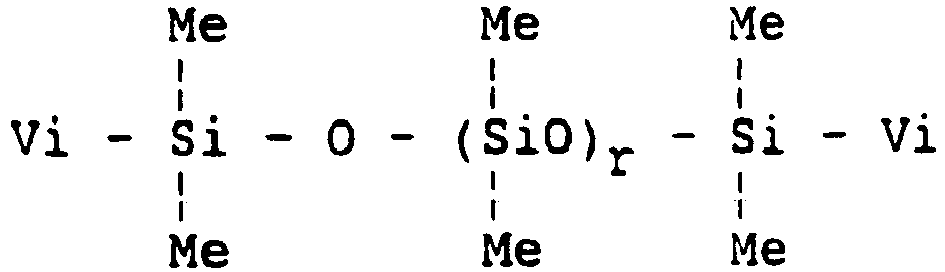

- Introduction of a polyoxyalkylene group into the obtained crosslinked organopolysiloxane polymer (steps III-VI) is accomplished by reacting the crosslinked polymer with a polyoxyalkylene compound having its formula selected from
Vi-CH2-O-(EO)u-(PO)v-(BO)w-H,
Vi-CH2-O-(EO)u-(PO)v-H,
Vi-CH2-O-(EO)u-(BO)w-H,
Vi-CH2-O-(PO)v-(BO)w-H,
Vi-CH2-O-(EO)u-H,
Vi-CH2-O-(BO)w-H and
Vi-CH2-O-(PO)v-H,
wherein Vi, EO, PO, and BO are as denoted hereinabove, and u, v, and w are as defined above. The resulting compound was a cross-linked organopolysiloxane polymer having the formula
- The foam control agent optionally includes an organic oil (D) which may be a single liquid or it may be a mixture of one or more such liquids. Suitable materials are described in
EP 1 075 863 - The composition of the present invention is prepared by simply mixing the components together in the correct proportions. So far as is known at this time there is no particular order in which the components should or need be mixed. In a preferred embodiment, the composition comprises components (A), (B) and (C), and more preferably (A), (B), (C) and (D).
- In the foam control composition comprising components (A) and (B) without components (C) or (D), the composition comprises 10-90% by weight of component (A) and 10-90% by weight of component (B); more preferably 30-60% by weight of component (A) and 30-60% by weight of component (B), based on the total weight of the foam control composition.
- In the foam control composition comprising components (A), (B) and (C), but not component (D), the composition comprises 10-90% by weight of component (A), 0.1-90% by weight of component (B) and 0.1-50% by weight of component (C); more preferably 30-60% by weight of component (A), 30-50% by weight of component (B) and 30-50% by weight of component (C), based on the total weight of the foam control composition.
- In composition comprising mixtures of components (A), (B) and (D), the composition comprises 10-90% by weight of component (A), 0.1-90% by weight of component (B) and 0.1-50% by weight of component (D); more preferably 30-60% by weight of component (A), 0.1-5% by weight of component (B) and 40-90% by weight of component (D), based on the total weight of the foam control composition.
- In composition comprising mixtures of components (A), (B), (C) and (D), the composition comprises 10-90% by weight of component (A), 0.1-50% by weight of component (B), 0.1-50% by weight of component (C) and 0.1-90% by weight of component (D); more preferably 10-50% by weight of component (A), 0.1-5% by weight of component (B), 0.1-5% by weight of component (C) and 40-90% by weight of component (D), based on the total weight of the foam control composition.
- The foam control composition of the present invention may also contain the following additional ingredients: a density adjuster; a colour preservative, such a maleate or fumarate, e.g. bis(2-methoxy-1-ethyl)maleate or diallyl maleate, an acetylenic alcohol, e.g. methyl butynol, cyclooctadiene, or cyclic methyl vinyl siloxane which reacts with any residual Pt catalyst present; an additional thickening agent, such as carboxymethyl cellulose or polyvinyl alcohol; a colouring agent such as a pigment or dye; or an organic waxy material, such as those described in
EP 1 528 954 - The composition of the present invention is added in low concentrations (e.g. less than 1% by weight) to potentially foaming liquids to control the amount of foam produced. This removes unsightly and problematic surface foam which improves filtration, watering, washing and drainage of such liquids. Foam control agents have found application traditionally in such areas of use as the pulp and paper industry, paints and latex, coating processes, fertilisers, textiles, fermentation processes, metal working, adhesive, caulk and polymer manufacture, the sugar beet industry, oil well cement, cleaning compounds, detergents, cooling towers, and in chemical processes of varied description such as municipal and industrial primary and secondary waste water treatment. Accordingly, the present invention also provides the use of the composition defined herein for reducing or eliminating foam formation in a liquid. The composition of the present invention is particularly suited to Heavy Duty Liquid (HDL) detergents. Such detergents are well known in the art.
- An HDL detergent is based on a formulation containing surfactants and water. The surfactants wet the surface of fabric and soil, help to lift the stains and stabilise dirt particles and oil droplets. The surfactants are typically an anionic surfactant which may be present at 5-20%, e.g. alkylbenzene sulfonate, and a nonionic surfactant which may be present at 5-30%, e.g. 7-EO ethoxylates. The detergent also contains a foam control agent and optionally a soap, which may be present at 5-20%. The detergent may optionally contain the following further ingredients: hydrotropes (e.g. salts of short chain benzene sulfonates, such as xylene-, cumene- or toluene-sulfonate); builders which sequester the hardness of water and disperse the dirt and soil particulates in the wash water (examples include Na citrate, Na salts of tartrate and mono- and di-succinate, STPP, silicates, carbonates, aluminosilicates and zeolites); alcohols (e.g. at 5-10%); enzymes and enzyme stabiliser (e.g. sodium formate and CaCl2); cleaning aid (e.g. Borax and hydrogen peroxide); optical brighteners; fragrance; opacifiers and a base to adjust the pH (e.g. alkanolamine, such as triethanolamine). All percentages are by weight and are based on the total weight of the detergent, with the balance being water.
- This typical HDL formulation may also be modified to a specialty liquid detergent for intended washing applications like woollens (anionic surfactants will be replaced by cationic surfactants), or colour care formulations including dye transfer inhibitors.
- Further details may be found in "Liquid detergents", Ed. Kuo-Yann Lai, Surfactant Sciences Serie Volume 67, Marcel Dekker Inc., 1997.
- Examples of detergents which made be used with the foam control agent of the present invention are as follows. Unilever: "Liquid detergent composition"
US 2005/0130864 , "Liquid laundry detergent composition"US 2005/0130859 , "Softening Laundry detergent"US 2005/0124528 , "Liquid detergent compositions"US 6,894,017 and "Liquid cleaning compositions and their use"US 2002/0198127 ; P&G: "Laundry and cleaning compositions"US 2005/0043205 , "Aqueous liquid laundry detergent compositions with visible beds"US 2005/0043200 and "Liquid laundry detergent compositions"US 2005/0009721 ; and Henkel: "Textile cleaning agent which is gentle on textiles"US 2005/0119151 . - The foam control composition is preferably added to the detergent at less than 5% by weight based on the total weight of the detergent and foam control composition combined. The amount of the foam control composition added to the detergent is preferably 0.01-0.5%, more preferably 0.03-0.25% and most preferably 0.05-0.1% by weight. The detergent is preferably an HDL detergent. The foam control composition is typically added to the potentially foaming liquid, such as the detergent, prior to use. The foam control composition is added and the liquid is stirred to disperse the foam control agent.
- A silicone antifoam agent was prepared by mixing the following components:
85% polyorganosiloxane fluid 4.5% MQ resin in 2.2% octylstearate 8% hydrophobised silica (6% Sipernat® D10 and 2% Aerosil® R972 both from Evonik Industries) EP 1 075 864 - The resulting composition was designated "
silicone antifoam 1". The antifoam composition was then prepared by combining the following ingredients:30 % silicone antifoam 1 2% crosslinked silicone polyether 2% MQ resin reacted with glycol 24% block copolymers based on ethylene oxide and propylene oxide having an average molecular weight of 3,000 to 5,000 and a HLB of 1 to 7, available as Pluronic® from BASF 43% Polypropylene glycol P2000 available as Sannix® PP-2000 or P-2000 from Sanyo Japan or Dow Chemicals. - The crosslinked silicone polyether is a cross-linked polydiorganosiloxane polymer having at least one polyoxyalkylene group prepared by the method described in
EP 0 663 225 - The polydiorganosiloxane was prepared by adding 12.8 parts of a linear polysiloxane having the formula Me3SiO-(Me2SiO)108-(MeHSiO)10-SiMe3, 2.6 of a polysiloxane having the formula ViMe2SiO-(Me2SiO)l-SiMe2Vi having a molecular weight of approximately 11,000 into a reactor, mixing, and heating to 80 °C. Next, 0.001 parts of a 2% isopropanol solution of H2PtCl6.6H2O were added and the mixture was reacted for 60 minutes. 60.2 parts of a polyoxyalkylene having the formula C2H4(EO)u(PO)vOH where the ratio of u:v is 1:1 and having a molecular weight of approximately 3,100 and 24.4 parts of isopropanol were then added. The mixture was heated to 90 °C and 0.001 additional parts of a 2% isopropanol solution of H2PtCl6.6H2O were added. The mixture was reacted at 90 °C for 2 hours, followed by a vacuum strip to remove the isopropanol. The mixture was cooled and filtered.
- The MO resin reacted with glycol is a copolymer which is the reaction products derived from heating a mixture of a siloxane copolymer consisting essentially of SiO4/2 units and (CH3)3SiO1/2 units in which the ratio of the SiO4/2 units to the (CH3)3SiO1/2 units is in the range of 1:0.4 to 1:1.2, and a hydroxylated polyoxypropylene polymer having molecular weights in the range of 500 to 6,000,
- The product is derived by heating for 30 minutes at reflux a mixture of 100 g. of a 50% (solids) xylene solution of a siloxane copolymer consisting essentially of SiO4/2 units and (CH3)3SiO1/2 units in which the ratio of the SiO4/2 units to the (CH3)3SiO1/2 units is in the range of 1:0.4 to 1:1.2, 100 g of xylene, 200 g. of a hydroxylated polyoxypropylene polymer having a molecular weight of about 4,100 (Voranol CP41 00) in xylene, and 14 drops of a 1N alcoholic KOH solution.
- An antifoam composition was prepared in the same manner as described in Example 1, except that the silicone antifoam was replaced by silicone antifoam 2:
77% polyorganosiloxane fluid 13.3% MQ resin in 6.6% octyl stearate 2% hydrophobised silica (Cab-o-sil® TS-720) with KOH EP 1 075 864 - An antifoam composition was prepared in the same manner as described in Example 1, except that the silicone antifoam is replaced by silicone antifoam 3:
89% polyorganosiloxane fluid 8% MQ resin 2% hydrophobised silica (Cab-o-sil® TS-530) with KOH Silicone antifoam 3 is produced in the same way as silicone antifoam 2, except that the MQ resin is dispersed in the siloxane copolymer. - An antifoam composition was prepared in the same manner as described in Example 1, except that the silicone antifoam was replaced with 30 wt% of branched PDMS antifoam compound. The branched PDMS antifoam compound used in this comparative example was prepared according to the method disclosed in Example 1 of
US 4,639,489 . The amounts of ingredients used were as follows: 59.2 weight parts of a trimethylsiloxy-terminated polydimethylsiloxane having a viscosity of 1000 mm2/s at 25 °C. 28.2 weight parts of a hydroxy-terminated polydimethylsiloxane having a viscosity of 12,500 mm2/s at 25 °C, 2.8 weight parts of ethyl polysilicate ("Silicate 45" from Tama Kagaku Kogyo Co., Ltd., Japan), 1.3 weight parts of a potassium silanolate catalyst, 2.8 parts of Aerosil 200 Silica (silica having a surface area of 200 m2/g from Degussa-Huls Corporation), and 4.8 weight parts of hydroxy-terminated polydimethylsiloxane having a viscosity of 40 mm2/s at 25 °C. In addition to the above ingredients, this formulation also included 0.625 weight parts of water, 0.005 weight parts of Silwet® L-77 Silicone Glycol and 0.09 weight parts of L-540 Silicone Glycol (a silicone polyether block copolymer wherein the polyether blocks consist of 50/50 mole percent of polyoxyethylene/polyoxypropylene) both from Momentive Performance Materials. -
Silicone antifoam 1 was used as such. -
Silicone antifoam 1 was emulsified with the following conventional emulsifying agents: stearyl alcohol ethoxylate (EO)2 and stearyl alcohol ethoxylate (EO)20 at 20% active in water. - Trimethysiloxy-terminated PDMS fluid having a viscosity of 1000 mm2/s (Dow Corning 200 Fluid) was combined with 4% hydrophobic silica (Sipernat® D10)
-
Silicone antifoam 3 was used as such. - A visual stability test of the antifoam dispersion in HDL was performed by mixing 1% of the antifoam compositions and the detergent for 20 seconds using a Speedmixer at 3000 rpm. A model HDL system was used together with a number of commercially available HDL detergents. The model HDL detergent contained: 7% sodium lauryl ether sulfate (SLES), 7% dodecylbenzene sulfonate (LAS), 7% dehydol LT7, 5% sodium tripolyphosphate, 5% glycerine and water.
- The antifoam/detergent compositions were then placed into a bottle. The bottle was kept in an oven at 37 °C and the aspect of the dispersion was visually monitored with time. The number of days before any sign of degradation appeared (e.g. a jelly-like ring on the glass bottle at the surface of the liquid or sedimentation) was recorded. The results are set out in the following tables.
Table 1. Results using the model HDL detergent Antifoam composition Time at 37 °C before degradation observed visually (days) Example 1 21 Comparative Example 2 1 Comparative Example 3 17 Example 2 13 Example 3 >68 Comparative Example 1 5 Comparative Example 4 0 Comparative Example 5 6 Table 2. Results using commercially available HDL detergents Antifoam composition Time at 37 °C before degradation observed visually (days) Ecover "Lessive liquide" W5 Formil Active Colours Dixan Gel Persil "Touch of Silan" Dash "Liquid Detergent" Comparative Example 1 12 12 9 9 23 Example 1 11 21 21 21 28 Example 2 13 13 13 31 16 Example 3 24 31 68 39 39 - 1.7 kg loads of towels were washed using 60 g of the model HDL formulation together with 0.075% of the antifoam compositions described hereinabove. A Miele W934 front loading washing machine was loaded with the towels and charged with 13 L of soft water to which was added 12 mL of a 262 g/L CaCl2.2H2O aqueous solution and 25 mL of a 72 g/L MgCl2.6H2O aqueous solution.
- The wash was performed using a 40°C programme. The foam height profile during the washing cycle was recorded and the results are set out in
Fig. 1 . The figure shows that the formulations of embodiments of the present invention show, in addition to improved stability, excellent antifoam properties (akin to the comparative formalities).
Claims (11)
- A foam control composition comprising: (A) a silicone antifoam comprising (i) an organopolysiloxane having at least one silicon-bonded substituent of the formula X-Ar, wherein X represents a divalent aliphatic group bonded to silicon through a carbon atom and Ar represents an aromatic group, (ii) an organosilicon resin having the formula R1 aSiO(4-a)/2 where R1 represents a hydrocarbon, a hydrocarbonoxy or a hydroxyl group and a has an average value of 0.5 to 2.4, and (iii) a hydrophobic filler; and (B) an organopolysiloxane resin having at least one polyoxyalkylene group in which the organopolysiloxane resin comprises tetrafunctional siloxane units having the formula SiO4/2 and monofunctional siloxane units having the formula R2 3SiO1/2, wherein the total number of tetrafunctional siloxane units in the resin is at least 50% based on the total number of siloxane units, and R2 represents a hydrocarbon group.
- A foam control composition as claimed in claim 1 further comprising (C) a cross-linked organopolysiloxane polymer having at least one polyoxyalkylene group, in which the cross-linked organopolysiloxane polymer comprises difunctional siloxane units having the formula R3 2SiO2/2, wherein the total number of difunctional siloxane units is at least 60/% based on the total number of siloxane units, and R3 represents a hydrocarbon group.
- A foam control composition as claimed in claim 1 or 2, further comprising (D) an organic oil.
- A foam control composition as claimed in claim 3 comprising 10-50% by weight of component (A), 0.1-5% by weight of component (B), 0.1-5% by weight of component (C) and 40-90% by weight of component (D), based on the total weight of the foam control composition.
- A foam control composition as claimed in any preceding claim, wherein the total number of tetrafunctional siloxane units in the organopolysiloxane resin (B) is at least 70% based on the total number of siloxane units.
- A foam control composition as claimed in any preceding claim, wherein the ratio of tetrafunctional siloxane units to monofunctional siloxane units in the organopolysiloxane resin (B) is 1:0.4-1.2.
- A foam control composition as claimed in any of claims 2 to 6, wherein the total number of difunctional siloxane units in the cross-linked organopolysiloxane polymer (C) is at least 70% based on the total number of siloxane units.
- Use of the composition as claimed in any preceding claim for reducing or eliminating foam formation in a liquid.
- A liquid detergent comprising one or more surfactants, water and the foam control composition as claimed in any of claims 1 to 7.
- A liquid detergent as claimed in claim 9, wherein the detergent is an HDL detergent.
- A liquid detergent as claimed in claim 9 or 10, wherein the foam control composition is present at 0.01-0.5% by weight based on the total weight of the detergent.
Applications Claiming Priority (2)
| Application Number | Priority Date | Filing Date | Title |
|---|---|---|---|
| GBGB0901662.7A GB0901662D0 (en) | 2009-02-04 | 2009-02-04 | Foam control composition |
| PCT/US2010/022985 WO2010091044A2 (en) | 2009-02-04 | 2010-02-03 | Foam control composition |
Publications (2)
| Publication Number | Publication Date |
|---|---|
| EP2393909A2 EP2393909A2 (en) | 2011-12-14 |
| EP2393909B1 true EP2393909B1 (en) | 2013-10-16 |
Family
ID=40469436
Family Applications (1)
| Application Number | Title | Priority Date | Filing Date |
|---|---|---|---|
| EP10704625.2A Active EP2393909B1 (en) | 2009-02-04 | 2010-02-03 | Foam control composition |
Country Status (10)
| Country | Link |
|---|---|
| US (1) | US8536109B2 (en) |
| EP (1) | EP2393909B1 (en) |
| JP (1) | JP5722237B2 (en) |
| KR (1) | KR101717309B1 (en) |
| CN (1) | CN102307978B (en) |
| BR (1) | BRPI1005422A2 (en) |
| ES (1) | ES2440596T3 (en) |
| GB (1) | GB0901662D0 (en) |
| RU (1) | RU2506306C2 (en) |
| WO (1) | WO2010091044A2 (en) |
Families Citing this family (45)
| Publication number | Priority date | Publication date | Assignee | Title |
|---|---|---|---|---|
| US8492325B2 (en) * | 2010-03-01 | 2013-07-23 | The Procter & Gamble Company | Dual-usage liquid laundry detergents comprising a silicone anti-foam |
| GB201102750D0 (en) | 2011-02-16 | 2011-03-30 | Dow Corning | Foam control composition |
| JP5754402B2 (en) * | 2011-04-07 | 2015-07-29 | 信越化学工業株式会社 | Oil compound for antifoam and antifoam composition |
| US8551533B2 (en) * | 2011-05-09 | 2013-10-08 | Momentive Performance Materials Inc. | Adjuvant composition and agrochemical formulation containing same |
| GB201115161D0 (en) * | 2011-09-02 | 2011-10-19 | Dow Corning | Improving the drainage of an aqueous composition |
| RU2615144C2 (en) | 2012-02-16 | 2017-04-04 | Дау Корнинг Корпорейшн | Granular substances to control foaming for rinsing cycle using siloxane wax |
| DE102012207484A1 (en) * | 2012-05-07 | 2013-11-07 | Wacker Chemie Ag | Defoamer formulations containing organopolysiloxanes |
| EP2859046A1 (en) * | 2012-06-08 | 2015-04-15 | Dow Corning Toray Co., Ltd | Carboxy silicone containing composition and process for preparing the composition |
| JP2014077218A (en) * | 2012-10-11 | 2014-05-01 | Dow Corning Toray Co Ltd | Defoaming agent and method of producing pulp |
| GB201314284D0 (en) | 2013-08-09 | 2013-09-25 | Dow Corning | Cosmetic compositions containing silicones |
| JP6342508B2 (en) * | 2014-02-26 | 2018-06-13 | ザ プロクター アンド ギャンブル カンパニー | Antifoam composition |
| WO2016074142A1 (en) | 2014-11-11 | 2016-05-19 | The Procter & Gamble Company | Detergent or cleaning compositions with improved sudsing profile |
| JP2015196701A (en) * | 2014-03-31 | 2015-11-09 | 花王株式会社 | Solid detergent |
| US9845445B2 (en) * | 2014-05-12 | 2017-12-19 | The Procter & Gamble Company | Cleaning compositions comprising alkoxylated polyalkyleneimine, organomodified silicone and silixane-based diluent |
| WO2015196400A1 (en) * | 2014-06-26 | 2015-12-30 | Dow Corning (China) Holding Co., Ltd. | Emulsion type silicone pressure sensitive adhesive composition and process for the production thereof |
| CN104130879B (en) * | 2014-08-08 | 2017-02-15 | 江苏四新科技应用研究所股份有限公司 | Defoaming agent for liquid detergent |
| CN104436767B (en) * | 2014-12-24 | 2016-05-18 | 江苏四新科技应用研究所股份有限公司 | A kind of silicon composition and preparation thereof, application |
| US12534576B2 (en) | 2015-01-28 | 2026-01-27 | Dow Silicones Corporation | Elastomeric compositions and their applications |
| CA2975175C (en) | 2015-01-28 | 2020-01-28 | Dow Corning Corporation | Elastomeric compositions and their applications |
| US9815003B2 (en) * | 2015-09-28 | 2017-11-14 | Wacker Chemical Corporation | Silicone defoamer compositions |
| DE102016203344A1 (en) | 2016-03-01 | 2017-09-07 | Wacker Chemie Ag | Defoamer compositions for detergents |
| JP6792748B2 (en) * | 2016-04-27 | 2020-12-02 | サンノプコ株式会社 | Defoamer |
| GB201613397D0 (en) | 2016-08-03 | 2016-09-14 | Dow Corning | Cosmetic composition comprising silicone materials |
| GB201613399D0 (en) | 2016-08-03 | 2016-09-14 | Dow Corning | Cosmetic composition comprising silicone materials |
| CA3040799A1 (en) | 2016-10-10 | 2018-04-19 | Stephan Nied | New antifoam formulations for the thermal desalination process of water |
| JP6881353B2 (en) * | 2017-03-17 | 2021-06-02 | 信越化学工業株式会社 | Organic group-modified organosilicon resin, its manufacturing method, and cosmetics |
| GB201707437D0 (en) | 2017-05-09 | 2017-06-21 | Dow Corning | Lamination adhesive compositions and their applications |
| GB201707439D0 (en) | 2017-05-09 | 2017-06-21 | Dow Corning | Lamination Process |
| CN107460531B (en) * | 2017-07-03 | 2020-11-13 | 阜南县申通机械制造有限公司 | Electrolytic dewaxing method for automobile covering parts |
| JP6784657B2 (en) | 2017-11-10 | 2020-11-11 | 信越化学工業株式会社 | Defoamer and method of manufacturing defoamer |
| US10836981B2 (en) * | 2017-11-10 | 2020-11-17 | The Procter & Gamble Company | Anti-foam compositions comprising an organopolysiloxane with adjacent hydrolysable groups |
| BR112020025480A2 (en) * | 2018-06-15 | 2021-03-16 | W. R. Grace & Co.-Conn | FOAM ELIMINATING ACTIVE, METHOD OF MANUFACTURING THE SAME AND DEFUMERATING FORMULATION |
| CN109011719B (en) * | 2018-08-23 | 2020-08-18 | 南京瑞思化学技术有限公司 | Organic silicon composition and preparation method thereof |
| WO2020068484A1 (en) * | 2018-09-28 | 2020-04-02 | Dow Global Technologies Llc | Hydroxyethyl cellulose derivative foam control agents and methods of processing foodstuffs |
| CN109364534B (en) * | 2018-10-09 | 2020-12-25 | 南京瑞思化学技术有限公司 | Modified polyether composition |
| CN112312987B (en) * | 2018-11-28 | 2022-06-17 | 瓦克化学股份公司 | Defoaming agent formulations containing organopolysiloxanes |
| CN112334206B (en) * | 2018-11-28 | 2022-06-28 | 瓦克化学股份公司 | Antifoam formulations containing organopolysiloxanes |
| EP3744764A1 (en) * | 2019-05-28 | 2020-12-02 | Evonik Operations GmbH | Production of sioc-linked siloxanes |
| PT4106899T (en) | 2020-02-20 | 2024-07-24 | Dow Silicones Corp | FOAM CONTROL COMPOSITION |
| CN112263851A (en) * | 2020-09-30 | 2021-01-26 | 四川健能制药有限公司 | Preparation method of simethicone defoaming composition |
| EP4232535A4 (en) * | 2020-10-26 | 2024-07-24 | Dow Global Technologies LLC | Metal working fluids foam control agent |
| JP7878852B2 (en) | 2020-12-28 | 2026-06-23 | ダウ・東レ株式会社 | Silicone-based defoaming agent composition |
| EP4268921A4 (en) * | 2020-12-28 | 2024-11-27 | Dow Toray Co., Ltd. | OIL COMPOUND FOR SILICONE-BASED ANTIFOAMING AGENTS, PRODUCTION METHOD THEREOF, AND ANTIFOAMING AGENT CONTAINING OIL COMPOUND FOR SILICONE-BASED ANTIFOAMING AGENTS |
| KR102994064B1 (en) * | 2021-05-07 | 2026-07-21 | 와커 헤미 아게 | Organopolysiloxane, compositions and powder formulations containing the same, and the use of the same as an antifoaming agent |
| WO2023284979A1 (en) * | 2021-07-16 | 2023-01-19 | Wacker Chemie Ag | Defoaming compositions with polydimethylsiloxanes, organopolysiloxane resins, alkyl ethers and without 2,2,4-trimethyl-1,3-diisobutyryloxypentane |
Family Cites Families (32)
| Publication number | Priority date | Publication date | Assignee | Title |
|---|---|---|---|---|
| US3511788A (en) | 1965-02-03 | 1970-05-12 | Dow Corning | Foams,compositions,method for making foams and foam covered substrate ii |
| BE788250A (en) * | 1972-05-15 | 1973-02-28 | Dow Corning | Silicone antifoam - consisting of polyoxypropylene (co)polymer, or siloxane-glycol copolymer, polymethylsiloxane, silica and siloxane |
| US3784479A (en) | 1972-05-15 | 1974-01-08 | Dow Corning | Foam control composition |
| SU734235A1 (en) * | 1978-09-26 | 1980-05-15 | Предприятие П/Я В-8415 | Foam breaking up composition |
| SU1161526A1 (en) * | 1983-04-08 | 1985-06-15 | Предприятие П/Я В-8415 | Foam-suppressing composition |
| JPS60251906A (en) | 1984-05-30 | 1985-12-12 | Dow Corning Kk | Preparation of silicone defoaming composition |
| JPS61197007A (en) | 1985-02-25 | 1986-09-01 | Shin Etsu Chem Co Ltd | Silicon defoaming composition |
| US4853474A (en) | 1987-07-08 | 1989-08-01 | Dow Corning Corporation | Cross-linked organopolysiloxanes and emulsions based thereon |
| FR2624128B1 (en) * | 1987-12-08 | 1990-07-20 | Rhone Poulenc Chimie | ANTI-MOUSSE COMPRISING AN MQ RESIN |
| US5136068A (en) | 1989-04-26 | 1992-08-04 | Dow Corning Corporation | Cross-linked organopolysiloxanes and emulsions based thereon |
| NO308363B1 (en) | 1993-12-28 | 2000-09-04 | Dow Corning | Use of a composition as a foam control agent |
| JP3428709B2 (en) * | 1993-12-28 | 2003-07-22 | ダウ コーニング アジア株式会社 | Silicone antifoam composition |
| DE19538751A1 (en) * | 1995-10-18 | 1997-04-24 | Huels Chemische Werke Ag | Defoamer dispersions for aqueous surfactant systems |
| US20040147426A1 (en) | 1998-07-10 | 2004-07-29 | The Procter & Gamble Company | Laundry and cleaning compositions |
| DE19936289A1 (en) | 1999-08-02 | 2001-02-15 | Wacker Chemie Gmbh | Defoamer formulation |
| DE60039559D1 (en) * | 1999-08-13 | 2008-09-04 | Dow Corning Sa | Silicone-containing foam control agent |
| ATE286422T1 (en) * | 1999-08-13 | 2005-01-15 | Dow Corning Sa | SILICONE-BASED FOAM REGULATOR |
| US6512015B1 (en) | 2000-06-30 | 2003-01-28 | Dow Corning Corporation | Silicone foam control compositions |
| ATE265516T1 (en) * | 2000-06-30 | 2004-05-15 | Dow Corning | STABLE SILICONE-BASED FOAM CONTROL COMPOSITIONS IN DETERGENTS |
| GB0104980D0 (en) | 2001-02-28 | 2001-04-18 | Unilever Plc | Liquid cleaning compositions and their use |
| GB0126280D0 (en) | 2001-11-01 | 2002-01-02 | Unilever Plc | Liquid detergent compositions |
| US20050119151A1 (en) | 2002-04-10 | 2005-06-02 | Konstanze Mayer | Textile cleaning agent which is gentle on textiles |
| US6656975B1 (en) * | 2002-05-21 | 2003-12-02 | Dow Corning Corporation | Silicone dispersions |
| GB0219073D0 (en) | 2002-08-16 | 2002-09-25 | Dow Corning | Silicone foam control compositions |
| DE10255649A1 (en) | 2002-11-28 | 2004-06-17 | Wacker-Chemie Gmbh | defoamer |
| US7326677B2 (en) | 2003-07-11 | 2008-02-05 | The Procter & Gamble Company | Liquid laundry detergent compositions comprising a silicone blend of non-functionalized and amino-functionalized silicone polymers |
| DE60312150T2 (en) | 2003-08-01 | 2007-11-08 | The Procter & Gamble Company, Cincinnati | Aqueous liquid detergent containing visible particles |
| US7012054B2 (en) | 2003-12-03 | 2006-03-14 | Unilever Home & Personal Care Usa, Division Of Conopco, Inc. | Softening laundry detergent |
| DE602004012887T2 (en) | 2003-12-05 | 2009-04-09 | Unilever N.V. | LIQUID DETERGENT |
| CA2548122C (en) | 2003-12-11 | 2013-01-15 | Unilever Plc | Enzyme-containing liquid detergent composition with improved storage stability |
| DE102004040263A1 (en) * | 2004-08-19 | 2006-02-23 | Wacker-Chemie Gmbh | defoamer |
| DE102005040273B4 (en) * | 2005-08-24 | 2007-08-30 | Henkel Kgaa | Use of foam regulator granules as deposit prevention in machine textile washing |
-
2009
- 2009-02-04 GB GBGB0901662.7A patent/GB0901662D0/en not_active Ceased
-
2010
- 2010-02-03 CN CN2010800065148A patent/CN102307978B/en active Active
- 2010-02-03 RU RU2011133312/04A patent/RU2506306C2/en not_active IP Right Cessation
- 2010-02-03 BR BRPI1005422A patent/BRPI1005422A2/en not_active IP Right Cessation
- 2010-02-03 WO PCT/US2010/022985 patent/WO2010091044A2/en not_active Ceased
- 2010-02-03 US US13/147,947 patent/US8536109B2/en active Active
- 2010-02-03 ES ES10704625.2T patent/ES2440596T3/en active Active
- 2010-02-03 KR KR1020117020426A patent/KR101717309B1/en not_active Expired - Fee Related
- 2010-02-03 EP EP10704625.2A patent/EP2393909B1/en active Active
- 2010-02-03 JP JP2011549221A patent/JP5722237B2/en active Active
Also Published As
| Publication number | Publication date |
|---|---|
| WO2010091044A3 (en) | 2010-11-11 |
| JP5722237B2 (en) | 2015-05-20 |
| KR101717309B1 (en) | 2017-03-16 |
| RU2506306C2 (en) | 2014-02-10 |
| CN102307978A (en) | 2012-01-04 |
| ES2440596T3 (en) | 2014-01-29 |
| WO2010091044A2 (en) | 2010-08-12 |
| US8536109B2 (en) | 2013-09-17 |
| EP2393909A2 (en) | 2011-12-14 |
| KR20110139208A (en) | 2011-12-28 |
| US20110294714A1 (en) | 2011-12-01 |
| GB0901662D0 (en) | 2009-03-11 |
| CN102307978B (en) | 2013-03-06 |
| RU2011133312A (en) | 2013-03-10 |
| BRPI1005422A2 (en) | 2019-09-24 |
| JP2012516775A (en) | 2012-07-26 |
Similar Documents
| Publication | Publication Date | Title |
|---|---|---|
| US8536109B2 (en) | Foam control composition | |
| US6512015B1 (en) | Silicone foam control compositions | |
| US6521586B1 (en) | Silicone foam control agent | |
| US6521587B1 (en) | Silicone foam control agent | |
| JP5543015B2 (en) | Antifoam composition | |
| US6207722B1 (en) | Foam control compositions having resin-fillers | |
| CN108778443B (en) | Defoamer composition for cleaning agents | |
| JP2008509811A (en) | Antifoam composition | |
| EP3494171A1 (en) | Foam control compositions comprising silicone materials | |
| EP3256230B1 (en) | Silicone defoamer compositions | |
| KR100895251B1 (en) | Antifoam composition | |
| JP2015525124A (en) | Carboxysilicone-containing composition and process for preparing the composition | |
| CN107921331B (en) | Defoaming compositions for detergents | |
| KR20000048475A (en) | Antifoam compositions containing ultra high molecular weight resins | |
| CN115135395A (en) | Foam control composition | |
| EP3708232B1 (en) | Antifoaming agent and method for manufacturing antifoaming agent |
Legal Events
| Date | Code | Title | Description |
|---|---|---|---|
| PUAI | Public reference made under article 153(3) epc to a published international application that has entered the european phase |
Free format text: ORIGINAL CODE: 0009012 |
|
| 17P | Request for examination filed |
Effective date: 20110822 |
|
| AK | Designated contracting states |
Kind code of ref document: A2 Designated state(s): AT BE BG CH CY CZ DE DK EE ES FI FR GB GR HR HU IE IS IT LI LT LU LV MC MK MT NL NO PL PT RO SE SI SK SM TR |
|
| DAX | Request for extension of the european patent (deleted) | ||
| RAP1 | Party data changed (applicant data changed or rights of an application transferred) |
Owner name: DOW CORNING TORAY CO., LTD. Owner name: DOW CORNING CORPORATION |
|
| GRAP | Despatch of communication of intention to grant a patent |
Free format text: ORIGINAL CODE: EPIDOSNIGR1 |
|
| RIC1 | Information provided on ipc code assigned before grant |
Ipc: C08L 83/04 20060101ALI20130411BHEP Ipc: C11D 3/37 20060101ALI20130411BHEP Ipc: C11D 3/00 20060101AFI20130411BHEP Ipc: B01D 19/04 20060101ALI20130411BHEP Ipc: C08K 3/36 20060101ALI20130411BHEP Ipc: C11D 3/16 20060101ALI20130411BHEP Ipc: C08G 77/46 20060101ALI20130411BHEP Ipc: C08K 9/04 20060101ALI20130411BHEP |
|
| INTG | Intention to grant announced |
Effective date: 20130503 |
|
| GRAS | Grant fee paid |
Free format text: ORIGINAL CODE: EPIDOSNIGR3 |
|
| GRAA | (expected) grant |
Free format text: ORIGINAL CODE: 0009210 |
|
| AK | Designated contracting states |
Kind code of ref document: B1 Designated state(s): AT BE BG CH CY CZ DE DK EE ES FI FR GB GR HR HU IE IS IT LI LT LU LV MC MK MT NL NO PL PT RO SE SI SK SM TR |
|
| REG | Reference to a national code |
Ref country code: GB Ref legal event code: FG4D |
|
| REG | Reference to a national code |
Ref country code: CH Ref legal event code: EP |
|
| REG | Reference to a national code |
Ref country code: IE Ref legal event code: FG4D |
|
| REG | Reference to a national code |
Ref country code: AT Ref legal event code: REF Ref document number: 636534 Country of ref document: AT Kind code of ref document: T Effective date: 20131115 |
|
| REG | Reference to a national code |
Ref country code: DE Ref legal event code: R096 Ref document number: 602010010955 Country of ref document: DE Effective date: 20131212 |
|
| REG | Reference to a national code |
Ref country code: NL Ref legal event code: T3 |
|
| REG | Reference to a national code |
Ref country code: ES Ref legal event code: FG2A Ref document number: 2440596 Country of ref document: ES Kind code of ref document: T3 Effective date: 20140129 |
|
| REG | Reference to a national code |
Ref country code: AT Ref legal event code: MK05 Ref document number: 636534 Country of ref document: AT Kind code of ref document: T Effective date: 20131016 |
|
| REG | Reference to a national code |
Ref country code: LT Ref legal event code: MG4D |
|
| PG25 | Lapsed in a contracting state [announced via postgrant information from national office to epo] |
Ref country code: SE Free format text: LAPSE BECAUSE OF FAILURE TO SUBMIT A TRANSLATION OF THE DESCRIPTION OR TO PAY THE FEE WITHIN THE PRESCRIBED TIME-LIMIT Effective date: 20131016 Ref country code: NO Free format text: LAPSE BECAUSE OF FAILURE TO SUBMIT A TRANSLATION OF THE DESCRIPTION OR TO PAY THE FEE WITHIN THE PRESCRIBED TIME-LIMIT Effective date: 20140116 Ref country code: IS Free format text: LAPSE BECAUSE OF FAILURE TO SUBMIT A TRANSLATION OF THE DESCRIPTION OR TO PAY THE FEE WITHIN THE PRESCRIBED TIME-LIMIT Effective date: 20140216 Ref country code: HR Free format text: LAPSE BECAUSE OF FAILURE TO SUBMIT A TRANSLATION OF THE DESCRIPTION OR TO PAY THE FEE WITHIN THE PRESCRIBED TIME-LIMIT Effective date: 20131016 Ref country code: LT Free format text: LAPSE BECAUSE OF FAILURE TO SUBMIT A TRANSLATION OF THE DESCRIPTION OR TO PAY THE FEE WITHIN THE PRESCRIBED TIME-LIMIT Effective date: 20131016 Ref country code: FI Free format text: LAPSE BECAUSE OF FAILURE TO SUBMIT A TRANSLATION OF THE DESCRIPTION OR TO PAY THE FEE WITHIN THE PRESCRIBED TIME-LIMIT Effective date: 20131016 |
|
| PG25 | Lapsed in a contracting state [announced via postgrant information from national office to epo] |
Ref country code: AT Free format text: LAPSE BECAUSE OF FAILURE TO SUBMIT A TRANSLATION OF THE DESCRIPTION OR TO PAY THE FEE WITHIN THE PRESCRIBED TIME-LIMIT Effective date: 20131016 Ref country code: CY Free format text: LAPSE BECAUSE OF FAILURE TO SUBMIT A TRANSLATION OF THE DESCRIPTION OR TO PAY THE FEE WITHIN THE PRESCRIBED TIME-LIMIT Effective date: 20131016 Ref country code: LV Free format text: LAPSE BECAUSE OF FAILURE TO SUBMIT A TRANSLATION OF THE DESCRIPTION OR TO PAY THE FEE WITHIN THE PRESCRIBED TIME-LIMIT Effective date: 20131016 |
|
| PG25 | Lapsed in a contracting state [announced via postgrant information from national office to epo] |
Ref country code: PT Free format text: LAPSE BECAUSE OF FAILURE TO SUBMIT A TRANSLATION OF THE DESCRIPTION OR TO PAY THE FEE WITHIN THE PRESCRIBED TIME-LIMIT Effective date: 20140217 |
|
| REG | Reference to a national code |
Ref country code: DE Ref legal event code: R097 Ref document number: 602010010955 Country of ref document: DE |
|
| PG25 | Lapsed in a contracting state [announced via postgrant information from national office to epo] |
Ref country code: EE Free format text: LAPSE BECAUSE OF FAILURE TO SUBMIT A TRANSLATION OF THE DESCRIPTION OR TO PAY THE FEE WITHIN THE PRESCRIBED TIME-LIMIT Effective date: 20131016 |
|
| PLBE | No opposition filed within time limit |
Free format text: ORIGINAL CODE: 0009261 |
|
| STAA | Information on the status of an ep patent application or granted ep patent |
Free format text: STATUS: NO OPPOSITION FILED WITHIN TIME LIMIT |
|
| PG25 | Lapsed in a contracting state [announced via postgrant information from national office to epo] |
Ref country code: RO Free format text: LAPSE BECAUSE OF FAILURE TO SUBMIT A TRANSLATION OF THE DESCRIPTION OR TO PAY THE FEE WITHIN THE PRESCRIBED TIME-LIMIT Effective date: 20131016 Ref country code: PL Free format text: LAPSE BECAUSE OF FAILURE TO SUBMIT A TRANSLATION OF THE DESCRIPTION OR TO PAY THE FEE WITHIN THE PRESCRIBED TIME-LIMIT Effective date: 20131016 Ref country code: SK Free format text: LAPSE BECAUSE OF FAILURE TO SUBMIT A TRANSLATION OF THE DESCRIPTION OR TO PAY THE FEE WITHIN THE PRESCRIBED TIME-LIMIT Effective date: 20131016 Ref country code: CZ Free format text: LAPSE BECAUSE OF FAILURE TO SUBMIT A TRANSLATION OF THE DESCRIPTION OR TO PAY THE FEE WITHIN THE PRESCRIBED TIME-LIMIT Effective date: 20131016 |
|
| 26N | No opposition filed |
Effective date: 20140717 |
|
| PG25 | Lapsed in a contracting state [announced via postgrant information from national office to epo] |
Ref country code: MC Free format text: LAPSE BECAUSE OF FAILURE TO SUBMIT A TRANSLATION OF THE DESCRIPTION OR TO PAY THE FEE WITHIN THE PRESCRIBED TIME-LIMIT Effective date: 20131016 Ref country code: LU Free format text: LAPSE BECAUSE OF FAILURE TO SUBMIT A TRANSLATION OF THE DESCRIPTION OR TO PAY THE FEE WITHIN THE PRESCRIBED TIME-LIMIT Effective date: 20140203 Ref country code: DK Free format text: LAPSE BECAUSE OF FAILURE TO SUBMIT A TRANSLATION OF THE DESCRIPTION OR TO PAY THE FEE WITHIN THE PRESCRIBED TIME-LIMIT Effective date: 20131016 |
|
| REG | Reference to a national code |
Ref country code: CH Ref legal event code: PL |
|
| REG | Reference to a national code |
Ref country code: DE Ref legal event code: R097 Ref document number: 602010010955 Country of ref document: DE Effective date: 20140717 |
|
| PG25 | Lapsed in a contracting state [announced via postgrant information from national office to epo] |
Ref country code: CH Free format text: LAPSE BECAUSE OF NON-PAYMENT OF DUE FEES Effective date: 20140228 Ref country code: LI Free format text: LAPSE BECAUSE OF NON-PAYMENT OF DUE FEES Effective date: 20140228 |
|
| REG | Reference to a national code |
Ref country code: IE Ref legal event code: MM4A |
|
| PG25 | Lapsed in a contracting state [announced via postgrant information from national office to epo] |
Ref country code: IE Free format text: LAPSE BECAUSE OF NON-PAYMENT OF DUE FEES Effective date: 20140203 |
|
| PG25 | Lapsed in a contracting state [announced via postgrant information from national office to epo] |
Ref country code: SI Free format text: LAPSE BECAUSE OF FAILURE TO SUBMIT A TRANSLATION OF THE DESCRIPTION OR TO PAY THE FEE WITHIN THE PRESCRIBED TIME-LIMIT Effective date: 20131016 |
|
| REG | Reference to a national code |
Ref country code: FR Ref legal event code: PLFP Year of fee payment: 7 |
|
| PG25 | Lapsed in a contracting state [announced via postgrant information from national office to epo] |
Ref country code: MT Free format text: LAPSE BECAUSE OF FAILURE TO SUBMIT A TRANSLATION OF THE DESCRIPTION OR TO PAY THE FEE WITHIN THE PRESCRIBED TIME-LIMIT Effective date: 20131016 |
|
| PG25 | Lapsed in a contracting state [announced via postgrant information from national office to epo] |
Ref country code: SM Free format text: LAPSE BECAUSE OF FAILURE TO SUBMIT A TRANSLATION OF THE DESCRIPTION OR TO PAY THE FEE WITHIN THE PRESCRIBED TIME-LIMIT Effective date: 20131016 |
|
| PG25 | Lapsed in a contracting state [announced via postgrant information from national office to epo] |
Ref country code: BG Free format text: LAPSE BECAUSE OF FAILURE TO SUBMIT A TRANSLATION OF THE DESCRIPTION OR TO PAY THE FEE WITHIN THE PRESCRIBED TIME-LIMIT Effective date: 20131016 Ref country code: GR Free format text: LAPSE BECAUSE OF FAILURE TO SUBMIT A TRANSLATION OF THE DESCRIPTION OR TO PAY THE FEE WITHIN THE PRESCRIBED TIME-LIMIT Effective date: 20140117 |
|
| PG25 | Lapsed in a contracting state [announced via postgrant information from national office to epo] |
Ref country code: HU Free format text: LAPSE BECAUSE OF FAILURE TO SUBMIT A TRANSLATION OF THE DESCRIPTION OR TO PAY THE FEE WITHIN THE PRESCRIBED TIME-LIMIT; INVALID AB INITIO Effective date: 20100203 |
|
| REG | Reference to a national code |
Ref country code: FR Ref legal event code: PLFP Year of fee payment: 8 |
|
| REG | Reference to a national code |
Ref country code: FR Ref legal event code: PLFP Year of fee payment: 9 |
|
| PGFP | Annual fee paid to national office [announced via postgrant information from national office to epo] |
Ref country code: FR Payment date: 20171211 Year of fee payment: 9 |
|
| PGFP | Annual fee paid to national office [announced via postgrant information from national office to epo] |
Ref country code: BE Payment date: 20171228 Year of fee payment: 9 |
|
| PGFP | Annual fee paid to national office [announced via postgrant information from national office to epo] |
Ref country code: NL Payment date: 20180115 Year of fee payment: 9 |
|
| PGFP | Annual fee paid to national office [announced via postgrant information from national office to epo] |
Ref country code: ES Payment date: 20180301 Year of fee payment: 9 |
|
| PGFP | Annual fee paid to national office [announced via postgrant information from national office to epo] |
Ref country code: IT Payment date: 20180221 Year of fee payment: 9 Ref country code: TR Payment date: 20180126 Year of fee payment: 9 |
|
| PG25 | Lapsed in a contracting state [announced via postgrant information from national office to epo] |
Ref country code: MK Free format text: LAPSE BECAUSE OF FAILURE TO SUBMIT A TRANSLATION OF THE DESCRIPTION OR TO PAY THE FEE WITHIN THE PRESCRIBED TIME-LIMIT Effective date: 20131016 |
|
| REG | Reference to a national code |
Ref country code: NL Ref legal event code: MM Effective date: 20190301 |
|
| REG | Reference to a national code |
Ref country code: BE Ref legal event code: MM Effective date: 20190228 |
|
| PG25 | Lapsed in a contracting state [announced via postgrant information from national office to epo] |
Ref country code: NL Free format text: LAPSE BECAUSE OF NON-PAYMENT OF DUE FEES Effective date: 20190301 |
|
| PG25 | Lapsed in a contracting state [announced via postgrant information from national office to epo] |
Ref country code: IT Free format text: LAPSE BECAUSE OF NON-PAYMENT OF DUE FEES Effective date: 20190203 Ref country code: FR Free format text: LAPSE BECAUSE OF NON-PAYMENT OF DUE FEES Effective date: 20190228 Ref country code: BE Free format text: LAPSE BECAUSE OF NON-PAYMENT OF DUE FEES Effective date: 20190228 |
|
| REG | Reference to a national code |
Ref country code: ES Ref legal event code: FD2A Effective date: 20200327 |
|
| PG25 | Lapsed in a contracting state [announced via postgrant information from national office to epo] |
Ref country code: ES Free format text: LAPSE BECAUSE OF NON-PAYMENT OF DUE FEES Effective date: 20190204 |
|
| REG | Reference to a national code |
Ref country code: DE Ref legal event code: R082 Ref document number: 602010010955 Country of ref document: DE Representative=s name: MURGITROYD & COMPANY, DE Ref country code: DE Ref legal event code: R081 Ref document number: 602010010955 Country of ref document: DE Owner name: DOW TORAY CO., LTD., JP Free format text: FORMER OWNERS: DOW CORNING TORAY CO., LTD., TOKYO, JP; DOW CORNING CORP., MIDLAND, MICH., US |
|
| PG25 | Lapsed in a contracting state [announced via postgrant information from national office to epo] |
Ref country code: TR Free format text: LAPSE BECAUSE OF NON-PAYMENT OF DUE FEES Effective date: 20190203 |
|
| P01 | Opt-out of the competence of the unified patent court (upc) registered |
Effective date: 20230525 |
|
| PGFP | Annual fee paid to national office [announced via postgrant information from national office to epo] |
Ref country code: GB Payment date: 20251211 Year of fee payment: 17 |
|
| PGFP | Annual fee paid to national office [announced via postgrant information from national office to epo] |
Ref country code: DE Payment date: 20251210 Year of fee payment: 17 |