EP2392702A2 - Broyage de fibres de polyéthylène à molécules ultra élevées - Google Patents
Broyage de fibres de polyéthylène à molécules ultra élevées Download PDFInfo
- Publication number
- EP2392702A2 EP2392702A2 EP11168116A EP11168116A EP2392702A2 EP 2392702 A2 EP2392702 A2 EP 2392702A2 EP 11168116 A EP11168116 A EP 11168116A EP 11168116 A EP11168116 A EP 11168116A EP 2392702 A2 EP2392702 A2 EP 2392702A2
- Authority
- EP
- European Patent Office
- Prior art keywords
- fibers
- cutting
- molecular weight
- fiber
- blade
- Prior art date
- Legal status (The legal status is an assumption and is not a legal conclusion. Google has not performed a legal analysis and makes no representation as to the accuracy of the status listed.)
- Withdrawn
Links
- 229920000785 ultra high molecular weight polyethylene Polymers 0.000 title description 9
- 239000004699 Ultra-high molecular weight polyethylene Substances 0.000 title description 5
- 239000000835 fiber Substances 0.000 claims abstract description 91
- 238000005520 cutting process Methods 0.000 claims abstract description 62
- 238000000034 method Methods 0.000 claims abstract description 25
- 239000004698 Polyethylene Substances 0.000 claims abstract description 17
- -1 polyethylene Polymers 0.000 claims abstract description 17
- 229920000573 polyethylene Polymers 0.000 claims abstract description 17
- 238000012545 processing Methods 0.000 claims abstract description 8
- 230000008569 process Effects 0.000 claims description 15
- 239000000843 powder Substances 0.000 claims description 8
- 238000003825 pressing Methods 0.000 claims description 6
- 239000000203 mixture Substances 0.000 claims description 5
- 230000006835 compression Effects 0.000 claims description 4
- 238000007906 compression Methods 0.000 claims description 4
- 239000002318 adhesion promoter Substances 0.000 claims description 2
- 239000002657 fibrous material Substances 0.000 abstract 1
- 239000000463 material Substances 0.000 description 15
- 229910000831 Steel Inorganic materials 0.000 description 9
- 239000010959 steel Substances 0.000 description 9
- 229920000642 polymer Polymers 0.000 description 7
- 230000007423 decrease Effects 0.000 description 5
- IJGRMHOSHXDMSA-UHFFFAOYSA-N Atomic nitrogen Chemical compound N#N IJGRMHOSHXDMSA-UHFFFAOYSA-N 0.000 description 4
- 239000013590 bulk material Substances 0.000 description 4
- 238000000354 decomposition reaction Methods 0.000 description 4
- 238000004519 manufacturing process Methods 0.000 description 4
- 229920005594 polymer fiber Polymers 0.000 description 4
- 229920000742 Cotton Polymers 0.000 description 3
- 230000015556 catabolic process Effects 0.000 description 2
- 238000001816 cooling Methods 0.000 description 2
- 238000006731 degradation reaction Methods 0.000 description 2
- 239000002184 metal Substances 0.000 description 2
- 238000000465 moulding Methods 0.000 description 2
- 229910052757 nitrogen Inorganic materials 0.000 description 2
- 229920003023 plastic Polymers 0.000 description 2
- 239000004033 plastic Substances 0.000 description 2
- 230000032258 transport Effects 0.000 description 2
- WJXQFVMTIGJBFX-UHFFFAOYSA-N 4-methoxytyramine Chemical compound COC1=CC=C(CCN)C=C1O WJXQFVMTIGJBFX-UHFFFAOYSA-N 0.000 description 1
- 229920000426 Microplastic Polymers 0.000 description 1
- 238000005054 agglomeration Methods 0.000 description 1
- 230000002776 aggregation Effects 0.000 description 1
- 239000003570 air Substances 0.000 description 1
- 238000005452 bending Methods 0.000 description 1
- 230000008901 benefit Effects 0.000 description 1
- 229910052799 carbon Inorganic materials 0.000 description 1
- 239000000919 ceramic Substances 0.000 description 1
- 230000008859 change Effects 0.000 description 1
- 239000003795 chemical substances by application Substances 0.000 description 1
- 238000007796 conventional method Methods 0.000 description 1
- 230000003247 decreasing effect Effects 0.000 description 1
- 238000011161 development Methods 0.000 description 1
- 229910003460 diamond Inorganic materials 0.000 description 1
- 239000010432 diamond Substances 0.000 description 1
- 238000001523 electrospinning Methods 0.000 description 1
- 239000003822 epoxy resin Substances 0.000 description 1
- 239000011888 foil Substances 0.000 description 1
- 238000001891 gel spinning Methods 0.000 description 1
- 239000008187 granular material Substances 0.000 description 1
- 238000010438 heat treatment Methods 0.000 description 1
- 239000007788 liquid Substances 0.000 description 1
- 238000002844 melting Methods 0.000 description 1
- 230000008018 melting Effects 0.000 description 1
- 239000002121 nanofiber Substances 0.000 description 1
- 238000005121 nitriding Methods 0.000 description 1
- 239000002245 particle Substances 0.000 description 1
- 229920000647 polyepoxide Polymers 0.000 description 1
- 230000000717 retained effect Effects 0.000 description 1
- 238000007873 sieving Methods 0.000 description 1
- 229920002994 synthetic fiber Polymers 0.000 description 1
- 239000012209 synthetic fiber Substances 0.000 description 1
- 238000012360 testing method Methods 0.000 description 1
- 230000008646 thermal stress Effects 0.000 description 1
- XLYOFNOQVPJJNP-UHFFFAOYSA-N water Substances O XLYOFNOQVPJJNP-UHFFFAOYSA-N 0.000 description 1
- 210000002268 wool Anatomy 0.000 description 1
Images
Classifications
-
- D—TEXTILES; PAPER
- D01—NATURAL OR MAN-MADE THREADS OR FIBRES; SPINNING
- D01G—PRELIMINARY TREATMENT OF FIBRES, e.g. FOR SPINNING
- D01G1/00—Severing continuous filaments or long fibres, e.g. stapling
- D01G1/02—Severing continuous filaments or long fibres, e.g. stapling to form staple fibres not delivered in strand form
- D01G1/04—Severing continuous filaments or long fibres, e.g. stapling to form staple fibres not delivered in strand form by cutting
-
- D—TEXTILES; PAPER
- D01—NATURAL OR MAN-MADE THREADS OR FIBRES; SPINNING
- D01G—PRELIMINARY TREATMENT OF FIBRES, e.g. FOR SPINNING
- D01G1/00—Severing continuous filaments or long fibres, e.g. stapling
-
- D—TEXTILES; PAPER
- D01—NATURAL OR MAN-MADE THREADS OR FIBRES; SPINNING
- D01G—PRELIMINARY TREATMENT OF FIBRES, e.g. FOR SPINNING
- D01G1/00—Severing continuous filaments or long fibres, e.g. stapling
- D01G1/06—Converting tows to slivers or yarns, e.g. in direct spinning
- D01G1/10—Converting tows to slivers or yarns, e.g. in direct spinning by cutting
-
- Y—GENERAL TAGGING OF NEW TECHNOLOGICAL DEVELOPMENTS; GENERAL TAGGING OF CROSS-SECTIONAL TECHNOLOGIES SPANNING OVER SEVERAL SECTIONS OF THE IPC; TECHNICAL SUBJECTS COVERED BY FORMER USPC CROSS-REFERENCE ART COLLECTIONS [XRACs] AND DIGESTS
- Y10—TECHNICAL SUBJECTS COVERED BY FORMER USPC
- Y10T—TECHNICAL SUBJECTS COVERED BY FORMER US CLASSIFICATION
- Y10T428/00—Stock material or miscellaneous articles
- Y10T428/26—Web or sheet containing structurally defined element or component, the element or component having a specified physical dimension
- Y10T428/268—Monolayer with structurally defined element
-
- Y—GENERAL TAGGING OF NEW TECHNOLOGICAL DEVELOPMENTS; GENERAL TAGGING OF CROSS-SECTIONAL TECHNOLOGIES SPANNING OVER SEVERAL SECTIONS OF THE IPC; TECHNICAL SUBJECTS COVERED BY FORMER USPC CROSS-REFERENCE ART COLLECTIONS [XRACs] AND DIGESTS
- Y10—TECHNICAL SUBJECTS COVERED BY FORMER USPC
- Y10T—TECHNICAL SUBJECTS COVERED BY FORMER US CLASSIFICATION
- Y10T428/00—Stock material or miscellaneous articles
- Y10T428/29—Coated or structually defined flake, particle, cell, strand, strand portion, rod, filament, macroscopic fiber or mass thereof
- Y10T428/2913—Rod, strand, filament or fiber
- Y10T428/298—Physical dimension
Definitions
- the invention relates to a process for processing fibers of polyethylene having a molecular weight Mw of at least 10,000,000 g / mol and the use of the fiber pieces thus obtained.
- UHMGPE ultra-high molecular weight polyethylene
- HMPE high molecular weight polyethylene
- HPPE high polyethylene
- UHMWPE ultra-high molecular weight polyethylene
- Mw molecular weight Mw in a range of 2 to 6 x 10 6 g / mo (see http://en.wikipedia.org/wiki/Ultra high molecular weight polyethylene).
- UHMGPE is still machinable (for example DE69525924T2 . WO2008 / 097170A1 . DE69737356T2 . DE69028519T12 or DE69631076T2 ).
- UHMGPE having a molecular weight M w of well below 6 ⁇ 10 6 g / mol must often be radiolabelled or thermally treated so that the polymer decomposes, so that the molecular weight decreases and the polymer becomes mechanically processable at all.
- the melting point of UHMGPE is usually between 125 and 145 ° C, depending on the quality. It is known that UHMGPE already decomposes significantly before, for example from temperatures of 120 ° C., and that the molecular weight decreases.
- UHMGPE having a molecular weight Mw of more than 8 ⁇ 10 6 g / mol can hitherto no longer be processed mechanically and is practically only available as a fiber (cf. W02009 / 077168A2 . WO2005 / 066401A1 or WO2010 / 057982A1 ).
- Fibers with a molecular weight Mw of up to 16 ⁇ 10 6 g / mol are well known (cf. DM REIN et al. "Electrospinning of Ultrahigh Molecular Weight Polyethylene Nanofibers "Journal of Polymer Science: Part B: Polymer Physics, 2007, 766 ).
- the object of the present invention is achieved in a first embodiment by a method for processing fibers of polyethylene having a molecular weight Mw of at least 10,000,000 g / mol, characterized in that the fibers are cut and fixed during the cutting process.
- polymer fibers or polymer strands leaving an extruder are cut with a blade without stopping the advancing movement of the strands during the cutting process.
- the polymer strands continuously pouring out of the nozzles of the extruder are cut off.
- stopping the cuttings during the cutting process was uneconomical.
- the object of the present invention is achieved in a further embodiment by a process for processing fibers of polyethylene having a molecular weight Mw of at least 10,000,000 g / mol, characterized in that the fibers are cut with a blade and the cutting edge of the blade during the dicing process relative to the fiber also moves in a direction which deviates at least 20 ° from the cutting direction.
- polymer fibers are cut with blades that impinge perpendicularly on the fibers.
- a straight blade rotating knife strikes the extruded polymer strands leaving the extruder dies.
- Polymer fibers are also ground in mills. In this case, a mill is often used, which has a cutting edge on a roller which is straight and is arranged exactly parallel to a fixed cutting edge next to the roller and can form a cutting gap with this.
- the fibers are fixed during the cutting process in the method according to the invention, one can advantageously split the fibers with a blade and move the cutting edge of the blade during the dicing relative to the fiber advantageously in a direction which deviates at least 20 ° from the cutting direction.
- the fibers are cut in the process according to the invention with a blade and the cutting edge of the blade during the dicing process moves relative to the fiber in a direction that deviates at least 20 ° from the cutting direction, you can advantageously cut the fibers and fix during the cutting process.
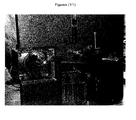
- the cutting edge of the blade may preferably be moved in a direction at least 20 ° from the cutting direction during the dicing process relative to the fiber by bending the cutting edge of the blade in the same direction as the curvature of the fiber (for example inserting a sickle blade) ), or, for example, the cutting edge of the blade presses not only in the cutting direction through the fiber, but also additionally reciprocated in deviating direction (see. Fig. 1 ).
- the fibers are cut with a pulling cut.
- the cutting movement is preferably oblique to the tool.
- the fibers are preferably ground to a cotton wool or wool-like product in appearance. This has the advantage that it is easy to agglomerate this cotton or wool in a commercially available agglomerator (for example, a Pallmann agglomerator type PVF 120).
- agglomerator for example, a Pallmann agglomerator type PVF 120.
- it is preferably not used as usual at rotational speeds in a range of 8,000 to 16,000 revolutions per minute, but the rotational speed of the roller is set to a speed in a range of 1,000 to 5,000 revolutions per minute.
- the material of at least the cutting edge may preferably be selected from the group of ceramic, diamond-coated metal or nitrided metal. It was found that the temperature during cutting or dicing so much less quickly increased and so a higher material throughput could be realized.
- the amount of processed fibers is preferably adjusted so that the temperature does not exceed 100.degree. C., in particular 60.degree. C., during the dicing process or cutting process. This ensures that the material properties of the fibers do not change. It has been observed that it is just the molecular weight and thus properties such as cut resistance of the fibers can be reduced from this temperature.
- the fibers are preferably cut into pieces having a length in a range of 0.01 to 100 mm, in particular 0.1 to 60 mm, most preferably at most 1 mm. Below this range, the production of the fiber pieces is no longer very economical. Above this range, further processing is difficult.
- polyethylene fibers having a molecular weight Mw of at least 20,000,000 g / mol are used. It is preferable to use polyethylene fibers having a filament diameter in a range of 2 to 50 ⁇ m.
- the cutting tools or cutting rollers can be cooled by internal cooling, for example.
- the yarn strand or fiber strand can also be cooled with air.
- the cooling air is also used to remove the clippings.
- the object of the present invention is achieved in a further embodiment by fiber pieces produced by a method according to the invention, characterized in that 90% of the fiber pieces have a length in a range of 0.1 to 100 mm.
- the object of the present invention is achieved in another embodiment by an agglomerate obtained by agglomerating the fiber pieces according to the invention.
- agglomerator for example, a Pallmann agglomerator type PVF 120.
- the container of the agglomerator can be cooled (for example with nitrogen, air or water).
- the object of the present invention is achieved in a further embodiment by a powder obtained by grinding the agglomerate according to the invention and / or the fiber pieces according to the invention.
- at the grinding is preferably set at a temperature of less than 120 ° C, in particular less than 100 ° C in order to prevent decomposition of the material and possibly decrease the molecular weight as possible.
- the average grain size (determined, for example, by sieving) of the powder is preferably in a range of 10 to 2000 ⁇ m.
- the grinding can be done for example with a commercially available baffle plate mill. If necessary, the mill can be cooled with liquid nitrogen.
- the primer may be selected from commercially available primers such as epoxy resin.
- the tool for pressing is preferably provided with a release agent such as foil or a Silkonbetikung.
- a release agent such as foil or a Silkonbetikung.
- the pressing takes place at most at 40 ° C, since the material properties of the polyethylene are retained.
- the object of the present invention is achieved in a further embodiment by a molding predominantly of polyethylene having a Molekulargwicht Mw of at least 10,000,000 g / mol, obtained by compression of the fiber pieces of the invention and / or the agglomerate of the invention and / or the powder according to the invention, wherein during the compression, a temperature in a range of 120 to 250 ° C is allowed to act for a period of time in a range of 0.5 to 5 hours.
- fiber pieces and / or the agglomerate according to the invention and / or the powder according to the invention having a molecular weight Mw of at least 20,000,000 g / mol in order nevertheless to obtain a molecular weight of the molded piece according to the invention by the possible decomposition during pressing and thus possibly a decrease in the molecular weight to achieve.
- the temperature exposure is limited to a period of up to 2 hours in order to minimize degradation.
- a temperature of at least 220 ° C is used, since it has surprisingly been found that a shorter treatment at a higher temperature has caused much less decomposition of the material than a longer treatment at lower temperatures.
- the object of the present invention is achieved in a further embodiment by the use of the fitting according to the invention, as underbody protection for vehicles or as armor or bullet-resistant equipment of walls, people, vehicles or real estate.
- the fitting according to the invention as underbody protection for vehicles or as armor or bullet-resistant equipment of walls, people, vehicles or real estate.
- walls of mobile buildings such as mobile toilets can be equipped accordingly.
- Dyneema® SK 78 fiber from DSM was cut using a device.
- a filament of this fiber has a diameter of about 20 microns.
- the yarn (fiber) to be taken off on reel spools was fed via a feed to a transport feed.
- the feed roller equipped with a gear stage transports the fiber necessary according to the cut length to a hold-down device Steel jaws.
- a bundle of about 100 filaments of fiber was passed through a gap between two relatively movable steel jaws and clamped between the steel jaws so that the filament bundle survived about 3 cm.
- the outer edges of the steel jaws were hardened by plasma nitriding.
- Dyneema® SK 78 fiber from DSM was produced by means of a commercially available fiber cutting converter with a cutting roller (for example from Schlumberger; Franz Fourné “Synthetic Fibers: Production, Machines and Apparatus, Properties", Hanser Verlag, 1995, p. 583 ) parts.
- the cutting roller was modified so that the cutting blade was not located just along the major axis on the outer surface of the roller, but the cutting blade was spirally arranged around the roller.
- the cutting edge was made of plasma nitrided steel.
- the roller was operated at a rotational speed of about 3,000 rpm. It was a cotton or wool-like product obtained from different lengths of fiber pieces, but practically all had a length between 0.3 and 6 cm.
- Example 1 The cut fibers from Example 1 or the ground / cracked fibers from Example 2 were fed to a commercial agglomerator Pallmann agglomerator type PVF 120 and agglomerated with conventional parameters. Care was taken that the temperature did not exceed 100 ° C. The product could be used as bulk material.
- the agglomerate from example 3 was ground in a commercially available baffle plate mill to a powder having an average particle size of about 1000 ⁇ m.
- the product could be used as bulk material.
- Example 4 The powder of Example 4 was compressed by conventional methods to a plate. During compression, a temperature of 210 ° C was set over a period of 1.5 h. The plate had a thickness of 1.5 cm after pressing. This plate withstood a nato caliber shot from a 308 Winchester rifle. The material still had a molecular weight Mw of more than 10,000,000 g / mol.
- the fiber pieces obtained from Example 1 were compacted with a commercially available compactor. The material still had a molecular weight Mw of more than 10,000,000 g / mol. Then,% of the compacted pieces of fiber, a mixture of 12 volume was.% Expoxidharzbindesch ASODUR® ® SFE and 88 vol. Prepared and then pressed in a conventional manner. The molded piece thus obtained was taken out. During the entire process, the material was not heated, so that a degradation of the material has not occurred.
Landscapes
- Engineering & Computer Science (AREA)
- Textile Engineering (AREA)
- Artificial Filaments (AREA)
- Processing And Handling Of Plastics And Other Materials For Molding In General (AREA)
- Preliminary Treatment Of Fibers (AREA)
- Compositions Of Macromolecular Compounds (AREA)
Applications Claiming Priority (1)
| Application Number | Priority Date | Filing Date | Title |
|---|---|---|---|
| DE102010029633A DE102010029633A1 (de) | 2010-06-02 | 2010-06-02 | Zerkleinerung von ultrahochmolekularen Polyethylenfasern |
Publications (2)
| Publication Number | Publication Date |
|---|---|
| EP2392702A2 true EP2392702A2 (fr) | 2011-12-07 |
| EP2392702A3 EP2392702A3 (fr) | 2013-07-31 |
Family
ID=44801246
Family Applications (1)
| Application Number | Title | Priority Date | Filing Date |
|---|---|---|---|
| EP11168116.9A Withdrawn EP2392702A3 (fr) | 2010-06-02 | 2011-05-30 | Broyage de fibres de polyéthylène à molécules ultra élevées |
Country Status (3)
| Country | Link |
|---|---|
| US (1) | US20110300375A1 (fr) |
| EP (1) | EP2392702A3 (fr) |
| DE (1) | DE102010029633A1 (fr) |
Families Citing this family (1)
| Publication number | Priority date | Publication date | Assignee | Title |
|---|---|---|---|---|
| DE102023134446A1 (de) * | 2023-12-08 | 2025-06-12 | Brückner Maschinenbau GmbH | System und Verfahren zur Wiederaufbereitung von ultrahochmolekularen Polymerfolienabschnitten |
Citations (9)
| Publication number | Priority date | Publication date | Assignee | Title |
|---|---|---|---|---|
| DE69028519T2 (de) | 1990-05-25 | 1997-01-30 | Anagnostis E Zachariades | Verbundwerkstoffe aus Polymeren mit ultrahohem Molekulargewicht, wie zum Beispiel UHMG-Polyethylen-Produkten und Methode zu ihrer Herstellung |
| DE69525924T2 (de) | 1994-09-21 | 2002-09-05 | Bmg Inc., Kyoto | Polyethylenguss mit ultrahohem molekulargewicht für künstliche verbindungen und verfahren zu dessen herstellung |
| DE69631076T2 (de) | 1995-01-20 | 2004-10-21 | Univ Southern California | Chemisch vernetztes ultrahochmolekulares Polyethylen für künstliche menschliche Gelenke |
| WO2005066401A1 (fr) | 2004-01-01 | 2005-07-21 | Dsm Ip Assets B.V. | Procede de fabrication d'un fil multifilament de polyethylene haute performance |
| US20070148452A1 (en) | 2003-12-12 | 2007-06-28 | Godo Sakamoto | High strength polyethylene fiber |
| DE69737356T2 (de) | 1996-10-02 | 2007-08-16 | DePuy Orthopaedics, Inc., Warsaw | Herstellung von medizinischen Implantatan aus Quervernetztem Ultrahochmolokularem Polyethylen mit verbesserter Abstimmung von Abriebfestigkeit und Oxidationsbeständigkeit |
| WO2008097170A1 (fr) | 2007-02-08 | 2008-08-14 | Seco Tools Ab | Outil de découpe doté de multiples cannelures définissant des profils différents, et procédé |
| WO2009077168A2 (fr) | 2007-12-17 | 2009-06-25 | Dsm Ip Assets B.V. | Procedé de filage d'uhmwpe, fils multifilaments d'uhmwpe ainsi produits et leur utilisation |
| WO2010057982A1 (fr) | 2008-11-20 | 2010-05-27 | Dsm Ip Assets B.V. | Fibre de polyéthylène filée à l'état de gel |
Family Cites Families (10)
| Publication number | Priority date | Publication date | Assignee | Title |
|---|---|---|---|---|
| US2858299A (en) * | 1953-04-02 | 1958-10-28 | Montedison Spa | Process for pulverizing polyethylene |
| NL8701219A (nl) * | 1987-05-22 | 1988-12-16 | Stamicarbon | Werkwijze voor het bereiden van een ultra-verstrekbaar polymeer materiaal, ultra-verstrekbaar polymeermateriaal, alsmede werkwijze voor het vervaardigen van voorwerpen. |
| NL9100279A (nl) * | 1991-02-18 | 1992-09-16 | Stamicarbon | Microporeuze folie uit polyetheen en werkwijze voor de vervaardiging daarvan. |
| DK0632792T3 (da) * | 1992-08-24 | 1999-01-18 | Vontech Int Corp | Cement med sammen-formalede fibre |
| JP3953154B2 (ja) * | 1997-09-30 | 2007-08-08 | 帝人テクノプロダクツ株式会社 | アラミド繊維束の切断装置 |
| DE60011310T2 (de) * | 1999-08-11 | 2005-06-16 | Toyo Boseki K.K. | Ballistisches Material enthaltend hochfeste Polyethylenfasern |
| JP2002127139A (ja) * | 2000-10-27 | 2002-05-08 | Du Pont Toray Co Ltd | 高機能繊維廃物の再生処理方法及びその再生品 |
| US6637085B2 (en) * | 2001-10-26 | 2003-10-28 | E. I. Du Pont De Nemours And Company | Process for recycling articles containing high-performance fiber |
| JP2011501786A (ja) * | 2007-10-17 | 2011-01-13 | テイジン・アラミド・ゲーエムベーハー | フィブリル状高性能短繊維を製造する方法、フィブリル状高性能短繊維、およびそれを含む物品 |
| PL210079B1 (pl) * | 2009-06-20 | 2011-11-30 | Centrum Badań Molekularnych i Makromolekularnych Polskiej Akademii Nauk | Sposób recyklingu wyrobów zawierających włókna polietylenowe o ultra wysokiej masie cząsteczkowej |
-
2010
- 2010-06-02 DE DE102010029633A patent/DE102010029633A1/de not_active Ceased
-
2011
- 2011-05-30 EP EP11168116.9A patent/EP2392702A3/fr not_active Withdrawn
- 2011-06-01 US US13/151,046 patent/US20110300375A1/en not_active Abandoned
Patent Citations (9)
| Publication number | Priority date | Publication date | Assignee | Title |
|---|---|---|---|---|
| DE69028519T2 (de) | 1990-05-25 | 1997-01-30 | Anagnostis E Zachariades | Verbundwerkstoffe aus Polymeren mit ultrahohem Molekulargewicht, wie zum Beispiel UHMG-Polyethylen-Produkten und Methode zu ihrer Herstellung |
| DE69525924T2 (de) | 1994-09-21 | 2002-09-05 | Bmg Inc., Kyoto | Polyethylenguss mit ultrahohem molekulargewicht für künstliche verbindungen und verfahren zu dessen herstellung |
| DE69631076T2 (de) | 1995-01-20 | 2004-10-21 | Univ Southern California | Chemisch vernetztes ultrahochmolekulares Polyethylen für künstliche menschliche Gelenke |
| DE69737356T2 (de) | 1996-10-02 | 2007-08-16 | DePuy Orthopaedics, Inc., Warsaw | Herstellung von medizinischen Implantatan aus Quervernetztem Ultrahochmolokularem Polyethylen mit verbesserter Abstimmung von Abriebfestigkeit und Oxidationsbeständigkeit |
| US20070148452A1 (en) | 2003-12-12 | 2007-06-28 | Godo Sakamoto | High strength polyethylene fiber |
| WO2005066401A1 (fr) | 2004-01-01 | 2005-07-21 | Dsm Ip Assets B.V. | Procede de fabrication d'un fil multifilament de polyethylene haute performance |
| WO2008097170A1 (fr) | 2007-02-08 | 2008-08-14 | Seco Tools Ab | Outil de découpe doté de multiples cannelures définissant des profils différents, et procédé |
| WO2009077168A2 (fr) | 2007-12-17 | 2009-06-25 | Dsm Ip Assets B.V. | Procedé de filage d'uhmwpe, fils multifilaments d'uhmwpe ainsi produits et leur utilisation |
| WO2010057982A1 (fr) | 2008-11-20 | 2010-05-27 | Dsm Ip Assets B.V. | Fibre de polyéthylène filée à l'état de gel |
Non-Patent Citations (2)
| Title |
|---|
| D. M. REIN ET AL.: "Electro- spinning of Ultrahigh-Molecular-Weight Polyethylene Nanofibers", JOURNAL OF POLYMER SCIENCE: PART B: POLYMER PHYSICS, 2007, pages 766 |
| FRANZ FOURNE: "Synthetische Fasern: Herstellung, Maschinen und Apparate, Eigenschaften", 1995, HANSER VERLAG, pages: 583 |
Also Published As
| Publication number | Publication date |
|---|---|
| EP2392702A3 (fr) | 2013-07-31 |
| US20110300375A1 (en) | 2011-12-08 |
| DE102010029633A1 (de) | 2011-12-08 |
Similar Documents
| Publication | Publication Date | Title |
|---|---|---|
| EP2995436B1 (fr) | Dispositif et procédé de fabrication d'un matériau composite en polymère rempli | |
| JP6119876B2 (ja) | 繊維強化樹脂成形材料およびその製造方法 | |
| EP3261813B1 (fr) | Procédé de fabrication de composants ou demi-produits renforcés de fibres | |
| EP2536545A2 (fr) | Procédé de fabrication de granulés en matériaux composites renforcés par des fibres | |
| DE19518188A1 (de) | Verfahren zur Entfaserung bzw. Entholzung von Bastfasergewächsen | |
| EP2165821B1 (fr) | Procédé et dispositif pour la fabrication d'un matériau composite renforcé par des fibres et utilisation du composite renforcé par des fibres | |
| EP3007883A1 (fr) | Procédé et dispositif permettant de fabriquer un élément composite renforcé par des fibres, et élément composite renforcé par des fibres | |
| KR102478812B1 (ko) | 섬유 강화 수지 성형 재료 및 그 제조 방법 | |
| EP2322713A1 (fr) | Procédé de fabrication de fibres de bambou et matières synthétiques en étant pourvues | |
| EP3081368B1 (fr) | Semi-produit composite en plastique/fibres et procede de production | |
| EP2794220B1 (fr) | Procédé de production d'un matériau composite renforcé par des fibres et dispositif pour la mise en oeuvre de ce procédé | |
| EP2942173A1 (fr) | Procédé de fabrication de granulé pour moulage par injection ; Procédé de fabrication d'une pièce moulée et pièce moulée fabriquée selon ce procédé | |
| EP2392702A2 (fr) | Broyage de fibres de polyéthylène à molécules ultra élevées | |
| EP0027277A1 (fr) | Procédés de fabrication de nattes ou de plaques de fibres minérales et dispositif pour la mise en oeuvre de ces procédés | |
| DE102010060911A1 (de) | Vorrichtung und Verfahren zur Herstellung von Polymeragglomeraten | |
| DE102005033734B4 (de) | Verfahren zum Trennen von Gummi-Verbundwerkstoff | |
| EP3117974A2 (fr) | Dispositif de coupe | |
| EP3455038B1 (fr) | Procédé pour la découpe des procuits secs renforcées par de fibres, en particulier pour la production d'un dispositif pour la production de energie éolique | |
| EP2959044A1 (fr) | Structure de support à base de fibres pour liquides et particules solides | |
| EP3570968A1 (fr) | Procédé et dispositif d'obtention de substances pulvérulentes en matière plastique | |
| EP1932644B1 (fr) | Méthode et dispositif pour la production de granulés | |
| DE10304097A1 (de) | Vorrichtung und Verfahren zur Herstellung eines Granulats | |
| WO2012089583A1 (fr) | Procédé de production de particules aptes à l'écoulement à partir de fibres polymères | |
| DE10112766A1 (de) | Verfahren zum Herstellen eines Halbzeugs | |
| DE4300269A1 (de) | Verfahren zur Herstellung faserverstärkter Kunststoffe mit einer Matrix aus thermoplastischem Kunststoff und Vorrichtung zur Durchführung des Verfahrens |
Legal Events
| Date | Code | Title | Description |
|---|---|---|---|
| AK | Designated contracting states |
Kind code of ref document: A2 Designated state(s): AL AT BE BG CH CY CZ DE DK EE ES FI FR GB GR HR HU IE IS IT LI LT LU LV MC MK MT NL NO PL PT RO RS SE SI SK SM TR |
|
| AX | Request for extension of the european patent |
Extension state: BA ME |
|
| PUAI | Public reference made under article 153(3) epc to a published international application that has entered the european phase |
Free format text: ORIGINAL CODE: 0009012 |
|
| PUAL | Search report despatched |
Free format text: ORIGINAL CODE: 0009013 |
|
| AK | Designated contracting states |
Kind code of ref document: A3 Designated state(s): AL AT BE BG CH CY CZ DE DK EE ES FI FR GB GR HR HU IE IS IT LI LT LU LV MC MK MT NL NO PL PT RO RS SE SI SK SM TR |
|
| AX | Request for extension of the european patent |
Extension state: BA ME |
|
| RIC1 | Information provided on ipc code assigned before grant |
Ipc: D01G 1/10 20060101ALI20130624BHEP Ipc: D01G 1/00 20060101AFI20130624BHEP Ipc: D01G 1/04 20060101ALI20130624BHEP |
|
| STAA | Information on the status of an ep patent application or granted ep patent |
Free format text: STATUS: THE APPLICATION IS DEEMED TO BE WITHDRAWN |
|
| 18D | Application deemed to be withdrawn |
Effective date: 20131203 |