EP2390289A1 - Nonaqueous ink composition for ink jet recording and ink jet recording method - Google Patents
Nonaqueous ink composition for ink jet recording and ink jet recording method Download PDFInfo
- Publication number
- EP2390289A1 EP2390289A1 EP20110167244 EP11167244A EP2390289A1 EP 2390289 A1 EP2390289 A1 EP 2390289A1 EP 20110167244 EP20110167244 EP 20110167244 EP 11167244 A EP11167244 A EP 11167244A EP 2390289 A1 EP2390289 A1 EP 2390289A1
- Authority
- EP
- European Patent Office
- Prior art keywords
- ink composition
- nonaqueous
- pigment
- nonaqueous ink
- solvent
- Prior art date
- Legal status (The legal status is an assumption and is not a legal conclusion. Google has not performed a legal analysis and makes no representation as to the accuracy of the status listed.)
- Granted
Links
- 239000000203 mixture Substances 0.000 title claims abstract description 108
- 238000000034 method Methods 0.000 title claims description 20
- 239000002904 solvent Substances 0.000 claims abstract description 58
- 125000000217 alkyl group Chemical group 0.000 claims abstract description 21
- 125000004432 carbon atom Chemical group C* 0.000 claims abstract description 18
- 239000000049 pigment Substances 0.000 claims description 77
- -1 alkylene glycol compound Chemical class 0.000 claims description 47
- 229920005989 resin Polymers 0.000 claims description 27
- 239000011347 resin Substances 0.000 claims description 27
- LYCAIKOWRPUZTN-UHFFFAOYSA-N ethylene glycol Natural products OCCO LYCAIKOWRPUZTN-UHFFFAOYSA-N 0.000 claims description 21
- BZHJMEDXRYGGRV-UHFFFAOYSA-N Vinyl chloride Chemical compound ClC=C BZHJMEDXRYGGRV-UHFFFAOYSA-N 0.000 claims description 18
- 150000002596 lactones Chemical class 0.000 claims description 13
- WGCNASOHLSPBMP-UHFFFAOYSA-N hydroxyacetaldehyde Natural products OCC=O WGCNASOHLSPBMP-UHFFFAOYSA-N 0.000 claims description 9
- 125000002496 methyl group Chemical group [H]C([H])([H])* 0.000 claims description 5
- 125000004108 n-butyl group Chemical group [H]C([H])([H])C([H])([H])C([H])([H])C([H])([H])* 0.000 claims description 5
- 238000007599 discharging Methods 0.000 claims description 4
- 239000007788 liquid Substances 0.000 claims description 4
- 239000000976 ink Substances 0.000 description 140
- MTHSVFCYNBDYFN-UHFFFAOYSA-N diethylene glycol Chemical compound OCCOCCO MTHSVFCYNBDYFN-UHFFFAOYSA-N 0.000 description 34
- 238000011156 evaluation Methods 0.000 description 15
- 239000004094 surface-active agent Substances 0.000 description 14
- 238000012360 testing method Methods 0.000 description 14
- 239000002270 dispersing agent Substances 0.000 description 13
- YEJRWHAVMIAJKC-UHFFFAOYSA-N 4-Butyrolactone Chemical compound O=C1CCCO1 YEJRWHAVMIAJKC-UHFFFAOYSA-N 0.000 description 10
- 239000002202 Polyethylene glycol Substances 0.000 description 10
- 229920001223 polyethylene glycol Polymers 0.000 description 10
- 239000003960 organic solvent Substances 0.000 description 9
- 150000001875 compounds Chemical class 0.000 description 8
- 238000007639 printing Methods 0.000 description 8
- OKTJSMMVPCPJKN-UHFFFAOYSA-N Carbon Chemical compound [C] OKTJSMMVPCPJKN-UHFFFAOYSA-N 0.000 description 7
- DNIAPMSPPWPWGF-UHFFFAOYSA-N monopropylene glycol Natural products CC(O)CO DNIAPMSPPWPWGF-UHFFFAOYSA-N 0.000 description 7
- 238000004804 winding Methods 0.000 description 7
- HYLLZXPMJRMUHH-UHFFFAOYSA-N 1-[2-(2-methoxyethoxy)ethoxy]butane Chemical compound CCCCOCCOCCOC HYLLZXPMJRMUHH-UHFFFAOYSA-N 0.000 description 6
- IAZDPXIOMUYVGZ-UHFFFAOYSA-N Dimethylsulphoxide Chemical compound CS(C)=O IAZDPXIOMUYVGZ-UHFFFAOYSA-N 0.000 description 6
- OKKJLVBELUTLKV-UHFFFAOYSA-N Methanol Chemical compound OC OKKJLVBELUTLKV-UHFFFAOYSA-N 0.000 description 6
- 239000011230 binding agent Substances 0.000 description 6
- 238000001035 drying Methods 0.000 description 6
- 239000000463 material Substances 0.000 description 6
- RRQYJINTUHWNHW-UHFFFAOYSA-N 1-ethoxy-2-(2-ethoxyethoxy)ethane Chemical compound CCOCCOCCOCC RRQYJINTUHWNHW-UHFFFAOYSA-N 0.000 description 5
- LRHPLDYGYMQRHN-UHFFFAOYSA-N N-Butanol Chemical compound CCCCO LRHPLDYGYMQRHN-UHFFFAOYSA-N 0.000 description 5
- SECXISVLQFMRJM-UHFFFAOYSA-N N-Methylpyrrolidone Chemical compound CN1CCCC1=O SECXISVLQFMRJM-UHFFFAOYSA-N 0.000 description 5
- 239000000654 additive Substances 0.000 description 5
- 239000003086 colorant Substances 0.000 description 5
- 229940019778 diethylene glycol diethyl ether Drugs 0.000 description 5
- 238000007641 inkjet printing Methods 0.000 description 5
- 238000002360 preparation method Methods 0.000 description 5
- 239000000126 substance Substances 0.000 description 5
- IJGRMHOSHXDMSA-UHFFFAOYSA-N Atomic nitrogen Chemical compound N#N IJGRMHOSHXDMSA-UHFFFAOYSA-N 0.000 description 4
- YCKRFDGAMUMZLT-UHFFFAOYSA-N Fluorine atom Chemical compound [F] YCKRFDGAMUMZLT-UHFFFAOYSA-N 0.000 description 4
- NBIIXXVUZAFLBC-UHFFFAOYSA-N Phosphoric acid Chemical compound OP(O)(O)=O NBIIXXVUZAFLBC-UHFFFAOYSA-N 0.000 description 4
- 230000008901 benefit Effects 0.000 description 4
- 239000006229 carbon black Substances 0.000 description 4
- XTDYIOOONNVFMA-UHFFFAOYSA-N dimethyl pentanedioate Chemical compound COC(=O)CCCC(=O)OC XTDYIOOONNVFMA-UHFFFAOYSA-N 0.000 description 4
- 229910001873 dinitrogen Inorganic materials 0.000 description 4
- 239000006185 dispersion Substances 0.000 description 4
- 229910052731 fluorine Inorganic materials 0.000 description 4
- 239000011737 fluorine Substances 0.000 description 4
- 229920000915 polyvinyl chloride Polymers 0.000 description 4
- 239000004800 polyvinyl chloride Substances 0.000 description 4
- MFRIHAYPQRLWNB-UHFFFAOYSA-N sodium tert-butoxide Chemical compound [Na+].CC(C)(C)[O-] MFRIHAYPQRLWNB-UHFFFAOYSA-N 0.000 description 4
- ZUHZGEOKBKGPSW-UHFFFAOYSA-N tetraglyme Chemical compound COCCOCCOCCOCCOC ZUHZGEOKBKGPSW-UHFFFAOYSA-N 0.000 description 4
- ZWEHNKRNPOVVGH-UHFFFAOYSA-N 2-Butanone Chemical compound CCC(C)=O ZWEHNKRNPOVVGH-UHFFFAOYSA-N 0.000 description 3
- CSCPPACGZOOCGX-UHFFFAOYSA-N Acetone Chemical compound CC(C)=O CSCPPACGZOOCGX-UHFFFAOYSA-N 0.000 description 3
- RTZKZFJDLAIYFH-UHFFFAOYSA-N Diethyl ether Chemical compound CCOCC RTZKZFJDLAIYFH-UHFFFAOYSA-N 0.000 description 3
- MUXOBHXGJLMRAB-UHFFFAOYSA-N Dimethyl succinate Chemical compound COC(=O)CCC(=O)OC MUXOBHXGJLMRAB-UHFFFAOYSA-N 0.000 description 3
- XEKOWRVHYACXOJ-UHFFFAOYSA-N Ethyl acetate Chemical compound CCOC(C)=O XEKOWRVHYACXOJ-UHFFFAOYSA-N 0.000 description 3
- XUIMIQQOPSSXEZ-UHFFFAOYSA-N Silicon Chemical compound [Si] XUIMIQQOPSSXEZ-UHFFFAOYSA-N 0.000 description 3
- GLLRIXZGBQOFLM-UHFFFAOYSA-N Xanthorin Natural products C1=C(C)C=C2C(=O)C3=C(O)C(OC)=CC(O)=C3C(=O)C2=C1O GLLRIXZGBQOFLM-UHFFFAOYSA-N 0.000 description 3
- 239000006096 absorbing agent Substances 0.000 description 3
- 239000003963 antioxidant agent Substances 0.000 description 3
- 239000011324 bead Substances 0.000 description 3
- 238000009835 boiling Methods 0.000 description 3
- XCJYREBRNVKWGJ-UHFFFAOYSA-N copper(II) phthalocyanine Chemical compound [Cu+2].C12=CC=CC=C2C(N=C2[N-]C(C3=CC=CC=C32)=N2)=NC1=NC([C]1C=CC=CC1=1)=NC=1N=C1[C]3C=CC=CC3=C2[N-]1 XCJYREBRNVKWGJ-UHFFFAOYSA-N 0.000 description 3
- 238000010586 diagram Methods 0.000 description 3
- 239000000975 dye Substances 0.000 description 3
- 125000001495 ethyl group Chemical group [H]C([H])([H])C([H])([H])* 0.000 description 3
- 125000001449 isopropyl group Chemical group [H]C([H])([H])C([H])(*)C([H])([H])[H] 0.000 description 3
- 239000012046 mixed solvent Substances 0.000 description 3
- 125000004123 n-propyl group Chemical group [H]C([H])([H])C([H])([H])C([H])([H])* 0.000 description 3
- HNJBEVLQSNELDL-UHFFFAOYSA-N pyrrolidin-2-one Chemical compound O=C1CCCN1 HNJBEVLQSNELDL-UHFFFAOYSA-N 0.000 description 3
- 238000001454 recorded image Methods 0.000 description 3
- 125000002914 sec-butyl group Chemical group [H]C([H])([H])C([H])([H])C([H])(*)C([H])([H])[H] 0.000 description 3
- 125000000999 tert-butyl group Chemical group [H]C([H])([H])C(*)(C([H])([H])[H])C([H])([H])[H] 0.000 description 3
- YFNKIDBQEZZDLK-UHFFFAOYSA-N triglyme Chemical compound COCCOCCOCCOC YFNKIDBQEZZDLK-UHFFFAOYSA-N 0.000 description 3
- XLYOFNOQVPJJNP-UHFFFAOYSA-N water Substances O XLYOFNOQVPJJNP-UHFFFAOYSA-N 0.000 description 3
- NLZUEZXRPGMBCV-UHFFFAOYSA-N Butylhydroxytoluene Chemical compound CC1=CC(C(C)(C)C)=C(O)C(C(C)(C)C)=C1 NLZUEZXRPGMBCV-UHFFFAOYSA-N 0.000 description 2
- DKMROQRQHGEIOW-UHFFFAOYSA-N Diethyl succinate Chemical compound CCOC(=O)CCC(=O)OCC DKMROQRQHGEIOW-UHFFFAOYSA-N 0.000 description 2
- LFQSCWFLJHTTHZ-UHFFFAOYSA-N Ethanol Chemical compound CCO LFQSCWFLJHTTHZ-UHFFFAOYSA-N 0.000 description 2
- 229920003171 Poly (ethylene oxide) Polymers 0.000 description 2
- WYURNTSHIVDZCO-UHFFFAOYSA-N Tetrahydrofuran Chemical compound C1CCOC1 WYURNTSHIVDZCO-UHFFFAOYSA-N 0.000 description 2
- MCMNRKCIXSYSNV-UHFFFAOYSA-N Zirconium dioxide Chemical compound O=[Zr]=O MCMNRKCIXSYSNV-UHFFFAOYSA-N 0.000 description 2
- 150000001298 alcohols Chemical class 0.000 description 2
- 229910000147 aluminium phosphate Inorganic materials 0.000 description 2
- 230000003078 antioxidant effect Effects 0.000 description 2
- 230000015572 biosynthetic process Effects 0.000 description 2
- 235000010354 butylated hydroxytoluene Nutrition 0.000 description 2
- 238000006243 chemical reaction Methods 0.000 description 2
- JHIVVAPYMSGYDF-UHFFFAOYSA-N cyclohexanone Chemical compound O=C1CCCCC1 JHIVVAPYMSGYDF-UHFFFAOYSA-N 0.000 description 2
- SZXQTJUDPRGNJN-UHFFFAOYSA-N dipropylene glycol Chemical compound OCCCOCCCO SZXQTJUDPRGNJN-UHFFFAOYSA-N 0.000 description 2
- 230000000694 effects Effects 0.000 description 2
- 238000005516 engineering process Methods 0.000 description 2
- 235000019441 ethanol Nutrition 0.000 description 2
- FKRCODPIKNYEAC-UHFFFAOYSA-N ethyl propionate Chemical compound CCOC(=O)CC FKRCODPIKNYEAC-UHFFFAOYSA-N 0.000 description 2
- 238000001704 evaporation Methods 0.000 description 2
- 230000008020 evaporation Effects 0.000 description 2
- GAEKPEKOJKCEMS-UHFFFAOYSA-N gamma-valerolactone Chemical compound CC1CCC(=O)O1 GAEKPEKOJKCEMS-UHFFFAOYSA-N 0.000 description 2
- 238000010438 heat treatment Methods 0.000 description 2
- 125000004435 hydrogen atom Chemical group [H]* 0.000 description 2
- 238000010348 incorporation Methods 0.000 description 2
- 239000001023 inorganic pigment Substances 0.000 description 2
- 230000003993 interaction Effects 0.000 description 2
- 238000012986 modification Methods 0.000 description 2
- 230000004048 modification Effects 0.000 description 2
- 229940088644 n,n-dimethylacrylamide Drugs 0.000 description 2
- YLGYACDQVQQZSW-UHFFFAOYSA-N n,n-dimethylprop-2-enamide Chemical compound CN(C)C(=O)C=C YLGYACDQVQQZSW-UHFFFAOYSA-N 0.000 description 2
- 239000012860 organic pigment Substances 0.000 description 2
- 125000002080 perylenyl group Chemical group C1(=CC=C2C=CC=C3C4=CC=CC5=CC=CC(C1=C23)=C45)* 0.000 description 2
- CSHWQDPOILHKBI-UHFFFAOYSA-N peryrene Natural products C1=CC(C2=CC=CC=3C2=C2C=CC=3)=C3C2=CC=CC3=C1 CSHWQDPOILHKBI-UHFFFAOYSA-N 0.000 description 2
- IEQIEDJGQAUEQZ-UHFFFAOYSA-N phthalocyanine Chemical compound N1C(N=C2C3=CC=CC=C3C(N=C3C4=CC=CC=C4C(=N4)N3)=N2)=C(C=CC=C2)C2=C1N=C1C2=CC=CC=C2C4=N1 IEQIEDJGQAUEQZ-UHFFFAOYSA-N 0.000 description 2
- BASFCYQUMIYNBI-UHFFFAOYSA-N platinum Chemical compound [Pt] BASFCYQUMIYNBI-UHFFFAOYSA-N 0.000 description 2
- 239000003495 polar organic solvent Substances 0.000 description 2
- 229920000642 polymer Polymers 0.000 description 2
- 239000002244 precipitate Substances 0.000 description 2
- BDERNNFJNOPAEC-UHFFFAOYSA-N propan-1-ol Chemical compound CCCO BDERNNFJNOPAEC-UHFFFAOYSA-N 0.000 description 2
- 150000003376 silicon Polymers 0.000 description 2
- 229910052710 silicon Inorganic materials 0.000 description 2
- 239000010703 silicon Substances 0.000 description 2
- 238000003756 stirring Methods 0.000 description 2
- 238000011410 subtraction method Methods 0.000 description 2
- ZIBGPFATKBEMQZ-UHFFFAOYSA-N triethylene glycol Chemical compound OCCOCCOCCO ZIBGPFATKBEMQZ-UHFFFAOYSA-N 0.000 description 2
- KCVWRCXEUJUXIG-UHFFFAOYSA-N 1,3-bis(icosanoyloxy)propan-2-yl icosanoate Chemical compound CCCCCCCCCCCCCCCCCCCC(=O)OCC(OC(=O)CCCCCCCCCCCCCCCCCCC)COC(=O)CCCCCCCCCCCCCCCCCCC KCVWRCXEUJUXIG-UHFFFAOYSA-N 0.000 description 1
- RYHBNJHYFVUHQT-UHFFFAOYSA-N 1,4-Dioxane Chemical compound C1COCCO1 RYHBNJHYFVUHQT-UHFFFAOYSA-N 0.000 description 1
- QWOZZTWBWQMEPD-UHFFFAOYSA-N 1-(2-ethoxypropoxy)propan-2-ol Chemical compound CCOC(C)COCC(C)O QWOZZTWBWQMEPD-UHFFFAOYSA-N 0.000 description 1
- KZVBBTZJMSWGTK-UHFFFAOYSA-N 1-[2-(2-butoxyethoxy)ethoxy]butane Chemical compound CCCCOCCOCCOCCCC KZVBBTZJMSWGTK-UHFFFAOYSA-N 0.000 description 1
- CNJRPYFBORAQAU-UHFFFAOYSA-N 1-ethoxy-2-(2-methoxyethoxy)ethane Chemical compound CCOCCOCCOC CNJRPYFBORAQAU-UHFFFAOYSA-N 0.000 description 1
- OAYXUHPQHDHDDZ-UHFFFAOYSA-N 2-(2-butoxyethoxy)ethanol Chemical compound CCCCOCCOCCO OAYXUHPQHDHDDZ-UHFFFAOYSA-N 0.000 description 1
- VXQBJTKSVGFQOL-UHFFFAOYSA-N 2-(2-butoxyethoxy)ethyl acetate Chemical compound CCCCOCCOCCOC(C)=O VXQBJTKSVGFQOL-UHFFFAOYSA-N 0.000 description 1
- FPZWZCWUIYYYBU-UHFFFAOYSA-N 2-(2-ethoxyethoxy)ethyl acetate Chemical compound CCOCCOCCOC(C)=O FPZWZCWUIYYYBU-UHFFFAOYSA-N 0.000 description 1
- SBASXUCJHJRPEV-UHFFFAOYSA-N 2-(2-methoxyethoxy)ethanol Chemical compound COCCOCCO SBASXUCJHJRPEV-UHFFFAOYSA-N 0.000 description 1
- SLNYBUIEAMRFSZ-UHFFFAOYSA-N 2-(2-{2-[2-(2-methoxy-ethoxy)-ethoxy]-ethoxy}-ethoxy)-ethanol Chemical compound COCCOCCOCCOCCOCCO SLNYBUIEAMRFSZ-UHFFFAOYSA-N 0.000 description 1
- FWLHAQYOFMQTHQ-UHFFFAOYSA-N 2-N-[8-[[8-(4-aminoanilino)-10-phenylphenazin-10-ium-2-yl]amino]-10-phenylphenazin-10-ium-2-yl]-8-N,10-diphenylphenazin-10-ium-2,8-diamine hydroxy-oxido-dioxochromium Chemical compound O[Cr]([O-])(=O)=O.O[Cr]([O-])(=O)=O.O[Cr]([O-])(=O)=O.Nc1ccc(Nc2ccc3nc4ccc(Nc5ccc6nc7ccc(Nc8ccc9nc%10ccc(Nc%11ccccc%11)cc%10[n+](-c%10ccccc%10)c9c8)cc7[n+](-c7ccccc7)c6c5)cc4[n+](-c4ccccc4)c3c2)cc1 FWLHAQYOFMQTHQ-UHFFFAOYSA-N 0.000 description 1
- COBPKKZHLDDMTB-UHFFFAOYSA-N 2-[2-(2-butoxyethoxy)ethoxy]ethanol Chemical compound CCCCOCCOCCOCCO COBPKKZHLDDMTB-UHFFFAOYSA-N 0.000 description 1
- LCZVSXRMYJUNFX-UHFFFAOYSA-N 2-[2-(2-hydroxypropoxy)propoxy]propan-1-ol Chemical compound CC(O)COC(C)COC(C)CO LCZVSXRMYJUNFX-UHFFFAOYSA-N 0.000 description 1
- NUYADIDKTLPDGG-UHFFFAOYSA-N 3,6-dimethyloct-4-yne-3,6-diol Chemical compound CCC(C)(O)C#CC(C)(O)CC NUYADIDKTLPDGG-UHFFFAOYSA-N 0.000 description 1
- QCAHUFWKIQLBNB-UHFFFAOYSA-N 3-(3-methoxypropoxy)propan-1-ol Chemical compound COCCCOCCCO QCAHUFWKIQLBNB-UHFFFAOYSA-N 0.000 description 1
- 239000004925 Acrylic resin Substances 0.000 description 1
- 229920000178 Acrylic resin Polymers 0.000 description 1
- OWNRRUFOJXFKCU-UHFFFAOYSA-N Bromadiolone Chemical compound C=1C=C(C=2C=CC(Br)=CC=2)C=CC=1C(O)CC(C=1C(OC2=CC=CC=C2C=1O)=O)C1=CC=CC=C1 OWNRRUFOJXFKCU-UHFFFAOYSA-N 0.000 description 1
- DKPFZGUDAPQIHT-UHFFFAOYSA-N Butyl acetate Natural products CCCCOC(C)=O DKPFZGUDAPQIHT-UHFFFAOYSA-N 0.000 description 1
- PWFDOHORIOCACW-UHFFFAOYSA-N C(C)OCCOCCOCC.COCCOCCOCCOC.COCCOCCOCCOCCOC Chemical compound C(C)OCCOCCOCC.COCCOCCOCCOC.COCCOCCOCCOCCOC PWFDOHORIOCACW-UHFFFAOYSA-N 0.000 description 1
- VTYYLEPIZMXCLO-UHFFFAOYSA-L Calcium carbonate Chemical compound [Ca+2].[O-]C([O-])=O VTYYLEPIZMXCLO-UHFFFAOYSA-L 0.000 description 1
- LCGLNKUTAGEVQW-UHFFFAOYSA-N Dimethyl ether Chemical class COC LCGLNKUTAGEVQW-UHFFFAOYSA-N 0.000 description 1
- RJUFJBKOKNCXHH-UHFFFAOYSA-N Methyl propionate Chemical compound CCC(=O)OC RJUFJBKOKNCXHH-UHFFFAOYSA-N 0.000 description 1
- 241000047703 Nonion Species 0.000 description 1
- XBDQKXXYIPTUBI-UHFFFAOYSA-M Propionate Chemical compound CCC([O-])=O XBDQKXXYIPTUBI-UHFFFAOYSA-M 0.000 description 1
- NRCMAYZCPIVABH-UHFFFAOYSA-N Quinacridone Chemical compound N1C2=CC=CC=C2C(=O)C2=C1C=C1C(=O)C3=CC=CC=C3NC1=C2 NRCMAYZCPIVABH-UHFFFAOYSA-N 0.000 description 1
- UWHCKJMYHZGTIT-UHFFFAOYSA-N Tetraethylene glycol, Natural products OCCOCCOCCOCCO UWHCKJMYHZGTIT-UHFFFAOYSA-N 0.000 description 1
- GWEVSGVZZGPLCZ-UHFFFAOYSA-N Titan oxide Chemical compound O=[Ti]=O GWEVSGVZZGPLCZ-UHFFFAOYSA-N 0.000 description 1
- 229920002433 Vinyl chloride-vinyl acetate copolymer Polymers 0.000 description 1
- 238000009825 accumulation Methods 0.000 description 1
- KXKVLQRXCPHEJC-UHFFFAOYSA-N acetic acid trimethyl ester Natural products COC(C)=O KXKVLQRXCPHEJC-UHFFFAOYSA-N 0.000 description 1
- 230000002378 acidificating effect Effects 0.000 description 1
- HSFWRNGVRCDJHI-UHFFFAOYSA-N alpha-acetylene Natural products C#C HSFWRNGVRCDJHI-UHFFFAOYSA-N 0.000 description 1
- 230000004075 alteration Effects 0.000 description 1
- 150000001408 amides Chemical class 0.000 description 1
- PYKYMHQGRFAEBM-UHFFFAOYSA-N anthraquinone Natural products CCC(=O)c1c(O)c2C(=O)C3C(C=CC=C3O)C(=O)c2cc1CC(=O)OC PYKYMHQGRFAEBM-UHFFFAOYSA-N 0.000 description 1
- 150000004056 anthraquinones Chemical class 0.000 description 1
- 239000000981 basic dye Substances 0.000 description 1
- 150000008366 benzophenones Chemical class 0.000 description 1
- 125000003354 benzotriazolyl group Chemical class N1N=NC2=C1C=CC=C2* 0.000 description 1
- GSCLMSFRWBPUSK-UHFFFAOYSA-N beta-Butyrolactone Chemical compound CC1CC(=O)O1 GSCLMSFRWBPUSK-UHFFFAOYSA-N 0.000 description 1
- VEZXCJBBBCKRPI-UHFFFAOYSA-N beta-propiolactone Chemical compound O=C1CCO1 VEZXCJBBBCKRPI-UHFFFAOYSA-N 0.000 description 1
- 229940043232 butyl acetate Drugs 0.000 description 1
- 150000001733 carboxylic acid esters Chemical class 0.000 description 1
- 229920006217 cellulose acetate butyrate Polymers 0.000 description 1
- 239000013522 chelant Substances 0.000 description 1
- PZTQVMXMKVTIRC-UHFFFAOYSA-L chembl2028348 Chemical compound [Ca+2].[O-]S(=O)(=O)C1=CC(C)=CC=C1N=NC1=C(O)C(C([O-])=O)=CC2=CC=CC=C12 PZTQVMXMKVTIRC-UHFFFAOYSA-L 0.000 description 1
- 229920006026 co-polymeric resin Polymers 0.000 description 1
- 238000004040 coloring Methods 0.000 description 1
- 230000003247 decreasing effect Effects 0.000 description 1
- 238000011161 development Methods 0.000 description 1
- 229940028356 diethylene glycol monobutyl ether Drugs 0.000 description 1
- XXJWXESWEXIICW-UHFFFAOYSA-N diethylene glycol monoethyl ether Chemical compound CCOCCOCCO XXJWXESWEXIICW-UHFFFAOYSA-N 0.000 description 1
- 229940075557 diethylene glycol monoethyl ether Drugs 0.000 description 1
- SBZXBUIDTXKZTM-UHFFFAOYSA-N diglyme Chemical compound COCCOCCOC SBZXBUIDTXKZTM-UHFFFAOYSA-N 0.000 description 1
- PPSZHCXTGRHULJ-UHFFFAOYSA-N dioxazine Chemical compound O1ON=CC=C1 PPSZHCXTGRHULJ-UHFFFAOYSA-N 0.000 description 1
- POLCUAVZOMRGSN-UHFFFAOYSA-N dipropyl ether Chemical compound CCCOCCC POLCUAVZOMRGSN-UHFFFAOYSA-N 0.000 description 1
- VPWFPZBFBFHIIL-UHFFFAOYSA-L disodium 4-[(4-methyl-2-sulfophenyl)diazenyl]-3-oxidonaphthalene-2-carboxylate Chemical compound [Na+].[Na+].[O-]S(=O)(=O)C1=CC(C)=CC=C1N=NC1=C(O)C(C([O-])=O)=CC2=CC=CC=C12 VPWFPZBFBFHIIL-UHFFFAOYSA-L 0.000 description 1
- 238000004043 dyeing Methods 0.000 description 1
- 230000003028 elevating effect Effects 0.000 description 1
- 230000002708 enhancing effect Effects 0.000 description 1
- 239000003822 epoxy resin Substances 0.000 description 1
- 150000002170 ethers Chemical class 0.000 description 1
- TUEYHEWXYWCDHA-UHFFFAOYSA-N ethyl 5-methylthiadiazole-4-carboxylate Chemical compound CCOC(=O)C=1N=NSC=1C TUEYHEWXYWCDHA-UHFFFAOYSA-N 0.000 description 1
- 229940093499 ethyl acetate Drugs 0.000 description 1
- 239000012847 fine chemical Substances 0.000 description 1
- 239000007789 gas Substances 0.000 description 1
- LNEPOXFFQSENCJ-UHFFFAOYSA-N haloperidol Chemical compound C1CC(O)(C=2C=CC(Cl)=CC=2)CCN1CCCC(=O)C1=CC=C(F)C=C1 LNEPOXFFQSENCJ-UHFFFAOYSA-N 0.000 description 1
- FHHGCKHKTAJLOM-UHFFFAOYSA-N hexaethylene glycol monomethyl ether Chemical compound COCCOCCOCCOCCOCCOCCO FHHGCKHKTAJLOM-UHFFFAOYSA-N 0.000 description 1
- FUZZWVXGSFPDMH-UHFFFAOYSA-M hexanoate Chemical compound CCCCCC([O-])=O FUZZWVXGSFPDMH-UHFFFAOYSA-M 0.000 description 1
- 125000004051 hexyl group Chemical group [H]C([H])([H])C([H])([H])C([H])([H])C([H])([H])C([H])([H])C([H])([H])* 0.000 description 1
- 235000019239 indanthrene blue RS Nutrition 0.000 description 1
- 238000011835 investigation Methods 0.000 description 1
- 125000000959 isobutyl group Chemical group [H]C([H])([H])C([H])(C([H])([H])[H])C([H])([H])* 0.000 description 1
- PXZQEOJJUGGUIB-UHFFFAOYSA-N isoindolin-1-one Chemical compound C1=CC=C2C(=O)NCC2=C1 PXZQEOJJUGGUIB-UHFFFAOYSA-N 0.000 description 1
- 150000002576 ketones Chemical class 0.000 description 1
- 150000002605 large molecules Chemical class 0.000 description 1
- 235000010187 litholrubine BK Nutrition 0.000 description 1
- 238000004519 manufacturing process Methods 0.000 description 1
- 239000012528 membrane Substances 0.000 description 1
- 229940017219 methyl propionate Drugs 0.000 description 1
- YKYONYBAUNKHLG-UHFFFAOYSA-N n-Propyl acetate Natural products CCCOC(C)=O YKYONYBAUNKHLG-UHFFFAOYSA-N 0.000 description 1
- 125000000449 nitro group Chemical group [O-][N+](*)=O 0.000 description 1
- 125000000018 nitroso group Chemical group N(=O)* 0.000 description 1
- 239000002736 nonionic surfactant Substances 0.000 description 1
- 230000003287 optical effect Effects 0.000 description 1
- 150000002894 organic compounds Chemical class 0.000 description 1
- JCGNDDUYTRNOFT-UHFFFAOYSA-N oxolane-2,4-dione Chemical compound O=C1COC(=O)C1 JCGNDDUYTRNOFT-UHFFFAOYSA-N 0.000 description 1
- 239000002245 particle Substances 0.000 description 1
- 125000001147 pentyl group Chemical group C(CCCC)* 0.000 description 1
- 229920001568 phenolic resin Polymers 0.000 description 1
- 239000005011 phenolic resin Substances 0.000 description 1
- 230000000704 physical effect Effects 0.000 description 1
- CLYVDMAATCIVBF-UHFFFAOYSA-N pigment red 224 Chemical compound C=12C3=CC=C(C(OC4=O)=O)C2=C4C=CC=1C1=CC=C2C(=O)OC(=O)C4=CC=C3C1=C42 CLYVDMAATCIVBF-UHFFFAOYSA-N 0.000 description 1
- 229940099800 pigment red 48 Drugs 0.000 description 1
- 229940104573 pigment red 5 Drugs 0.000 description 1
- 229940067265 pigment yellow 138 Drugs 0.000 description 1
- 229910052697 platinum Inorganic materials 0.000 description 1
- 229920006122 polyamide resin Polymers 0.000 description 1
- 229920000767 polyaniline Polymers 0.000 description 1
- 125000003367 polycyclic group Chemical group 0.000 description 1
- 229920000647 polyepoxide Polymers 0.000 description 1
- 229920000728 polyester Polymers 0.000 description 1
- 229920001225 polyester resin Polymers 0.000 description 1
- 239000004645 polyester resin Substances 0.000 description 1
- 229920001451 polypropylene glycol Polymers 0.000 description 1
- 239000004810 polytetrafluoroethylene Substances 0.000 description 1
- 229920001343 polytetrafluoroethylene Polymers 0.000 description 1
- 239000011148 porous material Substances 0.000 description 1
- 239000011164 primary particle Substances 0.000 description 1
- 239000000047 product Substances 0.000 description 1
- 229960000380 propiolactone Drugs 0.000 description 1
- 229940090181 propyl acetate Drugs 0.000 description 1
- 238000004451 qualitative analysis Methods 0.000 description 1
- IZMJMCDDWKSTTK-UHFFFAOYSA-N quinoline yellow Chemical compound C1=CC=CC2=NC(C3C(C4=CC=CC=C4C3=O)=O)=CC=C21 IZMJMCDDWKSTTK-UHFFFAOYSA-N 0.000 description 1
- WPPDXAHGCGPUPK-UHFFFAOYSA-N red 2 Chemical compound C1=CC=CC=C1C(C1=CC=CC=C11)=C(C=2C=3C4=CC=C5C6=CC=C7C8=C(C=9C=CC=CC=9)C9=CC=CC=C9C(C=9C=CC=CC=9)=C8C8=CC=C(C6=C87)C(C=35)=CC=2)C4=C1C1=CC=CC=C1 WPPDXAHGCGPUPK-UHFFFAOYSA-N 0.000 description 1
- 238000000926 separation method Methods 0.000 description 1
- 239000007787 solid Substances 0.000 description 1
- 239000003381 stabilizer Substances 0.000 description 1
- 238000003860 storage Methods 0.000 description 1
- 229920005792 styrene-acrylic resin Polymers 0.000 description 1
- 230000003746 surface roughness Effects 0.000 description 1
- 238000003786 synthesis reaction Methods 0.000 description 1
- 230000009897 systematic effect Effects 0.000 description 1
- 150000003505 terpenes Chemical class 0.000 description 1
- 235000007586 terpenes Nutrition 0.000 description 1
- YLQBMQCUIZJEEH-UHFFFAOYSA-N tetrahydrofuran Natural products C=1C=COC=1 YLQBMQCUIZJEEH-UHFFFAOYSA-N 0.000 description 1
- JOUDBUYBGJYFFP-FOCLMDBBSA-N thioindigo Chemical compound S\1C2=CC=CC=C2C(=O)C/1=C1/C(=O)C2=CC=CC=C2S1 JOUDBUYBGJYFFP-FOCLMDBBSA-N 0.000 description 1
- 235000010215 titanium dioxide Nutrition 0.000 description 1
- JLGLQAWTXXGVEM-UHFFFAOYSA-N triethylene glycol monomethyl ether Chemical compound COCCOCCOCCO JLGLQAWTXXGVEM-UHFFFAOYSA-N 0.000 description 1
- NQPDZGIKBAWPEJ-UHFFFAOYSA-N valeric acid Chemical compound CCCCC(O)=O NQPDZGIKBAWPEJ-UHFFFAOYSA-N 0.000 description 1
- 125000000391 vinyl group Chemical group [H]C([*])=C([H])[H] 0.000 description 1
- 229920002554 vinyl polymer Polymers 0.000 description 1
- PAPBSGBWRJIAAV-UHFFFAOYSA-N ε-Caprolactone Chemical compound O=C1CCCCCO1 PAPBSGBWRJIAAV-UHFFFAOYSA-N 0.000 description 1
Classifications
-
- C—CHEMISTRY; METALLURGY
- C09—DYES; PAINTS; POLISHES; NATURAL RESINS; ADHESIVES; COMPOSITIONS NOT OTHERWISE PROVIDED FOR; APPLICATIONS OF MATERIALS NOT OTHERWISE PROVIDED FOR
- C09D—COATING COMPOSITIONS, e.g. PAINTS, VARNISHES OR LACQUERS; FILLING PASTES; CHEMICAL PAINT OR INK REMOVERS; INKS; CORRECTING FLUIDS; WOODSTAINS; PASTES OR SOLIDS FOR COLOURING OR PRINTING; USE OF MATERIALS THEREFOR
- C09D11/00—Inks
- C09D11/30—Inkjet printing inks
- C09D11/32—Inkjet printing inks characterised by colouring agents
- C09D11/322—Pigment inks
-
- B—PERFORMING OPERATIONS; TRANSPORTING
- B41—PRINTING; LINING MACHINES; TYPEWRITERS; STAMPS
- B41J—TYPEWRITERS; SELECTIVE PRINTING MECHANISMS, i.e. MECHANISMS PRINTING OTHERWISE THAN FROM A FORME; CORRECTION OF TYPOGRAPHICAL ERRORS
- B41J2/00—Typewriters or selective printing mechanisms characterised by the printing or marking process for which they are designed
- B41J2/005—Typewriters or selective printing mechanisms characterised by the printing or marking process for which they are designed characterised by bringing liquid or particles selectively into contact with a printing material
- B41J2/01—Ink jet
- B41J2/21—Ink jet for multi-colour printing
- B41J2/2107—Ink jet for multi-colour printing characterised by the ink properties
-
- C—CHEMISTRY; METALLURGY
- C09—DYES; PAINTS; POLISHES; NATURAL RESINS; ADHESIVES; COMPOSITIONS NOT OTHERWISE PROVIDED FOR; APPLICATIONS OF MATERIALS NOT OTHERWISE PROVIDED FOR
- C09D—COATING COMPOSITIONS, e.g. PAINTS, VARNISHES OR LACQUERS; FILLING PASTES; CHEMICAL PAINT OR INK REMOVERS; INKS; CORRECTING FLUIDS; WOODSTAINS; PASTES OR SOLIDS FOR COLOURING OR PRINTING; USE OF MATERIALS THEREFOR
- C09D11/00—Inks
- C09D11/30—Inkjet printing inks
- C09D11/36—Inkjet printing inks based on non-aqueous solvents
-
- C—CHEMISTRY; METALLURGY
- C09—DYES; PAINTS; POLISHES; NATURAL RESINS; ADHESIVES; COMPOSITIONS NOT OTHERWISE PROVIDED FOR; APPLICATIONS OF MATERIALS NOT OTHERWISE PROVIDED FOR
- C09D—COATING COMPOSITIONS, e.g. PAINTS, VARNISHES OR LACQUERS; FILLING PASTES; CHEMICAL PAINT OR INK REMOVERS; INKS; CORRECTING FLUIDS; WOODSTAINS; PASTES OR SOLIDS FOR COLOURING OR PRINTING; USE OF MATERIALS THEREFOR
- C09D11/00—Inks
- C09D11/30—Inkjet printing inks
- C09D11/32—Inkjet printing inks characterised by colouring agents
- C09D11/324—Inkjet printing inks characterised by colouring agents containing carbon black
Definitions
- the present invention relates to a nonaqueous ink composition for ink jet recording and an ink jet recording method using the nonaqueous ink composition.
- Ink jet printing is a technique for printing images and characters by using small ink droplets discharged from nozzles of an ink jet recording head.
- Ink jet printing has mainly been used for printing images and characters on a surface of a water-absorbing recording medium such as paper.
- Aqueous inks produced by adding colorants such as watersoluble dyes to water are widely used as the inks for ink jet printing.
- recent years have seen use of ink jet printing in printing on surfaces of various other types of recording media in various different fields.
- nonaqueous inks substantially free of water as a solvent have been developed to replace the aqueous inks.
- nonaqueous inks examples include those based on glymes (a.k.a. glycol diethers) such as diethylene glycol diethyl ether, glycol dialkyl ethers such as diethylene glycol butyl methyl ether, glycol monoalkyl ethers such as diethylene glycol monobutyl ether, dicarboxylic acid diesters such as dimethyl glutarate, lactones such as ⁇ -butyrolactone, and amide-based solvents such as N-methyl-2-pyrrolidone (for example, refer to Japanese Unexamined Patent Application Publication No. 2009-74034 ).
- These nonaqueous inks are designed to firmly fix onto surfaces of vinyl chloride resins and form images and characters that have high water-resistance, lightfastness, and rub resistance.
- nonaqueous inks are formulated based on the assumption that printing is to be conducted on vinyl chloride resins. Thus, it has been necessary to limit the contents of protic polar media. This results in poor proton donor ability and a viscosity close to that of a Newtonian flow. In order to assure ink discharge stability during ink droplet formation (in particular, in the case where high frequency is used) with the ink jet recording method, it is necessary that the ink have a particular degree of pseudoplastic flow behavior. However, as for nonaqueous ink, there has been no adequate materials for imparting pseudoplasticity and it has been difficult to assure good discharge stability.
- An advantage of same aspects of the invention is to provide a nonaqueous ink composition for ink jet that has good discharge stability and/or high rubbing fastness for a recorded image and an ink jet recording method that uses the nonaqueous ink composition.
- a first aspect of the invention provides a nonaqueous ink composition for ink jet recording, the nonaqueous ink composition including a solvent that is represented by general formula (1): where R 1 denotes an alkyl group having 1 to 4 carbon atoms.
- R 1 in the solvent represented by general formula (1) may be a methyl group or an n-butyl group.
- the content of the solvent represented by general formula (1) is preferably 10 to 90 mass% and more preferably 30 to 90 mass% based on the total mass of the composition.
- the nonaqueous ink composition may further include at least one component which is liquid under normal temperature and pressure, and which is (i) an alkylene glycol compound or (ii) a lactone.
- the nonaqueous ink composition may further include a pigment.
- the nonaqueous ink composition preferably has a viscosity of 2 mPa ⁇ s to 15 mPa ⁇ s at a measuring temperature of 20°C.
- the nonaqueous ink composition preferably has a surface tension of 20 mN/m to 50 mN/m at a measuring temperature of 20°C.
- a second aspect of the invention provides an ink jet recording method that includes discharging droplets of the aforementioned nonaqueous ink composition of the first aspect, and allowing the droplets to adhere to a surface of a recording medium containing a vinyl chloride resin so as to record an image.
- an ink jet head exhibits good discharge stability since the nonaqueous ink composition is used. Moreover, since the solvent represented by general formula (1) interacts with a vinyl chloride resin in a recording medium, images and characters can firmly adhere onto a surface of the recording medium.
- a nonaqueous ink composition for ink jet recording (also simply referred to as “nonaqueous ink composition”) at least contains a particular solvent for imparting pseudoplasticity.
- the “nonaqueous ink composition” refers to an ink composition prepared without intentionally adding water and may contain trace amounts of moisture that inevitably comes to be mixed during preparation and storage of the ink composition.
- the nonaqueous ink composition of this embodiment at least contains a solvent represented by general formula (1) below:
- R 1 should be an alkyl group having 1 to 4 carbon atoms.
- the alkyl group having 1 to 4 carbon atoms can be a straight or branched alkyl group, e.g., a methyl group, an ethyl group, an n-propyl group, an iso-propyl group, an n-butyl group, an iso-butyl group, a sec-butyl group, or a tert-butyl group.
- a solvent represented by formula (1) that has R 1 denoting an alkyl group having 1 to 4 carbon atoms can impart suitable pseudoplasticity to the nonaqueous ink composition, and thus good ink discharge stability can be ensured.
- a solvent represented by formula (1) that has R 1 denoting an alkyl group having 1 to 4 carbon atoms interacts with vinyl chloride resins and the ink can be firmly fixed onto the surface of a recording medium containing a vinyl chloride resin.
- the hydrophile-lipophile balance (HLB) value of the solvent represented by formula (1) is 10.5 to 20.0 and preferably 12.0 to 18.5.
- HLB value of the solvent represented by formula (1) is in these ranges, suitable pseudoplasticity can be imparted to the ink and the interaction with the vinyl chloride resins can be enhanced.
- the I/O value can be determined by referring to literatures such as Atsushi FUJITA, Systematic Organic Qualitative Analysis - Mixture [original Japanese title: Keitoteki yuuki teisei bunseki - Kongoubutsu hen], published by Kazamashobo 1974 ; Nobuhiko KUROKI, Theoretic Chemistry of Dyeing [original Japanese title: Senshoku riron kagaku] published by Maki Shoten 1966 ; and Hiroo INOUE, Organic Compound Separation Technology [original Japanese title: Yuuki kagobutsu bunri ho] published by Shokabo Publishing Co., Ltd., 1990 .
- the content of the solvent represented by formula (1) in the nonaqueous ink composition of this embodiment is preferably 10 to 90 mass% and more preferably 30 to 90 mass% based on the total mass of the composition.
- the content of the solvent represented by formula (1) is 10 mass% or more, a suitable degree of pseudoplasticity is imparted to the nonaqueous ink composition and the ink discharge stability can be ensured.
- the content of the solvent represented by formula (1) is 30 mass% or more, the rub resistance of the recorded image can be further improved due to the interaction with the vinyl chloride resins.
- the nonaqueous ink composition of this embodiment may contain an organic solvent other than the solvent represented by formula (1), a surfactant, a pigment, a dispersant, etc., according to need.
- the nonaqueous ink composition of this embodiment preferably contains at least one component selected from the group consisting of an alkylene glycol compound and a lactone, said component being liquid under normal temperature (20 °C) and pressure (1 atm).
- the nonaqueous ink composition more preferably contains an alkylene glycol compound in order to firmly fix the ink onto a vinyl chloride resin.
- the alkylene glycol compound is preferably an ethylene glycol compound or a propylene glycol compound described in International Publication No. 2002/055619 pamphlet.
- Examples of the preferable ethylene glycol compound include monoethers and diethers of ethylene glycol, diethylene glycol, triethylene glycol, tetraethylene glycol, and polyethylene glycol. Among these, a diethylene glycol compound is particularly preferable.
- Examples of the preferable propylene glycol compound include monoethers and diethers of propylene glycol, dipropylene glycol, tripropylene glycol, and polypropylene glycol. Among these, a dipropylene glycol compound is particularly preferable.
- a diethylene glycol compound represented by formula (3) below may be used as the diethylene glycol compound described above: R 2 -O-C 2 H 4 -O-C 2 H 4 -O-R 3 (3)
- R 2 and R 3 each independently denote a hydrogen atom, an alkyl group having 1 to 4 carbon atoms, or R 4 CO group where R 4 denotes an alkyl group having 1 to 4 carbon atoms.
- An alkyl group having 1 to 4 carbon atoms can be a straight or branched alkyl group, e.g., a methyl group, an ethyl group, an n-propyl group, an iso-propyl group, an n-butyl group, a sec-butyl group, or a tert-butyl group.
- diethylene glycol compound represented by formula (3) examples include diethylene glycol, diethylene glycol monomethyl ether, diethylene glycol dimethyl ether, diethylene glycol methyl ethyl ether, diethylene glycol monoethyl ether, diethylene glycol diethyl ether, diethylene glycol mono-n-butyl ether, diethylene glycol di-n-butyl ether, diethylene glycol butyl methyl ether, diethylene glycol monoethyl ether acetate, and diethylene glycol mono-n-butyl ether acetate.
- a dipropylene glycol compound represented by general formula (4) below can be used as the dipropylene glycol compound described above: R 5 -O-C 3 H 6 -O-C 3 H 6 -O-R 6 (4)
- R 5 and R 6 each independently denote a hydrogen atom, an alkyl group having 1 to 4 carbon atoms, or R 7 CO group where R 7 denotes an alkyl group having 1 to 4 carbon atoms.
- An alkyl group having 1 to 4 carbon atoms can be a straight or branched alkyl group, e.g., a methyl group, an ethyl group, an n-propyl group, an iso-propyl group, an n-butyl group, a sec-butyl group, or a tert-butyl group.
- Examples of the dipropylene glycol compound represented by formula (4) include dipropylene glycol, dipropylene glycol monomethyl ether, and dipropylene glycol monoethyl ether.
- a lactone having 6 or less carbon atoms is preferred as the lactone.
- the lactone is more preferably ⁇ -propiolactone, ⁇ -butyrolactone, ⁇ -butyrolactone, ⁇ -valerolactone, or ⁇ -caprolactone.
- the ethylene glycol compound, dipropylene glycol compound, and lactone that can be used in the nonaqueous ink composition of this embodiment preferably have a boiling point of 150°C or more and more preferably 180°C or more under normal pressure (1 atm).
- the diethylene glycol compound and the dipropylene glycol compound that can be used in the nonaqueous ink composition of this embodiment preferably have a vapor pressure of 1 hPa or less and more preferably 0.7 hPa or less at 20°C.
- the load of providing local exhaust equipment or exhaust gas treating equipment can be reduced, the work environment can be improved, and the impact on the surrounding environment can be decreased.
- the nonaqueous ink composition of this embodiment preferably contains the diethylene glycol compound.
- the diethylene glycol compound content can be adequately adjusted according to the printing properties but is preferably 20 to 80 mass% relative to the total mass of the nonaqueous ink composition.
- the nonaqueous ink composition of this embodiment may contain a polyethylene glycol monoether compound represented by general formula (5) below, which is liquid under normal temperature and normal pressure, in addition to the diethylene glycol compound, the dipropylene glycol compound, the lactone, or a mixture thereof described above: R 8 -(OC 2 H 4 ) n -OR 9 (5)
- R 8 and R 9 each independently denote an alkyl group having 1 to 6 carbon atoms (preferably an alkyl group having 1 to 4 carbon atoms) and n denotes an integer of 3 to 6.
- An alkyl group having 1 to 6 carbon atoms can be a straight or branched alkyl group and examples thereof include examples of the alkyl group having 1 to 4 carbon atoms described above, a straight or branched pentyl group, and a straight or branched hexyl group.
- the polyethylene glycol monoether compound that can be used in the nonaqueous ink composition of this embodiment preferably has a boiling point of 200°C or more and preferably 250°C or more under normal pressure, and a flash point of 100°C or more and preferably 130°C or more.
- a polyethylene glycol monoether compound When such a polyethylene glycol monoether compound is used, evaporation of the nonaqueous ink composition can be suppressed.
- a tube for transporting the nonaqueous ink composition from an ink cartridge to an ink jet recording head accumulation of solid components in the tube can be prevented or reduced.
- Examples of the preferable polyethylene glycol monoether compound include triethylene glycol monoether compounds (e.g., triethylene glycol monomethyl ether and triethylene glycol monobutyl ether) and a mixture of polyethylene glycol monoether compounds (in particular, polyethylene glycol monomethyl ethers) represented by general formula (5) with n being an integer of 4 to 6, e.g., a mixture of tetraethylene glycol monomethyl ether, pentaethylene glycol monomethyl ether, and hexaethylene glycol monomethyl ether.
- triethylene glycol monoether compounds e.g., triethylene glycol monomethyl ether and triethylene glycol monobutyl ether
- polyethylene glycol monomethyl ether compounds in particular, polyethylene glycol monomethyl ethers represented by general formula (5) with n being an integer of 4 to 6, e.g., a mixture of tetraethylene glycol monomethyl ether, pentaethylene glycol monomethyl ether, and hexaethylene glycol monomethyl ether.
- the nonaqueous ink composition of this embodiment may further contain an organic solvent, examples of which are given below, in addition to the organic solvent described above.
- the organic solvent is preferably a polar organic solvent.
- the polar organic solvent include alcohols (e.g., methyl alcohol, ethyl alcohol, propyl alcohol, butyl alcohol, and fluorinated alcohol), ketones (e.g., acetone, methyl ethyl ketone, and cyclohexanone), carboxylic acid esters (e.g., methyl acetate, ethyl acetate, propyl acetate, butyl acetate, methyl propionate, and ethyl propionate), and ethers (e.g., diethyl ether, dipropyl ether, tetrahydrofuran, and dioxane).
- alcohols e.g., methyl alcohol, ethyl alcohol, propyl alcohol, butyl alcohol, and fluorinated alcohol
- ketones e.g., acetone, methyl ethyl ketone, and cyclohex
- the nonaqueous ink composition of this embodiment contains at least one of the diethylene glycol compound, the dipropylene glycol compound, and the lactone but not the polyethylene glycol monoether compound
- the total amount of the diethylene glycol compound, the dipropylene glycol compound, and the lactone is preferably 75 mass% or more of the total amount of all organic solvent components.
- the nonaqueous ink composition of this embodiment contains the ethylene glycol compound, the dipropylene glycol compound, the lactone, and the polyethylene glycol monoether compound
- the total amount of the diethylene glycol compound, the dipropylene glycol compound, the lactone, and the polyethylene glycol monoether is preferably 80 mass% or more of the total amount of all organic solvent components.
- the nonaqueous ink composition of the embodiment may further contain a silicon surfactant, a fluorine surfactant, or a polyoxyethylene derivative, i.e., a nonionic surfactant, in addition to the organic solvents described above in order to lower the surface tension and improve the wettability to a recording medium.
- a silicon surfactant e.g., a fluorine surfactant, or a polyoxyethylene derivative, i.e., a nonionic surfactant
- the silicon surfactant is preferably polyester-modified silicon or polyether-modified silicon. Specific examples thereof include BYK-347 and 348, BYK-UV 3500, 3510, 3530, and 3570 (produced by BYK Japan KK).
- the fluorine surfactant is preferably a fluorine-modified polymer. Specific examples thereof include BYK-340 (produced by BYK Japan KK).
- the polyoxyethylene derivative is preferably an acetylene glycol surfactant.
- Specific examples thereof include Surfynol 82, 104, 465, 485, and TG (produced by Air Products Japan), OLFINE STG and E1010 (produced by Nissin Chemical Industry Co., Ltd.), Nissan Nonion A-10R and A-13R (produced by NOF Corporation), FLOWLEN TG-740W and D-90 (produced by Kyoeisha Chemical Co., Ltd.), and NOIGEN CX-100 (produced by Dai-Ichi Kogyo Seiyaku Co., Ltd.).
- the surfactant content in the nonaqueous ink composition of this embodiment is preferably 0.05 to 3 mass% and more preferably 0.5 to 2 mass%.
- Pigments such as a colored inorganic pigment or a colored organic pigment usually used as a colorant for nonaqueous ink compositions can be used in the nonaqueous ink composition of this embodiment. These pigments may be used alone or in combination.
- the pigment examples include azo pigments such as azo lakes, insoluble azo pigments, fused azo pigments, chelate azo pigments; polycyclic pigments such as phthalocyanine pigments, perylene and perylene pigments, anthraquinone pigments, quinacridone pigments, dioxazine pigments, thioindigo pigments, isoindolinone pigments, and quinophthalone pigments; dye lakes such as basic dye lakes and acidic dye lakes; organic pigments such as nitro pigments, nitroso pigments, aniline black, and daylight fluorescent pigments; and inorganic pigments such as carbon black.
- the average primary particle size of the pigment particles is not particularly limited but is preferably 50 to 500 nm.
- Examples of the pigment used to prepare a magenta or red nonaqueous ink composition include C.I. Pigment Red 2, C.I. Pigment Red 3, C.I. Pigment Red 5, C.I. Pigment Red 6, C.I. Pigment Red 7, C.I. Pigment Red 15, C.I. Pigment Red 16, C.I. Pigment Red 48:1, C.I. Pigment Red 53:1, C.I. Pigment Red 57:1, C.I. Pigment Red 122, C.I. Pigment Red 123, C.I. Pigment Red 139, C.I. Pigment Red 144, C.I. Pigment Red 149, C.I. Pigment Red 166, C.I. Pigment Red 170, C.I. Pigment Red 177, C.I. Pigment Red 178, C.I. Pigment Red 194, C.I. Pigment Red 209, C.I. Pigment Red 222, and C.I. Pigment Red 224.
- Examples of the pigment used to prepare an orange or yellow nonaqueous ink composition include C.I. Pigment Orange 31, C.I. Pigment Orange 43, C.I. Pigment Orange 64, C.I. Pigment Yellow 12, C.I. Pigment Yellow 13, C.I. Pigment Yellow 14, C.I. Pigment Yellow 15, C.I. Pigment Yellow 17, C.I. Pigment Yellow 74, C.I. Pigment Yellow 93, C.I. Pigment Yellow 94, C.I. Pigment Yellow 128, C.I. Pigment Yellow 138, C.I. Pigment Yellow 150, and C.I. Pigment Yellow 180.
- Examples of the pigment used to prepare a green or cyan nonaqueous ink composition include C.I. Pigment Blue 15, C.I. Pigment Blue 15:2, C.I. Pigment Blue 15:3, C.I. Pigment Blue 16, C.I. Pigment Blue 60, C.I. Pigment Green 7, and C.I. Pigment Green 36.
- Examples of the pigment used to prepare a black nonaqueous ink composition include carbon black.
- Examples of the pigment used to prepare a white nonaqueous ink composition include Pigment White 6, 18, and 21.
- the pigment content in the nonaqueous ink composition of the embodiment can be adequately selected according to usage and printing properties.
- the pigment content is preferably 0.5 to 25 mass%, more preferably 0.5 to 15 mass%, and most preferably 1 to 10 mass%.
- a dispersant used in common nonaqueous ink compositions may be used in the nonaqueous ink composition of the embodiment to improve the dispersion stability of the pigment.
- the dispersant is preferably a dispersant that acts effectively when the solubility parameter of the organic solvent is 8 to 11.
- Such a dispersant include polyester high-molecular-weight compounds such as Hinoact KF1-M, T-6000, T-7000, T-8000, T-8350P, and T-8000E (produced by Takefu Fine Chemicals), Solsperse 20000, 24000, 32000, 32500, 33500, 34000, 35200, and 37500 (produced by The Lubrizol Corporation), Disperbyk-161, 162, 163, 164, 166, 180, 190, 191, and 192 (produced by BYK Japan KK), FLOWLEN DOPA-17, 22, 33, and G-700 (produced by Kyoeisha Chemical Co., Ltd.), Ajisper PB821 and PB711 (produced by Ajinomoto Inc.), and LP4010, LP4050, LP4055, and POLYMER 400, 401, 402, 403, 450, 451, and 453 (produced by EFKA Chemicals).
- polyester high-molecular-weight compounds such as Hinoact KF1-M,
- the dispersant content in the nonaqueous ink composition of this embodiment can be adequately selected according to the pigment to be dispersed.
- the dispersant content is preferably 5 to 200 parts by mass and more preferably 30 to 120 parts by mass relative to 100 parts by mass of the pigment in the nonaqueous ink composition.
- the nonaqueous ink composition of the embodiment may further contain other additives usually contained in nonaqueous ink compositions.
- additives include stabilizers such as antioxidants and UV absorbers, and binder resins.
- antioxidants examples include BHA (2,3-butyl-4-oxyanisole) and BHT (2,6-di-tert-butyl-p-cresol).
- the antioxidant content in the nonaqueous ink composition of the embodiment is preferably 0.01 to 3 mass%.
- UV absorber examples include benzophenone compounds and benzotriazole compounds.
- the UV absorber content in the nonaqueous ink composition of the embodiment is preferably 0.01 to 0.5 mass%.
- the nonaqueous ink composition of the embodiment may contain a binder resin to adjust the viscosity of the ink.
- the binder resin include acrylic resins, styrene acrylic resins, rosin-modified resins, phenolic resins, terpene resins, polyester resins, polyamide resins, epoxy resins, vinyl chloride-vinyl acetate copolymer resins, fibrous resins such as cellulose acetate butyrate, and vinyl toluene- ⁇ -methyl styrene copolymer resins.
- These binder resins may be used alone or in combination.
- the binder resin can further enhance the fixability of the ink to the vinyl chloride resins if added in adequate amounts.
- the nonaqueous ink composition of the embodiment can be made by a common method.
- a pigment is to be used as a colorant
- the pigment, a dispersant, and a portion of a diethylene glycol compound are first mixed and dispersed with a ball mill, a bead mill, or a jet mill or by ultrasonic waves so as to prepare a pigment dispersion and adjust the ink properties.
- the solvent represented by formula (1) above, the remaining portion of the diethylene glycol compound, and other additives are added to the resulting mixture under stirring to obtain a nonaqueous ink composition.
- the nonaqueous ink composition of the embodiment preferably has a surface tension at 20°C of 20 to 50 mN/m and more preferably 25 to 40 mN/m in view of the balance between the printing quality and the reliability of the inkjet ink composition.
- the surface tension is measured with an automatic surface tensiometer CBVP-Z (produced by Kyowa Interface Science Co., Ltd.) by determining the surface tension observed when a platinum plate is wetted with ink in a 20°C environment.
- the viscosity of the nonaqueous ink composition of the embodiment at 20°C is preferably 2 to 15 mPa ⁇ s, and more preferably 2 to 10 mPa ⁇ s.
- the viscosity is measured with a viscoelasticity tester MCR-300 (produced by Physica) in a 20°C environment by elevating the shear rate from 10 to 1000 and reading the viscosity at a shear rate of 200.
- An ink jet recording method includes discharging droplets of the nonaqueous ink composition described above and recording an image by allowing the droplets to adhere to a surface of a recording medium containing a vinyl chloride resin.
- the nonaqueous ink composition contains a solvent represented by general formula (1) above and interacts with the vinyl chloride resin.
- the ink jet recording method of this embodiment has an advantage that the droplets of the nonaqueous ink composition forming the image can be firmly fixed on the recording medium.
- the recording medium used in the ink jet recording method of this embodiment is not particularly limited as long as the recording medium contains a vinyl chloride resin.
- Examples of the recording medium that contains a vinyl chloride resin include hard or soft vinyl chloride films and sheets.
- the nonaqueous ink composition enables an image to be recorded onto an unprocessed surface of a vinyl chloride resin base and offers an advantage that expensive recording media, such as recording media having receiving layers, are no longer necessary.
- the nonaqueous ink composition can naturally be used on a surface-processed base such as a base having an ink-receiving layer.
- the ink jet recording apparatus used in the ink jet recording method of the embodiment is not particularly limited but is preferably a drop-on-demand-type ink jet recording apparatus.
- drop-on-demand-type ink jet recording apparatuses including those that employ a piezoelectric recording method that uses piezoelectric elements disposed in a recording head and those that employ a thermal jet recording method that uses thermal energy from heaters of exothermic bodies disposed in a recording head. Any of the recording methods may be employed.
- the nonaqueous ink composition of the embodiment has an advantage that it is inactive to the discharge nozzle surfaces subjected to ink-repelling treatment
- the nonaqueous ink composition can be advantageously used in the ink jet recording method that discharges ink through an ink jet recording head having a discharge nozzle surface subjected to ink-repelling treatment.
- Solvents in amounts equivalent to the concentrations set forth in Tables 1 to 3 below were placed in a container for each ink, and the mixture was stirred with a magnetic stirrer for 30 minutes to obtain a mixed solvent.
- a portion of the mixed solvent was separated, and particular amounts of Solsperse 37500 (trade name, produced by The Lubrizol Corporation) and C.I. Pigment Black 7 (trade name: CARBON BLACK produced by Mitsubishi Chemical Corporation) were added to the portion.
- the resulting mixture was pulverized with a homogenizer and dispersed with a bead mill containing zirconia beads having a diameter of 0.3 mm so as to obtain a pigment dispersion.
- the evaluation sample was subjected to a dry test using a I-type tester according to Japanese Industrial Standard (JIS) L 0849. Then the optical density (OD) value of the evaluation sample was measured with Spectrolino (produced by GretagMacbeth).
- JIS Japanese Industrial Standard
- Spectrolino produced by GretagMacbeth
- Each of the ink compositions obtained in "3.2. Preparation of nonaqueous ink composition” was printed on a glossy polyvinyl chloride sheet (SV-G-1270G produced by Roland DG Corporation at 100% duty by using a printer, SP-300V produced by Roland DG Corporation) and dried for 5 minutes.
- the glossy polyvinyl chloride sheet was wound using a winder and the winding marks that remain on the glossy surface were observed. The percentage of the area where winding marks were found was determined by observing the surface roughness of the glossy surface with a 3D laser scanning microscope VK-8700 Generation II (produced by Keyence Corporation).
- the evaluation standard is as follows. The results of evaluation are shown in Tables 1 to 3.
- Each of the ink compositions obtained in "3.2. Preparation of nonaqueous ink composition” was discharged from an ink jet recording head of a printer, SP-300V produced by Roland DG Corporation, and the amount of the ink composition discharged was measured.
- the discharge amount was determined by a subtraction method by which the decrease from the amount of the ink composition supplied to the ink jet recording head was determined.
- the evaluation results shown in Tables 1 to 3 are results calculated by the subtraction method in a 25°C temperature/40% humidity environment by using a standard driving voltage_and a waveform capable of discharging 7 ng of the ink composition of Example 3 at a frequency of 14.4 kHz.
- coloring tends to be high when large droplets are used to record an image than when a larger number of small droplets are used to record an image, provided that the amount of the ink composition used is the same. In other words, it is advantageous from the standpoint of enhancing the color development property to achieve a larger ink discharge amount.
- the head driving frequency of a printer, SP-300V produced by Roland DG Corporation was varied and the path of the discharged ink droplets at various frequencies was investigated.
- the shape of the droplets, whether the path of the discharged ink droplets is free of deflection, and whether the observed properties are ensured during continuous discharge (continuous discharge stability) were evaluated.
- the maximum frequency that satisfied all of the evaluation items was determined. Evaluation results are shown in Tables 1 to 3.
- the scope of the invention is not limited by the aforementioned embodiments and various modifications are possible.
- the invention encompasses structures substantially identical to those described in the embodiments (e.g., structures that offer the same functions, methods, and results and structures that have the same objects and effects).
- the invention also encompasses the structures of the embodiments from which non-essential portions are replaced and structures that achieve the same advantageous effects or object.
- the invention further encompasses structures of the embodiments to which known technology is added.
Landscapes
- Chemical & Material Sciences (AREA)
- Life Sciences & Earth Sciences (AREA)
- Engineering & Computer Science (AREA)
- Materials Engineering (AREA)
- Wood Science & Technology (AREA)
- Organic Chemistry (AREA)
- Inks, Pencil-Leads, Or Crayons (AREA)
- Ink Jet Recording Methods And Recording Media Thereof (AREA)
- Ink Jet (AREA)
Abstract

Description
- The present invention relates to a nonaqueous ink composition for ink jet recording and an ink jet recording method using the nonaqueous ink composition.
- Ink jet printing is a technique for printing images and characters by using small ink droplets discharged from nozzles of an ink jet recording head. Ink jet printing has mainly been used for printing images and characters on a surface of a water-absorbing recording medium such as paper. Aqueous inks produced by adding colorants such as watersoluble dyes to water are widely used as the inks for ink jet printing. However, recent years have seen use of ink jet printing in printing on surfaces of various other types of recording media in various different fields. In order to render the ink jet printing technique suitable for printing on various types of recording media, nonaqueous inks substantially free of water as a solvent have been developed to replace the aqueous inks.
- Examples of such nonaqueous inks include those based on glymes (a.k.a. glycol diethers) such as diethylene glycol diethyl ether, glycol dialkyl ethers such as diethylene glycol butyl methyl ether, glycol monoalkyl ethers such as diethylene glycol monobutyl ether, dicarboxylic acid diesters such as dimethyl glutarate, lactones such as γ-butyrolactone, and amide-based solvents such as N-methyl-2-pyrrolidone (for example, refer to Japanese Unexamined Patent Application Publication No.
2009-74034 - These nonaqueous inks are formulated based on the assumption that printing is to be conducted on vinyl chloride resins. Thus, it has been necessary to limit the contents of protic polar media. This results in poor proton donor ability and a viscosity close to that of a Newtonian flow. In order to assure ink discharge stability during ink droplet formation (in particular, in the case where high frequency is used) with the ink jet recording method, it is necessary that the ink have a particular degree of pseudoplastic flow behavior. However, as for nonaqueous ink, there has been no adequate materials for imparting pseudoplasticity and it has been difficult to assure good discharge stability.
- Moreover, the fixability of the nonaqueous ink onto recording media composed of vinyl chloride resin has not been sufficient and the recorded images sometimes fail to achieve sufficient rub resistance.
- An advantage of same aspects of the invention is to provide a nonaqueous ink composition for ink jet that has good discharge stability and/or high rubbing fastness for a recorded image and an ink jet recording method that uses the nonaqueous ink composition.
- A first aspect of the invention provides a nonaqueous ink composition for ink jet recording, the nonaqueous ink composition including a solvent that is represented by general formula (1):

- R1 in the solvent represented by general formula (1) may be a methyl group or an n-butyl group.
- The content of the solvent represented by general formula (1) is preferably 10 to 90 mass% and more preferably 30 to 90 mass% based on the total mass of the composition.
- The nonaqueous ink composition may further include at least one component which is liquid under normal temperature and pressure, and which is (i) an alkylene glycol compound or (ii) a lactone. The nonaqueous ink composition may further include a pigment.
- The nonaqueous ink composition preferably has a viscosity of 2 mPa·s to 15 mPa·s at a measuring temperature of 20°C. The nonaqueous ink composition preferably has a surface tension of 20 mN/m to 50 mN/m at a measuring temperature of 20°C.
- A second aspect of the invention provides an ink jet recording method that includes discharging droplets of the aforementioned nonaqueous ink composition of the first aspect, and allowing the droplets to adhere to a surface of a recording medium containing a vinyl chloride resin so as to record an image.
- According to the ink jet recording methods of the second aspect of the invention, an ink jet head exhibits good discharge stability since the nonaqueous ink composition is used. Moreover, since the solvent represented by general formula (1) interacts with a vinyl chloride resin in a recording medium, images and characters can firmly adhere onto a surface of the recording medium.
- Preferred embodiments of the invention will now be described in detail. The embodiments described below are merely illustrative and do not limit the scope of the invention. The invention also encompasses various other alterations and modification within the scope of the invention.
- A nonaqueous ink composition for ink jet recording (also simply referred to as "nonaqueous ink composition") according to an embodiment at least contains a particular solvent for imparting pseudoplasticity. For the purposes of the invention, the "nonaqueous ink composition" refers to an ink composition prepared without intentionally adding water and may contain trace amounts of moisture that inevitably comes to be mixed during preparation and storage of the ink composition.
- Components used in this embodiment will now be described in detail.
- The nonaqueous ink composition of this embodiment at least contains a solvent represented by general formula (1) below:
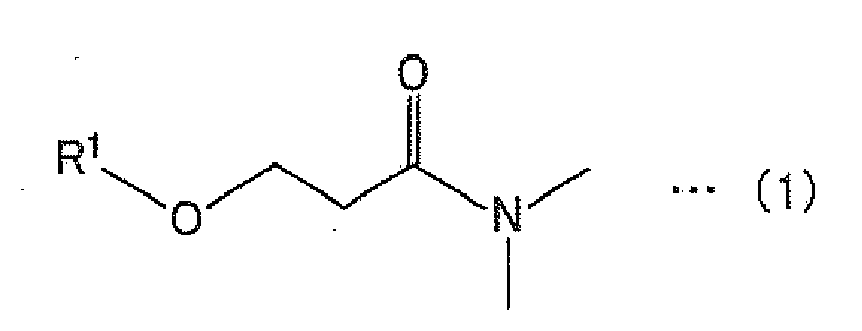
- Extensive investigations have led to the conclusion that R1 should be an alkyl group having 1 to 4 carbon atoms. The alkyl group having 1 to 4 carbon atoms can be a straight or branched alkyl group, e.g., a methyl group, an ethyl group, an n-propyl group, an iso-propyl group, an n-butyl group, an iso-butyl group, a sec-butyl group, or a tert-butyl group. A solvent represented by formula (1) that has R1 denoting an alkyl group having 1 to 4 carbon atoms can impart suitable pseudoplasticity to the nonaqueous ink composition, and thus good ink discharge stability can be ensured. Moreover, a solvent represented by formula (1) that has R1 denoting an alkyl group having 1 to 4 carbon atoms interacts with vinyl chloride resins and the ink can be firmly fixed onto the surface of a recording medium containing a vinyl chloride resin.
- The hydrophile-lipophile balance (HLB) value of the solvent represented by formula (1) is 10.5 to 20.0 and preferably 12.0 to 18.5. When the HLB value of the solvent represented by formula (1) is in these ranges, suitable pseudoplasticity can be imparted to the ink and the interaction with the vinyl chloride resins can be enhanced. The HLB value in the specification is a value calculated from equation (2) below based on the ratio of an inorganic character (I) to an organic character (O) (this ratio is also referred to as "I/O value") in an organic conceptual diagram:

- In particular, the I/O value can be determined by referring to literatures such as Atsushi FUJITA, Systematic Organic Qualitative Analysis - Mixture [original Japanese title: Keitoteki yuuki teisei bunseki - Kongoubutsu hen], published by Kazamashobo 1974; Nobuhiko KUROKI, Theoretic Chemistry of Dyeing [original Japanese title: Senshoku riron kagaku] published by Maki Shoten 1966; and Hiroo INOUE, Organic Compound Separation Technology [original Japanese title: Yuuki kagobutsu bunri ho] published by Shokabo Publishing Co., Ltd., 1990.
- The content of the solvent represented by formula (1) in the nonaqueous ink composition of this embodiment is preferably 10 to 90 mass% and more preferably 30 to 90 mass% based on the total mass of the composition. When the content of the solvent represented by formula (1) is 10 mass% or more, a suitable degree of pseudoplasticity is imparted to the nonaqueous ink composition and the ink discharge stability can be ensured. When the content of the solvent represented by formula (1) is 30 mass% or more, the rub resistance of the recorded image can be further improved due to the interaction with the vinyl chloride resins.
- The nonaqueous ink composition of this embodiment may contain an organic solvent other than the solvent represented by formula (1), a surfactant, a pigment, a dispersant, etc., according to need.
- The nonaqueous ink composition of this embodiment preferably contains at least one component selected from the group consisting of an alkylene glycol compound and a lactone, said component being liquid under normal temperature (20 °C) and pressure (1 atm). The nonaqueous ink composition more preferably contains an alkylene glycol compound in order to firmly fix the ink onto a vinyl chloride resin.
- The alkylene glycol compound is preferably an ethylene glycol compound or a propylene glycol compound described in International Publication No.
2002/055619 pamphlet. - Examples of the preferable ethylene glycol compound include monoethers and diethers of ethylene glycol, diethylene glycol, triethylene glycol, tetraethylene glycol, and polyethylene glycol. Among these, a diethylene glycol compound is particularly preferable. Examples of the preferable propylene glycol compound include monoethers and diethers of propylene glycol, dipropylene glycol, tripropylene glycol, and polypropylene glycol. Among these, a dipropylene glycol compound is particularly preferable.
- A diethylene glycol compound represented by formula (3) below may be used as the diethylene glycol compound described above:
R2-O-C2H4-O-C2H4-O-R3 (3)
- In formula (3), R2 and R3 each independently denote a hydrogen atom, an alkyl group having 1 to 4 carbon atoms, or R4CO group where R4 denotes an alkyl group having 1 to 4 carbon atoms. An alkyl group having 1 to 4 carbon atoms can be a straight or branched alkyl group, e.g., a methyl group, an ethyl group, an n-propyl group, an iso-propyl group, an n-butyl group, a sec-butyl group, or a tert-butyl group. Examples of the diethylene glycol compound represented by formula (3) include diethylene glycol, diethylene glycol monomethyl ether, diethylene glycol dimethyl ether, diethylene glycol methyl ethyl ether, diethylene glycol monoethyl ether, diethylene glycol diethyl ether, diethylene glycol mono-n-butyl ether, diethylene glycol di-n-butyl ether, diethylene glycol butyl methyl ether, diethylene glycol monoethyl ether acetate, and diethylene glycol mono-n-butyl ether acetate.
- A dipropylene glycol compound represented by general formula (4) below can be used as the dipropylene glycol compound described above:
R5-O-C3H6-O-C3H6-O-R6 (4)
- In formula (4), R5 and R6 each independently denote a hydrogen atom, an alkyl group having 1 to 4 carbon atoms, or R7CO group where R7 denotes an alkyl group having 1 to 4 carbon atoms. An alkyl group having 1 to 4 carbon atoms can be a straight or branched alkyl group, e.g., a methyl group, an ethyl group, an n-propyl group, an iso-propyl group, an n-butyl group, a sec-butyl group, or a tert-butyl group. Examples of the dipropylene glycol compound represented by formula (4) include dipropylene glycol, dipropylene glycol monomethyl ether, and dipropylene glycol monoethyl ether.
- A lactone having 6 or less carbon atoms is preferred as the lactone. The lactone is more preferably β-propiolactone, β-butyrolactone, γ-butyrolactone, γ-valerolactone, or ε-caprolactone.
- The ethylene glycol compound, dipropylene glycol compound, and lactone that can be used in the nonaqueous ink composition of this embodiment preferably have a boiling point of 150°C or more and more preferably 180°C or more under normal pressure (1 atm).
- The diethylene glycol compound and the dipropylene glycol compound that can be used in the nonaqueous ink composition of this embodiment preferably have a vapor pressure of 1 hPa or less and more preferably 0.7 hPa or less at 20°C.
- When a diethylene glycol compound or dipropylene glycol compound that satisfies the aforementioned conditions of high boiling point and low vapor pressure is used, the load of providing local exhaust equipment or exhaust gas treating equipment can be reduced, the work environment can be improved, and the impact on the surrounding environment can be decreased.
- The nonaqueous ink composition of this embodiment preferably contains the diethylene glycol compound. The diethylene glycol compound content can be adequately adjusted according to the printing properties but is preferably 20 to 80 mass% relative to the total mass of the nonaqueous ink composition.
- The nonaqueous ink composition of this embodiment may contain a polyethylene glycol monoether compound represented by general formula (5) below, which is liquid under normal temperature and normal pressure, in addition to the diethylene glycol compound, the dipropylene glycol compound, the lactone, or a mixture thereof described above:
R8-(OC2H4)n-OR9 (5)
- In formula (5), R8 and R9 each independently denote an alkyl group having 1 to 6 carbon atoms (preferably an alkyl group having 1 to 4 carbon atoms) and n denotes an integer of 3 to 6. An alkyl group having 1 to 6 carbon atoms can be a straight or branched alkyl group and examples thereof include examples of the alkyl group having 1 to 4 carbon atoms described above, a straight or branched pentyl group, and a straight or branched hexyl group.
- The polyethylene glycol monoether compound that can be used in the nonaqueous ink composition of this embodiment preferably has a boiling point of 200°C or more and preferably 250°C or more under normal pressure, and a flash point of 100°C or more and preferably 130°C or more. When such a polyethylene glycol monoether compound is used, evaporation of the nonaqueous ink composition can be suppressed. For example, when evaporation of the nonaqueous ink composition is suppressed in a tube for transporting the nonaqueous ink composition from an ink cartridge to an ink jet recording head, accumulation of solid components in the tube can be prevented or reduced.
- Examples of the preferable polyethylene glycol monoether compound include triethylene glycol monoether compounds (e.g., triethylene glycol monomethyl ether and triethylene glycol monobutyl ether) and a mixture of polyethylene glycol monoether compounds (in particular, polyethylene glycol monomethyl ethers) represented by general formula (5) with n being an integer of 4 to 6, e.g., a mixture of tetraethylene glycol monomethyl ether, pentaethylene glycol monomethyl ether, and hexaethylene glycol monomethyl ether.
- The nonaqueous ink composition of this embodiment may further contain an organic solvent, examples of which are given below, in addition to the organic solvent described above.
- The organic solvent is preferably a polar organic solvent. Examples of the polar organic solvent include alcohols (e.g., methyl alcohol, ethyl alcohol, propyl alcohol, butyl alcohol, and fluorinated alcohol), ketones (e.g., acetone, methyl ethyl ketone, and cyclohexanone), carboxylic acid esters (e.g., methyl acetate, ethyl acetate, propyl acetate, butyl acetate, methyl propionate, and ethyl propionate), and ethers (e.g., diethyl ether, dipropyl ether, tetrahydrofuran, and dioxane).
- When the nonaqueous ink composition of this embodiment contains at least one of the diethylene glycol compound, the dipropylene glycol compound, and the lactone but not the polyethylene glycol monoether compound, the total amount of the diethylene glycol compound, the dipropylene glycol compound, and the lactone is preferably 75 mass% or more of the total amount of all organic solvent components.
- When the nonaqueous ink composition of this embodiment contains the ethylene glycol compound, the dipropylene glycol compound, the lactone, and the polyethylene glycol monoether compound, the total amount of the diethylene glycol compound, the dipropylene glycol compound, the lactone, and the polyethylene glycol monoether is preferably 80 mass% or more of the total amount of all organic solvent components.
- The nonaqueous ink composition of the embodiment may further contain a silicon surfactant, a fluorine surfactant, or a polyoxyethylene derivative, i.e., a nonionic surfactant, in addition to the organic solvents described above in order to lower the surface tension and improve the wettability to a recording medium.
- The silicon surfactant is preferably polyester-modified silicon or polyether-modified silicon. Specific examples thereof include BYK-347 and 348, BYK-UV 3500, 3510, 3530, and 3570 (produced by BYK Japan KK).
- The fluorine surfactant is preferably a fluorine-modified polymer. Specific examples thereof include BYK-340 (produced by BYK Japan KK).
- The polyoxyethylene derivative is preferably an acetylene glycol surfactant. Specific examples thereof include Surfynol 82, 104, 465, 485, and TG (produced by Air Products Japan), OLFINE STG and E1010 (produced by Nissin Chemical Industry Co., Ltd.), Nissan Nonion A-10R and A-13R (produced by NOF Corporation), FLOWLEN TG-740W and D-90 (produced by Kyoeisha Chemical Co., Ltd.), and NOIGEN CX-100 (produced by Dai-Ichi Kogyo Seiyaku Co., Ltd.).
- The surfactant content in the nonaqueous ink composition of this embodiment is preferably 0.05 to 3 mass% and more preferably 0.5 to 2 mass%.
- Pigments such as a colored inorganic pigment or a colored organic pigment usually used as a colorant for nonaqueous ink compositions can be used in the nonaqueous ink composition of this embodiment. These pigments may be used alone or in combination.
- Examples of the pigment include azo pigments such as azo lakes, insoluble azo pigments, fused azo pigments, chelate azo pigments; polycyclic pigments such as phthalocyanine pigments, perylene and perylene pigments, anthraquinone pigments, quinacridone pigments, dioxazine pigments, thioindigo pigments, isoindolinone pigments, and quinophthalone pigments; dye lakes such as basic dye lakes and acidic dye lakes; organic pigments such as nitro pigments, nitroso pigments, aniline black, and daylight fluorescent pigments; and inorganic pigments such as carbon black. The average primary particle size of the pigment particles is not particularly limited but is preferably 50 to 500 nm.
- Examples of the pigment used to prepare a magenta or red nonaqueous ink composition include C.I. Pigment Red 2, C.I. Pigment Red 3, C.I. Pigment Red 5, C.I. Pigment Red 6, C.I. Pigment Red 7, C.I. Pigment Red 15, C.I. Pigment Red 16, C.I. Pigment Red 48:1, C.I. Pigment Red 53:1, C.I. Pigment Red 57:1, C.I. Pigment Red 122, C.I. Pigment Red 123, C.I. Pigment Red 139, C.I. Pigment Red 144, C.I. Pigment Red 149, C.I. Pigment Red 166, C.I. Pigment Red 170, C.I. Pigment Red 177, C.I. Pigment Red 178, C.I. Pigment Red 194, C.I. Pigment Red 209, C.I. Pigment Red 222, and C.I. Pigment Red 224.
- Examples of the pigment used to prepare an orange or yellow nonaqueous ink composition include C.I. Pigment Orange 31, C.I. Pigment Orange 43, C.I. Pigment Orange 64, C.I. Pigment Yellow 12, C.I. Pigment Yellow 13, C.I. Pigment Yellow 14, C.I. Pigment Yellow 15, C.I. Pigment Yellow 17, C.I. Pigment Yellow 74, C.I. Pigment Yellow 93, C.I. Pigment Yellow 94, C.I. Pigment Yellow 128, C.I. Pigment Yellow 138, C.I. Pigment Yellow 150, and C.I. Pigment Yellow 180.
- Examples of the pigment used to prepare a green or cyan nonaqueous ink composition include C.I. Pigment Blue 15, C.I. Pigment Blue 15:2, C.I. Pigment Blue 15:3, C.I. Pigment Blue 16, C.I. Pigment Blue 60, C.I. Pigment Green 7, and C.I. Pigment Green 36.
- Examples of the pigment used to prepare a black nonaqueous ink composition include carbon black.
- Examples of the pigment used to prepare a white nonaqueous ink composition include Pigment White 6, 18, and 21.
- The pigment content in the nonaqueous ink composition of the embodiment can be adequately selected according to usage and printing properties. The pigment content is preferably 0.5 to 25 mass%, more preferably 0.5 to 15 mass%, and most preferably 1 to 10 mass%.
- A dispersant used in common nonaqueous ink compositions may be used in the nonaqueous ink composition of the embodiment to improve the dispersion stability of the pigment. The dispersant is preferably a dispersant that acts effectively when the solubility parameter of the organic solvent is 8 to 11. Specific examples of such a dispersant include polyester high-molecular-weight compounds such as Hinoact KF1-M, T-6000, T-7000, T-8000, T-8350P, and T-8000E (produced by Takefu Fine Chemicals), Solsperse 20000, 24000, 32000, 32500, 33500, 34000, 35200, and 37500 (produced by The Lubrizol Corporation), Disperbyk-161, 162, 163, 164, 166, 180, 190, 191, and 192 (produced by BYK Japan KK), FLOWLEN DOPA-17, 22, 33, and G-700 (produced by Kyoeisha Chemical Co., Ltd.), Ajisper PB821 and PB711 (produced by Ajinomoto Inc.), and LP4010, LP4050, LP4055, and POLYMER 400, 401, 402, 403, 450, 451, and 453 (produced by EFKA Chemicals).
- The dispersant content in the nonaqueous ink composition of this embodiment can be adequately selected according to the pigment to be dispersed. The dispersant content is preferably 5 to 200 parts by mass and more preferably 30 to 120 parts by mass relative to 100 parts by mass of the pigment in the nonaqueous ink composition.
- The nonaqueous ink composition of the embodiment may further contain other additives usually contained in nonaqueous ink compositions. Examples of such additives include stabilizers such as antioxidants and UV absorbers, and binder resins.
- Examples of the antioxidant include BHA (2,3-butyl-4-oxyanisole) and BHT (2,6-di-tert-butyl-p-cresol). The antioxidant content in the nonaqueous ink composition of the embodiment is preferably 0.01 to 3 mass%.
- Examples of the UV absorber include benzophenone compounds and benzotriazole compounds. The UV absorber content in the nonaqueous ink composition of the embodiment is preferably 0.01 to 0.5 mass%.
- The nonaqueous ink composition of the embodiment may contain a binder resin to adjust the viscosity of the ink. Examples of the binder resin include acrylic resins, styrene acrylic resins, rosin-modified resins, phenolic resins, terpene resins, polyester resins, polyamide resins, epoxy resins, vinyl chloride-vinyl acetate copolymer resins, fibrous resins such as cellulose acetate butyrate, and vinyl toluene-α-methyl styrene copolymer resins. These binder resins may be used alone or in combination. The binder resin can further enhance the fixability of the ink to the vinyl chloride resins if added in adequate amounts.
- The nonaqueous ink composition of the embodiment can be made by a common method. When a pigment is to be used as a colorant, the pigment, a dispersant, and a portion of a diethylene glycol compound are first mixed and dispersed with a ball mill, a bead mill, or a jet mill or by ultrasonic waves so as to prepare a pigment dispersion and adjust the ink properties. Then the solvent represented by formula (1) above, the remaining portion of the diethylene glycol compound, and other additives (such as a surfactant and a binder resin) are added to the resulting mixture under stirring to obtain a nonaqueous ink composition.
- The nonaqueous ink composition of the embodiment preferably has a surface tension at 20°C of 20 to 50 mN/m and more preferably 25 to 40 mN/m in view of the balance between the printing quality and the reliability of the inkjet ink composition. The surface tension is measured with an automatic surface tensiometer CBVP-Z (produced by Kyowa Interface Science Co., Ltd.) by determining the surface tension observed when a platinum plate is wetted with ink in a 20°C environment.
- From the same viewpoint, the viscosity of the nonaqueous ink composition of the embodiment at 20°C is preferably 2 to 15 mPa·s, and more preferably 2 to 10 mPa·s. The viscosity is measured with a viscoelasticity tester MCR-300 (produced by Physica) in a 20°C environment by elevating the shear rate from 10 to 1000 and reading the viscosity at a shear rate of 200.
- An ink jet recording method according to an embodiment includes discharging droplets of the nonaqueous ink composition described above and recording an image by allowing the droplets to adhere to a surface of a recording medium containing a vinyl chloride resin. The nonaqueous ink composition contains a solvent represented by general formula (1) above and interacts with the vinyl chloride resin. Thus, the ink jet recording method of this embodiment has an advantage that the droplets of the nonaqueous ink composition forming the image can be firmly fixed on the recording medium.
- The recording medium used in the ink jet recording method of this embodiment is not particularly limited as long as the recording medium contains a vinyl chloride resin. Examples of the recording medium that contains a vinyl chloride resin include hard or soft vinyl chloride films and sheets. The nonaqueous ink composition enables an image to be recorded onto an unprocessed surface of a vinyl chloride resin base and offers an advantage that expensive recording media, such as recording media having receiving layers, are no longer necessary. However, the nonaqueous ink composition can naturally be used on a surface-processed base such as a base having an ink-receiving layer.
- The ink jet recording apparatus used in the ink jet recording method of the embodiment is not particularly limited but is preferably a drop-on-demand-type ink jet recording apparatus. There are different types of drop-on-demand-type ink jet recording apparatuses, including those that employ a piezoelectric recording method that uses piezoelectric elements disposed in a recording head and those that employ a thermal jet recording method that uses thermal energy from heaters of exothermic bodies disposed in a recording head. Any of the recording methods may be employed. Since the nonaqueous ink composition of the embodiment has an advantage that it is inactive to the discharge nozzle surfaces subjected to ink-repelling treatment, the nonaqueous ink composition can be advantageously used in the ink jet recording method that discharges ink through an ink jet recording head having a discharge nozzle surface subjected to ink-repelling treatment.
- The invention will now be described by way of examples. These examples do not limit the scope of the invention.
- In a 300 ml separable flask equipped with a stirrer, a thermocouple, and a nitrogen gas inlet tube, 19.828 g of N,N-dimethylacrylamide and 6.408 g of methanol were placed. The mixture was stirred while introducing nitrogen gas. To the resulting mixture, 0.338 g of sodium tert-butoxide was added, and reaction was conducted at 35°C for 4 hours. Upon completion of heating, 150 mg of phosphoric acid was added to homogenize the solution, and the solution was left standing for 3 hours. The solution was filtered to remove precipitates, and unreacted components were removed with an evaporator. As a result, a solvent A represented by formula (6) below was obtained:

- The HLB value of the solvent A calculated by equation (2) above from the I/O value in the organic conceptual diagram was 18.3.
- In a 300 ml separable flask equipped with a stirrer, a thermocouple, and a nitrogen gas inlet tube, 19.828 g of N,N-dimethylacrylamide and 14.824 g of 1-butanol were placed. The mixture was stirred while introducing nitrogen gas. To the resulting mixture, 0.338 g of sodium tert-butoxide was added, and reaction was conducted at 35°C for 4 hours. Upon completion of heating, 150 mg of phosphoric acid was added to homogenize the solution, and the solution was left standing for 3 hours. The solution was filtered to remove precipitates, and unreacted components were removed with an evaporator. As a result, a solvent B represented by formula (7) below was obtained.

- The HLB value of the solvent B calculated by equation (2) above from the I/O value in the organic conceptual diagram was 12.2.
- Solvents in amounts equivalent to the concentrations set forth in Tables 1 to 3 below were placed in a container for each ink, and the mixture was stirred with a magnetic stirrer for 30 minutes to obtain a mixed solvent.
- A portion of the mixed solvent was separated, and particular amounts of Solsperse 37500 (trade name, produced by The Lubrizol Corporation) and C.I. Pigment Black 7 (trade name: CARBON BLACK produced by Mitsubishi Chemical Corporation) were added to the portion. The resulting mixture was pulverized with a homogenizer and dispersed with a bead mill containing zirconia beads having a diameter of 0.3 mm so as to obtain a pigment dispersion.
- To the pigment dispersion, the rest of the mixed solvent and BYK-340 (fluorine surfactant produced by BYK Japan KK) were added, followed by stirring for 1 hour. The mixture was filtered through a PTFE membrane filter having a pore diameter of 5 µm. As a result, black ink compositions shown in Tables 1 to 3 were obtained. In the table, the unit of the figures is mass%.
- The materials set forth in the tables are as follows:
- · C.I. Pigment Black 7 (black pigment, trade name: CARBON BLACK produced by Mitsubishi Chemical Corporation)
- · Solsperse 37500 (trade name, dispersant produced by The Lubrizol Corporation)
- · γ-Butyrolactone (trade name, solvent produced by Kanto Chemical Co., Inc.)
- · N-Methylpyrrolidone (trade name, solvent produced by Kanto Chemical Co., Inc.)
- · 2-Pyrrolidone (trade name, solvent produced by Kanto Chemical Co., Inc.)
- · Dimethyl sulfoxide (trade name, solvent produced by Kanto Chemical Co., Inc.)
- · Dimethyl succinate (trade name, solvent produced by Kanto Chemical Co., Inc.)
- · Diethyl succinate (trade name, solvent produced by Kanto Chemical Co., Inc.)
- · Dimethyl glutarate (trade name, solvent produced by Kanto Chemical Co., Inc.)
- · Tetraethylene glycol dimethyl ether (trade name, solvent produced by Nippon Nyukazai Co., Ltd.)
- · Triethylene glycol dimethyl ether (trade name, solvent produced by Nippon Nyukazai Co., Ltd.)
- · Diethylene glycol diethyl ether (trade name, solvent produced by Nippon Nyukazai Co., Ltd.)
- · Diethylene glycol butyl methyl ether (trade name: HISOLV BDM, solvent produced by Toho Chemical Industry Co., Ltd.)
- · BYK-340 (trade name, fluorine surfactant produced by BYK Japan KK)
- Each of the ink compositions obtained in "3.2. Preparation of nonaqueous ink composition" was printed on a glossy polyvinyl chloride sheet (SV-G-1270G produced by Roland DG Corporation) at 100% duty by using a printer, SP-300V produced by Roland DG Corporation and dried at normal temperature for 1 day. As a result, an evaluation sample was obtained.
- Next, the evaluation sample was subjected to a dry test using a I-type tester according to Japanese Industrial Standard (JIS) L 0849. Then the optical density (OD) value of the evaluation sample was measured with Spectrolino (produced by GretagMacbeth). The evaluation standard is shown below and the evaluation results are shown in Tables 1 to 3.
- 7: OD < 0.15
- 6: 0.15 ≤ OD < 0.20
- 5: 0.20 ≤ OD < 0.25
- 4: 0.25 ≤ OD < 0.30
- 3: 0.30 ≤ OD < 0.35
- 2: 0.35 ≤ OD < 0.40
- 1: 0.40 ≤ OD
- Each of the ink compositions obtained in "3.2. Preparation of nonaqueous ink composition" was printed on a glossy polyvinyl chloride sheet (SV-G-1270G produced by Roland DG Corporation at 100% duty by using a printer, SP-300V produced by Roland DG Corporation) and dried for 5 minutes. The glossy polyvinyl chloride sheet was wound using a winder and the winding marks that remain on the glossy surface were observed. The percentage of the area where winding marks were found was determined by observing the surface roughness of the glossy surface with a 3D laser scanning microscope VK-8700 Generation II (produced by Keyence Corporation). The evaluation standard is as follows. The results of evaluation are shown in Tables 1 to 3.
- 5: The winding mark area percentage was less than 10%.
- 4: The winding mark area percentage was 10% or more but less than 20%.
- 3: The winding mark area percentage was 20% or more but less than 30%.
- 2: The winding mark area percentage was 30% or more but less than 40%.
- 1: The winding mark area percentage was 40% or more.
- Each of the ink compositions obtained in "3.2. Preparation of nonaqueous ink composition" was discharged from an ink jet recording head of a printer, SP-300V produced by Roland DG Corporation, and the amount of the ink composition discharged was measured. The discharge amount was determined by a subtraction method by which the decrease from the amount of the ink composition supplied to the ink jet recording head was determined. The evaluation results shown in Tables 1 to 3 are results calculated by the subtraction method in a 25°C temperature/40% humidity environment by using a standard driving voltage_and a waveform capable of discharging 7 ng of the ink composition of Example 3 at a frequency of 14.4 kHz.
- In fixing a colorant on a surface of a recording medium by using a pigment as the colorant, coloring (OD value) tends to be high when large droplets are used to record an image than when a larger number of small droplets are used to record an image, provided that the amount of the ink composition used is the same. In other words, it is advantageous from the standpoint of enhancing the color development property to achieve a larger ink discharge amount.
- The head driving frequency of a printer, SP-300V produced by Roland DG Corporation was varied and the path of the discharged ink droplets at various frequencies was investigated. In particular, the shape of the droplets, whether the path of the discharged ink droplets is free of deflection, and whether the observed properties are ensured during continuous discharge (continuous discharge stability) were evaluated. The maximum frequency that satisfied all of the evaluation items was determined. Evaluation results are shown in Tables 1 to 3.
Table 1 Materials Ex. 1 Ex. 2 Ex. 3 Ex. 4 Ex. 5 Ex. 6 Ex. 7 Ex. 8 Ex. 9 Pigment C.I. Pigment Black 7 4.00 4.00 4.00 4.00 4.00 4.00 4.00 4.00 4.00 Dispersant Solsperse 37500 4.00 4.00 4.00 4.00 4.00 4.00 4.00 4.00 4.00 Solvent Solvent A 10.00 Solvent B 10.00 γ-Butyrolactone 10.00 N-Methylpyrrolidone 10.00 2-Pyrrolidone 10.00 Dimethylsulfoxide 10.00 Dimethyl succinate 10.00 Diethyl succinate 10.00 Dimethyl glutarate 10.00 Tetraethylene glycol dimethyl ether Triethylene glycol dimethyl ether Diethylene glycol diethyl ether 50.00 50.00 50.00 50.00 50.00 50.00 50.00 50.00 50.00 Diethylene glycol butyl methyl ether 30.00 30.00 30.00 30.00 30.00 30.00 30.00 30.00 30.00 Surfactant BYK 340 2.00 2.00 2.00 2.00 2.00 2.00 2.00 2.00 2.00 Total 100.0 100.0 100.0 100.0 100.0 100.0 100.0 100.0 100.0 0 0 0 0 0 0 0 0 0 Rubbing fastness 6 6 4 4 2 2 4 4 4 Surface drying property 5 5 4 4 3 4 4 4 4 Discharge amount (ng) 8 8 7 7 7 7 7 7 7 High-frequency compatibility test (kHz) 45 45 35 35 35 35 35 35 35 Table 2 Materials Ex. 10 Ex.11 Ex. 12 Ex.13 Ex.14 Ex.15 Ex. 16 Ex.17 Ex.18 Pigment C.I. Pigment Black 7 4.00 4.00 4.00 4.00 4.00 4.00 4.00 4.00 4.00 Dispersant Solsperse 37500 4.00 4.00 4.00 4.00 4.00 4.00 4.00 4.00 4.00 Solvent Solvent A 30.00 Solvent B 30.00 γ-Butyrolactone 30.00 N-Methylpyrrolidone 30.00 2-Pyrrolidone 30.00 Dimethylsulfoxide 30.00 Dimethyl succinate 30.00 Diethyl succinate Dimethyl glutarate Tetraethylene glycol dimethyl ether 10.00 Triethylene glycol dimethyl ether 10.00 Diethylene glycol diethyl ether 50.00 50.00 30.00 30.00 30.00 30.00 30.00 30.00 30.00 Diethylene glycol butyl methyl ether 30.00 30.00 30.00 30.00 30.00 30.00 30.00 30.00 30.00 Surfactant BYK 340 2.00 2.00 2.00 2.00 2.00 2.00 2.00 2.00 2.00 Total 100.00 100.00 100.00 100.00 100.00 100.00 100.00 100.00 100.00 Rubbing fastness 4 2 7 7 5 5 2 2 6 Surface drying property 3 3 5 5 3 3 2 3 3 Discharge amount (ng) 7 7 9 9 7 7 7 7 7 High-frequency compatibly test (kHz) 35 35 50 50 35 35 35 35 35 Table 3 Materials Ex. 19 Ex. 20 Ex. 21 Ex. 22 Ex. 23 Ex. 24 Pigment C.I. Pigment Black 7 4.00 4.00 4.00 4.00 Dispersant Solsperse 37500 4.00 4.00 4.00 4.00 Solvent Solvent A 38.00 Solvent B 38.00 38.00 γ-Butyrolactone N-Methylpyrrolidone 2-Pyrrolidone Dimethylsulfoxide Dimethyl succinate Diethyl succinate 30.00 Dimethyl glutarate 30.00 Tetraethylene glycol Dimethyl ether 30.00 Triethylene glycol dimethyl ether 30.00 Diethylene glycol diethyl ether 30.00 30.00 30.00 30.00 30.00 30.00 Diethylene glycol butyl methyl ether 30.00 30.00 30.00 30.00 30.00 30.00 Surfactant BYK 340 2.00 2.00 2.00 2.00 2.00 2.00 Total 100,00 100.00 100.00 100.00 100.00 100.00 Rubbing fastness 6 6 5 2 - - Surface drying property 3 3 2 3 5 5 Discharge amount (ng) 7 7 7 7 9 9 High-frequency compatibility test (kHz) 35 35 35 35 50 50 - In Examples 1 and 2, an adequate degree of pseudoplasticity was imparted to the ink due to the incorporation of Solvent A or B. Thus, results of the tests for the discharge amount and high-frequency compatibility were satisfactory, indicating high discharge stability. Since results of the tests for the rubbing fastness were also satisfactory, it has been shown that the ink can firmly adhere to the glossy polyvinyl chloride sheet and thus exhibits improved rubbing fastness. The surface drying property of the ink was also enhanced.
- In Examples 3 to 11 in which inks that contain solvents other than Solvents A and B were used, the results of the evaluation test for high-frequency compatibility were significantly poor and the results of the evaluation test for rubbing fastness were also significantly poor compared to Examples 1 and 2.
- The results of Examples 12 and 22 were similar to those of Examples 1 to 11.
- In Examples 23 and 24, since an adequate degree of pseudoplasticity was imparted to the ink by incorporation of Solvent A or B without using a pigment, good results were obtained from the evaluation tests for the discharge amount and high-frequency compatibility, which shows that the discharge stability will also be good. These results suggest that the material that contributes to discharge stability is either Solvent A or Solvent B. The surface drying property of the ink was also good.
- The scope of the invention is not limited by the aforementioned embodiments and various modifications are possible. For example, the invention encompasses structures substantially identical to those described in the embodiments (e.g., structures that offer the same functions, methods, and results and structures that have the same objects and effects). The invention also encompasses the structures of the embodiments from which non-essential portions are replaced and structures that achieve the same advantageous effects or object. The invention further encompasses structures of the embodiments to which known technology is added.
Claims (9)
- A nonaqueous ink composition for ink jet recording, comprising:a solvent represented by general formula (1):where R1 denotes an alkyl group having 1 to 4 carbon atoms.

- The nonaqueous ink composition according to Claim 1, wherein R1 in the solvent represented by general formula (1) is a methyl group or an n-butyl group.
- The nonaqueous ink composition according to Claim 1 or Claim 2, wherein the content of the solvent represented by general formula (1) is 10 to 90 mass% based on the total mass of the composition.
- The nonaqueous ink composition according to any preceding claim, wherein a content of the solvent represented by general formula (1) is 30 to 90 mass% based on the total mass of the composition.
- The nonaqueous ink composition according to Claim 1, further comprising:at least one component which is liquid under normal temperature and pressure and which is (i) an alkylene glycol compound or (ii) a lactone.
- The nonaqueous ink composition according to any preceding claim, further comprising:a pigment.
- The nonaqueous ink composition according to any preceding claim, wherein the viscosity at a measuring temperature of 20°C is 2 mPa·s to 15 mPa·s.
- The nonaqueous ink composition according to any preceding claim, wherein the surface tension at a measuring temperature of 20°C is 20 mN/m to 50 mN/m.
- An ink jet recording method comprising:discharging droplets of the nonaqueous ink composition according to any preceding claim; andallowing the droplets to adhere to a surface of a recording medium containing a vinyl chloride resin so as to record an image.
Applications Claiming Priority (1)
| Application Number | Priority Date | Filing Date | Title |
|---|---|---|---|
| JP2010120139A JP2011246571A (en) | 2010-05-26 | 2010-05-26 | Nonaqueous ink composition for ink jet recording and inkjet recording method |
Publications (2)
| Publication Number | Publication Date |
|---|---|
| EP2390289A1 true EP2390289A1 (en) | 2011-11-30 |
| EP2390289B1 EP2390289B1 (en) | 2012-10-10 |
Family
ID=44117905
Family Applications (1)
| Application Number | Title | Priority Date | Filing Date |
|---|---|---|---|
| EP20110167244 Not-in-force EP2390289B1 (en) | 2010-05-26 | 2011-05-24 | Nonaqueous ink composition for ink jet recording and ink jet recording method |
Country Status (4)
| Country | Link |
|---|---|
| US (1) | US9056992B2 (en) |
| EP (1) | EP2390289B1 (en) |
| JP (1) | JP2011246571A (en) |
| CN (1) | CN102260434B (en) |
Families Citing this family (26)
| Publication number | Priority date | Publication date | Assignee | Title |
|---|---|---|---|---|
| JP5524536B2 (en) * | 2009-03-25 | 2014-06-18 | 理想科学工業株式会社 | Non-aqueous pigment ink |
| US9017701B2 (en) * | 2010-05-11 | 2015-04-28 | Xerox Corporation | Organogel compositions comprising alkylated benzimidazolones |
| JP5574099B2 (en) | 2010-05-26 | 2014-08-20 | セイコーエプソン株式会社 | Ink composition for inkjet printing and inkjet printing method |
| JP5700195B2 (en) | 2010-09-03 | 2015-04-15 | セイコーエプソン株式会社 | Non-aqueous ink composition for ink jet recording, ink set, and ink jet recording method |
| JP5768394B2 (en) * | 2011-02-10 | 2015-08-26 | 株式会社リコー | Ink set for ink jet recording, ink jet recording method using the ink set, and recorded matter |
| JP5888589B2 (en) * | 2011-06-28 | 2016-03-22 | 株式会社リコー | Ink for inkjet recording-Media set for recording and inkjet recording method |
| US9028055B2 (en) | 2011-11-15 | 2015-05-12 | Seiko Epson Corporation | Nonaqueous ink composition for ink jet recording and ink jet recording method |
| CN103224723B (en) | 2012-01-27 | 2017-03-01 | 精工爱普生株式会社 | Inkjet-recording non-aqueous ink composition and ink jet recording method |
| JP5887960B2 (en) * | 2012-01-30 | 2016-03-16 | セイコーエプソン株式会社 | Non-aqueous ink composition for inkjet recording and inkjet recording method |
| JP5867712B2 (en) * | 2012-01-27 | 2016-02-24 | セイコーエプソン株式会社 | Non-aqueous ink composition for inkjet recording and inkjet recording method |
| JP6051530B2 (en) * | 2012-02-01 | 2016-12-27 | 株式会社リコー | Inkjet recording method |
| JP6051531B2 (en) * | 2012-02-01 | 2016-12-27 | 株式会社リコー | Inkjet recording method |
| JP6003190B2 (en) * | 2012-04-26 | 2016-10-05 | セイコーエプソン株式会社 | Inkjet ink set and inkjet recording method |
| ES2604115T3 (en) | 2012-12-15 | 2017-03-03 | Byk-Chemie Gmbh | Composition for rheology control |
| CN104073025A (en) * | 2013-03-29 | 2014-10-01 | 日本化药株式会社 | Coloring dispersion agent, ink composition, inkjet recording method and colored member |
| JP5752201B2 (en) * | 2013-09-30 | 2015-07-22 | 大日本塗料株式会社 | Metallic ink composition for inkjet printing for polyvinyl chloride substrate |
| JP6252755B2 (en) * | 2014-01-29 | 2017-12-27 | セイコーエプソン株式会社 | Ink composition for inkjet recording |
| CN104946021B (en) * | 2014-03-27 | 2020-07-03 | 精工爱普生株式会社 | Nonaqueous inkjet ink composition, ink container, inkjet recording method, and inkjet recording apparatus |
| NL2012603B1 (en) * | 2014-04-10 | 2016-05-09 | Xeikon Ip Bv | A method of digitally printing and a digital printing apparatus. |
| CN113248975B (en) | 2014-10-24 | 2023-06-16 | 精工爱普生株式会社 | Inkjet ink composition and inkjet recording method |
| JP5930246B2 (en) * | 2015-02-17 | 2016-06-08 | セイコーエプソン株式会社 | Non-aqueous ink composition for inkjet recording and inkjet recording method |
| JP6604001B2 (en) * | 2015-02-24 | 2019-11-13 | セイコーエプソン株式会社 | Inkjet ink composition, inkjet recording method, and ink set |
| JP6604000B2 (en) * | 2015-02-24 | 2019-11-13 | セイコーエプソン株式会社 | Inkjet ink composition and inkjet recording method |
| CN105440798B (en) * | 2015-12-08 | 2018-11-02 | 北海市天硌打印耗材有限公司 | A kind of ink-jet printer ink and preparation method thereof |
| CN107011739B (en) | 2016-01-27 | 2021-10-08 | 精工爱普生株式会社 | Non-aqueous inkjet composition |
| JP7392359B2 (en) * | 2019-09-30 | 2023-12-06 | セイコーエプソン株式会社 | Inkjet recording device, inkjet recording method, and ink composition |
Citations (9)
| Publication number | Priority date | Publication date | Assignee | Title |
|---|---|---|---|---|
| JPS5094058A (en) * | 1973-09-25 | 1975-07-26 | ||
| WO2002055619A1 (en) | 2001-01-15 | 2002-07-18 | Seiko Epson Corporation | Oily ink composition for ink-jet recording, and ink-jet recording method |
| JP2007256485A (en) * | 2006-03-22 | 2007-10-04 | Jsr Corp | Liquid crystal alignment agent, liquid crystal alignment film, and liquid crystal display element |
| EP1867690A1 (en) * | 2006-06-14 | 2007-12-19 | Konica Minolta IJ Technologies, Inc. | Non-aqueous ink-set for ink-jet and ink-jet recording method |
| EP1892271A1 (en) * | 2005-06-14 | 2008-02-27 | Toyo Ink Mfg. Co., Ltd. | Jet printing ink for polyvinyl chloride resin sheets |
| JP2009074034A (en) | 2007-02-23 | 2009-04-09 | General Technology Kk | Oil-based inkjet ink |
| WO2009133181A1 (en) * | 2008-04-30 | 2009-11-05 | Rhodia Operations | Ether-amide type compounds, preparation method and uses |
| EP2123631A1 (en) * | 2007-02-20 | 2009-11-25 | Idemitsu Kosan Co., Ltd. | Process for producing -alkoxypropionamide |
| JP2010180332A (en) * | 2009-02-06 | 2010-08-19 | Toyo Ink Mfg Co Ltd | Nonaqueous ink composition |
Family Cites Families (42)
| Publication number | Priority date | Publication date | Assignee | Title |
|---|---|---|---|---|
| US3914303A (en) * | 1972-09-01 | 1975-10-21 | Cpc International Inc | Preparation of N,N-dialkylacylamides |
| JPS5637353B2 (en) | 1974-01-10 | 1981-08-31 | ||
| JPS607755B2 (en) | 1977-06-06 | 1985-02-26 | 東邦化学工業株式会社 | Dyeing method for polyester synthetic fibers |
| GB2035384B (en) | 1978-10-16 | 1982-12-01 | Ici Ltd | Stabilised aqueous dyestuff dispersions |
| JPS61213273A (en) | 1985-03-19 | 1986-09-22 | Toray Ind Inc | Ink composition for ink jet or spray dyeing |
| JPH08127981A (en) | 1994-10-28 | 1996-05-21 | Canon Inc | INKJET PRINTING INK AND INKJET PRINTING METHOD |
| JPH10158556A (en) | 1996-12-05 | 1998-06-16 | Mitsubishi Chem Corp | Inkjet printing ink |
| JP3050205B2 (en) | 1998-05-25 | 2000-06-12 | 東洋インキ製造株式会社 | Inkjet ink |
| US6362348B1 (en) * | 1999-02-03 | 2002-03-26 | Seiko Epson Corporation | Additive for inkjet printing, recording solution, method for preventing discoloration and fading of image, and recording sheet |
| US7414082B2 (en) | 2000-06-14 | 2008-08-19 | Mitsubishi Chemical Corporation | Recording liquid and ink jet recording method |
| JP4867085B2 (en) | 2000-06-14 | 2012-02-01 | 三菱化学株式会社 | Recording liquid and ink jet recording method |
| EP1167466B1 (en) | 2000-06-14 | 2004-12-15 | Mitsubishi Chemical Corporation | Recording liquid and ink jet recording method |
| JP2003201428A (en) | 2002-01-07 | 2003-07-18 | Konica Corp | Disperse dye ink and method for ink-jet recording using the disperse dye ink |
| EP1473342B1 (en) * | 2002-02-04 | 2006-07-19 | Mitsubishi Pencil Co., Ltd. | Oil base ballpoint ink composition and oily ballpoint pens |
| JP4579689B2 (en) | 2002-10-18 | 2010-11-10 | クラリアント ファイナンス (ビーブイアイ) リミティド | Azo compounds |
| JP4232456B2 (en) | 2002-12-20 | 2009-03-04 | 富士ゼロックス株式会社 | Inkjet recording method |
| JP4377594B2 (en) * | 2003-02-19 | 2009-12-02 | 出光興産株式会社 | Process for producing β-alkoxypropionamides |
| KR100578668B1 (en) | 2003-03-07 | 2006-05-12 | 주식회사 잉크테크 | Inkjet printing ink capable of printing on various materials, its manufacturing method and printing method using the ink |
| JP2004292468A (en) | 2003-03-25 | 2004-10-21 | Konica Minolta Holdings Inc | Ink for inkjet, its manufacturing method, inkjet recording method using the same, and inkjet printing method |
| JP4337425B2 (en) | 2003-06-27 | 2009-09-30 | 東洋インキ製造株式会社 | Non-aqueous inkjet ink for polyvinyl chloride resin sheet |
| JP4279088B2 (en) * | 2003-07-17 | 2009-06-17 | 出光興産株式会社 | β-alkoxypropionamides, solvents, detergents and liquid pharmaceutical compositions, and methods for producing β-alkoxypropionamides |
| TWI352103B (en) | 2003-12-10 | 2011-11-11 | Clariant Finance Bvi Ltd | Disperse dyes |
| JP2006124855A (en) | 2004-10-27 | 2006-05-18 | Konica Minolta Holdings Inc | Deep color-processing method and ink jet printing method |
| WO2006075373A1 (en) | 2005-01-13 | 2006-07-20 | Idemitsu Kosan Co., Ltd. | β-ALKOXYPROPIONAMIDE COMPOUND, SOLVENT, DETERGENT, LIQUID CHEMICAL COMPOSITION, AND PROCESS FOR PRODUCING β-ALKOXYPROPIONAMIDE COMPOUND |
| JP2007146002A (en) * | 2005-11-28 | 2007-06-14 | Toyo Ink Mfg Co Ltd | Ink composition |
| JP2007177160A (en) | 2005-12-28 | 2007-07-12 | General Technology Kk | Oil-based ink for inkjet recording |
| JP2007291257A (en) * | 2006-04-26 | 2007-11-08 | Konica Minolta Ij Technologies Inc | Non-aqueous inkjet ink and inkjet recording method |
| JP2008013714A (en) | 2006-07-07 | 2008-01-24 | General Technology Kk | Oily inkjet ink |
| US20080097013A1 (en) | 2006-10-19 | 2008-04-24 | Hitachi Maxell, Ltd. | Pigmented ink composition |
| JP5097395B2 (en) | 2006-12-28 | 2012-12-12 | 株式会社リコー | Ink for recording, ink media set, ink cartridge, ink jet recording method, ink jet recording apparatus, and ink recorded matter |
| JP4465722B2 (en) * | 2007-03-05 | 2010-05-19 | セイコーエプソン株式会社 | Ink composition, ink cartridge, and ink jet recording method |
| JP5261954B2 (en) | 2007-03-27 | 2013-08-14 | 凸版印刷株式会社 | Inkjet dispenser |
| JP2008274034A (en) | 2007-04-26 | 2008-11-13 | Konica Minolta Ij Technologies Inc | Nonaqueous inkjet ink and inkjet recording method |
| JP2009191221A (en) * | 2008-02-18 | 2009-08-27 | The Inctec Inc | Oil-based white ink composition for inkjet recording and method for producing the same |
| JP5240992B2 (en) | 2008-03-31 | 2013-07-17 | 大日本塗料株式会社 | Non-aqueous ink jet ink composition |
| BRPI0906089B1 (en) | 2008-03-04 | 2019-04-09 | Dai Nippon Toryo Co., Ltd | NON-WATER INK COMPOSITION FOR INK JET PRINTING |
| JP5270205B2 (en) | 2008-03-24 | 2013-08-21 | 株式会社Dnpファインケミカル | Oil-based green ink composition for inkjet recording and oil-based ink set for inkjet recording |
| US8210672B2 (en) | 2008-05-28 | 2012-07-03 | Seiko Epson Corporation | Printing method using inkjet recording method and printing apparatus |
| JP5574099B2 (en) * | 2010-05-26 | 2014-08-20 | セイコーエプソン株式会社 | Ink composition for inkjet printing and inkjet printing method |
| JP5851679B2 (en) | 2010-08-27 | 2016-02-03 | ゼネラル株式会社 | Inkjet ink |
| JP5700195B2 (en) * | 2010-09-03 | 2015-04-15 | セイコーエプソン株式会社 | Non-aqueous ink composition for ink jet recording, ink set, and ink jet recording method |
| JP5793910B2 (en) * | 2011-03-29 | 2015-10-14 | セイコーエプソン株式会社 | Non-aqueous ink composition for inkjet and inkjet recording method |
-
2010
- 2010-05-26 JP JP2010120139A patent/JP2011246571A/en not_active Withdrawn
-
2011
- 2011-05-24 EP EP20110167244 patent/EP2390289B1/en not_active Not-in-force
- 2011-05-24 CN CN201110139812.0A patent/CN102260434B/en not_active Expired - Fee Related
- 2011-05-26 US US13/116,570 patent/US9056992B2/en active Active
Patent Citations (9)
| Publication number | Priority date | Publication date | Assignee | Title |
|---|---|---|---|---|
| JPS5094058A (en) * | 1973-09-25 | 1975-07-26 | ||
| WO2002055619A1 (en) | 2001-01-15 | 2002-07-18 | Seiko Epson Corporation | Oily ink composition for ink-jet recording, and ink-jet recording method |
| EP1892271A1 (en) * | 2005-06-14 | 2008-02-27 | Toyo Ink Mfg. Co., Ltd. | Jet printing ink for polyvinyl chloride resin sheets |
| JP2007256485A (en) * | 2006-03-22 | 2007-10-04 | Jsr Corp | Liquid crystal alignment agent, liquid crystal alignment film, and liquid crystal display element |
| EP1867690A1 (en) * | 2006-06-14 | 2007-12-19 | Konica Minolta IJ Technologies, Inc. | Non-aqueous ink-set for ink-jet and ink-jet recording method |
| EP2123631A1 (en) * | 2007-02-20 | 2009-11-25 | Idemitsu Kosan Co., Ltd. | Process for producing -alkoxypropionamide |
| JP2009074034A (en) | 2007-02-23 | 2009-04-09 | General Technology Kk | Oil-based inkjet ink |
| WO2009133181A1 (en) * | 2008-04-30 | 2009-11-05 | Rhodia Operations | Ether-amide type compounds, preparation method and uses |
| JP2010180332A (en) * | 2009-02-06 | 2010-08-19 | Toyo Ink Mfg Co Ltd | Nonaqueous ink composition |
Non-Patent Citations (7)
| Title |
|---|
| "Nobuhiko KUROKI, Theoretic Chemistry of Dyeing", 1966, MAKI SHOTEN |
| ATSUSHI FUJITA: "Systematic Organic Qualitative Analysis - Mixture", 1974, KAZAMASHOBO |
| DATABASE CA [online] CHEMICAL ABSTRACTS SERVICE, COLUMBUS, OHIO, US; HAZAMA, SEIJI: "Nonaqueous ink compositions containing .beta.-alkoxypropanamides useful for jet-printing", XP002649420, retrieved from STN Database accession no. 2010:1035182 * |
| DATABASE CA [online] CHEMICAL ABSTRACTS SERVICE, COLUMBUS, OHIO, US; YOSHIO, KOHEI; HAYASHI, EIJI: "LIQUID CRYSTAL ALIGNEMENT AGENT, ALIGNEMENT FILM, AND LIQUID CRYSTAL DISPLAY ELEMENT", XP002649423, Database accession no. 2007:1096682 * |
| DATABASE WPI Week 197716, Derwent World Patents Index; AN 1977-27746Y, XP002649422 * |
| DATABASE WPI Week 201059, Derwent World Patents Index; AN 2010-K58621, XP002649421 * |
| HIROO INOUE: "Organic Compound Separation Technology", 1990, SHOKABO PUBLISHING CO., LTD. |
Also Published As
| Publication number | Publication date |
|---|---|
| CN102260434B (en) | 2015-07-01 |
| JP2011246571A (en) | 2011-12-08 |
| US9056992B2 (en) | 2015-06-16 |
| CN102260434A (en) | 2011-11-30 |
| EP2390289B1 (en) | 2012-10-10 |
| US20110292141A1 (en) | 2011-12-01 |
Similar Documents
| Publication | Publication Date | Title |
|---|---|---|
| EP2390289B1 (en) | Nonaqueous ink composition for ink jet recording and ink jet recording method | |
| JP5700195B2 (en) | Non-aqueous ink composition for ink jet recording, ink set, and ink jet recording method | |
| US8383700B2 (en) | Pigment dispersion, recording ink, ink cartridge, ink-jet recording method and ink-jet recording apparatus | |
| CN103224723B (en) | Inkjet-recording non-aqueous ink composition and ink jet recording method | |
| EP3263658B1 (en) | Inkjet ink composition, inkjet recording method and ink set | |
| JP5811344B2 (en) | Non-aqueous ink composition for inkjet recording and inkjet recording method | |
| EP3034571B1 (en) | Nonaqueous ink jet ink composition | |
| US8992678B2 (en) | Ink set for ink jet recording and ink jet recording method | |
| US6758889B2 (en) | Ink for ink-jet recording | |
| JP5849631B2 (en) | Non-aqueous ink composition for inkjet recording and inkjet recording method | |
| JP2013104011A (en) | Non-aqueous ink composition for inkjet recording and inkjet recording method | |
| JP6115604B2 (en) | Inkjet recording method | |
| JP5843062B2 (en) | Non-aqueous ink composition for inkjet recording and inkjet recording method | |
| JP5930246B2 (en) | Non-aqueous ink composition for inkjet recording and inkjet recording method | |
| JP6210246B2 (en) | Non-aqueous ink composition for inkjet recording and inkjet recording method | |
| JP3558213B2 (en) | Ink set | |
| JP2011231294A (en) | Inkjet ink | |
| JP5867712B2 (en) | Non-aqueous ink composition for inkjet recording and inkjet recording method | |
| JP5793909B2 (en) | Non-aqueous ink composition for inkjet and inkjet recording method | |
| JP5834562B2 (en) | Non-aqueous ink for ink jet and ink jet recording method | |
| JP5887960B2 (en) | Non-aqueous ink composition for inkjet recording and inkjet recording method | |
| JP5831725B2 (en) | Non-aqueous ink composition for ink jet recording, ink set, and ink jet recording method | |
| JP6269877B2 (en) | Non-aqueous ink for ink jet and ink jet recording method | |
| JP2016041819A (en) | Inkjet recording method and inkjet recording apparatus |
Legal Events
| Date | Code | Title | Description |
|---|---|---|---|
| AK | Designated contracting states |
Kind code of ref document: A1 Designated state(s): AL AT BE BG CH CY CZ DE DK EE ES FI FR GB GR HR HU IE IS IT LI LT LU LV MC MK MT NL NO PL PT RO RS SE SI SK SM TR |
|
| AX | Request for extension of the european patent |
Extension state: BA ME |
|
| PUAI | Public reference made under article 153(3) epc to a published international application that has entered the european phase |
Free format text: ORIGINAL CODE: 0009012 |
|
| 17P | Request for examination filed |
Effective date: 20111206 |
|
| GRAP | Despatch of communication of intention to grant a patent |
Free format text: ORIGINAL CODE: EPIDOSNIGR1 |
|
| GRAS | Grant fee paid |
Free format text: ORIGINAL CODE: EPIDOSNIGR3 |
|
| GRAA | (expected) grant |
Free format text: ORIGINAL CODE: 0009210 |
|
| AK | Designated contracting states |
Kind code of ref document: B1 Designated state(s): AL AT BE BG CH CY CZ DE DK EE ES FI FR GB GR HR HU IE IS IT LI LT LU LV MC MK MT NL NO PL PT RO RS SE SI SK SM TR |
|
| REG | Reference to a national code |
Ref country code: GB Ref legal event code: FG4D |
|
| REG | Reference to a national code |
Ref country code: AT Ref legal event code: REF Ref document number: 578965 Country of ref document: AT Kind code of ref document: T Effective date: 20121015 Ref country code: CH Ref legal event code: EP |
|
| REG | Reference to a national code |
Ref country code: IE Ref legal event code: FG4D |
|
| REG | Reference to a national code |
Ref country code: DE Ref legal event code: R096 Ref document number: 602011000299 Country of ref document: DE Effective date: 20121206 |
|
| PG25 | Lapsed in a contracting state [announced via postgrant information from national office to epo] |
Ref country code: SI Free format text: LAPSE BECAUSE OF FAILURE TO SUBMIT A TRANSLATION OF THE DESCRIPTION OR TO PAY THE FEE WITHIN THE PRESCRIBED TIME-LIMIT Effective date: 20121010 |
|
| REG | Reference to a national code |
Ref country code: NL Ref legal event code: VDEP Effective date: 20121010 |
|
| REG | Reference to a national code |
Ref country code: AT Ref legal event code: MK05 Ref document number: 578965 Country of ref document: AT Kind code of ref document: T Effective date: 20121010 |
|
| REG | Reference to a national code |
Ref country code: LT Ref legal event code: MG4D |
|
| PG25 | Lapsed in a contracting state [announced via postgrant information from national office to epo] |
Ref country code: LT Free format text: LAPSE BECAUSE OF FAILURE TO SUBMIT A TRANSLATION OF THE DESCRIPTION OR TO PAY THE FEE WITHIN THE PRESCRIBED TIME-LIMIT Effective date: 20121010 Ref country code: FI Free format text: LAPSE BECAUSE OF FAILURE TO SUBMIT A TRANSLATION OF THE DESCRIPTION OR TO PAY THE FEE WITHIN THE PRESCRIBED TIME-LIMIT Effective date: 20121010 Ref country code: HR Free format text: LAPSE BECAUSE OF FAILURE TO SUBMIT A TRANSLATION OF THE DESCRIPTION OR TO PAY THE FEE WITHIN THE PRESCRIBED TIME-LIMIT Effective date: 20121010 Ref country code: NL Free format text: LAPSE BECAUSE OF FAILURE TO SUBMIT A TRANSLATION OF THE DESCRIPTION OR TO PAY THE FEE WITHIN THE PRESCRIBED TIME-LIMIT Effective date: 20121010 Ref country code: IS Free format text: LAPSE BECAUSE OF FAILURE TO SUBMIT A TRANSLATION OF THE DESCRIPTION OR TO PAY THE FEE WITHIN THE PRESCRIBED TIME-LIMIT Effective date: 20130210 Ref country code: NO Free format text: LAPSE BECAUSE OF FAILURE TO SUBMIT A TRANSLATION OF THE DESCRIPTION OR TO PAY THE FEE WITHIN THE PRESCRIBED TIME-LIMIT Effective date: 20130110 Ref country code: SE Free format text: LAPSE BECAUSE OF FAILURE TO SUBMIT A TRANSLATION OF THE DESCRIPTION OR TO PAY THE FEE WITHIN THE PRESCRIBED TIME-LIMIT Effective date: 20121010 |
|
| PG25 | Lapsed in a contracting state [announced via postgrant information from national office to epo] |
Ref country code: GR Free format text: LAPSE BECAUSE OF FAILURE TO SUBMIT A TRANSLATION OF THE DESCRIPTION OR TO PAY THE FEE WITHIN THE PRESCRIBED TIME-LIMIT Effective date: 20130111 Ref country code: PT Free format text: LAPSE BECAUSE OF FAILURE TO SUBMIT A TRANSLATION OF THE DESCRIPTION OR TO PAY THE FEE WITHIN THE PRESCRIBED TIME-LIMIT Effective date: 20130211 Ref country code: PL Free format text: LAPSE BECAUSE OF FAILURE TO SUBMIT A TRANSLATION OF THE DESCRIPTION OR TO PAY THE FEE WITHIN THE PRESCRIBED TIME-LIMIT Effective date: 20121010 Ref country code: BE Free format text: LAPSE BECAUSE OF FAILURE TO SUBMIT A TRANSLATION OF THE DESCRIPTION OR TO PAY THE FEE WITHIN THE PRESCRIBED TIME-LIMIT Effective date: 20121010 Ref country code: LV Free format text: LAPSE BECAUSE OF FAILURE TO SUBMIT A TRANSLATION OF THE DESCRIPTION OR TO PAY THE FEE WITHIN THE PRESCRIBED TIME-LIMIT Effective date: 20121010 |
|
| PG25 | Lapsed in a contracting state [announced via postgrant information from national office to epo] |
Ref country code: AT Free format text: LAPSE BECAUSE OF FAILURE TO SUBMIT A TRANSLATION OF THE DESCRIPTION OR TO PAY THE FEE WITHIN THE PRESCRIBED TIME-LIMIT Effective date: 20121010 |
|
| PG25 | Lapsed in a contracting state [announced via postgrant information from national office to epo] |
Ref country code: RS Free format text: LAPSE BECAUSE OF FAILURE TO SUBMIT A TRANSLATION OF THE DESCRIPTION OR TO PAY THE FEE WITHIN THE PRESCRIBED TIME-LIMIT Effective date: 20121010 Ref country code: CZ Free format text: LAPSE BECAUSE OF FAILURE TO SUBMIT A TRANSLATION OF THE DESCRIPTION OR TO PAY THE FEE WITHIN THE PRESCRIBED TIME-LIMIT Effective date: 20121010 Ref country code: BG Free format text: LAPSE BECAUSE OF FAILURE TO SUBMIT A TRANSLATION OF THE DESCRIPTION OR TO PAY THE FEE WITHIN THE PRESCRIBED TIME-LIMIT Effective date: 20130110 Ref country code: DK Free format text: LAPSE BECAUSE OF FAILURE TO SUBMIT A TRANSLATION OF THE DESCRIPTION OR TO PAY THE FEE WITHIN THE PRESCRIBED TIME-LIMIT Effective date: 20121010 Ref country code: EE Free format text: LAPSE BECAUSE OF FAILURE TO SUBMIT A TRANSLATION OF THE DESCRIPTION OR TO PAY THE FEE WITHIN THE PRESCRIBED TIME-LIMIT Effective date: 20121010 Ref country code: SK Free format text: LAPSE BECAUSE OF FAILURE TO SUBMIT A TRANSLATION OF THE DESCRIPTION OR TO PAY THE FEE WITHIN THE PRESCRIBED TIME-LIMIT Effective date: 20121010 |
|
| PLBE | No opposition filed within time limit |
Free format text: ORIGINAL CODE: 0009261 |
|
| STAA | Information on the status of an ep patent application or granted ep patent |
Free format text: STATUS: NO OPPOSITION FILED WITHIN TIME LIMIT |
|
| PG25 | Lapsed in a contracting state [announced via postgrant information from national office to epo] |
Ref country code: RO Free format text: LAPSE BECAUSE OF FAILURE TO SUBMIT A TRANSLATION OF THE DESCRIPTION OR TO PAY THE FEE WITHIN THE PRESCRIBED TIME-LIMIT Effective date: 20121010 Ref country code: IT Free format text: LAPSE BECAUSE OF FAILURE TO SUBMIT A TRANSLATION OF THE DESCRIPTION OR TO PAY THE FEE WITHIN THE PRESCRIBED TIME-LIMIT Effective date: 20121010 |
|
| 26N | No opposition filed |
Effective date: 20130711 |
|
| PG25 | Lapsed in a contracting state [announced via postgrant information from national office to epo] |
Ref country code: ES Free format text: LAPSE BECAUSE OF FAILURE TO SUBMIT A TRANSLATION OF THE DESCRIPTION OR TO PAY THE FEE WITHIN THE PRESCRIBED TIME-LIMIT Effective date: 20130121 |
|
| REG | Reference to a national code |
Ref country code: DE Ref legal event code: R097 Ref document number: 602011000299 Country of ref document: DE Effective date: 20130711 |
|
| PG25 | Lapsed in a contracting state [announced via postgrant information from national office to epo] |
Ref country code: CY Free format text: LAPSE BECAUSE OF FAILURE TO SUBMIT A TRANSLATION OF THE DESCRIPTION OR TO PAY THE FEE WITHIN THE PRESCRIBED TIME-LIMIT Effective date: 20121010 |
|
| PG25 | Lapsed in a contracting state [announced via postgrant information from national office to epo] |
Ref country code: MC Free format text: LAPSE BECAUSE OF FAILURE TO SUBMIT A TRANSLATION OF THE DESCRIPTION OR TO PAY THE FEE WITHIN THE PRESCRIBED TIME-LIMIT Effective date: 20121010 |
|
| REG | Reference to a national code |
Ref country code: IE Ref legal event code: MM4A |
|
| PG25 | Lapsed in a contracting state [announced via postgrant information from national office to epo] |
Ref country code: IE Free format text: LAPSE BECAUSE OF NON-PAYMENT OF DUE FEES Effective date: 20130524 |
|
| REG | Reference to a national code |
Ref country code: CH Ref legal event code: PL |
|
| PG25 | Lapsed in a contracting state [announced via postgrant information from national office to epo] |
Ref country code: LI Free format text: LAPSE BECAUSE OF NON-PAYMENT OF DUE FEES Effective date: 20140531 Ref country code: CH Free format text: LAPSE BECAUSE OF NON-PAYMENT OF DUE FEES Effective date: 20140531 |
|
| PG25 | Lapsed in a contracting state [announced via postgrant information from national office to epo] |
Ref country code: MT Free format text: LAPSE BECAUSE OF FAILURE TO SUBMIT A TRANSLATION OF THE DESCRIPTION OR TO PAY THE FEE WITHIN THE PRESCRIBED TIME-LIMIT Effective date: 20121010 |
|
| REG | Reference to a national code |
Ref country code: FR Ref legal event code: PLFP Year of fee payment: 5 |
|
| PG25 | Lapsed in a contracting state [announced via postgrant information from national office to epo] |
Ref country code: SM Free format text: LAPSE BECAUSE OF FAILURE TO SUBMIT A TRANSLATION OF THE DESCRIPTION OR TO PAY THE FEE WITHIN THE PRESCRIBED TIME-LIMIT Effective date: 20121010 |
|
| PG25 | Lapsed in a contracting state [announced via postgrant information from national office to epo] |
Ref country code: TR Free format text: LAPSE BECAUSE OF FAILURE TO SUBMIT A TRANSLATION OF THE DESCRIPTION OR TO PAY THE FEE WITHIN THE PRESCRIBED TIME-LIMIT Effective date: 20121010 |
|
| PG25 | Lapsed in a contracting state [announced via postgrant information from national office to epo] |
Ref country code: HU Free format text: LAPSE BECAUSE OF FAILURE TO SUBMIT A TRANSLATION OF THE DESCRIPTION OR TO PAY THE FEE WITHIN THE PRESCRIBED TIME-LIMIT; INVALID AB INITIO Effective date: 20110524 Ref country code: MK Free format text: LAPSE BECAUSE OF FAILURE TO SUBMIT A TRANSLATION OF THE DESCRIPTION OR TO PAY THE FEE WITHIN THE PRESCRIBED TIME-LIMIT Effective date: 20121010 Ref country code: LU Free format text: LAPSE BECAUSE OF NON-PAYMENT OF DUE FEES Effective date: 20130524 |
|
| REG | Reference to a national code |
Ref country code: FR Ref legal event code: PLFP Year of fee payment: 6 |
|
| REG | Reference to a national code |
Ref country code: FR Ref legal event code: PLFP Year of fee payment: 7 |
|
| REG | Reference to a national code |
Ref country code: FR Ref legal event code: PLFP Year of fee payment: 8 |
|
| PG25 | Lapsed in a contracting state [announced via postgrant information from national office to epo] |
Ref country code: AL Free format text: LAPSE BECAUSE OF FAILURE TO SUBMIT A TRANSLATION OF THE DESCRIPTION OR TO PAY THE FEE WITHIN THE PRESCRIBED TIME-LIMIT Effective date: 20121010 |
|
| REG | Reference to a national code |
Ref country code: FR Ref legal event code: PLFP Year of fee payment: 13 |
|
| PGFP | Annual fee paid to national office [announced via postgrant information from national office to epo] |
Ref country code: GB Payment date: 20230330 Year of fee payment: 13 |
|
| PGFP | Annual fee paid to national office [announced via postgrant information from national office to epo] |
Ref country code: FR Payment date: 20230411 Year of fee payment: 13 Ref country code: DE Payment date: 20230331 Year of fee payment: 13 |
|
| REG | Reference to a national code |
Ref country code: DE Ref legal event code: R119 Ref document number: 602011000299 Country of ref document: DE |
|
| GBPC | Gb: european patent ceased through non-payment of renewal fee |
Effective date: 20240524 |
|
| PG25 | Lapsed in a contracting state [announced via postgrant information from national office to epo] |
Ref country code: DE Free format text: LAPSE BECAUSE OF NON-PAYMENT OF DUE FEES Effective date: 20241203 |
|
| PG25 | Lapsed in a contracting state [announced via postgrant information from national office to epo] |
Ref country code: FR Free format text: LAPSE BECAUSE OF NON-PAYMENT OF DUE FEES Effective date: 20240531 |
|
| PG25 | Lapsed in a contracting state [announced via postgrant information from national office to epo] |
Ref country code: GB Free format text: LAPSE BECAUSE OF NON-PAYMENT OF DUE FEES Effective date: 20240524 |