EP2386588A2 - Norbornene polymer including photoreactive functional group that has halogen substituent, method for preparing the same, and alignment layer using the same - Google Patents
Norbornene polymer including photoreactive functional group that has halogen substituent, method for preparing the same, and alignment layer using the same Download PDFInfo
- Publication number
- EP2386588A2 EP2386588A2 EP10729352A EP10729352A EP2386588A2 EP 2386588 A2 EP2386588 A2 EP 2386588A2 EP 10729352 A EP10729352 A EP 10729352A EP 10729352 A EP10729352 A EP 10729352A EP 2386588 A2 EP2386588 A2 EP 2386588A2
- Authority
- EP
- European Patent Office
- Prior art keywords
- group
- substituted
- unsubstituted
- halogen
- alkyl
- Prior art date
- Legal status (The legal status is an assumption and is not a legal conclusion. Google has not performed a legal analysis and makes no representation as to the accuracy of the status listed.)
- Granted
Links
- 0 C*N*S(*)(*)* Chemical compound C*N*S(*)(*)* 0.000 description 4
Images


Classifications
-
- G—PHYSICS
- G02—OPTICS
- G02F—OPTICAL DEVICES OR ARRANGEMENTS FOR THE CONTROL OF LIGHT BY MODIFICATION OF THE OPTICAL PROPERTIES OF THE MEDIA OF THE ELEMENTS INVOLVED THEREIN; NON-LINEAR OPTICS; FREQUENCY-CHANGING OF LIGHT; OPTICAL LOGIC ELEMENTS; OPTICAL ANALOGUE/DIGITAL CONVERTERS
- G02F1/00—Devices or arrangements for the control of the intensity, colour, phase, polarisation or direction of light arriving from an independent light source, e.g. switching, gating or modulating; Non-linear optics
- G02F1/01—Devices or arrangements for the control of the intensity, colour, phase, polarisation or direction of light arriving from an independent light source, e.g. switching, gating or modulating; Non-linear optics for the control of the intensity, phase, polarisation or colour
- G02F1/13—Devices or arrangements for the control of the intensity, colour, phase, polarisation or direction of light arriving from an independent light source, e.g. switching, gating or modulating; Non-linear optics for the control of the intensity, phase, polarisation or colour based on liquid crystals, e.g. single liquid crystal display cells
- G02F1/133—Constructional arrangements; Operation of liquid crystal cells; Circuit arrangements
- G02F1/1333—Constructional arrangements; Manufacturing methods
- G02F1/1337—Surface-induced orientation of the liquid crystal molecules, e.g. by alignment layers
- G02F1/133711—Surface-induced orientation of the liquid crystal molecules, e.g. by alignment layers by organic films, e.g. polymeric films
-
- C—CHEMISTRY; METALLURGY
- C08—ORGANIC MACROMOLECULAR COMPOUNDS; THEIR PREPARATION OR CHEMICAL WORKING-UP; COMPOSITIONS BASED THEREON
- C08F—MACROMOLECULAR COMPOUNDS OBTAINED BY REACTIONS ONLY INVOLVING CARBON-TO-CARBON UNSATURATED BONDS
- C08F232/00—Copolymers of cyclic compounds containing no unsaturated aliphatic radicals in a side chain, and having one or more carbon-to-carbon double bonds in a carbocyclic ring system
- C08F232/08—Copolymers of cyclic compounds containing no unsaturated aliphatic radicals in a side chain, and having one or more carbon-to-carbon double bonds in a carbocyclic ring system having condensed rings
-
- C—CHEMISTRY; METALLURGY
- C09—DYES; PAINTS; POLISHES; NATURAL RESINS; ADHESIVES; COMPOSITIONS NOT OTHERWISE PROVIDED FOR; APPLICATIONS OF MATERIALS NOT OTHERWISE PROVIDED FOR
- C09K—MATERIALS FOR MISCELLANEOUS APPLICATIONS, NOT PROVIDED FOR ELSEWHERE
- C09K2323/00—Functional layers of liquid crystal optical display excluding electroactive liquid crystal layer characterised by chemical composition
-
- C—CHEMISTRY; METALLURGY
- C09—DYES; PAINTS; POLISHES; NATURAL RESINS; ADHESIVES; COMPOSITIONS NOT OTHERWISE PROVIDED FOR; APPLICATIONS OF MATERIALS NOT OTHERWISE PROVIDED FOR
- C09K—MATERIALS FOR MISCELLANEOUS APPLICATIONS, NOT PROVIDED FOR ELSEWHERE
- C09K2323/00—Functional layers of liquid crystal optical display excluding electroactive liquid crystal layer characterised by chemical composition
- C09K2323/02—Alignment layer characterised by chemical composition
-
- G—PHYSICS
- G02—OPTICS
- G02F—OPTICAL DEVICES OR ARRANGEMENTS FOR THE CONTROL OF LIGHT BY MODIFICATION OF THE OPTICAL PROPERTIES OF THE MEDIA OF THE ELEMENTS INVOLVED THEREIN; NON-LINEAR OPTICS; FREQUENCY-CHANGING OF LIGHT; OPTICAL LOGIC ELEMENTS; OPTICAL ANALOGUE/DIGITAL CONVERTERS
- G02F1/00—Devices or arrangements for the control of the intensity, colour, phase, polarisation or direction of light arriving from an independent light source, e.g. switching, gating or modulating; Non-linear optics
- G02F1/01—Devices or arrangements for the control of the intensity, colour, phase, polarisation or direction of light arriving from an independent light source, e.g. switching, gating or modulating; Non-linear optics for the control of the intensity, phase, polarisation or colour
- G02F1/13—Devices or arrangements for the control of the intensity, colour, phase, polarisation or direction of light arriving from an independent light source, e.g. switching, gating or modulating; Non-linear optics for the control of the intensity, phase, polarisation or colour based on liquid crystals, e.g. single liquid crystal display cells
- G02F1/133—Constructional arrangements; Operation of liquid crystal cells; Circuit arrangements
- G02F1/1333—Constructional arrangements; Manufacturing methods
- G02F1/1337—Surface-induced orientation of the liquid crystal molecules, e.g. by alignment layers
- G02F1/13378—Surface-induced orientation of the liquid crystal molecules, e.g. by alignment layers by treatment of the surface, e.g. embossing, rubbing or light irradiation
- G02F1/133788—Surface-induced orientation of the liquid crystal molecules, e.g. by alignment layers by treatment of the surface, e.g. embossing, rubbing or light irradiation by light irradiation, e.g. linearly polarised light photo-polymerisation
Definitions
- the present invention relates to a photoreactive norbornene polymer comprising a photoreactive norbornene monomer, a process for preparing the same, and an alignment layer using the same and, more specifically, to a photoreactive norbornene polymer comprising a photoreactive norbornene monomer which has an excellent adhesion property and can make an improvement in an orientation and an orientation rate of liquid crystals, a process for preparing the same, and an alignment layer using the same.
- LCDs liquid crystal displays
- TFT-LCD thin film transistor - liquid crystal displays
- liquid crystals In order to be utilized as an optic switch in TFT-LCDs, liquid crystals should be initially oriented in a certain direction on a TFT layer which is disposed in the innermost part of a display cell, and a liquid crystal alignment layer is used to this end.
- a current method of orienting liquid crystals in LCD which is called as a "rubbing process,” comprises applying a thermal resistant polymer such as a polyimide on a transparent glass to form a polymer alignment layer and rubbing the alignment layer with a rapidly rotating roller wound with a rubbing cloth made of nylon or rayon to impart an orientation.
- a thermal resistant polymer such as a polyimide
- the rubbing process leaves mechanical scratches on a surface of a liquid crystal alignment agent or generates such a large amount of electrostatic charges that it can destruct a thin film transistor. Also, fine fibers derived from a rubbing cloth can cause a defect and are hampering an improvement in production yield.
- a newly designed manner of orienting liquid crystals is a UV-induced (i.e., light-induced) alignment of liquid crystals (hereinafter, referred to as "photoalignment").
- Photoalignment refers to a mechanism for forming a photopolymerizable liquid crystal alignment layer wherein pre-polarized UV rays induce a photoreaction in a photosensitivy group of a polymer, and via this process the main chains of the polymers are aligned in such a direction that liquid crystals are oriented.
- photoalignment is the photoalignment through photopolymerization disclosed in Jpn. J. Appl. Phys., Vol. 31, 1992, 2155 by M. Schadt et al., U.S. Patent No. 5,464,669 by Dae S. Kang et al. , and Jpn. J. Appl. Phys., Vol. 34, 1995, L1000 by Yuriy Reznikov .
- polycinnamate polymers such as poly(vinyl cinnamate) (PVCN) and poly(vinyl methoxycinnamate) (PVMC) were mainly used as a photoalignment polymer.
- PVN poly(vinyl cinnamate)
- PVMC poly(vinyl methoxycinnamate)
- UV irradiation makes a double bond in cinnamate group go through a [2+2] cycloaddition reaction to form a cyclobutane and thereby generates anisotropy, which allows liquid crystal molecules to be aligned in one direction and leads to an orientation of liquid crystals.
- Japanese Patent Laid-open Publication No. Hei11-181127 teaches a method of producing a polymer alignment layer and an alignment layer produced thereby in which main chains of polyacrylate or polymethacrylate has side chains including photoreactive groups such as cinnamate group.
- the polymer main chain has a poor thermal stability so that it has a negative impact on the stability of the alignment layer.
- Korean Patent Laid-open Publication No. 2002-006819 discloses a method of utilizing a photoalignment layer made of polymethacrylate polymers, but the disclosed polymer has drawbacks such as a low surface hardness and a poor adhesion property.
- Such a problem can be dealt with by combining a polymer having a photoreactive group with binder monomers such as acrylates or epoxy and hardening the resulting coating.
- binder monomers such as acrylates or epoxy
- an alignment layer with a higher hardness can be prepared through a light-induced reaction.
- this approach ultimately results in a lower concentration of photoreactive groups affecting the orientation of liquid crystals and thus can lead to deterioration of the orientation.
- an objective of the present invention is to provide a polymer that can improve orientation capabilities of an alignment layer by altering a substituent group of a photoreactive functional group and thereby making a change in the composition of the photoalignment layer.
- the present invention provides a photoreactive norbornene polymer including a norbornene monomer represented by Chemical Formula (1) as follows: in Chemical Formula (1), p is an integer from 0 to 4; and at least one of R 1 , R 2 , R 3 , and R 4 is a radical selected from the group consisting of a group represented by Chemical Formula (1a) and a group represented by Chemical Formula (1b); and the rest of them are the same or different from each other and are independently selected from the group consisting of hydrogen; a halogen; a linear or branched C1-C20 alkyl group which is unsubstituted or substituted with one or more substituent group selected from a halogen, alkyl, alkenyl, alkynyl, haloalkyl, haloalkenyl, haloalkynyl, aryl, haloaryl, aralkyl, haloaralkyl, alkoxy, haloalkoxy, carbonyloxy, halo
- the present invention provides a process for preparing a photoreactive norbornene polymer which comprises polymerizing a norbornene monomer represented by Chemical Formula (1) at a temperature of 10 - 200°C in the presence of a catalyst composition including a procatalyst which contains a Group 10 transition metal and a cocatalyst.
- the present invention provides an alignment layer comprising the photoreactive norbornene polymer.
- the present invention provides an alignment film comprising the photoreactive norbornene polymer.
- the photoreactive norbornene polymer of the present invention includes a halogen substituent group, it is more exposed to the surface than other additives when being utilized to prepare an alignment layer and thus can achieve a higher orientation rate, an improved orientation, and a better adhesion property.
- the photoreactive norbornene polymer according to the present invention is characterized by comprising a norbornene monomer represented by Chemical Formula (1) as above.
- the photoreactive norbornene polymer according to the present invention is structurally so robust and has such a high Tg (>300°C) that it is superior to any known photoreactive polymer using acrylate polymers in a thermal stability. (see FIG. 2 )
- the photoreactive norbornene polymer according to the present invention includes a norbornene monomer containing a certain photoreactive functional group and thereby has a halogen substituent group inserted therein. As a result of this, it is possible to improve a photoreactivity by a UV irradiation and an adhesion property.
- the photoreactive norbornene polymer of the present invention includes a norbornene monomer in which a photoreactive cinnamate group is covalently bonded with norbornene.
- an alignment layer comprising the photoreactive norbornene polymer gives a "compositional gradient" in the alignment layer and thus it can improve capabilities to orient liquid crystals.
- the term "compositional gradient" in the alignment layer refers to a phenomenon in which after a binder and an alignment layer polymer that forms the alignment layer are coated onto a substrate, the binder is present in large quantities nearer to the substrate while the alignment layer material is present in large quantities further from the substrate; or vice versa.
- the photoreactive material with a halogen substituent group more strongly causes this compositional gradient phenomenon with respect to the substrate as compared to other substituent groups.
- the compositional gradient depending on the substrate occurs more severely due to the uniquely low polarity.
- the substrate has a high polarity, a repulsive power makes the binder exist more abundantly near the substrate and the photoreactive material exist more abundantly near the surface, i.e. where it meets with liquid crystals. The more the alignment material exists where it meets with liquid crystals, the better orientation of liquid crystals can be obtained.
- the norbornene monomer represented by Chemical Formula (1) can be explained in more detail as follows.
- the halogen in Chemical Formulae (1a) and (1b) comprises F, Cl, Br and I, and is more preferably F, but it is not limited thereto.
- R 1 in Chemical Formula (1) is represented by Chemical Formula (1a) and at least one of R 10 , R 11 , R 12 , R 13 , and R 14 is F or C1-C20 alkyl substituted with F.
- the photoreactive norbornene polymer of the present invention can include a repeating unit represented by Chemical Formula (2) as follows: in Chemical Formula (2), n is 50 to 5,000 and p, R 1 , R 2 , R 3 , and R 4 are the same as defined above.
- alkyl refers to a straight or branched chain, monovalent, saturated hydrocarbon with 1 to 20 carbon atoms, preferably 1 to 10 carbon atoms, and more preferably 1 to 6 carbon atoms.
- the alkyl group can be substituted with one or more halogen.
- examples of the alkyl group include methyl, ethyl, propyl, 2-propyl, n-butyl, iso-butyl, tert-butyl, pentyl, hexyl, dodecyl, fluoromethyl, difluoromethyl, trifluoromethyl, chloromethyl, dichloromethyl, trichloromethyl, iodomethyl, bromomethyl, and the like.
- alkenyl refers to a straight or branched chain, monovalent hydrocarbon including at least one C-C double bond with 2 to 20 carbon atoms, preferably 2 to 10 carbon atoms, and more preferably 2 to 6 carbon atoms.
- the alkenyl group can be bonded through a carbon atom including a C-C double bond or a saturated carbon atom.
- the alkenyl group can be substituted with one or more halogen. Examples of the alkenyl group include ethenyl, 1-prophenyl, 2-prophenyl, 2-butenyl, 3-butenyl, pentenyl, 5-hexenyl, dodecenyl, and the like.
- cycloalkyl refers to a saturated or unsaturated, non-aromatic, monovalent, mono-, bi-, or tricyclic hydrocarbon with 3 to 12 cyclic carbons.
- the cycloalkyl group can be substituted with one or more halogen.
- examples of the cycloalkyl group include cyclopropyl, cyclobutyl, cyclopentyl, cyclopentenyl, cyclohexyl, cyclohexenyl, cycloheptyl, cyclooctyl, decahydronaphtalenyl, adamantly, norbonyl (i.e. bicyclo [2.2.1]hept-5-enyl), and the like.
- aryl refers to a monovalent, mono-, bi-, or tricyclic, aromatic hydrocarbon with 6 to 20 cyclic atoms and preferably 6 to 12 cyclic atoms.
- the aryl group can be substituted with one or more halogen. Examples of the aryl group include phenyl, naphthalenyl, fluorenyl, and the like.
- alkoxyaryl refers to a group in which one or more hydrogen atom in the aryl as defined above is substituted with an alkoxy group.
- alkoxyaryl group include methoxyphenyl, ethoxyphenyl, propoxyphenyl, butoxyphenyl, pentoxyphenyl, hexoxyphenyl, heptoxyphenyl, octoxyphenyl, nanoxyphenyl, methoxybiphenyl, ethoxybiphenyl, propoxybiphenyl, methoxynaphthalenyl, ethoxynaphthalenyl, propoxynaphthalenyl, methoxyanthracenyl, ethoxyantracenyl, propoxyanthracenyl, methoxyfluorenyl, and the like.
- aralkyl refers to a group in which at least one hydrogen atom in the alkyl group as defined above is substituted with an aryl group.
- the aralkyl group can be substituted with one or more halogen. Examples of the aralkyl group include benzyl, benzhydryl, trityl, and the like.
- alkynyl refers to a straight or branched chain, monovalent hydrocharbon including at least one C-C triple bond with 2 to 20 carbon atoms, preferably 2 to 10 carbon atoms, and more preferably 2 to 6 carbon atoms.
- the alkynyl group can be bonded through a carbon atom including a C-C triple bond or a saturated carbon atom.
- the alkynyl group can be substituted with one or more halogen. Examples of the alkynyl group include ethynyl, propynyl, and the like.
- alkylene refers to a straight or branched chain, bivalent, saturated hydrocarbon with 1 to 20 carbon atoms, preferably 1 to 10 carbon atoms, and more preferably 1 to 6 carbon atoms.
- the alkylene group can be substituted with one or more halogen. Examples of the alkylene group include methylene, ethylene, propylene, butylene, hexylene, and the like.
- alkenylene refers to a straight or branched chain, bivalent hydrocarbon including at least one C-C double bond with 2 to 20 carbon atoms, preferably 2 to 10 carbon atoms, and more preferably 2 to 6 carbon atoms.
- the alkenylene group can be bonded through a carbon atom including a C-C double bond and/or a saturated carbon atom.
- the alkenylene group can be substituted with one or more halogen.
- cycloalkylene refers to a saturated or unsaturated, non-aromatic, bivalent, mono-, bi-, or tricyclic hydrocarbon with 3 to 12 cyclic carbons.
- the cycloalkylene group can be substituted with one or more halogen.
- examples of the cycloalkylene include cyclopropylene, cyclobutylene, and the like.
- arylene refers to a bivalent, mono-, bi-, or tricyclic, aromatic hydrocarbon with 6 to 20 cyclic atoms and preferably 6 to 12 cyclic atoms.
- the arylene group can be substituted with one or more halogen.
- the aromatic portion of the arylene group includes carbon atoms only. Examples of the arylene group include phenylene and the like.
- arylalkylene refers to a bivalent part in which at least one hydrogen atom of the alkylene group as defined above is substituted with an aryl group, and it can be substituted with one or more halogen.
- Examples of the arylalkylene group include benzylene and the like.
- alkynylene refers to a straight or branched chain, bivalent hydrocarbon including at least one C-C triple bond with 2 to 20 carbon atoms, preferably 2 to 10 carbon atoms, and more preferably 2 to 6 carbon atoms.
- the alkynylene group may be bonded through a carbon atom including a C-C triple bond or a saturated carbon atom.
- the alkynylene group can be substituted with one or more halogen. Examples of the alkynylene group include ethynylene, propynylene, and the like.
- the weight average molecular weight of the photoreactive norbornene polymer according to the present invention is preferably 10,000 to 1,000,000 but it is not limited thereto.
- the photoreactive norbornene polymer of the present invention can be prepared by polymerizing the norbornene monomoer represented by Chemical Formula (1) at a temperature of 10 - 200°C in the presence of a catalyst composition including a procatalyst containing a Group 10 transition metal and a cocatalyst.
- reaction temperature lower than 10°C is undesirable since it can lead to a significant decrease in the polymerization activity.
- a reaction temperature higher than 200°C is also undesirable since it can cause decomposition of the catalyst.
- the procatalyst containing a Group 10 transition metal in the process for preparing the photoreactive norbornene polymer according to the present invention, one can use a compound with a Lewis base functional group which can readily take part in a Lewis acid-base reaction to separate out from a center transition metal in order that the procatalyst can be easily divided by the cocatalyst providing a Lewis acid so that the center transition metal is transformed into a catalyst active species.
- the cocatalyst can be at least one selected from the group consisting of: a first cocatalyst which provides a Lewis base capable of forming a weak coordinate bond with the metal of the procatalyst; and a second cocatalyst which provides a compound comprising a neutral Group 15 electron donor ligand.
- the first cocatalyst providing a Lewis base that can form a weak coordinate bond with the metal in the procatalyst one can use a compound easily reacting with a Lewis base to make a vacant site in a transition metal and also forming a weak coordinate bond with a transition metal compound to stabilize the generated transition metal, or a compound providing such a compound.
- Examples for the first cocatalyst include boranes such as B(C 6 F 5 ) 3 , borates such as dimethylanilinium tetrakis(pentafluorophenyl) borate, alkyl aluminums such as methylaluminoxane (MAO) or Al(C 2 H 5 ) 3 , and transition metal halides such as AgSbF 6 .
- boranes such as B(C 6 F 5 ) 3
- borates such as dimethylanilinium tetrakis(pentafluorophenyl) borate
- alkyl aluminums such as methylaluminoxane (MAO) or Al(C 2 H 5 ) 3
- transition metal halides such as AgSbF 6 .
- Examples for the second cocatalyst providing a compound that includes a neutral Group 15 electron donor ligand include alkyl phosphine, cycloalkyl phosphine, phenyl phosphine, and the like.
- the catalyst composition comprises 1 to 1,000 mole of the first cocatalyst and 1 to 1,000 mole of the second cocatalyst with respect to 1 mole of the procatalyst. If the content of the first and the second cocatalyst is less than 1 mole, the catalyst activation may not occur. If the content of the first and the second cocatalyst is more than 1,000 moles, the level of the catalyst activation can be lowered.
- first cocatalyst and the second cocatalyst into one salt and use it to activate the catalyst.
- a compound prepared by combining an alkyl phosphine with a borane to form an ionic bond therebetween can be used.
- the present invention provides an alignment layer comprising the photoreactive norbornene polymer.
- the present invention provides an alignment film comprising the photoreactive norbornene polymer.
- the alignment layer and the alignment film can be manufactured by using any components and methods known in the art, except for comprising the photoreactive norbornene polymer of the present invention.
- the alignment layer and the alignment film can be prepared by mixing the photoreactive norbornene polymer with a binder resin and a photoinitiator, dissolving them in an organic solvent, and then coating it onto a substrate and UV-curing it.
- Acrylates can be used as the binder resin, and more specifically, pentaerythritol triacrylate, dipentaerythritol hexaacrylate, trimethylolpropane triacrylate, tris(2-acrylolyloxyethyl) isocyanurate can be exemplified.
- Examples for the photoinitiator includes Irgacure 907, Irgacure 819, and the like.
- organic solvent examples include toluene, anisole, chlorobenzene, dichloroethane, cyclohexane, cyclopentane, propylene glycol methyl ether acetate, and the like.
- the solid content of the solution properly ranges from 1 to 15%, and is preferably from 10 to 15% for casting it as a film and from 1 to 5% for preparing it as a thin film.
- the substrate examples include a substrate comprising a cyclic polymer, a substrate comprising an acrylic polymer, a substrate comprising a cellulose polymer, and the like.
- a coating method one can use a bar coating, spin coating, blade coating, and the like.
- the resulting solution was spin-coated onto a quartz plate at 4,000 rpm for 30 second, was dried at 80°C for 2 minutes, and then irradiated with a light of 15mw/cm 2 by using a UV irradiator with a polarizing plate being disposed in front of a UV lamp. Absorbances in vertical direction and in horizontal direction were determined for each sample as irradiated over time to calculate the anisotropy ((A ⁇ -A ⁇ )/(A ⁇ +A ⁇ )). The reactivity was calculated through the amount of the remaining double bond of the cinnamate group ((A ⁇ +A ⁇ )/2). The results are shown in Fig. 3 .
- Example 2-3 EtO Isocyanurate ⁇ ⁇ Comparative Exp.
- Example 2-4 Et PETA ⁇ ⁇ Comparative Exp.
- Example 2-5 Et DPHA X ⁇ Comparative Exp.
- Example 2-6 Et Isocyanurate X X Comparative Exp.
- Example 2-7 PVCi PETA ⁇ ⁇ Comparative Exp.
- Example 2-8 PVCi DPHA X ⁇ Comparative Exp.
- polymers substituted with fluorine gave a better result in the orientation and the adhesion property than polymers with other substituent groups. Due to a substance gradient occurring in a thin layer by fluorine, the alignment layer material is more abundant near the surface and the binder is more abundant near the substrate. This gives a superior orientation and an excellent adhesion to the substrate. Also, by comparison, PVCi is inferior to norbornene in the orientation and the adhesion property. Because PVCi fails to have such a thermal, structural stability as the norbornene has, it imparts little or no orientation and also shows a poor adhesion property as no gradient in the material concentration occurs.
- a depth profile was determined with an ESCA for an alignment layer prepared by using the photoreactive norbornene polymer obtained from Example 3 in the same manner as described in Experimental Example 1.
- a chemical species to be identified was fluorine, and the results are shown in FIG. 4 .
- the amount of fluorine is higher on the surface, and it gradually decreases toward the substrate.
- the capability of orienting liquid crystals depends on the concentration of the alignment material on the surface of the alignment layer.
- concentration of the alignment material is so high that the orientation capability can be improved, but the hardness of the alignment layer would be deteriorated.
- a binder such as acrylates, which in turn causes a decrease in the concentration of the alignment material and thus a deterioration of the orientation capability.
- the alignment layers have a high anisotropy when they purely consist of the alignment material regardless of the substituent group. Also, from FIG. 3 , it can be understood that when the alignment material is mixed with a binder, the alignment layers have a similar anisotropy regardless of the substituent.
Landscapes
- Physics & Mathematics (AREA)
- Chemical & Material Sciences (AREA)
- Nonlinear Science (AREA)
- Health & Medical Sciences (AREA)
- Crystallography & Structural Chemistry (AREA)
- Mathematical Physics (AREA)
- General Physics & Mathematics (AREA)
- Optics & Photonics (AREA)
- Spectroscopy & Molecular Physics (AREA)
- Chemical Kinetics & Catalysis (AREA)
- Medicinal Chemistry (AREA)
- Polymers & Plastics (AREA)
- Organic Chemistry (AREA)
- Addition Polymer Or Copolymer, Post-Treatments, Or Chemical Modifications (AREA)
- Transition And Organic Metals Composition Catalysts For Addition Polymerization (AREA)
- Adhesives Or Adhesive Processes (AREA)
Abstract
Description
- The present invention relates to a photoreactive norbornene polymer comprising a photoreactive norbornene monomer, a process for preparing the same, and an alignment layer using the same and, more specifically, to a photoreactive norbornene polymer comprising a photoreactive norbornene monomer which has an excellent adhesion property and can make an improvement in an orientation and an orientation rate of liquid crystals, a process for preparing the same, and an alignment layer using the same. This application claims the benefit of Korean Patent Application No.
10-2009-0002316, filed on January 12, 2009 - Recently, with getting larger and larger, liquid crystal displays (LCDs) are broadening their applications from personal use such as cell phones or laptops to home use such as wall mountable television sets, and in accordance with this trend, high definition, high fidelity and a wide viewing angle are required for the LCDs. In particular, since individual pixels operate independently, thin film transistor - liquid crystal displays (TFT-LCD) driven by a thin film transistor exhibit a very fast response speed of liquid crystals, and thereby make it possible to realize a high definition dynamic image and are gradually expanding boundaries of their application.
- In order to be utilized as an optic switch in TFT-LCDs, liquid crystals should be initially oriented in a certain direction on a TFT layer which is disposed in the innermost part of a display cell, and a liquid crystal alignment layer is used to this end.
- A current method of orienting liquid crystals in LCD, which is called as a "rubbing process," comprises applying a thermal resistant polymer such as a polyimide on a transparent glass to form a polymer alignment layer and rubbing the alignment layer with a rapidly rotating roller wound with a rubbing cloth made of nylon or rayon to impart an orientation.
- However, the rubbing process leaves mechanical scratches on a surface of a liquid crystal alignment agent or generates such a large amount of electrostatic charges that it can destruct a thin film transistor. Also, fine fibers derived from a rubbing cloth can cause a defect and are hampering an improvement in production yield.
- In a bid to overcome these problems associated with the rubbing process and to make innovation in terms of productivity, a newly designed manner of orienting liquid crystals is a UV-induced (i.e., light-induced) alignment of liquid crystals (hereinafter, referred to as "photoalignment").
- Photoalignment refers to a mechanism for forming a photopolymerizable liquid crystal alignment layer wherein pre-polarized UV rays induce a photoreaction in a photosensitivy group of a polymer, and via this process the main chains of the polymers are aligned in such a direction that liquid crystals are oriented.
- Representative examples for photoalignment are the photoalignment through photopolymerization disclosed in Jpn. J. Appl. Phys., Vol. 31, 1992, 2155 by M. Schadt et al.,
U.S. Patent No. 5,464,669 by Dae S. Kang et al. , and Jpn. J. Appl. Phys., Vol. 34, 1995, L1000 by Yuriy Reznikov. - In the literatures and the patent as above, polycinnamate polymers such as poly(vinyl cinnamate) (PVCN) and poly(vinyl methoxycinnamate) (PVMC) were mainly used as a photoalignment polymer. In photo-aligning such a polymer, UV irradiation makes a double bond in cinnamate group go through a [2+2] cycloaddition reaction to form a cyclobutane and thereby generates anisotropy, which allows liquid crystal molecules to be aligned in one direction and leads to an orientation of liquid crystals.
- With regard to conventional photoalignment polymers, Japanese Patent Laid-open Publication No.
Hei11-181127 - Korean Patent Laid-open Publication No.
2002-006819 - Such a problem can be dealt with by combining a polymer having a photoreactive group with binder monomers such as acrylates or epoxy and hardening the resulting coating. In this case, an alignment layer with a higher hardness can be prepared through a light-induced reaction. However, this approach ultimately results in a lower concentration of photoreactive groups affecting the orientation of liquid crystals and thus can lead to deterioration of the orientation.
- To solve these problems, an objective of the present invention is to provide a polymer that can improve orientation capabilities of an alignment layer by altering a substituent group of a photoreactive functional group and thereby making a change in the composition of the photoalignment layer.
- The present invention provides a photoreactive norbornene polymer including a norbornene monomer represented by Chemical Formula (1) as follows:

p is an integer from 0 to 4; and
at least one of R1, R2, R3, and R4 is a radical selected from the group consisting of a group represented by Chemical Formula (1a) and a group represented by Chemical Formula (1b); and the rest of them are the same or different from each other and are independently selected from the group consisting of hydrogen; a halogen; a linear or branched C1-C20 alkyl group which is unsubstituted or substituted with one or more substituent group selected from a halogen, alkyl, alkenyl, alkynyl, haloalkyl, haloalkenyl, haloalkynyl, aryl, haloaryl, aralkyl, haloaralkyl, alkoxy, haloalkoxy, carbonyloxy, halocarbonyloxy, aryloxy, haloaryloxy, silyl and siloxy; a linear or branched C2-C20 alkenyl group which is unsubstituted or substituted with one or more substituent group selected from a halogen, alkyl, alkenyl, alkynyl, haloalkyl, haloalkenyl, haloalkynyl, aryl, haloaryl, aralkyl, haloaralkyl, alkoxy, haloalkoxy, carbonyloxy, halocarbonyloxy, aryloxy, haloaryloxy, silyl and siloxy; a linear or branched C2-C20 alkynyl group which is unsubstituted or substituted with one or more substituent group selected from a halogen, alkyl, alkenyl, alkynyl, haloalkyl, haloalkenyl, haloalkynyl, aryl, haloaryl, aralkyl, haloaralkyl, alkoxy, haloalkoxy, carbonyloxy, halocarbonyloxy, aryloxy, haloaryloxy, silyl and siloxy; C3-C12 cycloalkyl group which is unsubstituted or substituted with one or more substituent group selected from a halogen, alkyl, alkenyl, alkynyl, haloalkyl, haloalkenyl, haloalkynyl, aryl, haloaryl, aralkyl, haloaralkyl, alkoxy, haloalkoxy, carbonyloxy, halocarbonyloxy, aryloxy, haloaryloxy, silyl and siloxy; C6-C40 aryl group which is unsubstituted or substituted with one or more substituent group selected from a halogen, alkyl, alkenyl, alkynyl, haloalkyl, haloalkenyl, haloalkynyl, aryl, haloaryl, aralkyl, haloaralkyl, alkoxy, haloalkoxy, carbonyloxy, halocarbonyloxy, aryloxy, haloaryloxy, silyl and siloxy; and a polar group comprising at least one of oxygen, nitrogen, phosphorous, sulfur, silicon and boron; and
when none of R1, R2, R3, and R4 is hydrogen, the halogen, or the polar group, both of R1 and R2 or both of R3 and R4 can be linked to each other to form C1-C10 alkylidene group, or R1 or R2 can be linked to one of R3 and R4 to form a saturated or unsaturated C4-C12 aliphatic ring or C6-C24 aromatic ring; and

A is a direct bond, -O-, -S-, or -NH-; and
B is selected from the group consisting of a direct bond, a substituted or unsubstituted C1-C20 alkylene, carbonyl, carboxy, ester, a substituted or unsubstituted C6-C40 arylene, and a substituted or unsubstituted C6-C40 heteroarylene; and
X is -O- or -S-; and
R9 is selected from the group consisting of a direct bond, a substituted or unsubstituted C1-C20 alkylene, a substituted or unsubstituted C2-C20 alkenylene, a substituted or unsubstituted C3-C12 cycloalkylene, a substituted or unsubstituted C6-C40 arylene, a substituted or unsubstituted C7-C15 arylalkylene, and a substituted or unsubstituted C2-C20 alkynylene; and
at least one of R10, R11, R12, R13, and R14 is a halogen or a C1-C20 alkyl substituted with a halogen; and the rest of them are the same or different from each other and are independently selected from the group consisting of a substituted or unsubstituted C1-C20 alkyl, a substituted or unsubstituted C1-C20 alkoxy, a substituted or unsubstituted C6-C30 aryloxy, a substituted or unsubstituted C6-C40 aryl, C6-C40 heteroaryl including a heteroatom of Group 14, Group 15, or Group 16, and a substituted or unsubstituted C6-C40 alkoxyaryl. - Also, the present invention provides a process for preparing a photoreactive norbornene polymer which comprises polymerizing a norbornene monomer represented by Chemical Formula (1) at a temperature of 10 - 200°C in the presence of a catalyst composition including a procatalyst which contains a
Group 10 transition metal and a cocatalyst. - Also, the present invention provides an alignment layer comprising the photoreactive norbornene polymer.
- Also, the present invention provides an alignment film comprising the photoreactive norbornene polymer.
- Since the photoreactive norbornene polymer of the present invention includes a halogen substituent group, it is more exposed to the surface than other additives when being utilized to prepare an alignment layer and thus can achieve a higher orientation rate, an improved orientation, and a better adhesion property.
-
-
FIG. 1 is a view showing a structure of an alignment layer according to the present invention. -
FIG. 2 is a view illustrating a comparison of the photoreactive norbornene polymer according to an embodiment of the present invention with a conventional poly(vinyl cinnamate) in terms of a thermal stability. -
FIG. 3 is a view illustrating the anisotropy and the reactivity investigated by using UV-visible spectrometer. -
FIG. 4 is a view illustrating an ESCA result for an alignment layer in accordance with Experimental Example 3 of the present invention. - Hereinafter, the present invention will be explained in more detail.
- The photoreactive norbornene polymer according to the present invention is characterized by comprising a norbornene monomer represented by Chemical Formula (1) as above. The photoreactive norbornene polymer according to the present invention is structurally so robust and has such a high Tg (>300°C) that it is superior to any known photoreactive polymer using acrylate polymers in a thermal stability. (see
FIG. 2 ) - The photoreactive norbornene polymer according to the present invention includes a norbornene monomer containing a certain photoreactive functional group and thereby has a halogen substituent group inserted therein. As a result of this, it is possible to improve a photoreactivity by a UV irradiation and an adhesion property.
- Specifically, the photoreactive norbornene polymer of the present invention includes a norbornene monomer in which a photoreactive cinnamate group is covalently bonded with norbornene. By inserting a halogen substituent group into the photoreactive group, an alignment layer comprising the photoreactive norbornene polymer gives a "compositional gradient" in the alignment layer and thus it can improve capabilities to orient liquid crystals. The term "compositional gradient" in the alignment layer refers to a phenomenon in which after a binder and an alignment layer polymer that forms the alignment layer are coated onto a substrate, the binder is present in large quantities nearer to the substrate while the alignment layer material is present in large quantities further from the substrate; or vice versa. In the present invention, the photoreactive material with a halogen substituent group more strongly causes this compositional gradient phenomenon with respect to the substrate as compared to other substituent groups. In particular, when the photoreactive material is substituted with fluorine, the compositional gradient depending on the substrate occurs more severely due to the uniquely low polarity. For example, if the substrate has a high polarity, a repulsive power makes the binder exist more abundantly near the substrate and the photoreactive material exist more abundantly near the surface, i.e. where it meets with liquid crystals. The more the alignment material exists where it meets with liquid crystals, the better orientation of liquid crystals can be obtained.
- In the photoreactive norbornene polymer according to the present invention, the norbornene monomer represented by Chemical Formula (1) can be explained in more detail as follows.
- Specifically, the polar group in Chemical Formula (1) is -R5OR6, -OR6, -OC(O)OR6, -R5OC(O)OR6, -C(O)OR6, -R5C(O)OR6, -C(O)R6, -R5C(O)R6, - OC(O)R6, -R5OC(O)R6, -(R5O)m-OR6, -(OR5)m-OR6, -C(O)-O-C(O)R6, -R5C(O)-O-C(O)R6, -SR6, -R5SR6, -SSR6, -R5SSR6, -S(=O)R6, -R5S(=O)R6, -R5C(=S)R6-, -R5C(=S)SR6, -R5SO3R6, -SO3R6, -R5N=C=S, -N=C=S, -NCO, -R5-NCO, -CN, -R5CN, -NNC(=S)R6, -R5NNC(=S)R6, -NO2, -R5NO2,


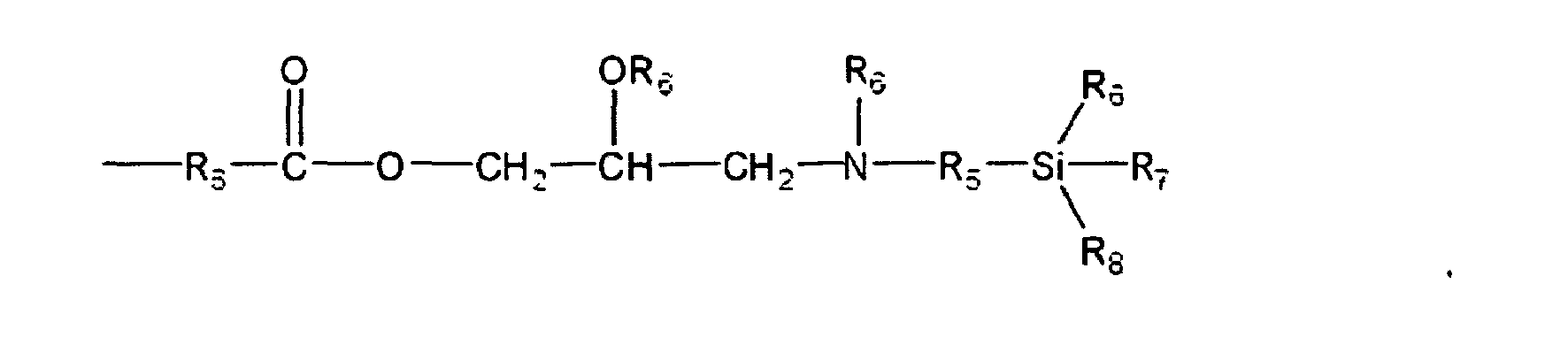


in the polar groups,
R5 is the same or different from each other and is independently a linear or branched C1-C20 alkylene which is unsubstituted or substituted with one or more substituent group selected from a halogen, alkyl, alkenyl, alkynyl, haloalkyl, haloalkenyl, haloalkynyl, aryl, haloaryl, aralkyl, haloaralkyl, alkoxy, haloalkoxy, carbonyloxy, halocarbonyloxy, aryloxy, haloaryloxy, silyl and siloxy; a linear or branched C2-C20 alkenylene which is unsubstituted or substituted with one or more substituent group selected from a halogen, alkyl, alkenyl, alkynyl, haloalkyl, haloalkenyl, haloalkynyl, aryl, haloaryl, aralkyl, haloaralkyl, alkoxy, haloalkoxy, carbonyloxy, halocarbonyloxy, aryloxy, haloaryloxy, silyl and siloxy; a linear or branched C2-C20 alkynylene which is unsubstituted or substituted with one or more substituent group selected from a halogen, alkyl, alkenyl, alkynyl, haloalkyl, haloalkenyl, haloalkynyl, aryl, haloaryl, aralkyl, haloaralkyl, alkoxy, haloalkoxy, carbonyloxy, halocarbonyloxy, aryloxy, haloaryloxy, silyl and siloxy; a C3-C12 cycloalkylene which is unsubstituted or substituted with one or more substituent group selected from a halogen, alkyl, alkenyl, alkynyl, haloalkyl, haloalkenyl, haloalkynyl, aryl, haloaryl, aralkyl, haloaralkyl, alkoxy, haloalkoxy, carbonyloxy, halocarbonyloxy, aryloxy, haloaryloxy, silyl and siloxy; C6-C40 arylene which is unsubstituted or substituted with one or more substituent group selected from a halogen, alkyl, alkenyl, alkynyl, haloalkyl, haloalkenyl, haloalkynyl, aryl, haloaryl, aralkyl, haloaralkyl, alkoxy, haloalkoxy, carbonyloxy, halocarbonyloxy, aryloxy, haloaryloxy, silyl and siloxy; C1-C20 alkoxylene which is unsubstituted or substituted with one or more substituent group selected from a halogen, alkyl, alkenyl, alkynyl, haloalkyl, haloalkenyl, haloalkynyl, aryl, haloaryl, aralkyl, haloaralkyl, alkoxy, haloalkoxy, carbonyloxy, halocarbonyloxy, aryloxy, haloaryloxy, silyl and siloxy; or C1-C20 carbonyloxylene which is unsubstituted or substituted with one or more substituent group selected from a halogen, alkyl, alkenyl, alkynyl, haloalkyl, haloalkenyl, haloalkynyl, aryl, haloaryl, aralkyl, haloaralkyl, alkoxy, haloalkoxy, carbonyloxy, halocarbonyloxy, aryloxy, haloaryloxy, silyl and siloxy; and
R6, R7 and R8 are the same or different from each other and is independently hydrogen; a halogen; a linear or branched C1-C20 alkyl which is unsubstituted or substituted with one or more substituent group selected from a halogen, alkyl, alkenyl, alkynyl, haloalkyl, haloalkenyl, haloalkynyl, aryl, haloaryl, aralkyl, haloaralkyl, alkoxy, haloalkoxy, carbonyloxy, halocarbonyloxy, aryloxy, haloaryloxy, silyl and siloxy; a linear or branched C2-C20 alkenyl which is unsubstituted or substituted with one or more substituent group selected from a halogen, alkyl, alkenyl, alkynyl, haloalkyl, haloalkenyl, haloalkynyl, aryl, haloaryl, aralkyl, haloaralkyl, alkoxy, haloalkoxy, carbonyloxy, halocarbonyloxy, aryloxy, haloaryloxy, silyl and siloxy; a linear or branched C2-C20 alkynyl which is unsubstituted or substituted with one or more substituent group selected from a halogen, alkyl, alkenyl, alkynyl, haloalkyl, haloalkenyl, haloalkynyl, aryl, haloaryl, aralkyl, haloaralkyl, alkoxy, haloalkoxy, carbonyloxy, halocarbonyloxy, aryloxy, haloaryloxy, silyl and siloxy; a C3-C12 cycloalkyl which is unsubstituted or substituted with one or more substituent group selected from a halogen, alkyl, alkenyl, alkynyl, haloalkyl, haloalkenyl, haloalkynyl, aryl, haloaryl, aralkyl, haloaralkyl, alkoxy, haloalkoxy, carbonyloxy, halocarbonyloxy, aryloxy, haloaryloxy, silyl and siloxy; C6-C40 aryl which is unsubstituted or substituted with one or more substituent group selected from a halogen, alkyl, alkenyl, alkynyl, haloalkyl, haloalkenyl, haloalkynyl, aryl, haloaryl, aralkyl, haloaralkyl, alkoxy, haloalkoxy, carbonyloxy, halocarbonyloxy, aryloxy, haloaryloxy, silyl and siloxy; C1-C20 alkoxy which is unsubstituted or substituted with one or more substituent group selected from a halogen, alkyl, alkenyl, alkynyl, haloalkyl, haloalkenyl, haloalkynyl, aryl, haloaryl, aralkyl, haloaralkyl, alkoxy, haloalkoxy, carbonyloxy, halocarbonyloxy, aryloxy, haloaryloxy, silyl and siloxy; or C1-C20 carbonyloxy which is unsubstituted or substituted with one or more substituent group selected from a halogen, alkyl, alkenyl, alkynyl, haloalkyl, haloalkenyl, haloalkynyl, aryl, haloaryl, aralkyl, haloaralkyl, alkoxy, haloalkoxy, carbonyloxy, halocarbonyloxy, aryloxy, haloaryloxy, silyl and siloxy; and
m is independently an integer from 1 to 10. - In the photoreactive norbornene polymer according to the present invention, the halogen in Chemical Formulae (1a) and (1b) comprises F, Cl, Br and I, and is more preferably F, but it is not limited thereto.
- In the photoreactive norbornene polymer according to the present invention, it is more preferable that R1 in Chemical Formula (1) is represented by Chemical Formula (1a) and at least one of R10, R11, R12, R13, and R14 is F or C1-C20 alkyl substituted with F.
- The photoreactive norbornene polymer of the present invention can include a repeating unit represented by Chemical Formula (2) as follows:

- Definition of the substituents described above will now be described in detail.
- The term "alkyl" refers to a straight or branched chain, monovalent, saturated hydrocarbon with 1 to 20 carbon atoms, preferably 1 to 10 carbon atoms, and more preferably 1 to 6 carbon atoms. The alkyl group can be substituted with one or more halogen. Examples of the alkyl group include methyl, ethyl, propyl, 2-propyl, n-butyl, iso-butyl, tert-butyl, pentyl, hexyl, dodecyl, fluoromethyl, difluoromethyl, trifluoromethyl, chloromethyl, dichloromethyl, trichloromethyl, iodomethyl, bromomethyl, and the like.
- The term "alkenyl" refers to a straight or branched chain, monovalent hydrocarbon including at least one C-C double bond with 2 to 20 carbon atoms, preferably 2 to 10 carbon atoms, and more preferably 2 to 6 carbon atoms. The alkenyl group can be bonded through a carbon atom including a C-C double bond or a saturated carbon atom. The alkenyl group can be substituted with one or more halogen. Examples of the alkenyl group include ethenyl, 1-prophenyl, 2-prophenyl, 2-butenyl, 3-butenyl, pentenyl, 5-hexenyl, dodecenyl, and the like.
- The term "cycloalkyl" refers to a saturated or unsaturated, non-aromatic, monovalent, mono-, bi-, or tricyclic hydrocarbon with 3 to 12 cyclic carbons. The cycloalkyl group can be substituted with one or more halogen. Examples of the cycloalkyl group include cyclopropyl, cyclobutyl, cyclopentyl, cyclopentenyl, cyclohexyl, cyclohexenyl, cycloheptyl, cyclooctyl, decahydronaphtalenyl, adamantly, norbonyl (i.e. bicyclo [2.2.1]hept-5-enyl), and the like.
- The term "aryl" refers to a monovalent, mono-, bi-, or tricyclic, aromatic hydrocarbon with 6 to 20 cyclic atoms and preferably 6 to 12 cyclic atoms. The aryl group can be substituted with one or more halogen. Examples of the aryl group include phenyl, naphthalenyl, fluorenyl, and the like.
- The "alkoxyaryl" refers to a group in which one or more hydrogen atom in the aryl as defined above is substituted with an alkoxy group. Examples of the alkoxyaryl group include methoxyphenyl, ethoxyphenyl, propoxyphenyl, butoxyphenyl, pentoxyphenyl, hexoxyphenyl, heptoxyphenyl, octoxyphenyl, nanoxyphenyl, methoxybiphenyl, ethoxybiphenyl, propoxybiphenyl, methoxynaphthalenyl, ethoxynaphthalenyl, propoxynaphthalenyl, methoxyanthracenyl, ethoxyantracenyl, propoxyanthracenyl, methoxyfluorenyl, and the like.
- The term "aralkyl" refers to a group in which at least one hydrogen atom in the alkyl group as defined above is substituted with an aryl group. The aralkyl group can be substituted with one or more halogen. Examples of the aralkyl group include benzyl, benzhydryl, trityl, and the like.
- The term "alkynyl" refers to a straight or branched chain, monovalent hydrocharbon including at least one C-C triple bond with 2 to 20 carbon atoms, preferably 2 to 10 carbon atoms, and more preferably 2 to 6 carbon atoms. The alkynyl group can be bonded through a carbon atom including a C-C triple bond or a saturated carbon atom. The alkynyl group can be substituted with one or more halogen. Examples of the alkynyl group include ethynyl, propynyl, and the like.
- The term "alkylene" refers to a straight or branched chain, bivalent, saturated hydrocarbon with 1 to 20 carbon atoms, preferably 1 to 10 carbon atoms, and more preferably 1 to 6 carbon atoms. The alkylene group can be substituted with one or more halogen. Examples of the alkylene group include methylene, ethylene, propylene, butylene, hexylene, and the like.
- The term "alkenylene" refers to a straight or branched chain, bivalent hydrocarbon including at least one C-C double bond with 2 to 20 carbon atoms, preferably 2 to 10 carbon atoms, and more preferably 2 to 6 carbon atoms. The alkenylene group can be bonded through a carbon atom including a C-C double bond and/or a saturated carbon atom. The alkenylene group can be substituted with one or more halogen.
- The term "cycloalkylene" refers to a saturated or unsaturated, non-aromatic, bivalent, mono-, bi-, or tricyclic hydrocarbon with 3 to 12 cyclic carbons. The cycloalkylene group can be substituted with one or more halogen. Examples of the cycloalkylene include cyclopropylene, cyclobutylene, and the like.
- The term "arylene" refers to a bivalent, mono-, bi-, or tricyclic, aromatic hydrocarbon with 6 to 20 cyclic atoms and preferably 6 to 12 cyclic atoms. The arylene group can be substituted with one or more halogen. The aromatic portion of the arylene group includes carbon atoms only. Examples of the arylene group include phenylene and the like.
- The term "arylalkylene" refers to a bivalent part in which at least one hydrogen atom of the alkylene group as defined above is substituted with an aryl group, and it can be substituted with one or more halogen. Examples of the arylalkylene group include benzylene and the like.
- The term "alkynylene" refers to a straight or branched chain, bivalent hydrocarbon including at least one C-C triple bond with 2 to 20 carbon atoms, preferably 2 to 10 carbon atoms, and more preferably 2 to 6 carbon atoms. The alkynylene group may be bonded through a carbon atom including a C-C triple bond or a saturated carbon atom. The alkynylene group can be substituted with one or more halogen. Examples of the alkynylene group include ethynylene, propynylene, and the like.
- The weight average molecular weight of the photoreactive norbornene polymer according to the present invention is preferably 10,000 to 1,000,000 but it is not limited thereto.
- The photoreactive norbornene polymer of the present invention can be prepared by polymerizing the norbornene monomoer represented by Chemical Formula (1) at a temperature of 10 - 200°C in the presence of a catalyst composition including a procatalyst containing a
Group 10 transition metal and a cocatalyst. - In the process for preparing the photoreactive norbornene polymer according to the present invention, a reaction temperature lower than 10°C is undesirable since it can lead to a significant decrease in the polymerization activity. A reaction temperature higher than 200°C is also undesirable since it can cause decomposition of the catalyst.
- In the process for preparing the photoreactive norbornene polymer according to the present invention, as the procatalyst containing a
Group 10 transition metal, one can use a compound with a Lewis base functional group which can readily take part in a Lewis acid-base reaction to separate out from a center transition metal in order that the procatalyst can be easily divided by the cocatalyst providing a Lewis acid so that the center transition metal is transformed into a catalyst active species. Examples of the procatalyst includes Allylpalladium chloride dimer ([(Allyl)Pd(Cl)]2), Palladium(II)acetate ((CH3CO2)2Pd), Palladium(II)acetylacetonate ([CH3COCH=C(O-)CH3]2Pd), NiBr(NP(CH3)3)4, [PdCl(NB)O(CH3)]2, and the like. - In the process for preparing the photoreactive norbornene polymer according to the present invention, the cocatalyst can be at least one selected from the group consisting of: a first cocatalyst which provides a Lewis base capable of forming a weak coordinate bond with the metal of the procatalyst; and a second cocatalyst which provides a compound comprising a neutral Group 15 electron donor ligand.
- As the first cocatalyst providing a Lewis base that can form a weak coordinate bond with the metal in the procatalyst, one can use a compound easily reacting with a Lewis base to make a vacant site in a transition metal and also forming a weak coordinate bond with a transition metal compound to stabilize the generated transition metal, or a compound providing such a compound. Examples for the first cocatalyst include boranes such as B(C6F5)3, borates such as dimethylanilinium tetrakis(pentafluorophenyl) borate, alkyl aluminums such as methylaluminoxane (MAO) or Al(C2H5)3, and transition metal halides such as AgSbF6.
- Examples for the second cocatalyst providing a compound that includes a neutral Group 15 electron donor ligand include alkyl phosphine, cycloalkyl phosphine, phenyl phosphine, and the like.
- In the process for preparing the photoreactive norbornene polymer of the present invention, it is preferable that the catalyst composition comprises 1 to 1,000 mole of the first cocatalyst and 1 to 1,000 mole of the second cocatalyst with respect to 1 mole of the procatalyst. If the content of the first and the second cocatalyst is less than 1 mole, the catalyst activation may not occur. If the content of the first and the second cocatalyst is more than 1,000 moles, the level of the catalyst activation can be lowered.
- Also, one can render the first cocatalyst and the second cocatalyst into one salt and use it to activate the catalyst. For example, a compound prepared by combining an alkyl phosphine with a borane to form an ionic bond therebetween can be used.
- Further, the present invention provides an alignment layer comprising the photoreactive norbornene polymer.
- Further, the present invention provides an alignment film comprising the photoreactive norbornene polymer.
- The alignment layer and the alignment film can be manufactured by using any components and methods known in the art, except for comprising the photoreactive norbornene polymer of the present invention.
- By way of examples, the alignment layer and the alignment film can be prepared by mixing the photoreactive norbornene polymer with a binder resin and a photoinitiator, dissolving them in an organic solvent, and then coating it onto a substrate and UV-curing it.
- Acrylates can be used as the binder resin, and more specifically, pentaerythritol triacrylate, dipentaerythritol hexaacrylate, trimethylolpropane triacrylate, tris(2-acrylolyloxyethyl) isocyanurate can be exemplified.
- Examples for the photoinitiator includes Irgacure 907, Irgacure 819, and the like.
- Examples of the organic solvent include toluene, anisole, chlorobenzene, dichloroethane, cyclohexane, cyclopentane, propylene glycol methyl ether acetate, and the like.
- In mixing the photoreactive norbornene polymer, the binder resin, and the photoinitiator and dissolving them in the organic solvent, the solid content of the solution properly ranges from 1 to 15%, and is preferably from 10 to 15% for casting it as a film and from 1 to 5% for preparing it as a thin film.
- Examples of the substrate include a substrate comprising a cyclic polymer, a substrate comprising an acrylic polymer, a substrate comprising a cellulose polymer, and the like. As a coating method, one can use a bar coating, spin coating, blade coating, and the like.
- Hereinafter, the present invention will be explained in further detail with reference to the following examples, however it should be understood that these examples are merely illustrative of the present invention and they are not intended to limit the scope of the present invention.
- 10g (80.6mmol) of 4-fluoro-benzaldehyde, 29.5g (2eq.) of malonic acid, and 1.21g (0.1 eq.) of piperidine were added to 33.7g (3eq.) of pyridine and stirred at room temperature for about 1 hour. After heating it to 80°C, the mixture was stirred for 12 hours. After the reaction, the resulting solution cooled down to room temperature and was slowly added with 1M HCl until it was titrated to about
pH 4. The resulting powder was filtered and washed with water, and then dried in a vacuum oven. (Yield: 90%)
1H-NMR (CDCl3, ppm) 6.42(d, 1H) 7.44(d, 2H) 7.75(d, 2H) 7.80(d, 1H). - 5g (40.1mmol) of 3-fluoro benzaldehyde, 8.38g (2eq.) of malonic acid, and 0.34g (0.1eq.) of piperidine were added to 9.52g (3eq.) of pyridine and stirred at room temperature for about 1 hour. After heating it to 80°C, the mixture was stirred for 12 hours. After the reaction, the resulting solution cooled to room temperature and was slowly added with 1 M HCl until it was titrated to about
pH 4. The resulting powder was filtered and washed with water, and then dried in a vacuum oven. (Yield: 84%)
1H-NMR (CDCl3, ppm): 6.43(d, 1H) 7.12-7.41 (m, 4H) 7.75(d, 1H). - 10g (70.4mmol) of 3,4-di-fluoro-benzaldehyde, 14.65g (2eq.) of malonic acid, and 0.59g (0.1eq.) of piperidine were added to 16.7g (3eq.) of pyridine and stirred at room temperature for about 1 hour. After heating it to 80°C, the mixture was stirred for 12 hours. After the reaction, the resulting solution cooled down to room temperature and was slowly added with 1 M HCl until it was titrated to about
pH 4. The resulting powder was filtered and washed with water, and then dried in a vacuum oven. (Yield: 95%)
1H-NMR (CDCl3, ppm): 6.41 (d, 1H) 7.15-7.45(m, 3H) 7.68(d, 1H). - 20g (42mmol) of pentafluoro-benzaldehyde, 21.23g (2eq.) of malonic acid, and 0.85g (0.1eq.) of piperidine were added to 24g (3eq.) of pyridine and stirred at room temperature for about 1 hour. After heating it to 80°C, the mixture was stirred for 12 hours. After the reaction, the resulting solution was cooled down to room temperature and was slowly added with 1 M HCl until it was titrated to about
pH 4. The resulting powder was filtered and washed with water, and then dried in a vacuum oven. (Yield: 13%)
1H-NMR (CDCl3, ppm): 6.76(d, 1H) 7.80(d, 1H) - 132g (1mol) of dicyclopentadiene and 116.2g (2mol) of allyl alcohol were placed into a 300ml high-pressure reactor and stirred at 190°C for 3 to 4 hours. The resulting solution was distilled at 80°C under vacuum to give 5-norbornene-2-methanol. (Yield: 67%, 166g)
1H-NMR (CDCl3, ppm) 0.5(dd, 1H) 1.1(m, 1H) 1.2∼1.45(m, 2H) 1.58∼1.8(m, 1H) 2.31 (b, 1H) 2.76∼2.92(m, 2H) 3.25∼4.6(m, 2H) 5.96∼6.17(m, 2H) - 132g (1mol) of dicyclopentadiene and 172.2g (2mol) of vinyl acetate were placed into a 300ml high-pressure reactor and stirred at 190°C for 3 to 4 hours. The resulting solution was distilled at 80°C under vacuum to give 5-norbornene-2-acetate. (Yield: 61%, 186g)
- 100g of 5-norbornene-2-acetate and 2eq. of NaOMe were dissolved in 300ml of MC and then refluxed for 5 hours. After the extraction by water, the resulting product was acidified with 1 M HCl to
pH 2∼3 and then 5-norbornene-2-ol was extracted by using EA. (Yield: 80%, 72g)
1H-NMR (CDCl3, ppm) 0.5(dd, 1H) 1.15∼1.56(m, 3H) 2.28(b, 1H) 2.66∼2.38(m, 2H) 4.1∼4.32(m, 1H) 5.88∼6.32(m, 2H) - 10g (60mmol) of 4-fluoro-cinnamic acid, 7.45g (60mmol) of 5-norbornene-2-methanol, and 0.3g (0.02eq.) of zirconium(IV) acetate hydroxide were added to 50ml of toluene and stirred. The mixture was heated to 145°C under N2 atmosphere and azeotropically refluxed for 24 hours. After the reaction, the mixture cooled down to room temperature and was added with 100 volume% of ethyl acetate. The resulting product was extracted with 1 M HCl and washed again with water. The organic layer was dried with Na2SO4 and the solvent was evaporated out to give a highly viscous material. (Yield: 68%, Purity (GC): 92%)
- 5g (43mmol) of 3-fluoro-cinnamic acid, 5.35g (43mmol) of 5-norbornene-2-methanol, and 0.21g (0.02eq.) of zirconium(IV) acetate hydroxide were added to 50ml of toluene and stirred. The mixture was heated to 145°C under N2 atmosphere and azeotropically refluxed for 24 hours. After the reaction, the mixture cooled down to room temperature and was added with 100 volume% of ethyl acetate. The resulting product was extracted by 1M HCl and washed again with water. The organic layer was dried with Na2SO4 and the solvent was evaporated out to give a highly viscous material. (Yield: 54%, Purity (GC): 73%)
- 5g (27.2mmol) of 3,4-di-fluoro-cinnamic acid, 3.38g (1eq.) of 5-norbornene-2-methanol, and 0.13g (0.02eq.) of zirconium(IV) acetate hydroxide were added to 50ml of xylene and stirred. The mixture was heated to 145°C under N2 atmosphere and azeotropically refluxed for 24 hours. After the reaction, the mixture cooled down to room temperature and was added with 100 volume% of ethyl acetate. The resulting product was extracted by 1M HCl and washed again with water. The organic layer was dried with Na2SO4 and the solvent was evaporated out to give a highly viscous material. (Yield: 63%, Purity (GC): 80%)
- 10g (42mmol) of pentafluoro-cinnamic acid, 5.7g (1eq.) of 5-norbornene-2-methanol and 0.2g (0.02eq.) of zirconium(IV) acetate hydroxide were added to 50ml of xylene and stirred. The mixture was heated to 145°C under N2 atmosphere and azeotropically refluxed for 24 hours. After the reaction, the mixture cooled down to room temperature and was added with 100 volume% of ethyl acetate. The resulting product was extracted by 1 M HCl and washed again with water. The organic layer was dried with Na2SO4 and the solvent was evaporated out to give a highly viscous material. (Yield: 32%, Purity (GC): 85%)
- 10g (60mmol) of 4-fluoro-cinnamic acid, 6.6g (60mmol) of 5-norbornene-2-ol, and 0.3g (0.02eq.) of zirconium(IV) acetate hydroxide were added to 50ml of toluene and stirred. The mixture was heated to 145°C under N2 atmosphere and azeotropically refluxed for 24 hours. After the reaction, the mixture cooled down to room temperature and was added with 100 volume% of ethyl acetate. The resulting product was extracted by 1 M HCl and washed again with water. The organic layer was dried with Na2SO4 and the solvent was evaporated out to give a highly viscous material. (Yield: 72%, Purity (GC): 95%)
- After 5g (18.4mmol) of 5-norbornene-2-methyl-(4-fluoro-cinnamate) was dissolved in 15ml of toluene, the solution was stirred for 30 minutes while purging it with N2. The solution was heated to 90°C, added with 4.13mg (18.4µmol) of Pd(acetate)2 and 37.2mg (38.6µmol) of tris(cyclohexyl) hydrogen phosphino tetrakis(pentafluorobenz)borate that were dissolved in 1ml of methylene chloride, and then stirred at 90°C for 15 hours. After the reaction, the resulting product cooled down to room temperature and was added with ethanol to give precipitates. The precipitates were filtered and dried in a vacuum oven.
(Yield: 85%, Mw: 158,000 (PDI = 2.88)) - After 5g (18.4mmol) of 5-norbornene-2-methyl-(3-fluoro-cinnamate) was dissolved in 15ml of toluene, the solution was stirred for 30 minutes while purging it with N2. The solution was heated to 90°C, added with 4.1 mg (18.4µmol) of Pd(acetate)2 and 37.1 mg (38.6µmol) of tris(cyclohexyl) hydrogen phosphino tetrakis(pentafluorobenz)borate that were dissolved in 1ml of methylene chloride, and then stirred at 90°C for 15 hours. After the reaction, the resulting product cooled down to room temperature and was added with ethanol to give precipitates. The precipitates were filtered and dried in a vacuum oven.
(Yield: 42%, Mw: 23,000 (PDI = 2.05)) - After 5g (17.2mmol) of 5-norbornene-2-methyl-(3,4-di-fluoro-cinnamate) was dissolved in 15ml of toluene, the solution was stirred for 30 minutes while purging it with N2. The solution was heated to 90°C, added with 1.29mg (5.7µmol) of Pd(acetate)2 and 11.5mg (11.97µmol) of tris(cyclohexyl) hydrogen phosphino tetrakis(pentafluorobenz)borate that were dissolved in 1ml of methylene chloride, and then stirred at 90°C for 15 hours. After the reaction, the resulting product cooled down to room temperature and was added with ethanol to give precipitates. The precipitates were filtered and dried in a vacuum oven.
(Yield: 65%, Mw: 85,000 (PDI = 2.11)) - After 5g (14.3mmol) of 5-norbornene-2-methyl-(perfluoro-cinnamate) was dissolved in 15ml of toluene, the solution was stirred for 30 minutes while purging it with N2. The solution was heated to 90°C, added with 1.07mg (4.7µmol) of Pd(acetate)2 and 11.5mg (11.97µmol) of tris(cyclohexyl) hydrogen phosphino tetrakis(pentafluorobenz)borate that were dissolved in 1ml of methylene chloride, and then stirred at 90°C for 15 hours. After the reaction, the resulting product cooled down to room temperature and was added with ethanol to give precipitates. The precipitates were filtered and dried in a vacuum oven.
(Yield: 23%, Mw: 25,000 (PDI = 3.55)) - After 4.75g (18.4mmol) of 5-norbornene-2-(4-fluoro-cinnamate) was dissolved in 15ml of toluene, the solution was stirred for 30 minutes while purging it with N2. The solution was heated to 90°C, added with 4.13mg (18.4µmol) of Pd(acetate)2 and 37.2mg (38.6µmol) of tris(cyclohexyl) hydrogen phosphino tetrakis(pentafluorobenz)borate that were dissolved in 1ml of methylene chloride, and then stirred at 90°C for 15 hours. After the reaction, the resulting product cooled down to room temperature and was added with ethanol to give precipitates. The precipitates were filtered and dried in a vacuum oven.
(Yield: 78%, Mw: 132,000 (PDI = 2.13)) - In order to investigate photoreactivity and anisotropy for the photoreactive norbornene polymers obtained from Examples 6 and 7, absorbance was determined for each polymer by using a UV-visible Spectrometer. The photoreactive norbornene polymer of Example 6 or Example 7 (2wt%), pentaerythritol triacrylate (PETA) (2wt%) and Irgacure 819 (0.2wt%) were dissolved in a solvent. The resulting solution was spin-coated onto a quartz plate at 4,000 rpm for 30 second, was dried at 80°C for 2 minutes, and then irradiated with a light of 15mw/cm2 by using a UV irradiator with a polarizing plate being disposed in front of a UV lamp. Absorbances in vertical direction and in horizontal direction were determined for each sample as irradiated over time to calculate the anisotropy ((A⊥-A ∥ )/(A⊥+A ∥)). The reactivity was calculated through the amount of the remaining double bond of the cinnamate group ((A⊥+A ∥ )/2). The results are shown in
Fig. 3 . - In order to determine the orientation of liquid crystals for the alignment layer comprising the polymer of Example 6 or Example 7, the same solutions as described in Experimental Example 1 were prepared, bar-coated on the same substrate as described above, and then dried in a oven at 60°C for 2 minutes. Liquid crystals that can splay were also bar coated thereto and dried at 80°C for 2 minutes. After that, the orientation was determined with the naked eye and by using a polarized microscope. As comparative experimental examples, comparison was also made with photoalignment polymers having an alkoxy substituent group or an alkyl substituent group. The results for these experimentations are shown in Table 1 as follows.
Table 1 Polymer Binder Orientation1 Adhesion2 Experimental Example
2-13F PETA ○ ○ Experimental Example
2-23F DPHA △ ○ Experimental Example
2-33F Isocyanurate △ ○ Experimental Example
2-44F PETA ○ ○ Experimental Example
2-54F DPHA ○ ○ Experimental Example
2-64F Isocyanurate △ ○ Experimental Example
2-74F(2) PETA ○ ○ Experimental Example
2-84F(2) DPHA ○ ○ Experimental Example
2-94F(2) Isocyanurate △ ○ Comparative
Exp. Example 2-1EtO PETA ○ △ Comparative
Exp. Example 2-2EtO DPHA × △ Comparative
Exp. Example 2-3EtO Isocyanurate × × Comparative
Exp. Example 2-4Et PETA ○ △ Comparative
Exp. Example 2-5Et DPHA X △ Comparative
Exp. Example 2-6Et Isocyanurate X X Comparative
Exp. Example 2-7PVCi PETA △ △ Comparative
Exp. Example 2-8PVCi DPHA X △ Comparative
Exp. Example 2-9PVCi Isocyanurate X X 3F : 5-norbornene-2-methyl-(3-fluoro-cinnamate)
4F : 5-norbornene-2-methyl-(4-fluoro-cinnamate)
4F(2) : 5-norbornene-2-(4-fluoro-cinnamate)
EtO : 5-norbornene-2-methyl-(4-ethoxy cinnamate)
Et: 5-norbornene-2-methyl-(4-ethyl cinnamate)
PVCi : poly(vinyl cinnamate)
PETA : pentaerythritol triacrylate
DPHA : dipentaerythritol hexaacrylate
Isocyanurate : tris(2-acrylolyloxyethyl) isocyanurate - With regard to the "orientation" in Table 1, after each of the alignment layers was UV-cured with a constant intensity of the radiation, 100mJ/cm2, the orientation of the liquid crystals was evaluated in accordance with the following standards: ○ = the orientation was excellent throughout the whole surface; △ = a haze was observed ; X = no orientation occurred.
- Also, the "adhesion" property was evaluated by using a tape testing method in accordance with the following standards: ○ = tape testing > 95% ; △ = tape testing > 50% ; X = tape testing < 50%.
- As confirmed by the results of Table 1, polymers substituted with fluorine gave a better result in the orientation and the adhesion property than polymers with other substituent groups. Due to a substance gradient occurring in a thin layer by fluorine, the alignment layer material is more abundant near the surface and the binder is more abundant near the substrate. This gives a superior orientation and an excellent adhesion to the substrate. Also, by comparison, PVCi is inferior to norbornene in the orientation and the adhesion property. Because PVCi fails to have such a thermal, structural stability as the norbornene has, it imparts little or no orientation and also shows a poor adhesion property as no gradient in the material concentration occurs.
- A depth profile was determined with an ESCA for an alignment layer prepared by using the photoreactive norbornene polymer obtained from Example 3 in the same manner as described in Experimental Example 1. A chemical species to be identified was fluorine, and the results are shown in
FIG. 4 . - As understood from
FIG. 4 , for each substrate, the amount of fluorine is higher on the surface, and it gradually decreases toward the substrate. - In the alignment layer, the capability of orienting liquid crystals depends on the concentration of the alignment material on the surface of the alignment layer. When an alignment layer purely consists of an alignment material, the concentration of the alignment material is so high that the orientation capability can be improved, but the hardness of the alignment layer would be deteriorated. For that reason mixed is a binder such as acrylates, which in turn causes a decrease in the concentration of the alignment material and thus a deterioration of the orientation capability.
- From the results shown in
FIG. 3 , it can be understood that the alignment layers have a high anisotropy when they purely consist of the alignment material regardless of the substituent group. Also, fromFIG. 3 , it can be understood that when the alignment material is mixed with a binder, the alignment layers have a similar anisotropy regardless of the substituent. - As the anisotropy and the reactivity are determined by the UV-visible spectrometer, it cannot be identified how much of the alignment material exists in the vicinity of the surface of the alignment layer. When we actually oriented the liquid crystals, we found that the degree of the orientation of the liquid crystals varied depending on the type the substituent group. (see Table 1)
- We presumed that this is because a gradient from the substrate to the surface occurred in the alignment materials forming the alignment layer and confirmed this presumption through an ESCA. (see
FIG. 4 ) - In the case of fluorine, regardless of the substrate, it was distributed most on the surface and its amount gradually decreased toward the substrate, which means that the alignment material having the fluorine substituent group is most abundant on the surface. By comparison, in the methoxy and the ethoxy substituent groups, the results varied depending on the substrate and the gradient was not so large as in the fluorine substituent group. Therefore, the fluorine substituent makes the alignment materials go up toward the surface of the alignment layer and thus the alignment materials have a better orientation capability than other cinnamate alignment materials with different substituent groups.
Claims (12)
- A photoreactive norbornene polymer including a norbornene monomer represented by Chemical Formula (1) :

p is an integer from 0 to 4; and
at least one of R1, R2, R3, and R4 is a radical selected from the group consisting of a group represented by Chemical Formula (1a) and a group represented by Chemical Formula (1b); and the rest of them are the same or different from each other and are independently selected from the group consisting of hydrogen; a halogen; a linear or branched C1-C20 alkyl group which is unsubstituted or substituted with one or more substituent group selected from a halogen, alkyl, alkenyl, alkynyl, haloalkyl, haloalkenyl, haloalkynyl, aryl, haloaryl, aralkyl, haloaralkyl, alkoxy, haloalkoxy, carbonyloxy, halocarbonyloxy, aryloxy, haloaryloxy, silyl and siloxy; a linear or branched C2-C20 alkenyl group which is unsubstituted or substituted with one or more substituent group selected from a halogen, alkyl, alkenyl, alkynyl, haloalkyl, haloalkenyl, haloalkynyl, aryl, haloaryl, aralkyl, haloaralkyl, alkoxy, haloalkoxy, carbonyloxy, halocarbonyloxy, aryloxy, haloaryloxy, silyl and siloxy; a linear or branched C2-C20 alkynyl group which is unsubstituted or substituted with one or more substituent group selected from a halogen, alkyl, alkenyl, alkynyl, haloalkyl, haloalkenyl, haloalkynyl, aryl, haloaryl, aralkyl, haloaralkyl, alkoxy, haloalkoxy, carbonyloxy, halocarbonyloxy, aryloxy, haloaryloxy, silyl and siloxy; C3-C12 cycloalkyl group which is unsubstituted or substituted with one or more substituent group selected from a halogen, alkyl, alkenyl, alkynyl, haloalkyl, haloalkenyl, haloalkynyl, aryl, haloaryl, aralkyl, haloaralkyl, alkoxy, haloalkoxy, carbonyloxy, halocarbonyloxy, aryloxy, haloaryloxy, silyl and siloxy; C6-C40 aryl group which is unsubstituted or substituted with one or more substituent group selected from a halogen, alkyl, alkenyl, alkynyl, haloalkyl, haloalkenyl, haloalkynyl, aryl, haloaryl, aralkyl, haloaralkyl, alkoxy, haloalkoxy, carbonyloxy, halocarbonyloxy, aryloxy, haloaryloxy, silyl and siloxy; and a polar group comprising at least one of oxygen, nitrogen, phosphorous, sulfur, silicon and boron; and
when none of R1, R2, R3, and R4 is hydrogen, the halogen, or the polar group, both of R1 and R2 or both of R3, and R4 can be linked to each other to form C1-C10 alkylidene group, or R1 or R2 can be linked to one of R3 and R4 to form a saturated or unsaturated C4-C12 aliphatic ring or a C6-C24 aromatic ring; and

A is a direct bond, -O-, -S-, or -NH-; and
B is selected from the group consisting of a direct bond, a substituted or unsubstituted C1-C20 alkylene, carbonyl, carboxy, ester, a substituted or unsubstituted C6-C40 arylene, and a substituted or unsubstituted C6-C40 heteroarylene; and
X is -O- or -S-; and
R9 is selected from the group consisting of a direct bond, a substituted or unsubstituted C1-C20 alkylene, a substituted or unsubstituted C2-C20 alkenylene, a substituted or unsubstituted C3-C12 cycloalkylene, a substituted or unsubstituted C6-C40 arylene, a substituted or unsubstituted C7-C15 arylalkylene, and a substituted or unsubstituted C2-C20 alkynylene; and
at least one of R10, R11, R12, R13, and R14 is a halogen or a C1-C20 alkyl substituted with a halogen; and the rest of them are the same or different from each other and are independently selected from the group consisting of a substituted or unsubstituted C1-C20 alkyl, a substituted or unsubstituted C1-C20 alkoxy, a substituted or unsubstituted C6-C30 aryloxy, a substituted or unsubstituted C6-C40 aryl, C6-C40 heteroaryl including a heteroatom of Group 14, Group 15, or Group 16, and a substituted or unsubstituted C6-C40 alkoxyaryl. - The photoreactive norbornene polymer according to Claim 1, wherein the halogen in Chemical Formulae (1a) and (1b) is selected from the group consisting of F, Cl, Br, and I.
- The photoreactive norbornene polymer according to Claim 1, wherein R1 of Chemical Formula (1) is represented by Chemical Formula (1a), and at least one of R10, R11, R12, R13, and R14 of Chemical Formula (1a) is F or C1-C20 alkyl substituted with F.
- The photoreactive norbornene polymer according to Claim 1, wherein the photoreactive norbornene polymer includes a repeating unit represented by Chemical Formula (2):

- The photoreactive norbornene polymer according to Claim 1, wherein the photoreactive norbornene polymer has a weight average molecular weight ranging from 10,000 to 1,000,000.
- A process for preparing a photoreactive norbornene polymer which comprises polymerizing a norbornene monomer represented by Chemical Formula (1) at a temperature of 10 - 200°C in the presence of a catalyst composition including a procatalyst containing a Group 10 transition metal and a
cocatalyst:
p is an integer from 0 to 4; and
at least one of R1, R2, R3, and R4 is a radical selected from the group consisting of a group represented by Chemical Formula (1a) and a group represented by Chemical Formula (1b); and the rest of them are the same or different from each other and are independently selected from the group consisting of hydrogen; a halogen; a linear or branched C1-C20 alkyl group which is unsubstituted or substituted with one or more substituent group selected from a halogen, alkyl, alkenyl, alkynyl, haloalkyl, haloalkenyl, haloalkynyl, aryl, haloaryl, aralkyl, haloaralkyl, alkoxy, haloalkoxy, carbonyloxy, halocarbonyloxy, aryloxy, haloaryloxy, silyl and siloxy; a linear or branched C2-C20 alkenyl group which is unsubstituted or substituted with one or more substituent group selected from a halogen, alkyl, alkenyl, alkynyl, haloalkyl, haloalkenyl, haloalkynyl, aryl, haloaryl, aralkyl, haloaralkyl, alkoxy, haloalkoxy, carbonyloxy, halocarbonyloxy, aryloxy, haloaryloxy, silyl and siloxy; a linear or branched C2-C20 alkynyl group which is unsubstituted or substituted with one or more substituent group selected from a halogen, alkyl, alkenyl, alkynyl, haloalkyl, haloalkenyl, haloalkynyl, aryl, haloaryl, aralkyl, haloaralkyl, alkoxy, haloalkoxy, carbonyloxy, halocarbonyloxy, aryloxy, haloaryloxy, silyl and siloxy; C3-C12 cycloalkyl group which is unsubstituted or substituted with one or more substituent group selected from a halogen, alkyl, alkenyl, alkynyl, haloalkyl, haloalkenyl, haloalkynyl, aryl, haloaryl, aralkyl, haloaralkyl, alkoxy, haloalkoxy, carbonyloxy, halocarbonyloxy, aryloxy, haloaryloxy, silyl and siloxy; C6-C40 aryl group which is unsubstituted or substituted with one or more substituent group selected from a halogen, alkyl, alkenyl, alkynyl, haloalkyl, haloalkenyl, haloalkynyl, aryl, haloaryl, aralkyl, haloaralkyl, alkoxy, haloalkoxy, carbonyloxy, halocarbonyloxy, aryloxy, haloaryloxy, silyl and siloxy; and a polar group comprising at least one of oxygen, nitrogen, phosphorous, sulfur, silicon and boron; and
when none of R1, R2, R3, and R4 is hydrogen, the halogen, or the polar group, both of R1 and R2 or both of R3, and R4 can be linked to each other to form C1-C10 alkylidene group, or R1 or R2 can be linked to one of R3 and R4 to form a saturated or unsaturated C4-C12 aliphatic ring or a C6-C24 aromatic ring; and

A is a direct bond, -O-, -S-, or -NH-; and
B is selected from the group consisting of a direct bond, a substituted or unsubstituted C1-C20 alkylene, carbonyl, carboxy, ester, a substituted or unsubstituted C6-C40 arylene, and a substituted or unsubstituted C6-C40 heteroarylene; and
X is -O- or -S-; and
R9 is selected from the group consisting of a direct bond, a substituted or unsubstituted C1-C20 alkylene, a substituted or unsubstituted C2-C20 alkenylene, a substituted or unsubstituted C3-C12 cycloalkylene, a substituted or unsubstituted C6-C40 arylene, a substituted or unsubstituted C7-C15 arylalkylene, and a substituted or unsubstituted C2-C20 alkynylene; and
at least one of R10, R11, R12, R13, and R14 is a halogen or a C1-C20 alkyl substituted with a halogen; and the rest of them are the same or different from each other and are independently selected from the group consisting of a substituted or unsubstituted C1-C20 alkyl, a substituted or unsubstituted C1-C20 alkoxy, a substituted or unsubstituted C6-C30 aryloxy, a substituted or unsubstituted C6-C40 aryl, C6-C40 heteroaryl including a heteroatom of Group 14, Group 15, or Group 16, and a substituted or unsubstituted C6-C40 alkoxyaryl. - The process for preparing a photoreactive norbornene polymer according to Claim 6, wherein the procatalyst includes at least one selected from the group consisting of Allylpalladium chloride dimer ([(Allyl)Pd(Cl)]2), Palladium(II)acetate ((CH3CO2)2Pd), Palladium(II)acetylacetonate ([CH3COCH=C(O-)CH3]2Pd), NiBr(NP(CH3)3)4, and [PdCl(NB)O(CH3)]2.
- The process for preparing a photoreactive norbornene polymer according to Claim 6, wherein the cocatalyst comprises at least one selected from the group consisting of a first cocatalyst which provides a Lewis base capable of forming a weak coordinate bond with the metal of the procatalyst; and a second cocatalyst which provides a compound including a neutral Group 15 electron donor ligand.
- An alignment layer comprising the photoreactive norbornene polymer according to any one of Claims 1 to 5.
- The alignment layer according to Claim 9, wherein the alignment layer is prepared by mixing a phtoreactive norbornene polymer, a binder resin, and a phtoinitiator, dissolving them in an organic solvent, coating it onto a substrate and UV- curing it.
- The alignment layer according to Claim 10, wherein the binder resin comprises at least one acrylate selected from the group consisting of pentaerythritol triacrylate, dipentaerythritol hexaacrylate, trimethylolpropane triacrylate, and tris(2-acrylolyloxyethyl) isocyanurate.
- An alignment film comprising the photoreactive norbornene polymer according to any one of Claims 1 to 5.
Applications Claiming Priority (3)
| Application Number | Priority Date | Filing Date | Title |
|---|---|---|---|
| KR20090002316 | 2009-01-12 | ||
| PCT/KR2010/000171 WO2010080010A2 (en) | 2009-01-12 | 2010-01-12 | Norbornene polymer including photoreactive functional group that has halogen substituent, method for preparing the same, and alignment layer using the same |
| KR1020100002496A KR100982394B1 (en) | 2009-01-12 | 2010-01-12 | Norbornene polymer comprising photoreactive functional group with halogen substituents, method for preparing the same, and algnment layer using the same |
Publications (3)
| Publication Number | Publication Date |
|---|---|
| EP2386588A2 true EP2386588A2 (en) | 2011-11-16 |
| EP2386588A4 EP2386588A4 (en) | 2012-08-29 |
| EP2386588B1 EP2386588B1 (en) | 2015-08-19 |
Family
ID=42642964
Family Applications (1)
| Application Number | Title | Priority Date | Filing Date |
|---|---|---|---|
| EP10729352.4A Active EP2386588B1 (en) | 2009-01-12 | 2010-01-12 | Norbornene polymer including photoreactive functional group that has halogen substituent, method for preparing the same, and alignment layer using the same |
Country Status (6)
| Country | Link |
|---|---|
| US (2) | US8343597B2 (en) |
| EP (1) | EP2386588B1 (en) |
| JP (1) | JP5888982B2 (en) |
| KR (1) | KR100982394B1 (en) |
| CN (1) | CN102216364B (en) |
| WO (1) | WO2010080010A2 (en) |
Cited By (1)
| Publication number | Priority date | Publication date | Assignee | Title |
|---|---|---|---|---|
| JP2015071621A (en) * | 2010-09-27 | 2015-04-16 | エルジー・ケム・リミテッド | Cyclic olefin compound, photoreactive polymer, and alignment layer comprising the same |
Families Citing this family (25)
| Publication number | Priority date | Publication date | Assignee | Title |
|---|---|---|---|---|
| WO2010080010A2 (en) | 2009-01-12 | 2010-07-15 | 주식회사 엘지화학 | Norbornene polymer including photoreactive functional group that has halogen substituent, method for preparing the same, and alignment layer using the same |
| JP5048742B2 (en) * | 2009-11-06 | 2012-10-17 | 株式会社ジャパンディスプレイイースト | Liquid crystal display |
| KR101503003B1 (en) * | 2010-07-23 | 2015-03-16 | 주식회사 엘지화학 | Composition for liquid crystal alignment layer and liquid crystal alignment layer |
| US9150678B2 (en) * | 2010-09-27 | 2015-10-06 | Lg Chem, Ltd. | Photoreactive polymer and alignment layer comprising the same |
| KR101544562B1 (en) | 2010-09-27 | 2015-08-17 | 주식회사 엘지화학 | Cyclic olefin compound having photoreactive group and photoreactive polymer |
| WO2013036312A1 (en) | 2011-08-19 | 2013-03-14 | Avery Dennison Corporation | Blends of ethylene copolymers and propylene based plastomers in multilayer films for low noise and rf welding |
| US9052548B2 (en) | 2011-11-28 | 2015-06-09 | Lg Chem, Ltd. | Photo-curable composition, optical anistropic film and its preparation method |
| EP2918408A1 (en) | 2011-12-22 | 2015-09-16 | Avery Dennison Corporation | Flexible Barrier Films Containing Cyclic Olefins |
| JP2013177561A (en) * | 2012-02-03 | 2013-09-09 | Jnc Corp | Polymer composition having photo-orientable group, liquid crystal oriented film formed from the polymer composition, and liquid crystal display device including retardation film formed from the liquid crystal oriented film |
| KR101574734B1 (en) * | 2012-05-11 | 2015-12-07 | 주식회사 엘지화학 | Optical film and display device comprising the same |
| US9201271B2 (en) * | 2012-08-20 | 2015-12-01 | Lg Chem, Ltd. | Liquid crystal alignment layer and liquid crystal cell comprising the same |
| WO2014030926A1 (en) * | 2012-08-21 | 2014-02-27 | 주식회사 엘지화학 | Optical anisotropic film |
| WO2014030859A1 (en) * | 2012-08-21 | 2014-02-27 | 주식회사 엘지화학 | Optical film and indicating element comprising same |
| KR101632059B1 (en) * | 2012-08-21 | 2016-06-20 | 주식회사 엘지화학 | Optical film and display device comprising the same |
| KR101515527B1 (en) | 2012-08-21 | 2015-04-27 | 주식회사 엘지화학 | Optical anistropic film |
| JP2015533883A (en) * | 2012-09-07 | 2015-11-26 | エルジー・ケム・リミテッド | Photoalignable polymer, alignment film containing the same, and liquid crystal retardation film |
| WO2014038868A1 (en) * | 2012-09-07 | 2014-03-13 | 주식회사 엘지화학 | Photoalignment polymer, and alignment layer and liquid crystal retardation film comprising same |
| TWI487742B (en) | 2012-09-10 | 2015-06-11 | Lg Chemical Ltd | Composition for photo-alignment layer and photo-alignment layer |
| KR20150016133A (en) * | 2013-08-02 | 2015-02-11 | 주식회사 엘지화학 | Process for purification of photoreactive compound and photoreactive compound |
| WO2015016680A1 (en) * | 2013-08-02 | 2015-02-05 | 주식회사 엘지화학 | Method for purifying photoreactive compound and photoreactive compound |
| KR101719686B1 (en) * | 2013-09-30 | 2017-03-24 | 주식회사 엘지화학 | Photoreactive copolymer and alignment layer comprising the same |
| KR101732687B1 (en) | 2013-12-27 | 2017-05-04 | 주식회사 엘지화학 | Composition for forming dye type polarizer and dye type polarizer |
| WO2015099377A1 (en) | 2013-12-27 | 2015-07-02 | 주식회사 엘지화학 | Composition for forming dye polarizer and dye polarizer |
| KR101746789B1 (en) | 2014-12-18 | 2017-06-13 | 주식회사 엘지화학 | Vertical alignment layer comprising a cyclic olefin copolymer |
| CN111057028B (en) * | 2018-10-17 | 2021-12-10 | 北京师范大学 | Fluorine-containing cationic polymerization monomer and synthesis and application thereof |
Family Cites Families (22)
| Publication number | Priority date | Publication date | Assignee | Title |
|---|---|---|---|---|
| JPH0392860A (en) * | 1989-09-05 | 1991-04-18 | Fuji Photo Film Co Ltd | Photosensitive resin composition |
| JP2777056B2 (en) * | 1993-05-20 | 1998-07-16 | エルジー電子株式会社 | Liquid crystal cell alignment material |
| KR970000356B1 (en) | 1993-09-18 | 1997-01-08 | 엘지전자 주식회사 | Light polymer alignment film forming method of liquid crystal display element |
| JP3945789B2 (en) | 1997-12-19 | 2007-07-18 | 林テレンプ株式会社 | Alignment film manufacturing method, alignment film, and liquid crystal display device provided with alignment film |
| KR20020006819A (en) | 2000-07-13 | 2002-01-26 | 김일흥 | Remote control robot soccer racing vehicles |
| AU2001280856A1 (en) * | 2000-07-28 | 2002-02-13 | Goodrich Corporation | Polymeric compositions for forming optical waveguides; optical waveguides formed therefrom; and methods for making same |
| JP4553499B2 (en) * | 2001-02-28 | 2010-09-29 | 独立行政法人産業技術総合研究所 | Liquid crystal alignment agent |
| DE60224963T2 (en) * | 2001-09-13 | 2009-03-05 | Jsr Corp. | Cyclic olefin addition copolymer and process for its preparation, crosslinkable composition, crosslinked product and process for its preparation and optically transparent material and its application |
| JP2006085098A (en) * | 2004-09-17 | 2006-03-30 | Fuji Photo Film Co Ltd | Alignment layer, optical compensation sheet and liquid crystal display device |
| KR100762832B1 (en) * | 2004-12-03 | 2007-10-02 | 주식회사 엘지화학 | LIGHT-REACTIVE COMPOUND, LIQUIDIZATION LAYERING MEMBER USING THE SAME, PROCESS FOR PRODUCING THE SAME, AND LIQUID CRYSTAL DISPLAY DEVICE |
| KR100789247B1 (en) | 2005-01-05 | 2008-01-02 | 주식회사 엘지화학 | Photoreactive Polymers and Methods for Making the Same |
| WO2006078129A1 (en) | 2005-01-20 | 2006-07-27 | Lg Chem. Ltd. | Alignment film for lcd using photoreactive polymer and lcd comprising the same |
| JP2006348115A (en) | 2005-06-14 | 2006-12-28 | Fujifilm Holdings Corp | Saturated norbornene resin film and its manufacturing process, polarizing plate, optical compensation film, antireflection film, and liquid crystal display |
| KR101414347B1 (en) * | 2006-07-28 | 2014-07-02 | 후지필름 가부시키가이샤 | A norbornene polymer, a film, a polarizing plate, and a liquid crystal display |
| TW200904950A (en) | 2007-04-23 | 2009-02-01 | Lg Chemical Ltd | A retardation film, a method for preparing retardation film and polarizer comprising the retardation film |
| KR101195186B1 (en) * | 2007-11-08 | 2012-10-29 | 주식회사 엘지화학 | Norbornene polymer including photoreactive norbornene monomer and process of making the same |
| JP5124027B2 (en) | 2008-01-18 | 2013-01-23 | エルジー・ケム・リミテッド | Optical film, method for producing the same, and liquid crystal display device including the same |
| WO2009091225A2 (en) * | 2008-01-18 | 2009-07-23 | Lg Chem, Ltd. | Composition for liquid crystal alignment layer, preparation method of liquid crystal alignment layer using the same, and optical film comprising the liquid crystal alignment layer |
| US20100296032A1 (en) | 2008-01-18 | 2010-11-25 | Johnson Matthey Public Limited Company | Optical film, preparation method of the same, and liquid crystal display comprising the same |
| JP2009179749A (en) * | 2008-01-31 | 2009-08-13 | Fujifilm Corp | Norbornene polymer, film containing the same, polarizing plate, liquid crystal display device |
| WO2010080010A2 (en) | 2009-01-12 | 2010-07-15 | 주식회사 엘지화학 | Norbornene polymer including photoreactive functional group that has halogen substituent, method for preparing the same, and alignment layer using the same |
| KR101056683B1 (en) | 2009-01-19 | 2011-08-12 | 주식회사 엘지화학 | Optical film, manufacturing method thereof, and liquid crystal display device comprising the same |
-
2010
- 2010-01-12 WO PCT/KR2010/000171 patent/WO2010080010A2/en not_active Ceased
- 2010-01-12 EP EP10729352.4A patent/EP2386588B1/en active Active
- 2010-01-12 JP JP2011545299A patent/JP5888982B2/en active Active
- 2010-01-12 KR KR1020100002496A patent/KR100982394B1/en active Active
- 2010-01-12 CN CN201080003200.2A patent/CN102216364B/en active Active
- 2010-01-12 US US13/123,444 patent/US8343597B2/en active Active
-
2011
- 2011-08-03 US US13/197,262 patent/US8231946B2/en active Active
Cited By (1)
| Publication number | Priority date | Publication date | Assignee | Title |
|---|---|---|---|---|
| JP2015071621A (en) * | 2010-09-27 | 2015-04-16 | エルジー・ケム・リミテッド | Cyclic olefin compound, photoreactive polymer, and alignment layer comprising the same |
Also Published As
| Publication number | Publication date |
|---|---|
| JP5888982B2 (en) | 2016-03-22 |
| US20110213048A1 (en) | 2011-09-01 |
| EP2386588A4 (en) | 2012-08-29 |
| US8343597B2 (en) | 2013-01-01 |
| US8231946B2 (en) | 2012-07-31 |
| KR100982394B1 (en) | 2010-09-14 |
| WO2010080010A2 (en) | 2010-07-15 |
| US20120009359A1 (en) | 2012-01-12 |
| WO2010080010A3 (en) | 2010-10-14 |
| EP2386588B1 (en) | 2015-08-19 |
| KR20100083103A (en) | 2010-07-21 |
| JP2012515228A (en) | 2012-07-05 |
| CN102216364A (en) | 2011-10-12 |
| CN102216364B (en) | 2015-01-14 |
Similar Documents
| Publication | Publication Date | Title |
|---|---|---|
| EP2386588A2 (en) | Norbornene polymer including photoreactive functional group that has halogen substituent, method for preparing the same, and alignment layer using the same | |
| KR101503003B1 (en) | Composition for liquid crystal alignment layer and liquid crystal alignment layer | |
| CN1989226B (en) | Alignment film using photoreactive polymer for LCD and LCD including same | |
| US8008415B2 (en) | Photoreactive exo-rich norbornene polymer and method for preparing the same | |
| KR101307494B1 (en) | Compound having photoreactive group, photoreactive polymer and alignment layer comprising the same | |
| US9150678B2 (en) | Photoreactive polymer and alignment layer comprising the same | |
| KR101071401B1 (en) | Photoreactive norbornene copolymer, preparation method thereof and alignment film comprising same | |
| KR101478303B1 (en) | Photo-curable composition, optical anistropic film and its preparation method | |
| KR101195186B1 (en) | Norbornene polymer including photoreactive norbornene monomer and process of making the same | |
| US9366907B2 (en) | Composition for photo-alignment layer and photo-alignment layer | |
| KR101719686B1 (en) | Photoreactive copolymer and alignment layer comprising the same | |
| KR101506606B1 (en) | Photoreactive norbornene polymer and method for preparing the same | |
| EP3196236B1 (en) | Vertical alignment film comprising (co)polymer of cyclic olefin compound |
Legal Events
| Date | Code | Title | Description |
|---|---|---|---|
| PUAI | Public reference made under article 153(3) epc to a published international application that has entered the european phase |
Free format text: ORIGINAL CODE: 0009012 |
|
| 17P | Request for examination filed |
Effective date: 20110802 |
|
| AK | Designated contracting states |
Kind code of ref document: A2 Designated state(s): AT BE BG CH CY CZ DE DK EE ES FI FR GB GR HR HU IE IS IT LI LT LU LV MC MK MT NL NO PL PT RO SE SI SK SM TR |
|
| RIN1 | Information on inventor provided before grant (corrected) |
Inventor name: CHUN, SUNG-HO Inventor name: CHOI, DAI-SEUNG Inventor name: YOO, DONG-WOO Inventor name: WON, YOUNG-CHUL |
|
| DAX | Request for extension of the european patent (deleted) | ||
| RIC1 | Information provided on ipc code assigned before grant |
Ipc: C08G 61/00 20060101ALI20120716BHEP Ipc: C08G 61/02 20060101AFI20120716BHEP Ipc: G02F 1/133 20060101ALI20120716BHEP Ipc: C08J 5/22 20060101ALI20120716BHEP |
|
| A4 | Supplementary search report drawn up and despatched |
Effective date: 20120726 |
|
| 17Q | First examination report despatched |
Effective date: 20130226 |
|
| GRAP | Despatch of communication of intention to grant a patent |
Free format text: ORIGINAL CODE: EPIDOSNIGR1 |
|
| INTG | Intention to grant announced |
Effective date: 20150522 |
|
| GRAS | Grant fee paid |
Free format text: ORIGINAL CODE: EPIDOSNIGR3 |
|
| GRAA | (expected) grant |
Free format text: ORIGINAL CODE: 0009210 |
|
| AK | Designated contracting states |
Kind code of ref document: B1 Designated state(s): AT BE BG CH CY CZ DE DK EE ES FI FR GB GR HR HU IE IS IT LI LT LU LV MC MK MT NL NO PL PT RO SE SI SK SM TR |
|
| REG | Reference to a national code |
Ref country code: GB Ref legal event code: FG4D |
|
| REG | Reference to a national code |
Ref country code: CH Ref legal event code: NV Representative=s name: KAMINSKI HARMANN PATENTANWAELTE AG, LI Ref country code: CH Ref legal event code: EP |
|
| REG | Reference to a national code |
Ref country code: IE Ref legal event code: FG4D |
|
| REG | Reference to a national code |
Ref country code: AT Ref legal event code: REF Ref document number: 743790 Country of ref document: AT Kind code of ref document: T Effective date: 20150915 |
|
| REG | Reference to a national code |
Ref country code: DE Ref legal event code: R096 Ref document number: 602010026807 Country of ref document: DE |
|
| REG | Reference to a national code |
Ref country code: FR Ref legal event code: PLFP Year of fee payment: 7 |
|
| REG | Reference to a national code |
Ref country code: AT Ref legal event code: MK05 Ref document number: 743790 Country of ref document: AT Kind code of ref document: T Effective date: 20150819 |
|
| REG | Reference to a national code |
Ref country code: LT Ref legal event code: MG4D |
|
| REG | Reference to a national code |
Ref country code: NL Ref legal event code: MP Effective date: 20150819 |
|
| PG25 | Lapsed in a contracting state [announced via postgrant information from national office to epo] |
Ref country code: GR Free format text: LAPSE BECAUSE OF FAILURE TO SUBMIT A TRANSLATION OF THE DESCRIPTION OR TO PAY THE FEE WITHIN THE PRESCRIBED TIME-LIMIT Effective date: 20151120 Ref country code: LT Free format text: LAPSE BECAUSE OF FAILURE TO SUBMIT A TRANSLATION OF THE DESCRIPTION OR TO PAY THE FEE WITHIN THE PRESCRIBED TIME-LIMIT Effective date: 20150819 Ref country code: LV Free format text: LAPSE BECAUSE OF FAILURE TO SUBMIT A TRANSLATION OF THE DESCRIPTION OR TO PAY THE FEE WITHIN THE PRESCRIBED TIME-LIMIT Effective date: 20150819 Ref country code: FI Free format text: LAPSE BECAUSE OF FAILURE TO SUBMIT A TRANSLATION OF THE DESCRIPTION OR TO PAY THE FEE WITHIN THE PRESCRIBED TIME-LIMIT Effective date: 20150819 Ref country code: NO Free format text: LAPSE BECAUSE OF FAILURE TO SUBMIT A TRANSLATION OF THE DESCRIPTION OR TO PAY THE FEE WITHIN THE PRESCRIBED TIME-LIMIT Effective date: 20151119 |
|
| PG25 | Lapsed in a contracting state [announced via postgrant information from national office to epo] |
Ref country code: PL Free format text: LAPSE BECAUSE OF FAILURE TO SUBMIT A TRANSLATION OF THE DESCRIPTION OR TO PAY THE FEE WITHIN THE PRESCRIBED TIME-LIMIT Effective date: 20150819 Ref country code: ES Free format text: LAPSE BECAUSE OF FAILURE TO SUBMIT A TRANSLATION OF THE DESCRIPTION OR TO PAY THE FEE WITHIN THE PRESCRIBED TIME-LIMIT Effective date: 20150819 Ref country code: SE Free format text: LAPSE BECAUSE OF FAILURE TO SUBMIT A TRANSLATION OF THE DESCRIPTION OR TO PAY THE FEE WITHIN THE PRESCRIBED TIME-LIMIT Effective date: 20150819 Ref country code: AT Free format text: LAPSE BECAUSE OF FAILURE TO SUBMIT A TRANSLATION OF THE DESCRIPTION OR TO PAY THE FEE WITHIN THE PRESCRIBED TIME-LIMIT Effective date: 20150819 Ref country code: PT Free format text: LAPSE BECAUSE OF FAILURE TO SUBMIT A TRANSLATION OF THE DESCRIPTION OR TO PAY THE FEE WITHIN THE PRESCRIBED TIME-LIMIT Effective date: 20151221 Ref country code: IS Free format text: LAPSE BECAUSE OF FAILURE TO SUBMIT A TRANSLATION OF THE DESCRIPTION OR TO PAY THE FEE WITHIN THE PRESCRIBED TIME-LIMIT Effective date: 20151219 |
|
| PG25 | Lapsed in a contracting state [announced via postgrant information from national office to epo] |
Ref country code: NL Free format text: LAPSE BECAUSE OF FAILURE TO SUBMIT A TRANSLATION OF THE DESCRIPTION OR TO PAY THE FEE WITHIN THE PRESCRIBED TIME-LIMIT Effective date: 20150819 |
|
| PG25 | Lapsed in a contracting state [announced via postgrant information from national office to epo] |
Ref country code: DK Free format text: LAPSE BECAUSE OF FAILURE TO SUBMIT A TRANSLATION OF THE DESCRIPTION OR TO PAY THE FEE WITHIN THE PRESCRIBED TIME-LIMIT Effective date: 20150819 Ref country code: EE Free format text: LAPSE BECAUSE OF FAILURE TO SUBMIT A TRANSLATION OF THE DESCRIPTION OR TO PAY THE FEE WITHIN THE PRESCRIBED TIME-LIMIT Effective date: 20150819 Ref country code: SK Free format text: LAPSE BECAUSE OF FAILURE TO SUBMIT A TRANSLATION OF THE DESCRIPTION OR TO PAY THE FEE WITHIN THE PRESCRIBED TIME-LIMIT Effective date: 20150819 Ref country code: CZ Free format text: LAPSE BECAUSE OF FAILURE TO SUBMIT A TRANSLATION OF THE DESCRIPTION OR TO PAY THE FEE WITHIN THE PRESCRIBED TIME-LIMIT Effective date: 20150819 Ref country code: IT Free format text: LAPSE BECAUSE OF FAILURE TO SUBMIT A TRANSLATION OF THE DESCRIPTION OR TO PAY THE FEE WITHIN THE PRESCRIBED TIME-LIMIT Effective date: 20150819 |
|
| REG | Reference to a national code |
Ref country code: DE Ref legal event code: R097 Ref document number: 602010026807 Country of ref document: DE |
|
| PG25 | Lapsed in a contracting state [announced via postgrant information from national office to epo] |
Ref country code: RO Free format text: LAPSE BECAUSE OF FAILURE TO SUBMIT A TRANSLATION OF THE DESCRIPTION OR TO PAY THE FEE WITHIN THE PRESCRIBED TIME-LIMIT Effective date: 20150819 Ref country code: BE Free format text: LAPSE BECAUSE OF NON-PAYMENT OF DUE FEES Effective date: 20160131 |
|
| PLBE | No opposition filed within time limit |
Free format text: ORIGINAL CODE: 0009261 |
|
| STAA | Information on the status of an ep patent application or granted ep patent |
Free format text: STATUS: NO OPPOSITION FILED WITHIN TIME LIMIT |
|
| 26N | No opposition filed |
Effective date: 20160520 |
|
| PG25 | Lapsed in a contracting state [announced via postgrant information from national office to epo] |
Ref country code: SI Free format text: LAPSE BECAUSE OF FAILURE TO SUBMIT A TRANSLATION OF THE DESCRIPTION OR TO PAY THE FEE WITHIN THE PRESCRIBED TIME-LIMIT Effective date: 20150819 Ref country code: LU Free format text: LAPSE BECAUSE OF FAILURE TO SUBMIT A TRANSLATION OF THE DESCRIPTION OR TO PAY THE FEE WITHIN THE PRESCRIBED TIME-LIMIT Effective date: 20160112 |
|
| PG25 | Lapsed in a contracting state [announced via postgrant information from national office to epo] |
Ref country code: MC Free format text: LAPSE BECAUSE OF FAILURE TO SUBMIT A TRANSLATION OF THE DESCRIPTION OR TO PAY THE FEE WITHIN THE PRESCRIBED TIME-LIMIT Effective date: 20150819 |
|
| REG | Reference to a national code |
Ref country code: IE Ref legal event code: MM4A |
|
| REG | Reference to a national code |
Ref country code: FR Ref legal event code: PLFP Year of fee payment: 8 |
|
| PG25 | Lapsed in a contracting state [announced via postgrant information from national office to epo] |
Ref country code: BE Free format text: LAPSE BECAUSE OF FAILURE TO SUBMIT A TRANSLATION OF THE DESCRIPTION OR TO PAY THE FEE WITHIN THE PRESCRIBED TIME-LIMIT Effective date: 20150819 |
|
| PG25 | Lapsed in a contracting state [announced via postgrant information from national office to epo] |
Ref country code: IE Free format text: LAPSE BECAUSE OF NON-PAYMENT OF DUE FEES Effective date: 20160112 |
|
| PG25 | Lapsed in a contracting state [announced via postgrant information from national office to epo] |
Ref country code: MT Free format text: LAPSE BECAUSE OF FAILURE TO SUBMIT A TRANSLATION OF THE DESCRIPTION OR TO PAY THE FEE WITHIN THE PRESCRIBED TIME-LIMIT Effective date: 20150819 |
|
| REG | Reference to a national code |
Ref country code: FR Ref legal event code: PLFP Year of fee payment: 9 |
|
| PG25 | Lapsed in a contracting state [announced via postgrant information from national office to epo] |
Ref country code: CY Free format text: LAPSE BECAUSE OF FAILURE TO SUBMIT A TRANSLATION OF THE DESCRIPTION OR TO PAY THE FEE WITHIN THE PRESCRIBED TIME-LIMIT Effective date: 20150819 Ref country code: HU Free format text: LAPSE BECAUSE OF FAILURE TO SUBMIT A TRANSLATION OF THE DESCRIPTION OR TO PAY THE FEE WITHIN THE PRESCRIBED TIME-LIMIT; INVALID AB INITIO Effective date: 20100112 Ref country code: SM Free format text: LAPSE BECAUSE OF FAILURE TO SUBMIT A TRANSLATION OF THE DESCRIPTION OR TO PAY THE FEE WITHIN THE PRESCRIBED TIME-LIMIT Effective date: 20150819 |
|
| PG25 | Lapsed in a contracting state [announced via postgrant information from national office to epo] |
Ref country code: MT Free format text: LAPSE BECAUSE OF FAILURE TO SUBMIT A TRANSLATION OF THE DESCRIPTION OR TO PAY THE FEE WITHIN THE PRESCRIBED TIME-LIMIT Effective date: 20160131 Ref country code: HR Free format text: LAPSE BECAUSE OF FAILURE TO SUBMIT A TRANSLATION OF THE DESCRIPTION OR TO PAY THE FEE WITHIN THE PRESCRIBED TIME-LIMIT Effective date: 20150819 Ref country code: MK Free format text: LAPSE BECAUSE OF FAILURE TO SUBMIT A TRANSLATION OF THE DESCRIPTION OR TO PAY THE FEE WITHIN THE PRESCRIBED TIME-LIMIT Effective date: 20150819 Ref country code: TR Free format text: LAPSE BECAUSE OF FAILURE TO SUBMIT A TRANSLATION OF THE DESCRIPTION OR TO PAY THE FEE WITHIN THE PRESCRIBED TIME-LIMIT Effective date: 20150819 |
|
| PG25 | Lapsed in a contracting state [announced via postgrant information from national office to epo] |
Ref country code: BG Free format text: LAPSE BECAUSE OF FAILURE TO SUBMIT A TRANSLATION OF THE DESCRIPTION OR TO PAY THE FEE WITHIN THE PRESCRIBED TIME-LIMIT Effective date: 20150819 |
|
| P01 | Opt-out of the competence of the unified patent court (upc) registered |
Effective date: 20230523 |
|
| PGFP | Annual fee paid to national office [announced via postgrant information from national office to epo] |
Ref country code: GB Payment date: 20251222 Year of fee payment: 17 |
|
| PGFP | Annual fee paid to national office [announced via postgrant information from national office to epo] |
Ref country code: FR Payment date: 20251223 Year of fee payment: 17 |
|
| REG | Reference to a national code |
Ref country code: CH Ref legal event code: U11 Free format text: ST27 STATUS EVENT CODE: U-0-0-U10-U11 (AS PROVIDED BY THE NATIONAL OFFICE) Effective date: 20260201 |
|
| PGFP | Annual fee paid to national office [announced via postgrant information from national office to epo] |
Ref country code: DE Payment date: 20251222 Year of fee payment: 17 |
|
| PGFP | Annual fee paid to national office [announced via postgrant information from national office to epo] |
Ref country code: CH Payment date: 20260201 Year of fee payment: 17 |