EP2380451A1 - Schuhsohle mit verbessertem muskularem unbewusstem Körperansprechverhalten - Google Patents
Schuhsohle mit verbessertem muskularem unbewusstem Körperansprechverhalten Download PDFInfo
- Publication number
- EP2380451A1 EP2380451A1 EP11163210A EP11163210A EP2380451A1 EP 2380451 A1 EP2380451 A1 EP 2380451A1 EP 11163210 A EP11163210 A EP 11163210A EP 11163210 A EP11163210 A EP 11163210A EP 2380451 A1 EP2380451 A1 EP 2380451A1
- Authority
- EP
- European Patent Office
- Prior art keywords
- sole
- inserts
- base element
- ground
- previous
- Prior art date
- Legal status (The legal status is an assumption and is not a legal conclusion. Google has not performed a legal analysis and makes no representation as to the accuracy of the status listed.)
- Withdrawn
Links
- 230000003387 muscular Effects 0.000 title abstract description 7
- 208000003443 Unconsciousness Diseases 0.000 title abstract description 3
- 230000010355 oscillation Effects 0.000 claims abstract description 6
- 239000000463 material Substances 0.000 claims description 6
- 239000012528 membrane Substances 0.000 claims description 2
- 230000000694 effects Effects 0.000 description 5
- 238000010521 absorption reaction Methods 0.000 description 2
- 210000001217 buttock Anatomy 0.000 description 2
- 210000003205 muscle Anatomy 0.000 description 2
- 230000000284 resting effect Effects 0.000 description 2
- 238000005452 bending Methods 0.000 description 1
- 244000309466 calf Species 0.000 description 1
- 238000006243 chemical reaction Methods 0.000 description 1
- 230000001419 dependent effect Effects 0.000 description 1
- 230000006698 induction Effects 0.000 description 1
- 210000002414 leg Anatomy 0.000 description 1
- 238000005096 rolling process Methods 0.000 description 1
- 230000035939 shock Effects 0.000 description 1
- 230000000638 stimulation Effects 0.000 description 1
Images


Classifications
-
- A—HUMAN NECESSITIES
- A43—FOOTWEAR
- A43B—CHARACTERISTIC FEATURES OF FOOTWEAR; PARTS OF FOOTWEAR
- A43B13/00—Soles; Sole-and-heel integral units
- A43B13/14—Soles; Sole-and-heel integral units characterised by the constructive form
- A43B13/22—Soles made slip-preventing or wear-resisting, e.g. by impregnation or spreading a wear-resisting layer
- A43B13/223—Profiled soles
-
- A—HUMAN NECESSITIES
- A43—FOOTWEAR
- A43B—CHARACTERISTIC FEATURES OF FOOTWEAR; PARTS OF FOOTWEAR
- A43B13/00—Soles; Sole-and-heel integral units
- A43B13/02—Soles; Sole-and-heel integral units characterised by the material
- A43B13/12—Soles with several layers of different materials
- A43B13/122—Soles with several layers of different materials characterised by the outsole or external layer
-
- A—HUMAN NECESSITIES
- A43—FOOTWEAR
- A43B—CHARACTERISTIC FEATURES OF FOOTWEAR; PARTS OF FOOTWEAR
- A43B13/00—Soles; Sole-and-heel integral units
- A43B13/14—Soles; Sole-and-heel integral units characterised by the constructive form
- A43B13/18—Resilient soles
- A43B13/187—Resiliency achieved by the features of the material, e.g. foam, non liquid materials
- A43B13/188—Differential cushioning regions
-
- A—HUMAN NECESSITIES
- A43—FOOTWEAR
- A43B—CHARACTERISTIC FEATURES OF FOOTWEAR; PARTS OF FOOTWEAR
- A43B7/00—Footwear with health or hygienic arrangements
- A43B7/14—Footwear with health or hygienic arrangements with foot-supporting parts
- A43B7/1405—Footwear with health or hygienic arrangements with foot-supporting parts with pads or holes on one or more locations, or having an anatomical or curved form
- A43B7/1415—Footwear with health or hygienic arrangements with foot-supporting parts with pads or holes on one or more locations, or having an anatomical or curved form characterised by the location under the foot
- A43B7/1425—Footwear with health or hygienic arrangements with foot-supporting parts with pads or holes on one or more locations, or having an anatomical or curved form characterised by the location under the foot situated under the ball of the foot, i.e. the joint between the first metatarsal and first phalange
-
- A—HUMAN NECESSITIES
- A43—FOOTWEAR
- A43B—CHARACTERISTIC FEATURES OF FOOTWEAR; PARTS OF FOOTWEAR
- A43B7/00—Footwear with health or hygienic arrangements
- A43B7/14—Footwear with health or hygienic arrangements with foot-supporting parts
- A43B7/1405—Footwear with health or hygienic arrangements with foot-supporting parts with pads or holes on one or more locations, or having an anatomical or curved form
- A43B7/1415—Footwear with health or hygienic arrangements with foot-supporting parts with pads or holes on one or more locations, or having an anatomical or curved form characterised by the location under the foot
- A43B7/144—Footwear with health or hygienic arrangements with foot-supporting parts with pads or holes on one or more locations, or having an anatomical or curved form characterised by the location under the foot situated under the heel, i.e. the calcaneus bone
-
- A—HUMAN NECESSITIES
- A43—FOOTWEAR
- A43B—CHARACTERISTIC FEATURES OF FOOTWEAR; PARTS OF FOOTWEAR
- A43B7/00—Footwear with health or hygienic arrangements
- A43B7/14—Footwear with health or hygienic arrangements with foot-supporting parts
- A43B7/1405—Footwear with health or hygienic arrangements with foot-supporting parts with pads or holes on one or more locations, or having an anatomical or curved form
- A43B7/1415—Footwear with health or hygienic arrangements with foot-supporting parts with pads or holes on one or more locations, or having an anatomical or curved form characterised by the location under the foot
- A43B7/1445—Footwear with health or hygienic arrangements with foot-supporting parts with pads or holes on one or more locations, or having an anatomical or curved form characterised by the location under the foot situated under the midfoot, i.e. the second, third or fourth metatarsal
-
- A—HUMAN NECESSITIES
- A43—FOOTWEAR
- A43B—CHARACTERISTIC FEATURES OF FOOTWEAR; PARTS OF FOOTWEAR
- A43B7/00—Footwear with health or hygienic arrangements
- A43B7/14—Footwear with health or hygienic arrangements with foot-supporting parts
- A43B7/1405—Footwear with health or hygienic arrangements with foot-supporting parts with pads or holes on one or more locations, or having an anatomical or curved form
- A43B7/1415—Footwear with health or hygienic arrangements with foot-supporting parts with pads or holes on one or more locations, or having an anatomical or curved form characterised by the location under the foot
- A43B7/145—Footwear with health or hygienic arrangements with foot-supporting parts with pads or holes on one or more locations, or having an anatomical or curved form characterised by the location under the foot situated under the toes, i.e. the phalanges
Definitions
- the present invention relates to an improved footwear sole in particular a generic shoe.
- Soles generally consist of a single material all along the sole of the foot which does not vary in density. Despite this, from a bio-mechanical aspect two different types of pressure are exerted on the sole and heel so that the system is not optimised for movement of the foot or the absorption of impact.
- Footwear is known of, for example, such as that described in the application EP10152804 which by means of special inserts make the foot slightly unstable when resting on the ground.
- EP10152804 which by means of special inserts make the foot slightly unstable when resting on the ground.
- the user's body is forced to use, and therefore train, a significant part of the musculature otherwise at rest, such as calves, buttocks, quadriceps, etc.
- the user exercises unconsciously in a relatively fatigue-free manner.
- the efficacy of such solution has been shown experimentally.
- the main object of the present invention is to extend the prior art, offering a sole with improved, and even different, abilities to stimulate a muscular reaction of the body without being subject to fatigue and/or without undertaking a physical exercise routine.
- Another object is to obtain a sole which promotes muscular stimulation even in the absence of physical exercise, even during a merely erect posture.
- the sole according to the invention has a sandwich structure comprising:
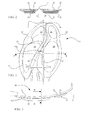
- a sole 20 The front of a sole 20 is partially visible in fig. 1 .
- the sole will be considered as positioned when in use, so that the part in contact with the ground is the bottom part.
- the sole 20 comprises an upper layer 22 which has seats or concavities housing four deformable inserts 24,26,28,30 with zero backlash.
- the inserts 24,26,28,30 are positioned roughly symmetrically around a longitudinal axis X of the sole 20, are distanced from each other and project a certain distance from the layer 22.
- the inserts 24,26,28,30 are islands of different material glued into the layer 22.
- the layer 22 is preferably coupled underneath to an intersole (not shown) .
- the inserts 24, 28 are larger than the others, drop-shaped and are positioned alongside the sole of the foot.
- the inserts 26, 30, smaller and of a roughly oval shape, are positioned alongside under the toe of the foot.
- the inserts 24,26,28,30 are entirely covered by a layer 32 which comes into contact with the ground.
- the layer 32 is a rubber strip glued onto the inserts 24, 26, 28, 30.
- the layer 32 extends over the layer 22 even in the areas between the various inserts 24,26,28,30 and in these areas is locally glued at anchorage points GL.
- the layer 32 or parts of it can thus freely oscillate in relation to the layer 22 along a plane (see diretrix D or G in fig.1 ) roughly parallel to the layer 22, thanks to the deformation of the inserts 24,26,28,30.
- the effect is shown in figures 4 and 5 , where a complete shoe 40 is shown which uses the sole 20.
- the part of the shoe 40 which rests on the ground is, on the front part, the layer 32 which can flex on the inserts 24, 26, 28, 30.
- the foot of a person wearing the shoe 40 is hugged in the upper and rests firmly on the layer 22 (for example by means of an intermediate intersole).
- the layer 22 Between the part resting on the ground consisting of the layer 32, and the layer integral with the foot, the layer 22, are the inserts 24, 26, 28,30. These can mechanically deform laterally (along the directrix D and G). Consequently the areas of the foot overlying the inserts 24,26,28,30 do not have a stable support on the ground but can constantly "vibrate" to the right or left, backwards or forwards, often alternately.
- the user's body detects these micro shifts in position and to restore stability activates the muscles needed to re-establish balance. Constant, unconscious training results which tones the musculature.
- the inserts 24,26,28,30 are also elastically compressible vertically, in other words orthogonal to the ground .
- the inserts 24, 26, 28, 30 also permit a vertical movement, in that they do not only "oscillate” in relation to the base element 22, but also compress and dilate thanks to the characteristics of elasticity and impact absorption.
- An boosted effect of induced muscular mobility results for the person wearing the footwear.
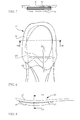
- a sole 42 In fig. 6 the rear part of a sole 42 is partially visible which at the front may be like the sole 22, for example.
- the sole 42 has a sandwich structure like the sole 20, and comprises an upper layer 50 which has seats or concavities which a single deformable heel insert 52 of a round shape is housed in without play.
- the insert 52 is positioned in the centre of the sole 42, under the heel.
- the insert 52 is entirely covered by a layer 54 which comes into contact with the ground.
- the layer 32 is a rubber strip glued onto the insert 54, and there are no points of contact, and therefore attachment, between the layer 54 and the layer 50.
- the layer 54 can freely oscillate in relation to the layer 50 along a plane roughly parallel (see directrix D2 or D3 in fig.6 ) to the layer 50 thanks to the deformation of the insert 54.
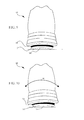
- the effect is shown in fig. 9 and 10 , where a complete shoe 50 is shown which uses the sole 42.
- the support point of the shoe 60 is, on the rear part, the layer 54 which can float on the insert 52.
- the foot inside the shoe 60 is hugged by the upper and rests firmly on the layer 50, while in the ground support, consisting of the layer 54, the insert 52 is interposed.
- the latter may mechanically deform so that the foot can oscillate over the layer 54 (arrow H).
- the foot does not have absolute stability and to impose it must activate the muscles needed for equilibrium.
- the insert 52 is also elastically compressible vertically, in other words orthogonally to the ground. This way it also permits a vertical movement of the foot in that it compresses or dilates. A boosted effect of muscular mobility results for the person wearing the footwear.
- the front or rear parts of the sole described permit a toning effect of legs and buttocks by simply walking, even more so if the two structures described are combined in a single sole.
- the deformation of the inserts is preferably of an elastic type, that is they return to their original form once the phase of pressure of the foot has finished.
- the base which an insert and the membrane or layer covering it lie on may be made with known materials used in the footwear sector such as generally rubber. It is the inserts, preferably in PU, which determine the characteristics of the sole. All the inserts described are positioned in the points of maximum pressure of the foot during the various phases of walking, adapting to the rolling phases and areas of bending.
- a space or channel 46 may be associated with the sole 20 which divides the sole or element 22 into two parts roughly along the axis X. Each part houses an insert under the sole of the foot and a toe insert.
- the channel 46 allows the sole 20 to distance itself slightly outwards (by several mm or fraction of millimetre) along the directrix D, a movement which makes the two pairs of inserts move away from each other and enables maximum comfort of the foot during the phase of maximum pressure on the sole which naturally tends to widen.
- the channel 46 may also take the form of a simple groove, tunnel, recess in the sole or incision of the sole.
- Fig.11 shows a variation 80 of the sole 20, to be compared to figure 2 .
- the inserts here indicated by reference numeral 84, are not coupled to the layer overlying the base 86 but, by means of the apertures or windows in the layer 86, directly to an intersole 88.
- a layer or element for contact with the ground 82 is coupled to and covers the inserts 84.
- the sole 80 is identical to the previous one, but is lighter thanks to the reduction of material in the layer 86. The same concept can be applied to the sole 42.
- the inserts placed under the sole of the foot and the inserts in the heel are of variable density to each other to better follow the biomechanics of the walk.
- a different type of PU can be used for each insert.
- each insert may in itself be of varying density, to increase the spatial resolution and precision of the shock absorbing action.
- a type of PU can be used which varies its density within the insert itself.
Landscapes
- Health & Medical Sciences (AREA)
- Epidemiology (AREA)
- General Health & Medical Sciences (AREA)
- Public Health (AREA)
- Chemical & Material Sciences (AREA)
- Engineering & Computer Science (AREA)
- Materials Engineering (AREA)
- Footwear And Its Accessory, Manufacturing Method And Apparatuses (AREA)
Applications Claiming Priority (1)
| Application Number | Priority Date | Filing Date | Title |
|---|---|---|---|
| IT000067A ITTV20100067A1 (it) | 2010-04-26 | 2010-04-26 | Suola migliorata di calzatura |
Publications (1)
| Publication Number | Publication Date |
|---|---|
| EP2380451A1 true EP2380451A1 (de) | 2011-10-26 |
Family
ID=43357949
Family Applications (1)
| Application Number | Title | Priority Date | Filing Date |
|---|---|---|---|
| EP11163210A Withdrawn EP2380451A1 (de) | 2010-04-26 | 2011-04-20 | Schuhsohle mit verbessertem muskularem unbewusstem Körperansprechverhalten |
Country Status (2)
| Country | Link |
|---|---|
| EP (1) | EP2380451A1 (de) |
| IT (1) | ITTV20100067A1 (de) |
Cited By (1)
| Publication number | Priority date | Publication date | Assignee | Title |
|---|---|---|---|---|
| US11412812B2 (en) * | 2016-01-08 | 2022-08-16 | Nike, Inc. | Articles of footwear with asymmetrical segmented plates |
Citations (6)
| Publication number | Priority date | Publication date | Assignee | Title |
|---|---|---|---|---|
| US1278320A (en) * | 1916-12-22 | 1918-09-10 | Gilbert S Ellithorpe | Shoe-tread. |
| EP1015280A1 (de) | 1997-09-19 | 2000-07-05 | Visteon Systemes Interieurs | Fahrzeuginnenausstattung, insbesondere für ein kraftfahrzeug |
| US6226896B1 (en) * | 1997-01-17 | 2001-05-08 | Nike, Inc. | Footwear with mountain goat traction elements |
| US6438873B1 (en) * | 1996-08-20 | 2002-08-27 | Adidas International B.V. | Shoe having an external chassis |
| US20070193065A1 (en) * | 2004-09-30 | 2007-08-23 | Tsuyoshi Nishiwaki | Shock absorbing device for shoe sole in rear foot part |
| US20080193774A1 (en) * | 2007-02-09 | 2008-08-14 | Nike, Inc. | Laminate and method for making laminate |
-
2010
- 2010-04-26 IT IT000067A patent/ITTV20100067A1/it unknown
-
2011
- 2011-04-20 EP EP11163210A patent/EP2380451A1/de not_active Withdrawn
Patent Citations (6)
| Publication number | Priority date | Publication date | Assignee | Title |
|---|---|---|---|---|
| US1278320A (en) * | 1916-12-22 | 1918-09-10 | Gilbert S Ellithorpe | Shoe-tread. |
| US6438873B1 (en) * | 1996-08-20 | 2002-08-27 | Adidas International B.V. | Shoe having an external chassis |
| US6226896B1 (en) * | 1997-01-17 | 2001-05-08 | Nike, Inc. | Footwear with mountain goat traction elements |
| EP1015280A1 (de) | 1997-09-19 | 2000-07-05 | Visteon Systemes Interieurs | Fahrzeuginnenausstattung, insbesondere für ein kraftfahrzeug |
| US20070193065A1 (en) * | 2004-09-30 | 2007-08-23 | Tsuyoshi Nishiwaki | Shock absorbing device for shoe sole in rear foot part |
| US20080193774A1 (en) * | 2007-02-09 | 2008-08-14 | Nike, Inc. | Laminate and method for making laminate |
Cited By (1)
| Publication number | Priority date | Publication date | Assignee | Title |
|---|---|---|---|---|
| US11412812B2 (en) * | 2016-01-08 | 2022-08-16 | Nike, Inc. | Articles of footwear with asymmetrical segmented plates |
Also Published As
| Publication number | Publication date |
|---|---|
| ITTV20100067A1 (it) | 2011-10-27 |
Similar Documents
| Publication | Publication Date | Title |
|---|---|---|
| KR101231022B1 (ko) | 진동발생수단이 내장된 구두 | |
| US20210227925A1 (en) | Shoes including arch pad | |
| JP2009101139A (ja) | ハイヒール用の機能性中敷 | |
| KR101998706B1 (ko) | 혈류개선과 지압형 구조가 장착된 진동 기능성 건강신발 | |
| KR102534387B1 (ko) | 평발 교정 보조기구 | |
| KR100603062B1 (ko) | 저면이 호형으로 형성된 신발창 | |
| KR101983723B1 (ko) | 혈류개선과 관절보호에 도움이 되는 기능성 건강신발 | |
| KR100872313B1 (ko) | 신발용 중창 및 허리쇠 | |
| KR100798868B1 (ko) | 건강 신발 | |
| EP2380451A1 (de) | Schuhsohle mit verbessertem muskularem unbewusstem Körperansprechverhalten | |
| US20080301975A1 (en) | Plantar For Reflexological Stimulation | |
| KR200455079Y1 (ko) | 직선보행유도기능을 갖는 중창을 갖는 신발 | |
| JP3232282U (ja) | 健康サンダル | |
| KR101760432B1 (ko) | 기능성 신발 하부 구조체 | |
| KR101483775B1 (ko) | 전방추진강화 및 충격흡수가 가능한 러닝 신발 | |
| KR20180034975A (ko) | 기능성 밑창 및 그것이 포함된 신발 | |
| KR101249015B1 (ko) | 기능성 신발 | |
| KR200461630Y1 (ko) | 중창 내부에 보행압력완충부가 형성된 신발 | |
| JP5283062B2 (ja) | 靴 | |
| JP6721995B2 (ja) | 筋力をトレーニングする方法及びそれに用いる履物 | |
| KR101435757B1 (ko) | 신발깔창 | |
| KR102688450B1 (ko) | 지압시스템 | |
| KR102844225B1 (ko) | 걷기운동용 신발 | |
| JP5010767B2 (ja) | ウォーキングシューズの靴底に装着するウォーキング助成具 | |
| KR101220444B1 (ko) | 신발창 |
Legal Events
| Date | Code | Title | Description |
|---|---|---|---|
| AK | Designated contracting states |
Kind code of ref document: A1 Designated state(s): AL AT BE BG CH CY CZ DE DK EE ES FI FR GB GR HR HU IE IS IT LI LT LU LV MC MK MT NL NO PL PT RO RS SE SI SK SM TR |
|
| AX | Request for extension of the european patent |
Extension state: BA ME |
|
| PUAI | Public reference made under article 153(3) epc to a published international application that has entered the european phase |
Free format text: ORIGINAL CODE: 0009012 |
|
| STAA | Information on the status of an ep patent application or granted ep patent |
Free format text: STATUS: THE APPLICATION IS DEEMED TO BE WITHDRAWN |
|
| 18D | Application deemed to be withdrawn |
Effective date: 20120427 |