EP2380362B1 - Wandler für hörgerät mit manipulierter oberfläche - Google Patents
Wandler für hörgerät mit manipulierter oberfläche Download PDFInfo
- Publication number
- EP2380362B1 EP2380362B1 EP09836787.3A EP09836787A EP2380362B1 EP 2380362 B1 EP2380362 B1 EP 2380362B1 EP 09836787 A EP09836787 A EP 09836787A EP 2380362 B1 EP2380362 B1 EP 2380362B1
- Authority
- EP
- European Patent Office
- Prior art keywords
- setae
- transducer
- tympanic membrane
- earlens
- biocompatible
- Prior art date
- Legal status (The legal status is an assumption and is not a legal conclusion. Google has not performed a legal analysis and makes no representation as to the accuracy of the status listed.)
- Active
Links
Images





Classifications
-
- H—ELECTRICITY
- H04—ELECTRIC COMMUNICATION TECHNIQUE
- H04R—LOUDSPEAKERS, MICROPHONES, GRAMOPHONE PICK-UPS OR LIKE ACOUSTIC ELECTROMECHANICAL TRANSDUCERS; ELECTRIC HEARING AIDS; PUBLIC ADDRESS SYSTEMS
- H04R25/00—Electric hearing aids
- H04R25/60—Mounting or interconnection of hearing aid parts, e.g. inside tips, housings or to ossicles
- H04R25/604—Mounting or interconnection of hearing aid parts, e.g. inside tips, housings or to ossicles of acoustic or vibrational transducers
- H04R25/606—Mounting or interconnection of hearing aid parts, e.g. inside tips, housings or to ossicles of acoustic or vibrational transducers acting directly on the eardrum, the ossicles or the skull, e.g. mastoid, tooth, maxillary or mandibular bone, or mechanically stimulating the cochlea, e.g. at the oval window
-
- H—ELECTRICITY
- H04—ELECTRIC COMMUNICATION TECHNIQUE
- H04R—LOUDSPEAKERS, MICROPHONES, GRAMOPHONE PICK-UPS OR LIKE ACOUSTIC ELECTROMECHANICAL TRANSDUCERS; ELECTRIC HEARING AIDS; PUBLIC ADDRESS SYSTEMS
- H04R25/00—Electric hearing aids
- H04R25/65—Housing parts, e.g. shells, tips or moulds, or their manufacture
- H04R25/652—Ear tips; Ear moulds
- H04R25/656—Non-customized, universal ear tips, i.e. ear tips which are not specifically adapted to the size or shape of the ear or ear canal
-
- B—PERFORMING OPERATIONS; TRANSPORTING
- B82—NANOTECHNOLOGY
- B82Y—SPECIFIC USES OR APPLICATIONS OF NANOSTRUCTURES; MEASUREMENT OR ANALYSIS OF NANOSTRUCTURES; MANUFACTURE OR TREATMENT OF NANOSTRUCTURES
- B82Y30/00—Nanotechnology for materials or surface science, e.g. nanocomposites
-
- H—ELECTRICITY
- H04—ELECTRIC COMMUNICATION TECHNIQUE
- H04R—LOUDSPEAKERS, MICROPHONES, GRAMOPHONE PICK-UPS OR LIKE ACOUSTIC ELECTROMECHANICAL TRANSDUCERS; ELECTRIC HEARING AIDS; PUBLIC ADDRESS SYSTEMS
- H04R25/00—Electric hearing aids
- H04R25/65—Housing parts, e.g. shells, tips or moulds, or their manufacture
- H04R25/658—Manufacture of housing parts
Definitions
- the disclosure is related to interfaces between biocompatible materials and living tissues, especially as applied to hearing aid transducers.
- EarLensTM is a contact transducer assembly for a hearing aid. Examples of EarLenses are described by Perkins and Shennib in US Patent 5,259,032 ("Perkins"). An EarlensTM is a biocompatible, removable contact transducer that is supported on the tympanic membrane of a wearer without the use of adhesives or mechanical attachments. The name “EarLens” was chosen because the installation and removal of the contact transducer assembly is reminiscent of the method for insertion and removal of contact lenses for the eyes. Furthermore, surface wetting agents may be used with the EarLens in analogy to the use of wetting solutions for contact lenses for the eyes.
- a conventional hearing aid uses an acoustic transducer to generate amplified sound waves in air that are received by the tympanic membrane (eardrum) of a wearer.
- a contact transducer is one that imparts vibrations directly to the tympanic membrane. Simply put, a contact transducer touches the eardrum while an acoustic transducer is a very small loudspeaker that is located near, but not touching, the eardrum.
- Fig. 1 is a diagram of the human auditory system including the ear canal, tympanic membrane, ossicles, and the cochlea.
- Vibrations of the tympanic membrane are perceived as sound regardless of whether the vibrations are stimulated by sound waves in air or by a contact transducer.
- Contact transducers offer better sound quality than acoustic transducers and they reduce feedback problems.
- the Perkins EarLensTM eliminates problems associated with adhesives that were previously used to attach transducers to the eardrum and it does not require surgery.
- EarLensTM contact transducers are custom fitted for each wearer by making a negative impression of the wearer's eardrum. A positive mold is then created and a biocompatible material is cast or molded from the positive impression. EarLenses also use a surface wetting agent to enhance sufficient, but weak, adhesion to the tympanic membrane while allowing the tympanic membrane epithelium below to naturally migrate. Mineral oil is often used as a surface wetting agent and may be periodically sprayed into the ear canal after placement of an EarLensTM device.
- US20050038498 describes nanofiber enhanced surface area substrates and structures comprising such substrates for use in various medical devices, as well as methods and uses for such substrates and medical devices.
- US5259032 describes a contact transducer assembly for an electromagnetically driven hearing device such as a hearing aid or other audio signal reproducing device worn by a user.
- the contact transducer assembly includes a transducer which is attached to a biocompatible support. This assembly is supported on the tympanic membrane of the wearer by surface adhesion, such that it can be readily inserted and removed in a manner similar to that of a conventional contact lens worn on the eye.
- US20030208888 describes a fabricated microstructure comprising at least one protrusion capable of providing an adhesive force at a surface of between about 60 and 2,000 nano-Newtons.
- a stalk supports the protrusion at an oblique angle relative to a supporting surface.
- the microstructure can adhere to different surfaces.
- the transducer is an improved EarLensTM distinguished by micro- an/or nano-structures patterned on the EarLens' surface. These structures allow the EarLensTM to adapt to the unique surface variations of a person's eardrum or ear canal and also permit the lens to remain in position despite eardrum tissue migration. Micro- or nano- structured surfaces are also applicable in other applications where artificial devices interact with living tissues such as the interaction between a contact (optical) lens and a cornea.
- Human eardrums exist in a wide variety of shapes and sizes. Although it may be possible to form a set of base shapes that will approximately fit most tympanic membranes, such a set has not yet been demonstrated. Furthermore, no suitable malleable material has been found that conforms to a person's eardrum on contact, Therefore, the current state of the art requires a custom mold for each ear to be fitted with an EarLensTM As described in detail below, an advanced hearing aid transducer with a patterned surface solves this problem through the use of thousands of tiny setae, or hair-like structures, which bend to conform to the unique topography of a person's eardrum.
- a hearing aid transducer adapts itself to variations in the surface of a tympanic membrane and slides over the migrating membrane without lubrication. Microscopic setae create a conforming interface between the biocompatible material of the transducer and the living tissue of the tympanic membrane.
- Epithelial migration refers to the generation of new tissue near the center of the tympanic membrane and around the malleus, and the movement of tissue toward the edge of the membrane over a period of weeks.
- Migration of eardrum tissue is an important self-cleaning mechanism which carries keratin outward for removal. Although the factors which control the speed and direction of migration are somewhat obscure, migration patterns are well characterized.
- Fig. 2 is a diagram showing typical migration patterns of a tympanic membrane epithelium.
- the end face view in Fig. 2 is based on a report by L. Michaels, Am. J. Anat. 189:189-200 (1990 ).
- New tissue is created in a central region 205 of the membrane and along radial regions 215 and 210 located roughly at 10 and 2 o'clock as represented by dashed lines in the figure.
- Current EarLenses overcome migration through the use of a surface wetting and lubrication layer which is often mineral oil.
- an advanced hearing aid transducer with a patterned surface eliminates the need for periodic oiling through the use of thousands of tiny setae, or hair-like structures which cling to the eardrum, yet allow it to slide past them during migration.
- FIGs. 3A and 3B show cross sectional views of example conventional (A) and advanced (B) EarLensTM transducers having an engineered surface.
- solid line 305 represents a cross section of a tympanic membrane or eardrum.
- EarLensTM 310 is a roughly cone-shaped structure that supports transducer element 315.
- Transducer element 315 converts an electrical signal into vibrations that are imparted to eardrum 305 via EarLensTM 310.
- a thin layer of surface wetting agent or lubricant e.g. mineral oil fills the space 320 between the EarLensTM 310 and the tympanic membrane 305.
- 3B is similar to 3A with the addition of patterned setae on the convex surface of EarLensTM 360.
- Solid line 355 represents a cross section of a tympanic membrane and EarLensTM 360 supports transducer element 365.
- setae 370 fill the thin space between EarLensTM 360 and eardrum 355.
- the representation of setae 370 is schematic only, not to scale.
- An EarLensTM as shown in Figs. 3A and 3B ,fits in the umbo area of the eardrum.
- the lens is roughly 1 mm thick and made from an elastomeric material such as silicone.
- the aspect ratio (i.e. length divided by diameter) of a seta is between about 10 and about 1000. Note that the setae are angled away from the malleus region.
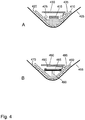
- Figs. 4A and 4B show cross sectional views of advanced EarLenses using photovoltaic cells as power and signal receivers, and coil-and-magnet (A) and piezoelectric (B) sound transducers.
- solid line 405 represents a cross section of a tympanic membrane.
- EarLensTM 410 is a roughly cone-shapedstructure that supports transducer magnet 415.
- a plurality of magnets 415 are driven by a plurality of coils 425 which are connected to a plurality of photovoltaic cells 430 via small wires 435.
- Thousands of microscopic setae 420 fill the thin space between EarLensTM 410 and eardrum 405.
- Electrical signals and power may be delivered to photovoltaic cell 430 via light beams generated by diode lasers or other suitable light sources.
- a diode laser may be packaged with a microphone, digital signal processor, and amplifier in the ear canal or behind the ear.
- Coil 425 and magnet 415 transform electrical signals into vibrations of the EarLens which are transmitted to the tympanic membrane 405 as sounds.
- solid line 455 represents a cross section of a tympanic membrane.
- EarLens 460 supports post 490 which is connected to piezoelectric elements 465.
- Piezoelectric elements 465 are connected to photovoltaic cells 480 via small wire bundles 485.
- the photovoltaic cells also supply power through the wire bundles to electronic circuit 490 and the circuit is similarly connected to the piezoelectric elements.
- Thousands of microscopic setae 470 fill the thin space between EarLensTM 460 and eardrum 455. Electrical signals and power may be delivered to photovoltaic cell 480 via a light beam generated by diode lasers or other suitable light sources. In the design of Fig.
- electronic circuit 490 may be used for signal processing, amplification, filtering or other tasks.
- Piezoelectric elements 465 vibrate in response to electrical signals delivered to it and the vibrations are carried through support post 490 to EarLensTM 460, and finally to tympanic membrane 405. Further details of the optical transmission architecture and electronics are described in co-pending US provisional patent applications 61/073,271 and 61/073,281 both filed on 17 June 2008 .
- Fig. 5 shows an advanced EarLensTM 510 fitting on the surface of an eardrum 505.
- Fig. 5 only the surfaces of the EarLensTM and ear drum are illustrated and these surfaces are shown in cross section. Only the umbo region of the tympanic membrane, where an EarLensTM is placed, is shown.(EarLenses normally do not cover the entire membrane; however, they may extend to regions other than the umbo area including the ear canal.)
- Inset 520 shows a magnified view of the thin region between EarLensTM 510 and eardrum 505. In this view the magnification is such that some of the thousands of tiny setae 515 on the surface of the EarLensTM are visible.
- the setae form a flexible, confirming interface between the two surfaces without the need for liquid lubricants.
- Eardrum 505 has countours, roughness and irregularities that are unique to each individual. The setae accommodate these variations so that one EarLensTM design is suitable for many different ear drum surfaces without the need for customization.
- Figs. 6A and 6B show part of a biocompatible surface comprising setae and a living tissue surface.
- biocompatible surface 610 has a plurality of tiny setae 615 attached to it.
- the setae may be fabricated at the same time as surface 610 or connected to the surface later.
- the setae are illustrated as being spaced apart by roughly the same distance as the length of an individual setae; however, the spacing may range from much more to much less than this distance.
- closely spaced setae may be used when improved adhesion between biocompatible surface 610 and another surface is needed.
- Fig 6B shows biocompatible surface 610 in contact (via its setae) with a living tissue surface 605.
- tissue surfaces may include a tympanic membrane epithelial surface, the cornea, skin, membranes of the mouth and throat, or other biological membranes.
- Fig. 6B surface 605 has some roughness and irregularities; it is not perfectly flat.
- Setae 615 bend to follow the topography of surface 605.
- the aspect ratio, or ratio of lengths to diameter, of each seta is shown as roughly 10, meaning a seta is ten times longer than it its diameter.
- setae may have aspect ratios ranging from roughly 3 to roughly 100 and setae of differing aspect ratios may be mixed on a single surface. It is necessary, however, that the setae be flexible enough to follow the undulations of the surface with which they come in contact.
- the Young's modulus of the setae material may be between about 0.01 GPa and 10 GPa.
- the setae in Figs. 6A and 6B are illustrated as all having the same length, although this is not a requirement. Setae bend more when surfaces 610 and 605 are close together and less when the surfaces are more distant from one another.
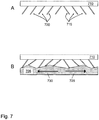
- Figs. 7A and 7B show a cross section of part of an advanced EarLensTM surface comprising setae oriented for migration of a tympanic membrane.
- EarLensTM surface 710 has a plurality of setae affixed to it.
- Reference numerals 715 and 720 point out two groups of such setae oriented in different directions. In particular setae 715 angle from the surface toward the right side of the figure while setae 720 are angled the opposite direction.
- Fig. 7B shows the EarLensTM surface comprising setae in contact with a tympanic membrane 705.
- tympanic membrane 705 shown in Fig. 7B is one in which new tissue is being generated.
- Arrows 725 and 730 indicate the direction of migration of the new tissue away from its source.
- EarLensTM 710 is designed so that the orientation of its setae match the migration of tissue in a tympanic membrane as described in Fig. 2 .
- the setae are angled away from a normal to the EarLensTM surface in the direction of tissue migration. This design allows the eardrum tissue to migrate while the EarLensTM remains in contact with the tympanic membrane and centered around the malleus region or the umbo region.
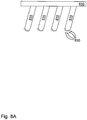
- Fig. 8A shows setae comprising fine structure at their tips.
- surface 810 supports a plurality of setae 815.
- Setae 815 in turn support even finer structures 830 called spatula at their tips.
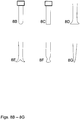
- Figs. 8B - 8G show various setae tip shapes.
- Setae tips may have spherical (B), flat (C, D), cupped (E), foot (F), or filament (G) shapes as examples.
- the shape of a seta tip influences how much force the seta exerts on a surface under different load strength and load angle conditions. Flatter tips provide more tip - surface interaction area for example.
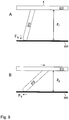
- Figs. 9A and 9B show a single seta in contact with a surface under normal and parallel force conditions.
- Fig. 9A shows a structure 910 (such as an EarLensTM, for example) with seta 915 in contact with a surface 905 (such as an eardrum, for example). The distance between the structure and the surface is denoted z 1 .
- a force F N normal to surface 905 has been applied to structure 910.
- Fig. 9B shows the same structure, seta, and surface as shown in Fig. 9A .
- Fig. 9A shows a force F N , normal to surface 905 .
- Fig. 10 shows a surface 1010 having setae and a mold 1040 for making same.
- Mold 1040 may be filled with a liquid elastomer that is cured and then released forming surface 1010.
- Methods for releasing a cured setae surface from a mold include changing the temperature of the mold, using coatings or sacrificial layers to coat the mold before filling it with liquid elastomer, using an elastomer that elutes a lubricant, such as oil, upon curing, and using an elastomer that shrinks upon curing.
- An additional method for manufacturing the engineered surface uses carbon nanotube fabrication technology, for example described by Qu et al., Science, v322, p238-242, 2008 .
- setae may be used at other interfaces between biocompatible materials and living tissues, for example such as the interface between a contact (optical) lens and a cornea.
- engineered surfaces displaying variations of setae or other surface micro- and nano-structures are applicable to many situations requiring "weak but sufficient" adhesion. These surfaces provide a platform for a variety of payloads, including, but not limited to, hearing aid transducers.
- EarLenses in contact with the ear drum, they may also be designed to contact parts of the ear canal in addition to, or instead of, the tympanic membrane.
Landscapes
- Health & Medical Sciences (AREA)
- General Health & Medical Sciences (AREA)
- Otolaryngology (AREA)
- Engineering & Computer Science (AREA)
- Neurosurgery (AREA)
- Physics & Mathematics (AREA)
- Acoustics & Sound (AREA)
- Signal Processing (AREA)
- Manufacturing & Machinery (AREA)
- Materials For Medical Uses (AREA)
- Prostheses (AREA)
Claims (15)
- Hörgerätewandler, der Folgendes umfasst: einen biokompatiblen Träger mit einer Oberfläche (710), die so gestaltet ist, dass sie zu einem Trommelfell passt; und
ein am Träger angebrachtes Ansteuerungselement (365);
wobei die Oberfläche mehrere mikroskopische Setae (715, 720) umfasst, die mit Bezug auf die Oberfläche in einem Muster abgewinkelt sind, das einem Migrationsmuster des Trommelfells entspricht. - Wandler nach Anspruch 1, wobei die Dichte von Setae (715, 720) größer als 100 Quadratmillimeter ist.
- Wandler nach Anspruch 1, wobei die Setae (715, 720) eine Länge zwischen 10 und 200 Mikron haben.
- Wandler nach Anspruch 1, wobei die Setae (715, 720) ein Aspektverhältnis von mehr als 10 haben.
- Wandler nach Anspruch 1, wobei die Setae (715, 720) ein E-Modul zwischen 0,01 GPa und 10 Gpa haben.
- Wandler nach Anspruch 1, wobei der biokompatible Träger aus Silikon, Fluorsilikon, Gummi oder anderen flexiblen Materialien gefertigt ist.
- Wandler nach Anspruch 1, wobei das Ansteuerungselement (365) elektrischen Strom von einer photovoltaischen Zelle empfängt.
- Wandler nach Anspruch 1, wobei das Ansteuerungselement (365) eine Spule und einen Dauermagnet umfasst.
- Wandler nach Anspruch 1, wobei das Ansteuerungselement (365) ein piezoelektrisches Bimorph umfasst.
- Wandler nach Anspruch 1, wobei Spitzen der Setae (715, 720) eine sphärische Form oder eine flache Form oder eine Schalenform oder eine Fußform oder eine Filamentform haben.
- Wandler nach Anspruch 1, wobei die Setae (715, 720) mit mehreren Spateln ausgestattet sind.
- Verfahren zum Bilden einer Grenzfläche zwischen einem lebenden Gewebe und einer biokompatiblen Oberfläche, das Folgendes beinhaltet:Bereitstellen eines Hörgerätewandlers mit einem biokompatiblen Träger mit einer Oberfläche (710), die passend zu einem Trommelfell gestaltet ist, und einem an dem Träger angebrachten Ansteuerungselement (365);Bilden einer Mehrzahl von Setae (715, 720) auf der Oberfläche;Orientieren der Setae (715, 720) in Winkeln gemäß einem Migrationsmuster des Trommelfells, auf dem die biokompatible Fläche platziert werden soll.
- Verfahren nach Anspruch 12, wobei das Bilden durch Fertigen der Oberfläche (710) und der Setae (715, 720) aus flüssigem Elastomer mit einer Form erfolgt.
- Verfahren nach Anspruch 12, wobei die Setae (715, 720) mit mehreren Spateln ausgestattet sind.
- Verfahren nach Anspruch 12, wobei die Spateln mit Kohlenstoffnanoröhrchen-Herstellungstechnologie hergestellt sind.
Applications Claiming Priority (3)
| Application Number | Priority Date | Filing Date | Title |
|---|---|---|---|
| US12296208P | 2008-12-16 | 2008-12-16 | |
| US12/633,614 US8506473B2 (en) | 2008-12-16 | 2009-12-08 | Hearing-aid transducer having an engineered surface |
| PCT/US2009/067703 WO2010077781A2 (en) | 2008-12-16 | 2009-12-11 | Hearing-aid transducer having an engineered surface |
Publications (3)
| Publication Number | Publication Date |
|---|---|
| EP2380362A2 EP2380362A2 (de) | 2011-10-26 |
| EP2380362A4 EP2380362A4 (de) | 2014-01-01 |
| EP2380362B1 true EP2380362B1 (de) | 2019-02-20 |
Family
ID=42241338
Family Applications (1)
| Application Number | Title | Priority Date | Filing Date |
|---|---|---|---|
| EP09836787.3A Active EP2380362B1 (de) | 2008-12-16 | 2009-12-11 | Wandler für hörgerät mit manipulierter oberfläche |
Country Status (4)
| Country | Link |
|---|---|
| US (1) | US8506473B2 (de) |
| EP (1) | EP2380362B1 (de) |
| DK (1) | DK2380362T3 (de) |
| WO (1) | WO2010077781A2 (de) |
Families Citing this family (23)
| Publication number | Priority date | Publication date | Assignee | Title |
|---|---|---|---|---|
| US8401212B2 (en) | 2007-10-12 | 2013-03-19 | Earlens Corporation | Multifunction system and method for integrated hearing and communication with noise cancellation and feedback management |
| US7668325B2 (en) | 2005-05-03 | 2010-02-23 | Earlens Corporation | Hearing system having an open chamber for housing components and reducing the occlusion effect |
| WO2009155358A1 (en) | 2008-06-17 | 2009-12-23 | Earlens Corporation | Optical electro-mechanical hearing devices with separate power and signal components |
| EP3509324B1 (de) | 2008-09-22 | 2023-08-16 | Earlens Corporation | Ausgewogene ankervorrichtungen und verfahren zum hören |
| EP3758394A1 (de) | 2010-12-20 | 2020-12-30 | Earlens Corporation | Anatomisch angepasstes gehörgangs-hörgerät |
| DK2840808T3 (en) | 2013-08-22 | 2018-01-08 | Bernafon Ag | Sound tube and eartip for a behind-the-ear hearing aid |
| DE102013114771B4 (de) * | 2013-12-23 | 2018-06-28 | Eberhard Karls Universität Tübingen Medizinische Fakultät | In den Gehörgang einbringbare Hörhilfe und Hörhilfe-System |
| US10034103B2 (en) | 2014-03-18 | 2018-07-24 | Earlens Corporation | High fidelity and reduced feedback contact hearing apparatus and methods |
| DK3169396T3 (da) | 2014-07-14 | 2021-06-28 | Earlens Corp | Glidende forspænding og peak-begrænsning for optiske høreapparater |
| US9924276B2 (en) | 2014-11-26 | 2018-03-20 | Earlens Corporation | Adjustable venting for hearing instruments |
| DK3888564T3 (da) | 2015-10-02 | 2025-07-14 | Earlens Corp | Indretning til tilpasset afgivelse af medicin i øregangen |
| US11350226B2 (en) | 2015-12-30 | 2022-05-31 | Earlens Corporation | Charging protocol for rechargeable hearing systems |
| US10492010B2 (en) | 2015-12-30 | 2019-11-26 | Earlens Corporations | Damping in contact hearing systems |
| WO2017116791A1 (en) | 2015-12-30 | 2017-07-06 | Earlens Corporation | Light based hearing systems, apparatus and methods |
| CN112738700A (zh) | 2016-09-09 | 2021-04-30 | 伊尔兰斯公司 | 智能镜系统和方法 |
| WO2018093733A1 (en) | 2016-11-15 | 2018-05-24 | Earlens Corporation | Improved impression procedure |
| US10419860B2 (en) | 2017-05-10 | 2019-09-17 | International Business Machines Corporation | Eye-mounted hearing aid |
| WO2019173470A1 (en) | 2018-03-07 | 2019-09-12 | Earlens Corporation | Contact hearing device and retention structure materials |
| WO2019199680A1 (en) | 2018-04-09 | 2019-10-17 | Earlens Corporation | Dynamic filter |
| EP3831095A4 (de) | 2018-07-31 | 2022-06-08 | Earlens Corporation | Nahfeldinduktive kopplung in einem kontakthörsystem |
| DE102019201273A1 (de) * | 2019-01-31 | 2020-08-06 | Vibrosonic Gmbh | Vibrationsmodul zum Auflegen auf ein Trommelfell |
| EP3994734B1 (de) * | 2019-07-03 | 2025-11-26 | Earlens Corporation | Piezoelektrischer wandler für trommelfell |
| CN121311206A (zh) * | 2023-06-13 | 2026-01-09 | 科利耳有限公司 | 可折叠的可植入医疗装置 |
Family Cites Families (16)
| Publication number | Priority date | Publication date | Assignee | Title |
|---|---|---|---|---|
| DE3508830A1 (de) | 1985-03-13 | 1986-09-18 | Robert Bosch Gmbh, 7000 Stuttgart | Hoergeraet |
| US4800884A (en) | 1986-03-07 | 1989-01-31 | Richards Medical Company | Magnetic induction hearing aid |
| US5259032A (en) * | 1990-11-07 | 1993-11-02 | Resound Corporation | contact transducer assembly for hearing devices |
| DE4104358A1 (de) | 1991-02-13 | 1992-08-20 | Implex Gmbh | Implantierbares hoergeraet zur anregung des innenohres |
| KR19990082641A (ko) * | 1996-02-15 | 1999-11-25 | 알만드 피. 뉴커만스 | 개량된 생체교합적인 트랜스듀서 |
| US5797834A (en) | 1996-05-31 | 1998-08-25 | Resound Corporation | Hearing improvement device |
| US6872439B2 (en) * | 2002-05-13 | 2005-03-29 | The Regents Of The University Of California | Adhesive microstructure and method of forming same |
| GB0222524D0 (en) | 2002-09-27 | 2002-11-06 | Westerngeco Seismic Holdings | Calibrating a seismic sensor |
| US20050038498A1 (en) * | 2003-04-17 | 2005-02-17 | Nanosys, Inc. | Medical device applications of nanostructured surfaces |
| US20050271870A1 (en) * | 2004-06-07 | 2005-12-08 | Jackson Warren B | Hierarchically-dimensioned-microfiber-based dry adhesive materials |
| US7867160B2 (en) * | 2004-10-12 | 2011-01-11 | Earlens Corporation | Systems and methods for photo-mechanical hearing transduction |
| US7955249B2 (en) | 2005-10-31 | 2011-06-07 | Earlens Corporation | Output transducers for hearing systems |
| US7479198B2 (en) | 2005-04-07 | 2009-01-20 | Timothy D'Annunzio | Methods for forming nanofiber adhesive structures |
| US7327108B2 (en) | 2005-08-24 | 2008-02-05 | Wayne-Dalton Corp. | System and methods for automatically moving access barriers initiated by mobile transmitter devices |
| WO2009146151A2 (en) | 2008-04-04 | 2009-12-03 | Forsight Labs, Llc | Corneal onlay devices and methods |
| US9943401B2 (en) | 2008-04-04 | 2018-04-17 | Eugene de Juan, Jr. | Therapeutic device for pain management and vision |
-
2009
- 2009-12-08 US US12/633,614 patent/US8506473B2/en not_active Expired - Fee Related
- 2009-12-11 EP EP09836787.3A patent/EP2380362B1/de active Active
- 2009-12-11 DK DK09836787.3T patent/DK2380362T3/da active
- 2009-12-11 WO PCT/US2009/067703 patent/WO2010077781A2/en not_active Ceased
Non-Patent Citations (1)
| Title |
|---|
| None * |
Also Published As
| Publication number | Publication date |
|---|---|
| DK2380362T3 (da) | 2019-05-13 |
| US8506473B2 (en) | 2013-08-13 |
| EP2380362A4 (de) | 2014-01-01 |
| US20100152527A1 (en) | 2010-06-17 |
| WO2010077781A3 (en) | 2010-09-10 |
| EP2380362A2 (de) | 2011-10-26 |
| WO2010077781A2 (en) | 2010-07-08 |
Similar Documents
| Publication | Publication Date | Title |
|---|---|---|
| EP2380362B1 (de) | Wandler für hörgerät mit manipulierter oberfläche | |
| US11153697B2 (en) | Anatomically customized ear canal hearing apparatus | |
| JP4058698B2 (ja) | イヤモ−ルド | |
| US11979718B2 (en) | Contact hearing device and retention structure materials | |
| US5259032A (en) | contact transducer assembly for hearing devices | |
| KR100229086B1 (ko) | 청각 장치를 위한 접촉 변환기 조립체 | |
| AU773761B2 (en) | Direct tympanic drive via a floating filament assembly | |
| US10616699B2 (en) | Hearing aid that can be introduced into the auditory canal and hearing aid system | |
| JP2006217071A5 (de) | ||
| EP2891333B1 (de) | Lösbare befestigung einer passiven transkutanen knochenleitungsvorrichtung mit begrenzter hautverformung | |
| Park et al. | Ultraminiature encapsulated accelerometers as a fully implantable sensor for implantable hearing aids |
Legal Events
| Date | Code | Title | Description |
|---|---|---|---|
| PUAI | Public reference made under article 153(3) epc to a published international application that has entered the european phase |
Free format text: ORIGINAL CODE: 0009012 |
|
| 17P | Request for examination filed |
Effective date: 20110718 |
|
| AK | Designated contracting states |
Kind code of ref document: A2 Designated state(s): AT BE BG CH CY CZ DE DK EE ES FI FR GB GR HR HU IE IS IT LI LT LU LV MC MK MT NL NO PL PT RO SE SI SK SM TR |
|
| DAX | Request for extension of the european patent (deleted) | ||
| A4 | Supplementary search report drawn up and despatched |
Effective date: 20131203 |
|
| RIC1 | Information provided on ipc code assigned before grant |
Ipc: B82Y 30/00 20110101ALN20131127BHEP Ipc: H04R 25/00 20060101AFI20131127BHEP |
|
| RAP1 | Party data changed (applicant data changed or rights of an application transferred) |
Owner name: EARLENS CORPORATION |
|
| RIC1 | Information provided on ipc code assigned before grant |
Ipc: H04R 25/00 20060101AFI20170803BHEP Ipc: B82Y 30/00 20110101ALN20170803BHEP |
|
| GRAP | Despatch of communication of intention to grant a patent |
Free format text: ORIGINAL CODE: EPIDOSNIGR1 |
|
| STAA | Information on the status of an ep patent application or granted ep patent |
Free format text: STATUS: GRANT OF PATENT IS INTENDED |
|
| INTG | Intention to grant announced |
Effective date: 20171002 |
|
| GRAJ | Information related to disapproval of communication of intention to grant by the applicant or resumption of examination proceedings by the epo deleted |
Free format text: ORIGINAL CODE: EPIDOSDIGR1 |
|
| STAA | Information on the status of an ep patent application or granted ep patent |
Free format text: STATUS: REQUEST FOR EXAMINATION WAS MADE |
|
| GRAP | Despatch of communication of intention to grant a patent |
Free format text: ORIGINAL CODE: EPIDOSNIGR1 |
|
| STAA | Information on the status of an ep patent application or granted ep patent |
Free format text: STATUS: GRANT OF PATENT IS INTENDED |
|
| INTC | Intention to grant announced (deleted) | ||
| RIC1 | Information provided on ipc code assigned before grant |
Ipc: B82Y 30/00 20110101ALN20180208BHEP Ipc: H04R 25/00 20060101AFI20180208BHEP |
|
| RIN1 | Information on inventor provided before grant (corrected) |
Inventor name: PURIA, SUNIL |
|
| INTG | Intention to grant announced |
Effective date: 20180307 |
|
| GRAJ | Information related to disapproval of communication of intention to grant by the applicant or resumption of examination proceedings by the epo deleted |
Free format text: ORIGINAL CODE: EPIDOSDIGR1 |
|
| STAA | Information on the status of an ep patent application or granted ep patent |
Free format text: STATUS: REQUEST FOR EXAMINATION WAS MADE |
|
| GRAP | Despatch of communication of intention to grant a patent |
Free format text: ORIGINAL CODE: EPIDOSNIGR1 |
|
| STAA | Information on the status of an ep patent application or granted ep patent |
Free format text: STATUS: GRANT OF PATENT IS INTENDED |
|
| INTC | Intention to grant announced (deleted) | ||
| RIC1 | Information provided on ipc code assigned before grant |
Ipc: H04R 25/00 20060101AFI20180720BHEP Ipc: B82Y 30/00 20110101ALN20180720BHEP |
|
| INTG | Intention to grant announced |
Effective date: 20180821 |
|
| GRAS | Grant fee paid |
Free format text: ORIGINAL CODE: EPIDOSNIGR3 |
|
| GRAA | (expected) grant |
Free format text: ORIGINAL CODE: 0009210 |
|
| STAA | Information on the status of an ep patent application or granted ep patent |
Free format text: STATUS: THE PATENT HAS BEEN GRANTED |
|
| AK | Designated contracting states |
Kind code of ref document: B1 Designated state(s): AT BE BG CH CY CZ DE DK EE ES FI FR GB GR HR HU IE IS IT LI LT LU LV MC MK MT NL NO PL PT RO SE SI SK SM TR |
|
| REG | Reference to a national code |
Ref country code: GB Ref legal event code: FG4D |
|
| REG | Reference to a national code |
Ref country code: CH Ref legal event code: EP |
|
| REG | Reference to a national code |
Ref country code: DE Ref legal event code: R096 Ref document number: 602009057122 Country of ref document: DE |
|
| REG | Reference to a national code |
Ref country code: AT Ref legal event code: REF Ref document number: 1099808 Country of ref document: AT Kind code of ref document: T Effective date: 20190315 |
|
| REG | Reference to a national code |
Ref country code: IE Ref legal event code: FG4D |
|
| REG | Reference to a national code |
Ref country code: DK Ref legal event code: T3 Effective date: 20190506 |
|
| REG | Reference to a national code |
Ref country code: LT Ref legal event code: MG4D |
|
| REG | Reference to a national code |
Ref country code: NL Ref legal event code: MP Effective date: 20190220 |
|
| PG25 | Lapsed in a contracting state [announced via postgrant information from national office to epo] |
Ref country code: PT Free format text: LAPSE BECAUSE OF FAILURE TO SUBMIT A TRANSLATION OF THE DESCRIPTION OR TO PAY THE FEE WITHIN THE PRESCRIBED TIME-LIMIT Effective date: 20190620 Ref country code: SE Free format text: LAPSE BECAUSE OF FAILURE TO SUBMIT A TRANSLATION OF THE DESCRIPTION OR TO PAY THE FEE WITHIN THE PRESCRIBED TIME-LIMIT Effective date: 20190220 Ref country code: NO Free format text: LAPSE BECAUSE OF FAILURE TO SUBMIT A TRANSLATION OF THE DESCRIPTION OR TO PAY THE FEE WITHIN THE PRESCRIBED TIME-LIMIT Effective date: 20190520 Ref country code: LT Free format text: LAPSE BECAUSE OF FAILURE TO SUBMIT A TRANSLATION OF THE DESCRIPTION OR TO PAY THE FEE WITHIN THE PRESCRIBED TIME-LIMIT Effective date: 20190220 Ref country code: FI Free format text: LAPSE BECAUSE OF FAILURE TO SUBMIT A TRANSLATION OF THE DESCRIPTION OR TO PAY THE FEE WITHIN THE PRESCRIBED TIME-LIMIT Effective date: 20190220 |
|
| PG25 | Lapsed in a contracting state [announced via postgrant information from national office to epo] |
Ref country code: BG Free format text: LAPSE BECAUSE OF FAILURE TO SUBMIT A TRANSLATION OF THE DESCRIPTION OR TO PAY THE FEE WITHIN THE PRESCRIBED TIME-LIMIT Effective date: 20190520 Ref country code: NL Free format text: LAPSE BECAUSE OF FAILURE TO SUBMIT A TRANSLATION OF THE DESCRIPTION OR TO PAY THE FEE WITHIN THE PRESCRIBED TIME-LIMIT Effective date: 20190220 Ref country code: LV Free format text: LAPSE BECAUSE OF FAILURE TO SUBMIT A TRANSLATION OF THE DESCRIPTION OR TO PAY THE FEE WITHIN THE PRESCRIBED TIME-LIMIT Effective date: 20190220 Ref country code: IS Free format text: LAPSE BECAUSE OF FAILURE TO SUBMIT A TRANSLATION OF THE DESCRIPTION OR TO PAY THE FEE WITHIN THE PRESCRIBED TIME-LIMIT Effective date: 20190620 Ref country code: HR Free format text: LAPSE BECAUSE OF FAILURE TO SUBMIT A TRANSLATION OF THE DESCRIPTION OR TO PAY THE FEE WITHIN THE PRESCRIBED TIME-LIMIT Effective date: 20190220 Ref country code: GR Free format text: LAPSE BECAUSE OF FAILURE TO SUBMIT A TRANSLATION OF THE DESCRIPTION OR TO PAY THE FEE WITHIN THE PRESCRIBED TIME-LIMIT Effective date: 20190521 |
|
| REG | Reference to a national code |
Ref country code: AT Ref legal event code: MK05 Ref document number: 1099808 Country of ref document: AT Kind code of ref document: T Effective date: 20190220 |
|
| PG25 | Lapsed in a contracting state [announced via postgrant information from national office to epo] |
Ref country code: SK Free format text: LAPSE BECAUSE OF FAILURE TO SUBMIT A TRANSLATION OF THE DESCRIPTION OR TO PAY THE FEE WITHIN THE PRESCRIBED TIME-LIMIT Effective date: 20190220 Ref country code: EE Free format text: LAPSE BECAUSE OF FAILURE TO SUBMIT A TRANSLATION OF THE DESCRIPTION OR TO PAY THE FEE WITHIN THE PRESCRIBED TIME-LIMIT Effective date: 20190220 Ref country code: IT Free format text: LAPSE BECAUSE OF FAILURE TO SUBMIT A TRANSLATION OF THE DESCRIPTION OR TO PAY THE FEE WITHIN THE PRESCRIBED TIME-LIMIT Effective date: 20190220 Ref country code: CZ Free format text: LAPSE BECAUSE OF FAILURE TO SUBMIT A TRANSLATION OF THE DESCRIPTION OR TO PAY THE FEE WITHIN THE PRESCRIBED TIME-LIMIT Effective date: 20190220 Ref country code: RO Free format text: LAPSE BECAUSE OF FAILURE TO SUBMIT A TRANSLATION OF THE DESCRIPTION OR TO PAY THE FEE WITHIN THE PRESCRIBED TIME-LIMIT Effective date: 20190220 Ref country code: ES Free format text: LAPSE BECAUSE OF FAILURE TO SUBMIT A TRANSLATION OF THE DESCRIPTION OR TO PAY THE FEE WITHIN THE PRESCRIBED TIME-LIMIT Effective date: 20190220 |
|
| REG | Reference to a national code |
Ref country code: DE Ref legal event code: R097 Ref document number: 602009057122 Country of ref document: DE |
|
| PG25 | Lapsed in a contracting state [announced via postgrant information from national office to epo] |
Ref country code: PL Free format text: LAPSE BECAUSE OF FAILURE TO SUBMIT A TRANSLATION OF THE DESCRIPTION OR TO PAY THE FEE WITHIN THE PRESCRIBED TIME-LIMIT Effective date: 20190220 Ref country code: SM Free format text: LAPSE BECAUSE OF FAILURE TO SUBMIT A TRANSLATION OF THE DESCRIPTION OR TO PAY THE FEE WITHIN THE PRESCRIBED TIME-LIMIT Effective date: 20190220 |
|
| PLBE | No opposition filed within time limit |
Free format text: ORIGINAL CODE: 0009261 |
|
| STAA | Information on the status of an ep patent application or granted ep patent |
Free format text: STATUS: NO OPPOSITION FILED WITHIN TIME LIMIT |
|
| PG25 | Lapsed in a contracting state [announced via postgrant information from national office to epo] |
Ref country code: AT Free format text: LAPSE BECAUSE OF FAILURE TO SUBMIT A TRANSLATION OF THE DESCRIPTION OR TO PAY THE FEE WITHIN THE PRESCRIBED TIME-LIMIT Effective date: 20190220 |
|
| 26N | No opposition filed |
Effective date: 20191121 |
|
| PG25 | Lapsed in a contracting state [announced via postgrant information from national office to epo] |
Ref country code: SI Free format text: LAPSE BECAUSE OF FAILURE TO SUBMIT A TRANSLATION OF THE DESCRIPTION OR TO PAY THE FEE WITHIN THE PRESCRIBED TIME-LIMIT Effective date: 20190220 |
|
| PG25 | Lapsed in a contracting state [announced via postgrant information from national office to epo] |
Ref country code: TR Free format text: LAPSE BECAUSE OF FAILURE TO SUBMIT A TRANSLATION OF THE DESCRIPTION OR TO PAY THE FEE WITHIN THE PRESCRIBED TIME-LIMIT Effective date: 20190220 |
|
| REG | Reference to a national code |
Ref country code: CH Ref legal event code: PCAR Free format text: NEW ADDRESS: WANNERSTRASSE 9/1, 8045 ZUERICH (CH) |
|
| REG | Reference to a national code |
Ref country code: BE Ref legal event code: MM Effective date: 20191231 |
|
| PG25 | Lapsed in a contracting state [announced via postgrant information from national office to epo] |
Ref country code: MC Free format text: LAPSE BECAUSE OF FAILURE TO SUBMIT A TRANSLATION OF THE DESCRIPTION OR TO PAY THE FEE WITHIN THE PRESCRIBED TIME-LIMIT Effective date: 20190220 |
|
| PG25 | Lapsed in a contracting state [announced via postgrant information from national office to epo] |
Ref country code: LU Free format text: LAPSE BECAUSE OF NON-PAYMENT OF DUE FEES Effective date: 20191211 Ref country code: IE Free format text: LAPSE BECAUSE OF NON-PAYMENT OF DUE FEES Effective date: 20191211 |
|
| PG25 | Lapsed in a contracting state [announced via postgrant information from national office to epo] |
Ref country code: BE Free format text: LAPSE BECAUSE OF NON-PAYMENT OF DUE FEES Effective date: 20191231 |
|
| PG25 | Lapsed in a contracting state [announced via postgrant information from national office to epo] |
Ref country code: CY Free format text: LAPSE BECAUSE OF FAILURE TO SUBMIT A TRANSLATION OF THE DESCRIPTION OR TO PAY THE FEE WITHIN THE PRESCRIBED TIME-LIMIT Effective date: 20190220 |
|
| PG25 | Lapsed in a contracting state [announced via postgrant information from national office to epo] |
Ref country code: MT Free format text: LAPSE BECAUSE OF FAILURE TO SUBMIT A TRANSLATION OF THE DESCRIPTION OR TO PAY THE FEE WITHIN THE PRESCRIBED TIME-LIMIT Effective date: 20190220 Ref country code: HU Free format text: LAPSE BECAUSE OF FAILURE TO SUBMIT A TRANSLATION OF THE DESCRIPTION OR TO PAY THE FEE WITHIN THE PRESCRIBED TIME-LIMIT; INVALID AB INITIO Effective date: 20091211 |
|
| REG | Reference to a national code |
Ref country code: DE Ref legal event code: R082 Ref document number: 602009057122 Country of ref document: DE Representative=s name: ZACCO LEGAL RECHTSANWALTSGESELLSCHAFT MBH, DE |
|
| PG25 | Lapsed in a contracting state [announced via postgrant information from national office to epo] |
Ref country code: MK Free format text: LAPSE BECAUSE OF FAILURE TO SUBMIT A TRANSLATION OF THE DESCRIPTION OR TO PAY THE FEE WITHIN THE PRESCRIBED TIME-LIMIT Effective date: 20190220 |
|
| P01 | Opt-out of the competence of the unified patent court (upc) registered |
Effective date: 20230531 |
|
| PGFP | Annual fee paid to national office [announced via postgrant information from national office to epo] |
Ref country code: DE Payment date: 20240228 Year of fee payment: 15 Ref country code: GB Payment date: 20240227 Year of fee payment: 15 Ref country code: CH Payment date: 20240229 Year of fee payment: 15 |
|
| PGFP | Annual fee paid to national office [announced via postgrant information from national office to epo] |
Ref country code: FR Payment date: 20240226 Year of fee payment: 15 Ref country code: DK Payment date: 20240226 Year of fee payment: 15 |
|
| REG | Reference to a national code |
Ref country code: DE Ref legal event code: R119 Ref document number: 602009057122 Country of ref document: DE |
|
| REG | Reference to a national code |
Ref country code: DK Ref legal event code: EBP Effective date: 20241231 |
|
| REG | Reference to a national code |
Ref country code: CH Ref legal event code: PL |
|
| GBPC | Gb: european patent ceased through non-payment of renewal fee |
Effective date: 20241211 |
|
| PG25 | Lapsed in a contracting state [announced via postgrant information from national office to epo] |
Ref country code: DE Free format text: LAPSE BECAUSE OF NON-PAYMENT OF DUE FEES Effective date: 20250701 |
|
| PG25 | Lapsed in a contracting state [announced via postgrant information from national office to epo] |
Ref country code: GB Free format text: LAPSE BECAUSE OF NON-PAYMENT OF DUE FEES Effective date: 20241211 |
|
| PG25 | Lapsed in a contracting state [announced via postgrant information from national office to epo] |
Ref country code: FR Free format text: LAPSE BECAUSE OF NON-PAYMENT OF DUE FEES Effective date: 20241231 |
|
| PG25 | Lapsed in a contracting state [announced via postgrant information from national office to epo] |
Ref country code: CH Free format text: LAPSE BECAUSE OF NON-PAYMENT OF DUE FEES Effective date: 20241231 |
|
| PG25 | Lapsed in a contracting state [announced via postgrant information from national office to epo] |
Ref country code: DK Free format text: LAPSE BECAUSE OF NON-PAYMENT OF DUE FEES Effective date: 20241231 |