EP2375752A2 - Verfahren und vorrichtung für mehrfachansichts-videocodierung/-dekodierung - Google Patents
Verfahren und vorrichtung für mehrfachansichts-videocodierung/-dekodierung Download PDFInfo
- Publication number
- EP2375752A2 EP2375752A2 EP09832105A EP09832105A EP2375752A2 EP 2375752 A2 EP2375752 A2 EP 2375752A2 EP 09832105 A EP09832105 A EP 09832105A EP 09832105 A EP09832105 A EP 09832105A EP 2375752 A2 EP2375752 A2 EP 2375752A2
- Authority
- EP
- European Patent Office
- Prior art keywords
- video
- depth information
- coding
- prediction
- accordance
- Prior art date
- Legal status (The legal status is an assumption and is not a legal conclusion. Google has not performed a legal analysis and makes no representation as to the accuracy of the status listed.)
- Ceased
Links
Images
Classifications
-
- H—ELECTRICITY
- H04—ELECTRIC COMMUNICATION TECHNIQUE
- H04N—PICTORIAL COMMUNICATION, e.g. TELEVISION
- H04N19/00—Methods or arrangements for coding, decoding, compressing or decompressing digital video signals
- H04N19/46—Embedding additional information in the video signal during the compression process
-
- H—ELECTRICITY
- H04—ELECTRIC COMMUNICATION TECHNIQUE
- H04N—PICTORIAL COMMUNICATION, e.g. TELEVISION
- H04N13/00—Stereoscopic video systems; Multi-view video systems; Details thereof
-
- H—ELECTRICITY
- H04—ELECTRIC COMMUNICATION TECHNIQUE
- H04N—PICTORIAL COMMUNICATION, e.g. TELEVISION
- H04N19/00—Methods or arrangements for coding, decoding, compressing or decompressing digital video signals
- H04N19/50—Methods or arrangements for coding, decoding, compressing or decompressing digital video signals using predictive coding
- H04N19/503—Methods or arrangements for coding, decoding, compressing or decompressing digital video signals using predictive coding involving temporal prediction
- H04N19/51—Motion estimation or motion compensation
- H04N19/513—Processing of motion vectors
- H04N19/517—Processing of motion vectors by encoding
- H04N19/52—Processing of motion vectors by encoding by predictive encoding
-
- H—ELECTRICITY
- H04—ELECTRIC COMMUNICATION TECHNIQUE
- H04N—PICTORIAL COMMUNICATION, e.g. TELEVISION
- H04N19/00—Methods or arrangements for coding, decoding, compressing or decompressing digital video signals
- H04N19/50—Methods or arrangements for coding, decoding, compressing or decompressing digital video signals using predictive coding
- H04N19/597—Methods or arrangements for coding, decoding, compressing or decompressing digital video signals using predictive coding specially adapted for multi-view video sequence encoding
Definitions
- Exemplary embodiments of the present invention relate to a multi-view video coding/decoding method and apparatus which uses coded and decoded multi-view videos to code and decode depth information videos corresponding to the multi-view videos.
- Multi-view Video Coding is a technology which codes a plurality of videos acquired from a plurality of cameras having different views and a plurality of depth information videos corresponding to the plurality of videos, that is, multi-view videos.
- the plurality of cameras are disposed so as to be spaced from each other in accordance with predetermined rules in distance and direction.
- a high correlation exists between the respective videos having different views and composing the multi-view videos.
- the high correlation between the respective videos is properly used, it is possible to remarkably improve the coding efficiency of the MVC.
- lights reflected from the identical object may differ from each other depending on directions, the lights may be considered to maximize the coding efficiency.
- the MVC of which the standardization is being actively conducted is based on H.264/MPEG part 10 Advanced Video Coding (hereafter, referred to as H.264/AVC), which is an existing international moving picture coding standard.
- H.264/AVC H.264/MPEG part 10 Advanced Video Coding
- the above-described characteristics of the multi-view video are considered to find a method for improving the coding efficiency.
- a hierarchical B-pictures coding process which is performed to support temporal scalability in Joint Scalable Video Coding (JSVC) defined in the H.264/AVC, is applied to intra-view prediction coding.
- JSVC Joint Scalable Video Coding
- the inter-view prediction coding is performed side by side with the intra-view prediction coding to improve the coding efficiency in the MVC.
- the HD stereo video refers to an interlaced video having a size of 1920 x 1080 or a progressive video having a size of 1024 x 720.
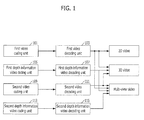
- Fig. 1 is a block diagram explaining a conventional multi-view video coding/decoding system.
- the conventional multi-view video coding/decoding system includes a first video coding unit 101, a first video decoding unit 103, a first depth information video coding unit 105, a first depth information video decoding unit 107, a second video coding unit 109, a second video decoding unit 111, a second depth information video coding unit 113, and a second depth video information decoding unit 115.
- First and second videos and first and second depth information videos are inputted to the first and second video coding units 101 and 109 and the first and second depth information video coding units 105 and 113, respectively.
- the first and second videos have a different view from each other, and the first and second depth information videos correspond to the first and second videos, respectively, and include depth information.
- two or more videos may be used, and the number of depth information videos may correspond to the number of videos.
- multi-view videos may be coded using videos having different views. That is, a high correlation exists between the multi-view videos. Therefore, when the first video is first coded, the second video coding unit 109 may code the second video by referring to the coded first video.
- the depth information video may be coded in the same manner.
- the respective coded videos are inputted to the first and second video decoding units 103 and 111 and the first and second depth information video decoding units 107 and 115, and then decoded.
- a two-dimensional (2D) video is a video obtained by decoding the coded first or second video
- a 3D video is a video obtained by decoding the coded first and second videos and the coded first depth information video.
- the first video may be a video having a reference view.
- a multi-view video is a video obtained by decoding the coded first and second videos and the coded first and second depth information videos.
- the coding and decoding of the multi-view video and the depth information video are performed independently.
- An embodiment of the present invention is directed to a multi-view video coding/decoding method and apparatus which effectively codes and decodes a depth information video corresponding to a multi-view video, thereby effectively coding and decoding the multi-view video.
- a multi-view video coding method includes: coding a multi-view video by performing inter and intra predictions; and coding a depth information video corresponding to the multi-view video in accordance with at least one of the inter prediction and the intra prediction.
- a multi-view video coding method includes: controlling the scales of first and second depth information videos corresponding to a multi-view video such that the scales are equalized; and coding the second depth information video, of which the scale is controlled, by referring to the first depth information video of which the scale is controlled.
- a multi-view video coding apparatus includes: a video coding block configured to code a multi-view video through inter and intra predictions; and a depth information video coding block configured to code a depth information video corresponding to the multi-view video using one or more pieces of inter prediction information and intra prediction information generated by the video coding block.
- a multi-view video coding apparatus includes: a scale control block configured to control the scales of first and second depth information videos corresponding to multi-view videos such that the scales are equalized to each other; and a depth information video coding block configured to code the second depth information video, of which the scale is controlled, by referring to the first depth information video of which the scale is controlled.
- a multi-view video decoding method includes: receiving a multi-view video coded through inter and intra predictions and a depth information video which is coded by using one or more pieces of prediction information in accordance with the inter prediction and prediction information in accordance with the intra prediction; decoding the coded multi-view video; and decoding the coded depth information video using the prediction information used during the coding of the depth information video.
- the coding when the depth information video for the multi-view video is coded, the coding may be performed by using the prediction information generated during the coding of the multi-view video, which makes it possible to increase the coding efficiency. Furthermore, the prediction information used during the decoding of the multi-view video may be used during the decoding of the depth information video. Therefore, it is possible to increase the decoding efficiency for the multi-view video.
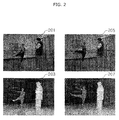
- Fig. 2 shows videos explaining the concept of a multi-view video coding method in accordance with an embodiment of the present invention.
- a first depth information video 203 corresponds to a first video 201
- a second depth information video 207 corresponds to a second video 205.
- the first and second videos 201 and 205 were taken by the same camera, and are videos for different frames having a temporal difference.
- the first video 201 and the first depth information video 203 and the second video 205 and the second depth information video 207 have similarities in the contours of objects and the motions of the objects at a time axis. This is because depth information is obtained by expressing a distance between the objects of the video and the camera in figures, and the depth information video represents the depth information.
- the object contours in the video and the depth information video during the coding are closely related to in-frame prediction modes in accordance with intra prediction, and the object motions are closely related to motion vectors. That is, when a video and a depth information video corresponding to the video are coded, it is highly likely that the prediction mode and the motion vector in the video are similar to those in the depth information video. Therefore, the coding of the video and the depth information video is not independently performed, but is performed using the similarity between the video and the depth information video, which makes it possible to increase coding efficiency. That is, when the coding of the multi-view video is performed through prediction information generated during the coding of the video when the depth information video is coded, the entire coding amount may decrease to increase the coding efficiency.
- the prediction information includes prediction modes and motion vectors. This principle may be extended to the multi-view video.
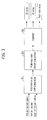
- Fig. 3 is a diagram explaining a multi-view video coding/decoding system in accordance with another embodiment of the present invention.
- the multi-view video coding and decoding system in accordance with the embodiment of the present invention includes a multi-view video coding apparatus 301 and a multi-view video decoding apparatus 303.
- Fig. 3 illustrates a case in which first and second videos and first and second depth information videos corresponding to the first and second videos, respectively, are coded and decoded.
- the multi-view video coding apparatus 301 receives and codes the first and second videos and the first and second depth information videos.
- the first and second videos are multi-view videos taken by cameras having a different view from each other, and the first and second depth information videos may be acquired by a stereo matching or depth camera.
- the multi-view video coding apparatus 301 codes the multi-view videos, that is, the first and second videos and the first and second depth information videos through inter and intra predictions. At this time, the multi-view video coding apparatus 301 may code a depth information video corresponding to a video using one or more pieces of prediction information in accordance with the inter prediction and prediction information in accordance with the intra prediction, which are generated during the coding of the video.
- the prediction information may include a motion vector of the video in accordance with the inter prediction and a prediction mode of the video in accordance with the intra prediction.
- the multi-view video coding apparatus 301 may code the depth information video using one or both of the motion vector and the prediction mode of the video.
- the multi-view video coding apparatus 301 may transmit the coded video and the coded depth information video as one bit stream.
- the multi-view video decoding apparatus 303 receives the coded video and the coded depth information video from the multi-view video coding apparatus 301, and then decodes the received videos.
- the multi-view video decoding apparatus 303 decodes the coded depth information video using the prediction information used during the coding of the multi-view video. Since the multi-view video coding apparatus 301 codes the depth information video using the prediction information of the multi-view video, the coded depth information video needs to be decoded by using the prediction information of the multi-view video.
- the information that the prediction information of the multi-view video was used during the coding of the depth information video may be included in a bit stream generated by the multi-view video coding apparatus 301 and then provided to the multi-view video decoding apparatus 303, or separately provided to the multi-view video decoding apparatus 303.
- Both of the multi-view video coding apparatus 301 and the multi-view video decoding apparatus 303 may perform the coding and the decoding in accordance with the H.264/AVC standard, respectively.
- the multi-view video coding/decoding system may include a separator 303.
- the separator 303 separates the decoded first and second videos and the decoded first and second depth information videos such that the separated videos may be used for reproducing 2D, 3D, or multi-view videos.
- the multi-view video coding apparatus 301 may code a video and a depth information video which have a different view from the previously coded video and depth information video, using the previously coded video and depth information video.
- the multi-view video coding apparatus 301 in accordance with the embodiment of the present invention may perform the coding by controlling a scale between the depth information videos. This will be described below in detail with reference to Fig. 5 .
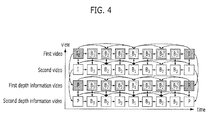
- Fig. 4 is a diagram explaining a process in which the prediction information is used in the multi-view video coding apparatus 301 in accordance with the embodiment of the present invention.
- the videos and the depth information videos include I frames, P frames, and B frames.
- the coding through the intra prediction is performed. Random access to a moving picture may be performed through the I frame.
- the P frame estimates a motion vector in a single direction with a previously coded I frame or P frame set to a reference video
- the B frame estimates a motion vector in both directions using the I frame, the P frame, and the B frame. That is, in the P and B frames, the coding through the inter prediction is performed.
- arrows indicate reference frames.
- the intra prediction is a coding technology based on a high correlation between the gray levels of adjacent pixels in a single frame.
- a reference frame is not used to code a block of a current frame, but a previously coded area of the current frame which is to be coded is used to calculate a prediction value of the current block.
- the intra prediction mode is divided into a 4 x 4 luma intra prediction mode, an 8 x 8 luma intra prediction mode, and a 16 x 16 luma intra prediction mode, and a chroma intra prediction mode.
- the intra prediction is performed on the current block depending on the variety of intra prediction modes, that is, various sizes and various intra prediction directions, and a prediction value is generated in accordance with the optimal intra prediction mode selected among them.
- the prediction value is generated, information on a residue and the prediction mode is coded to increase the compression rate of the video coding.
- the residue is a difference between the pixel value and the prediction value of the current block.
- the inter prediction is a coding technology based on the similarities between consecutive frames in a video sequence.
- One or more reference frames are used to estimate and compensate for the motion of a current frame by the unit of block, in order to code a video.
- a similar block to the current frame is searched for, and a motion vector is extracted.
- the residue between the current block and the similar block in the reference frames is coded to increase the compression rate of the video coding.
- the motion vector is needed to decode the video coded in accordance with the inter prediction. Therefore, the motion vector is coded together.
- the prediction information in accordance with the coding of the video is used. That is, as illustrated in Fig. 4 , the I frame of the depth information video may be coded by using the prediction information in accordance with the coding of the I frame of the video. Furthermore, the B and P frames of the depth information video may be coded by using the prediction information in accordance with the coding of the B and P frame of the video. In this case, when the depth information video is coded, the coding may be performed without including the information on the prediction mode or the motion vector. Therefore, the coding efficiency may increase.
- the depth information video when the depth information video is coded, a flag bit is inserted, which includes such information that the prediction information in accordance with the coding of the video is used. Then, when the coded depth information video is decoded, the flag bit may be used to use the decoding information of the video. Therefore, the prediction mode and the motion vector in accordance with the coding of the depth information video may not be coded. Since the information amount of the flag bit is smaller than those of the prediction mode and the motion vector in accordance with the coding of the depth information video, the coding efficiency may increase.
- the video may be coded in advance of the depth information video. Furthermore, since the similarities between the video and the depth information video are used, the depth information video may be coded by using the prediction information on the same view and the same frame.
- a frame of a video having a different view when a video is coded, a frame of a video having a different view may be referred to. Furthermore, when a depth information video is coded, a frame of a depth information video having a different view may be referred to.
- the B and P frames may be coded by referring to the frames of videos having a different view. For example, for the P frame of the second video, the coding in accordance with the inter prediction may be performed by referring to the I frame of the first video. This will be described below in detail with reference to Fig. 6 .
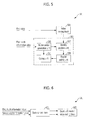
- Fig. 5 illustrates a multi-view vide coding apparatus 301 in accordance with another embodiment of the present invention.
- the multi-view video coding apparatus 301 in accordance with the embodiment of the present invention includes a video coding block 501 and a depth information video decoding block 503.
- the video coding block 501 performs the inter and intra predictions to code multi-view videos.
- Fig. 5 illustrates a case in which the video coding block 501 codes a first video among multi-view videos.
- the depth information video coding block 503 codes a depth information video corresponding to the multi-view video using one or more pieces of prediction information in accordance with the inter and intra predictions.
- the video coding block 501 codes the first video
- the depth information video coding block 503 codes the first depth information video.
- the prediction information may be a motion vector of the video in accordance with the inter prediction and a prediction mode of the video in accordance with the intra prediction.
- the depth information video coding block 503 includes a motion vector generation unit 505, an identity decision unit 507, a flag bit coding unit 509, and a coding unit 511.
- the motion vector generation unit 505 generates a motion vector for the current frame of the first depth information video using a reference frame. As described above, the motion vector generation unit 505 sets the reference frame with the B and P frames set to the current frame, and generates the motion vector.
- the identity decision unit 507 decides whether or not the motion vector for the current frame is identical to the motion vector in accordance with the inter prediction. That is, the identity decision unit 507 compares the motion vector generated by the video coding block 501 with the motion vector generated by the motion vector generation unit 505. As a result, when the identity between the motion vectors is confirmed, the motion vector generated by the video coding block 501 is used during the coding of the depth information video.
- the flag bit coding unit 509 generates a flag bit indicating the identity decision result of the identity decision unit 507, and then code the generated flag bit. For example, when the identity is confirmed, the flag bit may indicate '1'. On the other hand, when the identity is not confirmed, the flag bit may indicate '0'.
- the coding unit 511 codes the depth information video including the motion vector for the current frame, depending on the flag bit. That is, when the identity is confirmed, the coding unit 511 codes the depth information video including the motion vector for the depth information video. On the other hand, when the identity is not confirmed, the coding unit 511 codes the depth information video excluding the motion vector for the depth information video.
- the motion vector generated by the video coding block 501 when it is decided that the motion vector generated by the video coding block 501 is identical to the motion vector generated by the motion vector generation unit 505, the motion vector generated by the video coding block 501 may be used to increase the precision of the coding.
- the motion vector is not generated, but the coding is performed in accordance with the prediction mode.
- the multi-view video coding apparatus 301 may code the depth information video using the prediction mode of the video in accordance with the intra mode. More specifically, the flag bit coding unit 509 may further generate and code a flag bit indicating whether or not the video coding block 501 codes the depth information video using the prediction mode used during the intra prediction.
- the coding unit 511 may perform the intra prediction in accordance with the prediction mode, and further code the current frame of the depth information video. That is, the coding unit 511 codes the depth information video using the prediction mode within the I frame of the first video, under the precondition that the prediction mode of the I frame of the first video is identical to that of the I frame of the depth information video.
- the multi-view video coding apparatus 301 may code the depth information video using one or both of the prediction mode and the motion vector. Furthermore, when the depth information video coding block 503 codes the depth information video using the motion vector of the video coding block 501, the multi-view video coding apparatus 301 may not decide the identity, but code the depth information video under the precondition that the identity is confirmed.
- the inter and intra predictions may be performed depending on macro block types.
- the multi-view video coding apparatus 301 first decides the identity between the macro block types. When the identity is confirmed, the multi-view video coding apparatus 301 may code the depth information video using the prediction information of the video coding block 501.
- the multi-view video coding apparatus 301 may further include a filter block which is not illustrated.
- the filter block controls the prediction information such that the prediction information may be used by the depth information video coding block 503, depending on a difference in resolution or frame rate between the video and the depth information video.
- the filter block may control the scales of the motion vectors inputted to the identity decision unit 507. That is, when the frame rate of the video is different from that of the depth information video, the filter block may perform sub sampling to control the scales of the motion vectors.
- the filter block may perform down sampling to control the scales of the motion vectors.
- Fig. 6 illustrates a multi-view video coding apparatus 301 in accordance with another embodiment of the present invention.
- the multi-view video coding apparatus 301 in accordance with the embodiment of the present invention includes a scale control block 601 and a depth information video coding block 603.
- Fig. 6 illustrates a case in which first and second depth information videos are coded.
- the second depth information video is a depth information video corresponding to a video having a different view from the first depth information video.
- the scale control block 601 controls the scales of the first and second depth information videos corresponding to the multi-view videos such that the scales are equalized to each other.
- the depth information video includes depth information
- the depth information is obtained by expressing the distance between the objects of the video and the camera in figures. Therefore, the depth value between the first and second depth information videos with respect to the same object may exist. That is, a difference in scale may exist.
- the scale control block 601 may control the scale of the first depth information video on the basis of the second depth information video or control the scales of the first and second depth information videos with the average thereof.
- the depth information video coding block 603 codes the second depth information video, of which the scale is controlled, by referring to the first depth information depth image of which the scale is controlled by the scale control block 601.
- the I frame of the first depth information video may be referred to.
- the depth information video coding block 603 may code the second depth information video, of which the scale is controlled, by referring to the first depth information video of which the scale is controlled.
- the multi-view video may be coded by the video coding block 501 illustrated in Fig. 5 .
- the multi-view video coding apparatus 301 including the scale control block 601 and the depth information video coding block 603 in accordance with the embodiment of the present invention may control the scales of two or more depth information videos, and then code the depth information videos.
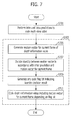
- Fig. 7 illustrates a multi-view video coding method in accordance with another embodiment of the present invention.
- the multi-view video coding method in accordance with the embodiment of the present invention starts from a step S701.
- the video coding block 501 performs the inter and intra predictions to code a multi-view video at the step S701.
- the depth information video coding block 503 codes a depth information video corresponding to the multi-view video using one or more pieces of prediction information in accordance with the inter and intra predictions, at a step S703.
- step S703 will be described in detail.
- the motion vector generation unit 505 generates a motion vector for the current frame of the depth information video using a reference frame, at a step S705.
- the identity decision unit 507 decides whether or not the motion vector in accordance with the inter prediction of the video coding block 501 is identical to the motion vector for the current frame, at a step S707.
- the filter block may control the scales of the motion vectors in accordance with the inter prediction of the video coding block 501.
- the flag bit coding unit 509 generates and codes a flag bit indicating the identity decision result at a step S709.
- the coding unit 509 codes the depth information video including the motion vector for the current frame depending on the flag bit, at a step S 711.
- the depth information video including the motion vector is coded at the step S711.
- the depth information video excluding the motion vector is coded at the step S711.
- the coding of the depth information video may be performed by using the prediction mode in accordance with the intra prediction which is generated at the step S701. More specifically, the prediction mode in accordance with the intra prediction, which is generated at the step S701, is transferred to the flag bit coding unit 509, and the flag bit coding unit 509 generates and codes a flag bit indicating whether or not to code the depth information video, using the prediction mode. The coding unit 509 performs the intra prediction in accordance with the prediction mode, and then codes the depth information video.
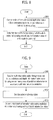
- Fig. 8 illustrates a multi-view video coding method in accordance with another embodiment of the present invention.
- the multi-view video coding method in accordance with the embodiment of the present invention starts from a step S801.
- the scale control block 601 controls the scales of first and second depth information videos corresponding to multi-view videos such that the scales are equalized, at a step S801. This is because, when the first depth information video is referred to during the coding of the second depth information video, a difference in scale between the first and second depth information videos may cause an error.
- the depth information video coding block 603 codes the second depth information video by referring to the first depth information video of which the scale is controlled at the step S801, at a step S803.
- the scales of two or more depth information videos may be controlled.
- two or more depth information videos of which the scales are controlled may be coded.
- Fig. 9 illustrates a multi-view video decoding method in accordance with another embodiment of the present invention.
- the multi-view video decoding method in accordance with the embodiment of the present invention starts from a step S901.
- a multi-view video coded through the inter and intra predictions and a depth information video coded by using one or more pieces of prediction information in accordance with the inter and intra predictions are received. That is, the video and the depth information video which are coded in accordance with the above-described embodiments of the present invention are received at the step S901.
- the coded multi-view video and the coded depth information video may be transmitted as one bit stream.
- the coded multi-view video is decoded at a step S903. Then, the prediction information used during the coding of the depth information video is used to decode the coded depth information video, at a step S905. Since the prediction information in accordance with the coding of the multi-view video was used in the coding process of the depth information video, the prediction information in accordance with the coding of the multi-view video may be used at the step S905. At the step S905, the prediction information in accordance with the coding of the multi-view video may be used by referring to a flag bit generated in the coding process of the depth information video.
- the decoding at the steps S903 and S905 may be performed in accordance with the H.264/AVC standard.
- the multi-view video coding/decoding method and apparatus described above can also be embodied as computer programs. Codes and code segments constituting the programs may be easily construed by computer programmers skilled in the art to which the invention pertains. Furthermore, the created programs may be stored in computer-readable recording media or data storage media and may be read out and executed by the computers. Examples of the computer-readable recording media include any computer-readable recoding media, e.g., intangible media such as carrier waves, as well as tangible media such as CD or DVD.
Landscapes
- Engineering & Computer Science (AREA)
- Multimedia (AREA)
- Signal Processing (AREA)
- Compression Or Coding Systems Of Tv Signals (AREA)
Applications Claiming Priority (3)
| Application Number | Priority Date | Filing Date | Title |
|---|---|---|---|
| KR20080124321 | 2008-12-08 | ||
| KR1020090037007A KR101158491B1 (ko) | 2008-12-08 | 2009-04-28 | 다시점 영상 부호화, 복호화 방법 및 그 장치. |
| PCT/KR2009/007328 WO2010068020A2 (ko) | 2008-12-08 | 2009-12-08 | 다시점 영상 부호화, 복호화 방법 및 그 장치 |
Publications (2)
| Publication Number | Publication Date |
|---|---|
| EP2375752A2 true EP2375752A2 (de) | 2011-10-12 |
| EP2375752A4 EP2375752A4 (de) | 2014-03-19 |
Family
ID=42365418
Family Applications (1)
| Application Number | Title | Priority Date | Filing Date |
|---|---|---|---|
| EP09832105.2A Ceased EP2375752A4 (de) | 2008-12-08 | 2009-12-08 | Verfahren und vorrichtung für mehrfachansichts-videocodierung/-dekodierung |
Country Status (5)
| Country | Link |
|---|---|
| US (1) | US9143796B2 (de) |
| EP (1) | EP2375752A4 (de) |
| KR (2) | KR101158491B1 (de) |
| CN (3) | CN102308585B (de) |
| WO (1) | WO2010068020A2 (de) |
Cited By (3)
| Publication number | Priority date | Publication date | Assignee | Title |
|---|---|---|---|---|
| CN104854862A (zh) * | 2012-12-27 | 2015-08-19 | 日本电信电话株式会社 | 图像编码方法、图像解码方法、图像编码装置、图像解码装置、图像编码程序、图像解码程序以及记录介质 |
| US9924197B2 (en) | 2012-12-27 | 2018-03-20 | Nippon Telegraph And Telephone Corporation | Image encoding method, image decoding method, image encoding apparatus, image decoding apparatus, image encoding program, and image decoding program |
| EP3731528A4 (de) * | 2017-12-21 | 2021-08-11 | Sony Interactive Entertainment Inc. | Bildverarbeitungsvorrichtung, inhaltsverarbeitungsvorrichtung, inhaltsverarbeitungssystem und bildverarbeitungsverfahren |
Families Citing this family (37)
| Publication number | Priority date | Publication date | Assignee | Title |
|---|---|---|---|---|
| KR101893559B1 (ko) | 2010-12-14 | 2018-08-31 | 삼성전자주식회사 | 다시점 비디오 부호화/복호화 장치 및 방법 |
| JP2012147332A (ja) * | 2011-01-13 | 2012-08-02 | Sony Corp | 符号化装置および符号化方法、並びに復号装置および復号方法 |
| WO2012099352A2 (ko) * | 2011-01-20 | 2012-07-26 | 삼성전자주식회사 | 다시점 영상 부호화/복호화 장치 및 방법 |
| KR101303719B1 (ko) * | 2011-02-03 | 2013-09-04 | 브로드콤 코포레이션 | 깊이 정보를 강화 계층으로 이용하기 위한 방법 및 시스템 |
| US11496760B2 (en) | 2011-07-22 | 2022-11-08 | Qualcomm Incorporated | Slice header prediction for depth maps in three-dimensional video codecs |
| US20130188013A1 (en) * | 2011-07-22 | 2013-07-25 | Qualcomm Incorporated | Mvc based 3dvc codec supporting inside view motion prediction (ivmp) mode |
| US9521418B2 (en) | 2011-07-22 | 2016-12-13 | Qualcomm Incorporated | Slice header three-dimensional video extension for slice header prediction |
| JP2014527350A (ja) * | 2011-08-09 | 2014-10-09 | サムスン エレクトロニクス カンパニー リミテッド | 多視点ビデオデータの符号化方法及びその装置、該復号化方法及びその装置 |
| CA2844602A1 (en) | 2011-08-09 | 2013-02-14 | Samsung Electronics Co., Ltd. | Method and device for encoding a depth map of multi viewpoint video data, and method and device for decoding the encoded depth map |
| US9288505B2 (en) | 2011-08-11 | 2016-03-15 | Qualcomm Incorporated | Three-dimensional video with asymmetric spatial resolution |
| US9414047B2 (en) * | 2011-08-12 | 2016-08-09 | Telefonaktiebolaget Lm Ericsson (Publ) | Signaling change of camera parameter and/or depth parameter using update message |
| KR20130022923A (ko) * | 2011-08-26 | 2013-03-07 | 삼성전자주식회사 | 가상 시점 합성 예측을 이용한 부호화/복호화 장치 및 부호화/복호화 방법 |
| US9485503B2 (en) * | 2011-11-18 | 2016-11-01 | Qualcomm Incorporated | Inside view motion prediction among texture and depth view components |
| KR20130056803A (ko) * | 2011-11-22 | 2013-05-30 | 삼성전자주식회사 | 칼라영상을 이용해서 다시점 깊이영상을 부호화/복호화 하는 장치 및 방법 |
| KR20130056684A (ko) * | 2011-11-22 | 2013-05-30 | 삼성전자주식회사 | 컬러 영상과 깊이 영상에 관한 부가정보를 부호화/복호화 하는 장치 및 방법 |
| WO2013115024A1 (ja) * | 2012-01-31 | 2013-08-08 | ソニー株式会社 | 画像処理装置および画像処理方法 |
| WO2013115609A1 (ko) * | 2012-02-02 | 2013-08-08 | 한국전자통신연구원 | 영상신호의 계층간 예측 방법 및 그 장치 |
| WO2013157822A1 (ko) * | 2012-04-16 | 2013-10-24 | 삼성전자주식회사 | 깊이 영상의 부호화 장치 및 방법, 그리고 복호화 장치 및 방법 |
| EP2838262A4 (de) * | 2012-04-16 | 2016-01-06 | Samsung Electronics Co Ltd | Verfahren zu mehrfachansichtsvideocodierung auf basis einer baumstrukturcodierungseinheit und vorrichtung dafür sowie verfahren zur mehrfachansichtsvideodecodierung auf basis einer baumstrukturcodierungseinheit und vorrichtung dafür |
| WO2013162272A1 (ko) * | 2012-04-24 | 2013-10-31 | 엘지전자 주식회사 | 비디오 신호 처리 방법 및 장치 |
| WO2014065546A1 (ko) * | 2012-10-22 | 2014-05-01 | (주)휴맥스 | 3차원 비디오에서의 뷰간 움직임 예측 방법 및 뷰간 병합 후보 결정 방법 |
| CN103795996B (zh) * | 2012-11-01 | 2016-08-03 | 上海贝尔股份有限公司 | 3d视频传递方法和设备 |
| US20150296197A1 (en) * | 2012-11-27 | 2015-10-15 | Intellectual Discovery Co., Ltd. | Encoding/decoding method and encoding/decoding device using depth information |
| WO2014107038A1 (ko) * | 2013-01-04 | 2014-07-10 | 삼성전자주식회사 | 깊이 영상의 부호화 장치 및 복호화 장치, 부호화 방법 및 복호화 방법 |
| WO2014110452A1 (en) * | 2013-01-11 | 2014-07-17 | Futurewei Technologies Co., Ltd. | Method and apparatus of depth prediction mode selection |
| KR101452625B1 (ko) * | 2013-04-01 | 2014-10-24 | 한양대학교 산학협력단 | 3차원 영상의 인트라 예측 방법 및 장치 |
| KR102300036B1 (ko) * | 2013-04-11 | 2021-09-08 | 엘지전자 주식회사 | 비디오 신호 처리 방법 및 장치 |
| KR102105323B1 (ko) * | 2013-04-15 | 2020-04-28 | 인텔렉추얼디스커버리 주식회사 | 객체 기반 적응적 밝기 보상 방법 및 장치 |
| EP3028466B1 (de) | 2013-07-24 | 2022-01-26 | Qualcomm Incorporated | Erweiterte vereinfachte bewegungsprädiktion für 3d-hevc |
| CN105393539B (zh) * | 2013-07-24 | 2019-03-29 | 高通股份有限公司 | 用于纹理及深度译码的子pu运动预测 |
| CN106105212A (zh) | 2014-03-07 | 2016-11-09 | 高通股份有限公司 | 简化的子预测单元(sub‑pu)运动参数继承(mpi) |
| US20160050440A1 (en) * | 2014-08-15 | 2016-02-18 | Ying Liu | Low-complexity depth map encoder with quad-tree partitioned compressed sensing |
| US11496747B2 (en) | 2017-03-22 | 2022-11-08 | Qualcomm Incorporated | Intra-prediction mode propagation |
| CN108924553B (zh) | 2018-06-20 | 2021-10-08 | 腾讯科技(深圳)有限公司 | 视频编码、解码方法、装置、计算机设备和存储介质 |
| CN116389767A (zh) * | 2018-11-20 | 2023-07-04 | 华为技术有限公司 | 合并模式的编码器、解码器及对应方法 |
| US11132819B2 (en) * | 2018-12-13 | 2021-09-28 | Konkuk University Industrial Cooperation Corp | Method and apparatus for decoding multi-view video information |
| CN114600454A (zh) | 2019-10-03 | 2022-06-07 | 华为技术有限公司 | 几何分割模式的译码过程 |
Family Cites Families (22)
| Publication number | Priority date | Publication date | Assignee | Title |
|---|---|---|---|---|
| KR100414629B1 (ko) | 1995-03-29 | 2004-05-03 | 산요덴키가부시키가이샤 | 3차원표시화상생성방법,깊이정보를이용한화상처리방법,깊이정보생성방법 |
| KR20060059769A (ko) * | 2004-11-29 | 2006-06-02 | 엘지전자 주식회사 | 영상신호의 엔코딩시에 베이스 레이어 픽처의 벡터를이용하기 위한 미세정보를 코딩하는 방법과 그 미세정보를이용하는 디코딩 방법 |
| US7728878B2 (en) * | 2004-12-17 | 2010-06-01 | Mitsubishi Electric Research Labortories, Inc. | Method and system for processing multiview videos for view synthesis using side information |
| US20060153300A1 (en) * | 2005-01-12 | 2006-07-13 | Nokia Corporation | Method and system for motion vector prediction in scalable video coding |
| WO2007011147A1 (en) | 2005-07-18 | 2007-01-25 | Electronics And Telecommunications Research Institute | Apparatus of predictive coding/decoding using view-temporal reference picture buffers and method using the same |
| EP1946563A2 (de) * | 2005-10-19 | 2008-07-23 | Thomson Licensing | Mehransicht-videocodierung unter verwendung skalierbarer videocodierung |
| US7667808B2 (en) | 2005-12-28 | 2010-02-23 | Lg Display Co., Ltd. | Liquid crystal display device and method of driving the same |
| JP2007178907A (ja) * | 2005-12-28 | 2007-07-12 | Lg Philips Lcd Co Ltd | 液晶表示装置 |
| US20070177671A1 (en) | 2006-01-12 | 2007-08-02 | Lg Electronics Inc. | Processing multiview video |
| ES2619522T3 (es) * | 2006-03-30 | 2017-06-26 | Lg Electronics, Inc. | Un método y un aparato para descodificar/codificar una señal de video multivisión |
| KR20080006495A (ko) * | 2006-07-12 | 2008-01-16 | 엘지전자 주식회사 | 비디오 신호의 디코딩 방법 및 장치 |
| KR101533740B1 (ko) | 2006-10-30 | 2015-07-03 | 니폰덴신뎅와 가부시키가이샤 | 동영상 부호화 방법 및 복호방법, 그들의 장치 및 그들의 프로그램과 프로그램을 기록한 기억매체 |
| CN101222627A (zh) * | 2007-01-09 | 2008-07-16 | 华为技术有限公司 | 一种多视点视频编解码系统以及预测向量的方法和装置 |
| CN101222639B (zh) | 2007-01-09 | 2010-04-21 | 华为技术有限公司 | 多视点视频技术中的视间预测方法、编码器和解码器 |
| EP2105021A4 (de) * | 2007-01-17 | 2011-03-02 | Lg Electronics Inc | vERFAHREN UND ANORDNUNG ZUM BEARBEITEN EINES VIDEOSIGNAL |
| EP2135454A4 (de) | 2007-03-02 | 2010-09-01 | Lg Electronics Inc | Verfahren und vorrichtung zum decodieren/codieren eines videosignals |
| KR101396948B1 (ko) | 2007-03-05 | 2014-05-20 | 경희대학교 산학협력단 | 하이브리드 다시점 및 계층화 비디오 코딩 방법과 장치 |
| US8548261B2 (en) | 2007-04-11 | 2013-10-01 | Samsung Electronics Co., Ltd. | Method and apparatus for encoding and decoding multi-view image |
| KR101301181B1 (ko) | 2007-04-11 | 2013-08-29 | 삼성전자주식회사 | 다시점 영상의 부호화, 복호화 방법 및 장치 |
| CN101690220B (zh) | 2007-04-25 | 2013-09-25 | Lg电子株式会社 | 用于解码/编码视频信号的方法和装置 |
| WO2009091383A2 (en) * | 2008-01-11 | 2009-07-23 | Thomson Licensing | Video and depth coding |
| US9113196B2 (en) * | 2008-11-10 | 2015-08-18 | Lg Electronics Inc. | Method and device for processing a video signal using inter-view prediction |
-
2009
- 2009-04-28 KR KR1020090037007A patent/KR101158491B1/ko active Active
- 2009-12-08 WO PCT/KR2009/007328 patent/WO2010068020A2/ko not_active Ceased
- 2009-12-08 CN CN200980156340.0A patent/CN102308585B/zh not_active Expired - Fee Related
- 2009-12-08 US US13/133,576 patent/US9143796B2/en active Active
- 2009-12-08 EP EP09832105.2A patent/EP2375752A4/de not_active Ceased
- 2009-12-08 CN CN201410026092.0A patent/CN103716642B/zh active Active
- 2009-12-08 CN CN201410026265.9A patent/CN103796027B/zh active Active
-
2011
- 2011-11-01 KR KR1020110112774A patent/KR101466849B1/ko active Active
Cited By (4)
| Publication number | Priority date | Publication date | Assignee | Title |
|---|---|---|---|---|
| CN104854862A (zh) * | 2012-12-27 | 2015-08-19 | 日本电信电话株式会社 | 图像编码方法、图像解码方法、图像编码装置、图像解码装置、图像编码程序、图像解码程序以及记录介质 |
| US9924197B2 (en) | 2012-12-27 | 2018-03-20 | Nippon Telegraph And Telephone Corporation | Image encoding method, image decoding method, image encoding apparatus, image decoding apparatus, image encoding program, and image decoding program |
| EP3731528A4 (de) * | 2017-12-21 | 2021-08-11 | Sony Interactive Entertainment Inc. | Bildverarbeitungsvorrichtung, inhaltsverarbeitungsvorrichtung, inhaltsverarbeitungssystem und bildverarbeitungsverfahren |
| US11503267B2 (en) | 2017-12-21 | 2022-11-15 | Sony Interactive Entertainment Inc. | Image processing device, content processing device, content processing system, and image processing method |
Also Published As
| Publication number | Publication date |
|---|---|
| CN102308585A (zh) | 2012-01-04 |
| WO2010068020A2 (ko) | 2010-06-17 |
| CN103716642A (zh) | 2014-04-09 |
| US20110261883A1 (en) | 2011-10-27 |
| CN102308585B (zh) | 2014-02-26 |
| WO2010068020A3 (ko) | 2011-10-27 |
| CN103716642B (zh) | 2017-09-05 |
| KR20100066304A (ko) | 2010-06-17 |
| US9143796B2 (en) | 2015-09-22 |
| KR101158491B1 (ko) | 2012-06-20 |
| CN103796027A (zh) | 2014-05-14 |
| EP2375752A4 (de) | 2014-03-19 |
| KR20110133532A (ko) | 2011-12-13 |
| KR101466849B1 (ko) | 2014-12-03 |
| CN103796027B (zh) | 2017-05-10 |
| WO2010068020A9 (ko) | 2010-08-05 |
Similar Documents
| Publication | Publication Date | Title |
|---|---|---|
| US9143796B2 (en) | Multi-view video coding/decoding method and apparatus | |
| JP7661385B2 (ja) | 深度マップの推定および更新を用いる効率的なマルチビュー符号化 | |
| US9918068B2 (en) | Method and apparatus of texture image compress in 3D video coding | |
| US10264281B2 (en) | Method and apparatus of inter-view candidate derivation in 3D video coding | |
| US9961369B2 (en) | Method and apparatus of disparity vector derivation in 3D video coding | |
| EP2932711B1 (de) | Vorrichtung und verfahren zur erzeugung und wiederherstellung eines videodatenstroms | |
| US20150172714A1 (en) | METHOD AND APPARATUS of INTER-VIEW SUB-PARTITION PREDICTION in 3D VIDEO CODING | |
| WO2014166329A1 (en) | Method and apparatus of inter-view candidate derivation for three-dimensional video coding | |
| CA2891723C (en) | Method and apparatus of constrained disparity vector derivation in 3d video coding | |
| US10045048B2 (en) | Method and apparatus for decoding multi-view video | |
| EP2936815A1 (de) | Verfahren und vorrichtung von disparitätsvektorableitungen in einer 3d-video-codierung | |
| US20130170763A1 (en) | Image encoding method and apparatus, image decoding method and apparatus, and programs therefor | |
| US9900620B2 (en) | Apparatus and method for coding/decoding multi-view image | |
| Mora et al. | Modification of the disparity vector derivation process in 3D-HEVC | |
| KR20080007069A (ko) | 비디오 신호 디코딩 방법 및 장치 |
Legal Events
| Date | Code | Title | Description |
|---|---|---|---|
| PUAI | Public reference made under article 153(3) epc to a published international application that has entered the european phase |
Free format text: ORIGINAL CODE: 0009012 |
|
| AK | Designated contracting states |
Kind code of ref document: A2 Designated state(s): AT BE BG CH CY CZ DE DK EE ES FI FR GB GR HR HU IE IS IT LI LT LU LV MC MK MT NL NO PL PT RO SE SI SK SM TR |
|
| AX | Request for extension of the european patent |
Extension state: AL BA RS |
|
| R17D | Deferred search report published (corrected) |
Effective date: 20111027 |
|
| 17P | Request for examination filed |
Effective date: 20120427 |
|
| RBV | Designated contracting states (corrected) |
Designated state(s): AT BE BG CH CY CZ DE DK EE ES FI FR GB GR HR HU IE IS IT LI LT LU LV MC MK MT NL NO PL PT RO SE SI SK SM TR |
|
| DAX | Request for extension of the european patent (deleted) | ||
| A4 | Supplementary search report drawn up and despatched |
Effective date: 20140219 |
|
| RIC1 | Information provided on ipc code assigned before grant |
Ipc: H04N 19/597 20140101ALI20140213BHEP Ipc: H04N 19/46 20140101ALI20140213BHEP Ipc: H04N 19/51 20140101AFI20140213BHEP |
|
| 17Q | First examination report despatched |
Effective date: 20150826 |
|
| REG | Reference to a national code |
Ref country code: DE Ref legal event code: R003 |
|
| STAA | Information on the status of an ep patent application or granted ep patent |
Free format text: STATUS: THE APPLICATION HAS BEEN REFUSED |
|
| 18R | Application refused |
Effective date: 20171130 |