EP2372973A2 - Aktualisierungen mit Kontextinformation - Google Patents
Aktualisierungen mit Kontextinformation Download PDFInfo
- Publication number
- EP2372973A2 EP2372973A2 EP11157518A EP11157518A EP2372973A2 EP 2372973 A2 EP2372973 A2 EP 2372973A2 EP 11157518 A EP11157518 A EP 11157518A EP 11157518 A EP11157518 A EP 11157518A EP 2372973 A2 EP2372973 A2 EP 2372973A2
- Authority
- EP
- European Patent Office
- Prior art keywords
- data
- context information
- metadata
- user
- information
- Prior art date
- Legal status (The legal status is an assumption and is not a legal conclusion. Google has not performed a legal analysis and makes no representation as to the accuracy of the status listed.)
- Withdrawn
Links
- 238000000034 method Methods 0.000 claims description 30
- 238000004891 communication Methods 0.000 claims description 28
- 230000006855 networking Effects 0.000 claims description 3
- 238000005259 measurement Methods 0.000 claims description 2
- 230000008569 process Effects 0.000 description 18
- 238000010586 diagram Methods 0.000 description 14
- 238000012545 processing Methods 0.000 description 6
- 230000001413 cellular effect Effects 0.000 description 5
- 230000003287 optical effect Effects 0.000 description 3
- 230000002730 additional effect Effects 0.000 description 2
- 230000000694 effects Effects 0.000 description 2
- 230000004044 response Effects 0.000 description 2
- 230000011218 segmentation Effects 0.000 description 2
- 230000003213 activating effect Effects 0.000 description 1
- 230000006399 behavior Effects 0.000 description 1
- 230000005540 biological transmission Effects 0.000 description 1
- 230000001419 dependent effect Effects 0.000 description 1
- 238000000605 extraction Methods 0.000 description 1
- 230000006870 function Effects 0.000 description 1
- 230000010365 information processing Effects 0.000 description 1
- 230000007774 longterm Effects 0.000 description 1
- 238000012986 modification Methods 0.000 description 1
- 230000004048 modification Effects 0.000 description 1
- 230000002093 peripheral effect Effects 0.000 description 1
- 238000011160 research Methods 0.000 description 1
- 230000003068 static effect Effects 0.000 description 1
- 230000000007 visual effect Effects 0.000 description 1
Images




Classifications
-
- H—ELECTRICITY
- H04—ELECTRIC COMMUNICATION TECHNIQUE
- H04L—TRANSMISSION OF DIGITAL INFORMATION, e.g. TELEGRAPHIC COMMUNICATION
- H04L67/00—Network arrangements or protocols for supporting network services or applications
- H04L67/01—Protocols
- H04L67/12—Protocols specially adapted for proprietary or special-purpose networking environments, e.g. medical networks, sensor networks, networks in vehicles or remote metering networks
-
- H—ELECTRICITY
- H04—ELECTRIC COMMUNICATION TECHNIQUE
- H04L—TRANSMISSION OF DIGITAL INFORMATION, e.g. TELEGRAPHIC COMMUNICATION
- H04L51/00—User-to-user messaging in packet-switching networks, transmitted according to store-and-forward or real-time protocols, e.g. e-mail
- H04L51/52—User-to-user messaging in packet-switching networks, transmitted according to store-and-forward or real-time protocols, e.g. e-mail for supporting social networking services
-
- H—ELECTRICITY
- H04—ELECTRIC COMMUNICATION TECHNIQUE
- H04L—TRANSMISSION OF DIGITAL INFORMATION, e.g. TELEGRAPHIC COMMUNICATION
- H04L67/00—Network arrangements or protocols for supporting network services or applications
- H04L67/50—Network services
- H04L67/56—Provisioning of proxy services
- H04L67/561—Adding application-functional data or data for application control, e.g. adding metadata
-
- H—ELECTRICITY
- H04—ELECTRIC COMMUNICATION TECHNIQUE
- H04W—WIRELESS COMMUNICATION NETWORKS
- H04W4/00—Services specially adapted for wireless communication networks; Facilities therefor
- H04W4/70—Services for machine-to-machine communication [M2M] or machine type communication [MTC]
-
- H—ELECTRICITY
- H04—ELECTRIC COMMUNICATION TECHNIQUE
- H04L—TRANSMISSION OF DIGITAL INFORMATION, e.g. TELEGRAPHIC COMMUNICATION
- H04L51/00—User-to-user messaging in packet-switching networks, transmitted according to store-and-forward or real-time protocols, e.g. e-mail
- H04L51/58—Message adaptation for wireless communication
Definitions
- a device e.g., a cellular phone
- another device e.g., a server
- the devices may also exchange metadata.
- the metadata describes the data and may aid the devices in automatically processing the data.
- a mobile device may include sensors to collect context information, a network interface to communicate with a remote device, and a processor.
- the processor may be configured to obtain data and obtain, from the sensors or an application, context information associated with the data. Additionally, the processor may be configured to parse the data based on the context information to obtain metadata associated with the data, and send the data and the metadata to the remote device.
- the sensors may include at least one of an acoustic sensor; Bluetooth transceiver; location sensor; temperature sensor; movement detecting components; infrared sensor; or power sensor.
- the context information may include a call log, measurement of battery power of user device, a list of Bluetooth peers, ambient temperature reading, ambient sound; contents of the device's communication with other devices, or a list of sites.
- the processor may be further configured to at least one of extract entity name, segment text; disambiguate a word, or disambiguate a sentence boundary.
- the processor may be further configured to receive input for specifying a time window in which the context information is to be obtained.
- the processor may be further configured to select types of context information to be obtained.
- the metadata may exclude user-specified types of information.
- the metadata may include descriptions of identified symbols in the data.
- the data may include at least one of text, image data, audio data, or video data.
- a method may include receiving data, at a mobile device, collecting first context information from sensors, collecting second context information from applications, and parsing, at the mobile device, the data based on the first context information and the second context information to obtain metadata, the metadata excluding personal information in the first and second context data. Additionally, the method may also include associating the metadata with the data, sending the metadata and the data from the mobile device to a remote device, posting, at the remote device, the data via an application for sharing the data with multiple users, and storing the metadata and the data in a database at the remote device.
- excluding personal information may include at least excluding a telephone number or an address.
- posting the data may include posting the data at an Internet message board or a social networking website.
- parsing the data may include obtaining property-value pairs based on the data, the first context information, and the second context information.
- collecting the context information may include at least one of determining location, determining temperature, determining Bluetooth peers, or determining sound.
- the data may include a message from a user at the mobile device, a message from an application at the mobile device, or a message from another user device in communication with the mobile device.
- the method may further include parsing, by the remote device, the data based on the first context data and the second context data to obtain additional metadata. Additionally, the method may further include receiving user input for selecting different types of context information.
- the method may further include receiving user input for selecting information to exclude from the context information.
- a computer-readable medium may include computer-executable instructions.
- the computer-executable instructions may cause a processing device to receive data, at a user device, from a user, collect context information from sensors and applications, associate the context information with the data, send the context information and the data from the user device to a remote device, and post the data, at the remote device, via an application for sharing the data with multiple users.
- the remote device may parse the data based on the context data to obtain metadata and stores the metadata and the data in a database at the remote device and the metadata may exclude personal information present in the context data.
- the context data may include a user log or list of web sites.
- a user device that sends data to a server device may collect and send context information associated with the data.
- the user device may collect the context information via sensors or software components that are installed on the user device.
- the context information may allow the server device to extract information from the uploaded data. For example, assume that the user device uploads a text message containing a phrase "Inferno is bad" to a server device.
- the server device may parse (e.g., language identification, named entity extraction, text segmentation, word disambiguation, sentence boundary disambiguation, etc.) the text message to extract information about the movie "Inferno.”
- the extracted information may be stored in a database and retrieved for different applications (e.g., a marketing application).
- a system 100 may include a user device 106 and a server device 110.
- a user 102 may input a text message 104 into user device 106.
- User device 106 may include context components, such as, for example, Global Positioning System receiver 108-1, power sensor 108-2, Bluetooth transceiver 108-3, temperature sensor 108-4, cell identifier 108-5, microphone/acoustic sensor 108-6, WiFi sensor 108-7, light sensor (not shown), call log (not shown), site history (not shown), etc.
- User device 106 may continually collect context information from one or more of context components. For example, user device 106 may periodically determine its location via GPS receiver 108-1, amount of battery power of user device via power sensor 108-2, identities of Bluetooth peers via Bluetooth transceiver 108-3, ambient temperature via temperature sensor 108-4, the identity of the cell in which user device is located via radio transceiver/sensor 108-5, ambient sound via microphone/acoustic sensor 108-6, identity of the WiFi network to which user device is attached via WiFi sensor 108-7, contents of user device 106's communication with other mobile devices based on the user log, Universal Resource Locators (URLs) of sites that user device 106 visited, etc.
- URLs Universal Resource Locators
- user device 106 may send text message 104 and context information 112 to server device 110.
- application 114 may store the text message 104, parse the received text message 104 based on the context information, and store the parsed message 116, text message 104 and context information 112 for later use (e.g., marketing research).
- user device 106 may process/filter context information 112 at user device 106 and send the processed information to server device 110.
- Fig. 2 is a diagram of an exemplary network 200 in which the concepts described herein may be implemented.
- network 200 may include user devices 202-1 through 202-4 (collectively referred to as user devices 202 and individually as user device 202-x), network 204, and server devices 206 and 208.
- network 200 may include other devices, such as wireless access points (WAPs), routers, switches, etc.
- WAPs wireless access points
- network 200 may include additional, fewer, or different devices than the ones illustrated in Fig. 2 .
- network 200 may include hundreds, thousands, or more of user devices 202.
- User device 202-x may transmit and/or receive data to/from other user devices 202-x and/or server devices 206 and 208.
- user device 202-x may receive user input, collect context information, and send the user input and the context information to server device 206.
- user device 202-x may process the context information prior to its transmission, for security purposes or to reduce the amount of transmitted data (e.g., information collected within or associated with a certain time window)
- Network 204 may include a fiber-optic network (e.g., passive optical networks (PONs)), an ad hoc network, a local area network (LAN), a wide area network (WAN), a wireless LAN, a metropolitan area network (MAN), a cellular network, a long term evolution (LTE) network, a public switched telephone network (PSTN), an intranet, the Internet, a satellite-based network, any other network, or a combination of networks.
- PONs passive optical networks
- LAN local area network
- WAN wide area network
- MAN metropolitan area network
- LTE long term evolution
- PSTN public switched telephone network
- Network 204 may allow any of devices 202-1 through 202-4, 206, and 208 to communicate with any of other devices 202-1 through 202-4, 206 and 208.
- Server device 206 may receive data and context information from user device 202-x. In one implementation, server device 206 may use the context information to parse the received data and store the parsed data for later use. If the received context information already has been processed at user device 202-x, server device 206 may simply store the data and context information at an appropriate database.
- Server device 208 may request information from server device 206. In response, server device 208 may allow server device 208 to perform database queries on the parsed data.
- Fig. 3 is a diagram of an exemplary user device 202-x.
- User device 202-x may include any of the following devices: a mobile telephone; a cellular phone; a personal communications system (PCS) terminal that may combine a cellular radiotelephone with data processing, facsimile, and/or data communications capabilities; an electronic notepad, a laptop, a netbook, a tablet computer, an ultra mobile personal computer (UMPC), and/or a personal computer with wireless or wireline communication capabilities; a personal digital assistant (PDA) that can include a telephone; a gaming device or console; a peripheral (e.g., wireless headphone); a digital camera; or another type of computational or communication device.
- PCS personal communications system
- PDA personal digital assistant
- user device 202-x may take the form of a mobile phone (e.g., a smart phone). As shown in Fig. 3 , user device 202-x may include a speaker 302, a display 304, control buttons 306, a keypad 308, a microphone 310, sensors 312, a front camera 314, a rear camera 316, and a housing 318.
- a mobile phone e.g., a smart phone.
- user device 202-x may include a speaker 302, a display 304, control buttons 306, a keypad 308, a microphone 310, sensors 312, a front camera 314, a rear camera 316, and a housing 318.
- Speaker 302 may provide audible information to a user of user device 202-x.
- Display 304 may provide visual information to the user, such as an image of a caller, video images, or pictures.
- display 304 may include a touch screen for providing input to user device 202-x.
- Control buttons 306 may permit the user to interact with user device 202-x to cause user device 202-x to perform one or more operations, such as place or receive a telephone call.
- Keypad 308 may include a telephone keypad.
- Microphone 310 may receive audible information from the user.
- Sensors 312 may collect and provide, to user device 202-x, information (e.g., acoustic, infrared, etc.) that is used to aid the user in capturing images or in providing other types of information (e.g., a distance between a user and user device 202-x).
- Front and rear cameras 314 and 316 may enable a user to view, capture and store images (e.g., pictures, videos) of a subject in front/back of user device 202-x.
- Housing 318 may provide a casing for components of user device 202-x and may protect the components from outside elements.
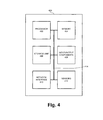
- Fig. 4 is a block diagram of a network device 400, which may represent any of user devices 202 and communication server devices 206 and 208.
- network device 400 may include a processor 402, a memory 404, a storage unit 406, input/output components 408, a network interface 410, sensors 412, and a communication path 414.
- device 400 may include additional, fewer, or different components than the ones illustrated in Fig. 4 .
- device 400 may include additional network interfaces, such as interfaces for receiving and sending data packets.
- Processor 402 may include a processor, a microprocessor, an Application Specific Integrated Circuit (ASIC), a Field Programmable Gate Array (FPGA), and/or other processing logic (e.g., audio/video processor) capable of processing information and/or controlling network device 400.
- Memory 404 may include static memory, such as read only memory (ROM), and/or dynamic memory, such as random access memory (RAM), or onboard cache, for storing data and machine-readable instructions.
- Storage unit 406 may include a magnetic and/or optical storage/recording medium. In some implementations, storage unit 406 may be mounted under a directory tree or mapped to a drive.
- Input/output components 408 may include a display screen (e.g., display 304, etc.), a keyboard, a mouse, a speaker, a microphone, a Digital Video Disk (DVD) writer, a DVD reader, Universal Serial Bus (USB) lines, and/or other types of components for converting physical events or phenomena to and/or from digital signals that pertain to network device 400.
- a display screen e.g., display 304, etc.
- a keyboard e.g., keyboard a mouse, a speaker, a microphone, a Digital Video Disk (DVD) writer, a DVD reader, Universal Serial Bus (USB) lines, and/or other types of components for converting physical events or phenomena to and/or from digital signals that pertain to network device 400.
- DVD Digital Video Disk
- USB Universal Serial Bus
- Network interface 408 may include a transceiver that enables network device 400 to communicate with other devices and/or systems.
- network interface 408 may communicate, via a network, such as the Internet, a terrestrial wireless network (e.g., a WLAN), a cellular network, a satellite-based network, a wireless personal area network (WPAN), etc.
- network interface 408 may include a modem, an Ethernet interface to a LAN, and/or an interface/ connection for connecting network device 400 to other devices (e.g., a Bluetooth interface).
- Sensors 412 may include, for example, power sensor 108-2, temperature sensor 108-4, microphone/acoustic sensor 108-6, sensors 312, etc. Sensors 412 may collect and provide, to network device 400, information (e.g., acoustic, infrared, etc.) about state of device 400 and/or its surroundings. In some implementations, sensors 412 may also include position/movement/orientation detecting components, such as an electronic gyroscope or an accelerometer.
- Communication path 414 may provide an interface through which components of network device 400 can communicate with one another.
- Fig. 5 is a block diagram of exemplary functional components of user device 202-x.
- user device 202-x may include communication application 502, context information collection (CIC) logic 504, driver/interface logic 506, and context information processing (CIP) logic 508.
- CIC context information collection
- CIP context information processing
- user device 202-x may include additional, fewer, or different functional components than those illustrated in Fig. 5 .
- user device 202-x may include an operating system, document application, game application, etc.
- CIC logic 504 may be integrated as part of communication application 502.
- Communication application 502 may include an application (e.g., a browser, a stand-alone application, a messaging client, etc.) for sending and/or receiving data (e.g., user input) and/or context information from/at user device 202-x.
- communication application 406 may obtain the context information from CIC logic 504 and/or CIP logic 506.
- a user of user device 202-x may update data at server device 206 or other user devices 202.
- CIC logic 504 may collect context information via sensors 412 and driver/interface logic 506, and provide the context information to communication application 502.
- CIC logic 504 may use CIP logic 508 to process data received from communication application 502 (e.g., user input) and the context information, for example, for bandwidth or security reasons, and relay the processed information to communication application 502.
- CIC logic 504 may collect the context information of user device 202-x via software components that are associated with hardware components (e.g., GPS receiver 108-1, power sensor 108-2, Bluetooth transceiver 108-3, ambient temperature sensor 108-4, radio transceiver/sensor 108-5, microphone/acoustic sensor 108-6, WiFi transceiver/sensor 108-7, infrared sensor, etc.) via driver/interface 506.
- hardware components e.g., GPS receiver 108-1, power sensor 108-2, Bluetooth transceiver 108-3, ambient temperature sensor 108-4, radio transceiver/sensor 108-5, microphone/acoustic sensor 108-6, WiFi transceiver/sensor 108-7, infrared sensor, etc.
- the context information may include the position/location information, readings from power sensor 108-2, identities of Bluetooth peers, ambient temperature, the identity of the cell in which user device 202-x is located, ambient sound, identity of the WiFi network to which user device 202-x may be attached, etc.
- CIC logic 504 may also collect context information of user device 202-x from other software applications. For example, CIC logic 504 may obtain a list of web sites that a browser in user device 202-x visited; documents that have been recently created/edited at user device 202-x; emails, text messages, images, and/or other files/data that have been recently sent from user device 202-x; voice messages that have been recorded; etc.
- Driver/interface logic 506 may include components for other software components to interact with hardware components, such as sensors 412, input/output components 408, storage unit 406, network interface 410, etc.
- CIP logic 508 may process user input and the context information that have been collected by CIC logic 504.
- CIP logic 508 may parse the user input based on the context information and provide the parsed information to CIC logic 504.
- the parsed information may include identified symbols (e.g., words) in the user input and metadata that describes the symbols (e.g., extracted named entity), text segmentation, word disambiguation, sentence boundary disambiguation, etc.
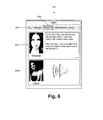
- GUI window 600 may include a menu bar 602 and video session windows 604-1 and 604-2 (collectively referred to as video session windows 604 and individually as video session window 604-x).
- GUI window 600 may include additional, fewer, or different components than those illustrated in Fig. 6 .
- Menu bar 602 may allow a user to conduct communication sessions (e.g., start a session and/or an end a session) with user devices 202 and/or server device 206. For example, in one implementation, the user may navigate through a menu tree via menu bar 602 to initiate a texting session or a conference based on a list of friends of the user. In another example, the user may send a transcript of the communication with another user to server device 206.
- communication sessions e.g., start a session and/or an end a session
- the user may navigate through a menu tree via menu bar 602 to initiate a texting session or a conference based on a list of friends of the user.
- the user may send a transcript of the communication with another user to server device 206.
- menu bar 602 may allow the user to perform operations that are associated with a session.
- the operations may include saving a session as a file (e.g., video, text, or audio, etc.), replaying a saved session, editing a saved session, modifying parameters that are associated with a current or future session (e.g., a list of friends that may participate in a session).
- the operations may include selecting types of context information (e.g., information from one or more of sensors 412 and/or applications), changing a time window(s) in which the context information is captured, selecting whether the context information is to be processed before the information is transmitted to another device (e.g., server device 206), etc.
- types of context information e.g., information from one or more of sensors 412 and/or applications
- changing a time window(s) in which the context information is captured e.g., information from one or more of sensors 412 and/or applications
- selecting whether the context information is to be processed before the information is transmitted to another device e.g., server device 206
- the user may also specify, via GUI window 600 what types of information may be prevented from being sent from user device 202-x.
- the user may specify that user's address and/or phone number may be distributed only to friends or acquaintances, and not to a web site on server device 206.
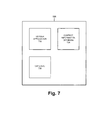
- Fig.7 is a block diagram of exemplary functional components of server device 206.
- server device 206 may include server application 702, a context information database 704, and CIP logic 706.
- server device may include additional, fewer, or different functional components than those illustrated in Fig. 7 .
- server device 206 may include an operating system, an email server, a firewall, etc.
- context information database 704 may not include server application.
- Server application 702 may provide a service to one or more applications on user device 202-x.
- server application 702 may receive data from user device 202-x (e.g., a user log describing user activity, a photograph, etc.), post the data at an Internet message board, a social networking website, or another type of information sharing server application, and allow the user to share the data with other users (e.g., let other users view the log).
- server application 702 may receive context information along with the data, process the data and the context information via CIP logic 706, and store the data, the context information and/or the processed information in context information database 704. Furthermore, when server application 702 receives a request from another application, user device 202-x, or server device 208, may retrieve/provide the data, the context information, and/or the processed information.
- Context information database 704 may store/retrieve the data, the context information, and/or the processed information.
- the data may include text, image, documents, and/or audio data.
- the context information may include information that is sent from user device 202-x. As described above, the context information may include data/ information from sensors 412, software components, etc.
- the processed information may include a reference to a piece (e.g., a word in text or audio clip, a paragraph, a piece of image, etc.) of the data.
- the processed information may also include metadata describing the piece of data. For example, assume that the data is "Inferno is a great movie," context information is "Uptown Theater,” which is the name of a movie theater that a user visited on March 2, 2010.
- Context information database 704 may store, for user device 202-x (or an identifier associated with an account for the user of user device 202-x), data "Inferno is a great movie” and context data “Location: Uptown Theater, March 2, 2010.”
- CIP logic 706 may process, when requested by an application (e.g., server application 702), data and context information associated with the data.
- the processed information may be stored, by CIP logic 706 or by the application, in context information database 704.
- server application 702 requests CIP logic 706 to process data "Inferno is a great movie” and context information "Location: Uptown Theater, March 2, 2010.”
- CIP logic 706 may determine a type of location, and upon determining that the location is a theater, may identify movies that are scheduled to play. Furthermore, CIP logic 706 may attempt to match each of the word in "Inferno is a great movie” to one of the names of the movies. Upon finding a match, CIP logic 706 may associate the word “Inferno” with metadata "movie” (i.e., a tag identifying a type of object) to generate a string: "Inferno - movie”). When server application 702 receives the processed information, "Inferno - movie,” server application 702 may associate the processed information with "Inferno is a great movie” and store the association and the processed information in database 704.
- CIP logic 706 may process data differently. For example, CIP logic 706 may handle text data differently from images or audio data. In another example, when the context data is a speech clip, CIP logic 706 may attempt to identify each of the words in the speech and parse the data based on the words.
- CIP logic 706 may operate similarly as CIP logic 508. However, whereas CIP logic 508 processes data for single user device 202-x, CIP logic 706 may handle data and context information for multiple user devices 202.
- Fig. 8 is a flow diagram of an exemplary process 800 that is associated with user device 202-x. Assume that user device 202-x has been and is collecting context information. Process 800 may begin with launching or starting communication application 502 in user device 202-x (block 802). For example, a user may launch communication application 502 by activating a menu item.
- Communication application 502 may obtain a message (block 804).
- the message may be audio, text, video, image, etc.
- the message may be received from a user, and in other instances, from an application or another user device 202-y.
- John may start communication application 502 at user device 202-x and decide to upload, to server device 206, text messages between John and Jane, a user of another device 202-y.
- User device 202-x may collect context information (block 806) as described above. At block 808, user device 202-x may parse the message based on the context information (block 808). In parsing the message, CIP logic 508 in user device 202-x may use the context information to obtain values for properties that are associated with different user activities or state of user device 202-x.
- CIP logic 508 may obtain a value for the location in longitude and latitude from GPS receiver installed in user device 202-x.
- CIP logic 508 may determine if there are additional properties, and for each property, CIP logic 508 may determine different values. Further, for each of these values, CIP logic 508 may determine properties, etc. CIP logic 508 may iterate through a process of determining property-value pairs for multiple times.
- user device 202-x determines, via a GPS receiver installed in user device 202-x, a value that is associated with a location property as a pair of longitude and latitude, (39.08,-77.02). For the value (39.08,-77.02) in longitude and latitude, user device 202-x may then determine additional properties.
- one property of a geographical coordinate is the name of a building.
- user device may determine that the name of the building at (39.08, -77.02) is "Uptown Theater”; a property associated with “Uptown theater” is “a type of establishment”; a value of the type of establishment is “theater”; properties associated with "theater” are “movies”; values associated with movies are names movies playing at Uptown Theater; a property for a movie is a "scheduled play time”: etc.
- CIP logic 508 may use different techniques for different properties. For example, for determining a location, CIP logic 508 may use the GPS receiver. For determining a type of building, CIP logic 508 may perform a lookup in a table. For determining a play time of a movie, CIP logic 508 may look up a movie schedule at a site.
- CIP logic 508 is parsing a message to Rebekah "I was completely lost when he began to talk about Last of the Mohicans" (see Fig. 6 ) based on a list of web sites that have been recently visited by a user at user device 202-x. Also assume that the web sites include a search site for music, and a property for the site is "music site.” In such a case, CIP logic 508 may determine (e.g., via the web site) that "Last of the Mohicans" is a song by performing a search in a dictionary and (e.g., identify the phrase) and then looking up the phrase "Last of the Mohicans" at the search site for music. That is, the value "Last of Mohicans" may be used to obtain another value for the property "music site.”
- User device 202-x may associate the message with metadata (block 810).
- CIC logic 504 and/or CIP logic 508 may tag or associate "Last of the Mohicans" with the metadata "book title.”
- user device 202-x may send the metadata and the message to server device 206.
- server device 206 may update and publish user blog, album, or any type shareable media.
- server device 206 may store the message and the metadata in context information database 704.
- user device 202-x is shown as parsing the message and context information.
- user device 202-x may perform additional processing for security purposes. For example, if the message (the data) and/or context information includes personal information (e.g., a password, user's address, etc.), CIP logic 508 may remove it from the message, the context information, and/or the processed information (e.g., the metadata). Alternatively, CIP logic 508 may block such information from being transmitted.
- the message the data
- context information includes personal information (e.g., a password, user's address, etc.)
- CIP logic 508 may remove it from the message, the context information, and/or the processed information (e.g., the metadata).
- CIP logic 508 may block such information from being transmitted.
- user device 202-x may not process the message and the context information.
- user device 202-x may send the message and the context information to server device 206 in raw form.
- CIP logic 706 in server device 206 may process the message and the context information to obtain the metadata.
- CIP logic 706 may also associate and store the message, context information, and the metadata.
- logic that performs one or more functions.
- This logic may include hardware, such as a processor, a microprocessor, an application specific integrated circuit, or a field programmable gate array, software, or a combination of hardware and software.
Landscapes
- Engineering & Computer Science (AREA)
- Computer Networks & Wireless Communication (AREA)
- Signal Processing (AREA)
- Computing Systems (AREA)
- Library & Information Science (AREA)
- Health & Medical Sciences (AREA)
- General Health & Medical Sciences (AREA)
- Medical Informatics (AREA)
- Information Transfer Between Computers (AREA)
- Selective Calling Equipment (AREA)
- Telephonic Communication Services (AREA)
Applications Claiming Priority (2)
| Application Number | Priority Date | Filing Date | Title |
|---|---|---|---|
| US32017410P | 2010-04-01 | 2010-04-01 | |
| US12/769,079 US20110246490A1 (en) | 2010-04-01 | 2010-04-28 | Updates with context information |
Publications (2)
| Publication Number | Publication Date |
|---|---|
| EP2372973A2 true EP2372973A2 (de) | 2011-10-05 |
| EP2372973A3 EP2372973A3 (de) | 2012-05-30 |
Family
ID=44278593
Family Applications (1)
| Application Number | Title | Priority Date | Filing Date |
|---|---|---|---|
| EP11157518A Withdrawn EP2372973A3 (de) | 2010-04-01 | 2011-03-09 | Aktualisierungen mit Kontextinformation |
Country Status (2)
| Country | Link |
|---|---|
| US (1) | US20110246490A1 (de) |
| EP (1) | EP2372973A3 (de) |
Cited By (2)
| Publication number | Priority date | Publication date | Assignee | Title |
|---|---|---|---|---|
| CN103064452A (zh) * | 2012-12-21 | 2013-04-24 | 杨林楠 | 一种基于手机的远程温湿度监控方法及系统 |
| CN107646196A (zh) * | 2015-05-29 | 2018-01-30 | 三星电子株式会社 | 用于执行通信服务的装置和方法 |
Families Citing this family (14)
| Publication number | Priority date | Publication date | Assignee | Title |
|---|---|---|---|---|
| US9128981B1 (en) | 2008-07-29 | 2015-09-08 | James L. Geer | Phone assisted ‘photographic memory’ |
| US8775454B2 (en) | 2008-07-29 | 2014-07-08 | James L. Geer | Phone assisted ‘photographic memory’ |
| KR20110121888A (ko) * | 2010-05-03 | 2011-11-09 | 삼성전자주식회사 | 휴대용 단말기에서 팝업 메뉴를 확인하기 위한 장치 및 방법 |
| US9560094B2 (en) | 2012-02-02 | 2017-01-31 | Tata Consultancy Services Limited | System and method for identifying and analyzing personal context of a user |
| KR101899548B1 (ko) | 2012-04-16 | 2018-09-17 | 삼성전자 주식회사 | 휴대단말에서 피드 정보 수집 방법 및 장치 |
| WO2014078706A1 (en) * | 2012-11-16 | 2014-05-22 | Loopwirez, Inc. | Ergonomic thumb interface for mobile phone, smart phone, or tablet |
| US9031573B2 (en) | 2012-12-31 | 2015-05-12 | Qualcomm Incorporated | Context-based parameter maps for position determination |
| US9928652B2 (en) | 2013-03-01 | 2018-03-27 | Apple Inc. | Registration between actual mobile device position and environmental model |
| US9247013B2 (en) * | 2013-03-08 | 2016-01-26 | Oracle International Corporation | System for repetitively executing rules-based configurable business application operations |
| KR102057944B1 (ko) * | 2013-09-17 | 2019-12-23 | 삼성전자주식회사 | 단말 장치 및 그의 공유 방법 |
| US20160155210A1 (en) * | 2014-12-01 | 2016-06-02 | Ebay Inc. | Interactive display based on near field communications |
| US10242082B2 (en) | 2014-12-12 | 2019-03-26 | Microsoft Technology Licensing, Llc | Context-driven multi-user communication |
| US9973922B1 (en) | 2017-03-23 | 2018-05-15 | Honda Motor Co., Ltd. | User identification from user data associated with a mobile communication device |
| US10542371B2 (en) | 2017-10-26 | 2020-01-21 | Verizon Patent And Licensing Inc. | System and method for providing customized point-of-interest information |
Family Cites Families (9)
| Publication number | Priority date | Publication date | Assignee | Title |
|---|---|---|---|---|
| CA2349177A1 (en) * | 1998-11-03 | 2000-05-11 | British Telecommunications Public Limited Company | Apparatus for processing communications |
| US20060265397A1 (en) * | 2001-03-06 | 2006-11-23 | Knowledge Vector, Inc. | Methods, systems, and computer program products for extensible, profile-and context-based information correlation, routing and distribution |
| WO2003054654A2 (en) * | 2001-12-21 | 2003-07-03 | Nokia Corporation | Location-based novelty index value and recommendation system and method |
| US20050216550A1 (en) * | 2004-03-26 | 2005-09-29 | Paseman William G | Communication mode and group integration for social networks |
| US20100299615A1 (en) * | 2007-09-28 | 2010-11-25 | The Trustees Of Dartmouth College | System And Method For Injecting Sensed Presence Into Social Networking Applications |
| US8386506B2 (en) * | 2008-08-21 | 2013-02-26 | Yahoo! Inc. | System and method for context enhanced messaging |
| US20110125743A1 (en) * | 2009-11-23 | 2011-05-26 | Nokia Corporation | Method and apparatus for providing a contextual model based upon user context data |
| US8750850B2 (en) * | 2010-01-18 | 2014-06-10 | Qualcomm Incorporated | Context-aware mobile incorporating presence of other mobiles into context |
| US9082127B2 (en) * | 2010-03-31 | 2015-07-14 | Cloudera, Inc. | Collecting and aggregating datasets for analysis |
-
2010
- 2010-04-28 US US12/769,079 patent/US20110246490A1/en not_active Abandoned
-
2011
- 2011-03-09 EP EP11157518A patent/EP2372973A3/de not_active Withdrawn
Non-Patent Citations (1)
| Title |
|---|
| None |
Cited By (3)
| Publication number | Priority date | Publication date | Assignee | Title |
|---|---|---|---|---|
| CN103064452A (zh) * | 2012-12-21 | 2013-04-24 | 杨林楠 | 一种基于手机的远程温湿度监控方法及系统 |
| CN107646196A (zh) * | 2015-05-29 | 2018-01-30 | 三星电子株式会社 | 用于执行通信服务的装置和方法 |
| EP3304867A4 (de) * | 2015-05-29 | 2018-04-11 | Samsung Electronics Co., Ltd. | Vorrichtung und verfahren zur durchführung von kommunikationsdiensten |
Also Published As
| Publication number | Publication date |
|---|---|
| US20110246490A1 (en) | 2011-10-06 |
| EP2372973A3 (de) | 2012-05-30 |
Similar Documents
| Publication | Publication Date | Title |
|---|---|---|
| EP2372973A2 (de) | Aktualisierungen mit Kontextinformation | |
| US10824594B2 (en) | Associating a captured screenshot with application-specific metadata that defines a session state of an application contributing image data to the captured screenshot | |
| US10692505B2 (en) | Personal assistant application | |
| US9276883B2 (en) | Information collection, storage, and sharing platform | |
| KR101733011B1 (ko) | 소셜 네트워크 서비스 기반 추천 정보 제공 장치 및 이를 이용한 방법 | |
| US9626656B2 (en) | Dialer with real-time reverse look-up including social data | |
| US20130051542A1 (en) | Social Caller ID with Reverse Look-Up | |
| US10348664B2 (en) | Method and system for achieving communications in a manner accounting for one or more user preferences or contexts | |
| KR20090127881A (ko) | 사용자 상태 표시자 제공 방법, 컴퓨터 판독가능한 저장 매체 및 사용자 상태 표시자 제공 장치 | |
| US9674271B2 (en) | Platform for sharing collected information with third-party applications | |
| WO2015038762A1 (en) | Method and apparatus for providing participant based image and video sharing | |
| US10049431B2 (en) | Locking a group of images to a desired level of zoom and an object of interest between image transitions | |
| WO2010127308A2 (en) | Automatic content tagging, such as tagging digital images via a wireless cellular network using metadata and facial recognition | |
| RU2549173C2 (ru) | Способ и система для осуществления посредничества между веб-сайтом контент-провайдера и мобильным устройством | |
| CN105120074A (zh) | 一种信息阅后即焚的方法及装置 | |
| JP2012247841A (ja) | 近隣人物特定装置、近隣人物特定方法、近隣人物特定プログラム及び近隣人物特定システム | |
| US20090007278A1 (en) | Privacy protection device, privacy protection method, and recording medium recorded with privacy protection program | |
| US20140212112A1 (en) | Contact video generation system | |
| KR101651766B1 (ko) | 소셜 네트워크 서비스 애플리케이션들에서의 정보를 에디팅하기 위한 방법 및 단말 | |
| JP2013131202A (ja) | ユーザーの連絡情報を処理するための方法及びシステム | |
| KR20160043640A (ko) | 라이프로그 디지털 다이어리 동영상 서비스 제공 시스템 및 그 방법 | |
| KR20120080379A (ko) | 디지털 카메라의 이미지 어노테이션 처리 방법 및 장치 | |
| WO2014172827A1 (en) | A method and apparatus for acquaintance management and privacy protection | |
| KR20070031720A (ko) | 지인 네트워크를 이용한 개인화 정보 서비스 방법 및시스템 | |
| US20130172015A1 (en) | System and method for location based event management |
Legal Events
| Date | Code | Title | Description |
|---|---|---|---|
| PUAI | Public reference made under article 153(3) epc to a published international application that has entered the european phase |
Free format text: ORIGINAL CODE: 0009012 |
|
| AK | Designated contracting states |
Kind code of ref document: A2 Designated state(s): AL AT BE BG CH CY CZ DE DK EE ES FI FR GB GR HR HU IE IS IT LI LT LU LV MC MK MT NL NO PL PT RO RS SE SI SK SM TR |
|
| AX | Request for extension of the european patent |
Extension state: BA ME |
|
| PUAL | Search report despatched |
Free format text: ORIGINAL CODE: 0009013 |
|
| AK | Designated contracting states |
Kind code of ref document: A3 Designated state(s): AL AT BE BG CH CY CZ DE DK EE ES FI FR GB GR HR HU IE IS IT LI LT LU LV MC MK MT NL NO PL PT RO RS SE SI SK SM TR |
|
| AX | Request for extension of the european patent |
Extension state: BA ME |
|
| RIC1 | Information provided on ipc code assigned before grant |
Ipc: H04L 29/06 20060101AFI20120424BHEP Ipc: H04L 29/08 20060101ALI20120424BHEP Ipc: H04W 4/02 20090101ALI20120424BHEP Ipc: H04L 12/58 20060101ALI20120424BHEP |
|
| 17P | Request for examination filed |
Effective date: 20121025 |
|
| 17Q | First examination report despatched |
Effective date: 20160513 |
|
| STAA | Information on the status of an ep patent application or granted ep patent |
Free format text: STATUS: THE APPLICATION IS DEEMED TO BE WITHDRAWN |
|
| 18D | Application deemed to be withdrawn |
Effective date: 20180222 |