EP2366819A1 - A knitting method for knitting a knitted fabric in which a lateral end part is strengthened, and the knitted fabric - Google Patents
A knitting method for knitting a knitted fabric in which a lateral end part is strengthened, and the knitted fabric Download PDFInfo
- Publication number
- EP2366819A1 EP2366819A1 EP11002148A EP11002148A EP2366819A1 EP 2366819 A1 EP2366819 A1 EP 2366819A1 EP 11002148 A EP11002148 A EP 11002148A EP 11002148 A EP11002148 A EP 11002148A EP 2366819 A1 EP2366819 A1 EP 2366819A1
- Authority
- EP
- European Patent Office
- Prior art keywords
- knitting
- stitch
- knitted fabric
- stitches
- lateral end
- Prior art date
- Legal status (The legal status is an assumption and is not a legal conclusion. Google has not performed a legal analysis and makes no representation as to the accuracy of the status listed.)
- Withdrawn
Links
- 238000009940 knitting Methods 0.000 claims description 162
- 239000004744 fabric Substances 0.000 claims description 38
- 238000000034 method Methods 0.000 claims description 32
- 238000005728 strengthening Methods 0.000 claims description 4
- 238000010586 diagram Methods 0.000 description 11
- 230000000717 retained effect Effects 0.000 description 7
- 230000000694 effects Effects 0.000 description 1
- 238000009963 fulling Methods 0.000 description 1
- 230000000007 visual effect Effects 0.000 description 1
Images




Classifications
-
- D—TEXTILES; PAPER
- D04—BRAIDING; LACE-MAKING; KNITTING; TRIMMINGS; NON-WOVEN FABRICS
- D04B—KNITTING
- D04B1/00—Weft knitting processes for the production of fabrics or articles not dependent on the use of particular machines; Fabrics or articles defined by such processes
- D04B1/22—Weft knitting processes for the production of fabrics or articles not dependent on the use of particular machines; Fabrics or articles defined by such processes specially adapted for knitting goods of particular configuration
Definitions
- the present invention relates to a knitting method for knitting a lateral end part in a thick, substantial, and low-stretch, knitted fabric using a flatbed knitting machine.
- the present invention aims to provide a knitting method for strengthening a lateral end part in a knitted fabric in a different process from that of Patent Citation 1 cited above, and to provide the knitted fabric.
- the present invention provides a knitting method for strengthening a lateral end part in a knitted fabric, using a flatbed knitting machine having at least one pair of front and back needle beds, wherein after a twisted stitch is formed on a back side of the knitted fabric, a stitch in the lateral end part in the knitted fabric is formed, then a new stitch following the twisted stitch and the stitch on the front side facing the twisted stitch is formed by tubular knitting, and then the stitch on the front side and the stitch on the back side which are formed by the tubular knitting are overlapped with each other.
- the lateral end part in the knitted fabric is formed at each side of a bifurcating part from which the knitted fabric is separated into right and left, and at least a pair of right and left stitches arranged in sandwich relation to the bifurcating part are crossed with each other to form a cross part in the bifurcating part.
- the present invention provides a knitted fabric knitted using a flatbed knitting machine and having a strengthened lateral end part therein, wherein a twisted stitch is formed on a back side of the knitted fabric before a stitch is formed in the lateral end part in the knitted fabric, a new stitch following the twisted stitch and the stitch on the front side facing the twisted stitch is formed by tubular knitting, and the stitch on the front side and the stitch on the back side which are formed by the tubular knitting are overlapped with each other.
- the stitch in the lateral end part in the knitted fabric is formed after the twisted stitch is formed on the back side of the knitted fabric, then the new stitch following the twisted stitch and the stitch on the front side positioned to face the twisted stitch is formed by the tubular knitting, and then the stitch on the front side and the stitch on the back side which are formed by the tubular knitting are overlapped with each other.
- This can provide the result that the lateral end part in the knitted fabric can be increased in thickness and thus in strength.
- the line along which the lateral end part extends can be shaped into a beautiful line. It is to be noted here that the term of the stitch used herein covers not only a knitted stitch but also a tuck stitch or a double stitch.
- the lateral end part in the knitted fabric is formed at each side of the bifurcating part from which the knitted fabric is separated into right and left, and at least a pair of right and left stitches positioned in sandwich relation to the bifurcating part are crossed with each other to form a cross part in the bifurcating part.
- the tubular knitting can provide the result that the tension of the knitting yarn can be relieved so that the stitches used for crossing can be easily transferred without being tensed.
- This can provide the result that the area of the knitted fabric at the cross part and closest to the bifurcating part can also be made free from tension, so that the knitted fabric can be beautifully shaped.
- a V-neck part of a sweater or an armhole of a vest can be shaped into a beautiful line.
- a V-neck part of the vest is described as a certain embodiment of the present invention.
- a two-bed type flatbed knitting machine is used which comprises a pair of front and back needle beds, the back needle bed of which is capable of being racked relative to the front needle bed, and at least two yarn feeders arranged over the needle beds.
- a fewer number of knitting needles than they are really used are represented in the knitting diagram.
- Fig. 1 is a view showing a front body 1 of a V-neck vest.
- the front body 1 of the vest knitted in the embodiment is wholly knitted in plain knitting.
- the front body 1 comprises a full-width part 4 knitted up to a bifurcating part 2 in a direction indicated by an arrow W, a right shoulder part 6 and a left shoulder part 7 which are knitted while being separated into right and left from the bifurcating part 2.
- Reference numeral 8 indicates an opening, and reference numeral 9 indicates a lateral end part.
- the full-width part 4 and the right shoulder part 6 are knitted by using a yarn feeder 10, and the left shoulder part 7 is knitted by using a yarn feeder 11.
- a chain line X-X indicates a boundary line in the bifurcating part 2.
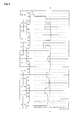
- Figs. 2 and 3 are knitting diagrams showing the knitting of the bifurcating part 2 of the front body 1 shown in Fig. 1 .
- Fig. 4 is a knitting diagram showing the knitting process of a cross part in the bifurcating part 2 taken in the first three steps and the subsequent knitting process of the right shoulder part 6 and the left shoulder part 7 following the bifurcating part 2.
- Figs. 5-7 are knitting diagrams showing the knitting processes following the knitting process of Fig. 4 .
- Numbers at the left side of the knitting diagrams designate knitting steps (S), and horizontal arrows designate knitting directions and vertical arrows designate stitch-transfer directions.
- Reference symbols FB and BB designate a front needle bed and a back needle bed, respectively.
- A-T of big letters designate knitting needles of FB
- small letters a-t designate knitting needles of BB.
- Circles indicate new stitches formed or transferred in the respective knitting steps
- Vs indicate tuck or pick-up stitches
- double circles indicate double stitches. Illustration of the stitches which are not involved in the knitting in the knitting steps and remain retained by the knitting needles during the knitting is omitted.
- a line X-X indicates a boundary line of the bifurcating part 2, as in the case of Fig. 1 .
- the FB side may be represented as the front side and the BB side may be represented as the back side.
- S1 shows the knitting of the full-width part 4 of the front body 1.
- the yarn feeder 10 is moved leftwards via a carriage (not shown) and the stitches are formed by the knitting needles T-A of FB.
- the yarn feeder 10 and the yarn feeder 11 are used for the knitting prior to forming the cross part.
- the yarn feeder 11 is used so that stitches are sequentially formed by the knitting needles T-N in the leftward direction.
- a stitch is picked up to the right by the knitting needle m, and in the next step S4, a stitch 31 is formed by the knitting needle M of FB.
- the knitting yarn extending from the knitting needle m to the knitting needle M of FB crosses over the knitting yarn extending from the knitting needle N of FB to the knitting needle m of BB, whereby a twisted stitch 21 is formed at the knitting needle m.
- step S9 new stitches are formed to the right with respect to the twisted stitches 23, 22, 21 formed on the back side of the front body 1 in the steps S3-S8 and also tucked by the knitting needle N of FB.
- step 10 stitches are formed to the left by the knitting needles M-K of FB.
- step 11 stitches are formed to the right by the knitting needles k-m of BB.
- tubular knitting is carried out to move in a circular direction, using the knitting needles K-M of FB and the knitting needles k-m of BB, whereby new stitches following the twisted stitches 23, 22, 21 and the stitches 31, 32, 33 positioned to face them are formed, so that the corresponding area of the knitted fabric is joined in a tubular form.
- the stitches retained by the knitting needles k-m of BB are respectively transferred to and overlapped with the stitches retained by the knitting needles K-M of FB.
- the yarn feeder 11 is moved leftwards for a while and then stitches are formed by the knitting needles N-T of FB, so as to continue from the stitch at the knitting needle M.
- step S14-S25 are in a symmetrical relation to the knitting of S2-S13 mentioned above with respect to the line X-X.
- the yarn feeder 10 is used so that stitches are sequentially formed to the right by the knitting needles A-G.
- step S15 a stitch is picked up to the left by the knitting needle h, and in the next step S16, a stitch is formed by the knitting needle H of FB. As a result of this, a twisted stitch is formed at the knitting needle h of BB.
- step S21 new stitches are formed to the left with respect to the twisted stitches formed on the back side of the front body 1 in the steps S15-S20 and also tucked by the knitting needle G of FB.
- step S22 stitches are formed to the right by the knitting needles H-J of FB.
- step S23 stitches are formed to the left by the knitting needles j-h.
- tubular knitting is carried out to move in a circular direction, using the knitting needles H-J of FB and the knitting needles h-j of BB, whereby new stitches following the twisted stitches and the stitches positioned to face them are formed, so that the corresponding area of the knitted fabric is joined in a tubular form.
- the stitches retained by the knitting needles h-j of BB are respectively transferred to and overlapped with the stitches retained by the knitting needles H-J of FB.
- the yarn feeder 10 is moved rightwards for a while and then stitches are formed by the knitting needles G-A of FB, so as to continue from the stitch at the knitting needle H.
- S26-S28 are the steps of crossing the stitches beyond the boundary of the bifurcating part 2.
- the stitch on the front side, arranged in sandwich relation to the bifurcating part 2 is transferred to and overlapped with the stitch on the back side formed next to the twisted stitch, so that it is crossed beyond the boundary of the bifurcating part 2.
- the stitches at the knitting needles J and K are respectively transferred to and overlapped with the stitches at the knitting needles j and k.
- the double stitch retained by the knitting needle k is transferred to the knitting needle J beyond the boundary of the bifurcating part 2.
- the double stitch retained by the knitting needle j is transferred to the knitting needle K beyond the boundary of the bifurcating part 2.
- the crossing of the stitches in the bifurcating part 2 is completed in the manner as mentioned above.
- the tubular knitting is provided following the twisted stitches and the stitches positioned to face them, the area near the cross part can be strengthened by a thick and substantial knitted fabric.
- the cross part is formed by the stitch-transfer process in the steps S26-S28
- the cross part may be formed by an alternative overlapping and crossing process, without being limited to such an illustrated process.
- the stitches on the front side, positioned in sandwich relation to the boundary of the bifurcating part 2 are crossed with each other first, and, then, the stitches on the back side may be transferred to across the boundary of the bifurcating part 2 and overlapped with the stitches on the front side.
- the stitches may be overlapped in a different positional relation from that in the embodiment.
- a known holding technique may be used (See Japanese Patent No. 2995464 , for example). In the case where a four-bed type flatbed knitting machine is used, an upper needle bed may be used for that process.
- the stitch-transfer process described in the embodiment is more advantageous than those alternatives in that the number of processes can be lessened.
- the knitting steps S29-S36 are fundamentally the same as the steps S2-S13 mentioned above, although they are different in number of twisted stitches formed and in presence or absence of the stitch-transfer process.
- the yarn feeder 11 is used so that stitches are sequentially formed to the left by the knitting needles T-N.
- a stitch is picked up to the right by the knitting needle m, and in the next step S31, a stitch 51 is formed by the knitting needle M of FB. As a result of this, a twisted stitch 41 is formed at the knitting needle m of BB.
- step S32 a stitch is picked up to the right by the knitting needle 1, and in the next step S33, stitches 52, 53 are formed by the knitting needles L and K. As a result of this, a twisted stitch 42 is formed at the knitting needle 1.
- step S34 new stitches are formed to the right with respect to the twisted stitches 42, 41 formed on the back side of the front body 1 in the steps S30-S33 and also tucked by the knitting needle N of FB.
- step S35 stitches are formed to the left by the knitting needles M-K of FB.
- step S36 the tubular knitting is done, forming stitches by the knitting needles 1 and m of BB, and then stitches are formed by the knitting needles N-T.
- the stitches at the knitting needles K-R are transferred to the knitting needles k-r, so that double stitches are formed at the knitting needles 1 and m.
- the stitches at the knitting needles k-r are transferred to the knitting needles L-S, for the narrowing.
- the lateral end part 9L in the left shoulder part 7 increases in distance from the boundary of the bifurcating part 2.
- a twisted stitch is not formed at the knitting needle k in the steps S33-S34, the twisted stitch may be formed in the same manner as in the steps S30-S31.
- tuck stitches may be formed.
- the tucking can tighten up the lateral end part 9L to produce a further strengthened lateral end part.
- the knitting of S39-S48 is in a symmetrical relation to the knitting of S29-S38 mentioned above with respect to the line X-X. In this regard, however, the yarn feeder 10 is used.
- the lateral end part 9R in the right shoulder part 6 is gradually increased in distance from the boundary of the bifurcating part 2.
- the steps S49-S57 are substantially the same as the steps S29-S38 mentioned above. In this regard, however, since the narrowing is done in the step S38, the knitting needles are each shifted rightwards from usual position by one. In the step 57, the stitches at the knitting needles m and n are transferred to and overlapped with the stitches at the knitting needles M and N, without using the narrowing in the step S38.
- the knitting of S58-S66 is in a symmetrical relation to the knitting of S49-S57 mentioned above with respect to the line X-X. In this regard, however, the yarn feeder 10 is used.
- the processes including the narrowing in the steps S29-S48 and the processes not including the narrowing in the steps S49-S66 may be alternated every predetermined course by being repeated for example in an alternate order, to form the opening 8 in the V-neck part.
- the knitting yarn connecting between the stitches on the front side and on the back side of the knitted fabric on the side closest to the boundary in the bifurcating part 2 is produced by the tubular knitting and also the stitch on the front side formed by the tubular knitting and the stitch on the back side are overlapped with each other, whereby the area around the opening of the V-neck is increased in thickness and thus in strength.
- the area around the opening can be prevented from undulating or curling, the V-shaped opening can be beautifully contoured.
- the forming of the twisted stitch and the tubular knitting following it are provided, as in the case of the knitting of the stitches to form the cross part shown in S1-S28. Therefore, substantially the same visual attractiveness and substantially the same thickness of the knitted fabric can be provided to the area around the opening of the V-neck including the bifurcating part.
- the tubular knitting after the forming of the twisted stitches rounds in a single direction, as shown in e.g. the steps S2-S13, the tubular knitting is not limited to this process.
- the knitting may be reversed in direction to turn around at that final tuck so that the stitches may be formed in the order of the knitting needles m, 1, k on the back side and the knitting needles K, L, M on the front side.
- the knitting needles two or three at each side, are used for forming the twisted stitch
- the number of knitting needles used may be varied to e.g. one at each side or three or more at each side.
- the number of knitting needles used for the tubular knitting following the forming of the twisted stitch may be varied properly according to such variation.
- the present invention is applicable to known tubular knitting that a tubular body whose front body and back body are joined at both lateral sides thereof is knitted on the flatbed knitting machine.
- the knitting of the bifurcating part in the V-neck front body is illustrated as one example, the present invention is not limited to the illustrated embodiment but is applicable to e.g. the knitting of a vest having a placket formed to extend straight, without using the narrowing technique as shown in e.g. the steps S38 and S48.
Landscapes
- Engineering & Computer Science (AREA)
- Textile Engineering (AREA)
- Knitting Of Fabric (AREA)
- Knitting Machines (AREA)
Abstract
[Object] The present invention relates to a knitting method for knitting a lateral end part in a knitted fabric for use in a collar, a placket and the like in a clothing or a garment like a sweater, using a flatbed knitting machine, aiming to provide a knitting method for strengthening the lateral end part in the knitted fabric, and the knitted fabric. [Technical Solution] After a twisted stitch is formed on the back side of the knitted fabric, a stitch in the lateral end part in the knitted fabric is formed, first; then a new stitch following the twisted stitch and the stitch on the front side facing the twisted stitch is formed by tubular knitting; and then the stitch on the front side and the stitch on the back side which are formed by the tubular knitting are overlapped with each other, these steps being taken by use of the flatbed knitting machine.
Description
- The present invention relates to a knitting method for knitting a lateral end part in a thick, substantial, and low-stretch, knitted fabric using a flatbed knitting machine.
- As to a knitting method for strengthening a lateral end part in a knitted fabric for use in a collar, a placket and the like in a sweater or a garment, using a flatbed knitting machine, the applicant of this application previously disclosed a knitting method for knitting a thick, substantial, and low-stretch, knitted fabric by combination of a plain knit and a transfer knit (See
Patent Citation 1, for example). - [Patent Citation 1] Japanese Examined Patent Publication No.
Hei 7-37699 - The present invention aims to provide a knitting method for strengthening a lateral end part in a knitted fabric in a different process from that of
Patent Citation 1 cited above, and to provide the knitted fabric. - The present invention provides a knitting method for strengthening a lateral end part in a knitted fabric, using a flatbed knitting machine having at least one pair of front and back needle beds, wherein after a twisted stitch is formed on a back side of the knitted fabric, a stitch in the lateral end part in the knitted fabric is formed, then a new stitch following the twisted stitch and the stitch on the front side facing the twisted stitch is formed by tubular knitting, and then the stitch on the front side and the stitch on the back side which are formed by the tubular knitting are overlapped with each other.
- In the present invention, the lateral end part in the knitted fabric is formed at each side of a bifurcating part from which the knitted fabric is separated into right and left, and at least a pair of right and left stitches arranged in sandwich relation to the bifurcating part are crossed with each other to form a cross part in the bifurcating part.
- Also, the present invention provides a knitted fabric knitted using a flatbed knitting machine and having a strengthened lateral end part therein, wherein a twisted stitch is formed on a back side of the knitted fabric before a stitch is formed in the lateral end part in the knitted fabric, a new stitch following the twisted stitch and the stitch on the front side facing the twisted stitch is formed by tubular knitting, and the stitch on the front side and the stitch on the back side which are formed by the tubular knitting are overlapped with each other.
- According to the present invention, the stitch in the lateral end part in the knitted fabric is formed after the twisted stitch is formed on the back side of the knitted fabric, then the new stitch following the twisted stitch and the stitch on the front side positioned to face the twisted stitch is formed by the tubular knitting, and then the stitch on the front side and the stitch on the back side which are formed by the tubular knitting are overlapped with each other. This can provide the result that the lateral end part in the knitted fabric can be increased in thickness and thus in strength. Also, since the lateral end part in the knitted fabric can be increased in strength, the line along which the lateral end part extends can be shaped into a beautiful line. It is to be noted here that the term of the stitch used herein covers not only a knitted stitch but also a tuck stitch or a double stitch.
- Also, according to the present invention, the lateral end part in the knitted fabric is formed at each side of the bifurcating part from which the knitted fabric is separated into right and left, and at least a pair of right and left stitches positioned in sandwich relation to the bifurcating part are crossed with each other to form a cross part in the bifurcating part. The tubular knitting can provide the result that the tension of the knitting yarn can be relieved so that the stitches used for crossing can be easily transferred without being tensed. This can provide the result that the area of the knitted fabric at the cross part and closest to the bifurcating part can also be made free from tension, so that the knitted fabric can be beautifully shaped.
- In the knitted fabric of the present invention, since the lateral end part is increased in thickness and thus in strength, a V-neck part of a sweater or an armhole of a vest can be shaped into a beautiful line.
-
- [
Fig.1] Fig. 1 is a view showing afront body 1 of a V-neck vest of a certain embodiment of the present invention, - [
Fig.2] Fig. 2 is a knitting diagram of a bifurcatingpart 2 of thefront body 1 of the embodiment of the present invention, - [
Fig.3] Fig. 3 is a knitting diagram of the bifurcatingpart 2 of thefront body 1 of the embodiment of the present invention, - [
Fig.4] Fig. 4 is a knitting diagram of a cross part of the bifurcatingpart 2 of thefront body 1 and parts following the bifurcatingpart 2 of the embodiment of the present invention, - [
Fig.5] Fig. 5 is a knitting diagram of the parts following the bifurcatingpart 2 of thefront body 1 of the embodiment of the present invention, - [
Fig.6] Fig. 6 is a knitting diagram of the parts following the bifurcatingpart 2 of thefront body 1 of the embodiment of the present invention, and - [
Fig.7] Fig. 7 is a knitting diagram of the parts following the bifurcatingpart 2 of thefront body 1 of the embodiment of the present invention. - In the following, the knitting of a V-neck part of the vest is described as a certain embodiment of the present invention. In the knitting described in the following, a two-bed type flatbed knitting machine is used which comprises a pair of front and back needle beds, the back needle bed of which is capable of being racked relative to the front needle bed, and at least two yarn feeders arranged over the needle beds. For convenience of explanation, a fewer number of knitting needles than they are really used are represented in the knitting diagram.
-
Fig. 1 is a view showing afront body 1 of a V-neck vest. Thefront body 1 of the vest knitted in the embodiment is wholly knitted in plain knitting. Thefront body 1 comprises a full-width part 4 knitted up to a bifurcatingpart 2 in a direction indicated by an arrow W, aright shoulder part 6 and aleft shoulder part 7 which are knitted while being separated into right and left from the bifurcatingpart 2.Reference numeral 8 indicates an opening, andreference numeral 9 indicates a lateral end part. The full-width part 4 and theright shoulder part 6 are knitted by using ayarn feeder 10, and theleft shoulder part 7 is knitted by using ayarn feeder 11. A chain line X-X indicates a boundary line in the bifurcatingpart 2. -
Figs. 2 and3 are knitting diagrams showing the knitting of the bifurcatingpart 2 of thefront body 1 shown inFig. 1 .Fig. 4 is a knitting diagram showing the knitting process of a cross part in the bifurcatingpart 2 taken in the first three steps and the subsequent knitting process of theright shoulder part 6 and theleft shoulder part 7 following thebifurcating part 2.Figs. 5-7 are knitting diagrams showing the knitting processes following the knitting process ofFig. 4 . Numbers at the left side of the knitting diagrams designate knitting steps (S), and horizontal arrows designate knitting directions and vertical arrows designate stitch-transfer directions. Reference symbols FB and BB designate a front needle bed and a back needle bed, respectively. Alphabetical letters A-T of big letters designate knitting needles of FB, and small letters a-t designate knitting needles of BB. Circles indicate new stitches formed or transferred in the respective knitting steps, Vs indicate tuck or pick-up stitches, and double circles indicate double stitches. Illustration of the stitches which are not involved in the knitting in the knitting steps and remain retained by the knitting needles during the knitting is omitted. A line X-X indicates a boundary line of the bifurcatingpart 2, as in the case ofFig. 1 . The FB side may be represented as the front side and the BB side may be represented as the back side. - In the following, the knitting steps S1-S28 shown in
Figs. 2-4 are described. S1 shows the knitting of the full-width part 4 of thefront body 1. Theyarn feeder 10 is moved leftwards via a carriage (not shown) and the stitches are formed by the knitting needles T-A of FB. In the subsequent steps from S2, theyarn feeder 10 and theyarn feeder 11 are used for the knitting prior to forming the cross part. - In the step S2, the
yarn feeder 11 is used so that stitches are sequentially formed by the knitting needles T-N in the leftward direction. In the step S3, a stitch is picked up to the right by the knitting needle m, and in the next step S4, a stitch 31 is formed by the knitting needle M of FB. Though these steps, the knitting yarn extending from the knitting needle m to the knitting needle M of FB crosses over the knitting yarn extending from the knitting needle N of FB to the knitting needle m of BB, whereby atwisted stitch 21 is formed at the knitting needle m. Thereafter, the same knitting steps as S3-S4 are taken in the steps S5-S6 and S7-S8, so thatstitches stitches needles 1 and m, respectively. In the step S9, new stitches are formed to the right with respect to thetwisted stitches front body 1 in the steps S3-S8 and also tucked by the knitting needle N of FB. In thestep 10, stitches are formed to the left by the knitting needles M-K of FB. In thestep 11, stitches are formed to the right by the knitting needles k-m of BB. In the steps S9-S11 mentioned above, tubular knitting is carried out to move in a circular direction, using the knitting needles K-M of FB and the knitting needles k-m of BB, whereby new stitches following thetwisted stitches stitches yarn feeder 11 is moved leftwards for a while and then stitches are formed by the knitting needles N-T of FB, so as to continue from the stitch at the knitting needle M. - S14-S25 are in a symmetrical relation to the knitting of S2-S13 mentioned above with respect to the line X-X. In the step S14, the
yarn feeder 10 is used so that stitches are sequentially formed to the right by the knitting needles A-G. In the step S15, a stitch is picked up to the left by the knitting needle h, and in the next step S16, a stitch is formed by the knitting needle H of FB. As a result of this, a twisted stitch is formed at the knitting needle h of BB. Thereafter, the same knitting steps as S15-S16 are taken in the steps S17-S18 and S19-S20, so that stitches are formed by the knitting needles I and J, respectively, while also twisted stitches are formed by the knitting needles i and j, respectively. In the step S21, new stitches are formed to the left with respect to the twisted stitches formed on the back side of thefront body 1 in the steps S15-S20 and also tucked by the knitting needle G of FB. In the step S22, stitches are formed to the right by the knitting needles H-J of FB. In the step S23, stitches are formed to the left by the knitting needles j-h. In the steps S21-S23 mentioned above, tubular knitting is carried out to move in a circular direction, using the knitting needles H-J of FB and the knitting needles h-j of BB, whereby new stitches following the twisted stitches and the stitches positioned to face them are formed, so that the corresponding area of the knitted fabric is joined in a tubular form. Then, in thestep 24, the stitches retained by the knitting needles h-j of BB are respectively transferred to and overlapped with the stitches retained by the knitting needles H-J of FB. In the step S25, theyarn feeder 10 is moved rightwards for a while and then stitches are formed by the knitting needles G-A of FB, so as to continue from the stitch at the knitting needle H. - S26-S28 are the steps of crossing the stitches beyond the boundary of the bifurcating
part 2. In this embodiment, the stitch on the front side, arranged in sandwich relation to the bifurcatingpart 2, is transferred to and overlapped with the stitch on the back side formed next to the twisted stitch, so that it is crossed beyond the boundary of the bifurcatingpart 2. In the step S26, the stitches at the knitting needles J and K are respectively transferred to and overlapped with the stitches at the knitting needles j and k. In the step S27, the double stitch retained by the knitting needle k is transferred to the knitting needle J beyond the boundary of the bifurcatingpart 2. In the step S28, the double stitch retained by the knitting needle j is transferred to the knitting needle K beyond the boundary of the bifurcatingpart 2. The crossing of the stitches in the bifurcatingpart 2 is completed in the manner as mentioned above. - Since in the steps S9-S11 and S21-S23, the tubular knitting is provided following the twisted stitches and the stitches positioned to face them, the area near the cross part can be strengthened by a thick and substantial knitted fabric.
- Although in the illustrated embodiment, the cross part is formed by the stitch-transfer process in the steps S26-S28, the cross part may be formed by an alternative overlapping and crossing process, without being limited to such an illustrated process. For example, as an alternative process, the stitches on the front side, positioned in sandwich relation to the boundary of the bifurcating
part 2, are crossed with each other first, and, then, the stitches on the back side may be transferred to across the boundary of the bifurcatingpart 2 and overlapped with the stitches on the front side. In this alternative process, the stitches may be overlapped in a different positional relation from that in the embodiment. Also, in this alternative process, a known holding technique may be used (See Japanese Patent No.2995464 - Next, the knitting of the
right shoulder part 6 and leftshoulder part 7 following the bifurcatingpart 2 is described with reference toFig. 4 showing the steps subsequent to S29 andFigs. 5-7 . After the stitches are crossed in the bifurcatingpart 2, as mentioned above, the narrowing process is carried out so that while the knitted fabric of theright shoulder part 6 and the knitted fabric of theleft shoulder part 7 are knitted, respectively, the lateral end parts 9R, 9L on their side facing the boundary of the bifurcatingpart 2 can gradually increase in distance from the boundary of the bifurcatingpart 2. By this knitting process, anopening 8 of the V-neck part is formed. - The knitting steps S29-S36 are fundamentally the same as the steps S2-S13 mentioned above, although they are different in number of twisted stitches formed and in presence or absence of the stitch-transfer process. In the step S29, the
yarn feeder 11 is used so that stitches are sequentially formed to the left by the knitting needles T-N. In the step S30, a stitch is picked up to the right by the knitting needle m, and in the next step S31, a stitch 51 is formed by the knitting needle M of FB. As a result of this, a twisted stitch 41 is formed at the knitting needle m of BB. Likewise, in the step S32, a stitch is picked up to the right by theknitting needle 1, and in the next step S33, stitches 52, 53 are formed by the knitting needles L and K. As a result of this, a twisted stitch 42 is formed at theknitting needle 1. In the step S34, new stitches are formed to the right with respect to the twisted stitches 42, 41 formed on the back side of thefront body 1 in the steps S30-S33 and also tucked by the knitting needle N of FB. In the step S35, stitches are formed to the left by the knitting needles M-K of FB. In the step S36, the tubular knitting is done, forming stitches by theknitting needles 1 and m of BB, and then stitches are formed by the knitting needles N-T. In the step S37, the stitches at the knitting needles K-R are transferred to the knitting needles k-r, so that double stitches are formed at theknitting needles 1 and m. In the step S38, the stitches at the knitting needles k-r are transferred to the knitting needles L-S, for the narrowing. As a result of this, the lateral end part 9L in theleft shoulder part 7 increases in distance from the boundary of the bifurcatingpart 2. Although in the process mentioned above, a twisted stitch is not formed at the knitting needle k in the steps S33-S34, the twisted stitch may be formed in the same manner as in the steps S30-S31. As an alternative to thestitches - The knitting of S39-S48 is in a symmetrical relation to the knitting of S29-S38 mentioned above with respect to the line X-X. In this regard, however, the
yarn feeder 10 is used. By the narrowing in the step S48, the lateral end part 9R in theright shoulder part 6 is gradually increased in distance from the boundary of the bifurcatingpart 2. - The steps S49-S57 are substantially the same as the steps S29-S38 mentioned above. In this regard, however, since the narrowing is done in the step S38, the knitting needles are each shifted rightwards from usual position by one. In the
step 57, the stitches at the knitting needles m and n are transferred to and overlapped with the stitches at the knitting needles M and N, without using the narrowing in the step S38. - The knitting of S58-S66 is in a symmetrical relation to the knitting of S49-S57 mentioned above with respect to the line X-X. In this regard, however, the
yarn feeder 10 is used. - In the knitting processes subsequent to S66, the processes including the narrowing in the steps S29-S48 and the processes not including the narrowing in the steps S49-S66 may be alternated every predetermined course by being repeated for example in an alternate order, to form the
opening 8 in the V-neck part. - In the knitting processes subsequent to S29 of
Fig. 4 , the knitting yarn connecting between the stitches on the front side and on the back side of the knitted fabric on the side closest to the boundary in the bifurcatingpart 2 is produced by the tubular knitting and also the stitch on the front side formed by the tubular knitting and the stitch on the back side are overlapped with each other, whereby the area around the opening of the V-neck is increased in thickness and thus in strength. As a result of this, since the area around the opening can be prevented from undulating or curling, the V-shaped opening can be beautifully contoured. Also, the forming of the twisted stitch and the tubular knitting following it are provided, as in the case of the knitting of the stitches to form the cross part shown in S1-S28. Therefore, substantially the same visual attractiveness and substantially the same thickness of the knitted fabric can be provided to the area around the opening of the V-neck including the bifurcating part. - Although in the illustrated embodiment, the tubular knitting after the forming of the twisted stitches rounds in a single direction, as shown in e.g. the steps S2-S13, the tubular knitting is not limited to this process. For example, as an alternative, after a final tuck in the step S9, the knitting may be reversed in direction to turn around at that final tuck so that the stitches may be formed in the order of the knitting needles m, 1, k on the back side and the knitting needles K, L, M on the front side.
- Although in the illustrated embodiment, the knitting needles, two or three at each side, are used for forming the twisted stitch, the number of knitting needles used may be varied to e.g. one at each side or three or more at each side. Also, the number of knitting needles used for the tubular knitting following the forming of the twisted stitch may be varied properly according to such variation.
- Although in the illustrated embodiment, the knitting of the
front body 1 using the two-bed type flatbed knitting machine has been disclosed, the present invention is applicable to known tubular knitting that a tubular body whose front body and back body are joined at both lateral sides thereof is knitted on the flatbed knitting machine. Although in the illustrated embodiment, the knitting of the bifurcating part in the V-neck front body is illustrated as one example, the present invention is not limited to the illustrated embodiment but is applicable to e.g. the knitting of a vest having a placket formed to extend straight, without using the narrowing technique as shown in e.g. the steps S38 and S48. -
- 1
- Front body
- 2
- Bifurcating part
- 6
- Right shoulder part
- 7
- Left shoulder part
- 8
- Opening
- 9
- Lateral end part
- 10, 11
- Yarn feeder
- 21, 22, 23, 41, 42
- Twisted stitch
- 31, 32, 33, 51, 52, 53
- Stitch
Claims (3)
- A knitting method for strengthening a lateral end part in a knitted fabric, using a flatbed knitting machine having at least one pair of front and back needle beds, wherein after a twisted stitch is formed on a back side of the knitted fabric, a stitch in the lateral end part in the knitted fabric is formed, then a new stitch following the twisted stitch and the stitch on the front side facing the twisted stitch is formed by tubular knitting, and then the stitch on the front side and the stitch on the back side which are formed by the tubular knitting are overlapped with each other.
- The knitting method for the lateral end part in the knitted fabric according to Claim 1, wherein the lateral end part in the knitted fabric is formed at each side of a bifurcating part from which the knitted fabric is separated into right and left, and at least a pair of right and left stitches arranged in sandwich relation to the bifurcating part are crossed with each other to form a cross part in the bifurcating part.
- A knitted fabric knitted using a flatbed knitting machine and having a strengthened lateral end part therein, wherein a twisted stitch is formed on a back side of the knitted fabric before a stitch is formed in the lateral end part in the knitted fabric, a new stitch following the twisted stitch and the stitch on the front side facing the twisted stitch is formed by tubular knitting, and the stitch on the front side and the stitch on the back side which are formed by the tubular knitting are overlapped with each other.
Applications Claiming Priority (1)
| Application Number | Priority Date | Filing Date | Title |
|---|---|---|---|
| JP2010058557A JP5452791B2 (en) | 2010-03-15 | 2010-03-15 | Method for knitting a knitted fabric with reinforced side ends and the knitted fabric |
Publications (1)
| Publication Number | Publication Date |
|---|---|
| EP2366819A1 true EP2366819A1 (en) | 2011-09-21 |
Family
ID=44340302
Family Applications (1)
| Application Number | Title | Priority Date | Filing Date |
|---|---|---|---|
| EP11002148A Withdrawn EP2366819A1 (en) | 2010-03-15 | 2011-03-15 | A knitting method for knitting a knitted fabric in which a lateral end part is strengthened, and the knitted fabric |
Country Status (3)
| Country | Link |
|---|---|
| EP (1) | EP2366819A1 (en) |
| JP (1) | JP5452791B2 (en) |
| CN (1) | CN102191617B (en) |
Cited By (2)
| Publication number | Priority date | Publication date | Assignee | Title |
|---|---|---|---|---|
| EP2392709A3 (en) * | 2010-06-03 | 2015-08-19 | Shima Seiki Manufacturing., Ltd. | Knitting method for a knitted fabric having a bifurcation part, and the knitted fabric |
| CN114277496A (en) * | 2022-01-08 | 2022-04-05 | 斓帛职业培训学校(桐乡)有限公司 | Knitting method for improving full-forming jag and blistering and knitted fabric |
Families Citing this family (3)
| Publication number | Priority date | Publication date | Assignee | Title |
|---|---|---|---|---|
| JP5980152B2 (en) * | 2013-03-19 | 2016-08-31 | 株式会社島精機製作所 | Knitting method of knitted fabric |
| CN110565253B (en) * | 2019-09-18 | 2020-10-16 | 斓帛职业培训学校(桐乡)有限公司 | Knitting method for overlapping full-formed cardigan front fly |
| JP7628059B2 (en) | 2021-06-11 | 2025-02-07 | 株式会社島精機製作所 | Knitting method for tubular pile fabric and tubular pile fabric |
Citations (5)
| Publication number | Priority date | Publication date | Assignee | Title |
|---|---|---|---|---|
| GB1236579A (en) * | 1967-12-01 | 1971-06-23 | Courtaulds Ltd | Knitting method |
| EP0416800A2 (en) * | 1989-09-08 | 1991-03-13 | SHIMA SEIKI MFG., Ltd. | Knitting method for thick fabric of reduced elasticity |
| EP0675219A1 (en) * | 1994-03-29 | 1995-10-04 | Shima Seiki Manufacturing, Ltd. | Rib knitting method |
| JP2995464B2 (en) | 1998-05-15 | 1999-12-27 | 株式会社島精機製作所 | Depositing device for stitch loop in flat knitting machine |
| EP0972870A2 (en) * | 1998-07-15 | 2000-01-19 | Shima Seiki Mfg., Ltd. | Method for knitting double jersey fabric including rib knitting and fabric knitted by the method |
Family Cites Families (3)
| Publication number | Priority date | Publication date | Assignee | Title |
|---|---|---|---|---|
| JP3164507B2 (en) * | 1996-05-20 | 2001-05-08 | 株式会社島精機製作所 | Method of treating bind-off of 1 × 1 rib knitted fabric |
| EP1990452B1 (en) * | 2006-02-28 | 2014-04-23 | Shima Seiki Manufacturing., Ltd. | Method of knitting tubular knitted fabric |
| JP2010285715A (en) * | 2009-06-11 | 2010-12-24 | Shima Seiki Mfg Ltd | Method for knitting fabric having separated part, and fabric obtained thereby |
-
2010
- 2010-03-15 JP JP2010058557A patent/JP5452791B2/en not_active Expired - Fee Related
-
2011
- 2011-03-15 EP EP11002148A patent/EP2366819A1/en not_active Withdrawn
- 2011-03-15 CN CN201110064140.1A patent/CN102191617B/en not_active Expired - Fee Related
Patent Citations (6)
| Publication number | Priority date | Publication date | Assignee | Title |
|---|---|---|---|---|
| GB1236579A (en) * | 1967-12-01 | 1971-06-23 | Courtaulds Ltd | Knitting method |
| EP0416800A2 (en) * | 1989-09-08 | 1991-03-13 | SHIMA SEIKI MFG., Ltd. | Knitting method for thick fabric of reduced elasticity |
| JPH0737699B2 (en) | 1989-09-08 | 1995-04-26 | 株式会社島精機製作所 | A method of knitting a solid knitted fabric with little elasticity |
| EP0675219A1 (en) * | 1994-03-29 | 1995-10-04 | Shima Seiki Manufacturing, Ltd. | Rib knitting method |
| JP2995464B2 (en) | 1998-05-15 | 1999-12-27 | 株式会社島精機製作所 | Depositing device for stitch loop in flat knitting machine |
| EP0972870A2 (en) * | 1998-07-15 | 2000-01-19 | Shima Seiki Mfg., Ltd. | Method for knitting double jersey fabric including rib knitting and fabric knitted by the method |
Cited By (3)
| Publication number | Priority date | Publication date | Assignee | Title |
|---|---|---|---|---|
| EP2392709A3 (en) * | 2010-06-03 | 2015-08-19 | Shima Seiki Manufacturing., Ltd. | Knitting method for a knitted fabric having a bifurcation part, and the knitted fabric |
| CN114277496A (en) * | 2022-01-08 | 2022-04-05 | 斓帛职业培训学校(桐乡)有限公司 | Knitting method for improving full-forming jag and blistering and knitted fabric |
| CN114277496B (en) * | 2022-01-08 | 2023-01-13 | 嘉兴市蒂维时装有限公司 | Knitting method for improving full-forming jag and blistering and knitted fabric |
Also Published As
| Publication number | Publication date |
|---|---|
| CN102191617B (en) | 2014-08-20 |
| CN102191617A (en) | 2011-09-21 |
| JP2011190556A (en) | 2011-09-29 |
| JP5452791B2 (en) | 2014-03-26 |
Similar Documents
| Publication | Publication Date | Title |
|---|---|---|
| EP2366820B1 (en) | Knitting method of V-neck peak and knitwear having V-neck | |
| KR20150106364A (en) | Method for knitting knitted fabric with pocket | |
| JP3949575B2 (en) | Knitwear neck knitting method by flat knitting machine and knitwear | |
| EP2385160B1 (en) | Knitting method of tubular knitted fabric | |
| EP2540887A2 (en) | Knitting method of knitted fabric and knitted fabric | |
| JP5567565B2 (en) | Knitwear having sleeves and body and knitting method thereof | |
| JP2011117102A (en) | Knitting method for knitted fabric and knitted fabric | |
| JPWO2002090637A1 (en) | Knitwear with collar woven by flat knitting machine and knitting method thereof | |
| EP2390394B1 (en) | Method for knitting tubular fabric having neck line, and tubular fabric having neck line | |
| EP2392709A2 (en) | Knitting method for a knitted fabric having a bifurcation part, and the knitted fabric | |
| JP5452791B2 (en) | Method for knitting a knitted fabric with reinforced side ends and the knitted fabric | |
| EP2581479B1 (en) | Method of joining knitted fabric and knitted fabric | |
| US7739886B2 (en) | Knitwear having open part in body tubular part, and method of knitting the same | |
| EP2392708B1 (en) | Method for knitting knitwear with collar having v-neck point and knitted fabric | |
| EP1669484B1 (en) | Knitting method for forming a drape around the neck | |
| EP2410085A1 (en) | Method for knitting knitted fabric and knitted fabric | |
| EP2431510B1 (en) | Method of knitting tubular fabric, and tubular fabric | |
| JP2008261074A (en) | Method for knitting knitted fabric | |
| JP5719570B2 (en) | Knitted fabric with a pocket with lid and its knitting method | |
| JP2011226003A (en) | Joining method of knitting fabric | |
| JP7162453B2 (en) | Knitting method of knitted fabric with recess and knitted fabric |
Legal Events
| Date | Code | Title | Description |
|---|---|---|---|
| PUAI | Public reference made under article 153(3) epc to a published international application that has entered the european phase |
Free format text: ORIGINAL CODE: 0009012 |
|
| AK | Designated contracting states |
Kind code of ref document: A1 Designated state(s): AL AT BE BG CH CY CZ DE DK EE ES FI FR GB GR HR HU IE IS IT LI LT LU LV MC MK MT NL NO PL PT RO RS SE SI SK SM TR |
|
| AX | Request for extension of the european patent |
Extension state: BA ME |
|
| 17P | Request for examination filed |
Effective date: 20120120 |
|
| STAA | Information on the status of an ep patent application or granted ep patent |
Free format text: STATUS: THE APPLICATION HAS BEEN WITHDRAWN |
|
| 18W | Application withdrawn |
Effective date: 20160824 |