EP2366330A1 - Verfahren und Anordnung von sensomotorischen Einlagen mit Stimulationselementen - Google Patents
Verfahren und Anordnung von sensomotorischen Einlagen mit Stimulationselementen Download PDFInfo
- Publication number
- EP2366330A1 EP2366330A1 EP11156076A EP11156076A EP2366330A1 EP 2366330 A1 EP2366330 A1 EP 2366330A1 EP 11156076 A EP11156076 A EP 11156076A EP 11156076 A EP11156076 A EP 11156076A EP 2366330 A1 EP2366330 A1 EP 2366330A1
- Authority
- EP
- European Patent Office
- Prior art keywords
- image
- stimulation elements
- display
- soles
- feet
- Prior art date
- Legal status (The legal status is an assumption and is not a legal conclusion. Google has not performed a legal analysis and makes no representation as to the accuracy of the status listed.)
- Granted
Links
- 230000000638 stimulation Effects 0.000 title claims abstract description 81
- 238000000034 method Methods 0.000 title claims abstract description 62
- 238000004519 manufacturing process Methods 0.000 claims abstract description 11
- 238000012545 processing Methods 0.000 claims description 12
- 230000001953 sensory effect Effects 0.000 claims description 4
- 239000000463 material Substances 0.000 claims description 3
- 238000001514 detection method Methods 0.000 claims description 2
- 238000012986 modification Methods 0.000 claims description 2
- 230000004048 modification Effects 0.000 claims description 2
- 230000006978 adaptation Effects 0.000 abstract description 10
- 230000005540 biological transmission Effects 0.000 description 6
- 230000000694 effects Effects 0.000 description 5
- 230000008859 change Effects 0.000 description 4
- 230000008569 process Effects 0.000 description 4
- 230000001225 therapeutic effect Effects 0.000 description 4
- 230000008901 benefit Effects 0.000 description 3
- 230000000399 orthopedic effect Effects 0.000 description 3
- 239000011248 coating agent Substances 0.000 description 2
- 238000000576 coating method Methods 0.000 description 2
- 239000011521 glass Substances 0.000 description 2
- 239000005336 safety glass Substances 0.000 description 2
- 238000002560 therapeutic procedure Methods 0.000 description 2
- 208000018737 Parkinson disease Diseases 0.000 description 1
- 230000007423 decrease Effects 0.000 description 1
- 230000001419 dependent effect Effects 0.000 description 1
- 238000011161 development Methods 0.000 description 1
- 230000018109 developmental process Effects 0.000 description 1
- 201000010099 disease Diseases 0.000 description 1
- 208000037265 diseases, disorders, signs and symptoms Diseases 0.000 description 1
- 238000011156 evaluation Methods 0.000 description 1
- 230000006872 improvement Effects 0.000 description 1
- 238000003780 insertion Methods 0.000 description 1
- 230000037431 insertion Effects 0.000 description 1
- 238000012423 maintenance Methods 0.000 description 1
- 238000005259 measurement Methods 0.000 description 1
- 238000002360 preparation method Methods 0.000 description 1
- 238000011084 recovery Methods 0.000 description 1
- 238000012958 reprocessing Methods 0.000 description 1
- 230000035945 sensitivity Effects 0.000 description 1
- 230000004936 stimulating effect Effects 0.000 description 1
- 238000003860 storage Methods 0.000 description 1
- 238000012360 testing method Methods 0.000 description 1
Images

Classifications
-
- A—HUMAN NECESSITIES
- A61—MEDICAL OR VETERINARY SCIENCE; HYGIENE
- A61B—DIAGNOSIS; SURGERY; IDENTIFICATION
- A61B5/00—Measuring for diagnostic purposes; Identification of persons
- A61B5/103—Measuring devices for testing the shape, pattern, colour, size or movement of the body or parts thereof, for diagnostic purposes
- A61B5/107—Measuring physical dimensions, e.g. size of the entire body or parts thereof
- A61B5/1074—Foot measuring devices
-
- A—HUMAN NECESSITIES
- A43—FOOTWEAR
- A43B—CHARACTERISTIC FEATURES OF FOOTWEAR; PARTS OF FOOTWEAR
- A43B17/00—Insoles for insertion, e.g. footbeds or inlays, for attachment to the shoe after the upper has been joined
-
- A—HUMAN NECESSITIES
- A43—FOOTWEAR
- A43B—CHARACTERISTIC FEATURES OF FOOTWEAR; PARTS OF FOOTWEAR
- A43B7/00—Footwear with health or hygienic arrangements
- A43B7/14—Footwear with health or hygienic arrangements with foot-supporting parts
- A43B7/1405—Footwear with health or hygienic arrangements with foot-supporting parts with pads or holes on one or more locations, or having an anatomical or curved form
- A43B7/1455—Footwear with health or hygienic arrangements with foot-supporting parts with pads or holes on one or more locations, or having an anatomical or curved form with special properties
- A43B7/146—Footwear with health or hygienic arrangements with foot-supporting parts with pads or holes on one or more locations, or having an anatomical or curved form with special properties provided with acupressure points or means for foot massage
-
- A—HUMAN NECESSITIES
- A43—FOOTWEAR
- A43D—MACHINES, TOOLS, EQUIPMENT OR METHODS FOR MANUFACTURING OR REPAIRING FOOTWEAR
- A43D1/00—Foot or last measuring devices; Measuring devices for shoe parts
- A43D1/02—Foot-measuring devices
- A43D1/022—Foot-measuring devices involving making footprints or permanent moulds of the foot
-
- A—HUMAN NECESSITIES
- A43—FOOTWEAR
- A43D—MACHINES, TOOLS, EQUIPMENT OR METHODS FOR MANUFACTURING OR REPAIRING FOOTWEAR
- A43D1/00—Foot or last measuring devices; Measuring devices for shoe parts
- A43D1/02—Foot-measuring devices
- A43D1/025—Foot-measuring devices comprising optical means, e.g. mirrors, photo-electric cells, for measuring or inspecting feet
Definitions
- the invention relates to a method and an arrangement for adapting sensorimotor inserts with stimulation elements.
- a sequence of a plurality of different positions of the stimulation elements is used in the context of a therapy, which in particular also requires a new adaptation of the sensorimotor insert at each change of positioning, in order to be able to take into account possible effects of the preceding therapy. It is desirable to frequently change the stimulation so there is a need to make new deposits quickly and without undue burden.
- An individual adaptation takes place in that a therapist determines the positioning of the stimulation elements on the basis of his knowledge, which usually requires a measurement and / or image of the soles of the person's feet, and a determination of the impact of different positioning on that person.
- the positioning of the stimulation elements which achieves the desired effect is then commissioned as an insert for the person and produced according to the specifications by a corresponding specialist company.
- the method for determining the positioning is complicated and time-consuming.
- the interface between the therapist and the manufacturer of the insert carries a certain risk of errors in the transmission of the positioning and extends the time until the delivery of the finished insert.
- the image is created in step a by means of a suitable image acquisition device, in particular a scanner or by a photographic process.
- a digital image is created or the created image is digitized.
- a two-dimensional image is created, which is much less expensive than creating three-dimensional images. In principle, however, the creation of a three-dimensional image is conceivable within the scope of the invention.
- the illustrated image shows the soles of the feet in a scale (1: 1) true to the original, preferably on a suitable monitor.
- the stimulation elements to be used in step c1 may in the simplest case be the same as those used in the manufacture of sensorimotor inserts.
- the stimulation elements may be designed specifically for the adaptation, for example with a slip-resistant coating and / or with a pressure sensor, which will be explained in more detail later.
- the stimulation elements are three-dimensional bodies of different shapes and sizes, usually made of a plastic material. These are used here for customization purposes. In the manufacture of the sensorimotor insert later in shape and size similar stimulation elements are used, not the specially adapted for the adaptation stimulation elements, although this would be possible in principle.
- the intended positioning of the stimulation elements is predetermined by the therapist according to his expert knowledge and not part of the method according to the invention.
- the stimulation elements can be positioned on the display with little effort and with great accuracy relative to the image.
- the stimulation elements are arranged as they are optionally positioned later in the sensorimotor insert.
- the display is designed to be substantially horizontal and has a shatter-proof, accessible by people and transparent surface. For this purpose, for example, be arranged in a simple embodiment, a flat screen directly below a safety glass plate.
- the stimulation elements arranged on the display can thus be tested directly on the person to be treated.
- the application of the stimulation elements in step c2 essentially consists in the person placing himself on the display in such a way that his feet are aligned as congruently as possible with the image of his soles, whereby the stimulation elements advantageously stimulate just those regions of the soles of the feet the predetermined positioning are provided.
- the application is therefore expressly not in a therapeutic manner, but to prepare for a subsequent, to be made by trained medical staff assessment of the effect of the stimulation elements on the person, which is not part of the method according to the invention.
- the alignment of the stimulation elements in different positions can thus advantageously be done on the basis of the image of the soles on the display, so that each subsequent non-counting process evaluation of the respective positioning can be advantageously carried out easily and quickly by the person repeatedly on the Indicator indicates that the image is covered.
- the method steps c1 and c2 can therefore be repeated as often as desired.
- one of the positions of the stimulation elements which is to be used in the sensorimotor insert is selected by the medical specialist according to their expert knowledge. This selection is not part of the method according to the invention.
- step d the selected positioning of the stimulation elements is used to make the sensorimotor inserts, for example, as a template for a manufacturer of orthopedic insoles. It is conceivable to reproduce the positioning on the image with the image of the soles of the feet, for example to take photographs, in order to be able to use the new image as a template. This is preferably done a scale is shown or again an image produced on the original scale.
- the method according to the invention does not comprise any therapeutic and / or diagnostic measures, but at best serves the technical support thereof.
- the image is displayed using electronic data processing and processed so that the image displayed on the display contains additional information concerning the intended positioning of the stimulation elements relative to the soles.
- additional information can be attached to it, such as a listing of the intended stimulation elements. It is particularly preferred to process the image by adding and / or changing additional image information, thereby overlaying the image with graphic symbols representing the stimulation elements such that the intended positioning of the stimulation elements relative to the soles of the feet is visible in the image displayed on the display. Further preferably, the stimulation elements are positioned according to the graphical symbols of the image displayed on the display.
- the image shown on the display is used in method step d for positioning the stimulation elements in the production of sensorimotor deposits.
- An advantage of the embodiment is that in process step d, the finally processed image can be used directly as a template for the production of the sensorimotor insert without a further image would have to be created.
- the final edited image can be saved on a data carrier or particularly advantageously be sent by remote data transmission directly to a manufacturer of orthopedic deposits, so that the time-consuming transmission by post is eliminated.
- the image in method step b software for realizing a graphical user interface that allows the insertion and / or modification of graphical symbols by a drag-and-drop method is also preferably used.
- the image is additionally displayed in particular on a suitable display device of the computer system.
- the person skilled in the art recognizes that such an already modified image is further processed by, for example, changing the position of the graphic symbols or exchanging individual graphic symbols, or by reprocessing the original image produced in method step a, if method steps c1 and c2 be repeated.
- method step c2 includes a three-dimensional image acquisition of the person standing on the display, which facilitates the assessment and in particular the subsequent comparison of the effects of different positioning on the person.
- method step c2 comprises a sensory detection of a compressive stress of the stimulation elements on the display.
- the stimulation elements are preferably provided with a particular film-like pressure sensor, which is arranged at least on a surface facing the display.
- the method steps b, c1 and c2 are repeated, wherein in each case the image displayed on the display and / or the positioning of the stimulation elements is stored on the display.
- the pressure values are preferably displayed and / or stored with the image for later comparisons.
- a parts list of the stimulation elements which are respectively provided according to the image, is preferably created and / or updated.
- additional parameters determined on the basis of the image of the soles of the feet are determined by means of a software, in particular a ratio of a loaded area to a total area of the soles of the feet.
- a software in particular a ratio of a loaded area to a total area of the soles of the feet.
- This is particularly preferably automated by numerical methods.
- Further preference is given by means of a software predetermined positioning of the graphical symbols in the image for further processing, for example, as a default or starting point.
- the software accesses a stored assignment table, the assignment table containing links of the predetermined positions with parameters that can be determined on the basis of the image of the soles of the feet.
- a certain ratio of contaminated foot area to the total area of the sole of the foot then leads to a fade-in of a sensible preselection of stimulation elements or graphic symbols, which are then changed by medical professionals according to their expert knowledge so that a predetermined positioning is created.
- the image to be used in method step d and / or the positioning to be used is preferably selected as a function of findings obtained in step c2.
- the acquisition of these findings is the responsibility of medical professionals and is expressly not part of the method according to the invention.
- a three-dimensional image of the person's body in step c2, measuring the pressure ratios of the stimulation elements and calculating the ratio of area to total foot area can not replace the expertise, but merely assist the healthcare professional in his or her potential diagnostic and / or therapeutic activity.
- Another object of the invention is an arrangement for the adaptation of sensorimotor deposits with stimulation elements, in particular according to the method described above.
- the arrangement comprises an image capture device for creating an image of the soles of a person standing on the image capture device, and a display device for displaying the edited image in original size, wherein stimulation elements are positioned on the display device relative to the image shown in accordance with an intended positioning and provided in that the person stands on the display device in such a way that the feet of the person coincide with the soles of the foot visible in the depicted image.
- the display device preferably has a horizontally alignable, unbreakable surface for image display.
- the method described above for adapting sensorimotor inserts can be carried out particularly advantageously with the arrangement described.
- the image capture device is located directly adjacent to the display device so that the person can conveniently walk from one device to the other.
- an electronic data processing system with software for processing the image by adding and / or changing additional image information is provided.
- This particularly preferably has a further display for displaying and processing the image.
- the stimulation elements on a side facing the display device on a slip-resistant material and / or a pressure sensor, which is designed in particular foil-shaped.
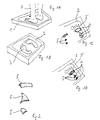
- FIG. 1A is a creation of an image 3 ( FIG. 1B ) of the soles of a standing person P by means of an image capture device 1 shown schematically.
- the image capture device 1 is preferably a two-dimensional scanner that generates a digitized image 3.
- FIGS. 1B, 1C and 1D In each case, a display 2 for displaying the image 3 is shown in a schematic representation, wherein the display 2 in Figures 1C and 1D only partially visible.
- the image 3 is displayed on the display 2 in original size, ie with a scale of 1: 1.
- the image 3 has been supplemented by graphic symbols 4 and carries as a processed image the reference numeral 3 'to distinguish it from the unprocessed image 3.
- the graphic symbols 4 represent stimulation elements 5 and make their size and positioning relative to the sole visible in the image 3' visible, noticeable.
- the stimulation elements 5 preferably have at least one slip-resistant side, which should face the display 2.
- the depicted three stimulation elements 5 are selected from a selection of further stimulation elements of different shapes and sizes to match the graphic symbols 4 and are positioned congruently with the graphic symbols 4 on the display 2, which is shown in FIG. 1D is shown.
- the positioning of the graphical symbols can only be done according to medical expert knowledge and is not part of the claimed objects.
- the placement of the stimulation elements 5 on the basis of the graphical symbols 5, however, can be advantageously carried out by an assistant without special knowledge.
- the display 2 is horizontally alignable and in particular accessible, so that the person P can stand on the display 2, wherein the feet are aligned on the basis of the image 3, 3 '. The then on the display 2 with the stimulation elements. 5 standing person P can then be assessed diagnostically, which is not the subject of the invention.
- the stimulation elements 5 are shown in detail. These are comparable to those stimulation elements that are used in sensorimotor deposits, but are used here only for adaptation for test purposes.
- the stimulation elements 5 are preferably specially equipped, in particular with a slip-resistant coating on at least one side for adhering to the surface of the display 2 (FIG. FIG. 1D ) to ensure.
- the stimulation elements to a pressure sensor in the form of a very thin sensor film, which is arranged on at least one surface.
- FIG. 3 is a schematic overview of an embodiment of an inventive arrangement shown.
- Walk-in footscanners as image capture device 1 are already available in the field of orthopedics.
- the scanned digitized image 3 is transmitted by the scanner 1 via a first data line D1 to an electronic data processing system 6.
- the computer system 6 is usually a usual for office equipment computer with a monitor 7, on which the image 3 of the soles of the feet can be displayed.
- the display can be made on the monitor 7 in original size, but this is not absolutely necessary.
- image information is added to the image 3 in the form of graphic symbols 4, which overlay the image 3. This is preferably done by means of a graphical user interface, which allows the operator to change the image and the graphic symbols a so-called drag-and-drop method allowed.
- the thus modified image 3 ' is transmitted to the display 2 via a second data line D2.
- the graphic symbols 4 are occupied by suitable stimulation elements 5, which is indicated by the arrow A.
- the person not shown can now stand on the display 2, that their feet cover the visible in the image 3 'soles, whereby the person is automatically on the arranged according to predetermined positioning stimulation elements 5 and the effect of the same can be assessed.
- the method can be repeated several times, with the person stepping aside, so that the stimulation elements 5 can be repositioned according to changed graphical symbols.
- the new positioning then corresponds to a changed specification, which was entered at the computer 6.
- the various positions can be stored on a storage medium of the computer 6 on the basis of the respectively associated images 3 ', preferably with additional information for evaluating the respective positioning.
- a positioning if appropriate also a plurality of positions, is selected for the production of a sensorimotor insert.
- the associated image 3 ' can be transmitted as a template for the production to the manufacturer, preferably without delay by remote data transmission via a connection D3 to a server 8 of the manufacturer. This can thus begin immediately after receipt of the image 3 'as a template with the production of such a customized insert.
Landscapes
- Life Sciences & Earth Sciences (AREA)
- Health & Medical Sciences (AREA)
- Biophysics (AREA)
- General Health & Medical Sciences (AREA)
- Public Health (AREA)
- Dentistry (AREA)
- Heart & Thoracic Surgery (AREA)
- Oral & Maxillofacial Surgery (AREA)
- Epidemiology (AREA)
- Pathology (AREA)
- Engineering & Computer Science (AREA)
- Biomedical Technology (AREA)
- Physics & Mathematics (AREA)
- Medical Informatics (AREA)
- Molecular Biology (AREA)
- Surgery (AREA)
- Animal Behavior & Ethology (AREA)
- Veterinary Medicine (AREA)
- Measurement Of The Respiration, Hearing Ability, Form, And Blood Characteristics Of Living Organisms (AREA)
Abstract
Description
- Die Erfindung betrifft ein Verfahren und eine Anordnung zur Anpassung von sensomotorischen Einlagen mit Stimulationselemente.
- Für die Motorik, insbesondere für die Erhaltung bzw. die Wiedergewinnung des Gleichgewichts spielt die sensorische Leistungsfähigkeit der plantaren Fußfläche eine wesentliche Rolle. Die Empfindlichkeit der Fußsohle lässt mit zunehmendem Alter nach. Auch bei Krankheitsbildern wie Morbus Parkinson ist eine Einschränkung der sensorischen Fähigkeiten feststellbar. Durch Stimulation der Fußsohle soll eine Verbesserung der sensomotorischen Leistungsfähigkeit erreicht werden. Dazu sind sensomotorische Einlagen oder Therapiesohlen für Schuhe bekannt, welche Überhöhungen aufweisen, welche keine Stützfunktion erfüllen, sondern rein zur Stimulation der Fußsohlen dienen. Die Anfertigung der Einlagen erfordert in jedem Fall eine individuelle Anpassung. Häufig kommt im Rahmen einer Therapie eine Abfolge einer Mehrzahl unterschiedlicher Positionierungen der Stimulationselemente zum Einsatz, was insbesondere auch bei jedem Wechsel der Positionierung eine erneute Anpassung der sensomotorischen Einlage erfordert, um mögliche Auswirkungen der vorangegangenen Therapie berücksichtigen zu können. Es ist wünschenswert, die Stimulation häufig zu verändern, so dass ein Bedarf besteht, neue Einlagen schnell und ohne unnötigen Aufwand anfertigen zu können.
- Eine individuelle Anpassung erfolgt, indem ein Therapeut die Positionierung der Stimulationselemente auf Grund seiner Kenntnisse festlegt, wozu in der Regel eine Vermessung und/oder Abbildung der Fußsohlen der jeweiligen Person notwendig ist, sowie eine Ermittlung der Auswirkungen verschiedener Positionierungen auf diese Person. Diejenige Positionierung der Stimulationselemente, welche die gewünschte Auswirkung erzielt wird dann als Einlage für die Person in Auftrag gegeben und nach den Vorgaben durch einen entsprechenden Fachbetrieb hergestellt. Das Verfahren zur Ermittlung der Positionierung ist aufwändig und zeitintensiv. Darüber hinaus birgt die Schnittstelle zwischen Therapeut und Hersteller der Einlage eine gewisse Gefahr von Fehlern bei der Übermittlung der Positionierung und verlängert die Zeit bis zur Auslieferung der fertigen Einlage.
- Eine Aufgabe der Erfindung besteht darin, die individuelle Anpassung der Positionierung der Stimulationselemente durch den Therapeuten mittels eines Verfahrens und einer Anordnung zur Anpassung von sensomotorischen Einlagen mit Stimulationselementen zu unterstützen, so dass diese effizienter, gegebenenfalls weniger fehleranfällig und schneller erfolgen kann.
- Die Aufgabe wird durch das Verfahren und die Anordnung gemäß der unabhängigen Patentansprüche gelöst. In den Unteransprüchen sind bevorzugte Ausführungsformen und vorteilhafte Weiterbildungen angegeben.
- Das Verfahren zur Anpassung von sensomotorischen Einlagen mit Stimulationselementen weist erfindungsgemäß folgende Verfahrensschritte auf:
- a. Erstellen eines Abbilds der Fußsohlen einer stehenden Person, für die die sensomotorischen Einlagen gefertigt werden sollen;
- b. Darstellen des Abbilds in Originalgröße auf einer Anzeige; Während der Darstellung des Abbilds auf der Anzeige erfolgen die folgenden Verfahrensschritte c1 und c2;
- c1. Anordnen von Stimulationselementen auf der Anzeige gemäß einer vorgesehenen Positionierung relativ zu den in dem Abbild dargestellten Fußsohlen;
- c2. Anwenden der Stimulationselemente durch die auf der Anzeige stehenden Person, wobei die Füße der Person entsprechend den in dem Abbild dargestellten Fußsohlen ausgerichtet werden;
- d. Verwenden der Positionierung der Stimulationselemente relativ zu dem auf der Anzeige (2) dargestellten Abbild (3') zur Herstellung sensomotorischer Einlagen mit entsprechend positionierten Stimulationselementen.
- Das Erstellen des Abbilds in Schritt a erfolgt mittels einer geeigneten Bildaufnahmevorrichtung, wie insbesondere einem Scanner oder durch ein fotografisches Verfahren. Bevorzugt wird ein digitales Abbild erstellt oder das erstellte Abbild digitalisiert. Weiterhin bevorzugt wird ein zweidimensionales Abbild erstellt, was wesentlich kostengünstiger ist, als dreidimensionale Abbilder zu erstellen. Grundsätzlich ist jedoch im Rahmen der Erfindung auch das Erstellen eines dreidimensionalen Abbilds denkbar.
- Gemäß Schritt b gibt das dargestellte Abbild gibt die Fußsohlen in einem originalgetreuen Maßstab (1:1) wieder, vorzugsweise auf einem geeigneten Monitor.
- Die in Schritt c1 zu verwendenden Stimulationselemente können im einfachsten Fall die gleichen sein, die bei der Herstellung von sensomotorischen Einlagen benutzt werden. Vorzugsweise können die Stimulationselemente speziell für die Anpassung ausgeführt sein, beispielsweise mit einer rutschhemmenden Beschichtung und/oder mit einem Drucksensor, was später noch näher erläutert wird. Es handelt sich bei den Stimulationselementen um dreidimensionale Körper in unterschiedlichen Formen und Größen, in der Regel aus einem Kunststoff. Diese werden hier zu Anpassungszwecken verwendet. Bei der Herstellung der sensomotorischen Einlage werden später in Form und Größe gleichartige Stimulationselemente verwendet, nicht die für die Anpassung speziell ausgerüsteten Stimulationselemente, obwohl dies prinzipiell möglich wäre. Die vorgesehene Positionierung der Stimulationselemente ist durch den Therapeuten nach dessen Expertenwissen vorgegeben und nicht Teil des erfindungsgemäßen Verfahrens. Dadurch, dass ein Abbild der Fußsohlen in Originalgröße auf der Anzeige sichtbar ist, können die Stimulationselemente ohne großen Aufwand und mit großer Genauigkeit relativ zu dem Abbild auf der Anzeige positioniert werden. Auf der Anzeige liegen dann die Stimulationselemente so angeordnet, wie sie gegebenenfalls später in der sensomotorischen Einlage positioniert sind. Die Person kann besonders vorteilhaft leicht seine Position finden und einnehmen, da nach wie vor die Fußsohlen auf der Anzeige sichtbar sind, auf welche die Person sich deckungsgleich stellt. Die Anzeige ist dazu im Wesentlichen waagerecht ausgerichtet und verfügt über eine bruchsichere, durch Personen begehbare und durchsichtige Oberfläche. Hierzu kann beispielsweise in vorteilhaft einfacher Ausführung ein Flachbildschirm unmittelbar unterhalb einer Sicherheitsglasplatte angeordnet sein.
- Die auf der Anzeige angeordneten Stimulationselemente können so unmittelbar an der zu therapierenden Person getestet werden. Die Anwendung der Stimulationselemente in Schritt c2 besteht im Wesentlichen darin, dass die Person sich so auf die Anzeige stellt, dass seine Füße möglichst deckungsgleich zu dem Abbild seiner Fußsohlen ausgerichtet sind, wodurch die Stimulationselemente in vorteilhafter Weise gerade diejenigen Regionen der Fußsohlen stimulieren, welche nach der vorgegebenen Positionierung vorgesehen sind. Die Anwendung erfolgt daher ausdrücklich nicht in therapeutischer Art, sondern zur Vorbereitung einer nachfolgenden, durch medizinisch ausgebildetes Fachpersonal vorzunehmenden Einschätzung der Auswirkung der Stimulationselemente auf die Person, welche nicht Bestandteil des erfindungsgemäßen Verfahrens ist. Das Ausrichten der Stimulationselemente in verschiedenen Positionierungen kann so vorteilhaft jeweils anhand des Abbilds der Fußsohlen auf der Anzeige erfolgen, so dass jeweils anschließend die nicht zum Verfahren zählende Bewertung der jeweiligen Positionierung vorteilhaft einfach und schnell durchgeführt werden kann, indem die Person sich wiederholt so auf die Anzeige stellt, dass das Abbild überdeckt wird. Die Verfahrensschritte c1 und c2 können also beliebig oft wiederholt werden. In der Regel wird durch das medizinische Fachpersonal nach deren Expertenwissen eine der Positionierungen der Stimulationselemente ausgewählt, welche in der sensomotorische Einlage zum Einsatz kommen soll. Diese Auswahl ist nicht Teil des erfindungsgemäßen Verfahrens.
- In Schritt d wird die ausgewählte Positionierung der Stimulationselemente zur Herstellung der sensomotorischen Einlagen verwendet, beispielsweise als Vorlage für einen Hersteller orthopädischer Einlagen. Es ist denkbar, die Positionierung auf der Anzeige mit dem Abbild der Fußsohlen erneut abzubilden, beispielsweise zu fotografieren, um die neue Abbildung als Vorlage verwenden zu können. Dazu wird vorzugsweise eine Maßstab mit abgebildet oder erneut ein Abbild im Originalmaßstab erzeugt.
- Das erfindungsgemäße Verfahren umfasst keine therapeutischen und/oder diagnostischen Maßnahmen, sondern dient allenfalls der technischen Unterstützung derselben.
- Gemäß einer bevorzugten Ausführungsform des Verfahrens wird in Verfahrensschritt b das Abbild mit Hilfe elektronischer Datenverarbeitung dargestellt und so bearbeitet, dass das auf der Anzeige dargestellte Abbild zusätzliche Informationen enthält, welche die vorgesehenen Positionierung der Stimulationselemente relativ zu den Fußsohlen betreffen. Ein Vorteil der elektronischen Datenverarbeitung des Abbilds besteht darin, dass diesem zusätzliche Informationen beigefügt werden können, wie beispielsweise eine Auflistung der vorgesehenen Stimulationselemente. Besonders bevorzugt erfolgt das Bearbeiten des Abbilds durch Hinzufügen und/oder Verändern zusätzlicher Bildinformation, wodurch dem Abbild grafische Symbole überlagert werden, welche die Stimulationselemente repräsentieren, so dass in dem auf der Anzeige dargestellten Abbild die vorgesehene Positionierung der Stimulationselemente relativ zu den Fußsohlen sichtbar ist. Weiterhin bevorzugt werden die Stimulationselemente entsprechend den grafischen Symbolen des auf der Anzeige dargestellten Abbilds positioniert. Dies hat den Vorteil, dass das Platzieren der Stimulationselemente auf der Oberfläche der Anzeige nach den eingefügten Symbolen, also nach Anleitung erfolgen kann, so dass diese Aufgabe durch Hilfskräfte durchführbar ist. Die Vorgabe der Positionierung durch medizinisches Fachpersonal, welche nicht Bestandteil des erfindungsgemäßen Verfahrens ist, erfolgt hier bereits durch die Vorgabe, wie die Bildinformation das Abbild verändern soll.
- Gemäß einer weiteren bevorzugten Ausführungsform des Verfahrens wird in Verfahrensschritt d das auf der Anzeige dargestellten Abbild zur Positionierung der Stimulationselemente bei der Herstellung der sensomotorischen Einlagen verwendet. Ein Vorteil der Ausführungsform besteht darin, dass in Verfahrensschritt d das abschließend bearbeitete Abbild unmittelbar als Vorlage für die Herstellung der sensomotorischen Einlage verwendet werden kann ohne dass ein weiteres Abbild erstellt werden müsste. Das abschließend bearbeitete Abbild kann auf einem Datenträger gespeichert oder besonders vorteilhaft per Datenfernübertragung direkt an einen Hersteller orthopädischer Einlagen gesendet werden, so dass die zeitaufwändigere Übermittlung per Post entfällt.
- Weiterhin bevorzugt wird zur Bearbeitung des Abbilds in Verfahrensschritt b eine Software zur Realisierung einer grafischen Benutzeroberfläche verwendet, die das Einfügen und/oder Verändern von grafischen Symbolen durch ein drag-and-drop Verfahren erlaubt. Dazu wird dass Abbild insbesondere zusätzlich auf einer geeigneten Anzeigevorrichtung der EDV-Anlage angezeigt. Der Fachmann erkennt, dass so ein bereits verändertes Abbild weitergehend bearbeitet wird, indem beispielsweise die Position der grafischen Symbole verändert wird oder einzelne grafische Symbole ausgetauscht werden, oder das in Verfahrensschritt a erstellte, ursprüngliche Abbild erneut bearbeitet werden kann, wenn die Verfahrensschritte c1 und c2 wiederholt werden.
- Gemäß einer bevorzugten Weiterbildung des Verfahrens beinhaltet Verfahrensschritt c2 eine dreidimensionale Bilderfassung der auf der Anzeige stehenden Person, was die Beurteilung und insbesondere den nachträglichen Vergleich der Auswirkungen verschiedener Positionierungen auf die Person erleichtert.
- Alternativ oder zusätzlich umfasst Verfahrensschritt c2 eine sensorische Erfassung einer Druckbeanspruchung der Stimulationselemente auf der Anzeige. Dazu werden die Stimulationselemente vorzugsweise mit je einem insbesondere folienartigen Drucksensor versehen, welcher mindestens auf einer der Anzeige zugewandten Oberfläche angeordnet ist. Gemäß einer bevorzugten Ausführungsform werden die Verfahrensschritte b, c1 und c2 wiederholt, wobei jeweils das auf der Anzeige dargestellte Abbild und/oder die Positionierung der Stimulationselemente auf der Anzeige gespeichert wird. Die Druckwerte werden vorzugsweise angezeigt und oder mit dem Abbild für spätere Vergleiche abgespeichert. Mittels einer Software wird weiterhin bevorzugt eine Teileliste der Stimulationselemente, welche gemäß dem Abbild jeweils vorgesehen sind, erstellt und/oder aktualisiert.
- Gemäß einer weiteren Ausführungsform des Verfahrens werden mittels einer Software zusätzliche, anhand des Abbilds der Fußsohlen ermittelbare Parameter bestimmt, insbesondere ein Verhältnis einer belasteten Fläche zu einer Gesamtfläche der Fußsohlen. Dies erfolgt besonders bevorzugt automatisiert durch numerische Methoden. Weiterhin bevorzugt werden mittels einer Software vorgegebene Positionierungen der grafischen Symbole in dem Abbild zur weitergehenden Bearbeitung dargestellt, beispielsweise als Vorgabe oder Startpunkt. Die Software greift dazu insbesondere eine gespeicherte Zuordnungstabelle zu, wobei die Zuordnungstabelle Verknüpfungen der vorgegebenen Positionierungen mit anhand des Abbilds der Fußsohlen ermittelbaren Parametern enthält. Ein bestimmtes Verhältnis von belasteter Fußfläche zur Gesamtfläche der Fußsohle führt dann zu einer Einblendung einer sinnvollen Vorauswahl von Stimulationselementen bzw. grafischen Symbolen, die dann durch medizinisches Fachpersonal nach deren Expertenwissen so verändert werden, dass eine vorgegebene Positionierung entsteht.
- Das in Verfahrensschritt d zu verwendende Abbild und/oder die zu verwendende Positionierung wird vorzugsweise in Abhängigkeit von in Schritt c2 erhaltenen Erkenntnissen ausgewählt. Die Erlangung dieser Erkenntnisse obliegt medizinischem Fachpersonal und ist ausdrücklich nicht Bestandteil des erfindungsgemäßen Verfahrens. Ein dreidimensionales Abbild des Körpers der Person in Schritt c2, ein Messen der Druckverhältnisse der Stimulationselemente und die Berechnung des Verhältnisses von belasteter Fläche zu Gesamtfläche der Fußsohle können das Expertenwissen nicht ersetzen, sondern unterstützen lediglich das Fachpersonal bei seiner gegebenenfalls diagnostischen und/oder therapeutischen Tätigkeit.
- Ein weiterer Gegenstand der Erfindung ist eine Anordnung zur Anpassung von sensomotorischen Einlagen mit Stimulationselementen, insbesondere nach dem zuvor beschriebenen Verfahren. Die Anordnung weist eine Bilderfassungsvorrichtung zum Erstellen eines Abbilds der Fußsohlen einer auf der Bilderfassungsvorrichtung stehenden Person, sowie eine Anzeigevorrichtung zur Darstellung des bearbeiteten Abbilds in Originalgröße auf, wobei Stimulationselemente auf der Anzeigevorrichtung relativ zu dem dargestellten Abbild entsprechend einer vorgesehenen Positionierung positionierbar sind und wobei vorgesehen ist, dass die Person derart auf der Anzeigevorrichtung steht, dass die Füße der Person mit den in dem dargestellten Abbild sichtbaren Fußsohlen in Überdeckung sind. Dazu verfügt die Anzeigevorrichtung vorzugsweise über eine waagerecht ausrichtbare, bruchfesten Oberfläche zur Bilddarstellung.
- Das zuvor beschriebene Verfahren zur Anpassung von sensomotorischen Einlagen lässt sich mit der beschriebenen Anordnung besonders vorteilhaft durchführen. Weiterhin bevorzugt ist die Bilderfassungsvorrichtung direkt benachbart zu der Anzeigevorrichtung angeordnet, so dass die Person bequem von der einen Vorrichtung auf die andere herübertreten kann.
- Gemäß einer bevorzugten Ausführungsform ist eine elektronische Datenverarbeitungsanlage mit einer Software zum Bearbeiten des Abbilds durch Hinzufügen und/oder Verändern zusätzlicher Bildinformation vorgesehen. Diese verfügt besonders bevorzugt um eine weitere Anzeige zur Darstellung und Bearbeitung des Abbilds.
- Gemäß einer weiteren bevorzugten Ausführungsform weisen die Stimulationselemente auf einer der Anzeigevorrichtung zugewandten Seite ein rutschhemmendes Material und/oder einen Drucksensor auf, welcher insbesondere folienförmig gestaltet ist.
- Nachfolgend wird die Erfindung anhand von Ausführungsbeispielen mit Bezug auf die beiliegenden Zeichnungen erläutert. Die Ausführungen beziehen sich sowohl auf das erfindungsgemäße Verfahren, wie auf die erfindungsgemäße Anordnung. Die Darstellung ist lediglich beispielhaft und schränkt den allgemeinen Erfindungsgedanken nicht ein.
- Es zeigen
-
Figuren 1A, 1B, 1C, 1D einen beispielhaften Ablauf des erfindungsgemäßen Verfahrens; -
Figur 2 die in dem Verfahren gemäßFigur 1 verwendeten Stimulationselemente im Detail; -
Figur 3 eine Ausführungsform der erfindungsgemäßen Anordnung in einer schematischen Darstellung. - In der
Figur 1A ist ein Erstellen eines Abbilds 3 (Figur 1B ) der Fußsohlen einer stehenden Person P mittels einer Bilderfassungsvorrichtung 1 schematisch dargestellt. Die Bilderfassungsvorrichtung 1 ist vorzugsweise eine zweidimensionale Scanner, welcher ein digitalisiertes Abbild 3 erzeugt. In denFiguren 1B, 1C und 1D ist jeweils eine Anzeige 2 zur Darstellung des Abbilds 3 in schematischer Darstellung gezeigt, wobei die Anzeige 2 inFiguren 1C und 1D nur ausschnittweise sichtbar ist. Das Abbild 3 wird auf der Anzeige 2 in Originalgröße, also mit Maßstab 1:1 dargestellt. In derFigur 1C ist das Abbild 3 durch grafische Symbole 4 ergänzt worden und trägt als bearbeitetes Abbild das Bezugszeichen 3' zur Unterscheidung von dem unbearbeiteten Abbild 3. Die grafischen Symbole 4 repräsentieren Stimulationselemente 5 und machen deren Größe und Positionierung relativ zu der in dem Abbild 3' erkennbaren Fußsohle sichtbar. Die Stimulationselemente 5 verfügen vorzugsweise über mindestens eine rutschhemmend ausgeführte Seite, welche der Anzeige 2 zugewandt sein soll. Die abgebildeten drei Stimulationselemente 5 sind passend zu den grafischen Symbolen 4 aus einer Auswahl weiterer Stimulationselemente verschiedener Formen und Größen herausgesucht und werden deckungsgleich mit den grafischen Symbolen 4 auf der Anzeige 2 positioniert, was in derFigur 1D dargestellt ist. Die Positionierung der grafischen Symbole kann nur nach medizinischem Expertenwissen erfolgen und ist nicht Teil der beanspruchten Gegenstände. Das Platzieren der Stimulationselemente 5 anhand der grafischen Symbole 5 kann hingegen vorteilhaft durch eine Hilfskraft ohne besondere Kenntnisse erfolgen. - Eine alternative Möglichkeit der Durchführung des Verfahrens besteht darin, dass die Stimulationselemente 5 unmittelbar auf dem nicht bearbeiteten Abbild 3 gemäß
Figur 1B angeordnet werden, wobei die genaue Positionierung medizinisches Expertenwissen darstellt, was die Vornahme dieses Schritts durch Hilfspersonal ausschließt. - Die Anzeige 2 ist waagerecht ausrichtbar und insbesondere begehbar, so dass die Person P auf der Anzeige 2 stehen kann, wobei die Füße anhand des Abbilds 3, 3' ausgerichtet werden. Die dann auf der Anzeige 2 mit den Stimulationselementen 5 stehende Person P kann dann diagnostisch beurteilt werden, was nicht Gegenstand der Erfindung ist.
- In der
Figur 2 sind die Stimulationselemente 5 im Detail gezeigt. Diese sind vergleichbar mit solchen Stimulationselementen, welche in sensomotorischen Einlagen zum Einsatz kommen, werden hier jedoch nur für die Anpassung zu Testzwecken verwendet. Dazu sind die Stimulationselemente 5 vorzugsweise speziell ausgestattet, insbesondere mit einer rutschhemmenden Beschichtung auf mindestens einer Seite um ein Haften an der Oberfläche der Anzeige 2 (Figur 1D ) zu gewährleisten. Zusätzlich oder alternativ weisen die Stimulationselemente einen Drucksensor in Form einer sehr dünnen Sensorfolie auf, welche auf mindestens einer Oberfläche angeordnet ist. - In der
Figur 3 ist eine schematische Übersicht einer Ausführungsform einer erfindungsgemäßen Anordnung dargestellt. Kernstück der Erfindung stellen die Bilderfassungsvorrichtung 1 und die Anzeige 2 auf, welche beide begehbar ausgeführt sind, wobei die Anzeige 2 beispielsweise durch einen Monitor unterhalb einer Glasplatte 10, insbesondere aus Sicherheitsglas, realisierbar ist. Begehbare Fußscanner als Bilderfassungsvorrichtung 1 sind im Bereich der Orthopädie bereits erhältlich. Für die Person P, deren Fußsohle auf dem Scanner 1 in unterbrochener Linie dargestellt ist, ist es besonders angenehm und bequem, wenn die waagerecht ausrichtbare Anzeige 2 unmittelbar neben dem Scanner 1 aufgestellt ist, bzw. diese in einem gemeinsamen Gehäuse 9 angeordnet sind und die Person mit einem kurzen Schritt von einem Gerät auf das andere steigen kann. - Das eingescannte digitalisierte Abbild 3 wird von dem Scanner1 über eine erste Datenleitung D1 an eine Anlage zur elektronischen Datenverarbeitung 6 übertragen. Bei der EDV-Anlage 6 handelt es sich in der Regel um einen für eine Büroausstattung üblichen Computer mit einem Monitor 7, auf welchem das Abbild 3 der Fußsohlen anzeigbar ist. Die Anzeige kann auf dem Monitor 7 in Originalgröße erfolgen, was jedoch nicht zwingend erforderlich ist. Mit Hilfe einer Software, wird dem Abbild 3 Bildinformation in Form von grafischen Symbolen 4, welche das Abbild 3 überlagern, hinzugefügt. Dies erfolgt vorzugsweise mittels einer graphischen Benutzeroberfläche, welche dem Bediener das Verändern des Abbilds und der grafischen Symbole durch ein sogenanntes Drag-and-Drop Verfahren erlaubt.
- Das derart veränderte Abbild 3' wird über eine zweite Datenleitung D2 an die Anzeige 2 übertragen. Die grafischen Symbole 4 werden mit passenden Stimulationselementen 5 belegt, was durch den Pfeil A angedeutet ist. Die nicht dargestellte Person kann nun so auf der Anzeige 2 stehen, dass ihre Füße die in dem Abbild 3' sichtbaren Fußsohlen überdecken, wodurch die Person automatisch auf den nach vorgegebener Positionierung angeordneten Stimulationselementen 5 steht und die Wirkung derselben beurteilbar ist.
- Das Verfahren kann mehrfach wiederholt werden, wobei die Person jeweils beiseite tritt, so dass die Stimulationselemente 5 neu gemäß veränderten grafischen Symbolen positioniert werden können. Die neue Positionierung entspricht dann einer veränderten Vorgabe, welche am Computer 6 eingegeben wurde. Die verschiedenen Positionierungen können anhand der jeweils zugehörigen Abbilder 3' auf einem Speichermedium des Computers 6 gespeichert werden, vorzugsweise mit zusätzlichen Informationen zur Bewertung der jeweiligen Positionierung. Schließlich wird in der Regel eine Positionierung, gegebenenfalls auch mehrere Positionierungen für die Herstellung einer sensomotorischen Einlage ausgewählt. Besonders vorteilhaft kann das zugehörige Abbild 3' als Vorlage für die Herstellung an den Hersteller übermittelt werden, vorzugsweise verzugslos durch Datenfernübertragung über eine Verbindung D3 auf einen Server 8 des Herstellers. Dieser kann somit unmittelbar nach Erhalt des Abbilds 3' als Vorlage mit der Herstellung einer so angepassten Einlage beginnen.
-
- 1
- Bilderfassungsvorrichtung
- 2
- Anzeige
- 3, 3'
- Abbild
- 4
- Grafische Symbole
- 5
- Stimulationselemente
- 6
- EDV-Anlage
- 7
- Monitor
- 8
- Server
- 9
- Gehäuse
- 10
- Glasplatte
- P
- Person
- D1
- Erste Datenübertragungsleitung
- D2
- Zweite Datenübertragungsleitung
- D3
- Verbindung
- A
- Pfeil
Claims (15)
- Verfahren zur Anpassung von sensomotorischen Einlagen mit Stimulationselementen durch folgende Verfahrensschritte:a. Erstellen eines Abbilds (3) der Fußsohlen einer stehenden Person (P);b. Darstellen des Abbilds (3') in Originalgröße auf einer Anzeige (2) und während der Darstellung des Abbilds:c1. Anordnen von Stimulationselementen (5) auf der Anzeige (2) gemäß einer vorgesehenen Positionierung relativ zu den in dem Abbild (3') dargestellten Fußsohlen;c2. Anwenden der Stimulationselemente (5) durch die auf der Anzeige (2) stehenden Person (P), wobei die Füße der Person entsprechend den in dem Abbild (3') dargestellten Fußsohlen ausgerichtet werden;d. Verwenden der Positionierung der Stimulationselemente relativ zu dem auf der Anzeige (2) dargestellten Abbild (3') zur Herstellung sensomotorischer Einlagen mit entsprechend positionierten Stimulationselementen.
- Verfahren nach Anspruch 1,
dadurch gekennzeichnet,
dass in Verfahrensschritt b das Abbild (3) mit Hilfe elektronischer Datenverarbeitung (6) dargestellt und so bearbeitet wird, dass das auf der Anzeige dargestellte Abbild (3') zusätzliche Informationen zu der vorgesehenen Positionierung der Stimulationselemente (5) relativ zu den Fußsohlen enthält. - Verfahren nach Anspruch 2,
dadurch gekennzeichnet,
dass das Bearbeiten des Abbilds (3) durch Hinzufügen und/oder Verändern zusätzlicher Bildinformation erfolgt, wodurch dem Abbild (3) grafische Symbole (4) überlagert werden, welche Stimulationselemente (5) repräsentieren, so dass in dem auf der Anzeige (2) dargestellten Abbild (3') die vorgesehene Positionierung der Stimulationselemente (5) relativ zu den Fußsohlen sichtbar ist. - Verfahren nach Anspruch 3,
dadurch gekennzeichnet,
dass die Stimulationselemente (5) entsprechend den grafischen Symbolen (4) des auf der Anzeige (2) dargestellten Abbilds (3') positioniert werden; - Verfahren nach einem der vorhergehenden Ansprüche 2 bis 4,
dadurch gekennzeichnet,
dass in Verfahrensschritt d das auf der Anzeige (2) dargestellten Abbild (3') zur Positionierung der Stimulationselementen bei der Herstellung der sensomotorischen Einlagen verwendet wird. - Verfahren nach einem der vorhergehenden Ansprüche,
dadurch gekennzeichnet,
dass Verfahrensschritt c2 eine dreidimensionale Bilderfassung der auf der Anzeige (2) stehenden Person (P) beinhaltet. - Verfahren nach einem der vorhergehenden Ansprüche,
dadurch gekennzeichnet,
dass Verfahrensschritt c2 eine sensorische Erfassung einer Druckbeanspruchung der Stimulationselemente (5) auf der Anzeige (2) beinhaltet. - Verfahren nach einem der vorhergehenden Ansprüche,
dadurch gekennzeichnet,
dass die Verfahrensschritte b, c1 und c2 wiederholt werden, wobei jeweils das auf der Anzeige (2) dargestellte Abbild (3') und/oder die Positionierung der Stimulationselemente (5) auf der Anzeige (2) gespeichert wird. - Verfahren nach einem der vorhergehenden Ansprüche,
dadurch gekennzeichnet,
dass in Verfahrensschritt d das zu verwendende Abbild (3') und/oder die zu verwendende Positionierung in Abhängigkeit von in Schritt c2 erhaltenen Erkenntnissen ausgewählt wird. - Verfahren nach einem der vorhergehenden Ansprüche,
dadurch gekennzeichnet,
dass mittels einer Software zusätzliche, anhand des Abbilds (3) der Fußsohlen ermittelbare Parameter bestimmt werden, insbesondere ein Verhältnis einer belasteten Fläche zu einer Gesamtfläche der Fußsohlen. - Verfahren nach einem der Ansprüche 3 bis 10,
dadurch gekennzeichnet,
dass mittels einer Software durch Zugreifen auf eine gespeicherte Zuordnungstabelle vorgegebene Positionierungen der grafischen Symbole (4) in dem Abbild (3) zur weitergehenden Bearbeitung dargestellt werden, wobei die Zuordnungstabelle Verknüpfungen der vorgegebenen Positionierungen mit anhand des Abbilds (3) der Fußsohlen ermittelbaren Parametern enthält. - Verfahren nach einem der vorhergehenden Ansprüche,
dadurch gekennzeichnet,
dass mittels einer Software eine Teileliste der Stimulationselemente (5), welche gemäß Abbild (3') vorgesehen sind, erstellt und/oder aktualisiert wird. - Anordnung zur Anpassung von sensomotorischen Einlagen mit Stimulationselementen, aufweisend eine Bilderfassungsvorrichtung (1) zum Erstellen eines Abbilds (3) der Fußsohlen einer auf der Bilderfassungsvorrichtung stehenden Person (P),
eine Anzeigevorrichtung (2) zur Darstellung des bearbeiteten Abbilds (3') in Originalgröße,
wobei Stimulationselemente (5) auf der Anzeigevorrichtung (2) relativ zu dem dargestellten Abbild (3') entsprechend einer vorgesehenen Positionierung positionierbar sind und wobei vorgesehen ist, dass die Person (P) derart auf der Anzeigevorrichtung (2) steht, dass die Füße der Person mit den in dem dargestellten Abbild (3') sichtbaren Fußsohlen in Überdeckung sind. - Anordnung nach Anspruch 13,
dadurch gekennzeichnet,
dass eine elektronische Datenverarbeitungsanlage (6) mit einer Software zum Bearbeiten des Abbilds (3) durch Hinzufügen und/oder Verändern zusätzlicher Bildinformation vorgesehen ist. - Anordnung nach einem der Ansprüche 13 oder 14,
dadurch gekennzeichnet,
dass die Stimulationselemente (5) auf einer der Anzeigevorrichtung (2) zugewandten Seite ein rutschhemmendes Material aufweisen und/oder einen Drucksensor.
Applications Claiming Priority (1)
| Application Number | Priority Date | Filing Date | Title |
|---|---|---|---|
| DE102010002913.0A DE102010002913B4 (de) | 2010-03-16 | 2010-03-16 | Anordnung zur Anpassung von sensomotorischen Einlagen mit Stimulationselementen |
Publications (2)
| Publication Number | Publication Date |
|---|---|
| EP2366330A1 true EP2366330A1 (de) | 2011-09-21 |
| EP2366330B1 EP2366330B1 (de) | 2014-11-26 |
Family
ID=44114327
Family Applications (1)
| Application Number | Title | Priority Date | Filing Date |
|---|---|---|---|
| EP20110156076 Not-in-force EP2366330B1 (de) | 2010-03-16 | 2011-02-25 | Verfahren und Anordnung von sensomotorischen Einlagen mit Stimulationselementen |
Country Status (2)
| Country | Link |
|---|---|
| EP (1) | EP2366330B1 (de) |
| DE (1) | DE102010002913B4 (de) |
Cited By (1)
| Publication number | Priority date | Publication date | Assignee | Title |
|---|---|---|---|---|
| CN114099971A (zh) * | 2021-12-17 | 2022-03-01 | 李信达 | 一种平衡康复装置 |
Families Citing this family (2)
| Publication number | Priority date | Publication date | Assignee | Title |
|---|---|---|---|---|
| DE102014001508B4 (de) | 2013-09-18 | 2022-10-27 | Friedrich Gruber | Vorrichtung zum Herstellen eines Schutzes für einen Huf |
| TWI657761B (zh) | 2017-09-21 | 2019-05-01 | 劉懿賢 | 足底量測裝置 |
Citations (2)
| Publication number | Priority date | Publication date | Assignee | Title |
|---|---|---|---|---|
| DE20320623U1 (de) * | 2003-10-09 | 2005-02-10 | Vabene Gmbh & Co. Kg | Vorrichtung zur Erstellung von Therapiesohlen |
| US20090071038A1 (en) * | 2007-09-18 | 2009-03-19 | Esoles, L.L.C. | Multi-component footbeds |
Family Cites Families (7)
| Publication number | Priority date | Publication date | Assignee | Title |
|---|---|---|---|---|
| GB9304058D0 (en) * | 1993-03-01 | 1993-04-14 | Orthotics Limited | Improvements relating to foot orthoses |
| US5753931A (en) * | 1995-07-13 | 1998-05-19 | Nike, Inc. | Object imaging device and method using line striping |
| DE29810514U1 (de) * | 1998-06-04 | 1998-10-08 | Schelchen GmbH, 15711 Zeesen | Vorrichtung zur orthopädischen Fußvermessung |
| DE102004022158B8 (de) * | 2004-05-05 | 2010-06-10 | Helmut Röck GmbH | Vorrichtung und ein Baukastensystem für die Herstellung orthopädischer Schuh- und/oder Einbaueinlagen sowie orthopädische Schuh- und/oder Einbaueinlage als solche |
| DE202005013379U1 (de) * | 2005-08-23 | 2006-08-31 | Fischer, Franz | Bausatz zur Herstellung von orthopädischen Schuheinlagen |
| DE102006003833A1 (de) * | 2005-08-28 | 2007-03-08 | Lenhart, Peter, Dr. med. | Fußbettstruktur, insbesondere Schuheinlage und Verfahren zur Herstellung derselben |
| US20090076772A1 (en) * | 2007-09-18 | 2009-03-19 | Esoles, Llc | Footbeds and a Method and Apparatus for Producing Such Footbeds |
-
2010
- 2010-03-16 DE DE102010002913.0A patent/DE102010002913B4/de not_active Expired - Fee Related
-
2011
- 2011-02-25 EP EP20110156076 patent/EP2366330B1/de not_active Not-in-force
Patent Citations (2)
| Publication number | Priority date | Publication date | Assignee | Title |
|---|---|---|---|---|
| DE20320623U1 (de) * | 2003-10-09 | 2005-02-10 | Vabene Gmbh & Co. Kg | Vorrichtung zur Erstellung von Therapiesohlen |
| US20090071038A1 (en) * | 2007-09-18 | 2009-03-19 | Esoles, L.L.C. | Multi-component footbeds |
Non-Patent Citations (2)
| Title |
|---|
| BREUER-KÜHNREICH, ANNETTE: "Variables Einlagen Konzept für Haltung und Bewegung", ORTHOPÄDIESCHUHTECHNIK, no. 4, 2008, pages 22 - 24, XP002641872 * |
| GRUBER J.: "Anwendungsbeobachtung der IGLI interaktiv Carboneinlage im Leistungssport", ORTHOPÄDIE-TECHNIK, vol. 2, 2008, pages 96 - 97, XP002641873 * |
Cited By (2)
| Publication number | Priority date | Publication date | Assignee | Title |
|---|---|---|---|---|
| CN114099971A (zh) * | 2021-12-17 | 2022-03-01 | 李信达 | 一种平衡康复装置 |
| CN114099971B (zh) * | 2021-12-17 | 2024-10-29 | 珠海闪亮麦宝医疗科技有限公司 | 一种平衡康复装置 |
Also Published As
| Publication number | Publication date |
|---|---|
| DE102010002913B4 (de) | 2016-03-03 |
| EP2366330B1 (de) | 2014-11-26 |
| DE102010002913A1 (de) | 2011-09-22 |
Similar Documents
| Publication | Publication Date | Title |
|---|---|---|
| EP1382002B1 (de) | Zahnidentifikation auf digitalen röntgenaufnahmen und zuordnung von informationen zu digitalen röntgenaufnahmen | |
| DE10312848A1 (de) | Datenbank, Zahnmodell und Zahnersatzteil, aufgebaut aus digitalisierten Abbildungen realer Zähne | |
| EP1700576A1 (de) | Verfahren zur Herstellung der Lageübereinstimmung von 3D-Datensätzen in einem dentalen CAD/CAM-System | |
| EP3618752B2 (de) | Verfahren zur konstruktion einer bohrschablone | |
| WO2008083874A2 (de) | Bildregistrierung | |
| DE102009006148B4 (de) | Verfahren, Monitor-Steuermodul, System und Computerprogramm zum Darstellen medizinischer Bilder | |
| DE112013000671B4 (de) | Gerät zum Planen einer Neuromodulationsbehandlung | |
| DE112022006230T5 (de) | Emotionseinschätzvorrichtung und verfahren zum erzeugen eines emotionseinschätzmodells | |
| DE4404695C2 (de) | Verfahren zum Herstellen orthopädischer Einlagen | |
| EP2366330B1 (de) | Verfahren und Anordnung von sensomotorischen Einlagen mit Stimulationselementen | |
| EP3566651A1 (de) | Verfahren und vorrichtung zur ermittlung von ergebniswerten auf basis einer skelettalen medizintechnischen bildaufnahme | |
| DE102022105049A1 (de) | Verfahren, vorrichtung und system zur empfehlung eines sets aus rehabilitationsprogrammen für einen bei einem arbeitsunfall verletzten arbeiter | |
| DE102015211166A1 (de) | Verfahren und Vorrichtung zur Registrierung von intraoralen Oberflächendaten relativ zu extraoralen Oberflächendaten | |
| DE202013005843U1 (de) | Vorrichtung zur Schmerzmessung und/oder Schmerzermittlung | |
| EP1051924A1 (de) | Verfahren und Vorrichtung zur Bestimmung von Körpermassen und/oder entsprechender Kleidergrösse einer Person | |
| DE102019126111A1 (de) | Verfahren, Computerprogrammprodukt und Simulationssystem zur Erstellung und Ausgabe eines dreidimensionalen Modells eines Gebisses | |
| EP3155588B1 (de) | Ganzkörperbildaufnahme- und bildverarbeitungssystem sowie verfahren zu dessen betrieb | |
| DE102015102992A1 (de) | Verfahren zum Überprüfen oder Ermitteln der Wirkung einer kieferorthopädischen Behandlung, sowie Vorrichtungen | |
| DE102018132809A1 (de) | Verfahren zur Bestimmung eines Wirkstoffgehalts einer Pflanze, Datenverarbeitungsprogramm, computerlesbares Medium und System zur Durchführung des Verfahrens | |
| DE102014003567A1 (de) | Kontaktnachrichten in personalisierten medizinischen diagnosebildern | |
| EP1480149A2 (de) | Verfahren und eine Vorrichtung zur Verarbeitung und Ausgabe einer Versionsänderung eines medizinische Therapiehinweise umfassenden Datensatzes | |
| DE102018205409A1 (de) | Verfahren, Vorrichtung, Computerprogramm und Computerprogrammprodukt zum Annotieren eines Bildes | |
| DE102011077909B4 (de) | Verfahren und Vorrichtung zur Unterstützung eines Anwenders bei einer Erstellung eines Plans für eine Bestrahlung eines Zielbereichs eines Patienten mit Therapiestrahlung | |
| EP1361535A1 (de) | Verfahren und System zur Unterstützung der Therapieplanung | |
| DE102004029162A1 (de) | Verfahren zur Herstellung von Fertigungszeichnungen für Einlagen und Fußbettungen |
Legal Events
| Date | Code | Title | Description |
|---|---|---|---|
| PUAI | Public reference made under article 153(3) epc to a published international application that has entered the european phase |
Free format text: ORIGINAL CODE: 0009012 |
|
| AK | Designated contracting states |
Kind code of ref document: A1 Designated state(s): AL AT BE BG CH CY CZ DE DK EE ES FI FR GB GR HR HU IE IS IT LI LT LU LV MC MK MT NL NO PL PT RO RS SE SI SK SM TR |
|
| AX | Request for extension of the european patent |
Extension state: BA ME |
|
| 17P | Request for examination filed |
Effective date: 20111008 |
|
| 17Q | First examination report despatched |
Effective date: 20131204 |
|
| GRAP | Despatch of communication of intention to grant a patent |
Free format text: ORIGINAL CODE: EPIDOSNIGR1 |
|
| RIC1 | Information provided on ipc code assigned before grant |
Ipc: A61B 5/107 20060101AFI20140515BHEP Ipc: A43D 1/02 20060101ALI20140515BHEP Ipc: A43B 7/14 20060101ALI20140515BHEP Ipc: A43B 17/00 20060101ALI20140515BHEP |
|
| INTG | Intention to grant announced |
Effective date: 20140602 |
|
| GRAP | Despatch of communication of intention to grant a patent |
Free format text: ORIGINAL CODE: EPIDOSNIGR1 |
|
| INTG | Intention to grant announced |
Effective date: 20140804 |
|
| GRAS | Grant fee paid |
Free format text: ORIGINAL CODE: EPIDOSNIGR3 |
|
| GRAA | (expected) grant |
Free format text: ORIGINAL CODE: 0009210 |
|
| AK | Designated contracting states |
Kind code of ref document: B1 Designated state(s): AL AT BE BG CH CY CZ DE DK EE ES FI FR GB GR HR HU IE IS IT LI LT LU LV MC MK MT NL NO PL PT RO RS SE SI SK SM TR |
|
| REG | Reference to a national code |
Ref country code: GB Ref legal event code: FG4D Free format text: NOT ENGLISH |
|
| REG | Reference to a national code |
Ref country code: CH Ref legal event code: EP |
|
| REG | Reference to a national code |
Ref country code: AT Ref legal event code: REF Ref document number: 697712 Country of ref document: AT Kind code of ref document: T Effective date: 20141215 |
|
| REG | Reference to a national code |
Ref country code: IE Ref legal event code: FG4D Free format text: LANGUAGE OF EP DOCUMENT: GERMAN |
|
| REG | Reference to a national code |
Ref country code: DE Ref legal event code: R096 Ref document number: 502011005071 Country of ref document: DE Effective date: 20150108 |
|
| REG | Reference to a national code |
Ref country code: NL Ref legal event code: VDEP Effective date: 20141126 |
|
| REG | Reference to a national code |
Ref country code: LT Ref legal event code: MG4D |
|
| PG25 | Lapsed in a contracting state [announced via postgrant information from national office to epo] |
Ref country code: ES Free format text: LAPSE BECAUSE OF FAILURE TO SUBMIT A TRANSLATION OF THE DESCRIPTION OR TO PAY THE FEE WITHIN THE PRESCRIBED TIME-LIMIT Effective date: 20141126 Ref country code: LT Free format text: LAPSE BECAUSE OF FAILURE TO SUBMIT A TRANSLATION OF THE DESCRIPTION OR TO PAY THE FEE WITHIN THE PRESCRIBED TIME-LIMIT Effective date: 20141126 Ref country code: IS Free format text: LAPSE BECAUSE OF FAILURE TO SUBMIT A TRANSLATION OF THE DESCRIPTION OR TO PAY THE FEE WITHIN THE PRESCRIBED TIME-LIMIT Effective date: 20150326 Ref country code: FI Free format text: LAPSE BECAUSE OF FAILURE TO SUBMIT A TRANSLATION OF THE DESCRIPTION OR TO PAY THE FEE WITHIN THE PRESCRIBED TIME-LIMIT Effective date: 20141126 Ref country code: NL Free format text: LAPSE BECAUSE OF FAILURE TO SUBMIT A TRANSLATION OF THE DESCRIPTION OR TO PAY THE FEE WITHIN THE PRESCRIBED TIME-LIMIT Effective date: 20141126 Ref country code: NO Free format text: LAPSE BECAUSE OF FAILURE TO SUBMIT A TRANSLATION OF THE DESCRIPTION OR TO PAY THE FEE WITHIN THE PRESCRIBED TIME-LIMIT Effective date: 20150226 Ref country code: PT Free format text: LAPSE BECAUSE OF FAILURE TO SUBMIT A TRANSLATION OF THE DESCRIPTION OR TO PAY THE FEE WITHIN THE PRESCRIBED TIME-LIMIT Effective date: 20150326 |
|
| PG25 | Lapsed in a contracting state [announced via postgrant information from national office to epo] |
Ref country code: RS Free format text: LAPSE BECAUSE OF FAILURE TO SUBMIT A TRANSLATION OF THE DESCRIPTION OR TO PAY THE FEE WITHIN THE PRESCRIBED TIME-LIMIT Effective date: 20141126 Ref country code: CY Free format text: LAPSE BECAUSE OF FAILURE TO SUBMIT A TRANSLATION OF THE DESCRIPTION OR TO PAY THE FEE WITHIN THE PRESCRIBED TIME-LIMIT Effective date: 20141126 Ref country code: SE Free format text: LAPSE BECAUSE OF FAILURE TO SUBMIT A TRANSLATION OF THE DESCRIPTION OR TO PAY THE FEE WITHIN THE PRESCRIBED TIME-LIMIT Effective date: 20141126 Ref country code: HR Free format text: LAPSE BECAUSE OF FAILURE TO SUBMIT A TRANSLATION OF THE DESCRIPTION OR TO PAY THE FEE WITHIN THE PRESCRIBED TIME-LIMIT Effective date: 20141126 Ref country code: LV Free format text: LAPSE BECAUSE OF FAILURE TO SUBMIT A TRANSLATION OF THE DESCRIPTION OR TO PAY THE FEE WITHIN THE PRESCRIBED TIME-LIMIT Effective date: 20141126 Ref country code: GR Free format text: LAPSE BECAUSE OF FAILURE TO SUBMIT A TRANSLATION OF THE DESCRIPTION OR TO PAY THE FEE WITHIN THE PRESCRIBED TIME-LIMIT Effective date: 20150227 |
|
| PG25 | Lapsed in a contracting state [announced via postgrant information from national office to epo] |
Ref country code: SK Free format text: LAPSE BECAUSE OF FAILURE TO SUBMIT A TRANSLATION OF THE DESCRIPTION OR TO PAY THE FEE WITHIN THE PRESCRIBED TIME-LIMIT Effective date: 20141126 Ref country code: CZ Free format text: LAPSE BECAUSE OF FAILURE TO SUBMIT A TRANSLATION OF THE DESCRIPTION OR TO PAY THE FEE WITHIN THE PRESCRIBED TIME-LIMIT Effective date: 20141126 Ref country code: RO Free format text: LAPSE BECAUSE OF FAILURE TO SUBMIT A TRANSLATION OF THE DESCRIPTION OR TO PAY THE FEE WITHIN THE PRESCRIBED TIME-LIMIT Effective date: 20141126 Ref country code: DK Free format text: LAPSE BECAUSE OF FAILURE TO SUBMIT A TRANSLATION OF THE DESCRIPTION OR TO PAY THE FEE WITHIN THE PRESCRIBED TIME-LIMIT Effective date: 20141126 Ref country code: EE Free format text: LAPSE BECAUSE OF FAILURE TO SUBMIT A TRANSLATION OF THE DESCRIPTION OR TO PAY THE FEE WITHIN THE PRESCRIBED TIME-LIMIT Effective date: 20141126 |
|
| REG | Reference to a national code |
Ref country code: DE Ref legal event code: R097 Ref document number: 502011005071 Country of ref document: DE |
|
| PG25 | Lapsed in a contracting state [announced via postgrant information from national office to epo] |
Ref country code: PL Free format text: LAPSE BECAUSE OF FAILURE TO SUBMIT A TRANSLATION OF THE DESCRIPTION OR TO PAY THE FEE WITHIN THE PRESCRIBED TIME-LIMIT Effective date: 20141126 |
|
| PG25 | Lapsed in a contracting state [announced via postgrant information from national office to epo] |
Ref country code: LU Free format text: LAPSE BECAUSE OF FAILURE TO SUBMIT A TRANSLATION OF THE DESCRIPTION OR TO PAY THE FEE WITHIN THE PRESCRIBED TIME-LIMIT Effective date: 20150225 |
|
| REG | Reference to a national code |
Ref country code: CH Ref legal event code: PL |
|
| PLBE | No opposition filed within time limit |
Free format text: ORIGINAL CODE: 0009261 |
|
| STAA | Information on the status of an ep patent application or granted ep patent |
Free format text: STATUS: NO OPPOSITION FILED WITHIN TIME LIMIT |
|
| GBPC | Gb: european patent ceased through non-payment of renewal fee |
Effective date: 20150226 |
|
| PG25 | Lapsed in a contracting state [announced via postgrant information from national office to epo] |
Ref country code: LI Free format text: LAPSE BECAUSE OF NON-PAYMENT OF DUE FEES Effective date: 20150228 Ref country code: MC Free format text: LAPSE BECAUSE OF FAILURE TO SUBMIT A TRANSLATION OF THE DESCRIPTION OR TO PAY THE FEE WITHIN THE PRESCRIBED TIME-LIMIT Effective date: 20141126 Ref country code: CH Free format text: LAPSE BECAUSE OF NON-PAYMENT OF DUE FEES Effective date: 20150228 |
|
| 26N | No opposition filed |
Effective date: 20150827 |
|
| REG | Reference to a national code |
Ref country code: IE Ref legal event code: MM4A |
|
| REG | Reference to a national code |
Ref country code: FR Ref legal event code: ST Effective date: 20151030 |
|
| PG25 | Lapsed in a contracting state [announced via postgrant information from national office to epo] |
Ref country code: IT Free format text: LAPSE BECAUSE OF FAILURE TO SUBMIT A TRANSLATION OF THE DESCRIPTION OR TO PAY THE FEE WITHIN THE PRESCRIBED TIME-LIMIT Effective date: 20141126 |
|
| PG25 | Lapsed in a contracting state [announced via postgrant information from national office to epo] |
Ref country code: GB Free format text: LAPSE BECAUSE OF NON-PAYMENT OF DUE FEES Effective date: 20150226 Ref country code: IE Free format text: LAPSE BECAUSE OF NON-PAYMENT OF DUE FEES Effective date: 20150225 |
|
| PG25 | Lapsed in a contracting state [announced via postgrant information from national office to epo] |
Ref country code: SI Free format text: LAPSE BECAUSE OF FAILURE TO SUBMIT A TRANSLATION OF THE DESCRIPTION OR TO PAY THE FEE WITHIN THE PRESCRIBED TIME-LIMIT Effective date: 20141126 Ref country code: FR Free format text: LAPSE BECAUSE OF NON-PAYMENT OF DUE FEES Effective date: 20150302 |
|
| PG25 | Lapsed in a contracting state [announced via postgrant information from national office to epo] |
Ref country code: MT Free format text: LAPSE BECAUSE OF FAILURE TO SUBMIT A TRANSLATION OF THE DESCRIPTION OR TO PAY THE FEE WITHIN THE PRESCRIBED TIME-LIMIT Effective date: 20141126 |
|
| REG | Reference to a national code |
Ref country code: AT Ref legal event code: MM01 Ref document number: 697712 Country of ref document: AT Kind code of ref document: T Effective date: 20160225 |
|
| PG25 | Lapsed in a contracting state [announced via postgrant information from national office to epo] |
Ref country code: BG Free format text: LAPSE BECAUSE OF FAILURE TO SUBMIT A TRANSLATION OF THE DESCRIPTION OR TO PAY THE FEE WITHIN THE PRESCRIBED TIME-LIMIT Effective date: 20141126 Ref country code: AT Free format text: LAPSE BECAUSE OF NON-PAYMENT OF DUE FEES Effective date: 20160225 Ref country code: HU Free format text: LAPSE BECAUSE OF FAILURE TO SUBMIT A TRANSLATION OF THE DESCRIPTION OR TO PAY THE FEE WITHIN THE PRESCRIBED TIME-LIMIT; INVALID AB INITIO Effective date: 20110225 Ref country code: SM Free format text: LAPSE BECAUSE OF FAILURE TO SUBMIT A TRANSLATION OF THE DESCRIPTION OR TO PAY THE FEE WITHIN THE PRESCRIBED TIME-LIMIT Effective date: 20141126 |
|
| PG25 | Lapsed in a contracting state [announced via postgrant information from national office to epo] |
Ref country code: BE Free format text: LAPSE BECAUSE OF NON-PAYMENT OF DUE FEES Effective date: 20150228 |
|
| PG25 | Lapsed in a contracting state [announced via postgrant information from national office to epo] |
Ref country code: TR Free format text: LAPSE BECAUSE OF FAILURE TO SUBMIT A TRANSLATION OF THE DESCRIPTION OR TO PAY THE FEE WITHIN THE PRESCRIBED TIME-LIMIT Effective date: 20141126 |
|
| PG25 | Lapsed in a contracting state [announced via postgrant information from national office to epo] |
Ref country code: MK Free format text: LAPSE BECAUSE OF FAILURE TO SUBMIT A TRANSLATION OF THE DESCRIPTION OR TO PAY THE FEE WITHIN THE PRESCRIBED TIME-LIMIT Effective date: 20141126 |
|
| PG25 | Lapsed in a contracting state [announced via postgrant information from national office to epo] |
Ref country code: AL Free format text: LAPSE BECAUSE OF FAILURE TO SUBMIT A TRANSLATION OF THE DESCRIPTION OR TO PAY THE FEE WITHIN THE PRESCRIBED TIME-LIMIT Effective date: 20141126 |
|
| PGFP | Annual fee paid to national office [announced via postgrant information from national office to epo] |
Ref country code: DE Payment date: 20230227 Year of fee payment: 13 |
|
| P01 | Opt-out of the competence of the unified patent court (upc) registered |
Effective date: 20230427 |
|
| REG | Reference to a national code |
Ref country code: DE Ref legal event code: R119 Ref document number: 502011005071 Country of ref document: DE |
|
| PG25 | Lapsed in a contracting state [announced via postgrant information from national office to epo] |
Ref country code: DE Free format text: LAPSE BECAUSE OF NON-PAYMENT OF DUE FEES Effective date: 20240903 |
|
| PG25 | Lapsed in a contracting state [announced via postgrant information from national office to epo] |
Ref country code: DE Free format text: LAPSE BECAUSE OF NON-PAYMENT OF DUE FEES Effective date: 20240903 |