EP2360238A1 - A yellow pigments generation deficient sphingomonas strain and its application in the production of gellan gum - Google Patents
A yellow pigments generation deficient sphingomonas strain and its application in the production of gellan gum Download PDFInfo
- Publication number
- EP2360238A1 EP2360238A1 EP10818224A EP10818224A EP2360238A1 EP 2360238 A1 EP2360238 A1 EP 2360238A1 EP 10818224 A EP10818224 A EP 10818224A EP 10818224 A EP10818224 A EP 10818224A EP 2360238 A1 EP2360238 A1 EP 2360238A1
- Authority
- EP
- European Patent Office
- Prior art keywords
- gellan gum
- strain
- acyl gellan
- fiber
- sphingomonas strain
- Prior art date
- Legal status (The legal status is an assumption and is not a legal conclusion. Google has not performed a legal analysis and makes no representation as to the accuracy of the status listed.)
- Granted
Links
Classifications
-
- C—CHEMISTRY; METALLURGY
- C12—BIOCHEMISTRY; BEER; SPIRITS; WINE; VINEGAR; MICROBIOLOGY; ENZYMOLOGY; MUTATION OR GENETIC ENGINEERING
- C12N—MICROORGANISMS OR ENZYMES; COMPOSITIONS THEREOF; PROPAGATING, PRESERVING, OR MAINTAINING MICROORGANISMS; MUTATION OR GENETIC ENGINEERING; CULTURE MEDIA
- C12N1/00—Microorganisms; Compositions thereof; Processes of propagating, maintaining or preserving microorganisms or compositions thereof; Processes of preparing or isolating a composition containing a microorganism; Culture media therefor
- C12N1/20—Bacteria; Culture media therefor
- C12N1/205—Bacterial isolates
-
- C—CHEMISTRY; METALLURGY
- C12—BIOCHEMISTRY; BEER; SPIRITS; WINE; VINEGAR; MICROBIOLOGY; ENZYMOLOGY; MUTATION OR GENETIC ENGINEERING
- C12P—FERMENTATION OR ENZYME-USING PROCESSES TO SYNTHESISE A DESIRED CHEMICAL COMPOUND OR COMPOSITION OR TO SEPARATE OPTICAL ISOMERS FROM A RACEMIC MIXTURE
- C12P19/00—Preparation of compounds containing saccharide radicals
- C12P19/04—Polysaccharides, i.e. compounds containing more than five saccharide radicals attached to each other by glycosidic bonds
-
- C—CHEMISTRY; METALLURGY
- C12—BIOCHEMISTRY; BEER; SPIRITS; WINE; VINEGAR; MICROBIOLOGY; ENZYMOLOGY; MUTATION OR GENETIC ENGINEERING
- C12R—INDEXING SCHEME ASSOCIATED WITH SUBCLASSES C12C - C12Q, RELATING TO MICROORGANISMS
- C12R2001/00—Microorganisms ; Processes using microorganisms
- C12R2001/01—Bacteria or Actinomycetales ; using bacteria or Actinomycetales
Definitions
- the present invention is related to a strain, i.e., the Sphingomonas strain ZD001 ( Sphingomonas sp. ZD001) which is characterized as being yellow pigments generation deficient and being capable of producing gellan gum having the normal quality, and to the application of this strain in the preparation of gellan gum via the fermentation of microorganism.
- Sphingomonas strain ZD001 Sphingomonas sp. ZD001
- Gellan Gum is a microbial extracellular polysaccharide, produced by a Sphingomonas strain (S phingomonas paucimobilis ) via aerobic fermentation. This product was successfully developed by CP Kelco U.S., Inc. in 1978. It is another microbial extracellular polysaccharide after xanthan, which is non-toxic and safe, and shows good physicochemical properties. It was approved to be used in food products in Japan, as early as in 1988. The FDA of the USA government approved its use in foodstuff in 1992. In our country, it was approved to be used as a thickener or a stabilizer for food products in 1996. And there are more than ten of other countries, which have approved its use as an additive for food products.
- gellan gum is increasingly and broadly used in food industry, medicine industry, chemical industry and other industrial fields, as a new emulsifier, a suspending agent, a thickener, a stabilizer, a gelling agent, a slow-released agent, a film-forming material and etc., due to its unique good properties. This shows a huge prospect of its applications being broadened.
- Gellan gum is comprised of ⁇ -1,3-D-glucose, ⁇ -1,4-D-glucuronic acid and ⁇ -1,4-L-rhamnose in the mole ratio of 2:1:1, with the linking order of a ⁇ -1,3-D-glucose, a ⁇ -1,4-D -glucuronic acid, a ⁇ -1,3-D-glucose, and an ⁇ -1,4-L-rhamnose to form the tetrasaccharide unit.
- acyl groups linked to the framework of long chains of sugars formed by the polymerization of tetrasaccharide units.
- the molecular weight of gellan gum normally is about 5 ⁇ 10 5 -1 ⁇ 10 6 daltons.
- Gellan gum mainly exists in two forms, i.e., the non-deacylated high acyl gellan gum (also called as native gellan gum), and the physically and/or chemically artificially-deacylated low acyl gellan gum.
- the high acyl or native gellan gum there are two kinds of acyl groups, namely, acetyl and glyceroyl.
- the acetyl groups are linked to the C 6 position of the first glucose residue while the glyceroyl groups are linked to the C 2 position of the same glucose residue.
- the low acyl gellan gum is a product substantially free of acyl groups, produced from high acyl gellan gum by a deacylation treatment. So, the molecules of gellan gum have various molecule weights showing large differences, depending upon whether the molecules are deacylated or not and how much degree the molecules are deacylated. At present, the low acyl gellan gum with a relatively low molecular weight has the most applications in food industry.
- the gellan gum-producing bacterial strains currently used in production can co-produce the by-products through metabolism during fermentation process, i.e., the yellow pigments (mainly the pigments carotinoids), which not only competes the carbon source with gellan gum, but only makes the fermentation broth yellowing.
- the yellow pigments mainly the pigments carotinoids
- the preparation of gellan gum particularly in the preparation of high acyl gellan gum, in order to remove the yellow pigments from the colloid, it needs to increase the amount of ethanol or isopropanol used in decoloration by extraction (in general, ethanol or isopropanol is used at the amount based on volume of 3 times of the volume of the fermentation broth), and the time for the operation. This reduces the efficiency of extraction and purification, leading to an increase on costs.
- One aim of the present invention is to provide a yellow-pigments generation-deficient strain, but being capable of producing gellan gum with normal quality, i.e., a sphingomonas strain, called as ZD001 ( Sphingomonas sp. ZD001).
- ZD001 Sphingomonas sp. ZD001
- the ZD001 strain has been deposited at China Center for Type Culture Collection (CCTCC), the address of the center: Wuhan University, Wuhan, China, Post Code 430072; and the preservation date of the strain: September 10, 2009; the preservation serial number: CCTCC No: M209198.
- CCTCC No: M209198 the strain is called as ZD001 (CCTCC NO: M 209198) strain.
- the said ZD001 (CCTCC NO: M 209198) strain has a 16S rDNA with the following sequence:
- the said ZD001 (CCTCC NO: M 209198) strain is characterized in that: Gram-negative bacillus; non-spore-forming ; straight rod in shape; colonies on nutrient agar plates showing the ivory-white color; positive in oxidase test; positive in catalase test; obligate aerobe; decomposing glucose, fructose, xylose and saccharose; positive in starch hydrolysis test; incapable of liquidizing gelatin; no growth at 43°C; the size of cells being in the range of 1.5 ⁇ 5.0 ⁇ m ⁇ 0.8-1.0 ⁇ m; and no production of yellow pigments.
- the present invention also relates to the use of the said ZD001 (CCTCC NO: M 209198) stain in the preparation of gellan gum via microorganism fermentation.
- the said ZD001 (CCTCC NO: M 209198) strain is activated by routine methods, the seed obtained thereof is cultured and the cultured seed is inoculated into the fermentation medium usually suitable for the growth of Sphingomonas strains. Then, at the temperatures ranging 28 ⁇ 32°C and pH 6.8 ⁇ 7.2, the culture is cultured on a shaker for 32-60 hrs and thereby the high acyl gellan gum-containing fermentation broth is obtained.
- the fermentation broth can be directly separated and extracted to obtain the high acyl gellan gum product, or it can be subjected to a deacylation treatment to prepare the low acyl gellan gum.
- the method is conducted as follows.
- the pH value of the said high acyl gellan gum-containing fermentation broth is adjusted to 5.0 ⁇ 6.0, and the temperature is raised up to 50°C ⁇ 70°C (preferably, 60°C), and the temperature is kept constant for 30 min-2 h (preferably, 1 h).
- the temperature is lowered to 40°C ⁇ 50°C, the pH is adjusted to 7.0, and then, lysozyme and alkaline proteinase are added and the temperature is kept as it was for 1 h - 3 h (preferably, 2 h) to remove the proteins.
- a flocculating agent solution is added to conduct the flocculation (the amount of the flocculating agent solution is about 5% of the fermentation broth in volume after the proteins have been removed).
- the solid material is dried (at 90°C) to obtain the said high acyl gellan gum.
- the flocculating agent is one or a mixture of more than one, of the following substances (the concentration usually is 20%, w/v): CaCl 2 , MgCl 2 , NaCl, and KCl.
- the method is conducted as follows. Into the said high acyl gellan gum-containing fermentation broth, a solution of an alkali metal chloride or an alkali earth metal chloride (usually having a concentration of 20%, w/v) is added and the pH is adjusted to 11.0, then a solid-liquid separation (a solid-liquid separation via a plate-and-frame device) is conducted so that a fiber-like material 1 is obtained.
- an alkali metal chloride or an alkali earth metal chloride usually having a concentration of 20%, w/v
- a solid-liquid separation a solid-liquid separation via a plate-and-frame device
- the so-obtained fiber-like material 1 is mixed with water in the ratio of 1 : 4 ⁇ 6 in volume, the pH is adjusted to 2.5 ⁇ 4.0 (preferably, pH 3.0), a washing is conducted for 15 min ⁇ 1 h (preferably, 30 min), and a filter press is given so that a fiber-liked material 2 is obtained.
- the so-obtained fiber-like material 2 is mixed evenly with water in the ratio of 1 : 9 ⁇ 12 in volume, and the temperature is raised up to 80°C ⁇ 90°C (preferably, 83°C ⁇ 87°C), and a basic agent is added to adjust the pH to 9.5 ⁇ 10.5 (preferably, pH 9.8-10.2).
- the reaction is conducted for 8 min ⁇ 15 min (preferably, 10 min ⁇ 12 min).
- the pH of the reaction liquid is adjusted to the neutral condition and a filtration aid is added (the amount of addition is 1 ⁇ 3%, w/v, preferably 2%) and a filtration is conducted.
- a flocculating agent is added (preferably, 10% in mass concentration, and the volume added is 5% of the filtrate volume) to conduct a flocculation.
- a separation is given and the solid material obtained is dried to prepare the said low acyl gellan gum.
- the said alkali metal chloride or alkali earth metal chloride is one selected from the following list or a mixture of more than two substances selected from the following list: CaCl 2 , MgCl 2 , NaCl, and KCl (preferably, CaCl 2 ).
- the said basic agent is one selected from the list or a mixture of more than two substances selected from the list: NaOH, KOH, and Na 3 PO 4 .
- the filtration aid is diatomite, perlite or a mixture thereof.
- the flocculating agent is one selected from the list or a mixture of two or more selected from the list: CaCl 2 , MgCl 2 , NaCl, and KCl (preferably, KCl).
- the main beneficial effects of the present invention are that: a yellow pigments generation deficient Sphingomonas strain ZD001 (CCTCC NO: M 209198) is provided, whose fermentation broth does not contain yellow pigment(s) and has the color of milky white; during the extraction, the amount of ethanol or isopropanol for use is reduced; and the processing steps are simplified. All these beneficial effects improve the yield, and lower the production costs. It is helpful in the industrial production of high-quality gellan gum.
- composition of YM agar medium are 0.30% of yeast extract, 0.30% of malt extract, 0.50% of peptone, 1.00% of glucose, 1.50% of agar, and the solvent distilled water.
- the concentrations in the medium refer to the mass-to-volume percent concentrations.
- the concentration 1% means that there is 1 g of the substance existing in the 100 ml medium.
- a yellow pigments generation deficient strain i.e., ZD001 (CCTCC NO: M 209198) strain.
- This strain is a Gram-negative bacillus; does not produce spores; and has the cells in the shape of straight rod.
- the colony on nutrient agar medium plate has the color of ivory white.
- the strain is positive in oxidase test, positive in catalase test, and is an obligate aerobe.
- the stain can decompose glucose, fructose, xylose and saccharose.
- the strain is positive in starch hydrolysis test, and does not liquidize the gelatin.
- the stain cannot grow at 43°C.
- the dimension of the bacterial bodies is 1.5-5.0 ⁇ m ⁇ 0.8-1.0 ⁇ m. The stain does not produce yellow pigment(s).
- YPG slant medium glucose 2.00%, peptone 0.50%, yeast extract 0.30%, agar 1.50%, and the solvent being distilled water, pH 7.2;
- the final concentrations for the first class culture medium are: yeast extract 0.20%; beef extract 0.30%; peptone 0.50%; potassium chloride 0.10%, and the solvent being distilled water, pH 7.2;
- the second class seed medium glucose 1.50%; yeast extract 0.50%; peptone 0.50%; potassium dihydrogen phosphate 0.06%; dipotassium hydrogen phosphate 0.06%; magnesium sulfate 0.06%, and the solvent being distilled water, pH 7.2;
- the fermentation medium glucose 3.00%; yeast extract 0.05%; peptone 0.30%; potassium dihydrogen phosphate 0.06%; dipotassium hydrogen phosphate 0.10%; magnesium sulfate 0.06%; and the solvent being distilled water, pH 7.2.
- Example 3 the preparation process for preparing high acyl gellan gum
- Example 4 The preparation process for preparing deacylated gellan gum
Landscapes
- Chemical & Material Sciences (AREA)
- Organic Chemistry (AREA)
- Engineering & Computer Science (AREA)
- Life Sciences & Earth Sciences (AREA)
- Health & Medical Sciences (AREA)
- Zoology (AREA)
- Wood Science & Technology (AREA)
- Genetics & Genomics (AREA)
- Bioinformatics & Cheminformatics (AREA)
- Biotechnology (AREA)
- General Health & Medical Sciences (AREA)
- Biochemistry (AREA)
- General Engineering & Computer Science (AREA)
- Microbiology (AREA)
- Chemical Kinetics & Catalysis (AREA)
- General Chemical & Material Sciences (AREA)
- Medicinal Chemistry (AREA)
- Tropical Medicine & Parasitology (AREA)
- Virology (AREA)
- Biomedical Technology (AREA)
- Preparation Of Compounds By Using Micro-Organisms (AREA)
- Micro-Organisms Or Cultivation Processes Thereof (AREA)
- Polysaccharides And Polysaccharide Derivatives (AREA)
Abstract
Description
- The present invention is related to a strain, i.e., the Sphingomonas strain ZD001 (Sphingomonas sp. ZD001) which is characterized as being yellow pigments generation deficient and being capable of producing gellan gum having the normal quality, and to the application of this strain in the preparation of gellan gum via the fermentation of microorganism.
- Gellan Gum is a microbial extracellular polysaccharide, produced by a Sphingomonas strain (Sphingomonas paucimobilis) via aerobic fermentation. This product was successfully developed by CP Kelco U.S., Inc. in 1978. It is another microbial extracellular polysaccharide after xanthan, which is non-toxic and safe, and shows good physicochemical properties. It was approved to be used in food products in Japan, as early as in 1988. The FDA of the USA government approved its use in foodstuff in 1992. In our country, it was approved to be used as a thickener or a stabilizer for food products in 1996. And there are more than ten of other countries, which have approved its use as an additive for food products. In recent years, gellan gum is increasingly and broadly used in food industry, medicine industry, chemical industry and other industrial fields, as a new emulsifier, a suspending agent, a thickener, a stabilizer, a gelling agent, a slow-released agent, a film-forming material and etc., due to its unique good properties. This shows a huge prospect of its applications being broadened.
- Gellan gum is comprised of β-1,3-D-glucose, β-1,4-D-glucuronic acid and α-1,4-L-rhamnose in the mole ratio of 2:1:1, with the linking order of a β-1,3-D-glucose, a β-1,4-D -glucuronic acid, a β-1,3-D-glucose, and an α-1,4-L-rhamnose to form the tetrasaccharide unit. To the framework of long chains of sugars formed by the polymerization of tetrasaccharide units, there are acyl groups linked. The molecular weight of gellan gum normally is about 5×10⁵-1×10⁶ daltons. Gellan gum mainly exists in two forms, i.e., the non-deacylated high acyl gellan gum (also called as native gellan gum), and the physically and/or chemically artificially-deacylated low acyl gellan gum. In the high acyl or native gellan gum, there are two kinds of acyl groups, namely, acetyl and glyceroyl. Usually, the acetyl groups are linked to the C 6 position of the first glucose residue while the glyceroyl groups are linked to the C 2 position of the same glucose residue. In general, for each tetrasaccharide unit, there is one glyceroyl group on average, and 0.5 acetyl groups on average. The low acyl gellan gum is a product substantially free of acyl groups, produced from high acyl gellan gum by a deacylation treatment. So, the molecules of gellan gum have various molecule weights showing large differences, depending upon whether the molecules are deacylated or not and how much degree the molecules are deacylated. At present, the low acyl gellan gum with a relatively low molecular weight has the most applications in food industry.
- The gellan gum-producing bacterial strains currently used in production, sphingomonas strains, can co-produce the by-products through metabolism during fermentation process, i.e., the yellow pigments (mainly the pigments carotinoids), which not only competes the carbon source with gellan gum, but only makes the fermentation broth yellowing. During the preparation of gellan gum, particularly in the preparation of high acyl gellan gum, in order to remove the yellow pigments from the colloid, it needs to increase the amount of ethanol or isopropanol used in decoloration by extraction (in general, ethanol or isopropanol is used at the amount based on volume of 3 times of the volume of the fermentation broth), and the time for the operation. This reduces the efficiency of extraction and purification, leading to an increase on costs.
- One aim of the present invention is to provide a yellow-pigments generation-deficient strain, but being capable of producing gellan gum with normal quality, i.e., a sphingomonas strain, called as ZD001 (Sphingomonas sp. ZD001). The ZD001 strain has been deposited at China Center for Type Culture Collection (CCTCC), the address of the center: Wuhan University, Wuhan, China, Post Code 430072; and the preservation date of the strain: September 10, 2009; the preservation serial number: CCTCC No: M209198. In the following text, the strain is called as ZD001 (CCTCC NO: M 209198) strain.
- The technical solution adopted in the present invention is:
- ZD001 (CCTCC NO: M 209198) strain is obtained by the separation and screening of the present inventors of this application. Through a sequencing of the 16S rDNA of this strain and a molecular comparison analysis, the strain has a homology of above 99% with the nucleotide sequence of 16S rDNA of the used sphingomonas strain (Sphingomonas paucimobilis). So, ZD001 (CCTCC NO: M 209198) strain is identified as a mutant strain of the reported gellan gum-producing sphingomonas strain, which still belongs to the same species as the reported gellan gum-producing sphingomonas strain.
- The said ZD001 (CCTCC NO: M 209198) strain has a 16S rDNA with the following sequence:

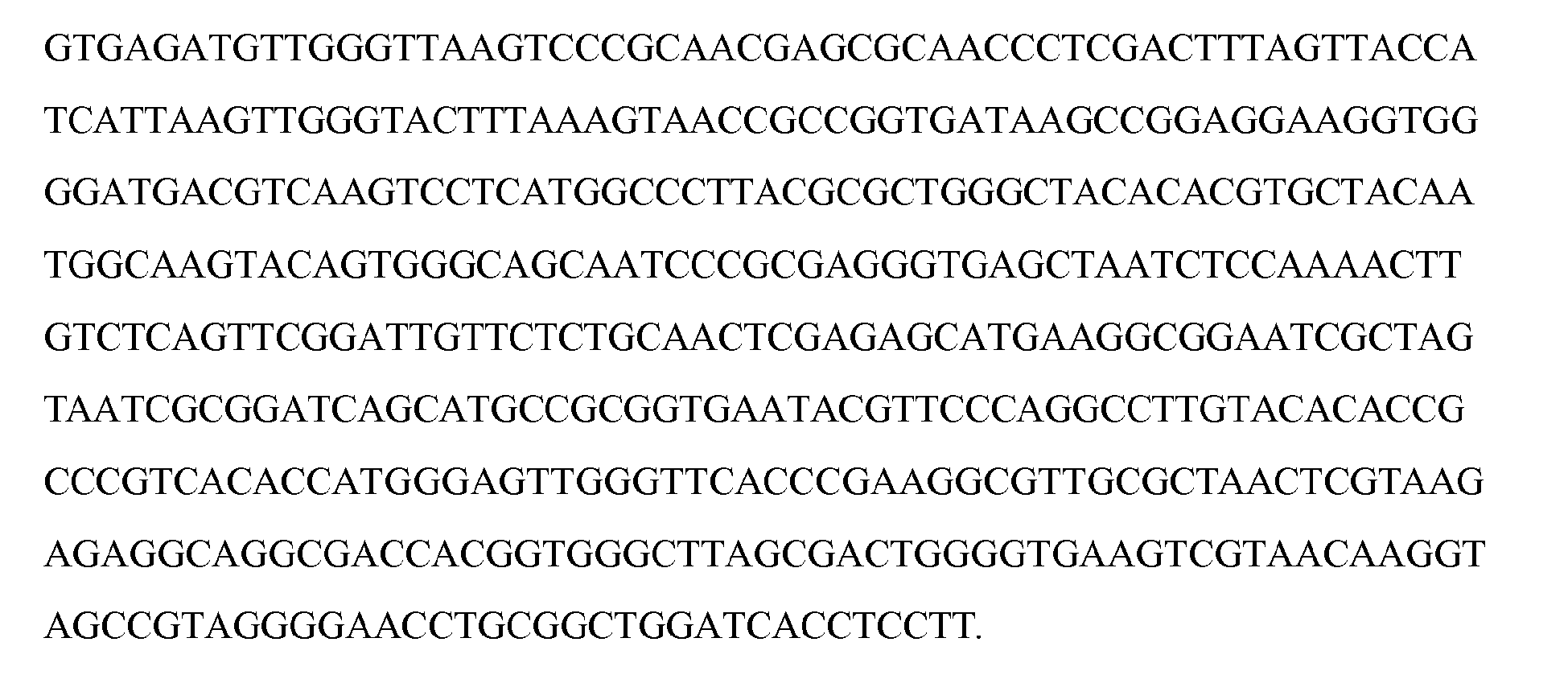
- The said ZD001 (CCTCC NO: M 209198) strain is characterized in that: Gram-negative bacillus; non-spore-forming ; straight rod in shape; colonies on nutrient agar plates showing the ivory-white color; positive in oxidase test; positive in catalase test; obligate aerobe; decomposing glucose, fructose, xylose and saccharose; positive in starch hydrolysis test; incapable of liquidizing gelatin; no growth at 43°C; the size of cells being in the range of 1.5~5.0 µm × 0.8-1.0 µm; and no production of yellow pigments.
- The present invention also relates to the use of the said ZD001 (CCTCC NO: M 209198) stain in the preparation of gellan gum via microorganism fermentation.
- In particular, the said use is described as follows. The said ZD001 (CCTCC NO: M 209198) strain is activated by routine methods, the seed obtained thereof is cultured and the cultured seed is inoculated into the fermentation medium usually suitable for the growth of Sphingomonas strains. Then, at the temperatures ranging 28~32°C and pH 6.8~7.2, the culture is cultured on a shaker for 32-60 hrs and thereby the high acyl gellan gum-containing fermentation broth is obtained. The fermentation broth can be directly separated and extracted to obtain the high acyl gellan gum product, or it can be subjected to a deacylation treatment to prepare the low acyl gellan gum.
- When the product to be prepared is a high acyl gellan gum, the method is conducted as follows. The pH value of the said high acyl gellan gum-containing fermentation broth is adjusted to 5.0~6.0, and the temperature is raised up to 50°C~70°C (preferably, 60°C), and the temperature is kept constant for 30 min-2 h (preferably, 1 h). After this, the temperature is lowered to 40°C~50°C, the pH is adjusted to 7.0, and then, lysozyme and alkaline proteinase are added and the temperature is kept as it was for 1 h - 3 h (preferably, 2 h) to remove the proteins. Into the fermentation broth that the proteins have been removed, a flocculating agent solution is added to conduct the flocculation (the amount of the flocculating agent solution is about 5% of the fermentation broth in volume after the proteins have been removed). After a second separation (via the addition of isopropanol or ethanol solution having a concentration of more than 90% in the amount of about 30% of the volume of the fermentation broth, with the preferable of 95% isopropanol, an agitation, and a filter press by a plate-and-frame filter press device), the solid material is dried (at 90°C) to obtain the said high acyl gellan gum. The flocculating agent is one or a mixture of more than one, of the following substances (the concentration usually is 20%, w/v): CaCl2, MgCl2, NaCl, and KCl.
- When the product to be prepared is a low acyl gellan gum, the method is conducted as follows. Into the said high acyl gellan gum-containing fermentation broth, a solution of an alkali metal chloride or an alkali earth metal chloride (usually having a concentration of 20%, w/v) is added and the pH is adjusted to 11.0, then a solid-liquid separation (a solid-liquid separation via a plate-and-frame device) is conducted so that a fiber-like material 1 is obtained. The so-obtained fiber-like material 1 is mixed with water in the ratio of 1 : 4~6 in volume, the pH is adjusted to 2.5~4.0 (preferably, pH 3.0), a washing is conducted for 15 min ~ 1 h (preferably, 30 min), and a filter press is given so that a fiber-liked material 2 is obtained. The so-obtained fiber-like material 2 is mixed evenly with water in the ratio of 1 : 9~12 in volume, and the temperature is raised up to 80°C~90°C (preferably, 83°C~87°C), and a basic agent is added to adjust the pH to 9.5~10.5 (preferably, pH 9.8-10.2). The reaction is conducted for 8 min ~ 15 min (preferably, 10 min ~ 12 min). After the reaction is over, the pH of the reaction liquid is adjusted to the neutral condition and a filtration aid is added (the amount of addition is 1~3%, w/v, preferably 2%) and a filtration is conducted. Into the filtrate, a flocculating agent is added (preferably, 10% in mass concentration, and the volume added is 5% of the filtrate volume) to conduct a flocculation. Then, a separation is given and the solid material obtained is dried to prepare the said low acyl gellan gum. The said alkali metal chloride or alkali earth metal chloride is one selected from the following list or a mixture of more than two substances selected from the following list: CaCl2, MgCl2, NaCl, and KCl (preferably, CaCl2). The said basic agent is one selected from the list or a mixture of more than two substances selected from the list: NaOH, KOH, and Na3PO4. The filtration aid is diatomite, perlite or a mixture thereof. The flocculating agent is one selected from the list or a mixture of two or more selected from the list: CaCl2, MgCl2, NaCl, and KCl (preferably, KCl).
- The main beneficial effects of the present invention are that: a yellow pigments generation deficient Sphingomonas strain ZD001 (CCTCC NO: M 209198) is provided, whose fermentation broth does not contain yellow pigment(s) and has the color of milky white; during the extraction, the amount of ethanol or isopropanol for use is reduced; and the processing steps are simplified. All these beneficial effects improve the yield, and lower the production costs. It is helpful in the industrial production of high-quality gellan gum.
- The following parts are a further description of the present invention, with reference to the specific examples. However, the protection scope of the present invention should not be limited to the examples.
- Isolation and Identification of ZD001 (CCTCC NO: M 209198) Stain
- 1. Collect earth samples under aseptic condition, dilute the samples and spread the suspensions onto YM agar medium plates;
- 2. Place the plates at 30°C to culture for 5 days;
- 3. Pick up bacterial colonies with different colonial morphologies, and streak the individual colony on the same culture medium plates to isolate, i.e., placing at 30°C to culture for 5 days.
- The composition of YM agar medium, based on the final concentrations, are 0.30% of yeast extract, 0.30% of malt extract, 0.50% of peptone, 1.00% of glucose, 1.50% of agar, and the solvent distilled water.
- Note: in the present invention, all of the concentrations in the medium refer to the mass-to-volume percent concentrations. For a component, the concentration 1% means that there is 1 g of the substance existing in the 100 ml medium.
- After screenings, a yellow pigments generation deficient strain, i.e., ZD001 (CCTCC NO: M 209198) strain, is obtained. This strain is a Gram-negative bacillus; does not produce spores; and has the cells in the shape of straight rod. The colony on nutrient agar medium plate has the color of ivory white. The strain is positive in oxidase test, positive in catalase test, and is an obligate aerobe. The stain can decompose glucose, fructose, xylose and saccharose. The strain is positive in starch hydrolysis test, and does not liquidize the gelatin. The stain cannot grow at 43°C. The dimension of the bacterial bodies is 1.5-5.0 µm × 0.8-1.0 µm. The stain does not produce yellow pigment(s).
-
- 1. Inoculate the pure stain culture into an YPG medium slant, and culture at 30°C for 72 h;
- 2. Cultivation of first class seed: inoculate the slant seed into 50 mL medium for first class seed (held in a 250 mL flask) and culture at 30°C with 200 rpm shaking for 24 h, and thereby the first class seed solution is obtained;
- 3. Cultivation of second class seed: inoculate the first class seed solution into 100 mL medium for the cultivation of second class seed (held in a 500 mL flask) in the amount 5% in volume ratio, and culture at 30°C with 200 rpm shaking for 12 h, and thereby a second class seed solution is obtained;
- 4. Fermentation in fermentor: inoculate the second class seed solution into the fermentation medium at the amount of 5% v/v, and culture it under the conditions of 30°C, pH 6.8 ~ 7.2, ventilation of 1. 0 vvm, and rotation speed of 300 rpm, for 48 hours;
- 5. Collection of the product from the fermentation: collect the gellan gum-containing fermentation gum produced in Step 4 after a cultivation of 48 hours.
- The components and the final concentrations of YPG slant medium are: glucose 2.00%, peptone 0.50%, yeast extract 0.30%, agar 1.50%, and the solvent being distilled water, pH 7.2;
- The final concentrations for the first class culture medium are: yeast extract 0.20%; beef extract 0.30%; peptone 0.50%; potassium chloride 0.10%, and the solvent being distilled water, pH 7.2;
- The second class seed medium: glucose 1.50%; yeast extract 0.50%; peptone 0.50%; potassium dihydrogen phosphate 0.06%; dipotassium hydrogen phosphate 0.06%; magnesium sulfate 0.06%, and the solvent being distilled water, pH 7.2;
- The fermentation medium: glucose 3.00%; yeast extract 0.05%; peptone 0.30%; potassium dihydrogen phosphate 0.06%; dipotassium hydrogen phosphate 0.10%; magnesium sulfate 0.06%; and the solvent being distilled water, pH 7.2.
-
- 1. Pre-treatment of fermentation broth: take 100 L of fermentation broth, and adjust its pH with 10% (v/v) HCl to 6.0, and the temperature is raised up to 60°C and kept the temperature constant for 1 h;
- 2. Removal of proteins impurities: the temperature is reduced to 40°C and the pH is adjusted with 10% (w/v) NaOH to 7.0; and then 50g of lysozyme (200,000 U/g, Pangbo Biological Engineering Co., Ltd) and 100g of alkaline proteinase (20,000 U/g, Pangbo Biological Engineering Co., Ltd) and the temperature is kept constant for 2 h;
- 3. Precipitation via flocculation and separation: into the fermentation broth that has been subjected to the pre-treatment and the protein impurities removal, 5 L of 20% (w/v) CaCl2 solution is added and an agitation is conducted for 30 min. After this, 30 L of isopropanol is added and an additional agitation is conducted for 1 h. Then, a plate-and-frame filter press is given;
- 4. Drying and milling: dry the fiber-like material obtained from filter pressing at 90°C for 2 h and mill the dried material so that a high acyl gellan gum product is obtained. It is in the form of a powder having the ivory white color, and containing 0.05~0.30% nitrogen.
-
- 1. Pre-treatment of fermentation broth: take 100 L of mature fermentation broth, and add 3 L of 20% (w/v) CaCl2 solution into it, and an agitation is conducted for 10 min. After this, the pH is adjusted with 10% NaOH to 11.0, and an agitation is conducted for 3 min. Then, a plate-and-frame filter pressing is conducted and a fiber-like material is obtained thereby;
- 2. Washing: mix the fiber-like material pre-treated in Step 1 with water in the volume ratio of 1:5, adjust the pH with 10% HCl to 3.0, and conduct an agitation for 30 min. After this, a plate-and-frame is conducted so that a fiber-like material is obtained.
- 3. Deacylation treatment: mix the fiber-like material washed in Step 2 with water in the volume ratio of 1:10. The mixture is agitated evenly and the temperature is raised up to about 90°C so that the fiber-like material is completely dissolved. The temperature is kept constant at 85°C and 10% NaOH aqueous solution is added, and the pH value is adjusted to 9.5~10.5. The reaction is conducted for 10 min. After this, the pH is adjusted with 10% HCl to 6.0;
- 4. Add diatomite calculated in mass, in the amount of 2% of the volume of the material solution as obtained in above step, and keep the temperature at a temperature higher than 80°C. A filtration by a plate-and-frame filtration is conducted. After the filtration, 5% KCl solution (the mass concentration is 10%) is added into the material solution (filtrate) calculated in volume and then a plate-and-frame pressing is given;
- 5. Drying and milling: the gellan gum fiber-like material obtained from pressing is dried at 90°C for 2 h. Then it is milled. And, the final product of low acyl gellan gum is obtained. The so-formed low acyl gellan gum is a milk-white powder, with the gel strength of ≥ 800 g/cm2 and the transmittancy of ≥ 80%.
Claims (7)
- A yellow pigments generation deficient Sphingomonas strain (Sphingomonas sp.) ZD001, deposited at Center for Type Culture Collection (CCTCC), the address: Wuhan University, Wuhan, China, 430072, the preservation date of the strain: September 10, 2009; and the preservation serial number: CCTCC No : M 209198.
- The Sphingomonas strain according to claim 1, characterized in that the said Sphingomonas strain has a 16S rDNA with the following sequence:


- The Sphingomonas strain according to claim 1, characterized in that the said Sphingomonas strain has the following characteristics: Gram-negative bacillus; non-spore-forming; straight rod in shape; colonies on nutrient agar plates showing the ivory-white color; positive in oxidase test; positive in catalase test; obligate aerobe; decomposing glucose, fructose, xylose and saccharose; positive in starch hydrolysis test; incapable of liquidizing gelatin; no growth at 43°C; the size of cells being in the range of 1.5~5.0 µm × 0.8-1.0 µm; and no production of yellow pigments.
- Use of the Sphingomonas strain according to claim 1 in the preparation of gellan gum by microorganism fermentation.
- The use according to claim 4, characterized in that the said use is: the said Sphingomonas strain is activated and cultivated into a seed culture, the seed culture is inoculated into a fermentation medium suitable for the fermentation of the Sphingomonas strain, and grows at 28~32°C, pH 6.8~7.2 on a shaker for 32-60 h, thereby an ivory-white fermentation broth containing high acyl gellan gum is obtained.
- The use according to claim 5, characterized in that the high acyl gellan gum-containing fermentation broth is subjected to a separation and purification method so that the high acyl gellan gum is obtained, wherein the said separation and purification method comprises: the pH value of the high acyl gellan gum-containing fermentation broth is adjusted to 5.0~6.0, and the temperature is raised up to 50°C~70°C and kept at the temperature for 30 min~2 h, then, the temperature is reduced to 40°C~50°C, the pH is adjusted to 7.0, and then lysozyme and alkaline proteinase are added and the temperature is kept for 1 h - 3 h to remove the proteins; into the fermentation broth with the proteins removed, a flocculating agent solution is added to precipitation by flocculation, then a separation and drying is conducted so that said high acyl gellan gum is obtained, wherein the flocculating agent is one or a mixture of two or more at any ratio, selecting from the group consisting of: CaCl2, MgCl2, NaCl, and KCl.
- The use according to claim 5, characterized in that the high acyl gellan gum-containing fermentation broth is subjected to a deacylation treatment, and then to a separation and purification so that a low acyl gellan gum is obtained, wherein the method for the preparation of the low acyl gellan gum comprises: Into the high acyl gellan gum-containing fermentation broth, an alkali metal or alkali earth metal chloride solution is added, the pH is adjusted to 11.0, a solid-liquid separation is conducted to obtain the fiber-like material 1, the fiber-like material 1 is mixed with water in the ratio of 1 : 4~6 in volume, the pH is adjusted to 2.5~4.0, and the fiber-like material 1 is washed for 15 min ~ 1 h, and the fiber-like material 1 is pressed so that the fiber-like material 2 is obtained, and the fiber-like material 2 is evenly mixed with water in the ratio of 1 : 9~12 in volume, the temperature is raised up to 80°C~90°C, and a basic agent is added to adjust the pH to 9.5~10.5, and the reaction is conducted for 8 min~15 min; after the reaction is over, the pH of the reaction is adjusted to the neutral condition, and the filtration aid is added so that a filtration is conducted thereby; the filtrate is taken and a flocculating agent is added into it to conduct a precipitation by flocculation, and then a second separation is conducted; the solid material so-obtained is dried and the said low acyl gellan gum is obtained; wherein the said alkali metal or alkali earth metal chloride is one of or a mixture of more than two of the following: CaCl2, MgCl2, NaCl, and KCl; wherein said basic agent is one of or a mixture of more than two of the following: NaOH, KOH, and Na3PO4, wherein the filtration aid is diatomite, perlite or a mixture thereof; wherein the flocculating agent is one of or a mixture of more than two of the following: CaCl2, MgCl2, NaCl, and KCl.
Applications Claiming Priority (2)
| Application Number | Priority Date | Filing Date | Title |
|---|---|---|---|
| CN2009101530057A CN101665778B (en) | 2009-09-25 | 2009-09-25 | Uranidin generation deficiency sphingolipid sphingomonas paucimobilis and application thereof in gellan gum production |
| PCT/CN2010/001228 WO2011035530A1 (en) | 2009-09-25 | 2010-08-13 | Yellow pigments generation deficient sphingomonas strain and application thereof in gellan gum production |
Publications (3)
| Publication Number | Publication Date |
|---|---|
| EP2360238A1 true EP2360238A1 (en) | 2011-08-24 |
| EP2360238A4 EP2360238A4 (en) | 2013-01-09 |
| EP2360238B1 EP2360238B1 (en) | 2014-01-15 |
Family
ID=41802556
Family Applications (1)
| Application Number | Title | Priority Date | Filing Date |
|---|---|---|---|
| EP10818224.7A Active EP2360238B1 (en) | 2009-09-25 | 2010-08-13 | A yellow pigments generation deficient sphingomonas strain and its application in the production of gellan gum |
Country Status (5)
| Country | Link |
|---|---|
| US (1) | US8685698B2 (en) |
| EP (1) | EP2360238B1 (en) |
| JP (1) | JP5765859B2 (en) |
| CN (1) | CN101665778B (en) |
| WO (1) | WO2011035530A1 (en) |
Cited By (1)
| Publication number | Priority date | Publication date | Assignee | Title |
|---|---|---|---|---|
| EP3483280A1 (en) * | 2017-11-10 | 2019-05-15 | Zhejiang Dsm Zhongken Biotechnology Co., Ltd | A fermentation method for producing gellan gum |
Families Citing this family (13)
| Publication number | Priority date | Publication date | Assignee | Title |
|---|---|---|---|---|
| CN101665778B (en) * | 2009-09-25 | 2012-03-28 | 浙江大学 | Uranidin generation deficiency sphingolipid sphingomonas paucimobilis and application thereof in gellan gum production |
| CN102311508B (en) * | 2010-07-09 | 2014-05-14 | 郸城财鑫糖业有限责任公司 | Process for extracting transparent high-acyl gellan gum |
| CN102747016A (en) * | 2012-06-28 | 2012-10-24 | 福建省农业科学院农业生物资源研究所 | Gellan gum efficient production strain and its application |
| JP2016504918A (en) * | 2013-01-31 | 2016-02-18 | グラクソ グループ リミテッドGlaxo Group Limited | Method for producing a protein |
| CN103509845B (en) * | 2013-08-09 | 2015-07-08 | 新疆阜丰生物科技有限公司 | High aryl gellan gum extracting method |
| CN103421718B (en) * | 2013-08-09 | 2015-11-11 | 浙江大学 | A kind of sphingomonas paucimobilis bacterial strain and application thereof |
| CN104193841B (en) * | 2014-08-07 | 2016-08-24 | 新疆阜丰生物科技有限公司 | A kind of low cost low acyl transparent type gellan gum extraction process |
| CN108690143A (en) | 2017-04-07 | 2018-10-23 | 帝斯曼知识产权资产管理有限公司 | A kind of production method of high transparency low-acyl gellan gum |
| CN113151050B (en) * | 2021-03-10 | 2022-10-11 | 南京工业大学 | Sphingomonas and application thereof |
| CN113698988B (en) * | 2021-07-27 | 2024-04-26 | 长寿花食品股份有限公司 | A production process of nutritional corn oil |
| CN113956372B (en) * | 2021-11-05 | 2022-07-26 | 南开大学 | Molecular marker and application of a kind of high acyl trizan gum and its production strain |
| CN113881423B (en) * | 2021-11-10 | 2022-10-04 | 南京工业大学 | Application of a thermosensitive heteropolysaccharide polymer in enhanced oil recovery |
| CN114214234B (en) * | 2021-12-21 | 2023-09-26 | 江苏大学 | A low molecular weight gellan gum production strain and its screening method and application |
Family Cites Families (9)
| Publication number | Priority date | Publication date | Assignee | Title |
|---|---|---|---|---|
| CN1553957A (en) * | 2000-03-02 | 2004-12-08 | Cp | Mutant bacterial strains of the genus Sphingomonas deficient in polyhydroxybutyrate production and methods of clarifying sphingans and compositions thereof |
| US20030100078A1 (en) | 2001-07-03 | 2003-05-29 | Harding Nancy E. | Mutant strain of Sphingomonas elodea which produces non-acetylated gellan gum |
| GB0203431D0 (en) * | 2002-02-13 | 2002-04-03 | Mars Inc | Gel |
| CN1271202C (en) * | 2004-06-24 | 2006-08-23 | 大连理工大学 | Sphingol monospore bacterial strain and its application in anthraquinone dye waste water decolour |
| CN1269964C (en) * | 2004-11-19 | 2006-08-16 | 张禹 | Process for preparing microbiological polysaccharide Gellan gum |
| CN1904032A (en) * | 2005-07-28 | 2007-01-31 | 中国科学院大连化学物理研究所 | Xanthan gum degradation bacteria, its fermentation method and application |
| CN100451106C (en) * | 2006-09-12 | 2009-01-14 | 山东大学 | Sphingomonaspaucimobilis of high-yield gellan gum and use therefor |
| CN1995326B (en) * | 2006-09-26 | 2010-05-12 | 张国沛 | Sphingol single-cell bacteria and method for producing microorganism polysaccharide |
| CN101665778B (en) * | 2009-09-25 | 2012-03-28 | 浙江大学 | Uranidin generation deficiency sphingolipid sphingomonas paucimobilis and application thereof in gellan gum production |
-
2009
- 2009-09-25 CN CN2009101530057A patent/CN101665778B/en active Active
-
2010
- 2010-08-13 WO PCT/CN2010/001228 patent/WO2011035530A1/en not_active Ceased
- 2010-08-13 EP EP10818224.7A patent/EP2360238B1/en active Active
- 2010-08-13 JP JP2012530094A patent/JP5765859B2/en active Active
- 2010-08-13 US US13/142,412 patent/US8685698B2/en active Active
Non-Patent Citations (2)
| Title |
|---|
| See also references of WO2011035530A1 * |
| XUECHANG WU ET AL: "A carotenoid-free mutant strain ofATCC 31461 for the commercial production of gellan", CARBOHYDRATE POLYMERS, APPLIED SCIENCE PUBLISHERS, LTD. BARKING, GB, vol. 84, no. 3, 12 January 2011 (2011-01-12), pages 1201-1207, XP028365184, ISSN: 0144-8617, DOI: 10.1016/J.CARBPOL.2011.01.018 [retrieved on 2011-01-18] * |
Cited By (2)
| Publication number | Priority date | Publication date | Assignee | Title |
|---|---|---|---|---|
| EP3483280A1 (en) * | 2017-11-10 | 2019-05-15 | Zhejiang Dsm Zhongken Biotechnology Co., Ltd | A fermentation method for producing gellan gum |
| US11149293B2 (en) | 2017-11-10 | 2021-10-19 | Zhejiang Dsm Zhongken Biotechnology Co. Ltd | Fermentation method for producing gellan gum |
Also Published As
| Publication number | Publication date |
|---|---|
| US8685698B2 (en) | 2014-04-01 |
| JP5765859B2 (en) | 2015-08-19 |
| WO2011035530A1 (en) | 2011-03-31 |
| EP2360238B1 (en) | 2014-01-15 |
| JP2013505709A (en) | 2013-02-21 |
| CN101665778B (en) | 2012-03-28 |
| EP2360238A4 (en) | 2013-01-09 |
| US20110281308A1 (en) | 2011-11-17 |
| CN101665778A (en) | 2010-03-10 |
Similar Documents
| Publication | Publication Date | Title |
|---|---|---|
| EP2360238B1 (en) | A yellow pigments generation deficient sphingomonas strain and its application in the production of gellan gum | |
| Stredansky et al. | Xanthan production by solid state fermentation | |
| CN101619300B (en) | Sphingomonas sp. TP-5 , method and application thereof for producing welan gum | |
| EP0077680B1 (en) | Heteropolysaccharide s-194, a process for producing it, and compositions containing it | |
| Mohsin et al. | Kinetically modelled approach of xanthan production using different carbon sources: A study on molecular weight and rheological properties of xanthan | |
| KR100771745B1 (en) | Production of exopolysaccharides unattached to the surface of bacterial cells | |
| JP3341017B2 (en) | New cellulose-producing bacteria | |
| CN112358985B (en) | Pradazobium and application thereof in preparation of water-soluble beta-1, 3 glucan | |
| JPH0739386A (en) | Production of bacterial cellulose | |
| EP0231585A2 (en) | Biosynthesis of heteropolysaccharides | |
| JPWO1997040135A1 (en) | Novel cellulose-producing bacteria | |
| CN118240677A (en) | A kind of Paenibacillus and its application in preparing Tremella oligosaccharide | |
| EP4267720A1 (en) | Bacterial strains for biocellulose production | |
| EP1283896B1 (en) | Method for obtaining a polysaccharide substantially free from whole cells and cell debris | |
| CN102618468B (en) | Temperature-resistant alcaligenes and application thereof in welan gum production | |
| CN100529055C (en) | A kind of alcaligenes and its application in preparing welan gum | |
| WO2006047845A1 (en) | Process for preparing a xanthan biopolymer | |
| CN113234633B (en) | A chitinase-producing strain and its application in the preparation of chitin oligosaccharides | |
| KR100462904B1 (en) | Manufacturing process for producing Alginate lyase using Xanthomonas sp. BH-1, newly isolated marine bacterium | |
| JP2767551B2 (en) | Method for producing bacterial cellulose using non-PQQ-producing strain | |
| JP4425174B2 (en) | Method for producing macrohomopsis gum | |
| Kongruang et al. | Quantitative analysis of exopolysaccharide production in a stirred tank bioreactor | |
| Kulandaivel et al. | Fermentation Process and Nutrition Study of Xanthomonas campestris and Xanthomonas malvacerum in xanthan gum production | |
| JPH07184675A (en) | Production of bacterial cellulose | |
| CZ220091A3 (en) | process for preparing glucomannan carbonaceous bio-polymer |
Legal Events
| Date | Code | Title | Description |
|---|---|---|---|
| PUAI | Public reference made under article 153(3) epc to a published international application that has entered the european phase |
Free format text: ORIGINAL CODE: 0009012 |
|
| 17P | Request for examination filed |
Effective date: 20110621 |
|
| AK | Designated contracting states |
Kind code of ref document: A1 Designated state(s): AL AT BE BG CH CY CZ DE DK EE ES FI FR GB GR HR HU IE IS IT LI LT LU LV MC MK MT NL NO PL PT RO SE SI SK SM TR |
|
| DAX | Request for extension of the european patent (deleted) | ||
| A4 | Supplementary search report drawn up and despatched |
Effective date: 20121207 |
|
| RIC1 | Information provided on ipc code assigned before grant |
Ipc: C08B 37/00 20060101ALI20121204BHEP Ipc: C12R 1/01 20060101ALI20121204BHEP Ipc: C12P 19/04 20060101ALI20121204BHEP Ipc: C12N 1/20 20060101AFI20121204BHEP |
|
| GRAP | Despatch of communication of intention to grant a patent |
Free format text: ORIGINAL CODE: EPIDOSNIGR1 |
|
| INTG | Intention to grant announced |
Effective date: 20130926 |
|
| GRAS | Grant fee paid |
Free format text: ORIGINAL CODE: EPIDOSNIGR3 |
|
| GRAA | (expected) grant |
Free format text: ORIGINAL CODE: 0009210 |
|
| AK | Designated contracting states |
Kind code of ref document: B1 Designated state(s): AL AT BE BG CH CY CZ DE DK EE ES FI FR GB GR HR HU IE IS IT LI LT LU LV MC MK MT NL NO PL PT RO SE SI SK SM TR |
|
| REG | Reference to a national code |
Ref country code: GB Ref legal event code: FG4D Ref country code: CH Ref legal event code: EP |
|
| REG | Reference to a national code |
Ref country code: AT Ref legal event code: REF Ref document number: 649870 Country of ref document: AT Kind code of ref document: T Effective date: 20140215 |
|
| REG | Reference to a national code |
Ref country code: IE Ref legal event code: FG4D |
|
| REG | Reference to a national code |
Ref country code: DE Ref legal event code: R096 Ref document number: 602010013211 Country of ref document: DE Effective date: 20140227 |
|
| REG | Reference to a national code |
Ref country code: NL Ref legal event code: VDEP Effective date: 20140115 |
|
| REG | Reference to a national code |
Ref country code: AT Ref legal event code: MK05 Ref document number: 649870 Country of ref document: AT Kind code of ref document: T Effective date: 20140115 |
|
| REG | Reference to a national code |
Ref country code: LT Ref legal event code: MG4D |
|
| PG25 | Lapsed in a contracting state [announced via postgrant information from national office to epo] |
Ref country code: IS Free format text: LAPSE BECAUSE OF FAILURE TO SUBMIT A TRANSLATION OF THE DESCRIPTION OR TO PAY THE FEE WITHIN THE PRESCRIBED TIME-LIMIT Effective date: 20140515 Ref country code: LT Free format text: LAPSE BECAUSE OF FAILURE TO SUBMIT A TRANSLATION OF THE DESCRIPTION OR TO PAY THE FEE WITHIN THE PRESCRIBED TIME-LIMIT Effective date: 20140115 Ref country code: NO Free format text: LAPSE BECAUSE OF FAILURE TO SUBMIT A TRANSLATION OF THE DESCRIPTION OR TO PAY THE FEE WITHIN THE PRESCRIBED TIME-LIMIT Effective date: 20140415 |
|
| PG25 | Lapsed in a contracting state [announced via postgrant information from national office to epo] |
Ref country code: AT Free format text: LAPSE BECAUSE OF FAILURE TO SUBMIT A TRANSLATION OF THE DESCRIPTION OR TO PAY THE FEE WITHIN THE PRESCRIBED TIME-LIMIT Effective date: 20140115 Ref country code: PT Free format text: LAPSE BECAUSE OF FAILURE TO SUBMIT A TRANSLATION OF THE DESCRIPTION OR TO PAY THE FEE WITHIN THE PRESCRIBED TIME-LIMIT Effective date: 20140515 Ref country code: FI Free format text: LAPSE BECAUSE OF FAILURE TO SUBMIT A TRANSLATION OF THE DESCRIPTION OR TO PAY THE FEE WITHIN THE PRESCRIBED TIME-LIMIT Effective date: 20140115 Ref country code: CY Free format text: LAPSE BECAUSE OF FAILURE TO SUBMIT A TRANSLATION OF THE DESCRIPTION OR TO PAY THE FEE WITHIN THE PRESCRIBED TIME-LIMIT Effective date: 20140115 Ref country code: ES Free format text: LAPSE BECAUSE OF FAILURE TO SUBMIT A TRANSLATION OF THE DESCRIPTION OR TO PAY THE FEE WITHIN THE PRESCRIBED TIME-LIMIT Effective date: 20140115 Ref country code: SE Free format text: LAPSE BECAUSE OF FAILURE TO SUBMIT A TRANSLATION OF THE DESCRIPTION OR TO PAY THE FEE WITHIN THE PRESCRIBED TIME-LIMIT Effective date: 20140115 Ref country code: NL Free format text: LAPSE BECAUSE OF FAILURE TO SUBMIT A TRANSLATION OF THE DESCRIPTION OR TO PAY THE FEE WITHIN THE PRESCRIBED TIME-LIMIT Effective date: 20140115 |
|
| PG25 | Lapsed in a contracting state [announced via postgrant information from national office to epo] |
Ref country code: BE Free format text: LAPSE BECAUSE OF FAILURE TO SUBMIT A TRANSLATION OF THE DESCRIPTION OR TO PAY THE FEE WITHIN THE PRESCRIBED TIME-LIMIT Effective date: 20140115 Ref country code: LV Free format text: LAPSE BECAUSE OF FAILURE TO SUBMIT A TRANSLATION OF THE DESCRIPTION OR TO PAY THE FEE WITHIN THE PRESCRIBED TIME-LIMIT Effective date: 20140115 Ref country code: HR Free format text: LAPSE BECAUSE OF FAILURE TO SUBMIT A TRANSLATION OF THE DESCRIPTION OR TO PAY THE FEE WITHIN THE PRESCRIBED TIME-LIMIT Effective date: 20140115 |
|
| REG | Reference to a national code |
Ref country code: DE Ref legal event code: R097 Ref document number: 602010013211 Country of ref document: DE |
|
| PG25 | Lapsed in a contracting state [announced via postgrant information from national office to epo] |
Ref country code: EE Free format text: LAPSE BECAUSE OF FAILURE TO SUBMIT A TRANSLATION OF THE DESCRIPTION OR TO PAY THE FEE WITHIN THE PRESCRIBED TIME-LIMIT Effective date: 20140115 Ref country code: DK Free format text: LAPSE BECAUSE OF FAILURE TO SUBMIT A TRANSLATION OF THE DESCRIPTION OR TO PAY THE FEE WITHIN THE PRESCRIBED TIME-LIMIT Effective date: 20140115 Ref country code: CZ Free format text: LAPSE BECAUSE OF FAILURE TO SUBMIT A TRANSLATION OF THE DESCRIPTION OR TO PAY THE FEE WITHIN THE PRESCRIBED TIME-LIMIT Effective date: 20140115 Ref country code: RO Free format text: LAPSE BECAUSE OF FAILURE TO SUBMIT A TRANSLATION OF THE DESCRIPTION OR TO PAY THE FEE WITHIN THE PRESCRIBED TIME-LIMIT Effective date: 20140115 |
|
| PLBE | No opposition filed within time limit |
Free format text: ORIGINAL CODE: 0009261 |
|
| STAA | Information on the status of an ep patent application or granted ep patent |
Free format text: STATUS: NO OPPOSITION FILED WITHIN TIME LIMIT |
|
| PG25 | Lapsed in a contracting state [announced via postgrant information from national office to epo] |
Ref country code: SK Free format text: LAPSE BECAUSE OF FAILURE TO SUBMIT A TRANSLATION OF THE DESCRIPTION OR TO PAY THE FEE WITHIN THE PRESCRIBED TIME-LIMIT Effective date: 20140115 Ref country code: PL Free format text: LAPSE BECAUSE OF FAILURE TO SUBMIT A TRANSLATION OF THE DESCRIPTION OR TO PAY THE FEE WITHIN THE PRESCRIBED TIME-LIMIT Effective date: 20140115 |
|
| 26N | No opposition filed |
Effective date: 20141016 |
|
| REG | Reference to a national code |
Ref country code: DE Ref legal event code: R097 Ref document number: 602010013211 Country of ref document: DE Effective date: 20141016 |
|
| REG | Reference to a national code |
Ref country code: DE Ref legal event code: R119 Ref document number: 602010013211 Country of ref document: DE |
|
| PG25 | Lapsed in a contracting state [announced via postgrant information from national office to epo] |
Ref country code: MC Free format text: LAPSE BECAUSE OF FAILURE TO SUBMIT A TRANSLATION OF THE DESCRIPTION OR TO PAY THE FEE WITHIN THE PRESCRIBED TIME-LIMIT Effective date: 20140115 Ref country code: LU Free format text: LAPSE BECAUSE OF FAILURE TO SUBMIT A TRANSLATION OF THE DESCRIPTION OR TO PAY THE FEE WITHIN THE PRESCRIBED TIME-LIMIT Effective date: 20140813 |
|
| REG | Reference to a national code |
Ref country code: CH Ref legal event code: PL |
|
| GBPC | Gb: european patent ceased through non-payment of renewal fee |
Effective date: 20140813 |
|
| PG25 | Lapsed in a contracting state [announced via postgrant information from national office to epo] |
Ref country code: LI Free format text: LAPSE BECAUSE OF NON-PAYMENT OF DUE FEES Effective date: 20140831 Ref country code: CH Free format text: LAPSE BECAUSE OF NON-PAYMENT OF DUE FEES Effective date: 20140831 |
|
| REG | Reference to a national code |
Ref country code: IE Ref legal event code: MM4A |
|
| PG25 | Lapsed in a contracting state [announced via postgrant information from national office to epo] |
Ref country code: SI Free format text: LAPSE BECAUSE OF FAILURE TO SUBMIT A TRANSLATION OF THE DESCRIPTION OR TO PAY THE FEE WITHIN THE PRESCRIBED TIME-LIMIT Effective date: 20140115 |
|
| REG | Reference to a national code |
Ref country code: DE Ref legal event code: R119 Ref document number: 602010013211 Country of ref document: DE Effective date: 20150303 |
|
| PG25 | Lapsed in a contracting state [announced via postgrant information from national office to epo] |
Ref country code: GB Free format text: LAPSE BECAUSE OF NON-PAYMENT OF DUE FEES Effective date: 20140813 Ref country code: DE Free format text: LAPSE BECAUSE OF NON-PAYMENT OF DUE FEES Effective date: 20150303 |
|
| PG25 | Lapsed in a contracting state [announced via postgrant information from national office to epo] |
Ref country code: IE Free format text: LAPSE BECAUSE OF NON-PAYMENT OF DUE FEES Effective date: 20140813 |
|
| PG25 | Lapsed in a contracting state [announced via postgrant information from national office to epo] |
Ref country code: SM Free format text: LAPSE BECAUSE OF FAILURE TO SUBMIT A TRANSLATION OF THE DESCRIPTION OR TO PAY THE FEE WITHIN THE PRESCRIBED TIME-LIMIT Effective date: 20140115 |
|
| PG25 | Lapsed in a contracting state [announced via postgrant information from national office to epo] |
Ref country code: MT Free format text: LAPSE BECAUSE OF FAILURE TO SUBMIT A TRANSLATION OF THE DESCRIPTION OR TO PAY THE FEE WITHIN THE PRESCRIBED TIME-LIMIT Effective date: 20140115 Ref country code: GR Free format text: LAPSE BECAUSE OF FAILURE TO SUBMIT A TRANSLATION OF THE DESCRIPTION OR TO PAY THE FEE WITHIN THE PRESCRIBED TIME-LIMIT Effective date: 20140416 Ref country code: BG Free format text: LAPSE BECAUSE OF FAILURE TO SUBMIT A TRANSLATION OF THE DESCRIPTION OR TO PAY THE FEE WITHIN THE PRESCRIBED TIME-LIMIT Effective date: 20140115 Ref country code: IT Free format text: LAPSE BECAUSE OF FAILURE TO SUBMIT A TRANSLATION OF THE DESCRIPTION OR TO PAY THE FEE WITHIN THE PRESCRIBED TIME-LIMIT Effective date: 20140115 |
|
| PG25 | Lapsed in a contracting state [announced via postgrant information from national office to epo] |
Ref country code: HU Free format text: LAPSE BECAUSE OF FAILURE TO SUBMIT A TRANSLATION OF THE DESCRIPTION OR TO PAY THE FEE WITHIN THE PRESCRIBED TIME-LIMIT; INVALID AB INITIO Effective date: 20100813 Ref country code: TR Free format text: LAPSE BECAUSE OF FAILURE TO SUBMIT A TRANSLATION OF THE DESCRIPTION OR TO PAY THE FEE WITHIN THE PRESCRIBED TIME-LIMIT Effective date: 20140115 |
|
| REG | Reference to a national code |
Ref country code: FR Ref legal event code: PLFP Year of fee payment: 7 |
|
| REG | Reference to a national code |
Ref country code: FR Ref legal event code: PLFP Year of fee payment: 8 |
|
| PG25 | Lapsed in a contracting state [announced via postgrant information from national office to epo] |
Ref country code: MK Free format text: LAPSE BECAUSE OF FAILURE TO SUBMIT A TRANSLATION OF THE DESCRIPTION OR TO PAY THE FEE WITHIN THE PRESCRIBED TIME-LIMIT Effective date: 20140115 |
|
| REG | Reference to a national code |
Ref country code: FR Ref legal event code: PLFP Year of fee payment: 9 |
|
| PG25 | Lapsed in a contracting state [announced via postgrant information from national office to epo] |
Ref country code: AL Free format text: LAPSE BECAUSE OF FAILURE TO SUBMIT A TRANSLATION OF THE DESCRIPTION OR TO PAY THE FEE WITHIN THE PRESCRIBED TIME-LIMIT Effective date: 20140115 |
|
| PGFP | Annual fee paid to national office [announced via postgrant information from national office to epo] |
Ref country code: FR Payment date: 20250829 Year of fee payment: 16 |