EP2354122A1 - Sulfosuccinate - Google Patents
Sulfosuccinate Download PDFInfo
- Publication number
- EP2354122A1 EP2354122A1 EP10000672A EP10000672A EP2354122A1 EP 2354122 A1 EP2354122 A1 EP 2354122A1 EP 10000672 A EP10000672 A EP 10000672A EP 10000672 A EP10000672 A EP 10000672A EP 2354122 A1 EP2354122 A1 EP 2354122A1
- Authority
- EP
- European Patent Office
- Prior art keywords
- sulfosuccinates
- monoalcohols
- alcohols
- guerbet
- radicals
- Prior art date
- Legal status (The legal status is an assumption and is not a legal conclusion. Google has not performed a legal analysis and makes no representation as to the accuracy of the status listed.)
- Withdrawn
Links
- ULUAUXLGCMPNKK-UHFFFAOYSA-N Sulfobutanedioic acid Chemical class OC(=O)CC(C(O)=O)S(O)(=O)=O ULUAUXLGCMPNKK-UHFFFAOYSA-N 0.000 title claims description 44
- 125000004432 carbon atom Chemical group C* 0.000 claims abstract description 32
- 150000001298 alcohols Chemical class 0.000 claims abstract description 28
- 150000001768 cations Chemical class 0.000 claims abstract description 16
- XLYOFNOQVPJJNP-UHFFFAOYSA-N water Substances O XLYOFNOQVPJJNP-UHFFFAOYSA-N 0.000 claims abstract description 14
- 125000000217 alkyl group Chemical group 0.000 claims abstract description 13
- 239000000203 mixture Substances 0.000 claims abstract description 10
- -1 Sulfosuccinate compound Chemical class 0.000 claims abstract description 8
- 238000007869 Guerbet synthesis reaction Methods 0.000 claims description 18
- PHTQWCKDNZKARW-UHFFFAOYSA-N isoamylol Chemical compound CC(C)CCO PHTQWCKDNZKARW-UHFFFAOYSA-N 0.000 claims description 14
- 229910052739 hydrogen Inorganic materials 0.000 claims description 13
- 239000001257 hydrogen Substances 0.000 claims description 13
- 150000001875 compounds Chemical class 0.000 claims description 11
- UFHFLCQGNIYNRP-UHFFFAOYSA-N Hydrogen Chemical compound [H][H] UFHFLCQGNIYNRP-UHFFFAOYSA-N 0.000 claims description 9
- 229920006395 saturated elastomer Polymers 0.000 claims description 8
- 239000004094 surface-active agent Substances 0.000 claims description 8
- 125000002723 alicyclic group Chemical group 0.000 claims description 6
- 125000004435 hydrogen atom Chemical group [H]* 0.000 claims description 5
- QGZKDVFQNNGYKY-UHFFFAOYSA-O Ammonium Chemical compound [NH4+] QGZKDVFQNNGYKY-UHFFFAOYSA-O 0.000 claims description 2
- 229910052783 alkali metal Inorganic materials 0.000 claims description 2
- 239000007858 starting material Substances 0.000 claims description 2
- 125000003158 alcohol group Chemical group 0.000 abstract description 11
- LFQSCWFLJHTTHZ-UHFFFAOYSA-N Ethanol Chemical compound CCO LFQSCWFLJHTTHZ-UHFFFAOYSA-N 0.000 description 30
- IJGRMHOSHXDMSA-UHFFFAOYSA-N Atomic nitrogen Chemical compound N#N IJGRMHOSHXDMSA-UHFFFAOYSA-N 0.000 description 12
- 150000003254 radicals Chemical class 0.000 description 11
- 239000000047 product Substances 0.000 description 9
- 239000000243 solution Substances 0.000 description 8
- 239000007864 aqueous solution Substances 0.000 description 6
- 229910052757 nitrogen Inorganic materials 0.000 description 6
- KJIFKLIQANRMOU-UHFFFAOYSA-N oxidanium;4-methylbenzenesulfonate Chemical compound O.CC1=CC=C(S(O)(=O)=O)C=C1 KJIFKLIQANRMOU-UHFFFAOYSA-N 0.000 description 6
- YLQLIQIAXYRMDL-UHFFFAOYSA-N propylheptyl alcohol Chemical compound CCCCCC(CO)CCC YLQLIQIAXYRMDL-UHFFFAOYSA-N 0.000 description 6
- YIWUKEYIRIRTPP-UHFFFAOYSA-N 2-ethylhexan-1-ol Chemical compound CCCCC(CC)CO YIWUKEYIRIRTPP-UHFFFAOYSA-N 0.000 description 5
- 239000000126 substance Substances 0.000 description 5
- KBPLFHHGFOOTCA-UHFFFAOYSA-N 1-Octanol Chemical compound CCCCCCCCO KBPLFHHGFOOTCA-UHFFFAOYSA-N 0.000 description 4
- LRHPLDYGYMQRHN-UHFFFAOYSA-N N-Butanol Chemical compound CCCCO LRHPLDYGYMQRHN-UHFFFAOYSA-N 0.000 description 4
- KDLHZDBZIXYQEI-UHFFFAOYSA-N Palladium Chemical compound [Pd] KDLHZDBZIXYQEI-UHFFFAOYSA-N 0.000 description 4
- 239000002253 acid Substances 0.000 description 4
- 125000001931 aliphatic group Chemical group 0.000 description 4
- 230000015572 biosynthetic process Effects 0.000 description 4
- 238000006243 chemical reaction Methods 0.000 description 4
- 238000004821 distillation Methods 0.000 description 4
- 238000002360 preparation method Methods 0.000 description 4
- 238000010992 reflux Methods 0.000 description 4
- 239000013065 commercial product Substances 0.000 description 3
- 230000000694 effects Effects 0.000 description 3
- VZCYOOQTPOCHFL-UPHRSURJSA-N maleic acid Chemical compound OC(=O)\C=C/C(O)=O VZCYOOQTPOCHFL-UPHRSURJSA-N 0.000 description 3
- FPYJFEHAWHCUMM-UHFFFAOYSA-N maleic anhydride Chemical compound O=C1OC(=O)C=C1 FPYJFEHAWHCUMM-UHFFFAOYSA-N 0.000 description 3
- 238000000034 method Methods 0.000 description 3
- 230000003068 static effect Effects 0.000 description 3
- 238000003786 synthesis reaction Methods 0.000 description 3
- VZCYOOQTPOCHFL-UHFFFAOYSA-N trans-butenedioic acid Natural products OC(=O)C=CC(O)=O VZCYOOQTPOCHFL-UHFFFAOYSA-N 0.000 description 3
- PLLBRTOLHQQAQQ-UHFFFAOYSA-N 8-methylnonan-1-ol Chemical compound CC(C)CCCCCCCO PLLBRTOLHQQAQQ-UHFFFAOYSA-N 0.000 description 2
- DGAQECJNVWCQMB-PUAWFVPOSA-M Ilexoside XXIX Chemical compound C[C@@H]1CC[C@@]2(CC[C@@]3(C(=CC[C@H]4[C@]3(CC[C@@H]5[C@@]4(CC[C@@H](C5(C)C)OS(=O)(=O)[O-])C)C)[C@@H]2[C@]1(C)O)C)C(=O)O[C@H]6[C@@H]([C@H]([C@@H]([C@H](O6)CO)O)O)O.[Na+] DGAQECJNVWCQMB-PUAWFVPOSA-M 0.000 description 2
- AMQJEAYHLZJPGS-UHFFFAOYSA-N N-Pentanol Chemical compound CCCCCO AMQJEAYHLZJPGS-UHFFFAOYSA-N 0.000 description 2
- PMZURENOXWZQFD-UHFFFAOYSA-L Sodium Sulfate Chemical compound [Na+].[Na+].[O-]S([O-])(=O)=O PMZURENOXWZQFD-UHFFFAOYSA-L 0.000 description 2
- 230000000052 comparative effect Effects 0.000 description 2
- 238000001816 cooling Methods 0.000 description 2
- MWKFXSUHUHTGQN-UHFFFAOYSA-N decan-1-ol Chemical compound CCCCCCCCCCO MWKFXSUHUHTGQN-UHFFFAOYSA-N 0.000 description 2
- 238000010438 heat treatment Methods 0.000 description 2
- ZSIAUFGUXNUGDI-UHFFFAOYSA-N hexan-1-ol Chemical compound CCCCCCO ZSIAUFGUXNUGDI-UHFFFAOYSA-N 0.000 description 2
- 239000012299 nitrogen atmosphere Substances 0.000 description 2
- 150000003138 primary alcohols Chemical class 0.000 description 2
- 150000003333 secondary alcohols Chemical class 0.000 description 2
- 229910052708 sodium Inorganic materials 0.000 description 2
- 239000011734 sodium Substances 0.000 description 2
- HRZFUMHJMZEROT-UHFFFAOYSA-L sodium disulfite Chemical compound [Na+].[Na+].[O-]S(=O)S([O-])(=O)=O HRZFUMHJMZEROT-UHFFFAOYSA-L 0.000 description 2
- 235000010262 sodium metabisulphite Nutrition 0.000 description 2
- 229910052938 sodium sulfate Inorganic materials 0.000 description 2
- 235000011152 sodium sulphate Nutrition 0.000 description 2
- LSNNMFCWUKXFEE-UHFFFAOYSA-L sulfite Chemical compound [O-]S([O-])=O LSNNMFCWUKXFEE-UHFFFAOYSA-L 0.000 description 2
- 239000000080 wetting agent Substances 0.000 description 2
- KXWCFNCJYXSCOL-DQRAZIAOSA-N (Z)-2,3-bis(2-propylheptyl)but-2-enedioic acid Chemical compound CCCCCC(CCC)C\C(C(O)=O)=C(C(O)=O)/CC(CCC)CCCCC KXWCFNCJYXSCOL-DQRAZIAOSA-N 0.000 description 1
- KHSQEVGCJFBTND-UHFFFAOYSA-N 1,4-dioxo-1,4-bis(2-propylheptoxy)butane-2-sulfonic acid Chemical compound CCCCCC(CCC)COC(=O)CC(S(O)(=O)=O)C(=O)OCC(CCC)CCCCC KHSQEVGCJFBTND-UHFFFAOYSA-N 0.000 description 1
- ICAXUQIEOXHXKK-UHFFFAOYSA-N 1,4-dioxo-1,4-di(tridecoxy)butane-2-sulfonic acid Chemical compound CCCCCCCCCCCCCOC(=O)CC(S(O)(=O)=O)C(=O)OCCCCCCCCCCCCC ICAXUQIEOXHXKK-UHFFFAOYSA-N 0.000 description 1
- XUJLWPFSUCHPQL-UHFFFAOYSA-N 11-methyldodecan-1-ol Chemical compound CC(C)CCCCCCCCCCO XUJLWPFSUCHPQL-UHFFFAOYSA-N 0.000 description 1
- CTTJWXVQRJUJQW-UHFFFAOYSA-N 2,2-dioctyl-3-sulfobutanedioic acid Chemical class CCCCCCCCC(C(O)=O)(C(C(O)=O)S(O)(=O)=O)CCCCCCCC CTTJWXVQRJUJQW-UHFFFAOYSA-N 0.000 description 1
- XMVBHZBLHNOQON-UHFFFAOYSA-N 2-butyl-1-octanol Chemical compound CCCCCCC(CO)CCCC XMVBHZBLHNOQON-UHFFFAOYSA-N 0.000 description 1
- XULHFMYCBKQGEE-UHFFFAOYSA-N 2-hexyl-1-Decanol Chemical compound CCCCCCCCC(CO)CCCCCC XULHFMYCBKQGEE-UHFFFAOYSA-N 0.000 description 1
- YGHRJJRRZDOVPD-UHFFFAOYSA-N 3-methylbutanal Chemical compound CC(C)CC=O YGHRJJRRZDOVPD-UHFFFAOYSA-N 0.000 description 1
- SFIQHFBITUEIBP-UHFFFAOYSA-N 5-methyl-2-propan-2-ylhexan-1-ol Chemical compound CC(C)CCC(CO)C(C)C SFIQHFBITUEIBP-UHFFFAOYSA-N 0.000 description 1
- ZLMJMSJWJFRBEC-UHFFFAOYSA-N Potassium Chemical compound [K] ZLMJMSJWJFRBEC-UHFFFAOYSA-N 0.000 description 1
- YFNXLKFOUVOSMS-UHFFFAOYSA-N S(=O)(=O)(O)C(C(=O)OCCCCCCCC(C)C)CC(=O)OCCCCCCCC(C)C.[Na] Chemical compound S(=O)(=O)(O)C(C(=O)OCCCCCCCC(C)C)CC(=O)OCCCCCCCC(C)C.[Na] YFNXLKFOUVOSMS-UHFFFAOYSA-N 0.000 description 1
- DWAQJAXMDSEUJJ-UHFFFAOYSA-M Sodium bisulfite Chemical compound [Na+].OS([O-])=O DWAQJAXMDSEUJJ-UHFFFAOYSA-M 0.000 description 1
- 239000013543 active substance Substances 0.000 description 1
- 150000001299 aldehydes Chemical class 0.000 description 1
- 238000005882 aldol condensation reaction Methods 0.000 description 1
- 239000003513 alkali Substances 0.000 description 1
- 125000000129 anionic group Chemical group 0.000 description 1
- 239000002585 base Substances 0.000 description 1
- QSBZDCGWKHEHSF-ZCXUNETKSA-N bis(2-propylheptyl) (z)-but-2-enedioate Chemical compound CCCCCC(CCC)COC(=O)\C=C/C(=O)OCC(CCC)CCCCC QSBZDCGWKHEHSF-ZCXUNETKSA-N 0.000 description 1
- 229910052799 carbon Inorganic materials 0.000 description 1
- 230000003197 catalytic effect Effects 0.000 description 1
- 239000011248 coating agent Substances 0.000 description 1
- 238000000576 coating method Methods 0.000 description 1
- 238000006482 condensation reaction Methods 0.000 description 1
- 239000006184 cosolvent Substances 0.000 description 1
- HPXRVTGHNJAIIH-UHFFFAOYSA-N cyclohexanol Chemical compound OC1CCCCC1 HPXRVTGHNJAIIH-UHFFFAOYSA-N 0.000 description 1
- XCIXKGXIYUWCLL-UHFFFAOYSA-N cyclopentanol Chemical compound OC1CCCC1 XCIXKGXIYUWCLL-UHFFFAOYSA-N 0.000 description 1
- 230000007423 decrease Effects 0.000 description 1
- 230000018044 dehydration Effects 0.000 description 1
- 238000006297 dehydration reaction Methods 0.000 description 1
- 238000009792 diffusion process Methods 0.000 description 1
- 238000006471 dimerization reaction Methods 0.000 description 1
- YZFZLNRZDLDMAE-UHFFFAOYSA-L disodium;2,2-bis(2-propylheptyl)-3-sulfobutanedioate Chemical compound [Na+].[Na+].CCCCCC(CCC)CC(C([O-])=O)(C(C([O-])=O)S(O)(=O)=O)CC(CCC)CCCCC YZFZLNRZDLDMAE-UHFFFAOYSA-L 0.000 description 1
- 239000003995 emulsifying agent Substances 0.000 description 1
- 238000007720 emulsion polymerization reaction Methods 0.000 description 1
- 150000002148 esters Chemical class 0.000 description 1
- 238000011156 evaluation Methods 0.000 description 1
- 150000002191 fatty alcohols Chemical class 0.000 description 1
- 125000002887 hydroxy group Chemical group [H]O* 0.000 description 1
- 238000011835 investigation Methods 0.000 description 1
- 238000005259 measurement Methods 0.000 description 1
- 125000001570 methylene group Chemical group [H]C([H])([*:1])[*:2] 0.000 description 1
- RZKSECIXORKHQS-UHFFFAOYSA-N n-heptane-3-ol Natural products CCCCC(O)CC RZKSECIXORKHQS-UHFFFAOYSA-N 0.000 description 1
- 230000007935 neutral effect Effects 0.000 description 1
- 239000002736 nonionic surfactant Substances 0.000 description 1
- 239000003973 paint Substances 0.000 description 1
- 229910052763 palladium Inorganic materials 0.000 description 1
- 229910052700 potassium Inorganic materials 0.000 description 1
- 239000011591 potassium Substances 0.000 description 1
- 125000000075 primary alcohol group Chemical group 0.000 description 1
- 239000011541 reaction mixture Substances 0.000 description 1
- 230000015227 regulation of liquid surface tension Effects 0.000 description 1
- 150000003839 salts Chemical class 0.000 description 1
- APSBXTVYXVQYAB-UHFFFAOYSA-M sodium docusate Chemical compound [Na+].CCCCC(CC)COC(=O)CC(S([O-])(=O)=O)C(=O)OCC(CC)CCCC APSBXTVYXVQYAB-UHFFFAOYSA-M 0.000 description 1
- 235000010267 sodium hydrogen sulphite Nutrition 0.000 description 1
- 229940001584 sodium metabisulfite Drugs 0.000 description 1
- 238000001179 sorption measurement Methods 0.000 description 1
- 238000003756 stirring Methods 0.000 description 1
Classifications
-
- C—CHEMISTRY; METALLURGY
- C07—ORGANIC CHEMISTRY
- C07C—ACYCLIC OR CARBOCYCLIC COMPOUNDS
- C07C309/00—Sulfonic acids; Halides, esters, or anhydrides thereof
- C07C309/01—Sulfonic acids
- C07C309/02—Sulfonic acids having sulfo groups bound to acyclic carbon atoms
- C07C309/03—Sulfonic acids having sulfo groups bound to acyclic carbon atoms of an acyclic saturated carbon skeleton
- C07C309/17—Sulfonic acids having sulfo groups bound to acyclic carbon atoms of an acyclic saturated carbon skeleton containing carboxyl groups bound to the carbon skeleton
-
- C—CHEMISTRY; METALLURGY
- C11—ANIMAL OR VEGETABLE OILS, FATS, FATTY SUBSTANCES OR WAXES; FATTY ACIDS THEREFROM; DETERGENTS; CANDLES
- C11D—DETERGENT COMPOSITIONS; USE OF SINGLE SUBSTANCES AS DETERGENTS; SOAP OR SOAP-MAKING; RESIN SOAPS; RECOVERY OF GLYCEROL
- C11D1/00—Detergent compositions based essentially on surface-active compounds; Use of these compounds as a detergent
- C11D1/02—Anionic compounds
- C11D1/12—Sulfonic acids or sulfuric acid esters; Salts thereof
- C11D1/123—Sulfonic acids or sulfuric acid esters; Salts thereof derived from carboxylic acids, e.g. sulfosuccinates
Definitions
- the invention relates to sulfosuccinates of special structure and compositions containing these sulfosuccinates and water.
- Guerbet alcohols are special branched alcohols. These are primary alcohols branched in the 2-position. Guerbet alcohols are known in the art, some have long been commercially available. They are obtained by the so-called Guerbet reaction, a dimerization reaction known for about 100 years, which can be described by the following formula scheme (R * denotes an aliphatic group):
- a primary or secondary alcohol is converted to an approximately double molecular weight alcohol which is alkylated in the 2-position.
- n-butanol is converted into 2-ethyl-hexan-1-ol, hexan-1-ol in 2-butyloctan-1-ol and octan-1-ol in 2-hexyl-decan-1-ol.
- the primary or secondary alcohols used for the Guerbet reaction carry at least one hydrogen atom on the carbon atom immediately adjacent to the C atom with the OH group-in many cases they carry two hydrogen atoms, ie the C atom the OH group is then immediately adjacent to a methylene group.
- the Guerbet reaction typically proceeds in the presence of a base at elevated temperature with dehydration and is an easy way to convert linear alcohols into branched alcohols. Typically, only one alcohol is used in the Guerbet reaction. However, it is also possible to use two different alcohols; in this case one speaks of a mixed Guerbet reaction.
- the radicals R * each represent an aliphatic group. Typically, it is a linear and saturated aliphatic group, i.
- fatty alcohols such as octanol or decanol are used as starting alcohols for the Guerbet reaction.
- R * is a saturated cycloaliphatic group, i.
- alcohols such as cyclopentanol or cyclohexanol are used as starting alcohols for the Guerbet reaction.
- Sulfosuccinates are a well known class of surfactants.
- the maximum achievable reduction in the surface tension of an aqueous solution of didecylsulfosuccinates can be achieved even at significantly lower concentrations than with dioctylsulfosuccinates, while Ditridecylsulfosuccinate again have a significantly weaker surface activity.
- Sulfosuccinates may contain linear or branched alcohol moieties.
- the commercially used branched alcohol units include the methyl-branched isodecanol and isotridecanol and the 2-ethylhexanol.
- 2-ethylhexanol is produced industrially by aldol condensation, it is formally a Guerbet alcohol because it is accessible by linking two butanol molecules by Guerbet reaction.
- 2-propylheptanol is a Guerbet alcohol because it is accessible by linking two pentanol molecules by Guerbet reaction.
- the sulfosuccinate of 2-propylheptanol is not yet commercially available.
- the object of the invention was to provide sulfosuccinates which have an improved dynamic surface tension of the corresponding aqueous solutions compared to the sulfosuccinates known from the prior art.
- Sulfosuccinates are salts of the following general formula (I)
- M is hydrogen or a cation; the radicals R 4 and R 5 , independently of one another, denote hydrogen or a cation or an alkyl group, where at most one of the radicals R 4 or R 5 may denote hydrogen or a cation.
- monoalkylsulfosuccinates are used when only one of the radicals R 4 or R 5 is an alkyl group and dialkylsulfosuccinates when both radicals R 4 and R 5 are an alkyl group.
- sulfosuccinates is used in the sense mentioned above, ie it comprises both monoalkyl sulfosuccinates and dialkyl sulfosuccinates. Since the sulfosuccinates (I) are esters, it is logical, in the case where the radicals R 4 and R 5 are alkyl groups, to say that the monoalcohols R 4 OH and R 5 OH are the alcohol units of the sulfosuccinates. This simplification of linguistic expression is used in the following.
- the present invention firstly sulfosuccinates of the general formula (I), wherein M is hydrogen or a cation and the radicals R 4 and R 5 - independently of one another - hydrogen or a cation or an alkyl group, wherein at most one of R 4 or R 5 may denote hydrogen or a cation, said sulfosuccinates at least one alcohol Containing monoalcohols (i) having a total of 8 to 36 carbon atoms, with the proviso that these monoalcohols are Guerbet alcohols (GA) containing at least two branches per molecule.
- M is hydrogen or a cation and the radicals R 4 and R 5 - independently of one another - hydrogen or a cation or an alkyl group, wherein at most one of R 4 or R 5 may denote hydrogen or a cation
- said sulfosuccinates at least one alcohol Containing monoalcohols (i) having a total of 8 to
- the monoalcohols are Guerbet alcohols (GA) containing at least three branches per molecule.
- the monoalcohols are Guerbet alcohols (GA) containing three branches per molecule and which are obtainable by using as starting alcohols for the Guerbet reaction to prepare these Guerbet alcohols (GA) exclusively those monoalcohols having 4 to 18 C atoms, which are selected from the group of primary and / or secondary monoalcohols of the formula (MA), where: (a) the total number of carbon atoms of the compounds (MA) is in the range of 4 to 18; (b) the radicals R 1 , R 2 and R 3 denote hydrogen or alkyl groups which, independently of one another, can be linear or branched or alicyclic, saturated or unsaturated; (c) the radicals R 1 and R 2 and / or R 1 and R 3 and / or R 2 and R 3 may be linked together, ie be part of an alicyclic substructure; (d) the compounds (MA) have at least one branch.
- G Guerbet alcohols
- the compounds (MA) have at least one branch.
- the sulfo-succinate alcohol moieties are monoalcohols (i) having a total of 8 to 36 carbon atoms, with the proviso that these monoalcohols are Guerbet alcohols (GA) containing at least two branches per molecule contain.
- the stated condition is that the Guerbet alcohols (GA) must contain at least two branches per molecule, this means the total number of branches in the molecule.
- the Guerbet reaction is in effect to link together two molecules of starting alcohol in a condensation reaction, wherein the resulting molecule, so the Guerbet alcohol the site where the two original starting alcohol moieties are linked together contains a branch in the molecule. If R * in the above equation is a linear aliphatic group, the resulting Guerbet alcohol contains a branch in the molecule. If R * in the above equation is a cycloaliphatic group, the resulting Guerbet alcohol contains two branches in the molecule.
- G Guerbet alcohols
- Guerbet alcohols are used which contain three branches per molecule and which are obtainable by using as starting materials for the Guerbet reaction to prepare these Guerbet alcohols (GA).
- exclusively those monoalcohols having 4 to 18 carbon atoms which are selected from the group of primary and / or secondary monoalcohols of the formula (MA), where: (a) the total number of carbon atoms of the compounds (MA) is in the range of 4 to 18; (b) the radicals R 1 , R 2 and R 3 denote hydrogen or alkyl groups which, independently of one another, can be linear or branched or alicyclic, saturated or unsaturated; (c) the radicals R 1 and R 2 and / or R 1 and R 3 and / or R 2 and R 3 may be linked together, ie be part of an alicyclic substructure; (d) the compounds (MA) have at least one branch.
- the alkyl groups of the compounds (MA) are exclusively saturated.
- the total number of their C atoms is in the range from 5 to 10.
- alcohols having 5 C atoms and in particular isomer mixtures of alcohols having 5 C atoms are particularly preferred.
- 3-Methyl-butan-1-ol is very particularly preferred as the monoalcohol (MA). It can be used in pure form or in the form of technical mixtures and also in admixture with other alcohols of the formula (MA) as the starting alcohol. Guerbet reaction results in the use of 3-methyl-butan-1-ol as monoalcohol (MA), the following guerbet alcohol (GA *) which may be referred to as 2-isopropyl-5-methyl-hexan-1-ol.
- the compounds (MA) can be used in pure form or in the form of technical products. It is also possible to use mixtures for the Guerbet reaction to be carried out according to the invention, which essentially comprise one or more compounds (MA) in addition to further substances, unbranched aliphatic alcohols being excluded as further substances.
- M in the formula (I) of the sulfosuccinates has the meaning of hydrogen or a cation. It goes without saying that the secondary condition that the sulfosuccinates are electrically neutral as a whole.
- M is selected from the group of monovalent cations, in particular from the group of alkali metal cations.
- Sodium, potassium and ammonium are very particularly preferred as cations M.
- sulfosuccinates (I) may be the sulfosuccinates (I) and monoalkyl and / or dialkylsulfosuccinates. Dialkylsulfosuccinates are preferred.
- compositions comprising one or more of the above-explained sulfosuccinates (I) and water.
- the invention relates to the use of sulfosuccinates (I) as surfactants.
- sulfosuccinates (I) as surfactants.
- the investigations of the Applicant have shown that the sulfosuccinates (I) according to the invention are distinguished from the sulfosuccinates known from the prior art by an improved dynamic surface tension: As can be seen from the examples below, higher surface formation rates can be achieved without significantly using the sulfosuccinates according to the invention Rise in surface tension.
- the invention relates to the use of the sulfosuccinates (I) as wetting agents, in particular in paints, and as emulsifier, in particular in the emulsion polymerization.
- the product thus obtained had the following characteristics: Acid value: 0.18 mg KOH / g; Epton: 14.01%; Dry residue: 71.66% by weight; Content of sodium sulfate: weight-0.32%.
- the product thus obtained had the following characteristics: Acid value: 3.6 mg KOH / g; Epton: 10.8%; Dry residue: 74.5% by weight; Content of sodium sulfate: 1.8% by weight.
- the determination of the dynamic surface tension (OS) was carried out by means of bubble pressure densimetry using a Krüss bubble pressure tensiometer BP 2.
- aqueous solutions having an active substance content of 0.1 wt .-% were prepared, the measurement was carried out at 25 ° C.
- the sulfosuccinate according to the invention according to Example 4 on the one hand effectively reduces the static surface tension (OS) (the OS of the invention Di-isoamylguerbet-SUS at bubble frequencies below 0.1 Hz is significantly lower than the OS of the commercial product di-2-EH-SUS), on the other hand, has surprisingly good dynamic behavior.
- OS static surface tension
- di-isoamylguerbet-SUS the alcohol component of which has 10 C atoms and is 3-branched
- di-2-PH-SUS the alcohol component of which also has 10 C atoms, but is branched only once
- this can already be observed at 0.5 or 2 Hz.
- di-2-EH-SUS the alcohol component has 8 carbon atoms and is branched 1
- the increase in OS with increasing bubble frequency is initially lower than in erfimdgshacken-di-isoamylguerbet- SUS, which then has a strong increase in OS at a bubble frequency of 10 Hz.
- the OS of its aqueous solution exceeds that of an aqueous di-2-EH-SUS solution (Di-C8V1-SUS) only at a bubble frequency of 5 Hz. Since blistering frequency is a measure of the rate of surface re-formation, it can be seen that the sulfosuccinates of the present invention make it possible to improve the technical applications described above.
Landscapes
- Chemical & Material Sciences (AREA)
- Organic Chemistry (AREA)
- Life Sciences & Earth Sciences (AREA)
- Engineering & Computer Science (AREA)
- Chemical Kinetics & Catalysis (AREA)
- Oil, Petroleum & Natural Gas (AREA)
- Wood Science & Technology (AREA)
- Organic Low-Molecular-Weight Compounds And Preparation Thereof (AREA)
- Emulsifying, Dispersing, Foam-Producing Or Wetting Agents (AREA)
Abstract
Sulfosuccinate der allgemeinen Formel (I),
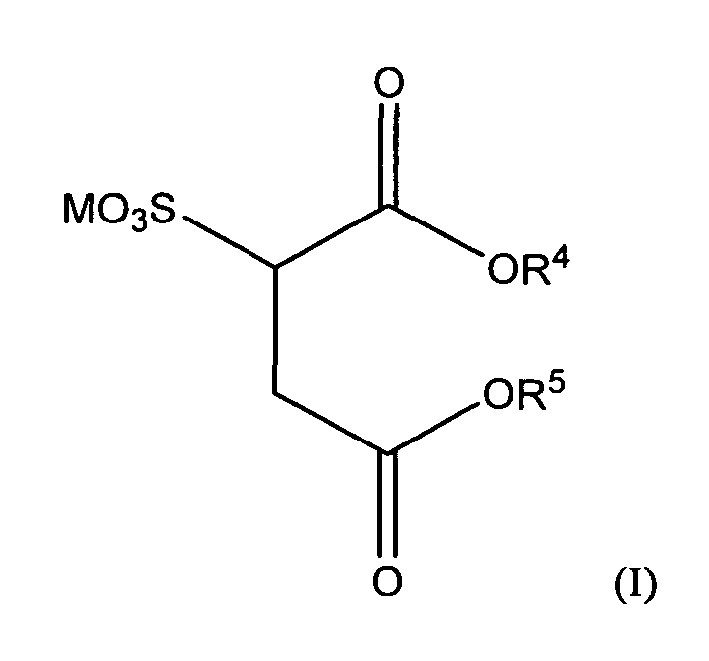
worin M Wasserstoff oder ein Kation und die Reste R4 und R5- unabhängig voneinander - Wasserstoff oder ein Kation oder eine Alkylgruppe bedeuten, wobei höchstens einer der Reste R4 oder R5 Wasserstoff oder ein Kation ist, wobei diese Sulfosuccinate mindestens einen Alkohol-Baustein enthalten, der den Monoalkoholen mit insgesamt 8 bis 36 C-Atomen zuzurechnen ist, mit der Maßgabe, dass es sich bei diesen Monoalkoholen um Guerbet-Alkohole (GA) handelt, die mindestens zwei Verzweigungen pro Molekül enthalten, eignen sich als Tenside mit verbesserter dynamischer Oberflächenspannung.
Description
- Die Erfindung betrifft Sulfosuccinate spezieller Stuktur und Zusammensetzungen enthaltend diese Sulfosuccinate und Wasser.
- Guerbet-Alkohole sind spezielle verzweigte Alkohole. Es handelt sich um primäre Alkohole, die in 2-Position verzweigt sind. Guerbet-Alkohole sind dem Fachmann bekannt, manche sind seit langem kommerziell erhältlich. Sie werden durch die so genannte Guerbet-Reaktion gewonnen, eine seit etwa 100 Jahren bekannte Dimerisierungs-Reaktion, die durch folgendes Formelschema (R* bedeutet darin eine aliphatische Gruppe) umschrieben werden kann:

- Im Rahmen der klassischen Guerbet-Reaktion wird ein primärer oder sekundärer Alkohol in einen Alkohol etwa doppelten Molekulargewichts überführt, der in 2-Position alkyliert ist. So wird etwa n-Butanol in 2-Ethyl-hexan-1-ol überführt, Hexan-1-ol in 2-Butyloctan-1-ol und Octan-1-ol in 2-Hexyl-decan-1-ol.
- Die für die Guerbet-Reaktion eingesetzten primären oder sekundären Alkohole tragen an dem C-Atom, das dem C-Atom mit der OH-Gruppe unmittelbar benachbart ist, mindestens ein Wasserstoffatom - in vielen Fällen tragen sie zwei Wasserstoffatome, d.h. dem C-Atom mit der OH-Gruppe ist dann eine Methylengruppe unmittelbar benachbart.
- Die Guerbet-Reaktion verläuft typischerweise in Gegenwart einer Base bei erhöhter Temperatur unter Wasserabspaltung und stellt eine einfache Möglichkeit dar, lineare Alkohole in verzweigte Alkohole zu überführen. Typischerweise setzt man nur einen einzigen Alkohol bei der Guerbet-Reaktion ein. Es ist jedoch auch möglich, zwei unterschiedliche Alkohole einzusetzen; in diesem Falle spricht man von einer gemischten Guerbet-Reaktion.
- Im obigen Formelschema bedeuten die Reste R* jeweils eine aliphatische Gruppe. Typischerweise handelt es sich um eine lineare und gesättigte aliphatische Gruppe, d.h. man setzt etwa Fettalkohole wie Octanol oder Decanol als Ausgangs-Alkohole für die Guerbet-Reaktion ein. Bisweilen handelt es sich bei R* um eine gesättigte cycloaliphatische Gruppe, d.h. man setzt etwa Alkohole wie Cyclopentanol oder Cyclohexanol als Ausgangs-Alkohole für die Guerbet-Reaktion ein.
- Sulfosuccinate sind eine seit langem bekannte Tensidklasse.
- Bezüglich der sogenannten statischen Oberflächenspannung werden die Eigenschaften der Sulfosuccinate in hohem Maße durch deren Alkoholbausteine bestimmt. Mit größerwerdenden Alkylresten dieser Alkoholbausteine sinkt das Verhältnis von hydrophilen zu lipophilen Molekülteilen (vergleichbar mit dem für nichtionische Tenside von Griffin vorgeschlagenen HLB-Wert (= hydrophile-lipophile-balance)). Bei der Variation der Größe der Alkylreste der Alkoholbausteine von Sulfosuccinaten wird ein Optimum für die tensidische Aktivität durchlaufen. So läßt sich die maximal erreichbare Verringerung der Oberflächenspannung einer wäßrigen Lösung von Didecylsulfosuccinaten schon bei deutlich geringeren Konzentrationen erreichen als mit Dioctylsulfosuccinaten, während Ditridecylsulfosuccinate wieder eine deutlich schwächere Oberflächenaktivität aufweisen.
- Eine weitere wichtige Größe zur Bewertung von Tensiden stellt die dynamische Oberflächenspannung dar. Diese gibt an, wie schnell ein Tensid eine neu entstehende Oberfläche belegen kann. Dies ist besonders bei schnellaufenden Prozessen wie dem Lackauftrag bei Druckerzeugnissen wichtig. Generell wirkt sich eine Vergrößerung des Alkylrests und damit die zunehmende Größe des Tensids ungünstig auf die dynamische Oberflächenspannung aus. Am Beispiel der Sulfosuccinate, die Isodecanol bzw. 2-Propylheptanol als Alkoholbausteine enthalten, läßt sich erkennen, dass bei Alkoholbausteinen mit gleicher Gesamtzahl an C-Atomen, die exakte Struktur der Alkoholbausteine einen Einfluß auf die dynamische Oberflächenspannung hat. Dabei gilt allerdings, dass eine verläßliche Berechnung bzw. Vorhersage der dynamischen Oberflächenspannung eines bestimmten Tensids derzeit nicht möglich ist, da verschiedene Prozesse wie Diffusion, Adsorption und Ausrichtung des Tensids oder bestimmter Molekülteile an der Oberfläche sehr genau berücksichtigt werden müssen.
- Sulfosuccinate können lineare oder verzweigte Alkoholbausteine enthalten. Zu den kommerziell eingesetzten verzweigten Alkoholbausteinen gehören das methylverzweigte Isodecanol und Isotridecanol sowie das 2-Ethylhexanol. Dabei stellt 2-Ethylhexanol, obwohl es großtechnisch durch Aldolkondensation hergestellt wird, formal einen Guerbet-Alkohol dar, weil er durch Verknüpfung zweier Butanol-Moleküle durch Guerbet-Reaktion zugänglich ist. Auch 2-Propylheptanol ist ein Guerbet-Alkohol, weil er durch Verknüpfung zweier Pentanol-Moleküle durch Guerbet-Reaktion zugänglich ist. Das Sulfosuccinat von 2-Propylheptanol ist jedoch bislang nicht kommerziell verfügbar.
- Aufgabe der Erfindung war es, Sulfosuccinate bereitzustellen, die gegenüber den aus dem Stand der Technik bekannten Sulfosuccinaten eine verbesserte dynamische Oberflächenspannung der entsprechenden wässrigen Lösungen aufweisen.
- Der Begriff "Sulfosuccinate" ist dem Fachmann bekannt. Es handelt sich bei Sulfosuccinaten um Salze folgender allgemeiner Formel (I)

- In der Formel (I) ist M Wasserstoff oder ein Kation; die Reste R4 und R5 bedeuten - unabhängig voneinander - Wasserstoff oder ein Kation oder eine Alkylgruppe, wobei höchstens einer der Reste R4 oder R5 Wasserstoff oder ein Kation bedeuten kann. Wie dem Fachmann bekannt spricht man von Monoalkylsulfosuccinaten, wenn nur einer der Reste R4 oder R5 eine Alkylgruppe bedeutet und von Dialkylsulfosuccinaten, wenn beide Reste R4 und R5 eine Alkylgruppe bedeuten.
- Im Rahmen der vorliegenden Erfindung wird der Begriff "Sulfosuccinate" in dem vorstehend genannten Sinne verwendet, d.h. er umfasst sowohl Monoalkylsulfosuccinate als auch Dialkylsulfosuccinate. Da die Sulfosuccinate (I) Ester darstellen, kann man logischerweise für den Fall, dass die Reste R4 bzw. R5 Alkylgruppen sind, sagen, dass die Monoalkohole R4OH bzw. R5OH die Alkoholbausteine der Sulfosuccinate sind. Von dieser Vereinfachung der sprachlichen Ausdrucksweise wird im folgenden Gebrauch gemacht.
- Gegenstand der vorliegenden Erfindung sind zunächst Sulfosuccinate der allgemeinen Formel (I),

- In einer Ausführungsform handelt es sich bei den Monoalkoholen um solche Guerbet-Alkohole (GA), die mindestens drei Verzweigungen pro Molekül enthalten.
- Vorzugsweise handelt es sich bei den Monoalkoholen um solche Guerbet-Alkohole (GA), die drei Verzweigungen pro Molekül enthalten und die erhältlich sind, indem man als Ausgangs-Alkohole für die Guerbet-Reaktion zur Herstellung dieser Guerbet-Alkohole (GA) ausschließlich solche Monoalkohole mit 4 bis 18 C-Atomen einsetzt, die ausgewählt sind aus der Gruppe der primären und/oder sekundären Monoalkohole der Formel (MA),

- Wie oben ausgeführt handelt es sich bei den Alkoholbausteinen der Sulfosuccinate um Monoalkohole (i) mit insgesamt 8 bis 36 C-Atomen, mit der Maßgabe, dass es sich bei diesen Monoalkoholen um Guerbet-Alkohole (GA) handelt, die mindestens zwei Verzweigungen pro Molekül enthalten.
- Der Begriff der Verzweigung ist hiebei wie folgt zu verstehen:
- C-Atome, die direkt mit 3 anderen C-Atomen verknüpft sind (tertiäre C-Atome), stellen eine Verzweigung dar.
- C-Atome, die direkt mit 4 anderen C-Atomen verknüpft sind (quartäre C-Atome), stellen zwei Verzweigungen dar.
- Wenn die genannte Bedingung lautet, dass die Guerbet-Alkohole (GA) mindestens zwei Verzweigungen pro Molekül enthalten müssen, dann ist damit die Gesamtzahl der Verzweigungen im Molekül gemeint.
- Was Guerbet-Alohole und die zu ihrer Herstellung angewandte Guerbet-Reaktion sind, ist dem Fachmann bekannt und wichtige Punkte hierzu wurden im Kapitel zum Stand der Technik bereits ausgeführt (siehe oben). Wie aus dem in diesem Zusammenhangdargestellten Formelschema (siehe oben) hervorgeht, besteht die Guerbet-Reaktion im Endeffekt darin, zwei Moleküle Ausgangsalkohol in einer Kondensationsreaktion miteinander zu verknüpfen, wobei das resultierende Molekül, also der Guerbet-Alkohol an derjenigen Stelle, an der die beiden ursprünglichen Ausgangs-Alkohol-Bausteine miteinander verknüpft sind, eine Verzweigung im Molekül enthält. Sofern R* im obigen Formelschema eine lineare aliphatische Gruppe ist, enthält der resultierende Guerbet-Alkohol eine Verzweigung im Molekül. Sofern R* im obigen Formelschema eine cycloaliphatische Gruppe ist, enthält der resultierende Guerbet-Alkohol zwei Verzweigungen im Molekül.
- In einer bevorzugten Ausführungsform setzt man im Rahmen der vorliegenden Erfindung solche Guerbet-Alkohole (GA) ein, die mindestens drei Verzweigungen pro Molekül enthalten.
- In einer besonders bevorzugten Ausführungsform setzt man im Rahmen der vorliegenden Erfindung solche Guerbet-Alkohole (GA) ein, die drei Verzweigungen pro Molekül enthalten und die erhältlich sind, indem man als Ausgangsalkohole für die Guerbet-Reaktion zur Herstellung dieser Guerbet-Alkohole (GA) ausschließlich solche Monoalkohole mit 4 bis 18 C-Atomen einsetzt, die ausgewählt sind aus der Gruppe der primären und/oder sekundären Monoalkohole der Formel (MA),

- Vorzugsweise sind dabei die Alkylgruppen der Verbindungen (MA) ausschließlich gesättigt.
- Bei den Verbindungen (MA), deren Alkylreste ausschließlich gesättigt sind, gilt in einer bevorzugten Ausführungsform, dass die Gesamtzahl ihrer C-Atome im Bereich von 5 bis 10 liegt. Dabei sind Alkohole mit 5 C-Atomen und insbesondere Isomerengemische von Alkoholen mit 5 C-Atomen besonders bevorzugt.
- 3-Methyl-butan-1-ol ist als Monoalkohol (MA) ganz besonders bevorzugt. Er kann in reiner Form oder in Form technischer Mischungen und auch in Abmischung mit anderen Alkoholen der Formel (MA) als Ausgangs-Alkohol eingesetzt werden. Durch Guerbetreaktion entsteht beim Einsatz von 3-Methyl-butan-1-ol als Monoalkohol (MA) der folgende Guerbetalkohol (GA*)

- Die Verbindungen (MA) können in reiner Form oder in Form technischer Produkte eingesetzt werden. Es ist auch möglich, Mischungen für die erfindungsgemäß durchzuführende Guerbetreaktion einzusetzen, die im wesentlichen ein oder mehrere Verbindungen (MA) neben weiteren Substanzen - wobei unverzweigte aliphatische Alkohole als weitere Substanzen ausgeschlossen sind - enthalten.
- Wie oben ausgeführt hat M in der Formel (I) der Sulfosuccinate die Bedeutung Wasserstoff oder ein Kation. Dabei gilt selbstverständlich die Nebenbedingung, dass die Sulfosuccinate insgesamt elektrisch neutral sind.
- In einer bevorzugten Ausführungsform wird M ausgewählt aus der Gruppe 1-wertiger Kationen, insbesondere aus der Gruppe der Alkalimetall-Kationen. Natrium, Kalium und Ammonium sind als Kationen M ganz besonders bevorzugt.
- Wie oben ausgeführt kann es sich bei den Sulfosuccinaten (I) und Monoalkyl-und/oder Dialkylsulfosuccinate handeln. Dialkylsulfosuccinate sind dabei bevorzugt.
- Dialkylsulfosuccinate, bei denen die Monoalkohole (MA) gesättigte, mindestens einfach verzweigte Monoalkohole mit 5 bis 10 C-Atomen sind, insbesondere 3-Methylbutan-1-ol, sind ganz besonders bevorzugt.
- Ein weiterer Erfindungsgegenstand sind Zusammensetzungen, enthaltend ein oder mehrere der oben näher erläuterten Sulfosuccinate (I) und Wasser.
- Desweiteren betrifft die Erfindung die Verwendung der Sulfosuccinate (I) als Tenside. Dabei haben die Untersuchungen der Anmelderin gezeigt, dass die erfindungsgemäßen Sulfosuccinate (I) sich gegenüber den aus dem Stand der Technik bekannten Sulfosuccinaten durch eine verbesserte dynamische Oberflächenspannung auszeichnen: Wie anhand der unten aufgeführten Beispiele ersichtlich, lassen sich mit den erfindungsgemäßen Sulfosuccinaten höhere Oberflächenbildungsraten ohne signifikanten Anstieg der Oberflächenspannung erreichen.
- In weiteren Ausführungsformen betrifft die Erfindung die Verwendung der Sulfosuccinate (I) als Netzmittel, insbesondere in Lacken, sowie als Emulgator, insbesondere in der Emulsionspolymerisation.
-
Eingesetzte Substanzen Natriumdisulfit von Fa. BASF Maleinsäureanhydrid von Fa. Sasol-Huntsman Hydropalat 875 anionisches Netzmittel (von Fa. Cognis) C10-V1-OH 2-Propylheptanol (Fa. BASF; 1-fach verzweigter Alkohol mit 10 C-Atomen) C10-V3-OH 3-fach-verzweigter Alkohol mit 10 C-Atomen, der wie folgt durch Guerbet-Reaktion aus 3-Methyl-1-butanol in Gegenwart von katalytischen Mengen Aldehyd, Alkali und Palladium auf Kohle hergestellt wurde: Ein Reaktionsgemisch aus 2500g 3-Methyl-1-Butanol (ein Isoamylalkohol), 75g 3-Methyl-1-Butanal, 4 g Pd/C (5% Pd/C 3610 von der Firma Johnson Matthey in 50% Wasser) wurde auf 180°C aufgeheizt, 320g KOH (50%ig) portionsweise zudosiert und mit einer Druck-rampe von 4,6 auf 1,4 bar 18 Stunden unter Rühren gefahren. Der erhaltene 3-fach verzweigte Alkohol wird unten auch als "Isoamylguerbetalkohol" bezeichnet. - In einem 21-Vierhalskolben mit mechanischem Rührer, Heizung, Destillationsapparatur und Stickstoff/Vakuumanschluß wurden unter Stickstoffatmosphäre 392 g
- (4,0 mol) Maleinsäureanhydrid,
- 1330 g (8,4 mol) C10-V1-OH (2-Propylheptanol) und
- 8,6 g (0,05 mol) p-Toluolsulfonsäure-Monohydrat
eingewogen und langsam auf 140 °C erhitzt. Das entstehende Reaktionswasser wurde destillativ abgetrennt. Sobald nur noch wenig Destillat überging (etwa 3,5 Stunden nach Reaktionsbeginn) wurde der Druck langsam auf bis zu 10 mbar gesenkt und 3 Stunden gehalten. Das erhaltene Produkt wies eine Restsäurezahl von 1,66 mg KOH/g auf. - Bei der erstmaligen Durchführung der Synthese gemäß Beispiel 2 wurde wie folgt verfahren:
- In einen 11-Vierhalskolben mit mechanischem Rührer, Heizung, Rückflußkühler und Stickstoffeinleitung wurden
- 574 g (1,45 mol) Di-(2-propylheptyl)-maleinat (hergestellt gemäß Beispiel 1),
- 40 g Hydropalat 875
- 142 g (0,75 mol) Natriumdisulfit und
- 194 g vollentsalztes Wasser
vorgelegt und der Ansatz bei 104 °C unter Rückfluß und leichtem Stickstoffstrom so lange gerührt, bis eine klare Lösung entstanden war (ca. 3 Stunden). Es wurde noch 10 Minuten nachgerührt. Im Produkt war kein Sulfit mehr nachweisbar. Beim Abkühlen vergelte/verfestigte sich das Produkt, was durch Zugabe eines Co-Solvens vermieden werden konnte: Hierzu wurden bei ca. 80 °C 50 g Ethanol zugesetzt.
- Bei der zweiten Durchführung der Synthese gemäß Beispiel 2 wurde wie oben beschrieben verfahren, jedoch mit dem Unterschiede, dass anstelle von 40 g Hydropalat 875 40 g einer Lösung aus (a) 70% Di-(2-propylheptyl)-sulfosuccinat, (b) 20% Wasser und (c) 10% Ethanol eingesetzt wurden (Komponente (a) dieser Lösung stand bei der oben beschriebenen erstmaligen Durchführung der Synthese noch nicht zur Verfügung).
- Das so erhaltene Produkt wies folgende Kennzahlen auf: Säurezahl: 0,18 mg KOH/g; Epton: 14,01 %; Trockenrückstand: 71,66 Gew.-%; Gehalt an Natriumsulfat: Gew.-0,32 %.
- In einem 0,51-Vierhalskolben mit mechanischem Rührer, Heizung, Destillationsapparatur mit Wasserabscheider und Stickstoff/Vakuumanschluß wurden unter Stickstoffatmosphäre
- 49,03 g (0,5 mol) Maleinsäureanhydrid,
- 162,5 g (1,0 mol) C10-V3-OH (Isoamylguerbetalkohol) und
- 1,04 g (0,01 mol) p-Toluolsulfonsäure-Monohydrat
eingewogen und langsam auf 140 °C erhitzt. Das entstehende Reaktionswasser wurde destillativ abgetrennt. Sobald nur noch wenig Destillat überging (etwa 3,5 Stunden nach Reaktionsbeginn) wurde der Druck langsam auf bis zu 10 mbar gesenkt und 3 Stunden gehalten. Das erhaltene Produkt wies eine Restsäurezahl von 4,26 mg KOH/g auf. - In einen 0,5 1-Vierhalskolben mit mechanischem Rührer, Heizung, Rückflußkühler und Stickstoffeinleitung wurden
- 100 g (0,25 mol) Di-(isoamylguerbet)-maleinat (hergestellt gemäß Beispiel 3),
- 24,66 g (0,13 mol) Natriumdisulfit und
- 41,31 g vollentsalztes Wasser
vorgelegt und der Ansatz bei 104 °C unter Rückfluß und leichtem Stickstoffstrom so lange gerührt, bis eine klare Lösung entstanden war (ca. 3 Stunden). Es wurde noch 10 Minuten nachgerührt. Im Produkt war kein Sulfit mehr nachweisbar. Beim Abkühlen vergelte/verfestigte sich das Produkt. - Das so erhaltene Produkt wies folgende Kennzahlen auf: Säurezahl: 3,6 mg KOH/g; Epton: 10,8 %; Trockenrückstand: 74,5 Gew.-%; Gehalt Natriumsulfat: 1,8 Gew.-%.
- Die Bestimmung der dynamischen Oberflächenspannung (OS) erfolgte mittels Blasendrucktensimetrie unter Verwendung eines Krüss Blasendrucktensiometers BP 2. Hierzu wurden wäßrige Lösungen mit einem Aktivsubstanzgehalt von 0.1 Gew.-% hergestellt, die Messung erfolgte bei 25 °C.
- Die erhaltenen Werte sind in Tabelle 1 zusammengestellt. Angegeben sind neben den Daten für die Substanz des Vergleichsbeispiels B2 (Di-2-PH-SUS) und den Daten des erfindungsgemäßen Beispiels B4 (Di-isoamylguerbet-SU) zum Vergleich zusätzlich die Daten zweier weiterer Substanzen, nämlich dem Natrium-di-(2-ethylhexyl)sulfosuccinat (Di-2-EH-SUS), welches ein bewährtes Handelsprodukt ist, und dem Natrium-di-(isodecyl)sulfosuccinat (Di-isodecyl-SUS), dessen Alkoholbaustein dieselbe Anzahl von C-Atomen aufweist (nämlich zehn) wie der Alkoholbaustein der erfindungsgemäßen Verbindung gemäß Beispiel 4.
Tabelle 1: Di-2-EH-SUS Di-2-PH-SUS (gemäß Di-isodecyl-SUS Di-isoamylguerbet-SUS (gemäß Beispiel 4) Blasen-frequenz [Hz] Oberfl-spannung [mN/m] Blasen-frequenz [Hz] Oberfl-spannung [mN/m] Blasen-frequenz [Hz] Obenfl-spannung [mN/m] Blasen-frequenz [Hz] Oberfl-spannung [mN/m] 20.112 46.1 18.311 59 19.752 19.652 53.6 10.203 40.6 10.118 50.9 10.081 65.5 10.261 46.4 3.062 38.8 3.065 35.9 2.967 52.9 3.062 32.4 2.026 38.3 2.013 32.3 2.024 49.1 2.016 30.2 0.507 36.1 0.523 27.0 0.5 31.7 0.52 28.0 0.256 35.2 0.254 26.3 0.249 29.2 0.25 27.6 0.098 33.8 0.099 26.1 0.093 26.9 0.086 27.1 - Es wurde gefunden, dass das erfindungsgemäße Sulfosuccinat gemäß Beispiel 4 einerseits effektiv die statische Oberflächenspannung (OS) senkt (die OS des erfindungsgemäßen Di-isoamylguerbet-SUS bei Blasenfrequenzen von unter 0.1 Hz ist signifikant geringer als die OS des Handelsproduktes Di-2-EH-SUS) andererseits ein überraschend gutes dynamische Verhalten aufweist. So steigt die OS wäßriger Lösungen des Di-isoamylguerbet-SUS (dessen Alkoholbaustein 10 C-Atome aufweist und 3-fach verzweigt ist) erst bei Blasenfrequenzen oberhalb 2 Hz merklich und erst ab 3 Hz stark an. Beim Di-2-PH-SUS (dessen Alkoholbaustein ebenfalls 10 C-Atome aufweist, jedoch nur 1-fach verzweigt ist) ist dies schon bei 0.5 beziehungsweise 2 Hz zu beobachten. Beim Vergleich mit dem Handelsprodukt Di-2-EH-SUS (dessen Alkoholbaustein 8 C-Atome aufweist und 1-fach verzweigt ist) fällt zudem auf, dass der Anstieg der OS mit steigender Blasenfrequenz zunächst geringer ausfällt als beim erfimdgsgemäßen-Di-isoamylguerbet-SUS, welches dann allerdings bei einer Blasenfrequenz von 10 Hz einen starken Anstieg der OS aufweist. Wegen der deutlich geringeren statischen OS des erfindungsgemäßen Sulfosuccinats übersteigt die OS seiner wäßrigen Lösung erst bei einer Blasenfrequenz von 5 Hz diejenige einer wäßrigen Di-2-EH-SUS-Lösung (Di-C8V1-SUS). Da die Blasenbildungsfrequenz ein Maß für die Rate der Oberflächen-Neubildung ist, läßt sich feststellen, dass die erfindungsgemäßen Sulfosuccinate eine Verbesserung der oben beschriebenen technischen Anwendungen ermöglicht.
Claims (11)
- Sulfosuccinate der allgemeinen Formel (I),

- Sulfosuccinate nach Anspruch 1, mit der Maßgabe, dass es sich bei den Monoalkoholen um Guerbet-Alkohole (GA) handelt, die mindestens drei Verzweigungen pro Molekül enthalten.
- Sulfosuccinate nach Anspruch 2, mit der Maßgabe, dass es sich bei den Monoalkoholen um Guerbet-Alkohole (GA) handelt, die drei Verzweigungen pro Molekül enthalten und die erhältlich sind, indem man als Ausgangsalkohole für die Guerbet-Reaktion zur Herstellung dieser Guerbet-Alkohole (GA) ausschließlich solche Monoalkohole mit 4 bis 18 C-Atomen einsetzt, die ausgewählt sind aus der Gruppe der primären und/oder sekundären Monoalkohole der Formel (MA),

- Sulfosuccinate nach Anspruch 3, wobei die Monoalkohole (MA) gesättigte, mindestens einfach verzweigte Monoalkohole mit 5 bis 10 C-Atomen sind.
- Sulfosuccinate nach Anspruch 3 oder 4, wobei es sich bei dem Monoalkohol (MA) um 3-Methyl-butan-1-ol handelt.
- Sulfosuccinate nach einem der Ansprüche 1 bis 5, wobei M ausgewählt ist aus der Gruppe 1-wertiger Kationen.
- Sulfosuccinate nach Anspruch 6, wobei M ausgewählt ist aus der Gruppe der Alkalimetall-Kationen.
- Sulfosuccinate nach Anspruch 6, wobei M ein Ammoniumion ist.
- Sulfosuccinate nach einem der Ansprüche 1 bis 8, wobei es sich um Dialkylsulfosuccinate handelt.
- Zusammensetzungen, enthaltend ein oder mehrere Sulfosuccinate gemäß den Ansprüchen 1 bis 9 und Wasser.
- Verwendung der Sulfosuccinate (I) gemäß den Ansprüchen 1 bis 9 als Tenside.
Priority Applications (5)
| Application Number | Priority Date | Filing Date | Title |
|---|---|---|---|
| EP10000672A EP2354122A1 (de) | 2010-01-23 | 2010-01-23 | Sulfosuccinate |
| PCT/EP2011/000149 WO2011088972A1 (de) | 2010-01-23 | 2011-01-14 | Sulfosuccinate |
| US13/522,822 US20120291669A1 (en) | 2010-01-23 | 2011-01-14 | Sulfosuccinates |
| CN201180006833.3A CN102725265B (zh) | 2010-01-23 | 2011-01-14 | 磺基琥珀酸酯 |
| BR112012018026A BR112012018026A2 (pt) | 2010-01-23 | 2011-01-14 | sulfosuccinato |
Applications Claiming Priority (1)
| Application Number | Priority Date | Filing Date | Title |
|---|---|---|---|
| EP10000672A EP2354122A1 (de) | 2010-01-23 | 2010-01-23 | Sulfosuccinate |
Publications (1)
| Publication Number | Publication Date |
|---|---|
| EP2354122A1 true EP2354122A1 (de) | 2011-08-10 |
Family
ID=42333363
Family Applications (1)
| Application Number | Title | Priority Date | Filing Date |
|---|---|---|---|
| EP10000672A Withdrawn EP2354122A1 (de) | 2010-01-23 | 2010-01-23 | Sulfosuccinate |
Country Status (5)
| Country | Link |
|---|---|
| US (1) | US20120291669A1 (de) |
| EP (1) | EP2354122A1 (de) |
| CN (1) | CN102725265B (de) |
| BR (1) | BR112012018026A2 (de) |
| WO (1) | WO2011088972A1 (de) |
Families Citing this family (8)
| Publication number | Priority date | Publication date | Assignee | Title |
|---|---|---|---|---|
| DE102014207386A1 (de) * | 2014-04-17 | 2015-10-22 | Evonik Degussa Gmbh | Tensidzusammensetzungen und hoch ölhaltige Formulierungen enthaltend diese |
| EP3101085A1 (de) | 2015-06-01 | 2016-12-07 | Cytec Industries Inc. | Schaumbildende tensid-zusammensetzungen |
| WO2017009068A1 (en) * | 2015-07-16 | 2017-01-19 | Basf Se | Defect reduction rinse solution containing ammonium salts of sulfoesters |
| WO2021125326A1 (ja) * | 2019-12-20 | 2021-06-24 | 花王株式会社 | 柔軟基剤 |
| CN115698239B (zh) * | 2020-07-30 | 2024-08-27 | 花王株式会社 | 润滑剂 |
| JP7633806B2 (ja) * | 2020-12-25 | 2025-02-20 | 花王株式会社 | 起泡性組成物の泡付着性向上剤 |
| US12378502B2 (en) * | 2021-06-22 | 2025-08-05 | Kao Corporation | Softening agent |
| CN119409603A (zh) * | 2024-10-31 | 2025-02-11 | 常州时创能源股份有限公司 | 一种用于硅片切割的新型润湿剂、其制备方法及应用 |
Citations (1)
| Publication number | Priority date | Publication date | Assignee | Title |
|---|---|---|---|---|
| US2652348A (en) * | 1950-07-21 | 1953-09-15 | American Cyanamid Co | Antistatic treatment of shaped articles comprising a vinyl resin and treated articles |
Family Cites Families (2)
| Publication number | Priority date | Publication date | Assignee | Title |
|---|---|---|---|---|
| CN1045592C (zh) * | 1996-03-25 | 1999-10-13 | 南京理工大学 | 琥珀酸二异辛酯磺酸钠制备方法 |
| DE102006009971A1 (de) * | 2006-03-03 | 2007-09-06 | Cognis Ip Management Gmbh | Salze von Alkylestern sulfonierter Dicarbonsäuren |
-
2010
- 2010-01-23 EP EP10000672A patent/EP2354122A1/de not_active Withdrawn
-
2011
- 2011-01-14 BR BR112012018026A patent/BR112012018026A2/pt not_active IP Right Cessation
- 2011-01-14 US US13/522,822 patent/US20120291669A1/en not_active Abandoned
- 2011-01-14 WO PCT/EP2011/000149 patent/WO2011088972A1/de not_active Ceased
- 2011-01-14 CN CN201180006833.3A patent/CN102725265B/zh not_active Expired - Fee Related
Patent Citations (1)
| Publication number | Priority date | Publication date | Assignee | Title |
|---|---|---|---|---|
| US2652348A (en) * | 1950-07-21 | 1953-09-15 | American Cyanamid Co | Antistatic treatment of shaped articles comprising a vinyl resin and treated articles |
Non-Patent Citations (2)
| Title |
|---|
| C.R. CARYL: "Sulphosuccinic esters. Structure and wetting power", INDUSTRIAL AND ENGINEERING CHEMISTRY, vol. 33, no. 6, June 1941 (1941-06-01), AMERICAN CHEMICAL SOCIETY, WASHINGTON, DC, US, pages 731 - 737, XP002593232, ISSN: 0019-7866, DOI: 10.1021/ie50378a011 * |
| K. KON-NO, ET AL.: "Micelle formation of oil-soluble surfactants in nonaqueous solutions: Effect of molecular structure of surfactants", JOURNAL OF COLLOID AND INTERFACE SCIENCE, vol. 35, no. 4, April 1971 (1971-04-01), ACADEMIC PRESS, NEW YORK, NY, US, pages 636 - 642, XP024185596, ISSN: 0021-9797, [retrieved on 19710401], DOI: 10.1016/0021-9797(71)90222-0 * |
Also Published As
| Publication number | Publication date |
|---|---|
| US20120291669A1 (en) | 2012-11-22 |
| CN102725265B (zh) | 2015-01-21 |
| WO2011088972A1 (de) | 2011-07-28 |
| CN102725265A (zh) | 2012-10-10 |
| BR112012018026A2 (pt) | 2018-06-05 |
Similar Documents
| Publication | Publication Date | Title |
|---|---|---|
| EP2354122A1 (de) | Sulfosuccinate | |
| DE3785627T2 (de) | Oberflaechenaktives mittel, abgeleitet von hydroxy-substituierten bi- oder tri-carbonsaeuren. | |
| EP1829859A2 (de) | Salze von Alkylestern sulfonierter Dicarbonsäuren | |
| EP2902010B1 (de) | Wäßrige tensid-Zusammensetzungen | |
| EP3218353A1 (de) | Kontinuierlicher prozess zur herstellung eines tensids in einem rohrreaktor | |
| EP0353580B1 (de) | Verfahren zur Herstellung von konzentrierten fliessfähigen wässrigen Lösungen von Betainen | |
| EP0613457B1 (de) | Ester von fettsäuren mit ethoxylierten polyolen | |
| EP0231890A2 (de) | Verfahren zur Reinigung von Alkylglycosiden, durch dieses Verfahren erhältliche Produkte und deren Verwendung | |
| DE4339643C1 (de) | Verfahren zur Herstellung von festen Esterquats | |
| EP0712391B1 (de) | Sulfobernsteinsäurediester enthaltende flüssige formulierungen | |
| DE3538910A1 (de) | Verfahren zur herstellung beweglicher pasten waschaktiver alpha-sulfofettsaeureestersalze hohen feststoffgehalts | |
| EP2185629A2 (de) | Alkoxylierte phosphorsäuretriester mit hohem alkoxylierungsgrad | |
| EP0309810A2 (de) | Verdickungsmittel | |
| DE69806623T2 (de) | Verfahren zur herstellung eines fettsäure acyl isethionat salz | |
| EP0370273B1 (de) | Neue Fettalkoholgemische und ihre Ethoxylate mit verbessertem Kälteverhalten | |
| EP0391392A2 (de) | Schwachschäumende und kältestabile flüssige Tensidzusammensetzungen aus Wasser und nichtionischen, anionischen und kationischen Tensiden und deren Verwendung | |
| EP1272034A1 (de) | Wässriges herbizides mittel | |
| DE2813326A1 (de) | Verfahren zur herstellung von granulatfoermigem natriumperborat-monohydrat und das dabei erhaltene produkt | |
| DE2748126A1 (de) | Nichtionogene tenside | |
| EP0363855A1 (de) | Konzentrierte und flüssige wasserhaltige Tensidzusammensetzung und deren Verwendung | |
| DE10000320A1 (de) | Wäßriges herbizides Mittel | |
| EP0773018A1 (de) | Kosmetische und/oder pharmazeutische Emulsionen | |
| DE2421924A1 (de) | Natriumperborat | |
| EP0564402A1 (de) | Schaumarme oberflächenaktive Verbindungen | |
| DE3818626A1 (de) | Konzentrierte pumpbare polyethercarboxylate |
Legal Events
| Date | Code | Title | Description |
|---|---|---|---|
| PUAI | Public reference made under article 153(3) epc to a published international application that has entered the european phase |
Free format text: ORIGINAL CODE: 0009012 |
|
| AK | Designated contracting states |
Kind code of ref document: A1 Designated state(s): AT BE BG CH CY CZ DE DK EE ES FI FR GB GR HR HU IE IS IT LI LT LU LV MC MK MT NL NO PL PT RO SE SI SK SM TR |
|
| AX | Request for extension of the european patent |
Extension state: AL BA RS |
|
| 17P | Request for examination filed |
Effective date: 20120210 |
|
| STAA | Information on the status of an ep patent application or granted ep patent |
Free format text: STATUS: THE APPLICATION IS DEEMED TO BE WITHDRAWN |
|
| 18D | Application deemed to be withdrawn |
Effective date: 20150801 |