EP2351858A1 - Detecting fetal chromosomal abnormalities using tandem single nucleotide polymorphisms - Google Patents
Detecting fetal chromosomal abnormalities using tandem single nucleotide polymorphisms Download PDFInfo
- Publication number
- EP2351858A1 EP2351858A1 EP11150524A EP11150524A EP2351858A1 EP 2351858 A1 EP2351858 A1 EP 2351858A1 EP 11150524 A EP11150524 A EP 11150524A EP 11150524 A EP11150524 A EP 11150524A EP 2351858 A1 EP2351858 A1 EP 2351858A1
- Authority
- EP
- European Patent Office
- Prior art keywords
- single nucleotide
- nucleotide polymorphisms
- tandem
- dna
- chr21
- Prior art date
- Legal status (The legal status is an assumption and is not a legal conclusion. Google has not performed a legal analysis and makes no representation as to the accuracy of the status listed.)
- Granted
Links
Images


Classifications
-
- C—CHEMISTRY; METALLURGY
- C12—BIOCHEMISTRY; BEER; SPIRITS; WINE; VINEGAR; MICROBIOLOGY; ENZYMOLOGY; MUTATION OR GENETIC ENGINEERING
- C12Q—MEASURING OR TESTING PROCESSES INVOLVING ENZYMES, NUCLEIC ACIDS OR MICROORGANISMS; COMPOSITIONS OR TEST PAPERS THEREFOR; PROCESSES OF PREPARING SUCH COMPOSITIONS; CONDITION-RESPONSIVE CONTROL IN MICROBIOLOGICAL OR ENZYMOLOGICAL PROCESSES
- C12Q1/00—Measuring or testing processes involving enzymes, nucleic acids or microorganisms; Compositions therefor; Processes of preparing such compositions
- C12Q1/68—Measuring or testing processes involving enzymes, nucleic acids or microorganisms; Compositions therefor; Processes of preparing such compositions involving nucleic acids
- C12Q1/6876—Nucleic acid products used in the analysis of nucleic acids, e.g. primers or probes
- C12Q1/6883—Nucleic acid products used in the analysis of nucleic acids, e.g. primers or probes for diseases caused by alterations of genetic material
-
- C—CHEMISTRY; METALLURGY
- C12—BIOCHEMISTRY; BEER; SPIRITS; WINE; VINEGAR; MICROBIOLOGY; ENZYMOLOGY; MUTATION OR GENETIC ENGINEERING
- C12Q—MEASURING OR TESTING PROCESSES INVOLVING ENZYMES, NUCLEIC ACIDS OR MICROORGANISMS; COMPOSITIONS OR TEST PAPERS THEREFOR; PROCESSES OF PREPARING SUCH COMPOSITIONS; CONDITION-RESPONSIVE CONTROL IN MICROBIOLOGICAL OR ENZYMOLOGICAL PROCESSES
- C12Q2600/00—Oligonucleotides characterized by their use
- C12Q2600/156—Polymorphic or mutational markers
-
- C—CHEMISTRY; METALLURGY
- C12—BIOCHEMISTRY; BEER; SPIRITS; WINE; VINEGAR; MICROBIOLOGY; ENZYMOLOGY; MUTATION OR GENETIC ENGINEERING
- C12Q—MEASURING OR TESTING PROCESSES INVOLVING ENZYMES, NUCLEIC ACIDS OR MICROORGANISMS; COMPOSITIONS OR TEST PAPERS THEREFOR; PROCESSES OF PREPARING SUCH COMPOSITIONS; CONDITION-RESPONSIVE CONTROL IN MICROBIOLOGICAL OR ENZYMOLOGICAL PROCESSES
- C12Q2600/00—Oligonucleotides characterized by their use
- C12Q2600/172—Haplotypes
-
- Y—GENERAL TAGGING OF NEW TECHNOLOGICAL DEVELOPMENTS; GENERAL TAGGING OF CROSS-SECTIONAL TECHNOLOGIES SPANNING OVER SEVERAL SECTIONS OF THE IPC; TECHNICAL SUBJECTS COVERED BY FORMER USPC CROSS-REFERENCE ART COLLECTIONS [XRACs] AND DIGESTS
- Y10—TECHNICAL SUBJECTS COVERED BY FORMER USPC
- Y10T—TECHNICAL SUBJECTS COVERED BY FORMER US CLASSIFICATION
- Y10T436/00—Chemistry: analytical and immunological testing
- Y10T436/14—Heterocyclic carbon compound [i.e., O, S, N, Se, Te, as only ring hetero atom]
- Y10T436/142222—Hetero-O [e.g., ascorbic acid, etc.]
- Y10T436/143333—Saccharide [e.g., DNA, etc.]
Definitions
- certain embodiments of the present invention provide a method for determining whether a fetus has at least one chromosomal abnormality, comprising using tandem single nucleotide polymorphisms to compare fetal DNA to maternal DNA so as to determine whether the fetus has at least one chromosomal abnormality.
- fetal cells in maternal blood might be used to assess the genetic status of a developing embryo.
- the extremely small amount of fetal cells in maternal blood (about 1 cell per ml) has proven a difficult obstacle to overcome when trying to isolate these cells for widespread clinical testing.
- cell-free fetal DNA is present in circulating maternal serum at higher percentages than fetal cells and has the potential to be assessed for chromosomal or gene defects.
- Cell-free fetal DNA can range from 1-47 % of total DNA in maternal blood.
- a critical limitation that has yet to be successfully overcome is that maternal DNA contamination makes it difficult to differentiate fetal from maternal DNA.
- tandem single nucleotide polymorphisms to detect chromosomes, e.g., to detect fetal chromosomal abnormalities.
- the tandem SNPs are combined with a sensitive DNA separation technology, e.g., high-fidelity PCR and constant denaturant capillary electrophoresis (CDCE), to detect fetal chromosomal abnormalities, e.g., through the simple sampling and comparison of maternal DNA to fetal DNA, e.g., from maternal serum and maternal buccal swabs.
- a sensitive DNA separation technology e.g., high-fidelity PCR and constant denaturant capillary electrophoresis (CDCE)
- CDE constant denaturant capillary electrophoresis
- certain embodiments of the present invention provide a method for determining whether a fetus has at least one chromosomal abnormality, comprising using tandem single nucleotide polymorphisms to compare fetal DNA to maternal DNA so as to determine whether the fetus has at least one chromosomal abnormality.
- fetal DNA is obtained from maternal blood. In certain embodiments of the invention, fetal DNA is cell-free fetal DNA. In certain embodiments of the invention, maternal DNA is obtained from a biological sample, e.g., maternal blood. In certain embodiments of the invention, maternal DNA is obtained from a buccal swab. In certain embodiments of the invention, maternal DNA is obtained from a biological sample that does not comprise fetal DNA.
- fetal DNA is obtained from maternal blood, maternal urine, maternal sweat, maternal cells, or cell free DNA from the mother.
- the biological sample is biological fluid.
- the biological sample is a maternal biological sample.
- samples may be whole blood, bone marrow, blood spots, blood serum, blood plasma, buffy coat preparations, saliva, cerebrospinal fluid, buccal swabs, solid tissues such as skin and hair, body waste products, such as feces and urine.
- samples may be lysates, homogenates, or partially purified samples of biological materials.
- biological materials can include crude or partially purified mixtures of nucleic acids.
- the biological sample is serum, urine, sweat, cells, or cell free DNA.
- the comparison step comprises using high-fidelity PCR and constant denaturant capillary electrophoresis to compare the fetal DNA to maternal DNA. In certain embodiments of the invention, the comparison step comprises using at least about 96 tandem single nucleotide polymorphisms.
- the method further comprises the step of converting the nucleic acid molecules to a homoduplex state, as opposed to being in heteroduplex form. This can be accomplished, e.g., by using an excess of primers and can aid in the tandem SNP analysis.
- methods such as mutation detection technologies can be used to analyze the tandem SNPs.
- methods such as denaturing HPLC, denaturing capillary electrophoresis, cycling temperature capillary electrophoresis, allele-specific PCRs, quantitative real time PCR approaches such as TaqMan® PCR system, polony PCR approaches, and microarray approaches can be used to analyze the tandem SNPs.
- the single nucleotide polymorphisms in each tandem single nucleotide polymorphism are each at most about 250 basepairs apart. In certain embodiments of the invention, the single nucleotide polymorphisms in each tandem single nucleotide polymorphism are each at most about 200 basepairs apart. In certain embodiments of the invention, the single nucleotide polymorphisms in each tandem single nucleotide polymorphism are each at most about 150 basepairs apart. In certain embodiments of the invention, the single nucleotide polymorphisms in each tandem single nucleotide polymorphism are each at most about 100 basepairs apart. In certain embodiments of the invention, the single nucleotide polymorphisms in each tandem single nucleotide polymorphism are each at most about 50 basepairs apart.
- At least one tandem single nucleotide polymorphism is located on the p arm of chromosome 21. In certain embodiments of the invention, at least one tandem single nucleotide polymorphism is located on the q arm of chromosome 21.
- the chromosomal abnormality is chromosomal aneuploidy. In certain embodiments of the invention, the chromosomal abnormality is trisomy 13, 18 or 21. In certain embodiments of the invention, the chromosomal abnormality is trisomy 21.
- the chromosomal abnormality is an insertion mutation (e . g ., a large insertion ( ⁇ 3 megabasepair) or small insertion ( ⁇ 3 megabasepair).
- the chromosomal abnormality is a deletion mutation (e.g., a large deletion ( ⁇ 3 megabasepair) or small deletion ( ⁇ 3 megabasepair)).
- the deleted region could include a deleted gene.
- the methods can be used to detect copy number polymorphisms and/or copy number variants in the genome. In certain embodiments of the invention, the methods can be used to detect chromosome 22q11 deletion syndrome, which is associated with cardiac defects.
- Chromosomal abnormalities include deletions associated with genetic syndromes and disorders such as the 22q11 deletion syndrome on chromosome 22, which is associated with cardiac defects.
- Other examples of chromosomal abnormalities include the 11q deletion syndrome on chromosome 11 and 8p deletion syndrome on chromosome 8, both of which are also associated with cardiac defects.
- the fetus is a male fetus. In certain embodiments of the invention, the fetus is a female fetus. In certain embodiments of the invention, the fetus is a mammal. In certain embodiments of the invention, the fetus is a human. In certain embodiments of the invention, the fetus is a non-human mammal. In certain embodiments of the invention, the fetus has been determined to be at an elevated risk for having a chromosomal abnormality.
- the method further comprises using tandem single nucleotide polymorphisms to compare paternal DNA to the fetal and/or maternal DNA.
- the fetal DNA is subjected to an enrichment step. In certain embodiments of the invention, the fetal DNA is not subjected to an enrichment step.
- Certain embodiments of the present invention provide a method for identifying chromosomes, comprising comparing tandem single nucleotide polymorphisms on the chromosomes so as to identify the chromosomes.
- the methods of the present invention are not limited to maternal-fetal analysis, but can also be applied to other situations, e.g ., forensic analysis of blood samples.
- the methods further comprises, prior to the comparison step, determining a set of tandem single nucleotide polymorphisms for a specific chromosome.
- Certain embodiments of the present invention provide a system comprising packaging material and primers that specifically hybridize to each of the single nucleotide polymorphisms of at least one of the tandem single nucleotide polymorphisms identified herein.
- Certain embodiments of the present invention provide a system comprising packaging material and primers that specifically hybridize flanking sequences of at least one of the tandem single nucleotide polymorphisms of the invention.
- Certain embodiments of the present invention provide a system comprising packaging material and at least one oligonucleotide that specifically hybridizes to at least one of the tandem single nucleotide polymorphisms of the invention.
- Certain embodiments of the present invention provide the use of high-fidelity PCR (HiFi-PCR) to amplify SNPs or tandem SNPs for the purpose of, e.g., determining chromosomal abnormalities.
- HiFi-PCR high-fidelity PCR
- Certain embodiments of the present invention provide the use of HiFi-PCR to amplify nucleic acids, e.g., DNA, isolated, e.g., from a maternal biological sample to analyze fetal DNA for chromosomal abnormalities.
- nucleic acids e.g., DNA
- isolated e.g., from a maternal biological sample to analyze fetal DNA for chromosomal abnormalities.
- HiFi-PCR is used to detect aneuploidy and large ( ⁇ 3 megabasepairs) or small ( ⁇ 3 megabasepairs) deletions and/or insertions.
- the maternal biological sample is serum, urine, sweat, cells, or cell free DNA.
- Certain embodiments of the present invention provide an isolated nucleic acid sequence comprising at least one of SEQ ID NOs 1-357.
- Certain embodiments of the present invention provide an isolated nucleic acid sequence of the invention (e.g., a nucleic acid sequence comprising a tandem SNP or a primer; e.g ., at least one of SEQ ID NOs 1-357) for use in medical treatment or diagnosis.
- an isolated nucleic acid sequence of the invention e.g., a nucleic acid sequence comprising a tandem SNP or a primer; e.g ., at least one of SEQ ID NOs 1-357
- the nucleic acid sequences may be, e.g ., isolated nucleic acid sequences and may be, e.g ., about 1000 or fewer, e.g ., about 900 or fewer, e.g ., about 800 or fewer, e.g ., about 700 or fewer, e.g ., about 600 or fewer, e.g ., about 500 or fewer, e.g ., about 400 or fewer, e.g ., about 300 or fewer, e.g ., about 250 or fewer, e.g ., about 200 or fewer, e.g ., about 150 or fewer, e.g ., about 100 or fewer, or e.g ., about 50 or fewer nucleic acids in length.
- tandem SNPs for chromosome 21 are identified, heterozygosity of the tandem SNPs determined, the ability to detect fetal DNA from maternal serum demonstrated, and the ability to detect fetal chromosomal abnormalities in maternal serum demonstrated.
- tandem SNPs have already been identified. These tandem SNPs are useful in the diagnosis of chromosomal abnormalities, for example, of trisomy 21.
- certain embodiments of the invention provide the specific tandem SNPs, or combinations thereof, as well as their use in diagnostic and therapeutic applications.
- tandem SNP assays based on a set of tandem SNPs for chromosome 21
- These diagnostics are sensitive and specific.
- the tandem SNP assay is particularly suited for fetal DNA analysis because fetal DNA present in maternal serum is generally present as short fragments ( e . g ., an average of 300 basepairs or fewer).
- certain embodiments of the present invention are directed to each of these tandem SNPs individually, and certain embodiments are directed to combinations of any and/or all of the tandem SNPs. Certain embodiments of the invention are directed to methods of using the tandem SNPs for diagnosing chromosomal abnormalities. Certain embodiments of the invention are directed to compilations of the tandem SNPs ( e.g ., reference tables) that are useful for diagnosing chromosomal abnormalities. Certain embodiments of the invention are also directed to primers for each of these tandem SNPs individually, and certain embodiments are directed to combinations of primers for any and/or all of the tandem SNPs. Certain embodiments of the invention provide isolated nucleic acid sequences that comprise at least one of the tandem SNPs and compositions that comprise the isolated nucleic acid sequences.
- nuchal translucency test An ultrasound screening called the nuchal translucency test is becoming more common. However, this test has an overall sensitivity of 77% for trisomy 21 with a false positive rate of 6% ( Malone et al., Obstet Gynecol, 2003. 102(5 Pt 1): p. 1066-79 ).
- the most advanced serum marker test is the "quad" screen, which measures the levels of alpha-fetoprotein (AFP), human chorionic gonadotropin (hCG), unconjugated estriol (E3), and inhibin-A. The biological reason for these markers to be elevated or reduced in a percentage of mothers carrying children with trisomy 21 is not understood.
- test is only capable of assigning risk categories (i.e ., 1 in 250, 1 in 100, 1 in 10), and not in making specific diagnoses.
- the quad screen is associated with a false positive rate of 7% and a sensitivity of less than 80%, rates which do not approach those achieved by invasive prenatal diagnostic tests ( Wald et al., Lancet, 2003. 361 (9360): p. 835-6 ).
- PCR-based approach for detecting aneuploidy relies on a method called quantitative fluorescent polymerase chain reaction (QF-PCR) of short tandem repeats (STRs).
- QF-PCR quantitative fluorescent polymerase chain reaction
- STRs short tandem repeats
- CDCE constant denaturant capillary electrophoresis
- HiFi-PCR high-fidelity PCR
- CDCE coupled with HiFi-PCR has been demonstrated to detect mutations in ⁇ 100 bp sequences with a sensitivity of at least 2 x 10 -6 in human cells and tissues ( Li-Sucholeiki et al., Nucleic Acids Res, 2000. 28(9): p. E44 ).
- this technology can be applied to single nucleotide polymorphisms (SNPs), natural single basepair variations present in the genome, to separate alleles.
- SNPs single nucleotide polymorphisms
- CDCE is used in the present invention to screen tandem SNPs to increase the informativeness (or heterozygosity) of each CDCE assay by increasing the number of possible alleles (or haplotypes) available.
- tandem SNPs a highly specific and sensitive assay for detecting fetal chromosomal abnormalities by simply comparing maternal serum to maternal buccal swabs has been created.
- High-Fidelity PCR is an amplification method resulting in an error rate (in per basepair doubling) equal to or better than standard PCR.
- Taq polymerase has an error rate of ⁇ 10 -4 per basepair doubling.
- Pyrococcus furiosus (Pfu) is a high-fidelity polymerase. The published error rate for Pfu is 1.3 x 10 -6 per basepair doubling ( Cline et al, Nucleic Acids Res. 1996 September 15; 24(18): 3546-3551 ).
- Methods for improving PCR fidelity include, among others: A) using a high-fidelity polymerase enzyme; and B) the addition of chemical reagents (e.g., betaine) that can lower temperatures required during the PCR process.
- chemical reagents e.g., betaine
- the prolonged heating of DNA and nucleotides during PCR can lead to damaged products, such as deaminated cytosines (uracils) and thus lead to misincorporation errors and miscopying errors during PCR ( Andre, Kim, Khrapko, Thilly. Genome Res. 1997 7: 843-852 .
- high-fidelity enzymes include Pfu and its derivations, or other enzymes with similar proofreading 3'->5' exonucleases.
- amplification e.g., HiFi-PCR
- primers being in molar excess (e . g ., 10 12 copies/ ⁇ l of primer vs 10 6 or less of the template) so that it is more likely that primers will anneal with template DNA than with each other ( see , e.g ., Li-Sucholeiki XC, Thilly WG. Nucleic Acids Res. 2000 May 1;28(9):E44 ; Thompson JR, Marcelino L, Polz M. Nucleic Acids Res. 2002 May 1; 30(9): 2083-2088 .).
- This can significantly reduce the creation ofheteroduplexes.
- a “single nucleotide polymorphism (SNP)" is a single basepair variation in a nucleic acid sequence.
- a “tandem SNP” is a pair of SNPs that are located in a nucleic acid sequence, e.g . on a chromosome, in a manner that allows for the detection of both of the SNPs.
- the distance between SNPs generally is about 250 basepairs or fewer, e.g., about 200 basepairs or fewer, e.g., about 150 basepairs or fewer, e.g., about 100 basepairs or fewer, e.g., about 50 basepairs or fewer.
- tandem SNPs can be detected by a variety of means that are capable of detecting the tandem SNPs.
- constant denaturant capillary electrophoresis (CDCE) can be combined with high-fidelity PCR (HiFi-PCR) to detect the tandem SNP.
- HiFi-PCR high-fidelity PCR
- hybridization on a microarray is used.
- high-fidelity PCR is used and another method capable of detecting SNPs present at low frequencies is used (e.g ., denaturing HPLC, denaturing capillary electrophoresis, cycling temperature capillary electrophoresis, allele-specific PCRs, quantitative real time PCR approaches such as TaqMan® PCR system, polony sequencing approaches, microarray approaches, and mass spectrometry).
- high-throughput sequencing approaches e.g ., at a single molecule level, are used.
- nucleic acid refers to deoxyribonucleotides or ribonucleotides and polymers thereof in either single- or double-stranded form, made of monomers (nucleotides) containing a sugar, phosphate and a base that is either a purine or pyrimidine. Unless specifically limited, the term encompasses nucleic acids containing known analogs of natural nucleotides that have similar binding properties as the reference nucleic acid and are metabolized in a manner similar to naturally occurring nucleotides.
- nucleic acid sequence also encompasses conservatively modified variants thereof (e.g ., degenerate codon substitutions) and complementary sequences, as well as the sequence explicitly indicated.
- degenerate codon substitutions may be achieved by generating sequences in which the third position of one or more selected (or all) codons is substituted with mixed-base and/or deoxyinosine residues.
- nucleotide sequence refers to a polymer of DNA or RNA which can be single- stranded or double-stranded, optionally containing synthetic, non-natural or altered nucleotide bases capable of incorporation into DNA or RNA polymers.
- nucleic acid refers to a polymer of DNA or RNA which can be single- stranded or double-stranded, optionally containing synthetic, non-natural or altered nucleotide bases capable of incorporation into DNA or RNA polymers.
- nucleic acid nucleic acid molecule
- polynucleotide are used interchangeably.
- an "isolated” or “purified” DNA molecule or RNA molecule is a DNA molecule or RNA molecule that exists apart from its native environment and is therefore not a product of nature.
- An isolated DNA molecule or RNA molecule may exist in a purified form or may exist in a non-native environment such as, for example, a transgenic host cell.
- an "'isolated” or “purified” nucleic acid molecule is substantially free of other cellular material or culture medium when produced by recombinant techniques, or substantially free of chemical precursors or other chemicals when chemically synthesized.
- an "isolated" nucleic acid is free of sequences that naturally flank the nucleic acid (i.e ., sequences located at the 5' and 3' ends of the nucleic acid) in the genomic DNA of the organism from which the nucleic acid is derived.
- sequence relationships between two or more nucleic acids or polynucleotides are used to describe the sequence relationships between two or more nucleic acids or polynucleotides: (a) “reference sequence,” (b) “comparison window,” (c) “sequence identity,” (d) “percentage of sequence identity,” and (e) “substantial identity.”
- Computer implementations of these mathematical algorithms can be utilized for comparison of sequences to determine sequence identity. Such implementations include, but are not limited to: CLUSTAL in the PC/Gene program (available from Intelligenetics, Mountain View, Calif.); the ALIGN program (Version 2.0) and GAP, BESTFIT, BLAST, FASTA, and TFASTA in the Wisconsin Genetics Software Package, Version 8 (available from Genetics Computer Group (GCG), 575 Science Drive, Madison, Wis., USA). Alignments using these programs can be performed using the default parameters.
- the CLUSTAL program is well described by Higgins et al. ( Higgins et al., CABIOS, 5, 151 (1989 )); Corpet et al.
- HSPs high scoring sequence pairs
- a scoring matrix is used to calculate the cumulative score. Extension of the word hits in each direction are halted when the cumulative alignment score falls off by the quantity X from its maximum achieved value, the cumulative score goes to zero or below due to the accumulation of one or more negative-scoring residue alignments, or the end of either sequence is reached.
- the BLAST algorithm In addition to calculating percent sequence identity, the BLAST algorithm also performs a statistical analysis of the similarity between two sequences.
- One measure of similarity provided by the BLAST algorithm is the smallest sum probability (P(N)), which provides an indication of the probability by which a match between two nucleotide or amino acid sequences would occur by chance.
- P(N) the smallest sum probability
- a test nucleic acid sequence is considered similar to a reference sequence if the smallest sum probability in a comparison of the test nucleic acid sequence to the reference nucleic acid sequence is less than about 0.1, less than about 0.01, or even less than about 0.001.
- Gapped BLAST in BLAST 2.0
- PSI-BLAST in BLAST 2.0
- the default parameters of the respective programs e.g., BLASTN for nucleotide sequences, BLASTX for proteins
- the BLASTN program for nucleotide sequences
- W wordlength
- E expectation
- the BLASTP program uses as defaults a wordlength (W) of 3, an expectation (E) of 10, and the BLOSUM62 scoring matrix. Alignment may also be performed manually by inspection.
- comparison of nucleotide sequences for determination of percent sequence identity to the promoter sequences disclosed herein may be made using the BlastN program (version 1.4.7 or later) with its default parameters or any equivalent program.
- equivalent program is intended any sequence comparison program that, for any two sequences in question, generates an alignment having identical nucleotide or amino acid residue matches and an identical percent sequence identity when compared to the corresponding alignment generated by the program.
- nucleotide sequences are substantially identical if two molecules hybridize to each other under stringent conditions.
- stringent conditions are selected to be about 5°C lower than the thermal melting point (T m ) for the specific sequence at a defined ionic strength and pH.
- T m thermal melting point
- stringent conditions encompass temperatures in the range of about 1°C to about 20°C, depending upon the desired degree of stringency as otherwise qualified herein.
- Nucleic acids that do not hybridize to each other under stringent conditions are still substantially identical if the polypeptides they encode are substantially identical. This may occur, e.g., when a copy of a nucleic acid is created using the maximum codon degeneracy permitted by the genetic code.
- One indication that two nucleic acid sequences are substantially identical is when the polypeptide encoded by the first nucleic acid is immunologically cross reactive with the polypeptide encoded by the second nucleic acid.
- sequence comparison typically one sequence acts as a reference sequence to which test sequences are compared.
- test and reference sequences are input into a computer, subsequence coordinates are designated if necessary, and sequence algorithm program parameters are designated.
- sequence comparison algorithm then calculates the percent sequence identity for the test sequence(s) relative to the reference sequence, based on the designated program parameters.
- hybridizing specifically to refers to the binding, duplexing, or hybridizing of a molecule only to a particular nucleotide sequence under stringent conditions when that sequence is present in a complex mixture (e.g ., total cellular) DNA or RNA.
- Bod(s) substantially refers to complementary hybridization between a probe nucleic acid and a target nucleic acid and embraces minor mismatches that can be accommodated by reducing the stringency of the hybridization media to achieve the desired detection of the target nucleic acid sequence.
- “Stringent hybridization conditions” and “stringent hybridization wash conditions” in the context of nucleic acid hybridization experiments such as Southern and Northern hybridizations are sequence dependent, and are different under different environmental parameters. Longer sequences hybridize specifically at higher temperatures.
- the thermal melting point (Tm) is the temperature (under defined ionic strength and pH) at which 50% of the target sequence hybridizes to a perfectly matched probe. Specificity is typically the function of post-hybridization washes, the critical factors being the ionic strength and temperature of the final wash solution.
- T m can be approximated from the equation of Meinkoth and Wahl (1984); T m 81.5°C + 16.6 (log M) + 0.41 (%GC) - 0.61 (% form) - 500/L; where M is the molarity of monovalent cations, %GC is the percentage of guanosine and cytosine nucleotides in the DNA, % form is the percentage of formamide in the hybridization solution, and L is the length of the hybrid in base pairs.
- T m is reduced by about 1°C for each 1% of mismatching; thus, T m , hybridization, and/or wash conditions can be adjusted to hybridize to sequences of the desired identity.
- the T m can be decreased 10°C.
- stringent conditions are selected to be about 5°C lower than the T m for the specific sequence and its complement at a defined ionic strength and pH.
- severely stringent conditions can utilize a hybridization and/or wash at 1, 2, 3, or 4°C lower than the T m ;
- moderately stringent conditions can utilize a hybridization and/or wash at 6, 7, 8, 9, or 10°C lower than the T m ;
- low stringency conditions can utilize a hybridization and/or wash at 11, 12, 13, 14, 15, or 20°C lower than the T m .
- hybridization and wash compositions those of ordinary skill will understand that variations in the stringency of hybridization and/or wash solutions are inherently described. If the desired degree of mismatching results in a temperature of less than 45°C (aqueous solution) or 32°C (formamide solution), the SSC concentration is increased so that a higher temperature can be used. Generally, highly stringent hybridization and wash conditions are selected to be about 5°C lower than the T m for the specific sequence at a defined ionic strength and pH.
- An example of highly stringent wash conditions is 0.15 M NaCl at 72°C for about 15 minutes.
- An example of stringent wash conditions is a 0.2 x SSC wash at 65°C for 15 minutes.
- a high stringency wash is preceded by a low stringency wash to remove background probe signal.
- An example medium stringency wash for a duplex of, e.g ., more than 100 nucleotides, is 1 x SSC at 45°C for 15 minutes.
- stringent conditions typically involve salt concentrations of less than about 1.5 M, less than about 0.01 to 1.0 M, Na ion concentration (or other salts) at pH 7.0 to 8.3, and the temperature is typically at least about 30°C and at least about 60°C for long probes ( e.g ., >50 nucleotides).
- Stringent conditions may also be achieved with the addition of destabilizing agents such as formamide.
- destabilizing agents such as formamide.
- a signal to noise ratio of 2 x (or higher) than that observed for an unrelated probe in the particular hybridization assay indicates detection of a specific hybridization.
- Nucleic acids that do not hybridize to each other under stringent conditions are still substantially identical if the proteins that they encode are substantially identical. This occurs, e.g ., when a copy of a nucleic acid is created using the maximum codon degeneracy permitted by the genetic code.
- Very stringent conditions are selected to be equal to the T m for a particular probe.
- An example of stringent conditions for hybridization of complementary nucleic acids that have more than 100 complementary residues on a filter in a Southern or Northern blot is 50% formamide, e.g ., hybridization in 50% formamide, 1 M NaCl, 1% SDS at 37°C, and a wash in 0.1 x SSC at 60 to 65°C.
- Exemplary moderate stringency conditions include hybridization in 40 to 45% formamide, 1.0 M NaCl, 1% SDS at 37°C, and a wash in 0.5 x to 1 x SSC at 55 to 60°C.
- hybridization data-sets e.g. microarray data
- treatment or “treating,” to the extent it.relates to a disease or condition includes preventing the disease or condition from occurring, inhibiting the disease or condition, eliminating the disease or condition, and/or relieving one or more symptoms of the disease or condition.
- 96 allelic markers on chromosome 21 are selected by examining tandem SNPs. These tandem SNPs will cover both q and p arms of the chromosome. Using heterozygosity data available through dbSNP, DCC Genotype Database and through the HapMap Project, SNPs that appear to be promising for high heterozygosity ( ⁇ 25%) are selected. Because all four possibilities may not exist in nature due to haplotype blocks in regions of low recombination, those that suggest less than three haplotypes are screened out.
- Target sequences covering tandem SNPs are designed using Vector NTI and WinMelt software.
- the melting map of a CDCE target covering two tandem SNPs (dbSNP rs2839416 and rs2839417) on chromosome 21 was calculated using WinMelt according to the algorithm of Lerman and Silverstein ( Lerman et al., Methods Enzymol, 1987. 155: p. 482-501 ) and is depicted in Figure 2 .
- Figure 2 depicts a DNA melting map of a CDCE target sequence covering tandem SNPs. All four haplotypes can be theoretically separated according to DNA melting temperature.
- the black line indicates haplotype 1 (G,A).
- the yellow line indicates haplotype 2 (T,A).
- the red line indicates haplotype 3 (G,G).
- the green line indicates haplotype 4 (T,G).
- HiFi PCR optimization for each target sequence is performed using Pfu polymerase.
- One of primers flanking the target sequence is ⁇ 20 bases in length and labeled 5' with a fluorescein molecule.
- the other primer is about 74 bases including a ⁇ 20-base target specific sequence and the 54-base clamp sequence.
- a standard HiFi PCR condition is applied to all target sequences, varying only annealing temperatures. These PCR amplicons are subjected to CDCE electrophoretic separation. The resulting electropherogram are analyzed for yield and purity of the PCR products. The purity is evaluated by comparing the peak area of the desired products to that of the byproducts and nonspecific amplification.
- Target sequences that can be amplified with a high PCR efficiency ( ⁇ 45% per cycle) and low levels of byproducts and nonspecific amplification ( ⁇ 0.1% of the desired products) are immediately be subjected to CDCE optimization.
- increasing amounts of Mg +2 concentrations (up to about 7 mM) in combination with different annealing temperatures are tested.
- primer positions are changed and the entire optimization process is repeated.
- the relevant haplotypes are created for the targets.
- the optimal separation condition for each haplotype should provide the greatest resolution among the observed peaks.
- Initial optimization is done around the theoretical melting temperature (T m ) in a 2°C temperature range in increments of 0.2°C which covers (T m -1°C ⁇ a predetermined offset) to (T m + 1°C ⁇ a predetermined offset).
- Electropherogram and peak measurements are transferred to a spreadsheet for analysis. To ensure the quality of the data, minimum and maximum peak heights are used. Individual markers are failed if electrophoretic spikes occur. Peak areas are used to calculate allele ratios. A check for allelic preferential amplification is performed on all 96 tandem SNPs.
- the neighboring sequences for each of the tandem SNPs are imported into a software program, e.g., Sequencher (Gene Codes, Ann Arbor, MI) and/or Vector NTI (Invitrogen, Carlsbad, CA) for sequence alignment and primer design, and into Winmelt (Medprobe, Norway) or Tru software (available on the world wide web at biophys.uniduesseldorf.de/local/POLAND/poland.html) where the algorithm for computing DNA melting temperatures given the Gotoh-Tagashira values for the enthalpy of melting DNA sequences are used to calculate melting temperatures of target sequences.
- CDCE candidates generally have a high melting region adjacent to a low melting region, lie in a low melting region, melting temperatures of the low melting region fall below 80°C, and no "valleys" occur between the high melting region and the low melting region.
- Primer sequences for these 118 tandem SNP/CDCE targets have been designed. These will be optimized as described herein using HiFi PCR and CDCE. These optimizations are described herein and include the creation of relevant haplotypes for all targets, a check for allelic preferential amplification during HiFi PCR, and obtaining the greatest resolution among peaks during CDCE. Haplotypes may be separated as homoduplex peaks. However; if certain targets cannot be separated out as homoduplexes, maternal DNA can be separated from fetal DNA as heteroduplexes.
- genomic DNA samples from 300 anonymous subjects have been obtained from healthy young adults who are less than 35 years old.
- the samples are anonymous as the only data obtained were the geographic location of the Red Cross blood donor center, donor gender, and whether or not the donor was 35 and under. These samples were spot-checked to look for the haplotypes seen in the HapMap project.
- Tandem SNPs are used to demonstrate detection of trisomy in patients.
- DNA from 20 patients who have been characterized by traditional karyotype analysis to have trisomy 21 are analyzed with the tandem SNP panel.
- Biological samples including a buccal (cheek) swab and a blood sample are collected from a cohort of pregnant women. Maternal buccal swab samples are compared to maternal serum to demonstrate that a third (paternal) peak is observed in several of the tandem SNP assays. Approximately 20 maternal buccal swab to maternal serum comparisons are made. To control for experimental artifacts, genomic DNA samples from maternal buccal swabs are utilized for each target sequence. The buccal samples are subjected to the process in parallel with the maternal blood sample. Any artifacts generated by the CDCE/HiFi-PCR procedure (including nonspecific PCR amplification and polymerase-induced mutations) are revealed as background peaks in the buccal swab samples.
- a blinded study is performed where the goal is to detect 20 known trisomy 21 fetuses by assaying maternal serum from 40 patients (previously determined by amniocentesis or CVS) ( see Figure 3 ).
- Figure 3 depicts an example of a CDCE electropherogram output with the peaks at full scale.
- Figure 3A depicts a sample from maternal buccal swab. Markers exhibiting two alleles are pursued. A baby with trisomy is expected to show either three alleles, evident by three peaks in a 1:1:1 ratio or two alleles in a 2:1 ratio.
- Figure 3B depicts a sample from maternal serum. Markers exhibiting three alleles are informative.
- Maternal serum from a woman carrying a baby with trisomy is expected to exhibit three alleles, evident by two equal peaks with a third smaller peak if the trisomy occurred during meiosis I (75% of T21 cases) or three alleles with different areas if the trisomy occurred during meiosis II (20% of T21 cases) where areas are: peak. x. and peak + 2x.
- Maternal serum from a woman with a normal baby with three alleles has three different areas where areas are: peak, x, and peak + x.
- the allele frequencies at each SNP loci are expected to be 85% and 15% for the majority and minority alleles, respectively, assuming Hardy-Weinberg equilibrium.
- the desired third haplotype is expected to be present at an average of 6.4 markers (15%) of per maternal-fetal sample tested. Because most loci have a heterozygosity value greater than 25%, for every maternal-fetal sample tested using the panel of 96 tandem SNP assays, greater than about 6.4 markers are most informative. Thus, while a panel of 96 tandem SNPs may be used, 6 or 7 of those tandem SNPs may be informative for any one specific maternal-fetal sample tested, and a 'positive' result from any one of those tandem SNPs is informative.
- tandem SNPs should be identified on both the p and the q arm of chromosome 21. Because of the comparative nature of the basic approach, the tandem SNP assay is predicted to have a detection rate of 95% (those that occur during maternal meiosis) for trisomy 21. If paternal samples are available, non-disjunctions that occur during paternal meiosis can also be detected. Thus, detection rates would be higher (about ⁇ 99%) with a 0% false positive rate.
- Table 2 provides exemplary tandem SNPs of the invention and primers that can be used in the methods of the invention to detect the tandem SNPs. Certain embodiments of the present invention provide primers that can be used to amplify at least one of the SNPs. Certain embodiments of the present invention provide nucleic acid sequences that comprise at least one of the SNPs, e.g., at least one of the tandem SNPs.
- An embodiment of the invention comprises a method for determining whether a fetus has at least one chromosomal abnormality, comprising: using tandem single nucleotide polymorphisms to compare fetal DNA to maternal DNA so as to determine whether the fetus has at least one chromosomal abnormality.
- the fetal DNA is obtained from maternal blood, maternal urine, maternal sweat, maternal cells, or cell free DNA from the mother.
- the fetal DNA is cell-free fetal DNA.
- the maternal DNA is obtained from maternal blood or from a buccal swab.
- the comparison step comprises using high-fidelity PCR (HiFi-PCR) and constant denaturant capillary electrophoresis (CDCE) to compare the fetal DNA to maternal DNA.
- HiFi-PCR high-fidelity PCR
- DCE constant denaturant capillary electrophoresis
- the comparison step comprises using at least 96 tandem single nucleotide polymorphisms.
- the single nucleotide polymorphisms in each tandem single nucleotide polymorphism are each at most: about 250 basepairs apart; about 200 basepairs apart; about 150 basepairs apart; about 100 basepairs apart; about 50 basepairs apart.
- At least one tandem single nucleotide polymorphism is located on the p arm or the q arm of chromosome21.
- At least one tandem single nucleotide polymorphism is located on the q arm of chromosome 21 and at least one tandem single nucleotide polymorphism is located p arm of chromosome 21.
- the chromosomal abnormality is chromosomal aneuploidy; optionally the chromosomal abnormality is trisomy 13, 18 or 21; optionally the chromosomal abnormality is trisomy 21.
- the chromosomal abnormality is a deletion or insertion mutation; optionally the chromosomal abnormality is a deletion or insertion mutation of more than about 3 megabasepairs; optionally he chromosomal abnormality is a deletion or insertion mutation of fewer than about 3 megabasepairs.
- the chromosomal abnormality is a copy number polymorphism, a copy number variant, chromosome 22q11 deletion syndrome, 11q deletion syndrome on chromosome 11 or 8p deletion syndrome on chromosome 8.
- the fetus is a male fetus.
- the fetus is a female fetus.
- the fetus is a mammal.
- the fetus is a human.
- the fetus is a non-human mammal.
- the fetus has been determined to be at an elevated risk for having a chromosomal abnormality.
- the above methods further comprise using tandem single nucleotide polymorphisms to compare paternal DNA to the fetal and/or maternal DNA.
- the comparison step further comprises the step of converting nucleic acid molecules to a homoduplex state.
- An embodiment of the invention comprises a method for identifying chromosomes, comprising comparing tandem single nucleotide polymorphisms on the chromosomes so as to identify the chromosomes.
- this embodiment further comprises, prior to the comparison step, detennining a set of tandem single nucleotide polymorphisms for a specific chromosome.
- An embodiment of the invention comprises a system comprising packaging material and primers that specifically hybridize to each of the single nucleotide polymorphisms of at least one of tandem single nucleotide polymorphisms 1-118.
- An embodiment of the invention comprises a system comprising packaging material and primers that specifically hybridize flanking sequences of at least one of the tandem single nucleotide polymorphisms 1-118.
- An embodiment of the invention comprises a method for amplifying a single nucleotide polymorphism or a tandem single nucleotide polymorphism comprising using high-fidelity PCR to amplify the single nucleotide polymorphism or the tandem single nucleotide polymorphism.
- the single nucleotide polymorphism or a tandem single nucleotide polymorphism is comprised in a nucleic acid segment obtained from a maternal biological sample.
- An embodiment of the invention comprises an isolated nucleic acid sequence comprising at least one of SEQ ID NOs 1-357.
- An embodiment of the invention comprises an isolated nucleic acid sequence as described by claim 36 for use in medical treatment or diagnosis.
Landscapes
- Chemical & Material Sciences (AREA)
- Life Sciences & Earth Sciences (AREA)
- Proteomics, Peptides & Aminoacids (AREA)
- Health & Medical Sciences (AREA)
- Organic Chemistry (AREA)
- Wood Science & Technology (AREA)
- Analytical Chemistry (AREA)
- Zoology (AREA)
- Genetics & Genomics (AREA)
- Engineering & Computer Science (AREA)
- Pathology (AREA)
- Immunology (AREA)
- Microbiology (AREA)
- Molecular Biology (AREA)
- Biotechnology (AREA)
- Biophysics (AREA)
- Physics & Mathematics (AREA)
- Biochemistry (AREA)
- Bioinformatics & Cheminformatics (AREA)
- General Engineering & Computer Science (AREA)
- General Health & Medical Sciences (AREA)
- Measuring Or Testing Involving Enzymes Or Micro-Organisms (AREA)
- Investigating Or Analysing Biological Materials (AREA)
Abstract
Description
- This patent document claims the benefit of priority of
U.S. application serial No. 60/777,865, filed February 28, 2006 - About 6.4 million women become pregnant in the U.S. each year, and about 70% of those women have maternal serum screening and/or an ultrasound test in an attempt to determine risks for common birth defects, such as those resulting from trisomy 13, 18, and 21 (Down Syndrome). Both the sensitivity and specificity of these common non-invasive screening tools are extremely poor. The best current non-invasive tests lead to a false positive rate between 7 and 20%. This high false positive rate has two catastrophic consequences for American families and society. First, it creates a large market for the two invasive diagnostic tests, chorionic villus sampling (CVS) and amniocentesis, which each carry a fetal loss rate of 0.5% -1 %. These invasive tests directly result in the loss of thousands of normal fetuses annually. Second, the high false positive rate heightens maternal anxiety and stress in the large and fixed proportion of pregnant American women who receive false positive results. However, prenatal diagnosis are critical in managing a pregnancy with chromosomal abnormalities and localized genetic abnormalities, as the diagnosis can allow for interventional care during delivery and can prevent devastating consequences for the neonate. Thus there is a tremendous need for the development of a sensitive and specific non-invasive prenatal diagnostic test for chromosomal abnormalities.
- Accordingly, certain embodiments of the present invention provide a method for determining whether a fetus has at least one chromosomal abnormality, comprising using tandem single nucleotide polymorphisms to compare fetal DNA to maternal DNA so as to determine whether the fetus has at least one chromosomal abnormality.
-
-
Figure 1 depicts an example of a tandem SNP. -
Figure 2 depicts a DNA melting map of a constant denaturant capillary electrophoresis target sequence covering a tandem SNP. -
Figure 3 depicts an example of a constant denaturant capillary electrophoresis electropherogram output.Figure 3A depicts results from a sample from a maternal buccal swab.Figure 3B depicts results from a sample from maternal serum.Figure 3C depicts results from a sample from maternal serum. - For years, it has been hoped that the use of fetal cells in maternal blood might be used to assess the genetic status of a developing embryo. Unfortunately, the extremely small amount of fetal cells in maternal blood (about 1 cell per ml) has proven a difficult obstacle to overcome when trying to isolate these cells for widespread clinical testing. However, cell-free fetal DNA is present in circulating maternal serum at higher percentages than fetal cells and has the potential to be assessed for chromosomal or gene defects. Cell-free fetal DNA can range from 1-47 % of total DNA in maternal blood. However, a critical limitation that has yet to be successfully overcome is that maternal DNA contamination makes it difficult to differentiate fetal from maternal DNA.
- As described herein, this limitation has been overcome by identifying tandem single nucleotide polymorphisms (SNPs) to detect chromosomes, e.g., to detect fetal chromosomal abnormalities. The tandem SNPs are combined with a sensitive DNA separation technology, e.g., high-fidelity PCR and constant denaturant capillary electrophoresis (CDCE), to detect fetal chromosomal abnormalities, e.g., through the simple sampling and comparison of maternal DNA to fetal DNA, e.g., from maternal serum and maternal buccal swabs. This approach substantially eliminates false positives and significantly reduces false negatives.
- Accordingly, certain embodiments of the present invention provide a method for determining whether a fetus has at least one chromosomal abnormality, comprising using tandem single nucleotide polymorphisms to compare fetal DNA to maternal DNA so as to determine whether the fetus has at least one chromosomal abnormality.
- In certain embodiments of the invention, fetal DNA is obtained from maternal blood. In certain embodiments of the invention, fetal DNA is cell-free fetal DNA. In certain embodiments of the invention, maternal DNA is obtained from a biological sample, e.g., maternal blood. In certain embodiments of the invention, maternal DNA is obtained from a buccal swab. In certain embodiments of the invention, maternal DNA is obtained from a biological sample that does not comprise fetal DNA.
- In certain embodiments of the invention, fetal DNA is obtained from maternal blood, maternal urine, maternal sweat, maternal cells, or cell free DNA from the mother.
- In certain embodiments, the biological sample is biological fluid. In certain embodiments, the biological sample is a maternal biological sample. In certain embodiments, samples may be whole blood, bone marrow, blood spots, blood serum, blood plasma, buffy coat preparations, saliva, cerebrospinal fluid, buccal swabs, solid tissues such as skin and hair, body waste products, such as feces and urine. In other embodiments, samples may be lysates, homogenates, or partially purified samples of biological materials. In other instances, biological materials can include crude or partially purified mixtures of nucleic acids. In certain embodiments, the biological sample is serum, urine, sweat, cells, or cell free DNA.
- In certain embodiments of the invention, the comparison step comprises using high-fidelity PCR and constant denaturant capillary electrophoresis to compare the fetal DNA to maternal DNA. In certain embodiments of the invention, the comparison step comprises using at least about 96 tandem single nucleotide polymorphisms.
- In certain embodiments of the invention, the method further comprises the step of converting the nucleic acid molecules to a homoduplex state, as opposed to being in heteroduplex form. This can be accomplished, e.g., by using an excess of primers and can aid in the tandem SNP analysis.
- In certain embodiments of the invention, methods such as mutation detection technologies can be used to analyze the tandem SNPs. In certain embodiments of the invention, methods such as denaturing HPLC, denaturing capillary electrophoresis, cycling temperature capillary electrophoresis, allele-specific PCRs, quantitative real time PCR approaches such as TaqMan® PCR system, polony PCR approaches, and microarray approaches can be used to analyze the tandem SNPs.
- In certain embodiments of the invention, the single nucleotide polymorphisms in each tandem single nucleotide polymorphism are each at most about 250 basepairs apart. In certain embodiments of the invention, the single nucleotide polymorphisms in each tandem single nucleotide polymorphism are each at most about 200 basepairs apart. In certain embodiments of the invention, the single nucleotide polymorphisms in each tandem single nucleotide polymorphism are each at most about 150 basepairs apart. In certain embodiments of the invention, the single nucleotide polymorphisms in each tandem single nucleotide polymorphism are each at most about 100 basepairs apart. In certain embodiments of the invention, the single nucleotide polymorphisms in each tandem single nucleotide polymorphism are each at most about 50 basepairs apart.
- In certain embodiments of the invention, at least one tandem single nucleotide polymorphism is located on the p arm of chromosome 21. In certain embodiments of the invention, at least one tandem single nucleotide polymorphism is located on the q arm of chromosome 21.
- In certain embodiments of the invention, the chromosomal abnormality is chromosomal aneuploidy. In certain embodiments of the invention, the chromosomal abnormality is trisomy 13, 18 or 21. In certain embodiments of the invention, the chromosomal abnormality is trisomy 21.
- In certain embodiments of the invention, the chromosomal abnormality is an insertion mutation (e.g., a large insertion (≥3 megabasepair) or small insertion (< 3 megabasepair). In certain embodiments of the invention, the chromosomal abnormality is a deletion mutation (e.g., a large deletion (≥3 megabasepair) or small deletion (< 3 megabasepair)). The deleted region could include a deleted gene.
- In certain embodiments of the invention, the methods can be used to detect copy number polymorphisms and/or copy number variants in the genome. In certain embodiments of the invention, the methods can be used to detect chromosome 22q11 deletion syndrome, which is associated with cardiac defects.
- Chromosomal abnormalities include deletions associated with genetic syndromes and disorders such as the 22q11 deletion syndrome on chromosome 22, which is associated with cardiac defects. Other examples of chromosomal abnormalities include the 11q deletion syndrome on chromosome 11 and 8p deletion syndrome on chromosome 8, both of which are also associated with cardiac defects.
- In certain embodiments of the invention, the fetus is a male fetus. In certain embodiments of the invention, the fetus is a female fetus. In certain embodiments of the invention, the fetus is a mammal. In certain embodiments of the invention, the fetus is a human. In certain embodiments of the invention, the fetus is a non-human mammal. In certain embodiments of the invention, the fetus has been determined to be at an elevated risk for having a chromosomal abnormality.
- In certain embodiments of the invention, the method further comprises using tandem single nucleotide polymorphisms to compare paternal DNA to the fetal and/or maternal DNA.
- In certain embodiments of the invention, the fetal DNA is subjected to an enrichment step. In certain embodiments of the invention, the fetal DNA is not subjected to an enrichment step.
- Certain embodiments of the present invention provide a method for identifying chromosomes, comprising comparing tandem single nucleotide polymorphisms on the chromosomes so as to identify the chromosomes. Thus, the methods of the present invention are not limited to maternal-fetal analysis, but can also be applied to other situations, e.g., forensic analysis of blood samples.
- In certain embodiments of the invention, the methods further comprises, prior to the comparison step, determining a set of tandem single nucleotide polymorphisms for a specific chromosome.
- Certain embodiments of the present invention provide a system comprising packaging material and primers that specifically hybridize to each of the single nucleotide polymorphisms of at least one of the tandem single nucleotide polymorphisms identified herein.
- Certain embodiments of the present invention provide a system comprising packaging material and primers that specifically hybridize flanking sequences of at least one of the tandem single nucleotide polymorphisms of the invention.
- Certain embodiments of the present invention provide a system comprising packaging material and at least one oligonucleotide that specifically hybridizes to at least one of the tandem single nucleotide polymorphisms of the invention.
- Certain embodiments of the present invention provide the use of high-fidelity PCR (HiFi-PCR) to amplify SNPs or tandem SNPs for the purpose of, e.g., determining chromosomal abnormalities.
- Certain embodiments of the present invention provide the use of HiFi-PCR to amplify nucleic acids, e.g., DNA, isolated, e.g., from a maternal biological sample to analyze fetal DNA for chromosomal abnormalities.
- In certain embodiments, HiFi-PCR is used to detect aneuploidy and large (≥3 megabasepairs) or small (<3 megabasepairs) deletions and/or insertions.
- In certain embodiments, the maternal biological sample is serum, urine, sweat, cells, or cell free DNA.
- Certain embodiments of the present invention provide an isolated nucleic acid sequence comprising at least one of SEQ ID NOs 1-357.
- Certain embodiments of the present invention provide an isolated nucleic acid sequence of the invention (e.g., a nucleic acid sequence comprising a tandem SNP or a primer; e.g., at least one of SEQ ID NOs 1-357) for use in medical treatment or diagnosis.
- In certain embodiments, the nucleic acid sequences may be, e.g., isolated nucleic acid sequences and may be, e.g., about 1000 or fewer, e.g., about 900 or fewer, e.g., about 800 or fewer, e.g., about 700 or fewer, e.g., about 600 or fewer, e.g., about 500 or fewer, e.g., about 400 or fewer, e.g., about 300 or fewer, e.g., about 250 or fewer, e.g., about 200 or fewer, e.g., about 150 or fewer, e.g., about 100 or fewer, or e.g., about 50 or fewer nucleic acids in length.
- Thus, short haplotypes are used to detect fetal chromosomal abnormalities in maternal serum, e.g., for the most common of these defects, trisomy 21. To demonstrate this method, tandem SNPs for chromosome 21 are identified, heterozygosity of the tandem SNPs determined, the ability to detect fetal DNA from maternal serum demonstrated, and the ability to detect fetal chromosomal abnormalities in maternal serum demonstrated. 118 tandem SNPs have already been identified. These tandem SNPs are useful in the diagnosis of chromosomal abnormalities, for example, of trisomy 21. Thus, certain embodiments of the invention provide the specific tandem SNPs, or combinations thereof, as well as their use in diagnostic and therapeutic applications.
- The output of these experiments, e.g., assays based on a set of tandem SNPs for chromosome 21, can be used in the clinic as an alternative to invasive diagnostic tests like amniocentesis and CVS, using, e.g., CDCE or other techniques capable of detecting the tandem SNPs. These diagnostics are sensitive and specific. The tandem SNP assay is particularly suited for fetal DNA analysis because fetal DNA present in maternal serum is generally present as short fragments (e.g., an average of 300 basepairs or fewer).
- Thus, certain embodiments of the present invention are directed to each of these tandem SNPs individually, and certain embodiments are directed to combinations of any and/or all of the tandem SNPs. Certain embodiments of the invention are directed to methods of using the tandem SNPs for diagnosing chromosomal abnormalities. Certain embodiments of the invention are directed to compilations of the tandem SNPs (e.g., reference tables) that are useful for diagnosing chromosomal abnormalities. Certain embodiments of the invention are also directed to primers for each of these tandem SNPs individually, and certain embodiments are directed to combinations of primers for any and/or all of the tandem SNPs. Certain embodiments of the invention provide isolated nucleic acid sequences that comprise at least one of the tandem SNPs and compositions that comprise the isolated nucleic acid sequences.
- An increasing number of fetal medical conditions can be successfully managed during the neonatal period if an early diagnosis is made. A variety of prenatal screening tools are available for chromosomal and birth defects. The two most commonly utilized non-invasive tools are ultrasound and measurements of maternal serum markers. Both of these "tests" have inadequate sensitivity and specificity for screening the most common of the defects, Down Syndrome (trisomy 21).
- An ultrasound screening called the nuchal translucency test is becoming more common. However, this test has an overall sensitivity of 77% for trisomy 21 with a false positive rate of 6% (Malone et al., Obstet Gynecol, 2003. 102(5 Pt 1): p. 1066-79). The most advanced serum marker test is the "quad" screen, which measures the levels of alpha-fetoprotein (AFP), human chorionic gonadotropin (hCG), unconjugated estriol (E3), and inhibin-A. The biological reason for these markers to be elevated or reduced in a percentage of mothers carrying children with trisomy 21 is not understood. Further, the test is only capable of assigning risk categories (i.e., 1 in 250, 1 in 100, 1 in 10), and not in making specific diagnoses. The quad screen is associated with a false positive rate of 7% and a sensitivity of less than 80%, rates which do not approach those achieved by invasive prenatal diagnostic tests (Wald et al., Lancet, 2003. 361 (9360): p. 835-6).
- Because of the inadequate sensitivity and specificity of currently available non-invasive tools, amniocentesis and chorionic villus sampling (CVS), both invasive procedures, remain the standard for the definitive detection of fetal chromosomal abnormalities. Both of these procedures carry a 0.5%-1% fetal loss rate, which translate into the death of thousands of normal fetuses annually. To solve this problem and meet the overwhelming need for an accurate non-invasive test, several strategies have been previously proposed by other investigators. However, those studies have been limited by their ability to detect and differentiate fetal DNA from maternal DNA.
- A PCR-based approach for detecting aneuploidy relies on a method called quantitative fluorescent polymerase chain reaction (QF-PCR) of short tandem repeats (STRs). However, polymerase errors are frequently made in the repeat sequences, generating a high background "noise" for each STR assay. These PCR errors (stutters) make peak area measurements difficult and thus the detection and quantification of low frequency fetal DNA in maternal serum not possible (Dhallan et al., JAMA, 2004. 291(9): p. 1114-9).
- In 1994, a technology called constant denaturant capillary electrophoresis (CDCE) combined with high-fidelity PCR (HiFi-PCR) was developed to allow researchers to detect and quantify low frequency somatic mutations present in heterogeneous cell populations (Khrapko et al., Nucleic Acids Res, 1994. 22(3): p. 364-9). Compared to other DNA separation methods, CDCE permits the highest resolution separation of DNA sequences differing by even a single base pair. The separation is based on differences in the melting temperature and the resulting electrophoretic mobility differences as the DNA molecules migrate through a linear polyacrylamide matrix under partially denaturing conditions (Khrapko et al., 1994). CDCE coupled with HiFi-PCR has been demonstrated to detect mutations in ∼100 bp sequences with a sensitivity of at least 2 x 10⁻⁶ in human cells and tissues (Li-Sucholeiki et al., Nucleic Acids Res, 2000. 28(9): p. E44). As described herein, this technology can be applied to single nucleotide polymorphisms (SNPs), natural single basepair variations present in the genome, to separate alleles. CDCE is used in the present invention to screen tandem SNPs to increase the informativeness (or heterozygosity) of each CDCE assay by increasing the number of possible alleles (or haplotypes) available. Through the use of tandem SNPs, a highly specific and sensitive assay for detecting fetal chromosomal abnormalities by simply comparing maternal serum to maternal buccal swabs has been created.
- High-Fidelity PCR is an amplification method resulting in an error rate (in per basepair doubling) equal to or better than standard PCR. For example, Taq polymerase has an error rate of ∼10-4 per basepair doubling. As an example, Pyrococcus furiosus (Pfu) is a high-fidelity polymerase. The published error rate for Pfu is 1.3 x 10⁻⁶ per basepair doubling (Cline et al, Nucleic Acids Res. 1996 September 15; 24(18): 3546-3551).
- Methods for improving PCR fidelity include, among others: A) using a high-fidelity polymerase enzyme; and B) the addition of chemical reagents (e.g., betaine) that can lower temperatures required during the PCR process. The prolonged heating of DNA and nucleotides during PCR can lead to damaged products, such as deaminated cytosines (uracils) and thus lead to misincorporation errors and miscopying errors during PCR (Andre, Kim, Khrapko, Thilly. Genome Res. 1997 7: 843-852. Zheng, Khrapko, Coller, Thilly, Copeland. Mutat Res. 2006 Jul 25;599(1-2):11-20). Examples of high-fidelity enzymes include Pfu and its derivations, or other enzymes with similar proofreading 3'->5' exonucleases.
- In certain embodiments of the invention, amplification, e.g., HiFi-PCR, is performed with primers being in molar excess (e.g., 1012 copies/µl of primer vs 106 or less of the template) so that it is more likely that primers will anneal with template DNA than with each other (see, e.g., Li-Sucholeiki XC, Thilly WG. Nucleic Acids Res. 2000 May 1;28(9):E44; Thompson JR, Marcelino L, Polz M. Nucleic Acids Res. 2002 May 1; 30(9): 2083-2088.). This can significantly reduce the creation ofheteroduplexes.
- A "single nucleotide polymorphism (SNP)" is a single basepair variation in a nucleic acid sequence. A "tandem SNP" is a pair of SNPs that are located in a nucleic acid sequence, e.g. on a chromosome, in a manner that allows for the detection of both of the SNPs. The distance between SNPs generally is about 250 basepairs or fewer, e.g., about 200 basepairs or fewer, e.g., about 150 basepairs or fewer, e.g., about 100 basepairs or fewer, e.g., about 50 basepairs or fewer. The tandem SNPs can be detected by a variety of means that are capable of detecting the tandem SNPs. In one embodiment of the invention, constant denaturant capillary electrophoresis (CDCE) can be combined with high-fidelity PCR (HiFi-PCR) to detect the tandem SNP. In another embodiment, hybridization on a microarray is used. In another embodiment, high-fidelity PCR is used and another method capable of detecting SNPs present at low frequencies is used (e.g., denaturing HPLC, denaturing capillary electrophoresis, cycling temperature capillary electrophoresis, allele-specific PCRs, quantitative real time PCR approaches such as TaqMan® PCR system, polony sequencing approaches, microarray approaches, and mass spectrometry). In another embodiment, high-throughput sequencing approaches, e.g., at a single molecule level, are used.
- The term "nucleic acid" refers to deoxyribonucleotides or ribonucleotides and polymers thereof in either single- or double-stranded form, made of monomers (nucleotides) containing a sugar, phosphate and a base that is either a purine or pyrimidine. Unless specifically limited, the term encompasses nucleic acids containing known analogs of natural nucleotides that have similar binding properties as the reference nucleic acid and are metabolized in a manner similar to naturally occurring nucleotides. Unless otherwise indicated, a particular nucleic acid sequence also encompasses conservatively modified variants thereof (e.g., degenerate codon substitutions) and complementary sequences, as well as the sequence explicitly indicated. Specifically, degenerate codon substitutions may be achieved by generating sequences in which the third position of one or more selected (or all) codons is substituted with mixed-base and/or deoxyinosine residues.
- The term "nucleotide sequence" refers to a polymer of DNA or RNA which can be single- stranded or double-stranded, optionally containing synthetic, non-natural or altered nucleotide bases capable of incorporation into DNA or RNA polymers. The terms "nucleic acid," "nucleic acid molecule," or "polynucleotide" are used interchangeably.
- Certain embodiments of the invention encompass isolated or substantially purified nucleic acid compositions. In the context of the present invention, an "isolated" or "purified" DNA molecule or RNA molecule is a DNA molecule or RNA molecule that exists apart from its native environment and is therefore not a product of nature. An isolated DNA molecule or RNA molecule may exist in a purified form or may exist in a non-native environment such as, for example, a transgenic host cell. For example, an "'isolated" or "purified" nucleic acid molecule is substantially free of other cellular material or culture medium when produced by recombinant techniques, or substantially free of chemical precursors or other chemicals when chemically synthesized. In one embodiment, an "isolated" nucleic acid is free of sequences that naturally flank the nucleic acid (i.e., sequences located at the 5' and 3' ends of the nucleic acid) in the genomic DNA of the organism from which the nucleic acid is derived.
- The following terms are used to describe the sequence relationships between two or more nucleic acids or polynucleotides: (a) "reference sequence," (b) "comparison window," (c) "sequence identity," (d) "percentage of sequence identity," and (e) "substantial identity."
- (a) As used herein, "reference sequence" is a defined sequence used as a basis for sequence comparison. A reference sequence may be a subset or the entirety of a specified sequence; for example, as a segment of a full-length cDNA or gene sequence, or the complete cDNA or gene sequence.
- (b) As used herein, "comparison window" makes reference to a contiguous and specified segment of a polynucleotide sequence, wherein the polynucleotide sequence in the comparison window may comprise additions or deletions (i.e., gaps) compared to the reference sequence (which does not comprise additions or deletions) for optimal alignment of the two sequences. Generally, the comparison window is at least 20 contiguous nucleotides in length, and optionally can be 30, 40, 50, 100, or longer. Those of skill in the art understand that to avoid a high similarity to a reference sequence due to inclusion of gaps in the polynucleotide sequence a gap penalty is typically introduced and is subtracted from the number of matches.
- Methods of alignment of sequences for comparison are well-known in the art. Thus, the determination of percent identity between any two sequences can be accomplished using a mathematical algorithm. Non-limiting examples of such mathematical algorithms are the algorithm of Myers and Miller (Myers and Miller, CABIOS, 4, 11 (1988)); the local homology algorithm of Smith et al. (Smith et al., Adv. Appl. Math., 2, 482 (1981)); the homology alignment algorithm of Needleman and Wunsch (Needleman and Wunsch, JMB, 48, 443 (1970)); the search-for-similarity-method of Pearson and Lipman (Pearson and Lipman, Proc. Natl. Acad. Sci. USA, 85, 2444 (1988)); the algorithm of Karlin and Altschul (Karlin and Altschul, Proc. Natl. Acad. Sci. USA, 87, 2264 (1990)), modified as in Karlin and Altschul (Karlin and Altschul, Proc. Natl. Acad. Sci. USA 90, 5873 (1993)).
- Computer implementations of these mathematical algorithms can be utilized for comparison of sequences to determine sequence identity. Such implementations include, but are not limited to: CLUSTAL in the PC/Gene program (available from Intelligenetics, Mountain View, Calif.); the ALIGN program (Version 2.0) and GAP, BESTFIT, BLAST, FASTA, and TFASTA in the Wisconsin Genetics Software Package, Version 8 (available from Genetics Computer Group (GCG), 575 Science Drive, Madison, Wis., USA). Alignments using these programs can be performed using the default parameters. The CLUSTAL program is well described by Higgins et al. (Higgins et al., CABIOS, 5, 151 (1989)); Corpet et al. (Corpet et al., Nucl. Acids Res.,16, 10881 (1988)); Huang et al. (Huang et al., CABIOS, 8, 155 (1992)); and Pearson et al. (Pearson et al., Meth. Mol. Biol., 24, 307 (1994)). The ALIGN program is based on the algorithm of Myers and Miller, supra. The BLAST programs of Altschul et al. (Altschul et al., JMB, 215, 403 (1990)) are based on the algorithm of Karlin and Altschul supra.
- Software for performing BLAST analyses is publicly available through the National Center for Biotechnology Information. This algorithm involves first identifying high scoring sequence pairs (HSPs) by identifying short words of length W in the query sequence, which either match or satisfy some positive-valued threshold score T when aligned with a word of the same length in a database sequence. T is referred to as the neighborhood word score threshold. These initial neighborhood word hits act as seeds for initiating searches to find longer HSPs containing them. The word hits are then extended in both directions along each sequence for as far as the cumulative alignment score can be increased. Cumulative scores are calculated using, for nucleotide sequences, the parameters M (reward score for a pair of matching residues; always >0) and N (penalty score for mismatching residues; always <0). For amino acid sequences, a scoring matrix is used to calculate the cumulative score. Extension of the word hits in each direction are halted when the cumulative alignment score falls off by the quantity X from its maximum achieved value, the cumulative score goes to zero or below due to the accumulation of one or more negative-scoring residue alignments, or the end of either sequence is reached.
- In addition to calculating percent sequence identity, the BLAST algorithm also performs a statistical analysis of the similarity between two sequences. One measure of similarity provided by the BLAST algorithm is the smallest sum probability (P(N)), which provides an indication of the probability by which a match between two nucleotide or amino acid sequences would occur by chance. For example, a test nucleic acid sequence is considered similar to a reference sequence if the smallest sum probability in a comparison of the test nucleic acid sequence to the reference nucleic acid sequence is less than about 0.1, less than about 0.01, or even less than about 0.001.
- To obtain gapped alignments for comparison purposes, Gapped BLAST (in BLAST 2.0) can be utilized. Alternatively, PSI-BLAST (in BLAST 2.0) can be used to perform an iterated search that detects distant relationships between molecules. When utilizing BLAST, Gapped BLAST, PSI-BLAST, the default parameters of the respective programs (e.g., BLASTN for nucleotide sequences, BLASTX for proteins) can be used. The BLASTN program (for nucleotide sequences) uses as defaults a wordlength (W) of 11, an expectation (E) of 10, a cutoff of 100, M=5, N=-4, and a comparison of both strands. For amino acid sequences, the BLASTP program uses as defaults a wordlength (W) of 3, an expectation (E) of 10, and the BLOSUM62 scoring matrix. Alignment may also be performed manually by inspection.
- For purposes of the present invention, comparison of nucleotide sequences for determination of percent sequence identity to the promoter sequences disclosed herein may be made using the BlastN program (version 1.4.7 or later) with its default parameters or any equivalent program. By "equivalent program" is intended any sequence comparison program that, for any two sequences in question, generates an alignment having identical nucleotide or amino acid residue matches and an identical percent sequence identity when compared to the corresponding alignment generated by the program.
- (c) As used herein, "sequence identity" or "identity" in the context of two nucleic acid or polypeptide sequences makes reference to a specified percentage of residues in the two sequences that are the same when aligned for maximum correspondence over a specified comparison window, as measured by sequence comparison algorithms or by visual inspection. When percentage of sequence identity is used in reference to proteins it is recognized that residue positions which are not identical often differ by conservative amino acid substitutions, where amino acid residues are substituted for other amino acid residues with similar chemical properties (e.g., charge or hydrophobicity) and therefore do not change the functional properties of the molecule. When sequences differ in conservative substitutions, the percent sequence identity may be adjusted upwards to correct for the conservative nature of the substitution. Sequences that differ by such conservative substitutions are said to have "sequence similarity" or "similarity." Means for making this adjustment are well known to those of skill in the art. Typically this involves scoring a conservative substitution as a partial rather than a full mismatch, thereby increasing the percentage sequence identity. Thus, for example, where an identical amino acid is given a score of 1 and a non-conservative substitution is given a score of zero, a conservative substitution is given a score between zero and 1. The scoring of conservative substitutions is calculated, e.g., as implemented in the program PC/GENE (Intelligenetics, Mountain View, Calif.).
- (d) As used herein, "percentage of sequence identity" means the value determined by comparing two optimally aligned sequences over a comparison window, wherein the portion of the polynucleotide sequence in the comparison window may comprise additions or deletions (i.e., gaps) as compared to the reference sequence (which does not comprise additions or deletions) for optimal alignment of the two sequences. The percentage is calculated by determining the number of positions at which the identical nucleic acid base or amino acid residue occurs in both sequences to yield the number of matched positions, dividing the number of matched positions by the total number of positions in the window of comparison, and multiplying the result by 100 to yield the percentage of sequence identity.
- (e)(i) The term "substantial identity" of polynucleotide sequences means that a polynucleotide comprises a sequence that has at least 70%, 71%, 72%, 73%, 74%, 75%, 76%, 77%, 78%, 79%, 80%, 81%, 82%, 83%, 84%, 85%, 86%, 87%, 88%, 89%, 90%, 91 %, 92%, 93%, or 94%, or even at least 95%, 96%, 97%, 98%, or 99% sequence identity, compared to a reference sequence using one of the alignment programs described using standard parameters. One of skill in the art will recognize that these values can be appropriately adjusted to determine corresponding identity of proteins encoded by two nucleotide sequences by taking into account codon degeneracy, amino acid similarity, reading frame positioning, and the like. Substantial identity of amino acid sequences for these purposes normally means sequence identity of at least 70%, 80%, 90%, or even at least 95%.
- Another indication that nucleotide sequences are substantially identical is if two molecules hybridize to each other under stringent conditions. Generally, stringent conditions are selected to be about 5°C lower than the thermal melting point (Tm) for the specific sequence at a defined ionic strength and pH. However, stringent conditions encompass temperatures in the range of about 1°C to about 20°C, depending upon the desired degree of stringency as otherwise qualified herein. Nucleic acids that do not hybridize to each other under stringent conditions are still substantially identical if the polypeptides they encode are substantially identical. This may occur, e.g., when a copy of a nucleic acid is created using the maximum codon degeneracy permitted by the genetic code. One indication that two nucleic acid sequences are substantially identical is when the polypeptide encoded by the first nucleic acid is immunologically cross reactive with the polypeptide encoded by the second nucleic acid.
- (e)(ii) The term "substantial identity" in the context of a peptide indicates that a peptide comprises a sequence with at least 70%, 71%, 72%, 73%, 74%, 75%, 76%, 77%, 78%, 79%, 80%, 81%, 82%, 83%, 84%, 85%, 86%, 87%, 88%, 89%, 90%, 91%, 92%, 93%, or 94%, or even 95%, 96%, 97%, 98% or 99%, sequence identity to the reference sequence over a specified comparison window. In certain embodiments, optimal alignment is conducted using the homology alignment algorithm of Needleman and Wunsch (Needleman and Wunsch, JMB, 48, 443 (1970)). An indication that two peptide sequences are substantially identical is that one peptide is immunologically reactive with antibodies raised against the second peptide. Thus, a peptide is substantially identical to a second peptide, for example, where the two peptides differ only by a conservative substitution. Thus, certain embodiments of the invention provide nucleic acid molecules that are substantially identical to the nucleic acid molecules described herein.
- For sequence comparison, typically one sequence acts as a reference sequence to which test sequences are compared. When using a sequence comparison algorithm, test and reference sequences are input into a computer, subsequence coordinates are designated if necessary, and sequence algorithm program parameters are designated. The sequence comparison algorithm then calculates the percent sequence identity for the test sequence(s) relative to the reference sequence, based on the designated program parameters.
- As noted above, another indication that two nucleic acid sequences are substantially identical is that the two molecules hybridize to each other under stringent conditions. The phrase "hybridizing specifically to" refers to the binding, duplexing, or hybridizing of a molecule only to a particular nucleotide sequence under stringent conditions when that sequence is present in a complex mixture (e.g., total cellular) DNA or RNA. "Bind(s) substantially" refers to complementary hybridization between a probe nucleic acid and a target nucleic acid and embraces minor mismatches that can be accommodated by reducing the stringency of the hybridization media to achieve the desired detection of the target nucleic acid sequence.
- "Stringent hybridization conditions" and "stringent hybridization wash conditions" in the context of nucleic acid hybridization experiments such as Southern and Northern hybridizations are sequence dependent, and are different under different environmental parameters. Longer sequences hybridize specifically at higher temperatures. The thermal melting point (Tm) is the temperature (under defined ionic strength and pH) at which 50% of the target sequence hybridizes to a perfectly matched probe. Specificity is typically the function of post-hybridization washes, the critical factors being the ionic strength and temperature of the final wash solution. For DNA-DNA hybrids, the Tm can be approximated from the equation of Meinkoth and Wahl (1984); Tm 81.5°C + 16.6 (log M) + 0.41 (%GC) - 0.61 (% form) - 500/L; where M is the molarity of monovalent cations, %GC is the percentage of guanosine and cytosine nucleotides in the DNA, % form is the percentage of formamide in the hybridization solution, and L is the length of the hybrid in base pairs. Tm is reduced by about 1°C for each 1% of mismatching; thus, Tm, hybridization, and/or wash conditions can be adjusted to hybridize to sequences of the desired identity. For example, if sequences with >90% identity are sought, the Tm can be decreased 10°C. Generally, stringent conditions are selected to be about 5°C lower than the Tm for the specific sequence and its complement at a defined ionic strength and pH. However, severely stringent conditions can utilize a hybridization and/or wash at 1, 2, 3, or 4°C lower than the Tm; moderately stringent conditions can utilize a hybridization and/or wash at 6, 7, 8, 9, or 10°C lower than the Tm; low stringency conditions can utilize a hybridization and/or wash at 11, 12, 13, 14, 15, or 20°C lower than the Tm. Using the equation, hybridization and wash compositions, and desired temperature, those of ordinary skill will understand that variations in the stringency of hybridization and/or wash solutions are inherently described. If the desired degree of mismatching results in a temperature of less than 45°C (aqueous solution) or 32°C (formamide solution), the SSC concentration is increased so that a higher temperature can be used. Generally, highly stringent hybridization and wash conditions are selected to be about 5°C lower than the Tm for the specific sequence at a defined ionic strength and pH.
- An example of highly stringent wash conditions is 0.15 M NaCl at 72°C for about 15 minutes. An example of stringent wash conditions is a 0.2 x SSC wash at 65°C for 15 minutes. Often, a high stringency wash is preceded by a low stringency wash to remove background probe signal. An example medium stringency wash for a duplex of, e.g., more than 100 nucleotides, is 1 x SSC at 45°C for 15 minutes. For short nucleotide sequences (e.g., about 10 to 50 nucleotides), stringent conditions typically involve salt concentrations of less than about 1.5 M, less than about 0.01 to 1.0 M, Na ion concentration (or other salts) at pH 7.0 to 8.3, and the temperature is typically at least about 30°C and at least about 60°C for long probes (e.g., >50 nucleotides). Stringent conditions may also be achieved with the addition of destabilizing agents such as formamide. In general, a signal to noise ratio of 2 x (or higher) than that observed for an unrelated probe in the particular hybridization assay indicates detection of a specific hybridization. Nucleic acids that do not hybridize to each other under stringent conditions are still substantially identical if the proteins that they encode are substantially identical. This occurs, e.g., when a copy of a nucleic acid is created using the maximum codon degeneracy permitted by the genetic code.
- Very stringent conditions are selected to be equal to the Tm for a particular probe. An example of stringent conditions for hybridization of complementary nucleic acids that have more than 100 complementary residues on a filter in a Southern or Northern blot is 50% formamide, e.g., hybridization in 50% formamide, 1 M NaCl, 1% SDS at 37°C, and a wash in 0.1 x SSC at 60 to 65°C. Exemplary low stringency conditions include hybridization with a buffer solution of 30 to 35% formamide, 1 M NaCl, 1% SDS (sodium dodecyl sulphate) at 37°C, and a wash in 1 x to 2 x SSC (20 x SSC = 3.0 M NaCl/0.3 M trisodium citrate) at 50 to 55°C. Exemplary moderate stringency conditions include hybridization in 40 to 45% formamide, 1.0 M NaCl, 1% SDS at 37°C, and a wash in 0.5 x to 1 x SSC at 55 to 60°C.
- In addition to the chemical optimization of stringency conditions, analytical models and algorithms can be applied to hybridization data-sets (e.g. microarray data) to improve stringency.
- The term "treatment" or "treating," to the extent it.relates to a disease or condition includes preventing the disease or condition from occurring, inhibiting the disease or condition, eliminating the disease or condition, and/or relieving one or more symptoms of the disease or condition.
- The invention will now be illustrated by the following non-limiting Examples.
- 96 allelic markers on chromosome 21 are selected by examining tandem SNPs. These tandem SNPs will cover both q and p arms of the chromosome. Using heterozygosity data available through dbSNP, DCC Genotype Database and through the HapMap Project, SNPs that appear to be promising for high heterozygosity (≥25%) are selected. Because all four possibilities may not exist in nature due to haplotype blocks in regions of low recombination, those that suggest less than three haplotypes are screened out.
Figure 1 depicts an example of tandem SNPs (SNP 1 = rs2839416, average estimated heterozygosity 0.444 and SNP2 = rs2839417, average estimated heterozygosity 0.414). - Target sequences covering tandem SNPs are designed using Vector NTI and WinMelt software. As an example, the melting map of a CDCE target covering two tandem SNPs (dbSNP rs2839416 and rs2839417) on chromosome 21 was calculated using WinMelt according to the algorithm of Lerman and Silverstein (Lerman et al., Methods Enzymol, 1987. 155: p. 482-501) and is depicted in
Figure 2 . -
Figure 2 depicts a DNA melting map of a CDCE target sequence covering tandem SNPs. All four haplotypes can be theoretically separated according to DNA melting temperature. The black line indicates haplotype 1 (G,A). The yellow line indicates haplotype 2 (T,A). The red line indicates haplotype 3 (G,G). The green line indicates haplotype 4 (T,G). - HiFi PCR optimization for each target sequence is performed using Pfu polymerase. One of primers flanking the target sequence is ∼20 bases in length and labeled 5' with a fluorescein molecule. The other primer is about 74 bases including a ∼20-base target specific sequence and the 54-base clamp sequence. A standard HiFi PCR condition is applied to all target sequences, varying only annealing temperatures. These PCR amplicons are subjected to CDCE electrophoretic separation. The resulting electropherogram are analyzed for yield and purity of the PCR products. The purity is evaluated by comparing the peak area of the desired products to that of the byproducts and nonspecific amplification. Target sequences that can be amplified with a high PCR efficiency (≥ 45% per cycle) and low levels of byproducts and nonspecific amplification (≤ 0.1% of the desired products) are immediately be subjected to CDCE optimization. For those target sequences that do not have acceptable PCR products in the first stage, increasing amounts of Mg+2 concentrations (up to about 7 mM) in combination with different annealing temperatures are tested. For the remaining target sequences that still do not work, primer positions are changed and the entire optimization process is repeated.
- For CDCE optimization, the relevant haplotypes are created for the targets. The optimal separation condition for each haplotype should provide the greatest resolution among the observed peaks. Initial optimization is done around the theoretical melting temperature (Tm) in a 2°C temperature range in increments of 0.2°C which covers (Tm-1°C ± a predetermined offset) to (Tm + 1°C ± a predetermined offset).
- Electropherogram and peak measurements are transferred to a spreadsheet for analysis. To ensure the quality of the data, minimum and maximum peak heights are used. Individual markers are failed if electrophoretic spikes occur. Peak areas are used to calculate allele ratios. A check for allelic preferential amplification is performed on all 96 tandem SNPs.
- In the fall of 2005, the International HapMap Project publicly released genotypes and frequencies from 270 people of four ethnic populations. Chromosome 21 haplotype data from approximately 40,000 SNPs genotyped across four populations, including U.S. residents with northern and western European ancestry, residents of Ibadan, Nigeria, of Tokyo, Japan, and of Beijing, China, were downloaded (2005-10-24: HapMap Public Release #19) and converted to the + orientation. Tandem SNP candidates fell within 100 basepairs from each other and at least three haplotypes existed in all four ethnic populations. CDCE target sequences and primers are designed for the tandem SNPs identified through the HapMap Project. The neighboring sequences for each of the tandem SNPs are imported into a software program, e.g., Sequencher (Gene Codes, Ann Arbor, MI) and/or Vector NTI (Invitrogen, Carlsbad, CA) for sequence alignment and primer design, and into Winmelt (Medprobe, Oslo, Norway) or Poland software (available on the world wide web at biophys.uniduesseldorf.de/local/POLAND/poland.html) where the algorithm for computing DNA melting temperatures given the Gotoh-Tagashira values for the enthalpy of melting DNA sequences are used to calculate melting temperatures of target sequences. CDCE candidates generally have a high melting region adjacent to a low melting region, lie in a low melting region, melting temperatures of the low melting region fall below 80°C, and no "valleys" occur between the high melting region and the low melting region.
- All of the 40,000 genotypes on chromosome 21 have been analyzed for tandem SNP/CDCE marker suitability. 118 tandem SNPs/CDCE targets meeting our requirements have been identified (see Table 1 for the first 42 identified and Table 2 for all 118).
- Primer sequences for these 118 tandem SNP/CDCE targets have been designed. These will be optimized as described herein using HiFi PCR and CDCE. These optimizations are described herein and include the creation of relevant haplotypes for all targets, a check for allelic preferential amplification during HiFi PCR, and obtaining the greatest resolution among peaks during CDCE. Haplotypes may be separated as homoduplex peaks. However; if certain targets cannot be separated out as homoduplexes, maternal DNA can be separated from fetal DNA as heteroduplexes.
Table 1 Tandem SNP #/ Observed haplotypes dbSNP Name Chromosome Chromosome Position bp dif 1 rs10482852 A/C Chr21 14613855 86 CC/CT/AC rs2822567 C/T Chr21 14613941 2 rs2822654 A/C Chr21 14687773 13 AA/AG/CG/CA rs1882882 A/G Chr21 14687786 3 rs2822785 A/G Chr21 14876399 65 AG/GG/AA/GA rs2822786 A/G Chr21 14876464 4 rs2822786 A/G Chr21 14876464 67 GC/AC/GT rs2822787 C/T Chr21 14876531 5 rs2822816 A/G Chr21 14948471 97 AA/GT/GA rs2822817 A/T Chr21 14948568 6 rs2822878 C/T Chr21 15033311 90 CA/CG/TG rs2822879 A/G Chr21 15033401 7 rs2223163 A/G Chr21 15149849 72 AT/GT/AC rs2822963 C/T Chr21 15149921 8 rs1297213 A/G Chr21 15253641 83 GG/AG/GT/AT rs1297214 G/T Chr21 15253724 9 rs2142450 C/T Chr21 15257273 67 CT/CC/TT rs10482863 C/T Chr21 15257340 10 rs10482863 C/T Chr21 15257340 46 TC/CC/TT rs1041403 C/T Chr21 15257386 11 rs2823333 C/T Chr21 15825896 89 TA/CA/TG rs2823334 A/G Chr21 15825985 12 rs2823335 A/G Chr21 15826379 78 GG/AC/GC rs992557 C/G Chr21 15826457 13 rs2823348 A/G Chr21 15833575 26 AA/GG/AG rs2823349 A/G Chr21 15833601 14 rs2823502 A/C Chr21 16124651 32 AT/AC/CT/CC rs2823503 C/T Chr21 16124683 15 rs960391 C/T Chr21 17034864 29 CC/CA/TC/TA rs13049140 A/C Chr21 17034893 16 rs2824078 C/T Chr21 17134418 30 CA/TA/TG rs10482886 A/G Chr21 17134448 17 rs1999288 C/T Chr21 17696177 92 CT/CC/TC rs208897 C/T Chr21 17696269 18 rs2824310 A/G Chr21 17744045 99 GG/GA/AA/AG rs6517774 A/G Chr21 17744144 19 rs728015 A/G Chr21 17968624 33 GG/AA/AG/GA rs728014 A/G Chr21 17968657 20 rs1047978 C/G Chr21 18091026 63 GG/CG/CC/GC rs2824495 C/G Chr21 18091089 21 rs157058 A/G Chr21 18355312 53 GT/GC/AT/AC rs150141 C/T Chr21 18355365 22 rs2824733 A/G Chr21 18610953 79 GG/GT/AG/AT rs2824734 G/T Chr21 18611032 23 rs963638 A/G Chr21 19009158 56 AA/GT/GA/AT rs963639 A/T Chr21 19009214 24 rs2187166 A/T Chr21 19081111 99 AC/TA/TC/AA rs2156203 A/C Chr21 19081210 25 rs2825470 C/T Chr21 19567109 60 CT/TC/CC/TT rs2825471 C/T Chr21 19567169 26 rs2407581 G/T Chr21 20272611 28 TT/GC/GT rs2825926 C/T Chr21 20272639 27 rs377685 A/G Chr21 20272988 33 GT/AT/GC/AC rs420778 C/T Chr21 20273021 28 rs2826058 A/C Chr21 20464969 92 AG/CT/CG rs2826059 G/T Chr21 20465061 29 rs2826072 C/T Chr21 20487958 95 CT/CC/TT rs2826073 C/T Chr21 20488053 30 rs2032203 C/T Chr21 20598845 98 CC/TC/TT rs2826152 C/T Chr21 20598943 31 rs1735808 C/T Chr21 20766284 45 CA/TA/CG/TG rs1786400 A/G Chr21 20766329 32 rs2014509 C/T Chr21 21113081 79 TG/CA/CG/GA rs2014519 A/G Chr21 21113160 33 rs2155798 A/G Chr21 21471022 75 GA/AA/GG rs2155799 A/G Chr21 21471097 34 rs1475881 C/G Chr21 21748820 96 GA/GG/CA rs7275487 A/G Chr21 21748916 35 rs2522558 C/G Chr21 21916691 23 CG/GG/GC/CC rs12627388 C/G Chr21 21916714 36 rs12627388 C/G Chr21 21916714 48 GC/GT/CC/CT rs2522559 C/T Chr21 21916762 37 rs1735934 A/G Chr21 21995555 78 AC/GC/GT rs2826958 C/T Chr21 21995633 38 rs994676 A/G Chr21 22043945 34 AC/GT/AT/GC rs2826982 C/T Chr21 22043979 39 rs1735976 A/G Chr21 22054777 31 AA/GC/AC rs2827016 A/C Chr21 22054808 40 rs1013069 A/G Chr21 22545627 67 AA/GA/AG/GG rs2827307 A/G Chr21 22545694 41 rs244260 A/G Chr21 23311737 88 AT/GT/AC/GC rs244261 C/T Chr21 23311825 42 rs2051265 A/C Chr21 23334109 47 CG/CC/AG/AC rs198061 C/G Chr21 23334156 - As a complement to Example 1, genomic DNA samples from 300 anonymous subjects have been obtained from healthy young adults who are less than 35 years old. The samples are anonymous as the only data obtained were the geographic location of the Red Cross blood donor center, donor gender, and whether or not the donor was 35 and under. These samples were spot-checked to look for the haplotypes seen in the HapMap project.
- A cohort of patients who have been confirmed to have trisomy 21 by traditional karyotype analysis are examined. Tandem SNPs are used to demonstrate detection of trisomy in patients. DNA from 20 patients who have been characterized by traditional karyotype analysis to have trisomy 21 are analyzed with the tandem SNP panel.
- Biological samples, including a buccal (cheek) swab and a blood sample are collected from a cohort of pregnant women. Maternal buccal swab samples are compared to maternal serum to demonstrate that a third (paternal) peak is observed in several of the tandem SNP assays. Approximately 20 maternal buccal swab to maternal serum comparisons are made. To control for experimental artifacts, genomic DNA samples from maternal buccal swabs are utilized for each target sequence. The buccal samples are subjected to the process in parallel with the maternal blood sample. Any artifacts generated by the CDCE/HiFi-PCR procedure (including nonspecific PCR amplification and polymerase-induced mutations) are revealed as background peaks in the buccal swab samples.
- A blinded study is performed where the goal is to detect 20 known trisomy 21 fetuses by assaying maternal serum from 40 patients (previously determined by amniocentesis or CVS) (see
Figure 3 ). -
Figure 3 depicts an example of a CDCE electropherogram output with the peaks at full scale.Figure 3A depicts a sample from maternal buccal swab. Markers exhibiting two alleles are pursued. A baby with trisomy is expected to show either three alleles, evident by three peaks in a 1:1:1 ratio or two alleles in a 2:1 ratio.Figure 3B depicts a sample from maternal serum. Markers exhibiting three alleles are informative. Maternal serum from a woman carrying a baby with trisomy is expected to exhibit three alleles, evident by two equal peaks with a third smaller peak if the trisomy occurred during meiosis I (75% of T21 cases) or three alleles with different areas if the trisomy occurred during meiosis II (20% of T21 cases) where areas are: peak. x. and peak + 2x. Figure from maternal serum. Markers exhibiting three alleles are informative. Maternal serum from a woman with a normal baby with three alleles has three different areas where areas are: peak, x, and peak + x. - For the case of the minimum heterozygosity, where both SNP1 and SNP2 are heterozygous at their respective loci at a rate of 25%, if 96 tandem SNPs are assayed, an average of 43 markers (44.5%) are expected to be heterozygous (two haplotypes) in the mother. The mother's expected heterozygosity is calculated using the following formula:

for i =1 to k alleles where pi = estimated allele frequency. - The allele frequencies at each SNP loci are expected to be 85% and 15% for the majority and minority alleles, respectively, assuming Hardy-Weinberg equilibrium. The desired third haplotype is expected to be present at an average of 6.4 markers (15%) of per maternal-fetal sample tested. Because most loci have a heterozygosity value greater than 25%, for every maternal-fetal sample tested using the panel of 96 tandem SNP assays, greater than about 6.4 markers are most informative. Thus, while a panel of 96 tandem SNPs may be used, 6 or 7 of those tandem SNPs may be informative for any one specific maternal-fetal sample tested, and a 'positive' result from any one of those tandem SNPs is informative.
- Finally, in order to diagnose a trisomy, a "positive" tandem SNPs should be identified on both the p and the q arm of chromosome 21. Because of the comparative nature of the basic approach, the tandem SNP assay is predicted to have a detection rate of 95% (those that occur during maternal meiosis) for trisomy 21. If paternal samples are available, non-disjunctions that occur during paternal meiosis can also be detected. Thus, detection rates would be higher (about ∼99%) with a 0% false positive rate.
- Table 2 provides exemplary tandem SNPs of the invention and primers that can be used in the methods of the invention to detect the tandem SNPs. Certain embodiments of the present invention provide primers that can be used to amplify at least one of the SNPs. Certain embodiments of the present invention provide nucleic acid sequences that comprise at least one of the SNPs, e.g., at least one of the tandem SNPs.


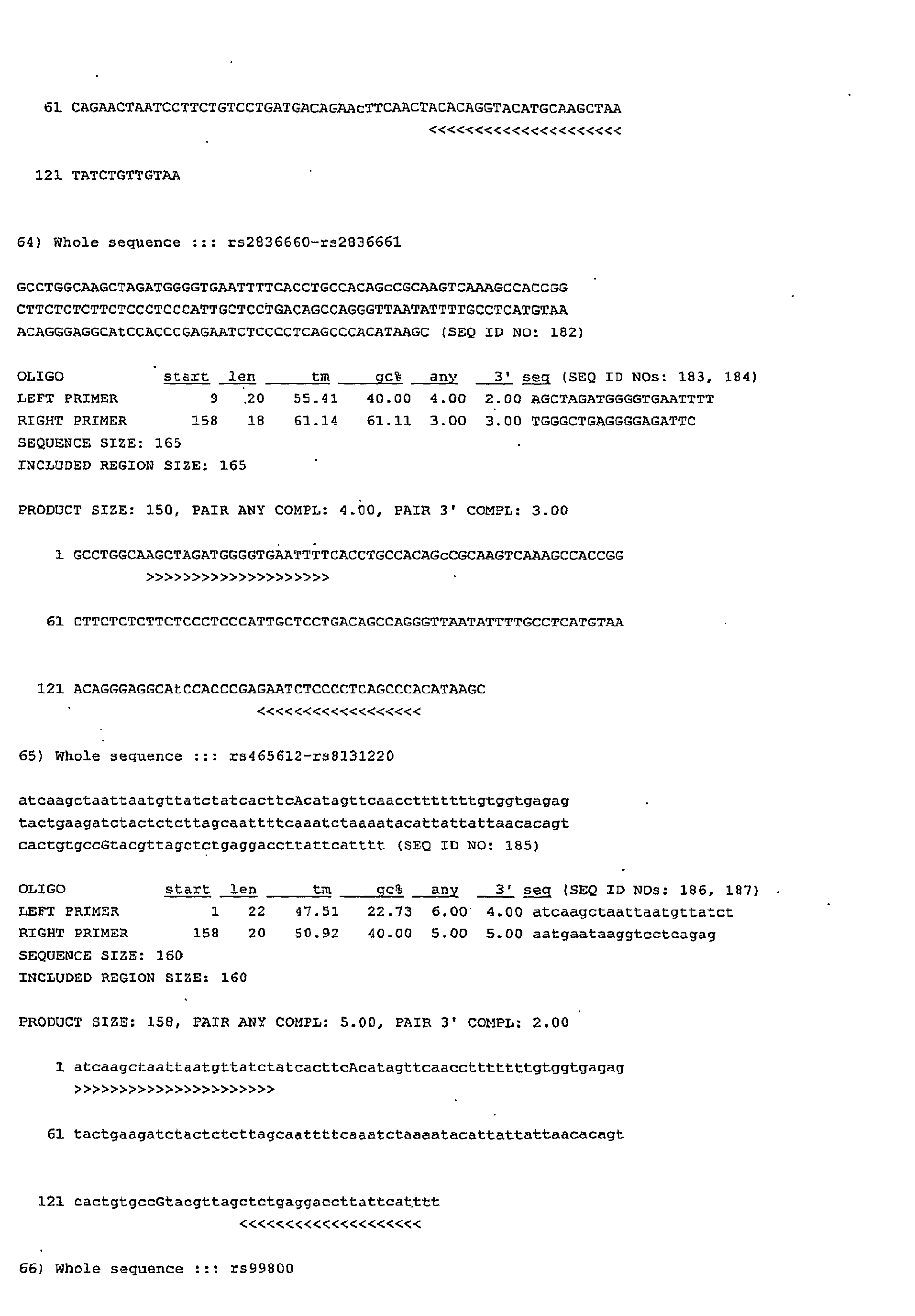
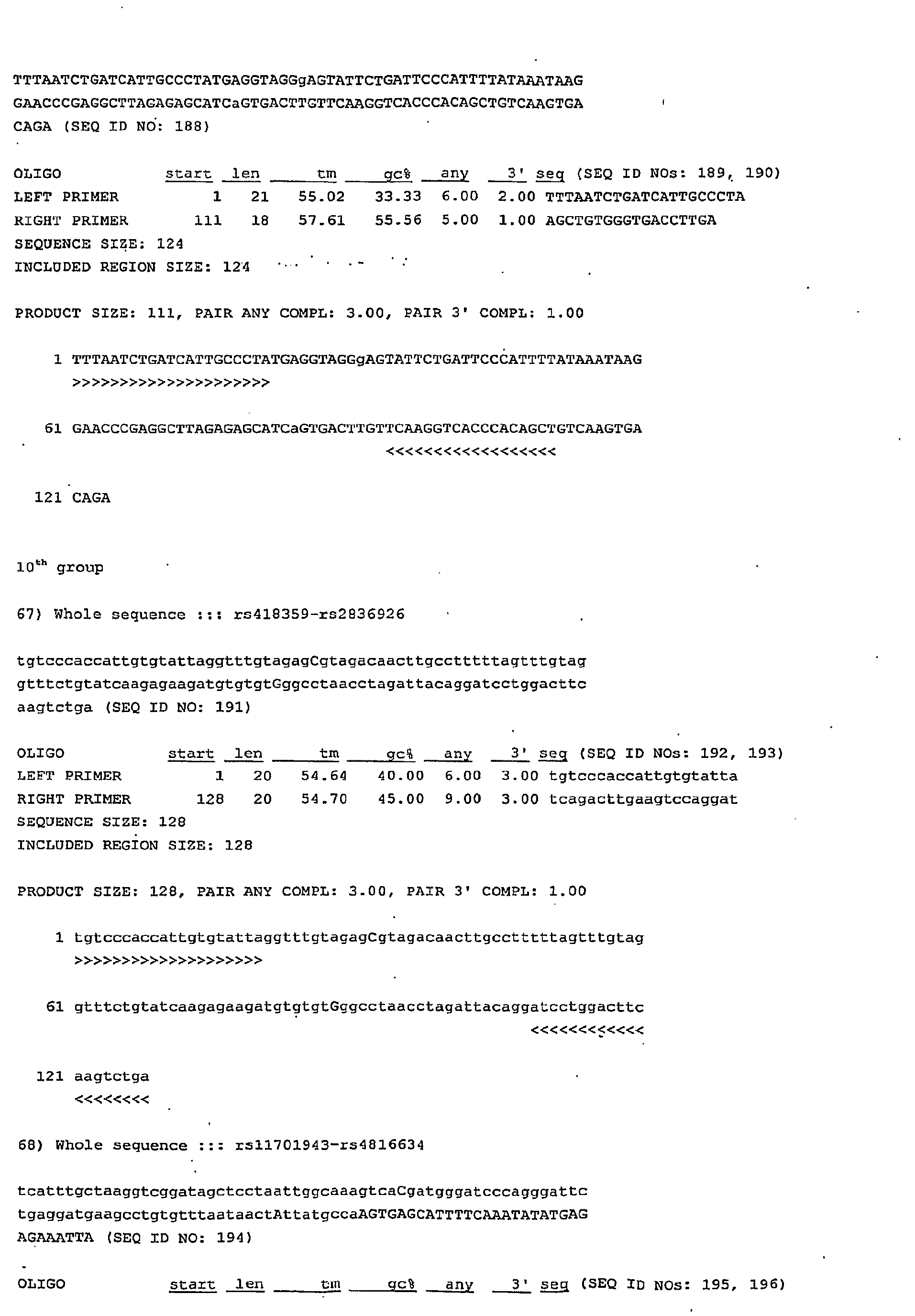

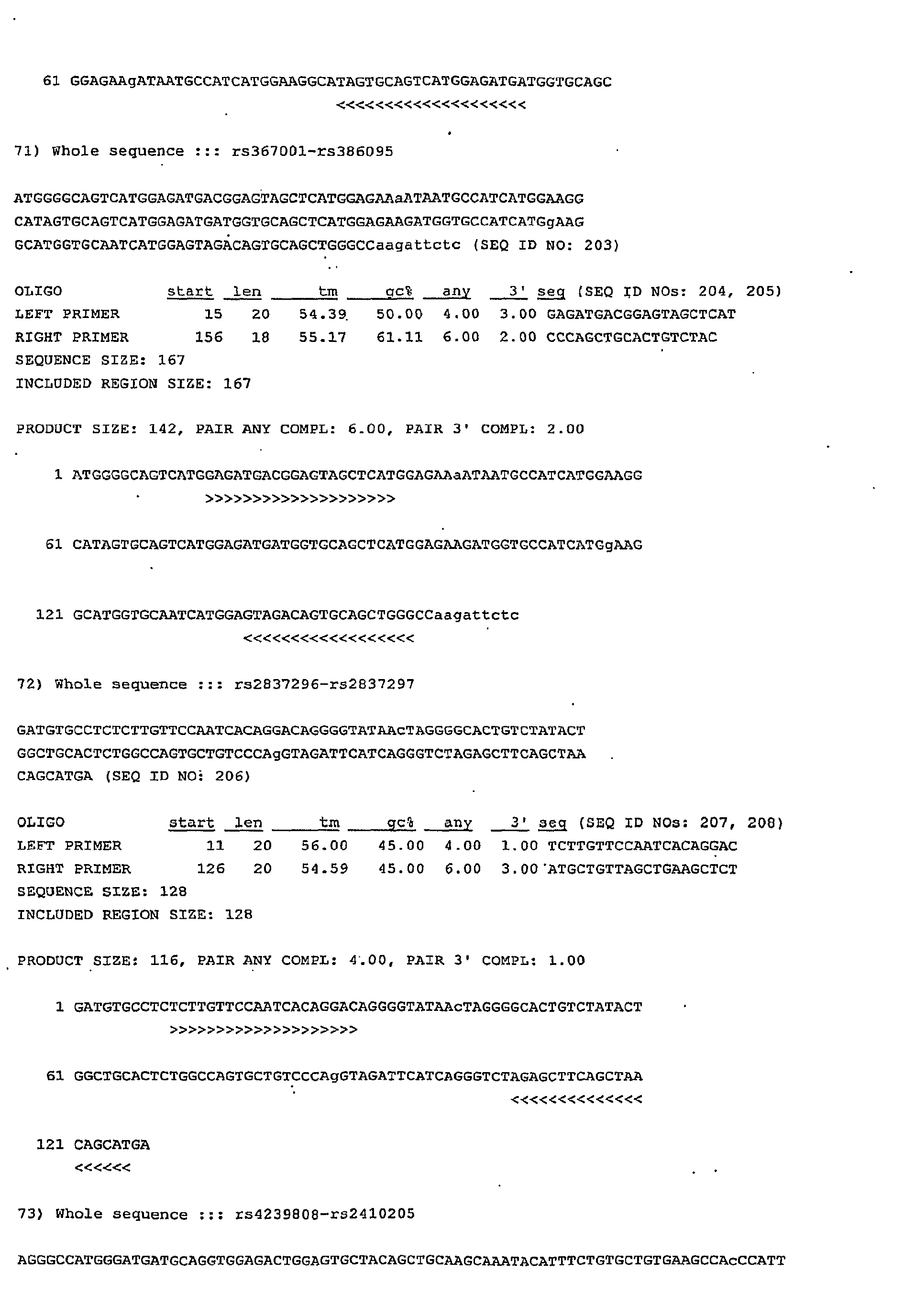
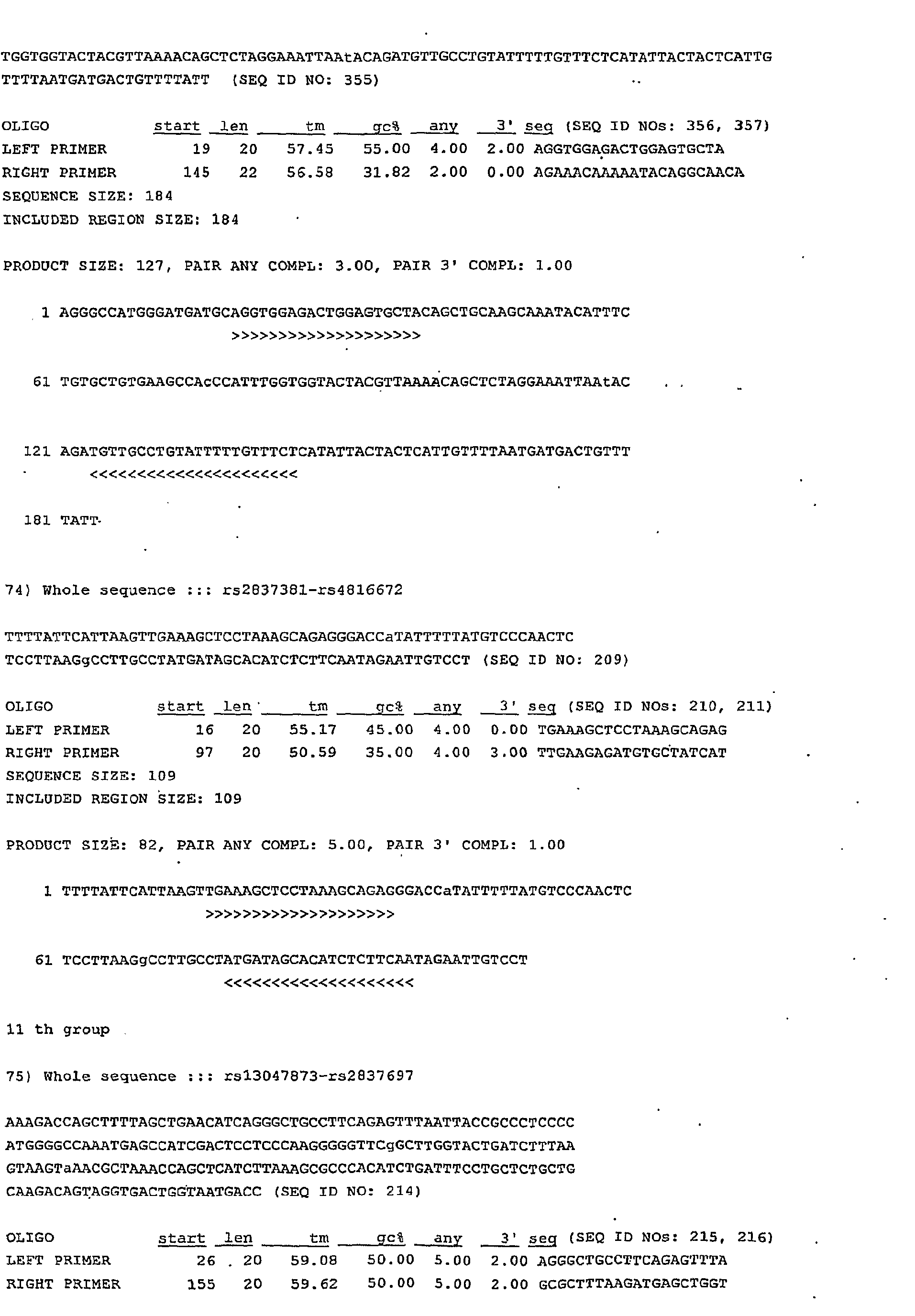


- All publications, patents and patent applications cited herein are incorporated herein by reference. While in the foregoing specification this invention has been described in relation to certain embodiments thereof, and many details have been set forth for purposes of illustration, it will be apparent to those skilled in the art that the invention is susceptible to additional embodiments and that certain of the details described herein may be varied considerably without departing from the basic principles of the invention.
- The use of the terms "a" and "an" and "the" and similar referents in the context of describing the invention are to be construed to cover both the singular and the plural, unless otherwise indicated herein or clearly contradicted by context. The terms "comprising," "having," "including," and "containing" are to be construed as open-ended terms (i.e., meaning "including, but not limited to") unless otherwise noted. Recitation of ranges of values herein are merely intended to serve as a shorthand method of referring individually to each separate value falling within the range, unless otherwise indicated herein, and each separate value is incorporated into the specification as if it were individually recited herein. All methods described herein can be performed in any suitable order unless otherwise indicated herein or otherwise clearly contradicted by context. The use of any and all examples, or exemplary language. (e.g., "such as") provided herein, is intended merely to better illuminate the invention and does not pose a limitation on the scope of the invention unless otherwise claimed. No language in the specification should be construed as indicating any non-claimed element as essential to the practice of the invention.
- Embodiments of this invention are described herein, including the best mode known to the inventors for carrying out the invention. Variations of those embodiments may become apparent to those of ordinary skill in the art upon reading the foregoing description. The inventors expect skilled artisans to employ such variations as appropriate, and the inventors intend for the invention to be practiced otherwise than as specifically described herein. Accordingly, this invention includes all modifications and equivalents of the subject matter recited in the claims appended hereto as permitted by applicable law. Moreover, any combination of the above-described elements in all possible variations thereof is encompassed by the invention unless otherwise indicated herein or otherwise clearly contradicted by context.
- An embodiment of the invention comprises a method for determining whether a fetus has at least one chromosomal abnormality, comprising: using tandem single nucleotide polymorphisms to compare fetal DNA to maternal DNA so as to determine whether the fetus has at least one chromosomal abnormality.
- Optionally in this method the fetal DNA is obtained from maternal blood, maternal urine, maternal sweat, maternal cells, or cell free DNA from the mother.
- Optionally in either of the above methods the fetal DNA is cell-free fetal DNA.
- Optionally in the above methods the maternal DNA is obtained from maternal blood or from a buccal swab.
- Optionally in the above methods the comparison step comprises using high-fidelity PCR (HiFi-PCR) and constant denaturant capillary electrophoresis (CDCE) to compare the fetal DNA to maternal DNA.
- Optionally in the above methods the comparison step comprises using at least 96 tandem single nucleotide polymorphisms.
- Optionally in the above methods the single nucleotide polymorphisms in each tandem single nucleotide polymorphism are each at most: about 250 basepairs apart; about 200 basepairs apart; about 150 basepairs apart; about 100 basepairs apart; about 50 basepairs apart.
- Optionally in the above methods at least one tandem single nucleotide polymorphism is located on the p arm or the q arm of chromosome21.
- Optionally in the above methods at least one tandem single nucleotide polymorphism is located on the q arm of chromosome 21 and at least one tandem single nucleotide polymorphism is located p arm of chromosome 21.
- Optionally in the above methods the chromosomal abnormality is chromosomal aneuploidy; optionally the chromosomal abnormality is trisomy 13, 18 or 21; optionally the chromosomal abnormality is trisomy 21. Alternatively, optionally in the above methods the chromosomal abnormality is a deletion or insertion mutation; optionally the chromosomal abnormality is a deletion or insertion mutation of more than about 3 megabasepairs; optionally he chromosomal abnormality is a deletion or insertion mutation of fewer than about 3 megabasepairs. Alternatively, optionally in the above methods the chromosomal abnormality is a copy number polymorphism, a copy number variant, chromosome 22q11 deletion syndrome, 11q deletion syndrome on chromosome 11 or 8p deletion syndrome on chromosome 8.
- Optionally in the above methods the fetus is a male fetus.
- Optionally in the above methods the fetus is a female fetus.
- Optionally in the above methods the fetus is a mammal.
- Optionally in the above methods the fetus is a human.
- Optionally in the above methods the fetus is a non-human mammal.
- Optionally in the above methods the fetus has been determined to be at an elevated risk for having a chromosomal abnormality.
- Optionally the above methods further comprise using tandem single nucleotide polymorphisms to compare paternal DNA to the fetal and/or maternal DNA.
- Optionally in the above methods the comparison step further comprises the step of converting nucleic acid molecules to a homoduplex state.
- An embodiment of the invention comprises a method for identifying chromosomes, comprising comparing tandem single nucleotide polymorphisms on the chromosomes so as to identify the chromosomes. Optionally, this embodiment further comprises, prior to the comparison step, detennining a set of tandem single nucleotide polymorphisms for a specific chromosome.
- An embodiment of the invention comprises a system comprising packaging material and primers that specifically hybridize to each of the single nucleotide polymorphisms of at least one of tandem single nucleotide polymorphisms 1-118.
- An embodiment of the invention comprises a system comprising packaging material and primers that specifically hybridize flanking sequences of at least one of the tandem single nucleotide polymorphisms 1-118.
- An embodiment of the invention comprises a method for amplifying a single nucleotide polymorphism or a tandem single nucleotide polymorphism comprising using high-fidelity PCR to amplify the single nucleotide polymorphism or the tandem single nucleotide polymorphism. Optionally, the single nucleotide polymorphism or
a tandem single nucleotide polymorphism is comprised in a nucleic acid segment obtained from a maternal biological sample. - An embodiment of the invention comprises an isolated nucleic acid sequence comprising at least one of SEQ ID NOs 1-357.
- An embodiment of the invention comprises an isolated nucleic acid sequence as described by claim 36 for use in medical treatment or diagnosis.


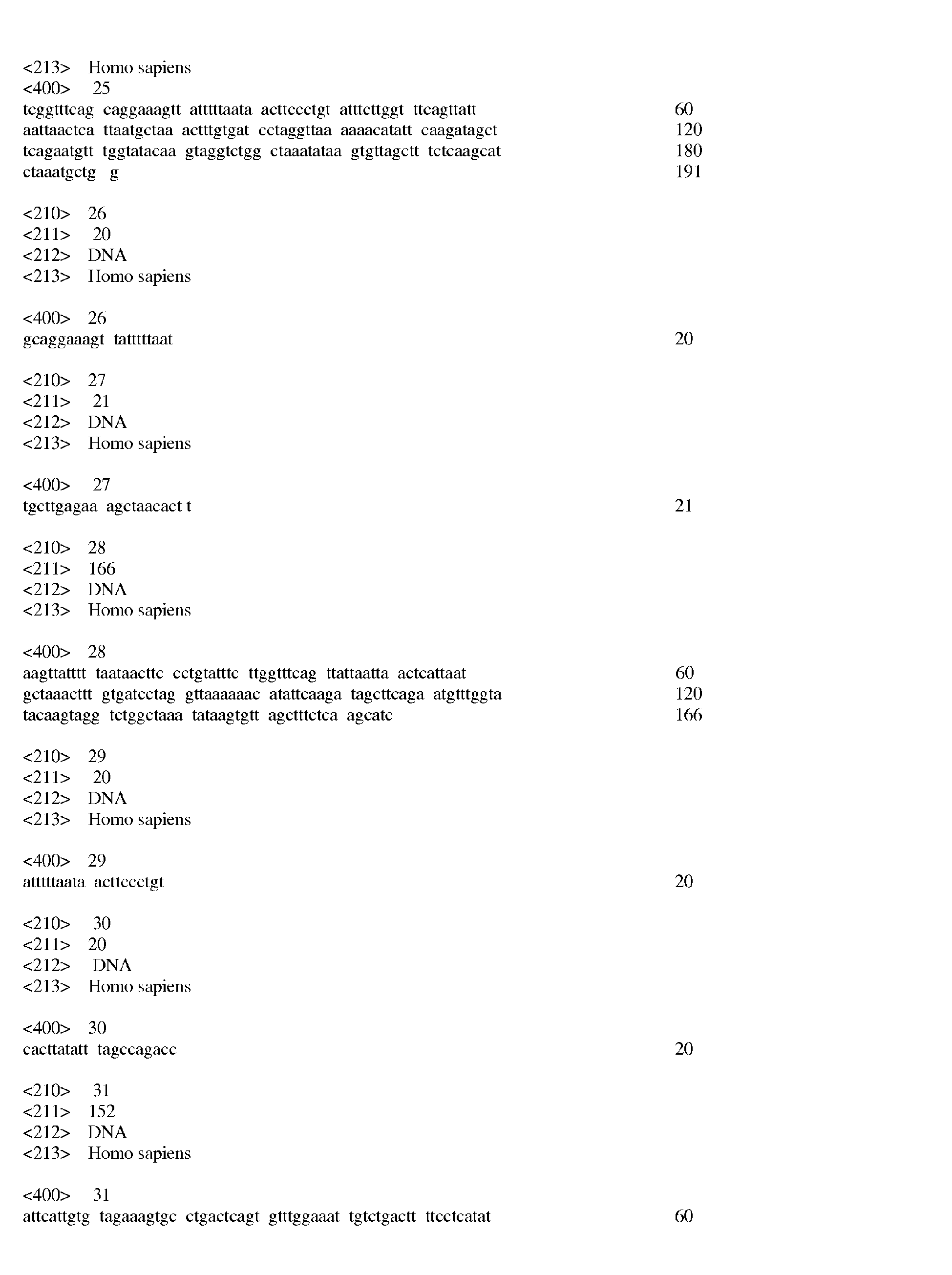


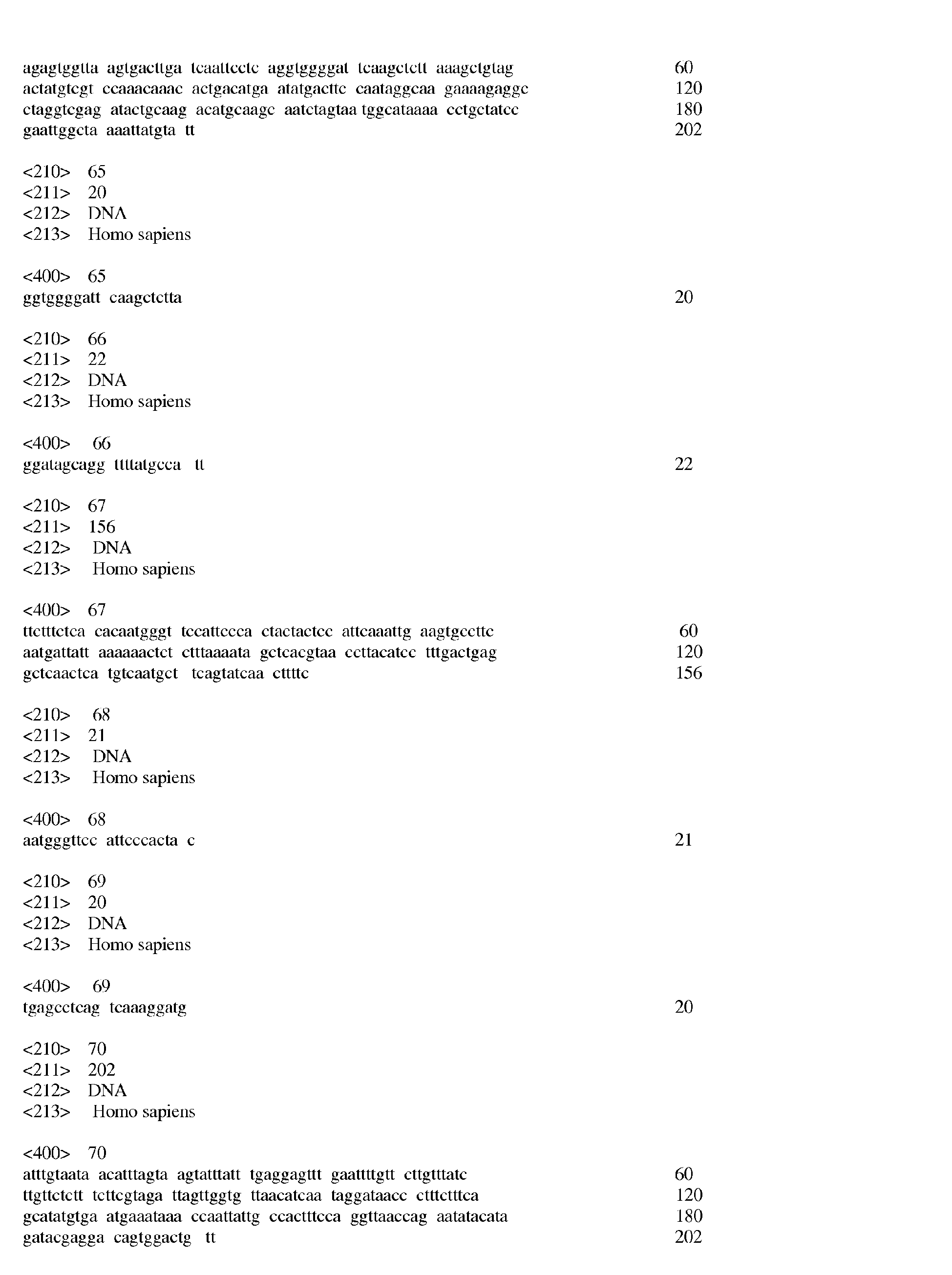

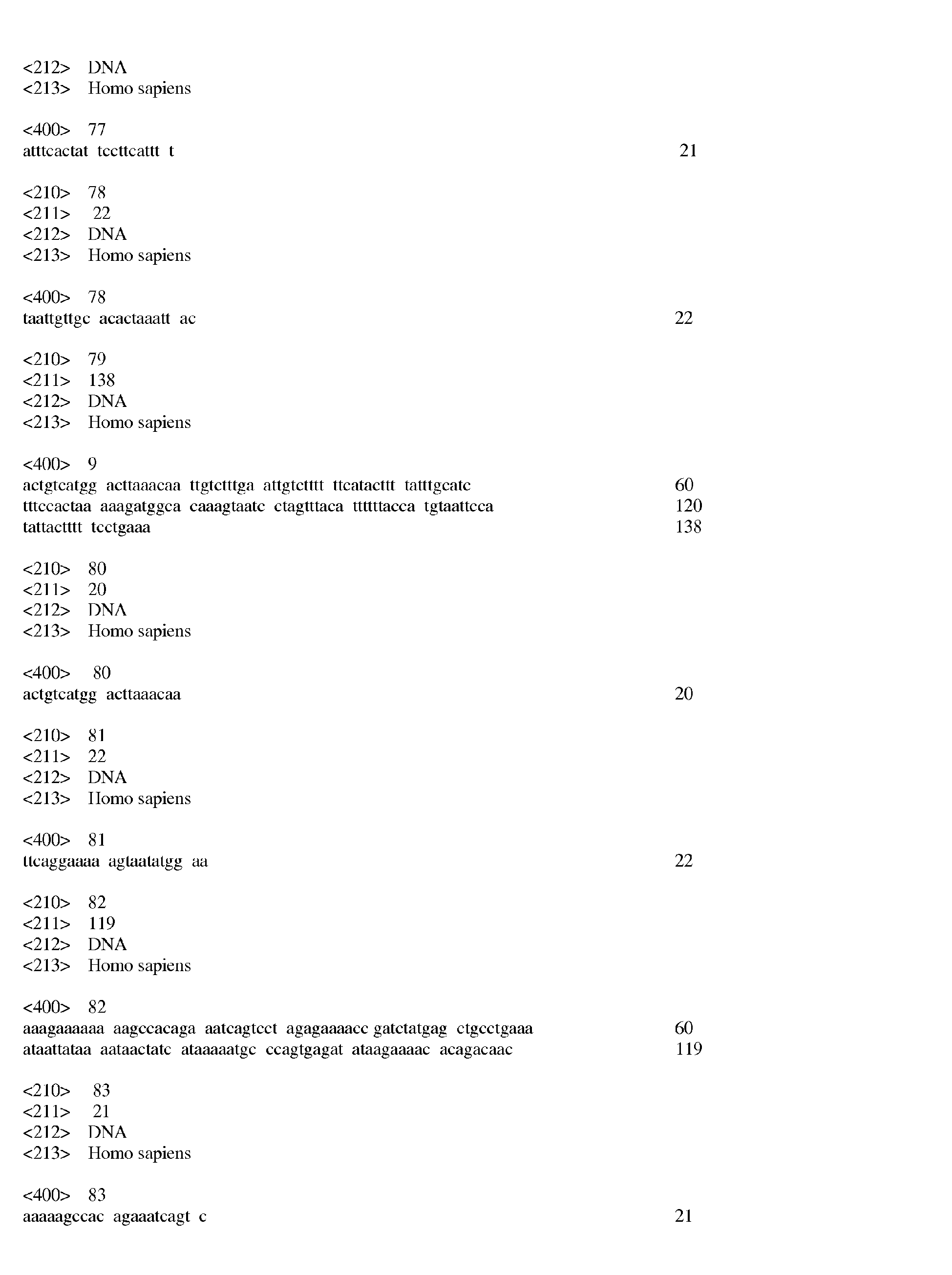


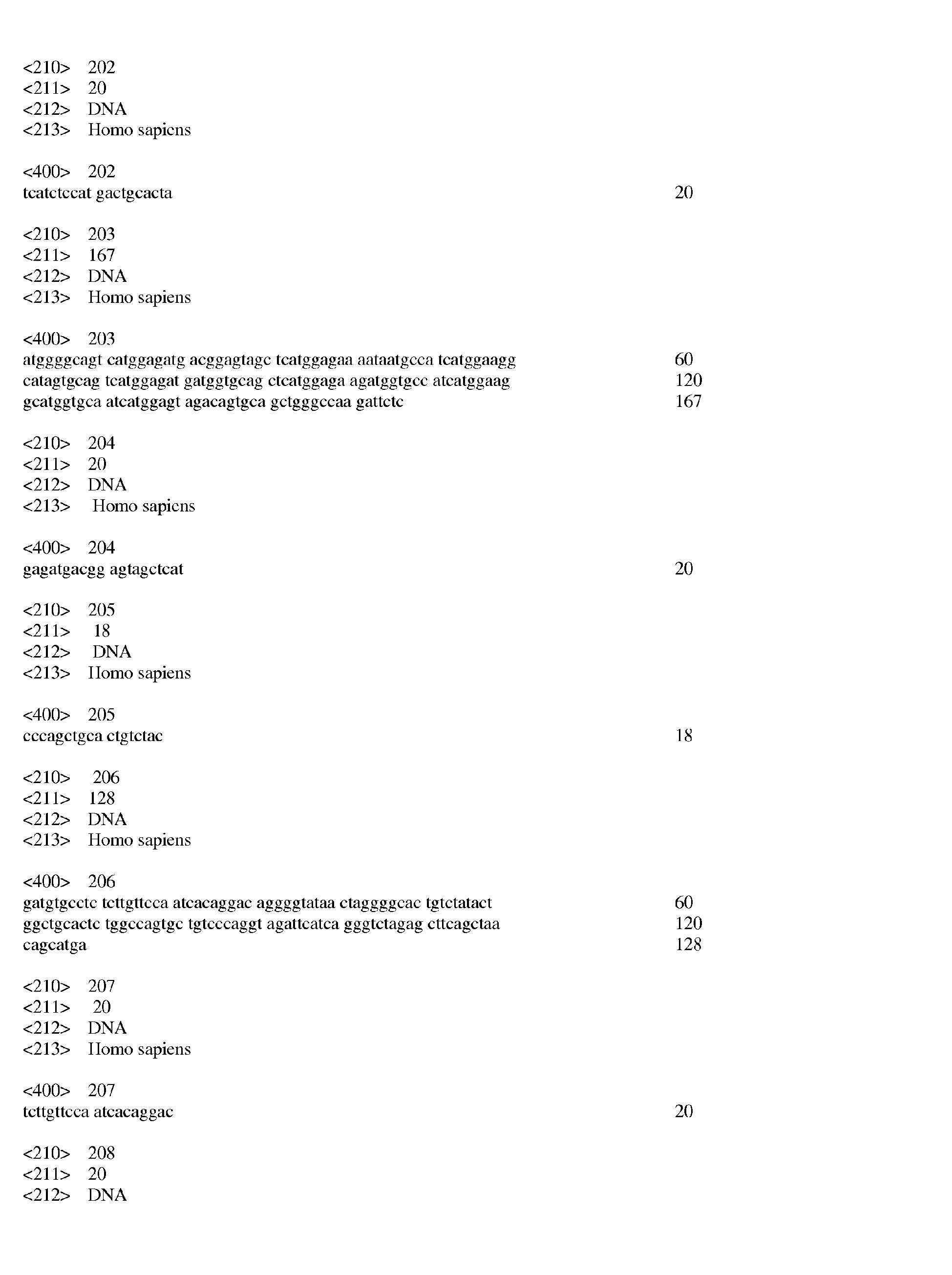

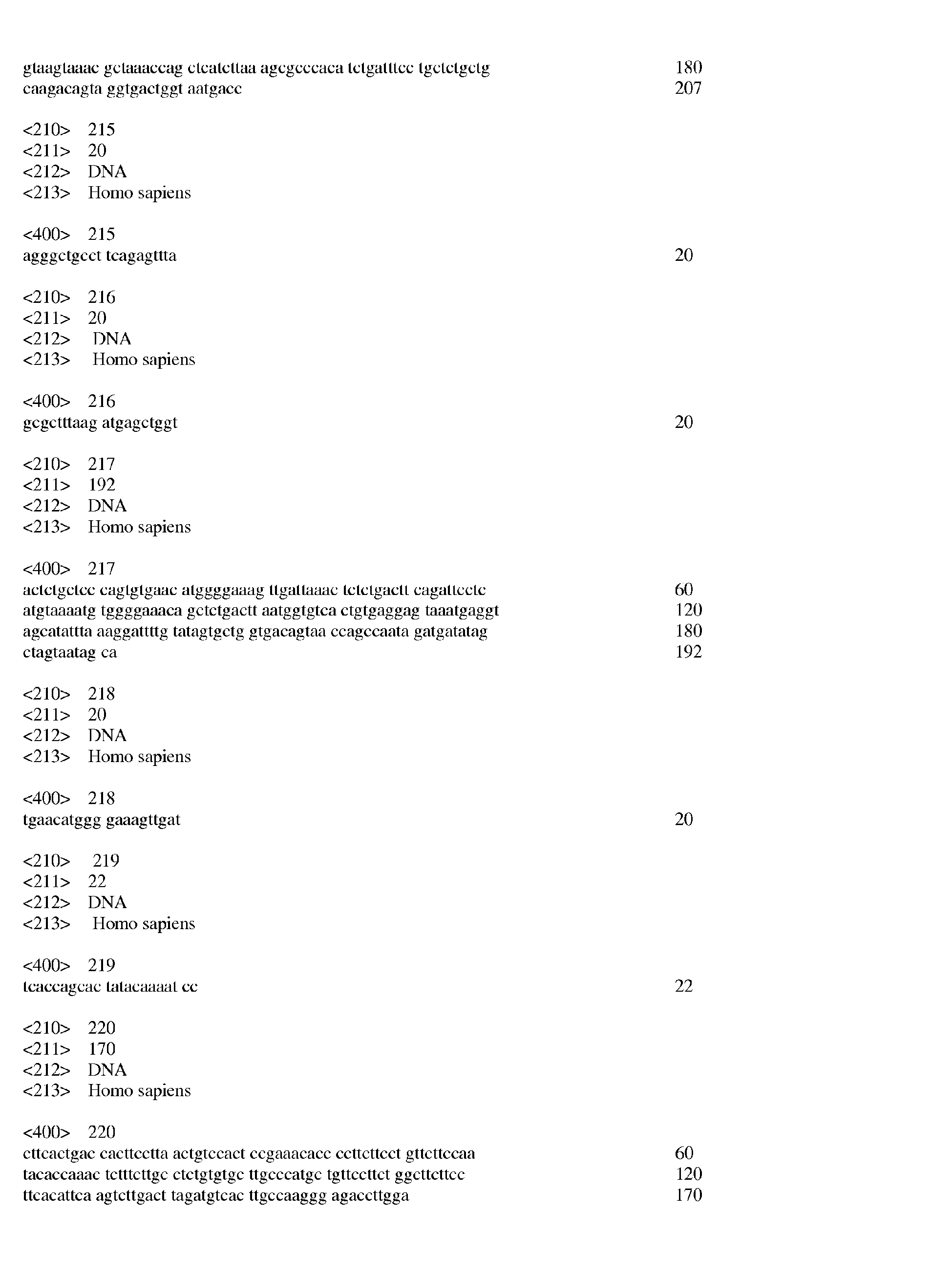


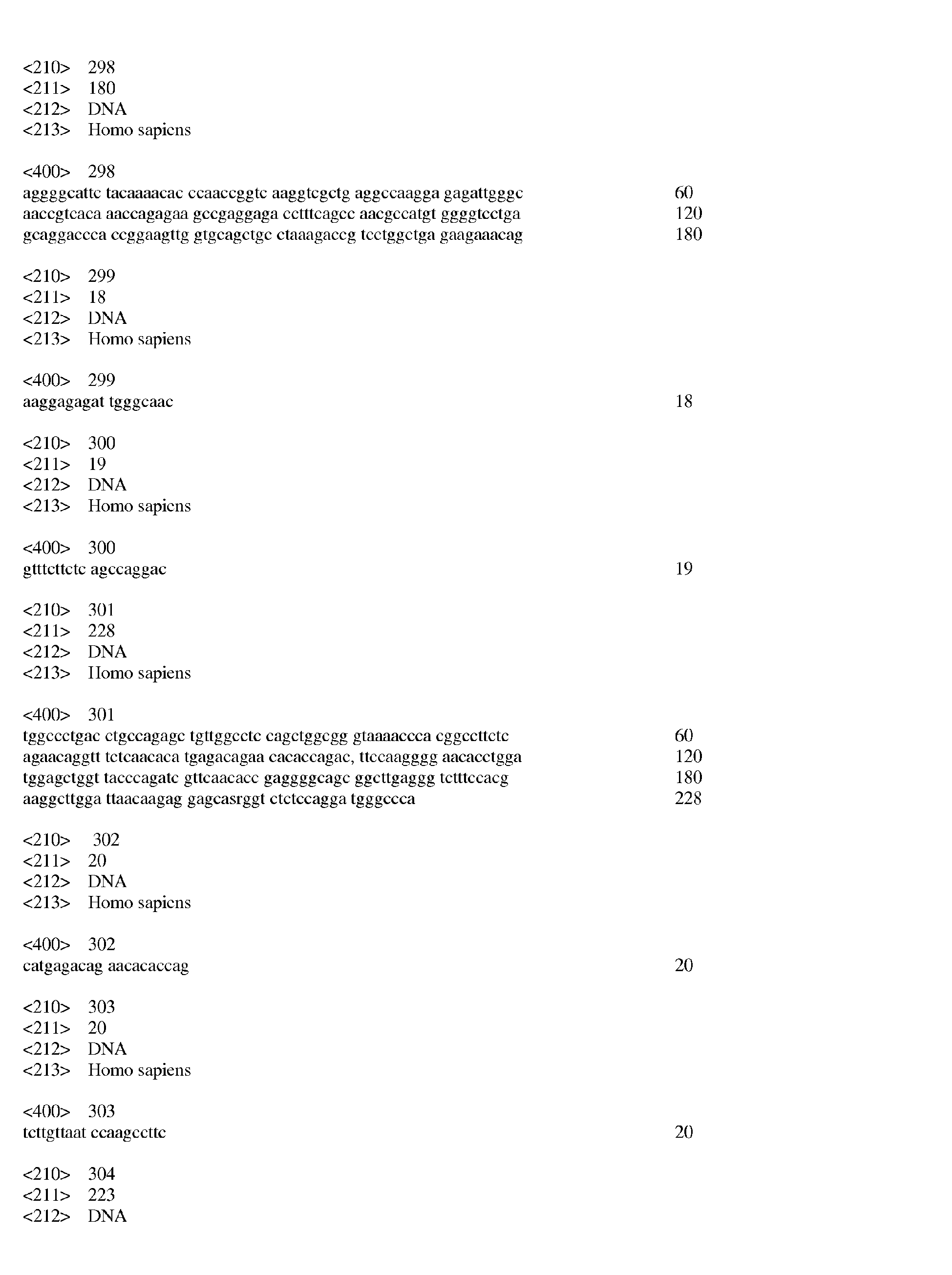


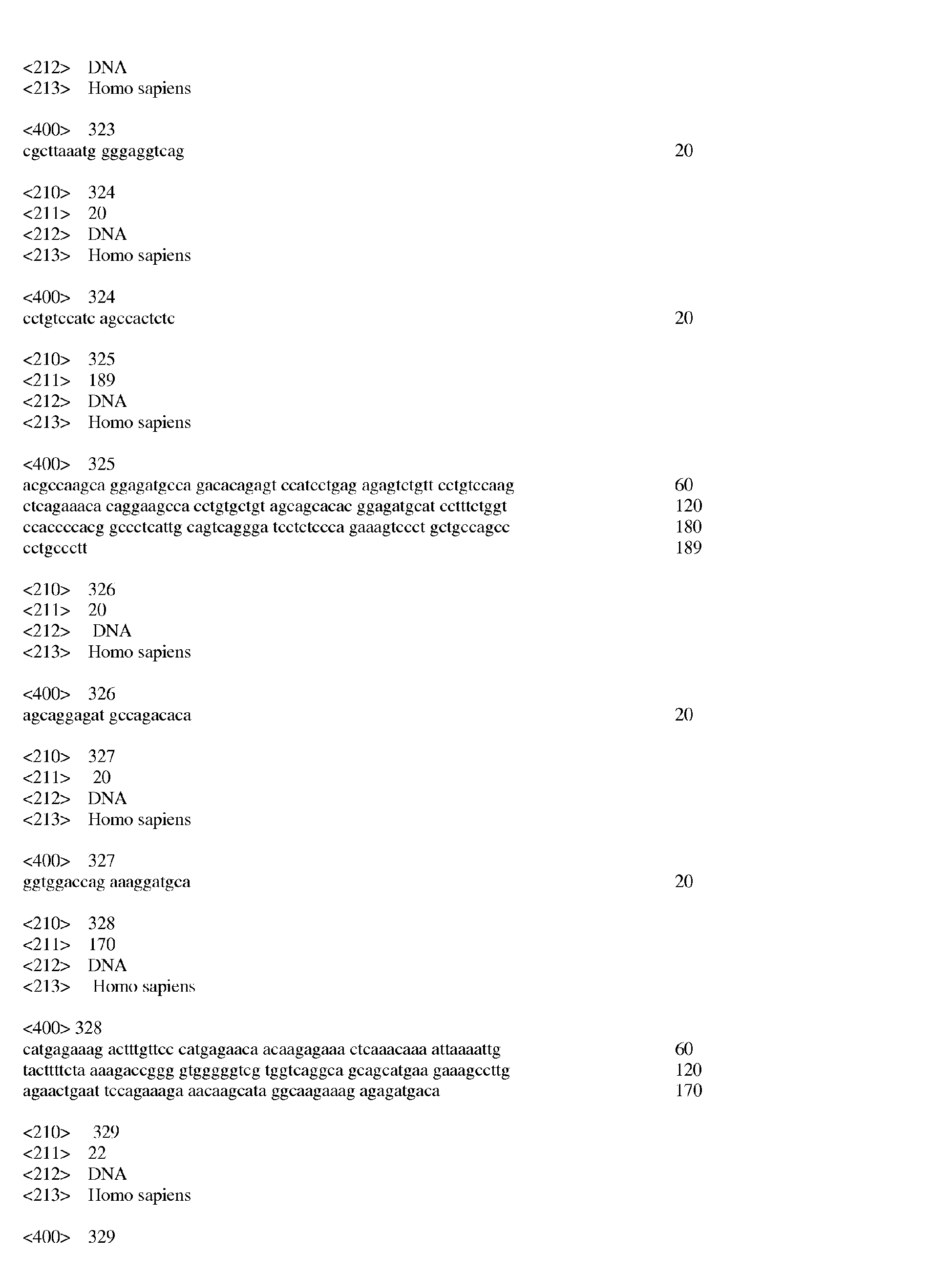


Claims (8)
- A method for detecting a fetal chromosomal abnormality, comprising
identifying tandem single nucleotide polymorphisms in fetal DNA and maternal DNA present in maternal blood or serum;
comparing tandem single nucleotide polymorphisms in the fetal DNA and maternal DNA so as to identify chromosomes and detect one of copy number polymorphisms and copy number variants in the genome;
wherein said tandem single nucleotide polymorphisms comprise a pair of single nucleotide polymorphisms located in a nucleic acid sequence in a manner that allows for the detection of both of the pair of single nucleotide polymorphisms in a tandem SNP assay, and wherein the distance between the pair of single nucleotide polymorphisms is 250 basepairs or fewer. - A method according to claim 1, wherein said fetal chromosomal abnormality is a chromosomal aneuploidy.
- A method according to claim 2, wherein said fetal chromosomal aneuploidy is trisomy 13, 18 or 21.
- A method according to claim 3, wherein said fetal DNA is cell-free DNA.
- A method according to any of claims 1-4, wherein said tandem single nucleotide polymorphisms are detected by one of: high fidelity PCR in combination with constant denaturant capillary electrophoresis; hybridization on a microarray; high fidelity PCR in combination with one of denaturing HPLC; denaturing capillary electrophoresis; cycling temperature electrophoresis; allele specific PCR; quantitative real-time PCR; a polony sequencing based approach, a microarray based approach; mass spectrometry; and high-throughput sequencing.
- A method according to claim 5, wherein said means for detecting said tandem single nucleotide polymorphisms is high fidelity PCR in combination with constant denaturant capillary electrophoresis.
- A method according to any of clams 1-6, wherein said fetal chromosomal abnormality is a trisomy, and wherein the quantity of tandem single nucleotide polymorphisms detected comprises one of the following ratios:where the fetus comprises normal chromosomes, the tandem single nucleotide polymorphisms detected comprise three different alleles with quantities with the ratio p:x:p+x; andwhere the fetus comprises a trisomy, the tandem single nucleotide polymorphisms detected comprise three different alleles: with quantities with the ratio p:x:p+2x; or with quantities in which two alleles are equal and one unequal.
- An isolated nucleic acid comprising at least one of SEQ ID No. 1-357 for use in medical treatment.
Priority Applications (1)
| Application Number | Priority Date | Filing Date | Title |
|---|---|---|---|
| SI200731635T SI2351858T1 (en) | 2006-02-28 | 2007-02-28 | Detecting fetal chromosomal abnormalities using tandem single nucleotide polymorphisms |
Applications Claiming Priority (2)
| Application Number | Priority Date | Filing Date | Title |
|---|---|---|---|
| US77786506P | 2006-02-28 | 2006-02-28 | |
| EP07752121A EP1996728B1 (en) | 2006-02-28 | 2007-02-28 | Detecting fetal chromosomal abnormalities using tandem single nucleotide polymorphisms |
Related Parent Applications (2)
| Application Number | Title | Priority Date | Filing Date |
|---|---|---|---|
| EP07752121.9 Division | 2007-02-28 | ||
| EP07752121A Division EP1996728B1 (en) | 2006-02-28 | 2007-02-28 | Detecting fetal chromosomal abnormalities using tandem single nucleotide polymorphisms |
Publications (2)
| Publication Number | Publication Date |
|---|---|
| EP2351858A1 true EP2351858A1 (en) | 2011-08-03 |
| EP2351858B1 EP2351858B1 (en) | 2014-12-31 |
Family
ID=38293156
Family Applications (2)
| Application Number | Title | Priority Date | Filing Date |
|---|---|---|---|
| EP11150524.4A Not-in-force EP2351858B1 (en) | 2006-02-28 | 2007-02-28 | Detecting fetal chromosomal abnormalities using tandem single nucleotide polymorphisms |
| EP07752121A Not-in-force EP1996728B1 (en) | 2006-02-28 | 2007-02-28 | Detecting fetal chromosomal abnormalities using tandem single nucleotide polymorphisms |
Family Applications After (1)
| Application Number | Title | Priority Date | Filing Date |
|---|---|---|---|
| EP07752121A Not-in-force EP1996728B1 (en) | 2006-02-28 | 2007-02-28 | Detecting fetal chromosomal abnormalities using tandem single nucleotide polymorphisms |
Country Status (9)
| Country | Link |
|---|---|
| US (3) | US7799531B2 (en) |
| EP (2) | EP2351858B1 (en) |
| AT (1) | ATE508209T1 (en) |
| AU (1) | AU2007220991C1 (en) |
| CA (1) | CA2647793C (en) |
| DE (1) | DE602007014335D1 (en) |
| DK (2) | DK2351858T3 (en) |
| SI (2) | SI1996728T1 (en) |
| WO (1) | WO2007100911A2 (en) |
Families Citing this family (180)
| Publication number | Priority date | Publication date | Assignee | Title |
|---|---|---|---|---|
| ES2784011T3 (en) | 2002-10-16 | 2020-09-21 | Streck Inc | Procedure and device to collect and preserve cells for analysis |
| US20100216153A1 (en) * | 2004-02-27 | 2010-08-26 | Helicos Biosciences Corporation | Methods for detecting fetal nucleic acids and diagnosing fetal abnormalities |
| US8024128B2 (en) * | 2004-09-07 | 2011-09-20 | Gene Security Network, Inc. | System and method for improving clinical decisions by aggregating, validating and analysing genetic and phenotypic data |
| US20090317798A1 (en) * | 2005-06-02 | 2009-12-24 | Heid Christian A | Analysis using microfluidic partitioning devices |
| US20070027636A1 (en) * | 2005-07-29 | 2007-02-01 | Matthew Rabinowitz | System and method for using genetic, phentoypic and clinical data to make predictions for clinical or lifestyle decisions |
| US10081839B2 (en) | 2005-07-29 | 2018-09-25 | Natera, Inc | System and method for cleaning noisy genetic data and determining chromosome copy number |
| US20070178501A1 (en) * | 2005-12-06 | 2007-08-02 | Matthew Rabinowitz | System and method for integrating and validating genotypic, phenotypic and medical information into a database according to a standardized ontology |
| US10083273B2 (en) | 2005-07-29 | 2018-09-25 | Natera, Inc. | System and method for cleaning noisy genetic data and determining chromosome copy number |
| US8515679B2 (en) | 2005-12-06 | 2013-08-20 | Natera, Inc. | System and method for cleaning noisy genetic data and determining chromosome copy number |
| US9424392B2 (en) | 2005-11-26 | 2016-08-23 | Natera, Inc. | System and method for cleaning noisy genetic data from target individuals using genetic data from genetically related individuals |
| US8532930B2 (en) | 2005-11-26 | 2013-09-10 | Natera, Inc. | Method for determining the number of copies of a chromosome in the genome of a target individual using genetic data from genetically related individuals |
| US11111544B2 (en) | 2005-07-29 | 2021-09-07 | Natera, Inc. | System and method for cleaning noisy genetic data and determining chromosome copy number |
| US11111543B2 (en) | 2005-07-29 | 2021-09-07 | Natera, Inc. | System and method for cleaning noisy genetic data and determining chromosome copy number |
| HUE030215T2 (en) * | 2006-02-02 | 2017-04-28 | Univ Leland Stanford Junior | Non-invasive fetal genetic screening by digital analysis |
| US20100184043A1 (en) * | 2006-02-28 | 2010-07-22 | University Of Louisville Research Foundation | Detecting Genetic Abnormalities |
| US8609338B2 (en) * | 2006-02-28 | 2013-12-17 | University Of Louisville Research Foundation, Inc. | Detecting fetal chromosomal abnormalities using tandem single nucleotide polymorphisms |
| US20100184044A1 (en) * | 2006-02-28 | 2010-07-22 | University Of Louisville Research Foundation | Detecting Genetic Abnormalities |
| US7799531B2 (en) * | 2006-02-28 | 2010-09-21 | University Of Louisville Research Foundation | Detecting fetal chromosomal abnormalities using tandem single nucleotide polymorphisms |
| US20080050739A1 (en) * | 2006-06-14 | 2008-02-28 | Roland Stoughton | Diagnosis of fetal abnormalities using polymorphisms including short tandem repeats |
| US20080124721A1 (en) * | 2006-06-14 | 2008-05-29 | Martin Fuchs | Analysis of rare cell-enriched samples |
| EP2029779A4 (en) | 2006-06-14 | 2010-01-20 | Living Microsystems Inc | Use of highly parallel snp genotyping for fetal diagnosis |
| EP2589668A1 (en) | 2006-06-14 | 2013-05-08 | Verinata Health, Inc | Rare cell analysis using sample splitting and DNA tags |
| US8137912B2 (en) * | 2006-06-14 | 2012-03-20 | The General Hospital Corporation | Methods for the diagnosis of fetal abnormalities |
| US12180549B2 (en) | 2007-07-23 | 2024-12-31 | The Chinese University Of Hong Kong | Diagnosing fetal chromosomal aneuploidy using genomic sequencing |
| HUE061020T2 (en) | 2007-07-23 | 2023-05-28 | Univ Hong Kong Chinese | Determining a nucleic acid sequence imbalance |
| EP2195454A4 (en) * | 2007-09-28 | 2011-08-24 | Murdoch Childrens Res Inst | METHOD FOR DETECTING, MONITORING AND ISOLATING CELLS |
| WO2009105531A1 (en) * | 2008-02-19 | 2009-08-27 | Gene Security Network, Inc. | Methods for cell genotyping |
| WO2009114543A2 (en) * | 2008-03-11 | 2009-09-17 | Sequenom, Inc. | Nucleic acid-based tests for prenatal gender determination |
| US20110092763A1 (en) * | 2008-05-27 | 2011-04-21 | Gene Security Network, Inc. | Methods for Embryo Characterization and Comparison |
| EP2853601B1 (en) | 2008-07-18 | 2016-09-21 | TrovaGene, Inc. | Methods for PCR-based detection of "ultra short" nucleic acid sequences |
| US20110178719A1 (en) * | 2008-08-04 | 2011-07-21 | Gene Security Network, Inc. | Methods for Allele Calling and Ploidy Calling |
| US8962247B2 (en) | 2008-09-16 | 2015-02-24 | Sequenom, Inc. | Processes and compositions for methylation-based enrichment of fetal nucleic acid from a maternal sample useful for non invasive prenatal diagnoses |
| US8476013B2 (en) | 2008-09-16 | 2013-07-02 | Sequenom, Inc. | Processes and compositions for methylation-based acid enrichment of fetal nucleic acid from a maternal sample useful for non-invasive prenatal diagnoses |
| ES2620012T3 (en) | 2008-09-20 | 2017-06-27 | The Board Of Trustees Of The Leland Stanford Junior University | Non-invasive diagnosis of fetal aneuploidy by sequencing |
| US20100167271A1 (en) * | 2008-12-30 | 2010-07-01 | Streck, Inc. | Method for screening blood using a preservative that may be in a substantially solid state form |
| US11634747B2 (en) | 2009-01-21 | 2023-04-25 | Streck Llc | Preservation of fetal nucleic acids in maternal plasma |
| DE202010018561U1 (en) | 2009-01-21 | 2017-08-28 | Streck Inc. | Blood collection tube |
| EP3290530B1 (en) | 2009-02-18 | 2020-09-02 | Streck Inc. | Preservation of cell-free nucleic acids |
| EP2473638B1 (en) | 2009-09-30 | 2017-08-09 | Natera, Inc. | Methods for non-invasive prenatal ploidy calling |
| SMT202300034T1 (en) * | 2009-11-05 | 2023-03-17 | Sequenom Inc | Fetal genomic analysis from a maternal biological sample |
| EA034241B1 (en) | 2009-11-06 | 2020-01-21 | Те Чайниз Юниверсити Ов Гонконг | Method for performing prenatal diagnosis of a sequence imbalance |
| CA2780536C (en) * | 2009-11-09 | 2018-01-02 | Streck, Inc. | Stabilization of rna in and extracting from intact cells within a blood sample |
| EP2504448B1 (en) * | 2009-11-25 | 2016-10-19 | Bio-Rad Laboratories, Inc. | Methods and compositions for detecting genetic material |
| DK2516680T3 (en) | 2009-12-22 | 2016-05-02 | Sequenom Inc | Method and kits to identify aneuploidy |
| AU2010343277B2 (en) * | 2010-01-19 | 2015-05-28 | Verinata Health, Inc. | Method for determining copy number variations |
| US20120010085A1 (en) | 2010-01-19 | 2012-01-12 | Rava Richard P | Methods for determining fraction of fetal nucleic acids in maternal samples |
| US20120100548A1 (en) | 2010-10-26 | 2012-04-26 | Verinata Health, Inc. | Method for determining copy number variations |
| US9323888B2 (en) | 2010-01-19 | 2016-04-26 | Verinata Health, Inc. | Detecting and classifying copy number variation |
| AU2011207561B2 (en) | 2010-01-19 | 2014-02-20 | Verinata Health, Inc. | Partition defined detection methods |
| WO2011091046A1 (en) | 2010-01-19 | 2011-07-28 | Verinata Health, Inc. | Identification of polymorphic sequences in mixtures of genomic dna by whole genome sequencing |
| US10388403B2 (en) | 2010-01-19 | 2019-08-20 | Verinata Health, Inc. | Analyzing copy number variation in the detection of cancer |
| US9260745B2 (en) | 2010-01-19 | 2016-02-16 | Verinata Health, Inc. | Detecting and classifying copy number variation |
| US20110312503A1 (en) | 2010-01-23 | 2011-12-22 | Artemis Health, Inc. | Methods of fetal abnormality detection |
| US8774488B2 (en) | 2010-03-11 | 2014-07-08 | Cellscape Corporation | Method and device for identification of nucleated red blood cells from a maternal blood sample |
| US11339429B2 (en) | 2010-05-18 | 2022-05-24 | Natera, Inc. | Methods for non-invasive prenatal ploidy calling |
| US11939634B2 (en) | 2010-05-18 | 2024-03-26 | Natera, Inc. | Methods for simultaneous amplification of target loci |
| US10316362B2 (en) | 2010-05-18 | 2019-06-11 | Natera, Inc. | Methods for simultaneous amplification of target loci |
| US9677118B2 (en) | 2014-04-21 | 2017-06-13 | Natera, Inc. | Methods for simultaneous amplification of target loci |
| US11326208B2 (en) | 2010-05-18 | 2022-05-10 | Natera, Inc. | Methods for nested PCR amplification of cell-free DNA |
| US11332793B2 (en) | 2010-05-18 | 2022-05-17 | Natera, Inc. | Methods for simultaneous amplification of target loci |
| US11408031B2 (en) | 2010-05-18 | 2022-08-09 | Natera, Inc. | Methods for non-invasive prenatal paternity testing |
| US12545960B2 (en) | 2010-05-18 | 2026-02-10 | Natera, Inc. | Methods for simultaneous amplification of target loci |
| US12221653B2 (en) | 2010-05-18 | 2025-02-11 | Natera, Inc. | Methods for simultaneous amplification of target loci |
| US8825412B2 (en) | 2010-05-18 | 2014-09-02 | Natera, Inc. | Methods for non-invasive prenatal ploidy calling |
| US11332785B2 (en) | 2010-05-18 | 2022-05-17 | Natera, Inc. | Methods for non-invasive prenatal ploidy calling |
| US20190010543A1 (en) | 2010-05-18 | 2019-01-10 | Natera, Inc. | Methods for simultaneous amplification of target loci |
| US11322224B2 (en) | 2010-05-18 | 2022-05-03 | Natera, Inc. | Methods for non-invasive prenatal ploidy calling |
| US12152275B2 (en) | 2010-05-18 | 2024-11-26 | Natera, Inc. | Methods for non-invasive prenatal ploidy calling |
| US11031095B2 (en) | 2010-08-06 | 2021-06-08 | Ariosa Diagnostics, Inc. | Assay systems for determination of fetal copy number variation |
| US10533223B2 (en) | 2010-08-06 | 2020-01-14 | Ariosa Diagnostics, Inc. | Detection of target nucleic acids using hybridization |
| US20140342940A1 (en) | 2011-01-25 | 2014-11-20 | Ariosa Diagnostics, Inc. | Detection of Target Nucleic Acids using Hybridization |
| US10167508B2 (en) | 2010-08-06 | 2019-01-01 | Ariosa Diagnostics, Inc. | Detection of genetic abnormalities |
| US20130261003A1 (en) | 2010-08-06 | 2013-10-03 | Ariosa Diagnostics, In. | Ligation-based detection of genetic variants |
| US11203786B2 (en) | 2010-08-06 | 2021-12-21 | Ariosa Diagnostics, Inc. | Detection of target nucleic acids using hybridization |
| US20130040375A1 (en) | 2011-08-08 | 2013-02-14 | Tandem Diagnotics, Inc. | Assay systems for genetic analysis |
| US20120034603A1 (en) | 2010-08-06 | 2012-02-09 | Tandem Diagnostics, Inc. | Ligation-based detection of genetic variants |
| US8700338B2 (en) | 2011-01-25 | 2014-04-15 | Ariosa Diagnosis, Inc. | Risk calculation for evaluation of fetal aneuploidy |
| BR112013009256A2 (en) * | 2010-10-19 | 2021-03-30 | Koninklijke Philips Electronics N.V | PATIENT MONITORING SYSTEM, PATIENT MONITORING METHOD AND COMPUTER PROGRAM |
| EP2633311A4 (en) * | 2010-10-26 | 2014-05-07 | Univ Stanford | NON-INVASIVE F TAL GENE SCREENING BY SEQUENCING ANALYSIS |
| US8999644B2 (en) | 2010-11-05 | 2015-04-07 | Centre Hospitalier Universitaire Vaudois | Method for detecting the presence of a DNA minor contributor in a DNA mixture |
| EP2656263B1 (en) | 2010-12-22 | 2019-11-06 | Natera, Inc. | Methods for non-invasive prenatal paternity testing |
| US20120184449A1 (en) * | 2010-12-23 | 2012-07-19 | Sequenom, Inc. | Fetal genetic variation detection |
| AU2012209421B2 (en) | 2011-01-25 | 2016-02-11 | F. Hoffmann-La Roche Ag | Risk calculation for evaluation of fetal aneuploidy |
| US8756020B2 (en) | 2011-01-25 | 2014-06-17 | Ariosa Diagnostics, Inc. | Enhanced risk probabilities using biomolecule estimations |
| US9994897B2 (en) * | 2013-03-08 | 2018-06-12 | Ariosa Diagnostics, Inc. | Non-invasive fetal sex determination |
| US11270781B2 (en) | 2011-01-25 | 2022-03-08 | Ariosa Diagnostics, Inc. | Statistical analysis for non-invasive sex chromosome aneuploidy determination |
| US10131947B2 (en) | 2011-01-25 | 2018-11-20 | Ariosa Diagnostics, Inc. | Noninvasive detection of fetal aneuploidy in egg donor pregnancies |
| US20120190020A1 (en) | 2011-01-25 | 2012-07-26 | Aria Diagnostics, Inc. | Detection of genetic abnormalities |
| EP2673380B1 (en) | 2011-02-09 | 2018-12-12 | Bio-Rad Laboratories, Inc. | Analysis of nucleic acids |
| JP6153874B2 (en) | 2011-02-09 | 2017-06-28 | ナテラ, インコーポレイテッド | Method for non-invasive prenatal ploidy calls |
| EP3456844B1 (en) | 2011-04-12 | 2020-06-10 | Verinata Health, Inc. | Resolving genome fractions using polymorphism counts |
| GB2484764B (en) | 2011-04-14 | 2012-09-05 | Verinata Health Inc | Normalizing chromosomes for the determination and verification of common and rare chromosomal aneuploidies |
| US9411937B2 (en) | 2011-04-15 | 2016-08-09 | Verinata Health, Inc. | Detecting and classifying copy number variation |
| EP2699666B1 (en) | 2011-04-18 | 2016-10-05 | DiamiR, LLC | miRNA-BASED UNIVERSAL SCREENING TEST (UST) |
| WO2012151391A2 (en) | 2011-05-04 | 2012-11-08 | Streck, Inc. | Inactivated virus compositions and methods of preparing such compositions |
| US20140235474A1 (en) | 2011-06-24 | 2014-08-21 | Sequenom, Inc. | Methods and processes for non invasive assessment of a genetic variation |
| US9547748B2 (en) | 2011-06-29 | 2017-01-17 | Bgi Health Service Co., Ltd. | Method for determining fetal chromosomal abnormality |
| CA2840418C (en) * | 2011-07-26 | 2019-10-29 | Verinata Health, Inc. | Method for determining the presence or absence of different aneuploidies in a sample |
| US8712697B2 (en) | 2011-09-07 | 2014-04-29 | Ariosa Diagnostics, Inc. | Determination of copy number variations using binomial probability calculations |
| US9984198B2 (en) | 2011-10-06 | 2018-05-29 | Sequenom, Inc. | Reducing sequence read count error in assessment of complex genetic variations |
| US20140242588A1 (en) | 2011-10-06 | 2014-08-28 | Sequenom, Inc | Methods and processes for non-invasive assessment of genetic variations |
| US10196681B2 (en) | 2011-10-06 | 2019-02-05 | Sequenom, Inc. | Methods and processes for non-invasive assessment of genetic variations |
| US9367663B2 (en) | 2011-10-06 | 2016-06-14 | Sequenom, Inc. | Methods and processes for non-invasive assessment of genetic variations |
| US10424394B2 (en) | 2011-10-06 | 2019-09-24 | Sequenom, Inc. | Methods and processes for non-invasive assessment of genetic variations |
| US8688388B2 (en) | 2011-10-11 | 2014-04-01 | Sequenom, Inc. | Methods and processes for non-invasive assessment of genetic variations |
| WO2013057568A1 (en) | 2011-10-18 | 2013-04-25 | Multiplicom Nv | Fetal chromosomal aneuploidy diagnosis |
| EP2805280B1 (en) | 2012-01-20 | 2022-10-05 | Sequenom, Inc. | Diagnostic processes that factor experimental conditions |
| US9605313B2 (en) | 2012-03-02 | 2017-03-28 | Sequenom, Inc. | Methods and processes for non-invasive assessment of genetic variations |
| US9892230B2 (en) | 2012-03-08 | 2018-02-13 | The Chinese University Of Hong Kong | Size-based analysis of fetal or tumor DNA fraction in plasma |
| AU2013249012B2 (en) | 2012-04-19 | 2019-03-28 | The Medical College Of Wisconsin, Inc. | Highly sensitive surveillance using detection of cell free DNA |
| US10289800B2 (en) | 2012-05-21 | 2019-05-14 | Ariosa Diagnostics, Inc. | Processes for calculating phased fetal genomic sequences |
| US10504613B2 (en) | 2012-12-20 | 2019-12-10 | Sequenom, Inc. | Methods and processes for non-invasive assessment of genetic variations |
| US9920361B2 (en) | 2012-05-21 | 2018-03-20 | Sequenom, Inc. | Methods and compositions for analyzing nucleic acid |
| US9840732B2 (en) | 2012-05-21 | 2017-12-12 | Fluidigm Corporation | Single-particle analysis of particle populations |
| US20150105267A1 (en) * | 2012-05-24 | 2015-04-16 | University Of Washington Through Its Center For Commercialization | Whole genome sequencing of a human fetus |
| US11261494B2 (en) | 2012-06-21 | 2022-03-01 | The Chinese University Of Hong Kong | Method of measuring a fractional concentration of tumor DNA |
| US10497461B2 (en) | 2012-06-22 | 2019-12-03 | Sequenom, Inc. | Methods and processes for non-invasive assessment of genetic variations |
| EP2872648B1 (en) | 2012-07-13 | 2019-09-04 | Sequenom, Inc. | Processes and compositions for methylation-based enrichment of fetal nucleic acid from a maternal sample useful for non-invasive prenatal diagnoses |
| AU2013292287A1 (en) | 2012-07-19 | 2015-02-19 | Ariosa Diagnostics, Inc. | Multiplexed sequential ligation-based detection of genetic variants |
| US20140100126A1 (en) | 2012-08-17 | 2014-04-10 | Natera, Inc. | Method for Non-Invasive Prenatal Testing Using Parental Mosaicism Data |
| US10482994B2 (en) | 2012-10-04 | 2019-11-19 | Sequenom, Inc. | Methods and processes for non-invasive assessment of genetic variations |
| US20130309666A1 (en) | 2013-01-25 | 2013-11-21 | Sequenom, Inc. | Methods and processes for non-invasive assessment of genetic variations |
| WO2014168711A1 (en) | 2013-03-13 | 2014-10-16 | Sequenom, Inc. | Primers for dna methylation analysis |
| KR20150132216A (en) | 2013-03-15 | 2015-11-25 | 더 차이니즈 유니버시티 오브 홍콩 | Determining fetal genomes for multiple fetus pregnancies |
| EP4187543A1 (en) | 2013-04-03 | 2023-05-31 | Sequenom, Inc. | Methods and processes for non-invasive assessment of genetic variations |
| US10699800B2 (en) | 2013-05-24 | 2020-06-30 | Sequenom, Inc. | Methods and processes for non-invasive assessment of genetic variations |
| CN112037860B (en) | 2013-06-13 | 2024-02-23 | 豪夫迈·罗氏有限公司 | Statistical analysis for non-invasive determination of sex chromosome aneuploidy |
| KR102299305B1 (en) | 2013-06-21 | 2021-09-06 | 시쿼넘, 인코포레이티드 | Methods and processes for non-invasive assessment of genetic variations |
| CN111349692B (en) | 2013-06-25 | 2023-10-13 | C.威特沃 | Method for performing polymerase chain reaction and related applications |
| EP4136972A1 (en) | 2013-07-24 | 2023-02-22 | Streck, Inc. | Compositions and methods for stabilizing circulating tumor cells |
| US10577655B2 (en) | 2013-09-27 | 2020-03-03 | Natera, Inc. | Cell free DNA diagnostic testing standards |
| US10262755B2 (en) | 2014-04-21 | 2019-04-16 | Natera, Inc. | Detecting cancer mutations and aneuploidy in chromosomal segments |
| US9499870B2 (en) | 2013-09-27 | 2016-11-22 | Natera, Inc. | Cell free DNA diagnostic testing standards |
| DK3053071T3 (en) | 2013-10-04 | 2024-01-22 | Sequenom Inc | METHODS AND PROCESSES FOR NON-INVASIVE ASSESSMENT OF GENETIC VARIATIONS |
| EP3495496B1 (en) | 2013-10-07 | 2020-11-25 | Sequenom, Inc. | Methods and processes for non-invasive assessment of chromosome alterations |
| JP6930832B2 (en) | 2013-11-18 | 2021-09-01 | ディアミール, エルエルシーDiamir, Llc | Methods of Using MiRNAs from Body Fluids for the Detection and Monitoring of Parkinson's Disease (PD) |
| US11365447B2 (en) | 2014-03-13 | 2022-06-21 | Sequenom, Inc. | Methods and processes for non-invasive assessment of genetic variations |
| US12492429B2 (en) | 2014-04-21 | 2025-12-09 | Natera, Inc. | Detecting mutations and ploidy in chromosomal segments |
| CN113774132A (en) | 2014-04-21 | 2021-12-10 | 纳特拉公司 | Detection of mutations and ploidy in chromosomal segments |
| US20180173846A1 (en) | 2014-06-05 | 2018-06-21 | Natera, Inc. | Systems and Methods for Detection of Aneuploidy |
| CA2956208C (en) | 2014-07-25 | 2025-07-08 | University Of Washington | Methods of determining tissues and/or cell types giving rise to cell-free dna, and methods of identifying a disease or disorder using same |
| EP3175000B1 (en) | 2014-07-30 | 2020-07-29 | Sequenom, Inc. | Methods and processes for non-invasive assessment of genetic variations |
| EP3204521B1 (en) | 2014-10-10 | 2021-06-02 | Cold Spring Harbor Laboratory | Random nucleotide mutation for nucleotide template counting and assembly |
| US10364467B2 (en) | 2015-01-13 | 2019-07-30 | The Chinese University Of Hong Kong | Using size and number aberrations in plasma DNA for detecting cancer |
| SG11201706529TA (en) | 2015-02-10 | 2017-09-28 | Univ Hong Kong Chinese | Detecting mutations for cancer screening and fetal analysis |
| US11168351B2 (en) | 2015-03-05 | 2021-11-09 | Streck, Inc. | Stabilization of nucleic acids in urine |
| DK3294906T3 (en) | 2015-05-11 | 2024-08-05 | Natera Inc | Methods for determining ploidy |
| WO2017004599A1 (en) | 2015-07-01 | 2017-01-05 | Neogenomics Laboratories, Inc. | Method for high sensitivity detection of myd88 mutations |
| WO2017031230A1 (en) * | 2015-08-17 | 2017-02-23 | Neogenomics Laboratories, Inc. | High-sensitivity sequencing to detect btk inhibitor resistance |
| US20170145475A1 (en) | 2015-11-20 | 2017-05-25 | Streck, Inc. | Single spin process for blood plasma separation and plasma composition including preservative |
| KR102490891B1 (en) * | 2015-12-04 | 2023-01-25 | 삼성디스플레이 주식회사 | Display device |
| US10975436B2 (en) | 2016-01-05 | 2021-04-13 | Diamir, Llc | Methods of using miRNA from bodily fluids for diagnosis and monitoring of neurodevelopmental disorders |
| US11149313B2 (en) | 2016-03-21 | 2021-10-19 | Diamir, Llc | Methods of using miRNAs from bodily fluids for detection and differentiation of neurodegenerative diseases |
| DK3443119T3 (en) | 2016-04-15 | 2022-05-23 | Natera Inc | Method for determining lung cancer |
| AU2017258800A1 (en) * | 2016-04-29 | 2018-12-20 | The Medical College Of Wisconsin, Inc. | Multiplexed optimized mismatch amplification (MOMA)-real time PCR for assessing fetal well being |
| US11708574B2 (en) | 2016-06-10 | 2023-07-25 | Myriad Women's Health, Inc. | Nucleic acid sequencing adapters and uses thereof |
| US11200963B2 (en) | 2016-07-27 | 2021-12-14 | Sequenom, Inc. | Genetic copy number alteration classifications |
| WO2018022991A1 (en) | 2016-07-29 | 2018-02-01 | Streck, Inc. | Suspension composition for hematology analysis control |
| WO2018064486A1 (en) | 2016-09-29 | 2018-04-05 | Counsyl, Inc. | Noninvasive prenatal screening using dynamic iterative depth optimization |
| WO2018067517A1 (en) | 2016-10-04 | 2018-04-12 | Natera, Inc. | Methods for characterizing copy number variation using proximity-litigation sequencing |
| CA3041647A1 (en) | 2016-10-24 | 2018-05-03 | The Chinese University Of Hong Kong | Methods and systems for tumor detection |
| GB201618485D0 (en) | 2016-11-02 | 2016-12-14 | Ucl Business Plc | Method of detecting tumour recurrence |
| US10011870B2 (en) | 2016-12-07 | 2018-07-03 | Natera, Inc. | Compositions and methods for identifying nucleic acid molecules |
| CN106939334B (en) * | 2017-01-13 | 2021-01-08 | 天昊生物医药科技(苏州)有限公司 | Method for detecting fetal DNA content in plasma of pregnant woman |
| WO2018140521A1 (en) | 2017-01-24 | 2018-08-02 | Sequenom, Inc. | Methods and processes for assessment of genetic variations |
| ES2990117T3 (en) | 2017-01-25 | 2024-11-28 | Univ Hong Kong Chinese | Diagnostic applications using nucleic acid fragments |
| WO2018156418A1 (en) | 2017-02-21 | 2018-08-30 | Natera, Inc. | Compositions, methods, and kits for isolating nucleic acids |
| PT3596233T (en) | 2017-03-17 | 2022-08-22 | Sequenom Inc | METHODS AND PROCESSES FOR EVALUATION OF GENETIC MOSAICIST |
| US11232850B2 (en) | 2017-03-24 | 2022-01-25 | Myriad Genetics, Inc. | Copy number variant caller |
| JP2020524519A (en) | 2017-06-20 | 2020-08-20 | ザ メディカル カレッジ オブ ウィスコンシン,インコーポレイテッドThe Medical College of Wisconsin, Inc. | Assessment of transplant complication risk by all cell-free DNA |
| US20210079470A1 (en) * | 2017-07-07 | 2021-03-18 | Chan Zuckerberg Biohub, Inc. | Noninvasive prenatal diagnosis of single-gene disorders using droplet digital pcr |
| US10781487B2 (en) | 2017-07-24 | 2020-09-22 | Diamir, Llc | miRNA-based methods for detecting and monitoring aging |
| ES2959360T3 (en) | 2017-07-26 | 2024-02-23 | Univ Hong Kong Chinese | Improving cancer screening using acellular viral nucleic acids |
| US12378543B2 (en) | 2017-10-19 | 2025-08-05 | Streck Llc | Compositions for hemolysis and coagulation regulation and stabilization of extracellular vesicles |
| WO2019118926A1 (en) | 2017-12-14 | 2019-06-20 | Tai Diagnostics, Inc. | Assessing graft suitability for transplantation |
| WO2019161244A1 (en) | 2018-02-15 | 2019-08-22 | Natera, Inc. | Methods for isolating nucleic acids with size selection |
| DK3781714T3 (en) | 2018-04-14 | 2026-03-30 | Natera Inc | METHODS FOR CANCER DETECTION AND MONITORING BY PERSONAL DETECTION OF CIRCULATING TUMOR DNA |
| US12234509B2 (en) | 2018-07-03 | 2025-02-25 | Natera, Inc. | Methods for detection of donor-derived cell-free DNA |
| US11931674B2 (en) | 2019-04-04 | 2024-03-19 | Natera, Inc. | Materials and methods for processing blood samples |
| EP3980559A1 (en) | 2019-06-06 | 2022-04-13 | Natera, Inc. | Methods for detecting immune cell dna and monitoring immune system |
Citations (6)
| Publication number | Priority date | Publication date | Assignee | Title |
|---|---|---|---|---|
| US777865A (en) | 1903-09-08 | 1904-12-20 | Gen Electric | Steam or gas turbine. |
| WO2002068685A2 (en) * | 2001-02-26 | 2002-09-06 | Cytogenetic Dna Services Ltd | Diagnostic test for the detection of chromosomal abnormalities in a fetus |
| WO2004079011A1 (en) * | 2003-02-28 | 2004-09-16 | Ravgen, Inc. | Methods for detection of genetic disorders |
| US20050049793A1 (en) * | 2001-04-30 | 2005-03-03 | Patrizia Paterlini-Brechot | Prenatal diagnosis method on isolated foetal cell of maternal blood |
| US6979541B1 (en) * | 2001-07-26 | 2005-12-27 | University Of Utah Research Foundation | Methods for identifying chromosomal aneuploidy |
| WO2006011738A1 (en) * | 2004-07-26 | 2006-02-02 | Kyeong Man Hong | Method for measuring the chromosome, gene or nucleotide sequence copy numbers using co- amplification of artificial snp sequences |
Family Cites Families (20)
| Publication number | Priority date | Publication date | Assignee | Title |
|---|---|---|---|---|
| GB9704444D0 (en) * | 1997-03-04 | 1997-04-23 | Isis Innovation | Non-invasive prenatal diagnosis |
| US6187540B1 (en) * | 1998-11-09 | 2001-02-13 | Identigene, Inc. | Method of newborn identification and tracking |
| JP2002531147A (en) | 1998-12-09 | 2002-09-24 | ティリー,ウィリアム,ジー. | Methods for identifying point mutations in the genome |
| USH2191H1 (en) * | 2000-10-24 | 2007-06-05 | Snp Consortium | Identification and mapping of single nucleotide polymorphisms in the human genome |
| US20030082606A1 (en) * | 2001-09-04 | 2003-05-01 | Lebo Roger V. | Optimizing genome-wide mutation analysis of chromosomes and genes |
| JP2005514956A (en) | 2002-01-18 | 2005-05-26 | ジェンザイム・コーポレーション | Methods for detection of fetal DNA and quantification of alleles |
| US6977162B2 (en) | 2002-03-01 | 2005-12-20 | Ravgen, Inc. | Rapid analysis of variations in a genome |
| US7442506B2 (en) | 2002-05-08 | 2008-10-28 | Ravgen, Inc. | Methods for detection of genetic disorders |
| US7727720B2 (en) | 2002-05-08 | 2010-06-01 | Ravgen, Inc. | Methods for detection of genetic disorders |
| WO2004078999A1 (en) | 2003-03-05 | 2004-09-16 | Genetic Technologies Limited | Identification of fetal dna and fetal cell markers in maternal plasma or serum |
| EP1664077B1 (en) * | 2003-09-05 | 2016-04-13 | Trustees of Boston University | Method for non-invasive prenatal diagnosis |
| EP1689884A4 (en) | 2003-10-08 | 2007-04-04 | Univ Boston | METHODS OF PRENATAL DIAGNOSIS OF CHROMOSOMIC ANOMALIES |
| DE60328193D1 (en) | 2003-10-16 | 2009-08-13 | Sequenom Inc | Non-invasive detection of fetal genetic traits |
| WO2005044086A2 (en) | 2003-10-30 | 2005-05-19 | Tufts-New England Medical Center | Prenatal diagnosis using cell-free fetal dna in amniotic fluid |
| GB0523276D0 (en) * | 2005-11-15 | 2005-12-21 | London Bridge Fertility | Chromosomal analysis by molecular karyotyping |
| US7799531B2 (en) * | 2006-02-28 | 2010-09-21 | University Of Louisville Research Foundation | Detecting fetal chromosomal abnormalities using tandem single nucleotide polymorphisms |
| US20100184044A1 (en) * | 2006-02-28 | 2010-07-22 | University Of Louisville Research Foundation | Detecting Genetic Abnormalities |
| US8609338B2 (en) * | 2006-02-28 | 2013-12-17 | University Of Louisville Research Foundation, Inc. | Detecting fetal chromosomal abnormalities using tandem single nucleotide polymorphisms |
| SMT202300034T1 (en) | 2009-11-05 | 2023-03-17 | Sequenom Inc | Fetal genomic analysis from a maternal biological sample |
| AU2010343277B2 (en) * | 2010-01-19 | 2015-05-28 | Verinata Health, Inc. | Method for determining copy number variations |
-
2007
- 2007-02-28 US US11/713,069 patent/US7799531B2/en active Active - Reinstated
- 2007-02-28 SI SI200730667T patent/SI1996728T1/en unknown
- 2007-02-28 EP EP11150524.4A patent/EP2351858B1/en not_active Not-in-force
- 2007-02-28 SI SI200731635T patent/SI2351858T1/en unknown
- 2007-02-28 DK DK11150524T patent/DK2351858T3/en active
- 2007-02-28 AU AU2007220991A patent/AU2007220991C1/en not_active Ceased
- 2007-02-28 DE DE602007014335T patent/DE602007014335D1/en active Active
- 2007-02-28 EP EP07752121A patent/EP1996728B1/en not_active Not-in-force
- 2007-02-28 WO PCT/US2007/005399 patent/WO2007100911A2/en not_active Ceased
- 2007-02-28 CA CA2647793A patent/CA2647793C/en not_active Expired - Fee Related
- 2007-02-28 AT AT07752121T patent/ATE508209T1/en not_active IP Right Cessation
- 2007-02-28 DK DK07752121.9T patent/DK1996728T3/en active
-
2010
- 2010-08-04 US US12/850,588 patent/US8663921B2/en not_active Expired - Fee Related
-
2012
- 2012-12-13 US US13/714,242 patent/US9181586B2/en active Active
Patent Citations (6)
| Publication number | Priority date | Publication date | Assignee | Title |
|---|---|---|---|---|
| US777865A (en) | 1903-09-08 | 1904-12-20 | Gen Electric | Steam or gas turbine. |
| WO2002068685A2 (en) * | 2001-02-26 | 2002-09-06 | Cytogenetic Dna Services Ltd | Diagnostic test for the detection of chromosomal abnormalities in a fetus |
| US20050049793A1 (en) * | 2001-04-30 | 2005-03-03 | Patrizia Paterlini-Brechot | Prenatal diagnosis method on isolated foetal cell of maternal blood |
| US6979541B1 (en) * | 2001-07-26 | 2005-12-27 | University Of Utah Research Foundation | Methods for identifying chromosomal aneuploidy |
| WO2004079011A1 (en) * | 2003-02-28 | 2004-09-16 | Ravgen, Inc. | Methods for detection of genetic disorders |
| WO2006011738A1 (en) * | 2004-07-26 | 2006-02-02 | Kyeong Man Hong | Method for measuring the chromosome, gene or nucleotide sequence copy numbers using co- amplification of artificial snp sequences |
Non-Patent Citations (27)
| Title |
|---|
| ALTSCHUL ET AL., JMB, vol. 215, 1990, pages 403 |
| ANDRE; KIM; KHRAPKO; THILLY, GENOME RES., vol. 7, 1997, pages 843 - 852 |
| ANTONARAKIS S E ET AL: "Analysis of DNA haplotypes suggests a genetic predisposition to trisomy 21 associated with DNA sequences on chromosome 21.", PROCEEDINGS OF THE NATIONAL ACADEMY OF SCIENCES OF THE UNITED STATES OF AMERICA MAY 1985, vol. 82, no. 10, May 1985 (1985-05-01), pages 3360 - 3364, XP002445469, ISSN: 0027-8424 * |
| CLINE ET AL., NUCLEIC ACIDS RES., vol. 24, no. 18, 15 September 1996 (1996-09-15), pages 3546 - 3551 |
| CORPET ET AL., NUCL. ACIDS RES., vol. 16, 1988, pages 10881 |
| DATABASE SNP [Online] 24 October 2001 (2001-10-24), XP002445465, retrieved from NCBI Database accession no. rs2822654 * |
| DHALLAN ET AL., JAMA, vol. 291, no. 9, 2004, pages 1114 - 9 |
| HIGGINS ET AL., CABIOS, vol. 5, 1989, pages 151 |
| HUANG ET AL., CABIOS, vol. 8, 1992, pages 155 |
| KARLIN; ALTSCHUL, PROC. NATL. ACAD. SCI. USA, vol. 87, 1990, pages 2264 |
| KARLIN; ALTSCHUL, PROC. NATL. ACAD. SCI. USA, vol. 90, 1993, pages 5873 |
| KHRAPKO ET AL., NUCLEIC ACIDS RES, vol. 22, no. 3, 1994, pages 364 - 9 |
| LERMAN ET AL., METHODS ENZYMOL, vol. 155, 1987, pages 482 - 501 |
| LI-SUCHOLEIKI ET AL., NUCLEIC ACIDS RES, vol. 28, no. 9, 2000, pages E44 |
| LI-SUCHOLEIKI X C ET AL: "A sensitive scanning technology for low frequency nuclear point mutations in human genomic DNA.", NUCLEIC ACIDS RESEARCH 1 MAY 2000, vol. 28, no. 9, 1 May 2000 (2000-05-01), pages E44, XP002445464, ISSN: 1362-4962 * |
| LI-SUCHOLEIKI XC; THILLY WG., NUCLEIC ACIDS RES., vol. 28, no. 9, 1 May 2000 (2000-05-01), pages E44 |
| MALONE ET AL., OBSTET GYNECOL, vol. 102, 2003, pages 1066 - 79 |
| MYERS; MILLER, CABIOS, vol. 4, no. 11, 1988 |
| NAGY BÁLINT ET AL: "Rapid determination of trisomy 21 from amniotic fluid cells using single-nucleotide polymorphic loci.", PRENATAL DIAGNOSIS DEC 2005, vol. 25, no. 12, December 2005 (2005-12-01), pages 1138 - 1141, XP002445478, ISSN: 0197-3851 * |
| NEEDLEMAN; WUNSCH, JMB, vol. 48, 1970, pages 443 |
| PEARSON ET AL., METH. MOL. BIOL., vol. 24, 1994, pages 307 |
| PEARSON; LIPMAN, PROC. NATL. ACAD. SCI. USA, vol. 85, 1988, pages 2444 |
| PONT-KINGDON GENEVIEVE ET AL: "Direct molecular haplotyping by melting curve analysis of hybridization probes: beta 2-adrenergic receptor haplotypes as an example.", NUCLEIC ACIDS RESEARCH 2005, vol. 33, no. 10, 2005, pages E89, XP002445468, ISSN: 1362-4962 * |
| SMITH ET AL., ADV. APPL. MATH., vol. 2, 1981, pages 482 |
| THOMPSON JR; MARCELINO L; POLZ M, NUCLEIC ACIDS RES., vol. 30, no. 9, 1 May 2002 (2002-05-01), pages 2083 - 2088 |
| WALD, LANCET, vol. 361, no. 9360, 2003, pages 835 - 6 |
| ZHENG; KHRAPKO; COLLER; THILLY; COPELAND, MUTAT RES., vol. 599, no. 1-2, 25 July 2006 (2006-07-25), pages 11 - 20 |
Also Published As
| Publication number | Publication date |
|---|---|
| AU2007220991B2 (en) | 2013-05-02 |
| DK2351858T3 (en) | 2015-04-07 |
| EP1996728A2 (en) | 2008-12-03 |
| HK1126254A1 (en) | 2009-08-28 |
| AU2007220991A1 (en) | 2007-09-07 |
| WO2007100911A2 (en) | 2007-09-07 |
| CA2647793A1 (en) | 2007-09-07 |
| SI2351858T1 (en) | 2015-06-30 |
| DK1996728T3 (en) | 2011-08-15 |
| US20080020390A1 (en) | 2008-01-24 |
| US8663921B2 (en) | 2014-03-04 |
| EP1996728B1 (en) | 2011-05-04 |
| US20130231252A1 (en) | 2013-09-05 |
| US20110059451A1 (en) | 2011-03-10 |
| WO2007100911A3 (en) | 2007-11-15 |
| US9181586B2 (en) | 2015-11-10 |
| US7799531B2 (en) | 2010-09-21 |
| DE602007014335D1 (en) | 2011-06-16 |
| AU2007220991C1 (en) | 2013-08-15 |
| CA2647793C (en) | 2016-07-05 |
| SI1996728T1 (en) | 2011-10-28 |
| EP2351858B1 (en) | 2014-12-31 |
| ATE508209T1 (en) | 2011-05-15 |
Similar Documents
| Publication | Publication Date | Title |
|---|---|---|
| EP1996728B1 (en) | Detecting fetal chromosomal abnormalities using tandem single nucleotide polymorphisms | |
| US10081841B2 (en) | Detecting fetal chromosomal abnormalities using tandem single nucleotide polymorphisms | |
| AU2020202587B2 (en) | Noninvasive detection of fetal aneuploidy in egg donor pregnancies | |
| US8399195B2 (en) | Detecting genetic abnormalities | |
| US20100184043A1 (en) | Detecting Genetic Abnormalities | |
| ES2398233T3 (en) | A method for the detection of chromosomal aneuploidies | |
| WO2010045617A2 (en) | Detecting genetic abnormalities | |
| US20120190020A1 (en) | Detection of genetic abnormalities | |
| WO2012114075A1 (en) | Method for processing maternal and fetal dna | |
| CN115851973A (en) | Method, kit and application for rapid detection of human InDel genetic polymorphism by real-time fluorescent PCR | |
| Liao et al. | The detection of aneuploidy and maternal contamination by QF-PCR in samples undergoing prenatal diagnosis for thalassemia in Southern China | |
| HK1126254B (en) | Detecting fetal chromosomal abnormalities using tandem single nucleotide polymorphisms | |
| US20230101627A1 (en) | Noninvasive detection of fetal aneuploidy in egg donor pregnancies | |
| EP2149612A1 (en) | Genetic markers of response to efalizumab |
Legal Events
| Date | Code | Title | Description |
|---|---|---|---|
| PUAI | Public reference made under article 153(3) epc to a published international application that has entered the european phase |
Free format text: ORIGINAL CODE: 0009012 |
|
| AC | Divisional application: reference to earlier application |
Ref document number: 1996728 Country of ref document: EP Kind code of ref document: P |
|
| AK | Designated contracting states |
Kind code of ref document: A1 Designated state(s): AT BE BG CH CY CZ DE DK EE ES FI FR GB GR HU IE IS IT LI LT LU LV MC NL PL PT RO SE SI SK TR |
|
| 17P | Request for examination filed |
Effective date: 20120203 |
|
| 17Q | First examination report despatched |
Effective date: 20120307 |
|
| GRAP | Despatch of communication of intention to grant a patent |
Free format text: ORIGINAL CODE: EPIDOSNIGR1 |
|
| INTG | Intention to grant announced |
Effective date: 20140310 |
|
| GRAP | Despatch of communication of intention to grant a patent |
Free format text: ORIGINAL CODE: EPIDOSNIGR1 |
|
| GRAS | Grant fee paid |
Free format text: ORIGINAL CODE: EPIDOSNIGR3 |
|
| INTG | Intention to grant announced |
Effective date: 20140728 |
|
| GRAA | (expected) grant |
Free format text: ORIGINAL CODE: 0009210 |
|
| AC | Divisional application: reference to earlier application |
Ref document number: 1996728 Country of ref document: EP Kind code of ref document: P |
|
| AK | Designated contracting states |
Kind code of ref document: B1 Designated state(s): AT BE BG CH CY CZ DE DK EE ES FI FR GB GR HU IE IS IT LI LT LU LV MC NL PL PT RO SE SI SK TR |
|
| REG | Reference to a national code |
Ref country code: CH Ref legal event code: EP Ref country code: GB Ref legal event code: FG4D |
|
| REG | Reference to a national code |
Ref country code: IE Ref legal event code: FG4D |
|
| REG | Reference to a national code |
Ref country code: AT Ref legal event code: REF Ref document number: 704458 Country of ref document: AT Kind code of ref document: T Effective date: 20150215 |
|
| REG | Reference to a national code |
Ref country code: DE Ref legal event code: R096 Ref document number: 602007039916 Country of ref document: DE Effective date: 20150219 |
|
| REG | Reference to a national code |
Ref country code: DK Ref legal event code: T3 Effective date: 20150401 |
|
| REG | Reference to a national code |
Ref country code: NL Ref legal event code: T3 |
|
| REG | Reference to a national code |
Ref country code: SE Ref legal event code: TRGR |
|
| PG25 | Lapsed in a contracting state [announced via postgrant information from national office to epo] |
Ref country code: FI Free format text: LAPSE BECAUSE OF FAILURE TO SUBMIT A TRANSLATION OF THE DESCRIPTION OR TO PAY THE FEE WITHIN THE PRESCRIBED TIME-LIMIT Effective date: 20141231 |
|
| PGFP | Annual fee paid to national office [announced via postgrant information from national office to epo] |
Ref country code: DK Payment date: 20150225 Year of fee payment: 9 Ref country code: NL Payment date: 20150225 Year of fee payment: 9 Ref country code: MC Payment date: 20150204 Year of fee payment: 9 Ref country code: IS Payment date: 20150323 Year of fee payment: 9 Ref country code: LU Payment date: 20150305 Year of fee payment: 9 Ref country code: LT Payment date: 20150318 Year of fee payment: 9 Ref country code: IE Payment date: 20150227 Year of fee payment: 9 |
|
| PG25 | Lapsed in a contracting state [announced via postgrant information from national office to epo] |
Ref country code: GR Free format text: LAPSE BECAUSE OF FAILURE TO SUBMIT A TRANSLATION OF THE DESCRIPTION OR TO PAY THE FEE WITHIN THE PRESCRIBED TIME-LIMIT Effective date: 20150401 |
|
| PGFP | Annual fee paid to national office [announced via postgrant information from national office to epo] |
Ref country code: LV Payment date: 20150305 Year of fee payment: 9 |
|
| REG | Reference to a national code |
Ref country code: AT Ref legal event code: MK05 Ref document number: 704458 Country of ref document: AT Kind code of ref document: T Effective date: 20141231 |
|
| PG25 | Lapsed in a contracting state [announced via postgrant information from national office to epo] |
Ref country code: CZ Free format text: LAPSE BECAUSE OF FAILURE TO SUBMIT A TRANSLATION OF THE DESCRIPTION OR TO PAY THE FEE WITHIN THE PRESCRIBED TIME-LIMIT Effective date: 20141231 Ref country code: SK Free format text: LAPSE BECAUSE OF FAILURE TO SUBMIT A TRANSLATION OF THE DESCRIPTION OR TO PAY THE FEE WITHIN THE PRESCRIBED TIME-LIMIT Effective date: 20141231 Ref country code: ES Free format text: LAPSE BECAUSE OF FAILURE TO SUBMIT A TRANSLATION OF THE DESCRIPTION OR TO PAY THE FEE WITHIN THE PRESCRIBED TIME-LIMIT Effective date: 20141231 Ref country code: RO Free format text: LAPSE BECAUSE OF FAILURE TO SUBMIT A TRANSLATION OF THE DESCRIPTION OR TO PAY THE FEE WITHIN THE PRESCRIBED TIME-LIMIT Effective date: 20141231 |
|
| PGFP | Annual fee paid to national office [announced via postgrant information from national office to epo] |
Ref country code: SI Payment date: 20150304 Year of fee payment: 9 |
|
| PG25 | Lapsed in a contracting state [announced via postgrant information from national office to epo] |
Ref country code: AT Free format text: LAPSE BECAUSE OF FAILURE TO SUBMIT A TRANSLATION OF THE DESCRIPTION OR TO PAY THE FEE WITHIN THE PRESCRIBED TIME-LIMIT Effective date: 20141231 Ref country code: PL Free format text: LAPSE BECAUSE OF FAILURE TO SUBMIT A TRANSLATION OF THE DESCRIPTION OR TO PAY THE FEE WITHIN THE PRESCRIBED TIME-LIMIT Effective date: 20141231 |
|
| PGFP | Annual fee paid to national office [announced via postgrant information from national office to epo] |
Ref country code: HU Payment date: 20150310 Year of fee payment: 9 |
|
| REG | Reference to a national code |
Ref country code: HU Ref legal event code: AG4A Ref document number: E024269 Country of ref document: HU |
|
| PGFP | Annual fee paid to national office [announced via postgrant information from national office to epo] |
Ref country code: SE Payment date: 20150226 Year of fee payment: 9 |
|
| REG | Reference to a national code |
Ref country code: DE Ref legal event code: R097 Ref document number: 602007039916 Country of ref document: DE |
|
| PG25 | Lapsed in a contracting state [announced via postgrant information from national office to epo] |
Ref country code: EE Free format text: LAPSE BECAUSE OF FAILURE TO SUBMIT A TRANSLATION OF THE DESCRIPTION OR TO PAY THE FEE WITHIN THE PRESCRIBED TIME-LIMIT Effective date: 20141231 |
|
| PLBE | No opposition filed within time limit |
Free format text: ORIGINAL CODE: 0009261 |
|
| STAA | Information on the status of an ep patent application or granted ep patent |
Free format text: STATUS: NO OPPOSITION FILED WITHIN TIME LIMIT |
|
| 26N | No opposition filed |
Effective date: 20151001 |
|
| PG25 | Lapsed in a contracting state [announced via postgrant information from national office to epo] |
Ref country code: IT Free format text: LAPSE BECAUSE OF FAILURE TO SUBMIT A TRANSLATION OF THE DESCRIPTION OR TO PAY THE FEE WITHIN THE PRESCRIBED TIME-LIMIT Effective date: 20141231 |
|
| REG | Reference to a national code |
Ref country code: FR Ref legal event code: PLFP Year of fee payment: 10 |
|
| PG25 | Lapsed in a contracting state [announced via postgrant information from national office to epo] |
Ref country code: BE Free format text: LAPSE BECAUSE OF FAILURE TO SUBMIT A TRANSLATION OF THE DESCRIPTION OR TO PAY THE FEE WITHIN THE PRESCRIBED TIME-LIMIT Effective date: 20141231 |
|
| REG | Reference to a national code |
Ref country code: DK Ref legal event code: EBP Effective date: 20160229 Ref country code: LT Ref legal event code: MM4D Effective date: 20160228 |
|
| PG25 | Lapsed in a contracting state [announced via postgrant information from national office to epo] |
Ref country code: LU Free format text: LAPSE BECAUSE OF NON-PAYMENT OF DUE FEES Effective date: 20160228 Ref country code: MC Free format text: LAPSE BECAUSE OF NON-PAYMENT OF DUE FEES Effective date: 20160229 |
|
| PG25 | Lapsed in a contracting state [announced via postgrant information from national office to epo] |
Ref country code: LT Free format text: LAPSE BECAUSE OF NON-PAYMENT OF DUE FEES Effective date: 20160228 Ref country code: HU Free format text: LAPSE BECAUSE OF NON-PAYMENT OF DUE FEES Effective date: 20160301 Ref country code: IS Free format text: LAPSE BECAUSE OF FAILURE TO SUBMIT A TRANSLATION OF THE DESCRIPTION OR TO PAY THE FEE WITHIN THE PRESCRIBED TIME-LIMIT Effective date: 20160831 |
|
| REG | Reference to a national code |
Ref country code: SE Ref legal event code: EUG |
|
| REG | Reference to a national code |
Ref country code: NL Ref legal event code: MM Effective date: 20160301 |
|
| PG25 | Lapsed in a contracting state [announced via postgrant information from national office to epo] |
Ref country code: SE Free format text: LAPSE BECAUSE OF NON-PAYMENT OF DUE FEES Effective date: 20160301 Ref country code: LV Free format text: LAPSE BECAUSE OF NON-PAYMENT OF DUE FEES Effective date: 20160228 Ref country code: SI Free format text: LAPSE BECAUSE OF NON-PAYMENT OF DUE FEES Effective date: 20160229 |
|
| REG | Reference to a national code |
Ref country code: SI Ref legal event code: KO00 Effective date: 20161013 Ref country code: IE Ref legal event code: MM4A |
|
| PG25 | Lapsed in a contracting state [announced via postgrant information from national office to epo] |
Ref country code: IE Free format text: LAPSE BECAUSE OF NON-PAYMENT OF DUE FEES Effective date: 20160228 Ref country code: DK Free format text: LAPSE BECAUSE OF NON-PAYMENT OF DUE FEES Effective date: 20160229 Ref country code: NL Free format text: LAPSE BECAUSE OF NON-PAYMENT OF DUE FEES Effective date: 20160301 |
|
| REG | Reference to a national code |
Ref country code: FR Ref legal event code: PLFP Year of fee payment: 11 |
|
| PGFP | Annual fee paid to national office [announced via postgrant information from national office to epo] |
Ref country code: CH Payment date: 20170227 Year of fee payment: 11 Ref country code: FR Payment date: 20170327 Year of fee payment: 11 |
|
| PG25 | Lapsed in a contracting state [announced via postgrant information from national office to epo] |
Ref country code: BG Free format text: LAPSE BECAUSE OF FAILURE TO SUBMIT A TRANSLATION OF THE DESCRIPTION OR TO PAY THE FEE WITHIN THE PRESCRIBED TIME-LIMIT Effective date: 20141231 |
|
| PGFP | Annual fee paid to national office [announced via postgrant information from national office to epo] |
Ref country code: GB Payment date: 20170227 Year of fee payment: 11 |
|
| PG25 | Lapsed in a contracting state [announced via postgrant information from national office to epo] |
Ref country code: CY Free format text: LAPSE BECAUSE OF FAILURE TO SUBMIT A TRANSLATION OF THE DESCRIPTION OR TO PAY THE FEE WITHIN THE PRESCRIBED TIME-LIMIT Effective date: 20141231 |
|
| PG25 | Lapsed in a contracting state [announced via postgrant information from national office to epo] |
Ref country code: PT Free format text: LAPSE BECAUSE OF FAILURE TO SUBMIT A TRANSLATION OF THE DESCRIPTION OR TO PAY THE FEE WITHIN THE PRESCRIBED TIME-LIMIT Effective date: 20150501 |
|
| PGFP | Annual fee paid to national office [announced via postgrant information from national office to epo] |
Ref country code: DE Payment date: 20170329 Year of fee payment: 11 |
|
| PG25 | Lapsed in a contracting state [announced via postgrant information from national office to epo] |
Ref country code: TR Free format text: LAPSE BECAUSE OF FAILURE TO SUBMIT A TRANSLATION OF THE DESCRIPTION OR TO PAY THE FEE WITHIN THE PRESCRIBED TIME-LIMIT Effective date: 20141231 |
|
| REG | Reference to a national code |
Ref country code: DE Ref legal event code: R119 Ref document number: 602007039916 Country of ref document: DE |
|
| REG | Reference to a national code |
Ref country code: CH Ref legal event code: PL |
|
| GBPC | Gb: european patent ceased through non-payment of renewal fee |
Effective date: 20180228 |
|
| PG25 | Lapsed in a contracting state [announced via postgrant information from national office to epo] |
Ref country code: LI Free format text: LAPSE BECAUSE OF NON-PAYMENT OF DUE FEES Effective date: 20180228 Ref country code: CH Free format text: LAPSE BECAUSE OF NON-PAYMENT OF DUE FEES Effective date: 20180228 |
|
| REG | Reference to a national code |
Ref country code: FR Ref legal event code: ST Effective date: 20181031 |
|
| PG25 | Lapsed in a contracting state [announced via postgrant information from national office to epo] |
Ref country code: DE Free format text: LAPSE BECAUSE OF NON-PAYMENT OF DUE FEES Effective date: 20180901 |
|
| PG25 | Lapsed in a contracting state [announced via postgrant information from national office to epo] |
Ref country code: FR Free format text: LAPSE BECAUSE OF NON-PAYMENT OF DUE FEES Effective date: 20180228 Ref country code: GB Free format text: LAPSE BECAUSE OF NON-PAYMENT OF DUE FEES Effective date: 20180228 |
|
| P01 | Opt-out of the competence of the unified patent court (upc) registered |
Effective date: 20230521 |