EP2349312B1 - N-terminal modifizierte tetrapeptidderivate mit c-terminalem argininmimetikum - Google Patents
N-terminal modifizierte tetrapeptidderivate mit c-terminalem argininmimetikum Download PDFInfo
- Publication number
- EP2349312B1 EP2349312B1 EP09795303.8A EP09795303A EP2349312B1 EP 2349312 B1 EP2349312 B1 EP 2349312B1 EP 09795303 A EP09795303 A EP 09795303A EP 2349312 B1 EP2349312 B1 EP 2349312B1
- Authority
- EP
- European Patent Office
- Prior art keywords
- group
- amino
- virus
- guanidino
- compound according
- Prior art date
- Legal status (The legal status is an assumption and is not a legal conclusion. Google has not performed a legal analysis and makes no representation as to the accuracy of the status listed.)
- Not-in-force
Links
- ODKSFYDXXFIFQN-UHFFFAOYSA-N arginine Natural products OC(=O)C(N)CCCNC(N)=N ODKSFYDXXFIFQN-UHFFFAOYSA-N 0.000 title claims description 15
- 239000004475 Arginine Substances 0.000 title claims description 14
- 125000000637 arginyl group Chemical group N[C@@H](CCCNC(N)=N)C(=O)* 0.000 title claims description 6
- 150000001875 compounds Chemical class 0.000 claims description 68
- 108090001126 Furin Proteins 0.000 claims description 49
- 238000003786 synthesis reaction Methods 0.000 claims description 38
- 230000015572 biosynthetic process Effects 0.000 claims description 36
- 239000002253 acid Substances 0.000 claims description 29
- 238000000034 method Methods 0.000 claims description 29
- 238000010168 coupling process Methods 0.000 claims description 28
- 230000008878 coupling Effects 0.000 claims description 26
- 238000005859 coupling reaction Methods 0.000 claims description 26
- -1 amino, guanidino Chemical group 0.000 claims description 25
- 241000700605 Viruses Species 0.000 claims description 24
- 108090000765 processed proteins & peptides Proteins 0.000 claims description 21
- 239000011347 resin Substances 0.000 claims description 21
- 229920005989 resin Polymers 0.000 claims description 21
- 125000003277 amino group Chemical group 0.000 claims description 20
- 125000004432 carbon atom Chemical group C* 0.000 claims description 20
- 239000000243 solution Substances 0.000 claims description 20
- 125000006239 protecting group Chemical group 0.000 claims description 19
- 125000002924 primary amino group Chemical group [H]N([H])* 0.000 claims description 18
- 201000010099 disease Diseases 0.000 claims description 17
- 208000037265 diseases, disorders, signs and symptoms Diseases 0.000 claims description 17
- 239000003814 drug Substances 0.000 claims description 16
- 125000001841 imino group Chemical group [H]N=* 0.000 claims description 15
- 125000000217 alkyl group Chemical group 0.000 claims description 14
- 150000003839 salts Chemical class 0.000 claims description 13
- 229910052757 nitrogen Inorganic materials 0.000 claims description 12
- 238000011282 treatment Methods 0.000 claims description 12
- 125000001072 heteroaryl group Chemical group 0.000 claims description 11
- 125000002795 guanidino group Chemical group C(N)(=N)N* 0.000 claims description 10
- 125000002496 methyl group Chemical group [H]C([H])([H])* 0.000 claims description 10
- 241000588724 Escherichia coli Species 0.000 claims description 9
- 206010027476 Metastases Diseases 0.000 claims description 8
- 206010028980 Neoplasm Diseases 0.000 claims description 8
- 125000003118 aryl group Chemical group 0.000 claims description 8
- 201000011510 cancer Diseases 0.000 claims description 8
- 238000002425 crystallisation Methods 0.000 claims description 8
- 229910052736 halogen Inorganic materials 0.000 claims description 8
- 230000009401 metastasis Effects 0.000 claims description 8
- 125000001424 substituent group Chemical group 0.000 claims description 8
- 229910052739 hydrogen Inorganic materials 0.000 claims description 7
- 239000001257 hydrogen Substances 0.000 claims description 7
- 230000002401 inhibitory effect Effects 0.000 claims description 7
- 238000000746 purification Methods 0.000 claims description 7
- 239000007790 solid phase Substances 0.000 claims description 7
- 238000010561 standard procedure Methods 0.000 claims description 7
- IJGRMHOSHXDMSA-UHFFFAOYSA-N Atomic nitrogen Chemical compound N#N IJGRMHOSHXDMSA-UHFFFAOYSA-N 0.000 claims description 6
- 208000002979 Influenza in Birds Diseases 0.000 claims description 6
- 125000003545 alkoxy group Chemical group 0.000 claims description 6
- 125000000539 amino acid group Chemical group 0.000 claims description 6
- 206010064097 avian influenza Diseases 0.000 claims description 6
- 230000001580 bacterial effect Effects 0.000 claims description 6
- 230000001588 bifunctional effect Effects 0.000 claims description 6
- 229910052760 oxygen Inorganic materials 0.000 claims description 6
- 230000001717 pathogenic effect Effects 0.000 claims description 6
- 230000008569 process Effects 0.000 claims description 6
- 239000011541 reaction mixture Substances 0.000 claims description 6
- 229910052717 sulfur Inorganic materials 0.000 claims description 6
- CHOGNBXWAZDZBM-UHFFFAOYSA-N 4-(aminomethyl)benzenecarboximidamide Chemical group NCC1=CC=C(C(N)=N)C=C1 CHOGNBXWAZDZBM-UHFFFAOYSA-N 0.000 claims description 5
- 101001098833 Homo sapiens Proprotein convertase subtilisin/kexin type 6 Proteins 0.000 claims description 5
- FSBIGDSBMBYOPN-VKHMYHEASA-N L-canavanine Chemical group OC(=O)[C@@H](N)CCONC(N)=N FSBIGDSBMBYOPN-VKHMYHEASA-N 0.000 claims description 5
- 208000008589 Obesity Diseases 0.000 claims description 5
- 102100038946 Proprotein convertase subtilisin/kexin type 6 Human genes 0.000 claims description 5
- 125000003739 carbamimidoyl group Chemical group C(N)(=N)* 0.000 claims description 5
- 206010012601 diabetes mellitus Diseases 0.000 claims description 5
- 241001493065 dsRNA viruses Species 0.000 claims description 5
- 230000002949 hemolytic effect Effects 0.000 claims description 5
- 235000020824 obesity Nutrition 0.000 claims description 5
- 206010003210 Arteriosclerosis Diseases 0.000 claims description 4
- 241000711404 Avian avulavirus 1 Species 0.000 claims description 4
- 241000193738 Bacillus anthracis Species 0.000 claims description 4
- 241000725619 Dengue virus Species 0.000 claims description 4
- 201000011001 Ebola Hemorrhagic Fever Diseases 0.000 claims description 4
- 208000031886 HIV Infections Diseases 0.000 claims description 4
- 241000713340 Human immunodeficiency virus 2 Species 0.000 claims description 4
- 241000712431 Influenza A virus Species 0.000 claims description 4
- 241001115401 Marburgvirus Species 0.000 claims description 4
- 241000711386 Mumps virus Species 0.000 claims description 4
- 241000725643 Respiratory syncytial virus Species 0.000 claims description 4
- 241000713124 Rift Valley fever virus Species 0.000 claims description 4
- 241000315672 SARS coronavirus Species 0.000 claims description 4
- 241000710959 Venezuelan equine encephalitis virus Species 0.000 claims description 4
- 241000710886 West Nile virus Species 0.000 claims description 4
- 208000011775 arteriosclerosis disease Diseases 0.000 claims description 4
- 238000004587 chromatography analysis Methods 0.000 claims description 4
- 150000002367 halogens Chemical class 0.000 claims description 4
- 125000005842 heteroatom Chemical group 0.000 claims description 4
- 125000004435 hydrogen atom Chemical group [H]* 0.000 claims description 4
- 238000010647 peptide synthesis reaction Methods 0.000 claims description 4
- 125000004076 pyridyl group Chemical group 0.000 claims description 4
- 239000006104 solid solution Substances 0.000 claims description 4
- 239000007921 spray Substances 0.000 claims description 4
- 238000007920 subcutaneous administration Methods 0.000 claims description 4
- 230000003612 virological effect Effects 0.000 claims description 4
- 238000005406 washing Methods 0.000 claims description 4
- WWUZIQQURGPMPG-UHFFFAOYSA-N (-)-D-erythro-Sphingosine Natural products CCCCCCCCCCCCCC=CC(O)C(N)CO WWUZIQQURGPMPG-UHFFFAOYSA-N 0.000 claims description 3
- 241000193755 Bacillus cereus Species 0.000 claims description 3
- 241000588832 Bordetella pertussis Species 0.000 claims description 3
- 241000712083 Canine morbillivirus Species 0.000 claims description 3
- 241000193163 Clostridioides difficile Species 0.000 claims description 3
- 241000193468 Clostridium perfringens Species 0.000 claims description 3
- 241000193466 Clostridium septicum Species 0.000 claims description 3
- 241000711573 Coronaviridae Species 0.000 claims description 3
- 241001115402 Ebolavirus Species 0.000 claims description 3
- 241000711950 Filoviridae Species 0.000 claims description 3
- 241000710831 Flavivirus Species 0.000 claims description 3
- 241000712079 Measles morbillivirus Species 0.000 claims description 3
- 208000002606 Paramyxoviridae Infections Diseases 0.000 claims description 3
- 208000001647 Renal Insufficiency Diseases 0.000 claims description 3
- 241000607768 Shigella Species 0.000 claims description 3
- 125000003710 aryl alkyl group Chemical group 0.000 claims description 3
- HVYWMOMLDIMFJA-DPAQBDIFSA-N cholesterol group Chemical group [C@@H]1(CC[C@H]2[C@@H]3CC=C4C[C@@H](O)CC[C@]4(C)[C@H]3CC[C@]12C)[C@H](C)CCCC(C)C HVYWMOMLDIMFJA-DPAQBDIFSA-N 0.000 claims description 3
- 206010009887 colitis Diseases 0.000 claims description 3
- 238000009826 distribution Methods 0.000 claims description 3
- 206010014599 encephalitis Diseases 0.000 claims description 3
- 125000004475 heteroaralkyl group Chemical group 0.000 claims description 3
- 238000001990 intravenous administration Methods 0.000 claims description 3
- 238000004255 ion exchange chromatography Methods 0.000 claims description 3
- 201000006370 kidney failure Diseases 0.000 claims description 3
- 210000002345 respiratory system Anatomy 0.000 claims description 3
- 238000004366 reverse phase liquid chromatography Methods 0.000 claims description 3
- 125000006413 ring segment Chemical group 0.000 claims description 3
- 229920006395 saturated elastomer Polymers 0.000 claims description 3
- WWUZIQQURGPMPG-KRWOKUGFSA-N sphingosine Chemical compound CCCCCCCCCCCCC\C=C\[C@@H](O)[C@@H](N)CO WWUZIQQURGPMPG-KRWOKUGFSA-N 0.000 claims description 3
- 241001430294 unidentified retrovirus Species 0.000 claims description 3
- 241000193830 Bacillus <bacterium> Species 0.000 claims description 2
- 241000186227 Corynebacterium diphtheriae Species 0.000 claims description 2
- 208000000932 Marburg Virus Disease Diseases 0.000 claims description 2
- 201000011013 Marburg hemorrhagic fever Diseases 0.000 claims description 2
- 241000589516 Pseudomonas Species 0.000 claims description 2
- 241000120645 Yellow fever virus group Species 0.000 claims description 2
- 230000002378 acidificating effect Effects 0.000 claims description 2
- 125000002252 acyl group Chemical group 0.000 claims description 2
- 229940065181 bacillus anthracis Drugs 0.000 claims description 2
- 239000012458 free base Substances 0.000 claims description 2
- 201000011475 meningoencephalitis Diseases 0.000 claims description 2
- 244000052769 pathogen Species 0.000 claims description 2
- JLVSPVFPBBFMBE-HXSWCURESA-O sphingosylphosphocholine acid Chemical compound CCCCCCCCCCCCC\C=C\[C@@H](O)[C@@H]([NH3+])COP([O-])(=O)OCC[N+](C)(C)C JLVSPVFPBBFMBE-HXSWCURESA-O 0.000 claims description 2
- 238000011191 terminal modification Methods 0.000 claims description 2
- 125000003588 lysine group Chemical group [H]N([H])C([H])([H])C([H])([H])C([H])([H])C([H])([H])C([H])(N([H])[H])C(*)=O 0.000 claims 2
- 230000002265 prevention Effects 0.000 claims 2
- 208000024827 Alzheimer disease Diseases 0.000 claims 1
- 102100035233 Furin Human genes 0.000 claims 1
- 208000032759 Hemolytic-Uremic Syndrome Diseases 0.000 claims 1
- 241000598436 Human T-cell lymphotropic virus Species 0.000 claims 1
- 241000713772 Human immunodeficiency virus 1 Species 0.000 claims 1
- 150000001204 N-oxides Chemical class 0.000 claims 1
- 241001138501 Salmonella enterica Species 0.000 claims 1
- YTAHJIFKAKIKAV-XNMGPUDCSA-N [(1R)-3-morpholin-4-yl-1-phenylpropyl] N-[(3S)-2-oxo-5-phenyl-1,3-dihydro-1,4-benzodiazepin-3-yl]carbamate Chemical compound O=C1[C@H](N=C(C2=C(N1)C=CC=C2)C1=CC=CC=C1)NC(O[C@H](CCN1CCOCC1)C1=CC=CC=C1)=O YTAHJIFKAKIKAV-XNMGPUDCSA-N 0.000 claims 1
- 241001147796 [Clostridium] spiroforme Species 0.000 claims 1
- 125000000753 cycloalkyl group Chemical group 0.000 claims 1
- 230000006806 disease prevention Effects 0.000 claims 1
- 125000003107 substituted aryl group Chemical group 0.000 claims 1
- 125000004417 unsaturated alkyl group Chemical group 0.000 claims 1
- 239000003112 inhibitor Substances 0.000 description 77
- 102000004961 Furin Human genes 0.000 description 48
- 238000003776 cleavage reaction Methods 0.000 description 37
- 230000007017 scission Effects 0.000 description 37
- DTQVDTLACAAQTR-UHFFFAOYSA-N Trifluoroacetic acid Chemical compound OC(=O)C(F)(F)F DTQVDTLACAAQTR-UHFFFAOYSA-N 0.000 description 35
- RTZKZFJDLAIYFH-UHFFFAOYSA-N Diethyl ether Chemical compound CCOCC RTZKZFJDLAIYFH-UHFFFAOYSA-N 0.000 description 30
- QTBSBXVTEAMEQO-UHFFFAOYSA-N Acetic acid Chemical compound CC(O)=O QTBSBXVTEAMEQO-UHFFFAOYSA-N 0.000 description 28
- ZMXDDKWLCZADIW-UHFFFAOYSA-N N,N-Dimethylformamide Chemical compound CN(C)C=O ZMXDDKWLCZADIW-UHFFFAOYSA-N 0.000 description 24
- 0 O=C(Cc1ccccc1)[*-]NCC1CCNCC1 Chemical compound O=C(Cc1ccccc1)[*-]NCC1CCNCC1 0.000 description 23
- JGFZNNIVVJXRND-UHFFFAOYSA-N N,N-Diisopropylethylamine (DIPEA) Chemical compound CCN(C(C)C)C(C)C JGFZNNIVVJXRND-UHFFFAOYSA-N 0.000 description 22
- 238000004128 high performance liquid chromatography Methods 0.000 description 20
- XLYOFNOQVPJJNP-UHFFFAOYSA-N water Chemical compound O XLYOFNOQVPJJNP-UHFFFAOYSA-N 0.000 description 19
- 102000006437 Proprotein Convertases Human genes 0.000 description 18
- 108010044159 Proprotein Convertases Proteins 0.000 description 18
- 210000004027 cell Anatomy 0.000 description 18
- VEXZGXHMUGYJMC-UHFFFAOYSA-N Hydrochloric acid Chemical compound Cl VEXZGXHMUGYJMC-UHFFFAOYSA-N 0.000 description 16
- 239000000203 mixture Substances 0.000 description 16
- 239000000758 substrate Substances 0.000 description 16
- 239000000047 product Substances 0.000 description 15
- 238000002953 preparative HPLC Methods 0.000 description 14
- 230000005764 inhibitory process Effects 0.000 description 13
- YMWUJEATGCHHMB-UHFFFAOYSA-N dichloromethane Natural products ClCCl YMWUJEATGCHHMB-UHFFFAOYSA-N 0.000 description 12
- 229960000583 acetic acid Drugs 0.000 description 11
- 238000010828 elution Methods 0.000 description 11
- 101710154606 Hemagglutinin Proteins 0.000 description 10
- 101710093908 Outer capsid protein VP4 Proteins 0.000 description 10
- 101710135467 Outer capsid protein sigma-1 Proteins 0.000 description 10
- KDLHZDBZIXYQEI-UHFFFAOYSA-N Palladium Chemical compound [Pd] KDLHZDBZIXYQEI-UHFFFAOYSA-N 0.000 description 10
- 101710176177 Protein A56 Proteins 0.000 description 10
- 229960004132 diethyl ether Drugs 0.000 description 10
- 239000000185 hemagglutinin Substances 0.000 description 10
- UFHFLCQGNIYNRP-UHFFFAOYSA-N Hydrogen Chemical compound [H][H] UFHFLCQGNIYNRP-UHFFFAOYSA-N 0.000 description 9
- 210000004899 c-terminal region Anatomy 0.000 description 9
- 239000008194 pharmaceutical composition Substances 0.000 description 9
- 239000000843 powder Substances 0.000 description 9
- 229940002612 prodrug Drugs 0.000 description 9
- 239000000651 prodrug Substances 0.000 description 9
- 238000011321 prophylaxis Methods 0.000 description 9
- QMMFVYPAHWMCMS-UHFFFAOYSA-N Dimethyl sulfide Chemical compound CSC QMMFVYPAHWMCMS-UHFFFAOYSA-N 0.000 description 8
- 238000006243 chemical reaction Methods 0.000 description 8
- 239000003153 chemical reaction reagent Substances 0.000 description 8
- 239000003053 toxin Substances 0.000 description 8
- 231100000765 toxin Toxicity 0.000 description 8
- 108700012359 toxins Proteins 0.000 description 8
- 150000001413 amino acids Chemical class 0.000 description 7
- 125000001584 benzyloxycarbonyl group Chemical group C(=O)(OCC1=CC=CC=C1)* 0.000 description 7
- 239000012362 glacial acetic acid Substances 0.000 description 7
- 238000002360 preparation method Methods 0.000 description 7
- 102000004169 proteins and genes Human genes 0.000 description 7
- 108090000623 proteins and genes Proteins 0.000 description 7
- 238000002560 therapeutic procedure Methods 0.000 description 7
- 241000712461 unidentified influenza virus Species 0.000 description 7
- 125000003088 (fluoren-9-ylmethoxy)carbonyl group Chemical group 0.000 description 6
- WBNTUGPRADFXAL-UHFFFAOYSA-N 1H-pyrazole-5-carboximidamide Chemical compound NC(=N)C=1C=CNN=1 WBNTUGPRADFXAL-UHFFFAOYSA-N 0.000 description 6
- WEVYAHXRMPXWCK-UHFFFAOYSA-N Acetonitrile Chemical compound CC#N WEVYAHXRMPXWCK-UHFFFAOYSA-N 0.000 description 6
- OKKJLVBELUTLKV-UHFFFAOYSA-N Methanol Chemical compound OC OKKJLVBELUTLKV-UHFFFAOYSA-N 0.000 description 6
- 238000005481 NMR spectroscopy Methods 0.000 description 6
- OKTJSMMVPCPJKN-UHFFFAOYSA-N activated carbon Substances [C] OKTJSMMVPCPJKN-UHFFFAOYSA-N 0.000 description 6
- RDOXTESZEPMUJZ-UHFFFAOYSA-N anisole Chemical compound COC1=CC=CC=C1 RDOXTESZEPMUJZ-UHFFFAOYSA-N 0.000 description 6
- 239000011734 sodium Substances 0.000 description 6
- ZGYICYBLPGRURT-UHFFFAOYSA-N tri(propan-2-yl)silicon Chemical compound CC(C)[Si](C(C)C)C(C)C ZGYICYBLPGRURT-UHFFFAOYSA-N 0.000 description 6
- 102000004190 Enzymes Human genes 0.000 description 5
- 108090000790 Enzymes Proteins 0.000 description 5
- 102000035195 Peptidases Human genes 0.000 description 5
- 108091005804 Peptidases Proteins 0.000 description 5
- 239000004365 Protease Substances 0.000 description 5
- 150000007513 acids Chemical class 0.000 description 5
- 239000002585 base Substances 0.000 description 5
- 239000003054 catalyst Substances 0.000 description 5
- 238000004113 cell culture Methods 0.000 description 5
- 125000001309 chloro group Chemical group Cl* 0.000 description 5
- 238000011161 development Methods 0.000 description 5
- 230000018109 developmental process Effects 0.000 description 5
- 229940088598 enzyme Drugs 0.000 description 5
- 239000003102 growth factor Substances 0.000 description 5
- 238000011068 loading method Methods 0.000 description 5
- 229910052763 palladium Inorganic materials 0.000 description 5
- JBWKIWSBJXDJDT-UHFFFAOYSA-N triphenylmethyl chloride Chemical compound C=1C=CC=CC=1C(C=1C=CC=CC=1)(Cl)C1=CC=CC=C1 JBWKIWSBJXDJDT-UHFFFAOYSA-N 0.000 description 5
- 108010036927 trypsin-like serine protease Proteins 0.000 description 5
- XEKOWRVHYACXOJ-UHFFFAOYSA-N Ethyl acetate Chemical compound CCOC(C)=O XEKOWRVHYACXOJ-UHFFFAOYSA-N 0.000 description 4
- 108090000288 Glycoproteins Proteins 0.000 description 4
- 102000003886 Glycoproteins Human genes 0.000 description 4
- CPELXLSAUQHCOX-UHFFFAOYSA-N Hydrogen bromide Chemical compound Br CPELXLSAUQHCOX-UHFFFAOYSA-N 0.000 description 4
- KDXKERNSBIXSRK-UHFFFAOYSA-N Lysine Natural products NCCCCC(N)C(O)=O KDXKERNSBIXSRK-UHFFFAOYSA-N 0.000 description 4
- 239000004472 Lysine Substances 0.000 description 4
- LRHPLDYGYMQRHN-UHFFFAOYSA-N N-Butanol Chemical compound CCCCO LRHPLDYGYMQRHN-UHFFFAOYSA-N 0.000 description 4
- NQRYJNQNLNOLGT-UHFFFAOYSA-N Piperidine Chemical compound C1CCNCC1 NQRYJNQNLNOLGT-UHFFFAOYSA-N 0.000 description 4
- CDBYLPFSWZWCQE-UHFFFAOYSA-L Sodium Carbonate Chemical compound [Na+].[Na+].[O-]C([O-])=O CDBYLPFSWZWCQE-UHFFFAOYSA-L 0.000 description 4
- 101710174704 Subtilisin-like serine protease Proteins 0.000 description 4
- 239000008280 blood Substances 0.000 description 4
- 210000004369 blood Anatomy 0.000 description 4
- 150000002148 esters Chemical class 0.000 description 4
- 238000002474 experimental method Methods 0.000 description 4
- 238000009472 formulation Methods 0.000 description 4
- 230000006870 function Effects 0.000 description 4
- 208000015181 infectious disease Diseases 0.000 description 4
- 239000004615 ingredient Substances 0.000 description 4
- 239000007788 liquid Substances 0.000 description 4
- 239000008176 lyophilized powder Substances 0.000 description 4
- 239000012528 membrane Substances 0.000 description 4
- WLJVXDMOQOGPHL-UHFFFAOYSA-N phenylacetic acid Chemical compound OC(=O)CC1=CC=CC=C1 WLJVXDMOQOGPHL-UHFFFAOYSA-N 0.000 description 4
- KIDHWZJUCRJVML-UHFFFAOYSA-N putrescine Chemical compound NCCCCN KIDHWZJUCRJVML-UHFFFAOYSA-N 0.000 description 4
- 108020003175 receptors Proteins 0.000 description 4
- 102000005962 receptors Human genes 0.000 description 4
- 239000007787 solid Substances 0.000 description 4
- 239000002904 solvent Substances 0.000 description 4
- 239000003826 tablet Substances 0.000 description 4
- RYHBNJHYFVUHQT-UHFFFAOYSA-N 1,4-Dioxane Chemical compound C1COCCO1 RYHBNJHYFVUHQT-UHFFFAOYSA-N 0.000 description 3
- LDDXTZJQVINROX-UHFFFAOYSA-N CNCc(cc1)ccc1C(N)=N Chemical compound CNCc(cc1)ccc1C(N)=N LDDXTZJQVINROX-UHFFFAOYSA-N 0.000 description 3
- PEDCQBHIVMGVHV-UHFFFAOYSA-N Glycerine Chemical compound OCC(O)CO PEDCQBHIVMGVHV-UHFFFAOYSA-N 0.000 description 3
- 102000005741 Metalloproteases Human genes 0.000 description 3
- 108010006035 Metalloproteases Proteins 0.000 description 3
- HEMHJVSKTPXQMS-UHFFFAOYSA-M Sodium hydroxide Chemical compound [OH-].[Na+] HEMHJVSKTPXQMS-UHFFFAOYSA-M 0.000 description 3
- 239000004480 active ingredient Substances 0.000 description 3
- 150000001540 azides Chemical class 0.000 description 3
- 125000001246 bromo group Chemical group Br* 0.000 description 3
- 230000000694 effects Effects 0.000 description 3
- 239000003480 eluent Substances 0.000 description 3
- 239000008187 granular material Substances 0.000 description 3
- 239000000543 intermediate Substances 0.000 description 3
- 239000007937 lozenge Substances 0.000 description 3
- 238000004519 manufacturing process Methods 0.000 description 3
- 239000011159 matrix material Substances 0.000 description 3
- 239000000546 pharmaceutical excipient Substances 0.000 description 3
- 239000002244 precipitate Substances 0.000 description 3
- 102000004196 processed proteins & peptides Human genes 0.000 description 3
- 230000009257 reactivity Effects 0.000 description 3
- 238000012552 review Methods 0.000 description 3
- 238000004809 thin layer chromatography Methods 0.000 description 3
- KRULQRVJXQQPQH-SANMLTNESA-N (2s)-2-(9h-fluoren-9-ylmethoxycarbonylamino)-6-(phenylmethoxycarbonylamino)hexanoic acid Chemical compound C([C@@H](C(=O)O)NC(=O)OCC1C2=CC=CC=C2C2=CC=CC=C21)CCCNC(=O)OCC1=CC=CC=C1 KRULQRVJXQQPQH-SANMLTNESA-N 0.000 description 2
- CNMAQBJBWQQZFZ-LURJTMIESA-N (2s)-2-(pyridin-2-ylamino)propanoic acid Chemical compound OC(=O)[C@H](C)NC1=CC=CC=N1 CNMAQBJBWQQZFZ-LURJTMIESA-N 0.000 description 2
- NIOKQPJRXDRREF-QMMMGPOBSA-N (2s)-2-amino-3-(3-carbamimidoylphenyl)propanoic acid Chemical compound OC(=O)[C@@H](N)CC1=CC=CC(C(N)=N)=C1 NIOKQPJRXDRREF-QMMMGPOBSA-N 0.000 description 2
- XPRCPVGCTGELMN-QMMMGPOBSA-N (2s)-2-amino-3-(4-carbamimidoylphenyl)propanoic acid Chemical compound OC(=O)[C@@H](N)CC1=CC=C(C(N)=N)C=C1 XPRCPVGCTGELMN-QMMMGPOBSA-N 0.000 description 2
- GNVNKFUEUXUWDV-VIFPVBQESA-N (2s)-2-amino-3-[4-(aminomethyl)phenyl]propanoic acid Chemical compound NCC1=CC=C(C[C@H](N)C(O)=O)C=C1 GNVNKFUEUXUWDV-VIFPVBQESA-N 0.000 description 2
- FYMNTAQFDTZISY-QMMMGPOBSA-N (2s)-2-amino-3-[4-(diaminomethylideneamino)phenyl]propanoic acid Chemical compound OC(=O)[C@@H](N)CC1=CC=C(N=C(N)N)C=C1 FYMNTAQFDTZISY-QMMMGPOBSA-N 0.000 description 2
- HNICLNKVURBTKV-NDEPHWFRSA-N (2s)-5-[[amino-[(2,2,4,6,7-pentamethyl-3h-1-benzofuran-5-yl)sulfonylamino]methylidene]amino]-2-(9h-fluoren-9-ylmethoxycarbonylamino)pentanoic acid Chemical compound C12=CC=CC=C2C2=CC=CC=C2C1COC(=O)N[C@H](C(O)=O)CCCN=C(N)NS(=O)(=O)C1=C(C)C(C)=C2OC(C)(C)CC2=C1C HNICLNKVURBTKV-NDEPHWFRSA-N 0.000 description 2
- JFLSOKIMYBSASW-UHFFFAOYSA-N 1-chloro-2-[chloro(diphenyl)methyl]benzene Chemical compound ClC1=CC=CC=C1C(Cl)(C=1C=CC=CC=1)C1=CC=CC=C1 JFLSOKIMYBSASW-UHFFFAOYSA-N 0.000 description 2
- JZRBSTONIYRNRI-VIFPVBQESA-N 3-methylphenylalanine Chemical compound CC1=CC=CC(C[C@H](N)C(O)=O)=C1 JZRBSTONIYRNRI-VIFPVBQESA-N 0.000 description 2
- TZCYLJGNWDVJRA-UHFFFAOYSA-N 6-chloro-1-hydroxybenzotriazole Chemical compound C1=C(Cl)C=C2N(O)N=NC2=C1 TZCYLJGNWDVJRA-UHFFFAOYSA-N 0.000 description 2
- 208000037157 Azotemia Diseases 0.000 description 2
- ZAMOUSCENKQFHK-UHFFFAOYSA-N Chlorine atom Chemical compound [Cl] ZAMOUSCENKQFHK-UHFFFAOYSA-N 0.000 description 2
- 229920000084 Gum arabic Polymers 0.000 description 2
- 239000007821 HATU Substances 0.000 description 2
- 241000282412 Homo Species 0.000 description 2
- 108010070716 Intercellular Signaling Peptides and Proteins Proteins 0.000 description 2
- 102000005755 Intercellular Signaling Peptides and Proteins Human genes 0.000 description 2
- 108010052285 Membrane Proteins Proteins 0.000 description 2
- 102000018697 Membrane Proteins Human genes 0.000 description 2
- 241000579835 Merops Species 0.000 description 2
- 102000011931 Nucleoproteins Human genes 0.000 description 2
- 108010061100 Nucleoproteins Proteins 0.000 description 2
- FSBIGDSBMBYOPN-UHFFFAOYSA-N O-guanidino-DL-homoserine Natural products OC(=O)C(N)CCON=C(N)N FSBIGDSBMBYOPN-UHFFFAOYSA-N 0.000 description 2
- 229910019142 PO4 Inorganic materials 0.000 description 2
- 239000005700 Putrescine Substances 0.000 description 2
- 241000607142 Salmonella Species 0.000 description 2
- 241000978776 Senegalia senegal Species 0.000 description 2
- 102000012479 Serine Proteases Human genes 0.000 description 2
- 108010022999 Serine Proteases Proteins 0.000 description 2
- 108010017898 Shiga Toxins Proteins 0.000 description 2
- FAPWRFPIFSIZLT-UHFFFAOYSA-M Sodium chloride Chemical compound [Na+].[Cl-] FAPWRFPIFSIZLT-UHFFFAOYSA-M 0.000 description 2
- 229930006000 Sucrose Natural products 0.000 description 2
- CZMRCDWAGMRECN-UGDNZRGBSA-N Sucrose Chemical compound O[C@H]1[C@H](O)[C@@H](CO)O[C@@]1(CO)O[C@@H]1[C@H](O)[C@@H](O)[C@H](O)[C@@H](CO)O1 CZMRCDWAGMRECN-UGDNZRGBSA-N 0.000 description 2
- QAOWNCQODCNURD-UHFFFAOYSA-N Sulfuric acid Chemical compound OS(O)(=O)=O QAOWNCQODCNURD-UHFFFAOYSA-N 0.000 description 2
- 239000012317 TBTU Substances 0.000 description 2
- DKGAVHZHDRPRBM-UHFFFAOYSA-N Tert-Butanol Chemical compound CC(C)(C)O DKGAVHZHDRPRBM-UHFFFAOYSA-N 0.000 description 2
- CLZISMQKJZCZDN-UHFFFAOYSA-N [benzotriazol-1-yloxy(dimethylamino)methylidene]-dimethylazanium Chemical compound C1=CC=C2N(OC(N(C)C)=[N+](C)C)N=NC2=C1 CLZISMQKJZCZDN-UHFFFAOYSA-N 0.000 description 2
- 239000000205 acacia gum Substances 0.000 description 2
- 235000010489 acacia gum Nutrition 0.000 description 2
- 230000004913 activation Effects 0.000 description 2
- 239000000443 aerosol Substances 0.000 description 2
- 150000008064 anhydrides Chemical class 0.000 description 2
- 150000001450 anions Chemical class 0.000 description 2
- PXXJHWLDUBFPOL-UHFFFAOYSA-N benzamidine Chemical group NC(=N)C1=CC=CC=C1 PXXJHWLDUBFPOL-UHFFFAOYSA-N 0.000 description 2
- GFLGAAJOIHPMFO-UHFFFAOYSA-N benzyl n-[4-(diaminomethylideneamino)butyl]carbamate Chemical compound NC(N)=NCCCCNC(=O)OCC1=CC=CC=C1 GFLGAAJOIHPMFO-UHFFFAOYSA-N 0.000 description 2
- 125000003178 carboxy group Chemical group [H]OC(*)=O 0.000 description 2
- 239000000969 carrier Substances 0.000 description 2
- 238000009903 catalytic hydrogenation reaction Methods 0.000 description 2
- 239000003795 chemical substances by application Substances 0.000 description 2
- 239000000460 chlorine Substances 0.000 description 2
- 229910052801 chlorine Inorganic materials 0.000 description 2
- 238000001816 cooling Methods 0.000 description 2
- 230000008025 crystallization Effects 0.000 description 2
- 230000003111 delayed effect Effects 0.000 description 2
- 238000001514 detection method Methods 0.000 description 2
- 150000004985 diamines Chemical class 0.000 description 2
- 229940079593 drug Drugs 0.000 description 2
- 230000004927 fusion Effects 0.000 description 2
- 230000035931 haemagglutination Effects 0.000 description 2
- 125000001475 halogen functional group Chemical group 0.000 description 2
- 238000001727 in vivo Methods 0.000 description 2
- 206010022000 influenza Diseases 0.000 description 2
- 238000007918 intramuscular administration Methods 0.000 description 2
- 238000004949 mass spectrometry Methods 0.000 description 2
- 238000005259 measurement Methods 0.000 description 2
- 230000001404 mediated effect Effects 0.000 description 2
- UZKWTJUDCOPSNM-UHFFFAOYSA-N methoxybenzene Substances CCCCOC=C UZKWTJUDCOPSNM-UHFFFAOYSA-N 0.000 description 2
- 125000001570 methylene group Chemical group [H]C([H])([*:1])[*:2] 0.000 description 2
- 238000002156 mixing Methods 0.000 description 2
- FEMOMIGRRWSMCU-UHFFFAOYSA-N ninhydrin Chemical compound C1=CC=C2C(=O)C(O)(O)C(=O)C2=C1 FEMOMIGRRWSMCU-UHFFFAOYSA-N 0.000 description 2
- 229960003424 phenylacetic acid Drugs 0.000 description 2
- 239000003279 phenylacetic acid Substances 0.000 description 2
- COLNVLDHVKWLRT-UHFFFAOYSA-N phenylalanine Chemical compound OC(=O)C(N)CC1=CC=CC=C1 COLNVLDHVKWLRT-UHFFFAOYSA-N 0.000 description 2
- 150000002993 phenylalanine derivatives Chemical class 0.000 description 2
- 239000010452 phosphate Substances 0.000 description 2
- 230000003389 potentiating effect Effects 0.000 description 2
- 239000002243 precursor Substances 0.000 description 2
- 230000006337 proteolytic cleavage Effects 0.000 description 2
- 238000011002 quantification Methods 0.000 description 2
- 238000004007 reversed phase HPLC Methods 0.000 description 2
- 229910000029 sodium carbonate Inorganic materials 0.000 description 2
- 239000005720 sucrose Substances 0.000 description 2
- 238000012360 testing method Methods 0.000 description 2
- 230000001225 therapeutic effect Effects 0.000 description 2
- 125000003396 thiol group Chemical group [H]S* 0.000 description 2
- ITMCEJHCFYSIIV-UHFFFAOYSA-N triflic acid Chemical compound OS(=O)(=O)C(F)(F)F ITMCEJHCFYSIIV-UHFFFAOYSA-N 0.000 description 2
- XFNJVJPLKCPIBV-UHFFFAOYSA-N trimethylenediamine Chemical compound NCCCN XFNJVJPLKCPIBV-UHFFFAOYSA-N 0.000 description 2
- ZAZOXESDOIKLOT-ZFZUJNNISA-N (2R)-2-amino-5-(diaminomethylideneamino)pentanamide Chemical compound NC(=O)[C@H](N)CCCNC(N)=N.NC(=O)[C@H](N)CCCNC(N)=N.NC(=O)[C@H](N)CCCNC(N)=N.NC(=O)[C@H](N)CCCNC(N)=N.NC(=O)[C@H](N)CCCNC(N)=N.NC(=O)[C@H](N)CCCNC(N)=N.NC(=O)[C@H](N)CCCNC(N)=N.NC(=O)[C@H](N)CCCNC(N)=N.NC(=O)[C@H](N)CCCNC(N)=N ZAZOXESDOIKLOT-ZFZUJNNISA-N 0.000 description 1
- FPIRBHDGWMWJEP-UHFFFAOYSA-N 1-hydroxy-7-azabenzotriazole Chemical compound C1=CN=C2N(O)N=NC2=C1 FPIRBHDGWMWJEP-UHFFFAOYSA-N 0.000 description 1
- 238000001644 13C nuclear magnetic resonance spectroscopy Methods 0.000 description 1
- 238000005160 1H NMR spectroscopy Methods 0.000 description 1
- NGNBDVOYPDDBFK-UHFFFAOYSA-N 2-[2,4-di(pentan-2-yl)phenoxy]acetyl chloride Chemical compound CCCC(C)C1=CC=C(OCC(Cl)=O)C(C(C)CCC)=C1 NGNBDVOYPDDBFK-UHFFFAOYSA-N 0.000 description 1
- VSOJIKTXJSNURZ-UHFFFAOYSA-N 3,4-dimethylcyclohexa-1,5-diene-1,4-diamine Chemical compound CC1C=C(N)C=CC1(C)N VSOJIKTXJSNURZ-UHFFFAOYSA-N 0.000 description 1
- BMYNFMYTOJXKLE-UHFFFAOYSA-N 3-azaniumyl-2-hydroxypropanoate Chemical compound NCC(O)C(O)=O BMYNFMYTOJXKLE-UHFFFAOYSA-N 0.000 description 1
- 241001136792 Alle Species 0.000 description 1
- 101710092462 Alpha-hemolysin Proteins 0.000 description 1
- 101710197219 Alpha-toxin Proteins 0.000 description 1
- 102000002659 Amyloid Precursor Protein Secretases Human genes 0.000 description 1
- 108010043324 Amyloid Precursor Protein Secretases Proteins 0.000 description 1
- 241000416162 Astragalus gummifer Species 0.000 description 1
- 201000001320 Atherosclerosis Diseases 0.000 description 1
- 241000894006 Bacteria Species 0.000 description 1
- 231100000699 Bacterial toxin Toxicity 0.000 description 1
- LSNNMFCWUKXFEE-UHFFFAOYSA-M Bisulfite Chemical compound OS([O-])=O LSNNMFCWUKXFEE-UHFFFAOYSA-M 0.000 description 1
- 241000283690 Bos taurus Species 0.000 description 1
- COVZYZSDYWQREU-UHFFFAOYSA-N Busulfan Chemical compound CS(=O)(=O)OCCCCOS(C)(=O)=O COVZYZSDYWQREU-UHFFFAOYSA-N 0.000 description 1
- ABZACMJYGYGXQN-UHFFFAOYSA-N CC(C)(C)OC(C(C(C=C1)=CC=C1C(C)=O)NC(NO)=N)=O Chemical compound CC(C)(C)OC(C(C(C=C1)=CC=C1C(C)=O)NC(NO)=N)=O ABZACMJYGYGXQN-UHFFFAOYSA-N 0.000 description 1
- ARFRIDODWLOXFB-UHFFFAOYSA-N CCC1=CCC(C(C)N)C=C1 Chemical compound CCC1=CCC(C(C)N)C=C1 ARFRIDODWLOXFB-UHFFFAOYSA-N 0.000 description 1
- RREWRYFHGVXLGO-NTMALXAHSA-N CCCC(C)(CC(C)(C)C)/C=C\C(C(CO)NC(CC(C)=O)=O)O Chemical compound CCCC(C)(CC(C)(C)C)/C=C\C(C(CO)NC(CC(C)=O)=O)O RREWRYFHGVXLGO-NTMALXAHSA-N 0.000 description 1
- WISNUSHENCBRSA-UHFFFAOYSA-N CNCC(CC=C1)=CC=C1C(N)=N Chemical compound CNCC(CC=C1)=CC=C1C(N)=N WISNUSHENCBRSA-UHFFFAOYSA-N 0.000 description 1
- ACOVQJZJINLGDJ-UHFFFAOYSA-N CNCC(c1ccc(CNC)cc1)N Chemical compound CNCC(c1ccc(CNC)cc1)N ACOVQJZJINLGDJ-UHFFFAOYSA-N 0.000 description 1
- 208000005623 Carcinogenesis Diseases 0.000 description 1
- 229920000623 Cellulose acetate phthalate Polymers 0.000 description 1
- 241000193403 Clostridium Species 0.000 description 1
- 241000450599 DNA viruses Species 0.000 description 1
- 108010062466 Enzyme Precursors Proteins 0.000 description 1
- 102000010911 Enzyme Precursors Human genes 0.000 description 1
- 108010037362 Extracellular Matrix Proteins Proteins 0.000 description 1
- 102000010834 Extracellular Matrix Proteins Human genes 0.000 description 1
- 108010080379 Fibrin Tissue Adhesive Proteins 0.000 description 1
- 108010010803 Gelatin Proteins 0.000 description 1
- 206010061192 Haemorrhagic fever Diseases 0.000 description 1
- 101001022148 Homo sapiens Furin Proteins 0.000 description 1
- 101001098868 Homo sapiens Proprotein convertase subtilisin/kexin type 9 Proteins 0.000 description 1
- DGAQECJNVWCQMB-PUAWFVPOSA-M Ilexoside XXIX Chemical compound C[C@@H]1CC[C@@]2(CC[C@@]3(C(=CC[C@H]4[C@]3(CC[C@@H]5[C@@]4(CC[C@@H](C5(C)C)OS(=O)(=O)[O-])C)C)[C@@H]2[C@]1(C)O)C)C(=O)O[C@H]6[C@@H]([C@H]([C@@H]([C@H](O6)CO)O)O)O.[Na+] DGAQECJNVWCQMB-PUAWFVPOSA-M 0.000 description 1
- 206010061598 Immunodeficiency Diseases 0.000 description 1
- 208000029462 Immunodeficiency disease Diseases 0.000 description 1
- 241001500351 Influenzavirus A Species 0.000 description 1
- QUOGESRFPZDMMT-UHFFFAOYSA-N L-Homoarginine Natural products OC(=O)C(N)CCCCNC(N)=N QUOGESRFPZDMMT-UHFFFAOYSA-N 0.000 description 1
- QUOGESRFPZDMMT-YFKPBYRVSA-N L-homoarginine Chemical compound OC(=O)[C@@H](N)CCCCNC(N)=N QUOGESRFPZDMMT-YFKPBYRVSA-N 0.000 description 1
- FYYHWMGAXLPEAU-UHFFFAOYSA-N Magnesium Chemical compound [Mg] FYYHWMGAXLPEAU-UHFFFAOYSA-N 0.000 description 1
- 241000124008 Mammalia Species 0.000 description 1
- 201000005505 Measles Diseases 0.000 description 1
- 101710193467 Membrane-bound transcription factor site-1 protease Proteins 0.000 description 1
- 102100034028 Membrane-bound transcription factor site-1 protease Human genes 0.000 description 1
- 241001465754 Metazoa Species 0.000 description 1
- CERQOIWHTDAKMF-UHFFFAOYSA-N Methacrylic acid Chemical compound CC(=C)C(O)=O CERQOIWHTDAKMF-UHFFFAOYSA-N 0.000 description 1
- VVQNEPGJFQJSBK-UHFFFAOYSA-N Methyl methacrylate Chemical compound COC(=O)C(C)=C VVQNEPGJFQJSBK-UHFFFAOYSA-N 0.000 description 1
- GRYLNZFGIOXLOG-UHFFFAOYSA-N Nitric acid Chemical compound O[N+]([O-])=O GRYLNZFGIOXLOG-UHFFFAOYSA-N 0.000 description 1
- 241000283973 Oryctolagus cuniculus Species 0.000 description 1
- 101710124951 Phospholipase C Proteins 0.000 description 1
- ABLZXFCXXLZCGV-UHFFFAOYSA-N Phosphorous acid Chemical group OP(O)=O ABLZXFCXXLZCGV-UHFFFAOYSA-N 0.000 description 1
- 102000003827 Plasma Kallikrein Human genes 0.000 description 1
- 108090000113 Plasma Kallikrein Proteins 0.000 description 1
- 102100038955 Proprotein convertase subtilisin/kexin type 9 Human genes 0.000 description 1
- 101710118538 Protease Proteins 0.000 description 1
- 101000762949 Pseudomonas aeruginosa (strain ATCC 15692 / DSM 22644 / CIP 104116 / JCM 14847 / LMG 12228 / 1C / PRS 101 / PAO1) Exotoxin A Proteins 0.000 description 1
- 108010079723 Shiga Toxin Proteins 0.000 description 1
- VYPSYNLAJGMNEJ-UHFFFAOYSA-N Silicium dioxide Chemical compound O=[Si]=O VYPSYNLAJGMNEJ-UHFFFAOYSA-N 0.000 description 1
- DMWVGXGXHPOEPT-UHFFFAOYSA-N Src Inhibitor-1 Chemical compound C=12C=C(OC)C(OC)=CC2=NC=NC=1NC(C=C1)=CC=C1OC1=CC=CC=C1 DMWVGXGXHPOEPT-UHFFFAOYSA-N 0.000 description 1
- 208000000389 T-cell leukemia Diseases 0.000 description 1
- 108090000190 Thrombin Proteins 0.000 description 1
- 241000710771 Tick-borne encephalitis virus Species 0.000 description 1
- 229920001615 Tragacanth Polymers 0.000 description 1
- 239000007983 Tris buffer Substances 0.000 description 1
- 108010003533 Viral Envelope Proteins Proteins 0.000 description 1
- 108010067390 Viral Proteins Proteins 0.000 description 1
- 208000003152 Yellow Fever Diseases 0.000 description 1
- 241000710772 Yellow fever virus Species 0.000 description 1
- 238000010521 absorption reaction Methods 0.000 description 1
- 159000000021 acetate salts Chemical class 0.000 description 1
- 125000002777 acetyl group Chemical group [H]C([H])([H])C(*)=O 0.000 description 1
- 230000003213 activating effect Effects 0.000 description 1
- 239000012190 activator Substances 0.000 description 1
- 239000013543 active substance Substances 0.000 description 1
- 239000000654 additive Substances 0.000 description 1
- QYPPJABKJHAVHS-UHFFFAOYSA-P agmatinium(2+) Chemical group NC(=[NH2+])NCCCC[NH3+] QYPPJABKJHAVHS-UHFFFAOYSA-P 0.000 description 1
- 229910052783 alkali metal Inorganic materials 0.000 description 1
- 150000001447 alkali salts Chemical class 0.000 description 1
- 239000002776 alpha toxin Substances 0.000 description 1
- 150000001409 amidines Chemical class 0.000 description 1
- 150000003862 amino acid derivatives Chemical class 0.000 description 1
- 150000003863 ammonium salts Chemical class 0.000 description 1
- 238000004458 analytical method Methods 0.000 description 1
- 230000033115 angiogenesis Effects 0.000 description 1
- HOPRXXXSABQWAV-UHFFFAOYSA-N anhydrous collidine Natural products CC1=CC=NC(C)=C1C HOPRXXXSABQWAV-UHFFFAOYSA-N 0.000 description 1
- 229920006318 anionic polymer Polymers 0.000 description 1
- 239000003125 aqueous solvent Substances 0.000 description 1
- 238000003556 assay Methods 0.000 description 1
- 239000012298 atmosphere Substances 0.000 description 1
- 229940090047 auto-injector Drugs 0.000 description 1
- 239000000688 bacterial toxin Substances 0.000 description 1
- 230000008901 benefit Effects 0.000 description 1
- WPYMKLBDIGXBTP-UHFFFAOYSA-N benzoic acid group Chemical group C(C1=CC=CC=C1)(=O)O WPYMKLBDIGXBTP-UHFFFAOYSA-N 0.000 description 1
- 125000001797 benzyl group Chemical group [H]C1=C([H])C([H])=C(C([H])=C1[H])C([H])([H])* 0.000 description 1
- 239000011230 binding agent Substances 0.000 description 1
- 230000004071 biological effect Effects 0.000 description 1
- 230000033228 biological regulation Effects 0.000 description 1
- 159000000007 calcium salts Chemical class 0.000 description 1
- 230000036952 cancer formation Effects 0.000 description 1
- 239000002775 capsule Substances 0.000 description 1
- 150000001718 carbodiimides Chemical class 0.000 description 1
- 238000001460 carbon-13 nuclear magnetic resonance spectrum Methods 0.000 description 1
- 231100000504 carcinogenesis Toxicity 0.000 description 1
- 238000007675 cardiac surgery Methods 0.000 description 1
- 230000002612 cardiopulmonary effect Effects 0.000 description 1
- 230000015556 catabolic process Effects 0.000 description 1
- 150000001768 cations Chemical class 0.000 description 1
- 229940081734 cellulose acetate phthalate Drugs 0.000 description 1
- 235000012000 cholesterol Nutrition 0.000 description 1
- 238000011210 chromatographic step Methods 0.000 description 1
- 230000015271 coagulation Effects 0.000 description 1
- 238000005345 coagulation Methods 0.000 description 1
- UTBIMNXEDGNJFE-UHFFFAOYSA-N collidine Natural products CC1=CC=C(C)C(C)=N1 UTBIMNXEDGNJFE-UHFFFAOYSA-N 0.000 description 1
- 238000007796 conventional method Methods 0.000 description 1
- 239000012043 crude product Substances 0.000 description 1
- 239000012228 culture supernatant Substances 0.000 description 1
- 210000000172 cytosol Anatomy 0.000 description 1
- DEZRYPDIMOWBDS-UHFFFAOYSA-N dcm dichloromethane Chemical compound ClCCl.ClCCl DEZRYPDIMOWBDS-UHFFFAOYSA-N 0.000 description 1
- NHBJTTGFHCHQHS-VZTVMPNDSA-N decanoyl-L-Arg-L-Val-L-Lys-L-Arg-chloromethylketone Chemical compound CCCCCCCCCC(=O)N[C@@H](CCCNC(N)=N)C(=O)N[C@@H](C(C)C)C(=O)N[C@@H](CCCCN)C(=O)N[C@@H](CCCNC(N)=N)C(=O)CCl NHBJTTGFHCHQHS-VZTVMPNDSA-N 0.000 description 1
- 238000006731 degradation reaction Methods 0.000 description 1
- 230000001419 dependent effect Effects 0.000 description 1
- 238000010511 deprotection reaction Methods 0.000 description 1
- 235000014113 dietary fatty acids Nutrition 0.000 description 1
- KZNICNPSHKQLFF-UHFFFAOYSA-N dihydromaleimide Natural products O=C1CCC(=O)N1 KZNICNPSHKQLFF-UHFFFAOYSA-N 0.000 description 1
- 239000003085 diluting agent Substances 0.000 description 1
- UXGNZZKBCMGWAZ-UHFFFAOYSA-N dimethylformamide dmf Chemical compound CN(C)C=O.CN(C)C=O UXGNZZKBCMGWAZ-UHFFFAOYSA-N 0.000 description 1
- 206010013023 diphtheria Diseases 0.000 description 1
- 239000002270 dispersing agent Substances 0.000 description 1
- 150000004141 diterpene derivatives Chemical class 0.000 description 1
- 230000012202 endocytosis Effects 0.000 description 1
- 210000001163 endosome Anatomy 0.000 description 1
- 239000002702 enteric coating Substances 0.000 description 1
- 238000009505 enteric coating Methods 0.000 description 1
- 230000002255 enzymatic effect Effects 0.000 description 1
- 229940093499 ethyl acetate Drugs 0.000 description 1
- 125000004494 ethyl ester group Chemical group 0.000 description 1
- 239000000194 fatty acid Substances 0.000 description 1
- 229930195729 fatty acid Natural products 0.000 description 1
- 150000004665 fatty acids Chemical class 0.000 description 1
- 230000002349 favourable effect Effects 0.000 description 1
- 125000005519 fluorenylmethyloxycarbonyl group Chemical group 0.000 description 1
- PTCGDEVVHUXTMP-UHFFFAOYSA-N flutolanil Chemical compound CC(C)OC1=CC=CC(NC(=O)C=2C(=CC=CC=2)C(F)(F)F)=C1 PTCGDEVVHUXTMP-UHFFFAOYSA-N 0.000 description 1
- 238000004108 freeze drying Methods 0.000 description 1
- 239000000499 gel Substances 0.000 description 1
- 239000008273 gelatin Substances 0.000 description 1
- 229920000159 gelatin Polymers 0.000 description 1
- 235000019322 gelatine Nutrition 0.000 description 1
- 235000011852 gelatine desserts Nutrition 0.000 description 1
- 239000011521 glass Substances 0.000 description 1
- 229940093915 gynecological organic acid Drugs 0.000 description 1
- 208000014829 head and neck neoplasm Diseases 0.000 description 1
- 230000002209 hydrophobic effect Effects 0.000 description 1
- NPZTUJOABDZTLV-UHFFFAOYSA-N hydroxybenzotriazole Substances O=C1C=CC=C2NNN=C12 NPZTUJOABDZTLV-UHFFFAOYSA-N 0.000 description 1
- 229920003132 hydroxypropyl methylcellulose phthalate Polymers 0.000 description 1
- 229940031704 hydroxypropyl methylcellulose phthalate Drugs 0.000 description 1
- 230000000988 hyperfibrinolytic effect Effects 0.000 description 1
- 230000007813 immunodeficiency Effects 0.000 description 1
- 238000000338 in vitro Methods 0.000 description 1
- 238000011534 incubation Methods 0.000 description 1
- 239000003701 inert diluent Substances 0.000 description 1
- 230000002458 infectious effect Effects 0.000 description 1
- 208000037797 influenza A Diseases 0.000 description 1
- 239000007972 injectable composition Substances 0.000 description 1
- 238000002347 injection Methods 0.000 description 1
- 239000007924 injection Substances 0.000 description 1
- 239000013067 intermediate product Substances 0.000 description 1
- 239000003446 ligand Substances 0.000 description 1
- 230000007774 longterm Effects 0.000 description 1
- 239000000314 lubricant Substances 0.000 description 1
- 239000011777 magnesium Substances 0.000 description 1
- 229910052749 magnesium Inorganic materials 0.000 description 1
- 230000007246 mechanism Effects 0.000 description 1
- 239000002207 metabolite Substances 0.000 description 1
- 150000004702 methyl esters Chemical class 0.000 description 1
- 238000002941 microtiter virus yield reduction assay Methods 0.000 description 1
- 230000003278 mimic effect Effects 0.000 description 1
- 150000007522 mineralic acids Chemical class 0.000 description 1
- 239000007932 molded tablet Substances 0.000 description 1
- 238000000465 moulding Methods 0.000 description 1
- WOOWBQQQJXZGIE-UHFFFAOYSA-N n-ethyl-n-propan-2-ylpropan-2-amine Chemical compound CCN(C(C)C)C(C)C.CCN(C(C)C)C(C)C WOOWBQQQJXZGIE-UHFFFAOYSA-N 0.000 description 1
- 230000001613 neoplastic effect Effects 0.000 description 1
- 230000004770 neurodegeneration Effects 0.000 description 1
- 208000015122 neurodegenerative disease Diseases 0.000 description 1
- PSACHCMMPFMFAJ-UHFFFAOYSA-N nmm n-methylmorpholine Chemical compound CN1CCOCC1.CN1CCOCC1 PSACHCMMPFMFAJ-UHFFFAOYSA-N 0.000 description 1
- VWBWQOUWDOULQN-UHFFFAOYSA-N nmp n-methylpyrrolidone Chemical compound CN1CCCC1=O.CN1CCCC1=O VWBWQOUWDOULQN-UHFFFAOYSA-N 0.000 description 1
- 108010059784 nonaarginine amide Proteins 0.000 description 1
- 239000007764 o/w emulsion Substances 0.000 description 1
- 210000000056 organ Anatomy 0.000 description 1
- 150000007524 organic acids Chemical class 0.000 description 1
- 235000005985 organic acids Nutrition 0.000 description 1
- 239000003960 organic solvent Substances 0.000 description 1
- 238000007911 parenteral administration Methods 0.000 description 1
- 239000000816 peptidomimetic Substances 0.000 description 1
- 230000035699 permeability Effects 0.000 description 1
- 239000012071 phase Substances 0.000 description 1
- UYWQUFXKFGHYNT-UHFFFAOYSA-N phenylmethyl ester of formic acid Natural products O=COCC1=CC=CC=C1 UYWQUFXKFGHYNT-UHFFFAOYSA-N 0.000 description 1
- 150000004714 phosphonium salts Chemical class 0.000 description 1
- 229950004354 phosphorylcholine Drugs 0.000 description 1
- 230000035790 physiological processes and functions Effects 0.000 description 1
- 229940012957 plasmin Drugs 0.000 description 1
- 108010011110 polyarginine Proteins 0.000 description 1
- 229940100467 polyvinyl acetate phthalate Drugs 0.000 description 1
- 159000000001 potassium salts Chemical class 0.000 description 1
- 244000144977 poultry Species 0.000 description 1
- 230000035755 proliferation Effects 0.000 description 1
- 230000002797 proteolythic effect Effects 0.000 description 1
- 238000000425 proton nuclear magnetic resonance spectrum Methods 0.000 description 1
- 125000002112 pyrrolidino group Chemical group [*]N1C([H])([H])C([H])([H])C([H])([H])C1([H])[H] 0.000 description 1
- 230000006340 racemization Effects 0.000 description 1
- 238000009877 rendering Methods 0.000 description 1
- 230000010076 replication Effects 0.000 description 1
- 230000002441 reversible effect Effects 0.000 description 1
- 238000010187 selection method Methods 0.000 description 1
- 210000002966 serum Anatomy 0.000 description 1
- 238000007493 shaping process Methods 0.000 description 1
- 239000000741 silica gel Substances 0.000 description 1
- 229910002027 silica gel Inorganic materials 0.000 description 1
- 229910052708 sodium Inorganic materials 0.000 description 1
- 239000011780 sodium chloride Substances 0.000 description 1
- 238000002415 sodium dodecyl sulfate polyacrylamide gel electrophoresis Methods 0.000 description 1
- 239000008279 sol Substances 0.000 description 1
- 239000012453 solvate Substances 0.000 description 1
- 241000894007 species Species 0.000 description 1
- 238000001228 spectrum Methods 0.000 description 1
- 230000007480 spreading Effects 0.000 description 1
- 238000003892 spreading Methods 0.000 description 1
- 238000010972 statistical evaluation Methods 0.000 description 1
- 239000004575 stone Substances 0.000 description 1
- 239000000126 substance Substances 0.000 description 1
- 229960002317 succinimide Drugs 0.000 description 1
- 125000000472 sulfonyl group Chemical group *S(*)(=O)=O 0.000 description 1
- 239000013589 supplement Substances 0.000 description 1
- 239000004094 surface-active agent Substances 0.000 description 1
- 239000000725 suspension Substances 0.000 description 1
- GFYHSKONPJXCDE-UHFFFAOYSA-N sym-collidine Natural products CC1=CN=C(C)C(C)=C1 GFYHSKONPJXCDE-UHFFFAOYSA-N 0.000 description 1
- 230000002194 synthesizing effect Effects 0.000 description 1
- 125000000999 tert-butyl group Chemical group [H]C([H])([H])C(*)(C([H])([H])[H])C([H])([H])[H] 0.000 description 1
- 125000005931 tert-butyloxycarbonyl group Chemical group [H]C([H])([H])C(OC(*)=O)(C([H])([H])[H])C([H])([H])[H] 0.000 description 1
- WYURNTSHIVDZCO-UHFFFAOYSA-N tetrahydrofuran Substances C1CCOC1 WYURNTSHIVDZCO-UHFFFAOYSA-N 0.000 description 1
- WHRNULOCNSKMGB-UHFFFAOYSA-N tetrahydrofuran thf Chemical compound C1CCOC1.C1CCOC1 WHRNULOCNSKMGB-UHFFFAOYSA-N 0.000 description 1
- 229960004072 thrombin Drugs 0.000 description 1
- 230000000699 topical effect Effects 0.000 description 1
- 239000000196 tragacanth Substances 0.000 description 1
- 235000010487 tragacanth Nutrition 0.000 description 1
- 229940116362 tragacanth Drugs 0.000 description 1
- YDJXDYKQMRNUSA-UHFFFAOYSA-N tri(propan-2-yl)silane Chemical compound CC(C)[SiH](C(C)C)C(C)C YDJXDYKQMRNUSA-UHFFFAOYSA-N 0.000 description 1
- 125000004044 trifluoroacetyl group Chemical group FC(C(=O)*)(F)F 0.000 description 1
- 210000004881 tumor cell Anatomy 0.000 description 1
- 230000005748 tumor development Effects 0.000 description 1
- 230000029812 viral genome replication Effects 0.000 description 1
- 230000001018 virulence Effects 0.000 description 1
- 239000000304 virulence factor Substances 0.000 description 1
- 230000007923 virulence factor Effects 0.000 description 1
- 239000007762 w/o emulsion Substances 0.000 description 1
- 238000001262 western blot Methods 0.000 description 1
- 238000010626 work up procedure Methods 0.000 description 1
- 229940051021 yellow-fever virus Drugs 0.000 description 1
Images

Classifications
-
- C—CHEMISTRY; METALLURGY
- C07—ORGANIC CHEMISTRY
- C07K—PEPTIDES
- C07K5/00—Peptides containing up to four amino acids in a fully defined sequence; Derivatives thereof
- C07K5/04—Peptides containing up to four amino acids in a fully defined sequence; Derivatives thereof containing only normal peptide links
- C07K5/08—Tripeptides
- C07K5/0802—Tripeptides with the first amino acid being neutral
- C07K5/0804—Tripeptides with the first amino acid being neutral and aliphatic
- C07K5/0808—Tripeptides with the first amino acid being neutral and aliphatic the side chain containing 2 to 4 carbon atoms, e.g. Val, Ile, Leu
-
- A—HUMAN NECESSITIES
- A61—MEDICAL OR VETERINARY SCIENCE; HYGIENE
- A61P—SPECIFIC THERAPEUTIC ACTIVITY OF CHEMICAL COMPOUNDS OR MEDICINAL PREPARATIONS
- A61P25/00—Drugs for disorders of the nervous system
- A61P25/28—Drugs for disorders of the nervous system for treating neurodegenerative disorders of the central nervous system, e.g. nootropic agents, cognition enhancers, drugs for treating Alzheimer's disease or other forms of dementia
-
- A—HUMAN NECESSITIES
- A61—MEDICAL OR VETERINARY SCIENCE; HYGIENE
- A61P—SPECIFIC THERAPEUTIC ACTIVITY OF CHEMICAL COMPOUNDS OR MEDICINAL PREPARATIONS
- A61P3/00—Drugs for disorders of the metabolism
- A61P3/04—Anorexiants; Antiobesity agents
-
- A—HUMAN NECESSITIES
- A61—MEDICAL OR VETERINARY SCIENCE; HYGIENE
- A61P—SPECIFIC THERAPEUTIC ACTIVITY OF CHEMICAL COMPOUNDS OR MEDICINAL PREPARATIONS
- A61P3/00—Drugs for disorders of the metabolism
- A61P3/08—Drugs for disorders of the metabolism for glucose homeostasis
- A61P3/10—Drugs for disorders of the metabolism for glucose homeostasis for hyperglycaemia, e.g. antidiabetics
-
- A—HUMAN NECESSITIES
- A61—MEDICAL OR VETERINARY SCIENCE; HYGIENE
- A61P—SPECIFIC THERAPEUTIC ACTIVITY OF CHEMICAL COMPOUNDS OR MEDICINAL PREPARATIONS
- A61P31/00—Antiinfectives, i.e. antibiotics, antiseptics, chemotherapeutics
- A61P31/04—Antibacterial agents
-
- A—HUMAN NECESSITIES
- A61—MEDICAL OR VETERINARY SCIENCE; HYGIENE
- A61P—SPECIFIC THERAPEUTIC ACTIVITY OF CHEMICAL COMPOUNDS OR MEDICINAL PREPARATIONS
- A61P31/00—Antiinfectives, i.e. antibiotics, antiseptics, chemotherapeutics
- A61P31/12—Antivirals
-
- A—HUMAN NECESSITIES
- A61—MEDICAL OR VETERINARY SCIENCE; HYGIENE
- A61P—SPECIFIC THERAPEUTIC ACTIVITY OF CHEMICAL COMPOUNDS OR MEDICINAL PREPARATIONS
- A61P31/00—Antiinfectives, i.e. antibiotics, antiseptics, chemotherapeutics
- A61P31/12—Antivirals
- A61P31/14—Antivirals for RNA viruses
-
- A—HUMAN NECESSITIES
- A61—MEDICAL OR VETERINARY SCIENCE; HYGIENE
- A61P—SPECIFIC THERAPEUTIC ACTIVITY OF CHEMICAL COMPOUNDS OR MEDICINAL PREPARATIONS
- A61P31/00—Antiinfectives, i.e. antibiotics, antiseptics, chemotherapeutics
- A61P31/12—Antivirals
- A61P31/14—Antivirals for RNA viruses
- A61P31/16—Antivirals for RNA viruses for influenza or rhinoviruses
-
- A—HUMAN NECESSITIES
- A61—MEDICAL OR VETERINARY SCIENCE; HYGIENE
- A61P—SPECIFIC THERAPEUTIC ACTIVITY OF CHEMICAL COMPOUNDS OR MEDICINAL PREPARATIONS
- A61P31/00—Antiinfectives, i.e. antibiotics, antiseptics, chemotherapeutics
- A61P31/12—Antivirals
- A61P31/14—Antivirals for RNA viruses
- A61P31/18—Antivirals for RNA viruses for HIV
-
- A—HUMAN NECESSITIES
- A61—MEDICAL OR VETERINARY SCIENCE; HYGIENE
- A61P—SPECIFIC THERAPEUTIC ACTIVITY OF CHEMICAL COMPOUNDS OR MEDICINAL PREPARATIONS
- A61P35/00—Antineoplastic agents
-
- A—HUMAN NECESSITIES
- A61—MEDICAL OR VETERINARY SCIENCE; HYGIENE
- A61P—SPECIFIC THERAPEUTIC ACTIVITY OF CHEMICAL COMPOUNDS OR MEDICINAL PREPARATIONS
- A61P35/00—Antineoplastic agents
- A61P35/04—Antineoplastic agents specific for metastasis
-
- A—HUMAN NECESSITIES
- A61—MEDICAL OR VETERINARY SCIENCE; HYGIENE
- A61P—SPECIFIC THERAPEUTIC ACTIVITY OF CHEMICAL COMPOUNDS OR MEDICINAL PREPARATIONS
- A61P9/00—Drugs for disorders of the cardiovascular system
- A61P9/10—Drugs for disorders of the cardiovascular system for treating ischaemic or atherosclerotic diseases, e.g. antianginal drugs, coronary vasodilators, drugs for myocardial infarction, retinopathy, cerebrovascula insufficiency, renal arteriosclerosis
-
- C—CHEMISTRY; METALLURGY
- C07—ORGANIC CHEMISTRY
- C07K—PEPTIDES
- C07K5/00—Peptides containing up to four amino acids in a fully defined sequence; Derivatives thereof
- C07K5/04—Peptides containing up to four amino acids in a fully defined sequence; Derivatives thereof containing only normal peptide links
- C07K5/08—Tripeptides
- C07K5/0815—Tripeptides with the first amino acid being basic
-
- C—CHEMISTRY; METALLURGY
- C07—ORGANIC CHEMISTRY
- C07K—PEPTIDES
- C07K5/00—Peptides containing up to four amino acids in a fully defined sequence; Derivatives thereof
- C07K5/04—Peptides containing up to four amino acids in a fully defined sequence; Derivatives thereof containing only normal peptide links
- C07K5/08—Tripeptides
- C07K5/0815—Tripeptides with the first amino acid being basic
- C07K5/0817—Tripeptides with the first amino acid being basic the first amino acid being Arg
-
- A—HUMAN NECESSITIES
- A61—MEDICAL OR VETERINARY SCIENCE; HYGIENE
- A61K—PREPARATIONS FOR MEDICAL, DENTAL OR TOILETRY PURPOSES
- A61K38/00—Medicinal preparations containing peptides
Definitions
- the invention relates to N-terminally modified tetrapeptide derivatives having a C-terminal arginine mimetic according to claim 1, to a process for preparing the tetrapeptide derivatives according to the invention, to a medicament comprising a tetrapeptide derivative according to the invention and to the use of the compound according to the invention and of the medicament according to the invention.
- Peptide mimetics are well known. They serve in the fields of pharmacy, medicine, organic chemistry and biochemistry among others as specific inhibitors of certain enzymes. Each mimetic must be specially designed and optimized with regard to the respective enzymatic activity to be influenced. Thus, there is a strong dependence of the activity of the peptide mimetic on the particular target enzyme.
- the human proprotein convertases belong to the family of serine proteases. According to the current state of knowledge, there are a total of 9 human proprotein convertases of which 7 representatives (furin, PC1 / 3, PC2, PC4, PC5 / 6, PACE4 and PC7) cleave their substrates behind a basic amino acid, while two members (SKI-1 and PCSK9) hydrolyze peptide bonds behind non-basic amino acid residues ( Seidah, NG and Prat, A., J. Mol. Med. 2007, 85, 685-696 ).
- the proprotein convertases belong to the family of subtilisin-like serine proteases, which are very strong in their sequence and structure different from other serine proteases, which also cleave behind basic P1 residues and which include, for example, the trypsin-like serine proteases (the designation P1, P2, P3, P4 and P5 used in the application corresponds to the nomenclature proposed by Schechter and Berger for designating the amino acid positions in Protease substrates and substrate analog inhibitors, Schechter & Berger, Biochem. Biophys. Res. Comm., 1967, 27, 157 ).
- furin has been described as an activator of various bacterial toxins, such as the anthrax toxin, the Clostridium septicum ⁇ -toxin, the Pseudomonas exotoxin, the Shiga toxin, the shiga-like toxins or the Diphtheria toxins (summarized in Thomas, G., Nat. Rev. Mol. Cell. Biol., 2002, 3, 753-766 ).
- These toxins belong to so-called A / B toxins which contain an active domain (A) and a binding domain (B), both of which are linked together via a furin cleavage sequence.
- a variety of other bacteria have at least one or more toxins with a furin cleavage site, such as Bacillus cereus, B. anthracis, B. butulinum, Clostridium perfringens, C. difficile, C. spirioforme, Bordetella pertussis, Samonella enterica, some E. coli Strains, (for example E. coli 0157-H7), which as EHEC (Enterohaemorrhagic Escherichia coli strains) cause haemolytic colitis, the hemolytic uraemic syndrome, among others renal failure. Shigella and E. coli toxins are also referred to as verotoxins because of their similarity.
- Furin also plays an essential role in the activation of various pathogenic viruses, for example in highly pathogenic avian influenza A viruses (HPAIV) ( Thomas, G., Nat. Rev. Mol. Cell. Biol., 2002, 3, 753-766 ). They all belong to the H5 or H7 subtypes, which can be differentiated serologically from the other subtypes. So far, they are the only one that has a multibasic cleavage site in their glycoprotein spike, hemagglutinin, which is cleaved by furin and other proprotein convertases, such as PC5 / 6. It is to be expected that in the future still further viruses of other subtypes will be identified, which possess Furinspaltstellen in their surface proteins.
- HPAIV highly pathogenic avian influenza A viruses
- avian influenza A viruses include, for example, the strain H5N1 that appeared in Hong Kong in 1997, while H7N1 had caused considerable losses in poultry in the Netherlands some years ago.
- furin or another protein mutant convertase with similar substrate specificity for influenza also became evident when mutinating a furin cleavage site with normally avirulent avian influenza strains possessing only a single arginine at the cleavage site (ie, would not normally be cleaved by furin) generate, which is a very greatly increased virulence resulted, although all other virulence factors were present.
- RNA negative strand viruses include the RNA negative strand viruses, parainfluenza viruses, the measles virus, the mumps virus, the canine distemper virus, the RSV (respiratory syncytial virus) in humans and cattle, the filoviruses (Ebola and Marburg virus, causing severe hemorrhagic fever) and Newcastle disease virus (non-classical avian influenza virus).
- furin activatable species include HIV-1 (human immunodeficiency V), HIV-2, HTLV (human T-lymphocytic leukemia V.)
- retroviruses eg SARS coronavirus
- the flaviviruses yellow fever virus, West Nile virus, dengue virus
- the tick-borne encephalitis virus (“tick born virus”) occurs.
- Other dreaded viruses are Venezuelan Equine Encephalitis Virus or Rift Valley Fever Virus.
- viruses have on their surface a glycoprotein with a furin cleavage site. After cleavage of this glycoprotein by furin, a peptide sequence is unmasked, whereby the virus envelope can fuse with membranes of the virus-infected cell, thereby introducing the virus genome into the cell. In addition, fusion in some viruses causes biologically active peptides to be cleaved out.
- furin or an analogous proprotein convertase may be involved in, enhance or even trigger other diseases. So can Furin different pro-forms of growth factors, receptors, adhesion molecules or matrix metalloproteases cleave, causing various diseases. These conditions may include diabetes, arteriosclerosis, cancer / metastasis, as well as Alzheimer's or obesity (summarized in Bontemps, Y. et al., Med. Res. Rev., 2007, 27, 631-648 ). In neurodegenerative diseases such as Alzheimer's, furin may be involved in activating the zymogen forms of secretases responsible for the formation of the A ⁇ peptide ( Bennett, BD et al., J. Biol.
- furin and the furin-like proprotein convertases have important functions in the regulation of tumorigenesis, angiogenesis and metastasis. These proprotein convertases cleave and activate, for example, precursor proteins of growth factors, growth factor receptors, adhesion molecules, but also pro-forms of the matrix metalloproteases. Since all these proteins are involved in tumor development, proprotein convertases are novel targets for the development of drugs for the treatment of cancer and metastasis ( Bassi, DE; Mahloogi, H .; Al-Saleem, L .; Lopez De Cicco, R .; Ridge, YES; Klein-Szanto, AJ Elevated furin expression in aggressive human head and neck tumors and tumor cell lines.
- the WO 2008/049595 A1 also relates to inhibitors of trypsin-like serine proteases, which in addition to plasmin also inhibit plasma kallikrein, and their preparation and use as medicaments, preferably for the treatment of blood loss, especially in hyperfibrinolytic conditions, organ transplants or cardiac surgery, especially with cardiopulmonary bypass or as part of a fibrin sealant.
- Highly potent inhibitors of subtilisin-like serine proteases, in particular protein convertases, have again not been shown.
- nona-D-arginine amide inhibits furin with an inhibition constant of 1.3 nM, while the shorter hexa-D-arg amide has a K i value of 7.6 nM ( Kacprzak, MM et al., J. Biol. Chem., 2004, 279, 36788-36794 ).
- the WO 2007/046 781 A1 deals with inhibitors of the endoprotease furin.
- oligoarginines are proposed.
- it shows tetrapeptide derivatives with an arginine mimic as C-terminal structure, the arginine mimetic having a modified phosphonate residue.
- the invention is therefore based on the object to provide for therapeutic applications suitable agents that inhibit furin or analogous proprotein convertases with high activity and specificity and are useful for the treatment of diseases in which these proteases are involved.
- the active compounds should have a low intrinsic reactivity.
- modified tetrapeptide derivatives according to claim 1 The object mentioned is achieved by modified tetrapeptide derivatives according to claim 1.
- Advantageous embodiments of the tetrapeptide derivatives of the invention will become apparent from the subclaims 2 to 6.
- the inhibitors according to the invention consist of the 5 segments P5, P4, P3, P2 and P1.
- P1 is a C-terminal arginine mimetic
- P2, P3 and P4 are amino or imino acid residues
- P5 is an N-terminal modification of the amino or imino acid residue P4.
- P5 is advantageously a variable structure, for example an acyl, sulfonyl or alkyl radical which is attached to the N-terminal Function of the remainder P4 is coupled.
- the use of the inhibitors according to the invention for the preparation of medicaments for the therapy and / or prophylaxis of bacterial and viral diseases is disclosed.
- the compounds according to the invention are also suitable for the production of medicaments, for the therapy and / or prophylaxis of cancer / metastasis, Alzheimer's, arteriosclerosis, diabetes or obesity.
- the compound according to the invention is a substrate or very particularly preferably an inhibitor for the proprotein convertases furin, PC1 / 3, PC2, PC4, PC5 / 6, PACE4 and / or PC7.
- P1 is a decarboxylated arginine mimetic.
- benzamidine structures are favorable.
- Compounds having such a P1 residue have a particularly low intrinsic reactivity.
- P1 building blocks are known arginine mimetics which have been used for the development of inhibitors of the trypsin-like serine protease thrombin (see review Stone mason and tumbler in Current Med. Chem. 2004, 11, 2297-2321 ).
- the synthesis of these building blocks is known to the person skilled in the art.
- the radical P2 is a basic amino acid in the L-configuration, the amino acid residues arginine, lysine and their homo- and nor-derivatives which are longer or shorter by one methylene group in the side chain are particularly preferred.
- P2 radicals are pyridylalanine and homopyridylalanine, it being possible for the nitrogen to be in any possible position of the pyridyl ring.
- the P3 residue is any natural or unnatural ⁇ -amino or ⁇ -imino acid residue in the L-configuration, with the most preferred amino acid residues being the proteinogenic amino and imino acid residues.
- the radical P4 is a basic amino acid in the L-configuration, particularly suitable are the amino acid residues arginine and lysine and their longer or shorter by one methylene group in the side chain homo- and Nor derivatives.
- canavanine, 3- and 4-amidinophenylalanine, 3- and 4-aminomethylphenylalanine or else 3- and 4-guanidinophenylalanine are preferred P4 radicals, and all the phenylalanine derivatives mentioned are particularly suitable as homo- and Norderivate.
- Pyridylalanine and homopyridylalanine are furthermore preferred as P 4 radicals, it being possible for the nitrogen to be in any possible position of the pyridyl ring.
- the P5 residue is very variable and may either be only a hydrogen atom in the simplest case, but it is preferably a hydrophobic saturated or optionally mono- or polyunsaturated acyl radical derived from naturally occurring fatty acids, but also preferably aralkyl-CO radical, or Heteroaralkyl-CO radical or a sulfonyl radical, where all of these radicals may optionally be unsubstituted or substituted with up to three radicals.
- substituents are: halogens, in particular chlorine atoms, amino groups, carboxyl groups which may also be present as esters, especially as ethyl esters, amidino-, hydroxyamidino-, guanidino-, -CH 2 -guanidino-, CF 3 - and alkyl groups with 1- 3 C atoms or alkoxy groups with 1-3 C atoms.
- the invention also provides methods for the synthesis of the compounds described, wherein the synthesis is possible by combination of solid phase and solution synthesis or by pure solution synthesis.
- a trityl chloride resin is charged with 1,4-diaminobutane by standard methods and successively the remaining building blocks P2, P3, P4 are coupled by Fmoc chemistry and P5 by standard methods
- Cleavage of the peptide from the resin is carried out with suitable acids or acid-containing cleavage cocktails, either removing all protecting groups or retaining certain protecting groups, such as in the side chain of lysine, followed by final assembly of the guanidino group by reaction of amino groups with pyrazole carboxamidine HCl and DIPEA either in DMF or optionally also in organic aqueous solvents containing sodium carbonate or in pure aqueous sodium carbonate solution ( Bernatowicz, MS et al., J.
- any other diamines can be used for the loading of the trityl chloride resin. If, in the end, the reaction with pyrazolecarboxamidine is omitted, the compounds having a C-terminal amino group are obtained.
- the invention also relates to processes in which segmental couplings are carried out in solution, with particularly racemization-free processes being used for such segmental couplings, for example the azide coupling, in which a suitable N-terminal and side-chain protected peptide methyl ester is converted by reaction into the hydrazide, from which then Standard method, the azide is prepared, which is used for coupling to a building block or a segment having a free amino group.
- other coupling methods can also be used, using particularly weak auxiliary bases, for example collidine, or using suitable additives, for example 6-Cl-HOBt, HOAt.
- the invention also relates to pharmaceutically suitable or compatible salts. These salts must have a pharmaceutically acceptable anion or cation. Suitable pharmaceutically acceptable acid addition salts of the compounds of the invention are, for. As salts of inorganic acids, such as Hydrochloric acid, hydrobromic acid, phosphoric, methaphosphoric, nitric, sulfonic and sulfuric acid or organic acids, such.
- inorganic acids such as Hydrochloric acid, hydrobromic acid, phosphoric, methaphosphoric, nitric, sulfonic and sulfuric acid or organic acids, such.
- the chlorine or acetate salt is most preferably used.
- Suitable phamazeutisch compatible basic salts are z. For example, ammonium salts, alkali metal salts (such as sodium and potassium salts) and alkaline earth salts (such as magnesium and calcium salts).
- Salts with a non-pharmaceutically acceptable anion are also within the scope of the invention as useful intermediates for the preparation or purification of pharmaceutically acceptable salts and / or for use in non-therapeutic, for example, in vitro applications.
- physiologically functional derivative denotes any physiologically acceptable derivative of a compound of the formula I, z.
- An ester which, when administered to a mammal, such as. Human, is able to form (directly or indirectly) a compound of formula I or an active metabolite thereof.
- the physiologically functional derivatives also include prodrugs of the compound according to the invention. Such prodrugs can be metabolized in vivo to a compound of the invention. These prodrugs may or may not be effective.
- Suitable prodrugs for benzamidine groups are compounds in which the amidine is present as hydroxyamidine, methoxyamidine, acetylhydroxyamidine, alkyloxycarbonylamidine, especially as ethyloxycarbonylamidine or hexyloxycarbonylamidine ( Ettmayer. et al., J. Med. Chem. 2004, 47, 2393-2404 ).
- the compounds of the invention may also be present in different stereoisomeric forms but also in polymorphic forms, for. B. as amorphous and crystalline polymorphic forms.
- the present invention also relates to the use of the compounds of formula (I) as medicaments for the treatment and prophylaxis of bacterial and viral diseases, as well as diabetes, atherosclerosis, cancer / metastasis, but also of Alzheimer's or the education of obesity, in which furin or analog Proprotein convertases that cleave behind basic P1 residues are involved.
- a pharmaceutical composition containing a compound of the formula (I) is the subject of this invention.
- the amount of compound of formula (I) required to achieve the desired biological effect depends on a number of factors, e.g. The particular compound chosen, the intended use, the mode of administration and the clinical condition of the patient.
- the compounds according to formula (I) can themselves be used as compound, but they are preferably present with a carrier or excipient in the form of a pharmaceutical composition.
- the carrier of course, must be compatible in the sense that it is compatible with the other ingredients of the composition and is not harmful to the patient.
- the carrier may be a solid or a liquid, or both, and is preferably formulated with the compound as a single dose, for example, as a tablet, which may contain from 0.05% to 95% by weight of the active ingredient.
- Other pharmaceutically active substances may also be present, including further compounds according to formula (I).
- the pharmaceutical compositions of the invention can be prepared by one of the known pharmaceutical methods, which consist essentially in that the ingredients are mixed with pharmacologically acceptable carriers and / or excipients.
- compositions according to the invention are in particular those which are oral, rectal, topical, peroral (eg sublingual) and parenteral (eg subcutaneous, intramuscular, intradermal or intravenous) administration, although the most suitable mode of administration in each particular case is dependent on the nature and severity of the condition to be treated and on the nature of the particular compound of formula (I) used.
- Aerosols are also suitable pharmaceutical compositions for the compounds according to the invention, which are also suitable in the form of aerosol sprays, especially for the treatment and prophylaxis of diseases of the respiratory tract.
- coated formulations and coated slow release formulations are within the scope of the invention. Preference is given to acid and enteric formulations. Suitable enteric coatings include cellulose acetate phthalate, polyvinyl acetate phthalate, hydroxypropylmethylcellulose phthalate and anionic polymers of methacrylic acid and methyl methacrylate.
- Suitable pharmaceutical compounds for oral administration may be in separate units, such as capsules, cachets, lozenges or tablets, each containing a certain amount of the compound of formula (I); as a powder or granules; as a solution or suspension in an aqueous or non-aqueous liquid; or as an oil-in-water or water-in-oil emulsion.
- these compositions may be prepared by any suitable pharmaceutical method comprising a step of contacting the active ingredient and the carrier (which may consist of one or more additional ingredients).
- the compositions are prepared by uniformly and homogeneously mixing the active ingredient with a liquid and / or finely divided solid carrier, after which the product is shaped if necessary.
- a tablet can be made by compressing or molding a powder or granules of the compound, optionally with one or more additional ingredients.
- Pressed tablets may be prepared by tableting the compound in free-flowing form, such as a powder or granules, optionally mixed with a binder, lubricant, inert diluent and / or one (several) surface-active / dispersing agent Means be made in a suitable machine. Molded tablets may be prepared by shaping the powdered compound moistened with an inert liquid diluent in a suitable machine.
- compositions suitable for peroral (sublingual) administration include lozenges containing a compound of formula (I) with a flavoring, usually sucrose or gum arabic or tragacanth, and lozenges which allow the administration of an inert base such as gelatin and Glycerol or sucrose and gum arabic.
- Suitable pharmaceutical compositions for parenteral administration preferably comprise sterile aqueous preparations of a compound according to formula (I) which are preferably isotonic with the blood of the intended recipient. These preparations are preferably administered intravenously, although administration may also be by subcutaneous, intramuscular or intradermal injection.
- compositions according to the invention generally contain from 0.1 to 5% by weight of the active compound.
- the invention also relates to processes for the preparation of pharmaceutical compositions in which one or more compounds of the general formula (I) are mixed with suitable carriers and excipients (see above).
- the compound according to the invention or a pharmaceutical composition according to the invention can be used particularly advantageously for the therapy or prophylaxis of a virally or bacterially caused disease as well as for the therapy and prophylaxis of Diabetes, arteriosclerosis, cancer, Alzheimer's or obesity, in particular in oral, subcutaneous, intravenous or transdermal form or in the form of a spray for the treatment of diseases in the respiratory tract.
- the compound of the invention or a medicament of the invention thereby for the therapy or prophylaxis of diseases caused by bacterial agents, in particular caused by pathogens from the group Pseudomonas spec., Shigella spec., Corynebacterium diphtheriae, Bacillus cereus, Bacillus anthracis, Bacillus butulinum, Clostridium perfringens , Clostridium difficile, Clostridium septicum, Clostridium sprioforme, Bordetella pertussis, Samonella enterica or by selected Escherichia coli strains, in particular E. coli strains which cause haemolytic colitis, the hemolytic uraemic syndrome and / or renal failure, in particular E. coli 0157-H7.
- Pseudomonas spec. Shigella spec., Corynebacterium diphtheriae, Bacillus cereus, Bacillus anthracis, Bacillus butul
- HPLC reversed-phase HPLC was a HPLC system LC-10A Shimadzu, consisting of the subsystems CTO-10A column oven, LC-10ATvp pumps (2 x), DGU-14A degasser, SIL-10Axl autoinjector, SCL-10Avp System controller, SPD-M10Avp photodiode array detector and a column 250 / 4,6 Nucleodur 100-5 C18 ec Macherey-Nagel (Düren, Germany), using the associated software Shimadzu CLASS VP, Version 7.2.1, used. The detection was carried out at 220 nm.
- Eluent was water with 0.1% TFA (A) and acetonitrile with 0.1% TFA (B) at a flow rate of 1 mL / min and a linear gradient (increase of 1% B / min).
- the respective starting conditions (% B) are given in the syntheses.
- Preparative RP-HPLC was performed on a Varian HPLC system consisting of Varian PrepStar Model 218 preparative pumps (2x), Varian ProStar Model 320 UV-Vis detector, Varian fraction collector Model 701, and a column VP 250/32 Nucleodur 100-5 C8 ec Macherey-Nagel (Düren, Germany), using the associated star software V. 6.0.
- the detection was carried out at 220 nm.
- Eluent also used water with 0.1% TFA (A) and acetonitrile with 0.1% TFA (B) at a flow rate of 20 mL / min and a suitable gradient.
- the spectra were recorded using an Applied Biosystems (QTrap 2000) instrument or an Autospec spectrometer from Micromass.
- silica gel precast Adamant UV 254 from Macherey-Nagel was used.
- the eluent used was a mixture of n-butanol, glacial acetic acid and water (4: 1: 1). The compounds were detected by UV absorption at 254 nm.
- ninhydrin solution 300 mg of ninhydrin dissolved in 100 ml of n-butanol and 3 ml of glacial acetic acid
- o- tolidine solution 150 mg o -olidine and 2.1 g Kl dissolved in 2 mL glacial acetic acid and 148 mL water.
- Fmoc amino acids All of the Fmoc amino acids, resins, coupling reagents and other reagents used in the synthesis were purchased from Orpegen, Iris Biotech, Novabiochem, Bachem, Aldrich, Fluka or Acros.
- the loading of the 2-chloro-trityl chloride resin (1.5 g) with Fmoc-Arg (Pbf) -OH was carried out in a glass vessel with frit bottom analogous to a standard procedure of the manufacturer with equimolar amounts of Fmoc-Arg (Pbf) -OH (1 , 51 g, 2.325 mmol) and 4 eq. DIPEA (9.3 mmol, 1.55 mL) based on the indicated resin loading (1.55 mmol / g) in dry DCM over a period of 2 h.
- the reaction solution was then filtered off with suction, the resin was washed 3 ⁇ with DCM / methanol / DIPEA (85/10/5 (v / v)), 3 ⁇ with DCM, 2 ⁇ with DMF and 2 ⁇ with DCM and dried. Subsequently, the remaining building blocks were manually coupled using a standard Fmoc synthesis protocol using phenylacetic acid instead of an Fmoc amino acid in the last step. After completion of the synthesis, the resin was washed several times with DMF and DCM. The cleavage from the resin was carried out with 1% TFA in DCM (v / v) in 30 min with shaking.
- the cleavage solution was squeezed out and evaporated down iV, then the cleavage from the resin was repeated twice under identical conditions.
- the product was lyophilized with 80% t-butanol and used directly for the next step in the synthesis (white powder, HPLC: start at 30% B, elution at 35.57 min, MS over 1051.5, MS Ft 1074.3 (m.p. M + Na) + ).
- trityl chloride resin 100 mg were reacted with 4-fold excess of 1,4-diaminobutane (0.6 mmol) based on the stated resin loading (1.5 mmol / g) of the manufacturer in the reaction vessels of the peptide synthesizer (Syro 2000, Multisyntech GmbH, Witten, Germany) with dry THF as LM over a period of 2 h. Thereafter, the LM was aspirated and the resin was washed 3x with DCM / methanol / DIPEA (85/10/5 (v / v)), 3x DCM, 2x DMF, and 2x DCM.
- DCM / methanol / DIPEA 85/10/5 (v / v)
- reaction vessels were removed from the machine and 2 mL of a mixture of 95% TFA, 2.5% triisopropylsilane and 2.5% water (v / v) was added to the resin. After shaking for 2 h at RT, the cleavage solution was squeezed out and the product is precipitated by addition of diethyl ether and centrifuged off. The resulting precipitate was washed twice with diethyl ether and then purified by preparative HPLC, the product-containing fractions were combined and lyophilized (white powder, HPLC: start at 1% B, elution at 22.3 min, MS calc. 617.79, MS 309.68 (M + 2H) 2+ / 2).
- the LM was again removed IV (oily residue, which slowly crystallized at 4 ° C).
- the intermediate was dissolved with 3 mL dioxane and 3 mL 1 M NaOH and stirred at 40 ° C for 3 h. Subsequently, 10 mL of water were added and the product was extracted 3 times with DCM. The combined DCM phases were dried with Na 2 SO 4 and then the LM iV removed (white solid, HPLC: start at 1% B, elution at 26.6 min).
- the product was purified by preparative HPLC, the product-containing fractions were combined and lyophilized (white powder, HPLC: start at 1% B, elution at 22.7 min, MS calc. 643.43, MS mL. 644.5 (M + H) +.
- the structure of the guanidino group was carried out by reacting the Phac-Arg-Val-Arg-4- (amidomethyl) piperidine x 3 TFA with pyrazolecarboxamidine x HCl and DIPEA analogously to the procedure described in step b of Example 2.
- the product was purified by preparative HPLC and lyophilized (white powder, HPLC:.. Start at 1% B, elution at 24.0 min, MS Calc 685.5, found MS 686.6 (M + H) +.
- the inhibitors 8-11 were prepared according to the following synthetic strategy according to the standard method described above, as the lysine Drivat Fmoc-Lys (Cbz) -OH was used for solid-phase peptide synthesis.
- Phac-Arg-Val-Lys (Cbz) -NH- (CH 2 ) 4 -NH 2 x 2 TFA (inhibitor 8) was reacted with 3-fold excess of pyrazolecarboxamidine x HCl and 4-fold excess of DIPEA in DMF.
- the product was purified by preparative HPLC (inhibitor 9, white lyophilized powder after preparative HPLC, HPLC: start at 1% B, elution at 36.8 min, MS calc. 765.5, MS F 766.5 (M + H ) + .
- Phac-Arg-Val-Lys (Cbz) -agmatine x 2 TFA (inhibitor 9) was hydrogenated with H 2 and 10% by mass Pd / C as catalyst in 90% acetic acid for 12 h at RT and the product was purified by preparative HPLC (inhibitor 10 , white lyophilized powder by preparative HPLC, HPLC: start at 1% B, elution at 23.1 min, MS calc. 631.4, MS F, 316.7 (M + 2H) 2+ / 2).
- Phac-Arg-Val-Lys-agmatine x 3 TFA (inhibitor 10) was mixed with a mixture of equal volumes of DMF and 1 M Na 2 CO 3 solution containing ca. 3 eq. Pyrazolecarboxamidine x HCl and 4 eq. DIPEA reacted analogously to step b of Example 2 (inhibitor 11, white lyophilized powder by preparative HPLC, HPLC: start at 1% B, elution at 24.3 min, MS calc. 673.4, MS F. 674.4 (M + H) + .
- Recombinantly produced human furin Kacprzak, MM et al., J. Biol. Chem., 2004, 279, 36788-36794 ) was used in the measurement batch in a concentration of about 0.95 nM.
- the inhibitor concentration was varied at a constant substrate concentration (12.5 ⁇ M in the batch) over at least the range of one order of magnitude, and the steady-state velocity was determined in each case.
- K m and V max were determined by means of a v / S characteristic.
- the avian influenza virus HA surface protein (one of the highly pathogenic influenza viruses of subtypes H5 and H7) is produced as a precursor protein HA0.
- HA0 is hydrolyzed at a multibasic cleavage site by the protease furin or by a furin-like enzyme, these proteases occur in virtually all cells. This results in the subunit HA1 and the membrane-bound subunit HA2. This cleavage is a prerequisite for the formation of infectious viruses so that they can fuse with the endosomal membrane of the target cell. If the proteolytic cleavage of HA in HA1 and HA2 is inhibited, the fusion and thus also the further multiplication of the viruses are inhibited.
- FIG. 1 For example, the inhibition of avian influenza virus HA cleavage by different concentrations of inhibitor 1 and the reference inhibitor Dec-Arg-Val-Lys-Arg-CMK is shown.
- the gel image A shows the results of the following experiment: Confluent MDCK cell cultures were infected with influenza virus A / FPV / Rostock / 34 (H7N1) at an MOI of 10 per cell. 16 hours after infection, the cells were lysed and the inhibition of HA cleavage (PSKKRKKR ⁇ GLFG) was investigated as a function of the inhibitor concentration by means of SDS-PAGE and Western blotting.
- the viral proteins were immunochemically detected with a rabbit anti-FPV serum using Pierce's ECL assay: HA0 (82 kDa), nucleoprotein NP (56 kDa) and HA1 ( ⁇ 50 kDa), with HA2 (32 kDa ) is not detectable with the antiserum used.
- the statistical evaluation is in picture B of the FIG. 1 shown.
- the quantification was carried out by means of a second monoclonal antibody, which is labeled with an IR dye and detectable with the LI-COR Odyssey Image system.
- the maximum amount of HA0 at 50 ⁇ M Dec-Arg-Val-Lys-Arg-CMK was set as 100% inhibition of cleavage.
- the intensities of the HA0 bands at the different inhibitor concentrations were normalized with the intensity of the bands for the nucleoprotein (NP at 56 kDa).
- avian influenza virus avian influenza virus
- MDCK cells were infected with FPV at low multiplicity of infection (MOI) of 10 -5 and incubated in the presence of a 25 ⁇ M concentration of inhibitor 1 over a period of 72 hours.
- MOI multiplicity of infection
- the multiplication of the FPV was investigated by virus titration in the cell culture supernatants with a standard hemagglutination test ( Koch et al., Virology 1989, 172, 25-31 , Figure 3).
- the release of virus in the group treated with the inhibitor is delayed by approximately 24 h compared to the untreated control group.
- the delayed virus replication in the presence of the inhibitor also makes it clear that the vitality of the cells is not affected by the inhibitor.
- FIG. 2 shows the multicyclic proliferation of FPV in cell culture in the presence (unfilled bars) of inhibitor 1 (25 ⁇ M) and without inhibitor (filled bars).
- MDCK cell cultures were incubated with influenza strain A / FPV / Rostock / 34 (H7N1) at an MOI of 10 -5 per cell at 37 ° C.
- influenza strain A / FPV / Rostock / 34 H7N1
- the amount of virus in the medium was determined by the hemagglutination test. The mean values of four independent experiments are shown.
- the Ki values for the inhibition of furin were also determined for the synthesized inhibitors shown in Table 3.
Landscapes
- Health & Medical Sciences (AREA)
- Chemical & Material Sciences (AREA)
- Life Sciences & Earth Sciences (AREA)
- Organic Chemistry (AREA)
- General Health & Medical Sciences (AREA)
- Medicinal Chemistry (AREA)
- General Chemical & Material Sciences (AREA)
- Public Health (AREA)
- Chemical Kinetics & Catalysis (AREA)
- Animal Behavior & Ethology (AREA)
- Veterinary Medicine (AREA)
- Nuclear Medicine, Radiotherapy & Molecular Imaging (AREA)
- Pharmacology & Pharmacy (AREA)
- Molecular Biology (AREA)
- Virology (AREA)
- Proteomics, Peptides & Aminoacids (AREA)
- Biochemistry (AREA)
- Genetics & Genomics (AREA)
- Biophysics (AREA)
- Engineering & Computer Science (AREA)
- Bioinformatics & Cheminformatics (AREA)
- Oncology (AREA)
- Communicable Diseases (AREA)
- Diabetes (AREA)
- Biomedical Technology (AREA)
- Hematology (AREA)
- Obesity (AREA)
- Neurology (AREA)
- Neurosurgery (AREA)
- Endocrinology (AREA)
- Emergency Medicine (AREA)
- Heart & Thoracic Surgery (AREA)
- Pulmonology (AREA)
- AIDS & HIV (AREA)
- Tropical Medicine & Parasitology (AREA)
- Child & Adolescent Psychology (AREA)
- Urology & Nephrology (AREA)
- Hospice & Palliative Care (AREA)
- Vascular Medicine (AREA)
- Cardiology (AREA)
Description
- Die Erfindung betrifft N-terminal modifizierte Tetrapeptidderivate mit C-terminalem Argininmimetikum entsprechend Anspruch 1, Verfahren zur Herstellung der erfindungsgemäßen Tetrapeptidderivate, ein Arzneimittel enthaltend ein erfindungsgemäßes Tetrapeptidderivat und die Verwendung der erfindungsgemäßen Verbindung sowie des erfindungsgemäßen Arzneimittels.
- Sie beschreibt neuartige Peptidmimetika, die als Inhibitoren der Serinprotease Furin und anderer Proproteinkonvertasen, die wie Furin C-terminal von multibasischen Spaltstellen ihre Substrate hydrolysieren, wirken. Zusätzlich werden Verfahren zu deren Herstellung bereitgestellt.
- Peptidmimetika sind allgemein bekannt. Sie dienen in den Gebieten der Pharmazie, Medizin, organischen Chemie und Biochemie unter anderem als spezifische Hemmstoffe für bestimmte Enzyme. Dabei muss jedes Mimetikum speziell im Hinblick auf die jeweilige zu beeinflussende enzymatische Aktivität designt und optimiert werden. Mithin besteht eine starke Abhängigkeit der Wirksamkeit des Peptidmimetikums von dem jeweiligen Target-Enzym.
- Die humanen Proproteinkonvertasen gehören zur Familie der Serinproteasen. Nach derzeitigem Wissensstand gibt es insgesamt 9 humane Proproteinkonvertasen, davon spalten 7 Vertreter (Furin, PC1/3, PC2, PC4, PC5/6, PACE4 und PC7) ihre Substrate hinter einer basischen Aminosäure, während zwei Mitglieder (SKI-1 und PCSK9) hinter nichtbasischen Aminosäureresten Peptidbindungen hydrolysieren (Seidah, N.G. und Prat, A., J. Mol. Med. 2007, 85, 685-696). Die Proproteinkonvertasen gehören zur Familie der subtilisinartigen Serinproteasen, die sich in ihrer Sequenz und Struktur sehr stark von anderen Serinproteasen unterscheiden, die ebenfalls hinter basischen P1-Resten spalten und zu denen beispielsweise die trypsinartigen Serinproteasen gehören (die in der Anmeldung verwendete Bezeichnung P1, P2, P3, P4 und P5 entspricht der von Schechter und Berger vorgeschlagenen Nomenklatur zur Bezeichnung der Aminosäurepositionen in Proteasesubstraten und substratanalogen Inhibitoren, Schechter & Berger, Biochem. Biophys. Res. Comm., 1967, 27, 157).
- Im Gegensatz zu den trypsinartigen Serinproteasen ist für die Vertreter der hinter basischen P1-Resten spaltenden Proproteinkonvertasen charakteristisch, dass sie nur dann effizient Substrate umsetzen, wenn diese weitere basische Aminosäurereste N-terminal der Spaltstelle besitzen. Furin war der erste beschriebene Vertreter aus dieser Gruppe von 7 Proteasen und ist inzwischen auch am besten charakterisiert (Thomas, G., Nat. Rev. Mol. Cell. Biol., 2002, 3, 753-766). Für Furin wurde gefunden, dass es besonders dann effizient Substrate spaltet, wenn diese neben einer basischen P1-Aminosäure weitere basische Reste in P2- und P4-Position besitzen. Sehr ähnliche Substratspezifitäten wurden auch für PC1/3, PC2, PC5/6 und PC7 gefunden (siehe MEROPS Datenbank http://merops.sanger.ac.uk/ und Remacle A.G. et al. J. Biol. Chem., 2008, 283, 20897-20906), aber auch Substrate der PC4 und PACE4 benötigen basische Reste in P2- und P1-Position.
- Es gibt zahlreiche Hinweise, dass die proteolytische Wirkung des Furins sehr wahrscheinlich die Entstehung oder Ausbreitung von Erkrankungen bewirkt. Möglicherweise können solche Wirkungen in vivo auch durch andere Proproteinkonvertasen übernommen werden, da sie eine ähnliche Substratspezifität wie das Furin besitzen. Deshalb gelten die im Folgenden gemachten Erläuterungen zur physiologischen Funktion des Furins prinzipiell auch für die anderen oben genannten Proproteinkonvertasen, die hinter basischen P1-Resten spalten.
- So wurde Furin als Aktivator verschiedener bakterieller Toxine beschrieben, beispielsweise des Anthrax-Toxins, des Clostridium septicum α-Toxins, des Pseudomonas Exotoxins, des Shigatoxins, der shigaartigen Toxine oder des Diphtherie-Toxins (zusammengefasst in Thomas, G., Nat. Rev. Mol. Cell. Biol., 2002, 3, 753-766). Diese Toxine gehören zu sogenannten A/B-Toxinen, die eine aktive Domäne (A) und eine Bindungsdomäne (B) enthalten, die beide über eine Furinspaltsequenz miteinander verbunden sind. Nach Rezeptorbindung der Toxine gelangen diese durch Endozytose in die Endosomen der befallenen Zelle und werden dort durch Furin gespalten, wodurch diese Toxine dann über verschiedene Mechanismen in das Zytosol der Zellen gelangen können (Thomas, G., Nat. Rev. Mol. Cell. Biol., 2002, 3, 753-766).
- Eine Vielzahl weiterer Bakterien besitzt mindestens eine oder mehrere Toxine mit einer Furin-Spaltstelle, so z.B. Bacillus cereus, B. anthracis, B. butulinum, Clostridium perfringens, C. difficile, C. spirioforme, Bordetella pertussis, Samonella enterica, einige E. coli-Stämme, (beispielsweise E. coli 0157-H7), die als EHEC (Enterohaemorrhagische Escherichia coli-Stämme) hämolytische Kolitits, das hämolytische uraemische Syndrom, u.a. Nierenversagen verursachen. Shigella-und E. coli-Toxine werden wegen ihrer Ähnlichkeit auch als Verotoxine bezeichnet.
- Furin besitzt auch eine essentielle Rolle bei der Aktivierung verschiedener pathogener Viren, beispielsweise bei hochpathogenen aviären Influenza A-Viren (HPAIV) (Thomas, G., Nat. Rev. Mol. Cell. Biol., 2002, 3, 753-766). Sie gehören alle zu den H5- bzw. H7-Subtypen, die sich serologisch von den anderen Subtypen unterscheiden lassen. Sie haben bislang als einzige eine multibasische Spaltstelle in ihrem Glykoprotein-Spike, dem Hämagglutinin, die von Furin und anderen Proproteinkonvertasen, z.B. PC5/6, gespalten wird. Es ist damit zu rechnen, dass in Zukunft noch weitere Viren anderer Subtypen identifiziert werden, die Furinspaltstellen in ihren Oberflächenproteinen besitzen. Zu diesen hochpathogenen aviären Influenza A-Viren gehören beispielsweise der in Hong Kong im Jahr 1997 aufgetretene Stamm H5N1, während H7N1 vor einigen Jahren in den Niederlanden zu beträchtlichen Verlusten bei Geflügel geführt hatte. Die Bedeutung von Furin oder einer anderen Proproteinkonvertase mit ähnlicher Substratspezifität für Influenza wurde auch deutlich, als es mit normalerweise avirulenten aviären Influenzastämmen, die nur ein einzelnes Arginin an der Spaltstelle besitzen (also normalerweise nicht durch Furin gespalten werden) gelang, durch Mutation eine Furinspaltstelle zu generieren, wodurch eine sehr stark erhöhte Virulenz resultierte, wenn auch alle anderen Virulenzfaktoren vorhanden waren.
- Weitere Virusbeispiele mit durch Furin und andere Proproteinkonvertasen aktivierbaren Glykoproteinen sind ca. 100 bedeutsame RNA- und DNA-Viren, die beim Menschen und vielen Tierarten zu bedeutsamen Erkrankungen führen. Dazu zählen bei den RNA-Negativstrangviren die Parainfluenzaviren, das Masern-Virus (measles virus), das Mumpsvirus, das Hundestaupevirus, das RSV (Respiratorische-Syncytial-Virus) beim Mensch und beim Rind, die Filoviren (Ebola- und Marburg-Virus, die schwere hämorrhagische Fieber verursachen) und das Newcastle-Disease-Virus (Virus der nicht-klassischen Geflügelpest). Bei den Plusstrang-RNA-Viren gehören zu den durch Furin aktivierbaren Spezies das HIV-1 (Humanes Immundefizienz-V.), HIV-2, HTLV (Humanes T-Lymphozytäres Leukämie-V.) und viele andere Retroviren, Coronaviren (z.B. das SARS-Coronavirus), die Flaviviren (Gelbfieber-Virus, West-Nil-Virus, Dengue-Virus), die sich zur Zeit als sogenannte "emerging viruses" aus ursprünglich eng begrenzten Gebieten über weite Teile der Welt verbreiten, vor allem aber in den tropischen Zonen. In unseren Breiten tritt das Frühsommer-Meningo-Encephalitis-Virus (engl. "tick born virus") auf. Weitere gefürchtete Viren sind das Venezuelan Equine Encephalitis Virus oder das Rift Valley Fever Virus.
- All diese Viren besitzen auf ihrer Oberfläche ein Glykoprotein mit einer Furinspaltstelle. Nach Spaltung dieses Glykoproteins durch Furin wird eine Peptidsequenz demaskiert, wodurch die Virushülle mit Membranen der Virusinfizierten Zelle verschmelzen kann und dadurch das Virusgenom in die Zelle einbringt. Darüber hinaus bewirkt die Fusion in manchen Viren, dass biologisch aktive Peptide heraus gespalten werden. Durch Experimente mit HIV-1 und Zellen die kein Furin besitzen wurde gezeigt, dass möglicherweise bei der Aktivierung auch andere Proproteinkonvertasen mit ähnlicher Substratspezifität die Funktion des Furins übernehmen können.
- Neben furinvermittelten Effekten bei bakteriell- und virusbedingten Erkrankungen kann Furin oder eine analoge Proproteinkonvertase auch bei anderen Erkrankungen beteiligt sein, diese verstärken oder sogar auslösen. So kann Furin verschiedene Proformen von Wachstumsfaktoren, Rezeptoren, Adhäsionsmolekülen oder Matrix-Metalloproteasen spalten, wodurch verschiedenen Erkrankungen ausgelöst werden. Zu diesen Erkrankungen gehören möglicherweise Diabetes, Arteriosklerose, Krebs/Metastasierung, aber auch Alzheimer oder die Ausbildung von Übergewicht (zusammengefasst in Bontemps, Y. et al., Med. Res. Rev., 2007, 27, 631-648). Bei neurodegenerativen Erkrankungen wie z.B. Alzheimer ist Furin möglicherweise an der Aktivierung der Zymogenformen von Sekretasen beteiligt, die für die Bildung des Aß-Peptides verantwortlich sind (Bennett, B.D. et al., J. Biol. Chem., 2000, 275, 37712-37717). Durch die bereits genannte furinvermittelte Spaltung von Matrix-Metalloproteasen, Adhäsionsmolekülen Wachstumsfaktoren, Wachstumsfaktorrezeptoren kann Furin oder eine analoge Proproteinkonvertase direkt bei der Entstehung, Entwicklung und dem Voranschreiten von Krebs sowie der Metastasierung und auch am Abbau extrazellulärer Matrixproteine beteiligt sein.
- Aus der Literatur ist bekannt, dass Furin und die furinähnlichen Proproteinkonvertasen wichtige Funktionen bei der Regulation der Tumorigenese, der Angiongenese und der Metastasierung besitzen. Diese Proproteinkonvertasen spalten und aktivieren beispielsweise Vorläuferproteine von Wachstumsfaktoren, Wachstumsfaktorrezeptoren, Adhäsionsmolekülen aber auch Proformen der Matrixmetalloproteasen. Da all diese Proteine in der Tumorentwicklung involviert sind, sind die Proproteinkonvertasen neuartige Targets für die Entwicklung von Wirkstoffen zur Behandlung von Krebs und der Metastasierung (Bassi, D. E.; Mahloogi, H.; Al-Saleem, L.; Lopez De Cicco, R.; Ridge, J. A.; Klein-Szanto, A. J. Elevated furin expression in aggressive human head and neck tumors and tumor cell lines. Mol Carcinog 2001, 31, 224-32, Khatib, A. M.; Bassi, D.; Siegfried, G.; Klein-Szanto, A. J.; Ouafik, L. Endo/exo-proteolysis in neoplastic progression and metastasis. J Mol Med 2005, 83, 856-64.)
- Die Arbeit von Lin et al. (2006) J. Med. Chem. 49, 7781-7791 beschäftigt sich mit Inhibitoren für den Faktor Xla, die die Koagulation unterbinden sollen. Die dort gezeigten Inhibitoren wurden jedoch lediglich auf ihre Hemmwirkung auf die trypsinartigen Serinproteasen Faktor Xla untersucht. Hochwirksame Inhibitoren von subtilisinartigen Serinproteasen, insbesondere Proteinkonvertasen, wurden nicht gezeigt.
- Die Arbeit von McNaughton and Miller (2006) Org. Lett. 27, 1803-1806 beschäftigt sich mit Auswahlmethoden für spezifische Liganden. Hochwirksame Inhibitoren von subtilisinartigen Serinproteasen, insbesondere Proteinkonvertasen, wurden jedoch nicht gezeigt.
- Die
WO 2008/049595 A1 betrifft ebenfalls Hemmstoffe trypsinartiger Serinproteasen, die neben Plasmin auch Plasmakallikrein hemmen, sowie deren Herstellung und Verwendung als Arzneimittel, vorzugsweise zur Behandlung von Blutverlust, insbesondere bei hyperfibrinolytisehen Zuständen, bei Organtransplantationen oder herzchirurgischen Eingriffen vor allem mit cardiopulmonalem Bypass oder als Bestandteil eines Fibrinklebers. Hochwirksame Inhibitoren von subtilisinartigen Serinproteasen, insbesondere Proteinkonvertasen, wurden wiederum nicht gezeigt. - Eine Übersicht von potentiellen Substratsequenzen des Furins und der anderen Proproteinkonvertasen, die eine basische Aminosäure als P1-Rest erfordern ist, ist im Anhang einer vor kurzem erschienenen Publikation zur Substratspezifität dieser Enzyme enthalten (Supplement zu Remacle A.G. et al. J. Biol. Chem., 2008, 283, 20897-20906). Allerdings stehen bisher noch keine geeigneten Hemmstoffe für diese Proteasen zur Verfügung, obwohl in den vergangenen Jahren von verschiedenen Gruppen versucht wurde, Furininhibitoren zu entwickeln. Dazu gehören auch Verbindungen, die von Polyarginin-Peptiden abgeleitet wurden. So hemmt beispielsweise Nona-D-Arginin-Amid Furin mit einer Hemmkonstante von 1,3 nM, während das kürzere Hexa-D-Arg-Amid einen Ki-Wert von 7,6 nM besitzt (Kacprzak, M.M. et al., J. Biol. Chem., 2004, 279, 36788-36794). Die
WO 2007/046 781 A1 beschäftigt sich mit Inhibitoren der Endoprotease Furin. Dabei werden unter anderem Oligoarginine vorgeschlagen. Weiterhin werden darin Tetrapeptidderivate mit einem Argininmimetikum als C-terminale Struktur gezeigt, wobei das Argininmimetikum einen modifizierten Phosphonat-Rest aufweist. - Einen Überblick über bekannte Hemmstoffe des Furins gibt eine kürzlich erschienene Übersichtsarbeit (Basak, A., J. Mol. Med., 2005, 83,844-855). Dazu gehören auch reine Peptidderivate, die sich von der Prodomäne des Furins ableiten, aber auch Peptidylchlormethylketone (Hallenberger, S. et al., Nature, 1992, 360, 358-361), Peptidylaldehyde mit C-terminalem Arginal (Jean, F. et al., Biochem. J., 1993, 292, 891-899), Peptidyl-Semicarbazone und auch Peptide mit stabilisierten Pseudopeptidbindungen (Angliker, H., J. Med. Chem., 1995, 38, 4014-4018) mit denen man versucht hatte, Bindungstaschen C-terminal der Spaltstelle für die Hemmung zu nutzen. Beschrieben wurden auch Diterpen-Derivate, die Furin im mikromolaren Bereich inhibieren (Basak, A. et al., Biochem. J., 1999, 338, 107-113). Allerdings sind diese Derivate ebenso wie die anderen genannten Peptidderivate mit aktivierten P1-Carbonylgruppen nicht für eine weitere klinische Entwicklung geeignet. Besonders nachteilhaft bei diesen bekannten Hemmstoffen ist, dass sie alle eine sehr kurze Halbwertszeit im Blut sowie eine hohe intrinsische Reaktivität besitzen.
- Der Erfindung liegt daher die Aufgabe zu Grunde, für therapeutische Anwendungen geeignete Wirkstoffe bereitzustellen, die Furin oder analoge Proproteinkonvertasen mit hoher Aktivität und Spezifität inhibieren und für die Behandlung von Erkrankungen verwendbar sind, bei denen diese Proteasen beteiligt sind. Insbesondere sollen die Wirkstoffe eine geringe intrinsische Reaktivität aufweisen.
- Die genannte Aufgabe wird erfindungsgemäß durch modifizierte Tetrapeptidderivate gemäß Anspruch 1 gelöst. Vorteilhafte Ausgestaltungen der erfindungsgemäßen Tetrapeptidderivate ergeben sich aus den Unteransprüchen 2 bis 6.
- Die erfindungsgemäßen Inhibitoren bestehen aus den 5 Segmenten P5, P4, P3, P2 und P1. Dabei ist P1 ein C-terminal befindliches Argininmimetikum, P2, P3 und P4 sind Amino- oder Iminosäurereste und P5 ist eine N-terminale Modifizierung des Amino- oder Iminosäurerestes P4. P5 ist dabei vorteilhaft eine variable Struktur, beispielsweise ein Acyl-, Sulfonyl- oder Alkylrest, der an die N-terminale Funktion des Restes P4 gekoppelt ist. Außerdem wird die Verwendung der erfindungsgemäßen Inhibitoren zur Herstellung von Arzneimitteln für die Therapie und/oder Prophylaxe von bakteriellen und viralen Erkrankungen offenbart. Die erfindungsgemäßen Verbindungen eignen sich auch für die Herstellung von Arzneimitteln, zur Therapie und/oder Prophylaxe von Krebs/Metastasierung, Alzheimer, Arteriosklerose, Diabetes oder Übergewicht.
- Besonders vorteilhaft ist es dabei, wenn die erfindungsgemäße Verbindung ein Substrat oder ganz besonders bevorzugt ein Inhibitor für die Proproteinkonvertasen Furin, PC1/3, PC2, PC4, PC5/6, PACE4 und/oder PC7 ist.
- Überraschend wurde gefunden, dass N-terminal modifizierte Tetrapeptidmimetika mit einem C-terminalen Argininmimetikum gemäß der allgemeinen Formel
P5-P4-P3-P2-P1 (I)
- Furin sehr wirksam hemmen, wenn die Reste P1, P2, P3, P4 und P5 in Anlehnung an die Definition nach Schechter und Berger (Schechter und Berger, Biochem. Biophys. Res. Comm., 1967, 27, 157-162) folgende Definitionen besitzen:
- P1 ein decarboxyliertes Argininmimetikum ist, ausgewählt aus folgenden Strukturen:


- R1 ein H, OH, O-CH3, NH2, O-CO-CH3 oder -CO-O-(CH2)m-CH3 mit m eine ganze Zahl von 1 bis 5 ist, und
- R2 ein H oder eine Amidinogruppe

- n gleich 3, 4 oder 5 ist, und
- s gleich 2 oder 3 ist, und
- P2 eine Amino- oder Iminosäure ausgewählt aus folgenden Strukturen
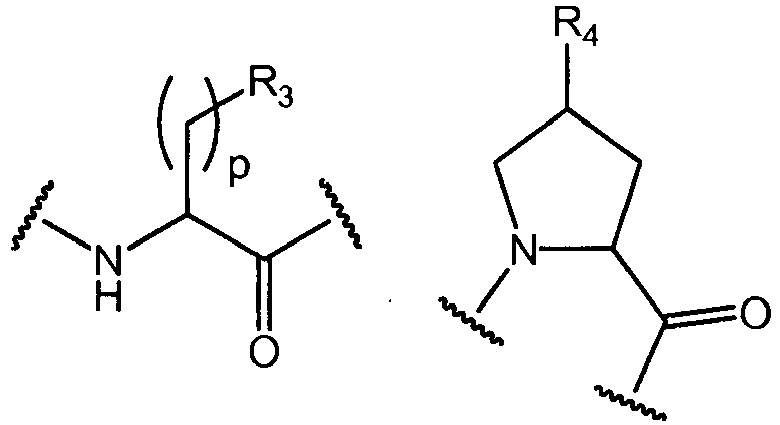
- p eine ganze Zahl von 0 bis 5 ist, und
- R3 eine Amino- oder eine Guanidinogruppe sein kann, oder eine -O-Guanidinogruppe wie im Canavaninrest, oder ein einfach oder mehrfach substituierter oder unsubstituierter Aryl- oder Heteroarylrest mit 5 bis 10 Ringatomen, wobei der Heteroarylring bis zu 3 Heteroatome enthalten kann ausgewählt aus N, S oder O, wobei der Substituent am Aryl- oder Heteroarylring ausgewählt ist aus -NH2, -CH2-NH2, -Amidino, -Hydroxyamidino, -Guanidino,-CH2-Guanidino, -Halogen, -Cl, -Br, -I, -CN, -CF3, Alkyl mit 1-3 C-Atomen oder Alkoxy mit 1-3 C-Atomen, -COOR5 mit R5 ein Wasserstoff oder eine Alkyl mit 1 bis 3 C-Atomen, und
- R4 ein H, OH oder -O-(CH2)q-R6 mit q eine ganze Zahl von 2 bis 4 und R6 eine Amino- oder Guanidinogruppe ist, und
- P3 ein beliebiger natürlicher oder unnatürlicher α-Amino- oder α-Iminosäure mit L- oder R-Konfiguration ist, und
- P4 eine α-Amino- oder α-Iminosäure ausgewählt aus folgenden Strukturen

- ist, wobei p, R3 und R4 definiert sind wie zuvor, und
- P5 ausgewählt ist aus
- einem -H oder -CO-X-R7 mit X entweder nicht vorhanden oder X gleich O oder NH, wobei R7 ein unsubstituierter oder gegebenenfalls einfach oder mehrfach substituierter verzweigter oder unverzweigter, gesättigter oder ungesättigter Alkylrest mit 1 bis 24 C-Atomen und 0 bis 3 Doppelbindungen ist, oder wobei R7 ein unsubstituierter oder gegebenenfalls einfach oder mehrfach substituierter Aryl-, Heteroaryl, Aralkyl-, Heteroaralkyl oder Cycloalkylrest mit 5 bis 20 Kohlenstoffatomen ist, wobei der Heteroarylring bis zu 3 Heteroatome enthalten kann ausgewählt aus N, S oder O, wobei der oder die gegebenenfalls vorhandenen Substituenten an R7 unabhängig voneinander ausgewählt werden aus -NH2, -CH2-NH2, -Amidino, -Hydroxyamidino, -Guanidino, -CH2-Guanidino, -Halogen, -Cl, -Br, -I, -CN, -CF3, Alkyl mit 1-3 C-Atomen oder Alkoxy mit 1-3 C-Atomen, -COOR5 mit R5 ein Wasserstoff oder eine Alkylgruppe mit 1 bis 3 C-Atomen, oder wobei R7 einen Cholesterolrest darstellt, oder
- einem Pyroglutamylrest oder einem anderen Amino- oder Iminosäurerest, oder
- einem -SO2-R7 wobei R7 definiert ist wie zuvor, oder
- einem unverzweigten oder verzweigten Alkyl mit 1 bis 10-C-Atomen, wobei der Alkylrest gegebenenfalls mit einem Halogen, einer NH2-, Guanidino-, COOH- oder COOR5-Gruppe modifiziert und R5 wie oben definiert ist, oder
- ein mit einem bifunktionellen Rest acyliertes Sphingosin bzw. mit einem bifunktionellen Rest acyliertes Sphingosyl-phosphorylcholin folgender Strukturen:


- Gemäß einer bevorzugten Ausführungsform enthalten die erfindungsgemäßen Verbindungen als P1-Reste die folgenden Strukturen:

- wobei R1 wie oben definiert ist und wobei das 4-Amidinobenzylamid-Derivat mit einem Wasserstoffatom als Rest R1 ganz besonders bevorzugt ist. Um eine verbesserte Membranpermeabilität der Inhibitoren zu erreichen, kann deren Hydrophobizität erhöht werden, indem Prodrugs der 4-Amidinobenzylamid-Derivate eingebaut werden (Ettmayer et al., J. Med. Chem. 2004, 47, 2393-2404), wobei der Rest R1 in diesen Fällen -OH, -O-CH3, -NH2, -O-CO-CH3 oder -CO-O-(CH2)m-CH3 mit m eine ganze Zahl von 1 bis 5 sein kann. Diese Prodrugs sind auch Gegenstand der vorliegenden Erfindung, Sie werden erst im Organismus in die inhibitorisch wirksamen Verbindungen mit freier Amidinogruppe umgewandelt.
- Bei P1 handelt es sich erfindungsgemäß um ein decarboxyliertes Argininmimetikum. Insbesondere sind dabei Benzamidin-Strukturen günstig. Verbindungen mit einem solchen P1-Rest weisen eine besonders geringe intrinsische Reaktivität auf.
- Die anderen genannten P1 Bausteine sind bekannte Argininmimetika, die für die Entwicklung von Inhibitoren der trypsinartigen Serinprotase Thrombin verwendet wurden (siehe Übersichtsarbeit Steinmetzer und Stürzebecher in Current Med. Chem. 2004, 11, 2297-2321). Die Synthese dieser Bausteine ist dem Fachmann bekannt.
- In einer weiteren bevorzugten Ausführungsform ist der Rest P2 eine basische Aminosäure in der L-Konfiguration, besonders bevorzugt sind die Aminosäurereste Arginin, Lysin sowie deren um eine Methylengruppe in der Seitenkette längeren oder kürzeren Homo- und Nor-Derivate. Ebenso sind Canavanin, 3- und 4-Amidinophenylalanin, 3- und 4-Aminomethylphenylalanin oder aber auch 3- und 4-Guanidinophenylalanin bevorzugte P2-Reste, wobei auch alle genannten Phenylalaninderivate als Homo- und Norderivate besonders geeignet sind. Als P2 Reste sind weiterhin auch Pyridylalanin und Homopyridylalanin bevorzugt, wobei der Stickstoff in jeder möglichen Position des Pyridylringes stehen kann.
- In einer weiteren bevorzugten Ausführungsform ist der P3-Rest ein beliebiger natürlicher oder unnatürlicher α-Amino- oder α-Iminosäurerest in der L-Konfiguration, wobei als ganz besonders bevorzugte Aminosäurereste die proteinogenen Amino- und Iminosäurereste geeignet sind.
- In einer weiteren bevorzugten Ausführungsform ist der Rest P4 eine basische Aminosäure in der L-Konfiguration, besonders geeignet sind die Aminosäurereste Arginin und Lysin sowie deren um eine Methylengruppe in der Seitenkette längeren oder kürzeren Homo- und Nor-Derivate. Ebenso sind Canavanin, 3- und 4-Amidinophenylalanin, 3- und 4-Aminomethylphenylalanin oder aber auch 3- und 4-Guanidinophenylalanin bevorzugte P4-Reste, wobei auch alle genannten Phenylalaninderivate als Homo- und Norderivate besonders geeignet sind. Als P4 Reste sind weiterhin auch Pyridylalanin und Homopyridylalanin bevorzugt, wobei der Stickstoff in jeder möglichen Position des Pyridylringes stehen kann.
- Der P5 Rest ist sehr variabel und kann entweder im einfachsten Fall nur ein Wasserstoffatom sein, bevorzugt ist er aber ein von natürlich vorkommenden Fettsäuren abgeleiteter hydrophober gesättigter oder gegebenenfalls auch ein oder mehrfach ungesättigter Acylrest, bevorzugt ist aber auch Aralkyl-CO-Rest, oder ein Heteroaralkyl-CO-Rest oder ein Sulfonylrest, wobei all diese Rest gegebenenfalls unsubstituiert oder mit bis zu drei Resten substituiert vorliegen können. Als Substituenten sind besonders geeignet: Halogene, im Besonderen Chloratome, Aminogruppen, Carboxylgruppen die auch als Ester vorliegen können, besonders als Ethylester, Amidino-, Hydroxyamidino-, Guanidino-, -CH2-Guanidino-, CF3- und Alkylgruppen mit 1-3 C-Atomen oder auch Alkoxygruppen mit 1-3 C-Atomen.
- Besonders geeignete P5 Gruppen auch die folgenden Strukturen:


- wobei z eine ganze Zahl von 1 bis 18 ist, ganz besonders bevorzugt ist z gleich 8, 14 oder 16 und auch mit einem bifunktionellen Rest acyliertes Shpingosin bzw. mit einem bifunktionellen Rest acyliertes Shpingosyl-phosphorylcholin folgender Strukturen:


- und wobei z eine ganze Zahl zwischen 2 und 20 ist.
- Gegenstand der Erfindung sind auch Verfahren zur Synthese der beschriebenen Verbindungen, wobei die Synthese durch Kombination von Festphasen- und Lösungssynthesen oder auch durch reine Lösungssynthese möglich ist.
- Bei der Synthese einer Verbindung gemäß der allgemeinen Formel (I) mittels Kombination von Festphasen- und Lösungssynthese werden folgende Schritte durchgeführt:
- Synthese des Segments P5-P4-P3-P2 durch Festphasenpeptidsynthese, beispielsweise an einem 2-Chlorotritylchlorid-Harz nach Standardverfahren der Fmoc-Chemie,
- anschließende Abspaltung des Peptidsegments vom Harz unter geeigneten sauren Bedingungen, wobei Seitenkettenschutzgruppen entweder erhalten oder abgespalten werden,
- Kopplung eines geeigneten P1-Bausteins mittels racemisierungsfreier Standardverfahren, der gegebenenfalls geschützt oder ungeschützt vorliegen kann, und gegebenenfalls
- Abspaltung aller eventuell noch vorhandenen Schutzgruppen, dazu gehört beispielsweise die Behandlung mit entsprechenden Säuren, beispielsweise mit Trifluoressigsäure, HBr in Eisessig, HCl in Eisessig, HF, Trifluormethansulfonsäure, wobei die Säuren gegebenenfalls nach Scavanger enthalten können, beispielsweise Wasser, Tri-isopropylsilan, Anisol, Dimethylsulfid oder andere gängige Scavanger mit freien Mercaptogruppen, gegebenenfalls werden noch vorhandene Schutzgruppen durch katalytische Hydrierung mit Wasserstoff und Palladium auf Aktivkohle als Katalysator entfernt, und
- finale Reinigung durch Kristallisation, Chromatographie, bevorzugt Umkehrphasen- oder Ionenaustauschchromatographie oder durch Gegenstromverteilung, und
- gegebenenfalls Überführung in eine andere bzw. geeignetere Salzform.
- Alternativ wird beispielsweise zur Synthese von Verbindungen mit einem C-terminalen Agmatinrest im ersten Schritt ein Tritylchlorid-Harz mit 1,4-Diaminobutan nach Standardverfahren beladen und nacheinander die restlichen Bausteine P2, P3, P4 mittels Fmoc-Chemie und P5 mittels Standardverfahren gekoppelt, es erfolgt die Abspaltung des Peptides vom Harz mit geeigneten Säuren oder säureenthaltenden Abspaltcocktails, wobei entweder alle Schutzgruppen entfernt werden oder aber bestimmte Schutzgruppen wie beispielsweise in der Seitenkette des Lysins erhalten bleiben, gefolgt vom finalen Aufbau der Guanidinogruppe durch Umsetzung von Aminogruppen mit PyrazolCarboxamidin x HCl und DIPEA entweder in DMF oder gegebenenfalls auch in organisch wässrigen Lösungsmitteln Natriumcarbonat enthaltend oder in reiner wässriger Natriumcarbonatlösung (Bernatowicz, M.S. et al., J. Org. Chem., 1992, 57, 2497-2502). Analog können auch beliebige andere Diamine für die Beladung des Tritylchlorid-Harzes verwendet werden. Wird am Ende auf die Umsetzung mit Pyrazolcarboxamidin verzichtet, erhält man die Verbindungen mit einer C-terminalen Aminogruppe.
- Für Synthesen im größeren Maßstab ("Upscaling") sind besonders Verfahren geeignet, bei denen nur reine Lösungssyntheseschritte angewendet werden. Üblicherweise beginnt die Lösungspeptidsynthese mit einem geeigneten C-terminalen P1-Baustein, an den der folgende Nα-urethan- und falls notwendig auch seitenkettengeschütze P2-Baustein gekoppelt wird, gefolgt von Abspaltung der Nα-Urethanschutzgruppe und Ankopplung des folgenden Nα-urethangeschützen Restes. Falls notwendig, können alle bei der Synthese auftretenden Intermediate gereinigt werden. Als Nα-Urethanschutzgruppe eignet sich besonders die Boc-Schutzgruppe. Die Synthese wird auf analoge Weise komplettiert, in den letzten Schritten wird der P5-Baustein gekoppelt und danach alle Schutzgruppen entfernt. Mittels dieser reinen Lösungssynthesestrategie können Racemisierungen bei den Kopplungsschritten minimiert werden, die oftmals ein Problem bei Segment-Kopplungen darstellen, wie sie oben bei der kombinierten Festphasen- und Lösungssynthese auftreten können. Eine Lösungssynthese umfasst beispielsweise folgende Schritte:
- a) Synthese eines an der terminalen Amidino- oder Guanidinogruppegeeignet geschützten P1-Bausteins mit freier Aminogruppe, die entweder als Salz oder freie Base vorliegen kann, z.B. von folgender Verbindung:

- b) Kopplung einer Nα-Boc oder anderweitig geeignet Nα-urethangeschützten Amino- oder Iminosäure mit geeigneter Seitenkettenschutzgruppe, falls notwendig, an die freie Aminogruppe des P1-Baustein, wobei prinzipiell alle geeigneten Kopplungsverfahren der Peptidchemie mit bekannten Hilfsbasen verwendet werden können, dazu gehören das Mischanhydridverfahren, Carbodiimidverfahren, Aktivesterverfahren, Azidverfahren, Propanphosphonsäureanhydrid-Ver-fahren oder Kopplung mit Triazimoch, TBTU, HBTU, BOP, PyBOP, HATU oder anderer Kopplungsreagentien basierend auf Uronium- oder Phosphoniumsalzen, gefolgt von einer Aufarbeitung des Reaktionsansatzes durch gängige Wasch- und Kristallisationsverfahren sowie gegebenenfalls gefolgt von einem Chromatographieschritt zur Reinigung, und gefolgt von standardmäßiger Abspaltung der Nα-Schutzgruppe unter Erhalt des P2-P1-Segments mit freier Aminogruppe am P2-Baustein, so wird beispielsweise für die Abspaltung der Nα-Boc-Schutzgruppe in der Regel Trifluoressigsäure oder HCl in einem geeigneten organischen Lösungsmittel wie Essigester, Essigsäure, Diethylether oder Dioxan verwendet,
- c) Kopplung einer Nα-Boc oder anderweitig geeignet Nα-urethangeschützten P3-Amino- oder Iminosäure an die freie Aminogruppe des P2-P1-Segments aus Schritt b) analog der im Schritt b) beschriebenen Methoden, gefolgt von der im Schritt b) beschriebenen Aufarbeitung des Reaktionsansatzes und der im Schritt b) beschriebenen Abspaltung der Nα-Schutzgruppe unter Erhalt des P3-P2-P1-Segments mit freier N-terminaler Aminogruppe am P3-Rest,
- d) Kopplung einer Nα-Boc oder anderweitig geeignet Nα-urethangeschützten P4-Amino- oder Iminosäure an die freie Aminogruppe des P3-P2-P1-Segments aus Schritt c) analog der im Schritt b) beschriebenen Methoden, gefolgt von der im Schritt b) beschriebenen Aufarbeitung des Reaktionsansatzes und der im Schritt b) beschriebenen Abspaltung der Nα-Schutzgruppe unter Erhalt des P4-P3-P2-P1-Segments mit freier N-terminaler Aminogruppe am P4-Rest,
- e) Kopplung des P5-Restes an die freie Aminogruppe des P4-P3-P2-P1-Segments aus Schritt d) gegebenenfalls analog der im Schritt b) beschriebenen Methoden, oder Kopplung eines bereits als Säurechlorid oder Aktivester, speziell als Succinimidester, vorliegenden P5-Bausteins in Gegenwart von Hilfsbasen ohne weiteres Kopplungsreagenz.
- f) Abspaltung aller noch vorhandenen Schutzgruppen durch gängige Verfahren, dazu gehört beispielsweise die katalytische Hydrierung mit Wasserstoff und Palladium auf Aktivkohle als Katalysator, oder die Behandlung mit entsprechenden Säuren, beispielsweise mit Trifluoressigsäure, HBr in Eisessig, HCl in Eisessig, HF, Trifluormethansulfonsäure, wobei die Säuren gegebenenfalls nach Scavanger enthalten können, beispielsweise Wasser, Triisopropylsilan, Anisol, Dimethylsulfid oder andere gängige Scavanger mit freien Mercaptogruppen, und
- g) finale Reinigung durch Kristallisation, Chromatographie, bevorzugt Umkehrphasen- oder Ionenaustauschchromatographie oder durch Gegenstromverteilung, und
- h) gegebenenfalls Überführung in eine andere bzw. geeignetere Salzform.
- Gegenstand der Erfindung sind auch Verfahren bei denen Segmentkopplungen in Lösung durchgeführt werden, wobei für solche Segmentkopplungen besonders racemisierungsfreie Verfahren verwendet werden, beispielsweise die Azidkopplung, bei der ein geeigneter N-terminal und seitenkettengeschützter Peptidmethylester durch Umsetzung in das Hydrazid überführt wird, aus dem dann mit Standardverfahren das Azid hergestellt wird, dass für die Kopplung an einen Baustein oder ein Segment mit freier Aminogruppe eingesetzt wird. Andererseits können auch andere Kopplungsverfahren genutzt werden, wobei besonders schwache Hilfsbasen, beispielsweise Collidin, verwendet werden, oder geeignete Additive, beispielsweise 6-Cl-HOBt, HOAt eingesetzt werden.
Für die oben genannten Verfahren können alle bekannten peptidchemischen Synthesemethoden, einschließlich sämtlicher Aminosäurederivate mit geeignetenschutzgruppen, geeignete Kopplungsreagentien, geeignete Abspaltreagentien in entsprechenden Lösungsmitteln eingesetzt werden, die ausführlich in Standardwerken der Peptidchemie und organischen Chemie detailliert beschrieben sind (Houben-Weyl Band E22, Synthesis of Peptides). - Gegenstand der Erfindung sind auch pharmazeutisch geeignete bzw. verträgliche Salze. Diese Salze müssen ein pharmazeutisch verträgliches Anion oder Kation aufweisen. Geeignete pharmazeutisch verträgliche Säureadditionssalze der erfindungsgemäßen Verbindungen sind z. B. Salze anorganischer Säuren, wie Salzsäure, Bromwasserstoff-, Phosphor-, Methaphosphor-, Salpeter-, Sulfon- und Schwefelsäure oder organischer Säuren, wie z. B. Essigsäure, Benzolsulfon-, Benzoe-, Zitronen-, Ethansulfon-, Fumar-, Glucon-, Glykol-, Isethion-, Milch-, Lactobion-, Malein-, Methansulfon-, Bernstein-, p-Tuluonsulfon-, Wein- und Trifluoressigessigsäure. Für medizinische Zwecke wird in besonders bevorzugter Weise das Chlor- oder Acetatsalz verwendet. Geeignete phamazeutisch verträgliche basische Salze sind z. B. Ammoniumsalze, Alkalimetallsalze (wie Natrium- und Kaliumsalze) und Erdalkalisalze (wie Magnesium- und Calciumsalze).
- Salze mit einem nicht pharmazeutisch verträglichen Anion gehören ebenfalls in den Rahmen der Erfindung als nützliche Zwischenprodukte für die Herstellung oder Reinigung pharmazeutisch verträglicher Salze und/oder für die Verwendung in nicht-therapeutischen, zum Beispiel in-vitro Anwendungen.
- Der im folgenden verwendete Begriff "physiologisch funktionelles Derivat" bezeichnet jedes physiologisch verträgliche Derivat einer erfindungsgemäßen Verbindung der Formel I, z. B. einen Ester, der bei Verabreichung an einen Säuger, wie z. B. den Menschen, in der Lage ist, (direkt oder indirekt) eine Verbindung der Formel I oder einen aktiven Metaboliten hiervon zu bilden. Zu den physiologisch funktionellen Derivaten zählen auch Prodrugs der erfindungsgemäßen Verbindung. Solche Prodrugs können in vivo zu einer erfindungsgemäßen Verbindung metabolisiert werden. Diese Prodrugs können selber wirksam sein oder nicht. Geeignete Prodrugs für Benzamidin-Gruppen sind beispielsweise Verbindungen, bei denen das Amidin als Hydroxyamidin, Methoxyamidin, Acetylhydroxyamidin, Alkyloxycarbonylamidin, speziell als Ethyloxycarbonylamidin oder Hexyloxycarbonylamidin vorliegen (Ettmayer . et al., J. Med. Chem. 2004, 47, 2393-2404).
- Die erfindungsgemäßen Verbindungen können auch in verschiedenen stereoisomeren Formen aber auch in polymorphen Formen vorliegen, z. B. als amorphe und kristalline polymorphe Formen.
- Nachfolgend beziehen sich alle Verweise auf Verbindungen gemäß Formel (I) wie vorstehend beschrieben, sowie auf deren Salze, Solvate und physiologisch funktionellen Derivate.
- Die vorliegende Erfindung betrifft auch die Verwendung der Verbindungen der Formel (I) als Arzneimittel zur Behandlung und Prophylaxe bakterieller und viraler Erkrankungen, sowie von Diabetes, Arteriosklerose, Krebs/Metastasierung, aber auch von Alzheimer oder der Ausbildung von Übergewicht, bei denen Furin oder analoge Proproteinkonvertasen, die hinter basischen P1-Resten spalten, beteiligt sind. Auch eine pharmazeutische Zusammensetzung enthaltend eine Verbindung der Formel (I) ist Gegenstand dieser Erfindung. Die Menge der Verbindung gemäß Formel (I), die erforderlich ist, um den gewünschten biologischen Effekt zu erreichen, ist abhängig von einer Reihe von Faktoren, z. B. der gewählten spezifischen Verbindung, der beabsichtigten Verwendung, der Art der Verabreichung und dem klinischen Zustand des Patienten. Zur Prophylaxe oder Therapie der oben genannten Zustände können die Verbindungen gemäß Formel (I) selbst als Verbindung verwendet werden, vorzugsweise liegen sie jedoch mit einem Träger oder Hilfsstoff in Form einer pharmazeutischen Zusammensetzung vor. Der Träger bzw. Hilfsstoff muss natürlich verträglich sein, in dem Sinn, dass er mit den anderen Bestandteilen der Zusammensetzung kompatibel und nicht gesundheitsschädlich für den Patienten ist.
- Der Träger kann ein Feststoff oder eine Flüssigkeit oder beides sein und wird vorzugsweise mit der Verbindung als Einzeldosis formuliert, beispielsweise als Tablette, die von 0,05% bis 95 Gew-% des Wirkstoffs enthalten kann. Weitere pharmazeutisch aktive Substanzen können ebenfalls vorhanden sein, einschließlich weiterer Verbindungen gemäß Formel (I). Die erfindungsgemäßen pharmazeutischen Zusammensetzungen können nach einer der bekannten pharmazeutischen Methoden hergestellt werden, die im Wesentlichen darin bestehen, dass die Bestandteile mit pharmakologisch verträglichen Träger-und/oder Hilfsstoffen gemischt werden.
- Erfindungsgemäße pharmazeutische Zusammensetzungen sind insbesondere solche, die für orale, rektale, topische, perorale (z. B. sublinguale) und parentale (z. B. subkutane, intramuskuläre, intradermale oder intravenöse) Verabreichung geeignet sind, wenngleich die geeignetste Verabreichungsweise in jedem Einzelfall von der Art und Schwere des zu behandelnden Zustandes und von der Art der jeweils verwendeten Verbindung gemäß Formel (I) abhängig ist. Auch Aerosole sind geeignete pharmazeutische Zusammensetzungen für die erfindungsgemäßen Verbindungen, die auch in Form von Aerosol-Sprays besonders für die Behandlung und Prophylaxe von Erkrankungen des Respirationstraktes geeignet sind. Auch dragierte Formulierungen und dragierte Retardformulierungen gehören in den Rahmen der Erfindung. Bevorzugt sind säure- und magensaftresistente Formulierungen. Geeignete magensaftresistente Beschichtungen umfassen Celluloseacetatphthalat, Polyvinylacetatphthalat, Hydroxypropylmethylcellulosephthalat und anionische Polymere von Methacrylsäure und Methacrylsäuremethylester.
- Geeignete Pharmazeutische Verbindungen für die orale Verabreichung können in separaten Einheiten vorliegen, wie zum Beispiel Kapseln, Oblatenkapseln, Lutschtabletten oder Tabletten, die jeweils eine bestimmte Menge der Verbindung gemäß Formel (I) enthalten; als Pulver oder Granulate; als Lösung oder Suspension in einer wässrigen oder nicht-wässrigen Flüssigkeit; oder als eine Öl-in-Wasser- oder Wasser-in-Öl-Emulsion. Diese Zusammensetzungen können, wie bereits erwähnt, nach jeder geeigneten pharmazeutischen Methode zubereitet werden, die einen Schritt umfasst, bei dem der Wirkstoff und der Träger (der aus einem oder mehreren zusätzlichen Bestandteilen bestehen kann) in Kontakt gebracht werden. Im Allgemeinen werden die Zusammensetzungen durch gleichmäßiges und homogenes Vermischen des Wirkstoffs mit einem flüssigen und/oder fein verteilten festen Träger hergestellt, wonach das Produkt, falls erforderlich, geformt wird.
- So kann beispielsweise eine Tablette hergestellt werden, indem ein Pulver oder Granulat der Verbindung verpresst oder geformt wird, gegebenenfalls mit einem oder mehreren zusätzlichen Bestandteilen. Gepresste Tabletten können durch Tablettieren der Verbindung in frei fließender Form, wie beispielsweise einem Pulver oder Granulat, gegebenenfalls gemischt mit einem Bindemittel, Gleitmittel, inertem Verdünner und/oder einem (mehreren) oberflächenaktiven/dispergierenden Mittel in einer geeigneten Maschine hergestellt werden. Geformte Tabletten können durch Formen der pulverförmigen, mit einem inerten flüssigen Verdünnungsmittel befeuchteten Verbindung in einer geeigneten Maschine hergestellt werden.
- Pharmazeutische Zusammensetzungen, die für eine perorale (sublinguale) Verabreichung geeignet sind, umfassen Lutschtabletten, die eine Verbindung gemäß Formel (I) mit einem Geschmacksstoff enthalten, üblicherweise Saccharose oder Gummi arabicum oder Tragant, und Pastillen, die die Verabreichung einer inerten Basis wie Gelatine und Glycerin oder Saccharose und Gummi arabicum umfassen.
- Geeignete pharmazeutische Zusammensetzungen für die parentale Verabreichung umfassen vorzugsweise sterile wässrige Zubereitungen einer Verbindung gemäß Formel (I), die vorzugsweise isotonisch mit dem Blut des vorgesehenen Empfängers sind. Diese Zubereitungen werden vorzugsweise intravenös verabreicht, wenngleich eine Verabreichung auch subkutan, intramuskulär oder intradermal als Injektion erfolgen kann.
- Diese Zubereitungen können vorzugsweise hergestellt werden, indem die Verbindung mit Wasser gemischt wird und die erhaltene Lösung steril und mit dem Blut isotonisch gemacht wird. Injizierbare erfindungsgemäße Zusammensetzungen enthalten im Allgemeinen von 0,1 bis 5 Gew.-% der aktiven Verbindung.
- Bezüglich der weiteren Formulierung wird auf gängige Handbücher verwiesen.
- Die Erfindung betrifft auch Verfahren zur Herstellung von pharmazeutischen Zusammensetzungen, bei denen man eine oder mehrere Verbindungen der allgemeinen Formel (I) mit geeigneten Träger- und Hilfsstoffen (siehe oben) vermischt.
- Besonders vorteilhaft kann die erfindungsgemäße Verbindung oder ein erfindungsgemäßes Arzneimittel zur Therapie oder Prophylaxe einer viral oder bakteriell bedingten Erkrankung sowie zur Therapie und Phrophylaxe von Diabetes, Arteriosklerose, Krebs, Alzheimer oder Übergewicht eingesetzt werden, insbesondere in oraler, subkutaner, intravenöser oder transdermaler Form oder in Form eines Sprays zur Behandlung von Erkrankungen im Respirationstrakt.
- Vorteilhaft kann die erfindungsgemäße Verbindung oder ein erfindungsgemäßes Arzneimittel dabei zur Therapie oder Prophylaxe von Erkrankungen hervorgerufen durch bakterielle Erreger, insbesondere hervorgerufen durch Erreger aus der Gruppe Pseudomonas spec., Shigella spec., Corynebacterium diphtheriae, Bacillus cereus, Bacilllus anthracis, Bacillus butulinum, Clostridium perfringens, Clostridium difficile, Clostridium septicum, Clostridium sprioforme, Bordetella pertussis, Samonella enterica oder durch ausgewählten Escherichia coli-Stämmen, insbesondere E.coli-Stämme, die hämolytische Kolitits, das Hämolytische uraemisches Syndrom und/oder Nierenversagen verursachen, ganz insbesondere E.coli 0157-H7 eingesetzt werden.
- Bei der Therapie oder Prophylaxe von Erkrankungen hervorgerufen durch Viren, kann die Verbindung oder das Arzneimittel insbesondere bei Erkrankungen hervorgerufen durch Viren der Gruppe
- ■ hochpathogene aviäre Influenza A-Viren, vor allem der H5- bzw. H7-Subtypen,
- ■ RNA-Negativstrangviren wie den Parainfluenzaviren, das Masern-Virus, das Mumpsvirus, das Hundestaupevirus, das Respiratorische-Syncytial-Virus, Filoviren wie das Ebola- und Marburg-Virus und das Newcastle-Disease-Virus, sowie .
- ■ Plusstrang-RNA-Viren, wie HIV-1, HIV-2, HTLV und andere Retroviren, insbesondere Coronaviren wie das SARS-Coronavirus, die Flaviviren, Gelbfieber-Viren, West-Nile-Virus., Dengue-Virus.oder das Frühsommer-Meningo-Encephalitis-Virus, das Venezuelan equine encephalitis Virus oder das Rift Valley Fever Virus verwendet werden.
- Man erkennt, dass die erfindungsgemäße Verbindung oder das erfindungsgemäße Arzneimittel ganz besonders vorteilhaft zur Hemmung der Proproteinkonvertasen Furin, PC1/3, PC2, PC4, PC5/6, PACE4 und/oder PC7 verwendet werden kann. Weitere Merkmale, Einzelheiten und Vorteile der Erfindung ergeben sich aus dem Wortlaut der Ansprüche sowie aus der folgenden Beschreibung von Ausführungsbeispielen anhand der Zeichnungen. Es zeigen:
- Fig. 1
- die Hemmung der HA-Spaltung des Vogelgrippevirus durch unterschiedliche Konzentrationen des Inhibitors 1 und des Referenzinhibitors Dec-Arg-Val-Lys-Arg-CMK
- Fig. 2
- die multizyklische Vermehrung des FPV in Zellkultur in Gegenwart von Inhibitor 1 und ohne Inhibitor.
- Eine detaillierte Beschreibung der Figuren findet sich bei der Beschreibung der Beispiel 7 und 8.
- Zur analytischen reversed-phase-HPLC wurde eine HPLC-Anlage LC-10A der Firma Shimadzu, bestehend aus den Teilsystemen CTO-10A Säulenofen, LC-10ATvp Pumpen (2 x), DGU-14A Degaser, SIL-10Axl Autoinjektor, SCL-10Avp Systemcontroller, SPD-M10Avp Photodiodenarraydetektor und einer Säule 250/4,6 Nucleodur 100-5 C18 ec der Firma Macherey-Nagel (Düren, Deutschland), unter Benutzung der zugehörigen Software Shimadzu CLASS-VP, Version 7.2.1, verwendet. Die Detektion erfolgte bei 220 nm. Als Elutionsmittel dienten Wasser mit 0,1 % TFA (A) und Acetonitril mit 0,1 % TFA (B) bei einer Flussrate von 1 mL/min und einem linearen Gradienten (Anstieg von 1 % B/min). Die jeweiligen Startbedingungen (% B) sind bei den Synthesen angegeben.
- Zur präparativen RP-HPLC wurde eine HPLC-Anlage der Firma Varian, bestehend aus den Teilsystemen Varian PrepStar Model 218 präparative Pumpen (2 x), Varian ProStar Model 320 UV-Vis Detektor, Varian Fraktionssammler Model 701, und einer Säule VP 250/32 Nucleodur 100-5 C8 ec der Firma Macherey-Nagel (Düren, Deutschland), unter Benutzung der zugehörigen Star-Software V. 6.0 verwendet. Die Detektion erfolgte bei 220 nm. Als Elutionsmittel dienten ebenfalls Wasser mit 0,1 % TFA (A) und Acetonitril mit 0,1 % TFA (B) bei einer Flussrate von 20 mL/min und einem geeigneten Gradienten.
- Die Spektren wurden mit einem Gerät der Firma Applied Biosystems (QTrap 2000) oder einem Spektrometer vom Typ Autospec der Firma Micromass aufgenommen.
- Für die Dünnschichtchromatographie wurden Kieselgel-Fertigplatten Adamant UV254 der Firma Macherey-Nagel verwendet. Als Laufmittel diente ein Gemisch aus n-Butanol, Eisessig und Wasser (4:1:1). Die Detektion der Verbindungen erfolgte durch UV-Absorption bei 254 nm. Zusätzlich wurden zur Detektion als Sprühreagenzien eine Ninhydrinlösung (300 mg Ninhydrin gelöst in 100 mL n-Butanol und 3 mL Eisessig) und nach Inkubation der DC-Platte in Chloratmosphäre eine o-Tolidinlösung (150 mg o-Tolidin und 2,1 g Kl gelöst in 2 mL Eisessig und 148 mL Wasser) verwendet.
- Die 1H- und 13C-NMR-Spektren wurden mit einem NMR-Spektrometer vom Typ ECX-400 der Firma Jeol Inc. USA aufgenommen (1H-NMR: 400 MHz, 13C-NMR: 100 MHz). Die Proben wurden in kommerziell erhältlichen deuterierten Lösemitteln der handelsüblichen Qualitäten gelöst. Die chemischen Verschiebungen wurden als δ-Werte in parts per million (ppm) angegeben, als Referenz wurden die Lösungsmittelsignale verwendet.
-
- Ac
- Acetyl
- Amb
- Amidobenzyl
- Boc
- tert.-Butyloxycarbonyl
- Bzl
- Benzyl
- Cbz
- Benzyloxycarbonyl
- DIPEA
- Diisopropylethylamin
- DCM
- Dichlormethan
- DMF
- N,N-Dimethylformamid
- Fmoc
- Fluorenylmethyloxycarbonyl
- hArg
- Homoarginin
- HBTU
- O-Benzotriazol-N,N,N',N'-tetramethyl-uronium-hexafluoro-phosphat
- HPLC
- Hochleistungs-Flüssigkeitschromatographie
- i.V.
- im Vakuum
- LM
- Lösungsmittel
- MS
- Massenspektroskopie
- NMM
- N-Methylmorpholin
- NMP
- N-Methylpyrrolidon
- NMR
- Nukleare Magnetresonanzspektroskopie
- Phac
- Phenylacetyl
- PyBOP
- Benzotriazol-1-yl-N-oxy-tris(pyrrolidino)phosphoniumhexafluoro-phosphat
- PyBrOP
- Bromo-tris-pyrrolidino-phosphonium-Hexafluorophosphat
- RT
- Raumtemperatur
- tBu
- tert.-Butyl
- TFA
- Trifluoressigsäure
- Tfa
- Trifluoracetyl
- THF
- Tetrahydrofuran
- Alle eingesetzten Fmoc-Aminosäuren, Harze, Kupplungsreagentien und anderen Reagentien für die Synthesen wurden von den Firmen Orpegen, Iris Biotech, Novabiochem, Bachem, Aldrich, Fluka oder Acros bezogen.
-
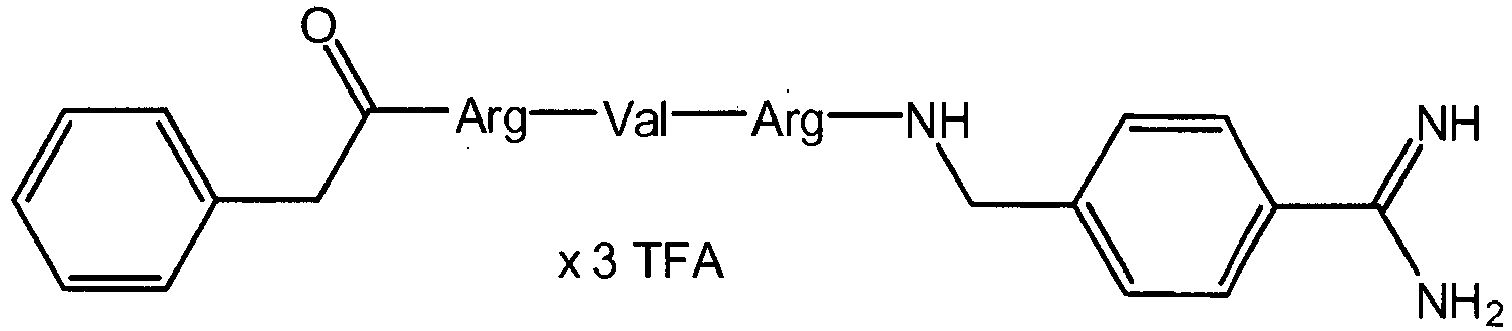

-

- 10 g (32,5 mmol) Boc-4-Acetylhydroxyamidinobenzylamid (hergestellt analog Schweinitz, A. et al., Med. Chem., 2006, 2, 349-361) wurden in 300 mL 90 % Essigsäure gelöst, mit 650 mg Katalysator (10% Pd/C) versetzt und mit Wasserstoff 6 h bei ca. 35° C und 36 h bei RT hydriert. Der Katalysator wurde abfiltriert und das LM i.V. entfernt. Der verbliebene Rückstand wurde in 150 mL Wasser gelöst, mit 40 mL konzentrierter HCl versetzt und 1,5 h gerührt. Die Lösung wurde i.V. eingeengt, der Rückstand wieder in Wasser gelöst und das LM i.V. eingeengt. Erneutes Lösen in Wasser und Lyophilisieren liefert das Produkt (weißlicher Feststoff, 6.8 g (30,6 mmol)).
- 1H-NMR (400 MHz, D2O): δ [ppm] = 4,46 (s, 2 H, H-1), 7,80-8,01 (2d, 4 H, arom.). 13C-NMR (100 Mhz, D2O): δ [ppm] = 42,64 (2 H, H-1), 128,65 (2 H, H-3), 129,26 (1 H, H-5), 129,61 (2 H, H-4), 138,69 (1 H, H-2), 166,47 (1 H, H-6).
- Die Beladung des 2-Chlor-Tritylchlorid-Harzes (1,5 g) mit Fmoc-Arg(Pbf)-OH erfolgte in einem Glasgefäß mit Frittenboden analog einer Standardprozedur des Herstellers mit äquimolaren Mengen an Fmoc-Arg(Pbf)-OH (1,51 g, 2,325 mmol) und 4 eq. DIPEA (9,3 mmol, 1,55 mL) bezogen auf die angegebene Harzbeladung (1,55 mmol/g) in trockenem DCM über einen Zeitraum von 2 h. Danach wurde die Reaktionslösung abgesaugt, das Harz 3 x mit DCM/Methanol/DIPEA (85/10/5 (v/v)), 3 x mit DCM, 2 x mit DMF und 2 x mit DCM gewaschen und getrocknet. Anschließend wurden die restlichen Bausteine mittels eines Standard-Fmoc-Syntheseprotokolls manuell gekoppelt, wobei im letzten Schritt Phenylessigsäure an Stelle einer Fmoc-Aminosäure verwendet wurde. Nach Beendigung der Synthese wurde das Harz mehrfach mit DMF und DCM gewaschen. Die Abspaltung vom Harz erfolgte mit 1 % TFA in DCM (v/v) in 30 min unter Schütteln. Die Abspaltlösung wurde herausgedrückt und i.V. eingeengt, anschließend wurde die Abspaltung vom Harz unter identischen Bedingungen 2 x wiederholt. Das Produkt wurde mit 80 % tert.Butanol lyophilisiert und direkt für den nächsten Syntheseschritt verwendet (weißes Pulver, HPLC: Start bei 30 % B, Elution bei 35,57 min, MS ber. 1051,5, MS gef. 1074,3 (M+Na)+).
- 105 mg (0,1 mmol) Phac-Arg(Pbf)-Val-Arg(Pbf)-OH als Rohprodukt, 50,9 mg (0,3 mmol) 6-Cl-HOBt, 23 mg (0,1 mmol) 4-Amidinobenzylamid x 2 HCl und 57,3 mg (0,11 mmol) PyBOP wurden in 500 µL DMF gelöst und mit 51,4 µL (0,3 mmol) DIPEA versetzt. Der Ansatz wurde 2 h bei RT gerührt. Das LM wurde i.V. entfernt und der verbleibende ölige Rückstand mit 2 mL einer Mischung aus 95 % TFA, 2,5 % Triisopropylsilan und 2,5 % Wasser (v/v) versetzt. Nach 3 h schütteln bei RT wurde das Produkt durch Zugabe von Diethylether gefällt, abzentrifugiert und das Präzipitat 2 x mit Diethylether gewaschen. Die Reinigung erfolgte durch präparative HPLC, die produktenthaltenden Fraktionen wurden vereint und lyophilisiert (weißes Pulver 60 mg, (HPLC: Start bei 1 % B, Elution bei 24,17 min, MS ber. 678,4, MS gef. 679,4 (M+H)+).
-

- 100 mg Tritylchlorid-Harz wurden mit 4-fachem Überschuss an 1,4-Diaminobutan (0,6 mmol) bezogen auf die angegebene Harzbeladung (1,5 mmol/g) des Herstellers in den Reaktionsgefäßen des Peptidsyntheseautomaten (Syro 2000, Multisyntech GmbH, Witten, Deutschland) mit trockenem THF als LM über einen Zeitraum von 2 h beladen. Danach wurde das LM abgesaugt und das Harz 3 x mit DCM/Methanol/DIPEA (85/10/5 (v/v)), 3 x mit DCM, 2 x mit DMF und 2 x mit DCM gewaschen.
Die folgenden Syntheseschritte erfolgten mittels eines multiplen Peptidsyntheseautomaten nach einem Standard-Fmoc-Protokoll in DMF/NMP mit Doppelkopplung und jeweils 4-fachen Überschüssen an Fmoc-Aminosäure, HOBt und HBTU in Gegenwart von 8 Äquivalenten DIPEA. Für die Fmoc-Abspaltung wurde jeweils eine Mischung aus Piperidin/DMF/NMP (1:1:1) verwendet. Im letzten Synthesezyklus wurde Phenylessigsäure analog einer normalen Fmoc-Aminosäure gekoppelt. Nach Beendigung der Synthese wurde das Harz mehrfach mit DMF und DCM gewaschen.
Die Reaktionsgefäße wurden aus dem Automaten entfernt und das Harz mit 2 mL einer Mischung aus 95 % TFA, 2,5 % Triisopropylsilan und 2,5 % Wasser (v/v) versetzt. Nach 2 h schütteln bei RT wurde die Abspaltlösung herausgedrückt und das Produkt durch Zugabe von Diethylether gefällt und abzentrifugiert. Das erhaltene Präzipitat wurde 2 x mit Diethylether gewaschen und anschließend durch präparative HPLC gereinigt, die produktenthaltenden Fraktionen vereint und lyophilisiert (weißes Pulver, HPLC: Start bei 1 % B, Elution bei 22,3 min, MS ber. 617,79, MS gef. 309,68 (M+2H)2+/2). - 48 mg (ca. 0,05 mmol) an Phac-Arg-Val-Arg-NH-(CH2)4-NH2 x 3 TFA wurden in einer Mischung aus 1 mL DMF und 1 mL 1 M Na2CO3-Lösung mit 0,15 mmol Pyrazolcarboxamidin x HCl und 0,2 mmol DIPEA versetzt. Der Ansatz wurde bei RT 36 h gerührt, das LM i.V. entfernt und das Produkt durch präparative HPLC gereinigt und lyophilisiert (weißes Pulver, HPLC: Start bei 1 % B, Elution bei 23,3 min, MS ber. 659,8, MS gef. 660,4 (M+H)+).
-

-

- 210,4 mg (1 mmol) 4-(Tfa-Amidomethyl)-Piperidin (Steinmetzer et al., J. Enz. Inhib., 1999, 14, 203-216) wurden mit 174 µL (1 mmol) DIPEA in 2,5 mL DMF gelöst. Unter Eiskühlung wurden 240 mg (1,1 mmol) Boc2O zugegeben, der Ansatz wurde 1 h unter Eiskühlung und über Nacht bei RT gerührt, anschließend das LM i.V. entfernt, der Rückstand in EE aufgenommen, 3 x mit 5 % KHSO4-Lsg. und 3 x mit ges. NaCl-Lösung gewaschen und mit Na2SO4 getrocknet. Das LM wurde erneut i.V. entfernt (öliger Rückstand, der bei 4 °C langsam kristallisiert). Das Zwischenprodukt wurde mit 3 mL Dioxan und 3 mL 1 M NaOH gelöst und bei 40 °C für 3 h gerührt. Im Anschluß wurden 10 mL Wasser zugesetzt und das Produkt 3 x mit DCM extrahiert. Die vereinten DCM-Phasen wurden mit Na2SO4 getrocknet und anschließend das LM i.V. entfernt (weißer Feststoff, HPLC: Start bei 1 % B, Elution bei 26,6 min).
- Die Kopplung von N-Boc-(4-Aminomethyl)-Piperidid an Phac-Arg(Pbf)-Val-Arg(Pbf)-OH (erhalten aus Schritt b des Synthesebeispiels 1) aus erfolgte analog des Schritts c aus Synthesebeispiel 1. Nach Abspaltung der am Peptid verbliebenen Pbf- und Boc-Schutzgruppen mit einer Mischung aus 95 % TFA, 2,5 % Triisopropylsilan und 2,5 % Wasser (v/v) über einen Zeitraum von 2 h bei RT wurde das in der Abspaltlösung enthaltene Zwischenprodukt durch Zugabe von Diethylether gefällt und abzentrifugiert, das Präzipitat 2 x mit Diethylether gewaschen und i.V. getrocknet. Das Produkt wurde durch präparative HPLC gereinigt, die produktenthaltenden Fraktionen wurden vereint und lyophilisiert (weißes Pulver, HPLC: Start bei 1 % B, Elution bei 22,7 min, MS ber. 643,43, MS gef. 644,5 (M+H)+.
- Der Aufbau der Guanidinogruppe erfolgte durch Umsetzung des Phac-Arg-Val-Arg-4-(Amidomethyl)-Piperidin x 3 TFA mit Pyrazolcarboxamidin x HCl und DIPEA analog der im Schritt b des Beispiels 2 beschriebenen Prozedur. Das Produkt wurde durch präparative HPLC gereinigt und lyophilisiert (weißes Pulver, HPLC: Start bei 1 % B, Elution bei 24,0 min, MS ber. 685,5, MS gef. 686,6 (M+H)+.
- Analog der Synthesestrategie für die Inhibitoren 2 und 2a wurden weitere Verbindungen hergestellt. Für den ersten Syntheseschritt, die Beladung des Tritylchlorid-Harzes (je ca. 100 mg mit einer Ausgangsbeladung von 1,5 mmol/g) wurde jeweils das entsprechende Diamin-Derivat eingesetzt, beispielsweise 1,3-Diaminopropan für die Inhibitoren 4 und 4a, oder p-Diaminoxylol für die Verbindungen 6 und 6a. Die Strukturen der Inhibitoren sind in Tabelle 1 zusammengefasst, alle Verbindungen wurden nach präparativer HPLC als TFA-Salze erhalten.
Tabelle: 1 Hemmstoffe der allgemeinen Struktur Phac-Arg-Val-Arg-P1. Nr. des Inhibitors P1 HPLC (% B) MS ber. MS qef. (M+H)+ 4 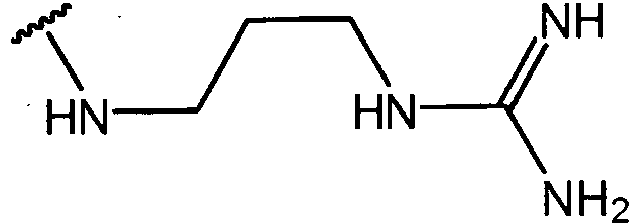
23,7 645,4 646,5 4a 
23,0 603,4 604,6 5 
25,4 673,4 674,7 5a 
23,8 631,4 632,5 6 
26,3 707,4 354,7* 6a 
25,2 656,4 333,7* 7 
26,9 707,4 708,6 7a 
25,7 656,4 333,8* *oder (M+2H)2+/2 - Die Inhibitoren 8-11 wurden entsprechend der folgenden Synthesestrategie nach oben beschriebenen Standardverfahren hergestellt, als Lysin-Drivat wurde Fmoc-Lys(Cbz)-OH für die Festphasenpeptidsynthese eingesetzt.
- Die Synthese erfolgte analog des Schritts a) im Synthesebeispiel 2 unter Verwendung von Tritylchlorid-Harz und Fmoc-Lys(Cbz)-OH als Baustein, allerdings ohne Abspaltung der Schutzgruppen und des Peptids vom Harz.
- Die Abspaltung der Pbf-Schutzgruppe und des Peptids vom Phac-Arg(Pbf)-Val-Lys(Cbz)-NH-(CH2)4-NH-Trityl-Harz erfolgte mit einer Mischung aus 95 % TFA, 2,5 % Triisopropylsilan und 2,5 % Wasser (v/v) über einen Zeitraum von 1,5 h bei RT unter Erhalt von Phac-Arg-Val-Lys(Cbz)-NH-(CH2)4-NH2 als 2 x TFA-Salz. Das Produkt wurde mit Diethylether gefällt, 2 x mit Diethylether gewaschen und durch präparative HPLC gereinigt (Inhibitor 8, weißes lyophilisiertes Pulver nach präparativer HPLC, HPLC: Start bei 1 % B, Elution bei 36,2 min, MS ber. 723,4, MS gef. 724,6 (M+H)+).
- Phac-Arg-Val-Lys(Cbz)-NH-(CH2)4-NH2 x 2 TFA (Inhibitor 8) wurde mit 3-fachem Überschuss an Pyrazolcarboxamidin x HCl und 4-fachem Überschuss an DIPEA in DMF umgesetzt. Das Produkt wurde durch präparative HPLC gereinigt (Inhibitor 9, weißes lyophilisiertes Pulver nach präparativer HPLC, HPLC: Start bei 1 % B, Elution bei 36,8 min, MS ber. 765,5, MS gef. 766,5 (M+H)+.
- Phac-Arg-Val-Lys(Cbz)-Agmatin x 2 TFA (Inhibitor 9) wurde mit H2 und 10 Massenprozent Pd/C als Katalysator in 90 % Essigsäure 12 h bei RT hydriert und das Produkt durch präparative HPLC gereinigt (Inhibitor 10, weißes lyophilisiertes Pulver nach präparativer HPLC, HPLC: Start bei 1 % B, Elution bei 23,1 min, MS ber. 631,4, MS gef. 316,7 (M+2H)2+/2).
- Phac-Arg-Val-Lys-Agmatin x 3 TFA (Inhibitor 10) wurde mit einer Mischung aus gleichen Volumina DMF und 1 M Na2CO3-Lösung mit ca. 3 eq. Pyrazolcarboxamidin x HCl und 4 eq. DIPEA analog Schritt b des Beispiels 2 umgesetzt (Inhibitor 11, weißes lyophilisiertes Pulver nach präparativer HPLC, HPLC: Start bei 1 % B, Elution bei 24,3 min, MS ber. 673,4, MS gef. 674,4 (M+H)+.
- Die Bestimmung der Hemmwirkung wurde mit einem Fluoreszenz-Plattenreader Safire2 der Firma Tecan (λEx = 380 nm, λEm = 460 nm) und Pyr-Arg-Thr-Lys-Arg-AMC (Bachem, Nr.: I-1650) als Substrat durchgeführt. Rekombinant hergestelltes humanes Furin (Kacprzak, M.M. et al., J. Biol. Chem., 2004, 279, 36788-36794) wurde im Messansatz in einer Konzentration von ca. 0,95 nM verwendet.
Für die Bestimmung der Hemmkonstanten wurde bei einer gleichbleibenden Substratkonzentration (12,5 µM im Ansatz) die Inhibitorkonzentration mindestens über den Bereich einer Größenordnung variiert, und jeweils die steady-state Geschwindigkeit bestimmt. Parallel zu jeder Inhibitormessung wurden mittels einer v/S-Charakteristik Km und Vmax ermittelt. Die Berechnung der Ki-Werte erfolgte durch Anpassung der bestimmten Geschwindigkeiten als Funktion der Inhibitorkonzentration an die Geschwindigkeitgsgleichung für kompetitiv reversibelbindende Inhibitoren:
Tabelle 2: Ki-Werte (µM) ausgewählter Inhibitoren für die Hemmung von Furin Inhibitor Ki-Wert (µM) 1 0,0014 2 0,077 2a 25 3 0,068 3a 10 4 0,097 4a 1,3 5 1,6 10 0,049 11 0,047 - Das HA-Oberflächenprotein des Vogelgrippevirus (gehört zu den hochpathogenen Influenzaviren der Subtypen H5 und H7) wird als Vorläuferprotein HA0 hergestellt. HA0 wird an einer multibasischen Spaltstelle durch die Protease Furin oder durch ein furinähnliches Enzym hydrolysiert, diese Proteasen kommen praktisch in allen Zellen vor. Dabei entsteht die Untereinheit HA1 und die membrangebundene Untereinheit HA2. Diese Spaltung ist Voraussetzung für die Bildung infektiöser Viren, damit sie mit der Endosomenmembran der Zielzelle fusionieren können. Inhibiert man die proteolytische Spaltung von HA in HA1 und HA2, werden die Fusion und damit auch die weitere Vermehrung der Viren gehemmt. Mit Vogelgrippeviren infizierte Zellen wurden mit unterschiedlichen Konzentrationen des Inhibitors 1 und eines bereits früher beschriebenen Kontrollinhibitors (Decanoyl-Arg-Val-Lys-Arg-Chlormethylketon, Hallenberger, S. et al., Nature, 1992, 360, 358-361) versetzt und die Spaltung des HA untersucht.
- In
Figur 1 ist die Hemmung der HA-Spaltung des Vogelgrippevirus durch unterschiedliche Konzentrationen des Inhibitors 1 und des Referenzinhibitors Dec-Arg-Val-Lys-Arg-CMK dargestellt. - Das Gelbild A zeigt dabei die Ergebnisse folgenden Experimentes: Konfluente MDCK Zellkulturen wurden mit Influenzavirus A/FPV/Rostock/34 (H7N1) bei einer MOI von 10 pro Zelle infiziert. 16 Stunden nach Infektion wurden die Zellen lysiert und die Hemmung der HA-Spaltung (PSKKRKKR↓GLFG) in Abhängigkeit der Inhibitorkonzentration mittels SDS-PAGE und Western-Blotting untersucht. Die viralen Proteine wurden immunchemisch mit einem Kaninchen-Anti-FPV-Serum unter Verwendung des ECL-Tests der Firma Pierce nachgewiesen: HA0 (82 kDa), Nucleoprotein NP (56 kDa) und HA1 (∼50 kDa), wobei HA2 (32 kDa) mit dem verwendeten Antiserum nicht nachweisbar ist.
- Die statistische Auswertung ist in Bild B der
Figur 1 dargestellt. Man erkennt die Quantifizierung der Hemmung der HA-Spaltung. Es wurden jeweils drei unabhängige Experimente für beide Inhibitoren durchgeführt, die Quantifizierung erfolgte mittels eines zweiten monoklonalen Antikörpers, der mit einem IR-Farbstoff markiert und mit dem LI-COR Odyssey Image-System nachweisbar ist. Die maximale Menge an HA0 bei 50 µM Dec-Arg-Val-Lys-Arg-CMK wurde als 100 %ige Hemmung der Spaltung gesetzt. Die Intensitäten der HA0-Banden bei den unterschiedlichen Inhibitorkonzentrationen wurden mit der Intensität der Banden für das Nucleoprotein (NP bei 56 kDa) normiert. - In einem weiteren Experiment wurden die Langzeiteffekte des Inhibitors 1 auf die multizyklische Vermehrung des Vogelgrippevirus (FPV) untersucht (Methode siehe Garten et al., Virology 1989, 172, 25-31). MDCK-Zellen wurden mit FPV bei niedriger Multiplizität der Infektion (MOI) von 10-5 infiziert und in Gegenwart einer Konzentration von 25 µM an Inhibitor 1 über einen Zeitraum von 72 h inkubiert. Zur Kontrolle wurden die infizierten Zellen ohne Inhibitor inkubiert. Die Vermehrung des FPV wurde durch Virustitration in den Zellkulturüberständen mit einem Standard Hämagglutinations-Test untersucht (Garten et al., Virology 1989, 172, 25-31, Figur 3). Die Virusfreisetzung in der mit dem Inhibitor behandelten Gruppe ist im Vergleich zur unbehandelten Kontrollgruppe um ca. 24 h verzögert. Die verzögerte Virusvermehrung in Gegenwart des Inhibitors macht auch deutlich, dass die Vitalität der Zellen durch den Inhibitor nicht beeinflusst wird.
-
Figur 2 zeigt die multizyklische Vermehrung des FPV in Zellkultur in Gegenwart (ungefüllte Balken) von Inhibitor 1 (25 µM) und ohne Inhibitor (gefüllte Balken). MDCK-Zellkulturen wurden mit dem Influenza-Stamm A/FPV/Rostock/34 (H7N1) bei einem MOI von 10-5 pro Zelle bei 37 °C inkubiert. Bei den angegebenen Zeitpunkten (10, 18, 32, 48, 60, and 72 h nach Infektion) wurde die Virusmenge im Medium mit dem Hämagglutinationstest bestimmt. Es sind die Mittelwerte von vier unabhängigen Experimenten gezeigt. - Entsprechend der oben beschriebenen Methoden wurden auch für die in Tabelle 3 dargestellten synthetisierten Inhibitoren die Ki-Werte zur Hemmung des Furins bestimmt.
Tabelle 3: Strukturen weiterer synthetisierter Inhibitoren und Ki-Werte zur Hemmung des Furins für ausgewählte Inhibitoren (n.b. = nicht bestimmt). Nr. Struktur HPLC min MS ber. MS gef. Ki (µM) 12 
13,64 541,69 542,21 (M+H)+ 41,21 13 
15,86 583,73 195,45 (M+3H)3+ 0,315 14 
21,76 589,41 590,41 (M+H)+ 5,41 15 
23,12 643,43 644,4 (M+H)+ 9,708 16 
16,83 602,38 201,84 (M+3H)3+ 0,002 17 
20,40 630,41 316,26 (M+2H)2+ 0,00077 18 
26,29 658,44 330,3 (M+2H)2+ 0,00082 19 
32,73 686,47 344,29 (M+2H)2+ 0,00082 20 
38,78 714,5 239,26 (M+3H)3+ 0,0024 21 
15,16 742,53 372,32 (M+H)+ 0,0067 22 
20,40* 770,56 386,37 (M+2H)2+ 0,0569 23 
25,38* 798,6 267,28 (M+3H)3+ 0,024 24 
30,66* 826,63 276,63 (M+3H)3+ 2,46 25 
38,12 686,5 344,29 (M+2H)2+ 0,0033 26 
15,12 560,37 561,3 (M+H)+ 0,0076 27 
27,78 694,4 232,57 (M+3H)3+ 0,0024 28 
31,72 746,33 374,24 (M+2H)2+ 0,0012 29 
27,02 714,37 358,25 (M+2H)2+ 0,0048 30 
36,80 782,43 261,93 (M+3H)3+ 0,011 31 
27,00 650,4 326,3 (M+2H)2+ 0,285 32 
39,49 784,44 393,26 (M+2H)2+ 0,7 33 
23,98 650,4 326,22 (M+2H)2+ 0,0015 34 
25,95 678,41 227,24 (M+3H)3+ 7,34 35 
22,77 676,39 226,5 (M+3H)3+ 0,031 36 
20,70 666,37 334,26 (M+H)+ 0,015 37 
21,40 680,39 341,26 (M+H)+ 0,005 38 
19,87 665,39 666,22 (M+H)+ 0,0028 39 
19,06 637,38 638,25 (M+H)+ 0,0037 40 
54,50 796,6 399,8 (M+2H)2+ n.b. 41 
58,20 824,6 413,63 (M+2H)2+ n.b. 42 
55,10 822,6 412,56 (M+2H)2+ n.b. 43 
21,40 636,4 319,32 (M+2H)2+ 0,042 44 
21,80 650,4 326,35 (M+2H)2+ 0,019 45 
21,50 735,4 368,83 (M+2H)2+ 0,0026 46 
19,90 707,4 354,83 (M+2H)2+ n.b. 47 
29,90 726,4 364,32 (M+2H)2+ n.b. 48 
27,10 692,4 347,34 (M+2H)2+ n.b. 49 
27,50 692,4 347,32 (M+2H)2+ n.b. 50 
20,20 716,4 359,29 (M+2H)2+ n.b. 51 
20,60 693,4 347,9 (M+2H)2+ n.b. 52 
21,00 694,4 348,3 (M+2H)2+ n.b. 53 
22,90 678,4 340,33 (M+2H)2+ n.b. 54 
16,50 673,5 337,88 (M+2H)2+ n.b. 55 
19,30 715,5 358,88 (M+2H)2+ n.b. 56 
15,70 659,4 330,91 (M+2H)2+ n.b. 57 
17,30 701,5 351,88 (M+2H)2+ n.b. 58 
18,10 707,4 354,89 (M+2H)2+ n.b. 59 
19,70 749,5 375,91 (M+2H)2+ n.b. 60§ 
32,10 694,4 348,22 (M+2H)2+ n.b. 61# 
30,40 692,4 347,37 (M+2H)2+ n.b. 62# 
30,40 692,4 347,38 (M+2H)2+ n.b. *Start der HPLC bei 30 % B, bei allen anderen Verbindungen Start der HPLC bei 1 % B.
$ Bei dieser Verbindung handelt es sich um ein Hydroxyamidino-Prodrug des Inhibitors 1.
# Diese Verbindungen wurden unter Verwendung von Fmoc-N(Methyl)Arg(Mtr)-OH (Bachem, Schweiz, Bestellnummer B-2840) unter Verwendung von PyBOP und PyBrOP als Kopplungsreagenz nach bereits früher beschriebenen Methoden hergestellt (Steinmetzer et al., Biol. Chem. 381, 603-610, 2000).
Claims (13)
- Verbindung gemäß Formel (I)
P5-P4-P3-P2-P1 (I)
wobei P5-P4-P3-P2-P1 ein Tetrapeptidderivat ist und wobei P1 ein Argininmimetikum, P2, P3, P4 jeweils ein Amino- und/oder Iminosäurerest und P5 eine N-terminale Modifizierung des Amino- oder Iminosäurerestes P4 ist, dadurch gekennzeichnet, dassP1 ein decarboxyliertes Argininmimetikum, ausgewählt aus folgenden Strukturen, ist:

 • R1 ausgewählt ist aus der Gruppe H, OH, O-CH3, NH2, O-CO-CH3 oder -CO-O-(CH2)m-CH3 wobei m eine ganze Zahl von 1 bis 5 ist, und• R2 ein H oder eine Amidinogruppe ist, und• n gleich 3, 4 oder 5 ist, und s gleich 2 oder 3 ist,P2 und P4 unabhängig voneinander jeweils ein Amino- oder Iminosäurerest ist, ausgewählt aus folgenden Strukturen
 ■ p eine ganze Zahl von 0 bis 5 ist, und■ R3 eine Amino- oder eine Guanidinogruppe sein kann, oder eine -O-Guanidinogruppe, oder ein einfach oder mehrfach substituierter oder unsubstituierter Aryl- oder Heteroarylrest mit 5 bis 10 Ringatomen, wobei der Heteroarylring bis zu 3 Heteroatome enthalten kann ausgewählt aus N, S oder O, wobei der Substituent am Aryl- oder Heteroarylring ausgewählt ist aus -NH2, -CH2-NH2, -Amidino, -Hydroxyamidino, -Guanidino, -CH2-Guanidino, -Halogen, -Cl, -Br, -I, -CN, -CF3, -Alkyl mit 1-3 C-Atomen oder -Alkoxy mit 1-3 C-Atomen, -COOR5 mit R5 ein Wasserstoff oder eine Alkyl mit 1 bis 3 C-Atomen, und■ R4 ein -H, -OH oder -O-(CH2)q-R6 ist mit q eine ganze Zahl von 2 bis 4 und R6 eine Amino- oder Guanidinogruppe ist;P3 ein beliebiger natürlicher oder unnatürlicher α-Amino- oder α-Iminosäurerest mit L- oder D-Konfiguration ist undP5 ausgewählt ist aus einer der Gruppen■ -H, -CO-R7 oder -CO-X-R7, oder■ Pyroglutamylrest oder ein anderen Amino- oder Iminosäurerest, oder■ -SO2-R7, oder■ unverzweigter oder verzweigter Alkylrest mit 1 bis 10-C-Atomen, wobei der Alkylrest gegebenenfalls mit einem Halogen, einer NH2-, Guanidino-, COOH- oder COO-R5-Gruppe, oder■ ein mit einem bifunktionellen Rest acyliertes Shpingosin oder mit einem bifunktionellen Rest acyliertes Shpingosyl-phosphorylcholin folgender Strukturen
 ■ z eine ganze Zahl zwischen 2 und 20 ist,■ X gleich O oder NH ist,■ R5 ein Wasserstoff oder eine Alkylgruppe mit 1 bis 3 C-Atomen, und■ R7 eini) unsubstituierter oder gegebenenfalls einfach oder mehrfach substituierter verzweigter oder unverzweigter, gesättigter oder ungesättigter Alkylrest mit 1 bis 24 C-Atomen und 0 bis 3 Doppelbindungen ist, oderii) ein unsubstituierter oder gegebenenfalls einfach oder mehrfach substituierter Aryl-, Heteroaryl-, Aralkyl-, Heteroaralkyl- oder Cycloalkylrest mit 5 bis 20 Kohlenstoffatomen ist, wobei der Heteroarylring bis zu 3 Heteroatome enthalten kann ausgewählt aus N, S oder O, wobei der oder die gegebenenfalls vorhandenen Substituenten an R7 unabhängig voneinander ausgewählt werden aus -NH2, -CH2-NH2, -Amidino, -Hydroxyamidino, -Guanidino, -CH2-Guanidino, -Halogen, -Cl, -Br, -I, -CN, -CF3, -Alkyl mit 1-3 C-Atomen oder Alkoxy mit 1 bis 3 C-Atomen, -COO-R5 oder ein Cholesterolrest ist, wobei P5 bevorzugt ausgewählt ist aus der Gruppe -CO-R7, - CO-X-R7 oder SO2-R7, wobei P5 besonders bevorzugt ausgewählt ist aus den folgenden Strukturen


- Verbindung nach Anspruch 1, dadurch gekennzeichnet, dass P1 bevorzugt ausgewählt ist aus folgenden Strukturen


- Verbindung nach Anspruch 2, dadurch gekennzeichnet, dass P2 in L - Konfiguration vorliegt und bevorzugt ausgewählt ist aus den Strukturen

 ■ eine Amino-, Guanidino- oder -O-Guanidinogruppe ist oder ein substituierter Arylrest mit 6 Ringatomen oder ein unsubstituierter Pyridylrest ist, wobei der Stickstoff im Pyridylring an beliebiger Stelle stehen kann und gegebenenfalls auch als N-Oxid vorliegt, und wobei der Substituent am Arylring ausgewählt ist aus -NH2, -CH2-NH2, -Amidino, -Hydroxyamidino, -Guanidino, oder -CH2-Guanidino.
 - Verbindung nach Anspruch 3, dadurch gekennzeichnet, dass P4 ein Aminosäurerest in L-Konfiguration ist.
- Verbindung nach Anspruch 4, dadurch gekennzeichnet, dass P3 ein nichtbasischer α-Amino- oder α-Iminosäurerest in L-Konfiguration, bevorzugt der Rest einer proteinogenen α-Amino- oder α-Iminosäure, ist.
- Verbindung nach einem der Ansprüche 1 bis 5, dadurch gekennzeichnet, dass■ P1 ein 4-Amidinobenzylamid-Rest,■ P2 ein Arginyl-, Lysyl- oder Canavaninrest in L-Konfiguration,■ P3 ein nichtbasischer α-Aminosäure- oder α-Iminosäurerest in L-Konfiguration,■ P4 ein Arginyl-, Lysyl- oder Canavaninrest in L-Konfiguration, und■ P5 ein Phenylacetyl- oder ein anderer Acylrest ist,
wobei die Verbindungen, einschließlich deren Salze,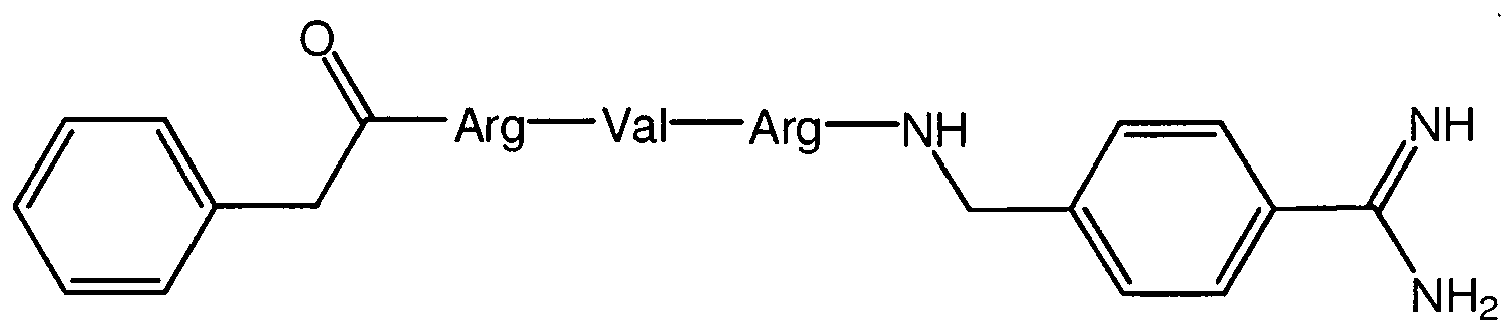








- Verfahren zur Herstellung einer Verbindung gemäß einem der Ansprüche 1 bis 6 durch eine Kombination von Festphasen- und Lösungssynthese mittels folgender Schritte:■ Synthese des Segments P5-P4-P3-P2 durch Festphasenpeptidsynthese,■ Abspaltung des Peptidsegments vom Harz unter geeigneten sauren Bedingungen, wobei Seitenkettenschutzgruppen entweder erhalten oder abgespalten werden,■ Kopplung eines geeigneten P1-Bausteins mittels racemisierungsfreier Standardverfahren, wobei der P1-Baustein entweder geschützt oder ungeschützt vorliegt,■ Reinigung durch Kristallisation, Chromatographie, bevorzugt Umkehrphasen- oder Ionenaustauschchromatographie oder durch Gegenstromverteilung,
- Verfahren zur Herstellung einer Verbindung gemäß einem der Ansprüche 1 bis 6 durch Lösungssynthese umfassend folgende Schritte:a) Synthese eines an der terminalen Amidino- oder Guanidinogruppe geeignet geschützten P1 mit freier Aminogruppe, wobei die Aminogruppe entweder als Salz oder freie Base vorlieget, bevorzugt Synthese von folgender Verbindung:
 b) Kopplung einer Nα-Boc oder anderweitig geeignet Nα-urethangeschützten Amino- oder Iminosäure mit oder ohne geeigneter Seitenkettenschutzgruppe an die freie Aminogruppe des P1-Bausteins,c) Aufarbeitung des Reaktionsansatzes durch gängige Wasch- und Kristallisationsverfahrend) Abspaltung der Nα-Schutzgruppe unter Erhalt des P2-P1-Segments mit freier Aminogruppe am P2-Baustein,e) Kopplung der Nα-Boc- oder anderweitig geeignet Nα-urethangeschützten P3-Amino- oder Iminosäure an die freie Aminogruppe des P2-P1-Segments,f) Aufarbeitung des Reaktionsansatzes durch gängige Wasch- und Kristallisationsverfahreng) Abspaltung der Nα-Schutzgruppe unter Erhalt des P3-P2-P1-Segments mit freier N-terminaler Aminogruppe am P3-Rest,h) Kopplung der Nα-Boc oder anderweitig geeignet Nα-urethangeschützten P4-Amino- oder Iminosäure an die freie Aminogruppe des P3-P2-P1-Segments aus Schritt h)i) Aufarbeitung des Reaktionsansatzes durch gängige Wasch- und Kristallisationsverfahrenj) Abspaltung der Nα-Schutzgruppe unter Erhalt des P4-P3-P2-P1-Segments mit freier N-terminaler Aminogruppe am P4-Rest,k) Kopplung des P5-Restes an die freie Aminogruppe des P4-P3-P2-P1-Segments aus Schritt j)l) Abspaltung aller noch vorhandenen Schutzgruppen,m) Reinigung durch Kristallisation und/oder Chromatographie,
 - Arzneimittel, enthaltend mindestens eine Verbindung gemäß einem der Ansprüche 1 bis 6.
- Verbindung gemäß einem der Ansprüche 1 bis 6 oder ein Arzneimittel gemäß Anspruch 9 zur Therapie oder Prophylaxe einer viral oder bakteriell bedingten Erkrankungen, sowie zur Therapie und Prophylaxe von Diabetes, Arteriosklerose, Krebs, Alzheimer oder Übergewicht, insbesondere in oraler, subkutaner, intravenöser oder transdermaler Form oder in Form eines Sprays zur Behandlung von Erkrankungen im Respirationstrakt, wobei die bakteriell bedingten Erkrankungen , insbesondere hervorgerufen sind durch Erreger aus der Gruppe Pseudomonas spec., Shigella spec., Corynebacterium diphtheriae, Bacillus cereus, Bacilllus anthracis, Bacillus butulinum, Clostridium perfringens, Clostridium difficile, Clostridium septicum, Clostridium sprioforme, Bordetella pertussis, Samonella enterica oder durch ausgewählten Escherichia coli-Stämmen, insbesondere E.coli-Stämme, die hämolytische Kolitits, das Hämolytische uraemisches Syndrom und/oder Nierenversagen verursachen, ganz insbesondere E.coli 0157-H7.
- Verbindung gemäß einem der Ansprüche 1 bis 6 oder ein Arzneimittel gemäß Anspruch 9 zur Therapie oder Prophylaxe von Erkrankungen hervorgerufen durch Viren, insbesondere hervorgerufen durch Viren der Gruppe■ hochpathogene aviäre Influenza A-Viren, vor allem der H5- bzw. H7-Subtypen,■ RNA-Negativstrangviren wie den Parainfluenzaviren, das Masern-Virus, das Mumpsvirus, das Hundestaupevirus, das Respiratorische-Syncytial-Virus, Filoviren wie das Ebola- und Marburg-Virus und das Newcastle-Disease-Virus, sowie■ Plusstrang-RNA-Viren, wie HIV-1, HIV-2, HTLV und andere Retroviren, insbesondere Coronaviren wie das SARS-Coronavirus, die Flaviviren, Gelbfieber-Viren, West-Nile-Virus, Dengue-Virus oder das Frühsommer-Meningo-Encephalitis-Virus, das Venezuelan equine encephalitis Virus oder das Rift Valley Fever Virus.
- Verbindung gemäß einem der Ansprüche 1 bis 6 oder ein Arzneimittel gemäß Anspruch 9 zur Hemmung der Proproteinkonvertasen Furin, PC1/3, PC2, PC4, PC5/6, PACE4 und/oder PC7.
- Verbindung gemäß einem der Ansprüche 1 bis 6 oder ein Arzneimittel gemäß Anspruch 9 zur Therapie von Krebs und zur Hemmung der Metastasierung.
Applications Claiming Priority (4)
| Application Number | Priority Date | Filing Date | Title |
|---|---|---|---|
| DE102008056082 | 2008-10-29 | ||
| DE102008053693 | 2008-10-29 | ||
| DE102009035593A DE102009035593A1 (de) | 2008-10-29 | 2009-07-30 | N-terminal modifizierte Tetrapeptidderivate mit C-terminalem Argininmetikum |
| PCT/DE2009/001514 WO2010048941A2 (de) | 2008-10-29 | 2009-10-29 | N-terminal modifizierte tetrapeptidderivate mit c-terminalem argininmimetikum |
Publications (2)
| Publication Number | Publication Date |
|---|---|
| EP2349312A2 EP2349312A2 (de) | 2011-08-03 |
| EP2349312B1 true EP2349312B1 (de) | 2014-06-04 |
Family
ID=42102012
Family Applications (1)
| Application Number | Title | Priority Date | Filing Date |
|---|---|---|---|
| EP09795303.8A Not-in-force EP2349312B1 (de) | 2008-10-29 | 2009-10-29 | N-terminal modifizierte tetrapeptidderivate mit c-terminalem argininmimetikum |
Country Status (3)
| Country | Link |
|---|---|
| US (1) | US8865865B2 (de) |
| EP (1) | EP2349312B1 (de) |
| WO (1) | WO2010048941A2 (de) |
Cited By (1)
| Publication number | Priority date | Publication date | Assignee | Title |
|---|---|---|---|---|
| CN109111376A (zh) * | 2018-09-18 | 2019-01-01 | 四川医立特生物医药有限公司 | 一种2,5-双脱氧链霉胺衍生物及其应用 |
Families Citing this family (7)
| Publication number | Priority date | Publication date | Assignee | Title |
|---|---|---|---|---|
| WO2013138665A1 (en) * | 2012-03-16 | 2013-09-19 | Sanford-Burnham Medical Research Institute | Inhibitors of furin and other pro-protein convertases |
| WO2013138666A1 (en) * | 2012-03-16 | 2013-09-19 | Sanford-Burnham Medical Research Institute | Inhibitors of furin and other pro-protein convertases |
| FR3016879A1 (fr) * | 2014-01-29 | 2015-07-31 | Guillaume Laconde | Procede de preparation de benzotriazole n-acyles |
| WO2015117094A1 (en) * | 2014-02-03 | 2015-08-06 | American Life Science Pharmaceuticals, Inc. | Compositions and methods for synthesizing (2s,3s)-trans-epoxysuccinyl-l-leucyl-amido-3-methylbutane ethyl ester |
| WO2017141032A1 (en) * | 2016-02-15 | 2017-08-24 | Oxford University Innovation Limited | Treatment of fibrotic disorders |
| WO2018097126A1 (ja) * | 2016-11-25 | 2018-05-31 | 日本曹達株式会社 | グアニジン化合物および殺菌剤 |
| ES3027568T3 (en) | 2016-12-15 | 2025-06-16 | Nestle Sa | Compositions and methods that modulate bacteria in a companion animal |
Family Cites Families (3)
| Publication number | Priority date | Publication date | Assignee | Title |
|---|---|---|---|---|
| US5688489A (en) * | 1995-09-15 | 1997-11-18 | Resolution Pharmaceuticals, Inc. | Non-receptor mediated imaging agents |
| CA2586086A1 (en) | 2004-07-23 | 2006-01-23 | Robert E.(Deceased) Smith | Furin inhibitors |
| DE102006050672A1 (de) | 2006-10-24 | 2008-04-30 | Curacyte Discovery Gmbh | Hemmstoffe des Plasmins und des Plasmakallikreins |
-
2009
- 2009-10-29 US US13/126,504 patent/US8865865B2/en not_active Expired - Fee Related
- 2009-10-29 WO PCT/DE2009/001514 patent/WO2010048941A2/de not_active Ceased
- 2009-10-29 EP EP09795303.8A patent/EP2349312B1/de not_active Not-in-force
Non-Patent Citations (3)
| Title |
|---|
| BECKER GERO L ET AL: "Highly potent inhibitors of proprotein convertase furin as potential drugs for treatment of infectious diseases.", THE JOURNAL OF BIOLOGICAL CHEMISTRY 22 JUN 2012, vol. 287, no. 26, 22 June 2012 (2012-06-22), pages 21992 - 22003, XP007921976, ISSN: 1083-351X * |
| GERO L BECKER ET AL: "New substrate analogue furin inhibitors derived from 4-amidinobenzylamide", BIOORGANIC & MEDICINAL CHEMISTRY LETTERS, PERGAMON, ELSEVIER SCIENCE, GB, vol. 21, no. 16, 19 June 2011 (2011-06-19), pages 4695 - 4697, XP028247166, ISSN: 0960-894X, [retrieved on 20110625], DOI: 10.1016/J.BMCL.2011.06.091 * |
| KUESTER MIRIAM ET AL: "Purification of the proprotein convertase furin by affinity chromatography based on PC-specific inhibitors.", BIOLOGICAL CHEMISTRY NOV 2011, vol. 392, no. 11, November 2011 (2011-11-01), pages 973 - 981, XP007921975, ISSN: 1437-4315 * |
Cited By (2)
| Publication number | Priority date | Publication date | Assignee | Title |
|---|---|---|---|---|
| CN109111376A (zh) * | 2018-09-18 | 2019-01-01 | 四川医立特生物医药有限公司 | 一种2,5-双脱氧链霉胺衍生物及其应用 |
| CN109111376B (zh) * | 2018-09-18 | 2021-09-14 | 四川医立特生物医药有限公司 | 一种2,5-双脱氧链霉胺衍生物及其应用 |
Also Published As
| Publication number | Publication date |
|---|---|
| WO2010048941A2 (de) | 2010-05-06 |
| EP2349312A2 (de) | 2011-08-03 |
| WO2010048941A3 (de) | 2010-07-15 |
| US20110312873A1 (en) | 2011-12-22 |
| US8865865B2 (en) | 2014-10-21 |
Similar Documents
| Publication | Publication Date | Title |
|---|---|---|
| US10376557B2 (en) | Peptide fragments for inducing synthesis of extracellular matrix proteins | |
| WO2010048941A2 (de) | N-terminal modifizierte tetrapeptidderivate mit c-terminalem argininmimetikum | |
| EP0513543B1 (de) | Amidinophenylalaninderivate, Verfahren zu deren Herstellung, deren Verwendung und diese enthaltende Mittel als Antikoagulantien | |
| EP1583526B1 (de) | Acylierte 4-amidino- und 4-guanidinobenzylaminen zur inhibierung von plasmakallikrein | |
| DE69633623T2 (de) | Cystein-Protease-Inhibitoren für die Behandlung von allergischen Krankheiten verursacht duch IgE | |
| WO1992008709A1 (de) | Meta-substituierte phenylalanin-derivate | |
| EP0635008A1 (de) | Piperazide von substituierten phenylalanin-derivativen als thrombin inhibitoren | |
| WO1992016549A1 (de) | Para-substituierte phenylalanin-derivate | |
| EP1294742B1 (de) | Urokinase-hemmstoffe | |
| US20240352069A1 (en) | Synthetic peptide, and cosmetic composition or pharmaceutical composition and application thereof | |
| EP1485345B1 (de) | Hemmstoffe der urokinase, ihre herstellung und verwendung | |
| AU2005334458B2 (en) | Furin inhibitors | |
| DE102009035593A1 (de) | N-terminal modifizierte Tetrapeptidderivate mit C-terminalem Argininmetikum | |
| EP1468085B1 (de) | Synthetische peptide und ihre vorbeugende oder therapeutische anwendung für krebsinvasion und metastasen | |
| CH689611A5 (de) | Urokinase-Inhibitoren. | |
| EP2435064B1 (de) | Verwendung von hemmstoffen der hat und tmprss2 als arzneimittel | |
| EP2729484B1 (de) | Zyklische tripeptidmimetika als plasmin inhibitoren | |
| JPS6151564B2 (de) | ||
| Midura-Nowaczek et al. | Synthesis of alkylamides of dipeptides as potential plasmin inhibitors | |
| JP3874372B2 (ja) | 制癌剤の効果増強剤 | |
| WO2003070953A1 (de) | Verbindung zur inhibierung der serin-proteinasen und zur inhibierung von infektionen oder virusvermehrung: rld 8564 | |
| CH641441A5 (de) | Therapeutisch wirksame pseudopeptide und diese enthaltende zusammensetzungen. | |
| JPH02115198A (ja) | 動物コラゲナーゼ阻害剤 | |
| JPH11246594A (ja) | 二環式デプシペプチド |
Legal Events
| Date | Code | Title | Description |
|---|---|---|---|
| PUAI | Public reference made under article 153(3) epc to a published international application that has entered the european phase |
Free format text: ORIGINAL CODE: 0009012 |
|
| 17P | Request for examination filed |
Effective date: 20110517 |
|
| AK | Designated contracting states |
Kind code of ref document: A2 Designated state(s): AT BE BG CH CY CZ DE DK EE ES FI FR GB GR HR HU IE IS IT LI LT LU LV MC MK MT NL NO PL PT RO SE SI SK SM TR |
|
| DAX | Request for extension of the european patent (deleted) | ||
| 17Q | First examination report despatched |
Effective date: 20120605 |
|
| GRAP | Despatch of communication of intention to grant a patent |
Free format text: ORIGINAL CODE: EPIDOSNIGR1 |
|
| INTG | Intention to grant announced |
Effective date: 20140305 |
|
| GRAS | Grant fee paid |
Free format text: ORIGINAL CODE: EPIDOSNIGR3 |
|
| GRAA | (expected) grant |
Free format text: ORIGINAL CODE: 0009210 |
|
| AK | Designated contracting states |
Kind code of ref document: B1 Designated state(s): AT BE BG CH CY CZ DE DK EE ES FI FR GB GR HR HU IE IS IT LI LT LU LV MC MK MT NL NO PL PT RO SE SI SK SM TR |
|
| REG | Reference to a national code |
Ref country code: GB Ref legal event code: FG4D Free format text: NOT ENGLISH |
|
| REG | Reference to a national code |
Ref country code: CH Ref legal event code: EP |
|
| REG | Reference to a national code |
Ref country code: AT Ref legal event code: REF Ref document number: 670640 Country of ref document: AT Kind code of ref document: T Effective date: 20140615 |
|
| REG | Reference to a national code |
Ref country code: IE Ref legal event code: FG4D Free format text: LANGUAGE OF EP DOCUMENT: GERMAN |
|
| REG | Reference to a national code |
Ref country code: DE Ref legal event code: R096 Ref document number: 502009009482 Country of ref document: DE Effective date: 20140717 |
|
| REG | Reference to a national code |
Ref country code: NL Ref legal event code: VDEP Effective date: 20140604 |
|
| PG25 | Lapsed in a contracting state [announced via postgrant information from national office to epo] |
Ref country code: FI Free format text: LAPSE BECAUSE OF FAILURE TO SUBMIT A TRANSLATION OF THE DESCRIPTION OR TO PAY THE FEE WITHIN THE PRESCRIBED TIME-LIMIT Effective date: 20140604 Ref country code: CY Free format text: LAPSE BECAUSE OF FAILURE TO SUBMIT A TRANSLATION OF THE DESCRIPTION OR TO PAY THE FEE WITHIN THE PRESCRIBED TIME-LIMIT Effective date: 20140604 Ref country code: LT Free format text: LAPSE BECAUSE OF FAILURE TO SUBMIT A TRANSLATION OF THE DESCRIPTION OR TO PAY THE FEE WITHIN THE PRESCRIBED TIME-LIMIT Effective date: 20140604 Ref country code: GR Free format text: LAPSE BECAUSE OF FAILURE TO SUBMIT A TRANSLATION OF THE DESCRIPTION OR TO PAY THE FEE WITHIN THE PRESCRIBED TIME-LIMIT Effective date: 20140905 Ref country code: NO Free format text: LAPSE BECAUSE OF FAILURE TO SUBMIT A TRANSLATION OF THE DESCRIPTION OR TO PAY THE FEE WITHIN THE PRESCRIBED TIME-LIMIT Effective date: 20140904 |
|
| REG | Reference to a national code |
Ref country code: LT Ref legal event code: MG4D |
|
| PG25 | Lapsed in a contracting state [announced via postgrant information from national office to epo] |
Ref country code: HR Free format text: LAPSE BECAUSE OF FAILURE TO SUBMIT A TRANSLATION OF THE DESCRIPTION OR TO PAY THE FEE WITHIN THE PRESCRIBED TIME-LIMIT Effective date: 20140604 Ref country code: SE Free format text: LAPSE BECAUSE OF FAILURE TO SUBMIT A TRANSLATION OF THE DESCRIPTION OR TO PAY THE FEE WITHIN THE PRESCRIBED TIME-LIMIT Effective date: 20140604 Ref country code: LV Free format text: LAPSE BECAUSE OF FAILURE TO SUBMIT A TRANSLATION OF THE DESCRIPTION OR TO PAY THE FEE WITHIN THE PRESCRIBED TIME-LIMIT Effective date: 20140604 |
|
| PG25 | Lapsed in a contracting state [announced via postgrant information from national office to epo] |
Ref country code: CZ Free format text: LAPSE BECAUSE OF FAILURE TO SUBMIT A TRANSLATION OF THE DESCRIPTION OR TO PAY THE FEE WITHIN THE PRESCRIBED TIME-LIMIT Effective date: 20140604 Ref country code: RO Free format text: LAPSE BECAUSE OF FAILURE TO SUBMIT A TRANSLATION OF THE DESCRIPTION OR TO PAY THE FEE WITHIN THE PRESCRIBED TIME-LIMIT Effective date: 20140604 Ref country code: EE Free format text: LAPSE BECAUSE OF FAILURE TO SUBMIT A TRANSLATION OF THE DESCRIPTION OR TO PAY THE FEE WITHIN THE PRESCRIBED TIME-LIMIT Effective date: 20140604 Ref country code: PT Free format text: LAPSE BECAUSE OF FAILURE TO SUBMIT A TRANSLATION OF THE DESCRIPTION OR TO PAY THE FEE WITHIN THE PRESCRIBED TIME-LIMIT Effective date: 20141006 Ref country code: SK Free format text: LAPSE BECAUSE OF FAILURE TO SUBMIT A TRANSLATION OF THE DESCRIPTION OR TO PAY THE FEE WITHIN THE PRESCRIBED TIME-LIMIT Effective date: 20140604 Ref country code: ES Free format text: LAPSE BECAUSE OF FAILURE TO SUBMIT A TRANSLATION OF THE DESCRIPTION OR TO PAY THE FEE WITHIN THE PRESCRIBED TIME-LIMIT Effective date: 20140604 |
|
| PGFP | Annual fee paid to national office [announced via postgrant information from national office to epo] |
Ref country code: GB Payment date: 20141030 Year of fee payment: 6 Ref country code: FR Payment date: 20141031 Year of fee payment: 6 |
|
| PG25 | Lapsed in a contracting state [announced via postgrant information from national office to epo] |
Ref country code: NL Free format text: LAPSE BECAUSE OF FAILURE TO SUBMIT A TRANSLATION OF THE DESCRIPTION OR TO PAY THE FEE WITHIN THE PRESCRIBED TIME-LIMIT Effective date: 20140604 Ref country code: IS Free format text: LAPSE BECAUSE OF FAILURE TO SUBMIT A TRANSLATION OF THE DESCRIPTION OR TO PAY THE FEE WITHIN THE PRESCRIBED TIME-LIMIT Effective date: 20141004 Ref country code: PL Free format text: LAPSE BECAUSE OF FAILURE TO SUBMIT A TRANSLATION OF THE DESCRIPTION OR TO PAY THE FEE WITHIN THE PRESCRIBED TIME-LIMIT Effective date: 20140604 |
|
| REG | Reference to a national code |
Ref country code: DE Ref legal event code: R097 Ref document number: 502009009482 Country of ref document: DE |
|
| PLBE | No opposition filed within time limit |
Free format text: ORIGINAL CODE: 0009261 |
|
| STAA | Information on the status of an ep patent application or granted ep patent |
Free format text: STATUS: NO OPPOSITION FILED WITHIN TIME LIMIT |
|
| PG25 | Lapsed in a contracting state [announced via postgrant information from national office to epo] |
Ref country code: IT Free format text: LAPSE BECAUSE OF FAILURE TO SUBMIT A TRANSLATION OF THE DESCRIPTION OR TO PAY THE FEE WITHIN THE PRESCRIBED TIME-LIMIT Effective date: 20140604 Ref country code: DK Free format text: LAPSE BECAUSE OF FAILURE TO SUBMIT A TRANSLATION OF THE DESCRIPTION OR TO PAY THE FEE WITHIN THE PRESCRIBED TIME-LIMIT Effective date: 20140604 |
|
| 26N | No opposition filed |
Effective date: 20150305 |
|
| PG25 | Lapsed in a contracting state [announced via postgrant information from national office to epo] |
Ref country code: LU Free format text: LAPSE BECAUSE OF FAILURE TO SUBMIT A TRANSLATION OF THE DESCRIPTION OR TO PAY THE FEE WITHIN THE PRESCRIBED TIME-LIMIT Effective date: 20141029 Ref country code: MC Free format text: LAPSE BECAUSE OF FAILURE TO SUBMIT A TRANSLATION OF THE DESCRIPTION OR TO PAY THE FEE WITHIN THE PRESCRIBED TIME-LIMIT Effective date: 20140604 |
|
| REG | Reference to a national code |
Ref country code: DE Ref legal event code: R097 Ref document number: 502009009482 Country of ref document: DE Effective date: 20150305 |
|
| PG25 | Lapsed in a contracting state [announced via postgrant information from national office to epo] |
Ref country code: BE Free format text: LAPSE BECAUSE OF NON-PAYMENT OF DUE FEES Effective date: 20141031 |
|
| REG | Reference to a national code |
Ref country code: IE Ref legal event code: MM4A |
|
| PG25 | Lapsed in a contracting state [announced via postgrant information from national office to epo] |
Ref country code: SI Free format text: LAPSE BECAUSE OF FAILURE TO SUBMIT A TRANSLATION OF THE DESCRIPTION OR TO PAY THE FEE WITHIN THE PRESCRIBED TIME-LIMIT Effective date: 20140604 |
|
| PG25 | Lapsed in a contracting state [announced via postgrant information from national office to epo] |
Ref country code: IE Free format text: LAPSE BECAUSE OF NON-PAYMENT OF DUE FEES Effective date: 20141029 |
|
| REG | Reference to a national code |
Ref country code: AT Ref legal event code: MM01 Ref document number: 670640 Country of ref document: AT Kind code of ref document: T Effective date: 20141029 |
|
| PGFP | Annual fee paid to national office [announced via postgrant information from national office to epo] |
Ref country code: CH Payment date: 20151021 Year of fee payment: 7 |
|
| PG25 | Lapsed in a contracting state [announced via postgrant information from national office to epo] |
Ref country code: AT Free format text: LAPSE BECAUSE OF NON-PAYMENT OF DUE FEES Effective date: 20141029 |
|
| PG25 | Lapsed in a contracting state [announced via postgrant information from national office to epo] |
Ref country code: SM Free format text: LAPSE BECAUSE OF FAILURE TO SUBMIT A TRANSLATION OF THE DESCRIPTION OR TO PAY THE FEE WITHIN THE PRESCRIBED TIME-LIMIT Effective date: 20140604 |
|
| GBPC | Gb: european patent ceased through non-payment of renewal fee |
Effective date: 20151029 |
|
| PG25 | Lapsed in a contracting state [announced via postgrant information from national office to epo] |
Ref country code: BG Free format text: LAPSE BECAUSE OF FAILURE TO SUBMIT A TRANSLATION OF THE DESCRIPTION OR TO PAY THE FEE WITHIN THE PRESCRIBED TIME-LIMIT Effective date: 20140604 |
|
| PG25 | Lapsed in a contracting state [announced via postgrant information from national office to epo] |
Ref country code: TR Free format text: LAPSE BECAUSE OF FAILURE TO SUBMIT A TRANSLATION OF THE DESCRIPTION OR TO PAY THE FEE WITHIN THE PRESCRIBED TIME-LIMIT Effective date: 20140604 Ref country code: GB Free format text: LAPSE BECAUSE OF NON-PAYMENT OF DUE FEES Effective date: 20151029 Ref country code: MT Free format text: LAPSE BECAUSE OF FAILURE TO SUBMIT A TRANSLATION OF THE DESCRIPTION OR TO PAY THE FEE WITHIN THE PRESCRIBED TIME-LIMIT Effective date: 20140604 Ref country code: HU Free format text: LAPSE BECAUSE OF FAILURE TO SUBMIT A TRANSLATION OF THE DESCRIPTION OR TO PAY THE FEE WITHIN THE PRESCRIBED TIME-LIMIT; INVALID AB INITIO Effective date: 20091029 |
|
| REG | Reference to a national code |
Ref country code: FR Ref legal event code: ST Effective date: 20160630 |
|
| PG25 | Lapsed in a contracting state [announced via postgrant information from national office to epo] |
Ref country code: FR Free format text: LAPSE BECAUSE OF NON-PAYMENT OF DUE FEES Effective date: 20151102 |
|
| REG | Reference to a national code |
Ref country code: CH Ref legal event code: PL |
|
| PG25 | Lapsed in a contracting state [announced via postgrant information from national office to epo] |
Ref country code: CH Free format text: LAPSE BECAUSE OF NON-PAYMENT OF DUE FEES Effective date: 20161031 Ref country code: LI Free format text: LAPSE BECAUSE OF NON-PAYMENT OF DUE FEES Effective date: 20161031 |
|
| PG25 | Lapsed in a contracting state [announced via postgrant information from national office to epo] |
Ref country code: MK Free format text: LAPSE BECAUSE OF FAILURE TO SUBMIT A TRANSLATION OF THE DESCRIPTION OR TO PAY THE FEE WITHIN THE PRESCRIBED TIME-LIMIT Effective date: 20140604 |
|
| PGFP | Annual fee paid to national office [announced via postgrant information from national office to epo] |
Ref country code: DE Payment date: 20211031 Year of fee payment: 13 |
|
| REG | Reference to a national code |
Ref country code: DE Ref legal event code: R119 Ref document number: 502009009482 Country of ref document: DE |
|
| PG25 | Lapsed in a contracting state [announced via postgrant information from national office to epo] |
Ref country code: DE Free format text: LAPSE BECAUSE OF NON-PAYMENT OF DUE FEES Effective date: 20230503 |