EP2348486A2 - Page description data processing apparatus, page description data processing method, and recording medium - Google Patents
Page description data processing apparatus, page description data processing method, and recording medium Download PDFInfo
- Publication number
- EP2348486A2 EP2348486A2 EP10192423A EP10192423A EP2348486A2 EP 2348486 A2 EP2348486 A2 EP 2348486A2 EP 10192423 A EP10192423 A EP 10192423A EP 10192423 A EP10192423 A EP 10192423A EP 2348486 A2 EP2348486 A2 EP 2348486A2
- Authority
- EP
- European Patent Office
- Prior art keywords
- path
- page description
- description data
- operator
- curved path
- Prior art date
- Legal status (The legal status is an assumption and is not a legal conclusion. Google has not performed a legal analysis and makes no representation as to the accuracy of the status listed.)
- Withdrawn
Links
Images


Classifications
-
- G—PHYSICS
- G06—COMPUTING OR CALCULATING; COUNTING
- G06T—IMAGE DATA PROCESSING OR GENERATION, IN GENERAL
- G06T11/00—Two-dimensional [2D] image generation
- G06T11/20—Drawing from basic elements
- G06T11/23—Drawing from basic elements using straight lines or curves
Definitions
- the present invention relates to a page description data processing apparatus, a page description data processing method, and a recording medium for performing a particular processing sequence on page description data described by a page description language (PDL), thereby to convert the page description data into more robust page description data (hereinafter referred to as "robustized page description data").
- PDL page description language
- the DTP application software generates page description data which express images of respective pages based on elements such as characters and images edited by the operator.
- the page description data are vector data independent of the resolution of an output machine such as a printer, a platesetter, or the like, and cannot be output per se from the output machine. Therefore, the page description data are rasterized by an RIP (Raster Image Processor) into raster image data comprising a cluster of dots representative of elements such as characters and images in pages.
- RIP Raster Image Processor
- the output machine When the raster image data are supplied to the output machine such as a printer, a platesetter, or the like, the output machine outputs a hard copy or a printing plate carrying an image based on the raster image data (see Japanese Laid-Open Patent Publication No. 2005-070957 ).
- PDF (Portable Document File) version 1.3 which is one type of page description data, incorporates a plurality of processing schemes (hereinafter referred to as "line join styles") that are applied to joints in stroking a plurality of connected paths.
- path refers to a path which has no line width by itself and which interconnects a start point and an end point.
- stroke refers to a process of applying a certain line width to a path.
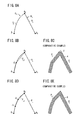
- an object O c strokes the curved path P c (indicated by the solid line in FIG. 8A ), and an RIP approximates the curved path P c with a polygonal path P L1 (indicated by the broken line in FIG. 8B ), made up of a plurality of line segments.
- the approximated result depends on the characteristics inherent in the output machine, such as an output resolution thereof, and the software version of the RIP.
- the curved path P c comprises a curve A 1 A 2 divided into two line segments by a joint J 1 .
- the curve A 1 A 2 is divided into three line segments by joints J 2 , J 3 , and is approximated by a polygonal path P L2 , indicated by the broken line.
- the angle ⁇ J 3 A 2 A 3 between a line segment J 3 A 2 and a line segment A 2 A 3 shown in FIG. 8D is greater than the angle ⁇ J 1 A 2 A 3 shown in FIG. 8B . If the angle ⁇ J 3 A 2 A 3 is equal to or greater than the miter limit, then the corner of the point A 2 is processed into a miter join, as shown in FIG. 8E of the accompanying drawings. As a result, a stroked area 6 is produced which has an apex at the corner of the point A 2 .
- the cut-off area 2 may be irregularly produced.
- the same phenomenon may occur with respect to a line shape that is made up of joined objects each stroking a curved path.
- a page description data processing apparatus, a page description data processing method and a recording medium operate by confirming whether or not page description data contain an object for stroking a path or not, confirming whether or not a curved path construction operator is contained in the object, if the page description data contain the object for stroking a path, and determining line segments of a polygonal path which is approximated to a curved path of the curved path construction operator and replacing the curved path construction operator with a plurality of straight path construction operators which correspond respectively to the line segments of the polygonal path, if the curved path construction operator is contained in the object.
- page description data is converted into more robust page description data (referred to as "robustized page description data").
- the line segments of the polygonal path are determined such that an approximation error with respect to the curved path falls within a predetermined range.
- a publishing system which incorporates a page description data processing apparatus, a page description data processing method, and a recording medium according to an embodiment of the present invention will be described in detail below with reference to the accompanying drawings.
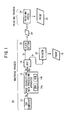
- FIG. 1 is a block diagram of an entire publishing system 10 according to an embodiment of the present invention.
- the publishing system 10 is arranged to perform a prepress process, a printing process, and a bookbinding process (not shown).
- the prepress process includes a DTP computer 12, a page description data processing apparatus 14 such as a personal computer or the like, an RIP 16, a printer 20, and a platesetter 22.
- the DTP computer 12 generates page description data Dp which express images of respective pages based on elements such as characters and images edited by the operator.
- the page description data processing apparatus 14 checks the contents (attributes) of the page description data Dp output from the DTP computer 12, performs a particular processing sequence on the page description data Dp having a certain attribute based on the checked contents, and generates the processed page description data Dp as robustized page description data Dp' or outputs page description data Dp free of the certain attribute.
- the processing function of the page description data processing apparatus 14 may be incorporated in the DTP computer 12, so that the page description data processing apparatus 14 can be dispensed with.
- the RIP 16 converts the page description data Dp or the robustized page description data Dp' output from the page description data processing apparatus 14 into raster image data Dr in C, M, Y, K.
- the printer 20 Based on the raster image data Dr, the printer 20 prints a proof 18 as a hard copy.
- the platesetter 22 If the proof 18 printed by the printer 20 is judged as acceptable by the operator, then the platesetter 22 generates and outputs printing plates PP in C, M, Y, K from the raster image data Dr output from the RIP 16 after the operator has turned on the start switch of the platesetter 22.
- the printing process includes a printing press 24.
- the printing press 24 has printing plates PP in C, M, Y, K mounted therein which carry respective inks in C, M, Y, K and transfer them to a sheet of paper, thereby producing a print 26 in multiple colors (four colors).
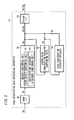
- FIG. 2 is a functional block diagram of the page description data processing apparatus 14.
- the page description data processing apparatus 14 has functions that are performed when a CPU 14a (see FIG. 1 ) thereof executes a program stored in a ROM 14b (see FIG. 1 ) thereof.
- the program may be recorded in a computer-readable recording medium such as the ROM 14b, a hard disk, a CD-ROM or the like, and the program recorded in the recording medium may be read and run by a computer system.
- the computer system includes an OS and hardware such as a CPU and peripheral devices.
- the computer-readable recording medium also includes a medium for dynamically holding programs for a short period of time, such as a communication line for transmitting programs via a network such as the Internet or the like or a communication channel such as a telephone line, or a memory for holding programs for a certain period of time such as a volatile memory in a computer system which serves as a server or a client in a network environment.
- the page description data processing apparatus 14 generates robustized page description data Dp' by analyzing page description data Dp supplied via an input interface (input I/F) 32 or generates unchanged page description data Dp, and outputs the robustized page description data Dp' or the unchanged page description data Dp via an output interface (output I/F) 34.
- the page description data processing apparatus 14 comprises, in addition to the input and output interfaces 32, 34, an object confirming unit 36 involved in the analyzing process, a curved path construction operator confirming unit 42, and a path construction operator replacer 44, as its functions.
- the object confirming unit 36 comprises a structural analyzer, not shown, a path object confirming unit 38, and a path-painting operator attribute confirming unit 40.
- path object refers to an arbitrary shape made up of a straight line, a rectangle, and a curve, e.g., a cubic Bezier curve.
- path-painting operator refers to an operator for ending a path object, having an attribute as either an operator for applying a line width to a current path to paint a line (hereinafter referred to as “stroking operator” for illustrative purposes) or an operator for filling a closed space generated by a current path (hereinafter referred to as “filling operator” for illustrative purposes).
- path construction operator refers to an operator for defining the physical shape of a path. According to the PDF, there are defined seven operators “m”, “1”, “c”, “v”, “y”, “h”, and "re”.
- curved path construction operator refers to an operator for adding a curve to a current path, among the path construction operators. According to the PDF, there are defined three operators “c”, “v”, and “y”, each for adding a cubic Bezier curve.
- straight path construction operator refers to an operator for adding a straight line to a current path, among the path construction operators. According to the PDF, there is defined one operator "I”.
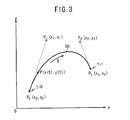
- FIG. 3 is a diagram showing a cubic Bezier curve that is generated by the operator "c".
- the cubic Bezier curve denoted by 50 in FIG. 3 , is defined by two terminal points, i.e., start and end points, P 0 (x 0 , Y 0 ) , P 3 (x 3 , Y 3 ) and two control points P 1 (x 1 , y 1 ) , P 2 (X 2 , Y 2 ).
- the cubic Bezier curve 50 is represented by coordinates P(x(t), y(t)) where t is a variable, and is generated between the start point P 0 and the end point P 3 by varying the variable "t" from 0 to 1.
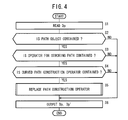
- the publishing system 10 is basically constructed as described above. Operation of the page description data processing apparatus 14 of the publishing system 10 will be described below with reference to a flowchart shown in FIG. 4 .
- step S1 shown in FIG. 4 the page description data processing apparatus 14 reads page description data Dp, page by page, which are output from the DTP computer 12.
- step S2 the structural analyzer, not shown, analyzes the structure of the page description data Dp and extracts an object contained in the pages. Thereafter, the path object confirming unit 38 confirms whether a path object is contained in the extracted object or not. If a path object is not contained in the extracted object, then the path object confirming unit 38 outputs the page description data Dp unchanged via the output interface 34 in step S6.
- the path-painting operator attribute confirming unit 40 confirms whether a stroking operator, e.g., an operator "S", "s” or the like, is contained in the path object or not in step S3. If a stroking operator is not contained in the path object, or in other words, if a filling operator "f", F" or the like, is contained in the path object, then the path-painting operator attribute confirming unit 40 outputs the page description data Dp unchanged via the output interface 34 in step S6.
- a stroking operator e.g., an operator "S", "s” or the like
- the curved path construction operator confirming unit 42 confirms whether a curved path construction operator, e.g., an operator "c", “v” or “y”, is contained in the path object or not in step S4. If a curved path construction operator is not contained in the path object, or in other words, if only an operator "m”, “1”, “h” or “re” is contained in the path object, then the curved path construction operator confirming unit 42 outputs the page description data Dp unchanged via the output interface 34 in step S6.
- a curved path construction operator e.g., an operator "c", "v” or "y
- the path construction operator replacer 44 replaces the curved path construction operator with a plurality of straight path construction operators by which the curved path construction operator is approximated, in step S5. Then, in step S6, the path construction operator replacer 44 outputs page description data Dp' where the curved path construction operator has been replaced with the straight path construction operators, via the output interface 34.
- the page description data Dp that are supplied to the page description data processing apparatus 14 are supplied as the unchanged page description data Dp or the page description data Dp' where the curved path construction operator has been replaced with the straight path construction operators, to the RIP 16, as shown in FIG. 1 .
- step S5 in FIG. 4 A process of replacing a path construction operator (step S5 in FIG. 4 ) will be described in detail below with reference to a flowchart shown in FIG. 5 .
- the process shown in FIG. 5 is carried out by the path construction operator replacer 44.
- variables are initialized. Specifically, a flag whose value is either 0 or 1, a variable n whose value is a non-negative integer, and a variable t n whose value is a real number ranging from 0 to 1, are set to 0 in step S51.
- the variables will be described later on when necessary.
- step S52 it is determined whether the flag is 0 or not in step S52. Since the flag is 0 initially, ⁇ t is set to 0.1 in step S53.
- the initial value of ⁇ is not limited to 0.1, but may be a suitable value for subsequent calculations to be described below.
- ⁇ t is set to ⁇ t/2 in step S54 as will be described in detail later.
- values of A, B are calculated according to predetermined expressions in step S55.
- the meanings of A, B will be described below with reference to FIG. 6 .
- FIG. 6 is a diagram illustrative of a process of determining a polygonal path which is approximated to a path represented by the cubic Bezier curve 50 shown in FIG. 3 .
- the gradient of the straight line T is expressed as y' ( tn) .
- means an approximation error that is produced when the cubic Bezier curve 50 is linearly approximated by the straight line T which passes through the point C n .
- step S56 it is determined whether
- the allowable error Err may be set depending on the accuracy with which an image is reproduced. If the print 26 is produced by the printing press 24 which has a resolution of 2400 dpi, then it is preferable to set the allowable error Err to a value equal to or smaller than a pixel size which corresponds to 1200 dpi, which is one-half of the resolution of 2400 dpi. In this manner, the process shown in FIG. 5 can be appropriately performed depending on the output resolution of the printing press 24.
- step S58 If the approximation error
- step S57 If the approximation error
- a current point i.e., a joint between line segments
- the coordinates (x, y) of the M current points can be calculated according to the expressions (1), (2).
- step S63 a group of straight path construction operators is generated, and then the curved path construction operator is replaced with the group of straight path construction operators in step S63. More specifically, (M - 1) straight path construction operators having start points C m and end points C m+1 are generated. Thereafter, the single curved path construction operator is replaced with the (M - 1) straight path construction operators (operator "1"). The process is thus ended.
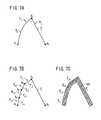
- FIG. 7A shows a path having a line shape which is the same as the line shape shown in FIG. 8A .
- FIG. 7B shows a polygonal path converted from the path shown in FIG. 7A by a page description data processing method according to the present embodiment.
- a curved path P c (curved path construction operator O c ) is replaced with line segments P L1 through P L4 of a polygonal path which correspond respectively to straight path construction operators O L1 through O L4 .
- the line segments P L1 through P L4 of the polygonal path reproduce the curved path P c with accuracy.
- FIG. 7C shows a stroked area 100 produced when the line segments P L1 through P L4 of the polygonal path shown in FIG. 7B are rasterized by the RIP 16.
- the stroked area 100 is expressed more stably than the stroked areas 4, 6 (see FIGS. 8C and 8E ). As no curved path construction operator is present in the object, the stroked area 100 is completely free of any line join style instability caused by the rasterizing process.
- the curved path P c is replaced with the line segments P L1 through P L4 of the polygonal path.
- the page description data are prevented from leading to print difficulties due to the characteristics inherent in the printing press 24, the software version of the RIP 16, etc.
- possible print difficulties in a process of rasterizing image data representing a precipitous sharp line shape can be prevented.
- the present invention is particularly effective in outlining fonts.
- page description data according to the PDF have been described above, the present invention is not limited to the PDF, but is also applicable to other page description languages such as PostScript (registered trademark) of Adobe Systems and XPS (XML Paper Specification).
- PostScript registered trademark
- XPS XML Paper Specification
Landscapes
- Physics & Mathematics (AREA)
- General Physics & Mathematics (AREA)
- Engineering & Computer Science (AREA)
- Theoretical Computer Science (AREA)
- Image Generation (AREA)
- Record Information Processing For Printing (AREA)
Applications Claiming Priority (1)
| Application Number | Priority Date | Filing Date | Title |
|---|---|---|---|
| JP2009270710A JP5476103B2 (ja) | 2009-11-27 | 2009-11-27 | ページ記述データ処理装置、方法及びプログラム |
Publications (1)
| Publication Number | Publication Date |
|---|---|
| EP2348486A2 true EP2348486A2 (en) | 2011-07-27 |
Family
ID=44010087
Family Applications (1)
| Application Number | Title | Priority Date | Filing Date |
|---|---|---|---|
| EP10192423A Withdrawn EP2348486A2 (en) | 2009-11-27 | 2010-11-24 | Page description data processing apparatus, page description data processing method, and recording medium |
Country Status (3)
| Country | Link |
|---|---|
| US (1) | US8566703B2 (enExample) |
| EP (1) | EP2348486A2 (enExample) |
| JP (1) | JP5476103B2 (enExample) |
Families Citing this family (4)
| Publication number | Priority date | Publication date | Assignee | Title |
|---|---|---|---|---|
| CN102622120B (zh) * | 2011-01-31 | 2015-07-08 | 宸鸿光电科技股份有限公司 | 多点触控面板的触碰轨迹追踪方法 |
| JP5259756B2 (ja) * | 2011-03-02 | 2013-08-07 | 富士フイルム株式会社 | ページ記述データ処理装置、方法及びプログラム並びに印刷物生産方法 |
| CN102819853B (zh) * | 2011-06-10 | 2015-11-25 | 富士通株式会社 | 曲线渲染方法和系统 |
| CN105381912B (zh) * | 2015-10-15 | 2017-10-03 | 东南大学 | 一种基于表面曲率的喷涂机器人自动路径生成方法 |
Citations (1)
| Publication number | Priority date | Publication date | Assignee | Title |
|---|---|---|---|---|
| JP2005070957A (ja) | 2003-08-21 | 2005-03-17 | Fuji Photo Film Co Ltd | 変換制御装置および変換制御プログラム |
Family Cites Families (17)
| Publication number | Priority date | Publication date | Assignee | Title |
|---|---|---|---|---|
| JPH06505817A (ja) | 1990-11-30 | 1994-06-30 | ケンブリッジ アニメーション システムズ リミテッド | 画像合成及び処理 |
| US5402530A (en) * | 1991-08-20 | 1995-03-28 | Island Graphics Corporation | Method and system for color film separation preprocess using electronic object-based choking and spreading procedures including object combining operations |
| US5500927A (en) * | 1993-03-18 | 1996-03-19 | Macromedia, Inc. | System and method for simplifying a computer-generated path |
| US5694535A (en) * | 1995-03-24 | 1997-12-02 | Novell, Inc. | Direct interactive, constant-time curve apparatus and method |
| JP3436008B2 (ja) * | 1996-08-20 | 2003-08-11 | 富士ゼロックス株式会社 | 描画処理装置 |
| US7069314B1 (en) * | 1999-06-09 | 2006-06-27 | Fuji Photo Film Co., Ltd. | Method of performing a process and client server system |
| US20030001864A1 (en) * | 2001-06-29 | 2003-01-02 | Bitflash Graphics, Inc. | Method and system for manipulation of garphics information |
| JP4462790B2 (ja) * | 2001-09-04 | 2010-05-12 | ソニー株式会社 | 磁気メモリ |
| JP3938530B2 (ja) * | 2002-08-23 | 2007-06-27 | 富士フイルム株式会社 | バリアブル印刷処理装置およびバリアブル印刷処理プログラム |
| US20040083430A1 (en) * | 2002-10-29 | 2004-04-29 | Boonen Paul J. J. | Method and apparatus to process portable document format data containing transparency |
| US7777901B2 (en) * | 2002-11-28 | 2010-08-17 | Fujifilm Corporation | Imposition apparatus for arranging pages and imposition program storage medium |
| JP4031448B2 (ja) * | 2004-01-23 | 2008-01-09 | 富士フイルム株式会社 | データ変換装置およびデータ変換プログラム |
| JP2006211140A (ja) * | 2005-01-26 | 2006-08-10 | Fuji Photo Film Co Ltd | 画像補正装置、画像補正プログラム、データ変換装置、データ変換プログラム |
| FR2885719B1 (fr) * | 2005-05-10 | 2007-12-07 | Thomson Licensing Sa | Procede et dispositif de suivi d'objets dans une sequence d'images |
| JP2007080182A (ja) * | 2005-09-16 | 2007-03-29 | Canon Inc | 情報処理装置、情報処理方法ならびに記憶媒体、プログラム |
| JP4946776B2 (ja) * | 2007-10-16 | 2012-06-06 | セイコーエプソン株式会社 | 画像処理方法、そのプログラム及び画像処理装置 |
| JP2010111088A (ja) * | 2008-11-10 | 2010-05-20 | Seiko Epson Corp | 画像形成装置 |
-
2009
- 2009-11-27 JP JP2009270710A patent/JP5476103B2/ja not_active Expired - Fee Related
-
2010
- 2010-11-24 EP EP10192423A patent/EP2348486A2/en not_active Withdrawn
- 2010-11-24 US US12/954,300 patent/US8566703B2/en not_active Expired - Fee Related
Patent Citations (1)
| Publication number | Priority date | Publication date | Assignee | Title |
|---|---|---|---|---|
| JP2005070957A (ja) | 2003-08-21 | 2005-03-17 | Fuji Photo Film Co Ltd | 変換制御装置および変換制御プログラム |
Non-Patent Citations (1)
| Title |
|---|
| ADOBE SYSTEMS: "PDF Reference", July 2000, PEARSON EDUCATION, pages: 135 - 136,140- |
Also Published As
| Publication number | Publication date |
|---|---|
| JP2011113414A (ja) | 2011-06-09 |
| US8566703B2 (en) | 2013-10-22 |
| US20110131483A1 (en) | 2011-06-02 |
| JP5476103B2 (ja) | 2014-04-23 |
Similar Documents
| Publication | Publication Date | Title |
|---|---|---|
| EP1258828B1 (en) | Just-in-time raster image assembly | |
| US7253918B2 (en) | Image processing device | |
| US5988899A (en) | In-RIP sorting of objects in the slow scan direction | |
| US7916321B2 (en) | Document processing apparatus and document processing method | |
| US8566703B2 (en) | Page description data processing apparatus, page description data processing method, and recording medium | |
| JP4973803B1 (ja) | 画像処理装置及びプログラム | |
| US20080204769A1 (en) | Image forming apparatus | |
| JP6330790B2 (ja) | 印刷制御システム、印刷制御装置およびプログラム | |
| JP6120824B2 (ja) | 画像処理装置、画像処理方法、及びプログラム | |
| US20040075859A1 (en) | Printer instruction processing | |
| US8599389B2 (en) | Page description data processing apparatus, page description data processing method, print producing method, and recording medium | |
| US8941878B2 (en) | Page description data processing apparatus, page description data processing method, and recording medium | |
| US8467077B2 (en) | Page description data processing apparatus, page description data processing method, and recording medium | |
| US20110242566A1 (en) | Systems and methods for optimizing function based object operations in interpreted page description languages | |
| JP2006252300A (ja) | プルプリント印刷システム | |
| US8610951B2 (en) | Page description data processing apparatus, page description data processing method, and recording medium | |
| JP2019192087A (ja) | 情報処理装置、プログラム、情報処理方法 | |
| JP2006154912A (ja) | ドキュメント表示および印刷システム、方法および記憶媒体 | |
| JP7316829B2 (ja) | 情報処理装置、情報処理方法、およびプログラム | |
| US8264735B2 (en) | Image processing apparatus, image formation apparatus, image processing method, and recording medium storing program | |
| US20030147682A1 (en) | System and methods for real-time printing | |
| JP2004326657A (ja) | 画像処理装置 | |
| JP2020029067A (ja) | 描画処理装置、描画処理方法、及びプログラム | |
| JP2017060070A (ja) | 画像形成装置、画像形成装置の制御方法及びプログラム | |
| JP2017024190A (ja) | 画像処理装置、画像処理装置の画像処理方法、及びプログラム |
Legal Events
| Date | Code | Title | Description |
|---|---|---|---|
| PUAI | Public reference made under article 153(3) epc to a published international application that has entered the european phase |
Free format text: ORIGINAL CODE: 0009012 |
|
| AK | Designated contracting states |
Kind code of ref document: A2 Designated state(s): AL AT BE BG CH CY CZ DE DK EE ES FI FR GB GR HR HU IE IS IT LI LT LU LV MC MK MT NL NO PL PT RO RS SE SI SK SM TR |
|
| AX | Request for extension of the european patent |
Extension state: BA ME |
|
| RIN1 | Information on inventor provided before grant (corrected) |
Inventor name: AOKI, YASUHARU |
|
| STAA | Information on the status of an ep patent application or granted ep patent |
Free format text: STATUS: THE APPLICATION HAS BEEN WITHDRAWN |
|
| 18W | Application withdrawn |
Effective date: 20150623 |