EP2341145A1 - miRNA fingerprint in the diagnosis of diseases - Google Patents
miRNA fingerprint in the diagnosis of diseases Download PDFInfo
- Publication number
- EP2341145A1 EP2341145A1 EP09181024A EP09181024A EP2341145A1 EP 2341145 A1 EP2341145 A1 EP 2341145A1 EP 09181024 A EP09181024 A EP 09181024A EP 09181024 A EP09181024 A EP 09181024A EP 2341145 A1 EP2341145 A1 EP 2341145A1
- Authority
- EP
- European Patent Office
- Prior art keywords
- hsa
- mir
- life
- mirnas
- diagnosis
- Prior art date
- Legal status (The legal status is an assumption and is not a legal conclusion. Google has not performed a legal analysis and makes no representation as to the accuracy of the status listed.)
- Ceased
Links
- 239000002679 microRNA Substances 0.000 title claims abstract description 366
- 108091070501 miRNA Proteins 0.000 title claims abstract description 288
- 208000037265 diseases, disorders, signs and symptoms Diseases 0.000 title claims abstract description 58
- 201000010099 disease Diseases 0.000 title claims abstract description 57
- 238000003745 diagnosis Methods 0.000 title claims description 89
- 230000014509 gene expression Effects 0.000 claims abstract description 62
- 238000000034 method Methods 0.000 claims abstract description 42
- -1 hsa-miR-891a Proteins 0.000 claims description 241
- 208000006545 Chronic Obstructive Pulmonary Disease Diseases 0.000 claims description 81
- 208000000236 Prostatic Neoplasms Diseases 0.000 claims description 51
- 206010060862 Prostate cancer Diseases 0.000 claims description 49
- 108091068999 Homo sapiens miR-144 stem-loop Proteins 0.000 claims description 41
- 210000004369 blood Anatomy 0.000 claims description 32
- 239000008280 blood Substances 0.000 claims description 32
- 238000002493 microarray Methods 0.000 claims description 32
- 108091066902 Homo sapiens miR-330 stem-loop Proteins 0.000 claims description 28
- 108091061570 Homo sapiens miR-662 stem-loop Proteins 0.000 claims description 27
- 108091061623 Homo sapiens miR-636 stem-loop Proteins 0.000 claims description 25
- 108091067545 Homo sapiens miR-383 stem-loop Proteins 0.000 claims description 24
- 108091063734 Homo sapiens miR-556 stem-loop Proteins 0.000 claims description 24
- 108091061649 Homo sapiens miR-625 stem-loop Proteins 0.000 claims description 24
- 102000039446 nucleic acids Human genes 0.000 claims description 24
- 108020004707 nucleic acids Proteins 0.000 claims description 24
- 150000007523 nucleic acids Chemical class 0.000 claims description 24
- 108091067482 Homo sapiens miR-205 stem-loop Proteins 0.000 claims description 22
- 108091061634 Homo sapiens miR-634 stem-loop Proteins 0.000 claims description 22
- 239000012472 biological sample Substances 0.000 claims description 22
- 108091067627 Homo sapiens miR-182 stem-loop Proteins 0.000 claims description 21
- 108091070371 Homo sapiens miR-25 stem-loop Proteins 0.000 claims description 21
- 108091067605 Homo sapiens miR-183 stem-loop Proteins 0.000 claims description 20
- 108091067253 Homo sapiens miR-369 stem-loop Proteins 0.000 claims description 20
- 108091044614 Homo sapiens miR-548p stem-loop Proteins 0.000 claims description 20
- 108091061624 Homo sapiens miR-641 stem-loop Proteins 0.000 claims description 20
- 108091067258 Homo sapiens miR-361 stem-loop Proteins 0.000 claims description 19
- 108091067286 Homo sapiens miR-363 stem-loop Proteins 0.000 claims description 19
- 108091092284 Homo sapiens miR-515-1 stem-loop Proteins 0.000 claims description 19
- 108091092278 Homo sapiens miR-515-2 stem-loop Proteins 0.000 claims description 19
- 108091079273 Homo sapiens miR-1913 stem-loop Proteins 0.000 claims description 18
- 108091068960 Homo sapiens miR-195 stem-loop Proteins 0.000 claims description 18
- 108091064864 Homo sapiens miR-1470 stem-loop Proteins 0.000 claims description 17
- 108091067692 Homo sapiens miR-199a-1 stem-loop Proteins 0.000 claims description 17
- 108091067467 Homo sapiens miR-199a-2 stem-loop Proteins 0.000 claims description 17
- 108091027963 non-coding RNA Proteins 0.000 claims description 17
- 102000042567 non-coding RNA Human genes 0.000 claims description 17
- 210000002966 serum Anatomy 0.000 claims description 17
- 108091067617 Homo sapiens miR-139 stem-loop Proteins 0.000 claims description 16
- 108091063807 Homo sapiens miR-545 stem-loop Proteins 0.000 claims description 16
- 108091044797 Homo sapiens miR-1291 stem-loop Proteins 0.000 claims description 15
- 108091064474 Homo sapiens miR-519b stem-loop Proteins 0.000 claims description 15
- 108091086462 Homo sapiens miR-875 stem-loop Proteins 0.000 claims description 15
- 108091044954 Homo sapiens miR-1229 stem-loop Proteins 0.000 claims description 14
- 108091045230 Homo sapiens miR-1324 stem-loop Proteins 0.000 claims description 14
- 108091068985 Homo sapiens miR-137 stem-loop Proteins 0.000 claims description 14
- 108091069517 Homo sapiens miR-224 stem-loop Proteins 0.000 claims description 14
- 108091063756 Homo sapiens miR-554 stem-loop Proteins 0.000 claims description 14
- 108091063722 Homo sapiens miR-581 stem-loop Proteins 0.000 claims description 14
- 108091061594 Homo sapiens miR-590 stem-loop Proteins 0.000 claims description 14
- 108091060465 Homo sapiens miR-767 stem-loop Proteins 0.000 claims description 14
- 108091044872 Homo sapiens miR-1258 stem-loop Proteins 0.000 claims description 13
- 108091044792 Homo sapiens miR-1294 stem-loop Proteins 0.000 claims description 13
- 108091069033 Homo sapiens miR-188 stem-loop Proteins 0.000 claims description 13
- 108091044773 Homo sapiens miR-302f stem-loop Proteins 0.000 claims description 13
- 108091092304 Homo sapiens miR-492 stem-loop Proteins 0.000 claims description 13
- 108091064470 Homo sapiens miR-518b stem-loop Proteins 0.000 claims description 13
- 108091086454 Homo sapiens miR-744 stem-loop Proteins 0.000 claims description 13
- 108091070512 Homo sapiens let-7d stem-loop Proteins 0.000 claims description 12
- 108091060466 Homo sapiens miR-1224 stem-loop Proteins 0.000 claims description 12
- 108091069017 Homo sapiens miR-140 stem-loop Proteins 0.000 claims description 12
- 108091070493 Homo sapiens miR-21 stem-loop Proteins 0.000 claims description 12
- 108091070383 Homo sapiens miR-32 stem-loop Proteins 0.000 claims description 12
- 108091067005 Homo sapiens miR-328 stem-loop Proteins 0.000 claims description 12
- 108091092303 Homo sapiens miR-497 stem-loop Proteins 0.000 claims description 12
- 108091092280 Homo sapiens miR-519c stem-loop Proteins 0.000 claims description 12
- 108091061639 Homo sapiens miR-631 stem-loop Proteins 0.000 claims description 12
- 108091061601 Homo sapiens miR-646 stem-loop Proteins 0.000 claims description 12
- 108091086709 Homo sapiens miR-675 stem-loop Proteins 0.000 claims description 12
- 108091086510 Homo sapiens miR-891b stem-loop Proteins 0.000 claims description 12
- 108091070380 Homo sapiens miR-92a-1 stem-loop Proteins 0.000 claims description 12
- 108091087110 Homo sapiens miR-940 stem-loop Proteins 0.000 claims description 12
- 108091087117 Homo sapiens miR-944 stem-loop Proteins 0.000 claims description 12
- 108091070376 Homo sapiens miR-96 stem-loop Proteins 0.000 claims description 12
- 108091008065 MIR21 Proteins 0.000 claims description 12
- 238000009396 hybridization Methods 0.000 claims description 12
- 108091062097 Homo sapiens miR-1283-1 stem-loop Proteins 0.000 claims description 11
- 108091044589 Homo sapiens miR-1283-2 stem-loop Proteins 0.000 claims description 11
- 108091070395 Homo sapiens miR-31 stem-loop Proteins 0.000 claims description 11
- 108091067010 Homo sapiens miR-338 stem-loop Proteins 0.000 claims description 11
- 108091067008 Homo sapiens miR-342 stem-loop Proteins 0.000 claims description 11
- 108091092234 Homo sapiens miR-488 stem-loop Proteins 0.000 claims description 11
- 108091061611 Homo sapiens miR-639 stem-loop Proteins 0.000 claims description 11
- 108091070377 Homo sapiens miR-93 stem-loop Proteins 0.000 claims description 11
- 108091069086 Homo sapiens miR-127 stem-loop Proteins 0.000 claims description 10
- 108091044980 Homo sapiens miR-1305 stem-loop Proteins 0.000 claims description 10
- 108091069034 Homo sapiens miR-193a stem-loop Proteins 0.000 claims description 10
- 108091070373 Homo sapiens miR-24-1 stem-loop Proteins 0.000 claims description 10
- 108091032542 Homo sapiens miR-452 stem-loop Proteins 0.000 claims description 10
- 108091061603 Homo sapiens miR-651 stem-loop Proteins 0.000 claims description 10
- 108091044697 Homo sapiens miR-1249 stem-loop Proteins 0.000 claims description 9
- 108091069102 Homo sapiens miR-136 stem-loop Proteins 0.000 claims description 9
- 108091070374 Homo sapiens miR-24-2 stem-loop Proteins 0.000 claims description 9
- 108091061637 Homo sapiens miR-632 stem-loop Proteins 0.000 claims description 9
- 108091044953 Homo sapiens miR-1228 stem-loop Proteins 0.000 claims description 8
- 108091061957 Homo sapiens miR-1298 stem-loop Proteins 0.000 claims description 8
- 108091068958 Homo sapiens miR-184 stem-loop Proteins 0.000 claims description 8
- 108091079264 Homo sapiens miR-1911 stem-loop Proteins 0.000 claims description 8
- 108091086504 Homo sapiens miR-541 stem-loop Proteins 0.000 claims description 8
- 108091086647 Homo sapiens miR-877 stem-loop Proteins 0.000 claims description 8
- 108091007685 MIR541 Proteins 0.000 claims description 8
- 108091044971 Homo sapiens miR-1243 stem-loop Proteins 0.000 claims description 7
- 108091069085 Homo sapiens miR-126 stem-loop Proteins 0.000 claims description 7
- 108091070489 Homo sapiens miR-17 stem-loop Proteins 0.000 claims description 7
- 108091065453 Homo sapiens miR-296 stem-loop Proteins 0.000 claims description 7
- 108091032103 Homo sapiens miR-425 stem-loop Proteins 0.000 claims description 7
- 108091092306 Homo sapiens miR-432 stem-loop Proteins 0.000 claims description 7
- 108091086503 Homo sapiens miR-450b stem-loop Proteins 0.000 claims description 7
- 108091064417 Homo sapiens miR-518d stem-loop Proteins 0.000 claims description 7
- 108091064467 Homo sapiens miR-520c stem-loop Proteins 0.000 claims description 7
- 108091044789 Homo sapiens miR-548k stem-loop Proteins 0.000 claims description 7
- 108091063718 Homo sapiens miR-579 stem-loop Proteins 0.000 claims description 7
- 108091086652 Homo sapiens miR-885 stem-loop Proteins 0.000 claims description 7
- 108091044878 Homo sapiens miR-1251 stem-loop Proteins 0.000 claims description 6
- 108091044768 Homo sapiens miR-1276 stem-loop Proteins 0.000 claims description 6
- 108091064853 Homo sapiens miR-1471 stem-loop Proteins 0.000 claims description 6
- 108091067465 Homo sapiens miR-217 stem-loop Proteins 0.000 claims description 6
- 108091063737 Homo sapiens miR-559 stem-loop Proteins 0.000 claims description 6
- 108091063727 Homo sapiens miR-564 stem-loop Proteins 0.000 claims description 6
- 108091061772 Homo sapiens miR-609 stem-loop Proteins 0.000 claims description 6
- 108091061647 Homo sapiens miR-621 stem-loop Proteins 0.000 claims description 6
- 108091086477 Homo sapiens miR-873 stem-loop Proteins 0.000 claims description 6
- 108091087064 Homo sapiens miR-922 stem-loop Proteins 0.000 claims description 6
- 108091087085 Homo sapiens miR-934 stem-loop Proteins 0.000 claims description 6
- 108091033149 Homo sapiens miR-384 stem-loop Proteins 0.000 claims description 5
- 108091053841 Homo sapiens miR-483 stem-loop Proteins 0.000 claims description 5
- 108091061633 Homo sapiens miR-626 stem-loop Proteins 0.000 claims description 5
- 108091061671 Homo sapiens miR-657 stem-loop Proteins 0.000 claims description 5
- 108091086502 Homo sapiens miR-874 stem-loop Proteins 0.000 claims description 5
- 238000003753 real-time PCR Methods 0.000 claims description 5
- 108091069047 Homo sapiens let-7i stem-loop Proteins 0.000 claims description 4
- 108091069016 Homo sapiens miR-122 stem-loop Proteins 0.000 claims description 4
- 108091044923 Homo sapiens miR-1226 stem-loop Proteins 0.000 claims description 4
- 108091062150 Homo sapiens miR-1271 stem-loop Proteins 0.000 claims description 4
- 108091068991 Homo sapiens miR-141 stem-loop Proteins 0.000 claims description 4
- 108091069002 Homo sapiens miR-145 stem-loop Proteins 0.000 claims description 4
- 108091092238 Homo sapiens miR-146b stem-loop Proteins 0.000 claims description 4
- 108091078047 Homo sapiens miR-1827 stem-loop Proteins 0.000 claims description 4
- 108091068998 Homo sapiens miR-191 stem-loop Proteins 0.000 claims description 4
- 108091067580 Homo sapiens miR-214 stem-loop Proteins 0.000 claims description 4
- 108091069527 Homo sapiens miR-223 stem-loop Proteins 0.000 claims description 4
- 108091070397 Homo sapiens miR-28 stem-loop Proteins 0.000 claims description 4
- 108091067259 Homo sapiens miR-362 stem-loop Proteins 0.000 claims description 4
- 108091067564 Homo sapiens miR-373 stem-loop Proteins 0.000 claims description 4
- 108091032109 Homo sapiens miR-423 stem-loop Proteins 0.000 claims description 4
- 108091063813 Homo sapiens miR-455 stem-loop Proteins 0.000 claims description 4
- 108091087072 Homo sapiens miR-509-3 stem-loop Proteins 0.000 claims description 4
- 108091064426 Homo sapiens miR-522 stem-loop Proteins 0.000 claims description 4
- 108091064471 Homo sapiens miR-525 stem-loop Proteins 0.000 claims description 4
- 108091063565 Homo sapiens miR-532 stem-loop Proteins 0.000 claims description 4
- 108091061687 Homo sapiens miR-548a-3 stem-loop Proteins 0.000 claims description 4
- 108091063772 Homo sapiens miR-589 stem-loop Proteins 0.000 claims description 4
- 108091061622 Homo sapiens miR-628 stem-loop Proteins 0.000 claims description 4
- 108091086461 Homo sapiens miR-876 stem-loop Proteins 0.000 claims description 4
- 108091070375 Homo sapiens miR-95 stem-loop Proteins 0.000 claims description 4
- 108091007780 MiR-122 Proteins 0.000 claims description 4
- 238000002512 chemotherapy Methods 0.000 claims description 4
- 238000002560 therapeutic procedure Methods 0.000 claims description 4
- 108091045820 Homo sapiens miR-1184-1 stem-loop Proteins 0.000 claims description 3
- 108091034012 Homo sapiens miR-1184-2 stem-loop Proteins 0.000 claims description 3
- 108091034015 Homo sapiens miR-1184-3 stem-loop Proteins 0.000 claims description 3
- 108091044903 Homo sapiens miR-1234 stem-loop Proteins 0.000 claims description 3
- 108091044588 Homo sapiens miR-1252 stem-loop Proteins 0.000 claims description 3
- 108091044758 Homo sapiens miR-1267 stem-loop Proteins 0.000 claims description 3
- 108091078084 Homo sapiens miR-1825 stem-loop Proteins 0.000 claims description 3
- 108091067464 Homo sapiens miR-218-1 stem-loop Proteins 0.000 claims description 3
- 108091067641 Homo sapiens miR-30c-2 stem-loop Proteins 0.000 claims description 3
- 108091067543 Homo sapiens miR-382 stem-loop Proteins 0.000 claims description 3
- 108091092227 Homo sapiens miR-489 stem-loop Proteins 0.000 claims description 3
- 108091064424 Homo sapiens miR-527 stem-loop Proteins 0.000 claims description 3
- 108091063773 Homo sapiens miR-548a-1 stem-loop Proteins 0.000 claims description 3
- 108091063768 Homo sapiens miR-548a-2 stem-loop Proteins 0.000 claims description 3
- 108091061690 Homo sapiens miR-606 stem-loop Proteins 0.000 claims description 3
- 108091061642 Homo sapiens miR-617 stem-loop Proteins 0.000 claims description 3
- 108091061626 Homo sapiens miR-635 stem-loop Proteins 0.000 claims description 3
- 108091086478 Homo sapiens miR-665 stem-loop Proteins 0.000 claims description 3
- 108091061966 Homo sapiens miR-802 stem-loop Proteins 0.000 claims description 3
- 230000003321 amplification Effects 0.000 claims description 3
- 238000004949 mass spectrometry Methods 0.000 claims description 3
- 238000003199 nucleic acid amplification method Methods 0.000 claims description 3
- 238000007899 nucleic acid hybridization Methods 0.000 claims description 3
- 238000012163 sequencing technique Methods 0.000 claims description 3
- 210000002700 urine Anatomy 0.000 claims description 3
- 238000000018 DNA microarray Methods 0.000 claims description 2
- 229940079593 drug Drugs 0.000 claims description 2
- 239000003814 drug Substances 0.000 claims description 2
- 238000011065 in-situ storage Methods 0.000 claims description 2
- 239000007790 solid phase Substances 0.000 claims description 2
- 230000004083 survival effect Effects 0.000 claims description 2
- 108091070514 Homo sapiens let-7b stem-loop Proteins 0.000 claims 2
- 108091070511 Homo sapiens let-7c stem-loop Proteins 0.000 claims 2
- 108091070508 Homo sapiens let-7e stem-loop Proteins 0.000 claims 2
- 108091069046 Homo sapiens let-7g stem-loop Proteins 0.000 claims 2
- 108091068853 Homo sapiens miR-100 stem-loop Proteins 0.000 claims 2
- 108091044803 Homo sapiens miR-1207 stem-loop Proteins 0.000 claims 2
- 108091044921 Homo sapiens miR-1225 stem-loop Proteins 0.000 claims 2
- 108091069004 Homo sapiens miR-125a stem-loop Proteins 0.000 claims 2
- 108091069024 Homo sapiens miR-132 stem-loop Proteins 0.000 claims 2
- 108091068993 Homo sapiens miR-142 stem-loop Proteins 0.000 claims 2
- 108091068992 Homo sapiens miR-143 stem-loop Proteins 0.000 claims 2
- 108091069090 Homo sapiens miR-149 stem-loop Proteins 0.000 claims 2
- 108091069088 Homo sapiens miR-150 stem-loop Proteins 0.000 claims 2
- 108091068955 Homo sapiens miR-154 stem-loop Proteins 0.000 claims 2
- 108091065981 Homo sapiens miR-155 stem-loop Proteins 0.000 claims 2
- 108091068954 Homo sapiens miR-185 stem-loop Proteins 0.000 claims 2
- 108091068956 Homo sapiens miR-186 stem-loop Proteins 0.000 claims 2
- 108091067635 Homo sapiens miR-187 stem-loop Proteins 0.000 claims 2
- 108091079269 Homo sapiens miR-1909 stem-loop Proteins 0.000 claims 2
- 108091079295 Homo sapiens miR-1914 stem-loop Proteins 0.000 claims 2
- 108091079265 Homo sapiens miR-1915 stem-loop Proteins 0.000 claims 2
- 108091067995 Homo sapiens miR-192 stem-loop Proteins 0.000 claims 2
- 108091067484 Homo sapiens miR-199b stem-loop Proteins 0.000 claims 2
- 108091092296 Homo sapiens miR-202 stem-loop Proteins 0.000 claims 2
- 108091090626 Homo sapiens miR-2114 stem-loop Proteins 0.000 claims 2
- 108091090625 Homo sapiens miR-2115 stem-loop Proteins 0.000 claims 2
- 108091090620 Homo sapiens miR-2116 stem-loop Proteins 0.000 claims 2
- 108091070494 Homo sapiens miR-22 stem-loop Proteins 0.000 claims 2
- 108091067572 Homo sapiens miR-221 stem-loop Proteins 0.000 claims 2
- 108091067573 Homo sapiens miR-222 stem-loop Proteins 0.000 claims 2
- 108091065449 Homo sapiens miR-299 stem-loop Proteins 0.000 claims 2
- 108091067007 Homo sapiens miR-324 stem-loop Proteins 0.000 claims 2
- 108091066896 Homo sapiens miR-331 stem-loop Proteins 0.000 claims 2
- 108091066985 Homo sapiens miR-335 stem-loop Proteins 0.000 claims 2
- 108091067013 Homo sapiens miR-337 stem-loop Proteins 0.000 claims 2
- 108091066993 Homo sapiens miR-339 stem-loop Proteins 0.000 claims 2
- 108091066899 Homo sapiens miR-340 stem-loop Proteins 0.000 claims 2
- 108091065456 Homo sapiens miR-34c stem-loop Proteins 0.000 claims 2
- 108091067254 Homo sapiens miR-367 stem-loop Proteins 0.000 claims 2
- 108091067243 Homo sapiens miR-377 stem-loop Proteins 0.000 claims 2
- 108091067552 Homo sapiens miR-379 stem-loop Proteins 0.000 claims 2
- 108091067557 Homo sapiens miR-380 stem-loop Proteins 0.000 claims 2
- 108091032537 Homo sapiens miR-409 stem-loop Proteins 0.000 claims 2
- 108091061676 Homo sapiens miR-411 stem-loop Proteins 0.000 claims 2
- 108091032108 Homo sapiens miR-424 stem-loop Proteins 0.000 claims 2
- 108091032638 Homo sapiens miR-431 stem-loop Proteins 0.000 claims 2
- 108091062137 Homo sapiens miR-454 stem-loop Proteins 0.000 claims 2
- 108091053855 Homo sapiens miR-485 stem-loop Proteins 0.000 claims 2
- 108091053840 Homo sapiens miR-486 stem-loop Proteins 0.000 claims 2
- 108091059229 Homo sapiens miR-486-2 stem-loop Proteins 0.000 claims 2
- 108091092228 Homo sapiens miR-490 stem-loop Proteins 0.000 claims 2
- 108091092229 Homo sapiens miR-491 stem-loop Proteins 0.000 claims 2
- 108091092305 Homo sapiens miR-493 stem-loop Proteins 0.000 claims 2
- 108091064508 Homo sapiens miR-501 stem-loop Proteins 0.000 claims 2
- 108091064509 Homo sapiens miR-502 stem-loop Proteins 0.000 claims 2
- 108091064365 Homo sapiens miR-505 stem-loop Proteins 0.000 claims 2
- 108091064362 Homo sapiens miR-508 stem-loop Proteins 0.000 claims 2
- 108091064367 Homo sapiens miR-509-1 stem-loop Proteins 0.000 claims 2
- 108091086508 Homo sapiens miR-509-2 stem-loop Proteins 0.000 claims 2
- 108091092274 Homo sapiens miR-512-1 stem-loop Proteins 0.000 claims 2
- 108091092275 Homo sapiens miR-512-2 stem-loop Proteins 0.000 claims 2
- 108091064366 Homo sapiens miR-513a-1 stem-loop Proteins 0.000 claims 2
- 108091064370 Homo sapiens miR-513a-2 stem-loop Proteins 0.000 claims 2
- 108091064511 Homo sapiens miR-516a-1 stem-loop Proteins 0.000 claims 2
- 108091064512 Homo sapiens miR-516a-2 stem-loop Proteins 0.000 claims 2
- 108091064420 Homo sapiens miR-518a-1 stem-loop Proteins 0.000 claims 2
- 108091064422 Homo sapiens miR-518a-2 stem-loop Proteins 0.000 claims 2
- 108091092281 Homo sapiens miR-520a stem-loop Proteins 0.000 claims 2
- 108091064446 Homo sapiens miR-520d stem-loop Proteins 0.000 claims 2
- 108091064465 Homo sapiens miR-523 stem-loop Proteins 0.000 claims 2
- 108091064441 Homo sapiens miR-524 stem-loop Proteins 0.000 claims 2
- 108091061666 Homo sapiens miR-542 stem-loop Proteins 0.000 claims 2
- 108091063777 Homo sapiens miR-548b stem-loop Proteins 0.000 claims 2
- 108091061641 Homo sapiens miR-548c stem-loop Proteins 0.000 claims 2
- 108091061614 Homo sapiens miR-548d-1 stem-loop Proteins 0.000 claims 2
- 108091061568 Homo sapiens miR-548d-2 stem-loop Proteins 0.000 claims 2
- 108091063808 Homo sapiens miR-574 stem-loop Proteins 0.000 claims 2
- 108091063721 Homo sapiens miR-576 stem-loop Proteins 0.000 claims 2
- 108091063723 Homo sapiens miR-582 stem-loop Proteins 0.000 claims 2
- 108091061599 Homo sapiens miR-593 stem-loop Proteins 0.000 claims 2
- 108091061778 Homo sapiens miR-615 stem-loop Proteins 0.000 claims 2
- 108091061779 Homo sapiens miR-616 stem-loop Proteins 0.000 claims 2
- 108091061644 Homo sapiens miR-624 stem-loop Proteins 0.000 claims 2
- 108091061631 Homo sapiens miR-629 stem-loop Proteins 0.000 claims 2
- 108091061677 Homo sapiens miR-654 stem-loop Proteins 0.000 claims 2
- 108091060463 Homo sapiens miR-671 stem-loop Proteins 0.000 claims 2
- 108091086460 Homo sapiens miR-708 stem-loop Proteins 0.000 claims 2
- 108091062100 Homo sapiens miR-769 stem-loop Proteins 0.000 claims 2
- 108091086506 Homo sapiens miR-888 stem-loop Proteins 0.000 claims 2
- 108091007773 MIR100 Proteins 0.000 claims 2
- 108091007711 MIR2115 Proteins 0.000 claims 2
- 108091007772 MIRLET7C Proteins 0.000 claims 2
- 108091070522 Homo sapiens let-7a-2 stem-loop Proteins 0.000 claims 1
- 108091070510 Homo sapiens let-7f-1 stem-loop Proteins 0.000 claims 1
- 108091070526 Homo sapiens let-7f-2 stem-loop Proteins 0.000 claims 1
- 108091068928 Homo sapiens miR-107 stem-loop Proteins 0.000 claims 1
- 108091045832 Homo sapiens miR-1178 stem-loop Proteins 0.000 claims 1
- 108091045833 Homo sapiens miR-1179 stem-loop Proteins 0.000 claims 1
- 108091045823 Homo sapiens miR-1180 stem-loop Proteins 0.000 claims 1
- 108091045825 Homo sapiens miR-1181 stem-loop Proteins 0.000 claims 1
- 108091045827 Homo sapiens miR-1182 stem-loop Proteins 0.000 claims 1
- 108091045829 Homo sapiens miR-1183 stem-loop Proteins 0.000 claims 1
- 108091045229 Homo sapiens miR-1197 stem-loop Proteins 0.000 claims 1
- 108091044910 Homo sapiens miR-1200 stem-loop Proteins 0.000 claims 1
- 108091044902 Homo sapiens miR-1202 stem-loop Proteins 0.000 claims 1
- 108091044911 Homo sapiens miR-1203 stem-loop Proteins 0.000 claims 1
- 108091044907 Homo sapiens miR-1204 stem-loop Proteins 0.000 claims 1
- 108091044909 Homo sapiens miR-1206 stem-loop Proteins 0.000 claims 1
- 108091044804 Homo sapiens miR-1208 stem-loop Proteins 0.000 claims 1
- 108091044926 Homo sapiens miR-1227 stem-loop Proteins 0.000 claims 1
- 108091044940 Homo sapiens miR-1231 stem-loop Proteins 0.000 claims 1
- 108091044936 Homo sapiens miR-1236 stem-loop Proteins 0.000 claims 1
- 108091044937 Homo sapiens miR-1237 stem-loop Proteins 0.000 claims 1
- 108091044938 Homo sapiens miR-1238 stem-loop Proteins 0.000 claims 1
- 108091044979 Homo sapiens miR-1244-1 stem-loop Proteins 0.000 claims 1
- 108091034013 Homo sapiens miR-1244-2 stem-loop Proteins 0.000 claims 1
- 108091034014 Homo sapiens miR-1244-3 stem-loop Proteins 0.000 claims 1
- 108091045543 Homo sapiens miR-1244-4 stem-loop Proteins 0.000 claims 1
- 108091044881 Homo sapiens miR-1246 stem-loop Proteins 0.000 claims 1
- 108091044882 Homo sapiens miR-1247 stem-loop Proteins 0.000 claims 1
- 108091044695 Homo sapiens miR-1248 stem-loop Proteins 0.000 claims 1
- 108091044886 Homo sapiens miR-1250 stem-loop Proteins 0.000 claims 1
- 108091044693 Homo sapiens miR-1253 stem-loop Proteins 0.000 claims 1
- 108091044694 Homo sapiens miR-1255a stem-loop Proteins 0.000 claims 1
- 108091044870 Homo sapiens miR-1256 stem-loop Proteins 0.000 claims 1
- 108091044871 Homo sapiens miR-1257 stem-loop Proteins 0.000 claims 1
- 108091069006 Homo sapiens miR-125b-1 stem-loop Proteins 0.000 claims 1
- 108091069087 Homo sapiens miR-125b-2 stem-loop Proteins 0.000 claims 1
- 108091044875 Homo sapiens miR-1261 stem-loop Proteins 0.000 claims 1
- 108091044868 Homo sapiens miR-1262 stem-loop Proteins 0.000 claims 1
- 108091044860 Homo sapiens miR-1263 stem-loop Proteins 0.000 claims 1
- 108091060475 Homo sapiens miR-1264 stem-loop Proteins 0.000 claims 1
- 108091044761 Homo sapiens miR-1265 stem-loop Proteins 0.000 claims 1
- 108091044767 Homo sapiens miR-1266 stem-loop Proteins 0.000 claims 1
- 108091044764 Homo sapiens miR-1270 stem-loop Proteins 0.000 claims 1
- 108091044765 Homo sapiens miR-1272 stem-loop Proteins 0.000 claims 1
- 108091044777 Homo sapiens miR-1275 stem-loop Proteins 0.000 claims 1
- 108091044774 Homo sapiens miR-1277 stem-loop Proteins 0.000 claims 1
- 108091044612 Homo sapiens miR-1278 stem-loop Proteins 0.000 claims 1
- 108091044613 Homo sapiens miR-1279 stem-loop Proteins 0.000 claims 1
- 108091044608 Homo sapiens miR-1281 stem-loop Proteins 0.000 claims 1
- 108091044609 Homo sapiens miR-1282 stem-loop Proteins 0.000 claims 1
- 108091044584 Homo sapiens miR-1284 stem-loop Proteins 0.000 claims 1
- 108091044829 Homo sapiens miR-1286 stem-loop Proteins 0.000 claims 1
- 108091044798 Homo sapiens miR-1287 stem-loop Proteins 0.000 claims 1
- 108091044585 Homo sapiens miR-1288 stem-loop Proteins 0.000 claims 1
- 108091044794 Homo sapiens miR-1289-1 stem-loop Proteins 0.000 claims 1
- 108091044795 Homo sapiens miR-1289-2 stem-loop Proteins 0.000 claims 1
- 108091067642 Homo sapiens miR-129-1 stem-loop Proteins 0.000 claims 1
- 108091069093 Homo sapiens miR-129-2 stem-loop Proteins 0.000 claims 1
- 108091044796 Homo sapiens miR-1290 stem-loop Proteins 0.000 claims 1
- 108091044586 Homo sapiens miR-1292 stem-loop Proteins 0.000 claims 1
- 108091044790 Homo sapiens miR-1293 stem-loop Proteins 0.000 claims 1
- 108091060453 Homo sapiens miR-1296 stem-loop Proteins 0.000 claims 1
- 108091044816 Homo sapiens miR-1297 stem-loop Proteins 0.000 claims 1
- 108091044817 Homo sapiens miR-1299 stem-loop Proteins 0.000 claims 1
- 108091062151 Homo sapiens miR-1301 stem-loop Proteins 0.000 claims 1
- 108091044964 Homo sapiens miR-1302-1 stem-loop Proteins 0.000 claims 1
- 108091033925 Homo sapiens miR-1302-10 stem-loop Proteins 0.000 claims 1
- 108091033832 Homo sapiens miR-1302-11 stem-loop Proteins 0.000 claims 1
- 108091044965 Homo sapiens miR-1302-2 stem-loop Proteins 0.000 claims 1
- 108091044966 Homo sapiens miR-1302-3 stem-loop Proteins 0.000 claims 1
- 108091044969 Homo sapiens miR-1302-4 stem-loop Proteins 0.000 claims 1
- 108091044970 Homo sapiens miR-1302-5 stem-loop Proteins 0.000 claims 1
- 108091044961 Homo sapiens miR-1302-6 stem-loop Proteins 0.000 claims 1
- 108091044962 Homo sapiens miR-1302-7 stem-loop Proteins 0.000 claims 1
- 108091044968 Homo sapiens miR-1302-8 stem-loop Proteins 0.000 claims 1
- 108091033923 Homo sapiens miR-1302-9 stem-loop Proteins 0.000 claims 1
- 108091044974 Homo sapiens miR-1303 stem-loop Proteins 0.000 claims 1
- 108091044975 Homo sapiens miR-1304 stem-loop Proteins 0.000 claims 1
- 108091044603 Homo sapiens miR-1306 stem-loop Proteins 0.000 claims 1
- 108091044678 Homo sapiens miR-1307 stem-loop Proteins 0.000 claims 1
- 108091045232 Homo sapiens miR-1321 stem-loop Proteins 0.000 claims 1
- 108091045233 Homo sapiens miR-1322 stem-loop Proteins 0.000 claims 1
- 108091060456 Homo sapiens miR-1323 stem-loop Proteins 0.000 claims 1
- 108091066990 Homo sapiens miR-133b stem-loop Proteins 0.000 claims 1
- 108091069094 Homo sapiens miR-134 stem-loop Proteins 0.000 claims 1
- 108091069092 Homo sapiens miR-138-1 stem-loop Proteins 0.000 claims 1
- 108091069015 Homo sapiens miR-138-2 stem-loop Proteins 0.000 claims 1
- 108091060454 Homo sapiens miR-1468 stem-loop Proteins 0.000 claims 1
- 108091064840 Homo sapiens miR-1469 stem-loop Proteins 0.000 claims 1
- 108091068997 Homo sapiens miR-152 stem-loop Proteins 0.000 claims 1
- 108091051956 Homo sapiens miR-1537 stem-loop Proteins 0.000 claims 1
- 108091051957 Homo sapiens miR-1538 stem-loop Proteins 0.000 claims 1
- 108091051930 Homo sapiens miR-1539 stem-loop Proteins 0.000 claims 1
- 108091070491 Homo sapiens miR-16-1 stem-loop Proteins 0.000 claims 1
- 108091068927 Homo sapiens miR-16-2 stem-loop Proteins 0.000 claims 1
- 108091067618 Homo sapiens miR-181a-2 stem-loop Proteins 0.000 claims 1
- 108091079276 Homo sapiens miR-1908 stem-loop Proteins 0.000 claims 1
- 108091079270 Homo sapiens miR-1910 stem-loop Proteins 0.000 claims 1
- 108091079272 Homo sapiens miR-1912 stem-loop Proteins 0.000 claims 1
- 108091067982 Homo sapiens miR-197 stem-loop Proteins 0.000 claims 1
- 108091039001 Homo sapiens miR-1972-1 stem-loop Proteins 0.000 claims 1
- 108091033921 Homo sapiens miR-1972-2 stem-loop Proteins 0.000 claims 1
- 108091038990 Homo sapiens miR-1973 stem-loop Proteins 0.000 claims 1
- 108091039003 Homo sapiens miR-1976 stem-loop Proteins 0.000 claims 1
- 108091067677 Homo sapiens miR-198 stem-loop Proteins 0.000 claims 1
- 108091070519 Homo sapiens miR-19b-1 stem-loop Proteins 0.000 claims 1
- 108091070495 Homo sapiens miR-19b-2 stem-loop Proteins 0.000 claims 1
- 108091067470 Homo sapiens miR-204 stem-loop Proteins 0.000 claims 1
- 108091089961 Homo sapiens miR-2052 stem-loop Proteins 0.000 claims 1
- 108091089967 Homo sapiens miR-2053 stem-loop Proteins 0.000 claims 1
- 108091089962 Homo sapiens miR-2054 stem-loop Proteins 0.000 claims 1
- 108091069013 Homo sapiens miR-206 stem-loop Proteins 0.000 claims 1
- 108091067468 Homo sapiens miR-210 stem-loop Proteins 0.000 claims 1
- 108091067471 Homo sapiens miR-211 stem-loop Proteins 0.000 claims 1
- 108091090543 Homo sapiens miR-2110 stem-loop Proteins 0.000 claims 1
- 108091061946 Homo sapiens miR-2113 stem-loop Proteins 0.000 claims 1
- 108091090619 Homo sapiens miR-2117 stem-loop Proteins 0.000 claims 1
- 108091067466 Homo sapiens miR-212 stem-loop Proteins 0.000 claims 1
- 108091067578 Homo sapiens miR-215 stem-loop Proteins 0.000 claims 1
- 108091067463 Homo sapiens miR-218-2 stem-loop Proteins 0.000 claims 1
- 108091080307 Homo sapiens miR-2276 stem-loop Proteins 0.000 claims 1
- 108091080306 Homo sapiens miR-2277 stem-loop Proteins 0.000 claims 1
- 108091080308 Homo sapiens miR-2278 stem-loop Proteins 0.000 claims 1
- 108091070372 Homo sapiens miR-26a-1 stem-loop Proteins 0.000 claims 1
- 108091065428 Homo sapiens miR-26a-2 stem-loop Proteins 0.000 claims 1
- 108091086975 Homo sapiens miR-297 stem-loop Proteins 0.000 claims 1
- 108091086636 Homo sapiens miR-298 stem-loop Proteins 0.000 claims 1
- 108091068837 Homo sapiens miR-29b-1 stem-loop Proteins 0.000 claims 1
- 108091068845 Homo sapiens miR-29b-2 stem-loop Proteins 0.000 claims 1
- 108091086634 Homo sapiens miR-300 stem-loop Proteins 0.000 claims 1
- 108091044772 Homo sapiens miR-302e stem-loop Proteins 0.000 claims 1
- 108091065163 Homo sapiens miR-30c-1 stem-loop Proteins 0.000 claims 1
- 108091060457 Homo sapiens miR-320b-1 stem-loop Proteins 0.000 claims 1
- 108091062096 Homo sapiens miR-320b-2 stem-loop Proteins 0.000 claims 1
- 108091060471 Homo sapiens miR-320c-1 stem-loop Proteins 0.000 claims 1
- 108091078079 Homo sapiens miR-320c-2 stem-loop Proteins 0.000 claims 1
- 108091078081 Homo sapiens miR-320d-1 stem-loop Proteins 0.000 claims 1
- 108091078082 Homo sapiens miR-320d-2 stem-loop Proteins 0.000 claims 1
- 108091066988 Homo sapiens miR-325 stem-loop Proteins 0.000 claims 1
- 108091067011 Homo sapiens miR-326 stem-loop Proteins 0.000 claims 1
- 108091066987 Homo sapiens miR-345 stem-loop Proteins 0.000 claims 1
- 108091066970 Homo sapiens miR-346 stem-loop Proteins 0.000 claims 1
- 108091067267 Homo sapiens miR-370 stem-loop Proteins 0.000 claims 1
- 108091067570 Homo sapiens miR-372 stem-loop Proteins 0.000 claims 1
- 108091067535 Homo sapiens miR-375 stem-loop Proteins 0.000 claims 1
- 108091067554 Homo sapiens miR-381 stem-loop Proteins 0.000 claims 1
- 108091053847 Homo sapiens miR-410 stem-loop Proteins 0.000 claims 1
- 108091053842 Homo sapiens miR-412 stem-loop Proteins 0.000 claims 1
- 108091061665 Homo sapiens miR-421 stem-loop Proteins 0.000 claims 1
- 108091032093 Homo sapiens miR-422a stem-loop Proteins 0.000 claims 1
- 108091032930 Homo sapiens miR-429 stem-loop Proteins 0.000 claims 1
- 108091032636 Homo sapiens miR-433 stem-loop Proteins 0.000 claims 1
- 108091032861 Homo sapiens miR-448 stem-loop Proteins 0.000 claims 1
- 108091032929 Homo sapiens miR-449a stem-loop Proteins 0.000 claims 1
- 108091053854 Homo sapiens miR-484 stem-loop Proteins 0.000 claims 1
- 108091092307 Homo sapiens miR-494 stem-loop Proteins 0.000 claims 1
- 108091092297 Homo sapiens miR-495 stem-loop Proteins 0.000 claims 1
- 108091092298 Homo sapiens miR-496 stem-loop Proteins 0.000 claims 1
- 108091092282 Homo sapiens miR-498 stem-loop Proteins 0.000 claims 1
- 108091064515 Homo sapiens miR-503 stem-loop Proteins 0.000 claims 1
- 108091064516 Homo sapiens miR-504 stem-loop Proteins 0.000 claims 1
- 108091064363 Homo sapiens miR-506 stem-loop Proteins 0.000 claims 1
- 108091064364 Homo sapiens miR-507 stem-loop Proteins 0.000 claims 1
- 108091064371 Homo sapiens miR-510 stem-loop Proteins 0.000 claims 1
- 108091092230 Homo sapiens miR-511 stem-loop Proteins 0.000 claims 1
- 108091064423 Homo sapiens miR-520h stem-loop Proteins 0.000 claims 1
- 108091064429 Homo sapiens miR-521-1 stem-loop Proteins 0.000 claims 1
- 108091064455 Homo sapiens miR-521-2 stem-loop Proteins 0.000 claims 1
- 108091063810 Homo sapiens miR-539 stem-loop Proteins 0.000 claims 1
- 108091086476 Homo sapiens miR-543 stem-loop Proteins 0.000 claims 1
- 108091044615 Homo sapiens miR-548i-1 stem-loop Proteins 0.000 claims 1
- 108091044616 Homo sapiens miR-548i-2 stem-loop Proteins 0.000 claims 1
- 108091044617 Homo sapiens miR-548i-3 stem-loop Proteins 0.000 claims 1
- 108091044611 Homo sapiens miR-548i-4 stem-loop Proteins 0.000 claims 1
- 108091044760 Homo sapiens miR-548m stem-loop Proteins 0.000 claims 1
- 108091044861 Homo sapiens miR-548n stem-loop Proteins 0.000 claims 1
- 108091090622 Homo sapiens miR-548q stem-loop Proteins 0.000 claims 1
- 108091063753 Homo sapiens miR-551a stem-loop Proteins 0.000 claims 1
- 108091063755 Homo sapiens miR-552 stem-loop Proteins 0.000 claims 1
- 108091063758 Homo sapiens miR-553 stem-loop Proteins 0.000 claims 1
- 108091063741 Homo sapiens miR-555 stem-loop Proteins 0.000 claims 1
- 108091063735 Homo sapiens miR-557 stem-loop Proteins 0.000 claims 1
- 108091063736 Homo sapiens miR-558 stem-loop Proteins 0.000 claims 1
- 108091063743 Homo sapiens miR-561 stem-loop Proteins 0.000 claims 1
- 108091063744 Homo sapiens miR-562 stem-loop Proteins 0.000 claims 1
- 108091063748 Homo sapiens miR-563 stem-loop Proteins 0.000 claims 1
- 108091063731 Homo sapiens miR-567 stem-loop Proteins 0.000 claims 1
- 108091063725 Homo sapiens miR-568 stem-loop Proteins 0.000 claims 1
- 108091063732 Homo sapiens miR-569 stem-loop Proteins 0.000 claims 1
- 108091063733 Homo sapiens miR-570 stem-loop Proteins 0.000 claims 1
- 108091063730 Homo sapiens miR-571 stem-loop Proteins 0.000 claims 1
- 108091063726 Homo sapiens miR-572 stem-loop Proteins 0.000 claims 1
- 108091063804 Homo sapiens miR-573 stem-loop Proteins 0.000 claims 1
- 108091063720 Homo sapiens miR-575 stem-loop Proteins 0.000 claims 1
- 108091063716 Homo sapiens miR-577 stem-loop Proteins 0.000 claims 1
- 108091063717 Homo sapiens miR-578 stem-loop Proteins 0.000 claims 1
- 108091063719 Homo sapiens miR-580 stem-loop Proteins 0.000 claims 1
- 108091063764 Homo sapiens miR-583 stem-loop Proteins 0.000 claims 1
- 108091063765 Homo sapiens miR-584 stem-loop Proteins 0.000 claims 1
- 108091063769 Homo sapiens miR-585 stem-loop Proteins 0.000 claims 1
- 108091063771 Homo sapiens miR-586 stem-loop Proteins 0.000 claims 1
- 108091063776 Homo sapiens miR-587 stem-loop Proteins 0.000 claims 1
- 108091063767 Homo sapiens miR-588 stem-loop Proteins 0.000 claims 1
- 108091061591 Homo sapiens miR-591 stem-loop Proteins 0.000 claims 1
- 108091061592 Homo sapiens miR-592 stem-loop Proteins 0.000 claims 1
- 108091061597 Homo sapiens miR-595 stem-loop Proteins 0.000 claims 1
- 108091061598 Homo sapiens miR-596 stem-loop Proteins 0.000 claims 1
- 108091061785 Homo sapiens miR-597 stem-loop Proteins 0.000 claims 1
- 108091061783 Homo sapiens miR-598 stem-loop Proteins 0.000 claims 1
- 108091061784 Homo sapiens miR-599 stem-loop Proteins 0.000 claims 1
- 108091061688 Homo sapiens miR-600 stem-loop Proteins 0.000 claims 1
- 108091061683 Homo sapiens miR-601 stem-loop Proteins 0.000 claims 1
- 108091061684 Homo sapiens miR-602 stem-loop Proteins 0.000 claims 1
- 108091061789 Homo sapiens miR-603 stem-loop Proteins 0.000 claims 1
- 108091061787 Homo sapiens miR-604 stem-loop Proteins 0.000 claims 1
- 108091061689 Homo sapiens miR-605 stem-loop Proteins 0.000 claims 1
- 108091061774 Homo sapiens miR-607 stem-loop Proteins 0.000 claims 1
- 108091061775 Homo sapiens miR-608 stem-loop Proteins 0.000 claims 1
- 108091061776 Homo sapiens miR-610 stem-loop Proteins 0.000 claims 1
- 108091061777 Homo sapiens miR-611 stem-loop Proteins 0.000 claims 1
- 108091061780 Homo sapiens miR-612 stem-loop Proteins 0.000 claims 1
- 108091061781 Homo sapiens miR-613 stem-loop Proteins 0.000 claims 1
- 108091061773 Homo sapiens miR-614 stem-loop Proteins 0.000 claims 1
- 108091061645 Homo sapiens miR-618 stem-loop Proteins 0.000 claims 1
- 108091061646 Homo sapiens miR-619 stem-loop Proteins 0.000 claims 1
- 108091061650 Homo sapiens miR-620 stem-loop Proteins 0.000 claims 1
- 108091061648 Homo sapiens miR-622 stem-loop Proteins 0.000 claims 1
- 108091061653 Homo sapiens miR-623 stem-loop Proteins 0.000 claims 1
- 108091061621 Homo sapiens miR-627 stem-loop Proteins 0.000 claims 1
- 108091061636 Homo sapiens miR-630 stem-loop Proteins 0.000 claims 1
- 108091061638 Homo sapiens miR-633 stem-loop Proteins 0.000 claims 1
- 108091061618 Homo sapiens miR-637 stem-loop Proteins 0.000 claims 1
- 108091061613 Homo sapiens miR-638 stem-loop Proteins 0.000 claims 1
- 108091061625 Homo sapiens miR-640 stem-loop Proteins 0.000 claims 1
- 108091061630 Homo sapiens miR-643 stem-loop Proteins 0.000 claims 1
- 108091061604 Homo sapiens miR-645 stem-loop Proteins 0.000 claims 1
- 108091061602 Homo sapiens miR-647 stem-loop Proteins 0.000 claims 1
- 108091061609 Homo sapiens miR-648 stem-loop Proteins 0.000 claims 1
- 108091061610 Homo sapiens miR-649 stem-loop Proteins 0.000 claims 1
- 108091061608 Homo sapiens miR-650 stem-loop Proteins 0.000 claims 1
- 108091061616 Homo sapiens miR-652 stem-loop Proteins 0.000 claims 1
- 108091061679 Homo sapiens miR-653 stem-loop Proteins 0.000 claims 1
- 108091061680 Homo sapiens miR-655 stem-loop Proteins 0.000 claims 1
- 108091061564 Homo sapiens miR-656 stem-loop Proteins 0.000 claims 1
- 108091061674 Homo sapiens miR-658 stem-loop Proteins 0.000 claims 1
- 108091061675 Homo sapiens miR-659 stem-loop Proteins 0.000 claims 1
- 108091061672 Homo sapiens miR-660 stem-loop Proteins 0.000 claims 1
- 108091061615 Homo sapiens miR-661 stem-loop Proteins 0.000 claims 1
- 108091044906 Homo sapiens miR-663b stem-loop Proteins 0.000 claims 1
- 108091060464 Homo sapiens miR-668 stem-loop Proteins 0.000 claims 1
- 108091061959 Homo sapiens miR-670 stem-loop Proteins 0.000 claims 1
- 108091067625 Homo sapiens miR-7-1 stem-loop Proteins 0.000 claims 1
- 108091067630 Homo sapiens miR-7-2 stem-loop Proteins 0.000 claims 1
- 108091092101 Homo sapiens miR-711 stem-loop Proteins 0.000 claims 1
- 108091092108 Homo sapiens miR-718 stem-loop Proteins 0.000 claims 1
- 108091060481 Homo sapiens miR-758 stem-loop Proteins 0.000 claims 1
- 108091029837 Homo sapiens miR-759 stem-loop Proteins 0.000 claims 1
- 108091086475 Homo sapiens miR-760 stem-loop Proteins 0.000 claims 1
- 108091061950 Homo sapiens miR-761 stem-loop Proteins 0.000 claims 1
- 108091062103 Homo sapiens miR-762 stem-loop Proteins 0.000 claims 1
- 108091061955 Homo sapiens miR-764 stem-loop Proteins 0.000 claims 1
- 108091087855 Homo sapiens miR-765 stem-loop Proteins 0.000 claims 1
- 108091062099 Homo sapiens miR-766 stem-loop Proteins 0.000 claims 1
- 108091087853 Homo sapiens miR-770 stem-loop Proteins 0.000 claims 1
- 108091086472 Homo sapiens miR-887 stem-loop Proteins 0.000 claims 1
- 108091086467 Homo sapiens miR-889 stem-loop Proteins 0.000 claims 1
- 108091086511 Homo sapiens miR-890 stem-loop Proteins 0.000 claims 1
- 108091086639 Homo sapiens miR-892a stem-loop Proteins 0.000 claims 1
- 108091086505 Homo sapiens miR-892b stem-loop Proteins 0.000 claims 1
- 108091087068 Homo sapiens miR-920 stem-loop Proteins 0.000 claims 1
- 108091087065 Homo sapiens miR-921 stem-loop Proteins 0.000 claims 1
- 108091087063 Homo sapiens miR-924 stem-loop Proteins 0.000 claims 1
- 108091070381 Homo sapiens miR-92a-2 stem-loop Proteins 0.000 claims 1
- 108091087086 Homo sapiens miR-933 stem-loop Proteins 0.000 claims 1
- 108091087084 Homo sapiens miR-935 stem-loop Proteins 0.000 claims 1
- 108091087083 Homo sapiens miR-936 stem-loop Proteins 0.000 claims 1
- 108091087082 Homo sapiens miR-937 stem-loop Proteins 0.000 claims 1
- 108091087106 Homo sapiens miR-938 stem-loop Proteins 0.000 claims 1
- 108091087105 Homo sapiens miR-939 stem-loop Proteins 0.000 claims 1
- 108091087109 Homo sapiens miR-941-1 stem-loop Proteins 0.000 claims 1
- 108091087114 Homo sapiens miR-941-2 stem-loop Proteins 0.000 claims 1
- 108091087113 Homo sapiens miR-941-3 stem-loop Proteins 0.000 claims 1
- 108091087111 Homo sapiens miR-941-4 stem-loop Proteins 0.000 claims 1
- 108091045521 Homo sapiens miR-941-5 stem-loop Proteins 0.000 claims 1
- 108091087115 Homo sapiens miR-942 stem-loop Proteins 0.000 claims 1
- 108091087118 Homo sapiens miR-943 stem-loop Proteins 0.000 claims 1
- 108091068856 Homo sapiens miR-98 stem-loop Proteins 0.000 claims 1
- 239000013614 RNA sample Substances 0.000 claims 1
- 238000012544 monitoring process Methods 0.000 claims 1
- 230000004043 responsiveness Effects 0.000 claims 1
- 230000036541 health Effects 0.000 abstract description 13
- 108700011259 MicroRNAs Proteins 0.000 description 80
- 206010028980 Neoplasm Diseases 0.000 description 51
- 239000000523 sample Substances 0.000 description 45
- 206010058467 Lung neoplasm malignant Diseases 0.000 description 44
- 201000005202 lung cancer Diseases 0.000 description 44
- 208000020816 lung neoplasm Diseases 0.000 description 44
- 108020005187 Oligonucleotide Probes Proteins 0.000 description 28
- 239000002751 oligonucleotide probe Substances 0.000 description 28
- 238000013459 approach Methods 0.000 description 18
- 230000004069 differentiation Effects 0.000 description 18
- 230000001105 regulatory effect Effects 0.000 description 18
- 230000002074 deregulated effect Effects 0.000 description 16
- 230000035945 sensitivity Effects 0.000 description 15
- 238000000692 Student's t-test Methods 0.000 description 14
- 238000012353 t test Methods 0.000 description 14
- 201000011510 cancer Diseases 0.000 description 11
- 108091032973 (ribonucleotides)n+m Proteins 0.000 description 9
- 108091030146 MiRBase Proteins 0.000 description 8
- 238000004458 analytical method Methods 0.000 description 8
- 239000000090 biomarker Substances 0.000 description 8
- 210000001772 blood platelet Anatomy 0.000 description 7
- 238000001514 detection method Methods 0.000 description 7
- 210000003743 erythrocyte Anatomy 0.000 description 7
- 210000000265 leukocyte Anatomy 0.000 description 7
- 108090000623 proteins and genes Proteins 0.000 description 7
- 206010061902 Pancreatic neoplasm Diseases 0.000 description 6
- 210000000601 blood cell Anatomy 0.000 description 6
- 210000004027 cell Anatomy 0.000 description 6
- 208000015486 malignant pancreatic neoplasm Diseases 0.000 description 6
- 208000008443 pancreatic carcinoma Diseases 0.000 description 6
- 210000001519 tissue Anatomy 0.000 description 6
- 102000000574 RNA-Induced Silencing Complex Human genes 0.000 description 5
- 108010016790 RNA-Induced Silencing Complex Proteins 0.000 description 5
- 108020004417 Untranslated RNA Proteins 0.000 description 5
- 102000039634 Untranslated RNA Human genes 0.000 description 5
- 210000004072 lung Anatomy 0.000 description 5
- 201000006417 multiple sclerosis Diseases 0.000 description 5
- 238000004393 prognosis Methods 0.000 description 5
- 208000024891 symptom Diseases 0.000 description 5
- 230000000295 complement effect Effects 0.000 description 4
- 239000002773 nucleotide Substances 0.000 description 4
- 201000002528 pancreatic cancer Diseases 0.000 description 4
- 239000002243 precursor Substances 0.000 description 4
- 210000002307 prostate Anatomy 0.000 description 4
- 230000003612 virological effect Effects 0.000 description 4
- 102000007066 Prostate-Specific Antigen Human genes 0.000 description 3
- 108010072866 Prostate-Specific Antigen Proteins 0.000 description 3
- 238000001574 biopsy Methods 0.000 description 3
- 230000002596 correlated effect Effects 0.000 description 3
- 230000000875 corresponding effect Effects 0.000 description 3
- 238000003748 differential diagnosis Methods 0.000 description 3
- 210000003734 kidney Anatomy 0.000 description 3
- 238000007477 logistic regression Methods 0.000 description 3
- 238000007481 next generation sequencing Methods 0.000 description 3
- 125000003729 nucleotide group Chemical group 0.000 description 3
- 102000004169 proteins and genes Human genes 0.000 description 3
- 238000012360 testing method Methods 0.000 description 3
- 238000011282 treatment Methods 0.000 description 3
- YBJHBAHKTGYVGT-ZKWXMUAHSA-N (+)-Biotin Chemical compound N1C(=O)N[C@@H]2[C@H](CCCCC(=O)O)SC[C@@H]21 YBJHBAHKTGYVGT-ZKWXMUAHSA-N 0.000 description 2
- 102000040650 (ribonucleotides)n+m Human genes 0.000 description 2
- 108091032955 Bacterial small RNA Proteins 0.000 description 2
- 206010006458 Bronchitis chronic Diseases 0.000 description 2
- 208000011231 Crohn disease Diseases 0.000 description 2
- 206010014561 Emphysema Diseases 0.000 description 2
- 241000124008 Mammalia Species 0.000 description 2
- 208000002193 Pain Diseases 0.000 description 2
- 206010033645 Pancreatitis Diseases 0.000 description 2
- 108020004566 Transfer RNA Proteins 0.000 description 2
- 206010006451 bronchitis Diseases 0.000 description 2
- 208000007451 chronic bronchitis Diseases 0.000 description 2
- 230000006870 function Effects 0.000 description 2
- 230000028709 inflammatory response Effects 0.000 description 2
- 238000010801 machine learning Methods 0.000 description 2
- 230000003211 malignant effect Effects 0.000 description 2
- 239000011159 matrix material Substances 0.000 description 2
- 201000001441 melanoma Diseases 0.000 description 2
- 230000003340 mental effect Effects 0.000 description 2
- 108020004999 messenger RNA Proteins 0.000 description 2
- 239000000203 mixture Substances 0.000 description 2
- 238000012986 modification Methods 0.000 description 2
- 230000004048 modification Effects 0.000 description 2
- 201000008026 nephroblastoma Diseases 0.000 description 2
- 230000036407 pain Effects 0.000 description 2
- 238000001959 radiotherapy Methods 0.000 description 2
- 230000004044 response Effects 0.000 description 2
- 108020004418 ribosomal RNA Proteins 0.000 description 2
- 230000000391 smoking effect Effects 0.000 description 2
- MEOVPKDOYAIVHZ-UHFFFAOYSA-N 2-chloro-1-(1-methylpyrrol-2-yl)ethanol Chemical compound CN1C=CC=C1C(O)CCl MEOVPKDOYAIVHZ-UHFFFAOYSA-N 0.000 description 1
- 206010000060 Abdominal distension Diseases 0.000 description 1
- 208000020053 Abnormal inflammatory response Diseases 0.000 description 1
- 208000024827 Alzheimer disease Diseases 0.000 description 1
- 206010002942 Apathy Diseases 0.000 description 1
- 102000008682 Argonaute Proteins Human genes 0.000 description 1
- 108010088141 Argonaute Proteins Proteins 0.000 description 1
- 206010005003 Bladder cancer Diseases 0.000 description 1
- 208000003174 Brain Neoplasms Diseases 0.000 description 1
- 206010006187 Breast cancer Diseases 0.000 description 1
- 208000026310 Breast neoplasm Diseases 0.000 description 1
- 208000024172 Cardiovascular disease Diseases 0.000 description 1
- 206010009944 Colon cancer Diseases 0.000 description 1
- 206010011224 Cough Diseases 0.000 description 1
- 108020004414 DNA Proteins 0.000 description 1
- 208000000059 Dyspnea Diseases 0.000 description 1
- 206010013975 Dyspnoeas Diseases 0.000 description 1
- 206010014733 Endometrial cancer Diseases 0.000 description 1
- 206010014759 Endometrial neoplasm Diseases 0.000 description 1
- 208000010228 Erectile Dysfunction Diseases 0.000 description 1
- 208000031852 Gastrointestinal stromal cancer Diseases 0.000 description 1
- 208000032612 Glial tumor Diseases 0.000 description 1
- 206010018338 Glioma Diseases 0.000 description 1
- 108091007417 HOX transcript antisense RNA Proteins 0.000 description 1
- 206010020772 Hypertension Diseases 0.000 description 1
- 208000008839 Kidney Neoplasms Diseases 0.000 description 1
- 108020005198 Long Noncoding RNA Proteins 0.000 description 1
- 238000000585 Mann–Whitney U test Methods 0.000 description 1
- 206010027476 Metastases Diseases 0.000 description 1
- 241001465754 Metazoa Species 0.000 description 1
- 206010028813 Nausea Diseases 0.000 description 1
- 241000208125 Nicotiana Species 0.000 description 1
- 235000002637 Nicotiana tabacum Nutrition 0.000 description 1
- 101710163270 Nuclease Proteins 0.000 description 1
- 108091028043 Nucleic acid sequence Proteins 0.000 description 1
- 206010033128 Ovarian cancer Diseases 0.000 description 1
- 206010061535 Ovarian neoplasm Diseases 0.000 description 1
- 206010033546 Pallor Diseases 0.000 description 1
- 208000037273 Pathologic Processes Diseases 0.000 description 1
- 108091007412 Piwi-interacting RNA Proteins 0.000 description 1
- 206010035664 Pneumonia Diseases 0.000 description 1
- 206010036790 Productive cough Diseases 0.000 description 1
- 206010037660 Pyrexia Diseases 0.000 description 1
- 238000011529 RT qPCR Methods 0.000 description 1
- 206010038389 Renal cancer Diseases 0.000 description 1
- 102000006382 Ribonucleases Human genes 0.000 description 1
- 108010083644 Ribonucleases Proteins 0.000 description 1
- 206010039491 Sarcoma Diseases 0.000 description 1
- 108020003224 Small Nucleolar RNA Proteins 0.000 description 1
- 102000042773 Small Nucleolar RNA Human genes 0.000 description 1
- 108020004459 Small interfering RNA Proteins 0.000 description 1
- 208000005718 Stomach Neoplasms Diseases 0.000 description 1
- 208000024313 Testicular Neoplasms Diseases 0.000 description 1
- 206010057644 Testis cancer Diseases 0.000 description 1
- 208000000728 Thymus Neoplasms Diseases 0.000 description 1
- 208000024770 Thyroid neoplasm Diseases 0.000 description 1
- 208000007097 Urinary Bladder Neoplasms Diseases 0.000 description 1
- 206010047700 Vomiting Diseases 0.000 description 1
- 208000008383 Wilms tumor Diseases 0.000 description 1
- 108091007416 X-inactive specific transcript Proteins 0.000 description 1
- 108091035715 XIST (gene) Proteins 0.000 description 1
- 230000009798 acute exacerbation Effects 0.000 description 1
- 230000006978 adaptation Effects 0.000 description 1
- 238000003915 air pollution Methods 0.000 description 1
- 238000013528 artificial neural network Methods 0.000 description 1
- 208000006673 asthma Diseases 0.000 description 1
- 230000001580 bacterial effect Effects 0.000 description 1
- 230000004888 barrier function Effects 0.000 description 1
- 230000009286 beneficial effect Effects 0.000 description 1
- 230000015572 biosynthetic process Effects 0.000 description 1
- 239000011616 biotin Substances 0.000 description 1
- 229960002685 biotin Drugs 0.000 description 1
- 235000020958 biotin Nutrition 0.000 description 1
- 238000004159 blood analysis Methods 0.000 description 1
- 210000000988 bone and bone Anatomy 0.000 description 1
- 238000007469 bone scintigraphy Methods 0.000 description 1
- 108010051489 calin Proteins 0.000 description 1
- 239000000969 carrier Substances 0.000 description 1
- 238000004113 cell culture Methods 0.000 description 1
- 210000003855 cell nucleus Anatomy 0.000 description 1
- 239000007795 chemical reaction product Substances 0.000 description 1
- 230000001684 chronic effect Effects 0.000 description 1
- 208000029742 colonic neoplasm Diseases 0.000 description 1
- 238000002591 computed tomography Methods 0.000 description 1
- 230000001276 controlling effect Effects 0.000 description 1
- 238000002681 cryosurgery Methods 0.000 description 1
- 210000000805 cytoplasm Anatomy 0.000 description 1
- 230000006378 damage Effects 0.000 description 1
- 238000011161 development Methods 0.000 description 1
- 230000037213 diet Effects 0.000 description 1
- 235000005911 diet Nutrition 0.000 description 1
- 208000035475 disorder Diseases 0.000 description 1
- 238000002651 drug therapy Methods 0.000 description 1
- 238000005516 engineering process Methods 0.000 description 1
- 238000006911 enzymatic reaction Methods 0.000 description 1
- 238000002474 experimental method Methods 0.000 description 1
- 238000010195 expression analysis Methods 0.000 description 1
- 239000012530 fluid Substances 0.000 description 1
- 239000007850 fluorescent dye Substances 0.000 description 1
- 239000007789 gas Substances 0.000 description 1
- 206010017758 gastric cancer Diseases 0.000 description 1
- 210000004907 gland Anatomy 0.000 description 1
- 230000009931 harmful effect Effects 0.000 description 1
- 201000010536 head and neck cancer Diseases 0.000 description 1
- 208000014829 head and neck neoplasm Diseases 0.000 description 1
- 238000001794 hormone therapy Methods 0.000 description 1
- 201000001881 impotence Diseases 0.000 description 1
- 238000007901 in situ hybridization Methods 0.000 description 1
- 238000010348 incorporation Methods 0.000 description 1
- 208000015181 infectious disease Diseases 0.000 description 1
- 238000011221 initial treatment Methods 0.000 description 1
- 230000000977 initiatory effect Effects 0.000 description 1
- 230000003993 interaction Effects 0.000 description 1
- 238000003064 k means clustering Methods 0.000 description 1
- 208000022013 kidney Wilms tumor Diseases 0.000 description 1
- 201000010982 kidney cancer Diseases 0.000 description 1
- 208000032839 leukemia Diseases 0.000 description 1
- 238000012417 linear regression Methods 0.000 description 1
- 201000007270 liver cancer Diseases 0.000 description 1
- 208000014018 liver neoplasm Diseases 0.000 description 1
- 230000007774 longterm Effects 0.000 description 1
- 238000013123 lung function test Methods 0.000 description 1
- 210000001165 lymph node Anatomy 0.000 description 1
- 201000010453 lymph node cancer Diseases 0.000 description 1
- 210000004995 male reproductive system Anatomy 0.000 description 1
- 210000002418 meninge Anatomy 0.000 description 1
- 230000009401 metastasis Effects 0.000 description 1
- 238000012775 microarray technology Methods 0.000 description 1
- 210000005087 mononuclear cell Anatomy 0.000 description 1
- 230000008693 nausea Effects 0.000 description 1
- 230000001473 noxious effect Effects 0.000 description 1
- 230000000414 obstructive effect Effects 0.000 description 1
- 238000005457 optimization Methods 0.000 description 1
- 238000002640 oxygen therapy Methods 0.000 description 1
- 239000002245 particle Substances 0.000 description 1
- 230000009054 pathological process Effects 0.000 description 1
- 230000002093 peripheral effect Effects 0.000 description 1
- 210000002381 plasma Anatomy 0.000 description 1
- 108091007428 primary miRNA Proteins 0.000 description 1
- 238000000513 principal component analysis Methods 0.000 description 1
- 230000008569 process Effects 0.000 description 1
- 238000012545 processing Methods 0.000 description 1
- 201000001514 prostate carcinoma Diseases 0.000 description 1
- 238000002661 proton therapy Methods 0.000 description 1
- 238000000746 purification Methods 0.000 description 1
- 230000009467 reduction Effects 0.000 description 1
- 208000023504 respiratory system disease Diseases 0.000 description 1
- 230000002441 reversible effect Effects 0.000 description 1
- 238000012216 screening Methods 0.000 description 1
- 238000010187 selection method Methods 0.000 description 1
- 230000001568 sexual effect Effects 0.000 description 1
- 208000013220 shortness of breath Diseases 0.000 description 1
- 230000005586 smoking cessation Effects 0.000 description 1
- 208000024794 sputum Diseases 0.000 description 1
- 210000003802 sputum Anatomy 0.000 description 1
- 239000007858 starting material Substances 0.000 description 1
- 238000007619 statistical method Methods 0.000 description 1
- 201000011549 stomach cancer Diseases 0.000 description 1
- 239000000758 substrate Substances 0.000 description 1
- 238000012706 support-vector machine Methods 0.000 description 1
- 238000001356 surgical procedure Methods 0.000 description 1
- 238000001308 synthesis method Methods 0.000 description 1
- 201000003120 testicular cancer Diseases 0.000 description 1
- 230000001225 therapeutic effect Effects 0.000 description 1
- 201000009377 thymus cancer Diseases 0.000 description 1
- 201000002510 thyroid cancer Diseases 0.000 description 1
- 238000002054 transplantation Methods 0.000 description 1
- 238000002604 ultrasonography Methods 0.000 description 1
- 201000005112 urinary bladder cancer Diseases 0.000 description 1
- 238000002255 vaccination Methods 0.000 description 1
- 230000008673 vomiting Effects 0.000 description 1
- 230000004580 weight loss Effects 0.000 description 1
- 208000016261 weight loss Diseases 0.000 description 1
- 230000036642 wellbeing Effects 0.000 description 1
Images

















































Classifications
-
- C—CHEMISTRY; METALLURGY
- C12—BIOCHEMISTRY; BEER; SPIRITS; WINE; VINEGAR; MICROBIOLOGY; ENZYMOLOGY; MUTATION OR GENETIC ENGINEERING
- C12Q—MEASURING OR TESTING PROCESSES INVOLVING ENZYMES, NUCLEIC ACIDS OR MICROORGANISMS; COMPOSITIONS OR TEST PAPERS THEREFOR; PROCESSES OF PREPARING SUCH COMPOSITIONS; CONDITION-RESPONSIVE CONTROL IN MICROBIOLOGICAL OR ENZYMOLOGICAL PROCESSES
- C12Q1/00—Measuring or testing processes involving enzymes, nucleic acids or microorganisms; Compositions therefor; Processes of preparing such compositions
- C12Q1/68—Measuring or testing processes involving enzymes, nucleic acids or microorganisms; Compositions therefor; Processes of preparing such compositions involving nucleic acids
- C12Q1/6876—Nucleic acid products used in the analysis of nucleic acids, e.g. primers or probes
- C12Q1/6883—Nucleic acid products used in the analysis of nucleic acids, e.g. primers or probes for diseases caused by alterations of genetic material
-
- C—CHEMISTRY; METALLURGY
- C12—BIOCHEMISTRY; BEER; SPIRITS; WINE; VINEGAR; MICROBIOLOGY; ENZYMOLOGY; MUTATION OR GENETIC ENGINEERING
- C12Q—MEASURING OR TESTING PROCESSES INVOLVING ENZYMES, NUCLEIC ACIDS OR MICROORGANISMS; COMPOSITIONS OR TEST PAPERS THEREFOR; PROCESSES OF PREPARING SUCH COMPOSITIONS; CONDITION-RESPONSIVE CONTROL IN MICROBIOLOGICAL OR ENZYMOLOGICAL PROCESSES
- C12Q1/00—Measuring or testing processes involving enzymes, nucleic acids or microorganisms; Compositions therefor; Processes of preparing such compositions
- C12Q1/68—Measuring or testing processes involving enzymes, nucleic acids or microorganisms; Compositions therefor; Processes of preparing such compositions involving nucleic acids
- C12Q1/6876—Nucleic acid products used in the analysis of nucleic acids, e.g. primers or probes
- C12Q1/6883—Nucleic acid products used in the analysis of nucleic acids, e.g. primers or probes for diseases caused by alterations of genetic material
- C12Q1/6886—Nucleic acid products used in the analysis of nucleic acids, e.g. primers or probes for diseases caused by alterations of genetic material for cancer
-
- A—HUMAN NECESSITIES
- A61—MEDICAL OR VETERINARY SCIENCE; HYGIENE
- A61N—ELECTROTHERAPY; MAGNETOTHERAPY; RADIATION THERAPY; ULTRASOUND THERAPY
- A61N5/00—Radiation therapy
- A61N5/10—X-ray therapy; Gamma-ray therapy; Particle-irradiation therapy
-
- C—CHEMISTRY; METALLURGY
- C12—BIOCHEMISTRY; BEER; SPIRITS; WINE; VINEGAR; MICROBIOLOGY; ENZYMOLOGY; MUTATION OR GENETIC ENGINEERING
- C12Q—MEASURING OR TESTING PROCESSES INVOLVING ENZYMES, NUCLEIC ACIDS OR MICROORGANISMS; COMPOSITIONS OR TEST PAPERS THEREFOR; PROCESSES OF PREPARING SUCH COMPOSITIONS; CONDITION-RESPONSIVE CONTROL IN MICROBIOLOGICAL OR ENZYMOLOGICAL PROCESSES
- C12Q2600/00—Oligonucleotides characterized by their use
- C12Q2600/112—Disease subtyping, staging or classification
-
- C—CHEMISTRY; METALLURGY
- C12—BIOCHEMISTRY; BEER; SPIRITS; WINE; VINEGAR; MICROBIOLOGY; ENZYMOLOGY; MUTATION OR GENETIC ENGINEERING
- C12Q—MEASURING OR TESTING PROCESSES INVOLVING ENZYMES, NUCLEIC ACIDS OR MICROORGANISMS; COMPOSITIONS OR TEST PAPERS THEREFOR; PROCESSES OF PREPARING SUCH COMPOSITIONS; CONDITION-RESPONSIVE CONTROL IN MICROBIOLOGICAL OR ENZYMOLOGICAL PROCESSES
- C12Q2600/00—Oligonucleotides characterized by their use
- C12Q2600/158—Expression markers
-
- C—CHEMISTRY; METALLURGY
- C12—BIOCHEMISTRY; BEER; SPIRITS; WINE; VINEGAR; MICROBIOLOGY; ENZYMOLOGY; MUTATION OR GENETIC ENGINEERING
- C12Q—MEASURING OR TESTING PROCESSES INVOLVING ENZYMES, NUCLEIC ACIDS OR MICROORGANISMS; COMPOSITIONS OR TEST PAPERS THEREFOR; PROCESSES OF PREPARING SUCH COMPOSITIONS; CONDITION-RESPONSIVE CONTROL IN MICROBIOLOGICAL OR ENZYMOLOGICAL PROCESSES
- C12Q2600/00—Oligonucleotides characterized by their use
- C12Q2600/178—Oligonucleotides characterized by their use miRNA, siRNA or ncRNA
Definitions
- MicroRNAs are a recently discovered class of small non-coding RNAs (17-14 nucleotides). Due to their function as regulators of gene expression they play a critical role both in physiological and in pathological processes, such as cancer (Calin and Croce 2006; Esquela-Kerscher and Slack 2006; Zhang, Pan et al. 2007; Sassen, Miska et al. 2008).
- miRNAs are not only found in tissues but also in human blood both as free circulating nucleic acids and in mononuclear cells.
- a recent proof-of-principle study demonstrated miRNA expression pattern in pooled blood sera and pooled blood cells, both in healthy individuals and in cancer patients including patients with lung cancer (Chen, Ba et al. 2008).
- a remarkable stability of miRNAs in human sera was recently demonstrated (Chen, Ba et al. 2008; Gilad, Meiri et al. 2008).
- the present invention provides novel methods for diagnosing diseases based on the determination of specific miRNAs that have altered expression levels in disease states compared to healthy controls or altered expression levels in a condition 1 (biological state or health state 1) compared to a condition 2 (biological state or health state 2).
- the diseases are particularly selected from prostate cancer, Wilms' tumour and COPD.
- miRNAs are single-stranded RNA molecules of ⁇ 21-23 nucleotides in length, which regulate gene expression. miRNAs are encoded by genes from whose DNA they are transcribed but miRNAs are not translated into protein (i.e. they are non-coding RNAs). The genes encoding miRNAs are much longer than the processed mature miRNA molecule; miRNAs are first transcribed as primary transcripts or pri-miRNA with a cap and poly-A tail and processed to short, 70-nucleotide stem-loop structures known as pre-miRNA in the cell nucleus.
- RNA-induced silencing complex RNA-induced silencing complex
- Dicer cleaves the pre-miRNA stem-loop, two complementary short RNA molecules are formed, but only one is integrated into the RISC.
- This strand is known as the guide strand and is selected by the argonaute protein, the catalytically active RNase in the RISC, on the basis of the stability of the 5' end.
- the remaining strand is degraded as a RISC substrate. Therefore the miRNA*s are derived from the same hairpin structure like the "normal” miRNAs. So if the "normal” miRNA is then later called the “mature miRNA” or “guided strand", the miRNA* is the passenger strand.
- miRNA* see also above “miRNA”.
- the miRNA*s also known as the anti-guide or passenger strand, are mostly complementary to the guide strand, but there are usually single-stranded overhangs on each end, there is usually one or a few mispairs and there are sometimes extra or missing bases causing single-stranded "bubbles.
- the miRNA*s are likely to act in a regulatory fashion as the miRNAs.
- miRNA also includes the term “miRNA*”.
- a well established repository of validated miRNAs is the miRBase.
- the miRBase ( www.mirbase.org) is a searchable database of published miRNA sequences and annotation. Each entry in the miRBase Sequence database represents a predicted hairpin portion of a miRNA transcript (termed mir in the database), with information on the location and sequence of the mature miRNA sequence (termed miR). Both hairpin and mature sequences are available for searching and browsing, and entries can also be retrieved by name, keyword, references and annotation. All sequence and annotation data are also available for download.
- a miRNA-Profile represents the collection of expression levels of a plurality of miRNAs, therefore it is a quantitative measure of individual miRNA expression levels. Hereby, each miRNA is represented by a numerical value. The higher the value of an individual miRNA the higher is the expression level of this miRNA.
- a miRNA-profile is obtained from the RNA of a biological sample. The are various technologies to determine a miRNA-Profile, e.g. microarrays, RT-PCR, Next Generation Sequencing. As a starting material for analysis, RNA or total-RNA or any fraction thereof can be used. The plurality of miRNAs that are determined by a miRNA-profile can range from a selection of one up to all known miRNAs.
- the pre-determined set of miRNAs or miRNA signature is understood in the present invention as a fixed defined set of miRNAs which is able to differentiate between a condition 1 and another condition 2. e.g. when condition 1 is lung cancer and condition 2 is normal control, the corresponding pre-determined set of miRNAs is able to differentiate between a samples derived from a lung cancer patient or a normal control patient. Alternatively, condition 1 is lung cancer and condition 2 is multiple sclerosis, the corresponding pre-determined set of miRNAs is able to differentiate between a lung cancer patient and a multiple sclerosis patient. In order to be able to perform the sample analysis it is required that, e.g.
- these fixed defined set of miRNAs have to be represented by capture probes that are defined by the predetermined set of miRNAs.
- capture probes that are defined by the predetermined set of miRNAs.
- probes capable for detecting these 25 miRNAs have to be implemented for performing the diagnostic analysis.
- a common miRNA signature profile is understood in the present invention as a non-fixed defined set of miRNAs or non-coding RNAs which is able to differentiate between a condition 1 and another condition 2.
- the common miRNA or non-coding RNA signature profile is calculated "on-the-fly" from a plurality of miRNA-profiles that are stored, e.g. in database.
- the common miRNA signature profile which is able to differentiate between a condition 1 and another condition 2 is changing as soon as an new profile is added to the database which is relevant to either to state of health 1 or another condition 2. In this respect it is different from a predetermined set of miRNAs (see above).
- the basis for generating the common miRNA signature profile- hence the miRNA profiles stored in the database ⁇ is generated from capture probes, e.g. on a matrix that is representing as much as possible different capture probes for detecting as much as possible, ideally all known, miRNAs.
- ncRNA non-coding RNA
- npcRNA non-protein-coding RNA
- nmRNA non-messenger RNA
- snmRNA small non-messenger RNA
- fRNA functional RNA
- small RNA (sRNA) is often used for bacterial ncRNAs.
- the DNA sequence from which a non-coding RNA is transcribed as the end product is often called an RNA gene or non-coding RNA gene.
- Non-coding RNA genes include highly abundant and functionally important RNAs such as transfer RNA (tRNA) and ribosomal RNA (rRNA), as well as RNAs such as snoRNAs, microRNAs, siRNAs and piRNAs and the long ncRNAs that include examples such as Xist and HOTAIR (see here for a more complete list of ncRNAs).
- tRNA transfer RNA
- rRNA ribosomal RNA
- RNAs such as snoRNAs, microRNAs, siRNAs and piRNAs
- Xist and HOTAIR see here for a more complete list of ncRNAs.
- the number of ncRNAs encoded within the human genome is unknown, however recent transcriptomic and bioinformatic studies suggest the existence of thousands of ncRNAs. Since most of the newly identified ncRNAs have not been validated for their function, it is possible that many are non-functional.
- a condition is understood in the present invention as status of a subject that can be described by physical, mental or social criteria. It includes as well so-called “healthy” and “diseased” conditions, therefore it is not limited to the WHO definition of health as "a state of complete physical, mental, and social well-being and not merely the absence of disease or infirmity.” but includes disease and infirmity.
- diseases comprised, e.g. by the conditions of the present invention, it is referred to the international classification of diseases (ICD) of the WHO (http://www.who.int/classifications/icd/en /index.html).
- ICD international classification of diseases
- Prostate cancer is a form of cancer that develops in the prostate, a gland in the male reproductive system.
- the cancer cells may metastasize (spread) from the prostate to other parts of the body, particularly the bones and lymph nodes.
- Prostate cancer may cause pain, difficulty in urinating, problems during sexual intercourse, or erectile dysfunction. Other symptoms can potentially develop during later stages of the disease.
- prostate cancer Rates of detection of prostate cancers vary widely across the world, with South and East Asia detecting less frequently than in Europe, and especially the United States.Prostate cancer tends to develop in men over the age of fifty and although it is one of the most prevalent types of cancer in men, many never have symptoms, undergo no therapy, and eventually die of other causes. This is because cancer of the prostate is, in most cases, slow-growing, symptom free and men with the condition often die of causes unrelated to the prostate cancer, such as heart/circulatory disease, pneumonia, other unconnected cancers, or old age. Many factors, including genetics and diet, have been implicated in the development of prostate cancer. The presence of prostate cancer may be indicated by symptoms, physical examination, prostate specific antigen (PSA), or biopsy.
- PSA prostate specific antigen
- Suspected prostate cancer is typically confirmed by taking a biopsy of the prostate and examining it under a microscope. Further tests, such as CT scans and bone scans, may be performed to determine whether prostate cancer has spread.
- Treatment options for prostate cancer with intent to cure are primarily surgery, radiation therapy, and proton therapy.
- Other treatments such as hormonal therapy, chemotherapy, cryosurgery, and high intensity focused ultrasound (HIFU) also exist, depending on the clinical scenario and desired outcome.
- HIFU high intensity focused ultrasound
- the age and underlying health of the man, the extent of metastasis, appearance under the microscope, and response of the cancer to initial treatment are important in determining the outcome of the disease.
- the decision whether or not to treat localized prostate cancer (a tumour that is contained within the prostate) with curative intent is a patient trade-off between the expected beneficial and harmful effects in terms of patient survival and quality of life.
- Wilms' tumour or nephroblastoma is a tumour of the kidneys that typically occurs in children, rarely in adults Its common name is an eponym, referring to Dr. Max Wilms, the German surgeon (1867-1918) who first described this kind of tumour.
- Wilms' tumour is a highly malignant, usually unilateral and rapidly developing tumour of the kidney, composed of malignant epithelial and mesodermal cells. Initially, asymptomatic; later, moderate local pain, nausea, vomiting, apathy, and fever. There is also pallor, weight loss, abdominal distension, and blood hypertension It is the most common malignous kidney tumour in children, usually affecting children aged 3-4 years. 75 percent of patients are under 5 years, but it has also been reported in adults. In the past, the mortality from this cancer was extremely high. Newer approaches to therapy have been very effective in controlling the tumour. In a small proportion of patients Wilms' tumour occurs in conjunction with absence of the iris and the familial form of the association is inherited as an autosomal dominant trait.
- COPD Chobstructive pulmonary disease
- COPD Chronic obstructive pulmonary disease
- COPD chronic bronchitis
- emphysema The natural course of COPD is characterized by occasional sudden worsenings of symptoms called acute exacerbations, most of which are caused by infections or air pollution.
- COPD chronic obstructive pulmonary disease
- COPD ranked as the sixth leading cause of death in 1990. It is projected to be the fourth leading cause of death worldwide by 2030 due to an increase in smoking rates and demographic changes in many countries. COPD is the 4th leading cause of death in the U.S., and the economic burden of COPD in the U.S. in 2007 was $42.6 billion in health care costs and lost productivity.
- COPD chronic obstructive lung disease
- COAD chronic obstructive airway disease
- CAL chronic airflow limitation
- CORD chronic obstructive respiratory disease
- a “biological sample” in terms of the invention means a sample of biological tissue or fluid.
- biological samples are sections of tissues, blood, blood fractions, plasma, serum, urine or samples from other peripheral sources or cell cultures, cell colonies of even single cells, or a collection of single cells.
- a biological sample may be provided by removing a sample of cells from a subject, but can also be provided by using a previously isolated sample.
- a tissue sample can be removed from a subject suspected of having a disease by conventional biopsy techniques.
- a blood sample is taken from the subject.
- the blood or tissue sample is obtained from the subject prior to initiation of radiotherapy, chemotherapy or other therapeutic treatment.
- the biological sample preferably is a blood or a serum sample. Further, it is also preferred to use blood cells, e.g. erythrocytes, leukocytes or thrombocytes.
- a biological sample from a patient means a sample from a subject suspected to be affected by a disease.
- the term "subject” refers to any mammal, including both human and other mammals.
- the methods of the present invention are applied to human subjects.
- Subject-matter of the invention is a method for diagnosing a disease, comprising the steps
- an expression profile of a predetermined set of miRNAs is determined.
- the determination may be carried out by any convenient means for determining nucleic acids.
- qualitative, semi-quantitative and preferably quantitative detection methods can be used. A variety of techniques are well known to those of skill in the art.
- the determination may comprise nucleic acid hybridization and/or nucleic acid amplification steps.
- Nucleic acid hybridization may for example be performed using a solid phase nucleic acid biochip array, in particular a microarray, or in situ hybridization.
- the miRNA microarray technology affords the analysis of a complex biological sample for all expressed miRNAs. Nucleotides with complementarity to the corresponding miRNAs are spotted on coated carriers or are fabricated by in-situ synthesis methods on a carrier. Preferably, miRNAs isolated from the sample of interest are not labelled, e.g. before hybridization of the miRNAs to the complementary sequences on the carrier and the resulting signal indicating the occurrence of a distinct miRNA is generated by incorporation of a detectable label (e.g. biotin, fluorescent dye) by means of an enzyme reaction .
- a detectable label e.g. biotin, fluorescent dye
- miRNAs isolated from the sample of interest are labelled, e.g. fluorescently labelled, so that upon hybridization of the miRNAs to the complementary sequences on the carrier the resulting signal indicates the occurrence of a distinct miRNA.
- miRNA microarray On one miRNA microarray, preferably at least the whole predetermined set of miRNAs can be analyzed.
- RT-PCR quantitative real-time polymerase chain reaction
- Alternative methods for obtaining expression profiles may also contain sequencing, next generation sequencing or mass spectroscopy.
- the predetermined set of miRNAs in step (a) of the above method of the invention depends on the disease to be diagnosed.
- the inventors found out that single miRNA biomarkers lack sufficient accuracy, specificity and sensitivity, and therefore it is preferred to analyze more complex miRNA expression patterns, so-called miRNA signatures.
- the predetermined set of miRNAs comprises one or more, preferably a larger number of miRNAs (miRNA signatures) that are differentially regulated in samples of a patient affected by a particular disease compared to healthy controls.
- the disease can also be compared to any other defined condition (e.g. another disease)
- the expression profile determined in the above step (a) is subsequently compared to a reference expression profile or to a plurality of reference profiles in the above step (b).
- the reference expression profile is the expression profile of the same set of miRNAs in a biological sample originating from the same source as the biological sample from a patient but obtained from a healthy subject.
- both the reference expression profile and the expression profile of the above step (a) are determined in a blood or serum sample or in a sample of erythrocytes, leukocytes and/or thrombocytes. It is understood that the reference expression profile is not necessarily obtained from a single healthy subject but may be an average expression profile of a plurality of healthy subjects. It is preferred to use a reference expression profile obtained from a person of the same gender, and a similar age as the patient.
- the above method of the invention is suitable for diagnosing any diseases for which a differential expression of miRNAs compared to healthy controls or other diseases exists.
- the method may be used for diagnosing cancer including bladder cancer, brain cancer, breast cancer, colon cancer, endometrium cancer, gastrointestinal stromal cancer, glioma, head- and neck cancer, kidney cancer, leukemia, liver cancer, lung cancer, lymph node cancer, melanoma, meninges cancer, ovarian cancer, pancreas cancer, prostate cancer, sarcoma, stomach cancer, testicular cancer, thyroid cancer, thymus cancer and Wilms' tumour or COPD.
- the diagnosis may comprise determining type, rate and/or stage of cancer. The course of the disease and the success of therapy such as chemotherapy may be monitored.
- the method of the invention provides a prognosis on the survivor rate and enables to determine a patient's response to drugs.
- diseases may be diagnosed by means of the above method of the invention, if the disease state is correlated with a differential expression of miRNAs compared to a healthy control.
- the disease may be Alzheimer's disease, multiple sclerosis, melanoma, Morbus Crohn and cardiovascular diseases.
- the inventors succeeded in developing a generally applicable approach to arrive at miRNA signatures that are correlated with a particular disease. In more detail, the following steps are accomplished:
- the inventors surprisingly found out that the described approach yields in miRNA signatures that provide high diagnostic accuracy, specificity and sensitivity in the determination of diseases.
- the disease to be determined is prostate cancer, Wilms' tumour or COPD,.
- the inventors succeeded in determining miRNAs that are differentially regulated in samples from prostate cancer, Wilms' tumour and COPD patients as compared to healthy controls.
- a complete overview of all miRNAs that are found to be differentially regulated in blood samples of prostate cancer, Wilms' tumour and COPD patients is provided in the tables shown in Figure 2 , 3 and 4 .
- the miRNAs that are found to be differentially regulated are sorted in the order of their t-test significance.
- Another method for assessing the significance is to compute the Mutual information (MI) (Shannon, 1984) which is an adequate measure to estimate the overall diagnostic information content of single biomarkers (Keller, Ludwig et al., 2006).
- MI Mutual information
- mutual information is considered as the reduction in uncertainty about the class labels "0" for controls and "1" for tumour samples due to the knowledge of the miRNA expression.
- the disease to be determined is prostate cancer.
- miRNAs are differentially regulated in samples from prostate cancer patients as compared to health controls.
- a complete overview of all miRNAs that are found to be differentially regulated in blood samples of prostate cancer patients is provided in the table shown in Figure 2 .
- 241 miRNAs were found to be significantly deregulated ( t-test significance ⁇ 0.05) in blood cells of prostate cancer patients as compared to the healthy controls.
- the predetermined set of miRNAs for the diagnosis of prostate cancer comprises one or more nucleic acids selected from the deregulated miRNAs presented in the table in Figure 2 .
- the predetermined set of miRNAs should preferably comprise at least 1, preferably at least 7, 10 ,15 ,20, 25, 30, 35, 40, 50, 75 or 100 of the indicated nucleic acids. It is particularly preferred to include the 100, 75, 50, 40, 35, 30, 25, 20, 15, 10 or at least 7 of the first mentioned miRNAs according to their order in the table in Figure 2 .
- the predetermined set of miRNAs for the diagnosis of prostate cancer comprises one or more nucleic acids selected from the 241 most deregulated miRNAs.
- the predetermined set of miRNAs comprises at least 7, preferably at least 10, 15, 20, 25, 30, 35, 40, 50, 75, 100 or all of the above-indicated nucleic acids.
- the predetermined set of miRNAs for the diagnosis of prostate cancer comprises one or more miRNAs selected from the group consisting of hsa-miR-144*, hsa-miR-148a, hsa-miR-519b-5p, hsa-miR-1324, hsa-miR-137, hsa-miR-556-5p, hsa-miR-330-3p
- the predetermined set of miRNAs for the diagnosis of prostate cancer comprises one or more miRNAs selected from the group consisting of hsa-miR-144*, hsa-miR-148a, hsa-miR-519b-5p, hsa-miR-1324, hsa-miR-137, hsa-miR-556-5p, hsa-miR-330-3p, hsa-miR-361-5p, hsa-miR-891 b, hsa-miR-767-5p
- the predetermined set of miRNAs for the diagnosis of prostate cancer comprises one or more miRNAs selected from the group consisting of hsa-miR-144*, hsa-miR-148a, hsa-miR-519b-5p, hsa-miR-1324, hsa-miR-137, hsa-miR-556-5p, hsa-miR-330-3p, hsa-miR-361-5p, hsa-miR-891b, hsa-miR-767-5p, hsa-miR-744*, hsa-miR-208b, hsa-miR-548p, hsa-miR-20a*, hsa-miR-195
- the predetermined set of miRNAs for the diagnosis of prostate cancer comprises one or more miRNAs selected from the group consisting of hsa-miR-144*, hsa-miR-148a, hsa-miR-519b-5p, hsa-miR-1324, hsa-miR-137, hsa-miR-556-5p, hsa-miR-330-3p, hsa-miR-361-5p, hsa-miR-891b, hsa-miR-767-5p, hsa-miR-744*, hsa-miR-208b, hsa-miR-548p, hsa-miR-20a*, hsa-miR-195, hsa-miR-33b, hsa-miR-1283, hsa-miR-519c-5p, h
- the predetermined set of miRNAs for the diagnosis of prostate cancer comprises one or more miRNAs selected from the group consisting of hsa-miR-144*, hsa-miR-148a, hsa-miR-519b-5p, hsa-miR-1324, hsa-miR-137, hsa-miR-556-5p, hsa-miR-330-3p, hsa-miR-361-5p, hsa-miR-891b, hsa-miR-767-5p, hsa-miR-744*, hsa-miR-208b, hsa-miR-548p, hsa-miR-20a*, hsa-miR-195, hsa-miR-33b, hsa-miR-1283, hsa-miR-519c-5p, h
- the predetermined set of miRNAs for the diagnosis of prostate cancer comprises one or more miRNAs selected from the group consisting of hsa-miR-144*, hsa-miR-148a, hsa-miR-519b-5p, hsa-miR-1324, hsa-miR-137, hsa-miR-556-5p, hsa-miR-330-3p, hsa-miR-361-5p, hsa-miR-891b, hsa-miR-767-5p, hsa-miR-744*, hsa-miR-208b, hsa-miR-548p, hsa-miR-20a*, hsa-miR-195, hsa-miR-33b, hsa-miR-1283, hsa-miR-519c-5p, h
- the predetermined set of miRNAs for the diagnosis of prostate cancer comprises one or more miRNAs selected from the group consisting of hsa-miR-144*, hsa-miR-148a, hsa-miR-519b-5p, hsa-miR-1324, hsa-miR-137, hsa-miR-556-5p, hsa-miR-330-3p, hsa-miR-361-5p, hsa-miR-891b, hsa-miR-767-5p, hsa-miR-744*, hsa-miR-208b, hsa-miR-548p, hsa-miR-20a*, hsa-miR-195, hsa-miR-33b, hsa-miR-1283, hsa-miR-519c-5p, h
- the predetermined set of miRNAs for the diagnosis of prostate cancer comprises one or more miRNAs selected from the group consisting of hsa-miR-144*, hsa-miR-148a, hsa-miR-519b-5p, hsa-miR-1324, hsa-miR-137, hsa-miR-556-5p, hsa-miR-330-3p, hsa-miR-361-5p, hsa-miR-891b, hsa-miR-767-5p, hsa-miR-744*, hsa-miR-208b, hsa-miR-548p, hsa-miR-20a*, hsa-miR-195, hsa-miR-33b, hsa-miR-1283, hsa-miR-519c-5p, h
- the predetermined set of miRNAs for the diagnosis of prostate cancer comprises one or more miRNAs selected from the group consisting of hsa-miR-144*, hsa-miR-148a, hsa-miR-519b-5p, hsa-miR-1324, hsa-miR-137, hsa-miR-556-5p, hsa-miR-330-3p, hsa-miR-361-5p, hsa-miR-891b, hsa-miR-767-5p, hsa-miR-744*, hsa-miR-208b, hsa-miR-548p, hsa-miR-20a*, hsa-miR-195, hsa-miR-33b, hsa-miR-1283, hsa-miR-519c-5p, h
- the predetermined set of miRNAs for the diagnosis of prostate cancer comprises one or more miRNAs selected from the group consisting of hsa-miR-144*, hsa-miR-148a, hsa-miR-519b-5p, hsa-miR-1324, hsa-miR-137, hsa-miR-556-5p, hsa-miR-330-3p, hsa-miR-361-5p, hsa-miR-891b, hsa-miR-767-5p, hsa-miR-744*, hsa-miR-208b, hsa-miR-548p, hsa-miR-20a*, hsa-miR-195, hsa-miR-33b, hsa-miR-1283, hsa-miR-519c-5p, h
- the predetermined set of miRNAs comprises those miRNAs that were most significantly deregulated.
- the measured miRNA profiles were classified using statistical learning approaches in order to compute accuracy, specificity, and sensitivity for the diagnosis of prostate cancer (see Figure 6 ).
- the miRNAs that performed best for the diagnosis of prostate cancer according to their accuracy, specificity, and sensitivity are the 270 miRNAs shown in Table in Figure 2 (entries No. 1-270) leading to an accuracy 82.8 %, a specificity of 87.5 % and a sensitivity of 71.9 %
- the predetermined set of miRNAs for the diagnosis of prostate cancer should preferably comprise at least 7, preferably at least 10, 15, 20, 25, 30, 35, 40, 50, 75, 100, preferably all of the known miRNAs, preferably all of the 863 (see Figure 1 , representing the current status of all known miRNAs in the version 12, 13, and 14 of the miRBase repository (www.mirbase.org).
- kits for diagnosing a disease comprising means for determining an expression profile of a predetermined set of miRNAs in a biological sample, in particular in a blood and/or serum sample.
- a predetermined set of miRNAs in a biological sample, in particular in a blood and/or serum sample.
- one or more reference expression profiles are also provided which show the expression profile of the same set of miRNAs in the same type of biological sample, in particular in a blood and/or serum sample, obtained from one or more healthy subjects.
- a comparison to said reference expression profile(s) allows for the diagnosis of the disease.
- kits for diagnosing prostate cancer comprising means for determining the expression profile of one or more miRNAs presented in the table in Figure 2 , preferably one or more miRNAs selected from the group consisting of hsa-miR-144*, hsa-miR-148a, hsa-miR-519b-5p, hsa-miR-1324, hsa-miR-137, hsa-miR-556-5p, hsa-miR-330-3p, hsa-miR-361-5p, hsa-miR-891b, hsa-miR-767-5p, hsa-miR-744*, hsa-miR-208b, hsa-miR-548p, hsa-miR-20a*, hsa-miR-195, hsa-miR-33b, hs
- the kit comprises means for determining at least 7, preferably at least 10, 15, 20, 25, 30, 35, 40, 50, 75, 100 or all of the indicated miRNAs. It is particularly preferred to include means for determining the 100, 75, 50, 45 ,40 ,35, 30, 25, 20, 15, 10 or at least 7 first mentioned miRNAs in the order of their diagnostic significance as represented by their order in the table in Figure 2 .
- the kit for diagnosing prostate cancer is particularly suitable for diagnosing prostate cancer in a blood and/or serum sample or in a sample comprising erythrocytes, leukocytes and/or thrombocytes.
- the means for determining a predetermined set of miRNAs may for example comprise a microarray comprising miRNA-specific oligonucleotide probes.
- the microarray comprises miRNA-specific oligonucleotide probes for the detection of miRNAs.
- probes for detecting different miRNAs may be included.
- a microarray intended for use in the diagnosis of prostate cancer preferably comprises miRNA specific oligonucleotide probes for one or more miRNAs presented in the table in Figure 2 , preferably for one or more miRNAs selected from the group consisting of hsa-miR-144*, hsa-miR-148a, hsa-miR-519b-5p, hsa-miR-1324, hsa-miR-137, hsa-miR-556-5p, hsa-miR-330-3p, hsa-miR-361-5p, hsa-miR-891b, hsa-miR-767-5p, hsa-miR-744*, hsa-miR-208b, hsa-miR-548p, hsa-miR-20a*, hsa-miR-195, hsa-miR-33
- the microarray comprises oligonucleotide probes for determining at least 7, preferably at least 10, 15, 20, 25, 30, 35, 40, 50, 75, 100 or all of the indicated miRNAs. It is particularly preferred to include oligonucleotide probes for determining the most significant miRNAs, which is represented by their order in the table depicted in Figure 2
- the microarray can comprise oligonucleotide probes obtained from known or predicted miRNA sequences.
- the array may contain different oligonucleotide probes for each miRNA, for example one containing the active mature sequence and another being specific for the precursor of the miRNA.
- the array may also contain controls such as one or more sequences differing from the human orthologs by only a few bases, which can serve as controls for hybridization stringency conditions. It is also possible to include viral miRNAs or putative miRNAs as predicted from bioinformatic tools. Further, it is possible to include appropriate controls for non-specific hybridization on the microarray.
- the disease to be determined is Wilms' tumour.
- miRNAs are differentially regulated in samples from Wilms' tumour patients as compared to health controls.
- a complete overview of all miRNAs that are found to be differentially regulated in blood samples of Wilms' tumour patients is provided in the table shown in Figure 3 .
- 49 miRNAs were found to be significantly deregulated (t-test significance ⁇ 0.05) in blood cells of Wilms' tumour patients as compared to the healthy controls.
- the predetermined set of miRNAs for the diagnosis of Wilms' tumour comprises one or more nucleic acids selected from the deregulated miRNAs presented in the table in Figure 3 .
- the predetermined set of miRNAs should preferably comprise at least 1, preferably at least 7, 10 ,15 ,20, 25, 30, 35, 40, 50, 75 or 100 of the indicated nucleic acids. It is particularly preferred to include the 100, 75, 50, 40, 35, 30, 25, 20, 15, 10 or at least 7 of the first mentioned miRNAs according to their order in the table in Figure 3 .
- the predetermined set of miRNAs for the diagnosis of Wilms' tumour comprises one or more nucleic acids selected from the 49 most deregulated miRNAs.
- the predetermined set of miRNAs comprises at least 7, preferably at least 10, 15, 20, 25, 30, 35, 40, 50, 75, 100 or all of the above-indicated nucleic acids.
- the predetermined set of miRNAs for the diagnosis of Wilms' tumour comprises one or more miRNAs selected from the group consisting of hsa-miR-23b*, hsa-miR-875-5p, hsa-miR-181d, hsa-miR-144*, hsa-miR-10a*, hsa-miR-144, hsa-miR-581.
- the predetermined set of miRNAs for the diagnosis of Wilms' tumour comprises one or more miRNAs selected from the group consisting of hsa-miR-23b*, hsa-miR-875-5p, hsa-miR-181d, hsa-miR-144*, hsa-miR-10a*, hsa-miR-144, hsa-miR-581, hsa-miR-218, hsa-miR-1294, hsa-miR-302f.
- the predetermined set of miRNAs for the diagnosis of Wilms' tumour comprises one or more miRNAs selected from the group consisting of hsa-miR-23b*, hsa-miR-875-5p, hsa-miR-181d, hsa-miR-144*, hsa-miR-10a*, hsa-miR-144, hsa-miR-581, hsa-miR-218, hsa-miR-1294, hsa-miR-302f, hsa-miR-944, hsa-miR-92a-1*, hsa-miR-190b, hsa-miR-20b, hsa-miR-1913.
- the predetermined set of miRNAs for the diagnosis of Wilms' tumour comprises one or more miRNAs selected from the group consisting of hsa-miR-23b*, hsa-miR-875-5p, hsa-miR-181d, hsa-miR-144*, hsa-miR-10a*, hsa-miR-144, hsa-miR-581, hsa-miR-218, hsa-miR-1294, hsa-miR-302f, hsa-miR-944, hsa-miR-92a-1*, hsa-miR-190b, hsa-miR-20b, hsa-miR-1913, hsa-miR-96, hsa-miR-363, hsa-miR-590-3p, hsa-miR
- the predetermined set of miRNAs for the diagnosis of Wilms' tumour comprises one or more miRNAs selected from the group consisting of hsa-miR-23b*, hsa-miR-875-5p, hsa-miR-181d, hsa-miR-144*, hsa-miR-10a*, hsa-miR-144, hsa-miR-581, hsa-miR-218, hsa-miR-1294, hsa-miR-302f, hsa-miR-944, hsa-miR-92a-1*, hsa-miR-190b, hsa-miR-20b, hsa-miR-1913, hsa-miR-96, hsa-miR-363, hsa-miR-590-3p, hsa-miR
- the predetermined set of miRNAs for the diagnosis of Wilms' tumour comprises one or more miRNAs selected from the group consisting of hsa-miR-23b*, hsa-miR-875-5p, hsa-miR-181 d, hsa-miR-144*, hsa-miR-10a*, hsa-miR-144, hsa-miR-581, hsa-miR-218, hsa-miR-1294, hsa-miR-302f, hsa-miR-944, hsa-miR-92a-1*, hsa-miR-190b, hsa-miR-20b, hsa-miR-1913, hsa-miR-96, hsa-miR-363, hsa-miR-590-3p, hsa-mi
- the predetermined set of miRNAs for the diagnosis of Wilms' tumour comprises one or more miRNAs selected from the group consisting of hsa-miR-23b*, hsa-miR-875-5p, hsa-miR-181d, hsa-miR-144*, hsa-miR-10a*, hsa-miR-144, hsa-miR-581, hsa-miR-218, hsa-miR-1294, hsa-miR-302f, hsa-miR-944, hsa-miR-92a-1*, hsa-miR-190b, hsa-miR-20b, hsa-miR-1913, hsa-miR-96, hsa-miR-363, hsa-miR-590-3p, hsa-miR
- the predetermined set of miRNAs for the diagnosis of Wilms' tumour comprises one or more miRNAs selected from the group consisting of hsa-miR-23b*, hsa-miR-875-5p, hsa-miR-181d, hsa-miR-144*, hsa-miR-10a*, hsa-miR-144, hsa-miR-581, hsa-miR-218, hsa-miR-1294, hsa-miR-302f, hsa-miR-944, hsa-miR-92a-1*, hsa-miR-190b, hsa-miR-20b, hsa-miR-1913, hsa-miR-96, hsa-miR-363, hsa-miR-590-3p, hsa-miR
- the predetermined set of miRNAs for the diagnosis of Wilms' tumour comprises one or more miRNAs selected from the group consisting of hsa-miR-23b*, hsa-miR-875-5p, hsa-miR-181d, hsa-miR-144*, hsa-miR-10a*, hsa-miR-144, hsa-miR-581, hsa-miR-218, hsa-miR-1294, hsa-miR-302f, hsa-miR-944, hsa-miR-92a-1*, hsa-miR-190b, hsa-miR-20b, hsa-miR-1913, hsa-miR-96, hsa-miR-363, hsa-miR-590-3p, hsa-miR
- the predetermined set of miRNAs for the diagnosis of Wilms' tumour comprises one or more miRNAs selected from the group consisting of hsa-miR-23b*, hsa-miR-875-5p, hsa-miR-181d, hsa-miR-144*, hsa-miR-10a*, hsa-miR-144, hsa-miR-581, hsa-miR-218, hsa-miR-1294, hsa-miR-302f, hsa-miR-944, hsa-miR-92a-1*, hsa-miR-190b, hsa-miR-20b, hsa-miR-1913, hsa-miR-96, hsa-miR-363, hsa-miR-590-3p, hsa-miR
- the predetermined set of miRNAs comprises those miRNAs that were most significantly deregulated.
- the predetermined set of miRNAs for the diagnosis of Wilms' tumour should preferably comprise at least 7, preferably at least 10, 15, 20, 25, 30, 35, 40, 50, 75, 100, preferably all of the known miRNAs, preferably all of the 863 (see Figure 1 , representing the current status of all known miRNAs in the version 12, 13, and 14 of the miRBase repository (www.mirbase.org).
- kits for diagnosing a disease comprising means for determining an expression profile of a predetermined set of miRNAs in a biological sample, in particular in a blood and/or serum sample.
- a predetermined set of miRNAs in a biological sample, in particular in a blood and/or serum sample.
- one or more reference expression profiles are also provided which show the expression profile of the same set of miRNAs in the same type of biological sample, in particular in a blood and/or serum sample, obtained from one or more healthy subjects.
- a comparison to said reference expression profile(s) allows for the diagnosis of the disease.
- kits for diagnosing Wilms' tumour comprising means for determining the expression profile of one or more miRNAs presented in the table in Figure 3 , preferably one or more miRNAs selected from the group consisting of hsa-miR-23b*, hsa-miR-875-5p, hsa-miR-181d, hsa-miR-144*, hsa-miR-10a*, hsa-miR-144, hsa-miR-581, hsa-miR-218, hsa-miR-1294, hsa-miR-302f, hsa-miR-944, hsa-miR-92a-1*, hsa-miR-190b, hsa-miR-20b, hsa-miR-1913, hsa-miR-96, hsa-miR
- the kit comprises means for determining at least 7, preferably at least 10, 15, 20, 25, 30, 35, 40, 50 ,75, 100 or all of the indicated miRNAs. It is particularly preferred to include means for determining the 100, 75, 50, 45, 40, 35, 30, 25, 20, 15, 10 or at least 7 first mentioned miRNAs in the order of their diagnostic significance as represented by their order in the table in Figure 3 .
- the kit for diagnosing Wilms' tumour is particularly suitable for diagnosing Wilms' tumour in a blood and/or serum sample or in a sample comprising erythrocytes, leukocytes and/or thrombocytes.
- the means for determining a predetermined set of miRNAs may for example comprise a microarray comprising miRNA-specific oligonucleotide probes.
- the microarray comprises miRNA-specific oligonucleotide probes for the detection of miRNAs.
- probes for detecting different miRNAs may be included.
- a microarray intended for use in the diagnosis of Wilms' tumour preferably comprises miRNA specific oligonucleotide probes for one or more miRNAs presented in the table in Figure 3 , preferably for one or more miRNAs selected from the group consisting of hsa-miR-23b*, hsa-miR-875-5p, hsa-miR-181d, hsa-miR-144*, hsa-miR-10a*, hsa-miR-144, hsa-miR-581, hsa-miR-218, hsa-miR-1294, hsa-miR-302f, hsa-miR-944, hsa-miR-92a-1*, hsa-miR-190b, hsa-miR-20b, hsa-miR-1913, hsa-miR-96, hs
- the microarray comprises oligonucleotide probes for determining at least 7, preferably at least 10, 15, 20, 25, 30, 35, 40, 50, 75, 100 or all of the indicated miRNAs. It is particularly preferred to include oligonucleotide probes for determining the most significant miRNAs, which is represented by their order in the table depicted in Figure 3 .
- the microarray can comprise oligonucleotide probes obtained from known or predicted miRNA sequences.
- the array may contain different oligonucleotide probes for each miRNA, for example one containing the active mature sequence and another being specific for the precursor of the miRNA.
- the array may also contain controls such as one or more sequences differing from the human orthologs by only a few bases, which can serve as controls for hybridization stringency conditions. It is also possible to include viral miRNAs or putative miRNAs as predicted from bioinformatic tools. Further, it is possible to include appropriate controls for non-specific hybridization on the microarray.
- the disease to be determined is COPD.
- the inventors found out that miRNAs are differentially regulated in samples from COPD patients as compared to health controls.
- a complete overview of all miRNAs that are found to be differentially regulated in blood samples of COPD patients is provided in the table shown in Figure 4 .
- 81 miRNAs were found to be significantly deregulated (t-test significance ⁇ 0.05) in blood cells of COPD patients as compared to the healthy controls.
- the predetermined set of miRNAs for the diagnosis of COPD comprises one or more nucleic acids selected from the deregulated miRNAs presented in the table in Figure 4 .
- the predetermined set of miRNAs should preferably comprise at least 1, preferably at least 7, 10 ,15 ,20, 25, 30, 35, 40, 50, 75 or 100 of the indicated nucleic acids. It is particularly preferred to include the 100, 75, 50, 40, 35, 30, 25, 20, 15, 10 or at least 7 of the first mentioned miRNAs according to their order in the table in Figure 4 .
- the predetermined set of miRNAs for the diagnosis of COPD comprises one or more nucleic acids selected from the 81 most deregulated miRNAs:
- the predetermined set of miRNAs comprises at least 7, preferably at least 10, 15, 20, 25, 30, 35, 40, 50, 75, 100 or all of the above-indicated nucleic acids.
- the predetermined set of miRNAs for the diagnosis of COPD comprises one or more miRNAs selected from the group consisting of hsa-miR-182*, hsa-miR-205, hsa-miR-662, hsa-miR-636, hsa-miR-554, hsa-miR-1233, hsa-miR-330-3p.
- the predetermined set of miRNAs for the diagnosis of COPD comprises one or more miRNAs selected from the group consisting of hsa-miR-182*, hsa-miR-205, hsa-miR-662, hsa-miR-636, hsa-miR-554, hsa-miR-1233, hsa-miR-330-3p, hsa-miR-492, hsa-miR-383, hsa-miR-518b.
- the predetermined set of miRNAs for the diagnosis of COPD comprises one or more miRNAs selected from the group consisting of hsa-miR-182*, hsa-miR-205, hsa-miR-662, hsa-miR-636, hsa-miR-554, hsa-miR-1233, hsa-miR-330-3p, hsa-miR-492, hsa-miR-383, hsa-miR-518b, hsa-miR-23b, hsa-miR-188-5p, hsa-miR-216a, hsa-miR-625*, hsa-miR-26a.
- the predetermined set of miRNAs for the diagnosis of COPD comprises one or more miRNAs selected from the group consisting of hsa-miR-182*, hsa-miR-205, hsa-miR-662, hsa-miR-636, hsa-miR-554, hsa-miR-1233, hsa-miR-330-3p, hsa-miR-492, hsa-miR-383, hsa-miR-518b, hsa-miR-23b, hsa-miR-188-5p, hsa-miR-216a, hsa-miR-625*, hsa-miR-26a, hsa-miR-30c, hsa-miR-200a*, hsa-miR-24-1*, hsa-miR-641,
- the predetermined set of miRNAs for the diagnosis of COPD comprises one or more miRNAs selected from the group consisting of hsa-miR-182*, hsa-miR-205, hsa-miR-662, hsa-miR-636, hsa-miR-554, hsa-miR-1233, hsa-miR-330-3p, hsa-miR-492, hsa-miR-383, hsa-miR-518b, hsa-miR-23b, hsa-miR-188-5p, hsa-miR-216a, hsa-miR-625*, hsa-miR-26a, hsa-miR-30c, hsa-miR-200a*, hsa-miR-24-1*, hsa-miR-641,
- the predetermined set of miRNAs for the diagnosis of COPD comprises one or more miRNAs selected from the group consisting of hsa-miR-182*, hsa-miR-205, hsa-miR-662, hsa-miR-636, hsa-miR-554, hsa-miR-1233, hsa-miR-330-3p, hsa-miR-492, hsa-miR-383, hsa-miR-518b, hsa-miR-23b, hsa-miR-188-5p, hsa-miR-216a, hsa-miR-625*, hsa-miR-26a, hsa-miR-30c, hsa-miR-200a*, hsa-miR-24-1*, hsa-miR-641,
- the predetermined set of miRNAs for the diagnosis of COPD comprises one or more miRNAs selected from the group consisting of hsa-miR-182*, hsa-miR-205, hsa-miR-662, hsa-miR-636, hsa-miR-554, hsa-miR-1233, hsa-miR-330-3p, hsa-miR-492, hsa-miR-383, hsa-miR-518b, hsa-miR-23b, hsa-miR-188-5p, hsa-miR-216a, hsa-miR-625*, hsa-miR-26a, hsa-miR-30c, hsa-miR-200a*, hsa-miR-24-1*, hsa-miR-641,
- the predetermined set of miRNAs for the diagnosis of COPD comprises one or more miRNAs selected from the group consisting of hsa-miR-182*, hsa-miR-205, hsa-miR-662, hsa-miR-636, hsa-miR-554, hsa-miR-1233, hsa-miR-330-3p, hsa-miR-492, hsa-miR-383, hsa-miR-518b, hsa-miR-23b, hsa-miR-188-5p, hsa-miR-216a, hsa-miR-625*, hsa-miR-26a, hsa-miR-30c, hsa-miR-200a*, hsa-miR-24-1*, hsa-miR-641,
- the predetermined set of miRNAs for the diagnosis of COPD comprises one or more miRNAs selected from the group consisting of hsa-miR-182*, hsa-miR-205, hsa-miR-662, hsa-miR-636, hsa-miR-554, hsa-miR-1233, hsa-miR-330-3p, hsa-miR-492, hsa-miR-383, hsa-miR-518b, hsa-miR-23b, hsa-miR-188-5p, hsa-miR-216a, hsa-miR-625*, hsa-miR-26a, hsa-miR-30c, hsa-miR-200a*, hsa-miR-24-1*, hsa-miR-641,
- the predetermined set of miRNAs for the diagnosis of COPD comprises one or more miRNAs selected from the group consisting of hsa-miR-182*, hsa-miR-205, hsa-miR-662, hsa-miR-636, hsa-miR-554, hsa-miR-1233, hsa-miR-330-3p, hsa-miR-492, hsa-miR-383, hsa-miR-518b, hsa-miR-23b, hsa-miR-188-5p, hsa-miR-216a, hsa-miR-625*, hsa-miR-26a, hsa-miR-30c, hsa-miR-200a*, hsa-miR-24-1*, hsa-miR-641,
- the predetermined set of miRNAs comprises those miRNAs that were most significantly deregulated.
- the predetermined set of miRNAs for the diagnosis of COPD should preferably comprise at least 7, preferably at least 10, 15, 20, 25, 30, 35, 40, 50, 75, 100, preferably all of the known miRNAs, preferably all of the 863 (see Figure 1 , representing the current status of all known miRNAs in the version 12, 13, and 14 of the miRBase repository (www.mirbase.org).
- the measured miRNA profiles were classified using statistical learning approaches in order to compute accuracy, specificity, and sensitivity for the diagnosis of COPD (see Figure 7 ).
- the miRNAs that performed best for the diagnosis of prostate cancer according to their accuracy, specificity, and sensitivity are the 30 miRNAs shown in Table in Figure 4 (entries No. 1-30) leading to an accuracy 89.6 % a specificity of 91.7 % and a sensitivity of 87.5 %
- kits for diagnosing a disease comprising means for determining an expression profile of a predetermined set of miRNAs in a biological sample, in particular in a blood and/or serum sample.
- a predetermined set of miRNAs in a biological sample, in particular in a blood and/or serum sample.
- one or more reference expression profiles are also provided which show the expression profile of the same set of miRNAs in the same type of biological sample, in particular in a blood and/or serum sample, obtained from one or more healthy subjects.
- a comparison to said reference expression profile(s) allows for the diagnosis of the disease.
- kits for diagnosing COPD comprising means for determining the expression profile of one or more miRNAs presented in the table in Figure 4 , preferably one or more miRNAs selected from the group consisting of hsa-miR-182*, hsa-miR-205, hsa-miR-662, hsa-miR-636, hsa-miR-554, hsa-miR-1233, hsa-miR-330-3p, hsa-miR-492, hsa-miR-383, hsa-miR-518b, hsa-miR-23b, hsa-miR-188-5p, hsa-miR-216a, hsa-miR-625*, hsa-miR-26a, hsa-miR-30c, hsa-miR-200a*
- the kit comprises means for determining at least 7, preferably at least 10, 15, 20, 25, 30, 35, 40, 50 ,75, 100 or all of the indicated miRNAs. It is particularly preferred to include means for determining the 100, 75, 50, 45 ,40 ,35, 30, 25, 20, 15, 10 or at least 7 first mentioned miRNAs in the order of their diagnostic significance as represented by their order in the table in Figure 3 .
- the kit for diagnosing COPD is particularly suitable for diagnosing COPD in a blood and/or serum sample or in a sample comprising erythrocytes, leukocytes and/or thrombocytes.
- the means for determining a predetermined set of miRNAs may for example comprise a microarray comprising miRNA-specific oligonucleotide probes.
- the microarray comprises miRNA-specific oligonucleotide probes for the detection of miRNAs.
- probes for detecting different miRNAs may be included.
- a microarray intended for use in the diagnosis of COPD preferably comprises miRNA specific oligonucleotide probes for one or more miRNAs presented in the table in Figure 4 , preferably for one or more miRNAs selected from the group consisting of hsa-miR-182*, hsa-miR-205, hsa-miR-662, hsa-miR-636, hsa-miR-554, hsa-miR-1233, hsa-miR-330-3p, hsa-miR-492, hsa-miR-383, hsa-miR-518b, hsa-miR-23b, hsa-miR-188-5p, hsa-miR-216a, hsa-miR-625*, hsa-miR-26a, hsa-miR-30c, hsa-mi
- the microarray comprises oligonucleotide probes for determining at least 7, preferably at least 10, 15, 20, 25, 30, 35, 40, 50, 75, 100 or all of the indicated miRNAs. It is particularly preferred to include oligonucleotide probes for determining the most significant miRNAs, which is represented by their order in the table depicted in Figure 4 .
- the microarray can comprise oligonucleotide probes obtained from known or predicted miRNA sequences.
- the array may contain different oligonucleotide probes for each miRNA, for example one containing the active mature sequence and another being specific for the precursor of the miRNA.
- the array may also contain controls such as one or more sequences differing from the human orthologs by only a few bases, which can serve as controls for hybridization stringency conditions. It is also possible to include viral miRNAs or putative miRNAs as predicted from bioinformatic tools. Further, it is possible to include appropriate controls for non-specific hybridization on the microarray.
- the diseases to be diagnosed or differentiated is COPD from lung cancer.
- the inventors found out that miRNAs are differentially regulated in samples from COPD patients as compared to lung cancer patients.
- a complete overview of all miRNAs that are found to be differentially regulated in blood samples of COPD and lung cancer patients is provided in the table shown in Figure 9 .
- 86 miRNAs were found to be significantly deregulated (t-test significance ⁇ 0.05) in blood cells of COPD patients as compared to the lung cancer patients.
- the predetermined set of miRNAs for the diagnosis/differentiation of COPD from lung cancer comprises one or more nucleic acids selected from the deregulated miRNAs presented in the table in Figure 9 .
- the predetermined set of miRNAs should preferably comprise at least 1, preferably at least 7, 10, 15 ,20, 25, 30, 35, 40, 50, 75 or 100 of the indicated nucleic acids. It is particularly preferred to include the 100, 75, 50, 40, 35, 30, 25, 20, 15, 10 or at least 7 of the first mentioned miRNAs according to their order in the table in Figure 9 .
- the predetermined set of miRNAs for the diagnosis/differentiation of COPD from lung cancer comprises one or more nucleic acids selected from the 86 most deregulated miRNAs.
- the predetermined set of miRNAs comprises at least 7, preferably at least 10, 15, 20, 25, 30, 35, 40, 50, 75, 100 or all of the above-indicated nucleic acids.
- the predetermined set of miRNAs for the diagnosis/differentiation of COPD from lung cancer comprises one or more miRNAs selected from the group consisting of hsa-miR-369-5p, hsa-miR-662, hsa-miR-636, hsa-miR-26a, hsa-miR-383, hsa-miR-92a, hsa-miR-328.
- the predetermined set of miRNAs for the diagnosis/differentiation of COPD from lung cancer comprises one or more miRNAs selected from the group consisting of hsa-miR-369-5p, hsa-miR-662, hsa-miR-636, hsa-miR-26a, hsa-miR-383, hsa-miR-92a, hsa-miR-328, hsa-miR-675, hsa-miR-1224-3p, hsa-let-7d*.
- the predetermined set of miRNAs for the diagnosis/differentiation of COPD from lung cancer comprises one or more miRNAs selected from the group consisting of hsa-miR-369-5p, hsa-miR-662, hsa-miR-636, hsa-miR-26a, hsa-miR-383, hsa-miR-92a, hsa-miR-328, hsa-miR-675, hsa-miR-1224-3p, hsa-let-7d*, hsa-miR-641, hsa-miR-25, hsa-miR-93*, hsa-miR-940, hsa-miR-631.
- the predetermined set of miRNAs for the diagnosis/differentiation of COPD from lung cancer comprises one or more miRNAs selected from the group consisting of hsa-miR-369-5p, hsa-miR-662, hsa-miR-636, hsa-miR-26a, hsa-miR-383, hsa-miR-92a, hsa-miR-328, hsa-miR-675, hsa-miR-1224-3p, hsa-let-7d*, hsa-miR-641, hsa-miR-25, hsa-miR-93*, hsa-miR-940, hsa-miR-631, hsa-miR-513b, hsa-miR-130b, hsa-miR-30e*, hsa-miR-19
- the predetermined set of miRNAs for the diagnosis/differentiation of COPD from lung cancer comprises one or more miRNAs selected from the group consisting of hsa-miR-369-5p, hsa-miR-662, hsa-miR-636, hsa-miR-26a, hsa-miR-383, hsa-miR-92a, hsa-miR-328, hsa-miR-675, hsa-miR-1224-3p, hsa-let-7d*, hsa-miR-641, hsa-miR-25, hsa-miR-93*, hsa-miR-940, hsa-miR-631, hsa-miR-513b, hsa-miR-130b, hsa-miR-30e*, hsa-miR-19
- the predetermined set of miRNAs for the diagnosis/differentiation of COPD from lung cancer comprises one or more miRNAs selected from the group consisting of hsa-miR-369-5p, hsa-miR-662, hsa-miR-636, hsa-miR-26a, hsa-miR-383, hsa-miR-92a, hsa-miR-328, hsa-miR-675, hsa-miR-1224-3p, hsa-let-7d*, hsa-miR-641, hsa-miR-25, hsa-miR-93*, hsa-miR-940, hsa-miR-631, hsa-miR-513b, hsa-miR-130b, hsa-miR-30e*, hsa-miR-19
- the predetermined set of miRNAs for the diagnosis/differentiation of COPD from lung cancer comprises one or more miRNAs selected from the group consisting of hsa-miR-369-5p, hsa-miR-662, hsa-miR-636, hsa-miR-26a, hsa-miR-383, hsa-miR-92a, hsa-miR-328, hsa-miR-675, hsa-miR-1224-3p, hsa-let-7d*, hsa-miR-641, hsa-miR-25, hsa-miR-93*, hsa-miR-940, hsa-miR-631, hsa-miR-513b, hsa-miR-130b, hsa-miR-30e*, hsa-miR-19
- the predetermined set of miRNAs for the diagnosis/differentiation of COPD from lung cancer comprises one or more miRNAs selected from the group consisting of hsa-miR-369-5p, hsa-miR-662, hsa-miR-636, hsa-miR-26a, hsa-miR-383, hsa-miR-92a, hsa-miR-328, hsa-miR-675, hsa-miR-1224-3p, hsa-let-7d*, hsa-miR-641, hsa-miR-25, hsa-miR-93*, hsa-miR-940, hsa-miR-631, hsa-miR-513b, hsa-miR-130b, hsa-miR-30e*, hsa-miR-19
- the predetermined set of miRNAs for the diagnosis/differentiation of COPD from lung cancer comprises one or more miRNAs selected from the group consisting of hsa-miR-369-5p, hsa-miR-662, hsa-miR-636, hsa-miR-26a, hsa-miR-383, hsa-miR-92a, hsa-miR-328, hsa-miR-675, hsa-miR-1224-3p, hsa-let-7d*, hsa-miR-641, hsa-miR-25, hsa-miR-93*, hsa-miR-940, hsa-miR-631, hsa-miR-513b, hsa-miR-130b, hsa-miR-30e*, hsa-miR-19
- the predetermined set of miRNAs comprises those miRNAs that were most significantly deregulated.
- the predetermined set of miRNAs for the diagnosis/differentiation of COPD from lung cancer should preferably comprise at least 7, preferably at least 10, 15, 20, 25, 30, 35, 40, 50, 75, 100, preferably all of the known miRNAs, preferably all of the 863 (see Figure 1 , representing the current status of all known miRNAs in the version 12, 13, and 14 of the miRBase repository (www.mirbase.org).
- the measured miRNA profiles were classified using statistical learning approaches in order to compute accuracy, specificity, and sensitivity for the diagnosis/differentiation of COPD from lung cancer (see Figure 8 ).
- the miRNAs that performed best for the diagnosis/differentiation of COPD from lung cancer according to their accuracy, specificity, and sensitivity are the 270 miRNAs shown in Table in Figure 9 (entries No. 1-270) leading to an accuracy 89.6 % a specificity of 91.7 % and a sensitivity of 91.7%.
- kits for diagnosing a disease comprising means for determining an expression profile of a predetermined set of miRNAs in a biological sample, in particular in a blood and/or serum sample.
- a predetermined set of miRNAs in a biological sample, in particular in a blood and/or serum sample.
- one or more reference expression profiles are also provided which show the expression profile of the same set of miRNAs in the same type of biological sample, in particular in a blood and/or serum sample, obtained from one or more healthy subjects.
- a comparison to said reference expression profile(s) allows for the diagnosis of the disease.
- kits for diagnosing diagnosis/differentiation of COPD from lung cancer comprising means for determining the expression profile of one or more miRNAs presented in the table in Figure 9 , preferably one or more miRNAs selected from the group consisting of hsa-miR-369-5p, hsa-miR-662, hsa-miR-636, hsa-miR-26a, hsa-miR-383, hsa-miR-92a, hsa-miR-328, hsa-miR-675, hsa-miR-1224-3p, hsa-let-7d*, hsa-miR-641, hsa-miR-25, hsa-miR-93*, hsa-miR-940, hsa-miR-631, hsa-miR-513b, hsa-mi
- the kit comprises means for determining at least 7, preferably at least 10, 15, 20, 25, 30, 35, 40, 50 ,75, 100 or all of the indicated miRNAs. It is particularly preferred to include means for determining the 100, 75, 50, 45 ,40 ,35, 30, 25, 20, 15, 10 or at least 7 first mentioned miRNAs in the order of their diagnostic significance as represented by their order in the table in Figure 9 .
- the kit for diagnosis/differentiation of COPD from lung cancer is particularly suitable for diagnosis/differentiation of COPD from lung cancer in a blood and/or serum sample or in a sample comprising erythrocytes, leukocytes and/or thrombocytes.
- the means for determining a predetermined set of miRNAs may for example comprise a microarray comprising miRNA-specific oligonucleotide probes.
- the microarray comprises miRNA-specific oligonucleotide probes for the detection of miRNAs.
- probes for detecting different miRNAs may be included.
- a microarray intended for use in the diagnosis/differentiation of COPD from lung cancer preferably comprises miRNA specific oligonucleotide probes for one or more miRNAs presented in the table in Figure 9 , preferably for one or more miRNAs selected from the group consisting of hsa-miR-369-5p, hsa-miR-662, hsa-miR-636, hsa-miR-26a, hsa-miR-383, hsa-miR-92a, hsa-miR-328, hsa-miR-675, hsa-miR-1224-3p, hsa-let-7d*, hsa-miR-641, hsa-miR-25, hsa-miR-93*, hsa-miR-940, hsa-miR-631, hsa-miR-513b, hsa
- the microarray comprises oligonucleotide probes for determining at least 7, preferably at least 10, 15, 20, 25, 30, 35, 40, 50, 75, 100 or all of the indicated miRNAs. It is particularly preferred to include oligonucleotide probes for determining the most significant miRNAs, which is represented by their order in the table depicted in Figure 9 .
- the microarray can comprise oligonucleotide probes obtained from known or predicted miRNA sequences.
- the array may contain different oligonucleotide probes for each miRNA, for example one containing the active mature sequence and another being specific for the precursor of the miRNA.
- the array may also contain controls such as one or more sequences differing from the human orthologs by only a few bases, which can serve as controls for hybridization stringency conditions. It is also possible to include viral miRNAs or putative miRNAs as predicted from bioinformatic tools. Further, it is possible to include appropriate controls for non-specific hybridization on the microarray.
- the differential diagnosis is not limited to the example of differentiating COPD from lung cancer. According to the present invention the differential diagnosis is possible for each and every disease as soon as a set of biomarkers are available that exhibit a high diagnostic value to differentiate between the 2 diseases or more general to differentiate between 2 clinical conditions.
Landscapes
- Chemical & Material Sciences (AREA)
- Health & Medical Sciences (AREA)
- Life Sciences & Earth Sciences (AREA)
- Proteomics, Peptides & Aminoacids (AREA)
- Organic Chemistry (AREA)
- Engineering & Computer Science (AREA)
- Wood Science & Technology (AREA)
- Pathology (AREA)
- Zoology (AREA)
- Genetics & Genomics (AREA)
- Analytical Chemistry (AREA)
- Immunology (AREA)
- General Health & Medical Sciences (AREA)
- Microbiology (AREA)
- Molecular Biology (AREA)
- General Engineering & Computer Science (AREA)
- Bioinformatics & Cheminformatics (AREA)
- Biochemistry (AREA)
- Physics & Mathematics (AREA)
- Biophysics (AREA)
- Biotechnology (AREA)
- Biomedical Technology (AREA)
- Oncology (AREA)
- Hospice & Palliative Care (AREA)
- Animal Behavior & Ethology (AREA)
- Radiology & Medical Imaging (AREA)
- Nuclear Medicine, Radiotherapy & Molecular Imaging (AREA)
- Public Health (AREA)
- Veterinary Medicine (AREA)
- Measuring Or Testing Involving Enzymes Or Micro-Organisms (AREA)
Abstract
The present invention provides novel methods for diagnosing a state of health based on the determination of specific miRNAs that have altered expression levels in different conditions, e.g. disease states compared to healthy controls.

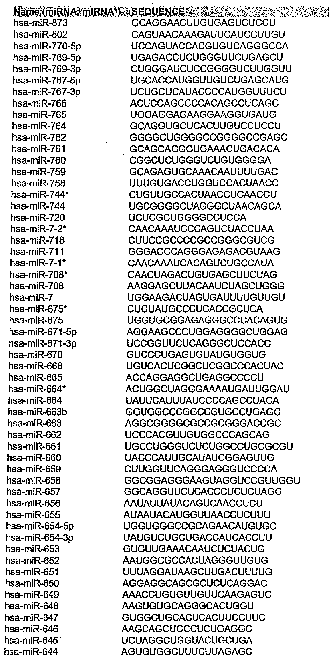

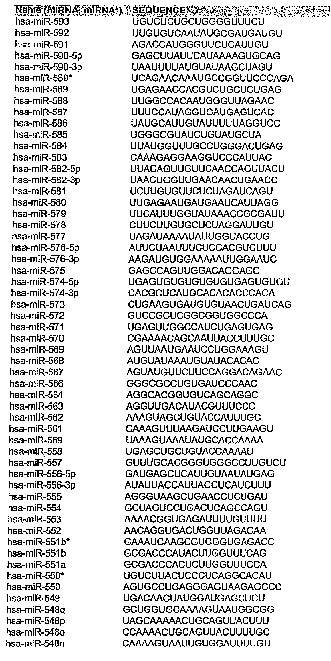

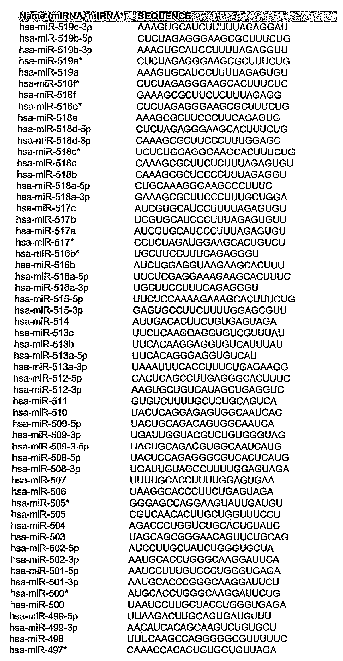


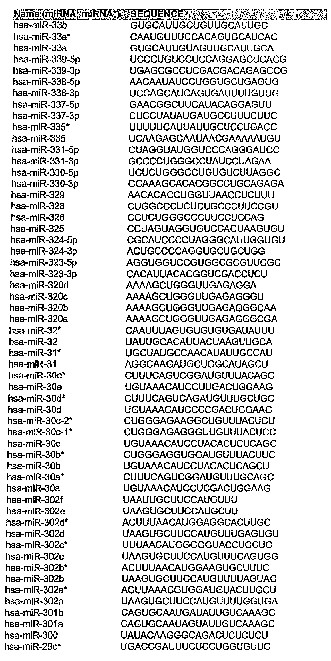

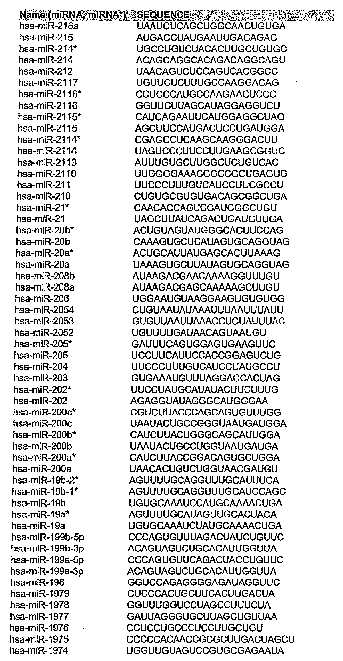


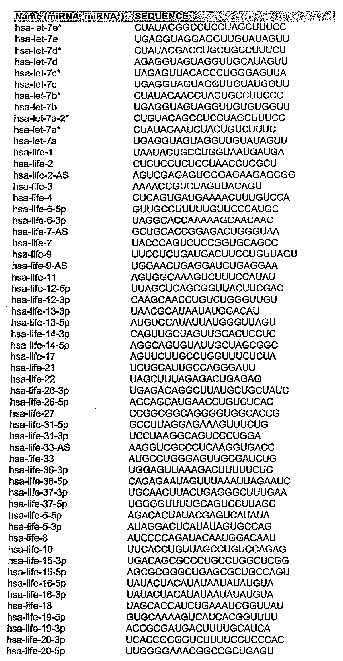
Description
- MicroRNAs (miRNA) are a recently discovered class of small non-coding RNAs (17-14 nucleotides). Due to their function as regulators of gene expression they play a critical role both in physiological and in pathological processes, such as cancer (Calin and Croce 2006; Esquela-Kerscher and Slack 2006; Zhang, Pan et al. 2007; Sassen, Miska et al. 2008).
- There is increasing evidence that miRNAs are not only found in tissues but also in human blood both as free circulating nucleic acids and in mononuclear cells. A recent proof-of-principle study demonstrated miRNA expression pattern in pooled blood sera and pooled blood cells, both in healthy individuals and in cancer patients including patients with lung cancer (Chen, Ba et al. 2008). In addition, a remarkable stability of miRNAs in human sera was recently demonstrated (Chen, Ba et al. 2008; Gilad, Meiri et al. 2008). These findings make miRNA a potential tool for diagnostics for various types of diseases based on blood analysis.
- Thus, although various markers have been proposed to indicate specific types of disorders such as prostate cancer, Wilms' tumour or COPD (Chronic obstructive pulmonary disease) there is still a need for more efficient and effective methods and compositions for the diagnosis of diseases.
- The present invention provides novel methods for diagnosing diseases based on the determination of specific miRNAs that have altered expression levels in disease states compared to healthy controls or altered expression levels in a condition 1 (biological state or health state 1) compared to a condition 2 (biological state or health state 2). The diseases are particularly selected from prostate cancer, Wilms' tumour and COPD.
- microRNAs (miRNA or µRNA) are single-stranded RNA molecules of ∼21-23 nucleotides in length, which regulate gene expression. miRNAs are encoded by genes from whose DNA they are transcribed but miRNAs are not translated into protein (i.e. they are non-coding RNAs). The genes encoding miRNAs are much longer than the processed mature miRNA molecule; miRNAs are first transcribed as primary transcripts or pri-miRNA with a cap and poly-A tail and processed to short, 70-nucleotide stem-loop structures known as pre-miRNA in the cell nucleus. This processing is performed in animals by a protein complex known as the Microprocessor complex, consisting of the nuclease Drosha and the double-stranded RNA binding protein Pasha. These pre-miRNAs are then processed to mature miRNAs in the cytoplasm by interaction with the endonuclease Dicer, which also initiates the formation of the RNA-induced silencing complex (RISC). When Dicer cleaves the pre-miRNA stem-loop, two complementary short RNA molecules are formed, but only one is integrated into the RISC. This strand is known as the guide strand and is selected by the argonaute protein, the catalytically active RNase in the RISC, on the basis of the stability of the 5' end. The remaining strand, known as the miRNA*, anti-guide or passenger strand, is degraded as a RISC substrate. Therefore the miRNA*s are derived from the same hairpin structure like the "normal" miRNAs. So if the "normal" miRNA is then later called the "mature miRNA" or "guided strand", the miRNA* is the passenger strand.
- The miRNA*s, also known as the anti-guide or passenger strand, are mostly complementary to the guide strand, but there are usually single-stranded overhangs on each end, there is usually one or a few mispairs and there are sometimes extra or missing bases causing single-stranded "bubbles.The miRNA*s are likely to act in a regulatory fashion as the miRNAs.
- It is understood that according to the present invention the term "miRNA" also includes the term "miRNA*".
- A well established repository of validated miRNAs is the miRBase.
- The miRBase (www.mirbase.org) is a searchable database of published miRNA sequences and annotation. Each entry in the miRBase Sequence database represents a predicted hairpin portion of a miRNA transcript (termed mir in the database), with information on the location and sequence of the mature miRNA sequence (termed miR). Both hairpin and mature sequences are available for searching and browsing, and entries can also be retrieved by name, keyword, references and annotation. All sequence and annotation data are also available for download.
- A miRNA-Profile represents the collection of expression levels of a plurality of miRNAs, therefore it is a quantitative measure of individual miRNA expression levels. Hereby, each miRNA is represented by a numerical value. The higher the value of an individual miRNA the higher is the expression level of this miRNA. A miRNA-profile is obtained from the RNA of a biological sample. The are various technologies to determine a miRNA-Profile, e.g. microarrays, RT-PCR, Next Generation Sequencing. As a starting material for analysis, RNA or total-RNA or any fraction thereof can be used. The plurality of miRNAs that are determined by a miRNA-profile can range from a selection of one up to all known miRNAs.
- The pre-determined set of miRNAs or miRNA signature is understood in the present invention as a fixed defined set of miRNAs which is able to differentiate between a
condition 1 and anothercondition 2. e.g. whencondition 1 is lung cancer andcondition 2 is normal control, the corresponding pre-determined set of miRNAs is able to differentiate between a samples derived from a lung cancer patient or a normal control patient. Alternatively,condition 1 is lung cancer andcondition 2 is multiple sclerosis, the corresponding pre-determined set of miRNAs is able to differentiate between a lung cancer patient and a multiple sclerosis patient. In order to be able to perform the sample analysis it is required that, e.g. on the matrix that will be used to determine a miRNA profile, these fixed defined set of miRNAs have to be represented by capture probes that are defined by the predetermined set of miRNAs. For example, when the predetermined set of miRNAs for diagnosing lung cancer from healthy controls consists of 25 miRNAs, probes capable for detecting these 25 miRNAs have to be implemented for performing the diagnostic analysis. - A common miRNA signature profile is understood in the present invention as a non-fixed defined set of miRNAs or non-coding RNAs which is able to differentiate between a
condition 1 and anothercondition 2. The common miRNA or non-coding RNA signature profile is calculated "on-the-fly" from a plurality of miRNA-profiles that are stored, e.g. in database. The common miRNA signature profile which is able to differentiate between acondition 1 and anothercondition 2 is changing as soon as an new profile is added to the database which is relevant to either to state ofhealth 1 or anothercondition 2. In this respect it is different from a predetermined set of miRNAs (see above). Furthermore, the basis for generating the common miRNA signature profile- hence the miRNA profiles stored in the database ― is generated from capture probes, e.g. on a matrix that is representing as much as possible different capture probes for detecting as much as possible, ideally all known, miRNAs. - A non-coding RNA (ncRNA) is a functional RNA molecule that is not translated into a protein. Less-frequently used synonyms are non-protein-coding RNA (npcRNA), non-messenger RNA (nmRNA), small non-messenger RNA (snmRNA), functional RNA (fRNA). The term small RNA (sRNA) is often used for bacterial ncRNAs. The DNA sequence from which a non-coding RNA is transcribed as the end product is often called an RNA gene or non-coding RNA gene.
- Non-coding RNA genes include highly abundant and functionally important RNAs such as transfer RNA (tRNA) and ribosomal RNA (rRNA), as well as RNAs such as snoRNAs, microRNAs, siRNAs and piRNAs and the long ncRNAs that include examples such as Xist and HOTAIR (see here for a more complete list of ncRNAs). The number of ncRNAs encoded within the human genome is unknown, however recent transcriptomic and bioinformatic studies suggest the existence of thousands of ncRNAs. Since most of the newly identified ncRNAs have not been validated for their function, it is possible that many are non-functional.
- A condition (biological state or health state or state of health) is understood in the present invention as status of a subject that can be described by physical, mental or social criteria. It includes as well so-called "healthy" and "diseased" conditions, therefore it is not limited to the WHO definition of health as "a state of complete physical, mental, and social well-being and not merely the absence of disease or infirmity." but includes disease and infirmity. For the definition of diseases comprised, e.g. by the conditions of the present invention, it is referred to the international classification of diseases (ICD) of the WHO (http://www.who.int/classifications/icd/en /index.html). When 2 or more conditions are compared according to the present invention, it is understood that this is possible for all conditions that can be defined and is not limited to a comparison of a disease versus healthy and extends to multi-way comparisons. Examples for comparison are, but not limited to:
- pairwise comparisons :
- ■ lung cancer vs. healthy control, pancreatic cancer vs. healthy control
- ■ lung cancer vs. pancreatic cancer, lung cancer vs. multiple sclerosis
- ■ lung
cancer WHO grade 1 vs. lungcancer WHO grade 2 - ■ lung
cancer WHO grade 1 metastasing vs. lungcancer WHO grade 1 non-metastasing - ■ Morbus Crohn vs. collitis
- ■ Pancreatic cancer vs. pancreatitis
- multi-way comparisons:
- ■ Lung cancer vs. pancreatic cancer vs. multiple sclerosis
- ■ Pancreas cancer vs. pancreatitis vs. lung
cancer WHO grade 1 non-metastasing
- Prostate cancer is a form of cancer that develops in the prostate, a gland in the male reproductive system. The cancer cells may metastasize (spread) from the prostate to other parts of the body, particularly the bones and lymph nodes. Prostate cancer may cause pain, difficulty in urinating, problems during sexual intercourse, or erectile dysfunction. Other symptoms can potentially develop during later stages of the disease.
- Rates of detection of prostate cancers vary widely across the world, with South and East Asia detecting less frequently than in Europe, and especially the United States.Prostate cancer tends to develop in men over the age of fifty and although it is one of the most prevalent types of cancer in men, many never have symptoms, undergo no therapy, and eventually die of other causes. This is because cancer of the prostate is, in most cases, slow-growing, symptom free and men with the condition often die of causes unrelated to the prostate cancer, such as heart/circulatory disease, pneumonia, other unconnected cancers, or old age. Many factors, including genetics and diet, have been implicated in the development of prostate cancer. The presence of prostate cancer may be indicated by symptoms, physical examination, prostate specific antigen (PSA), or biopsy. There is controversy about the accuracy of the PSA test and the value of screening. Suspected prostate cancer is typically confirmed by taking a biopsy of the prostate and examining it under a microscope. Further tests, such as CT scans and bone scans, may be performed to determine whether prostate cancer has spread.
- Treatment options for prostate cancer with intent to cure are primarily surgery, radiation therapy, and proton therapy. Other treatments, such as hormonal therapy, chemotherapy, cryosurgery, and high intensity focused ultrasound (HIFU) also exist, depending on the clinical scenario and desired outcome.
- The age and underlying health of the man, the extent of metastasis, appearance under the microscope, and response of the cancer to initial treatment are important in determining the outcome of the disease. The decision whether or not to treat localized prostate cancer (a tumour that is contained within the prostate) with curative intent is a patient trade-off between the expected beneficial and harmful effects in terms of patient survival and quality of life.
- Wilms' tumour or nephroblastoma is a tumour of the kidneys that typically occurs in children, rarely in adults Its common name is an eponym, referring to Dr. Max Wilms, the German surgeon (1867-1918) who first described this kind of tumour.
- Wilms' tumour is a highly malignant, usually unilateral and rapidly developing tumour of the kidney, composed of malignant epithelial and mesodermal cells. Initially, asymptomatic; later, moderate local pain, nausea, vomiting, apathy, and fever. There is also pallor, weight loss, abdominal distension, and blood hypertension It is the most common malignous kidney tumour in children, usually affecting children aged 3-4 years. 75 percent of patients are under 5 years, but it has also been reported in adults. In the past, the mortality from this cancer was extremely high. Newer approaches to therapy have been very effective in controlling the tumour. In a small proportion of patients Wilms' tumour occurs in conjunction with absence of the iris and the familial form of the association is inherited as an autosomal dominant trait.
- Chronic obstructive pulmonary disease (COPD) refers to chronic bronchitis and emphysema, a pair of two commonly co-existing diseases of the lungs in which the airways become narrowed. This leads to a limitation of the flow of air to and from the lungs causing shortness of breath. In contrast to asthma, the limitation of airflow is poorly reversible and usually gets progressively worse over time.
- COPD is caused by noxious particles or gas, most commonly from tobacco smoking, which triggers an abnormal inflammatory response in the lung. The inflammatory response in the larger airways is known as chronic bronchitis, which is diagnosed clinically when people regularly cough up sputum. In the alveoli, the inflammatory response causes destruction of the tissues of the lung, a process known as emphysema. The natural course of COPD is characterized by occasional sudden worsenings of symptoms called acute exacerbations, most of which are caused by infections or air pollution.
- The diagnosis of COPD requires lung function tests. Important management strategies are smoking cessation, vaccinations, rehabilitation, and drug therapy (often using inhalers). Some patients go on to requiring long-term oxygen therapy or lung transplantation.
- Worldwide, COPD ranked as the sixth leading cause of death in 1990. It is projected to be the fourth leading cause of death worldwide by 2030 due to an increase in smoking rates and demographic changes in many countries. COPD is the 4th leading cause of death in the U.S., and the economic burden of COPD in the U.S. in 2007 was $42.6 billion in health care costs and lost productivity.
- COPD is also known as chronic obstructive lung disease (COLD), chronic obstructive airway disease (COAD), chronic airflow limitation (CAL) and chronic obstructive respiratory disease (CORD).
- A "biological sample" in terms of the invention means a sample of biological tissue or fluid. Examples of biological samples are sections of tissues, blood, blood fractions, plasma, serum, urine or samples from other peripheral sources or cell cultures, cell colonies of even single cells, or a collection of single cells. Furthermore, also pools or mixture of the above mentioned samples may be employed. A biological sample may be provided by removing a sample of cells from a subject, but can also be provided by using a previously isolated sample. For example, a tissue sample can be removed from a subject suspected of having a disease by conventional biopsy techniques. In a preferred embodiment, a blood sample is taken from the subject. In one embodiment, the blood or tissue sample is obtained from the subject prior to initiation of radiotherapy, chemotherapy or other therapeutic treatment. According to the invention, the biological sample preferably is a blood or a serum sample. Further, it is also preferred to use blood cells, e.g. erythrocytes, leukocytes or thrombocytes.
- A biological sample from a patient means a sample from a subject suspected to be affected by a disease. As used herein, the term "subject" refers to any mammal, including both human and other mammals. Preferably, the methods of the present invention are applied to human subjects.
- Subject-matter of the invention is a method for diagnosing a disease, comprising the steps
- (a) determining an expression profile of a predetermined set of miRNAs in a biological sample from a patient (or subject); and
- (b) comparing said expression profile to a reference expression profile, wherein the comparison of said determined expression profile to said reference expression profile allows for the diagnosis of the disease.
- In step (a) of the above method of the invention, an expression profile of a predetermined set of miRNAs is determined. The determination may be carried out by any convenient means for determining nucleic acids. For expression profiling, qualitative, semi-quantitative and preferably quantitative detection methods can be used. A variety of techniques are well known to those of skill in the art. In particular, the determination may comprise nucleic acid hybridization and/or nucleic acid amplification steps.
- Nucleic acid hybridization may for example be performed using a solid phase nucleic acid biochip array, in particular a microarray, or in situ hybridization. The miRNA microarray technology affords the analysis of a complex biological sample for all expressed miRNAs. Nucleotides with complementarity to the corresponding miRNAs are spotted on coated carriers or are fabricated by in-situ synthesis methods on a carrier. Preferably, miRNAs isolated from the sample of interest are not labelled, e.g. before hybridization of the miRNAs to the complementary sequences on the carrier and the resulting signal indicating the occurrence of a distinct miRNA is generated by incorporation of a detectable label (e.g. biotin, fluorescent dye) by means of an enzyme reaction .
- According to another embodiment of the invention, miRNAs isolated from the sample of interest are labelled, e.g. fluorescently labelled, so that upon hybridization of the miRNAs to the complementary sequences on the carrier the resulting signal indicates the occurrence of a distinct miRNA.
- On one miRNA microarray, preferably at least the whole predetermined set of miRNAs can be analyzed.
- Further, quantitative real-time polymerase chain reaction (RT-PCR) can be used to detect miRNAs even at very low abundance.
- Alternative methods for obtaining expression profiles may also contain sequencing, next generation sequencing or mass spectroscopy.
- The predetermined set of miRNAs in step (a) of the above method of the invention depends on the disease to be diagnosed. The inventors found out that single miRNA biomarkers lack sufficient accuracy, specificity and sensitivity, and therefore it is preferred to analyze more complex miRNA expression patterns, so-called miRNA signatures. The predetermined set of miRNAs comprises one or more, preferably a larger number of miRNAs (miRNA signatures) that are differentially regulated in samples of a patient affected by a particular disease compared to healthy controls. Alternatively, the disease can also be compared to any other defined condition (e.g. another disease)
- The expression profile determined in the above step (a) is subsequently compared to a reference expression profile or to a plurality of reference profiles in the above step (b). The reference expression profile is the expression profile of the same set of miRNAs in a biological sample originating from the same source as the biological sample from a patient but obtained from a healthy subject. Preferably, both the reference expression profile and the expression profile of the above step (a) are determined in a blood or serum sample or in a sample of erythrocytes, leukocytes and/or thrombocytes. It is understood that the reference expression profile is not necessarily obtained from a single healthy subject but may be an average expression profile of a plurality of healthy subjects. It is preferred to use a reference expression profile obtained from a person of the same gender, and a similar age as the patient.
- The above method of the invention is suitable for diagnosing any diseases for which a differential expression of miRNAs compared to healthy controls or other diseases exists. In particular, the method may be used for diagnosing cancer including bladder cancer, brain cancer, breast cancer, colon cancer, endometrium cancer, gastrointestinal stromal cancer, glioma, head- and neck cancer, kidney cancer, leukemia, liver cancer, lung cancer, lymph node cancer, melanoma, meninges cancer, ovarian cancer, pancreas cancer, prostate cancer, sarcoma, stomach cancer, testicular cancer, thyroid cancer, thymus cancer and Wilms' tumour or COPD. The diagnosis may comprise determining type, rate and/or stage of cancer. The course of the disease and the success of therapy such as chemotherapy may be monitored. The method of the invention provides a prognosis on the survivor rate and enables to determine a patient's response to drugs.
- In addition to cancer, also different types of diseases may be diagnosed by means of the above method of the invention, if the disease state is correlated with a differential expression of miRNAs compared to a healthy control. For example the disease may be Alzheimer's disease, multiple sclerosis, melanoma, Morbus Crohn and cardiovascular diseases. The inventors found out that also these diseases are correlated with a specific expression profile of miRNAs.
- The inventors succeeded in developing a generally applicable approach to arrive at miRNA signatures that are correlated with a particular disease. In more detail, the following steps are accomplished:
- 1. miRNAs are extracted from a biological sample of a patient, preferably a blood or serum or urine sample or a sample comprising erythrocytes, leukocytes or thrombocytes, using suitable kits / purification methods. From these samples preferably the RNA-fraction is used for analysis.
- 2. The respective samples are measured using experimental techniques. These techniques include but are not restricted to:
- ● Array based approaches
- ● Real time quantitative polymerase chain reaction
- ● Sequencing
- ● Next Generation Sequencing
- ● Mass Spectroscopy
- 3. Mathematical approaches are applied to gather information on the value and the redundancy of single biomarkers. These methods include, but are not restricted to:
- ● basic mathematic approaches (e.g. Fold Quotients, Signal to Noise ratios, Correlation)
- ● statistical methods as hypothesis tests (e.g. t-test, Wilcoxon-Mann-Whitney test), the Area under the Receiver operator Characteristics Curve
- ● Information Theory approaches, (e.g. the Mutual Information, Cross-entropy)
- ● Probability theory (e.g. joint and conditional probabilities)
- ● Combinations and modifications of the previously mentioned examples
- 4. The information collected in 3) are used to estimate for each biomarker the diagnostic content or value. Usually, however, this diagnostic value of only one biomarker is too small to get a highly accurate diagnosis with accuracy rates, specificities and sensitivities beyond the 90% barrier. Please note that the diagnostic content for our miRNAs can be found in the tables in
Figures 2 ,3 ,4 and9 These tables includes the miRNAs with the sequences, and the significance value as computed by a t-test. - 5. Thus statistical learning / machine learning / bioinformatics / computational approaches are applied to define subsets of biomarkers that are tailored for the detection of diseases. These techniques includes but are not restricted to
● Wrapper subset selection techniques (e.g. forward step-wise, backward step-wise, combinatorial approaches, optimization approaches)
● Filter subset selection methods (e.g. the methods mentioned in 3) ● Principal Component Analysis
● Combinations and modifications of such methods (e.g. hybrid approaches) - 6. The diagnostic content of each detected set can be estimated by mathematical and/or computational techniques to define the diagnostic information content of subsets.
- 7. The subsets, detected in
step 5, which may range from only a small number (at least two) to all measured biomarkers is then used to carry out a diagnosis. To this end, statistical learning / machine learning / bioinformatics / computational approaches are applied that include but are not restricted to any type of supervised or unsupervised analysis:- ● Classification techniques (e.g. naive Bayes, Linear Discriminant Analysis, Quadratic Discriminant Analysis Neural Nets, Tree based approaches, Support Vector Machines, Nearest Neighbour Approaches)
- ● Regression techniques (e.g. linear Regression, Multiple Regression, logistic regression, probit regression, ordinal logistic regression ordinal Probit-Regression, Poisson Regression, negative binomial Regression, multinomial logistic Regression, truncated regression)
- ● Clustering techniques (e.g. k-means clustering, hierarchical clustering, PCA)
- ● Adaptations, extensions, and combinations of the previously mentioned approaches
- The inventors surprisingly found out that the described approach yields in miRNA signatures that provide high diagnostic accuracy, specificity and sensitivity in the determination of diseases.
- According to a preferred embodiment of the invention, the disease to be determined is prostate cancer, Wilms' tumour or COPD,.
- The inventors succeeded in determining miRNAs that are differentially regulated in samples from prostate cancer, Wilms' tumour and COPD patients as compared to healthy controls. A complete overview of all miRNAs that are found to be differentially regulated in blood samples of prostate cancer, Wilms' tumour and COPD patients is provided in the tables shown in
Figure 2 ,3 and4 . - In
Figure 9 a list of miRNAs found to be differentially regulated between lung cancer and COPD patients is provided. - In the tables shown in
Figures 2 ,3 ,4 and9 the miRNAs that are found to be differentially regulated are sorted in the order of their t-test significance.. Another method for assessing the significance is to compute the Mutual information (MI) (Shannon, 1984) which is an adequate measure to estimate the overall diagnostic information content of single biomarkers (Keller, Ludwig et al., 2006). According to the invention mutual information is considered as the reduction in uncertainty about the class labels "0" for controls and "1" for tumour samples due to the knowledge of the miRNA expression. The higher the value of the MI of a miRNA, the higher is the diagnostic content of the respective miRNA. - According to another preferred embodiment of the invention, the disease to be determined is prostate cancer. Surprisingly, the inventors found out that miRNAs are differentially regulated in samples from prostate cancer patients as compared to health controls. A complete overview of all miRNAs that are found to be differentially regulated in blood samples of prostate cancer patients is provided in the table shown in
Figure 2 . In total, 241 miRNAs were found to be significantly deregulated ( t-test significance <0.05) in blood cells of prostate cancer patients as compared to the healthy controls. - Preferably, the predetermined set of miRNAs for the diagnosis of prostate cancer comprises one or more nucleic acids selected from the deregulated miRNAs presented in the table in
Figure 2 . - The predetermined set of miRNAs should preferably comprise at least 1, preferably at least 7, 10 ,15 ,20, 25, 30, 35, 40, 50, 75 or 100 of the indicated nucleic acids. It is particularly preferred to include the 100, 75, 50, 40, 35, 30, 25, 20, 15, 10 or at least 7 of the first mentioned miRNAs according to their order in the table in
Figure 2 . - Thus, preferably the predetermined set of miRNAs for the diagnosis of prostate cancer comprises one or more nucleic acids selected from the 241 most deregulated miRNAs.
- Preferably, the predetermined set of miRNAs comprises at least 7, preferably at least 10, 15, 20, 25, 30, 35, 40, 50, 75, 100 or all of the above-indicated nucleic acids.
- In a further embodiment the predetermined set of miRNAs for the diagnosis of prostate cancer comprises one or more miRNAs selected from the group consisting of hsa-miR-144*, hsa-miR-148a, hsa-miR-519b-5p, hsa-miR-1324, hsa-miR-137, hsa-miR-556-5p, hsa-miR-330-3p
- In a further embodiment the predetermined set of miRNAs for the diagnosis of prostate cancer comprises one or more miRNAs selected from the group consisting of hsa-miR-144*, hsa-miR-148a, hsa-miR-519b-5p, hsa-miR-1324, hsa-miR-137, hsa-miR-556-5p, hsa-miR-330-3p, hsa-miR-361-5p, hsa-miR-891 b, hsa-miR-767-5p
- In a further embodiment the predetermined set of miRNAs for the diagnosis of prostate cancer comprises one or more miRNAs selected from the group consisting of hsa-miR-144*, hsa-miR-148a, hsa-miR-519b-5p, hsa-miR-1324, hsa-miR-137, hsa-miR-556-5p, hsa-miR-330-3p, hsa-miR-361-5p, hsa-miR-891b, hsa-miR-767-5p, hsa-miR-744*, hsa-miR-208b, hsa-miR-548p, hsa-miR-20a*, hsa-miR-195
- In a further embodiment the predetermined set of miRNAs for the diagnosis of prostate cancer comprises one or more miRNAs selected from the group consisting of hsa-miR-144*, hsa-miR-148a, hsa-miR-519b-5p, hsa-miR-1324, hsa-miR-137, hsa-miR-556-5p, hsa-miR-330-3p, hsa-miR-361-5p, hsa-miR-891b, hsa-miR-767-5p, hsa-miR-744*, hsa-miR-208b, hsa-miR-548p, hsa-miR-20a*, hsa-miR-195, hsa-miR-33b, hsa-miR-1283, hsa-miR-519c-5p, hsa-miR-497, hsa-miR-9*.
- In a further embodiment the predetermined set of miRNAs for the diagnosis of prostate cancer comprises one or more miRNAs selected from the group consisting of hsa-miR-144*, hsa-miR-148a, hsa-miR-519b-5p, hsa-miR-1324, hsa-miR-137, hsa-miR-556-5p, hsa-miR-330-3p, hsa-miR-361-5p, hsa-miR-891b, hsa-miR-767-5p, hsa-miR-744*, hsa-miR-208b, hsa-miR-548p, hsa-miR-20a*, hsa-miR-195, hsa-miR-33b, hsa-miR-1283, hsa-miR-519c-5p, hsa-miR-497, hsa-miR-9*, hsa-miR-200a, hsa-miR-338-3p, hsa-miR-515-5p, hsa-miR-31*, hsa-miR-551b*.
- In a further embodiment the predetermined set of miRNAs for the diagnosis of prostate cancer comprises one or more miRNAs selected from the group consisting of hsa-miR-144*, hsa-miR-148a, hsa-miR-519b-5p, hsa-miR-1324, hsa-miR-137, hsa-miR-556-5p, hsa-miR-330-3p, hsa-miR-361-5p, hsa-miR-891b, hsa-miR-767-5p, hsa-miR-744*, hsa-miR-208b, hsa-miR-548p, hsa-miR-20a*, hsa-miR-195, hsa-miR-33b, hsa-miR-1283, hsa-miR-519c-5p, hsa-miR-497, hsa-miR-9*, hsa-miR-200a, hsa-miR-338-3p, hsa-miR-515-5p, hsa-miR-31*, hsa-miR-551b*, hsa-miR-518e*, hsa-miR-127-5p, hsa-miR-21*, hsa-miR-216a, hsa-miR-452*.
- In a further embodiment the predetermined set of miRNAs for the diagnosis of prostate cancer comprises one or more miRNAs selected from the group consisting of hsa-miR-144*, hsa-miR-148a, hsa-miR-519b-5p, hsa-miR-1324, hsa-miR-137, hsa-miR-556-5p, hsa-miR-330-3p, hsa-miR-361-5p, hsa-miR-891b, hsa-miR-767-5p, hsa-miR-744*, hsa-miR-208b, hsa-miR-548p, hsa-miR-20a*, hsa-miR-195, hsa-miR-33b, hsa-miR-1283, hsa-miR-519c-5p, hsa-miR-497, hsa-miR-9*, hsa-miR-200a, hsa-miR-338-3p, hsa-miR-515-5p, hsa-miR-31*, hsa-miR-551b*, hsa-miR-518e*, hsa-miR-127-5p, hsa-miR-21*, hsa-miR-216a, hsa-miR-452*, hsa-miR-183*, hsa-miR-500, hsa-miR-1826, hsa-miR-625*, hsa-miR-513b.
- In a further embodiment the predetermined set of miRNAs for the diagnosis of prostate cancer comprises one or more miRNAs selected from the group consisting of hsa-miR-144*, hsa-miR-148a, hsa-miR-519b-5p, hsa-miR-1324, hsa-miR-137, hsa-miR-556-5p, hsa-miR-330-3p, hsa-miR-361-5p, hsa-miR-891b, hsa-miR-767-5p, hsa-miR-744*, hsa-miR-208b, hsa-miR-548p, hsa-miR-20a*, hsa-miR-195, hsa-miR-33b, hsa-miR-1283, hsa-miR-519c-5p, hsa-miR-497, hsa-miR-9*, hsa-miR-200a, hsa-miR-338-3p, hsa-miR-515-5p, hsa-miR-31*, hsa-miR-551b*, hsa-miR-518e*, hsa-miR-127-5p, hsa-miR-21*, hsa-miR-216a, hsa-miR-452*, hsa-miR-183*, hsa-miR-500, hsa-miR-1826, hsa-miR-625*, hsa-miR-513b, hsa-miR-526a, hsa-miR-33a, hsa-miR-1243, hsa-miR-517*, hsa-miR-541.
- In a further embodiment the predetermined set of miRNAs for the diagnosis of prostate cancer comprises one or more miRNAs selected from the group consisting of hsa-miR-144*, hsa-miR-148a, hsa-miR-519b-5p, hsa-miR-1324, hsa-miR-137, hsa-miR-556-5p, hsa-miR-330-3p, hsa-miR-361-5p, hsa-miR-891b, hsa-miR-767-5p, hsa-miR-744*, hsa-miR-208b, hsa-miR-548p, hsa-miR-20a*, hsa-miR-195, hsa-miR-33b, hsa-miR-1283, hsa-miR-519c-5p, hsa-miR-497, hsa-miR-9*, hsa-miR-200a, hsa-miR-338-3p, hsa-miR-515-5p, hsa-miR-31*, hsa-miR-551b*, hsa-miR-518e*, hsa-miR-127-5p, hsa-miR-21*, hsa-miR-216a, hsa-miR-452*, hsa-miR-183*, hsa-miR-500, hsa-miR-1826, hsa-miR-625*, hsa-miR-513b, hsa-miR-526a, hsa-miR-33a, hsa-miR-1243, hsa-miR-517*, hsa-miR-541, hsa-miR-217, hsa-miR-621, hsa-miR-518d-5p, hsa-miR-873, hsa-miR-103-as, hsa-miR-450b-5p, hsa-miR-545, hsa-miR-1251, hsa-miR-885-5p, hsa-miR-922.
- In a further embodiment the predetermined set of miRNAs for the diagnosis of prostate cancer comprises one or more miRNAs selected from the group consisting of hsa-miR-144*, hsa-miR-148a, hsa-miR-519b-5p, hsa-miR-1324, hsa-miR-137, hsa-miR-556-5p, hsa-miR-330-3p, hsa-miR-361-5p, hsa-miR-891b, hsa-miR-767-5p, hsa-miR-744*, hsa-miR-208b, hsa-miR-548p, hsa-miR-20a*, hsa-miR-195, hsa-miR-33b, hsa-miR-1283, hsa-miR-519c-5p, hsa-miR-497, hsa-miR-9*, hsa-miR-200a, hsa-miR-338-3p, hsa-miR-515-5p, hsa-miR-31*, hsa-miR-551b*, hsa-miR-518e*, hsa-miR-127-5p, hsa-miR-21*, hsa-miR-216a, hsa-miR-452*, hsa-miR-183*, hsa-miR-500, hsa-miR-1826, hsa-miR-625*, hsa-miR-513b, hsa-miR-526a, hsa-miR-33a, hsa-miR-1243, hsa-miR-517*, hsa-miR-541, hsa-miR-217, hsa-miR-621, hsa-miR-518d-5p, hsa-miR-873, hsa-miR-103-as, hsa-miR-450b-5p, hsa-miR-545, hsa-miR-1251, hsa-miR-885-5p, hsa-miR-922, hsa-miR-628-5p, hsa-miR-548f, hsa-miR-802, hsa-miR-25, hsa-miR-423-3p, hsa-miR-522*, hsa-miR-519a*, hsa-miR-455-3p, hsa-miR-1245, hsa-miR-362-5p, hsa-miR-1184, hsa-miR-191, hsa-miR-487a, hsa-miR-216b, hsa-miR-525-5p, hsa-miR-509-3-5p, hsa-miR-27a*, hsa-miR-488*, hsa-miR-1226, hsa-miR-646, hsa-miR-527, hsa-miR-635, hsa-miR-1825, hsa-let-7i*.
- Most preferably, the predetermined set of miRNAs comprises those miRNAs that were most significantly deregulated.
- In a further embodiment, the measured miRNA profiles were classified using statistical learning approaches in order to compute accuracy, specificity, and sensitivity for the diagnosis of prostate cancer (see
Figure 6 ). The miRNAs that performed best for the diagnosis of prostate cancer according to their accuracy, specificity, and sensitivity are the 270 miRNAs shown in Table inFigure 2 (entries No. 1-270) leading to an accuracy 82.8 %, a specificity of 87.5 % and a sensitivity of 71.9 % - The predetermined set of miRNAs for the diagnosis of prostate cancer should preferably comprise at least 7, preferably at least 10, 15, 20, 25, 30, 35, 40, 50, 75, 100, preferably all of the known miRNAs, preferably all of the 863 (see
Figure 1 , representing the current status of all known miRNAs in theversion - Another embodiment of the present invention is a kit for diagnosing a disease, comprising means for determining an expression profile of a predetermined set of miRNAs in a biological sample, in particular in a blood and/or serum sample. Preferably, one or more reference expression profiles are also provided which show the expression profile of the same set of miRNAs in the same type of biological sample, in particular in a blood and/or serum sample, obtained from one or more healthy subjects. A comparison to said reference expression profile(s) allows for the diagnosis of the disease. Another preferred embodiment of the present invention is a kit for diagnosing prostate cancer, comprising means for determining the expression profile of one or more miRNAs presented in the table in
Figure 2 , preferably one or more miRNAs selected from the group consisting of hsa-miR-144*, hsa-miR-148a, hsa-miR-519b-5p, hsa-miR-1324, hsa-miR-137, hsa-miR-556-5p, hsa-miR-330-3p, hsa-miR-361-5p, hsa-miR-891b, hsa-miR-767-5p, hsa-miR-744*, hsa-miR-208b, hsa-miR-548p, hsa-miR-20a*, hsa-miR-195, hsa-miR-33b, hsa-miR-1283, hsa-miR-519c-5p, hsa-miR-497, hsa-miR-9*, hsa-miR-200a, hsa-miR-338-3p, hsa-miR-515-5p, hsa-miR-31*, hsa-miR-551b*, hsa-miR-518e*, hsa-miR-127-5p, hsa-miR-21*, hsa-miR-216a, hsa-miR-452*, hsa-miR-183*, hsa-miR-500, hsa-miR-1826, hsa-miR-625*, hsa-miR-513b, hsa-miR-526a, hsa-miR-33a, hsa-miR-1243, hsa-miR-517*, hsa-miR-541, hsa-miR-217, hsa-miR-621, hsa-miR-518d-5p, hsa-miR-873, hsa-miR-103-as, hsa-miR-450b-5p, hsa-miR-545, hsa-miR-1251, hsa-miR-885-5p, hsa-miR-922 - In a preferred embodiment the kit comprises means for determining at least 7, preferably at least 10, 15, 20, 25, 30, 35, 40, 50, 75, 100 or all of the indicated miRNAs. It is particularly preferred to include means for determining the 100, 75, 50, 45 ,40 ,35, 30, 25, 20, 15, 10 or at least 7 first mentioned miRNAs in the order of their diagnostic significance as represented by their order in the table in
Figure 2 . The kit for diagnosing prostate cancer is particularly suitable for diagnosing prostate cancer in a blood and/or serum sample or in a sample comprising erythrocytes, leukocytes and/or thrombocytes. - The means for determining a predetermined set of miRNAs may for example comprise a microarray comprising miRNA-specific oligonucleotide probes. In a preferred embodiment, the microarray comprises miRNA-specific oligonucleotide probes for the detection of miRNAs. Depending on the intended use of the microarray in the diagnosis or prognosis of a particular disease, probes for detecting different miRNAs may be included.
- A microarray intended for use in the diagnosis of prostate cancer preferably comprises miRNA specific oligonucleotide probes for one or more miRNAs presented in the table in
Figure 2 , preferably for one or more miRNAs selected from the group consisting of hsa-miR-144*, hsa-miR-148a, hsa-miR-519b-5p, hsa-miR-1324, hsa-miR-137, hsa-miR-556-5p, hsa-miR-330-3p, hsa-miR-361-5p, hsa-miR-891b, hsa-miR-767-5p, hsa-miR-744*, hsa-miR-208b, hsa-miR-548p, hsa-miR-20a*, hsa-miR-195, hsa-miR-33b, hsa-miR-1283, hsa-miR-519c-5p, hsa-miR-497, hsa-miR-9*, hsa-miR-200a, hsa-miR-338-3p, hsa-miR-515-5p, hsa-miR-31*, hsa-miR-551b*, hsa-miR-518e*, hsa-miR-127-5p, hsa-miR-21*, hsa-miR-216a, hsa-miR-452*, hsa-miR-183*, hsa-miR-500, hsa-miR-1826, hsa-miR-625*, hsa-miR-513b, hsa-miR-526a, hsa-miR-33a, hsa-miR-1243, hsa-miR-517*, hsa-miR-541, hsa-miR-217, hsa-miR-621, hsa-miR-518d-5p, hsa-miR-873, hsa-miR-103-as, hsa-miR-450b-5p, hsa-miR-545, hsa-miR-1251, hsa-miR-885-5p, hsa-miR-922 - In a preferred embodiment the microarray comprises oligonucleotide probes for determining at least 7, preferably at least 10, 15, 20, 25, 30, 35, 40, 50, 75, 100 or all of the indicated miRNAs. It is particularly preferred to include oligonucleotide probes for determining the most significant miRNAs, which is represented by their order in the table depicted in
Figure 2 - The microarray can comprise oligonucleotide probes obtained from known or predicted miRNA sequences. The array may contain different oligonucleotide probes for each miRNA, for example one containing the active mature sequence and another being specific for the precursor of the miRNA. The array may also contain controls such as one or more sequences differing from the human orthologs by only a few bases, which can serve as controls for hybridization stringency conditions. It is also possible to include viral miRNAs or putative miRNAs as predicted from bioinformatic tools. Further, it is possible to include appropriate controls for non-specific hybridization on the microarray.
- According to another preferred embodiment of the invention, the disease to be determined is Wilms' tumour. Surprisingly, the inventors found out that miRNAs are differentially regulated in samples from Wilms' tumour patients as compared to health controls. A complete overview of all miRNAs that are found to be differentially regulated in blood samples of Wilms' tumour patients is provided in the table shown in
Figure 3 . In total, 49 miRNAs were found to be significantly deregulated (t-test significance <0.05) in blood cells of Wilms' tumour patients as compared to the healthy controls. - Preferably, the predetermined set of miRNAs for the diagnosis of Wilms' tumour comprises one or more nucleic acids selected from the deregulated miRNAs presented in the table in
Figure 3 . - The predetermined set of miRNAs should preferably comprise at least 1, preferably at least 7, 10 ,15 ,20, 25, 30, 35, 40, 50, 75 or 100 of the indicated nucleic acids. It is particularly preferred to include the 100, 75, 50, 40, 35, 30, 25, 20, 15, 10 or at least 7 of the first mentioned miRNAs according to their order in the table in
Figure 3 . - Thus, preferably the predetermined set of miRNAs for the diagnosis of Wilms' tumour comprises one or more nucleic acids selected from the 49 most deregulated miRNAs.
- Preferably, the predetermined set of miRNAs comprises at least 7, preferably at least 10, 15, 20, 25, 30, 35, 40, 50, 75, 100 or all of the above-indicated nucleic acids.
- In a further embodiment the predetermined set of miRNAs for the diagnosis of Wilms' tumour comprises one or more miRNAs selected from the group consisting of hsa-miR-23b*, hsa-miR-875-5p, hsa-miR-181d, hsa-miR-144*, hsa-miR-10a*, hsa-miR-144, hsa-miR-581.
- In a further embodiment the predetermined set of miRNAs for the diagnosis of Wilms' tumour comprises one or more miRNAs selected from the group consisting of hsa-miR-23b*, hsa-miR-875-5p, hsa-miR-181d, hsa-miR-144*, hsa-miR-10a*, hsa-miR-144, hsa-miR-581, hsa-miR-218, hsa-miR-1294, hsa-miR-302f.
- In a further embodiment the predetermined set of miRNAs for the diagnosis of Wilms' tumour comprises one or more miRNAs selected from the group consisting of hsa-miR-23b*, hsa-miR-875-5p, hsa-miR-181d, hsa-miR-144*, hsa-miR-10a*, hsa-miR-144, hsa-miR-581, hsa-miR-218, hsa-miR-1294, hsa-miR-302f, hsa-miR-944, hsa-miR-92a-1*, hsa-miR-190b, hsa-miR-20b, hsa-miR-1913.
- In a further embodiment the predetermined set of miRNAs for the diagnosis of Wilms' tumour comprises one or more miRNAs selected from the group consisting of hsa-miR-23b*, hsa-miR-875-5p, hsa-miR-181d, hsa-miR-144*, hsa-miR-10a*, hsa-miR-144, hsa-miR-581, hsa-miR-218, hsa-miR-1294, hsa-miR-302f, hsa-miR-944, hsa-miR-92a-1*, hsa-miR-190b, hsa-miR-20b, hsa-miR-1913, hsa-miR-96, hsa-miR-363, hsa-miR-590-3p, hsa-miR-140-5p, hsa-miR-639.
- In a further embodiment the predetermined set of miRNAs for the diagnosis of Wilms' tumour comprises one or more miRNAs selected from the group consisting of hsa-miR-23b*, hsa-miR-875-5p, hsa-miR-181d, hsa-miR-144*, hsa-miR-10a*, hsa-miR-144, hsa-miR-581, hsa-miR-218, hsa-miR-1294, hsa-miR-302f, hsa-miR-944, hsa-miR-92a-1*, hsa-miR-190b, hsa-miR-20b, hsa-miR-1913, hsa-miR-96, hsa-miR-363, hsa-miR-590-3p, hsa-miR-140-5p, hsa-miR-639, hsa-miR-1305, hsa-miR-651, hsa-miR-556-3p, hsa-miR-139-5p, hsa-miR-545*.
- In a further embodiment the predetermined set of miRNAs for the diagnosis of Wilms' tumour comprises one or more miRNAs selected from the group consisting of hsa-miR-23b*, hsa-miR-875-5p, hsa-miR-181 d, hsa-miR-144*, hsa-miR-10a*, hsa-miR-144, hsa-miR-581, hsa-miR-218, hsa-miR-1294, hsa-miR-302f, hsa-miR-944, hsa-miR-92a-1*, hsa-miR-190b, hsa-miR-20b, hsa-miR-1913, hsa-miR-96, hsa-miR-363, hsa-miR-590-3p, hsa-miR-140-5p, hsa-miR-639, hsa-miR-1305, hsa-miR-651, hsa-miR-556-3p, hsa-miR-139-5p, hsa-miR-545*, hsa-miR-632, hsa-miR-103, hsa-miR-105*, hsa-miR-1249, hsa-miR-1470.
- In a further embodiment the predetermined set of miRNAs for the diagnosis of Wilms' tumour comprises one or more miRNAs selected from the group consisting of hsa-miR-23b*, hsa-miR-875-5p, hsa-miR-181d, hsa-miR-144*, hsa-miR-10a*, hsa-miR-144, hsa-miR-581, hsa-miR-218, hsa-miR-1294, hsa-miR-302f, hsa-miR-944, hsa-miR-92a-1*, hsa-miR-190b, hsa-miR-20b, hsa-miR-1913, hsa-miR-96, hsa-miR-363, hsa-miR-590-3p, hsa-miR-140-5p, hsa-miR-639, hsa-miR-1305, hsa-miR-651, hsa-miR-556-3p, hsa-miR-139-5p, hsa-miR-545*, hsa-miR-632, hsa-miR-103, hsa-miR-105*, hsa-miR-1249, hsa-miR-1470, hsa-miR-634, hsa-miR-488, hsa-miR-1298, hsa-miR-20a, hsa-miR-302b*.
- In a further embodiment the predetermined set of miRNAs for the diagnosis of Wilms' tumour comprises one or more miRNAs selected from the group consisting of hsa-miR-23b*, hsa-miR-875-5p, hsa-miR-181d, hsa-miR-144*, hsa-miR-10a*, hsa-miR-144, hsa-miR-581, hsa-miR-218, hsa-miR-1294, hsa-miR-302f, hsa-miR-944, hsa-miR-92a-1*, hsa-miR-190b, hsa-miR-20b, hsa-miR-1913, hsa-miR-96, hsa-miR-363, hsa-miR-590-3p, hsa-miR-140-5p, hsa-miR-639, hsa-miR-1305, hsa-miR-651, hsa-miR-556-3p, hsa-miR-139-5p, hsa-miR-545*, hsa-miR-632, hsa-miR-103, hsa-miR-105*, hsa-miR-1249, hsa-miR-1470, hsa-miR-634, hsa-miR-488, hsa-miR-1298, hsa-miR-20a, hsa-miR-302b*, hsa-miR-1258, hsa-miR-548k, hsa-miR-579, hsa-miR-1228, hsa-miR-548h.
- In a further embodiment the predetermined set of miRNAs for the diagnosis of Wilms' tumour comprises one or more miRNAs selected from the group consisting of hsa-miR-23b*, hsa-miR-875-5p, hsa-miR-181d, hsa-miR-144*, hsa-miR-10a*, hsa-miR-144, hsa-miR-581, hsa-miR-218, hsa-miR-1294, hsa-miR-302f, hsa-miR-944, hsa-miR-92a-1*, hsa-miR-190b, hsa-miR-20b, hsa-miR-1913, hsa-miR-96, hsa-miR-363, hsa-miR-590-3p, hsa-miR-140-5p, hsa-miR-639, hsa-miR-1305, hsa-miR-651, hsa-miR-556-3p, hsa-miR-139-5p, hsa-miR-545*, hsa-miR-632, hsa-miR-103, hsa-miR-105*, hsa-miR-1249, hsa-miR-1470, hsa-miR-634, hsa-miR-488, hsa-miR-1298, hsa-miR-20a, hsa-miR-302b*, hsa-miR-1258, hsa-miR-548k, hsa-miR-579, hsa-miR-1228, hsa-miR-548h, hsa-miR-17, hsa-miR-609, hsa-miR-296-5p, hsa-miR-625*, hsa-miR-1276, hsa-miR-425, hsa-miR-520c-3p, hsa-miR-432, hsa-miR-30a*, hsa-miR-302a.
- In a further embodiment the predetermined set of miRNAs for the diagnosis of Wilms' tumour comprises one or more miRNAs selected from the group consisting of hsa-miR-23b*, hsa-miR-875-5p, hsa-miR-181d, hsa-miR-144*, hsa-miR-10a*, hsa-miR-144, hsa-miR-581, hsa-miR-218, hsa-miR-1294, hsa-miR-302f, hsa-miR-944, hsa-miR-92a-1*, hsa-miR-190b, hsa-miR-20b, hsa-miR-1913, hsa-miR-96, hsa-miR-363, hsa-miR-590-3p, hsa-miR-140-5p, hsa-miR-639, hsa-miR-1305, hsa-miR-651, hsa-miR-556-3p, hsa-miR-139-5p, hsa-miR-545*, hsa-miR-632, hsa-miR-103, hsa-miR-105*, hsa-miR-1249, hsa-miR-1470, hsa-miR-634, hsa-miR-488, hsa-miR-1298, hsa-miR-20a, hsa-miR-302b*, hsa-miR-1258, hsa-miR-548k, hsa-miR-579, hsa-miR-1228, hsa-miR-548h, hsa-miR-17, hsa-miR-609, hsa-miR-296-5p, hsa-miR-625*, hsa-miR-1276, hsa-miR-425, hsa-miR-520c-3p, hsa-miR-432, hsa-miR-30a*, hsa-miR-302a, hsa-miR-384, hsa-miR-106a, hsa-miR-617, hsa-miR-342-3p, hsa-miR-548f, hsa-miR-218-1*, hsa-miR-10b, hsa-miR-548a-3p, hsa-miR-1252, hsa-miR-662, hsa-miR-590-5p, hsa-miR-374a, hsa-miR-126, hsa-miR-876-3p, hsa-miR-720, hsa-miR-519d, hsa-miR-141*, hsa-miR-665, hsa-miR-18b, hsa-miR-589, hsa-miR-30c-2*, hsa-miR-1267, hsa-miR-101, hsa-miR-382.
- Most preferably, the predetermined set of miRNAs comprises those miRNAs that were most significantly deregulated.
- The predetermined set of miRNAs for the diagnosis of Wilms' tumour should preferably comprise at least 7, preferably at least 10, 15, 20, 25, 30, 35, 40, 50, 75, 100, preferably all of the known miRNAs, preferably all of the 863 (see
Figure 1 , representing the current status of all known miRNAs in theversion - Another embodiment of the present invention is a kit for diagnosing a disease, comprising means for determining an expression profile of a predetermined set of miRNAs in a biological sample, in particular in a blood and/or serum sample. Preferably, one or more reference expression profiles are also provided which show the expression profile of the same set of miRNAs in the same type of biological sample, in particular in a blood and/or serum sample, obtained from one or more healthy subjects. A comparison to said reference expression profile(s) allows for the diagnosis of the disease.
- Another preferred embodiment of the present invention is a kit for diagnosing Wilms' tumour, comprising means for determining the expression profile of one or more miRNAs presented in the table in
Figure 3 , preferably one or more miRNAs selected from the group consisting of hsa-miR-23b*, hsa-miR-875-5p, hsa-miR-181d, hsa-miR-144*, hsa-miR-10a*, hsa-miR-144, hsa-miR-581, hsa-miR-218, hsa-miR-1294, hsa-miR-302f, hsa-miR-944, hsa-miR-92a-1*, hsa-miR-190b, hsa-miR-20b, hsa-miR-1913, hsa-miR-96, hsa-miR-363, hsa-miR-590-3p, hsa-miR-140-5p, hsa-miR-639, hsa-miR-1305, hsa-miR-651, hsa-miR-556-3p, hsa-miR-139-5p, hsa-miR-545*, hsa-miR-632, hsa-miR-103, hsa-miR-105*, hsa-miR-1249, hsa-miR-1470, hsa-miR-634, hsa-miR-488, hsa-miR-1298, hsa-miR-20a, hsa-miR-302b*, hsa-miR-1258, hsa-miR-548k, hsa-miR-579, hsa-miR-1228, hsa-miR-548h, hsa-miR-17, hsa-miR-609, hsa-miR-296-5p, hsa-miR-625*, hsa-miR-1276, hsa-miR-425, hsa-miR-520c-3p, hsa-miR-432, hsa-miR-30a*, hsa-miR-302a - In a preferred embodiment the kit comprises means for determining at least 7, preferably at least 10, 15, 20, 25, 30, 35, 40, 50 ,75, 100 or all of the indicated miRNAs. It is particularly preferred to include means for determining the 100, 75, 50, 45, 40, 35, 30, 25, 20, 15, 10 or at least 7 first mentioned miRNAs in the order of their diagnostic significance as represented by their order in the table in
Figure 3 . The kit for diagnosing Wilms' tumour is particularly suitable for diagnosing Wilms' tumour in a blood and/or serum sample or in a sample comprising erythrocytes, leukocytes and/or thrombocytes. - The means for determining a predetermined set of miRNAs may for example comprise a microarray comprising miRNA-specific oligonucleotide probes. In a preferred embodiment, the microarray comprises miRNA-specific oligonucleotide probes for the detection of miRNAs. Depending on the intended use of the microarray in the diagnosis or prognosis of a particular disease, probes for detecting different miRNAs may be included.
- A microarray intended for use in the diagnosis of Wilms' tumour preferably comprises miRNA specific oligonucleotide probes for one or more miRNAs presented in the table in
Figure 3 , preferably for one or more miRNAs selected from the group consisting of hsa-miR-23b*, hsa-miR-875-5p, hsa-miR-181d, hsa-miR-144*, hsa-miR-10a*, hsa-miR-144, hsa-miR-581, hsa-miR-218, hsa-miR-1294, hsa-miR-302f, hsa-miR-944, hsa-miR-92a-1*, hsa-miR-190b, hsa-miR-20b, hsa-miR-1913, hsa-miR-96, hsa-miR-363, hsa-miR-590-3p, hsa-miR-140-5p, hsa-miR-639, hsa-miR-1305, hsa-miR-651, hsa-miR-556-3p, hsa-miR-139-5p, hsa-miR-545*, hsa-miR-632, hsa-miR-103, hsa-miR-105*, hsa-miR-1249, hsa-miR-1470, hsa-miR-634, hsa-miR-488, hsa-miR-1298, hsa-miR-20a, hsa-miR-302b*, hsa-miR-1258, hsa-miR-548k, hsa-miR-579, hsa-miR-1228, hsa-miR-548h, hsa-miR-17, hsa-miR-609, hsa-miR-296-5p, hsa-rniR-625*, hsa-miR-1276, hsa-miR-425, hsa-miR-520c-3p, hsa-miR-432, hsa-miR-30a*, hsa-miR-302a - In a preferred embodiment the microarray comprises oligonucleotide probes for determining at least 7, preferably at least 10, 15, 20, 25, 30, 35, 40, 50, 75, 100 or all of the indicated miRNAs. It is particularly preferred to include oligonucleotide probes for determining the most significant miRNAs, which is represented by their order in the table depicted in
Figure 3 . - The microarray can comprise oligonucleotide probes obtained from known or predicted miRNA sequences. The array may contain different oligonucleotide probes for each miRNA, for example one containing the active mature sequence and another being specific for the precursor of the miRNA. The array may also contain controls such as one or more sequences differing from the human orthologs by only a few bases, which can serve as controls for hybridization stringency conditions. It is also possible to include viral miRNAs or putative miRNAs as predicted from bioinformatic tools. Further, it is possible to include appropriate controls for non-specific hybridization on the microarray.
- According to another preferred embodiment of the invention, the disease to be determined is COPD. Surprisingly, the inventors found out that miRNAs are differentially regulated in samples from COPD patients as compared to health controls. A complete overview of all miRNAs that are found to be differentially regulated in blood samples of COPD patients is provided in the table shown in
Figure 4 . In total, 81 miRNAs were found to be significantly deregulated (t-test significance <0.05) in blood cells of COPD patients as compared to the healthy controls. - Preferably, the predetermined set of miRNAs for the diagnosis of COPD comprises one or more nucleic acids selected from the deregulated miRNAs presented in the table in
Figure 4 . - The predetermined set of miRNAs should preferably comprise at least 1, preferably at least 7, 10 ,15 ,20, 25, 30, 35, 40, 50, 75 or 100 of the indicated nucleic acids. It is particularly preferred to include the 100, 75, 50, 40, 35, 30, 25, 20, 15, 10 or at least 7 of the first mentioned miRNAs according to their order in the table in
Figure 4 . - Thus, preferably the predetermined set of miRNAs for the diagnosis of COPD comprises one or more nucleic acids selected from the 81 most deregulated miRNAs:
- Preferably, the predetermined set of miRNAs comprises at least 7, preferably at least 10, 15, 20, 25, 30, 35, 40, 50, 75, 100 or all of the above-indicated nucleic acids.
- In a further embodiment the predetermined set of miRNAs for the diagnosis of COPD comprises one or more miRNAs selected from the group consisting of hsa-miR-182*, hsa-miR-205, hsa-miR-662, hsa-miR-636, hsa-miR-554, hsa-miR-1233, hsa-miR-330-3p.
- In a further embodiment the predetermined set of miRNAs for the diagnosis of COPD comprises one or more miRNAs selected from the group consisting of hsa-miR-182*, hsa-miR-205, hsa-miR-662, hsa-miR-636, hsa-miR-554, hsa-miR-1233, hsa-miR-330-3p, hsa-miR-492, hsa-miR-383, hsa-miR-518b.
- In a further embodiment the predetermined set of miRNAs for the diagnosis of COPD comprises one or more miRNAs selected from the group consisting of hsa-miR-182*, hsa-miR-205, hsa-miR-662, hsa-miR-636, hsa-miR-554, hsa-miR-1233, hsa-miR-330-3p, hsa-miR-492, hsa-miR-383, hsa-miR-518b, hsa-miR-23b, hsa-miR-188-5p, hsa-miR-216a, hsa-miR-625*, hsa-miR-26a.
- In a further embodiment the predetermined set of miRNAs for the diagnosis of COPD comprises one or more miRNAs selected from the group consisting of hsa-miR-182*, hsa-miR-205, hsa-miR-662, hsa-miR-636, hsa-miR-554, hsa-miR-1233, hsa-miR-330-3p, hsa-miR-492, hsa-miR-383, hsa-miR-518b, hsa-miR-23b, hsa-miR-188-5p, hsa-miR-216a, hsa-miR-625*, hsa-miR-26a, hsa-miR-30c, hsa-miR-200a*, hsa-miR-24-1*, hsa-miR-641, hsa-miR-32.
- In a further embodiment the predetermined set of miRNAs for the diagnosis of COPD comprises one or more miRNAs selected from the group consisting of hsa-miR-182*, hsa-miR-205, hsa-miR-662, hsa-miR-636, hsa-miR-554, hsa-miR-1233, hsa-miR-330-3p, hsa-miR-492, hsa-miR-383, hsa-miR-518b, hsa-miR-23b, hsa-miR-188-5p, hsa-miR-216a, hsa-miR-625*, hsa-miR-26a, hsa-miR-30c, hsa-miR-200a*, hsa-miR-24-1*, hsa-miR-641, hsa-miR-32, hsa-miR-646, hsa-miR-92a, hsa-miR-566, hsa-miR-1291, hsa-miR-23a.
- In a further embodiment the predetermined set of miRNAs for the diagnosis of COPD comprises one or more miRNAs selected from the group consisting of hsa-miR-182*, hsa-miR-205, hsa-miR-662, hsa-miR-636, hsa-miR-554, hsa-miR-1233, hsa-miR-330-3p, hsa-miR-492, hsa-miR-383, hsa-miR-518b, hsa-miR-23b, hsa-miR-188-5p, hsa-miR-216a, hsa-miR-625*, hsa-miR-26a, hsa-miR-30c, hsa-miR-200a*, hsa-miR-24-1*, hsa-miR-641, hsa-miR-32, hsa-miR-646, hsa-miR-92a, hsa-miR-566, hsa-miR-1291, hsa-miR-23a, hsa-miR-24-2*, hsa-miR-548p, hsa-miR-1470, hsa-miR-199a-5p, hsa-miR-25.
- In a further embodiment the predetermined set of miRNAs for the diagnosis of COPD comprises one or more miRNAs selected from the group consisting of hsa-miR-182*, hsa-miR-205, hsa-miR-662, hsa-miR-636, hsa-miR-554, hsa-miR-1233, hsa-miR-330-3p, hsa-miR-492, hsa-miR-383, hsa-miR-518b, hsa-miR-23b, hsa-miR-188-5p, hsa-miR-216a, hsa-miR-625*, hsa-miR-26a, hsa-miR-30c, hsa-miR-200a*, hsa-miR-24-1*, hsa-miR-641, hsa-miR-32, hsa-miR-646, hsa-miR-92a, hsa-miR-566, hsa-miR-1291, hsa-miR-23a, hsa-miR-24-2*, hsa-miR-548p, hsa-miR-1470, hsa-miR-199a-5p, hsa-miR-25, hsa-miR-136, hsa-miR-342-5p, hsa-miR-1229, hsa-miR-369-5p, hsa-miR-634.
- In a further embodiment the predetermined set of miRNAs for the diagnosis of COPD comprises one or more miRNAs selected from the group consisting of hsa-miR-182*, hsa-miR-205, hsa-miR-662, hsa-miR-636, hsa-miR-554, hsa-miR-1233, hsa-miR-330-3p, hsa-miR-492, hsa-miR-383, hsa-miR-518b, hsa-miR-23b, hsa-miR-188-5p, hsa-miR-216a, hsa-miR-625*, hsa-miR-26a, hsa-miR-30c, hsa-miR-200a*, hsa-miR-24-1*, hsa-miR-641, hsa-miR-32, hsa-miR-646, hsa-miR-92a, hsa-miR-566, hsa-miR-1291, hsa-miR-23a, hsa-miR-24-2*, hsa-miR-548p, hsa-miR-1470, hsa-miR-199a-5p, hsa-miR-25, hsa-miR-136, hsa-miR-342-5p, hsa-miR-1229, hsa-miR-369-5p, hsa-miR-634, hsa-miR-1913, hsa-miR-548o, hsa-miR-183, hsa-miR-182, hsa-miR-129-3p.
- In a further embodiment the predetermined set of miRNAs for the diagnosis of COPD comprises one or more miRNAs selected from the group consisting of hsa-miR-182*, hsa-miR-205, hsa-miR-662, hsa-miR-636, hsa-miR-554, hsa-miR-1233, hsa-miR-330-3p, hsa-miR-492, hsa-miR-383, hsa-miR-518b, hsa-miR-23b, hsa-miR-188-5p, hsa-miR-216a, hsa-miR-625*, hsa-miR-26a, hsa-miR-30c, hsa-miR-200a*, hsa-miR-24-1*, hsa-miR-641, hsa-miR-32, hsa-miR-646, hsa-miR-92a, hsa-miR-566, hsa-miR-1291, hsa-miR-23a, hsa-miR-24-2*, hsa-miR-548p, hsa-miR-1470, hsa-miR-199a-5p, hsa-miR-25, hsa-miR-136, hsa-miR-342-5p, hsa-miR-1229, hsa-miR-369-5p, hsa-miR-634, hsa-miR-1913, hsa-miR-548o, hsa-miR-183, hsa-miR-182, hsa-miR-129-3p, hsa-miR-500*, hsa-miR-1308, hsa-miR-1471, hsa-miR-195, hsa-miR-361-5p, hsa-miR-515-5p, hsa-miR-224, hsa-miR-151-5p, hsa-miR-564, hsa-miR-934.
- In a further embodiment the predetermined set of miRNAs for the diagnosis of COPD comprises one or more miRNAs selected from the group consisting of hsa-miR-182*, hsa-miR-205, hsa-miR-662, hsa-miR-636, hsa-miR-554, hsa-miR-1233, hsa-miR-330-3p, hsa-miR-492, hsa-miR-383, hsa-miR-518b, hsa-miR-23b, hsa-miR-188-5p, hsa-miR-216a, hsa-miR-625*, hsa-miR-26a, hsa-miR-30c, hsa-miR-200a*, hsa-miR-24-1*, hsa-miR-641, hsa-miR-32, hsa-miR-646, hsa-miR-92a, hsa-miR-566, hsa-miR-1291, hsa-miR-23a, hsa-miR-24-2*, hsa-miR-548p, hsa-miR-1470, hsa-miR-199a-5p, hsa-miR-25, hsa-miR-136, hsa-miR-342-5p, hsa-miR-1229, hsa-miR-369-5p, hsa-miR-634, hsa-miR-1913, hsa-miR-548o, hsa-miR-183, hsa-miR-182, hsa-miR-129-3p, hsa-miR-500*, hsa-miR-1308, hsa-miR-1471, hsa-miR-195, hsa-miR-361-5p, hsa-miR-515-5p, hsa-miR-224, hsa-miR-151-5p, hsa-miR-564, hsa-miR-934, hsa-miR-146b-5p, hsa-miR-214, hsa-miR-216b, hsa-miR-28-5p, hsa-miR-940, hsa-miR-606, hsa-miR-631, hsa-miR-21*, hsa-miR-384, hsa-miR-1234, hsa-miR-1260, hsa-miR-532-3p, hsa-miR-122*, hsa-miR-199a-3p, hsa-miR-33b*, hsa-miR-184, hsa-miR-373*, hsa-miR-145, hsa-miR-27a, hsa-miR-1258, hsa-miR-124, hsa-miR-489, hsa-miR-559, hsa-miR-223.
- Most preferably, the predetermined set of miRNAs comprises those miRNAs that were most significantly deregulated.
- The predetermined set of miRNAs for the diagnosis of COPD should preferably comprise at least 7, preferably at least 10, 15, 20, 25, 30, 35, 40, 50, 75, 100, preferably all of the known miRNAs, preferably all of the 863 (see
Figure 1 , representing the current status of all known miRNAs in theversion - In a further embodiment, the measured miRNA profiles were classified using statistical learning approaches in order to compute accuracy, specificity, and sensitivity for the diagnosis of COPD (see
Figure 7 ). The miRNAs that performed best for the diagnosis of prostate cancer according to their accuracy, specificity, and sensitivity are the 30 miRNAs shown in Table inFigure 4 (entries No. 1-30) leading to an accuracy 89.6 % a specificity of 91.7 % and a sensitivity of 87.5 % - Another embodiment of the present invention is a kit for diagnosing a disease, comprising means for determining an expression profile of a predetermined set of miRNAs in a biological sample, in particular in a blood and/or serum sample. Preferably, one or more reference expression profiles are also provided which show the expression profile of the same set of miRNAs in the same type of biological sample, in particular in a blood and/or serum sample, obtained from one or more healthy subjects. A comparison to said reference expression profile(s) allows for the diagnosis of the disease.
- Another preferred embodiment of the present invention is a kit for diagnosing COPD, comprising means for determining the expression profile of one or more miRNAs presented in the table in
Figure 4 , preferably one or more miRNAs selected from the group consisting of hsa-miR-182*, hsa-miR-205, hsa-miR-662, hsa-miR-636, hsa-miR-554, hsa-miR-1233, hsa-miR-330-3p, hsa-miR-492, hsa-miR-383, hsa-miR-518b, hsa-miR-23b, hsa-miR-188-5p, hsa-miR-216a, hsa-miR-625*, hsa-miR-26a, hsa-miR-30c, hsa-miR-200a*, hsa-miR-24-1*, hsa-miR-641, hsa-miR-32, hsa-miR-646, hsa-miR-92a, hsa-miR-566, hsa-miR-1291, hsa-miR-23a, hsa-miR-24-2*, hsa-miR-548p, hsa-miR-1470, hsa-miR-199a-5p, hsa-miR-25, hsa-miR-136, hsa-miR-342-5p, hsa-miR-1229, hsa-miR-369-5p, hsa-miR-634, hsa-miR-1913, hsa-miR-548o, hsa-miR-183, hsa-miR-182, hsa-miR-129-3p, hsa-miR-500*, hsa-miR-1308, hsa-miR-1471, hsa-miR-195, hsa-miR-361-5p, hsa-miR-515-5p, hsa-miR-224, hsa-miR-151-5p, hsa-miR-564, hsa-miR-934. - In a preferred embodiment the kit comprises means for determining at least 7, preferably at least 10, 15, 20, 25, 30, 35, 40, 50 ,75, 100 or all of the indicated miRNAs. It is particularly preferred to include means for determining the 100, 75, 50, 45 ,40 ,35, 30, 25, 20, 15, 10 or at least 7 first mentioned miRNAs in the order of their diagnostic significance as represented by their order in the table in
Figure 3 . The kit for diagnosing COPD is particularly suitable for diagnosing COPD in a blood and/or serum sample or in a sample comprising erythrocytes, leukocytes and/or thrombocytes. - The means for determining a predetermined set of miRNAs may for example comprise a microarray comprising miRNA-specific oligonucleotide probes. In a preferred embodiment, the microarray comprises miRNA-specific oligonucleotide probes for the detection of miRNAs. Depending on the intended use of the microarray in the diagnosis or prognosis of a particular disease, probes for detecting different miRNAs may be included.
- A microarray intended for use in the diagnosis of COPD preferably comprises miRNA specific oligonucleotide probes for one or more miRNAs presented in the table in
Figure 4 , preferably for one or more miRNAs selected from the group consisting of hsa-miR-182*, hsa-miR-205, hsa-miR-662, hsa-miR-636, hsa-miR-554, hsa-miR-1233, hsa-miR-330-3p, hsa-miR-492, hsa-miR-383, hsa-miR-518b, hsa-miR-23b, hsa-miR-188-5p, hsa-miR-216a, hsa-miR-625*, hsa-miR-26a, hsa-miR-30c, hsa-miR-200a*, hsa-miR-24-1*, hsa-miR-641, hsa-miR-32, hsa-miR-646, hsa-miR-92a, hsa-miR-566, hsa-miR-1291, hsa-miR-23a, hsa-miR-24-2*, hsa-miR-548p, hsa-miR-1470, hsa-miR-199a-5p, hsa-miR-25, hsa-miR-136, hsa-miR-342-5p, hsa-miR-1229, hsa-miR-369-5p, hsa-miR-634, hsa-miR-1913, hsa-miR-5480, hsa-miR-183, hsa-miR-182, hsa-miR-129-3p, hsa-miR-500*, hsa-miR-1308, hsa-miR-1471, hsa-miR-195, hsa-miR-361-5p, hsa-miR-515-5p, hsa-miR-224, hsa-miR-151-5p, hsa-miR-564, hsa-miR-934. - In a preferred embodiment the microarray comprises oligonucleotide probes for determining at least 7, preferably at least 10, 15, 20, 25, 30, 35, 40, 50, 75, 100 or all of the indicated miRNAs. It is particularly preferred to include oligonucleotide probes for determining the most significant miRNAs, which is represented by their order in the table depicted in
Figure 4 . - The microarray can comprise oligonucleotide probes obtained from known or predicted miRNA sequences. The array may contain different oligonucleotide probes for each miRNA, for example one containing the active mature sequence and another being specific for the precursor of the miRNA. The array may also contain controls such as one or more sequences differing from the human orthologs by only a few bases, which can serve as controls for hybridization stringency conditions. It is also possible to include viral miRNAs or putative miRNAs as predicted from bioinformatic tools. Further, it is possible to include appropriate controls for non-specific hybridization on the microarray.
- According to another preferred embodiment of the invention, the diseases to be diagnosed or differentiated is COPD from lung cancer. Surprisingly, the inventors found out that miRNAs are differentially regulated in samples from COPD patients as compared to lung cancer patients. A complete overview of all miRNAs that are found to be differentially regulated in blood samples of COPD and lung cancer patients is provided in the table shown in
Figure 9 . In total, 86 miRNAs were found to be significantly deregulated (t-test significance <0.05) in blood cells of COPD patients as compared to the lung cancer patients. - Preferably, the predetermined set of miRNAs for the diagnosis/differentiation of COPD from lung cancer comprises one or more nucleic acids selected from the deregulated miRNAs presented in the table in
Figure 9 . - The predetermined set of miRNAs should preferably comprise at least 1, preferably at least 7, 10, 15 ,20, 25, 30, 35, 40, 50, 75 or 100 of the indicated nucleic acids. It is particularly preferred to include the 100, 75, 50, 40, 35, 30, 25, 20, 15, 10 or at least 7 of the first mentioned miRNAs according to their order in the table in
Figure 9 . - Thus, preferably the predetermined set of miRNAs for the diagnosis/differentiation of COPD from lung cancer comprises one or more nucleic acids selected from the 86 most deregulated miRNAs.
- Preferably, the predetermined set of miRNAs comprises at least 7, preferably at least 10, 15, 20, 25, 30, 35, 40, 50, 75, 100 or all of the above-indicated nucleic acids.
- In a further embodiment the predetermined set of miRNAs for the diagnosis/differentiation of COPD from lung cancer comprises one or more miRNAs selected from the group consisting of hsa-miR-369-5p, hsa-miR-662, hsa-miR-636, hsa-miR-26a, hsa-miR-383, hsa-miR-92a, hsa-miR-328.
- In a further embodiment the predetermined set of miRNAs for the diagnosis/differentiation of COPD from lung cancer comprises one or more miRNAs selected from the group consisting of hsa-miR-369-5p, hsa-miR-662, hsa-miR-636, hsa-miR-26a, hsa-miR-383, hsa-miR-92a, hsa-miR-328, hsa-miR-675, hsa-miR-1224-3p, hsa-let-7d*.
- In a further embodiment the predetermined set of miRNAs for the diagnosis/differentiation of COPD from lung cancer comprises one or more miRNAs selected from the group consisting of hsa-miR-369-5p, hsa-miR-662, hsa-miR-636, hsa-miR-26a, hsa-miR-383, hsa-miR-92a, hsa-miR-328, hsa-miR-675, hsa-miR-1224-3p, hsa-let-7d*, hsa-miR-641, hsa-miR-25, hsa-miR-93*, hsa-miR-940, hsa-miR-631.
- In a further embodiment the predetermined set of miRNAs for the diagnosis/differentiation of COPD from lung cancer comprises one or more miRNAs selected from the group consisting of hsa-miR-369-5p, hsa-miR-662, hsa-miR-636, hsa-miR-26a, hsa-miR-383, hsa-miR-92a, hsa-miR-328, hsa-miR-675, hsa-miR-1224-3p, hsa-let-7d*, hsa-miR-641, hsa-miR-25, hsa-miR-93*, hsa-miR-940, hsa-miR-631, hsa-miR-513b, hsa-miR-130b, hsa-miR-30e*, hsa-miR-193a-3p, hsa-miR-323-3p.
- In a further embodiment the predetermined set of miRNAs for the diagnosis/differentiation of COPD from lung cancer comprises one or more miRNAs selected from the group consisting of hsa-miR-369-5p, hsa-miR-662, hsa-miR-636, hsa-miR-26a, hsa-miR-383, hsa-miR-92a, hsa-miR-328, hsa-miR-675, hsa-miR-1224-3p, hsa-let-7d*, hsa-miR-641, hsa-miR-25, hsa-miR-93*, hsa-miR-940, hsa-miR-631, hsa-miR-513b, hsa-miR-130b, hsa-miR-30e*, hsa-miR-193a-3p, hsa-miR-323-3p, hsa-miR-634, hsa-miR-224, hsa-miR-200a*, hsa-miR-205, hsa-miR-363.
- In a further embodiment the predetermined set of miRNAs for the diagnosis/differentiation of COPD from lung cancer comprises one or more miRNAs selected from the group consisting of hsa-miR-369-5p, hsa-miR-662, hsa-miR-636, hsa-miR-26a, hsa-miR-383, hsa-miR-92a, hsa-miR-328, hsa-miR-675, hsa-miR-1224-3p, hsa-let-7d*, hsa-miR-641, hsa-miR-25, hsa-miR-93*, hsa-miR-940, hsa-miR-631, hsa-miR-513b, hsa-miR-130b, hsa-miR-30e*, hsa-miR-193a-3p, hsa-miR-323-3p, hsa-miR-634, hsa-miR-224, hsa-miR-200a*, hsa-miR-205, hsa-miR-363, hsa-miR-877, hsa-miR-1229, hsa-miR-1308, hsa-miR-1911, hsa-miR-376a*.
- In a further embodiment the predetermined set of miRNAs for the diagnosis/differentiation of COPD from lung cancer comprises one or more miRNAs selected from the group consisting of hsa-miR-369-5p, hsa-miR-662, hsa-miR-636, hsa-miR-26a, hsa-miR-383, hsa-miR-92a, hsa-miR-328, hsa-miR-675, hsa-miR-1224-3p, hsa-let-7d*, hsa-miR-641, hsa-miR-25, hsa-miR-93*, hsa-miR-940, hsa-miR-631, hsa-miR-513b, hsa-miR-130b, hsa-miR-30e*, hsa-miR-193a-3p, hsa-miR-323-3p, hsa-miR-634, hsa-miR-224, hsa-miR-200a*, hsa-miR-205, hsa-miR-363, hsa-miR-877, hsa-miR-1229, hsa-miR-1308, hsa-miR-1911, hsa-miR-376a*, hsa-miR-183, hsa-miR-199a-3p, hsa-miR-1291, hsa-miR-184, hsa-miR-139-5p.
- In a further embodiment the predetermined set of miRNAs for the diagnosis/differentiation of COPD from lung cancer comprises one or more miRNAs selected from the group consisting of hsa-miR-369-5p, hsa-miR-662, hsa-miR-636, hsa-miR-26a, hsa-miR-383, hsa-miR-92a, hsa-miR-328, hsa-miR-675, hsa-miR-1224-3p, hsa-let-7d*, hsa-miR-641, hsa-miR-25, hsa-miR-93*, hsa-miR-940, hsa-miR-631, hsa-miR-513b, hsa-miR-130b, hsa-miR-30e*, hsa-miR-193a-3p, hsa-miR-323-3p, hsa-miR-634, hsa-miR-224, hsa-miR-200a*, hsa-miR-205, hsa-miR-363, hsa-miR-877, hsa-miR-1229, hsa-miR-1308, hsa-miR-1911, hsa-miR-376a*, hsa-miR-183, hsa-miR-199a-3p, hsa-miR-1291, hsa-miR-184, hsa-miR-139-5p, hsa-miR-550, hsa-miR-657, hsa-miR-1258, hsa-miR-874, hsa-miR-626.
- In a further embodiment the predetermined set of miRNAs for the diagnosis/differentiation of COPD from lung cancer comprises one or more miRNAs selected from the group consisting of hsa-miR-369-5p, hsa-miR-662, hsa-miR-636, hsa-miR-26a, hsa-miR-383, hsa-miR-92a, hsa-miR-328, hsa-miR-675, hsa-miR-1224-3p, hsa-let-7d*, hsa-miR-641, hsa-miR-25, hsa-miR-93*, hsa-miR-940, hsa-miR-631, hsa-miR-513b, hsa-miR-130b, hsa-miR-30e*, hsa-miR-193a-3p, hsa-miR-323-3p, hsa-miR-634, hsa-miR-224, hsa-miR-200a*, hsa-miR-205, hsa-miR-363, hsa-miR-877, hsa-miR-1229, hsa-miR-1308, hsa-miR-1911, hsa-miR-376a*, hsa-miR-183, hsa-miR-199a-3p, hsa-miR-1291, hsa-miR-184, hsa-miR-139-5p, hsa-miR-550, hsa-miR-657, hsa-miR-1258, hsa-miR-874, hsa-miR-626, hsa-miR-483-3p, hsa-miR-1260, hsa-miR-1827, hsa-miR-95, hsa-miR-487a, hsa-miR-1271, hsa-miR-126, hsa-miR-1233, hsa-miR-559, hsa-miR-515-3p.
- Most preferably, the predetermined set of miRNAs comprises those miRNAs that were most significantly deregulated.
- The predetermined set of miRNAs for the diagnosis/differentiation of COPD from lung cancer should preferably comprise at least 7, preferably at least 10, 15, 20, 25, 30, 35, 40, 50, 75, 100, preferably all of the known miRNAs, preferably all of the 863 (see
Figure 1 , representing the current status of all known miRNAs in theversion - In a further embodiment, the measured miRNA profiles were classified using statistical learning approaches in order to compute accuracy, specificity, and sensitivity for the diagnosis/differentiation of COPD from lung cancer (see
Figure 8 ). The miRNAs that performed best for the diagnosis/differentiation of COPD from lung cancer according to their accuracy, specificity, and sensitivity are the 270 miRNAs shown in Table inFigure 9 (entries No. 1-270) leading to an accuracy 89.6 % a specificity of 91.7 % and a sensitivity of 91.7%. - Another embodiment of the present invention is a kit for diagnosing a disease, comprising means for determining an expression profile of a predetermined set of miRNAs in a biological sample, in particular in a blood and/or serum sample. Preferably, one or more reference expression profiles are also provided which show the expression profile of the same set of miRNAs in the same type of biological sample, in particular in a blood and/or serum sample, obtained from one or more healthy subjects. A comparison to said reference expression profile(s) allows for the diagnosis of the disease. Another preferred embodiment of the present invention is a kit for diagnosing diagnosis/differentiation of COPD from lung cancer, comprising means for determining the expression profile of one or more miRNAs presented in the table in
Figure 9 , preferably one or more miRNAs selected from the group consisting of hsa-miR-369-5p, hsa-miR-662, hsa-miR-636, hsa-miR-26a, hsa-miR-383, hsa-miR-92a, hsa-miR-328, hsa-miR-675, hsa-miR-1224-3p, hsa-let-7d*, hsa-miR-641, hsa-miR-25, hsa-miR-93*, hsa-miR-940, hsa-miR-631, hsa-miR-513b, hsa-miR-130b, hsa-miR-30e*, hsa-miR-193a-3p, hsa-miR-323-3p, hsa-miR-634, hsa-miR-224, hsa-miR-200a*, hsa-miR-205, hsa-miR-363, hsa-miR-877, hsa-miR-1229, hsa-miR-1308, hsa-miR-1911, hsa-miR-376a*, hsa-miR-183, hsa-miR-199a-3p, hsa-miR-1291, hsa-miR-184, hsa-miR-139-5p, hsa-miR-550, hsa-miR-657, hsa-miR-1258, hsa-miR-874, hsa-miR-626, hsa-miR-483-3p, hsa-miR-1260, hsa-miR-1827, hsa-miR-95, hsa-miR-487a, hsa-miR-1271, hsa-miR-126, hsa-miR-1233, hsa-miR-559, hsa-miR-515-3p. - In a preferred embodiment the kit comprises means for determining at least 7, preferably at least 10, 15, 20, 25, 30, 35, 40, 50 ,75, 100 or all of the indicated miRNAs. It is particularly preferred to include means for determining the 100, 75, 50, 45 ,40 ,35, 30, 25, 20, 15, 10 or at least 7 first mentioned miRNAs in the order of their diagnostic significance as represented by their order in the table in
Figure 9 . The kit for diagnosis/differentiation of COPD from lung cancer is particularly suitable for diagnosis/differentiation of COPD from lung cancer in a blood and/or serum sample or in a sample comprising erythrocytes, leukocytes and/or thrombocytes. - The means for determining a predetermined set of miRNAs may for example comprise a microarray comprising miRNA-specific oligonucleotide probes. In a preferred embodiment, the microarray comprises miRNA-specific oligonucleotide probes for the detection of miRNAs. Depending on the intended use of the microarray in the diagnosis or prognosis of a particular disease, probes for detecting different miRNAs may be included.
- A microarray intended for use in the diagnosis/differentiation of COPD from lung cancer preferably comprises miRNA specific oligonucleotide probes for one or more miRNAs presented in the table in
Figure 9 , preferably for one or more miRNAs selected from the group consisting of hsa-miR-369-5p, hsa-miR-662, hsa-miR-636, hsa-miR-26a, hsa-miR-383, hsa-miR-92a, hsa-miR-328, hsa-miR-675, hsa-miR-1224-3p, hsa-let-7d*, hsa-miR-641, hsa-miR-25, hsa-miR-93*, hsa-miR-940, hsa-miR-631, hsa-miR-513b, hsa-miR-130b, hsa-miR-30e*, hsa-miR-193a-3p, hsa-miR-323-3p, hsa-miR-634, hsa-miR-224, hsa-miR-200a*, hsa-miR-205, hsa-miR-363, hsa-miR-877, hsa-miR-1229, hsa-miR-1308, hsa-miR-1911, hsa-miR-376a*, hsa-miR-183, hsa-miR-199a-3p, hsa-miR-1291, hsa-miR-184, hsa-miR-139-5p, hsa-miR-550, hsa-miR-657, hsa-miR-1258, hsa-miR-874, hsa-miR-626, hsa-miR-483-3p, hsa-miR-1260, hsa-miR-1827, hsa-miR-95, hsa-miR-487a, hsa-miR-1271, hsa-miR-126, hsa-miR-1233, hsa-miR-559, hsa-miR-515-3p. - In a preferred embodiment the microarray comprises oligonucleotide probes for determining at least 7, preferably at least 10, 15, 20, 25, 30, 35, 40, 50, 75, 100 or all of the indicated miRNAs. It is particularly preferred to include oligonucleotide probes for determining the most significant miRNAs, which is represented by their order in the table depicted in
Figure 9 . - The microarray can comprise oligonucleotide probes obtained from known or predicted miRNA sequences. The array may contain different oligonucleotide probes for each miRNA, for example one containing the active mature sequence and another being specific for the precursor of the miRNA. The array may also contain controls such as one or more sequences differing from the human orthologs by only a few bases, which can serve as controls for hybridization stringency conditions. It is also possible to include viral miRNAs or putative miRNAs as predicted from bioinformatic tools. Further, it is possible to include appropriate controls for non-specific hybridization on the microarray.
- The differential diagnosis is not limited to the example of differentiating COPD from lung cancer. According to the present invention the differential diagnosis is possible for each and every disease as soon as a set of biomarkers are available that exhibit a high diagnostic value to differentiate between the 2 diseases or more general to differentiate between 2 clinical conditions.
- The invention will now be illustrated by the following figures and the nonlimiting experimental examples.
-
-
Figure 1 :
Overview of miRNA sequences published in the miRNA database 14.0 plus additional miRNA sequences. -
Figure 2 :
Overview of all miRNAs that are found to be differentially regulated in blood samples of prostate cancer patients, grouped accordingly to their results in t-tests. -
Figure 3 :
Overview of all miRNAs that are found to be differentially regulated in blood samples of Wilms tumour patients, grouped accordingly to their results in t-tests. -
Figure 4 :
Overview of all miRNAs that are found to be differentially regulated in blood samples of COPD patients, grouped accordingly to their results in t-tests. -
Figure 5 :
General overview of the method of diagnosing and/or predicting the state of health employing predetermined sets of miRNAs. -
Figure 6 :
Prostate cancer patients against healthy controls - classification of: according to t-test with the 270 miRNAs with the lowest p-values (seeFigure 2 ) lead to an accuracy 82.8 % a specificity of 87.5 % and a sensitivity of 71.9 % red = prostate cancer patients (1= derived from 1 independent sample collection); blue = healthy controls (1,2,3,4,5 = derived from 5 independent sample collections) -
Figure 7 :
COPD patients against healthy controls - classification of: according to t-test with the 30 miRNAs with the lowest p-values (seeFigure 4 ) lead to an accuracy 89.6 % a specificity of 91.7 % and a sensitivity of 87.5 % red = COPD patients (2= derived from 1 independent sample collection); blue = healthy controls (1,2,3,4,5 = derived from 5 independent sample collections) -
Figure 8 :
COPD patients against lung cancer patients - classification of: according to t-test with the 270 miRNAs with the lowest p-values (seeFigure 9 ) lead to an accuracy 89.6 % a specificity of 91.7 % and a sensitivity of 91.7 % red = COPD patients (2= derived from 1 independent sample collection); blue = lung cancer patients (1= derived from 1 independent sample collection) -
Figure 9 :
Overview of all miRNAs that are found to be differentially regulated in blood samples between lung cancer and COPD-patients grouped accordingly to their results in t-tests. -
- Alvarez-Garcia, I. and E. A. Miska (2005). "MicroRNA functions in animal development and human disease." Development 132(21): 4653-62.
- Benjamini, Y and Y Hochberg (1995). "Controlling the false discovery rate: A practical and powerful approach to multiple testing." J R Statist Soc B 57: 289-300.
- Bolstad, B. M., R. A. Irizarry, et al. (2003). "A comparison of normalization methods for high density oligonucleotide array data based on variance and bias." Bioinformatics 19(2): 185-93.
- Calin, G. A. and C. M. Croce (2006). "MicroRNA-cancer connection: the beginning of a new tale." Cancer Res 66(15): 7390-4.
- Calin, G. A. and C. M. Croce (2006). "MicroRNA signatures in human cancers." Nat Rev Cancer 6(11): 857-66.
- Chen, X., Y. Ba, et al. (2008). "Characterization of microRNAs in serum: a novel class of biomarkers for diagnosis of cancer and other diseases." Cell Res 18(10): 997-1006.
- Crawford, M., E. Brawner, et al. (2008). "MicroRNA-126 inhibits invasion in non-small cell lung carcinoma cell lines." Biochem Biophys Res Commun 373(4): 607-12.
- Esquela-Kerscher, A. and F. J. Slack (2006). "Oncomirs - microRNAs with a role in cancer." Nat Rev Cancer 6(4): 259-69.
- Feitelson, M. A. and J. Lee (2007). "Hepatitis B virus integration, fragile sites, and hepatocarcinogenesis." Cancer Lett 252(2): 157-70.
- Gilad, S., E. Meiri, et al. (2008). "Serum microRNAs are promising novel biomarkers." PLoS ONE 3(9): e3148.
- Griffiths-Jones, S., R. J. Grocock, et al. (2006). "miRBase: microRNA sequences, targets and gene nomenclature." Nucleic Acids Res 34(Database issue): D140-4.
- Griffiths-Jones, S., S. Moxon, et al. (2005). "Rfam: annotating non-coding RNAs in complete genomes." Nucleic Acids Res 33(Database issue): D121-4.
- Griffiths-Jones, S., H. K. Saini, et al. (2008). "miRBase: tools for microRNA genomics." Nucleic Acids Res 36(Database issue): D154-8.
- Guo, L., Z. X. Huang, et al. (2008). "Differential Expression Profiles of microRNAs in NIH3T3 Cells in Response to UVB Irradiation." Photochem Photobiol.
- Harris, T. A., M. Yamakuchi, et al. (2008). "MicroRNA-126 regulates endothelial expression of vascular .
- Hayashita, Y., H. Osada, et al. (2005). "A polycistronic microRNA cluster, miR-17-92, is overexpressed in human lung cancers and enhances cell proliferation." Cancer Res 65(21): 9628-32.
- He, L., J. M. Thomson, et al. (2005). "A microRNA polycistron as a potential human oncogene." Nature 435(7043): 828-33.
- Henschke, C. I. and D. F. Yankelevitz (2008). "CT screening for lung cancer: update 2007." Oncoloaist 13(1): 65-78.
- Hochberg, Y (1988). "A sharper bonferroni procedure for multiple tests of significance." Biometrica 75:185-193.
- Ichimi, T., H. Enokida, et al. (2009). "Identification of novel microRNA targets based on microRNA signatures in bladder cancer." Int J Cancer.
- Jemal, A., R. Siegel, et al. (2008). "Cancer statistics, 2008." CA Cancer J Clin 58(2): 71-96.
- Johnson, S. M., H. Grosshans, et al. (2005). "RAS is regulated by the let-7 microRNA family." Cell 120(5): 635-47.
- Keller, A., N. Ludwig, et al. (2006). "A minimally invasive multiple marker approach allows highly efficient detection of meningioma tumours." BMC Bioinformatics 7: 539.
- Lee, R. C., R. L. Feinbaum, et al. (1993). "The C. elegans heterochronic gene lin-4 encodes small RNAs with antisense complementarity to lin-14." Cell 75(5): 843-54.
- Lu, J., G. Getz, et al. (2005). "MicroRNA expression profiles classify human cancers." Nature 435(7043): 834-8.
- Mann, H. and F. Wilcoxon (1947). "On a test whether one of two random variables is stochastically larger than the other." Ann Mat Stat 18: 50-60.
- Sassen, S., E. A. Miska, et al. (2008). "MicroRNA: implications for cancer." Virchows Arch 452(1): 1-10.
- Scott, W. J., J. Howington, et al. (2007). "Treatment of non-small cell lung cancer stage I and stage II: ACCP evidence-based clinical practice guidelines (2nd edition)." Chest 132(3 Suppl): 234S-242S.
- Shannon, C. (1984). "A mathematical theory of communication." The Bell System Technical Journal 27: 623-656.
- Stahlhut Espinosa, C. E. and F. J. Slack (2006). "The role of microRNAs in cancer." Yale J Biol Med 79(3-4): 131-40.
- Takamizawa, J., H. Konishi, et al. (2004). "Reduced expression of the let-7 microRNAs in human lung cancers in association with shortened postoperative survival." Cancer Res 64(11): 3753-6.
- Team, R. D. C. (2008). R: A Language and Environment for Statistical Computing.. Vienna, Austria, R Foundation for Statistical Computing.
- Tong, A. W. (2006). "Small RNAs and non-small cell lung cancer." Curr Mol Med 6(3): 339-49.
- Vapnik, V. (2000). The Nature of Statistical Learning Theory., Springer.
- Volinia, S., G. A. Calin, et al. (2006). "A microRNA expression signature of human solid tumours defines cancer gene targets." Proc Natl Acad Sci USA 103(7): 2257-61.
- Vorwerk, S., K. Ganter, et al. (2008). "Microfluidic-based enzymatic on-chip labeling of miRNAs." N Biotechnol 25(2-3): 142-9.
- Wilcoxon, F. (1945). "Individual comparisons by ranking methods." Biometric Bull 1: 80-83.
- Williams, A. E. (2008). "Functional aspects of animal microRNAs." Cell Mol Life Sci 65(4): 545-62.
- Yanaihara, N., N. Caplen, et al. (2006). "Unique microRNA molecular profiles in lung cancer diagnosis and prognosis." Cancer Cell 9(3): 189-98.
- Zhang, B., X. Pan, et al. (2007). "microRNAs as oncogenes and tumour suppressors." Dev Biol 302(1): 1-12.
- Zhang, B., Q. Wang, et al. (2007). "MicroRNAs and their regulatory roles in animals and plants." J Cell Physiol 210(2): 279-89.


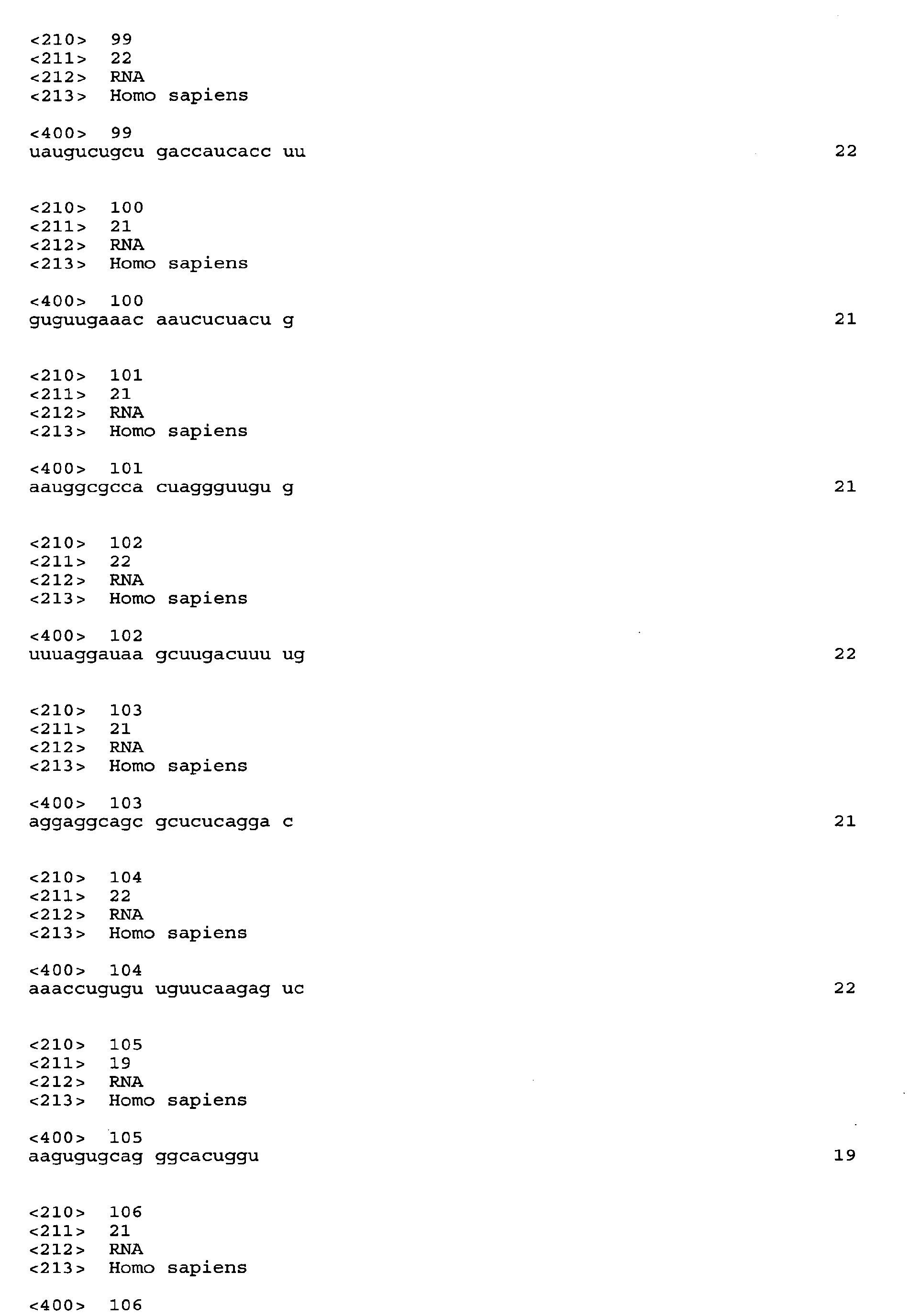


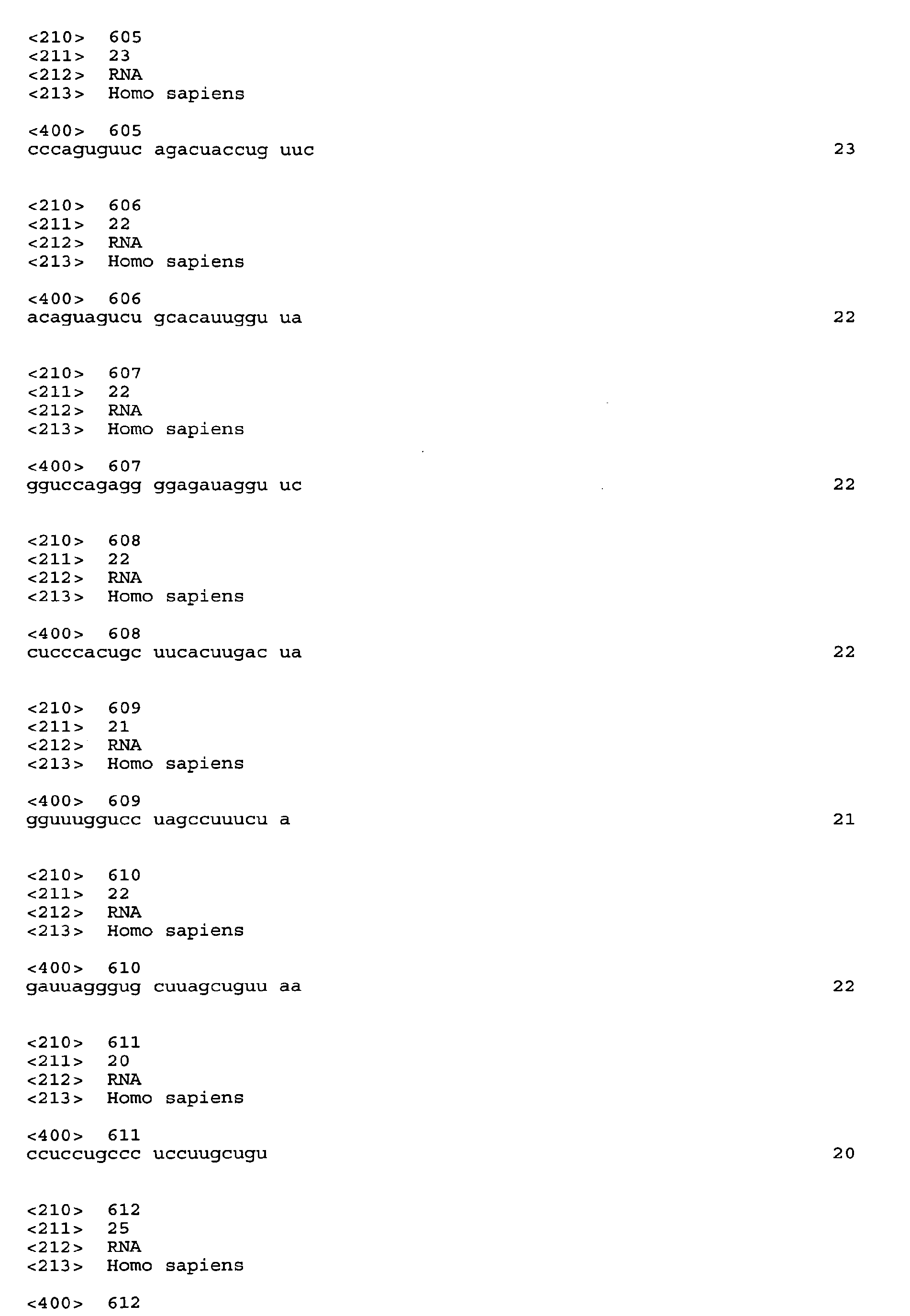


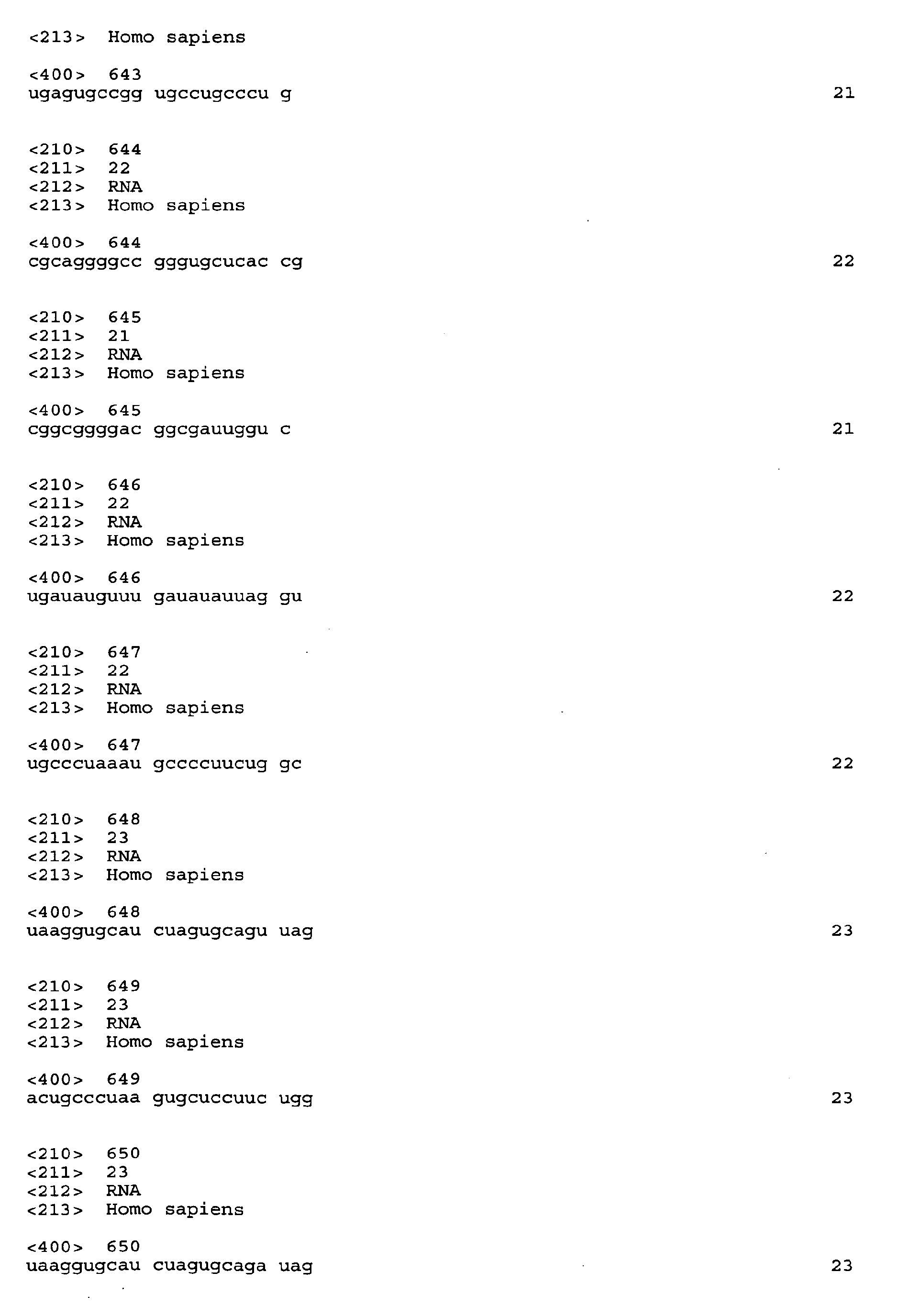


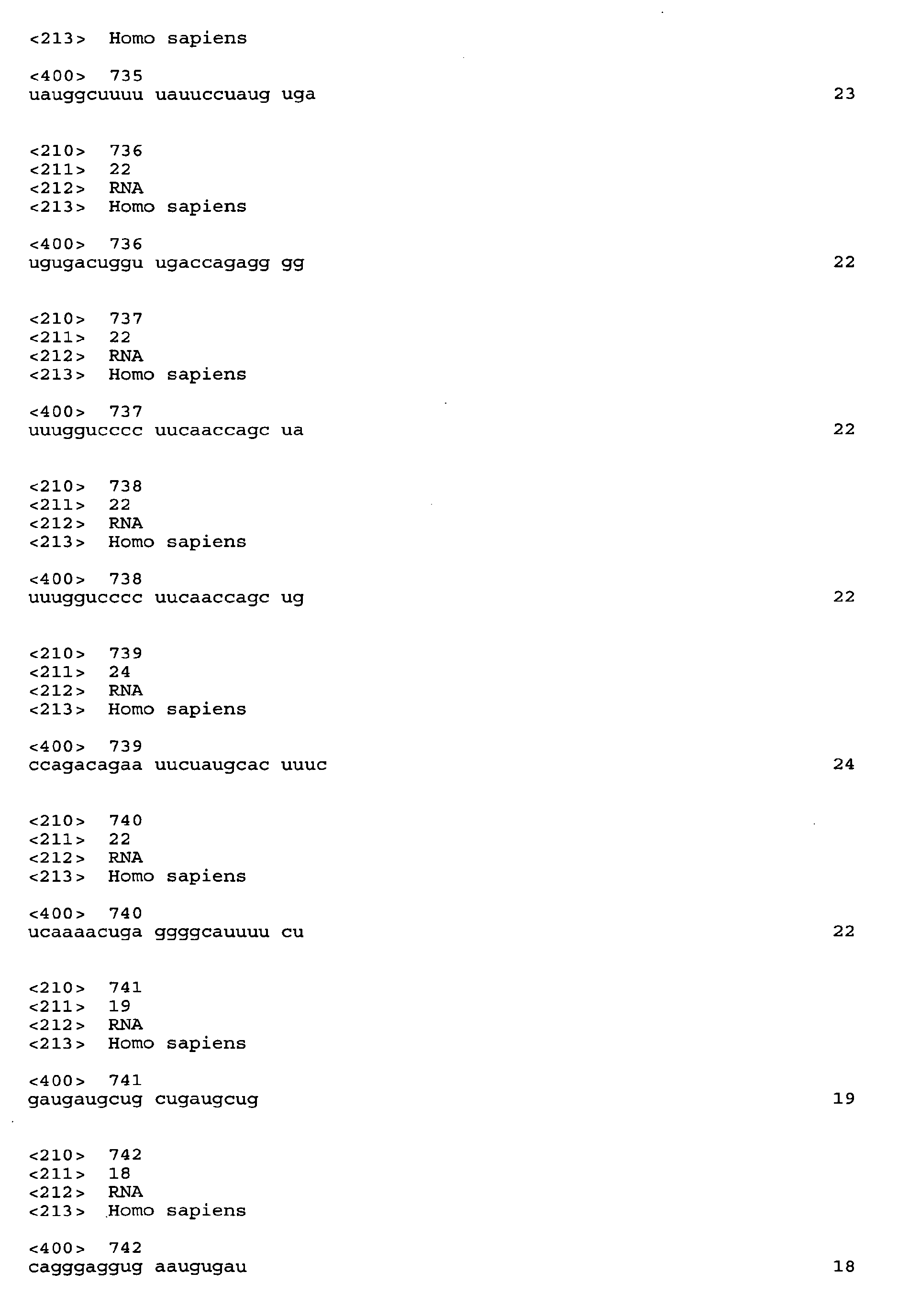


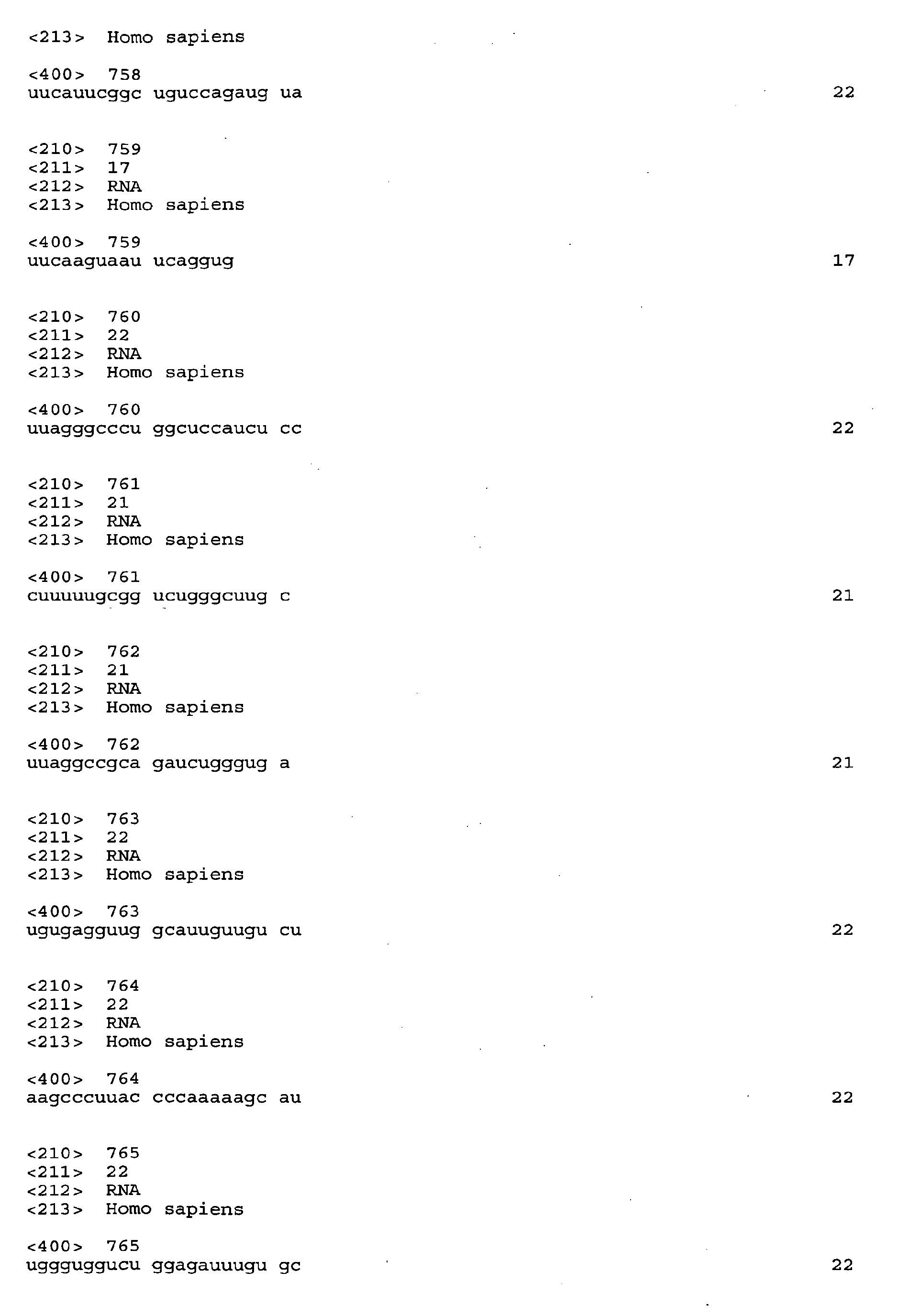


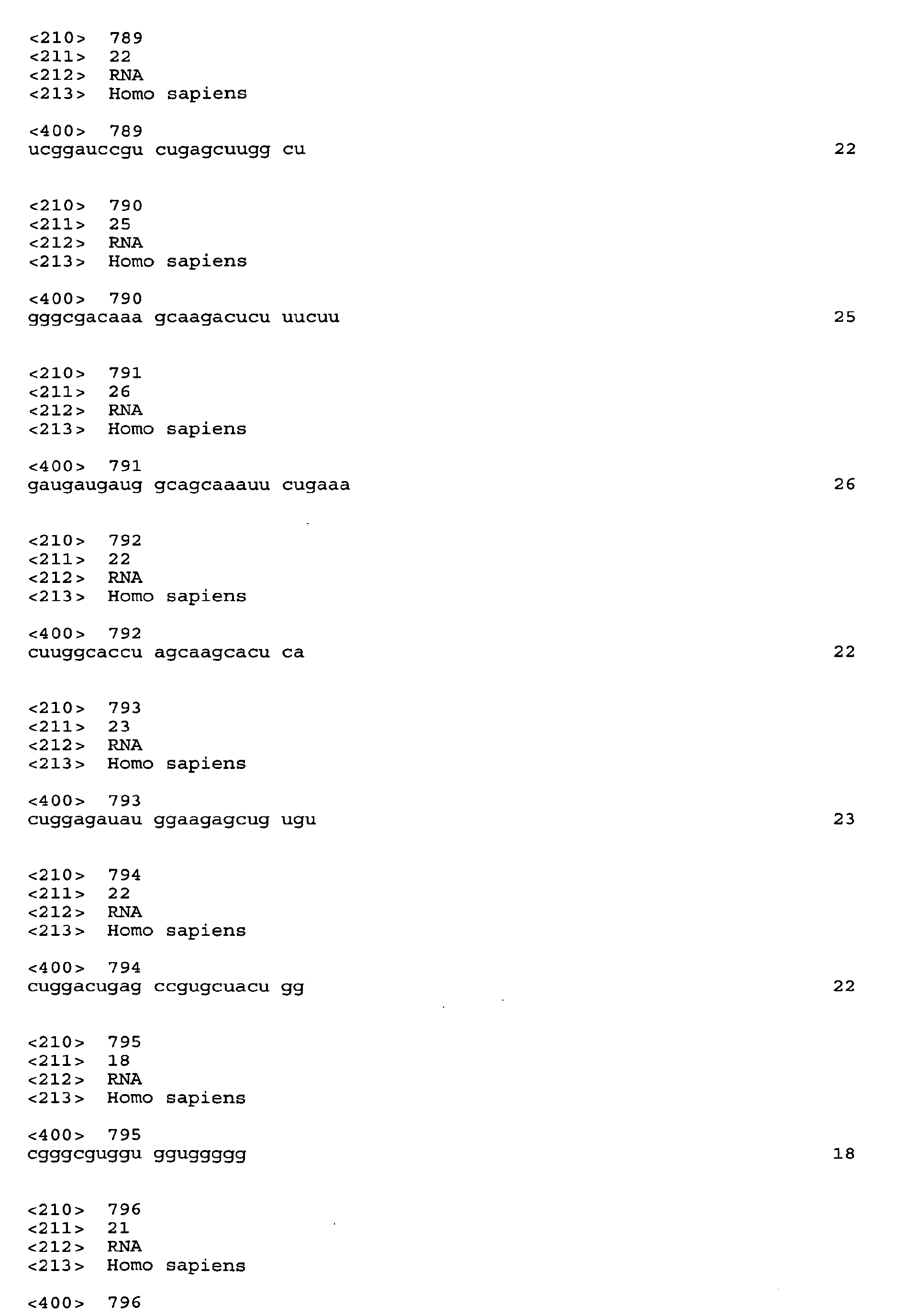


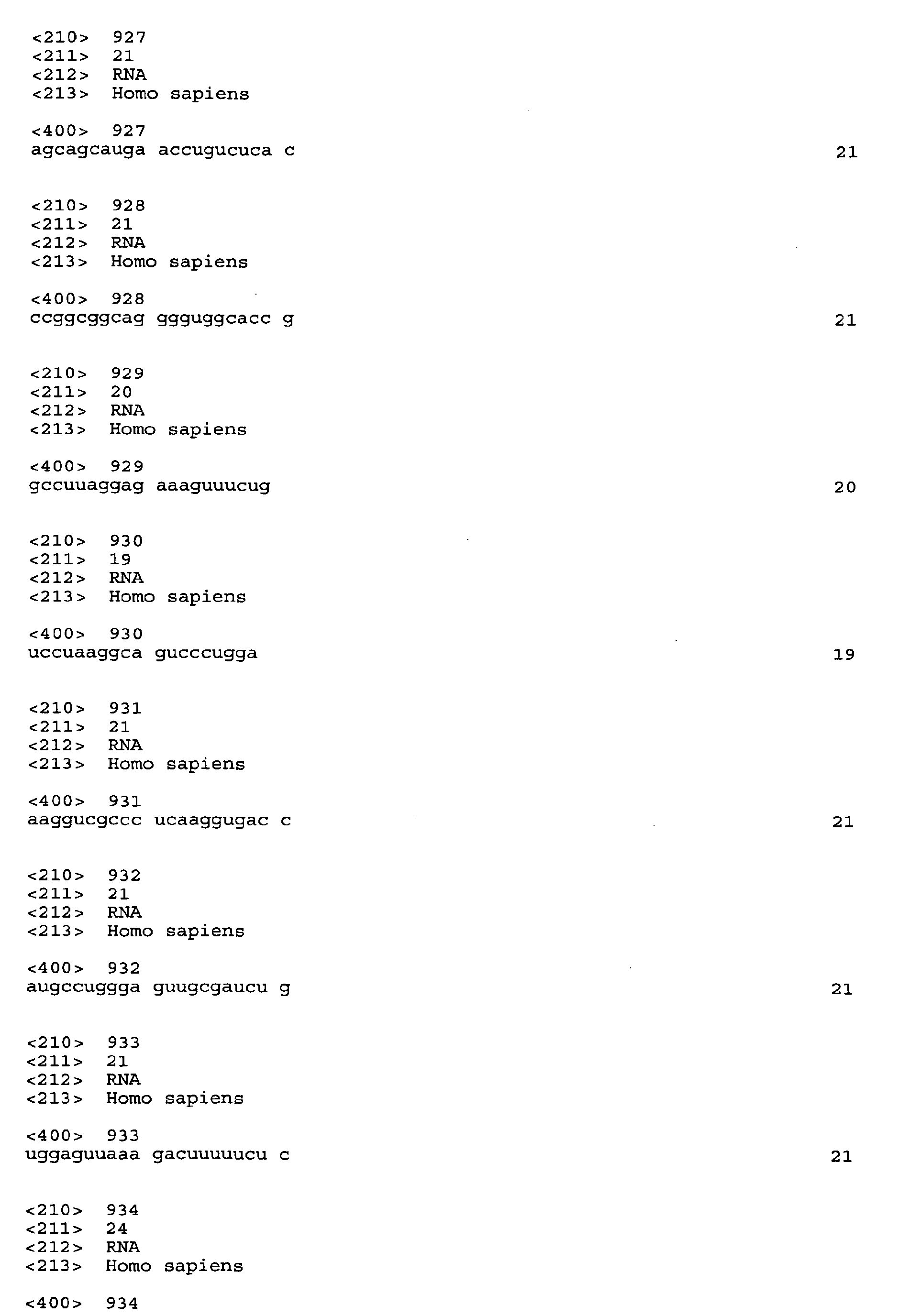


Claims (15)
- A method of diagnosing a disease, comprising the steps(a) determining an expression profile of a predetermined set of non-coding RNAs, including miRNAs, in a biological sample from a patient; and(b) comparing said expression profile to a reference expression profile,
wherein the comparison of said determined expression profile to said reference expression profile allows for the diagnosis of the disease, wherein the disease is selected from prostate cancer, Wilms' tumour and COPD. - The method according to any one of claims 1, , wherein the expression profile is determined of non-coding RNAs, including miRNAs selected from the group consisting of hsa-miR-99b*, hsa-miR-99b, hsa-miR-99a*, hsa-miR-99a, hsa-miR-98, hsa-miR-96*, hsa-miR-96, hsa-miR-95, hsa-miR-944, hsa-miR-943, hsa-miR-942, hsa-miR-941, hsa-miR-940, hsa-miR-939, hsa-miR-938, hsa-miR-937, hsa-miR-936, hsa-miR-935, hsa-miR-934, hsa-miR-933, hsa-miR-93*, hsa-miR-93, hsa-miR-92b*, hsa-miR-92b, hsa-miR-92a-2*, hsa-miR-92a-1*, hsa-miR-92a, hsa-miR-924, hsa-miR-922, hsa-miR-921, hsa-miR-920, hsa-miR-9*, hsa-miR-9, hsa-miR-892b, hsa-miR-892a, hsa-miR-891b, hsa-miR-891a, hsa-miR-890, hsa-miR-889, hsa-miR-888*, hsa-miR-888, hsa-miR-887, hsa-miR-886-5p, hsa-miR-886-3p, hsa-miR-885-5p, hsa-miR-885-3p, hsa-miR-877*, hsa-miR-877, hsa-miR-876-5p, hsa-miR-876-3p, hsa-miR-875-5p, hsa-miR-875-3p, hsa-miR-874, hsa-miR-873, hsa-miR-802, hsa-miR-770-5p, hsa-miR-769-5p, hsa-miR-769-3p, hsa-miR-767-5p, hsa-miR-767-3p, hsa-miR-766, hsa-miR-765, hsa-miR-764, hsa-miR-762, hsa-miR-761, hsa-miR-760, hsa-miR-759, hsa-miR-758, hsa-miR-744*, hsa-miR-744, hsa-miR-720, hsa-miR-7-2*, hsa-miR-718, hsa-miR-711, hsa-miR-7-1*, hsa-miR-708*, hsa-miR-708, hsa-miR-7, hsa-miR-675*, hsa-miR-675, hsa-miR-671-5p, hsa-miR-671-3p, hsa-miR-670, hsa-miR-668, hsa-miR-665, hsa-miR-664*, hsa-miR-664, hsa-miR-663b, hsa-miR-663, hsa-miR-662, hsa-miR-661, hsa-miR-660, hsa-miR-659, hsa-miR-658, hsa-miR-657, hsa-miR-656, hsa-miR-655, hsa-miR-654-5p, hsa-miR-654-3p, hsa-miR-653, hsa-miR-652, hsa-miR-651, hsa-miR-650, hsa-miR-649, hsa-miR-648, hsa-miR-647, hsa-miR-646, hsa-miR-645, hsa-miR-644, hsa-miR-643, hsa-miR-642, hsa-miR-641, hsa-miR-640, hsa-miR-639, hsa-miR-638, hsa-miR-637, hsa-miR-636, hsa-miR-635, hsa-miR-634, hsa-miR-633, hsa-miR-632, hsa-miR-631, hsa-miR-630, hsa-miR-629*, hsa-miR-629, hsa-miR-628-5p, hsa-miR-628-3p, hsa-miR-627, hsa-miR-626, hsa-miR-625*, hsa-miR-625, hsa-miR-624*, hsa-miR-624, hsa-miR-623, hsa-miR-622, hsa-miR-621, hsa-miR-620, hsa-miR-619, hsa-miR-618, hsa-miR-617, hsa-miR-616*, hsa-miR-616, hsa-miR-615-5p, hsa-miR-615-3p, hsa-miR-614, hsa-miR-613, hsa-miR-612, hsa-miR-611, hsa-miR-610, hsa-miR-609, hsa-miR-608, hsa-miR-607, hsa-miR-606, hsa-miR-605, hsa-miR-604, hsa-miR-603, hsa-miR-602, hsa-miR-601, hsa-miR-600, hsa-miR-599, hsa-miR-598, hsa-miR-597, hsa-miR-596, hsa-miR-595, hsa-miR-593*, hsa-miR-593, hsa-miR-592, hsa-miR-591, hsa-miR-590-5p, hsa-miR-590-3p, hsa-miR-589*, hsa-miR-589, hsa-miR-588, hsa-miR-587, hsa-miR-586, hsa-miR-585, hsa-miR-584, hsa-miR-583, hsa-miR-582-5p, hsa-miR-582-3p, hsa-miR-581, hsa-miR-580, hsa-miR-579, hsa-miR-578, hsa-miR-577, hsa-miR-576-5p, hsa-miR-576-3p, hsa-miR-575, hsa-miR-574-5p, hsa-miR-574-3p, hsa-miR-573, hsa-miR-572, hsa-miR-571, hsa-miR-570, hsa-miR-569, hsa-miR-568, hsa-miR-567, hsa-miR-566, hsa-miR-564, hsa-miR-563, hsa-miR-562, hsa-miR-561, hsa-miR-559, hsa-miR-558, hsa-miR-557, hsa-miR-556-5p, hsa-miR-556-3p, hsa-miR-555, hsa-miR-554, hsa-miR-553, hsa-miR-552, hsa-miR-551b*, hsa-miR-551b, hsa-miR-551a, hsa-miR-550*, hsa-miR-550, hsa-miR-549, hsa-miR-548q, hsa-miR-548p, hsa-miR-548o, hsa-miR-548n, hsa-miR-548m, hsa-miR-5481, hsa-miR-548k, hsa-miR-548j, hsa-miR-548i, hsa-miR-548h, hsa-miR-548g, hsa-miR-548f, hsa-miR-548e, hsa-miR-548d-5p, hsa-miR-548d-3p, hsa-miR-548c-5p, hsa-miR-548c-3p, hsa-miR-548b-5p, hsa-miR-548b-3p, hsa-miR-548a-5p, hsa-miR-548a-3p, hsa-miR-545*, hsa-miR-545, hsa-miR-544, hsa-miR-543, hsa-miR-542-5p, hsa-miR-542-3p, hsa-miR-541*, hsa-miR-541, hsa-miR-539, hsa-miR-532-5p, hsa-miR-532-3p, hsa-miR-527, hsa-miR-526b*, hsa-miR-526b, hsa-miR-526a, hsa-miR-525-5p, hsa-miR-525-3p, hsa-miR-524-5p, hsa-miR-524-3p, hsa-miR-523*, hsa-miR-523, hsa-miR-522*, hsa-miR-522, hsa-miR-521, hsa-miR-520h, hsa-miR-520g, hsa-miR-520f, hsa-miR-520e, hsa-miR-520d-5p, hsa-miR-520d-3p, hsa-miR-520c-5p, hsa-miR-520c-3p, hsa-miR-520b, hsa-miR-520a-5p, hsa-miR-520a-3p, hsa-miR-519e*, hsa-miR-519e, hsa-miR-519d, hsa-miR-519c-5p, hsa-miR-519c-3p, hsa-miR-519b-5p, hsa-miR-519b-3p, hsa-miR-519a*, hsa-miR-519a, hsa-miR-518f*, hsa-miR-518f, hsa-miR-518e*, hsa-miR-518e, hsa-miR-518d-5p, hsa-miR-518d-3p, hsa-miR-518c*, hsa-miR-518c, hsa-miR-518b, hsa-miR-518a-5p, hsa-miR-518a-3p, hsa-miR-517c, hsa-miR-517b, hsa-miR-517a, hsa-miR-517*, hsa-miR-516b*, hsa-miR-516b, hsa-miR-516a-5p, hsa-miR-516a-3p, hsa-miR-515-5p, hsa-miR-515-3p, hsa-miR-514, hsa-miR-513c, hsa-miR-513b, hsa-miR-513a-5p, hsa-miR-513a-3p, hsa-miR-512-5p, hsa-miR-512-3p, hsa-miR-511, hsa-miR-510, hsa-miR-509-5p, hsa-miR-509-3p, hsa-miR-509-3-5p, hsa-miR-508-5p, hsa-miR-508-3p, hsa-miR-507, hsa-miR-506, hsa-miR-505*, hsa-miR-505, hsa-miR-504, hsa-miR-503, hsa-miR-502-5p, hsa-miR-502-3p, hsa-miR-501-5p, hsa-miR-501-3p, hsa-miR-500*, hsa-miR-500, hsa-miR-499-5p, hsa-miR-499-3p, hsa-miR-498, hsa-miR-497*, hsa-miR-497, hsa-miR-496, hsa-miR-495, hsa-miR-494, hsa-miR-493*, hsa-miR-493, hsa-miR-492, hsa-miR-491-5p, hsa-miR-491-3p, hsa-miR-490-5p, hsa-miR-490-3p, hsa-miR-489, hsa-miR-488*, hsa-miR-488, hsa-miR-487b, hsa-miR-487a, hsa-miR-486-5p, hsa-miR-486-3p, hsa-miR-485-5p, hsa-miR-485-3p, hsa-miR-484, hsa-miR-483-5p, hsa-miR-483-3p, hsa-miR-455-5p, hsa-miR-455-3p, hsa-miR-454*, hsa-miR-454, hsa-miR-453, hsa-miR-452*, hsa-miR-452, hsa-miR-451, hsa-miR-450b-5p, hsa-miR-450b-3p, hsa-miR-450a, hsa-miR-449c*, hsa-miR-449c, hsa-miR-449b*, hsa-miR-449b, hsa-miR-449a, hsa-miR-448, hsa-miR-433, hsa-miR-432*, hsa-miR-432, hsa-miR-431*, hsa-miR-431, hsa-miR-429, hsa-miR-425*, hsa-miR-425, hsa-miR-424*, hsa-miR-424, hsa-miR-423-5p, hsa-miR-423-3p, hsa-miR-422a, hsa-miR-421, hsa-miR-412, hsa-miR-411*, hsa-miR-411, hsa-miR-410, hsa-miR-409-5p, hsa-miR-409-3p, hsa-miR-384, hsa-miR-383, hsa-miR-382, hsa-miR-381, hsa-miR-380*, hsa-miR-380, hsa-miR-379*, hsa-miR-379, hsa-miR-378*, hsa-miR-378, hsa-miR-377*, hsa-miR-377, hsa-miR-376c, hsa-miR-376b, hsa-miR-376a*, hsa-miR-376a, hsa-miR-375, hsa-miR-374b*, hsa-miR-374b, hsa-miR-374a*, hsa-miR-374a, hsa-miR-373*, hsa-miR-373, hsa-miR-372, hsa-miR-371-5p, hsa-miR-371-3p, hsa-miR-370, hsa-miR-369-5p, hsa-miR-369-3p, hsa-miR-367*, hsa-miR-367, hsa-miR-365*, hsa-miR-365, hsa-miR-363*, hsa-miR-363, hsa-miR-362-5p, hsa-miR-362-3p, hsa-miR-361-5p, hsa-miR-361-3p, hsa-miR-34c-5p, hsa-miR-34c-3p, hsa-miR-34b*, hsa-miR-34b, hsa-miR-34a*, hsa-miR-34a, hsa-miR-346, hsa-miR-345, hsa-miR-342-5p, hsa-miR-342-3p, hsa-miR-340*, hsa-miR-340, hsa-miR-33b*, hsa-miR-33b, hsa-miR-33a*, hsa-miR-33a, hsa-miR-339-5p, hsa-miR-339-3p, hsa-miR-338-5p, hsa-miR-338-3p, hsa-miR-337-5p, hsa-miR-337-3p, hsa-miR-335*, hsa-miR-335, hsa-miR-331-5p, hsa-miR-331-3p, hsa-miR-330-5p, hsa-miR-330-3p, hsa-miR-329, hsa-miR-328, hsa-miR-326, hsa-miR-325, hsa-miR-324-5p, hsa-miR-324-3p, hsa-miR-323-5p, hsa-miR-323-3p, hsa-miR-320d, hsa-miR-320c, hsa-miR-320b, hsa-miR-320a, hsa-miR-32*, hsa-miR-32, hsa-miR-31*, hsa-miR-31, hsa-miR-30e*, hsa-miR-30e, hsa-miR-30d*, hsa-miR-30d, hsa-miR-30c-2*, hsa-miR-30c-1*, hsa-miR-30c, hsa-miR-30b*, hsa-miR-30b, hsa-miR-30a*, hsa-miR-30a, hsa-miR-302f, hsa-miR-302e, hsa-miR-302d*, hsa-miR-302d, hsa-miR-302c*, hsa-miR-302c, hsa-miR-302b*, hsa-miR-302b, hsa-miR-302a*, hsa-miR-302a, hsa-miR-301b, hsa-miR-301a, hsa-miR-300, hsa-miR-29c*, hsa-miR-29c, hsa-miR-29b-2*, hsa-miR-29b-1*, hsa-miR-29b, hsa-miR-29a*, hsa-miR-29a, hsa-miR-299-5p, hsa-miR-299-3p, hsa-miR-298, hsa-miR-297, hsa-miR-296-5p, hsa-miR-296-3p, hsa-miR-28-5p, hsa-miR-28-3p, hsa-miR-27b*, hsa-miR-27b, hsa-miR-27a*, hsa-miR-27a, hsa-miR-26b*, hsa-miR-26b, hsa-miR-26a-2*, hsa-miR-26a-1*, hsa-miR-26a, hsa-miR-25*, hsa-miR-25, hsa-miR-24-2*, hsa-rniR-24-1*, hsa-miR-24, hsa-miR-23b*, hsa-miR-23b, hsa-miR-23a*, hsa-miR-23a, hsa-miR-2278, hsa-miR-2277, hsa-miR-2276, hsa-miR-224*, hsa-miR-224, hsa-miR-223*, hsa-miR-223, hsa-miR-222*, hsa-miR-222, hsa-miR-221*, hsa-miR-221, hsa-miR-220c, hsa-miR-220b, hsa-miR-220a, hsa-miR-22*, hsa-miR-22, hsa-miR-219-5p, hsa-miR-219-2-3p, hsa-miR-219-1-3p, hsa-miR-218-2*, hsa-miR-218-1*, hsa-miR-218, hsa-miR-217, hsa-miR-216b, hsa-miR-216a, hsa-miR-215, hsa-miR-214*, hsa-miR-214, hsa-miR-212, hsa-miR-2117, hsa-miR-2116*, hsa-miR-2116, hsa-miR-2115*, hsa-miR-2115, hsa-miR-2114*, hsa-miR-2114, hsa-miR-2113, hsa-miR-2110, hsa-miR-211, hsa-miR-210, hsa-miR-21*, hsa-miR-21, hsa-miR-20b*, hsa-miR-20b, hsa-miR-20a*, hsa-miR-20a, hsa-miR-208b, hsa-miR-208a, hsa-miR-206, hsa-miR-2054, hsa-miR-2053, hsa-miR-2052, hsa-miR-205*, hsa-miR-205, hsa-miR-204, hsa-miR-203, hsa-miR-202*, hsa-miR-202, hsa-miR-200c*, hsa-miR-200c, hsa-miR-200b*, hsa-miR-200b, hsa-miR-200a*, hsa-miR-200a, hsa-miR-19b-2*, hsa-miR-19b-1*, hsa-miR-19b, hsa-miR-19a*, hsa-miR-19a, hsa-miR-199b-5p, hsa-miR-199b-3p, hsa-miR-199a-5p, hsa-miR-199a-3p, hsa-miR-198, hsa-miR-1979, hsa-miR-1978, hsa-miR-1977, hsa-miR-1976, hsa-miR-1975, hsa-miR-1974, hsa-miR-1973, hsa-miR-1972, hsa-miR-197, hsa-miR-196b*, hsa-miR-196b, hsa-miR-196a*, hsa-miR-196a, hsa-miR-195*, hsa-miR-195, hsa-miR-194*, hsa-miR-194, hsa-miR-193b*, hsa-miR-193b, hsa-miR-193a-5p, hsa-miR-193a-3p, hsa-miR-192*, hsa-miR-192, hsa-miR-1915*, hsa-miR-1915, hsa-miR-1914*, hsa-miR-1914, hsa-miR-1913, hsa-miR-1912, hsa-miR-1911*, hsa-miR-1911, hsa-miR-1910, hsa-miR-191*, hsa-miR-191, hsa-miR-190b, hsa-miR-1909*, hsa-miR-1909, hsa-miR-1908, hsa-miR-190, hsa-miR-18b*, hsa-miR-18b, hsa-miR-18a*, hsa-miR-18a, hsa-miR-188-5p, hsa-miR-188-3p, hsa-miR-187*, hsa-miR-187, hsa-miR-186*, hsa-miR-186, hsa-miR-185*, hsa-miR-185, hsa-miR-184, hsa-miR-183*, hsa-miR-183, hsa-miR-1827, hsa-miR-1826, hsa-miR-1825, hsa-miR-182*, hsa-miR-182, hsa-miR-181d, hsa-miR-181c*, hsa-miR-181c, hsa-miR-181b, hsa-miR-181a-2*, hsa-miR-181a*, hsa-miR-181a, hsa-miR-17*, hsa-miR-17, hsa-miR-16-2*, hsa-miR-16-1*, hsa-miR-16, hsa-miR-15b*, hsa-miR-15b, hsa-miR-15a*, hsa-miR-15a, hsa-miR-155*, hsa-miR-155, hsa-miR-154*, hsa-miR-154, hsa-miR-1539, hsa-miR-1538, hsa-miR-1537, hsa-miR-153, hsa-miR-152, hsa-miR-151-5p, hsa-miR-151-3p, hsa-miR-150*, hsa-miR-150, hsa-miR-149*, hsa-miR-149, hsa-miR-148b*, hsa-miR-148b, hsa-miR-148a*, hsa-miR-148a, hsa-miR-147b, hsa-miR-1471, hsa-miR-1470, hsa-miR-147, hsa-miR-146b-5p, hsa-miR-146b-3p, hsa-miR-146a*, hsa-miR-146a, hsa-miR-1469, hsa-miR-1468, hsa-miR-145*, hsa-miR-145, hsa-miR-144*, hsa-miR-144, hsa-miR-143*, hsa-miR-143, hsa-miR-142-5p, hsa-miR-142-3p, hsa-miR-141*, hsa-miR-141, hsa-miR-140-5p, hsa-miR-140-3p, hsa-miR-139-5p, hsa-miR-139-3p, hsa-miR-138-2*, hsa-miR-138-1*, hsa-miR-138, hsa-miR-137, hsa-miR-136*, hsa-miR-136, hsa-miR-135b*, hsa-miR-135b, hsa-miR-135a*, hsa-miR-135a, hsa-miR-134, hsa-miR-133b, hsa-miR-133a, hsa-miR-1324, hsa-miR-1323, hsa-miR-1322, hsa-miR-1321, hsa-miR-132*, hsa-miR-132, hsa-miR-130b*, hsa-miR-130b, hsa-miR-130a*, hsa-miR-130a, hsa-miR-1308, hsa-miR-1307, hsa-miR-1306, hsa-miR-1305, hsa-miR-1304, hsa-miR-1303, hsa-miR-1302, hsa-miR-1301, hsa-miR-1299, hsa-miR-1298, hsa-miR-1297, hsa-miR-1296, hsa-miR-129-5p, hsa-miR-1295, hsa-miR-1294, hsa-miR-129-3p, hsa-miR-1293, hsa-miR-1292, hsa-miR-1291, hsa-miR-1290, hsa-miR-129*, hsa-miR-1289, hsa-miR-1288, hsa-miR-1287, hsa-miR-1286, hsa-miR-1285, hsa-miR-1284, hsa-miR-1283, hsa-miR-1282, hsa-miR-1281, hsa-miR-1280, hsa-miR-128, hsa-miR-1279, hsa-miR-1278, hsa-miR-1277, hsa-miR-1276, hsa-miR-127-5p, hsa-miR-1275, hsa-miR-1274b, hsa-miR-1274a, hsa-miR-127-3p, hsa-miR-1273, hsa-miR-1272, hsa-miR-1271, hsa-miR-1270, hsa-miR-1269, hsa-miR-1268, hsa-miR-1267, hsa-miR-1266, hsa-miR-1265, hsa-miR-1264, hsa-miR-1263, hsa-miR-1262, hsa-miR-1261, hsa-miR-1260, hsa-miR-126*, hsa-miR-126, hsa-miR-125b-2*, hsa-miR-125b-1*, hsa-miR-125b, hsa-miR-125a-5p, hsa-miR-125a-3p, hsa-miR-1259, hsa-miR-1258, hsa-miR-1257, hsa-miR-1256, hsa-miR-1255b, hsa-miR-1255a, hsa-miR-1254, hsa-miR-1253, hsa-miR-1252, hsa-miR-1251, hsa-miR-1250, hsa-miR-1249, hsa-miR-1248, hsa-miR-1247, hsa-miR-1246, hsa-miR-1245, hsa-miR-1244, hsa-miR-1243, hsa-miR-124*, hsa-miR-124, hsa-miR-1238, hsa-miR-1237, hsa-miR-1236, hsa-miR-1234, hsa-miR-1233, hsa-miR-1231, hsa-miR-1229, hsa-miR-1228*, hsa-miR-1228, hsa-miR-1227, hsa-miR-1226*, hsa-miR-1226, hsa-miR-1225-5p, hsa-miR-1225-3p, hsa-miR-1224-5p, hsa-miR-1224-3p, hsa-miR-122*, hsa-miR-122, hsa-miR-1208, hsa-miR-1207-5p, hsa-miR-1207-3p, hsa-miR-1206, hsa-rniR-1205, hsa-miR-1204, hsa-miR-1203, hsa-miR-1202, hsa-miR-1201, hsa-miR-1200, hsa-miR-1197, hsa-miR-1185, hsa-miR-1184, hsa-miR-1183, hsa-miR-1182, hsa-miR-1181, hsa-miR-1180, hsa-miR-1179, hsa-miR-1178, hsa-rniR-10b*, hsa-miR-10b, hsa-miR-10a*, hsa-miR-10a, hsa-miR-107, hsa-miR-106b*, hsa-miR-106b, hsa-miR-106a*, hsa-miR-106a, hsa-miR-105*, hsa-miR-105, hsa-miR-103-as, hsa-miR-103-2*, hsa-miR-103, hsa-miR-101*, hsa-miR-101, hsa-miR-100*, hsa-miR-100, hsa-miR-1, hsa-let-7i*, hsa-let-7i, hsa-let-7g*, hsa-let-7g, hsa-let-7f-2*, hsa-let-7f-1*, hsa-let-7f, hsa-let-7e*, hsa-let-7e, hsa-let-7d*, hsa-let-7d, hsa-let-7c*, hsa-let-7c, hsa-let-7b*, hsa-let-7b, hsa-let-7a-2*, hsa-let-7a*, hsa-let-7a, hsa-life-1, hsa-life-2, hsa-life-2-AS, hsa-life-3, hsa-life-4, hsa-life-6-5p, hsa-life-6-3p, hsa-life-7-AS, hsa-life-7, hsa-life-9, hsa-life-9-AS, hsa-life-11, hsa-life-12-5p, hsa-life-12-3p, hsa-life-13-3p, hsa-life-13-5p, hsa-life-14-3p, hsa-life-14-5p, hsa-life-17, hsa-life-21, hsa-life-22, hsa-life-26-3p, hsa-life-26-5p, hsa-life-27, hsa-life-31-5p, hsa-life-31-3p, hsa-life-33-AS, hsa-life-33, hsa-life-36-3p, hsa-life-36-5p, hsa-life-37-3p, hsa-life-37-5p, hsa-life-5-5p, hsa-life-5-3p, hsa-life-8, hsa-life-10, hsa-life-15-3p, hsa-life-15-5p, hsa-life-16-5p, hsa-life-16-3p, hsa-life-18, hsa-life-19-5p, hsa-life-19-3p, hsa-life-20-3p, hsa-life-20-5p, hsa-life-23-3p, hsa-life-23-5p, hsa-life-24, hsa-life-25, hsa-life-28-3p, hsa-life-28-5p, hsa-life-29, hsa-life-30, hsa-life-32-AS, hsa-life-32, hsa-life-34-3p, hsa-life-34-5p, hsa-life-35.
- The method according to claim 1 or 2, wherein the predetermined set of non-coding RNAs, including miRNAs representative for diagnosis of prostate cancer comprises at least 1, 7 ,10, 15, 20, 25, 30, 35, 40, 50, 75, 100 of non-coding RNAs including miRNAs.
- The method according to claim 1, 2 or 3, wherein the predetermined set of miRNAs representative for diagnosis of prostate cancer comprises at least 1, 7 ,10 ,15 ,20, 25, 30, 35, 40, 50, 75, 100 of the miRNAs selected from the group consisting of hsa-miR-144*, hsa-miR-148a, hsa-miR-519b-5p, hsa-miR-1324, hsa-miR-137, hsa-miR-556-5p, hsa-miR-330-3p, hsa-miR-361-5p, hsa-miR-891b, hsa-miR-767-5p, hsa-miR-744*, hsa-miR-208b, hsa-miR-548p, hsa-miR-20a*, hsa-miR-195, hsa-miR-33b, hsa-miR-1283, hsa-miR-519c-5p, hsa-miR-497, hsa-miR-9*, hsa-miR-200a, hsa-miR-338-3p, hsa-miR-515-5p, hsa-miR-31*, hsa-miR-551b*, hsa-miR-518e*, hsa-miR-127-5p, hsa-miR-21*, hsa-miR-216a, hsa-miR-452*, hsa-miR-183*, hsa-miR-500, hsa-miR-1826, hsa-miR-625*, hsa-miR-513b, hsa-miR-526a, hsa-miR-33a, hsa-miR-1243, hsa-miR-517*, hsa-miR-541, hsa-miR-217, hsa-miR-621, hsa-miR-518d-5p, hsa-miR-873, hsa-miR-103-as, hsa-miR-450b-5p, hsa-miR-545, hsa-miR-1251, hsa-miR-885-5p, hsa-miR-922, hsa-miR-628-5p, hsa-miR-548f, hsa-miR-802, hsa-miR-25, hsa-miR-423-3p, hsa-miR-522*, hsa-rniR-519a*, hsa-miR-455-3p, hsa-miR-1245, hsa-miR-362-5p, hsa-miR-1184, hsa-miR-191, hsa-miR-487a, hsa-miR-216b, hsa-miR-525-5p, hsa-miR-509-3-5p, hsa-miR-27a*, hsa-miR-488*, hsa-miR-1226, hsa-miR-646, hsa-miR-527, hsa-miR-635, hsa-miR-1825, hsa-let-7i*.
- The method according to claim 1 or 2, wherein the predetermined set of miRNAs representative for Wilms' tumour comprises at least 1, 7, 10, 15, 20, 25, 30, 35, 40, 50, 75, 100 of non-coding RNAs including miRNAs.
- The method according to claim 1, 2 or 5, wherein the predetermined set of miRNAs representative for diagnosis of Wilms' tumour comprises at least 1, 7 ,10, 15, 20, 25, 30, 35, 40, 50, 75, 100 of the miRNAs selected from the group consisting of hsa-miR-23b*, hsa-miR-875-5p, hsa-miR-181d, hsa-miR-144*, hsa-miR-10a*, hsa-miR-144, hsa-miR-581, hsa-miR-218, hsa-miR-1294, hsa-miR-302f, hsa-miR-944, hsa-miR-92a-1 *, hsa-miR-190b, hsa-miR-20b, hsa-miR-1913, hsa-miR-96, hsa-miR-363, hsa-miR-590-3p, hsa-miR-140-5p, hsa-miR-639, hsa-miR-1305, hsa-miR-651, hsa-miR-556-3p, hsa-miR-139-5p, hsa-miR-545*, hsa-miR-632, hsa-miR-103, hsa-miR-105*, hsa-miR-1249, hsa-miR-1470, hsa-miR-634, hsa-miR-488, hsa-miR-1298, hsa-miR-20a, hsa-miR-302b*, hsa-miR-1258, hsa-miR-548k, hsa-miR-579, hsa-miR-1228, hsa-miR-548h, hsa-miR-17, hsa-miR-609, hsa-miR-296-5p, \hsa-miR-625*, hsa-miR-1276, hsa-miR-425, hsa-miR-520c-3p, hsa-miR-432, hsa-miR-30a*, hsa-miR-302a, hsa-miR-384, hsa-miR-106a, hsa-miR-617, hsa-miR-342-3p, hsa-miR-548f, hsa-miR-218-1*, hsa-miR-10b, hsa-miR-548a-3p, hsa-miR-1252, hsa-miR-662, hsa-miR-590-5p, hsa-miR-374a, hsa-miR-126, hsa-miR-876-3p, hsa-miR-720, hsa-miR-519d, hsa-miR-141*, hsa-miR-665, hsa-miR-18b, hsa-miR-589, hsa-miR-30c-2*, hsa-miR-1267, hsa-miR-101, hsa-miR-382.
- The method according to claim 1 or 2, wherein the predetermined set of miRNAs representative for diagnosis of COPD comprises at least 1, 7, 10, 15, 20, 25, 30, 35, 40, 50, 75, 100 non-coding RNAs including miRNAs.
- The method according to claim 1, 2 or 7, wherein the predetermined set of miRNAs representative for diagnosis of COPD comprises at least 1, 7, 10, 15, 20, 25, 30, 35, 40, 50, 75, 100 of the miRNAs selected from the group consiting of hsa-miR-182*, hsa-miR-205, hsa-miR-662, hsa-miR-636, hsa-miR-554, hsa-miR-1233, hsa-miR-330-3p, hsa-miR-492, hsa-miR-383, hsa-miR-518b, hsa-miR-23b, hsa-miR-188-5p, hsa-miR-216a, hsa-miR-625*, hsa-miR-26a, hsa-miR-30c, hsa-miR-200a*, hsa-miR-24-1 *, hsa-miR-641, hsa-miR-32, hsa-miR-646, hsa-miR-92a, hsa-miR-566, hsa-miR-1291, hsa-miR-23a, hsa-miR-24-2*, hsa-miR-548p, hsa-miR-1470, hsa-miR-199a-5p, hsa-miR-25, hsa-miR-136, hsa-miR-342-5p, hsa-miR-1229, hsa-miR-369-5p, hsa-miR-634, hsa-miR-1913, hsa-miR-548o, hsa-miR-183, hsa-miR-182, hsa-miR-129-3p, hsa-miR-500*, hsa-miR-1308, hsa-miR-1471, hsa-miR-195, hsa-miR-361-5p, hsa-miR-515-5p, hsa-miR-224, hsa-miR-151-5p, hsa-miR-564, hsa-miR-934, hsa-miR-146b-5p, hsa-miR-214, hsa-miR-216b, hsa-miR-28-5p, hsa-miR-940, hsa-miR-606, hsa-miR-631, hsa-miR-21*, hsa-miR-384, hsa-miR-1234, hsa-miR-1260, hsa-miR-532-3p, hsa-miR-122*, hsa-miR-199a-3p, hsa-miR-33b*, hsa-miR-184, hsa-miR-373*, hsa-miR-145, hsa-miR-27a, hsa-miR-1258, hsa-miR-124, hsa-miR-489, hsa-miR-559, hsa-miR-223.
- The method according to any one of claims 1-8 wherein said biological sample is selected from blood and/or serum or urine samples.
- The method according to any one of claims 1-9 wherein miRNA the expression profile is determined by nucleic acid hybridization, nucleic acid amplification, polymerase extension, sequencing, mass spectroscopy or any combinations thereof.
- The method according to any one of claims 1-10, wherein the miRNA expression profile of said subject and the reference expression profiles and optionally the predetermined set of miRNAs are stored in a database.
- The method according to any one of claims 1-11, wherein the biological sample is not labeled prior to determination of the expression profile.
- The method according to any one of claims 1-12 wherein the diagnosis comprises determining survival rate, responsiveness to drugs, and/or monitoring the course of the disease or the therapy, e.g. chemotherapy.
- The method of claim 10 wherein the nucleic acid hybridisation is performed using a solid-phase nucleic acid biochip array, in particular a microarray or in situ hybridisation, and/or wherein the nucleic acid amplification is performed via a real-time PCR (RT-PCR).
- A kit for diagnosing and/or predicting prostate cancer, Wilms' tumour or COPD of a subject, comprising:(a) means for determining the miRNA expression profile of a RNA sample of a subject, and(b) at least one reference set of miRNA profile characteristic for a particular condition.
Priority Applications (17)
| Application Number | Priority Date | Filing Date | Title |
|---|---|---|---|
| EP09181024A EP2341145A1 (en) | 2009-12-30 | 2009-12-30 | miRNA fingerprint in the diagnosis of diseases |
| EP10800962.2A EP2519646B1 (en) | 2009-12-30 | 2010-12-30 | miRNA FINGERPRINT IN THE DIAGNOSIS OF COPD |
| ES10800962.2T ES2622589T3 (en) | 2009-12-30 | 2010-12-30 | MiRNA fingerprint in the diagnosis of COPD |
| EP10803591.6A EP2519650B1 (en) | 2009-12-30 | 2010-12-30 | Mirna fingerprint in the diagnosis of wilms' tumour |
| PCT/EP2010/070924 WO2011080315A1 (en) | 2009-12-30 | 2010-12-30 | Mirna fingerprint in the diagnosis of prostate cancer |
| EP10801172.7A EP2519648B1 (en) | 2009-12-30 | 2010-12-30 | miRNA fingerprint in the diagnosis of prostate cancer |
| PCT/EP2010/070926 WO2011080316A1 (en) | 2009-12-30 | 2010-12-30 | miRNA FINGERPRINT IN THE DIAGNOSIS OF WILMS' TUMOUR |
| EP16189740.0A EP3124625B1 (en) | 2009-12-30 | 2010-12-30 | miRNA fingerprint in the diagnosis of prostate cancer |
| US13/519,959 US20130035251A1 (en) | 2009-12-30 | 2010-12-30 | miRNA FINGERPRINT IN THE DIAGNOSIS OF WILMS' TUMOUR |
| EP14164371.8A EP2772551A1 (en) | 2009-12-30 | 2010-12-30 | miRNA fingerprint from patient's blood samples in the diagnosis of Wilms' tumour |
| PCT/EP2010/070932 WO2011080318A1 (en) | 2009-12-30 | 2010-12-30 | Mirna fingerprint in the diagnosis of copd |
| US13/519,957 US20130053263A1 (en) | 2009-12-30 | 2010-12-30 | miRNA FINGERPRINT IN THE DIAGNOSIS OF COPD |
| US13/520,014 US20130053264A1 (en) | 2009-12-30 | 2010-12-30 | Mirna fingerprint in the diagnosis of prostate cancer |
| DK10800962.2T DK2519646T3 (en) | 2009-12-30 | 2010-12-30 | miRNA FINGERPRINT IN DIAGNOSTICATION OF COPD |
| US14/312,302 US20150031777A1 (en) | 2009-12-30 | 2014-06-23 | miRNA FINGERPRINT IN THE DIAGNOSIS OF WILMS' TUMOUR |
| US14/755,261 US9528158B2 (en) | 2009-12-30 | 2015-06-30 | miRNA fingerprint in the diagnosis of COPD |
| US14/823,545 US9745630B2 (en) | 2009-12-30 | 2015-08-11 | MiRNA fingerprint in the diagnosis of prostate cancer |
Applications Claiming Priority (1)
| Application Number | Priority Date | Filing Date | Title |
|---|---|---|---|
| EP09181024A EP2341145A1 (en) | 2009-12-30 | 2009-12-30 | miRNA fingerprint in the diagnosis of diseases |
Publications (1)
| Publication Number | Publication Date |
|---|---|
| EP2341145A1 true EP2341145A1 (en) | 2011-07-06 |
Family
ID=41818784
Family Applications (6)
| Application Number | Title | Priority Date | Filing Date |
|---|---|---|---|
| EP09181024A Ceased EP2341145A1 (en) | 2009-12-30 | 2009-12-30 | miRNA fingerprint in the diagnosis of diseases |
| EP10801172.7A Not-in-force EP2519648B1 (en) | 2009-12-30 | 2010-12-30 | miRNA fingerprint in the diagnosis of prostate cancer |
| EP10803591.6A Not-in-force EP2519650B1 (en) | 2009-12-30 | 2010-12-30 | Mirna fingerprint in the diagnosis of wilms' tumour |
| EP16189740.0A Not-in-force EP3124625B1 (en) | 2009-12-30 | 2010-12-30 | miRNA fingerprint in the diagnosis of prostate cancer |
| EP14164371.8A Withdrawn EP2772551A1 (en) | 2009-12-30 | 2010-12-30 | miRNA fingerprint from patient's blood samples in the diagnosis of Wilms' tumour |
| EP10800962.2A Active EP2519646B1 (en) | 2009-12-30 | 2010-12-30 | miRNA FINGERPRINT IN THE DIAGNOSIS OF COPD |
Family Applications After (5)
| Application Number | Title | Priority Date | Filing Date |
|---|---|---|---|
| EP10801172.7A Not-in-force EP2519648B1 (en) | 2009-12-30 | 2010-12-30 | miRNA fingerprint in the diagnosis of prostate cancer |
| EP10803591.6A Not-in-force EP2519650B1 (en) | 2009-12-30 | 2010-12-30 | Mirna fingerprint in the diagnosis of wilms' tumour |
| EP16189740.0A Not-in-force EP3124625B1 (en) | 2009-12-30 | 2010-12-30 | miRNA fingerprint in the diagnosis of prostate cancer |
| EP14164371.8A Withdrawn EP2772551A1 (en) | 2009-12-30 | 2010-12-30 | miRNA fingerprint from patient's blood samples in the diagnosis of Wilms' tumour |
| EP10800962.2A Active EP2519646B1 (en) | 2009-12-30 | 2010-12-30 | miRNA FINGERPRINT IN THE DIAGNOSIS OF COPD |
Country Status (5)
| Country | Link |
|---|---|
| US (6) | US20130053264A1 (en) |
| EP (6) | EP2341145A1 (en) |
| DK (1) | DK2519646T3 (en) |
| ES (1) | ES2622589T3 (en) |
| WO (3) | WO2011080318A1 (en) |
Cited By (21)
| Publication number | Priority date | Publication date | Assignee | Title |
|---|---|---|---|---|
| WO2012101219A3 (en) * | 2011-01-28 | 2012-12-13 | Febit Holding Gmbh | Complex mirna sets as novel biomarkers for lung diseases |
| DE102011108254A1 (en) * | 2011-07-22 | 2013-01-24 | RUHR-UNIVERSITäT BOCHUM | Diagnosing malignant diseases, preferably cancer, comprises providing sample obtained from bodily fluid or bodily waste, and determining concentration of microRNA including microRNA-1246 and microRNA-1290 in the sample |
| WO2013026684A1 (en) * | 2011-08-19 | 2013-02-28 | Febit Holding Gmbh | Complex sets of mirnas as non-invasive biomarkers for kidney cancer |
| CN102965439A (en) * | 2012-11-27 | 2013-03-13 | 上海交通大学医学院 | Application of miR-296-3p to preparation of kit for diagnosing prostate cancer generation or migration |
| WO2013181613A1 (en) * | 2012-05-31 | 2013-12-05 | Research Development Foundation | Mirna for the diagnosis and treatment of autoimmune and inflammatory disease |
| CN103667282A (en) * | 2012-08-30 | 2014-03-26 | 苏州博泰安生物科技有限公司 | Molecular marker miR-628-3P for prostatic cancer and application of molecular marker miR-628-3P |
| WO2014093504A1 (en) * | 2012-12-11 | 2014-06-19 | Duke University | Microrna biomarkers for graft versus host disease |
| US8846316B2 (en) | 2012-04-30 | 2014-09-30 | Industrial Technology Research Institute | Biomarker for human liver cancer |
| US8895509B2 (en) | 2010-11-23 | 2014-11-25 | Georgia Tech Research Corporation | MIR-200 family induces mesenchymal-to-epithelial transition (MET) in ovarian cancer cells |
| JP2015502976A (en) * | 2011-12-23 | 2015-01-29 | インターナショナル センター フォー ジェネティック エンジニアリング アンド バイオテクノロジー | MicroRNA for cardiac regeneration by induction of cardiac myocyte proliferation |
| WO2015121663A1 (en) * | 2014-02-13 | 2015-08-20 | Oxford Gene Technology (Operations) Ltd | Biomarkers for prostate cancer |
| EP2942399A1 (en) * | 2014-05-08 | 2015-11-11 | Universite De Liege | Method for the diagnosis of breast cancer |
| WO2016127998A1 (en) * | 2015-02-11 | 2016-08-18 | Exiqon | A microrna-based method for early detection of prostate cancer in urine samples |
| CN106459963A (en) * | 2014-06-12 | 2017-02-22 | 东丽株式会社 | Prostate cancer detection kit or device, and detection method |
| US9790492B2 (en) | 2012-08-20 | 2017-10-17 | National Cancer Center | Agent for treating cancer |
| CN108130366A (en) * | 2017-11-10 | 2018-06-08 | 中山大学 | A kind of method for building people miRNA sequencing libraries and carrying out high-flux sequence |
| CN108884463A (en) * | 2016-04-01 | 2018-11-23 | 东丽株式会社 | The detection kit or device and detection method of malignant brain tumor |
| WO2019138237A1 (en) * | 2018-01-12 | 2019-07-18 | Imperial Innovations Limited | A micro rna as a marker of a disease that may be associated with ageing |
| US10358681B2 (en) | 2015-02-27 | 2019-07-23 | Aarhus Universitet | Microrna-based method for assessing the prognosis of a prostate cancer patient |
| KR20210071809A (en) * | 2019-12-06 | 2021-06-16 | 주식회사 레피겐엠디 | Multi-Genetic Marker for Predicting Risk of Disease by Reduced Immunity and Methods of Predicting Risk of Disease Using the Same |
| US11535899B2 (en) | 2018-08-10 | 2022-12-27 | Toray Industries, Inc. | Kit, device and method for detecting prostate cancer |
Families Citing this family (96)
| Publication number | Priority date | Publication date | Assignee | Title |
|---|---|---|---|---|
| WO2011127219A1 (en) * | 2010-04-06 | 2011-10-13 | Caris Life Sciences Luxembourg Holdings | Circulating biomarkers for disease |
| WO2011163214A2 (en) * | 2010-06-21 | 2011-12-29 | Diogenix, Inc. | Microrna profiles for evaluating multiple sclerosis |
| HUE045731T2 (en) * | 2011-02-07 | 2020-01-28 | Gabriella Sozzi | Micro-rna biomarkers for identifying risk of and/or for diagnosing lung tumour |
| US20140106986A1 (en) * | 2011-06-01 | 2014-04-17 | Medical Prognosis Institute A/S | Methods and devices for prognosis of cancer relapse |
| WO2012175672A2 (en) * | 2011-06-24 | 2012-12-27 | Baden-Württemberg Stiftung Ggmbh | Diagnosis and/or prognosis of parkinson's disease dementia |
| US10119135B2 (en) | 2012-05-22 | 2018-11-06 | Ruprecht-Karls-Universität Heidelberg | Therapeutic micro RNA targets in chronic pulmonary diseases |
| KR101398547B1 (en) * | 2012-05-30 | 2014-05-27 | 한국과학기술연구원 | microRNAs for identification of exposure to lower alipatic saturated aldeydes the method of identification using thereof |
| US20150344961A1 (en) * | 2012-09-11 | 2015-12-03 | New York University | Sera Based miRNAs as Non-Invasive Biomarkers in Melanoma |
| WO2014071226A1 (en) * | 2012-11-02 | 2014-05-08 | The Regents Of The University Of California | Methods and systems for determining a likelihood of adverse prostate cancer pathology |
| ES2921623T3 (en) | 2012-11-26 | 2022-08-30 | Modernatx Inc | terminally modified RNA |
| EP2931319B1 (en) | 2012-12-13 | 2019-08-21 | ModernaTX, Inc. | Modified nucleic acid molecules and uses thereof |
| JP2016504050A (en) | 2013-01-17 | 2016-02-12 | モデルナ セラピューティクス インコーポレイテッドModerna Therapeutics,Inc. | Signal sensor polynucleotide for modification of cell phenotype |
| CA2834187A1 (en) * | 2013-04-15 | 2014-10-15 | Norgen Biotek Corporation | Use of micrornas for screening and diagnosis of prostate cancer and benign prostatic hyperplasia |
| ES2768659T3 (en) | 2013-09-27 | 2020-06-23 | Mevion Medical Systems Inc | Particle beam scanning |
| PL405648A1 (en) | 2013-10-15 | 2015-04-27 | Warszawski Uniwersytet Medyczny | Method for diagnosing primary hepatic carcinoma, application of microRNA marker for diagnosing the lesion within liver, assessment of the progression of disease and evaluation of patient's vulnerability and/or disease to the proposed treatment and diagnostic set containing such same markers |
| PL406033A1 (en) | 2013-11-14 | 2015-05-25 | Warszawski Uniwersytet Medyczny | Method for diagnosing of thyroid papillous carcinoma, application of microRNA marker for diagnosing of the thyroid carcinoma, assessment of the disease progress and evaluation of patient and/or disease susceptibility to the proposed treatment and diagnostic set containing such markers |
| EP3083987B1 (en) * | 2013-12-19 | 2020-08-05 | Hummingbird Diagnostics GmbH | Determination of platelet-mirnas in alzheimer's disease |
| US10675487B2 (en) | 2013-12-20 | 2020-06-09 | Mevion Medical Systems, Inc. | Energy degrader enabling high-speed energy switching |
| US9962560B2 (en) | 2013-12-20 | 2018-05-08 | Mevion Medical Systems, Inc. | Collimator and energy degrader |
| US9661736B2 (en) | 2014-02-20 | 2017-05-23 | Mevion Medical Systems, Inc. | Scanning system for a particle therapy system |
| EP3444362B1 (en) * | 2014-05-02 | 2020-12-09 | Ruprecht-Karls-Universität Heidelberg | Circulating mirnas as early detection marker and prognostic marker |
| KR102401222B1 (en) | 2014-06-13 | 2022-05-24 | 국립연구개발법인 고쿠리츠간켄큐센터 | Breast cancer detection kit or device, and method for detecting breast cancer |
| US10815528B2 (en) * | 2014-10-28 | 2020-10-27 | Hummingbird Diagnostics Gmbh | MiRNAs as non-invasive biomarkers for inflammatory bowel disease |
| WO2016077125A1 (en) | 2014-11-10 | 2016-05-19 | Moderna Therapeutics, Inc. | Alternative nucleic acid molecules containing reduced uracil content and uses thereof |
| EP3245302B8 (en) * | 2015-01-14 | 2022-01-19 | Ohio State Innovation Foundation | Mirna-based predictive models for diagnosis and prognosis of prostate cancer |
| US11226856B2 (en) * | 2015-04-24 | 2022-01-18 | Senslytics Corporation | Methods and systems correlating hypotheses outcomes using relevance scoring for intuition based forewarning |
| CN105018594B (en) * | 2015-04-27 | 2018-08-21 | 广州医科大学附属第三医院 | A kind of colorectal cancer early diagnosis marker and related kit |
| KR101693996B1 (en) * | 2015-05-22 | 2017-01-06 | 강원대학교산학협력단 | Use of Micro RNAs of miR-3615, miR-5701, miR-5581-3p, miR-4792 and miR-2467-5p for Diagnosis of Chronic Obstructive Pulmonary Disease |
| US10786689B2 (en) | 2015-11-10 | 2020-09-29 | Mevion Medical Systems, Inc. | Adaptive aperture |
| RU2618409C1 (en) * | 2016-01-12 | 2017-05-03 | Общество с ограниченной ответственностью Научно-технический центр "БиоКлиникум" | Method for prostate cancer differential diagnosis based on plasma micrornas analysis |
| EP3405579A1 (en) | 2016-01-22 | 2018-11-28 | Modernatx, Inc. | Messenger ribonucleic acids for the production of intracellular binding polypeptides and methods of use thereof |
| EP3443001B1 (en) | 2016-04-11 | 2025-04-30 | Obsidian Therapeutics, Inc. | REGULATED BIOS CIRCUIT SYSTEMS |
| DK3458083T5 (en) | 2016-05-18 | 2024-10-21 | Modernatx Inc | POLYNUCLEOTIDES ENCODING INTERLEUKIN-12 (IL12) AND USES THEREOF |
| JP2019528758A (en) * | 2016-06-08 | 2019-10-17 | エムアイアール サイエンティフィック,エルエルシー | Methods and compositions for the diagnosis and treatment of prostate cancer |
| WO2017218704A1 (en) | 2016-06-14 | 2017-12-21 | Modernatx, Inc. | Stabilized formulations of lipid nanoparticles |
| US11564997B2 (en) | 2016-06-29 | 2023-01-31 | Crispr Therapeutics Ag | Materials and methods for treatment of friedreich ataxia and other related disorders |
| US11174469B2 (en) | 2016-06-29 | 2021-11-16 | Crispr Therapeutics Ag | Materials and methods for treatment of Amyotrophic Lateral Sclerosis (ALS) and other related disorders |
| WO2018002812A1 (en) | 2016-06-29 | 2018-01-04 | Crispr Therapeutics Ag | Materials and methods for treatment of myotonic dystrophy type 1 (dm1) and other related disorders |
| US11459587B2 (en) | 2016-07-06 | 2022-10-04 | Vertex Pharmaceuticals Incorporated | Materials and methods for treatment of pain related disorders |
| CA3029132A1 (en) | 2016-07-06 | 2018-01-11 | Vertex Pharmaceuticals Incorporated | Materials and methods for treatment of pain related disorders |
| WO2018009779A1 (en) | 2016-07-08 | 2018-01-11 | Mevion Medical Systems, Inc. | Treatment planning |
| WO2018049506A1 (en) * | 2016-09-14 | 2018-03-22 | Ontario Institute For Cancer Research (Oicr) | Mirna prostate cancer marker |
| CN106636334B (en) * | 2016-10-09 | 2020-07-03 | 山东大学 | MicroRNA marker group and application thereof in preparation of lymph node metastasis kit for detecting gastric cancer |
| EP3532070A1 (en) | 2016-10-26 | 2019-09-04 | Modernatx, Inc. | Messenger ribonucleic acids for enhancing immune responses and methods of use thereof |
| US11583504B2 (en) | 2016-11-08 | 2023-02-21 | Modernatx, Inc. | Stabilized formulations of lipid nanoparticles |
| RU2647433C1 (en) * | 2016-12-30 | 2018-03-15 | Общество с ограниченной ответственностью научно-технический центр "БиоКлиникум" (ООО НТЦ "БиоКлиникум") | Method of differential diagnosis of prostate cancer and benign prostatic hyperplasia |
| RU2646790C1 (en) * | 2016-12-30 | 2018-03-07 | Общество с ограниченной ответственностью научно-технический центр "БиоКлиникум" (ООО НТЦ "БиоКлиникум") | Method of differential diagnosis of prostate cancer and benign prostatic hyperplasia |
| US20180196924A1 (en) * | 2017-01-09 | 2018-07-12 | International Business Machines Corporation | Computer-implemented method and system for diagnosis of biological conditions of a patient |
| EP3576780A1 (en) | 2017-02-01 | 2019-12-11 | Modernatx, Inc. | Immunomodulatory therapeutic mrna compositions encoding activating oncogene mutation peptides |
| US20200216857A1 (en) | 2017-02-22 | 2020-07-09 | Crispr Therapeutics Ag | Materials and methods for treatment of spinocerebellar ataxia type 2 (sca2) and other spinocerebellar ataxia type 2 protein (atxn2) gene related conditions or disorders |
| EP3585899A1 (en) | 2017-02-22 | 2020-01-01 | CRISPR Therapeutics AG | Materials and methods for treatment of primary hyperoxaluria type 1 (ph1) and other alanine-glyoxylate aminotransferase (agxt) gene related conditions or disorders |
| CN119351474A (en) | 2017-02-22 | 2025-01-24 | 克里斯珀医疗股份公司 | Compositions and methods for gene editing |
| EP3585807A1 (en) | 2017-02-22 | 2020-01-01 | CRISPR Therapeutics AG | Materials and methods for treatment of early onset parkinson's disease (park1) and other synuclein, alpha (snca) gene related conditions or disorders |
| EP3585898A1 (en) | 2017-02-22 | 2020-01-01 | CRISPR Therapeutics AG | Materials and methods for treatment of spinocerebellar ataxia type 1 (sca1) and other spinocerebellar ataxia type 1 protein (atxn1) gene related conditions or disorders |
| US11103730B2 (en) | 2017-02-23 | 2021-08-31 | Mevion Medical Systems, Inc. | Automated treatment in particle therapy |
| US20200131498A1 (en) | 2017-06-14 | 2020-04-30 | Modernatx, Inc. | Polynucleotides encoding methylmalonyl-coa mutase |
| WO2019006253A1 (en) | 2017-06-30 | 2019-01-03 | Mevion Medical Systems, Inc. | Configurable collimator controlled using linear motors |
| WO2019046809A1 (en) | 2017-08-31 | 2019-03-07 | Modernatx, Inc. | Methods of making lipid nanoparticles |
| CN107354227A (en) * | 2017-09-06 | 2017-11-17 | 苏州吉玛基因股份有限公司 | MicroRNA probe one-step method real-time fluorescent quantitative PCR detecting methods |
| WO2019102381A1 (en) | 2017-11-21 | 2019-05-31 | Casebia Therapeutics Llp | Materials and methods for treatment of autosomal dominant retinitis pigmentosa |
| EP3728595A1 (en) | 2017-12-21 | 2020-10-28 | CRISPR Therapeutics AG | Materials and methods for treatment of usher syndrome type 2a and/or non-syndromic autosomal recessive retinitis pigmentosa (arrp) |
| EP3728594A1 (en) | 2017-12-21 | 2020-10-28 | CRISPR Therapeutics AG | Materials and methods for treatment of usher syndrome type 2a |
| US20190314291A1 (en) | 2018-01-30 | 2019-10-17 | Modernatx, Inc. | Compositions and methods for delivery of agents to immune cells |
| EP3543358A1 (en) | 2018-03-22 | 2019-09-25 | Institut d'Investigació Biomèdica de Bellvitge (IDIBELL) | Methods and markers for azoospermia characterisation |
| EP3773745A1 (en) | 2018-04-11 | 2021-02-17 | ModernaTX, Inc. | Messenger rna comprising functional rna elements |
| US20220403001A1 (en) | 2018-06-12 | 2022-12-22 | Obsidian Therapeutics, Inc. | Pde5 derived regulatory constructs and methods of use in immunotherapy |
| WO2020061457A1 (en) | 2018-09-20 | 2020-03-26 | Modernatx, Inc. | Preparation of lipid nanoparticles and methods of administration thereof |
| WO2020086742A1 (en) | 2018-10-24 | 2020-04-30 | Obsidian Therapeutics, Inc. | Er tunable protein regulation |
| CN109971851A (en) * | 2019-01-22 | 2019-07-05 | 宁波大学 | MiR-125b-2-3p as a molecular marker for differential diagnosis of renal cancer subtypes and its use in tumor metastasis |
| MX2021009245A (en) | 2019-01-31 | 2021-11-12 | Modernatx Inc | METHODS FOR THE PREPARATION OF LIPID NANOPARTICLES. |
| US20220133767A1 (en) * | 2019-02-19 | 2022-05-05 | Beth Israel Deaconess Medical Center, Inc. | Targeting micrornas to overcome drug tolerance and resistance |
| KR20210149251A (en) | 2019-03-08 | 2021-12-08 | 옵시디안 테라퓨틱스, 인크. | Human carbonic anhydrase 2 compositions and methods for tunable modulation |
| EP3934752A1 (en) | 2019-03-08 | 2022-01-12 | Mevion Medical Systems, Inc. | Delivery of radiation by column and generating a treatment plan therefor |
| EP3938052A4 (en) * | 2019-03-15 | 2022-12-21 | MIR Scientific, LLC | PROSTATE CANCER PREDICTION METHODS AND THEIR USES |
| US20220387628A1 (en) | 2019-06-24 | 2022-12-08 | Modernatx, Inc. | Messenger rna comprising functional rna elements and uses thereof |
| WO2020263883A1 (en) | 2019-06-24 | 2020-12-30 | Modernatx, Inc. | Endonuclease-resistant messenger rna and uses thereof |
| JP2023504334A (en) * | 2019-08-26 | 2023-02-03 | リキッド ラング ディーエックス | Biomarkers for diagnosis of lung cancer |
| WO2021046451A1 (en) | 2019-09-06 | 2021-03-11 | Obsidian Therapeutics, Inc. | Compositions and methods for dhfr tunable protein regulation |
| CN116133652A (en) | 2020-01-31 | 2023-05-16 | 摩登纳特斯有限公司 | Method for preparing lipid nanoparticles |
| EP3862442A3 (en) * | 2020-02-04 | 2021-10-27 | Artemisia S.p.A. | Method for the early diagnosis of cancer by means of ddpcr analysis of mirna in liquid biopsy |
| EP3862441A3 (en) * | 2020-02-04 | 2021-10-27 | Artemisia S.p.A. | Method for the early diagnosis of cancer by means of ddpcr analysis of mirna and protein markers in liquid biopsy |
| CN116710079A (en) | 2020-07-24 | 2023-09-05 | 斯特兰德生物科技公司 | Lipid nanoparticles comprising modified nucleotides |
| TW202220637A (en) | 2020-08-06 | 2022-06-01 | 美商現代公司 | Methods of preparing lipid nanoparticles |
| AU2022205679A1 (en) | 2021-01-08 | 2023-07-06 | Strand Therapeutics Inc. | Expression constructs and uses thereof |
| EP4334446A1 (en) | 2021-05-03 | 2024-03-13 | CureVac SE | Improved nucleic acid sequence for cell type specific expression |
| CN113637762B (en) * | 2021-10-15 | 2024-02-02 | 北京百奥思科生物医学技术有限公司 | Application of miRNA related to melanoma in diagnosis and treatment of melanoma |
| WO2023068220A1 (en) * | 2021-10-18 | 2023-04-27 | 株式会社Preferred Networks | Prediction method and biomarker |
| US12037616B2 (en) | 2022-03-01 | 2024-07-16 | Crispr Therapeutics Ag | Methods and compositions for treating angiopoietin-like 3 (ANGPTL3) related conditions |
| IL316186A (en) | 2022-04-26 | 2024-12-01 | Strand Therapeutics Inc | Lipid nanoparticles comprising venezuelan equine encephalitis (vee) replicon and uses thereof |
| EP4561546A1 (en) | 2022-07-29 | 2025-06-04 | ModernaTX, Inc. | Lipid nanoparticle compositions comprising surface lipid derivatives and related uses |
| WO2024026475A1 (en) | 2022-07-29 | 2024-02-01 | Modernatx, Inc. | Compositions for delivery to hematopoietic stem and progenitor cells (hspcs) and related uses |
| WO2024026487A1 (en) | 2022-07-29 | 2024-02-01 | Modernatx, Inc. | Lipid nanoparticle compositions comprising phospholipid derivatives and related uses |
| KR20260006623A (en) | 2023-04-28 | 2026-01-13 | 센젠 센신 바이오테크놀로지 컴퍼니 리미티드 | Modified delivery carrier and use thereof |
| WO2024259373A1 (en) | 2023-06-14 | 2024-12-19 | Modernatx, Inc. | Compounds and compositions for delivery of therapeutic agents |
| WO2025160381A1 (en) | 2024-01-26 | 2025-07-31 | Modernatx, Inc. | Methods of preparing lipid nanoparticles |
| WO2025166202A1 (en) | 2024-01-31 | 2025-08-07 | Modernatx, Inc. | Lipid nanoparticle compositions comprising sialic acid derivatives and the uses thereof |
Citations (3)
| Publication number | Priority date | Publication date | Assignee | Title |
|---|---|---|---|---|
| WO2008116267A1 (en) * | 2007-03-26 | 2008-10-02 | Crc For Asthma And Airways Ltd | Therapeutic targets and molecules |
| WO2009086156A2 (en) * | 2007-12-21 | 2009-07-09 | Asuragen, Inc. | Mir-10 regulated genes and pathways as targets for therapeutic intervention |
| WO2009108860A2 (en) * | 2008-02-28 | 2009-09-03 | The Ohio University Rasearch Foundation | Microrna-based methods and compositions for the diagnosis, pronosis and treatment of prostate related disorders |
Family Cites Families (27)
| Publication number | Priority date | Publication date | Assignee | Title |
|---|---|---|---|---|
| CA2554818A1 (en) * | 2004-02-09 | 2005-08-25 | Thomas Jefferson University | Diagnosis and treatment of cancers with microrna located in or near cancer-associated chromosomal features |
| WO2005111211A2 (en) * | 2004-05-14 | 2005-11-24 | Rosetta Genomics Ltd. | Micronas and uses thereof |
| EP2290073A3 (en) * | 2004-05-28 | 2011-08-31 | Asuragen, Inc. | Methods and compositions involving microRNA |
| US7642348B2 (en) * | 2004-10-04 | 2010-01-05 | Rosetta Genomics Ltd | Prostate cancer-related nucleic acids |
| CA2857878A1 (en) * | 2004-11-12 | 2006-12-28 | Asuragen, Inc. | Methods and compositions involving mirna and mirna inhibitor molecules |
| US8071306B2 (en) * | 2005-01-25 | 2011-12-06 | Merck Sharp & Dohme Corp. | Methods for quantitating small RNA molecules |
| EP2377559A1 (en) * | 2005-06-03 | 2011-10-19 | Southern Adelaide Health Service - Flinders Medical Centre | Targeting cells with altered microRNA expression |
| US20070065844A1 (en) * | 2005-06-08 | 2007-03-22 | Massachusetts Institute Of Technology | Solution-based methods for RNA expression profiling |
| WO2008115387A2 (en) * | 2007-03-15 | 2008-09-25 | University Hospitals Of Cleveland | Screening, diagnosing, treating and prognosis of pathophysiologic states by rna regulation |
| EP2152898A2 (en) * | 2007-05-18 | 2010-02-17 | Karolinska Institutet Innovations AB | Microrna molecules associated with inflammatory skin disorders |
| EP2613149B1 (en) * | 2007-07-25 | 2014-09-17 | University Of Louisville Research Foundation, Inc. | Exosome-associated microRNA as a diagnostic marker |
| DE102007036678B4 (en) * | 2007-08-03 | 2015-05-21 | Sirs-Lab Gmbh | Use of polynucleotides to detect gene activities to distinguish between local and systemic infection |
| EP2610342B1 (en) * | 2007-09-14 | 2016-05-04 | The Ohio State University Research Foundation | MiRNA Expression in Human Peripheral Blood Microvesicles and uses Thereof |
| EP2198050A1 (en) * | 2007-09-14 | 2010-06-23 | Asuragen, INC. | Micrornas differentially expressed in cervical cancer and uses thereof |
| US20090123933A1 (en) * | 2007-11-12 | 2009-05-14 | Wake Forest University Health Sciences | Microrna biomarkers in lupus |
| CN101918594A (en) * | 2007-11-30 | 2010-12-15 | 俄亥俄州立大学研究基金会 | MicroRNA expression profiling and targeting in peripheral blood in lung cancer |
| US7964354B2 (en) * | 2007-12-20 | 2011-06-21 | Celgene Corporation | Use of micro-RNA as a biomarker of immunomodulatory drug activity |
| US20090181390A1 (en) * | 2008-01-11 | 2009-07-16 | Signosis, Inc. A California Corporation | High throughput detection of micrornas and use for disease diagnosis |
| CN102099474B (en) * | 2008-05-15 | 2014-05-28 | 托皮根药品公司 | Oligonucleotides for treating inflammation and neoplastic cell proliferation |
| WO2009143379A2 (en) * | 2008-05-21 | 2009-11-26 | Fred Hutchinson Cancer Research Center | Use of extracellular rna to measure disease |
| WO2009151600A2 (en) * | 2008-06-10 | 2009-12-17 | Tufts University | Smad proteins control drosha-mediated mirna maturation |
| US9068974B2 (en) * | 2008-11-08 | 2015-06-30 | The Wistar Institute Of Anatomy And Biology | Biomarkers in peripheral blood mononuclear cells for diagnosing or detecting lung cancers |
| EP3211098B1 (en) * | 2008-11-10 | 2023-03-15 | Battelle Memorial Institute | Method utilizing microrna to determine physiological conditions |
| EP2364369B1 (en) * | 2008-12-10 | 2015-07-29 | Universiteit Gent | Neuroblastoma prognostic multigene expression signature |
| WO2010129860A2 (en) * | 2009-05-08 | 2010-11-11 | The Ohio State University Research Foundation | Microrna expression profiling and targeting in chronic obstructive pulmonary disease (copd) lung tissue and methods of use thereof |
| WO2010135692A2 (en) * | 2009-05-22 | 2010-11-25 | Asuragen, Inc. | Mirna biomarkers of prostate disease |
| US8486909B2 (en) * | 2009-06-24 | 2013-07-16 | Board Of Regents Of The University Of Nebraska | Compositions and methods for the diagnosis and treatment of inflammatory disorders and fibrotic disease |
-
2009
- 2009-12-30 EP EP09181024A patent/EP2341145A1/en not_active Ceased
-
2010
- 2010-12-30 DK DK10800962.2T patent/DK2519646T3/en active
- 2010-12-30 WO PCT/EP2010/070932 patent/WO2011080318A1/en not_active Ceased
- 2010-12-30 EP EP10801172.7A patent/EP2519648B1/en not_active Not-in-force
- 2010-12-30 EP EP10803591.6A patent/EP2519650B1/en not_active Not-in-force
- 2010-12-30 US US13/520,014 patent/US20130053264A1/en not_active Abandoned
- 2010-12-30 EP EP16189740.0A patent/EP3124625B1/en not_active Not-in-force
- 2010-12-30 US US13/519,959 patent/US20130035251A1/en not_active Abandoned
- 2010-12-30 EP EP14164371.8A patent/EP2772551A1/en not_active Withdrawn
- 2010-12-30 EP EP10800962.2A patent/EP2519646B1/en active Active
- 2010-12-30 WO PCT/EP2010/070924 patent/WO2011080315A1/en not_active Ceased
- 2010-12-30 WO PCT/EP2010/070926 patent/WO2011080316A1/en not_active Ceased
- 2010-12-30 ES ES10800962.2T patent/ES2622589T3/en active Active
- 2010-12-30 US US13/519,957 patent/US20130053263A1/en not_active Abandoned
-
2014
- 2014-06-23 US US14/312,302 patent/US20150031777A1/en not_active Abandoned
-
2015
- 2015-06-30 US US14/755,261 patent/US9528158B2/en active Active
- 2015-08-11 US US14/823,545 patent/US9745630B2/en active Active
Patent Citations (3)
| Publication number | Priority date | Publication date | Assignee | Title |
|---|---|---|---|---|
| WO2008116267A1 (en) * | 2007-03-26 | 2008-10-02 | Crc For Asthma And Airways Ltd | Therapeutic targets and molecules |
| WO2009086156A2 (en) * | 2007-12-21 | 2009-07-09 | Asuragen, Inc. | Mir-10 regulated genes and pathways as targets for therapeutic intervention |
| WO2009108860A2 (en) * | 2008-02-28 | 2009-09-03 | The Ohio University Rasearch Foundation | Microrna-based methods and compositions for the diagnosis, pronosis and treatment of prostate related disorders |
Non-Patent Citations (45)
| Title |
|---|
| ALVAREZ-GARCIA, I.; E. A. MISKA: "MicroRNA functions in animal development and human disease", DEVELOPMENT, vol. 132, no. 21, 2005, pages 4653 - 62 |
| BENJAMINI, Y.; Y. HOCHBERG: "Controlling the false discovery rate: A practical and powerful approach to multiple testing", J R STATIST SOC B, vol. 57, 1995, pages 289 - 300 |
| BOLSTAD, B. M.; R. A. IRIZARRY ET AL.: "A comparison of normalization methods for high density oligonucleotide array data based on variance and bias", BIOINFORMATICS, vol. 19, no. 2, 2003, pages 185 - 93 |
| CALIN, G. A.; C. M. CROCE: "MicroRNA signatures in human cancers", NAT REV CANCER, vol. 6, no. 11, 2006, pages 857 - 66 |
| CALIN, G. A.; C. M. CROCE: "MicroRNA-cancer connection: the beginning of a new tale", CANCER RES, vol. 66, no. 15, 2006, pages 7390 - 4 |
| CHEN, X.; Y. BA ET AL.: "Characterization of microRNAs in serum: a novel class of biomarkers for diagnosis of cancer and other diseases", CELL RES, vol. 18, no. 10, 2008, pages 997 - 1006 |
| COTT, W. J.; J. HOWINGTON ET AL.: "Chest", vol. 132, 2007, article "Treatment of non-small cell lung cancer stage I and stage II: ACCP evidence-based clinical practice guidelines (2nd edition)", pages: 234S - 242S |
| CRAWFORD, M.; E. BRAWNER ET AL.: "MicroRNA-126 inhibits invasion in non-small cell lung carcinoma cell lines", BIOCHEM BIOPHYS RES COMMUN, vol. 373, no. 4, 2008, pages 607 - 12 |
| DRAKE KYLIE M ET AL: "Loss of Heterozygosity at 2q37 in Sporadic Wilms' Tumor: Putative Role for miR-562", CLINICAL CANCER RESEARCH, vol. 15, no. 19, October 2009 (2009-10-01), pages 5985 - 5992, XP002583240, ISSN: 1078-0432 * |
| ESQUELA-KERSCHER, A.; F. J. SLACK: "Oncomirs - microRNAs with a role in cancer", NAT REV CANCER, vol. 6, no. 4, 2006, pages 259 - 69 |
| FEITELSON, M. A.; J. LEE: "Hepatitis B virus integration, fragile sites, and hepatocarcinogenesis", CANCER LETT, vol. 252, no. 2, 2007, pages 157 - 70 |
| GILAD, S.; E. MEIRI ET AL.: "Serum microRNAs are promising novel biomarkers", PLOS ONE, vol. 3, no. 9, 2008, pages E3148 |
| GRIFFITHS-JONES, S.; H. K. SAINI ET AL.: "miRBase: tools for microRNA genomics", NUCLEIC ACIDS RES, vol. 36, 2008, pages D154 - 8 |
| GRIFFITHS-JONES, S.; R. J. GROCOCK ET AL.: "miRBase: microRNA sequences, targets and gene nomenclature", NUCLEIC ACIDS RES, vol. 34, 2006, pages D140 - 4 |
| GRIFFITHS-JONES, S.; S. MOXON ET AL.: "Rfam: annotating non-coding RNAs in complete genomes", NUCLEIC ACIDS RES, vol. 33, 2005, pages D121 - 4 |
| GUO, L.; Z. X. HUANG ET AL.: "Differential Expression Profiles of microRNAs in NIH3T3 Cells in Response to UVB Irradiation", PHOTOCHEM PHOTOBIOL., 2008 |
| HARRIS, T. A.; M. YAMAKUCHI ET AL.: "MicroRNA-126 regulates endothelial expression of vascular cell adhesion molecule 1", PROC NATL ACAD SCI USA, vol. 105, no. 5, 2008, pages 1516 - 21 |
| HAYASHITA, Y.; H. OSADA ET AL.: "A polycistronic microRNA cluster, miR-17-92, is overexpressed in human lung cancers and enhances cell proliferation", CANCER RES, vol. 65, no. 21, 2005, pages 9628 - 32 |
| HE, L.; J. M. THOMSON ET AL.: "A microRNA polycistron as a potential human oncogene", NATURE, vol. 435, no. 7043, 2005, pages 828 - 33 |
| HENSCHKE, C. I.; D. F. YANKELEVITZ: "CT screening for lung cancer: update 2007", ONCOLO-GIST, vol. 13, no. 1, 2008, pages 65 - 78 |
| HOCHBERG, Y: "A sharper bonferroni procedure for multiple tests of significance", BIOMETRICA, vol. 75, 1988, pages 185 - 193 |
| ICHIMI, T.; H. ENOKIDA ET AL.: "Identification of novel microRNA targets based on microRNA signatures in bladder cancer", INT J CANCER, 2009 |
| JEMAL, A.; R. SIEGEL ET AL.: "Cancer statistics, 2008", CA CANCER J CLIN, vol. 58, no. 2, 2008, pages 71 - 96 |
| JOHNSON, S. M.; H. GROSSHANS ET AL.: "RAS is regulated by the let-7 microRNA family", CELL, vol. 120, no. 5, 2005, pages 635 - 47 |
| KELLER, A.; N. LUDWIG ET AL.: "A minimally invasive multiple marker approach allows highly efficient detection of meningioma tumours", BMC BIOINFORMATICS, vol. 7, 2006, pages 539 |
| KHAN J: "Diagnostic classification of pediatric cancers using microRNA profiles", EJC SUPPLEMENTS, vol. 5, no. 8, November 2007 (2007-11-01), & ANNUAL MEETING OF THE EORTC-NCI-ASCO ON MOLECULAR MARKERS IN CANCER; BRUSSELS, BELGIUM; NOVEMBER 15 -17, 2007, pages 12 - 13, XP002583241, ISSN: 1359-6349 * |
| KORT ERIC J ET AL: "The E2F3-Oncomir-1 axis is activated in Wilms' tumor", CANCER RESEARCH, vol. 68, no. 11, June 2008 (2008-06-01), pages 4034 - 4038, XP002573839, ISSN: 0008-5472 * |
| LEE, R. C.; R. L. FEINBAUM ET AL.: "The C. elegans heterochronic gene lin-4 encodes small RNAs with antisense complementarity to lin-14", CELL, vol. 75, no. 5, 1993, pages 843 - 54 |
| LU, J.; G. GETZ ET AL.: "MicroRNA expression profiles classify human cancers", NATURE, vol. 435, no. 7043, 2005, pages 834 - 8 |
| MANN, H.; F. WILCOXON: "On a test whether one of two random variables is stochastically larger than the other", ANN MAT STAT, vol. 18, 1947, pages 50 - 60 |
| SASSEN, S.; E. A. MISKA ET AL.: "MicroRNA: implications for cancer", VIRCHOWS ARCH, vol. 452, no. 1, 2008, pages 1 - 10 |
| SHANNON, C.: "A mathematical theory of communication", THE BELL SYSTEM TECHNICAL JOURNAL, vol. 27, 1984, pages 623 - 656 |
| STAHLHUT ESPINOSA, C. E.; F. J. SLACK: "The role of microRNAs in cancer", YALE J BIOL MED, vol. 79, no. 3-4, 2006, pages 131 - 40 |
| TAKAMIZAWA, J.; H. KONISHI ET AL.: "Reduced expression of the let-7 microRNAs in human lung cancers in association with shortened postoperative survival", CANCER RES, vol. 64, no. 11, 2004, pages 3753 - 6 |
| TEAM, R. D. C.: "R Foundation for Statistical Computing", 2008, article "R: A Language and Environment for Statistical Computing" |
| TONG A W ET AL: "MicroRNA profile analysis of human prostate cancers", CANCER GENE THERAPY, vol. 16, no. 3, March 2009 (2009-03-01), pages 206 - 216, XP002573838, ISSN: 0929-1903 * |
| TONG, A. W.: "Small RNAs and non-small cell lung cancer", CURR MOL MED, vol. 6, no. 3, 2006, pages 339 - 49 |
| VAPNIK, V.: "The Nature of Statistical Learning Theory.", 2000, SPRINGER |
| VOLINIA, S.; G. A. CALIN ET AL.: "A microRNA expression signature of human solid tumours defines cancer gene targets", PROC NATL ACAD SCI U S A, vol. 103, no. 7, 2006, pages 2257 - 61 |
| VORWERK, S.; K. GANTER ET AL.: "Microfluidic-based enzymatic on-chip labeling of miRNAs", N BIOTECHNOL, vol. 25, no. 2-3, 2008, pages 142 - 9 |
| WILCOXON, F.: "Individual comparisons by ranking methods", BIOMETRIC BULL, vol. 1, 1945, pages 80 - 83 |
| WILLIAMS, A. E.: "Functional aspects of animal microRNAs", CELL MOL LIFE SCI, vol. 65, no. 4, 2008, pages 545 - 62 |
| YANAIHARA, N.; N. CAPLEN ET AL.: "Unique microRNA molecular profiles in lung cancer diagnosis and prognosis", CANCER CELL, vol. 9, no. 3, 2006, pages 189 - 98 |
| ZHANG, B.; Q. WANG ET AL.: "MicroRNAs and their regulatory roles in animals and plants", J CELL PHYSIOL, vol. 210, no. 2, 2007, pages 279 - 89 |
| ZHANG, B.; X. PAN ET AL.: "microRNAs as oncogenes and tumour suppressors", DEV BIOL, vol. 302, no. 1, 2007, pages 1 - 12 |
Cited By (39)
| Publication number | Priority date | Publication date | Assignee | Title |
|---|---|---|---|---|
| US8895509B2 (en) | 2010-11-23 | 2014-11-25 | Georgia Tech Research Corporation | MIR-200 family induces mesenchymal-to-epithelial transition (MET) in ovarian cancer cells |
| WO2012101219A3 (en) * | 2011-01-28 | 2012-12-13 | Febit Holding Gmbh | Complex mirna sets as novel biomarkers for lung diseases |
| DE102011108254A1 (en) * | 2011-07-22 | 2013-01-24 | RUHR-UNIVERSITäT BOCHUM | Diagnosing malignant diseases, preferably cancer, comprises providing sample obtained from bodily fluid or bodily waste, and determining concentration of microRNA including microRNA-1246 and microRNA-1290 in the sample |
| WO2013026684A1 (en) * | 2011-08-19 | 2013-02-28 | Febit Holding Gmbh | Complex sets of mirnas as non-invasive biomarkers for kidney cancer |
| EP3135774A3 (en) * | 2011-08-19 | 2017-05-31 | Hummingbird Diagnostics GmbH | Complex sets of mirnas as non-invasive biomarkers for kidney cancer |
| JP2017186339A (en) * | 2011-12-23 | 2017-10-12 | インターナショナル センター フォー ジェネティック エンジニアリング アンド バイオテクノロジー | MicroRNA for cardiac regeneration by induction of cardiac myocyte proliferation |
| JP2015502976A (en) * | 2011-12-23 | 2015-01-29 | インターナショナル センター フォー ジェネティック エンジニアリング アンド バイオテクノロジー | MicroRNA for cardiac regeneration by induction of cardiac myocyte proliferation |
| US8846316B2 (en) | 2012-04-30 | 2014-09-30 | Industrial Technology Research Institute | Biomarker for human liver cancer |
| WO2013181613A1 (en) * | 2012-05-31 | 2013-12-05 | Research Development Foundation | Mirna for the diagnosis and treatment of autoimmune and inflammatory disease |
| US9790492B2 (en) | 2012-08-20 | 2017-10-17 | National Cancer Center | Agent for treating cancer |
| CN103667282A (en) * | 2012-08-30 | 2014-03-26 | 苏州博泰安生物科技有限公司 | Molecular marker miR-628-3P for prostatic cancer and application of molecular marker miR-628-3P |
| CN102965439B (en) * | 2012-11-27 | 2014-01-08 | 上海交通大学医学院 | Application of miR-296-3p in the preparation of prostate cancer occurrence or metastasis diagnostic kit |
| CN102965439A (en) * | 2012-11-27 | 2013-03-13 | 上海交通大学医学院 | Application of miR-296-3p to preparation of kit for diagnosing prostate cancer generation or migration |
| WO2014093504A1 (en) * | 2012-12-11 | 2014-06-19 | Duke University | Microrna biomarkers for graft versus host disease |
| WO2015121663A1 (en) * | 2014-02-13 | 2015-08-20 | Oxford Gene Technology (Operations) Ltd | Biomarkers for prostate cancer |
| EP2942399A1 (en) * | 2014-05-08 | 2015-11-11 | Universite De Liege | Method for the diagnosis of breast cancer |
| EP3156483A4 (en) * | 2014-06-12 | 2018-04-18 | Toray Industries, Inc. | Prostate cancer detection kit or device, and detection method |
| EP3800253A3 (en) * | 2014-06-12 | 2021-07-28 | Toray Industries, Inc. | Prostate cancer detection kit or device, and detection method |
| US12480165B2 (en) | 2014-06-12 | 2025-11-25 | Toray Industries, Inc. | Prostate cancer detection kit or device, and detection method |
| CN111996254B (en) * | 2014-06-12 | 2024-10-18 | 东丽株式会社 | Prostate cancer detection kit or device and detection method |
| US11959144B2 (en) | 2014-06-12 | 2024-04-16 | Toray Industries, Inc. | Prostate cancer detection kit or device, and detection method |
| CN106459963A (en) * | 2014-06-12 | 2017-02-22 | 东丽株式会社 | Prostate cancer detection kit or device, and detection method |
| US10619213B2 (en) | 2014-06-12 | 2020-04-14 | Toray Industries, Inc. | Prostate cancer detection kit or device, and detection method |
| CN106459963B (en) * | 2014-06-12 | 2020-08-18 | 东丽株式会社 | Prostate cancer detection kit or device and detection method |
| CN111996254A (en) * | 2014-06-12 | 2020-11-27 | 东丽株式会社 | Prostate cancer detection kit or device and detection method |
| US11519038B2 (en) | 2014-06-12 | 2022-12-06 | Toray Industries, Inc. | Prostate cancer detection kit or device, and detection method |
| EP3800253A2 (en) | 2014-06-12 | 2021-04-07 | Toray Industries, Inc. | Prostate cancer detection kit or device, and detection method |
| WO2016127998A1 (en) * | 2015-02-11 | 2016-08-18 | Exiqon | A microrna-based method for early detection of prostate cancer in urine samples |
| US10400288B2 (en) | 2015-02-11 | 2019-09-03 | Aarhus Universitet | MicroRNA-based method for early detection of prostate cancer in urine samples |
| US10358681B2 (en) | 2015-02-27 | 2019-07-23 | Aarhus Universitet | Microrna-based method for assessing the prognosis of a prostate cancer patient |
| CN108884463A (en) * | 2016-04-01 | 2018-11-23 | 东丽株式会社 | The detection kit or device and detection method of malignant brain tumor |
| CN108130366B (en) * | 2017-11-10 | 2021-02-19 | 中山大学 | Method for constructing human miRNA sequencing library for high-throughput sequencing |
| CN108130366A (en) * | 2017-11-10 | 2018-06-08 | 中山大学 | A kind of method for building people miRNA sequencing libraries and carrying out high-flux sequence |
| WO2019138237A1 (en) * | 2018-01-12 | 2019-07-18 | Imperial Innovations Limited | A micro rna as a marker of a disease that may be associated with ageing |
| US11535899B2 (en) | 2018-08-10 | 2022-12-27 | Toray Industries, Inc. | Kit, device and method for detecting prostate cancer |
| US11905565B2 (en) | 2018-08-10 | 2024-02-20 | Toray Industries, Inc. | Kit, device and method for detecting prostate cancer |
| US12252748B2 (en) | 2018-08-10 | 2025-03-18 | Toray Industries, Inc. | Kit, device and method for detecting prostate cancer |
| KR20210071809A (en) * | 2019-12-06 | 2021-06-16 | 주식회사 레피겐엠디 | Multi-Genetic Marker for Predicting Risk of Disease by Reduced Immunity and Methods of Predicting Risk of Disease Using the Same |
| KR102288359B1 (en) | 2019-12-06 | 2021-08-10 | 주식회사 레피겐엠디 | Multi-Genetic Marker for Predicting Risk of Disease by Reduced Immunity and Methods of Predicting Risk of Disease Using the Same |
Also Published As
| Publication number | Publication date |
|---|---|
| ES2622589T3 (en) | 2017-07-06 |
| WO2011080315A1 (en) | 2011-07-07 |
| EP2519648B1 (en) | 2016-09-28 |
| DK2519646T3 (en) | 2017-04-24 |
| EP2519648A1 (en) | 2012-11-07 |
| EP2772551A1 (en) | 2014-09-03 |
| US20150292020A1 (en) | 2015-10-15 |
| US20150031777A1 (en) | 2015-01-29 |
| EP3124625A1 (en) | 2017-02-01 |
| US9528158B2 (en) | 2016-12-27 |
| EP2519646B1 (en) | 2017-03-15 |
| US20150337393A1 (en) | 2015-11-26 |
| WO2011080316A1 (en) | 2011-07-07 |
| US20130053263A1 (en) | 2013-02-28 |
| EP2519646A1 (en) | 2012-11-07 |
| EP3124625B1 (en) | 2019-07-24 |
| WO2011080318A1 (en) | 2011-07-07 |
| EP2519650B1 (en) | 2014-04-16 |
| US20130053264A1 (en) | 2013-02-28 |
| EP2519650A1 (en) | 2012-11-07 |
| US9745630B2 (en) | 2017-08-29 |
| US20130035251A1 (en) | 2013-02-07 |
Similar Documents
| Publication | Publication Date | Title |
|---|---|---|
| US20220042102A1 (en) | Mirna fingerprint in the diagnosis of lung cancer | |
| US9528158B2 (en) | miRNA fingerprint in the diagnosis of COPD | |
| US9822416B2 (en) | miRNA in the diagnosis of ovarian cancer | |
| AU2011311881A1 (en) | MicroRNAs (miRNA) as biomakers for the identification of familial and non-familial colorectal cancer | |
| Li et al. | Meta-analysis of the differentially expressed colorectal cancer-related microRNA expression profiles | |
| HK1252674B (en) | Mirna fingerprint in the diagnosis of lung cancer | |
| Class et al. | Patent application title: miRNA FINGERPRINT IN THE DIAGNOSIS OF PROSTATE CANCER Inventors: Andreas Keller (Puettlingen, DE) Andreas Keller (Puettlingen, DE) Eckart Meese (Huetschenhausen, DE) Eckart Meese (Huetschenhausen, DE) Anne Borries (Heidelberg, DE) Anne Borries (Heidelberg, DE) Markus Beier (Weinheim, DE) Markus Beier (Weinheim, DE) Assignees: Comprehensive Biomarker Center GmbH |
Legal Events
| Date | Code | Title | Description |
|---|---|---|---|
| PUAI | Public reference made under article 153(3) epc to a published international application that has entered the european phase |
Free format text: ORIGINAL CODE: 0009012 |
|
| AK | Designated contracting states |
Kind code of ref document: A1 Designated state(s): AT BE BG CH CY CZ DE DK EE ES FI FR GB GR HR HU IE IS IT LI LT LU LV MC MK MT NL NO PL PT RO SE SI SK SM TR |
|
| STAA | Information on the status of an ep patent application or granted ep patent |
Free format text: STATUS: THE APPLICATION HAS BEEN REFUSED |
|
| 18R | Application refused |
Effective date: 20110601 |