EP2337099A2 - Light emitting device and light unit using the same - Google Patents
Light emitting device and light unit using the same Download PDFInfo
- Publication number
- EP2337099A2 EP2337099A2 EP10195768A EP10195768A EP2337099A2 EP 2337099 A2 EP2337099 A2 EP 2337099A2 EP 10195768 A EP10195768 A EP 10195768A EP 10195768 A EP10195768 A EP 10195768A EP 2337099 A2 EP2337099 A2 EP 2337099A2
- Authority
- EP
- European Patent Office
- Prior art keywords
- light emitting
- light
- emitting device
- emitting diodes
- heat radiation
- Prior art date
- Legal status (The legal status is an assumption and is not a legal conclusion. Google has not performed a legal analysis and makes no representation as to the accuracy of the status listed.)
- Granted
Links
Images





Classifications
-
- H—ELECTRICITY
- H10—SEMICONDUCTOR DEVICES; ELECTRIC SOLID-STATE DEVICES NOT OTHERWISE PROVIDED FOR
- H10H—INORGANIC LIGHT-EMITTING SEMICONDUCTOR DEVICES HAVING POTENTIAL BARRIERS
- H10H20/00—Individual inorganic light-emitting semiconductor devices having potential barriers, e.g. light-emitting diodes [LED]
- H10H20/80—Constructional details
- H10H20/85—Packages
-
- H—ELECTRICITY
- H10—SEMICONDUCTOR DEVICES; ELECTRIC SOLID-STATE DEVICES NOT OTHERWISE PROVIDED FOR
- H10H—INORGANIC LIGHT-EMITTING SEMICONDUCTOR DEVICES HAVING POTENTIAL BARRIERS
- H10H20/00—Individual inorganic light-emitting semiconductor devices having potential barriers, e.g. light-emitting diodes [LED]
- H10H20/80—Constructional details
- H10H20/85—Packages
- H10H20/858—Means for heat extraction or cooling
- H10H20/8582—Means for heat extraction or cooling characterised by their shape
-
- H—ELECTRICITY
- H10—SEMICONDUCTOR DEVICES; ELECTRIC SOLID-STATE DEVICES NOT OTHERWISE PROVIDED FOR
- H10H—INORGANIC LIGHT-EMITTING SEMICONDUCTOR DEVICES HAVING POTENTIAL BARRIERS
- H10H20/00—Individual inorganic light-emitting semiconductor devices having potential barriers, e.g. light-emitting diodes [LED]
- H10H20/80—Constructional details
- H10H20/85—Packages
- H10H20/8506—Containers
-
- H—ELECTRICITY
- H10—SEMICONDUCTOR DEVICES; ELECTRIC SOLID-STATE DEVICES NOT OTHERWISE PROVIDED FOR
- H10H—INORGANIC LIGHT-EMITTING SEMICONDUCTOR DEVICES HAVING POTENTIAL BARRIERS
- H10H20/00—Individual inorganic light-emitting semiconductor devices having potential barriers, e.g. light-emitting diodes [LED]
- H10H20/80—Constructional details
- H10H20/85—Packages
- H10H20/855—Optical field-shaping means, e.g. lenses
- H10H20/856—Reflecting means
-
- H—ELECTRICITY
- H10—SEMICONDUCTOR DEVICES; ELECTRIC SOLID-STATE DEVICES NOT OTHERWISE PROVIDED FOR
- H10W—GENERIC PACKAGES, INTERCONNECTIONS, CONNECTORS OR OTHER CONSTRUCTIONAL DETAILS OF DEVICES COVERED BY CLASS H10
- H10W90/00—Package configurations
Definitions
- a light emitting diode a semiconductor light emitting device converting current to light.
- an LED can be implemented as a light emitting device emitting white light having superior efficiency by using fluorescent material or by combining individual LEDs that emit three primary colors.
- the light emitting device is being used as a light source in various fields, such as a backlight for displays, a lighting display, an image display, etc.
- Embodiments provide a light emitting device that allow an orientation angle to be adjusted inside a package, has superior light efficiency, and can guarantee heat radiation performance.
- a light emitting device comprises: a body including a horizontal surface; an insulating layer over at least a portion of the horizontal surface; an electrode over at least a portion of the insulating layer; a heat radiation member formed within the body and protruding from the horizontal surface, the heat radiation member comprising two or more surfaces that are inclined with respect to the horizontal surface; and two or more light emitting diodes, wherein each of the two or more light emitting diodes is mounted on a respective one of the two or more inclined surfaces, and wherein each of the two or more light emitting diodes is electrically connected to the electrode.
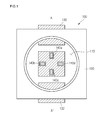
- FIG. 1 is a plane view of a light emitting device according to a first embodiment
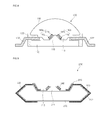
- FIG. 2 is a cross-sectional view of a light emitting device according to the first embodiment
- FIG. 3 is a detailed perspective view of a main part of a light emitting device according to the first embodiment
- FIGS. 4 through 7 are views illustrating mounting states of light emitting diodes of a light emitting device according to an embodiment
- FIG. 8 is a cross-sectional view of a light emitting device according to a second embodiment
- FIG. 9 is a cross-sectional view of a light emitting device according to a third embodiment.
- FIG. 10 is a cross-sectional view of a light emitting device according to a fourth embodiment.
- FIG. 11 is a cross-sectional view of a light emitting device according to a fifth embodiment.
- FIG. 12 is a cross-sectional view of a light emitting device according to a sixth embodiment.
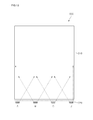
- FIG. 13 is a schematic view of a light unit according to a first embodiment
- FIG. 14 is a schematic view of a light unit according to a second embodiment
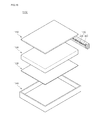
- FIG. 15 is a disassembled perspective view of a backlight unit including a light emitting device or a light emitting device package according to an embodiment.
- FIG. 16 is a perspective view of a light uniting using a light emitting device package according to an embodiment.
- FIG. 1 is a plane view of a light emitting device according to a first embodiment
- a light emitting device 100 includes a body 120 having a cavity 113, a first electrode 130 and a second electrode 132 disposed in the body 120, and a heat radiation member 110 having two or more inclination surfaces for mounting a plurality of light emitting diodes 140a, 140b, 140c, 140d in the cavity 113 and thermally connected to the light emitting diodes 140a, 140b, 140c, 140d.
- the cavity 113 in which the light emitting diodes 140a, 140b, 140c, 140d are mounted may be sealed by using a sealant (not shown).
- the cavity 113 in which the light emitting diodes 140a, 140b, 140c, 140d are mounted may be formed at an upper portion of the body 120.
- the body 120 may be formed of various materials such as ceramic, silicon, resin, etc.
- the body 120 may be formed in a single body structure using an injection molding, or in a multi-layered structure.
- the cavity 113 may be formed in a concave container shape, such as a cup shape, a polygonal shape, an elliptical shape, a circular shape, etc.
- a circumferential surface of the cavity 113 may be formed vertically or with a predetermined slope in consideration of distribution angles of the mounted light emitting diodes 140a, 140b, 140c, 140d.
- a surface of the cavity 113 may be coated or deposited with a high reflectivity material, for example, white photo solder resist (PSR) ink, silver (Ag), aluminum (Al) or the like, so that the luminous efficiency of the light emitting device 100 can be enhanced.
- PSR white photo solder resist
- One terminals of the first and second electrodes 130 and 132 may be electrically connected to the light emitting diodes 140a, 140b, 140c, 140d, respectively, and the other terminals may be electrically connected to a substrate (not shown) on which the light emitting device 100 is mounted, to supply power to the light emitting diodes 140a, 140b, 140c, 140d. Therefore, the first and second electrodes 130 and 132 may be formed such that one terminals are disposed inside the body 120 on which the light emitting diodes 140a, 140b, 140c, 140d are mounted, and the other terminals are exposed to an outer lower side of the body 120. While FIG.
- the electrodes 130 and 132 are two, it is to be understood that two or more electrodes may be formed according to the number of the light emitting diodes 140a, 140b, 140c, 140d to be driven or controlled.
- the first and second electrodes 130 and 132 are not limited to the shape shown in the drawings, but may be modified in various shapes, such as a shape enclosing the body 120 or in a shape the other terminals of which are branched.
- the light emitting diodes 140a, 140b, 140c, 140d may be provided in a structure in which light emitting chips 142a and 142c are formed on dies 144a and 144c, respectively.
- Each of the light emitting diodes 140a, 140b, 140c, 140d may be at least one of a red light emitting diode emitting red light, a green light emitting diode emitting green light, and a blue light emitting diode emitting blue light, and is not limited thereto.
- the light emitting diodes 140a, 140b, 140c, 140d are two or more, it is also possible to apply the light emitting diodes 140a, 140b, 140c, 140d each emitting a different color light.
- the heat shielding member 110 is formed of material such as metal, resin or the like having a good thermal conductivity, and is thermally connected to the light emitting diodes 140a, 140b, 140c, 140d. At an upper portion of the heat shielding member 110, a heat radiation mounting part 115 having inclination surfaces on which the plurality of light emitting diodes 140a, 140b, 140c, 140d are mounted may be formed.
- the heat radiation mounting part 115 may be formed in a polyhedral structure having mounting surfaces on which the light emitting diodes are mounted.
- FIG. 3 exemplarily shows that the heat radiation mounting part 115 is formed in a quadrangular pyramid shape providing four inclination surfaces A, B, C, D for mounting the four light emitting diodes 140a, 140b, 140c, 140d.
- the light emitting diodes 140a, 140b, 140c, 140d are mounted on the inclination surfaces A, B, C, D of the quadrangular pyramid-shaped heat radiation mounting part 115, respectively, the light emitting diodes 140a, 140b, 140c, 140d are fixed with a slope on the inclination surfaces A, B, C, D. Accordingly, orientation angles of the respective light emitting diodes 140a, 140b, 140c, 140d are inclined according to the slopes of the inclination surfaces A, B, C, D, and thus the orientation angle in a specific direction may be increased.
- the orientation angle of the light emitting device 100 including the plurality of light emitting diodes 140a, 140b, 140c, 140d may be expanded or be concentrated in specific direction.
- the light emitting diodes 140a, 140b, 140c, 140d may have an orientation angle of 110°-130°, typically.
- the heat radiation mounting part 115 since the heat radiation mounting part 115 has the polyhedral structure and thus can secure a wide heat radiation region, the heat radiation mounting part 115 can effectively radiate heat generated from the respective light emitting diodes 140a, 140b, 140c, 140d.
- the heat radiation mounting part 115 may be modified in various shapes according to the sizes and the number of light emitting diodes which are being mounted.
- FIGS. 4 through 7 are views illustrating mounting states of light emitting diodes of a light emitting device according to an embodiment, and show various shapes of the heat radiation mounting part 15.
- FIG. 4 is a perspective view of a heat radiation mounting part 115 on which five light emitting diodes 140a, 140b, 140c, 140d, 140e are mounted
- FIG. 5 is a cross-sectional view of FIG. 4 .
- the heat radiation mounting part 115 shown in FIGS. 4 and 5 is formed in a truncated pyramid shape having four inclination surfaces A, B, C, D at sides thereof and one top surface E parallel to a bottom surface. Therefore, the four light emitting diodes 140a, 140b, 140c, 140d are mounted with a slope on the four inclination surfaces A, B, C, D, and the one light emitting diode 140e is mounted on the top surface E parallel to the bottom surface.
- the orientation angle of the light emitting device may be expanded by the light emitting diodes 140a, 140b, 140c, 140d mounted on the four inclination surfaces A, B, C, D, and a front light intensity may be enhanced by the light emitting diode 140e mounted on the top surface E.
- the top surface E may be also formed with a slope with respect to the bottom surface.
- the orientation angle of the light emitting device may be inclined in a specific direction according to the inclined direction of the top surface E.
- the heat radiation mounting part 115 is a polyhedral structure having five mounting surfaces A, B, C, D, E, and inner spaces formed by the five mounting surfaces A, B, C, D, E may function as a heat radiation space capable of radiating heat generated from the five light emitting diodes 140a, 140b, 140c, 140d, 140e. Accordingly, a plurality of light emitting diodes can be mounted and at the same time the heat radiation efficiency can be guaranteed.
- FIG. 6 is a perspective view exemplarily showing a heat radiation mounting part 115 on which six light emitting diodes 140a, 140b, 140c, 140d, 140e, 140f are mounted.
- the heat radiation mounting part 115 shown in FIG. 6 is formed in a truncated pentagonal pyramid shape having five inclination surfaces A, B, C, D, E at sides thereof and one top surface F parallel to a bottom surface. Therefore, the five light emitting diodes 140a, 140b, 140c, 140d, 140e are mounted with a slope on the five inclination surfaces A, B, C, D, E and the one light emitting diode 140f is mounted on the top surface F parallel to the bottom surface.
- the light efficiency of the light emitting device can be enhanced, and by adjusting the slopes of the mounting surfaces of the respective light emitting diodes 140a, 140b, 140c, 140d, 140e, the orientation angle of the light emitting device can be adjusted.
- FIG. 7 exemplarily shows a heat radiation mounting part 115 on which four light emitting diodes 140a, 140b, 140c, 140d are mounted.
- the heat radiation mounting part 115 shown in FIG. 7 is formed in a truncated pyramid shape having four inclination surfaces A, B, C, D at sides thereof and one top surface E parallel to a bottom surface.
- the four light emitting diodes 140a, 140b, 140c, 140d are mounted on the four inclination surfaces A, B, C, D, and the top surface E may be left without mounting a light emitting diode.
- the orientation angle of the light emitting device may be expanded by the light emitting diodes 140a, 140b, 140c, 140d mounted on the four inclination surfaces A, B, C, D, and heat generated from the four light emitting diodes 140a, 140b, 140c, 140c can be more effectively radiated through the top surface E.
- the heat radiation efficiency of the heat radiation mounting part 115 can be further enhanced.
- FIG. 8 is a cross-sectional view of a light emitting device according to a second embodiment, and exemplarily shows that the current embodiment is applied to a lead frame package type light emitting devices.
- the same constitutions as those in the first embodiment will be referred from the previous description and thus the repeated description will be omitted.
- a light emitting device 100 includes a body 120 having a cavity 113, a first electrode 130 and a second electrode 132 disposed inside the body 120, a heat radiation member 110 having two or more inclination surfaces for mounting light emitting diodes 140a, 140b, 140c, 140d in the cavity 113 and thermally connected to the light emitting diodes 140a, 140b, 140c, 140d, and a lens part 160 formed at a light emitting region of the body 120 on which the light emitting diodes 140a, 140b, 140c, 140d are mounted, scattering or focusing light.
- the cavity 113 may be sealed by using a transparent sealant (not shown).
- a fluorescent material for converting light emitted from the light emitting diodes 140a, 140b, 140c, 140d to a light having a predetermined color may be added to the transparent sealant.
- the lens part 160 may be disposed on the light emitting diodes 140a, 140b, 140c, 140d to change the orientation angle of the light emitted from the light emitting diodes 140a, 140b, 140c, 140d.
- the lens part 160 may be disposed directly in contact with the light emitting diodes 140a, 140b, 140c, 140d or apart from the light emitting diodes 140a, 140b, 140c, 140d, and has a shape for scattering or focusing light.
- the lens part 160 may be formed in various shapes, such as a semispherical shape an upper surface of which is convex, or in a shape having a convex upper surface and a concave portion formed in the convex upper surface.
- the lens part 160 may be formed in a asymmetric semispherical shape in which only a region corresponding to the light emitting region is protruded or recessed.
- the lens part 160 may be formed of a material including a transparent resin material such as silicon or epoxy, and may include a fluorescent material at at least a portion thereof.
- lights emitted from the light emitting diodes 140a, 140b, 140c, 140d mounted on the mounting part 115, 117 may be scattered or focused by the lens part 160 and then emitted.
- FIG. 9 is a cross-sectional view of a light emitting device according to a third embodiment
- FIG. 10 is a cross-sectional view of a light emitting device according to a fourth embodiment.
- FIGS. 9 and 10 exemplarily show that the embodiments are applied to wafer level package type light emitting devices. The light emitting devices shown in FIGS. 9 and 10 will be described with reference to the heat radiation mounting part shown in FIG. 7 .
- the light emitting device 100 includes a body 210 having a cavity 213, an insulating layer 212 on a surface of the body 210, first electrode 130 and second electrode 132 on the body 210, a reflective layer 230 formed on at least some region of the insulating layer, reflecting light, and a heat radiation mounting part 215 providing inclination surfaces for mounting light emitting diodes 240.
- the cavity 213 in which the light emitting diodes 240 are mounted may be sealed by using a sealant (not shown).
- the cavity 213 in which the light emitting devices 240 are mounted may be formed at an upper portion of the body 210.
- the body 210 may be formed of various materials such as silicon (Si), aluminum (Al), aluminum nitride (AlN), aluminum oxide (A1O x ), photo sensitive glass (PSG), sapphire (Al 2 O 3 ), beryllium oxide (BeO), or the like.
- the cavity 213 may be formed in a concave container shape, such as a cup shape, a polygonal shape, an elliptical shape, a circular shape, etc.
- a circumferential surface of the cavity 213 may be formed vertically or with a predetermined slope in consideration of distribution angles of lights emitted from the mounted light emitting diodes 240.
- the cavity 213 may be formed with various methods according to the material of the body 210. For example, when the body 210 is formed of silicon (Si), the cavity 213 may be formed by performing a wet etching.
- the insulating layer 212 prevents the body 210 from being electrically shorted to the first and second electrodes 220, 222, the reflective layer 230, an external power, or the like.
- the insulating layer 212 may be formed of at least one of silicon oxide (SiO 2 Si x O y ), silicon nitride (Si 3 N 4 , Si x N y ), silicon oxynitride (SiO x N y ), and aluminum oxide (Al 2 O 3 ), preferably, silicon oxide (SiO 2 Si x O y ), but the invention is not limited thereto. Also, in the case where the body 210 is formed of insulator such as aluminum nitride (AlN), aluminum oxide (AlO x ), or the like, the insulating layer 212 may not be formed.
- the first electrode 220 and the second electrode 222 may be formed on the insulating layer 212 to supply power to the light emitting device 240.
- the first electrode 220 and the second electrode 222 may be formed separately as a positive electrode and a negative electrode, and may be formed in two or more electrodes.
- the reflective layer 230 may be formed at a position capable of efficiently reflecting lights emitted from the light emitting diodes 240, for example, inside the cavity 213 of the body 210, but the invention is not limited thereto.
- the reflective layer 230 may have a multi-layer structure, for example, a Ti/Ag structure including a titanium (Ti) layer and a silver (Ag) layer stacked sequentially.
- the light emitting diode 240 may be at least one of a red light emitting diode emitting red light, a green light emitting diode emitting green light, and a blue light emitting diode emitting blue light, but the invention is not limited thereto. In this embodiment, since the light emitting diodes 240 are two or more, it is also possible to apply the light emitting diodes 240 each emitting a different color light.
- a heat radiation mounting part 215 having a plurality of mounting surfaces for mounting the plurality of light emitting diodes 240 is formed in a polyhedral shape on the insulating layer 212.
- the heat radiation mounting parts 215 shown in FIGS. 9 and 10 employ the truncated pyramid shape shown in FIG. 7 . That is, fourth inclination surfaces for mounting four light emitting diodes 240 are formed in the heat radiation mounting parts 215, respectively, and a top surface parallel to a bottom surface thereof is left open without a light emitting diode.
- the plurality of light emitting diodes 240 are respectively fixed with a slope on the inclination surfaces of the heat radiation mounting part 215 having the truncated pyramid shape. Accordingly, an orientation angle of each of the light emitting diodes 240 is inclined according to the slope of the inclination surface, and thus the orientation angle in a specific direction may be increased. Accordingly, the orientation angle of the light emitting device 200 including the plurality of light emitting diodes 240 may be expanded or be concentrated in specific direction.
- FIG. 10 is a cross-sectional view of a light emitting device according to a fourth embodiment, and exemplarily shows that the embodiment is applied to a wafer level package type light emitting device.
- the same constitution as that in the third embodiment will be referred from the previous description and thus the repeated description will be omitted.
- the light emitting device 200 includes a heat radiation mounting part 215 having a polyhedral structure shape providing a plurality of mounting surfaces on which a plurality of light emitting diodes 240 are mounted in a cavity 213 of a body 210.
- a lens part 260 capable of scattering or focusing light may be formed at the light emitting region of the cavity 213 on which the light emitting diodes 240 are mounted.
- the cavity 213 may be sealed by using a sealant (not shown).
- a fluorescent material for converting light emitted from the light emitting diodes 240 to a light having a predetermined color may be added to the transparent sealant.
- the lens part 260 may be disposed on the light emitting diodes 240 to change the orientation angles of lights emitted from the light emitting diodes 240.
- the lens part 260 may be disposed directly in contact with the light emitting diodes 240 or apart from the light emitting diodes 240, and has a shape for scattering or focusing light.
- the lens part 260 may be formed in various shapes, such as a semispherical shape an upper surface of which is convex, or in a shape having a convex upper surface and a concave portion formed in the convex upper surface.
- the lens part 260 may be also formed in a asymmetric semispherical shape in which only a region corresponding to the light emitting region is protruded or recessed.
- the lens part 260 may be formed of a material including a transparent resin material such as silicon or epoxy, and may include a fluorescent material at at least a portion thereof.
- the irradiation angle of light emitted from each of the light emitting diodes 240 is inclined according to the inclination surface, and thus the orientation angle of the light emitting device 200 can be adjusted.
- the lights emitted from the light emitting diodes 240 mounted on the mounting part 215 may be scattered or focused by the lens part 260 and then emitted. Therefore, by modifying the shape of the lens part 260, it is possible to enhance the orientation angle and light emitting characteristics of the light emitting device 200.
- FIG. 11 is a cross-sectional view of a light emitting device 300 according to a fifth embodiment
- FIG. 12 is a cross-sectional view of a light emitting device 300 according to a sixth embodiment.
- FIGS. 11 and 12 exemplarily show that the current embodiments are applied chip on board (COB) type light emitting devices in which light emitting diodes 340 are mounted in a chip shape on a substrate 310.
- COB chip on board
- the light emitting device 300 includes the substrate 310, a heat radiation mounting part 315 providing inclination surfaces for mounting the plurality of light emitting diodes 340, and a resin part 360 sealing the light emitting diodes 340, and the light emitting diodes 340 may be electrically connected to the substrate 310 through a wire (not shown).
- the substrate 310 may use various substrates, such as a single-layer printed circuit board (PCB), a multi-layer PCB, an FPCB, a ceramic substrate, a metal substrate, etc.
- a lead frame or an electrode layer for supplying power may be patterned on the substrate 310, and a reflective layer may be formed.
- a cavity for mounting the light emitting diodes 340 may be formed.
- the heat radiation mounting part 315 may be formed in a polyhedral structure having mounting surfaces on which the light emitting diodes 340a, 340b are mounted.
- the light emitting device 300 of FIG. 10 according to the fifth embodiment exemplarily shows that the heat radiation mounting part 315 is formed in a quadrangular pyramid shape (see FIG. 3 ). Accordingly, four light emitting diodes may be mounted on inclination surfaces of the heat radiation mounting part 315.
- the heat radiation mounting part 315 may be formed by processing the substrate 310 to allow mounting regions of the substrate 310 to be protruded with inclination surfaces, or by attaching a protruded and inclined structure capable of mounting the light emitting diodes 340a, 340b on the substrate 310.
- the light emitting diodes 340a, 340b may be arranged in plurality on the substrate 310 in a row direction and/or a column direction.
- the light emitting diodes 340a, 340b are mounted on the heat radiation mounting part 315, and then are electrically connected to the substrate 310.
- the light emitting diodes 340a and 340b may be fixed with a slope according to slopes of the inclination surfaces provided by heat radiation mounting part 315. Therefore, according to the mounting angles of the light emitting diodes 340a, 340b, the orientation angle of the light emitting device 300 varies.
- the light emitting diodes 340a, 340b may be electrically connected to the substrate 310 by using a wire bonding, a flip chip bonding, a die bonding, or the like.
- the light emitting diodes 340a, 340b may be at least one of a red light emitting diode emitting red light, a green light emitting diode emitting green light, and a blue light emitting diode emitting blue light, or it is also possible to apply the light emitting diodes 340a, 340b each emitting a different color light.
- a resin part 360 may seal the light emitting diodes 340a, 340b mounted on the heat radiation mounting part 315.
- the resin part 360 may be formed in a semispherical shape or a convex lens shape using a transparent resin such as epoxy, and the material and shape of the resin part 360 may be modified according to the layout of the light emitting device 300. Also, a fluorescent material changing the light emitting characteristic of the light emitting device 300 may be added to at least a region of the resin part 360.
- a light emitting device according to a sixth embodiment shown in FIG. 12 is different in the shape of the heat radiation mounting part from the light emitting device according to the fourth embodiment. Therefore, the repeated description on the same constitutions as those in the fourth embodiment will be omitted.
- the heat radiation mounting part 315 of the light emitting device 300 according the sixth embodiment shown in FIG. 6 may be formed in a truncated trapezoidal pyramid shape (see FIG. 4 ). Accordingly, the heat radiation mounting part 315 has four inclination surfaces at sides thereof, and a top surface parallel to a bottom surface thereof. That is, a total of five mounting surfaces may be formed to thus mount five light emitting diodes on the five mounting surfaces.
- four light emitting diodes 340a, 340c may be mounted on the four inclination surfaces, and a light emitting diode 340b may be mounted on the top surface.
- the orientation angle of the light emitting device 300 may be expanded by the light emitting diodes 340a, 340c mounted on the four inclination surfaces, and a front light intensity may be enhanced by the light emitting diode 340b mounted on the top surface.
- the COB type light emitting devices includes the heat radiation mounting part 315 having a polyhedral structure providing a plurality of mounting surfaces such that a plurality of light emitting diodes are mounted. Accordingly, the COB type light emitting devices can adjust the orientation angle, can enhance the light efficiency and guarantee the heat radiation efficiency without a large change in the structure of the light emitting device.
- FIG. 13 is a schematic view of a light unit 500 according to a first embodiment, and exemplarily shows an edge type backlight unit.
- the light unit 500 includes a light guide panel 510 guiding light, and a light source 520 supplying the light guide panel 510 with light and including at least one or more light emitting devices having different orientation angles.
- the light guide panel 510 may reflect, refract and scatter lights emitted from the light emitting devices arranged at one side and convert the light to a plane light through a front surface thereof.
- the light guide panel 510 may be formed of a material, such as polycarbonate-series resin (PC), polymethylmethacrylate-series resin (PMMA), methacrylate-styrene copolymer (MS), or the like.
- the light source 520 includes a plurality of light emitting devices A, B, C, D, and is arranged at a side surface of the light guide panel 510 to provide light to the light guide panel 510.
- the respective light emitting devices A, B, C, D have orientation angles that are different from one another according to the arrangement position thereof.
- the light emitting devices may have different orientation angles by mounting two or more light emitting diodes constituting each of the light emitting devices with a slope with respect to a mounted surface thereof.
- the light emitting devices B and C positioned at a central portion of an edge of the light guide panel 510 may transfer light toward the light guide panel 510 without adjusting the orientation angles.
- the light emitting devices A and D positioned at both sides of the edge of the light guide panel 510 have the orientation angles set in a center direction of the light guide panel 510 so as to prevent the light from being leaked to an outside of the light guide panel 510.
- packages of the respective light emitting devices A, B, C, D are mounted on the same plane, but light emitting diodes in each of the light emitting devices emit lights having different orientation angles according to slopes of surfaces on which the light emitting diodes are mounted. Accordingly, the orientation angles of the respective light emitting devices A, B, C, D can be adjusted without changing a design factor of the light emitting devices A, B, C, D.
- the light emitting devices A and D supply more light toward the center portion of the light guide panel 510, the light emitting device B adjacent to the light emitting device A may be arranged with a relatively wide spacing distance.
- the light emitting device C adjacent to the light emitting device D may be also arranged with a relatively wide spacing distance. Therefore, it is possible to decrease the number of light emitting devices equipped in the light unit 500.
- FIG. 14 is a schematic view of a light unit 550 according to a second embodiment and exemplarily shows a direct type backlight unit.
- the light unit 550 includes a light diffusion plate 515 diffusing light, and a light source 525 supplying the light diffusion plate 515 with light and including at least one or more light emitting devices having different orientation angles.
- the light diffusion plate 515 may supply light generated from the light source 525 to a display panel (not shown) disposed above the light diffusion plate 515.
- the diffusion plate 515 may be used to guarantee uniform luminance and chromaticity.
- the light diffusion plate 515 is disposed apart by a predetermined spacing from the light source 525, and may selectively include optical sheets, such as a diffusion sheet, a prism sheet, a brightness enhancement film, a protection sheet, etc.
- the light source 525 includes a plurality of light emitting devices A, B, C, D, and is arranged at a side surface of the light diffusion plate 515 to provide light to the light diffusion plate 515.
- the respective light emitting devices A, B, C, D have orientation angles that are different from one another according to the arrangement position thereof.
- the light emitting devices B and C arranged at a central region of the light diffusion plate 515 can enhance light efficiency of the light unit 550 by adjusting the orientation angles at wider angles.
- the light emitting devices A and D arranged at an edge of the light diffusion plate 515 have the orientation angles set in a center direction of the light diffusion plate 515 so as to prevent the light from being leaked to an outside of the light diffusion plate 515.
- packages of the respective light emitting devices A, B, C, D are mounted on the same plane, but light emitting diodes in each of the light emitting devices emit lights having different orientation angles according to slopes of surfaces on which the light emitting diodes are mounted. Accordingly, the orientation angles of the respective light emitting devices A, B, C, D can be adjusted without changing a design factor of the light emitting devices A, B, C, D.
- the light emitting device B adjacent to the light emitting device A may be arranged with a relatively wide spacing distance
- the light emitting device C adjacent to the light emitting device D may be also arranged with a relatively wide spacing distance. Therefore, it is possible to decrease the number of light emitting devices equipped in the light unit 500.
- the light emitting devices having orientation angles different according to the position of the light emitting devices are arranged, thereby capable of preventing light from being leaked to an outside of the light guide panel 510 or an outside of the light diffusion plate 515, and thus enhancing the light efficiency.
- FIG. 15 is a disassembled perspective view of a backlight unit using a light emitting device package according to an embodiment.
- the backlight unit 1100 shown in FIG. 16 is an example of lighting systems, and the invention is not limited thereto.
- the backlight unit 1100 may include a bottom frame 1140, a light guide member 1120 disposed in the bottom frame 1140, and a light emitting module 1110 disposed at at least one side surface of the light guide member 1120 or below the light guide member 1120. Also, a reflective sheet 1130 may be disposed below the light guide member 1120.
- the bottom frame 1140 may be formed in a box shape a top surface of which is opened such that the light guide member 1120, the light emitting module 1110 and the reflective sheet 1130 can be received.
- the bottom frame 1140 may be formed of a metal or resin material, but the invention is not limited thereto.
- the light emitting module 1110 may include a substrate and a plurality of light emitting device packages mounted on the substrate according to the embodiments.
- the plurality of light emitting device packages may provide light to the light guide member 1120.
- the light emitting module 1110 may be disposed at at least one of inner side surfaces of the bottom frame 1140, and thus may provide light to at least one of the side surfaces of the light guide member 1120.
- the light emitting module 1110 may be disposed below the bottom frame 1140 to provide light toward a bottom surface of the light guide member 1120.
- the invention is not limited thereto.
- the light guide member 1120 may be disposed inside the bottom frame 1140.
- the light guide member 1120 may convert the light provided from the light emitting module to a plane light source and guide the converted plane light source to a display panel (not shown).
- the light guide member 1120 may be, for example, a light guide panel (LGP).
- LGP may be formed of, for example, one of acryl-series resin such as polymethyl metaacrylate (PMMA), polyethylene terephthlate (PET), poly carbonate (PC), COC, or polyethylene naphthalate resin.
- PMMA polymethyl metaacrylate
- PET polyethylene terephthlate
- PC poly carbonate
- COC polyethylene naphthalate resin
- An optical sheet 1150 may be disposed above the light guide member 1120.
- the optical sheet 1150 may include, for example, at least one of a diffusion sheet, a prism sheet, a brightness enhancement sheet and a fluorescent sheet.
- the optical sheet 1150 may be configured by the diffusion sheet, the prism sheet, the brightness enhancement sheet and the fluorescent sheet stacked.
- the diffusion sheet 1150 diffuses the light emitted from the light emitting module 1110 uniformly, and the diffused light may be focused on the display panel (not shown) by the prism sheet.
- the light emitted from the prism sheet is a randomly polarized light
- the brightness enhancement sheet may increase the polarization of the light emitted from the prism sheet.
- the prism sheet may be, for example, a vertical and/or horizontal sheet.
- the brightness enhancement sheet may be, for example, a brightness enhancement film.
- the fluorescent sheet may be a transparent plate or film including a fluorescent material.
- the reflective sheet 1130 may be disposed below the light guide member 1120.
- the reflective sheet 1130 may reflect light emitted from the bottom surface of the light guide member 1120 toward a light emitting surface of the light guide member 1120.
- the reflective sheet 1130 may be formed of, for example, resin material having good reflectivity, for example, PET, PC, PVC resins, or the like, but the invention is not limited thereto.
- FIG. 16 is a perspective view of a light unit using a light emitting device package according to an embodiment.
- the lighting unit 1200 of FIG. 16 is an example of lighting systems and the invention is not limited thereto.
- the lighting unit 1200 may include a case body 1210, a light emitting module 1230 installed in the case body 1210, and a connection terminal installed in the case body 1210, receiving power from an external power source.
- the case body 1210 may be preferably formed of a material having good heat shielding characteristic, for example, a metal material or a resin material.
- the light emitting module 1230 may include a substrate 300, and a light emitting device package mounted on the substrate 300 according to at least one of the embodiments.
- the substrate 300 may be an insulator substrate on which a circuit pattern is printed, and may include, for example, a general printed circuit board (PCB), a metal core PCB, a flexible PCB, a ceramic PCB, etc.
- PCB general printed circuit board
- metal core PCB metal core PCB
- flexible PCB flexible PCB
- ceramic PCB ceramic PCB
- the substrate 300 may be formed of a material to efficiently reflect light, and a surface thereof may be formed in a color capable of efficiently reflecting light, for example, white color, silver color.
- the light emitting device packages according to at least one of the embodiments may be mounted on the substrate 300.
- Each of the light emitting device packages 200 may include at least one light emitting diode (LED).
- the light emitting diode may include a color LED emitting red, green, blue or white light, and a UV LED emitting ultraviolet (UV).
- the light emitting module 1230 may have a combination of several LEDs so as to obtain desired color and luminance.
- the light emitting module 130 may have a combination of a white LED, a red LED, and a green LED so as to obtain a high color rendering index (CRI).
- a fluorescent sheet may be further disposed on a path of light emitted from the light emitting module 1230.
- the fluorescent sheet converts the wavelength of the light emitted from the light emitting module.
- the fluorescent sheet may include a yellow fluorescent material, so that the light, which is emitted from the light emitting module 1230 and passes through the fluorescent sheet, finally appears as white light.
- connection terminal 1220 may be electrically connected to the light emitting module 1230 to supply power to the light emitting module 1230. As shown in FIG. 16 , the connection terminal 1220 may be screwed and coupled to an external power, but the invention is not limited thereto. For example, the connection terminal 1220 may be made in a pin type and inserted into an external power, or may be connected to the external power through a power line.
- the lighting system may include at least one of a light guide member, a diffusion sheet, a prism sheet, a brightness enhancement sheet and a fluorescent sheet on a traveling path of light to obtain a desired optical effect.
- any reference in this specification to "one embodiment,” “an embodiment,” “example embodiment,” etc. means that a particular feature, structure, or characteristic described in connection with the embodiment is included in at least one embodiment of the invention.
- the appearances of such phrases in various places in the specification are not necessarily all referring to the same embodiment.
Landscapes
- Non-Portable Lighting Devices Or Systems Thereof (AREA)
- Led Device Packages (AREA)
- Planar Illumination Modules (AREA)
- Fastening Of Light Sources Or Lamp Holders (AREA)
Abstract
Description
- The present application claims priority to Korean Patent Application No.
10-2009-0128530 filed on December 21, 2009 - A light emitting diode (LED) a semiconductor light emitting device converting current to light. In recent years, an LED can be implemented as a light emitting device emitting white light having superior efficiency by using fluorescent material or by combining individual LEDs that emit three primary colors.
- Also, since the luminance of the light emitting device using an LED increases gradually, the light emitting device is being used as a light source in various fields, such as a backlight for displays, a lighting display, an image display, etc.
- Embodiments provide a light emitting device that allow an orientation angle to be adjusted inside a package, has superior light efficiency, and can guarantee heat radiation performance.
- Embodiments also provide a light unit that has superior light efficiency and can decrease the number of light emitting devices.
In one embodiment, a light emitting device comprises: a body including a horizontal surface; an insulating layer over at least a portion of the horizontal surface; an electrode over at least a portion of the insulating layer; a heat radiation member formed within the body and protruding from the horizontal surface, the heat radiation member comprising two or more surfaces that are inclined with respect to the horizontal surface; and two or more light emitting diodes, wherein each of the two or more light emitting diodes is mounted on a respective one of the two or more inclined surfaces, and wherein each of the two or more light emitting diodes is electrically connected to the electrode.
The details of one or more embodiments are set forth in the accompanying drawings and the description below. Other features will be apparent from the description and drawings, and from the claims. -
FIG. 1 is a plane view of a light emitting device according to a first embodiment; -
FIG. 2 is a cross-sectional view of a light emitting device according to the first embodiment; -
FIG. 3 is a detailed perspective view of a main part of a light emitting device according to the first embodiment; -
FIGS. 4 through 7 are views illustrating mounting states of light emitting diodes of a light emitting device according to an embodiment; -
FIG. 8 is a cross-sectional view of a light emitting device according to a second embodiment; -
FIG. 9 is a cross-sectional view of a light emitting device according to a third embodiment; -
FIG. 10 is a cross-sectional view of a light emitting device according to a fourth embodiment; -
FIG. 11 is a cross-sectional view of a light emitting device according to a fifth embodiment; -
FIG. 12 is a cross-sectional view of a light emitting device according to a sixth embodiment; -
FIG. 13 is a schematic view of a light unit according to a first embodiment; -
FIG. 14 is a schematic view of a light unit according to a second embodiment; -
FIG. 15 is a disassembled perspective view of a backlight unit including a light emitting device or a light emitting device package according to an embodiment; and -
FIG. 16 is a perspective view of a light uniting using a light emitting device package according to an embodiment. - Reference will now be made in detail to the embodiments of the present disclosure, examples of which are shown in the accompanying drawings. In the following description, it will be understood that when a layer (or film) is referred to as being "on" another layer or substrate, it can be directly on the other layer or substrate, or intervening layers may also be present. Further, it will be understood that when a layer is referred to as being "under" another layer, it can be directly under the other layer, and one or more intervening layers may also be present. In addition, it will also be understood that when a layer is referred to as being "between" two layers, it can be the only layer between the two layers, or one or more intervening layers may also be present. In the figures, the dimensions of layers and regions are exaggerated for clarity of illustration. In addition, the dimension of each part does not reflect an actual size.
-
FIG. 1 is a plane view of a light emitting device according to a first embodiment, -
FIG. 2 is a cross-sectional view of a light emitting device according to the first embodiment, and -
FIG. 3 is a detailed perspective view of a main part of a light emitting device according to the first embodiment and exemplarily shows that the current embodiment is applied to a lead frame package type light emitting device. - A
light emitting device 100 according to the first embodiment includes abody 120 having acavity 113, afirst electrode 130 and asecond electrode 132 disposed in thebody 120, and aheat radiation member 110 having two or more inclination surfaces for mounting a plurality oflight emitting diodes cavity 113 and thermally connected to thelight emitting diodes cavity 113 in which thelight emitting diodes - The
cavity 113 in which thelight emitting diodes body 120. Thebody 120 may be formed of various materials such as ceramic, silicon, resin, etc. Thebody 120 may be formed in a single body structure using an injection molding, or in a multi-layered structure. - The
cavity 113 may be formed in a concave container shape, such as a cup shape, a polygonal shape, an elliptical shape, a circular shape, etc. Herein, a circumferential surface of thecavity 113 may be formed vertically or with a predetermined slope in consideration of distribution angles of the mountedlight emitting diodes cavity 113 may be coated or deposited with a high reflectivity material, for example, white photo solder resist (PSR) ink, silver (Ag), aluminum (Al) or the like, so that the luminous efficiency of thelight emitting device 100 can be enhanced. - One terminals of the first and
second electrodes light emitting diodes light emitting device 100 is mounted, to supply power to thelight emitting diodes second electrodes body 120 on which thelight emitting diodes body 120. WhileFIG. 2 shows that theelectrodes light emitting diodes second electrodes body 120 or in a shape the other terminals of which are branched. Thelight emitting diodes light emitting chips dies 144a and 144c, respectively. Each of thelight emitting diodes light emitting diodes light emitting diodes - The
heat shielding member 110 is formed of material such as metal, resin or the like having a good thermal conductivity, and is thermally connected to thelight emitting diodes heat shielding member 110, a heatradiation mounting part 115 having inclination surfaces on which the plurality oflight emitting diodes - As shown in
FIG. 3 , the heatradiation mounting part 115 may be formed in a polyhedral structure having mounting surfaces on which the light emitting diodes are mounted.FIG. 3 exemplarily shows that the heatradiation mounting part 115 is formed in a quadrangular pyramid shape providing four inclination surfaces A, B, C, D for mounting the fourlight emitting diodes - When the
light emitting diodes radiation mounting part 115, respectively, thelight emitting diodes light emitting diodes light emitting device 100 including the plurality oflight emitting diodes light emitting diodes - Also, since the heat
radiation mounting part 115 has the polyhedral structure and thus can secure a wide heat radiation region, the heatradiation mounting part 115 can effectively radiate heat generated from the respectivelight emitting diodes radiation mounting part 115 may be modified in various shapes according to the sizes and the number of light emitting diodes which are being mounted. -
FIGS. 4 through 7 are views illustrating mounting states of light emitting diodes of a light emitting device according to an embodiment, and show various shapes of the heat radiation mounting part 15. -
FIG. 4 is a perspective view of a heatradiation mounting part 115 on which fivelight emitting diodes FIG. 5 is a cross-sectional view ofFIG. 4 . - The heat
radiation mounting part 115 shown inFIGS. 4 and 5 is formed in a truncated pyramid shape having four inclination surfaces A, B, C, D at sides thereof and one top surface E parallel to a bottom surface. Therefore, the fourlight emitting diodes light emitting diode 140e is mounted on the top surface E parallel to the bottom surface. - According to the above constitution, the orientation angle of the light emitting device may be expanded by the
light emitting diodes light emitting diode 140e mounted on the top surface E. - Herein, the top surface E may be also formed with a slope with respect to the bottom surface. When the top surface E is formed with a slope, the orientation angle of the light emitting device may be inclined in a specific direction according to the inclined direction of the top surface E.
- The heat
radiation mounting part 115 is a polyhedral structure having five mounting surfaces A, B, C, D, E, and inner spaces formed by the five mounting surfaces A, B, C, D, E may function as a heat radiation space capable of radiating heat generated from the fivelight emitting diodes -
FIG. 6 is a perspective view exemplarily showing a heatradiation mounting part 115 on which sixlight emitting diodes - The heat
radiation mounting part 115 shown inFIG. 6 is formed in a truncated pentagonal pyramid shape having five inclination surfaces A, B, C, D, E at sides thereof and one top surface F parallel to a bottom surface. Therefore, the fivelight emitting diodes light emitting diode 140f is mounted on the top surface F parallel to the bottom surface. - Thus, by integrating the plurality of
light emitting diodes light emitting diodes -
FIG. 7 exemplarily shows a heatradiation mounting part 115 on which fourlight emitting diodes - The heat
radiation mounting part 115 shown inFIG. 7 is formed in a truncated pyramid shape having four inclination surfaces A, B, C, D at sides thereof and one top surface E parallel to a bottom surface. Herein, the fourlight emitting diodes - According to the above constitution, the orientation angle of the light emitting device may be expanded by the
light emitting diodes light emitting diodes - Thus, in the case where some of the mounting surfaces of the heat radiation mounting part is left open without mounting a light emitting diode, the heat radiation efficiency of the heat
radiation mounting part 115 can be further enhanced. -
FIG. 8 is a cross-sectional view of a light emitting device according to a second embodiment, and exemplarily shows that the current embodiment is applied to a lead frame package type light emitting devices. In describing the second embodiment, the same constitutions as those in the first embodiment will be referred from the previous description and thus the repeated description will be omitted. - A
light emitting device 100 according to the second embodiment includes abody 120 having acavity 113, afirst electrode 130 and asecond electrode 132 disposed inside thebody 120, aheat radiation member 110 having two or more inclination surfaces for mountinglight emitting diodes cavity 113 and thermally connected to thelight emitting diodes lens part 160 formed at a light emitting region of thebody 120 on which thelight emitting diodes - The
cavity 113 may be sealed by using a transparent sealant (not shown). A fluorescent material for converting light emitted from thelight emitting diodes - The
lens part 160 may be disposed on thelight emitting diodes light emitting diodes lens part 160 may be disposed directly in contact with thelight emitting diodes light emitting diodes lens part 160 may be formed in various shapes, such as a semispherical shape an upper surface of which is convex, or in a shape having a convex upper surface and a concave portion formed in the convex upper surface. Also, according to the directions and slopes of the inclination surfaces on which thelight emitting diodes lens part 160 may be formed in a asymmetric semispherical shape in which only a region corresponding to the light emitting region is protruded or recessed. Thelens part 160 may be formed of a material including a transparent resin material such as silicon or epoxy, and may include a fluorescent material at at least a portion thereof. - Therefore, lights emitted from the
light emitting diodes part 115, 117 may be scattered or focused by thelens part 160 and then emitted. -
FIG. 9 is a cross-sectional view of a light emitting device according to a third embodiment, andFIG. 10 is a cross-sectional view of a light emitting device according to a fourth embodiment.FIGS. 9 and10 exemplarily show that the embodiments are applied to wafer level package type light emitting devices. The light emitting devices shown inFIGS. 9 and10 will be described with reference to the heat radiation mounting part shown inFIG. 7 . - As shown in
FIG. 9 , thelight emitting device 100 according to the third embodiment includes abody 210 having acavity 213, an insulatinglayer 212 on a surface of thebody 210,first electrode 130 andsecond electrode 132 on thebody 210, areflective layer 230 formed on at least some region of the insulating layer, reflecting light, and a heatradiation mounting part 215 providing inclination surfaces for mountinglight emitting diodes 240. Thecavity 213 in which thelight emitting diodes 240 are mounted may be sealed by using a sealant (not shown). - The
cavity 213 in which thelight emitting devices 240 are mounted may be formed at an upper portion of thebody 210. Thebody 210 may be formed of various materials such as silicon (Si), aluminum (Al), aluminum nitride (AlN), aluminum oxide (A1Ox), photo sensitive glass (PSG), sapphire (Al2O3), beryllium oxide (BeO), or the like. - The
cavity 213 may be formed in a concave container shape, such as a cup shape, a polygonal shape, an elliptical shape, a circular shape, etc. Herein, a circumferential surface of thecavity 213 may be formed vertically or with a predetermined slope in consideration of distribution angles of lights emitted from the mountedlight emitting diodes 240. Thecavity 213 may be formed with various methods according to the material of thebody 210. For example, when thebody 210 is formed of silicon (Si), thecavity 213 may be formed by performing a wet etching. - The insulating
layer 212 prevents thebody 210 from being electrically shorted to the first andsecond electrodes reflective layer 230, an external power, or the like. The insulatinglayer 212 may be formed of at least one of silicon oxide (SiO2 SixOy), silicon nitride (Si3N4, SixNy), silicon oxynitride (SiOxNy), and aluminum oxide (Al2O3), preferably, silicon oxide (SiO2 SixOy), but the invention is not limited thereto. Also, in the case where thebody 210 is formed of insulator such as aluminum nitride (AlN), aluminum oxide (AlOx), or the like, the insulatinglayer 212 may not be formed. - The
first electrode 220 and thesecond electrode 222 may be formed on the insulatinglayer 212 to supply power to thelight emitting device 240. Thefirst electrode 220 and thesecond electrode 222 may be formed separately as a positive electrode and a negative electrode, and may be formed in two or more electrodes. - The
reflective layer 230 may be formed at a position capable of efficiently reflecting lights emitted from thelight emitting diodes 240, for example, inside thecavity 213 of thebody 210, but the invention is not limited thereto. Thereflective layer 230 may have a multi-layer structure, for example, a Ti/Ag structure including a titanium (Ti) layer and a silver (Ag) layer stacked sequentially. - The
light emitting diode 240 may be at least one of a red light emitting diode emitting red light, a green light emitting diode emitting green light, and a blue light emitting diode emitting blue light, but the invention is not limited thereto. In this embodiment, since thelight emitting diodes 240 are two or more, it is also possible to apply thelight emitting diodes 240 each emitting a different color light. - A heat
radiation mounting part 215 having a plurality of mounting surfaces for mounting the plurality oflight emitting diodes 240 is formed in a polyhedral shape on the insulatinglayer 212. - The heat
radiation mounting parts 215 shown inFIGS. 9 and10 employ the truncated pyramid shape shown inFIG. 7 . That is, fourth inclination surfaces for mounting fourlight emitting diodes 240 are formed in the heatradiation mounting parts 215, respectively, and a top surface parallel to a bottom surface thereof is left open without a light emitting diode. - The plurality of
light emitting diodes 240 are respectively fixed with a slope on the inclination surfaces of the heatradiation mounting part 215 having the truncated pyramid shape. Accordingly, an orientation angle of each of thelight emitting diodes 240 is inclined according to the slope of the inclination surface, and thus the orientation angle in a specific direction may be increased. Accordingly, the orientation angle of thelight emitting device 200 including the plurality oflight emitting diodes 240 may be expanded or be concentrated in specific direction. -
FIG. 10 is a cross-sectional view of a light emitting device according to a fourth embodiment, and exemplarily shows that the embodiment is applied to a wafer level package type light emitting device. In describing the fourth embodiment, the same constitution as that in the third embodiment will be referred from the previous description and thus the repeated description will be omitted. - The
light emitting device 200 according to the fourth embodiment includes a heatradiation mounting part 215 having a polyhedral structure shape providing a plurality of mounting surfaces on which a plurality oflight emitting diodes 240 are mounted in acavity 213 of abody 210. - A
lens part 260 capable of scattering or focusing light may be formed at the light emitting region of thecavity 213 on which thelight emitting diodes 240 are mounted. - The
cavity 213 may be sealed by using a sealant (not shown). A fluorescent material for converting light emitted from thelight emitting diodes 240 to a light having a predetermined color may be added to the transparent sealant. - The
lens part 260 may be disposed on thelight emitting diodes 240 to change the orientation angles of lights emitted from thelight emitting diodes 240. Thelens part 260 may be disposed directly in contact with thelight emitting diodes 240 or apart from thelight emitting diodes 240, and has a shape for scattering or focusing light. For example, thelens part 260 may be formed in various shapes, such as a semispherical shape an upper surface of which is convex, or in a shape having a convex upper surface and a concave portion formed in the convex upper surface. Also, according to the directions and slopes of the inclination surfaces on which thelight emitting diodes 240 are mounted, thelens part 260 may be also formed in a asymmetric semispherical shape in which only a region corresponding to the light emitting region is protruded or recessed. Thelens part 260 may be formed of a material including a transparent resin material such as silicon or epoxy, and may include a fluorescent material at at least a portion thereof. - By mounting the
light emitting diodes 240 on the heatradiation mounting part 215, the irradiation angle of light emitted from each of thelight emitting diodes 240 is inclined according to the inclination surface, and thus the orientation angle of thelight emitting device 200 can be adjusted. - The lights emitted from the
light emitting diodes 240 mounted on the mountingpart 215 may be scattered or focused by thelens part 260 and then emitted. Therefore, by modifying the shape of thelens part 260, it is possible to enhance the orientation angle and light emitting characteristics of thelight emitting device 200. -
FIG. 11 is a cross-sectional view of alight emitting device 300 according to a fifth embodiment, andFIG. 12 is a cross-sectional view of alight emitting device 300 according to a sixth embodiment.FIGS. 11 and 12 exemplarily show that the current embodiments are applied chip on board (COB) type light emitting devices in which light emitting diodes 340 are mounted in a chip shape on asubstrate 310. - As shown in
FIG. 11 , thelight emitting device 300 includes thesubstrate 310, a heatradiation mounting part 315 providing inclination surfaces for mounting the plurality of light emitting diodes 340, and aresin part 360 sealing the light emitting diodes 340, and the light emitting diodes 340 may be electrically connected to thesubstrate 310 through a wire (not shown). - The
substrate 310 may use various substrates, such as a single-layer printed circuit board (PCB), a multi-layer PCB, an FPCB, a ceramic substrate, a metal substrate, etc. A lead frame or an electrode layer for supplying power may be patterned on thesubstrate 310, and a reflective layer may be formed. Also, a cavity for mounting the light emitting diodes 340 may be formed. - The heat
radiation mounting part 315 may be formed in a polyhedral structure having mounting surfaces on which thelight emitting diodes light emitting device 300 ofFIG. 10 according to the fifth embodiment exemplarily shows that the heatradiation mounting part 315 is formed in a quadrangular pyramid shape (seeFIG. 3 ). Accordingly, four light emitting diodes may be mounted on inclination surfaces of the heatradiation mounting part 315. The heatradiation mounting part 315 may be formed by processing thesubstrate 310 to allow mounting regions of thesubstrate 310 to be protruded with inclination surfaces, or by attaching a protruded and inclined structure capable of mounting thelight emitting diodes substrate 310. Thelight emitting diodes substrate 310 in a row direction and/or a column direction. - The
light emitting diodes radiation mounting part 315, and then are electrically connected to thesubstrate 310. Thelight emitting diodes radiation mounting part 315. Therefore, according to the mounting angles of thelight emitting diodes light emitting device 300 varies. Thelight emitting diodes substrate 310 by using a wire bonding, a flip chip bonding, a die bonding, or the like. Thelight emitting diodes light emitting diodes - A
resin part 360 may seal thelight emitting diodes radiation mounting part 315. Theresin part 360 may be formed in a semispherical shape or a convex lens shape using a transparent resin such as epoxy, and the material and shape of theresin part 360 may be modified according to the layout of thelight emitting device 300. Also, a fluorescent material changing the light emitting characteristic of thelight emitting device 300 may be added to at least a region of theresin part 360. - A light emitting device according to a sixth embodiment shown in
FIG. 12 is different in the shape of the heat radiation mounting part from the light emitting device according to the fourth embodiment. Therefore, the repeated description on the same constitutions as those in the fourth embodiment will be omitted. - The heat
radiation mounting part 315 of thelight emitting device 300 according the sixth embodiment shown inFIG. 6 may be formed in a truncated trapezoidal pyramid shape (seeFIG. 4 ). Accordingly, the heatradiation mounting part 315 has four inclination surfaces at sides thereof, and a top surface parallel to a bottom surface thereof. That is, a total of five mounting surfaces may be formed to thus mount five light emitting diodes on the five mounting surfaces. - According to the above constitution, four
light emitting diodes light emitting diode 340b may be mounted on the top surface. Thus, when thelight emitting diodes heat radiation part 315, the orientation angle of thelight emitting device 300 may be expanded by thelight emitting diodes light emitting diode 340b mounted on the top surface. - As described in the fifth and sixth embodiments, the COB type light emitting devices includes the heat
radiation mounting part 315 having a polyhedral structure providing a plurality of mounting surfaces such that a plurality of light emitting diodes are mounted. Accordingly, the COB type light emitting devices can adjust the orientation angle, can enhance the light efficiency and guarantee the heat radiation efficiency without a large change in the structure of the light emitting device. -
FIG. 13 is a schematic view of alight unit 500 according to a first embodiment, and exemplarily shows an edge type backlight unit. - As shown in
FIG. 13 , thelight unit 500 includes alight guide panel 510 guiding light, and alight source 520 supplying thelight guide panel 510 with light and including at least one or more light emitting devices having different orientation angles. - The
light guide panel 510 may reflect, refract and scatter lights emitted from the light emitting devices arranged at one side and convert the light to a plane light through a front surface thereof. Thelight guide panel 510 may be formed of a material, such as polycarbonate-series resin (PC), polymethylmethacrylate-series resin (PMMA), methacrylate-styrene copolymer (MS), or the like. - The
light source 520 includes a plurality of light emitting devices A, B, C, D, and is arranged at a side surface of thelight guide panel 510 to provide light to thelight guide panel 510. The respective light emitting devices A, B, C, D have orientation angles that are different from one another according to the arrangement position thereof. The light emitting devices may have different orientation angles by mounting two or more light emitting diodes constituting each of the light emitting devices with a slope with respect to a mounted surface thereof. - Among the light emitting devices A, B, C, D, the light emitting devices B and C positioned at a central portion of an edge of the
light guide panel 510 may transfer light toward thelight guide panel 510 without adjusting the orientation angles. - On the other hand, the light emitting devices A and D positioned at both sides of the edge of the
light guide panel 510 have the orientation angles set in a center direction of thelight guide panel 510 so as to prevent the light from being leaked to an outside of thelight guide panel 510. - Herein, packages of the respective light emitting devices A, B, C, D are mounted on the same plane, but light emitting diodes in each of the light emitting devices emit lights having different orientation angles according to slopes of surfaces on which the light emitting diodes are mounted. Accordingly, the orientation angles of the respective light emitting devices A, B, C, D can be adjusted without changing a design factor of the light emitting devices A, B, C, D.
- Also, since the light emitting devices A and D supply more light toward the center portion of the
light guide panel 510, the light emitting device B adjacent to the light emitting device A may be arranged with a relatively wide spacing distance. The light emitting device C adjacent to the light emitting device D may be also arranged with a relatively wide spacing distance. Therefore, it is possible to decrease the number of light emitting devices equipped in thelight unit 500. -
FIG. 14 is a schematic view of alight unit 550 according to a second embodiment and exemplarily shows a direct type backlight unit. - As shown in
FIG. 14 , thelight unit 550 includes alight diffusion plate 515 diffusing light, and alight source 525 supplying thelight diffusion plate 515 with light and including at least one or more light emitting devices having different orientation angles. - The
light diffusion plate 515 may supply light generated from thelight source 525 to a display panel (not shown) disposed above thelight diffusion plate 515. Thediffusion plate 515 may be used to guarantee uniform luminance and chromaticity. Thelight diffusion plate 515 is disposed apart by a predetermined spacing from thelight source 525, and may selectively include optical sheets, such as a diffusion sheet, a prism sheet, a brightness enhancement film, a protection sheet, etc. - The
light source 525 includes a plurality of light emitting devices A, B, C, D, and is arranged at a side surface of thelight diffusion plate 515 to provide light to thelight diffusion plate 515. The respective light emitting devices A, B, C, D have orientation angles that are different from one another according to the arrangement position thereof. - Among the light emitting devices A, B, C, D, the light emitting devices B and C arranged at a central region of the
light diffusion plate 515 can enhance light efficiency of thelight unit 550 by adjusting the orientation angles at wider angles. - The light emitting devices A and D arranged at an edge of the
light diffusion plate 515 have the orientation angles set in a center direction of thelight diffusion plate 515 so as to prevent the light from being leaked to an outside of thelight diffusion plate 515. - Herein, packages of the respective light emitting devices A, B, C, D are mounted on the same plane, but light emitting diodes in each of the light emitting devices emit lights having different orientation angles according to slopes of surfaces on which the light emitting diodes are mounted. Accordingly, the orientation angles of the respective light emitting devices A, B, C, D can be adjusted without changing a design factor of the light emitting devices A, B, C, D.
- Also, in the case where the orientation angles of the light emitting devices A and D are set to wide angles, the light emitting device B adjacent to the light emitting device A may be arranged with a relatively wide spacing distance, and the light emitting device C adjacent to the light emitting device D may be also arranged with a relatively wide spacing distance. Therefore, it is possible to decrease the number of light emitting devices equipped in the
light unit 500. - As described above, in the
light units light guide panel 510 or an outside of thelight diffusion plate 515, and thus enhancing the light efficiency. -
FIG. 15 is a disassembled perspective view of a backlight unit using a light emitting device package according to an embodiment. Thebacklight unit 1100 shown inFIG. 16 is an example of lighting systems, and the invention is not limited thereto. - Referring to
FIG. 15 , thebacklight unit 1100 may include abottom frame 1140, alight guide member 1120 disposed in thebottom frame 1140, and alight emitting module 1110 disposed at at least one side surface of thelight guide member 1120 or below thelight guide member 1120. Also, areflective sheet 1130 may be disposed below thelight guide member 1120. - The
bottom frame 1140 may be formed in a box shape a top surface of which is opened such that thelight guide member 1120, thelight emitting module 1110 and thereflective sheet 1130 can be received. Thebottom frame 1140 may be formed of a metal or resin material, but the invention is not limited thereto. - The
light emitting module 1110 may include a substrate and a plurality of light emitting device packages mounted on the substrate according to the embodiments. The plurality of light emitting device packages may provide light to thelight guide member 1120. - As shown in
FIG. 16 , thelight emitting module 1110 may be disposed at at least one of inner side surfaces of thebottom frame 1140, and thus may provide light to at least one of the side surfaces of thelight guide member 1120. - It is also to be understood that the
light emitting module 1110 may be disposed below thebottom frame 1140 to provide light toward a bottom surface of thelight guide member 1120. However, since such a constitution may be modified according to the design of thebacklight unit 1100, the invention is not limited thereto. - The
light guide member 1120 may be disposed inside thebottom frame 1140. Thelight guide member 1120 may convert the light provided from the light emitting module to a plane light source and guide the converted plane light source to a display panel (not shown). - The
light guide member 1120 may be, for example, a light guide panel (LGP). The LGP may be formed of, for example, one of acryl-series resin such as polymethyl metaacrylate (PMMA), polyethylene terephthlate (PET), poly carbonate (PC), COC, or polyethylene naphthalate resin. - An
optical sheet 1150 may be disposed above thelight guide member 1120. - The
optical sheet 1150 may include, for example, at least one of a diffusion sheet, a prism sheet, a brightness enhancement sheet and a fluorescent sheet. For example, theoptical sheet 1150 may be configured by the diffusion sheet, the prism sheet, the brightness enhancement sheet and the fluorescent sheet stacked. In this case, thediffusion sheet 1150 diffuses the light emitted from thelight emitting module 1110 uniformly, and the diffused light may be focused on the display panel (not shown) by the prism sheet. At this time, the light emitted from the prism sheet is a randomly polarized light, and the brightness enhancement sheet may increase the polarization of the light emitted from the prism sheet. The prism sheet may be, for example, a vertical and/or horizontal sheet. Also, the brightness enhancement sheet may be, for example, a brightness enhancement film. Also, the fluorescent sheet may be a transparent plate or film including a fluorescent material. - The
reflective sheet 1130 may be disposed below thelight guide member 1120. Thereflective sheet 1130 may reflect light emitted from the bottom surface of thelight guide member 1120 toward a light emitting surface of thelight guide member 1120. - The
reflective sheet 1130 may be formed of, for example, resin material having good reflectivity, for example, PET, PC, PVC resins, or the like, but the invention is not limited thereto. -
FIG. 16 is a perspective view of a light unit using a light emitting device package according to an embodiment. Thelighting unit 1200 ofFIG. 16 is an example of lighting systems and the invention is not limited thereto. - Referring to
FIG. 16 , thelighting unit 1200 may include acase body 1210, alight emitting module 1230 installed in thecase body 1210, and a connection terminal installed in thecase body 1210, receiving power from an external power source. - The
case body 1210 may be preferably formed of a material having good heat shielding characteristic, for example, a metal material or a resin material. - The
light emitting module 1230 may include asubstrate 300, and a light emitting device package mounted on thesubstrate 300 according to at least one of the embodiments. - The
substrate 300 may be an insulator substrate on which a circuit pattern is printed, and may include, for example, a general printed circuit board (PCB), a metal core PCB, a flexible PCB, a ceramic PCB, etc. - Also, the
substrate 300 may be formed of a material to efficiently reflect light, and a surface thereof may be formed in a color capable of efficiently reflecting light, for example, white color, silver color. - The light emitting device packages according to at least one of the embodiments may be mounted on the
substrate 300. Each of the light emitting device packages 200 may include at least one light emitting diode (LED). The light emitting diode may include a color LED emitting red, green, blue or white light, and a UV LED emitting ultraviolet (UV). - The
light emitting module 1230 may have a combination of several LEDs so as to obtain desired color and luminance. For example, thelight emitting module 130 may have a combination of a white LED, a red LED, and a green LED so as to obtain a high color rendering index (CRI). A fluorescent sheet may be further disposed on a path of light emitted from thelight emitting module 1230. The fluorescent sheet converts the wavelength of the light emitted from the light emitting module. For example, when the light emitted from thelight emitting module 1230 has a blue wavelength band, the fluorescent sheet may include a yellow fluorescent material, so that the light, which is emitted from thelight emitting module 1230 and passes through the fluorescent sheet, finally appears as white light. - The
connection terminal 1220 may be electrically connected to thelight emitting module 1230 to supply power to thelight emitting module 1230. As shown inFIG. 16 , theconnection terminal 1220 may be screwed and coupled to an external power, but the invention is not limited thereto. For example, theconnection terminal 1220 may be made in a pin type and inserted into an external power, or may be connected to the external power through a power line. - As described above, the lighting system may include at least one of a light guide member, a diffusion sheet, a prism sheet, a brightness enhancement sheet and a fluorescent sheet on a traveling path of light to obtain a desired optical effect.
- Any reference in this specification to "one embodiment," "an embodiment," "example embodiment," etc., means that a particular feature, structure, or characteristic described in connection with the embodiment is included in at least one embodiment of the invention. The appearances of such phrases in various places in the specification are not necessarily all referring to the same embodiment. Further, when a particular feature, structure, or characteristic is described in connection with any embodiment, it is submitted that it is within the purview of one skilled in the art to effect such feature, structure, or characteristic in connection with other ones of the embodiments.
- Although embodiments have been described with reference to a number of illustrative embodiments thereof, it should be understood that numerous other modifications and embodiments can be devised by those skilled in the art that will fall within the spirit and scope of the principles of this disclosure. More particularly, various variations and modifications are possible in the component parts and/or arrangements of the subject combination arrangement within the scope of the disclosure, the drawings and the appended claims. In addition to variations and modifications in the component parts and/or arrangements, alternative uses will also be apparent to those skilled in the art.
Claims (12)
- A light emitting device comprising:a body including a horizontal surface;an insulating layer over at least a portion of the horizontal surface;an electrode over at least a portion of the insulating layer;a heat radiation member formed within the body and protruding from the horizontal surface, the heat radiation member comprising two or more surfaces that are inclined with respect to the horizontal surface; andtwo or more light emitting diodes, wherein each of the two or more light emitting diodes is mounted on a respective one of the two or more inclined surfaces, and wherein each of the two or more light emitting diodes is electrically connected to the electrode.
- The light emitting device of claim 1, wherein the heat radiation member is thermally connected to each of the two or more light emitting diodes.
- The light emitting device of claim 2, wherein the body further comprises an opening through a rear portion thereof, opposite the horizontal surface, and wherein the heat radiation member is exposed through the opening.
- The light emitting device of claim 1, wherein the heat radiation member and the insulating layer are formed of silicon oxide.
- The light emitting device of claim 1, wherein the heat radiation member comprises at least three inclined surfaces, and wherein the portion of the heat radiation member that includes the at least three inclined surfaces has a pyramidal shape.
- The light emitting device of claim 5, wherein the portion of the heat radiation member that includes the at least three inclined surfaces has a truncated pyramidal shape that includes a horizontal surface which shares a common edge with each of the at least three inclined surfaces.
- The light emitting device of claim 1, wherein each of the inclined surfaces has a slope greater than 0° and less than or equal to 30° with respect to the horizontal surface.
- The light emitting device of claim 1, wherein each of the two or more light emitting diodes has an orientation angle that depends upon the slope of the respective inclined surface on which it is mounted.
- The light emitting device of claim 1 further comprising:a lens over the two or more light emitting diodes.
- A light unit comprising:a light guide panel; andone or more light emitting devices, wherein each of the one or more light emitting devices has a respective orientation angle such that each of the one or more light emitting devices transmits light into the light guide panel at a corresponding, predetermined direction, and wherein the light emitting device is one of the claims 1 to 9.
- The light unit of claim 10 further comprising:a plurality of light emitting devices, wherein at least one of the plurality of light emitting devices is positioned at a side edge of the light guide panel and at least one of the plurality of light emitting devices is positioned towards the center of the light guide panel, relative to the at least one light emitting device positioned at the side edge, wherein the orientation angle associated with the at least one light emitting device positioned towards the center of the light guide panel causes light produced by the corresponding at least one light emitting device to be dispersed into the light guide panel at a first angle, wherein the orientation angle associated with the at least one light emitting device positioned at the side edge of the light guide panel causes light produced by the corresponding at least one light emitting device to be dispersed into the light guide panel at a second angle, and wherein the first angle is different than the second angle.
- The light unit of claim 11, wherein the two or more inclined surfaces associated with the at least one light emitting device positioned at the side edge of the light guide panel are configured to direct light produced by the light emitting diodes mounted thereon away from the side edge of the light guide panel, thereby reducing the leakage of light from the light guide panel.
Applications Claiming Priority (1)
| Application Number | Priority Date | Filing Date | Title |
|---|---|---|---|
| KR1020090128530A KR101039881B1 (en) | 2009-12-21 | 2009-12-21 | Light emitting element and light unit using same |
Publications (3)
| Publication Number | Publication Date |
|---|---|
| EP2337099A2 true EP2337099A2 (en) | 2011-06-22 |
| EP2337099A3 EP2337099A3 (en) | 2014-06-11 |
| EP2337099B1 EP2337099B1 (en) | 2019-09-11 |
Family
ID=43828417
Family Applications (1)
| Application Number | Title | Priority Date | Filing Date |
|---|---|---|---|
| EP10195768.6A Not-in-force EP2337099B1 (en) | 2009-12-21 | 2010-12-17 | Light emitting device and lighting unit using the same |
Country Status (6)
| Country | Link |
|---|---|
| US (1) | US8465176B2 (en) |
| EP (1) | EP2337099B1 (en) |
| JP (1) | JP2011129916A (en) |
| KR (1) | KR101039881B1 (en) |
| CN (1) | CN102130109B (en) |
| TW (1) | TWI604163B (en) |
Cited By (2)
| Publication number | Priority date | Publication date | Assignee | Title |
|---|---|---|---|---|
| WO2014037739A1 (en) * | 2012-09-07 | 2014-03-13 | Litecool Limited | Led package |
| WO2015155437A1 (en) * | 2014-04-09 | 2015-10-15 | Commissariat A L'energie Atomique Et Aux Energies Alternatives | Optoelectronic device with light-emitting diodes and an improved radiation pattern |
Families Citing this family (18)
| Publication number | Priority date | Publication date | Assignee | Title |
|---|---|---|---|---|
| JP5421799B2 (en) * | 2010-01-18 | 2014-02-19 | パナソニック株式会社 | LED unit |
| KR101181173B1 (en) * | 2010-10-11 | 2012-09-18 | 엘지이노텍 주식회사 | The radiant heat circuit board, the manufacturing method thereof and the heat generating device package having the same |
| CN103078040B (en) * | 2011-08-22 | 2016-12-21 | Lg伊诺特有限公司 | Light emitting device package and light device |
| KR101888607B1 (en) * | 2011-12-30 | 2018-08-16 | 엘지이노텍 주식회사 | Light emitting device module and lighting system including the same |
| JP6069610B2 (en) * | 2012-01-12 | 2017-02-01 | シーシーエス株式会社 | Line light irradiation device |
| JP2014053506A (en) * | 2012-09-07 | 2014-03-20 | Toshiba Corp | Semiconductor light-emitting device and light-emitting module |
| CN103090319A (en) * | 2012-12-20 | 2013-05-08 | 康佳集团股份有限公司 | Lamp bar of liquid crystal display (LCD) television and directly-down type backlight module |
| CN103441211B (en) * | 2013-08-30 | 2016-04-13 | 华南理工大学 | A kind of LED encapsulation structure of asymmetrical rectangular light spot |
| KR102264061B1 (en) * | 2013-09-13 | 2021-06-14 | 루미리즈 홀딩 비.브이. | Frame based package for flip-chip led |
| US9343443B2 (en) * | 2014-02-05 | 2016-05-17 | Cooledge Lighting, Inc. | Light-emitting dies incorporating wavelength-conversion materials and related methods |
| JP6392637B2 (en) * | 2014-11-07 | 2018-09-19 | 住友電工プリントサーキット株式会社 | LED module and LED lighting apparatus |
| JP6489820B2 (en) * | 2014-12-18 | 2019-03-27 | スタンレー電気株式会社 | Optical device |
| US11262376B2 (en) * | 2016-06-02 | 2022-03-01 | Weifang Goertek Microelectronics Co., Ltd. | MEMS device and electronic apparatus |
| JP7085894B2 (en) * | 2018-05-17 | 2022-06-17 | スタンレー電気株式会社 | Light transmission plate with light emitting function and its manufacturing method |
| CN108598122B (en) * | 2018-04-28 | 2021-08-31 | 京东方科技集团股份有限公司 | Display substrate, manufacturing method thereof, and display device |
| WO2022246689A1 (en) * | 2021-05-26 | 2022-12-01 | 京东方科技集团股份有限公司 | Array substrate and display apparatus |
| US11385399B1 (en) * | 2022-03-25 | 2022-07-12 | Tactotek Oy | Integrated optically functional multilayer structure and related method of manufacture |
| CN117038820A (en) * | 2023-08-29 | 2023-11-10 | 北京创盈光电医疗科技有限公司 | A light-emitting chip, a large-angle LED light-emitting structure and a light-emitting device |
Family Cites Families (17)
| Publication number | Priority date | Publication date | Assignee | Title |
|---|---|---|---|---|
| US6452217B1 (en) * | 2000-06-30 | 2002-09-17 | General Electric Company | High power LED lamp structure using phase change cooling enhancements for LED lighting products |
| US6635987B1 (en) * | 2000-09-26 | 2003-10-21 | General Electric Company | High power white LED lamp structure using unique phosphor application for LED lighting products |
| ATE425556T1 (en) * | 2001-04-12 | 2009-03-15 | Matsushita Electric Works Ltd | LIGHT SOURCE COMPONENT WITH LED AND METHOD FOR PRODUCING IT |
| US7728345B2 (en) * | 2001-08-24 | 2010-06-01 | Cao Group, Inc. | Semiconductor light source for illuminating a physical space including a 3-dimensional lead frame |
| US7183587B2 (en) * | 2003-09-09 | 2007-02-27 | Cree, Inc. | Solid metal block mounting substrates for semiconductor light emitting devices |
| JP2006080391A (en) * | 2004-09-10 | 2006-03-23 | Koha Co Ltd | Light emitting device |
| WO2007015732A2 (en) * | 2005-08-01 | 2007-02-08 | Intex Recreation Corp. | A method of varying the color of light emitted by a light-emitting device |
| KR101308701B1 (en) * | 2006-02-21 | 2013-09-13 | 삼성디스플레이 주식회사 | Point light source, light emitting module and display device having the same |
| KR100799864B1 (en) * | 2006-04-21 | 2008-01-31 | 삼성전기주식회사 | LED Package |
| JP5007395B2 (en) * | 2006-06-23 | 2012-08-22 | シーシーエス株式会社 | Solid light source |
| JP2008108942A (en) | 2006-10-26 | 2008-05-08 | Iwasaki Electric Co Ltd | Light source device |
| KR100782797B1 (en) | 2007-01-02 | 2007-12-05 | 삼성전기주식회사 | Backlight unit |
| JP5106094B2 (en) * | 2007-02-22 | 2012-12-26 | シャープ株式会社 | Surface mount type light emitting diode and method for manufacturing the same |
| US8604506B2 (en) * | 2007-02-22 | 2013-12-10 | Sharp Kabushiki Kaisha | Surface mounting type light emitting diode and method for manufacturing the same |
| KR100896282B1 (en) * | 2007-11-01 | 2009-05-08 | 엘지전자 주식회사 | Light emitting device package and its manufacturing method |
| CN101459210A (en) * | 2007-12-14 | 2009-06-17 | 先进开发光电股份有限公司 | Packaging structure of photoelectric element and manufacturing method thereof |
| KR20090099785A (en) * | 2008-03-18 | 2009-09-23 | 엘지디스플레이 주식회사 | LED package, backlight unit and liquid crystal display device having same |
-
2009
- 2009-12-21 KR KR1020090128530A patent/KR101039881B1/en not_active Expired - Fee Related
-
2010
- 2010-09-15 US US12/882,839 patent/US8465176B2/en not_active Expired - Fee Related
- 2010-12-09 TW TW099143021A patent/TWI604163B/en not_active IP Right Cessation
- 2010-12-13 JP JP2010277133A patent/JP2011129916A/en active Pending
- 2010-12-17 EP EP10195768.6A patent/EP2337099B1/en not_active Not-in-force
- 2010-12-21 CN CN201010602428.5A patent/CN102130109B/en not_active Expired - Fee Related
Non-Patent Citations (1)
| Title |
|---|
| None |
Cited By (4)
| Publication number | Priority date | Publication date | Assignee | Title |
|---|---|---|---|---|
| WO2014037739A1 (en) * | 2012-09-07 | 2014-03-13 | Litecool Limited | Led package |
| WO2015155437A1 (en) * | 2014-04-09 | 2015-10-15 | Commissariat A L'energie Atomique Et Aux Energies Alternatives | Optoelectronic device with light-emitting diodes and an improved radiation pattern |
| FR3019938A1 (en) * | 2014-04-09 | 2015-10-16 | Commissariat Energie Atomique | OPTOELECTRONIC DEVICE WITH LIGHT EMITTING DIODES WITH IMPROVED EMISSION DIAGRAM |
| US10115864B2 (en) | 2014-04-09 | 2018-10-30 | Commissariat à l'Éneergie Atomique et aux Énergies Alternatives | Optoelectronic device with light-emitting diodes and an improved radiation pattern |
Also Published As
| Publication number | Publication date |
|---|---|
| EP2337099A3 (en) | 2014-06-11 |
| EP2337099B1 (en) | 2019-09-11 |
| CN102130109A (en) | 2011-07-20 |
| US8465176B2 (en) | 2013-06-18 |
| TWI604163B (en) | 2017-11-01 |
| TW201135147A (en) | 2011-10-16 |
| CN102130109B (en) | 2015-05-27 |
| US20110149600A1 (en) | 2011-06-23 |
| JP2011129916A (en) | 2011-06-30 |
| KR101039881B1 (en) | 2011-06-09 |
Similar Documents
| Publication | Publication Date | Title |
|---|---|---|
| EP2337099B1 (en) | Light emitting device and lighting unit using the same | |
| EP2337072B1 (en) | Light emitting device and light unit using the same | |
| JP5797393B2 (en) | Light emitting device package | |
| KR101039994B1 (en) | Light emitting device and light unit having same | |
| JP6058351B2 (en) | LIGHT SOURCE MODULE AND LIGHTING DEVICE HAVING THE SAME | |
| KR101655463B1 (en) | Light emitting device package and light unit having the same | |
| JP2017079209A (en) | Lighting device | |
| KR101997244B1 (en) | Light source module and lighting system having the same | |
| KR20110128693A (en) | Light emitting device package and light unit having same | |
| KR102719655B1 (en) | Optical lens, light uint and lighting apparatus having thereof | |
| KR101047633B1 (en) | Light emitting device and light unit having same | |
| KR102101367B1 (en) | Light emitting device | |
| KR102451866B1 (en) | Optical plate, lighting device, and lighting module | |
| KR101997240B1 (en) | Lighting device | |
| US12328977B2 (en) | Light emitting device pakage | |
| KR101936289B1 (en) | Light emitting device | |
| KR20190076935A (en) | A light emitting device package | |
| KR101924014B1 (en) | Light emitting device package and lighting system having the same | |
| KR101880058B1 (en) | Light emitting device package and lighting apparatus having the same | |
| KR101946834B1 (en) | Light emitting device packae and light unit having the same | |
| KR101637590B1 (en) | Light emitting device package and lighting system | |
| KR20130079869A (en) | Light emitting device package and lighting system including the same | |
| KR20120099549A (en) | Light emitting device package, fabrication method for light emitting device package and lighting system |
Legal Events
| Date | Code | Title | Description |
|---|---|---|---|
| PUAI | Public reference made under article 153(3) epc to a published international application that has entered the european phase |
Free format text: ORIGINAL CODE: 0009012 |
|
| 17P | Request for examination filed |
Effective date: 20101217 |
|
| AK | Designated contracting states |
Kind code of ref document: A2 Designated state(s): AL AT BE BG CH CY CZ DE DK EE ES FI FR GB GR HR HU IE IS IT LI LT LU LV MC MK MT NL NO PL PT RO RS SE SI SK SM TR |
|
| AX | Request for extension of the european patent |
Extension state: BA ME |
|
| PUAL | Search report despatched |
Free format text: ORIGINAL CODE: 0009013 |
|
| RIC1 | Information provided on ipc code assigned before grant |
Ipc: H01L 33/64 20100101AFI20140430BHEP Ipc: H01L 25/075 20060101ALI20140430BHEP |
|
| AK | Designated contracting states |
Kind code of ref document: A3 Designated state(s): AL AT BE BG CH CY CZ DE DK EE ES FI FR GB GR HR HU IE IS IT LI LT LU LV MC MK MT NL NO PL PT RO RS SE SI SK SM TR |
|
| AX | Request for extension of the european patent |
Extension state: BA ME |
|
| RAP1 | Party data changed (applicant data changed or rights of an application transferred) |
Owner name: LG INNOTEK CO., LTD. |
|
| RBV | Designated contracting states (corrected) |
Designated state(s): AL AT BE BG CH CY CZ DE DK EE ES FI FR GB GR HR HU IE IS IT LI LT LU LV MC MK MT NL NO PL PT RO RS SE SI SK SM TR |
|
| RAP1 | Party data changed (applicant data changed or rights of an application transferred) |
Owner name: LG INNOTEK CO., LTD. |
|
| STAA | Information on the status of an ep patent application or granted ep patent |
Free format text: STATUS: EXAMINATION IS IN PROGRESS |
|
| 17Q | First examination report despatched |
Effective date: 20181108 |
|
| GRAP | Despatch of communication of intention to grant a patent |
Free format text: ORIGINAL CODE: EPIDOSNIGR1 |
|
| STAA | Information on the status of an ep patent application or granted ep patent |
Free format text: STATUS: GRANT OF PATENT IS INTENDED |
|
| RIC1 | Information provided on ipc code assigned before grant |
Ipc: H01L 33/48 20100101ALI20190318BHEP Ipc: H01L 25/075 20060101ALI20190318BHEP Ipc: H01L 33/64 20100101AFI20190318BHEP |
|
| INTG | Intention to grant announced |
Effective date: 20190418 |
|
| GRAS | Grant fee paid |
Free format text: ORIGINAL CODE: EPIDOSNIGR3 |
|
| GRAA | (expected) grant |
Free format text: ORIGINAL CODE: 0009210 |
|
| STAA | Information on the status of an ep patent application or granted ep patent |
Free format text: STATUS: THE PATENT HAS BEEN GRANTED |
|
| AK | Designated contracting states |
Kind code of ref document: B1 Designated state(s): AL AT BE BG CH CY CZ DE DK EE ES FI FR GB GR HR HU IE IS IT LI LT LU LV MC MK MT NL NO PL PT RO RS SE SI SK SM TR |
|
| REG | Reference to a national code |
Ref country code: GB Ref legal event code: FG4D |
|
| REG | Reference to a national code |
Ref country code: CH Ref legal event code: EP |
|
| REG | Reference to a national code |
Ref country code: AT Ref legal event code: REF Ref document number: 1179610 Country of ref document: AT Kind code of ref document: T Effective date: 20190915 |
|
| REG | Reference to a national code |
Ref country code: DE Ref legal event code: R096 Ref document number: 602010060972 Country of ref document: DE |
|
| REG | Reference to a national code |
Ref country code: IE Ref legal event code: FG4D |
|
| REG | Reference to a national code |
Ref country code: NL Ref legal event code: MP Effective date: 20190911 |
|
| REG | Reference to a national code |
Ref country code: LT Ref legal event code: MG4D |
|
| PG25 | Lapsed in a contracting state [announced via postgrant information from national office to epo] |
Ref country code: HR Free format text: LAPSE BECAUSE OF FAILURE TO SUBMIT A TRANSLATION OF THE DESCRIPTION OR TO PAY THE FEE WITHIN THE PRESCRIBED TIME-LIMIT Effective date: 20190911 Ref country code: LT Free format text: LAPSE BECAUSE OF FAILURE TO SUBMIT A TRANSLATION OF THE DESCRIPTION OR TO PAY THE FEE WITHIN THE PRESCRIBED TIME-LIMIT Effective date: 20190911 Ref country code: NO Free format text: LAPSE BECAUSE OF FAILURE TO SUBMIT A TRANSLATION OF THE DESCRIPTION OR TO PAY THE FEE WITHIN THE PRESCRIBED TIME-LIMIT Effective date: 20191211 Ref country code: FI Free format text: LAPSE BECAUSE OF FAILURE TO SUBMIT A TRANSLATION OF THE DESCRIPTION OR TO PAY THE FEE WITHIN THE PRESCRIBED TIME-LIMIT Effective date: 20190911 Ref country code: SE Free format text: LAPSE BECAUSE OF FAILURE TO SUBMIT A TRANSLATION OF THE DESCRIPTION OR TO PAY THE FEE WITHIN THE PRESCRIBED TIME-LIMIT Effective date: 20190911 Ref country code: BG Free format text: LAPSE BECAUSE OF FAILURE TO SUBMIT A TRANSLATION OF THE DESCRIPTION OR TO PAY THE FEE WITHIN THE PRESCRIBED TIME-LIMIT Effective date: 20191211 |
|
| PG25 | Lapsed in a contracting state [announced via postgrant information from national office to epo] |
Ref country code: LV Free format text: LAPSE BECAUSE OF FAILURE TO SUBMIT A TRANSLATION OF THE DESCRIPTION OR TO PAY THE FEE WITHIN THE PRESCRIBED TIME-LIMIT Effective date: 20190911 Ref country code: RS Free format text: LAPSE BECAUSE OF FAILURE TO SUBMIT A TRANSLATION OF THE DESCRIPTION OR TO PAY THE FEE WITHIN THE PRESCRIBED TIME-LIMIT Effective date: 20190911 Ref country code: AL Free format text: LAPSE BECAUSE OF FAILURE TO SUBMIT A TRANSLATION OF THE DESCRIPTION OR TO PAY THE FEE WITHIN THE PRESCRIBED TIME-LIMIT Effective date: 20190911 Ref country code: ES Free format text: LAPSE BECAUSE OF FAILURE TO SUBMIT A TRANSLATION OF THE DESCRIPTION OR TO PAY THE FEE WITHIN THE PRESCRIBED TIME-LIMIT Effective date: 20190911 Ref country code: GR Free format text: LAPSE BECAUSE OF FAILURE TO SUBMIT A TRANSLATION OF THE DESCRIPTION OR TO PAY THE FEE WITHIN THE PRESCRIBED TIME-LIMIT Effective date: 20191212 |
|
| REG | Reference to a national code |
Ref country code: AT Ref legal event code: MK05 Ref document number: 1179610 Country of ref document: AT Kind code of ref document: T Effective date: 20190911 |
|
| PG25 | Lapsed in a contracting state [announced via postgrant information from national office to epo] |
Ref country code: AT Free format text: LAPSE BECAUSE OF FAILURE TO SUBMIT A TRANSLATION OF THE DESCRIPTION OR TO PAY THE FEE WITHIN THE PRESCRIBED TIME-LIMIT Effective date: 20190911 Ref country code: PT Free format text: LAPSE BECAUSE OF FAILURE TO SUBMIT A TRANSLATION OF THE DESCRIPTION OR TO PAY THE FEE WITHIN THE PRESCRIBED TIME-LIMIT Effective date: 20200113 Ref country code: PL Free format text: LAPSE BECAUSE OF FAILURE TO SUBMIT A TRANSLATION OF THE DESCRIPTION OR TO PAY THE FEE WITHIN THE PRESCRIBED TIME-LIMIT Effective date: 20190911 Ref country code: NL Free format text: LAPSE BECAUSE OF FAILURE TO SUBMIT A TRANSLATION OF THE DESCRIPTION OR TO PAY THE FEE WITHIN THE PRESCRIBED TIME-LIMIT Effective date: 20190911 Ref country code: RO Free format text: LAPSE BECAUSE OF FAILURE TO SUBMIT A TRANSLATION OF THE DESCRIPTION OR TO PAY THE FEE WITHIN THE PRESCRIBED TIME-LIMIT Effective date: 20190911 Ref country code: IT Free format text: LAPSE BECAUSE OF FAILURE TO SUBMIT A TRANSLATION OF THE DESCRIPTION OR TO PAY THE FEE WITHIN THE PRESCRIBED TIME-LIMIT Effective date: 20190911 Ref country code: EE Free format text: LAPSE BECAUSE OF FAILURE TO SUBMIT A TRANSLATION OF THE DESCRIPTION OR TO PAY THE FEE WITHIN THE PRESCRIBED TIME-LIMIT Effective date: 20190911 |
|
| PG25 | Lapsed in a contracting state [announced via postgrant information from national office to epo] |
Ref country code: SM Free format text: LAPSE BECAUSE OF FAILURE TO SUBMIT A TRANSLATION OF THE DESCRIPTION OR TO PAY THE FEE WITHIN THE PRESCRIBED TIME-LIMIT Effective date: 20190911 Ref country code: CZ Free format text: LAPSE BECAUSE OF FAILURE TO SUBMIT A TRANSLATION OF THE DESCRIPTION OR TO PAY THE FEE WITHIN THE PRESCRIBED TIME-LIMIT Effective date: 20190911 Ref country code: IS Free format text: LAPSE BECAUSE OF FAILURE TO SUBMIT A TRANSLATION OF THE DESCRIPTION OR TO PAY THE FEE WITHIN THE PRESCRIBED TIME-LIMIT Effective date: 20200224 Ref country code: SK Free format text: LAPSE BECAUSE OF FAILURE TO SUBMIT A TRANSLATION OF THE DESCRIPTION OR TO PAY THE FEE WITHIN THE PRESCRIBED TIME-LIMIT Effective date: 20190911 |
|
| REG | Reference to a national code |
Ref country code: DE Ref legal event code: R097 Ref document number: 602010060972 Country of ref document: DE |
|
| PLBE | No opposition filed within time limit |
Free format text: ORIGINAL CODE: 0009261 |
|
| STAA | Information on the status of an ep patent application or granted ep patent |
Free format text: STATUS: NO OPPOSITION FILED WITHIN TIME LIMIT |
|
| PG2D | Information on lapse in contracting state deleted |
Ref country code: IS |
|
| PG25 | Lapsed in a contracting state [announced via postgrant information from national office to epo] |
Ref country code: DK Free format text: LAPSE BECAUSE OF FAILURE TO SUBMIT A TRANSLATION OF THE DESCRIPTION OR TO PAY THE FEE WITHIN THE PRESCRIBED TIME-LIMIT Effective date: 20190911 Ref country code: IS Free format text: LAPSE BECAUSE OF FAILURE TO SUBMIT A TRANSLATION OF THE DESCRIPTION OR TO PAY THE FEE WITHIN THE PRESCRIBED TIME-LIMIT Effective date: 20200112 |
|
| REG | Reference to a national code |
Ref country code: CH Ref legal event code: PL |
|
| 26N | No opposition filed |
Effective date: 20200615 |
|
| REG | Reference to a national code |
Ref country code: BE Ref legal event code: MM Effective date: 20191231 |
|
| PG25 | Lapsed in a contracting state [announced via postgrant information from national office to epo] |
Ref country code: MC Free format text: LAPSE BECAUSE OF FAILURE TO SUBMIT A TRANSLATION OF THE DESCRIPTION OR TO PAY THE FEE WITHIN THE PRESCRIBED TIME-LIMIT Effective date: 20190911 Ref country code: SI Free format text: LAPSE BECAUSE OF FAILURE TO SUBMIT A TRANSLATION OF THE DESCRIPTION OR TO PAY THE FEE WITHIN THE PRESCRIBED TIME-LIMIT Effective date: 20190911 |
|
| GBPC | Gb: european patent ceased through non-payment of renewal fee |
Effective date: 20191217 |
|
| PG25 | Lapsed in a contracting state [announced via postgrant information from national office to epo] |
Ref country code: FR Free format text: LAPSE BECAUSE OF NON-PAYMENT OF DUE FEES Effective date: 20191231 Ref country code: GB Free format text: LAPSE BECAUSE OF NON-PAYMENT OF DUE FEES Effective date: 20191217 Ref country code: IE Free format text: LAPSE BECAUSE OF NON-PAYMENT OF DUE FEES Effective date: 20191217 Ref country code: LU Free format text: LAPSE BECAUSE OF NON-PAYMENT OF DUE FEES Effective date: 20191217 |
|
| PG25 | Lapsed in a contracting state [announced via postgrant information from national office to epo] |
Ref country code: BE Free format text: LAPSE BECAUSE OF NON-PAYMENT OF DUE FEES Effective date: 20191231 Ref country code: CH Free format text: LAPSE BECAUSE OF NON-PAYMENT OF DUE FEES Effective date: 20191231 Ref country code: LI Free format text: LAPSE BECAUSE OF NON-PAYMENT OF DUE FEES Effective date: 20191231 |
|
| PG25 | Lapsed in a contracting state [announced via postgrant information from national office to epo] |
Ref country code: CY Free format text: LAPSE BECAUSE OF FAILURE TO SUBMIT A TRANSLATION OF THE DESCRIPTION OR TO PAY THE FEE WITHIN THE PRESCRIBED TIME-LIMIT Effective date: 20190911 |
|
| PG25 | Lapsed in a contracting state [announced via postgrant information from national office to epo] |
Ref country code: HU Free format text: LAPSE BECAUSE OF FAILURE TO SUBMIT A TRANSLATION OF THE DESCRIPTION OR TO PAY THE FEE WITHIN THE PRESCRIBED TIME-LIMIT; INVALID AB INITIO Effective date: 20101217 Ref country code: MT Free format text: LAPSE BECAUSE OF FAILURE TO SUBMIT A TRANSLATION OF THE DESCRIPTION OR TO PAY THE FEE WITHIN THE PRESCRIBED TIME-LIMIT Effective date: 20190911 |
|
| REG | Reference to a national code |
Ref country code: DE Ref legal event code: R081 Ref document number: 602010060972 Country of ref document: DE Owner name: SUZHOU LEKIN SEMICONDUCTOR CO. LTD., TAICANG, CN Free format text: FORMER OWNER: LG INNOTEK CO., LTD., SEOUL, KR |
|
| PG25 | Lapsed in a contracting state [announced via postgrant information from national office to epo] |
Ref country code: TR Free format text: LAPSE BECAUSE OF FAILURE TO SUBMIT A TRANSLATION OF THE DESCRIPTION OR TO PAY THE FEE WITHIN THE PRESCRIBED TIME-LIMIT Effective date: 20190911 |
|
| PG25 | Lapsed in a contracting state [announced via postgrant information from national office to epo] |
Ref country code: MK Free format text: LAPSE BECAUSE OF FAILURE TO SUBMIT A TRANSLATION OF THE DESCRIPTION OR TO PAY THE FEE WITHIN THE PRESCRIBED TIME-LIMIT Effective date: 20190911 |
|
| PGFP | Annual fee paid to national office [announced via postgrant information from national office to epo] |
Ref country code: DE Payment date: 20231107 Year of fee payment: 14 |
|
| REG | Reference to a national code |
Ref country code: DE Ref legal event code: R079 Ref document number: 602010060972 Country of ref document: DE Free format text: PREVIOUS MAIN CLASS: H01L0033640000 Ipc: H10H0020858000 |
|
| REG | Reference to a national code |
Ref country code: DE Ref legal event code: R119 Ref document number: 602010060972 Country of ref document: DE |
|
| PG25 | Lapsed in a contracting state [announced via postgrant information from national office to epo] |
Ref country code: DE Free format text: LAPSE BECAUSE OF NON-PAYMENT OF DUE FEES Effective date: 20250701 |