EP2330666A1 - Alkaline battery - Google Patents
Alkaline battery Download PDFInfo
- Publication number
- EP2330666A1 EP2330666A1 EP08877128A EP08877128A EP2330666A1 EP 2330666 A1 EP2330666 A1 EP 2330666A1 EP 08877128 A EP08877128 A EP 08877128A EP 08877128 A EP08877128 A EP 08877128A EP 2330666 A1 EP2330666 A1 EP 2330666A1
- Authority
- EP
- European Patent Office
- Prior art keywords
- negative electrode
- battery
- height
- manganese dioxide
- positive electrode
- Prior art date
- Legal status (The legal status is an assumption and is not a legal conclusion. Google has not performed a legal analysis and makes no representation as to the accuracy of the status listed.)
- Granted
Links
Images
Classifications
-
- H—ELECTRICITY
- H01—ELECTRIC ELEMENTS
- H01M—PROCESSES OR MEANS, e.g. BATTERIES, FOR THE DIRECT CONVERSION OF CHEMICAL ENERGY INTO ELECTRICAL ENERGY
- H01M6/00—Primary cells; Manufacture thereof
- H01M6/04—Cells with aqueous electrolyte
- H01M6/06—Dry cells, i.e. cells wherein the electrolyte is rendered non-fluid
-
- H—ELECTRICITY
- H01—ELECTRIC ELEMENTS
- H01M—PROCESSES OR MEANS, e.g. BATTERIES, FOR THE DIRECT CONVERSION OF CHEMICAL ENERGY INTO ELECTRICAL ENERGY
- H01M4/00—Electrodes
- H01M4/02—Electrodes composed of, or comprising, active material
- H01M4/24—Electrodes for alkaline accumulators
-
- H—ELECTRICITY
- H01—ELECTRIC ELEMENTS
- H01M—PROCESSES OR MEANS, e.g. BATTERIES, FOR THE DIRECT CONVERSION OF CHEMICAL ENERGY INTO ELECTRICAL ENERGY
- H01M6/00—Primary cells; Manufacture thereof
- H01M6/04—Cells with aqueous electrolyte
- H01M6/06—Dry cells, i.e. cells wherein the electrolyte is rendered non-fluid
- H01M6/08—Dry cells, i.e. cells wherein the electrolyte is rendered non-fluid with cup-shaped electrodes
- H01M6/085—Dry cells, i.e. cells wherein the electrolyte is rendered non-fluid with cup-shaped electrodes of the reversed type, i.e. anode in the centre
-
- H—ELECTRICITY
- H01—ELECTRIC ELEMENTS
- H01M—PROCESSES OR MEANS, e.g. BATTERIES, FOR THE DIRECT CONVERSION OF CHEMICAL ENERGY INTO ELECTRICAL ENERGY
- H01M4/00—Electrodes
- H01M4/02—Electrodes composed of, or comprising, active material
- H01M4/36—Selection of substances as active materials, active masses, active liquids
- H01M4/362—Composites
- H01M4/364—Composites as mixtures
-
- H—ELECTRICITY
- H01—ELECTRIC ELEMENTS
- H01M—PROCESSES OR MEANS, e.g. BATTERIES, FOR THE DIRECT CONVERSION OF CHEMICAL ENERGY INTO ELECTRICAL ENERGY
- H01M4/00—Electrodes
- H01M4/02—Electrodes composed of, or comprising, active material
- H01M4/36—Selection of substances as active materials, active masses, active liquids
- H01M4/48—Selection of substances as active materials, active masses, active liquids of inorganic oxides or hydroxides
- H01M4/50—Selection of substances as active materials, active masses, active liquids of inorganic oxides or hydroxides of manganese
-
- Y—GENERAL TAGGING OF NEW TECHNOLOGICAL DEVELOPMENTS; GENERAL TAGGING OF CROSS-SECTIONAL TECHNOLOGIES SPANNING OVER SEVERAL SECTIONS OF THE IPC; TECHNICAL SUBJECTS COVERED BY FORMER USPC CROSS-REFERENCE ART COLLECTIONS [XRACs] AND DIGESTS
- Y02—TECHNOLOGIES OR APPLICATIONS FOR MITIGATION OR ADAPTATION AGAINST CLIMATE CHANGE
- Y02E—REDUCTION OF GREENHOUSE GAS [GHG] EMISSIONS, RELATED TO ENERGY GENERATION, TRANSMISSION OR DISTRIBUTION
- Y02E60/00—Enabling technologies; Technologies with a potential or indirect contribution to GHG emissions mitigation
- Y02E60/10—Energy storage using batteries
-
- Y—GENERAL TAGGING OF NEW TECHNOLOGICAL DEVELOPMENTS; GENERAL TAGGING OF CROSS-SECTIONAL TECHNOLOGIES SPANNING OVER SEVERAL SECTIONS OF THE IPC; TECHNICAL SUBJECTS COVERED BY FORMER USPC CROSS-REFERENCE ART COLLECTIONS [XRACs] AND DIGESTS
- Y02—TECHNOLOGIES OR APPLICATIONS FOR MITIGATION OR ADAPTATION AGAINST CLIMATE CHANGE
- Y02P—CLIMATE CHANGE MITIGATION TECHNOLOGIES IN THE PRODUCTION OR PROCESSING OF GOODS
- Y02P70/00—Climate change mitigation technologies in the production process for final industrial or consumer products
- Y02P70/50—Manufacturing or production processes characterised by the final manufactured product
Definitions
- the present invention relates to alkaline batteries using electrolytic manganese dioxide as a positive electrode active material.
- alkaline batteries For their high energy density per unit weight, alkaline batteries have widely been used as power sources of portable electronic devices which have rapidly been spread in recent years.
- a typical material as a positive electrode active material of the alkaline battery is electrolytic manganese dioxide (EMD).
- EMD electrolytic manganese dioxide
- various improvements and refinements have been done, e.g., by increasing a reaction area of manganese dioxide or raising a potential of manganese dioxide (see Patent Literature 1).
- an alkaline battery includes a positive electrode and a negative electrode placed in a battery case with a separator interposed therebetween.
- a separator interposed therebetween.
- heights of the positive and negative electrodes placed in the battery case are kept the same to maximize an area in which they oppose each other.
- the low-performance batteries can be manufactured at low cost by decreasing the amount of an active material of the positive and/or negative electrodes.
- decreasing the amount of the positive electrode active material is not very preferable because it brings about significant decrease in capacity.
- the negative electrode active material is more expensive than manganese dioxide used as the positive electrode active material. Therefore, decreasing the amount of the negative electrode active material makes it possible to effectively reduce the manufacture cost of the low-grade and low-performance batteries.
- the negative electrode becomes smaller in height than the positive electrode in the battery case. Accordingly, the area in which the positive and negative electrodes oppose each other is decreased and a discharge characteristic of the battery deteriorates.
- the degree of the deterioration is less severe than the decrease in capacity caused by decreasing the positive electrode active material. Therefore, discharge performance required for the low-grade batteries can be maintained.
- the inventor of the present invention manufactured batteries and evaluated their performance.
- the negative electrode active material was decreased in amount while the positive electrode active material was not, i.e., the negative electrode was decreased in height while the positive electrode was not.
- the fabricated batteries were AA alkaline batteries using graphite-containing manganese dioxide as the positive electrode and zinc containing a gelling agent as the negative electrode.
- batteries 1 to 5 were manufactured using a positive electrode having a fixed height (L 1 ) of 40 mm and a negative electrode having a height (L 2 ) varied in a range of 42 to 34 mm.
- Table 1 shows the measurement results of an initial discharge characteristic, a discharge characteristic after a storage period and the ratio of the discharge characteristic after the storage period to the initial discharge characteristic (remaining percentage) of batteries 1 to 5.
- the batteries manufactured within a month were intermittently discharged under a medium load (an hour discharge per day at a current of 250 mA) to measure time (hr) to reach an end voltage of 0.9 V.
- the batteries were stored for a week at 60°C (corresponding to storage for a year at normal temperature) and discharged intermittently under the medium load, i.e., in the same condition for the initial discharge characteristic evaluation, to measure time (hr) to reach an end voltage of 0.9 V.
- a performance retaining characteristic was evaluated by the ratio of the discharge performance after the storage period to the initial discharge performance (remaining percentage).
- a potential of electrolytic manganese dioxide was adjusted by changing the molar ratio between manganese and sulfuric acid in an electrolysis step using a manganese sulfate solution as an electrolyte solution. Then, the obtained electrolytic manganese dioxide was immersed in a 40% KOH aqueous solution and a potential difference from a reference electrode made of mercury oxide (Hg/HgO) was measured to obtain the potential of electrolytic manganese dioxide.
- Hg/HgO mercury oxide
- the heights of the positive and negative electrodes 2 and 3 were calculated by taking a picture of the battery using radiographic X-ray equipment, for example, and measuring a distance from a bottom surface to a top surface of the positive or negative electrode 2 or 3.
- a midpoint between a topmost part and a bottommost part of the top surface was regarded as the top surface and the distance was measured.
- the initial discharge characteristic deteriorated with the decrease in height of the negative electrode. This is considered as a natural consequence of the decrease in area in which the positive and negative electrodes oppose each other.
- the remaining percentage was also considerably decreased with the decrease in height of the negative electrode. It has been considered that the decrease in remaining percentage, i.e., deterioration of the retaining characteristic, is caused by decrease in degree of oxidation of manganese dioxide reduced by an oxidation-reduction reaction between manganese dioxide and graphite in the positive electrode material mixture (see Patent Literature 2). Therefore, it has been assumed that the deterioration of the retaining characteristic does not occur even when the amount of the negative electrode is decreased, while the amount of the positive electrode is not.
- the inventor manufactured batteries using low potential manganese dioxide on the ground that decreasing the potential of manganese dioxide inhibits the oxidation of graphite and the reduction of manganese dioxide (see Patent Literature 2).
- batteries 6 and 7 were manufactured using a positive electrode having a fixed height (36 mm) and manganese dioxide having a potential (200 mV, 150 mV) lower than the potential of manganese dioxide (306 mV) used in the battery 4 and at which the oxidation of graphite can be inhibited.
- Table 2 shows the measurement results of the initial discharge characteristic, the discharge characteristic after the storage period and the remaining percentage of these batteries.
- the inventor manufactured batteries using a positive electrode in which the ratio of graphite in the positive electrode active material was decreased on the ground that decreasing the graphite ratio inhibits the oxidation of graphite and the reduction of manganese dioxide.
- Table 3 shows the measurement results of the initial discharge characteristic, the discharge characteristic after a storage period and the remaining percentage.
- the battery 8 in which the graphite ratio was lower than that in the battery 4 did not show any considerable change in initial discharge characteristic and remaining percentage after the storage period.
- the decrease in graphite ratio was not effective for restoring the retaining characteristic deteriorated by decreasing the negative electrode amount.
- An object of the invention is to provide an alkaline battery having good productivity and high cost performance and does not considerably deteriorate the retaining characteristic even if the amount of the negative electrode is decreased.
- a potential of electrolytic manganese dioxide is in a range of 220 to 290 mV with respect to a reference electrode made of mercury oxide (Hg/HgO).
- an alkaline battery of the present invention is an alkaline battery including a positive electrode and a negative electrode placed in a battery case with a separator interposed therebetween, wherein the negative electrode is smaller in height than the positive electrode in the battery case, the positive electrode contains electrolytic manganese dioxide and graphite, and a potential of electrolytic manganese dioxide is in a range of 220 to 290 mV with respect to a reference electrode made of mercury oxide (Hg/HgO).
- Hg/HgO mercury oxide
- a weight ratio between the electrolytic manganese dioxide and the graphite is in a range of 90:10 to 94:6.
- an initial open circuit voltage of the alkaline battery is in a range of 1.60 to 1.64 V.
- the negative electrode contains zinc powder and the content of zinc powder having a particle diameter of 75 ⁇ m or less is in a range of 21 to 40%.
- the negative electrode is a gelled negative electrode containing zinc powder and a density of the gelled negative electrode is in a range of 2.35 to 2.65 g/cm 3 .
- the ratio of the negative electrode height to the positive electrode height in the battery case is in a range of 0.85 to 0.975.
- an alkaline battery can be provided with good productivity and high cost performance.
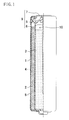
- FIG. 1 is a partial sectional view illustrating the structure of an alkaline battery according to an embodiment of the present invention.
- the present inventor studied about factors of the unexpected considerable decrease in remaining percentage after the storage period due to the decrease in height of the negative electrode other than the oxidation-reduction reaction between manganese dioxide and graphite. Then, the inventor has found the following.
- the inventor has conceived that inhibiting the reduction reaction between manganese dioxide and hydrogen gas makes it possible to hinder the decrease in remaining percentage even when the height of the negative electrode 3 is decreased. For this purpose, it is effective to lower the activity of manganese dioxide.
- the potential of manganese dioxide is decreased to a potential at which the oxidation of graphite can be inhibited (about 200 mV)
- the initial discharge performance is considerably decreased as described above. Therefore, the potential of manganese dioxide has to be decreased within a potential range higher than the potential at which the oxidation of graphite can be inhibited.
- FIG. 1 is a partial sectional view illustrating the structure of an alkaline battery according to an embodiment of the present invention.
- a positive electrode 2 and a gelled negative electrode 3 are placed in a closed-bottomed battery case 1 with a separator 4 interposed therebetween.
- An opening of the battery case 1 is sealed with a sealing unit 9 integral with a gasket 5, a negative electrode current collector 6 and a negative electrode lead plate 7.
- the negative electrode 3 is smaller in height than the positive electrode 2 in the battery case 1 and the positive electrode 2 contains electrolytic manganese dioxide and graphite.
- Table 4 shows the measurement results of an initial discharge characteristic, a discharge characteristic after a storage period and a remaining percentage of AA alkaline batteries 9 to 12 manufactured using a negative electrode 3 having a fixed height (36 mm) and electrolytic manganese dioxide having a potential (220 to 290 mV) lower than a potential of electrolytic manganese dioxide (306 mV) used in the battery 4 and higher than a potential at which graphite oxidation can be inhibited.
- the batteries 9 to 12 in which the potential of electrolytic manganese dioxide was in the range of 220 to 290 mV hardly deteriorated the initial discharge performance relative to that of the battery 4 (EMD potential: 306 mV) in which the negative electrode 3 was decreased in height as shown in Table 2. That is, as compared with the batteries 6 and 7 in which the potential of electrolytic manganese dioxide was 200 mV or less, the initial discharge characteristic was significantly improved. Further, the remaining percentage after the storage period was restored to a level close to that of the battery 2 in which the negative electrode 3 had the same height as the positive electrode 2.
- an initial open circuit voltage of a battery is uniquely determined by the potential of electrolytic manganese dioxide. Therefore, the present invention is effective in a battery having an initial open circuit voltage defined in a range of 1.60 to 1.64 V.
- the height of the negative electrode 3 is decreased and the potential of manganese dioxide is set within a certain range (220 mV to 290 mV) so that low-grade batteries configured to hinder the deterioration of the retaining characteristic are manufactured with good productivity. Therefore, a certain degree of the deterioration in initial discharge performance is acceptable.
- fine powder the amount of zinc powder having a particle diameter of 75 ⁇ m or less
- Table 7 shows the measurement results of the initial discharge characteristic, the discharge characteristic after the storage period and the remaining percentage of AA alkaline batteries 23 to 25 manufactured using a negative electrode 3 having a fixed height (36 mm) and containing the fine powder in a content higher than 15 % which was the fine powder content in the battery 11 shown in Table 4.
- the batteries 23 to 25 in which the fine powder content was in the range of 21 to 40 % improved the initial discharge performance.
- the remaining percentage after the storage period was hardly changed.
- the initial discharge performance and the remaining percentage were almost equal to those of the battery 2 in which the negative electrode 3 had the same height as the positive electrode 2.
- the similar effect can be obtained by lowering a density of the gelled negative electrode 3 (hereinafter referred to as a gel density).
- the volumetric expansion of the negative electrode 3 can be accelerated by decreasing the gel density.
- the gel density can be adjusted by varying the amount of a gelling agent or an electrolyte solution contained in the gelled negative electrode 3 relative to a certain amount of zinc.
- Table 8 shows the measurement results of the initial discharge characteristic, the discharge characteristic after the storage period and the remaining percentage of AA alkaline batteries 26 to 28 manufactured using a negative electrode 3 having a fixed height (36 mm) and a gel density lower than 2.70 g/cm 3 which was the gel density in the battery 11 shown in Table 4.
- the batteries 26 to 28 in which the gel density was in the range of 2.35 to 2.65 g/cm 3 improved the initial discharge performance.
- the remaining percentage after the storage period was hardly changed.
- the decrease in initial discharge performance caused by the decrease in height of the negative electrode 3 can be suppressed by increasing a length of part of the negative electrode current collector 6 immersed in the gelled negative electrode 3.
- the batteries 29 and 30 in which the length of the immersed part of the negative electrode current collector was increased improved the initial discharge performance.
- the ratio (L 3 /L 2 ) of the length (L 3 ) of the immersed part of the negative electrode current collector to the height of the negative electrode (L 2 ) is preferably 60 % or more.
- the present invention is not limited to the embodiment and various modifications can be made.
- the present invention may be effective not only for AA alkaline batteries, but also for alkaline batteries of other sizes.
- the present invention is not limited to the cylindrical alkaline batteries but may be applicable to rectangular alkaline batteries.
- the alkaline battery of the present invention has good productivity and high cost performance and is applicable to a wide range of electronic devices using dry batteries as power sources.
Landscapes
- Chemical & Material Sciences (AREA)
- Chemical Kinetics & Catalysis (AREA)
- Electrochemistry (AREA)
- General Chemical & Material Sciences (AREA)
- Engineering & Computer Science (AREA)
- Manufacturing & Machinery (AREA)
- Battery Electrode And Active Subsutance (AREA)
- Primary Cells (AREA)
Abstract
Description
- The present invention relates to alkaline batteries using electrolytic manganese dioxide as a positive electrode active material.
- For their high energy density per unit weight, alkaline batteries have widely been used as power sources of portable electronic devices which have rapidly been spread in recent years. Today, there are various alkaline batteries different in grades and price ranges adapted to different devices and applications, including regular alkaline batteries having a good discharge characteristic under a light load suitable for devices such as handheld game machines, high-performance alkaline batteries having a good discharge characteristic under a heavy load suitable for devices such as digital still cameras, and high-quality and high-performance alkaline batteries having a good discharge characteristic in a wide range from a high current to a low current.
- A typical material as a positive electrode active material of the alkaline battery is electrolytic manganese dioxide (EMD). In order to provide batteries with a good discharge characteristic, various improvements and refinements have been done, e.g., by increasing a reaction area of manganese dioxide or raising a potential of manganese dioxide (see Patent Literature 1).
-
Patent Literature 1 Published Japanese Patent Application No.2004-47445 -
Patent Literature 2 Published Japanese Patent Application No.7-183032 - If high-grade batteries and low-grade batteries are both manufactured in the same production line, total manufacture cost can be reduced.
- In general, an alkaline battery includes a positive electrode and a negative electrode placed in a battery case with a separator interposed therebetween. In order to enhance reaction efficiency between the positive and negative electrodes, heights of the positive and negative electrodes placed in the battery case are kept the same to maximize an area in which they oppose each other.
- When the low-grade batteries are manufactured in the production line for the high-grade batteries, the low-performance batteries can be manufactured at low cost by decreasing the amount of an active material of the positive and/or negative electrodes. However, decreasing the amount of the positive electrode active material is not very preferable because it brings about significant decrease in capacity.
- On the other hand, zinc used as the negative electrode active material is more expensive than manganese dioxide used as the positive electrode active material. Therefore, decreasing the amount of the negative electrode active material makes it possible to effectively reduce the manufacture cost of the low-grade and low-performance batteries. In this case, the negative electrode becomes smaller in height than the positive electrode in the battery case. Accordingly, the area in which the positive and negative electrodes oppose each other is decreased and a discharge characteristic of the battery deteriorates. However, the degree of the deterioration is less severe than the decrease in capacity caused by decreasing the positive electrode active material. Therefore, discharge performance required for the low-grade batteries can be maintained.
- The inventor of the present invention manufactured batteries and evaluated their performance. In the fabricated batteries, the negative electrode active material was decreased in amount while the positive electrode active material was not, i.e., the negative electrode was decreased in height while the positive electrode was not. The fabricated batteries were AA alkaline batteries using graphite-containing manganese dioxide as the positive electrode and zinc containing a gelling agent as the negative electrode.
- Specifically,
batteries 1 to 5 were manufactured using a positive electrode having a fixed height (L1) of 40 mm and a negative electrode having a height (L2) varied in a range of 42 to 34 mm. Table 1 shows the measurement results of an initial discharge characteristic, a discharge characteristic after a storage period and the ratio of the discharge characteristic after the storage period to the initial discharge characteristic (remaining percentage) ofbatteries 1 to 5. -
[Table 1] Positive electrode Negative electrode Height ratio (L2/L1) Discharge performance Height (L2) Height (L1) - Initial After storage Remaining percentage mm mm hr hr % Battery 140 42 1.05 7.78 7.38 94.9 Battery 240 1.00 7.57 7.02 92.7 Battery 338 0.95 7.35 6.38 86.8 Battery 436 0.90 7.16 5.83 81.4 Battery 534 0.85 6.73 4.97 73.8 - For the evaluation of the initial discharge characteristic, the batteries manufactured within a month were intermittently discharged under a medium load (an hour discharge per day at a current of 250 mA) to measure time (hr) to reach an end voltage of 0.9 V. For the evaluation of the discharge characteristic after the storage period, the batteries were stored for a week at 60°C (corresponding to storage for a year at normal temperature) and discharged intermittently under the medium load, i.e., in the same condition for the initial discharge characteristic evaluation, to measure time (hr) to reach an end voltage of 0.9 V. A performance retaining characteristic was evaluated by the ratio of the discharge performance after the storage period to the initial discharge performance (remaining percentage).
- A potential of electrolytic manganese dioxide was adjusted by changing the molar ratio between manganese and sulfuric acid in an electrolysis step using a manganese sulfate solution as an electrolyte solution. Then, the obtained electrolytic manganese dioxide was immersed in a 40% KOH aqueous solution and a potential difference from a reference electrode made of mercury oxide (Hg/HgO) was measured to obtain the potential of electrolytic manganese dioxide.
- The heights of the positive and
negative electrodes negative electrode negative electrode 3 was not horizontal to the bottom surface thereof, a midpoint between a topmost part and a bottommost part of the top surface was regarded as the top surface and the distance was measured. - As shown in Table 1, the initial discharge characteristic deteriorated with the decrease in height of the negative electrode. This is considered as a natural consequence of the decrease in area in which the positive and negative electrodes oppose each other. However, unexpectedly, the remaining percentage was also considerably decreased with the decrease in height of the negative electrode. It has been considered that the decrease in remaining percentage, i.e., deterioration of the retaining characteristic, is caused by decrease in degree of oxidation of manganese dioxide reduced by an oxidation-reduction reaction between manganese dioxide and graphite in the positive electrode material mixture (see Patent Literature 2). Therefore, it has been assumed that the deterioration of the retaining characteristic does not occur even when the amount of the negative electrode is decreased, while the amount of the positive electrode is not.
- In order to restore the retaining characteristic, the inventor manufactured batteries using low potential manganese dioxide on the ground that decreasing the potential of manganese dioxide inhibits the oxidation of graphite and the reduction of manganese dioxide (see Patent Literature 2).
- Specifically, batteries 6 and 7 were manufactured using a positive electrode having a fixed height (36 mm) and manganese dioxide having a potential (200 mV, 150 mV) lower than the potential of manganese dioxide (306 mV) used in the
battery 4 and at which the oxidation of graphite can be inhibited. Table 2 shows the measurement results of the initial discharge characteristic, the discharge characteristic after the storage period and the remaining percentage of these batteries. -
[Table 2] Positive electrode Negative electrode Height ratio (L2/L1) Discharge performance Height (L1) EMD potential Height (L2) - Initial After storage Remaining percentage mm mV mm hr hr % Battery 440 306 36 0.90 7.16 5.83 81.4 Battery 6 200 6.46 5.98 92.6 Battery 7 150 5.97 5.58 93.5 - As shown in Table 2, in the batteries 6 and 7 in which the potential of manganese dioxide was lower than that of the
battery 4, the remaining percentage was increased on one hand, but the initial discharge characteristic considerably deteriorated on the other hand. A conceivable cause of this result is decrease in activity of the positive electrode due to the decrease in potential of manganese dioxide. - In order to restore the retaining characteristic, the inventor manufactured batteries using a positive electrode in which the ratio of graphite in the positive electrode active material was decreased on the ground that decreasing the graphite ratio inhibits the oxidation of graphite and the reduction of manganese dioxide.
- Specifically, a battery 8 was manufactured using a negative electrode having a fixed height (36 mm) and a positive electrode in which the graphite ratio (EMD:graphite = 96.5:3.5) was lower than that in the battery 4 (EMD:graphite = 95:5). Table 3 shows the measurement results of the initial discharge characteristic, the discharge characteristic after a storage period and the remaining percentage.
-
[Table 3] Positive electrode Negative electrode Height ratio (L2/L1) Discharge performance Height (L1) Compounding ratio Height (L2) - Initial After storage Remaining percentage mm EMD:graphite mm hr hr % Battery 440 95.5 36 0.9 7.16 5.83 81.4 Battery 8 96.5:3.5 7.18 5.84 81.3 - As shown in Table 3, the battery 8 in which the graphite ratio was lower than that in the
battery 4 did not show any considerable change in initial discharge characteristic and remaining percentage after the storage period. The decrease in graphite ratio was not effective for restoring the retaining characteristic deteriorated by decreasing the negative electrode amount. - In view of the foregoing, the present invention has been achieved. An object of the invention is to provide an alkaline battery having good productivity and high cost performance and does not considerably deteriorate the retaining characteristic even if the amount of the negative electrode is decreased.
- In order to achieve the object of the present invention, in an alkaline battery in which a negative electrode is smaller in height than a positive electrode in a battery case, a potential of electrolytic manganese dioxide is in a range of 220 to 290 mV with respect to a reference electrode made of mercury oxide (Hg/HgO).
- Specifically, an alkaline battery of the present invention is an alkaline battery including a positive electrode and a negative electrode placed in a battery case with a separator interposed therebetween, wherein the negative electrode is smaller in height than the positive electrode in the battery case, the positive electrode contains electrolytic manganese dioxide and graphite, and a potential of electrolytic manganese dioxide is in a range of 220 to 290 mV with respect to a reference electrode made of mercury oxide (Hg/HgO).
- In a suitable embodiment, a weight ratio between the electrolytic manganese dioxide and the graphite is in a range of 90:10 to 94:6.
- In a suitable embodiment, an initial open circuit voltage of the alkaline battery is in a range of 1.60 to 1.64 V.
- In a suitable embodiment, the negative electrode contains zinc powder and the content of zinc powder having a particle diameter of 75 µm or less is in a range of 21 to 40%.
- In a suitable embodiment, the negative electrode is a gelled negative electrode containing zinc powder and a density of the gelled negative electrode is in a range of 2.35 to 2.65 g/cm3.
- In a suitable embodiment, the ratio of the negative electrode height to the positive electrode height in the battery case is in a range of 0.85 to 0.975.
- According to the present invention, even when the negative electrode is smaller in height than the positive electrode in the battery case so that the amount of the negative electrode is decreased, the retaining characteristic is less likely to deteriorate. Thus, an alkaline battery can be provided with good productivity and high cost performance.
-
FIG. 1 is a partial sectional view illustrating the structure of an alkaline battery according to an embodiment of the present invention. -
- 1
- Battery case
- 2
- Positive electrode
- 3
- Gelled negative electrode
- 4
- Separator
- 5
- Gasket
- 6
- Negative electrode current collector
- 7
- Negative electrode lead plate
- 9
- Sealing unit
- 10
- Space
- The present inventor studied about factors of the unexpected considerable decrease in remaining percentage after the storage period due to the decrease in height of the negative electrode other than the oxidation-reduction reaction between manganese dioxide and graphite. Then, the inventor has found the following.
- As a result of analysis of gas present in the battery after the storage period, most of the gas was hydrogen gas. It is considered that the hydrogen gas was generated by corrosion of zinc powder in a gelled negative electrode and accumulated during the storage period in
space 10 above thenegative electrode 3 in thebattery case 1 enlarged as a result of the decrease in height of thenegative electrode 3 as shown inFIG. 1 . - That is, the reduction reaction of manganese dioxide caused by the hydrogen gas accumulated in the
space 10 was more pronounced than the effect of CO2 gas generated by the oxidation of graphite. This is regarded as a cause of the deterioration of the retaining characteristic, i.e., the decrease in remaining percentage. - Based on the finding, the inventor has conceived that inhibiting the reduction reaction between manganese dioxide and hydrogen gas makes it possible to hinder the decrease in remaining percentage even when the height of the
negative electrode 3 is decreased. For this purpose, it is effective to lower the activity of manganese dioxide. However, if the potential of manganese dioxide is decreased to a potential at which the oxidation of graphite can be inhibited (about 200 mV), the initial discharge performance is considerably decreased as described above. Therefore, the potential of manganese dioxide has to be decreased within a potential range higher than the potential at which the oxidation of graphite can be inhibited. - Hereinafter, an embodiment of the present invention will be explained with reference to the drawings. The embodiment does not limit the present invention.
-
FIG. 1 is a partial sectional view illustrating the structure of an alkaline battery according to an embodiment of the present invention. As shown inFIG. 1 , apositive electrode 2 and a gellednegative electrode 3 are placed in a closed-bottomedbattery case 1 with aseparator 4 interposed therebetween. An opening of thebattery case 1 is sealed with asealing unit 9 integral with agasket 5, a negative electrode current collector 6 and a negative electrode lead plate 7. Thenegative electrode 3 is smaller in height than thepositive electrode 2 in thebattery case 1 and thepositive electrode 2 contains electrolytic manganese dioxide and graphite. - Table 4 shows the measurement results of an initial discharge characteristic, a discharge characteristic after a storage period and a remaining percentage of AA
alkaline batteries 9 to 12 manufactured using anegative electrode 3 having a fixed height (36 mm) and electrolytic manganese dioxide having a potential (220 to 290 mV) lower than a potential of electrolytic manganese dioxide (306 mV) used in thebattery 4 and higher than a potential at which graphite oxidation can be inhibited. -
[Table 4] Positive electrode Negative electrode Height ratio (L2/L1) Discharge performance Open circuit voltage Height (L1) EMD potential Height (L2) Initial After storage Remaining percentage mm mV mm - hr hr % V Battery 4 40 306 36 0.90 7.16 5.83 81.4 1.642 Battery 9290 7.12 6.43 90.3 1.640 Battery 10269 7.05 6.39 90.7 1.626 Battery 11 241 6.97 6.37 91.4 1.613 Battery 12 220 6.89 6.33 91.8 1.602 - The initial discharge performance, the discharge characteristic after the storage period, the potential of electrolytic manganese dioxide and the heights of the positive and
negative electrodes - As shown in Table 4, the
batteries 9 to 12 in which the potential of electrolytic manganese dioxide was in the range of 220 to 290 mV hardly deteriorated the initial discharge performance relative to that of the battery 4 (EMD potential: 306 mV) in which thenegative electrode 3 was decreased in height as shown in Table 2. That is, as compared with the batteries 6 and 7 in which the potential of electrolytic manganese dioxide was 200 mV or less, the initial discharge characteristic was significantly improved. Further, the remaining percentage after the storage period was restored to a level close to that of thebattery 2 in which thenegative electrode 3 had the same height as thepositive electrode 2. - The above-described results indicate that setting the potential of electrolytic manganese dioxide to a potential (220 to 290 mV) higher than that at which the graphite oxidation can be inhibited makes it possible to obtain an alkaline battery capable of hindering the decrease in initial discharge performance and the deterioration of the discharge characteristic after the storage period, even if the amount of the
negative electrode 3 is decreased. Accordingly, low-grade batteries having certain initial performance and retaining characteristic can be manufactured with good productivity by merely decreasing the amount of thenegative electrode 3, or the height of thenegative electrode 3. Thus, alkaline batteries can be provided with high cost performance. - As shown in Table 4, an initial open circuit voltage of a battery is uniquely determined by the potential of electrolytic manganese dioxide. Therefore, the present invention is effective in a battery having an initial open circuit voltage defined in a range of 1.60 to 1.64 V.
- As described above, even when the compounding ratio of graphite in the positive electrode material mixture was decreased for the purpose of inhibiting the oxidation-reduction reaction between manganese dioxide and graphite, the retaining characteristic was hardly restored (see Table 3). However, the inventor has found that the retaining characteristic improves when the graphite ratio in the positive electrode active material is increased.
- Table 5 shows the measurement results of the initial discharge characteristic, the discharge characteristic after the storage period and the remaining percentage of AA alkaline batteries 13 to 20 manufactured using a
negative electrode 3 having a fixed height (36 mm) and a positive electrode material mixture layer in which the graphite ratio was increased relative to that in thebatteries 9 to 12 shown in Table 4 (EMD:graphite = 95:5). -
[Table 5] Positive electrode Negative electrode Height ratio (L2/L1) Discharge performance Height (L1) EMD potential Compounding ratio Height (L2) Initial After storage Remaining percentage mm mV EMD:graphite mm - hr hr % Battery 9 40 290 95:5 36 .90 7.12 6.43 90.3 Battery 13 94:6 7.12 6.59 92.6 Battery 14 90:10 7.05 6.57 93.2 Battery 10269 95:5 7.05 6.39 90.7 Battery 15 94:6 7.07 6.58 93.1 Battery 16 90:10 6.98 6.55 93.8 Battery 11 241 95:5 6.97 6.37 91.4 Battery 17 94:6 6.98 6.50 93.1 Battery 18 90:10 6.87 6.47 94.2 Battery 12 220 95:5 6.89 6.33 91.8 Battery 19 94:6 6.86 6.45 94.0 Battery 20 90:10 6.75 6.39 94.7 - As shown in Table 5, the batteries 13 to 20 in which the compounding ratio by weight between electrolytic manganese dioxide and graphite was in the range of 90:10 to 94:6 slightly decreased the initial discharge performance, but restored the remaining percentage after the storage period to a level equal to or higher than that of the
battery 2 in which thenegative electrode 3 have the same height as thepositive electrode 2. - This effect is presumably resulted from the increase in graphite amount surrounding manganese dioxide. That is, the increase in graphite amount inhibited the reduction reaction of manganese dioxide by the hydrogen gas accumulated in the
space 10 above thenegative electrode 3 in thebattery case 1, which is a factor of the deterioration of the retaining characteristic pronounced by the decrease in height of thenegative electrode 3. - Therefore, as shown in Table 6, even when the height of the
negative electrode 3 is decreased to 34 mm (the ratio between the heights of the positive andnegative electrodes 2 and 3 (L2/L1) = 0.85), an alkaline battery which does not deteriorate the retaining characteristic can be provided by increasing the graphite ratio in the positive electrode material mixture (EMD:graphite = 90:10) as in a battery 21. -
[Table 6] Positive electrode Negative electrode Height ratio (L2/L1) Discharge performance Height (L1) EMD potential Compounding ratio Height (L2) Initial After storage Remaining percentage mm mV EMD:graphite mm - hr hr % Battery 5 40 306 95:5 34 0.85 6.73 4.97 73.8 Battery 21 241 90:10 6.51 6.12 94.0 Battery 22 241 95:5 39 0.975 7.36 6.85 93.1 - Further, as shown in Table 6, when the potential of electrolytic manganese dioxide was set to 241 mV in a battery 22 in which the height of the
negative electrode 3 was reduced to 39 mm (the ratio between the heights of the positive andnegative electrodes 2 and 3 (L2/L1) = 0.975), the initial discharge characteristic and the remaining percentage after the storage ratio can be maintained to the same level as those of thebattery 2 in which thenegative electrode 3 has the same height as thepositive electrode 2. - According to the present invention, the height of the
negative electrode 3 is decreased and the potential of manganese dioxide is set within a certain range (220 mV to 290 mV) so that low-grade batteries configured to hinder the deterioration of the retaining characteristic are manufactured with good productivity. Therefore, a certain degree of the deterioration in initial discharge performance is acceptable. - In this situation, however, the inventor of the present invention has found that the deterioration of the initial discharge performance can be hindered by increasing, among zinc powder in the gelled
negative electrode 3, the amount of zinc powder having a particle diameter of 75 µm or less (hereinafter this is referred to as fine powder). - Table 7 shows the measurement results of the initial discharge characteristic, the discharge characteristic after the storage period and the remaining percentage of AA alkaline batteries 23 to 25 manufactured using a
negative electrode 3 having a fixed height (36 mm) and containing the fine powder in a content higher than 15 % which was the fine powder content in the battery 11 shown in Table 4. -
[Table 7] Positive electrode Negative electrode Height ratio (L2/L1) Discharge performance Height (L1) EMD potential Height (L2) Fine powder content Initial After storage Remaining percentage mm mV mm % - hr hr % Battery 11 40 241 36 15 0.90 6.97 6.37 91.4 Battery 23 21 7.12 6.58 92.4 Battery 24 30 7.35 6.72 91.4 Battery 25 40 7.43 6.83 91.9 - As shown in Table 7, the batteries 23 to 25 in which the fine powder content was in the range of 21 to 40 % improved the initial discharge performance. The remaining percentage after the storage period was hardly changed. In particular, in the battery 25 in which the fine powder content was 40 %, the initial discharge performance and the remaining percentage were almost equal to those of the
battery 2 in which thenegative electrode 3 had the same height as thepositive electrode 2. - This effect is presumably resulted from the following principle. By increasing the fine powder content in the zinc powder in the
negative electrode 3, volumetric expansion of thenegative electrode 3 in a discharge state is accelerated. Therefore, thenegative electrode 3 is effectively increased in height to increase the area in which the positive andnegative electrodes negative electrode 3 has the same height as thepositive electrode 2, it is difficult to increase the fine powder content because the volumetric expansion of thenegative electrode 3 may possibly bring about leakage of an electrolyte solution. However, according to the present invention, the height of thenegative electrode 3 has been decreased and thesufficient space 10 lies above thenegative electrode 3. Therefore, the leakage of the electrolyte solution is less likely to occur. - The similar effect can be obtained by lowering a density of the gelled negative electrode 3 (hereinafter referred to as a gel density). The volumetric expansion of the
negative electrode 3 can be accelerated by decreasing the gel density. The gel density can be adjusted by varying the amount of a gelling agent or an electrolyte solution contained in the gellednegative electrode 3 relative to a certain amount of zinc. - Table 8 shows the measurement results of the initial discharge characteristic, the discharge characteristic after the storage period and the remaining percentage of AA alkaline batteries 26 to 28 manufactured using a
negative electrode 3 having a fixed height (36 mm) and a gel density lower than 2.70 g/cm3 which was the gel density in the battery 11 shown in Table 4. -
[Table 8] Positive electrode Negative electrode Height ratio (L2/L1) Discharge performance Height (L1) EMD potential Height (L2) Gel density Initial After storage Remaining percentage mm mV mm g/cm3 - hr hr % Battery 11 40 241 36 2.70 0.90 6.97 6.37 91.4 Battery 26 2.65 7.10 6.50 91.5 Battery 27 2.55 7.21 6.68 92.6 Battery 28 2.35 7.16 6.53 91.2 - As shown in Table 8, the batteries 26 to 28 in which the gel density was in the range of 2.35 to 2.65 g/cm3 improved the initial discharge performance. The remaining percentage after the storage period was hardly changed.
- The decrease in initial discharge performance caused by the decrease in height of the
negative electrode 3 can be suppressed by increasing a length of part of the negative electrode current collector 6 immersed in the gellednegative electrode 3. - Table 9 shows the measurement results of the initial discharge characteristic, the discharge characteristic after the storage period and the remaining percentage of AA alkaline batteries 29 and 30 manufactured using a
negative electrode 3 having a fixed height (36 mm) and a negative electrode current collector in which a length of the immersed part was increased relative to the length (L3 = 21 mm) of the immersed part of the negative electrode current collector of the battery 11 shown in Table 4. -
[Table 9] Positive Electrode Negative electrode Height ratio (L2/L1) Negative electrode current collector Discharge performance Height (L1) EMD potential Height (L2) Immersed length (L3) (L3/L2) Initial After storage Remaining percentage mm mV mm - mm % hr hr % Battery 11 40 241 36 0.90 21 58 6.97 6.37 91.4 Battery 29 27 68 7.12 6.58 92.4 Battery 30 32 80 7.25 6.68 92.1 - As shown in Table 9, the batteries 29 and 30 in which the length of the immersed part of the negative electrode current collector was increased improved the initial discharge performance. In order to achieve the effect, the ratio (L3/L2) of the length (L3) of the immersed part of the negative electrode current collector to the height of the negative electrode (L2) is preferably 60 % or more.
- In the above description, a suitable embodiment of the present invention has been explained. However, the present invention is not limited to the embodiment and various modifications can be made. For example, the present invention may be effective not only for AA alkaline batteries, but also for alkaline batteries of other sizes. The present invention is not limited to the cylindrical alkaline batteries but may be applicable to rectangular alkaline batteries.
- The alkaline battery of the present invention has good productivity and high cost performance and is applicable to a wide range of electronic devices using dry batteries as power sources.
Claims (6)
- An alkaline battery comprising a positive electrode and a negative electrode placed in a battery case with a separator interposed therebetween, wherein
the negative electrode is smaller in height than the positive electrode in the battery case,
the positive electrode contains electrolytic manganese dioxide and graphite, and a potential of electrolytic manganese dioxide is in a range of 220 to 290 mV with respect to a reference electrode made of mercury oxide (Hg/HgO). - The alkaline battery of claim 1, wherein
a weight ratio between the electrolytic manganese dioxide and the graphite is in a range of 90:10 to 94:6. - The alkaline battery of claim 1, wherein
an initial open circuit voltage of the alkaline battery is in a range of 1.60 to 1.64 V. - The alkaline battery of claim 1, wherein
the negative electrode contains zinc powder and the content of zinc powder having a particle diameter of 75 µm or less is in a range of 21 to 40 %. - The alkaline battery of claim 1, wherein
the negative electrode is a gelled negative electrode containing zinc powder and a density of the gelled negative electrode is in a range of 2.35 to 2.65 g/cm3. - The alkaline battery of claim 1, wherein
the ratio of the negative electrode height to the positive electrode height in the battery case is in a range of 0.85 to 0.975.
Applications Claiming Priority (2)
| Application Number | Priority Date | Filing Date | Title |
|---|---|---|---|
| JP2008256457A JP5352173B2 (en) | 2008-10-01 | 2008-10-01 | Alkaline battery |
| PCT/JP2008/003816 WO2010038263A1 (en) | 2008-10-01 | 2008-12-17 | Alkaline battery |
Publications (3)
| Publication Number | Publication Date |
|---|---|
| EP2330666A1 true EP2330666A1 (en) | 2011-06-08 |
| EP2330666A4 EP2330666A4 (en) | 2014-09-10 |
| EP2330666B1 EP2330666B1 (en) | 2018-08-01 |
Family
ID=42073058
Family Applications (1)
| Application Number | Title | Priority Date | Filing Date |
|---|---|---|---|
| EP08877128.2A Active EP2330666B1 (en) | 2008-10-01 | 2008-12-17 | Alkaline battery |
Country Status (6)
| Country | Link |
|---|---|
| US (1) | US8241780B2 (en) |
| EP (1) | EP2330666B1 (en) |
| JP (1) | JP5352173B2 (en) |
| CN (1) | CN101779315B (en) |
| BR (1) | BRPI0817159B1 (en) |
| WO (1) | WO2010038263A1 (en) |
Families Citing this family (2)
| Publication number | Priority date | Publication date | Assignee | Title |
|---|---|---|---|---|
| CN102859767B (en) * | 2011-04-18 | 2015-08-05 | 松下电器产业株式会社 | Alkaline primary battery |
| CN103337600B (en) * | 2013-05-18 | 2016-02-17 | 宁波倍特瑞能源科技有限公司 | A kind of alkaline dry battery positive pole housing and alkaline dry battery |
Family Cites Families (14)
| Publication number | Priority date | Publication date | Assignee | Title |
|---|---|---|---|---|
| JP2806233B2 (en) | 1993-11-10 | 1998-09-30 | 東ソー株式会社 | Electrolytic manganese dioxide and method for producing the same |
| US6589693B1 (en) * | 1999-08-05 | 2003-07-08 | Eveready Battery Company, Inc. | High discharge electrolytic manganese dioxide and an electrode and alkaline cell incorporating the same |
| JP2002198060A (en) * | 2000-12-26 | 2002-07-12 | Sony Corp | Battery |
| US7045253B2 (en) * | 2002-01-07 | 2006-05-16 | Eveready Battery Company, Inc. | Zinc shapes for anodes of electrochemical cells |
| JP3873760B2 (en) * | 2002-02-07 | 2007-01-24 | 松下電器産業株式会社 | Alkaline battery |
| JP3712259B2 (en) | 2002-05-15 | 2005-11-02 | 三井金属鉱業株式会社 | Cathode active material for alkaline manganese battery and battery |
| GR20030100208A (en) * | 2002-05-15 | 2004-02-02 | Mitsui Mining & Smelting Co., Ltd. | Battery cathode active material,method for producing electrolytic manganese dioxide and battery |
| US7273680B2 (en) * | 2002-08-28 | 2007-09-25 | The Gillette Company | Alkaline battery including nickel oxyhydroxide cathode and zinc anode |
| US6991875B2 (en) * | 2002-08-28 | 2006-01-31 | The Gillette Company | Alkaline battery including nickel oxyhydroxide cathode and zinc anode |
| US20070248879A1 (en) * | 2002-08-28 | 2007-10-25 | Durkot Richard E | Alkaline battery including nickel oxyhydroxide cathode and zinc anode |
| JP5081387B2 (en) * | 2006-01-12 | 2012-11-28 | Fdkエナジー株式会社 | Positive electrode mixture and alkaline battery |
| JP2007227011A (en) * | 2006-02-21 | 2007-09-06 | Toshiba Battery Co Ltd | Alkaline cell |
| JP5079404B2 (en) * | 2006-06-28 | 2012-11-21 | パナソニック株式会社 | Alkaline battery |
| WO2008001813A1 (en) * | 2006-06-28 | 2008-01-03 | Panasonic Corporation | Alkaline dry cell |
-
2008
- 2008-10-01 JP JP2008256457A patent/JP5352173B2/en active Active
- 2008-12-17 BR BRPI0817159A patent/BRPI0817159B1/en active IP Right Grant
- 2008-12-17 CN CN2008800208163A patent/CN101779315B/en active Active
- 2008-12-17 US US12/600,790 patent/US8241780B2/en active Active
- 2008-12-17 EP EP08877128.2A patent/EP2330666B1/en active Active
- 2008-12-17 WO PCT/JP2008/003816 patent/WO2010038263A1/en not_active Ceased
Also Published As
| Publication number | Publication date |
|---|---|
| BRPI0817159A8 (en) | 2016-09-13 |
| BRPI0817159B1 (en) | 2018-07-17 |
| EP2330666B1 (en) | 2018-08-01 |
| JP5352173B2 (en) | 2013-11-27 |
| US20100297493A1 (en) | 2010-11-25 |
| JP2010086860A (en) | 2010-04-15 |
| EP2330666A4 (en) | 2014-09-10 |
| CN101779315B (en) | 2013-11-20 |
| CN101779315A (en) | 2010-07-14 |
| US8241780B2 (en) | 2012-08-14 |
| BRPI0817159A2 (en) | 2015-09-01 |
| WO2010038263A1 (en) | 2010-04-08 |
Similar Documents
| Publication | Publication Date | Title |
|---|---|---|
| JP3491897B2 (en) | Additives for primary electrochemical cells with manganese dioxide cathode | |
| KR100429115B1 (en) | Batteries with Anode Comprising Aluminum | |
| WO2005015665A3 (en) | High capacity alkaline cells | |
| JP4049811B2 (en) | Primary electrochemical cell | |
| US4293622A (en) | Step cell | |
| EP2479824B1 (en) | Cylindrical alkaline battery | |
| JP5172181B2 (en) | Zinc alkaline battery | |
| EP1958278B1 (en) | Rechargeable alkaline manganese cell having reduced capacity fade and improved cycle life | |
| EP2330666B1 (en) | Alkaline battery | |
| EP2768048B1 (en) | Alkaline cell | |
| EP2113956A1 (en) | Alkaline Battery | |
| EP2337129B1 (en) | Alkali battery | |
| EP0952621A1 (en) | Alkaline storage battery and method for charging battery | |
| JP4222488B2 (en) | Alkaline battery | |
| EP0322806A1 (en) | Dry cell | |
| JP4327586B2 (en) | Aluminum primary battery | |
| EP4160758B1 (en) | Alkaline button cell | |
| JP2008041490A (en) | Alkaline battery | |
| JPH0724215B2 (en) | Dry cell | |
| JP2004327157A (en) | Storage battery | |
| JPH05151956A (en) | Button type silver oxide battery | |
| JPH0777131B2 (en) | Zinc alkaline battery | |
| JP2001028269A (en) | Stacked manganese dry battery | |
| JP2008258098A (en) | Flat alkaline cell | |
| JP2002050349A (en) | Negative electrode for alkaline battery and alkaline battery using the same |
Legal Events
| Date | Code | Title | Description |
|---|---|---|---|
| PUAI | Public reference made under article 153(3) epc to a published international application that has entered the european phase |
Free format text: ORIGINAL CODE: 0009012 |
|
| 17P | Request for examination filed |
Effective date: 20100707 |
|
| AK | Designated contracting states |
Kind code of ref document: A1 Designated state(s): AT BE BG CH CY CZ DE DK EE ES FI FR GB GR HR HU IE IS IT LI LT LU LV MC MT NL NO PL PT RO SE SI SK TR |
|
| AX | Request for extension of the european patent |
Extension state: AL BA MK RS |
|
| DAX | Request for extension of the european patent (deleted) | ||
| RIC1 | Information provided on ipc code assigned before grant |
Ipc: H01M 4/36 20060101ALI20140730BHEP Ipc: H01M 10/28 20060101ALI20140730BHEP Ipc: H01M 4/24 20060101ALI20140730BHEP Ipc: H01M 6/06 20060101ALI20140730BHEP Ipc: H01M 4/50 20100101ALI20140730BHEP Ipc: H01M 6/08 20060101AFI20140730BHEP Ipc: H01M 4/06 20060101ALI20140730BHEP |
|
| A4 | Supplementary search report drawn up and despatched |
Effective date: 20140807 |
|
| RAP1 | Party data changed (applicant data changed or rights of an application transferred) |
Owner name: PANASONIC INTELLECTUAL PROPERTY MANAGEMENT CO., LT |
|
| RAP1 | Party data changed (applicant data changed or rights of an application transferred) |
Owner name: PANASONIC INTELLECTUAL PROPERTY MANAGEMENT CO., LT |
|
| GRAP | Despatch of communication of intention to grant a patent |
Free format text: ORIGINAL CODE: EPIDOSNIGR1 |
|
| STAA | Information on the status of an ep patent application or granted ep patent |
Free format text: STATUS: GRANT OF PATENT IS INTENDED |
|
| INTG | Intention to grant announced |
Effective date: 20180227 |
|
| GRAS | Grant fee paid |
Free format text: ORIGINAL CODE: EPIDOSNIGR3 |
|
| GRAA | (expected) grant |
Free format text: ORIGINAL CODE: 0009210 |
|
| STAA | Information on the status of an ep patent application or granted ep patent |
Free format text: STATUS: THE PATENT HAS BEEN GRANTED |
|
| AK | Designated contracting states |
Kind code of ref document: B1 Designated state(s): AT BE BG CH CY CZ DE DK EE ES FI FR GB GR HR HU IE IS IT LI LT LU LV MC MT NL NO PL PT RO SE SI SK TR |
|
| REG | Reference to a national code |
Ref country code: GB Ref legal event code: FG4D |
|
| REG | Reference to a national code |
Ref country code: CH Ref legal event code: EP Ref country code: AT Ref legal event code: REF Ref document number: 1025393 Country of ref document: AT Kind code of ref document: T Effective date: 20180815 |
|
| REG | Reference to a national code |
Ref country code: IE Ref legal event code: FG4D |
|
| REG | Reference to a national code |
Ref country code: DE Ref legal event code: R096 Ref document number: 602008056302 Country of ref document: DE |
|
| REG | Reference to a national code |
Ref country code: NL Ref legal event code: MP Effective date: 20180801 |
|
| REG | Reference to a national code |
Ref country code: LT Ref legal event code: MG4D |
|
| REG | Reference to a national code |
Ref country code: AT Ref legal event code: MK05 Ref document number: 1025393 Country of ref document: AT Kind code of ref document: T Effective date: 20180801 |
|
| PG25 | Lapsed in a contracting state [announced via postgrant information from national office to epo] |
Ref country code: FI Free format text: LAPSE BECAUSE OF FAILURE TO SUBMIT A TRANSLATION OF THE DESCRIPTION OR TO PAY THE FEE WITHIN THE PRESCRIBED TIME-LIMIT Effective date: 20180801 Ref country code: SE Free format text: LAPSE BECAUSE OF FAILURE TO SUBMIT A TRANSLATION OF THE DESCRIPTION OR TO PAY THE FEE WITHIN THE PRESCRIBED TIME-LIMIT Effective date: 20180801 Ref country code: IS Free format text: LAPSE BECAUSE OF FAILURE TO SUBMIT A TRANSLATION OF THE DESCRIPTION OR TO PAY THE FEE WITHIN THE PRESCRIBED TIME-LIMIT Effective date: 20181201 Ref country code: NL Free format text: LAPSE BECAUSE OF FAILURE TO SUBMIT A TRANSLATION OF THE DESCRIPTION OR TO PAY THE FEE WITHIN THE PRESCRIBED TIME-LIMIT Effective date: 20180801 Ref country code: AT Free format text: LAPSE BECAUSE OF FAILURE TO SUBMIT A TRANSLATION OF THE DESCRIPTION OR TO PAY THE FEE WITHIN THE PRESCRIBED TIME-LIMIT Effective date: 20180801 Ref country code: LT Free format text: LAPSE BECAUSE OF FAILURE TO SUBMIT A TRANSLATION OF THE DESCRIPTION OR TO PAY THE FEE WITHIN THE PRESCRIBED TIME-LIMIT Effective date: 20180801 Ref country code: GR Free format text: LAPSE BECAUSE OF FAILURE TO SUBMIT A TRANSLATION OF THE DESCRIPTION OR TO PAY THE FEE WITHIN THE PRESCRIBED TIME-LIMIT Effective date: 20181102 Ref country code: PL Free format text: LAPSE BECAUSE OF FAILURE TO SUBMIT A TRANSLATION OF THE DESCRIPTION OR TO PAY THE FEE WITHIN THE PRESCRIBED TIME-LIMIT Effective date: 20180801 Ref country code: NO Free format text: LAPSE BECAUSE OF FAILURE TO SUBMIT A TRANSLATION OF THE DESCRIPTION OR TO PAY THE FEE WITHIN THE PRESCRIBED TIME-LIMIT Effective date: 20181101 Ref country code: BG Free format text: LAPSE BECAUSE OF FAILURE TO SUBMIT A TRANSLATION OF THE DESCRIPTION OR TO PAY THE FEE WITHIN THE PRESCRIBED TIME-LIMIT Effective date: 20181101 |
|
| PG25 | Lapsed in a contracting state [announced via postgrant information from national office to epo] |
Ref country code: ES Free format text: LAPSE BECAUSE OF FAILURE TO SUBMIT A TRANSLATION OF THE DESCRIPTION OR TO PAY THE FEE WITHIN THE PRESCRIBED TIME-LIMIT Effective date: 20180801 Ref country code: HR Free format text: LAPSE BECAUSE OF FAILURE TO SUBMIT A TRANSLATION OF THE DESCRIPTION OR TO PAY THE FEE WITHIN THE PRESCRIBED TIME-LIMIT Effective date: 20180801 Ref country code: LV Free format text: LAPSE BECAUSE OF FAILURE TO SUBMIT A TRANSLATION OF THE DESCRIPTION OR TO PAY THE FEE WITHIN THE PRESCRIBED TIME-LIMIT Effective date: 20180801 |
|
| PG25 | Lapsed in a contracting state [announced via postgrant information from national office to epo] |
Ref country code: EE Free format text: LAPSE BECAUSE OF FAILURE TO SUBMIT A TRANSLATION OF THE DESCRIPTION OR TO PAY THE FEE WITHIN THE PRESCRIBED TIME-LIMIT Effective date: 20180801 Ref country code: CZ Free format text: LAPSE BECAUSE OF FAILURE TO SUBMIT A TRANSLATION OF THE DESCRIPTION OR TO PAY THE FEE WITHIN THE PRESCRIBED TIME-LIMIT Effective date: 20180801 Ref country code: RO Free format text: LAPSE BECAUSE OF FAILURE TO SUBMIT A TRANSLATION OF THE DESCRIPTION OR TO PAY THE FEE WITHIN THE PRESCRIBED TIME-LIMIT Effective date: 20180801 Ref country code: IT Free format text: LAPSE BECAUSE OF FAILURE TO SUBMIT A TRANSLATION OF THE DESCRIPTION OR TO PAY THE FEE WITHIN THE PRESCRIBED TIME-LIMIT Effective date: 20180801 |
|
| REG | Reference to a national code |
Ref country code: DE Ref legal event code: R097 Ref document number: 602008056302 Country of ref document: DE |
|
| PG25 | Lapsed in a contracting state [announced via postgrant information from national office to epo] |
Ref country code: DK Free format text: LAPSE BECAUSE OF FAILURE TO SUBMIT A TRANSLATION OF THE DESCRIPTION OR TO PAY THE FEE WITHIN THE PRESCRIBED TIME-LIMIT Effective date: 20180801 Ref country code: SK Free format text: LAPSE BECAUSE OF FAILURE TO SUBMIT A TRANSLATION OF THE DESCRIPTION OR TO PAY THE FEE WITHIN THE PRESCRIBED TIME-LIMIT Effective date: 20180801 |
|
| PLBE | No opposition filed within time limit |
Free format text: ORIGINAL CODE: 0009261 |
|
| STAA | Information on the status of an ep patent application or granted ep patent |
Free format text: STATUS: NO OPPOSITION FILED WITHIN TIME LIMIT |
|
| 26N | No opposition filed |
Effective date: 20190503 |
|
| REG | Reference to a national code |
Ref country code: CH Ref legal event code: PL |
|
| PG25 | Lapsed in a contracting state [announced via postgrant information from national office to epo] |
Ref country code: LU Free format text: LAPSE BECAUSE OF NON-PAYMENT OF DUE FEES Effective date: 20181217 Ref country code: SI Free format text: LAPSE BECAUSE OF FAILURE TO SUBMIT A TRANSLATION OF THE DESCRIPTION OR TO PAY THE FEE WITHIN THE PRESCRIBED TIME-LIMIT Effective date: 20180801 Ref country code: MC Free format text: LAPSE BECAUSE OF FAILURE TO SUBMIT A TRANSLATION OF THE DESCRIPTION OR TO PAY THE FEE WITHIN THE PRESCRIBED TIME-LIMIT Effective date: 20180801 |
|
| REG | Reference to a national code |
Ref country code: IE Ref legal event code: MM4A |
|
| REG | Reference to a national code |
Ref country code: BE Ref legal event code: MM Effective date: 20181231 |
|
| PG25 | Lapsed in a contracting state [announced via postgrant information from national office to epo] |
Ref country code: IE Free format text: LAPSE BECAUSE OF NON-PAYMENT OF DUE FEES Effective date: 20181217 |
|
| PG25 | Lapsed in a contracting state [announced via postgrant information from national office to epo] |
Ref country code: BE Free format text: LAPSE BECAUSE OF NON-PAYMENT OF DUE FEES Effective date: 20181231 |
|
| PG25 | Lapsed in a contracting state [announced via postgrant information from national office to epo] |
Ref country code: CH Free format text: LAPSE BECAUSE OF NON-PAYMENT OF DUE FEES Effective date: 20181231 Ref country code: LI Free format text: LAPSE BECAUSE OF NON-PAYMENT OF DUE FEES Effective date: 20181231 |
|
| PG25 | Lapsed in a contracting state [announced via postgrant information from national office to epo] |
Ref country code: MT Free format text: LAPSE BECAUSE OF NON-PAYMENT OF DUE FEES Effective date: 20181217 |
|
| PG25 | Lapsed in a contracting state [announced via postgrant information from national office to epo] |
Ref country code: TR Free format text: LAPSE BECAUSE OF FAILURE TO SUBMIT A TRANSLATION OF THE DESCRIPTION OR TO PAY THE FEE WITHIN THE PRESCRIBED TIME-LIMIT Effective date: 20180801 |
|
| PG25 | Lapsed in a contracting state [announced via postgrant information from national office to epo] |
Ref country code: PT Free format text: LAPSE BECAUSE OF FAILURE TO SUBMIT A TRANSLATION OF THE DESCRIPTION OR TO PAY THE FEE WITHIN THE PRESCRIBED TIME-LIMIT Effective date: 20180801 |
|
| PG25 | Lapsed in a contracting state [announced via postgrant information from national office to epo] |
Ref country code: HU Free format text: LAPSE BECAUSE OF FAILURE TO SUBMIT A TRANSLATION OF THE DESCRIPTION OR TO PAY THE FEE WITHIN THE PRESCRIBED TIME-LIMIT; INVALID AB INITIO Effective date: 20081217 Ref country code: CY Free format text: LAPSE BECAUSE OF FAILURE TO SUBMIT A TRANSLATION OF THE DESCRIPTION OR TO PAY THE FEE WITHIN THE PRESCRIBED TIME-LIMIT Effective date: 20180801 |
|
| PGFP | Annual fee paid to national office [announced via postgrant information from national office to epo] |
Ref country code: DE Payment date: 20251211 Year of fee payment: 18 |
|
| PGFP | Annual fee paid to national office [announced via postgrant information from national office to epo] |
Ref country code: GB Payment date: 20251219 Year of fee payment: 18 |
|
| PGFP | Annual fee paid to national office [announced via postgrant information from national office to epo] |
Ref country code: FR Payment date: 20251222 Year of fee payment: 18 |