EP2329959B1 - Wärmeempfindliches Aufzeichnungsmaterial mit Barrierebeschichtung - Google Patents
Wärmeempfindliches Aufzeichnungsmaterial mit Barrierebeschichtung Download PDFInfo
- Publication number
- EP2329959B1 EP2329959B1 EP20090177678 EP09177678A EP2329959B1 EP 2329959 B1 EP2329959 B1 EP 2329959B1 EP 20090177678 EP20090177678 EP 20090177678 EP 09177678 A EP09177678 A EP 09177678A EP 2329959 B1 EP2329959 B1 EP 2329959B1
- Authority
- EP
- European Patent Office
- Prior art keywords
- heat
- sensitive recording
- recording material
- recording layer
- material according
- Prior art date
- Legal status (The legal status is an assumption and is not a legal conclusion. Google has not performed a legal analysis and makes no representation as to the accuracy of the status listed.)
- Not-in-force
Links
- 239000011248 coating agent Substances 0.000 title claims description 55
- 238000000576 coating method Methods 0.000 title claims description 55
- 239000000463 material Substances 0.000 title claims description 51
- 230000004888 barrier function Effects 0.000 title claims description 37
- 239000010410 layer Substances 0.000 claims description 103
- 239000000758 substrate Substances 0.000 claims description 35
- 229920002451 polyvinyl alcohol Polymers 0.000 claims description 34
- 239000011241 protective layer Substances 0.000 claims description 29
- 229920000219 Ethylene vinyl alcohol Polymers 0.000 claims description 28
- 239000004372 Polyvinyl alcohol Substances 0.000 claims description 25
- 239000011230 binding agent Substances 0.000 claims description 24
- 239000000049 pigment Substances 0.000 claims description 19
- 239000000126 substance Substances 0.000 claims description 18
- 239000003960 organic solvent Substances 0.000 claims description 17
- VTYYLEPIZMXCLO-UHFFFAOYSA-L Calcium carbonate Chemical compound [Ca+2].[O-]C([O-])=O VTYYLEPIZMXCLO-UHFFFAOYSA-L 0.000 claims description 15
- 239000002243 precursor Substances 0.000 claims description 13
- IISBACLAFKSPIT-UHFFFAOYSA-N bisphenol A Chemical compound C=1C=C(O)C=CC=1C(C)(C)C1=CC=C(O)C=C1 IISBACLAFKSPIT-UHFFFAOYSA-N 0.000 claims description 12
- VPWNQTHUCYMVMZ-UHFFFAOYSA-N 4,4'-sulfonyldiphenol Chemical compound C1=CC(O)=CC=C1S(=O)(=O)C1=CC=C(O)C=C1 VPWNQTHUCYMVMZ-UHFFFAOYSA-N 0.000 claims description 11
- 239000004715 ethylene vinyl alcohol Substances 0.000 claims description 11
- 231100000489 sensitizer Toxicity 0.000 claims description 11
- WOZVHXUHUFLZGK-UHFFFAOYSA-N dimethyl terephthalate Chemical compound COC(=O)C1=CC=C(C(=O)OC)C=C1 WOZVHXUHUFLZGK-UHFFFAOYSA-N 0.000 claims description 10
- 229940098465 tincture Drugs 0.000 claims description 10
- 238000006243 chemical reaction Methods 0.000 claims description 9
- 239000000203 mixture Substances 0.000 claims description 9
- VYPSYNLAJGMNEJ-UHFFFAOYSA-N Silicium dioxide Chemical compound O=[Si]=O VYPSYNLAJGMNEJ-UHFFFAOYSA-N 0.000 claims description 8
- 239000005995 Aluminium silicate Substances 0.000 claims description 7
- 235000012211 aluminium silicate Nutrition 0.000 claims description 7
- 229910000019 calcium carbonate Inorganic materials 0.000 claims description 7
- 238000004132 cross linking Methods 0.000 claims description 7
- 239000001023 inorganic pigment Substances 0.000 claims description 7
- NLYAJNPCOHFWQQ-UHFFFAOYSA-N kaolin Chemical compound O.O.O=[Al]O[Si](=O)O[Si](=O)O[Al]=O NLYAJNPCOHFWQQ-UHFFFAOYSA-N 0.000 claims description 7
- XAAILNNJDMIMON-UHFFFAOYSA-N 2'-anilino-6'-(dibutylamino)-3'-methylspiro[2-benzofuran-3,9'-xanthene]-1-one Chemical compound C=1C(N(CCCC)CCCC)=CC=C(C2(C3=CC=CC=C3C(=O)O2)C2=C3)C=1OC2=CC(C)=C3NC1=CC=CC=C1 XAAILNNJDMIMON-UHFFFAOYSA-N 0.000 claims description 6
- WSFSSNUMVMOOMR-UHFFFAOYSA-N Formaldehyde Chemical compound O=C WSFSSNUMVMOOMR-UHFFFAOYSA-N 0.000 claims description 6
- LYRFLYHAGKPMFH-UHFFFAOYSA-N octadecanamide Chemical compound CCCCCCCCCCCCCCCCCC(N)=O LYRFLYHAGKPMFH-UHFFFAOYSA-N 0.000 claims description 6
- JHOKTNSTUVKGJC-UHFFFAOYSA-N n-(hydroxymethyl)octadecanamide Chemical compound CCCCCCCCCCCCCCCCCC(=O)NCO JHOKTNSTUVKGJC-UHFFFAOYSA-N 0.000 claims description 5
- HEVGMYPGMWZOBU-UHFFFAOYSA-N [3-[(4-methylphenyl)sulfonylcarbamoylamino]phenyl] 4-methylbenzenesulfonate Chemical compound C1=CC(C)=CC=C1S(=O)(=O)NC(=O)NC1=CC=CC(OS(=O)(=O)C=2C=CC(C)=CC=2)=C1 HEVGMYPGMWZOBU-UHFFFAOYSA-N 0.000 claims description 4
- 239000000377 silicon dioxide Substances 0.000 claims description 4
- 230000009471 action Effects 0.000 claims description 3
- WNROFYMDJYEPJX-UHFFFAOYSA-K aluminium hydroxide Chemical compound [OH-].[OH-].[OH-].[Al+3] WNROFYMDJYEPJX-UHFFFAOYSA-K 0.000 claims description 3
- 239000000440 bentonite Substances 0.000 claims description 3
- 229910000278 bentonite Inorganic materials 0.000 claims description 3
- SVPXDRXYRYOSEX-UHFFFAOYSA-N bentoquatam Chemical compound O.O=[Si]=O.O=[Al]O[Al]=O SVPXDRXYRYOSEX-UHFFFAOYSA-N 0.000 claims description 3
- ZNZYKNKBJPZETN-WELNAUFTSA-N Dialdehyde 11678 Chemical compound N1C2=CC=CC=C2C2=C1[C@H](C[C@H](/C(=C/O)C(=O)OC)[C@@H](C=C)C=O)NCC2 ZNZYKNKBJPZETN-WELNAUFTSA-N 0.000 claims description 2
- 229920000877 Melamine resin Polymers 0.000 claims description 2
- MGJKQDOBUOMPEZ-UHFFFAOYSA-N N,N'-dimethylurea Chemical compound CNC(=O)NC MGJKQDOBUOMPEZ-UHFFFAOYSA-N 0.000 claims description 2
- IBVAQQYNSHJXBV-UHFFFAOYSA-N adipic acid dihydrazide Chemical compound NNC(=O)CCCCC(=O)NN IBVAQQYNSHJXBV-UHFFFAOYSA-N 0.000 claims description 2
- KGBXLFKZBHKPEV-UHFFFAOYSA-N boric acid Chemical compound OB(O)O KGBXLFKZBHKPEV-UHFFFAOYSA-N 0.000 claims description 2
- 239000004327 boric acid Substances 0.000 claims description 2
- 239000003822 epoxy resin Substances 0.000 claims description 2
- IVJISJACKSSFGE-UHFFFAOYSA-N formaldehyde;1,3,5-triazine-2,4,6-triamine Chemical compound O=C.NC1=NC(N)=NC(N)=N1 IVJISJACKSSFGE-UHFFFAOYSA-N 0.000 claims description 2
- IRWGLNFPSKUEMS-UHFFFAOYSA-N n-(2-hydroxyphenyl)-2-(4-hydroxyphenyl)sulfanylacetamide Chemical compound C1=CC(O)=CC=C1SCC(=O)NC1=CC=CC=C1O IRWGLNFPSKUEMS-UHFFFAOYSA-N 0.000 claims description 2
- 230000035515 penetration Effects 0.000 claims description 2
- 229920000768 polyamine Polymers 0.000 claims description 2
- 229920000647 polyepoxide Polymers 0.000 claims description 2
- 229920005989 resin Polymers 0.000 claims description 2
- 239000011347 resin Substances 0.000 claims description 2
- LROZSPADHSXFJA-UHFFFAOYSA-N 2-(4-hydroxyphenyl)sulfonylphenol Chemical compound C1=CC(O)=CC=C1S(=O)(=O)C1=CC=CC=C1O LROZSPADHSXFJA-UHFFFAOYSA-N 0.000 claims 1
- BRLQWZUYTZBJKN-UHFFFAOYSA-N Epichlorohydrin Chemical compound ClCC1CO1 BRLQWZUYTZBJKN-UHFFFAOYSA-N 0.000 claims 1
- ISWSIDIOOBJBQZ-UHFFFAOYSA-N Phenol Chemical compound OC1=CC=CC=C1 ISWSIDIOOBJBQZ-UHFFFAOYSA-N 0.000 claims 1
- 229910021502 aluminium hydroxide Inorganic materials 0.000 claims 1
- 125000003170 phenylsulfonyl group Chemical group C1(=CC=CC=C1)S(=O)(=O)* 0.000 claims 1
- 235000012239 silicon dioxide Nutrition 0.000 claims 1
- 235000019422 polyvinyl alcohol Nutrition 0.000 description 23
- 239000008199 coating composition Substances 0.000 description 20
- 239000000370 acceptor Substances 0.000 description 17
- -1 2,4'-dihydroxydiphenyl sulfone Chemical class 0.000 description 8
- 230000000052 comparative effect Effects 0.000 description 8
- 229920001577 copolymer Polymers 0.000 description 8
- 230000015572 biosynthetic process Effects 0.000 description 7
- 235000010216 calcium carbonate Nutrition 0.000 description 7
- 239000000470 constituent Substances 0.000 description 6
- 238000000034 method Methods 0.000 description 6
- 241000294754 Macroptilium atropurpureum Species 0.000 description 5
- 230000000694 effects Effects 0.000 description 5
- ZTILAOCGFRDHBH-UHFFFAOYSA-N 4-(4-propan-2-yloxyphenyl)sulfonylphenol Chemical compound C1=CC(OC(C)C)=CC=C1S(=O)(=O)C1=CC=C(O)C=C1 ZTILAOCGFRDHBH-UHFFFAOYSA-N 0.000 description 4
- LFQSCWFLJHTTHZ-UHFFFAOYSA-N Ethanol Chemical compound CCO LFQSCWFLJHTTHZ-UHFFFAOYSA-N 0.000 description 4
- IMROMDMJAWUWLK-UHFFFAOYSA-N Ethenol Chemical compound OC=C IMROMDMJAWUWLK-UHFFFAOYSA-N 0.000 description 4
- 238000000586 desensitisation Methods 0.000 description 4
- 239000004014 plasticizer Substances 0.000 description 4
- 238000007639 printing Methods 0.000 description 4
- 238000012545 processing Methods 0.000 description 4
- 150000001875 compounds Chemical class 0.000 description 3
- 125000002147 dimethylamino group Chemical group [H]C([H])([H])N(*)C([H])([H])[H] 0.000 description 3
- 238000002474 experimental method Methods 0.000 description 3
- 238000004519 manufacturing process Methods 0.000 description 3
- JWSWULLEVAMIJK-UHFFFAOYSA-N 1-phenylmethoxynaphthalene Chemical compound C=1C=CC2=CC=CC=C2C=1OCC1=CC=CC=C1 JWSWULLEVAMIJK-UHFFFAOYSA-N 0.000 description 2
- 229920002472 Starch Polymers 0.000 description 2
- PPBRXRYQALVLMV-UHFFFAOYSA-N Styrene Chemical compound C=CC1=CC=CC=C1 PPBRXRYQALVLMV-UHFFFAOYSA-N 0.000 description 2
- 230000008859 change Effects 0.000 description 2
- 239000003795 chemical substances by application Substances 0.000 description 2
- 125000001664 diethylamino group Chemical group [H]C([H])([H])C([H])([H])N(*)C([H])([H])C([H])([H])[H] 0.000 description 2
- 238000010790 dilution Methods 0.000 description 2
- 239000012895 dilution Substances 0.000 description 2
- KZTYYGOKRVBIMI-UHFFFAOYSA-N diphenyl sulfone Chemical compound C=1C=CC=CC=1S(=O)(=O)C1=CC=CC=C1 KZTYYGOKRVBIMI-UHFFFAOYSA-N 0.000 description 2
- MCPKSFINULVDNX-UHFFFAOYSA-N drometrizole Chemical compound CC1=CC=C(O)C(N2N=C3C=CC=CC3=N2)=C1 MCPKSFINULVDNX-UHFFFAOYSA-N 0.000 description 2
- 238000001035 drying Methods 0.000 description 2
- 239000000835 fiber Substances 0.000 description 2
- 238000009472 formulation Methods 0.000 description 2
- 238000010348 incorporation Methods 0.000 description 2
- 239000004816 latex Substances 0.000 description 2
- 229920000126 latex Polymers 0.000 description 2
- 239000000314 lubricant Substances 0.000 description 2
- 238000002844 melting Methods 0.000 description 2
- 230000008018 melting Effects 0.000 description 2
- 235000014593 oils and fats Nutrition 0.000 description 2
- 239000012188 paraffin wax Substances 0.000 description 2
- 230000008569 process Effects 0.000 description 2
- 230000001681 protective effect Effects 0.000 description 2
- 230000004043 responsiveness Effects 0.000 description 2
- 230000002441 reversible effect Effects 0.000 description 2
- 239000008107 starch Substances 0.000 description 2
- 235000019698 starch Nutrition 0.000 description 2
- 229920003048 styrene butadiene rubber Polymers 0.000 description 2
- 238000012360 testing method Methods 0.000 description 2
- 239000011800 void material Substances 0.000 description 2
- 239000001993 wax Substances 0.000 description 2
- 230000003313 weakening effect Effects 0.000 description 2
- YJTKZCDBKVTVBY-UHFFFAOYSA-N 1,3-Diphenylbenzene Chemical group C1=CC=CC=C1C1=CC=CC(C=2C=CC=CC=2)=C1 YJTKZCDBKVTVBY-UHFFFAOYSA-N 0.000 description 1
- AGPLQTQFIZBOLI-UHFFFAOYSA-N 1-benzyl-4-phenylbenzene Chemical group C=1C=C(C=2C=CC=CC=2)C=CC=1CC1=CC=CC=C1 AGPLQTQFIZBOLI-UHFFFAOYSA-N 0.000 description 1
- OAGNKYSIOSDNIG-UHFFFAOYSA-N 1-methyl-3-[2-(3-methylphenoxy)ethoxy]benzene Chemical compound CC1=CC=CC(OCCOC=2C=C(C)C=CC=2)=C1 OAGNKYSIOSDNIG-UHFFFAOYSA-N 0.000 description 1
- WCOXQTXVACYMLM-UHFFFAOYSA-N 2,3-bis(12-hydroxyoctadecanoyloxy)propyl 12-hydroxyoctadecanoate Chemical compound CCCCCCC(O)CCCCCCCCCCC(=O)OCC(OC(=O)CCCCCCCCCCC(O)CCCCCC)COC(=O)CCCCCCCCCCC(O)CCCCCC WCOXQTXVACYMLM-UHFFFAOYSA-N 0.000 description 1
- KHTJRKQAETUUQH-UHFFFAOYSA-N 2-(hydroxymethyl)octadecanamide Chemical compound CCCCCCCCCCCCCCCCC(CO)C(N)=O KHTJRKQAETUUQH-UHFFFAOYSA-N 0.000 description 1
- QKJAZPHKNWSXDF-UHFFFAOYSA-N 2-bromoquinoline Chemical compound C1=CC=CC2=NC(Br)=CC=C21 QKJAZPHKNWSXDF-UHFFFAOYSA-N 0.000 description 1
- FPIAKQHHSBQHDE-UHFFFAOYSA-N 2-methylprop-2-enoic acid;prop-2-enamide;prop-2-enoic acid Chemical compound NC(=O)C=C.OC(=O)C=C.CC(=C)C(O)=O FPIAKQHHSBQHDE-UHFFFAOYSA-N 0.000 description 1
- XCSGHNKDXGYELG-UHFFFAOYSA-N 2-phenoxyethoxybenzene Chemical compound C=1C=CC=CC=1OCCOC1=CC=CC=C1 XCSGHNKDXGYELG-UHFFFAOYSA-N 0.000 description 1
- PYSRRFNXTXNWCD-UHFFFAOYSA-N 3-(2-phenylethenyl)furan-2,5-dione Chemical class O=C1OC(=O)C(C=CC=2C=CC=CC=2)=C1 PYSRRFNXTXNWCD-UHFFFAOYSA-N 0.000 description 1
- JIINFQZEQNJKMR-UHFFFAOYSA-N 3-N,3-N-dibutyl-6-N,6-N-diethyl-9H-fluorene-3,6-diamine Chemical compound C(CCC)N(C=1C=CC=2CC3=CC=C(C=C3C=2C=1)N(CC)CC)CCCC JIINFQZEQNJKMR-UHFFFAOYSA-N 0.000 description 1
- NYMQRLJHQHVCAD-UHFFFAOYSA-N 4,5,6,7-tetrachloro-3,3-bis[2-[4-(dimethylamino)phenyl]-2-(4-methoxyphenyl)ethenyl]-2-benzofuran-1-one Chemical compound C1=CC(OC)=CC=C1C(C=1C=CC(=CC=1)N(C)C)=CC1(C=C(C=2C=CC(OC)=CC=2)C=2C=CC(=CC=2)N(C)C)C(C(Cl)=C(Cl)C(Cl)=C2Cl)=C2C(=O)O1 NYMQRLJHQHVCAD-UHFFFAOYSA-N 0.000 description 1
- 229920002134 Carboxymethyl cellulose Polymers 0.000 description 1
- 239000004971 Cross linker Substances 0.000 description 1
- 108010010803 Gelatin Proteins 0.000 description 1
- 229920000663 Hydroxyethyl cellulose Polymers 0.000 description 1
- 239000004354 Hydroxyethyl cellulose Substances 0.000 description 1
- 229920003171 Poly (ethylene oxide) Polymers 0.000 description 1
- 239000004698 Polyethylene Substances 0.000 description 1
- 229920000147 Styrene maleic anhydride Polymers 0.000 description 1
- 239000002174 Styrene-butadiene Substances 0.000 description 1
- XTXRWKRVRITETP-UHFFFAOYSA-N Vinyl acetate Chemical compound CC(=O)OC=C XTXRWKRVRITETP-UHFFFAOYSA-N 0.000 description 1
- 239000000654 additive Substances 0.000 description 1
- 150000001447 alkali salts Chemical class 0.000 description 1
- 229910052782 aluminium Inorganic materials 0.000 description 1
- XAGFODPZIPBFFR-UHFFFAOYSA-N aluminium Chemical compound [Al] XAGFODPZIPBFFR-UHFFFAOYSA-N 0.000 description 1
- 238000004458 analytical method Methods 0.000 description 1
- 235000012216 bentonite Nutrition 0.000 description 1
- BPLKDVGMXNZCQO-UHFFFAOYSA-N benzyl 4-phenylmethoxybenzoate Chemical compound C=1C=C(OCC=2C=CC=CC=2)C=CC=1C(=O)OCC1=CC=CC=C1 BPLKDVGMXNZCQO-UHFFFAOYSA-N 0.000 description 1
- 229910001593 boehmite Inorganic materials 0.000 description 1
- 230000001680 brushing effect Effects 0.000 description 1
- MTAZNLWOLGHBHU-UHFFFAOYSA-N butadiene-styrene rubber Chemical compound C=CC=C.C=CC1=CC=CC=C1 MTAZNLWOLGHBHU-UHFFFAOYSA-N 0.000 description 1
- CJZGTCYPCWQAJB-UHFFFAOYSA-L calcium stearate Chemical compound [Ca+2].CCCCCCCCCCCCCCCCCC([O-])=O.CCCCCCCCCCCCCCCCCC([O-])=O CJZGTCYPCWQAJB-UHFFFAOYSA-L 0.000 description 1
- 239000008116 calcium stearate Substances 0.000 description 1
- 235000013539 calcium stearate Nutrition 0.000 description 1
- 125000003178 carboxy group Chemical group [H]OC(*)=O 0.000 description 1
- 239000001768 carboxy methyl cellulose Substances 0.000 description 1
- 235000010948 carboxy methyl cellulose Nutrition 0.000 description 1
- 239000008112 carboxymethyl-cellulose Substances 0.000 description 1
- 239000005018 casein Substances 0.000 description 1
- BECPQYXYKAMYBN-UHFFFAOYSA-N casein, tech. Chemical compound NCCCCC(C(O)=O)N=C(O)C(CC(O)=O)N=C(O)C(CCC(O)=N)N=C(O)C(CC(C)C)N=C(O)C(CCC(O)=O)N=C(O)C(CC(O)=O)N=C(O)C(CCC(O)=O)N=C(O)C(C(C)O)N=C(O)C(CCC(O)=N)N=C(O)C(CCC(O)=N)N=C(O)C(CCC(O)=N)N=C(O)C(CCC(O)=O)N=C(O)C(CCC(O)=O)N=C(O)C(COP(O)(O)=O)N=C(O)C(CCC(O)=N)N=C(O)C(N)CC1=CC=CC=C1 BECPQYXYKAMYBN-UHFFFAOYSA-N 0.000 description 1
- 235000021240 caseins Nutrition 0.000 description 1
- 239000003054 catalyst Substances 0.000 description 1
- 238000010276 construction Methods 0.000 description 1
- 230000007547 defect Effects 0.000 description 1
- 230000002950 deficient Effects 0.000 description 1
- 235000014113 dietary fatty acids Nutrition 0.000 description 1
- 238000007606 doctor blade method Methods 0.000 description 1
- 238000005516 engineering process Methods 0.000 description 1
- 230000007613 environmental effect Effects 0.000 description 1
- 239000000194 fatty acid Substances 0.000 description 1
- 229930195729 fatty acid Natural products 0.000 description 1
- 150000004665 fatty acids Chemical class 0.000 description 1
- 238000007667 floating Methods 0.000 description 1
- 229920000159 gelatin Polymers 0.000 description 1
- 239000008273 gelatin Substances 0.000 description 1
- 235000019322 gelatine Nutrition 0.000 description 1
- 235000011852 gelatine desserts Nutrition 0.000 description 1
- 238000007646 gravure printing Methods 0.000 description 1
- FAHBNUUHRFUEAI-UHFFFAOYSA-M hydroxidooxidoaluminium Chemical compound O[Al]=O FAHBNUUHRFUEAI-UHFFFAOYSA-M 0.000 description 1
- 235000019447 hydroxyethyl cellulose Nutrition 0.000 description 1
- 239000004615 ingredient Substances 0.000 description 1
- 238000007641 inkjet printing Methods 0.000 description 1
- 239000011229 interlayer Substances 0.000 description 1
- 230000007774 longterm Effects 0.000 description 1
- 229910052751 metal Inorganic materials 0.000 description 1
- 239000002184 metal Substances 0.000 description 1
- 229920000609 methyl cellulose Polymers 0.000 description 1
- 239000001923 methylcellulose Substances 0.000 description 1
- 235000010981 methylcellulose Nutrition 0.000 description 1
- 230000003287 optical effect Effects 0.000 description 1
- 230000001151 other effect Effects 0.000 description 1
- 229920001495 poly(sodium acrylate) polymer Polymers 0.000 description 1
- 229920000573 polyethylene Polymers 0.000 description 1
- 229920002635 polyurethane Polymers 0.000 description 1
- 239000004814 polyurethane Substances 0.000 description 1
- 239000011253 protective coating Substances 0.000 description 1
- 230000009467 reduction Effects 0.000 description 1
- 238000012552 review Methods 0.000 description 1
- 150000003839 salts Chemical class 0.000 description 1
- 239000011122 softwood Substances 0.000 description 1
- 239000007787 solid Substances 0.000 description 1
- 239000000243 solution Substances 0.000 description 1
- 239000002904 solvent Substances 0.000 description 1
- 230000007480 spreading Effects 0.000 description 1
- 238000003892 spreading Methods 0.000 description 1
- 230000000087 stabilizing effect Effects 0.000 description 1
- 239000011115 styrene butadiene Substances 0.000 description 1
- 229920001897 terpolymer Polymers 0.000 description 1
- 238000012549 training Methods 0.000 description 1
- XLYOFNOQVPJJNP-UHFFFAOYSA-N water Substances O XLYOFNOQVPJJNP-UHFFFAOYSA-N 0.000 description 1
- 239000003232 water-soluble binding agent Substances 0.000 description 1
- XOOUIPVCVHRTMJ-UHFFFAOYSA-L zinc stearate Chemical compound [Zn+2].CCCCCCCCCCCCCCCCCC([O-])=O.CCCCCCCCCCCCCCCCCC([O-])=O XOOUIPVCVHRTMJ-UHFFFAOYSA-L 0.000 description 1
Classifications
-
- B—PERFORMING OPERATIONS; TRANSPORTING
- B41—PRINTING; LINING MACHINES; TYPEWRITERS; STAMPS
- B41M—PRINTING, DUPLICATING, MARKING, OR COPYING PROCESSES; COLOUR PRINTING
- B41M5/00—Duplicating or marking methods; Sheet materials for use therein
- B41M5/26—Thermography ; Marking by high energetic means, e.g. laser otherwise than by burning, and characterised by the material used
- B41M5/40—Thermography ; Marking by high energetic means, e.g. laser otherwise than by burning, and characterised by the material used characterised by the base backcoat, intermediate, or covering layers, e.g. for thermal transfer dye-donor or dye-receiver sheets; Heat, radiation filtering or absorbing means or layers; combined with other image registration layers or compositions; Special originals for reproduction by thermography
- B41M5/42—Intermediate, backcoat, or covering layers
- B41M5/44—Intermediate, backcoat, or covering layers characterised by the macromolecular compounds
-
- B—PERFORMING OPERATIONS; TRANSPORTING
- B41—PRINTING; LINING MACHINES; TYPEWRITERS; STAMPS
- B41M—PRINTING, DUPLICATING, MARKING, OR COPYING PROCESSES; COLOUR PRINTING
- B41M5/00—Duplicating or marking methods; Sheet materials for use therein
- B41M5/26—Thermography ; Marking by high energetic means, e.g. laser otherwise than by burning, and characterised by the material used
- B41M5/30—Thermography ; Marking by high energetic means, e.g. laser otherwise than by burning, and characterised by the material used using chemical colour formers
- B41M5/323—Organic colour formers, e.g. leuco dyes
- B41M5/327—Organic colour formers, e.g. leuco dyes with a lactone or lactam ring
- B41M5/3275—Fluoran compounds
-
- B—PERFORMING OPERATIONS; TRANSPORTING
- B41—PRINTING; LINING MACHINES; TYPEWRITERS; STAMPS
- B41M—PRINTING, DUPLICATING, MARKING, OR COPYING PROCESSES; COLOUR PRINTING
- B41M5/00—Duplicating or marking methods; Sheet materials for use therein
- B41M5/26—Thermography ; Marking by high energetic means, e.g. laser otherwise than by burning, and characterised by the material used
- B41M5/30—Thermography ; Marking by high energetic means, e.g. laser otherwise than by burning, and characterised by the material used using chemical colour formers
- B41M5/337—Additives; Binders
- B41M5/3372—Macromolecular compounds
-
- B—PERFORMING OPERATIONS; TRANSPORTING
- B41—PRINTING; LINING MACHINES; TYPEWRITERS; STAMPS
- B41M—PRINTING, DUPLICATING, MARKING, OR COPYING PROCESSES; COLOUR PRINTING
- B41M5/00—Duplicating or marking methods; Sheet materials for use therein
- B41M5/26—Thermography ; Marking by high energetic means, e.g. laser otherwise than by burning, and characterised by the material used
- B41M5/40—Thermography ; Marking by high energetic means, e.g. laser otherwise than by burning, and characterised by the material used characterised by the base backcoat, intermediate, or covering layers, e.g. for thermal transfer dye-donor or dye-receiver sheets; Heat, radiation filtering or absorbing means or layers; combined with other image registration layers or compositions; Special originals for reproduction by thermography
- B41M5/41—Base layers supports or substrates
-
- B—PERFORMING OPERATIONS; TRANSPORTING
- B41—PRINTING; LINING MACHINES; TYPEWRITERS; STAMPS
- B41M—PRINTING, DUPLICATING, MARKING, OR COPYING PROCESSES; COLOUR PRINTING
- B41M5/00—Duplicating or marking methods; Sheet materials for use therein
- B41M5/26—Thermography ; Marking by high energetic means, e.g. laser otherwise than by burning, and characterised by the material used
- B41M5/40—Thermography ; Marking by high energetic means, e.g. laser otherwise than by burning, and characterised by the material used characterised by the base backcoat, intermediate, or covering layers, e.g. for thermal transfer dye-donor or dye-receiver sheets; Heat, radiation filtering or absorbing means or layers; combined with other image registration layers or compositions; Special originals for reproduction by thermography
- B41M5/42—Intermediate, backcoat, or covering layers
-
- B—PERFORMING OPERATIONS; TRANSPORTING
- B41—PRINTING; LINING MACHINES; TYPEWRITERS; STAMPS
- B41M—PRINTING, DUPLICATING, MARKING, OR COPYING PROCESSES; COLOUR PRINTING
- B41M2205/00—Printing methods or features related to printing methods; Location or type of the layers
- B41M2205/04—Direct thermal recording [DTR]
-
- B—PERFORMING OPERATIONS; TRANSPORTING
- B41—PRINTING; LINING MACHINES; TYPEWRITERS; STAMPS
- B41M—PRINTING, DUPLICATING, MARKING, OR COPYING PROCESSES; COLOUR PRINTING
- B41M2205/00—Printing methods or features related to printing methods; Location or type of the layers
- B41M2205/38—Intermediate layers; Layers between substrate and imaging layer
-
- B—PERFORMING OPERATIONS; TRANSPORTING
- B41—PRINTING; LINING MACHINES; TYPEWRITERS; STAMPS
- B41M—PRINTING, DUPLICATING, MARKING, OR COPYING PROCESSES; COLOUR PRINTING
- B41M2205/00—Printing methods or features related to printing methods; Location or type of the layers
- B41M2205/40—Cover layers; Layers separated from substrate by imaging layer; Protective layers; Layers applied before imaging
-
- B—PERFORMING OPERATIONS; TRANSPORTING
- B41—PRINTING; LINING MACHINES; TYPEWRITERS; STAMPS
- B41M—PRINTING, DUPLICATING, MARKING, OR COPYING PROCESSES; COLOUR PRINTING
- B41M3/00—Printing processes to produce particular kinds of printed work, e.g. patterns
- B41M3/10—Watermarks
-
- B—PERFORMING OPERATIONS; TRANSPORTING
- B41—PRINTING; LINING MACHINES; TYPEWRITERS; STAMPS
- B41M—PRINTING, DUPLICATING, MARKING, OR COPYING PROCESSES; COLOUR PRINTING
- B41M3/00—Printing processes to produce particular kinds of printed work, e.g. patterns
- B41M3/14—Security printing
-
- B—PERFORMING OPERATIONS; TRANSPORTING
- B41—PRINTING; LINING MACHINES; TYPEWRITERS; STAMPS
- B41M—PRINTING, DUPLICATING, MARKING, OR COPYING PROCESSES; COLOUR PRINTING
- B41M5/00—Duplicating or marking methods; Sheet materials for use therein
- B41M5/26—Thermography ; Marking by high energetic means, e.g. laser otherwise than by burning, and characterised by the material used
- B41M5/30—Thermography ; Marking by high energetic means, e.g. laser otherwise than by burning, and characterised by the material used using chemical colour formers
- B41M5/333—Colour developing components therefor, e.g. acidic compounds
- B41M5/3333—Non-macromolecular compounds
- B41M5/3335—Compounds containing phenolic or carboxylic acid groups or metal salts thereof
-
- B—PERFORMING OPERATIONS; TRANSPORTING
- B41—PRINTING; LINING MACHINES; TYPEWRITERS; STAMPS
- B41M—PRINTING, DUPLICATING, MARKING, OR COPYING PROCESSES; COLOUR PRINTING
- B41M5/00—Duplicating or marking methods; Sheet materials for use therein
- B41M5/26—Thermography ; Marking by high energetic means, e.g. laser otherwise than by burning, and characterised by the material used
- B41M5/30—Thermography ; Marking by high energetic means, e.g. laser otherwise than by burning, and characterised by the material used using chemical colour formers
- B41M5/333—Colour developing components therefor, e.g. acidic compounds
- B41M5/3333—Non-macromolecular compounds
- B41M5/3335—Compounds containing phenolic or carboxylic acid groups or metal salts thereof
- B41M5/3336—Sulfur compounds, e.g. sulfones, sulfides, sulfonamides
-
- B—PERFORMING OPERATIONS; TRANSPORTING
- B41—PRINTING; LINING MACHINES; TYPEWRITERS; STAMPS
- B41M—PRINTING, DUPLICATING, MARKING, OR COPYING PROCESSES; COLOUR PRINTING
- B41M5/00—Duplicating or marking methods; Sheet materials for use therein
- B41M5/26—Thermography ; Marking by high energetic means, e.g. laser otherwise than by burning, and characterised by the material used
- B41M5/30—Thermography ; Marking by high energetic means, e.g. laser otherwise than by burning, and characterised by the material used using chemical colour formers
- B41M5/337—Additives; Binders
- B41M5/3375—Non-macromolecular compounds
-
- B—PERFORMING OPERATIONS; TRANSPORTING
- B41—PRINTING; LINING MACHINES; TYPEWRITERS; STAMPS
- B41M—PRINTING, DUPLICATING, MARKING, OR COPYING PROCESSES; COLOUR PRINTING
- B41M5/00—Duplicating or marking methods; Sheet materials for use therein
- B41M5/26—Thermography ; Marking by high energetic means, e.g. laser otherwise than by burning, and characterised by the material used
- B41M5/40—Thermography ; Marking by high energetic means, e.g. laser otherwise than by burning, and characterised by the material used characterised by the base backcoat, intermediate, or covering layers, e.g. for thermal transfer dye-donor or dye-receiver sheets; Heat, radiation filtering or absorbing means or layers; combined with other image registration layers or compositions; Special originals for reproduction by thermography
- B41M5/42—Intermediate, backcoat, or covering layers
- B41M5/423—Intermediate, backcoat, or covering layers characterised by non-macromolecular compounds, e.g. waxes
-
- B—PERFORMING OPERATIONS; TRANSPORTING
- B41—PRINTING; LINING MACHINES; TYPEWRITERS; STAMPS
- B41M—PRINTING, DUPLICATING, MARKING, OR COPYING PROCESSES; COLOUR PRINTING
- B41M5/00—Duplicating or marking methods; Sheet materials for use therein
- B41M5/26—Thermography ; Marking by high energetic means, e.g. laser otherwise than by burning, and characterised by the material used
- B41M5/40—Thermography ; Marking by high energetic means, e.g. laser otherwise than by burning, and characterised by the material used characterised by the base backcoat, intermediate, or covering layers, e.g. for thermal transfer dye-donor or dye-receiver sheets; Heat, radiation filtering or absorbing means or layers; combined with other image registration layers or compositions; Special originals for reproduction by thermography
- B41M5/42—Intermediate, backcoat, or covering layers
- B41M5/426—Intermediate, backcoat, or covering layers characterised by inorganic compounds, e.g. metals, metal salts, metal complexes
Definitions
- the invention relates to a heat-sensitive recording material having a substrate which carries on the front side at least one heat-sensitive recording layer, which in turn has at least one dye precursor and at least one color acceptor, which react color-forming with one another under the action of heat. Further, the heat-sensitive recording material has a barrier coating containing an ethylene-vinyl alcohol copolymer (EVOH) disposed between the substrate and the heat-sensitive recording layer, which is capable of preventing the thermosensitive recording layer from backward penetration of chemicals causing uncontrolled desensitization and color reactions the heat-sensitive recording layer can cause to protect.
- EVOH ethylene-vinyl alcohol copolymer
- thermosensitive recording material is the same EP 2 033 802 A1 according to which the recording material comprises a substrate, on the front side coated with a protective layer heat-sensitive recording layer is applied and the back has a backside coating, the backside coating comprises in addition to pigments and binders acting as a crosslinking component polyurethane-based.
- thermosensitive recording materials have proven themselves on the market quite well and solve the problem of a plasticizers, oils and fats protective backing coating quite outstanding.
- both documents give no indication as to how the heat-sensitive recording layer is to be protected against chemicals that can either cause an unwanted color-forming reaction in the recording layer or a weakening or erasure of a trained in the recording layer or typeface and the - even in larger Amounts - contained in the substrate and / or applied to the back of the substrate.
- the achievement of this task was preceded by the time-consuming analysis of numerous defective productions, which made it necessary to put the formulation of the task also the usual basic process for the production of heat-sensitive recording materials to the test.
- the heat-sensitive recording layer is to the substrate through the barrier layer containing ethylene-vinyl alcohol copolymer (EVOH) shielded, which represents a perfect and - very much - permanent protection against organic solvents. Even a long-term exposure of organic solvents from the direction of the substrate is able to keep the barrier coating containing ethylene-vinyl alcohol copolymer (EVOH) from the heat-sensitive recording layer.
- EVOH ethylene-vinyl alcohol copolymer
- the heat-sensitive recording material of the present invention is produced by the roll and then stored, the front and back sides of the recording material in the roll come into contact, respectively.
- a protective layer covering the heat-sensitive recording layer, the heat-sensitive recording layer is also shielded to the outside of the next layer within a roll by the protective layer, which is also to be formed to provide good organic solvent protection.
- the barrier coating of the heat-sensitive recording material according to the invention preferably comprises at least 90% by weight, most preferably at least 98% by weight, based in each case on the total weight of the barrier coating, of the ethylene-vinyl alcohol copolymer.
- Further constituents of this barrier coating are, for example, defoamers and / or agents for stabilizing the color curtain in the case of a possible application of the coating composition for the barrier coating by means of curtain or slide coaters.
- the coating weight for the barrier coating is preferably in a range from 0.9 to 5.0 g / m 2 , very particularly preferably in a range from 1.5 to 3.5 g / m 2 .
- Particularly suitable coating compositions for the application of this barrier coating are, in particular, contactless application devices such as air brushes and curtain coater or slide coater, without being limited to these in any way.
- thermosensitive recording layer is of integral importance to the present invention.
- a protective layer based on very good results, which has at least 60 wt .-%, particularly preferably at least 85 wt .-% diacetone-modified polyvinyl alcohol as a binder, wherein the two values to the weight. % refer to the total amount of binder in the protective layer.
- a protective layer constructed in this way is considered to be preferred in the context of the present invention.
- the thus preferred protective layer of the heat-sensitive recording material according to the invention in addition to the diacetone-modified polyvinyl alcohol in a first possible embodiment, further binders, in particular mixtures of different carboxyl or silanol-modified polyvinyl alcohols have. These then make up a maximum of 40 wt .-%, more preferably only a maximum of 15 wt .-%, again, based on the total amount of binder in the protective layer.
- the protective layer of the heat-sensitive recording material according to the invention has as binders exclusively diacetone-modified polyvinyl alcohol.
- the binder content in the protective layer be in the range of 35 to 65% by weight based on the total weight of the protective layer.
- Suitable crosslinking aids in the protective layer are, in particular, those selected from the group comprising: boric acid, polyamine, epoxy resin, dialdehyde, formaldehyde oligomers, epiochlorohydrin resin, adipic dihydrazide, dimethylurea, melamine-formaldehyde. It is also possible to use mixtures of different crosslinking aids.
- the ratio of the weight% of the binder, especially the diacetone-modified polyvinyl alcohol, to the crosslinking aid is in a range of 20: 1 to 5: 1, and more preferably in a range of 12: 1 to 7 : 1 is.
- the protective layer additionally contains an inorganic pigment.
- the inorganic pigment is selected from the group comprising silica, aluminum hydroxide, bentonite, calcium carbonate, kaolin or a mixture of said inorganic pigments.
- roller coater, knife coater, curtain coater or air brush are particularly suitable as coating devices for applying the protective layer covering the heat-sensitive recording layer.
- the basis weight of the protective layer is preferably between 1.0 and 3.0 g / m 2 and more preferably between 1.6 and 2.3 g / m 2 .
- the configuration of the heat-sensitive recording layer is less limited.
- the recording layer may initially include all known dye precursors in principle, and combinations of several dye precursors are possible.
- the heat-sensitive recording layer as color acceptor comprises at least 33% by weight, based on the total amount of color acceptors in the heat-sensitive recording layer, of N- (p-toluenesulphonyl ) -N'-3- (p-toluenesulphonyl-oxy-phenyl) -urea according to the following formula (1), wherein the two CH 3 end- molecules are also frequently omitted in the literature.
- N- (p-toluensulphonyl) -N'-3- (p-toluensulphonyl-oxy-phenyl) -urea is known as Pergafast ® 201 from Ciba Specialty Chemicals Inc.
- N- (p-toluenesulphonyl) -N'-3- (p-toluenesulphonyl-oxy-phenyl) urea is the sole color acceptor. Based on the total weight of the recording layer, the color acceptor then makes up to 32% by weight, but preferably in the range of 18 to 30% by weight and more preferably 20 to 28.5% by weight of the heat-sensitive recording layer ,
- the recording layer of the heat-sensitive recording material of the present invention within this first embodiment may preferably also contain sensitizers to increase the thermal responsiveness.
- sensitizers are on the one hand the substances listed in paragraph [0036];
- 2- (2H-benzotriazol-2-yl) -p-cresol according to the following formula (2) is particularly preferred, although here too the CH 3 end molecule is frequently omitted from the literature:
- 2- (2H-benzotriazol-2-yl) -p-cresol of formula (2) available as Tinuvin® from CIBA Specialty Chemicals Inc., may be used as the sole sensitizer or in combination with the sensitizers mentioned in paragraph [0036] in the recording layer of the recording material according to the invention are used.
- the heat-sensitive recording layer as color acceptor is at least 66 2/3% by weight, based on the total amount of color acceptors in the heat-sensitive Recording Layer - 4,4'-Dihydroxydiphenylsulfone.
- 4,4'-Dihydroxydiphenylsulfone is also commonly referred to as 4,4'-sulfonyldiphenol and is also known under the tradename 4,4 Bisphenol S.
- 4,4'-Dihydroxydiphenylsulfone has the chemical formula C12H1004S and can be represented as the following formula (3):
- the above color acceptors are preferably incorporated into this heat-sensitive recording layer to a maximum of 10% by weight, based on the total amount of color acceptors in the heat-sensitive recording layer, the remainder being 4,4'-dihydroxydiphenylsulfone.
- 4,4'-dihydroxydiphenylsulfone is the sole color acceptor in the thermosensitive recording layer is considered to be most preferred.
- thermosensitive recording material preferably has as the dye precursor in the thermosensitive recording layer at least one substance selected from the list comprising: 3-diethylamino-6-methyl-7-anilinofluoran, 3-dibutylamino-6-methyl-7-anilinofluoran, 3- (N -methyl-N-propyl) amino-6-methyl-7-anilinofluoran, 3- (N-ethyl-N-isoamyl) amino-6-methyl- 7-anilinofluoran, 3- (N -methyl-N-cyclohexyl) amino-6-methyl-7-anilinofluoran, 3- (N-ethyl) -N-tolyl) amino-6-methyl-7-anilinofluoran and 3- N-ethyl-N-tetrahydrofuryl) amino-6-methyl-7-anilinofluoran.
- ODB 3-dibutylamino-6-methyl-7-anilinofluoran
- thermosensitive recording layer has more than one dye precursor each selected from the dye precursors listed in the above paragraph.
- the recording material according to the invention may, in addition to these substances given as dye precursors, also contain one or more of the following compounds absorbing in the near infrared range:
- the recording layer of the heat-sensitive recording material of the present invention may also preferably contain sensitisers having a melting point of preferably from 60 ° C to 180 ° C, more preferably having a melting point of from 80 ° C to 140 ° C, to increase the thermal responsiveness.
- Such sensitizers are, for example: benzyl p-benzyloxybenzoate, methylolstearamide, stearic acid amide, p-benzylbiphenyl, 1,2-di (phenoxy) ethane, 1,2-di (m-methylphenoxy) ethane, m-terphenyl, dibenzyl oxalate, Benzylnaphthylether, dimethyl terephthalate and diphenylsulfone, with methylolstearamide, and in particular stearic acid amide and dimethyl terephthalate are considered to be very preferred.
- Suitable binders for incorporation into the heat-sensitive recording layer are, for example, water-soluble binders such as starch, hydroxyethylcellulose, methylcellulose, carboxymethylcellulose, gelatin, casein, polyvinyl alcohols, modified polyvinyl alcohols, ethylene-vinyl alcohol copolymers, sodium polyacrylates, acrylamide-acrylate copolymers, acrylamide-acrylate-methacrylate Terpolymers and alkali salts of styrene-maleic anhydride copolymer or ethylene-maleic anhydride copolymer, which binders can be used alone or in combination with one another; Water-insoluble latex binders such as styrene-butadiene copolymers, acrylonitrile-butadiene copolymers and methyl acrylate-butadiene copolymers are also suitable as binders for incorporation into the heat-sensitive recording layer.
- water-soluble binders such as starch, hydroxye
- polyvinyl alcohol ethylene-vinyl alcohol copolymers or polyvinyl alcohol in conjunction with ethylene-vinyl alcohol copolymers as particularly preferred binders which together, based on the total weight of the recording layer, in a range of 10 to 20 wt .-% in the heat-sensitive recording layer is incorporated.
- the coating composition for forming the heat-sensitive recording layer may further contain lubricants and release agents such as metal salts higher fatty acids, for example, zinc stearate, calcium stearate, and waxes, such as paraffin, oxidized paraffin, polyethylene, polyethylene oxide, stearamides, and castor wax.
- lubricants and release agents such as metal salts higher fatty acids, for example, zinc stearate, calcium stearate, and waxes, such as paraffin, oxidized paraffin, polyethylene, polyethylene oxide, stearamides, and castor wax.
- pigments preferably inorganic pigments such as, for example, aluminum (hydr) oxide, silica and calcium carbonate, in which case in particular Calcium carbonate, which is preferably incorporated in the recording layer in an amount of 0 to 28% by weight, based on the total weight of the recording layer, is preferred.
- inorganic pigments such as, for example, aluminum (hydr) oxide, silica and calcium carbonate, in which case in particular Calcium carbonate, which is preferably incorporated in the recording layer in an amount of 0 to 28% by weight, based on the total weight of the recording layer, is preferred.
- the heat-sensitive recording layer - offer in particular roller blade coater, knife coater, curtain coater or air brush.
- the coating composition used to form the recording layer is aqueous.
- the subsequent drying of the coating composition is usually done by a method in which heat is supplied, as is done by hot-air floating dryer or contact dryer. Proven is also a combination of the listed dry processes.
- the basis weight of the heat-sensitive recording layer is preferably from 2 to 6 g / m 2, and more preferably from 2.2 to 4.8 g / m 2 .
- the heat-sensitive recording material according to the invention comprises a pigment-containing intermediate layer, which is arranged between the barrier coating and the heat-sensitive recording layer.
- Suitable pigments of the intermediate layer are both organic void pigments and inorganic pigments, the latter preferably selected from the group comprising natural and calcined kaolin, silica and in particular bentonite, calcium carbonate and aluminum hydroxide and here especially boehmite.
- organic void pigments and inorganic pigments the latter preferably selected from the group comprising natural and calcined kaolin, silica and in particular bentonite, calcium carbonate and aluminum hydroxide and here especially boehmite.
- such an intermediate layer can make a positive contribution to the leveling of the surface to be coated, which reduces the amount of coating color necessarily to be applied for the heat-sensitive recording layer. For this reason, offer to coat the pigment-containing intermediate layer leveling coating, such as Walzenstreichwerke, doctor blade and (roll) doctor blade coating.
- the pigments of this intermediate layer can absorb the liquefied by heat wax components of the heat-sensitive recording layer in the typeface training and thus favor a safe and rapid operation of the heat-induced on drawing.
- the basis weight of the pigment-containing intermediate layer is preferably between 5 and 20 g / m 2 and more preferably between 7 and 11 g / m 2 .
- paper is the substrate that has prevailed on the market with regard to the good environmental compatibility because of good recyclability and is preferred in the context of the invention.
- the barrier coating between the substrate and heat-sensitive recording layer it is also possible to use those substrates which, due to their ingredients and their negative influence on the heat-sensitive recording layer, would rather be forbidden, for example films or films coated with films in which the respective films contain larger amounts of plasticizers, or even papers from recycled fibers of the lowest quality.
- the proposed heat-sensitive recording material has a coating of a tincture applied to the substrate in the form of at least one character or in the form of a pattern, the tincture comprising at least one organic solvent. It is also possible that the tincture comprises a mixture of several organic solvents. In a preferred embodiment, the tincture also contains other constituents, such as, for example, fluorescent fibers and / or pigments.
- Applying the tincture with at least one organic solvent to the substrate formed to form the paper authentication feature causes the opacity of the substrate to change at the sites wetted with the tincture relative to the non-wetted areas of the substrate. If one keeps the thus treated, here proposed heat-sensitive recording material against a light source, makes the change in transparency in the review sharp-edged as easily recognizable image or pattern.
- analog printing methods such as, for example, the flexographic and gravure printing methods
- the tincture is applied by means of digital printing methods. If the order of tincture digital printing technology, which is considered preferable and what is given, inter alia, in the inkjet printing process, the formation of an individual authentication feature per single section of the heat-sensitive recording material proposed here. If the heat-sensitive recording material proposed here is used as a ticket and / or in particular as an admission ticket, each individual ticket can be provided with an individual authentication feature.
- the heat-sensitive recording material proposed here as a ticket, very particularly preferably as an admission ticket.
- a paper web of bleached and ground deciduous and softwood pulps with a basis weight of 130 g / m 2 with the addition of conventional additives in conventional amounts is first prepared on a fourdrinier paper machine as a substrate. From the paper web 3 sample rolls are cut for further treatment.
- the coating material used for the heat-sensitive recording layer essentially contains the following components: Dye precursors: 3-dibutylamino-6-methyl-7 anilinofluoran, that is ODB-2; color acceptor: N- (p-toluenesulphonyl) -N'-3- (p-toluenesulphonyl-oxy-phenyl) urea, that is Pergafast® 201; sensitizer: Benzylnaphthyl ether, that is BNE; Binder: polyvinyl alcohol; co-binders: Acrylate copolymer; Pigment: Calcium carbonate.
- a protective layer of 2.0 g / m 2 is applied to the heat-sensitive recording layer by means of air brushing in each case for all 3 pattern rolls.
- a coating composition which essentially contains the following components: Binder: Diacetone-modified polyvinyl alcohol; 61.3% by weight (atro) crosslinkers: adipic; 6.0% by weight (atro) Pigment: Kaolin; 16.6% by weight (atro) Lubricant: Hidorin Z-7-30; 8.1% by weight (atro) aids: pH regulator, optical brightener; 8.0% by weight (atro)
- the desired barrier effect of the barrier layer against organic solvents should then be investigated.
- 0.5 ml of ethanol is applied to the respective reverse side of test strips from the 3 sample rolls corresponding to Example 1 according to the invention and the two comparative examples 2 and 3 using a pipette. After a respective exposure time of 10 minutes, the ethanol is completely absorbed. The effect of the solvent application on the heat-sensitive recording layer is visually evaluated.
- the heat-sensitive recording layer of Inventive Example 1 shows no thermal reactions at all, the present invention is excellently confirmed in terms of quality.
- Comparative Example 2 shows an intense thermoreactions, this barrier coating is not at all suitable to develop a far-reaching protective effect against organic solvents from the direction of the substrate over a longer exposure time.
- Comparative Example 3 there are scattered color reaction points on the heat-sensitive recording layer: below these colored dots, the barrier coating of the coating composition BS3 has cracks and voids due to the too high viscosity of the silanized polyvinyl alcohol. Again, the barrier effect against organic solvents is not convincing, because not without flaws.
- thermosensitive recording material finally expected by the inventors.
Landscapes
- Physics & Mathematics (AREA)
- Optics & Photonics (AREA)
- Chemical & Material Sciences (AREA)
- Chemical Kinetics & Catalysis (AREA)
- General Chemical & Material Sciences (AREA)
- Heat Sensitive Colour Forming Recording (AREA)
Description
- Die Erfindung betrifft ein wärmeempfindliches Aufzeichnungsmaterial mit einem Substrat, das vorderseitig mindestens eine wärmeempfindliche Aufzeichnungsschicht trägt, die ihrerseits mindestens einen Farbstoffvorläufer und mindestens einen Farbakzeptor aufweist, welche unter Einwirkung von Wärme farbbildend miteinander reagieren. Ferner weist das wärmeempfindliche Aufzeichnungsmaterial eine zwischen Substrat und wärmeempfindlicher Aufzeichnungsschicht angeordnete, Ethylen-Vinyl-Alkohol-Copolymer (EVOH) enthaltende Barrierebeschichtung auf, welche in der Lage ist, die wärmeempfindliche Aufzeichnungsschicht vor einem rückseitigen Eindringen von Chemikalien, die unkontrollierte Desensibilisierungs- und Farbreaktionen in der wärmeempfindlichen Aufzeichnungsschicht bewirken können, zu schützen.
- Ein solches wärmeempfindliches Aufzeichnungsmaterial ist - ohne die einschränkenden Merkmale hinsichtlich Lage und Aufbau der zwischen Substrat und Aufzeichnungsschicht gelegenen Barriereschicht - beispielsweise aus der
EP 0 938 419 B1 bekannt. Hier weist eine rückseitig auf das Substrat des bekannten Aufzeichnungsmaterials aufgebrachte Beschichtung eine Mischung auf, die - Stärke,
- ein keine Styrol- oder Vinylacetatkomponenten umfassendes Acrylatcopolymer mit einer Filmbildungstemperatur kleiner 5°C und bevorzugt kleiner 2°C
- sowie einen alkalischen Katalysator, wie beispielsweise Calciumcarbonat,
- Ein weiteres wärmeempfindliches Aufzeichnungsmaterial ist genauso aus der
EP 2 033 802 A1 bekannt, nach der das Aufzeichnungsmaterial ein Substrat aufweist, auf das frontseitig eine mit einer Schutzschicht überzogene wärmeempfindliche Auf zeichnungsschicht aufgetragen ist und das rückseitig eine Rückseitenbeschichtung aufweist, wobei die Rückseitenbeschichtung neben Pigmenten und Bindemittel eine als Vernetzer wirkende Komponente auf Polyurethanbasis umfasst. - Beide wärmeempfindliche Aufzeichnungsmaterialien haben sich auf dem Markt durchaus bewährt und lösen das Problem einer gegenüber Weichmachern, Ölen und Fetten schützenden Rückseitenbeschichtung ganz hervorragend. Beide Schriften geben jedoch keinen Hinweis darauf, wie die wärmeempfindliche Aufzeichnungsschicht gegenüber Chemikalien zu schützen ist, die entweder eine ungewollte farbbildende Reaktion in der Aufzeichnungsschicht oder aber eine Schwächung bzw. Löschung eines in der Aufzeichnungsschicht auszubildenden oder ausgebildeten Schriftbildes bewirken können und die - auch in größeren Mengen - in dem Substrat enthalten und/oder auf der Rückseite des Substrats aufgebracht sind. Der Gewinnung dieser Aufgabenstellung war die zeitintensive Analyse zahlreicher Fehlproduktionen vorausgegangen, die es erforderlich machten, bei der Formulierung der Aufgabenstellung auch die üblichen Grundverfahren zur Herstellung von wärmeempfindlichen Aufzeichnungsmaterialien auf den Prüfstand zu stellen.
- Bei einer solchen Aufgabenstellung spielt insbesondere die Dichtigkeit von Schichten gegenüber organischen Lösungsmitteln eine besonders herausragende Rolle. Nach zahlreichen Vorversuchen mussten die Erfinder überdies erkennen, dass viele der bekannten oder nahe liegenden Rezepturen zur Ausbildung einer Schutzbeschichtung bei der Handhabung innerhalb der Produktion ganz häufig zu Verarbeitungsschwierigkeiten durch rheologische Besonderheiten der in der Regel selbstvemetzenden Beschichtungsmassen führen. Diese Verarbeitungsschwierigkeiten führen insbesondere zu Beschichtungsfehlern durch zu hoch viskose Streichmassenbestandteile und in einer schleichenden Verstopfung in den Rohrzuleitungen hin zu den Beschichtungsaggregaten.
- Ein in Richtung der avisierten Lösung des oben geschilderten Problems gehender Aufbau eines wärmeempfindlichen Aufzeichnungsmaterials ist jedoch der
US 5,804,529 A zu entnehmen, der die Einbettung einer wärmeempfindlichen Aufzeichnungsschicht zwischen zwei Schichten vorsieht, die entweder auf Polyvinylalkoholbasis oder auf der Basis von Ethylen-Vinyl-Alkohol-Copolymer (EVOH) aufgebaut sind. Auch wenn die Zielsetzung dieses bekannten Vorschlags darin liegt, ein wärmeempfindliches Aufzeichnungsmaterial mit hervorragender Lichtbeständigkeit zur Verfügung zu stellen, während weitere Effekte dieses bekannten Vorschlags in der Schrift nicht erwähnt werden, kommt diesem Vorschlag als nächstliegender Stand der Technik eine besondere Bedeutung zu. - Technisch vergleichbar, sind insofern genauso die Offenbarungen der
US 6,150,067 A an dieser Stelle zu nennen, während die Offenbarungen derUS 5,641,724 A - eine reversible wärmeempfindliche Aufzeichnungsverbindung betreffend - diesseits nur als entfernter Stand der Technik betrachtet werden. - Zur Lösung der anstehenden Aufgaben wird nunmehr ein wärmeempfindliches Aufzeichnungsmaterial vorgeschlagen, mindestens aufweisend:
- ein Substrat,
- eine auf der Vorderseite des Substrates angeordnete wärmeempfindliche Aufzeichnungsschicht mit mindestens einem Farbstoffvorläufer und mindestens einem Farbakzeptor, wobei Farbstoffvorläufer und Farbakzeptor unter Einwirkung von Wärme farbbildend miteinander reagieren,
- eine zwischen Substrat und wärmeempfindlicher Aufzeichnungsschicht angeordnete, Ethylen-Vinyl-Alkohol-Copolymer (EVOH) enthaltende Barrierebeschichtung, geeignet zum Schutz der wärmeempfindlichen Aufzeichnungsschicht vor einem Eindringen von unkontrollierte Desensibilisierungs- und Farbreaktionen in der wärmeempfindlichen Aufzeichnungsschicht bewirkenden Chemikalien,
- ferner eine pigmenthaltige Zwischenschicht, welche zwischen Barrierebeschichtung und wärmeempfindlicher Aufzeichnungsschicht angeordnet ist,
- die wärmeempfindliche Aufzeichnungsschicht durch eine Schutzschicht abgedeckt ist, welche als Bindemittel zu mindestens 60 Ges.-% - bezogen auf den Gesamtanteil an Bindemittel in der Schutzschicht - Diaceton-modifizierten Polyvinylalkohol aufweist.
- Gerade ein wärmeempfindliches Aufzeichnungsmaterial mit der erfindungsgemäßen Anordnung von
- Substrat
- Barrierebeschichtung,
- pigmenthaltige Zwischenschicht,
- wärmeempfindliche Aufzeichnungsschicht
- und Schutzschicht
- Bei der erfindungsgemäßen Anordnung von Substrat und den in dieser Reihenfolge auf der Vorderseite des Substrates vorzusehenden, mindestens notwendigen Barrierebeschichtung, pigmenthaltigen Zwischenschicht, wärmeempfindlichen Aufzeichnungsschicht und Schutzschicht ist die wärmeempfindliche Aufzeichnungsschicht zum Substrat hin durch die Ethylen-Vinyl-Alkohol-Copolymer (EVOH) enthaltende Barrierebeschichtung abgeschirmt, die einen perfekten und - ganz wesentlich - dauerhaften Schutz vor organischen Lösungsmitteln darstellt. Selbst eine lang andauernde Exposition von organischen Lösungsmitteln aus Richtung des Substrates vermag die Ethylen-Vinyl-Alkohol-Copolymer (EVOH) enthaltende Barrierebeschichtung von der wärmeempfindlichen Aufzeichnungsschicht fernzuhalten.
- Da das erfindungsgemäße wärmeempfindliche Aufzeichnungsmaterial rollenweise produziert und anschließend gelagert wird, kommen jeweils Vorder- und Rückseite des Aufzeichnungsmaterials in der Rolle in Kontakt. Durch die Anordnung einer die wärmeempfindliche Aufzeichnungsschicht abdeckenden Schutzschicht ist die wärmeempfindliche Aufzeichnungsschicht auch nach außen bzw. zum Substrat der nächsten Lage innerhalb einer Rolle hin durch die Schutzschicht abgeschirmt, die ebenfalls so auszubilden ist, dass sie eine guten Schutz vor organischen Lösungsmitteln darstellt.
- In verschiedenen Versuchen stellte sich eine besonders überzeugende Über legenheit einer Barrierebeschichtung auf der Basis von Ethylen-Vinyl-Alkohol-Copolymer heraus. Einerseits verglichen mit einer Beschichtung auf der Basis von üblichem Polyvinylalkohol bildet eine Beschichtung auf der Basis von Ethylen-Vinyl-Alkohol-Copolymer eine gegenüber organischen Lösemitteln wesentlich verbesserte Barrierewirkung. Soll hingegen andererseits eine Barrierebeschichtung beispielsweise auf der Basis von hochmolekularem silanisiertem Polyvinylalkohol ausgebildet werden, spielen die sehr großen Verarbeitungsschwierigkeiten dieses silanisierten Polyvinylalkohols unter anderem in Folge seiner hohen Viskosität eine entscheidende Rolle:
- Wird eine starke wässerige Verdünnung des hochmolekularen Polyvinylalkohols innerhalb der Streichmasse zur Ausbildung der Barrierebeschichtung gewählt, ist deren Verarbeitung gut möglich, aber eine zufriedenstellende Abschirmung der wärmeempfindlichen Aufzeichnungsschicht zum Substrat hin ist nicht gegeben: es kommt bei einer Exposition mit organischen Lösungsmitteln zu unkontrollierbaren Desensibilisierungs- oder Farbreaktionen in der wärmeempfindlichen Aufzeichnungsschicht.
- Bei einer Reduzierung der wässerigen Verdünnung wird die Streichmasse zur Ausbildung der Barrierebeschichtung mehr und mehr zähflüssig: es drohen Beschichtungsfehter, wo es dann erneut bei einer Exposition mit organischen Lösungsmitteln zu unkontrollierbaren Desensibilisierungs- oder Farbreaktionen in der wärmeempfindlichen Aufzeichnungsschicht und/oder zu einer schleichenden Verstopfung in den Rohrzuleitungen hin zum Beschichtungsaggregat für die Ausbildung der Barrierebeschichtung kommt.
- Die Barrierebeschichtung des erfindungsgemäßen wärmeempfindlichen Auf zeichnungsmaterials umfasst bevorzugt zu mindestens 90 Gew.-%, ganz besonders bevorzugt zu mindestens 98 Gew. % - jeweils bezogen auf das Gesamtgewicht der Barrierebeschichtung, das Ethylen-Vinyl-Alkohol-Copolymer. Weitere Bestandteile dieser Barrierebeschichtung sind dann beispielsweise Entschäumer und/oder Mittel zur Stabilisierung des Farbvorhangs bei einem möglichen Auftrag der Beschichtungsmasse für die Barrierebeschichtung mittels Curtain- bzw. Slide-Coaters.
- Das Auftragsgewicht für die Barrierebeschichtung liegt bevorzugt in einem Bereich von 0,9 bis 5,0 g/m2, ganz besonders bevorzugt in einem Bereich von 1,5 bis 3,5 g/m2. Als zum Auftrag dieser Barrierebeschichtung besonders geeignete Streichwerke kommen insbesondere kontaktlose Auftragsvorrichtungen wie Luftbürste sowie Curtain- bzw. Slide-Coater in Betracht, ohne darauf in irgendeiner Art und Weise beschränkt zu sein.
- Entsprechend den obigen Ausführungen in den Absätzen [0011] und [0013] ist die Ausbildung einer die wärmeempfindliche Aufzeichnungsschicht abdeckenden Schutzschicht von integraler Bedeutung für die vorliegende Erfindung.
- Es stellte sich eine durch sehr gute Ergebnisse begründete Überlegenheit einer Schutzschicht heraus, die als Bindemittel zu mindestens 60 Gew.-%, besonders bevorzugt zu mindestens 85 Gew.-% Diaceton-modifizierten Polyvinylalkohol aufweist, wobei sich die beiden Werte zu den Gew.-% auf den Gesamtanteil an Bindemittel in der Schutzschicht beziehen. Eine derart aufgebaute Schutzschicht gilt als bevorzugt im Sinne der vorliegenden Erfindung.
- Die derart bevorzugte Schutzschicht des erfindungsgemäßen wärmeempfindlichen Aufzeichnungsmaterials kann neben dem Diaceton-modifizierten Polyvinylalkohol in einer ersten möglichen Ausführungsform weitere Bindemittel, insbesondere Mischungen verschiedener Carboxylgruppen- oder Silanol-modifizierter Polyvinylalkohole, aufweisen. Diese machen dann maximal 40 Gew.-%, besonders bevorzugt nur maximal 15 Gew.-%, aus, erneut bezogen auf den Gesamtanteil an Bindemittel in der Schutzschicht. In einer zweiten möglichen Ausführungsform weist die Schutzschicht des erfindungsgemäßen wärmeempfindlichen Aufzeichnungsmaterials als Bindemittel ausschließlich Diaceton-modifizierten Polyvinylalkohol auf. Insbesondere wenn Diaceton-modifizierter Polyvinylalkohol alleiniges Bindemittel in der die wärmeempfindliche Aufzeichnungsschicht abdeckenden Schutzschicht ist, gilt es als ganz besonders bevorzugt, wenn der Bindemittelanteil in der Schutzschicht in einem Bereich von 35 bis 65 Gew.-% liegt, bezogen auf das Gesamtgewicht der Schutzschicht.
- Als Vernetzungshilfsmittel in der Schutzschicht bieten sich insbesondere solche an, die ausgewählt sind aus der Gruppe umfassend: Borsäure, Polyamin, Epoxyharz, Dialdehyd, Formaldehydoligomere, Epiochlorhydrinharz, Adipinsäuredihydrazid, Dimethylharnstoff, Melaminformaldehyd. Auch Mischungen verschiedener Vemetzungshilfsmittel sind möglich.
- Es ist bevorzugt, wenn innerhalb der Schutzschicht das Verhältnis der Gew.-% des Bindemittels, insbesondere des Diaceton-modifizierten Polyvinylalkohols zu dem Vernetzungshilfsmittel in einem Bereich von 20 : 1 bis 5 : 1 und besonders bevorzugt in einem Bereich von 12 : 1 bis 7 : 1 liegt.
- Besonders gute Ergebnisse wurden erzielt, wenn die Schutzschicht zusätzlich ein anorganisches Pigment enthält. Dabei empfiehlt es sich besonders, wenn das anorganische Pigment ausgewählt ist aus der Gruppe umfassend Siliziumdioxid, Aluminiumhydroxid, Bentonit, Kalziumkarbonat, Kaolin oder einer Mischung aus den genannten anorganischen Pigmenten. Dabei ist insbesondere ein Verhältnis Pigment und hier ganz besonders bevorzugt von Kaolin zu dem Diaceton-modifizierten Polyvinylalkohol in einem Bereich von 1 : 1,5 bis 1 : 4,5 einzustellen, die Verhältniswerte dabei bezogen auf die jeweiligen Gew.-% von Pigment und Polyvinylalkohol in der Schutzschicht.
- Als Beschichtungsvorrichtung zum Auftrag der die wärmeempfindliche Aufzeichnungsschicht abdeckenden Schutzschicht bieten sich insbesondere Rollrakelstreichwerk, Messerstreichwerk, Vorhangbeschichter oder Luftbürste an. Die flächenbezogene Masse der Schutzschicht liegt bevorzugt zwischen 1,0 und 3,0 g/m2 und noch besser zwischen 1,6 und 2,3 g/m2.
- Die Ausgestaltung der wärmeempfindlichen Aufzeichnungsschicht ist weniger limitiert. Hier erkannten die Erfinder mit Bezug auf die gestellte Aufgabe, dass die Aufzeichnungsschicht zunächst grundsätzlich alle bekannten Farbstoffvorläufer beinhalten kann, wobei auch Kombinationen mehrerer Farbstoffvorläufer möglich sind.
- Allgemein ist als möglicher Farbakzeptor insbesondere mindestens eine der Substanzen möglich, ausgesucht aus der Liste, umfassend:
- ■ 2,2 bis (4-hydroxyphenyl)-propan,
- ■ 4-[(4-(1-methylethoxy)phenyl)sulfonyl]phenol,
- ■ 4,4'-Dihydroxydiphenylsulfon,
- ■ N-(p-toluensulphonyl)-N'-(3-p-toluensulphonyl-oxy-phenyl)-harnstoff,
- ■ 2,4'-dihydroxy-diphenylsulfon,
- ■ N-(2-hydroxyphenyl)-2-[(4-hydroxyphenyl)thio]acetamid,
- In einer ersten bevorzugten Ausführungsform gemäß dieses Absatzes sowie der nächstfolgenden Absätze [0025] bis [0028] weist die wärmeempfindliche Aufzeichnungsschicht als Farbakzeptor zu mindestens 33⅓ Gew.-%, bezogen auf den Gesamtanteil an Farbakzeptoren in der wärmeempfindlichen Aufzeichnungsschicht, N-(p-toluensulphonyl)-N'-3-(p-toluensulphonyl-Oxy-phenyl)-harnstoff gemäß der folgenden Formel (1) auf, wobei die beiden CH3-Endmoleküle in der Literatur auch häufig weggelassen werden.

- N-(p-toluensulphonyl)-N'-3-(p-toluensulphonyl-Oxy-phenyl)-harnstoff gemäß obiger Formel (1) ist bekannt als Pergafast® 201 der Firma CIBA Speciality Chemicals Inc.
- Als ganz besonders bevorzugt innerhalb dieser ersten Ausführungsform gilt es, wenn N-(p-toluensulphonyl)-N'-3-(p-toluensulphonyl-Oxy-phenyl)-harnstoff gemäß der Formel (1) alleiniger Farbakzeptor ist. Bezogen auf das Gesamtgewicht der Aufzeichnungsschicht macht dann der Farbakzeptor bis zu 32 Gew.-%, bevorzugt jedoch einen Anteil in einem Bereich von 18 bis 30 Gew.-% und noch besser zwischen 20 und 28,5 Gew.-% der wärmeempfindlichen Aufzeichnungsschicht aus.
- Die Aufzeichnungsschicht des erfindungsgemäßen wärmeempfindlichenAuf zeichnungsmaterials innerhalb dieser ersten Ausführungsform kann zur Erhöhung der thermischen Ansprechempfindlichkeit bevorzugt auch Sensibilisatoren enthalten. Derartige Sensibilisatoren sind zum einen die im Absatz [0036] aufgeführten Substanzen; besonders bevorzugt ist jedoch innerhalb dieser ersten Ausführungsform 2-(2H-benzotriazol-2-yl)-p-cresol gemäß der folgenden Formel (2), wobei auch hier das CH3-Endmolekül in der Literatur häufig weggelassen wird:
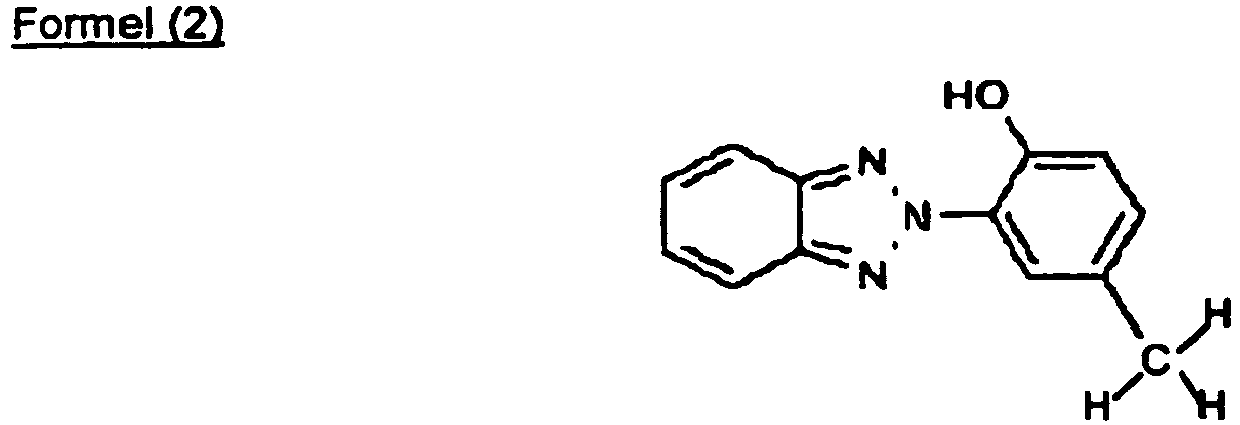
- 2-(2H-benzotriazol-2-yl)-p-cresol gemäß Formel (2), erhältlich als Tinuvin® der Firma CIBA Speciality Chemicals Inc., kann als alleiniger Sensibilisator oder in Kombination mit den in Absatz [0036] genannten Sensibilisatoren in der Aufzeichnungsschicht des erfindungsgemäßen Aufzeichnungsmaterials eingesetzt werden.
- In einer zweiten ebenfalls bevorzugten Ausführungsform gemäß dieses Absatzes und der nächstfolgenden Absätze [0030] bis [0032] und [0037] weist die wärmeempfindliche Aufzeichnungsschicht als Farbakzeptor zu mindestens 66 2/3 Gew.-% - bezogen auf den Gesamtanteil an Farbakzeptoren in der wärmeempfindlichen Aufzeichnungsschicht - 4,4'-Dihydroxydiphenylsulfon auf.
- 4,4'-Dihydroxydiphenylsulfon wird auch häufig als 4,4'-Sulfonyldiphenol bezeichnet und ist genauso unter der Handelsbezeichnung 4,4 Bisphenol S bekannt. 4,4'-Dihydroxydiphenylsulfon weist die chemische Summenformel C12H1004S auf und ist darstellbar als folgende Formel (3):

- Die wärmeempfindliche Aufzeichnungsschicht des erfindungsgemäßen wärmeempfindlichen Aufzeichnungsmaterials innerhalb dieser zweiten Ausführungsform kann neben 4,4'-Dihydroxydiphenylsulfon weitere Farbakzeptoren aufweisen, ausgesucht aus der Liste, umfassend
- 2,2 bis (4-hydroxyphenyl)-Propan - auch bekannt als Bisphenol A,
- 4-[(4-(1-methylethoxy)phenyl)sulfonyl]-Phenol - auch bekannt als D8 sowie
- Pergafast® 201.
- Bevorzugt sind die obigen Farbakzeptoren, einzeln oder auch untereinander kombiniert, zu maximal 10 Gew.-% - bezogen auf den Gesamtanteil an Farbakzeptoren in der wärmeempfindlichen Aufzeichnungsschicht - in dieser wärmeempfindlichen Aufzeichnungsschicht eingebunden, den Rest bildet 4,4'-Dihydroxydiphenylsulfon. Schließlich gilt eine Ausführungsform, bei der 4,4'-Dihydroxydiphenylsulfon einziger Farbakzeptor in der wärmeempfindlichen Aufzeichnungsschicht ist, als ganz besonders bevorzugt.
- Das wärmeempfindliche Aufzeichnungsmaterial weist als Farbstoffvorläufer in der wärmeempfindlichen Aufzeichnungsschicht bevorzugt mindestens eine Substanz aus, die ausgesucht ist aus der Liste, umfassend: 3-diethylamino-6-methyl-7-Anilinofluoran, 3-dibutylamino-6-methyl-7-Anilinofluoran, 3-(N-methyl-N-propyl)amino-6-methyl-7-Anilinofluoran, 3-(N-ethyl-N-isoamyl)amino-6-methyl-7-Anilinofluoran, 3-(N-methyl-N-cyclohexyl)amino-6-methyl-7-Anilinofluoran, 3-(N-ethyl)-N-tolyl)amino-6-methyl-7-Anilinofluoran und 3-(N-ethyl-N-tetrahydrofuryl)amino-6-methyl-7-Anilinofluoran. Ganz besonders bevorzugt ist dabei 3-dibutylamino-6-methyl-7-Anilinofluoran - auch bekannt als ODB-2.
- Es ist möglich, dass die wärmeempfindliche Aufzeichnungsschicht mehr als einen Farbstoffvorläufer aufweist, jeweils ausgesucht aus den im obigen Absatz aufgelisteten Farbstoffvorläufern. Das erfindungsgemäße Aufzeichnungsmaterial kann jedoch neben diesen als Farbstoffvorläufer angegebenen Substanzen weiterhin auch eine oder mehrere der folgenden, im nahen Infrarot-Bereich absorbierenden Verbindungen enthalten:
- 3,6-Bis(dimethylamino)fluoren-9-spiro-3'-(6'-dimethylaminophthalid), 3-Diethylamino-6-methylaminofluoren-9-spiro-3'-(6'-dimethylaminophthalid), 3,6-Bis(diethylamino)-fluoren-9-spiro-3'-(6'-dimethylaminophthalid), 3-Dibutylamino-6-dimethylaminofluoren-9-spiro-3'-(6'-dimethylaminophthalid), 3-Dibutylamino-6-diethylaminofluoren-9-spiro-3'-(6'-dimethylaminophthalid), 3,6-Bis(dimethylamino)fluoren-9-spiro-3'-(6'-diethylamino-phthalid), 3-Diethylamino-6-dimethylaminofluoren-9-spiro-3'-(6'-diethylaminophthalid), 3-Dibutylamino-6-dimethylaminofluoren-9-spiro-3'-(6'-diethylaminophthalid), 3,6-Bis-(diethylamino)fluoren-9-spiro-3'-(6'-diethylaminophthalid), 3,6-Bis-(dimethylamino)-fluoren-9-spiro-3'-(6'-dibutylaminophthalid), 3-Dibutylamino-6-di-ethylaminofluoren-9-spiro-3'-(6'-diethylaminophthalid), 3-Diethylamino-6-dimethylaminofluoren-9-spiro-3'-(6'-dibutylaminophthalid), 3,3-Bis[2-(4-dimethylamino-phenyl)-2-(4-methoxyphenyl)-ethenyl]-4,5,6,7-tetrachlorophthalid.
- Die Aufzeichnungsschicht des erfindungsgemäßen wärmeempfindlichen Aufzeichnungsmaterials kann zur Erhöhung der thermischen Ansprechempfindlichkeit bevorzugt auch Sensibilisatoren mit einem Schmelzpunkt idealerweise von 60°C bis 180°C, besonders bevorzugt mit einem Schmelzpunkt von 80°C bis 140°C, enthalten. Derartige Sensibilisatoren sind beispielsweise: Benzyl-p-benzyloxy-benzoat, Methylolstearamid, Stearinsäureamid, p-Benzylbiphenyl, 1,2-Di(phenoxy)-ethan, 1,2-Di(m-methylphenoxy)ethan, m-Terphenyl, Dibenzyloxalat, Benzylnaphthylether, Dimethylterephtalat und Diphenylsulfon, wobei Methylolstearamid, und insbesondere Stearinsäureamid und Dimethylterephtalat als ganz bevorzugt gelten.
- In zahlreichen Versuchen zur zweiten bevorzugten Ausführungsformbetreffend die wärmeempfindliche Aufzeichnungsschicht zeigte sich, dass ein auf die Gew.-% innerhalb der Aufzeichnungsschicht bezogenes Verhältnis
- Farbakzeptorgesamt : Sensibilisatorgesamt und insbesondere
- 4,4'-Dihydroxydiphenylsulfon : Sensibilisator, ausgesucht aus der Liste umfassend Methylolstearamid, Stearinsäureamid, und Dimethylterephtalat
- Geeignete Bindemittel zur Einbindung in die wärmeempfindliche Aufzeichnungsschicht sind beispielsweise wassertösliche Bindemittel wie Stärke, Hydroxyethylzellulose, Methylzellulose, Carboxymethylzellulose, Gelatine, Kasein, Polyvinylalkohole, modifizierte Polyvinylalkohole, Ethylen-Vinylalkohol-Coplymere, Natriumpolyacrylate, Acrylamid-Acrylat-Copolymere, Acrylamid-Acrylat-Methacrylat-Terpolymere sowie Alkalisalze von Styrol-Maleinsäureanhydrid-Copolymer oder Ethylen-Maleinsäureanhydrid-Copolymer, wobei die Bindemittel allein oder in Kombination untereinander eingesetzt werden können; auch wasserunlösliche Latexbinder wie Styrol-Butadiene-Copolymere, Acrylnitril-Butadien-Copolymere und Methyl-Acrylat-Butadien-Copolymere bieten sich als Bindemittel zur Einbindung in die wärmeempfindliche Aufzeichnungsschicht an. Im Sinne der vorliegenden Erfindung gelten Polyvinylalkohol, Ethylen-Vinylalkohol-Coplymere oder Polyvinylalkohol in Verbindung mit Ethylen-Vinylalkohol-Coplymeren als besonders bevorzugte Bindemittel, die zusammen, bezogen auf das Gesamtgewicht der Aufzeichnungsschicht, in einem Bereich von 10 bis 20 Gew.-% in die wärmeempfindliche Aufzeichnungsschicht eingebunden sind.
- Zur Vermeidung des Klebens an einem Thermokopf und zur Vermeidung einer übermäßigen Abnutzung des Thermokopfes kann die Beschichtungsmasse zur Ausbildung der wärmeempfindlichen Aufzeichnungsschicht - allgemein sowie innerhalb der ersten bevorzugten wie auch innerhalb der zweiten bevorzugten Ausführungsform bereffend die wärmeempfindliche Aufzeichnungsschicht - weiterhin Gleit- und Trennmittel enthalten wie Metallsalze höherer Fettsäuren, zum Beispiel Zinkstearat, Kalziumstearat sowie Wachse, wie zum Beispiel Paraffin, oxidiertes Paraffin, Polyethylen, Polyethylenoxid, Stearamide und Kastorwachs. Weitere Bestandteile der Aufzeichnungsschicht sind gegebenenfalls beispielsweise Pigmente, bevorzugt anorganische Pigmente wie beispielsweise Aluminium(hydr)oxid, Kieselsäure und Kalziumkarbonat, wobei hier insbesondere Kalziumkarbonat, das bevorzugt in einer Menge von 0 bis 28 Gew.-%, bezogen auf das Gesamtgewicht der Aufzeichnungsschicht, in die Aufzeichnungsschicht eingebunden sein soll, als bevorzugt gilt.
- Als Beschichtungsvorrichtung zum Auftrag der wärmeempfindlichen Aufzeichnungsschicht - allgemein sowie innerhalb der ersten bevorzugten wie auch innerhalb der zweiten bevorzugten Ausführungsform bereffend die wärmeempfindliche Aufzeichnungsschicht - bieten sich insbesondere Rollrakelstreichwerk, Messerstreichwerk, Vorhangbeschichter oder Luftbürste an. Entsprechend einer bevorzugten Ausführungsform ist die zur Ausbildung der Aufzeichnungsschicht genutzte Beschichtungsmasse wässerig. Die anschließende Trocknung der Beschichtungsmasse geschieht üblicherweise durch ein Verfahren, bei dem Wärme zugeführt wird, wie es durch Heißluft-Schwebetrockner oder auch Kontakttrockner geschieht. Bewährt ist auch eine Kombination aus den aufgeführten Trockenverfahren. Die flächenbezogene Masse der wärmeempfindlichen Aufzeichnungsschicht liegt bevorzugt zwischen 2 und 6 g/m2 und noch besser zwischen 2,2 und 4,8 g/m2.
- Erfindungsgemäß weist das erfindungsgemäße wärmeempfindliche Aufzeichnungsmaterial eine pigmenthaltige Zwischenschicht auf, welche zwischen Barrierebeschichtung und wärmeempfindlicher Aufzeichnungsschicht angeordnet ist.
- Als Pigmente der Zwischenschicht bieten sich sowohl organische Hohlraum-Pigmente wie auch anorganische Pigmente an, letztere bevorzugt ausgewählt aus der Gruppe, umfassend natürliches wie kalziniertes Kaolin, Siliziumoxid und hier besonders Bentonit, Kalziumkarbonat sowie Aluminiumhydroxid und hier besonders Böhmit. Eine solche Zwischenschicht kann zum einen einen positiven Beitrag zur Egalisierung der zu beschichtenden Oberfläche leisten, womit sich die Menge an notwendigerweise aufzubringender Streichfarbe für die wärmeempfindliche Aufzeichnungsschicht reduziert. Aus diesem Grund bieten sich zum Auftrag der pigmenthaltigen Zwischenschicht egalisierende Streichwerke an, wie beispielsweise Walzenstreichwerke, Streichmesser- und (Roll-)Rakelstreichwerke. Zum anderen können die Pigmente dieser Zwischenschicht die durch Hitzeeinwirkung verflüssigten Wachsbestandteile der wärmeempfindlichen Aufzeichnungsschicht bei der Schriftbildausbildung aufnehmen und begünstigen so eine sichere und schnelle Funktionsweise der wärmeinduzierten Auf zeichnung. Die flächenbezogene Masse der pigmenthaltigen Zwischenschicht liegt bevorzugt zwischen 5 und 20 g/m2 und noch besser zwischen 7 und 11 g/m2.
- Auch wenn nicht auf Papier als Substrat beschränkt, ist Papier das Substrat, die sich am Markt auch mit Blick auf die gute Umweltverträglichkeit wegen der guten Recyclingfähigkeit durchgesetzt hat und die im Sinne der Erfindung bevorzugt ist. Es ist aber möglich aufgrund der Anordnung der Barrierebeschichtung zwischen Substrat und wärmeempfindlicher Aufzeichnungsschicht, auch solche Substrate zu verwenden, die sich aufgrund ihrer Inhaltsstoffe und deren negativer Einflussnahme auf die wärmeempfindliche Aufzeichnungsschicht eher verbieten würden wie beispielsweise Folien oder Folien beschichtete Papiere, bei denen die jeweiligen Folien größere Mengen an Weichmachern enthalten, oder auch Papiere aus recycelten Fasern niedrigster Qualitäten.
- Die herausragende Beständigkeit des vorgeschlagenen wärmeempfindlichen Aufzeichnungsmaterials gegenüber organischen Lösungsmitteln ermöglicht die Ausbildung eines völlig neuartigen Authentifikationsmerkmals in Form eines unechten Wasserzeichens. In diesem Sinne und im Rahmen einer ganz bevorzugten Ausführungsvariante weist das vorgeschlagene wärmeempfindliche Aufzeichnungsmaterial eine rückseitig auf das Substrat in Form von mindestens einem Zeichen oder in Form eines Musters aufgetragene Beschichtung aus einer Tinktur auf, wobei die Tinktur mindestens ein organisches Lösungsmittel umfasst. Es ist auch möglich, dass die Tinktur eine Mischung aus mehreren organischen Lösungsmitteln umfasst. In einer bevorzugten Ausführungsform sind in der Tinktur auch weitere Bestandteile enthalten wie beispielsweise fluoreszierende Fasern und/oder Pigmente.
- Der Auftrag der Tinktur mit mindestens einem organischem Lösungsmittel auf das zur Ausbildung des Authentifikationsmerkmals aus Papier bestehende Substrat bewirkt eine Änderung der Opazität bzw. der Transparenz des Substrates an den mit der Tinktur benetzten Stellen im Vergleich zu den nicht benetzten Stellen des Substrates. Hält man das derart behandelte, hier vorgeschlagene wärmeempfindliche Aufzeichnungsmaterial gegen eine Lichtquelle, macht sich die Transparenzänderung in der Durchsicht scharfkantig als leicht zu erkennendes Bild oder Muster aus.
- Zum Auftrag der das Authentifikationsmerkmal ausbildenden Tinktur bieten sich insbesondere analoge Druckverfahren, wie beispielsweise das Flexo- und das Tiefdruckverfahren an. In einer ganz besonders bevorzugten Ausführungsform ist die Tinktur mittels digitaler Druckverfahren aufgebracht. Sofern der Auftrag der Tinktur digitaldrucktechnisch erfolgt, was als bevorzugt gilt und was unter anderem im Inkjet-Druckverfahren gegeben ist, wird die Ausbildung eines individuellen Authentifikationsmerkmals pro Einzelabschnitt des hier vorgeschlagenen wärmeempfindlichen Aufzeichnungsmaterials ermöglicht. Wird das hier vorgeschlagene wärmeempfindliche Aufzeichnungsmaterial als Ticket und/oder insbesondere als Eintrittskarte verwendet, kann jede einzelne Eintrittskarte mit einem individuellen Authentifikationsmerkmal versehen werden. Im Falle einer Eintrittskarte beispielsweise für ein Fußballspiel können Veranstalter, Veranstaltungsort, Veranstaltungszeit, gegeneinander antretende Fußballmannschaften, Verkaufsort und Verkaufszeit des Tickets und vielleicht noch eine fortlaufende Kontrollziffer als individuelles Authentifikationsmerkmal auf das hier vorgeschlagene wärmeempfindliche Aufzeichnungsmaterial ausgebildet werden. Die Verfälschung eines solchen Authentifikationsmerkmals ist schwierig und mit entsprechender Kontrolle am Veranstaltungsort aussichtslos.
- Entsprechend den obigen Ausführungen gilt es also als besonders bevorzugt, das hier vorgeschlagene wärmeempfindliche Aufzeichnungsmaterial als Ticket, ganz besonders bevorzugt, als Eintrittskarte zu verwenden.
- Die Erfindung soll anhand des nachfolgenden erfindungsgemäßen Beispiels 1 sowie der beiden Vergleichsbeispiele 2 und 3 weiter verdeutlicht werden:
- Zu diesem Zweck wird zunächst auf einer Langsieb-Papiermaschine als Substrat eine Papierbahn aus gebleichten und gemahlenen Laub- und Nadelholzzellstoffen mit einer flächenbezogenen Masse von 130 g/m2 unter Zusatz üblicher Zuschlagstoffe in üblichen Mengen hergestellt. Aus der Papierbahn werden 3 Musterrollen zur Weiterbehandlung geschnitten.
- Zur Ausbildung des einen erfindungsgemäßen Beispiels und der beiden vergleichenden Beispiele werden drei verschiedene Streichmassen für eine vorderseitige Beaufschlagung des jeweiligen Substrates der 3 Musterrollen mit jeweils einer Barrierebeschichtung vorbereitet:
- ■ Streichmasse BSI(für Beispiel 1) enthält zu 99,5 Gew.-% Ethylen-Vinyl-Alkohol-Copolymer (EVOH) , genauer Exceval HR 3010 (Kuraray), weitere Bestandteile von Streichmasse BS1 sind in erster Linie Entschäumer.
- ■ Streichmasse BS2(für Vergleichsbeispiel 2) enthält zu 99,5 Gew.-% üblichen Polyvinylalkohol, genauer Gohsenol NM 11 (Nippon Gohsei), weitere Bestandteile von Streichmasse BS2 sind in erster Linie Entschäumer.
- ■ Streichmasse BS3(für Vergleichsbeispiel 3) enthält zu 99,5 Gew.-% silanisierten Polyvinylalkohol, genauer R 1130 (Kuraray), weitere Bestandteile von Streichmasse BS3 sind in erster Linie Entschäumer.
- Die drei Streichmassen werden zum beabsichtigten Auftrag mittels Luftbürste auf einen Feststoffgehalt von 12 % mit Wasser verdünnt. Anschließend werden die jeweiligen Viskositäten der Streichmassen nach Brookfield (Spindel 3 / 100 rpm / 23 °C) bestimmt, es ergeben sich die Messwerte:
- ■ Streichmasse BS1: 750,
- ■ Streichmasse BS2: 690,
- ■ Streichmasse BS3: 2780 (Fraktionsbildung, kein sauberes Verstreichen möglich).
- Zur Ausbildung des erfindungsgemäßen Beispiels 1 sowie der beiden Vergleichsbeispiele 2 und 3 werden die drei Streichmassen nunmehr vorderseitig mittels Luftbürste auf das jeweilige Substrat der 3 Musterrollen mit einer jeweiligen flächenbezogenen Masse von 2,8 g/m2 aufgetragen.
- Auf die getrocknete Barrierebeschichtung wird jeweils bei allen 3 Musterrollen innerhalb von einem Durchgang durch die zur Anwendung kommenden Mehrkopf-Streichmaschine
- mittels Rollrakel-Streichwerk eine hauptsächlich kalziniertes Kaolin und organische Hohlraum-Pigmente als Pigmentmischung, Styrolbutadienlatex als Bindemittel und Stärke als Cobinder aufweisende Zwischenschicht von 8 g/m2 und anschließend
- mittels Rollrakel-Streicheinrichtung eine wärmeempfindliche Aufzeichnungsschicht mit einer flächenbezogenen Masse von 4,2 g/m2
- Die für die wärmeempfindliche Aufzeichnungsschicht zum Einsatz kommende Streichmasse enthält im wesentlichen die folgenden Komponenten:
Farbstoffvorläufer: 3-dibutylamino-6-methyl-7 Anilinofluoran, das ist ODB-2; Farbakzeptor: N-(p-toluensulphonyl)-N'-3-(p-toluensulphonyl-Oxy-phenyl) harnstoff, das ist Pergafast® 201; Sensibilisator: Benzylnaphthylether, das ist BNE; Bindemittel: Polyvinylalkohol; Cobinder: Acrylat-Copolymer; Pigment: Kalziumkarbonat. - Auf die wärmeempfindliche Aufzeichnungsschicht wird schließlich mittels Luftbürste jeweils bei allen 3 Musterrollen eine Schutzschicht von 2,0 g/m2 aufgetragen. Dafür kommt eine Streichmasse zum Einsatz, die im wesentlichen die folgenden Komponenten enthält:
Bindemittel: Diaceton-modifizierter Polyvinylalkohol; 61,3 Gew.-% (atro) Vernetzer: Adipinsäuredihydrazid; 6,0 Ges.-% (atro) Pigment: Kaolin; 16,6 Ges.-% (atro) Gleitmittel: Hidorin Z-7-30; 8,1 Gew.-% (atro) Hilfsmittel: pH-Regler, optische Aufheller; 8,0 Gew.-% (atro) - Bei allen 3 Musterrollen soll alsdann die erwünschte Sperrwirkung der Barriereschicht gegenüber organischen Lösemitteln untersucht werden. Zu diesem Zweck wird auf die jeweilige Rückseite von Probestreifen aus den 3 Musterrollen entsprechend des erfindungsgemäßen Beispiels 1 sowie der beiden Vergleichsbeispiele 2 und 3 mit einer Pipette 0,5 ml Ethanol aufgegeben. Nach einer jeweiligen Einwirkzeit von 10 Minuten ist das Ethanol vollständig aufgesaugt. Die Auswirkung des Lösemittelauftrags auf die wärmeempfindliche Aufzeichnungsschicht wird visuell beurteilt.
- Die wärmeempfindliche Aufzeichnungsschicht des erfindungsgemäßen Beispiels 1 zeigt überhaupt keine Thermoreaktionen, die vorliegende Erfindung wird hinsichtlich ihrer Güte hervorragend bestätigt. Bei dem Vergleichsbeispiel 2 zeigt sich eine intensive Thermoreaktionen, diese Barrierebeschichtung ist überhaupt nicht geeignet, eine weitreichende Schutzwirkung gegenüber organischen Lösemitteln aus Richtung des Substrates über eine längere Einwirkzeit zu entfalten. Bei dem Vergleichsbeispiel 3 ergeben sich vereinzelte Farbreaktionspunkte auf der wärmeempfindlichen Aufzeichnungsschicht: unterhalb dieser farbigen Punkte weist die Barrierebeschichtung aus der Streichmasse BS3 Risse und Fehlstellen infolge der zu hohen Viskosität des silanisierten Polyvinylalkohols auf. Auch hier ist die Barrierewirkung gegenüber organischen Lösemitteln nicht überzeugend, weil nicht ohne Fehlstellen.
- Damit kann die schließlich seitens der Erfinder erwartete Überlegenheit des vorgeschlagenen wärmeempfindlichen Aufzeichnungsmaterials bestätigt werden.
ganz besonders bevorzugt in einem Bereich von 1 : 0,8 bis 1 : 1,4, liegt.
Claims (15)
- Wärmeempfindliches Aufzeichnungsmaterial, mindestens aufweisend:o ein Substrat,o eine auf der Vorderseite des Substrates angeordnete wärmeempfindliche Aufzeichnungsschicht mit mindestens einem Farbstoffvorläufer und mindestens einem Farbakzeptor, wobei Farbstoffvorläufer und Farbakzeptor unter Einwirkung von Wärme farbbildend miteinander reagieren,o eine zwischen Substrat und wärmeempfindlicher Aufzeichnungsschicht angeordnete, Ethylen-Vinyl-Alkohol-Copolymer (EVOH) enthaltende Barrierebeschichtung, geeignet zum Schutz der wärmeempfindlichen Aufzeichnungsschicht vor einem Eindringen von unkontrollierte Desensibilisierungs- und Farbreaktionen in der wärmeempfindlichen Aufzeichnungsschicht bewirkenden Chemikalien,ferner eine pigmenthaltige Zwischenschicht, welche zwischen Barrierebeschichtung und wärmeempfindlicher Aufzeichnungsschicht angeordnet ist,
dadurch gekennzeichnet, dass■ die wärmeempfindliche Aufzeichnungsschicht durch eine Schutzschicht abgedeckt ist, welche als Bindemittel zu mindestens 60 Gew.-% - bezogen auf den Gesamtanteil an Bindemittel in der Schutzschicht - Diaceton-modifizierten Polyvinylalkohol aufweist. - Wärmeempfindliches Aufzeichnungsmaterial nach Patentanspruch 1, dadurch gekennzeichnet, dass die Barrierebeschichtung zu mindestens 90 Gew.-% - bezogen auf das Gesamtgewicht der Barrierebeschichtung - das Ethylen-Vinyl-Alkohol-Copolymer (EVOH) enthält
- Wärmeempfindliches Aufzeichnungsmaterial nach Patentanspruch 1, dadurch gekennzeichnet, dass die Barrierebeschichtung zu mindestens 98 Gew.-% - bezogen auf das Gesamtgewicht der Barrierebeschichtung - das Ethylen-Vinyl-Alkohol-Copolymer (EVOH) enthält
- Wärmeempfindliches Aufzeichnungsmaterial nach einem der Patentansprüche 1 bis 3, dadurch gekennzeichnet, dass die Schutzschicht als Bindemittel ausschließlich Diaceton-modifizierten Polyvinylalkohol aufweist.
- Wärmeempfindliches Aufzeichnungsmaterial nach einem der Patentansprüche 1 bis 4, dadurch gekennzeichnet, dass die Schutzschicht ein Vernetzungshilfsmittel enthält, ausgewählt aus der Gruppe, umfassend: Borsäure, Polyamin, Epoxyharz, Dialdehyd, Formaldehydoligomere, Epiochlorhydrinharz, Adipinsäuredihydrazid, Dimethylharnstoff, Melaminformaldehyd.
- Wärmeempfindliches Aufzeichnungsmaterial nach Patentanspruch 5, dadurch gekennzeichnet, dass das auf Gew.-% bezogene Verhältnis von dem Diacetonmodifiziertem Polyvinylalkohol zu dem Vernetzungshilfsmittel in einem Bereich von 20 : 1 bis 5 : 1 und besonders bevorzugt in einem Bereich von 12 : 1 bis 7 : 1 liegt.
- Wärmeempfindliches Aufzeichnungsmaterial nach einem der Patentansprüche 1 bis 6, dadurch gekennzeichnet, dass die Schutzschicht ein anorganisches Pigment enthält, bevorzugt ausgesucht aus der Liste, umfassend: Siliziumdioxid, Aluminiumhydroxid, Bentonit, Kalziumkarbonat, Kaolin oder eine Mischung aus den genannten anorganischen Pigmenten.
- Wärmeempfindliches Aufzeichnungsmaterial nach einem der Patentansprüche 1 bis 7, dadurch gekennzeichnet, dass die wärmeempfindliche Aufzeichnungsschicht als Farbakzeptor mindestens eine Substanz enthält, ausgesucht aus der Liste, umfassend:■ 2,2 bis (4-hydroxyphenyl)-propan,■ 4-[(4-(1-methylethoxy)phenyl)sulfonyl]phenol,■ 4,4'-Dihydroxydiphenylsulfon,■ N-(p-toluensulphonyl)-N'-(3-p-toluensulphonyl-oxy-phenyl)-harnstoff,■ 2,4'-dihydroxy-diphenylsulfon,■ N-(2-hydroxyphenyl)-2-[(4-hydroxyphenyl)thio]acetamid,
- Wärmeempfindliches Aufzeichnungsmaterial nach einem der Patentansprüche 1 bis 7, dadurch gekennzeichnet, dass die wärmeempfindliche Aufzeichnungsschicht 4,4'-Dihydroxydiphenylsulfon als einzigen Farbakzeptor aufweist.
- Wärmeempfindliches Aufzeichnungsmaterial nach einem der Patentansprüche 1 bis 7, dadurch gekennzeichnet dass die wärmeempfindliche Aufzeichnungsschicht N-(p-toluensulphonyl)-N'-3-(p-toluensulphonyl-Oxy-phenyl)-harnstoff als einzigen Farbakzeptor aufweist.
- Wärmeempfindliches Aufzeichnungsmaterial nach einem der Patentansprüche 1 bis 10, dadurch gekennzeichnet, dass die wärmeempfindliche Aufzeichnungsschicht als Farbstoffvorläufer mindestens eine Substanz aufweist, die ausgesucht ist aus der Liste, umfassend: 3-diethylamino-6-methyl-7-Anilinofluoran, 3-dibutylamino-6-methyl-7-Anilinofluoran, 3-(N-methyl-N-propyl)amino-6-methyl-7-Anilinofluoran, 3-(N-ethyl-N-isoamyl)amino-6-methyl-7-Anilinofluoran, 3-(N-methyl-N-cyclohexyl)amino-6-methyl-7-Anilinofluoran, 3-(N-ethyl-N-tolyl)amino-6-methyl-7-Anilinofluoran und 3-(N-ethyl-N-tetrahydrofuryl)amino-6-methyl-7-Anilinofluoran.
- Wärmeempfindliches Aufzeichnungsmaterial nach einem der Patentansprüche 1 bis 11, dadurch gekennzeichnet, dass die wärmeempfindliche Aufzeichnungsschicht mindestens einen Sensibilisator aufweist, ausgesucht aus der Liste umfassend Methylolstearamid, Stearinsäureamid und Dimethylterephtatat.
- Wärmeempfindliches Aufzeichnungsmaterial nach Patentanspruch 9, dadurch gekennzeichnet, dass ein auf die Gew.-% innerhalb der Aufzeichnungsschicht bezogenes Verhältnis 4,4'-Dihydroxydiphenylsulfon : Sensibilisator, ausgesucht aus der Liste umfassend: Methylolstearamid, Stearinsäureamid und Dimethylterephtalat, in einem Bereich von 1 : 0,5 bis 1 : 2 liegt.
- Wärmeempfindliches Aufzeichnungsmaterial nach einem der Patentansprüche 1 bis 13, dadurch gekennzeichnet, dass die wärmeempfindliche Aufzeichnungsschicht als Bindemittel eine Substanz enthält, ausgesucht aus die Liste, umfassend: Polyvinylalkohol, Ethylen-Vinylalkohol-Coplymer oder eine Kombination aus Polyvinylalkohol und Ethylen-Vinylalkohol-Coplymer.
- Wärmeempfindliches Aufzeichnungsmaterial nach einem der Patentansprüche 1 bis 14, dadurch gekennzeichnet, dass das Aufzeichnungsmaterial ein Authentifikationsmerkmal aufweist, wobei das Authentifikationsmerkmal ausgebildet ist als rückseitiger Auftrag einer mindestens ein organisches Lösungsmittel umfassenden Tinktur auf das Substrat.
Priority Applications (4)
| Application Number | Priority Date | Filing Date | Title |
|---|---|---|---|
| ES09177678T ES2394407T3 (es) | 2009-12-01 | 2009-12-01 | Material de registro termosensible con revestimiento de barrera |
| EP20090177678 EP2329959B1 (de) | 2009-12-01 | 2009-12-01 | Wärmeempfindliches Aufzeichnungsmaterial mit Barrierebeschichtung |
| PCT/EP2010/063412 WO2011067004A1 (de) | 2009-12-01 | 2010-09-13 | Wärmeempfindliches aufzeichnungsmaterial mit barrierebeschichtung |
| US13/512,979 US9050844B2 (en) | 2009-12-01 | 2010-09-13 | Heat-sensitive recording material with barrier coating |
Applications Claiming Priority (1)
| Application Number | Priority Date | Filing Date | Title |
|---|---|---|---|
| EP20090177678 EP2329959B1 (de) | 2009-12-01 | 2009-12-01 | Wärmeempfindliches Aufzeichnungsmaterial mit Barrierebeschichtung |
Publications (2)
| Publication Number | Publication Date |
|---|---|
| EP2329959A1 EP2329959A1 (de) | 2011-06-08 |
| EP2329959B1 true EP2329959B1 (de) | 2012-08-29 |
Family
ID=42173647
Family Applications (1)
| Application Number | Title | Priority Date | Filing Date |
|---|---|---|---|
| EP20090177678 Not-in-force EP2329959B1 (de) | 2009-12-01 | 2009-12-01 | Wärmeempfindliches Aufzeichnungsmaterial mit Barrierebeschichtung |
Country Status (4)
| Country | Link |
|---|---|
| US (1) | US9050844B2 (de) |
| EP (1) | EP2329959B1 (de) |
| ES (1) | ES2394407T3 (de) |
| WO (1) | WO2011067004A1 (de) |
Families Citing this family (7)
| Publication number | Priority date | Publication date | Assignee | Title |
|---|---|---|---|---|
| DE102015014036A1 (de) * | 2015-10-30 | 2017-05-04 | Giesecke & Devrient Gmbh | Sicherheitselement |
| US10653135B2 (en) * | 2016-07-11 | 2020-05-19 | Covestro Llc | Methods for treating seeds with an aqueous composition and seeds treated therewith |
| US10653136B2 (en) * | 2016-07-11 | 2020-05-19 | Covestro Llc | Aqueous compositions for treating seeds, seeds treated therewith, and methods for treating seeds |
| PL3625058T3 (pl) * | 2017-05-19 | 2024-11-25 | Mitsubishi Hitec Paper Europe Gmbh | Kompozyt warstwowy obejmujący warstwę nośną i warstwę uszlachetniającą i sposób jego wytwarzania |
| JP6865656B2 (ja) * | 2017-08-31 | 2021-04-28 | 三光株式会社 | 感熱記録材料 |
| DE102018101109A1 (de) * | 2018-01-18 | 2019-07-18 | Mitsubishi Hitec Paper Europe Gmbh | Wärmeempfindliches Aufzeichnungsmaterial umfassend eine Mehrzahl von Submikrometerpartikeln mit monomodaler Partikelgrößenverteilung |
| CN111778773A (zh) * | 2020-05-26 | 2020-10-16 | 湖南天琪智慧印刷有限公司 | 具有高保留率和防乙醇性能的热敏纸及其制作方法 |
Family Cites Families (11)
| Publication number | Priority date | Publication date | Assignee | Title |
|---|---|---|---|---|
| JP3501430B2 (ja) | 1994-09-29 | 2004-03-02 | 株式会社リコー | 可逆的熱発色性組成物及びそれを用いた記録媒体 |
| JPH1024657A (ja) | 1996-05-10 | 1998-01-27 | Mitsubishi Paper Mills Ltd | 感熱記録材料およびその製造方法 |
| EP0844097B1 (de) | 1996-11-21 | 2001-07-18 | Ncr International Inc. | Wärmeempfindliches Papier mit Sicherheitsmerkmalen und Sicherheitstinte dafür |
| ATE197574T1 (de) | 1997-09-12 | 2000-12-15 | Mitsubishi Hitec Paper Flensbu | Wärmeempfindlicher aufzeichnungsbogen mit einer rückseitenbeschichtung die stärke, ein acrylatcopolymer und einen alkalischen katalysator enthält |
| ES2204065T3 (es) * | 1998-02-02 | 2004-04-16 | Ncr International Inc. | Material de registro termosensible. |
| JPH11286174A (ja) | 1998-04-02 | 1999-10-19 | Fuji Photo Film Co Ltd | 感熱記録材料 |
| DE19842866A1 (de) * | 1998-09-19 | 2000-03-30 | Stora Spezialpapiere Gmbh | Wärmeempfindliches Aufzeichnungsmaterial mit Sicherheitsmerkmal |
| FR2828897B1 (fr) * | 2001-08-21 | 2004-01-23 | Danel | Article d'imprimerie filigrane, en particulier pour imprimante thermique |
| ES2265300B1 (es) | 2006-07-17 | 2008-02-01 | Antonio Oliva Gurgui | "derivados de poliuretanos y usos correspondientes y procedimientos de fabricacion de marcas al agua". |
| ES2294965B1 (es) | 2007-05-07 | 2009-04-16 | Antonio Oliva Gurgui | "derivados de uretanos y oligouretanos y usos correspondientes y procedimientos de fabricacion de marcas al agua mediante la tecnica de impresion offset". |
| EP2033802B1 (de) | 2007-09-10 | 2010-02-24 | Mitsubishi HiTec Paper Flensburg GmbH | Wärmeempfindliches Aufzeichnungsmaterial mit Rückseitenbeschichtung |
-
2009
- 2009-12-01 EP EP20090177678 patent/EP2329959B1/de not_active Not-in-force
- 2009-12-01 ES ES09177678T patent/ES2394407T3/es active Active
-
2010
- 2010-09-13 WO PCT/EP2010/063412 patent/WO2011067004A1/de not_active Ceased
- 2010-09-13 US US13/512,979 patent/US9050844B2/en active Active
Also Published As
| Publication number | Publication date |
|---|---|
| US20140274681A1 (en) | 2014-09-18 |
| ES2394407T3 (es) | 2013-01-31 |
| WO2011067004A1 (de) | 2011-06-09 |
| EP2329959A1 (de) | 2011-06-08 |
| US9050844B2 (en) | 2015-06-09 |
Similar Documents
| Publication | Publication Date | Title |
|---|---|---|
| EP2033799B1 (de) | Wärmeempfindliches Aufzeichnungsmaterial | |
| EP2329959A1 (de) | Wärmeempfindliches Aufzeichnungsmaterial mit Barrierebeschichtung | |
| EP3305538A1 (de) | Wärmeempfindliches aufzeichnungsmaterial | |
| DE202020005616U1 (de) | Wärmeempfindliches Aufzeichnungsmaterial, umfassend phenolfreie organische Farbentwickler | |
| EP2574645B1 (de) | Mit einem Farbstoffvorläufer farbbildend reagierender Farbakzeptor und wärmeempfindliches Aufzeichnungsmaterial mit einem solchen Farbakzeptor | |
| EP2910384B1 (de) | Wärmeempfindliches Aufzeichnungsmaterial mit einer neuartigen Farbakzeptor-Kombination | |
| EP2279877B1 (de) | Wärmeempfindliches Aufzeichnungsmaterial | |
| DE60032686T2 (de) | Wärmeempfindliches aufzeichnungsmaterial | |
| EP2979888B1 (de) | Wärmeempfindliches Aufzeichnungsmaterial mit Salicylsäure-Derivat als mit einem Farbstoffvorläufer reaktionsfähiger (Farb-)Entwickler | |
| EP2953797B1 (de) | Wärmeempfindliches aufzeichnungsmaterial | |
| EP2329955B1 (de) | Wärmeempfindliches Aufzeichnungsmaterial mit Authentizitätsmerkmal | |
| EP2112000B1 (de) | Wärmeempfindliches Aufzeichnungsmaterial | |
| EP2033802B1 (de) | Wärmeempfindliches Aufzeichnungsmaterial mit Rückseitenbeschichtung | |
| EP2033800B1 (de) | Wärmeempfindliches Aufzeichnungsmaterial | |
| DE102018101109A1 (de) | Wärmeempfindliches Aufzeichnungsmaterial umfassend eine Mehrzahl von Submikrometerpartikeln mit monomodaler Partikelgrößenverteilung | |
| EP2329958B1 (de) | Wärmeempfindliches Aufzeichnungsmaterial mit Rückseitenbeschichtung | |
| EP2070714B1 (de) | Verfahren zur Herstellung eines wärmeempfindlichen Aufzeichnungsmaterials | |
| EP2758249B1 (de) | Aufzeichnungsmaterial zur offset-bedruckung | |
| EP2765007A1 (de) | Wärmeempfindliches Aufzeichnungsmaterial | |
| DE102006050420B3 (de) | Wärmeempfindliches Aufzeichnungsmaterial | |
| EP2480415B1 (de) | Wärmeempfindliches aufzeichnungsmaterial mit rückseitenbeschichtung | |
| DE102005050418A1 (de) | Wärmeempfindliches Aufzeichnungsmaterial | |
| EP2414173B1 (de) | Wärmeempfindliches aufzeichnungsmaterial | |
| EP2505374A1 (de) | Wärmeempfindliches Aufzeichnungsmaterial, seine Verwendung und Verfahren zu seiner Herstellung | |
| EP1925459A2 (de) | Wärmeempfindliches Aufzeichnungsmaterial mit Authentifikationsmerkmal |
Legal Events
| Date | Code | Title | Description |
|---|---|---|---|
| PUAI | Public reference made under article 153(3) epc to a published international application that has entered the european phase |
Free format text: ORIGINAL CODE: 0009012 |
|
| AK | Designated contracting states |
Kind code of ref document: A1 Designated state(s): AT BE BG CH CY CZ DE DK EE ES FI FR GB GR HR HU IE IS IT LI LT LU LV MC MK MT NL NO PL PT RO SE SI SK SM TR |
|
| AX | Request for extension of the european patent |
Extension state: AL BA RS |
|
| 17P | Request for examination filed |
Effective date: 20111208 |
|
| RAP1 | Party data changed (applicant data changed or rights of an application transferred) |
Owner name: MITSUBISHI HITEC PAPER EUROPE GMBH |
|
| GRAP | Despatch of communication of intention to grant a patent |
Free format text: ORIGINAL CODE: EPIDOSNIGR1 |
|
| GRAS | Grant fee paid |
Free format text: ORIGINAL CODE: EPIDOSNIGR3 |
|
| GRAA | (expected) grant |
Free format text: ORIGINAL CODE: 0009210 |
|
| AK | Designated contracting states |
Kind code of ref document: B1 Designated state(s): AT BE BG CH CY CZ DE DK EE ES FI FR GB GR HR HU IE IS IT LI LT LU LV MC MK MT NL NO PL PT RO SE SI SK SM TR |
|
| REG | Reference to a national code |
Ref country code: GB Ref legal event code: FG4D Free format text: NOT ENGLISH |
|
| REG | Reference to a national code |
Ref country code: CH Ref legal event code: EP |
|
| REG | Reference to a national code |
Ref country code: AT Ref legal event code: REF Ref document number: 572850 Country of ref document: AT Kind code of ref document: T Effective date: 20120915 |
|
| REG | Reference to a national code |
Ref country code: IE Ref legal event code: FG4D Free format text: LANGUAGE OF EP DOCUMENT: GERMAN |
|
| REG | Reference to a national code |
Ref country code: DE Ref legal event code: R096 Ref document number: 502009004526 Country of ref document: DE Effective date: 20121025 |
|
| REG | Reference to a national code |
Ref country code: NL Ref legal event code: T3 |
|
| REG | Reference to a national code |
Ref country code: LT Ref legal event code: MG4D Effective date: 20120829 |
|
| PG25 | Lapsed in a contracting state [announced via postgrant information from national office to epo] |
Ref country code: HR Free format text: LAPSE BECAUSE OF FAILURE TO SUBMIT A TRANSLATION OF THE DESCRIPTION OR TO PAY THE FEE WITHIN THE PRESCRIBED TIME-LIMIT Effective date: 20120829 Ref country code: FI Free format text: LAPSE BECAUSE OF FAILURE TO SUBMIT A TRANSLATION OF THE DESCRIPTION OR TO PAY THE FEE WITHIN THE PRESCRIBED TIME-LIMIT Effective date: 20120829 Ref country code: NO Free format text: LAPSE BECAUSE OF FAILURE TO SUBMIT A TRANSLATION OF THE DESCRIPTION OR TO PAY THE FEE WITHIN THE PRESCRIBED TIME-LIMIT Effective date: 20121129 Ref country code: LT Free format text: LAPSE BECAUSE OF FAILURE TO SUBMIT A TRANSLATION OF THE DESCRIPTION OR TO PAY THE FEE WITHIN THE PRESCRIBED TIME-LIMIT Effective date: 20120829 Ref country code: IS Free format text: LAPSE BECAUSE OF FAILURE TO SUBMIT A TRANSLATION OF THE DESCRIPTION OR TO PAY THE FEE WITHIN THE PRESCRIBED TIME-LIMIT Effective date: 20121229 |
|
| REG | Reference to a national code |
Ref country code: ES Ref legal event code: FG2A Ref document number: 2394407 Country of ref document: ES Kind code of ref document: T3 Effective date: 20130131 |
|
| PG25 | Lapsed in a contracting state [announced via postgrant information from national office to epo] |
Ref country code: PT Free format text: LAPSE BECAUSE OF FAILURE TO SUBMIT A TRANSLATION OF THE DESCRIPTION OR TO PAY THE FEE WITHIN THE PRESCRIBED TIME-LIMIT Effective date: 20121231 Ref country code: LV Free format text: LAPSE BECAUSE OF FAILURE TO SUBMIT A TRANSLATION OF THE DESCRIPTION OR TO PAY THE FEE WITHIN THE PRESCRIBED TIME-LIMIT Effective date: 20120829 Ref country code: SI Free format text: LAPSE BECAUSE OF FAILURE TO SUBMIT A TRANSLATION OF THE DESCRIPTION OR TO PAY THE FEE WITHIN THE PRESCRIBED TIME-LIMIT Effective date: 20120829 Ref country code: GR Free format text: LAPSE BECAUSE OF FAILURE TO SUBMIT A TRANSLATION OF THE DESCRIPTION OR TO PAY THE FEE WITHIN THE PRESCRIBED TIME-LIMIT Effective date: 20121130 Ref country code: SE Free format text: LAPSE BECAUSE OF FAILURE TO SUBMIT A TRANSLATION OF THE DESCRIPTION OR TO PAY THE FEE WITHIN THE PRESCRIBED TIME-LIMIT Effective date: 20120829 |
|
| PG25 | Lapsed in a contracting state [announced via postgrant information from national office to epo] |
Ref country code: EE Free format text: LAPSE BECAUSE OF FAILURE TO SUBMIT A TRANSLATION OF THE DESCRIPTION OR TO PAY THE FEE WITHIN THE PRESCRIBED TIME-LIMIT Effective date: 20120829 Ref country code: CZ Free format text: LAPSE BECAUSE OF FAILURE TO SUBMIT A TRANSLATION OF THE DESCRIPTION OR TO PAY THE FEE WITHIN THE PRESCRIBED TIME-LIMIT Effective date: 20120829 Ref country code: RO Free format text: LAPSE BECAUSE OF FAILURE TO SUBMIT A TRANSLATION OF THE DESCRIPTION OR TO PAY THE FEE WITHIN THE PRESCRIBED TIME-LIMIT Effective date: 20120829 Ref country code: DK Free format text: LAPSE BECAUSE OF FAILURE TO SUBMIT A TRANSLATION OF THE DESCRIPTION OR TO PAY THE FEE WITHIN THE PRESCRIBED TIME-LIMIT Effective date: 20120829 |
|
| PG25 | Lapsed in a contracting state [announced via postgrant information from national office to epo] |
Ref country code: SK Free format text: LAPSE BECAUSE OF FAILURE TO SUBMIT A TRANSLATION OF THE DESCRIPTION OR TO PAY THE FEE WITHIN THE PRESCRIBED TIME-LIMIT Effective date: 20120829 Ref country code: PL Free format text: LAPSE BECAUSE OF FAILURE TO SUBMIT A TRANSLATION OF THE DESCRIPTION OR TO PAY THE FEE WITHIN THE PRESCRIBED TIME-LIMIT Effective date: 20120829 |
|
| BERE | Be: lapsed |
Owner name: MITSUBISHI HITEC PAPER EUROPE G.M.B.H. Effective date: 20121231 |
|
| PLBE | No opposition filed within time limit |
Free format text: ORIGINAL CODE: 0009261 |
|
| STAA | Information on the status of an ep patent application or granted ep patent |
Free format text: STATUS: NO OPPOSITION FILED WITHIN TIME LIMIT |
|
| PG25 | Lapsed in a contracting state [announced via postgrant information from national office to epo] |
Ref country code: BG Free format text: LAPSE BECAUSE OF FAILURE TO SUBMIT A TRANSLATION OF THE DESCRIPTION OR TO PAY THE FEE WITHIN THE PRESCRIBED TIME-LIMIT Effective date: 20121129 Ref country code: MC Free format text: LAPSE BECAUSE OF NON-PAYMENT OF DUE FEES Effective date: 20121231 |
|
| 26N | No opposition filed |
Effective date: 20130530 |
|
| REG | Reference to a national code |
Ref country code: IE Ref legal event code: MM4A |
|
| REG | Reference to a national code |
Ref country code: DE Ref legal event code: R097 Ref document number: 502009004526 Country of ref document: DE Effective date: 20130530 |
|
| PG25 | Lapsed in a contracting state [announced via postgrant information from national office to epo] |
Ref country code: BE Free format text: LAPSE BECAUSE OF NON-PAYMENT OF DUE FEES Effective date: 20121231 |
|
| PG25 | Lapsed in a contracting state [announced via postgrant information from national office to epo] |
Ref country code: IE Free format text: LAPSE BECAUSE OF NON-PAYMENT OF DUE FEES Effective date: 20121201 |
|
| PG25 | Lapsed in a contracting state [announced via postgrant information from national office to epo] |
Ref country code: MT Free format text: LAPSE BECAUSE OF FAILURE TO SUBMIT A TRANSLATION OF THE DESCRIPTION OR TO PAY THE FEE WITHIN THE PRESCRIBED TIME-LIMIT Effective date: 20120829 Ref country code: CY Free format text: LAPSE BECAUSE OF FAILURE TO SUBMIT A TRANSLATION OF THE DESCRIPTION OR TO PAY THE FEE WITHIN THE PRESCRIBED TIME-LIMIT Effective date: 20120829 |
|
| PG25 | Lapsed in a contracting state [announced via postgrant information from national office to epo] |
Ref country code: TR Free format text: LAPSE BECAUSE OF FAILURE TO SUBMIT A TRANSLATION OF THE DESCRIPTION OR TO PAY THE FEE WITHIN THE PRESCRIBED TIME-LIMIT Effective date: 20120829 |
|
| PG25 | Lapsed in a contracting state [announced via postgrant information from national office to epo] |
Ref country code: LU Free format text: LAPSE BECAUSE OF NON-PAYMENT OF DUE FEES Effective date: 20121201 Ref country code: SM Free format text: LAPSE BECAUSE OF FAILURE TO SUBMIT A TRANSLATION OF THE DESCRIPTION OR TO PAY THE FEE WITHIN THE PRESCRIBED TIME-LIMIT Effective date: 20120829 |
|
| PG25 | Lapsed in a contracting state [announced via postgrant information from national office to epo] |
Ref country code: HU Free format text: LAPSE BECAUSE OF FAILURE TO SUBMIT A TRANSLATION OF THE DESCRIPTION OR TO PAY THE FEE WITHIN THE PRESCRIBED TIME-LIMIT Effective date: 20091201 |
|
| REG | Reference to a national code |
Ref country code: CH Ref legal event code: PL |
|
| PG25 | Lapsed in a contracting state [announced via postgrant information from national office to epo] |
Ref country code: LI Free format text: LAPSE BECAUSE OF NON-PAYMENT OF DUE FEES Effective date: 20131231 Ref country code: CH Free format text: LAPSE BECAUSE OF NON-PAYMENT OF DUE FEES Effective date: 20131231 |
|
| PG25 | Lapsed in a contracting state [announced via postgrant information from national office to epo] |
Ref country code: MK Free format text: LAPSE BECAUSE OF FAILURE TO SUBMIT A TRANSLATION OF THE DESCRIPTION OR TO PAY THE FEE WITHIN THE PRESCRIBED TIME-LIMIT Effective date: 20120829 |
|
| REG | Reference to a national code |
Ref country code: FR Ref legal event code: PLFP Year of fee payment: 7 |
|
| REG | Reference to a national code |
Ref country code: AT Ref legal event code: MM01 Ref document number: 572850 Country of ref document: AT Kind code of ref document: T Effective date: 20141201 |
|
| PG25 | Lapsed in a contracting state [announced via postgrant information from national office to epo] |
Ref country code: AT Free format text: LAPSE BECAUSE OF NON-PAYMENT OF DUE FEES Effective date: 20141201 |
|
| REG | Reference to a national code |
Ref country code: FR Ref legal event code: PLFP Year of fee payment: 8 |
|
| REG | Reference to a national code |
Ref country code: FR Ref legal event code: PLFP Year of fee payment: 9 |
|
| PGFP | Annual fee paid to national office [announced via postgrant information from national office to epo] |
Ref country code: GB Payment date: 20201227 Year of fee payment: 12 Ref country code: FR Payment date: 20201228 Year of fee payment: 12 |
|
| PGFP | Annual fee paid to national office [announced via postgrant information from national office to epo] |
Ref country code: NL Payment date: 20201223 Year of fee payment: 12 |
|
| PGFP | Annual fee paid to national office [announced via postgrant information from national office to epo] |
Ref country code: IT Payment date: 20201231 Year of fee payment: 12 |
|
| PGFP | Annual fee paid to national office [announced via postgrant information from national office to epo] |
Ref country code: DE Payment date: 20201224 Year of fee payment: 12 Ref country code: ES Payment date: 20210108 Year of fee payment: 12 |
|
| REG | Reference to a national code |
Ref country code: DE Ref legal event code: R119 Ref document number: 502009004526 Country of ref document: DE |
|
| REG | Reference to a national code |
Ref country code: NL Ref legal event code: MM Effective date: 20220101 |
|
| GBPC | Gb: european patent ceased through non-payment of renewal fee |
Effective date: 20211201 |
|
| PG25 | Lapsed in a contracting state [announced via postgrant information from national office to epo] |
Ref country code: NL Free format text: LAPSE BECAUSE OF NON-PAYMENT OF DUE FEES Effective date: 20220101 |
|
| PG25 | Lapsed in a contracting state [announced via postgrant information from national office to epo] |
Ref country code: GB Free format text: LAPSE BECAUSE OF NON-PAYMENT OF DUE FEES Effective date: 20211201 Ref country code: DE Free format text: LAPSE BECAUSE OF NON-PAYMENT OF DUE FEES Effective date: 20220701 |
|
| PG25 | Lapsed in a contracting state [announced via postgrant information from national office to epo] |
Ref country code: FR Free format text: LAPSE BECAUSE OF NON-PAYMENT OF DUE FEES Effective date: 20211231 |
|
| PG25 | Lapsed in a contracting state [announced via postgrant information from national office to epo] |
Ref country code: IT Free format text: LAPSE BECAUSE OF NON-PAYMENT OF DUE FEES Effective date: 20211201 |
|
| REG | Reference to a national code |
Ref country code: ES Ref legal event code: FD2A Effective date: 20230302 |
|
| PG25 | Lapsed in a contracting state [announced via postgrant information from national office to epo] |
Ref country code: ES Free format text: LAPSE BECAUSE OF NON-PAYMENT OF DUE FEES Effective date: 20211202 |