EP2324091B1 - Method of preparing a mold sealer, mold sealer assembly and compositions thereof - Google Patents
Method of preparing a mold sealer, mold sealer assembly and compositions thereof Download PDFInfo
- Publication number
- EP2324091B1 EP2324091B1 EP09808758.8A EP09808758A EP2324091B1 EP 2324091 B1 EP2324091 B1 EP 2324091B1 EP 09808758 A EP09808758 A EP 09808758A EP 2324091 B1 EP2324091 B1 EP 2324091B1
- Authority
- EP
- European Patent Office
- Prior art keywords
- mold
- group
- assembly
- silane
- alkyl
- Prior art date
- Legal status (The legal status is an assumption and is not a legal conclusion. Google has not performed a legal analysis and makes no representation as to the accuracy of the status listed.)
- Not-in-force
Links
- 239000000203 mixture Substances 0.000 title claims description 79
- 238000000034 method Methods 0.000 title claims description 4
- 229910000077 silane Inorganic materials 0.000 claims description 47
- BLRPTPMANUNPDV-UHFFFAOYSA-N Silane Chemical compound [SiH4] BLRPTPMANUNPDV-UHFFFAOYSA-N 0.000 claims description 45
- ZMANZCXQSJIPKH-UHFFFAOYSA-N Triethylamine Chemical compound CCN(CC)CC ZMANZCXQSJIPKH-UHFFFAOYSA-N 0.000 claims description 36
- 125000000217 alkyl group Chemical group 0.000 claims description 21
- XLYOFNOQVPJJNP-UHFFFAOYSA-N water Substances O XLYOFNOQVPJJNP-UHFFFAOYSA-N 0.000 claims description 20
- VYZAMTAEIAYCRO-UHFFFAOYSA-N Chromium Chemical compound [Cr] VYZAMTAEIAYCRO-UHFFFAOYSA-N 0.000 claims description 19
- 239000003995 emulsifying agent Substances 0.000 claims description 15
- PXHVJJICTQNCMI-UHFFFAOYSA-N Nickel Chemical compound [Ni] PXHVJJICTQNCMI-UHFFFAOYSA-N 0.000 claims description 14
- 239000003002 pH adjusting agent Substances 0.000 claims description 14
- 150000004756 silanes Chemical class 0.000 claims description 13
- 229910000831 Steel Inorganic materials 0.000 claims description 12
- 238000000576 coating method Methods 0.000 claims description 12
- 239000010959 steel Substances 0.000 claims description 12
- 229940086542 triethylamine Drugs 0.000 claims description 12
- 125000003545 alkoxy group Chemical group 0.000 claims description 11
- 229910001220 stainless steel Inorganic materials 0.000 claims description 11
- 239000010935 stainless steel Substances 0.000 claims description 11
- 239000003054 catalyst Substances 0.000 claims description 10
- 239000011248 coating agent Substances 0.000 claims description 10
- WYTZZXDRDKSJID-UHFFFAOYSA-N (3-aminopropyl)triethoxysilane Chemical compound CCO[Si](OCC)(OCC)CCCN WYTZZXDRDKSJID-UHFFFAOYSA-N 0.000 claims description 9
- 239000003431 cross linking reagent Substances 0.000 claims description 9
- 229910052751 metal Inorganic materials 0.000 claims description 9
- 239000002184 metal Substances 0.000 claims description 9
- GSEJCLTVZPLZKY-UHFFFAOYSA-N Triethanolamine Chemical compound OCCN(CCO)CCO GSEJCLTVZPLZKY-UHFFFAOYSA-N 0.000 claims description 8
- 125000003277 amino group Chemical group 0.000 claims description 8
- 150000004678 hydrides Chemical class 0.000 claims description 8
- 125000003161 (C1-C6) alkylene group Chemical group 0.000 claims description 7
- 125000005370 alkoxysilyl group Chemical group 0.000 claims description 7
- 239000001257 hydrogen Substances 0.000 claims description 7
- 229910052739 hydrogen Inorganic materials 0.000 claims description 7
- 125000004435 hydrogen atom Chemical group [H]* 0.000 claims description 7
- 229910052759 nickel Inorganic materials 0.000 claims description 7
- 229910001018 Cast iron Inorganic materials 0.000 claims description 6
- 229910052782 aluminium Inorganic materials 0.000 claims description 6
- XAGFODPZIPBFFR-UHFFFAOYSA-N aluminium Chemical compound [Al] XAGFODPZIPBFFR-UHFFFAOYSA-N 0.000 claims description 6
- 125000002887 hydroxy group Chemical group [H]O* 0.000 claims description 5
- JTXUAHIMULPXKY-UHFFFAOYSA-N 3-trihydroxysilylpropan-1-amine Chemical compound NCCC[Si](O)(O)O JTXUAHIMULPXKY-UHFFFAOYSA-N 0.000 claims description 4
- 239000000839 emulsion Substances 0.000 claims description 4
- SWDDLRSGGCWDPH-UHFFFAOYSA-N 4-triethoxysilylbutan-1-amine Chemical compound CCO[Si](OCC)(OCC)CCCCN SWDDLRSGGCWDPH-UHFFFAOYSA-N 0.000 claims description 3
- PHQOGHDTIVQXHL-UHFFFAOYSA-N n'-(3-trimethoxysilylpropyl)ethane-1,2-diamine Chemical compound CO[Si](OC)(OC)CCCNCCN PHQOGHDTIVQXHL-UHFFFAOYSA-N 0.000 claims description 3
- ZYAASQNKCWTPKI-UHFFFAOYSA-N 3-[dimethoxy(methyl)silyl]propan-1-amine Chemical compound CO[Si](C)(OC)CCCN ZYAASQNKCWTPKI-UHFFFAOYSA-N 0.000 claims description 2
- TZZGHGKTHXIOMN-UHFFFAOYSA-N 3-trimethoxysilyl-n-(3-trimethoxysilylpropyl)propan-1-amine Chemical compound CO[Si](OC)(OC)CCCNCCC[Si](OC)(OC)OC TZZGHGKTHXIOMN-UHFFFAOYSA-N 0.000 claims description 2
- 238000011065 in-situ storage Methods 0.000 claims description 2
- 238000004519 manufacturing process Methods 0.000 claims description 2
- 239000000178 monomer Substances 0.000 claims description 2
- 125000002947 alkylene group Chemical group 0.000 claims 1
- 239000002563 ionic surfactant Substances 0.000 claims 1
- 239000002736 nonionic surfactant Substances 0.000 claims 1
- 150000003606 tin compounds Chemical class 0.000 claims 1
- 150000003609 titanium compounds Chemical class 0.000 claims 1
- 239000003795 chemical substances by application Substances 0.000 description 25
- -1 e.g. Substances 0.000 description 22
- 238000012360 testing method Methods 0.000 description 18
- 238000001723 curing Methods 0.000 description 14
- LFQSCWFLJHTTHZ-UHFFFAOYSA-N Ethanol Chemical compound CCO LFQSCWFLJHTTHZ-UHFFFAOYSA-N 0.000 description 8
- 229920001971 elastomer Polymers 0.000 description 8
- 229920001296 polysiloxane Polymers 0.000 description 7
- 229920001577 copolymer Polymers 0.000 description 6
- 235000014113 dietary fatty acids Nutrition 0.000 description 6
- LYCAIKOWRPUZTN-UHFFFAOYSA-N ethylene glycol Natural products OCCO LYCAIKOWRPUZTN-UHFFFAOYSA-N 0.000 description 6
- 239000000194 fatty acid Substances 0.000 description 6
- 229930195729 fatty acid Natural products 0.000 description 6
- 150000004665 fatty acids Chemical class 0.000 description 6
- WGCNASOHLSPBMP-UHFFFAOYSA-N hydroxyacetaldehyde Natural products OCC=O WGCNASOHLSPBMP-UHFFFAOYSA-N 0.000 description 6
- 150000003839 salts Chemical class 0.000 description 6
- 238000004132 cross linking Methods 0.000 description 5
- 125000004356 hydroxy functional group Chemical group O* 0.000 description 5
- 229920001169 thermoplastic Polymers 0.000 description 5
- 239000004416 thermosoftening plastic Substances 0.000 description 5
- 230000032683 aging Effects 0.000 description 4
- 239000004205 dimethyl polysiloxane Substances 0.000 description 4
- 235000013870 dimethyl polysiloxane Nutrition 0.000 description 4
- 239000000463 material Substances 0.000 description 4
- 239000003607 modifier Substances 0.000 description 4
- 229920000435 poly(dimethylsiloxane) Polymers 0.000 description 4
- 239000007921 spray Substances 0.000 description 4
- 239000000126 substance Substances 0.000 description 4
- YXFVVABEGXRONW-UHFFFAOYSA-N Toluene Chemical compound CC1=CC=CC=C1 YXFVVABEGXRONW-UHFFFAOYSA-N 0.000 description 3
- 239000000654 additive Substances 0.000 description 3
- FDENMIUNZYEPDD-UHFFFAOYSA-L disodium [2-[4-(10-methylundecyl)-2-sulfonatooxyphenoxy]phenyl] sulfate Chemical compound [Na+].[Na+].CC(C)CCCCCCCCCc1ccc(Oc2ccccc2OS([O-])(=O)=O)c(OS([O-])(=O)=O)c1 FDENMIUNZYEPDD-UHFFFAOYSA-L 0.000 description 3
- 238000000465 moulding Methods 0.000 description 3
- MQWFLKHKWJMCEN-UHFFFAOYSA-N n'-[3-[dimethoxy(methyl)silyl]propyl]ethane-1,2-diamine Chemical compound CO[Si](C)(OC)CCCNCCN MQWFLKHKWJMCEN-UHFFFAOYSA-N 0.000 description 3
- 238000001556 precipitation Methods 0.000 description 3
- 238000000926 separation method Methods 0.000 description 3
- 239000012748 slip agent Substances 0.000 description 3
- 239000004971 Cross linker Substances 0.000 description 2
- 229920002943 EPDM rubber Polymers 0.000 description 2
- 239000007983 Tris buffer Substances 0.000 description 2
- 238000000429 assembly Methods 0.000 description 2
- 230000000712 assembly Effects 0.000 description 2
- 239000003139 biocide Substances 0.000 description 2
- 150000001875 compounds Chemical class 0.000 description 2
- 125000004122 cyclic group Chemical group 0.000 description 2
- 230000003247 decreasing effect Effects 0.000 description 2
- 230000006866 deterioration Effects 0.000 description 2
- 239000000975 dye Substances 0.000 description 2
- 239000000945 filler Substances 0.000 description 2
- 230000006872 improvement Effects 0.000 description 2
- JEIPFZHSYJVQDO-UHFFFAOYSA-N iron(III) oxide Inorganic materials O=[Fe]O[Fe]=O JEIPFZHSYJVQDO-UHFFFAOYSA-N 0.000 description 2
- 125000002924 primary amino group Chemical group [H]N([H])* 0.000 description 2
- 239000000758 substrate Substances 0.000 description 2
- 239000004094 surface-active agent Substances 0.000 description 2
- XUJLWPFSUCHPQL-UHFFFAOYSA-N 11-methyldodecan-1-ol Polymers CC(C)CCCCCCCCCCO XUJLWPFSUCHPQL-UHFFFAOYSA-N 0.000 description 1
- XDLMVUHYZWKMMD-UHFFFAOYSA-N 3-trimethoxysilylpropyl 2-methylprop-2-enoate Chemical compound CO[Si](OC)(OC)CCCOC(=O)C(C)=C XDLMVUHYZWKMMD-UHFFFAOYSA-N 0.000 description 1
- KWYUFKZDYYNOTN-UHFFFAOYSA-M Potassium hydroxide Chemical compound [OH-].[K+] KWYUFKZDYYNOTN-UHFFFAOYSA-M 0.000 description 1
- ATJFFYVFTNAWJD-UHFFFAOYSA-N Tin Chemical class [Sn] ATJFFYVFTNAWJD-UHFFFAOYSA-N 0.000 description 1
- ISKQADXMHQSTHK-UHFFFAOYSA-N [4-(aminomethyl)phenyl]methanamine Chemical compound NCC1=CC=C(CN)C=C1 ISKQADXMHQSTHK-UHFFFAOYSA-N 0.000 description 1
- XQBCVRSTVUHIGH-UHFFFAOYSA-L [dodecanoyloxy(dioctyl)stannyl] dodecanoate Chemical compound CCCCCCCCCCCC(=O)O[Sn](CCCCCCCC)(CCCCCCCC)OC(=O)CCCCCCCCCCC XQBCVRSTVUHIGH-UHFFFAOYSA-L 0.000 description 1
- 125000003668 acetyloxy group Chemical group [H]C([H])([H])C(=O)O[*] 0.000 description 1
- 239000002253 acid Substances 0.000 description 1
- 239000002318 adhesion promoter Substances 0.000 description 1
- 150000001412 amines Chemical class 0.000 description 1
- 239000002585 base Substances 0.000 description 1
- 230000009286 beneficial effect Effects 0.000 description 1
- 230000008901 benefit Effects 0.000 description 1
- 230000015572 biosynthetic process Effects 0.000 description 1
- 230000008859 change Effects 0.000 description 1
- 239000008199 coating composition Substances 0.000 description 1
- 230000001010 compromised effect Effects 0.000 description 1
- 238000009833 condensation Methods 0.000 description 1
- 230000005494 condensation Effects 0.000 description 1
- 230000007797 corrosion Effects 0.000 description 1
- 238000005260 corrosion Methods 0.000 description 1
- 230000006378 damage Effects 0.000 description 1
- 230000005595 deprotonation Effects 0.000 description 1
- 238000010537 deprotonation reaction Methods 0.000 description 1
- KPUWHANPEXNPJT-UHFFFAOYSA-N disiloxane Chemical class [SiH3]O[SiH3] KPUWHANPEXNPJT-UHFFFAOYSA-N 0.000 description 1
- 238000002474 experimental method Methods 0.000 description 1
- 125000000524 functional group Chemical group 0.000 description 1
- 238000013007 heat curing Methods 0.000 description 1
- 239000012456 homogeneous solution Substances 0.000 description 1
- 238000002347 injection Methods 0.000 description 1
- 239000007924 injection Substances 0.000 description 1
- 238000005461 lubrication Methods 0.000 description 1
- 230000007246 mechanism Effects 0.000 description 1
- 125000000250 methylamino group Chemical group [H]N(*)C([H])([H])[H] 0.000 description 1
- 238000002156 mixing Methods 0.000 description 1
- 239000006082 mold release agent Substances 0.000 description 1
- 238000010068 moulding (rubber) Methods 0.000 description 1
- WHIVNJATOVLWBW-UHFFFAOYSA-N n-butan-2-ylidenehydroxylamine Chemical compound CCC(C)=NO WHIVNJATOVLWBW-UHFFFAOYSA-N 0.000 description 1
- 125000002524 organometallic group Chemical group 0.000 description 1
- 230000004792 oxidative damage Effects 0.000 description 1
- 239000013500 performance material Substances 0.000 description 1
- 229920000642 polymer Polymers 0.000 description 1
- 230000008569 process Effects 0.000 description 1
- 230000005855 radiation Effects 0.000 description 1
- 239000011347 resin Substances 0.000 description 1
- 229920005989 resin Polymers 0.000 description 1
- FZHAPNGMFPVSLP-UHFFFAOYSA-N silanamine Chemical compound [SiH3]N FZHAPNGMFPVSLP-UHFFFAOYSA-N 0.000 description 1
- SCPYDCQAZCOKTP-UHFFFAOYSA-N silanol Chemical compound [SiH3]O SCPYDCQAZCOKTP-UHFFFAOYSA-N 0.000 description 1
- 229910052990 silicon hydride Inorganic materials 0.000 description 1
- 239000000243 solution Substances 0.000 description 1
- 239000002904 solvent Substances 0.000 description 1
- 238000007655 standard test method Methods 0.000 description 1
- 238000010998 test method Methods 0.000 description 1
- 150000003608 titanium Chemical class 0.000 description 1
- 150000003623 transition metal compounds Chemical class 0.000 description 1
- CPUDPFPXCZDNGI-UHFFFAOYSA-N triethoxy(methyl)silane Chemical compound CCO[Si](C)(OCC)OCC CPUDPFPXCZDNGI-UHFFFAOYSA-N 0.000 description 1
Images

Classifications
-
- C—CHEMISTRY; METALLURGY
- C09—DYES; PAINTS; POLISHES; NATURAL RESINS; ADHESIVES; COMPOSITIONS NOT OTHERWISE PROVIDED FOR; APPLICATIONS OF MATERIALS NOT OTHERWISE PROVIDED FOR
- C09K—MATERIALS FOR MISCELLANEOUS APPLICATIONS, NOT PROVIDED FOR ELSEWHERE
- C09K3/00—Materials not provided for elsewhere
- C09K3/10—Materials in mouldable or extrudable form for sealing or packing joints or covers
-
- C—CHEMISTRY; METALLURGY
- C09—DYES; PAINTS; POLISHES; NATURAL RESINS; ADHESIVES; COMPOSITIONS NOT OTHERWISE PROVIDED FOR; APPLICATIONS OF MATERIALS NOT OTHERWISE PROVIDED FOR
- C09D—COATING COMPOSITIONS, e.g. PAINTS, VARNISHES OR LACQUERS; FILLING PASTES; CHEMICAL PAINT OR INK REMOVERS; INKS; CORRECTING FLUIDS; WOODSTAINS; PASTES OR SOLIDS FOR COLOURING OR PRINTING; USE OF MATERIALS THEREFOR
- C09D183/00—Coating compositions based on macromolecular compounds obtained by reactions forming in the main chain of the macromolecule a linkage containing silicon, with or without sulfur, nitrogen, oxygen, or carbon only; Coating compositions based on derivatives of such polymers
- C09D183/04—Polysiloxanes
- C09D183/08—Polysiloxanes containing silicon bound to organic groups containing atoms other than carbon, hydrogen, and oxygen
-
- B—PERFORMING OPERATIONS; TRANSPORTING
- B29—WORKING OF PLASTICS; WORKING OF SUBSTANCES IN A PLASTIC STATE IN GENERAL
- B29C—SHAPING OR JOINING OF PLASTICS; SHAPING OF MATERIAL IN A PLASTIC STATE, NOT OTHERWISE PROVIDED FOR; AFTER-TREATMENT OF THE SHAPED PRODUCTS, e.g. REPAIRING
- B29C33/00—Moulds or cores; Details thereof or accessories therefor
- B29C33/56—Coatings, e.g. enameled or galvanised; Releasing, lubricating or separating agents
- B29C33/60—Releasing, lubricating or separating agents
- B29C33/62—Releasing, lubricating or separating agents based on polymers or oligomers
- B29C33/64—Silicone
-
- C—CHEMISTRY; METALLURGY
- C09—DYES; PAINTS; POLISHES; NATURAL RESINS; ADHESIVES; COMPOSITIONS NOT OTHERWISE PROVIDED FOR; APPLICATIONS OF MATERIALS NOT OTHERWISE PROVIDED FOR
- C09D—COATING COMPOSITIONS, e.g. PAINTS, VARNISHES OR LACQUERS; FILLING PASTES; CHEMICAL PAINT OR INK REMOVERS; INKS; CORRECTING FLUIDS; WOODSTAINS; PASTES OR SOLIDS FOR COLOURING OR PRINTING; USE OF MATERIALS THEREFOR
- C09D5/00—Coating compositions, e.g. paints, varnishes or lacquers, characterised by their physical nature or the effects produced; Filling pastes
- C09D5/34—Filling pastes
-
- C—CHEMISTRY; METALLURGY
- C08—ORGANIC MACROMOLECULAR COMPOUNDS; THEIR PREPARATION OR CHEMICAL WORKING-UP; COMPOSITIONS BASED THEREON
- C08G—MACROMOLECULAR COMPOUNDS OBTAINED OTHERWISE THAN BY REACTIONS ONLY INVOLVING UNSATURATED CARBON-TO-CARBON BONDS
- C08G77/00—Macromolecular compounds obtained by reactions forming a linkage containing silicon with or without sulfur, nitrogen, oxygen or carbon in the main chain of the macromolecule
- C08G77/04—Polysiloxanes
- C08G77/22—Polysiloxanes containing silicon bound to organic groups containing atoms other than carbon, hydrogen and oxygen
- C08G77/26—Polysiloxanes containing silicon bound to organic groups containing atoms other than carbon, hydrogen and oxygen nitrogen-containing groups
Definitions
- This invention generally relates to mold sealer compositions that are effective for molding thermoplastic parts.
- thermoplastic industry it is a common problem in the thermoplastic industry for molders to find that the efficiency of the semi-permanent release agent is sacrificed due to the use of high quality smooth mold surfaces, or highly filled thermoplastic compounds.
- the release agent cannot bond well onto the mold surfaces, particularly when chrome or nickel materials are employed as mold surfaces.
- the release agents are removed from the molds too easily, and as a result they do not perform very well over multiple releases from molds. This lack of adhesion can be demonstrated by rubbing the cured release agent off the mold surface.
- release number may be decreased due to the rubber flow or injection forces.
- thermoplastic industry requires that mold coatings be highly durable, permitting a number of release cycles.
- most of the traditional release agents only last a few cycles before reapplication of release agent is needed. This problem increases the down time, the cost, and labor involved in reapplying the release agents.
- WO 2006/106236 A2 discloses a durable coating composition for optimizing the molding/mold release number of a mold-release agent, wherein the composition is an emulsion comprising a resin, a surfactant, such as polyethoxylated isotridecyl alcohol; a catalyst, such as dioctyltin dilaurate; an adhesion promoter, such as 3-aminopropyltrihydroxysilane; an acid or base to adjust the pH between 4-13 and water.
- the composition is coated on a bladder and cured at 80-180°C, for example 10 minutes at 170°C.
- US 4 889 770 A discloses an emulsion composition to impart durable release and lubrication to bladders, comprising dimethylpolysiloxane, aminoethylaminopropyltrimethoxysilane or alternatively other amino-containing trialkoxysilane, dibutyltin diacetate and toluene.
- the composition is cured at 150°C on the bladders.
- US 6 322 850 B1 discloses an emulsified composition to facilitate multiple release of molded parts, comprising polydimethoxysilane; a silane, such as aminopropyltriethoxysilane or aminopropyltrinmethoxysilane; a surfactant; ethanol and water.
- the composition is coated on molds and cured at 160°C.
- the present invention is directed to sealed mold assemblies and methods for producing a seal on a mold.
- a sealed mold assembly comprising:
- the mold sealer compositions may further contain a cross-linking agent.
- the mold sealer compositions of the present invention may contain additional additives, such as, e.g., slip agents (such as a functional or non-functional siloxanes), emulsifiers, dyes, catalysts, biocides, cure modifying agents, fillers, viscosity modifying agents and combinations thereof.
- the mold sealer compositions in each aspect of the present invention may be curable by various mechanisms such as heat, moisture and/or ambient condensation. Desirably, the compositions are heat curable. When applied as a coating, the mold sealer compositions cure to a finish having a high durability permitting a number of releases (e.g., at least 3 releases, desirably at least 4 releases, and more desirably at least 5 releases), without transfer of the mold release composition to a part.
- the mold sealer compositions in each aspect of the present invention are stable, e.g., having no or significantly reduced precipitation, separation, or performance deterioration for a substantial period, e.g., desirably for at least about six months, more desirably for about one year.
- the present invention is based on mold sealer compositions that are durable, cost effective, and permit multiple releases when applied as a coating.
- the present invention is directed to sealed mold assemblies prepared with said mold sealer compositions.
- the mold sealer compositions include a curable component, desirably, a heat curable component.
- a curable component desirably, a heat curable component.
- curable refers to a change in state, condition, and/or structure in a material that is usually, but not necessarily, induced by at least one variable, such as time, temperature, radiation, presence and quantity in such material of a curing catalyst or accelerator, or the like.
- cure or “curing” cover partial as well as complete curing.
- the curable component contains a silane that has both amino and alkoxy functional groups, a carrier, and a cross-linking agent.
- the silane has the general formula: wherein:
- Non-limiting examples of useful silanes of the present invention include n-(2-aminoethyl)-3-aminoproplymethyldimethoxysilane, 3-aminopropyltriethoxysilane, methacryloxypropyltirmethoxysilane, methyltriethoxysilane, aminobutyltriethoxysilane, bis(3-trimethoxysilylpropyl)amine, aminopropylsilanetriol, 4-aminobutyltriethoxysilane, 3-aminopropylmethyldimethoxysilane, n-(2-aminoethyl)-3-aminopropyltrimethoxysilane, 3-aminopropylsilanetriol, as well as oligomers of the above preformed or formed in situ from above monomers, as well as combinations thereof.
- These silanes are commercially available from sources such as Gelest, Dow Corning, Shin-Etsu Chemical, and
- the silane of the present invention is present in the mold sealer composition in an amount effective to obtain the desired bonding strength and release durability. Desirably, the silane is present in the mold sealer composition in an amount of 0.1-10 w/w %, more desirably, 0.3-5 w/w/ %, and even more desirably 0.5-2 w/w %.
- the mold sealer compositions may desirably contain cure components other than the silane of formula 1, as are known in the art.
- cure components other than the silane of formula 1, as are known in the art.
- an emulsifier or emulsifiers are advantageous for stability.
- Additional silanes or crosslinking agents can be used with the aminosilane of formula (I) to modify the cross linking density of the sealer coating.
- Useful examples of such modifiers are tetra- or trialkoxy silanes.
- the addition of a crosslinking modifier is particularly useful when formula (I) has less than 3 crosslinking groups.
- the heat curable component desirably includes a cross-linking agent, either formula (I) or a modifier.
- Cross-linking is the attachment of two or more chains of polymers by, for example, bridges and cross bridges, comprising either an element, a group, or a compound.
- the cross-linking agent is selected from the group consisting of alkoxy functionalized silanes and hydroxyl functionalized silanes.
- Suitable cross-linking agents may be selected from a variety of crosslinkers, such as, but not limited to: a monomeric, cyclic, oligomeric or polymeric silazane, ,an enoxy-functional silazane, a silicon hydride, an alkoxy functional silane such as trialkoxy- and trialkoxysilanes, a methylethylketoxime functional silane, an acetoxy functional silane, an enoxy functional silane, an amino-functional silane, and combinations thereof. More specifically, suitable crosslinkers include, but are not limited to: tris methylamino functional silane, tris enoxy functional silane, hydride functional silane, and cyclic trisilazane. Particularly useful crosslinking modifiers are functionalized polydimethylsiloxane (PDMS), e.g. hydroxyl terminated PDMS.
- PDMS polydimethylsiloxane
- Cross-linking agents desirably are present in the mold release compositions of the present invention in an amount from about 0.01% to about 10% w/w, more desirably from about 0.3% to about 3% w/w.
- the mold sealer compositions contain a water based carrier, including, for example, as part of a solution or emulsion composition.
- the mold sealer compositions in each aspect of the present invention may contain a number of other optional additives, such as, e.g., bases, catalysts, biocides, slip agents, dyes, cure modifying agents, fillers, viscosity modifying agents, and combinations thereof.
- a slip agent used in the present invention may be a functional or a non-functional siloxane.
- the base used in the present invention may be triethanolamine, triethyl amine, KOH or any other suitable base. Any type of base known in the art may be used in accordance with this invention. Desirably, non-protonated amines may be used as suitable bases, as they may provide silanes with better bond-ability to metal/mold surfaces.
- the function of the base may be useful for adjusting the pH to the basic region so that the amino group of the formula (I) is deprotonated.
- Suitable catalysts include conventional organometallic catalysts, such as, water and solvent based organic titanium derivatives and organic tin derivatives, tertiary amine compounds, and certain early transition metal compounds. Generally, the catalyst is present in an amount from about 0 to 1.0% w/w. This concentration, however, may be varied depending upon the desired cure rate.
- the pH of the mold sealer composition is from 10 to 11, and desirably from 10.5 to 10.8. Lower pH may result in a more stable silanol having a longer shelf life, however, a sealer coating having a high pH is more effective in application (e.g., durability).
- the compositions may be formulated to achieve a balance between durability, i.e. the number of releases, ease of release and stability. The selection of pH in combination with other additives such as emulsifiers enhance the ability to achieve such a balance of properties.
- the mold sealer composition does also contain a pH modifier.
- the pH modifier may be added, in an amount effective to improve the shelf life of the mold sealer composition and as a deprotonation agent.
- the pH modifier is added to maintain the desired pH from 10 to 11, and desirably from 10.5 to 10.8.
- the pH modifiers are selected from the group consisting of triethanolamine and triethyl amine.
- the mold sealer compositions desirably are applied to a part to form a mold sealer coating.
- the compositions cure at ambient or elevated temperatures to form the mold sealer coatings.
- the application of heat is not necessary in some embodiments of each aspect of the present invention, however temperature may desirably be used to affect curing speed. Thus, it may be desirable to apply heat, depending upon the components selected.
- cure time desirably ranges between about 2 minutes and about 48 hours. Examples of suitable heat applications, include, e.g., curing for 5 minutes at 204°C [400°F], curing for 10 minutes at 163°C [325°F], or curing 30 minutes at 93°C [200°F].
- the cure time may be shortened upon addition of certain appropriate catalysts, as described above.
- the compositions desirably cure to a high durability finish that permits a number of releases without contaminating a released part by transfer of the release composition from the mold to the part.
- the cured compositions permit at least 3 releases, desirably at least 4 releases, more desirably at least 5 releases, even more desirably at least 6-9 releases, and most desirably at least 10 releases.
- the cured mold sealer compositions in each aspect of the present invention are stable, e.g., having no or significantly reduced precipitation, separation, or performance deterioration for a substantial period, e.g., desirably for at least about six months, more desirably for about at least one year.
- the presence of precipitation and separation can normally be determined by unaided observance, the naked eye.
- the mold sealer compositions are applied to form the sealed mold assembly of the present invention.
- the sealed mold assembly contains a mold forming a part having a least one surface, and a coating on the at least one surface, wherein the coating comprise the mold sealer composition having a pH of 10-11 comprising:
- the mold forming part is composed of a metal selected from the group consisting of steel, stainless steel, chrome, cast iron, aluminum and nickel.
- the mold sealer composition may be chemically bonded to the at least one surface.
- the present invention also contemplates sealed molds formed by the process of:
- Any suitable curing conditions maybe be used, such as, e.g., heat curing (e.g., 204°C [400°F] for 5 minutes, 163°C [325°F] for 10 minutes, or 93°C [200°F] for 30 minutes).
- heat curing e.g., 204°C [400°F] for 5 minutes, 163°C [325°F] for 10 minutes, or 93°C [200°F] for 30 minutes).
- Table 1 shows the weight percent of five (5) inventive compositions: Table 1 Components: Compositions (wt.%) 1 2 3 4 5 Silane #1 (n-(2-aminoethyl)-3-aminopropylmethyldimethoxysilane 1.00 None None None None None None None None None None None None None None None None None None Silane #2 (3-aminopropyltriethoxysilane) None 1.00 None None None None None None Silane #3 (methacryloxypropyltrimethoxysilane) None None 1.00 None None Silane #4 (methyltriethoxysilane) None None None None 1.00 None Silane #5 (aminobutyltriethoxysilane) None None None None None 1.00 Water 98.211-98.83 98.211-98.83 98.211-98.541 98.211-98.541 98.211-98.83 pH modifier 1 0.17-0.50 0.17-0.50 0.17-0.50 0.17-0.50 0.17-0.50 silicone glycol
- Table 2 shows the weight percent of compositions 1, 2, 5 with the presence of the emulsifier and compositions 1A, 2A, and 5A without the emulsifier: Table 2 Components: Compositions (wt.%) 1 1A 2 2A 5 5A Silane #1 (n-(2-aminoethyl)-3-aminopropylmethyldimethoxysilane 1.00 1.00 None None None None None None None None None None None Silane #2 (3-aminopropyltriethoxysilane) None None 1.00 1.00 None None None Silane #3 (methacryloxypropyltrimethoxysilane) None None None None None None None None None None Silane #4 (methyltriethoxysilane) None None None None None None None None None None None Silane #5 (aminobutyltriethoxysilane) None None None None 1.00 1.00 Water 98.211-98.83 98.211-98.83 98.211-98.83 98.211-98.541 98
- compositions 1, 2, and 5 which contain water-soluble silanes, were carried out with the presence of emulsifier(s) and without the presence of emulsifier(s). The results showed no observable differences with or without emulsifier(s) indicating that soluble silanes do not require emulsifiers.
- Table 3 shows the weight percent of compositions 3 and 4 with the presence of the emulsifier and compositions 3A and 4A without the emulsifier: Table 3 Components Compositions (wt.%) 3 3A 4 4A Silane #1 (n-(2-aminoethyl)-3-aminopropylmethyldimethoxysilane 1.00 1.00 None None Silane #2 (3-aminopropyltriethoxysilane) None None 1.00 1.00 Silane #3 (methacryloxypropyltrimethoxysilane) 1.00 1.00 None None Silane #4 (methyltriethoxysilane) None None 1.00 1.00 Silane #5 (aminobutyltriethoxysilane) None None None None None None Water 98.211-98.83 98.211-98.83 98.211-98.83 98.211-98.83 98.211-98.541 pH modifier 1 0.17-0.50 0.17-0.50 0.17-0.50 silicone glycol copolymers
- compositions 3A and 4A which contain silanes that are water-insoluble, when tested without emulsifier(s), could not be mixed to form a homogeneous solution.
- the silanes could be clearly seen floating on top of the water, even after extensive mixing. Therefore, there was no reliable way for compositions 3A and 4A to create a uniform coating on the mold surface, and as a result these formulas could not be tested for their effectiveness as a mold sealer.
- the mold sealer compositions of the present invention obtained excellent releasibility properties on stainless steel as compared to the controls.
- the inventive compositions achieved at least 3.5-6 times as many releases cycles as the controls.
- the mold sealer compositions of the present invention obtained excellent releasibility properties on chrome plated molds.
- the inventive mold sealer compositions achieved 2-4 times the number of release cycles as compared to the control (no sealer and no release agent compositions.)
- Test Results The mold sealer was determined to have a shelf life of at least 1 year at room temperature (77°F, or 25°C). The results are provided in Fig. 2 .
- the inventive composition continued to provide excellent release after 2, 4 and 6 months of aging on parts at room temperature.
- Fig. 2 further indicate that, although the sealer does shows a small decrease in performance over time after aging for the equivalent of 360 days at room temperature, the sealer still enables R-150 to achieve 7 auto releases and 17 good releases. This is a significant improvement over the 1 auto/good releases, which is possible without the sealer.
- Release agent Frekote R-150 was applied to sealed molds as a touch-up coat after 17-23 auto/good releases. Each touch-up coat provided approximately the same amount of releases as the original sealed mold (e.g. 17-23). There was no need to re-apply the sealer after the mold surface was already sealed by formula (I).
- the mold sealer was first cured at 163°C [325°F] for 10 minutes. After curing, the mold sealer was heated to 316°C [600°F] and held at that temperature for 1 hour. It was then cooled back down to 163°C [325°F], and Frekote R-150 was applied to the mold and cured for 10 minutes. After testing this panel for rubber release, it was able to give 20 auto releases, a significant improvement over the 12 auto releases which could be achieved without the secondary cure.
- Example 6 describes tests that were performed in order to determine the optimal amount of silane to use in a mold sealer composition.
- APTES aminopropyltriethoxysilane
Landscapes
- Chemical & Material Sciences (AREA)
- Engineering & Computer Science (AREA)
- Materials Engineering (AREA)
- Organic Chemistry (AREA)
- Life Sciences & Earth Sciences (AREA)
- Wood Science & Technology (AREA)
- Chemical Kinetics & Catalysis (AREA)
- Mechanical Engineering (AREA)
- Sealing Material Composition (AREA)
- Paints Or Removers (AREA)
- Compositions Of Macromolecular Compounds (AREA)
- Moulds For Moulding Plastics Or The Like (AREA)
Description
- This invention generally relates to mold sealer compositions that are effective for molding thermoplastic parts.
- It is a common problem in the thermoplastic industry for molders to find that the efficiency of the semi-permanent release agent is sacrificed due to the use of high quality smooth mold surfaces, or highly filled thermoplastic compounds. In particular, the release agent cannot bond well onto the mold surfaces, particularly when chrome or nickel materials are employed as mold surfaces. The release agents are removed from the molds too easily, and as a result they do not perform very well over multiple releases from molds. This lack of adhesion can be demonstrated by rubbing the cured release agent off the mold surface.
- It is also a common problem that the release number may be decreased due to the rubber flow or injection forces. In particular, the thermoplastic industry requires that mold coatings be highly durable, permitting a number of release cycles. However, most of the traditional release agents only last a few cycles before reapplication of release agent is needed. This problem increases the down time, the cost, and labor involved in reapplying the release agents.
- Moreover, in addition to the need for mold sealers which have adequate release numbers, there is also a need for more effective from a performance standpoint as well as cost effective mold sealers.
-
WO 2006/106236 A2 discloses a durable coating composition for optimizing the molding/mold release number of a mold-release agent, wherein the composition is an emulsion comprising a resin, a surfactant, such as polyethoxylated isotridecyl alcohol; a catalyst, such as dioctyltin dilaurate; an adhesion promoter, such as 3-aminopropyltrihydroxysilane; an acid or base to adjust the pH between 4-13 and water. The composition is coated on a bladder and cured at 80-180°C, for example 10 minutes at 170°C. -
US 4 889 770 A discloses an emulsion composition to impart durable release and lubrication to bladders, comprising dimethylpolysiloxane, aminoethylaminopropyltrimethoxysilane or alternatively other amino-containing trialkoxysilane, dibutyltin diacetate and toluene. The composition is cured at 150°C on the bladders. -
US 6 322 850 B1 discloses an emulsified composition to facilitate multiple release of molded parts, comprising polydimethoxysilane; a silane, such as aminopropyltriethoxysilane or aminopropyltrinmethoxysilane; a surfactant; ethanol and water. The composition is coated on molds and cured at 160°C. - The present invention is directed to sealed mold assemblies and methods for producing a seal on a mold.
- In one aspect of the invention there is provided a sealed mold assembly comprising:
- (a) a mold composed of a metal selected from the group consisting of steel, stainless steel, chrome, cast iron, aluminum, and nickel for forming a part, said mold having at least one surface;
- (b) a coating on said at least one surface comprising a mold sealer composition having a pH of 10-11 comprising:
- (i) a silane having the formula I:
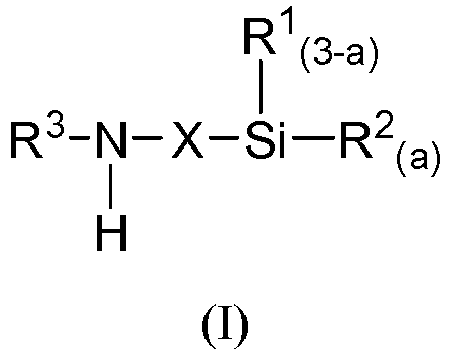
- R1 is selected from hydroxy and alkoxy;
- R2 is alkyl, alkyene, hydride;
- R3 is selected from the group consisting of hydrogen and alkyl, wherein said alkyl is optionally substituted by an amino group or an alkoxysilyl group;
- X is C1-C6 alkylene; and
- a is 0 or 1;
- (ii) a carrier being water;
- (iii) a pH modifier selected from the group consisting of triethanolamine and triethyl amine.
- (i) a silane having the formula I:
- In another aspect of the invention there is provided a method for producing a durable seal on a mold, comprising the steps of:
- (a) providing a mold composed of a metal selected from the group consisting of steel, stainless steel, chrome, cast iron, aluminum, and nickel for forming a part, said mold having at least one surface;
- (b) applying a mold sealer composition onto said at least one surface, said mold sealer composition having a pH of 10-11 comprising:
- (i) a silane having the formula I:

- R1 is selected from hydroxy and alkoxy;
- R2 is alkyl, alkyene, hydride;
- R3 is selected from the group consisting of hydrogen and alkyl, wherein said alkyl is optionally substituted by an amino group or an alkoxysilyl group;
- X is C1-C6 alkylene; and
- a is 0 or 1;
- (ii) a carrier being water;
- (iii) a pH modifier selected from the group consisting of triethanolamine and triethyl amine; and
- (i) a silane having the formula I:
- (c) exposing said mold sealer composition to curing conditions for a time sufficient to effectuate at least partial cure, thereby forming a durable seal on the mold.
- In some embodiments of the aspects of the invention, the mold sealer compositions may further contain a cross-linking agent. Optionally, the mold sealer compositions of the present invention may contain additional additives, such as, e.g., slip agents (such as a functional or non-functional siloxanes), emulsifiers, dyes, catalysts, biocides, cure modifying agents, fillers, viscosity modifying agents and combinations thereof.
- The mold sealer compositions in each aspect of the present invention may be curable by various mechanisms such as heat, moisture and/or ambient condensation. Desirably, the compositions are heat curable. When applied as a coating, the mold sealer compositions cure to a finish having a high durability permitting a number of releases (e.g., at least 3 releases, desirably at least 4 releases, and more desirably at least 5 releases), without transfer of the mold release composition to a part. The mold sealer compositions in each aspect of the present invention are stable, e.g., having no or significantly reduced precipitation, separation, or performance deterioration for a substantial period, e.g., desirably for at least about six months, more desirably for about one year.
-
-
Figure 1 shows mold sealer results for both chrome and steel substrates. -
Figure 2 shows results of the mold sealer's shelf life. - The present invention is based on mold sealer compositions that are durable, cost effective, and permit multiple releases when applied as a coating. The present invention is directed to sealed mold assemblies prepared with said mold sealer compositions.
- The mold sealer compositions include a curable component, desirably, a heat curable component. The term "cure" or "curing," as used herein, refers to a change in state, condition, and/or structure in a material that is usually, but not necessarily, induced by at least one variable, such as time, temperature, radiation, presence and quantity in such material of a curing catalyst or accelerator, or the like. The terms "cure" or "curing" cover partial as well as complete curing.
- The curable component contains a silane that has both amino and alkoxy functional groups, a carrier, and a cross-linking agent. The silane has the general formula:

- R1 is selected from of hydroxy and alkoxy;
- R2 is alkyl, alkyene, or hydride;
- R3 is selected from the group consisting of hydrogen and alkyl, wherein said alkyl is optionally substituted by an amino group or an alkoxysilyl group;
- X is C1-C6 alkylene (i.e., C1, C2, C3, C4, C5, C6, desirably C3); and
- a is 0 or 1.
- Non-limiting examples of useful silanes of the present invention include n-(2-aminoethyl)-3-aminoproplymethyldimethoxysilane, 3-aminopropyltriethoxysilane, methacryloxypropyltirmethoxysilane, methyltriethoxysilane, aminobutyltriethoxysilane, bis(3-trimethoxysilylpropyl)amine, aminopropylsilanetriol, 4-aminobutyltriethoxysilane, 3-aminopropylmethyldimethoxysilane, n-(2-aminoethyl)-3-aminopropyltrimethoxysilane, 3-aminopropylsilanetriol, as well as oligomers of the above preformed or formed in situ from above monomers, as well as combinations thereof. These silanes are commercially available from sources such as Gelest, Dow Corning, Shin-Etsu Chemical, and Momentive Performance Materials.
- The silane of the present invention is present in the mold sealer composition in an amount effective to obtain the desired bonding strength and release durability. Desirably, the silane is present in the mold sealer composition in an amount of 0.1-10 w/w %, more desirably, 0.3-5 w/w/ %, and even more desirably 0.5-2 w/w %.
- The mold sealer compositions may desirably contain cure components other than the silane of formula 1, as are known in the art. In particular, if a silane is not water soluble or only partially water soluble, an emulsifier or emulsifiers are advantageous for stability.
- Additional silanes or crosslinking agents can be used with the aminosilane of formula (I) to modify the cross linking density of the sealer coating. Useful examples of such modifiers are tetra- or trialkoxy silanes. The addition of a crosslinking modifier is particularly useful when formula (I) has less than 3 crosslinking groups.
- The heat curable component desirably includes a cross-linking agent, either formula (I) or a modifier. Cross-linking is the attachment of two or more chains of polymers by, for example, bridges and cross bridges, comprising either an element, a group, or a compound. Desirably, the cross-linking agent is selected from the group consisting of alkoxy functionalized silanes and hydroxyl functionalized silanes.
- Suitable cross-linking agents may be selected from a variety of crosslinkers, such as, but not limited to: a monomeric, cyclic, oligomeric or polymeric silazane, ,an enoxy-functional silazane, a silicon hydride, an alkoxy functional silane such as trialkoxy- and trialkoxysilanes, a methylethylketoxime functional silane, an acetoxy functional silane, an enoxy functional silane, an amino-functional silane, and combinations thereof. More specifically, suitable crosslinkers include, but are not limited to: tris methylamino functional silane, tris enoxy functional silane, hydride functional silane, and cyclic trisilazane. Particularly useful crosslinking modifiers are functionalized polydimethylsiloxane (PDMS), e.g. hydroxyl terminated PDMS.
- Cross-linking agents desirably are present in the mold release compositions of the present invention in an amount from about 0.01% to about 10% w/w, more desirably from about 0.3% to about 3% w/w.
- The mold sealer compositions contain a water based carrier, including, for example, as part of a solution or emulsion composition.
- The mold sealer compositions in each aspect of the present invention may contain a number of other optional additives, such as, e.g., bases, catalysts, biocides, slip agents, dyes, cure modifying agents, fillers, viscosity modifying agents, and combinations thereof.
- A slip agent used in the present invention may be a functional or a non-functional siloxane.
- The base used in the present invention may be triethanolamine, triethyl amine, KOH or any other suitable base. Any type of base known in the art may be used in accordance with this invention. Desirably, non-protonated amines may be used as suitable bases, as they may provide silanes with better bond-ability to metal/mold surfaces.
- The function of the base may be useful for adjusting the pH to the basic region so that the amino group of the formula (I) is deprotonated.
- Any conventional catalyst may be employed provided the mold release properties of the compositions are not compromised. Suitable catalysts that may be used include conventional organometallic catalysts, such as, water and solvent based organic titanium derivatives and organic tin derivatives, tertiary amine compounds, and certain early transition metal compounds. Generally, the catalyst is present in an amount from about 0 to 1.0% w/w. This concentration, however, may be varied depending upon the desired cure rate.
- The pH of the mold sealer composition is from 10 to 11, and desirably from 10.5 to 10.8. Lower pH may result in a more stable silanol having a longer shelf life, however, a sealer coating having a high pH is more effective in application (e.g., durability). Generally, the compositions may be formulated to achieve a balance between durability, i.e. the number of releases, ease of release and stability. The selection of pH in combination with other additives such as emulsifiers enhance the ability to achieve such a balance of properties.
- The mold sealer composition does also contain a pH modifier. The pH modifier may be added, in an amount effective to improve the shelf life of the mold sealer composition and as a deprotonation agent. The pH modifier is added to maintain the desired pH from 10 to 11, and desirably from 10.5 to 10.8. The pH modifiers are selected from the group consisting of triethanolamine and triethyl amine.
- In accordance with the present invention, the mold sealer compositions desirably are applied to a part to form a mold sealer coating. Upon application, the compositions cure at ambient or elevated temperatures to form the mold sealer coatings. The application of heat is not necessary in some embodiments of each aspect of the present invention, however temperature may desirably be used to affect curing speed. Thus, it may be desirable to apply heat, depending upon the components selected. In room temperature curing embodiments, cure time desirably ranges between about 2 minutes and about 48 hours. Examples of suitable heat applications, include, e.g., curing for 5 minutes at 204°C [400°F], curing for 10 minutes at 163°C [325°F], or curing 30 minutes at 93°C [200°F].
- The cure time may be shortened upon addition of certain appropriate catalysts, as described above. The compositions desirably cure to a high durability finish that permits a number of releases without contaminating a released part by transfer of the release composition from the mold to the part. In one embodiment, the cured compositions permit at least 3 releases, desirably at least 4 releases, more desirably at least 5 releases, even more desirably at least 6-9 releases, and most desirably at least 10 releases.
- Desirably, the cured mold sealer compositions in each aspect of the present invention are stable, e.g., having no or significantly reduced precipitation, separation, or performance deterioration for a substantial period, e.g., desirably for at least about six months, more desirably for about at least one year. The presence of precipitation and separation can normally be determined by unaided observance, the naked eye.
- The mold sealer compositions are applied to form the sealed mold assembly of the present invention. The sealed mold assembly contains a mold forming a part having a least one surface, and a coating on the at least one surface, wherein the coating comprise the mold sealer composition having a pH of 10-11 comprising:
- (i) a silane having the formula I:

- R1 is selected from hydroxy and alkoxy;
- R2 is alkyl, alkyene, hydride;
- R3 is selected from the group consisting of hydrogen and alkyl, wherein said alkyl is optionally substituted by an amino group or an alkoxysilyl group;
- X is C1-C6 alkylene; and
- a is 0 or 1;
- (ii) a carrier being water;
- (iii) a pH modifier selected from the group consisting of triethanolamine and triethyl amine.
- The mold forming part is composed of a metal selected from the group consisting of steel, stainless steel, chrome, cast iron, aluminum and nickel. The mold sealer composition may be chemically bonded to the at least one surface.
- The present invention also contemplates sealed molds formed by the process of:
- comprising the steps of:
- (a) providing a mold composed of a metal selected from the group consisting of steel, stainless steel, chrome, cast iron, aluminum, and nickel for forming a part, said mold having at least one surface;
- (b) applying a mold sealer composition onto said at least one surface, said mold sealer composition having a pH of 10-11 comprising:
- (i) a silane having the formula I:

- R1 is selected from hydroxy and alkoxy;
- R2 is alkyl, alkyene, hydride;
- R3 is selected from the group consisting of hydrogen and alkyl, wherein said alkyl is optionally substituted by an amino group or an alkoxysilyl group;
- X is C1-C6 alkylene; and
- a is 0 or 1;
- (ii) a carrier being water;
- (iii) a pH modifier selected from the group consisting of triethanolamine and triethyl amine; and
- (i) a silane having the formula I:
- (c) exposing said mold sealer composition to curing conditions for a time sufficient to effectuate at least partial cure, thereby forming a durable seal on the mold.
- Any suitable curing conditions maybe be used, such as, e.g., heat curing (e.g., 204°C [400°F] for 5 minutes, 163°C [325°F] for 10 minutes, or 93°C [200°F] for 30 minutes).
- Table 1 shows the weight percent of five (5) inventive compositions:
Table 1 Components: Compositions (wt.%) 1 2 3 4 5 Silane #1 (n-(2-aminoethyl)-3-aminopropylmethyldimethoxysilane 1.00 None None None None Silane #2 (3-aminopropyltriethoxysilane) None 1.00 None None None Silane #3 (methacryloxypropyltrimethoxysilane) None None 1.00 None None Silane #4 (methyltriethoxysilane) None None None 1.00 None Silane #5 (aminobutyltriethoxysilane) None None None None 1.00 Water 98.211-98.83 98.211-98.83 98.211-98.541 98.211-98.541 98.211-98.83 pH modifier1 0.17-0.50 0.17-0.50 0.17-0.50 0.17-0.50 0.17-0.50 silicone glycol copolymers 2 0-0.0723 0-0.0723 0.0723 0.0723 0-0.0723 alcohol ethoxylate3 0-0.0723 0-0.0723 0.0723 0.0723 0-0.0723 ethoxylated fatty acids4 0-0.0723 0-0.0723 0.0723 0.0723 0-0.0723 alkyl diphenyloxide disulfonate salts5 0-0.0723 0-0.0723 0.0723 0.0723 0-0.0723 1 Triethylamine, a base was used.
2 Silicone glycol copolymers sold under the trade name of Silwet 7605 (Momentive).
3 Alcohol ethoxylate sold under the trade name of Tomadol 900 (Air Products).
4 Ethoxylated fatty acids sold under the trade name of T-Maz 20 (BASF).
5 Alkyl diphenyloxide disulfonate salts sold under the trade name of Dowfax 2A1 (Dow Chemical). - Table 2 shows the weight percent of
compositions 1, 2, 5 with the presence of the emulsifier and compositions 1A, 2A, and 5A without the emulsifier:Table 2 Components: Compositions (wt.%) 1 1A 2 2A 5 5A Silane #1 (n-(2-aminoethyl)-3-aminopropylmethyldimethoxysilane 1.00 1.00 None None None None Silane #2 (3-aminopropyltriethoxysilane) None None 1.00 1.00 None None Silane #3 (methacryloxypropyltrimethoxysilane) None None None None None None Silane #4 (methyltriethoxysilane) None None None None None None Silane #5 (aminobutyltriethoxysilane) None None None None 1.00 1.00 Water 98.211-98.83 98.211-98.83 98.211-98.83 98.211-98.541 98.211-98.541 98.211-98.83 pH modifier 1 0.17-0.50 0.17-0.50 0.17-0.50 0.17-0.50 0.17-0.50 0.17-0.50 silicone glycol copolymers 2 0.0723 None 0.0723 None 0.0723 None alcohol ethoxylate3 0.0723 None 0.0723 None 0.0723 None ethoxylated fatty acids4 0.0723 None 0.0723 None 0.0723 None alkyl diphenyloxide disulfonate salts5 0.0723 None 0.0723 None 0.0723 None 1 Triethylamine, a base was used.
2 Silicone glycol copolymers sold under the trade name of Silwet 7605 (Momentive).
3 Alcohol ethoxylate sold under the trade name of Tomadol 900 (Air Products).
4 Ethoxylated fatty acids sold under the trade name of T-Maz 20 (BASF).
5 Alkyl diphenyloxide disulfonate salts sold under the trade name of Dowfax 2A1 (Dow Chemical). - The
compositions 1, 2, and 5, which contain water-soluble silanes, were carried out with the presence of emulsifier(s) and without the presence of emulsifier(s). The results showed no observable differences with or without emulsifier(s) indicating that soluble silanes do not require emulsifiers. - Table 3 shows the weight percent of compositions 3 and 4 with the presence of the emulsifier and compositions 3A and 4A without the emulsifier:
Table 3 Components Compositions (wt.%) 3 3A 4 4A Silane #1 (n-(2-aminoethyl)-3-aminopropylmethyldimethoxysilane 1.00 1.00 None None Silane #2 (3-aminopropyltriethoxysilane) None None 1.00 1.00 Silane #3 (methacryloxypropyltrimethoxysilane) 1.00 1.00 None None Silane #4 (methyltriethoxysilane) None None 1.00 1.00 Silane #5 (aminobutyltriethoxysilane) None None None None Water 98.211-98.83 98.211-98.83 98.211-98.83 98.211-98.541 pH modifier 1 0.17-0.50 0.17-0.50 0.17-0.50 0.17-0.50 silicone glycol copolymers 2 0.0723 None 0.0723 None alcohol ethoxylate3 0.0723 None 0.0723 None ethoxylated fatty acids4 0.0723 None 0.0723 None alkyl diphenyloxide disulfonate salts5 0.0723 None 0.0723 None 1 Triethylamine, a base was used.
2 Silicone glycol copolymers sold under the trade name of Silwet 7605 (Momentive).
3 Alcohol ethoxylate is sold under the trade name of Tomadol 900 (Air Products).
4 Ethoxylated fatty acids sold under the trade name of T-Maz 20 (BASF).
5 Alkyl diphenyloxide disulfonate salts sold under the trade name of Dowfax 2A1 (Dow Chemical). - In contrast with Table 2, compositions 3A and 4A, which contain silanes that are water-insoluble, when tested without emulsifier(s), could not be mixed to form a homogeneous solution. The silanes could be clearly seen floating on top of the water, even after extensive mixing. Therefore, there was no reliable way for compositions 3A and 4A to create a uniform coating on the mold surface, and as a result these formulas could not be tested for their effectiveness as a mold sealer.
- Experiments were performed to evaluate the effectiveness (releasibility) of the seal of mold sealer compositions shown in Table 1 on various types of mold materials (stainless steel and/or chrome plated molds).
- The following protocol was followed to test the releasibility:
- 1. Four coats of the inventive mold sealer composition were applied to a pair of metal panel using a spray gun, adjusted to spray 1 to 1.5 mL/second. After applying the inventive mold sealer composition, it was allowed to cure for 10 minutes at 163°C [325°F].
- 2. After the inventive mold sealer composition was cured, applied a commercially available silicone-based release agent (Frekote R-150, available from Henkel) was applied to the panels, using the same spray gun and allowed to cure for 10 minutes at 163°C [325°F].
- 3. After curing, the panels were tested for releasibilty by placing a small piece of uncured EPDM rubber between two of these panels, which was then placed into a hot press using an applied load of 5000 pounds and a temperature of 177°C [350°F]. After 25 minutes the rubber was fully cured, and the panels were removed from the hot press.
- 4. The two panels were separated, and the cured rubber was removed.
- The standard for assessing releasibility was based on a scale of 1 (worst) to 5 (best), as follows:
- A value of 5 indicates an automatic release, with essentially no force required to release the rubber.
- A value of 4 indicates that a small amount of force is required for release.
- A value of 3 indicates that a moderate amount of force is required for release.
- A value of 2 indicates that a high amount of force is required for release.
- A value of 1 indicates no release at all: the rubber cannot be removed without being damaged.
- Plus and minus signs were used to show slight differences in releasibility, e.g., a "4+" is slightly easier than a "4", but not as easy as a "5-".
- Tests were performed on both steel and chrome molds, using Frekote R-150 with and without the mold sealer. The results were compared by counting the number of extremely easy, or "auto" releases that could be achieved - a value of "5" in the releasibility scale. Auto releases are defined as releases which require essentially no force at all to remove the cured rubber from the mold surface.
- Following the above protocol, a comparison was made to test inventive mold sealer compositions nos. 1, 2, 3 and 5 on stainless steel.
- Comparison tests were conducted to test the molds releasibility without sealer but with release agent, and releasibility without a sealer or a release agent. The release test was repeated multiple times, to determine how many easy releases could be obtained from a single application of each composition. The following results were obtained:
Table 2 Stainless Steel Molds: Releasibility Sealer: Release Agent: 1 2 3 4 5 6 7 8 9 10 11 12 13 14 15 16 Control 1: no sealer no release agent 3 3 Control 2: no sealer Frekote R-150 5 5 5- 4+ 4+ 4 4 4 3 Silane 1 Frekote R-150 5 5 5 5 5- 5- 4+ 4+ 4- 4 4 4- Silane 2 Frekote R-150 5 5 5 5 5 5 5 5 5 5 5 5 5 5 5 5 Silane 3 Frekote R-150 5 5 4+ 4 4 3 3 Silane 5Frekote R-150 5 5 5 5 5- 5- 5- 4+ - As illustrated in Table 2, the mold sealer compositions of the present invention obtained excellent releasibility properties on stainless steel as compared to the controls. As is also apparent from Table 2, the inventive compositions achieved at least 3.5-6 times as many releases cycles as the controls. When using the sealer on steel molds, it is possible to obtain 12 auto releases, where previously Frekote R-150 alone could only give one auto release.
- Following the same protocol, a comparison was made to test inventive mold sealer compositions nos. 1, 2, 4 and 5 on chrome plated molds.
- Comparison was made to a test without sealer but with release agent, and a test without sealer and release agent. The release test was repeated multiple times, to determine how many easy releases could be obtained from a single application of each formula. The following results were obtained:
Table 3 Chrome Plated Molds: Releasibility Sealer: Release Agent: 1 2 3 4 5 6 7 8 9 10 11 12 13 14 Control 1: no sealer no release agent 4- 4- 4- Control 2: no sealer Frekote R-150 5 4 4- 4- Silane 1 Frekote R-150 5 5 5 5- 5- 5 5 4+ Silane 2 Frekote R-150 5 5 5 5 5 5 5 5 5 5 5 5 5- 5- Silane 4 Frekote R-150 5 5 4 Silane 5Frekote R-150 5 5 5 5 5 5- 5- 5- 5- 5- 4+ - As illustrated in Table 3, the mold sealer compositions of the present invention obtained excellent releasibility properties on chrome plated molds. As noted in some instances, the inventive mold sealer compositions achieved 2-4 times the number of release cycles as compared to the control (no sealer and no release agent compositions.) When using the sealer on chrome molds, it is possible to obtain 12 auto releases, where previously R-150 alone could only give one auto release.
- The results on chrome and steel substrates depicted in the chart of
Fig. 1 illustrate graphically how beneficial this mold sealer can be for the thermoplastic and particularly the rubber molding industry. The inventive mold sealer compositions permit a significant greater number of releases from each application of release agent as compared to molds without the inventive sealer compositions. Such results additionally provide significant savings of time and money for users. - Molding parameters: Each of the inventive compositions 1-5 were tested over a period of 40 days of heat aging, which is approximately equal to 1 year at room temperature. 1 day of heat-aging is equivalent to 9 days of aging at room temperature.
- Application: For each test during the shelf life study, the heat-aged samples of mold sealer were evaluated using the standard test method for rubber release. A heat-aged sample of mold sealer was removed from the oven and spray-applied to a chrome mold, using four coats. It was cured at 325°F for 10 minutes. Next, Frekote R-150 was applied to the panel using the same spray gun and allowed to cure for 10 minutes at 163°C [325°F]. Each panel was then tested for its ability to release EPDM rubber. The results were compared to determine how the performance of the mold sealer changes over time.
- Test Results: The mold sealer was determined to have a shelf life of at least 1 year at room temperature (77°F, or 25°C). The results are provided in
Fig. 2 . - As indicated in the shelf life table in
Fig. 2 , the inventive composition continued to provide excellent release after 2, 4 and 6 months of aging on parts at room temperature. - The results in
Fig. 2 further indicate that, although the sealer does shows a small decrease in performance over time after aging for the equivalent of 360 days at room temperature, the sealer still enables R-150 to achieve 7 auto releases and 17 good releases. This is a significant improvement over the 1 auto/good releases, which is possible without the sealer. - Release agent Frekote R-150 was applied to sealed molds as a touch-up coat after 17-23 auto/good releases. Each touch-up coat provided approximately the same amount of releases as the original sealed mold (e.g. 17-23). There was no need to re-apply the sealer after the mold surface was already sealed by formula (I).
- A simple test was performed to determine if the mold sealer would cause corrosive damage to metal molds, because this is a common problem for water-based formulas. An excess amount of the mold sealer was applied to a steel panel and allowed to air dry overnight at room temperature. On the same panel, the same test was also performed using water and using Frekote R-150.
- The results indicated that the inventive mold sealer composition did not cause rust to form on steel molds, whereas using water in combination with Frekote R-150 alone did cause rust formation. This is due to its unique chemistry, which does not cause oxidative damage to take place at the mold surface.
- The mold sealer was first cured at 163°C [325°F] for 10 minutes. After curing, the mold sealer was heated to 316°C [600°F] and held at that temperature for 1 hour. It was then cooled back down to 163°C [325°F], and Frekote R-150 was applied to the mold and cured for 10 minutes. After testing this panel for rubber release, it was able to give 20 auto releases, a significant improvement over the 12 auto releases which could be achieved without the secondary cure.
- Example 6 describes tests that were performed in order to determine the optimal amount of silane to use in a mold sealer composition.
- Water- based samples were prepared using 0.5%, 1.0%, and 1.5% aminopropyltriethoxysilane (abbreviated as APTES).
- These samples were applied to chrome panels, and tested using Frekote R-150 release agent, as described in the test method given earlier.
- The results were as follows:
Concentration No. of Auto Releases 0.5% APTES 8 1.0% APTES 12 1.5% APTES 12 - These results show that the optimal concentration is approximately 1.0% silane. There is little to no benefit to using a higher amount, and using a lower amount results in decreased performance.
Claims (11)
- A sealed mold assembly comprising:(a) a mold composed of a metal selected from the group consisting of steel, stainless steel, chrome, cast iron, aluminum, and nickel for forming a part, said mold having at least one surface;(b) a coating on said at least one surface comprising a mold sealer composition having a pH of 10-11 comprising:(i) a silane having the formula I:
 R1 is selected from the group consisting of hydroxy and alkoxy;R2 is alkyl, alkyene, hydride;R3 is selected from the group consisting of hydrogen and alkyl, wherein said alkyl is optionally substituted by an amino group or an alkoxysilyl group;X is C1-C6 alkylene; anda is 0 or 1;(ii) a carrier being water;(iii) a pH modifier selected from the group consisting of triethanolamine and triethyl amine.
 - The assembly of claim 1, wherein said carrier is selected from the group consisting of an emulsion and a water-based solution.
- The assembly of claim 1, further comprising a cross-linking agent, wherein said cross-linking agent is selected from the group consisting of alkoxy functionalized silanes and hydroxy functionalized silanes.
- The assembly of claim 1, further comprising an emulsifier, wherein said emulsifier is selected from the group consisting of using non ionic and ionic surfactants with HLB from 3-25.
- The assembly of claim 1, wherein said pH modifier is triethyl amine.
- The assembly of claim 1, wherein X is C3 alkylene.
- The assembly of claim 1, wherein said silane of formula I is 3-aminopropyltriethoxysilane.
- The assembly of claim 1, wherein said silane of formula I is selected from the group consisting of: n-(2-aminoethyl)-3-aminopropylmethyidimethoxysilane; 4-aminobutyltriethoxysilane; 3-aminopropylmethyldimethoxysilane; n-(2-aminoethyl)-3-aminopropyltrimethoxysilane; bis(3-trimethoxysilylpropyl)amine; 3-aminopropylsilanetriol; and oligomers of above preformed or formed in situ from above monomer.
- The assembly of claim 1, further comprising a catalyst selected from the group consisting of organic titanium compounds and organic tin compounds.
- A method for producing a durable seal on a mold, comprising the steps of:(a) providing a mold composed of a metal selected from the group consisting of steel, stainless steel, chrome, cast iron, aluminum, and nickel for forming a part, said mold having at least one surface;(b) applying a mold sealer composition onto said at least one surface, said mold sealer composition having a pH of 10-11 comprising:(i) a silane having the formula I:
 R1 is selected from the group consisting of hydroxy and alkoxy;R2 is alkyl, alkyene, hydride;R3 is selected from the group consisting of hydrogen and alkyl, wherein said alkyl is optionally substituted by an amino group or an alkoxysilyl group;X is C1-C6 alkylene; anda is 0 or 1;(ii) a carrier being water;(iii) a pH modifier selected from the group consisting of triethanolamine and triethyl amine; and(c) exposing said mold sealer composition to curing conditions for a time sufficient to effectuate at least partial cure, thereby forming a durable seal on said mold.
 - The method of claim 10, wherein said curing conditions are 400°F for 5 minutes or 200°F for 30 minutes.
Applications Claiming Priority (2)
| Application Number | Priority Date | Filing Date | Title |
|---|---|---|---|
| US9042108P | 2008-08-20 | 2008-08-20 | |
| PCT/US2009/054282 WO2010022133A2 (en) | 2008-08-20 | 2009-08-19 | Method of preparing a mold sealer, mold sealer assembly and compositions thereof |
Publications (3)
| Publication Number | Publication Date |
|---|---|
| EP2324091A2 EP2324091A2 (en) | 2011-05-25 |
| EP2324091A4 EP2324091A4 (en) | 2017-04-19 |
| EP2324091B1 true EP2324091B1 (en) | 2019-07-03 |
Family
ID=41707643
Family Applications (1)
| Application Number | Title | Priority Date | Filing Date |
|---|---|---|---|
| EP09808758.8A Not-in-force EP2324091B1 (en) | 2008-08-20 | 2009-08-19 | Method of preparing a mold sealer, mold sealer assembly and compositions thereof |
Country Status (8)
| Country | Link |
|---|---|
| US (1) | US20110139959A1 (en) |
| EP (1) | EP2324091B1 (en) |
| JP (1) | JP2012500144A (en) |
| KR (1) | KR20110056514A (en) |
| CN (1) | CN102171308B (en) |
| ES (1) | ES2741550T3 (en) |
| MX (1) | MX2011001820A (en) |
| WO (1) | WO2010022133A2 (en) |
Families Citing this family (3)
| Publication number | Priority date | Publication date | Assignee | Title |
|---|---|---|---|---|
| EP2822745A1 (en) | 2012-03-08 | 2015-01-14 | Danmarks Tekniske Universitet | Silane based coating of aluminium mold |
| CN108115106B (en) * | 2018-01-25 | 2024-05-17 | 温岭立骅机械有限公司 | Die casting machine and automatic spraying device thereof |
| CN113071030B (en) * | 2021-03-25 | 2023-03-17 | 东莞市凯文化工有限公司 | Hole sealing release agent and preparation method thereof |
Family Cites Families (24)
| Publication number | Priority date | Publication date | Assignee | Title |
|---|---|---|---|---|
| US4507443A (en) * | 1984-02-23 | 1985-03-26 | The B. F. Goodrich Company | Sealant and coating composition |
| JP2614462B2 (en) | 1987-10-05 | 1997-05-28 | 東レ・ダウコーニング・シリコーン株式会社 | Rubber surface treatment composition |
| DE4112652A1 (en) * | 1991-04-18 | 1992-10-22 | Wolman Gmbh Dr | WOOD PRESERVATIVES |
| JP3290540B2 (en) * | 1994-05-23 | 2002-06-10 | 信越化学工業株式会社 | Release agent composition |
| DE69510694T2 (en) * | 1994-12-21 | 1999-10-21 | Zeneca Ltd., London | Grafting method |
| DE19946916A1 (en) * | 1999-09-30 | 2001-04-26 | Abb Research Ltd | Mold release agent for thermoset molded parts |
| US6322850B1 (en) * | 2000-04-24 | 2001-11-27 | Tse Industries, Inc. | Mold release reaction product and method of coating of a mold core |
| FR2810989A1 (en) * | 2000-06-30 | 2002-01-04 | Rhodia Chimie Sa | AQUEOUS DISPERSION BASED ON VISCOUS SILICONE OILS CROSS-LINKABLE BY CONDENSATION INTO AN ELASTOMER, ADHERENT USABLE IN PARTICULAR AS SEALANTS OR PAINTS, METHOD FOR PREPARATION |
| JP3350532B1 (en) * | 2001-09-28 | 2002-11-25 | コニシ株式会社 | Aqueous solid adhesive and bonding method using the aqueous solid adhesive |
| US20030072948A1 (en) * | 2001-10-03 | 2003-04-17 | 3M Innovative Properties Company | Dry-peelable temporary protective coatings |
| DE10151264A1 (en) * | 2001-10-17 | 2003-04-30 | Degussa | Aminoalkylalkoxysiloxane-containing mixtures, their preparation and their use |
| FR2838447B1 (en) * | 2002-04-12 | 2005-09-30 | Rhodia Chimie Sa | NON-HYDROGEN-BASED SILOXANE-BASED COMPOSITION FOR MOLDING-DEMOLATING TIRES |
| WO2004033172A1 (en) * | 2002-10-04 | 2004-04-22 | Henkel Corporation | Room temperature curable water-based mold release agent for composite materials |
| KR101052434B1 (en) * | 2002-11-01 | 2011-07-29 | 에이제토 엘렉토로닉 마티리알즈 가부시키가이샤 | Polysilazane-containing coating solution |
| CN1330681C (en) * | 2003-03-20 | 2007-08-08 | 科尼希株式会社 | Silanized polyurethane water-based composition, and water-based encapsulation adhesive and water-based contact adhesive |
| JP4737923B2 (en) * | 2003-03-20 | 2011-08-03 | コニシ株式会社 | Silylated urethane-based aqueous composition, aqueous wrapping adhesive, and aqueous contact adhesive |
| EP1496079B1 (en) * | 2003-07-10 | 2005-07-06 | Wacker-Chemie GmbH | Crosslinkable polysiloxane-urea copolymers |
| FR2884170B1 (en) | 2005-04-08 | 2007-10-12 | Rhodia Chimie Sa | USE OF A SILOXANE-BASED COMPOSITION FOR THE MOLDING-DEMOLDING OF TIRES |
| DE102005023050A1 (en) * | 2005-05-13 | 2006-11-16 | Henkel Kgaa | Storage-stable emulsion containing a silyl-terminated polymer, useful as adhesive, sealant, surface coating and molding composition, also new polymers |
| US20070173597A1 (en) * | 2006-01-20 | 2007-07-26 | Williams David A | Sealant composition containing inorganic-organic nanocomposite filler |
| FR2902438A1 (en) * | 2006-06-20 | 2007-12-21 | Rhodia Recherches & Tech | SILOXANE-BASED LUBRICANT COMPOSITION, NOT DEGREASING HYDROGEN, PREPARATION METHOD AND USE THEREOF |
| JP5271486B2 (en) * | 2006-08-16 | 2013-08-21 | 株式会社ブリヂストン | Release agent, method for forming concave / convex pattern using the same, method for producing optical information recording medium, and optical information recording medium |
| CN1931795A (en) * | 2006-09-07 | 2007-03-21 | 武汉理工大学 | Hole sealing moisture-proof anticorrosive composite coating material and its prepn process |
| US20080160286A1 (en) * | 2006-12-27 | 2008-07-03 | Jawed Asrar | Modified discontinuous glass fibers for use in the formation of thermoplastic fiber-reinforced composite articles |
-
2009
- 2009-08-19 ES ES09808758T patent/ES2741550T3/en active Active
- 2009-08-19 WO PCT/US2009/054282 patent/WO2010022133A2/en not_active Ceased
- 2009-08-19 JP JP2011523955A patent/JP2012500144A/en active Pending
- 2009-08-19 EP EP09808758.8A patent/EP2324091B1/en not_active Not-in-force
- 2009-08-19 MX MX2011001820A patent/MX2011001820A/en active IP Right Grant
- 2009-08-19 CN CN200980136605.0A patent/CN102171308B/en not_active Expired - Fee Related
- 2009-08-19 KR KR1020117006275A patent/KR20110056514A/en not_active Withdrawn
-
2011
- 2011-02-21 US US13/031,399 patent/US20110139959A1/en not_active Abandoned
Non-Patent Citations (1)
| Title |
|---|
| None * |
Also Published As
| Publication number | Publication date |
|---|---|
| CN102171308B (en) | 2014-03-12 |
| EP2324091A4 (en) | 2017-04-19 |
| US20110139959A1 (en) | 2011-06-16 |
| KR20110056514A (en) | 2011-05-30 |
| MX2011001820A (en) | 2011-03-29 |
| CN102171308A (en) | 2011-08-31 |
| ES2741550T3 (en) | 2020-02-11 |
| JP2012500144A (en) | 2012-01-05 |
| WO2010022133A3 (en) | 2010-05-14 |
| EP2324091A2 (en) | 2011-05-25 |
| WO2010022133A2 (en) | 2010-02-25 |
Similar Documents
| Publication | Publication Date | Title |
|---|---|---|
| US4024306A (en) | Method of preparing an organopolysiloxane for surface coating | |
| US4535109A (en) | Method for producing silicone aqueous emulsion compositions | |
| EP1167455B1 (en) | Room temperature rapid-curable silicone composition | |
| US5152950A (en) | Bladder lubricant composition for tire molding | |
| JP7173302B2 (en) | Room-temperature-curing organopolysiloxane composition for oil seals and automotive parts | |
| JPH09506667A (en) | RTV silicone compositions using aminohydrocarbyl substituted ketoximinosilane | |
| JP3725178B2 (en) | Room temperature curable organopolysiloxane composition | |
| JPS6366258A (en) | Rubbery substance | |
| AU710137B2 (en) | Method for enhancing longevity of a surface drying oil on a silicone composition modified by incorporation of zinc oxide | |
| CN105658695A (en) | Moisture curable compositions | |
| EP0482480B1 (en) | Surface-treating agent and surface-treated EPDM article | |
| US20110139959A1 (en) | Method Of Preparing A Mold Sealer, Mold Sealer Assembly And Compositions Thereof | |
| JPH061848A (en) | Fluorosilicone resin and curable fluorosilicone resin composition | |
| JPH03203960A (en) | Room temperature curable organopolysiloxane composition | |
| EP0384401A1 (en) | Primer compositions | |
| US10982112B2 (en) | Hydrophobic silicone coating | |
| EP0643106A2 (en) | Organopolysiloxane compositions, their preparation and use, rubber articles coated with them | |
| US6306999B1 (en) | Room temperature curable organopolysiloxane composition | |
| JPH0341108B2 (en) | ||
| US5081181A (en) | Primer composition | |
| EP0342809A2 (en) | Room temperature-curable compositions for forming organofluorosilicone elastomers | |
| JP4400983B2 (en) | Curable composition | |
| US4448814A (en) | Method of forming film | |
| CA2072288A1 (en) | Water reducible silicone weatherstrip coating | |
| US4487907A (en) | RTV Polyorganosiloxane compositions yielding paintable elastomers |
Legal Events
| Date | Code | Title | Description |
|---|---|---|---|
| PUAI | Public reference made under article 153(3) epc to a published international application that has entered the european phase |
Free format text: ORIGINAL CODE: 0009012 |
|
| 17P | Request for examination filed |
Effective date: 20110314 |
|
| AK | Designated contracting states |
Kind code of ref document: A2 Designated state(s): AT BE BG CH CY CZ DE DK EE ES FI FR GB GR HR HU IE IS IT LI LT LU LV MC MK MT NL NO PL PT RO SE SI SK SM TR |
|
| AX | Request for extension of the european patent |
Extension state: AL BA RS |
|
| DAX | Request for extension of the european patent (deleted) | ||
| RAP1 | Party data changed (applicant data changed or rights of an application transferred) |
Owner name: HENKEL US IP LLC |
|
| RAP1 | Party data changed (applicant data changed or rights of an application transferred) |
Owner name: HENKEL IP & HOLDING GMBH |
|
| REG | Reference to a national code |
Ref country code: DE Ref legal event code: R079 Ref document number: 602009059018 Country of ref document: DE Free format text: PREVIOUS MAIN CLASS: C09K0003100000 Ipc: B28B0007380000 |
|
| A4 | Supplementary search report drawn up and despatched |
Effective date: 20170321 |
|
| RIC1 | Information provided on ipc code assigned before grant |
Ipc: B28B 7/38 20060101AFI20170315BHEP Ipc: B29C 33/60 20060101ALI20170315BHEP |
|
| STAA | Information on the status of an ep patent application or granted ep patent |
Free format text: STATUS: EXAMINATION IS IN PROGRESS |
|
| 17Q | First examination report despatched |
Effective date: 20180620 |
|
| GRAP | Despatch of communication of intention to grant a patent |
Free format text: ORIGINAL CODE: EPIDOSNIGR1 |
|
| STAA | Information on the status of an ep patent application or granted ep patent |
Free format text: STATUS: GRANT OF PATENT IS INTENDED |
|
| INTG | Intention to grant announced |
Effective date: 20190410 |
|
| GRAS | Grant fee paid |
Free format text: ORIGINAL CODE: EPIDOSNIGR3 |
|
| GRAA | (expected) grant |
Free format text: ORIGINAL CODE: 0009210 |
|
| STAA | Information on the status of an ep patent application or granted ep patent |
Free format text: STATUS: THE PATENT HAS BEEN GRANTED |
|
| AK | Designated contracting states |
Kind code of ref document: B1 Designated state(s): AT BE BG CH CY CZ DE DK EE ES FI FR GB GR HR HU IE IS IT LI LT LU LV MC MK MT NL NO PL PT RO SE SI SK SM TR |
|
| REG | Reference to a national code |
Ref country code: GB Ref legal event code: FG4D |
|
| REG | Reference to a national code |
Ref country code: CH Ref legal event code: EP Ref country code: AT Ref legal event code: REF Ref document number: 1150430 Country of ref document: AT Kind code of ref document: T Effective date: 20190715 |
|
| REG | Reference to a national code |
Ref country code: IE Ref legal event code: FG4D |
|
| REG | Reference to a national code |
Ref country code: DE Ref legal event code: R096 Ref document number: 602009059018 Country of ref document: DE |
|
| REG | Reference to a national code |
Ref country code: NL Ref legal event code: MP Effective date: 20190703 |
|
| REG | Reference to a national code |
Ref country code: LT Ref legal event code: MG4D |
|
| REG | Reference to a national code |
Ref country code: AT Ref legal event code: MK05 Ref document number: 1150430 Country of ref document: AT Kind code of ref document: T Effective date: 20190703 |
|
| PG25 | Lapsed in a contracting state [announced via postgrant information from national office to epo] |
Ref country code: HR Free format text: LAPSE BECAUSE OF FAILURE TO SUBMIT A TRANSLATION OF THE DESCRIPTION OR TO PAY THE FEE WITHIN THE PRESCRIBED TIME-LIMIT Effective date: 20190703 Ref country code: NL Free format text: LAPSE BECAUSE OF FAILURE TO SUBMIT A TRANSLATION OF THE DESCRIPTION OR TO PAY THE FEE WITHIN THE PRESCRIBED TIME-LIMIT Effective date: 20190703 Ref country code: PT Free format text: LAPSE BECAUSE OF FAILURE TO SUBMIT A TRANSLATION OF THE DESCRIPTION OR TO PAY THE FEE WITHIN THE PRESCRIBED TIME-LIMIT Effective date: 20191104 Ref country code: LT Free format text: LAPSE BECAUSE OF FAILURE TO SUBMIT A TRANSLATION OF THE DESCRIPTION OR TO PAY THE FEE WITHIN THE PRESCRIBED TIME-LIMIT Effective date: 20190703 Ref country code: FI Free format text: LAPSE BECAUSE OF FAILURE TO SUBMIT A TRANSLATION OF THE DESCRIPTION OR TO PAY THE FEE WITHIN THE PRESCRIBED TIME-LIMIT Effective date: 20190703 Ref country code: SE Free format text: LAPSE BECAUSE OF FAILURE TO SUBMIT A TRANSLATION OF THE DESCRIPTION OR TO PAY THE FEE WITHIN THE PRESCRIBED TIME-LIMIT Effective date: 20190703 Ref country code: CZ Free format text: LAPSE BECAUSE OF FAILURE TO SUBMIT A TRANSLATION OF THE DESCRIPTION OR TO PAY THE FEE WITHIN THE PRESCRIBED TIME-LIMIT Effective date: 20190703 Ref country code: NO Free format text: LAPSE BECAUSE OF FAILURE TO SUBMIT A TRANSLATION OF THE DESCRIPTION OR TO PAY THE FEE WITHIN THE PRESCRIBED TIME-LIMIT Effective date: 20191003 Ref country code: BG Free format text: LAPSE BECAUSE OF FAILURE TO SUBMIT A TRANSLATION OF THE DESCRIPTION OR TO PAY THE FEE WITHIN THE PRESCRIBED TIME-LIMIT Effective date: 20191003 Ref country code: AT Free format text: LAPSE BECAUSE OF FAILURE TO SUBMIT A TRANSLATION OF THE DESCRIPTION OR TO PAY THE FEE WITHIN THE PRESCRIBED TIME-LIMIT Effective date: 20190703 |
|
| REG | Reference to a national code |
Ref country code: ES Ref legal event code: FG2A Ref document number: 2741550 Country of ref document: ES Kind code of ref document: T3 Effective date: 20200211 |
|
| PG25 | Lapsed in a contracting state [announced via postgrant information from national office to epo] |
Ref country code: IS Free format text: LAPSE BECAUSE OF FAILURE TO SUBMIT A TRANSLATION OF THE DESCRIPTION OR TO PAY THE FEE WITHIN THE PRESCRIBED TIME-LIMIT Effective date: 20191103 Ref country code: LV Free format text: LAPSE BECAUSE OF FAILURE TO SUBMIT A TRANSLATION OF THE DESCRIPTION OR TO PAY THE FEE WITHIN THE PRESCRIBED TIME-LIMIT Effective date: 20190703 Ref country code: GR Free format text: LAPSE BECAUSE OF FAILURE TO SUBMIT A TRANSLATION OF THE DESCRIPTION OR TO PAY THE FEE WITHIN THE PRESCRIBED TIME-LIMIT Effective date: 20191004 |
|
| PG25 | Lapsed in a contracting state [announced via postgrant information from national office to epo] |
Ref country code: TR Free format text: LAPSE BECAUSE OF FAILURE TO SUBMIT A TRANSLATION OF THE DESCRIPTION OR TO PAY THE FEE WITHIN THE PRESCRIBED TIME-LIMIT Effective date: 20190703 |
|
| PG25 | Lapsed in a contracting state [announced via postgrant information from national office to epo] |
Ref country code: DK Free format text: LAPSE BECAUSE OF FAILURE TO SUBMIT A TRANSLATION OF THE DESCRIPTION OR TO PAY THE FEE WITHIN THE PRESCRIBED TIME-LIMIT Effective date: 20190703 Ref country code: PL Free format text: LAPSE BECAUSE OF FAILURE TO SUBMIT A TRANSLATION OF THE DESCRIPTION OR TO PAY THE FEE WITHIN THE PRESCRIBED TIME-LIMIT Effective date: 20190703 Ref country code: EE Free format text: LAPSE BECAUSE OF FAILURE TO SUBMIT A TRANSLATION OF THE DESCRIPTION OR TO PAY THE FEE WITHIN THE PRESCRIBED TIME-LIMIT Effective date: 20190703 Ref country code: RO Free format text: LAPSE BECAUSE OF FAILURE TO SUBMIT A TRANSLATION OF THE DESCRIPTION OR TO PAY THE FEE WITHIN THE PRESCRIBED TIME-LIMIT Effective date: 20190703 |
|
| PG25 | Lapsed in a contracting state [announced via postgrant information from national office to epo] |
Ref country code: LU Free format text: LAPSE BECAUSE OF NON-PAYMENT OF DUE FEES Effective date: 20190819 Ref country code: IS Free format text: LAPSE BECAUSE OF FAILURE TO SUBMIT A TRANSLATION OF THE DESCRIPTION OR TO PAY THE FEE WITHIN THE PRESCRIBED TIME-LIMIT Effective date: 20200224 Ref country code: LI Free format text: LAPSE BECAUSE OF NON-PAYMENT OF DUE FEES Effective date: 20190831 Ref country code: SM Free format text: LAPSE BECAUSE OF FAILURE TO SUBMIT A TRANSLATION OF THE DESCRIPTION OR TO PAY THE FEE WITHIN THE PRESCRIBED TIME-LIMIT Effective date: 20190703 Ref country code: CH Free format text: LAPSE BECAUSE OF NON-PAYMENT OF DUE FEES Effective date: 20190831 Ref country code: MC Free format text: LAPSE BECAUSE OF FAILURE TO SUBMIT A TRANSLATION OF THE DESCRIPTION OR TO PAY THE FEE WITHIN THE PRESCRIBED TIME-LIMIT Effective date: 20190703 Ref country code: SK Free format text: LAPSE BECAUSE OF FAILURE TO SUBMIT A TRANSLATION OF THE DESCRIPTION OR TO PAY THE FEE WITHIN THE PRESCRIBED TIME-LIMIT Effective date: 20190703 |
|
| REG | Reference to a national code |
Ref country code: BE Ref legal event code: MM Effective date: 20190831 |
|
| REG | Reference to a national code |
Ref country code: DE Ref legal event code: R097 Ref document number: 602009059018 Country of ref document: DE |
|
| PLBE | No opposition filed within time limit |
Free format text: ORIGINAL CODE: 0009261 |
|
| STAA | Information on the status of an ep patent application or granted ep patent |
Free format text: STATUS: NO OPPOSITION FILED WITHIN TIME LIMIT |
|
| PG2D | Information on lapse in contracting state deleted |
Ref country code: IS |
|
| PG25 | Lapsed in a contracting state [announced via postgrant information from national office to epo] |
Ref country code: IE Free format text: LAPSE BECAUSE OF NON-PAYMENT OF DUE FEES Effective date: 20190819 |
|
| 26N | No opposition filed |
Effective date: 20200603 |
|
| PG25 | Lapsed in a contracting state [announced via postgrant information from national office to epo] |
Ref country code: BE Free format text: LAPSE BECAUSE OF NON-PAYMENT OF DUE FEES Effective date: 20190831 Ref country code: SI Free format text: LAPSE BECAUSE OF FAILURE TO SUBMIT A TRANSLATION OF THE DESCRIPTION OR TO PAY THE FEE WITHIN THE PRESCRIBED TIME-LIMIT Effective date: 20190703 |
|
| PGFP | Annual fee paid to national office [announced via postgrant information from national office to epo] |
Ref country code: DE Payment date: 20200819 Year of fee payment: 12 Ref country code: GB Payment date: 20200826 Year of fee payment: 12 Ref country code: FR Payment date: 20200821 Year of fee payment: 12 |
|
| PGFP | Annual fee paid to national office [announced via postgrant information from national office to epo] |
Ref country code: IT Payment date: 20200826 Year of fee payment: 12 |
|
| PGFP | Annual fee paid to national office [announced via postgrant information from national office to epo] |
Ref country code: ES Payment date: 20201023 Year of fee payment: 12 |
|
| PG25 | Lapsed in a contracting state [announced via postgrant information from national office to epo] |
Ref country code: CY Free format text: LAPSE BECAUSE OF FAILURE TO SUBMIT A TRANSLATION OF THE DESCRIPTION OR TO PAY THE FEE WITHIN THE PRESCRIBED TIME-LIMIT Effective date: 20190703 |
|
| PG25 | Lapsed in a contracting state [announced via postgrant information from national office to epo] |
Ref country code: HU Free format text: LAPSE BECAUSE OF FAILURE TO SUBMIT A TRANSLATION OF THE DESCRIPTION OR TO PAY THE FEE WITHIN THE PRESCRIBED TIME-LIMIT; INVALID AB INITIO Effective date: 20090819 Ref country code: MT Free format text: LAPSE BECAUSE OF FAILURE TO SUBMIT A TRANSLATION OF THE DESCRIPTION OR TO PAY THE FEE WITHIN THE PRESCRIBED TIME-LIMIT Effective date: 20190703 |
|
| REG | Reference to a national code |
Ref country code: DE Ref legal event code: R119 Ref document number: 602009059018 Country of ref document: DE |
|
| GBPC | Gb: european patent ceased through non-payment of renewal fee |
Effective date: 20210819 |
|
| PG25 | Lapsed in a contracting state [announced via postgrant information from national office to epo] |
Ref country code: MK Free format text: LAPSE BECAUSE OF FAILURE TO SUBMIT A TRANSLATION OF THE DESCRIPTION OR TO PAY THE FEE WITHIN THE PRESCRIBED TIME-LIMIT Effective date: 20190703 |
|
| PG25 | Lapsed in a contracting state [announced via postgrant information from national office to epo] |
Ref country code: IT Free format text: LAPSE BECAUSE OF NON-PAYMENT OF DUE FEES Effective date: 20210819 Ref country code: GB Free format text: LAPSE BECAUSE OF NON-PAYMENT OF DUE FEES Effective date: 20210819 Ref country code: FR Free format text: LAPSE BECAUSE OF NON-PAYMENT OF DUE FEES Effective date: 20210831 Ref country code: DE Free format text: LAPSE BECAUSE OF NON-PAYMENT OF DUE FEES Effective date: 20220301 |
|
| REG | Reference to a national code |
Ref country code: ES Ref legal event code: FD2A Effective date: 20221104 |
|
| PG25 | Lapsed in a contracting state [announced via postgrant information from national office to epo] |
Ref country code: ES Free format text: LAPSE BECAUSE OF NON-PAYMENT OF DUE FEES Effective date: 20210820 |