EP2319822A1 - Verfahren zur Herstellung von Guerbet-Alkoholen - Google Patents
Verfahren zur Herstellung von Guerbet-Alkoholen Download PDFInfo
- Publication number
- EP2319822A1 EP2319822A1 EP09013922A EP09013922A EP2319822A1 EP 2319822 A1 EP2319822 A1 EP 2319822A1 EP 09013922 A EP09013922 A EP 09013922A EP 09013922 A EP09013922 A EP 09013922A EP 2319822 A1 EP2319822 A1 EP 2319822A1
- Authority
- EP
- European Patent Office
- Prior art keywords
- alcohols
- group
- primary
- reaction
- guerbet
- Prior art date
- Legal status (The legal status is an assumption and is not a legal conclusion. Google has not performed a legal analysis and makes no representation as to the accuracy of the status listed.)
- Granted
Links
- 150000001298 alcohols Chemical class 0.000 title claims abstract description 59
- 238000004519 manufacturing process Methods 0.000 title description 5
- KDLHZDBZIXYQEI-UHFFFAOYSA-N Palladium Chemical compound [Pd] KDLHZDBZIXYQEI-UHFFFAOYSA-N 0.000 claims abstract description 40
- 239000003054 catalyst Substances 0.000 claims abstract description 32
- 238000007869 Guerbet synthesis reaction Methods 0.000 claims abstract description 28
- 125000004432 carbon atom Chemical group C* 0.000 claims abstract description 27
- 229910052751 metal Inorganic materials 0.000 claims abstract description 24
- 239000002184 metal Substances 0.000 claims abstract description 24
- 150000002739 metals Chemical class 0.000 claims abstract description 19
- 125000002887 hydroxy group Chemical group [H]O* 0.000 claims abstract description 15
- BASFCYQUMIYNBI-UHFFFAOYSA-N platinum Chemical compound [Pt] BASFCYQUMIYNBI-UHFFFAOYSA-N 0.000 claims abstract description 15
- 229910052763 palladium Inorganic materials 0.000 claims abstract description 14
- 238000006471 dimerization reaction Methods 0.000 claims abstract description 13
- 238000005984 hydrogenation reaction Methods 0.000 claims abstract description 12
- 150000001728 carbonyl compounds Chemical class 0.000 claims abstract description 11
- 229910052741 iridium Inorganic materials 0.000 claims abstract description 9
- 229910052703 rhodium Inorganic materials 0.000 claims abstract description 9
- 239000010948 rhodium Substances 0.000 claims abstract description 9
- 229910052707 ruthenium Inorganic materials 0.000 claims abstract description 9
- KJTLSVCANCCWHF-UHFFFAOYSA-N Ruthenium Chemical compound [Ru] KJTLSVCANCCWHF-UHFFFAOYSA-N 0.000 claims abstract description 8
- GKOZUEZYRPOHIO-UHFFFAOYSA-N iridium atom Chemical compound [Ir] GKOZUEZYRPOHIO-UHFFFAOYSA-N 0.000 claims abstract description 8
- 229910052762 osmium Inorganic materials 0.000 claims abstract description 8
- SYQBFIAQOQZEGI-UHFFFAOYSA-N osmium atom Chemical compound [Os] SYQBFIAQOQZEGI-UHFFFAOYSA-N 0.000 claims abstract description 8
- MHOVAHRLVXNVSD-UHFFFAOYSA-N rhodium atom Chemical compound [Rh] MHOVAHRLVXNVSD-UHFFFAOYSA-N 0.000 claims abstract description 8
- 229910052697 platinum Inorganic materials 0.000 claims abstract description 7
- 229910052799 carbon Inorganic materials 0.000 claims abstract description 6
- 125000004435 hydrogen atom Chemical group [H]* 0.000 claims abstract description 6
- 125000001424 substituent group Chemical group 0.000 claims abstract description 3
- KWYUFKZDYYNOTN-UHFFFAOYSA-M Potassium hydroxide Chemical compound [OH-].[K+] KWYUFKZDYYNOTN-UHFFFAOYSA-M 0.000 claims description 45
- 238000000034 method Methods 0.000 claims description 29
- PHTQWCKDNZKARW-UHFFFAOYSA-N isoamylol Chemical compound CC(C)CCO PHTQWCKDNZKARW-UHFFFAOYSA-N 0.000 claims description 24
- 230000008569 process Effects 0.000 claims description 22
- 239000002585 base Substances 0.000 claims description 21
- 238000006243 chemical reaction Methods 0.000 claims description 19
- 150000001875 compounds Chemical class 0.000 claims description 18
- -1 alkaline earth metal carbonates Chemical class 0.000 claims description 7
- 150000001299 aldehydes Chemical class 0.000 claims description 6
- 229910052739 hydrogen Inorganic materials 0.000 claims description 6
- 239000001257 hydrogen Substances 0.000 claims description 5
- 230000002209 hydrophobic effect Effects 0.000 claims description 5
- 229920006395 saturated elastomer Polymers 0.000 claims description 5
- UFHFLCQGNIYNRP-UHFFFAOYSA-N Hydrogen Chemical compound [H][H] UFHFLCQGNIYNRP-UHFFFAOYSA-N 0.000 claims description 4
- 125000003158 alcohol group Chemical group 0.000 claims description 4
- 125000002723 alicyclic group Chemical group 0.000 claims description 4
- 150000001340 alkali metals Chemical class 0.000 claims description 4
- 125000000217 alkyl group Chemical group 0.000 claims description 4
- 150000003138 primary alcohols Chemical class 0.000 claims description 4
- 150000002576 ketones Chemical class 0.000 claims description 3
- 229910052700 potassium Inorganic materials 0.000 claims description 3
- 239000011591 potassium Substances 0.000 claims description 3
- ZLMJMSJWJFRBEC-UHFFFAOYSA-N Potassium Chemical compound [K] ZLMJMSJWJFRBEC-UHFFFAOYSA-N 0.000 claims description 2
- 125000003172 aldehyde group Chemical group 0.000 claims description 2
- 229910052783 alkali metal Inorganic materials 0.000 claims description 2
- 229910000272 alkali metal oxide Inorganic materials 0.000 claims description 2
- 229910052784 alkaline earth metal Inorganic materials 0.000 claims description 2
- 229910001860 alkaline earth metal hydroxide Inorganic materials 0.000 claims description 2
- 150000004703 alkoxides Chemical class 0.000 claims description 2
- 150000001408 amides Chemical class 0.000 claims description 2
- 150000001768 cations Chemical class 0.000 claims description 2
- 150000004678 hydrides Chemical class 0.000 claims description 2
- 125000000468 ketone group Chemical group 0.000 claims description 2
- LFQSCWFLJHTTHZ-UHFFFAOYSA-N Ethanol Chemical compound CCO LFQSCWFLJHTTHZ-UHFFFAOYSA-N 0.000 abstract description 21
- LRHPLDYGYMQRHN-UHFFFAOYSA-N N-Butanol Chemical class CCCCO LRHPLDYGYMQRHN-UHFFFAOYSA-N 0.000 description 15
- 239000011541 reaction mixture Substances 0.000 description 15
- 239000000203 mixture Substances 0.000 description 13
- KBPLFHHGFOOTCA-UHFFFAOYSA-N 1-Octanol Chemical compound CCCCCCCCO KBPLFHHGFOOTCA-UHFFFAOYSA-N 0.000 description 12
- 239000000539 dimer Chemical group 0.000 description 9
- ZSIAUFGUXNUGDI-UHFFFAOYSA-N hexan-1-ol Chemical class CCCCCCO ZSIAUFGUXNUGDI-UHFFFAOYSA-N 0.000 description 9
- 239000000047 product Substances 0.000 description 9
- AMQJEAYHLZJPGS-UHFFFAOYSA-N N-Pentanol Chemical class CCCCCO AMQJEAYHLZJPGS-UHFFFAOYSA-N 0.000 description 7
- 238000001816 cooling Methods 0.000 description 7
- MWKFXSUHUHTGQN-UHFFFAOYSA-N decan-1-ol Chemical compound CCCCCCCCCCO MWKFXSUHUHTGQN-UHFFFAOYSA-N 0.000 description 7
- 238000002386 leaching Methods 0.000 description 7
- BDERNNFJNOPAEC-UHFFFAOYSA-N propan-1-ol Chemical class CCCO BDERNNFJNOPAEC-UHFFFAOYSA-N 0.000 description 7
- QPRQEDXDYOZYLA-UHFFFAOYSA-N 2-methylbutan-1-ol Chemical compound CCC(C)CO QPRQEDXDYOZYLA-UHFFFAOYSA-N 0.000 description 6
- KSMVZQYAVGTKIV-UHFFFAOYSA-N decanal Chemical compound CCCCCCCCCC=O KSMVZQYAVGTKIV-UHFFFAOYSA-N 0.000 description 6
- 235000014113 dietary fatty acids Nutrition 0.000 description 6
- 150000002009 diols Chemical class 0.000 description 6
- 239000000194 fatty acid Substances 0.000 description 6
- 229930195729 fatty acid Natural products 0.000 description 6
- NUJGJRNETVAIRJ-UHFFFAOYSA-N octanal Chemical compound CCCCCCCC=O NUJGJRNETVAIRJ-UHFFFAOYSA-N 0.000 description 6
- 238000003756 stirring Methods 0.000 description 6
- XLYOFNOQVPJJNP-UHFFFAOYSA-N water Substances O XLYOFNOQVPJJNP-UHFFFAOYSA-N 0.000 description 6
- PXHVJJICTQNCMI-UHFFFAOYSA-N Nickel Chemical compound [Ni] PXHVJJICTQNCMI-UHFFFAOYSA-N 0.000 description 5
- 230000015572 biosynthetic process Effects 0.000 description 5
- 150000004665 fatty acids Chemical class 0.000 description 5
- 230000003647 oxidation Effects 0.000 description 5
- 238000007254 oxidation reaction Methods 0.000 description 5
- BBMCTIGTTCKYKF-UHFFFAOYSA-N 1-heptanol Chemical compound CCCCCCCO BBMCTIGTTCKYKF-UHFFFAOYSA-N 0.000 description 4
- YIWUKEYIRIRTPP-UHFFFAOYSA-N 2-ethylhexan-1-ol Chemical compound CCCCC(CC)CO YIWUKEYIRIRTPP-UHFFFAOYSA-N 0.000 description 4
- VYPSYNLAJGMNEJ-UHFFFAOYSA-N Silicium dioxide Chemical compound O=[Si]=O VYPSYNLAJGMNEJ-UHFFFAOYSA-N 0.000 description 4
- BTANRVKWQNVYAZ-UHFFFAOYSA-N butan-2-ol Chemical compound CCC(C)O BTANRVKWQNVYAZ-UHFFFAOYSA-N 0.000 description 4
- 239000006227 byproduct Substances 0.000 description 4
- 238000006555 catalytic reaction Methods 0.000 description 4
- 230000002349 favourable effect Effects 0.000 description 4
- BXWNKGSJHAJOGX-UHFFFAOYSA-N hexadecan-1-ol Chemical compound CCCCCCCCCCCCCCCCO BXWNKGSJHAJOGX-UHFFFAOYSA-N 0.000 description 4
- ZOCHHNOQQHDWHG-UHFFFAOYSA-N hexan-3-ol Chemical compound CCCC(O)CC ZOCHHNOQQHDWHG-UHFFFAOYSA-N 0.000 description 4
- ZWRUINPWMLAQRD-UHFFFAOYSA-N nonan-1-ol Chemical compound CCCCCCCCCO ZWRUINPWMLAQRD-UHFFFAOYSA-N 0.000 description 4
- JYVLIDXNZAXMDK-UHFFFAOYSA-N pentan-2-ol Chemical compound CCCC(C)O JYVLIDXNZAXMDK-UHFFFAOYSA-N 0.000 description 4
- AQIXEPGDORPWBJ-UHFFFAOYSA-N pentan-3-ol Chemical compound CCC(O)CC AQIXEPGDORPWBJ-UHFFFAOYSA-N 0.000 description 4
- HGBOYTHUEUWSSQ-UHFFFAOYSA-N pentanal Chemical compound CCCCC=O HGBOYTHUEUWSSQ-UHFFFAOYSA-N 0.000 description 4
- OKKJLVBELUTLKV-UHFFFAOYSA-N Methanol Chemical compound OC OKKJLVBELUTLKV-UHFFFAOYSA-N 0.000 description 3
- 230000008901 benefit Effects 0.000 description 3
- 230000018044 dehydration Effects 0.000 description 3
- 238000006297 dehydration reaction Methods 0.000 description 3
- 239000001760 fusel oil Substances 0.000 description 3
- 239000002638 heterogeneous catalyst Substances 0.000 description 3
- 229910052759 nickel Inorganic materials 0.000 description 3
- 150000003839 salts Chemical class 0.000 description 3
- 150000003333 secondary alcohols Chemical class 0.000 description 3
- 238000007086 side reaction Methods 0.000 description 3
- SYXYWTXQFUUWLP-UHFFFAOYSA-N sodium;butan-1-olate Chemical compound [Na+].CCCC[O-] SYXYWTXQFUUWLP-UHFFFAOYSA-N 0.000 description 3
- XFRVVPUIAFSTFO-UHFFFAOYSA-N 1-Tridecanol Chemical compound CCCCCCCCCCCCCO XFRVVPUIAFSTFO-UHFFFAOYSA-N 0.000 description 2
- 239000005697 Dodecan-1-ol Substances 0.000 description 2
- KFZMGEQAYNKOFK-UHFFFAOYSA-N Isopropanol Chemical compound CC(C)O KFZMGEQAYNKOFK-UHFFFAOYSA-N 0.000 description 2
- 239000005702 Tetradecan-1-ol Substances 0.000 description 2
- XLOMVQKBTHCTTD-UHFFFAOYSA-N Zinc monoxide Chemical compound [Zn]=O XLOMVQKBTHCTTD-UHFFFAOYSA-N 0.000 description 2
- 238000005882 aldol condensation reaction Methods 0.000 description 2
- 150000008044 alkali metal hydroxides Chemical class 0.000 description 2
- 150000001336 alkenes Chemical class 0.000 description 2
- 150000001733 carboxylic acid esters Chemical class 0.000 description 2
- 150000001735 carboxylic acids Chemical class 0.000 description 2
- 230000000052 comparative effect Effects 0.000 description 2
- 229910052802 copper Inorganic materials 0.000 description 2
- KTHXBEHDVMTNOH-UHFFFAOYSA-N cyclobutanol Chemical compound OC1CCC1 KTHXBEHDVMTNOH-UHFFFAOYSA-N 0.000 description 2
- SFVWPXMPRCIVOK-UHFFFAOYSA-N cyclododecanol Chemical compound OC1CCCCCCCCCCC1 SFVWPXMPRCIVOK-UHFFFAOYSA-N 0.000 description 2
- QCRFMSUKWRQZEM-UHFFFAOYSA-N cycloheptanol Chemical compound OC1CCCCCC1 QCRFMSUKWRQZEM-UHFFFAOYSA-N 0.000 description 2
- HPXRVTGHNJAIIH-UHFFFAOYSA-N cyclohexanol Chemical compound OC1CCCCC1 HPXRVTGHNJAIIH-UHFFFAOYSA-N 0.000 description 2
- FHADSMKORVFYOS-UHFFFAOYSA-N cyclooctanol Chemical compound OC1CCCCCCC1 FHADSMKORVFYOS-UHFFFAOYSA-N 0.000 description 2
- XCIXKGXIYUWCLL-UHFFFAOYSA-N cyclopentanol Chemical compound OC1CCCC1 XCIXKGXIYUWCLL-UHFFFAOYSA-N 0.000 description 2
- LQZZUXJYWNFBMV-UHFFFAOYSA-N dodecan-1-ol Chemical compound CCCCCCCCCCCCO LQZZUXJYWNFBMV-UHFFFAOYSA-N 0.000 description 2
- 230000000694 effects Effects 0.000 description 2
- 150000002148 esters Chemical class 0.000 description 2
- QNVRIHYSUZMSGM-UHFFFAOYSA-N hexan-2-ol Chemical compound CCCCC(C)O QNVRIHYSUZMSGM-UHFFFAOYSA-N 0.000 description 2
- JARKCYVAAOWBJS-UHFFFAOYSA-N hexanal Chemical compound CCCCCC=O JARKCYVAAOWBJS-UHFFFAOYSA-N 0.000 description 2
- RZKSECIXORKHQS-UHFFFAOYSA-N n-heptane-3-ol Natural products CCCCC(O)CC RZKSECIXORKHQS-UHFFFAOYSA-N 0.000 description 2
- GLDOVTGHNKAZLK-UHFFFAOYSA-N octadecan-1-ol Chemical compound CCCCCCCCCCCCCCCCCCO GLDOVTGHNKAZLK-UHFFFAOYSA-N 0.000 description 2
- 239000003921 oil Substances 0.000 description 2
- 150000003254 radicals Chemical class 0.000 description 2
- 230000009467 reduction Effects 0.000 description 2
- HEMHJVSKTPXQMS-UHFFFAOYSA-M sodium hydroxide Inorganic materials [OH-].[Na+] HEMHJVSKTPXQMS-UHFFFAOYSA-M 0.000 description 2
- 239000000126 substance Substances 0.000 description 2
- 150000003505 terpenes Chemical class 0.000 description 2
- 235000007586 terpenes Nutrition 0.000 description 2
- HLZKNKRTKFSKGZ-UHFFFAOYSA-N tetradecan-1-ol Chemical compound CCCCCCCCCCCCCCO HLZKNKRTKFSKGZ-UHFFFAOYSA-N 0.000 description 2
- KJIOQYGWTQBHNH-UHFFFAOYSA-N undecanol Chemical compound CCCCCCCCCCCO KJIOQYGWTQBHNH-UHFFFAOYSA-N 0.000 description 2
- OYHQOLUKZRVURQ-NTGFUMLPSA-N (9Z,12Z)-9,10,12,13-tetratritiooctadeca-9,12-dienoic acid Chemical compound C(CCCCCCC\C(=C(/C\C(=C(/CCCCC)\[3H])\[3H])\[3H])\[3H])(=O)O OYHQOLUKZRVURQ-NTGFUMLPSA-N 0.000 description 1
- WRIDQFICGBMAFQ-UHFFFAOYSA-N (E)-8-Octadecenoic acid Natural products CCCCCCCCCC=CCCCCCCC(O)=O WRIDQFICGBMAFQ-UHFFFAOYSA-N 0.000 description 1
- 0 *CCC(CO)N Chemical compound *CCC(CO)N 0.000 description 1
- AZUYLZMQTIKGSC-UHFFFAOYSA-N 1-[6-[4-(5-chloro-6-methyl-1H-indazol-4-yl)-5-methyl-3-(1-methylindazol-5-yl)pyrazol-1-yl]-2-azaspiro[3.3]heptan-2-yl]prop-2-en-1-one Chemical compound ClC=1C(=C2C=NNC2=CC=1C)C=1C(=NN(C=1C)C1CC2(CN(C2)C(C=C)=O)C1)C=1C=C2C=NN(C2=CC=1)C AZUYLZMQTIKGSC-UHFFFAOYSA-N 0.000 description 1
- XMVBHZBLHNOQON-UHFFFAOYSA-N 2-butyl-1-octanol Chemical compound CCCCCCC(CO)CCCC XMVBHZBLHNOQON-UHFFFAOYSA-N 0.000 description 1
- LOIMOHMWAXGSLR-UHFFFAOYSA-N 2-hexyldodecan-1-ol Chemical compound CCCCCCCCCCC(CO)CCCCCC LOIMOHMWAXGSLR-UHFFFAOYSA-N 0.000 description 1
- LQJBNNIYVWPHFW-UHFFFAOYSA-N 20:1omega9c fatty acid Natural products CCCCCCCCCCC=CCCCCCCCC(O)=O LQJBNNIYVWPHFW-UHFFFAOYSA-N 0.000 description 1
- YGHRJJRRZDOVPD-UHFFFAOYSA-N 3-methylbutanal Chemical compound CC(C)CC=O YGHRJJRRZDOVPD-UHFFFAOYSA-N 0.000 description 1
- QSBYPNXLFMSGKH-UHFFFAOYSA-N 9-Heptadecensaeure Natural products CCCCCCCC=CCCCCCCCC(O)=O QSBYPNXLFMSGKH-UHFFFAOYSA-N 0.000 description 1
- DPUOLQHDNGRHBS-UHFFFAOYSA-N Brassidinsaeure Natural products CCCCCCCCC=CCCCCCCCCCCCC(O)=O DPUOLQHDNGRHBS-UHFFFAOYSA-N 0.000 description 1
- OKTJSMMVPCPJKN-UHFFFAOYSA-N Carbon Chemical compound [C] OKTJSMMVPCPJKN-UHFFFAOYSA-N 0.000 description 1
- URXZXNYJPAJJOQ-UHFFFAOYSA-N Erucic acid Natural products CCCCCCC=CCCCCCCCCCCCC(O)=O URXZXNYJPAJJOQ-UHFFFAOYSA-N 0.000 description 1
- 241001295925 Gegenes Species 0.000 description 1
- YZCKVEUIGOORGS-UHFFFAOYSA-N Hydrogen atom Chemical compound [H] YZCKVEUIGOORGS-UHFFFAOYSA-N 0.000 description 1
- DGAQECJNVWCQMB-PUAWFVPOSA-M Ilexoside XXIX Chemical compound C[C@@H]1CC[C@@]2(CC[C@@]3(C(=CC[C@H]4[C@]3(CC[C@@H]5[C@@]4(CC[C@@H](C5(C)C)OS(=O)(=O)[O-])C)C)[C@@H]2[C@]1(C)O)C)C(=O)O[C@H]6[C@@H]([C@H]([C@@H]([C@H](O6)CO)O)O)O.[Na+] DGAQECJNVWCQMB-PUAWFVPOSA-M 0.000 description 1
- 239000005642 Oleic acid Substances 0.000 description 1
- ZQPPMHVWECSIRJ-UHFFFAOYSA-N Oleic acid Natural products CCCCCCCCC=CCCCCCCCC(O)=O ZQPPMHVWECSIRJ-UHFFFAOYSA-N 0.000 description 1
- 240000004808 Saccharomyces cerevisiae Species 0.000 description 1
- 239000013543 active substance Substances 0.000 description 1
- 230000001476 alcoholic effect Effects 0.000 description 1
- 125000001931 aliphatic group Chemical group 0.000 description 1
- 229910052782 aluminium Inorganic materials 0.000 description 1
- PNEYBMLMFCGWSK-UHFFFAOYSA-N aluminium oxide Inorganic materials [O-2].[O-2].[O-2].[Al+3].[Al+3] PNEYBMLMFCGWSK-UHFFFAOYSA-N 0.000 description 1
- 239000007864 aqueous solution Substances 0.000 description 1
- 235000013405 beer Nutrition 0.000 description 1
- 230000001588 bifunctional effect Effects 0.000 description 1
- 238000009835 boiling Methods 0.000 description 1
- 229910052796 boron Inorganic materials 0.000 description 1
- 239000000969 carrier Substances 0.000 description 1
- 239000013065 commercial product Substances 0.000 description 1
- 238000009833 condensation Methods 0.000 description 1
- 239000007859 condensation product Substances 0.000 description 1
- 239000000470 constituent Substances 0.000 description 1
- 239000010949 copper Substances 0.000 description 1
- 230000009849 deactivation Effects 0.000 description 1
- DTDMYWXTWWFLGJ-UHFFFAOYSA-N decan-4-ol Chemical compound CCCCCCC(O)CCC DTDMYWXTWWFLGJ-UHFFFAOYSA-N 0.000 description 1
- 238000006356 dehydrogenation reaction Methods 0.000 description 1
- 230000008021 deposition Effects 0.000 description 1
- 239000003599 detergent Substances 0.000 description 1
- 238000004821 distillation Methods 0.000 description 1
- DPUOLQHDNGRHBS-KTKRTIGZSA-N erucic acid Chemical compound CCCCCCCC\C=C/CCCCCCCCCCCC(O)=O DPUOLQHDNGRHBS-KTKRTIGZSA-N 0.000 description 1
- 238000000855 fermentation Methods 0.000 description 1
- 230000004151 fermentation Effects 0.000 description 1
- 239000000796 flavoring agent Substances 0.000 description 1
- 235000019634 flavors Nutrition 0.000 description 1
- 238000007037 hydroformylation reaction Methods 0.000 description 1
- 239000012535 impurity Substances 0.000 description 1
- 229910052500 inorganic mineral Inorganic materials 0.000 description 1
- 238000011835 investigation Methods 0.000 description 1
- ZXEKIIBDNHEJCQ-UHFFFAOYSA-N isobutanol Chemical compound CC(C)CO ZXEKIIBDNHEJCQ-UHFFFAOYSA-N 0.000 description 1
- QXJSBBXBKPUZAA-UHFFFAOYSA-N isooleic acid Natural products CCCCCCCC=CCCCCCCCCC(O)=O QXJSBBXBKPUZAA-UHFFFAOYSA-N 0.000 description 1
- 229940046892 lead acetate Drugs 0.000 description 1
- 239000003446 ligand Substances 0.000 description 1
- 229910052749 magnesium Inorganic materials 0.000 description 1
- 239000000463 material Substances 0.000 description 1
- 230000004060 metabolic process Effects 0.000 description 1
- 150000002736 metal compounds Chemical class 0.000 description 1
- 238000010327 methods by industry Methods 0.000 description 1
- 125000001570 methylene group Chemical group [H]C([H])([*:1])[*:2] 0.000 description 1
- 239000011707 mineral Substances 0.000 description 1
- 229910000510 noble metal Inorganic materials 0.000 description 1
- ZQPPMHVWECSIRJ-KTKRTIGZSA-N oleic acid Chemical compound CCCCCCCC\C=C/CCCCCCCC(O)=O ZQPPMHVWECSIRJ-KTKRTIGZSA-N 0.000 description 1
- 238000006384 oligomerization reaction Methods 0.000 description 1
- MUJIDPITZJWBSW-UHFFFAOYSA-N palladium(2+) Chemical compound [Pd+2] MUJIDPITZJWBSW-UHFFFAOYSA-N 0.000 description 1
- 230000000737 periodic effect Effects 0.000 description 1
- 239000010970 precious metal Substances 0.000 description 1
- 238000002360 preparation method Methods 0.000 description 1
- 125000000075 primary alcohol group Chemical group 0.000 description 1
- 238000009790 rate-determining step (RDS) Methods 0.000 description 1
- 239000002994 raw material Substances 0.000 description 1
- 150000004760 silicates Chemical class 0.000 description 1
- 239000000377 silicon dioxide Substances 0.000 description 1
- 239000007787 solid Substances 0.000 description 1
- 239000000243 solution Substances 0.000 description 1
- 235000015096 spirit Nutrition 0.000 description 1
- 239000004094 surface-active agent Substances 0.000 description 1
- 125000000383 tetramethylene group Chemical class [H]C([H])([*:1])C([H])([H])C([H])([H])C([H])([H])[*:2] 0.000 description 1
- 229910052719 titanium Inorganic materials 0.000 description 1
- 229910052723 transition metal Inorganic materials 0.000 description 1
- 150000003624 transition metals Chemical class 0.000 description 1
- 239000013638 trimer Substances 0.000 description 1
- 238000005829 trimerization reaction Methods 0.000 description 1
- 238000005406 washing Methods 0.000 description 1
- 235000014101 wine Nutrition 0.000 description 1
- 239000010457 zeolite Substances 0.000 description 1
- 229910052725 zinc Inorganic materials 0.000 description 1
- 239000011701 zinc Substances 0.000 description 1
- 239000011787 zinc oxide Substances 0.000 description 1
- 229910052726 zirconium Inorganic materials 0.000 description 1
Classifications
-
- C—CHEMISTRY; METALLURGY
- C07—ORGANIC CHEMISTRY
- C07C—ACYCLIC OR CARBOCYCLIC COMPOUNDS
- C07C29/00—Preparation of compounds having hydroxy or O-metal groups bound to a carbon atom not belonging to a six-membered aromatic ring
- C07C29/32—Preparation of compounds having hydroxy or O-metal groups bound to a carbon atom not belonging to a six-membered aromatic ring increasing the number of carbon atoms by reactions without formation of -OH groups
- C07C29/34—Preparation of compounds having hydroxy or O-metal groups bound to a carbon atom not belonging to a six-membered aromatic ring increasing the number of carbon atoms by reactions without formation of -OH groups by condensation involving hydroxy groups or the mineral ester groups derived therefrom, e.g. Guerbet reaction
-
- C—CHEMISTRY; METALLURGY
- C07—ORGANIC CHEMISTRY
- C07C—ACYCLIC OR CARBOCYCLIC COMPOUNDS
- C07C31/00—Saturated compounds having hydroxy or O-metal groups bound to acyclic carbon atoms
- C07C31/02—Monohydroxylic acyclic alcohols
- C07C31/125—Monohydroxylic acyclic alcohols containing five to twenty-two carbon atoms
Definitions
- the invention relates to a process for the preparation of Guerbet alcohols.
- Fusel oils are a mixture of medium and higher alcohols (fusel alcohols), fatty acid esters, terpenes and furfurals. They are produced during alcoholic fermentation as by-products of the yeast metabolism and serve as flavor and aroma carriers in beer, wine and spirits.
- fusel alcohols are propanols, butanols, pentanols (e.g., isoamyl alcohol) and hexanols.
- 3-Methyl-1-butanol an isoamyl alcohol
- 3-methyl-1-butanol can not only be obtained from fusel oil, but e.g. also by hydroformylation and reduction of butene isomers.
- Guerbet alcohols are special branched alcohols. These are primary alcohols which are branched in the beta position to the CH 2 OH group. Guerbet alcohols are known in the art, some have long been commercially available. They are obtained by the so-called Guerbet reaction, a dimerization reaction known for more than 100 years, which can be described by the following formula scheme (R * denotes an aliphatic group):
- a primary or secondary alcohol is converted to a primary double molecular weight alcohol alkylated in the beta position to the carbon atom bearing the OH group.
- n-butanol is converted into 2-ethylhexan-1-ol, hexan-1-ol in 2-butyloctan-1-ol and octan-1-ol in 2-hexyl-dodecan-1-ol.
- the primary or secondary alcohols used for the Guerbet reaction at least contribute to the C atom immediately adjacent to the C atom with the OH group Hydrogen atom - in many cases they carry two hydrogen atoms, ie the C atom with the OH group is then immediately adjacent to a methylene group.
- the resulting condensation product can continue to react with starting alcohol still present in the reaction mixture, resulting in a number of other alcohols of higher molecular weight.
- the extent to which this side reaction takes place depends in each case on the nature of the starting alcohols and the reaction conditions. Furthermore, further side reactions may occur which lead to aldehydes, ketones, carboxylic acid or carboxylic acid esters as by-products.
- US 3,979,466 (see Column 1, lines 32-35) states: "The process is highly sensitive and unpredictable as a result of particular steps.”
- the Guerbet reaction typically proceeds in the presence of a base at elevated temperature with dehydration and is an easy way to convert linear alcohols into branched alcohols. Typically, only one alcohol is used in the Guerbet reaction. However, it is also possible to use two different alcohols; in this case one speaks of a mixed Guerbet reaction.
- the historically first reaction of the kind mentioned was already published by Marcel Guerbet in 1899, who had dimerized n-butanol to 2-ethylhexan-1-ol.
- Guerbet's commercial product manufacturing reactions have typically been conducted using basic catalysts, typically sodium or potassium hydroxide.
- basic catalysts typically sodium or potassium hydroxide.
- an additional catalyst is often used in the Guerbet reaction, in practice mostly zinc oxide.
- alkali metal hydroxides, lead acetate and nickel on kieselguhr can be used with nickel serving as a dehydrogenation catalyst.
- WO 91/04242 describes an improved Guerbet process in which alcohols are dimerized in the presence of a base and a carbonyl compound at temperatures above 180 ° C. Alcohols having 4 to 22 carbon atoms are used as starting alcohols, with alcohols having 6 to 18 carbon atoms being preferred.
- the description also mentions on page 9 the possibility of additionally using a cocatalyst, eg complexes or salts of Al, Ni, B, Mg, Cu, Zn, Ti, Zr or a noble metal of group VIII, in particular Pt, Pd, Rh , Ir and Ru, without exemplifying this in the examples.
- Carlini found that 50% of the palladium catalyst used dissolved (see page 69, left column, first paragraph). Carlini concludes, "This high leaching extent reduces the interest for industrial application perspectives of heterogeneous palladium-based systems". Carlini's conclusion means that he at least for industrial applications discourages the use of palladium-based catalyst systems in Guerbet reactions, because it comes here due to the leaching to an extremely high loss of the active substance of the catalyst.
- Iridium-containing catalysts used were [IrCl (cod)] 2 or [Cp * IrCl 2 ] 2 .
- WO 2009/081727 A1 describes the dimerization of alcohols with a maximum of 4 carbon atoms.
- the Guerbet reaction is carried out in the presence of complexes of transition metals and a base.
- the hydrogen partial pressure is at least 0.1 MPa.
- the object of the invention was to provide an improved process for the dimerization of alcohols in the sense of a Guerbet reaction.
- the Guerbet reaction should proceed with good yields and with low by-product formation.
- the process conditions should be at least equivalent to the prior art, but rather more favorable; this means, in particular, that the Guerbet reaction should proceed under comparatively favorable temperature and pressure conditions.
- catalysts should be used be as resource-efficient as possible, ie catalyst losses should be kept within technically acceptable limits.
- a single starting alcohol can be used; but it can also be used as starting alcohols several different alcohols.
- the main product of the Guerbet reaction are dimerization products, but in minor amounts also higher homologs, in particular trimerization products, which result from the fact that the primary dimerization products also react with unreacted starting alcohols (MA) in the manner of a Guerbet reaction.
- MA unreacted starting alcohols
- the abovementioned compounds (A) are used as starting alcohols for the process according to the invention, namely alcohols which have 2 to 72 C atoms and 1 to 3 OH groups per molecule.
- diols are used as starting alcohols.
- suitable diols are alpha-omega-diols, vicinal diols and dimer diols.
- Dimer diols are well-known and commercially available compounds obtained, for example, by reduction of dimer fatty acids and their esters. These are in turn obtained by dimerization of unsaturated carboxylic acids or carboxylic acid esters, usually fatty acids such as oleic acid, linoleic acid, erucic acid and the like or their esters. Usually, the oligomerization takes place at elevated temperature in the presence of a catalyst of about alumina. The resulting substances - technical grade dimer fatty acids - are mixtures, with dimerization products predominating. However, small amounts of higher oligomers, in particular the trimer fatty acids are included. Dimer fatty acids are commercial products and are offered in various compositions and grades. In the context of the present invention, preference is given to those dimer diols which have a dimer content of at least 70% and in particular of at least 90% and in which the number of carbon atoms per dimer molecule is predominantly in the range from 36 to 44.
- the alcohols (A) are selected from the group of primary and / or secondary monoalcohols of the formula (MA) where: (a) the total number of C atoms of the compounds (MA) is in the range of 2 to 24; (b) the radicals R 1 , R 2 and R 3 denote hydrogen or alkyl groups which, independently of one another, are linear or branched or alicyclic, saturated or unsaturated could be; (c) the radicals R 1 and R 2 and / or R 1 and R 3 and / or R 2 and R 3 may be linked to one another, ie be part of an alicyclic substructure.
- the radicals R 1 and R 2 and / or R 1 and R 3 and / or R 2 and R 3 may be linked to one another, ie be part of an alicyclic substructure.
- the alkyl groups are exclusively saturated.
- the total number of their C atoms is in the range from 4 to 18 and in particular in the range from 5 to 10.
- alcohols having 5 C atoms and in particular isomer mixtures of alcohols having 5 C atoms are particularly preferred.
- 3-Methyl-butan-1-ol is very particularly preferred as the monoalcohol (MA). It can be used in pure form or in the form of technical mixtures and also in admixture with other alcohols of the formula (MA) as the starting alcohol.
- Examples of suitable compounds (A) having several OH groups per molecule are dimer alcohols.
- the compounds (MA) can be used in pure form or in the form of technical products. It is also possible to use mixtures for the Guerbet reaction to be carried out according to the invention, which essentially comprise one or more compounds (MA) in addition to further substances, an example of which is the use of fusel oils. Preferably, however, if one chooses fusel oil as a raw material base, they clean before use in a Guerbet reaction of terpenes, furfurals and other impurities, which can be done for example by distillation processes. Accordingly, in one embodiment, fusel alcohols or mixtures of fusel alcohols are used as compounds (MA).
- the selection of the bases (B) to be used in the process according to the invention is not critical per se.
- Suitable bases (B) are alkali metal and alkaline earth metal hydroxides, alkali metal and alkaline earth metal carbonates, alkoxides, amides and hydrides. Preference is given to using alkali metal hydroxides, in particular potassium hydroxide.
- such bases (B) are used in which potassium acts as a cation.
- bases (B) are used in which potassium acts as a cation.
- examples are potassium alkoxides and potassium hydroxide.
- Potassium hydroxide is very particularly preferred, especially in the form of an aqueous solution, e.g. as 50% aqueous KOH.
- the compounds (B) in an amount of 0.5 to 12 wt .-%, preferably 1.5 to 7 wt .-% - based on the starting alcohols used - a.
- the nature of the addition of the base (B) is not critical per se and can be done in various ways, which the expert can routinely optimize on an individual case.
- the total amount of base (B) is added right at the beginning of the Guerbet reaction.
- the portionwise addition of the base (B) - especially KOH - Guerbet reaction is driven with a pressure ramp known in the art to keep the reaction mixture at a constant temperature near the boiling point.
- a pressure ramp known in the art to keep the reaction mixture at a constant temperature near the boiling point.
- the selection of the carbonyl compounds (C) to be used in the process according to the invention is not critical per se.
- the preferred carbonyl compounds (C) used are aldehydes, in particular those which are different from those used Derive starting alcohols (MA) by formally replacing the alcohol group with an aldehyde group.
- ketones are preferably used as the carbonyl compounds (C), in particular those which derive from the starting alcohols (MA) used by formally replacing the alcohol group by a keto group.
- the compounds (C) in an amount of 0.01 to 10 wt .-%, preferably 0.5 to 5 wt .-% - based on the starting alcohols used - a.
- the hydrogenation catalysts (H) to be used are selected from the group of the metals ruthenium, rhodium, palladium, osmium, iridium and platinum, these metals having to be present in elemental form.
- elemental form is meant that the metals are in the form of the zero oxidation state elements, in the form of the pure metals but not in the form of compounds or complexes of the metals, which clearly implies that salts or complexes or compounds of these metals do not fall within the definition of the hydrogenation catalysts (H) according to the present invention.Of course, metal-ligand complexes or metal compounds do not fall within the definition of the hydrogenation catalysts (H) according to the present invention, if the metal has the oxidation calls zero to them.
- the metals mentioned are precious metals of Group VIII of the Periodic Table. They must be present in elemental form and are therefore heterogeneous catalysts. Thus, salts of these metals or complexes of these metals do not fall within the definition of component (H) according to the present invention, nor complexes of these metals in which the metal is in the oxidation state O.
- the metals ruthenium, rhodium, palladium, osmium, iridium and platinum are incorporated in a hydrophobic environment.
- This can be realized, for example, in that these metals are immobilized on carbon or on modified silica or hydrophobized silica.
- the immobilization and hydrophobization can also be applied to other modified mineral builders such as Zeolites hydrotalcites or silicates take place.
- the fact that the metals are incorporated into a hydrophobic environment, in particular applied to hydrophobic supports has the advantage that they are largely protected from washing out by water and deactivation by alkaline compounds. In particular, when the reaction temperature is below 200 ° C and especially below 190 ° C, a possible leaching effect, which means a loss of expensive catalyst and therefore is technically uneconomical, in this way for a technical process reasonably low.
- Palladium on carbon (Pd / C) is most preferred as the hydrogenation catalyst (H).
- the catalyst (C) in an amount of 0.0005 to 0.1 wt .-%, preferably 0.001 to 0.008 wt .-% - metal content of the catalyst (C) based on the starting alcohols used - a.
- the optimum reaction temperature for the production of Guerbet alcohols is to be set relatively high according to the prior art; typically in the range of 230 to 280 ° C and especially 245-280 ° C is worked.
- vapor pressures of more than 10 bar are achieved in this temperature range, which place very high technical demands on the systems and are therefore difficult to implement.
- the catalyst system to be used according to the invention has the advantage that it allows work to be carried out under milder reaction conditions.
- Pd / C 5% Pd / C 3610 from Johnson Matthey in 50% H 2 O.
- a reaction mixture of 2540 g of a mixture of octan-1-ol and decan-1-ol, 70 g KOH (50%) and 75g of a mixture of octanal and decanal were heated to 235 ° C with stirring and slight overpressure and for 4 hours stirred at this temperature. The water formed in the reaction was removed. After cooling the reaction mixture, a reaction mixture containing 64% Guerbet alcohols was obtained.
- a reaction mixture of 2540 g of a mixture of octan-1-ol and decan-1-ol, 70 g KOH (50%), 75g of a mixture of octanal and decanal and 5 g Pd / C were added with stirring and slight overpressure to 225 ° C heated and stirred for 2 hours at this temperature. The water formed in the reaction was removed. After cooling the reaction mixture, a reaction mixture containing 70% Guerbet alcohols was obtained.
- a reaction mixture of 2540 g of a mixture of octan-1-ol and decan-1-ol, 70 g KOH (50%), 75g of a mixture of octanal and decanal and 5 g Pd / C were stirred with slight overpressure to 200 ° C heated and stirred for 4 hours at this temperature. The water formed in the reaction was removed. After cooling the reaction mixture, a reaction mixture containing 64% Guerbet alcohols was obtained.
- a reaction mixture of 3100 g pentan-1-ol and 92 g pentanal and 56 g KOH (50%) was heated to 220 ° C and driven at an autogenous autogenous pressure of 7 bar 22 hours with stirring. After cooling, a guerbet alcohol content of 30% was found.
- a reaction mixture of 3100 g pentan-1-ol and 92 g pentanal, 56 g KOH (50%) and 5 g Pd / C was heated to 195 ° C and driven at a self-adjusting pressure of 5.5 bar for 5 hours with stirring. After cooling, a guerbet alcohol content of 30% was found.
- a reaction mixture of 2500 g of 3-methyl-1-butanol, 75 g of 3-methyl-1-butanal, 4 g of Pd / C was heated to 180 ° C, 320g KOH (50%) added in portions and with a pressure ramp of 4.6 Driven to 1.4 bar for 18 hours with stirring. After cooling, there was a Guerbetalkohol share of 75%.
- a reaction mixture of 2500 g hexane-1-ol, 75 g hexanal, 4 g Pd / C was heated to 210 ° C, 80g KOH (50%) added in portions and driven with a pressure ramp of 5 to 3 bar for 6 hours with stirring. After cooling, there was a Guerbetalkohol share of 38%.
Landscapes
- Chemical & Material Sciences (AREA)
- Organic Chemistry (AREA)
- Chemical Kinetics & Catalysis (AREA)
- Organic Low-Molecular-Weight Compounds And Preparation Thereof (AREA)
- Low-Molecular Organic Synthesis Reactions Using Catalysts (AREA)
Abstract
Description
- Die Erfindung betrifft ein Verfahren zur Herstellung von Guerbet-Alkoholen.
- Fuselöle sind ein Gemisch aus mittleren und höheren Alkoholen (Fuselalkohole), Fettsäureestern, Terpenen und Furfuralen. Sie entstehen bei der alkoholischen Gärung als Nebenprodukte des Hefestoffwechsels und dienen in Bier, Wein und Spirituosen als Geschmacks- und Aromaträger. Beispiele für Fuselalkohole sind Propanole, Butanole, Pentanole (z.B. Isoamylalkohol) und Hexanole. 3-Methyl-1-butanol (ein Isoamylalkohol) ist Hauptbestandteil des Fuselöls. 3-Methyl-1-butanol kann aber nicht nur aus Fuselöl gewonnen werden, sondern z.B. auch durch Hydroformylierung und Reduktion von Buten-Isomeren.
- Guerbet-Alkohole sind spezielle verzweigte Alkohole. Es handelt sich um primäre Alkohole, die in beta-Stellung zur CH2OH-Gruppe verzweigt sind. Guerbet-Alkohole sind dem Fachmann bekannt, manche sind seit langem kommerziell erhältlich. Sie werden durch die so genannte Guerbet-Reaktion gewonnen, eine seit mehr als 100 Jahren bekannte Dimerisierungs-Reaktion, die durch folgendes Formelschema (R* bedeutet darin eine aliphatische Gruppe) umschrieben werden kann:

- Im Rahmen der klassischen Guerbet-Reaktion wird ein primärer oder sekundärer Alkohol in einen primären Alkohol etwa doppelten Molekulargewichts überführt, der in beta-Position zum C-Atom, das die OH-Gruppe trägt, alkyliert ist. So wird etwa n-Butanol in 2-Ethylhexan-1-ol überführt, Hexan-1-ol in 2-Butyloctan-1-ol und Octan-1-ol in 2-Hexyl-dodecan-1-ol.
- Die für die Guerbet-Reaktion eingesetzten primären oder sekundären Alkohole tragen an dem C-Atom, das dem C-Atom mit der OH-Gruppe unmittelbar benachbart ist, mindestens ein Wasserstoffatom - in vielen Fällen tragen sie zwei Wasserstoffatome, d.h. dem C-Atom mit der OH-Gruppe ist dann eine Methylengruppe unmittelbar benachbart.
- Das entstandene Kondensationsprodukt kann mit noch in der Reaktionsmischung vorhandenem Ausgangsalkohol weiterreagieren, wobei eine Reihe weiterer Alkohole mit höherem Molekulargewicht entsteht. In welchem Ausmaß diese Nebenreaktion abläuft hängt im Einzelfall von der Art der Ausgangsalkohole und den Reaktionsbedingungen ab. Ferner können weitere Nebenreaktionen ablaufen, die zu Aldehyden, Ketonen, Carbonsäure oder Carbonsäureestern als Nebenprodukten führen.
US 3,979,466 führt hierzu (vergl. dort Spalte 1, Zeilen 32-35) aus: ,,It is further indicated that a plurality of different reactions are likely involved so that the process is highly sensitive and unpredictable as to the effect of particular steps." - Die Guerbet-Reaktion verläuft typischerweise in Gegenwart einer Base bei erhöhter Temperatur unter Wasserabspaltung und stellt eine einfache Möglichkeit dar, lineare Alkohole in verzweigte Alkohole zu überführen. Typischerweise setzt man nur einen einzigen Alkohol bei der Guerbet-Reaktion ein. Es ist jedoch auch möglich, zwei unterschiedliche Alkohole einzusetzen; in diesem Falle spricht man von einer gemischten Guerbet-Reaktion. Die historisch erste Reaktion der genannten Art wurde von Marcel Guerbet bereits im Jahre 1899 publiziert, der n-Butanol zu 2-Ethylhexan-1-ol dimerisiert hatte.
- Anthony J. O'Lenick beschreibt in Journal of Surfactants and Detergents, Vol. 4 (2001), S. 311-315, dass im Zuge der Gesamtreaktion mehrere Teilschritte ablaufen und zwar (a) Oxidation des Ausgangsalkohols zum Aldehyd, (b) Aldol-Kondensation, (c) Dehydratisierung (Wasserabspaltung) zu einem ungesättigten Aldehyd und (d) Hydrierung des allylischen Aldehyds.
- Nach O'Lenick sind folgende Informationen über die Teilschritte bekannt: (1) Die Reaktion kann im Prinzip ohne Katalysator ablaufen, wird jedoch stark durch die Gegenwart eines Wasserstoff Transfer-Katalysators beschleunigt. (2) Bei "tieferen" Temperaturen (130 bis 140°C ist der Oxidationsprozess, also die intermediäre Aldehyd-Bildung der geschwindigkeitsbestimmende Schritt. (3) Bei etwa höheren Temperaturen (160 bis 180 °C) ist die Aldol-Kondensation der geschwindigkeits-bestimmende Schritt. (4) Bei noch höheren Temperaturen werden Nebenreaktionen dominant.
- Bereits seit den 60-er und 70-er Jahren des 20. Jahrhunderts wird die Guerbet-Reaktionen zur Herstellung kommerzieller Produkte typischerweise so durchgeführt, dass man basische Katalysatoren einsetzte, in der Regel Natrium- oder Kaliumhydroxid. Häufig wird bei der Guerbet-Reaktion neben der Base ein zusätzlicher Katalysator eingesetzt, in der Praxis meist Zinkoxid.
- Gemäß
US 3,119,880 können Alkalimetallhydroxide, Bleiacetat und Nickel auf Kieselgur eingesetzt werden, wobei Nickel als Dehydrierungs-Katalysator dient. - Gemäß
US 3,979,466 werden Alkalikatalysatoren in Kombination Mit Palladium-(II)-Katalysatoren eingesetzt. -
WO 91/04242 - Carlini et al. beschreiben in Journal of Molecular Catalysis A (2004), S. 65-70 die Herstellung von 2-Ethyl-hexanol aus Butanol durch Guerbet-Reaktion bifunktioneller Katalysatoren auf Cu- oder Pd-Basis und Natriumbutanolat. Sie erwähnen dabei zunächst für den ganz speziellen Fall einer Umsetzung von Methanol mit n-Propanol zu i-Butanol den Einsatz eines Pd/C-Katalysators in Kombination mit Natriumbutanolat bei Temperaturen über 200 °C (Seite 66, linke Spalte, unten). Auf den Seiten 67-69 berichten Sie dann über ihre Untersuchungen zur Selbstkondensation von Butanol bei 200 °C unter Pd(II)- und Pd(0)-Katalyse in Kombination mit Natriumbutanolat-Katalyse. Die Reaktionen wurden in einem 300 ml Reaktor durchgeführt, wobei eine Menge von etwa 0,5 mol Butanol zum Einsatz kam. Tabelle 1 auf S. 68 fasst die Versuchsdaten zusammen. Carlini untersuchte auch, inwieweit der eingesetzte Katalysator unter den Reaktionsbedingungen ,,stabil" blieb. Dabei fand er heraus, dass es zu ,,solid deposition and leaching effects" kam, dass also der heterogene Katalysator sich zum Teil an den Reaktorwandungen niederschlug und zum Teil in Lösung ging. Das Leaching (Auslaugen des eingesetzten heterogenen Katalysators) erwies sich als beträchtlich. Carlini stellte fest, dass 50% des eingesetzten Palladiumkatalysators in Lösung gingen (vergl. S. 69, linke Spalte, erster Absatz). Carlini kommt zu folgendem Schluss: "This high leaching extent clearly reduces the interest for industrial application perspectives of heterogeneous palladium-based systems". Carlinis Schlussfolgerung bedeutet, dass er dem Fachmann zumindest für industrielle Anwendungen davon abrät, Palladium-basierte Katalysatorsysteme bei Guerbetreaktionen einzusetzen, weil es hier bedingt durch das Leaching zu einem außerordentlich hohen Verlust der Aktivsubstanz des Katalysators kommt.
- Matsu-ura et al. beschreiben in Journal of Organic Chemistry (2006), S. 8306-8308 die Guerbet-Reaktion unter Iridium-Katalyse in Gegenwart von Alkenen und Basen. In dem die beiden Spalten von S. 8307 überbrückenden Absatz wird beschrieben, dass sich unter diesen Bedingungen 3-Methyl-1-butanol (ein Isoamylalkohol) in 50%-iger Ausbeute dimerisieren läßt (vergleiche Eintrag 9 der Tabelle 2, S. 8307 rechte Spalte). Das Dimerisierungsprodukt hat die Struktur:
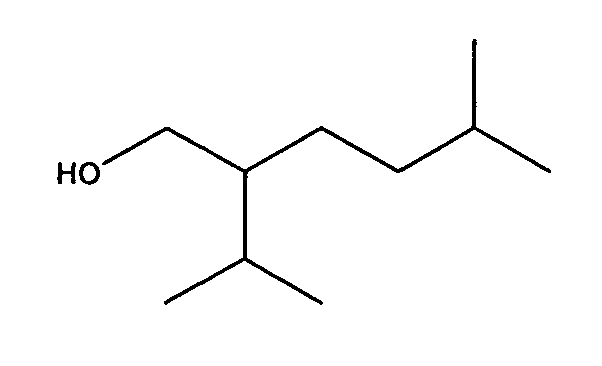
- Aufwändig und somit nachteilig an dem Verfahren nach Matsu-ura ist die Notwendigkeit, in Gegenwart eines Alkens, das als Wasserstoff-Akzeptor dient, zu arbeiten. Als Iridium-haltige Katalysatoren wurden [IrCl(cod)]2 oder [Cp*IrCl2]2 eingesetzt.
-
WO 2009/081727 A1 beschreibt die Dimerisierung von Alkoholen mit maximal 4 C-Atomen. Dabei wird die Guerbet-Reaktion in Gegenwart von Komplexen von Übergangsmetallen und einer Base durchgeführt. Dabei beträgt der Wasserstoffpartialdruck mindestens 0,1 MPa. - Aufgabe der Erfindung war es, ein verbessertes Verfahren zur Dimerisierung von Alkoholen im Sinne einer Guerbet-Reaktion bereitzustellen. Dabei sollte die Guerbetreaktion mit guten Ausbeuten verlaufen und mit geringer Nebenproduktbildung. Die Verfahrensbedingungen sollten im Vergleich zum Stand der Technik mindestens gleichwertig, eher jedoch günstiger sein; dies bedeutet insbesondere, dass die Guerbet-Reaktion unter vergleichweise günstigen Temperatur- und Druckbedingungen verlaufen soll. Ferner sollten eingesetzte Katalysatoren möglichst Ressourcen-schonend einsetzbar sein, d.h. Katalysatorverluste sollten sich in technisch vertretbaren Grenzen halten.
- Die vorliegende Erfindung betrifft ein Verfahren zur Dimerisierung von Alkoholen im Sinne einer Guerbet-Reaktion, bei dem man ein oder mehrere Alkohole (A), die 2 bis 72 C-Atome und 1 bis 3 OH-Gruppen pro Molekül aufweisen, in Gegenwart
- (a) einer Base (B),
- (b) einer Carbonylverbindung (C) und
- (c) eines Hydrierkatalysators (H) aus der Gruppe der Metalle Ruthenium, Rhodium, Palladium, Osmium, Iridum und Platin, wobei diese Metalle in elementarer Form vorliegen müssen,
- Bei der Guerbet-Reaktion kann ein einziger Ausgangsalkohol eingesetzt werden; es können aber auch mehrere unterschiedliche Alkohole als Ausgangsalkohole eingesetzt werden. Als Hauptprodukt der Guerbet-Reaktion entstehen Dimerisierungsprodukte, jedoch in untergeordneten Mengen auch höhere Homologe, insbesondere Trimerisierungsprodukte, die daraus resultieren, dass die primären Dimerisierungsprodukte mit noch nicht umgesetzten Ausgangsalkoholen (MA) ebenfalls im Sinne einer Guerbet-Reaktion reagieren.
- Wenn daher von einem ,,Verfahren zur Dimerisierung von Alkoholen im Sinne einer Guerbet-Reaktion" die Rede ist, schließt dies neben der Bildung von Dimerisierungsprodukten auch die die Bildung höherer Homologer ein.
- Setzt man ausschließlich einen primären oder sekundären Monoalkohol der Formel (MA) ein, so handelt es sich um die ,,klassische" Form der Guerbet-Reaktion; setzt man mehrere primäre und/oder sekundäre Monoalkohole der Formel (MA) ein, so handelt es sich um eine ,,gemischte" Guerbet-Reaktion.
- Wie ausgeführt setzt man die oben genannten Verbindungen (A) als Ausgangsalkohole für das erfindungsgemäße Verfahren ein, nämlich Alkohole, die 2 bis 72 C-Atome und 1 bis 3 OH-Gruppen pro Molekül aufweisen.
- In einer Ausführungsform setzt man Diole als Ausgangsalkohole ein. Beispiele für geeignete Diole sind alpha-omega-Diole, vicinale Diole und Dimerdiole.
- Dimerdiole sind seit langem bekannte und im Handel erhältliche Verbindungen, die beispielsweise durch Reduktion von Dimerfettsäuren und deren Estern gewonnen werden. Diese werden ihrerseits durch Dimerisierung ungesättigter Carbonsäuren oder Carbonsäureester, in der Regel Fettsäuren wie Ölsäure, Linolsäure, Erucasäure und dergleichen bzw. deren Estern gewonnen. Üblicherweise erfolgt die Oligomerisierung bei erhöhter Temperatur in Gegenwart eines Katalysators aus etwa Tonerde. Die dabei erhaltenen Substanzen - Dimerfettsäuren technischer Qualität - stellen Gemische dar, wobei die Dimerisierungsprodukte überwiegen. Jedoch sind auch geringe Anteile höherer Oligomerer, insbesondere die Trimerfettsäuren, enthalten. Dimerfettsäuren sind handelsübliche Produkte und werden in verschiedenen Zusammensetzungen und Qualitäten angeboten. Im Rahmen der vorliegenden Erfindung sind diejenigen Dimerdiole bevorzugt, die einen Dimergehalt von mindestens 70% und insbesondere von mindestens 90% aufweisen und bei denen die Zahl der C-Atome pro Dimermolekül überwiegend im Bereich von 36 bis 44 liegt.
- In einer bevorzugten Ausführungsform wählt man die Alkohole (A) aus der Gruppe der primären und/oder sekundären Monoalkohole der Formel (MA),

- Vorzugsweise sind dabei die Alkylgruppen ausschließlich gesättigt.
- Bei den Verbindungen (MA), deren Alkylreste ausschließlich gesättigt sind, gilt in einer bevorzugten Ausführungsform, dass die Gesamtzahl ihrer C-Atome im Bereich von 4 bis 18 und insbesondere im Bereich von 5 bis 10 liegt. Dabei sind Alkohole mit 5 C-Atomen und insbesondere Isomerengemische von Alkoholen mit 5 C-Atomen besonders bevorzugt.
- 3-Methyl-butan-1-ol ist als Monoalkohol (MA) ganz besonders bevorzugt. Er kann in reiner Form oder in Form technischer Mischungen und auch in Abmischung mit anderen Alkoholen der Formel (MA) als Ausgangs-Alkohol eingesetzt werden.
- Beispiele für geeignete Verbindungen (A) mit mehreren OH-Gruppen pro Molekül sind Dimeralkohole.
- Beispiele für geeignete Verbindungen (MA) sind:
- a) primäre Alkohole, z.B. Ethanol, Propan-1-ol, Butan-1-ol, Hexan-1-ol, Heptan-1-ol, Octan-1-ol, Nonan-1-ol, Decan-1-ol, Undecan-1-ol, Dodecan-1-ol, Tridecan-1-ol, Tetradecan-1-ol, 2-Methylbutan-1-ol, 3-Methylbutan-1-ol; Hexadecan-1-ol, Octadecan-1-ol;
- b) sekundäre Alkohole, z.B. Propan-2-ol, Butan-2-ol, Cyclobutanol, Pentan-2-ol, Pentan-3-ol, Cyclopentanol, Hexan-2-ol, Hexan-3-ol, Cyclohexanol, Cycloheptanol, Cyclooctanol, Cyclododecanol.
- Die Verbindungen (MA) können in reiner Form oder in Form technischer Produkte eingesetzt werden. Es ist auch möglich Mischungen für die erfindungsgemäß durchzuführende Guerbetreaktion einzusetzen, die im Wesentlichen ein oder mehrere Verbindungen (MA) neben weiteren Substanzen enthalten, ein Beispiel hierfür ist der Einsatz von Fuselölen. Vorzugsweise wird man jedoch, wenn man Fuselöle als Rohstoffbasis wählt, diese vor dem Einsatz in einer Guerbet-Reaktion von Terpenen, Furfuralen und weiteren Begleitstoffen reinigen, was z.B. durch destillative Verfahren erfolgen kann. In einer Ausführungsform werden dementsprechend Fuselalkohole oder Mischungen von Fuselalkoholen als Verbindungen (MA) eingesetzt.
- Die Auswahl der beim erfindungsgemäßen Verfahren einzusetzenden Basen (B) ist an sich nicht kritisch.
- Beispiele geeigneter Basen (B) sind Alkali- und Erdalkalihydroxide, Alkali- und Erdalkalicarbonate, Alkoxide, Amide und Hydride. Vorzugsweise setzt man Alkalihydroxide ein, insbesondere Kaliumhydroxid.
- In einer besonders bevorzugten Ausführungsform setzt man solche Basen (B) ein, bei denen Kalium als Kation fungiert. Beispiele sind Kaliumalkoholate und Kaliumhydroxid. Kaliumhydroxid ist dabei ganz besonders bevorzugt, insbesondere in Form einer wässrigen Lösung, z.B. als 50%-ige wässrige KOH.
- Vorzugsweise setzt man die Verbindungen (B) in einer Menge von 0,5 bis 12 Gew.-%, vorzugsweise 1,5 bis 7 Gew.-% - bezogen auf die eingesetzten Ausgangsalkohole - ein.
- Die Art der Zugabe der Base (B) ist an sich nicht kritisch und kann auf verschiedene Weise erfolgen, die der Fachmann routinemäßig auf den Einzelfall hin optimieren kann. In einer Ausführungsform wird die Gesamtmenge der Base (B) gleich zu Beginn der Guerbet-Reaktion zugesetzt. Insbesondere bei kurzkettigen Alkoholen kann es günstiger sein, die Base (B), insbesonder KOH, portionsweise zuzudosieren. Vorzugsweise wird bei der portionsweisen Zudosierung der Base (B) - insbesondere KOH - die Guerbet-Reaktion mit einer dem Fachmann bekannten Druckrampe gefahren, um das Reaktionsgemisch bei konstanter Temperatur nahe des Siedepunktes zu halten. Die beschriebenen Varianten der portionsweisen Zudosierung der Base (B) und der Einsatz einer Druckrampe führt meist zu einer signifikanten Ausbeutesteigerung.
- Die Auswahl der beim erfindungsgemäßen Verfahren einzusetzenden Carbonylverbindungen (C) ist an sich nicht kritisch.
- Sofern man primäre Ausgangsalkohole (MA) einsetzt, setzt man als Carbonylverbindungen (C) vorzugsweise Aldehyde ein, insbesondere solche, die von den eingesetzten Ausgangsalkoholen (MA) dadurch ableiten, dass man formal die Alkoholgruppe durch eine Aldehydgruppe ersetzt.
- Sofern man sekundäre Ausgangsalkohole (MA) einsetzt, setzt man als Carbonylverbindungen (C) vorzugsweise Ketone ein, insbesondere solche, die von den eingesetzten Ausgangsalkoholen (MA) dadurch ableiten, dass man formal die Alkoholgruppe durch eine Ketogruppe ersetzt.
- Vorzugsweise setzt man die Verbindungen (C) in einer Menge von 0,01 bis 10 Gew.-%, vorzugsweise 0,5 bis 5 Gew.-% - bezogen auf die eingesetzten Ausgangsalkohole - ein.
- Die einzusetzenden Hydrierkatalysatoren (H) werden ausgewählt aus der Gruppe der Metalle Ruthenium, Rhodium, Palladium, Osmium, Iridium und Platin, wobei diese Metalle in elementarer Form vorliegen müssen. Unter dem Ausdruck ,,in elementarer Form" ist zu verstehen, dass die Metalle in Form der Elemente der Oxidationsstufe null vorliegen, und zwar in Form der reinen Metalle, jedoch nicht in Form von Verbindungen oder Komplexen der Metalle. Dies impliziert klar, dass Salze oder Komplexe oder Verbindungen dieser Metalle nicht unter die Definition der Hydrierkatalysatoren (H) gemäß der vorliegenden Erfindung fallen. Logischerweise fallen Metall-Ligand-Komplexe oder Metall-Verbindungen auch dann nicht unter die Definition der Hydrierkatalysatoren (H) gemäß der vorliegenden Erfindung, wenn in ihnen das Metall die Oxidationssrufe null aufweist.
- Die genannten Metalle sind Edelmetalle der Gruppe VIII des Periodensystems. Sie müssen in elementarer Form vorliegen und sind somit heterogene Katalysatoren. Mithin fallen Salze dieser Metalle oder Komplexe dieser Metalle nicht unter die Definition der Komponente (H) gemäß der vorliegenden Erfindung, auch nicht Komplexe dieser Metalle, bei denen das Metall in der Oxidationsstufe 0 vorliegt.
- In einer bevorzugten Ausführungsform sind die Metalle Ruthenium, Rhodium, Palladium, Osmium, Iridium und Platin in eine hydrophobe Umgebung eingebunden. Das kann etwa dadurch realisiert sein, dass diese Metalle auf Kohle oder auf modifizierter Kieselsäure oder hydrophobisierter Kieselsäure immobilisert vorliegen. Die Immobilisierung und Hydrophobisierung kann auch auf anderen modifizierten mineralischen Gerüstsubstanzen wie Zeolithen Hydrotalciten oder Silicaten erfolgen. Dass die Metalle in eine hydrophobe Umgebung eingebunden sind, insbesondere auf hydrophobe Träger aufgebracht sind, hat den Vorteil, dass sie vor dem Auswaschen durch Wasser und der Deaktivierung durch alkalische Verbindungen weitgehend geschützt sind. Insbesondere dann, wenn die Reaktionstemperatur unterhalb von 200 °C und insbesondere unterhalb von 190 °C liegt, ist ein möglicher Auswasch-Effekt (,,leaching"), der ja einen Verlust teuren Katalysators bedeutet und daher verfahrenstechnisch unökonomisch ist, auf diese Weise für einen technischen Prozess vertretbar gering.
- Palladium auf Kohle (Pd/C) ist als Hydrierkatalysatoren (H) ganz besonders bevorzugt.
- Vorzugsweise setzt man den Katalysator (C) in einer Menge von 0,0005 bis 0,1 Gew.-%, vorzugsweise 0,001 bis 0,008 Gew.-% - Metallgehalt des Katalysators (C) bezogen auf die eingesetzten Ausgangsalkohole - ein.
- Die optimale Reaktionstemperatur zur Herstellung von Guerbetalkoholen ist gemäß dem Stand der Technik relativ hoch anzusetzen; typischerweise wird im Bereich von 230 bis 280°C und insbesondere 245-280°C gearbeitet. Bei der Herstellung von insbesondere kurzkettiger Guerbetalkoholen mit weniger als 16 C-Atomen werden in diesem Temperaturbereich Dampfdrücke von mehr als 10 bar erreicht, die technisch sehr hohe Anforderungen an die Anlagen stellen und daher schwer zu realisieren sind. Das erfindungsgemäß einzusetzende Katalysatorsystem hat demgegenüber den Vorteil, dass es gestattet, unter milderen Reaktionsbedingungen zu arbeiten: So kann beim erfindungsgemäßen Verfahren in Abhängigkeit des eingesetzten Ausgangsalkohols bei 120-250°C gearbeitet werden. Vorzugsweise arbeitet man bei 140 bis 230 °C. Durch die genannte Absenkung der Reaktionstemperatur werden auch niedrigere Drücke erhalten, die eine technische Realisierung auch kurzkettiger Guerbetalkohole in üblichen technischen Anlagen (pmax = 6 bar) ermöglichen. Vorzugswiese arbeitet man bei Drücken von 0,01 bis 15 bar und insbesondere 0, bis 6 bar.
- Insgesamt zeichnet sich das erfindungsgemäße Verfahren durch mehrere Vorteile aus:
- Die Guerbetreaktion verläuft mit guten Ausbeuten.
- Die Nebenproduktbildung ist gering.
- Die Reaktionstemperaturen und Drücke sind im Vergleich zum Stand der Technik niedriger.
- Der Hydrierkatalysator (H) ist dann besonders gut gegen Auswaschen durch Wasser und vor alkalischen Verbindungen geschützt, wenn die elementaren Metalle (Ruthenium, Rhodium, Palladium, Osmium, Iridum, Platin) in eine hydrophobe Umgebung eingebunden sind.
- Die Reaktion verläuft unter vergleichsweise günstigen Temperatur- und Druckbedingungen.
- Pd/C: 5% Pd/C 3610 von der Firma Johnson Matthey in 50% H2O
- Ein Reaktionsgemisch aus 2540g eines Gemisches aus Octan-1-ol und Decan-1-ol, 70 g KOH (50%ig) sowie 75g eines Gemisches aus Octanal und Decanal wurden unter Rühren und leichtem Überdruck auf 235°C erhitzt und 4 Stunden lang bei dieser Temperatur gerührt. Das bei der Reaktion entstandene Wasser wurde entfernt. Nach Abkühlen des Reaktionsgemisches wurde ein Reaktionsgemisch mit 64% Guerbetalkoholen erhalten.
- Ein Reaktionsgemisch aus 2540g eines Gemisches aus Octan-1-ol und Decan-1-ol, 70 g KOH (50%ig), 75g eines Gemisches aus Octanal und Decanal und 5 g Pd/C wurden unter Rühren und leichtem Überdruck auf 225°C erhitzt und 2 Stunden lang bei dieser Temperatur gerührt. Das bei der Reaktion entstandene Wasser wurde entfernt. Nach Abkühlen des Reaktionsgemisches wurde ein Reaktionsgemisch mit 70 % Guerbetalkoholen erhalten.
- Ein Reaktionsgemisch aus 2540g eines Gemisches aus Octan-1-ol und Decan-1-ol, 70 g KOH (50%ig), 75g eines Gemisches aus Octanal und Decanal und 5 g Pd/C wurden unter Rühren und leichtem Überdruck auf 200°C erhitzt und 4 Stunden lang bei dieser Temperatur gerührt. Das bei der Reaktion entstandene Wasser wurde entfernt. Nach Abkühlen des Reaktionsgemisches wurde ein Reaktionsgemisch mit 64 % Guerbetalkoholen erhalten.
- Ein Reaktionsgemisch aus 3100g Pentan-1-ol und 92g Pentanal sowie 56g KOH (50%ig) wurde auf 220°C aufgeheizt und bei einem sich einstellenden Eigendruck von 7 bar 22 Stunden unter Rühren gefahren. Nach Abkühlen fand sich ein Guerbetalkohol-Anteil von 30%.
- Ein Reaktionsgemisch aus 3100g Pentan-1-ol und 92g Pentanal, 56g KOH (50%ig) und 5 g Pd/C wurde auf 195°C aufgeheizt und bei einem sich einstellenden Eigendruck von 5,5 bar 5 Stunden unter Rühren gefahren. Nach Abkühlen fand sich ein Guerbetalkohol-Anteil von 30%.
- Ein Reaktionsgemisch aus 2500g 3-Methyl-1-Butanol, 75g 3-Methyl-1-Butanal, 4 g Pd/C wurde auf 180°C aufgeheizt, 320g KOH (50%ig) portionsweise zudosiert und mit einer Druckrampe von 4,6 auf 1,4 bar 18 Stunden unter Rühren gefahren. Nach Abkühlen fand sich ein Guerbetalkohol-Anteil von 75%.
- Ein Reaktionsgemisch aus 2500g Hexan-1-ol, 75g Hexanal, 4 g Pd/C wurde auf 210°C aufgeheizt, 80g KOH (50%ig) portionsweise zudosiert und mit einer Druckrampe von 5 auf 3 bar 6 Stunden unter Rühren gefahren. Nach Abkühlen fand sich ein Guerbetalkohol-Anteil von 38%.
Claims (14)
- Verfahren zur Dimerisierung von Alkoholen im Sinne einer Guerbet-Reaktion, bei dem man ein oder mehrere Alkohole (A), die 2 bis 72 C-Atome und 1 bis 3 OH-Gruppen pro Molekül aufweisen, in Gegenwart(a) einer Base (B),(b) einer Carbonylverbindung (C) und(c) eines Hydrierkatalysators (H) aus der Gruppe der Metalle Ruthenium, Rhodium, Palladium, Osmium, Iridium und Platin, wobei diese Metalle in elementarer Form vorliegen müssen,umsetzt, mit der Maßgabe, dass die Alkohole (A) mindestens eine primäre oder sekundäre OH-Gruppe aufweisen und dem C-Atom mit dieser primären oder sekundären OH-Gruppe ein C-Atom unmittelbar benachbart ist, das mindestens ein H-Atom als Substituenten trägt.
- Verfahren nach Anspruch 1, wobei man die Alkohole (A) auswählt aus der Gruppe der primären und/oder sekundären Monoalkohole der Formel (MA),

- Verfahren nach Anspruch 2, wobei die Alkylgruppen ausschließlich gesättigt sind.
- Verfahren nach Anspruch 3, wobei für die primären und/oder sekundären Monoalkohole der Formel (MA) gilt, dass die Gesamtzahl ihrer C-Atome im Bereich von 4 bis 18 liegt.
- Verfahren nach Anspruch 3, wobei für die primären und/oder sekundären Monoalkohole der Formel (MA) gilt, dass die Gesamtzahl ihrer C-Atome im Bereich von 5 bis 10 liegt.
- Verfahren nach Anspruch 5, wobei man 3-Methyl-butan-1-ol als Monoalkohol (MA) einsetzt.
- Verfahren nach einem der Ansprüche 1 bis 6, wobei man als Base (B) eine Verbindung einsetzt, die ausgewählt ist aus der Gruppe der Alkali- und Erdalkalihydroxide, Alkali- und Erdalkaliarbonate, Alkoxide, Amide und Hydride.
- Verfahren nach einem der Ansprüche 1 bis 6, wobei man als Base (B) eine Verbindung einsetzt, bei der Kalium als Kation fungiert.
- Verfahren nach Anspruch 8, wobei man Kaliumhydroxid als Base (B) einsetzt.
- Verfahren nach einem der Ansprüche 1 bis 5, wobei man die Carbonylverbindung (C) wie folgt wählt: Sofern man primäre Ausgangsalkohole (MA) einsetzt, setzt man als Carbonylverbindungen (C) Aldehyde ein, die sich von den eingesetzten Ausgangsalkoholen (MA) dadurch ableiten, dass man formal die Alkoholgruppe durch eine Aldehydgruppe ersetzt; sofern man sekundäre Ausgangsalkohole (MA) einsetzt, setzt man als Carbonylverbindungen (C) Ketone ein, die sich von den eingesetzten Ausgangsalkoholen (MA) dadurch ableiten, dass man formal die Alkoholgruppe durch eine Ketogruppe ersetzt.
- Verfahren nach einem der Ansprüche 1 bis 10, wobei das Metall des Hydrierkatalysators (H) in eine hydrophobe Umgebung eingebettet ist.
- Verfahren nach einem der Ansprüche 1 bis 10, wobei man Palladium auf Kohle (Pd/C) als Hydrierkatalysator (H) einsetzt.
- Verfahren nach einem der Ansprüche 1 bis 12, wobei man die Umsetzung im Temperaturbereich von 140 °C bis 230 °C durchführt.
- Verfahren nach einem der Ansprüche 1 bis 13, wobei man die Umsetzung bei Drücken im Bereich von 0,1 bis 6 bar durchführt.
Priority Applications (6)
| Application Number | Priority Date | Filing Date | Title |
|---|---|---|---|
| EP09013922.1A EP2319822B1 (de) | 2009-11-06 | 2009-11-06 | Verfahren zur Herstellung von Guerbet-Alkoholen |
| ES09013922.1T ES2621807T3 (es) | 2009-11-06 | 2009-11-06 | Procedimiento para la preparación de alcoholes de Guerbet |
| JP2012537317A JP5688093B2 (ja) | 2009-11-06 | 2010-10-28 | ゲルベアルコールの製造方法 |
| US13/508,103 US8779216B2 (en) | 2009-11-06 | 2010-10-28 | Method for producing Guerbet alcohols |
| PCT/EP2010/006609 WO2011054483A1 (de) | 2009-11-06 | 2010-10-28 | Verfahren zur herstellung von guerbet-alkoholen |
| CA2779759A CA2779759A1 (en) | 2009-11-06 | 2010-10-28 | Method for producing guerbet alcohols |
Applications Claiming Priority (1)
| Application Number | Priority Date | Filing Date | Title |
|---|---|---|---|
| EP09013922.1A EP2319822B1 (de) | 2009-11-06 | 2009-11-06 | Verfahren zur Herstellung von Guerbet-Alkoholen |
Publications (2)
| Publication Number | Publication Date |
|---|---|
| EP2319822A1 true EP2319822A1 (de) | 2011-05-11 |
| EP2319822B1 EP2319822B1 (de) | 2017-01-11 |
Family
ID=42101410
Family Applications (1)
| Application Number | Title | Priority Date | Filing Date |
|---|---|---|---|
| EP09013922.1A Not-in-force EP2319822B1 (de) | 2009-11-06 | 2009-11-06 | Verfahren zur Herstellung von Guerbet-Alkoholen |
Country Status (6)
| Country | Link |
|---|---|
| US (1) | US8779216B2 (de) |
| EP (1) | EP2319822B1 (de) |
| JP (1) | JP5688093B2 (de) |
| CA (1) | CA2779759A1 (de) |
| ES (1) | ES2621807T3 (de) |
| WO (1) | WO2011054483A1 (de) |
Families Citing this family (12)
| Publication number | Priority date | Publication date | Assignee | Title |
|---|---|---|---|---|
| EP2616418B1 (de) * | 2010-09-15 | 2016-11-02 | Kabushiki Kaisha Sangi | Verfahren zur herstellung von alkohol durch eine guerbet-reaktion |
| EP2457890A1 (de) | 2010-11-29 | 2012-05-30 | Cognis IP Management GmbH | Biozidzusammensetzungen mit Alkoxylierungsprodukten aus Isoamylalkoholderivaten |
| US9422469B2 (en) | 2013-03-15 | 2016-08-23 | Chevron U.S.A. Inc. | Mixed carbon length synthesis of primary guerbet alcohols |
| DE102011121087A1 (de) | 2011-12-14 | 2013-06-20 | Fraunhofer-Gesellschaft zur Förderung der angewandten Forschung e.V. | Verfahren zur katalytischen Kondensation oder Kopplung |
| JP6510400B2 (ja) | 2012-03-21 | 2019-05-08 | ピー2 サイエンス,インコーポレイティド | ゲルベアルコール、並びにその調製方法及び使用 |
| WO2013156399A1 (de) * | 2012-04-20 | 2013-10-24 | Basf Se | Verfahren zur herstellung von verzweigten alkoholen |
| WO2014120593A1 (en) | 2013-02-01 | 2014-08-07 | 3M Innovative Properties Company | Pressure-sensitive adhesive compositions and adhesive articles including the same |
| EP3048090B1 (de) * | 2013-09-17 | 2022-03-30 | LG Chem, Ltd. | Verfahren zur herstellung von alkanol |
| US9902673B2 (en) | 2015-07-16 | 2018-02-27 | The University Of Rochester | Methods for producing butanol |
| WO2019163640A1 (ja) * | 2018-02-20 | 2019-08-29 | 長瀬産業株式会社 | ゲルベアルコールを製造する方法 |
| FR3079746B1 (fr) | 2018-04-10 | 2020-11-06 | Biosynthis Sarl | Excipient cosmetique comprenant des alcanes |
| FR3135395B1 (fr) | 2022-04-02 | 2026-04-24 | Biosynthis Sarl | Procede de preparation d’un melange volatil d’alcanes et de composition cosmetique |
Citations (5)
| Publication number | Priority date | Publication date | Assignee | Title |
|---|---|---|---|---|
| US3119880A (en) | 1961-05-29 | 1964-01-28 | Gulf Research Development Co | Condensation of alcohols |
| US3514493A (en) * | 1966-05-18 | 1970-05-26 | Montedison Spa | Process for the dimerization of primary and secondary alcohols |
| US3979466A (en) | 1973-06-06 | 1976-09-07 | Continental Oil Company | Process for condensation of alcohols |
| WO1991004242A1 (en) | 1989-09-13 | 1991-04-04 | Henkel Research Corporation | Improved guerbet process |
| WO2009081727A1 (ja) | 2007-12-20 | 2009-07-02 | Mitsubishi Chemical Corporation | アルコールの製造方法 |
Family Cites Families (2)
| Publication number | Priority date | Publication date | Assignee | Title |
|---|---|---|---|---|
| JPH03279336A (ja) * | 1990-03-29 | 1991-12-10 | Kao Corp | 分枝二量化アルコールの製造方法 |
| DE10046433A1 (de) * | 2000-09-20 | 2002-04-04 | Cognis Deutschland Gmbh | Verfahren zur Herstellung von Guerbetalkoholen |
-
2009
- 2009-11-06 EP EP09013922.1A patent/EP2319822B1/de not_active Not-in-force
- 2009-11-06 ES ES09013922.1T patent/ES2621807T3/es active Active
-
2010
- 2010-10-28 WO PCT/EP2010/006609 patent/WO2011054483A1/de not_active Ceased
- 2010-10-28 JP JP2012537317A patent/JP5688093B2/ja not_active Expired - Fee Related
- 2010-10-28 CA CA2779759A patent/CA2779759A1/en not_active Abandoned
- 2010-10-28 US US13/508,103 patent/US8779216B2/en not_active Expired - Fee Related
Patent Citations (5)
| Publication number | Priority date | Publication date | Assignee | Title |
|---|---|---|---|---|
| US3119880A (en) | 1961-05-29 | 1964-01-28 | Gulf Research Development Co | Condensation of alcohols |
| US3514493A (en) * | 1966-05-18 | 1970-05-26 | Montedison Spa | Process for the dimerization of primary and secondary alcohols |
| US3979466A (en) | 1973-06-06 | 1976-09-07 | Continental Oil Company | Process for condensation of alcohols |
| WO1991004242A1 (en) | 1989-09-13 | 1991-04-04 | Henkel Research Corporation | Improved guerbet process |
| WO2009081727A1 (ja) | 2007-12-20 | 2009-07-02 | Mitsubishi Chemical Corporation | アルコールの製造方法 |
Non-Patent Citations (5)
| Title |
|---|
| ANTHONY J. 0 LENICK, JOURNAL OF SURFACTANTS AND DETERGENTS, vol. 4, 2001, pages 311 - 315 |
| CARLINI ET AL., JOURNAL OF MOLECULAR CATALYSIS A, 2004, pages 65 - 70 |
| MATSU-URA ET AL., JOURNAL OF ORGANIC CHEMISTRY, 2006, pages 8306 - 8308 |
| P.L. BURK ET.AL.: "The Rhodium promoted Guerbet reaction Part I. Higher alcohols from lower alcohols", J. MOLECULAR CATALYSIS, vol. 33, 1985, pages 1 - 14, XP002578142 * |
| P.L. BURK ET.AL.: "The Rhodium promoted Guerbet reaction part II. Secondary alcohols and methanol as substrates", J. MOLECULAR CATALYSIS, vol. 33, 1985, pages 15 - 21, XP002578143 * |
Also Published As
| Publication number | Publication date |
|---|---|
| ES2621807T3 (es) | 2017-07-05 |
| US20120220806A1 (en) | 2012-08-30 |
| US8779216B2 (en) | 2014-07-15 |
| EP2319822B1 (de) | 2017-01-11 |
| JP5688093B2 (ja) | 2015-03-25 |
| WO2011054483A1 (de) | 2011-05-12 |
| JP2013510105A (ja) | 2013-03-21 |
| CA2779759A1 (en) | 2011-05-12 |
Similar Documents
| Publication | Publication Date | Title |
|---|---|---|
| EP2319822B1 (de) | Verfahren zur Herstellung von Guerbet-Alkoholen | |
| DE2702582C3 (de) | Verfahren zur Herstellung von Trimethylolalkanen | |
| EP3750866B1 (de) | Verfahren zur herstellung eines alkohols aus kohlenwasserstoffen | |
| EP2734493B1 (de) | Verfahren zur herstellung 2,2-difluorethanol | |
| DE102008031338B4 (de) | Verfahren zur Herstellung von Neopentylglykol | |
| EP3625199B1 (de) | Hydroformylierungsverfahren dienend der grosstechnischen herstellung von aldehyden und/oder alkoholen | |
| DE10357718A1 (de) | Verfahren zur Herstellung von Tricyclodecandialdehyd | |
| DE19803892A1 (de) | Verfahren zur Herstellung von optisch aktiven Aminoalkoholen | |
| DE69214026T2 (de) | Herstellung von Neopentylglykol (III) | |
| EP0922687B1 (de) | Verfahren zur Herstellung von Alkoholen | |
| DE3644675A1 (de) | Verfahren zur herstellung von 2,2-dimethylpropandiol-(1,3) | |
| EP0022955A1 (de) | Verbessertes Verfahren zur Herstellung von höheren ungesättigten Ketonen | |
| DE69410103T2 (de) | Verfahren zur herstellung von 2-ethyl-1,3-hexandiol | |
| EP0919532B1 (de) | Verfahren zur Herstellung von gesättigten Alkoholen | |
| WO2008064991A1 (de) | Verfahren zur herstellung von 3-alkoxypropan-1-ole | |
| EP2703375A1 (de) | Verfahren zur Herstellung von Menthol | |
| WO2002024621A1 (de) | Verfahren zur herstellung von verzweigten alkoholen und/oder kohlenwasserstoffen | |
| DE2447069A1 (de) | Verfahren zur herstellung von carbonsaeuren und/oder carbonsaeureestern | |
| EP2780308B1 (de) | Verfahren zur gewinnung von di-trimethylolpropan und mit trimethylolpropan angereicherten produktströmen aus den nebenströmen der trimethylolpropanherstellung | |
| EP1090899B1 (de) | Verfahren zur Herstellung von 1,3-Diolen | |
| DE1901089A1 (de) | Verfahren zur Herstellung von Hexantriol-1,2,6 | |
| EP1758842B1 (de) | Verfahren zur herstellung primärer langkettiger alkohole | |
| DE60113857T2 (de) | Herstellung von 3-alkylcycloalkanolen | |
| DE69105743T2 (de) | Oxo-verfahren. | |
| EP1889825A1 (de) | Verfahren zur Herstellung von 1,2-Propandiol |
Legal Events
| Date | Code | Title | Description |
|---|---|---|---|
| PUAI | Public reference made under article 153(3) epc to a published international application that has entered the european phase |
Free format text: ORIGINAL CODE: 0009012 |
|
| AK | Designated contracting states |
Kind code of ref document: A1 Designated state(s): AT BE BG CH CY CZ DE DK EE ES FI FR GB GR HR HU IE IS IT LI LT LU LV MC MK MT NL NO PL PT RO SE SI SK SM TR |
|
| AX | Request for extension of the european patent |
Extension state: AL BA RS |
|
| 17P | Request for examination filed |
Effective date: 20110616 |
|
| GRAP | Despatch of communication of intention to grant a patent |
Free format text: ORIGINAL CODE: EPIDOSNIGR1 |
|
| INTG | Intention to grant announced |
Effective date: 20160708 |
|
| RIN1 | Information on inventor provided before grant (corrected) |
Inventor name: WICK, ANJA Inventor name: MAHNKE, EIKE, ULF |
|
| GRAS | Grant fee paid |
Free format text: ORIGINAL CODE: EPIDOSNIGR3 |
|
| GRAA | (expected) grant |
Free format text: ORIGINAL CODE: 0009210 |
|
| AK | Designated contracting states |
Kind code of ref document: B1 Designated state(s): AT BE BG CH CY CZ DE DK EE ES FI FR GB GR HR HU IE IS IT LI LT LU LV MC MK MT NL NO PL PT RO SE SI SK SM TR |
|
| REG | Reference to a national code |
Ref country code: GB Ref legal event code: FG4D Free format text: NOT ENGLISH |
|
| REG | Reference to a national code |
Ref country code: CH Ref legal event code: EP |
|
| REG | Reference to a national code |
Ref country code: AT Ref legal event code: REF Ref document number: 861119 Country of ref document: AT Kind code of ref document: T Effective date: 20170115 |
|
| REG | Reference to a national code |
Ref country code: IE Ref legal event code: FG4D Free format text: LANGUAGE OF EP DOCUMENT: GERMAN |
|
| REG | Reference to a national code |
Ref country code: DE Ref legal event code: R096 Ref document number: 502009013556 Country of ref document: DE |
|
| REG | Reference to a national code |
Ref country code: LT Ref legal event code: MG4D |
|
| REG | Reference to a national code |
Ref country code: NL Ref legal event code: MP Effective date: 20170111 |
|
| PG25 | Lapsed in a contracting state [announced via postgrant information from national office to epo] |
Ref country code: NL Free format text: LAPSE BECAUSE OF FAILURE TO SUBMIT A TRANSLATION OF THE DESCRIPTION OR TO PAY THE FEE WITHIN THE PRESCRIBED TIME-LIMIT Effective date: 20170111 |
|
| REG | Reference to a national code |
Ref country code: ES Ref legal event code: FG2A Ref document number: 2621807 Country of ref document: ES Kind code of ref document: T3 Effective date: 20170705 |
|
| PG25 | Lapsed in a contracting state [announced via postgrant information from national office to epo] |
Ref country code: HR Free format text: LAPSE BECAUSE OF FAILURE TO SUBMIT A TRANSLATION OF THE DESCRIPTION OR TO PAY THE FEE WITHIN THE PRESCRIBED TIME-LIMIT Effective date: 20170111 Ref country code: IS Free format text: LAPSE BECAUSE OF FAILURE TO SUBMIT A TRANSLATION OF THE DESCRIPTION OR TO PAY THE FEE WITHIN THE PRESCRIBED TIME-LIMIT Effective date: 20170511 Ref country code: GR Free format text: LAPSE BECAUSE OF FAILURE TO SUBMIT A TRANSLATION OF THE DESCRIPTION OR TO PAY THE FEE WITHIN THE PRESCRIBED TIME-LIMIT Effective date: 20170412 Ref country code: LT Free format text: LAPSE BECAUSE OF FAILURE TO SUBMIT A TRANSLATION OF THE DESCRIPTION OR TO PAY THE FEE WITHIN THE PRESCRIBED TIME-LIMIT Effective date: 20170111 Ref country code: NO Free format text: LAPSE BECAUSE OF FAILURE TO SUBMIT A TRANSLATION OF THE DESCRIPTION OR TO PAY THE FEE WITHIN THE PRESCRIBED TIME-LIMIT Effective date: 20170411 Ref country code: FI Free format text: LAPSE BECAUSE OF FAILURE TO SUBMIT A TRANSLATION OF THE DESCRIPTION OR TO PAY THE FEE WITHIN THE PRESCRIBED TIME-LIMIT Effective date: 20170111 |
|
| PG25 | Lapsed in a contracting state [announced via postgrant information from national office to epo] |
Ref country code: SE Free format text: LAPSE BECAUSE OF FAILURE TO SUBMIT A TRANSLATION OF THE DESCRIPTION OR TO PAY THE FEE WITHIN THE PRESCRIBED TIME-LIMIT Effective date: 20170111 Ref country code: PT Free format text: LAPSE BECAUSE OF FAILURE TO SUBMIT A TRANSLATION OF THE DESCRIPTION OR TO PAY THE FEE WITHIN THE PRESCRIBED TIME-LIMIT Effective date: 20170511 Ref country code: LV Free format text: LAPSE BECAUSE OF FAILURE TO SUBMIT A TRANSLATION OF THE DESCRIPTION OR TO PAY THE FEE WITHIN THE PRESCRIBED TIME-LIMIT Effective date: 20170111 Ref country code: PL Free format text: LAPSE BECAUSE OF FAILURE TO SUBMIT A TRANSLATION OF THE DESCRIPTION OR TO PAY THE FEE WITHIN THE PRESCRIBED TIME-LIMIT Effective date: 20170111 Ref country code: BG Free format text: LAPSE BECAUSE OF FAILURE TO SUBMIT A TRANSLATION OF THE DESCRIPTION OR TO PAY THE FEE WITHIN THE PRESCRIBED TIME-LIMIT Effective date: 20170411 |
|
| REG | Reference to a national code |
Ref country code: DE Ref legal event code: R097 Ref document number: 502009013556 Country of ref document: DE |
|
| PG25 | Lapsed in a contracting state [announced via postgrant information from national office to epo] |
Ref country code: EE Free format text: LAPSE BECAUSE OF FAILURE TO SUBMIT A TRANSLATION OF THE DESCRIPTION OR TO PAY THE FEE WITHIN THE PRESCRIBED TIME-LIMIT Effective date: 20170111 Ref country code: SK Free format text: LAPSE BECAUSE OF FAILURE TO SUBMIT A TRANSLATION OF THE DESCRIPTION OR TO PAY THE FEE WITHIN THE PRESCRIBED TIME-LIMIT Effective date: 20170111 Ref country code: RO Free format text: LAPSE BECAUSE OF FAILURE TO SUBMIT A TRANSLATION OF THE DESCRIPTION OR TO PAY THE FEE WITHIN THE PRESCRIBED TIME-LIMIT Effective date: 20170111 Ref country code: CZ Free format text: LAPSE BECAUSE OF FAILURE TO SUBMIT A TRANSLATION OF THE DESCRIPTION OR TO PAY THE FEE WITHIN THE PRESCRIBED TIME-LIMIT Effective date: 20170111 |
|
| PLBE | No opposition filed within time limit |
Free format text: ORIGINAL CODE: 0009261 |
|
| STAA | Information on the status of an ep patent application or granted ep patent |
Free format text: STATUS: NO OPPOSITION FILED WITHIN TIME LIMIT |
|
| PG25 | Lapsed in a contracting state [announced via postgrant information from national office to epo] |
Ref country code: SM Free format text: LAPSE BECAUSE OF FAILURE TO SUBMIT A TRANSLATION OF THE DESCRIPTION OR TO PAY THE FEE WITHIN THE PRESCRIBED TIME-LIMIT Effective date: 20170111 Ref country code: DK Free format text: LAPSE BECAUSE OF FAILURE TO SUBMIT A TRANSLATION OF THE DESCRIPTION OR TO PAY THE FEE WITHIN THE PRESCRIBED TIME-LIMIT Effective date: 20170111 |
|
| 26N | No opposition filed |
Effective date: 20171012 |
|
| PG25 | Lapsed in a contracting state [announced via postgrant information from national office to epo] |
Ref country code: SI Free format text: LAPSE BECAUSE OF FAILURE TO SUBMIT A TRANSLATION OF THE DESCRIPTION OR TO PAY THE FEE WITHIN THE PRESCRIBED TIME-LIMIT Effective date: 20170111 |
|
| REG | Reference to a national code |
Ref country code: DE Ref legal event code: R119 Ref document number: 502009013556 Country of ref document: DE |
|
| PG25 | Lapsed in a contracting state [announced via postgrant information from national office to epo] |
Ref country code: MC Free format text: LAPSE BECAUSE OF FAILURE TO SUBMIT A TRANSLATION OF THE DESCRIPTION OR TO PAY THE FEE WITHIN THE PRESCRIBED TIME-LIMIT Effective date: 20170111 |
|
| GBPC | Gb: european patent ceased through non-payment of renewal fee |
Effective date: 20171106 |
|
| PG25 | Lapsed in a contracting state [announced via postgrant information from national office to epo] |
Ref country code: CH Free format text: LAPSE BECAUSE OF NON-PAYMENT OF DUE FEES Effective date: 20171130 Ref country code: LI Free format text: LAPSE BECAUSE OF NON-PAYMENT OF DUE FEES Effective date: 20171130 |
|
| PG25 | Lapsed in a contracting state [announced via postgrant information from national office to epo] |
Ref country code: LU Free format text: LAPSE BECAUSE OF NON-PAYMENT OF DUE FEES Effective date: 20171106 |
|
| REG | Reference to a national code |
Ref country code: FR Ref legal event code: ST Effective date: 20180731 Ref country code: BE Ref legal event code: MM Effective date: 20171130 |
|
| REG | Reference to a national code |
Ref country code: IE Ref legal event code: MM4A |
|
| PG25 | Lapsed in a contracting state [announced via postgrant information from national office to epo] |
Ref country code: MT Free format text: LAPSE BECAUSE OF FAILURE TO SUBMIT A TRANSLATION OF THE DESCRIPTION OR TO PAY THE FEE WITHIN THE PRESCRIBED TIME-LIMIT Effective date: 20170111 |
|
| PG25 | Lapsed in a contracting state [announced via postgrant information from national office to epo] |
Ref country code: IE Free format text: LAPSE BECAUSE OF NON-PAYMENT OF DUE FEES Effective date: 20171106 Ref country code: IT Free format text: LAPSE BECAUSE OF NON-PAYMENT OF DUE FEES Effective date: 20171106 Ref country code: FR Free format text: LAPSE BECAUSE OF NON-PAYMENT OF DUE FEES Effective date: 20171130 Ref country code: DE Free format text: LAPSE BECAUSE OF NON-PAYMENT OF DUE FEES Effective date: 20180602 |
|
| PG25 | Lapsed in a contracting state [announced via postgrant information from national office to epo] |
Ref country code: GB Free format text: LAPSE BECAUSE OF NON-PAYMENT OF DUE FEES Effective date: 20171106 Ref country code: BE Free format text: LAPSE BECAUSE OF NON-PAYMENT OF DUE FEES Effective date: 20171130 |
|
| REG | Reference to a national code |
Ref country code: ES Ref legal event code: FD2A Effective date: 20181221 |
|
| REG | Reference to a national code |
Ref country code: AT Ref legal event code: MM01 Ref document number: 861119 Country of ref document: AT Kind code of ref document: T Effective date: 20171106 |
|
| PG25 | Lapsed in a contracting state [announced via postgrant information from national office to epo] |
Ref country code: AT Free format text: LAPSE BECAUSE OF NON-PAYMENT OF DUE FEES Effective date: 20171106 |
|
| PG25 | Lapsed in a contracting state [announced via postgrant information from national office to epo] |
Ref country code: ES Free format text: LAPSE BECAUSE OF NON-PAYMENT OF DUE FEES Effective date: 20171107 |
|
| PG25 | Lapsed in a contracting state [announced via postgrant information from national office to epo] |
Ref country code: HU Free format text: LAPSE BECAUSE OF FAILURE TO SUBMIT A TRANSLATION OF THE DESCRIPTION OR TO PAY THE FEE WITHIN THE PRESCRIBED TIME-LIMIT; INVALID AB INITIO Effective date: 20091106 |
|
| PG25 | Lapsed in a contracting state [announced via postgrant information from national office to epo] |
Ref country code: CY Free format text: LAPSE BECAUSE OF NON-PAYMENT OF DUE FEES Effective date: 20170111 |
|
| PG25 | Lapsed in a contracting state [announced via postgrant information from national office to epo] |
Ref country code: MK Free format text: LAPSE BECAUSE OF FAILURE TO SUBMIT A TRANSLATION OF THE DESCRIPTION OR TO PAY THE FEE WITHIN THE PRESCRIBED TIME-LIMIT Effective date: 20170111 |
|
| PG25 | Lapsed in a contracting state [announced via postgrant information from national office to epo] |
Ref country code: TR Free format text: LAPSE BECAUSE OF FAILURE TO SUBMIT A TRANSLATION OF THE DESCRIPTION OR TO PAY THE FEE WITHIN THE PRESCRIBED TIME-LIMIT Effective date: 20170111 |