EP2319686A1 - Deoxidizing laminate - Google Patents
Deoxidizing laminate Download PDFInfo
- Publication number
- EP2319686A1 EP2319686A1 EP09809555A EP09809555A EP2319686A1 EP 2319686 A1 EP2319686 A1 EP 2319686A1 EP 09809555 A EP09809555 A EP 09809555A EP 09809555 A EP09809555 A EP 09809555A EP 2319686 A1 EP2319686 A1 EP 2319686A1
- Authority
- EP
- European Patent Office
- Prior art keywords
- oxygen
- odor
- resin composition
- absorbent
- absorption layer
- Prior art date
- Legal status (The legal status is an assumption and is not a legal conclusion. Google has not performed a legal analysis and makes no representation as to the accuracy of the status listed.)
- Granted
Links
- QVGXLLKOCUKJST-UHFFFAOYSA-N atomic oxygen Chemical compound [O] QVGXLLKOCUKJST-UHFFFAOYSA-N 0.000 claims abstract description 232
- 239000001301 oxygen Substances 0.000 claims abstract description 232
- 229910052760 oxygen Inorganic materials 0.000 claims abstract description 232
- 238000010521 absorption reaction Methods 0.000 claims abstract description 186
- 239000002250 absorbent Substances 0.000 claims abstract description 171
- 230000002745 absorbent Effects 0.000 claims abstract description 171
- 239000011342 resin composition Substances 0.000 claims abstract description 114
- 229920005992 thermoplastic resin Polymers 0.000 claims abstract description 68
- 238000002955 isolation Methods 0.000 claims abstract description 63
- 230000004888 barrier function Effects 0.000 claims abstract description 46
- 239000003054 catalyst Substances 0.000 claims abstract description 45
- 229910052723 transition metal Inorganic materials 0.000 claims abstract description 40
- 150000003624 transition metals Chemical class 0.000 claims abstract description 34
- 239000000126 substance Substances 0.000 claims abstract description 25
- 238000010030 laminating Methods 0.000 claims abstract description 18
- 239000007789 gas Substances 0.000 claims description 53
- 230000002378 acidificating effect Effects 0.000 claims description 42
- OAKJQQAXSVQMHS-UHFFFAOYSA-N Hydrazine Chemical compound NN OAKJQQAXSVQMHS-UHFFFAOYSA-N 0.000 claims description 30
- 150000003839 salts Chemical class 0.000 claims description 21
- 150000001875 compounds Chemical class 0.000 claims description 20
- 238000013329 compounding Methods 0.000 claims description 18
- 150000002429 hydrazines Chemical class 0.000 claims description 15
- 238000004806 packaging method and process Methods 0.000 claims description 15
- 150000003672 ureas Chemical class 0.000 claims description 10
- 150000002357 guanidines Chemical class 0.000 claims description 9
- 239000000395 magnesium oxide Substances 0.000 claims description 7
- CPLXHLVBOLITMK-UHFFFAOYSA-N magnesium oxide Inorganic materials [Mg]=O CPLXHLVBOLITMK-UHFFFAOYSA-N 0.000 claims description 7
- AXZKOIWUVFPNLO-UHFFFAOYSA-N magnesium;oxygen(2-) Chemical compound [O-2].[Mg+2] AXZKOIWUVFPNLO-UHFFFAOYSA-N 0.000 claims description 7
- 239000000654 additive Substances 0.000 claims description 6
- 230000000996 additive effect Effects 0.000 claims description 5
- HAMNKKUPIHEESI-UHFFFAOYSA-N aminoguanidine Chemical class NNC(N)=N HAMNKKUPIHEESI-UHFFFAOYSA-N 0.000 claims description 5
- 238000007254 oxidation reaction Methods 0.000 abstract description 13
- 230000003647 oxidation Effects 0.000 abstract description 9
- 238000004519 manufacturing process Methods 0.000 abstract description 8
- 239000010410 layer Substances 0.000 description 253
- -1 medical products Substances 0.000 description 38
- 150000001299 aldehydes Chemical class 0.000 description 25
- 150000001735 carboxylic acids Chemical class 0.000 description 20
- VYPSYNLAJGMNEJ-UHFFFAOYSA-N Silicium dioxide Chemical compound O=[Si]=O VYPSYNLAJGMNEJ-UHFFFAOYSA-N 0.000 description 18
- GUTLYIVDDKVIGB-UHFFFAOYSA-N cobalt atom Chemical compound [Co] GUTLYIVDDKVIGB-UHFFFAOYSA-N 0.000 description 18
- 229920005989 resin Polymers 0.000 description 15
- 239000011347 resin Substances 0.000 description 15
- VKGQPUZNCZPZKI-UHFFFAOYSA-N (diaminomethylideneamino)azanium;sulfate Chemical compound NN=C(N)N.NN=C(N)N.OS(O)(=O)=O VKGQPUZNCZPZKI-UHFFFAOYSA-N 0.000 description 12
- QTBSBXVTEAMEQO-UHFFFAOYSA-N Acetic acid Chemical compound CC(O)=O QTBSBXVTEAMEQO-UHFFFAOYSA-N 0.000 description 12
- 229920000092 linear low density polyethylene Polymers 0.000 description 12
- 239000004707 linear low-density polyethylene Substances 0.000 description 12
- 229910052751 metal Inorganic materials 0.000 description 12
- 239000002184 metal Substances 0.000 description 12
- 230000000052 comparative effect Effects 0.000 description 11
- 150000007529 inorganic bases Chemical class 0.000 description 11
- 238000004898 kneading Methods 0.000 description 11
- 239000000203 mixture Substances 0.000 description 11
- 239000000378 calcium silicate Substances 0.000 description 10
- 229910052918 calcium silicate Inorganic materials 0.000 description 10
- OYACROKNLOSFPA-UHFFFAOYSA-N calcium;dioxido(oxo)silane Chemical compound [Ca+2].[O-][Si]([O-])=O OYACROKNLOSFPA-UHFFFAOYSA-N 0.000 description 10
- 229910017052 cobalt Inorganic materials 0.000 description 10
- 239000010941 cobalt Substances 0.000 description 10
- 238000009820 dry lamination Methods 0.000 description 10
- 239000000047 product Substances 0.000 description 10
- KWYUFKZDYYNOTN-UHFFFAOYSA-M Potassium hydroxide Chemical compound [OH-].[K+] KWYUFKZDYYNOTN-UHFFFAOYSA-M 0.000 description 9
- HEMHJVSKTPXQMS-UHFFFAOYSA-M Sodium hydroxide Chemical compound [OH-].[Na+] HEMHJVSKTPXQMS-UHFFFAOYSA-M 0.000 description 9
- XSQUKJJJFZCRTK-UHFFFAOYSA-N Urea Chemical compound NC(N)=O XSQUKJJJFZCRTK-UHFFFAOYSA-N 0.000 description 9
- UBDZFAGVPPMTIT-UHFFFAOYSA-N 2-aminoguanidine;hydron;chloride Chemical compound [Cl-].NC(N)=N[NH3+] UBDZFAGVPPMTIT-UHFFFAOYSA-N 0.000 description 8
- IKHGUXGNUITLKF-UHFFFAOYSA-N Acetaldehyde Chemical compound CC=O IKHGUXGNUITLKF-UHFFFAOYSA-N 0.000 description 8
- IJGRMHOSHXDMSA-UHFFFAOYSA-N Atomic nitrogen Chemical compound N#N IJGRMHOSHXDMSA-UHFFFAOYSA-N 0.000 description 8
- 239000003242 anti bacterial agent Substances 0.000 description 8
- DDRJAANPRJIHGJ-UHFFFAOYSA-N creatinine Chemical compound CN1CC(=O)NC1=N DDRJAANPRJIHGJ-UHFFFAOYSA-N 0.000 description 8
- 230000000694 effects Effects 0.000 description 8
- ZRALSGWEFCBTJO-UHFFFAOYSA-N guanidine group Chemical group NC(=N)N ZRALSGWEFCBTJO-UHFFFAOYSA-N 0.000 description 8
- XEEYBQQBJWHFJM-UHFFFAOYSA-N Iron Chemical compound [Fe] XEEYBQQBJWHFJM-UHFFFAOYSA-N 0.000 description 7
- 238000001035 drying Methods 0.000 description 7
- 229920000620 organic polymer Polymers 0.000 description 7
- 230000035699 permeability Effects 0.000 description 7
- 239000000843 powder Substances 0.000 description 7
- VTYYLEPIZMXCLO-UHFFFAOYSA-L Calcium carbonate Chemical compound [Ca+2].[O-]C([O-])=O VTYYLEPIZMXCLO-UHFFFAOYSA-L 0.000 description 6
- WMFOQBRAJBCJND-UHFFFAOYSA-M Lithium hydroxide Chemical compound [Li+].[OH-] WMFOQBRAJBCJND-UHFFFAOYSA-M 0.000 description 6
- 239000004594 Masterbatch (MB) Substances 0.000 description 6
- XGEGHDBEHXKFPX-UHFFFAOYSA-N N-methyl urea Chemical compound CNC(N)=O XGEGHDBEHXKFPX-UHFFFAOYSA-N 0.000 description 6
- ZMANZCXQSJIPKH-UHFFFAOYSA-N Triethylamine Chemical compound CCN(CC)CC ZMANZCXQSJIPKH-UHFFFAOYSA-N 0.000 description 6
- 239000003795 chemical substances by application Substances 0.000 description 6
- 230000003247 decreasing effect Effects 0.000 description 6
- YAMHXTCMCPHKLN-UHFFFAOYSA-N imidazolidin-2-one Chemical compound O=C1NCCN1 YAMHXTCMCPHKLN-UHFFFAOYSA-N 0.000 description 6
- 235000012245 magnesium oxide Nutrition 0.000 description 6
- 238000002156 mixing Methods 0.000 description 6
- UMGDCJDMYOKAJW-UHFFFAOYSA-N thiourea Chemical compound NC(N)=S UMGDCJDMYOKAJW-UHFFFAOYSA-N 0.000 description 6
- NPHFFBWJNRVQNH-UHFFFAOYSA-H NN.S(=O)(=O)([O-])[O-].[Al+3].S(=O)(=O)([O-])[O-].S(=O)(=O)([O-])[O-].[Al+3] Chemical compound NN.S(=O)(=O)([O-])[O-].[Al+3].S(=O)(=O)([O-])[O-].S(=O)(=O)([O-])[O-].[Al+3] NPHFFBWJNRVQNH-UHFFFAOYSA-H 0.000 description 5
- 239000003463 adsorbent Substances 0.000 description 5
- 125000004429 atom Chemical group 0.000 description 5
- ODINCKMPIJJUCX-UHFFFAOYSA-N calcium oxide Inorganic materials [Ca]=O ODINCKMPIJJUCX-UHFFFAOYSA-N 0.000 description 5
- 229920001577 copolymer Polymers 0.000 description 5
- 235000013305 food Nutrition 0.000 description 5
- 125000004435 hydrogen atom Chemical group [H]* 0.000 description 5
- XLYOFNOQVPJJNP-UHFFFAOYSA-M hydroxide Chemical compound [OH-] XLYOFNOQVPJJNP-UHFFFAOYSA-M 0.000 description 5
- 238000000034 method Methods 0.000 description 5
- 239000000377 silicon dioxide Substances 0.000 description 5
- PAYRUJLWNCNPSJ-UHFFFAOYSA-N Aniline Chemical compound NC1=CC=CC=C1 PAYRUJLWNCNPSJ-UHFFFAOYSA-N 0.000 description 4
- CIWBSHSKHKDKBQ-JLAZNSOCSA-N Ascorbic acid Chemical compound OC[C@H](O)[C@H]1OC(=O)C(O)=C1O CIWBSHSKHKDKBQ-JLAZNSOCSA-N 0.000 description 4
- OFBQJSOFQDEBGM-UHFFFAOYSA-N Pentane Chemical compound CCCCC OFBQJSOFQDEBGM-UHFFFAOYSA-N 0.000 description 4
- CDBYLPFSWZWCQE-UHFFFAOYSA-L Sodium Carbonate Chemical compound [Na+].[Na+].[O-]C([O-])=O CDBYLPFSWZWCQE-UHFFFAOYSA-L 0.000 description 4
- UIIMBOGNXHQVGW-UHFFFAOYSA-M Sodium bicarbonate Chemical compound [Na+].OC([O-])=O UIIMBOGNXHQVGW-UHFFFAOYSA-M 0.000 description 4
- 229910021536 Zeolite Inorganic materials 0.000 description 4
- POJWUDADGALRAB-UHFFFAOYSA-N allantoin Chemical compound NC(=O)NC1NC(=O)NC1=O POJWUDADGALRAB-UHFFFAOYSA-N 0.000 description 4
- 239000007864 aqueous solution Substances 0.000 description 4
- 235000010216 calcium carbonate Nutrition 0.000 description 4
- 239000000292 calcium oxide Substances 0.000 description 4
- 235000012255 calcium oxide Nutrition 0.000 description 4
- 229910052799 carbon Inorganic materials 0.000 description 4
- 239000004927 clay Substances 0.000 description 4
- 229940109239 creatinine Drugs 0.000 description 4
- 239000002274 desiccant Substances 0.000 description 4
- 238000001514 detection method Methods 0.000 description 4
- HNPSIPDUKPIQMN-UHFFFAOYSA-N dioxosilane;oxo(oxoalumanyloxy)alumane Chemical compound O=[Si]=O.O=[Al]O[Al]=O HNPSIPDUKPIQMN-UHFFFAOYSA-N 0.000 description 4
- 238000001125 extrusion Methods 0.000 description 4
- UYTPUPDQBNUYGX-UHFFFAOYSA-N guanine Chemical compound O=C1NC(N)=NC2=C1N=CN2 UYTPUPDQBNUYGX-UHFFFAOYSA-N 0.000 description 4
- NAQMVNRVTILPCV-UHFFFAOYSA-N hexane-1,6-diamine Chemical compound NCCCCCCN NAQMVNRVTILPCV-UHFFFAOYSA-N 0.000 description 4
- 238000005470 impregnation Methods 0.000 description 4
- 239000000155 melt Substances 0.000 description 4
- 229910052757 nitrogen Inorganic materials 0.000 description 4
- 239000005022 packaging material Substances 0.000 description 4
- BWHMMNNQKKPAPP-UHFFFAOYSA-L potassium carbonate Chemical compound [K+].[K+].[O-]C([O-])=O BWHMMNNQKKPAPP-UHFFFAOYSA-L 0.000 description 4
- CPRMKOQKXYSDML-UHFFFAOYSA-M rubidium hydroxide Chemical compound [OH-].[Rb+] CPRMKOQKXYSDML-UHFFFAOYSA-M 0.000 description 4
- 238000007789 sealing Methods 0.000 description 4
- WGTYBPLFGIVFAS-UHFFFAOYSA-M tetramethylammonium hydroxide Chemical compound [OH-].C[N+](C)(C)C WGTYBPLFGIVFAS-UHFFFAOYSA-M 0.000 description 4
- WYWHKKSPHMUBEB-UHFFFAOYSA-N tioguanine Chemical compound N1C(N)=NC(=S)C2=C1N=CN2 WYWHKKSPHMUBEB-UHFFFAOYSA-N 0.000 description 4
- 239000010457 zeolite Substances 0.000 description 4
- OTXHZHQQWQTQMW-UHFFFAOYSA-N (diaminomethylideneamino)azanium;hydrogen carbonate Chemical compound OC([O-])=O.N[NH2+]C(N)=N OTXHZHQQWQTQMW-UHFFFAOYSA-N 0.000 description 3
- FUSNOPLQVRUIIM-UHFFFAOYSA-N 4-amino-2-(4,4-dimethyl-2-oxoimidazolidin-1-yl)-n-[3-(trifluoromethyl)phenyl]pyrimidine-5-carboxamide Chemical compound O=C1NC(C)(C)CN1C(N=C1N)=NC=C1C(=O)NC1=CC=CC(C(F)(F)F)=C1 FUSNOPLQVRUIIM-UHFFFAOYSA-N 0.000 description 3
- 229920000877 Melamine resin Polymers 0.000 description 3
- CHJJGSNFBQVOTG-UHFFFAOYSA-N N-methyl-guanidine Natural products CNC(N)=N CHJJGSNFBQVOTG-UHFFFAOYSA-N 0.000 description 3
- 239000004743 Polypropylene Substances 0.000 description 3
- IBVAQQYNSHJXBV-UHFFFAOYSA-N adipic acid dihydrazide Chemical compound NNC(=O)CCCCC(=O)NN IBVAQQYNSHJXBV-UHFFFAOYSA-N 0.000 description 3
- 125000000217 alkyl group Chemical group 0.000 description 3
- 125000003277 amino group Chemical group 0.000 description 3
- BIVUUOPIAYRCAP-UHFFFAOYSA-N aminoazanium;chloride Chemical compound Cl.NN BIVUUOPIAYRCAP-UHFFFAOYSA-N 0.000 description 3
- 125000001797 benzyl group Chemical group [H]C1=C([H])C([H])=C(C([H])=C1[H])C([H])([H])* 0.000 description 3
- 239000006227 byproduct Substances 0.000 description 3
- AXCZMVOFGPJBDE-UHFFFAOYSA-L calcium dihydroxide Chemical compound [OH-].[OH-].[Ca+2] AXCZMVOFGPJBDE-UHFFFAOYSA-L 0.000 description 3
- 239000000920 calcium hydroxide Substances 0.000 description 3
- 229910001861 calcium hydroxide Inorganic materials 0.000 description 3
- 235000011116 calcium hydroxide Nutrition 0.000 description 3
- BRPQOXSCLDDYGP-UHFFFAOYSA-N calcium oxide Chemical compound [O-2].[Ca+2] BRPQOXSCLDDYGP-UHFFFAOYSA-N 0.000 description 3
- 239000004202 carbamide Substances 0.000 description 3
- OWIUPIRUAQMTTK-UHFFFAOYSA-N carbazic acid Chemical compound NNC(O)=O OWIUPIRUAQMTTK-UHFFFAOYSA-N 0.000 description 3
- 239000003086 colorant Substances 0.000 description 3
- ZWLIYXJBOIDXLL-UHFFFAOYSA-N decanedihydrazide Chemical compound NNC(=O)CCCCCCCCC(=O)NN ZWLIYXJBOIDXLL-UHFFFAOYSA-N 0.000 description 3
- SCIZLHIMZCLSND-UHFFFAOYSA-N diamino(carbamimidoyl)azanium;chloride Chemical compound Cl.NN(N)C(N)=N SCIZLHIMZCLSND-UHFFFAOYSA-N 0.000 description 3
- SWSQBOPZIKWTGO-UHFFFAOYSA-N dimethylaminoamidine Natural products CN(C)C(N)=N SWSQBOPZIKWTGO-UHFFFAOYSA-N 0.000 description 3
- 239000003814 drug Substances 0.000 description 3
- XZBIXDPGRMLSTC-UHFFFAOYSA-N formohydrazide Chemical compound NNC=O XZBIXDPGRMLSTC-UHFFFAOYSA-N 0.000 description 3
- 239000012493 hydrazine sulfate Substances 0.000 description 3
- 229910000377 hydrazine sulfate Inorganic materials 0.000 description 3
- 238000005286 illumination Methods 0.000 description 3
- 229910052742 iron Inorganic materials 0.000 description 3
- 229920001684 low density polyethylene Polymers 0.000 description 3
- 239000004702 low-density polyethylene Substances 0.000 description 3
- VTHJTEIRLNZDEV-UHFFFAOYSA-L magnesium dihydroxide Chemical compound [OH-].[OH-].[Mg+2] VTHJTEIRLNZDEV-UHFFFAOYSA-L 0.000 description 3
- 239000000347 magnesium hydroxide Substances 0.000 description 3
- 229910001862 magnesium hydroxide Inorganic materials 0.000 description 3
- 235000012254 magnesium hydroxide Nutrition 0.000 description 3
- 239000000463 material Substances 0.000 description 3
- JDSHMPZPIAZGSV-UHFFFAOYSA-N melamine Chemical compound NC1=NC(N)=NC(N)=N1 JDSHMPZPIAZGSV-UHFFFAOYSA-N 0.000 description 3
- QSHDDOUJBYECFT-UHFFFAOYSA-N mercury Chemical compound [Hg] QSHDDOUJBYECFT-UHFFFAOYSA-N 0.000 description 3
- 229910052753 mercury Inorganic materials 0.000 description 3
- UAGLZAPCOXRKPH-UHFFFAOYSA-N nitric acid;1,2,3-triaminoguanidine Chemical compound O[N+]([O-])=O.NNC(NN)=NN UAGLZAPCOXRKPH-UHFFFAOYSA-N 0.000 description 3
- WWZKQHOCKIZLMA-UHFFFAOYSA-N octanoic acid Chemical compound CCCCCCCC(O)=O WWZKQHOCKIZLMA-UHFFFAOYSA-N 0.000 description 3
- TWNQGVIAIRXVLR-UHFFFAOYSA-N oxo(oxoalumanyloxy)alumane Chemical compound O=[Al]O[Al]=O TWNQGVIAIRXVLR-UHFFFAOYSA-N 0.000 description 3
- 239000002245 particle Substances 0.000 description 3
- 229920002589 poly(vinylethylene) polymer Polymers 0.000 description 3
- 229920001195 polyisoprene Polymers 0.000 description 3
- 229920000306 polymethylpentene Polymers 0.000 description 3
- 239000011116 polymethylpentene Substances 0.000 description 3
- 229920001155 polypropylene Polymers 0.000 description 3
- 235000011118 potassium hydroxide Nutrition 0.000 description 3
- 230000008569 process Effects 0.000 description 3
- PECRFPZAFZIMEN-UHFFFAOYSA-N propan-2-ylhydrazine;sulfuric acid Chemical compound CC(C)NN.OS(O)(=O)=O PECRFPZAFZIMEN-UHFFFAOYSA-N 0.000 description 3
- 239000000741 silica gel Substances 0.000 description 3
- 229910002027 silica gel Inorganic materials 0.000 description 3
- 235000011121 sodium hydroxide Nutrition 0.000 description 3
- 229920003048 styrene butadiene rubber Polymers 0.000 description 3
- 125000001424 substituent group Chemical group 0.000 description 3
- DDPWVABNMBRBFI-UHFFFAOYSA-N tert-butylhydrazine;hydron;chloride Chemical compound Cl.CC(C)(C)NN DDPWVABNMBRBFI-UHFFFAOYSA-N 0.000 description 3
- 238000012360 testing method Methods 0.000 description 3
- KCOYHFNCTWXETP-UHFFFAOYSA-N (carbamothioylamino)thiourea Chemical compound NC(=S)NNC(N)=S KCOYHFNCTWXETP-UHFFFAOYSA-N 0.000 description 2
- ULUZGMIUTMRARO-UHFFFAOYSA-N (carbamoylamino)urea Chemical compound NC(=O)NNC(N)=O ULUZGMIUTMRARO-UHFFFAOYSA-N 0.000 description 2
- HQDAJGNZGNZGCO-UHFFFAOYSA-N (propan-2-ylideneamino)urea Chemical compound CC(C)=NNC(N)=O HQDAJGNZGNZGCO-UHFFFAOYSA-N 0.000 description 2
- JAEZSIYNWDWMMN-UHFFFAOYSA-N 1,1,3-trimethylthiourea Chemical compound CNC(=S)N(C)C JAEZSIYNWDWMMN-UHFFFAOYSA-N 0.000 description 2
- RHUYHJGZWVXEHW-UHFFFAOYSA-N 1,1-Dimethyhydrazine Chemical compound CN(C)N RHUYHJGZWVXEHW-UHFFFAOYSA-N 0.000 description 2
- TUMNHQRORINJKE-UHFFFAOYSA-N 1,1-diethylurea Chemical compound CCN(CC)C(N)=O TUMNHQRORINJKE-UHFFFAOYSA-N 0.000 description 2
- YBBLOADPFWKNGS-UHFFFAOYSA-N 1,1-dimethylurea Chemical compound CN(C)C(N)=O YBBLOADPFWKNGS-UHFFFAOYSA-N 0.000 description 2
- FMCUPJKTGNBGEC-UHFFFAOYSA-N 1,2,4-triazol-4-amine Chemical compound NN1C=NN=C1 FMCUPJKTGNBGEC-UHFFFAOYSA-N 0.000 description 2
- VZXTWGWHSMCWGA-UHFFFAOYSA-N 1,3,5-triazine-2,4-diamine Chemical compound NC1=NC=NC(N)=N1 VZXTWGWHSMCWGA-UHFFFAOYSA-N 0.000 description 2
- KREOCUNMMFZOOS-UHFFFAOYSA-N 1,3-di(propan-2-yl)thiourea Chemical compound CC(C)NC(S)=NC(C)C KREOCUNMMFZOOS-UHFFFAOYSA-N 0.000 description 2
- ZWAVGZYKJNOTPX-UHFFFAOYSA-N 1,3-diethylurea Chemical compound CCNC(=O)NCC ZWAVGZYKJNOTPX-UHFFFAOYSA-N 0.000 description 2
- 229940057054 1,3-dimethylurea Drugs 0.000 description 2
- ROFVGYAMRSGUSQ-UHFFFAOYSA-N 1-(2-bromoethyl)piperazine;hydrobromide Chemical compound Br.BrCCN1CCNCC1 ROFVGYAMRSGUSQ-UHFFFAOYSA-N 0.000 description 2
- LLSXLCPLOKTRCV-UHFFFAOYSA-N 1-(diaminomethylideneamino)-3-ethylthiourea;hydrochloride Chemical compound Cl.CCNC(=S)NN=C(N)N LLSXLCPLOKTRCV-UHFFFAOYSA-N 0.000 description 2
- VJQCNCOGZPSOQZ-UHFFFAOYSA-N 1-Methylguanidine hydrochloride Chemical compound [Cl-].C[NH2+]C(N)=N VJQCNCOGZPSOQZ-UHFFFAOYSA-N 0.000 description 2
- JJWACYUTERPMBM-UHFFFAOYSA-N 1-acetylimidazolidin-2-one Chemical compound CC(=O)N1CCNC1=O JJWACYUTERPMBM-UHFFFAOYSA-N 0.000 description 2
- VSNHCAURESNICA-NJFSPNSNSA-N 1-oxidanylurea Chemical compound N[14C](=O)NO VSNHCAURESNICA-NJFSPNSNSA-N 0.000 description 2
- VILCJCGEZXAXTO-UHFFFAOYSA-N 2,2,2-tetramine Chemical compound NCCNCCNCCN VILCJCGEZXAXTO-UHFFFAOYSA-N 0.000 description 2
- JTTIOYHBNXDJOD-UHFFFAOYSA-N 2,4,6-triaminopyrimidine Chemical compound NC1=CC(N)=NC(N)=N1 JTTIOYHBNXDJOD-UHFFFAOYSA-N 0.000 description 2
- GHCFWKFREBNSPC-UHFFFAOYSA-N 2-Amino-4-methylpyrimidine Chemical compound CC1=CC=NC(N)=N1 GHCFWKFREBNSPC-UHFFFAOYSA-N 0.000 description 2
- MFGOFGRYDNHJTA-UHFFFAOYSA-N 2-amino-1-(2-fluorophenyl)ethanol Chemical compound NCC(O)C1=CC=CC=C1F MFGOFGRYDNHJTA-UHFFFAOYSA-N 0.000 description 2
- JWYUFVNJZUSCSM-UHFFFAOYSA-N 2-aminobenzimidazole Chemical compound C1=CC=C2NC(N)=NC2=C1 JWYUFVNJZUSCSM-UHFFFAOYSA-N 0.000 description 2
- MWBWWFOAEOYUST-UHFFFAOYSA-N 2-aminopurine Chemical compound NC1=NC=C2N=CNC2=N1 MWBWWFOAEOYUST-UHFFFAOYSA-N 0.000 description 2
- MOKRDWKSHLLYKM-UHFFFAOYSA-N 2-hydrazinyl-2-oxoacetamide Chemical compound NNC(=O)C(N)=O MOKRDWKSHLLYKM-UHFFFAOYSA-N 0.000 description 2
- XSXYESVZDBAKKT-UHFFFAOYSA-N 2-hydroxybenzohydrazide Chemical compound NNC(=O)C1=CC=CC=C1O XSXYESVZDBAKKT-UHFFFAOYSA-N 0.000 description 2
- CLAHOZSYMRNIPY-UHFFFAOYSA-N 2-hydroxyethylurea Chemical compound NC(=O)NCCO CLAHOZSYMRNIPY-UHFFFAOYSA-N 0.000 description 2
- NXFQWRWXEYTOTK-UHFFFAOYSA-N 2-methyl-4-amino-6-methoxy-s-triazine Chemical compound COC1=NC(C)=NC(N)=N1 NXFQWRWXEYTOTK-UHFFFAOYSA-N 0.000 description 2
- KEPNSIARSTUPGS-UHFFFAOYSA-N 2-n,4-n,6-n-trichloro-1,3,5-triazine-2,4,6-triamine Chemical compound ClNC1=NC(NCl)=NC(NCl)=N1 KEPNSIARSTUPGS-UHFFFAOYSA-N 0.000 description 2
- WADSJYLPJPTMLN-UHFFFAOYSA-N 3-(cycloundecen-1-yl)-1,2-diazacycloundec-2-ene Chemical compound C1CCCCCCCCC=C1C1=NNCCCCCCCC1 WADSJYLPJPTMLN-UHFFFAOYSA-N 0.000 description 2
- FCPHVJQWZFNNKD-UHFFFAOYSA-N 3-amino-1,1-dimethylthiourea Chemical compound CN(C)C(=S)NN FCPHVJQWZFNNKD-UHFFFAOYSA-N 0.000 description 2
- FDNAQCWUERCJBK-UHFFFAOYSA-N 3-hydroxynaphthalene-2-carbohydrazide Chemical compound C1=CC=C2C=C(O)C(C(=O)NN)=CC2=C1 FDNAQCWUERCJBK-UHFFFAOYSA-N 0.000 description 2
- TXRCQKVSGVJWAW-UHFFFAOYSA-N 4,4-dimethylimidazolidine-2-thione Chemical compound CC1(C)CNC(=S)N1 TXRCQKVSGVJWAW-UHFFFAOYSA-N 0.000 description 2
- VHYFNPMBLIVWCW-UHFFFAOYSA-N 4-Dimethylaminopyridine Chemical compound CN(C)C1=CC=NC=C1 VHYFNPMBLIVWCW-UHFFFAOYSA-N 0.000 description 2
- PTVZQOAHCSKAAS-UHFFFAOYSA-N 4-methyl-3-thiosemicarbazide Chemical compound CNC(=S)NN PTVZQOAHCSKAAS-UHFFFAOYSA-N 0.000 description 2
- UHRHPPKWXSNZLR-UHFFFAOYSA-N 5-bromopyrimidin-2-amine Chemical compound NC1=NC=C(Br)C=N1 UHRHPPKWXSNZLR-UHFFFAOYSA-N 0.000 description 2
- OQZMDDKDHRIGDY-UHFFFAOYSA-N 5-chloropyrimidin-2-amine Chemical compound NC1=NC=C(Cl)C=N1 OQZMDDKDHRIGDY-UHFFFAOYSA-N 0.000 description 2
- SSHFCFRJYJIJDV-UHFFFAOYSA-N 5-nitropyrimidin-2-amine Chemical compound NC1=NC=C([N+]([O-])=O)C=N1 SSHFCFRJYJIJDV-UHFFFAOYSA-N 0.000 description 2
- XLQQJSWJHHKLOK-UHFFFAOYSA-N 5-nitrosopyrimidine-2,4,6-triamine Chemical compound NC1=NC(N)=C(N=O)C(N)=N1 XLQQJSWJHHKLOK-UHFFFAOYSA-N 0.000 description 2
- FVFVNNKYKYZTJU-UHFFFAOYSA-N 6-chloro-1,3,5-triazine-2,4-diamine Chemical compound NC1=NC(N)=NC(Cl)=N1 FVFVNNKYKYZTJU-UHFFFAOYSA-N 0.000 description 2
- ZXLYUNPVVODNRE-UHFFFAOYSA-N 6-ethenyl-1,3,5-triazine-2,4-diamine Chemical compound NC1=NC(N)=NC(C=C)=N1 ZXLYUNPVVODNRE-UHFFFAOYSA-N 0.000 description 2
- ATCQNYLEZRQALQ-UHFFFAOYSA-N 6-propan-2-yloxy-1,3,5-triazine-2,4-diamine Chemical compound CC(C)OC1=NC(N)=NC(N)=N1 ATCQNYLEZRQALQ-UHFFFAOYSA-N 0.000 description 2
- MSSXOMSJDRHRMC-UHFFFAOYSA-N 9H-purine-2,6-diamine Chemical compound NC1=NC(N)=C2NC=NC2=N1 MSSXOMSJDRHRMC-UHFFFAOYSA-N 0.000 description 2
- POJWUDADGALRAB-PVQJCKRUSA-N Allantoin Natural products NC(=O)N[C@@H]1NC(=O)NC1=O POJWUDADGALRAB-PVQJCKRUSA-N 0.000 description 2
- 239000004156 Azodicarbonamide Substances 0.000 description 2
- 241000894006 Bacteria Species 0.000 description 2
- BVKZGUZCCUSVTD-UHFFFAOYSA-M Bicarbonate Chemical compound OC([O-])=O BVKZGUZCCUSVTD-UHFFFAOYSA-M 0.000 description 2
- OKTJSMMVPCPJKN-UHFFFAOYSA-N Carbon Chemical group [C] OKTJSMMVPCPJKN-UHFFFAOYSA-N 0.000 description 2
- BVKZGUZCCUSVTD-UHFFFAOYSA-L Carbonate Chemical compound [O-]C([O-])=O BVKZGUZCCUSVTD-UHFFFAOYSA-L 0.000 description 2
- RYGMFSIKBFXOCR-UHFFFAOYSA-N Copper Chemical compound [Cu] RYGMFSIKBFXOCR-UHFFFAOYSA-N 0.000 description 2
- 229920000089 Cyclic olefin copolymer Polymers 0.000 description 2
- RPNUMPOLZDHAAY-UHFFFAOYSA-N Diethylenetriamine Chemical compound NCCNCCN RPNUMPOLZDHAAY-UHFFFAOYSA-N 0.000 description 2
- ROSDSFDQCJNGOL-UHFFFAOYSA-N Dimethylamine Chemical compound CNC ROSDSFDQCJNGOL-UHFFFAOYSA-N 0.000 description 2
- QUSNBJAOOMFDIB-UHFFFAOYSA-N Ethylamine Chemical compound CCN QUSNBJAOOMFDIB-UHFFFAOYSA-N 0.000 description 2
- 229920000219 Ethylene vinyl alcohol Polymers 0.000 description 2
- PIICEJLVQHRZGT-UHFFFAOYSA-N Ethylenediamine Chemical compound NCCN PIICEJLVQHRZGT-UHFFFAOYSA-N 0.000 description 2
- PDQAZBWRQCGBEV-UHFFFAOYSA-N Ethylenethiourea Chemical compound S=C1NCCN1 PDQAZBWRQCGBEV-UHFFFAOYSA-N 0.000 description 2
- RYECOJGRJDOGPP-UHFFFAOYSA-N Ethylurea Chemical compound CCNC(N)=O RYECOJGRJDOGPP-UHFFFAOYSA-N 0.000 description 2
- VEXZGXHMUGYJMC-UHFFFAOYSA-N Hydrochloric acid Chemical class Cl VEXZGXHMUGYJMC-UHFFFAOYSA-N 0.000 description 2
- UFHFLCQGNIYNRP-UHFFFAOYSA-N Hydrogen Chemical compound [H][H] UFHFLCQGNIYNRP-UHFFFAOYSA-N 0.000 description 2
- 239000005909 Kieselgur Substances 0.000 description 2
- BAPJBEWLBFYGME-UHFFFAOYSA-N Methyl acrylate Chemical compound COC(=O)C=C BAPJBEWLBFYGME-UHFFFAOYSA-N 0.000 description 2
- BAVYZALUXZFZLV-UHFFFAOYSA-N Methylamine Chemical compound NC BAVYZALUXZFZLV-UHFFFAOYSA-N 0.000 description 2
- YNAVUWVOSKDBBP-UHFFFAOYSA-N Morpholine Chemical compound C1COCCN1 YNAVUWVOSKDBBP-UHFFFAOYSA-N 0.000 description 2
- VLCDUOXHFNUCKK-UHFFFAOYSA-N N,N'-Dimethylthiourea Chemical compound CNC(=S)NC VLCDUOXHFNUCKK-UHFFFAOYSA-N 0.000 description 2
- FLVIGYVXZHLUHP-UHFFFAOYSA-N N,N'-diethylthiourea Chemical compound CCNC(=S)NCC FLVIGYVXZHLUHP-UHFFFAOYSA-N 0.000 description 2
- MGJKQDOBUOMPEZ-UHFFFAOYSA-N N,N'-dimethylurea Chemical compound CNC(=O)NC MGJKQDOBUOMPEZ-UHFFFAOYSA-N 0.000 description 2
- KWYHDKDOAIKMQN-UHFFFAOYSA-N N,N,N',N'-tetramethylethylenediamine Chemical compound CN(C)CCN(C)C KWYHDKDOAIKMQN-UHFFFAOYSA-N 0.000 description 2
- JGFZNNIVVJXRND-UHFFFAOYSA-N N,N-Diisopropylethylamine (DIPEA) Chemical compound CCN(C(C)C)C(C)C JGFZNNIVVJXRND-UHFFFAOYSA-N 0.000 description 2
- KQJQICVXLJTWQD-UHFFFAOYSA-N N-Methylthiourea Chemical compound CNC(N)=S KQJQICVXLJTWQD-UHFFFAOYSA-N 0.000 description 2
- IPCRBOOJBPETMF-UHFFFAOYSA-N N-acetylthiourea Chemical compound CC(=O)NC(N)=S IPCRBOOJBPETMF-UHFFFAOYSA-N 0.000 description 2
- PXHVJJICTQNCMI-UHFFFAOYSA-N Nickel Chemical compound [Ni] PXHVJJICTQNCMI-UHFFFAOYSA-N 0.000 description 2
- GLUUGHFHXGJENI-UHFFFAOYSA-N Piperazine Chemical compound C1CNCCN1 GLUUGHFHXGJENI-UHFFFAOYSA-N 0.000 description 2
- NQRYJNQNLNOLGT-UHFFFAOYSA-N Piperidine Chemical compound C1CCNCC1 NQRYJNQNLNOLGT-UHFFFAOYSA-N 0.000 description 2
- 239000005062 Polybutadiene Substances 0.000 description 2
- 239000004698 Polyethylene Substances 0.000 description 2
- 239000004793 Polystyrene Substances 0.000 description 2
- JUJWROOIHBZHMG-UHFFFAOYSA-N Pyridine Chemical compound C1=CC=NC=C1 JUJWROOIHBZHMG-UHFFFAOYSA-N 0.000 description 2
- LJTFFORYSFGNCT-UHFFFAOYSA-N Thiocarbohydrazide Chemical compound NNC(=S)NN LJTFFORYSFGNCT-UHFFFAOYSA-N 0.000 description 2
- IUNNCDSJWDQYPW-DJWKRKHSSA-N [(z)-ethylideneamino]urea Chemical compound C\C=N/NC(N)=O IUNNCDSJWDQYPW-DJWKRKHSSA-N 0.000 description 2
- NJYZCEFQAIUHSD-UHFFFAOYSA-N acetoguanamine Chemical compound CC1=NC(N)=NC(N)=N1 NJYZCEFQAIUHSD-UHFFFAOYSA-N 0.000 description 2
- OFLXLNCGODUUOT-UHFFFAOYSA-N acetohydrazide Chemical compound C\C(O)=N\N OFLXLNCGODUUOT-UHFFFAOYSA-N 0.000 description 2
- FQUDPIIGGVBZEQ-UHFFFAOYSA-N acetone thiosemicarbazone Chemical compound CC(C)=NNC(N)=S FQUDPIIGGVBZEQ-UHFFFAOYSA-N 0.000 description 2
- 230000003213 activating effect Effects 0.000 description 2
- 229960000458 allantoin Drugs 0.000 description 2
- 229910052782 aluminium Inorganic materials 0.000 description 2
- XAGFODPZIPBFFR-UHFFFAOYSA-N aluminium Chemical compound [Al] XAGFODPZIPBFFR-UHFFFAOYSA-N 0.000 description 2
- 150000004982 aromatic amines Chemical class 0.000 description 2
- 125000003118 aryl group Chemical group 0.000 description 2
- 235000010323 ascorbic acid Nutrition 0.000 description 2
- 229960005070 ascorbic acid Drugs 0.000 description 2
- 239000011668 ascorbic acid Substances 0.000 description 2
- XOZUGNYVDXMRKW-AATRIKPKSA-N azodicarbonamide Chemical compound NC(=O)\N=N\C(N)=O XOZUGNYVDXMRKW-AATRIKPKSA-N 0.000 description 2
- 235000019399 azodicarbonamide Nutrition 0.000 description 2
- RQPZNWPYLFFXCP-UHFFFAOYSA-L barium dihydroxide Chemical compound [OH-].[OH-].[Ba+2] RQPZNWPYLFFXCP-UHFFFAOYSA-L 0.000 description 2
- 229910001863 barium hydroxide Inorganic materials 0.000 description 2
- UTTHLMXOSUFZCQ-UHFFFAOYSA-N benzene-1,3-dicarbohydrazide Chemical compound NNC(=O)C1=CC=CC(C(=O)NN)=C1 UTTHLMXOSUFZCQ-UHFFFAOYSA-N 0.000 description 2
- VJRITMATACIYAF-UHFFFAOYSA-N benzenesulfonohydrazide Chemical compound NNS(=O)(=O)C1=CC=CC=C1 VJRITMATACIYAF-UHFFFAOYSA-N 0.000 description 2
- QYCSNMDOZNUZIT-UHFFFAOYSA-N benzhydrylidenehydrazine Chemical compound C=1C=CC=CC=1C(=NN)C1=CC=CC=C1 QYCSNMDOZNUZIT-UHFFFAOYSA-N 0.000 description 2
- WARCRYXKINZHGQ-UHFFFAOYSA-N benzohydrazide Chemical compound NNC(=O)C1=CC=CC=C1 WARCRYXKINZHGQ-UHFFFAOYSA-N 0.000 description 2
- RWCCWEUUXYIKHB-UHFFFAOYSA-N benzophenone Chemical compound C=1C=CC=CC=1C(=O)C1=CC=CC=C1 RWCCWEUUXYIKHB-UHFFFAOYSA-N 0.000 description 2
- FUWUEFKEXZQKKA-UHFFFAOYSA-N beta-thujaplicin Chemical compound CC(C)C=1C=CC=C(O)C(=O)C=1 FUWUEFKEXZQKKA-UHFFFAOYSA-N 0.000 description 2
- 235000013361 beverage Nutrition 0.000 description 2
- HUCVOHYBFXVBRW-UHFFFAOYSA-M caesium hydroxide Inorganic materials [OH-].[Cs+] HUCVOHYBFXVBRW-UHFFFAOYSA-M 0.000 description 2
- NKWPZUCBCARRDP-UHFFFAOYSA-L calcium bicarbonate Chemical compound [Ca+2].OC([O-])=O.OC([O-])=O NKWPZUCBCARRDP-UHFFFAOYSA-L 0.000 description 2
- 229910000020 calcium bicarbonate Inorganic materials 0.000 description 2
- 229910000019 calcium carbonate Inorganic materials 0.000 description 2
- 150000001721 carbon Chemical group 0.000 description 2
- XEVRDFDBXJMZFG-UHFFFAOYSA-N carbonyl dihydrazine Chemical compound NNC(=O)NN XEVRDFDBXJMZFG-UHFFFAOYSA-N 0.000 description 2
- 239000013043 chemical agent Substances 0.000 description 2
- 229910052802 copper Inorganic materials 0.000 description 2
- 239000010949 copper Substances 0.000 description 2
- 239000002537 cosmetic Substances 0.000 description 2
- HUYREUUJFLHEDE-UHFFFAOYSA-N cyclohexanecarbohydrazide Chemical compound NNC(=O)C1CCCCC1 HUYREUUJFLHEDE-UHFFFAOYSA-N 0.000 description 2
- 239000002781 deodorant agent Substances 0.000 description 2
- OKGXJRGLYVRVNE-UHFFFAOYSA-N diaminomethylidenethiourea Chemical compound NC(N)=NC(N)=S OKGXJRGLYVRVNE-UHFFFAOYSA-N 0.000 description 2
- QGBSISYHAICWAH-UHFFFAOYSA-N dicyandiamide Chemical compound NC(N)=NC#N QGBSISYHAICWAH-UHFFFAOYSA-N 0.000 description 2
- 235000014113 dietary fatty acids Nutrition 0.000 description 2
- ZBCBWPMODOFKDW-UHFFFAOYSA-N diethanolamine Chemical compound OCCNCCO ZBCBWPMODOFKDW-UHFFFAOYSA-N 0.000 description 2
- GRGBENNNGZARRZ-UHFFFAOYSA-N dodecanedihydrazide Chemical compound NNC(=O)CCCCCCCCCCC(=O)NN GRGBENNNGZARRZ-UHFFFAOYSA-N 0.000 description 2
- SWRGUMCEJHQWEE-UHFFFAOYSA-N ethanedihydrazide Chemical compound NNC(=O)C(=O)NN SWRGUMCEJHQWEE-UHFFFAOYSA-N 0.000 description 2
- 239000005038 ethylene vinyl acetate Substances 0.000 description 2
- 239000000194 fatty acid Substances 0.000 description 2
- 229930195729 fatty acid Natural products 0.000 description 2
- 239000011888 foil Substances 0.000 description 2
- WJRBRSLFGCUECM-UHFFFAOYSA-N hydantoin Chemical compound O=C1CNC(=O)N1 WJRBRSLFGCUECM-UHFFFAOYSA-N 0.000 description 2
- 229940091173 hydantoin Drugs 0.000 description 2
- BRWIZMBXBAOCCF-UHFFFAOYSA-N hydrazinecarbothioamide Chemical compound NNC(N)=S BRWIZMBXBAOCCF-UHFFFAOYSA-N 0.000 description 2
- 239000001257 hydrogen Substances 0.000 description 2
- 229910052739 hydrogen Inorganic materials 0.000 description 2
- 230000001771 impaired effect Effects 0.000 description 2
- 229910010272 inorganic material Inorganic materials 0.000 description 2
- 239000011229 interlayer Substances 0.000 description 2
- ZLNQQNXFFQJAID-UHFFFAOYSA-L magnesium carbonate Chemical compound [Mg+2].[O-]C([O-])=O ZLNQQNXFFQJAID-UHFFFAOYSA-L 0.000 description 2
- 239000001095 magnesium carbonate Substances 0.000 description 2
- 229910000021 magnesium carbonate Inorganic materials 0.000 description 2
- 235000014380 magnesium carbonate Nutrition 0.000 description 2
- WPBNNNQJVZRUHP-UHFFFAOYSA-L manganese(2+);methyl n-[[2-(methoxycarbonylcarbamothioylamino)phenyl]carbamothioyl]carbamate;n-[2-(sulfidocarbothioylamino)ethyl]carbamodithioate Chemical compound [Mn+2].[S-]C(=S)NCCNC([S-])=S.COC(=O)NC(=S)NC1=CC=CC=C1NC(=S)NC(=O)OC WPBNNNQJVZRUHP-UHFFFAOYSA-L 0.000 description 2
- 229940127554 medical product Drugs 0.000 description 2
- HDZGCSFEDULWCS-UHFFFAOYSA-N monomethylhydrazine Chemical compound CNN HDZGCSFEDULWCS-UHFFFAOYSA-N 0.000 description 2
- 238000000465 moulding Methods 0.000 description 2
- LSHROXHEILXKHM-UHFFFAOYSA-N n'-[2-[2-[2-(2-aminoethylamino)ethylamino]ethylamino]ethyl]ethane-1,2-diamine Chemical compound NCCNCCNCCNCCNCCN LSHROXHEILXKHM-UHFFFAOYSA-N 0.000 description 2
- PVSOXVUXWUJKSH-UHFFFAOYSA-N n,n'-diaminobenzenecarboximidamide Chemical compound NNC(=NN)C1=CC=CC=C1 PVSOXVUXWUJKSH-UHFFFAOYSA-N 0.000 description 2
- XRVHSOXXNQTWAW-UHFFFAOYSA-N n-(methylcarbamoyl)acetamide Chemical compound CNC(=O)NC(C)=O XRVHSOXXNQTWAW-UHFFFAOYSA-N 0.000 description 2
- GKRZNOGGALENQJ-UHFFFAOYSA-N n-carbamoylacetamide Chemical compound CC(=O)NC(N)=O GKRZNOGGALENQJ-UHFFFAOYSA-N 0.000 description 2
- CMUOJBJRZUHRMU-UHFFFAOYSA-N nitrourea Chemical compound NC(=O)N[N+]([O-])=O CMUOJBJRZUHRMU-UHFFFAOYSA-N 0.000 description 2
- PJBQYCIDGYKEMN-UHFFFAOYSA-N pentanehydrazide Chemical compound CCCCC(=O)NN PJBQYCIDGYKEMN-UHFFFAOYSA-N 0.000 description 2
- 229920001200 poly(ethylene-vinyl acetate) Polymers 0.000 description 2
- 229920002857 polybutadiene Polymers 0.000 description 2
- 229920000573 polyethylene Polymers 0.000 description 2
- 229920001296 polysiloxane Polymers 0.000 description 2
- 229920002223 polystyrene Polymers 0.000 description 2
- 239000011736 potassium bicarbonate Substances 0.000 description 2
- 235000015497 potassium bicarbonate Nutrition 0.000 description 2
- 229910000028 potassium bicarbonate Inorganic materials 0.000 description 2
- 229910000027 potassium carbonate Inorganic materials 0.000 description 2
- 235000011181 potassium carbonates Nutrition 0.000 description 2
- TYJJADVDDVDEDZ-UHFFFAOYSA-M potassium hydrogencarbonate Chemical compound [K+].OC([O-])=O TYJJADVDDVDEDZ-UHFFFAOYSA-M 0.000 description 2
- 229940086066 potassium hydrogencarbonate Drugs 0.000 description 2
- 238000002360 preparation method Methods 0.000 description 2
- LJXQPZWIHJMPQQ-UHFFFAOYSA-N pyrimidin-2-amine Chemical compound NC1=NC=CC=N1 LJXQPZWIHJMPQQ-UHFFFAOYSA-N 0.000 description 2
- YAAWASYJIRZXSZ-UHFFFAOYSA-N pyrimidine-2,4-diamine Chemical compound NC1=CC=NC(N)=N1 YAAWASYJIRZXSZ-UHFFFAOYSA-N 0.000 description 2
- SBMSLRMNBSMKQC-UHFFFAOYSA-N pyrrolidin-1-amine Chemical compound NN1CCCC1 SBMSLRMNBSMKQC-UHFFFAOYSA-N 0.000 description 2
- 150000003242 quaternary ammonium salts Chemical class 0.000 description 2
- 150000003254 radicals Chemical class 0.000 description 2
- 230000009467 reduction Effects 0.000 description 2
- 229910000030 sodium bicarbonate Inorganic materials 0.000 description 2
- 235000017557 sodium bicarbonate Nutrition 0.000 description 2
- 229910000029 sodium carbonate Inorganic materials 0.000 description 2
- 235000017550 sodium carbonate Nutrition 0.000 description 2
- ATHGHQPFGPMSJY-UHFFFAOYSA-N spermidine Chemical compound NCCCCNCCCN ATHGHQPFGPMSJY-UHFFFAOYSA-N 0.000 description 2
- PFNFFQXMRSDOHW-UHFFFAOYSA-N spermine Chemical compound NCCCNCCCCNCCCN PFNFFQXMRSDOHW-UHFFFAOYSA-N 0.000 description 2
- UUCCCPNEFXQJEL-UHFFFAOYSA-L strontium dihydroxide Chemical compound [OH-].[OH-].[Sr+2] UUCCCPNEFXQJEL-UHFFFAOYSA-L 0.000 description 2
- 229910001866 strontium hydroxide Inorganic materials 0.000 description 2
- 229940073455 tetraethylammonium hydroxide Drugs 0.000 description 2
- LRGJRHZIDJQFCL-UHFFFAOYSA-M tetraethylazanium;hydroxide Chemical compound [OH-].CC[N+](CC)(CC)CC LRGJRHZIDJQFCL-UHFFFAOYSA-M 0.000 description 2
- FAGUFWYHJQFNRV-UHFFFAOYSA-N tetraethylenepentamine Chemical compound NCCNCCNCCNCCN FAGUFWYHJQFNRV-UHFFFAOYSA-N 0.000 description 2
- 229960003087 tioguanine Drugs 0.000 description 2
- GETQZCLCWQTVFV-UHFFFAOYSA-N trimethylamine Chemical compound CN(C)C GETQZCLCWQTVFV-UHFFFAOYSA-N 0.000 description 2
- GJFNRSDCSTVPCJ-UHFFFAOYSA-N 1,8-bis(dimethylamino)naphthalene Chemical compound C1=CC(N(C)C)=C2C(N(C)C)=CC=CC2=C1 GJFNRSDCSTVPCJ-UHFFFAOYSA-N 0.000 description 1
- REUNKIVMEYRTLE-UHFFFAOYSA-N 1-n,1-n-dimethyl-2h-1,3,5-triazine-1,2,4-triamine Chemical compound CN(C)N1C=NC(N)=NC1N REUNKIVMEYRTLE-UHFFFAOYSA-N 0.000 description 1
- OEPOKWHJYJXUGD-UHFFFAOYSA-N 2-(3-phenylmethoxyphenyl)-1,3-thiazole-4-carbaldehyde Chemical compound O=CC1=CSC(C=2C=C(OCC=3C=CC=CC=3)C=CC=2)=N1 OEPOKWHJYJXUGD-UHFFFAOYSA-N 0.000 description 1
- ROGIWVXWXZRRMZ-UHFFFAOYSA-N 2-methylbuta-1,3-diene;styrene Chemical class CC(=C)C=C.C=CC1=CC=CC=C1 ROGIWVXWXZRRMZ-UHFFFAOYSA-N 0.000 description 1
- IEFWDQQGFDLKFK-UHFFFAOYSA-N 2-n,2-n-dimethyl-1,3,5-triazine-2,4,6-triamine Chemical compound CN(C)C1=NC(N)=NC(N)=N1 IEFWDQQGFDLKFK-UHFFFAOYSA-N 0.000 description 1
- WGTASENVNYJZBK-UHFFFAOYSA-N 3,4,5-trimethoxyamphetamine Chemical compound COC1=CC(CC(C)N)=CC(OC)=C1OC WGTASENVNYJZBK-UHFFFAOYSA-N 0.000 description 1
- XVMFICQRQHBOOT-UHFFFAOYSA-N 6-methoxy-1,3,5-triazine-2,4-diamine Chemical compound COC1=NC(N)=NC(N)=N1 XVMFICQRQHBOOT-UHFFFAOYSA-N 0.000 description 1
- RZVHIXYEVGDQDX-UHFFFAOYSA-N 9,10-anthraquinone Chemical compound C1=CC=C2C(=O)C3=CC=CC=C3C(=O)C2=C1 RZVHIXYEVGDQDX-UHFFFAOYSA-N 0.000 description 1
- UJTTUOLQLCQZEA-UHFFFAOYSA-N 9h-fluoren-9-ylmethyl n-(4-hydroxybutyl)carbamate Chemical compound C1=CC=C2C(COC(=O)NCCCCO)C3=CC=CC=C3C2=C1 UJTTUOLQLCQZEA-UHFFFAOYSA-N 0.000 description 1
- 208000032484 Accidental exposure to product Diseases 0.000 description 1
- NIXOWILDQLNWCW-UHFFFAOYSA-M Acrylate Chemical compound [O-]C(=O)C=C NIXOWILDQLNWCW-UHFFFAOYSA-M 0.000 description 1
- KLSJWNVTNUYHDU-UHFFFAOYSA-N Amitrole Chemical compound NC1=NC=NN1 KLSJWNVTNUYHDU-UHFFFAOYSA-N 0.000 description 1
- UXVMQQNJUSDDNG-UHFFFAOYSA-L Calcium chloride Chemical compound [Cl-].[Cl-].[Ca+2] UXVMQQNJUSDDNG-UHFFFAOYSA-L 0.000 description 1
- 229920001661 Chitosan Polymers 0.000 description 1
- VYZAMTAEIAYCRO-UHFFFAOYSA-N Chromium Chemical compound [Cr] VYZAMTAEIAYCRO-UHFFFAOYSA-N 0.000 description 1
- 240000007154 Coffea arabica Species 0.000 description 1
- 239000004713 Cyclic olefin copolymer Substances 0.000 description 1
- KSPIHGBHKVISFI-UHFFFAOYSA-N Diphenylcarbazide Chemical compound C=1C=CC=CC=1NNC(=O)NNC1=CC=CC=C1 KSPIHGBHKVISFI-UHFFFAOYSA-N 0.000 description 1
- VGGSQFUCUMXWEO-UHFFFAOYSA-N Ethene Chemical compound C=C VGGSQFUCUMXWEO-UHFFFAOYSA-N 0.000 description 1
- 239000005977 Ethylene Substances 0.000 description 1
- FYYHWMGAXLPEAU-UHFFFAOYSA-N Magnesium Chemical compound [Mg] FYYHWMGAXLPEAU-UHFFFAOYSA-N 0.000 description 1
- 244000061176 Nicotiana tabacum Species 0.000 description 1
- 235000002637 Nicotiana tabacum Nutrition 0.000 description 1
- GRYLNZFGIOXLOG-UHFFFAOYSA-N Nitric acid Chemical class O[N+]([O-])=O GRYLNZFGIOXLOG-UHFFFAOYSA-N 0.000 description 1
- 229920000007 Nylon MXD6 Polymers 0.000 description 1
- 240000007594 Oryza sativa Species 0.000 description 1
- 235000007164 Oryza sativa Nutrition 0.000 description 1
- 240000008467 Oryza sativa Japonica Group Species 0.000 description 1
- 235000005043 Oryza sativa Japonica Group Nutrition 0.000 description 1
- 229910019142 PO4 Inorganic materials 0.000 description 1
- 244000046052 Phaseolus vulgaris Species 0.000 description 1
- 235000010627 Phaseolus vulgaris Nutrition 0.000 description 1
- 239000004952 Polyamide Substances 0.000 description 1
- 229910002039 SYLYSIA SY350 Inorganic materials 0.000 description 1
- XHQYBDSXTDXSHY-UHFFFAOYSA-N Semicarbazide hydrochloride Chemical compound Cl.NNC(N)=O XHQYBDSXTDXSHY-UHFFFAOYSA-N 0.000 description 1
- 241000533293 Sesbania emerus Species 0.000 description 1
- 231100000597 Sick building syndrome Toxicity 0.000 description 1
- BQCADISMDOOEFD-UHFFFAOYSA-N Silver Chemical compound [Ag] BQCADISMDOOEFD-UHFFFAOYSA-N 0.000 description 1
- QAOWNCQODCNURD-UHFFFAOYSA-L Sulfate Chemical compound [O-]S([O-])(=O)=O QAOWNCQODCNURD-UHFFFAOYSA-L 0.000 description 1
- QAOWNCQODCNURD-UHFFFAOYSA-N Sulfuric acid Chemical class OS(O)(=O)=O QAOWNCQODCNURD-UHFFFAOYSA-N 0.000 description 1
- 244000269722 Thea sinensis Species 0.000 description 1
- GWEVSGVZZGPLCZ-UHFFFAOYSA-N Titan oxide Chemical compound O=[Ti]=O GWEVSGVZZGPLCZ-UHFFFAOYSA-N 0.000 description 1
- GSEJCLTVZPLZKY-UHFFFAOYSA-N Triethanolamine Chemical compound OCCN(CCO)CCO GSEJCLTVZPLZKY-UHFFFAOYSA-N 0.000 description 1
- 235000010724 Wisteria floribunda Nutrition 0.000 description 1
- HCHKCACWOHOZIP-UHFFFAOYSA-N Zinc Chemical compound [Zn] HCHKCACWOHOZIP-UHFFFAOYSA-N 0.000 description 1
- IKHGUXGNUITLKF-XPULMUKRSA-N acetaldehyde Chemical compound [14CH]([14CH3])=O IKHGUXGNUITLKF-XPULMUKRSA-N 0.000 description 1
- 150000001242 acetic acid derivatives Chemical class 0.000 description 1
- 239000002253 acid Substances 0.000 description 1
- 239000000853 adhesive Substances 0.000 description 1
- 230000001070 adhesive effect Effects 0.000 description 1
- 239000012790 adhesive layer Substances 0.000 description 1
- 239000004840 adhesive resin Substances 0.000 description 1
- 229920006223 adhesive resin Polymers 0.000 description 1
- 125000003158 alcohol group Chemical group 0.000 description 1
- 125000003172 aldehyde group Chemical group 0.000 description 1
- 230000005260 alpha ray Effects 0.000 description 1
- TUFYVOCKVJOUIR-UHFFFAOYSA-N alpha-Thujaplicin Natural products CC(C)C=1C=CC=CC(=O)C=1O TUFYVOCKVJOUIR-UHFFFAOYSA-N 0.000 description 1
- PNEYBMLMFCGWSK-UHFFFAOYSA-N aluminium oxide Inorganic materials [O-2].[O-2].[O-2].[Al+3].[Al+3] PNEYBMLMFCGWSK-UHFFFAOYSA-N 0.000 description 1
- DIZPMCHEQGEION-UHFFFAOYSA-H aluminium sulfate (anhydrous) Chemical compound [Al+3].[Al+3].[O-]S([O-])(=O)=O.[O-]S([O-])(=O)=O.[O-]S([O-])(=O)=O DIZPMCHEQGEION-UHFFFAOYSA-H 0.000 description 1
- DKNWSYNQZKUICI-UHFFFAOYSA-N amantadine Chemical compound C1C(C2)CC3CC2CC1(N)C3 DKNWSYNQZKUICI-UHFFFAOYSA-N 0.000 description 1
- 229960003805 amantadine Drugs 0.000 description 1
- 150000001413 amino acids Chemical class 0.000 description 1
- 230000008901 benefit Effects 0.000 description 1
- HFACYLZERDEVSX-UHFFFAOYSA-N benzidine Chemical compound C1=CC(N)=CC=C1C1=CC=C(N)C=C1 HFACYLZERDEVSX-UHFFFAOYSA-N 0.000 description 1
- 239000012965 benzophenone Substances 0.000 description 1
- 150000008366 benzophenones Chemical class 0.000 description 1
- 230000005250 beta ray Effects 0.000 description 1
- 229920001400 block copolymer Polymers 0.000 description 1
- 238000009835 boiling Methods 0.000 description 1
- MTAZNLWOLGHBHU-UHFFFAOYSA-N butadiene-styrene rubber Chemical class C=CC=C.C=CC1=CC=CC=C1 MTAZNLWOLGHBHU-UHFFFAOYSA-N 0.000 description 1
- 239000001110 calcium chloride Substances 0.000 description 1
- 229910001628 calcium chloride Inorganic materials 0.000 description 1
- 239000011203 carbon fibre reinforced carbon Substances 0.000 description 1
- 230000003197 catalytic effect Effects 0.000 description 1
- 150000003943 catecholamines Chemical class 0.000 description 1
- 238000006243 chemical reaction Methods 0.000 description 1
- AMFIJXSMYBKJQV-UHFFFAOYSA-L cobalt(2+);octadecanoate Chemical compound [Co+2].CCCCCCCCCCCCCCCCCC([O-])=O.CCCCCCCCCCCCCCCCCC([O-])=O AMFIJXSMYBKJQV-UHFFFAOYSA-L 0.000 description 1
- 238000004040 coloring Methods 0.000 description 1
- 235000012495 crackers Nutrition 0.000 description 1
- HPNMFZURTQLUMO-UHFFFAOYSA-N diethylamine Chemical compound CCNCC HPNMFZURTQLUMO-UHFFFAOYSA-N 0.000 description 1
- 238000009792 diffusion process Methods 0.000 description 1
- YWEUIGNSBFLMFL-UHFFFAOYSA-N diphosphonate Chemical compound O=P(=O)OP(=O)=O YWEUIGNSBFLMFL-UHFFFAOYSA-N 0.000 description 1
- 230000008030 elimination Effects 0.000 description 1
- 238000003379 elimination reaction Methods 0.000 description 1
- 230000002708 enhancing effect Effects 0.000 description 1
- RTZKZFJDLAIYFH-UHFFFAOYSA-N ether Substances CCOCC RTZKZFJDLAIYFH-UHFFFAOYSA-N 0.000 description 1
- 125000001033 ether group Chemical group 0.000 description 1
- 230000001747 exhibiting effect Effects 0.000 description 1
- 239000000284 extract Substances 0.000 description 1
- 239000000796 flavoring agent Substances 0.000 description 1
- 235000019634 flavors Nutrition 0.000 description 1
- 235000011194 food seasoning agent Nutrition 0.000 description 1
- QUSSPXNPULRXKG-UHFFFAOYSA-N galleon Natural products O1C(=CC=2)C(OC)=CC=2CCCCC(=O)CCC2=CC=C(O)C1=C2 QUSSPXNPULRXKG-UHFFFAOYSA-N 0.000 description 1
- 230000005251 gamma ray Effects 0.000 description 1
- PKWIYNIDEDLDCJ-UHFFFAOYSA-N guanazole Chemical compound NC1=NNC(N)=N1 PKWIYNIDEDLDCJ-UHFFFAOYSA-N 0.000 description 1
- 230000036541 health Effects 0.000 description 1
- 229920001903 high density polyethylene Polymers 0.000 description 1
- 239000004700 high-density polyethylene Substances 0.000 description 1
- 239000012770 industrial material Substances 0.000 description 1
- 239000003317 industrial substance Substances 0.000 description 1
- 150000002484 inorganic compounds Chemical class 0.000 description 1
- 239000011147 inorganic material Substances 0.000 description 1
- 229910052500 inorganic mineral Inorganic materials 0.000 description 1
- 239000001023 inorganic pigment Substances 0.000 description 1
- 150000002500 ions Chemical class 0.000 description 1
- 229920003049 isoprene rubber Polymers 0.000 description 1
- 125000000468 ketone group Chemical group 0.000 description 1
- 239000011777 magnesium Substances 0.000 description 1
- 229910052749 magnesium Inorganic materials 0.000 description 1
- 238000012423 maintenance Methods 0.000 description 1
- SGGOJYZMTYGPCH-UHFFFAOYSA-L manganese(2+);naphthalene-2-carboxylate Chemical compound [Mn+2].C1=CC=CC2=CC(C(=O)[O-])=CC=C21.C1=CC=CC2=CC(C(=O)[O-])=CC=C21 SGGOJYZMTYGPCH-UHFFFAOYSA-L 0.000 description 1
- SGLXWMAOOWXVAM-UHFFFAOYSA-L manganese(2+);octanoate Chemical compound [Mn+2].CCCCCCCC([O-])=O.CCCCCCCC([O-])=O SGLXWMAOOWXVAM-UHFFFAOYSA-L 0.000 description 1
- 238000005259 measurement Methods 0.000 description 1
- 238000002844 melting Methods 0.000 description 1
- 230000008018 melting Effects 0.000 description 1
- 150000002736 metal compounds Chemical class 0.000 description 1
- 235000010755 mineral Nutrition 0.000 description 1
- 239000011707 mineral Substances 0.000 description 1
- 230000003472 neutralizing effect Effects 0.000 description 1
- 229910052759 nickel Inorganic materials 0.000 description 1
- 239000011368 organic material Substances 0.000 description 1
- 239000012860 organic pigment Substances 0.000 description 1
- 125000004430 oxygen atom Chemical group O* 0.000 description 1
- 239000012785 packaging film Substances 0.000 description 1
- 229920006280 packaging film Polymers 0.000 description 1
- 238000012856 packing Methods 0.000 description 1
- LYXOWKPVTCPORE-UHFFFAOYSA-N phenyl-(4-phenylphenyl)methanone Chemical compound C=1C=C(C=2C=CC=CC=2)C=CC=1C(=O)C1=CC=CC=C1 LYXOWKPVTCPORE-UHFFFAOYSA-N 0.000 description 1
- HKOOXMFOFWEVGF-UHFFFAOYSA-N phenylhydrazine Chemical group NNC1=CC=CC=C1 HKOOXMFOFWEVGF-UHFFFAOYSA-N 0.000 description 1
- 229940067157 phenylhydrazine Drugs 0.000 description 1
- NBIIXXVUZAFLBC-UHFFFAOYSA-K phosphate Chemical compound [O-]P([O-])([O-])=O NBIIXXVUZAFLBC-UHFFFAOYSA-K 0.000 description 1
- 239000010452 phosphate Substances 0.000 description 1
- DLYUQMMRRRQYAE-UHFFFAOYSA-N phosphorus pentoxide Inorganic materials O1P(O2)(=O)OP3(=O)OP1(=O)OP2(=O)O3 DLYUQMMRRRQYAE-UHFFFAOYSA-N 0.000 description 1
- IEQIEDJGQAUEQZ-UHFFFAOYSA-N phthalocyanine Chemical compound N1C(N=C2C3=CC=CC=C3C(N=C3C4=CC=CC=C4C(=N4)N3)=N2)=C(C=CC=C2)C2=C1N=C1C2=CC=CC=C2C4=N1 IEQIEDJGQAUEQZ-UHFFFAOYSA-N 0.000 description 1
- 229920003023 plastic Polymers 0.000 description 1
- 239000004033 plastic Substances 0.000 description 1
- 229920002647 polyamide Polymers 0.000 description 1
- 229920000728 polyester Polymers 0.000 description 1
- 229920000139 polyethylene terephthalate Polymers 0.000 description 1
- 239000005020 polyethylene terephthalate Substances 0.000 description 1
- 229920000642 polymer Polymers 0.000 description 1
- 229920005672 polyolefin resin Polymers 0.000 description 1
- 229920000346 polystyrene-polyisoprene block-polystyrene Polymers 0.000 description 1
- 229920000915 polyvinyl chloride Polymers 0.000 description 1
- 239000004800 polyvinyl chloride Substances 0.000 description 1
- 150000004033 porphyrin derivatives Chemical class 0.000 description 1
- 238000004321 preservation Methods 0.000 description 1
- 235000013324 preserved food Nutrition 0.000 description 1
- UMJSCPRVCHMLSP-UHFFFAOYSA-N pyridine Natural products COC1=CC=CN=C1 UMJSCPRVCHMLSP-UHFFFAOYSA-N 0.000 description 1
- 125000001453 quaternary ammonium group Chemical group 0.000 description 1
- SBYHFKPVCBCYGV-UHFFFAOYSA-N quinuclidine Chemical compound C1CC2CCN1CC2 SBYHFKPVCBCYGV-UHFFFAOYSA-N 0.000 description 1
- 230000005855 radiation Effects 0.000 description 1
- 229920005604 random copolymer Polymers 0.000 description 1
- 230000036632 reaction speed Effects 0.000 description 1
- 230000002787 reinforcement Effects 0.000 description 1
- 238000011160 research Methods 0.000 description 1
- 235000009566 rice Nutrition 0.000 description 1
- 235000019685 rice crackers Nutrition 0.000 description 1
- 239000000565 sealant Substances 0.000 description 1
- DUIOPKIIICUYRZ-UHFFFAOYSA-N semicarbazide Chemical compound NNC(N)=O DUIOPKIIICUYRZ-UHFFFAOYSA-N 0.000 description 1
- 208000008842 sick building syndrome Diseases 0.000 description 1
- 229920002050 silicone resin Polymers 0.000 description 1
- 229910052709 silver Inorganic materials 0.000 description 1
- 239000004332 silver Substances 0.000 description 1
- 238000001179 sorption measurement Methods 0.000 description 1
- 229940063673 spermidine Drugs 0.000 description 1
- 229940063675 spermine Drugs 0.000 description 1
- 229920000468 styrene butadiene styrene block copolymer Polymers 0.000 description 1
- 229910052717 sulfur Inorganic materials 0.000 description 1
- 125000004434 sulfur atom Chemical group 0.000 description 1
- 229920003051 synthetic elastomer Polymers 0.000 description 1
- 239000005061 synthetic rubber Substances 0.000 description 1
- 235000013616 tea Nutrition 0.000 description 1
- 125000005207 tetraalkylammonium group Chemical group 0.000 description 1
- 239000004308 thiabendazole Substances 0.000 description 1
- WJCNZQLZVWNLKY-UHFFFAOYSA-N thiabendazole Chemical compound S1C=NC(C=2NC3=CC=CC=C3N=2)=C1 WJCNZQLZVWNLKY-UHFFFAOYSA-N 0.000 description 1
- 235000010296 thiabendazole Nutrition 0.000 description 1
- 229960004546 thiabendazole Drugs 0.000 description 1
- 239000001016 thiazine dye Substances 0.000 description 1
- OGIDPMRJRNCKJF-UHFFFAOYSA-N titanium oxide Inorganic materials [Ti]=O OGIDPMRJRNCKJF-UHFFFAOYSA-N 0.000 description 1
- 150000004992 toluidines Chemical class 0.000 description 1
- 235000013343 vitamin Nutrition 0.000 description 1
- 239000011782 vitamin Substances 0.000 description 1
- 229940088594 vitamin Drugs 0.000 description 1
- 229930003231 vitamin Natural products 0.000 description 1
- 150000003722 vitamin derivatives Chemical class 0.000 description 1
- XLYOFNOQVPJJNP-UHFFFAOYSA-N water Substances O XLYOFNOQVPJJNP-UHFFFAOYSA-N 0.000 description 1
- 229910052725 zinc Inorganic materials 0.000 description 1
- 239000011701 zinc Substances 0.000 description 1
- 239000004711 α-olefin Substances 0.000 description 1
- 229930007845 β-thujaplicin Natural products 0.000 description 1
Images

Classifications
-
- C—CHEMISTRY; METALLURGY
- C08—ORGANIC MACROMOLECULAR COMPOUNDS; THEIR PREPARATION OR CHEMICAL WORKING-UP; COMPOSITIONS BASED THEREON
- C08K—Use of inorganic or non-macromolecular organic substances as compounding ingredients
- C08K5/00—Use of organic ingredients
- C08K5/04—Oxygen-containing compounds
- C08K5/09—Carboxylic acids; Metal salts thereof; Anhydrides thereof
- C08K5/098—Metal salts of carboxylic acids
-
- B—PERFORMING OPERATIONS; TRANSPORTING
- B32—LAYERED PRODUCTS
- B32B—LAYERED PRODUCTS, i.e. PRODUCTS BUILT-UP OF STRATA OF FLAT OR NON-FLAT, e.g. CELLULAR OR HONEYCOMB, FORM
- B32B27/00—Layered products comprising a layer of synthetic resin
- B32B27/18—Layered products comprising a layer of synthetic resin characterised by the use of special additives
-
- B—PERFORMING OPERATIONS; TRANSPORTING
- B32—LAYERED PRODUCTS
- B32B—LAYERED PRODUCTS, i.e. PRODUCTS BUILT-UP OF STRATA OF FLAT OR NON-FLAT, e.g. CELLULAR OR HONEYCOMB, FORM
- B32B25/00—Layered products comprising a layer of natural or synthetic rubber
- B32B25/04—Layered products comprising a layer of natural or synthetic rubber comprising rubber as the main or only constituent of a layer, which is next to another layer of the same or of a different material
- B32B25/08—Layered products comprising a layer of natural or synthetic rubber comprising rubber as the main or only constituent of a layer, which is next to another layer of the same or of a different material of synthetic resin
-
- B—PERFORMING OPERATIONS; TRANSPORTING
- B32—LAYERED PRODUCTS
- B32B—LAYERED PRODUCTS, i.e. PRODUCTS BUILT-UP OF STRATA OF FLAT OR NON-FLAT, e.g. CELLULAR OR HONEYCOMB, FORM
- B32B25/00—Layered products comprising a layer of natural or synthetic rubber
- B32B25/16—Layered products comprising a layer of natural or synthetic rubber comprising polydienes homopolymers or poly-halodienes homopolymers
-
- B—PERFORMING OPERATIONS; TRANSPORTING
- B32—LAYERED PRODUCTS
- B32B—LAYERED PRODUCTS, i.e. PRODUCTS BUILT-UP OF STRATA OF FLAT OR NON-FLAT, e.g. CELLULAR OR HONEYCOMB, FORM
- B32B27/00—Layered products comprising a layer of synthetic resin
- B32B27/06—Layered products comprising a layer of synthetic resin as the main or only constituent of a layer, which is next to another layer of the same or of a different material
-
- B—PERFORMING OPERATIONS; TRANSPORTING
- B32—LAYERED PRODUCTS
- B32B—LAYERED PRODUCTS, i.e. PRODUCTS BUILT-UP OF STRATA OF FLAT OR NON-FLAT, e.g. CELLULAR OR HONEYCOMB, FORM
- B32B27/00—Layered products comprising a layer of synthetic resin
- B32B27/32—Layered products comprising a layer of synthetic resin comprising polyolefins
-
- B—PERFORMING OPERATIONS; TRANSPORTING
- B32—LAYERED PRODUCTS
- B32B—LAYERED PRODUCTS, i.e. PRODUCTS BUILT-UP OF STRATA OF FLAT OR NON-FLAT, e.g. CELLULAR OR HONEYCOMB, FORM
- B32B27/00—Layered products comprising a layer of synthetic resin
- B32B27/36—Layered products comprising a layer of synthetic resin comprising polyesters
-
- B—PERFORMING OPERATIONS; TRANSPORTING
- B65—CONVEYING; PACKING; STORING; HANDLING THIN OR FILAMENTARY MATERIAL
- B65D—CONTAINERS FOR STORAGE OR TRANSPORT OF ARTICLES OR MATERIALS, e.g. BAGS, BARRELS, BOTTLES, BOXES, CANS, CARTONS, CRATES, DRUMS, JARS, TANKS, HOPPERS, FORWARDING CONTAINERS; ACCESSORIES, CLOSURES, OR FITTINGS THEREFOR; PACKAGING ELEMENTS; PACKAGES
- B65D65/00—Wrappers or flexible covers; Packaging materials of special type or form
- B65D65/38—Packaging materials of special type or form
- B65D65/40—Applications of laminates for particular packaging purposes
-
- B—PERFORMING OPERATIONS; TRANSPORTING
- B65—CONVEYING; PACKING; STORING; HANDLING THIN OR FILAMENTARY MATERIAL
- B65D—CONTAINERS FOR STORAGE OR TRANSPORT OF ARTICLES OR MATERIALS, e.g. BAGS, BARRELS, BOTTLES, BOXES, CANS, CARTONS, CRATES, DRUMS, JARS, TANKS, HOPPERS, FORWARDING CONTAINERS; ACCESSORIES, CLOSURES, OR FITTINGS THEREFOR; PACKAGING ELEMENTS; PACKAGES
- B65D81/00—Containers, packaging elements, or packages, for contents presenting particular transport or storage problems, or adapted to be used for non-packaging purposes after removal of contents
- B65D81/24—Adaptations for preventing deterioration or decay of contents; Applications to the container or packaging material of food preservatives, fungicides, pesticides or animal repellants
- B65D81/26—Adaptations for preventing deterioration or decay of contents; Applications to the container or packaging material of food preservatives, fungicides, pesticides or animal repellants with provision for draining away, or absorbing, or removing by ventilation, fluids, e.g. exuded by contents; Applications of corrosion inhibitors or desiccators
-
- C—CHEMISTRY; METALLURGY
- C08—ORGANIC MACROMOLECULAR COMPOUNDS; THEIR PREPARATION OR CHEMICAL WORKING-UP; COMPOSITIONS BASED THEREON
- C08K—Use of inorganic or non-macromolecular organic substances as compounding ingredients
- C08K5/00—Use of organic ingredients
- C08K5/16—Nitrogen-containing compounds
-
- B—PERFORMING OPERATIONS; TRANSPORTING
- B65—CONVEYING; PACKING; STORING; HANDLING THIN OR FILAMENTARY MATERIAL
- B65D—CONTAINERS FOR STORAGE OR TRANSPORT OF ARTICLES OR MATERIALS, e.g. BAGS, BARRELS, BOTTLES, BOXES, CANS, CARTONS, CRATES, DRUMS, JARS, TANKS, HOPPERS, FORWARDING CONTAINERS; ACCESSORIES, CLOSURES, OR FITTINGS THEREFOR; PACKAGING ELEMENTS; PACKAGES
- B65D81/00—Containers, packaging elements, or packages, for contents presenting particular transport or storage problems, or adapted to be used for non-packaging purposes after removal of contents
- B65D81/24—Adaptations for preventing deterioration or decay of contents; Applications to the container or packaging material of food preservatives, fungicides, pesticides or animal repellants
- B65D81/26—Adaptations for preventing deterioration or decay of contents; Applications to the container or packaging material of food preservatives, fungicides, pesticides or animal repellants with provision for draining away, or absorbing, or removing by ventilation, fluids, e.g. exuded by contents; Applications of corrosion inhibitors or desiccators
- B65D81/266—Adaptations for preventing deterioration or decay of contents; Applications to the container or packaging material of food preservatives, fungicides, pesticides or animal repellants with provision for draining away, or absorbing, or removing by ventilation, fluids, e.g. exuded by contents; Applications of corrosion inhibitors or desiccators for absorbing gases, e.g. oxygen absorbers or desiccants
- B65D81/267—Adaptations for preventing deterioration or decay of contents; Applications to the container or packaging material of food preservatives, fungicides, pesticides or animal repellants with provision for draining away, or absorbing, or removing by ventilation, fluids, e.g. exuded by contents; Applications of corrosion inhibitors or desiccators for absorbing gases, e.g. oxygen absorbers or desiccants the absorber being in sheet form
Definitions
- the present invention relates to a deoxidizing multilayered body.
- the deoxidizing multilayered body of the present invention can be used for part or whole of a deoxidizing container, sheet, or film.
- the term “deoxidize” means that the oxygen concentration becomes 0.1 vol% or less under a sealed environment and the term “deoxidizer” means a chemical agent, a material, and the like which are used for the purpose of achieving a deoxidized state. Further, the term “deoxidizing” has the same meaning as the expression “has a function of a deoxidizer.” Still further, the term “oxygen absorb” means that the chemical agent, material, and the like take in the oxygen contained in the environment regardless of the reached oxygen concentration.
- a deoxidizer which eliminates oxygen contained in a packaging container or a packaging bag storing such products has been used.
- the shape which has been developed at early stage and still used commonly as the deoxidizer is a shape in which a deoxidizer consisted of powdery or granular iron powder, or ascorbic acid, or the like is filled in a air-permeable sachet.
- a film type deoxidizer having good handleability, wide application range, and very little possibility of accidental ingestion is also being used.
- various suggestions have been made in terms of an oxygen absorbent composition and a film constitution.
- a basic deoxidizing multilayered body that is obtained by adding a deoxidizer like iron powder or ascorbic acid to a resin, molding the resin into a film, a sheet, or the like, laminating an isolation layer having heat sealability on one side, and laminating a gas barrier layer on the other side, is known (Patent Document 1).
- a packaging film containing a layer made from oxidizable organic components or resin components and a transition metal catalyst is also known (Patent Documents 2 and 3).
- a deoxidizer consisted of an organic material with the oxidation, including an adsorbent like zeolite, etc. in an oxygen absorbent composition
- preparing a deoxidizing multilayered film which is obtained by laminating layers containing an adsorbent, or preparing a deoxidizing multilayered film which is obtained by laminating layers containing a base as a neutralizing agent of an acidic gas, that is a cause of odor has been suggested (Patent Documents 4 to 6).
- an amine compound, a hydrazide compound, a hydrazine compound or a hydrazine derivative supported on an inorganic material is known mainly for the purpose of the elimination of tobacco smell and a counter measureagainst a sick building syndrome (Patent Documents 7 and 8).
- the deoxidizing multilayered film which contains an oxygen absorption layer made of oxidizable organic components or resin components and a metal catalyst is problematic in that odorous organic components are produced with oxidation of the organic components or the resin components during deoxidization process.
- the deoxidizing multilayered film is used for packaging of a food product, flavor of the food product is impaired even by production of weak odor, yielding a significant problem of lowering the value of the food product.
- an object of the present invention is to provide a deoxidizing multilayered body, which suppresses the production of odorous components produced with oxidation, and which can absorb oxygen at a practically sufficient rate.
- the present inventors conducted a research on a deoxidizing multilayered body, and as a result found that by laminating an odor absorption layer containing an odor absorbent and an oxygen absorption layer, and laminating at the same time an isolation layer on the odor absorption layer side and an oxygen barrier layer side on the oxygen absorption layer, a deoxidizing multilayered body which suppresses the production of odorous organic components produced with oxidation and can absorb oxygen at a practically sufficient rate is obtained, and accomplished the present invention.
- the present invention is a deoxidizing multilayered body constituted by laminating at least an isolation layer (A) that contains a thermoplastic resin, an odor absorption layer (B), which is made from an odor absorbent resin composition (b) that contains an oxidizable thermoplastic resin, a transition metal catalyst, and an odor absorbent, an oxygen absorption layer (C), which is made from an oxygen absorbent resin composition (c) that contains an oxidizable thermoplastic resin and a transition metal catalyst, and an oxygen barrier layer (D), which contains an oxygen barrier substance, in this order.
- the isolation layer (A) is preferably an acidic gas absorbent isolation layer (Aa), which is made from an acidic gas absorbent resin composition (a) that contains an acidic gas absorbent and a thermoplastic resin.
- the odor absorbent used in the present invention preferably contains a hydrazine derivative, a urea derivative, or a guanidine derivative, and particularly preferably, it is constituted by having a hydrazine derivative, a urea derivative, or a guanidine derivative supported on a carrier.
- the hydrazine derivative is an aminoguanidine derivative and/or a hydrazine double salt.
- the acidic gas absorbent used in the present invention is preferably a base compound, and particularly preferably magnesium oxide.
- the deoxidizing multilayered body of the present invention may further contain a photoinitiator in the odor absorbent resin composition (b) and/or the oxygen absorbent resin composition (c).
- the oxygen absorbent resin composition (c) further contains at least one component selected from a group consisting of a photoinitiator, another thermoplastic resin that is different from the oxidizable thermoplastic resin, and an additive, and the total compounding ratio of the oxidizable thermoplastic resin, the transition metal catalyst, and the above component is 100% by mass in the oxygen absorbent resin composition (c).
- the present invention relates to a deoxidizing packaging container having, at least in a part thereof, which is constituted by placing the isolation layer (A) on the inside of the container.
- the deoxidizing multilayered body in which a layer made from an oxygen absorbent resin composition containing an oxidizable thermoplastic resin and a transition metal catalyst is laminated, the problem of odor produced during the process of absorbing oxygen is solved without impairing the oxygen absorption capability of the composition.
- An oxygen absorbent resin composition containing an oxidizable thermoplastic resin and a transition metal catalyst produces odorous organic components as a by-product during its oxidation process. Accordingly, a deoxidizing multilayered body constituted by three layers of an isolation layer, an oxygen absorption layer, and an oxygen barrier layer in which the oxygen absorbent resin composition containing an oxidizable thermoplastic resin and a transition metal catalyst is used in the oxygen absorption layer has a problem of by-production of odorous components. To solve this problem, the present inventors conducted various studies as described below, and as a result accomplished the present invention, which is the best mode.
- thermoplastic resin layer containing an odor absorbent odor absorption layer
- the odor absorption layer acts as resistance to oxygen permeation, the oxygen absorption rate was decreased.
- the oxygen absorbent resin composition containing an oxidizable thermoplastic resin and a transition metal catalyst
- the resin composition is used for the oxygen absorption layer to provide a deoxidizing multilayered body having three layers of an isolation layer, the oxygen absorption layer, and an oxygen barrier layer
- the oxygen absorption rate was significantly decreased although it was possible to obtain the odor suppressing effect.
- the deoxidizing multilayered body of the present invention is constituted by laminating at least an isolation layer (A), an odor absorption layer (B) which contains an odor absorbent, an oxygen absorption layer (C), and an oxygen barrier layer (D) in this order, and therefore can suppress odor while exhibiting high oxygen absorption capability.
- an acidic gas absorbent in the isolation layer (A) to prepare an acidic gas absorbent isolation layer (Aa)
- production of an acidic gas can be also suppressed.
- a reinforcement layer which is located adjacent to them and between them and can increase the strength of the film, a recycle layer in which a recovered resin is reused, an adhesive layer which improves the interlayer strength, etc. can be also laminated within the range which does not impair the effect of the present invention.
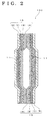
- Fig. 1 is a cross-sectional view of an embodiment of a deoxidizing multilayered body according to the present invention.
- (A) is an isolation layer which contains a thermoplastic resin.
- (B) is an odor absorption layer which is made from an odor absorbent resin composition (b) that contains an oxidizable thermoplastic resin, a transition metal catalyst, and an odor absorbent.
- (C) is an oxygen absorption layer which is made from an oxygen absorbent resin composition (c) that contains an oxidizable thermoplastic resin and a transition metal catalyst.
- (D) is an oxygen barrier layer which contains an oxygen barrier substance.
- reference 11 represents an odor absorbent.
- the invention relates to a deoxidizing multilayered body constituted by laminating at least four layers of the isolation layer (A), the odor absorption layer (B), the oxygen absorption layer (C), and the oxygen barrier layer (D) in this order, and a deoxidizing packaging container which has, at least in a part thereof, the deoxidizing multilayered body and which is constituted by placing the isolation layer (A) on the inside of the container.
- the isolation layer (A), the odor absorption layer (B), the oxygen absorption layer (C), and the oxygen barrier layer (D) which constitute the deoxidizing multilayered body of the present invention will be explained in detail.
- the isolation layer (A) which constitutes the deoxidizing multilayered body of the present invention contains a thermoplastic resin, plays a role of separating a stored product from the odor absorption layer (B), which is made from an odor absorbent resin composition (b) that contains an oxidizable thermoplastic resin, a transition metal catalyst, and an odor absorbent, and at the same time it functions as a sealant. Further, it also plays a role of performing efficient oxygen permeation not to prevent the fast oxygen absorption by the oxidizable thermoplastic resin contained in the odor absorbent resin composition (b), which constitutes the odor absorption layer (B).
- the isolation layer (A) of the present invention means a layer which contains a thermoplastic resin and has the oxygen permeability of 1000 cc/(m 2 ⁇ 24h ⁇ atm) or more. If the oxygen permeability of the isolation layer (A) is less than 1000 cc/(m 2 ⁇ 24h ⁇ atm), the rate of absorbing oxygen by the deoxidizing multilayered body of the present invention becomes slow, and therefore undesirable.
- the oxygen permeability indicates the value that is measured by using OX-TRAN-2/21 manufactured by MOCON, Inc. under the conditions having the measurement temperature of 25°C and the cell area of 50 cm 2 .
- the thickness of the isolation layer (A) is preferably 1 to 100 ⁇ m, and more preferably 1 to 20 ⁇ m. In this case, the oxygen absorption rate of the deoxidizing multilayered body can be increased more compared to a case in which the thickness does not fall within the above range.
- the isolation layer (A) is preferably an acidic gas absorbent isolation layer (Aa), which is made from an acidic gas absorbent resin composition (a) that contains an acidic gas absorbent and a thermoplastic resin.
- the acidic gas absorbent isolation layer (Aa) as the isolation layer (A), the acidic gas which is produced as a by-product with the oxygen absorption reaction can be absorbed and the odor originating therefrom can be suppressed.
- the acidic gas absorbent used for the present invention is a compound which chemically and/or physically fixes odorous components mainly originating from carboxylic acids.
- the acidic gas absorbent used for the present invention is preferably a base compound based on the reason that it can neutralize the odorous components originating from carboxylic acids, and therefore is effective for chemical fixing of the odorous components.
- the base compound include an inorganic base compound like a hydroxide, a carbonate, a hydrogen carbonate, an oxide, etc. of a metal belonging to Group 1 and Group 2 of the Periodical Table. Based on the reason of high basicity, a hydroxide and an oxide of the metal belonging to Group 2 are particularly preferable.
- sodium hydroxide, potassium hydroxide, calcium hydroxide, magnesium hydroxide, sodium carbonate, potassium carbonate, calcium carbonate, magnesium carbonate, sodium hydrogen carbonate, potassium hydrogen carbonate, calcium hydrogen carbonate, calcium oxide and magnesium oxide, etc. are preferable based on the reason that they are excellent in economy. Magnesium oxide is particularly preferred based on the reason that it has high safety.
- an organic base compound as a base compound, and the representative example includes an amine compound having a non-covalent electron pair on the nitrogen.
- the compounding ratio of the acidic gas absorbent is preferably 0.01 to 50 parts by mass, and particularly preferably 0.1 to 10 parts by mass relative to the 100 parts by mass of the thermoplastic resin contained in the acidic gas absorbent resin composition (a). In this case, not only the capability of absorbing an acidic gas is increased more compared to a case in which the compounding ratio does not fall within the above range, but also reduction in the oxygen permeability of the acidic gas absorbent isolation layer (Aa) caused by the acidic gas absorbent can be prevented.
- the acidic gas absorbent resin composition (a) which constitutes the acidic gas absorbent isolation layer (Aa) may be produced by, for example, mixing a thermoplastic resin and a powdery acidic gas absorbent at the temperature which is the same or higher than the temperature at which each resin composition melts.
- the odor absorption layer (B) which constitutes the deoxidizing multilayered body of the present invention is made from an odor absorbent resin composition (b) that contains an oxidizable thermoplastic resin, a transition metal catalyst, and an odor absorbent.
- the oxygen absorption layer (C) which constitutes the deoxidizing multilayered body of the present invention is made from an oxygen absorbent resin composition (c) that contains an oxidizable thermoplastic resin and a transition metal catalyst.
- the odor absorption layer (B) is essential for absorbing odor originating from aldehydes that are produced as a by-product of an oxygen absorption reaction. Further, the oxygen absorption layer (C) is also essential for obtaining sufficient oxygen absorption rate.
- the thickness of the odor absorption layer (B) and the oxygen absorption layer (C) is preferably 1 to 300 ⁇ m, and more preferably 1 to 200 ⁇ m, respectively.
- the oxygen absorption rate of the deoxidizing multilayered body can be increased more compared to a case in which the thickness does not fall within the above range, and at the same time loss of flexibility as a packaging material can be prevented.
- the oxidizable thermoplastic resin that is used for the present invention means a thermoplastic resin which has any one of an aryl group, a benzyl group, an alcohol group, an ether group, an aldehyde group, a ketone group, and a tertiary carbon. Among them, in the present invention, it is preferable to use a thermoplastic resin having an aryl group as an oxidizable thermoplastic resin.
- Examples of the oxidizable thermoplastic resin that is contained in the odor absorbent resin composition (b) and the oxygen absorbent resin composition (c) include an organic polymer compound having a portion in which a double bond between carbons is included, an organic polymer compound having a hydrogen atom bonded to a tertiary carbon atom, and an organic polymer compound having a benzyl group, and they can be used singly or in combination thereof.
- the carbon-carbon double bond in the organic polymer compound having a portion in which carbons bond with a double bond is included may be present in the main chain or the side chain of the polymer.
- Examples include 1,4-polybutadiene, 1,2-polybutadiene, 1,4-polyisoprene, 3,4-polyisoprene, styrene butadiene rubber, a styrene-butadienestyrene block copolymer, a styrene-isoprene-styrene block copolymer, an ethylene/methyl acrylate/cyclohexenyl methyl acrylate copolymer, etc.
- examples of the organic polymer compound having a hydrogen atom bonded to a tertiary carbon atom include polypropylene, polymethylpentene, etc.
- Examples of the organic polymer compound having a benzyl group include hydrogenated styrene butadiene rubber, hydrogenated styrene isoprene rubber, etc. Among them, an organic polymer compound having a portion in which carbons bond with a double bond is preferable, and 1,2-polybutadiene is more preferable.
- the oxidizable thermoplastic resin that is contained in the odor absorbent resin composition (b) and the oxygen absorbent resin composition (c) considering the laminate adhesion between the odor absorption layer (B) and the oxygen absorption layer (C), it is preferable to select resins having a fusibility to each other or the identical resin. Further, with respect to the oxidizable thermoplastic resin contained in the odor absorbent resin composition (b), it is preferable to select resins having a fusibility to each other, considering the laminate adhesion between the odor absorption layer (B) and the isolation layer (A).
- the transition metal catalyst is a catalyst which has a metal compound like a salt, an oxide, or the like of a transition metal element.
- a transition metal element manganese, iron, cobalt, nickel, and copper are appropriate. Manganese, iron, and cobalt are particularly appropriate as they show an excellent catalytic activity.
- the salt of the transition metal element include a mineral acid salt and a fatty acid salt of the transition metal element. Examples thereof include a hydrochloric acid salt, a sulfuric acid salt, a nitric acid salt, an acetic acid salt, or a higher fatty acid salt of the transition metal element. Representative examples include cobalt octylate, manganese octylate, manganese naphthenate, iron naphthenate, cobalt stearate, etc.
- the transition metal catalyst that is preferable in terms of easy handleability is a supported catalyst in which salts of the transition metal element are supported on a carrier.
- Type of the carrier is not specifically limited, however, zeolite, diatomaceous earth, calcium silicate, etc. may be used.
- an aggregate having a size of 0.1 to 200 ⁇ m during and after preparation of the catalyst is preferable as it has good handleability.
- a carrier which is 10 to 100 nm when dispersed in a resin composition is preferable as it can give a transparent resin composition when it is compounded in a resin composition. Examples of such carrier include synthetic calcium silicate.
- the compounding ratio of the transition metal catalyst to the odor absorbent resin composition (b) and the oxygen absorbent resin composition (c) is, from the view point of the oxygen absorption capability, physical strength, and economy, preferably 0.001 to 10% by mass, and particularly preferably 0.01 to 1% by mass in terms of the mass of the metal atom in each resin composition of the odor absorbent resin composition (b) and the oxygen absorbent resin composition (c).
- the odor absorbent used in the present invention is a substance which chemically and/or physically fixes odorous components mainly originating from aldehydes.
- any substance having the above property can be used within the range which does not impair the effect of the present invention.
- a hydrazine derivative, a urea derivative, or a guanidine derivative is preferably used as an odor absorbent.
- a commercially available deodorant having the above-mentioned function may be also used as an odor absorbent.
- a hydrazine derivative, a urea derivative, or a guanidine derivative is supported on a carrier and used as an odor absorbent. Using it according to this embodiment is more preferable since physical adsorption of the aldehydes on the carrier can also be expected.
- Type of the carrier is not specifically limited, however, zeolite, diatomaceous earth, calcium silicate, porous silica, activated white clay, etc. may be used. Among them, calcium silicate, porous silica, and activated white clay are preferable.
- the amount of a hydrazine derivative, a urea derivative, or a guanidine derivative supported on a carrier is preferably 0.001 to 30 mmol/(g-carrier), and more preferably 0.01 to 10 mmol/(g-carrier).
- the compounding ratio of the odor absorbent is preferably 0.1 to 50% by mass, and particularly preferably 0.9 to 10% by mass in the odor absorbent resin composition (b). In this case, there is an advantage that is more excellent in the odor absorption capability or the transparency than a case in which the compounding ratio does not fall within the above range.
- the hydrazine derivative indicates an organic substance having N-NH 2 group like hydrazine, phenyl hydrazine and their derivatives, semicarbazide, hydrazide and its derivative, an aminoguanidine derivative, etc.
- Specific examples include hydrazine, hydrazine sulfate, hydrazine hydrochloride, monomethylhydrazine, 1,3-dimethylhydrazine, aluminum sulfate hydrazine double salt, carbazic acid, formohydrazide, isopropylhydrazine sulfate, tert-butylhydrazine hydrochloride, 1-aminopyrrolidine, aminoguanidine sulfate, aminoguanidine hydrochloride, aminoguanidine bicarbonate, diaminoguanidine hydrochloride, triaminoguanidine nitrate, acethydrazide, benzohydrazide, pentanohydrazide, carb
- aluminum sulfate hydrazine double salt, aminoguanidine sulfate, and aminoguanidine hydrochloride are particularly preferable.
- the aminoguanidine derivative, the hydrazine double salt, or their mixtures are preferable.
- the aminoguanidine derivative indicates the hydrazine derivative having a guanidine structure that is represented by the following structural formula (1) or its salt, and examples thereof include aminoguanidine sulfate, aminoguanidine hydrochloride, etc.
- R 1 to R 4 in the formula represent any atom and/or a substituent group, and preferably a hydrogen atom, an alkyl group, or an amino group.
- the hydrazine double salt used in the present invention indicates a double salt which is formed by chemical bond between an acidic metal salt and hydrazine.
- the metal in the acidic metal salt include magnesium, aluminum, and chrome
- examples of the salt include one kind of a sulfate, a hydrochloride, and a phosphate, or a mixture thereof.
- aluminum sulfate and hydrazine are admixed with each other in water, a hydrazine double salt is produced, and it is referred to as aluminum sulfate hydrazine double salt.
- Hydrazine (N 2 H 4 ) as a chemical compound has an odor absorption capability.
- it has low boiling temperature of 113°C, and is easily decomposed, it is not easy to obtain the odor absorbent resin composition of the present invention by kneading it with a resin.
- by preparing a hydrazine double salt these disadvantages can be overcome while maintaining the odor absorption capability that is intrinsically possessed by hydrazine, and thus it is a preferred embodiment of the present invention to produce an odor absorbent containing the hydrazine double salt.
- the urea derivative indicates a compound which has the structure that is represented by the following structural formula (2) and does not have a N-NH 2 group in the molecule.
- Specific examples thereof include urea, 1-methylurea, 1,1-dimethylurea, 1,3-dimethylurea, ethylurea, 1,1-diethylurea, 1,3-diethylurea, arylurea, acetylurea, 1-acetyl-3-methylurea, hydroxyurea, 2-hydroxyethylurea, 1,3-(hydroxymethyl)urea, nitrourea, acetone semicarbazone, acetaldehyde semicarbazone, azodicarbonamide, ethyleneurea, 1-acetyl-2-imidazolidinone, hydantoin, 1-arylhydantoin, glycoluryl, allantoin, biurette, biurea, thiourea, N-methylthiourea, 1,3-dimethylthi
- R 5 to R 7 in the formula represent any atom and/or any substituent group other than an amino group (-NH 2 ), and they are preferably a hydrogen atom or an alkyl group.
- Y represents an oxygen atom or a sulfur atom.
- the guanidine derivative indicates a compound which has the guanidine structure that is represented by the following structural formula (3) and does not have a N-NH 2 group in the molecule.
- Specific examples thereof include guanidine, 1-methylguanidine hydrochloride, cyanoguanidine, 1-ethyl-3-guanidinothiourea hydrochloride, creatinine, a creatinine hydrate, 2,4-diamino-1,3,5-triazine, 2,4-diamino-6-methyl-1,3,5-triazine, 2-vinyl-4,6-diamino-1,3,5-triazine, 2-chloro-4,6-diamino-1,3,5-triazine, 2,4-diamino-6-dimethylamino-1,3,5-triazine, 2,4-diamino-6-methoxy-1,3,5-triazine, 2,4-diamino-6-isopropoxy-1,3,
- R 8 to R 11 in the formula represent any atom and/or any substituent group other than an amino group (-NH 2 ), and they are preferably a hydrogen atom or an alkyl group.
- the odor absorbent used in the present invention has a particularly significant effect on absorption of aldehydes.
- thermoplastic resin composition (b) which constitutes the odor absorption layer (B) and the oxygen absorbent resin composition (c) which constitutes the oxygen absorption layer (C) another thermoplastic resin that is different from the oxidizable thermoplastic resin may be further compounded to improve the dispersability of other compounding components or to increase the oxygen absorption rate by enhancing the oxygen permeability of each layer described above.
- thermoplastic resin examples include high density polyethylene, low density polyethylene, linear-chain low density polyethylene, metallocene linear-chain low density polyethylene (herein below, described as "m-LLDPE"), polypropylene, an ethylene vinyl acetate copolymer, polystyrene, polymethylpentene, an ethylene vinyl alcohol copolymer, etc.
- the compounding amount of the thermoplastic resin is preferably 1000 parts by mass or less, and particularly preferably 500 parts by mass or less relative to 100 parts by mass of the oxidizable thermoplastic resin.
- the compounding amount of the oxidizable thermoplastic resin relatively increases, and as a result, reduction in the oxygen absorption capability can be more sufficiently inhibited compared to a case in which the compounding amount is more than 1000 parts by mass.
- the thermoplastic resin to be compounded preferably has high miscibility with oxidizable thermoplastic resin or high oxygen permeability after formed into a film.
- the odor absorbent resin composition (b) which constitutes the odor absorption layer (B) can be produced, for example, by mixing a resin composition containing an oxidizable thermoplastic resin, a resin composition containing a transition metal catalyst, and a resin composition containing an odor absorbent at the temperature which is the same or higher than the temperature at which each resin composition melts.
- it can be also produced by mixing a resin composition containing an oxidizable thermoplastic resin and a transition metal catalyst and a powdery odor absorbent at the temperature which is the same or higher than the temperature at which the resin composition melts.
- the oxygen absorbent resin composition (c) which constitutes the oxygen absorption layer (C) can be produced, for example, by mixing a resin composition containing an oxidizable thermoplastic resin and a resin composition containing a transition metal catalyst at the temperature which is the same or higher than the melting temperature of the resins.
- a photoinitiator may be included in the odor absorbent resin composition (b) and/or the oxygen absorbent resin composition (c) to activate the oxygen absorption reaction.
- the photoinitiator is a substance which functions to increase the reaction speed by efficiently generating active species in a reaction system for the oxygen absorption reaction.
- the photoinitiator molecule which is excited by light irradiation extracts a hydrogen from the oxidizable thermoplastic resin to give an active radical, and thus initiates the oxidation reaction.
- the photoinitiator include benzophenone and its derivative, a thiazine dye, a metal porphyrin derivative, an anthraquinone derivative, etc.
- Preferred is a benzophenone derivative which contains a benzophenone skeleton structure.
- the compounding ratio of the photoinitiator is preferably 0.001 to 10% by mass, and particularly preferably 0.01 to 1% by mass in each of the resin compositions.
- the light irradiated to the deoxidizing multilayered body of the present invention is one kind of electromagnetic wave which gives an energy to the photoinitiator to be in the exited state.
- the wavelength of the light for activating the oxygen absorption is preferably 180 nm to 800 nm, and UV light in the range of 200 to 380 nm is particularly preferable.
- the photoinitiator may be included in both of the odor absorbent resin composition (b) and the oxygen absorbent resin composition (c).
- the active species that are generated by light irradiation are more easily produced from the oxygen absorbent resin composition (c) and the active species are transferred to the odor absorbent resin composition (b), it can be included only in the oxygen absorbent resin composition (c), and this embodiment is economical and desirable.
- the oxidation reaction can be initiated by extracting a hydrogen from the oxidizable thermoplastic resin by giving an energy from outside like a radiation including electron ray, ⁇ ray, ⁇ ray, ⁇ ray, X ray, etc., and heat, high frequency wave, ultrasonic wave, etc., and by providing it as a radical.
- the composition described above can be prepared into a composition which has an oxygen absorption function and also other functions like drying function, etc.
- the deoxidizing multilayered body of the present invention can be prepared into a multilayered body which contains a layer including at least one additive selected from a drying agent, an adsorbent, an anti-bacterial agent, and a coloring agent within the range which does not impair the effect of the present invention.
- the drying agent mentioned in the present invention means an agent which absorbs moisture from the air, and examples thereof include silica gel, quicklime, calcium chloride, phosphorus pentoxide, aluminum oxide, etc.
- the adsorbent mentioned in the present invention means an agent which physically fixes an atom, a molecule, a fine particule, etc. on its surface, and specific examples thereof include active carbon, zeolite, silica gel, aluminum oxide, etc. Among them, silica gel and aluminum oxide are preferable because they also have a function of a drying agent.
- the anti-bacterial agent mentioned in the present invention means an agent which inhibits growth of bacteria or kills bacteria, and specific examples thereof include an inorganic anti-bacterial agent or an organic anti-bacterial agent.
- the examples of the inorganic anti-bacterial agent include silver, copper, zinc, or their chemical compounds
- the examples of the organic anti-bacterial agent include hinokitiol and chitosan in addition to a chemical like a quaternary ammonium salt, thiabendazole, organic silicone quaternary ammonium salt, etc.
- the natural anti-bacterial agent is more preferable from the viewpoint of safety.
- the coloring agent mentioned in the present invention means an agent which is used for coloring whole or a part of the deoxidizing multilayered body of the present invention, and examples thereof include an inorganic pigment like titanium oxide and an organic pigment like phthalocyanine, etc.
- the compounding ratio of the inorganic base and the amine compound in the oxygen absorbent resin composition (c) which constitutes the oxygen absorption layer (C) used in the present invention is preferably 1% by mass or less, and particularly preferably less than 0.1% by mass.
- the oxygen absorption capability of the oxygen absorbent multilayered body can be improved more compared to a case in which the inorganic base and/or the amine compound are contained in an amount of more than 1% by mass in the oxygen absorption layer (C).
- the inorganic base mentioned in the present invention means an inorganic compound which exhibits a basic property, and the oxidizable thermoplastic resin, the transition metal catalyst, and the photoinitiator are not included therein.
- the inorganic base inhibits the oxidation reaction of the oxidizable thermoplastic resin, the oxygen absorption capability of the oxygen absorbent multilayered body is significantly decreased if the inorganic base is included in the oxygen absorption layer (C).
- Examples of the inorganic base include a hydroxide, a carbonate, a hydrogen carbonate, an oxide, etc. of a metal belonging to Group 1 and Group 2 of the Periodical Table. Specific examples thereof include lithium hydroxide, sodium hydroxide, potassium hydroxide, rubidium hydroxide, cesium hydroxide, calcium hydroxide, strontium hydroxide, barium hydroxide, magnesium hydroxide, sodium carbonate, potassium carbonate, calcium carbonate, magnesium carbonate, sodium hydrogen carbonate, potassium hydrogen carbonate, calcium hydrogen carbonate, calcium oxide, magnesium oxide, etc.
- lithium hydroxide, sodium hydroxide, potassium hydroxide, rubidium hydroxide, cesium hydroxide, calcium hydroxide, strontium hydroxide, barium hydroxide, magnesium hydroxide, calcium oxide, and magnesium oxide significantly inhibit the oxidation of the oxidizable thermoplastic resin.
- the amine compound mentioned in the present invention means a compound which contains a primary to a tertiary or a quaternary ammonium ion in the molecule, and the oxidizable thermoplastic resin, the transition metal catalyst, and the photoinitiator are not included therein.
- the amine compound inhibits the oxidation reaction of the oxidizable thermoplastic resin, the oxygen absorption capability of the oxygen absorbent multilayered body is significantly decreased if the amine compound is included in the oxygen absorption layer (C).
- Examples of the amine compound include an aliphatic amine, an aromatic amine, a hydroxide of tetraallkylammonium, a hydrazine derivative, a urea derivative, a guanidine derivative, etc.
- Examples of the aliphatic amine include methylamine, ethylamine, dimethylamine, diethylamine, trimethylamine, triethylamine, ether amine, triethanolamine, N,N-diisopropylethylamine, piperidine, piperazine, morpholine, quinuclidine, amantadine, an amino acid, etc.
- aromatic amine examples include pyridine, 4-dimethylaminopyridine, aniline, toluidine, benzidine, triethylamine, ethylenediamine, tetramethylethylenediamine, hexamethylenediamine, diethylenetriamine, triethylenetetramine, tetraethylenepentamine, pentaethylenehexamine, spermidine, spermine, diazabicycloundecene, aniline, catechol amine, phenethylamine, 1,8-bis(dimethylamino)naphthalene, etc.
- hydroxide of tetraalkylammonium examples include tetramethylammonium hydroxide, tetraethyl ammonium hydroxide, etc.
- hydrazine derivative examples include hydrazine, hydrazine sulfate, hydrazine hydrochloride, monomethylhydrazine, 1,1-dimethylhydrazine, aluminum sulfate hydrazine double salt, carbazic acid, formohydrazide, isopropylhydrazine sulfate, tert-butylhydrazine hydrochloride, 1-aminopyrrolidine, aminoguanidine sulfate, aminoguanidine hydrochloride, aminoguanidine bicarbonate, diaminoguanidine hydrochloride, triaminoguanidine nitrate, acethydrazide, benzohydrazide, pentanohydrazide, carbohydrazide, cyclohexane carbohydrazide, benzenesulfonohydrazide, thiocarbohydrazide, thiobenzohydrazide, pentan
- urea derivative examples include urea, 1-methylurea, 1,1-dimethylurea, 1,3-dimethylurea, ethylurea, 1,1-diethylurea, 1,3-diethylurea, arylurea, acetylurea, 1-acetyl-3-methylurea, hydroxyurea, 2-hydroxyethylurea, 1,3-(hydroxymethyl)urea, nitrourea, acetone semicarbazone, acetaldehyde semicarbazone, azodicarbonamide, ethyleneurea, 1-acetyl-2-imidazolidinone, hydantoin, 1-arylhydantoin, glycoluryl, allantoin, biurette, biurea, thiourea, N-methylthiourea, 1,3-dimethylthiourea, trimethylthiourea, 1,3-diethyl-2-thiourea, N,N'-diisopropyl
- guanidine, derivative examples include guanidine, 1-methylguanidine hydrochloride, cyanoguanidine, 1-ethyl-3-guanidinothiourea hydrochloride, creatinine, creatinine hydrate, 2,4-diamino-1,3,5-triazine, 2,4-diamino-6-methyl-1,3,5-triazine, 2-vinyl-4,6-diamino-1,3,5-triazine, 2-chloro-4,6-diamino-1,3,5-triazine, 2,4-diamino-5-dimethylamino-1,3,5-triazine, 2,4-diamino-6-methaxy-1,3,5-triazine, 2,4-diamino-6-isopropoxy-1,3,5-triazine, 2-amino-4-methoxy-6-methyl-1,3,5-triazine, ameline, amelide, melamine
- amine compounds ethylenediamine, tetramethylethylenediamine, hexamethylenediamine, diethylenetriamine, triethylenetetramine, tetraethylenepentamine, pentaethylenehexamine, diazabicycloundecene, tetramethylammonium hydroxide, tetraethylammonium hydroxide, hydrazine, hydrazine sulfate, hydrazine hydrochloride, aluminum sulfate hydrazine double salt, carbazic acid, formohydrazide, 1,5-diphenylcarbonohydrazide, isopropylhydrazine sulfate, tert-butylhydrazine hydrochloride, aminoguanidine sulfate, aminoguanidine hydrochloride, aminoguanidine bicarbonate, diaminoguanidine hydrochloride, triaminoguanidine nitrate, urea, thiour
- the total compounding ratio of the inorganic base and the amine compound in the oxygen absorbent resin composition (c) which constitutes the oxygen absorption layer (C) is most preferably 0% by mass.
- the inorganic base and the amine compound are not included in the oxygen absorption layer (C), and therefore the oxygen absorption capability of the oxygen absorbent multilayered body can be improved more compared to a case in which the inorganic base and/or the amine compound are included in the oxygen absorbent resin composition (c).
- the total compounding ratio of 0% by mass for the inorganic base and the amine compound in the oxygen absorbent resin composition (c) means that the oxygen absorbent resin composition (c) has the following constitution.
- the total compounding ratio of the oxidizable thermoplastic resin, the transition metal catalyst, and accessory components in the oxygen absorbent resin composition (c) is 100% by mass when the oxygen absorbent resin composition (c) contains a oxidizable thermoplastic resin, a transition metal catalyst, and accessory components.
- the accessory components indicate at least one component that is selected from the group consisting of a photoinitiator, a thermoplastic resin which is different from the oxidizable thermoplastic resin, and additives.
- the accessory components are different from the inorganic base and the amine compound which are described above.
- the oxygen barrier substance which constitutes the oxygen barrier layer (D) means a substance having the oxygen permeability of 100 cc/(m 2 ⁇ 24h ⁇ atm) or less.
- Representative examples of the oxygen barrier layer (D) include a metal foil like an aluminum foil, in addition to a layer containing polyester, polyamide, nylon MXD6, an ethylene-vinyl alcohol copolymer, a vinylidene chloride, etc. to which silica or alumina is vapor-deposited.
- the thickness of the oxygen barrier layer (D) is preferably 1 to 300 ⁇ m, and more preferably 1 to 100 ⁇ m. In this case, the oxygen barrier effect can be improved more and loss of flexibility as a packaging material can be simultaneously prevented compared to a case in which the thickness does not fall within the above range.
- the deoxidizing multilayered body of the present invention can be produced, for example, by co-extrusion of a multilayered body having a multilayer structure in which the isolation layer (A), the odor absorption layer (B), the oxygen absorption layer (C), and the oxygen barrier layer (D) are laminated in this order, by using a machine for producing a multilayered film.
- a multilayered body having a multilayer structure in which the isolation layer (A), the odor absorption layer (B), and the oxygen absorption layer (C) are laminated in this order is produced by co-extrusion by using a machine for producing a multilayered film, and the oxygen barrier layer (D) is laminated thereto by using an adhesive.
- an adhesive resin may be used for each interlayer region if necessary.
- an optional layer may be laminated within the range that a certain property of the deoxidizing multilayered body of the present invention is not impaired, and the layers may be laminated by combining various methods.
- the deoxidizing multilayered body of the present invention may be used as a deoxidizing packaging material in a part or whole of a packaging container like a packaging bag, etc.
- Fig. 2 is a cross-sectional view of an embodiment of a deoxidizing packaging container according to the present invention, illustrating an example of using the deoxidizing multilayered body 10 of Fig. 1 .
- a deoxidizing packaging container 100 has two deoxidizing multilayered bodies 10. Both of the deoxidizing multilayered bodies 10 are bonded in a state in which the isolation layer (A) faces the inside.
- the deoxidizing packaging container 100 may be produced, for example, by heat-sealing the edge parts of the deoxidizing multilayered bodies 10.
- Fig. 2 illustrates an example in which the deoxidizing multilayered body is used on whole of a packaging container, it can be used on a part of a packaging container by using it as a cover material of a container or on just one surface of a pouch bag.
- the deoxidizing multilayered body of the present invention may be used as a deoxidizer processed into a sheet shape or a film shape, or used as a deoxidizer packaging body having a shape in which the processed deoxidizer is enclosed in a air-permeable sachet. Further, it can be used as a deoxidizer after molding into a shape like a label, a card, a packing, etc.
- the transparent compositions can be obtained. Accordingly, by using a transparent resin for each layer like the isolation layer (A), the oxygen barrier layer (D), etc. which constitute the multilayered film, a transparent deoxidizing multilayered sheet or film can be prepared. This transparent deoxidizing multilayered sheet or film is appropriate for a packaging material having see-through property.
- deoxidizing multilayered body of the present invention is not limited, and it exhibits a practically valuable deoxidizing absorption capability in the field of preservation and quality maintenance of food products, beverages, pharmaceuticals, medical products, cosmetics, metal products, electronic products, etc.
- the deoxidizing multilayered body of the present invention can absorb oxygen regardless of the presence or absence of moisture in a subject to be preserved, it can be particularly preferably used for dried food products like powder seasoning, powder coffee, coffee bean, rice, tea, bean, Japanese rice cracker, rice cracker, etc., pharmaceuticals, health products like a vitamin preparation, and industrial materials like electronic parts, etc.
- Powder containing a transition metal catalyst which is obtained by impregnating cobalt octylate (trade name: NIKKA OCTHIX Cobalt, manufactured by Nihon Kagaku Sangyo Co., Ltd., cobalt content: 8% by mass) in synthetic calcium silicate (trade name: MICROCELL E, manufactured by Celite Corporation) followed by drying under reduced pressure and 4-phenylbenzophenone (herein below, described as "PBP") as a photoinitiator were admixed with each other, and melt-kneaded with m-LLDPE (trade name: KERNEL KC570S, manufactured by Japan Polyethylene Corporation) by using a biaxial kneading extruder at 160°C to prepare a catalyst master batch made from a resin composition having cobalt element content of 1.2% by mass, synthetic calcium silicate (average particle diameter: 2 ⁇ m) of 7.5% by mass, and PBP content of 2.1 % by mass.
- PBP 4-phenylbenzoph
- the catalyst master batch described above and syndiotactic 1,2-polybutadiene (trade name: RB820, manufactured by JSR Corporation, herein below, described as "RB"), which is an oxidizable thermoplastic resin, were admixed with each other at the mass ratio of 10 : 90, and melt-kneaded by using a biaxial kneading extruder at 140°C to prepare an oxygen absorbent resin composition 1 (containing 0.13 parts by mass of cobalt atom and 10 parts by mass of m-LLDPE relative to 100 parts by mass of RB).
- RB820 syndiotactic 1,2-polybutadiene
- the odor absorbent 1, the catalyst master batch described above, and RB were admixed with one another at the mass ratio of 6 : 10 : 90 (aminoguanidine sulfate: 0.03 mmol/g), and melt-kneaded by using a biaxial kneading extruder at 140°C to prepare an odor absorbent resin composition 1 (containing 0.13 parts by mass of cobalt atom, 6.7 parts by mass of the odor absorbent 1, and 10 parts by mass of m-LLDPE relative to 100 parts by mass of RB).
- a multilayered film having m-LLDPE as an isolation layer (A), the above-mentioned odor absorbent resin composition 1 as an odor absorption layer (B1), and the oxygen absorbent resin composition 1 as an oxygen absorption layer (C1) was produced by co-extrusion.
- the layer constitution includes the isolation layer (A) with a thickness of about 10 ⁇ m, the odor absorption layer (B1) with a thickness of about 20 ⁇ m, and the oxygen absorption layer (C1) with a thickness of about 20 ⁇ m in this order.
- the oxygen barrier layer (D) with a thickness of 12 ⁇ m, which is made from silica vapor-deposited polyethylene terephthalate (trade name: TECH BARRIER P2, manufactured by Mitsubishi Plastics, Inc., herein below, described as "SiPET”), was bonded by dry lamination to give a deoxidizing multilayered film 1.
- Oxygen absorption capability of the above deoxidizing multilayered film 1 was evaluated.
- the above deoxidizing multilayered film was illuminated with UV light from the light source of 1 kW high pressure mercury lamp with the illuminance of 6.2 mW/cm 2 for 90 seconds (illumination amount of 560 mJ/cm 2 ).
- the film was processed into a bag to have an oxygen absorption area of 250 cm 2 , to which 120 mL of a mixture gas containing 5 vol% of oxygen and 95 vol% of nitrogen was added followed by sealing (initial oxygen amount: 0.024 mL/cm 2 ).
- the oxygen concentration was 0.1 vol% after 25 hours.
- the period of time required for the oxygen concentration in a bag to be reduced to 0.1 vol% is referred to as deoxidization time.
- Concentration of odorous organic substances from the above-mentioned deoxidizing multilayered film 1 was evaluated.
- concentration of aldehydes and carboxylic acids in the bag after deoxidization was measured by using a gas detector tube for acetaldehyde (trade name : ACETALDEHYDE 92L (for low concentration), manufactured by Gastec Corporation) and a gas detector tube for acetic acid (trade name: ACETIC ACID 81L, manufactured by Gastec Corporation).
- ACETIC ACID 81L for acetic acid
- An acidic gas absorbent resin composition was produced by mixing m-LLDPE and magnesium oxide at the mass ratio of 100 : 1.4.
- a multilayered film having the acidic gas absorbent resin composition as an acidic gas absorbent isolation layer (Aa), the odor absorbent resin composition 1 as an odor absorption layer (B1), and the oxygen absorbent resin composition 1 as an oxygen absorption layer (C1) was produced by laminating the acidic gas absorbent isolation layer (Aa), the odor absorption layer (B1), and the oxygen absorption layer (C1) in this order.
- the oxygen barrier layer (D) with a thickness of 12 ⁇ m, which is made from SiPET, was bonded by dry lamination to give a deoxidizing multilayered film 2.
- the oxygen absorption capability of the deoxidizing multilayered film 2 and the amount of the malodorous organic substances released from the deoxidizing multilayered film were evaluated in the same manner as Example 1, and as a result, the deoxidization time was 26 hours. Further, in the bag after the deoxidization concentration of the aldehydes was 1 ppm and concentration of the carboxylic acids was less than 0.25 ppm, which is the lower detection limit of the gas detector tube, and no odor was identified. The results are shown in Table 1.
- aqueous solution of ethylene urea was impregnated in activated white clay followed by drying to obtain an odor absorbent 2 (impregnation amount of ethylene urea: 1.5 mmol/(g-carrier)).
- the odor absorbent 2, the catalyst master batch described in Example 1, and RB were admixed with one another at the mass ratio of 6 : 10 : 90 (ethyleneurea 0.08 mmol/g), and melt-kneaded by using a biaxial kneading extruder at 140°C to prepare an odor absorbent resin composition 2 (containing 0.13 parts by mass of cobalt atom, 6.7 parts by mass of the odor absorbent 2, and 10 parts by mass of m-LLDPE relative to 100 parts by mass of RB).
- a multilayered film having the odor absorbent resin composition 2 as an odor absorption layer (B2) and the oxygen absorbent resin composition 1 as an oxygen absorption layer (C1) was produced by laminating the acidic gas absorbent isolation layer (Aa), the odor absorption layer (B2), and the oxygen absorption layer (C1) in this order, similar to Example 2.
- the oxygen barrier layer (D) with a thickness of 12 ⁇ m, which is made from SiPET was bonded by dry lamination to give a deoxidizing multilayered film 3.
- Oxygen absorption capability of the above deoxidizing multilayered film 3 was evaluated.
- the above deoxidizing multilayered film was illuminated with UV light from the light source of 1 kW high pressure mercury lamp with the illuminance of 6.2 mW/cm 2 for 150 seconds (illumination amount of 960 mJ/cm 2 ).
- the film was processed into a bag to have an oxygen absorption area of 250 cm 2 , to which 240 mL of a mixture gas containing 5 vol% of oxygen and 95 vol% of nitrogen was added followed by sealing (initial oxygen amount: 0.024 mL//cm 2 ).
- the deoxidization time was 17 hours.
- the amount of the odorous organic substances released from the deoxidizing multilayered film 4 was evaluated in the same manner as Example 1, and as a result, in the bag after the deoxidization concentration of the aldehydes was 10 ppm and concentration of the carboxylic acids was less than 0.25 ppm which is the lower detection limit of the gas detector tube. Odor from the inside of the bag was not identified. The results are shown in Table 1.
- the odor absorbent 1 described in Example 1 and m-LLDPE were admixed with each other at the mass ratio of 6 : 100 (aminoguanidine sulfate 0.03 mmol/g), and melt-kneaded by using a biaxial kneading extruder at 140°C to prepare an odor absorbent resin composition 3 (containing 6 parts by mass of the odor absorbent 1 relative to 100 parts by mass of m-LLDPE).
- a multilayered film having the isolation layer (A), the odor absorption layer (X), and the oxygen absorption layer (C1) was produced in the same manner as Example 1 except that the odor absorption layer (X) made from the above-mentioned odor absorbent resin composition 3 was laminated instead of the odor absorption layer (B1) made from the odor absorbent resin composition 1.
- the oxygen barrier layer (D) with a thickness of 12 ⁇ m, which is made from SiPET was bonded by dry lamination to give a deoxidizing multilayered film 4.
- the oxygen absorption capability of the deoxidizing multilayered film 4 and the concentration of the malodorous organic substances released from the deoxidizing multilayered film were evaluated in the same manner as Example 1, and as a result, the deoxidization time was 38 hours. Further, concentration of the aldehydes was 1 ppm and concentration of the carboxylic acids was 0.3 ppm in the bag after the deoxidization. The results are shown in Table 1.
- Example 1 Layer constitution Deoxidization time (h) Concentration of aldehydes (ppm) Concentration of carboxylic acids (ppm)
- Example 1 Isolation layer (A)/Odor absorption layer (B1) /Oxygen absorption layer (C1)/Barrier layer (D) 25 1 0.3
- Example 2 Acidic gas absorbent isolation layer (Aa) /Odor absorption layer (B1) /Oxygen absorption layer (C1)/Barrier layer (D) 26 1 ⁇ 0.25
- Example 3 Acidic gas absorbent isolation layer (Aa) /Odor absorption layer (B2) /Oxygen absorption layer (C1)/Barrier layer (D) 17 10 ⁇ 0.25 Comparativ e example 1 Isolation layer (A)/Odor absorption layer (X)/Oxygen absorption layer (C1)/Barrier layer (D) 38 1 0.3
- the odor absorbent 3, the catalyst master batch described in Example 1, and RB were admixed with one another at the mass ratio of 3 : 10 : 90 (aminoguanidine sulfate: 0.04 mmol/g), and melt-kneaded by using a biaxial kneading extruder at 140°C to prepare an odor absorbent resin composition 4 (containing 0.13 parts by mass of cobalt atom, 3.3 parts by mass of the odor absorbent 3, and 10 parts by mass of m-LLDPE relative to 100 parts by mass of RB).
- a multilayered film having the odor absorbent resin composition 4 as an odor absorption layer (B4) and the oxygen absorbent resin composition 1 as an oxygen absorption layer (C1) was produced by laminating the isolation layer (A), the odor absorption layer (B4), and the oxygen absorption layer (C1) in this order, similar to Example 1.
- the oxygen barrier layer (D) with a thickness of 12 ⁇ m, which is made from SiPET was bonded by dry lamination to give a deoxidizing multilayered film 5.
- Oxygen absorption capability of the above deoxidizing multilayered film 5 was evaluated.
- the above deoxidizing multilayered film was illuminated with UV light from the light source of 1 kW high pressure mercury lamp with the illuminance of 6.2 mW/cm 2 for 150 seconds (illumination amount of 960 mJ/cm 2 ).
- the film was processed into a bag to have an oxygen absorption area of 250 cm 2 , to which 240 mL of a mixture gas containing 5 vol% of oxygen and 95 vol% of nitrogen was added followed by sealing (initial oxygen amount: 0.024 mL/cm 2 ).
- the deoxidization time was 18 hours.
- the amount of the odorous organic substances released from the deoxidizing multilayered film 5 was evaluated in the same manner as Example 1, and as a result, concentration of the aldehydes was 10 ppm and concentration of the carboxylic acids was less than 0.3 ppm in the bag after the deoxidization, and no odor was identified. The result are shown in Table 2.
- the odor absorbent 4, the catalyst master batch described in Example 1, and RB were admixed with one another at the mass ratio of 6 : 10 : 90 (aminoguanidine hydrochloride 0.03 mmol/g), and melt-kneaded by using a biaxial kneading extruder at 140°C to prepare an odor absorbent resin composition 5 (containing 0.13 parts by mass of cobalt atom, 6.7 parts by mass of the odor absorbent 4, and 10 parts by mass of m-LLDPE relative to 100 parts by mass of RB).
- a multilayered film having the odor absorbent resin composition 5 as an odor absorption layer (B5) and the oxygen absorbent resin composition 1 described in Example 1 as an oxygen absorption layer (C1) was produced by laminating the isolation layer (A), the odor absorption layer (B5), and the oxygen absorption layer (C1) in this order, similar to Example 1.
- the oxygen barrier layer (D) with a thickness of 12 ⁇ m, which is made from SiPET was bonded by dry lamination to give a deoxidizing multilayered film 6.
- the oxygen absorption capability of the deoxidizing multilayered film 6 and the amount of the malodorous organic substances released from the deoxidizing multilayered film were evaluated in the same manner as Example 3, and as a result, the deoxidization time was 21 hours. Further, concentration of the aldehydes was 18 ppm and concentration of the carboxylic acids was 0.3 ppm in the bag after the deoxidization, and no odor was identified. The results are shown in Table 2.
- a multilayered film having the isolation layer (A), the oxygen absorption layer (C1), and the oxygen absorption layer (C1) was produced in the same manner as Example 4 except that the oxygen absorption layer (C1) was laminated instead of the odor absorption layer (B4) made from the odor absorbent resin composition 4.
- the oxygen absorption capability of the deoxidizing multilayered film 7 and the release concentration of the malodorous organic substances from the deoxidizing multilayered film were evaluated in the same manner as Example 4, and as a result, the deoxidization time was 16 hours. Further, concentration of the aldehydes was 55 ppm and concentration of the carboxylic acids was 0.7 ppm in the bag after the deoxidization, and strong odor was identified.
- the release amount of the aldehydes and the carboxylic acids was determined by measuring concentration of the carboxylic acids and the carboxylic acids in the bag after the deoxidization using a gas detector tube for acetaldehyde (trade name: ACETALDEHYDE 92L (for medium concentration), manufactured by Gastec Corporation) and a gas detector tube for acetic acid (trade name: ACETIC ACID 81L, manufactured by Gastec Corporation). The results are shown in Table 2.
- a multilayered film having the isolation layer (A), the oxygen absorption layer (B4), and the oxygen permeation layer (Y) was produced in the same manner as Example 4 except that the oxygen permeation layer (Y) made from m-LLDPE was laminated instead of the odor absorption layer (C1) made from the oxygen absorption resin composition 1.
- the oxygen barrier layer (D) with a thickness of 12 ⁇ m, which is made from SiPET was bonded by dry lamination to give a deoxidizing multilayered film 8.
- the oxygen absorption capability of the deoxidizing multilayered film 8 and the concentration of the malodorous organic substances released from the deoxidizing multilayered film were evaluated in the same manner as Example 4, and as a result, the deoxidization time was 150 hours. Further, in the bag after the deoxidization concentration of the aldehydes was 19 ppm and concentration of the carboxylic acids was 0.3 ppm. The results are shown in Table 2.
- Example 4 in which the odor absorption layer (B4) and the oxygen absorption layer (C1) are laminated and Example 5 in which the odor absorption layer (B5) and the oxygen absorption layer (C1) are laminated, it was possible to achieve both the maintaining of the oxygen absorption capability and the suppressing of concentration of the carboxylic acids and concentration of the aldehydes.
- Powder 1 containing a transition metal catalyst and an aldehyde deodorant (trade name: KESMON NS-241, manufactured by Toagosei, Co., Lid., herein below, described as "NS-241 ") were admixed with each other, and melt-kneaded with RB by using a biaxial kneading extruder at 140°C to prepare an odor absorbent resin composition 6 (containing 0.13 parts by mass of cobalt atom and 6 parts by mass of NS-241 relative to 100 parts by mass of RB).
- Powder 1 containing a transition metal catalyst and PBP were admixed with each other, and melt-kneaded with RB by using a biaxial kneading extruder at 140°C to prepare an oxygen absorbent resin composition 2 (containing 0.12 parts by mass of cobalt atom, 0.75 parts by mass of synthetic calcium silicate (average particle diameter: 2 ⁇ m), and 0.21 parts by mass of PBP relative to 100 parts by mass of RB).
- a multilayered film having the odor absorbent resin composition 6 as an odor absorption layer (B6) and the oxygen absorbent resin composition 2 as an oxygen absorption layer (C2) was produced by laminating the acidic gas absorbent isolation layer (Aa), the odor absorption layer (B6), and the oxygen absorption layer (C2) in this order, similar to Example 2.
- the oxygen barrier layer (D) with a thickness of 12 ⁇ m, which is made from SiPET was bonded by dry lamination to give a deoxidizing multilayered film 9.
- the oxygen absorption capability of the deoxidizing multilayered film 9 and the amount of the malodorous organic substances released from the deoxidizing multilayered film were evaluated in the same manner as Example 1, and as a result, the deoxidization time was 17 hours. Further, in the bag after the deoxidization concentration of the aldehydes was 1 ppm and concentration of the carboxylic acids was less than 0.25 ppm which is the lower detection limit of the gas detector tube, and no odor from the inside of the bag was identified. The results are shown in Table 3.
- Powder 1 containing a transition metal catalyst, PBP, and NS-241 were admixed with one another, and melt-kneaded with RB by using a biaxial kneading extruder at 140°C to prepare an odor absorbent resin composition 7 (containing 0.13 parts by mass of cobalt atom, 0.75 parts by mass of synthetic calcium silicate (average particle diameter: 2 ⁇ m), 0.21 parts by mass of PBP, and 6 parts by mass of NS-241 relative to 100 parts by mass of RB).
- an odor absorbent resin composition 7 containing 0.13 parts by mass of cobalt atom, 0.75 parts by mass of synthetic calcium silicate (average particle diameter: 2 ⁇ m), 0.21 parts by mass of PBP, and 6 parts by mass of NS-241 relative to 100 parts by mass of RB).
- a multilayered film having the acidic gas absorbent resin composition as an acidic gas absorbent isolation layer (Aa), the odor absorbent resin composition 7 as an odor absorption layer (B7), and the odor absorbent resin composition 7 as an the odor absorption layer (B7) was produced by laminating the acidic gas absorbent isolation layer (Aa), the odor absorption layer (B7), and the odor absorption layer (B7) in this order.
- the oxygen barrier layer (D) with a thickness of 12 ⁇ m, which is made from SiPET, was bonded by dry lamination to give a deoxidizing multilayered film 10.
- the oxygen absorption capability of the deoxidizing multilayered film 10 and the amount of the malodorous organic substances released from the deoxidizing multilayered film were evaluated in the same manner as Example 1, and as a result, the deoxidization time was 62 hours. Further, concentration of the aldehydes was 1 ppm and concentration of the carboxylic acids was less than 0.25 ppm which is the lower detection limit of the gas detector tube, and no odor from the inside of the bag was identified. The results are shown in Table 3.
Landscapes
- Chemical & Material Sciences (AREA)
- Health & Medical Sciences (AREA)
- Chemical Kinetics & Catalysis (AREA)
- Medicinal Chemistry (AREA)
- Polymers & Plastics (AREA)
- Organic Chemistry (AREA)
- Engineering & Computer Science (AREA)
- Mechanical Engineering (AREA)
- Food Science & Technology (AREA)
- Laminated Bodies (AREA)
- Packages (AREA)
- Wrappers (AREA)
Abstract
Description
- The present invention relates to a deoxidizing multilayered body. The deoxidizing multilayered body of the present invention can be used for part or whole of a deoxidizing container, sheet, or film.
- In the present specification, the term "deoxidize" means that the oxygen concentration becomes 0.1 vol% or less under a sealed environment and the term "deoxidizer" means a chemical agent, a material, and the like which are used for the purpose of achieving a deoxidized state. Further, the term "deoxidizing" has the same meaning as the expression "has a function of a deoxidizer." Still further, the term "oxygen absorb" means that the chemical agent, material, and the like take in the oxygen contained in the environment regardless of the reached oxygen concentration.
- For the purpose of preserving for a long period of time the various products that are prone to deteriorate or degrade under the influence of oxygen, and that are represented by food products, beverages, pharmaceuticals, medical products, cosmetics, metal products, and electronic products by preventing their oxidation by oxygen, a deoxidizer which eliminates oxygen contained in a packaging container or a packaging bag storing such products has been used. The shape which has been developed at early stage and still used commonly as the deoxidizer is a shape in which a deoxidizer consisted of powdery or granular iron powder, or ascorbic acid, or the like is filled in a air-permeable sachet.
- In recent years, a film type deoxidizer having good handleability, wide application range, and very little possibility of accidental ingestion is also being used. With respect to the film type deoxidizer, various suggestions have been made in terms of an oxygen absorbent composition and a film constitution. A basic deoxidizing multilayered body, that is obtained by adding a deoxidizer like iron powder or ascorbic acid to a resin, molding the resin into a film, a sheet, or the like, laminating an isolation layer having heat sealability on one side, and laminating a gas barrier layer on the other side, is known (Patent Document 1). Further, a packaging film containing a layer made from oxidizable organic components or resin components and a transition metal catalyst is also known (Patent Documents 2 and 3). Further, for the purpose of suppressing odor produced by a deoxidizer consisted of an organic material with the oxidation, including an adsorbent like zeolite, etc. in an oxygen absorbent composition, preparing a deoxidizing multilayered film which is obtained by laminating layers containing an adsorbent, or preparing a deoxidizing multilayered film which is obtained by laminating layers containing a base as a neutralizing agent of an acidic gas, that is a cause of odor has been suggested (Patent Documents 4 to 6).
- Further, with respect to an agent of eliminating aldehyde-based gas as a cause of unusual smell, an amine compound, a hydrazide compound, a hydrazine compound or a hydrazine derivative supported on an inorganic material is known mainly for the purpose of the elimination of tobacco smell and a counter measureagainst a sick building syndrome (Patent Documents 7 and 8).
-
- Patent Document 1: Japanese Patent Application Laid-Open (JP-A) No.
55-90535 - Patent Document 2: Japanese Patent Application Publication (JP-B) No.
2991437 - Patent Document 3:
JP-B No. 3183704 - Patent Document 4:
JP-A No. 05-247276 - Patent Document 5:
JP-A No. 06-100042 - Patent Document 6:
JP-B No. 3306071 - Patent Document 7:
JP-B No. 2837057 - Patent Document 8:
JP-A No. 2007-204892 - The present inventors found the followings.
Specifically, as described above, the deoxidizing multilayered film which contains an oxygen absorption layer made of oxidizable organic components or resin components and a metal catalyst is problematic in that odorous organic components are produced with oxidation of the organic components or the resin components during deoxidization process. In particular, when the deoxidizing multilayered film is used for packaging of a food product, flavor of the food product is impaired even by production of weak odor, yielding a significant problem of lowering the value of the food product. - Accordingly, an object of the present invention is to provide a deoxidizing multilayered body, which suppresses the production of odorous components produced with oxidation, and which can absorb oxygen at a practically sufficient rate.
- The present inventors conducted a research on a deoxidizing multilayered body, and as a result found that by laminating an odor absorption layer containing an odor absorbent and an oxygen absorption layer, and laminating at the same time an isolation layer on the odor absorption layer side and an oxygen barrier layer side on the oxygen absorption layer, a deoxidizing multilayered body which suppresses the production of odorous organic components produced with oxidation and can absorb oxygen at a practically sufficient rate is obtained, and accomplished the present invention.
- Specifically, the present invention is a deoxidizing multilayered body constituted by laminating at least an isolation layer (A) that contains a thermoplastic resin, an odor absorption layer (B), which is made from an odor absorbent resin composition (b) that contains an oxidizable thermoplastic resin, a transition metal catalyst, and an odor absorbent, an oxygen absorption layer (C), which is made from an oxygen absorbent resin composition (c) that contains an oxidizable thermoplastic resin and a transition metal catalyst, and an oxygen barrier layer (D), which contains an oxygen barrier substance, in this order.
- Further, in the deoxidizing multilayered body of the present invention, the isolation layer (A) is preferably an acidic gas absorbent isolation layer (Aa), which is made from an acidic gas absorbent resin composition (a) that contains an acidic gas absorbent and a thermoplastic resin.
- The odor absorbent used in the present invention preferably contains a hydrazine derivative, a urea derivative, or a guanidine derivative, and particularly preferably, it is constituted by having a hydrazine derivative, a urea derivative, or a guanidine derivative supported on a carrier.
- Further, it is preferable that the hydrazine derivative is an aminoguanidine derivative and/or a hydrazine double salt.
- The acidic gas absorbent used in the present invention is preferably a base compound, and particularly preferably magnesium oxide.
- The deoxidizing multilayered body of the present invention may further contain a photoinitiator in the odor absorbent resin composition (b) and/or the oxygen absorbent resin composition (c).
- In the deoxidizing multilayered body of the present invention, it is preferable that the oxygen absorbent resin composition (c) further contains at least one component selected from a group consisting of a photoinitiator, another thermoplastic resin that is different from the oxidizable thermoplastic resin, and an additive, and the total compounding ratio of the oxidizable thermoplastic resin, the transition metal catalyst, and the above component is 100% by mass in the oxygen absorbent resin composition (c).
- Further, the present invention relates to a deoxidizing packaging container having, at least in a part thereof, which is constituted by placing the isolation layer (A) on the inside of the container.
- According to the present invention, with the deoxidizing multilayered body in which a layer made from an oxygen absorbent resin composition containing an oxidizable thermoplastic resin and a transition metal catalyst is laminated, the problem of odor produced during the process of absorbing oxygen is solved without impairing the oxygen absorption capability of the composition.
-
-
Fig. 1 is a cross-sectional view of an embodiment of a deoxidizing multilayered body according to the present invention. -
Fig. 2 is a cross-sectional view of an embodiment of a deoxidizing packaging container according to the present invention. - An oxygen absorbent resin composition containing an oxidizable thermoplastic resin and a transition metal catalyst produces odorous organic components as a by-product during its oxidation process. Accordingly, a deoxidizing multilayered body constituted by three layers of an isolation layer, an oxygen absorption layer, and an oxygen barrier layer in which the oxygen absorbent resin composition containing an oxidizable thermoplastic resin and a transition metal catalyst is used in the oxygen absorption layer has a problem of by-production of odorous components. To solve this problem, the present inventors conducted various studies as described below, and as a result accomplished the present invention, which is the best mode.
- According to the above multilayered body, if a thermoplastic resin layer containing an odor absorbent (odor absorption layer) is laminated between the oxygen absorption layer and the isolation layer, it was possible to suppress the diffusion of the odorous organic components, which are produced from the oxygen absorption layer, towards the isolation layer side. However, since the odor absorption layer acts as resistance to oxygen permeation, the oxygen absorption rate was decreased.
- Meanwhile, when an odor absorbent is included in the oxygen absorbent resin composition containing an oxidizable thermoplastic resin and a transition metal catalyst, it was possible to obtain both the oxygen absorption rate and the odor suppressing effect. However, when the resin composition is used for the oxygen absorption layer to provide a deoxidizing multilayered body having three layers of an isolation layer, the oxygen absorption layer, and an oxygen barrier layer, the oxygen absorption rate was significantly decreased although it was possible to obtain the odor suppressing effect.
- By contrast, the deoxidizing multilayered body of the present invention is constituted by laminating at least an isolation layer (A), an odor absorption layer (B) which contains an odor absorbent, an oxygen absorption layer (C), and an oxygen barrier layer (D) in this order, and therefore can suppress odor while exhibiting high oxygen absorption capability. Further, by compounding an acidic gas absorbent in the isolation layer (A) to prepare an acidic gas absorbent isolation layer (Aa), production of an acidic gas can be also suppressed. Further, a reinforcement layer which is located adjacent to them and between them and can increase the strength of the film, a recycle layer in which a recovered resin is reused, an adhesive layer which improves the interlayer strength, etc. can be also laminated within the range which does not impair the effect of the present invention.
- Herein below, one embodiment for carrying out the present invention is explained in view of the drawings.
Fig. 1 is a cross-sectional view of an embodiment of a deoxidizing multilayered body according to the present invention. InFig. 1 , (A) is an isolation layer which contains a thermoplastic resin. (B) is an odor absorption layer which is made from an odor absorbent resin composition (b) that contains an oxidizable thermoplastic resin, a transition metal catalyst, and an odor absorbent. (C) is an oxygen absorption layer which is made from an oxygen absorbent resin composition (c) that contains an oxidizable thermoplastic resin and a transition metal catalyst. Further, (D) is an oxygen barrier layer which contains an oxygen barrier substance. Further, inFig. 1 , reference 11 represents an odor absorbent. - The invention relates to a deoxidizing multilayered body constituted by laminating at least four layers of the isolation layer (A), the odor absorption layer (B), the oxygen absorption layer (C), and the oxygen barrier layer (D) in this order, and a deoxidizing packaging container which has, at least in a part thereof, the deoxidizing multilayered body and which is constituted by placing the isolation layer (A) on the inside of the container.
- Herein below, the isolation layer (A), the odor absorption layer (B), the oxygen absorption layer (C), and the oxygen barrier layer (D) which constitute the deoxidizing multilayered body of the present invention will be explained in detail.
- The isolation layer (A) which constitutes the deoxidizing multilayered body of the present invention contains a thermoplastic resin, plays a role of separating a stored product from the odor absorption layer (B), which is made from an odor absorbent resin composition (b) that contains an oxidizable thermoplastic resin, a transition metal catalyst, and an odor absorbent, and at the same time it functions as a sealant. Further, it also plays a role of performing efficient oxygen permeation not to prevent the fast oxygen absorption by the oxidizable thermoplastic resin contained in the odor absorbent resin composition (b), which constitutes the odor absorption layer (B).
- The isolation layer (A) of the present invention means a layer which contains a thermoplastic resin and has the oxygen permeability of 1000 cc/(m2 · 24h · atm) or more. If the oxygen permeability of the isolation layer (A) is less than 1000 cc/(m2 · 24h · atm), the rate of absorbing oxygen by the deoxidizing multilayered body of the present invention becomes slow, and therefore undesirable. The oxygen permeability indicates the value that is measured by using OX-TRAN-2/21 manufactured by MOCON, Inc. under the conditions having the measurement temperature of 25°C and the cell area of 50 cm2.
- The representative examples of the thermoplastic resin that is used for the isolation layer (A) include a polyolefin resin like polyethylene, an ethylene-α-olefin copolymer, polypropylene, a propylene-ethylene random copolymer, a propylene-ethylene block copolymer, an ethylene-cyclic olefin copolymer, etc., various ion cross-linked products of an ethylene-(meth)acrylate copolymer, an ethylene-methyl (meth)acrylate, and an ethylene-(meth)acrylate copolymer, an ethylenic copolymer like an ethylene-vinyl acetate copolymer, etc., a synthetic rubber resin like polybutadiene, polyisoprene, a styrene-butadiene copolymer, etc., and their hydrogenated resins, and a copolymer of soft polyvinyl chloride, polystyrene, polymethylpentene, a silicone resin, and polysiloxane and other resin, etc., and they can be used singly or in combination thereof.
- The thickness of the isolation layer (A) is preferably 1 to 100 µm, and more preferably 1 to 20 µm. In this case, the oxygen absorption rate of the deoxidizing multilayered body can be increased more compared to a case in which the thickness does not fall within the above range.
- In the deoxidizing multilayered body of the present invention, the isolation layer (A) is preferably an acidic gas absorbent isolation layer (Aa), which is made from an acidic gas absorbent resin composition (a) that contains an acidic gas absorbent and a thermoplastic resin. By having the acidic gas absorbent isolation layer (Aa) as the isolation layer (A), the acidic gas which is produced as a by-product with the oxygen absorption reaction can be absorbed and the odor originating therefrom can be suppressed.
- The acidic gas absorbent used for the present invention is a compound which chemically and/or physically fixes odorous components mainly originating from carboxylic acids. The acidic gas absorbent used for the present invention is preferably a base compound based on the reason that it can neutralize the odorous components originating from carboxylic acids, and therefore is effective for chemical fixing of the odorous components.
- Preferred examples of the base compound include an inorganic base compound like a hydroxide, a carbonate, a hydrogen carbonate, an oxide, etc. of a metal belonging to
Group 1 and Group 2 of the Periodical Table. Based on the reason of high basicity, a hydroxide and an oxide of the metal belonging to Group 2 are particularly preferable. Specificially, sodium hydroxide, potassium hydroxide, calcium hydroxide, magnesium hydroxide, sodium carbonate, potassium carbonate, calcium carbonate, magnesium carbonate, sodium hydrogen carbonate, potassium hydrogen carbonate, calcium hydrogen carbonate, calcium oxide and magnesium oxide, etc. are preferable based on the reason that they are excellent in economy. Magnesium oxide is particularly preferred based on the reason that it has high safety. In addition, it is also possible to use an organic base compound as a base compound, and the representative example includes an amine compound having a non-covalent electron pair on the nitrogen. - The compounding ratio of the acidic gas absorbent is preferably 0.01 to 50 parts by mass, and particularly preferably 0.1 to 10 parts by mass relative to the 100 parts by mass of the thermoplastic resin contained in the acidic gas absorbent resin composition (a). In this case, not only the capability of absorbing an acidic gas is increased more compared to a case in which the compounding ratio does not fall within the above range, but also reduction in the oxygen permeability of the acidic gas absorbent isolation layer (Aa) caused by the acidic gas absorbent can be prevented.
- The acidic gas absorbent resin composition (a) which constitutes the acidic gas absorbent isolation layer (Aa) may be produced by, for example, mixing a thermoplastic resin and a powdery acidic gas absorbent at the temperature which is the same or higher than the temperature at which each resin composition melts.
- The odor absorption layer (B) which constitutes the deoxidizing multilayered body of the present invention is made from an odor absorbent resin composition (b) that contains an oxidizable thermoplastic resin, a transition metal catalyst, and an odor absorbent. Further, the oxygen absorption layer (C) which constitutes the deoxidizing multilayered body of the present invention is made from an oxygen absorbent resin composition (c) that contains an oxidizable thermoplastic resin and a transition metal catalyst.
- In the deoxidizing multilayered body of the present invention, the odor absorption layer (B) is essential for absorbing odor originating from aldehydes that are produced as a by-product of an oxygen absorption reaction. Further, the oxygen absorption layer (C) is also essential for obtaining sufficient oxygen absorption rate.
- The thickness of the odor absorption layer (B) and the oxygen absorption layer (C) is preferably 1 to 300 µm, and more preferably 1 to 200 µm, respectively. In this case, the oxygen absorption rate of the deoxidizing multilayered body can be increased more compared to a case in which the thickness does not fall within the above range, and at the same time loss of flexibility as a packaging material can be prevented.
- The oxidizable thermoplastic resin that is used for the present invention means a thermoplastic resin which has any one of an aryl group, a benzyl group, an alcohol group, an ether group, an aldehyde group, a ketone group, and a tertiary carbon. Among them, in the present invention, it is preferable to use a thermoplastic resin having an aryl group as an oxidizable thermoplastic resin.
- Examples of the oxidizable thermoplastic resin that is contained in the odor absorbent resin composition (b) and the oxygen absorbent resin composition (c) include an organic polymer compound having a portion in which a double bond between carbons is included, an organic polymer compound having a hydrogen atom bonded to a tertiary carbon atom, and an organic polymer compound having a benzyl group, and they can be used singly or in combination thereof. The carbon-carbon double bond in the organic polymer compound having a portion in which carbons bond with a double bond is included may be present in the main chain or the side chain of the polymer. Representative examples include 1,4-polybutadiene, 1,2-polybutadiene, 1,4-polyisoprene, 3,4-polyisoprene, styrene butadiene rubber, a styrene-butadienestyrene block copolymer, a styrene-isoprene-styrene block copolymer, an ethylene/methyl acrylate/cyclohexenyl methyl acrylate copolymer, etc. Further, examples of the organic polymer compound having a hydrogen atom bonded to a tertiary carbon atom include polypropylene, polymethylpentene, etc. Examples of the organic polymer compound having a benzyl group include hydrogenated styrene butadiene rubber, hydrogenated styrene isoprene rubber, etc. Among them, an organic polymer compound having a portion in which carbons bond with a double bond is preferable, and 1,2-polybutadiene is more preferable.
- With regard to the oxidizable thermoplastic resin that is contained in the odor absorbent resin composition (b) and the oxygen absorbent resin composition (c), considering the laminate adhesion between the odor absorption layer (B) and the oxygen absorption layer (C), it is preferable to select resins having a fusibility to each other or the identical resin. Further, with respect to the oxidizable thermoplastic resin contained in the odor absorbent resin composition (b), it is preferable to select resins having a fusibility to each other, considering the laminate adhesion between the odor absorption layer (B) and the isolation layer (A).
- The transition metal catalyst is a catalyst which has a metal compound like a salt, an oxide, or the like of a transition metal element. As the transition metal element, manganese, iron, cobalt, nickel, and copper are appropriate. Manganese, iron, and cobalt are particularly appropriate as they show an excellent catalytic activity. Examples of the salt of the transition metal element include a mineral acid salt and a fatty acid salt of the transition metal element. Examples thereof include a hydrochloric acid salt, a sulfuric acid salt, a nitric acid salt, an acetic acid salt, or a higher fatty acid salt of the transition metal element. Representative examples include cobalt octylate, manganese octylate, manganese naphthenate, iron naphthenate, cobalt stearate, etc.
- The transition metal catalyst that is preferable in terms of easy handleability is a supported catalyst in which salts of the transition metal element are supported on a carrier. Type of the carrier is not specifically limited, however, zeolite, diatomaceous earth, calcium silicate, etc. may be used. In particular, an aggregate having a size of 0.1 to 200 µm during and after preparation of the catalyst is preferable as it has good handleability. In particular, a carrier which is 10 to 100 nm when dispersed in a resin composition is preferable as it can give a transparent resin composition when it is compounded in a resin composition. Examples of such carrier include synthetic calcium silicate. The compounding ratio of the transition metal catalyst to the odor absorbent resin composition (b) and the oxygen absorbent resin composition (c) is, from the view point of the oxygen absorption capability, physical strength, and economy, preferably 0.001 to 10% by mass, and particularly preferably 0.01 to 1% by mass in terms of the mass of the metal atom in each resin composition of the odor absorbent resin composition (b) and the oxygen absorbent resin composition (c).
- The odor absorbent used in the present invention is a substance which chemically and/or physically fixes odorous components mainly originating from aldehydes. With respect to the odor absorbent used in the present invention, any substance having the above property can be used within the range which does not impair the effect of the present invention. However, based on the reason that the odorous components originating from aldehydes can be effectively fixed, among them, a hydrazine derivative, a urea derivative, or a guanidine derivative is preferably used as an odor absorbent. At this time, it is possible to use the derivative singly or in combination thereof as an odor absorbent, or it can be used as an odor absorbent by combining it with other substances. Further, a commercially available deodorant having the above-mentioned function may be also used as an odor absorbent.
- Further, it is also possible that a hydrazine derivative, a urea derivative, or a guanidine derivative is supported on a carrier and used as an odor absorbent. Using it according to this embodiment is more preferable since physical adsorption of the aldehydes on the carrier can also be expected. Type of the carrier is not specifically limited, however, zeolite, diatomaceous earth, calcium silicate, porous silica, activated white clay, etc. may be used. Among them, calcium silicate, porous silica, and activated white clay are preferable. The amount of a hydrazine derivative, a urea derivative, or a guanidine derivative supported on a carrier is preferably 0.001 to 30 mmol/(g-carrier), and more preferably 0.01 to 10 mmol/(g-carrier).
- The compounding ratio of the odor absorbent is preferably 0.1 to 50% by mass, and particularly preferably 0.9 to 10% by mass in the odor absorbent resin composition (b). In this case, there is an advantage that is more excellent in the odor absorption capability or the transparency than a case in which the compounding ratio does not fall within the above range.
- The hydrazine derivative indicates an organic substance having N-NH2 group like hydrazine, phenyl hydrazine and their derivatives, semicarbazide, hydrazide and its derivative, an aminoguanidine derivative, etc. Specific examples include hydrazine, hydrazine sulfate, hydrazine hydrochloride, monomethylhydrazine, 1,3-dimethylhydrazine, aluminum sulfate hydrazine double salt, carbazic acid, formohydrazide, isopropylhydrazine sulfate, tert-butylhydrazine hydrochloride, 1-aminopyrrolidine, aminoguanidine sulfate, aminoguanidine hydrochloride, aminoguanidine bicarbonate, diaminoguanidine hydrochloride, triaminoguanidine nitrate, acethydrazide, benzohydrazide, pentanohydrazide, carbohydrazide, cyclohexane carbohydrazide, benzenesulfonohydrazide, thiocarbohydrazide, thiobenzohydrazide, pentane imidehydrazide, benzohydrazonohydrazide, adipic acid dihydrazide, sebacic acid dihydrazide, dodecanediohydrazide, isophthalic acid dihydrazide, propionic acid hydrazide, salicylic acid hydrazide, 3-hydroxy-2-naphthoic acid hydrazide, oxamic acid hydrazide, oxalyldihydrazide, benzophenone hydrazone, N-aminopolyacrylamide, thiosemicarbazide, 4-methylthiosemicarbazide, 4,4-dimethyl-3-thiosemicarbazide, semicarbazide hydrochloride, and 4-amino-1,2,4-triazole. Among them, aluminum sulfate hydrazine double salt, aminoguanidine sulfate, and aminoguanidine hydrochloride are particularly preferable.
Among the hydrazine derivatives described above, based on the reason that the odorous components originating from aldehydes, in particular acetaldehyde, can be more effectively fixed, the aminoguanidine derivative, the hydrazine double salt, or their mixtures are preferable. - The aminoguanidine derivative indicates the hydrazine derivative having a guanidine structure that is represented by the following structural formula (1) or its salt, and examples thereof include aminoguanidine sulfate, aminoguanidine hydrochloride, etc.

- Further, R1 to R4 in the formula represent any atom and/or a substituent group, and preferably a hydrogen atom, an alkyl group, or an amino group.
- The hydrazine double salt used in the present invention indicates a double salt which is formed by chemical bond between an acidic metal salt and hydrazine. Examples of the metal in the acidic metal salt include magnesium, aluminum, and chrome, and examples of the salt include one kind of a sulfate, a hydrochloride, and a phosphate, or a mixture thereof. For example, when aluminum sulfate and hydrazine are admixed with each other in water, a hydrazine double salt is produced, and it is referred to as aluminum sulfate hydrazine double salt.
- Hydrazine (N2H4) as a chemical compound has an odor absorption capability. However, as it has low boiling temperature of 113°C, and is easily decomposed, it is not easy to obtain the odor absorbent resin composition of the present invention by kneading it with a resin. However, by preparing a hydrazine double salt, these disadvantages can be overcome while maintaining the odor absorption capability that is intrinsically possessed by hydrazine, and thus it is a preferred embodiment of the present invention to produce an odor absorbent containing the hydrazine double salt.
- The urea derivative indicates a compound which has the structure that is represented by the following structural formula (2) and does not have a N-NH2 group in the molecule. Specific examples thereof include urea, 1-methylurea, 1,1-dimethylurea, 1,3-dimethylurea, ethylurea, 1,1-diethylurea, 1,3-diethylurea, arylurea, acetylurea, 1-acetyl-3-methylurea, hydroxyurea, 2-hydroxyethylurea, 1,3-(hydroxymethyl)urea, nitrourea, acetone semicarbazone, acetaldehyde semicarbazone, azodicarbonamide, ethyleneurea, 1-acetyl-2-imidazolidinone, hydantoin, 1-arylhydantoin, glycoluryl, allantoin, biurette, biurea, thiourea, N-methylthiourea, 1,3-dimethylthiourea, trimethylthiourea, 1,3-diethyl-2-thiourea, N,N'-diisopropylthiourea, 1-aryl-2-thiourea, 1-acetyl-2-thiourea, acetone thiosemicarbazone, ethylenethiourea, 4,4-dimethyl-2-imidazolidine thione, guanylthiourea, 2,5-dithiobiurea, etc.

- Further, R5 to R7 in the formula represent any atom and/or any substituent group other than an amino group (-NH2), and they are preferably a hydrogen atom or an alkyl group.
Further, Y represents an oxygen atom or a sulfur atom. - The guanidine derivative indicates a compound which has the guanidine structure that is represented by the following structural formula (3) and does not have a N-NH2 group in the molecule. Specific examples thereof include guanidine, 1-methylguanidine hydrochloride, cyanoguanidine, 1-ethyl-3-guanidinothiourea hydrochloride, creatinine, a creatinine hydrate, 2,4-diamino-1,3,5-triazine, 2,4-diamino-6-methyl-1,3,5-triazine, 2-vinyl-4,6-diamino-1,3,5-triazine, 2-chloro-4,6-diamino-1,3,5-triazine, 2,4-diamino-6-dimethylamino-1,3,5-triazine, 2,4-diamino-6-methoxy-1,3,5-triazine, 2,4-diamino-6-isopropoxy-1,3,5-triazine, 2-amino-4-methoxy-6-methyl-1,3,5-triazine, ameline, amelide, melamine, trichloromelamine, 2-aminopyrimidine, 2,4-diaminopyrimidine, 2,4,6-triaminopyrimidine, 2,4,6-triamino-5-nitrosopyrimidine, 2-amino-4-methylpyrimidine, 2-amino-5-nitropyrimidine, 2-amino-5-chloropyrimidine, 2-amino-5-bromopyrimidine, 2-aminobenzimidazole, 2-aminopurine, 2,6-diaminopurine, guanine, 6-thioguanine, 3-amino-1,2,4-triazole, 3,5-diamino-1,2,4-triazole, etc.
-

- The odor absorbent used in the present invention has a particularly significant effect on absorption of aldehydes.
- In the odor absorbent resin composition (b) which constitutes the odor absorption layer (B) and the oxygen absorbent resin composition (c) which constitutes the oxygen absorption layer (C), another thermoplastic resin that is different from the oxidizable thermoplastic resin may be further compounded to improve the dispersability of other compounding components or to increase the oxygen absorption rate by enhancing the oxygen permeability of each layer described above. Examples of such thermoplastic resin include high density polyethylene, low density polyethylene, linear-chain low density polyethylene, metallocene linear-chain low density polyethylene (herein below, described as "m-LLDPE"), polypropylene, an ethylene vinyl acetate copolymer, polystyrene, polymethylpentene, an ethylene vinyl alcohol copolymer, etc. The compounding amount of the thermoplastic resin is preferably 1000 parts by mass or less, and particularly preferably 500 parts by mass or less relative to 100 parts by mass of the oxidizable thermoplastic resin. When the compounding amount is 1000 parts by mass or less, the compounding amount of the oxidizable thermoplastic resin relatively increases, and as a result, reduction in the oxygen absorption capability can be more sufficiently inhibited compared to a case in which the compounding amount is more than 1000 parts by mass. Further, the thermoplastic resin to be compounded preferably has high miscibility with oxidizable thermoplastic resin or high oxygen permeability after formed into a film.
- The odor absorbent resin composition (b) which constitutes the odor absorption layer (B) can be produced, for example, by mixing a resin composition containing an oxidizable thermoplastic resin, a resin composition containing a transition metal catalyst, and a resin composition containing an odor absorbent at the temperature which is the same or higher than the temperature at which each resin composition melts. Alternatively, it can be produced by mixing a resin composition containing an oxidizable thermoplastic resin, a resin composition containing a transition metal catalyst, and a powdery odor absorbent at the temperature which is the same or higher than the temperature at which each resin composition melts. Further, it can be also produced by mixing a resin composition containing an oxidizable thermoplastic resin and a transition metal catalyst and a powdery odor absorbent at the temperature which is the same or higher than the temperature at which the resin composition melts.
- The oxygen absorbent resin composition (c) which constitutes the oxygen absorption layer (C) can be produced, for example, by mixing a resin composition containing an oxidizable thermoplastic resin and a resin composition containing a transition metal catalyst at the temperature which is the same or higher than the melting temperature of the resins.
- According to the deoxidizing multilayered body of the present invention, if desired, a photoinitiator may be included in the odor absorbent resin composition (b) and/or the oxygen absorbent resin composition (c) to activate the oxygen absorption reaction. The photoinitiator is a substance which functions to increase the reaction speed by efficiently generating active species in a reaction system for the oxygen absorption reaction. In the present invention, it is preferable that the photoinitiator molecule which is excited by light irradiation extracts a hydrogen from the oxidizable thermoplastic resin to give an active radical, and thus initiates the oxidation reaction.
- Representative examples of the photoinitiator include benzophenone and its derivative, a thiazine dye, a metal porphyrin derivative, an anthraquinone derivative, etc. Preferred is a benzophenone derivative which contains a benzophenone skeleton structure. The compounding ratio of the photoinitiator is preferably 0.001 to 10% by mass, and particularly preferably 0.01 to 1% by mass in each of the resin compositions.
- The light irradiated to the deoxidizing multilayered body of the present invention is one kind of electromagnetic wave which gives an energy to the photoinitiator to be in the exited state. The wavelength of the light for activating the oxygen absorption is preferably 180 nm to 800 nm, and UV light in the range of 200 to 380 nm is particularly preferable.
- The photoinitiator may be included in both of the odor absorbent resin composition (b) and the oxygen absorbent resin composition (c). However, as the active species that are generated by light irradiation are more easily produced from the oxygen absorbent resin composition (c) and the active species are transferred to the odor absorbent resin composition (b), it can be included only in the oxygen absorbent resin composition (c), and this embodiment is economical and desirable.
- As a method of activating the oxygen absorption other than those described above, the oxidation reaction can be initiated by extracting a hydrogen from the oxidizable thermoplastic resin by giving an energy from outside like a radiation including electron ray, α ray, β ray, γ ray, X ray, etc., and heat, high frequency wave, ultrasonic wave, etc., and by providing it as a radical.
- By including at least one additive selected from a drying agent, an adsorbent, an anti-bacterial agent, and a coloring agent in the odor absorbent resin composition (b) which constitutes the odor absorption layer (B) and/or the oxygen absorbent resin composition (c) which constitutes the oxygen absorption layer (C) in the present invention, the composition described above can be prepared into a composition which has an oxygen absorption function and also other functions like drying function, etc. Further, the deoxidizing multilayered body of the present invention can be prepared into a multilayered body which contains a layer including at least one additive selected from a drying agent, an adsorbent, an anti-bacterial agent, and a coloring agent within the range which does not impair the effect of the present invention.
- The drying agent mentioned in the present invention means an agent which absorbs moisture from the air, and examples thereof include silica gel, quicklime, calcium chloride, phosphorus pentoxide, aluminum oxide, etc.
- The adsorbent mentioned in the present invention means an agent which physically fixes an atom, a molecule, a fine particule, etc. on its surface, and specific examples thereof include active carbon, zeolite, silica gel, aluminum oxide, etc. Among them, silica gel and aluminum oxide are preferable because they also have a function of a drying agent.
- The anti-bacterial agent mentioned in the present invention means an agent which inhibits growth of bacteria or kills bacteria, and specific examples thereof include an inorganic anti-bacterial agent or an organic anti-bacterial agent. In addition, the examples of the inorganic anti-bacterial agent include silver, copper, zinc, or their chemical compounds, and the examples of the organic anti-bacterial agent include hinokitiol and chitosan in addition to a chemical like a quaternary ammonium salt, thiabendazole, organic silicone quaternary ammonium salt, etc. The natural anti-bacterial agent is more preferable from the viewpoint of safety.
- The coloring agent mentioned in the present invention means an agent which is used for coloring whole or a part of the deoxidizing multilayered body of the present invention, and examples thereof include an inorganic pigment like titanium oxide and an organic pigment like phthalocyanine, etc.
- The compounding ratio of the inorganic base and the amine compound in the oxygen absorbent resin composition (c) which constitutes the oxygen absorption layer (C) used in the present invention is preferably 1% by mass or less, and particularly preferably less than 0.1% by mass. In this case, the oxygen absorption capability of the oxygen absorbent multilayered body can be improved more compared to a case in which the inorganic base and/or the amine compound are contained in an amount of more than 1% by mass in the oxygen absorption layer (C).
- The inorganic base mentioned in the present invention means an inorganic compound which exhibits a basic property, and the oxidizable thermoplastic resin, the transition metal catalyst, and the photoinitiator are not included therein. As the inorganic base inhibits the oxidation reaction of the oxidizable thermoplastic resin, the oxygen absorption capability of the oxygen absorbent multilayered body is significantly decreased if the inorganic base is included in the oxygen absorption layer (C).
- Examples of the inorganic base include a hydroxide, a carbonate, a hydrogen carbonate, an oxide, etc. of a metal belonging to
Group 1 and Group 2 of the Periodical Table. Specific examples thereof include lithium hydroxide, sodium hydroxide, potassium hydroxide, rubidium hydroxide, cesium hydroxide, calcium hydroxide, strontium hydroxide, barium hydroxide, magnesium hydroxide, sodium carbonate, potassium carbonate, calcium carbonate, magnesium carbonate, sodium hydrogen carbonate, potassium hydrogen carbonate, calcium hydrogen carbonate, calcium oxide, magnesium oxide, etc. Among them, lithium hydroxide, sodium hydroxide, potassium hydroxide, rubidium hydroxide, cesium hydroxide, calcium hydroxide, strontium hydroxide, barium hydroxide, magnesium hydroxide, calcium oxide, and magnesium oxide significantly inhibit the oxidation of the oxidizable thermoplastic resin. - The amine compound mentioned in the present invention means a compound which contains a primary to a tertiary or a quaternary ammonium ion in the molecule, and the oxidizable thermoplastic resin, the transition metal catalyst, and the photoinitiator are not included therein. As the amine compound inhibits the oxidation reaction of the oxidizable thermoplastic resin, the oxygen absorption capability of the oxygen absorbent multilayered body is significantly decreased if the amine compound is included in the oxygen absorption layer (C).
- Examples of the amine compound include an aliphatic amine, an aromatic amine, a hydroxide of tetraallkylammonium, a hydrazine derivative, a urea derivative, a guanidine derivative, etc. Examples of the aliphatic amine include methylamine, ethylamine, dimethylamine, diethylamine, trimethylamine, triethylamine, ether amine, triethanolamine, N,N-diisopropylethylamine, piperidine, piperazine, morpholine, quinuclidine, amantadine, an amino acid, etc.
- Examples of the aromatic amine include pyridine, 4-dimethylaminopyridine, aniline, toluidine, benzidine, triethylamine, ethylenediamine, tetramethylethylenediamine, hexamethylenediamine, diethylenetriamine, triethylenetetramine, tetraethylenepentamine, pentaethylenehexamine, spermidine, spermine, diazabicycloundecene, aniline, catechol amine, phenethylamine, 1,8-bis(dimethylamino)naphthalene, etc. Examples of the hydroxide of tetraalkylammonium include tetramethylammonium hydroxide, tetraethyl ammonium hydroxide, etc.
- Examples of the hydrazine derivative include hydrazine, hydrazine sulfate, hydrazine hydrochloride, monomethylhydrazine, 1,1-dimethylhydrazine, aluminum sulfate hydrazine double salt, carbazic acid, formohydrazide, isopropylhydrazine sulfate, tert-butylhydrazine hydrochloride, 1-aminopyrrolidine, aminoguanidine sulfate, aminoguanidine hydrochloride, aminoguanidine bicarbonate, diaminoguanidine hydrochloride, triaminoguanidine nitrate, acethydrazide, benzohydrazide, pentanohydrazide, carbohydrazide, cyclohexane carbohydrazide, benzenesulfonohydrazide, thiocarbohydrazide, thiobenzohydrazide, pentane imidehydrazide, benzohydrazonohydrazide, adipic acid dihydrazide, sebacic acid dihydrazide, dodecanediohydrazide, isophthalic acid dihydrazide, propionic acid hydrazide, salicylic acid hydrazide, 3-hydroxy-2-naphthoic acid hydrazide, oxamic acid hydrazide, oxalyldihydrazide, benzophenone hydrazone, N-aminopolyacrylamide, thiosemicarbazide, 4-methylthiosemicarbazide, 4,4-dimethyl-3-thiosemicarbazide, hydrochloride semicarbazide, 4-amino-1,2,4-triazole, etc.
- Examples of the urea derivative include urea, 1-methylurea, 1,1-dimethylurea, 1,3-dimethylurea, ethylurea, 1,1-diethylurea, 1,3-diethylurea, arylurea, acetylurea, 1-acetyl-3-methylurea, hydroxyurea, 2-hydroxyethylurea, 1,3-(hydroxymethyl)urea, nitrourea, acetone semicarbazone, acetaldehyde semicarbazone, azodicarbonamide, ethyleneurea, 1-acetyl-2-imidazolidinone, hydantoin, 1-arylhydantoin, glycoluryl, allantoin, biurette, biurea, thiourea, N-methylthiourea, 1,3-dimethylthiourea, trimethylthiourea, 1,3-diethyl-2-thiourea, N,N'-diisopropylthiourea, 1-aryl-2-thiourea, 1-acetyl-2-thiourea, acetone thiosemicarbazone, ethylenethiourea, 4,4-dimethyl-2-imidazolidine thione, guanylthiourea, 2,5-dithiobiurea, etc.
- Examples of the guanidine, derivative include guanidine, 1-methylguanidine hydrochloride, cyanoguanidine, 1-ethyl-3-guanidinothiourea hydrochloride, creatinine, creatinine hydrate, 2,4-diamino-1,3,5-triazine, 2,4-diamino-6-methyl-1,3,5-triazine, 2-vinyl-4,6-diamino-1,3,5-triazine, 2-chloro-4,6-diamino-1,3,5-triazine, 2,4-diamino-5-dimethylamino-1,3,5-triazine, 2,4-diamino-6-methaxy-1,3,5-triazine, 2,4-diamino-6-isopropoxy-1,3,5-triazine, 2-amino-4-methoxy-6-methyl-1,3,5-triazine, ameline, amelide, melamine, trichloromelamine, 2-aminopyrimidine, 2,4-diaminopyrimidine, 2,4,6-triaminopyrimidine, 2,4,6-triamino-5-nitrosopyrimidine, 2-amino-4-methylpyrimidine, 2-amino-5-nitropyrimidine, 2-amino-5-chloropyrimidine, 2-amino-5-bromopyrimidine, 2-aminobenzimidazole, 2-aminopurine, 2,6-diaminopurine, guanine, 6-thioguanine, etc.
- Among these amine compounds, ethylenediamine, tetramethylethylenediamine, hexamethylenediamine, diethylenetriamine, triethylenetetramine, tetraethylenepentamine, pentaethylenehexamine, diazabicycloundecene, tetramethylammonium hydroxide, tetraethylammonium hydroxide, hydrazine, hydrazine sulfate, hydrazine hydrochloride, aluminum sulfate hydrazine double salt, carbazic acid, formohydrazide, 1,5-diphenylcarbonohydrazide, isopropylhydrazine sulfate, tert-butylhydrazine hydrochloride, aminoguanidine sulfate, aminoguanidine hydrochloride, aminoguanidine bicarbonate, diaminoguanidine hydrochloride, triaminoguanidine nitrate, urea, thiourea, ethyleneurea, melamine, adipic acid dihydrazide, and sebacic acid dihydrazide significantly inhibit the oxidation of the oxidizable thermoplastic resin.
- The total compounding ratio of the inorganic base and the amine compound in the oxygen absorbent resin composition (c) which constitutes the oxygen absorption layer (C) is most preferably 0% by mass. In this case, the inorganic base and the amine compound are not included in the oxygen absorption layer (C), and therefore the oxygen absorption capability of the oxygen absorbent multilayered body can be improved more compared to a case in which the inorganic base and/or the amine compound are included in the oxygen absorbent resin composition (c).
- Herein, the total compounding ratio of 0% by mass for the inorganic base and the amine compound in the oxygen absorbent resin composition (c) means that the oxygen absorbent resin composition (c) has the following constitution.
- Specifically, it means that the total compounding ratio of the oxidizable thermoplastic resin, the transition metal catalyst, and accessory components in the oxygen absorbent resin composition (c) is 100% by mass when the oxygen absorbent resin composition (c) contains a oxidizable thermoplastic resin, a transition metal catalyst, and accessory components. Herein, the accessory components indicate at least one component that is selected from the group consisting of a photoinitiator, a thermoplastic resin which is different from the oxidizable thermoplastic resin, and additives. In addition, the accessory components are different from the inorganic base and the amine compound which are described above.
- The oxygen barrier substance which constitutes the oxygen barrier layer (D) means a substance having the oxygen permeability of 100 cc/(m2 · 24h · atm) or less. Representative examples of the oxygen barrier layer (D) include a metal foil like an aluminum foil, in addition to a layer containing polyester, polyamide, nylon MXD6, an ethylene-vinyl alcohol copolymer, a vinylidene chloride, etc. to which silica or alumina is vapor-deposited. The thickness of the oxygen barrier layer (D) is preferably 1 to 300 µm, and more preferably 1 to 100 µm. In this case, the oxygen barrier effect can be improved more and loss of flexibility as a packaging material can be simultaneously prevented compared to a case in which the thickness does not fall within the above range.
- The deoxidizing multilayered body of the present invention can be produced, for example, by co-extrusion of a multilayered body having a multilayer structure in which the isolation layer (A), the odor absorption layer (B), the oxygen absorption layer (C), and the oxygen barrier layer (D) are laminated in this order, by using a machine for producing a multilayered film. Or, it is also possible that a multilayered body having a multilayer structure in which the isolation layer (A), the odor absorption layer (B), and the oxygen absorption layer (C) are laminated in this order is produced by co-extrusion by using a machine for producing a multilayered film, and the oxygen barrier layer (D) is laminated thereto by using an adhesive. Further, for the co-extrusion, an adhesive resin may be used for each interlayer region if necessary. Further, in addition to the each layer described above, an optional layer may be laminated within the range that a certain property of the deoxidizing multilayered body of the present invention is not impaired, and the layers may be laminated by combining various methods.
- The deoxidizing multilayered body of the present invention may be used as a deoxidizing packaging material in a part or whole of a packaging container like a packaging bag, etc.
Fig. 2 is a cross-sectional view of an embodiment of a deoxidizing packaging container according to the present invention, illustrating an example of using the deoxidizingmultilayered body 10 ofFig. 1 . As shown inFig. 2 , a deoxidizingpackaging container 100 has two deoxidizingmultilayered bodies 10. Both of the deoxidizingmultilayered bodies 10 are bonded in a state in which the isolation layer (A) faces the inside. The deoxidizingpackaging container 100 may be produced, for example, by heat-sealing the edge parts of the deoxidizingmultilayered bodies 10. Further, whileFig. 2 illustrates an example in which the deoxidizing multilayered body is used on whole of a packaging container, it can be used on a part of a packaging container by using it as a cover material of a container or on just one surface of a pouch bag. - Further, the deoxidizing multilayered body of the present invention may be used as a deoxidizer processed into a sheet shape or a film shape, or used as a deoxidizer packaging body having a shape in which the processed deoxidizer is enclosed in a air-permeable sachet. Further, it can be used as a deoxidizer after molding into a shape like a label, a card, a packing, etc.
- As for the odor absorbent resin composition (b) which constitutes the odor absorption layer (B) of the present invention and the oxygen absorbent resin composition (c) which constitutes the oxygen absorption layer (C), by selecting an oxidizable thermoplastic resin with high transparency and finely dispersing an additive like a catalyst, an odor absorbent, etc. in the resin composition, the transparent compositions can be obtained. Accordingly, by using a transparent resin for each layer like the isolation layer (A), the oxygen barrier layer (D), etc. which constitute the multilayered film, a transparent deoxidizing multilayered sheet or film can be prepared. This transparent deoxidizing multilayered sheet or film is appropriate for a packaging material having see-through property.
- Use of the deoxidizing multilayered body of the present invention is not limited, and it exhibits a practically valuable deoxidizing absorption capability in the field of preservation and quality maintenance of food products, beverages, pharmaceuticals, medical products, cosmetics, metal products, electronic products, etc.
- In particular, since the deoxidizing multilayered body of the present invention can absorb oxygen regardless of the presence or absence of moisture in a subject to be preserved, it can be particularly preferably used for dried food products like powder seasoning, powder coffee, coffee bean, rice, tea, bean, Japanese rice cracker, rice cracker, etc., pharmaceuticals, health products like a vitamin preparation, and industrial materials like electronic parts, etc.
- Herein below, the present invention will be described in greater detail in view of the Examples and Comparative examples, but the present invention is not limited by them.
- Powder containing a transition metal catalyst which is obtained by impregnating cobalt octylate (trade name: NIKKA OCTHIX Cobalt, manufactured by Nihon Kagaku Sangyo Co., Ltd., cobalt content: 8% by mass) in synthetic calcium silicate (trade name: MICROCELL E, manufactured by Celite Corporation) followed by drying under reduced pressure and 4-phenylbenzophenone (herein below, described as "PBP") as a photoinitiator were admixed with each other, and melt-kneaded with m-LLDPE (trade name: KERNEL KC570S, manufactured by Japan Polyethylene Corporation) by using a biaxial kneading extruder at 160°C to prepare a catalyst master batch made from a resin composition having cobalt element content of 1.2% by mass, synthetic calcium silicate (average particle diameter: 2 µm) of 7.5% by mass, and PBP content of 2.1 % by mass.
- The catalyst master batch described above and syndiotactic 1,2-polybutadiene (trade name: RB820, manufactured by JSR Corporation, herein below, described as "RB"), which is an oxidizable thermoplastic resin, were admixed with each other at the mass ratio of 10 : 90, and melt-kneaded by using a biaxial kneading extruder at 140°C to prepare an oxygen absorbent resin composition 1 (containing 0.13 parts by mass of cobalt atom and 10 parts by mass of m-LLDPE relative to 100 parts by mass of RB).
- An aqueous solution of aminoguanidine sulfate was impregnated in activated white clay (trade name: GALLEON EARTH, manufactured by Mizusawa industrial Chemicals, Ltd.) followed by drying to obtain an odor absorbent 1 (impregnation amount of aminoguanidine sulfate: 0.8 mmol/(g-carrier)). The
odor absorbent 1, the catalyst master batch described above, and RB were admixed with one another at the mass ratio of 6 : 10 : 90 (aminoguanidine sulfate: 0.03 mmol/g), and melt-kneaded by using a biaxial kneading extruder at 140°C to prepare an odor absorbent resin composition 1 (containing 0.13 parts by mass of cobalt atom, 6.7 parts by mass of theodor absorbent - A multilayered film having m-LLDPE as an isolation layer (A), the above-mentioned odor
absorbent resin composition 1 as an odor absorption layer (B1), and the oxygenabsorbent resin composition 1 as an oxygen absorption layer (C1) was produced by co-extrusion. The layer constitution includes the isolation layer (A) with a thickness of about 10 µm, the odor absorption layer (B1) with a thickness of about 20 µm, and the oxygen absorption layer (C1) with a thickness of about 20 µm in this order. - To the oxygen absorption layer (C1) side of the obtained deoxidizing multilayered film, the oxygen barrier layer (D) with a thickness of 12 µm, which is made from silica vapor-deposited polyethylene terephthalate (trade name: TECH BARRIER P2, manufactured by Mitsubishi Plastics, Inc., herein below, described as "SiPET"), was bonded by dry lamination to give a deoxidizing
multilayered film 1. - Oxygen absorption capability of the above deoxidizing
multilayered film 1 was evaluated. The above deoxidizing multilayered film was illuminated with UV light from the light source of 1 kW high pressure mercury lamp with the illuminance of 6.2 mW/cm2 for 90 seconds (illumination amount of 560 mJ/cm2). After that, the film was processed into a bag to have an oxygen absorption area of 250 cm2, to which 120 mL of a mixture gas containing 5 vol% of oxygen and 95 vol% of nitrogen was added followed by sealing (initial oxygen amount: 0.024 mL/cm2). As a result of maintaining it under the condition of 25°C and 60%RH, the oxygen concentration was 0.1 vol% after 25 hours. Herein below, the period of time required for the oxygen concentration in a bag to be reduced to 0.1 vol% is referred to as deoxidization time. - Concentration of odorous organic substances from the above-mentioned deoxidizing
multilayered film 1 was evaluated. In the oxygen absorption capability test described above, concentration of aldehydes and carboxylic acids in the bag after deoxidization was measured by using a gas detector tube for acetaldehyde (trade name : ACETALDEHYDE 92L (for low concentration), manufactured by Gastec Corporation) and a gas detector tube for acetic acid (trade name: ACETIC ACID 81L, manufactured by Gastec Corporation). As a result, the concentration of aldehydes was 1 ppm and the concentration of carboxylic acids was 0.3 ppm. Further, no odor from the inside of the bag was identified after the deoxidization. These results are shown in Table 1. - An acidic gas absorbent resin composition was produced by mixing m-LLDPE and magnesium oxide at the mass ratio of 100 : 1.4. A multilayered film having the acidic gas absorbent resin composition as an acidic gas absorbent isolation layer (Aa), the odor
absorbent resin composition 1 as an odor absorption layer (B1), and the oxygenabsorbent resin composition 1 as an oxygen absorption layer (C1) was produced by laminating the acidic gas absorbent isolation layer (Aa), the odor absorption layer (B1), and the oxygen absorption layer (C1) in this order. To the oxygen absorption layer (C1) side of the multilayered film, the oxygen barrier layer (D) with a thickness of 12 µm, which is made from SiPET, was bonded by dry lamination to give a deoxidizing multilayered film 2. - The oxygen absorption capability of the deoxidizing multilayered film 2 and the amount of the malodorous organic substances released from the deoxidizing multilayered film were evaluated in the same manner as Example 1, and as a result, the deoxidization time was 26 hours. Further, in the bag after the deoxidization concentration of the aldehydes was 1 ppm and concentration of the carboxylic acids was less than 0.25 ppm, which is the lower detection limit of the gas detector tube, and no odor was identified. The results are shown in Table 1.
- An aqueous solution of ethylene urea was impregnated in activated white clay followed by drying to obtain an odor absorbent 2 (impregnation amount of ethylene urea: 1.5 mmol/(g-carrier)). The odor absorbent 2, the catalyst master batch described in Example 1, and RB were admixed with one another at the mass ratio of 6 : 10 : 90 (ethyleneurea 0.08 mmol/g), and melt-kneaded by using a biaxial kneading extruder at 140°C to prepare an odor absorbent resin composition 2 (containing 0.13 parts by mass of cobalt atom, 6.7 parts by mass of the
odor absorbent 2, and 10 parts by mass of m-LLDPE relative to 100 parts by mass of RB). - A multilayered film having the odor absorbent resin composition 2 as an odor absorption layer (B2) and the oxygen
absorbent resin composition 1 as an oxygen absorption layer (C1) was produced by laminating the acidic gas absorbent isolation layer (Aa), the odor absorption layer (B2), and the oxygen absorption layer (C1) in this order, similar to Example 2. To the oxygen absorption layer (C1) side of the multilayered film, the oxygen barrier layer (D) with a thickness of 12 µm, which is made from SiPET, was bonded by dry lamination to give a deoxidizing multilayered film 3. - Oxygen absorption capability of the above deoxidizing multilayered film 3 was evaluated. The above deoxidizing multilayered film was illuminated with UV light from the light source of 1 kW high pressure mercury lamp with the illuminance of 6.2 mW/cm2 for 150 seconds (illumination amount of 960 mJ/cm2). After that, the film was processed into a bag to have an oxygen absorption area of 250 cm2, to which 240 mL of a mixture gas containing 5 vol% of oxygen and 95 vol% of nitrogen was added followed by sealing (initial oxygen amount: 0.024 mL//cm2). As a result of maintaining it under the condition of 25°C and 60%RH, the deoxidization time was 17 hours.
- The amount of the odorous organic substances released from the deoxidizing multilayered film 4 was evaluated in the same manner as Example 1, and as a result, in the bag after the deoxidization concentration of the aldehydes was 10 ppm and concentration of the carboxylic acids was less than 0.25 ppm which is the lower detection limit of the gas detector tube. Odor from the inside of the bag was not identified. The results are shown in Table 1.
- The
odor absorbent 1 described in Example 1 and m-LLDPE were admixed with each other at the mass ratio of 6 : 100 (aminoguanidine sulfate 0.03 mmol/g), and melt-kneaded by using a biaxial kneading extruder at 140°C to prepare an odor absorbent resin composition 3 (containing 6 parts by mass of theodor absorbent 1 relative to 100 parts by mass of m-LLDPE). - A multilayered film having the isolation layer (A), the odor absorption layer (X), and the oxygen absorption layer (C1) was produced in the same manner as Example 1 except that the odor absorption layer (X) made from the above-mentioned odor absorbent resin composition 3 was laminated instead of the odor absorption layer (B1) made from the odor
absorbent resin composition 1. To the oxygen absorption layer (C1) side of the multilayered film produced, the oxygen barrier layer (D) with a thickness of 12 µm, which is made from SiPET, was bonded by dry lamination to give a deoxidizing multilayered film 4. - The oxygen absorption capability of the deoxidizing multilayered film 4 and the concentration of the malodorous organic substances released from the deoxidizing multilayered film were evaluated in the same manner as Example 1, and as a result, the deoxidization time was 38 hours. Further, concentration of the aldehydes was 1 ppm and concentration of the carboxylic acids was 0.3 ppm in the bag after the deoxidization. The results are shown in Table 1.
-
[Table 1] Layer constitution Deoxidization time (h) Concentration of aldehydes (ppm) Concentration of carboxylic acids (ppm) Example 1 Isolation layer (A)/Odor absorption layer (B1) /Oxygen absorption layer (C1)/Barrier layer (D) 25 1 0.3 Example 2 Acidic gas absorbent isolation layer (Aa) /Odor absorption layer (B1) /Oxygen absorption layer (C1)/Barrier layer (D) 26 1 <0.25 Example 3 Acidic gas absorbent isolation layer (Aa) /Odor absorption layer (B2) /Oxygen absorption layer (C1)/Barrier layer (D) 17 10 <0.25 Comparativ e example 1 Isolation layer (A)/Odor absorption layer (X)/Oxygen absorption layer (C1)/Barrier layer (D) 38 1 0.3 - As is clear from Table 1, although production of odor can be suppressed in Comparative example 1 in which the odor absorption layer (X) only having an odor absorption capability is laminated instead of the odor absorption layer (B1) having both the oxygen absorption capability and the odor absorption capability, the result shows that the oxygen absorption rate is significantly decreased compared to Example 1 in which the odor absorption layer (B1) is laminated. Namely, according to Comparative example 1, the problem relating to obtaining practically sufficient oxygen absorption rate while suppressing the production of odor could not be solved.
- An aqueous solution of aminoguanidine sulfate was impregnated in porous silica (trade name: SYLYSIA 350, manufactured by Fuji Silysia Chemical Ltd.) followed by drying to obtain an odor absorbent 3 (impregnation amount of aminoguanidine sulfate: 1.5 mmol/(g-carrier)). The odor absorbent 3, the catalyst master batch described in Example 1, and RB were admixed with one another at the mass ratio of 3 : 10 : 90 (aminoguanidine sulfate: 0.04 mmol/g), and melt-kneaded by using a biaxial kneading extruder at 140°C to prepare an odor absorbent resin composition 4 (containing 0.13 parts by mass of cobalt atom, 3.3 parts by mass of the
odor absorbent 3, and 10 parts by mass of m-LLDPE relative to 100 parts by mass of RB). - A multilayered film having the odor absorbent resin composition 4 as an odor absorption layer (B4) and the oxygen
absorbent resin composition 1 as an oxygen absorption layer (C1) was produced by laminating the isolation layer (A), the odor absorption layer (B4), and the oxygen absorption layer (C1) in this order, similar to Example 1. To the oxygen absorption layer (C1) side of the multilayered film, the oxygen barrier layer (D) with a thickness of 12 µm, which is made from SiPET, was bonded by dry lamination to give a deoxidizing multilayered film 5. - Oxygen absorption capability of the above deoxidizing multilayered film 5 was evaluated. The above deoxidizing multilayered film was illuminated with UV light from the light source of 1 kW high pressure mercury lamp with the illuminance of 6.2 mW/cm2 for 150 seconds (illumination amount of 960 mJ/cm2). After that, the film was processed into a bag to have an oxygen absorption area of 250 cm2, to which 240 mL of a mixture gas containing 5 vol% of oxygen and 95 vol% of nitrogen was added followed by sealing (initial oxygen amount: 0.024 mL/cm2). As a result of maintaining it under the condition of 25°C and 60%RH, the deoxidization time was 18 hours.
- The amount of the odorous organic substances released from the deoxidizing multilayered film 5 was evaluated in the same manner as Example 1, and as a result, concentration of the aldehydes was 10 ppm and concentration of the carboxylic acids was less than 0.3 ppm in the bag after the deoxidization, and no odor was identified. The result are shown in Table 2.
- An aqueous solution of aminoguanidine hydrochloride was impregnated in synthetic calcium silicate (trade name: MICROCELL E, manufactured by Celite Corporation) followed by drying to obtain an odor absorbent 4 (impregnation amount of aminoguanidine hydrochloride: 0.6 mmol/(g-carrier)). The odor absorbent 4, the catalyst master batch described in Example 1, and RB were admixed with one another at the mass ratio of 6 : 10 : 90 (aminoguanidine hydrochloride 0.03 mmol/g), and melt-kneaded by using a biaxial kneading extruder at 140°C to prepare an odor absorbent resin composition 5 (containing 0.13 parts by mass of cobalt atom, 6.7 parts by mass of the
odor absorbent 4, and 10 parts by mass of m-LLDPE relative to 100 parts by mass of RB). - A multilayered film having the odor absorbent resin composition 5 as an odor absorption layer (B5) and the oxygen
absorbent resin composition 1 described in Example 1 as an oxygen absorption layer (C1) was produced by laminating the isolation layer (A), the odor absorption layer (B5), and the oxygen absorption layer (C1) in this order, similar to Example 1. To the oxygen absorption layer (C1) side of the multilayered film, the oxygen barrier layer (D) with a thickness of 12 µm, which is made from SiPET, was bonded by dry lamination to give a deoxidizing multilayered film 6. - The oxygen absorption capability of the deoxidizing multilayered film 6 and the amount of the malodorous organic substances released from the deoxidizing multilayered film were evaluated in the same manner as Example 3, and as a result, the deoxidization time was 21 hours. Further, concentration of the aldehydes was 18 ppm and concentration of the carboxylic acids was 0.3 ppm in the bag after the deoxidization, and no odor was identified. The results are shown in Table 2.
- A multilayered film having the isolation layer (A), the oxygen absorption layer (C1), and the oxygen absorption layer (C1) was produced in the same manner as Example 4 except that the oxygen absorption layer (C1) was laminated instead of the odor absorption layer (B4) made from the odor absorbent resin composition 4. To the oxygen absorption layer (C1) side of the multilayered film, the oxygen barrier layer (D) with a thickness of 12 µm, which is made from SiPET, was bonded by dry lamination to give a deoxidizing multilayered film 7.
- The oxygen absorption capability of the deoxidizing multilayered film 7 and the release concentration of the malodorous organic substances from the deoxidizing multilayered film were evaluated in the same manner as Example 4, and as a result, the deoxidization time was 16 hours. Further, concentration of the aldehydes was 55 ppm and concentration of the carboxylic acids was 0.7 ppm in the bag after the deoxidization, and strong odor was identified. Further, the release amount of the aldehydes and the carboxylic acids was determined by measuring concentration of the carboxylic acids and the carboxylic acids in the bag after the deoxidization using a gas detector tube for acetaldehyde (trade name: ACETALDEHYDE 92L (for medium concentration), manufactured by Gastec Corporation) and a gas detector tube for acetic acid (trade name: ACETIC ACID 81L, manufactured by Gastec Corporation). The results are shown in Table 2.
- A multilayered film having the isolation layer (A), the oxygen absorption layer (B4), and the oxygen permeation layer (Y) was produced in the same manner as Example 4 except that the oxygen permeation layer (Y) made from m-LLDPE was laminated instead of the odor absorption layer (C1) made from the oxygen
absorption resin composition 1. To the oxygen permeation layer (Y) side of the multilayered film produced, the oxygen barrier layer (D) with a thickness of 12 µm, which is made from SiPET, was bonded by dry lamination to give a deoxidizing multilayered film 8. - The oxygen absorption capability of the deoxidizing multilayered film 8 and the concentration of the malodorous organic substances released from the deoxidizing multilayered film were evaluated in the same manner as Example 4, and as a result, the deoxidization time was 150 hours. Further, in the bag after the deoxidization concentration of the aldehydes was 19 ppm and concentration of the carboxylic acids was 0.3 ppm. The results are shown in Table 2.
-
[Table 2] Layer constitution Deoxidization time (h) Concentration of aldehydes (ppm) Concentration of carboxylic acids (ppm) Example 4 Isolation layer (A)/Odor absorption layer (B4) /Oxygen absorption layer (C1)/Barrier layer (D) 18 10 0.3 Example 5 Isolation layer (A)/Odor absorption layer (B5) /Oxygen absorption layer (C1)/Barrier layer (D) 21 18 0.3 Comparative example 2 Isolation layer (A)/Oxygen absorption layer (C1) /Oxygen absorption layer (C1)/Barrier layer (D) 16 55 0.7 Comparative example 3 Isolation layer (A)/Oxygen absorption layer (B4) /Oxygen permeation layer (Y)/Barrier layer (D) 150 19 0.3 - As is clear from Table 2, in Comparative example 2 in which the deoxidizing multilayered body that does not laminate the odor absorption layer (B4) containing an odor absorbent, deoxidized state was reached within 16 hours after starting the test. However, as the concentration of the aldehydes in the bag reached 55 ppm, strong odor was produced. Meanwhile, in Comparative example 3 in which only the odor absorption layer (B4) containing an odor absorbent was laminated without laminating the oxygen absorption layer (C1), the oxygen absorption capability was significantly decreased and the deoxidized state was achieved after 150 hours, i.e., after a lapse of six days or more from the start of the test. On the contrary, according to Example 4 in which the odor absorption layer (B4) and the oxygen absorption layer (C1) are laminated and Example 5 in which the odor absorption layer (B5) and the oxygen absorption layer (C1) are laminated, it was possible to achieve both the maintaining of the oxygen absorption capability and the suppressing of concentration of the carboxylic acids and concentration of the aldehydes.
- By impregnating cobalt octylate (trade name: NIKKA OCTHIX Cobalt, manufactured by Nihon Kagaku Sangyo Co., Ltd., cobalt content: 8% by mass) in synthetic calcium silicate (trade name: MICROCELL E, manufactured by Celite Corporation) followed by drying under reduced pressure,
powder 1 containing a transition metal catalyst was obtained. -
Powder 1 containing a transition metal catalyst and an aldehyde deodorant (trade name: KESMON NS-241, manufactured by Toagosei, Co., Lid., herein below, described as "NS-241 ") were admixed with each other, and melt-kneaded with RB by using a biaxial kneading extruder at 140°C to prepare an odor absorbent resin composition 6 (containing 0.13 parts by mass of cobalt atom and 6 parts by mass of NS-241 relative to 100 parts by mass of RB). -
Powder 1 containing a transition metal catalyst and PBP were admixed with each other, and melt-kneaded with RB by using a biaxial kneading extruder at 140°C to prepare an oxygen absorbent resin composition 2 (containing 0.12 parts by mass of cobalt atom, 0.75 parts by mass of synthetic calcium silicate (average particle diameter: 2 µm), and 0.21 parts by mass of PBP relative to 100 parts by mass of RB). - A multilayered film having the odor absorbent resin composition 6 as an odor absorption layer (B6) and the oxygen absorbent resin composition 2 as an oxygen absorption layer (C2) was produced by laminating the acidic gas absorbent isolation layer (Aa), the odor absorption layer (B6), and the oxygen absorption layer (C2) in this order, similar to Example 2. To the oxygen absorption layer (C2) side of the multilayered film, the oxygen barrier layer (D) with a thickness of 12 µm, which is made from SiPET, was bonded by dry lamination to give a deoxidizing
multilayered film 9. - The oxygen absorption capability of the deoxidizing
multilayered film 9 and the amount of the malodorous organic substances released from the deoxidizing multilayered film were evaluated in the same manner as Example 1, and as a result, the deoxidization time was 17 hours. Further, in the bag after the deoxidization concentration of the aldehydes was 1 ppm and concentration of the carboxylic acids was less than 0.25 ppm which is the lower detection limit of the gas detector tube, and no odor from the inside of the bag was identified. The results are shown in Table 3. -
Powder 1 containing a transition metal catalyst, PBP, and NS-241 were admixed with one another, and melt-kneaded with RB by using a biaxial kneading extruder at 140°C to prepare an odor absorbent resin composition 7 (containing 0.13 parts by mass of cobalt atom, 0.75 parts by mass of synthetic calcium silicate (average particle diameter: 2 µm), 0.21 parts by mass of PBP, and 6 parts by mass of NS-241 relative to 100 parts by mass of RB). - A multilayered film having the acidic gas absorbent resin composition as an acidic gas absorbent isolation layer (Aa), the odor absorbent resin composition 7 as an odor absorption layer (B7), and the odor absorbent resin composition 7 as an the odor absorption layer (B7) was produced by laminating the acidic gas absorbent isolation layer (Aa), the odor absorption layer (B7), and the odor absorption layer (B7) in this order. To the odor absorption layer (B7) side of the multilayered film, the oxygen barrier layer (D) with a thickness of 12 µm, which is made from SiPET, was bonded by dry lamination to give a deoxidizing
multilayered film 10. - The oxygen absorption capability of the deoxidizing
multilayered film 10 and the amount of the malodorous organic substances released from the deoxidizing multilayered film were evaluated in the same manner as Example 1, and as a result, the deoxidization time was 62 hours. Further, concentration of the aldehydes was 1 ppm and concentration of the carboxylic acids was less than 0.25 ppm which is the lower detection limit of the gas detector tube, and no odor from the inside of the bag was identified. The results are shown in Table 3. -
[Table 3] Layer constitution Deoxidization time (h) Concentration of aldehydes (ppm) Concentration of carboxylic acids (ppm) Example 6 Acidic gas absorbent isolation layer (Aa)/Odor absorption layer (B6) /Oxygen absorption layer (C2)/Barrier layer (D) 17 1 <0.25 Comparativ e example 4 Acidic gas absorbent isolation layer (Aa)/Odor absorption layer (B7) /Odor absorption layer (B7)/Barrier layer (D) 62 1 <0.25 -
- (A): Isolation layer
- (B): The odor absorption layer, which is made from the odor absorbent resin composition (b)
- (C): The oxygen absorption layer, which is made from the oxygen absorbent resin composition (c)
- (D): The oxygen barrier layer
Claims (10)
- A deoxidizing multilayered body constituted by laminating at least:an isolation layer (A) that contains a thermoplastic resin;an odor absorption layer (B) which is made from an odor absorbent resin composition (b) that contains an oxidizable thermoplastic resin, a transition metal catalyst, and an odor absorbent;an oxygen absorption layer (C) which is made from an oxygen absorbent resin composition (c) that contains an oxidizable thermoplastic resin and a transition metal catalyst; andan oxygen barrier layer (D) which contains an oxygen barrier substance, in this order.
- The deoxidizing multilayered body according to Claim 1,
wherein the isolation layer (A) is an acidic gas absorbent isolation layer (Aa) which is made from an acidic gas absorbent resin composition (a) that contains an acidic gas absorbent and a thermoplastic resin. - The deoxidizing multilayered body according to Claim 1 or 2,
wherein the odor absorbent contains a hydrazine derivative, a urea derivative, or a guanidine derivative. - The deoxidizing multilayered body according to any one of Claims 1 to 3,
wherein the odor absorbent is constituted by supporting a hydrazine derivative, a urea derivative, or a guanidine derivative on a carrier. - The deoxidizing multilayered body according to Claim 3 or 4,
wherein the hydrazine derivative is an aminoguanidine derivative and/or a hydrazine double salt. - The deoxidizing multilayered body according to any one of Claims 2 to 5,
wherein the acidic gas absorbent contains a base compound. - The deoxidizing multilayered body according to Claim 6,
wherein the base compound is magnesium oxide. - The deoxidizing multilayered body according to any one of Claims 1 to 7,
wherein the odor absorbent resin composition (b) and/or the oxygen absorbent resin composition (c) further contain(s) a photoinitiator. - The deoxidizing multilayered body according to any one of Claims 1 to 7,
wherein the oxygen absorbent resin composition (c) further contains at least one component selected from the group consisting of photoinitiator, another thermoplastic resin that is different from the oxidizable thermoplastic resin, and an additive, and
the total compounding ratio of the oxidizable thermoplastic resin, the transition metal catalyst, and the component is 100% by mass in the oxygen absorbent resin composition (c). - A deoxidizing packaging container comprising, at least in a part thereof, the deoxidizing multilayered body according to any one of Claims 1 to 9, which is constituted by placing the isolation layer (A) on the inside of the container.
Applications Claiming Priority (3)
| Application Number | Priority Date | Filing Date | Title |
|---|---|---|---|
| JP2008216736 | 2008-08-26 | ||
| JP2009091034 | 2009-04-03 | ||
| PCT/JP2009/004129 WO2010023899A1 (en) | 2008-08-26 | 2009-08-26 | Deoxidizing laminate |
Publications (3)
| Publication Number | Publication Date |
|---|---|
| EP2319686A1 true EP2319686A1 (en) | 2011-05-11 |
| EP2319686A4 EP2319686A4 (en) | 2012-02-29 |
| EP2319686B1 EP2319686B1 (en) | 2015-01-21 |
Family
ID=41721082
Family Applications (1)
| Application Number | Title | Priority Date | Filing Date |
|---|---|---|---|
| EP09809555.7A Not-in-force EP2319686B1 (en) | 2008-08-26 | 2009-08-26 | Deoxidizing laminate |
Country Status (6)
| Country | Link |
|---|---|
| US (1) | US8679468B2 (en) |
| EP (1) | EP2319686B1 (en) |
| JP (1) | JP5472109B2 (en) |
| KR (1) | KR101464812B1 (en) |
| CN (1) | CN102131641B (en) |
| WO (1) | WO2010023899A1 (en) |
Cited By (2)
| Publication number | Priority date | Publication date | Assignee | Title |
|---|---|---|---|---|
| WO2014060390A1 (en) * | 2012-10-16 | 2014-04-24 | Saudi Basic Industries Corporation | Use of an lldpe composition in health care applications |
| EP2894194A4 (en) * | 2012-09-07 | 2016-04-27 | Mitsubishi Gas Chemical Co | OXYGEN-ABSORBING RESIN COMPOSITION AND OXYGEN-ABSORBING MULTI-LAYER BODY USING THE SAME |
Families Citing this family (23)
| Publication number | Priority date | Publication date | Assignee | Title |
|---|---|---|---|---|
| CN102149543B (en) * | 2009-05-18 | 2014-09-03 | 三菱瓦斯化学株式会社 | Deoxygenating laminate |
| EP2668034A4 (en) * | 2011-01-27 | 2016-07-06 | Vitriflex Inc | INORGANIC MULTILAYER STACK, METHODS AND COMPOSITIONS THEREOF |
| US20130020318A1 (en) * | 2011-02-07 | 2013-01-24 | Extrusion Dies Industries, Llc | Active Packaging Technology |
| JP2013203436A (en) * | 2012-03-28 | 2013-10-07 | Mitsubishi Gas Chemical Co Inc | Deoxidizing multi-layer member and weight bag using the same |
| KR20150114467A (en) * | 2013-02-05 | 2015-10-12 | 미츠비시 가스 가가쿠 가부시키가이샤 | Packaging unit for oxygen-absorbent multilayer article, and storage method |
| US9128105B2 (en) * | 2013-05-06 | 2015-09-08 | Spectrum Laboratories, Llc | Urea-based synthetic urine and method of manufacturing same |
| JP6225491B2 (en) * | 2013-05-31 | 2017-11-08 | 大日本印刷株式会社 | Packaging material for radiation sterilization treatment and package comprising the same |
| JP6421404B2 (en) * | 2013-05-31 | 2018-11-14 | 大日本印刷株式会社 | Pharmaceutical package |
| JP6225490B2 (en) * | 2013-05-31 | 2017-11-08 | 大日本印刷株式会社 | Pharmaceutical package |
| JP6263927B2 (en) * | 2013-09-30 | 2018-01-24 | 大日本印刷株式会社 | Packaging material for radiation sterilization treatment and package comprising the same |
| JP6573607B2 (en) * | 2014-06-05 | 2019-09-11 | 共同印刷株式会社 | Easy-cut absorbable laminate and packaging bag using the same |
| EP3192829A4 (en) * | 2014-09-12 | 2018-05-02 | Mitsubishi Gas Chemical Company, Inc. | Modified rubber, rubber composition and tire |
| JP2017013880A (en) * | 2015-07-06 | 2017-01-19 | 凸版印刷株式会社 | Individual packaging cigarettes |
| JP6202077B2 (en) * | 2015-12-09 | 2017-09-27 | 大日本印刷株式会社 | Oxygen absorbing materials and packaging materials |
| KR20180121785A (en) * | 2016-03-30 | 2018-11-08 | 미츠비시 가스 가가쿠 가부시키가이샤 | Oxygen absorber compositions, oxygen-absorbing multilayer bodies, oxygen-absorbing packaging containers, and methods of preserving articles |
| JP6628690B2 (en) * | 2016-06-01 | 2020-01-15 | 共同印刷株式会社 | Acetic acid adsorption film laminate |
| JP6202183B1 (en) * | 2016-12-09 | 2017-09-27 | 三菱瓦斯化学株式会社 | Multilayer body, packaging container, and food storage method |
| JP6729524B2 (en) * | 2017-08-31 | 2020-07-22 | 大日本印刷株式会社 | Oxygen absorbing material and packaging material |
| JP7087619B2 (en) * | 2018-04-17 | 2022-06-21 | 凸版印刷株式会社 | Oxygen absorbing film and packaging material |
| JP7225701B2 (en) * | 2018-11-07 | 2023-02-21 | 東洋製罐グループホールディングス株式会社 | Oxygen-absorbing laminate and its manufacturing method |
| WO2020121754A1 (en) * | 2018-12-13 | 2020-06-18 | 東亞合成株式会社 | Deodorant composition suitable for aldehyde-based gas or ketone-based gas |
| EP4038162A4 (en) * | 2019-09-30 | 2023-10-25 | Zeroignition Technologies Inc. | Thermally insulating and fire retardant material and method for making same |
| CN113273661A (en) * | 2021-03-23 | 2021-08-20 | 福建吉鲜生物科技有限公司 | Preparation method and preparation system of environment-friendly food deoxidizer |
Family Cites Families (19)
| Publication number | Priority date | Publication date | Assignee | Title |
|---|---|---|---|---|
| JPS5590535A (en) | 1978-12-28 | 1980-07-09 | Nippon Synthetic Chem Ind Co Ltd:The | Membranous substance |
| US5021515A (en) | 1987-07-27 | 1991-06-04 | Cmb Foodcan Plc | Packaging |
| CA2062083C (en) * | 1991-04-02 | 2002-03-26 | Drew Ve Speer | Compositions, articles and methods for scavenging oxygen |
| JPH05247276A (en) | 1992-03-04 | 1993-09-24 | Toppan Printing Co Ltd | Oxygen barrier resin composition |
| JPH06100042A (en) | 1992-09-14 | 1994-04-12 | Toppan Printing Co Ltd | Oxygen barrier laminate |
| EP0638320B1 (en) * | 1992-12-28 | 1999-05-19 | Nippon Steel Corporation | Air cleaning agent and production thereof |
| JP2837057B2 (en) | 1993-02-09 | 1998-12-14 | 新日本製鐵株式会社 | Method for producing deodorant |
| JP3630706B2 (en) * | 1993-09-01 | 2005-03-23 | 東洋製罐株式会社 | Plastic multilayer container with excellent content preservation |
| JPH08324649A (en) * | 1995-05-30 | 1996-12-10 | Mitsubishi Gas Chem Co Inc | Bare chip storage method |
| US6057013A (en) | 1996-03-07 | 2000-05-02 | Chevron Chemical Company | Oxygen scavenging system including a by-product neutralizing material |
| JPH09291120A (en) * | 1996-04-26 | 1997-11-11 | Ube Ind Ltd | Polybutadiene particles, method for producing the same, and oxygen absorbent |
| JP3882234B2 (en) * | 1996-10-04 | 2007-02-14 | 東洋製罐株式会社 | Oxygen-absorbing multilayer plastic container with excellent storage stability |
| US20050079306A1 (en) * | 1996-10-18 | 2005-04-14 | Toyo Seikan Kaisha, Ltd. | Oxygen-absorbing resin composition and packaging container, packaging material, cap or liner material having oxygen absorbability |
| JP3582254B2 (en) * | 1996-10-18 | 2004-10-27 | 東洋製罐株式会社 | Oxygen-absorbing resin composition, packaging container and manufacturing method |
| BRPI0414321B8 (en) * | 2003-09-22 | 2021-06-22 | Baxter Healthcare Sa | high pressure sterilization for final sterilization of pharmaceutical preparations and medical products |
| JP2005137601A (en) | 2003-11-06 | 2005-06-02 | Polyplastics Co | Deodorant and deodorant resin composition |
| JP4788363B2 (en) | 2006-02-03 | 2011-10-05 | 東亞合成株式会社 | Deodorant dispersion and deodorized processed products |
| JP5515194B2 (en) * | 2006-09-26 | 2014-06-11 | 大日本印刷株式会社 | Packaging materials, packaging bags and packaging products using barrier coextrusion multilayer sealant film |
| JPWO2008081593A1 (en) * | 2006-12-28 | 2010-04-30 | 日本ゼオン株式会社 | LAMINATE FOR LIGHT EMITTING ELEMENT AND LIGHT EMITTING ELEMENT |
-
2009
- 2009-08-26 US US13/060,644 patent/US8679468B2/en active Active
- 2009-08-26 KR KR1020117000901A patent/KR101464812B1/en not_active Expired - Fee Related
- 2009-08-26 EP EP09809555.7A patent/EP2319686B1/en not_active Not-in-force
- 2009-08-26 WO PCT/JP2009/004129 patent/WO2010023899A1/en not_active Ceased
- 2009-08-26 JP JP2010526544A patent/JP5472109B2/en active Active
- 2009-08-26 CN CN2009801332181A patent/CN102131641B/en not_active Expired - Fee Related
Non-Patent Citations (2)
| Title |
|---|
| DATABASE WPI Week 199519 Thomson Scientific, London, GB; AN 1995-143805 XP002667260, -& JP 7 067594 A (TOYO SEIKAN KAISHA LTD) 14 March 1995 (1995-03-14) * |
| See also references of WO2010023899A1 * |
Cited By (5)
| Publication number | Priority date | Publication date | Assignee | Title |
|---|---|---|---|---|
| EP2894194A4 (en) * | 2012-09-07 | 2016-04-27 | Mitsubishi Gas Chemical Co | OXYGEN-ABSORBING RESIN COMPOSITION AND OXYGEN-ABSORBING MULTI-LAYER BODY USING THE SAME |
| US9758666B2 (en) | 2012-09-07 | 2017-09-12 | Mitsubishi Gas Chemical Company, Inc. | Oxygen-absorbing resin composition and oxygen-absorbing multilayer body using the same |
| WO2014060390A1 (en) * | 2012-10-16 | 2014-04-24 | Saudi Basic Industries Corporation | Use of an lldpe composition in health care applications |
| US9546254B2 (en) | 2012-10-16 | 2017-01-17 | Saudi Basic Industries Corporation | Use of an LLDPE composition in health care applications |
| EA029679B1 (en) * | 2012-10-16 | 2018-04-30 | Сауди Бейсик Индастриз Корпорейшн | Use of an lldpe polymer composition for manufacturing healthcare articles |
Also Published As
| Publication number | Publication date |
|---|---|
| EP2319686B1 (en) | 2015-01-21 |
| JPWO2010023899A1 (en) | 2012-01-26 |
| US8679468B2 (en) | 2014-03-25 |
| CN102131641A (en) | 2011-07-20 |
| KR101464812B1 (en) | 2014-11-24 |
| KR20110059589A (en) | 2011-06-02 |
| EP2319686A4 (en) | 2012-02-29 |
| WO2010023899A1 (en) | 2010-03-04 |
| CN102131641B (en) | 2013-11-13 |
| JP5472109B2 (en) | 2014-04-16 |
| US20110171074A1 (en) | 2011-07-14 |
Similar Documents
| Publication | Publication Date | Title |
|---|---|---|
| EP2319686B1 (en) | Deoxidizing laminate | |
| US8889238B2 (en) | Deoxidizing multilayered body | |
| JP6499447B2 (en) | Oxygen-absorbing resin composition and oxygen-absorbing multilayer body using the same | |
| KR102724778B1 (en) | Sealant film for packaging liquid contents and laminate containing same, and packaging material for liquid contents, packaging body for liquid contents | |
| KR20180121785A (en) | Oxygen absorber compositions, oxygen-absorbing multilayer bodies, oxygen-absorbing packaging containers, and methods of preserving articles | |
| JP5092814B2 (en) | Oxygen-absorbing resin composition | |
| JP2010248334A (en) | Oxygen-absorbing resin composition | |
| JP6327522B2 (en) | Oxygen-absorbing multilayer package and storage method | |
| JP2019177920A (en) | Package, bib liquid content package formed of the package, and packaging material forming the package | |
| JP5023521B2 (en) | Oxygen-absorbing resin composition | |
| JP5093182B2 (en) | Oxygen-absorbing resin composition | |
| JP2009179672A (en) | Oxygen-absorbing resin composition | |
| JP2010248333A (en) | Oxygen-absorbing resin composition | |
| JP2002052655A (en) | Oxygen-absorbing multilayer body and method for storing low moisture content article using the same | |
| JP6186875B2 (en) | Oxygen barrier resin composition and laminate and molded body using the same | |
| JP2022155877A (en) | High heat resistant and low odor gas adsorption laminate | |
| JPH0931241A (en) | Resin composition for preserving liquid food and laminate using the same | |
| JP2005350101A (en) | Package with oxygen absorption capacity | |
| JP2007106873A (en) | Resin composition having oxygen-absorbing ability and package using the same |
Legal Events
| Date | Code | Title | Description |
|---|---|---|---|
| PUAI | Public reference made under article 153(3) epc to a published international application that has entered the european phase |
Free format text: ORIGINAL CODE: 0009012 |
|
| 17P | Request for examination filed |
Effective date: 20110317 |
|
| AK | Designated contracting states |
Kind code of ref document: A1 Designated state(s): AT BE BG CH CY CZ DE DK EE ES FI FR GB GR HR HU IE IS IT LI LT LU LV MC MK MT NL NO PL PT RO SE SI SK SM TR |
|
| AX | Request for extension of the european patent |
Extension state: AL BA RS |
|
| DAX | Request for extension of the european patent (deleted) | ||
| RIC1 | Information provided on ipc code assigned before grant |
Ipc: C08K 5/24 20060101ALN20120119BHEP Ipc: B32B 25/08 20060101ALI20120119BHEP Ipc: B32B 27/32 20060101ALN20120119BHEP Ipc: B65D 65/40 20060101ALN20120119BHEP Ipc: C08K 3/22 20060101ALN20120119BHEP Ipc: C08K 5/31 20060101ALN20120119BHEP Ipc: B32B 25/16 20060101AFI20120119BHEP Ipc: B32B 27/36 20060101ALN20120119BHEP Ipc: C08K 5/098 20060101ALN20120119BHEP Ipc: B65D 81/26 20060101ALN20120119BHEP Ipc: B32B 27/18 20060101ALI20120119BHEP Ipc: B32B 27/06 20060101ALI20120119BHEP |
|
| A4 | Supplementary search report drawn up and despatched |
Effective date: 20120126 |
|
| 17Q | First examination report despatched |
Effective date: 20121005 |
|
| REG | Reference to a national code |
Ref country code: DE Ref legal event code: R079 Ref document number: 602009029147 Country of ref document: DE Free format text: PREVIOUS MAIN CLASS: B32B0027180000 Ipc: B32B0025160000 |
|
| GRAP | Despatch of communication of intention to grant a patent |
Free format text: ORIGINAL CODE: EPIDOSNIGR1 |
|
| RIC1 | Information provided on ipc code assigned before grant |
Ipc: B32B 25/16 20060101AFI20140821BHEP Ipc: B65D 81/26 20060101ALN20140821BHEP Ipc: B32B 27/36 20060101ALN20140821BHEP Ipc: B65D 65/40 20060101ALN20140821BHEP Ipc: C08K 5/24 20060101ALN20140821BHEP Ipc: C08K 5/31 20060101ALN20140821BHEP Ipc: B32B 27/06 20060101ALI20140821BHEP Ipc: B32B 27/32 20060101ALN20140821BHEP Ipc: C08K 3/22 20060101ALN20140821BHEP Ipc: B32B 25/08 20060101ALI20140821BHEP Ipc: C08K 5/098 20060101ALN20140821BHEP Ipc: B32B 27/18 20060101ALI20140821BHEP |
|
| INTG | Intention to grant announced |
Effective date: 20140905 |
|
| GRAS | Grant fee paid |
Free format text: ORIGINAL CODE: EPIDOSNIGR3 |
|
| GRAA | (expected) grant |
Free format text: ORIGINAL CODE: 0009210 |
|
| AK | Designated contracting states |
Kind code of ref document: B1 Designated state(s): AT BE BG CH CY CZ DE DK EE ES FI FR GB GR HR HU IE IS IT LI LT LU LV MC MK MT NL NO PL PT RO SE SI SK SM TR |
|
| REG | Reference to a national code |
Ref country code: GB Ref legal event code: FG4D |
|
| REG | Reference to a national code |
Ref country code: CH Ref legal event code: EP |
|
| REG | Reference to a national code |
Ref country code: IE Ref legal event code: FG4D |
|
| REG | Reference to a national code |
Ref country code: DE Ref legal event code: R096 Ref document number: 602009029147 Country of ref document: DE Effective date: 20150305 |
|
| REG | Reference to a national code |
Ref country code: AT Ref legal event code: REF Ref document number: 708969 Country of ref document: AT Kind code of ref document: T Effective date: 20150315 |
|
| REG | Reference to a national code |
Ref country code: NL Ref legal event code: VDEP Effective date: 20150121 |
|
| REG | Reference to a national code |
Ref country code: AT Ref legal event code: MK05 Ref document number: 708969 Country of ref document: AT Kind code of ref document: T Effective date: 20150121 |
|
| REG | Reference to a national code |
Ref country code: LT Ref legal event code: MG4D |
|
| PG25 | Lapsed in a contracting state [announced via postgrant information from national office to epo] |
Ref country code: BG Free format text: LAPSE BECAUSE OF FAILURE TO SUBMIT A TRANSLATION OF THE DESCRIPTION OR TO PAY THE FEE WITHIN THE PRESCRIBED TIME-LIMIT Effective date: 20150421 Ref country code: NO Free format text: LAPSE BECAUSE OF FAILURE TO SUBMIT A TRANSLATION OF THE DESCRIPTION OR TO PAY THE FEE WITHIN THE PRESCRIBED TIME-LIMIT Effective date: 20150421 Ref country code: ES Free format text: LAPSE BECAUSE OF FAILURE TO SUBMIT A TRANSLATION OF THE DESCRIPTION OR TO PAY THE FEE WITHIN THE PRESCRIBED TIME-LIMIT Effective date: 20150121 Ref country code: HR Free format text: LAPSE BECAUSE OF FAILURE TO SUBMIT A TRANSLATION OF THE DESCRIPTION OR TO PAY THE FEE WITHIN THE PRESCRIBED TIME-LIMIT Effective date: 20150121 Ref country code: LT Free format text: LAPSE BECAUSE OF FAILURE TO SUBMIT A TRANSLATION OF THE DESCRIPTION OR TO PAY THE FEE WITHIN THE PRESCRIBED TIME-LIMIT Effective date: 20150121 Ref country code: FI Free format text: LAPSE BECAUSE OF FAILURE TO SUBMIT A TRANSLATION OF THE DESCRIPTION OR TO PAY THE FEE WITHIN THE PRESCRIBED TIME-LIMIT Effective date: 20150121 Ref country code: SE Free format text: LAPSE BECAUSE OF FAILURE TO SUBMIT A TRANSLATION OF THE DESCRIPTION OR TO PAY THE FEE WITHIN THE PRESCRIBED TIME-LIMIT Effective date: 20150121 |
|
| PG25 | Lapsed in a contracting state [announced via postgrant information from national office to epo] |
Ref country code: NL Free format text: LAPSE BECAUSE OF FAILURE TO SUBMIT A TRANSLATION OF THE DESCRIPTION OR TO PAY THE FEE WITHIN THE PRESCRIBED TIME-LIMIT Effective date: 20150121 Ref country code: PL Free format text: LAPSE BECAUSE OF FAILURE TO SUBMIT A TRANSLATION OF THE DESCRIPTION OR TO PAY THE FEE WITHIN THE PRESCRIBED TIME-LIMIT Effective date: 20150121 Ref country code: AT Free format text: LAPSE BECAUSE OF FAILURE TO SUBMIT A TRANSLATION OF THE DESCRIPTION OR TO PAY THE FEE WITHIN THE PRESCRIBED TIME-LIMIT Effective date: 20150121 Ref country code: GR Free format text: LAPSE BECAUSE OF FAILURE TO SUBMIT A TRANSLATION OF THE DESCRIPTION OR TO PAY THE FEE WITHIN THE PRESCRIBED TIME-LIMIT Effective date: 20150422 Ref country code: LV Free format text: LAPSE BECAUSE OF FAILURE TO SUBMIT A TRANSLATION OF THE DESCRIPTION OR TO PAY THE FEE WITHIN THE PRESCRIBED TIME-LIMIT Effective date: 20150121 Ref country code: IS Free format text: LAPSE BECAUSE OF FAILURE TO SUBMIT A TRANSLATION OF THE DESCRIPTION OR TO PAY THE FEE WITHIN THE PRESCRIBED TIME-LIMIT Effective date: 20150521 |
|
| REG | Reference to a national code |
Ref country code: DE Ref legal event code: R097 Ref document number: 602009029147 Country of ref document: DE |
|
| PG25 | Lapsed in a contracting state [announced via postgrant information from national office to epo] |
Ref country code: RO Free format text: LAPSE BECAUSE OF FAILURE TO SUBMIT A TRANSLATION OF THE DESCRIPTION OR TO PAY THE FEE WITHIN THE PRESCRIBED TIME-LIMIT Effective date: 20150121 Ref country code: DK Free format text: LAPSE BECAUSE OF FAILURE TO SUBMIT A TRANSLATION OF THE DESCRIPTION OR TO PAY THE FEE WITHIN THE PRESCRIBED TIME-LIMIT Effective date: 20150121 Ref country code: SK Free format text: LAPSE BECAUSE OF FAILURE TO SUBMIT A TRANSLATION OF THE DESCRIPTION OR TO PAY THE FEE WITHIN THE PRESCRIBED TIME-LIMIT Effective date: 20150121 Ref country code: EE Free format text: LAPSE BECAUSE OF FAILURE TO SUBMIT A TRANSLATION OF THE DESCRIPTION OR TO PAY THE FEE WITHIN THE PRESCRIBED TIME-LIMIT Effective date: 20150121 Ref country code: CZ Free format text: LAPSE BECAUSE OF FAILURE TO SUBMIT A TRANSLATION OF THE DESCRIPTION OR TO PAY THE FEE WITHIN THE PRESCRIBED TIME-LIMIT Effective date: 20150121 |
|
| PLBE | No opposition filed within time limit |
Free format text: ORIGINAL CODE: 0009261 |
|
| STAA | Information on the status of an ep patent application or granted ep patent |
Free format text: STATUS: NO OPPOSITION FILED WITHIN TIME LIMIT |
|
| 26N | No opposition filed |
Effective date: 20151022 |
|
| PG25 | Lapsed in a contracting state [announced via postgrant information from national office to epo] |
Ref country code: IT Free format text: LAPSE BECAUSE OF FAILURE TO SUBMIT A TRANSLATION OF THE DESCRIPTION OR TO PAY THE FEE WITHIN THE PRESCRIBED TIME-LIMIT Effective date: 20150121 |
|
| PG25 | Lapsed in a contracting state [announced via postgrant information from national office to epo] |
Ref country code: SI Free format text: LAPSE BECAUSE OF FAILURE TO SUBMIT A TRANSLATION OF THE DESCRIPTION OR TO PAY THE FEE WITHIN THE PRESCRIBED TIME-LIMIT Effective date: 20150121 |
|
| PG25 | Lapsed in a contracting state [announced via postgrant information from national office to epo] |
Ref country code: LU Free format text: LAPSE BECAUSE OF FAILURE TO SUBMIT A TRANSLATION OF THE DESCRIPTION OR TO PAY THE FEE WITHIN THE PRESCRIBED TIME-LIMIT Effective date: 20150826 Ref country code: MC Free format text: LAPSE BECAUSE OF FAILURE TO SUBMIT A TRANSLATION OF THE DESCRIPTION OR TO PAY THE FEE WITHIN THE PRESCRIBED TIME-LIMIT Effective date: 20150121 |
|
| REG | Reference to a national code |
Ref country code: CH Ref legal event code: PL |
|
| PG25 | Lapsed in a contracting state [announced via postgrant information from national office to epo] |
Ref country code: LI Free format text: LAPSE BECAUSE OF NON-PAYMENT OF DUE FEES Effective date: 20150831 Ref country code: CH Free format text: LAPSE BECAUSE OF NON-PAYMENT OF DUE FEES Effective date: 20150831 |
|
| PG25 | Lapsed in a contracting state [announced via postgrant information from national office to epo] |
Ref country code: BE Free format text: LAPSE BECAUSE OF FAILURE TO SUBMIT A TRANSLATION OF THE DESCRIPTION OR TO PAY THE FEE WITHIN THE PRESCRIBED TIME-LIMIT Effective date: 20150121 |
|
| REG | Reference to a national code |
Ref country code: IE Ref legal event code: MM4A |
|
| REG | Reference to a national code |
Ref country code: FR Ref legal event code: PLFP Year of fee payment: 8 |
|
| PG25 | Lapsed in a contracting state [announced via postgrant information from national office to epo] |
Ref country code: IE Free format text: LAPSE BECAUSE OF NON-PAYMENT OF DUE FEES Effective date: 20150826 |
|
| PG25 | Lapsed in a contracting state [announced via postgrant information from national office to epo] |
Ref country code: MT Free format text: LAPSE BECAUSE OF FAILURE TO SUBMIT A TRANSLATION OF THE DESCRIPTION OR TO PAY THE FEE WITHIN THE PRESCRIBED TIME-LIMIT Effective date: 20150121 |
|
| PG25 | Lapsed in a contracting state [announced via postgrant information from national office to epo] |
Ref country code: HU Free format text: LAPSE BECAUSE OF FAILURE TO SUBMIT A TRANSLATION OF THE DESCRIPTION OR TO PAY THE FEE WITHIN THE PRESCRIBED TIME-LIMIT; INVALID AB INITIO Effective date: 20090826 Ref country code: SM Free format text: LAPSE BECAUSE OF FAILURE TO SUBMIT A TRANSLATION OF THE DESCRIPTION OR TO PAY THE FEE WITHIN THE PRESCRIBED TIME-LIMIT Effective date: 20150121 |
|
| PG25 | Lapsed in a contracting state [announced via postgrant information from national office to epo] |
Ref country code: CY Free format text: LAPSE BECAUSE OF FAILURE TO SUBMIT A TRANSLATION OF THE DESCRIPTION OR TO PAY THE FEE WITHIN THE PRESCRIBED TIME-LIMIT Effective date: 20150121 |
|
| REG | Reference to a national code |
Ref country code: FR Ref legal event code: PLFP Year of fee payment: 9 |
|
| PG25 | Lapsed in a contracting state [announced via postgrant information from national office to epo] |
Ref country code: TR Free format text: LAPSE BECAUSE OF FAILURE TO SUBMIT A TRANSLATION OF THE DESCRIPTION OR TO PAY THE FEE WITHIN THE PRESCRIBED TIME-LIMIT Effective date: 20150121 |
|
| PG25 | Lapsed in a contracting state [announced via postgrant information from national office to epo] |
Ref country code: MK Free format text: LAPSE BECAUSE OF FAILURE TO SUBMIT A TRANSLATION OF THE DESCRIPTION OR TO PAY THE FEE WITHIN THE PRESCRIBED TIME-LIMIT Effective date: 20150121 Ref country code: PT Free format text: LAPSE BECAUSE OF FAILURE TO SUBMIT A TRANSLATION OF THE DESCRIPTION OR TO PAY THE FEE WITHIN THE PRESCRIBED TIME-LIMIT Effective date: 20150121 |
|
| REG | Reference to a national code |
Ref country code: FR Ref legal event code: PLFP Year of fee payment: 10 |
|
| PGFP | Annual fee paid to national office [announced via postgrant information from national office to epo] |
Ref country code: FR Payment date: 20190711 Year of fee payment: 11 Ref country code: DE Payment date: 20190813 Year of fee payment: 11 |
|
| PGFP | Annual fee paid to national office [announced via postgrant information from national office to epo] |
Ref country code: GB Payment date: 20190822 Year of fee payment: 11 |
|
| REG | Reference to a national code |
Ref country code: DE Ref legal event code: R119 Ref document number: 602009029147 Country of ref document: DE |
|
| GBPC | Gb: european patent ceased through non-payment of renewal fee |
Effective date: 20200826 |
|
| PG25 | Lapsed in a contracting state [announced via postgrant information from national office to epo] |
Ref country code: FR Free format text: LAPSE BECAUSE OF NON-PAYMENT OF DUE FEES Effective date: 20200831 Ref country code: DE Free format text: LAPSE BECAUSE OF NON-PAYMENT OF DUE FEES Effective date: 20210302 |
|
| PG25 | Lapsed in a contracting state [announced via postgrant information from national office to epo] |
Ref country code: GB Free format text: LAPSE BECAUSE OF NON-PAYMENT OF DUE FEES Effective date: 20200826 |