EP2319409B1 - True ECG measurement during cardio pulmonary resuscitation by adaptvie piecewise stitching algorithm - Google Patents
True ECG measurement during cardio pulmonary resuscitation by adaptvie piecewise stitching algorithm Download PDFInfo
- Publication number
- EP2319409B1 EP2319409B1 EP10189877.3A EP10189877A EP2319409B1 EP 2319409 B1 EP2319409 B1 EP 2319409B1 EP 10189877 A EP10189877 A EP 10189877A EP 2319409 B1 EP2319409 B1 EP 2319409B1
- Authority
- EP
- European Patent Office
- Prior art keywords
- signal
- artifact
- ecg
- primary
- segment
- Prior art date
- Legal status (The legal status is an assumption and is not a legal conclusion. Google has not performed a legal analysis and makes no representation as to the accuracy of the status listed.)
- Active
Links
Images




Classifications
-
- A—HUMAN NECESSITIES
- A61—MEDICAL OR VETERINARY SCIENCE; HYGIENE
- A61B—DIAGNOSIS; SURGERY; IDENTIFICATION
- A61B5/00—Measuring for diagnostic purposes; Identification of persons
- A61B5/72—Signal processing specially adapted for physiological signals or for diagnostic purposes
- A61B5/7235—Details of waveform analysis
- A61B5/7246—Details of waveform analysis using correlation, e.g. template matching or determination of similarity
-
- A—HUMAN NECESSITIES
- A61—MEDICAL OR VETERINARY SCIENCE; HYGIENE
- A61B—DIAGNOSIS; SURGERY; IDENTIFICATION
- A61B5/00—Measuring for diagnostic purposes; Identification of persons
- A61B5/24—Detecting, measuring or recording bioelectric or biomagnetic signals of the body or parts thereof
- A61B5/316—Modalities, i.e. specific diagnostic methods
- A61B5/318—Heart-related electrical modalities, e.g. electrocardiography [ECG]
- A61B5/321—Accessories or supplementary instruments therefor, e.g. cord hangers
- A61B5/322—Physical templates or devices for measuring ECG waveforms, e.g. electrocardiograph rulers or calipers
-
- A—HUMAN NECESSITIES
- A61—MEDICAL OR VETERINARY SCIENCE; HYGIENE
- A61B—DIAGNOSIS; SURGERY; IDENTIFICATION
- A61B5/00—Measuring for diagnostic purposes; Identification of persons
- A61B5/24—Detecting, measuring or recording bioelectric or biomagnetic signals of the body or parts thereof
- A61B5/316—Modalities, i.e. specific diagnostic methods
- A61B5/318—Heart-related electrical modalities, e.g. electrocardiography [ECG]
- A61B5/346—Analysis of electrocardiograms
- A61B5/349—Detecting specific parameters of the electrocardiograph cycle
- A61B5/364—Detecting abnormal ECG interval, e.g. extrasystoles, ectopic heartbeats
-
- A—HUMAN NECESSITIES
- A61—MEDICAL OR VETERINARY SCIENCE; HYGIENE
- A61B—DIAGNOSIS; SURGERY; IDENTIFICATION
- A61B5/00—Measuring for diagnostic purposes; Identification of persons
- A61B5/72—Signal processing specially adapted for physiological signals or for diagnostic purposes
- A61B5/7203—Signal processing specially adapted for physiological signals or for diagnostic purposes for noise prevention, reduction or removal
-
- A—HUMAN NECESSITIES
- A61—MEDICAL OR VETERINARY SCIENCE; HYGIENE
- A61B—DIAGNOSIS; SURGERY; IDENTIFICATION
- A61B5/00—Measuring for diagnostic purposes; Identification of persons
- A61B5/72—Signal processing specially adapted for physiological signals or for diagnostic purposes
- A61B5/7203—Signal processing specially adapted for physiological signals or for diagnostic purposes for noise prevention, reduction or removal
- A61B5/7207—Signal processing specially adapted for physiological signals or for diagnostic purposes for noise prevention, reduction or removal of noise induced by motion artifacts
- A61B5/721—Signal processing specially adapted for physiological signals or for diagnostic purposes for noise prevention, reduction or removal of noise induced by motion artifacts using a separate sensor to detect motion or using motion information derived from signals other than the physiological signal to be measured
-
- A—HUMAN NECESSITIES
- A61—MEDICAL OR VETERINARY SCIENCE; HYGIENE
- A61B—DIAGNOSIS; SURGERY; IDENTIFICATION
- A61B5/00—Measuring for diagnostic purposes; Identification of persons
- A61B5/72—Signal processing specially adapted for physiological signals or for diagnostic purposes
- A61B5/7203—Signal processing specially adapted for physiological signals or for diagnostic purposes for noise prevention, reduction or removal
- A61B5/7217—Signal processing specially adapted for physiological signals or for diagnostic purposes for noise prevention, reduction or removal of noise originating from a therapeutic or surgical apparatus, e.g. from a pacemaker
-
- A—HUMAN NECESSITIES
- A61—MEDICAL OR VETERINARY SCIENCE; HYGIENE
- A61B—DIAGNOSIS; SURGERY; IDENTIFICATION
- A61B5/00—Measuring for diagnostic purposes; Identification of persons
- A61B5/72—Signal processing specially adapted for physiological signals or for diagnostic purposes
- A61B5/7225—Details of analogue processing, e.g. isolation amplifier, gain or sensitivity adjustment, filtering, baseline or drift compensation
-
- A—HUMAN NECESSITIES
- A61—MEDICAL OR VETERINARY SCIENCE; HYGIENE
- A61B—DIAGNOSIS; SURGERY; IDENTIFICATION
- A61B5/00—Measuring for diagnostic purposes; Identification of persons
- A61B5/72—Signal processing specially adapted for physiological signals or for diagnostic purposes
- A61B5/7235—Details of waveform analysis
-
- A—HUMAN NECESSITIES
- A61—MEDICAL OR VETERINARY SCIENCE; HYGIENE
- A61B—DIAGNOSIS; SURGERY; IDENTIFICATION
- A61B5/00—Measuring for diagnostic purposes; Identification of persons
- A61B5/72—Signal processing specially adapted for physiological signals or for diagnostic purposes
- A61B5/7235—Details of waveform analysis
- A61B5/725—Details of waveform analysis using specific filters therefor, e.g. Kalman or adaptive filters
-
- A—HUMAN NECESSITIES
- A61—MEDICAL OR VETERINARY SCIENCE; HYGIENE
- A61N—ELECTROTHERAPY; MAGNETOTHERAPY; RADIATION THERAPY; ULTRASOUND THERAPY
- A61N1/00—Electrotherapy; Circuits therefor
- A61N1/18—Applying electric currents by contact electrodes
- A61N1/32—Applying electric currents by contact electrodes alternating or intermittent currents
- A61N1/38—Applying electric currents by contact electrodes alternating or intermittent currents for producing shock effects
- A61N1/39—Heart defibrillators
- A61N1/3904—External heart defibrillators [EHD]
- A61N1/39044—External heart defibrillators [EHD] in combination with cardiopulmonary resuscitation [CPR] therapy
-
- A—HUMAN NECESSITIES
- A61—MEDICAL OR VETERINARY SCIENCE; HYGIENE
- A61N—ELECTROTHERAPY; MAGNETOTHERAPY; RADIATION THERAPY; ULTRASOUND THERAPY
- A61N1/00—Electrotherapy; Circuits therefor
- A61N1/18—Applying electric currents by contact electrodes
- A61N1/32—Applying electric currents by contact electrodes alternating or intermittent currents
- A61N1/38—Applying electric currents by contact electrodes alternating or intermittent currents for producing shock effects
- A61N1/39—Heart defibrillators
- A61N1/3987—Heart defibrillators characterised by the timing or triggering of the shock
Definitions
- the invention relates generally to the field of systems, methods and apparatuses for the processing of electrocardiogram (ECG) signals. More specifically, the invention relates to an apparatus according to the preamble of claim 1 and to a process according to the preamble of claim 4 and in particular to systems, methods and apparatuses for the adaptive reduction of artifacts in ECG signals caused by cardio pulmonary resuscitation (CPR).An apparatus and a process according to the preamble are known from WO00/27464A2 .
- AEDs Automatic External Defibrillators
- AEDs Automatic External Defibrillators
- public locales such as offices, shopping centers stadiums and other areas of high pedestrian traffic.
- the AEDs empower citizens to provide medical help during cardiac emergencies in public places where help was previously unavailable in the crucial early stages of a cardiac event.
- fully automated external defibrillators capable of accurately detecting ventricular arrhythmia and non-shockable supraventricular arrhythmia, such as those described in U.S. Patent 5,474,574 to Payne et al. , were developed to treat unattended patients.
- AEDs have been developed to serve as diagnostic monitoring devices that can automatically provide therapy in hospital settings as exhibited in U.S. Patent 6,658,290 to Lin et al.
- AEDs may be further integrated into emergency response protocols by detecting shockable rhythms, applying a shock and then prompting the rescuer to resume compressions immediately.
- the algorithms depend on heart rate calculations and a variety of morphology features derived from ECG waveforms, like ECG waveform factor and irregularity as disclosed in U.S. Patent 5,474,574 to Payne et al. and US Patent 6,480,734 to Zhang et al. Further, in order to provide sufficient processing capability, current AEDs commonly embed the algorithms and control logic into microcontollers.
- ECG signals exhibit poor amplitudes during ventricular arrhythmia events, further reducing signal-to-noise ratios, often resulting in low quality or unusable signals. In these conditions, existing arrhythmia recognition algorithms may not perform adequately, leaving afflicted persons at risk.
- Patent 6,807,442 uses multiple sensors as indicators of CPR activity and to provide reference signals.
- U.S. Patent 6,961,612 utilizes a reference signal indicative of CPR activity to identify the presence of CPR artifacts in an ECG segment.
- WO/2006/015348 discloses utilizing a transthoracic impedance measurement to identify significant patient motion.
- U.S. Patent 5,704,365 describes utilizing a plurality of ECG leads to estimate the effect of noise on ECG signals.
- U.S. Patent 7,295,871 discloses a frequency domain approach to system identification using linear predictive filtering and recursive least squares. In some recent research, K.
- Rhineberger introduced an alternative method of ECG filtering based on adaptive regression on lagged reference signals ( Rheinberger, et al., Removal of resuscitation artifacts from ventricular fibrillation ECG signals using kalman methods, Computers in Cardiology (2005 )). Still other methods of CPR artifact detection and filtering focus on utilizing frequency modulation instead of a reference signal to remove anomalies. (See Aramendi et al., Detection of ventricular fibrillation in the presence of cardiopulmonary resuscitation artifacts, Resuscitation (2007 )). Other disclosed methods of implementing care in response situations focus on the detection and determination of CPR activity and utilize chest compression detectors ( EP 1859770 A1 ) or accelerometers ( U.S. Patent 7,122,014 ) to estimate the depth and presence of CPR compressions.
- An apparatus according to the preamble of claim 1 is known from WO0027464 .
- Various embodiments of the invention disclose a method and apparatus for filtering signal artifacts from a sensed ECG signal in real time.
- Various embodiments include devices or automated methods that utilize a piecewise stitching adaptive algorithm for filtering signal artifacts from an ECG signal.
- Various embodiments implement the piecewise stitching adaptive algorithm in computer hardware such as a specifically designed computer processor or microprocessor.
- Other embodiments store the piecewise stitching adaptive algorithm on a non-volatile computer-accessible memory.
- the hardware is connected to sensors that sense physiological signals. In certain embodiments one of the sensors senses ECG signals. In other embodiments other sensors sense artifact signals.
- Artifact signals may be CPR compression signals, hemodynamic signals, or other signals reflective of additional physiological function that may produce artifacts in the ECG signal. Further, CPR artifact representative signals can be acquired using sensing techniques like ultrasounds, optical sensing and ballistocardiogram that can be indicative of physical origins of artifacts
- the method and apparatus may then execute the piecewise stitching adaptive algorithm to remove the artifact created by the artifact signal from the ECG signal by selecting signal sample windows from the ECG signal and artifact signal. Then primary signal and secondary signal segments may be generated from the ECG signal and the artifact signal. A relationship between the primary and secondary signal segments may then be determined which will allow for the estimation of a signal artifact in the primary signal based on the determined relationship. Finally, various embodiments may remove the estimated signal artifact from the primary signal segment.
- a rhythm analysis algorithm may be utilized to identify shockable ECG rhythm. This may allow the method and system to be utilized in medical devices such as Automated External Defibrillators (AED).
- AED Automated External Defibrillators
- the rhythm analysis algorithm may allow for the administration of life-sustaining therapy that complies with recent procedures, practices, and guidelines for CPR.
- the method and apparatus will optimize the filtering and sensing by only implementing the artifact filtering process when an artifact signal is sensed. In this way, required power and latency of therapy application is reduced.
- signal sample windows are selected from ECG signal and artifact signal in uniform and non-uniform sized signal sample windows depending on the time delay between the ECG signal and the artifact signal.
- the method and apparatus may handle delays in sensing due to sensory deficiency as well as delays resulting from differences in physiology.
- the start times and end times of the signal segments in the ECG and artifact signal will match.
- the ECG signal and artifact signal sample window start and end times will be determined by utilizing an adaptive indexing or segment by segment regression schemes.
- the piecewise stitching adaptive algorithm will estimate the phase lead or phase lag between the ECG signal and artifact signal using a shifted autocorrelation calculation. These estimates may then be stored in memory for future use in selecting additional signal sample windows.
- the piecewise stitching adaptive algorithm utilized weighting schemes to apply weights to the primary and secondary signal segments. In certain embodiments, all segments are weighed equally. In other embodiments central segment weighting is utilized to provide more weight to the central signal segments.
- the method and apparatus may sense artifacts generated in other signals indicative of other physiological processes.
- the artifact signal is a measure of hemodynamic activity.
- the method and apparatus may utilize passive or active filtering on the primary signal in providing the artifact signal.
- the ECG signal is filtered using a bandpass filter to provide the artifact signal.
- the method and apparatus needs only one sensed signal in order to filter the signal artifacts.
- LMS Least Mean Square
- ⁇ E[e 2 (n)].
- the adaptive filter then minimizes the instantaneous squared error, ⁇ (n), using the steepest gradient algorithm.
- RLS Recursive Least Square
- ECG signals vary from Ventricular Tachycardia (VT) to Ventricular Fibrillation (VF), fine Ventricular Fibrillation and asystole. Further recovery signals also vary from asystole to fine VF, VT, supraventricular tachycardia (SVT) and so on.
- VT Ventricular Tachycardia
- VF Ventricular Fibrillation
- SVT supraventricular tachycardia
- the frequency and amplitudes of all these waveforms show enormous variations within themselves.
- CPR artifacts such as compressions and expansions vary widely between rescue personnel and also during a particular cycle of CPR. Further, actual amplitudes of compressions and expansions vary widely. Essentially, the variability of ventricular signals, mated with CPR artifacts precludes the adaptive filter from settling, reducing operational capacity of the device that implements this approach.
- PSAA piecewise stitching adaptive algorithm
- the PSAA may utilize piecewise regression and/or piecewise deconvolution methods in order to effectively analyze and clean a sensed ventricular signal.
- the PSAA utilizes a reference signal received from devices that measure CPR activity. These embodiments allow the PSAA to have a baseline or reference of all CPR activity, which can then be used to correlate the CPR activity with the sensed ECG.
- the acquisition methodology, origin, sampling technique, filtering methods and sensors utilized in obtaining the CPR signal mirrors what is utilized in obtaining ECG signals.
- common mode ECG may be utilized in determining the CPR reference signal in order to insure proper representation of CPR activity.
- the CPR reference signal many be mapped one-to-one with the ECG signal reference, resulting in an instantaneous correlation of the CPR data with the ECG data.
- embodiments may utilize reference signals generated from sensing mechanical acceleration, velocity, or distance measurements. However, in utilizing these alternative reference signals, accuracy may decline due to possible causal relationships between the reference signal and the artifact component of the ECG. Thus, embodiments may utilize the time series CPR reference signal along with the time series ECG to promote accuracy.
- the sensed signals still may not align one-to-one within a sample frame. This may be due, in part, to the propagation of mechanical or electrical signals through various body tissues. For example conduction through muscle cells may create a distortion in the signals.
- the methods utilized in sensing the ECG and CPR signal may differ slightly due to differences in sensory devices or other system requirements. These differences, however slight, may also introduce delay, resulting in the lack of a one-to-one correlation.
- Various embodiments may utilize convolution or transfer functions to assist in determining the relationship between the CPR signal and the ECG signal. This allows for the correlation of multiple samples in one time series to the other.
- a segment of more than one sample in an artifact component of ECG signal can be related to a similar sized segment in a CPR reference signal.
- the relationship between the CPR reference signal and the ECG signal may be utilized to remove artifacts from the ECG signals.
- both instantaneous demixing and deconvolution algorithms are utilized in removing CPR artifacts from the ECG signal.
- ECG signals such as ECG signals, artifact component signals affecting ECG signals and reference signals are considered to be stochastic (or) random signals. Such signals cannot be reproduced at will.
- Major statistical parameters representing a stochastic signal are its mean, variance, and autocovariance.
- a stochastic signal is defined to be an ergodic signal if all its statistical properties can be estimated from a single realization of sufficiently large finite length. For ergodic signals, time averages equal ensemble averages derived via the expectation operator in the limit as the length of realization goes to infinity.
- finite sums can be used as shown below.
- autocorrelation preserves signal content, while restricting the random uncorrelated noise to a dc component, in many practical situations.
- autocorrelation and crosscorrelations are used in random signal estimation problems, to analyze a random signal characteristics and its interaction with another signal. This is better than using raw signals to analyze and estimate random signal characteristics.
- ⁇ y(n) ⁇ refers to ECG signal observed when recorded from automated external defibrillator electrodes
- ⁇ ecg(n) ⁇ indicates the true ECG component
- ⁇ a 1 (n) ⁇ indicates the artifact component seen in the observed ECG, when CPR is performed.
- ⁇ N 1 (n) ⁇ and ⁇ N 2 (n) ⁇ indicate uncorrelated wide band noise, that is always present in any electronic sensor systems. When CPR is not performed, artifact component ⁇ a 1 (n) ⁇ should be zero.
- ⁇ x(n) ⁇ indicates the CPR reference signal, indicative of CPR activity and is made up of: a baseline activity component, ⁇ b(n) ⁇ , that should be very close to zero in all situations, the actual artifact signal, ⁇ a 2 (n) ⁇ , recorded by CPR sensor and uncorrelated wide band noise ⁇ N 2 (n) ⁇ .
- ⁇ x(n) ⁇ is zero when CPR activity does not happen.
- artifact ⁇ a 1 (n) ⁇ is estimated in ⁇ y(n) ⁇ , using ⁇ x(n) ⁇ and removed, thus resulting in a clean ECG signal ⁇ ecg(n) ⁇ .
- an additional constraint is to restrict the implementation of entire operation in a time domain. Windowing the data into multiple small windows provides an opportunity to implement a real-time algorithm, allowing the AED to perform this analysis in a live rescue operation.
- Various embodiments utilize a stable linear time-invariant system (LTI) discrete-time system with an impulse response ⁇ h[n] ⁇ , that relates the CPR reference signal ⁇ x(n) ⁇ with observed ECG signal ⁇ y(n) ⁇ .
- LTI linear time-invariant system
- a recursive relation for computing the impulse response samples ⁇ h[n] ⁇ of the CPR reference signal ⁇ x[n] ⁇ and the observed ECG signal ⁇ y[n] ⁇ is given as equivalent to finding an impulse response samples ⁇ h[n] ⁇ between ACS ⁇ r xx [l] ⁇ and CCS ⁇ r yx [l] ⁇ .
- Utilizing ACS and CCS provide the same information as utilizing the CPR reference signal ⁇ x[n] ⁇ and the observed ECG signal ⁇ y[n] ⁇ but also have the added advantage of reducing the impact of uncorrelated noise on the observed ECG signal [y[n] ⁇ .
- artifact ⁇ a 1 [n] ⁇ is estimated, or reconstructed, from the relation between CPR reference signal ⁇ x[n] ⁇ and observed ECG signal ⁇ y[n] ⁇ .
- the artifact is then subtracted from the observed ECG signal ⁇ y[n] ⁇ to get clean ECG signal ⁇ ecg[n] ⁇ , as indicated in the model shown in equation (9).
- overlapped windowing is used to create a continuous output signal ⁇ ecg[n] ⁇ , after the removal of estimated artifact due to CPR.
- Exact overlapping segments may be identified and contributions due to impulse responses [h i [n] ⁇ , ⁇ h i + 1 ⁇ n ⁇ , etc. are weighed. Proper weighting ensures that there are no sudden jumps in the intermediate output, namely the reconstructed artifact component ⁇ a 1 [n] ⁇ .
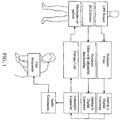
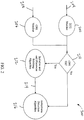
- a system may utilize an ECG monitor 202 that receives an ECG signal 204.
- the ECG monitor 202 may monitor or record the ECG signal 204 from sensors placed on the body.
- the ECG monitor 202 may analyze the ECG signal 204 and condition it for further processing. Further, the ECG monitor 202 may identify anomalies or artifacts that are present due to additional actions being taken such as CPR compressions.
- Various embodiments will have a CPR monitor 206 that analyzes a CPR signal 208.
- the CPR signal 208 may provide an independent indication of CPR activity being performed. Further, the CPR monitor 206 may condition the CPR signal 204 for further processing.
- the system 200 may then utilize decision logic 210 to determine whether PSAA is required. If the logic 210 determines CPR signal 208 is present, it will initialize and call the PSAA algorithm 212. The PSAA algorithm 212 will then take the ECG signal 204 and the CPR signal 208 and remove the CPR signal 208 from the ECG signal 204 to provide an ECG signal 214 clean of CPR artifacts. The ECG signal 214 may then be passed to other algorithms of the system 200 such as an Arrhythmia Detection Algorithm 216.
- the logic 210 will not initialize the PSAA algorithm 212 and the system 200 will pass the ECG signal 204 directly to the other algorithms such as an Arrhythmia Detection Algorithm 216.
- Other embodiments may sense a variety of primary and secondary signals wherein the secondary signal provides additional data or signal input to the primary signal and is preferentially removed or filtered utilizing the PSAA.
- the secondary signal provides additional data or signal input to the primary signal and is preferentially removed or filtered utilizing the PSAA.
- motion artifacts in Stress ECG machines respiratory artifacts in ECG and Stress ECG machines, machine artifacts in Stress ECG machines, electrooculagraphy signals in EEG, ECG signals / Pulse from EEG signals and CPR artifacts from other hemodynamic signals.
- various embodiments may remove artifacts in various signals representing physical impulses such as ECG, EEG, utilizing a second signal representing various physical impulses such as CPR compressions.
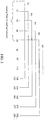
- the overlapping convolution output segments is implemented by first windowing the first W L samples of observed ECG signal ⁇ y[n] ⁇ and CPR reference signal ⁇ x[n] ⁇ , where W L indicates the window length. A rectangular window is then applied on both the input signals to generate CPR reference signal segments ⁇ x 1 (n) ⁇ and observed ECG signal segments ⁇ y 1 (n)1 ⁇ .
- CCS and ACS functions are determined as given above in equation (12), after subtracting mean values of ⁇ y 1 (n) ⁇ and ⁇ x 1 (n) ⁇ .
- ⁇ h(n) ⁇ is determined from the relationship between the two using equation (17) and the size of ⁇ h(n) ⁇ is set equal to N lag .
- ⁇ h(n) ⁇ is used to construct x 1 ′ n , using the convolution formula shown below.
- x 1 ′ n is the estimated artifact.
- Length of signal x 1 ′ n is W L + N lag -1.
- the output of convolution x 1 ′ n is then truncated to the first W L points.
- truncation should avoid beginning and ending N lag points.
- various embodiments just avoid N lag -1 points.
- Still other embodiments reduce the impact of initial N lag points by giving them lower weight in subsequent calculations of estimating the artifact.
- the output of the first non-overlapping segment between first and second windows is the same. Further, various embodiments assume that windows jump by N lag points. However, this jump may be determined by an input parameter or otherwise computed and indicated in N jump . Following the determination of the artifact segment ⁇ a 1 (n) ⁇ the clean ECG signal y est may be estimated for the first N lag points.
- weighting schemes may be utilized in estimating second, third and subsequent non-overlapping segments of data.
- These weighting schemas include: equal weighting and central segments weighting.
- an overlapped segment between two adjacent windows get calculated twice and so, equal weighting will be given to two adjacent window calculations, if only two windows overlap. Similar is the case for three adjacent computations, with a particular small segment being common to them. For example, if you set N lag / N jump of 16 points and have W L of 128 points ( i.e ), then a particular segment can be present in 8 neighboring windows.
- N lag points x out n
- n
- Center heavy weighting in computation of segments common to neighboring windows is utilized as a weighting scheme, in various embodiments, for the PSAA.
- the center heavy weighting scheme eliminates uncertainty provided by the edges in convolution of a set of windows, W L , by weighting the center segments. For example, if only six windows are utilized and a particular segment is present in the center, avoiding the windows on the two extremes and applying weight to the four windows in the center is center weighting.
- the center weighting algorithm is expressed as follows: x out n
- Numerator term 1 x k + 1 ′ n
- n 0
- Numerator term 2 3 ⁇ x k ⁇ 2 ′ n
- n 5 ⁇ N lag
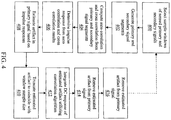
- a system implementing the PSAA using the convolution algorithm is presented.
- First select sample windows are selected from the primary and secondary observed signals 400.
- the primary signal segments and the secondary signal segments are generated 402.
- the auto and cross correlations are then computed from the primary and secondary signal segments 404.
- the impulse responses are determined from the auto- and cross correlations 406.
- the estimated artifact present in the primary signal is estimated from the impulse response 408.
- the estimated artifact is then truncated to coincide with the length of the selected primary and secondary signal sequences 410.
- the DC response of the estimated artifact is integrated utilizing convolution 412.
- the estimated clean primary signal is generated by removing the estimated artifact from the selected primary signal 414.
- the cycle may repeat for the next selected sample windows of the primary and secondary signals. In this way, embodiments may filter the entire primary signal with a high degree of accuracy utilizing the PSAA and convolution algorithm.
- FIG. 5 an embodiment of the PSAA utilizing overlapping regression segments is presented.
- This embodiment is similar to window based overlapping convolution output segments, except that output segments are computed from a simple regression relation between ⁇ x(n) ⁇ and ⁇ y ( n ) ⁇ .
- Assumption here is that the artifact and the reference signal have a point-by-point correlation, even if the relation is obscured by other components. In other words, relations are assumed to be piecewise linear.
- estimates of ⁇ and ⁇ are made in every window of W L samples ( ⁇ 2 seconds), and windows are given overlaps of W L /2 samples. Non-stationarity is accounted up to an extent, by this overlap.
- ⁇ and ⁇ are calculated as per equation (30).
- Estimates of ⁇ and ⁇ in equation (30) may help to reconstruct the artifact component in observed, corrupted ECG signal, ⁇ y(n) ⁇ . Further, additional windowing and overlapping methods may be utilized to simulate the overlapping convolution scheme and can eliminate non-stationary issues. Additionally, using smaller segments allows non-stationarity of relations to be captured.
- an embodiment of the PSAA utilizing linear regression segments is presented.
- select sample windows are selected from the primary and secondary observed signals 600.
- the primary signal sequence and the secondary signal sequence are generated 602.
- the linear regression is then determined between the primary and secondary signals 604.
- the estimated artifact is generated based on the linear regression 606.
- the estimated artifact is then truncated to coincide with the length of the selected primary and secondary signal sequences 608.
- the estimated clean primary signal is generated by removing the estimated artifact from the selected primary signal 610.
- the cycle may repeat for the next selected sample windows of the primary and secondary signals. In this way, various embodiments may filter the entire primary signal with a high degree of accuracy utilizing the PSAA and linear regression algorithm.
- a time varying, adaptive windowing scheme is also possible with piecewise regression implementation of PSAA scheme.
- overlap segment size, window start point in ⁇ x(n) ⁇ and ⁇ y(n) ⁇ all can change along with window size.
- This approach leads to segment-by-segment correlation, with segments that are unequal, with biases due to different number of computations per point.
- an acceptable artifact waveform can be built and can be subtracted from ⁇ y(n) ⁇ for arriving at artifact-removed ECG signal.
- every signal sample both in the sensed ECG signal and CPR reference signal, initiates computation and parameter storage actions. For example, computation of average, computation of auto-correlation sequence, cross-correlation sequences and the deconvolution and convolution operations happen continuously. However, in certain embodiments, additional computations such as the estimate the artifact segment are only performed at particular indices. In this way, the PSAA is able to reduce the amount of computation required in signal filtering and analysis.
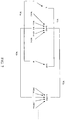
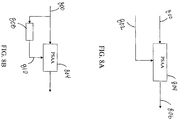
- FIGs. 8A - 8D various embodiments of systems utilizing the PSAA are presented.
- the embodiment depicted in 8A inputs the ECG signal 800 and the CPR reference signal 802 into the PSAA 804.
- the PSAA will then remove the CPR artifacts from the ECG signal 800 and provide the estimated actual ECG signal 806 for further use.
- FIG. 8B an embodiment of a system utilizing the PSAA without a reference signal is presented.
- the low frequency region of the ECG signal 800 recorded during CPR is dominated by a CPR artifact.
- filtering the ECG signal 800 utilizing a low pass filter 808 enables salient features of reference signal.
- this low-pass filtered output signal 810 can be used as ⁇ x(n) ⁇ in the PSAA 804.
- processing delay is minimized or made linear by using finite impulse response (FIR) filters. Lead or lag computation may utilize correlation analysis and subsequently applied.
- the low pass filter filters select signal ranges, for example, between (0-6) Hz.
- various embodiments may utilize the PSAA 804 to clean CPR artifacts from several input signals artifacts from several input signals using CPR reference signal 802.
- Input signals may include: ECG signal 800, pO 2 signal 812, atrial blood pressure (ABP) signal 814, central venous pressure (CVP) signal 816, and the heart sound signal 818.
- the PSAA 804 may filter the CPR artifact from multiple signals concurrently and provide uncorrupted signals for further analysis.
- FIG. 8D an embodiment utilizing the PSAA with multiple signals having related components, in absence of a CPR reference signal 802, is presented.
- a CPR reference signal 802 is not available, two or more signals corrupted with motion artifacts as a result of CPR are fed to the PSAA 804.
- an ECG signal 800 and a Hemodynamic signal 820 may be inputted to the PSAA 804.
- the PSAA 804 can correlate the signals and estimate the CPR artifact component.
- the PSAA 804 will then eliminate the CPR artifact component from original source signals and output clean versions of the input signals 822 along with a signal representing an estimate of the CPR artifact 824.
- the PSAA may be also be utilized in AED systems to enable first-responder instruction based on states of sensed signals as shown in FIG. 9 .
- the PSAA 900 may be utilized in conjunction with a rhythm analysis algorithm 902 to determine between pulseless rhythm 904, shockable rhythm 906 and non-shockable rhythm 908.
- a pulseless rhythm 904 requiring continued CPR can be determined in AEDs utilizing the PSAA 900.
- the PSAA 900 continually monitors the ECG signal 910 and CPR reference signal 912 and passes the clean ECG output signal 914 to a rhythm analysis algorithm 902 also implemented in the AED.
- the rhythm analysis algorithm 902 may then determine that continued CPR is required due to pulseless electrical activity or asystole and may instruct the AED to deliver the continue CPR command 916 to the first-responder.
- Presence of a shockable rhythm 906 requiring CPR to cease and a shock applied may be made near real-time in an AED utilizing the PSAA 900.
- the PSAA 900 continually monitors the ECG signal 910 and CPR reference signal 912 and passes the clean ECG output signal 914 to the rhythm analysis algorithm 902.
- the rhythm analysis algorithm 902 may then determine that an electrical shock is required and may instruct the AED to deliver the stop CPR and shock patient command 918 as per protocol.
- the PSAA 900 may drive the interruption of CPR in order to provide treatment adhering to protocol.
- Various embodiments allow for control signals to be directed to mechanical compression devices delivering automatic CPR compressions in order to automatically synchronize the electrical shock and compression cycles. If there is a non-shockable rhythm, the AED may deliver the continue CPR command and other commands 920.
- AEDs utilize the PSAA 900 to determine which signal processing is required by the PSAA 900.
- the PSAA 900 outputs the sensed ECG signal in situations where the estimated artifact signal 916 exhibits low signal amplitude or situations where the artifact has marginal impact on the ECG signal 910.
- the sensed ECG signal 910 may be utilized and passed directly to the rhythm analysis algorithm 902 bypassing the PSAA 900 signal processing thus further reducing latency and required processing power.
- various embodiments can remove noise from a sensed signal when signal to noise ratios show very large variations.
- the PSAA algorithm can efficiently delineate artifacts even for severe artifact conditions where signal-to-noise ratios are 1 to 20, and in cases of asystole, this ratio can be much larger of the order of 1:1000, being restricted mainly by inherent noise characteristics of ECG channel.
- the PSAA is able to analyze the sensed signal as shown in FIG. 10A and the CPR reference signal as shown in FIG. 10B and separate the CPR artifact resulting in a recovered ECG signal as shown in FIG. 10C .
- the PSAA may perform the same analysis on various alternate primary and secondary signals to the same effect.
- various signals that interfere with stress ECG machines and EEG machines may be removed by utilizing the PSAA.
- a digital microprocessor-based control system 1002 is used for controlling overall operation of AED 1000.
- the electrical control system 1000 further includes an impedance measuring circuit for testing the interconnection and operability of electrodes 1004 and 1006.
- Control system 1002 includes a processor 1008 interfaced to program memory 1010, data memory 1012, event memory 1014 and real time clock 1016.
- the operating program executed by processor 1008 is stored in program memory 1010. Electrical power is provided by the battery 1018 and is connected to power generation circuit 1020.
- Power generation circuit 1020 is also connected to power control unit 1022, lid switch 1024, watch dog timer 1026, real time clock 1016 and processor 1008.
- a data communication port 1028 is coupled to processor 1008 for data transfer. In certain embodiments, the data transfer may be performed utilizing a serial port, usb port, firewire, wireless such as 802.11x or 3G, radio and the like.
- Rescue switch 1030, maintenance indicator 1032, diagnostic display panel 1034, the voice circuit 1036 and audible alarm 1038 are also connected to processor 1008.
- Voice circuit 1036 is connected to speaker 1040.
- rescue light switch 1042 and a visual display 1044 is connected to the processor 1008 to provide additional operation information.
- the AED will have a processor 1008 and a PSAA co-processor 1046.
- the PSAA co-processor 1046 may be the PSAA algorithm implemented in hardware and operably connected to the processor over a high-speed data bus.
- the processor 1018 and PSAA co-processor 1046 are on the same silicon and may be implemented in a multi-core processor.
- the processor 1008 and PSAA co-processor may be implemented as part of a multi-processor or even networked processor arrangement.
- the processor 1018 offloads some of the PSAA calculations to the PSAA co-processor thus optimizing the processing of the sensed signals from the electrodes 1004 and 1006.
- processor 1008 is optimized with specific instructions or optimizations to execute PSAA calculations.
- processor 1010 may execute PSAA calculations in fewer clock cycles and while commanding fewer hardware resources.
- the logic and algorithm of the control system 1002 may be implemented in logic, either hardware in the form of an ASIC or a combination in the form of an FPGA, or the like.
- High voltage generation circuit 1048 is also connected to and controlled by processor 1008.
- High voltage generation circuit 1048 may contain semiconductor switches (not shown) and a plurality of capacitors (not shown).
- connectors 1050, 1052 link the high voltage generation circuit 1048 to electrodes 1004 and 1006.
- Impedance measuring circuit 1054 is connected to both connector 1050 and real time clock 1016. Impedance measuring circuit 1054 is interfaced to real time clock through analog-to-digital (A/D) converter 1056. Another impedance measuring circuit 1058 may be connected to connector 1050 and real time clock 1016 and interfaced to processor 1008 through analog-to-digital (A/D) converter 1056. A CPR device 1060 may be connected to the processor 1008 and real time click 1016 through connector 1052 and A/D 1056. The CPR device 1060 may be a chest compression detection device or a manual automatic or semi-automatic mechanical chest compression device.
Landscapes
- Health & Medical Sciences (AREA)
- Life Sciences & Earth Sciences (AREA)
- Engineering & Computer Science (AREA)
- Signal Processing (AREA)
- Biomedical Technology (AREA)
- General Health & Medical Sciences (AREA)
- Animal Behavior & Ethology (AREA)
- Public Health (AREA)
- Veterinary Medicine (AREA)
- Heart & Thoracic Surgery (AREA)
- Physics & Mathematics (AREA)
- Biophysics (AREA)
- Pathology (AREA)
- Surgery (AREA)
- Medical Informatics (AREA)
- Molecular Biology (AREA)
- Psychiatry (AREA)
- Physiology (AREA)
- Computer Vision & Pattern Recognition (AREA)
- Artificial Intelligence (AREA)
- Cardiology (AREA)
- Nuclear Medicine, Radiotherapy & Molecular Imaging (AREA)
- Radiology & Medical Imaging (AREA)
- Power Engineering (AREA)
- Critical Care (AREA)
- Emergency Medicine (AREA)
- Measurement And Recording Of Electrical Phenomena And Electrical Characteristics Of The Living Body (AREA)
- Electrotherapy Devices (AREA)
Applications Claiming Priority (1)
| Application Number | Priority Date | Filing Date | Title |
|---|---|---|---|
| US12/611,679 US8509881B2 (en) | 2009-11-03 | 2009-11-03 | True ECG measurement during cardio pulmonary resuscitation by adaptive piecewise stitching algorithm |
Publications (2)
| Publication Number | Publication Date |
|---|---|
| EP2319409A1 EP2319409A1 (en) | 2011-05-11 |
| EP2319409B1 true EP2319409B1 (en) | 2021-01-06 |
Family
ID=43770550
Family Applications (1)
| Application Number | Title | Priority Date | Filing Date |
|---|---|---|---|
| EP10189877.3A Active EP2319409B1 (en) | 2009-11-03 | 2010-11-03 | True ECG measurement during cardio pulmonary resuscitation by adaptvie piecewise stitching algorithm |
Country Status (5)
| Country | Link |
|---|---|
| US (1) | US8509881B2 (enExample) |
| EP (1) | EP2319409B1 (enExample) |
| JP (1) | JP5719564B2 (enExample) |
| KR (1) | KR101683908B1 (enExample) |
| CN (1) | CN102048531B (enExample) |
Families Citing this family (56)
| Publication number | Priority date | Publication date | Assignee | Title |
|---|---|---|---|---|
| US9308383B2 (en) * | 2010-03-12 | 2016-04-12 | Schiller Medical S.A.S. | Method, apparatus and computer program for defibrillation delivery decision |
| RU2486862C1 (ru) * | 2011-11-18 | 2013-07-10 | Федеральное государственное бюджетное образовательное учреждение высшего профессионального образования ФГБОУ ВПО "Пензенский государственный университет" (ПГУ) | Способ адаптивного подавления помех в электрокардиосигнале |
| WO2013078469A1 (en) | 2011-11-25 | 2013-05-30 | Persyst Development Corporation | Method and system for displaying eeg data and user interface |
| EP2782498B1 (en) * | 2011-11-25 | 2022-03-16 | Persyst Development Corporation | Method and system for displaying eeg data and user interface |
| US9839368B2 (en) | 2012-01-17 | 2017-12-12 | Zoll Medical Corporation | Systems and methods for filtering ECG artifacts |
| US8903498B2 (en) | 2012-03-27 | 2014-12-02 | Physio-Control, Inc. | System and method for electrocardiogram analysis and optimization of cardiopulmonary resuscitation and therapy delivery |
| US9545211B2 (en) | 2012-03-27 | 2017-01-17 | Physio-Control, Inc. | System and method for electrocardiogram analysis and optimization of cardiopulmonary resuscitation and therapy delivery |
| US9084545B2 (en) | 2012-05-03 | 2015-07-21 | Physio-Control, Inc. | Filter mechanism for removing ECG artifact from mechanical chest compressions |
| US9538931B2 (en) | 2012-03-27 | 2017-01-10 | Physio-Control, Inc. | Reducing electrocardiogram artifacts during and post CPR |
| US9126055B2 (en) | 2012-04-20 | 2015-09-08 | Cardiac Science Corporation | AED faster time to shock method and device |
| US8942800B2 (en) | 2012-04-20 | 2015-01-27 | Cardiac Science Corporation | Corrective prompting system for appropriate chest compressions |
| WO2013179234A1 (en) | 2012-06-01 | 2013-12-05 | Koninklijke Philips N.V. | Method and apparatus for analyzing cardiac rhythm during cpr |
| US9633577B2 (en) | 2012-10-02 | 2017-04-25 | Zoll Medical Corporation | CPR training system and methods |
| JP6505964B2 (ja) * | 2012-10-05 | 2019-04-24 | 日本光電工業株式会社 | 心電図解析機能付き除細動器の制御方法および除細動器 |
| CN103705231B (zh) * | 2012-10-08 | 2016-01-20 | 经络动力医学股份有限公司 | 动态心电信号捕获方法 |
| JP2014076117A (ja) * | 2012-10-09 | 2014-05-01 | Nippon Koden Corp | 心電図解析装置および電極セット |
| WO2014102653A1 (en) | 2012-12-31 | 2014-07-03 | Koninklijke Philips N.V. | Method and apparatus for reducing motion artifacts in ecg signals |
| CN105122273B (zh) * | 2013-01-17 | 2018-11-20 | 科迪影技术股份有限公司 | 用于电生理学信号的非局域均值滤波 |
| WO2014141056A2 (en) | 2013-03-12 | 2014-09-18 | Koninklijke Philips N.V. | Defibrillator and method using limb leads for artifact free ecg |
| JP6664963B2 (ja) * | 2013-03-13 | 2020-03-13 | コーニンクレッカ フィリップス エヌ ヴェKoninklijke Philips N.V. | 心肺蘇生中にショック勧告の信頼性をスコアリングするための方法及び装置 |
| US9811634B2 (en) * | 2013-04-25 | 2017-11-07 | Zoll Medical Corporation | Systems and methods to predict the chances of neurologically intact survival while performing CPR |
| US9511239B2 (en) | 2013-09-27 | 2016-12-06 | Zoll Medical Corporation | Electrode with feature for indicating prior use with adult or pediatric subject and systems and methods including same |
| WO2015048018A1 (en) | 2013-09-30 | 2015-04-02 | Zoll Medical Corporation | Adult and pediatric defibrillation electrode pad assembly |
| CN105705086B (zh) * | 2013-11-08 | 2019-05-07 | 皇家飞利浦有限公司 | Ecg高通滤波器 |
| CN103610458B (zh) * | 2013-11-27 | 2015-05-13 | 中国科学院深圳先进技术研究院 | 心电数据重采样方法、心电图显示方法和装置 |
| EP3229895B8 (en) * | 2014-12-12 | 2020-04-01 | Koninklijke Philips N.V. | Analyze option button for an automated external defibrillator (aed) with dual ecg analysis algorithms |
| EP3229897B1 (en) * | 2014-12-12 | 2018-12-05 | Koninklijke Philips N.V. | Confidence analyzer for an automated external defibrillator (aed) with dual ecg analysis algorithms |
| US10561853B2 (en) | 2014-12-12 | 2020-02-18 | Koninklijke Philips N.V. | Automated external defibrillator (AED) with dual ECG analysis algorithms |
| RU2017125786A (ru) | 2014-12-18 | 2019-01-18 | Конинклейке Филипс Н.В. | Дефибриллятор с запланированным и непрерывным режимами работы |
| BR112017012771A2 (pt) | 2014-12-18 | 2017-12-26 | Koninklijke Philips Nv | desfibrilador externo automatizado (dea) para usar durante uma ressuscitação cardiopulmonar (rcp), e método para controlar uma saída de eletroterapia de um desfibrilador durante a aplicação de rcp |
| US10835449B2 (en) * | 2015-03-30 | 2020-11-17 | Zoll Medical Corporation | Modular components for medical devices |
| US10542961B2 (en) | 2015-06-15 | 2020-01-28 | The Research Foundation For The State University Of New York | System and method for infrasonic cardiac monitoring |
| US10894168B2 (en) * | 2016-03-30 | 2021-01-19 | Koninklijke Philips N.V. | Automated external defibrillator with shortened pause for rhythm analysis |
| US10433749B2 (en) * | 2016-08-10 | 2019-10-08 | Biosense Webster (Israel) Ltd. | Identifying ECG signals having the same morphology |
| WO2018122900A1 (ja) * | 2016-12-26 | 2018-07-05 | 日本電気株式会社 | レーダー間干渉除去方法、信号処理装置、信号処理方法および信号処理プログラム |
| FR3061850B1 (fr) * | 2017-01-19 | 2023-02-10 | Bioserenity | Dispositif de suivi de l’activite electro-physiologique d’un sujet |
| US11179293B2 (en) | 2017-07-28 | 2021-11-23 | Stryker Corporation | Patient support system with chest compression system and harness assembly with sensor system |
| EP3684463B1 (en) | 2017-09-19 | 2025-05-14 | Neuroenhancement Lab, LLC | Method and apparatus for neuroenhancement |
| US11717686B2 (en) | 2017-12-04 | 2023-08-08 | Neuroenhancement Lab, LLC | Method and apparatus for neuroenhancement to facilitate learning and performance |
| US11318277B2 (en) | 2017-12-31 | 2022-05-03 | Neuroenhancement Lab, LLC | Method and apparatus for neuroenhancement to enhance emotional response |
| US12280219B2 (en) | 2017-12-31 | 2025-04-22 | NeuroLight, Inc. | Method and apparatus for neuroenhancement to enhance emotional response |
| US11364361B2 (en) | 2018-04-20 | 2022-06-21 | Neuroenhancement Lab, LLC | System and method for inducing sleep by transplanting mental states |
| CN108670245A (zh) * | 2018-05-31 | 2018-10-19 | 哈尔滨工业大学深圳研究生院 | 一种心电信号检测方法及系统 |
| US11452839B2 (en) | 2018-09-14 | 2022-09-27 | Neuroenhancement Lab, LLC | System and method of improving sleep |
| CN109171708B (zh) * | 2018-10-25 | 2021-04-16 | 广东工业大学 | 一种可除颤心律识别装置 |
| CN109567781B (zh) * | 2018-11-13 | 2021-06-18 | 中国人民解放军陆军军医大学 | 心肺复苏过程中自动检测脉搏的装置及其检测方法 |
| CN109431493B (zh) * | 2018-12-07 | 2021-02-26 | 南京医科大学 | 基于距离分段加权算法的可穿戴体表电势采集装置 |
| US11786694B2 (en) | 2019-05-24 | 2023-10-17 | NeuroLight, Inc. | Device, method, and app for facilitating sleep |
| CN113116357A (zh) * | 2019-12-30 | 2021-07-16 | 华为技术有限公司 | 一种数据采集方法、终端设备及存储介质 |
| WO2022115874A2 (en) * | 2020-11-30 | 2022-06-02 | Zoll Medical Corporation | Mixed-segment electrocardiogram analysis in coordination with cardiopulmonary resuscitation for efficient defibrillation electrotherapy |
| US12350505B2 (en) | 2020-12-23 | 2025-07-08 | Stryker Corporation | Defibrillators with enhanced functionality during cardiopulmonary resuscitation periods |
| US12350506B2 (en) | 2020-12-23 | 2025-07-08 | Stryker Corporation | Up-to-date defibrillation recommendations based on continuous ECG analysis during cardiopulmonary resuscitation |
| WO2023086233A1 (en) * | 2021-11-09 | 2023-05-19 | University Of Connecticut | Cardiopulmonary resuscitation, treatment, and analysis |
| CN115067901B (zh) * | 2022-06-30 | 2024-10-18 | 北京京东拓先科技有限公司 | 心跳信号探测方法和装置 |
| KR102725436B1 (ko) * | 2022-11-14 | 2024-11-04 | 세종대학교산학협력단 | Ecg 데이터 스티칭 방법 및 이를 이용하는 모니터링 장치 |
| US12417847B1 (en) * | 2025-01-03 | 2025-09-16 | Defibrio AS | Systems and methods for rhythm recognition |
Family Cites Families (45)
| Publication number | Priority date | Publication date | Assignee | Title |
|---|---|---|---|---|
| US5589639A (en) * | 1986-02-28 | 1996-12-31 | D'antonio; Nicholas F. | Sensor and transducer apparatus |
| US4802491A (en) * | 1986-07-30 | 1989-02-07 | Massachusetts Institute Of Technology | Method and apparatus for assessing myocardial electrical stability |
| US5649544A (en) * | 1989-10-30 | 1997-07-22 | Feng; Genquan | Method of and arrangement for diagnosing heart disease |
| US5474574A (en) * | 1992-06-24 | 1995-12-12 | Cardiac Science, Inc. | Automatic external cardioverter/defibrillator |
| US5405361A (en) * | 1993-03-15 | 1995-04-11 | Surviva Link Corporation | External defibrillator circuit |
| US5713367A (en) * | 1994-01-26 | 1998-02-03 | Cambridge Heart, Inc. | Measuring and assessing cardiac electrical stability |
| US5588439A (en) * | 1995-01-10 | 1996-12-31 | Nellcor Incorporated | Acoustic impulse respirometer and method |
| US5762068A (en) * | 1995-11-27 | 1998-06-09 | Quinton Instrument Company | ECG filter and slew rate limiter for filtering an ECG signal |
| US5999845A (en) * | 1997-05-21 | 1999-12-07 | Quinton Instrument Company | Muscle artifact noise detector for ECG signals |
| US6178357B1 (en) * | 1998-08-28 | 2001-01-23 | Agilent Technologies, Inc. | Electrode pad system and defibrillator electrode pad that reduces the risk of peripheral shock |
| US6125299A (en) * | 1998-10-29 | 2000-09-26 | Survivalink Corporation | AED with force sensor |
| US6390996B1 (en) * | 1998-11-09 | 2002-05-21 | The Johns Hopkins University | CPR chest compression monitor |
| NO310137B1 (no) * | 1998-12-11 | 2001-05-28 | Laerdal Medical As | System for å måle og analysere HLR parametere for anvendelse med og av en ekstern defibrillator |
| NO310135B1 (no) * | 1999-05-31 | 2001-05-28 | Laerdal Medical As | System for å måle og anvende parametere ved utförelse av brystkompresjon i löpet av en livredningssituasjon hhv.treningssituasjon samt anvendelser |
| NO311746B1 (no) * | 1999-08-27 | 2002-01-21 | Laerdal Medical As | System for å redusere signalforstyrrelser i EKG forårsaket av hjerte-lunge-redning |
| US6246907B1 (en) * | 1999-12-01 | 2001-06-12 | Cardiacscience, Inc. | Automatic external cardioverter/defibrillator with cardiac rate detector and method of operating the same |
| US6289243B1 (en) * | 1999-12-01 | 2001-09-11 | Cardiac Science, Inc. | Automatic external cardioverter/defibrillator with tachyarrhythmia detector using a modulation (amplitude and frequency) domain function |
| AU2001234846A1 (en) * | 2000-02-04 | 2001-08-14 | Zmd Corporation | Integrated resuscitation |
| DE60017368T2 (de) | 2000-05-26 | 2006-03-02 | Laerdal Medical A/S | System zur Messung und Analyse von kardiopulmonaren Wiederbelebungs-Parametern zum Gebrauch mit einem externen Defibrillator |
| US6658290B1 (en) * | 2000-06-12 | 2003-12-02 | Cardiac Science, Inc. | Public access defibrillator |
| US6480734B1 (en) * | 2000-06-30 | 2002-11-12 | Cardiac Science Inc. | Cardiac arrhythmia detector using ECG waveform-factor and its irregularity |
| US7463922B1 (en) * | 2000-07-13 | 2008-12-09 | Koninklijke Philips Electronics, N.V. | Circuit and method for analyzing a patient's heart function using overlapping analysis windows |
| DE10046075A1 (de) | 2000-09-15 | 2002-04-04 | Friendly Sensors Ag | Vorrichtung und Verfahren zur Erzeugung von Messdaten |
| US6553257B2 (en) * | 2001-03-13 | 2003-04-22 | Koninklijke Philips Electronics N.V. | Interactive method of performing cardipulmonary resuscitation with minimal delay to defibrillation shocks |
| US6983183B2 (en) * | 2001-07-13 | 2006-01-03 | Cardiac Science, Inc. | Method and apparatus for monitoring cardiac patients for T-wave alternans |
| US6827695B2 (en) * | 2002-10-25 | 2004-12-07 | Revivant Corporation | Method of determining depth of compressions during cardio-pulmonary resuscitation |
| US7272441B1 (en) * | 2002-11-13 | 2007-09-18 | Medtronic Physio-Control Manufacturing Corp. | External defibrillator and methods for operating the external defibrillator |
| EP1581304A1 (en) * | 2002-12-13 | 2005-10-05 | Koninklijke Philips Electronics N.V. | External defibrillator with shock activated by cessation of precordial compressions |
| US7308304B2 (en) * | 2003-02-14 | 2007-12-11 | Medtronic Physio-Control Corp. | Cooperating defibrillators and external chest compression devices |
| US6961612B2 (en) * | 2003-02-19 | 2005-11-01 | Zoll Medical Corporation | CPR sensitive ECG analysis in an automatic external defibrillator |
| US20040215244A1 (en) * | 2003-04-23 | 2004-10-28 | Marcovecchio Alan F. | Processing pulse signal in conjunction with ECG signal to detect pulse in external defibrillation |
| US7220235B2 (en) | 2003-06-27 | 2007-05-22 | Zoll Medical Corporation | Method and apparatus for enhancement of chest compressions during CPR |
| US20050101889A1 (en) * | 2003-11-06 | 2005-05-12 | Freeman Gary A. | Using chest velocity to process physiological signals to remove chest compression artifacts |
| US7567837B2 (en) * | 2003-12-19 | 2009-07-28 | Institute Of Critical Care Medicine | Enhanced rhythm identification in compression corrupted ECG |
| US7039457B2 (en) * | 2003-12-19 | 2006-05-02 | Institute Of Critical Care Medicine | Rhythm identification in compression corrupted ECG signal |
| US7565194B2 (en) * | 2004-05-12 | 2009-07-21 | Zoll Medical Corporation | ECG rhythm advisory method |
| EP1778350A4 (en) | 2004-07-30 | 2010-04-21 | Access Cardiosystems Inc | METHOD AND DEVICE FOR DETECTING PATIENT CAUSES CAUSED BY HLW AND / OR MOTION PATIENTS IN THE PATIENTS ELECTROCARDIOGRAM USING THE PATIENT IMPEDANCE |
| GB0502871D0 (en) | 2005-02-10 | 2005-03-16 | Cardiodigital Ltd | ECG analysis during CPR |
| EP1904174A2 (en) * | 2005-06-23 | 2008-04-02 | Koninklijke Philips Electronics N.V. | Defibrillator with automatic shock first/cpr first algorithm |
| US20070213775A1 (en) * | 2005-07-19 | 2007-09-13 | Koninklijke Philips Electronics N.V. | External Defibrillator With Pre-Cpr-Ecg Based Defibrillating Shock |
| JP5455373B2 (ja) * | 2005-12-16 | 2014-03-26 | コーニンクレッカ フィリップス エヌ ヴェ | 増加するcpr実施時間を有する自動対外除細動器 |
| US8010190B2 (en) * | 2006-05-26 | 2011-08-30 | Cardiac Science Corporation | CPR feedback method and apparatus |
| CN101553276A (zh) | 2006-12-07 | 2009-10-07 | 皇家飞利浦电子股份有限公司 | 具有带有暂停以便进行ecg采集的cpr周期的aed |
| JP4971461B2 (ja) | 2007-11-01 | 2012-07-11 | ゾール メディカル コーポレイション | 除細動と胸部圧迫の同期 |
| US7783341B2 (en) * | 2008-01-07 | 2010-08-24 | General Electric Company | Method and apparatus for discerning therapeutic signals from noise in physiological data |
-
2009
- 2009-11-03 US US12/611,679 patent/US8509881B2/en active Active
-
2010
- 2010-11-02 JP JP2010246339A patent/JP5719564B2/ja not_active Expired - Fee Related
- 2010-11-03 EP EP10189877.3A patent/EP2319409B1/en active Active
- 2010-11-03 CN CN201010543580.0A patent/CN102048531B/zh active Active
- 2010-11-03 KR KR1020100108896A patent/KR101683908B1/ko not_active Expired - Fee Related
Non-Patent Citations (1)
| Title |
|---|
| None * |
Also Published As
| Publication number | Publication date |
|---|---|
| CN102048531A (zh) | 2011-05-11 |
| KR101683908B1 (ko) | 2016-12-07 |
| CN102048531B (zh) | 2015-02-11 |
| US20110105930A1 (en) | 2011-05-05 |
| EP2319409A1 (en) | 2011-05-11 |
| JP2011098198A (ja) | 2011-05-19 |
| US8509881B2 (en) | 2013-08-13 |
| JP5719564B2 (ja) | 2015-05-20 |
| KR20110049725A (ko) | 2011-05-12 |
Similar Documents
| Publication | Publication Date | Title |
|---|---|---|
| US8509881B2 (en) | True ECG measurement during cardio pulmonary resuscitation by adaptive piecewise stitching algorithm | |
| US11529086B2 (en) | Medical device for sensing cardiac function | |
| US6393316B1 (en) | Method and apparatus for detection and treatment of cardiac arrhythmias | |
| US8688202B2 (en) | Method and apparatus for identifying cardiac risk | |
| US9008762B2 (en) | Method and apparatus for identifying cardiac risk | |
| JP6092364B2 (ja) | 迅速にショックを送達する方法およびaed装置 | |
| Aramendi et al. | Suppression of the cardiopulmonary resuscitation artefacts using the instantaneous chest compression rate extracted from the thoracic impedance | |
| US9839368B2 (en) | Systems and methods for filtering ECG artifacts | |
| US20080097537A1 (en) | Method And System For Cardiac Signal Decomposition | |
| US11771360B2 (en) | Cardiac monitoring system with normally conducted QRS complex identification | |
| US8170655B2 (en) | Module and device for discerning therapeutic signals from noise in physiological data | |
| Ruiz et al. | Reliable extraction of the circulation component in the thoracic impedance measured by defibrillation pads | |
| US9072438B2 (en) | Method and apparatus for identifying cardiac risk | |
| US12161476B2 (en) | Cardiac monitoring system with supraventricular tachycardia (SVT) classifications | |
| Pingale | Using Pan Tompkin ‘S Method, ECG signal processing and dignose various diseases in Matlab | |
| Vijaya et al. | Arrhythmia detection through ECG feature extraction using wavelet analysis | |
| Yol et al. | Design of real time cardiac arrhythmia detection device | |
| US8798733B2 (en) | Device and method for identifying cardiac events | |
| KR20140114181A (ko) | 심전도 신호에 기반하여 스트레스를 분석하고 추정하는 방법 및 장치 | |
| US20150342490A1 (en) | Biological signal detecting apparatus and implantable medical device | |
| EP1778347B1 (en) | Defibrillator with cardiac blood flow determination |
Legal Events
| Date | Code | Title | Description |
|---|---|---|---|
| PUAI | Public reference made under article 153(3) epc to a published international application that has entered the european phase |
Free format text: ORIGINAL CODE: 0009012 |
|
| AK | Designated contracting states |
Kind code of ref document: A1 Designated state(s): AL AT BE BG CH CY CZ DE DK EE ES FI FR GB GR HR HU IE IS IT LI LT LU LV MC MK MT NL NO PL PT RO RS SE SI SK SM TR |
|
| AX | Request for extension of the european patent |
Extension state: BA ME |
|
| 17P | Request for examination filed |
Effective date: 20111110 |
|
| RAP1 | Party data changed (applicant data changed or rights of an application transferred) |
Owner name: CARDIAC SCIENCE CORPORATION |
|
| STAA | Information on the status of an ep patent application or granted ep patent |
Free format text: STATUS: EXAMINATION IS IN PROGRESS |
|
| RIC1 | Information provided on ipc code assigned before grant |
Ipc: A61B 5/04 20060101AFI20190619BHEP Ipc: A61N 1/39 20060101ALN20190619BHEP |
|
| 17Q | First examination report despatched |
Effective date: 20190627 |
|
| RIC1 | Information provided on ipc code assigned before grant |
Ipc: A61B 5/04 20060101AFI20200602BHEP Ipc: A61N 1/39 20060101ALN20200602BHEP |
|
| GRAP | Despatch of communication of intention to grant a patent |
Free format text: ORIGINAL CODE: EPIDOSNIGR1 |
|
| STAA | Information on the status of an ep patent application or granted ep patent |
Free format text: STATUS: GRANT OF PATENT IS INTENDED |
|
| RIC1 | Information provided on ipc code assigned before grant |
Ipc: A61N 1/39 20060101ALN20200624BHEP Ipc: A61B 5/04 20060101AFI20200624BHEP |
|
| INTG | Intention to grant announced |
Effective date: 20200716 |
|
| GRAS | Grant fee paid |
Free format text: ORIGINAL CODE: EPIDOSNIGR3 |
|
| GRAA | (expected) grant |
Free format text: ORIGINAL CODE: 0009210 |
|
| STAA | Information on the status of an ep patent application or granted ep patent |
Free format text: STATUS: THE PATENT HAS BEEN GRANTED |
|
| AK | Designated contracting states |
Kind code of ref document: B1 Designated state(s): AL AT BE BG CH CY CZ DE DK EE ES FI FR GB GR HR HU IE IS IT LI LT LU LV MC MK MT NL NO PL PT RO RS SE SI SK SM TR |
|
| REG | Reference to a national code |
Ref country code: GB Ref legal event code: FG4D |
|
| REG | Reference to a national code |
Ref country code: AT Ref legal event code: REF Ref document number: 1351434 Country of ref document: AT Kind code of ref document: T Effective date: 20210115 Ref country code: CH Ref legal event code: EP |
|
| REG | Reference to a national code |
Ref country code: DE Ref legal event code: R096 Ref document number: 602010066296 Country of ref document: DE |
|
| REG | Reference to a national code |
Ref country code: IE Ref legal event code: FG4D |
|
| REG | Reference to a national code |
Ref country code: NL Ref legal event code: MP Effective date: 20210106 |
|
| REG | Reference to a national code |
Ref country code: AT Ref legal event code: MK05 Ref document number: 1351434 Country of ref document: AT Kind code of ref document: T Effective date: 20210106 |
|
| REG | Reference to a national code |
Ref country code: LT Ref legal event code: MG9D |
|
| PG25 | Lapsed in a contracting state [announced via postgrant information from national office to epo] |
Ref country code: HR Free format text: LAPSE BECAUSE OF FAILURE TO SUBMIT A TRANSLATION OF THE DESCRIPTION OR TO PAY THE FEE WITHIN THE PRESCRIBED TIME-LIMIT Effective date: 20210106 Ref country code: GR Free format text: LAPSE BECAUSE OF FAILURE TO SUBMIT A TRANSLATION OF THE DESCRIPTION OR TO PAY THE FEE WITHIN THE PRESCRIBED TIME-LIMIT Effective date: 20210407 Ref country code: FI Free format text: LAPSE BECAUSE OF FAILURE TO SUBMIT A TRANSLATION OF THE DESCRIPTION OR TO PAY THE FEE WITHIN THE PRESCRIBED TIME-LIMIT Effective date: 20210106 Ref country code: LT Free format text: LAPSE BECAUSE OF FAILURE TO SUBMIT A TRANSLATION OF THE DESCRIPTION OR TO PAY THE FEE WITHIN THE PRESCRIBED TIME-LIMIT Effective date: 20210106 Ref country code: BG Free format text: LAPSE BECAUSE OF FAILURE TO SUBMIT A TRANSLATION OF THE DESCRIPTION OR TO PAY THE FEE WITHIN THE PRESCRIBED TIME-LIMIT Effective date: 20210406 Ref country code: NO Free format text: LAPSE BECAUSE OF FAILURE TO SUBMIT A TRANSLATION OF THE DESCRIPTION OR TO PAY THE FEE WITHIN THE PRESCRIBED TIME-LIMIT Effective date: 20210406 Ref country code: NL Free format text: LAPSE BECAUSE OF FAILURE TO SUBMIT A TRANSLATION OF THE DESCRIPTION OR TO PAY THE FEE WITHIN THE PRESCRIBED TIME-LIMIT Effective date: 20210106 Ref country code: PT Free format text: LAPSE BECAUSE OF FAILURE TO SUBMIT A TRANSLATION OF THE DESCRIPTION OR TO PAY THE FEE WITHIN THE PRESCRIBED TIME-LIMIT Effective date: 20210506 |
|
| PG25 | Lapsed in a contracting state [announced via postgrant information from national office to epo] |
Ref country code: AT Free format text: LAPSE BECAUSE OF FAILURE TO SUBMIT A TRANSLATION OF THE DESCRIPTION OR TO PAY THE FEE WITHIN THE PRESCRIBED TIME-LIMIT Effective date: 20210106 Ref country code: PL Free format text: LAPSE BECAUSE OF FAILURE TO SUBMIT A TRANSLATION OF THE DESCRIPTION OR TO PAY THE FEE WITHIN THE PRESCRIBED TIME-LIMIT Effective date: 20210106 Ref country code: RS Free format text: LAPSE BECAUSE OF FAILURE TO SUBMIT A TRANSLATION OF THE DESCRIPTION OR TO PAY THE FEE WITHIN THE PRESCRIBED TIME-LIMIT Effective date: 20210106 Ref country code: LV Free format text: LAPSE BECAUSE OF FAILURE TO SUBMIT A TRANSLATION OF THE DESCRIPTION OR TO PAY THE FEE WITHIN THE PRESCRIBED TIME-LIMIT Effective date: 20210106 Ref country code: SE Free format text: LAPSE BECAUSE OF FAILURE TO SUBMIT A TRANSLATION OF THE DESCRIPTION OR TO PAY THE FEE WITHIN THE PRESCRIBED TIME-LIMIT Effective date: 20210106 |
|
| PG25 | Lapsed in a contracting state [announced via postgrant information from national office to epo] |
Ref country code: IS Free format text: LAPSE BECAUSE OF FAILURE TO SUBMIT A TRANSLATION OF THE DESCRIPTION OR TO PAY THE FEE WITHIN THE PRESCRIBED TIME-LIMIT Effective date: 20210506 |
|
| REG | Reference to a national code |
Ref country code: DE Ref legal event code: R097 Ref document number: 602010066296 Country of ref document: DE |
|
| PG25 | Lapsed in a contracting state [announced via postgrant information from national office to epo] |
Ref country code: SM Free format text: LAPSE BECAUSE OF FAILURE TO SUBMIT A TRANSLATION OF THE DESCRIPTION OR TO PAY THE FEE WITHIN THE PRESCRIBED TIME-LIMIT Effective date: 20210106 Ref country code: EE Free format text: LAPSE BECAUSE OF FAILURE TO SUBMIT A TRANSLATION OF THE DESCRIPTION OR TO PAY THE FEE WITHIN THE PRESCRIBED TIME-LIMIT Effective date: 20210106 Ref country code: CZ Free format text: LAPSE BECAUSE OF FAILURE TO SUBMIT A TRANSLATION OF THE DESCRIPTION OR TO PAY THE FEE WITHIN THE PRESCRIBED TIME-LIMIT Effective date: 20210106 |
|
| PLBE | No opposition filed within time limit |
Free format text: ORIGINAL CODE: 0009261 |
|
| STAA | Information on the status of an ep patent application or granted ep patent |
Free format text: STATUS: NO OPPOSITION FILED WITHIN TIME LIMIT |
|
| PG25 | Lapsed in a contracting state [announced via postgrant information from national office to epo] |
Ref country code: RO Free format text: LAPSE BECAUSE OF FAILURE TO SUBMIT A TRANSLATION OF THE DESCRIPTION OR TO PAY THE FEE WITHIN THE PRESCRIBED TIME-LIMIT Effective date: 20210106 Ref country code: SK Free format text: LAPSE BECAUSE OF FAILURE TO SUBMIT A TRANSLATION OF THE DESCRIPTION OR TO PAY THE FEE WITHIN THE PRESCRIBED TIME-LIMIT Effective date: 20210106 Ref country code: ES Free format text: LAPSE BECAUSE OF FAILURE TO SUBMIT A TRANSLATION OF THE DESCRIPTION OR TO PAY THE FEE WITHIN THE PRESCRIBED TIME-LIMIT Effective date: 20210106 Ref country code: DK Free format text: LAPSE BECAUSE OF FAILURE TO SUBMIT A TRANSLATION OF THE DESCRIPTION OR TO PAY THE FEE WITHIN THE PRESCRIBED TIME-LIMIT Effective date: 20210106 |
|
| 26N | No opposition filed |
Effective date: 20211007 |
|
| REG | Reference to a national code |
Ref country code: DE Ref legal event code: R081 Ref document number: 602010066296 Country of ref document: DE Owner name: ZOLL MEDICAL CORPORATION, CHELMSFORD, US Free format text: FORMER OWNER: CARDIAC SCIENCE CORPORATION, WAUKESHA, WIS., US |
|
| REG | Reference to a national code |
Ref country code: GB Ref legal event code: 732E Free format text: REGISTERED BETWEEN 20211230 AND 20220105 |
|
| PG25 | Lapsed in a contracting state [announced via postgrant information from national office to epo] |
Ref country code: AL Free format text: LAPSE BECAUSE OF FAILURE TO SUBMIT A TRANSLATION OF THE DESCRIPTION OR TO PAY THE FEE WITHIN THE PRESCRIBED TIME-LIMIT Effective date: 20210106 |
|
| PG25 | Lapsed in a contracting state [announced via postgrant information from national office to epo] |
Ref country code: SI Free format text: LAPSE BECAUSE OF FAILURE TO SUBMIT A TRANSLATION OF THE DESCRIPTION OR TO PAY THE FEE WITHIN THE PRESCRIBED TIME-LIMIT Effective date: 20210106 |
|
| PG25 | Lapsed in a contracting state [announced via postgrant information from national office to epo] |
Ref country code: IT Free format text: LAPSE BECAUSE OF FAILURE TO SUBMIT A TRANSLATION OF THE DESCRIPTION OR TO PAY THE FEE WITHIN THE PRESCRIBED TIME-LIMIT Effective date: 20210106 |
|
| PG25 | Lapsed in a contracting state [announced via postgrant information from national office to epo] |
Ref country code: IS Free format text: LAPSE BECAUSE OF FAILURE TO SUBMIT A TRANSLATION OF THE DESCRIPTION OR TO PAY THE FEE WITHIN THE PRESCRIBED TIME-LIMIT Effective date: 20210506 |
|
| PG25 | Lapsed in a contracting state [announced via postgrant information from national office to epo] |
Ref country code: MC Free format text: LAPSE BECAUSE OF FAILURE TO SUBMIT A TRANSLATION OF THE DESCRIPTION OR TO PAY THE FEE WITHIN THE PRESCRIBED TIME-LIMIT Effective date: 20210106 |
|
| REG | Reference to a national code |
Ref country code: CH Ref legal event code: PL |
|
| PG25 | Lapsed in a contracting state [announced via postgrant information from national office to epo] |
Ref country code: LU Free format text: LAPSE BECAUSE OF NON-PAYMENT OF DUE FEES Effective date: 20211103 Ref country code: BE Free format text: LAPSE BECAUSE OF NON-PAYMENT OF DUE FEES Effective date: 20211130 |
|
| REG | Reference to a national code |
Ref country code: BE Ref legal event code: MM Effective date: 20211130 |
|
| PG25 | Lapsed in a contracting state [announced via postgrant information from national office to epo] |
Ref country code: IE Free format text: LAPSE BECAUSE OF NON-PAYMENT OF DUE FEES Effective date: 20211103 |
|
| PG25 | Lapsed in a contracting state [announced via postgrant information from national office to epo] |
Ref country code: HU Free format text: LAPSE BECAUSE OF FAILURE TO SUBMIT A TRANSLATION OF THE DESCRIPTION OR TO PAY THE FEE WITHIN THE PRESCRIBED TIME-LIMIT; INVALID AB INITIO Effective date: 20101103 Ref country code: CY Free format text: LAPSE BECAUSE OF FAILURE TO SUBMIT A TRANSLATION OF THE DESCRIPTION OR TO PAY THE FEE WITHIN THE PRESCRIBED TIME-LIMIT Effective date: 20210106 |
|
| P01 | Opt-out of the competence of the unified patent court (upc) registered |
Effective date: 20230505 |
|
| PG25 | Lapsed in a contracting state [announced via postgrant information from national office to epo] |
Ref country code: LI Free format text: LAPSE BECAUSE OF NON-PAYMENT OF DUE FEES Effective date: 20220701 Ref country code: CH Free format text: LAPSE BECAUSE OF NON-PAYMENT OF DUE FEES Effective date: 20220701 |
|
| PG25 | Lapsed in a contracting state [announced via postgrant information from national office to epo] |
Ref country code: MK Free format text: LAPSE BECAUSE OF FAILURE TO SUBMIT A TRANSLATION OF THE DESCRIPTION OR TO PAY THE FEE WITHIN THE PRESCRIBED TIME-LIMIT Effective date: 20210106 |
|
| PG25 | Lapsed in a contracting state [announced via postgrant information from national office to epo] |
Ref country code: MT Free format text: LAPSE BECAUSE OF FAILURE TO SUBMIT A TRANSLATION OF THE DESCRIPTION OR TO PAY THE FEE WITHIN THE PRESCRIBED TIME-LIMIT Effective date: 20210106 |
|
| PG25 | Lapsed in a contracting state [announced via postgrant information from national office to epo] |
Ref country code: TR Free format text: LAPSE BECAUSE OF FAILURE TO SUBMIT A TRANSLATION OF THE DESCRIPTION OR TO PAY THE FEE WITHIN THE PRESCRIBED TIME-LIMIT Effective date: 20210106 |
|
| PGFP | Annual fee paid to national office [announced via postgrant information from national office to epo] |
Ref country code: DE Payment date: 20251128 Year of fee payment: 16 |
|
| PGFP | Annual fee paid to national office [announced via postgrant information from national office to epo] |
Ref country code: GB Payment date: 20251127 Year of fee payment: 16 |
|
| PGFP | Annual fee paid to national office [announced via postgrant information from national office to epo] |
Ref country code: FR Payment date: 20251125 Year of fee payment: 16 |