EP2315155A2 - Method and system for granting access into a server computer system - Google Patents
Method and system for granting access into a server computer system Download PDFInfo
- Publication number
- EP2315155A2 EP2315155A2 EP10195679A EP10195679A EP2315155A2 EP 2315155 A2 EP2315155 A2 EP 2315155A2 EP 10195679 A EP10195679 A EP 10195679A EP 10195679 A EP10195679 A EP 10195679A EP 2315155 A2 EP2315155 A2 EP 2315155A2
- Authority
- EP
- European Patent Office
- Prior art keywords
- computer system
- server computer
- user
- signals
- mapping
- Prior art date
- Legal status (The legal status is an assumption and is not a legal conclusion. Google has not performed a legal analysis and makes no representation as to the accuracy of the status listed.)
- Granted
Links
Images






Classifications
-
- G—PHYSICS
- G06—COMPUTING OR CALCULATING; COUNTING
- G06F—ELECTRIC DIGITAL DATA PROCESSING
- G06F21/00—Security arrangements for protecting computers, components thereof, programs or data against unauthorised activity
- G06F21/30—Authentication, i.e. establishing the identity or authorisation of security principals
- G06F21/31—User authentication
-
- G—PHYSICS
- G06—COMPUTING OR CALCULATING; COUNTING
- G06F—ELECTRIC DIGITAL DATA PROCESSING
- G06F21/00—Security arrangements for protecting computers, components thereof, programs or data against unauthorised activity
- G06F21/70—Protecting specific internal or peripheral components, in which the protection of a component leads to protection of the entire computer
- G06F21/82—Protecting input, output or interconnection devices
- G06F21/83—Protecting input, output or interconnection devices input devices, e.g. keyboards, mice or controllers thereof
-
- G—PHYSICS
- G06—COMPUTING OR CALCULATING; COUNTING
- G06F—ELECTRIC DIGITAL DATA PROCESSING
- G06F2221/00—Indexing scheme relating to security arrangements for protecting computers, components thereof, programs or data against unauthorised activity
- G06F2221/03—Indexing scheme relating to G06F21/50, monitoring users, programs or devices to maintain the integrity of platforms
- G06F2221/031—Protect user input by software means
Definitions
- FR-A1-2 864 855 discloses a procedure for entering a secret code with help of a remote control comprising a button with multiple degrees of freedom. By pressing or turning the button in certain directions, it is possible to increment or decrement digital values which can be inputted to a TV set or a computer system with means of the remote control.
- the method disclosed in FR-A1-2 864 855 is restricted to the input of comparatively short and simple secret codes not being able to protect sensitive data in the context of current computer systems.
- US 2002/104005 A1 discloses a direction sensitive, touch activated security device which can be coupled to an electronic system, such as a computing device.
- US 202/019947 A1 discloses an identification information input apparatus comprising a rotary encoder group for giving the user a click feel per unit rotation and generating an electric signal, and inputting arbitrary alpha-numeric characters.
- a rotary encoder group for giving the user a click feel per unit rotation and generating an electric signal, and inputting arbitrary alpha-numeric characters.
- the present invention resolves the problem of secretly inputting data based on a standard PC hardware system and provides additional benefits due to its support of an advanced signal grouping and authentication process (the authentication process as revealed in US 2005/193208 A1 which also applies a password-mapping procedure addresses a completely different approach for entering secret code based on the mapping of assigned authentication symbols and temporary authentication symbols).
- the present invention therefore aims to provide an improved method and computer system.
- the invention provides a method for securely inputting a secret character string into a computer system comprising: inputting signals from an input device coupled to the computer system; grouping the signals into sets of signals for translation in response to a user input action; translating each set of signals into a respective symbol for providing the symbols as the character string.
- Inputting of the signals can be performed by turning the wheel of a wheelmouse into a first direction.
- the user input action can be to change the turning direction of the wheelmouse in order to input a consecutive group of signals. In other words, consecutive signals that are inputted while the wheel is being turned into the same direction are grouped into the same group.
- the change of the turning direction of the wheel mouse is an implementation of the user input action for signaling the end of a sequence of signals and the beginning of a consecutive sequence of signals.
- Other embodiments include clicking or moving the computer mouse to indicate the transition from one group of signals to the next.
- the user input action indicates a transition from a sequence of signals forming a group to a consecutive sequence of signals forming the next group.
- the groups of signals are translated into characters such as by means of a mapping table that assigns predefined sequences of signals to characters.
- the present invention is particularly advantageous as a protection for sensitive data, in particular for protection against so called identity theft, as the user's input of the character string into the computer is difficult, if not impossible to observe.
- the invention relates to a method for securely inputting a secret character string into a computer system comprising: inputting signals from an input device coupled to the computer system; grouping the signals into sets of signals for translation in response to a user input action; and translating each set of signals into a respective symbol for providing the symbols as the character string.
- the input device is a handheld input device, such as a mouse.
- the signals are input from scrolling movement.
- the scrolling movement is measured by increments.
- the scrolling movement is by a mouse wheel.
- the scrolling movement is from a movement of the mouse.
- increments on the input device are detectable by a user.
- the handheld input device does not provide detectable tactile feedback while scrolling.
- the signals are scrolling movements measured as increments determined by a change in direction.
- a set of signals is determined by a change in direction of the scroll.
- a set of signals is determined by a clicking of a button.
- a set of signals is made while holding down a button.
- translating each set of signals is from a mapping.
- the mapping is a universal predetermined mapping.
- mapping is read from a file.
- the file is located on the server side.
- the file is located on the client side.
- a set of signals from scrolling in a predetermined direction is mapped to numeric characters.
- a set of signals from scrolling in a predetermined direction is mapped to characters in an alphabet.
- a set of signals from scrolling in a predetermined direction is mapped to alphanumeric symbols.
- the character string is for inputting a password.
- the character string is for inputting an account number.
- the character string is for inputting a PIN number.
- the invention in a further aspect relates to a method for inputting a character string, comprising: inputting signals from a touchpad; grouping the signals for translation; translating the grouped signals into symbols; and submitting the symbols as a character string.
- the touchpad is rectangular.
- the touchpad is circular.
- the signals are scrolling movements measured as increments determined by a change in direction.
- grouping the signals is determined by a clicking of a button.
- grouping the signals is made while holding down a button.
- the grouped signals for translation consists of the degrees and direction around the circular path of a circular touchpad.
- translating each grouping of increments is from a mapping.
- the character string is for inputting a password.
- the character string is for inputting an account number.
- the character string is for inputting a PIN number.
- the invention relates to a computer system, comprising: means for detecting signals from a handheld input device; means for grouping the signals for translation; means for translating the grouped signals into symbols; and means for using the symbols as a character string.
- the handheld input device is a mouse.
- the signals are input from scrolling movement.
- the scrolling movement is measured by increments.
- the scrolling movement is by a mouse wheel.
- the scrolling movement is from a movement of the mouse.
- increments on the input device are detectable by a user.
- the handheld input device does not provide detectable tactile feedback while scrolling.
- the signals are scrolling movements measured as increments determined by a change in direction.
- the grouped signals for translation is determined by a change in direction of the scroll.
- the grouped signals for translation is determined by a clicking of a button.
- the grouped signals for translation is made while holding down a button.
- translating each grouped signals for translation is from a mapping.
- the mapping is a universal predetermined mapping.
- mapping is read from a file.
- the file is located on the server side.
- the file is located on the client side.
- the grouped signals for translation from scrolling in a predetermined direction is mapped to numeric characters.
- the grouped signals for translation from scrolling in a predetermined direction is mapped to characters in an alphabet. According to embodiments of the invention the grouped signals for translation from scrolling in a predetermined direction is mapped to alphanumeric symbols.
- the character string is to input a password.
- the character string is to input an account number.
- the character string is to input an PIN number.
- the present invention provides a system that could bypass loggers and make it more difficult for cameras to view the actions of a user when entering information.
- the preferred embodiment uses common inputs, such as a mouse wheel, to input signals that would be translated into characters used in a password.
- the advantage of this input method is that loggers are not able to track the input, and even if they could log the mouse events it would be difficult for a hacker to put the mouse movements in the right context to recognize that a password is being input.
- a further layer of obfuscation may be added by creating mappings to translate the scrolling into characters, making it even more difficult for hackers to steal the password string.
- the mouse wheel of a computer mouse is used to input sensitive information, such as a password, PIN number, any input needed to bypass a security mechanism, or any account numbers (e.g. credit card, bank number, social security number, e-commerce accounts, etc.), etc.
- sensitive information such as a password, PIN number, any input needed to bypass a security mechanism, or any account numbers (e.g. credit card, bank number, social security number, e-commerce accounts, etc.), etc.
- These movements are measured in increments (constituting incremental values) as the mouse wheel's increments are detectable by touch because each increment is a separate click on the wheel.
- These increments are individual signals sent by the mouse, and these grouping of signals/increments (hereinafter referred to as "groupings" or a "set of signals”) are grouped together using various triggers and translated into symbols. These symbols and/or characters are then appended together to form a password.
- signals from the increments on a mouse wheel are grouped when triggered by a change in the direction of movement.
- four increments forward (e.g. up) on the mouse wheel followed by two increments backwards (e.g. down) and then three forward again can be grouped as the incremental values "4," "2,” and "3.”
- the trigger for the embodiment to group the first four increments was the change in direction from forward to backward.
- These values can then be translated into other symbols.
- a mapping file of the preferred embodiment may translate the '4' increments into the letter 'A', the number '8' or possibly even the symbol '+' if the system were able to accept non-alphanumeric characters in the password.
- Other more complex variations can also be used with the same system as will be explained below. While the examples provided use passwords as the input string, one can appreciate that this system can be adapted for input of many different kinds of sensitive data.
- FIG. 1 depicts a system capable of utilizing a preferred embodiment of the present invention.
- a computing unit 100 is connected to an input device 102 through a communication medium 101.
- the computing unit 100 consists of anything that can process inputs from a user, such as a computer.
- the input device 102 is typically handheld, such as a mouse, but could be any peripheral device, particularly those with scrolling capability, such as a touchpad.
- the preferred embodiment utilizes a mouse because the mouse's wheel is capable of scrolling. Mouse wheels often have increments that are easily detectable by touch. Touchpads do not have detectable increments and thus embodiments would be more complex in order to recognize increments.
- the communication medium 101 could be a wireless signal, a wire, USB connection, etc.
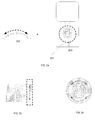
- FIGs. 2a to 2c depict three types of input devices 102 that have scrolling capability.
- a mouse 200 has a scroll wheel 201 which can be moved in a forward/up or backward/down motion which when viewed horizontally 202 is left and right, respectively. Scrolling is typically a bi-directional movement, thus scrolling can also be accomplished by touchpads as shown in FIGS. 2b to 2c.
- FIG. 2b depicts a rectangular touchpad where the scrolling occurs on the right hand side of the pad. The scrolling movement of the rectangular touchpad is similar to that of the mouse wheel, where forward and backward scrolls up and down, respectively.
- FIG. 2c depicts a circular touchpad where scrolling is performed on the outer rim of the circle while the inner circle is used for cursor activities. Scrolling up and down can occur by moving the finger on the pad in a counterclockwise and clockwise direction. While these are some of the common inputs for scrolling, one skilled in the art would also be able to adjust the setting such that scrolling forward and backward could be done in other directions, such as horizontally.
- circular touchpads can also be set so that counterclockwise and clockwise scroll horizontally left and right. Rectangular touchpads can be adjusted so that scrolling forward and backward appears as a horizontal left and right motion, respectively, on the screen.
- the preferred embodiment would be usable with any of these scrolling inputs which provide bi-directional movement.
- the preferred embodiment uses signals from the mouse and groups them together. For example, in a typical mouse wheel, a user is able to feel the clicks under his finger as he moves the wheel forwards and backwards. Scrolling movement can thus be measured by these detectable increments of clicks on the mouse wheel.
- the group of increments, or a grouping can be grouped as a single set of signals to be translated by the embodiment. For example, four increments forward can be grouped together as a single set of signals with an incremental value of four. The preferred embodiment could translate this incremental value as a symbol, such as an alpha-numeric character.
- a distinguishing characteristic between the various input devices is that some of the input devices have detectable increments during the scrolling movement, such as the mouse wheel, while others do not, such as the scrolling in a touchpad.
- input devices that cannot provide incremental feedback to a user it may be possible to use other means to measure incremental values, such as a change in direction, to indicate an increment.
- a movement forward followed by a movement backward would be measured as two increments, with an incremental value of two, regardless of the distance moved during the forward or backward movement.
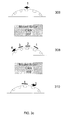
- FIG. 3a depicts a typical login/password box which could be displayed by the preferred embodiment.
- a user would use the keyboard to type in the password in the password box 301 (where the password is typically encrypted and displayed to the user as "****").
- a user may have a button 300 to indicate that input will be from an alternative fashion, such as a mouse.
- the default could be to input the password via a mouse.
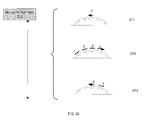
- FIGs. 3b to 3f depict how the user would physically enter the password and various methods of grouping sets of signals from the different scrolling movements and increments.
- increments are grouped as a set of signals by the change in direction.
- an increment forward 302 followed by four increments backward 303, two increments forward 304, and three increments backward 305 would result in a grouping of the incremental values one, four, two, and three.
- the equivalent mouse signal stream would be as follows: ⁇ Up> ⁇ Down> ⁇ Down> ⁇ Down> ⁇ Down> ⁇ Up> ⁇ Up> ⁇ Down> ⁇ Down> ⁇ Down> ⁇ Down> ⁇ Down> ⁇ Down> ⁇ Down> ⁇ Down>
- An advantage of this embodiment is that whereas a keyboard logger would be able to read the keyboard input stream: ⁇ 1> ⁇ 4> ⁇ 2> ⁇ 3>, a mouse logger would receive the mouse input stream and not be able to discern that it is a password input. Furthermore, a camera watching the keyboard would not be able to discern the amount of increments because the incremental clicks are difficult to gauge by visual feedback.
- FIG. 3c depicts an alternative grouping method.
- a user scrolls the mouse wheel one increment forward (up) 306 and then triggers the end of the grouping using a mouse button click 307.
- the trigger or "interrupt” separates the increments and allows the embodiment to group the increments.
- the user then scrolls forward four increments 308 followed by another interrupt by a mouse button click 309.
- the user then completes the example password by scrolling backward (or, alternatively, forward again) two increments 310.
- the mouse signal stream would be as follows: ⁇ Up> ⁇ interrupt> ⁇ Up> ⁇ Up> ⁇ Up> ⁇ Up> ⁇ Up> ⁇ Interrupt> ⁇ Down> ⁇ Down> ⁇ Down>
- Another alternative embodiment is to trigger groupings based on increments that are made while a button is pressed down.
- a user could depress a mouse button 314, and all the movements that are made can be collected as subgroups. For example, while holding a button down 314, a user could increment forward once 311, backward four times 312, and forward twice 313. The change in directions would be placed in subgroups and all the increments made while the mouse button was down 314 would be translated as one symbol or character. Thus one symbol or character will be mapped to the mouse input stream of "1 Up, 4 Down, 2 Up.”
- One skilled in the art can appreciate the complexity of the groupings that could be created under this embodiment.
- FIG. 3e depicts one of the groupings that could be created for input devices that cannot detect increments, such as a mouse wheel without increments, a tilt wheel, a touchpad, etc.
- increments would be indicated by changes in direction.
- the grouping would thus have to be triggered by an interrupt, such as a mouse button click. Due to this hardware limitation, increment groupings created using an input device without detectable increments would be slightly less complex than those input by a mouse wheel having increments. In the example displayed in FIG.
- a user would move his finger back and forth three times to indicate three increments 314 followed by a mouse button click 315 to trigger the embodiment to group the first three increments as the value "3.”
- the user would then move his finger back and fourth four times 316 to indicate four increments and follow this with a mouse button click 317.
- the incremental values would be "34" which could then be translated as other characters.
- FIG. 3f depicts an example of the embodiment where the input device is a circular touchpad.
- the circular touchpad also cannot detect increments and could also be used to measure increments by the different techniques already explained, such as using button interrupts between scrolling or holding the button down while scrolling.
- the circular touchpad could also input scrolling movements measured by the degrees and direction around a circle. For example, a user could scroll two and one-fourths revolution counter-clockwise 318 or equivalently 810 degrees counter-clockwise around the circle 318 to represent a single grouping. The user could then scroll a quarter-circle revolution clockwise 319 or equivalently 90 degrees clockwise around the circle 319. The user then scrolls three-fourths revolution counter-clockwise 320 or equivalently 270 degrees counter-clockwise around the circle 320. This input could then be mapped to different symbols.
- the user would not necessarily have to start each scroll from the end of the last scroll. For example, when the user changes direction between scrolls 318 and 319 the user starts where he had originally stopped. However, the user can, as shown between scrolls 319 and 320, pick up his finger and start from anywhere else in the circular touchpad.
- An advantage to this method is that even if a camera is watching the keyboard, the user can change starting positions each time he inputs the same password, making it harder to detect the movements.
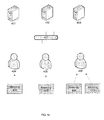
- FIGs. 4a to 4c depict several ways the preferred embodiment can translate the groupings into symbols.
- a mapping is a way of associating at least one input to at least one output.
- the sets of signals that were input could be translated to different symbols using a mapping.
- a set of signals could already be pre-set such that all systems (represented by servers 401, 402, and 403) have the same universal mapping 400 between sets of signals and characters.
- a server 401 could have the default mapping of one increment translated as the letter 'A', two increments as the letter 'B', three as the letter 'C', and so on.
- Another server 402 could have the same mapping.
- An advantage of this system is that users 404, 405, 406 would only have to remember one type of mapping to be used in all systems when accessed over a network 407.
- each server 401, 402, 403 represents a different website where users enter using a login/password.
- Users 404 and 405 use the same first mapping 400 to enter the first server 401.
- Users 404 and 405 would use the same second mapping 408 to enter a second server 402; however, the first 400 and second 408 mappings are different. Since these systems are accessible over a network 407, a third user 406 would be able to register and use the same mappings as the first two users.
- An advantage of this system is that it would be more complex for a mouse logger to decipher or for a camera watching the movements to determine the password without knowing the associated server and its mapping table.
- mappings it is possible to have the mappings established on the client side by the user.
- a user 404 could create one mapping file 400 which could be used with any server 401, 402, 403 because the embodiment would translate the groupings from the mapping 400 into character symbols before submitting the encrypted password string over the network 407.
- a second user 405 could also have his own mapping file 408 to be used on any server 401, 402, 402 accessible over a network 407.
- a user 406 could use a first mapping file 409 on a first server 401 accessed over a network 407, and use a second mapping file 410 to access a second server 402. In another separate instance the user 406 could choose to log in using the second mapping file 410 to access the first server 401.
- the advantage of this method is that the added complexity would make it extremely complex to decipher from a camera or a mouse logger because deciphering would require knowledge of the movements and the correct mapping file to translate and recognize the movements.
- FIGs 5a to 5d provide examples of some of the mappings that could located on a server or created by a user.
- the mapping file translates groupings to character symbols.
- the mapping adds complexity by translating groupings by number as well as direction in order to determine the character. This is an example of a mapping that would likely use mouse interrupts or holding down the mouse button in order to group increments.
- the mapping file translates groupings into either numbers or letters depending on the direction. For example, the increment '3' could be either the number '1' if the scroll was forwards or the letter 'A' if the scroll was backwards.
- the mapping could also be adapted so that the increment '3' could be the number '1' if the scroll was backwards or the letter 'A' if the scroll was forwards.
- FIG. 5d provides an example mapping that could be used for groupings made while holding down a mouse button. For example, if a user pressed a mouse button and moved the mouse wheel three forward, four backward, two forward and then let go of the mouse button, the grouping would be translated to the letter 'A'.
- FIG. 5e provides an example mapping that could be used with groupings created using the circular touchpad.
- the groupings are translated into alphanumeric characters, however, the symbols could be any character which the password system may require.
- passwords accepted by systems are typically only alphanumeric characters.
- an advantage of the preferred embodiment is that a system or user could create a mapping between a set of signals and a more complex symbol. For example, three increments forward could translate to the character " ⁇ .”
- FIG. 6 provides the logic and steps performed by a system of the preferred embodiment.
- the preferred embodiment would wait for the selection of the password input 600.
- the default may be to enter the password using a mouse wheel or other input device, but some embodiments may have the keyboard input as a default and require a user to initialize input using another device.
- a next possible step may be for the system to determine the mapping 601. This is an optional step because the mapping could already be a pre-determined universal mapping.
- the server may be reading the mapping from a file created specifically for that server or the embodiment may accept a mapping file created by the user. The embodiment can then receive the input signals from the user 602.
- the system When the user has input the increments the system will recognize a trigger that groups the increments 603, the trigger being a change in direction, an interrupt of some kind, a lifting of the mouse button, etc. The system will then translate the grouping 604 into the appropriate symbol using the mapping format. A user can then either enter more increment groupings to append to the password 606 or indicate that he has completed his password entry 605. Embodiments can vary on when the translation step will occur. Translation of the groupings 604 could occur on-the-fly as shown in FIG. 6 or at the completion of the password entry. This may depend on if the mapping file exists on the server side or the client/user side.
Landscapes
- Engineering & Computer Science (AREA)
- Theoretical Computer Science (AREA)
- Computer Security & Cryptography (AREA)
- Computer Hardware Design (AREA)
- General Physics & Mathematics (AREA)
- General Engineering & Computer Science (AREA)
- Physics & Mathematics (AREA)
- Software Systems (AREA)
- Position Input By Displaying (AREA)
- User Interface Of Digital Computer (AREA)
- Input From Keyboards Or The Like (AREA)
- Storage Device Security (AREA)
- Financial Or Insurance-Related Operations Such As Payment And Settlement (AREA)
- Walking Sticks, Umbrellas, And Fans (AREA)
- Catching Or Destruction (AREA)
Abstract
Description
- Online security is becoming a growing concern as more personal information is placed over the internet or in a data format on a personal computer. While much of this data is typically password-protected, current technology allows hackers to spy and extract information, such as passwords, personal identification numbers (PINs), or credit card numbers. Currently passwords are input via a keyboard or through a biometric password manager/fingerprint reader. The disadvantages are that there are several known methods to steal sensitive information from a keyboard input. Hackers use hardware and software key loggers. Also persons sitting next to a user can watch the user entering a password or video cameras could also be hidden to capture users typing their passwords. This problem is even more relevant for blind users who may not be aware of other persons observing their movements. The disadvantage of a fingerprint reader is that they are not common devices, and even if they were ubiquitous a user would have to register his fingerprint and passwords on each device. A method and system is needed to protect users from having passwords or other sensitive data stolen.
- From prior art, several approaches to solve the described problem are known which are, however, not applicable on a standard computer system as these methods require special additional hardware components.
-
FR-A1-2 864 855 FR-A1-2 864 855 -
US 2002/104005 A1 discloses a direction sensitive, touch activated security device which can be coupled to an electronic system, such as a computing device. -
US 202/019947 A1 discloses an identification information input apparatus comprising a rotary encoder group for giving the user a click feel per unit rotation and generating an electric signal, and inputting arbitrary alpha-numeric characters. As the methods disclosed inFR-A1-2 864 855 US 2002/104005 A1 andUS 202/019947 A1 are based on special hardware components resulting in additional costs and maintenance efforts, the existing systems do not represent a satisfying solution for the question how to secretly enter secret code in a standard computer system. The present invention resolves the problem of secretly inputting data based on a standard PC hardware system and provides additional benefits due to its support of an advanced signal grouping and authentication process (the authentication process as revealed inUS 2005/193208 A1 which also applies a password-mapping procedure addresses a completely different approach for entering secret code based on the mapping of assigned authentication symbols and temporary authentication symbols). - The present invention therefore aims to provide an improved method and computer system.
- The invention provides a method for securely inputting a secret character string into a computer system comprising: inputting signals from an input device coupled to the computer system; grouping the signals into sets of signals for translation in response to a user input action; translating each set of signals into a respective symbol for providing the symbols as the character string.
- Embodiments of the invention are given in the dependent claims.
- Inputting of the signals can be performed by turning the wheel of a wheelmouse into a first direction. The user input action can be to change the turning direction of the wheelmouse in order to input a consecutive group of signals. In other words, consecutive signals that are inputted while the wheel is being turned into the same direction are grouped into the same group. The change of the turning direction of the wheel mouse is an implementation of the user input action for signaling the end of a sequence of signals and the beginning of a consecutive sequence of signals.
- Other embodiments include clicking or moving the computer mouse to indicate the transition from one group of signals to the next. In other words, the user input action indicates a transition from a sequence of signals forming a group to a consecutive sequence of signals forming the next group. The groups of signals are translated into characters such as by means of a mapping table that assigns predefined sequences of signals to characters.
- The present invention is particularly advantageous as a protection for sensitive data, in particular for protection against so called identity theft, as the user's input of the character string into the computer is difficult, if not impossible to observe.
- In one aspect, the invention relates to a method for securely inputting a secret character string into a computer system comprising: inputting signals from an input device coupled to the computer system; grouping the signals into sets of signals for translation in response to a user input action; and translating each set of signals into a respective symbol for providing the symbols as the character string.
- According to embodiments of the invention, the input device is a handheld input device, such as a mouse.
- According to embodiments of the invention the signals are input from scrolling movement.
- According to embodiments of the invention the scrolling movement is measured by increments.
- According to embodiments of the invention the scrolling movement is by a mouse wheel.
- According to embodiments of the invention the scrolling movement is from a movement of the mouse.
- According to embodiments of the invention increments on the input device are detectable by a user.
- According to embodiments of the invention the handheld input device does not provide detectable tactile feedback while scrolling.
- According to embodiments of the invention the signals are scrolling movements measured as increments determined by a change in direction.
- According to embodiments of the invention a set of signals is determined by a change in direction of the scroll.
- According to embodiments of the invention a set of signals is determined by a clicking of a button.
- According to embodiments of the invention a set of signals is made while holding down a button.
- According to embodiments of the invention translating each set of signals is from a mapping.
- According to embodiments of the invention the mapping is a universal predetermined mapping.
- According to embodiments of the invention the mapping is read from a file.
- According to embodiments of the invention the file is located on the server side.
- According to embodiments of the invention the file is located on the client side.
- According to embodiments of the invention a set of signals from scrolling in a predetermined direction is mapped to numeric characters.
- According to embodiments of the invention a set of signals from scrolling in a predetermined direction is mapped to characters in an alphabet.
- According to embodiments of the invention a set of signals from scrolling in a predetermined direction is mapped to alphanumeric symbols.
- According to embodiments of the invention the character string is for inputting a password.
- According to embodiments of the invention the character string is for inputting an account number.
- According to embodiments of the invention the character string is for inputting a PIN number.
- In a further aspect the invention relates to a method for inputting a character string, comprising: inputting signals from a touchpad; grouping the signals for translation; translating the grouped signals into symbols; and submitting the symbols as a character string.
- According to embodiments of the invention the touchpad is rectangular.
- According to embodiments of the invention the touchpad is circular.
- According to embodiments of the invention the signals are scrolling movements measured as increments determined by a change in direction.
- According to embodiments of the invention grouping the signals is determined by a clicking of a button.
- According to embodiments of the invention grouping the signals is made while holding down a button.
- According to embodiments of the invention the grouped signals for translation consists of the degrees and direction around the circular path of a circular touchpad. According to embodiments of the invention translating each grouping of increments is from a mapping.
- According to embodiments of the invention the character string is for inputting a password.
- According to embodiments of the invention the character string is for inputting an account number.
- According to embodiments of the invention the character string is for inputting a PIN number.
- In a further aspect, the invention relates to a computer system, comprising: means for detecting signals from a handheld input device; means for grouping the signals for translation; means for translating the grouped signals into symbols; and means for using the symbols as a character string.
- According to embodiments of the invention the handheld input device is a mouse.
- According to embodiments of the invention the signals are input from scrolling movement.
- According to embodiments of the invention the scrolling movement is measured by increments.
- According to embodiments of the invention the scrolling movement is by a mouse wheel.
- According to embodiments of the invention the scrolling movement is from a movement of the mouse.
- According to embodiments of the invention increments on the input device are detectable by a user.
- According to embodiments of the invention the handheld input device does not provide detectable tactile feedback while scrolling.
- According to embodiments of the invention the signals are scrolling movements measured as increments determined by a change in direction.
- According to embodiments of the invention the grouped signals for translation is determined by a change in direction of the scroll.
- According to embodiments of the invention the grouped signals for translation is determined by a clicking of a button.
- According to embodiments of the invention the grouped signals for translation is made while holding down a button.
- According to embodiments of the invention translating each grouped signals for translation is from a mapping.
- According to embodiments of the invention the mapping is a universal predetermined mapping.
- According to embodiments of the invention the mapping is read from a file.
- According to embodiments of the invention the file is located on the server side.
- According to embodiments of the invention the file is located on the client side.
- According to embodiments of the invention the grouped signals for translation from scrolling in a predetermined direction is mapped to numeric characters.
- According to embodiments of the invention the grouped signals for translation from scrolling in a predetermined direction is mapped to characters in an alphabet. According to embodiments of the invention the grouped signals for translation from scrolling in a predetermined direction is mapped to alphanumeric symbols.
- According to embodiments of the invention the character string is to input a password.
- According to embodiments of the invention the character string is to input an account number.
- According to embodiments of the invention the character string is to input an PIN number.
-
-
FIG. 1 depicts a system capable of using a preferred embodiment. -
FIGs. 2a to 2c provide examples of input devices that are capable of sending signals that are usable by the preferred embodiment. -
FIG. 3a provides an example login/input device that could be displayed to a user in order to trigger use of the password input in the preferred embodiment. -
FIGs. 3b to 3f are example methods of grouping scrolling movements to be input and translated by the preferred embodiment. -
FIGs. 4a to 4c are example ways that mapping files can be used in the preferred embodiment. -
FIGs. 5a to 5e provide example mapping files to translate groupings of increments/sets of signals into symbols for password input. -
FIG. 6 depicts the logic and steps performed by a preferred embodiment to receive an input, translate the groupings, and submit as a password. - To avoid the dangers of malicious hackers stealing passwords or other sensitive information and to avoid the inconvenience of fingerprint readers, the present invention provides a system that could bypass loggers and make it more difficult for cameras to view the actions of a user when entering information. The preferred embodiment uses common inputs, such as a mouse wheel, to input signals that would be translated into characters used in a password. The advantage of this input method is that loggers are not able to track the input, and even if they could log the mouse events it would be difficult for a hacker to put the mouse movements in the right context to recognize that a password is being input. A further layer of obfuscation may be added by creating mappings to translate the scrolling into characters, making it even more difficult for hackers to steal the password string. It would also be difficult to decipher the movements by persons sitting next to a user or by a camera. Input for blind users would be easier, and unlike fingerprint readers, there are multiple devices usable in different embodiments to enter a password, and input devices like computer mice with a wheel are already ubiquitous.
- In a preferred embodiment, the mouse wheel of a computer mouse is used to input sensitive information, such as a password, PIN number, any input needed to bypass a security mechanism, or any account numbers (e.g. credit card, bank number, social security number, e-commerce accounts, etc.), etc. These movements are measured in increments (constituting incremental values) as the mouse wheel's increments are detectable by touch because each increment is a separate click on the wheel. These increments are individual signals sent by the mouse, and these grouping of signals/increments (hereinafter referred to as "groupings" or a "set of signals") are grouped together using various triggers and translated into symbols. These symbols and/or characters are then appended together to form a password. For example, signals from the increments on a mouse wheel are grouped when triggered by a change in the direction of movement. Thus, as an example, four increments forward (e.g. up) on the mouse wheel followed by two increments backwards (e.g. down) and then three forward again can be grouped as the incremental values "4," "2," and "3." This is because the trigger for the embodiment to group the first four increments was the change in direction from forward to backward. These values can then be translated into other symbols. For example, a mapping file of the preferred embodiment may translate the '4' increments into the letter 'A', the number '8' or possibly even the symbol '+' if the system were able to accept non-alphanumeric characters in the password. Other more complex variations can also be used with the same system as will be explained below. While the examples provided use passwords as the input string, one can appreciate that this system can be adapted for input of many different kinds of sensitive data.
-
FIG. 1 depicts a system capable of utilizing a preferred embodiment of the present invention. Acomputing unit 100 is connected to aninput device 102 through acommunication medium 101. Thecomputing unit 100 consists of anything that can process inputs from a user, such as a computer. Theinput device 102 is typically handheld, such as a mouse, but could be any peripheral device, particularly those with scrolling capability, such as a touchpad. The preferred embodiment utilizes a mouse because the mouse's wheel is capable of scrolling. Mouse wheels often have increments that are easily detectable by touch. Touchpads do not have detectable increments and thus embodiments would be more complex in order to recognize increments. Many mice now also have a tilt wheel capable of scrolling horizontally. Scrolling can be vertical as well as horizontal; however, any type of bi-directional scrolling movement would be usable with the preferred embodiment, such as the general movement of a mouse. Thecommunication medium 101 could be a wireless signal, a wire, USB connection, etc. -
FIGs. 2a to 2c depict three types ofinput devices 102 that have scrolling capability. InFIG. 2a , amouse 200 has ascroll wheel 201 which can be moved in a forward/up or backward/down motion which when viewed horizontally 202 is left and right, respectively. Scrolling is typically a bi-directional movement, thus scrolling can also be accomplished by touchpads as shown inFIGS. 2b to 2c. FIG. 2b depicts a rectangular touchpad where the scrolling occurs on the right hand side of the pad. The scrolling movement of the rectangular touchpad is similar to that of the mouse wheel, where forward and backward scrolls up and down, respectively.FIG. 2c depicts a circular touchpad where scrolling is performed on the outer rim of the circle while the inner circle is used for cursor activities. Scrolling up and down can occur by moving the finger on the pad in a counterclockwise and clockwise direction. While these are some of the common inputs for scrolling, one skilled in the art would also be able to adjust the setting such that scrolling forward and backward could be done in other directions, such as horizontally. For example, circular touchpads can also be set so that counterclockwise and clockwise scroll horizontally left and right. Rectangular touchpads can be adjusted so that scrolling forward and backward appears as a horizontal left and right motion, respectively, on the screen. The preferred embodiment would be usable with any of these scrolling inputs which provide bi-directional movement. - In order to determine how to translate signals from mouse input to a password, the preferred embodiment uses signals from the mouse and groups them together. For example, in a typical mouse wheel, a user is able to feel the clicks under his finger as he moves the wheel forwards and backwards. Scrolling movement can thus be measured by these detectable increments of clicks on the mouse wheel. The group of increments, or a grouping, can be grouped as a single set of signals to be translated by the embodiment. For example, four increments forward can be grouped together as a single set of signals with an incremental value of four. The preferred embodiment could translate this incremental value as a symbol, such as an alpha-numeric character.
- A distinguishing characteristic between the various input devices is that some of the input devices have detectable increments during the scrolling movement, such as the mouse wheel, while others do not, such as the scrolling in a touchpad. In input devices that cannot provide incremental feedback to a user, it may be possible to use other means to measure incremental values, such as a change in direction, to indicate an increment. Thus, a movement forward followed by a movement backward would be measured as two increments, with an incremental value of two, regardless of the distance moved during the forward or backward movement.
-
FIG. 3a depicts a typical login/password box which could be displayed by the preferred embodiment. Normally, a user would use the keyboard to type in the password in the password box 301 (where the password is typically encrypted and displayed to the user as "****"). In some embodiments of the present invention, a user may have abutton 300 to indicate that input will be from an alternative fashion, such as a mouse. In other embodiments, the default could be to input the password via a mouse. Furthermore, it is possible to not display the password as it is input, particularly for blind users to prevent observers or cameras from discerning the number of symbols that are in the password string. -
FIGs. 3b to 3f depict how the user would physically enter the password and various methods of grouping sets of signals from the different scrolling movements and increments. InFIG. 3b , increments are grouped as a set of signals by the change in direction. Thus, an increment forward 302, followed by four increments backward 303, two increments forward 304, and three increments backward 305 would result in a grouping of the incremental values one, four, two, and three. The equivalent mouse signal stream would be as follows:
<Up><Down><Down><Down><Down><Up><Up><Down><Down><Down> - This could be translated as the password "1423"; however, as will be explained later, the "1423" could be translated into other symbols.
- An advantage of this embodiment is that whereas a keyboard logger would be able to read the keyboard input stream: <1><4><2><3>, a mouse logger would receive the mouse input stream and not be able to discern that it is a password input. Furthermore, a camera watching the keyboard would not be able to discern the amount of increments because the incremental clicks are difficult to gauge by visual feedback.
-
FIG. 3c depicts an alternative grouping method. A user scrolls the mouse wheel one increment forward (up) 306 and then triggers the end of the grouping using a mouse button click 307. The trigger or "interrupt" separates the increments and allows the embodiment to group the increments. The user then scrolls forward fourincrements 308 followed by another interrupt by a mouse button click 309. The user then completes the example password by scrolling backward (or, alternatively, forward again) twoincrements 310. The mouse signal stream would be as follows:
<Up><interrupt><Up><Up><Up><Up><interrupt><Down><Down> - This creates the groupings "142". An extra advantage of this embodiment is that because the button is involved, the translation mapping can be more complex because the mouse stream could also provide the system with groupings mapped based on their direction, such that the system could read the stream as "1 Up, 4 Up, 2 Down" and have "Up" increment values translate differently than "Down" increment values, as will be explained further in the translation section below. For example, "up" could translate to numbers, while "down" translates to letters (or vice-versa), and therefore the stream above could translate to "14B".
- Another alternative embodiment is to trigger groupings based on increments that are made while a button is pressed down. In
FIG. 3d , a user could depress amouse button 314, and all the movements that are made can be collected as subgroups. For example, while holding a button down 314, a user could increment forward once 311, backward fourtimes 312, and forward twice 313. The change in directions would be placed in subgroups and all the increments made while the mouse button was down 314 would be translated as one symbol or character. Thus one symbol or character will be mapped to the mouse input stream of "1 Up, 4 Down, 2 Up." One skilled in the art can appreciate the complexity of the groupings that could be created under this embodiment. -
FIG. 3e depicts one of the groupings that could be created for input devices that cannot detect increments, such as a mouse wheel without increments, a tilt wheel, a touchpad, etc. As explained earlier, increments would be indicated by changes in direction. The grouping would thus have to be triggered by an interrupt, such as a mouse button click. Due to this hardware limitation, increment groupings created using an input device without detectable increments would be slightly less complex than those input by a mouse wheel having increments. In the example displayed inFIG. 3e , a user would move his finger back and forth three times to indicate threeincrements 314 followed by a mouse button click 315 to trigger the embodiment to group the first three increments as the value "3." The user would then move his finger back and fourth fourtimes 316 to indicate four increments and follow this with a mouse button click 317. The incremental values would be "34" which could then be translated as other characters. -
FIG. 3f depicts an example of the embodiment where the input device is a circular touchpad. Like the rectangular touchpad inFIG. 3e , the circular touchpad also cannot detect increments and could also be used to measure increments by the different techniques already explained, such as using button interrupts between scrolling or holding the button down while scrolling. The circular touchpad could also input scrolling movements measured by the degrees and direction around a circle. For example, a user could scroll two and one-fourths revolution counter-clockwise 318 or equivalently 810 degrees counter-clockwise around thecircle 318 to represent a single grouping. The user could then scroll a quarter-circle revolution clockwise 319 or equivalently 90 degrees clockwise around thecircle 319. The user then scrolls three-fourths revolution counter-clockwise 320 or equivalently 270 degrees counter-clockwise around thecircle 320. This input could then be mapped to different symbols. - In
FIG. 3f , the user would not necessarily have to start each scroll from the end of the last scroll. For example, when the user changes direction betweenscrolls scrolls -
FIGs. 4a to 4c depict several ways the preferred embodiment can translate the groupings into symbols. A mapping is a way of associating at least one input to at least one output. Thus, the sets of signals that were input could be translated to different symbols using a mapping. InFIG. 4a , a set of signals could already be pre-set such that all systems (represented byservers universal mapping 400 between sets of signals and characters. For example, aserver 401 could have the default mapping of one increment translated as the letter 'A', two increments as the letter 'B', three as the letter 'C', and so on. Anotherserver 402 could have the same mapping. An advantage of this system is thatusers network 407. - Alternatively, in
FIG. 4b , it is also possible to have the mappings set on the server side so that a user inputting a password will have to know the mappings of each server they are accessing over thenetwork 407. For example, eachserver Users first mapping 400 to enter thefirst server 401.Users second mapping 408 to enter asecond server 402; however, the first 400 and second 408 mappings are different. Since these systems are accessible over anetwork 407, athird user 406 would be able to register and use the same mappings as the first two users. An advantage of this system is that it would be more complex for a mouse logger to decipher or for a camera watching the movements to determine the password without knowing the associated server and its mapping table. - Alternatively, in
FIG. 4c , it is possible to have the mappings established on the client side by the user. Thus, auser 404 could create onemapping file 400 which could be used with anyserver mapping 400 into character symbols before submitting the encrypted password string over thenetwork 407. Asecond user 405 could also have hisown mapping file 408 to be used on anyserver network 407. An advantage to this method is that a user would only have to remember one type of mapping, but a logger or camera would still need the mapping file because each mapping by a user would be different. For example, if afirst user 404 inputted four increments forward as one grouping, in his mapping system that could translate to the letter 'A', but in the mapping system of asecond user 405, the same grouping could be translated as the number '5'. - Alternatively, it could be possible to let the user choose from multiple mapping files. Thus, a
user 406 could use afirst mapping file 409 on afirst server 401 accessed over anetwork 407, and use asecond mapping file 410 to access asecond server 402. In another separate instance theuser 406 could choose to log in using thesecond mapping file 410 to access thefirst server 401. The advantage of this method is that the added complexity would make it extremely complex to decipher from a camera or a mouse logger because deciphering would require knowledge of the movements and the correct mapping file to translate and recognize the movements. -
FIGs 5a to 5d provide examples of some of the mappings that could located on a server or created by a user. InFIG. 5a the mapping file translates groupings to character symbols. InFIG. 5b the mapping adds complexity by translating groupings by number as well as direction in order to determine the character. This is an example of a mapping that would likely use mouse interrupts or holding down the mouse button in order to group increments. InFIG. 5c the mapping file translates groupings into either numbers or letters depending on the direction. For example, the increment '3' could be either the number '1' if the scroll was forwards or the letter 'A' if the scroll was backwards. The mapping could also be adapted so that the increment '3' could be the number '1' if the scroll was backwards or the letter 'A' if the scroll was forwards.FIG. 5d provides an example mapping that could be used for groupings made while holding down a mouse button. For example, if a user pressed a mouse button and moved the mouse wheel three forward, four backward, two forward and then let go of the mouse button, the grouping would be translated to the letter 'A'.FIG. 5e provides an example mapping that could be used with groupings created using the circular touchpad. - In these various mappings the groupings are translated into alphanumeric characters, however, the symbols could be any character which the password system may require. As passwords are input by keyboard currently, passwords accepted by systems are typically only alphanumeric characters. However, an advantage of the preferred embodiment is that a system or user could create a mapping between a set of signals and a more complex symbol. For example, three increments forward could translate to the character "§." One could have a password mixed between alpha-numeric characters and symbols, for example, a password could be "@$14ab§2£".
-
FIG. 6 provides the logic and steps performed by a system of the preferred embodiment. The preferred embodiment would wait for the selection of thepassword input 600. As explained earlier, the default may be to enter the password using a mouse wheel or other input device, but some embodiments may have the keyboard input as a default and require a user to initialize input using another device. A next possible step may be for the system to determine themapping 601. This is an optional step because the mapping could already be a pre-determined universal mapping. On the other hand, the server may be reading the mapping from a file created specifically for that server or the embodiment may accept a mapping file created by the user. The embodiment can then receive the input signals from theuser 602. When the user has input the increments the system will recognize a trigger that groups theincrements 603, the trigger being a change in direction, an interrupt of some kind, a lifting of the mouse button, etc. The system will then translate thegrouping 604 into the appropriate symbol using the mapping format. A user can then either enter more increment groupings to append to thepassword 606 or indicate that he has completed hispassword entry 605. Embodiments can vary on when the translation step will occur. Translation of thegroupings 604 could occur on-the-fly as shown inFIG. 6 or at the completion of the password entry. This may depend on if the mapping file exists on the server side or the client/user side. - Several embodiments of the present invention are specifically illustrated and described herein. However, it will be appreciated that modifications and variations of the present invention are covered by the above teachings and within the purview of the appended claims without departing from the spirit and intended scope of the invention.
Claims (15)
- A method for granting access to a first user (404, 405, 406) into a first server computer system (401, 402, 403), the method comprising:- storing a first mapping (400, 408, 409) to a data storage being operatively coupled to the first server computer system,- receiving first log-in data by the first server computer system via a network (407) from the first user,- mapping the received first log-in data by the first server computer system to a first secret character string according to said first mapping,- determining, if the first secret character string is a valid passphrase of the first server computer system, and- granting access to the first user by the first server computer system in case the first secret character string was determined to be a valid passphrase by the first server computer system.
- The method of claim 1,- wherein the first log-in data is received by the first server computer system from a client computer system (100) of the first user and- wherein the first secret character string is created by the steps comprising:inputting signals from an input device (102) coupled to the client computer system, the input device being a wheel mouse, wherein the signals are input from scrolling movement by a mouse wheel (201) of the wheel mouse,- interrupting the input of signals by a user by user input actions executed by the first user, the user input actions acting as interrupts that group the signals into sets of signals for translation,- submitting the sets of signals as the first log-in data to the first server computer system.
- The method of claim 2, further comprising the steps of:- translating each set of signals by the first server computer system based on the first mapping into a respective symbol, the symbol being a symbol or character,- appending the symbols together after their generation until the entry of the secret code is completed (605), thereby forming the first secret character string.
- The method according to claim 2, wherein the user input action being one of changing the turning direction of the wheel mouse, a mouse click, a mouse movement or the release of a button pressed during the scrolling movement.
- The method according to claim 2, wherein the grouped signals for translation are determined by a change in direction of the scroll.
- The method according to any one of claims 2 to 4, wherein the grouped signals for translation are determined by a clicking of a button, a mouse click or a mouse movement.
- The method according to any one of the preceding claims 2 to 4, wherein the grouped signals for translation are made while holding down a button.
- The method according to claim 6, wherein the grouped signals for translation from scrolling in a predetermined direction are mapped to numeric characters, to characters in an alphabet or to alphanumeric symbols.
- A computer-readable storage medium comprising instructions which, when executed by a processor, execute the method according to claim 1.
- A computer system comprising at least a first server computer system (401),- wherein the first server computer system is accessible by a first user (404, 405, 406) via a network (407),- wherein the first server computer system comprises a first mapping (400, 408, 409),- wherein the first server computer system is operable to receive first log-in data via a network from the first user,- wherein the first server computer system is operable to map the received first log-in data to a first secret character string according to said first mapping,- wherein the first server computer system is operable to determine, if the first secret character string is a valid passphrase of the first server computer system, and- wherein the first server computer system is operable to grant access to the first user into the first server computer system in case the first secret character string was determined to be a valid passphrase for the first server computer system.
- The computer system of claim 10, wherein the computer system further comprises a client computer system (100),- wherein the first log-in data is received by the first server computer system from a client computer system (100) of the first user and- wherein the first secret character string is created by the steps comprising:- inputting signals from an input device (102) coupled to the client computer system, the input device being a wheel mouse, wherein the signals are input from scrolling movement by a mouse wheel (201) of the wheel mouse,- interrupting the input of signals by a user by user input actions executed by the first user, the user input actions acting as interrupts that group the signals into sets of signals for translation,- submitting the sets of signals as the first log-in data to the first server computer system,- translating each set of signals by the first server computer system based on the first mapping into a respective symbol, the symbol being a symbol or character,- appending the symbols together after their generation until the entry of the secret code is completed (605), thereby forming the first secret character string.
- The computer system of claim 10, wherein the computer system further comprises a second server computer system (402, 403),- wherein said second server computer system is accessible by a second user via the network (407),- wherein the second server computer system comprises a copy of the first mapping (400),- wherein the second server computer system is operable to receive second log-in data via a network from the second user,- wherein the second server computer system is operable to map the received second log-in data to a second secret character string according to said first mapping,- wherein the second server computer system is operable to determine, if the second secret character string is a valid passphrase of the second server computer system, and- wherein the second server computer system is operable to grant access to the second user into the second server computer system in case the second secret character string was determined to be a valid passphrase for the second server computer system.
- The computer system of claim 12,- wherein the first user and the second user are identical persons and- wherein the first and the second login-data are different from each other.
- The computer system of claim 10, wherein the computer system further comprises a second server computer system (402, 403),- wherein said second server computer system is accessible by a second user via the network (407),- wherein the second server computer system comprises a second mapping (408, 409),- wherein the second server computer system is operable to receive second log-in data via a network from the second user,- wherein the second server computer system is operable to map the received second log-in data to a second secret character string according to said second mapping,- wherein the second server computer system is operable to determine, if the second secret character string is a valid passphrase of the second server computer system, and- wherein the second server computer system is operable to grant access to the second user in case the second secret character string was determined to be a valid passphrase.
- The computer system of claim 14,- wherein the first user and the second user are identical and- wherein the first and the second login-data are different from each other.
Applications Claiming Priority (2)
| Application Number | Priority Date | Filing Date | Title |
|---|---|---|---|
| US11/261,882 US7808480B2 (en) | 2005-10-28 | 2005-10-28 | Method and system for secure input |
| EP06806985A EP1943606B1 (en) | 2005-10-28 | 2006-10-04 | Method and system for secure password/pin input via mouse scroll wheel |
Related Parent Applications (2)
| Application Number | Title | Priority Date | Filing Date |
|---|---|---|---|
| EP06806985.5 Division | 2006-10-04 | ||
| EP06806985A Division EP1943606B1 (en) | 2005-10-28 | 2006-10-04 | Method and system for secure password/pin input via mouse scroll wheel |
Publications (3)
| Publication Number | Publication Date |
|---|---|
| EP2315155A2 true EP2315155A2 (en) | 2011-04-27 |
| EP2315155A3 EP2315155A3 (en) | 2011-08-03 |
| EP2315155B1 EP2315155B1 (en) | 2018-04-04 |
Family
ID=37907296
Family Applications (2)
| Application Number | Title | Priority Date | Filing Date |
|---|---|---|---|
| EP06806985A Active EP1943606B1 (en) | 2005-10-28 | 2006-10-04 | Method and system for secure password/pin input via mouse scroll wheel |
| EP10195679.5A Active EP2315155B1 (en) | 2005-10-28 | 2006-10-04 | Method and system for granting access into a server computer system |
Family Applications Before (1)
| Application Number | Title | Priority Date | Filing Date |
|---|---|---|---|
| EP06806985A Active EP1943606B1 (en) | 2005-10-28 | 2006-10-04 | Method and system for secure password/pin input via mouse scroll wheel |
Country Status (11)
| Country | Link |
|---|---|
| US (2) | US7808480B2 (en) |
| EP (2) | EP1943606B1 (en) |
| JP (1) | JP5345850B2 (en) |
| KR (1) | KR101007778B1 (en) |
| CN (1) | CN101297302A (en) |
| AT (1) | ATE498156T1 (en) |
| AU (1) | AU2006307996B2 (en) |
| CA (1) | CA2624712C (en) |
| DE (1) | DE602006020058D1 (en) |
| IL (1) | IL190798A (en) |
| WO (1) | WO2007048687A2 (en) |
Families Citing this family (56)
| Publication number | Priority date | Publication date | Assignee | Title |
|---|---|---|---|---|
| US9412123B2 (en) | 2003-07-01 | 2016-08-09 | The 41St Parameter, Inc. | Keystroke analysis |
| US10999298B2 (en) | 2004-03-02 | 2021-05-04 | The 41St Parameter, Inc. | Method and system for identifying users and detecting fraud by use of the internet |
| US10354097B2 (en) * | 2005-11-14 | 2019-07-16 | Nokia Technologies Oy | Context sensitive concealment of an input field |
| US11301585B2 (en) | 2005-12-16 | 2022-04-12 | The 41St Parameter, Inc. | Methods and apparatus for securely displaying digital images |
| US8938671B2 (en) | 2005-12-16 | 2015-01-20 | The 41St Parameter, Inc. | Methods and apparatus for securely displaying digital images |
| CN1987831B (en) * | 2005-12-19 | 2010-09-01 | 鸿富锦精密工业(深圳)有限公司 | Input device and its cipher control method |
| US8151327B2 (en) | 2006-03-31 | 2012-04-03 | The 41St Parameter, Inc. | Systems and methods for detection of session tampering and fraud prevention |
| US8417731B2 (en) | 2006-12-28 | 2013-04-09 | Sap Ag | Article utilizing a generic update module with recursive calls identify, reformat the update parameters into the identified database table structure |
| US7730056B2 (en) * | 2006-12-28 | 2010-06-01 | Sap Ag | Software and method for utilizing a common database layout |
| US8606799B2 (en) * | 2006-12-28 | 2013-12-10 | Sap Ag | Software and method for utilizing a generic database query |
| US8311530B2 (en) | 2007-01-26 | 2012-11-13 | Research In Motion Limited | Touch entry of password on a mobile device |
| EP1953663A1 (en) | 2007-01-26 | 2008-08-06 | Research In Motion Limited | Touch entry of password on a mobile device |
| KR101452704B1 (en) * | 2007-02-14 | 2014-10-23 | 삼성전자주식회사 | A password setting method and a password authentication method in a portable device having a plurality of buttons |
| KR20080086197A (en) * | 2007-03-22 | 2008-09-25 | 엘지전자 주식회사 | Symbol input method and its mobile terminal |
| US20080301786A1 (en) * | 2007-06-01 | 2008-12-04 | Shaun Cuttill | Times 2 security system |
| EP2017764A3 (en) * | 2007-07-02 | 2010-01-20 | Albis Technologies AG | User interface for secure entry of a code |
| US8142286B2 (en) * | 2007-08-17 | 2012-03-27 | Microsoft Corporation | Programmable movement of an orientation of a game character view of a game environment |
| US20110019824A1 (en) | 2007-10-24 | 2011-01-27 | Hmicro, Inc. | Low power radiofrequency (rf) communication systems for secure wireless patch initialization and methods of use |
| FR2925799B1 (en) * | 2007-12-19 | 2011-04-01 | Bull Sas | METHOD OF ENTRYING IDENTIFIER, ENTRY DEVICE AND COMPUTER PROGRAM THEREFOR, AND DATA PROCESSING DEVICE COMPRISING ENTRY DEVICE. |
| US20090165121A1 (en) * | 2007-12-21 | 2009-06-25 | Nvidia Corporation | Touch Pad based Authentication of Users |
| SK50042008A3 (en) | 2008-01-04 | 2009-09-07 | Logomotion, S. R. O. | Method and system for authentication preferably at payments, identifier of identity and/or agreement |
| CN101533432A (en) * | 2008-03-14 | 2009-09-16 | 鸿富锦精密工业(深圳)有限公司 | System and method for password protection |
| SK288721B6 (en) | 2008-03-25 | 2020-01-07 | Smk Kk | Method, circuit and carrier for perform multiple operations on the keypad of mobile communication equipment |
| WO2009132148A2 (en) * | 2008-04-22 | 2009-10-29 | The 41St Parameter, Inc. | Systems and methods for security management based on cursor events |
| EP2329563A2 (en) | 2008-08-29 | 2011-06-08 | Logomotion, s.r.o. | Removable card for a contactless communication, its utilization and the method of production |
| US9098845B2 (en) | 2008-09-19 | 2015-08-04 | Logomotion, S.R.O. | Process of selling in electronic shop accessible from the mobile communication device |
| WO2010128442A2 (en) | 2009-05-03 | 2010-11-11 | Logomotion, S.R.O. | A payment terminal using a mobile communication device, such as a mobile phone; a method of direct debit payment transaction |
| SK288747B6 (en) | 2009-04-24 | 2020-04-02 | Smk Kk | Method and system for cashless payment transactions, particularly with contactless payment device using |
| SK50862008A3 (en) | 2008-09-19 | 2010-06-07 | Logomotion, S. R. O. | System for electronic payment applications and method for payment authorization |
| US20100073203A1 (en) * | 2008-09-23 | 2010-03-25 | Burrell Iv James W | WORLDs SMALLEST KEYBOARD AND CONTROL MEANS |
| SK288641B6 (en) | 2008-10-15 | 2019-02-04 | Smk Corporation | Communication method with POS terminal and frequency convertor for POS terminal |
| SK500092009A3 (en) | 2009-02-27 | 2010-09-07 | Logomotion, S. R. O. | Computer mouse for data transmission, preferably at electronic payment, method for data transmission |
| CN101833412A (en) * | 2009-03-13 | 2010-09-15 | 鸿富锦精密工业(深圳)有限公司 | Safe input system and safe input method |
| US9112850B1 (en) | 2009-03-25 | 2015-08-18 | The 41St Parameter, Inc. | Systems and methods of sharing information through a tag-based consortium |
| US9009628B2 (en) * | 2010-03-22 | 2015-04-14 | Infosys Limited | Method and system for processing information fed via an inputting means |
| WO2012054646A2 (en) | 2010-10-19 | 2012-04-26 | The 41St Parameter, Inc. | Variable risk engine |
| JP5858641B2 (en) * | 2011-05-10 | 2016-02-10 | キヤノン株式会社 | Information processing apparatus, system including information processing apparatus and external apparatus, system control method, and program |
| US10754913B2 (en) | 2011-11-15 | 2020-08-25 | Tapad, Inc. | System and method for analyzing user device information |
| US9633201B1 (en) | 2012-03-01 | 2017-04-25 | The 41St Parameter, Inc. | Methods and systems for fraud containment |
| US9521551B2 (en) | 2012-03-22 | 2016-12-13 | The 41St Parameter, Inc. | Methods and systems for persistent cross-application mobile device identification |
| WO2014022813A1 (en) | 2012-08-02 | 2014-02-06 | The 41St Parameter, Inc. | Systems and methods for accessing records via derivative locators |
| CN103809774B (en) * | 2012-11-05 | 2018-02-06 | 宝德科技股份有限公司 | mouse and mouse input method |
| WO2014078569A1 (en) | 2012-11-14 | 2014-05-22 | The 41St Parameter, Inc. | Systems and methods of global identification |
| US9563756B2 (en) * | 2013-02-07 | 2017-02-07 | Samsung Electronics Co., Ltd. | Two phase password input mechanism |
| US10535066B2 (en) * | 2013-06-17 | 2020-01-14 | Paypal, Inc. | Systems and methods for securing pins during EMV chip and pin payments |
| CN104423619B (en) * | 2013-08-20 | 2017-12-26 | 联想(北京)有限公司 | A kind of input method and system |
| US10902327B1 (en) | 2013-08-30 | 2021-01-26 | The 41St Parameter, Inc. | System and method for device identification and uniqueness |
| US10091312B1 (en) | 2014-10-14 | 2018-10-02 | The 41St Parameter, Inc. | Data structures for intelligently resolving deterministic and probabilistic device identifiers to device profiles and/or groups |
| CN104915612B (en) * | 2015-06-05 | 2017-09-26 | 飞天诚信科技股份有限公司 | A kind of realization method and system of safely inputting information |
| US10078429B2 (en) * | 2015-07-20 | 2018-09-18 | Nowww.Us Pty Ltd. | Method for disguising a computer system's login interface |
| US20170091431A1 (en) * | 2015-09-26 | 2017-03-30 | Qualcomm Incorporated | Secure identification information entry on a small touchscreen display |
| US11360997B2 (en) | 2015-12-21 | 2022-06-14 | Sap Se | Data synchronization error resolution based on UI manipulation actions |
| US10768794B2 (en) | 2015-12-21 | 2020-09-08 | Sap Se | Truncated synchronization of data object instances |
| JP6583694B2 (en) * | 2017-01-30 | 2019-10-02 | 京セラドキュメントソリューションズ株式会社 | Electronic equipment and lock management program |
| US11164206B2 (en) * | 2018-11-16 | 2021-11-02 | Comenity Llc | Automatically aggregating, evaluating, and providing a contextually relevant offer |
| US11010044B2 (en) * | 2019-05-28 | 2021-05-18 | Shopify Inc. | Swipe-based PIN entry |
Citations (4)
| Publication number | Priority date | Publication date | Assignee | Title |
|---|---|---|---|---|
| US20020019947A1 (en) | 2000-07-31 | 2002-02-14 | Matsushita Electric Industrial Co., Ltd. | Discernment information input apparatus |
| US20020104005A1 (en) | 2001-01-31 | 2002-08-01 | Yin Memphis Zhihong | Direction-sensitive, touch-activated security device and method of use therefor |
| FR2864855A1 (en) | 2004-01-05 | 2005-07-08 | Thomson Licensing Sa | Secret code introducing process for remote control, involves introducing controls on introduction unit, where graphical indicator signals introduction without displaying introduced number of controls, and validating digital values of code |
| US20050193208A1 (en) | 2004-02-26 | 2005-09-01 | Charrette Edmond E.Iii | User authentication |
Family Cites Families (45)
| Publication number | Priority date | Publication date | Assignee | Title |
|---|---|---|---|---|
| JPH05324560A (en) * | 1992-05-15 | 1993-12-07 | Brother Ind Ltd | User authentication system for information processing device |
| US5596656B1 (en) * | 1993-10-06 | 2000-04-25 | Xerox Corp | Unistrokes for computerized interpretation of handwriting |
| US6366697B1 (en) * | 1993-10-06 | 2002-04-02 | Xerox Corporation | Rotationally desensitized unistroke handwriting recognition |
| US5764794A (en) * | 1993-10-27 | 1998-06-09 | Perlin; Kenneth | Method and apparatus for electronically storing alphanumeric characters |
| WO1996001453A1 (en) * | 1994-07-01 | 1996-01-18 | Palm Computing, Inc. | Multiple pen stroke character set and handwriting recognition system |
| JP3508961B2 (en) * | 1995-07-21 | 2004-03-22 | ソニー株式会社 | Terminal device |
| US5790115A (en) * | 1995-09-19 | 1998-08-04 | Microsoft Corporation | System for character entry on a display screen |
| US6044174A (en) * | 1996-10-11 | 2000-03-28 | Lucent Technologies Inc. | Method and apparatus for parametric representation of handwritten symbols |
| US6208757B1 (en) * | 1996-10-11 | 2001-03-27 | Lucent Technologies Inc. | Method and apparatus for reconstructing handwritten symbols from parametric representations thereof |
| JP3674212B2 (en) * | 1997-02-07 | 2005-07-20 | ソニー株式会社 | Mobile email phone |
| US6215901B1 (en) * | 1997-03-07 | 2001-04-10 | Mark H. Schwartz | Pen based computer handwriting instruction |
| JP3951357B2 (en) * | 1997-05-27 | 2007-08-01 | 松下電器産業株式会社 | Rotating operation type electronic parts |
| JPH1186093A (en) * | 1997-09-02 | 1999-03-30 | Nec Corp | Password number input device |
| US6057845A (en) * | 1997-11-14 | 2000-05-02 | Sensiva, Inc. | System, method, and apparatus for generation and recognizing universal commands |
| JPH11191094A (en) * | 1997-12-26 | 1999-07-13 | Nec Eng Ltd | Password number input device |
| US6792146B2 (en) * | 1999-04-13 | 2004-09-14 | Qualcomm, Incorporated | Method and apparatus for entry of multi-stroke characters |
| US6658574B1 (en) * | 1999-06-21 | 2003-12-02 | International Business Machines Corporation | Method for non-disclosing password entry |
| US6654496B1 (en) * | 1999-07-06 | 2003-11-25 | Xerox Corporation | Method and apparatus for selecting symbols using strokes on a user interface |
| US6509847B1 (en) * | 1999-09-01 | 2003-01-21 | Gateway, Inc. | Pressure password input device and method |
| GB2355148B (en) * | 1999-10-08 | 2004-09-01 | Nokia Mobile Phones Ltd | Communication device |
| US6498601B1 (en) * | 1999-11-29 | 2002-12-24 | Xerox Corporation | Method and apparatus for selecting input modes on a palmtop computer |
| US6978127B1 (en) | 1999-12-16 | 2005-12-20 | Koninklijke Philips Electronics N.V. | Hand-ear user interface for hand-held device |
| JP2001175350A (en) * | 1999-12-17 | 2001-06-29 | Tatsuno Corp | Password input device |
| JP4565291B2 (en) * | 2000-01-28 | 2010-10-20 | ソニー株式会社 | Information processing apparatus, information processing method, and program storage medium |
| JP2001331272A (en) * | 2000-05-24 | 2001-11-30 | Alps Electric Co Ltd | Character input device |
| EP1327186A1 (en) | 2000-09-22 | 2003-07-16 | Ziad Badarneh | Means for handhold functional apparatus |
| JP2002123359A (en) * | 2000-10-17 | 2002-04-26 | Sony Corp | Information processing apparatus, information processing method, and recording medium recording information processing method |
| KR100396547B1 (en) * | 2000-12-27 | 2003-09-02 | 삼성전자주식회사 | Method for generating and receiving/transmitting input code in universal input-device and apparatus thereof |
| US6744427B2 (en) * | 2001-03-01 | 2004-06-01 | International Business Machines Corporation | Character input interface for compact electronic devices |
| US7079110B2 (en) * | 2001-04-30 | 2006-07-18 | Microsoft Corporation | Input device including a wheel assembly for scrolling an image in multiple directions |
| US20020188872A1 (en) * | 2001-06-06 | 2002-12-12 | Willeby Tandy G. | Secure key entry using a graphical user inerface |
| US7308652B2 (en) * | 2001-06-08 | 2007-12-11 | Lenovo Singapore Pte. Ltd | Entry of a password through a touch-sensitive computer screen |
| US6704006B2 (en) * | 2001-07-03 | 2004-03-09 | Hewlett-Packard Development Company, L.P. | Methods and systems for increasing the input efficiency of personal digital assistants and other handheld stylus-engagable computing devices |
| US6670951B2 (en) * | 2001-07-03 | 2003-12-30 | Hewlett-Packard Development Company, L.P. | Methods and systems for increasing the input efficiency of personal digital assistants and other handheld stylus-engagable computing devices |
| US7084856B2 (en) * | 2001-10-22 | 2006-08-01 | Apple Computer, Inc. | Mouse having a rotary dial |
| KR20040083788A (en) * | 2003-03-25 | 2004-10-06 | 삼성전자주식회사 | Portable communication terminal capable of operating program using a gesture command and program operating method using thereof |
| US6992656B2 (en) * | 2003-08-13 | 2006-01-31 | Hughes Micheal L | Computer mouse with data retrieval and input functionalities |
| JP4679045B2 (en) * | 2003-08-20 | 2011-04-27 | Necディスプレイソリューションズ株式会社 | Passcode input method and electronic device to which this method is applied |
| JP2005115512A (en) * | 2003-10-06 | 2005-04-28 | Sony Ericsson Mobilecommunications Japan Inc | Terminal device and character input method |
| US7495659B2 (en) * | 2003-11-25 | 2009-02-24 | Apple Inc. | Touch pad for handheld device |
| TW200521862A (en) * | 2003-12-31 | 2005-07-01 | Asustek Comp Inc | Touch panel pointing device |
| US7250938B2 (en) * | 2004-01-06 | 2007-07-31 | Lenovo (Singapore) Pte. Ltd. | System and method for improved user input on personal computing devices |
| JP4701615B2 (en) * | 2004-01-23 | 2011-06-15 | ソニー株式会社 | Information storage device |
| JP2005303797A (en) * | 2004-04-14 | 2005-10-27 | Sony Ericsson Mobilecommunications Japan Inc | Portable electronic equipment |
| US20070080944A1 (en) * | 2005-10-07 | 2007-04-12 | Parees Benjamin M | Mouse with disengageable scroll function |
-
2005
- 2005-10-28 US US11/261,882 patent/US7808480B2/en active Active
-
2006
- 2006-10-04 CN CNA2006800402605A patent/CN101297302A/en active Pending
- 2006-10-04 EP EP06806985A patent/EP1943606B1/en active Active
- 2006-10-04 AU AU2006307996A patent/AU2006307996B2/en active Active
- 2006-10-04 EP EP10195679.5A patent/EP2315155B1/en active Active
- 2006-10-04 JP JP2008537038A patent/JP5345850B2/en active Active
- 2006-10-04 CA CA2624712A patent/CA2624712C/en active Active
- 2006-10-04 DE DE602006020058T patent/DE602006020058D1/en active Active
- 2006-10-04 WO PCT/EP2006/067054 patent/WO2007048687A2/en not_active Ceased
- 2006-10-04 AT AT06806985T patent/ATE498156T1/en not_active IP Right Cessation
- 2006-10-04 KR KR1020087009986A patent/KR101007778B1/en not_active Expired - Fee Related
-
2008
- 2008-04-10 IL IL190798A patent/IL190798A/en active IP Right Grant
-
2010
- 2010-08-30 US US12/871,503 patent/US8264460B2/en not_active Expired - Fee Related
Patent Citations (4)
| Publication number | Priority date | Publication date | Assignee | Title |
|---|---|---|---|---|
| US20020019947A1 (en) | 2000-07-31 | 2002-02-14 | Matsushita Electric Industrial Co., Ltd. | Discernment information input apparatus |
| US20020104005A1 (en) | 2001-01-31 | 2002-08-01 | Yin Memphis Zhihong | Direction-sensitive, touch-activated security device and method of use therefor |
| FR2864855A1 (en) | 2004-01-05 | 2005-07-08 | Thomson Licensing Sa | Secret code introducing process for remote control, involves introducing controls on introduction unit, where graphical indicator signals introduction without displaying introduced number of controls, and validating digital values of code |
| US20050193208A1 (en) | 2004-02-26 | 2005-09-01 | Charrette Edmond E.Iii | User authentication |
Also Published As
| Publication number | Publication date |
|---|---|
| DE602006020058D1 (en) | 2011-03-24 |
| EP1943606B1 (en) | 2011-02-09 |
| US7808480B2 (en) | 2010-10-05 |
| CA2624712C (en) | 2013-08-13 |
| US20100321296A1 (en) | 2010-12-23 |
| ATE498156T1 (en) | 2011-02-15 |
| AU2006307996B2 (en) | 2011-05-19 |
| US20070097076A1 (en) | 2007-05-03 |
| AU2006307996A1 (en) | 2007-05-03 |
| WO2007048687A3 (en) | 2007-06-28 |
| CN101297302A (en) | 2008-10-29 |
| EP1943606A2 (en) | 2008-07-16 |
| WO2007048687A2 (en) | 2007-05-03 |
| KR20080054411A (en) | 2008-06-17 |
| JP5345850B2 (en) | 2013-11-20 |
| IL190798A0 (en) | 2008-11-03 |
| EP2315155A3 (en) | 2011-08-03 |
| US8264460B2 (en) | 2012-09-11 |
| EP2315155B1 (en) | 2018-04-04 |
| JP2009514077A (en) | 2009-04-02 |
| KR101007778B1 (en) | 2011-01-18 |
| CA2624712A1 (en) | 2007-05-03 |
| IL190798A (en) | 2013-04-30 |
Similar Documents
| Publication | Publication Date | Title |
|---|---|---|
| EP1943606B1 (en) | Method and system for secure password/pin input via mouse scroll wheel | |
| AU2016269267B2 (en) | Encoding methods and systems | |
| EP2875496B1 (en) | Pin verification | |
| US9177162B2 (en) | Method and device for secured entry of personal data | |
| US6209102B1 (en) | Method and apparatus for secure entry of access codes in a computer environment | |
| US8117652B1 (en) | Password input using mouse clicking | |
| US20120290838A1 (en) | System and Method for Web-Based Security Authentication | |
| EP4058914B1 (en) | Improved systems and methods for secure data input and authentication | |
| KR20110101030A (en) | Information input security method through touch screen |
Legal Events
| Date | Code | Title | Description |
|---|---|---|---|
| PUAI | Public reference made under article 153(3) epc to a published international application that has entered the european phase |
Free format text: ORIGINAL CODE: 0009012 |
|
| AC | Divisional application: reference to earlier application |
Ref document number: 1943606 Country of ref document: EP Kind code of ref document: P |
|
| AK | Designated contracting states |
Kind code of ref document: A2 Designated state(s): AT BE BG CH CY CZ DE DK EE ES FI FR GB GR HU IE IS IT LI LT LU LV MC NL PL PT RO SE SI SK TR |
|
| PUAL | Search report despatched |
Free format text: ORIGINAL CODE: 0009013 |
|
| AK | Designated contracting states |
Kind code of ref document: A3 Designated state(s): AT BE BG CH CY CZ DE DK EE ES FI FR GB GR HU IE IS IT LI LT LU LV MC NL PL PT RO SE SI SK TR |
|
| RIC1 | Information provided on ipc code assigned before grant |
Ipc: G06F 21/04 20060101ALI20110629BHEP Ipc: G06F 21/20 20060101AFI20110629BHEP |
|
| 17P | Request for examination filed |
Effective date: 20110818 |
|
| RIC1 | Information provided on ipc code assigned before grant |
Ipc: G06F 21/04 20060101ALI20120308BHEP Ipc: G06F 21/20 20060101AFI20120308BHEP |
|
| 17Q | First examination report despatched |
Effective date: 20130604 |
|
| RAP1 | Party data changed (applicant data changed or rights of an application transferred) |
Owner name: SAP SE |
|
| R17C | First examination report despatched (corrected) |
Effective date: 20130604 |
|
| REG | Reference to a national code |
Ref country code: DE Ref legal event code: R079 Ref document number: 602006055102 Country of ref document: DE Free format text: PREVIOUS MAIN CLASS: G06F0021200000 Ipc: G06F0021310000 |
|
| GRAP | Despatch of communication of intention to grant a patent |
Free format text: ORIGINAL CODE: EPIDOSNIGR1 |
|
| RIC1 | Information provided on ipc code assigned before grant |
Ipc: G06F 21/31 20130101AFI20171030BHEP Ipc: G06F 21/83 20130101ALI20171030BHEP |
|
| INTG | Intention to grant announced |
Effective date: 20171130 |
|
| GRAS | Grant fee paid |
Free format text: ORIGINAL CODE: EPIDOSNIGR3 |
|
| GRAA | (expected) grant |
Free format text: ORIGINAL CODE: 0009210 |
|
| AC | Divisional application: reference to earlier application |
Ref document number: 1943606 Country of ref document: EP Kind code of ref document: P |
|
| AK | Designated contracting states |
Kind code of ref document: B1 Designated state(s): AT BE BG CH CY CZ DE DK EE ES FI FR GB GR HU IE IS IT LI LT LU LV MC NL PL PT RO SE SI SK TR |
|
| REG | Reference to a national code |
Ref country code: GB Ref legal event code: FG4D |
|
| REG | Reference to a national code |
Ref country code: CH Ref legal event code: EP |
|
| REG | Reference to a national code |
Ref country code: AT Ref legal event code: REF Ref document number: 986322 Country of ref document: AT Kind code of ref document: T Effective date: 20180415 |
|
| REG | Reference to a national code |
Ref country code: IE Ref legal event code: FG4D |
|
| REG | Reference to a national code |
Ref country code: DE Ref legal event code: R096 Ref document number: 602006055102 Country of ref document: DE |
|
| REG | Reference to a national code |
Ref country code: NL Ref legal event code: MP Effective date: 20180404 |
|
| REG | Reference to a national code |
Ref country code: LT Ref legal event code: MG4D |
|
| PG25 | Lapsed in a contracting state [announced via postgrant information from national office to epo] |
Ref country code: NL Free format text: LAPSE BECAUSE OF FAILURE TO SUBMIT A TRANSLATION OF THE DESCRIPTION OR TO PAY THE FEE WITHIN THE PRESCRIBED TIME-LIMIT Effective date: 20180404 |
|
| REG | Reference to a national code |
Ref country code: FR Ref legal event code: PLFP Year of fee payment: 13 |
|
| PG25 | Lapsed in a contracting state [announced via postgrant information from national office to epo] |
Ref country code: FI Free format text: LAPSE BECAUSE OF FAILURE TO SUBMIT A TRANSLATION OF THE DESCRIPTION OR TO PAY THE FEE WITHIN THE PRESCRIBED TIME-LIMIT Effective date: 20180404 Ref country code: BG Free format text: LAPSE BECAUSE OF FAILURE TO SUBMIT A TRANSLATION OF THE DESCRIPTION OR TO PAY THE FEE WITHIN THE PRESCRIBED TIME-LIMIT Effective date: 20180704 Ref country code: ES Free format text: LAPSE BECAUSE OF FAILURE TO SUBMIT A TRANSLATION OF THE DESCRIPTION OR TO PAY THE FEE WITHIN THE PRESCRIBED TIME-LIMIT Effective date: 20180404 Ref country code: SE Free format text: LAPSE BECAUSE OF FAILURE TO SUBMIT A TRANSLATION OF THE DESCRIPTION OR TO PAY THE FEE WITHIN THE PRESCRIBED TIME-LIMIT Effective date: 20180404 Ref country code: PL Free format text: LAPSE BECAUSE OF FAILURE TO SUBMIT A TRANSLATION OF THE DESCRIPTION OR TO PAY THE FEE WITHIN THE PRESCRIBED TIME-LIMIT Effective date: 20180404 Ref country code: LT Free format text: LAPSE BECAUSE OF FAILURE TO SUBMIT A TRANSLATION OF THE DESCRIPTION OR TO PAY THE FEE WITHIN THE PRESCRIBED TIME-LIMIT Effective date: 20180404 |
|
| PG25 | Lapsed in a contracting state [announced via postgrant information from national office to epo] |
Ref country code: LV Free format text: LAPSE BECAUSE OF FAILURE TO SUBMIT A TRANSLATION OF THE DESCRIPTION OR TO PAY THE FEE WITHIN THE PRESCRIBED TIME-LIMIT Effective date: 20180404 Ref country code: GR Free format text: LAPSE BECAUSE OF FAILURE TO SUBMIT A TRANSLATION OF THE DESCRIPTION OR TO PAY THE FEE WITHIN THE PRESCRIBED TIME-LIMIT Effective date: 20180705 |
|
| REG | Reference to a national code |
Ref country code: AT Ref legal event code: MK05 Ref document number: 986322 Country of ref document: AT Kind code of ref document: T Effective date: 20180404 |
|
| PG25 | Lapsed in a contracting state [announced via postgrant information from national office to epo] |
Ref country code: PT Free format text: LAPSE BECAUSE OF FAILURE TO SUBMIT A TRANSLATION OF THE DESCRIPTION OR TO PAY THE FEE WITHIN THE PRESCRIBED TIME-LIMIT Effective date: 20180806 |
|
| REG | Reference to a national code |
Ref country code: DE Ref legal event code: R097 Ref document number: 602006055102 Country of ref document: DE |
|
| PG25 | Lapsed in a contracting state [announced via postgrant information from national office to epo] |
Ref country code: DK Free format text: LAPSE BECAUSE OF FAILURE TO SUBMIT A TRANSLATION OF THE DESCRIPTION OR TO PAY THE FEE WITHIN THE PRESCRIBED TIME-LIMIT Effective date: 20180404 Ref country code: AT Free format text: LAPSE BECAUSE OF FAILURE TO SUBMIT A TRANSLATION OF THE DESCRIPTION OR TO PAY THE FEE WITHIN THE PRESCRIBED TIME-LIMIT Effective date: 20180404 Ref country code: EE Free format text: LAPSE BECAUSE OF FAILURE TO SUBMIT A TRANSLATION OF THE DESCRIPTION OR TO PAY THE FEE WITHIN THE PRESCRIBED TIME-LIMIT Effective date: 20180404 Ref country code: CZ Free format text: LAPSE BECAUSE OF FAILURE TO SUBMIT A TRANSLATION OF THE DESCRIPTION OR TO PAY THE FEE WITHIN THE PRESCRIBED TIME-LIMIT Effective date: 20180404 Ref country code: RO Free format text: LAPSE BECAUSE OF FAILURE TO SUBMIT A TRANSLATION OF THE DESCRIPTION OR TO PAY THE FEE WITHIN THE PRESCRIBED TIME-LIMIT Effective date: 20180404 Ref country code: SK Free format text: LAPSE BECAUSE OF FAILURE TO SUBMIT A TRANSLATION OF THE DESCRIPTION OR TO PAY THE FEE WITHIN THE PRESCRIBED TIME-LIMIT Effective date: 20180404 |
|
| PLBE | No opposition filed within time limit |
Free format text: ORIGINAL CODE: 0009261 |
|
| STAA | Information on the status of an ep patent application or granted ep patent |
Free format text: STATUS: NO OPPOSITION FILED WITHIN TIME LIMIT |
|
| PG25 | Lapsed in a contracting state [announced via postgrant information from national office to epo] |
Ref country code: IT Free format text: LAPSE BECAUSE OF FAILURE TO SUBMIT A TRANSLATION OF THE DESCRIPTION OR TO PAY THE FEE WITHIN THE PRESCRIBED TIME-LIMIT Effective date: 20180404 |
|
| 26N | No opposition filed |
Effective date: 20190107 |
|
| PG25 | Lapsed in a contracting state [announced via postgrant information from national office to epo] |
Ref country code: SI Free format text: LAPSE BECAUSE OF FAILURE TO SUBMIT A TRANSLATION OF THE DESCRIPTION OR TO PAY THE FEE WITHIN THE PRESCRIBED TIME-LIMIT Effective date: 20180404 |
|
| REG | Reference to a national code |
Ref country code: CH Ref legal event code: PL |
|
| REG | Reference to a national code |
Ref country code: BE Ref legal event code: MM Effective date: 20181031 |
|
| PG25 | Lapsed in a contracting state [announced via postgrant information from national office to epo] |
Ref country code: LU Free format text: LAPSE BECAUSE OF NON-PAYMENT OF DUE FEES Effective date: 20181004 Ref country code: MC Free format text: LAPSE BECAUSE OF FAILURE TO SUBMIT A TRANSLATION OF THE DESCRIPTION OR TO PAY THE FEE WITHIN THE PRESCRIBED TIME-LIMIT Effective date: 20180404 |
|
| REG | Reference to a national code |
Ref country code: IE Ref legal event code: MM4A |
|
| PG25 | Lapsed in a contracting state [announced via postgrant information from national office to epo] |
Ref country code: LI Free format text: LAPSE BECAUSE OF NON-PAYMENT OF DUE FEES Effective date: 20181031 Ref country code: CH Free format text: LAPSE BECAUSE OF NON-PAYMENT OF DUE FEES Effective date: 20181031 Ref country code: BE Free format text: LAPSE BECAUSE OF NON-PAYMENT OF DUE FEES Effective date: 20181031 |
|
| PG25 | Lapsed in a contracting state [announced via postgrant information from national office to epo] |
Ref country code: IE Free format text: LAPSE BECAUSE OF NON-PAYMENT OF DUE FEES Effective date: 20181004 |
|
| PG25 | Lapsed in a contracting state [announced via postgrant information from national office to epo] |
Ref country code: TR Free format text: LAPSE BECAUSE OF FAILURE TO SUBMIT A TRANSLATION OF THE DESCRIPTION OR TO PAY THE FEE WITHIN THE PRESCRIBED TIME-LIMIT Effective date: 20180404 |
|
| PG25 | Lapsed in a contracting state [announced via postgrant information from national office to epo] |
Ref country code: CY Free format text: LAPSE BECAUSE OF FAILURE TO SUBMIT A TRANSLATION OF THE DESCRIPTION OR TO PAY THE FEE WITHIN THE PRESCRIBED TIME-LIMIT Effective date: 20180404 Ref country code: HU Free format text: LAPSE BECAUSE OF FAILURE TO SUBMIT A TRANSLATION OF THE DESCRIPTION OR TO PAY THE FEE WITHIN THE PRESCRIBED TIME-LIMIT; INVALID AB INITIO Effective date: 20061004 |
|
| PG25 | Lapsed in a contracting state [announced via postgrant information from national office to epo] |
Ref country code: IS Free format text: LAPSE BECAUSE OF FAILURE TO SUBMIT A TRANSLATION OF THE DESCRIPTION OR TO PAY THE FEE WITHIN THE PRESCRIBED TIME-LIMIT Effective date: 20180804 |
|
| PGFP | Annual fee paid to national office [announced via postgrant information from national office to epo] |
Ref country code: DE Payment date: 20251021 Year of fee payment: 20 |
|
| PGFP | Annual fee paid to national office [announced via postgrant information from national office to epo] |
Ref country code: GB Payment date: 20251022 Year of fee payment: 20 |
|
| PGFP | Annual fee paid to national office [announced via postgrant information from national office to epo] |
Ref country code: FR Payment date: 20251029 Year of fee payment: 20 |