EP2305322A2 - Polymerer medizinischer oder medizintechnischer oder PSA-Artikel mit antimikrobieller Ausrüstung - Google Patents
Polymerer medizinischer oder medizintechnischer oder PSA-Artikel mit antimikrobieller Ausrüstung Download PDFInfo
- Publication number
- EP2305322A2 EP2305322A2 EP20100005888 EP10005888A EP2305322A2 EP 2305322 A2 EP2305322 A2 EP 2305322A2 EP 20100005888 EP20100005888 EP 20100005888 EP 10005888 A EP10005888 A EP 10005888A EP 2305322 A2 EP2305322 A2 EP 2305322A2
- Authority
- EP
- European Patent Office
- Prior art keywords
- article
- medical
- glove
- carrier material
- solution
- Prior art date
- Legal status (The legal status is an assumption and is not a legal conclusion. Google has not performed a legal analysis and makes no representation as to the accuracy of the status listed.)
- Granted
Links
- 0 C*C(N(*)C(C)(C)C(C)(C)C)=N* Chemical compound C*C(N(*)C(C)(C)C(C)(C)C)=N* 0.000 description 2
Images

Classifications
-
- A—HUMAN NECESSITIES
- A61—MEDICAL OR VETERINARY SCIENCE; HYGIENE
- A61B—DIAGNOSIS; SURGERY; IDENTIFICATION
- A61B42/00—Surgical gloves; Finger-stalls specially adapted for surgery; Devices for handling or treatment thereof
- A61B42/10—Surgical gloves
-
- A—HUMAN NECESSITIES
- A61—MEDICAL OR VETERINARY SCIENCE; HYGIENE
- A61B—DIAGNOSIS; SURGERY; IDENTIFICATION
- A61B42/00—Surgical gloves; Finger-stalls specially adapted for surgery; Devices for handling or treatment thereof
-
- A—HUMAN NECESSITIES
- A61—MEDICAL OR VETERINARY SCIENCE; HYGIENE
- A61B—DIAGNOSIS; SURGERY; IDENTIFICATION
- A61B46/00—Surgical drapes
-
- A—HUMAN NECESSITIES
- A61—MEDICAL OR VETERINARY SCIENCE; HYGIENE
- A61L—METHODS OR APPARATUS FOR STERILISING MATERIALS OR OBJECTS IN GENERAL; DISINFECTION, STERILISATION OR DEODORISATION OF AIR; CHEMICAL ASPECTS OF BANDAGES, DRESSINGS, ABSORBENT PADS OR SURGICAL ARTICLES; MATERIALS FOR BANDAGES, DRESSINGS, ABSORBENT PADS OR SURGICAL ARTICLES
- A61L29/00—Materials for catheters, medical tubing, cannulae, or endoscopes or for coating catheters
- A61L29/14—Materials characterised by their function or physical properties, e.g. lubricating compositions
- A61L29/16—Biologically active materials, e.g. therapeutic substances
-
- A—HUMAN NECESSITIES
- A61—MEDICAL OR VETERINARY SCIENCE; HYGIENE
- A61L—METHODS OR APPARATUS FOR STERILISING MATERIALS OR OBJECTS IN GENERAL; DISINFECTION, STERILISATION OR DEODORISATION OF AIR; CHEMICAL ASPECTS OF BANDAGES, DRESSINGS, ABSORBENT PADS OR SURGICAL ARTICLES; MATERIALS FOR BANDAGES, DRESSINGS, ABSORBENT PADS OR SURGICAL ARTICLES
- A61L31/00—Materials for other surgical articles, e.g. stents, stent-grafts, shunts, surgical drapes, guide wires, materials for adhesion prevention, occluding devices, surgical gloves, tissue fixation devices
- A61L31/14—Materials characterised by their function or physical properties, e.g. injectable or lubricating compositions, shape-memory materials, surface modified materials
- A61L31/16—Biologically active materials, e.g. therapeutic substances
-
- A—HUMAN NECESSITIES
- A61—MEDICAL OR VETERINARY SCIENCE; HYGIENE
- A61B—DIAGNOSIS; SURGERY; IDENTIFICATION
- A61B17/00—Surgical instruments, devices or methods
- A61B17/34—Trocars; Puncturing needles
-
- A—HUMAN NECESSITIES
- A61—MEDICAL OR VETERINARY SCIENCE; HYGIENE
- A61B—DIAGNOSIS; SURGERY; IDENTIFICATION
- A61B17/00—Surgical instruments, devices or methods
- A61B2017/00831—Material properties
- A61B2017/00889—Material properties antimicrobial, disinfectant
-
- A—HUMAN NECESSITIES
- A61—MEDICAL OR VETERINARY SCIENCE; HYGIENE
- A61B—DIAGNOSIS; SURGERY; IDENTIFICATION
- A61B46/00—Surgical drapes
- A61B46/40—Drape material, e.g. laminates; Manufacture thereof
-
- A—HUMAN NECESSITIES
- A61—MEDICAL OR VETERINARY SCIENCE; HYGIENE
- A61B—DIAGNOSIS; SURGERY; IDENTIFICATION
- A61B50/00—Containers, covers, furniture or holders specially adapted for surgical or diagnostic appliances or instruments, e.g. sterile covers
-
- A—HUMAN NECESSITIES
- A61—MEDICAL OR VETERINARY SCIENCE; HYGIENE
- A61M—DEVICES FOR INTRODUCING MEDIA INTO, OR ONTO, THE BODY; DEVICES FOR TRANSDUCING BODY MEDIA OR FOR TAKING MEDIA FROM THE BODY; DEVICES FOR PRODUCING OR ENDING SLEEP OR STUPOR
- A61M25/00—Catheters; Hollow probes
- A61M25/0043—Catheters; Hollow probes characterised by structural features
- A61M2025/0056—Catheters; Hollow probes characterised by structural features provided with an antibacterial agent, e.g. by coating, residing in the polymer matrix or releasing an agent out of a reservoir
-
- A—HUMAN NECESSITIES
- A61—MEDICAL OR VETERINARY SCIENCE; HYGIENE
- A61M—DEVICES FOR INTRODUCING MEDIA INTO, OR ONTO, THE BODY; DEVICES FOR TRANSDUCING BODY MEDIA OR FOR TAKING MEDIA FROM THE BODY; DEVICES FOR PRODUCING OR ENDING SLEEP OR STUPOR
- A61M25/00—Catheters; Hollow probes
- A61M25/0017—Catheters; Hollow probes specially adapted for long-term hygiene care, e.g. urethral or indwelling catheters to prevent infections
Definitions
- the invention relates to medical or medical polymeric articles or polymeric articles for personal protective equipment (PPE) with antimicrobial finish.
- PPE personal protective equipment
- the present invention relates to gloves, in particular examination gloves and / or surgical gloves and / or protective gloves, catheters, in particular bladder catheters and / or venous catheters, components for a drainage system, in particular an intra-operative drainage system and / or a post-operative drainage system, cannulas , Medical-grade tubing or other polymeric articles intended for medically invasive use, collection bags, and also films such as cover / protective / packaging films for use in a medical environment comprising a polymeric carrier material or consisting of a polymeric carrier material, which has antimicrobial finish.
- nosocomial infection is meant the infection caused by microorganisms, which is related to a stay in a medical facility and hospital.
- Factors are often patients with already weakened endogenous infection defense and invasive medical measures, which bring with it an increased risk of infection.
- an increased and inappropriate use of antibiotics in the treatment of bacterial infections also brings with it the problem of the increase of multidrug-resistant germs.
- Infection herds are in particular wound infections after operations, urinary tract infections, respiratory tract infections and sepsis (transfer of the pathogen into the bloodstream).
- the pathogens enter the body, in particular during surgical interventions or when using invasive aids.
- Invasive medical measures so foreign components are introduced into the patient, usually with a longer residence time.
- Invasive devices include, for example, venous catheters (potentially triggers nosocomial septicemia), urinary catheters (possibly triggers of nosocomial urinary tract infections), intubation and ventilator tubes for respiratory equipment (possibly the trigger of respiratory pneumonia) or liquor discharges (possibly a trigger for meningitis).
- An essential starting point for the pathogenesis of such infections is often first the attachment of microorganisms and thus potential infectious agents to the tools used in the medical environment, such as the plastic material of a catheter. At the point of transition to the inside of the body or inside the body, the germs grow further.
- Infections may be endogenous, ie be caused by the patient's own microorganisms or be of an exogenous nature, ie be caused by non-local pathogens through transmission.
- gloves are an important protection for the wearer, such as the medical staff. Gloves reduce the germ load on the hands of the staff, however, gloves do not prevent transmission, which is why hand disinfection must be performed even after glove use.
- Antimicrobially finished items are already known in medicine and medical technology.
- the antimicrobial equipment should protect both the object or the material from which the article is made from infestation by microorganisms or at least suppress the proliferation of microorganisms in or on the object, as well as the immediate environment of the article before infestation by microorganisms or at least suppress the proliferation of microorganisms in this environment.
- a variety of antimicrobial agents are used.
- the microbicides used are substances of different chemical composition, which can kill microorganisms such as viruses, bacteria, fungi or algae.
- microbicides are among other things also distinguished by their effectiveness in antibiotics, preservatives, disinfectants, slimicides and paint fungicides or by their specific activity against various groups of microorganisms in algaecides, bactericides, fungicides and virucides. Active substances that inhibit the growth of microorganisms without killing them are also known as microbiostats such as bacteriostats or antivirals.
- microbiostats such as bacteriostats or antivirals.
- the chemical structure and the properties of the known microbicides are usually accurate. In contrast, little is known regarding their sites of action in the cells and on the mechanism of action taking place in the cells at the molecular level. Nonetheless, a large number of microbicides can be characterized by their mechanism of action as membrane-active or electrophile-active agents. However, a clear assignment is not always possible.
- the membrane-active microbicides include, for example: alcohols, acids, phenols, salicylanilides, carbanilides, dibenzamidines, agents with cationogenic character, such as quaternary ammonium compounds, biguanides and azole fungicides.
- the membrane-active agents have in common that they can occupy the cell membrane adsorptive. Especially in the presence of non-lethal microbicide concentrations, this is initially a reversible process, but this leads to changes in the outer membrane and the cell wall. The outer barriers lose their integrity, allowing access to the cytoplasmic membrane for the microbicide molecules, thus triggering the lethal effects.
- the object of the present invention is now to provide medical and medical-technical articles or articles for personal protective equipment with nonspecific but nevertheless highly effective antimicrobial equipments which effectively inhibit the colonization by pathogenic germs on the articles and in the vicinity of the articles, or prevent, so inhibit the further colonization as well as the transmission or avoid.
- This should in particular be ensured that neither the user nor a patient by handling the product in his health is impaired.
- the aim of this equipment is to ensure that growth is also effectively inhibited or hindered by germs that have built up resistance to antimicrobial agents that have already been used.
- a medical or medical-technical article or article for personal protective equipment comprising a polymeric carrier material or consisting of a carrier material having a first surface-forming side and a second surface-forming side, which is manufacturer-equipped with an antimicrobial preparation, wherein the preparation Polyhexamethylenguanidin or a salt thereof as an antimicrobial agent. More preferably, the preparation comprises polyhexamethyleneguanidinium hydrochloride thereof as an antimicrobial agent.
- 35 ⁇ n + m ⁇ 80, in particular 35 ⁇ n + m ⁇ 70, in particular 30 ⁇ n + m ⁇ 60, in particular 40 ⁇ n + m ⁇ 80 and particularly preferably 40 ⁇ n + m ⁇ 70 means.
- the polyhexamethyleneguanidine according to the present invention may also be present as a salt.
- the base polymer is present as a cation or polycation whose positive charges are balanced by monovalent, divalent or trivalent inorganic or organic anions.
- chloride, bromide, nitrate, phosphate, hydrogen phosphate, dihydrogen phosphate, citrate, hydrogen citrate, dihydrogen citrate, sulfate, hydrogen sulfate, carbonate, bicarbonate, acetate, gluconate, lactate or mixtures thereof are suitable as anions.
- Particularly preferred is chloride, phosphate and hydrogen phosphate.
- the preparation comprises polyhexamethyleneguanidinium hydrochloride (CAS 57 028-96-3).
- polyhexamethyleneguanidine or a salt thereof in particular polyhexamethyleneguanidinium hydrochloride, has a broad antimicrobial activity spectrum.
- Polyhexamethyleneguanidine or a salt thereof for example, is effective against bacteria such as Echerichia coli, Pseudomonas aeruginosa, Staphylococcus aureus, Salmonella typhimurium, Salmonella gallinarium, Mycobacterium tuberculosis, Clostridium difficile, Coryme bacterium diphteriae, Shigella sonnei, Shigella flexneri, Proteus vulgaris, Pasteurella gallinarium or Listeria monocitogenes , It is also effective against many fungi and fours.
- polyhexamethyleneguanidine or a salt thereof in particular polyhexamethyleneguanidinium hydrochloride, also has antibacterial activity against bacteria which have already built up resistances, such as, for example, Staphylococcus aureus (MRSA).
- MRSA Staphylococcus aureus
- Polyhexamethyleneguanidine or a salt thereof has a catiogenic character or is positively charged and thus can react well with the negatively charged cell walls of the germs, thus forming an electrostatic bond with the negative charged parts of the cell wall.
- the semipermeability of the cell membrane is disturbed or even dissolved.
- the destruction of the intact cell structure eventually leads to cell death of the germs. Rather, this mode of action is based on a physical mode of action.
- polyhexamethyleneguanidine or its salts are not in such great danger of developing resistance of the germs to polyhexamethyleneguanidine or its salts.
- the antimicrobial finishing of articles with polymeric carrier material, equipped with polyhexamethyleneguanidine or its salts provides an additional preventive measure against infection and infection transmission.
- polyhexamethyleneguanidine or its salts are less toxic than known low molecular weight antimicrobial compounds, such as, for example, low molecular weight quaternary nitrogen compounds, for example chlorhexidine or benzalkonium chloride, and have high stability to ultraviolet radiation. Due to its polymeric nature, polyhexamethyleneguanidine or its salts can not pass through the skin into the body of a human. Thus, an article equipped with polyhexamethyleneguanidine or its salt can be worn directly on the skin. In addition, polyhexamethyleneguanidine or its salts have hitherto also been known as non-allergenic substances.
- polyhexamethyleneguanidine or its salts do not contain any residues in the Leaves organs or musculature of the animals behind.
- Polyhexamethyleneguanidine especially in the form of polyhexamethyleneguanidinium hydrochloride (CAS 57 028-96-3), has been included in the EU Directive, Annex II, as a safe product and thus also in areas of application such as human hygiene, disinfectants for the private sector and others also approved in public health.
- polyhexamethyleneguanidine or its salt is non-corrosive to a variety of materials such as, in particular, metals, latex, wood, or plastic materials, that is, not damaging.
- a medical or medical article or article for personal protective equipment is a preferred article that is antimicrobially effective at least 2 days, preferably at least 3 days, more preferably at least 4 days, from first use.
- a medical or medical article or article for personal protective equipment is also a preferred subject of the present invention whose content of polyhexamethyleneguanidine or its salt relative to the surface of the polymeric carrier material is from 0.0001 to 100 mg / cm 2 is.
- the polymeric carrier material has a content of 0.1 to 10000 ⁇ g / cm 2 , in particular 1 to 5000 ⁇ g / cm 2 , more particularly 10 to 2000 ⁇ g / cm 2 , furthermore especially 10 to 1750 ⁇ g / cm 2 and most preferably 10 to 1500 ug / cm 2 based on the surface of the carrier material.
- the medical or medical article or article for the personal protective equipment consists of the polymeric carrier material
- the article based on its area, a content of polyhexamethyleneguanidine or its salt from 0.1 to 10,000 micrograms / cm 2 , especially 1 to 5000 ⁇ g / cm 2 , more particularly 10 to 2000 ⁇ g / cm 2 , more particularly 10 to 1750 ⁇ g / cm 2 and most preferably 10 to 1500 ⁇ g / cm 2 .
- medical or medical-technical articles or articles for personal protective equipment in particular a glove, in particular an examination glove and / or a surgical glove and / or a protective glove, a catheter, in particular a bladder catheter and / or a venous catheter, a component for a drainage system, in particular an intra-operative drainage system and / or a postoperative drainage system, a cannula or a hose with use in the medical environment, as well other medically invasive aids; a collection bag and / or a film, such as in particular cover / protective / packaging films for use in the medical environment.
- Gloves are intended to protect the patient and the user from contamination, especially as examination gloves when conducting medical examinations.
- Surgical gloves used in surgery are sterile, anatomically shaped medical gloves. Protection in handling contaminated medical materials or for other diagnostic or therapeutic purposes should generally provide any protective gloves.
- Examination and care / protective gloves may be sterile or non-sterile, and may also be anatomically shaped.
- the above-mentioned gloves are disposable gloves, ie gloves intended for single use. Already the use of disposable gloves helps to reduce infection transfer.
- Under drainage is understood in the medical environment, the discharge / suction of diseased and / or increasingly accumulating natural body fluids.
- inner and outer drainage In internal drainage, a kind of connection between the hollow organs, such as esophagus, stomach, intestine are applied surgically or minimally invasive, and then derive pent-up fluids in the corresponding hollow organs.
- the body fluid In the external drainage, the body fluid is discharged from the inside of the body to the outside.
- the external drainage is divided in the medical field very different and usually also less standardized.
- the subdivision can take place, for example, according to the inventor of the respective drainage method or after the body region subjected to drainage (eg abdominal drainage), according to the disease state (for example wound drainage, pneumothorax drainage) or also the functioning of the drainage (gravity drainage, (vacuum) suction drainage, capillary drainage ) or the time of use, in particular as a suction during surgery (intraoperative drainage) or after surgery (postoperative drainage), so in the form of a wound drainage.
- appropriate components of the drainage system such as handpieces, suction hoses, Connecting hoses, all mostly made of polymeric materials.
- the components of the drainage must be fixed in or on the corresponding body region / wound, in particular in the case of a drainage to be carried out postoperatively, ie wound drainage.
- a preferred subject of the present invention are in particular also gloves, in particular examination gloves and / or surgical gloves and / or protective gloves, catheters, in particular a bladder catheter and / or a venous catheter, components for a drainage system, in particular an intra-operative drainage system and / or a Postoperative drainage system, cannulas, hoses used in the medical environment, or other invasive aids, collection bags, and also films, such as cover / protective / packaging films for use in the medical environment comprising each a polymeric carrier material or consisting of a polymeric carrier material which is provided by the manufacturer with an antimicrobial preparation and wherein the preparation comprises polyhexamethyleneguanidine or a salt thereof, in particular polyhexamethyleneguanidinium chloride as an antimicrobial agent and in particular further auxiliaries or additives.
- polymeric carrier material for the medical or medical-technical article or the article for the personal protective equipment, in particular synthetic homopolymers and copolymers based on polyolefins, such as polyethylene (HDPE and LDPE), polypropylene, polyisobutylene, polybutadiene, polyisoprene ; Polymers and copolymers of vinylaromatic monomers such as polystyrene, poly (styrene-co-acrylonitrile), poly (styrene-co-butadiene-co-acrylonitrile) (ABS copolymers); halogen-containing polymers such as polyvinyl chloride, polyvinylidene chloride, polychloroprene, polytetrafluoroethylene (PTFE) and polyvinylidene fluoride; Polycondensates, for example polyesters, such as polyethylene terephthalate, polybutylene terephthalate; Polyamides, such as polycaprol
- the polymeric carrier material may also have elastomeric properties, in particular as a polymeric carrier material for the gloves.
- polymeric carrier material for gloves conventionally known in the art polymeric materials are used. Natural rubber and / or synthetic rubbers or combinations thereof are known.
- the synthetic rubbers are preferably taken from the group comprising isoprene rubber (synthetic polyisoprene), chloroprene rubber (polychloroprene), acrylonitrile-butadiene rubber (nitrile rubber), hydrogenated nitrile rubber, styrene-butadiene rubber, S-EB-S (styrene-ethylene rubber).
- Butene-styrene block copolymers SIS (styrene-isoprenes-styrene) block copolymers, SBS (styrene-butadiene-styrene) block copolymers, SI (styrene-isoprene) block copolymers, SB (styrene-butadiene) block Copolymers, butadiene polymers, styrene-butadiene polymers, carboxylated styrene-butadiene polymers, acrylonitrile-styrene-butadiene polymers, and derivatives thereof.
- the polymeric carrier material of the glove in particular of the examination glove and / or the surgical glove and / or the protective glove of the polymeric materials taken from the group of natural rubber and synthetic rubber, thereof in particular synthetic polyisoprene (isoprene rubber), polychloroprene, acrylonitrile-butadiene rubber and derivatives, or combinations thereof.
- Polymeric carrier material for films preferably comprises polymeric materials taken from the group of polyolefins, in particular polyethylene and / or polypropylene and polyvinyl chloride, or combinations thereof.
- polymeric carrier material for the components for drainage systems in particular PVC (polyvinyl chloride), polyurethane, silicone or PU silicones and / or combinations are used.
- the manufacturer-side finishing of the polymeric carrier material with the antimicrobial preparation on the first and / or second surface-forming side of the polymeric carrier material can be carried out in particular by spraying on /. With spray-on / spraying, it is possible for at least one antimicrobial finish of the first and / or second surface-forming side to be carried out, possibly for the respective area of use of the polymeric carrier material and concomitantly with / on the article comprising or consisting of this carrier material.
- the manufacturer's equipment can be made by dipping the polymeric carrier material in the antimicrobial preparation.
- polyhexamethyleneguanidine or a salt thereof, in particular polyhexamethyleneguanidinium chloride can be applied thereto after the preparation of the polymeric support material, in particular by spraying or dipping.
- polymeric carrier material in a subsequent downstream step with a solution comprising polyhexamethyleneguanidine or a salt thereof, in particular polyhexamethyleneguanidinium chloride, in particular by spraying or dipping.
- the antimicrobial finish of the polymeric support material is such that the Polyhexamethylenguanidin or a salt thereof, in particular Polyhexamethylenguanidiniumchlorid is added directly to the mass for the preparation of the polymeric support material, ie thus the Polyhexamethylenguanidin or a salt thereof, in particular Polyhexamethylenguanidiniumchlorid directly into the polymeric carrier material is integrated.
- Polyhexamethylene guanidine or a salt thereof is added as an additive directly to the polymer matrix composition from which the polymeric carrier material is formed.
- the in-line processing can advantageously be carried out with less technical effort than a corresponding finishing step on the finished polymeric carrier material at a later time.
- polymeric carrier material with antimicrobial finish allows a polymeric carrier material with antimicrobial finish to be independent of the later field of application or, in particular, independently of the later particularly preferred first or second surface-forming side of the carrier material provided. It is also advantageously ensured a longer-lasting effectiveness; since it is preferable that the antibacterial agent can be gradually released or diffused to the first and / or second surface-forming side.
- Polyhexamethyleneguanidine or a salt thereof are in particular in the polymer matrix composition in an amount of 0.02-2.0% by weight, more particularly of 0.05-1.5% by weight, more particularly of 0.07-1.2 Wt% included.
- Polyhexamethyleneguanidine or a salt thereof may be present in the form of an antimicrobial preparation with a higher proportion, in particular from 0.1 to 50% by weight, preferably from 0.2 to 45% by weight, more preferably from 1 to 40% by weight, in particular from 5 to 35% by weight, more particularly from 10 to 30% by weight.
- auxiliary substances in particular further film-forming components, in particular those which contribute to better adhesion of the antimicrobial preparation, are advantageously added to the antibacterial preparation.
- the preparation may comprise, as adjuvant or additive, in particular a skin care agent, a surfactant, a hydrophobizing agent, a hydrophilizing agent, a lubricant, a wetting agent and / or a softening agent.
- a skin care agent e.g. a surfactant, a hydrophobizing agent, a hydrophilizing agent, a lubricant, a wetting agent and / or a softening agent.
- auxiliary or additive based on the surface of the polymeric support material, to be from 0.0001 to 150 mg / cm 2 .
- the polymeric carrier material has a content of 0.1 to 900 ⁇ g / cm 2 , in particular 0.1 to 500 ⁇ g / cm 2 , in particular 0.1 to 300 ⁇ g / cm 2 and very particularly preferably 0.1 to 150 ⁇ g / cm 2 based on the surface of the carrier material.
- the preparation has no water.
- the article according to the invention is to be designated as anhydrous in particular except for a residual moisture content caused by existing humidity.
- the preparation preferably comprises, as a skin care agent, in particular a plant extract, wherein the plant extract can be prepared, for example, by extraction of the entire plant, but also exclusively by extraction from flowers, leaves, seeds, roots and / or other parts of plants.
- the plant extract can be prepared, for example, by extraction of the entire plant, but also exclusively by extraction from flowers, leaves, seeds, roots and / or other parts of plants.
- special plants such as green tea, witch hazel, chamomile, pansies, aloe vera, horse chestnut, sage, willow bark, chrysanthemums, Oak bark, Nettle, Hops, Burdock root, Horsetail, Hawthorn, Lime blossom, Almonds, Spruce needles, Sandalwood, Juniper, Coconut, Kiwi, Guava, Lime, Mango, Apricot, Wheat, Melon, Orange, Grapefruit, avocado, Rosemary, Birch, Beech shoots, Meadowfoam, yarrow, quenelle, thyme, lemon
- the preparation comprises a plant extract of green tea, witch hazel, marigold or aloe vera.
- the preparations according to the invention may also contain mixtures of several, in particular of two, different plant extracts.
- the preparation according to the invention contains aloe vera.
- the antimicrobial preparation comprises skin care agents.
- skin care agents in particular for examination gloves, surgical gloves, and / or protective gloves, is especially contemplated.
- the addition of skin care agents in the antimicrobial preparation which is applied to the second surface-forming side of the polymeric carrier material which forms the inside of the glove.
- the preparation as surfactant preferably comprises in particular a nonionic surfactant, a cationic surfactant, an anionic surfactant or an amphoteric surfactant.
- the nonionic surfactants used are preferably alkoxylated, advantageously ethoxylated, in particular primary, alcohols having preferably 8 to 18 carbon atoms and on average 1 to 12 moles of ethylene oxide (EO) per mole of alcohol, in which the alcohol radical can be linear or preferably methyl-branched in the 2-position or linear and methyl-branched radicals in the mixture can contain, as they are usually present in Oxoalkoholresten.
- alcohol ethoxylates with linear radicals of alcohols of natural origin having 12 to 18 carbon atoms, for example of coconut, palm, tallow or oleyl alcohol, and on average 2 to 8 EO per mole of alcohol are preferred.
- the preferred ethoxylated alcohols include, for example, C12-14 alcohols with 3 EO to 7 EO, C9-11 alcohol with 7 EO, C13-15 alcohols with 3 EO, 5 EO, 7 EO or 8 EO, C12-18 Alcohols with 3 EO, 5 EO or 7 EO and mixtures of these, such as mixtures of C12-14 alcohol with 3 EO and C12-18 alcohol with 7 EO.
- the degrees of ethoxylation given represent statistical means which, for a particular product, may be an integer or a fractional number can.
- fatty alcohols with more than 12 EO can also be used. Examples include tallow fatty alcohol with 14 EO, 25 EO, 30 EO or 40 EO.
- Nonionic surfactants containing EO and PO groups together in the molecule can also be used according to the invention.
- block copolymers with EO-PO block units or PO-EO block units can be used, but also EO-PO-EO copolymers or PO-EO-PO copolymers.
- mixed alkoxylated nonionic surfactants in which EO and PO units are not randomly distributed but statistically distributed are available by the simultaneous action of ethylene oxide (EO) and propylene oxide (PO) on fatty alcohols.
- Examples of cationic compounds of the formula (IV) are, in particular, didecyldimethylammonium chloride, ditallowdimethylammonium chloride or dihexadecylammonium chloride.
- Examples of compounds of the formula (V) are methyl N- (2-hydroxyethyl) -N, N-di (tallow acyloxyethyl) ammonium methosulfate, bis (palmitoyl) ethyl hydroxyethyl methyl ammonium methosulfate or methyl N, N bis (acyloxyethyl) -N- (2-hydroxyethyl) methosulfate.
- the preparation may in particular also comprise a hydrophilicizing agent.
- hydrophilicizing agents are mono- or polyhydric alcohols, alkanolamines or glycol ethers, if they are miscible with water.
- the hydrophilicizing agents are preferably selected from ethylene glycol methyl ether, ethylene glycol ethyl ether, ethylene glycol propyl ether, ethylene glycol mono-n-butyl ether, diethylene glycol methyl ether, diethylene glycol ethyl ether, propylene glycol methyl, ethyl or propyl ether, dipropylene glycol monomethyl or ethyl ether, diisopropylene glycol monomethyl, or ethyl ether, methoxy -, ethoxy or Butoxytriglykol, 1-butoxyethoxy-2-propanol, 3-methyl-3-methoxybutanol, propylene glycol t-butyl ether, alcohols, especially C1-C4 alkanols, glycols, polyethylene glycols, preferably having a molecular weight between 100 and 100,000, in particular between 200 and 10,000, and polyols, such as sorbitol and manni
- the polymeric carrier material with antimicrobial finish may be provided in the simplest case by dipping or spraying the polymeric carrier material with a non-alcoholic solution of polyhexamethyleneguanidine or its salt. After evaporation of the solvent thus an antimicrobially finished polymeric support material is obtained, which acts due to the mode of action of Polyhexamethylenguanidin or its salt for a long time antimicrobial and thus effectively kills germs occurring.
- an antimicrobially finished polymeric support material acts due to the mode of action of Polyhexamethylenguanidin or its salt for a long time antimicrobial and thus effectively kills germs occurring.
- the antimicrobial preparation comprising polyhexamethyleneguanidine or its salt is applied to a first surface-forming side and / or second surface-forming side of a polymeric carrier material.
- an inventive medical or medical article or article for personal protective equipment a glove, in particular an examination glove and / or a surgical glove and / or a protective glove, a catheter, in particular a bladder catheter and / or a venous catheter, a components for a drainage system , in particular an intraoperative drainage system and / or a postoperative drainage system, a cannula or a tube with use in the medical environment, a collection bag and / or a film, in particular cover / protective Nerpackungsfolien for use in the medical environment first surface-forming side formed by the first surface-forming side of the polymeric substrate.
- This first surface-forming side of the article may be directed toward the patient or the user in the application-oriented condition of the article. However, it may also be provided that this first surface-forming side of the article points away from the patient or the user.
- the first surface-forming side of the polymeric carrier material forms an outer surface of the article. More preferably, the second surface-forming side of the polymeric carrier material forms an inner side of the article. Particularly preferably, the first and the second surface-forming side of the polymeric carrier material form the corresponding outside and inside of the article.
- the "outside” of an article in particular in the case of an article with a shape, is the upper side which faces away from the space which is at least partially enclosed by the shaping.
- the outside is the top of the glove, which is intended for use and in the state provided to the user and also in the tightened state of the glove is a position facing away from the body of the user.
- “Outside” or “outside” basically means an orientation away from the interior of the article and / or from the body of the user.
- the “inside” is accordingly the top of the article which is closest to the space at least partially enclosed by the shape of the article.
- the inner side is the upper side, which faces the user's body in the state provided for use and in the state provided for the user and also in the tightened state of the glove.
- “Inside” or “inside” basically means an orientation facing the interior of an article and / or the body of the user.
- a preferred subject matter of the invention is a glove, in particular an examination glove and / or a surgical glove and / or a protective glove, in which the antimicrobial preparation is applied to the first surface-forming side and / or the second surface-forming side of the polymeric carrier material.
- the glove in particular the examination glove and / or the surgical glove and / or the protective glove, is preferably formed from the polymeric carrier material.
- the antimicrobial preparation is applied to the first surface-forming side of the polymeric carrier material, wherein, in particular, the first surface-forming top side of the polymeric carrier material forms the outside of the glove, in particular the examination glove and / or the surgical glove and / or the protective glove.
- the equipment of the outside of the glove in particular the examination glove and / or the surgical glove and / or the protective glove is an advantageous measure to minimize the risk of transmission of germs.
- the area forming the later operation area and also the area adjacent to the operation area on the skin of the patient are prepared in accordance with disinfected; Nevertheless, there is a risk that pathogens from the germ flora of the patient are introduced by manipulating the surgeon on the gloves in the surgical field and thus in the open wound.
- a non-sterile environment such as in patient wound care such as changing dressings, setting cannulas, applying infusions reduces the antimicrobial drug-containing outside of the glove, especially the examination glove, the risk of germ transmission.
- the antimicrobial preparation is applied to the second surface-forming side of the polymeric carrier material, more particularly the second surface-forming top side of the polymeric carrier material forming the inside of the glove, in particular the examination glove and / or the surgical glove and / or the protective glove.
- the equipment of the inside of the glove, in particular the examination glove and / or the surgical glove and / or the protective glove is an advantageous measure to reduce the risk of transmission of the microbial flora of the wearer to its environment, such as. also on the patient, and also, for example, in the surgical field or in the patient environment u.a. after removing or changing gloves.
- the antimicrobial preparation is applied to the first and the second surface-forming side of the polymeric carrier material, wherein the polymeric carrier material forms the glove, in particular the examination glove and / or the surgical glove and / or the protective glove.
- the bilateral equipment will provide a comprehensive anti-infection supplement.
- the polymeric carrier material which is comprised by the glove, in particular the examination glove and / or the surgical glove and / or the protective glove can be on one or both surface-forming pages, in particular with a 5-35% concentrated aqueous solution of polyhexamethyleneguanidine or its salt completely or in certain areas, sprayed once or several times or dipped completely in the solution and then dried.
- This polymeric carrier material will preferably form the entire glove, in particular examination glove and / or surgical glove and / or protective glove.
- the polymeric carrier material has a content of polyhexamethyleneguanidine or its salt relative to the surface of the polymeric carrier material, and in case the article is formed from the polymeric carrier material, ultimately based on the surface of the article, from 0.1 to 10000 ⁇ g / cm 2 , in particular 1 to 5000 ⁇ g / cm 2 , more particularly 10 to 2000 ⁇ g / cm 2 , more particularly 10 to 1750 ⁇ g / cm 2 and most especially preferably from 10 to 1500 ⁇ g / cm 2 .
- a preferred subject matter of the invention is a glove, in particular an examination glove and / or an operating glove and / or a protective glove, in which the antimicrobial preparation is integrated in the polymeric carrier material.
- the glove in particular the examination glove and / or the surgical glove and / or the protective glove, is preferably formed from the polymeric carrier material.
- a further preferred subject matter of the invention is a component of a drainage system and / or a cannula and / or a tube with use in the medical environment and / or a catheter, in particular a bladder catheter and / or a venous catheter, wherein, in these articles, the antimicrobial composition is applied to the first surface-forming side of the polymeric support material, and further wherein in particular the first surface-forming side of the polymeric support material is the outside of the component of a drainage system and / or the cannula and / or the medical-grade tubing Environment and / or a catheter, in particular a bladder catheter and / or a venous catheter is.
- the subject of the invention is a component of a drainage system and / or a cannula and / or a tube with use in the medical environment and / or a catheter, in particular a bladder catheter and / or a venous catheter, wherein these Articles the antimicrobial preparation is applied to the second surface-forming side of the polymeric support material and wherein, in particular, the second surface-forming side of the polymeric carrier material is the inside of the component of a drainage system and / or the cannula and / or the tube with use in the medical environment and / or a catheter, in particular a bladder catheter and / or a venous catheter.
- the subject matter of the invention is a component of a drainage system and / or a tube with use in the medical environment and / or a catheter, in particular a bladder catheter and / or a venous catheter, wherein these articles the antimicrobial preparation is applied to both of the first and second surface-forming sides of the polymeric support material, and more particularly to the first and second surface-forming side of the polymeric carrier material form the outside and the inside of the component of a drainage system and / or the cannula and / or the tube with use in the medical environment and / or a catheter, in particular a bladder catheter and / or a venous catheter.
- a further preferred subject matter of the invention is a component of a drainage system and / or a cannula and / or a tube with use in the medical environment and / or a catheter, in particular a bladder catheter and / or a venous catheter, wherein in these articles, the antimicrobial preparation is integrated into the polymeric carrier material, in particular this one component of a drainage system and / or this cannula and / or this tube with use in the medical environment and / or these catheters, in particular these bladder catheters and / or this venous catheter are further formed from the polymeric carrier material.
- the solvent L1 and / or the solvent L2 are selected from the group consisting of alcohols, ketones, aromatic solvents, water or a mixture thereof.
- the solution A, C or D is a concentration of 0.1 to 50 wt .-%, preferably 0.2 to 45 wt .-%, more preferably 1 to 40 wt .-%, further especially 5 to 35 wt .-%, more preferably 10 to 30 wt .-%, of polyhexamethyleneguanidine or a salt thereof, in particular Polyhexamethylenguanidiniumchlorid.
- the solution B, C or D contains a concentration of 0.1 to 20 wt .-%, preferably 0.2 to 15 wt .-%, of other auxiliaries or additives.
- FIG. 1 a glove according to the invention, in particular an examination glove, an operating glove and / or a protective glove.
- the in FIG. 1 illustrated glove 10 consists of a polymeric substrate 12 having a first top 14 and a second top 16.
- the first surface-forming side 14 forms the outer side 15 of the glove, that is to say the upper side facing away from the wearer and, in the case of patient contact, the upper side facing the patient.
- the second surface-forming side 16 forms the inner side 17 of the glove, that is to say the surface-forming side facing the wearer.
- the first surface-forming side 14 of the polymeric carrier material 12, and thus the outer side 15 of the glove 10, is sprayed with a 10-30% by weight aqueous solution of polyhexamethyleneguanidinium chloride (CAS 57 028-96-3), such that on the outside 15 ) of the glove (10) the active ingredient based on the area in an amount of 10 to 1750 ug / cm 2 and very particularly preferably 10 to 1500 ug / cm 2 , most preferably from 100 -1000 micrograms / cm 2 is present. Then the glove is allowed to dry.
- a 10-30% by weight aqueous solution of polyhexamethyleneguanidinium chloride CAS 57 028-96-3
- the test method is intended to quantify the effect of the antimicrobial finish on the polymeric materials.
- the polymeric material with the respective bacterial strain, which is previously placed in soft agar, inoculated. After defined times, germ count determinations are carried out.
- the test procedure is based on ASTM E 2180-01.
- the microbial indicators used are preferably the bacterial strains: Staphylococcus aureus ATCC 6538 (DSM 346), Klebsiella pneumoniae ATCC 4352 (DSM 789).
- test pieces are punched or cut with a defined size / dimension.
- the number of test pieces is chosen so that at least a triple determination at the defined times after inoculation is possible.
- Test pieces are understood as meaning the sample material pieces equipped with antimicrobial active ingredient as well as the pieces of control pieces without antimicrobial active ingredient equipment.
- the specimens are sterilized under conditions suitable for the specimen.
- test piece a sample and control piece
- a test piece a sample and control piece
- dab a sterile swab soaked in a sterile 85% saline solution
- This moistening ensures a uniform distribution of the subsequently applied soft agar.
- 1 ml of bacterial culture with 1-5 x 10 8 CFU / ml is added to 100 ml of the soft agar set at 45 ⁇ 2 ° C.
- 1 - 5 x 10 6 CFU / ml bacterial culture are present in the soft agar.
- test specimens are placed in a sterile 250 ml screw cap bottle using 100 ml Ringer's solution containing the Enthemmer.
- the screw cap vessel is treated for 1 min in an ultrasonic bath and then mechanically shaken for 1 min. Subsequently, a serial dilution is made by introducing 1 ml each from the previous solution into a sterile tube containing 9 ml of Ringer's solution containing Enthemmer. The dilution series are created in such a way that a later count of the grown-up colonies is possible. Accordingly, higher dilutions should be used in the case of preparations with higher bacterial growth to be expected, such as the control material pieces and the germ count controls.
- the determined values are then given in the unit CFU / g or CFU / ml.
Landscapes
- Health & Medical Sciences (AREA)
- Life Sciences & Earth Sciences (AREA)
- Surgery (AREA)
- Animal Behavior & Ethology (AREA)
- Public Health (AREA)
- Veterinary Medicine (AREA)
- Biomedical Technology (AREA)
- Molecular Biology (AREA)
- Engineering & Computer Science (AREA)
- General Health & Medical Sciences (AREA)
- Heart & Thoracic Surgery (AREA)
- Medical Informatics (AREA)
- Chemical & Material Sciences (AREA)
- Medicinal Chemistry (AREA)
- Epidemiology (AREA)
- Vascular Medicine (AREA)
- Agricultural Chemicals And Associated Chemicals (AREA)
- Compositions Of Macromolecular Compounds (AREA)
- Materials For Medical Uses (AREA)
Abstract
Description
- Die Erfindung betrifft medizinische oder medizintechnische polymere Artikel oder polymere Artikel für die persönliche Schutzausrüstung (PSA - Artikel) mit antimikrobieller Ausrüstung. Insbesondere betrifft die vorliegende Erfindung Handschuhe, insbesondere Untersuchungshandschuhe und/oder Operationshandschuhe und/oder Schutzhandschuhe, Katheter, insbesondere Blasenkatheter und/oder Venenkatheter, Komponenten für ein Drainage-Systeme, insbesondere eines intraoperativen Drainage-Systems und/oder eines postoperativen Drainage-Systems, Kanülen, Schläuche mit Einsatz im medizinischen Umfeld, oder sonstige für den medizinisch invasiven Einsatz vorgesehene polymere Artikel, Auffangbeutel, und auch Folien, wie Abdeck-/Schutz-/Verpackungsfolien für den Einsatz im medizinischen Umfeld umfassend ein polymeres Trägermaterial oder bestehend aus einem polymeren Trägermaterial, welches eine antimikrobielle Ausrüstung aufweist.
- Die Problematik von Infektionen, auch von Infektionstransfer vor allem in Krankenhäusern und in sonstigen medizinischen Einrichtungen ist bekannt. So ist die nosokomiale Infektion ein großes Problem. Unter nosokomialer Infektion wird die durch Mikroorganismen hervorgerufene Infektion verstanden, die im Zusammenhang mit einem Aufenthalt in einer medizinischen Einrichtungen und Krankenhaus besteht. Faktoren sind oftmals Patienten mit bereits geschwächter körpereigener Infektionsabwehr und invasive medizinische Massnahmen, welche ein erhöhtes Infektionsrisiko mit sich bringen. Zudem bringt u.a. ein vermehrter und nicht sachgemäßer Einsatz von Antibiotika in der Behandlung von bakteriellen Infektionen auch noch das Problem der Zunahme von multiresistenten Keimen mit sich.
- Infektionsherde sind dabei insbesondere Wundinfektionen nach Operationen, HarnwegsInfektionen, Atemwegsinfektionen und Sepsis (Übertritt des Erregers in die Blutbahn). Die Erreger gelangen insbesondere bei chirurgischen Eingriffen oder bei Anwendung von invasiven Hilfsmitteln in den Körper. Im Rahmen von invasiven medizinischen Maßnahmen werden also in den Patienten körperfremde Komponenten eingeführt, zumeist auch mit einer längeren Verweildauer. Invasive Hilfsmittel sind dabei beispielsweise Venenkatheter (möglicherweise Auslöser für nosokomiale Septikämien), Harnwegskatheter (möglicherweise Auslöser nosokomialer Harnwegsinfektionen), Intubation und Beatmungsschläuche für apparative Beatmung (möglicherweise Auslöser von Beatmungspneumonien) oder Liquorableitungen (möglicherweise Auslöser für Meningitiden).
Wesentlicher Ausgangspunkt für die Pathogenese von derartigen Infektionen ist oftmals zunächst die Anheftung von Mikroorganismen und damit potentiellen Infektionserregern an die im medizinischen Umfeld eingesetzten Hilfsmittel, wie beispielsweise an das Plastikmaterial eines Katheters. An der Übergangstelle zum Körperinneren bzw. dann im Körperinneren wachsen die Keime weiter heran. - Infektionen können endogen bedingt sein, also durch die eigene Patientenflora an Mikroorganismen verursacht sein oder auch exogener Art sein, also durch nicht standortübliche Erreger durch Übertragung verursacht sein.
- Präventionsmaßnahmen zur Vermeidung von Infektionen und insbesondere von Infektionstransfer sind ein ganz wesentlicher Bestandteil des alltäglichen medizinischen Arbeitsablaufes:
- So hilft die Händedesinfektion Infektionen zu vermeiden, und damit einhergehend die Entstehung von nosokomialen Infektionen oder auch multiresistenten Keimen zu unterdrücken.
Die Händedesinfektion ist eine Präventionsmaßnahme, die gemäß den 5 Indikationen entsprechend den Richtlinien der WHO und des Robert-Koch-Instituts erfolgen soll: - 1) Grundsätzlich vor jedem Patientenkontakt, und dabei auch vor dem Anlegen der Handschuhe;
- 2) unmittelbar vor aseptischen Tätigkeiten, wie beispielsweise bei Kontakt mit invasiven Hilfsmitteln (wie Katheter), bei Kontakt mit nicht intakter Haut wie beim Anlegen von Verbänden und Injektionen, bei Schleimhautkontakt;
- 3) nach Kontakt mit potentiell infektiösem Material, wie beispielsweise bei Kontakt mit nicht intakter Haut (Anlegen von Verbänden, bei Kontakt mit invasiven Hilfsmitteln (Blutabnahme über Katheter, Wechsel von Sekretbeuteln));
- 4) nach Patientenkontakt, dabei insbesondere auch nach dem Ausziehen der Handschuhe; und 5) nach Verlassen der unmittelbaren Patientenumgebung, auch ohne direkten Kontakt zum Patienten gehabt zu haben.
- Die Durchführung der Händedesinfektion - hygienisch oder chirurgisch - und deren Wirksamkeit wird gemäß den Referenzverfahren EN 1500 bzw. EN 12791 untersucht und festgelegt. Trotz Vorgaben hinsichtlich der Einreibemethode für die Händedesinfektion ist die Problematik der möglicherweise verbleibenden Benetzungslücken bei Einreibung des Händedesinfektionsmittels bekannt.
- Auch Handschuhe sind ein wichtiger Schutz für den Träger, wie also dem medizinischen Personal. Handschuhe vermindern die Keimlast an den Händen des Personals, jedoch verhindern Handschuhe nicht die Übertragung, weshalb auch nach Handschuhgebrauch eine Händedesinfektion durchzuführen ist.
- Auch für medizinische Instrumente ist eine entsprechende Methodik der Desinfektion vorgegeben.
- Die Bereitstellung und Herstellung von antimikrobiellen Bedingungen in einer jeweiligen Situation durch eine entsprechende erforderliche in situ -Anwendung von antimikrobiellen Wirksubstanzen, wie durch direktes Besprühen, Einreiben, Abwischen ist bekannt und wird auch durchgeführt.
Der Nachteil dabei ist, dass die Ausführung des Desinfektionsschritts oftmals in einer Notfallsituation und damit auch unter zeitlichem Druck durchgeführt werden muss. So können insbesondere trotz der bekannten Standard-Einreibemethoden wie vorangehend dargestellt bei der Händedesinfektion Benetzungslücken des Desinfektionsmittels an den Händen bzw. auf den Handschuhen verbleiben. - Antimikrobiell ausgerüstete Gegenstände sind in der Medizin und in der Medizintechnik schon bekannt. Hierbei soll die antimikrobielle Ausrüstung sowohl den Gegenstand bzw. das Material aus dem der Gegenstand besteht vor dem Befall durch Mikroorganismen schützen oder zumindest die Vermehrung von Mikroorganismen in oder auf dem Gegenstand unterdrücken, als auch die unmittelbare Umgebung des Artikels vor dem Befall durch Mikroorganismen bewahren oder zumindest die Vermehrung von Mikroorganismen in dieser Umgebung unterdrücken. Dabei werden unterschiedlichste antimikrobielle Wirkstoffe (Mikrobizide) zum Einsatz gebracht. Die eingesetzten Mikrobizide sind Stoffe unterschiedlicher chemischer Zusammensetzung, die Mikroorganismen wie beispielsweise Viren, Bakterien, Pilze oder Algen abtöten können. Daher werden Mikrobizide u.a. auch nach ihrer Wirksamkeit unterschieden in Antibiotika, Konservierungsmittel, Desinfektionsmittel, Schleimbekämpfungsmittel und Anstrichfungizide oder auch nach ihrer spezifischen Wirkung gegen verschiedene Mikroorganismengruppen unterschieden in Algizide, Bakterizide, Fungizide und Viruzide. Wirkstoffe, die die Vegetation von Mikroorganismen nur hemmen, ohne sie abzutöten, bezeichnet man auch als Mikrobiostatika wie beispielsweise Bakteriostatika oder Virostatika.
Über die chemische Struktur und die Eigenschaften der bekannten Mikrobizide besitzt man meist genaue Kenntnisse. Dagegen ist bezüglich ihrer Wirkungsorte in den Zellen und über die in den Zellen auf molekularer Ebene ablaufenden Wirkungsmechanismen wenig bekannt. Nichtsdestotrotz kann man eine große Anzahl von Mikrobiziden nach ihrem Wirkungsmechanismus charakterisieren als membranaktive oder elektrophilaktive Wirkstoffe. Eine eindeutige Zuordnung ist jedoch nicht immer möglich. - Zu den membranaktiven Mikrobiziden zählen beispielsweise: Alkohole, Säuren, Phenole, Salicylanilide, Carbanilide, Dibenzamidine, Wirkstoffe mit kationogenem Charakter, wie quartäre Ammonium-Verbindungen, Biguanide und Azol-Fungizide. Den membranaktiven Wirkstoffen ist gemeinsam, dass sie die Zellmembran adsorptiv belegen können. Vor allem in Gegenwart nicht letaler Mikrobizidkonzentrationen ist dies zunächst ein reversibler Vorgang, der jedoch zu Veränderungen an der äußeren Membran und der Zellwand führt. Die äußeren Barrieren verlieren ihre Integrität, wodurch der Zugang zur Cytoplasmamembran für die Mikrobizidmoleküle ermöglicht wird und somit die letalen Effekte ausgelöst werden können.
- Aufgabe der vorliegenden Erfindung ist es nun, medizinische und medizintechnische Artikel oder Artikel für die persönliche Schutzausrüstung mit unspezifisch aber dennoch hoch wirksamen antimikrobiellen Ausrüstungen zur Verfügung zu stellen, die die Besiedelung durch pathogene Keime auf den Artikeln und in der näheren Umgebung der Artikel effektiv hemmen oder verhindern, also sowohl die weitere Kolonisation als auch die Übertragung hemmen oder vermeiden. Hierbei soll insbesondere sichergestellt sein, dass weder der Anwender noch ein Patient durch den Umgang mit dem Produkt in seiner Gesundheit beeinträchtigt wird. Durch diese Ausrüstung soll weithin sichergestellt sein, dass auch das Wachstum von denjenigen Keimen effektiv gehemmt oder gehindert wird, die gegen bereits eingesetzte antimikrobiell wirkende Mittel Resistenzen aufgebaut haben.
- Gelöst wird die Aufgabe durch einen medizinischen oder medizintechnischen Artikel oder Artikel für die persönliche Schutzausrüstung umfassend ein polymeres Trägermaterial oder bestehend aus einem Trägermaterial mit einer ersten oberflächenbildenden Seite und einer zweiten oberflächenbildenden Seite, welches herstellerseitig mit einer antimikrobiellen Zubereitung ausgerüstet ist, wobei die Zubereitung Polyhexamethylenguanidin oder ein Salz hiervon als antimikrobielles Mittel umfasst. Besonders bevorzugt umfasst die Zubereitung Polyhexamethylenguanidiniumhydrochlorid hiervon als antimikrobielles Mittel.
- Dabei weist Polyhexamethylenguanidin gemäß der vorliegenden Erfindung die folgende chemische Struktur gemäß Formel (I) auf:

- n = 10 bis 80
- R1 = H, OH, NH2 oder NH-C(=NH)-NH2;
- R2, R3, R4, R5 = gleichzeitig oder unabhängig voneinander H, OH, (CH2)6-NH2 oder (CH2)6-OH.
- Bevorzugt bedeutet gemäß Formel (I) gleichzeitig oder unabhängig voneinander:
- n = 10 bis 80
- R1 = H, NH2 oder NH-C(=NH)-NH2;
- R2 = H oder (CH2)6-NH2;
- R3, R4, R5 = H.
- Weiterhin bevorzugt kann n = 20 bis 80, insbesondere n = 30 bis 80, insbesondere n = 30 bis 70 oder besonders bevorzugt n = 30 bis 60 bedeuten. Es kann jedoch auch vorgesehen sein, dass n = 35 bis 80, insbesondere n = 35 bis 70, insbesondere n = 35 bis 60, insbesondere n = 40 bis 80 oder besonders bevorzugt n = 40 bis 70 bedeutet.
- Weiterhin kann das Polyhexamethylenguanidin gemäß der vorliegenden Erfindung auch als Kation insbesondere als Polykation gemäß der folgenden Formel (II) vorliegen:
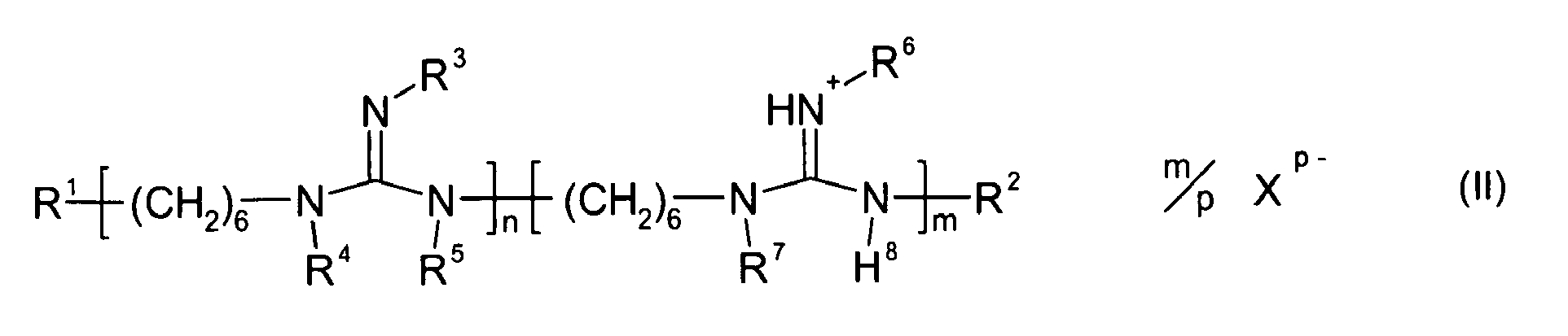
- m = 1 bis 80 und n = 0 bis 79, wobei 10 ≤ n + m ≤ 80 gilt;
- R1 = H, OH, NH2, NH2 +, NH-C(=NH)-NH2 oder NH-C(=NH2 +)-NH2;
- R2 ,R3, R4, R5 = gleichzeitig oder unabhängig voneinander H, OH, (CH2)6-NH2, (CH2)6-OH oder (CH2)6-NH2 +;
- R6, R7, R8 =gleichzeitig oder unabhängig voneinander H, (CH2)6-NH2, (CH2)6-OH oder (CH2)6-NH2 +;
- p = 1, 2 oder 3; und
- X = ein organisches oder anorganisches Anion, das gemäß
- p = 1 ein einwertiges organisches oder anorganisches Anion,
- p = 2 ein zweiwertiges organisches oder anorganisches Anion oder
- p = 3 ein dreiwertiges organisches oder anorganisches Anion ist.
- In einer bevorzugten Ausführung der Erfindung bedeutet in Formel (II) gleichzeitig oder unabhängig voneinander:
- m = 1 bis 80 und n = 0 bis 79, wobei 10 ≤ n + m ≤ 80 gilt;
- R1 = H, NH2, NH2-, NH-C(=NH)-NH2 oder NH-C(=NH2 +)-NH2;
- R2 ,R3, R4, R5 = gleichzeitig oder unabhängig voneinander H, (CH2)6-NH2 oder (CH2)6-NH2 +;
- R6, R7, R8 = gleichzeitig oder unabhängig voneinander H, (CH2)6-NH2, oder (CH2)6-NH2 +;
- p = 1, 2 oder 3; und
- X = ein organisches oder anorganisches Anion, das gemäß
- p = 1 ein einwertiges organisches oder anorganisches Anion,
- p = 2 ein zweiwertiges organisches oder anorganisches Anion oder
- p = 3 ein dreiwertiges organisches oder anorganisches Anion ist.
- In einer weiteren bevorzugten Ausführung der Erfindung bedeutet in Formel (II) gleichzeitig oder unabhängig voneinander:
- m = 1 bis 80 und n = 0 bis 79, wobei 10 ≤ n + m ≤ 80 gilt;
- R1 = H, NH2 +, NH-C(=NH2 +)-NH2, NH2 oder NH-C(=NH2)-NH2;
- R2 = H, (CH2)6-NH2 + oder (CH2)6-NH2;
- R3, R4, R5, R6, R7, R8 = H;
- p = 1, 2 oder 3; und
- X = ein organisches oder anorganisches Anion, das gemäß
- p = 1 ein einwertiges organisches oder anorganisches Anion,
- p = 2 ein zweiwertiges organisches oder anorganisches Anion oder
- p = 3 ein dreiwertiges organisches oder anorganisches Anion ist.
- Weiterhin bevorzugt kann gemäß Formel (II) der vorliegenden Erfindung insbesondere 20 ≤ n + m ≤ 80, insbesondere 30 ≤ n + m ≤ 80, insbesondere 30 ≤ n + m ≤ 70 und besonders bevorzugt 30 ≤ n + m ≤ 60 bedeuten. Es kann jedoch auch vorgesehen sein, dass 35 ≤ n + m ≤ 80, insbesondere 35 ≤ n + m ≤ 70, insbesondere 30 ≤ n + m ≤ 60, insbesondere 40 ≤ n + m ≤ 80 und besonders bevorzugt 40 ≤ n + m ≤ 70 bedeutet. Gleichzeitig oder unabhängig hiervon kann gemäß Formel (II) der vorliegenden Erfindung insbesondere m = 10 bis 80, insbesondere m = 20 bis 80, insbesondere m = 30 bis 80, insbesondere m = 30 bis 70 oder besonders bevorzugt m = 30 bis 60 und n = 0 bis 79 bedeuten. Es kann jedoch auch vorgesehen sein, dass m = 5 bis 80, insbesondere m = 15 bis 80, insbesondere m = 25 bis 80, insbesondere m = 35 bis 80, insbesondere m = 40 bis 80, insbesondere m = 35 bis 70, insbesondere m = 35 bis 60, insbesondere m = 40 bis 80, insbesondere m = 40 bis 70 und n = 0 bis 60 bedeutet.
- Damit kann weiterhin bevorzugt das Polyhexamethylenguanidin gemäß der vorliegenden Erfindung auch als Salz vorliegen. Falls das Polyhexamethylenguanidin als Salz vorliegt, so liegt das Grundpolymer als Kation oder Polykation vor, dessen positive Ladungen durch einwertige, zweiwertige oder dreiwertige anorganische oder organische Anionen ausgeglichen sind. Insbesondere sind als Anionen Chlorid, Bromid, Nitrat, Phosphat, Hydrogenphosphat, Dihydrogenphosphat, Citrat, Hydrogencitrat, Dihydrogencitrat, Sulfat, Hydrogensulfat, Carbonat, Hydrogencarbonat, Acetat, Gluconat, Lactat oder Mischungen hiervon geeignet. Besonders bevorzugt ist Chlorid, Phosphat und Hydrogenphosphat.
- Ganz besonders bevorzugt umfasst die Zubereitung Polyhexamethylenguanidiniumhydrochlorid (CAS 57 028-96-3).
- Überraschender Weise hat sich gezeigt, dass Polyhexamethylenguanidin oder ein Salz hiervon, insbesondere Polyhexamethylenguanidiniumhydrochlorid ein breites antimikrobielles Wirkspektrum aufweist. Polyhexamethylenguanidin oder ein Salz hiervon ist beispielsweise wirksam gegen Bakterien wie Echerichia coli, Pseudomonas aeruginosa, Staphylococcus aureus, Salmonella typhimurium, Salmonella gallinarium, Mycobacterium tuberculosis, Clostridium difficile, Coryme bacterium diphteriae, Shigella sonnei, Shigella flexneri, Proteus vulgaris, Pasteurella gallinarium oder Listeria monocitogenes. Zudem ist es wirksam gegen zahlreiche Pilze und Vieren. Weiterhin überraschend hat sich gezeigt, dass auch Polyhexamethylenguanidin oder ein Salz hiervon, insbesondere Polyhexamethylenguanidiniumhydrochlorid auch antibakteriell wirksam ist gegen Bakterien, die bereits Resistenzen aufgebaut haben, wie beispielsweise Staphylococcus aureus (MRSA). Polyhexamethylenguanidin oder ein Salz hiervon hat katiogenen Charakter oder ist positiv geladen und kann damit gut mit den negativ geladenen Zellwänden der Keime reagieren, also eine elektrostatische Bindung mit den negativen geladenen Teilen der Zellwand eingehen. Die Semipermeabilität der Zellmembran wird gestört oder auch aufgelöst. Die Zerstörung der intakten Zellstruktur führt schließlich zum Zelltod der Keime. Diese Wirkungsweise basiert vielmehr auf einer physikalischen Wirkungsweise. Dadurch unterliegt Polyhexamethylenguanidin oder dessen Salze nicht der so großen Gefahr der Ausbildung von Resistenzen der Keime gegenüber Polyhexamethylenguanidin oder dessen Salze.
Vorteilhaft wird durch die antimikrobielle Ausrüstung von Artikeln mit polymerem Trägermaterial, ausgerüstet mit gegenüber Polyhexamethylenguanidin oder dessen Salze eine zusätzliche Präventionsmaßnahme vor Infektionen und Infektionsübertragung geschaffen. - Aufgrund des polymeren Charakters ist Polyhexamethylenguanidin oder dessen Salze gegenüber bekannten niedermolekularen antimikrobiellen Verbindungen wie beispielsweise niedermolekulare quaternäre Stickstoffverbindungen z.B. Chlorhexidin oder Benzalkoniumchlorid wenig toxisch und weist eine hohe Stabilität gegen Ultraviolette Strahlung auf. Aufgrund des polymeren Charakters kann Polyhexamethylenguanidin oder dessen Salze nicht über die Haut in den Körper eines Menschen gelangen. Somit kann ein mit Polyhexamethylenguanidin oder dessen Salz ausgerüsteter Gegenstand direkt auf der Haut getragen werden.
Zudem sind Polyhexamethylenguanidin oder dessen Salze bislang auch als nicht Allergie auslösender Stoff bekannt. Zudem ist aus Akkumulationstests, ausgeführt in Tieren, bekannt, dass Polyhexamethylenguanidin oder dessen Salze keinerlei Rückstände in den Organen oder Muskulatur der Tiere zurücklässt. Polyhexamethylenguanidin, insbesondere in der Ausführung als Polyhexamethylenguanidiniumhydrochlorid (CAS 57 028-96-3) ist in der EU-Direktive, Annex II, als sicheres Produkt aufgenommen worden und damit auch für die Anwendungsbereiche, wie u.a. menschliche Hygiene, Desinfektionsmittel für den privaten Bereich und auch im öffentlichen Gesundheitswesen zugelassen. - Zudem wirkt Polyhexamethylenguanidin oder dessen Salz gegenüber einer Vielzahl an Materialien, wie insbesondere Metalle, Latex, Holz oder Plastikmaterialien nicht korrosiv, also nicht beschädigend.
- Überraschender Weise hat sich zudem gezeigt, dass Polyhexamethylenguanidin oder dessen Salz davon auf einem polymeren Trägermaterial über einen längeren Zeitraum antibakteriell wirkt. Damit ist gemäß der vorliegenden Erfindung auch ein medizinischer oder medizintechnischer Artikel oder ein Artikel für die persönliche Schutzausrüstung ein bevorzugter Gegenstand, der ab dem erstmaligen Gebrauch mindestens 2 Tage, vorzugsweise mindestens 3 Tage, weiter vorzugsweise mindestens 4 Tage antimikrobiell wirksam ist.
- Hiervon losgelöst oder im Zusammenhang stehend ist auch ein medizinischer oder medizintechnischer Artikel oder ein Artikel für die persönliche Schutzausrüstung ein bevorzugter Gegenstand der vorliegenden Erfindung, dessen Gehalt an Polyhexamethylenguanidin oder dessen Salz bezogen auf die Oberfläche des polymeren Trägermaterials 0,0001 bis 100 mg/ cm2 beträgt. Insbesondere weist das polymere Trägermaterial einen Gehalt von 0,1 bis 10000 µg/ cm2, insbesondere 1 bis 5000 µg/ cm2, weiter insbesondere 10 bis 2000 µg/ cm2, weiter insbesondere 10 bis 1750 µg/ cm2 und ganz besonders bevorzugt 10 bis 1500 µg/ cm2 bezogen auf die Fläche des Trägermaterials auf. Insbesondere wenn der medizinische oder medizintechnische Artikel oder Artikel für die persönliche Schutzausrüstung aus dem polymeren Trägermaterial besteht, so weist der Artikel, bezogen auf seine Fläche einen Gehalt an Polyhexamethylenguanidin oder dessen Salz von 0,1 bis 10000 µg/ cm2, insbesondere 1 bis 5000 µg/ cm2, weiter insbesondere 10 bis 2000 µg/ cm2, weiter insbesondere 10 bis 1750 µg/ cm2 und ganz besonders bevorzugt 10 bis 1500 µg/ cm2 auf.
- Gemäß der vorliegenden Erfindung können medizinische oder medizintechnische Artikel oder Artikel für die persönliche Schutzausrüstung, insbesondere ein Handschuh, insbesondere ein Untersuchungshandschuh und/oder ein Operationshandschuh und/oder ein Schutzhandschuh, ein Katheter, insbesondere ein Blasenkatheter und/oder ein Venenkatheter, eine Komponente für ein Drainage-System, insbesondere eines intraoperativen Drainage-Systems und/oder eines postoperativen Drainage-Systems, eine Kanüle oder ein Schlauch mit Einsatz im medizinischen Umfeld, sowie sonstige medizinisch invasive Hilfsmittel; ein Auffangbeutel und/oder eine Folie, wie insbesondere Abdeck-/Schutz-/Verpackungsfolien für den Einsatz im medizinischen Umfeld sein.
- Handschuhe sollen den Patienten und den Anwender vor Kontaminationen, insbesondere als Untersuchungshandschuhe bei der Durchführung von medizinischen Untersuchungen schützen. In der Chirurgie eingesetzte Operationshandschuhe sind dabei sterile, anatomisch geformte medizinische Handschuhe. Schutz beim Umgang mit kontaminierten medizinischen Materialien oder für sonstige diagnostische oder therapeutische Zwecke sollen allgemein jegliche Schutzhandschuhe bieten. Untersuchungs- und Pflege/Schutzhandschuhe können steril oder unsteril sein, und können auch anatomisch geformt sein. Besonders bevorzugt handelt es sich bei den vorgenannten Handschuhen um wegwerfbare Handschuhe, also für den einmaligen Gebrauch vorgesehene Handschuhe. Bereits der Einsatz von wegwerfbaren Handschuhen unterstützt die Verminderung von Infektionstransfer.
- Unter Drainage wird im medizinischen Umfeld die Ableitung /Absaugung von krankhaften und/oder vermehrt anfallenden natürlichen Körperflüssigkeiten verstanden. Dabei wird auch unterschieden zwischen innerer und äußerer Drainage. Bei der inneren Drainage werden operativ oder minimal invasiv eine Art Verbindung zwischen den Hohlorganen, wie Speiseröhre, Magen, Darm angelegt, um dann aufgestaute Flüssigkeiten in die entsprechenden Hohlorgane abzuleiten.
Bei der äußeren Drainage wird die Körperflüssigkeit aus dem Körperinneren nach außen abgeleitet. Die äußere Drainage wird im medizinischen Bereich sehr unterschiedlich und zumeist auch wenig standardisiert unterteilt. Die Unterteilung kann erfolgen beispielsweise nach dem Erfinder der jeweiligen Drainage-Methode, oder nach der Drainage unterzogenen Körperregion (z.B. Bauchdrainage), nach dem Krankheitszustand (bspw. Wunddrainage, Pneumothoraxdrainage) oder auch der Funktionsweise der Drainage (Schwerkraftdrainage, (Vakuum)saugdrainage, Kapillardrainage) oder auch dem Zeitpunkt des Einsatzes, wie insbesondere als Absaugung während einer Operation (intraoperative Drainage) oder nach der Operation (postoperative Drainage), so in Form einer Wunddrainage.
Bei der Durchführung einer jeglichen Drainage werden entsprechende Komponenten des Drainage-Systems, wie beispielsweise Handstücke, Absaugschläuche, Verbindungsschläuche, alle zumeist aus polymeren Materialien eingesetzt. Die Komponenten der Drainage müssen insbesondere bei einer postoperativ durchzuführenden Drainage, also der Wunddrainage, in oder an der entsprechenden Körperregion/Wunde fixiert werden. - Ein bevorzugter Gegenstand der vorliegenden Erfindung sind insbesondere auch Handschuhe, insbesondere Untersuchungshandschuhe und/oder Operationshandschuhe und/oder Schutzhandschuhe, Katheter, insbesondere ein Blasenkatheter und/oder ein Venenkatheter, Komponenten für ein Drainage-System, insbesondere eines intraoperativen Drainage-Systems und/oder eines postoperativen Drainage-Systems, Kanülen, Schläuche mit Einsatz im medizinischen Umfeld, oder sonstige invasiven Hilfsmittel, Auffangbeutel, und auch Folien, wie Abdeck-/Schutz-/Verpackungsfolien für den Einsatz im medizinischen Umfeld umfassend jeweils ein polymeres Trägermaterial oder bestehend aus einem polymeren Trägermaterial, welches herstellerseitig mit einer antimikrobiellen Zubereitung ausgerüstet ist und wobei die Zubereitung Polyhexamethylenguanidin oder ein Salz hiervon, insbesondere Polyhexamethylenguanidiniumchlorid als antimikrobielles Mittel und insbesondere weitere Hilfs- oder Zusatzstoffe umfasst.
- Als polymeres Trägermaterial für den medizinischen oder medizintechnischen Artikel oder den Artikel für die persönliche Schutzausrüstung können dabei verschiedene Materialien eingesetzt werden, wie insbesondere synthetische Homo- und Copolymere auf Basis von Polyolefinen, wie Polyethylen (HDPE und LDPE), Polypropylen, Polyisobutylen, Polybutadien, Polyisopren; Polymere und Copolymere aus vinylaromatischen Monomeren, wie Polystyrol, Poly(styrol-co-acrylnitril), Poly(styrol-co-butadien-co-acrylnitril) (ABS-Copolymere); halogenhaltige Polymere, wie Polyvinylchlorid, Polyvinylidenchlorid, Polychloropren, Polytetrafluorethylen (PTFE) und Polyvinylidenfluorid; Polykondensate, beispielsweise Polyester, wie Polyethylenterephthalat, Polybutylenterephthalat; Polyamide, wie Polycaprolactam, Polykondensate aus Hexamethylendiamin und Adipinsaeure; Polyacrylate und Polymethacrylate, wie Polymethylmethacrylat; Polycarbonate, Polyether, Polyetherketone, Polyacrylnitril, Polyurethane, Polyimide und Silikone. Ebenso können als polymeres Trägermaterial auch natürliche Polymere wie Naturkautschuk eingesetzt werden. Ebenso können auch Kombinationen der genannten synthetischen und/oder natürlichen Polymere eingesetzt werden.
- Das polymere Trägermaterial kann dabei auch elastomere Eigenschaften aufweisen, insbesondere als polymeres Trägermaterial für die Handschuhe.
- Als polymeres Trägermaterial für Handschuhe werden die für den Fachmann herkömmlich bekannten polymeren Materialien eingesetzt. Bekannt sind Naturkautschuk und/oder Synthesekautschuke oder Kombinationen davon. Die Synthesekautschuke sind vorzugsweise entnommen aus der Gruppe umfassend Isoprenkautschuk (synthetisches Polyisopren), Chloropren-Kautschuk (Polychloropren), Acrylnitril-Butadien-Kautschuk (Nitrilkautschuk), hydrierter Nitrilkautschuk, Styrol-Butadien-Kautschuk, S-EB-S (Styrol-Ethylen-Buten-Styrol) Block-Copolymere, S-I-S (Styrol-Isoprene-Styrol) Block-Copolymere, S-B-S (Styrol-Butadien-Styrol) Block-Copolymere, S-I (Styrol-Isopren) Block-copolymere, S-B (Styrol-Butadien) Block-Copolymere, Butadien-Polymere, Styrol-Butadien Polymere, Carboxylierte Styrol-Butadien-Polymere, Acrylnitril-Styrol-Butadien Polymere, und deren Derivate.
- Insbesondere vorzugsweise ist das polymere Trägermaterial des Handschuhs, insbesondere des Untersuchungshandschuhs und/oder des Operationshandschuhs und/oder des Schutzhandschuhs aus den polymeren Materialien entnommen aus der Gruppe Naturkautschuk und synthetischer Kautschuk, davon insbesondere synthetisches Polyisopren (Isoprenkautschuk), Polychloropren, Acrylonitril-Butadien-Kautschuk und Derivate, oder Kombinationen davon.
- Als polymeres Trägermaterial für Folien werden vorzugsweise polymere Materialien entnommen aus der Gruppe Polyolefine, wie insbesondere Polyethylen und/oder Polypropylen und Polyvinylchlorid, oder Kombinationen davon eingesetzt.
- Als polymeres Trägermaterial für die Komponenten für Drainage-Systeme werden insbesondere PVC (Polyvinylchlorid), Polyurethan, Silikon oder PU-Silikone und/oder Kombinationen eingesetzt.
- Die herstellerseitige Ausrüstung des polymeren Trägermaterials mit der antimikrobiellen Zubereitung auf der ersten und/oder zweiten oberflächenbildenden Seite des polymeren Trägermaterials kann insbesondere durch Auf-/Besprühen erfolgen. Mit Auf-/Besprühen kann vorteilhaft eine möglicherweise für den jeweiligen Einsatzbereich des polymeren Trägermaterials und damit einhergehend auf/an dem dieses Trägermaterial umfassenden oder daraus bestehenden Artikel zumindest eine nur bereichsweise antimikrobielle Ausrüstung der ersten und/oder zweiten oberflächenbildenden Seite erfolgen.
- In einer weiteren alternativen vorteilhaften Weise kann die herstellerseitige Ausrüstung mittels Tauchen des polymeren Trägermaterials in der antimikrobiellen Zubereitung erfolgen.
- Das Polyhexamethylenguanidin oder ein Salz hiervon, insbesondere Polyhexamethylenguanidiniumchlorid kann nach der Herstellung des polymeren Trägermaterials auf dieses aufgebracht, insbesondere durch Sprühen oder Tauchen aufgebracht werden.
- Es ist auch möglich das polymere Trägermaterial in einem späteren nachgeschalteten Arbeitsschritt mit einer Lösung umfassend Polyhexamethylenguanidin oder ein Salz hiervon, insbesondere Polyhexamethylenguanidiniumchlorid zu beaufschlagen, insbesondere durch Besprühen oder Tauchen.
- In einer weiteren vorteilhaften Alternative erfolgt die antimikrobielle Ausrüstung des polymeren Trägermaterials derart, dass das Polyhexamethylenguanidin oder ein Salz hiervon, insbesondere Polyhexamethylenguanidiniumchlorid direkt der Masse zur Herstellung des polymeren Trägermaterials zugesetzt wird, d.h dass somit das Polyhexamethylenguanidin oder ein Salz hiervon, insbesondere Polyhexamethylenguanidiniumchlorid direkt in das polymere Trägermaterial integriert ist. Polyhexamethylenguanidin oder ein Salz hiervon wird als Additiv direkt der Polymermatrixzusammensetzung, aus welcher das polymere Trägermaterial gebildet wird, zugesetzt. Aufgrund der hohen Temperaturresistenz der Molekülstruktur von Polyhexamethylenguanidin oder ein Salz hiervon, insbesondere Polyhexamethylenguanidiniumchlorid, von bis ca. 250°C ist diese alternative Vorgehensweise möglich, ohne dass negative Veränderungen der Eigenschaften des antimikrobiellen Wirkstoffs zu befürchten sind. Der inline-Verarbeitungsprozess kann vorteilhafterweise zumeist mit weniger technischen Aufwand vorgenommen werden als ein entsprechender Ausrüstungsschritt auf dem fertigen polymeren Trägermaterial zu einem späteren Zeitpunkt. Insbesondere vorteilhaft wird hierbei ein polymeres Trägermaterial bereitgestellt, das durchgehend mit dem antimikrobiellen Wirkstoff versetzt ist, so dass der Wirkstoff damit auch auf der ersten und der zweiten oberflächenbilddenden Seite des polymeren Trägermaterials bereitgestellt wird. Dies ist insbesondere vorteilhaft, da damit ein polymeres Trägermaterial mit einer antimikrobiellen Ausrüstung unanhängig vom späteren Einsatzbereich bzw. insbesondere unabhängig von der späteren für den Einsatz besonders bevorzugten ersten oder zweiten oberflächenbildenden Seite des Trägermaterials bereitgestellt wird. Es wird zudem vorteilhafterweise eine länger anhaltende Wirksamkeit gewährleistet; da vorzugsweise der antibakterielle Wirkstoff allmählich freigesetzt werden kann bzw. an die erste und/oder zweite oberflächenbildende Seite diffundieren kann. Polyhexamethylenguanidin oder ein Salz davon sind dabei insbesondere in der Polymermatrixzusammensetzung in einem Anteil von 0,02 - 2,0 Gew-%, weiter insbesondere von 0,05 - 1,5 Gew-%, weiter insbesondere von 0,07 - 1,2 Gew-% enthalten. Polyhexamethylenguanidin oder ein Salz davon kann dabei in Form einer antimikrobiellen Zubereitung mit einem höheren Anteil, insbesondere von 0,1 bis 50 Gew.-%, vorzugsweise 0,2 bis 45 Gew.-%, weiter vorzugsweise 1 bis 40 Gew.-%, weiter insbesondere 5 bis 35 Gew.-%, weiter inbesondere von 10 - 30 Gew-% zugeben werden.
- Bei Ausrüstungen direkt auf eine und/ oder beide der ersten und/oder der zweiten oberflächenbildenden Seite werden vorteilhafterweise in die antibakteriellen Zubereitung noch weitere Hilfsstoffe, insbesondere weitere filmbildende Komponenten, insbesondere die zur besseren Haftbarkeit der antimikrobiellen Zubereitung beitragen, zugesetzt.
- Gemäß einer besonders bevorzugten Ausführung der vorliegenden Erfindung kann die Zubereitung als Hilfs- oder Zusatzstoff insbesondere ein Hautpflegemittel, ein Tensid, ein Hydrophobisierungsmittel, ein Hydrophilisierungsmittel, ein Gleitmittel, ein Netzmittel und/oder ein Avivagemittel umfassen. Hierbei ist insbesondere vorgesehen, dass eine Menge an Hilfs- oder Zusatzstoff bezogen auf die Oberfläche des polymeren Trägermaterials 0,0001 bis 150 mg/ cm2 beträgt. Insbesondere weist das polymere Trägermaterial einen Gehalt von 0,1 bis 900 µg/ cm2, insbesondere 0,1 bis 500 µg/ cm2, insbesondere 0,1 bis 300 µg/ cm2 und ganz besonders bevorzugt 0,1 bis 150 µg/ cm2 bezogen auf die Fläche des Trägermaterials auf.
- Insbesondere weist die Zubereitung kein Wasser auf. Somit ist der erfindungsgemäße Artikel insbesondere bis auf einen durch vorhandene Luftfeuchtigkeit verursachten Restwassergehalt als wasserfrei zu bezeichnen.
- Vorzugsweise umfasst die Zubereitung als Hautpflegemittel insbesondere einen Pflanzenextrakt, wobei der Pflanzenextrakt beispielsweise durch Extraktion der gesamten Pflanze, aber auch ausschließlich durch Extraktion aus Blüten, Blättern, Samen, Wurzeln und/oder anderen Pflanzenteilen, hergestellt werden kann. Erfindungsgemäß sind vor allem die Extrakte aus speziellen Pflanzen wie Grünem Tee, Hamamelis, Kamille, Stiefmütterchen, Aloe Vera, Rosskastanie, Salbei, Weidenrinde, Chrysanthemen, Eichenrinde, Brennnessel, Hopfen, Klettenwurzel, Schachtelhalm, Weissdorn, Lindenblüten, Mandeln, Fichtennadeln, Sandelholz, Wacholder, Kokosnuss, Kiwi, Guave, Limette, Mango, Aprikose, Weizen, Melone, Orange, Grapefruit, Avocado, Rosmarin, Birke, Buchensprossen, Wiesenschaumkraut, Schafgarbe, Quendel, Thymian, Melisse, Eibisch, Veilchen, Blättern der Schwarzen Johannisbeere, Huflattich, Fünffingerkraut, Ginseng, Ingwerwurzel und Süßkartoffel als Pflanzenextrakt bevorzugt.
- Insbesondere umfasst die Zubereitung einen Pflanzenextrakt aus Grünem Tee, Hamamelis, Ringelblume oder Aloe Vera. Die erfindungsgemäßen Zubereitungen können auch Mischungen aus mehreren, insbesondere aus zwei, verschiedenen Pflanzenextrakten enthalten. In einer besonders bevorzugten Ausführungsform ist in der erfindungsgemäßen Zubereitung Aloe Vera enthalten.
- Insbesondere vorzugsweise ist bei Handschuhen, insbesondere bei Untersuchungshandschuhen, Operationshandschuhen, und/oder Schutzhandschuhen vorgesehen, dass die antimikrobielle Zubereitung Hautpflegemittel umfasst. Insbesondere vorgesehen ist der Zusatz an Hautpflegemitteln in der antimikrobiellen Zubereitung, welche auf der zweiten oberflächenbildende Seite des polymeren Trägermaterials, welche die Innenseite des Handschuhs bildet, aufgebracht ist.
- Vorzugsweise umfasst die Zubereitung als Tensid insbesondere ein nichtionisches Tensid, ein kationisches Tensid, ein anionisches Tensid oder ein amphoteres Tensid.
- Als nichtionische Tenside werden vorzugsweise alkoxylierte, vorteilhafterweise ethoxylierte, insbesondere primäre Alkohole mit vorzugsweise 8 bis 18 C-Atomen und durchschnittlich 1 bis 12 Mol Ethylenoxid (EO) pro Mol Alkohol eingesetzt, in denen der Alkoholrest linear oder bevorzugt in 2-Stellung methylverzweigt sein kann bzw. lineare und methylverzweigte Reste im Gemisch enthalten kann, so wie sie üblicherweise in Oxoalkoholresten vorliegen. Insbesondere sind jedoch Alkoholethoxylate mit linearen Resten aus Alkoholen nativen Ursprungs mit 12 bis 18 C-Atomen, z.B. aus Kokos-, Palm-, Talgfett- oder Oleylalkohol, und durchschnittlich 2 bis 8 EO pro Mol Alkohol bevorzugt. Zu den bevorzugten ethoxylierten Alkoholen gehören beispielsweise C12-14-Alkohole mit 3 EO bis 7 EO, C9-11-Alkohol mit 7 EO, C13-15-Alkohole mit 3 EO, 5 EO, 7 EO oder 8 EO, C12-18-Alkohole mit 3 EO, 5 EO oder 7 EO und Mischungen aus diesen, wie Mischungen aus C12-14-Alkohol mit 3 EO und C12-18-Alkohol mit 7 EO. Die angegebenen Ethoxylierungsgrade stellen statistische Mittelwerte dar, die für ein spezielles Produkt eine ganze oder eine gebrochene Zahl sein können. Zusätzlich zu diesen nichtionischen Tensiden können auch Fettalkohole mit mehr als 12 EO eingesetzt werden. Beispiele hierfür sind Talgfettalkohol mit 14 EO, 25 EO, 30 EO oder 40 EO. Auch nichtionische Tenside, die EO- und PO-Gruppen zusammen im Molekül enthalten, sind erfindungsgemäß einsetzbar. Hierbei können Blockcopolymere mit EO-PO-Blockeinheiten bzw. PO-EO-Blockeinheiten eingesetzt werden, aber auch EO-PO-EO-Copolymere bzw. PO-EO-PO-Copolymere. Selbstverständlich sind auch gemischt alkoxylierte Niotenside einsetzbar, in denen EO- und PO-Einheiten nicht blockweise sondern statistisch verteilt sind. Solche Produkte sind durch gleichzeitige Einwirkung von Ethylenoxid (EO) und Propylenoxid (PO) auf Fettalkohole erhältlich.
- Beispiele für Fettalkoholpolyethylenglycolether sind solche mit der Formel (III)
R1O-(CH2CH2O)nH (III)
wobei für gilt: n = 1 bis 5; - R1 = eine linearer oder verzweigter Alkyl- und/oder Alkenylrest mit 6 bis 22, vorzugsweise 12 bis 18 Kohlenstoffatomen.
- Als kationische Tenside können insbesondere quartäre Ammoniumverbindungen, kationische Polymere und Emulgatoren, wie in Mitteln zur Textilavivage eingesetzt werden. Geeignete Beispiele für quartäre Ammoniumverbindungen sind Stoffe der Formeln (IV) und (V):

- R, R6 = ein acyclischer Alkylrest mit 12 bis 24 Kohlenstoffatomen;
- R7 = ein gesättigter C1-C4 Alkyl- oder Hydroxyalkylrest;
- R8 = entweder gleich R, Ra oder Rb ist oder für einen aromatischen Rest steht;
- X- = ein Halogenid-, Methosulfat-, Methophosphat- oder Phosphatanion sowie Mischungen hiervon.
- Verbindungen der Formel (V) sind sogenannte Esterquats. Hierfür gilt:
- R9 =
- H, OH oder O(CO)-R12, wobei R12 unabhängig von R11 und R13 für einen aliphatischen Alkylrest mit 12 bis 22 Kohlenstoffatomen oder für einen aliphatischen Hydroxyalkylrest mit 12 bis 22 Kohlenstoffatomen oder für einen aliphatischen Alkenylrest mit 12 bis 22 Kohlenstoffatomen mit 1, 2 oder 3 Doppelbindungen steht;
- R10 =
- H, OH oder O(CO)-R13, wobei R13 unabhängig von R12 und R11 für einen aliphatischen Alkylrest mit 12 bis 22 Kohlenstoffatomen oder für einen aliphatischen Hydroxyalkylrest mit 12 bis 22 Kohlenstoffatomen oder für einen aliphatischen Alkenylrest mit 12 bis 22 Kohlenstoffatomen mit 1, 2 oder 3 Doppelbindungen steht;
- R11 =
- unabhängig von R12 und R13 ein aliphatischer Alkylrest mit 12 bis 22 Kohlenstoffatomen oder ein aliphatischen Hydroxyalkylrest mit 12 bis 22 Kohlenstoffatomen oder ein aliphatischer Alkenylrest mit 12 bis 22 Kohlenstoffatomen mit 1, 2 oder 3 Doppelbindungen;
- q, r, s =
- jeweils unabhängig voneinander 0, 1, 2, 3, 4 oder 5, wobei jedoch q + r +s ≥ 1 gilt;
- X- =
- Halogenid-, Methosulfat-, Methophosphat- oder Phosphation sowie Mischungen hiervon.
- Für bevorzugte Verbindungen gemäß Formel V gilt:
- R9 =
- O(CO)-R12, wobei R12 unabhängig von R11 und R13 für einen aliphatischen Alkylrest mit 16 bis 18 Kohlenstoffatomen oder für einen aliphatischen Alkenylrest mit 16 bis 18 Kohlenstoffatomen mit 1, 2 oder 3 Doppelbindungen steht;
- R10 =
- O(CO)-R13, wobei R13 unabhängig von R11 und R13 für einen aliphatischen Alkylrest mit 16 bis 18 Kohlenstoffatomen oder für einen aliphatischen Alkenylrest mit 16 bis 18 Kohlenstoffatomen mit 1, 2 oder 3 Doppelbindungen steht;
- R11 =
- unabhängig von R12 und R13 ein aliphatischer Alkylrest mit 16 bis 18 Kohlenstoffatomen oder ein aliphatischer Alkenylrest mit 16 bis 18 Kohlenstoffatomen mit 1, 2 oder 3 Doppelbindungen;
- q, r, s =
- jeweils unabhängig voneinander 0, 1, 2 oder 3, wobei jedoch q + r +s ≥ 1 gilt;
- X- =
- Halogenid-, Methosulfat-, Methophosphat- oder Phosphation sowie Mischungen hiervon.
- Beispiele für kationische Verbindungen der Formel (IV) sind insbesondere Didecyldimethylammoniumchlorid, Ditalgdimethylammoniumchlorid oder Dihexadecylammoniumchlorid.
- Beispiele für Verbindungen der Formel (V) sind Methyl-N-(2-hydroxyethyl)-N,N-di(talgacyloxyethyl)ammonium-methosulfat, Bis-(palmitoyl)-ethyl-hydroxyethyl-methylammonium-methosulfat oder Methyl-N,N-bis(acyloxyethyl)-N-(2-hydroxyethyl)ammoniummethosulfat.
- Um die Benetzbarkeit des polymeren Trägermaterials zu verbessern und somit auch die antimikrobielle Wirksamkeit zu verbessern, kann die Zubereitung insbesondere auch ein Hydrophilierungsmittel umfassen. Beispiele für derartige Hydrophilierungsmittel sind ein- oder mehrwertigen Alkohole, Alkanolamine oder Glycolether, sofern sie mit Wasser mischbar sind. Vorzugsweise werden die Hydrophilierungsmittel ausgewählt Ethylenglykolmethylether, Ethylenglykolethylether, Ethylenglykolpropylether, Ethylenglykolmono-n-butylether, Diethylenglykol-methylether, Diethylenglykolethylether, Propylenglykolmethyl-, -ethyl- oder - propyl-ether, Dipropylenglykolmonomethyl-, oder - ethylether, Düsopropylenglykolmonomethyl-, oder -ethylether, Methoxy-, Ethoxy- oder Butoxytriglykol, 1-Butoxyethoxy-2-propanol, 3-Methyl-3-methoxybutanol, Propylen-glykol-t-butylether, Alkoholen, insbesondere C1-C4-Alkanole, Glykole, Polyethylenglykole, vorzugsweise mit einem Molekulargewicht zwischen 100 und 100000, insbesondere zwischen 200 und 10000, und Polyolen, wie Sorbitol und Mannitol, sowie bei Raumtemperatur flüssiges oder feste Polyethylenglykol, Carbonsäureestern, Polyvinylalkoholen, Ethylenoxid-Propylenoxid-Blockcopolymeren sowie beliebigen Gemischen der voranstehenden.
- Das polymere Trägermaterial mit einer antimikrobiellen Ausrüstung kann im einfachsten Fall durch Tauchen oder Besprühen des polymeren Trägermaterials mit einer nichtalkoholischen Lösung von Polyhexamethylenguanidin oder dessen Salz bereitgestellt werden. Nach dem Verdampfen des Lösungsmittels wird somit ein antimikrobiell ausgerüstetes polymeres Trägermaterial erhalten, welches aufgrund der Wirkweise von Polyhexamethylenguanidin oder dessen Salz sehr lange antimikrobiell wirkt und somit auftretende Keime wirkungsvoll abtötet. Damit wird die Kolonisation von Mikroorganismen auf dem entsprechend ausgerüsteten Trägermaterial und damit einhergehend auch auf dem dieses Trägermaterial umfassenden oder auf dem aus diesem Trägermaterial bestehenden Artikel zumindest reduziert oder vorteilhafterweise auch verhindert und/oder auch die Übertragung ausgehend von dem dieses entsprechend ausgerüstete Trägermaterial umfassende oder aus diesem Trägermaterial bestehende Artikel wird reduziert oder vorteilhafterweise auch verhindert.
- Gemäß der vorliegenden Erfindung ist dabei vorgesehen, dass die antimikrobielle Zubereitung umfassend Polyhexamethylenguanidin oder dessen Salz auf eine erste oberflächenbildende Seite und/oder zweiten oberflächenbildenden Seite eines polymeren Trägermaterials aufgebracht ist.
- Insbesondere weist ein erfindungsgemäßer medizinischer oder medizintechnischer Artikel oder Artikel für persönliche Schutzausrüstung, ein Handschuh, insbesondere ein Untersuchungshandschuh und/oder ein Operationshandschuh und/oder ein Schutzhandschuh, ein Katheter, insbesondere ein Blasenkatheter und/oder ein Venenkatheter, eine Komponenten für ein Drainage-System, insbesondere eines intraoperativen Drainage-Systems und/oder eines postoperativen Drainage-Systems, eine Kanüle oder ein Schlauch mit Einsatz im medizinischen Umfeld, ein Auffangbeutel und/oder eine Folie, wie insbesondere Abdeck-/Schutz-Nerpackungsfolien für den Einsatz im medizinischen Umfeld eine erste oberflächenbildende Seite auf, die durch die erste oberflächenbildende Seite des polymerenTrägermaterials gebildet wird. Diese erste oberflächenbildende Seite des Artikels kann im anwendungsgerechten Zustand des Artikels zum Patienten oder zum Anwender gerichtet sein. Es kann jedoch auch vorgesehen sein, dass diese erste oberflächenbildende Seite des Artikels vom Patienten oder vom Anwender wegweist.
- So ist insbesondere auch vorgesehen, dass die erste oberflächenbildende Seite des polymeren Trägermaterials eine Außenfläche des Artikels bildet.
Weiter vorzugsweise bildet die zweite oberflächenbildende Seite des polymeren Trägermaterials eine Innenseite des Artikels.
Insbesondere bevorzugt bilden die erste und die zweite oberflächenbildende Seite des polymeren Trägermaterials die entsprechende Außenseite und Innenseite des Artikels. - Im Rahmen dieser Erfindung ist die "Außenseite" eines Artikels, insbesondere bei einem Artikel mit einer Formgebung, die Oberseite, welche von dem durch die Formgebung zumindest teilweise umschlossenen Raum abgewandt ist. So ist im Falle von Handschuhen die Außenseite die Oberseite des Handschuhs, welche im für den Gebrauch vorgesehenen und im für den Anwender bereitgestellten Zustand und auch im angezogenen Zustand des Handschuhs eine dem Körper des Anwenders abgewandte Lage ist.
"Außen" bzw. "Außenseite" bedeutet grundsätzlich eine vom Rauminneren des Artikels und/oder vom Körper des Anwenders abgewandte Orientierung.
Die "Innenseite" ist dem entsprechend die Oberseite des Artikels, welche dem durch die Formgebung des Artikels zumindest teilweise umschlossenen Raum am nächsten ist. So ist im Falle von Handschuhen die Innenseite die Oberseite, welche im für den Gebrauch vorgesehenen und im für den Anwender bereitgestellten Zustand und auch im angezogenen Zustand des Handschuhes dem Körper des Anwenders zugewandt ist. "Innen" bzw. "Innenseite" bedeutet grundsätzlich eine dem Rauminneren eines Artikels und/oder dem Körper des Anwenders zugewandte Orientierung. - Ein bevorzugter Gegenstand der Erfindung ist ein Handschuh, insbesondere ein Untersuchungshandschuh und/oder ein Operationshandschuh und/oder ein Schutzhandschuh, bei dem die antimikrobielle Zubereitung auf der ersten oberflächenbildenden Seite und/oder der zweiten oberflächenbildenden Seite des polymeren Trägermaterials aufgebracht ist. Insbesondere vorzugsweise ist der Handschuh, insbesondere der Untersuchungshandschuh und/oder der Operationshandschuh und/oder der Schutzhandschuh aus dem polymeren Trägermaterial gebildet.
Weiter insbesondere ist die antimikrobielle Zubereitung auf der ersten oberflächenbildenden Seite des polymeren Trägermaterials aufgebracht, wobei weiter insbesondere die erste oberflächenbildende Oberseite des polymeren Trägermaterials die Außenseite des Handschuhs, insbesondere des Untersuchungshandschuhs und/oder des Operationshandschuhs und/oder des Schutzhandschuhs bildet. Die Ausrüstung der Außenseite des Handschuhs, insbesondere des Untersuchungshandschuhs und/oder des Operationshandschuhs und/oder des Schutzhandschuhs ist eine vorteilhafte Maßnahme, um das Risiko der Übertragung von Keimen zu minimieren. Im Falle einer Operation wird der als spätere Operationsfeld bildende Bereich und auch der an das Operationsfeld angrenzende Bereich auf der Haut des Patienten entsprechend desinfiziert vorbereitet; dennoch besteht die Gefahr, dass Erreger aus der Keimflora des Patienten durch Hantieren des Chirurgen über die Handschuhe in das Operationsfeld und damit in die offene Wunde eingebracht werden. Insbesondere auch bei Arbeiten in einem an sich unsterilen Umfeld, wie beispielsweise bei der Patientenwundversorgung wie Verbandswechsel, Setzen von Kanülen, Anlegen von Infusionen vermindert die den antimikrobiellen Wirkstoff aufweisende Außenseite des Handschuhs, insbesondere des Untersuchungshandschuhs, die Gefahr der Keimverschleppung. - In einer weiteren alternativen vorteilhaften Ausführung ist die antimikrobielle Zubereitung auf der zweiten oberflächenbildenden Seite des polymeren Trägermaterials aufgebracht, wobei weiter insbesondere die zweite oberflächenbildende Oberseite des polymeren Trägermaterials die Innenseite des Handschuhs, insbesondere des Untersuchungshandschuhs und/oder des Operationshandschuhs und/oder des Schutzhandschuhs bildet. Die Ausrüstung der Innenseite des Handschuhs, insbesondere des Untersuchungshandschuhs und/oder des Operationshandschuhs und/oder des Schutzhandschuhs ist eine vorteilhafte Maßnahme, um die Gefahr der Übertragung der Keimflora des Trägers auf sein Umfeld, wie u.a. auch auf den Patienten, und auch beispielsweise in das Operationsfeld oder in die Patientenumgebung u.a. nach dem Ausziehen oder beim Wechsel der Handschuhe zu vermindern.
- In einer weiteren vorteilhaften Ausführung ist die antimikrobielle Zubereitung auf die erste und die zweite oberflächenbildende Seite des polymeren Trägermaterials aufgebracht,
wobei das polymere Trägermaterial den Handschuh, insbesondere den Untersuchungshandschuh und/oder den Operationshandschuh und/oder den Schutzhandschuhs bildet. Durch die beidseitige Ausrüstung wird eine umfassende Zusatz-Präventionsmaßnahme gegen Infektionen bereitgestellt. - Zur Herstellung eines erfindungsgemäßen Handschuhs, insbesondere eines Untersuchungshandschuh und/oder eines Operationshandschuh und/oder eines Schutzhandschuhs kann das polymere Trägermaterial, das von dem Handschuh, insbesondere dem Untersuchungshandschuh und/oder dem Operationshandschuh und/oder dem Schutzhandschuhs umfasst wird, auf einer oder auf beiden oberflächenbildenden Seiten insbesondere mit einer 5 - 35% konzentrierten wässrigen Lösung an Polyhexamethylenguanidin oder dessen Salz vollständig oder in bestimmten Bereichen, einmalig oder mehrmalig besprüht oder vollständig in die Lösung getaucht und anschließend getrocknet werden. Dieses polymere Trägermaterial wird vorzugsweise den gesamten Handschuh, insbesondere Untersuchungshandschuh und/oder Operationshandschuh und/oder Schutzhandschuhs bilden. Vorzugsweise weist das polymere Trägermaterial einen Gehalt an Polyhexamethylenguanidin oder dessen Salz bezogen auf die Oberfläche des polymeren Trägermaterials, und im Falle dass der Artikel aus dem polymeren Trägermaterial gebildet ist, letztlich bezogen auf die Oberfläche des Artikels, von 0,1 bis 10000 µg/ cm2, insbesondere 1 bis 5000 µg/ cm2, weiter insbesondere 10 bis 2000 µg/ cm2, weiter insbesondere 10 bis 1750 µg/ cm2 und ganz besonders bevorzugt 10 bis 1500 µg/ cm2 auf.
- In einer weiteren alternativen vorteilhaften Ausführung ist ein bevorzugter Gegenstand der Erfindung ist ein Handschuh, insbesondere ein Untersuchungshandschuh und/oder ein Operationshandschuh und/oder ein Schutzhandschuh, bei dem die antimikrobielle Zubereitung in dem polymeren Trägermaterials integriert ist. Insbesondere vorzugsweise ist der Handschuh, insbesondere der Untersuchungshandschuh und/oder der Operationshandschuh und/oder der Schutzhandschuh aus dem polymeren Trägermaterial gebildet.
- Ein weiter bevorzugter Gegenstand der Erfindung ist eine Komponente eines Drainage-Systems und/ oder eine Kanüle und/oder ein Schlauch mit Einsatz im medizinischen Umfeld und/oder ein Katheter, insbesondere ein Blasenkatheter und/oder ein Venenkatheter ist,
wobei bei diesen Artikeln die antimikrobielle Zubereitung auf der ersten oberflächenbildenden Seite des polymeren Trägermaterials aufgebracht ist und wobei weiter insbesondere die erste oberflächenbildende Seite des polymeren Trägermaterials die Außenseite der Komponente eines Drainage-Systems und/ oder der Kanüle und/oder des Schlauchs mit Einsatz im medizinischen Umfeld und/oder eines Katheters, insbesondere eines Blasenkatheter und/oder eines Venenkatheter ist. - In einer weiteren alternativen vorteilhaften Form ist der Gegenstand der Erfindung eine Komponente eines Drainage-Systems und/ oder eine Kanüle und/oder ein Schlauch mit Einsatz im medizinischen Umfeld und/oder ein Katheter, insbesondere ein Blasenkatheter und/oder ein Venenkatheter, wobei bei diesen Artikeln die antimikrobielle Zubereitung auf der zweiten oberflächenbildenden Seite des polymeren Trägermaterials aufgebracht ist und
wobei weiter insbesondere die zweite oberflächenbildende Seite des polymeren Trägermaterials die Innenseite der Komponente eines Drainage-Systems und/ oder der Kanüle und/oder des Schlauchs mit Einsatz im medizinischen Umfeld und/oder eines Katheters, insbesondere eines Blasenkatheter und/oder eines Venenkatheter ist. - In einer weiteren bevorzugten Ausführung ist der Gegenstand der Erfindung eine Komponente eines Drainage-Systems und/ oder eine Kanüle und/oder ein Schlauch mit Einsatz im medizinischen Umfeld und/oder ein Katheter, insbesondere ein Blasenkatheter und/oder ein Venenkatheter, wobei bei diesen Artikeln die antimikrobielle Zubereitung auf beiden der ersten und der zweiten oberflächenbildenden Seite des polymeren Trägermaterials aufgebracht ist und wobei weiter insbesondere die erste und die zweite oberflächenbildende Seite des polymeren Trägermaterials die Außenseite und die Innenseite der Komponente eines Drainage-Systems und/ oder der Kanüle und/oder des Schlauchs mit Einsatz im medizinischen Umfeld und/oder eines Katheters, insbesondere eines Blasenkatheter und/oder eines Venenkatheter bilden.
- Ein weiter bevorzugter Gegenstand der Erfindung ist eine Komponente eines Drainage-Systems und/ oder eine Kanüle und/oder ein Schlauch mit Einsatz im medizinischen Umfeld und/oder ein Katheter, insbesondere ein Blasenkatheter und/oder ein Venenkatheter ist,
wobei bei diesen Artikeln die antimikrobielle Zubereitung in das polymere Trägermaterial integriert ist, wobei insbesondere diese eine Komponente eines Drainage-Systems und/oder diese Kanüle und/oder dieser Schlauch mit Einsatz im medizinischen Umfeld und/oder dieser Katheter, insbesondere dieser Blasenkatheter und/oder dieser Venenkatheter weiter aus dem polymeren Trägermaterial gebildet sind. - Gemäß einem weiterführenden Gedanken der vorliegenden Erfindung ist auch ein Verfahren zur Herstellung eines medizinischen oder medizintechnischen Artikels umfassend ein polymeres Trägermaterial mit einer ersten oberflächenbildenden Seite und einer zweiten oberflächenbildenden Seite Gegenstand der vorliegenden Erfindung. Insbesondere kann mit diesem Verfahren ein Artikel der oben beschriebenen Art und ganz besonders ein Handschuh, insbesondere ein Untersuchungshandschuh und/oder ein Operationshandschuh und/oder ein Schutzhandschuh, ein Katheter, insbesondere ein Blasenkatheter und/oder ein Venenkatheter, eine Komponenten für ein Drainage-System, insbesondere eines intraoperativen Drainage-Systems und/oder eines postoperativen Drainage-Systems, eine Kanüle oder ein Schlauch mit Einsatz im medizinischen Umfeld, ein Auffangbeutel und/oder eine Folie, wie insbesondere Abdeck-/Schutz-/Verpackungsfolien für den Einsatz im medizinischen Umfeld jeweils umfassend ein polymeres Trägermaterial mit einer ersten oberflächenbildenden Seite und einer zweiten oberflächenbildenden Seite hergestellt werden. Das erfindungsgemäße Verfahren umfasst die Verfahrensschritte:
- a) Lösen von Polyhexamethylenguanidin oder ein Salz hiervon, insbesondere Polyhexamethylenguanidiniumchlorid in einem Lösungsmittel L1 zur Herstellung einer Lösung A,
- b) Besprühen des polymeren Trägermaterials auf der ersten und/oder zweiten oberflächendenbildende Seite mit der Lösung A oder Tauchen des polymerenTrägermaterials in die Lösung A oder Tauchen des Artikels in die Lösung A und
- c) Trocknen des Trägermaterials oder des Artikels.
- Gemäß einem bevorzugten Verfahren ist weiterhin vorgesehen:
- a') Lösen von weiteren Hilfs- oder Zusatzstoffen
- in dem Lösungsmittel L1 oder einem Lösungsmittel L2 zur Herstellung einer Lösung B oder
- in der Lösung A zur Herstellung einer Lösung C erfolgt und
- d) ein Besprühen des polymeren Trägermaterials auf der ersten und/oder zweiten oberflächenenbildenden Seite oder
Tauchen des polymerenTrägermaterials oder
Tauchen des Artikels- mit der/ in die Lösung A und mit der/ in die Lösung B oder
- mit einer/ in eine Lösung D, die die Lösung A und die Lösung B enthält oder
- mit der/ in die Lösung C erfolgt,
- Insbesondere werden in diesem Verfahren das Lösungsmittel L1 und/ oder das Lösungsmittel L2 aus der Gruppe bestehend aus Alkoholen, Ketonen, aromatischen Lösungsmitteln, Wasser oder einer Mischung hiervon gewählt.
- Weiterhin bevorzugt ist in diesem Verfahren, dass die Lösung A, C oder D eine Konzentration von 0,1 bis 50 Gew.-%, vorzugsweise 0,2 bis 45 Gew.-%, weiter vorzugsweise 1 bis 40 Gew.-%, weiter insbesondere 5 bis 35 Gew.-%, weiter insbesondere 10 bis 30 Gew.-%, an Polyhexamethylenguanidin oder ein Salz hiervon, insbesondere Polyhexamethylenguanidiniumchlorid enthält.
- Insbesondere ist auch vorgesehen, dass die Lösung B, C oder D eine Konzentration von 0,1 bis 20 Gew.-%, vorzugsweise 0,2 bis 15 Gew.-%, an weiteren Hilfs- oder Zusatzstoffen enthält.
- Hervorzuheben ist an dieser Stelle, dass die hier aufgeführten Merkmale der alternativen oder bevorzugten Ausgestaltungen der Erfindung nicht auf die einzelnen Alternativen oder Bevorzugungen zu beschränken sind. Im Zusammenhang mit der vorliegenden Erfindung ist es vielmehr der Fall, dass eine Kombination von Ausgestaltungen bzw. eine Kombination jedes Einzelmerkmals einer alternativen Form mit Merkmalen einer anderen alternativen Ausgestaltung ebenso als erfindungsgemäßer Gegenstand zu sehen ist. Ebenso wenig soll die Erfindung durch die nachfolgende Beschreibung der Zeichnungen reduziert verstanden sein.
- Nachstehend wird die Erfindung unter Bezugnahme auf Zeichnungen anhand eines Beispiels erläutert. So zeigt die
Figur 1 einen erfindungsgemäßen Handschuh, insbesondere einen Untersuchungshandschuh, einen Operationshandschuh und/oder einen Schutzhandschuh. Der inFigur 1 dargestellte Handschuh 10 besteht aus einem polymeren Trägermaterial 12, welches eine erste Oberseite 14 und eine zweite Oberseite 16 aufweist. Die erste oberflächenbildende Seite 14 bildet dabei die Außenseite 15 des Handschuhs, also die dem Träger abgewandte Oberseite und eben bei Patientenkontakt die dem Patienten zugewandte Oberseite. Die zweite oberflächenbildende Seite 16 bildet die Innenseite 17 des Handschuhs, also die dem Träger zugewandte oberflächenbildende Seite.
Die erste oberflächenbildende Seite 14 des polymeren Trägermaterials 12, und damit die Außenseite 15 des Handschuhs 10 wird mit einer 10 - 30 Gew.-% wässrigen Polyhexamethylenguanidiniumchlorid-Lösung (CAS 57 028-96-3) besprüht, derart, dass auf der Außenseite 15) des Handschuhs (10) der Wirkstoff bezogen auf die Fläche in einer Menge von 10 bis 1750 µg/ cm2 und ganz besonders bevorzugt 10 bis 1500 µg/ cm2, ganz besonders bevorzugt von 100 -1000 µg/ cm2 vorhanden ist.
Anschließend wird der Handschuh trocknen gelassen. - Das Prüfverfahren dient zur quantitativen Bestimmung der Wirkung der antimikrobiellen Ausrüstung bei den polymeren Materialien. Dazu wird das polymere Material mit dem jeweiligen Bakterienstamm, der zuvor in Weichagar gegeben wird, beimpft. Nach definierten Zeiten werden Keimzahlbestimmungen durchgeführt. Das Prüfverfahren wird angelehnt an die ASTM E 2180-01 durchführt.
Als mikrobielle Indikatoren werden vorzugsweise die Bakterienstämme: Staphylococcus aureus ATCC 6538 (DSM 346), Klebsiella pneumoniae ATCC 4352 (DSM 789) eingesetzt. - Für den Versuch werden benötigt:
- Sterile Schere, sterile Pinzette
- Stanzeisen mit Durchmesser 4 cm
- Sterile Flaschen, Petrischalen, Reagenzgläser
- Brutschrank (37°C ± 2 °C)
- Ringerlösung mit Enthemmern (0,3% Lecithin, 0,1% Histidin, 1% Tween). Die Ringerlösung wird durch Auflösen von 1 Ringer-Tablette (erhältlich bei der Fa. Merck unter der Materialnummer 1.15525.0001) in 500 ml destilliertem Wasser hergestellt. Eine Ringertablette enthält 0,00525 g Ammoniumchlorid, 0,005 g Natriumhydrogencarbonat, 0,04 g Calciumchlorid - 2 Hydrat, 0,00525 g Kaliumchlorid und 1,125 g Natriumchlorid.
- CASO-Agar = Caseinpepton-Sojamehlpepton-Agar (erhältlich bei der Fa. Merck unter der Materialnummer 1.05458.0500)
- CASO-Bouillon (erhältlich bei der Fa. Merck unter der Materialnummer 1.05459.0500)
- 0,85%-ige Kochsalzlösung
- Weichagar (hergestellt aus Mischung von 0,85 g Kochsalz, 0,3 g Agar- Agar (erhältlich bei Fa. Merck unter der Materialnummer 1.01614.1000) und 100 ml destilliertes Wasser)
- Bakterienstämme: Staphylococcus aureus ATCC 6538 (DSM 346), Klebsiella pneumoniae ATCC 4352 (DSM 789)
- Vom polymeren Material werden Prüfstücke mit einer definierten Größe/Dimension ausgestanzt bzw. geschnitten. Die Anzahl der Prüfstücke wird so gewählt, dass mindestens eine Dreifachbestimmung zu den definierten Zeiten nach der Beimpfung möglich ist.
Unter Prüfstücke werden dabei die mit antimikrobiellem Wirkstoff ausgerüsteten Probenmaterialstücke sowie die Kontrollmaterialstücke ohne antimikrobielle Wirkstoffausrüstung verstanden.
Die Prüfstücke werden unter den für das Prüfstück geeigneten Bedingungen sterilisiert. Für den Versuch wird der jeweilige Bakterienstamm mit Kolonien von 1-5 x 10⁸ KBE/ml (KBE = Kolonie bildende Einheiten) eingesetzt. - Bei dem gesamten Prüfverfahren wird die eingesetzte Keimzahl zusätzlich überprüft, d.h. sämtliche Prüfverfahrensschritte werden ohne Einbringen eines Prüfstücks durchgeführt (Keimzahl-Kontrolle).
Jedes Prüfstück (also Proben - und Kontrollmaterialstück) wird in eine Petrischale gegeben. Mittels eines sterilen Tupfers, welcher mit einer sterilen 85 %-igen Kochsalzlösung getränkt ist, wird jedes Prüfstück durch Abtupfen befeuchtet. Diese Befeuchtung gewährleistet eine gleichmäßige Verteilung des nachfolgend aufzubringenden Weichagars. 1 ml der Bakterienkultur mit 1-5 x 10⁸ KBE/ml wird in 100 ml des auf 45 ± 2 °C eingestellten Weichagars gegeben. Damit liegen 1 - 5 x 10⁶ KBE/ml Bakterienkultur im Weichagar vor. Anschließend wird 1 ml des beimpften Weichagars vorsichtig auf das Prüfstück aufgebracht, derart dass ein dünner Film auf dem gesamten Prüfstück entsteht. Nach Erstarren des Weichagars werden die mit den Prüfstücken beladenen Petrischalen bis zum gewünschten Prüfzeitpunkt zur Keimzahlbestimmung bei 37 ± 2 °C in den Brutschrank gestellt.
Als Prüfzeitpunkte können beispielsweise Zeit 1= 0 h (also sofort, direkt nach Beladung des Prüfstücks mit beimpften Weichagar), Zeit 2= 4 h, Zeit 3 = 24 h oder noch spätere Zeitpunkte gewählt werden.
Zur Keimzahlbestimmung werden die Prüfstücke mittels 100 ml Ringerlösung mit Enthemmer jeweils in eine sterile 250 ml Schraubverschlussflasche gegeben. Zum Ablösen des Weichagars vom Prüfstück wird das Schraubverschlussgefäß für 1 min im Ultraschallbad behandelt und anschließend für 1 min mechanisch geschüttelt. Nachfolgend wird daraus eine Verdünnungsreihe angelegt, indem jeweils 1 ml aus der vorangehenden Lösung in ein steriles Röhrchen mit vorgelegten 9 ml an Ringerlösung mit Enthemmer eingebracht wird. Die Verdünnungsreihen werden derart angelegt, so dass eine spätere Auszählung der herangewachsenen Kolonien möglich ist. Bei Ansätzen mit zu erwartendem höheren Bakterienwachstum, wie den Kontrollmaterialstücken und den Keimzahl-Kontrollen, sind demnach höhere Verdünnungen anzusetzen.
Anschließend wird mit einer sterilen Pipette aus jeder Verdünnungsstufe 1 ml entnommen und in eine sterile Petrischale pipettiert und mit 15 - 20 ml Agarmedium (CASO-Agar) beschichtet. Zur gleichmäßigen Verteilung des Mediums werden die befüllten Petrischalen kreisend über die Arbeitsfläche bewegt. Nach Erstarren des Agars werden die Petrischalen mit dem Deckel nach unten in den Brutschrank gestellt und 18 - 24 Stunden bei 37 ± 2°C im Brutschrank bebrütet.
Die Auswertung der Keimzahlen erfolgt dann mittels Abzählen der gewachsenen Keimkolonien. Bei stärkerem Kolonienwachstum sind die Platten mit Kolonien zwischen 30 und 300 zur Auswertung heranzuziehen und möglichst die Zählwerte zweier Verdünnungsstufen zu berücksichtigen.
Die mittlere geschätzte Kolonienzahl ermittelt sich wie folgt:

Claims (18)
- Medizinischer oder medizintechnischer Artikel oder Artikel für die persönliche Schutzausrüstung (10) umfassend ein polymeres Trägermaterial (12) oder bestehend aus einem polymeren Trägermaterial (12) mit einer ersten oberflächenbildenden Seite (14) und einer zweiten oberflächenbildenden Seite (16), welches herstellerseitig mit einer antimikrobiellen Zubereitung ausgerüstet ist, dadurch gekennzeichnet, dass die Zubereitung Polyhexamethylenguanidin oder ein Salz hiervon als antimikrobielles Mittel umfasst.
- Medizinischer oder medizintechnischer Artikel oder Artikel für die persönliche Schutzausrüstung gemäß Anspruch 1, dadurch gekennzeichnet, dass die antimikrobielle Zubereitung auf der ersten und/oder der zweiten oberflächenbildenden Seite des polymeren Trägermaterials aufgebracht, insbesondere durch Sprühen oder Tauchen aufgebracht ist und/oder in das polymere Trägermaterial integriert ist.
- Medizinischer oder medizintechnischer Artikel oder Artikel für die persönliche Schutzausrüstung gemäß mindestens einem der vorgenannten Ansprüche, dadurch gekennzeichnet, dass die Zubereitung Polyhexamethylenguanidin oder ein Salz hiervon als antimikrobielles Mittel und weitere Hilfs- oder Zusatzstoffe umfasst.
- Medizinischer oder medizintechnischer Artikel oder Artikel für die persönliche Schutzausrüstung gemäß mindestens einem der vorgenannten Ansprüche, dadurch gekennzeichnet, dass die Zubereitung als Hilfs- oder Zusatzstoff ein Hautpflegemittel, ein Tensid, ein Hydrophobisierungsmittel, ein Hydrophilisierungsmittel, ein Gleitmittel, ein Netzmittel und/ oder ein Avivagemittel umfasst.
- Medizinischer oder medizintechnischer Artikel oder Artikel für die persönliche Schutzausrüstung gemäß mindestens einem der vorgenannten Ansprüche, dadurch gekennzeichnet, dass der Artikel ab dem erstmaligen Gebrauch mindestens 2 Tage, vorzugsweise mindestens 3 Tage, weiter vorzugsweise mindestens 4 Tage antimikrobiell wirksam ist.
- Medizinischer oder medizintechnischer Artikel oder Artikel für die persönliche Schutzausrüstung gemäß mindestens einem der vorgenannten Ansprüche, dadurch gekennzeichnet, dass der Gehalt an Polyhexamethylenguanidin oder dessen Salz bezogen auf die Oberfläche des polymeren Trägermaterials 0,1 bis 10000 µg/ cm2, insbesondere 1 bis 5000 µg/ cm2, weiter insbesondere 10 bis 2000 µg/ cm2, weiter insbesondere 10 bis 1750 µg/ cm2 und ganz besonders bevorzugt 10 bis 1500 µg/ cm2 beträgt.
- Medizinischer oder medizintechnischer Artikel gemäß mindestens einem der vorgenannten Ansprüche, dadurch gekennzeichnet, dass die erste oberflächenbildende Seite des polymeren Trägermaterials eine Außenseite des Artikels und dass insbesondere die zweite oberflächenbildende Seite des polymeren Trägermaterials eine Innenseite des Artikels bildet.
- Medizinischer oder medizintechnischer Artikel oder Artikel für die persönliche Schutzausrüstung gemäß mindestens einem der vorgenannten Ansprüche, dadurch gekennzeichnet, dass der Artikel ein Handschuh, insbesondere ein Untersuchungshandschuh und/oder ein Operationshandschuh und/oder ein Schutzhandschuh, ein Katheter, insbesondere ein Blasenkatheter und/oder ein Venenkatheter, eine Komponente für ein Drainage-System, insbesondere eines intraoperativen Drainage-Systems und/oder eines postoperativen Drainage-Systems, eine Kanüle oder ein Schlauch mit Einsatz im medizinischen Umfeld, ein Auffangbeutel und/oder eine Folie, wie insbesondere Abdeck-/Schutz-Nerpackungsfolien für den Einsatz im medizinischen Umfeld ist.
- Medizinischer oder medizintechnischer Artikel oder Artikel für die persönliche Schutzausrüstung gemäß mindestens einem der vorgenannten Ansprüche, dadurch gekennzeichnet, dass der Artikel ein Untersuchungshandschuh und/oder ein Operationshandschuh und/oder ein Schutzhandschuh ist, bei dem die antimikrobielle Zubereitung auf der ersten oberflächenbildenden Seite und/oder der zweiten oberflächenbildenden Seite des polymeren Trägermaterials aufgebracht ist,
- Medizinischer oder medizintechnischer Artikel oder Artikel für die persönliche Schutzausrüstung gemäß Anspruch 9, wobei die antimikrobielle Zubereitung auf der ersten oberflächenbildenden Seite des polymeren Trägermaterials aufgebracht ist und das polymere Trägermaterial den Untersuchungshandschuh und/oder den Operationshandschuh und/oder den Schutzhandschuhs bildet.
- Medizinischer oder medizintechnischer Artikel oder Artikel für die persönliche Schutzausrüstung gemäß Anspruch 9 oder 10, wobei die antimikrobielle Zubereitung auf der zweiten oberflächenbildenden Seite des polymeren Trägermaterials aufgebracht ist und das polymere Trägermaterial den Untersuchungshandschuh und/oder den Operationshandschuh und/oder den Schutzhandschuhs bildet.
- Medizinischer oder medizintechnischer Artikel oder Artikel für die persönliche Schutzausrüstung gemäß mindestens einem der vorgenannten Ansprüche 1 - 8, dadurch gekennzeichnet, dass der Artikel eine Komponente eines Drainage-Systems, und/ oder eine Kanüle und/oder ein Schlauch mit Einsatz im medizinischen Umfeld und/oder ein Katheter, insbesondere ein Blasenkatheter und/oder ein Venenkatheter ist und dass die antimikrobielle Zubereitung auf der ersten oberflächenbildenden Seite des polymeren Trägermaterials aufgebracht ist.
- Medizinischer oder medizintechnischer Artikel oder Artikel für die persönliche Schutzausrüstung gemäß mindestens einem der vorgenannten Ansprüche 1- 8, dadurch gekennzeichnet, dass der Artikel eine Komponente eines Drainage-Systems, insbesondere eines intraoperativen Drainage-Systems und/oder eines postoperativen Drainage-Systems und/ oder eine Kanüle oder ein Schlauch mit Einsatz im medizinischen Umfeld und/oder ein Katheter, insbesondere ein Blasenkatheter und/oder ein Venenkatheter ist und dass die antimikrobielle Zubereitung in das polymere Trägermaterials integriert ist.
- Verfahren zur Herstellung eines medizinischen oder medizintechnischen Artikels oder Artikels für die persönliche Schutzausrüstung umfassend ein polymeres Trägermaterial mit einer ersten oberflächenbildenden Seite und einer zweiten oberflächenbildenden Seite nach mindestens einem der vorgenannten Ansprüche, dadurch gekennzeichnet, dass das Verfahren die Verfahrensschritte umfassta) Lösen von Polyhexamethylenguanidin oder ein Salz hiervon, insbesondere Polyhexamethylenguanidiniumchlorid in einem Lösungsmittel L1 zur Herstellung einer Lösung A,b) Besprühen des polymeren Trägermaterials auf der ersten und/oder zweiten oberflächenbildenden Seite mit der Lösung A oder Tauchen des polymeren Trägermaterials in die Lösung A oder Tauchen des Artikels in die Lösung A undc) Trocknen des polymeren Trägermaterials oder des Artikels.
- Verfahren nach Anspruch 14, dadurch gekennzeichnet, dass weiterhina') Lösen von weiteren Hilfs- oder Zusatzstoffen- in dem Lösungsmittel L1 oder einem Lösungsmittel L2 zur Herstellung einer Lösung B oder- in der Lösung A zur Herstellung einer Lösung C erfolgt undd) ein Besprühen des polymeren Trägermaterials auf der ersten und/oder zweiten oberflächenbildenden Seite oderwobei Verfahrensschritt a') zusätzlich angewendet wird und Verfahrensschritt d) Verfahrensschritt b) ersetzt.
Tauchen des polymeren Trägermaterials oder
Tauchen des Artikels- mit der/ in die Lösung A und mit der/ in die Lösung B oder- mit einer/ in eine Lösung D, die die Lösung A und die Lösung B enthält oder- mit der/ in die Lösung C erfolgt, - Verfahren nach Anspruch 14 oder 15, dadurch gekennzeichnet, dass das Lösungsmittel L1 und/ oder das Lösungsmittel L2 ausgewählt wird aus der Gruppe bestehend aus Alkoholen, Ketonen, aromatischen Lösungsmitteln, Wasser oder einer Mischung hiervon.
- Verfahren nach Anspruch 14, 15 oder 16, dadurch gekennzeichnet, dass die Lösung A, C oder D eine Konzentration von 0,1 bis 50 Gew.-%, vorzugsweise 0,2 bis 45 Gew.-%, weiter vorzugsweise 1 bis 40 Gew.-%, weiter insbesondere 5 bis 35 Gew.-%, weiter insbesondere 10 bis 30 Gew.-%, an Polyhexamethylenguanidin oder ein Salz hiervon, insbesondere Polyhexamethylenguanidiniumchlorid enthält.
- Verfahren nach Anspruch 14, 15, 16 oder 17, dadurch gekennzeichnet, dass die Lösung B, C oder D eine Konzentration von 0,1 bis 20 Gew.-%, vorzugsweise 0,2 bis 15 Gew.-%, an weiteren Hilfs- oder Zusatzstoffen enthält.
Applications Claiming Priority (1)
| Application Number | Priority Date | Filing Date | Title |
|---|---|---|---|
| DE102009029762A DE102009029762A1 (de) | 2009-06-18 | 2009-06-18 | Polymerer medizinischer oder medizintechnischer oder PSA-Artikel mit antimikrobieller Ausrüstung |
Publications (3)
| Publication Number | Publication Date |
|---|---|
| EP2305322A2 true EP2305322A2 (de) | 2011-04-06 |
| EP2305322A3 EP2305322A3 (de) | 2014-10-08 |
| EP2305322B1 EP2305322B1 (de) | 2018-09-19 |
Family
ID=43123063
Family Applications (1)
| Application Number | Title | Priority Date | Filing Date |
|---|---|---|---|
| EP10005888.2A Active EP2305322B1 (de) | 2009-06-18 | 2010-06-08 | Polymerer medizinischer oder medizintechnischer oder PSA-Artikel mit antimikrobieller Ausrüstung |
Country Status (2)
| Country | Link |
|---|---|
| EP (1) | EP2305322B1 (de) |
| DE (1) | DE102009029762A1 (de) |
Cited By (2)
| Publication number | Priority date | Publication date | Assignee | Title |
|---|---|---|---|---|
| WO2011058145A1 (de) * | 2009-11-12 | 2011-05-19 | B. Braun Melsungen Ag | Verwendung von polyoxyalkylendiamin-basierten polyguanidinderivaten für medizinische artikel |
| US9572913B2 (en) | 2009-11-12 | 2017-02-21 | B. Braun Melsungen Ag | Use of polymeric or oligomeric active ingredients for medical articles |
Family Cites Families (8)
| Publication number | Priority date | Publication date | Assignee | Title |
|---|---|---|---|---|
| US4853978A (en) * | 1987-07-24 | 1989-08-08 | Surgikos, Inc. | Antimicrobial medical glove |
| GB2349644A (en) * | 1999-05-01 | 2000-11-08 | Biointeractions Ltd | Infection resistant polymers, methods for their preparation, and their uses |
| DE102004011293A1 (de) * | 2004-03-09 | 2005-09-22 | Aesculap Ag & Co. Kg | Antimikrobielles medizintechnisches Produkt |
| US7435428B2 (en) * | 2005-02-23 | 2008-10-14 | Ns Uni-Gloves Sdn Bhd | Method of manufacturing a hand health care glove |
| US20070048358A1 (en) * | 2005-08-31 | 2007-03-01 | Schorr Phillip A | Antimicrobial substrates |
| US20070048356A1 (en) * | 2005-08-31 | 2007-03-01 | Schorr Phillip A | Antimicrobial treatment of nonwoven materials for infection control |
| ES2348645T3 (es) * | 2005-09-15 | 2010-12-10 | Aesculap Ag | Material de sutura antimicrobiano biocompatible. |
| DE102007062372A1 (de) * | 2007-12-22 | 2009-06-25 | Paul Hartmann Ag | Medizinischer Artikel mit antimikrobieller Ausrüstung |
-
2009
- 2009-06-18 DE DE102009029762A patent/DE102009029762A1/de not_active Withdrawn
-
2010
- 2010-06-08 EP EP10005888.2A patent/EP2305322B1/de active Active
Non-Patent Citations (1)
| Title |
|---|
| None |
Cited By (2)
| Publication number | Priority date | Publication date | Assignee | Title |
|---|---|---|---|---|
| WO2011058145A1 (de) * | 2009-11-12 | 2011-05-19 | B. Braun Melsungen Ag | Verwendung von polyoxyalkylendiamin-basierten polyguanidinderivaten für medizinische artikel |
| US9572913B2 (en) | 2009-11-12 | 2017-02-21 | B. Braun Melsungen Ag | Use of polymeric or oligomeric active ingredients for medical articles |
Also Published As
| Publication number | Publication date |
|---|---|
| DE102009029762A1 (de) | 2010-12-23 |
| EP2305322A3 (de) | 2014-10-08 |
| EP2305322B1 (de) | 2018-09-19 |
Similar Documents
| Publication | Publication Date | Title |
|---|---|---|
| CA2562329C (en) | Therapeutic antimicrobial compositions and methods | |
| CA2667307C (en) | Antimicrobial compositions comprising a c2-c5 lower alcohol, a cationic antimicrobial agent, and a fatty component containing free hydroxyl groups | |
| DE69533724T2 (de) | Zusammensetzung zum inaktivieren von reizstoffen in flüssigkeiten | |
| US7704935B1 (en) | Chlorhexidine acetate antiseptic cleaning agent | |
| CA2869015C (en) | Systems and methods for applying a novel antimicrobial coating material to a medical device | |
| EP2804639B1 (de) | Verfahren und applikator zur perioperativen desinfektion von durch nicht natürliche öffnungen einzuführenden medizinischen instrumenten | |
| Ginjupalli et al. | Antimicrobial activity and properties of irreversible hydrocolloid impression materials incorporated with silver nanoparticles | |
| JP6803382B2 (ja) | 外科的用途のための抗菌性組成物 | |
| EP2229193B1 (de) | Medizinischer artikel mit antimikrobieller ausrüstung | |
| JP2022536927A (ja) | 微生物増殖を防止するための組成物、キット、方法、および使用 | |
| EP3331977A1 (de) | Antimikrobielle zusammensetzung mit wirksamkeit gegen endosporen | |
| Romatowski | Prevention and control of surgical wound infection | |
| WO2009000551A1 (de) | Verwendung einer synergistischen zusammensetzung als therapeutisches mittel oder desinfektionsmittel | |
| EP2305322B1 (de) | Polymerer medizinischer oder medizintechnischer oder PSA-Artikel mit antimikrobieller Ausrüstung | |
| KR101476093B1 (ko) | 피록톤 올아민을 포함하는 물티슈 조성물 | |
| US12419823B2 (en) | Antimicrobial composition | |
| EP3106172B1 (de) | Antimikrobiell aktive mittel und deren verwendung | |
| DE3537627A1 (de) | Desinfektionsmittel und seine verwendung | |
| KR101933603B1 (ko) | 양쪽성 계면활성제를 포함하는 방부제 조성물 및 이를 포함하는 물티슈 | |
| DE19532884C2 (de) | Flüssiges Desinfektionsmittel | |
| Simon et al. | Comparison of the antimicrobial efficacy of topical antiseptic creams on canine wounds | |
| WO2022102612A1 (ja) | 歯ブラシ用殺菌・ウイルス不活化剤 |
Legal Events
| Date | Code | Title | Description |
|---|---|---|---|
| PUAI | Public reference made under article 153(3) epc to a published international application that has entered the european phase |
Free format text: ORIGINAL CODE: 0009012 |
|
| AK | Designated contracting states |
Kind code of ref document: A2 Designated state(s): AL AT BE BG CH CY CZ DE DK EE ES FI FR GB GR HR HU IE IS IT LI LT LU LV MC MK MT NL NO PL PT RO SE SI SK SM TR |
|
| AX | Request for extension of the european patent |
Extension state: BA ME RS |
|
| PUAL | Search report despatched |
Free format text: ORIGINAL CODE: 0009013 |
|
| AK | Designated contracting states |
Kind code of ref document: A3 Designated state(s): AL AT BE BG CH CY CZ DE DK EE ES FI FR GB GR HR HU IE IS IT LI LT LU LV MC MK MT NL NO PL PT RO SE SI SK SM TR |
|
| AX | Request for extension of the european patent |
Extension state: BA ME RS |
|
| RIC1 | Information provided on ipc code assigned before grant |
Ipc: A61B 19/04 20060101ALI20140904BHEP Ipc: A61L 29/16 20060101AFI20140904BHEP Ipc: A61L 31/16 20060101ALI20140904BHEP Ipc: A61B 19/08 20060101ALI20140904BHEP |
|
| 17P | Request for examination filed |
Effective date: 20150407 |
|
| RBV | Designated contracting states (corrected) |
Designated state(s): AL AT BE BG CH CY CZ DE DK EE ES FI FR GB GR HR HU IE IS IT LI LT LU LV MC MK MT NL NO PL PT RO SE SI SK SM TR |
|
| STAA | Information on the status of an ep patent application or granted ep patent |
Free format text: STATUS: EXAMINATION IS IN PROGRESS |
|
| 17Q | First examination report despatched |
Effective date: 20170405 |
|
| REG | Reference to a national code |
Ref country code: DE Ref legal event code: R079 Ref document number: 502010015376 Country of ref document: DE Free format text: PREVIOUS MAIN CLASS: A61L0029160000 Ipc: A61B0017340000 |
|
| RIC1 | Information provided on ipc code assigned before grant |
Ipc: A61B 46/00 20160101ALI20180319BHEP Ipc: A61B 17/00 20060101ALI20180319BHEP Ipc: A61L 31/16 20060101ALI20180319BHEP Ipc: A61M 25/00 20060101ALI20180319BHEP Ipc: A61L 29/16 20060101ALI20180319BHEP Ipc: A61B 42/10 20160101ALI20180319BHEP Ipc: A61B 17/34 20060101AFI20180319BHEP Ipc: A61B 42/00 20160101ALI20180319BHEP |
|
| GRAP | Despatch of communication of intention to grant a patent |
Free format text: ORIGINAL CODE: EPIDOSNIGR1 |
|
| STAA | Information on the status of an ep patent application or granted ep patent |
Free format text: STATUS: GRANT OF PATENT IS INTENDED |
|
| INTG | Intention to grant announced |
Effective date: 20180507 |
|
| GRAS | Grant fee paid |
Free format text: ORIGINAL CODE: EPIDOSNIGR3 |
|
| GRAA | (expected) grant |
Free format text: ORIGINAL CODE: 0009210 |
|
| STAA | Information on the status of an ep patent application or granted ep patent |
Free format text: STATUS: THE PATENT HAS BEEN GRANTED |
|
| AK | Designated contracting states |
Kind code of ref document: B1 Designated state(s): AL AT BE BG CH CY CZ DE DK EE ES FI FR GB GR HR HU IE IS IT LI LT LU LV MC MK MT NL NO PL PT RO SE SI SK SM TR |
|
| REG | Reference to a national code |
Ref country code: GB Ref legal event code: FG4D Free format text: NOT ENGLISH |
|
| REG | Reference to a national code |
Ref country code: CH Ref legal event code: EP |
|
| REG | Reference to a national code |
Ref country code: AT Ref legal event code: REF Ref document number: 1042339 Country of ref document: AT Kind code of ref document: T Effective date: 20181015 |
|
| REG | Reference to a national code |
Ref country code: IE Ref legal event code: FG4D Free format text: LANGUAGE OF EP DOCUMENT: GERMAN |
|
| REG | Reference to a national code |
Ref country code: DE Ref legal event code: R096 Ref document number: 502010015376 Country of ref document: DE |
|
| REG | Reference to a national code |
Ref country code: NL Ref legal event code: MP Effective date: 20180919 |
|
| PG25 | Lapsed in a contracting state [announced via postgrant information from national office to epo] |
Ref country code: NO Free format text: LAPSE BECAUSE OF FAILURE TO SUBMIT A TRANSLATION OF THE DESCRIPTION OR TO PAY THE FEE WITHIN THE PRESCRIBED TIME-LIMIT Effective date: 20181219 Ref country code: SE Free format text: LAPSE BECAUSE OF FAILURE TO SUBMIT A TRANSLATION OF THE DESCRIPTION OR TO PAY THE FEE WITHIN THE PRESCRIBED TIME-LIMIT Effective date: 20180919 Ref country code: FI Free format text: LAPSE BECAUSE OF FAILURE TO SUBMIT A TRANSLATION OF THE DESCRIPTION OR TO PAY THE FEE WITHIN THE PRESCRIBED TIME-LIMIT Effective date: 20180919 Ref country code: GR Free format text: LAPSE BECAUSE OF FAILURE TO SUBMIT A TRANSLATION OF THE DESCRIPTION OR TO PAY THE FEE WITHIN THE PRESCRIBED TIME-LIMIT Effective date: 20181220 Ref country code: LT Free format text: LAPSE BECAUSE OF FAILURE TO SUBMIT A TRANSLATION OF THE DESCRIPTION OR TO PAY THE FEE WITHIN THE PRESCRIBED TIME-LIMIT Effective date: 20180919 Ref country code: BG Free format text: LAPSE BECAUSE OF FAILURE TO SUBMIT A TRANSLATION OF THE DESCRIPTION OR TO PAY THE FEE WITHIN THE PRESCRIBED TIME-LIMIT Effective date: 20181219 |
|
| REG | Reference to a national code |
Ref country code: LT Ref legal event code: MG4D |
|
| PG25 | Lapsed in a contracting state [announced via postgrant information from national office to epo] |
Ref country code: AL Free format text: LAPSE BECAUSE OF FAILURE TO SUBMIT A TRANSLATION OF THE DESCRIPTION OR TO PAY THE FEE WITHIN THE PRESCRIBED TIME-LIMIT Effective date: 20180919 Ref country code: LV Free format text: LAPSE BECAUSE OF FAILURE TO SUBMIT A TRANSLATION OF THE DESCRIPTION OR TO PAY THE FEE WITHIN THE PRESCRIBED TIME-LIMIT Effective date: 20180919 Ref country code: HR Free format text: LAPSE BECAUSE OF FAILURE TO SUBMIT A TRANSLATION OF THE DESCRIPTION OR TO PAY THE FEE WITHIN THE PRESCRIBED TIME-LIMIT Effective date: 20180919 |
|
| PG25 | Lapsed in a contracting state [announced via postgrant information from national office to epo] |
Ref country code: EE Free format text: LAPSE BECAUSE OF FAILURE TO SUBMIT A TRANSLATION OF THE DESCRIPTION OR TO PAY THE FEE WITHIN THE PRESCRIBED TIME-LIMIT Effective date: 20180919 Ref country code: PL Free format text: LAPSE BECAUSE OF FAILURE TO SUBMIT A TRANSLATION OF THE DESCRIPTION OR TO PAY THE FEE WITHIN THE PRESCRIBED TIME-LIMIT Effective date: 20180919 Ref country code: IS Free format text: LAPSE BECAUSE OF FAILURE TO SUBMIT A TRANSLATION OF THE DESCRIPTION OR TO PAY THE FEE WITHIN THE PRESCRIBED TIME-LIMIT Effective date: 20190119 Ref country code: RO Free format text: LAPSE BECAUSE OF FAILURE TO SUBMIT A TRANSLATION OF THE DESCRIPTION OR TO PAY THE FEE WITHIN THE PRESCRIBED TIME-LIMIT Effective date: 20180919 Ref country code: NL Free format text: LAPSE BECAUSE OF FAILURE TO SUBMIT A TRANSLATION OF THE DESCRIPTION OR TO PAY THE FEE WITHIN THE PRESCRIBED TIME-LIMIT Effective date: 20180919 Ref country code: CZ Free format text: LAPSE BECAUSE OF FAILURE TO SUBMIT A TRANSLATION OF THE DESCRIPTION OR TO PAY THE FEE WITHIN THE PRESCRIBED TIME-LIMIT Effective date: 20180919 Ref country code: ES Free format text: LAPSE BECAUSE OF FAILURE TO SUBMIT A TRANSLATION OF THE DESCRIPTION OR TO PAY THE FEE WITHIN THE PRESCRIBED TIME-LIMIT Effective date: 20180919 Ref country code: IT Free format text: LAPSE BECAUSE OF FAILURE TO SUBMIT A TRANSLATION OF THE DESCRIPTION OR TO PAY THE FEE WITHIN THE PRESCRIBED TIME-LIMIT Effective date: 20180919 |
|
| PG25 | Lapsed in a contracting state [announced via postgrant information from national office to epo] |
Ref country code: SK Free format text: LAPSE BECAUSE OF FAILURE TO SUBMIT A TRANSLATION OF THE DESCRIPTION OR TO PAY THE FEE WITHIN THE PRESCRIBED TIME-LIMIT Effective date: 20180919 Ref country code: PT Free format text: LAPSE BECAUSE OF FAILURE TO SUBMIT A TRANSLATION OF THE DESCRIPTION OR TO PAY THE FEE WITHIN THE PRESCRIBED TIME-LIMIT Effective date: 20190119 Ref country code: SM Free format text: LAPSE BECAUSE OF FAILURE TO SUBMIT A TRANSLATION OF THE DESCRIPTION OR TO PAY THE FEE WITHIN THE PRESCRIBED TIME-LIMIT Effective date: 20180919 |
|
| REG | Reference to a national code |
Ref country code: DE Ref legal event code: R097 Ref document number: 502010015376 Country of ref document: DE |
|
| PLBE | No opposition filed within time limit |
Free format text: ORIGINAL CODE: 0009261 |
|
| STAA | Information on the status of an ep patent application or granted ep patent |
Free format text: STATUS: NO OPPOSITION FILED WITHIN TIME LIMIT |
|
| PG25 | Lapsed in a contracting state [announced via postgrant information from national office to epo] |
Ref country code: DK Free format text: LAPSE BECAUSE OF FAILURE TO SUBMIT A TRANSLATION OF THE DESCRIPTION OR TO PAY THE FEE WITHIN THE PRESCRIBED TIME-LIMIT Effective date: 20180919 |
|
| 26N | No opposition filed |
Effective date: 20190620 |
|
| PG25 | Lapsed in a contracting state [announced via postgrant information from national office to epo] |
Ref country code: SI Free format text: LAPSE BECAUSE OF FAILURE TO SUBMIT A TRANSLATION OF THE DESCRIPTION OR TO PAY THE FEE WITHIN THE PRESCRIBED TIME-LIMIT Effective date: 20180919 |
|
| PG25 | Lapsed in a contracting state [announced via postgrant information from national office to epo] |
Ref country code: MC Free format text: LAPSE BECAUSE OF FAILURE TO SUBMIT A TRANSLATION OF THE DESCRIPTION OR TO PAY THE FEE WITHIN THE PRESCRIBED TIME-LIMIT Effective date: 20180919 |
|
| REG | Reference to a national code |
Ref country code: BE Ref legal event code: MM Effective date: 20190630 |
|
| PG25 | Lapsed in a contracting state [announced via postgrant information from national office to epo] |
Ref country code: TR Free format text: LAPSE BECAUSE OF FAILURE TO SUBMIT A TRANSLATION OF THE DESCRIPTION OR TO PAY THE FEE WITHIN THE PRESCRIBED TIME-LIMIT Effective date: 20180919 |
|
| PG25 | Lapsed in a contracting state [announced via postgrant information from national office to epo] |
Ref country code: IE Free format text: LAPSE BECAUSE OF NON-PAYMENT OF DUE FEES Effective date: 20190608 |
|
| PG25 | Lapsed in a contracting state [announced via postgrant information from national office to epo] |
Ref country code: BE Free format text: LAPSE BECAUSE OF NON-PAYMENT OF DUE FEES Effective date: 20190630 Ref country code: LU Free format text: LAPSE BECAUSE OF NON-PAYMENT OF DUE FEES Effective date: 20190608 |
|
| PGFP | Annual fee paid to national office [announced via postgrant information from national office to epo] |
Ref country code: AT Payment date: 20200618 Year of fee payment: 11 |
|
| PG25 | Lapsed in a contracting state [announced via postgrant information from national office to epo] |
Ref country code: CY Free format text: LAPSE BECAUSE OF FAILURE TO SUBMIT A TRANSLATION OF THE DESCRIPTION OR TO PAY THE FEE WITHIN THE PRESCRIBED TIME-LIMIT Effective date: 20180919 |
|
| PG25 | Lapsed in a contracting state [announced via postgrant information from national office to epo] |
Ref country code: HU Free format text: LAPSE BECAUSE OF FAILURE TO SUBMIT A TRANSLATION OF THE DESCRIPTION OR TO PAY THE FEE WITHIN THE PRESCRIBED TIME-LIMIT; INVALID AB INITIO Effective date: 20100608 Ref country code: MT Free format text: LAPSE BECAUSE OF FAILURE TO SUBMIT A TRANSLATION OF THE DESCRIPTION OR TO PAY THE FEE WITHIN THE PRESCRIBED TIME-LIMIT Effective date: 20180919 |
|
| REG | Reference to a national code |
Ref country code: AT Ref legal event code: MM01 Ref document number: 1042339 Country of ref document: AT Kind code of ref document: T Effective date: 20210608 |
|
| PG25 | Lapsed in a contracting state [announced via postgrant information from national office to epo] |
Ref country code: AT Free format text: LAPSE BECAUSE OF NON-PAYMENT OF DUE FEES Effective date: 20210608 |
|
| PG25 | Lapsed in a contracting state [announced via postgrant information from national office to epo] |
Ref country code: MK Free format text: LAPSE BECAUSE OF FAILURE TO SUBMIT A TRANSLATION OF THE DESCRIPTION OR TO PAY THE FEE WITHIN THE PRESCRIBED TIME-LIMIT Effective date: 20180919 |
|
| P01 | Opt-out of the competence of the unified patent court (upc) registered |
Effective date: 20230518 |
|
| PGFP | Annual fee paid to national office [announced via postgrant information from national office to epo] |
Ref country code: GB Payment date: 20240620 Year of fee payment: 15 |
|
| PGFP | Annual fee paid to national office [announced via postgrant information from national office to epo] |
Ref country code: DE Payment date: 20240617 Year of fee payment: 15 |
|
| PGFP | Annual fee paid to national office [announced via postgrant information from national office to epo] |
Ref country code: FR Payment date: 20240621 Year of fee payment: 15 |
|
| PGFP | Annual fee paid to national office [announced via postgrant information from national office to epo] |
Ref country code: CH Payment date: 20240701 Year of fee payment: 15 |
|
| REG | Reference to a national code |
Ref country code: DE Ref legal event code: R119 Ref document number: 502010015376 Country of ref document: DE |
|
| REG | Reference to a national code |
Ref country code: CH Ref legal event code: H13 Free format text: ST27 STATUS EVENT CODE: U-0-0-H10-H13 (AS PROVIDED BY THE NATIONAL OFFICE) Effective date: 20260127 |
|
| GBPC | Gb: european patent ceased through non-payment of renewal fee |
Effective date: 20250608 |
|
| PG25 | Lapsed in a contracting state [announced via postgrant information from national office to epo] |
Ref country code: GB Free format text: LAPSE BECAUSE OF NON-PAYMENT OF DUE FEES Effective date: 20250608 |
|
| PG25 | Lapsed in a contracting state [announced via postgrant information from national office to epo] |
Ref country code: DE Free format text: LAPSE BECAUSE OF NON-PAYMENT OF DUE FEES Effective date: 20260101 |
|
| PG25 | Lapsed in a contracting state [announced via postgrant information from national office to epo] |
Ref country code: FR Free format text: LAPSE BECAUSE OF NON-PAYMENT OF DUE FEES Effective date: 20250630 |
|
| PG25 | Lapsed in a contracting state [announced via postgrant information from national office to epo] |
Ref country code: CH Free format text: LAPSE BECAUSE OF NON-PAYMENT OF DUE FEES Effective date: 20250630 |