EP2302454A1 - Dispersion composition and method of producing the same, photosensitive resin composition and method of producing the same, light-shielding color filter and method of producing the same, and solid-state image sensor - Google Patents
Dispersion composition and method of producing the same, photosensitive resin composition and method of producing the same, light-shielding color filter and method of producing the same, and solid-state image sensor Download PDFInfo
- Publication number
- EP2302454A1 EP2302454A1 EP10178699A EP10178699A EP2302454A1 EP 2302454 A1 EP2302454 A1 EP 2302454A1 EP 10178699 A EP10178699 A EP 10178699A EP 10178699 A EP10178699 A EP 10178699A EP 2302454 A1 EP2302454 A1 EP 2302454A1
- Authority
- EP
- European Patent Office
- Prior art keywords
- dispersion
- producing
- light
- group
- color filter
- Prior art date
- Legal status (The legal status is an assumption and is not a legal conclusion. Google has not performed a legal analysis and makes no representation as to the accuracy of the status listed.)
- Granted
Links
- 239000006185 dispersion Substances 0.000 title claims abstract description 341
- 238000000034 method Methods 0.000 title claims abstract description 152
- 239000000203 mixture Substances 0.000 title claims abstract description 95
- 239000011342 resin composition Substances 0.000 title claims description 77
- 238000011282 treatment Methods 0.000 claims abstract description 123
- RTAQQCXQSZGOHL-UHFFFAOYSA-N Titanium Chemical compound [Ti] RTAQQCXQSZGOHL-UHFFFAOYSA-N 0.000 claims abstract description 108
- 239000002270 dispersing agent Substances 0.000 claims abstract description 108
- 229910052719 titanium Inorganic materials 0.000 claims abstract description 108
- 239000002904 solvent Substances 0.000 claims abstract description 107
- 239000010936 titanium Substances 0.000 claims abstract description 107
- 239000007788 liquid Substances 0.000 claims abstract description 102
- 230000008569 process Effects 0.000 claims abstract description 82
- LLHKCFNBLRBOGN-UHFFFAOYSA-N propylene glycol methyl ether acetate Chemical compound COCC(C)OC(C)=O LLHKCFNBLRBOGN-UHFFFAOYSA-N 0.000 claims abstract description 38
- 239000002245 particle Substances 0.000 claims abstract description 32
- DKPFZGUDAPQIHT-UHFFFAOYSA-N Butyl acetate Natural products CCCCOC(C)=O DKPFZGUDAPQIHT-UHFFFAOYSA-N 0.000 claims abstract description 24
- FUZZWVXGSFPDMH-UHFFFAOYSA-N hexanoic acid Chemical compound CCCCCC(O)=O FUZZWVXGSFPDMH-UHFFFAOYSA-N 0.000 claims abstract description 24
- JHIVVAPYMSGYDF-UHFFFAOYSA-N cyclohexanone Chemical compound O=C1CCCCC1 JHIVVAPYMSGYDF-UHFFFAOYSA-N 0.000 claims abstract description 20
- CATSNJVOTSVZJV-UHFFFAOYSA-N heptan-2-one Chemical compound CCCCCC(C)=O CATSNJVOTSVZJV-UHFFFAOYSA-N 0.000 claims abstract description 20
- ARXJGSRGQADJSQ-UHFFFAOYSA-N 1-methoxypropan-2-ol Chemical compound COCC(C)O ARXJGSRGQADJSQ-UHFFFAOYSA-N 0.000 claims abstract description 13
- BHXIWUJLHYHGSJ-UHFFFAOYSA-N ethyl 3-ethoxypropanoate Chemical compound CCOCCC(=O)OCC BHXIWUJLHYHGSJ-UHFFFAOYSA-N 0.000 claims abstract description 11
- 229920005989 resin Polymers 0.000 claims description 69
- 239000011347 resin Substances 0.000 claims description 69
- 150000001875 compounds Chemical class 0.000 claims description 57
- 239000003999 initiator Substances 0.000 claims description 28
- 125000004435 hydrogen atom Chemical group [H]* 0.000 claims description 26
- 229920000578 graft copolymer Polymers 0.000 claims description 22
- 230000008859 change Effects 0.000 claims description 19
- 125000005647 linker group Chemical group 0.000 claims description 10
- 125000000962 organic group Chemical group 0.000 claims description 10
- 125000004429 atom Chemical group 0.000 claims description 5
- 238000001556 precipitation Methods 0.000 abstract description 15
- -1 sands Substances 0.000 description 43
- 239000010408 film Substances 0.000 description 40
- 239000000049 pigment Substances 0.000 description 27
- 239000002253 acid Substances 0.000 description 24
- 238000011161 development Methods 0.000 description 24
- 230000018109 developmental process Effects 0.000 description 24
- 229920000642 polymer Polymers 0.000 description 23
- 238000000576 coating method Methods 0.000 description 21
- 125000001931 aliphatic group Chemical group 0.000 description 20
- 239000011248 coating agent Substances 0.000 description 20
- 125000004432 carbon atom Chemical group C* 0.000 description 19
- 239000002609 medium Substances 0.000 description 19
- 239000000178 monomer Substances 0.000 description 19
- 125000000217 alkyl group Chemical group 0.000 description 15
- 125000003118 aryl group Chemical group 0.000 description 15
- 230000000694 effects Effects 0.000 description 15
- 125000002887 hydroxy group Chemical group [H]O* 0.000 description 15
- 239000004094 surface-active agent Substances 0.000 description 15
- XLYOFNOQVPJJNP-UHFFFAOYSA-N water Substances O XLYOFNOQVPJJNP-UHFFFAOYSA-N 0.000 description 14
- 239000011324 bead Substances 0.000 description 13
- 125000000623 heterocyclic group Chemical group 0.000 description 13
- 239000007787 solid Substances 0.000 description 13
- GWEVSGVZZGPLCZ-UHFFFAOYSA-N Titan oxide Chemical compound O=[Ti]=O GWEVSGVZZGPLCZ-UHFFFAOYSA-N 0.000 description 12
- 230000005856 abnormality Effects 0.000 description 12
- 239000003513 alkali Substances 0.000 description 12
- 239000000758 substrate Substances 0.000 description 12
- 150000001732 carboxylic acid derivatives Chemical class 0.000 description 11
- 125000001424 substituent group Chemical group 0.000 description 11
- FBPFZTCFMRRESA-FSIIMWSLSA-N D-Glucitol Natural products OC[C@H](O)[C@H](O)[C@@H](O)[C@H](O)CO FBPFZTCFMRRESA-FSIIMWSLSA-N 0.000 description 10
- FBPFZTCFMRRESA-JGWLITMVSA-N D-glucitol Chemical compound OC[C@H](O)[C@@H](O)[C@H](O)[C@H](O)CO FBPFZTCFMRRESA-JGWLITMVSA-N 0.000 description 10
- YCKRFDGAMUMZLT-UHFFFAOYSA-N Fluorine atom Chemical compound [F] YCKRFDGAMUMZLT-UHFFFAOYSA-N 0.000 description 10
- 238000002835 absorbance Methods 0.000 description 10
- 229910052731 fluorine Inorganic materials 0.000 description 10
- 239000011737 fluorine Substances 0.000 description 10
- 230000003287 optical effect Effects 0.000 description 10
- 229920000620 organic polymer Polymers 0.000 description 10
- 239000000600 sorbitol Substances 0.000 description 10
- 241000894007 species Species 0.000 description 10
- XEKOWRVHYACXOJ-UHFFFAOYSA-N Ethyl acetate Chemical compound CCOC(C)=O XEKOWRVHYACXOJ-UHFFFAOYSA-N 0.000 description 9
- 239000007795 chemical reaction product Substances 0.000 description 9
- 125000002496 methyl group Chemical group [H]C([H])([H])* 0.000 description 9
- 125000001997 phenyl group Chemical group [H]C1=C([H])C([H])=C(*)C([H])=C1[H] 0.000 description 9
- PEDCQBHIVMGVHV-UHFFFAOYSA-N Glycerine Chemical compound OCC(O)CO PEDCQBHIVMGVHV-UHFFFAOYSA-N 0.000 description 8
- 150000001408 amides Chemical class 0.000 description 8
- 229920001577 copolymer Polymers 0.000 description 8
- 239000002612 dispersion medium Substances 0.000 description 8
- 150000002148 esters Chemical class 0.000 description 8
- 238000011156 evaluation Methods 0.000 description 8
- 239000000463 material Substances 0.000 description 8
- 238000007792 addition Methods 0.000 description 7
- 230000015572 biosynthetic process Effects 0.000 description 7
- 239000011362 coarse particle Substances 0.000 description 7
- 230000000052 comparative effect Effects 0.000 description 7
- 238000007334 copolymerization reaction Methods 0.000 description 7
- 125000000524 functional group Chemical group 0.000 description 7
- 229920000728 polyester Polymers 0.000 description 7
- 238000003786 synthesis reaction Methods 0.000 description 7
- ZWEHNKRNPOVVGH-UHFFFAOYSA-N 2-Butanone Chemical compound CCC(C)=O ZWEHNKRNPOVVGH-UHFFFAOYSA-N 0.000 description 6
- CSCPPACGZOOCGX-UHFFFAOYSA-N Acetone Chemical compound CC(C)=O CSCPPACGZOOCGX-UHFFFAOYSA-N 0.000 description 6
- IJGRMHOSHXDMSA-UHFFFAOYSA-N Atomic nitrogen Chemical compound N#N IJGRMHOSHXDMSA-UHFFFAOYSA-N 0.000 description 6
- 239000004606 Fillers/Extenders Substances 0.000 description 6
- YXFVVABEGXRONW-UHFFFAOYSA-N Toluene Chemical compound CC1=CC=CC=C1 YXFVVABEGXRONW-UHFFFAOYSA-N 0.000 description 6
- 150000008065 acid anhydrides Chemical class 0.000 description 6
- 125000005843 halogen group Chemical group 0.000 description 6
- 239000000126 substance Substances 0.000 description 6
- 238000012719 thermal polymerization Methods 0.000 description 6
- QGZKDVFQNNGYKY-UHFFFAOYSA-N Ammonia Chemical compound N QGZKDVFQNNGYKY-UHFFFAOYSA-N 0.000 description 5
- 239000004721 Polyphenylene oxide Substances 0.000 description 5
- NIXOWILDQLNWCW-UHFFFAOYSA-N acrylic acid group Chemical group C(C=C)(=O)O NIXOWILDQLNWCW-UHFFFAOYSA-N 0.000 description 5
- 125000002947 alkylene group Chemical group 0.000 description 5
- 125000003277 amino group Chemical group 0.000 description 5
- 150000001733 carboxylic acid esters Chemical class 0.000 description 5
- 239000011521 glass Substances 0.000 description 5
- 125000001841 imino group Chemical group [H]N=* 0.000 description 5
- 229910052757 nitrogen Inorganic materials 0.000 description 5
- 125000004430 oxygen atom Chemical group O* 0.000 description 5
- 229920000570 polyether Polymers 0.000 description 5
- 239000000047 product Substances 0.000 description 5
- 230000002829 reductive effect Effects 0.000 description 5
- 230000035945 sensitivity Effects 0.000 description 5
- 230000002123 temporal effect Effects 0.000 description 5
- 235000010215 titanium dioxide Nutrition 0.000 description 5
- VZCYOOQTPOCHFL-UHFFFAOYSA-N trans-butenedioic acid Natural products OC(=O)C=CC(O)=O VZCYOOQTPOCHFL-UHFFFAOYSA-N 0.000 description 5
- LDHQCZJRKDOVOX-UHFFFAOYSA-N trans-crotonic acid Natural products CC=CC(O)=O LDHQCZJRKDOVOX-UHFFFAOYSA-N 0.000 description 5
- LIPRQQHINVWJCH-UHFFFAOYSA-N 1-ethoxypropan-2-yl acetate Chemical compound CCOCC(C)OC(C)=O LIPRQQHINVWJCH-UHFFFAOYSA-N 0.000 description 4
- SMZOUWXMTYCWNB-UHFFFAOYSA-N 2-(2-methoxy-5-methylphenyl)ethanamine Chemical compound COC1=CC=C(C)C=C1CCN SMZOUWXMTYCWNB-UHFFFAOYSA-N 0.000 description 4
- IKHGUXGNUITLKF-UHFFFAOYSA-N Acetaldehyde Chemical compound CC=O IKHGUXGNUITLKF-UHFFFAOYSA-N 0.000 description 4
- IAZDPXIOMUYVGZ-UHFFFAOYSA-N Dimethylsulphoxide Chemical compound CS(C)=O IAZDPXIOMUYVGZ-UHFFFAOYSA-N 0.000 description 4
- JOYRKODLDBILNP-UHFFFAOYSA-N Ethyl urethane Chemical compound CCOC(N)=O JOYRKODLDBILNP-UHFFFAOYSA-N 0.000 description 4
- VZCYOOQTPOCHFL-OWOJBTEDSA-N Fumaric acid Chemical compound OC(=O)\C=C\C(O)=O VZCYOOQTPOCHFL-OWOJBTEDSA-N 0.000 description 4
- CERQOIWHTDAKMF-UHFFFAOYSA-N Methacrylic acid Chemical compound CC(=C)C(O)=O CERQOIWHTDAKMF-UHFFFAOYSA-N 0.000 description 4
- ZMXDDKWLCZADIW-UHFFFAOYSA-N N,N-Dimethylformamide Chemical compound CN(C)C=O ZMXDDKWLCZADIW-UHFFFAOYSA-N 0.000 description 4
- 229920003171 Poly (ethylene oxide) Polymers 0.000 description 4
- 150000001412 amines Chemical class 0.000 description 4
- 239000011230 binding agent Substances 0.000 description 4
- 239000006229 carbon black Substances 0.000 description 4
- 125000003178 carboxy group Chemical group [H]OC(*)=O 0.000 description 4
- LDHQCZJRKDOVOX-NSCUHMNNSA-N crotonic acid Chemical compound C\C=C\C(O)=O LDHQCZJRKDOVOX-NSCUHMNNSA-N 0.000 description 4
- 230000007423 decrease Effects 0.000 description 4
- 230000003247 decreasing effect Effects 0.000 description 4
- LZCLXQDLBQLTDK-UHFFFAOYSA-N ethyl 2-hydroxypropanoate Chemical compound CCOC(=O)C(C)O LZCLXQDLBQLTDK-UHFFFAOYSA-N 0.000 description 4
- XLLIQLLCWZCATF-UHFFFAOYSA-N ethylene glycol monomethyl ether acetate Natural products COCCOC(C)=O XLLIQLLCWZCATF-UHFFFAOYSA-N 0.000 description 4
- 230000006870 function Effects 0.000 description 4
- 238000005227 gel permeation chromatography Methods 0.000 description 4
- 238000010438 heat treatment Methods 0.000 description 4
- 239000003112 inhibitor Substances 0.000 description 4
- 230000005764 inhibitory process Effects 0.000 description 4
- 238000004519 manufacturing process Methods 0.000 description 4
- 238000005259 measurement Methods 0.000 description 4
- LVHBHZANLOWSRM-UHFFFAOYSA-N methylenebutanedioic acid Natural products OC(=O)CC(=C)C(O)=O LVHBHZANLOWSRM-UHFFFAOYSA-N 0.000 description 4
- 125000005702 oxyalkylene group Chemical group 0.000 description 4
- 238000002360 preparation method Methods 0.000 description 4
- 238000003860 storage Methods 0.000 description 4
- 239000010409 thin film Substances 0.000 description 4
- 150000003573 thiols Chemical class 0.000 description 4
- 239000004408 titanium dioxide Substances 0.000 description 4
- JAHNSTQSQJOJLO-UHFFFAOYSA-N 2-(3-fluorophenyl)-1h-imidazole Chemical compound FC1=CC=CC(C=2NC=CN=2)=C1 JAHNSTQSQJOJLO-UHFFFAOYSA-N 0.000 description 3
- 239000004593 Epoxy Substances 0.000 description 3
- LFQSCWFLJHTTHZ-UHFFFAOYSA-N Ethanol Chemical compound CCO LFQSCWFLJHTTHZ-UHFFFAOYSA-N 0.000 description 3
- OKKJLVBELUTLKV-UHFFFAOYSA-N Methanol Chemical compound OC OKKJLVBELUTLKV-UHFFFAOYSA-N 0.000 description 3
- 239000004952 Polyamide Substances 0.000 description 3
- OFOBLEOULBTSOW-UHFFFAOYSA-N Propanedioic acid Natural products OC(=O)CC(O)=O OFOBLEOULBTSOW-UHFFFAOYSA-N 0.000 description 3
- 241000872198 Serjania polyphylla Species 0.000 description 3
- VYPSYNLAJGMNEJ-UHFFFAOYSA-N Silicium dioxide Chemical compound O=[Si]=O VYPSYNLAJGMNEJ-UHFFFAOYSA-N 0.000 description 3
- XUIMIQQOPSSXEZ-UHFFFAOYSA-N Silicon Chemical compound [Si] XUIMIQQOPSSXEZ-UHFFFAOYSA-N 0.000 description 3
- PPBRXRYQALVLMV-UHFFFAOYSA-N Styrene Chemical compound C=CC1=CC=CC=C1 PPBRXRYQALVLMV-UHFFFAOYSA-N 0.000 description 3
- ZJCCRDAZUWHFQH-UHFFFAOYSA-N Trimethylolpropane Chemical compound CCC(CO)(CO)CO ZJCCRDAZUWHFQH-UHFFFAOYSA-N 0.000 description 3
- 125000005396 acrylic acid ester group Chemical group 0.000 description 3
- 230000002776 aggregation Effects 0.000 description 3
- 238000004220 aggregation Methods 0.000 description 3
- 239000007864 aqueous solution Substances 0.000 description 3
- 239000003795 chemical substances by application Substances 0.000 description 3
- 239000003086 colorant Substances 0.000 description 3
- 238000007865 diluting Methods 0.000 description 3
- 235000011187 glycerol Nutrition 0.000 description 3
- 230000003993 interaction Effects 0.000 description 3
- LDHQCZJRKDOVOX-IHWYPQMZSA-N isocrotonic acid Chemical compound C\C=C/C(O)=O LDHQCZJRKDOVOX-IHWYPQMZSA-N 0.000 description 3
- IQPQWNKOIGAROB-UHFFFAOYSA-N isocyanate group Chemical group [N-]=C=O IQPQWNKOIGAROB-UHFFFAOYSA-N 0.000 description 3
- ZFSLODLOARCGLH-UHFFFAOYSA-N isocyanuric acid Chemical compound OC1=NC(O)=NC(O)=N1 ZFSLODLOARCGLH-UHFFFAOYSA-N 0.000 description 3
- 239000004973 liquid crystal related substance Substances 0.000 description 3
- VZCYOOQTPOCHFL-UPHRSURJSA-N maleic acid Chemical compound OC(=O)\C=C/C(O)=O VZCYOOQTPOCHFL-UPHRSURJSA-N 0.000 description 3
- 239000011976 maleic acid Substances 0.000 description 3
- 125000005397 methacrylic acid ester group Chemical group 0.000 description 3
- ZQMHJBXHRFJKOT-UHFFFAOYSA-N methyl 2-[(1-methoxy-2-methyl-1-oxopropan-2-yl)diazenyl]-2-methylpropanoate Chemical compound COC(=O)C(C)(C)N=NC(C)(C)C(=O)OC ZQMHJBXHRFJKOT-UHFFFAOYSA-N 0.000 description 3
- 229910052760 oxygen Inorganic materials 0.000 description 3
- 239000001301 oxygen Substances 0.000 description 3
- IEQIEDJGQAUEQZ-UHFFFAOYSA-N phthalocyanine Chemical class N1C(N=C2C3=CC=CC=C3C(N=C3C4=CC=CC=C4C(=N4)N3)=N2)=C(C=CC=C2)C2=C1N=C1C2=CC=CC=C2C4=N1 IEQIEDJGQAUEQZ-UHFFFAOYSA-N 0.000 description 3
- 229920002647 polyamide Polymers 0.000 description 3
- 229920001296 polysiloxane Polymers 0.000 description 3
- 229920002635 polyurethane Polymers 0.000 description 3
- 239000004814 polyurethane Substances 0.000 description 3
- 239000002243 precursor Substances 0.000 description 3
- 230000005855 radiation Effects 0.000 description 3
- 150000003839 salts Chemical class 0.000 description 3
- 229910052710 silicon Inorganic materials 0.000 description 3
- 239000010703 silicon Substances 0.000 description 3
- 239000000243 solution Substances 0.000 description 3
- 230000001629 suppression Effects 0.000 description 3
- 125000001302 tertiary amino group Chemical group 0.000 description 3
- 238000012360 testing method Methods 0.000 description 3
- OGIDPMRJRNCKJF-UHFFFAOYSA-N titanium oxide Inorganic materials [Ti]=O OGIDPMRJRNCKJF-UHFFFAOYSA-N 0.000 description 3
- WSLDOOZREJYCGB-UHFFFAOYSA-N 1,2-Dichloroethane Chemical compound ClCCCl WSLDOOZREJYCGB-UHFFFAOYSA-N 0.000 description 2
- YXIWHUQXZSMYRE-UHFFFAOYSA-N 1,3-benzothiazole-2-thiol Chemical compound C1=CC=C2SC(S)=NC2=C1 YXIWHUQXZSMYRE-UHFFFAOYSA-N 0.000 description 2
- JOLQKTGDSGKSKJ-UHFFFAOYSA-N 1-ethoxypropan-2-ol Chemical compound CCOCC(C)O JOLQKTGDSGKSKJ-UHFFFAOYSA-N 0.000 description 2
- 238000005160 1H NMR spectroscopy Methods 0.000 description 2
- XNWFRZJHXBZDAG-UHFFFAOYSA-N 2-METHOXYETHANOL Chemical compound COCCO XNWFRZJHXBZDAG-UHFFFAOYSA-N 0.000 description 2
- INQDDHNZXOAFFD-UHFFFAOYSA-N 2-[2-(2-prop-2-enoyloxyethoxy)ethoxy]ethyl prop-2-enoate Chemical compound C=CC(=O)OCCOCCOCCOC(=O)C=C INQDDHNZXOAFFD-UHFFFAOYSA-N 0.000 description 2
- HCLJOFJIQIJXHS-UHFFFAOYSA-N 2-[2-[2-(2-prop-2-enoyloxyethoxy)ethoxy]ethoxy]ethyl prop-2-enoate Chemical compound C=CC(=O)OCCOCCOCCOCCOC(=O)C=C HCLJOFJIQIJXHS-UHFFFAOYSA-N 0.000 description 2
- TXBCBTDQIULDIA-UHFFFAOYSA-N 2-[[3-hydroxy-2,2-bis(hydroxymethyl)propoxy]methyl]-2-(hydroxymethyl)propane-1,3-diol Chemical compound OCC(CO)(CO)COCC(CO)(CO)CO TXBCBTDQIULDIA-UHFFFAOYSA-N 0.000 description 2
- JESXATFQYMPTNL-UHFFFAOYSA-N 2-ethenylphenol Chemical compound OC1=CC=CC=C1C=C JESXATFQYMPTNL-UHFFFAOYSA-N 0.000 description 2
- ZNQVEEAIQZEUHB-UHFFFAOYSA-N 2-ethoxyethanol Chemical compound CCOCCO ZNQVEEAIQZEUHB-UHFFFAOYSA-N 0.000 description 2
- KUDUQBURMYMBIJ-UHFFFAOYSA-N 2-prop-2-enoyloxyethyl prop-2-enoate Chemical compound C=CC(=O)OCCOC(=O)C=C KUDUQBURMYMBIJ-UHFFFAOYSA-N 0.000 description 2
- VVBLNCFGVYUYGU-UHFFFAOYSA-N 4,4'-Bis(dimethylamino)benzophenone Chemical compound C1=CC(N(C)C)=CC=C1C(=O)C1=CC=C(N(C)C)C=C1 VVBLNCFGVYUYGU-UHFFFAOYSA-N 0.000 description 2
- YEJRWHAVMIAJKC-UHFFFAOYSA-N 4-Butyrolactone Chemical compound O=C1CCCO1 YEJRWHAVMIAJKC-UHFFFAOYSA-N 0.000 description 2
- IRQWEODKXLDORP-UHFFFAOYSA-N 4-ethenylbenzoic acid Chemical compound OC(=O)C1=CC=C(C=C)C=C1 IRQWEODKXLDORP-UHFFFAOYSA-N 0.000 description 2
- LPEKGGXMPWTOCB-UHFFFAOYSA-N 8beta-(2,3-epoxy-2-methylbutyryloxy)-14-acetoxytithifolin Natural products COC(=O)C(C)O LPEKGGXMPWTOCB-UHFFFAOYSA-N 0.000 description 2
- KWOLFJPFCHCOCG-UHFFFAOYSA-N Acetophenone Chemical compound CC(=O)C1=CC=CC=C1 KWOLFJPFCHCOCG-UHFFFAOYSA-N 0.000 description 2
- WKBOTKDWSSQWDR-UHFFFAOYSA-N Bromine atom Chemical compound [Br] WKBOTKDWSSQWDR-UHFFFAOYSA-N 0.000 description 2
- VTYYLEPIZMXCLO-UHFFFAOYSA-L Calcium carbonate Chemical compound [Ca+2].[O-]C([O-])=O VTYYLEPIZMXCLO-UHFFFAOYSA-L 0.000 description 2
- ZAMOUSCENKQFHK-UHFFFAOYSA-N Chlorine atom Chemical compound [Cl] ZAMOUSCENKQFHK-UHFFFAOYSA-N 0.000 description 2
- QUSNBJAOOMFDIB-UHFFFAOYSA-N Ethylamine Chemical compound CCN QUSNBJAOOMFDIB-UHFFFAOYSA-N 0.000 description 2
- WSFSSNUMVMOOMR-UHFFFAOYSA-N Formaldehyde Chemical compound O=C WSFSSNUMVMOOMR-UHFFFAOYSA-N 0.000 description 2
- QIGBRXMKCJKVMJ-UHFFFAOYSA-N Hydroquinone Chemical compound OC1=CC=C(O)C=C1 QIGBRXMKCJKVMJ-UHFFFAOYSA-N 0.000 description 2
- LRHPLDYGYMQRHN-UHFFFAOYSA-N N-Butanol Chemical compound CCCCO LRHPLDYGYMQRHN-UHFFFAOYSA-N 0.000 description 2
- 229910019142 PO4 Inorganic materials 0.000 description 2
- NQRYJNQNLNOLGT-UHFFFAOYSA-N Piperidine Chemical compound C1CCNCC1 NQRYJNQNLNOLGT-UHFFFAOYSA-N 0.000 description 2
- 239000002202 Polyethylene glycol Substances 0.000 description 2
- KAESVJOAVNADME-UHFFFAOYSA-N Pyrrole Chemical compound C=1C=CNC=1 KAESVJOAVNADME-UHFFFAOYSA-N 0.000 description 2
- WYURNTSHIVDZCO-UHFFFAOYSA-N Tetrahydrofuran Chemical compound C1CCOC1 WYURNTSHIVDZCO-UHFFFAOYSA-N 0.000 description 2
- 239000007877 V-601 Substances 0.000 description 2
- MPIAGWXWVAHQBB-UHFFFAOYSA-N [3-prop-2-enoyloxy-2-[[3-prop-2-enoyloxy-2,2-bis(prop-2-enoyloxymethyl)propoxy]methyl]-2-(prop-2-enoyloxymethyl)propyl] prop-2-enoate Chemical compound C=CC(=O)OCC(COC(=O)C=C)(COC(=O)C=C)COCC(COC(=O)C=C)(COC(=O)C=C)COC(=O)C=C MPIAGWXWVAHQBB-UHFFFAOYSA-N 0.000 description 2
- 238000010521 absorption reaction Methods 0.000 description 2
- YRKCREAYFQTBPV-UHFFFAOYSA-N acetylacetone Chemical compound CC(=O)CC(C)=O YRKCREAYFQTBPV-UHFFFAOYSA-N 0.000 description 2
- 238000007259 addition reaction Methods 0.000 description 2
- 239000000654 additive Substances 0.000 description 2
- 150000001298 alcohols Chemical class 0.000 description 2
- 125000004450 alkenylene group Chemical group 0.000 description 2
- 125000004419 alkynylene group Chemical group 0.000 description 2
- 125000003368 amide group Chemical group 0.000 description 2
- 229910021529 ammonia Inorganic materials 0.000 description 2
- 239000003945 anionic surfactant Substances 0.000 description 2
- MWPLVEDNUUSJAV-UHFFFAOYSA-N anthracene Chemical compound C1=CC=CC2=CC3=CC=CC=C3C=C21 MWPLVEDNUUSJAV-UHFFFAOYSA-N 0.000 description 2
- 239000012298 atmosphere Substances 0.000 description 2
- QVGXLLKOCUKJST-UHFFFAOYSA-N atomic oxygen Chemical compound [O] QVGXLLKOCUKJST-UHFFFAOYSA-N 0.000 description 2
- TZCXTZWJZNENPQ-UHFFFAOYSA-L barium sulfate Chemical compound [Ba+2].[O-]S([O-])(=O)=O TZCXTZWJZNENPQ-UHFFFAOYSA-L 0.000 description 2
- 239000012965 benzophenone Substances 0.000 description 2
- IISBACLAFKSPIT-UHFFFAOYSA-N bisphenol A Chemical compound C=1C=C(O)C=CC=1C(C)(C)C1=CC=C(O)C=C1 IISBACLAFKSPIT-UHFFFAOYSA-N 0.000 description 2
- 230000000903 blocking effect Effects 0.000 description 2
- GDTBXPJZTBHREO-UHFFFAOYSA-N bromine Substances BrBr GDTBXPJZTBHREO-UHFFFAOYSA-N 0.000 description 2
- 229910052794 bromium Inorganic materials 0.000 description 2
- GKRVGTLVYRYCFR-UHFFFAOYSA-N butane-1,4-diol;2-methylidenebutanedioic acid Chemical compound OCCCCO.OC(=O)CC(=C)C(O)=O.OC(=O)CC(=C)C(O)=O GKRVGTLVYRYCFR-UHFFFAOYSA-N 0.000 description 2
- 229910052799 carbon Inorganic materials 0.000 description 2
- 150000001735 carboxylic acids Chemical class 0.000 description 2
- 239000003093 cationic surfactant Substances 0.000 description 2
- 238000006243 chemical reaction Methods 0.000 description 2
- 239000000460 chlorine Substances 0.000 description 2
- 229910052801 chlorine Inorganic materials 0.000 description 2
- 238000004040 coloring Methods 0.000 description 2
- 230000000295 complement effect Effects 0.000 description 2
- 125000000332 coumarinyl group Chemical class O1C(=O)C(=CC2=CC=CC=C12)* 0.000 description 2
- 125000006165 cyclic alkyl group Chemical group 0.000 description 2
- SWXVUIWOUIDPGS-UHFFFAOYSA-N diacetone alcohol Chemical compound CC(=O)CC(C)(C)O SWXVUIWOUIDPGS-UHFFFAOYSA-N 0.000 description 2
- 235000014113 dietary fatty acids Nutrition 0.000 description 2
- XXJWXESWEXIICW-UHFFFAOYSA-N diethylene glycol monoethyl ether Chemical compound CCOCCOCCO XXJWXESWEXIICW-UHFFFAOYSA-N 0.000 description 2
- 229940075557 diethylene glycol monoethyl ether Drugs 0.000 description 2
- 230000008034 disappearance Effects 0.000 description 2
- UKMSUNONTOPOIO-UHFFFAOYSA-N docosanoic acid Chemical compound CCCCCCCCCCCCCCCCCCCCCC(O)=O UKMSUNONTOPOIO-UHFFFAOYSA-N 0.000 description 2
- ODQWQRRAPPTVAG-GZTJUZNOSA-N doxepin Chemical compound C1OC2=CC=CC=C2C(=C/CCN(C)C)/C2=CC=CC=C21 ODQWQRRAPPTVAG-GZTJUZNOSA-N 0.000 description 2
- 125000003700 epoxy group Chemical group 0.000 description 2
- 229940093499 ethyl acetate Drugs 0.000 description 2
- 125000001495 ethyl group Chemical group [H]C([H])([H])C([H])([H])* 0.000 description 2
- 229940116333 ethyl lactate Drugs 0.000 description 2
- 239000000194 fatty acid Substances 0.000 description 2
- 229930195729 fatty acid Natural products 0.000 description 2
- 230000002349 favourable effect Effects 0.000 description 2
- NVVZQXQBYZPMLJ-UHFFFAOYSA-N formaldehyde;naphthalene-1-sulfonic acid Chemical compound O=C.C1=CC=C2C(S(=O)(=O)O)=CC=CC2=C1 NVVZQXQBYZPMLJ-UHFFFAOYSA-N 0.000 description 2
- 239000001530 fumaric acid Substances 0.000 description 2
- 125000001072 heteroaryl group Chemical group 0.000 description 2
- 230000006872 improvement Effects 0.000 description 2
- 230000002401 inhibitory effect Effects 0.000 description 2
- 239000012948 isocyanate Substances 0.000 description 2
- 150000002513 isocyanates Chemical class 0.000 description 2
- 239000011159 matrix material Substances 0.000 description 2
- 230000007246 mechanism Effects 0.000 description 2
- 229910044991 metal oxide Inorganic materials 0.000 description 2
- 150000004706 metal oxides Chemical class 0.000 description 2
- 125000001434 methanylylidene group Chemical group [H]C#[*] 0.000 description 2
- 229940057867 methyl lactate Drugs 0.000 description 2
- ZIUHHBKFKCYYJD-UHFFFAOYSA-N n,n'-methylenebisacrylamide Chemical compound C=CC(=O)NCNC(=O)C=C ZIUHHBKFKCYYJD-UHFFFAOYSA-N 0.000 description 2
- 125000004433 nitrogen atom Chemical group N* 0.000 description 2
- 239000002736 nonionic surfactant Substances 0.000 description 2
- 230000000269 nucleophilic effect Effects 0.000 description 2
- 150000002923 oximes Chemical class 0.000 description 2
- 230000036961 partial effect Effects 0.000 description 2
- YNPNZTXNASCQKK-UHFFFAOYSA-N phenanthrene Chemical compound C1=CC=C2C3=CC=CC=C3C=CC2=C1 YNPNZTXNASCQKK-UHFFFAOYSA-N 0.000 description 2
- 239000010452 phosphate Substances 0.000 description 2
- 239000004014 plasticizer Substances 0.000 description 2
- 229920000647 polyepoxide Polymers 0.000 description 2
- 229920001223 polyethylene glycol Polymers 0.000 description 2
- 238000006116 polymerization reaction Methods 0.000 description 2
- 125000001436 propyl group Chemical group [H]C([*])([H])C([H])([H])C([H])([H])[H] 0.000 description 2
- BBEAQIROQSPTKN-UHFFFAOYSA-N pyrene Chemical compound C1=CC=C2C=CC3=CC=CC4=CC=C1C2=C43 BBEAQIROQSPTKN-UHFFFAOYSA-N 0.000 description 2
- WQGWDDDVZFFDIG-UHFFFAOYSA-N pyrogallol Chemical compound OC1=CC=CC(O)=C1O WQGWDDDVZFFDIG-UHFFFAOYSA-N 0.000 description 2
- 150000003254 radicals Chemical class 0.000 description 2
- 239000002994 raw material Substances 0.000 description 2
- 230000009257 reactivity Effects 0.000 description 2
- 230000009467 reduction Effects 0.000 description 2
- 238000005057 refrigeration Methods 0.000 description 2
- 239000005871 repellent Substances 0.000 description 2
- 230000002940 repellent Effects 0.000 description 2
- 239000004065 semiconductor Substances 0.000 description 2
- 238000004528 spin coating Methods 0.000 description 2
- 150000005846 sugar alcohols Polymers 0.000 description 2
- 238000010189 synthetic method Methods 0.000 description 2
- WGTYBPLFGIVFAS-UHFFFAOYSA-M tetramethylammonium hydroxide Chemical compound [OH-].C[N+](C)(C)C WGTYBPLFGIVFAS-UHFFFAOYSA-M 0.000 description 2
- 125000003396 thiol group Chemical group [H]S* 0.000 description 2
- LLZRNZOLAXHGLL-UHFFFAOYSA-J titanic acid Chemical compound O[Ti](O)(O)O LLZRNZOLAXHGLL-UHFFFAOYSA-J 0.000 description 2
- 238000002834 transmittance Methods 0.000 description 2
- 125000000391 vinyl group Chemical group [H]C([*])=C([H])[H] 0.000 description 2
- 235000012431 wafers Nutrition 0.000 description 2
- NMRPBPVERJPACX-UHFFFAOYSA-N (3S)-octan-3-ol Natural products CCCCCC(O)CC NMRPBPVERJPACX-UHFFFAOYSA-N 0.000 description 1
- DNIAPMSPPWPWGF-GSVOUGTGSA-N (R)-(-)-Propylene glycol Chemical class C[C@@H](O)CO DNIAPMSPPWPWGF-GSVOUGTGSA-N 0.000 description 1
- FGTUGLXGCCYKPJ-SPIKMXEPSA-N (Z)-but-2-enedioic acid 2-[2-(2-hydroxyethoxy)ethoxy]ethanol Chemical compound OC(=O)\C=C/C(O)=O.OC(=O)\C=C/C(O)=O.OCCOCCOCCO FGTUGLXGCCYKPJ-SPIKMXEPSA-N 0.000 description 1
- FFJCNSLCJOQHKM-CLFAGFIQSA-N (z)-1-[(z)-octadec-9-enoxy]octadec-9-ene Chemical compound CCCCCCCC\C=C/CCCCCCCCOCCCCCCCC\C=C/CCCCCCCC FFJCNSLCJOQHKM-CLFAGFIQSA-N 0.000 description 1
- SORHAFXJCOXOIC-CCAGOZQPSA-N (z)-4-[2-[(z)-3-carboxyprop-2-enoyl]oxyethoxy]-4-oxobut-2-enoic acid Chemical compound OC(=O)\C=C/C(=O)OCCOC(=O)\C=C/C(O)=O SORHAFXJCOXOIC-CCAGOZQPSA-N 0.000 description 1
- ABFQGXBZQWZNKI-UHFFFAOYSA-N 1,1-dimethoxyethanol Chemical compound COC(C)(O)OC ABFQGXBZQWZNKI-UHFFFAOYSA-N 0.000 description 1
- BVOMRRWJQOJMPA-UHFFFAOYSA-N 1,2,3-trithiane Chemical compound C1CSSSC1 BVOMRRWJQOJMPA-UHFFFAOYSA-N 0.000 description 1
- MYWOJODOMFBVCB-UHFFFAOYSA-N 1,2,6-trimethylphenanthrene Chemical compound CC1=CC=C2C3=CC(C)=CC=C3C=CC2=C1C MYWOJODOMFBVCB-UHFFFAOYSA-N 0.000 description 1
- VDYWHVQKENANGY-UHFFFAOYSA-N 1,3-Butyleneglycol dimethacrylate Chemical compound CC(=C)C(=O)OC(C)CCOC(=O)C(C)=C VDYWHVQKENANGY-UHFFFAOYSA-N 0.000 description 1
- YHMYGUUIMTVXNW-UHFFFAOYSA-N 1,3-dihydrobenzimidazole-2-thione Chemical compound C1=CC=C2NC(S)=NC2=C1 YHMYGUUIMTVXNW-UHFFFAOYSA-N 0.000 description 1
- AZQWKYJCGOJGHM-UHFFFAOYSA-N 1,4-benzoquinone Chemical compound O=C1C=CC(=O)C=C1 AZQWKYJCGOJGHM-UHFFFAOYSA-N 0.000 description 1
- OGBWMWKMTUSNKE-UHFFFAOYSA-N 1-(2-methylprop-2-enoyloxy)hexyl 2-methylprop-2-enoate Chemical compound CCCCCC(OC(=O)C(C)=C)OC(=O)C(C)=C OGBWMWKMTUSNKE-UHFFFAOYSA-N 0.000 description 1
- RRQYJINTUHWNHW-UHFFFAOYSA-N 1-ethoxy-2-(2-ethoxyethoxy)ethane Chemical compound CCOCCOCCOCC RRQYJINTUHWNHW-UHFFFAOYSA-N 0.000 description 1
- GQKDBQTXMIUPSY-UHFFFAOYSA-N 1-methoxypropan-2-ol;1-methoxypropan-2-yl acetate Chemical compound COCC(C)O.COCC(C)OC(C)=O GQKDBQTXMIUPSY-UHFFFAOYSA-N 0.000 description 1
- VOBUAPTXJKMNCT-UHFFFAOYSA-N 1-prop-2-enoyloxyhexyl prop-2-enoate Chemical compound CCCCCC(OC(=O)C=C)OC(=O)C=C VOBUAPTXJKMNCT-UHFFFAOYSA-N 0.000 description 1
- KGRVJHAUYBGFFP-UHFFFAOYSA-N 2,2'-Methylenebis(4-methyl-6-tert-butylphenol) Chemical compound CC(C)(C)C1=CC(C)=CC(CC=2C(=C(C=C(C)C=2)C(C)(C)C)O)=C1O KGRVJHAUYBGFFP-UHFFFAOYSA-N 0.000 description 1
- QWQNFXDYOCUEER-UHFFFAOYSA-N 2,3-ditert-butyl-4-methylphenol Chemical compound CC1=CC=C(O)C(C(C)(C)C)=C1C(C)(C)C QWQNFXDYOCUEER-UHFFFAOYSA-N 0.000 description 1
- RNIPJYFZGXJSDD-UHFFFAOYSA-N 2,4,5-triphenyl-1h-imidazole Chemical class C1=CC=CC=C1C1=NC(C=2C=CC=CC=2)=C(C=2C=CC=CC=2)N1 RNIPJYFZGXJSDD-UHFFFAOYSA-N 0.000 description 1
- HIXDQWDOVZUNNA-UHFFFAOYSA-N 2-(3,4-dimethoxyphenyl)-5-hydroxy-7-methoxychromen-4-one Chemical compound C=1C(OC)=CC(O)=C(C(C=2)=O)C=1OC=2C1=CC=C(OC)C(OC)=C1 HIXDQWDOVZUNNA-UHFFFAOYSA-N 0.000 description 1
- FALRKNHUBBKYCC-UHFFFAOYSA-N 2-(chloromethyl)pyridine-3-carbonitrile Chemical compound ClCC1=NC=CC=C1C#N FALRKNHUBBKYCC-UHFFFAOYSA-N 0.000 description 1
- WOFPPJOZXUTRAU-UHFFFAOYSA-N 2-Ethyl-1-hexanol Natural products CCCCC(O)CCC WOFPPJOZXUTRAU-UHFFFAOYSA-N 0.000 description 1
- RFCQDOVPMUSZMN-UHFFFAOYSA-N 2-Naphthalenethiol Chemical compound C1=CC=CC2=CC(S)=CC=C21 RFCQDOVPMUSZMN-UHFFFAOYSA-N 0.000 description 1
- APJRQJNSYFWQJD-GGWOSOGESA-N 2-[(e)-but-2-enoyl]oxyethyl (e)-but-2-enoate Chemical compound C\C=C\C(=O)OCCOC(=O)\C=C\C APJRQJNSYFWQJD-GGWOSOGESA-N 0.000 description 1
- APJRQJNSYFWQJD-GLIMQPGKSA-N 2-[(z)-but-2-enoyl]oxyethyl (z)-but-2-enoate Chemical compound C\C=C/C(=O)OCCOC(=O)\C=C/C APJRQJNSYFWQJD-GLIMQPGKSA-N 0.000 description 1
- NGNBDVOYPDDBFK-UHFFFAOYSA-N 2-[2,4-di(pentan-2-yl)phenoxy]acetyl chloride Chemical compound CCCC(C)C1=CC=C(OCC(Cl)=O)C(C(C)CCC)=C1 NGNBDVOYPDDBFK-UHFFFAOYSA-N 0.000 description 1
- HWSSEYVMGDIFMH-UHFFFAOYSA-N 2-[2-[2-(2-methylprop-2-enoyloxy)ethoxy]ethoxy]ethyl 2-methylprop-2-enoate Chemical compound CC(=C)C(=O)OCCOCCOCCOC(=O)C(C)=C HWSSEYVMGDIFMH-UHFFFAOYSA-N 0.000 description 1
- VIYWVRIBDZTTMH-UHFFFAOYSA-N 2-[4-[2-[4-[2-(2-methylprop-2-enoyloxy)ethoxy]phenyl]propan-2-yl]phenoxy]ethyl 2-methylprop-2-enoate Chemical compound C1=CC(OCCOC(=O)C(=C)C)=CC=C1C(C)(C)C1=CC=C(OCCOC(=O)C(C)=C)C=C1 VIYWVRIBDZTTMH-UHFFFAOYSA-N 0.000 description 1
- NQBXSWAWVZHKBZ-UHFFFAOYSA-N 2-butoxyethyl acetate Chemical compound CCCCOCCOC(C)=O NQBXSWAWVZHKBZ-UHFFFAOYSA-N 0.000 description 1
- ZVUNTIMPQCQCAQ-UHFFFAOYSA-N 2-dodecanoyloxyethyl dodecanoate Chemical compound CCCCCCCCCCCC(=O)OCCOC(=O)CCCCCCCCCCC ZVUNTIMPQCQCAQ-UHFFFAOYSA-N 0.000 description 1
- SVONRAPFKPVNKG-UHFFFAOYSA-N 2-ethoxyethyl acetate Chemical compound CCOCCOC(C)=O SVONRAPFKPVNKG-UHFFFAOYSA-N 0.000 description 1
- YIWUKEYIRIRTPP-UHFFFAOYSA-N 2-ethylhexan-1-ol Chemical compound CCCCC(CC)CO YIWUKEYIRIRTPP-UHFFFAOYSA-N 0.000 description 1
- FLFWJIBUZQARMD-UHFFFAOYSA-N 2-mercapto-1,3-benzoxazole Chemical compound C1=CC=C2OC(S)=NC2=C1 FLFWJIBUZQARMD-UHFFFAOYSA-N 0.000 description 1
- TURITJIWSQEMDB-UHFFFAOYSA-N 2-methyl-n-[(2-methylprop-2-enoylamino)methyl]prop-2-enamide Chemical compound CC(=C)C(=O)NCNC(=O)C(C)=C TURITJIWSQEMDB-UHFFFAOYSA-N 0.000 description 1
- GDHSRTFITZTMMP-UHFFFAOYSA-N 2-methylidenebutanedioic acid;propane-1,2-diol Chemical compound CC(O)CO.OC(=O)CC(=C)C(O)=O.OC(=O)CC(=C)C(O)=O GDHSRTFITZTMMP-UHFFFAOYSA-N 0.000 description 1
- VFZKVQVQOMDJEG-UHFFFAOYSA-N 2-prop-2-enoyloxypropyl prop-2-enoate Chemical compound C=CC(=O)OC(C)COC(=O)C=C VFZKVQVQOMDJEG-UHFFFAOYSA-N 0.000 description 1
- HCGFUIQPSOCUHI-UHFFFAOYSA-N 2-propan-2-yloxyethanol Chemical compound CC(C)OCCO HCGFUIQPSOCUHI-UHFFFAOYSA-N 0.000 description 1
- 125000003903 2-propenyl group Chemical group [H]C([*])([H])C([H])=C([H])[H] 0.000 description 1
- HXIQYSLFEXIOAV-UHFFFAOYSA-N 2-tert-butyl-4-(5-tert-butyl-4-hydroxy-2-methylphenyl)sulfanyl-5-methylphenol Chemical compound CC1=CC(O)=C(C(C)(C)C)C=C1SC1=CC(C(C)(C)C)=C(O)C=C1C HXIQYSLFEXIOAV-UHFFFAOYSA-N 0.000 description 1
- RVBUGGBMJDPOST-UHFFFAOYSA-N 2-thiobarbituric acid Chemical class O=C1CC(=O)NC(=S)N1 RVBUGGBMJDPOST-UHFFFAOYSA-N 0.000 description 1
- JDFDHBSESGTDAL-UHFFFAOYSA-N 3-methoxypropan-1-ol Chemical compound COCCCO JDFDHBSESGTDAL-UHFFFAOYSA-N 0.000 description 1
- CCTFMNIEFHGTDU-UHFFFAOYSA-N 3-methoxypropyl acetate Chemical compound COCCCOC(C)=O CCTFMNIEFHGTDU-UHFFFAOYSA-N 0.000 description 1
- FQMIAEWUVYWVNB-UHFFFAOYSA-N 3-prop-2-enoyloxybutyl prop-2-enoate Chemical compound C=CC(=O)OC(C)CCOC(=O)C=C FQMIAEWUVYWVNB-UHFFFAOYSA-N 0.000 description 1
- CYUZOYPRAQASLN-UHFFFAOYSA-N 3-prop-2-enoyloxypropanoic acid Chemical compound OC(=O)CCOC(=O)C=C CYUZOYPRAQASLN-UHFFFAOYSA-N 0.000 description 1
- JIGUICYYOYEXFS-UHFFFAOYSA-N 3-tert-butylbenzene-1,2-diol Chemical compound CC(C)(C)C1=CC=CC(O)=C1O JIGUICYYOYEXFS-UHFFFAOYSA-N 0.000 description 1
- VGFRMBWZNUQUSB-UHFFFAOYSA-N 4,5,6,7-tetrahydroxy-2-benzofuran-1,3-dione Chemical compound OC1=C(O)C(O)=C2C(=O)OC(=O)C2=C1O VGFRMBWZNUQUSB-UHFFFAOYSA-N 0.000 description 1
- XOJWAAUYNWGQAU-UHFFFAOYSA-N 4-(2-methylprop-2-enoyloxy)butyl 2-methylprop-2-enoate Chemical compound CC(=C)C(=O)OCCCCOC(=O)C(C)=C XOJWAAUYNWGQAU-UHFFFAOYSA-N 0.000 description 1
- KTZOPXAHXBBDBX-FCXRPNKRSA-N 4-[(e)-but-2-enoyl]oxybutyl (e)-but-2-enoate Chemical compound C\C=C\C(=O)OCCCCOC(=O)\C=C\C KTZOPXAHXBBDBX-FCXRPNKRSA-N 0.000 description 1
- DBCAQXHNJOFNGC-UHFFFAOYSA-N 4-bromo-1,1,1-trifluorobutane Chemical compound FC(F)(F)CCCBr DBCAQXHNJOFNGC-UHFFFAOYSA-N 0.000 description 1
- JHWGFJBTMHEZME-UHFFFAOYSA-N 4-prop-2-enoyloxybutyl prop-2-enoate Chemical compound C=CC(=O)OCCCCOC(=O)C=C JHWGFJBTMHEZME-UHFFFAOYSA-N 0.000 description 1
- CDSULTPOCMWJCM-UHFFFAOYSA-N 4h-chromene-2,3-dione Chemical compound C1=CC=C2OC(=O)C(=O)CC2=C1 CDSULTPOCMWJCM-UHFFFAOYSA-N 0.000 description 1
- PFVOFZIGWQSALT-UHFFFAOYSA-N 5-ethoxypentanoic acid Chemical compound CCOCCCCC(O)=O PFVOFZIGWQSALT-UHFFFAOYSA-N 0.000 description 1
- NIXOWILDQLNWCW-UHFFFAOYSA-M Acrylate Chemical compound [O-]C(=O)C=C NIXOWILDQLNWCW-UHFFFAOYSA-M 0.000 description 1
- 229920002126 Acrylic acid copolymer Polymers 0.000 description 1
- 239000004925 Acrylic resin Substances 0.000 description 1
- 229920000178 Acrylic resin Polymers 0.000 description 1
- 102100040440 Adenylate kinase isoenzyme 5 Human genes 0.000 description 1
- 101710168711 Adenylate kinase isoenzyme 5 Proteins 0.000 description 1
- VHUUQVKOLVNVRT-UHFFFAOYSA-N Ammonium hydroxide Chemical compound [NH4+].[OH-] VHUUQVKOLVNVRT-UHFFFAOYSA-N 0.000 description 1
- 238000004438 BET method Methods 0.000 description 1
- 235000021357 Behenic acid Nutrition 0.000 description 1
- LSNNMFCWUKXFEE-UHFFFAOYSA-M Bisulfite Chemical compound OS([O-])=O LSNNMFCWUKXFEE-UHFFFAOYSA-M 0.000 description 1
- NLZUEZXRPGMBCV-UHFFFAOYSA-N Butylhydroxytoluene Chemical compound CC1=CC(C(C)(C)C)=C(O)C(C(C)(C)C)=C1 NLZUEZXRPGMBCV-UHFFFAOYSA-N 0.000 description 1
- 101150020334 C18L gene Proteins 0.000 description 1
- LAKGQRZUKPZJDH-GLIMQPGKSA-N C\C=C/C(=O)OCC(CO)(CO)COC(=O)\C=C/C Chemical compound C\C=C/C(=O)OCC(CO)(CO)COC(=O)\C=C/C LAKGQRZUKPZJDH-GLIMQPGKSA-N 0.000 description 1
- OKTJSMMVPCPJKN-UHFFFAOYSA-N Carbon Chemical compound [C] OKTJSMMVPCPJKN-UHFFFAOYSA-N 0.000 description 1
- XDTMQSROBMDMFD-UHFFFAOYSA-N Cyclohexane Chemical compound C1CCCCC1 XDTMQSROBMDMFD-UHFFFAOYSA-N 0.000 description 1
- MQIUGAXCHLFZKX-UHFFFAOYSA-N Di-n-octyl phthalate Natural products CCCCCCCCOC(=O)C1=CC=CC=C1C(=O)OCCCCCCCC MQIUGAXCHLFZKX-UHFFFAOYSA-N 0.000 description 1
- XTHFKEDIFFGKHM-UHFFFAOYSA-N Dimethoxyethane Chemical compound COCCOC XTHFKEDIFFGKHM-UHFFFAOYSA-N 0.000 description 1
- MYMOFIZGZYHOMD-UHFFFAOYSA-N Dioxygen Chemical compound O=O MYMOFIZGZYHOMD-UHFFFAOYSA-N 0.000 description 1
- ORAWFNKFUWGRJG-UHFFFAOYSA-N Docosanamide Chemical compound CCCCCCCCCCCCCCCCCCCCCC(N)=O ORAWFNKFUWGRJG-UHFFFAOYSA-N 0.000 description 1
- BRLQWZUYTZBJKN-UHFFFAOYSA-N Epichlorohydrin Chemical compound ClCC1CO1 BRLQWZUYTZBJKN-UHFFFAOYSA-N 0.000 description 1
- FPVVYTCTZKCSOJ-UHFFFAOYSA-N Ethylene glycol distearate Chemical compound CCCCCCCCCCCCCCCCCC(=O)OCCOC(=O)CCCCCCCCCCCCCCCCC FPVVYTCTZKCSOJ-UHFFFAOYSA-N 0.000 description 1
- 101100464868 Homo sapiens PPIL1 gene Proteins 0.000 description 1
- WOBHKFSMXKNTIM-UHFFFAOYSA-N Hydroxyethyl methacrylate Chemical compound CC(=C)C(=O)OCCO WOBHKFSMXKNTIM-UHFFFAOYSA-N 0.000 description 1
- 235000000177 Indigofera tinctoria Nutrition 0.000 description 1
- FXHOOIRPVKKKFG-UHFFFAOYSA-N N,N-Dimethylacetamide Chemical compound CN(C)C(C)=O FXHOOIRPVKKKFG-UHFFFAOYSA-N 0.000 description 1
- UEEJHVSXFDXPFK-UHFFFAOYSA-N N-dimethylaminoethanol Chemical compound CN(C)CCO UEEJHVSXFDXPFK-UHFFFAOYSA-N 0.000 description 1
- NPKSPKHJBVJUKB-UHFFFAOYSA-N N-phenylglycine Chemical compound OC(=O)CNC1=CC=CC=C1 NPKSPKHJBVJUKB-UHFFFAOYSA-N 0.000 description 1
- LRYAPECLTRYCTR-UHFFFAOYSA-N NC(=O)C=C.NC(=O)C=C.NC(=O)C=C.NCCNCCN Chemical compound NC(=O)C=C.NC(=O)C=C.NC(=O)C=C.NCCNCCN LRYAPECLTRYCTR-UHFFFAOYSA-N 0.000 description 1
- 239000004677 Nylon Substances 0.000 description 1
- YDMUKYUKJKCOEE-SPIKMXEPSA-N OC(=O)\C=C/C(O)=O.OC(=O)\C=C/C(O)=O.OCC(CO)(CO)CO Chemical compound OC(=O)\C=C/C(O)=O.OC(=O)\C=C/C(O)=O.OCC(CO)(CO)CO YDMUKYUKJKCOEE-SPIKMXEPSA-N 0.000 description 1
- BEAWHIRRACSRDJ-UHFFFAOYSA-N OCC(CO)(CO)CO.OC(=O)CC(=C)C(O)=O.OC(=O)CC(=C)C(O)=O Chemical compound OCC(CO)(CO)CO.OC(=O)CC(=C)C(O)=O.OC(=O)CC(=C)C(O)=O BEAWHIRRACSRDJ-UHFFFAOYSA-N 0.000 description 1
- AMFGWXWBFGVCKG-UHFFFAOYSA-N Panavia opaque Chemical compound C1=CC(OCC(O)COC(=O)C(=C)C)=CC=C1C(C)(C)C1=CC=C(OCC(O)COC(=O)C(C)=C)C=C1 AMFGWXWBFGVCKG-UHFFFAOYSA-N 0.000 description 1
- 102100038802 Peptidyl-prolyl cis-trans isomerase-like 1 Human genes 0.000 description 1
- LGRFSURHDFAFJT-UHFFFAOYSA-N Phthalic anhydride Natural products C1=CC=C2C(=O)OC(=O)C2=C1 LGRFSURHDFAFJT-UHFFFAOYSA-N 0.000 description 1
- 229920002035 Pluronic® L 10 Polymers 0.000 description 1
- 239000004793 Polystyrene Substances 0.000 description 1
- 229920002396 Polyurea Polymers 0.000 description 1
- 239000004372 Polyvinyl alcohol Substances 0.000 description 1
- NRCMAYZCPIVABH-UHFFFAOYSA-N Quinacridone Chemical compound N1C2=CC=CC=C2C(=O)C2=C1C=C1C(=O)C3=CC=CC=C3NC1=C2 NRCMAYZCPIVABH-UHFFFAOYSA-N 0.000 description 1
- 239000006087 Silane Coupling Agent Substances 0.000 description 1
- 229920002359 Tetronic® Polymers 0.000 description 1
- 229910010421 TiNx Inorganic materials 0.000 description 1
- GSEJCLTVZPLZKY-UHFFFAOYSA-N Triethanolamine Chemical compound OCCN(CCO)CCO GSEJCLTVZPLZKY-UHFFFAOYSA-N 0.000 description 1
- DAKWPKUUDNSNPN-UHFFFAOYSA-N Trimethylolpropane triacrylate Chemical compound C=CC(=O)OCC(CC)(COC(=O)C=C)COC(=O)C=C DAKWPKUUDNSNPN-UHFFFAOYSA-N 0.000 description 1
- SLGBZMMZGDRARJ-UHFFFAOYSA-N Triphenylene Natural products C1=CC=C2C3=CC=CC=C3C3=CC=CC=C3C2=C1 SLGBZMMZGDRARJ-UHFFFAOYSA-N 0.000 description 1
- 101100502056 Vaccinia virus (strain Copenhagen) F14L gene Proteins 0.000 description 1
- 101100502058 Vaccinia virus (strain Western Reserve) VACWR053 gene Proteins 0.000 description 1
- QYKIQEUNHZKYBP-UHFFFAOYSA-N Vinyl ether Chemical compound C=COC=C QYKIQEUNHZKYBP-UHFFFAOYSA-N 0.000 description 1
- 238000002441 X-ray diffraction Methods 0.000 description 1
- LOCXTTRLSIDGPS-FVDSYPCUSA-N [(z)-[1-oxo-1-(4-phenylsulfanylphenyl)octan-2-ylidene]amino] benzoate Chemical compound C=1C=C(SC=2C=CC=CC=2)C=CC=1C(=O)C(/CCCCCC)=N\OC(=O)C1=CC=CC=C1 LOCXTTRLSIDGPS-FVDSYPCUSA-N 0.000 description 1
- GQPVFBDWIUVLHG-UHFFFAOYSA-N [2,2-bis(hydroxymethyl)-3-(2-methylprop-2-enoyloxy)propyl] 2-methylprop-2-enoate Chemical compound CC(=C)C(=O)OCC(CO)(CO)COC(=O)C(C)=C GQPVFBDWIUVLHG-UHFFFAOYSA-N 0.000 description 1
- CQHKDHVZYZUZMJ-UHFFFAOYSA-N [2,2-bis(hydroxymethyl)-3-prop-2-enoyloxypropyl] prop-2-enoate Chemical compound C=CC(=O)OCC(CO)(CO)COC(=O)C=C CQHKDHVZYZUZMJ-UHFFFAOYSA-N 0.000 description 1
- ULQMPOIOSDXIGC-UHFFFAOYSA-N [2,2-dimethyl-3-(2-methylprop-2-enoyloxy)propyl] 2-methylprop-2-enoate Chemical compound CC(=C)C(=O)OCC(C)(C)COC(=O)C(C)=C ULQMPOIOSDXIGC-UHFFFAOYSA-N 0.000 description 1
- JUDXBRVLWDGRBC-UHFFFAOYSA-N [2-(hydroxymethyl)-3-(2-methylprop-2-enoyloxy)-2-(2-methylprop-2-enoyloxymethyl)propyl] 2-methylprop-2-enoate Chemical compound CC(=C)C(=O)OCC(CO)(COC(=O)C(C)=C)COC(=O)C(C)=C JUDXBRVLWDGRBC-UHFFFAOYSA-N 0.000 description 1
- HVVWZTWDBSEWIH-UHFFFAOYSA-N [2-(hydroxymethyl)-3-prop-2-enoyloxy-2-(prop-2-enoyloxymethyl)propyl] prop-2-enoate Chemical compound C=CC(=O)OCC(CO)(COC(=O)C=C)COC(=O)C=C HVVWZTWDBSEWIH-UHFFFAOYSA-N 0.000 description 1
- LAKGQRZUKPZJDH-GGWOSOGESA-N [2-[[(e)-but-2-enoyl]oxymethyl]-3-hydroxy-2-(hydroxymethyl)propyl] (e)-but-2-enoate Chemical compound C\C=C\C(=O)OCC(CO)(CO)COC(=O)\C=C\C LAKGQRZUKPZJDH-GGWOSOGESA-N 0.000 description 1
- SWHLOXLFJPTYTL-UHFFFAOYSA-N [2-methyl-3-(2-methylprop-2-enoyloxy)-2-(2-methylprop-2-enoyloxymethyl)propyl] 2-methylprop-2-enoate Chemical compound CC(=C)C(=O)OCC(C)(COC(=O)C(C)=C)COC(=O)C(C)=C SWHLOXLFJPTYTL-UHFFFAOYSA-N 0.000 description 1
- HSZUHSXXAOWGQY-UHFFFAOYSA-N [2-methyl-3-prop-2-enoyloxy-2-(prop-2-enoyloxymethyl)propyl] prop-2-enoate Chemical compound C=CC(=O)OCC(C)(COC(=O)C=C)COC(=O)C=C HSZUHSXXAOWGQY-UHFFFAOYSA-N 0.000 description 1
- RIRQZLBMQJPZCB-UHFFFAOYSA-N [Ce+].O=NN(O)C1=CC=CC=C1 Chemical compound [Ce+].O=NN(O)C1=CC=CC=C1 RIRQZLBMQJPZCB-UHFFFAOYSA-N 0.000 description 1
- AMTPYFGPPVFBBI-UHFFFAOYSA-N acedapsone Chemical compound C1=CC(NC(=O)C)=CC=C1S(=O)(=O)C1=CC=C(NC(C)=O)C=C1 AMTPYFGPPVFBBI-UHFFFAOYSA-N 0.000 description 1
- 229950009438 acedapsone Drugs 0.000 description 1
- 150000008062 acetophenones Chemical class 0.000 description 1
- 230000002378 acidificating effect Effects 0.000 description 1
- DPKHZNPWBDQZCN-UHFFFAOYSA-N acridine orange free base Chemical compound C1=CC(N(C)C)=CC2=NC3=CC(N(C)C)=CC=C3C=C21 DPKHZNPWBDQZCN-UHFFFAOYSA-N 0.000 description 1
- 150000001251 acridines Chemical class 0.000 description 1
- 150000001252 acrylic acid derivatives Chemical class 0.000 description 1
- 229920006243 acrylic copolymer Polymers 0.000 description 1
- 150000008360 acrylonitriles Chemical class 0.000 description 1
- 125000003647 acryloyl group Chemical group O=C([*])C([H])=C([H])[H] 0.000 description 1
- 230000000996 additive effect Effects 0.000 description 1
- 125000003545 alkoxy group Chemical group 0.000 description 1
- 150000003973 alkyl amines Chemical class 0.000 description 1
- 125000005012 alkyl thioether group Chemical group 0.000 description 1
- PNEYBMLMFCGWSK-UHFFFAOYSA-N aluminium oxide Inorganic materials [O-2].[O-2].[O-2].[Al+3].[Al+3] PNEYBMLMFCGWSK-UHFFFAOYSA-N 0.000 description 1
- 238000004458 analytical method Methods 0.000 description 1
- 238000004873 anchoring Methods 0.000 description 1
- 150000004056 anthraquinones Chemical class 0.000 description 1
- 229940053200 antiepileptics fatty acid derivative Drugs 0.000 description 1
- 239000003963 antioxidant agent Substances 0.000 description 1
- 230000003078 antioxidant effect Effects 0.000 description 1
- 150000001491 aromatic compounds Chemical class 0.000 description 1
- 150000004832 aryl thioethers Chemical group 0.000 description 1
- 125000000732 arylene group Chemical group 0.000 description 1
- 125000004104 aryloxy group Chemical group 0.000 description 1
- 125000000751 azo group Chemical group [*]N=N[*] 0.000 description 1
- 150000007656 barbituric acids Chemical class 0.000 description 1
- AYJRCSIUFZENHW-DEQYMQKBSA-L barium(2+);oxomethanediolate Chemical compound [Ba+2].[O-][14C]([O-])=O AYJRCSIUFZENHW-DEQYMQKBSA-L 0.000 description 1
- 229940116226 behenic acid Drugs 0.000 description 1
- JGFLAAWSLCPCDY-UHFFFAOYSA-N benzene;cyclopenta-1,3-diene;iron Chemical class [Fe].C1C=CC=C1.C1=CC=CC=C1 JGFLAAWSLCPCDY-UHFFFAOYSA-N 0.000 description 1
- ZYGHJZDHTFUPRJ-UHFFFAOYSA-N benzo-alpha-pyrone Natural products C1=CC=C2OC(=O)C=CC2=C1 ZYGHJZDHTFUPRJ-UHFFFAOYSA-N 0.000 description 1
- RWCCWEUUXYIKHB-UHFFFAOYSA-N benzophenone Chemical compound C=1C=CC=CC=1C(=O)C1=CC=CC=C1 RWCCWEUUXYIKHB-UHFFFAOYSA-N 0.000 description 1
- 150000008366 benzophenones Chemical class 0.000 description 1
- DZBUGLKDJFMEHC-UHFFFAOYSA-N benzoquinolinylidene Natural products C1=CC=CC2=CC3=CC=CC=C3N=C21 DZBUGLKDJFMEHC-UHFFFAOYSA-N 0.000 description 1
- IOJUPLGTWVMSFF-UHFFFAOYSA-N benzothiazole Chemical class C1=CC=C2SC=NC2=C1 IOJUPLGTWVMSFF-UHFFFAOYSA-N 0.000 description 1
- 230000005540 biological transmission Effects 0.000 description 1
- BJQHLKABXJIVAM-UHFFFAOYSA-N bis(2-ethylhexyl) phthalate Chemical compound CCCCC(CC)COC(=O)C1=CC=CC=C1C(=O)OCC(CC)CCCC BJQHLKABXJIVAM-UHFFFAOYSA-N 0.000 description 1
- 229920001400 block copolymer Polymers 0.000 description 1
- OZQCLFIWZYVKKK-UHFFFAOYSA-N butane-1,3-diol 2-methylidenebutanedioic acid Chemical compound CC(O)CCO.OC(=O)CC(=C)C(O)=O.OC(=O)CC(=C)C(O)=O OZQCLFIWZYVKKK-UHFFFAOYSA-N 0.000 description 1
- JHIWVOJDXOSYLW-UHFFFAOYSA-N butyl 2,2-difluorocyclopropane-1-carboxylate Chemical compound CCCCOC(=O)C1CC1(F)F JHIWVOJDXOSYLW-UHFFFAOYSA-N 0.000 description 1
- BVFSYZFXJYAPQJ-UHFFFAOYSA-N butyl(oxo)tin Chemical compound CCCC[Sn]=O BVFSYZFXJYAPQJ-UHFFFAOYSA-N 0.000 description 1
- 102220347073 c.42C>A Human genes 0.000 description 1
- 229910000019 calcium carbonate Inorganic materials 0.000 description 1
- 238000004364 calculation method Methods 0.000 description 1
- 125000000609 carbazolyl group Chemical class C1(=CC=CC=2C3=CC=CC=C3NC12)* 0.000 description 1
- 150000001721 carbon Chemical group 0.000 description 1
- 125000002915 carbonyl group Chemical group [*:2]C([*:1])=O 0.000 description 1
- 238000005266 casting Methods 0.000 description 1
- 239000001913 cellulose Substances 0.000 description 1
- 229920002678 cellulose Polymers 0.000 description 1
- 239000012986 chain transfer agent Substances 0.000 description 1
- OEYIOHPDSNJKLS-UHFFFAOYSA-N choline Chemical compound C[N+](C)(C)CCO OEYIOHPDSNJKLS-UHFFFAOYSA-N 0.000 description 1
- 229960001231 choline Drugs 0.000 description 1
- 238000006482 condensation reaction Methods 0.000 description 1
- 239000000498 cooling water Substances 0.000 description 1
- IPHJYJHJDIGARM-UHFFFAOYSA-M copper phthalocyaninesulfonic acid, dioctadecyldimethylammonium salt Chemical compound [Cu+2].CCCCCCCCCCCCCCCCCC[N+](C)(C)CCCCCCCCCCCCCCCCCC.C=1C(S(=O)(=O)[O-])=CC=C(C(=NC2=NC(C3=CC=CC=C32)=N2)[N-]3)C=1C3=NC([C]1C=CC=CC1=1)=NC=1N=C1[C]3C=CC=CC3=C2[N-]1 IPHJYJHJDIGARM-UHFFFAOYSA-M 0.000 description 1
- 235000001671 coumarin Nutrition 0.000 description 1
- 239000007822 coupling agent Substances 0.000 description 1
- 125000004122 cyclic group Chemical group 0.000 description 1
- 125000004956 cyclohexylene group Chemical group 0.000 description 1
- 229960002887 deanol Drugs 0.000 description 1
- 230000018044 dehydration Effects 0.000 description 1
- 238000006297 dehydration reaction Methods 0.000 description 1
- 230000003111 delayed effect Effects 0.000 description 1
- 238000013461 design Methods 0.000 description 1
- 238000010586 diagram Methods 0.000 description 1
- GDVKFRBCXAPAQJ-UHFFFAOYSA-A dialuminum;hexamagnesium;carbonate;hexadecahydroxide Chemical compound [OH-].[OH-].[OH-].[OH-].[OH-].[OH-].[OH-].[OH-].[OH-].[OH-].[OH-].[OH-].[OH-].[OH-].[OH-].[OH-].[Mg+2].[Mg+2].[Mg+2].[Mg+2].[Mg+2].[Mg+2].[Al+3].[Al+3].[O-]C([O-])=O GDVKFRBCXAPAQJ-UHFFFAOYSA-A 0.000 description 1
- HPNMFZURTQLUMO-UHFFFAOYSA-N diethylamine Chemical compound CCNCC HPNMFZURTQLUMO-UHFFFAOYSA-N 0.000 description 1
- 229940019778 diethylene glycol diethyl ether Drugs 0.000 description 1
- 238000009792 diffusion process Methods 0.000 description 1
- SBZXBUIDTXKZTM-UHFFFAOYSA-N diglyme Chemical compound COCCOCCOC SBZXBUIDTXKZTM-UHFFFAOYSA-N 0.000 description 1
- 239000000539 dimer Substances 0.000 description 1
- 239000012972 dimethylethanolamine Substances 0.000 description 1
- CZZYITDELCSZES-UHFFFAOYSA-N diphenylmethane Chemical compound C=1C=CC=CC=1CC1=CC=CC=C1 CZZYITDELCSZES-UHFFFAOYSA-N 0.000 description 1
- WNAHIZMDSQCWRP-UHFFFAOYSA-N dodecane-1-thiol Chemical compound CCCCCCCCCCCCS WNAHIZMDSQCWRP-UHFFFAOYSA-N 0.000 description 1
- 238000001035 drying Methods 0.000 description 1
- 238000002296 dynamic light scattering Methods 0.000 description 1
- 230000005274 electronic transitions Effects 0.000 description 1
- 239000003822 epoxy resin Substances 0.000 description 1
- 125000004185 ester group Chemical group 0.000 description 1
- DAOJMFXILKTYRL-UHFFFAOYSA-N ethane-1,2-diol;2-methylidenebutanedioic acid Chemical compound OCCO.OC(=O)CC(=C)C(O)=O.OC(=O)CC(=C)C(O)=O DAOJMFXILKTYRL-UHFFFAOYSA-N 0.000 description 1
- RTZKZFJDLAIYFH-UHFFFAOYSA-N ether Substances CCOCC RTZKZFJDLAIYFH-UHFFFAOYSA-N 0.000 description 1
- HNPDNOZNULJJDL-UHFFFAOYSA-N ethyl n-ethenylcarbamate Chemical class CCOC(=O)NC=C HNPDNOZNULJJDL-UHFFFAOYSA-N 0.000 description 1
- STVZJERGLQHEKB-UHFFFAOYSA-N ethylene glycol dimethacrylate Substances CC(=C)C(=O)OCCOC(=O)C(C)=C STVZJERGLQHEKB-UHFFFAOYSA-N 0.000 description 1
- 150000004665 fatty acids Chemical class 0.000 description 1
- 239000000945 filler Substances 0.000 description 1
- 238000011049 filling Methods 0.000 description 1
- 239000010419 fine particle Substances 0.000 description 1
- GVEPBJHOBDJJJI-UHFFFAOYSA-N fluoranthrene Natural products C1=CC(C2=CC=CC=C22)=C3C2=CC=CC3=C1 GVEPBJHOBDJJJI-UHFFFAOYSA-N 0.000 description 1
- ANSXAPJVJOKRDJ-UHFFFAOYSA-N furo[3,4-f][2]benzofuran-1,3,5,7-tetrone Chemical compound C1=C2C(=O)OC(=O)C2=CC2=C1C(=O)OC2=O ANSXAPJVJOKRDJ-UHFFFAOYSA-N 0.000 description 1
- 238000004817 gas chromatography Methods 0.000 description 1
- YBMRDBCBODYGJE-UHFFFAOYSA-N germanium oxide Inorganic materials O=[Ge]=O YBMRDBCBODYGJE-UHFFFAOYSA-N 0.000 description 1
- 229940100608 glycol distearate Drugs 0.000 description 1
- 150000002366 halogen compounds Chemical class 0.000 description 1
- 125000005553 heteroaryloxy group Chemical group 0.000 description 1
- 125000005842 heteroatom Chemical group 0.000 description 1
- 239000001257 hydrogen Substances 0.000 description 1
- 229910052739 hydrogen Inorganic materials 0.000 description 1
- 239000000852 hydrogen donor Substances 0.000 description 1
- 230000007062 hydrolysis Effects 0.000 description 1
- 238000006460 hydrolysis reaction Methods 0.000 description 1
- 230000003301 hydrolyzing effect Effects 0.000 description 1
- 229960001545 hydrotalcite Drugs 0.000 description 1
- 229910001701 hydrotalcite Inorganic materials 0.000 description 1
- 230000001771 impaired effect Effects 0.000 description 1
- 229940097275 indigo Drugs 0.000 description 1
- COHYTHOBJLSHDF-UHFFFAOYSA-N indigo powder Natural products N1C2=CC=CC=C2C(=O)C1=C1C(=O)C2=CC=CC=C2N1 COHYTHOBJLSHDF-UHFFFAOYSA-N 0.000 description 1
- 230000000977 initiatory effect Effects 0.000 description 1
- 238000007641 inkjet printing Methods 0.000 description 1
- 239000011256 inorganic filler Substances 0.000 description 1
- 229910003475 inorganic filler Inorganic materials 0.000 description 1
- 239000001023 inorganic pigment Substances 0.000 description 1
- 238000009413 insulation Methods 0.000 description 1
- 239000004611 light stabiliser Substances 0.000 description 1
- CDOSHBSSFJOMGT-UHFFFAOYSA-N linalool Chemical compound CC(C)=CCCC(C)(O)C=C CDOSHBSSFJOMGT-UHFFFAOYSA-N 0.000 description 1
- ZLNQQNXFFQJAID-UHFFFAOYSA-L magnesium carbonate Chemical compound [Mg+2].[O-]C([O-])=O ZLNQQNXFFQJAID-UHFFFAOYSA-L 0.000 description 1
- 239000001095 magnesium carbonate Substances 0.000 description 1
- 229910000021 magnesium carbonate Inorganic materials 0.000 description 1
- 239000000395 magnesium oxide Substances 0.000 description 1
- CPLXHLVBOLITMK-UHFFFAOYSA-N magnesium oxide Inorganic materials [Mg]=O CPLXHLVBOLITMK-UHFFFAOYSA-N 0.000 description 1
- AXZKOIWUVFPNLO-UHFFFAOYSA-N magnesium;oxygen(2-) Chemical compound [O-2].[Mg+2] AXZKOIWUVFPNLO-UHFFFAOYSA-N 0.000 description 1
- 150000002689 maleic acids Chemical class 0.000 description 1
- FPYJFEHAWHCUMM-UHFFFAOYSA-N maleic anhydride Chemical compound O=C1OC(=O)C=C1 FPYJFEHAWHCUMM-UHFFFAOYSA-N 0.000 description 1
- QSHDDOUJBYECFT-UHFFFAOYSA-N mercury Chemical compound [Hg] QSHDDOUJBYECFT-UHFFFAOYSA-N 0.000 description 1
- 229910052751 metal Inorganic materials 0.000 description 1
- 239000002184 metal Substances 0.000 description 1
- RBQRWNWVPQDTJJ-UHFFFAOYSA-N methacryloyloxyethyl isocyanate Chemical compound CC(=C)C(=O)OCCN=C=O RBQRWNWVPQDTJJ-UHFFFAOYSA-N 0.000 description 1
- YDKNBNOOCSNPNS-UHFFFAOYSA-N methyl 1,3-benzoxazole-2-carboxylate Chemical compound C1=CC=C2OC(C(=O)OC)=NC2=C1 YDKNBNOOCSNPNS-UHFFFAOYSA-N 0.000 description 1
- SNVLJLYUUXKWOJ-UHFFFAOYSA-N methylidenecarbene Chemical compound C=[C] SNVLJLYUUXKWOJ-UHFFFAOYSA-N 0.000 description 1
- 238000002156 mixing Methods 0.000 description 1
- 150000002762 monocarboxylic acid derivatives Chemical class 0.000 description 1
- BZFWSDQZPYVFHP-UHFFFAOYSA-N n,n-dimethyl-4-methylsulfanylaniline Chemical compound CSC1=CC=C(N(C)C)C=C1 BZFWSDQZPYVFHP-UHFFFAOYSA-N 0.000 description 1
- XZSZONUJSGDIFI-UHFFFAOYSA-N n-(4-hydroxyphenyl)-2-methylprop-2-enamide Chemical compound CC(=C)C(=O)NC1=CC=C(O)C=C1 XZSZONUJSGDIFI-UHFFFAOYSA-N 0.000 description 1
- 229920001778 nylon Polymers 0.000 description 1
- UPHWVVKYDQHTCF-UHFFFAOYSA-N octadecylazanium;acetate Chemical compound CC(O)=O.CCCCCCCCCCCCCCCCCCN UPHWVVKYDQHTCF-UHFFFAOYSA-N 0.000 description 1
- 229920002114 octoxynol-9 Polymers 0.000 description 1
- 239000012860 organic pigment Substances 0.000 description 1
- 239000003960 organic solvent Substances 0.000 description 1
- 150000002902 organometallic compounds Chemical class 0.000 description 1
- 125000005375 organosiloxane group Chemical group 0.000 description 1
- 125000004043 oxo group Chemical group O=* 0.000 description 1
- TWNQGVIAIRXVLR-UHFFFAOYSA-N oxo(oxoalumanyloxy)alumane Chemical compound O=[Al]O[Al]=O TWNQGVIAIRXVLR-UHFFFAOYSA-N 0.000 description 1
- PVADDRMAFCOOPC-UHFFFAOYSA-N oxogermanium Chemical compound [Ge]=O PVADDRMAFCOOPC-UHFFFAOYSA-N 0.000 description 1
- 125000006353 oxyethylene group Chemical group 0.000 description 1
- RVTZCBVAJQQJTK-UHFFFAOYSA-N oxygen(2-);zirconium(4+) Chemical compound [O-2].[O-2].[Zr+4] RVTZCBVAJQQJTK-UHFFFAOYSA-N 0.000 description 1
- NWVVVBRKAWDGAB-UHFFFAOYSA-N p-methoxyphenol Chemical compound COC1=CC=C(O)C=C1 NWVVVBRKAWDGAB-UHFFFAOYSA-N 0.000 description 1
- FZUGPQWGEGAKET-UHFFFAOYSA-N parbenate Chemical compound CCOC(=O)C1=CC=C(N(C)C)C=C1 FZUGPQWGEGAKET-UHFFFAOYSA-N 0.000 description 1
- 238000002161 passivation Methods 0.000 description 1
- 239000013500 performance material Substances 0.000 description 1
- 230000002093 peripheral effect Effects 0.000 description 1
- 230000035699 permeability Effects 0.000 description 1
- 125000002080 perylenyl group Chemical group C1(=CC=C2C=CC=C3C4=CC=CC5=CC=CC(C1=C23)=C45)* 0.000 description 1
- CSHWQDPOILHKBI-UHFFFAOYSA-N peryrene Natural products C1=CC(C2=CC=CC=3C2=C2C=CC=3)=C3C2=CC=CC3=C1 CSHWQDPOILHKBI-UHFFFAOYSA-N 0.000 description 1
- 125000001791 phenazinyl group Chemical class C1(=CC=CC2=NC3=CC=CC=C3N=C12)* 0.000 description 1
- ISWSIDIOOBJBQZ-UHFFFAOYSA-N phenol group Chemical group C1(=CC=CC=C1)O ISWSIDIOOBJBQZ-UHFFFAOYSA-N 0.000 description 1
- 150000003009 phosphonic acids Chemical class 0.000 description 1
- 238000000206 photolithography Methods 0.000 description 1
- DOIRQSBPFJWKBE-UHFFFAOYSA-N phthalic acid di-n-butyl ester Natural products CCCCOC(=O)C1=CC=CC=C1C(=O)OCCCC DOIRQSBPFJWKBE-UHFFFAOYSA-N 0.000 description 1
- 230000000704 physical effect Effects 0.000 description 1
- 229940110337 pigment blue 1 Drugs 0.000 description 1
- 229920000962 poly(amidoamine) Polymers 0.000 description 1
- 229920000058 polyacrylate Polymers 0.000 description 1
- 229920000768 polyamine Polymers 0.000 description 1
- 229920005646 polycarboxylate Polymers 0.000 description 1
- 229910021420 polycrystalline silicon Inorganic materials 0.000 description 1
- 229920006149 polyester-amide block copolymer Polymers 0.000 description 1
- 229920001228 polyisocyanate Polymers 0.000 description 1
- 239000005056 polyisocyanate Substances 0.000 description 1
- 239000003505 polymerization initiator Substances 0.000 description 1
- 229920000193 polymethacrylate Polymers 0.000 description 1
- 229920000259 polyoxyethylene lauryl ether Polymers 0.000 description 1
- 239000000244 polyoxyethylene sorbitan monooleate Substances 0.000 description 1
- 235000010482 polyoxyethylene sorbitan monooleate Nutrition 0.000 description 1
- 229920005591 polysilicon Polymers 0.000 description 1
- 229920000053 polysorbate 80 Polymers 0.000 description 1
- 229920002223 polystyrene Polymers 0.000 description 1
- 229920002451 polyvinyl alcohol Polymers 0.000 description 1
- 239000001267 polyvinylpyrrolidone Substances 0.000 description 1
- 229920000036 polyvinylpyrrolidone Polymers 0.000 description 1
- 235000013855 polyvinylpyrrolidone Nutrition 0.000 description 1
- 150000004032 porphyrins Chemical class 0.000 description 1
- 239000002244 precipitate Substances 0.000 description 1
- 125000002924 primary amino group Chemical group [H]N([H])* 0.000 description 1
- 239000011164 primary particle Substances 0.000 description 1
- 230000001737 promoting effect Effects 0.000 description 1
- BDERNNFJNOPAEC-UHFFFAOYSA-N propan-1-ol Chemical compound CCCO BDERNNFJNOPAEC-UHFFFAOYSA-N 0.000 description 1
- MCSKRVKAXABJLX-UHFFFAOYSA-N pyrazolo[3,4-d]triazole Chemical class N1=NN=C2N=NC=C21 MCSKRVKAXABJLX-UHFFFAOYSA-N 0.000 description 1
- 229940079877 pyrogallol Drugs 0.000 description 1
- 229940030966 pyrrole Drugs 0.000 description 1
- WVIICGIFSIBFOG-UHFFFAOYSA-N pyrylium Chemical class C1=CC=[O+]C=C1 WVIICGIFSIBFOG-UHFFFAOYSA-N 0.000 description 1
- 230000007261 regionalization Effects 0.000 description 1
- 238000007650 screen-printing Methods 0.000 description 1
- 125000000467 secondary amino group Chemical group [H]N([*:1])[*:2] 0.000 description 1
- 239000000377 silicon dioxide Substances 0.000 description 1
- 229910052814 silicon oxide Inorganic materials 0.000 description 1
- 238000001179 sorption measurement Methods 0.000 description 1
- 230000003595 spectral effect Effects 0.000 description 1
- 150000003413 spiro compounds Chemical class 0.000 description 1
- 150000003440 styrenes Chemical class 0.000 description 1
- 125000005504 styryl group Chemical group 0.000 description 1
- 125000005156 substituted alkylene group Chemical group 0.000 description 1
- 125000005649 substituted arylene group Chemical group 0.000 description 1
- 238000006467 substitution reaction Methods 0.000 description 1
- 229940014800 succinic anhydride Drugs 0.000 description 1
- 229910052717 sulfur Inorganic materials 0.000 description 1
- 125000004434 sulfur atom Chemical group 0.000 description 1
- 150000003464 sulfur compounds Chemical class 0.000 description 1
- 239000006228 supernatant Substances 0.000 description 1
- 238000004381 surface treatment Methods 0.000 description 1
- 239000008399 tap water Substances 0.000 description 1
- 235000020679 tap water Nutrition 0.000 description 1
- 229940073455 tetraethylammonium hydroxide Drugs 0.000 description 1
- LRGJRHZIDJQFCL-UHFFFAOYSA-M tetraethylazanium;hydroxide Chemical compound [OH-].CC[N+](CC)(CC)CC LRGJRHZIDJQFCL-UHFFFAOYSA-M 0.000 description 1
- YLQBMQCUIZJEEH-UHFFFAOYSA-N tetrahydrofuran Natural products C=1C=COC=1 YLQBMQCUIZJEEH-UHFFFAOYSA-N 0.000 description 1
- 150000004897 thiazines Chemical class 0.000 description 1
- 125000000101 thioether group Chemical group 0.000 description 1
- 150000003568 thioethers Chemical class 0.000 description 1
- YRHRIQCWCFGUEQ-UHFFFAOYSA-N thioxanthen-9-one Chemical compound C1=CC=C2C(=O)C3=CC=CC=C3SC2=C1 YRHRIQCWCFGUEQ-UHFFFAOYSA-N 0.000 description 1
- 125000000464 thioxo group Chemical group S=* 0.000 description 1
- XJDNKRIXUMDJCW-UHFFFAOYSA-J titanium tetrachloride Chemical compound Cl[Ti](Cl)(Cl)Cl XJDNKRIXUMDJCW-UHFFFAOYSA-J 0.000 description 1
- 125000005424 tosyloxy group Chemical group S(=O)(=O)(C1=CC=C(C)C=C1)O* 0.000 description 1
- OVTCUIZCVUGJHS-VQHVLOKHSA-N trans-dipyrrin Chemical class C=1C=CNC=1/C=C1\C=CC=N1 OVTCUIZCVUGJHS-VQHVLOKHSA-N 0.000 description 1
- 238000012546 transfer Methods 0.000 description 1
- 125000005369 trialkoxysilyl group Chemical group 0.000 description 1
- PWBHRVGYSMBMIO-UHFFFAOYSA-M tributylstannanylium;acetate Chemical compound CCCC[Sn](CCCC)(CCCC)OC(C)=O PWBHRVGYSMBMIO-UHFFFAOYSA-M 0.000 description 1
- SRPWOOOHEPICQU-UHFFFAOYSA-N trimellitic anhydride Chemical compound OC(=O)C1=CC=C2C(=O)OC(=O)C2=C1 SRPWOOOHEPICQU-UHFFFAOYSA-N 0.000 description 1
- 239000013638 trimer Substances 0.000 description 1
- QXJQHYBHAIHNGG-UHFFFAOYSA-N trimethylolethane Chemical compound OCC(C)(CO)CO QXJQHYBHAIHNGG-UHFFFAOYSA-N 0.000 description 1
- 229940096522 trimethylolpropane triacrylate Drugs 0.000 description 1
- 125000005580 triphenylene group Chemical group 0.000 description 1
- AAAQKTZKLRYKHR-UHFFFAOYSA-N triphenylmethane Chemical compound C1=CC=CC=C1C(C=1C=CC=CC=1)C1=CC=CC=C1 AAAQKTZKLRYKHR-UHFFFAOYSA-N 0.000 description 1
- 239000011882 ultra-fine particle Substances 0.000 description 1
- 239000006097 ultraviolet radiation absorber Substances 0.000 description 1
- 150000003682 vanadium compounds Chemical class 0.000 description 1
- 229920001567 vinyl ester resin Polymers 0.000 description 1
- 229920002554 vinyl polymer Polymers 0.000 description 1
- 125000001834 xanthenyl group Chemical class C1=CC=CC=2OC3=CC=CC=C3C(C12)* 0.000 description 1
- 125000006839 xylylene group Chemical group 0.000 description 1
- 229910001928 zirconium oxide Inorganic materials 0.000 description 1
- PAPBSGBWRJIAAV-UHFFFAOYSA-N ε-Caprolactone Chemical compound O=C1CCCCCO1 PAPBSGBWRJIAAV-UHFFFAOYSA-N 0.000 description 1
Images

Classifications
-
- G—PHYSICS
- G03—PHOTOGRAPHY; CINEMATOGRAPHY; ANALOGOUS TECHNIQUES USING WAVES OTHER THAN OPTICAL WAVES; ELECTROGRAPHY; HOLOGRAPHY
- G03F—PHOTOMECHANICAL PRODUCTION OF TEXTURED OR PATTERNED SURFACES, e.g. FOR PRINTING, FOR PROCESSING OF SEMICONDUCTOR DEVICES; MATERIALS THEREFOR; ORIGINALS THEREFOR; APPARATUS SPECIALLY ADAPTED THEREFOR
- G03F7/00—Photomechanical, e.g. photolithographic, production of textured or patterned surfaces, e.g. printing surfaces; Materials therefor, e.g. comprising photoresists; Apparatus specially adapted therefor
- G03F7/0005—Production of optical devices or components in so far as characterised by the lithographic processes or materials used therefor
- G03F7/0007—Filters, e.g. additive colour filters; Components for display devices
-
- G—PHYSICS
- G02—OPTICS
- G02B—OPTICAL ELEMENTS, SYSTEMS OR APPARATUS
- G02B5/00—Optical elements other than lenses
- G02B5/20—Filters
- G02B5/201—Filters in the form of arrays
Definitions
- the present invention relates to a dispersion composition containing titanium black, a method of producing the dispersion composition, a photosensitive resin composition for a light-shielding color filter, a method of producing the photosensitive resin composition, a light-shielding color filter, a method of producing the light-shielding color filter, and a solid-state image sensor.
- Color filters for use in liquid crystal displays are provided with a light-shielding film called black matrix for the purpose of shielding a space between colored pixels from light, improving contrast, or the like.
- solid-state image sensors are also provided with a fight-shielding color filter for the purpose of preventing noise, improving image quality, or the like.
- a photosensitive resin composition containing a black color material such as carbon black or titanium black is known. More specifically, as photosensitive resin compositions used mainly for liquid crystal displays, a photosensitive resin composition containing titanium black having a specific X-ray diffraction peak intensity ratio (for example, Japanese Patent No. 3724269 and International Patent Publication No. WO 2005/037926 ), or a photosensitive resin composition containing titanium black having a specific nitrogen concentration or a specific crystallite diameter (for example, Japanese Patent Application Laid-Open (JP-A) Nos. 2006-182627 , 2006-206891 , and 2006-209102 ) have been examined for the purpose of, for example, improving the optical density.
- JP-A Japanese Patent Application Laid-Open
- a composition for forming a light-shielding film containing titanium black and a resin component is disclosed for the purpose of obtaining a thin film with high light-shielding properties (for example, JP-A No. 2007-115921 ).
- titanium black is known as a black pigment, and it is thought that compositions including titanium black can form high-performance light-shielding films that have excellent light-shielding properties and insulation properties
- the particles are likely to precipitate over time because the density of titanium black is high. Therefore, it is difficult to use titanium black in compositions intended for coating application.
- the invention has been made in view of such circumstances and aims to address the following issues.
- a dispersion composition in which precipitation of titanium black particles is suppressed, which has excellent dispersion stability, and which inhibits the occurrence of coated surface abnormalities (i.e., leakage in light shielding) when the dispersion composition is made into a coating film, and a method of producing the same is also provided.
- a photosensitive resin composition for a light-shielding color filter which may be used to produce a light-shielding color filter that suppresses leakage in light shielding and has an excellent light-shielding capability, and a method of producing the same is also provided.
- a light-shielding color filter that suppresses leakage in light shielding and has an excellent light-shielding capability, and a method of producing the same is also provided.
- a solid-state image sensor that generates little noise and exhibits excellent color reproducibility.
- a dispersion composition in which precipitation of titanium black particles is suppressed, which has excellent dispersion stability, and which inhibits the occurrence of coated surface abnormalities (i.e., leakage in light shielding) when the dispersion composition is made into a coating film, and a method of producing the same.
- a photosensitive resin composition for a light-shielding color filter which may be used to produce a light-shielding color filter that suppresses leakage in light shielding and has an excellent light-shielding capability, and a method of producing the same.
- a light-shielding color filter that suppresses leakage in light shielding and has an excellent light-shielding capability, and a method of producing the same.
- a solid-state image sensor that has little noise and exhibits excellent color reproducibility.
- Fig. 1 is a schematic diagram showing an example of a dispersion apparatus used for a first dispersion treatment and an example of the flow of a liquid to be treated (a mixed liquid).
- the method of producing a dispersion composition includes:
- titanium black particles included in a dispersion composition easily precipitate with the passage of time as compared to a case of a dispersion composition including carbon black particles.
- the dispersion composition including titanium black as particles tends to have a low dispersion stability.
- it has been found out that the precipitation of titanium black (particles) may be suppressed and the dispersion stability may be improved, by performing a dispersion treatment without using a medium (i.e., a dispersion treatment corresponding to the first dispersion process) as a pretreatment of a dispersion treatment using a medium (i.e., a dispersion treatment corresponding to the second dispersion process).
- the dispersion composition and the method of producing the same have the configurations of the invention, the precipitation of titanium black particles is suppressed, the dispersion stability is improved, and the occurrence of coated surface abnormalities (i.e., leakage in light shielding) of a coated film obtained using the dispersion composition is inhibited.
- the first dispersion process in the invention is a process of applying a dispersion treatment to the mixed liquid without using a medium.
- the mixed liquid is subjected to a dispersion treatment without using a medium.
- the recitation "performing a dispersion treatment without using a medium” means that a dispersion treatment is carried out using substantially no dispersion medium (such as beads, sands, or balls) and, instead, utilizing shear force (such as the shear force applied by a disperser).
- the recitation “using substantially no medium (or no dispersion medium)" means that a dispersion medium may be mixed into the mixed liquid as long as the content of the dispersion medium is so small that it does not contribute to the dispersion process.
- shear force is applied to a liquid to be treated (a mixed liquid) by allowing the liquid to pass through a space sandwiched between a stationary unit having a concentric cylindrical shape and a rotation unit in a dispersion apparatus as shown in Fig. 1 .
- the dispersion treatment it is preferable to perform the dispersion treatment under the condition that the number of coarse particles having a volume average particle diameter of 0.1 ⁇ m or more is 1,000 particles or less per 1 ⁇ L of the liquid to be treated (or the mixed liquid) after completion of the first dispersion process.
- shear rate means a value calculated by the following expression: speed of rotation unit/(gap between rotation unit and stationary unit).
- the term "speed of rotation unit” means a value calculated from the radius of rotation and the rotational frequency of the rotation unit, according to the following expression: 3.14 ⁇ radius (m) ⁇ rotational frequency (1/s). It is preferable that the treatment is uniformized by ensuring that all the liquid to be treated passes through the gap of Fig. 1 in the embodiment using the Dispersion apparatus of Fig. 1 .
- the shear rate is 150,000 (1/s) or more, the precipitation of titanium black may be further suppressed, the number of coarse particles may be further reduced, and the temporal stability of a composition may be further improved.
- the shear rate is 350,000 (1/s) or less, the occurrence of coated surface abnormalities (i.e., leakage in light shielding) may be further suppressed.
- a high-shear circulation type disperser to be used for the first dispersion process is not particularly limited. Examples thereof include MAGICLAB (trade name, manufactured by IKA), FILMIX (trade name, manufactured by PRIMIX Corporation), and SS5 (trade name, manufactured by M Technique Co., Ltd.).
- the treatment time of the first dispersion process is preferably from 5 minutes to 2 hours, and more preferably from 20 minutes to 1 hour.
- An object that is to be dispersed in the first dispersion process is a mixed liquid containing titanium black, a dispersant, and the solvents 1 and 2, in which the content of the solvent 2 is 5% by mass or more with respect to the total content of the solvents 1 and 2.
- the solvent 2 may be a single-component solvent or a mixture of multiple solvents.
- the dispersant is preferably a graft copolymer having a graft chain in which the total number of atoms thereof except hydrogen atoms is from 40 to 10,000. Details of respective components including titanium black, the dispersant, the solvents 1 and 2 will be described hereinafter.
- the mixed liquid may contain other additional components such as components of the photosensitive resin composition which will be described later (e.g., a resin, a photopolymerization initiator, and a polymerizable compound), in addition to the titanium black, the dispersant, and the solvents 1 and 2.
- a resin e.g., a resin, a photopolymerization initiator, and a polymerizable compound
- the second dispersion process in the invention is a step of applying a dispersion treatment to the dispersion liquid obtained by the first dispersion process, using a medium.
- the dispersion liquid that has been subjected to the first dispersion process is subjected to a dispersion treatment using a dispersion medium.
- the dispersion treatment is performed under the condition that the number of coarse particles having a volume average particle diameter of 0.1 ⁇ m or more is 1,000 particles or less per 1 ⁇ L of the liquid to be treated (or the mixed liquid) after completion of the second dispersion process.
- any known dispersion medium e.g., beads, sands, or balls
- the composition and size (i.e., diameter) of the beads are not particularly limited. Any beads having a known composition or a known diameter may be used. For example, beads having a diameter of from 0.01 to 0.10 mm are suitably used as the bead dispersion medium.
- the dispersion apparatus to be used for the second dispersion process is not particularly limited.
- Usable examples of the dispersion apparatus include dispersion apparatuses, such as a circulation dispersion apparatus, which enable repeated dispersion treatment of the dispersion liquid obtained by the first dispersion process.
- Specific examples of dispersion apparatuses include ULTRA APEX MILL (trade name, manufactured by Kotobuki Industries Co., Ltd.) and DYNO-MILL ECM series (trade name, manufactured by Shinmaru Enterprises Corporation).
- the temperature at the time of performing the dispersion treatment is not particularly limited, and is preferably from 5 to 60°C, and more preferably from 20 to 40°C, from the viewpoint of dispersion stability.
- the dispersion treatment of the dispersion liquid obtained by the first dispersion process may be started after an additional component such as a solvent or a dispersant has been added to the dispersion liquid, or the dispersion treatment may be started before such a component is added.
- the solvent and dispersant to be added may be the same as or different from the solvent and dispersant included in the mixed liquid which is to be treated in the first dispersion process, respectively.
- the dispersant (and the solvent, if necessary) may be added during the dispersion treatment, and the dispersion treatment may be further continued after the addition thereof (hereinafter, such a dispersion treatment is referred to as a "multistage dispersion treatment").
- this dispersion treatment is performed, using a medium, on the dispersion liquid obtained by the first dispersion process (hereinafter, this dispersion treatment may be referred to as a "first stage of dispersion treatment"), and then, a dispersant is added to the dispersion liquid obtained by this dispersion treatment (i.e., the first stage of dispersion treatment), and a dispersion treatment is further performed (hereinafter, this dispersion treatment may be referred to as a "second stage of dispersion treatment").
- a third or additional subsequent stage of dispersion treatment may be performed after further addition of a dispersant after the second stage of dispersion treatment, or further addition of a dispersant may be performed during a third or additional subsequent stage of dispersion treatment after the second stage of dispersion treatment.
- the multistage dispersion treatment refers to a dispersion treatment in which the ratio (D/P ratio) of an amount of dispersant (D) to an amount of titanium black (P) increases with each stage of the first stage, the second stage, and later stages of the dispersion treatment.
- a dispersion treatment in which the D/P ratio does not increase with each stage of the dispersion treatment is not included in the multistage dispersion treatment of the invention.
- a dispersion treatment in which a dispersion treatment is suspended at some point, and, after some time, the dispersion is simply re-started at the same D/P ratio, or a dispersion treatment in which multiple dispersion treatments are conducted by changing the disperser, the type of beads, the amount of beads, or the like without changing the D/P ratio, are not included in the multistage dispersion treatment of the invention.
- the first stage of dispersion treatment and the second stage of dispersion treatment of a multistage dispersion treatment performed as the second dispersion process will be described in detail.
- the first stage of dispersion treatment is a dispersion treatment in which a dispersion liquid obtained by the first dispersion process is dispersed.
- Preferable conditions e.g., an apparatus, the temperature, or the like
- Preferable conditions of the first stage of dispersion treatment are substantially the same as those of the second dispersion process.
- the ratio (D/P ratio) (mass ratio) of an amount of the dispersant (D) to an amount of the titanium black (P) in the mixed liquid is preferably from 0.05 to 1.00. and more preferably from 0.05 to 0.50.
- the D/P ratio is adjusted so as not to be excessively high, for example, to 1.00 or lower, the process of dispersion can be accelerated.
- the D/P ratio is adjusted to 0.05 or more, the dispersion stability can be improved.
- the volume average particle diameter of titanium black after the dispersion treatment is preferably from 0.005 ⁇ m to 0.03 ⁇ m, and more preferably from 0.01 ⁇ m to 0.02 ⁇ m.
- the volume average particle diameter of titanium black is determined by a dynamic light scattering method using a diluted liquid obtained by 80-fold diluting a mixed liquid or dispersion liquid containing titanium black with propylene glycol monomethyl ether acetate. The measurement may be performed using MICROTRAC UPA-EX150 (trade name, manufactured by Nikkiso Co., Ltd.).
- the mass ratio of the solvent to the titanium black (solvent/titanium black) of the mixed liquid to be used in the first stage of dispersion treatment is preferably from 1.0 to 9.0, and more preferably from 1.0 to 5.0, in view of easiness in dispersibility.
- the second stage of dispersion treatment is a dispersion treatment in which a dispersant is added to the dispersion liquid obtained by the first stage of dispersion treatment and a dispersion treatment is further performed.
- a dispersion treatment of titanium black is further performed using a part or all of the remainder of the initial dispersant (i.e., the amount obtained by subtracting the amount of the dispersant used in the first stage of dispersion treatment from the total amount of the initial dispersant).
- the dispersant used in the second state of dispersion treatment may be the same as or different from the dispersant used in the first stage of dispersion treatment.
- the mass ratio (D/P ratio) of an amount of the second dispersant (D) to an amount of the titanium black (P) in the mixed liquid is preferably from 0.05 to 1.00, and more preferably from 0.05 to 0.50.
- the D/P ratio is adjusted so as not to be excessively high, for example, to 1.00 or lower, the process of dispersion can be accelerated.
- the D/P ratio is adjusted to 0.05 or more, the dispersion stability can be improved.
- the timing at which the dispersant is added in the second stage of dispersion treatment is not particularly limited. From the viewpoint of the dispersibility-improving effect (that is, the effect of preventing aggregation of titanium black) of plural-batch addition of the dispersant, the dispersant is preferably added after the change in the volume average particle diameter of titanium black reaches 10 nm/pass or less. In this regard, the dispersant may be added only once or may be added in two or more separate batches in the second stage of dispersion treatment. The timing of subsequent additions can be delayed after the change in the volume average particle diameter reaches 10 nm/pass or less.
- the term "10 nm/pass or less” means that the change in the volume average particle diameter per pass in a dispersion apparatus is 10 nm or less.
- An example of a state of "10 nm/pass or less” includes the following state. That is, in a system in which the volume average particle diameter decreases with respect to each pass at the beginning of the dispersion treatment of the mixed liquid, and the change in the volume average particle diameter decreases with respect to each pass as the dispersion progresses, a state in which the amount of change in the volume average particle diameter with respect to each pass reaches 10 nm or less, is indicated by "10 nm/pass or less".
- the term "pass” refers to the number of times the total volume of the dispersion liquid is allowed to pass through the dispersion apparatus. For example, when 25 L (liter) of a mixed liquid is dispersed at a flow rate of 5 L/h in a dispersion apparatus, a 5-hour dispersion treatment is defined as "one pass”.
- a solvent may be added in addition to a dispersant.
- the solvent to be added in the second stage of dispersion treatment may be the same as or different from the solvent(s) included in the mixed liquid that is to be treated in the first stage of dispersion treatment (i.e., the solvent to be added in the second stage of dispersion treatment may be the solvent 1 and/or 2, or may be a solvent other than the solvents 1 and 2).
- the solvents 1 and/or 2 are/is preferably used as the solvent to be added in the second stage of dispersion treatment.
- the mass ratio thereof i.e., "solvent 1/solvent 2"
- solvent 1/solvent 2 the mass ratio thereof
- components of the photosensitive resin composition which will be described later (e.g., a resin, a photopolymerization initiator, or a polymerizable compound) may be added, in addition to the dispersant and solvent.
- Preferable conditions (e.g., an apparatus, the temperature, or the like) of the second stage of dispersion treatment are substantially the same as those of the first stage of dispersion treatment.
- the conditions of the first stage of dispersion treatment and the conditions of the second stage of dispersion treatment may be the same as or different from each other.
- the method of producing a dispersion composition may include, after the first or second dispersion process, an additional dispersion process in which the dispersion liquid obtained by the first or second dispersion process is subjected to an additional dispersion treatment.
- an additional dispersion treatment performed in the additional dispersion process, a medium may or may not be used; but it is preferable that a medium is used in the additional dispersion treatment.
- the dispersion composition of the invention (hereinafter referred to as "final dispersion composition") is obtained through the first dispersion process and the second dispersion processes (which is preferably the multistage dispersion).
- the total content of solvents included in the obtained final dispersion composition is preferably from 30 to 95% by mass, preferably from 40 to 90% by mass, and particularly preferably from 50 to 80% by mass, with respect to the total mass of the composition.
- the ratio (D/P ratio) of the dispersant (D) to the titanium black (P) which are included in the obtained final dispersion composition is preferably from 0.2 to 1.2.
- the D/P ratio is 0.2 or more, the dispersion stability is further improved.
- the D/P ratio is 1.2 or less, it is advantageous in terms of the microparticulation of pigment caused by the progression of dispersion.
- the D/P ratio is preferably from 0.2 to 0.8, and particularly preferably from 0.2 to 0.5, from the same reason.
- the content of titanium black in the obtained final dispersion composition is preferably from 5 to 80% by mass, more preferably from 5 to 50% by mass, and particularly preferably from 5 to 30% by mass, with respect to the total mass of the composition.
- dispersion composition of the invention such as a titanium black, dispersant, or a solvent, and the method of producing the same will be described in detail.
- Titanium black used in the invention is black particles (black pigment) including a titanium atom. Titanium black is preferably a low-order titanium oxide or a titanium oxynitride represented by TiN x O y (wherein x and y each represent a real number of less than 2).
- the surface of titanium black may be modified, if necessary, for the purpose of improvement in dispersibility, suppression of aggregation, and the like. Specifically, the surface may be coated with silicon oxide, titanium oxide, germanium oxide, aluminum oxide, magnesium oxide, zirconium oxide, or the like. Alternatively, the surface may be treated with a water repellent substance described in JP-A No. 2007-302836 .
- Examples of methods of producing titanium black include, but not limited to, a method of heating and reducing a mixture of titanium dioxide and titanium metal in a reduction atmosphere (see, for example, JP-A No. 49-5432 ), a method in which ultrafine particles of titanium dioxide is obtained by hydrolysis of titanium tetrachloride at high temperatures and then reduced in a reduction atmosphere containing hydrogen (see, for example, JP-A No. 57-205322 ), a method of reducing titanium dioxide or titanium hydroxide at high temperatures in the presence of ammonia (see, for example, JP-A Nos.
- An average primary particle diameter of titanium black is not particularly limited, and it is preferably from 3 nm to 2000 nm, more preferably from 10 nm to 500 nm, and particularly preferably from 10 nm to 100 nm, from the viewpoint of dispersibility and colorability.
- the specific surface area of titanium black is not particularly limited.
- a specific surface area of titanium black measured by the BET method is usually from about 5 to 150 m 2 /g, and particularly preferably from about 20 to 100 m 2 /g.
- titanium black examples include TITANIUM BLACK 10S, 12S, 13R, 13M, 13 M-C, 13R, 13 R-N, and 13 M-T (all trade names, manufactured by Mitsubishi Materials Corporation or Jemco Co., Ltd.) and TILACK D (trade name, manufactured by AKO KASEI CO., LTD).
- TITANIUM BLACK 10S, 12S, 13R, 13M, 13 M-C, 13R, 13 R-N, and 13 M-T all trade names, manufactured by Mitsubishi Materials Corporation or Jemco Co., Ltd.
- TILACK D trade name, manufactured by AKO KASEI CO., LTD.
- a single species of titanium black may be used alone, or a combination of two or more species thereof may be used.
- an extender pigment may be added to titanium black, if necessary.
- extender pigments examples include barium sulfate, barium carbonate, calcium carbonate, silica, basic magnesium carbonate, alumina white, gloss white, titanium white, and hydrotalcite. Any one of these extender pigments may be used alone, or a mixture of two or more of them may be used.
- the amount of the extender pigments to be used is usually from 0 part by mass to 100 parts by mass, preferably from 5 to 50 parts by mass, and further preferably from 10 to 40 parts by mass, with respect to 100 parts by mass of titanium black. If necessary, the surfaces of the titanium black and the extender pigment may be modified using a polymer before use.
- the dispersion composition of the invention may include, as a light-shielding pigment, a light-shielding pigment other than titanium black.
- the light-shielding pigment other than titanium black is not particularly limited as long as it has absorbance in a visible light region, and may be an organic pigment or an inorganic pigment.
- Examples of the light-shielding pigment other than titanium black include the extender pigments described above, carbon black (C. I. Pigment Black 7), C.I. Pigment Blue 1, 2, 15, 15:1, 15:2, 15:3, 15:4, 15:6, 16, 22, 60, 64, 66, 79, 80, C.I. Pigment Violet 1, 19, 23. 27, 32, 37, 42, C.I. Pigment Brown 25, 28, and C.I. Pigment Black 1.
- Examples of combinations of titanium black and a light-shielding pigment other than titanium black include a mixture of titanium black with carbon black at a ratio of 6:1 and a mixture of titanium black with titanium oxide at a ratio of 3:1.
- the amount of light-shielding pigments other than titanium black which are mixed may be in the range of from 0.01 part by mass to 99.99 parts by mass, and preferably in the range of from 20 to 70 parts by mass, with respect to 100 parts by mass of titanium black.
- the mixed liquid to be treated in the first dispersion process in the invention includes, as solvent components, propylene glycol monomethyl ether acetate (the solvent 1) and at least one solvent (the solvent 2) selected from the group consisting of butyl acetate, 2-heptanone, ethyl 3-ethoxypropionate, cyclohexanone, and propylene glycol monomethyl ether.
- the content of the solvent 2 is 5% by mass or more based on the total amount of the solvents 1 and 2.
- the content of the solvent 2 is preferably 10% by mass or more, more preferably 20% by mass or more, and particularly preferably 25% by mass or more, with respect to the total content of the solvents 1 and 2, from the viewpoint of further inhibiting the occurrence of coated surface abnormalities.
- the upper limit of the content of the solvent 2 with respect to the total content of the solvents 1 and 2 is preferably 60% by mass, and more preferably 50% by mass, from the viewpoint of dispersion stability.
- the solvent 2 is more preferably at least one selected from the group consisting of butyl acetate, 2-heptanone, ethyl 3-ethoxypropionate, and propylene glycol monomethyl ether, and particularly preferably at least one selected from the group consisting of butyl acetate and ethyl 3-ethoxypropionate.
- the mixed liquid may contain other solvents, other than the solvents 1 and 2.
- additional solvents include acetone, methyl ethyl ketone, cyclohexane, ethyl acetate, ethylene dichloride, tetrahydrofuran, toluene, ethylene glycol monomethyl ether, ethylene glycol monoethyl ether, etlhylene glycol dimethyl ether, propylene glycol monoethyl ether, acetylacetone, diacetone alcohol, ethylene glycol monomethyl ether acetate, ethylene glycol ethyl ether acetate, ethylene glycol monoisopropyl ether, ethylene glycol monobutyl ether acetate, 3-methoxypropanol, methoxy methoxy ethanol, diethylene glycol monoethyl ether, diethylene glycol monoethyl ether, diethylene glycol dimethyl ether, diethylene glycol diethyl ether
- the total content of the solvent components included in the mixed liquid is preferably from 20 to 70% by mass, more preferably from 30 to 60% by mass, and particularly preferably from 40 to 50% by mass, with respect to the total amount of the mixed liquid.
- a solvent component(s) may be additionally added at the time of the start of the second dispersion process and/or during the second dispersion process.
- the solvent component(s) to be additionally added may be the solvent 1 and/or the solvent 2, or may be any one of the additional solvents.
- the dispersant used in the invention is at least a dispersant included in the mixed liquid to be treated in the first dispersion process.
- the dispersant may be additionally added in the second dispersion process in an embodiment of the multistage dispersion treatment (i.e., multistage dispersion treatment), or may be additionally added at the start of the second dispersion process.
- the dispersant to be additionally added may be the same as or different from the dispersant included in the mixed liquid.
- the dispersant included in the mixed liquid and the dispersant to be additionally added thereto only single species of the dispersant may be used, or a combination of two or more species thereof may be used, respectively.
- dispersants used in the invention include: polymer dispersants such as polyamidoamine and a salt thereof, polycarboxylic acid and a salt thereof, high-molecular-weight unsaturated acid ester, modified polyurethane, modified polyester, modified poly(meth)acrylate, (meth)acryl copolymer, and naphthalenesulfonic acid-formalin condensate; polyoxyethylene alkyl phosphate; polyoxyethylene alkylamine; alkanolamine; and pigment derivatives.
- the dispersant used in the invention may be classified into a linear polymer, a terminal-modified polymer, a graft polymer, and a block polymer, depending on its structure.
- the dispersant used in the invention adsorbs on the surfaces of titanium black and an optional pigment to be used in combination with titanium black, and acts to prevent reaggregation. Therefore, examples of preferable structures of the dispersant include a terminal-modified polymer, a graft polymer, and a block polymer, which have an anchoring moiety to the pigment surface. On the other hand, an effect of promoting adsorption of a dispersion resin may be imparted to the dispersant by modifying the pigment surface.
- dispersants to be used in the invention include: DISPERBYK 101 (polyamide amine phosphate), 107 (carboxylic acid ester), 110 (acid group-containing copolymer), 130 (polyamide), 161, 162, 163, 164, 165, 166, 170, and 180 (high-molecular copolymer) (trade name, manufactured by BYK Chemie); BYK-P104 and P105 (high-molecular-weight unsaturated polycarboxylic acid) (trade name, manufactured by BYK Chemie); EFKA4047, 4050, 4010, and 4165 (polyurethane compound), EFKA 4330, 4340 (block copolymer), 4400, 4402 (modified polyacrylate), 5010 (polyester amide), 5765 (high-molecular-weight polycarboxylate), 6220 (fatty acid polyester), 6745 (phthalocyanine derivative), and 6750 (azo pigment derivative) (trade name, manufactured by EFKA);
- the acid value of the dispersant is preferably from 5.0 to 200 mgKOH/g, more preferably from 10 to 150 mgKOH/g, and further preferably from 60 to 150 mgKOH/g.
- the acid value is 200 mgKOH/g or less, the releasing of a pattern at the time of development is suppressed.
- the acid value is 5.0 mgKOH/g or more, favorable alkali development properties are obtained.
- the acid value is 60 mgKOH/g or more, the precipitation of titanium black may be further suppressed, the number of coarse particles may be further reduced, and the temporal stability of composition may be further improved.
- the acid value of the dispersant may be calculated, for example, from the average content of acid groups in the dispersant.
- a resin having a desired acid value may be obtained by changing the content of monomer units containing an acid group, which constitute the dispersant.
- the weight average molecular weight of the dispersant used in the invention is preferably from 10,000 to 300,000, more preferably from 15,000 to 200,000, further preferably from 20,000 to 100,000, and particularly preferably from 25,000 to 50,000 from the viewpoint of suppression of the releasing of a pattern at the time of development and development properties.
- the weight average molecular weight of dispersant may be measured, for example, by GPC.
- a graft copolymer hereinafter referred to as "specific resin"
- the dispersibility and storage stability may be further improved by using the graft copolymer as a dispersant.
- the graft copolymer have a graft chain having the total number of atoms except hydrogen atoms of from 40 to 10,000.
- the graft chain means a chain from the bottom of the main chain of a copolymer to the terminal of a group branched from the main chain.
- the specific resin is a dispersion resin which imparts dispersibility to titanium black. Since the specific resin has an excellent dispersibility and affinity to a solvent due to the graft chain, the specific resin is excellent in dispersibility of titanium black and dispersion stability after the passage of time.
- the specific resin When the specific resin is made into a photosensitive resin composition, the specific resin has an affinity to a polymerizable compound or other resins usable in combination therewith, due to the graft chain; therefore, residues are hardly produced in alkaline development.
- a function as a resin that provides development properties required for forming a pattern by alkaline development may be imparted to the specific resin by introducing an alkali-soluble partial structure such as a carboxylic group into the specific resin. Therefore, in the photosensitive resin composition of the invention, the dispersion resin itself, which is essential to the dispersion of titanium black, has an alkali solubility by introducing an alkali-soluble partial structure into the graft copolymer. Such a photosensitive resin composition is preferable in that it is excellent in light-shielding properties of the exposure portion and alkali development properties of the unexposed portion are improved.
- the graft copolymer to be used in the invention have the total number of atoms except hydrogen atoms per one graft chain of preferably from 40 to 10,000, more preferably from 50 to 2,000, and further preferably from 60 to 500 per graft chain.
- any one of poly(meth)acryl, polyester, polyurethane, polyurea, polyamide, and polyether structures or the like may be used as a polymer structure of the graft chain.
- the polymer structure is preferably a poly(meth)acrylic structure, or a graft chain having a poly(meth)acryl, polyester, or polyether structure, or more preferably a graft chain having a polyester or polyether structure is preferably used.
- the structure of a macromonomer having such a polymer structure as a graft chain is not particularly limited as long as it has a substituent which can react with a polymer main chain portion and satisfies the requirement of the invention.
- a macromonomer having a reactive double bonding group may be suitably used.
- Examples of commercial products of macromonomers to be suitably used for synthesis of the specific resin include: macromonomers AA-6, AA-10, AB-6, AS-6, AN-6, AW-6, AA-714, AY-707, AY-714, AK-5, AK-30, and AK-32 (trade names, manufactured by TOAGOSEI CO., LTD.); and macromonomers BLENMER PP-100, BLENMER PP-500, BLENMER PP-800, BLENMER PP-1000, BLENMER 55-PET-800, BLENMER PME-4000, BLENMER PSE-400, BLENMER PSE-1300, and BLENMER 43PAPE-600B (trade names, manufactured by NOF CORPORATION), Among them, AA-6, AA-10, AB-6, AS-6, and AN-6 (trade names, manufactured by TOAGOSEI CO., LTD.) and BLENMER PME-4000 (trade name, manufactured by NOF CO
- the graft moiety of the specific resin to be used in the invention includes a structural unit represented by at least one of Formulae (1) to (5), and more preferably includes a structural unit represented by at least one of Formula (1A), (2A), (3), (4) and (5).
- X 1 , X 2 , X 3 , X 4 , X 5 , and X 6 each independently represents a hydrogen atom or a monovalent organic group. From the viewpoint of the limitations of synthesis, X 1 , X 2 , X 3 , X 4 , X 5 , and X 6 each independently represents preferably a hydrogen atom or an alkyl group having 1 to 12 carbon atoms, more preferably a hydrogen atom or a methyl group, and particularly preferably a methyl group.
- Y 1 , Y 2 , Y 3 , Y 4 , and Y 5 each independently represents a divalent linking group, the structures of which are not particularly restricted.
- Specific examples of the linking groups include the linking groups represented by (Y-1) to (Y-20) shown below.
- A indicates a bond with the oxygen atom just above any one of Y 1 to Y 3 in Formulae (1) to (5)
- B indicates a bond with the oxygen or carbon atom at the right side of any one of Y 1 to Y 5 shown in Formulae (1) to (5).
- (Y-2) and (Y-13) are morse preferable from the viewpoint of ease of synthesis.
- Z 1 , Z 2 , Z 3 , Z 4 , and Z 5 independently represent a monovalent organic group, and their structures are not particularly limited.
- Specific examples of the monovalent organic group include a hydroxyl group, an alkyl group, an alkoxy group, an aryloxy group, a heteroaryloxy group, an alkylthio ether group, an arylthio ether group, a heteroaryl thioether group, and an amino group.
- Z 1 to Z 5 each have a stereo-repulsion effect from the viewpoint of improvement in dispersibility, and it is preferable that Z 1 to Z 5 independently represent an alkyl group having 5 to 24 carbon atoms, more preferably a branched alkyl group having 5 to 24 carbon atoms or a cyclic alkyl group having 5 to 24 carbon atoms.
- n, m, p, q, and r each represent an integer from 1 to 500.
- j and k each independently represent an integer of from 2 to 8, and from the viewpoints of dispersion stability and developability, j and k each independently represent preferably an integer of from 4 to 6, and most preferably 5.
- R represents a hydrogen atom or a monovalent organic group, and the structure of R is not particularly limited.
- R is preferably a hydrogen atom, an alkyl group, an aryl group, or a heteroaryl group, and more preferably a hydrogen atom or an alkyl group.
- R represent an alkyl group, examples thereof include a straight-chain alkyl group having 1 to 20 carbon atoms, a branched alkyl group having 3 to 20 carbon atoms, and a cyclic alkyl group having 5 to 20 carbon atoms, and R is more preferably a straight-chain alkyl group having 1 to 20 carbon atoms, and particularly preferably a straight-chain alkyl group having 1 to 6 carbon atoms.
- two or more R's having different structures from one another may be included in the specific resin.
- the structural unit represented by Formula (1) be a structural unit represented by the following Formula (1A).
- the structural unit represented by Formula (2) be a structural unit represented by the following Formula (2A).
- X 1 , Y 1 , Z 1 , and n respectively have the same definitions as those of X 1 , Y 1 , Z 1 , and n in Formula (1), and preferable ranges thereof are also the same.
- X 2 , Y 2 , Z 2 , and on respectively have the same definitions as those of X 2 , Y 2 , Z 2 , and m in Formula (2), and preferable ranges thereof are also the same.
- the specific resin to be used in the invention contains at least one of the structural units represented by Formulae (1) to (5) in a content of preferably from 10 to 90% by mass, and more preferably from 30 to 70% by mass, with respect to the total mass of the specific resin.
- the specific resin to be used in the invention may contain two or more graft copolymers having different structures from one another.
- a functional group that can interact with titanium black may be introduced into the specific resin.
- a functional group that can interact with titanium black examples thereof include a structural unit having an acid group, a structural unit having a basic group, a structural unit having a coordinating group, and a structural unit having reactivity.
- acid groups include a carboxylic group, a sulfonic group, a phosphoric group, and a phenolic hydroxyl group.
- a carboxylic group having good adsorbability to titanium black and high dispersibility is particularly preferable. Any one of the acid groups may be used alone, or a combination of two or more of them may be used. It is advantageous to introduce such an acid group in that alkali development properties of the specific resin are improved.
- the content of these copolymerization components to be used suitably in the specific resin of the invention is from 0.1 to 50 mol%. In particular, the content is preferably from 1 to 30 mol% from the viewpoint of suppression of decrease in image strength caused by alkaline development.
- Examples of basic groups include a primary amino group, a secondary amino group, a tertiary amino group, a hetero ring having an N atom, and an amide group.
- a tertiary amino group having good adsorbability to pigment and high dispersibility is particularly preferable. Any one of them may be used alone, or a combination of two or more of them may be used.
- the content of these copolymerization components to be used suitably in the specific resin of the invention is from 0.01 to 50 mol%. In particular, the content is preferably from 0.01 to 30 mol% from the viewpoint of preventing inhibition of development properties.
- Examples of coordinating groups and groups having reactivity include an acetylacetoxy group, a trialkoxysilyl group, an isocyanate group, an acid anhydride, and an acid chloride.
- An acetylacetoxy group having good adsorbability to pigment and high dispersibility is particularly preferable. Any one of them may be used singly, or a combination of two or more of the may be used.
- the content of these copolymerization components to be used suitably in the specific resin of the invention is from 0.5 to 50 mol%. In particular, the content is preferably from 1 to 30 mol% from the viewpoint of preventing inhibition of development properties.
- the structure of the functional group, other than the graft moiety, which may interact with titanium black is not particularly limited as long as it has a functional group that may form an interaction with titanium black other than the graft moiety.
- the specific resin include at least one repeating unit obtained from a monomer represented by any one of Formulae (i) to (iii).
- R 1 , R 2 , and R 3 independently represent a hydrogen atom, a halogen atom (e.g., fluorine, chlorine, and bromine) or an alkyl group having 1 to 6 carbon atoms (e.g., a methyl group, an ethyl group, and a propyl group), more preferably a hydrogen atom or an alkyl group having 1 to 3 carbon atoms, and most preferably a hydrogen atom or a methyl group.
- R 2 and R 3 are each particularly preferably a hydrogen atom.
- X represents an oxygen atom (-O-) or an imino group (-NH-), and is preferably an oxygen atom.
- L represents a single bond or a divalent linking group.
- divalent linking groups include divalent aliphatic groups (e.g., an alkylene group and a substituted alkylene group, an alkenylene group, a substituted alkenylene group, an alkynylene group, and a substituted alkynylene group), and divalent aromatic groups (e.g., an arylene group and a substituted arylene group), a divalent heterocyclic group, and combinations of any one of these groups and any one of an oxygen atom (-O-), a sulfur atom (-S-), an imino group (-NH-), a substituted imino group (-NR 31 -, wherein R 31 represents an aliphatic group, an aromatic group, or a heterocyclic group), and a carbonyl group (-CO-).
- divalent aliphatic groups e.g., an alkylene group and a substituted alkylene group, an alkenylene group, a substituted
- the divalent aliphatic group may have a cyclic or branched structure.
- the aliphatic group is preferably an aliphatic group having 1 to 20 carbon atoms, more preferably an aliphatic group having I to 15 carbon atoms, and further preferably an aliphatic group having 1 to 10 carbon atoms.
- a saturated aliphatic group is more preferable than an unsaturated aliphatic group.
- the aliphatic group may have a substituent. Examples of substituents include a halogen atom, a hydroxyl group, an aromatic group, and a heterocyclic group.
- the divalent aromatic group is preferably a divalent aromatic group having 6 to 20 carbon atoms, more preferably a divalent aromatic group having 6 to 15 carbon atoms, and most preferably a divalent aromatic group having 6 to 10 carbon atoms.
- the aromatic group may have a substituent. Examples of substituents include a halogen atom, a hydroxyl group, an aliphatic group, an aromatic group, and a heterocyclic group.
- the divalent heterocyclic group has preferably a five- or six-membered ring as a heterocyclic ring thereof.
- Other heterocyclic rings, aliphatic rings, or aromatic rings may be condensed with the heterocyclic ring included in the divalent heterocyclic group.
- L is preferably a single bond, an alkylene group, or a divalent linking group including an oxyalkylene structure.
- the oxyalkylene structure is preferably an oxyethylene structure or an oxypropylene structure.
- L may include a polyoxyalkylene structure repeatedly having two or more oxyalkylene structures therein.
- the polyoxyalkylene structure is preferably a polyoxyethylene structure or a polyoxypropylene structure.
- the polyoxyethylene structure is represented by -(OCH 2 CH 2 ) n -, wherein n represents preferably an integer of 2 or more, and more preferably an integer from 2 to 10.
- Z represents a functional group that can interact with titanium black, in addition to the graft moiety, and is preferably carboxylic acid or a tertiary amino group, and more preferably carboxylic acid.
- Y represents a methine group or a nitrogen atom.
- R 4 , R 5 , and R 6 independently represent a hydrogen atom, a halogen atom (e.g., fluorine, chlorine, and bromine), an alkyl group having I to 6 carbon atoms (e.g., a methyl group, an ethyl group, and a propyl group), Z, or -L-Z, wherein L and Z have the same definitions as L and Z described above, respectively.
- R 4 , R 3 , and R 6 are each preferably a hydrogen atom or an alkyl group having I to 3 carbon atoms, and more preferably a hydrogen atom.
- R 1 , R 2 , and R 3 each represent a hydrogen atom or a methyl group
- L represents an alkylene group or a divalent linking group including an oxyalkylene structure
- X represents an oxygen atom or an imino group
- Z represents carboxylic acid.
- R 1 represents a hydrogen atom or a methyl group
- L represents an alkylene group
- Z represents carboxylic acid
- Y represents a methine group.
- R 4 , R 5 , and R 6 each represent a hydrogen atom or a methyl group
- L represents a single bond or an alkylene group
- Z represents carboxylic acid
- examples of representative compounds represented by Formulae (i) to (iii) include: methacrylic acid; crotonic acid; isocrotonic acid; a reaction product of a compound having an addition-polymerizable double bond and a hydroxyl group in the molecule (e.g., 2-hydroxyethyl methacrylate) and a succinic anhydride; a reaction product of a compound having an addition-polymerizable double bond and a hydroxyl group in the molecule and a phthalic anhydride; a reaction product of a compound having an addition-polymerizable double bond and a hydroxyl group in the molecule and a tetrahydroxyphthalic anhydride; a reaction product of a compound having an addition-polymerizable double bond and a hydroxyl group in the molecule and a trimellitic anhydride; a reaction product of a compound having an addition-polymerizable double bond and a hydroxyl group in the molecule and a trimelli
- the content of the functional group that can interact with titanium black, such as a monomer having an acidic group, in the specific resin is preferably from 0.05 to 90% by mass, more preferably from 1.0 to 80% by mass, and further preferably from 10 to 70% by mass based, with respect to the specific resin from the viewpoint of interaction with titanium black, dispersion stability, and permeability to developer.
- the specific resin to be included in the titanium black dispersion composition according to the invention may further contain other structural units having various functions (such as a structural unit having a functional group which has an affinity to a dispersion medium which is used for a dispersion product) as a copolymerization component, in addition to the structural unit having a graft moiety and the functional group that can interact with titanium black, unless the effects of the invention are impaired.
- structural units having various functions such as a structural unit having a functional group which has an affinity to a dispersion medium which is used for a dispersion product
- copolymerization components may be used singly, or a combination of two or more of them may be used.
- the content of copolymerization components suitably used in the specific resin is from 0 to 90 mol%, and particularly preferably from 0 to 60 mol%. When the content is within the ranges above, sufficient pattern formation is carried out.
- solvents to be used in the synthesis of the specific resin include ethylene dichloride, cyclohexanone, methyl ethyl ketone, acetone, methanol, ethanol, propanol, butanol, ethylene glycol monomethyl ether, ethylene glycol monoethyl ether, 2-methoxyethylacetate, 1-methoxy-2-propanol, 1-methoxy-2-propyl acetate, N,N-dimethylformamide, N,N-dimethylacetamide, dimethyl sulfoxide, toluene, ethyl acetate, methyl lactate, and ethyl lactate. Any one of these solvents may be used singly, or a mixture of two or more thereof may be used.
- Specific examples of the specific resin include Exemplary Compounds 1 to 53 shown below.
- the figures added to each structural unit indicate percent by mass.
- the dispersion composition of the invention may further contain components of the photosensitive resin composition which will be described hereinafter (e.g., a resin, a photopolymerization initiator, and a polymerizable compound). That is, a photosensitive resin composition may be produced in the process of producing the dispersion composition.
- a photosensitive resin composition may be produced in the process of producing the dispersion composition.
- the method of producing a photosensitive resin composition for a light-shielding color filter (hereinafter, which may be simply referred to as "photosensitive resin composition”) of the invention includes: a first dispersion process in which a mixed liquid containing at least titanium black, a dispersant, the solvent 1, and the solvent 2 is subjected to a dispersion treatment without using a medium, wherein the content of the solvent 2 is 5% by mass or more with respect to the total content of the solvents 1 and 2; and a second dispersion process in which the dispersion liquid obtained by the first dispersion process is subjected to an additional dispersion treatment using a medium, in a process of producing a photosensitive resin composition for a light-shielding color filter containing titanium black, a dispersant, a resin, a polymerizable compound, a photopolymerization initiator, the solvent 1, and the solvent 2.
- the photosensitive resin composition for a light-shielding color filter of the invention is one produced by the method of
- the photosensitive resin composition of the invention According to the photosensitive resin composition of the invention and the method of producing the same, precipitation of titanium black is prevented, and the dispersion stability is dramatically improved. Further, the leakage in light shielding caused by the coated surface abnormalities when the dispersion composition is made into a coating film is suppressed.
- the timing at which each component is added is not particularly limited as long as the dispersion treatments in the first and second dispersion processes are performed in the process of producing a photosensitive resin composition which contains at least titanium black, a dispersant, a resin (a resin other than the dispersant), a polymerizable compound, a photopolymerization initiator, and solvents (the solvents 1 and 2).
- a photosensitive resin composition may be made by producing a dispersion composition by the method of producing a dispersion composition of the invention, which is described above, and adding components such as a resin, a polymerizable compound, and a photopolymerization initiator (and a solvent, if necessary) to the produced dispersion composition.
- a resin, a polymerizable compound, and a photopolymerization initiator and a solvent, if necessary
- at least one of a resin, a polymerizable compound, and a photopolymerization initiator is added in advance and the rest of the components such as a photosensitive resin composition may be added to the produced dispersion composition.
- all of the resin, polymerizable compound, and photopolymerization initiator are added to produce a photosensitive resin composition as a dispersion composition.
- titanium black, the dispersant, and the solvents 1 and 2 are as described in the section "Dispersion composition and method for producing the same", and preferable ranges thereof are also the same as those described therein.
- the resin, polymerizable compounds, photopolymerization initiators, and other components included in the photosensitive resin composition of the invention will be described in detail.
- the photosensitive resin composition of the invention includes a resin (i.e., a resin other than the dispersant). It is preferable to use a linear organic polymer as the resin. As such a linear organic polymer, any one of known linear organic polymers may be arbitrarily used. It is preferable to select a linear organic polymer soluble or swellable in water or weak alkali water in order to make water development or weak alkali water development possible.
- a resin i.e., a resin other than the dispersant.
- a linear organic polymer any one of known linear organic polymers may be arbitrarily used. It is preferable to select a linear organic polymer soluble or swellable in water or weak alkali water in order to make water development or weak alkali water development possible.
- the linear organic polymer is selected according to the application not only as a coat forming material but also as a developing material in water, weak alkali water, or organic solvent.
- a water-soluble organic polymer enables water development.
- linear organic polymers include radical polymers having a carboxylic group in the side chain, for example, polymers described in JP-A No. 59-44615 , JP-B Nos. 54-34327 , 58-12577 , 54-25957 , JP-ANos.
- Examples of monomers having a carboxyl group include acrylic acid, methacrylic acid, itaconic acid, crotonic acid, maleic acid, fumaric acid, and 4-carboxylstyrene.
- Examples of monomers having an acid anhydride include a maleic anhydride.
- a cellulose derivative having a carboxylic group in the side chain may be used. In addition to these, those obtained by adding a cyclic anhydride to a polymer having a hydroxyl group are useful.
- the linear organic polymer soluble or swellable in water or weak alkali water may be hereinafter referred to as "alkali soluble resin".
- a (meth)acrylic resin having an allyl group, a vinyl ester group, or the like and a carboxyl group in the side chain an alkali-soluble resin having a double bond in the side chain described in JP-A No. 2000-187322 or JP-A No. 2002-62698 , and an alkali-soluble resin having an amide group in the side chain described in JP-A No. 2001-242612 are suitable in view of excellent balance between film strength, sensitivity, and development properties.
- 63-287944 , 63-287947 , or 1-271741 , and a urethane binder polymer having an acid group and a double bond in the side chain described in JP-A No. 2002-107918 are excellent in strength, and thus they are advantageous in respect of the print durability and low-light exposure adequacy.
- acetal-modified polyvinyl alcohol binder polymers having an acid group described in European Patent Application No. 993966 or 1204000 or JP-A No. 2001-318463 are suitable in respect of excellent balance in film strength and development properties.
- polyvinyl pyrrolidone and polyethylene oxide are useful as a water-soluble linear organic polymer.
- alcohol-soluble nylon and a polyether of 2,2-bis-(4-hydroxyphenyl)-propane and epichlorohydrin are useful.
- a resin having a polymerizable group is preferable; a resin having a group containing a double bond as the polymerizable group is more preferable; and a resin having an acryloyl group or a methacryloyl group is further preferable.
- the resin may be any of a random polymer, a block polymer, and a graft polymer.
- the weight average molecular weight of the resin is preferably 5,000 or more, and further preferably in the range of from 10,000 to 300,000.
- the number average molecular weight thereof is preferably 1,000 or more, further preferably in the range of from 2,000 to 250,000.
- the degree of polydispersion i.e., weight average molecular weight/number average molecular weight is preferably I or more, and further preferably in the range of from 1.1 to 10.
- the content of the resin in the total solid content of the photosensitive resin composition (which means the total content in the case in which two or more species of resins are used) is not particularly limited, and it is preferably from 5 to 50% by mass, more preferably from 10 to 40% by mass, and particularly preferably from 10 to 35% by mass, from the viewpoint of more effectively obtaining the effects of the invention.
- the photosensitive resin composition of the invention includes at least one polymerizable compound.
- polymerizable compounds include an addition-polymerizable compound having at least one ethylenic unsaturated double bond.
- the polymerizable compound is selected from the compounds having at least one, preferably two or more, terminal ethylenic unsaturated bond(s).
- Such compounds are widely known in the field of industry, and any of them may be used in the invention without particular limitation. These compounds may have any of chemical forms such as monomer, prepolymer, namely, dimer, trimer or oligomer, and a mixture or (co)polymer thereof.
- Examples of monomers and (co)polymers thereof include unsaturated carboxylic acids (such as acrylic acid, methacrylic acid, itaconic acid, crotonic acid, isocrotonic acid, and maleic acid), and esters and amides thereof, and copolymers thereof.
- Preferable examples thereof include esters of an unsaturated carboxylic acid and an aliphatic polyalcohol compound, amides of an unsaturated carboxylic acid and an aliphatic polyamine compound, and (co)polymers thereof.
- reaction products obtained from unsaturated carboxylic acid esters or amides having a nucleophilic substituent group such as a hydroxyl group, an amino group, or a mercapto group and monofunctional or polyfunctional isocyanates or epoxies are suitably used.
- compounds obtained by replacing the unsaturated carboxylic acid with an unsaturated phosphonic acid, styrene, or vinyl ether may be used.
- monomers of the esters of an aliphatic polyhydric alcohol compound and an unsaturated carboxylic acid include: acrylic acid esters such as ethylene glycol diacrylate, triethylene glycol diacrylate, 1,3-butanediol diacrylate, tetramethylene glycol diacrylate, propylene glycol diacrylate, neopentyl glycol diacrylate, trimethylol propane triacrylate, trimethylol propane tri(acryloyloxypropyl)ether, trimethylol ethane triacrylate, hexanediol diacrylate, 1.4-cyclohexanediol diacrylate, tetraethylene glycol diacrylate, pentaerythritol diacrylate, pentaerythritol triacrylate, pentaerythritol tetraacrylate, dipentaerythritol diacrylate, dipentaerythritol hexaacrylate, sorbi
- esters to be suitably used include aliphatic alcohol esters described in JP-A No. 51-47334 or 57-196231 , those having an aromatic skeleton described in JP-A No. 59-5240 , 59-5241 , or 2-226149 , and those containing an amino group described in JP-A No. 1-165613 . Further, a mixture of two or more of the ester monomers may be used.
- the monomers of an amide of an aliphatic polyhydric amine compound with an unsaturated carboxylic acid include methylene bis-acrylamide, methylene bis-methacrylamide, 1,6-hexamethyelne bis-acrylamide, 1,6-hexamethyelne bis-methacrylamide, diethylenetriamine trisacrylamide, xylylene bisacrylamide, and xylylene bismethacrylamide.
- Other preferable examples of amide monomers include those having a cyclohexylene structure described in JP-B No. 54-21726 .
- a urethane addition-polymerizable compound produced by an addition reaction between an isocyanate and a hydroxyl group may be suitably used.
- Specific examples thereof include vinyl urethane compounds having two or more polymerizable vinyl groups per molecule thereof, which are obtained by adding a vinyl monomer containing a hydroxyl group as represented by the following Formula (A) to a polyisocyanate compound having two or more isocyanate groups per molecule thereof, as described in, for example, JP-B No. 48-41708 .
- CH 2 C(R 4 )COOCH 2 CH(R 5 )OH (A)
- R 4 and R 5 independently represent H or CH 3 .
- these polymerizable compounds details of the method of use such as their structures, the single or combination use, or the addition amount may be arbitrarily determined depending on the final performance design of the photosensitive resin composition.
- a structure having a large content of unsaturated groups per molecule is preferably used.
- a difunctional or more functional compound is preferably used.
- a trifunctional or more functional compound is preferably used.
- a combination of compounds having different functional number and/or different species of polymerizable groups is also effective for controlling both the sensitivity and the strength.
- the selection and usage method of the polymerizable compound are important factors also for the compatibility with other components (e.g., a photopolymerization initiator, a coloring agent (a pigment or a dye), and a binder polymer) and the dispersibility thereof.
- the compatibility may be improved by using a compound having a low purity or a combination of two or more compounds. From the viewpoint of improving the adhesion to a hard surface such as a support, a specific structure may also be selected.
- the content of the polymerizable compound in the total solid content of the photosensitive resin composition (which means the total content in the case in which two or more species of polymerizable compounds are used) is not particularly limited, and it is preferably from 10 to 80% by mass, more preferably from 15 to 75% by mass, and particularly preferably from 20 to 60% by mass, from the viewpoint of more effectively obtaining the effects of the invention.
- the photosensitive resin composition of the invention contains at least one photopolymerization initiator.
- the photopolymerization initiator is not particularly limited as long as it can polymerize the photopolymerizable compound. It is preferably selected from the viewpoint of characteristics, initiation efficiency, absorption wavelength, availability, and cost.
- photopolymerization initiators include at least one active halogen compound selected from halomethyloxadiazole compounds and halomethyl-s-triazine compounds, 3-aryl-substituted coumarin compounds, lophine dimers, benzophenone compounds, acetophenone compounds and derivatives thereof, cyclopentadiene-benzene-iron complexes and salts thereof, and oxime compounds.
- the oxime compounds are preferable from the viewpoint of suppressing the releasing of a light-shielding color filter (i.e., release of a light-shielding color filter formed, particularly, on a substrate having a structure).
- the oxime compound (which may be hereinafter referred to as "oxime photopolymerization initiator") is not particularly limited.
- oxime compounds include oxime compounds described in JP-A No. 2000-80068 , WO02/100903 Al , or JP-A No. 2001-233842 .
- oxime compounds include, but not limited to, 2-(O-benzoyloxime)-1-[4-(phenylthio)phenyl]-1,2-butanedione, 2-(O-benzoyloxime)-1-[4-(phenylthio)phenyl]-1,2-pentanedione, 2-(O-benzoyloxime)-1-[4-(phenylthio)phenyl]-1,2-hexanedione, 2-(O-benzoyloxime)-1-[4-(phenylthio)phenyl]-1,2-heptanedione, 2-(O-benzoyloxime)-1-[4-(phenylthio)phenyl]-1,2-octanedione, 2-(O-benzoyloxime)-1-[4-(methylphenylthio)phenyl]-1,2-butanedione, 2-(O-benzoyloxime)-1-[4-(ethy
- preferable examples include 2-(O-benzoyloxime)-1-[4-(phenylthio)phenyl]-1,2-octanedione and 1-(O-acetyloxime)-1-[9-ethyl-6-(2-methylbenzoyl)-9H-carbazol-3-yl]ethanone, Specific examples thereof include CGI-124 and CGI-242 (both trade names, manufactured by Ciba Specialty Chemicals).
- the photopolymerization initiator may be used in combination with a sensitizer, a light stabilizer, or the like. Further, known initiators other than the photopolymerization initiators may be used for the photosensitive resin composition of the invention.
- the content of the photopolymerization initiator in the total solid content of the photosensitive resin composition (which means the total content in the case in which two or more species of photopolymerization initiators are used) is preferably from 3 to 20% by mass, more preferably from 4 to 19% by mass, and particularly preferably from 5 to 18% by mass, from the viewpoint of more effectively obtaining the effects of the invention.
- the photosensitive resin composition according to the invention may contain a surfactant in order to improve the coatability.
- a surfactant include various surfactants such as a fluorine-containing surfactant, a nonionic surfactant, a cationic surfactant, an anionic surfactant, and a silicone surfactant.
- the photosensitive resin composition according to the invention contains a fluorine-containing surfactant
- the liquid properties (in particular, fluidity) of the composition prepared as a coating liquid are improved, and the uniformity of the coating thickness and the liquid saving property can be improved. That is, when a photosensitive resin composition including a fluorine-containing surfactant is used as a coating liquid to form a film, the wettability on the surface to be coated is improved due to decrease in the surface tension between the surface to be coated and the coating liquid, and the coatability on the surface to be coated is improved. Therefore, even when a thin film of several micrometers thickness is formed with a small amount of the liquid, a film with uniform thickness may be suitably formed.
- the fluorine content in the fluorine-containing surfactant is preferably from 3% by mass to 40% by mass, more preferably from 5% by mass to 30% by mass, and still more preferably from 7% by mass to 25% by mass.
- the fluorine content of the fluorine-containing surfactant is within the above range, it is effective in terms of the uniformity of the coating film thickness and the liquid saving, and excellent solubility in the photosensitive resin composition can be achieved.
- fluorine-containing surfactant examples include MEGAFAC F171, F172, FI73, F176, F177, F14L, F142, F143, F144, R30, F437, F475, F479, F482, F554, F780 and F781 (all trade names, manufactured by DIC Corporation), FLUORAD FC430, FC431 and FC171 (all trade names, manufactured by Sumitomo 3M Limited), SURFLON S-382, SC-101, SC-103, SC-104, SC-105, SC-1068, SC-381, SC-383, S-393 and KH-40 (all trade names, manufactured by Asahi Glass Co., Ltd.), and SOLSPERSE 20000 (trade name, manufactured by Lubrizol Japan Limited).
- nonionic surfactant examples include glycerol, trimethylolpropane and trimethylolethane, and an ethoxylate or propoxylate product thereof (such as glycerol propoxylate or glycerin ethoxylate); polyoxyethylene lauryl ether, polyoxyethylene stearyl ether, polyoxyethylene oleyl ether, polyoxyethylene octyl phenyl ether, polyoxyethylene nonyl phenyl ether, polyethylene glycol dilaurate, polyethylene glycol distearate, and sorbitan fatty acid esters such as PLURONIC L10, L31, L61, L62, 10R5, 17R2 and 25R2, and TETRONIC 304, 701, 704, 901, 904 and 150R1 (all trade names, manufactured by BASF).
- cationic surfactant examples include phthalocyanine derivatives s such as EFKA-745 (trade name, manufactured by Morishita & Co., Ltd.), organosiloxane polymers such as KP341 (trade name, manufactured by Shin-Etsu Chemical Co., Ltd.); (meth)acrylic acid (co)polymers such as POLYFLOW No.75, No.90, No.95 (all trade names, manufactured by Kyoeisha Chemical Co., Ltd.); and W001 (trade name, available from Yusho Co., Ltd.).
- phthalocyanine derivatives s such as EFKA-745 (trade name, manufactured by Morishita & Co., Ltd.)
- organosiloxane polymers such as KP341 (trade name, manufactured by Shin-Etsu Chemical Co., Ltd.)
- (meth)acrylic acid (co)polymers such as POLYFLOW No.75, No.90, No.95 (all trade names, manufactured by Ky
- anionic surfactant examples include W004, W005 and W017 (all trade names, available from Yusho Co., Ltd.).
- silicone surfactant examples include TORAY SILICONE DC3PA, SH7PA, DC11PA, SH21PA, SH28PA, SH29PA, SH30PA and SH8400 (all trade names, manufactured by Dow Corning Toray Co., Ltd.), TSF-4440, TSF-4300, TSF-4445, TSF-4460 and TSF-4452 (all trade names, manufactured by Momentive Performance Materials Inc.), KP341, KF6001, and KF6002 (all trade names, manufactured by Shin-Etsu Chemical Co., Ltd.), and BYK307, BYK323 and BYK330 (trade names, manufactured by BYK Chemie). Any one of these surfactants may be used shingly, or a combination of two or more thereof may be used.
- the amount of the surfactant to be added is preferably from 0.001% by mass to 2.0% by mass, more preferably from 0.005% by mass to 1.0% by mass, with respect to the total mass of the photosensitive resin composition.
- the photosensitive resin composition of the invention may contain a solvent component.
- the solvent component is as described in the section "Dispersion composition and method for producing the same", and preferable ranges thereof are also the same as those described therein.
- the photosensitive resin composition may contain at least one component selected from known additive agents such as a sensitizer, a co-sensitizer, a thermal polymerization inhibitor, adhesion improvers (e.g., a silane coupling agent and a titanium coupling agent) for improving the adhesion to a hard surface such as a support, an inorganic filler and a plasticizer for improving physical properties of a cured film, and an oil-sensitizing agent.
- the photosensitive resin composition may contain a chain transfer agent, an azo compound that increases the cure degree of a film owing to post-heating performed after light exposure and development, a thermal polymerization initiator such as a peroxide compound, a thermal polymerization component, an ultraviolet absorber such as alkoxy benzophenone, a plasticizer such as dioctyl phthalate, a development improver such as a low-molecular-weight organic carboxylic acid, as well as various additives such as a filler, a polymeric compound other than the alkali-soluble resin, an antioxidant or aggregation inhibitor, or a polyfunctional thiol or an epoxy compound that for the purpose of increasing film strength and sensitivity.
- a chain transfer agent such as a peroxide compound, a thermal polymerization component, an ultraviolet absorber such as alkoxy benzophenone, a plasticizer such as dioctyl phthalate, a development improver such as a low-molecular-weight organic carboxylic acid
- sensitizer a sensitizer which sensitizes the photopolymerization initiator by an electronic transition mechanism or an energy transfer mechanism is preferably used.
- sensitizers include those belonging to the compounds as listed below and having an absorption wavelength in a wavelength region of from 300 nm to 450 nm.
- Examples thereof include polynuclear aromatic compounds (e.g., phenanthrene, anthracene, pyrene, perylene, triphenylene, 9,10-dialkoxyanthracene), xanthenes, thioxanthones, cyanines, merocyanines, phthalocyanines, thiazines, acridines, anthraquinones, squaryliums, acridine orange, coumarins, ketocoumarin, phenothiazins, phenazines, styryl benzenes, azo compounds, diphenylmethane, triphenylmethane, distyrylbenzenes, carbazoles, porphyrin, spiro compounds, quinacridone, indigo, styryl, pyrylium compounds, pyrromethene compounds, pyrazolotriazole compounds, benzothiazole compounds, barbituric acid derivatives, thio
- co-sensitizer has a function of further improving the sensitivity of the photopolymerization initiator or sensitizer toward actinic radiation or suppressing polymerization inhibition of a photopolymerizable compound caused by oxygen.
- co-sensitizers include amines (such as triethanolamine, p-dimethylaminobenzoic acid ethyl ester, p-formyidimethylaniline, and p-methylthiodimethylaniline), thiols and sulfides (such as 2-mercaptobenzothiazole, 2-mercaptobenzooxazole, 2-mercaptobenzimidazole, 2-mercapto-4(3H)-quinazoline, and ⁇ -mercaptonaphthalene), amino acid compounds (e.g., N-phenylglycine), organometallic compounds (e.g., tributyltin acetate), hydrogen donors, and sulfur compounds (e.g. trithiane).
- thermal polymerization inhibitors include hydroquinone, p-methoxyphenol, di-t-butyl-p-cresol, pyrogallol, t-butyl-catechol, benzoquinone, 4,4'-thiobis(3-methyl-6-t-butylphenol), 2,2'-methylenebis(4-methyl-6-t-butylphenol), and N-nitrosophenylhydroxyamine cerium (I) salt.
- higher fatty acid derivatives such as behenic acid and behenic acid amide may be added to prevent the polymerization inhibition caused by oxygen. The derivatives may be unevenly distributed on the surface of the coating film in the process of drying after the coating.
- the light-shielding color filter of the invention is one formed using the photosensitive resin composition of the invention. Since the light-shielding color filter of the invention is formed using the photosensitive resin composition of the invention in which the occurrence of coated surface abnormalities (i.e., leakage in light shielding) is inhibited when the dispersion composition is made into a coating film, the leakage in light shielding in the light-shielding color filter is suppressed; therefore, the light-shielding color filter has an excellent light-shielding capability.
- coated surface abnormalities i.e., leakage in light shielding
- the light-shielding color filter refers to a light-shielding pattern obtained by exposing and developing a photosensitive resin composition containing at least a black coloring material, a photopolymerizable compound, a resin, a photopolymerization initiator, and a solvent.
- the color of the light-shielding color filter may be an achromatic color such as black or gray, or may be black, gray, or the like with which a tint of chromatic color has been mixed.
- the light-shielding color filter is obtained by exposing and developing a photosensitive resin composition containing at least a black coloring material, a photopolymerizable compound, a resin, a photopolymerization initiator and a solvent, it may also be referred to as a light-shielding film or a light-shielding filter.
- the light-shielding color filter can be preferably used for various applications such as, in a solid-state image sensor, for blocking light in portions other than a light receiving portion in a surface at which a light receiving element is formed, for blocking light on a surface opposite to the surface at which a light receiving element is formed, or for use as a pixel for adjusting color (for example, pixels of achromatic color such as black or gray, or pixels of black, gray, or the like with which chromatic colors have been mixed).
- the film thickness of the light-shielding color filter is not particularly limited, and is preferably from 0.1 ⁇ m to 10 ⁇ m, more preferably from 0.3 ⁇ m to 5.0 ⁇ m, and still more preferably from 0.5 ⁇ m to 3.0 ⁇ m, in order to obtain the effects of the invention more efficiently.
- the pattern size of the light-shielding color filter is not particularly limited and is preferably from 1,000 ⁇ m or smaller, more preferably from 500 ⁇ m or smaller, and still more preferably from 300 ⁇ m or smaller, in order to obtain the effects of the invention more efficiently.
- the lower limit of the pattern size is preferably I ⁇ m.
- Spectral characteristics of the light-shielding color filter of the invention are not particularly limited. From the viewpoint of improving light-shielding capability of an infrared region which may be required for the solid-state image sensor, the viewpoint of the balance in light-shielding capabilities between a visible region and an infrared region, and the viewpoint of obtaining the effects of the invention more effectively, the ratio [OD 1200 /OD 365 ] of the optical density (OD 1200 ) at a wavelength of 1,200 nm and the optical density (OD 365 ) at a wavelength of 365 nm is preferably from 0.5 to 3.
- the optical density (OD) is a value obtained by measuring the transmittance of the obtained film using a measuring apparatus (trade name: UV-3600, manufactured by Shimadzu Corporation) and converting the obtained transmittance (%T) by the following Equation B.
- OD value - Log % T / 100
- the optical density at a wavelength ⁇ nm is indicated by "OD ⁇ ".
- suitable conditions of the optical density of the light-shielding color filter are as follows. That is, the ratio [OD 1200 /OD 365 ] is more preferably from 1.0 to 2.5, and particularly preferably from 1.3 to 2.0.
- the optical density (OD 1200 ) at a wavelength of 1200 nm of the light-shielding color filter is preferably from 1.5 to 10, and more preferably from 2 to 10.
- the optical density (OD 365 ) at a wavelength of 365 nm of the light-shielding color filter is preferably from 1 to 7, and more preferably from 2 to 6.
- the optical density in the wavelength region of from 900 nm to 1300 nm of the light-shieiding color filter is preferably from 2 to 10, more preferably from 2 to 9, and particularly preferably from 2 to 8.
- the ratio [OD 900 /OD 365 ] of the light-shielding color filter is preferably from 1.0 to 2.5, and more preferably from 1.1 to 2.5.
- the ratio [OD 1100 /OD 365 ] of the light-shielding color filter is preferably from 0.6 to 2.5, and more preferably from 0.7 to 2.5.
- the ratio [OD 1300 /OD 365 ] of the light-shielding color filter is preferably from 0.4 to 2.3, and more preferably from 0.5 to 2.0.
- the light-shielding color filter of the invention may be suitably used for solid-state image sensors such as a charge-coupled devices (CCD) or a complementary metal-oxide semiconductor (CMOS).
- the light-shielding color filter of the invention is suitably used for a solid-state image sensor such as a CCD or CMOS having more than 1 million pixels.
- the filter is suitably used when it is a thin film having a thickness of 2 ⁇ m or less, and preferably 1 ⁇ m or less. In this case, the content of components which contribute to photolithography properties except the coloring agent in the film is relatively decreased. Moreover, the contents of other components are further decreased by the increased content of the black color material, and the transmission amount of light to the film is lowered.
- the lower film portion which undergoes low-light exposure tends to be excessively developed, whereby an inverse tapered shape may be readily formed, and the pattern is easily separated. This becomes significant when the thickness of a film to be formed is from 0.005 ⁇ m to 0.9 ⁇ m, and more specifically from 0.1 ⁇ m to 0.7 ⁇ m.
- the method of producing a light-shielding color filter of the invention includes:
- a photosensitive layer is formed by applying the photosensitive resin composition of the invention is applied to a support.
- supports include a photoelectric conversion element substrate which is used for a solid-state image sensor, such as a silicon substrate (or a silicon wafer) and a complementary metal oxide semiconductor (CMOS). Further, an undercoat layer may be provided on the support, if necessary, for the purpose of improving the adhesion with an upper layer, preventing substance diffusion, or for planarization of the substrate surface.
- CMOS complementary metal oxide semiconductor
- an undercoat layer may be provided on the support, if necessary, for the purpose of improving the adhesion with an upper layer, preventing substance diffusion, or for planarization of the substrate surface.
- the patterned structure may be any one of various patterned structures such as a thin-film transistor, a photoelectric conversion element, or a passivation film and a color pattern (e.g., red, green, blue, or transparent pattern) which has been provided on the substrate before the light-shielding color filter is formed.
- a color pattern e.g., red, green, blue, or transparent pattern
- any one of various coating methods such as slit coating, ink-jetting, spin coating, flow casting coating, roll coating, or screen printing may be used as a method of coating the support with the photosensitive resin composition of the invention.
- the thickness (i.e., dry film thickness) of a coating film formed using the photosensitive resin composition is preferably from 0.35 ⁇ m to 3.0 ⁇ m, and more preferably from 0.50 ⁇ m to 2.5 ⁇ m from the viewpoint of resolution and development properties.
- the photosensitive resin composition which has been applied to the support is usually dried at 70 to 1.30°C for about 2 minutes to 4 minutes, thereby forming a photosensitive layer.
- the photosensitive layer formed by the photosensitive layer forming step is subjected to pattern exposure using, for example, a mask and cured.
- a mask When the photosensitive layer is exposed to light through a mask, only a photo-irradiated coating film portion is cured.
- ultraviolet rays such as g-rays, h-rays, or i-rays are preferably used as the radiation which may be used at the time of exposing.
- a high-pressure mercury-vapor lamp is more preferably used.
- the irradiation intensity is preferably from 5 to 3,000 mJ, more preferably from 10 to 2,000 mJ, and most preferably from 10 to 1,000 mJ.
- the photosensitive layer after the exposure is developed, for example, by an alkaline development treatment to form a colored pattern.
- the developing step dissolving a non-irradiated portion of the photosensitive layer obtained in the exposing step is dissolved using an alkaline aqueous solution, whereby only a photo-irradiated portion of the photosensitive layer is left.
- an organic alkali developer is desirably used as a developer.
- the developing temperature is from 20 to 30°C and the developing time is from 20 seconds to 240 seconds.
- Examples of developers include an alkaline aqueous solution prepared by diluting an organic alkali compound with pure water so as to have a concentration of 0.001 to 10% by mass, and preferably 0.01 to 1% by mass.
- organic alkali compounds include aqueous ammonia, ethylamine, diethylamine, dimethylethanolamine, tetramethylammonium hydroxide, tetraethylammonium hydroxide, choline, pyrrole, piperidine, and 1,8-diazablcyclo-[5,4,0]-7-undecene.
- rinsing with pure water is generally performed after the development.
- the method of producing a light-shielding color filter of the invention may further include curing the pattern after the development by heating and/or exposing (which may be referred to as "a curing step"), in addition to the photosensitive layer forming step, the exposing step, and the developing step.
- the solid-state image sensor of the invention has at least the light-shielding color filter of the invention. Since the solid-state image sensor of the invention has the light-shielding color filter of the invention in which the leakage in light shielding is suppressed, the noise which may be generated in the solid-state image sensor is reduced, and the solid-state image sensor has excellent color reproducibility.
- the structure of the solid-state image sensor is not particularly limited as long as it has the light-shielding color filter of the invention and has a structure that functions as a solid-state image sensor.
- Examples thereof include a structure which has: a support; and, on the support, multiple photodiodes that form a light-receiving area of a solid-state image sensor (e.g., CCD or CMOS image sensor) and a light-sensitive element made of polysilicon; and the light-shielding color filter of the invention at the light-sensitive element surface side of the support (e.g., at portions other than the light-receiving unit or at the color-adjusting pixel unit) or at the opposite side of the light-sensitive element surface side.
- a solid-state image sensor e.g., CCD or CMOS image sensor
- the composition ratio, acid value, and weight average molecular weight (Mw) of the dispersant 1 are shown in Table 1 below.
- the weight average molecular weight is a value obtained by measuring by gel permeation chromatography (GPC) and calculating in polystyrene equivalent.
- an analyzer (trade name: HLC-8020GPC, manufactured by TOSOH CORPORATION) was used and columns (trade names: TSKGEL SUPERHZM-H, TSK GEL SUPER HZ4000, and TSK GEL SUPER HZ200, manufactured by TOSOH CORPORATION) were used.
- the following dispersants 2 to 5 were synthesized by the same synthetic method as the synthetic method of the dispersant 1.
- the composition ratio, acid value, and weight average molecular weight (Mw) of these dispersants are shown in Table I below.
- a mixed liquid obtained by mixing the following composition was subjected to a dispersion treatment using a high-shear circulation type disperser (the first dispersion process; the dispersion apparatus and the dispersion conditions are shown below). Thereafter, a dispersion treatment using a bead mill (the second dispersion process; the dispersion apparatus and the dispersion conditions are shown below) was started.
- a dispersion treatment using a bead mill the second dispersion process; the dispersion apparatus and the dispersion conditions are shown below
- Dispersion apparatus High-shear circulation type disperser (trade name: Magic LAB, manufactured by IKA)
- Dispersion conditions Treatment time 30 min Water-cooled temperature 25 to 29°C Shear rate 230,000 (1/s) (The shear rate was calculated at a rotational frequency of 14,650 (1/s) with a gap of 0.01 mm.)
- Dispersion apparatus bead mill (trade name: ULTRA APEX MILL UAM015, manufactured by KOTOBUKI INDUSTRIES CO.,LTD) ⁇ Treatment conditions: Diameter of beads ⁇ 0.05 mm Filling rate of beads 75% by volume Mill peripheral speed 12 m/sec Amount of mixed liquid to be treated 680 g Circulating flow amount (pump supply amount) 30 kg/hour Temperature of liquid to be treated 25 to 30°C Cooling water tap water Volume of circular path of bead mill 0.15 L
- the volume average particle diameter was measured at 30-minute intervals (time period for one pass) while the dispersion treatment was performed under the above-mentioned conditions. At this time, the volume average particle diameter decreased as the dispersion time increased (i.e., as the number of passes increased). However, the amount of change thereof gradually decreased.
- Dispersant 1 30 parts by mass
- Propylene glycol monomethyl ether acetate 70 parts by mass
- the titanium black dispersion liquid was prepared in the manner described above.
- the number of coarse particles included in the obtained titanium black dispersion liquid (i.e., the number of particles having a volume average particle diameter of 0.1 ⁇ m or more contained per 1 ⁇ L of the titanium black dispersion liquid) was measured. The measurement was performed using a measuring apparatus (trade name: FPIA3000, manufactured by SYSMEX CORPORATION), and a sample obtained by 100-fold diluting the dispersion liquid. The results of measurement are shown in Table 1.
- the obtained titanium black dispersion liquid was subjected to precipitation test. Specifically, a solid concentration (a) of the dispersion liquid before the passage of predetermined time (six months) and a solid concentration (b) of the dispersion liquid after the passage of time (six months) were respectively measured.
- the rate of change of solid concentration (%) was determined by the following Equation (1), and the precipitation property of titanium black was evaluated in accordance with the following evaluation criteria.
- the precipitation test was carried out under the conditions of room temperature and -5°C (refrigeration), respectively. The evaluation results are shown in Table 1 below.
- the solid concentration was obtained in such a manner that 5 g of the dispersion liquid was weighed and heated in an oven at 165°C for 60 minutes, and then the amount of the dispersion liquid remaining after the heating was measured, followed by calculation according to the following Equation (2).
- the solid concentration after the passage of time was measured in the following manner: the titanium black dispersion liquid was put in 50-mL containers made of resin, and the containers were allowed to stand at either room temperature or at -5°C (refrigeration), respectively, for six months; 5 g of the supernatant liquid to a depth of 1 cm from the top of the liquid surface was collected; and the solid concentration of the obtained dispersion liquid was measured.
- Titanium black dispersion liquid prepared above 50 parts by mass ⁇ Dipentaerythritol hexaacrylate (T-1 shown below) 8 parts by mass ⁇ Oxime photopolymerization initiator (K-1 shown below) 5 parts by mass ⁇ Resin (J-1 shown below; the weight average molecular weight (Mw) is shown below) 10 parts by mass ⁇ Propylene glycol monoethyl ether acetate 27 parts by mass
- the photosensitive resin composition was applied to a glass substrate by spin coating, and heated on a hot plate at 120°C for 2 minutes, thereby obtaining a photosensitive layer. Subsequently, the photosensitive layer was exposed at an exposure amount of 200 mJ/cm 2 using an i-line stepper, thereby obtaining a light-shielding film. Regarding the obtained light-shielding film, the absorbance at a wavelength of 550 nm was measured using a spectroscope (trade name: UV3600, manufactured by Shimadzu Corporation), and the resulting value was defined as an absorbance (i).
- the photosensitive resin composition was enclosed in a 100-mL glass container, and was allowed to stand at room temperature for six months. Then, the photosensitive resin composition was sampled at a depth of 2 cm from the liquid surface. A light-shielding film was produced in the same manner as described above using the sampled photosensitive resin composition. The absorbance thereof was measured, and the resulting value was defined as an absorbance (ii). The rate of change of absorbance before and after the six-month standing was calculated from the measured absorbances (i) and (ii). The temporal stability (i.e., storage stability) was evaluated in accordance with the following evaluation criteria. Evaluation results are shown in Table 1.
- the glass substrate having the coating film formed thereon was irradiated with light from the rear surface thereof (i.e., the surface of the glass substrate at which the light-shielding film was not formed), and the surface state of the light-shielding film (i.e., the front surface of the glass substrate at which the light-shielding film was formed) was observed using an optical microscope (magnification: 100 times).
- the leakage in light shielding considered to be a trace of bubbles was counted as the coated surface abnormality. The results are shown in Table 1.
- the number of leakage in light shielding present per an area of 0.01 m 2 is shown in Table 1.
- Titanium black dispersion liquids and photosensitive resin compositions of Examples 2 to 17 and Comparative Examples 1 to 5 were prepared in the same manner in Example 1 except that the dispersant 1 used for "Preparation of titanium black dispersion liquid" in Example I was respectively changed to the dispersants shown in Table 1 below, and the species of the solvent 2, the mass ratio [solvent 1/solvent 2], and the shear rate were changed, respectively. Then, the same evaluation as that of Example I was performed. The results are shown in Table 1 below.
- the “mass ratio [solvent 1/solvent 2]” column shows the mass ratio [solvent 1/lsolvent 2] in the mixed liquid to be treated in the first dispersion process.
- PGMEA propylene glycol monomethyl ether acetate.
- PGME propylene glycol monoethyl ether.
- EEP is 3-ethoxyethylpropionate.
- a light-shielding color filter with little leakage in light shielding may be produced by subjecting the light shielding film of the invention to pattern exposure and developing the light shielding film after the exposure to form a pattern.
- a solid-state image sensor that has little noise and is excellent in color reproducibility may be produced using a substrate for a solid-state image sensor, in which a light-sensitive element such as a photodiode is formed, as a support in place of silicon wafers.
Landscapes
- Physics & Mathematics (AREA)
- General Physics & Mathematics (AREA)
- Optics & Photonics (AREA)
- Materials For Photolithography (AREA)
- Optical Filters (AREA)
- Processes Of Treating Macromolecular Substances (AREA)
- Compositions Of Macromolecular Compounds (AREA)
- Optical Elements Other Than Lenses (AREA)
Abstract
Description
- The present invention relates to a dispersion composition containing titanium black, a method of producing the dispersion composition, a photosensitive resin composition for a light-shielding color filter, a method of producing the photosensitive resin composition, a light-shielding color filter, a method of producing the light-shielding color filter, and a solid-state image sensor.
- Color filters for use in liquid crystal displays are provided with a light-shielding film called black matrix for the purpose of shielding a space between colored pixels from light, improving contrast, or the like. In addition, solid-state image sensors are also provided with a fight-shielding color filter for the purpose of preventing noise, improving image quality, or the like.
- As a composition used for forming a black matrix for liquid crystal display devices, or a light-shielding color filter for solid-state image sensors, a photosensitive resin composition containing a black color material such as carbon black or titanium black is known. More specifically, as photosensitive resin compositions used mainly for liquid crystal displays, a photosensitive resin composition containing titanium black having a specific X-ray diffraction peak intensity ratio (for example, Japanese Patent No.
3724269 WO 2005/037926 ), or a photosensitive resin composition containing titanium black having a specific nitrogen concentration or a specific crystallite diameter (for example, Japanese Patent Application Laid-Open (JP-A) Nos.2006-182627 2006-206891 2006-209102 - Furthermore, as photosensitive resin compositions for solid-state image sensors, a composition for forming a light-shielding film containing titanium black and a resin component is disclosed for the purpose of obtaining a thin film with high light-shielding properties (for example,
JP-A No. 2007-115921 - As described above, titanium black is known as a black pigment, and it is thought that compositions including titanium black can form high-performance light-shielding films that have excellent light-shielding properties and insulation properties However, in the compositions including titanium black fine particles, the particles are likely to precipitate over time because the density of titanium black is high. Therefore, it is difficult to use titanium black in compositions intended for coating application.
- The invention has been made in view of such circumstances and aims to address the following issues.
- That is, according to an aspect of the invention, a dispersion composition is provided in which precipitation of titanium black particles is suppressed, which has excellent dispersion stability, and which inhibits the occurrence of coated surface abnormalities (i.e., leakage in light shielding) when the dispersion composition is made into a coating film, and a method of producing the same is also provided.
- According to another aspect of the invention, a photosensitive resin composition for a light-shielding color filter is provided, which may be used to produce a light-shielding color filter that suppresses leakage in light shielding and has an excellent light-shielding capability, and a method of producing the same is also provided.
- According to still another aspect of the invention, a light-shielding color filter is provided that suppresses leakage in light shielding and has an excellent light-shielding capability, and a method of producing the same is also provided.
- According to still another aspect of the invention, a solid-state image sensor is provided that generates little noise and exhibits excellent color reproducibility.
- Exemplary embodiments of the present invention are described below.
- (1) A method of producing a dispersion composition comprising:
- a first dispersion process of producing a dispersion liquid by subjecting a mixed liquid comprising titanium black, a dispersant, propylene glycol monomethyl ether acetate, and at least one solvent selected from the group consisting of butyl acetate, 2-heptanone, ethyl 3-ethoxypropionate, cyclohexanone, and propylene glycol monomethyl ether to a dispersion treatment without using a medium, wherein a content of the solvent in the mixed liquid is 5% by mass or more relative to the total content of the propylene glycol monoethyl ether acetate and the solvent; and
- a second dispersion process of further subjecting the dispersion liquid obtained by the first dispersion treatment to a dispersion treatment using a medium.
- (2) The method of producing a dispersion composition of (1), wherein the dispersant comprises a graft copolymer having a graft chain in which the total number of atoms other than hydrogen atoms is from 40 to 10,000.
- (3) The method of producing a dispersion composition of (2), wherein the graft copolymer comprises a structural unit represented by at least one of the following Formulae (1) to (5):


and j and k each independently represent an integer of from 2 to 8. - (4) The method of producing a dispersion composition of (2) or (3), wherein the graft copolymer comprises a structural unit represented by at least one of Formulae (1) to (5) in a range of from 10% to 90% by mass relative to the total mass of the graft copolymer.
- (5) The method of producing a dispersion composition of any one of (1) to (4),
wherein the second dispersion process comprises:- subjecting the dispersion liquid obtained by the first dispersion process to a dispersion treatment until the change in volume average particle diameter of the titanium black becomes 10 nm/pass or less and adding a dispersant to the resulting dispersion liquid, to which a further dispersion treatment is then performed.
- (6) A dispersion composition, produced by the method of producing a dispersion composition of any one of (1) to (5).
- (7) A method of producing a photosensitive resin composition for a light-shielding color filter including titanium black, a dispersant, a resin, a polymerizable compound, a photopolymerization initiator, propylene glycol monoethyl ether acetate, and at least one solvent selected from the group consisting of butyl acetate, 2-heptanone, ethyl 3-ethoxypropionate, cyclohexanone, and propylene glycol monomethyl ether, the method comprising:
- a first dispersion process of producing a dispersion liquid by subjecting a mixed liquid comprising titanium black, a dispersant, propylene glycol monomethyl ether acetate, and at least one solvent selected from the group consisting of butyl acetate, 2-heptanone, ethyl 3-ethoxypropionate, cyclohexanone, and propylene glycol monomethyl ether to a dispersion treatment without using a medium, wherein a content of the solvent in the mixed liquid is 5% by mass or more relative to the total content of the propylene glycol monomethyl ether acetate and the solvent; and
- a second dispersion process of further subjecting the dispersion liquid obtained by the first dispersion treatment to a dispersion treatment using a medium.
- (8) A photosensitive resin composition for a light-shielding color filter, which is produced by the method of producing a photosensitive resin composition for a light-shielding color filter of (7).
- (9) The photosensitive resin composition for a light-shielding color filter of (8), which is used for producing a color filter for a solid-state image sensor.
- (10) A method of producing a light-shielding color filter, the method comprising:
- applying the photosensitive resin composition for a light-shielding color filter of (8) or (9) to a support to form a photosensitive layer;
- subjecting the photosensitive layer to pattern exposure; and
- developing the photosensitive layer after the exposure to form a colored pattern.
- (11) A light-shielding color filter, which is produced by the method of producing a light-shielding color filter of (10).
- (12) A solid-state image sensor comprising the light-shielding color filter of (11).
- According to the invention, there is provided a dispersion composition in which precipitation of titanium black particles is suppressed, which has excellent dispersion stability, and which inhibits the occurrence of coated surface abnormalities (i.e., leakage in light shielding) when the dispersion composition is made into a coating film, and a method of producing the same.
According to the invention, there is provided a photosensitive resin composition for a light-shielding color filter, which may be used to produce a light-shielding color filter that suppresses leakage in light shielding and has an excellent light-shielding capability, and a method of producing the same.
According to the invention, there is provided a light-shielding color filter that suppresses leakage in light shielding and has an excellent light-shielding capability, and a method of producing the same.
According to the invention, there is provided a solid-state image sensor that has little noise and exhibits excellent color reproducibility. -
Fig. 1 is a schematic diagram showing an example of a dispersion apparatus used for a first dispersion treatment and an example of the flow of a liquid to be treated (a mixed liquid). - Hereinafter, the dispersion composition of the invention and the method of producing the same will be described in detail. Further, the photosensitive resin composition for a light-shielding color filter and the method of producing the same, the light-shielding color filter and the method of producing the same, and the solid-state image sensor of the invention will be described in detail,
- According an exemplary embodiment of the invention, the method of producing a dispersion composition includes:
- a first dispersion process of performing a dispersion treatment on a mixed liquid containing at least titanium black, a dispersant, propylene glycol monomethyl ether acetate (which may be referred to as "solvent 1" hereinafter), and at least one solvent (which may be referred to as "solvent 2" hereinafter) selected from the group consisting of butyl acetate, 2-heptanone, ethyl 3-ethoxypropionate, cyclohexanone, and propylene glycol monomethyl ether, without using a medium, wherein the content of the solvent 2 is 5% by mass or more with respect to the total content of the solvents 1 and 2; and
- a second dispersion process of performing an additional dispersion treatment, using a medium, on a dispersion liquid obtained by the first dispersion process.
- Generally, titanium black particles included in a dispersion composition easily precipitate with the passage of time as compared to a case of a dispersion composition including carbon black particles. As a result, the dispersion composition including titanium black as particles tends to have a low dispersion stability.
As a result of study by the inventor of the present invention, it has been found out that the precipitation of titanium black (particles) may be suppressed and the dispersion stability may be improved, by performing a dispersion treatment without using a medium (i.e., a dispersion treatment corresponding to the first dispersion process) as a pretreatment of a dispersion treatment using a medium (i.e., a dispersion treatment corresponding to the second dispersion process). Further, it has been found that when the dispersion method is applied to a titanium black dispersion composition obtained by using the solvent 1 generally used as a solvent component of a photosensitive resin composition for a color filter, coated surface abnormalities (i.e., leakage in light shielding) tend to occur easily in a coating film formed using the dispersion composition. The reason is thought to be the generation of bubbles in the obtained dispersion composition during the treatments of the first dispersion process and the second dispersion process; however, the invention is not limited by the reason.
When the dispersion composition and the method of producing the same have the configurations of the invention, the precipitation of titanium black particles is suppressed, the dispersion stability is improved, and the occurrence of coated surface abnormalities (i.e., leakage in light shielding) of a coated film obtained using the dispersion composition is inhibited. - The first dispersion process in the invention is a process of applying a dispersion treatment to the mixed liquid without using a medium. Specifically, in the first dispersion process, the mixed liquid is subjected to a dispersion treatment without using a medium.
Here, the recitation "performing a dispersion treatment without using a medium" means that a dispersion treatment is carried out using substantially no dispersion medium (such as beads, sands, or balls) and, instead, utilizing shear force (such as the shear force applied by a disperser).
Here, the recitation "using substantially no medium (or no dispersion medium)" means that a dispersion medium may be mixed into the mixed liquid as long as the content of the dispersion medium is so small that it does not contribute to the dispersion process.
In an example of an embodiment of performing a dispersion treatment utilizing shear force applied by a disperser, shear force is applied to a liquid to be treated (a mixed liquid) by allowing the liquid to pass through a space sandwiched between a stationary unit having a concentric cylindrical shape and a rotation unit in a dispersion apparatus as shown inFig. 1 . - In the first dispersion process, it is preferable to perform the dispersion treatment under the condition that the number of coarse particles having a volume average particle diameter of 0.1 µm or more is 1,000 particles or less per 1 µL of the liquid to be treated (or the mixed liquid) after completion of the first dispersion process.
Specifically, it is preferable to perform the dispersion treatment of the first dispersion process at a shear rate of From 150,000 to 350,000 (1/s), and more preferably at a shear rate of from 175,000 to 300,000 (1/s), from the viewpoint of more effectively obtaining the effects of the invention.
Herein, the term "shear rate" means a value calculated by the following expression: speed of rotation unit/(gap between rotation unit and stationary unit). Herein, the term "speed of rotation unit" means a value calculated from the radius of rotation and the rotational frequency of the rotation unit, according to the following expression: 3.14 × radius (m) × rotational frequency (1/s).
It is preferable that the treatment is uniformized by ensuring that all the liquid to be treated passes through the gap ofFig. 1 in the embodiment using the Dispersion apparatus ofFig. 1 .
When the shear rate is 150,000 (1/s) or more, the precipitation of titanium black may be further suppressed, the number of coarse particles may be further reduced, and the temporal stability of a composition may be further improved.
When the shear rate is 350,000 (1/s) or less, the occurrence of coated surface abnormalities (i.e., leakage in light shielding) may be further suppressed. - A high-shear circulation type disperser to be used for the first dispersion process is not particularly limited. Examples thereof include MAGICLAB (trade name, manufactured by IKA), FILMIX (trade name, manufactured by PRIMIX Corporation), and SS5 (trade name, manufactured by M Technique Co., Ltd.).
The treatment time of the first dispersion process is preferably from 5 minutes to 2 hours, and more preferably from 20 minutes to 1 hour. - An object that is to be dispersed in the first dispersion process is a mixed liquid containing titanium black, a dispersant, and the solvents 1 and 2, in which the content of the solvent 2 is 5% by mass or more with respect to the total content of the solvents 1 and 2.
The solvent 2 may be a single-component solvent or a mixture of multiple solvents.
The dispersant is preferably a graft copolymer having a graft chain in which the total number of atoms thereof except hydrogen atoms is from 40 to 10,000.
Details of respective components including titanium black, the dispersant, the solvents 1 and 2 will be described hereinafter.
Further, the mixed liquid may contain other additional components such as components of the photosensitive resin composition which will be described later (e.g., a resin, a photopolymerization initiator, and a polymerizable compound), in addition to the titanium black, the dispersant, and the solvents 1 and 2. - The second dispersion process in the invention is a step of applying a dispersion treatment to the dispersion liquid obtained by the first dispersion process, using a medium. Specifically, in the second dispersion process, the dispersion liquid that has been subjected to the first dispersion process is subjected to a dispersion treatment using a dispersion medium.
In the second dispersion process, it is preferable that the dispersion treatment is performed under the condition that the number of coarse particles having a volume average particle diameter of 0.1 µm or more is 1,000 particles or less per 1 µL of the liquid to be treated (or the mixed liquid) after completion of the second dispersion process.
Any known dispersion medium (e.g., beads, sands, or balls) may be used as the medium.
The composition and size (i.e., diameter) of the beads are not particularly limited. Any beads having a known composition or a known diameter may be used. For example, beads having a diameter of from 0.01 to 0.10 mm are suitably used as the bead dispersion medium. - The dispersion apparatus to be used for the second dispersion process is not particularly limited. Usable examples of the dispersion apparatus include dispersion apparatuses, such as a circulation dispersion apparatus, which enable repeated dispersion treatment of the dispersion liquid obtained by the first dispersion process. Specific examples of dispersion apparatuses include ULTRA APEX MILL (trade name, manufactured by Kotobuki Industries Co., Ltd.) and DYNO-MILL ECM series (trade name, manufactured by Shinmaru Enterprises Corporation).
- The temperature at the time of performing the dispersion treatment is not particularly limited, and is preferably from 5 to 60°C, and more preferably from 20 to 40°C, from the viewpoint of dispersion stability.
- In the second dispersion process, the dispersion treatment of the dispersion liquid obtained by the first dispersion process may be started after an additional component such as a solvent or a dispersant has been added to the dispersion liquid, or the dispersion treatment may be started before such a component is added. The solvent and dispersant to be added may be the same as or different from the solvent and dispersant included in the mixed liquid which is to be treated in the first dispersion process, respectively.
- In an embodiment of the second dispersion process, the dispersant (and the solvent, if necessary) may be added during the dispersion treatment, and the dispersion treatment may be further continued after the addition thereof (hereinafter, such a dispersion treatment is referred to as a "multistage dispersion treatment").
In the second dispersion process which takes the embodiment of a multistage dispersion treatment, first, a dispersion treatment is performed, using a medium, on the dispersion liquid obtained by the first dispersion process (hereinafter, this dispersion treatment may be referred to as a "first stage of dispersion treatment"), and then, a dispersant is added to the dispersion liquid obtained by this dispersion treatment (i.e., the first stage of dispersion treatment), and a dispersion treatment is further performed (hereinafter, this dispersion treatment may be referred to as a "second stage of dispersion treatment").
In the second dispersion process which takes the embodiment of a multistage dispersion treatment, a third or additional subsequent stage of dispersion treatment may be performed after further addition of a dispersant after the second stage of dispersion treatment, or further addition of a dispersant may be performed during a third or additional subsequent stage of dispersion treatment after the second stage of dispersion treatment. - Herein, the multistage dispersion treatment refers to a dispersion treatment in which the ratio (D/P ratio) of an amount of dispersant (D) to an amount of titanium black (P) increases with each stage of the first stage, the second stage, and later stages of the dispersion treatment. In this regard, a dispersion treatment in which the D/P ratio does not increase with each stage of the dispersion treatment is not included in the multistage dispersion treatment of the invention. For example, a dispersion treatment in which a dispersion treatment is suspended at some point, and, after some time, the dispersion is simply re-started at the same D/P ratio, or a dispersion treatment in which multiple dispersion treatments are conducted by changing the disperser, the type of beads, the amount of beads, or the like without changing the D/P ratio, are not included in the multistage dispersion treatment of the invention.
Hereinafter, the first stage of dispersion treatment and the second stage of dispersion treatment of a multistage dispersion treatment performed as the second dispersion process will be described in detail. - The first stage of dispersion treatment is a dispersion treatment in which a dispersion liquid obtained by the first dispersion process is dispersed.
Preferable conditions (e.g., an apparatus, the temperature, or the like) of the first stage of dispersion treatment are substantially the same as those of the second dispersion process. - In the first stage of dispersion treatment, the ratio (D/P ratio) (mass ratio) of an amount of the dispersant (D) to an amount of the titanium black (P) in the mixed liquid is preferably from 0.05 to 1.00. and more preferably from 0.05 to 0.50. When the D/P ratio is adjusted so as not to be excessively high, for example, to 1.00 or lower, the process of dispersion can be accelerated. When the D/P ratio is adjusted to 0.05 or more, the dispersion stability can be improved.
- In the first stage of dispersion treatment, the volume average particle diameter of titanium black after the dispersion treatment is preferably from 0.005 µm to 0.03 µm, and more preferably from 0.01 µm to 0.02 µm. The volume average particle diameter of titanium black is determined by a dynamic light scattering method using a diluted liquid obtained by 80-fold diluting a mixed liquid or dispersion liquid containing titanium black with propylene glycol monomethyl ether acetate. The measurement may be performed using MICROTRAC UPA-EX150 (trade name, manufactured by Nikkiso Co., Ltd.).
- The mass ratio of the solvent to the titanium black (solvent/titanium black) of the mixed liquid to be used in the first stage of dispersion treatment is preferably from 1.0 to 9.0, and more preferably from 1.0 to 5.0, in view of easiness in dispersibility.
- The second stage of dispersion treatment is a dispersion treatment in which a dispersant is added to the dispersion liquid obtained by the first stage of dispersion treatment and a dispersion treatment is further performed.
- In the second stage of dispersion treatment, a dispersion treatment of titanium black is further performed using a part or all of the remainder of the initial dispersant (i.e., the amount obtained by subtracting the amount of the dispersant used in the first stage of dispersion treatment from the total amount of the initial dispersant). In this case, the dispersant used in the second state of dispersion treatment may be the same as or different from the dispersant used in the first stage of dispersion treatment.
- In the second stage of dispersion treatment, the mass ratio (D/P ratio) of an amount of the second dispersant (D) to an amount of the titanium black (P) in the mixed liquid is preferably from 0.05 to 1.00, and more preferably from 0.05 to 0.50. When the D/P ratio is adjusted so as not to be excessively high, for example, to 1.00 or lower, the process of dispersion can be accelerated. When the D/P ratio is adjusted to 0.05 or more, the dispersion stability can be improved.
- The timing at which the dispersant is added in the second stage of dispersion treatment is not particularly limited. From the viewpoint of the dispersibility-improving effect (that is, the effect of preventing aggregation of titanium black) of plural-batch addition of the dispersant, the dispersant is preferably added after the change in the volume average particle diameter of titanium black reaches 10 nm/pass or less.
In this regard, the dispersant may be added only once or may be added in two or more separate batches in the second stage of dispersion treatment. The timing of subsequent additions can be delayed after the change in the volume average particle diameter reaches 10 nm/pass or less. - Herein, the term "10 nm/pass or less" means that the change in the volume average particle diameter per pass in a dispersion apparatus is 10 nm or less. An example of a state of "10 nm/pass or less" includes the following state. That is, in a system in which the volume average particle diameter decreases with respect to each pass at the beginning of the dispersion treatment of the mixed liquid, and the change in the volume average particle diameter decreases with respect to each pass as the dispersion progresses, a state in which the amount of change in the volume average particle diameter with respect to each pass reaches 10 nm or less, is indicated by "10 nm/pass or less".
Here, the term "pass" refers to the number of times the total volume of the dispersion liquid is allowed to pass through the dispersion apparatus. For example, when 25 L (liter) of a mixed liquid is dispersed at a flow rate of 5 L/h in a dispersion apparatus, a 5-hour dispersion treatment is defined as "one pass". The number of times of passes is determined by the following Equation (A).
- In the second stage of dispersion treatment, a solvent may be added in addition to a dispersant. The solvent to be added in the second stage of dispersion treatment may be the same as or different from the solvent(s) included in the mixed liquid that is to be treated in the first stage of dispersion treatment (i.e., the solvent to be added in the second stage of dispersion treatment may be the solvent 1 and/or 2, or may be a solvent other than the solvents 1 and 2).
The solvents 1 and/or 2 are/is preferably used as the solvent to be added in the second stage of dispersion treatment.
Here, when the solvent 1 is used in combination with the solvent 2, the mass ratio thereof (i.e., "solvent 1/solvent 2") may be the same as or different from the mass ratio thereof used in the first stage of dispersion treatment.
Further, in the second stage of dispersion treatment, components of the photosensitive resin composition which will be described later (e.g., a resin, a photopolymerization initiator, or a polymerizable compound) may be added, in addition to the dispersant and solvent. - Preferable conditions (e.g., an apparatus, the temperature, or the like) of the second stage of dispersion treatment are substantially the same as those of the first stage of dispersion treatment. However, the conditions of the first stage of dispersion treatment and the conditions of the second stage of dispersion treatment may be the same as or different from each other.
- In an embodiment of the invention, the method of producing a dispersion composition may include, after the first or second dispersion process, an additional dispersion process in which the dispersion liquid obtained by the first or second dispersion process is subjected to an additional dispersion treatment. In the additional dispersion treatment performed in the additional dispersion process, a medium may or may not be used; but it is preferable that a medium is used in the additional dispersion treatment.
- The dispersion composition of the invention (hereinafter referred to as "final dispersion composition") is obtained through the first dispersion process and the second dispersion processes (which is preferably the multistage dispersion).
- The total content of solvents included in the obtained final dispersion composition is preferably from 30 to 95% by mass, preferably from 40 to 90% by mass, and particularly preferably from 50 to 80% by mass, with respect to the total mass of the composition.
- The ratio (D/P ratio) of the dispersant (D) to the titanium black (P) which are included in the obtained final dispersion composition is preferably from 0.2 to 1.2. When the D/P ratio is 0.2 or more, the dispersion stability is further improved. When the D/P ratio is 1.2 or less, it is advantageous in terms of the microparticulation of pigment caused by the progression of dispersion. Specifically, the D/P ratio is preferably from 0.2 to 0.8, and particularly preferably from 0.2 to 0.5, from the same reason.
- The content of titanium black in the obtained final dispersion composition is preferably from 5 to 80% by mass, more preferably from 5 to 50% by mass, and particularly preferably from 5 to 30% by mass, with respect to the total mass of the composition.
- Hereinafter, respective components of the dispersion composition of the invention, such as a titanium black, dispersant, or a solvent, and the method of producing the same will be described in detail.
- Titanium black used in the invention is black particles (black pigment) including a titanium atom. Titanium black is preferably a low-order titanium oxide or a titanium oxynitride represented by TiNxOy (wherein x and y each represent a real number of less than 2).
The surface of titanium black may be modified, if necessary, for the purpose of improvement in dispersibility, suppression of aggregation, and the like. Specifically, the surface may be coated with silicon oxide, titanium oxide, germanium oxide, aluminum oxide, magnesium oxide, zirconium oxide, or the like. Alternatively, the surface may be treated with a water repellent substance described inJP-A No. 2007-302836 - Examples of methods of producing titanium black include, but not limited to, a method of heating and reducing a mixture of titanium dioxide and titanium metal in a reduction atmosphere (see, for example,
JP-A No. 49-5432 JP-A No. 57-205322 JP-A Nos. 60-65069 61-201610 JP-A No. 61-201610 - An average primary particle diameter of titanium black is not particularly limited, and it is preferably from 3 nm to 2000 nm, more preferably from 10 nm to 500 nm, and particularly preferably from 10 nm to 100 nm, from the viewpoint of dispersibility and colorability.
- The specific surface area of titanium black is not particularly limited. In order to make water repellency a predetermined performance after the titanium black is subjected to a surface treatment using a water repellent agent, a specific surface area of titanium black measured by the BET method is usually from about 5 to 150 m2/g, and particularly preferably from about 20 to 100 m2/g.
- Examples of commercial products of the titanium black include TITANIUM BLACK 10S, 12S, 13R, 13M, 13 M-C, 13R, 13 R-N, and 13 M-T (all trade names, manufactured by Mitsubishi Materials Corporation or Jemco Co., Ltd.) and TILACK D (trade name, manufactured by AKO KASEI CO., LTD).
A single species of titanium black may be used alone, or a combination of two or more species thereof may be used. - Further, an extender pigment may be added to titanium black, if necessary.
- Examples of extender pigments include barium sulfate, barium carbonate, calcium carbonate, silica, basic magnesium carbonate, alumina white, gloss white, titanium white, and hydrotalcite. Any one of these extender pigments may be used alone, or a mixture of two or more of them may be used. The amount of the extender pigments to be used is usually from 0 part by mass to 100 parts by mass, preferably from 5 to 50 parts by mass, and further preferably from 10 to 40 parts by mass, with respect to 100 parts by mass of titanium black.
If necessary, the surfaces of the titanium black and the extender pigment may be modified using a polymer before use. - The dispersion composition of the invention may include, as a light-shielding pigment, a light-shielding pigment other than titanium black. The light-shielding pigment other than titanium black is not particularly limited as long as it has absorbance in a visible light region, and may be an organic pigment or an inorganic pigment. Examples of the light-shielding pigment other than titanium black include the extender pigments described above, carbon black (C. I. Pigment Black 7), C.I. Pigment Blue 1, 2, 15, 15:1, 15:2, 15:3, 15:4, 15:6, 16, 22, 60, 64, 66, 79, 80, C.I. Pigment Violet 1, 19, 23. 27, 32, 37, 42, C.I. Pigment Brown 25, 28, and C.I. Pigment Black 1. Examples of combinations of titanium black and a light-shielding pigment other than titanium black include a mixture of titanium black with carbon black at a ratio of 6:1 and a mixture of titanium black with titanium oxide at a ratio of 3:1. The amount of light-shielding pigments other than titanium black which are mixed may be in the range of from 0.01 part by mass to 99.99 parts by mass, and preferably in the range of from 20 to 70 parts by mass, with respect to 100 parts by mass of titanium black.
- The mixed liquid to be treated in the first dispersion process in the invention includes, as solvent components, propylene glycol monomethyl ether acetate (the solvent 1) and at least one solvent (the solvent 2) selected from the group consisting of butyl acetate, 2-heptanone, ethyl 3-ethoxypropionate, cyclohexanone, and propylene glycol monomethyl ether.
In the mixed liquid, the content of the solvent 2 is 5% by mass or more based on the total amount of the solvents 1 and 2. - In the mixed liquid, the content of the solvent 2 is preferably 10% by mass or more, more preferably 20% by mass or more, and particularly preferably 25% by mass or more, with respect to the total content of the solvents 1 and 2, from the viewpoint of further inhibiting the occurrence of coated surface abnormalities.
The upper limit of the content of the solvent 2 with respect to the total content of the solvents 1 and 2 is preferably 60% by mass, and more preferably 50% by mass, from the viewpoint of dispersion stability. - From the viewpoint of further inhibiting the occurrence of coated surface abnormalities, the solvent 2 is more preferably at least one selected from the group consisting of butyl acetate, 2-heptanone, ethyl 3-ethoxypropionate, and propylene glycol monomethyl ether, and particularly preferably at least one selected from the group consisting of butyl acetate and ethyl 3-ethoxypropionate.
- If necessary, the mixed liquid may contain other solvents, other than the solvents 1 and 2.
Examples of other additional solvents include acetone, methyl ethyl ketone, cyclohexane, ethyl acetate, ethylene dichloride, tetrahydrofuran, toluene, ethylene glycol monomethyl ether, ethylene glycol monoethyl ether, etlhylene glycol dimethyl ether, propylene glycol monoethyl ether, acetylacetone, diacetone alcohol, ethylene glycol monomethyl ether acetate, ethylene glycol ethyl ether acetate, ethylene glycol monoisopropyl ether, ethylene glycol monobutyl ether acetate, 3-methoxypropanol, methoxy methoxy ethanol, diethylene glycol monoethyl ether, diethylene glycol monoethyl ether, diethylene glycol dimethyl ether, diethylene glycol diethyl ether, propylene glycol monoethyl ether acetate, 3-methoxypropylacetate, N.N-dimethylformamide, dimethyl sulfoxide, γ-butyrolactone, ethyl acetate, methyl lactate, and ethyl lactate. - The total content of the solvent components included in the mixed liquid (i.e., the solvents 1 and 2, and an additional solvent which may be added if necessary) is preferably from 20 to 70% by mass, more preferably from 30 to 60% by mass, and particularly preferably from 40 to 50% by mass, with respect to the total amount of the mixed liquid.
- A solvent component(s) may be additionally added at the time of the start of the second dispersion process and/or during the second dispersion process. The solvent component(s) to be additionally added may be the solvent 1 and/or the solvent 2, or may be any one of the additional solvents.
- The dispersant used in the invention is at least a dispersant included in the mixed liquid to be treated in the first dispersion process.
However, the dispersant may be additionally added in the second dispersion process in an embodiment of the multistage dispersion treatment (i.e., multistage dispersion treatment), or may be additionally added at the start of the second dispersion process.
When the dispersant is additionally added, the dispersant to be additionally added may be the same as or different from the dispersant included in the mixed liquid.
Regarding the dispersant included in the mixed liquid and the dispersant to be additionally added thereto, only single species of the dispersant may be used, or a combination of two or more species thereof may be used, respectively. - Examples of dispersants used in the invention include: polymer dispersants such as polyamidoamine and a salt thereof, polycarboxylic acid and a salt thereof, high-molecular-weight unsaturated acid ester, modified polyurethane, modified polyester, modified poly(meth)acrylate, (meth)acryl copolymer, and naphthalenesulfonic acid-formalin condensate; polyoxyethylene alkyl phosphate; polyoxyethylene alkylamine; alkanolamine; and pigment derivatives.
The dispersant used in the invention may be classified into a linear polymer, a terminal-modified polymer, a graft polymer, and a block polymer, depending on its structure. - The dispersant used in the invention adsorbs on the surfaces of titanium black and an optional pigment to be used in combination with titanium black, and acts to prevent reaggregation. Therefore, examples of preferable structures of the dispersant include a terminal-modified polymer, a graft polymer, and a block polymer, which have an anchoring moiety to the pigment surface.
On the other hand, an effect of promoting adsorption of a dispersion resin may be imparted to the dispersant by modifying the pigment surface. - Specific examples of dispersants to be used in the invention include: DISPERBYK 101 (polyamide amine phosphate), 107 (carboxylic acid ester), 110 (acid group-containing copolymer), 130 (polyamide), 161, 162, 163, 164, 165, 166, 170, and 180 (high-molecular copolymer) (trade name, manufactured by BYK Chemie); BYK-P104 and P105 (high-molecular-weight unsaturated polycarboxylic acid) (trade name, manufactured by BYK Chemie); EFKA4047, 4050, 4010, and 4165 (polyurethane compound), EFKA 4330, 4340 (block copolymer), 4400, 4402 (modified polyacrylate), 5010 (polyester amide), 5765 (high-molecular-weight polycarboxylate), 6220 (fatty acid polyester), 6745 (phthalocyanine derivative), and 6750 (azo pigment derivative) (trade name, manufactured by EFKA); AJISPER PB821 and PB822 (trade name, manufactured by Ajinomoto Fine-Techno Co., Inc.); FLOWLEN TG-710 (urethane oligomer) and POLYFLOW Nos. 50E and 300 (acrylic copolymer) (trade name, manufactured by Kyoeisha Chemical Co., Ltd.); DISPARLON KS-860, 873SN, 874, #2150 (aliphatic polycarboxylic acid), #7004 (polyether ester), DA-703-50, DA-705, and DA-725 (trade name, manufactured by Kusumoto Chemicals, Ltd.); DEMOL RN, N (naphthalenesulfonic acid formalin polycondensate), MS, C, SN-B (aromatic sulfonic acid formalin polycondensate), HOMOGENOL L-18 (high-molecular polycarboxylic acid), EMULGEN 920, 930, 935, and 985 (polyoxyethylene nonyl phenyl ether), and ACETAMIN 86 (stearylamine acetate) (all trade names, manufactured by Kao Corporation); SOLSPERSE 5000 (phthalocyanine derivative), 22000 (azo pigment derivative), 13240 (polyester amine), 3000, 17000, 27000 (polymer having a functional moiety at a terminal thereof), 24000, 28000, 32000, and 38500 (graft polymers) (trade name, manufactured by The Lubrizol Corporation); and NIKKOL T106 (polyoxyethylene sorbitan monooleate) and MYS-IEX (polyoxyethylene monostearate) (trade name, manufactured by Nikko Chemicals Co., Ltd.).
Any one of these dispersants may be used alone, or a combination of two or more thereof may be used. - The acid value of the dispersant is preferably from 5.0 to 200 mgKOH/g, more preferably from 10 to 150 mgKOH/g, and further preferably from 60 to 150 mgKOH/g. When the acid value is 200 mgKOH/g or less, the releasing of a pattern at the time of development is suppressed. When the acid value is 5.0 mgKOH/g or more, favorable alkali development properties are obtained. When the acid value is 60 mgKOH/g or more, the precipitation of titanium black may be further suppressed, the number of coarse particles may be further reduced, and the temporal stability of composition may be further improved.
- In the invention, the acid value of the dispersant may be calculated, for example, from the average content of acid groups in the dispersant. A resin having a desired acid value may be obtained by changing the content of monomer units containing an acid group, which constitute the dispersant.
- The weight average molecular weight of the dispersant used in the invention is preferably from 10,000 to 300,000, more preferably from 15,000 to 200,000, further preferably from 20,000 to 100,000, and particularly preferably from 25,000 to 50,000 from the viewpoint of suppression of the releasing of a pattern at the time of development and development properties. The weight average molecular weight of dispersant may be measured, for example, by GPC.
- In an embodiment of the invention, it is preferable to use a graft copolymer (hereinafter referred to as "specific resin") as a dispersant.
The dispersibility and storage stability may be further improved by using the graft copolymer as a dispersant. - It is preferable that the graft copolymer have a graft chain having the total number of atoms except hydrogen atoms of from 40 to 10,000. In this case, the graft chain means a chain from the bottom of the main chain of a copolymer to the terminal of a group branched from the main chain.
In the dispersion composition, the specific resin is a dispersion resin which imparts dispersibility to titanium black. Since the specific resin has an excellent dispersibility and affinity to a solvent due to the graft chain, the specific resin is excellent in dispersibility of titanium black and dispersion stability after the passage of time. When the specific resin is made into a photosensitive resin composition, the specific resin has an affinity to a polymerizable compound or other resins usable in combination therewith, due to the graft chain; therefore, residues are hardly produced in alkaline development. - Further, a function as a resin that provides development properties required for forming a pattern by alkaline development may be imparted to the specific resin by introducing an alkali-soluble partial structure such as a carboxylic group into the specific resin. Therefore, in the photosensitive resin composition of the invention, the dispersion resin itself, which is essential to the dispersion of titanium black, has an alkali solubility by introducing an alkali-soluble partial structure into the graft copolymer. Such a photosensitive resin composition is preferable in that it is excellent in light-shielding properties of the exposure portion and alkali development properties of the unexposed portion are improved.
- When a longer graft chain is employed, the steric repulsion effect is increased and the dispersibility is improved. On the other hand, when the graft chain is too long, the adsorbability to titanium black is lowered and the dispersibility is reduced. Thus, it is preferable that the graft copolymer to be used in the invention have the total number of atoms except hydrogen atoms per one graft chain of preferably from 40 to 10,000, more preferably from 50 to 2,000, and further preferably from 60 to 500 per graft chain.
- Any one of poly(meth)acryl, polyester, polyurethane, polyurea, polyamide, and polyether structures or the like may be used as a polymer structure of the graft chain. In order to improve interaction of the graft moiety and the solvent and further increase dispersibility, the polymer structure is preferably a poly(meth)acrylic structure, or a graft chain having a poly(meth)acryl, polyester, or polyether structure, or more preferably a graft chain having a polyester or polyether structure is preferably used.
- The structure of a macromonomer having such a polymer structure as a graft chain is not particularly limited as long as it has a substituent which can react with a polymer main chain portion and satisfies the requirement of the invention. Preferably, a macromonomer having a reactive double bonding group may be suitably used.
- Examples of commercial products of macromonomers to be suitably used for synthesis of the specific resin include: macromonomers AA-6, AA-10, AB-6, AS-6, AN-6, AW-6, AA-714, AY-707, AY-714, AK-5, AK-30, and AK-32 (trade names, manufactured by TOAGOSEI CO., LTD.); and macromonomers BLENMER PP-100, BLENMER PP-500, BLENMER PP-800, BLENMER PP-1000, BLENMER 55-PET-800, BLENMER PME-4000, BLENMER PSE-400, BLENMER PSE-1300, and BLENMER 43PAPE-600B (trade names, manufactured by NOF CORPORATION), Among them, AA-6, AA-10, AB-6, AS-6, and AN-6 (trade names, manufactured by TOAGOSEI CO., LTD.) and BLENMER PME-4000 (trade name, manufactured by NOF CORPORATION) are preferably used.
- It is preferable that the graft moiety of the specific resin to be used in the invention includes a structural unit represented by at least one of Formulae (1) to (5), and more preferably includes a structural unit represented by at least one of Formula (1A), (2A), (3), (4) and (5).
-


- In Formulae (1) to (5), X1, X2, X3, X4, X5, and X6 each independently represents a hydrogen atom or a monovalent organic group. From the viewpoint of the limitations of synthesis, X1, X2, X3, X4, X5, and X6 each independently represents preferably a hydrogen atom or an alkyl group having 1 to 12 carbon atoms, more preferably a hydrogen atom or a methyl group, and particularly preferably a methyl group.
In Formulae (1) to (5), Y1, Y2, Y3, Y4, and Y5 each independently represents a divalent linking group, the structures of which are not particularly restricted. Specific examples of the linking groups include the linking groups represented by (Y-1) to (Y-20) shown below. In the following structures, A indicates a bond with the oxygen atom just above any one of Y1 to Y3 in Formulae (1) to (5), and B indicates a bond with the oxygen or carbon atom at the right side of any one of Y1 to Y5 shown in Formulae (1) to (5). Among the structures shown below, (Y-2) and (Y-13) are morse preferable from the viewpoint of ease of synthesis. -





- In Formulae (1) to (5), Z1, Z2, Z3, Z4, and Z5 independently represent a monovalent organic group, and their structures are not particularly limited. Specific examples of the monovalent organic group include a hydroxyl group, an alkyl group, an alkoxy group, an aryloxy group, a heteroaryloxy group, an alkylthio ether group, an arylthio ether group, a heteroaryl thioether group, and an amino group. Among them, it is preferable that Z1 to Z5 each have a stereo-repulsion effect from the viewpoint of improvement in dispersibility, and it is preferable that Z1 to Z5 independently represent an alkyl group having 5 to 24 carbon atoms, more preferably a branched alkyl group having 5 to 24 carbon atoms or a cyclic alkyl group having 5 to 24 carbon atoms.
In Formulae (1) to (5), n, m, p, q, and r each represent an integer from 1 to 500.
In Formula (1) and (2), j and k each independently represent an integer of from 2 to 8, and from the viewpoints of dispersion stability and developability, j and k each independently represent preferably an integer of from 4 to 6, and most preferably 5. - In Formula (5), R represents a hydrogen atom or a monovalent organic group, and the structure of R is not particularly limited. R is preferably a hydrogen atom, an alkyl group, an aryl group, or a heteroaryl group, and more preferably a hydrogen atom or an alkyl group. When R represent an alkyl group, examples thereof include a straight-chain alkyl group having 1 to 20 carbon atoms, a branched alkyl group having 3 to 20 carbon atoms, and a cyclic alkyl group having 5 to 20 carbon atoms, and R is more preferably a straight-chain alkyl group having 1 to 20 carbon atoms, and particularly preferably a straight-chain alkyl group having 1 to 6 carbon atoms.
In Formula (5), two or more R's having different structures from one another may be included in the specific resin. - From the viewpoints of dispersion stability and developability, it is more preferable that the structural unit represented by Formula (1) be a structural unit represented by the following Formula (1A).
From the viewpoints of dispersion stability and developability, it is more preferable that the structural unit represented by Formula (2) be a structural unit represented by the following Formula (2A). -


- In Formula (1A), X1, Y1, Z1, and n respectively have the same definitions as those of X1, Y1, Z1, and n in Formula (1), and preferable ranges thereof are also the same.
In Formula (2A), X2, Y2, Z2, and on respectively have the same definitions as those of X2, Y2, Z2, and m in Formula (2), and preferable ranges thereof are also the same. - The specific resin to be used in the invention contains at least one of the structural units represented by Formulae (1) to (5) in a content of preferably from 10 to 90% by mass, and more preferably from 30 to 70% by mass, with respect to the total mass of the specific resin. When the content is within the above ranges, the dispersibility of titanium black is high, and favorable development properties are obtained at the time of forming a resist. The specific resin to be used in the invention may contain two or more graft copolymers having different structures from one another.
- In addition to the graft moiety, a functional group that can interact with titanium black may be introduced into the specific resin. Examples thereof include a structural unit having an acid group, a structural unit having a basic group, a structural unit having a coordinating group, and a structural unit having reactivity.
- Examples of acid groups include a carboxylic group, a sulfonic group, a phosphoric group, and a phenolic hydroxyl group. A carboxylic group having good adsorbability to titanium black and high dispersibility is particularly preferable. Any one of the acid groups may be used alone, or a combination of two or more of them may be used.
It is advantageous to introduce such an acid group in that alkali development properties of the specific resin are improved.
The content of these copolymerization components to be used suitably in the specific resin of the invention is from 0.1 to 50 mol%. In particular, the content is preferably from 1 to 30 mol% from the viewpoint of suppression of decrease in image strength caused by alkaline development. - Examples of basic groups include a primary amino group, a secondary amino group, a tertiary amino group, a hetero ring having an N atom, and an amide group. A tertiary amino group having good adsorbability to pigment and high dispersibility is particularly preferable. Any one of them may be used alone, or a combination of two or more of them may be used. The content of these copolymerization components to be used suitably in the specific resin of the invention is from 0.01 to 50 mol%. In particular, the content is preferably from 0.01 to 30 mol% from the viewpoint of preventing inhibition of development properties.
- Examples of coordinating groups and groups having reactivity include an acetylacetoxy group, a trialkoxysilyl group, an isocyanate group, an acid anhydride, and an acid chloride. An acetylacetoxy group having good adsorbability to pigment and high dispersibility is particularly preferable. Any one of them may be used singly, or a combination of two or more of the may be used. The content of these copolymerization components to be used suitably in the specific resin of the invention is from 0.5 to 50 mol%. In particular, the content is preferably from 1 to 30 mol% from the viewpoint of preventing inhibition of development properties.
- The structure of the functional group, other than the graft moiety, which may interact with titanium black is not particularly limited as long as it has a functional group that may form an interaction with titanium black other than the graft moiety. However, it is preferable that the specific resin include at least one repeating unit obtained from a monomer represented by any one of Formulae (i) to (iii).
-


- In Formulae (i) to (iii), R1, R2, and R3 independently represent a hydrogen atom, a halogen atom (e.g., fluorine, chlorine, and bromine) or an alkyl group having 1 to 6 carbon atoms (e.g., a methyl group, an ethyl group, and a propyl group), more preferably a hydrogen atom or an alkyl group having 1 to 3 carbon atoms, and most preferably a hydrogen atom or a methyl group. R2 and R3 are each particularly preferably a hydrogen atom.
X represents an oxygen atom (-O-) or an imino group (-NH-), and is preferably an oxygen atom. - L represents a single bond or a divalent linking group. Examples of divalent linking groups include divalent aliphatic groups (e.g., an alkylene group and a substituted alkylene group, an alkenylene group, a substituted alkenylene group, an alkynylene group, and a substituted alkynylene group), and divalent aromatic groups (e.g., an arylene group and a substituted arylene group), a divalent heterocyclic group, and combinations of any one of these groups and any one of an oxygen atom (-O-), a sulfur atom (-S-), an imino group (-NH-), a substituted imino group (-NR31-, wherein R31 represents an aliphatic group, an aromatic group, or a heterocyclic group), and a carbonyl group (-CO-).
- The divalent aliphatic group may have a cyclic or branched structure. The aliphatic group is preferably an aliphatic group having 1 to 20 carbon atoms, more preferably an aliphatic group having I to 15 carbon atoms, and further preferably an aliphatic group having 1 to 10 carbon atoms. As for the aliphatic group, a saturated aliphatic group is more preferable than an unsaturated aliphatic group. Further, the aliphatic group may have a substituent. Examples of substituents include a halogen atom, a hydroxyl group, an aromatic group, and a heterocyclic group.
- The divalent aromatic group is preferably a divalent aromatic group having 6 to 20 carbon atoms, more preferably a divalent aromatic group having 6 to 15 carbon atoms, and most preferably a divalent aromatic group having 6 to 10 carbon atoms. The aromatic group may have a substituent. Examples of substituents include a halogen atom, a hydroxyl group, an aliphatic group, an aromatic group, and a heterocyclic group.
- The divalent heterocyclic group has preferably a five- or six-membered ring as a heterocyclic ring thereof. Other heterocyclic rings, aliphatic rings, or aromatic rings may be condensed with the heterocyclic ring included in the divalent heterocyclic group. Further, the heterocyclic group may have a substituent. Examples of substituents include a halogen atom, a hydroxy group, an oxo group (=O), a thioxo group (=S), an amino group (= NH), a substituted imino group (=N-R32, wherein R32 represents an aliphatic group, an aromatic group, or a heterocyclic group), an aliphatic group, an aromatic group, and a heterocyclic group.
- L is preferably a single bond, an alkylene group, or a divalent linking group including an oxyalkylene structure. The oxyalkylene structure is preferably an oxyethylene structure or an oxypropylene structure. Alternatively, L may include a polyoxyalkylene structure repeatedly having two or more oxyalkylene structures therein. The polyoxyalkylene structure is preferably a polyoxyethylene structure or a polyoxypropylene structure. The polyoxyethylene structure is represented by -(OCH2CH2)n-, wherein n represents preferably an integer of 2 or more, and more preferably an integer from 2 to 10.
- In Formulae (i) to (iii), Z represents a functional group that can interact with titanium black, in addition to the graft moiety, and is preferably carboxylic acid or a tertiary amino group, and more preferably carboxylic acid. Y represents a methine group or a nitrogen atom.
- In Formula (iii), R4, R5, and R6 independently represent a hydrogen atom, a halogen atom (e.g., fluorine, chlorine, and bromine), an alkyl group having I to 6 carbon atoms (e.g., a methyl group, an ethyl group, and a propyl group), Z, or -L-Z, wherein L and Z have the same definitions as L and Z described above, respectively. R4, R3, and R6 are each preferably a hydrogen atom or an alkyl group having I to 3 carbon atoms, and more preferably a hydrogen atom.
- In the invention, as a monomer represented by Formula (i) above, it is preferable to use a compound in which R1, R2, and R3 each represent a hydrogen atom or a methyl group, L represents an alkylene group or a divalent linking group including an oxyalkylene structure, X represents an oxygen atom or an imino group, and Z represents carboxylic acid.
As a monomer represented by Formula (ii) above, it is preferable to use a compound in which R1 represents a hydrogen atom or a methyl group, L represents an alkylene group, Z represents carboxylic acid, and Y represents a methine group.
As a monomer represented by Formula (iii), it is preferable to use a compound in which R4, R5, and R6 each represent a hydrogen atom or a methyl group, L represents a single bond or an alkylene group, and Z represents carboxylic acid. - Hereinafter, examples of representative compounds represented by Formulae (i) to (iii) will be described.
Specifically, examples thereof include: methacrylic acid; crotonic acid; isocrotonic acid; a reaction product of a compound having an addition-polymerizable double bond and a hydroxyl group in the molecule (e.g., 2-hydroxyethyl methacrylate) and a succinic anhydride; a reaction product of a compound having an addition-polymerizable double bond and a hydroxyl group in the molecule and a phthalic anhydride; a reaction product of a compound having an addition-polymerizable double bond and a hydroxyl group in the molecule and a tetrahydroxyphthalic anhydride; a reaction product of a compound having an addition-polymerizable double bond and a hydroxyl group in the molecule and a trimellitic anhydride; a reaction product of a compound having an addition-polymerizable double bond and a hydroxyl group in the molecule and a pyromellitic anhydride; acrylic acid; acrylic acid dimer; acrylic acid oligomer; maleic acid; itaconic acid; fumaric acid; 4-vinylbenzoic acid; vinylphenol; and 4-hydroxyphenyl methacrylamide. - The content of the functional group that can interact with titanium black, such as a monomer having an acidic group, in the specific resin is preferably from 0.05 to 90% by mass, more preferably from 1.0 to 80% by mass, and further preferably from 10 to 70% by mass based, with respect to the specific resin from the viewpoint of interaction with titanium black, dispersion stability, and permeability to developer.
- For the purpose of improving various performances such as image strength, the specific resin to be included in the titanium black dispersion composition according to the invention may further contain other structural units having various functions (such as a structural unit having a functional group which has an affinity to a dispersion medium which is used for a dispersion product) as a copolymerization component, in addition to the structural unit having a graft moiety and the functional group that can interact with titanium black, unless the effects of the invention are impaired.
- Examples of the copolymerization component which may be used in the specific resin according to the invention include radical polymerizable compounds selected from acrylic acid esters, methacrylic acid esters, styrenes, acrylonitriles, and methacrylonitriles.
- Any one of the copolymerization components may be used singly, or a combination of two or more of them may be used. The content of copolymerization components suitably used in the specific resin is from 0 to 90 mol%, and particularly preferably from 0 to 60 mol%. When the content is within the ranges above, sufficient pattern formation is carried out.
- Examples of solvents to be used in the synthesis of the specific resin include ethylene dichloride, cyclohexanone, methyl ethyl ketone, acetone, methanol, ethanol, propanol, butanol, ethylene glycol monomethyl ether, ethylene glycol monoethyl ether, 2-methoxyethylacetate, 1-methoxy-2-propanol, 1-methoxy-2-propyl acetate, N,N-dimethylformamide, N,N-dimethylacetamide, dimethyl sulfoxide, toluene, ethyl acetate, methyl lactate, and ethyl lactate. Any one of these solvents may be used singly, or a mixture of two or more thereof may be used.
- Specific examples of the specific resin include Exemplary Compounds 1 to 53 shown below. In this regard, the figures added to each structural unit (the main chain part) indicate percent by mass.
-


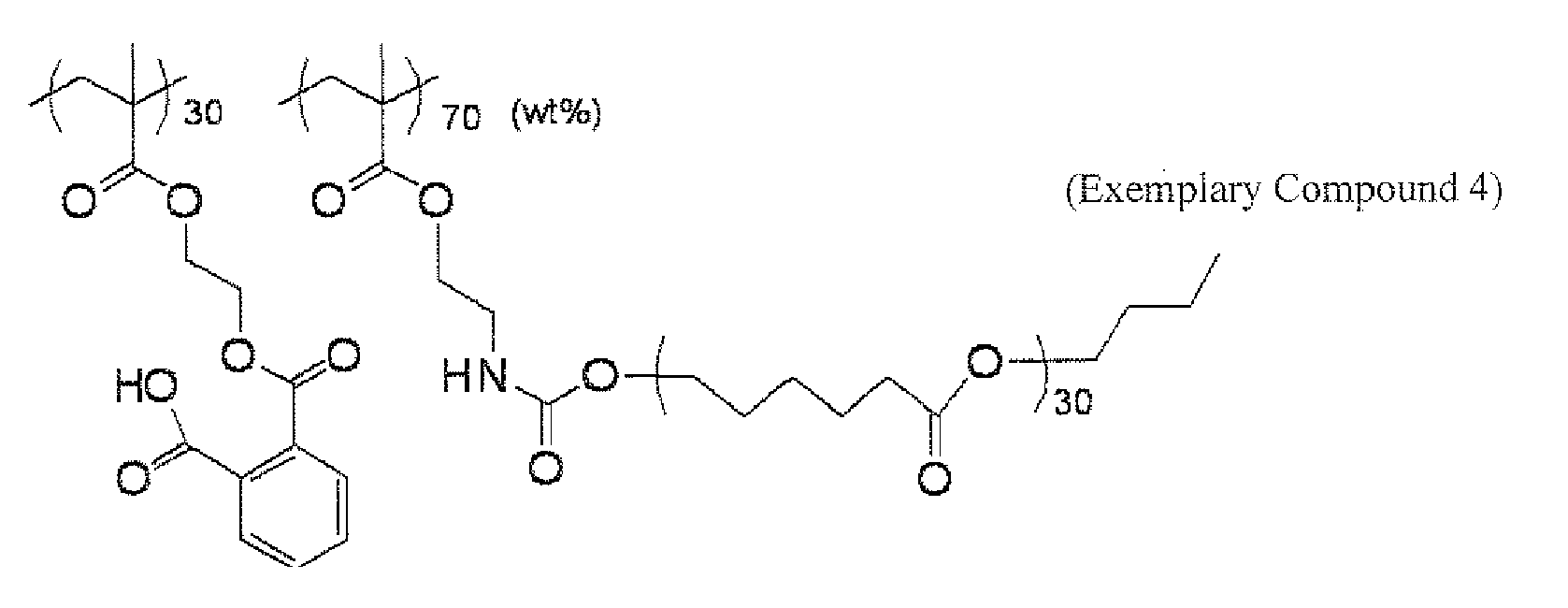
-


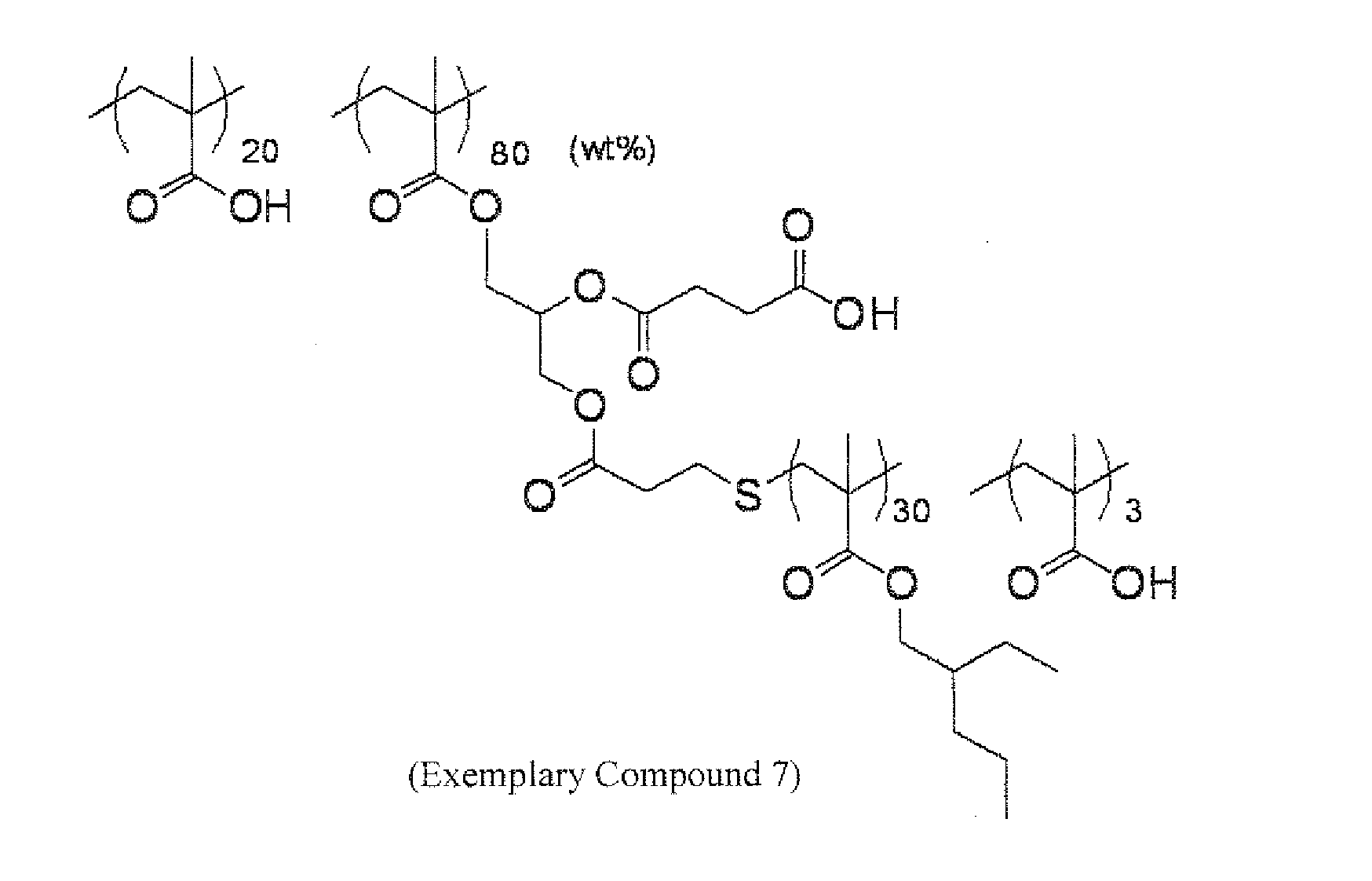
-


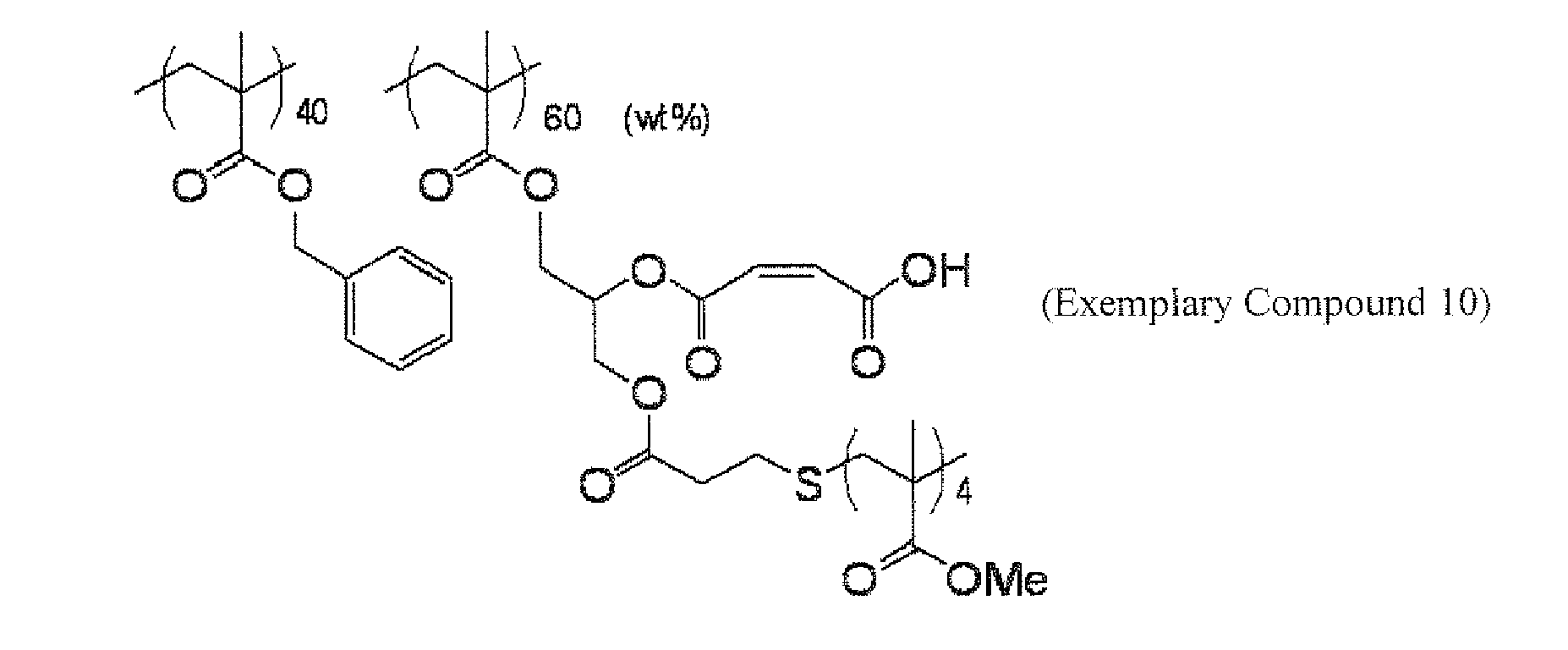

-


-


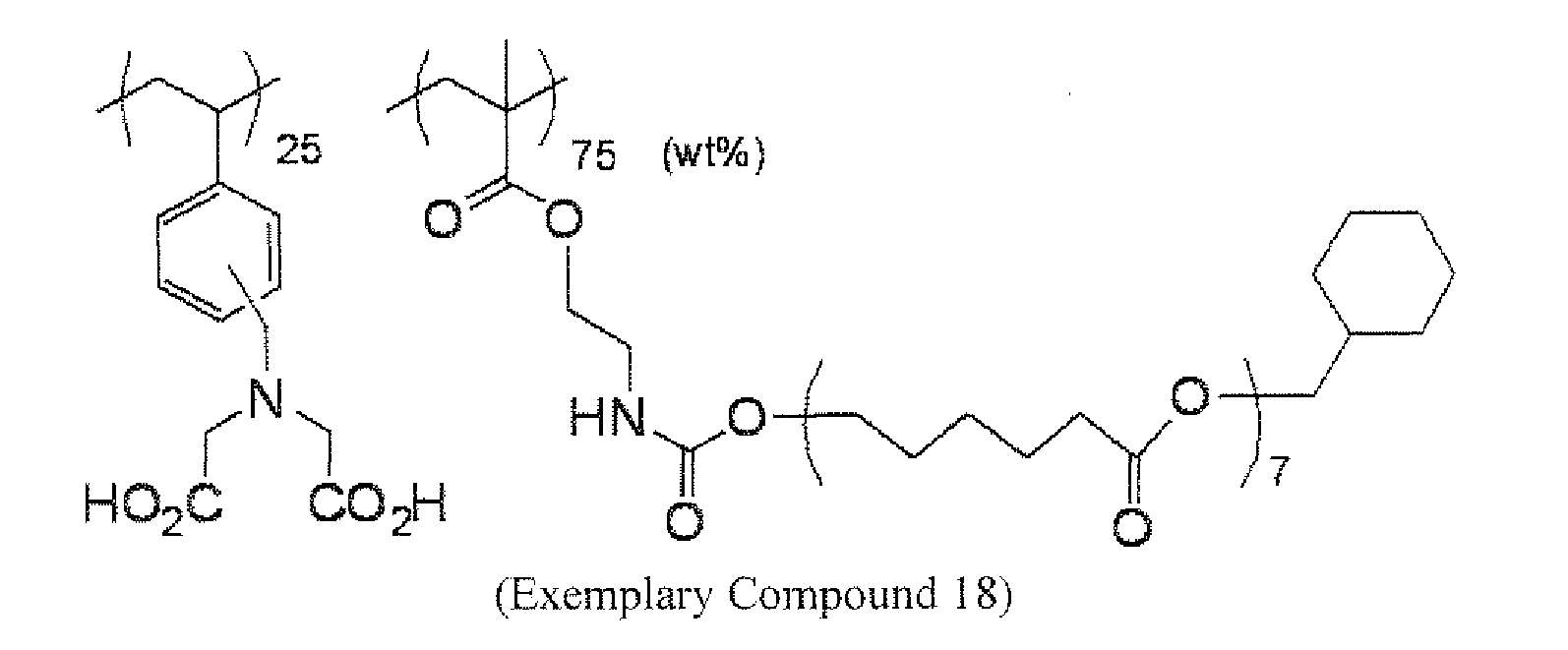

-


-


-


-


-


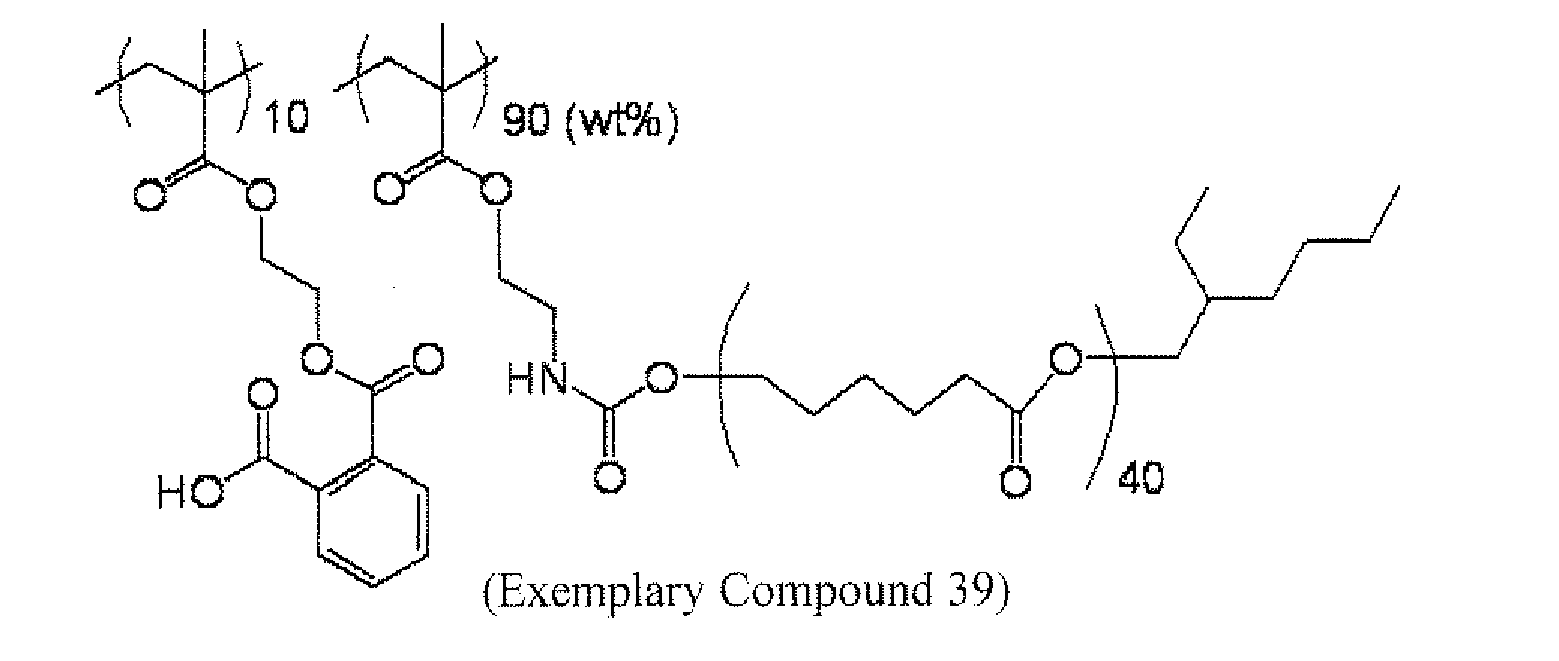
-


-


-


-


- In addition to the components described above, the dispersion composition of the invention may further contain components of the photosensitive resin composition which will be described hereinafter (e.g., a resin, a photopolymerization initiator, and a polymerizable compound). That is, a photosensitive resin composition may be produced in the process of producing the dispersion composition.
- The method of producing a photosensitive resin composition for a light-shielding color filter (hereinafter, which may be simply referred to as "photosensitive resin composition") of the invention includes: a first dispersion process in which a mixed liquid containing at least titanium black, a dispersant, the solvent 1, and the solvent 2 is subjected to a dispersion treatment without using a medium, wherein the content of the solvent 2 is 5% by mass or more with respect to the total content of the solvents 1 and 2; and a second dispersion process in which the dispersion liquid obtained by the first dispersion process is subjected to an additional dispersion treatment using a medium, in a process of producing a photosensitive resin composition for a light-shielding color filter containing titanium black, a dispersant, a resin, a polymerizable compound, a photopolymerization initiator, the solvent 1, and the solvent 2.
Further, the photosensitive resin composition for a light-shielding color filter of the invention is one produced by the method of producing a photosensitive resin composition for a light-shielding color filter of the invention. - According to the photosensitive resin composition of the invention and the method of producing the same, precipitation of titanium black is prevented, and the dispersion stability is dramatically improved.
Further, the leakage in light shielding caused by the coated surface abnormalities when the dispersion composition is made into a coating film is suppressed. - In the method of producing a photosensitive resin composition of the invention, the timing at which each component is added is not particularly limited as long as the dispersion treatments in the first and second dispersion processes are performed in the process of producing a photosensitive resin composition which contains at least titanium black, a dispersant, a resin (a resin other than the dispersant), a polymerizable compound, a photopolymerization initiator, and solvents (the solvents 1 and 2).
For example, a photosensitive resin composition may be made by producing a dispersion composition by the method of producing a dispersion composition of the invention, which is described above, and adding components such as a resin, a polymerizable compound, and a photopolymerization initiator (and a solvent, if necessary) to the produced dispersion composition.
Alternatively, in the method of producing a dispersion composition of the invention, at least one of a resin, a polymerizable compound, and a photopolymerization initiator is added in advance and the rest of the components such as a photosensitive resin composition may be added to the produced dispersion composition.
Alternatively, in the method of producing a dispersion composition of the invention, all of the resin, polymerizable compound, and photopolymerization initiator are added to produce a photosensitive resin composition as a dispersion composition. - Among the components of the photosensitive resin composition of the invention, titanium black, the dispersant, and the solvents 1 and 2 are as described in the section "Dispersion composition and method for producing the same", and preferable ranges thereof are also the same as those described therein.
Hereinafter, the resin, polymerizable compounds, photopolymerization initiators, and other components included in the photosensitive resin composition of the invention will be described in detail. - The photosensitive resin composition of the invention includes a resin (i.e., a resin other than the dispersant).
It is preferable to use a linear organic polymer as the resin. As such a linear organic polymer, any one of known linear organic polymers may be arbitrarily used. It is preferable to select a linear organic polymer soluble or swellable in water or weak alkali water in order to make water development or weak alkali water development possible. - The linear organic polymer is selected according to the application not only as a coat forming material but also as a developing material in water, weak alkali water, or organic solvent. For example, the use of a water-soluble organic polymer enables water development.
Examples of linear organic polymers include radical polymers having a carboxylic group in the side chain, for example, polymers described inJP-A No. 59-44615 JP-B Nos. 54-34327 58-12577 54-25957 JP-ANos. 54-92723 59-53836 59-71048
Among the linear organic polymers, the linear organic polymer soluble or swellable in water or weak alkali water may be hereinafter referred to as "alkali soluble resin". - Among them, a (meth)acrylic resin having an allyl group, a vinyl ester group, or the like and a carboxyl group in the side chain, an alkali-soluble resin having a double bond in the side chain described in
JP-A No. 2000-187322 JP-A No. 2002-62698 JP-A No. 2001-242612 JP-B No. 7-12004 7-120041 7-120042 8-12424 JP-A No. 63-287944 63-287947 1-271741 JP-A No. 2002-107918 993966 1204000 orJP-A No. 2001-318463 - Among the resins, a resin having a polymerizable group is preferable; a resin having a group containing a double bond as the polymerizable group is more preferable; and a resin having an acryloyl group or a methacryloyl group is further preferable. The resin may be any of a random polymer, a block polymer, and a graft polymer.
- The weight average molecular weight of the resin is preferably 5,000 or more, and further preferably in the range of from 10,000 to 300,000. The number average molecular weight thereof is preferably 1,000 or more, further preferably in the range of from 2,000 to 250,000. The degree of polydispersion (i.e., weight average molecular weight/number average molecular weight) is preferably I or more, and further preferably in the range of from 1.1 to 10.
- Only one species of the resin may be used singly, or a combination of two or more species thereof may be used.
The content of the resin in the total solid content of the photosensitive resin composition (which means the total content in the case in which two or more species of resins are used) is not particularly limited, and it is preferably from 5 to 50% by mass, more preferably from 10 to 40% by mass, and particularly preferably from 10 to 35% by mass, from the viewpoint of more effectively obtaining the effects of the invention. - The photosensitive resin composition of the invention includes at least one polymerizable compound.
Examples of polymerizable compounds include an addition-polymerizable compound having at least one ethylenic unsaturated double bond. Specifically, the polymerizable compound is selected from the compounds having at least one, preferably two or more, terminal ethylenic unsaturated bond(s). Such compounds are widely known in the field of industry, and any of them may be used in the invention without particular limitation. These compounds may have any of chemical forms such as monomer, prepolymer, namely, dimer, trimer or oligomer, and a mixture or (co)polymer thereof. - Examples of monomers and (co)polymers thereof include unsaturated carboxylic acids (such as acrylic acid, methacrylic acid, itaconic acid, crotonic acid, isocrotonic acid, and maleic acid), and esters and amides thereof, and copolymers thereof. Preferable examples thereof include esters of an unsaturated carboxylic acid and an aliphatic polyalcohol compound, amides of an unsaturated carboxylic acid and an aliphatic polyamine compound, and (co)polymers thereof. Additionally, reaction products obtained from unsaturated carboxylic acid esters or amides having a nucleophilic substituent group such as a hydroxyl group, an amino group, or a mercapto group and monofunctional or polyfunctional isocyanates or epoxies; and dehydration condensation reaction products of unsaturated carboxylic acid esters or amides having a nucleophilic substituent group such as a hydroxyl group, an amino group, or a mercapto group and monofunctional or polyfunctional carboxylic acids are suitably used. Further, addition reaction products of unsaturated carboxylic acid esters or amides having an electrophilic substituent group such as an isocyanate group or an epoxy group and monofunctional or polyfunctional alcohols, amines, or thiols; and substitution reaction products of unsaturated carboxylic acid esters or amides having a leaving substituent such as a halogen group or a tosyloxy group and monofunctional or polyfunctional alcohols, amines or thiols are also suitable. Alternatively, as another example, compounds obtained by replacing the unsaturated carboxylic acid with an unsaturated phosphonic acid, styrene, or vinyl ether may be used.
- Specific examples of monomers of the esters of an aliphatic polyhydric alcohol compound and an unsaturated carboxylic acid include: acrylic acid esters such as ethylene glycol diacrylate, triethylene glycol diacrylate, 1,3-butanediol diacrylate, tetramethylene glycol diacrylate, propylene glycol diacrylate, neopentyl glycol diacrylate, trimethylol propane triacrylate, trimethylol propane tri(acryloyloxypropyl)ether, trimethylol ethane triacrylate, hexanediol diacrylate, 1.4-cyclohexanediol diacrylate, tetraethylene glycol diacrylate, pentaerythritol diacrylate, pentaerythritol triacrylate, pentaerythritol tetraacrylate, dipentaerythritol diacrylate, dipentaerythritol hexaacrylate, sorbitol triacrylate, sorbitol tetraacrylate, sorbitol pentaacrylate, sorbitol hexaacrylate, tri(acryloyloxyethyl)isocyanurate, polyester acrylate oligomer and isocyanuric acid EO-modified triacrylate; methacrylic acid esters such as tetramethylene glycol dimethacrylate, triethylene glycol dimethacrylate, neopentyl glycol dimethacrylate, trimethylolpropane trimethacryiate, trimethylolethane trimethacrylate, ethylene glycol dimethacrylate, 1,3-butanediol dimethacrylate, hexanediol dimethacrylate, pentaerythritol dimethacrylate, pentaerythritol trimethacrylate, pentaerythritol tetramethacrylate, dipentaerythritol dimethacrylate, dipentaerythritol hexamethacrylate, sorbitol trimethacrylate, sorbitol tetramethacrylate, bis[p-(3-methacryloxy-2-hydroxypropoxy)phenyl]dimethylmethane, and bis-[p-(methacryloxyethoxy)phenyl]dimethylmethane; itaconic acid esters such as ethylene glycol diitaconate, propylene glycol diitaconate, 1,3-butanediol diitaconate, 1,4-butanediol diitaconate, tetramethylene glycol diitaconate, pentaerythritol diitaconate, and sorbitol tetraitaconate; crotonic acid esters such as ethylene glycol dicrotonate, tetramethylene glycol dicrotonate, pentaerythritol dicrotonate, and sorbitol tetradicrotonate; isocrotonic acid esters such as ethylene glycol diisocrotonate, pentaerythritol diisocrotonate, and sorbitol tetraisocrotonate; maleic acid esters such as ethylene glycol dimaleate, triethylene glycol dimaleate, pentaerythritol dimaleate, and sorbitol tetramaleate. Examples of other esters to be suitably used include aliphatic alcohol esters described in
JP-A No. 51-47334 57-196231 JP-A No. 59-5240 59-5241 2-226149 JP-A No. 1-165613 - Specific examples of the monomers of an amide of an aliphatic polyhydric amine compound with an unsaturated carboxylic acid include methylene bis-acrylamide, methylene bis-methacrylamide, 1,6-hexamethyelne bis-acrylamide, 1,6-hexamethyelne bis-methacrylamide, diethylenetriamine trisacrylamide, xylylene bisacrylamide, and xylylene bismethacrylamide. Other preferable examples of amide monomers include those having a cyclohexylene structure described in
JP-B No. 54-21726
Further, a urethane addition-polymerizable compound produced by an addition reaction between an isocyanate and a hydroxyl group may be suitably used. Specific examples thereof include vinyl urethane compounds having two or more polymerizable vinyl groups per molecule thereof, which are obtained by adding a vinyl monomer containing a hydroxyl group as represented by the following Formula (A) to a polyisocyanate compound having two or more isocyanate groups per molecule thereof, as described in, for example,JP-B No. 48-41708
CH2=C(R4)COOCH2CH(R5)OH (A)
In Formula (A), R4 and R5 independently represent H or CH3. - As for these polymerizable compounds, details of the method of use such as their structures, the single or combination use, or the addition amount may be arbitrarily determined depending on the final performance design of the photosensitive resin composition. For example, from the viewpoint of sensitivity, a structure having a large content of unsaturated groups per molecule is preferably used. In many cases, a difunctional or more functional compound is preferably used. From the viewpoint of increasing the strength of a cured film, a trifunctional or more functional compound is preferably used.
Use of a combination of compounds having different functional number and/or different species of polymerizable groups (e.g., an acrylic acid ester, a methacrylic acid ester, a styrene compound, and a vinyl ether compound) is also effective for controlling both the sensitivity and the strength. The selection and usage method of the polymerizable compound are important factors also for the compatibility with other components (e.g., a photopolymerization initiator, a coloring agent (a pigment or a dye), and a binder polymer) and the dispersibility thereof. For example, the compatibility may be improved by using a compound having a low purity or a combination of two or more compounds. From the viewpoint of improving the adhesion to a hard surface such as a support, a specific structure may also be selected. - The content of the polymerizable compound in the total solid content of the photosensitive resin composition (which means the total content in the case in which two or more species of polymerizable compounds are used) is not particularly limited, and it is preferably from 10 to 80% by mass, more preferably from 15 to 75% by mass, and particularly preferably from 20 to 60% by mass, from the viewpoint of more effectively obtaining the effects of the invention.
- The photosensitive resin composition of the invention contains at least one photopolymerization initiator. The photopolymerization initiator is not particularly limited as long as it can polymerize the photopolymerizable compound. It is preferably selected from the viewpoint of characteristics, initiation efficiency, absorption wavelength, availability, and cost.
- Examples of photopolymerization initiators include at least one active halogen compound selected from halomethyloxadiazole compounds and halomethyl-s-triazine compounds, 3-aryl-substituted coumarin compounds, lophine dimers, benzophenone compounds, acetophenone compounds and derivatives thereof, cyclopentadiene-benzene-iron complexes and salts thereof, and oxime compounds. Among them, the oxime compounds are preferable from the viewpoint of suppressing the releasing of a light-shielding color filter (i.e., release of a light-shielding color filter formed, particularly, on a substrate having a structure).
- The oxime compound (which may be hereinafter referred to as "oxime photopolymerization initiator") is not particularly limited. Examples of oxime compounds include oxime compounds described in
JP-A No. 2000-80068 WO02/100903 Al JP-A No. 2001-233842
Specific examples of oxime compounds include, but not limited to,
2-(O-benzoyloxime)-1-[4-(phenylthio)phenyl]-1,2-butanedione, 2-(O-benzoyloxime)-1-[4-(phenylthio)phenyl]-1,2-pentanedione, 2-(O-benzoyloxime)-1-[4-(phenylthio)phenyl]-1,2-hexanedione, 2-(O-benzoyloxime)-1-[4-(phenylthio)phenyl]-1,2-heptanedione, 2-(O-benzoyloxime)-1-[4-(phenylthio)phenyl]-1,2-octanedione, 2-(O-benzoyloxime)-1-[4-(methylphenylthio)phenyl]-1,2-butanedione, 2-(O-benzoyloxime)-1-[4-(ethylphenylthio)phenyl]-1,2-butanedione, 2-(O-benzoyloxime)-1-[4-(butylphenylthio)phenyl]-1,2-butanedione, 1-(O-acetyloxime)-1-[9-ethyl-6-(2-methylbenzoyl)-9H-carbazol-3-yl]ethanone, 1-(O-acetyloxime)-1-[9-methyl-6-(2-methylbenzoyl)-9H-carbazol-3-yl]ethanone, 1-(O-acetyloxime)-1-[9-propyl-6-(2-methylbenzoyl)-9H-carbazol-3-yl]ethanone, 1-(O-acetyloxime)-1-[9-ethyl-6-(2-ethylbenzoyl)-9H-carbazol-3-yl]ethanone, and 1-(O-acetyloxime)-1-[9-ethyl-6-(2-butylbenzoyl)-9H-carbazol-3-yl]ethanone. - Among them, preferable examples include
2-(O-benzoyloxime)-1-[4-(phenylthio)phenyl]-1,2-octanedione and
1-(O-acetyloxime)-1-[9-ethyl-6-(2-methylbenzoyl)-9H-carbazol-3-yl]ethanone, Specific examples thereof include CGI-124 and CGI-242 (both trade names, manufactured by Ciba Specialty Chemicals). - The photopolymerization initiator may be used in combination with a sensitizer, a light stabilizer, or the like.
Further, known initiators other than the photopolymerization initiators may be used for the photosensitive resin composition of the invention. - Only one of the photopolymerization initiators may be used singly, or a combination of two or more thereof may be used.
The content of the photopolymerization initiator in the total solid content of the photosensitive resin composition (which means the total content in the case in which two or more species of photopolymerization initiators are used) is preferably from 3 to 20% by mass, more preferably from 4 to 19% by mass, and particularly preferably from 5 to 18% by mass, from the viewpoint of more effectively obtaining the effects of the invention. - The photosensitive resin composition according to the invention may contain a surfactant in order to improve the coatability. Examples of the surfactant include various surfactants such as a fluorine-containing surfactant, a nonionic surfactant, a cationic surfactant, an anionic surfactant, and a silicone surfactant.
- In particular, when the photosensitive resin composition according to the invention contains a fluorine-containing surfactant, the liquid properties (in particular, fluidity) of the composition prepared as a coating liquid are improved, and the uniformity of the coating thickness and the liquid saving property can be improved.
That is, when a photosensitive resin composition including a fluorine-containing surfactant is used as a coating liquid to form a film, the wettability on the surface to be coated is improved due to decrease in the surface tension between the surface to be coated and the coating liquid, and the coatability on the surface to be coated is improved. Therefore, even when a thin film of several micrometers thickness is formed with a small amount of the liquid, a film with uniform thickness may be suitably formed. - The fluorine content in the fluorine-containing surfactant is preferably from 3% by mass to 40% by mass, more preferably from 5% by mass to 30% by mass, and still more preferably from 7% by mass to 25% by mass. When the fluorine content of the fluorine-containing surfactant is within the above range, it is effective in terms of the uniformity of the coating film thickness and the liquid saving, and excellent solubility in the photosensitive resin composition can be achieved.
- Examples of the fluorine-containing surfactant include MEGAFAC F171, F172, FI73, F176, F177, F14L, F142, F143, F144, R30, F437, F475, F479, F482, F554, F780 and F781 (all trade names, manufactured by DIC Corporation), FLUORAD FC430, FC431 and FC171 (all trade names, manufactured by Sumitomo 3M Limited), SURFLON S-382, SC-101, SC-103, SC-104, SC-105, SC-1068, SC-381, SC-383, S-393 and KH-40 (all trade names, manufactured by Asahi Glass Co., Ltd.), and SOLSPERSE 20000 (trade name, manufactured by Lubrizol Japan Limited).
- Examples of the nonionic surfactant include glycerol, trimethylolpropane and trimethylolethane, and an ethoxylate or propoxylate product thereof (such as glycerol propoxylate or glycerin ethoxylate); polyoxyethylene lauryl ether, polyoxyethylene stearyl ether, polyoxyethylene oleyl ether, polyoxyethylene octyl phenyl ether, polyoxyethylene nonyl phenyl ether, polyethylene glycol dilaurate, polyethylene glycol distearate, and sorbitan fatty acid esters such as PLURONIC L10, L31, L61, L62, 10R5, 17R2 and 25R2, and TETRONIC 304, 701, 704, 901, 904 and 150R1 (all trade names, manufactured by BASF).
- Examples of the cationic surfactant include phthalocyanine derivatives s such as EFKA-745 (trade name, manufactured by Morishita & Co., Ltd.), organosiloxane polymers such as KP341 (trade name, manufactured by Shin-Etsu Chemical Co., Ltd.); (meth)acrylic acid (co)polymers such as POLYFLOW No.75, No.90, No.95 (all trade names, manufactured by Kyoeisha Chemical Co., Ltd.); and W001 (trade name, available from Yusho Co., Ltd.).
- Examples of the anionic surfactant include W004, W005 and W017 (all trade names, available from Yusho Co., Ltd.).
- Examples of the silicone surfactant include TORAY SILICONE DC3PA, SH7PA, DC11PA, SH21PA, SH28PA, SH29PA, SH30PA and SH8400 (all trade names, manufactured by Dow Corning Toray Co., Ltd.), TSF-4440, TSF-4300, TSF-4445, TSF-4460 and TSF-4452 (all trade names, manufactured by Momentive Performance Materials Inc.), KP341, KF6001, and KF6002 (all trade names, manufactured by Shin-Etsu Chemical Co., Ltd.), and BYK307, BYK323 and BYK330 (trade names, manufactured by BYK Chemie).
Any one of these surfactants may be used shingly, or a combination of two or more thereof may be used. - When the photosensitive resin composition contains a surfactant, the amount of the surfactant to be added is preferably from 0.001% by mass to 2.0% by mass, more preferably from 0.005% by mass to 1.0% by mass, with respect to the total mass of the photosensitive resin composition.
- The photosensitive resin composition of the invention may contain a solvent component. The solvent component is as described in the section "Dispersion composition and method for producing the same", and preferable ranges thereof are also the same as those described therein.
The photosensitive resin composition may contain at least one component selected from known additive agents such as a sensitizer, a co-sensitizer, a thermal polymerization inhibitor, adhesion improvers (e.g., a silane coupling agent and a titanium coupling agent) for improving the adhesion to a hard surface such as a support, an inorganic filler and a plasticizer for improving physical properties of a cured film, and an oil-sensitizing agent. If necessary, the photosensitive resin composition may contain a chain transfer agent, an azo compound that increases the cure degree of a film owing to post-heating performed after light exposure and development, a thermal polymerization initiator such as a peroxide compound, a thermal polymerization component, an ultraviolet absorber such as alkoxy benzophenone, a plasticizer such as dioctyl phthalate, a development improver such as a low-molecular-weight organic carboxylic acid, as well as various additives such as a filler, a polymeric compound other than the alkali-soluble resin, an antioxidant or aggregation inhibitor, or a polyfunctional thiol or an epoxy compound that for the purpose of increasing film strength and sensitivity. - As for the sensitizer, a sensitizer which sensitizes the photopolymerization initiator by an electronic transition mechanism or an energy transfer mechanism is preferably used. Examples of sensitizers include those belonging to the compounds as listed below and having an absorption wavelength in a wavelength region of from 300 nm to 450 nm. Examples thereof include polynuclear aromatic compounds (e.g., phenanthrene, anthracene, pyrene, perylene, triphenylene, 9,10-dialkoxyanthracene), xanthenes, thioxanthones, cyanines, merocyanines, phthalocyanines, thiazines, acridines, anthraquinones, squaryliums, acridine orange, coumarins, ketocoumarin, phenothiazins, phenazines, styryl benzenes, azo compounds, diphenylmethane, triphenylmethane, distyrylbenzenes, carbazoles, porphyrin, spiro compounds, quinacridone, indigo, styryl, pyrylium compounds, pyrromethene compounds, pyrazolotriazole compounds, benzothiazole compounds, barbituric acid derivatives, thiobarbituric acid derivatives, aromatic ketone compounds such as acetophenone, benzophenone, thioxanthone, or Michler's ketone, and heterocycle compounds such as N-aryl oxazolidinone.
Further, the co-sensitizer has a function of further improving the sensitivity of the photopolymerization initiator or sensitizer toward actinic radiation or suppressing polymerization inhibition of a photopolymerizable compound caused by oxygen. Examples of co-sensitizers include amines (such as triethanolamine, p-dimethylaminobenzoic acid ethyl ester, p-formyidimethylaniline, and p-methylthiodimethylaniline), thiols and sulfides (such as 2-mercaptobenzothiazole, 2-mercaptobenzooxazole, 2-mercaptobenzimidazole, 2-mercapto-4(3H)-quinazoline, and β-mercaptonaphthalene), amino acid compounds (e.g., N-phenylglycine), organometallic compounds (e.g., tributyltin acetate), hydrogen donors, and sulfur compounds (e.g. trithiane). - Unnecessary thermal polymerization of the photopolymerizable compound during the production or storage of the composition may be prevented by adding the thermal polymerization inhibitor. Examples of thermal polymerization inhibitors include hydroquinone, p-methoxyphenol, di-t-butyl-p-cresol, pyrogallol, t-butyl-catechol, benzoquinone, 4,4'-thiobis(3-methyl-6-t-butylphenol),
2,2'-methylenebis(4-methyl-6-t-butylphenol), and N-nitrosophenylhydroxyamine cerium (I) salt. If necessary, higher fatty acid derivatives such as behenic acid and behenic acid amide may be added to prevent the polymerization inhibition caused by oxygen. The derivatives may be unevenly distributed on the surface of the coating film in the process of drying after the coating. - The light-shielding color filter of the invention is one formed using the photosensitive resin composition of the invention.
Since the light-shielding color filter of the invention is formed using the photosensitive resin composition of the invention in which the occurrence of coated surface abnormalities (i.e., leakage in light shielding) is inhibited when the dispersion composition is made into a coating film, the leakage in light shielding in the light-shielding color filter is suppressed; therefore, the light-shielding color filter has an excellent light-shielding capability. - The light-shielding color filter refers to a light-shielding pattern obtained by exposing and developing a photosensitive resin composition containing at least a black coloring material, a photopolymerizable compound, a resin, a photopolymerization initiator, and a solvent. The color of the light-shielding color filter may be an achromatic color such as black or gray, or may be black, gray, or the like with which a tint of chromatic color has been mixed. Since the light-shielding color filter is obtained by exposing and developing a photosensitive resin composition containing at least a black coloring material, a photopolymerizable compound, a resin, a photopolymerization initiator and a solvent, it may also be referred to as a light-shielding film or a light-shielding filter.
The light-shielding color filter can be preferably used for various applications such as, in a solid-state image sensor, for blocking light in portions other than a light receiving portion in a surface at which a light receiving element is formed, for blocking light on a surface opposite to the surface at which a light receiving element is formed, or for use as a pixel for adjusting color (for example, pixels of achromatic color such as black or gray, or pixels of black, gray, or the like with which chromatic colors have been mixed). - The film thickness of the light-shielding color filter is not particularly limited, and is preferably from 0.1 µm to 10 µm, more preferably from 0.3 µm to 5.0 µm, and still more preferably from 0.5 µm to 3.0 µm, in order to obtain the effects of the invention more efficiently. The pattern size of the light-shielding color filter is not particularly limited and is preferably from 1,000 µm or smaller, more preferably from 500 µm or smaller, and still more preferably from 300 µm or smaller, in order to obtain the effects of the invention more efficiently. The lower limit of the pattern size is preferably I µm.
- Spectral characteristics of the light-shielding color filter of the invention are not particularly limited. From the viewpoint of improving light-shielding capability of an infrared region which may be required for the solid-state image sensor, the viewpoint of the balance in light-shielding capabilities between a visible region and an infrared region, and the viewpoint of obtaining the effects of the invention more effectively, the ratio [OD1200/OD365] of the optical density (OD1200) at a wavelength of 1,200 nm and the optical density (OD365) at a wavelength of 365 nm is preferably from 0.5 to 3.
The optical density (OD) is a value obtained by measuring the transmittance of the obtained film using a measuring apparatus (trade name: UV-3600, manufactured by Shimadzu Corporation) and converting the obtained transmittance (%T) by the following Equation B.
- In the invention, the optical density at a wavelength λ nm is indicated by "ODλ".
From the viewpoint of the balance of light-shielding capabilities between a visible region and an infrared region and the viewpoint of obtaining the effects of the invention more effectively, suitable conditions of the optical density of the light-shielding color filter are as follows. That is, the ratio [OD1200/OD365] is more preferably from 1.0 to 2.5, and particularly preferably from 1.3 to 2.0.
The optical density (OD1200) at a wavelength of 1200 nm of the light-shielding color filter is preferably from 1.5 to 10, and more preferably from 2 to 10.
The optical density (OD365) at a wavelength of 365 nm of the light-shielding color filter is preferably from 1 to 7, and more preferably from 2 to 6.
The optical density in the wavelength region of from 900 nm to 1300 nm of the light-shieiding color filter is preferably from 2 to 10, more preferably from 2 to 9, and particularly preferably from 2 to 8.
The ratio [OD900/OD365] of the light-shielding color filter is preferably from 1.0 to 2.5, and more preferably from 1.1 to 2.5.
The ratio [OD1100/OD365] of the light-shielding color filter is preferably from 0.6 to 2.5, and more preferably from 0.7 to 2.5.
The ratio [OD1300/OD365] of the light-shielding color filter is preferably from 0.4 to 2.3, and more preferably from 0.5 to 2.0. - The light-shielding color filter of the invention may be suitably used for solid-state image sensors such as a charge-coupled devices (CCD) or a complementary metal-oxide semiconductor (CMOS). Specifically, the light-shielding color filter of the invention is suitably used for a solid-state image sensor such as a CCD or CMOS having more than 1 million pixels.
Specifically, the filter is suitably used when it is a thin film having a thickness of 2 µm or less, and preferably 1 µm or less. In this case, the content of components which contribute to photolithography properties except the coloring agent in the film is relatively decreased. Moreover, the contents of other components are further decreased by the increased content of the black color material, and the transmission amount of light to the film is lowered. Therefore, the lower film portion which undergoes low-light exposure tends to be excessively developed, whereby an inverse tapered shape may be readily formed, and the pattern is easily separated. This becomes significant when the thickness of a film to be formed is from 0.005 µm to 0.9 µm, and more specifically from 0.1 µm to 0.7 µm. - The method of producing a light-shielding color filter of the invention includes:
- applying the photosensitive resin composition for a light-shielding color filter of the invention to a support to form a photosensitive layer (which may be hereinafter referred to as "photosensitive layer forming step");
- subjecting the photosensitive layer into pattern exposure (which may be hereinafter referred to as "exposing step"); and
- developing the photosensitive layer after the exposure to form a colored pattern (which may be hereinafter referred to as "developing step").
- In the photosensitive layer forming step, a photosensitive layer is formed by applying the photosensitive resin composition of the invention is applied to a support.
- Examples of supports include a photoelectric conversion element substrate which is used for a solid-state image sensor, such as a silicon substrate (or a silicon wafer) and a complementary metal oxide semiconductor (CMOS). Further, an undercoat layer may be provided on the support, if necessary, for the purpose of improving the adhesion with an upper layer, preventing substance diffusion, or for planarization of the substrate surface. In the light-shielding color filter of the invention and the method of producing the same, when a substrate (namely, a substrate having a patterned structure formed thereon) is used as a support, the effect of suppressing the releasing of the pattern of the invention is exerted more effectively. The patterned structure may be any one of various patterned structures such as a thin-film transistor, a photoelectric conversion element, or a passivation film and a color pattern (e.g., red, green, blue, or transparent pattern) which has been provided on the substrate before the light-shielding color filter is formed.
- Any one of various coating methods such as slit coating, ink-jetting, spin coating, flow casting coating, roll coating, or screen printing may be used as a method of coating the support with the photosensitive resin composition of the invention.
The thickness (i.e., dry film thickness) of a coating film formed using the photosensitive resin composition is preferably from 0.35 µm to 3.0 µm, and more preferably from 0.50 µm to 2.5 µm from the viewpoint of resolution and development properties. - The photosensitive resin composition which has been applied to the support is usually dried at 70 to 1.30°C for about 2 minutes to 4 minutes, thereby forming a photosensitive layer.
- In the exposing step, the photosensitive layer formed by the photosensitive layer forming step is subjected to pattern exposure using, for example, a mask and cured. When the photosensitive layer is exposed to light through a mask, only a photo-irradiated coating film portion is cured.
- It is preferable to perform exposure by irradiation with a radiation. Specifically, ultraviolet rays such as g-rays, h-rays, or i-rays are preferably used as the radiation which may be used at the time of exposing. A high-pressure mercury-vapor lamp is more preferably used. The irradiation intensity is preferably from 5 to 3,000 mJ, more preferably from 10 to 2,000 mJ, and most preferably from 10 to 1,000 mJ.
- After the exposing step, the photosensitive layer after the exposure is developed, for example, by an alkaline development treatment to form a colored pattern. In the developing step, dissolving a non-irradiated portion of the photosensitive layer obtained in the exposing step is dissolved using an alkaline aqueous solution, whereby only a photo-irradiated portion of the photosensitive layer is left.
- From the viewpoint that a basic circuit or the like is not damaged, an organic alkali developer is desirably used as a developer. Usually, the developing temperature is from 20 to 30°C and the developing time is from 20 seconds to 240 seconds.
- Examples of developers include an alkaline aqueous solution prepared by diluting an organic alkali compound with pure water so as to have a concentration of 0.001 to 10% by mass, and preferably 0.01 to 1% by mass. Usable examples of organic alkali compounds include aqueous ammonia, ethylamine, diethylamine, dimethylethanolamine, tetramethylammonium hydroxide, tetraethylammonium hydroxide, choline, pyrrole, piperidine, and 1,8-diazablcyclo-[5,4,0]-7-undecene. In this regard, when an alkaline aqueous solution is used as a developer, rinsing with pure water is generally performed after the development.
- If necessary, the method of producing a light-shielding color filter of the invention may further include curing the pattern after the development by heating and/or exposing (which may be referred to as " a curing step"), in addition to the photosensitive layer forming step, the exposing step, and the developing step.
- The solid-state image sensor of the invention has at least the light-shielding color filter of the invention. Since the solid-state image sensor of the invention has the light-shielding color filter of the invention in which the leakage in light shielding is suppressed, the noise which may be generated in the solid-state image sensor is reduced, and the solid-state image sensor has excellent color reproducibility.
- The structure of the solid-state image sensor is not particularly limited as long as it has the light-shielding color filter of the invention and has a structure that functions as a solid-state image sensor. Examples thereof include a structure which has: a support; and, on the support, multiple photodiodes that form a light-receiving area of a solid-state image sensor (e.g., CCD or CMOS image sensor) and a light-sensitive element made of polysilicon; and the light-shielding color filter of the invention at the light-sensitive element surface side of the support (e.g., at portions other than the light-receiving unit or at the color-adjusting pixel unit) or at the opposite side of the light-sensitive element surface side.
- Hereinafter, the invention will be described in more detail with reference to Examples. However, the invention is not limited to these Examples as long as it does not depart from the gist of the invention. Unless otherwise indicated, "part(s)" means "part(s) by mass". Further, the room temperature means 25°C.
- First, 600.0 g of ε-caprolactone and 22.8 g of 2-ethyl-1-hexanol were introduced into a 500-mL three-necked flask, and were stirred and dissolved while nitrogen was blown thereinto. Then, 0.1 g of monobutyltin oxide was added thereto, and the mixture was heated to 100°C. Eight hours later, the disappearance of the raw materials was confirmed by gas chromatography, and the mixture was cooled to 80°C. Then, 0.1 g of 2,6-di-t-butyl-4-methylphenol was added, and 27.2 g of 2-methacryloyloxyethyl isocyanate were added. Five hours later, the disappearance of the raw materials was confirmed by 1H-NMR, and the resulting mixture was cooled to room temperature, thereby obtaining 200 g of a precursor M1 (the following structure) in a solid state. The fact that the resulting product was the precursor M1 was confirmed by 1H-NMR, IR, and mass analysis.
-

- Next, 30.0 g of the precursor M1, 70.0 g of NK ester CB-1, 2.3 g of dodecyl mercaptan, and 233.3 g of propylene glycol monomethyl ether acetate were put into a nitrogen-substituted three-necked flask, and were stirred using a stirrer (trade name: THREE-ONE MOTOR, manufactured by Shinto Scientific Co., Ltd.) and heated up to 75°C while nitrogen was blown into the flask. Then, 0.2 g of dimethyl
2,2-azobis(2-methylpropionate) (trade name: V-601, manufactured by Wako Pure Chemical Industries, Ltd.) was added thereto, and the resulting mixture was heated and stirred at 75°C for 2 hours. Two hours later, 0.2 g of V-601 was additionally added thereto, and the mixture was heated and stirred for 3 hours, thereby obtaining a 30% solution of the following dispersant 1.
The composition ratio, acid value, and weight average molecular weight (Mw) of the dispersant 1 are shown in Table 1 below. The weight average molecular weight is a value obtained by measuring by gel permeation chromatography (GPC) and calculating in polystyrene equivalent. In GPC, an analyzer (trade name: HLC-8020GPC, manufactured by TOSOH CORPORATION) was used and columns (trade names: TSKGEL SUPERHZM-H, TSK GEL SUPER HZ4000, and TSK GEL SUPER HZ200, manufactured by TOSOH CORPORATION) were used. - The following dispersants 2 to 5 were synthesized by the same synthetic method as the synthetic method of the dispersant 1. The composition ratio, acid value, and weight average molecular weight (Mw) of these dispersants are shown in Table I below.
-


- A mixed liquid obtained by mixing the following composition was subjected to a dispersion treatment using a high-shear circulation type disperser (the first dispersion process; the dispersion apparatus and the dispersion conditions are shown below). Thereafter, a dispersion treatment using a bead mill (the second dispersion process; the dispersion apparatus and the dispersion conditions are shown below) was started.
- Composition of mixed liquid
Titanium black (trade name: 13M-T, manufactured by Mitsubishi Materials Corporation) 29.4 parts by mass Dispersant 1 26.5 parts by mass Solvents 1 and 2 (solvent species and mass ratio [solvent 1/solvent 2] are shown in Table 1) 44.1 parts by mass (the total of solvents 1 and 2) - · Dispersion apparatus: High-shear circulation type disperser (trade name: Magic LAB, manufactured by IKA)
· Dispersion conditions:Treatment time 30 min Water-cooled temperature 25 to 29°C Shear rate 230,000 (1/s) - · Dispersion apparatus: bead mill (trade name: ULTRA APEX MILL UAM015, manufactured by KOTOBUKI INDUSTRIES CO.,LTD)
· Treatment conditions:Diameter of beads ϕ0.05 mm Filling rate of beads 75% by volume Mill peripheral speed 12 m/sec Amount of mixed liquid to be treated 680 g Circulating flow amount (pump supply amount) 30 kg/hour Temperature of liquid to be treated 25 to 30°C Cooling water tap water Volume of circular path of bead mill 0.15 L - After the start of dispersion in the second dispersion process, the volume average particle diameter was measured at 30-minute intervals (time period for one pass) while the dispersion treatment was performed under the above-mentioned conditions. At this time, the volume average particle diameter decreased as the dispersion time increased (i.e., as the number of passes increased). However, the amount of change thereof gradually decreased. At the time at which the change in the volume average particle diameter per pass reached 10 nm or less each time the dispersion time period was extended by 30 minutes (namely, at the time at which the change in the volume average particle diameter reached 10 nm/pass or less; the process up to this time corresponding to the "first stage of dispersion treatment"), 120 g of propylene glycol monomethyl ether acetate solution of the dispersant 1. which has the composition shown below, was added to the dispersion liquid.
- Composition
· Dispersant 1 30 parts by mass · Propylene glycol monomethyl ether acetate 70 parts by mass - After the addition of the solution (dispersant), 10 passes of dispersion treatment was further continued. When the change in the volume average particle diameter per pass (30 minutes) reached 10 nm or less, the preparation of the titanium black dispersion liquid was completed.
The titanium black dispersion liquid was prepared in the manner described above. - The number of coarse particles included in the obtained titanium black dispersion liquid (i.e., the number of particles having a volume average particle diameter of 0.1 µm or more contained per 1 µL of the titanium black dispersion liquid) was measured.
The measurement was performed using a measuring apparatus (trade name: FPIA3000, manufactured by SYSMEX CORPORATION), and a sample obtained by 100-fold diluting the dispersion liquid.
The results of measurement are shown in Table 1. - The obtained titanium black dispersion liquid was subjected to precipitation test.
Specifically, a solid concentration (a) of the dispersion liquid before the passage of predetermined time (six months) and a solid concentration (b) of the dispersion liquid after the passage of time (six months) were respectively measured. The rate of change of solid concentration (%) was determined by the following Equation (1), and the precipitation property of titanium black was evaluated in accordance with the following evaluation criteria. The precipitation test was carried out under the conditions of room temperature and -5°C (refrigeration), respectively.
The evaluation results are shown in Table 1 below. -

-
- A: The rate of change of solid concentration was less than 3%.
- B: The rate of change of solid concentration was 3% or more and less than 10%.
- C: The rate of change of solid concentration was 10% or more.
- Here, the solid concentration was obtained in such a manner that 5 g of the dispersion liquid was weighed and heated in an oven at 165°C for 60 minutes, and then the amount of the dispersion liquid remaining after the heating was measured, followed by calculation according to the following Equation (2).
-

- The solid concentration after the passage of time was measured in the following manner: the titanium black dispersion liquid was put in 50-mL containers made of resin, and the containers were allowed to stand at either room temperature or at -5°C (refrigeration), respectively, for six months; 5 g of the supernatant liquid to a depth of 1 cm from the top of the liquid surface was collected; and the solid concentration of the obtained dispersion liquid was measured.
- The following components were mixed, thereby obtaining a photosensitive resin composition.
-
· Titanium black dispersion liquid prepared above 50 parts by mass · Dipentaerythritol hexaacrylate (T-1 shown below) 8 parts by mass · Oxime photopolymerization initiator (K-1 shown below) 5 parts by mass · Resin (J-1 shown below; the weight average molecular weight (Mw) is shown below) 10 parts by mass · Propylene glycol monoethyl ether acetate 27 parts by mass -

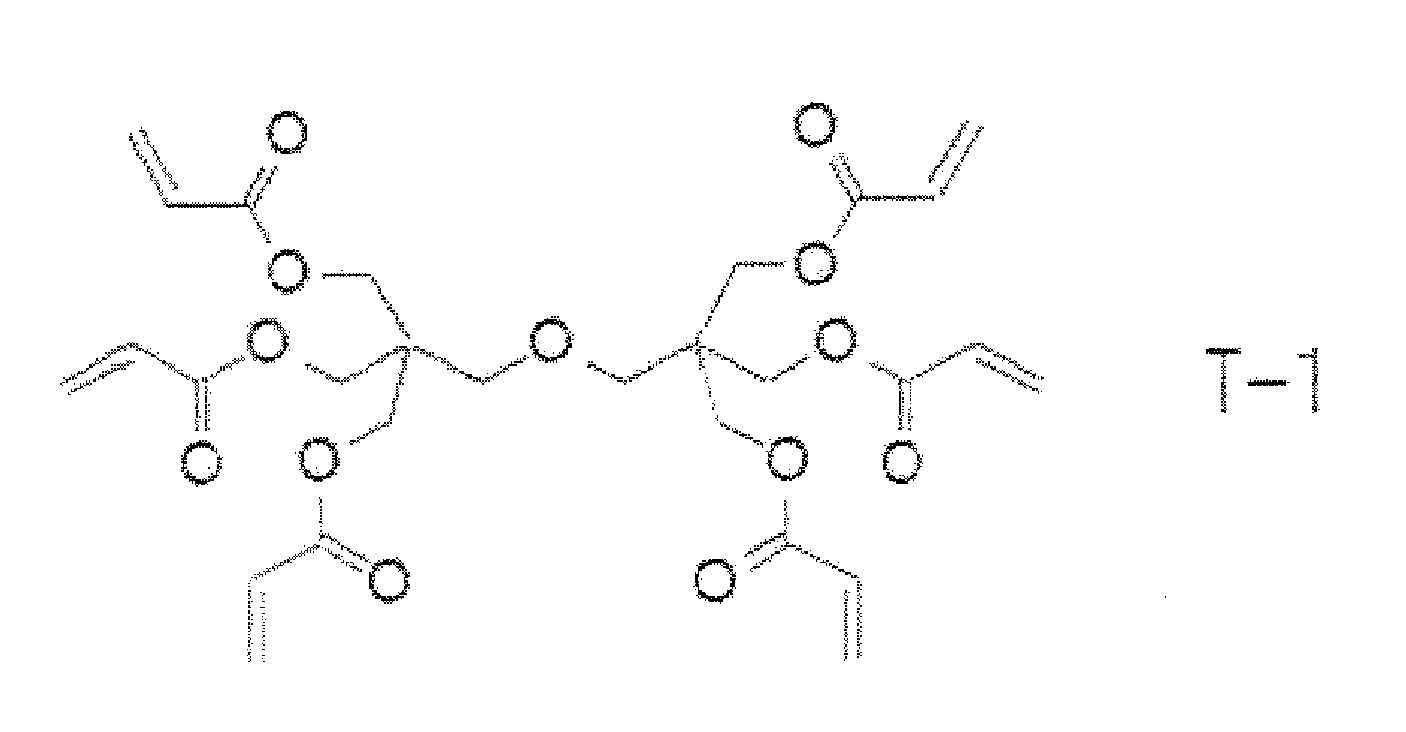

- The photosensitive resin composition was applied to a glass substrate by spin coating, and heated on a hot plate at 120°C for 2 minutes, thereby obtaining a photosensitive layer.
Subsequently, the photosensitive layer was exposed at an exposure amount of 200 mJ/cm2 using an i-line stepper, thereby obtaining a light-shielding film.
Regarding the obtained light-shielding film, the absorbance at a wavelength of 550 nm was measured using a spectroscope (trade name: UV3600, manufactured by Shimadzu Corporation), and the resulting value was defined as an absorbance (i). - Separately, the photosensitive resin composition was enclosed in a 100-mL glass container, and was allowed to stand at room temperature for six months. Then, the photosensitive resin composition was sampled at a depth of 2 cm from the liquid surface.
A light-shielding film was produced in the same manner as described above using the sampled photosensitive resin composition. The absorbance thereof was measured, and the resulting value was defined as an absorbance (ii).
The rate of change of absorbance before and after the six-month standing was calculated from the measured absorbances (i) and (ii). The temporal stability (i.e., storage stability) was evaluated in accordance with the following evaluation criteria.
Evaluation results are shown in Table 1. -
- A: The rate of change of absorbance was less than 3%.
- B: The rate of change of absorbance was 3% or more and less than 10%.
- C: The rate of change of absorbance was 10% or more.
- The glass substrate having the coating film formed thereon was irradiated with light from the rear surface thereof (i.e., the surface of the glass substrate at which the light-shielding film was not formed), and the surface state of the light-shielding film (i.e., the front surface of the glass substrate at which the light-shielding film was formed) was observed using an optical microscope (magnification: 100 times).
The leakage in light shielding considered to be a trace of bubbles was counted as the coated surface abnormality.
The results are shown in Table 1.
The number of leakage in light shielding present per an area of 0.01 m2 is shown in Table 1. - Titanium black dispersion liquids and photosensitive resin compositions of Examples 2 to 17 and Comparative Examples 1 to 5 were prepared in the same manner in Example 1 except that the dispersant 1 used for "Preparation of titanium black dispersion liquid" in Example I was respectively changed to the dispersants shown in Table 1 below, and the species of the solvent 2, the mass ratio [solvent 1/solvent 2], and the shear rate were changed, respectively. Then, the same evaluation as that of Example I was performed.
The results are shown in Table 1 below. -
Table 1 Dispersant Composition ratio Acid value (mgKOH/g) Mw Solvent I Solvent 2 Mass ratio [solvent 1/solvent 2] First dispersion process Shear rate (1/s) Evaluation X (% by mass) Y (% by mass) The number of coarse particles (particles/ µL) Precipitation property Temporal stability of the composition Coated surface abnurmality (the number) Room temperature -5°C Example 1 Dispersant 1 35 65 80 30000 PGMEA Butyl acetate 70/30 Included 230000 181 A A A 0 Example 2 Dispersant 1 70 30 120 31000 PGMEA Butyl acetate 70/30 Included 230000 192 A A A 1 Example 3 Dispersant 1 70 30 120 31000 PGMEA EFP 70/30 Included 230000 156 A A A 0 Example 4 Dispersant 1 70 30 120 31000 PGMEA Cyclohexanone 70/30 Included 230000 170 A A A 4 Example 5 Dispersant 1 70 30 120 31000 PGMEA PGME 70/30 Included 230000 125 A A A 2 Example 6 Dispersant 1 70 30 120 31000 PGMEA 2-heptanone 70/30 Included 230000 125 A A A 2 Example 7 Dispersant 2 70 30 115 31000 PGMEA Butyl acetate 70/30 Included 230000 132 A A A 3 Example 8 Dispersant 3 70 30 126 32900 PGMEA Butyl acetate 70/30 Included 230000 178 A A A 1 Example 9 Dispersant 4 70 30 100 29100 PGMEA Butyl acetate 70/30 Included 230000 168 A A A 1 Example 10 Dispersant 5 70 30 150 34500 PGMEA Butyl acetate 70/30 Included 230000 199 A A A 2 Example 11 Dispersant 1 70 30 120 31000 PGMEA Butyl acetate 95/5 Included 230000 50 A A A 0 Example 12 Dispersant 1 70 30 120 31000 PGMEA Butyl acetate 50/50 Included 230000 120 A A A 1 Example 13 Dispersant 1 70 30 120 31000 PGMEA Butyl acetate 75/25 Included 230000 130 B B A 3 Example 14 Dispersant 1 70 30 120 31000 PGMEA Butyl acetate 0/100 Included 230000 115 A A A 0 Example 15 Dispersant 1 70 30 120 31000 PGMEA Butyl acetate 60/40 Included 230000 110 A A A 0 Example 16 Dispersant 1 70 30 120 31000 PGMEA Butyl acetate 60/40 Included 230000 106 A A A 1 Example 17 Dispersant 1 70 30 120 31000 PGMEA Butyl acetate 60/40 Included 230000 94 A A A 0 Comparative Example 1 Dispersant 70 30 120 31000 PGMEA - 100/0 Included 230000 135 A A A 24 Comparative Example 2 Dispersant 2 70 30 115 31000 PGMEA - 100/0 Included 230000 134 A A A 31 Comparative Example 3 Dispersant 3 70 30 126 31000 PGMEA - 100/0 Included 230000 146 A A A 26 Comparative Example 4 Dispersant 4 70 30 100 31000 PGMEA - 100/0 Included 230000 164 A A A 27 Comparative Example 5 Dispersant 1 70 30 120 31000 PGMEA Butyl acetate 60/40 Not included - 8432 A A A 654 - The "mass ratio [solvent 1/solvent 2]" column shows the mass ratio [solvent 1/lsolvent 2] in the mixed liquid to be treated in the first dispersion process.
"PGMEA" is propylene glycol monomethyl ether acetate.
"PGME" is propylene glycol monoethyl ether.
"EEP" is 3-ethoxyethylpropionate. - As shown in Table 1, the precipitation of titanium black was suppressed, the storage stability with the passage of time was excellent, and the occurrence of coated surface abnormalities (i.e., leakage in light shielding) was suppressed in Examples of the invention.
Therefore, a light-shielding color filter with little leakage in light shielding may be produced by subjecting the light shielding film of the invention to pattern exposure and developing the light shielding film after the exposure to form a pattern. Further, a solid-state image sensor that has little noise and is excellent in color reproducibility may be produced using a substrate for a solid-state image sensor, in which a light-sensitive element such as a photodiode is formed, as a support in place of silicon wafers.
Further, the dispersion composition of the invention is a composition produced by the method of producing a dispersion composition of the invention.
Claims (12)
- A method of producing a dispersion composition comprising:a first dispersion process of producing a dispersion liquid by subjecting a mixed liquid comprising titanium black, a dispersant, propylene glycol monomethyl ether acetate, and at least one solvent selected from the group consisting of butyl acetate, 2-heptanone, ethyl 3-ethoxypropionate, cyclohexanone, and propylene glycol monomethyl ether to a dispersion treatment without using a medium, wherein a content of the solvent in the mixed liquid is 5% by mass or more relative to the total content of the propylene glycol monomethyl ether acetate and the solvent; anda second dispersion process of further subjecting the dispersion liquid obtained by the first dispersion treatment to a dispersion treatment using a medium.
- The method of producing a dispersion composition of claim 1, wherein the dispersant comprises a graft copolymer having a graft chain in which the total number of atoms other than hydrogen atoms is from 40 to 10,000.
- The method of producing a dispersion composition of claim 2, wherein the graft copolymer comprises a structural unit represented by at least one of the following Formulae (1) to (5):


- The method of producing a dispersion composition of claim 2 or 3, wherein the graft copolymer comprises a structural unit represented by at least one of Formulae (1) to (5) in a range of from 10% to 90% by mass relative to the total mass of the graft copolymer.
- The method of producing a dispersion composition of any one of claims 1 to 4, wherein the second dispersion process comprises:subjecting the dispersion liquid obtained by the first dispersion process to a dispersion treatment until the change in volume average particle diameter of the titanium black becomes 10 nm/pass or less and adding a dispersant to the resulting dispersion liquid, to which a further dispersion treatment is then performed.
- A dispersion composition, obtainable by the method of producing a dispersion composition of any one of claims I to 5.
- A method of producing a photosensitive resin composition for a light-shielding color filter including titanium black, a dispersant, a resin, a polymerizable compound, a photopolymerization initiator, propylene glycol monomethyl ether acetate, and at least one solvent selected from the group consisting of butyl acetate, 2-heptanone, ethyl 3-ethoxypropionate, cyclohexanone, and propylene glycol monomethyl ether, the method comprising a first dispersion process and a second dispersion process as defined in any of claims 1 to 5.
- A photosensitive resin composition for a light-shielding color filter, which is obtainable by the method of producing a photosensitive resin composition for a light-shielding color filter of claim 7.
- A use of the photosensitive resin composition of claim 8 for producing a color filter for a solid-state image sensor.
- A method of producing a light-shielding color filter, the method comprising:applying the photosensitive resin composition for a light-shielding color filter of claim 8 or 9 to a support to form a photosensitive layer;subjecting the photosensitive layer to pattern exposure; anddeveloping the photosensitive layer after the exposure to form a colored pattern.
- A light-shielding color filter, which is obtainable by the method of producing a light-shielding color filter of claim 10.
- A solid-state image sensor comprising the light-shielding color filter of claim 11.
Applications Claiming Priority (1)
| Application Number | Priority Date | Filing Date | Title |
|---|---|---|---|
| JP2009223127 | 2009-09-28 |
Publications (2)
| Publication Number | Publication Date |
|---|---|
| EP2302454A1 true EP2302454A1 (en) | 2011-03-30 |
| EP2302454B1 EP2302454B1 (en) | 2013-01-09 |
Family
ID=43480798
Family Applications (1)
| Application Number | Title | Priority Date | Filing Date |
|---|---|---|---|
| EP20100178699 Not-in-force EP2302454B1 (en) | 2009-09-28 | 2010-09-23 | Titanium black dispersion composition and method of producing the same, photosensitive resin composition and method of producing the same, light-shielding color filter and method of producing the same, and solid-state image sensor |
Country Status (2)
| Country | Link |
|---|---|
| EP (1) | EP2302454B1 (en) |
| JP (1) | JP5501175B2 (en) |
Cited By (3)
| Publication number | Priority date | Publication date | Assignee | Title |
|---|---|---|---|---|
| EP2550554A4 (en) * | 2010-03-25 | 2014-04-09 | Fujifilm Corp | BLACK CURABLE COMPOSITION, COLORED LIGHT PROTECTION FILTER FOR SEMICONDUCTOR IMAGING DEVICE AND METHOD FOR MANUFACTURING THE SAME, SEMICONDUCTOR IMAGING DEVICE, WAFER LENS, AND CAMERA MODULE |
| EP2985325A4 (en) * | 2013-04-12 | 2017-01-11 | Fujifilm Corporation | Composition for forming far-infrared radiation shielding layer |
| US20180355088A1 (en) * | 2016-02-29 | 2018-12-13 | Fujifilm Corporation | Dispersion composition, curable composition, light-shielding film, color filter, solid-state imaging device, image display device, resin, and method for manufacturing cured film |
Families Citing this family (5)
| Publication number | Priority date | Publication date | Assignee | Title |
|---|---|---|---|---|
| JP6136928B2 (en) * | 2011-08-30 | 2017-05-31 | 旭硝子株式会社 | Negative photosensitive resin composition, method for producing partition wall, and method for producing optical element |
| JP6155076B2 (en) * | 2012-04-10 | 2017-06-28 | 住友化学株式会社 | Colorant dispersion |
| CN104559313A (en) * | 2013-10-18 | 2015-04-29 | 住友化学株式会社 | Colorant dispersion |
| WO2018088052A1 (en) * | 2016-11-09 | 2018-05-17 | 昭和電工株式会社 | Positive photosensitive resin composition and titanium black dispersion liquid |
| JP6741616B2 (en) * | 2017-03-28 | 2020-08-19 | 富士フイルム株式会社 | Container, method of manufacturing container, and method of manufacturing cured film |
Citations (45)
| Publication number | Priority date | Publication date | Assignee | Title |
|---|---|---|---|---|
| JPS4841708B1 (en) | 1970-01-13 | 1973-12-07 | ||
| JPS495432A (en) | 1972-05-04 | 1974-01-18 | ||
| JPS5147334A (en) | 1974-10-21 | 1976-04-22 | Hitachi Ltd | BATSUFUAMEMORISEIGYOHOSHIKI |
| JPS5492723A (en) | 1977-12-30 | 1979-07-23 | Somar Mfg | Photosensitive material and use |
| JPS5425957B2 (en) | 1974-10-04 | 1979-08-31 | ||
| JPS5434327B1 (en) | 1970-12-28 | 1979-10-26 | ||
| JPS57196231A (en) | 1981-05-20 | 1982-12-02 | Hoechst Ag | Mixture able to be polymerized by radiation and copying material mainly composed thereof |
| JPS57205322A (en) | 1981-06-15 | 1982-12-16 | Mitsubishi Metal Corp | Manufacture of fine powder of black lower titanium oxide |
| JPS5812577B2 (en) | 1973-12-21 | 1983-03-09 | ヘキスト アクチエンゲゼルシヤフト | Photopolymerizable copying material |
| JPS595241A (en) | 1982-06-21 | 1984-01-12 | ヘキスト・アクチエンゲゼルシヤフト | Radiation polymerizable mixture |
| JPS595240A (en) | 1982-06-21 | 1984-01-12 | ヘキスト・アクチエンゲゼルシヤフト | Radiation polymerizable mixture |
| JPS5944615A (en) | 1982-09-07 | 1984-03-13 | Furuno Electric Co Ltd | Gyro device |
| JPS5953836A (en) | 1982-09-21 | 1984-03-28 | Fuji Photo Film Co Ltd | Photosensitive lithographic plate |
| JPS5971048A (en) | 1982-10-18 | 1984-04-21 | Mitsubishi Chem Ind Ltd | Photopolymerizable photosensitive composition |
| JPS6065069A (en) | 1983-09-21 | 1985-04-13 | Mitsubishi Metal Corp | Black pigment |
| JPS61201610A (en) | 1985-02-28 | 1986-09-06 | Mitsubishi Metal Corp | Black powder and its preparation |
| JPS63287944A (en) | 1987-05-21 | 1988-11-25 | Fuji Photo Film Co Ltd | Photosensitive composition |
| JPS63287947A (en) | 1987-05-21 | 1988-11-25 | Fuji Photo Film Co Ltd | Photosensitive composition |
| JPH01165613A (en) | 1987-11-16 | 1989-06-29 | Hoechst Ag | Polymerizable compound, radiation polymerizable mixture thereof and radiation polymerized recording material |
| JPH01271741A (en) | 1988-04-25 | 1989-10-30 | Fuji Photo Film Co Ltd | Photosensitive composition |
| JPH02226149A (en) | 1988-12-22 | 1990-09-07 | Hoechst Ag | Photopolymerizing compound, photopolymerizing mixture containing the same and photopolymerizing copying material manufactured therefrom |
| JPH07120042B2 (en) | 1987-05-21 | 1995-12-20 | 富士写真フイルム株式会社 | Photosensitive composition |
| JPH07120040B2 (en) | 1987-05-21 | 1995-12-20 | 富士写真フイルム株式会社 | Photosensitive composition |
| JPH07120041B2 (en) | 1987-05-21 | 1995-12-20 | 富士写真フイルム株式会社 | Photosensitive composition |
| JPH0812424B2 (en) | 1987-11-19 | 1996-02-07 | 富士写真フイルム株式会社 | Photosensitive composition |
| JP2000080068A (en) | 1998-06-26 | 2000-03-21 | Ciba Specialty Chem Holding Inc | New O-acyl oxime photoinitiator |
| EP0993966A1 (en) | 1998-10-13 | 2000-04-19 | Agfa-Gevaert AG | Negativ-working radiation-sensitive mixture for the production of a recording material which is imageable by heat or infrared laser beams |
| JP2000187322A (en) | 1998-10-15 | 2000-07-04 | Mitsubishi Chemicals Corp | Photosensitive composition, image forming material and image forming method using the same |
| JP2001233842A (en) | 1999-12-15 | 2001-08-28 | Ciba Specialty Chem Holding Inc | Oxime ester photoinitiator |
| JP2001242612A (en) | 2000-03-01 | 2001-09-07 | Fuji Photo Film Co Ltd | Image recording material |
| JP2001318463A (en) | 2000-05-11 | 2001-11-16 | Fuji Photo Film Co Ltd | Negative type original plate of planographic printing plate |
| JP2002062698A (en) | 2000-08-21 | 2002-02-28 | Kyocera Corp | Image forming machine |
| JP2002107918A (en) | 2000-10-03 | 2002-04-10 | Fuji Photo Film Co Ltd | Photosensitive planographic printing plate |
| EP1204000A1 (en) | 2000-11-06 | 2002-05-08 | Fuji Photo Film Co., Ltd. | Photosensitive lithographic printing plate |
| WO2002100903A1 (en) | 2001-06-11 | 2002-12-19 | Ciba Specialty Chemicals Holding Inc. | Oxime ester photoinitiators having a combined structure |
| WO2005037926A1 (en) | 2003-10-15 | 2005-04-28 | Toray Industries, Inc. | Black composition, black coating composition, resin black matrix, color filter for liquid crystal display and liquid crystal display |
| JP3724269B2 (en) | 1998-08-31 | 2005-12-07 | 東レ株式会社 | Black coating composition, resin black matrix, color filter and liquid crystal display device |
| JP2006182627A (en) | 2004-12-28 | 2006-07-13 | Ishihara Sangyo Kaisha Ltd | Blackish titanium oxynitride |
| JP2006209102A (en) | 2004-12-28 | 2006-08-10 | Dainippon Printing Co Ltd | Black resin composition for display element, and member for display element |
| JP2006206891A (en) | 2004-12-28 | 2006-08-10 | Ishihara Sangyo Kaisha Ltd | Black titanium oxynitride |
| JP2007115921A (en) | 2005-10-20 | 2007-05-10 | Fujifilm Electronic Materials Co Ltd | Lightproof film forming composition, lightproof film for solid state imaging element using it, and solid state imaging element |
| JP2007302836A (en) | 2006-05-15 | 2007-11-22 | Mikuni Color Ltd | Carbon black dispersion for black matrix formation |
| US20080318018A1 (en) * | 2004-12-28 | 2008-12-25 | Hiroaki Segawa | Black Resin Composition for Display Device, and Member for Display Device |
| EP2048539A1 (en) * | 2007-09-06 | 2009-04-15 | FUJIFILM Corporation | Processed pigment, pigment-dispersed composition, colored photosensitive composition, color filter, liquid crystal display element, and solid image pickup element |
| EP2103966A2 (en) * | 2008-03-18 | 2009-09-23 | FUJIFILM Corporation | Photosensitive resin composition, light-shielding color filter, method of producing the same and solid-state image sensor |
Family Cites Families (7)
| Publication number | Priority date | Publication date | Assignee | Title |
|---|---|---|---|---|
| JP2007161872A (en) * | 2005-12-14 | 2007-06-28 | Toyo Ink Mfg Co Ltd | Coloring composition and color filter |
| JP5219408B2 (en) * | 2006-06-02 | 2013-06-26 | 富士フイルム株式会社 | Pigment dispersion composition, photocurable composition, color filter using the same, and method for producing color filter |
| JP5528677B2 (en) * | 2008-03-31 | 2014-06-25 | 富士フイルム株式会社 | Polymerizable composition, light-shielding color filter for solid-state image sensor, solid-state image sensor, and method for producing light-shielding color filter for solid-state image sensor |
| JP5340102B2 (en) * | 2008-10-03 | 2013-11-13 | 富士フイルム株式会社 | Dispersion composition, polymerizable composition, light-shielding color filter, solid-state imaging device, liquid crystal display device, wafer level lens, and imaging unit |
| JP5227818B2 (en) * | 2009-01-22 | 2013-07-03 | 東京応化工業株式会社 | Coating pattern forming method, resist coating film forming material, resist composition, pattern forming method |
| JP5361440B2 (en) * | 2009-02-23 | 2013-12-04 | 富士フイルム株式会社 | Photosensitive resin composition and method for producing the same, light-shielding color filter and method for producing the same, and solid-state imaging device |
| JP5153698B2 (en) * | 2009-03-19 | 2013-02-27 | 富士フイルム株式会社 | Method for producing dispersion composition, method for producing photosensitive resin composition for light-shielding color filter, and method for producing light-shielding color filter |
-
2010
- 2010-09-14 JP JP2010206040A patent/JP5501175B2/en active Active
- 2010-09-23 EP EP20100178699 patent/EP2302454B1/en not_active Not-in-force
Patent Citations (45)
| Publication number | Priority date | Publication date | Assignee | Title |
|---|---|---|---|---|
| JPS4841708B1 (en) | 1970-01-13 | 1973-12-07 | ||
| JPS5434327B1 (en) | 1970-12-28 | 1979-10-26 | ||
| JPS495432A (en) | 1972-05-04 | 1974-01-18 | ||
| JPS5812577B2 (en) | 1973-12-21 | 1983-03-09 | ヘキスト アクチエンゲゼルシヤフト | Photopolymerizable copying material |
| JPS5425957B2 (en) | 1974-10-04 | 1979-08-31 | ||
| JPS5147334A (en) | 1974-10-21 | 1976-04-22 | Hitachi Ltd | BATSUFUAMEMORISEIGYOHOSHIKI |
| JPS5492723A (en) | 1977-12-30 | 1979-07-23 | Somar Mfg | Photosensitive material and use |
| JPS57196231A (en) | 1981-05-20 | 1982-12-02 | Hoechst Ag | Mixture able to be polymerized by radiation and copying material mainly composed thereof |
| JPS57205322A (en) | 1981-06-15 | 1982-12-16 | Mitsubishi Metal Corp | Manufacture of fine powder of black lower titanium oxide |
| JPS595241A (en) | 1982-06-21 | 1984-01-12 | ヘキスト・アクチエンゲゼルシヤフト | Radiation polymerizable mixture |
| JPS595240A (en) | 1982-06-21 | 1984-01-12 | ヘキスト・アクチエンゲゼルシヤフト | Radiation polymerizable mixture |
| JPS5944615A (en) | 1982-09-07 | 1984-03-13 | Furuno Electric Co Ltd | Gyro device |
| JPS5953836A (en) | 1982-09-21 | 1984-03-28 | Fuji Photo Film Co Ltd | Photosensitive lithographic plate |
| JPS5971048A (en) | 1982-10-18 | 1984-04-21 | Mitsubishi Chem Ind Ltd | Photopolymerizable photosensitive composition |
| JPS6065069A (en) | 1983-09-21 | 1985-04-13 | Mitsubishi Metal Corp | Black pigment |
| JPS61201610A (en) | 1985-02-28 | 1986-09-06 | Mitsubishi Metal Corp | Black powder and its preparation |
| JPH07120040B2 (en) | 1987-05-21 | 1995-12-20 | 富士写真フイルム株式会社 | Photosensitive composition |
| JPS63287947A (en) | 1987-05-21 | 1988-11-25 | Fuji Photo Film Co Ltd | Photosensitive composition |
| JPH07120042B2 (en) | 1987-05-21 | 1995-12-20 | 富士写真フイルム株式会社 | Photosensitive composition |
| JPS63287944A (en) | 1987-05-21 | 1988-11-25 | Fuji Photo Film Co Ltd | Photosensitive composition |
| JPH07120041B2 (en) | 1987-05-21 | 1995-12-20 | 富士写真フイルム株式会社 | Photosensitive composition |
| JPH01165613A (en) | 1987-11-16 | 1989-06-29 | Hoechst Ag | Polymerizable compound, radiation polymerizable mixture thereof and radiation polymerized recording material |
| JPH0812424B2 (en) | 1987-11-19 | 1996-02-07 | 富士写真フイルム株式会社 | Photosensitive composition |
| JPH01271741A (en) | 1988-04-25 | 1989-10-30 | Fuji Photo Film Co Ltd | Photosensitive composition |
| JPH02226149A (en) | 1988-12-22 | 1990-09-07 | Hoechst Ag | Photopolymerizing compound, photopolymerizing mixture containing the same and photopolymerizing copying material manufactured therefrom |
| JP2000080068A (en) | 1998-06-26 | 2000-03-21 | Ciba Specialty Chem Holding Inc | New O-acyl oxime photoinitiator |
| JP3724269B2 (en) | 1998-08-31 | 2005-12-07 | 東レ株式会社 | Black coating composition, resin black matrix, color filter and liquid crystal display device |
| EP0993966A1 (en) | 1998-10-13 | 2000-04-19 | Agfa-Gevaert AG | Negativ-working radiation-sensitive mixture for the production of a recording material which is imageable by heat or infrared laser beams |
| JP2000187322A (en) | 1998-10-15 | 2000-07-04 | Mitsubishi Chemicals Corp | Photosensitive composition, image forming material and image forming method using the same |
| JP2001233842A (en) | 1999-12-15 | 2001-08-28 | Ciba Specialty Chem Holding Inc | Oxime ester photoinitiator |
| JP2001242612A (en) | 2000-03-01 | 2001-09-07 | Fuji Photo Film Co Ltd | Image recording material |
| JP2001318463A (en) | 2000-05-11 | 2001-11-16 | Fuji Photo Film Co Ltd | Negative type original plate of planographic printing plate |
| JP2002062698A (en) | 2000-08-21 | 2002-02-28 | Kyocera Corp | Image forming machine |
| JP2002107918A (en) | 2000-10-03 | 2002-04-10 | Fuji Photo Film Co Ltd | Photosensitive planographic printing plate |
| EP1204000A1 (en) | 2000-11-06 | 2002-05-08 | Fuji Photo Film Co., Ltd. | Photosensitive lithographic printing plate |
| WO2002100903A1 (en) | 2001-06-11 | 2002-12-19 | Ciba Specialty Chemicals Holding Inc. | Oxime ester photoinitiators having a combined structure |
| WO2005037926A1 (en) | 2003-10-15 | 2005-04-28 | Toray Industries, Inc. | Black composition, black coating composition, resin black matrix, color filter for liquid crystal display and liquid crystal display |
| JP2006182627A (en) | 2004-12-28 | 2006-07-13 | Ishihara Sangyo Kaisha Ltd | Blackish titanium oxynitride |
| JP2006209102A (en) | 2004-12-28 | 2006-08-10 | Dainippon Printing Co Ltd | Black resin composition for display element, and member for display element |
| JP2006206891A (en) | 2004-12-28 | 2006-08-10 | Ishihara Sangyo Kaisha Ltd | Black titanium oxynitride |
| US20080318018A1 (en) * | 2004-12-28 | 2008-12-25 | Hiroaki Segawa | Black Resin Composition for Display Device, and Member for Display Device |
| JP2007115921A (en) | 2005-10-20 | 2007-05-10 | Fujifilm Electronic Materials Co Ltd | Lightproof film forming composition, lightproof film for solid state imaging element using it, and solid state imaging element |
| JP2007302836A (en) | 2006-05-15 | 2007-11-22 | Mikuni Color Ltd | Carbon black dispersion for black matrix formation |
| EP2048539A1 (en) * | 2007-09-06 | 2009-04-15 | FUJIFILM Corporation | Processed pigment, pigment-dispersed composition, colored photosensitive composition, color filter, liquid crystal display element, and solid image pickup element |
| EP2103966A2 (en) * | 2008-03-18 | 2009-09-23 | FUJIFILM Corporation | Photosensitive resin composition, light-shielding color filter, method of producing the same and solid-state image sensor |
Cited By (4)
| Publication number | Priority date | Publication date | Assignee | Title |
|---|---|---|---|---|
| EP2550554A4 (en) * | 2010-03-25 | 2014-04-09 | Fujifilm Corp | BLACK CURABLE COMPOSITION, COLORED LIGHT PROTECTION FILTER FOR SEMICONDUCTOR IMAGING DEVICE AND METHOD FOR MANUFACTURING THE SAME, SEMICONDUCTOR IMAGING DEVICE, WAFER LENS, AND CAMERA MODULE |
| EP2985325A4 (en) * | 2013-04-12 | 2017-01-11 | Fujifilm Corporation | Composition for forming far-infrared radiation shielding layer |
| US20180355088A1 (en) * | 2016-02-29 | 2018-12-13 | Fujifilm Corporation | Dispersion composition, curable composition, light-shielding film, color filter, solid-state imaging device, image display device, resin, and method for manufacturing cured film |
| US11326009B2 (en) * | 2016-02-29 | 2022-05-10 | FUJIIFILM Corporation | Dispersion composition, curable composition, light-shielding film, color filter, solid-state imaging device, image display device, resin, and method for manufacturing cured film |
Also Published As
| Publication number | Publication date |
|---|---|
| JP2011089108A (en) | 2011-05-06 |
| JP5501175B2 (en) | 2014-05-21 |
| EP2302454B1 (en) | 2013-01-09 |
Similar Documents
| Publication | Publication Date | Title |
|---|---|---|
| EP2492716B1 (en) | Titanium black dispersion, photosensitive resin composition, wafer level lens, and solid-state image pickup element | |
| JP5898887B2 (en) | Composition, and transparent film, microlens, solid-state imaging device, method for manufacturing transparent film, method for manufacturing microlens, and method for manufacturing solid-state imaging device using the same | |
| US8808948B2 (en) | Dispersion composition, photosensitive resin composition for light-shielding color filter, light-shielding color filter, method of producing the same, and solid-state image sensor having the color filter | |
| CN102471616B (en) | Colored composition for light-shielding film, light-shielding pattern, method for forming the same, solid-state image sensing device, and method for producing the same | |
| JP5340198B2 (en) | Dispersion composition | |
| EP2302454B1 (en) | Titanium black dispersion composition and method of producing the same, photosensitive resin composition and method of producing the same, light-shielding color filter and method of producing the same, and solid-state image sensor | |
| US9571706B2 (en) | Support plate for solid-state imaging element, method for manufacturing the same, and solid-state imaging device | |
| KR101692804B1 (en) | Colored curable composition, color filter, and method for producing color filter | |
| KR20150046207A (en) | Photosensitive composition, grey cured film using same, grey pixel, and solid state imaging element | |
| CN103608703A (en) | Radiation-sensitive composition, method for forming pattern, color filter and method of producing the same, and solid-state image sensor | |
| JP6158765B2 (en) | Radiation-sensitive composition, color filter and method for producing the same, and solid-state imaging device | |
| JP5745458B2 (en) | Dispersion composition, curable composition using the same, transparent film, microlens, and solid-state imaging device, transparent film manufacturing method, microlens manufacturing method, and solid-state imaging device manufacturing method | |
| EP2236526B1 (en) | Colored curable composition for color filter, color filter and method for producing the same, and solid state imaging device | |
| JP5153667B2 (en) | Method for producing dispersion composition, method for producing photosensitive resin composition for light-shielding color filter, and method for producing light-shielding color filter |
Legal Events
| Date | Code | Title | Description |
|---|---|---|---|
| PUAI | Public reference made under article 153(3) epc to a published international application that has entered the european phase |
Free format text: ORIGINAL CODE: 0009012 |
|
| AK | Designated contracting states |
Kind code of ref document: A1 Designated state(s): AL AT BE BG CH CY CZ DE DK EE ES FI FR GB GR HR HU IE IS IT LI LT LU LV MC MK MT NL NO PL PT RO SE SI SK SM TR |
|
| AX | Request for extension of the european patent |
Extension state: BA ME RS |
|
| 17P | Request for examination filed |
Effective date: 20110914 |
|
| GRAP | Despatch of communication of intention to grant a patent |
Free format text: ORIGINAL CODE: EPIDOSNIGR1 |
|
| GRAS | Grant fee paid |
Free format text: ORIGINAL CODE: EPIDOSNIGR3 |
|
| GRAA | (expected) grant |
Free format text: ORIGINAL CODE: 0009210 |
|
| AK | Designated contracting states |
Kind code of ref document: B1 Designated state(s): AL AT BE BG CH CY CZ DE DK EE ES FI FR GB GR HR HU IE IS IT LI LT LU LV MC MK MT NL NO PL PT RO SE SI SK SM TR |
|
| REG | Reference to a national code |
Ref country code: GB Ref legal event code: FG4D |
|
| REG | Reference to a national code |
Ref country code: AT Ref legal event code: REF Ref document number: 593091 Country of ref document: AT Kind code of ref document: T Effective date: 20130115 Ref country code: CH Ref legal event code: EP |
|
| REG | Reference to a national code |
Ref country code: IE Ref legal event code: FG4D |
|
| REG | Reference to a national code |
Ref country code: DE Ref legal event code: R096 Ref document number: 602010004507 Country of ref document: DE Effective date: 20130307 |
|
| PG25 | Lapsed in a contracting state [announced via postgrant information from national office to epo] |
Ref country code: SI Free format text: LAPSE BECAUSE OF FAILURE TO SUBMIT A TRANSLATION OF THE DESCRIPTION OR TO PAY THE FEE WITHIN THE PRESCRIBED TIME-LIMIT Effective date: 20130109 |
|
| REG | Reference to a national code |
Ref country code: NL Ref legal event code: VDEP Effective date: 20130109 |
|
| REG | Reference to a national code |
Ref country code: AT Ref legal event code: MK05 Ref document number: 593091 Country of ref document: AT Kind code of ref document: T Effective date: 20130109 |
|
| REG | Reference to a national code |
Ref country code: LT Ref legal event code: MG4D |
|
| PG25 | Lapsed in a contracting state [announced via postgrant information from national office to epo] |
Ref country code: BE Free format text: LAPSE BECAUSE OF FAILURE TO SUBMIT A TRANSLATION OF THE DESCRIPTION OR TO PAY THE FEE WITHIN THE PRESCRIBED TIME-LIMIT Effective date: 20130109 Ref country code: IS Free format text: LAPSE BECAUSE OF FAILURE TO SUBMIT A TRANSLATION OF THE DESCRIPTION OR TO PAY THE FEE WITHIN THE PRESCRIBED TIME-LIMIT Effective date: 20130509 Ref country code: BG Free format text: LAPSE BECAUSE OF FAILURE TO SUBMIT A TRANSLATION OF THE DESCRIPTION OR TO PAY THE FEE WITHIN THE PRESCRIBED TIME-LIMIT Effective date: 20130409 Ref country code: SE Free format text: LAPSE BECAUSE OF FAILURE TO SUBMIT A TRANSLATION OF THE DESCRIPTION OR TO PAY THE FEE WITHIN THE PRESCRIBED TIME-LIMIT Effective date: 20130109 Ref country code: LT Free format text: LAPSE BECAUSE OF FAILURE TO SUBMIT A TRANSLATION OF THE DESCRIPTION OR TO PAY THE FEE WITHIN THE PRESCRIBED TIME-LIMIT Effective date: 20130109 Ref country code: AT Free format text: LAPSE BECAUSE OF FAILURE TO SUBMIT A TRANSLATION OF THE DESCRIPTION OR TO PAY THE FEE WITHIN THE PRESCRIBED TIME-LIMIT Effective date: 20130109 Ref country code: NO Free format text: LAPSE BECAUSE OF FAILURE TO SUBMIT A TRANSLATION OF THE DESCRIPTION OR TO PAY THE FEE WITHIN THE PRESCRIBED TIME-LIMIT Effective date: 20130409 Ref country code: ES Free format text: LAPSE BECAUSE OF FAILURE TO SUBMIT A TRANSLATION OF THE DESCRIPTION OR TO PAY THE FEE WITHIN THE PRESCRIBED TIME-LIMIT Effective date: 20130420 |
|
| PG25 | Lapsed in a contracting state [announced via postgrant information from national office to epo] |
Ref country code: NL Free format text: LAPSE BECAUSE OF FAILURE TO SUBMIT A TRANSLATION OF THE DESCRIPTION OR TO PAY THE FEE WITHIN THE PRESCRIBED TIME-LIMIT Effective date: 20130109 Ref country code: GR Free format text: LAPSE BECAUSE OF FAILURE TO SUBMIT A TRANSLATION OF THE DESCRIPTION OR TO PAY THE FEE WITHIN THE PRESCRIBED TIME-LIMIT Effective date: 20130410 Ref country code: FI Free format text: LAPSE BECAUSE OF FAILURE TO SUBMIT A TRANSLATION OF THE DESCRIPTION OR TO PAY THE FEE WITHIN THE PRESCRIBED TIME-LIMIT Effective date: 20130109 Ref country code: LV Free format text: LAPSE BECAUSE OF FAILURE TO SUBMIT A TRANSLATION OF THE DESCRIPTION OR TO PAY THE FEE WITHIN THE PRESCRIBED TIME-LIMIT Effective date: 20130109 Ref country code: PT Free format text: LAPSE BECAUSE OF FAILURE TO SUBMIT A TRANSLATION OF THE DESCRIPTION OR TO PAY THE FEE WITHIN THE PRESCRIBED TIME-LIMIT Effective date: 20130509 Ref country code: PL Free format text: LAPSE BECAUSE OF FAILURE TO SUBMIT A TRANSLATION OF THE DESCRIPTION OR TO PAY THE FEE WITHIN THE PRESCRIBED TIME-LIMIT Effective date: 20130109 |
|
| PG25 | Lapsed in a contracting state [announced via postgrant information from national office to epo] |
Ref country code: HR Free format text: LAPSE BECAUSE OF FAILURE TO SUBMIT A TRANSLATION OF THE DESCRIPTION OR TO PAY THE FEE WITHIN THE PRESCRIBED TIME-LIMIT Effective date: 20130109 |
|
| PG25 | Lapsed in a contracting state [announced via postgrant information from national office to epo] |
Ref country code: RO Free format text: LAPSE BECAUSE OF FAILURE TO SUBMIT A TRANSLATION OF THE DESCRIPTION OR TO PAY THE FEE WITHIN THE PRESCRIBED TIME-LIMIT Effective date: 20130109 Ref country code: CZ Free format text: LAPSE BECAUSE OF FAILURE TO SUBMIT A TRANSLATION OF THE DESCRIPTION OR TO PAY THE FEE WITHIN THE PRESCRIBED TIME-LIMIT Effective date: 20130109 Ref country code: SK Free format text: LAPSE BECAUSE OF FAILURE TO SUBMIT A TRANSLATION OF THE DESCRIPTION OR TO PAY THE FEE WITHIN THE PRESCRIBED TIME-LIMIT Effective date: 20130109 Ref country code: EE Free format text: LAPSE BECAUSE OF FAILURE TO SUBMIT A TRANSLATION OF THE DESCRIPTION OR TO PAY THE FEE WITHIN THE PRESCRIBED TIME-LIMIT Effective date: 20130109 Ref country code: DK Free format text: LAPSE BECAUSE OF FAILURE TO SUBMIT A TRANSLATION OF THE DESCRIPTION OR TO PAY THE FEE WITHIN THE PRESCRIBED TIME-LIMIT Effective date: 20130109 |
|
| PLBE | No opposition filed within time limit |
Free format text: ORIGINAL CODE: 0009261 |
|
| STAA | Information on the status of an ep patent application or granted ep patent |
Free format text: STATUS: NO OPPOSITION FILED WITHIN TIME LIMIT |
|
| PG25 | Lapsed in a contracting state [announced via postgrant information from national office to epo] |
Ref country code: CY Free format text: LAPSE BECAUSE OF FAILURE TO SUBMIT A TRANSLATION OF THE DESCRIPTION OR TO PAY THE FEE WITHIN THE PRESCRIBED TIME-LIMIT Effective date: 20130109 |
|
| 26N | No opposition filed |
Effective date: 20131010 |
|
| REG | Reference to a national code |
Ref country code: DE Ref legal event code: R097 Ref document number: 602010004507 Country of ref document: DE Effective date: 20131010 |
|
| PG25 | Lapsed in a contracting state [announced via postgrant information from national office to epo] |
Ref country code: MC Free format text: LAPSE BECAUSE OF FAILURE TO SUBMIT A TRANSLATION OF THE DESCRIPTION OR TO PAY THE FEE WITHIN THE PRESCRIBED TIME-LIMIT Effective date: 20130109 |
|
| REG | Reference to a national code |
Ref country code: IE Ref legal event code: MM4A |
|
| PG25 | Lapsed in a contracting state [announced via postgrant information from national office to epo] |
Ref country code: IE Free format text: LAPSE BECAUSE OF NON-PAYMENT OF DUE FEES Effective date: 20130923 |
|
| REG | Reference to a national code |
Ref country code: CH Ref legal event code: PL |
|
| GBPC | Gb: european patent ceased through non-payment of renewal fee |
Effective date: 20140923 |
|
| PG25 | Lapsed in a contracting state [announced via postgrant information from national office to epo] |
Ref country code: SM Free format text: LAPSE BECAUSE OF FAILURE TO SUBMIT A TRANSLATION OF THE DESCRIPTION OR TO PAY THE FEE WITHIN THE PRESCRIBED TIME-LIMIT Effective date: 20130109 |
|
| PG25 | Lapsed in a contracting state [announced via postgrant information from national office to epo] |
Ref country code: TR Free format text: LAPSE BECAUSE OF FAILURE TO SUBMIT A TRANSLATION OF THE DESCRIPTION OR TO PAY THE FEE WITHIN THE PRESCRIBED TIME-LIMIT Effective date: 20130109 Ref country code: MT Free format text: LAPSE BECAUSE OF FAILURE TO SUBMIT A TRANSLATION OF THE DESCRIPTION OR TO PAY THE FEE WITHIN THE PRESCRIBED TIME-LIMIT Effective date: 20130109 |
|
| PG25 | Lapsed in a contracting state [announced via postgrant information from national office to epo] |
Ref country code: HU Free format text: LAPSE BECAUSE OF FAILURE TO SUBMIT A TRANSLATION OF THE DESCRIPTION OR TO PAY THE FEE WITHIN THE PRESCRIBED TIME-LIMIT; INVALID AB INITIO Effective date: 20100923 Ref country code: CH Free format text: LAPSE BECAUSE OF NON-PAYMENT OF DUE FEES Effective date: 20140930 Ref country code: GB Free format text: LAPSE BECAUSE OF NON-PAYMENT OF DUE FEES Effective date: 20140923 Ref country code: LI Free format text: LAPSE BECAUSE OF NON-PAYMENT OF DUE FEES Effective date: 20140930 Ref country code: MK Free format text: LAPSE BECAUSE OF FAILURE TO SUBMIT A TRANSLATION OF THE DESCRIPTION OR TO PAY THE FEE WITHIN THE PRESCRIBED TIME-LIMIT Effective date: 20130109 Ref country code: LU Free format text: LAPSE BECAUSE OF NON-PAYMENT OF DUE FEES Effective date: 20130923 |
|
| REG | Reference to a national code |
Ref country code: FR Ref legal event code: PLFP Year of fee payment: 7 |
|
| REG | Reference to a national code |
Ref country code: FR Ref legal event code: PLFP Year of fee payment: 8 |
|
| REG | Reference to a national code |
Ref country code: FR Ref legal event code: PLFP Year of fee payment: 9 |
|
| PG25 | Lapsed in a contracting state [announced via postgrant information from national office to epo] |
Ref country code: AL Free format text: LAPSE BECAUSE OF FAILURE TO SUBMIT A TRANSLATION OF THE DESCRIPTION OR TO PAY THE FEE WITHIN THE PRESCRIBED TIME-LIMIT Effective date: 20130109 |
|
| PGFP | Annual fee paid to national office [announced via postgrant information from national office to epo] |
Ref country code: DE Payment date: 20190910 Year of fee payment: 10 Ref country code: IT Payment date: 20190917 Year of fee payment: 10 |
|
| REG | Reference to a national code |
Ref country code: DE Ref legal event code: R119 Ref document number: 602010004507 Country of ref document: DE |
|
| PG25 | Lapsed in a contracting state [announced via postgrant information from national office to epo] |
Ref country code: DE Free format text: LAPSE BECAUSE OF NON-PAYMENT OF DUE FEES Effective date: 20210401 |
|
| PG25 | Lapsed in a contracting state [announced via postgrant information from national office to epo] |
Ref country code: IT Free format text: LAPSE BECAUSE OF NON-PAYMENT OF DUE FEES Effective date: 20200923 |
|
| PGFP | Annual fee paid to national office [announced via postgrant information from national office to epo] |
Ref country code: FR Payment date: 20220808 Year of fee payment: 13 |
|
| P01 | Opt-out of the competence of the unified patent court (upc) registered |
Effective date: 20230515 |
|
| PG25 | Lapsed in a contracting state [announced via postgrant information from national office to epo] |
Ref country code: FR Free format text: LAPSE BECAUSE OF NON-PAYMENT OF DUE FEES Effective date: 20230930 |