EP2300575B1 - Engineered fuel feed stock useful for displacement of coal in coal firing plants - Google Patents
Engineered fuel feed stock useful for displacement of coal in coal firing plants Download PDFInfo
- Publication number
- EP2300575B1 EP2300575B1 EP09771071.9A EP09771071A EP2300575B1 EP 2300575 B1 EP2300575 B1 EP 2300575B1 EP 09771071 A EP09771071 A EP 09771071A EP 2300575 B1 EP2300575 B1 EP 2300575B1
- Authority
- EP
- European Patent Office
- Prior art keywords
- feed stock
- carbon
- content
- fuel
- gasification
- Prior art date
- Legal status (The legal status is an assumption and is not a legal conclusion. Google has not performed a legal analysis and makes no representation as to the accuracy of the status listed.)
- Revoked
Links
Images



Classifications
-
- C—CHEMISTRY; METALLURGY
- C10—PETROLEUM, GAS OR COKE INDUSTRIES; TECHNICAL GASES CONTAINING CARBON MONOXIDE; FUELS; LUBRICANTS; PEAT
- C10J—PRODUCTION OF PRODUCER GAS, WATER-GAS, SYNTHESIS GAS FROM SOLID CARBONACEOUS MATERIAL, OR MIXTURES CONTAINING THESE GASES; CARBURETTING AIR OR OTHER GASES
- C10J3/00—Production of combustible gases containing carbon monoxide from solid carbonaceous fuels
- C10J3/46—Gasification of granular or pulverulent flues in suspension
- C10J3/463—Gasification of granular or pulverulent flues in suspension in stationary fluidised beds
-
- C—CHEMISTRY; METALLURGY
- C10—PETROLEUM, GAS OR COKE INDUSTRIES; TECHNICAL GASES CONTAINING CARBON MONOXIDE; FUELS; LUBRICANTS; PEAT
- C10L—FUELS NOT OTHERWISE PROVIDED FOR; NATURAL GAS; SYNTHETIC NATURAL GAS OBTAINED BY PROCESSES NOT COVERED BY SUBCLASSES C10G OR C10K; LIQUIFIED PETROLEUM GAS; USE OF ADDITIVES TO FUELS OR FIRES; FIRE-LIGHTERS
- C10L5/00—Solid fuels
- C10L5/40—Solid fuels essentially based on materials of non-mineral origin
- C10L5/403—Solid fuels essentially based on materials of non-mineral origin on paper and paper waste
-
- C—CHEMISTRY; METALLURGY
- C10—PETROLEUM, GAS OR COKE INDUSTRIES; TECHNICAL GASES CONTAINING CARBON MONOXIDE; FUELS; LUBRICANTS; PEAT
- C10J—PRODUCTION OF PRODUCER GAS, WATER-GAS, SYNTHESIS GAS FROM SOLID CARBONACEOUS MATERIAL, OR MIXTURES CONTAINING THESE GASES; CARBURETTING AIR OR OTHER GASES
- C10J3/00—Production of combustible gases containing carbon monoxide from solid carbonaceous fuels
- C10J3/46—Gasification of granular or pulverulent flues in suspension
- C10J3/48—Apparatus; Plants
- C10J3/482—Gasifiers with stationary fluidised bed
-
- C—CHEMISTRY; METALLURGY
- C01—INORGANIC CHEMISTRY
- C01B—NON-METALLIC ELEMENTS; COMPOUNDS THEREOF; METALLOIDS OR COMPOUNDS THEREOF NOT COVERED BY SUBCLASS C01C
- C01B3/00—Hydrogen; Gaseous mixtures containing hydrogen; Separation of hydrogen from mixtures containing it; Purification of hydrogen
- C01B3/02—Production of hydrogen or of gaseous mixtures containing a substantial proportion of hydrogen
-
- C—CHEMISTRY; METALLURGY
- C10—PETROLEUM, GAS OR COKE INDUSTRIES; TECHNICAL GASES CONTAINING CARBON MONOXIDE; FUELS; LUBRICANTS; PEAT
- C10L—FUELS NOT OTHERWISE PROVIDED FOR; NATURAL GAS; SYNTHETIC NATURAL GAS OBTAINED BY PROCESSES NOT COVERED BY SUBCLASSES C10G OR C10K; LIQUIFIED PETROLEUM GAS; USE OF ADDITIVES TO FUELS OR FIRES; FIRE-LIGHTERS
- C10L5/00—Solid fuels
- C10L5/02—Solid fuels such as briquettes consisting mainly of carbonaceous materials of mineral or non-mineral origin
- C10L5/34—Other details of the shaped fuels, e.g. briquettes
- C10L5/36—Shape
-
- C—CHEMISTRY; METALLURGY
- C10—PETROLEUM, GAS OR COKE INDUSTRIES; TECHNICAL GASES CONTAINING CARBON MONOXIDE; FUELS; LUBRICANTS; PEAT
- C10L—FUELS NOT OTHERWISE PROVIDED FOR; NATURAL GAS; SYNTHETIC NATURAL GAS OBTAINED BY PROCESSES NOT COVERED BY SUBCLASSES C10G OR C10K; LIQUIFIED PETROLEUM GAS; USE OF ADDITIVES TO FUELS OR FIRES; FIRE-LIGHTERS
- C10L5/00—Solid fuels
- C10L5/02—Solid fuels such as briquettes consisting mainly of carbonaceous materials of mineral or non-mineral origin
- C10L5/34—Other details of the shaped fuels, e.g. briquettes
- C10L5/36—Shape
- C10L5/363—Pellets or granulates
-
- C—CHEMISTRY; METALLURGY
- C10—PETROLEUM, GAS OR COKE INDUSTRIES; TECHNICAL GASES CONTAINING CARBON MONOXIDE; FUELS; LUBRICANTS; PEAT
- C10L—FUELS NOT OTHERWISE PROVIDED FOR; NATURAL GAS; SYNTHETIC NATURAL GAS OBTAINED BY PROCESSES NOT COVERED BY SUBCLASSES C10G OR C10K; LIQUIFIED PETROLEUM GAS; USE OF ADDITIVES TO FUELS OR FIRES; FIRE-LIGHTERS
- C10L5/00—Solid fuels
- C10L5/02—Solid fuels such as briquettes consisting mainly of carbonaceous materials of mineral or non-mineral origin
- C10L5/34—Other details of the shaped fuels, e.g. briquettes
- C10L5/36—Shape
- C10L5/366—Powders
-
- C—CHEMISTRY; METALLURGY
- C10—PETROLEUM, GAS OR COKE INDUSTRIES; TECHNICAL GASES CONTAINING CARBON MONOXIDE; FUELS; LUBRICANTS; PEAT
- C10L—FUELS NOT OTHERWISE PROVIDED FOR; NATURAL GAS; SYNTHETIC NATURAL GAS OBTAINED BY PROCESSES NOT COVERED BY SUBCLASSES C10G OR C10K; LIQUIFIED PETROLEUM GAS; USE OF ADDITIVES TO FUELS OR FIRES; FIRE-LIGHTERS
- C10L5/00—Solid fuels
- C10L5/40—Solid fuels essentially based on materials of non-mineral origin
- C10L5/406—Solid fuels essentially based on materials of non-mineral origin on plastic
-
- C—CHEMISTRY; METALLURGY
- C10—PETROLEUM, GAS OR COKE INDUSTRIES; TECHNICAL GASES CONTAINING CARBON MONOXIDE; FUELS; LUBRICANTS; PEAT
- C10L—FUELS NOT OTHERWISE PROVIDED FOR; NATURAL GAS; SYNTHETIC NATURAL GAS OBTAINED BY PROCESSES NOT COVERED BY SUBCLASSES C10G OR C10K; LIQUIFIED PETROLEUM GAS; USE OF ADDITIVES TO FUELS OR FIRES; FIRE-LIGHTERS
- C10L5/00—Solid fuels
- C10L5/40—Solid fuels essentially based on materials of non-mineral origin
- C10L5/44—Solid fuels essentially based on materials of non-mineral origin on vegetable substances
- C10L5/445—Agricultural waste, e.g. corn crops, grass clippings, nut shells or oil pressing residues
-
- C—CHEMISTRY; METALLURGY
- C10—PETROLEUM, GAS OR COKE INDUSTRIES; TECHNICAL GASES CONTAINING CARBON MONOXIDE; FUELS; LUBRICANTS; PEAT
- C10L—FUELS NOT OTHERWISE PROVIDED FOR; NATURAL GAS; SYNTHETIC NATURAL GAS OBTAINED BY PROCESSES NOT COVERED BY SUBCLASSES C10G OR C10K; LIQUIFIED PETROLEUM GAS; USE OF ADDITIVES TO FUELS OR FIRES; FIRE-LIGHTERS
- C10L5/00—Solid fuels
- C10L5/40—Solid fuels essentially based on materials of non-mineral origin
- C10L5/46—Solid fuels essentially based on materials of non-mineral origin on sewage, house, or town refuse
-
- C—CHEMISTRY; METALLURGY
- C10—PETROLEUM, GAS OR COKE INDUSTRIES; TECHNICAL GASES CONTAINING CARBON MONOXIDE; FUELS; LUBRICANTS; PEAT
- C10L—FUELS NOT OTHERWISE PROVIDED FOR; NATURAL GAS; SYNTHETIC NATURAL GAS OBTAINED BY PROCESSES NOT COVERED BY SUBCLASSES C10G OR C10K; LIQUIFIED PETROLEUM GAS; USE OF ADDITIVES TO FUELS OR FIRES; FIRE-LIGHTERS
- C10L5/00—Solid fuels
- C10L5/40—Solid fuels essentially based on materials of non-mineral origin
- C10L5/48—Solid fuels essentially based on materials of non-mineral origin on industrial residues and waste materials
-
- C—CHEMISTRY; METALLURGY
- C10—PETROLEUM, GAS OR COKE INDUSTRIES; TECHNICAL GASES CONTAINING CARBON MONOXIDE; FUELS; LUBRICANTS; PEAT
- C10J—PRODUCTION OF PRODUCER GAS, WATER-GAS, SYNTHESIS GAS FROM SOLID CARBONACEOUS MATERIAL, OR MIXTURES CONTAINING THESE GASES; CARBURETTING AIR OR OTHER GASES
- C10J2300/00—Details of gasification processes
- C10J2300/09—Details of the feed, e.g. feeding of spent catalyst, inert gas or halogens
- C10J2300/0903—Feed preparation
-
- C—CHEMISTRY; METALLURGY
- C10—PETROLEUM, GAS OR COKE INDUSTRIES; TECHNICAL GASES CONTAINING CARBON MONOXIDE; FUELS; LUBRICANTS; PEAT
- C10J—PRODUCTION OF PRODUCER GAS, WATER-GAS, SYNTHESIS GAS FROM SOLID CARBONACEOUS MATERIAL, OR MIXTURES CONTAINING THESE GASES; CARBURETTING AIR OR OTHER GASES
- C10J2300/00—Details of gasification processes
- C10J2300/09—Details of the feed, e.g. feeding of spent catalyst, inert gas or halogens
- C10J2300/0903—Feed preparation
- C10J2300/0909—Drying
-
- C—CHEMISTRY; METALLURGY
- C10—PETROLEUM, GAS OR COKE INDUSTRIES; TECHNICAL GASES CONTAINING CARBON MONOXIDE; FUELS; LUBRICANTS; PEAT
- C10J—PRODUCTION OF PRODUCER GAS, WATER-GAS, SYNTHESIS GAS FROM SOLID CARBONACEOUS MATERIAL, OR MIXTURES CONTAINING THESE GASES; CARBURETTING AIR OR OTHER GASES
- C10J2300/00—Details of gasification processes
- C10J2300/09—Details of the feed, e.g. feeding of spent catalyst, inert gas or halogens
- C10J2300/0913—Carbonaceous raw material
- C10J2300/0916—Biomass
-
- C—CHEMISTRY; METALLURGY
- C10—PETROLEUM, GAS OR COKE INDUSTRIES; TECHNICAL GASES CONTAINING CARBON MONOXIDE; FUELS; LUBRICANTS; PEAT
- C10J—PRODUCTION OF PRODUCER GAS, WATER-GAS, SYNTHESIS GAS FROM SOLID CARBONACEOUS MATERIAL, OR MIXTURES CONTAINING THESE GASES; CARBURETTING AIR OR OTHER GASES
- C10J2300/00—Details of gasification processes
- C10J2300/09—Details of the feed, e.g. feeding of spent catalyst, inert gas or halogens
- C10J2300/0913—Carbonaceous raw material
- C10J2300/0946—Waste, e.g. MSW, tires, glass, tar sand, peat, paper, lignite, oil shale
-
- C—CHEMISTRY; METALLURGY
- C10—PETROLEUM, GAS OR COKE INDUSTRIES; TECHNICAL GASES CONTAINING CARBON MONOXIDE; FUELS; LUBRICANTS; PEAT
- C10L—FUELS NOT OTHERWISE PROVIDED FOR; NATURAL GAS; SYNTHETIC NATURAL GAS OBTAINED BY PROCESSES NOT COVERED BY SUBCLASSES C10G OR C10K; LIQUIFIED PETROLEUM GAS; USE OF ADDITIVES TO FUELS OR FIRES; FIRE-LIGHTERS
- C10L2200/00—Components of fuel compositions
- C10L2200/04—Organic compounds
- C10L2200/0461—Fractions defined by their origin
- C10L2200/0469—Renewables or materials of biological origin
-
- Y—GENERAL TAGGING OF NEW TECHNOLOGICAL DEVELOPMENTS; GENERAL TAGGING OF CROSS-SECTIONAL TECHNOLOGIES SPANNING OVER SEVERAL SECTIONS OF THE IPC; TECHNICAL SUBJECTS COVERED BY FORMER USPC CROSS-REFERENCE ART COLLECTIONS [XRACs] AND DIGESTS
- Y02—TECHNOLOGIES OR APPLICATIONS FOR MITIGATION OR ADAPTATION AGAINST CLIMATE CHANGE
- Y02E—REDUCTION OF GREENHOUSE GAS [GHG] EMISSIONS, RELATED TO ENERGY GENERATION, TRANSMISSION OR DISTRIBUTION
- Y02E50/00—Technologies for the production of fuel of non-fossil origin
- Y02E50/10—Biofuels, e.g. bio-diesel
-
- Y—GENERAL TAGGING OF NEW TECHNOLOGICAL DEVELOPMENTS; GENERAL TAGGING OF CROSS-SECTIONAL TECHNOLOGIES SPANNING OVER SEVERAL SECTIONS OF THE IPC; TECHNICAL SUBJECTS COVERED BY FORMER USPC CROSS-REFERENCE ART COLLECTIONS [XRACs] AND DIGESTS
- Y02—TECHNOLOGIES OR APPLICATIONS FOR MITIGATION OR ADAPTATION AGAINST CLIMATE CHANGE
- Y02E—REDUCTION OF GREENHOUSE GAS [GHG] EMISSIONS, RELATED TO ENERGY GENERATION, TRANSMISSION OR DISTRIBUTION
- Y02E50/00—Technologies for the production of fuel of non-fossil origin
- Y02E50/30—Fuel from waste, e.g. synthetic alcohol or diesel
Definitions
- the present invention relates to alternative fuels.
- the invention relates to engineered fuel feed stocks of sufficiently high heating value comprising a component of a processed municipal solid waste waste stream, which can offset, or partially offset, the use of coal in coal firing plants for the generation of electricity, and which, when combusted, produces a better emission profile as compared to combusted coal.
- Sources of fossil fuels useful for heating, transportation, and the production of chemicals as well as petrochemicals are becoming increasingly more scarce and costly.
- Industries such as those producing energy and petrochemicals are actively searching for cost effective engineered fuel feed stock alternatives for use in generating those products and many others.
- transportation costs for moving engineered fuel feed stocks for production of energy and petrochemicals is rapidly escalating.
- Combustion and gasification are thermochemical processes that are used to release the energy stored within the fuel source. Combustion takes place in a reactor in the presence of excess air, or excess oxygen. Combustion is generally used for generating steam which is used to power turbines for producing electricity.
- the brute force nature of the combustion of fuel causes significant amounts of pollutants to be generated in the gas produced.
- combustion in an oxidizing atmosphere of, for example, fossil fuels such as coal, oil and natural gas releases nitrogen oxides, a precursor to ground level ozone which can stimulate asthma attacks.
- Combustion is also the largest source of sulfur dioxide which in turn produces sulfates that are very fine particulates. Fine particle pollution from U.S. coal fired power plants cuts short the lives of over 30,000 people each year. Hundreds of thousands of Americans suffer from asthma attacks, cardiac problems and upper and lower respiratory problems associated with fine particles from power plants.
- Acid rain is caused by the emission of nitrogen oxides and sulfur dioxide into the air. These themselves may be only mildly acidic, yet when it reacts with the atmosphere, it creates acidic compounds such as sulfurous acid, nitric acid and sulfuric acid that fall as rain, hence the term acid rain. In Europe and the U.S., stricter emission laws have reduced the environmental hazards associated with this problem.
- Coal also contains low levels of uranium, thorium, and other naturally-occurring radioactive isotopes whose release into the environment leads to radioactive contamination. While these substances are present as very small trace impurities, enough coal is burned that significant amounts of these substances are released. A 1,000 MW coal-burning power plant could release as much as 5.2 tons/year of uranium (containing 74 pounds of uranium-235) and 12.8 tons/ycar of thorium.
- the radioactive emission from this coal power plant is 100 times greater than a comparable nuclear power plant with the same electrical output; including processing output, the coal power plant's radiation output is over 3 times greater (http://www.ornl.gov/info/ornlreview/rev26-34/text/colmain.html).
- Gasification also takes place in a reactor, although in the absence of air, or in the presence of substochiometric amounts of oxygen.
- the thermochemical reactions that take place in the absence of oxygen or under substochiometric amounts of oxygen do not result in the formation of nitrogen oxides or sulfur oxides. Therefore, gasification can eliminate much of the pollutants formed during the firing of fuels, especially sulfur containing fuels such as for example coal.
- Gasification generates a gaseous, fuel rich product known as synthesis gas (syngas).
- synthesis gas gas
- two processes take place that convert the fuel source into a useable fuel gas.
- pyrolysis releases the volatile components of the fuel at temperatures below 600°C (1112°F), a process known as devolatization.
- the pyrolysis also produces char that consists mainly of carbon or charcoal and ash.
- the carbon remaining after pyrolysis is either reacted with steam, hydrogen, or pure oxygen. Gasification with pure oxygen results in a high quality mixture of carbon monoxide and hydrogen due to no dilution of nitrogen from air.
- gasifier types have been developed. They can be grouped into four major classifications: fixed-bed updraft, fixed-bed downdraft, bubbling fluidized-bed and circulating fluidized bed. Differentiation is based on the means of supporting the fuel source in the reactor vessel, the direction of flow of both the fuel and oxidant, and the way heat is supplied to the reactor.
- the advantages and disadvantages of these gasifier designs have been well documented in literature, for example, Rezaiyan, J. and Nicholas P. Cheremisinoff, Gasification Technology, A Primer for Engineers and Engineers. Boca Raton: CRC Press, 2005
- the updraft gasifier also known as counterflow gasification, is the oldest and simplest form of gasifier; it is still used for coal gasification.
- the fuel is introduced at the top of the reactor, and a grate at the bottom of the reactor supports the reacting bed.
- the oxidant in the form of air or oxygen and/or steam are introduced below the grate and flow up through the bed of fuel and char. Complete combustion of char takes place at the bottom of the bed, liberating CO 2 and H 2 O.
- These hot gases ( ⁇ 1000°C) pass through the bed above, where they are reduced to H 2 and CO and cooled to about 750°C.
- updraft gasification is a simple, low cost process that is able to handle fuel with a high moisture and high inorganic content.
- the primary disadvantage of updraft gasification is that the synthesis gas contains 10-20% tar by weight, requiring extensive syngas cleanup before engine, turbine or synthesis applications.
- Downdraft gasification also known as concurrent-flow gasification, has the same mechanical configuration as the updraft gasifier except that the oxidant and product gases flow down the reactor, in the same direction as the fuel, and can combust up to 99.9% of the tars formed.
- Low moisture fuel ( ⁇ 20%) and air or oxygen are ignited in the reaction zone at the top of the reactor, generating pyrolysis gas/vapor, which bums intensely leaving 5 to 15% char and hot combustion gas.
- These gases flow downward and react with the char at 800 to 1200°C, generating more CO and H 2 while being cooled to below 800°C.
- unconverted char and ash pass through the bottom of the grate and are sent to disposal.
- downdraft gasification The advantages of downdraft gasification are that up to 99.9% of the tar formed is consumed, requiring minimal or no tar cleanup. Minerals remain with the char/ash, reducing the need for a cyclone.
- the disadvantages of downdraft gasification are that it requires feed drying to a low moisture content ( ⁇ 20%). The syngas exiting the reactor is at high temperature, requiring a secondary heat recovery system; and 4-7% of the carbon remains unconverted.
- the bubbling fluidized bed consists of fine, inert particles of sand or alumina, which have been selected for size, density, and thermal characteristics.
- gas oxygen, air or steam
- a point is reached when the frictional force between the particles and the gas counterbalances the weight of the solids.
- gas velocity minimum fluidization
- the solid particles become suspended, and bubbling and channeling of gas through the media may occur, such that the particles remain in the reactor and appear to be in a "boiling state".
- the minimum fluidization velocity is not equal to the minimum bubbling velocity and channeling velocity. For coarse particles, the minimum bubbling velocity and channeling velocity are close or almost equal, but the channeling velocity may be quite different, due to the gas distribution problem.
- the fluidized particles tend to break up the fuel fed to the bed and ensure good heat transfer throughout the reactor.
- the advantages of bubbling fluidized-bed gasification are that it yields a uniform product gas and exhibits a nearly uniform temperature distribution throughout the reactor. It is also able to accept a wide range of fuel particle sizes, including fines; provides high rates of heat transfer between inert material, fuel and gas.
- the circulating fluidized bed gasifiers operate at gas velocities higher than the so-called transport velocity or onset velocity of circulating fluidization at which the entrainment of the bed particles dramatically increases so that continuous feeding or recycling back the entrained particles to the bed is required to maintain a stable gas-solid system in the bed.
- the circulating fluidized-bed gasification is suitable for rapid reactions offering high heat transport rates due to high heat capacity of the bed material. High conversion rates are possible with low tar and unconverted carbon.
- these gasifiers use a homogeneous source of fuel.
- a constant unchanging fuel source allows the gasifier to be calibrated to consistently form the desired product.
- Each type of gasifier will operate satisfactorily with respect to stability, gas quality, efficiency and pressure losses only within certain ranges of the fuel properties.
- Some of the properties of fuel to consider are energy content, moisture content, volatile matter, ash content and ash chemical composition, reactivity, size and size distribution, bulk density, and charring properties.
- gasifiers use a homogeneous source of fuel for producing synthesis gas.
- a constant unchanging fuel source allows the gasifier to be calibrated to consistently form the desired product.
- Each type of gasifier will operate satisfactorily with respect to stability, gas quality, efficiency and pressure losses only within certain ranges of the fuel properties.
- Some of the properties of fuel to consider for combustion and gasification are high heating value (HHV) content, carbon (C), hydrogen (H), and oxygen (O) content, BTU value, moisture content, volatile matter content, ash content and ash chemical composition, sulfur content, chlorine content, reactivity, size and size distribution, and bulk density.
- Waste such as municipal solid waste (MSW)
- MSW Municipal solid waste
- the drawbacks accompanying combustion have been described above, and include the production of pollutants such as nitrogen oxides, sulfur oxide, particulates and products of chlorine that damage the environment.
- Michael Frost "TIRES AS FUEL SUPPLEMENT : FEASIBILITY STUDY", 1992 (1992-01-01), pages 1-120 , XP55246538, California asses the feasibility of using tires as fuel.
- GHGs pollutants and greenhouse gases
- fuels such as coals.
- GHGs such as carbon dioxide, methane, nitrous oxide, water vapor, carbon monoxide, nitrogen oxide, nitrogen dioxide, and ozone
- GHGs in the atmosphere result in the trapping of absorbed heat and warming of the earth's surface.
- GHG emissions come mostly from energy use driven largely by economic growth, fuel used for electricity generation, and weather patterns affecting heating and cooling needs.
- Energy- related carbon dioxide emissions, resulting from petroleum and natural gas represent 82 percent of total U.S. human-made GHG emissions.
- Waste landfills are also significant sources of GHG emissions, mostly because of methane released during decomposition of waste, such as, for example, MSW. Compared with carbon dioxide, methane is twenty-times stronger than carbon dioxide as a GHG, and landfills are responsible for about 4% of the anthropogenic emissions. Considerable reductions in methane emissions can be achieved by combustion of waste and by collecting methane from landfills. The methane collected from the landfill can either be used directly in energy production or flared off, i.e., eliminated through combustion without energy production ( Combustion Of Waste May Reduce Greenhouse Gas Emissions, ScienceDaily, Dec. 8, 2007 ).
- CO 2 carbon dioxide
- the carbon footprint can be seen as the total amount of carbon dioxide and other GHGs emitted over the full life cycle of a product or service.
- a carbon footprint is usually expressed as a CO 2 equivalent (usually in kilograms or tons), which accounts for the same global warming effects of different GHGs.
- Carbon footprints can be calculated using a Life Cycle Assessment method, or can be restricted to the immediately attributable emissions from energy use of fossil fuels.
- Carbon footprint is the total amount of CO 2 attributable to the actions of an individual (mainly through their energy use) over a period of one year. This definition underlies the personal carbon calculators. The term owes its origins to the idea that a footprint is what has been left behind as a result of the individual's activities. Carbon footprints can either consider only direct emissions (typically from energy used in the home and in transport, including travel by cars, airplanes, rail and other public transport), or can also include indirect emissions which include CO 2 emissions as a result of goods and services consumed, along with the concomitant waste produced.
- the carbon footprint can be efficiently and effectively reduced by applying the following steps: (i) life cycle assessment to accurately determine the current carbon footprint; (ii) identification of hot-spots in terms of energy consumption and associated CO 2 -emissions; (iii) optimization of energy efficiency and, thus, reduction of CO 2 -emissions and reduction of other GHG emissions contributed from production processes; and (iv) identification of solutions to neutralize the CO 2 emissions that cannot be eliminated by energy saving measures.
- the last step includes carbon offsetting, and investment in projects that aim at the reducing CO 2 emissions.
- carbon offsets are another way to reduce a carbon footprint.
- One carbon offset represents the reduction of one ton of CO 2 -eq.
- Companies that sell carbon offsets invest in projects such as renewable energy research, agricultural and landfill gas capture, and tree-planting.
- Emissions trading schemes provide a financial incentive for organizations and corporations to reduce their carbon footprint. Such schemes exist under cap-and-trade systems, where the total carbon emissions for a particular country, region, or sector are capped at a certain value, and organizations are issued permits to emit a fraction of the total emissions. Organizations that emit less carbon than their emission target can then sell their "excess" carbon emissions.
- the disposed materials represent what is left over after a long series of steps including: (i) extraction and processing of raw materials; (ii) manufacture of products; (iii) transportation of materials and products to markets; (iv) use by consumers; and (v) waste management.
- GHG greenhouse gas
- Waste management affects GHGs by affecting energy consumption (specifically, combustion of fossil fuels) associated with making, transporting, using, and disposing the product or material that becomes a waste and emissions from the waste in landfills where the waste is disposed.
- Incineration typically reduces the volume of the MSW by about 90% with the remaining 10% of the volume of the original MSW still needing to be landfilled. This incineration process produces large quantities of the GHG CO 2 . Typically, the amount of energy produced per equivalents CO 2 expelled during incineration are very low, thus making incineration of MSW for energy production one of the worst offenders in producing GHG released into the atmosphere. Therefore, if GHGs are to be avoided, new solutions for the disposal of wastes, such as MSW, other than landfilling and incineration, are needed.
- Each material disposed of as waste has a different GHG impact depending on how it is made and disposed.
- the most important GHGs for waste management options are carbon dioxide, methane, nitrous oxide, and perfluorocarbons.
- carbon dioxide CO 2
- CO 2 carbon dioxide
- Most carbon dioxide emissions result from energy use, particularly fossil fuel combustion.
- Carbon dioxide is the reference gas for measurement of the heat-trapping potential (also known as global warming potential or GWP).
- GWP heat-trapping potential
- Methane has a GWP of 21, meaning that one kg of methane has the same heat-trapping potential as 21 kg of CO 2 .
- Nitrous oxide has a GWP of 310.
- Perfluorocarbons are the most potent GHGs with GWPs of 6,500 for CF 4 and 9,200 for C 2 F 6 . Emissions of carbon dioxide, methane, nitrous oxide, and perfluorocarbons are usually expressed in "carbon equivalents.” Because CO 2 is 12/44 carbon by weight, one metric ton of CO 2 is equal to 12/44 or 0.27 metric tons of carbon equivalent (MTCE). The MTCE value for one metric ton of each of the other gases is determined by multiplying its GWP by a factor of 12/44 ( The Intergovernmental Panel on climate Change (IPCC), climate Change 1995: The Science of climate Change, 1996, p. 121 ). Methane (CH 4 ), a more potent GHG, is produced when organic waste decomposes in an oxygen free (anaerobic) environment, such as a landfill. Methane from landfills is the largest source of methane in the US.
- the greater GHG emission reductions are usually obtained when recycled waste materials are processed and used to replace fossil fuels. If the replaced material is biogenic (material derived from living organisms), it is not always possible to obtain reductions of emissions. Even other factors, such as the treatment of the waste material and the fate of the products after the use, affect the emissions balance. For example, the recycling of oil-absorbing sheets made of recycled textiles lead to emission reductions compared with the use of virgin plastic. In another example, the use of recycled plastic as raw material for construction material was found to be better than the use of impregnated wood. This is because the combustion of plastic causes more emissions than impregnated wood for reducing emissions. If the replaced material had been fossil fuel-based, or concrete, or steel, the result would probably have been more favorable to the recycling of plastic.
- RGGI Regional Greenhouse Gas Initiative
- RGGI is a market-based program designed to reduce global warming pollution from electric power plants in the Northeast.
- Other such initiatives are being considered in different sections of the U.S. and on the federal level.
- RGGI is a government mandated GHG trading system in the Northeastern U.S. This program will require, for example, that coal-fired power plants aggressively reduce their GHG emissions by on average 2.5 % per year.
- One way to do this is by changing the fuel source used or scrubbing the emissions to remove the pollutants.
- An alternative is to purchase carbon credits generated by others which can offset their emissions into the atmosphere.
- sulfur emissions as well as chlorine emissions.
- Fuels and waste containing significant amounts of sulfur or chlorine should be avoided for combustion and gasification reactions. Significant amounts are defined as an amount that when added to a final fuel feed stock causes the final feed stock to have more than 2% sulfur or more than 1% of chlorine. Materials such as coal, used tires, carpet, and rubber, when combusted, release unacceptable amounts of harmful sulfur- and chlorine-based gases.
- EF engineered fuel feed stock
- the engineered fuel feed stock described here is useful for many purposes including, but not limited to, offsetting or replacing coal as the feed stock in coal-fired power generating plants. It is also an object of this invention to provide novel feed stocks, which when combusted produce a better emission profile as compared to combusted coal.
- the invention is defined by the appended claims.
- the present disclosure describes an engineered fuel feed stock comprising at least one component derived from a processed MSW waste stream, the feed stock possessing a range of chemical molecular characteristics which make it useful for a variety of combustion and gasification purposes. Purposes such as generating energy when used as a substitute for coal or as a supplement to coal is described, as well as a source feed stock for use in gasification and production of synthesis gas.
- the feed stock can be in the form of loose material, densified cubes, briquettes, pellets, or other suitable shapes and forms.
- a process of producing engineered fuel feed stock which comprises the process in which a plurality of waste streams, including solid and liquid wastes, are processed and, where necessary, separated in a materials recovery center so as to inventory the components which comprise the waste streams.
- the materials comprising the waste stream in the materials recovery facility are inventoried for chemical molecular characteristics, without separation, and this inventoried material can be stored for subsequent use when producing a desired engineered fuel feed stock having a particular chemical molecular profile.
- the materials comprising the waste stream entering the materials recovery facility are separated according to their chemical molecular characteristics and inventoried separately for use in producing an engineered fuel feed stock.
- These materials comprising the waste stream entering the materials recovery facility, when undergoing separation, can be positively or negatively selected for, based on, for example, BTU fuel content, carbon content, hydrogen content, ash content, chlorine content, or any other suitable characteristics, for gasification or combustion.
- Methods for making the engineered fuel feed stock described herein are also described.
- HHV fuels can be designed, for example, to have the highest possible heat content with a tolerable ash content in order to prevent slagging. These fuels have comparable energy density (BTU/lb) to coal, but without the problems of slagging, fusion and sulfur pollution, and can serve as a substitute for coal or a supplement to coal. Also, engineered fuel feed stocks can be designed, for example, to produce high quality syngas by optimizing the content of C, H, and O in the feed stock prior to gasification.
- engineered fuel feed stocks produce high quality syngas in terms of HHV if the syngas is to be used for power generation applications or H 2 /CO ratios, amounts of CO and H 2 present in the product syngas in the event that the syngas is to be used in chemical synthetic applications.
- engineered fuel feed stocks can be engineered so as to minimize harmful emissions, for example, engineered feed stocks comprising less than 2% sulfur content.
- waste stream components including recyclable materials and recycling residue, can be used to produce the desired engineered fuel feed stock. Although at any given time during the life cycle of the waste entering the materials recovery facility, it may be determined that the highest and best use for some or all of the components of the waste streams is for them to be recycled.
- the present invention provides an engineered fuel feed stock, comprising a component derived from a processed MSW waste stream, the feed stock comprising a carbon content of between about 70 weight-% and about 80weight-%, a hydrogen content of between 5 weight- % and 10 weight-%, a moisture content of between 5 weight-% and 20 weight-%, a sulfur content of less than 2 weight-%, an ash content of less than 5 weight-%, and wherein the feed stock contains no more than 0,01 % of glass, metals, grit, and noncombustibles.
- the moisture content is between 5 weight-% and 10 weight-%.
- feed stock has a HHV of between about 20934 kJ/kg and about 34890 kJ/kg. In some embodiments, the feed stock has a volatile matter content of about 40% to about 80%. In some embodiments, the feed stock has a HHV of between about 23260 kJ/kg and about 32564 kJ/kg.
- the feed stock has an O/C ratio from about 0.01 to about 0.05.
- the feed stock upon gasification at 850°C and an ER of 0.34 produces synthesis gas comprising H 2 in an amount of about 25 vol. % to about 30 vol. %; N 2 in an amount of about 42 vol. % to about 48 vol.
- the feed stock has a volatile matter content of about 40% to about 80%.
- the engineered fuel feed stock contains substantially no glass, metal, grit and non-combustibles (other than those necessary to cause the engineered fuel feed stock to be inert).
- the feedstock has a carbon content of about 75 weight-%.
- the feed stock has a hydrogen content between 5 weight-% and about 8 weight-%. In some embodiments, the feed stock has a hydrogen content of between about 6 weight-% and 7 weight-%.
- the feed stock has a moisture content of between 12 weight-% and 20 weight-%. In some embodiments, the feed stock has a moisture content of between 18 weight-% and 20 weight-%.
- the feed stock has an ash content of less than 4 weight-%. In some embodiments, the feed stock has an ash content of less than 3 weight-%.
- the feed stock has a HHV of between 20934 kJ/kg and about 34890kJ/kg. In some embodiments, the feed stock has a HHV of between about 23260 kJ/kg and about 32564 kJ/kg. In some embodiments, the feed stock has a HHV of between about 25586 kJ/kg and about 30238 kJ/kg. In some embodiments, the feed stock has a HHV of about 23260 kJ/kg.
- the feed stock has a volatile matter content of about 50% to about 70%. In some embodiments, the feed stock has a volatile matter content of about 60%.
- the engineered fuel feed stock has a ratio of H/C from about 0.09 to about 0.14. In some embodiments, the engineered fuel feed stock has a ratio of H/C from about 0.10 to about 0.13. In some embodiments, the engineered fuel feed stock has a ratio of H/C from about 0.11 to about 0.12. In some embodiments, the engineered fuel feed stock has a ratio of H/C of about 0.13. In some embodiments, the engineered fuel feed stock has a ratio of H/C of about 0.08.
- the engineered fuel feed stock upon gasification at 850°C and an ER of 0.34 produces synthesis gas comprising H 2 in an amount from about 6 vol. % to about 30 vol. %; CO in an amount from about 14 vol. % to about 25 vol. %, CH 4 in an amount from about 0.3 vol. % to about 6.5 vol. %, CO 2 in an amount from about 6.5 vol. % to about 13.5% vol. %; and N 2 in an amount from about 44 vol. % to about 68 vol. %.
- the engineered fuel feed stock upon gasification at 850°C and an ER of 0.34 produces synthesis gas having an H 2 /CO ratio from about 0.3 to about 2.0. In some embodiments, the engineered fuel feed stock upon gasification at 850°C and an ER of 0.34 produces synthesis gas having an H 2 /CO ratio from about 0.5 to about 1.5. In some embodiments, the engineered fuel feed stock upon gasification at 850°C and an ER of 0.34 produces synthesis gas having an H 2 /CO ratio from about 0.8 to about 1.2. In some embodiments, the engineered fuel feed stock upon gasification at 850°C and an ER of 0.34 produces synthesis gas having an H 2 /CO ratio of about 1.0.
- the engineered fuel feed stock upon gasification at 850°C and an ER of 0.34 produces synthesis gas having H 2 in an amount of about 20 vol. %; N 2 in an amount of about 46 vol. %; CO in an amount of about 25 vol. %; CH 4 in an amount of about 1 vol. %; CO 2 in an amount of about 8 vol. %; and a kJ/m 3 of about 5961.
- the engineered fuel feed stock when combusted produces less harmful emissions as compared to the combustion of coal. In some embodiments, the engineered fuel feed stock when combusted produces less sulfur emission as compared to the combustion of coal. In some embodiments, the engineered fuel feed stock when combusted produces less HCl emission as compared to the combustion of coal. In some embodiments, the engineered fuel feed stock when combusted produces less heavy metal emissions such as for example mercury as compared to the combustion of coal. In some embodiments, the engineered fuel feed stock is designed to avoid the emission of particulate matters, NOx, CO, CO2, volatile organic compounds (VOCs), and halogen gases.
- VOCs volatile organic compounds
- the engineered fuel feed stock is designed to have reduced emission profiles with respect to GHGs as compared to the GHGs emitted from combusted coal. In some embodiments, the engineered fuel feed stock is designed to have reduced emission profiles with respect to GHGs emitted from the combustion of biomasses such as for example, wood, switch grass and the like.
- the feed stock is in a loose, non-densified form.
- the engineered fuel feed stock is in a densified form.
- the densified form is a cube. In some embodiments, the densified form is rectangular. In other embodiments, the densified form is cylindrical. In some embodiments, the densified form is spherical. In some embodiments, the densified form is a briquette. In other embodiments, the densified form is a pellet.
- the densified fuel is sliced into sheets of different thickness. In some embodiments, the thickness is from about 0,48 cm to about 1,91 cm.
- the engineered fuel feed stock further comprises at least one waste material in addition to the component derived from a processed MSW waste stream that enhances the gasification of the fuel pellet. In some embodiments, the engineered fuel feed stock further comprises at least one waste material in addition to the component derived from a processed MSW waste stream that enhances the gasification of the fuel pellet.
- the enhancement is a reduction in ash. In other embodiments, the enhancement aids in the control of temperature. In still other embodiments, the enhancement is a reduction in the amount of sulfur emissions produced. In still other embodiments, the enhancement is the reduction of chlorine emissions produced. In still other embodiments, the enhancement is the reduction of heavy metal emissions produced.
- the engineered fuel feed stock is rendered inert.
- the engineered fuel feed stock comprises at least one additive that renders the feed stock inert.
- an additive can be blended into the processed MSW waste stream that can render the resulting feed stock inert.
- Some types of wet MSW contain a relatively high number of viable bacterial cells that can generate heat and hydrogen gas during fermentation under wet conditions, for example during prolonged storage or transportation.
- an additive such as calcium hydroxide can be added to the MSW for the prevention of the rotting of food wastes and for the acceleration of drying of solid wastes.
- the additive that renders the feed stock inert is CaO.
- additives are calcium sulfoaluminate and other sulfate compounds, as long as they do not interfere with the downstream processes in which the pellet are used.
- the MSW can be rendered biologically inert through any known method for inactivating biological material.
- X-rays can be used to deactivate the MSW before processing, or after processing. Drying can be used to remove the water necessary for organisms such as microbes to grow. Treatment of the MSW with high heat and optionally also high heat under pressure (autoclaving) will also render the MSW biologically inert.
- autoclaving high heat under pressure
- the excess heat generated by the reciprocating engines or turbines fueled by the engineered pellets can be redirected through the system and used to render the MSW inert.
- the feed stock is rendered inert through means such as microwave radiation.
- the densified form of the engineered fuel feed stock has a diameter of between about 0,64 cm to about 3,81 cm. In some embodiments, the densified form of the engineered fuel feed stock has a length of between about 1,27 cm to about 15,2 cm. In some embodiments, the densified form of the engineered fuel feed stock has a surface to volume ratio of between about 20:1 to about 3:1. In some embodiments, the densified form of the engineered fuel feed stock has a bulk density of about 160,2 kg/m 3 to about 1201,4 kg/m 3 . In some embodiments, the densified form of the engineered fuel feed stock has a porosity of between about 0.2 and about 0.6.
- the densified form of the engineered fuel feed stock has an aspect ratio of between about 1 to about 10. In some embodiments, the densified form of the engineered fuel feed stock has a thermal conductivity of between about 0,0398 W/(m ⁇ °C) and about 1,0 W/(m ⁇ °C). In some embodiments, the densified form of the engineered fuel feed stock has a specific heat capacity of between about 0,2 J/(kg ⁇ °C) to 2,0 J/(kg ⁇ °C). In some embodiments, the densified form of the engineered fuel feed stock has a thermal diffusivity of between about 1,00 mm 2 /s to 2,01 mm 2 /s.
- the at least one waste material that enhances the gasification of the fuel pellet is selected from fats, oils and grease (FOG). In some embodiments, the at least one waste material that enhances the gasification of the fuel pellet is sludge.
- the densified form of the engineered fuel feed stock is substantially encapsulated within the FOG component. In some of the embodiments, the encapsulation layer is scored. In still further embodiments, the scoring of the encapsulated densified form of the engineered fuel feed stock causes the fuel to devolatize more efficiently during gasification process than the fuel without the scoring.
- Novel engineered fuel feed stocks comprise at least one waste stream component derived from MSW, such as recycling residue which is the non- recoverable portion of recyclable materials, and which are engineered to have predetermined chemical molecular characteristics.
- These feed stocks can have the positive characteristics of high BTU containing fuels such as, for example, coal, without the negative attributes of coal such as deleterious sulfur emissions.
- Highly variable and heterogeneous streams of waste can now be processed in a controlled manner and a plurality of the resulting components therefrom recombined into an engineered fuel feed stock which behaves as a constant and homogeneous fuel for use in subsequent conversion processes. Included among these processes are pyrolysis, gasification and combustion.
- the engineered fuel feed stock can be used alone to produce thermal energy, power, biofuels, or chemicals, or it can be used as a supplement along with other fuels for these and other purposes.
- Methods and processes for engineering homogeneous engineered fuel feed stock from naturally heterogeneous and variable waste streams which possess a variety of optimal physical and chemical characteristics for different conversion processes are described, as well as different feed stocks themselves.
- Chemical properties can be engineered into the resulting engineered fuel feed stocks based on the type of conversion process for which the fuel will be used.
- Feed stocks can be engineered for use as fuels including synthetic fuels, high BTU containing fuels (HHV fuels) and fuels useful to produce high quality syngas, among other types of useful fuels.
- engineered fuels can be designed to have the same or similar chemical molecular compositions as known solid fuels, such as, for example, wood, coal, coke, etc. and function as a substitute for, or supplemental to, fuel for combustion and gasification.
- Other fuels can be designed and synthesized which have chemical molecular characteristics that are different than naturally occurring fuel.
- High BTU Fuels can be designed to have the highest possible heat content with a tolerable ash content in order to prevent slagging. These fuels have comparable energy density (such as carbon content, hydrogen content) as coal, but without the problems of slagging, fusion and sulfur pollution (ash content, sulfur content, and chlorine content) and can serve as a substitute for coal, or a supplement to coal. Fuels can be designed to produce high quality syngas by optimizing, for example, the content of C, H, O, moisture, and ash in the engineered fuel feed stock. Such fuels produce high quality syngas in terms of, for example, syngas caloric value, H 2 /CO ratios, and amounts of CO, H 2 , CO 2 , and CH 4 .
- Thermal conversion devices are described in the art which are designed to suit specific fuels found in the nature and in these cases operational problems often occur or modifications are needed to the devices when fuels other than the designed for fuels are co-fired.
- the present invention provides for an optimal fuel to be engineered that will best suit known thermal conversion devices and no modifications to the device will be needed.
- the engineered fuel feed stock described herein provides an efficient way to moderate the operating conditions of thermal conversion devices such as for example by lower the operating temperature, by reducing the need for oxygen supply or steam supply, by allowing for the relaxing of emission controls.
- the methods described herein provide a powerful means for upgrading low-grade fuels such as sludge, yardwastes, food wastes and the like to be transformed into a high quality fuel.
- Air equivalence ratio means the ratio of the amount of air supplied to the gasifier divided by the amount of air required for complete fuel combustion.
- BTU Blood Thermal Unit
- carbon boundary means the temperature obtained when exactly enough oxygen is added to achieve complete gasification, or carbon conversion. Above this temperature there is no solid carbon present.
- carbon content means all carbon contained in the fixed carbon (see definition below) as well as in all the volatile matters in the feed stock.
- carbon conversion means to convert solid carbon in fuel feed stock into carbon-containing gases, such as CO, CO2 and CH4 in most gasification operations
- commercial waste means solid waste generated by stores, offices, restaurants, warehouses, and other non-manufacturing, non-processing activities. Commercial waste does not include household, process, industrial or special wastes.
- construction and demolition debris means uncontaminated solid waste resulting from the construction, remodeling, repair and demolition of utilities, structures and roads; and uncontaminated solid waste resulting from land clearing.
- waste includes, but is not limited to bricks, concrete and other masonry materials, soil, rock, wood (including painted, treated and coated wood and wood products), land clearing debris, wall coverings, plaster, drywall, plumbing fixtures, nonasbestos insulation, roofing shingles and other roof coverings, asphaltic pavement, glass, plastics that are not sealed in a manner that conceals other wastes, empty buckets ten gallons or less in size and having no more than one inch of residue remaining on the bottom, electrical wiring and components containing no hazardous liquids, and pipe and metals that are incidental to any of the above.
- Solid waste that is not C&D debris includes, but is not limited to asbestos waste, garbage, corrugated container board, electrical fixtures containing hazardous liquids such as fluorescent light ballasts or transformers, fluorescent lights, carpeting, furniture, appliances, tires, drums, containers greater than ten gallons in size, any containers having more than one inch of residue remaining on the bottom and fuel tanks.
- hazardous liquids such as fluorescent light ballasts or transformers, fluorescent lights, carpeting, furniture, appliances, tires, drums, containers greater than ten gallons in size, any containers having more than one inch of residue remaining on the bottom and fuel tanks.
- solid waste including what otherwise would be construction and demolition debris
- any processing technique that renders individual waste components unrecognizable, such as pulverizing or shredding.
- devolatization means a process that removes the volatile material in a engineered fuel feed stock thus increasing the relative amount of carbon in the engineered fuel feed stock.
- fixed carbon is the balance of material after moisture, ash, volatile mater determined by proximate analysis.
- Garbage means putrescible solid waste including animal and vegetable waste resulting from the handling, storage, sale, preparation, cooking or serving of foods. Garbage originates primarily in home kitchens, stores, markets, restaurants and other places where food is stored, prepared or served.
- gasification means a technology that uses a noncombustion thermal process to convert solid waste to a clean burning fuel for the purpose of generating for example, electricity, liquid fuels, and diesel distillates.
- Noncombustion means the use of no air or oxygen or substoichiometric amounts of oxygen in the thermal process.
- hazardous waste means solid waste that exhibits one of the four characteristics of a hazardous waste (reactivity, corrosivity, ignitability, and/or toxicity) or is specifically designated as such by the Environmental Protection Agency (EPA) as specified in 40 CFR part 262.
- EPA Environmental Protection Agency
- Heating Value is defined as the amount of energy released when a fuel is burned completely in a steady-flow process and the products are returned to the state of the reactants.
- the heating value is dependent on the phase of water in the combustion products. If H 2 O is in liquid form, heating value is called HHV (Higher Heating Value). When H 2 O is in vapor form, heating value is called LHV (Lower Heating Value).
- HHV higher heating value
- HHV Fuel 146.58 C + 568.78 H + 29.4 S ⁇ 6.58 A ⁇ 51.53 O + N .
- C, H, S, A, O and N are carbon content, hydrogen content, sulfur content, ash content, oxygen content and nitrogen content, respectively, all in weight percentage.
- MSW munal solid waste
- Municipal solid waste means solid waste generated at residences, commercial or industrial establishments, and institutions, and includes all processable wastes along with all components of construction and demolition debris that are processable, but excluding hazardous waste, automobile scrap and other motor vehicle waste, infectious waste, asbestos waste, contaminated soil and other absorbent media and ash other than ash from household stoves. Used tires are excluded from the definition of MSW.
- Components of municipal solid waste include without limitation plastics, fibers, paper, yard waste, rubber, leather, wood, and also recycling residue, a residual component containing the non-recoverable portion of recyclable materials remaining after municipal solid waste has been processed with a plurality of components being sorted from the municipal solid waste.
- nonprocessable waste also known as noncombustible waste
- nonprocessable wastes include but are not limited to: batteries, such as dry cell batteries, mercury batteries and vehicle batteries; refrigerators; stoves; freezers; washers; dryers; bedsprings; vehicle frame parts; crankcases; transmissions; engines; lawn mowers; snow blowers; bicycles; file cabinets; air conditioners; hot water heaters; water storage tanks; water softeners; furnaces; oil storage tanks; metal furniture; propane tanks; and yard waste.
- processed MSW waste stream means that MSW has been processed at, for example, a materials recovery facility, by having been sorted according to types of MSW components.
- Types of MSW components include, but are not limited to, plastics, fibers, paper, yard waste, rubber, leather, wood, and also recycling residue, a residual component containing the non-recoverable portion of recyclable materials remaining after municipal solid waste has been processed with a plurality of components being sorted from the municipal solid waste.
- Processed MSW contains substantially no glass, metals, grit, or non-combustibles.
- Grit includes dirt, dust, granular wastes such as coffee grounds and sand, and as such the processed MSW contains substantially no coffee grounds.
- Processable waste means wastes that readily gasify in gasification systems and give off meaningful contribution of carbon or hydrogen into the synthesis gas generated during gasification.
- Processable waste includes, but is not limited to, newspaper, junk mail, corrugated cardboard, office paper, magazines, books, paperboard, other paper, rubber, textiles, and leather from residential, commercial, and institutional sources only, wood, food wastes, and other combustible portions of the MSW stream.
- pyrolysis means a process using applied heat in an oxygen-deficient or oxygen-free environment for chemical decomposition of solid waste.
- recycling residue means the residue remaining after a recycling facility has processed its recyclables from incoming waste which no longer contains economic value from a recycling point of view.
- sludge means any solid, semisolid, or liquid generated from a municipal, commercial, or industrial wastewater treatment plant or process, water supply treatment plant, air pollution control facility or any other such waste having similar characteristics and effects.
- solid waste means unwanted or discarded solid material with insufficient liquid content to be free flowing, including but not limited to rubbish, garbage, scrap materials, junk, refuse, inert fill material, and landscape refuse, but does not include hazardous waste, biomedical waste, septic tank sludge, or agricultural wastes, but does not include animal manure and absorbent bedding used for soil enrichment or solid or dissolved materials in industrial discharges.
- a solid waste, or constituent of the waste may have value, be beneficially used, have other use, or be sold or exchanged, does not exclude it from this definition.
- steam/carbon ratio means the ratio of total moles of steam injected into the gasifier/combustor divided by the total moles of carbon feed stock.
- S/C steam/carbon ratio
- thermal efficiency also known as cold gas efficiency
- thermal efficiency means the ratio of the total HHV contained in the resulting product gas divided by the total HHV that was contained in the fuel input.
- volatile materials also known as volatile organic compounds
- volatile materials means the organic chemical compounds that have high enough vapor pressures under normal conditions to significantly vaporize and enter the atmosphere.
- volatile materials include aldehydes, ketones, methane, and other light hydrocarbons.
- MSW One abundant source of engineered fuel feed stock is MSW.
- MSW is solid waste generated at residences, commercial or industrial establishments, and institutions, and includes all processable wastes along with all components of construction and demolition debris that are processable, but excluding hazardous waste, automobile scrap and other motor vehicle waste, infectious waste, asbestos waste, contaminated soil and other absorbent media and ash other than ash from household stoves. It does include garbage, refuse, and other discarded materials that result from residential, commercial, industrial, and community activities.
- the composition of MSW varies widely depending on time of collection, season of the year of collection, the types of customers from which the MSW is collected on any given day, etc. MSW may contain a very wide variety of waste or discarded material.
- the waste may include biodegradable waste, non-biodegradable waste, ferrous materials, non-ferrous metals, paper or cardboard in a wide variety of forms, a wide range of plastics (some of which may contain traces of toxic metals used as catalysts, stabilizers or other additives), paints, varnishes and solvents, fabrics, wood products, glass, chemicals including medicines, pesticides and the like, solid waste of various types and a wide range of other materials.
- the waste includes household waste and industrial waste. Industrial waste contemplated for use herein is low in toxic or hazardous materials. However, MSW is processed in order to remove non-processable components prior to engineering the engineered fuel feed stocks described herein.
- Processed MSW has been sorted or inventoried according to types of MSW components.
- Types of MSW components include, but are not limited to, plastics, fibers, paper, yard waste, rubber, leather, wood, and also recycling residue, a residual component containing the non-recoverable portion of recyclable materials remaining after municipal solid waste has been processed with a plurality of components being sorted from the municipal solid waste.
- Processed MSW contains substantially no glass, metals, grit, or non-combustibles.
- Grit includes dirt, dust, granular wastes such as coffee grounds and sand, and as such the processed MSW contains substantially no coffee grounds.
- substantially no as used herein means that no more than 0.01% of the material is present in the MSW components.
- FOGs Another fuel source for use in an engineered fuel feed stock is FOGs.
- FOGs are commonly found in such things as meats, sauces, gravy, dressings, deep-fried foods, baked goods, cheeses, butter and the like.
- Many different businesses generate FOG wastes by processing or serving food, including; eating and drinking establishments, caterers, hospitals, nursing homes, day care centers, schools and grocery stores.
- FOGs have been a major problem for municipalities. Studies have concluded that FOGs are one of the primary causes of sanitary sewer blockages which result in sanitary sewer system overflows (SSOs) from sewer collection systems. These SSOs have caused numerous problems in some municipalities including overflow out of the sewage lines out of maintenance (manhole) holes and into storm drains.
- SSOs sanitary sewer system overflows
- oils and greases useful in the present invention are petroleum waste products.
- Nonlimiting examples of petroleum waste products include discarded engine oil.
- biomass waste also known as biogenic waste.
- Biomass refers to living and recently dead biological material that can be used as fuel or for industrial production. Most commonly, biomass refers to plant matter grown for use as biofuel, but it also includes plant or animal matter used for production of fibers, chemicals or heat. Biomass may also include biodegradable wastes that can be burnt as fuel. It excludes organic material which has been transformed by geological processes into substances such as coal or petroleum.
- Nonlimiting types of biomass waste include woods, yard wastes, plants, including miscanthus, switchgrass, hemp, corn, poplar, willow, sugarcane and oil palm (palm oil), coconut shells, and shells of nuts.
- Sludge is a mixture of solid wastes and bacteria removed from the wastewater at various stages of the treatment process. It can be categorized as "primary sludge” and "secondary sludge".
- Primary sludge is about 4% solids and 96% water. It consists of the material which settles out of wastewater in the primary sedimentation tanks, before bacterial digestion takes place.
- Secondary or activated sludge is much more liquid - about 1% solids and 99% water.
- Secondary sludge consists of bacteria and organic materials on which the bacteria feed. About 30% of the secondary sludge produced is returned to the aeration tanks to assist with the biological process of sewage treatment. The remaining 70% must be disposed of.
- the sludge contemplated for use in the present invention is municipal sludge a.k.a. biosolids. Municipal sludge does not include papermill or other industrial/agricultural sludge.
- the key determinants of the caloric or BTU value of a sludge are its dryness expressed as Total Solids on a wet weight basis (or inversely as water content) and its volatile solids content (Total Volatile Solids or TVS expressed on a dry weight basis).
- sludge There are two distinct types of sludge - 1) raw sludge (sludge treated only with primary and secondary aerobic clarifiers) and 2) digested sludge (add anaerobic digestion to number 1).
- Anaerobic sludge is typically 60% TVS and raw sludge is typically 75-80% TVS.
- the TS of sludge cake (dewatered sludge) varies depending on the method used by the treatment plant to dewater the sludge, and ranges from 10% to 97+%.
- One pound of Volatile Solids has about 10550,6-12660,7 kJ, e.g., it requires 1266,1 kJ to drive off 0,4536 kg of water as steam.
- animal wastes such as manures, animal biomass (meat and bone tissue), poultry litter, fossil fuels such as coal, coal by products, petroleum coke, black liquor, and carbon black.
- Chemical compositions of fuel are known to affect reactor performance, whether for combustion or gasification, and therefore the production of, and quality of, syngas.
- Most gasifiers are constructed so as to be able to efficiently burn one type of fuel - a homogeneous fuel, such as wood pellets or coal, for example.
- a homogeneous fuel such as wood pellets or coal, for example.
- the natural fuels such as wood or coal are homogeneous and provide the reactor with a constant supply of predictable fuel, these fuels do not allow the reactors to function optimally due to their suboptimal chemical molecular characteristics.
- syngas which results from the gasification process, can be used to produce, for example, diesel distillates and liquid fuels.
- Syngas useful in the production of such products should contain at least a certain amount energy expressed usually in BTU/ft 3 in order to be used efficiently in liquid fuel production, while other syngas requirements for this process may also include an appropriate ratio of hydrogen to carbon monoxide (H 2 /CO), as well as syngas purity.
- Engineered fuel feed stock is described herein which comprises at least one component derived from a processed MSW waste stream and embodies predetermined chemical molecular characteristics that cause the fuel to perform optimally for a particular thermal conversion process.
- waste components from MSW so as to remove contaminating wastes that do not contribute to the gasification process or create hazardous emissions (such as dioxins, mercury, sulfur and chlorine, etc.), and optionally adding other materials that enhance the gasification or combustion process, material useful for production of engineered fuel feed stock with the appropriate chemical molecular characteristics is achieved.
- Figure 1 shows commonly available feed stock materials, such as, for example, coal, FOGs, wood, sludge, black liquor, rubber and MSW streams, positioned in terms of their hydrogen content to carbon content ratio (H/C)(kg/kg) and oxygen content to carbon content (O/C)(kg/kg) ratio.
- H/C hydrogen content to carbon content ratio
- O/C oxygen content to carbon content
- Figure 1 also plotted the carbon boundary temperature against the O/C ratio, with variations with H/C indicated by a slashed area.
- the carbon boundary temperature is the temperature obtained when exactly enough oxygen is added to achieve complete carbon conversion.
- the typical temperature is about 850°C and for dry coal gasification the typical temperature is about 1,500°C.
- Fuels such as anthracite, semianthracite, high- and low-volatile bituminous all have low H/C ratios from about 0.03 to 0.07 and low O/C content ratios from about 0.05 to about 0.12. These fuels require high temperatures due to the low O/C ratio and normally require steam injection to promote complete conversion of the carbon during gasification.
- Other feed stocks such as various woods, magazines, mixed paper, and corrugated cardboard all have relatively high H/C content ratios of about 0.1 to about 0.14 and O/C content ratios of about 0.8 to about 1.0, which in practice require low gasification temperatures.
- the O/C ratio in feed stock should be about 0.55 to 0.6.
- over-oxidizing or increased oxidation may occur at this temperature, and thus a higher CO 2 in the syngas would be expected. Therefore, it is an advantage of the engineered feed stock that fuel O/C and H/C ratios can be adjusted to allow for optimal gasification operation and performance to be achieved.
- novel engineered fuel feed stocks that can both simulate naturally occurring fuels, such as for example wood and coal, as well as populate the carbon boundary with heretofore unknown novel engineered fuel feed stocks that have different gasification profiles as compared to known engineered fuel feed stocks.
- Figure 2 shows some novel engineered fuel feed stocks produced by selecting known engineered fuel feed stocks within the dotted line and directly mixing the selected feed stocks, and in some cases increasing or decreasing the moisture content. These novel feed stocks populate areas within the solid lined area within the carbon temperature boundary.
- Engineered fuel feed stock can be designed by selecting types of feed stock characteristics identified within the carbon boundary of the graph based on, for example, H 2/ CO content in the product syngas, H 2 + CO production rate and Heating Value of the syngas, which would indicate the H/C ratio and O/C ratio required for a particular engineered fuel that should be best suited for a particular application.
- H 2/ CO content in the product syngas H 2 + CO production rate and Heating Value of the syngas
- H/C ratio and O/C ratio required for a particular engineered fuel that should be best suited for a particular application.
- gasification for energy production gasification for Fischer-Tropsch fuel production, pyrolysis, and combustion different HHV contents
- CO+H2 production rates or H 2 /CO ratios may be required.
- the combustion and gasification processes use fuel containing sufficient energy that upon firing the fuel releases the stored chemical energy.
- This energy stored in the fuel can be expressed in terms of percent carbon, hydrogen, oxygen, along with the effects of other components such as sulfur, chlorine, nitrogen, and of course moisture in the form of H 2 O.
- MSW can be characterized by its chemical molecular make up, such as, for example, the amount of carbon, hydrogen, oxygen, and ash present.
- MSW normally consists of a variety of components that can individually or collectively be characterized themselves for fuel purposes by a variety of parameters including, without limitation, carbon content, hydrogen content, moisture content, ash content, sulfur content, chlorine content, and HHV content.
- carbon content, hydrogen content, moisture content, ash content, sulfur content, chlorine content, and HHV content Although heterogeneic in nature, the many components of MSW can serve as raw materials for engineering various engineered fuel feed stocks useful for a variety of different thermal conversion processes.
- Such materials can be engineered to create engineered fuel feed stocks that embody the chemical characteristics of known fuels, for example, wood and coal, while other feed stocks can be engineered to create fuels that are not observed in nature and provide unique combustion and gasification profiles.
- the carbon and hydrogen content of most biomasses such as wood is given in Table 1. From Table 1 it can be readily observed that the range of carbon in biomass such as wood varies only slightly, as does the hydrogen content.
- the carbon and hydrogen content When used as a fuel source, for example, in gasification, the carbon and hydrogen content have a significant effect on the chemical characteristics of the syngas.
- the process of gasification must be varied so that the chemical characteristics of the syngas can be varied.
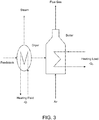
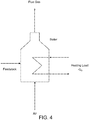
- FIG. 4 shows a schematic with direct combustion of wet feed stock, without reducing its moisture content.
- the available heat utilization is Q 3 .
- HYSYS AspenTech, Inc., Burlington MA
- Feed stock with a moisture content of either 30 wt % or 40 wt % was dried at a rate of one tone per hour to a moisture content of 10 wt %, i . e . 202 kg/hr or 303 kg/hr of water removed (vaporized by heating to about 121,1°C. This requires an input of energy of approximately 0,19 MW or 0,256 MW, respectively.
- the feed stock at a moisture content of 10 wt % is then combusted in a boiler assuming the heating load is adjusted to control the flue gas temperature to a predetermined temperature.
- this predetermined temperature could be higher (non-condensation, 65,6°C) or ower (condensation, 37,8°C) than the temperature of water in flue gas.
- Moisture can effect gasification in a variety of ways. For example, if moisture is removed from the feed stock prior to being gasified, gasification performance may, or may not, be improved, depending upon which parameter of gasification is observed. In terms of energy utilization efficiency, drying may not improve the overall efficiency of gasification, unlike the effect of drying the feed stock upon combustion applications as discussed above.
- oxidants such as air, pure oxygen or steam can be used.
- oxygen large scale coal gasification which operates at temperatures of typically 1500°C
- the challenge in this case is operating the gasification with a minimum amount of gasifying feed stock required because this reduces the amount of oxygen per unit product gas.
- This reduction is oxygen translates into a larger savings during the gasification.
- more steam is then necessary. Since more moisture is necessary, it can either be introduced into the gasification unit or as in the present invention the necessary moisture is present in the feed stock. This increase in moisture in the feed stock, both reduces the amount of oxygen needed during gasification as well as allows more control of the gasification temperature, which increases carbon conversion, and thus improves the overall gasification performance.
- thermodynamics and kinetics of the gasification reaction are effected by the amount of moisture during the gasification reaction.
- reaction (b) allows every carbon that is gasified via steam yields two molecules of synthesis gas per atom of carbon with steam, which is less extensive in comparison with only one carbon in reaction (a) via oxygen, which is much more expensive.
- reaction (b) to predominate during gasification the presence of sufficient moisture is important.
- syngas production rate and composition can be enhanced in order to favor or disfavor one particular application.
- the effect of moisture can have on gasifier performance and syngas properties also varies according to the characteristics of the feed stock. For example, the chemically bonded moisture and carbon content are two parameters that can influence of moisture on the feed stock during gasification.
- gasification feed stock like steam injection into gasifiers
- gasification moderator which can achieve at least one of the following:
- ER air equivalence
- Operation of the gasifier at lower temperatures is preferred for such engineered fuel feed stocks due to their propensity for slagging or ash fusion.
- Presence of moisture in feed stock also increases the conversion of carbon, making low temperature operation of the gasification possible while still being capable of reducing the potential risk of ash slagging, fusion.
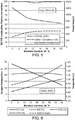
- FIG. 6 shows the predicted variation of syngas compositions with feed stocks of different moisture contents for a typical wood feed stock at 800 °C.
- Moisture in feed stock can replace the external steam supply in case steam is used as oxidant, which is often the case when external heat is available, and/or saving oxygen is desired.
- By replacing air or oxygen as the oxidant by water from feed stock, a high BTU syngas can be produced due to reduced dilution of nitrogen, and increased water-gas reaction (b).
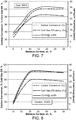
- the H 2 +CO production rate and cold gas efficiency will be slightly increased with increasing moisture when operating at a constant gasification temperature and air-equivalence ratio ( Fig. 8 ).
- engineered fuel feed stocks can be engineered for a specified use. Feedstocks not falling within the scope of the claim are for illustrative purposes only.
- Table 5 lists some common components found in MSW, along with their C, H, O, N, S, ash, and HHV content, as well as the ER required for complete combustion.
- the components can be sorted into any different number of classes, according to, for example, their carbon content. For example, MSW can be sorted into two, three, four, five or even more classes.
- Table 5a lists four separate classes: class #1 has a carbon content of about 45%, class #2 has a carbon content of about 55%, class #3 has a carbon content of about 60%, and class #4 has a carbon content of about 75%.
- Table 5 Sorted Waste C H O N S A HHV (kJ/kg) Air at ER 1 (kg/kg) Wood 49.5 6 42.7 0.2 0.1 1.5 19941 5.9 Food waste 48 6.4 37.6 2.6 0.4 5 20269 6.1 Paper 43.5 6 44 0.3 0.2 6 17666 5.2 Cardboard 44 5.9 44.6 0.3 0.2 5 17643 5.2 Yard waste 47.8 6 38 3.4 0.3 4.5 19508 5.9 Textiles 55 6.6 31.2 4.6 0.15 2.5 23479 7.2 Plastics 60 7.2 22.8 0 0 10 27435 8.4 Leather 60 8 11.6 10 0.4 10 28703 9.1 Rubber 78 10 0 2 0 10 39900 12.4 Table 5a Waste Class C H O N S A HHV (kJ/kg Air
- equation 1 can be used to select from, and assign the amounts from, the four classes listed in Table 5a.
- an engineered fuel feed stock made from MSW can be designed to have the same chemical composition as natural woodchips.
- Natural woodchips have the chemical composition listed in Table 6.
- the precise amounts of the different classes of sorted MSW listed in Table 5 needed for engineering a synthetic fuel of the same chemical composition as natural woodchips were determined according to eq. 1 to be 88.1 % from class #1 and 11.9% from class # 2. No components from classes #3 and #4 were required for this particular synthetic engineered fuel feed stock.
- Gasification tests were performed at a laboratory scale stratified downdraft gasifier.
- the gasifier has an inside diameter of 10,16 cm and a height of 60,96 cm above a perforated grate.
- the real-time temperatures are recorded by a data logger thermometer (OMEGA, HH309A).
- a syngas sampling train consisting of two water scrubbers, and a vacuum pump is used for taking syngas samples, which is analyzed by a HP5890A gas chromotograph to obtain volumetric fractions of H2, N2, CO, CO2 and CH4.
- feed stock #2 has an energy content of 32543 kJ/m 3
- feed stock # 7 has an energy content of 33506 kJ/m 3 , a difference of about 3%.
- the chemical molecular characteristics of the two feed stocks are listed in Table 9. The moisture content, carbon content, hydrogen content, oxygen content, and ratios of H/C and O/C are very different compared to each other.
- the feed stocks were gasified using the following procedure. Gasification tests were performed at a laboratory scale stratified downdraft gasifier.
- the gasifier has an inside diameter of 10,16 cm and a height of 60,96 cm above a perforated grate.
- the real-time temperatures are recorded by a data logger thermometer (OMEGA, HH309A).
- a syngas sampling train consisting of two water scrubbers, and a vacuum pump is used for taking syngas samples, which is analyzed by a HP5890A gas chromotograph to obtain volumetric fractions of H 2 , N 2 , CO, CO 2 and CH 4 .
- a dry gas test meter is installed in the air entrance to measure the air intake rate. The tests with two wood and simulated wood were conducted with air as oxidant at similar operating conditions. The results are listed in the following table. It can be seen that syngas composition, H 2 /CO ratio and syngas HHV are fairly close between the two engineered fuel feed stocks. The results of the gasification of feed stocks FS#2 and FS#7 are listed in Table 10.
- slagging occurs depends on the ash content of the fuel, the melting characteristics of the ash, and the temperature pattern in the gasifier. Local high temperatures in voids in the fuel bed in the oxidation zone, caused by bridging in the bed and maldistribution of gaseous and solids flows, may cause slagging even using fuels with a high ash melting temperature. In general, no slagging is observed with fuels having ash contents below 5-6 percent. Severe slagging can be expected for fuels having ash contents of 12 percent and above. For fuels with ash contents between 6 and 12 percent, the slagging behavior depends to a large extent on the ash melting temperature, which is influenced by the presence of trace elements giving rise to the formation of low melting point eutectic mixtures.
- Novel feed stocks can be synthesized according to the methods described herein that when combusted have a better emission profile as compared to coal when combusted.
- Emissions from coal combustion depend on the rank and composition of the fuel, the type and size of the boiler, firing conditions, load, type of control technologies, and the level of equipment maintenance.
- the major pollutants of concern from bituminous and subituminous coal combustion also arise due to size of the boiler, firing conditions, load, type of control technologies, and the level of equipment. These pollutants include particulate matter (PM), sulfur oxides (SOx), and nitrogen oxides (NOx).
- Table 13 lists the various amounts of pollutants emitted from the firing of bituminous and sub-bituminous coals in stoker burners, one of the most common coal burners. The information listed in Table 13 is compiled and published in Document AP-42 by the EPA (http://www.epa.gov/ttn/chief/ap42/ch01/final/c01s01.pdf).
- the fuel feed stock described herein when combusted will have a lower emission profile as compared to the emission profile as reported by the EPA and tabulated in Table 13.
- Equation 2 gives the relationship between the energy content of the fuel (HHV) and the amount of ash contained in the engineered fuel feed stock.
- an engineered fuel feed stock with a HHV of about 23260 kJ/kg to about 34890 kJ/kg can be designed whereby the ash is held to a minimum amount, for example, less than about 5% ash, or less than about 4% ash.
- the components of MSW used to engineer the fuels of about 23260 kJ/kg were selected from the four classes of MSW components derived from MSW listed in Table 5.
- Table 14 lists the amounts of the components of MSW used for engineering these fuels and their corresponding carbon, hydrogen, sulfur, and ash contents as well as the HHV value for the engineered fuel..
- the amount of other materials that enhance the gasification process may be increased during the process thereby bringing the chemical molecular characteristics of the densified form of the engineered fuel feed stock within the desired fuel specification.
- other materials that enhance the gasification process may be added before or during the compression to adjust the chemical molecular characteristics of the resulting densified form of the engineered fuel feed stock.
- the other material added to the feed stock is a FOG. Table 15 lists the heat content of certain FOGs and their carbon and hydrogen contents.
- Table 16 gives the carbon and hydrogen content of sludge.
- Table 16 Elemental Analysis Primary Secondary Mixed Digested Carbon 60.0 53.0 57.0 67.0 Hydrogen 7.5 7.0 7.0 5.0 Oxygen 28.0 30.5 30.0 25.0 Nitrogen 3.0 9.0 5.0 2.2 Sulfur 1.5 0.5 1.0 0.8 Total 100 100 100 100 100
- Fischer-Tropsch The best-known technology for producing hydrocarbons from synthesis gas is the Fischer-Tropsch synthesis. This technology was first demonstrated in Germany in 1902 by Sabatier and Senderens when they hydrogenated carbon monoxide (CO) to methane, using a nickel catalyst. In 1926 Fischer and Tropsch were awarded a patent for the discovery of a catalytic technique to convert synthesis gas to liquid hydrocarbons similar to petroleum.
- Equation 3 describes the production of hydrocarbons, commonly referred to as the Anderson-Schulz-Flory equation.
- W n weight fraction of products with carbon number n
- ⁇ chain growth probability, i.e., the probability that a carbon chain on the catalyst surface will grow by adding another carbon atom rather than terminating.
- ⁇ is dependent on concentrations or partial pressures of CO and H2, temperature, pressure, and catalyst composition but independent of chain length. As a increases, the average carbon number of the product also increases. When ⁇ equals 0, only methane is formed. As a approaches 1, the product becomes predominantly wax.
- Figure 11 provides a graphical representation of eq. 2 showing the weight fraction of various products as a function of the chain growth parameter ⁇ .
- Figure 11 shows that there is a particular ⁇ that will maximize the yield of a desired product, such as gasoline or diesel fuel.
- Additional gasoline and diesel fuel can be produced through further refining, such as hydrocracking or catalytic cracking of the wax product.
- Table 17 lists for each of the targeted products derived from syngas the corresponding appropriate H 2 /CO ratio that is needed.
- One way to produce such H 2 /CO ratio is to control the amount of C, H, and O in the feed stock used to produce the syngas.
- Figure 12 shows the predicted C/H and C/O ratios needed in the feed stock in order to produce a syngas of the requisite H 2 /CO ratio Table 17
- Product Basic Chemical Reaction H 2 / CO Ratio FT Liquid fuels 2nH 2 +nCO ⁇ C n H 2n + nH 2 O; (2n+1)H 2 + nCO ⁇ C n H 2n+1 + nH 2 O 2:0-2.1 Methanol 2H 2 + CO CH 3 OH; CO 2 + 3H 2 ⁇ CH 3 OH + H 2 O 2.0 Ethanol 2CO + 4H 2 ⁇ C 2 H 5 OH + H 2 O 2.0 Higher alcohols nCO + 2nH 2 ⁇ C n H 2n+1 OH + (
- the proper ratio of H/C and O/C in the composition of the engineered feed stock can be determined, along with the proper amount of moisture and ash content. Once these ratios have been determined then the proper MSW components can be selected and combined together to form feed stocks that upon gasification will yield a syngas with the desired H 2 /CO ratio.
- Up and downdraft gasifiers are limited in the range of fuel size acceptable in the feed stock. Fine grained and/or fluffy feed stock may cause flow problems in the bunker section of the gasifier as well as an inadmissible pressure drop over the reduction zone and a high proportion of dust in the gas. Large pressure drops will lead to reduction of the gas load of downdraft equipment, resulting in low temperatures and tar production. Excessively large sizes of particles or pieces give rise to reduced reactivity of the fuel, resulting in startup problems and poor gas quality, and to transport problems through the equipment. A large range in size distribution of the feed stock will generally aggravate the above phenomena. Too large particle sizes can cause gas channeling problems, especially in updraft gasifiers. Acceptable fuel sizes fox gasification systems depend to a certain extent on the design of the units.
- the shape of the engineered fuel feed stock particles and the densified form of the engineered fuel feed stock also strongly influence the rates of gas-solid reactions and momentum transfers between the particles and the gas stream that carries them.
- One parameter used to describe the shape of a particle is sphericity, which affects the fluidity of the particles during the gasification/combustion process. Fluidity is important in avoiding channeling and bridging by the particles in the gasifier, thereby reducing the efficiency of the conversion process.
- Equations 8 and 9 describe the volume of a sphere and cylinder, respectively.
- ⁇ p S p V p 2 1 4 ⁇ d 2 + ⁇ dh 1 4 ⁇ d 2 h
- Table 18 below lists different cylinders and a sphere that all have the same volume (0.524 in 3 ), yet possessing different surface areas (in 2 ) and specific surface areas (in 2 /in 3 ) .
- Table 18 Characteristic dimensions Average diameter Surface area (cm 2 ) Volume (cm 3 ) Specific surface area (cm 2 /(cm 3 ) Sphericity Sphere ⁇ 1" ⁇ 1" 20,3 8,59 2,4 1 Cylindrical ⁇ 0.5"x2.667" ⁇ 1" 29,1 74,0 3,4 0.686 Cylindrical 0.87"x0.88" ⁇ 1" 23,2 58,9 2,7 0.874 Cylindrical ⁇ 1.0"x0.667” ⁇ 1" 23,6 60,1 2,8 0.857 Cylindrical ⁇ 1.5"x0.296" ⁇ 1" 31,8 80,8 3,7 0.637
- spheres For shapes with the same volume such as cylinders and spheres, spheres have the lowest specific surface area. As the sphericity of a cylinder approaches 1 it behaves more like a sphere in the gasification/combustion process. However, the surface area for the corresponding volume is not maximized in the shape of a sphere which means the conversion process will not be optimally efficient. There is a minimum specific surface area and highest sphericity for a cylindrical shape depending on its diameter and length. This shape when determined for the engineered fuel is optimal for the conversion process for which the fuel is used. Figure 13 shows that when the cylindrical diameter is plotted against the sphericity and the cylindrical length and specific area, the optimal size of the pellet can be determined.
- the maximization of ⁇ p for a particular feed stock provides better hydrodynamic performance during the conversion process and cost effectiveness in preparation (size reduction and pelletizing) of the engineered fuel as compared to other natural fuels.
- the size and shape, and in some embodiments, the sphericity, of the engineered fuel feed stock can be determined.
- the sphericity of natural woodchips provides a natural starting point. Natural woodchips have a sphericity ( ⁇ p ) of about 0.2.
- An engineered fuel particle was designed with a sphericity of 0.25, a slightly better sphericity than natural woodchips yet containing the same HHV.
- the rate of gasification of the fuel pellets can be positively effected by a number of elements which act as catalysts, such as small quantities of potassium, sodium or zinc.
- Bulk density is defined as the weight per unit volume of loosely tipped fuel. Fuels with high bulk density are advantageous because they represent a high energy-for-volume value. Low bulk density fuels sometimes give rise to insufficient flow under gravity, resulting in low gas heating values and ultimately in burning of the char in the reduction zone. Average bulk densities of solid fuels such as wood, coal and peat ranges from about 160 kg/m 3 to about 481 kg/m 3 . If bulk densities for some components used for the pellets of the invention are too low, the over all bulk density can be improved through pelletization. The bulk density varies significantly with moisture content and particle size of the fuel.
- Exemplary ranges for specifications of a waste feed for a gasification system can include, but are not limited to: a diameter of between about 0,64 cm to about 3,81 cm ; a length of between about 1,27 cm to about 15,24 cm; a surface to volume ratio of between about 20:1 to about 3:1; a bulk density of about 160 kg/m 3 to about 1201 kg/m 3 ; a porosity of between about 0.2 and about 0.6; an aspect ratio of between about 1 to about 10; a thermal conductivity of between about 0,040 W/(m ⁇ °C) and about 1,0 W/(m ⁇ °C) ; a specific heat capacity of between about 0,2 to 2,0 J/(kg ⁇ °C) BTU/(1b ⁇ °F); a thermal diffusivity of between about 1,0x10 -6 m 2 /s to 2,0x10 -6 m 2 /s; a HHV of between about 6978 kJ/kg to about 34890 kJ/kg; a moisture content of
- MSW feed stock can be classified according to its carbon content and thus its potential for producing the amount of CO and H 2 in the resulting syngas upon thermal conversion.
- Table 19 shows one classification of types of fuels based on carbon content: low heat fuels (less than 45 wt % carbon); moderate heat fuels (45-60 wt % carbon); and high heat fuels (> 60 wt % carbon).
- the low heat fuels can be characterized as producing syngas containing CO and H 2 at less than about 0,62 m 3 /kg and an HHV of less than about 4471 kJ/m 3 . Because the gasifier requires an air equivalence ratio of more than 0.35 because of the low amount of carbon, the gasifier temperature will not rise above about 850°C causing incomplete conversion of carbon and the formation of methane and tars. These fuels can be used for production of syngas for all purposes, co-gasification with other fuels including moderate and high heat fuels, as well as LFG.
- the moderate heat fuels can be characterized as producing syngas containing CO and H 2 at about 0,62 to about 1,24 m 3 /kg and an HHV of about 4471 to about 7452 kJ/m 3 .
- the gasifier requires an air equivalence ratio of about 0.1 to about 0.35 with a carbon content of about 45 wt % to about 60 wt %, the gasifier maintains a temperature of about 850°C to about 900°C causing complete conversion of carbon, minimal formation of methane and tars, and low risk of slagging.
- These fuels can be used for production of syngas for all applications, liquid fuels, and chemicals applications.
- the high heat fuels can be characterized as producing syngas containing CO and H 2 at greater than about 1,24 m 3 /kg and an HHV of greater than 7452 kJ/m 3 . Because the gasifier requires an air equivalence ratio of only less than about 0.1 with a carbon content of greater than about 60 wt %, the gasifier's temperature is generally greater than about 900° C causing complete conversion of carbon, no formation of methane and tars, but a high risk of slagging. These fuels can be used for production of syngas for all applications, liquid fuels, and chemicals applications.
- engineered fuel feed stocks of different carbon content can be selected and fuels can be engineered and synthesized for a particular end use. Such selection allows the fine tuning of the engineered fuels produced from differing heterogeneous feed stocks such as MSW, FOGS, sludges, etc.
- the engineered fuels can be used for producing syngas containing the desired CO and H 2 content.
- the MSW can be processed by any method that allows for identification and separation of the component parts according to material type, such as by plastics, fibers, textiles, paper in all its forms, cardboard, rubber, yard waste, food waste, and leather.
- Methods of separation such as those disclosed in US 7,431,156 , US 2006/0254957 , US 2008/0290006 , US 2008/0237093 can be used for separating the components of waste.
- the component or components of the engineered feed stock are mixed.
- the mixed components are reduced in size using known techniques such as shredding, grinding, crumbling and the like. Methods for the reduction in size of MSW components is well known and for example are described in US 5,888,256 .
- the individual components are first reduced in size prior to mixing with other components.
- the mixed components of the engineered fuel feed stock are densified using known densification methods such as, for example, those described in US 5,916,826 . .
- the densification forms pellets by the use of a pelletizer, such as a Pasadena hand press, capable of exerting up to 178 kN.
- the FOGS component is added directly to the mixing tank. In other embodiments, the FOGS component is added after mixing just before the waste is placed into a pelletizing die.
- pellets are produced having a range of dimensions.
- the pellets should have a diameter of at least about 0,64 cm, and especially in the range of about 0,64 cm to about 3,81 cm.
- the pellets should have a length of at least about 1,27 cm, and especially in the range of about 1,27 cm to about 15,24 cm.
- the pellets become scored on the surface of the encapsulation. This scoring may act as an identifying mark. The scoring can also affect the devolatization process such that the scored pellets volatize at a more efficient rate than the unscored pellets.
- the engineered fuel feed stock described herein is biologically, chemically and toxicologically inert.
- biologically inert, chemically inert, and toxicologically inert means that the engineered fuel feed stock described herein does not exceed the EPA's limits for acceptable limits on biological, chemical and toxicological agents contained within the engineered fuel feed stock.
- the terms also include the meaning that the engineered fuel feed stock does not release toxic products after production or upon prolonged storage.
- the engineered fuel feed stock does not contain, for example pathogens or live organisms, nor contain the conditions that would promote the growth of organisms after production or upon prolonged storage.
- the engineered fuel feed stock in any form described herein can be designed so as to have a moisture content sufficient so as not to promote growth of organisms.
- the engineered fuel feed stock can be designed to be anti-absorbent, meaning it will not absorb water to any appreciable amount after production and upon prolonged storage.
- the engineered fuel feed stock is also air stable, meaning it will not decompose in the presence of air to give off appreciable amounts of volatile organic compounds.
- the engineered fuel feed stock described herein may be tested according to known methods in order to determine whether they meet the limits allowed for the definition of inert. For example, 40 CFR Parts 239 through 259 promulgated under Title 40 - Protection of the Environment, contains all of the EPA's regulations governing the regulations for solid waste.
- components for the engineered feed stock were selected they were shredded in a low speed shredder and then mixed mechanically. Afterwards the mixture was densified using a pelletizer. If the moisture content needed to be increased, water was added during the mixing step. A small sample of the feed stock was taken and dried in an temperature controlled and vented oven to confirm the moisture content. The mixed engineered feed stock was then subjected to gasification as described above.
Landscapes
- Chemical & Material Sciences (AREA)
- Organic Chemistry (AREA)
- Oil, Petroleum & Natural Gas (AREA)
- Life Sciences & Earth Sciences (AREA)
- Environmental & Geological Engineering (AREA)
- General Life Sciences & Earth Sciences (AREA)
- Geochemistry & Mineralogy (AREA)
- Geology (AREA)
- Combustion & Propulsion (AREA)
- Engineering & Computer Science (AREA)
- Agronomy & Crop Science (AREA)
- Inorganic Chemistry (AREA)
- Processing Of Solid Wastes (AREA)
- Solid Fuels And Fuel-Associated Substances (AREA)
- Fertilizers (AREA)
Priority Applications (2)
| Application Number | Priority Date | Filing Date | Title |
|---|---|---|---|
| EP17166365.1A EP3216848B1 (en) | 2008-06-26 | 2009-06-25 | Method for producing engineered fuel feed stock form waste material |
| HRP20171096TT HRP20171096T1 (hr) | 2008-06-26 | 2009-06-25 | Modificirano tehničko gorivo pogodno za zamjenu ugljena u elektranama na ugljen |
Applications Claiming Priority (3)
| Application Number | Priority Date | Filing Date | Title |
|---|---|---|---|
| US7602008P | 2008-06-26 | 2008-06-26 | |
| US7602708P | 2008-06-26 | 2008-06-26 | |
| PCT/US2009/048718 WO2009158539A1 (en) | 2008-06-26 | 2009-06-25 | Engineered fuel feed stock useful for displacement of coal in coal firing plants |
Related Child Applications (1)
| Application Number | Title | Priority Date | Filing Date |
|---|---|---|---|
| EP17166365.1A Division EP3216848B1 (en) | 2008-06-26 | 2009-06-25 | Method for producing engineered fuel feed stock form waste material |
Publications (3)
| Publication Number | Publication Date |
|---|---|
| EP2300575A1 EP2300575A1 (en) | 2011-03-30 |
| EP2300575A4 EP2300575A4 (en) | 2012-06-20 |
| EP2300575B1 true EP2300575B1 (en) | 2017-04-26 |
Family
ID=41444960
Family Applications (2)
| Application Number | Title | Priority Date | Filing Date |
|---|---|---|---|
| EP17166365.1A Not-in-force EP3216848B1 (en) | 2008-06-26 | 2009-06-25 | Method for producing engineered fuel feed stock form waste material |
| EP09771071.9A Revoked EP2300575B1 (en) | 2008-06-26 | 2009-06-25 | Engineered fuel feed stock useful for displacement of coal in coal firing plants |
Family Applications Before (1)
| Application Number | Title | Priority Date | Filing Date |
|---|---|---|---|
| EP17166365.1A Not-in-force EP3216848B1 (en) | 2008-06-26 | 2009-06-25 | Method for producing engineered fuel feed stock form waste material |
Country Status (9)
| Country | Link |
|---|---|
| US (4) | US8349034B2 (pl) |
| EP (2) | EP3216848B1 (pl) |
| JP (1) | JP2011526323A (pl) |
| CN (3) | CN102076833A (pl) |
| CA (1) | CA2729001A1 (pl) |
| HR (1) | HRP20171096T1 (pl) |
| MX (1) | MX2010014187A (pl) |
| PL (1) | PL2300575T3 (pl) |
| WO (1) | WO2009158539A1 (pl) |
Families Citing this family (41)
| Publication number | Priority date | Publication date | Assignee | Title |
|---|---|---|---|---|
| US7748137B2 (en) * | 2007-07-15 | 2010-07-06 | Yin Wang | Wood-drying solar greenhouse |
| CN102083601A (zh) | 2008-06-26 | 2011-06-01 | 凯斯勒废物系统公司 | 废弃物存储一体化的系统与方法 |
| CA2729001A1 (en) | 2008-06-26 | 2009-12-30 | Casella Waste Systems, Inc. | Engineered fuel feed stock useful for displacement of coal in coal firing plants |
| US8444721B2 (en) | 2008-06-26 | 2013-05-21 | Re Community Energy, Llc | Engineered fuel feed stock |
| US20100018113A1 (en) * | 2008-06-26 | 2010-01-28 | Casella Waste Systems, Inc. | Engineered fuel feed stock |
| EP2516926B1 (en) | 2009-12-22 | 2017-03-29 | Accordant Energy, LLC | Sorbent-containing engineered fuel feed stocks |
| WO2011097648A2 (en) | 2010-02-08 | 2011-08-11 | Fulcrum Bioenergy, Inc. | Processes for economically converting municipal solid waste into ethanol |
| US12252655B2 (en) | 2010-02-08 | 2025-03-18 | Fulcrum Bioenergy, Inc. | Feedstock processing systems and methods for producing Fischer-Tropsch liquids and transportation fuels |
| GB2561716B (en) * | 2015-09-01 | 2022-10-19 | Fulcrum Bioenergy Inc | Fuels and fuel additives that have high biogenic content derived from renewable organic feedstock |
| US11525097B2 (en) | 2010-02-08 | 2022-12-13 | Fulcrum Bioenergy, Inc. | Feedstock processing systems and methods for producing fischer-tropsch liquids and transportation fuels |
| US9057033B2 (en) * | 2010-03-11 | 2015-06-16 | Arno Schneider | Method and device for producing synthesis gas and for operating an internal combustion engine therewith |
| HRP20171259T1 (hr) | 2011-06-03 | 2017-10-20 | Accordant Energy, Llc | Postupak za proizvodnju modificiranog tehničkog goriva iz otpada |
| ES2688361T3 (es) | 2012-01-26 | 2018-11-02 | Accordant Energy, Llc | Mitigación de emisiones de combustión dañinas usando materias primas combustibles que contienen sorbente |
| JP6271832B2 (ja) * | 2012-11-14 | 2018-01-31 | 大王製紙株式会社 | 固形燃料の製造方法 |
| US9523056B2 (en) * | 2012-12-05 | 2016-12-20 | Ube Industries, Ltd. | Biomass solid fuel |
| US9126204B1 (en) | 2013-01-24 | 2015-09-08 | Wm Intellectual Property Holdings L.L.C. | Process and system for producing engineered fuel |
| US9702548B2 (en) | 2014-06-16 | 2017-07-11 | Biomass Energy Enhancements, Llc | System for co-firing cleaned coal and beneficiated organic-carbon-containing feedstock in a coal combustion apparatus |
| US9796940B2 (en) | 2014-06-16 | 2017-10-24 | Biomass Energy Enhancements, Llc | Processed biomass pellets from organic-carbon-containing feedstock |
| US10018355B2 (en) | 2014-06-16 | 2018-07-10 | CTP Biotechnology, LLC | System and process for combusting coal and beneficiated organic-carbon-containing feedstock |
| US9683738B2 (en) | 2014-06-16 | 2017-06-20 | Biomass Energy Enhancements, Llc | System for co-firing coal and beneficiated organic-carbon-containing feedstock in a coal combustion apparatus |
| US10024533B2 (en) | 2014-06-16 | 2018-07-17 | Ctp Biotechnology Llc | System and process for combusting cleaned coal and beneficiated organic-carbon-containing feedstock |
| AU2015329082B2 (en) * | 2014-10-07 | 2018-08-23 | Mitsubishi Ube Cement Corporation | Biomass solid fuel |
| EP3854864A1 (en) | 2014-10-30 | 2021-07-28 | Ecogensus, LLC | Process for forming a solid fuel composition from mixed solid waste |
| TWI687511B (zh) * | 2014-10-30 | 2020-03-11 | 美商艾科詹瑟斯有限公司 | 由混合固體廢棄物形成之固體燃料組合物 |
| TWI755726B (zh) | 2014-10-30 | 2022-02-21 | 美商艾科詹瑟斯有限公司 | 自混合固態廢棄物形成固態燃料組合物之系統 |
| US9864823B2 (en) | 2015-03-30 | 2018-01-09 | Uop Llc | Cleansing system for a feed composition based on environmental factors |
| US20160292188A1 (en) * | 2015-03-30 | 2016-10-06 | Uop Llc | Data cleansing system and method for inferring a feed composition |
| AU2016283116A1 (en) | 2015-06-24 | 2017-03-23 | Wm Intellectual Property Holdings, L.L.C. | Process for producing engineered fuel |
| RU2746855C2 (ru) * | 2016-04-06 | 2021-04-21 | УБЭ Индастриз, Лтд. | Твердое топливо из биомассы |
| US10787362B2 (en) | 2016-05-16 | 2020-09-29 | Christopher L. de Graffenried, SR. | Hydrogen co-firing with carbon pre-capture for higher carbon ratio fossil fuels |
| US11318510B2 (en) | 2017-11-22 | 2022-05-03 | Gaiaca, LLC | Systems and methods for cannabis waste disposal |
| US10876061B2 (en) * | 2017-11-22 | 2020-12-29 | Gaiaca, LLC | Systems and methods for cannabis waste disposal |
| US10618025B2 (en) | 2018-04-04 | 2020-04-14 | EcoGensus LLC | Process vessel for forming fuel compositions and related systems and methods |
| CN109628194B (zh) * | 2018-12-26 | 2021-05-14 | 同济大学 | 一种利用含油污泥生产油煤改性燃料的方法 |
| US11370983B2 (en) | 2019-02-04 | 2022-06-28 | Eastman Chemical Company | Gasification of plastics and solid fossil fuels |
| US11447576B2 (en) | 2019-02-04 | 2022-09-20 | Eastman Chemical Company | Cellulose ester compositions derived from recycled plastic content syngas |
| US11939406B2 (en) | 2019-03-29 | 2024-03-26 | Eastman Chemical Company | Polymers, articles, and chemicals made from densified textile derived syngas |
| WO2020205415A1 (en) | 2019-03-29 | 2020-10-08 | Eastman Chemical Company | Polymers, articles, and chemicals made from high concentrated recycle derived syngas |
| JP7645868B2 (ja) | 2019-08-26 | 2025-03-14 | イーストマン ケミカル カンパニー | 2-エチルヘキサノイルで置換されているセルロースエステル |
| CN112632793B (zh) * | 2020-12-30 | 2021-11-02 | 中国矿业大学 | 一种煤仓煤料堆积密度离线计算方法 |
| JP7788231B2 (ja) * | 2021-06-29 | 2025-12-18 | 一般財団法人電力中央研究所 | ガス化炉設備 |
Citations (4)
| Publication number | Priority date | Publication date | Assignee | Title |
|---|---|---|---|---|
| CH552523A (de) | 1972-07-14 | 1974-08-15 | Occidental Petroleum Corp | Verfahren zur herstellung und wiedergewinnung von chemikalien und brennstoffen aus organische feststoffe enthaltenden abfaellen, insbesondere muell. |
| US4236897A (en) | 1978-09-18 | 1980-12-02 | Johnston Ian F | Fuel pellets |
| US4624417A (en) | 1983-06-17 | 1986-11-25 | Newest, Inc. | Process for converting solid waste and sewage sludge into energy sources and separate recyclable by-products |
| WO2002051969A1 (en) | 2000-12-22 | 2002-07-04 | Cq Inc. | Fuel pellet and method for its production |
Family Cites Families (116)
| Publication number | Priority date | Publication date | Assignee | Title |
|---|---|---|---|---|
| US3650711A (en) * | 1969-03-14 | 1972-03-21 | Ethyl Corp | Fuel composition |
| US3642458A (en) * | 1969-08-22 | 1972-02-15 | Texaco Inc | Coke-making process and coke fuel produced by same |
| US3790091A (en) * | 1971-06-07 | 1974-02-05 | Nat Recycling Inc | Solid waste separating method and classification of material |
| US3846096A (en) * | 1971-06-15 | 1974-11-05 | Occidental Petroleum Corp | Gasification of carbonaceous solids |
| US3759196A (en) * | 1971-12-13 | 1973-09-18 | Kinney Inc A M | Refuse disposal and heat recovery in steam boilers |
| US3950143A (en) * | 1972-07-14 | 1976-04-13 | The Kingsford Company | Process for producing solid industrial fuel |
| US3910775A (en) * | 1974-02-22 | 1975-10-07 | Fox John M | Method and apparatus for processing refuse, sewage and/or waste material into a source of energy |
| US3961913A (en) * | 1974-03-29 | 1976-06-08 | Combustion Equipment Associates, Inc. | Process for treating organic wastes and product thereof |
| US4049391A (en) * | 1974-04-01 | 1977-09-20 | Black Clawson Fibreclaim, Inc. | Process for refuse disposal and heat recovery therefrom |
| US4153514A (en) * | 1975-02-27 | 1979-05-08 | Occidental Petroleum Corporation | Pyrolysis process for solid wastes |
| US4026678A (en) * | 1975-12-17 | 1977-05-31 | Guaranty Performance Co., Inc. | Process for treating municipal wastes to produce a fuel |
| US4015951A (en) * | 1976-01-05 | 1977-04-05 | Gunnerman Rudolf W | Fuel pellets and method for making them from organic fibrous materials |
| US4078902A (en) * | 1976-02-26 | 1978-03-14 | Acme Sales Corporation | Coke briquette |
| US4193206A (en) * | 1977-03-08 | 1980-03-18 | Uop Inc. | Processes for drying sewage sludge and filtering water |
| US4152119A (en) * | 1977-08-01 | 1979-05-01 | Dynecology Incorporated | Briquette comprising caking coal and municipal solid waste |
| SE423146B (sv) * | 1978-04-04 | 1982-04-13 | Svenska Flaektfabriken Ab | Sett att foredla fast brensle sasom bark och annat treavfall |
| US4249471A (en) * | 1979-01-29 | 1981-02-10 | Gunnerman Rudolf W | Method and apparatus for burning pelletized organic fibrous fuel |
| US4225457A (en) * | 1979-02-26 | 1980-09-30 | Dynecology Incorporated | Briquette comprising caking coal and municipal solid waste |
| US4201551A (en) * | 1979-03-09 | 1980-05-06 | Combustion Equipment Associates, Inc. | Embrittlement additive for treating organic materials |
| CH628837A5 (fr) | 1979-03-27 | 1982-03-31 | Bema Engineering Sa | Procede de compression separatrice de dechets, appareil pour la mise en oeuvre de ce procede, brique et boue resultant de ce procede et utilisation de cette boue. |
| US4265636A (en) * | 1979-07-23 | 1981-05-05 | Occidental Research Corporation | Use of formaldehyde as a chemical embrittling agent for waste |
| CH646992A5 (de) * | 1980-02-26 | 1984-12-28 | Maurer A Ing Sa | Verfahren zur kontinuierlichen thermischen behandlung von verkohlbarem ausgangsmaterial. |
| US4308033A (en) | 1980-10-23 | 1981-12-29 | Gunnerman Rudolf W | Fuel pellet and process for making it by shaping under pressure an organic fibrous material |
| US4529407A (en) * | 1981-06-25 | 1985-07-16 | Pickering Fuel Resources, Inc. | Fuel pellets |
| DE3128560C1 (de) * | 1981-07-18 | 1983-02-24 | Mannesmann Veba Umwelttechnik GmbH, 4690 Herne | Verfahren zur Aufbereitung der zu brikettierenden brennbaren Fraktion von Hausmuell und Anlage zur Durchfuehrung des Verfahrens |
| US4395265A (en) * | 1981-12-16 | 1983-07-26 | Charles Reilly | Fuel pellets |
| US4398917A (en) * | 1982-03-23 | 1983-08-16 | Reilly Charles J | Process for the preparation of fuel pellets |
| US4405331A (en) * | 1982-04-23 | 1983-09-20 | Acres American Incorporated | Refuse derived fuel and a process for the production thereof |
| US4515601A (en) * | 1982-05-03 | 1985-05-07 | Charters John E | Carbonaceous briquette |
| US4758244A (en) * | 1983-02-17 | 1988-07-19 | University Of Melbourne | Upgrading solid fuels |
| DE3306795C1 (de) * | 1983-02-26 | 1983-12-15 | L. & C. Steinmüller GmbH, 5270 Gummersbach | Verfahren zur Bindung von Schwefelverbindungen,die als Reaktionsprodukte bei der Verbrennung schwefelhaltiger Brennstoffe in einer Feuerung entstehen durch Zugabe von Additiven |
| US4828577A (en) * | 1984-12-03 | 1989-05-09 | Markham Jr William M | Process for converting food sludges to biomass fuels |
| US4613339A (en) * | 1984-12-24 | 1986-09-23 | Gunnerman Rudolf W | Process for preparing and using sweet sorghum in a fuel product |
| WO1986006930A1 (fr) * | 1985-05-24 | 1986-12-04 | Clerc De Bussy Le | Procede d'obtention de bois torrefie, produit obtenu, et application a la production d'energie |
| US4744969A (en) * | 1986-12-10 | 1988-05-17 | Florida Institute Of Phosphate Research | Process for the conversion of coal and gypsum to valuable products |
| US4875905A (en) * | 1988-11-14 | 1989-10-24 | Solidiwaste Technology, L.P. | Method of preparing a high heating value fuel product |
| US5562743A (en) * | 1989-06-19 | 1996-10-08 | University Of North Texas | Binder enhanced refuse derived fuel |
| US5342418A (en) * | 1990-04-25 | 1994-08-30 | Jesse Albert H | Method of making pelletized fuel |
| US5125931A (en) * | 1990-09-24 | 1992-06-30 | Dynecology Incorporated | Sewage sludge disposal process and apparatus |
| US5429645A (en) * | 1990-12-06 | 1995-07-04 | Benson; Peter H. | Solid fuel and process for combustion of the solid fuel |
| DE69215345T2 (de) * | 1991-12-30 | 1997-03-13 | Texaco Development Corp | Behandlung von Synthesegas |
| US5591417A (en) * | 1992-04-15 | 1997-01-07 | Mobil Oil Corporation | Removing SOx, CO and NOx from flue gases |
| DE4231771A1 (de) | 1992-09-23 | 1994-03-24 | Bayer Ag | Verfahren zur Verstromung von Kunststoffabfällen |
| US5250080A (en) * | 1992-10-13 | 1993-10-05 | Corpoven, S.A. | Process for manufacturing a solid fuel |
| US5431702A (en) * | 1993-03-25 | 1995-07-11 | Dynecology, Inc. | Waste conversion process and products |
| DE4303450C2 (de) * | 1993-02-05 | 1997-07-03 | Rheinische Kalksteinwerke | Mittel zur trockenen Reinigung von Abgasen |
| US5797972A (en) * | 1993-03-25 | 1998-08-25 | Dynecology, Inc. | Sewage sludge disposal process and product |
| US5387267A (en) * | 1993-08-25 | 1995-02-07 | Modular Energy Corporation | Process and apparatus for treating heterogeneous waste to provide a homogeneous fuel |
| US20040237405A1 (en) | 1993-10-19 | 2004-12-02 | Mitsubishi Jukogyo Kabushiki Kaisha | Process for the gasification of organic materials, processes for the gasification of glass fiber reinforced plastics, and apparatus |
| DE4336580A1 (de) * | 1993-10-27 | 1995-05-04 | Krupp Koppers Gmbh | Verfahren zur Aufarbeitung von kommunalem Kunststoffabfall |
| US5516345A (en) * | 1994-06-30 | 1996-05-14 | Iowa State University Research Foundation, Inc. | Latent heat-ballasted gasifier method |
| JP2647804B2 (ja) * | 1994-09-30 | 1997-08-27 | 工業技術院長 | 生ゴミの処理方法 |
| GB9512433D0 (en) | 1995-06-19 | 1995-08-23 | Geraint Rees | Agglomerates from carbonaceous fuel |
| US5643342A (en) * | 1995-08-02 | 1997-07-01 | Pelletech Fuels, Inc. | Fuel pellet and method of making the fuel pellet |
| US5888256A (en) | 1996-09-11 | 1999-03-30 | Morrison; Garrett L. | Managed composition of waste-derived fuel |
| US5755836A (en) * | 1997-01-14 | 1998-05-26 | Earth Cycle, L.L.C. | Process for manufacturing a composite fire log and product resulting therefrom |
| US6780210B2 (en) * | 1997-08-13 | 2004-08-24 | Edward E. Boss | Process for forming a fuel product from paper mill sludge |
| US6214064B1 (en) * | 1997-08-13 | 2001-04-10 | Edward E. Boss | Process for making a fuel product from coal fines and sewage sludge |
| US6048374A (en) * | 1997-08-18 | 2000-04-11 | Green; Alex E. S. | Process and device for pyrolysis of feedstock |
| US6152306A (en) * | 1997-10-30 | 2000-11-28 | Molecular Waste Technologies | Solid waste reduction |
| US6506223B2 (en) * | 1997-12-05 | 2003-01-14 | Waste Technology Transfer, Inc. | Pelletizing and briquetting of combustible organic-waste materials using binders produced by liquefaction of biomass |
| US5916826A (en) | 1997-12-05 | 1999-06-29 | Waste Technology Transfer, Inc. | Pelletizing and briquetting of coal fines using binders produced by liquefaction of biomass |
| IT1297030B1 (it) * | 1997-12-30 | 1999-08-03 | Pirelli Ambiente S P A | Composizione combustibile solida |
| US6582486B1 (en) * | 1997-12-30 | 2003-06-24 | Pirelli Ambient S.P.A. | Solid combustible composition |
| US6423878B2 (en) * | 1998-03-20 | 2002-07-23 | Riccardo Reverso | Process and apparatus for the controlled pyrolysis of plastic materials |
| US6000639A (en) * | 1998-06-19 | 1999-12-14 | Hydrocarbon Technologies, Inc. | Treating municipal solid waste for producing hydrocarbon fuel products |
| FI981742A0 (fi) * | 1998-08-12 | 1998-08-12 | Foster Wheeler Energia Oy | Nestepakkauskartonki jätemateriaalin kierrätysprosessi ja laite nestepakkauskartonkijätemateriaalin kierrättämiseksi |
| US6165238A (en) * | 1999-06-14 | 2000-12-26 | Cq Inc. | Fuel pellet and method for its production |
| US6149694A (en) * | 1999-06-16 | 2000-11-21 | Northwest Missouri State University | Process for using animal waste as fuel |
| NL1013007C2 (nl) * | 1999-09-09 | 2001-03-12 | Dsm Nv | Werkwijze voor het vervaardigen van brandstofkorrels. |
| US6692544B1 (en) * | 2000-04-12 | 2004-02-17 | Ecosystems Projects, Llc | Municipal waste briquetting system and method of filling land |
| KR100391121B1 (ko) * | 2000-12-11 | 2003-07-16 | 김현영 | 고분자 유기물의 가스화 방법 및 장치 |
| US20040050678A1 (en) * | 2001-01-15 | 2004-03-18 | Kenzo Takahashi | Plastic liquefying device |
| US7252691B2 (en) * | 2001-03-06 | 2007-08-07 | John Philipson | Conversion of municipal solid waste to high fuel value |
| JP2003004211A (ja) * | 2001-04-19 | 2003-01-08 | Ebara Corp | 廃棄物処理装置および廃棄物の処理方法 |
| US20040244289A1 (en) | 2001-09-28 | 2004-12-09 | Fumiaki Morozumi | Process for reforming inflammable gas, apparatus for reforming inflammable gas and gasification apparatus |
| JP2003253037A (ja) * | 2002-02-28 | 2003-09-10 | Jfe Steel Kk | 塩素含有合成樹脂の脱塩素処理方法 |
| AU2002950780A0 (en) * | 2002-08-12 | 2002-09-12 | Pacific Edge Holdings Pty. Ltd. | Process for gasification of low rank carbonaceous material |
| SE524069C2 (sv) | 2002-10-21 | 2004-06-22 | Reimer Carlsson Med Bo Interio | Kassett, hållare och metod för överföring av en rulle biograffilm |
| US7618606B2 (en) * | 2003-02-06 | 2009-11-17 | The Ohio State University | Separation of carbon dioxide (CO2) from gas mixtures |
| US7488464B2 (en) * | 2003-07-31 | 2009-02-10 | Enviroscrub Technologies Corporation | Metal oxide processing methods and systems |
| WO2005021686A1 (en) * | 2003-08-29 | 2005-03-10 | Ebara Corporation | Recycling method and system |
| GB0325668D0 (en) * | 2003-11-04 | 2003-12-10 | Dogru Murat | Intensified and minaturized gasifier with multiple air injection and catalytic bed |
| US7967877B2 (en) * | 2003-11-13 | 2011-06-28 | Biomass Worldwide Group Limited | Biomass energy product and processing method |
| US7264124B2 (en) | 2003-11-17 | 2007-09-04 | Casella Waste Systems, Inc. | Systems and methods for sorting recyclables at a material recovery facility |
| US7028478B2 (en) * | 2003-12-16 | 2006-04-18 | Advanced Combustion Energy Systems, Inc. | Method and apparatus for the production of energy |
| JP4097618B2 (ja) | 2004-03-31 | 2008-06-11 | 株式会社栗本鐵工所 | 固形燃料の製造方法 |
| MXPA06011334A (es) | 2004-04-02 | 2007-03-21 | Skill Associates Inc | Convertidores de biomasa y procesos. |
| US7909895B2 (en) * | 2004-11-10 | 2011-03-22 | Enertech Environmental, Inc. | Slurry dewatering and conversion of biosolids to a renewable fuel |
| US7708964B2 (en) * | 2004-12-02 | 2010-05-04 | Battelle Energy Alliance, Llc | Oil shale derived pollutant control materials and methods and apparatuses for producing and utilizing the same |
| US7384615B2 (en) * | 2004-12-02 | 2008-06-10 | Battelle Energy Alliance, Llc | Method oil shale pollutant sorption/NOx reburning multi-pollutant control |
| EP1669434A1 (en) * | 2004-12-13 | 2006-06-14 | NedCoal Patent B.V. i/o | Method and installation for conversion into fuel of organic material originating for instance from domestic waste |
| US20060228294A1 (en) * | 2005-04-12 | 2006-10-12 | Davis William H | Process and apparatus using a molten metal bath |
| US7485767B2 (en) * | 2005-06-29 | 2009-02-03 | Exxonmobil Chemical Patents Inc. | Production of synthesis gas blends for conversion to methanol or Fischer-Tropsch liquids |
| US20070006526A1 (en) * | 2005-07-07 | 2007-01-11 | New Energy Usa, Llc | Fuel pellet briquettes from biomass and recovered coal slurries |
| US9274099B2 (en) * | 2005-07-22 | 2016-03-01 | The Board Of Trustees Of The Leland Stanford Junior University | Screening test drugs to identify their effects on cell membrane voltage-gated ion channel |
| CA2515879A1 (en) * | 2005-08-05 | 2007-02-05 | Mark A. Dupuis | Densification system |
| US7932424B2 (en) * | 2006-01-26 | 2011-04-26 | Kitakyushu Foundation For The Advancement Of Industry, Science And Technology | Method for catalytically cracking waste plastics and apparatus for catalytically cracking waste plastics |
| WO2007103283A2 (en) * | 2006-03-02 | 2007-09-13 | Shaw Waste Solutions, Llc | Improved steam reformation system |
| BRPI0621534A2 (pt) | 2006-03-23 | 2016-08-16 | Zia Metallurg Processes Inc | aparelho para gerar gás de síntese a partir de material orgânico residual, aparelho de co-geração, e, aparelho de geração de hidrogênio |
| US20070261295A1 (en) | 2006-05-11 | 2007-11-15 | Tolmie Richard W | Water resistance, density, and durability of biomass fuels |
| WO2007147244A1 (en) | 2006-06-19 | 2007-12-27 | Michel Babeu | Method for manufacturing a solid fuel with waste materials |
| US7497392B2 (en) * | 2006-07-17 | 2009-03-03 | Alliance Technology Group, Inc. | Process and apparatus for transforming waste materials into fuel |
| US7713503B2 (en) * | 2006-09-12 | 2010-05-11 | General Electric Company | Sorbents and sorbent composition for mercury removal |
| JP2008106270A (ja) * | 2006-09-29 | 2008-05-08 | Ube Ind Ltd | 固体原燃料の製造方法 |
| US20080110090A1 (en) * | 2006-11-15 | 2008-05-15 | C166, An Llc Registered In Florida | Gasification of fuel in a slagging gasifier |
| US8459466B2 (en) | 2007-05-23 | 2013-06-11 | Re Community Energy, Llc | Systems and methods for optimizing a single-stream materials recovery facility |
| US20090056206A1 (en) * | 2007-08-28 | 2009-03-05 | Stephane Gauthier | Method for manufacture of plant biomass solid fuel |
| US20090056205A1 (en) * | 2007-08-28 | 2009-03-05 | Stephane Gauthier | Plant biomass solid fuel |
| CN101215490B (zh) | 2008-01-17 | 2011-03-16 | 中国矿业大学(北京) | 垃圾衍生燃料及其制备方法 |
| US20100018113A1 (en) * | 2008-06-26 | 2010-01-28 | Casella Waste Systems, Inc. | Engineered fuel feed stock |
| CA2729001A1 (en) * | 2008-06-26 | 2009-12-30 | Casella Waste Systems, Inc. | Engineered fuel feed stock useful for displacement of coal in coal firing plants |
| US8444721B2 (en) * | 2008-06-26 | 2013-05-21 | Re Community Energy, Llc | Engineered fuel feed stock |
| EP2516926B1 (en) * | 2009-12-22 | 2017-03-29 | Accordant Energy, LLC | Sorbent-containing engineered fuel feed stocks |
| ES2688361T3 (es) * | 2012-01-26 | 2018-11-02 | Accordant Energy, Llc | Mitigación de emisiones de combustión dañinas usando materias primas combustibles que contienen sorbente |
| WO2013170184A2 (en) * | 2012-05-11 | 2013-11-14 | Dingrong Bai | Systems and methods for producing engineered fuel feedstocks with reduced chlorine content |
-
2009
- 2009-06-25 CA CA2729001A patent/CA2729001A1/en not_active Abandoned
- 2009-06-25 US US12/492,093 patent/US8349034B2/en not_active Expired - Fee Related
- 2009-06-25 CN CN2009801251697A patent/CN102076833A/zh active Pending
- 2009-06-25 CN CN201410710486.8A patent/CN104498098A/zh active Pending
- 2009-06-25 MX MX2010014187A patent/MX2010014187A/es unknown
- 2009-06-25 EP EP17166365.1A patent/EP3216848B1/en not_active Not-in-force
- 2009-06-25 JP JP2011516680A patent/JP2011526323A/ja active Pending
- 2009-06-25 WO PCT/US2009/048718 patent/WO2009158539A1/en not_active Ceased
- 2009-06-25 EP EP09771071.9A patent/EP2300575B1/en not_active Revoked
- 2009-06-25 CN CN201810700061.7A patent/CN109536234A/zh active Pending
- 2009-06-25 PL PL09771071T patent/PL2300575T3/pl unknown
- 2009-06-25 HR HRP20171096TT patent/HRP20171096T1/hr unknown
-
2012
- 2012-12-07 US US13/708,328 patent/US8828105B2/en active Active
-
2014
- 2014-07-25 US US14/340,616 patent/US20150096222A1/en not_active Abandoned
-
2019
- 2019-05-08 US US16/407,016 patent/US20200102518A1/en not_active Abandoned
Patent Citations (4)
| Publication number | Priority date | Publication date | Assignee | Title |
|---|---|---|---|---|
| CH552523A (de) | 1972-07-14 | 1974-08-15 | Occidental Petroleum Corp | Verfahren zur herstellung und wiedergewinnung von chemikalien und brennstoffen aus organische feststoffe enthaltenden abfaellen, insbesondere muell. |
| US4236897A (en) | 1978-09-18 | 1980-12-02 | Johnston Ian F | Fuel pellets |
| US4624417A (en) | 1983-06-17 | 1986-11-25 | Newest, Inc. | Process for converting solid waste and sewage sludge into energy sources and separate recyclable by-products |
| WO2002051969A1 (en) | 2000-12-22 | 2002-07-04 | Cq Inc. | Fuel pellet and method for its production |
Non-Patent Citations (8)
| Title |
|---|
| "CHARACTERIZATION OF MUNICIPAL SOLID WASTE IN THE UNITED STATES : 1998 UPDATE", U.S. ENVIRONMENTAL PROTECTION AGENCY, MUNICIPAL AND INDUSTRIAL SOLID WASTE DIVISION, OFFICE OF SOLID WASTE, July 1999 (1999-07-01), pages 1 - 159, XP055457955 |
| "Standard Practice for Ultimate Analysis of Coal and Coke", ASTM STANDARD D3176 - 09, 2009, XP055457709 |
| "Standard Test Methods for Instrumental Determination of Carbon, Hydrogen, and Nitrogen in Laboratory Samples of Coal", ASTM STANDARD D5373- 08, 2008, XP055457717 |
| DAVID H.F. LIU ET AL.: "Hazardous Waste and Solid Waste", SOLID WASTE, 1999, XP055457936 |
| MICHAEL FROST, TIRES AS A FUEL SUPPLEMENT: FEASABILITY STUDY, 1 January 1992 (1992-01-01), pages 1 - 120, XP055246538, [retrieved on 20160201] |
| MICHAEL FROST: "TIRES AS A FUEL SUPPLEMENT : FEASIBILITY STUD Y", 1 January 1992 (1992-01-01), California, pages 1 - 120, XP055246538 * |
| SAMI M ET AL.: "co-firing of coal and biomass fuel blends", PROGRESS IN ENERGY AND COMBUSTION SCIENCE, vol. 27, no. 2, 1 January 2001 (2001-01-01), AMSTERDAM ; NL, pages 171 - 214, XP027356588, ISSN: 0360-1285 |
| SAMI M ET AL: "Co-firing of coal and biomass fuel blends", PROGRESS IN ENERGY AND COMBUSTION SCIENCE, ELSEVIER SCIENCE PUBLISHERS, AMSTERDAM, NL, vol. 27, no. 2, 1 January 2001 (2001-01-01), pages 171 - 214, XP027356588, ISSN: 0360-1285, [retrieved on 20010101] * |
Also Published As
| Publication number | Publication date |
|---|---|
| JP2011526323A (ja) | 2011-10-06 |
| US20100031560A1 (en) | 2010-02-11 |
| EP2300575A1 (en) | 2011-03-30 |
| EP2300575A4 (en) | 2012-06-20 |
| EP3216848B1 (en) | 2020-08-05 |
| PL2300575T3 (pl) | 2017-09-29 |
| MX2010014187A (es) | 2011-03-29 |
| US8828105B2 (en) | 2014-09-09 |
| US20200102518A1 (en) | 2020-04-02 |
| EP3216848A1 (en) | 2017-09-13 |
| CN109536234A (zh) | 2019-03-29 |
| WO2009158539A1 (en) | 2009-12-30 |
| CN102076833A (zh) | 2011-05-25 |
| US20150096222A1 (en) | 2015-04-09 |
| US8349034B2 (en) | 2013-01-08 |
| CA2729001A1 (en) | 2009-12-30 |
| CN104498098A (zh) | 2015-04-08 |
| US20130097921A1 (en) | 2013-04-25 |
| HRP20171096T1 (hr) | 2017-10-06 |
Similar Documents
| Publication | Publication Date | Title |
|---|---|---|
| EP2300575B1 (en) | Engineered fuel feed stock useful for displacement of coal in coal firing plants | |
| US10329501B2 (en) | Engineered fuel feed stock | |
| US10611974B2 (en) | Engineered fuel feed stock | |
| HK40006538A (en) | Engineered fuel feed stock useful for displacement of coal in coal firing plants |
Legal Events
| Date | Code | Title | Description |
|---|---|---|---|
| PUAI | Public reference made under article 153(3) epc to a published international application that has entered the european phase |
Free format text: ORIGINAL CODE: 0009012 |
|
| 17P | Request for examination filed |
Effective date: 20110121 |
|
| AK | Designated contracting states |
Kind code of ref document: A1 Designated state(s): AT BE BG CH CY CZ DE DK EE ES FI FR GB GR HR HU IE IS IT LI LT LU LV MC MK MT NL NO PL PT RO SE SI SK TR |
|
| AX | Request for extension of the european patent |
Extension state: AL BA RS |
|
| DAX | Request for extension of the european patent (deleted) | ||
| A4 | Supplementary search report drawn up and despatched |
Effective date: 20120521 |
|
| RIC1 | Information provided on ipc code assigned before grant |
Ipc: C10L 5/48 20060101ALI20120514BHEP Ipc: C10L 5/46 20060101AFI20120514BHEP |
|
| RAP1 | Party data changed (applicant data changed or rights of an application transferred) |
Owner name: RE COMMUNITY ENERGY, LLC |
|
| 17Q | First examination report despatched |
Effective date: 20130125 |
|
| RAP1 | Party data changed (applicant data changed or rights of an application transferred) |
Owner name: ACCORDANT ENERGY, LLC |
|
| RIN1 | Information on inventor provided before grant (corrected) |
Inventor name: BAI, DINGRONG Inventor name: CALABRESE, PAULA, A. |
|
| GRAP | Despatch of communication of intention to grant a patent |
Free format text: ORIGINAL CODE: EPIDOSNIGR1 |
|
| STAA | Information on the status of an ep patent application or granted ep patent |
Free format text: STATUS: GRANT OF PATENT IS INTENDED |
|
| INTG | Intention to grant announced |
Effective date: 20161116 |
|
| GRAS | Grant fee paid |
Free format text: ORIGINAL CODE: EPIDOSNIGR3 |
|
| GRAA | (expected) grant |
Free format text: ORIGINAL CODE: 0009210 |
|
| STAA | Information on the status of an ep patent application or granted ep patent |
Free format text: STATUS: THE PATENT HAS BEEN GRANTED |
|
| AK | Designated contracting states |
Kind code of ref document: B1 Designated state(s): AT BE BG CH CY CZ DE DK EE ES FI FR GB GR HR HU IE IS IT LI LT LU LV MC MK MT NL NO PL PT RO SE SI SK TR |
|
| REG | Reference to a national code |
Ref country code: GB Ref legal event code: FG4D |
|
| REG | Reference to a national code |
Ref country code: CH Ref legal event code: EP |
|
| REG | Reference to a national code |
Ref country code: AT Ref legal event code: REF Ref document number: 887896 Country of ref document: AT Kind code of ref document: T Effective date: 20170515 |
|
| REG | Reference to a national code |
Ref country code: NL Ref legal event code: FP Ref country code: IE Ref legal event code: FG4D |
|
| REG | Reference to a national code |
Ref country code: DE Ref legal event code: R096 Ref document number: 602009045716 Country of ref document: DE |
|
| REG | Reference to a national code |
Ref country code: HR Ref legal event code: TUEP Ref document number: P20171096 Country of ref document: HR |
|
| REG | Reference to a national code |
Ref country code: LT Ref legal event code: MG4D |
|
| REG | Reference to a national code |
Ref country code: AT Ref legal event code: MK05 Ref document number: 887896 Country of ref document: AT Kind code of ref document: T Effective date: 20170426 |
|
| REG | Reference to a national code |
Ref country code: HR Ref legal event code: T1PR Ref document number: P20171096 Country of ref document: HR |
|
| PG25 | Lapsed in a contracting state [announced via postgrant information from national office to epo] |
Ref country code: NO Free format text: LAPSE BECAUSE OF FAILURE TO SUBMIT A TRANSLATION OF THE DESCRIPTION OR TO PAY THE FEE WITHIN THE PRESCRIBED TIME-LIMIT Effective date: 20170726 Ref country code: FI Free format text: LAPSE BECAUSE OF FAILURE TO SUBMIT A TRANSLATION OF THE DESCRIPTION OR TO PAY THE FEE WITHIN THE PRESCRIBED TIME-LIMIT Effective date: 20170426 Ref country code: LT Free format text: LAPSE BECAUSE OF FAILURE TO SUBMIT A TRANSLATION OF THE DESCRIPTION OR TO PAY THE FEE WITHIN THE PRESCRIBED TIME-LIMIT Effective date: 20170426 Ref country code: ES Free format text: LAPSE BECAUSE OF FAILURE TO SUBMIT A TRANSLATION OF THE DESCRIPTION OR TO PAY THE FEE WITHIN THE PRESCRIBED TIME-LIMIT Effective date: 20170426 Ref country code: GR Free format text: LAPSE BECAUSE OF FAILURE TO SUBMIT A TRANSLATION OF THE DESCRIPTION OR TO PAY THE FEE WITHIN THE PRESCRIBED TIME-LIMIT Effective date: 20170727 Ref country code: AT Free format text: LAPSE BECAUSE OF FAILURE TO SUBMIT A TRANSLATION OF THE DESCRIPTION OR TO PAY THE FEE WITHIN THE PRESCRIBED TIME-LIMIT Effective date: 20170426 |
|
| PG25 | Lapsed in a contracting state [announced via postgrant information from national office to epo] |
Ref country code: LV Free format text: LAPSE BECAUSE OF FAILURE TO SUBMIT A TRANSLATION OF THE DESCRIPTION OR TO PAY THE FEE WITHIN THE PRESCRIBED TIME-LIMIT Effective date: 20170426 Ref country code: SE Free format text: LAPSE BECAUSE OF FAILURE TO SUBMIT A TRANSLATION OF THE DESCRIPTION OR TO PAY THE FEE WITHIN THE PRESCRIBED TIME-LIMIT Effective date: 20170426 Ref country code: IS Free format text: LAPSE BECAUSE OF FAILURE TO SUBMIT A TRANSLATION OF THE DESCRIPTION OR TO PAY THE FEE WITHIN THE PRESCRIBED TIME-LIMIT Effective date: 20170826 |
|
| REG | Reference to a national code |
Ref country code: DE Ref legal event code: R026 Ref document number: 602009045716 Country of ref document: DE |
|
| PLBI | Opposition filed |
Free format text: ORIGINAL CODE: 0009260 |
|
| PG25 | Lapsed in a contracting state [announced via postgrant information from national office to epo] |
Ref country code: SK Free format text: LAPSE BECAUSE OF FAILURE TO SUBMIT A TRANSLATION OF THE DESCRIPTION OR TO PAY THE FEE WITHIN THE PRESCRIBED TIME-LIMIT Effective date: 20170426 Ref country code: RO Free format text: LAPSE BECAUSE OF FAILURE TO SUBMIT A TRANSLATION OF THE DESCRIPTION OR TO PAY THE FEE WITHIN THE PRESCRIBED TIME-LIMIT Effective date: 20170426 Ref country code: DK Free format text: LAPSE BECAUSE OF FAILURE TO SUBMIT A TRANSLATION OF THE DESCRIPTION OR TO PAY THE FEE WITHIN THE PRESCRIBED TIME-LIMIT Effective date: 20170426 Ref country code: EE Free format text: LAPSE BECAUSE OF FAILURE TO SUBMIT A TRANSLATION OF THE DESCRIPTION OR TO PAY THE FEE WITHIN THE PRESCRIBED TIME-LIMIT Effective date: 20170426 Ref country code: MC Free format text: LAPSE BECAUSE OF FAILURE TO SUBMIT A TRANSLATION OF THE DESCRIPTION OR TO PAY THE FEE WITHIN THE PRESCRIBED TIME-LIMIT Effective date: 20170426 |
|
| REG | Reference to a national code |
Ref country code: CH Ref legal event code: PL |
|
| PLAX | Notice of opposition and request to file observation + time limit sent |
Free format text: ORIGINAL CODE: EPIDOSNOBS2 |
|
| 26 | Opposition filed |
Opponent name: DREISS PATENTANWAELTE PARTG MBB Effective date: 20180123 |
|
| REG | Reference to a national code |
Ref country code: FR Ref legal event code: ST Effective date: 20180228 |
|
| PG25 | Lapsed in a contracting state [announced via postgrant information from national office to epo] |
Ref country code: LI Free format text: LAPSE BECAUSE OF NON-PAYMENT OF DUE FEES Effective date: 20170630 Ref country code: CH Free format text: LAPSE BECAUSE OF NON-PAYMENT OF DUE FEES Effective date: 20170630 Ref country code: LU Free format text: LAPSE BECAUSE OF NON-PAYMENT OF DUE FEES Effective date: 20170625 |
|
| REG | Reference to a national code |
Ref country code: BE Ref legal event code: MM Effective date: 20170630 |
|
| PG25 | Lapsed in a contracting state [announced via postgrant information from national office to epo] |
Ref country code: SI Free format text: LAPSE BECAUSE OF FAILURE TO SUBMIT A TRANSLATION OF THE DESCRIPTION OR TO PAY THE FEE WITHIN THE PRESCRIBED TIME-LIMIT Effective date: 20170426 Ref country code: FR Free format text: LAPSE BECAUSE OF NON-PAYMENT OF DUE FEES Effective date: 20170630 |
|
| PLBB | Reply of patent proprietor to notice(s) of opposition received |
Free format text: ORIGINAL CODE: EPIDOSNOBS3 |
|
| PG25 | Lapsed in a contracting state [announced via postgrant information from national office to epo] |
Ref country code: BE Free format text: LAPSE BECAUSE OF NON-PAYMENT OF DUE FEES Effective date: 20170630 |
|
| PG25 | Lapsed in a contracting state [announced via postgrant information from national office to epo] |
Ref country code: MT Free format text: LAPSE BECAUSE OF NON-PAYMENT OF DUE FEES Effective date: 20170625 |
|
| PG25 | Lapsed in a contracting state [announced via postgrant information from national office to epo] |
Ref country code: HU Free format text: LAPSE BECAUSE OF FAILURE TO SUBMIT A TRANSLATION OF THE DESCRIPTION OR TO PAY THE FEE WITHIN THE PRESCRIBED TIME-LIMIT; INVALID AB INITIO Effective date: 20090625 |
|
| REG | Reference to a national code |
Ref country code: HR Ref legal event code: ODRP Ref document number: P20171096 Country of ref document: HR Payment date: 20190607 Year of fee payment: 11 |
|
| PGFP | Annual fee paid to national office [announced via postgrant information from national office to epo] |
Ref country code: CZ Payment date: 20190614 Year of fee payment: 11 Ref country code: IE Payment date: 20190627 Year of fee payment: 11 Ref country code: IT Payment date: 20190621 Year of fee payment: 11 Ref country code: NL Payment date: 20190626 Year of fee payment: 11 Ref country code: PL Payment date: 20190531 Year of fee payment: 11 |
|
| PGFP | Annual fee paid to national office [announced via postgrant information from national office to epo] |
Ref country code: ES Payment date: 20190603 Year of fee payment: 16 Ref country code: BG Payment date: 20190619 Year of fee payment: 11 |
|
| REG | Reference to a national code |
Ref country code: DE Ref legal event code: R064 Ref document number: 602009045716 Country of ref document: DE Ref country code: DE Ref legal event code: R103 Ref document number: 602009045716 Country of ref document: DE |
|
| PG25 | Lapsed in a contracting state [announced via postgrant information from national office to epo] |
Ref country code: CY Free format text: LAPSE BECAUSE OF NON-PAYMENT OF DUE FEES Effective date: 20170426 |
|
| PGFP | Annual fee paid to national office [announced via postgrant information from national office to epo] |
Ref country code: GB Payment date: 20190627 Year of fee payment: 11 Ref country code: DE Payment date: 20190627 Year of fee payment: 11 |
|
| PG25 | Lapsed in a contracting state [announced via postgrant information from national office to epo] |
Ref country code: MK Free format text: LAPSE BECAUSE OF FAILURE TO SUBMIT A TRANSLATION OF THE DESCRIPTION OR TO PAY THE FEE WITHIN THE PRESCRIBED TIME-LIMIT Effective date: 20170426 |
|
| RDAF | Communication despatched that patent is revoked |
Free format text: ORIGINAL CODE: EPIDOSNREV1 |
|
| RDAG | Patent revoked |
Free format text: ORIGINAL CODE: 0009271 |
|
| STAA | Information on the status of an ep patent application or granted ep patent |
Free format text: STATUS: PATENT REVOKED |
|
| REG | Reference to a national code |
Ref country code: FI Ref legal event code: MGE |
|
| 27W | Patent revoked |
Effective date: 20191010 |
|
| GBPR | Gb: patent revoked under art. 102 of the ep convention designating the uk as contracting state |
Effective date: 20191010 |
|
| PG25 | Lapsed in a contracting state [announced via postgrant information from national office to epo] |
Ref country code: PT Free format text: LAPSE BECAUSE OF FAILURE TO SUBMIT A TRANSLATION OF THE DESCRIPTION OR TO PAY THE FEE WITHIN THE PRESCRIBED TIME-LIMIT Effective date: 20170426 |
|
| REG | Reference to a national code |
Ref country code: HR Ref legal event code: PNEV Ref document number: P20171096 Country of ref document: HR |
|
| PGFP | Annual fee paid to national office [announced via postgrant information from national office to epo] |
Ref country code: TR Payment date: 20200608 Year of fee payment: 12 |