EP2297576B1 - Etablierte menschliche zelllinie von braunem fettgewebe und verfahren zur differenzierung aus einer hmads-zelllinie - Google Patents
Etablierte menschliche zelllinie von braunem fettgewebe und verfahren zur differenzierung aus einer hmads-zelllinie Download PDFInfo
- Publication number
- EP2297576B1 EP2297576B1 EP09769262.8A EP09769262A EP2297576B1 EP 2297576 B1 EP2297576 B1 EP 2297576B1 EP 09769262 A EP09769262 A EP 09769262A EP 2297576 B1 EP2297576 B1 EP 2297576B1
- Authority
- EP
- European Patent Office
- Prior art keywords
- population
- agonist
- adipocytes
- human
- cells
- Prior art date
- Legal status (The legal status is an assumption and is not a legal conclusion. Google has not performed a legal analysis and makes no representation as to the accuracy of the status listed.)
- Active
Links
Images




Classifications
-
- C—CHEMISTRY; METALLURGY
- C12—BIOCHEMISTRY; BEER; SPIRITS; WINE; VINEGAR; MICROBIOLOGY; ENZYMOLOGY; MUTATION OR GENETIC ENGINEERING
- C12N—MICROORGANISMS OR ENZYMES; COMPOSITIONS THEREOF; PROPAGATING, PRESERVING, OR MAINTAINING MICROORGANISMS; MUTATION OR GENETIC ENGINEERING; CULTURE MEDIA
- C12N5/00—Undifferentiated human, animal or plant cells, e.g. cell lines; Tissues; Cultivation or maintenance thereof; Culture media therefor
- C12N5/06—Animal cells or tissues; Human cells or tissues
- C12N5/0602—Vertebrate cells
- C12N5/0652—Cells of skeletal and connective tissues; Mesenchyme
- C12N5/0662—Stem cells
- C12N5/0667—Adipose-derived stem cells [ADSC]; Adipose stromal stem cells
-
- A—HUMAN NECESSITIES
- A61—MEDICAL OR VETERINARY SCIENCE; HYGIENE
- A61P—SPECIFIC THERAPEUTIC ACTIVITY OF CHEMICAL COMPOUNDS OR MEDICINAL PREPARATIONS
- A61P3/00—Drugs for disorders of the metabolism
- A61P3/04—Anorexiants; Antiobesity agents
-
- G—PHYSICS
- G01—MEASURING; TESTING
- G01N—INVESTIGATING OR ANALYSING MATERIALS BY DETERMINING THEIR CHEMICAL OR PHYSICAL PROPERTIES
- G01N33/00—Investigating or analysing materials by specific methods not covered by groups G01N1/00 - G01N31/00
- G01N33/48—Biological material, e.g. blood, urine; Haemocytometers
- G01N33/50—Chemical analysis of biological material, e.g. blood, urine; Testing involving biospecific ligand binding methods; Immunological testing
- G01N33/5005—Chemical analysis of biological material, e.g. blood, urine; Testing involving biospecific ligand binding methods; Immunological testing involving human or animal cells
- G01N33/5008—Chemical analysis of biological material, e.g. blood, urine; Testing involving biospecific ligand binding methods; Immunological testing involving human or animal cells for testing or evaluating the effect of chemical or biological compounds, e.g. drugs, cosmetics
- G01N33/5044—Chemical analysis of biological material, e.g. blood, urine; Testing involving biospecific ligand binding methods; Immunological testing involving human or animal cells for testing or evaluating the effect of chemical or biological compounds, e.g. drugs, cosmetics involving specific cell types
-
- C—CHEMISTRY; METALLURGY
- C12—BIOCHEMISTRY; BEER; SPIRITS; WINE; VINEGAR; MICROBIOLOGY; ENZYMOLOGY; MUTATION OR GENETIC ENGINEERING
- C12N—MICROORGANISMS OR ENZYMES; COMPOSITIONS THEREOF; PROPAGATING, PRESERVING, OR MAINTAINING MICROORGANISMS; MUTATION OR GENETIC ENGINEERING; CULTURE MEDIA
- C12N2501/00—Active agents used in cell culture processes, e.g. differentation
- C12N2501/10—Growth factors
- C12N2501/115—Basic fibroblast growth factor (bFGF, FGF-2)
-
- C—CHEMISTRY; METALLURGY
- C12—BIOCHEMISTRY; BEER; SPIRITS; WINE; VINEGAR; MICROBIOLOGY; ENZYMOLOGY; MUTATION OR GENETIC ENGINEERING
- C12N—MICROORGANISMS OR ENZYMES; COMPOSITIONS THEREOF; PROPAGATING, PRESERVING, OR MAINTAINING MICROORGANISMS; MUTATION OR GENETIC ENGINEERING; CULTURE MEDIA
- C12N2501/00—Active agents used in cell culture processes, e.g. differentation
- C12N2501/30—Hormones
- C12N2501/38—Hormones with nuclear receptors
- C12N2501/385—Hormones with nuclear receptors of the family of the retinoic acid recptor, e.g. RAR, RXR; Peroxisome proliferator-activated receptor [PPAR]
-
- C—CHEMISTRY; METALLURGY
- C12—BIOCHEMISTRY; BEER; SPIRITS; WINE; VINEGAR; MICROBIOLOGY; ENZYMOLOGY; MUTATION OR GENETIC ENGINEERING
- C12N—MICROORGANISMS OR ENZYMES; COMPOSITIONS THEREOF; PROPAGATING, PRESERVING, OR MAINTAINING MICROORGANISMS; MUTATION OR GENETIC ENGINEERING; CULTURE MEDIA
- C12N2501/00—Active agents used in cell culture processes, e.g. differentation
- C12N2501/30—Hormones
- C12N2501/38—Hormones with nuclear receptors
- C12N2501/39—Steroid hormones
-
- C—CHEMISTRY; METALLURGY
- C12—BIOCHEMISTRY; BEER; SPIRITS; WINE; VINEGAR; MICROBIOLOGY; ENZYMOLOGY; MUTATION OR GENETIC ENGINEERING
- C12N—MICROORGANISMS OR ENZYMES; COMPOSITIONS THEREOF; PROPAGATING, PRESERVING, OR MAINTAINING MICROORGANISMS; MUTATION OR GENETIC ENGINEERING; CULTURE MEDIA
- C12N2501/00—Active agents used in cell culture processes, e.g. differentation
- C12N2501/80—Neurotransmitters; Neurohormones
- C12N2501/81—Adrenaline
Definitions
- the present invention provides a method of differentiating hMADS cells into a functional human brown adipocyte population, a method of converting a human white adipocyte population into a functional human brown adipocyte population, and method of screening for molecules capable of modulating body weight in a subject.
- White adipose tissue plays a key role in the control of energy balance and glucose-lipid homeostasis ( Ailhaud G. et al., Annu Rev Nutr, 1992. 12: p. 207-233 ; Rosen, ED and BM Spiegelman, Nature, 2006. 444 (7121): p. 847-53 ).
- brown adipose tissue BAT is specialized in adaptive thermogenesis during which the uncoupling protein UCP1 plays a determining role.
- the presence of brown adipose tissue is well known in both rodents and larger mammals ( Garruti, G. and D. Ricquier, Int J Obes Metab Disord Relate, 1992.
- the PRDM16 zinc finger transcriptional protein truly controls the "brown" determination of white preadipocytes by inducing PGC-1 ⁇ , UCP1 and triiodothyronine desiodinase type 2 (Dio2). ( Seale, P., et al., Cell Metab, 2007. 6 (1): p. 38-54 ).
- Zilberfarb et al., 1997 discloses that the ⁇ 3-adrenergic receptor is coupled to adenylate cyclase and lipolysis in PAZ6 cells.
- This coupling between the ⁇ 3-adrenergic receptor and the adenylate cyclase is known to be the preliminary of a cascade of events leading to the uncoupling activity of the UCP1 protein.
- hMADS cells human adipose tissue mesenchymal stem cells
- the hMADS cells prove to be able to differentiate into several lineages, in particular osteoblastic as adipocyte, and lead in vivo to bone and muscle regeneration ( Rodriguez, AM, et al., Biochem Biophys Res Commun, 2004. 315 (2): p. 255-63 ; Rodriguez, AM, et al., J Exp Med, 2005. 201 (9): p. 1397-405 ; Zaragosi, LE, et al., Stem Cells, 2006.
- HMADS cells acquire the functional properties of human white adipocytes (secretion of leptin and adiponectin, insulin responses and ⁇ -adrenergic agonists and, primate-specific, atrial natriuretic factor, Rodriguez, AM, et al., Biochem Biophys Res Commun, 2004. 315 (2): p. 255-63 ). HMADS cells therefore represent a suitable cellular model to study their potential ability to differentiate also in brown adipocytes.
- the functional human brown adipocyte population (or line) described herein is derived from a population (or line) of adipose-derived multipotent human stem cells (hMADS cells).
- hMADS cells are described in particular in the international application published February 12, 2004 under the number WO 2004/013275 and in Rodriguez, AM, et al., Biochem Biophys Res Commun, 2004. 315 (2): p. 255-63 .
- These hMADS cells are capable of differentiating into various cell types such as adipocytes, osteoblasts, myocytes and endothelial cells depending on the culture medium used.
- the hMADS cell populations according to the present invention have a capacity for self-renewal and an adipocyte differentiation capacity preserved for at least 130, more advantageously at least 200 population doublings.
- the conditions for differentiating the hMADS cell population into a functional human brown adipocyte population have been determined and are described hereinafter. A population of functional human brown adipocytes has thus been established.
- “functional” human brown adipocyte population is meant a population having a significantly greater respiratory activity and decoupling activity relative to the respiratory activity and the decoupling activity of any other cell type, particularly in relation to to those of white adipocytes.
- the significantly higher respiratory activity of the functional human brown adipocyte population is stimulated when this population is exposed to a specific ⁇ -adrenergic receptor agonist such as isoproterenol.
- the significantly higher respiratory activity and decoupling activity in the functional human brown adipocyte population, as well as the stimulation of respiratory activity by a specific ⁇ -adrenergic receptor agonist are due to the expression of the gene encoding UCP1.
- human brown adipocytes compared to the absence of expression of the same gene in human white adipocytes.
- the decoupling activity of the UCP1 protein results from its presence in the mitochondrial inner membrane of human brown adipocytes. Significantly higher respiratory activity and decoupling activity of these human brown adipocytes would not be observed if the UCP1 protein was not both localized and functional in the mitochondrial inner membrane.
- the functionality of human brown adipocytes can be verified in various ways, described below.
- the term "respiratory activity” refers to the ability of a cell or cell population to consume oxygen. This ability to consume oxygen can be measured as indicated below.
- the term "decoupling activity” is understood to mean the capacity of the UCP1 protein, and consequently the capacity of the cell which contains it, to decouple its respiratory activity from its production of ATP. Indeed, when the cell is breathing, it produces a proton gradient between the inside and the outside of the mitochondrial inner membrane. This gradient allows the generation of ATP. The UCP1 protein dissipates this proton gradient. There is a sharp decrease in ATP production and an increase in heat production. Thus, for the same production of ATP, a brown adipocyte will consume much more oxygen than a white adipocyte. The measurement of decoupling activity is shown below.
- the expression of a gene by a cell population means that the product resulting from this expression is either the translation product of said gene, namely the protein coded by the gene, or the transcript of said gene, i.e., the mRNA encoding the protein.
- the expression of a gene is determined by the quantification of either the translation product (protein encoded by the gene), for example using the immunoblotting technique, or the transcription product (mRNA encoding the protein), for example by Quantitative RT-PCR and / or Northern blot technique. Quantification techniques for gene expression products are well known to those skilled in the art.
- the expression of the genes encoding the UCP1, CIDEA, CPT1B, Bcl2, Bax, PPAR alpha, PGC1 alpha, PGC1 beta and PRDM16 proteins by the functional human brown adipocyte population is quantified and then compared to the expression of these genes by a population of human white adipocytes.
- This white adipocyte population The human is advantageously derived from a population of hMADS cells as described above.
- the culture conditions allowing the differentiation of hMADS cells into white human adipocytes are described in particular in the international application published on February 12, 2004 under the number WO 2004/013275 , page 17, line 36 to page 18, line 8, or in the Examples section of this patent application.
- the population of human white adipocytes is obtained after stimulation of a hMADS cell population for 1 to 9 days, advantageously for 6 days, with a specific PPAR gamma receptor agonist, such as a compound of the thiazolinedione family, which The compound is advantageously chosen from rosiglitazone, ciglitazone, pioglitazone, darglitazone and troglitazone.
- the expression of a gene by the functional human brown adipocyte population is higher or lower than that of the same gene by a population of human white adipocytes, when a significant difference is observed. of this expression. Conversely, a difference is not significant when the expression of a gene by the functional human brown adipocyte population is ⁇ 0.20 times identical to that of the same gene by a population of human white adipocytes.
- the expression of the gene coding for the UCP1 protein is 10 to 1000 times higher, preferably 20 to 500 times greater than the expression of this same gene by the population of human white adipocytes, and / or the expression of the gene coding for the CIDEA protein is 10 to 100 times greater, preferably 20 to 100 times, greater than the expression of this same gene by the population of human white adipocytes, and / or the expression of the gene coding for the CPT1B protein is 2 to 10 times higher, preferably 4 to 8 times greater than the expression of this same gene by the population of human white adipocytes, and / or the expression of the gene coding for the Bcl2 protein is 1.5 to 4 times higher, preferably 2 to 3 times greater than the expression of this same gene by the population of human white adipocytes, and / or the expression of the gene coding for the Bax protein is 0.25 to 2.5 times lower, preferably 0.5 to 2 times less than the expression of this same gene by the population of human white adipocytes, and
- the expression of the gene encoding UCP1 is preferably increased after stimulation with an agonist of a beta-adrenergic receptor, advantageously after stimulation with a beta3-adrenergic receptor agonist, advantageously for a period of between 1 to 24 hours, advantageously 6 hours.
- the expression of the gene encoding UCP1 is 1.5 to 4 times higher than that obtained in the absence of stimulation by an agonist of a beta-adrenergic receptor.
- any specific agonist of a beta-adrenergic receptor may be used. Examples of such agonists are in particular cited in Table 1 of Carpene, C.Methods Mol Biol 2001. 155, 129-140 . Mention may in particular be made of, but not limited to, the compounds noradrenaline and adrenaline, the compounds T0509 (beta1), the compounds salbutamol and procaterol (beta2), the compound BRL37314 (beta3), dobutamine, terbutaline, isoproterenol which is a specific agonist of the three beta1-, beta2- and beta3-adrenergic receptors, the compound CGP12177A, which is a partial agonist of the beta3-adrenergic receptor, and the compound CL316243, which is a specific agonist of the beta3-adrenergic receptor.
- the specific agonist of a beta-adrenergic receptor is chosen from dobutamine, terbutaline, isoproterenol, noradrenaline, adrenaline, the compound CGP12177A, which is a partial agonist of the beta3-adrenergic receptor, and the compound CL316243, which is a specific agonist of the beta3-adrenergic receptor.
- the specific agonist of a beta-adrenergic receptor is chosen from the compounds noradrenaline, adrenaline, isoproterenol and CL316243.
- the compounds dobutamine, terbutaline isoproterenol, and CL316243 can be obtained from Sigma Chemical Company (St Louis, USA).
- the compound CGP12177A can be obtained from Research Biochemical (Natick, MA, USA).
- the specific agonist concentration of a beta-adrenergic receptor is between 1 nM and 1000 nM, advantageously between 1 nM and 500 nM, more advantageously between 1 and 100 nM.
- the invention also describes the use of a beta3-adrenergic receptor-specific agonist to increase the expression of the gene encoding UCP1 protein in a human brown adipocyte population as defined herein, advantageously to increase the decoupling activity of the UCP1 protein in said population.
- the agonist is CL316243, and is preferably used at a concentration of between 1 nM and 1000 nM, preferably between 1 nM and 500 nM, still more preferably between 1 and 100 nM.
- thiazolinediones that may be used in the context of the present invention, mention may be made of, but not limited to, rosiglitazone, ciglitazone, pioglitazone, darglitazone, troglitazone or the compound NC-2100.
- the specific agonists of the PPAR gamma receptor such as the compound S26948, the compounds derived from N- (2-benzoylphenyl) -L-tyrosine, the FMOC derivatives, the 1,3-dicarbonyl compounds containing heterocycles 2 ( 3H), benzazolonic compounds, sulfonylurea compounds, compounds of the 5-substituted-2-benzoylaminobenzoic acid family, the halofenate compound, the indene-N-oxide derivatives, the type 1 angiotensin such as telmisartan, irbesartan and losartan.
- the specific agonists of the PPAR gamma receptor such as the compound S26948, the compounds derived from N- (2-benzoylphenyl) -L-tyrosine, the FMOC derivatives, the 1,3-dicarbonyl compounds containing heterocycles 2 ( 3H), benzazolonic compounds, sulfon
- the specific agonist of the PPAR gamma receptor is a thiazolinedione, chosen from the group consisting of rosiglitazone, ciglitazone, pioglitazone, darglitazone and troglitazone.
- the ciglitazone and troglitazone compounds may in particular be obtained from Cayman Chemical (Ann Arbor, MI, USA).
- the compounds pioglitazone and rosiglitazone can be obtained from Sigma Chemical Co. (St. Louis, MO, USA).
- Darglitazone can be obtained from Medicinal Chemistry, AstraZeneca R & D (Molndal, Sweden).
- the rosiglitazone concentration is between 5 nM and 1000 nM, advantageously between 10 nM and 500 nM, more advantageously between 20 and 100 nM.
- the specific agonist of the PPAR gamma receptor is pioglitazone
- the pioglitazone concentration is between 0.2 ⁇ M and 10 ⁇ M, advantageously between 0.4 ⁇ M and 5 ⁇ M, more advantageously between 0.8 ⁇ M and 2 ⁇ M.
- the concentration of ciglitazone is between 0.5 ⁇ M and 20 ⁇ M, advantageously between 1 ⁇ M and 10 ⁇ M, more advantageously between 2 ⁇ M and 4 ⁇ M.
- the concentration of darglitazone is between 0.2 ⁇ M and 20 ⁇ M, advantageously between 0.5 ⁇ M and 10 ⁇ M, more advantageously between 1 ⁇ M and 5 ⁇ M. .
- the concentration of troglitazone is between 0.2 ⁇ M and 10 ⁇ M, advantageously between 0.5 ⁇ M and 5 ⁇ M, more advantageously between 1 ⁇ M and 4 ⁇ M. .
- the general culture conditions used for multiplication and differentiation of the hMADS cell population are known to those skilled in the art and are in particular described in the application. WO 2004/013275 or in the Examples section of this patent application.
- the culture medium used for the differentiation of the hMADS cell population is changed regularly, preferably every other day, before use of the cells. This medium advantageously does not contain serum such as newborn calf serum and is chemically defined.
- a significant stimulation of the respiratory activity is observed, such as an increase of at least 20%, preferably at least 40% relative to the absence of stimulation with the specific agonist of a beta-adrenergic receptor.
- no stimulation is observed when the white adipocytes are exposed to a specific agonist of a beta-adrenergic receptor.
- the expression of the gene encoding UCP1 is 1.5 to 4 times higher than that obtained in the absence of stimulation by a beta-adrenergic receptor agonist.
- the specific agonist of a beta-adrenergic receptor is isoproterenol.
- the specific agonist concentration of a beta-adrenergic receptor is between 1 nM and 1000 nM, advantageously between 1 nM and 500 nM, more advantageously between 1 and 100 nM.
- the functionality of the human brown adipocyte population can be verified by quantifying the oxygen consumption using a respirometer. Such a technique is well known to those skilled in the art.
- the functionality of the human brown adipocyte population can also be verified by quantifying the decoupling activity of said population.
- This quantification of the decoupling activity can be carried out using a decoupling agent such as carbonyl cyanide 3-chlorophenylhydrazone (CCCP).
- CCCP carbonyl cyanide 3-chlorophenylhydrazone
- the subject of the present invention is a process for converting a population of white human adipocytes into a functional human brown adipocyte population as defined in the present invention, comprising the stimulation of said adipocyte population.
- human leukocytes with a specific PPAR gamma agonist, said agonist being a thiazolinedione, for a period of between 1 and 10 days, advantageously between 1 and 6, more advantageously of 2 days.
- the human white adipocyte population is as described above.
- the culture medium used for the conversion of the human white adipocyte population is the same as that used for the differentiation of hMADS cells. Likewise, this medium is changed regularly, preferably every other day, before use of the cells.
- the specific agonist of the PPAR gamma receptor is as defined above.
- said thiazolinedione is selected from the group consisting of rosiglitazone, ciglitazone, pioglitazone, darglitazone and troglitazone.
- the rosiglitazone concentration is between 5 nM and 1000 nM, advantageously between 10 nM and 500 nM, more advantageously between 20 and 100 nM.
- the specific agonist of the PPAR gamma receptor is pioglitazone
- the pioglitazone concentration is between 0.2 ⁇ M and 10 ⁇ M, advantageously between 0.4 ⁇ M and 5 ⁇ M, more advantageously between 0.8 ⁇ M and 2 ⁇ M.
- the concentration of ciglitazone is between 0.5 ⁇ M and 20 ⁇ M, advantageously between 1 ⁇ M and 10 ⁇ M, more advantageously between 2 ⁇ M and 4 ⁇ M.
- the concentration of darglitazone is between 0.2 ⁇ M and 20 ⁇ M, advantageously between 0.5 ⁇ M and 10 ⁇ M, more advantageously between 1 ⁇ M and 5 ⁇ M. .
- the concentration of troglitazone is between 0.2 ⁇ M and 10 ⁇ M, advantageously between 0.5 ⁇ M and 5 ⁇ M, more advantageously between 1 ⁇ M and 4 ⁇ M. .
- the expression of the gene encoding UCP1 is 1.5 to 4 times higher than that obtained in the absence of stimulation by a beta-adrenergic receptor agonist.
- the specific agonist of a beta-adrenergic receptor is isoproterenol.
- the specific agonist concentration of a beta-adrenergic receptor is between 1 nM and 1000 nM, advantageously between 1 nM and 500 nM, more advantageously between 1 and 100 nM.
- the present invention also describes the human brown adipocyte population obtained by the differentiation method or the conversion method as defined in the present invention.
- a functional human brown adipocyte population as defined in the present invention as a template for identifying a molecule or combination of molecules capable of modulating body weight in a subject, advantageously for identifying a molecule or a combination of molecules capable of treating overweight and / or obesity in a subject.
- the subject is a human being.
- said molecule or combination of molecules is likely to increase the respiratory activity and / or decoupling activity of a brown adipocyte population and / or to treat overweight and / or obesity in a subject.
- phenotype of a population of human brown adipocytes functional according to the present invention it is meant that said population simultaneously expresses the genes coding for the UCP1, CIDEA, CPT1B, Bcl2, Bax, PPAR alpha, PGC1 alpha, PGC1 beta and PRDM16 proteins. as described above. Also, said population has a high respiratory activity, which can be stimulated by a specific agonist of a beta-adrenergic receptor such as isoproterenol. This phenotype can be determined as described above (immunoblotting, Northern blot, quantitative RT-PCR, respirometer, etc ).
- the population of human white adipocytes is as defined above.
- hMADS cells (“human multipotent adipose-derived stem cells”), multipotent human stem cells derived from adipose tissue; WAT (white adipose tissue), white adipose tissue; BAT (brown adipose tissue), brown adipose tissue; PPAR ("peroxisome proliferator-activated receptor"), receptor activated by the inducers of peroxisome proliferation; PPRE (“peroxisome proliferator-responsive element”), element of response of the inducers of the peroxisome proliferation; UCP1 (uncoupling protein 1), uncoupling protein 1; UCP2 (uncoupling protein 2), uncoupling protein 2; PGC-1 ⁇ ( ⁇ ) (“PPAR ⁇ co-activator ⁇ ( ⁇ )”), co-activator ⁇ ( ⁇ ) of the nuclear receptor PPAR gamma; CtBP-1 ("C-terminal-binding protein-1”), C-terminal binding protein 1; AR ("adrenergic adren
- the hMADS-2 line cells were derived from adipose tissue from the pubic region of a 5-year-old donor; they were used between passages 16 to 35 (35 to 100 doublings of the cell population). The cells were seeded at a density of 4,500 cells / cm 2 in DMEM medium (Dulbecco's Modified Eagle's medium) enriched with 10% fetal calf serum, 2.5 ng / ml hFGF 2 , 60 ⁇ g / ml penicillin and 50 ⁇ g / ml. streptomycin. After a change of medium every other day, when the cells arrive at confluence, hFGF 2 is removed and the cells induced to differentiate two days later, defining the day 0 of differentiation.
- DMEM medium Dulbecco's Modified Eagle's medium
- the adipocyte differentiation medium consists of DMEM / H12 (1/1: v / v) enriched in 10 ⁇ g / ml transferrin, 0.85 ⁇ M insulin, 0.2 nM T 3 , 1 ⁇ M dexamethasone (DEX) and 500 ⁇ M isobutyl methylxanthine (IBMX).
- DEX dexamethasone
- IBMX isobutyl methylxanthine
- RNA extraction, use of reverse transcriptase and the determination of mRNA levels by quantitative RT-PCR in real time have been described ( Zaragosi, LE et al., Stem Cells, 2006. 24 (11): p. 2412-9 ; Elabd, C., et al., Biochem Biophys Res Commun, 2007. 361 (2): p. 342-8 ; Bezy, O., and al., J Biol Chem, 2005. 280 (12): p. 11432-8 ).
- the expression of the genes of interest was normalized with respect to that of the TBP gene and quantified using the comparative method ⁇ Ct.
- Immunoblot analysis The total cell lysates are analyzed by immunoblotting as described previously ( Bezy, O., et al., J Biol Chem, 2005. 280 (12): p. 11432-8 ).
- the primary antibodies obtained in rabbit anti-UCP1 human and anti-TBP are products of Santa Cruz (Sant-Cruz, USA) and secondary antibodies (conjugated to horseradish peroxidase) Promega products (Charbonippos, France).
- the "Enhanced Chemiluminescence" system (Millipore, Saint-Quentin-Yvelines, France) was used for detection.
- Oxygen consumption was measured using a 2-chamber respirometer equipped with a Peltier thermostat, Clark-type electrodes and integrated magnetic stirrers ( Oxygraphe Oroboros, Insbrück, Austria). The measurements were made at 37 ° C. with continuous stirring in a volume of 2 ml of DMEM / F12 medium (1/1: v / v) containing 10% fetal calf serum. Before each measurement, the medium present in the chambers was equilibrated with the air for 30 min, then the freshly trypsinated cells transferred into this medium.
- ATP synthase was inhibited with oligomycin (0.25-0.5 mg / l) and the respiratory activity of the cells titrated in the presence of the carbonyl cyanide decoupling agent.
- 3-chlorophenylhydrazone (CCCP) at optimal concentrations of 1-2 ⁇ M.
- the respiratory chain was blocked with 1 ⁇ g / ml of Antimycin A.
- Oxygen consumption was calculated using the DataGraph software (Oroboros Software).
- the basal respiratory activity corresponds to the consumption of oxygen sensitive to Antimycin A.
- the stimulation of the respiratory activity was carried out in the presence of 1 ⁇ M isoproterenol added extemporaneously in the injection chamber, the measurements being made as described upper.
- UCP1 and brown adipocyte markers are expressed during differentiation of hMADS cells
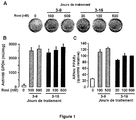
- PPAR ⁇ As previously described ( Rodriguez, AM, et al., Biochem Biophys Res Commun, 2004. 315 (2): p. 255-63 ), the activation of PPAR ⁇ is necessary for the adipocyte differentiation of hMADS-2 cells ( Fig.1A ).
- An additional week's treatment does not bring about changes in the expression of GPDH and PPAR ⁇ genes.
- 20nM rosiglitazone is sufficient to induce a maximal response, in agreement with the affinity of PPAR ⁇ for this ligand ( Fig.1A-C ).
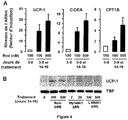
- Fig.2D the expression of the CIDEA gene, reported as closely associated with that of UCP1, is increased ( Fig.2D ) ( Zhou, Z., et al., Nat Genet, 2003. 35 (1): p. 49-56 ).
- brown adipocytes show a very important mitochondriogenesis ( Wilson-Fritch, L., et al., J Clin Invest, 2004. 114 (9): p. 1281-9 ).
- CPT1B mitochondrial carnitine palmitoyltransferase
- adipocytes expressing the white or brown phenotypes ( Fig. 6 ). It is known that brown rodent adipocytes are more susceptible to apoptosis than white adipocytes in vitro as in vivo . These adipocytes express both the anti-apoptotic protein Bcl-2 and the pro-apoptotic protein Bax ( Briscini et al., FEBS Lett 1998. 431, 80-84 ; Lindquist and Rehnmark, J Biol Chem1998. 273, 30147-30156 ; Nisoli et al. Cell Death Differ 2006. 13, 2154-2156 ).
- human white adipocytes show significant susceptibility to apoptosis, which appears to be related to the low expression of Bcl-2 and NAIP anti-apoptotic genes ( Papineau et al., Metabolism 2003. 52, 987-992 ).
- the passage of hMADS cells from the white phenotype to the brown phenotype is accompanied by an increase in the expression of the anti-apoptotic gene Bcl-2 and a decrease in that of the pro-apoptotic gene Bax, the Bcl-2 / Bax ratio increasing from 1 to 3.7 ( Figure 7 ) involving, depending on the species, an expression pattern different from the genes associated with apoptosis.
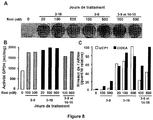
- brown adipocytes A major feature of brown adipocytes is intense respiratory activity and significant decoupling of oxidative phosphorylation. Oxygen consumption, determined using an oxygen-sensitive electrode ( Cannon, B. and J. Nedergaard, Physiol Rev, 2004. 84 (1): p. 277-359 ) made it possible to measure the relative speeds of respiration. The results show the important effect of long-term treatment with rosiglitazone on total and decoupled respiratory activities. After 20 days of chronic exposure which allows the acquisition of the brown phenotype, compared to the values obtained with the hMADS-2 cells exposed between days 3 and 9 and expressing the white phenotype, these two activities are increased by 3 times and 2, 5 times, respectively ( Fig.5 , A and B).
- brown adipose tissue plays an important role in adaptive thermogenesis in rodents, its ablation by transgenesis leading to obesity and a malfunction observed in obese rodents ( Cannon, B. and J.
- hMADS cells are immature stem cells whose lineage is located upstream of the white and brown lineages. Once committed to the brown lineage, hMADS cells have all the characteristics of brown rodent adipocytes; they express the UCP1, CIDEA, PGC-1 ⁇ , PGC-1 ⁇ and PRDM16 genes as well as the three members of the PPAR family. Crucially, the acquisition of the brown phenotype is accompanied by a significant increase in respiratory activities and uncoupling. Positive modulation of UCP1 expression by isoproterenol and CL316243 demonstrates that the signaling pathway generated by ⁇ -adrenergic receptors, particularly ⁇ 3 receptors, is also functional in these cells.
- human adipocytes immortalized by transgenesis and expressing ⁇ 3-adrenergic receptors show only weak lipolytic activity in response to CGP12177A, a partial ⁇ 3 agonist, and these receptors appear only weakly coupled to adenylate cyclase ( Zilberfarb, V., et al., Cell Sci J, 1997. 110 (Pt 7): p. 801-7 ; Jockers, R., et al., Endocrinology, 1998. 139 (6): p. 2676-84 ).
- no stimulation of UCP1 expression and no decoupling respiratory activity was reported in response to a specific ⁇ 3 agonist, contrary to the results of our work.
- no stimulation of respiratory activity by a specific ⁇ -adrenergic receptor agonist had been reported.
- Rosiglitazone belongs to the family of thiazolidinediones, a class of insulin-sensitizing molecules used in the treatment of type 2 diabetes ( Olefsky, JM and AR Saltiel, Trends Endocrinol Metab, 2000. 11 (9): p. 362-8 ). It promotes terminal adipocyte differentiation by specifically activating PPAR ⁇ ( Rodriguez, AM, et al., Biochem Biophys Res Commun, 2004. 315 (2): p. 255-63 ; Tai, TA, et al., J. Biol Chem, 1996. 271 (47): p. 29909-14 ; Forman, BM, et al., Cell, 1995. 83 (5): p.
- Activation of PPAR ⁇ occurs in white preadipocytes as well as in brown preadipocytes and leads to their differentiation into white and brown adipocytes, respectively ( Nedergaard, J., et al., Biochim Biophys Acta, 2005. 1740 (2): p. 293-304 ; Petrovic, N. et al., Am J Physiol Endocrinol Metab, (May 20, 2008). doi: 10.1152 / ajpendo.00035.2008 ).
- Rosiglitazone while normalizing blood glucose and insulin levels, leads to increased body weight in animals as well as in many patients ( Carmona, MC, et al., Int J Obes (Lond), 2005. 29 (7): p. 864-71 ; Goldberg, RB, Curr Opin Lipidol, 2007. 18 (4): p. 435-42 ; Home, PD, et al., Diabet Med, 2007. 24 (6): p. 626-34 ; Joosen, AM, et al., Diabetes Metab Res Rev, 2006. 22 (3): p. 204-10 ).
Landscapes
- Health & Medical Sciences (AREA)
- Life Sciences & Earth Sciences (AREA)
- Engineering & Computer Science (AREA)
- Biomedical Technology (AREA)
- Chemical & Material Sciences (AREA)
- Bioinformatics & Cheminformatics (AREA)
- Immunology (AREA)
- Cell Biology (AREA)
- Biotechnology (AREA)
- Organic Chemistry (AREA)
- Hematology (AREA)
- General Health & Medical Sciences (AREA)
- Molecular Biology (AREA)
- Genetics & Genomics (AREA)
- Urology & Nephrology (AREA)
- Biochemistry (AREA)
- Zoology (AREA)
- Wood Science & Technology (AREA)
- Developmental Biology & Embryology (AREA)
- Microbiology (AREA)
- Medicinal Chemistry (AREA)
- Analytical Chemistry (AREA)
- Toxicology (AREA)
- Pathology (AREA)
- General Physics & Mathematics (AREA)
- Rheumatology (AREA)
- Physics & Mathematics (AREA)
- Food Science & Technology (AREA)
- Tropical Medicine & Parasitology (AREA)
- General Engineering & Computer Science (AREA)
- Nuclear Medicine, Radiotherapy & Molecular Imaging (AREA)
- Pharmacology & Pharmacy (AREA)
- Animal Behavior & Ethology (AREA)
- Child & Adolescent Psychology (AREA)
- Chemical Kinetics & Catalysis (AREA)
- Public Health (AREA)
- Veterinary Medicine (AREA)
- Diabetes (AREA)
- General Chemical & Material Sciences (AREA)
- Obesity (AREA)
Claims (13)
- Differenzierungsverfahren einer aus adipösem Gewebe abgeleiteten, multipotenten, menschlichen Stammzellepopulation (hMADS-Zellen) in einer funktionale Population menschlicher brauner Adipozyten, umfassend die Stimulation der genannten hMADS-Zellen durch einen spezifischen Agonisten des Gamma-PPAR-Rezeptors, wobei der genannte Agonist ein Thiazolindion ist und diese Stimulation ausgeführt ist:- entweder während einer Periode, die zwischen 10 und 30 Tagen umfassenden Dauer,- oder (i) während einer ersten Differenzierungsperiode der hMADS-Zellen in weiße Adipozyten einer zwischen 2 und 9 Tagen umfassenden Dauer, (ii) wobei auf die erste Periode eine zweite Periode einer zwischen 2 und 10 Tagen umfassenden Dauer folgt, in deren Verlauf die Stimulation gestoppt ist, (iii) wobei auf die genannte zweite Periode eine dritte Stimulationsperiode einer zwischen 1 und 10 Tagen umfassenden Dauer folgt.
- Differenzierungsverfahren gemäß Anspruch 1, wobei das genannte Thiazolindion aus der Gruppe ausgewählt ist, die aus Rosiglitazon, Ciglitazon, Pioglitazon, Darglitazon und Troglitazon besteht.
- Differenzierungsverfahren gemäß Anspruch 2, wobei die Konzentration an spezifischem Agonisten des Gamma-PPAR-Rezeptors zwischen 5 nM und 1000 nM umfassend ist wenn der Agonist das Rosilitazon ist, zwischen 0,2 µM und 10 µM wenn der Agonist das Pioglitazon ist, zwischen 0,5 µM und 20 µM wenn der Agonist das Ciglitazon ist, zwischen 0,2 und 20 µM wenn der Agonist das Darglitazon ist, und zwischen 0,2 und 10 µM wenn der Agonist das Troglitazon ist.
- Differenzierungsverfahren gemäß einem der Ansprüche 1 bis 3, umfassend darüber hinaus die Funktionalität der Population menschlicher brauner Adipozyten, die nach der Differenzierung der Population der hMADS-Zellen erhalten wurde, wobei die genannte Überprüfung die folgenden sukzessiven Schritte umfasst:- die Stimulation der Atmungsaktivität der genannten Population menschlicher brauner Adipozyten durch einen spezifischen Agonisten eines adrenergischen Beta-Rezeptors, der ausgewählt ist aus der Gruppe, die aus Isoproterenol, Noradrenalin, Adrenalin, Dobutamin, Terbutalin und der Verbindung CL316243 besteht,- die Quantifizierung der Expression des für UCP1-kodierenden Gens und / oder des Sauerstoffverbrauchs, und- die Überprüfung, dass die genannte Population funktional ist, wenn die Expression des UCP1-kodierenden Gens und / oder des Sauerstoffverbrauchs im Verhältnis zu der erhöht ist, die bei Fehlen der Stimulation durch den genannten spezifischen Agonisten eines adrenergischen Beta-Rezeptors erhalten wird.
- Differenzierungsverfahren gemäß Anspruch 4, wobei der spezifische Agonist eines adrenergischen Beta-Rezeptors das Isoproterol ist.
- Differenzierungsverfahren gemäß Anspruch 4 oder 5, wobei die Konzentration an spezifischem Agonisten eines adrenergischen Beta-Rezeptoren zwischen 1 nM und 1000 nM umfassend ist.
- Konvertierungsverfahren einer Population menschlicher weißer Adipozyten in eine funktionale Population menschlicher brauner Adipozyten, umfassend die Stimulation der genannten Population menschlicher weißer Adipozyten durch einen spezifischen Agonisten des Gamma-PPAR während einer zwischen 1 und 10 Tagen umfassenden Dauer, wobei der genannte Agonist ein Thiazolindion ist.
- Konvertierungsverfahren gemäß Anspruch 7, wobei das genannte Thiazolindion ausgewählt ist aus der Gruppe, die aus Rosiglitazon, Ciglitazon, Pioglitazon, Darglitazon und Troglitazon besteht.
- Konvertierungsverfahren gemäß Anspruch 8, wobei die Konzentration an spezifischem Agonisten des Gamma-PPAR-Rezeptors zwischen 5 nM und 1000 nM umfassend ist wenn der Agonist das Rosiglitazon ist, zwischen 0,2 µM und 10 wenn der Agonist das Pioglitazon ist, zwischen 0,5 µM und 20 µM wenn der Agonist das Ciglitazon ist, zwischen 0,2 und 20 µM wenn der Agonist das Darglitazon ist, und zwischen 0,2 und 10 µM wenn der Agonist das Troglitazon ist.
- Konvertierungsverfahren gemäß einem der Ansprüche 7 bis 9, umfassend darüber hinaus die Überprüfung der Funktionalität der Population menschlicher brauner Adipozyten, die nach der Konvertierung der Population menschlicher weißer Adipozyten erhalten wird, wobei die genannte Überprüfung die folgenden sukzessiven Schritte umfasst:- die Stimulation der Atmungsaktivität der genannten Population menschlicher brauner Adipozyten durch einen spezifischen Agonisten eines adrenergischen Beta-Rezeptors, der ausgewählt ist aus der Gruppe bestehend aus dem Isoproterenol, dem Noradrenalin, dem Adrenalin, dem Dobutamin, dem Terbutalin und der Verbindung CL316243,- die Quantifizierung der Expression des UCP1-kodierenden Gens und /oder des Sauerstoffverbrauchs, und- die Überprüfung, dass die genannte Population funktional ist, wenn die Expression des UCP1-kodierenden Gens und / oder der Sauerstoffverbrauch im Verhältnis zu der erhöht ist, die bei Fehlen der Stimulation durch den genannten spezifischen Agonisten eines adrenergischen Beta-Rezeptors erhalten wird.
- Konvertierungsverfahren gemäß Anspruch 10, bei dem der spezifische Agonist eines adrenergischen Beta-Rezeptors das Isoproterenol ist.
- Konvertierungsverfahren gemäß Anspruch 10 oder 11, bei dem die Konzentration an spezifischem Agonisten eines adrenergischen Beta-Rezeptors zwischen 1 nM und 1000 nM umfassend ist.
- Identifizierungsverfahren eines Moleküls oder einer Molekülverbindung, das / die geeignet ist, die Bildung von menschlichen braunen Adipozyten zu begünstigen und / oder Übergewicht und / oder Fettsucht bei einem Patienten zu behandeln, umfassend die folgenden sukzessiven Schritte:a) die Umsetzung des Verfahrens gemäß irgendeinem der Ansprüche 1 bis 12 derart, dass eine funktionale Referenzpopulation von menschlichen braunen Adipozyten erhalten wird,b) das Gegenüberstellen einer Population von hMADS-Zellen mit dem genannten Molekül oder der genannten Molekülkombination,c) die Identifizierung des genannten Moleküls oder der genannten Molekülkombination als geeignet zur Begünstigung der Bildung von menschlichen braunen Adipozyten und / oder zur Behandlung von Übergewicht und / oder Fettsucht bei einem Patienten, wenn die Population von hMADS-Zellen des Schritts b) den Phänotyp der funktionalen Referenzpopulation von menschlichen braunen Adipozyten des Schritts a) exprimiert.
Applications Claiming Priority (2)
| Application Number | Priority Date | Filing Date | Title |
|---|---|---|---|
| FR0854140A FR2932818B1 (fr) | 2008-06-23 | 2008-06-23 | Lignee d'adipocytes bruns humains et procede de differenciation a partir d'une lignee de cellules hmads. |
| PCT/EP2009/057852 WO2009156413A1 (fr) | 2008-06-23 | 2009-06-23 | Lignee etablie d'adipocytes bruns humains et procede de differenciation a partir d'une lignee de cellules hmads |
Publications (2)
| Publication Number | Publication Date |
|---|---|
| EP2297576A1 EP2297576A1 (de) | 2011-03-23 |
| EP2297576B1 true EP2297576B1 (de) | 2017-01-11 |
Family
ID=39998991
Family Applications (1)
| Application Number | Title | Priority Date | Filing Date |
|---|---|---|---|
| EP09769262.8A Active EP2297576B1 (de) | 2008-06-23 | 2009-06-23 | Etablierte menschliche zelllinie von braunem fettgewebe und verfahren zur differenzierung aus einer hmads-zelllinie |
Country Status (8)
| Country | Link |
|---|---|
| US (1) | US9790469B2 (de) |
| EP (1) | EP2297576B1 (de) |
| JP (1) | JP5766115B2 (de) |
| AU (1) | AU2009264265A1 (de) |
| CA (1) | CA2728804A1 (de) |
| ES (1) | ES2622068T3 (de) |
| FR (1) | FR2932818B1 (de) |
| WO (1) | WO2009156413A1 (de) |
Families Citing this family (21)
| Publication number | Priority date | Publication date | Assignee | Title |
|---|---|---|---|---|
| WO2010080985A1 (en) * | 2009-01-08 | 2010-07-15 | Dana-Farber Cancer Institute, Inc. | Compositions and methods for induced brown fat differentiation |
| SG10201601853XA (en) | 2011-03-11 | 2016-04-28 | Univ Singapore | Pericyte progenitors from peripheral blood |
| WO2013003595A1 (en) | 2011-06-29 | 2013-01-03 | Biorestorative Therapies, Inc. | Brown fat cell compositions and methods |
| SG11201405257WA (en) * | 2012-03-12 | 2014-09-26 | Univ Singapore | Generation of brown adipose tissue (bat) from mesenchymal cells |
| US10335437B2 (en) * | 2012-08-10 | 2019-07-02 | The Trustees Of Columbia University In The City Of New York | Injectable brown adipose microtissues for treatment and prevention of obesity and diabetes |
| US11419916B2 (en) | 2012-09-11 | 2022-08-23 | Energesis Pharmaceuticals, Inc. | Methods and compositions for inducing differentiation of human brown adipocyte progenitors |
| JP6034107B2 (ja) * | 2012-09-25 | 2016-11-30 | 日本メナード化粧品株式会社 | 幹細胞から褐色脂肪細胞への分化促進剤 |
| US9784726B2 (en) | 2013-01-08 | 2017-10-10 | Atrogi Ab | Screening method, a kit, a method of treatment and a compound for use in a method of treatment |
| WO2014108531A1 (en) | 2013-01-13 | 2014-07-17 | Atrogi Ab | A screening method, a kit, a method of treatment and a compound for use in a method of treatment |
| US10167449B2 (en) * | 2013-04-19 | 2019-01-01 | Biorestorative Therapies, Inc. | Human brown adipose derived stem cells and uses |
| WO2015090350A1 (en) | 2013-12-16 | 2015-06-25 | Atrogi Ab | A screening method, a kit, a method of treatment and a compound for use in a method of treatment |
| EP3110946B1 (de) * | 2014-02-24 | 2021-09-01 | Energesis Pharmaceuticals Inc. | Verfahren und zusammensetzungen zur induzierung der differenzierung von vorläufern menschlicher brauner adipozyten |
| US20170153225A1 (en) * | 2014-07-09 | 2017-06-01 | Atrogi Ab | A method of screening for a compound capable of stimulating glucose transport into brown and/or brite adipocytes of a mammal, a kit for use in such a method |
| KR101773041B1 (ko) | 2016-01-26 | 2017-08-31 | 한양대학교 에리카산학협력단 | 줄기세포로부터 추출된 엑소좀을 함유하는 베이지 지방세포 분화 유도용 조성물 |
| WO2018062269A1 (ja) * | 2016-09-30 | 2018-04-05 | 京都府公立大学法人 | 体細胞を製造する方法、体細胞、及び組成物 |
| GB201714734D0 (en) | 2017-09-13 | 2017-10-25 | Atrogi Ab | New compounds and uses |
| GB201714740D0 (en) | 2017-09-13 | 2017-10-25 | Atrogi Ab | New compounds and uses |
| GB201714745D0 (en) | 2017-09-13 | 2017-10-25 | Atrogi Ab | New compounds and uses |
| GB201714736D0 (en) | 2017-09-13 | 2017-10-25 | Atrogi Ab | New compounds and uses |
| GB201903832D0 (en) | 2019-03-20 | 2019-05-01 | Atrogi Ab | New compounds and methods |
| WO2020223381A2 (en) * | 2019-04-29 | 2020-11-05 | Biorestorative Therapies, Inc. | Non-naturally occuring three-dimensional (3d) brown adipose-derived stem cell aggregates, and methods of generating and using the same |
Citations (1)
| Publication number | Priority date | Publication date | Assignee | Title |
|---|---|---|---|---|
| WO1996033724A2 (en) * | 1995-04-25 | 1996-10-31 | The Salk Institute For Biological Studies | Selective modulators of peroxisome proliferator activated receptor-gamma, and methods for the use thereof |
Family Cites Families (5)
| Publication number | Priority date | Publication date | Assignee | Title |
|---|---|---|---|---|
| FR2733513B1 (fr) * | 1995-04-25 | 1997-07-18 | Centre Nat Rech Scient | Lignees immortalisees de cellules issues du tissu adipeux humain, leur procede de preparation et leurs applications |
| US6426411B1 (en) * | 1997-05-30 | 2002-07-30 | Dana-Farber Cancer Institute | PGC-1, a novel brown fat pparγ coactivator |
| DK1677735T3 (da) * | 2003-10-17 | 2014-10-27 | Joslin Diabetes Center Inc | Fremgangsmåder og sammensætninger til modulering af adipocytfunktion |
| WO2007041869A1 (en) * | 2005-10-14 | 2007-04-19 | Universite Laval | Reconstructed living adipose tissue |
| WO2009137613A2 (en) * | 2008-05-06 | 2009-11-12 | Joslin Diabetes Center, Inc. | Methods and compositions for inducing brown adipogenesis |
-
2008
- 2008-06-23 FR FR0854140A patent/FR2932818B1/fr active Active
-
2009
- 2009-06-23 US US13/000,904 patent/US9790469B2/en active Active
- 2009-06-23 AU AU2009264265A patent/AU2009264265A1/en not_active Abandoned
- 2009-06-23 ES ES09769262.8T patent/ES2622068T3/es active Active
- 2009-06-23 JP JP2011515361A patent/JP5766115B2/ja active Active
- 2009-06-23 EP EP09769262.8A patent/EP2297576B1/de active Active
- 2009-06-23 WO PCT/EP2009/057852 patent/WO2009156413A1/fr not_active Ceased
- 2009-06-23 CA CA2728804A patent/CA2728804A1/fr not_active Abandoned
Patent Citations (1)
| Publication number | Priority date | Publication date | Assignee | Title |
|---|---|---|---|---|
| WO1996033724A2 (en) * | 1995-04-25 | 1996-10-31 | The Salk Institute For Biological Studies | Selective modulators of peroxisome proliferator activated receptor-gamma, and methods for the use thereof |
Non-Patent Citations (6)
| Title |
|---|
| BUCKLE D R ET AL: "Non thiazolidinedione antihyperglycaemic agents. 1: alpha-heteroatom substituted beta-phenylpropanoic acids", BIOORGANIC & MEDICINAL CHEMISTRY LETTERS, PERGAMON, ELSEVIER SCIENCE, GB, vol. 6, no. 17, 3 September 1996 (1996-09-03), pages 2121 - 2126, XP004135669, ISSN: 0960-894X, DOI: 10.1016/0960-894X(96)00383-6 * |
| CARPÉNÉ C: "Assays of adrenergic receptors. Including lipolysis and binding measurements.", METHODS IN MOLECULAR BIOLOGY (CLIFTON, N.J.) 2001, vol. 155, 2001, pages 129 - 140, XP009164817, ISSN: 1064-3745 * |
| ELABD C ET AL: "Human adipose tissue-derived multipotent stem cells differentiate in vitro and in vivo into osteocyte-like cells", BIOCHEMICAL AND BIOPHYSICAL RESEARCH COMMUNICATIONS, ACADEMIC PRESS INC. ORLANDO, FL, US, vol. 361, no. 2, 21 September 2007 (2007-09-21), pages 342 - 348, XP027016318, ISSN: 0006-291X, [retrieved on 20070806], DOI: 10.1016/J.BBRC.2007.06.180 * |
| KREY G ET AL: "FATTY ACIDS, EICOSANOIDS, AND HYPOLIPIDEMIC AGENTS IDENTIFIED AS LIGANDS OF PEROXISOME PROLIFERATOR-ACTIVATED RECEPTORS BY COACTIVATOR-DEPENDENT RECEPTOR LIGAND ASSAY", CONFERENCE PROCEEDINGS, vol. 11, no. 6, 1 June 1997 (1997-06-01), pages 779 - 791, XP002402069 * |
| LAURE-EMMANUELLE ZARAGOSI ET AL: "Autocrine Fibroblast Growth Factor 2 Signaling Is Critical for Self-Renewal of Human Multipotent Adipose-Derived Stem Cells", STEM CELLS, vol. 24, no. 11, 1 November 2006 (2006-11-01), pages 2412 - 2419, XP055108785, ISSN: 1066-5099, DOI: 10.1634/stemcells.2006-0006 * |
| RODRIGUEZ A-M ET AL: "Transplantation of a multipotent cell population from human adipose tissue induces dystrophin expression in the immunocompetent mdx mouse", THE JOURNAL OF EXPERIMENTAL MEDICINE, ROCKEFELLER UNIVERSITY PRESS, US, vol. 201, no. 9, 2 May 2005 (2005-05-02), pages 1397 - 1405, XP003005684, ISSN: 0022-1007, DOI: 10.1084/JEM.20042224 * |
Also Published As
| Publication number | Publication date |
|---|---|
| FR2932818B1 (fr) | 2015-12-04 |
| AU2009264265A1 (en) | 2009-12-30 |
| WO2009156413A1 (fr) | 2009-12-30 |
| CA2728804A1 (fr) | 2009-12-30 |
| JP5766115B2 (ja) | 2015-08-19 |
| US20110117066A1 (en) | 2011-05-19 |
| JP2011525797A (ja) | 2011-09-29 |
| US9790469B2 (en) | 2017-10-17 |
| FR2932818A1 (fr) | 2009-12-25 |
| ES2622068T3 (es) | 2017-07-05 |
| EP2297576A1 (de) | 2011-03-23 |
Similar Documents
| Publication | Publication Date | Title |
|---|---|---|
| EP2297576B1 (de) | Etablierte menschliche zelllinie von braunem fettgewebe und verfahren zur differenzierung aus einer hmads-zelllinie | |
| Janderová et al. | Human mesenchymal stem cells as an in vitro model for human adipogenesis | |
| Bordicchia et al. | Cardiac natriuretic peptides act via p38 MAPK to induce the brown fat thermogenic program in mouse and human adipocytes | |
| US12312599B2 (en) | Methods, compositions, and kits for producing beige adipocytes and treating metabolic disorders | |
| Boopathy et al. | Oxidative stress-induced Notch1 signaling promotes cardiogenic gene expression in mesenchymal stem cells | |
| Gorski et al. | Uncoupling protein 1 expression in adipocytes derived from skeletal muscle fibro/adipogenic progenitors is under genetic and hormonal control | |
| Gregoire | Adipocyte differentiation: from fibroblast to endocrine cell | |
| AU2007254644B2 (en) | Islet cells from human embryonic stem cells | |
| Ludikhuize et al. | Metabolic regulation of stem cells and differentiation: a forkhead box O transcription factor perspective | |
| Newell et al. | Characterization of the transcriptional and functional effects of fibroblast growth factor‐1 on human preadipocyte differentiation | |
| JP2002522068A (ja) | GLP−1またはExendin−4による、非インスリン産生細胞のインスリン産生細胞への分化、およびその使用 | |
| Sharifpanah et al. | Peroxisome proliferator-activated receptor α agonists enhance cardiomyogenesis of mouse ES cells by utilization of a reactive oxygen species-dependent mechanism | |
| Takagi et al. | Induction of beige adipocytes by naturally occurring β3-adrenoceptor agonist p-synephrine | |
| Asano et al. | Isoform-specific regulation of vascular endothelial growth factor (VEGF) family mRNA expression in cultured mouse brown adipocytes | |
| EP3174972A1 (de) | Verfahren zur in-vitro-herstellung von adipozytenvorläufern und adipozyten | |
| Chen et al. | Glucose‐dependent insulinotropic polypeptide modifies adipose plasticity and promotes beige adipogenesis of human omental adipose‐derived stem cells | |
| Zhang et al. | Stimulation of glucose uptake and improvement of insulin resistance by aromadendrin | |
| Lim et al. | GO6976 prevents TNF-α-induced suppression of adiponectin expression in 3T3-L1 adipocytes: Putative involvement of protein kinase C | |
| Liu et al. | Insulin regulates the expression of adiponectin and adiponectin receptors in porcine adipocytes | |
| Akasaka et al. | Direct evidence for leptin-induced lipid oxidation independent of long-form leptin receptor | |
| FR2962443A1 (fr) | Modele de tissu adipeux et procede de preparation | |
| Jung et al. | Duration and magnitude of extracellular signal-regulated protein kinase phosphorylation determine adipogenesis or osteogenesis in human bone marrow-derived stem cells | |
| Peymani et al. | Dual effects of peroxisome proliferator-activated receptor γ on embryonic stem cell self-renewal in presence and absence of leukemia inhibitory factor | |
| US10662407B2 (en) | Method for controlling differentiation of embryonic stem cells into adipocytes or kidney precursor cells by regulating SIRT1 expression | |
| Shen et al. | Alpha-lipoic acid enhances DMSO-induced cardiomyogenic differentiation of P19 cells |
Legal Events
| Date | Code | Title | Description |
|---|---|---|---|
| PUAI | Public reference made under article 153(3) epc to a published international application that has entered the european phase |
Free format text: ORIGINAL CODE: 0009012 |
|
| 17P | Request for examination filed |
Effective date: 20110119 |
|
| AK | Designated contracting states |
Kind code of ref document: A1 Designated state(s): AT BE BG CH CY CZ DE DK EE ES FI FR GB GR HR HU IE IS IT LI LT LU LV MC MK MT NL NO PL PT RO SE SI SK TR |
|
| AX | Request for extension of the european patent |
Extension state: AL BA RS |
|
| 17Q | First examination report despatched |
Effective date: 20110524 |
|
| DAX | Request for extension of the european patent (deleted) | ||
| REG | Reference to a national code |
Ref country code: DE Ref legal event code: R079 Ref document number: 602009043730 Country of ref document: DE Free format text: PREVIOUS MAIN CLASS: G01N0033500000 Ipc: C12N0005077500 |
|
| GRAP | Despatch of communication of intention to grant a patent |
Free format text: ORIGINAL CODE: EPIDOSNIGR1 |
|
| RIC1 | Information provided on ipc code assigned before grant |
Ipc: G01N 33/50 20060101ALI20151020BHEP Ipc: C12N 5/0775 20100101AFI20151020BHEP Ipc: C12N 5/077 20100101ALI20151020BHEP |
|
| INTG | Intention to grant announced |
Effective date: 20151116 |
|
| GRAJ | Information related to disapproval of communication of intention to grant by the applicant or resumption of examination proceedings by the epo deleted |
Free format text: ORIGINAL CODE: EPIDOSDIGR1 |
|
| GRAP | Despatch of communication of intention to grant a patent |
Free format text: ORIGINAL CODE: EPIDOSNIGR1 |
|
| INTG | Intention to grant announced |
Effective date: 20160419 |
|
| GRAJ | Information related to disapproval of communication of intention to grant by the applicant or resumption of examination proceedings by the epo deleted |
Free format text: ORIGINAL CODE: EPIDOSDIGR1 |
|
| GRAP | Despatch of communication of intention to grant a patent |
Free format text: ORIGINAL CODE: EPIDOSNIGR1 |
|
| INTC | Intention to grant announced (deleted) | ||
| INTG | Intention to grant announced |
Effective date: 20160921 |
|
| GRAS | Grant fee paid |
Free format text: ORIGINAL CODE: EPIDOSNIGR3 |
|
| GRAA | (expected) grant |
Free format text: ORIGINAL CODE: 0009210 |
|
| AK | Designated contracting states |
Kind code of ref document: B1 Designated state(s): AT BE BG CH CY CZ DE DK EE ES FI FR GB GR HR HU IE IS IT LI LT LU LV MC MK MT NL NO PL PT RO SE SI SK TR |
|
| REG | Reference to a national code |
Ref country code: GB Ref legal event code: FG4D Free format text: NOT ENGLISH |
|
| REG | Reference to a national code |
Ref country code: CH Ref legal event code: EP |
|
| REG | Reference to a national code |
Ref country code: AT Ref legal event code: REF Ref document number: 861296 Country of ref document: AT Kind code of ref document: T Effective date: 20170115 |
|
| REG | Reference to a national code |
Ref country code: IE Ref legal event code: FG4D Free format text: LANGUAGE OF EP DOCUMENT: FRENCH |
|
| REG | Reference to a national code |
Ref country code: DE Ref legal event code: R096 Ref document number: 602009043730 Country of ref document: DE |
|
| REG | Reference to a national code |
Ref country code: CH Ref legal event code: NV Representative=s name: MICHELI AND CIE SA, CH |
|
| REG | Reference to a national code |
Ref country code: LT Ref legal event code: MG4D |
|
| REG | Reference to a national code |
Ref country code: NL Ref legal event code: MP Effective date: 20170111 |
|
| REG | Reference to a national code |
Ref country code: FR Ref legal event code: PLFP Year of fee payment: 9 |
|
| REG | Reference to a national code |
Ref country code: AT Ref legal event code: MK05 Ref document number: 861296 Country of ref document: AT Kind code of ref document: T Effective date: 20170111 |
|
| PG25 | Lapsed in a contracting state [announced via postgrant information from national office to epo] |
Ref country code: NL Free format text: LAPSE BECAUSE OF FAILURE TO SUBMIT A TRANSLATION OF THE DESCRIPTION OR TO PAY THE FEE WITHIN THE PRESCRIBED TIME-LIMIT Effective date: 20170111 |
|
| REG | Reference to a national code |
Ref country code: ES Ref legal event code: FG2A Ref document number: 2622068 Country of ref document: ES Kind code of ref document: T3 Effective date: 20170705 |
|
| PG25 | Lapsed in a contracting state [announced via postgrant information from national office to epo] |
Ref country code: GR Free format text: LAPSE BECAUSE OF FAILURE TO SUBMIT A TRANSLATION OF THE DESCRIPTION OR TO PAY THE FEE WITHIN THE PRESCRIBED TIME-LIMIT Effective date: 20170412 Ref country code: LT Free format text: LAPSE BECAUSE OF FAILURE TO SUBMIT A TRANSLATION OF THE DESCRIPTION OR TO PAY THE FEE WITHIN THE PRESCRIBED TIME-LIMIT Effective date: 20170111 Ref country code: HR Free format text: LAPSE BECAUSE OF FAILURE TO SUBMIT A TRANSLATION OF THE DESCRIPTION OR TO PAY THE FEE WITHIN THE PRESCRIBED TIME-LIMIT Effective date: 20170111 Ref country code: FI Free format text: LAPSE BECAUSE OF FAILURE TO SUBMIT A TRANSLATION OF THE DESCRIPTION OR TO PAY THE FEE WITHIN THE PRESCRIBED TIME-LIMIT Effective date: 20170111 Ref country code: NO Free format text: LAPSE BECAUSE OF FAILURE TO SUBMIT A TRANSLATION OF THE DESCRIPTION OR TO PAY THE FEE WITHIN THE PRESCRIBED TIME-LIMIT Effective date: 20170411 Ref country code: IS Free format text: LAPSE BECAUSE OF FAILURE TO SUBMIT A TRANSLATION OF THE DESCRIPTION OR TO PAY THE FEE WITHIN THE PRESCRIBED TIME-LIMIT Effective date: 20170511 |
|
| PG25 | Lapsed in a contracting state [announced via postgrant information from national office to epo] |
Ref country code: PT Free format text: LAPSE BECAUSE OF FAILURE TO SUBMIT A TRANSLATION OF THE DESCRIPTION OR TO PAY THE FEE WITHIN THE PRESCRIBED TIME-LIMIT Effective date: 20170511 Ref country code: SE Free format text: LAPSE BECAUSE OF FAILURE TO SUBMIT A TRANSLATION OF THE DESCRIPTION OR TO PAY THE FEE WITHIN THE PRESCRIBED TIME-LIMIT Effective date: 20170111 Ref country code: PL Free format text: LAPSE BECAUSE OF FAILURE TO SUBMIT A TRANSLATION OF THE DESCRIPTION OR TO PAY THE FEE WITHIN THE PRESCRIBED TIME-LIMIT Effective date: 20170111 Ref country code: LV Free format text: LAPSE BECAUSE OF FAILURE TO SUBMIT A TRANSLATION OF THE DESCRIPTION OR TO PAY THE FEE WITHIN THE PRESCRIBED TIME-LIMIT Effective date: 20170111 Ref country code: BG Free format text: LAPSE BECAUSE OF FAILURE TO SUBMIT A TRANSLATION OF THE DESCRIPTION OR TO PAY THE FEE WITHIN THE PRESCRIBED TIME-LIMIT Effective date: 20170411 Ref country code: AT Free format text: LAPSE BECAUSE OF FAILURE TO SUBMIT A TRANSLATION OF THE DESCRIPTION OR TO PAY THE FEE WITHIN THE PRESCRIBED TIME-LIMIT Effective date: 20170111 |
|
| REG | Reference to a national code |
Ref country code: DE Ref legal event code: R097 Ref document number: 602009043730 Country of ref document: DE |
|
| PG25 | Lapsed in a contracting state [announced via postgrant information from national office to epo] |
Ref country code: SK Free format text: LAPSE BECAUSE OF FAILURE TO SUBMIT A TRANSLATION OF THE DESCRIPTION OR TO PAY THE FEE WITHIN THE PRESCRIBED TIME-LIMIT Effective date: 20170111 Ref country code: CZ Free format text: LAPSE BECAUSE OF FAILURE TO SUBMIT A TRANSLATION OF THE DESCRIPTION OR TO PAY THE FEE WITHIN THE PRESCRIBED TIME-LIMIT Effective date: 20170111 Ref country code: RO Free format text: LAPSE BECAUSE OF FAILURE TO SUBMIT A TRANSLATION OF THE DESCRIPTION OR TO PAY THE FEE WITHIN THE PRESCRIBED TIME-LIMIT Effective date: 20170111 Ref country code: EE Free format text: LAPSE BECAUSE OF FAILURE TO SUBMIT A TRANSLATION OF THE DESCRIPTION OR TO PAY THE FEE WITHIN THE PRESCRIBED TIME-LIMIT Effective date: 20170111 |
|
| PLBE | No opposition filed within time limit |
Free format text: ORIGINAL CODE: 0009261 |
|
| STAA | Information on the status of an ep patent application or granted ep patent |
Free format text: STATUS: NO OPPOSITION FILED WITHIN TIME LIMIT |
|
| PG25 | Lapsed in a contracting state [announced via postgrant information from national office to epo] |
Ref country code: DK Free format text: LAPSE BECAUSE OF FAILURE TO SUBMIT A TRANSLATION OF THE DESCRIPTION OR TO PAY THE FEE WITHIN THE PRESCRIBED TIME-LIMIT Effective date: 20170111 |
|
| 26N | No opposition filed |
Effective date: 20171012 |
|
| PG25 | Lapsed in a contracting state [announced via postgrant information from national office to epo] |
Ref country code: MC Free format text: LAPSE BECAUSE OF FAILURE TO SUBMIT A TRANSLATION OF THE DESCRIPTION OR TO PAY THE FEE WITHIN THE PRESCRIBED TIME-LIMIT Effective date: 20170111 |
|
| PG25 | Lapsed in a contracting state [announced via postgrant information from national office to epo] |
Ref country code: SI Free format text: LAPSE BECAUSE OF FAILURE TO SUBMIT A TRANSLATION OF THE DESCRIPTION OR TO PAY THE FEE WITHIN THE PRESCRIBED TIME-LIMIT Effective date: 20170111 |
|
| REG | Reference to a national code |
Ref country code: IE Ref legal event code: MM4A |
|
| PG25 | Lapsed in a contracting state [announced via postgrant information from national office to epo] |
Ref country code: IE Free format text: LAPSE BECAUSE OF NON-PAYMENT OF DUE FEES Effective date: 20170623 Ref country code: LU Free format text: LAPSE BECAUSE OF NON-PAYMENT OF DUE FEES Effective date: 20170623 |
|
| REG | Reference to a national code |
Ref country code: BE Ref legal event code: MM Effective date: 20170630 |
|
| REG | Reference to a national code |
Ref country code: FR Ref legal event code: PLFP Year of fee payment: 10 |
|
| PG25 | Lapsed in a contracting state [announced via postgrant information from national office to epo] |
Ref country code: BE Free format text: LAPSE BECAUSE OF NON-PAYMENT OF DUE FEES Effective date: 20170630 |
|
| PG25 | Lapsed in a contracting state [announced via postgrant information from national office to epo] |
Ref country code: MT Free format text: LAPSE BECAUSE OF FAILURE TO SUBMIT A TRANSLATION OF THE DESCRIPTION OR TO PAY THE FEE WITHIN THE PRESCRIBED TIME-LIMIT Effective date: 20170111 |
|
| PG25 | Lapsed in a contracting state [announced via postgrant information from national office to epo] |
Ref country code: HU Free format text: LAPSE BECAUSE OF FAILURE TO SUBMIT A TRANSLATION OF THE DESCRIPTION OR TO PAY THE FEE WITHIN THE PRESCRIBED TIME-LIMIT; INVALID AB INITIO Effective date: 20090623 |
|
| PG25 | Lapsed in a contracting state [announced via postgrant information from national office to epo] |
Ref country code: CY Free format text: LAPSE BECAUSE OF NON-PAYMENT OF DUE FEES Effective date: 20170111 |
|
| PG25 | Lapsed in a contracting state [announced via postgrant information from national office to epo] |
Ref country code: MK Free format text: LAPSE BECAUSE OF FAILURE TO SUBMIT A TRANSLATION OF THE DESCRIPTION OR TO PAY THE FEE WITHIN THE PRESCRIBED TIME-LIMIT Effective date: 20170111 |
|
| PG25 | Lapsed in a contracting state [announced via postgrant information from national office to epo] |
Ref country code: TR Free format text: LAPSE BECAUSE OF FAILURE TO SUBMIT A TRANSLATION OF THE DESCRIPTION OR TO PAY THE FEE WITHIN THE PRESCRIBED TIME-LIMIT Effective date: 20170111 |
|
| P01 | Opt-out of the competence of the unified patent court (upc) registered |
Effective date: 20230622 |
|
| PGFP | Annual fee paid to national office [announced via postgrant information from national office to epo] |
Ref country code: GB Payment date: 20250626 Year of fee payment: 17 |
|
| PGFP | Annual fee paid to national office [announced via postgrant information from national office to epo] |
Ref country code: FR Payment date: 20250626 Year of fee payment: 17 |
|
| PGFP | Annual fee paid to national office [announced via postgrant information from national office to epo] |
Ref country code: ES Payment date: 20250828 Year of fee payment: 17 |
|
| PGFP | Annual fee paid to national office [announced via postgrant information from national office to epo] |
Ref country code: DE Payment date: 20250725 Year of fee payment: 17 |
|
| PGFP | Annual fee paid to national office [announced via postgrant information from national office to epo] |
Ref country code: IT Payment date: 20250626 Year of fee payment: 17 |
|
| PGFP | Annual fee paid to national office [announced via postgrant information from national office to epo] |
Ref country code: CH Payment date: 20250711 Year of fee payment: 17 |