EP2296852B1 - Tree delimbing method and device - Google Patents
Tree delimbing method and device Download PDFInfo
- Publication number
- EP2296852B1 EP2296852B1 EP09770489.4A EP09770489A EP2296852B1 EP 2296852 B1 EP2296852 B1 EP 2296852B1 EP 09770489 A EP09770489 A EP 09770489A EP 2296852 B1 EP2296852 B1 EP 2296852B1
- Authority
- EP
- European Patent Office
- Prior art keywords
- trunk
- limbing
- compliance
- knives
- control unit
- Prior art date
- Legal status (The legal status is an assumption and is not a legal conclusion. Google has not performed a legal analysis and makes no representation as to the accuracy of the status listed.)
- Active
Links
Images

Classifications
-
- A—HUMAN NECESSITIES
- A01—AGRICULTURE; FORESTRY; ANIMAL HUSBANDRY; HUNTING; TRAPPING; FISHING
- A01G—HORTICULTURE; CULTIVATION OF VEGETABLES, FLOWERS, RICE, FRUIT, VINES, HOPS OR SEAWEED; FORESTRY; WATERING
- A01G23/00—Forestry
- A01G23/02—Transplanting, uprooting, felling or delimbing trees
- A01G23/08—Felling trees
- A01G23/083—Feller-delimbers
-
- A—HUMAN NECESSITIES
- A01—AGRICULTURE; FORESTRY; ANIMAL HUSBANDRY; HUNTING; TRAPPING; FISHING
- A01G—HORTICULTURE; CULTIVATION OF VEGETABLES, FLOWERS, RICE, FRUIT, VINES, HOPS OR SEAWEED; FORESTRY; WATERING
- A01G23/00—Forestry
- A01G23/02—Transplanting, uprooting, felling or delimbing trees
- A01G23/095—Delimbers
-
- B—PERFORMING OPERATIONS; TRANSPORTING
- B27—WORKING OR PRESERVING WOOD OR SIMILAR MATERIAL; NAILING OR STAPLING MACHINES IN GENERAL
- B27L—REMOVING BARK OR VESTIGES OF BRANCHES; SPLITTING WOOD; MANUFACTURE OF VENEER, WOODEN STICKS, WOOD SHAVINGS, WOOD FIBRES OR WOOD POWDER
- B27L1/00—Debarking or removing vestiges of branches from trees or logs; Machines therefor
Definitions
- This invention is relates to a tree delimbing method and device for delimbing a tree trunk in a compliant gripping state defined by a set of limbing knives enclosing the trunk, comprising repeated adjustment of the limbing knives through a control unit for adaption of the gripping state to a varying thickness of the trunk when the trunk is advanced between the knives for the delimbing of the trunk.
- the compliance of the gripping state is predetermined by changing a closing extent of a gripping means provided with the limbing knives each time a top face of the trunk has been moved a predetermined distance in a direction of movement for a resiliently compliant limbing knife.
- a switch which is actuated by the compliant limbing knife so as to when the switch is not actuated by the limbing knife, the closing extent of the gripping means increases to lift the tree trunk in the delimbing device until the compliant limbing knife actuates the switch that then interrupts the closing of the gripping means.
- a disadvantage of the prior art device is that the compliance of the gripping state, i.e. the remaining free stroke of travel of the resilient limbing knife, is invariable after each increase of the extent of closing of the grip of the trunk.
- Birch trees for example, can have coarse branches that may excessively load the processing assembly when attempting to cut the branches too close to the trunk.
- the gripping state should then have a relatively large compliance, capable of allowing the tree trunk to move away from the limbing knives, or allowing the limbing knives to move away from the tree trunk a further distance, when one or more such coarse branches are coming into knife engagement.
- the compliance, play or remaining free stroke of travel of the gripping state should then be about 30 to 40 mm.
- spruce trees for example, may have a linearly tapering trunk with relatively thin branches.
- the gripping state should then have a relatively small compliance so as to cut the branches close to the trunk. If the compliance then is too large, the elastic branches may resiliently bend toward the trunk and slide along the limbing knives without being cut.
- the compliance, play or free stroke of travel of the gripping state may then be about 5 mm.
- An object of the present invention is to further develop a method and a device of the type defined above so that it is capable of more effectively delimbing tree trunks of mutually differing branch qualities.
- Another object may be considered as to adapt the delimbing operation to the requirements of the actual tree trunk.
- a method according to the invention is defined in claim 1.
- the compliance of the gripping state can be adapted to the quality of the actual tree trunk.
- the desired compliance may empirically be determined by an operator of the device based on a judgment of the tree trunk and its branches and be set in an input unit as a category such as "Spruce”, "Birch”, etc. but also as a direct distance value, for example 40 mm.
- the compliance of the gripping state may be included by all limbing knives, according to one embodiment of the invention, the compliance comprises a remaining free stroke of one limbing knife resiliently engaging the trunk.
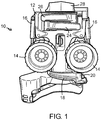
- FIG.1 shows a front face of a vertically oriented tree processing assembly 10 of the single-grip type.
- Assembly 10 has a main body 12 supporting inter alia a pair of opposite feed wheels 14, a lower forward limbing knife 18, a pair of upper forward limbing knives 24, 26 and an upper rearward limbing knife 28.
- the two feed wheels 14 are pivotally connected to the main body 12 to clamp and longitudinally feed a tree trunk 60 ( FIGS. 2-5 ) felled by the assembly 10.
- Each feed wheel 14 and the limbing knives18, 24, 26 are adjusted to their positions enclosing the trunk by means of actuators.
- the feed wheels 14 are adjusted by respective hydraulic cylinders 16, and the lower limbing knife 18 as well as the upper forward limbing knives 24, 26 are also adjusted by respective hydraulic cylinders 20 and 56, 56 ( FIG. 4 ).
- the upper rearward limbing knife 28 is resiliently forced to the tree trunk 60 by means of a spring 30 ( FIGS. 4, 5 ).
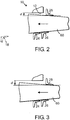
- FIG. 2-5 shows a horizontally oriented tree processing assembly 10 gripping a tree trunk 60 by the upper forward limbing knives 24, 26 and by the upper rearward limbing knife 28. Accordingly, the upper forward limbing knives 24, 26 as well as the lower forward limbing knife 18 (indicated only in FIG. 2 ) support the weight of the horizontally oriented tree trunk 60 received in the processing assembly 10.
- limbing knife 18 is understood to be controlled in a manner corresponding to the control of the adjustable upper forward limbing knives 24, 26.
- the bottom face of the main body may represent an upper end position, formed by an upper stop (not shown) for the spring-loaded limbing knife 28, the lower end position of which may be defined by a lower stop 32 ( FIGS. 4, 5 ) of the assembly 10.
- the distance d is critical for a correct delimbing operation.
- Distance d may be regarded as representing the play or remaining stroke of travel of the spring-loaded limbing knife 28 - and thereby also the play in the vertical direction of the horizontally oriented tree trunk 30.
- the trunk may get stuck in the assembly 10 or subject the limbing knives to a far too high load by cutting into far too massive wood sections of the branches or the trunk 60. If, on the other hand, the play is too large, the branches of the trunk 60 may bend to the trunk and slide under the the knives whereby they will not be cut off during the delimbing operation.
- the actual distance d is detected by a proximity sensor 42, such as an analog inductive or magnetic proximity sensor.
- Proximity sensor 42 is continuously signaling the actual distance d, for example as an electric current i, via a signal connection 44 to an electronic control unit 46 of a control system 40.
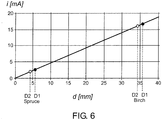
- a processor (not shown) in the control unit 40 can be programmed to emit a control signal via a signal connection 48 to a magnet valve 50 when the electric current indicates that the distance d has risen to a critical value D1 ( FIG. 6 ) that may be stored in a memory (not shown) in the control unit 46.
- Valve 50 then opens a path between a hydraulic pump 52 and the respective hydraulic cylinders 56.
- the limbing knives 24, 26 will then further tighten the grip of the tree trunk 60, whereby the distance d decreases to an adjoining value D2 ( FIG. 6 ) when the tree trunk 60 is lifted further up in the assembly 10.
- the distance d may further increase until it again reaches the critical value D1, whereupon the above process is repeated.
- the number of repetitions of this process depends on the magnitude of the interval D1-D2 and the length of the tree trunk.
- the magnitude of the interval D1-D2 may vary depending on the accuracy, for example, depending on inertia and delay in the hydraulic system and influence of hysteresis, of the control system 40 and the sensor 42.
- D1 and D2 may have relatively large values that typically amount to between 30 and 40 mm.
- the limbing knife 28 has a relatively large play above the tree trunk 60.
- Such a case may be suitable for trunks of birch, the branches of which may be relatively massive close to the trunk.
- the large play of the limbing knife 28 will then allow the knife to be forced further out from the trunk before it cuts the branch.
- the spring-loaded limbing knife 28 and also the other limbing knives can have such a cutting angle that they are guided away from the trunk to a certain amount during the cutting operation.
- the process may then also allow that the whole trunk 60 is forced away from the adjustable limbing knives 24, 26 when these knives encounter massive branches.
- D1 and D2 have relatively small values of about 5 mm may be suitable when delimbing trunks of spruce, for example, where generally the trunk surface tapers relatively linearly and the branches are relatively thin and therefore are quite easy to cut off.
- the branches are then cut close to the trunk 60 and are thereby prevented from bending against the trunk and sliding along and past the limbing knives 18, 24, 26, 28.
- the desired play or the above-mentioned critical value D1 can be set in the control unit 46 prior to each delimbing operation.
- the control unit 46 is provided with an input unit 47, having one or more push buttons or keys 49, for example, in the vehicle (not shown) that supports the assembly 10.
- the operator (not shown) then makes a visual examination of the tree to be felled, and, after an empirical conclusion, makes a decision about the quality of the trunk, for example in the form of a category, that is entered into the unit 47.
Landscapes
- Life Sciences & Earth Sciences (AREA)
- Forests & Forestry (AREA)
- Biodiversity & Conservation Biology (AREA)
- Ecology (AREA)
- Environmental Sciences (AREA)
- Engineering & Computer Science (AREA)
- Wood Science & Technology (AREA)
- Harvester Elements (AREA)
- Control And Other Processes For Unpacking Of Materials (AREA)
- Debarking, Splitting, And Disintegration Of Timber (AREA)
- Details Of Cutting Devices (AREA)
- Management, Administration, Business Operations System, And Electronic Commerce (AREA)
- Tyre Moulding (AREA)
- Threshing Machine Elements (AREA)
- Catching Or Destruction (AREA)
- Processing Of Meat And Fish (AREA)
Description
- This invention is relates to a tree delimbing method and device for delimbing a tree trunk in a compliant gripping state defined by a set of limbing knives enclosing the trunk, comprising repeated adjustment of the limbing knives through a control unit for adaption of the gripping state to a varying thickness of the trunk when the trunk is advanced between the knives for the delimbing of the trunk.
- When delimbing tree trunks using a tree processing assembly, it is desirable to cut the branches as close as possible to the trunk. During a delimbing operation it is therefore necessary to adapt the grip of the surrounding knives to the varying thickness of the trunk section that is currently in the grip.
- In a prior art delimbing device of the above mentioned type and disclosed in
U.S. Patent 4,898,218 , the compliance of the gripping state is predetermined by changing a closing extent of a gripping means provided with the limbing knives each time a top face of the trunk has been moved a predetermined distance in a direction of movement for a resiliently compliant limbing knife. In the example disclosed in the above patent, there is provided a switch which is actuated by the compliant limbing knife so as to when the switch is not actuated by the limbing knife, the closing extent of the gripping means increases to lift the tree trunk in the delimbing device until the compliant limbing knife actuates the switch that then interrupts the closing of the gripping means. When the tree trunk advances further in the delimbing device in the direction to its top end, the switch again becomes non-actuated by the returning resiliently compliant limbing knife such that the closing extent of the gripping means once more increases. This procedure is repeated until the whole tree trunk has been advanced through the delimbing device. - A disadvantage of the prior art device is that the compliance of the gripping state, i.e. the remaining free stroke of travel of the resilient limbing knife, is invariable after each increase of the extent of closing of the grip of the trunk. However, in order to obtain a good delimbing operation, it may be necessary to cut the branches of different types of tree trunks with mutually different compliance or remaining free stroke of travel of the resilient limbing knife. Birch trees, for example, can have coarse branches that may excessively load the processing assembly when attempting to cut the branches too close to the trunk. The gripping state should then have a relatively large compliance, capable of allowing the tree trunk to move away from the limbing knives, or allowing the limbing knives to move away from the tree trunk a further distance, when one or more such coarse branches are coming into knife engagement. The compliance, play or remaining free stroke of travel of the gripping state should then be about 30 to 40 mm. On the other hand, spruce trees, for example, may have a linearly tapering trunk with relatively thin branches. The gripping state should then have a relatively small compliance so as to cut the branches close to the trunk. If the compliance then is too large, the elastic branches may resiliently bend toward the trunk and slide along the limbing knives without being cut. The compliance, play or free stroke of travel of the gripping state may then be about 5 mm.
- An object of the present invention is to further develop a method and a device of the type defined above so that it is capable of more effectively delimbing tree trunks of mutually differing branch qualities.
- Another object may be considered as to adapt the delimbing operation to the requirements of the actual tree trunk.
- These objects are obtained by the features of the appended claims.
- In one aspect of the invention, a method according to the invention is defined in claim 1.
- Thereby the compliance of the gripping state can be adapted to the quality of the actual tree trunk. The desired compliance may empirically be determined by an operator of the device based on a judgment of the tree trunk and its branches and be set in an input unit as a category such as "Spruce", "Birch", etc. but also as a direct distance value, for example 40 mm.
- While the compliance of the gripping state may be included by all limbing knives, according to one embodiment of the invention, the compliance comprises a remaining free stroke of one limbing knife resiliently engaging the trunk.
- Other features and advantages of the invention may be apparent from the claims and the following detailed description of embodiments.
-
-
FIG. 1 is a front view of a vertically oriented tree processing assembly that may be incorporated with a device according to the invention; -
FIG. 2 is a diagrammatic side view with parts broken away of a tree trunk received in a horizontally oriented tree processing assembly; -
FIG. 3 is a view corresponding toFIG. 2 illustrating an increasing distance between the tree trunk and a bottom face of the assembly when the trunk is advanced therethrough; -
FIG. 4 is a diagrammatic front view of a horizontally oriented tree processing assembly gripping a tree trunk; -
FIG. 5 is a view corresponding toFIG. 4 where the assembly is gripping a thinner section of the trunk; and -
FIG. 6 is a graph showing a characteristic of a proximity sensor that may be incorporated with a device according to the invention - Throughout the drawing, components having similar function have identical reference numbers.
-
FIG.1 shows a front face of a vertically orientedtree processing assembly 10 of the single-grip type.Assembly 10 has amain body 12 supporting inter alia a pair ofopposite feed wheels 14, a lower forwardlimbing knife 18, a pair of upper forwardlimbing knives limbing knife 28. - The two
feed wheels 14 are pivotally connected to themain body 12 to clamp and longitudinally feed a tree trunk 60 (FIGS. 2-5 ) felled by theassembly 10. The likewise pivotally connectedlimbing knives main body 12, enclose the tree trunk to cut off branches therefrom when the trunk is advanced through the assembly. - Each
feed wheel 14 and the limbing knives18, 24, 26 are adjusted to their positions enclosing the trunk by means of actuators. In the examples shown, thefeed wheels 14 are adjusted by respectivehydraulic cylinders 16, and the lowerlimbing knife 18 as well as the upper forwardlimbing knives hydraulic cylinders FIG. 4 ). The upper rearwardlimbing knife 28 is resiliently forced to thetree trunk 60 by means of a spring 30 (FIGS. 4, 5 ). - The diagrammatic representation of
FIG. 2-5 shows a horizontally orientedtree processing assembly 10 gripping atree trunk 60 by the upper forwardlimbing knives limbing knife 28. Accordingly, the upper forwardlimbing knives FIG. 2 ) support the weight of the horizontally orientedtree trunk 60 received in theprocessing assembly 10. - To facilitate the description, the function of the adjustable lower forward
limbing knife 18 is omitted. If theassembly 10 is provided with such alimbing knife 18, in the following description,limbing knife 18 is understood to be controlled in a manner corresponding to the control of the adjustable upper forwardlimbing knives - When the horizontally oriented, thus gripped
tree trunk 60 is advanced to the left through the assembly in the manner that is diagrammatically shown inFIGS. 2 and 3 , i.e. from the butt end to the top end, the actual distance d from the trunk to a bottom face of themain body 12 of theassembly 10 will increase. The spring-loadedlimbing knife 28 will then follow the movement downwards of the top face of thetrunk 30 and - to a limited extent - also upwards. Distance d may then be considered as a measurement of the compliance of the enclosing engagement of the limbing knives to the vertical movements and variations of thickness during the feed of the trunk. The bottom face of the main body may represent an upper end position, formed by an upper stop (not shown) for the spring-loadedlimbing knife 28, the lower end position of which may be defined by a lower stop 32 (FIGS. 4, 5 ) of theassembly 10. - The distance d is critical for a correct delimbing operation. Distance d may be regarded as representing the play or remaining stroke of travel of the spring-loaded limbing knife 28 - and thereby also the play in the vertical direction of the horizontally oriented
tree trunk 30. - If, on the one hand, the play is too small, the trunk may get stuck in the
assembly 10 or subject the limbing knives to a far too high load by cutting into far too massive wood sections of the branches or thetrunk 60. If, on the other hand, the play is too large, the branches of thetrunk 60 may bend to the trunk and slide under the the knives whereby they will not be cut off during the delimbing operation. - As is apparent from
FIGS. 4 and 5 , the actual distance d is detected by aproximity sensor 42, such as an analog inductive or magnetic proximity sensor.Proximity sensor 42 is continuously signaling the actual distance d, for example as an electric current i, via asignal connection 44 to anelectronic control unit 46 of acontrol system 40. In one embodiment, a processor (not shown) in thecontrol unit 40 can be programmed to emit a control signal via asignal connection 48 to amagnet valve 50 when the electric current indicates that the distance d has risen to a critical value D1 (FIG. 6 ) that may be stored in a memory (not shown) in thecontrol unit 46. Valve 50 then opens a path between ahydraulic pump 52 and the respectivehydraulic cylinders 56. Thelimbing knives tree trunk 60, whereby the distance d decreases to an adjoining value D2 (FIG. 6 ) when thetree trunk 60 is lifted further up in theassembly 10. During the continuing feed of thetrunk 60 in theassembly 10, the distance d may further increase until it again reaches the critical value D1, whereupon the above process is repeated. The number of repetitions of this process depends on the magnitude of the interval D1-D2 and the length of the tree trunk. The magnitude of the interval D1-D2 may vary depending on the accuracy, for example, depending on inertia and delay in the hydraulic system and influence of hysteresis, of thecontrol system 40 and thesensor 42. - As indicated in
FIG. 6 , in certain circumstances, D1 and D2 may have relatively large values that typically amount to between 30 and 40 mm. This means that the limbingknife 28 has a relatively large play above thetree trunk 60. Such a case may be suitable for trunks of birch, the branches of which may be relatively massive close to the trunk. The large play of the limbingknife 28 will then allow the knife to be forced further out from the trunk before it cuts the branch. The spring-loadedlimbing knife 28 and also the other limbing knives can have such a cutting angle that they are guided away from the trunk to a certain amount during the cutting operation. The process may then also allow that thewhole trunk 60 is forced away from theadjustable limbing knives trunk 60 than will a smaller play. The spring-loadedlimbing knife 28 and the weight of thetrunk 60 will, however, provide for that the thinner branches still are cut close to the trunk, - A relatively small play where D1 and D2 have relatively small values of about 5 mm may be suitable when delimbing trunks of spruce, for example, where generally the trunk surface tapers relatively linearly and the branches are relatively thin and therefore are quite easy to cut off. The branches are then cut close to the
trunk 60 and are thereby prevented from bending against the trunk and sliding along and past the limbingknives - In order to take account for varying quality of tree trunks where at least certain branches need to be cut off at different distances from the trunk to obtain a good delimbing result for a certain processing assembly, the desired play or the above-mentioned critical value D1 can be set in the
control unit 46 prior to each delimbing operation. To this end, thecontrol unit 46 is provided with aninput unit 47, having one or more push buttons orkeys 49, for example, in the vehicle (not shown) that supports theassembly 10. In one embodiment of the invention, the operator (not shown) then makes a visual examination of the tree to be felled, and, after an empirical conclusion, makes a decision about the quality of the trunk, for example in the form of a category, that is entered into theunit 47. Apart from "Birch" and "Spruce", in a set of categories to be entered, also other tree species, sub-categories such as "Slender Birch", as well as varying qualities such as decay or rotten wood, may be included. An experienced operator may also enter the value of D1 directly, if thecontrol unit 46 so allows. The set ofkeys 49 of thecontrol unit 47 may be located accessible for the operator in the proximity of a joy stick (not shown), for example, provided for controlling another function of the tree processing assembly. - To relieve the operator, in the scope of the appended claims, it is at least imaginable to perform the setting of tree trunk category automatically by using a camera and an image processing system (not shown) having the capability of identifying the different categories of tree trunks.
Claims (4)
- A method of delimbing a tree trunk (60), comprising a set of limbing knives (18, 24, 26, 28), including a compliant limbing knife (28) spring loaded against the trunk, adapted to enclose the trunk (60) and defining a compliant tree trunk gripping state, , said method comprising
repeated adjustment of the limbing knives, by means of actuators (29, 56), through a control unit (46) for adaption of the gripping state to a varying thickness of the trunk when the trunk is advanced between the knives for the delimbing of the trunk,
setting, by means of an input unit (47), a desired compliance (D1) of the gripping state in the control unit (46), wherein the compliance comprises a remaining free stroke of travel of the compliant limbing knife (28) spring loaded against the trunk,
detecting, by a sensor (42), an actual compliance (d) of the gripping state and signaling the actual compliance to the control unit (46), and
wherein on each repeated adjustment of the limbing knives, actuators are controlled , by means of the control unit, until the actual compliance (d) corresponds to the desired compliance (D1). - A device for delimbing a tree trunk (60), comprising a set of limbing knives (18, 24, 26, 28) adapted to enclose the trunk and define a compliant tree trunk gripping state, comprising actuators (20, 56) for repeated adjustment of the limbing knives through a control unit (46) for adaption of the gripping state to a varied thickness of the trunk when the trunk is advanced between the knives for the delimbing of the trunk; an input unit (47) for entering a desired compliance (D1) of the gripping state into the control unit; and a sensor (42) for detecting an actual compliance (d) of the gripping state and signaling the actual compliance to the control unit; on each repeated adjustment of the limbing knives, the control unit being adapted to control the actuators until the actual compliance (d) corresponds to the desired compliance (D1) wherein one of the limbing knives (18, 24, 26, 28) comprises a spring-loaded limbing knife (28), and wherein the compliance comprises a remaining free travel of stroke of the spring-loaded limbing knife (28).
- The device according to claim 2, wherein the sensor is a proximity sensor adapted to detect the actual remaining free travel of stroke (d).
- The device according to any of claims 2-3, wherein the input unit (47) comprises a set of keys (49).
Applications Claiming Priority (2)
| Application Number | Priority Date | Filing Date | Title |
|---|---|---|---|
| SE0801495A SE532530C2 (en) | 2008-06-25 | 2008-06-25 | Method and apparatus for branching a tree trunk |
| PCT/SE2009/050797 WO2009157864A1 (en) | 2008-06-25 | 2009-06-23 | Tree delimbing method and device |
Publications (3)
| Publication Number | Publication Date |
|---|---|
| EP2296852A1 EP2296852A1 (en) | 2011-03-23 |
| EP2296852A4 EP2296852A4 (en) | 2014-05-14 |
| EP2296852B1 true EP2296852B1 (en) | 2020-10-07 |
Family
ID=41444775
Family Applications (1)
| Application Number | Title | Priority Date | Filing Date |
|---|---|---|---|
| EP09770489.4A Active EP2296852B1 (en) | 2008-06-25 | 2009-06-23 | Tree delimbing method and device |
Country Status (8)
| Country | Link |
|---|---|
| US (1) | US9357717B2 (en) |
| EP (1) | EP2296852B1 (en) |
| AU (1) | AU2009263080B2 (en) |
| CA (1) | CA2728465C (en) |
| ES (1) | ES2828399T3 (en) |
| RU (1) | RU2491163C2 (en) |
| SE (1) | SE532530C2 (en) |
| WO (1) | WO2009157864A1 (en) |
Cited By (1)
| Publication number | Priority date | Publication date | Assignee | Title |
|---|---|---|---|---|
| EP4068948B1 (en) | 2019-12-03 | 2025-06-25 | Sp Maskiner I Ljungby Ab | Harvesting head for forestry and a method for determining a thickness of a tree trunk in a harvesting head for forestry |
Families Citing this family (9)
| Publication number | Priority date | Publication date | Assignee | Title |
|---|---|---|---|---|
| SE530792C2 (en) * | 2007-01-18 | 2008-09-16 | Log Max Ab | Device for capturing a broken saw chain |
| SE537224C2 (en) * | 2012-12-13 | 2015-03-10 | Komatsu Forest Ab | Device for passively capturing a broken saw chain |
| US9999180B2 (en) * | 2013-02-28 | 2018-06-19 | Waratah Nz Limited | Timber-working head and method of operation |
| AU2013203686B2 (en) * | 2013-02-28 | 2016-01-07 | Waratah Nz Limited | A system, device, and method for processing a length of material |
| CA2942589C (en) * | 2014-03-14 | 2022-06-28 | Tenho KOPONEN | Energy wood grapple and an accessory for an energy wood grapple |
| EP3391737B1 (en) | 2017-04-20 | 2021-08-04 | Waratah OM OY | Log processing head |
| US10918027B1 (en) | 2019-03-19 | 2021-02-16 | Santiago E. Noriega | Climbing palm tree trimmer |
| IT202000025426A1 (en) * | 2020-10-27 | 2022-04-27 | Microtec Srl | MACHINING HEAD FOR A FORESTRY MACHINE |
| FI131266B1 (en) * | 2023-07-07 | 2025-01-15 | Ponsse Oyj | Method and control system for controlling operation of wood processing device of forest work machine |
Family Cites Families (12)
| Publication number | Priority date | Publication date | Assignee | Title |
|---|---|---|---|---|
| US3939996A (en) * | 1969-12-29 | 1976-02-24 | Eaton Yale Ltd. | Tree harvesting apparatus |
| SU891443A1 (en) * | 1980-03-25 | 1981-12-23 | Центральный Научно-Исследовательский И Проектно-Конструкторский Институт Механизации И Энергетики Лесной Промышленности | Apparatus for remote control and stabilizing of clamping forces of trunk-working machine cutting tools |
| SU1009765A1 (en) * | 1981-03-18 | 1983-04-07 | Дальневосточный научно-исследовательский институт лесной промышленности | Machine for disbarking timber,cutting head for splitting timber, pressing plate of moving mechanism disbarking mill, timber slewing mechanism and loading mechanism of disbarking machine |
| SE459796B (en) | 1988-06-06 | 1989-08-07 | Grangaerde Maskin Ab | BRANCH DEVICE |
| FI955475A0 (en) * | 1995-11-14 | 1995-11-14 | Juha Moisio | Styrmekanism Foer en faellgripares oeverskaer |
| FI106092B (en) | 1998-06-04 | 2000-11-30 | Ponsse Oyj | Process and device for measuring the diameter of tree trunks |
| FI104531B (en) * | 1998-09-15 | 2000-02-29 | Timberjack Oy | Pruning equipment and method in pruning equipment |
| US6263931B1 (en) * | 2000-05-25 | 2001-07-24 | Caterpillar S.A.R.L. | Trimming member arrangement for a tree trimming device |
| SE517563C2 (en) * | 2000-09-22 | 2002-06-18 | Sp Maskiner I Ljungby Ab | Ways of regulating compressive force in a twig knife unit in a single-crop harvester assembly |
| CA2390342A1 (en) * | 2002-06-10 | 2003-12-10 | S. Huot Inc. | Flared butt reduced for logs (ii) |
| FI122885B (en) | 2005-05-30 | 2012-08-31 | John Deere Forestry Oy | System for measuring the efficiency of a forest machine |
| US20080030188A1 (en) * | 2006-08-07 | 2008-02-07 | Richard Louis Ponziani | Non-contact position sensor |
-
2008
- 2008-06-25 SE SE0801495A patent/SE532530C2/en unknown
-
2009
- 2009-06-23 ES ES09770489T patent/ES2828399T3/en active Active
- 2009-06-23 WO PCT/SE2009/050797 patent/WO2009157864A1/en not_active Ceased
- 2009-06-23 US US13/001,346 patent/US9357717B2/en active Active
- 2009-06-23 CA CA2728465A patent/CA2728465C/en active Active
- 2009-06-23 AU AU2009263080A patent/AU2009263080B2/en active Active
- 2009-06-23 RU RU2011102565/13A patent/RU2491163C2/en active
- 2009-06-23 EP EP09770489.4A patent/EP2296852B1/en active Active
Non-Patent Citations (1)
| Title |
|---|
| None * |
Cited By (1)
| Publication number | Priority date | Publication date | Assignee | Title |
|---|---|---|---|---|
| EP4068948B1 (en) | 2019-12-03 | 2025-06-25 | Sp Maskiner I Ljungby Ab | Harvesting head for forestry and a method for determining a thickness of a tree trunk in a harvesting head for forestry |
Also Published As
| Publication number | Publication date |
|---|---|
| SE532530C2 (en) | 2010-02-16 |
| RU2491163C2 (en) | 2013-08-27 |
| AU2009263080B2 (en) | 2016-02-04 |
| WO2009157864A1 (en) | 2009-12-30 |
| CA2728465A1 (en) | 2009-12-30 |
| ES2828399T3 (en) | 2021-05-26 |
| SE0801495L (en) | 2009-12-26 |
| EP2296852A1 (en) | 2011-03-23 |
| CA2728465C (en) | 2016-08-09 |
| AU2009263080A1 (en) | 2009-12-30 |
| RU2011102565A (en) | 2012-07-27 |
| US9357717B2 (en) | 2016-06-07 |
| EP2296852A4 (en) | 2014-05-14 |
| US20110265912A1 (en) | 2011-11-03 |
Similar Documents
| Publication | Publication Date | Title |
|---|---|---|
| US9357717B2 (en) | Tree delimbing method and device | |
| US8725361B2 (en) | Vehicle guidance system and method | |
| US6318425B1 (en) | Delimbing device and a method in a delimbing device | |
| US20100230008A1 (en) | Wood harvester apparatus and harvesting and wood processing method | |
| US6814112B2 (en) | Method of controlling press power in a limbing knife assembly in a single-grip harvester head | |
| WO2000015026A1 (en) | A control arrangement and a method in a delimbing device | |
| EP0346308A1 (en) | Delimbing device for a tree | |
| CN108777940A (en) | Hand guiding gardening utensil | |
| WO2013000089A1 (en) | Integrated tree harvester and processor system and method | |
| US6578610B2 (en) | Automatic feller/buncher clamp control | |
| EP1345489A1 (en) | Control method and apparatus of a tree harvesting machine | |
| US3960190A (en) | Method and apparatus for harvesting sheared trees | |
| US6289957B1 (en) | Control method and apparatus of a tree harvesting machine | |
| WO2015084183A2 (en) | A timber-working device and method of operation | |
| CA2921721C (en) | A timber-working device and method of operation | |
| FI121587B (en) | A method for controlling the functions of a forest machine harvester head and forest machine | |
| US20250301973A1 (en) | Work vehicle and system having a harvester tool for a forestry application | |
| CN207480528U (en) | Transfer matic inspects platform by random samples | |
| EP4603787A1 (en) | System and method for a forestry vehicle | |
| CN107493832A (en) | A kind of grape picker | |
| EP1401258B1 (en) | Felling head | |
| JP3108678B2 (en) | Combine | |
| SU1633326A1 (en) | Screw for testing metal strength by thread shearing | |
| RU135228U1 (en) | LOGGING MACHINE WITH AUTOMATED SYSTEM OF DIRECTED FELLING TREES | |
| JPH0316083B2 (en) |
Legal Events
| Date | Code | Title | Description |
|---|---|---|---|
| PUAI | Public reference made under article 153(3) epc to a published international application that has entered the european phase |
Free format text: ORIGINAL CODE: 0009012 |
|
| 17P | Request for examination filed |
Effective date: 20101228 |
|
| AK | Designated contracting states |
Kind code of ref document: A1 Designated state(s): AT BE BG CH CY CZ DE DK EE ES FI FR GB GR HR HU IE IS IT LI LT LU LV MC MK MT NL NO PL PT RO SE SI SK TR |
|
| AX | Request for extension of the european patent |
Extension state: AL BA RS |
|
| DAX | Request for extension of the european patent (deleted) | ||
| A4 | Supplementary search report drawn up and despatched |
Effective date: 20140415 |
|
| RIC1 | Information provided on ipc code assigned before grant |
Ipc: B27L 1/00 20060101AFI20140409BHEP Ipc: A01G 23/083 20060101ALI20140409BHEP |
|
| STAA | Information on the status of an ep patent application or granted ep patent |
Free format text: STATUS: EXAMINATION IS IN PROGRESS |
|
| 17Q | First examination report despatched |
Effective date: 20170321 |
|
| GRAP | Despatch of communication of intention to grant a patent |
Free format text: ORIGINAL CODE: EPIDOSNIGR1 |
|
| STAA | Information on the status of an ep patent application or granted ep patent |
Free format text: STATUS: GRANT OF PATENT IS INTENDED |
|
| INTG | Intention to grant announced |
Effective date: 20200511 |
|
| GRAS | Grant fee paid |
Free format text: ORIGINAL CODE: EPIDOSNIGR3 |
|
| GRAA | (expected) grant |
Free format text: ORIGINAL CODE: 0009210 |
|
| STAA | Information on the status of an ep patent application or granted ep patent |
Free format text: STATUS: THE PATENT HAS BEEN GRANTED |
|
| AK | Designated contracting states |
Kind code of ref document: B1 Designated state(s): AT BE BG CH CY CZ DE DK EE ES FI FR GB GR HR HU IE IS IT LI LT LU LV MC MK MT NL NO PL PT RO SE SI SK TR |
|
| REG | Reference to a national code |
Ref country code: GB Ref legal event code: FG4D |
|
| RIN1 | Information on inventor provided before grant (corrected) |
Inventor name: ARVIDSSON, HANS |
|
| REG | Reference to a national code |
Ref country code: CH Ref legal event code: EP Ref country code: AT Ref legal event code: REF Ref document number: 1320649 Country of ref document: AT Kind code of ref document: T Effective date: 20201015 |
|
| REG | Reference to a national code |
Ref country code: IE Ref legal event code: FG4D |
|
| REG | Reference to a national code |
Ref country code: DE Ref legal event code: R096 Ref document number: 602009062888 Country of ref document: DE |
|
| REG | Reference to a national code |
Ref country code: FI Ref legal event code: FGE |
|
| REG | Reference to a national code |
Ref country code: NL Ref legal event code: MP Effective date: 20201007 |
|
| REG | Reference to a national code |
Ref country code: AT Ref legal event code: MK05 Ref document number: 1320649 Country of ref document: AT Kind code of ref document: T Effective date: 20201007 |
|
| PG25 | Lapsed in a contracting state [announced via postgrant information from national office to epo] |
Ref country code: GR Free format text: LAPSE BECAUSE OF FAILURE TO SUBMIT A TRANSLATION OF THE DESCRIPTION OR TO PAY THE FEE WITHIN THE PRESCRIBED TIME-LIMIT Effective date: 20210108 Ref country code: PT Free format text: LAPSE BECAUSE OF FAILURE TO SUBMIT A TRANSLATION OF THE DESCRIPTION OR TO PAY THE FEE WITHIN THE PRESCRIBED TIME-LIMIT Effective date: 20210208 Ref country code: NO Free format text: LAPSE BECAUSE OF FAILURE TO SUBMIT A TRANSLATION OF THE DESCRIPTION OR TO PAY THE FEE WITHIN THE PRESCRIBED TIME-LIMIT Effective date: 20210107 Ref country code: NL Free format text: LAPSE BECAUSE OF FAILURE TO SUBMIT A TRANSLATION OF THE DESCRIPTION OR TO PAY THE FEE WITHIN THE PRESCRIBED TIME-LIMIT Effective date: 20201007 |
|
| REG | Reference to a national code |
Ref country code: LT Ref legal event code: MG4D |
|
| REG | Reference to a national code |
Ref country code: ES Ref legal event code: FG2A Ref document number: 2828399 Country of ref document: ES Kind code of ref document: T3 Effective date: 20210526 |
|
| PG25 | Lapsed in a contracting state [announced via postgrant information from national office to epo] |
Ref country code: PL Free format text: LAPSE BECAUSE OF FAILURE TO SUBMIT A TRANSLATION OF THE DESCRIPTION OR TO PAY THE FEE WITHIN THE PRESCRIBED TIME-LIMIT Effective date: 20201007 Ref country code: LV Free format text: LAPSE BECAUSE OF FAILURE TO SUBMIT A TRANSLATION OF THE DESCRIPTION OR TO PAY THE FEE WITHIN THE PRESCRIBED TIME-LIMIT Effective date: 20201007 Ref country code: SE Free format text: LAPSE BECAUSE OF FAILURE TO SUBMIT A TRANSLATION OF THE DESCRIPTION OR TO PAY THE FEE WITHIN THE PRESCRIBED TIME-LIMIT Effective date: 20201007 Ref country code: IS Free format text: LAPSE BECAUSE OF FAILURE TO SUBMIT A TRANSLATION OF THE DESCRIPTION OR TO PAY THE FEE WITHIN THE PRESCRIBED TIME-LIMIT Effective date: 20210207 Ref country code: AT Free format text: LAPSE BECAUSE OF FAILURE TO SUBMIT A TRANSLATION OF THE DESCRIPTION OR TO PAY THE FEE WITHIN THE PRESCRIBED TIME-LIMIT Effective date: 20201007 Ref country code: BG Free format text: LAPSE BECAUSE OF FAILURE TO SUBMIT A TRANSLATION OF THE DESCRIPTION OR TO PAY THE FEE WITHIN THE PRESCRIBED TIME-LIMIT Effective date: 20210107 |
|
| PG25 | Lapsed in a contracting state [announced via postgrant information from national office to epo] |
Ref country code: HR Free format text: LAPSE BECAUSE OF FAILURE TO SUBMIT A TRANSLATION OF THE DESCRIPTION OR TO PAY THE FEE WITHIN THE PRESCRIBED TIME-LIMIT Effective date: 20201007 |
|
| REG | Reference to a national code |
Ref country code: DE Ref legal event code: R097 Ref document number: 602009062888 Country of ref document: DE |
|
| PG25 | Lapsed in a contracting state [announced via postgrant information from national office to epo] |
Ref country code: LT Free format text: LAPSE BECAUSE OF FAILURE TO SUBMIT A TRANSLATION OF THE DESCRIPTION OR TO PAY THE FEE WITHIN THE PRESCRIBED TIME-LIMIT Effective date: 20201007 Ref country code: SK Free format text: LAPSE BECAUSE OF FAILURE TO SUBMIT A TRANSLATION OF THE DESCRIPTION OR TO PAY THE FEE WITHIN THE PRESCRIBED TIME-LIMIT Effective date: 20201007 Ref country code: RO Free format text: LAPSE BECAUSE OF FAILURE TO SUBMIT A TRANSLATION OF THE DESCRIPTION OR TO PAY THE FEE WITHIN THE PRESCRIBED TIME-LIMIT Effective date: 20201007 Ref country code: CZ Free format text: LAPSE BECAUSE OF FAILURE TO SUBMIT A TRANSLATION OF THE DESCRIPTION OR TO PAY THE FEE WITHIN THE PRESCRIBED TIME-LIMIT Effective date: 20201007 Ref country code: EE Free format text: LAPSE BECAUSE OF FAILURE TO SUBMIT A TRANSLATION OF THE DESCRIPTION OR TO PAY THE FEE WITHIN THE PRESCRIBED TIME-LIMIT Effective date: 20201007 |
|
| PLBE | No opposition filed within time limit |
Free format text: ORIGINAL CODE: 0009261 |
|
| STAA | Information on the status of an ep patent application or granted ep patent |
Free format text: STATUS: NO OPPOSITION FILED WITHIN TIME LIMIT |
|
| PG25 | Lapsed in a contracting state [announced via postgrant information from national office to epo] |
Ref country code: DK Free format text: LAPSE BECAUSE OF FAILURE TO SUBMIT A TRANSLATION OF THE DESCRIPTION OR TO PAY THE FEE WITHIN THE PRESCRIBED TIME-LIMIT Effective date: 20201007 |
|
| 26N | No opposition filed |
Effective date: 20210708 |
|
| PG25 | Lapsed in a contracting state [announced via postgrant information from national office to epo] |
Ref country code: IT Free format text: LAPSE BECAUSE OF FAILURE TO SUBMIT A TRANSLATION OF THE DESCRIPTION OR TO PAY THE FEE WITHIN THE PRESCRIBED TIME-LIMIT Effective date: 20201007 |
|
| PG25 | Lapsed in a contracting state [announced via postgrant information from national office to epo] |
Ref country code: SI Free format text: LAPSE BECAUSE OF FAILURE TO SUBMIT A TRANSLATION OF THE DESCRIPTION OR TO PAY THE FEE WITHIN THE PRESCRIBED TIME-LIMIT Effective date: 20201007 |
|
| PG25 | Lapsed in a contracting state [announced via postgrant information from national office to epo] |
Ref country code: MC Free format text: LAPSE BECAUSE OF FAILURE TO SUBMIT A TRANSLATION OF THE DESCRIPTION OR TO PAY THE FEE WITHIN THE PRESCRIBED TIME-LIMIT Effective date: 20201007 |
|
| REG | Reference to a national code |
Ref country code: CH Ref legal event code: PL |
|
| REG | Reference to a national code |
Ref country code: BE Ref legal event code: MM Effective date: 20210630 |
|
| PG25 | Lapsed in a contracting state [announced via postgrant information from national office to epo] |
Ref country code: LU Free format text: LAPSE BECAUSE OF NON-PAYMENT OF DUE FEES Effective date: 20210623 |
|
| PG25 | Lapsed in a contracting state [announced via postgrant information from national office to epo] |
Ref country code: LI Free format text: LAPSE BECAUSE OF NON-PAYMENT OF DUE FEES Effective date: 20210630 Ref country code: IE Free format text: LAPSE BECAUSE OF NON-PAYMENT OF DUE FEES Effective date: 20210623 Ref country code: CH Free format text: LAPSE BECAUSE OF NON-PAYMENT OF DUE FEES Effective date: 20210630 |
|
| PG25 | Lapsed in a contracting state [announced via postgrant information from national office to epo] |
Ref country code: IS Free format text: LAPSE BECAUSE OF FAILURE TO SUBMIT A TRANSLATION OF THE DESCRIPTION OR TO PAY THE FEE WITHIN THE PRESCRIBED TIME-LIMIT Effective date: 20210207 |
|
| PG25 | Lapsed in a contracting state [announced via postgrant information from national office to epo] |
Ref country code: BE Free format text: LAPSE BECAUSE OF NON-PAYMENT OF DUE FEES Effective date: 20210630 |
|
| PG25 | Lapsed in a contracting state [announced via postgrant information from national office to epo] |
Ref country code: HU Free format text: LAPSE BECAUSE OF FAILURE TO SUBMIT A TRANSLATION OF THE DESCRIPTION OR TO PAY THE FEE WITHIN THE PRESCRIBED TIME-LIMIT; INVALID AB INITIO Effective date: 20090623 Ref country code: CY Free format text: LAPSE BECAUSE OF FAILURE TO SUBMIT A TRANSLATION OF THE DESCRIPTION OR TO PAY THE FEE WITHIN THE PRESCRIBED TIME-LIMIT Effective date: 20201007 |
|
| PG25 | Lapsed in a contracting state [announced via postgrant information from national office to epo] |
Ref country code: MK Free format text: LAPSE BECAUSE OF FAILURE TO SUBMIT A TRANSLATION OF THE DESCRIPTION OR TO PAY THE FEE WITHIN THE PRESCRIBED TIME-LIMIT Effective date: 20201007 |
|
| PG25 | Lapsed in a contracting state [announced via postgrant information from national office to epo] |
Ref country code: TR Free format text: LAPSE BECAUSE OF FAILURE TO SUBMIT A TRANSLATION OF THE DESCRIPTION OR TO PAY THE FEE WITHIN THE PRESCRIBED TIME-LIMIT Effective date: 20201007 |
|
| REG | Reference to a national code |
Ref country code: DE Ref legal event code: R082 Ref document number: 602009062888 Country of ref document: DE Representative=s name: STRAUS, ALEXANDER, DIPL.-CHEM.UNIV. DR.PHIL., DE |
|
| PG25 | Lapsed in a contracting state [announced via postgrant information from national office to epo] |
Ref country code: MT Free format text: LAPSE BECAUSE OF FAILURE TO SUBMIT A TRANSLATION OF THE DESCRIPTION OR TO PAY THE FEE WITHIN THE PRESCRIBED TIME-LIMIT Effective date: 20201007 |
|
| PGFP | Annual fee paid to national office [announced via postgrant information from national office to epo] |
Ref country code: FI Payment date: 20250519 Year of fee payment: 17 |
|
| PGFP | Annual fee paid to national office [announced via postgrant information from national office to epo] |
Ref country code: DE Payment date: 20250519 Year of fee payment: 17 |
|
| PGFP | Annual fee paid to national office [announced via postgrant information from national office to epo] |
Ref country code: GB Payment date: 20250416 Year of fee payment: 17 |
|
| PGFP | Annual fee paid to national office [announced via postgrant information from national office to epo] |
Ref country code: FR Payment date: 20250415 Year of fee payment: 17 |
|
| PGFP | Annual fee paid to national office [announced via postgrant information from national office to epo] |
Ref country code: ES Payment date: 20250829 Year of fee payment: 17 |