EP2295440A1 - Nouveaux liquides ioniques à base d'anions thiophosphate et leurs préprations - Google Patents
Nouveaux liquides ioniques à base d'anions thiophosphate et leurs préprations Download PDFInfo
- Publication number
- EP2295440A1 EP2295440A1 EP10290391A EP10290391A EP2295440A1 EP 2295440 A1 EP2295440 A1 EP 2295440A1 EP 10290391 A EP10290391 A EP 10290391A EP 10290391 A EP10290391 A EP 10290391A EP 2295440 A1 EP2295440 A1 EP 2295440A1
- Authority
- EP
- European Patent Office
- Prior art keywords
- imidazolium
- methyl
- cation
- ionic liquid
- butyl
- Prior art date
- Legal status (The legal status is an assumption and is not a legal conclusion. Google has not performed a legal analysis and makes no representation as to the accuracy of the status listed.)
- Granted
Links
- 239000002608 ionic liquid Substances 0.000 title claims abstract description 55
- -1 thiophosphate anions Chemical class 0.000 title claims abstract description 35
- 238000002360 preparation method Methods 0.000 title claims abstract description 8
- 125000003118 aryl group Chemical group 0.000 claims abstract description 14
- 125000000753 cycloalkyl group Chemical group 0.000 claims abstract description 8
- 125000003710 aryl alkyl group Chemical group 0.000 claims abstract description 7
- UFHFLCQGNIYNRP-UHFFFAOYSA-N Hydrogen Chemical compound [H][H] UFHFLCQGNIYNRP-UHFFFAOYSA-N 0.000 claims abstract description 6
- 239000001257 hydrogen Substances 0.000 claims abstract description 6
- 229910052739 hydrogen Inorganic materials 0.000 claims abstract description 6
- 150000002892 organic cations Chemical class 0.000 claims abstract description 6
- 125000000217 alkyl group Chemical group 0.000 claims abstract description 5
- 125000005842 heteroatom Chemical group 0.000 claims abstract description 4
- 150000001768 cations Chemical class 0.000 claims description 28
- 229920002678 cellulose Polymers 0.000 claims description 22
- 239000001913 cellulose Substances 0.000 claims description 21
- 239000002904 solvent Substances 0.000 claims description 19
- 125000004432 carbon atom Chemical group C* 0.000 claims description 17
- 150000001450 anions Chemical class 0.000 claims description 15
- 125000004429 atom Chemical group 0.000 claims description 12
- 239000000463 material Substances 0.000 claims description 11
- 238000000034 method Methods 0.000 claims description 11
- YMWUJEATGCHHMB-UHFFFAOYSA-N Dichloromethane Chemical compound ClCCl YMWUJEATGCHHMB-UHFFFAOYSA-N 0.000 claims description 9
- RTZKZFJDLAIYFH-UHFFFAOYSA-N Diethyl ether Chemical compound CCOCC RTZKZFJDLAIYFH-UHFFFAOYSA-N 0.000 claims description 9
- 229930195733 hydrocarbon Natural products 0.000 claims description 9
- 239000004215 Carbon black (E152) Substances 0.000 claims description 7
- IJGRMHOSHXDMSA-UHFFFAOYSA-N nitrogen Substances N#N IJGRMHOSHXDMSA-UHFFFAOYSA-N 0.000 claims description 7
- 150000003839 salts Chemical class 0.000 claims description 7
- 230000007928 solubilization Effects 0.000 claims description 7
- 238000005063 solubilization Methods 0.000 claims description 7
- NOEGNKMFWQHSLB-UHFFFAOYSA-N 5-hydroxymethylfurfural Chemical compound OCC1=CC=C(C=O)O1 NOEGNKMFWQHSLB-UHFFFAOYSA-N 0.000 claims description 6
- WEVYAHXRMPXWCK-UHFFFAOYSA-N Acetonitrile Chemical compound CC#N WEVYAHXRMPXWCK-UHFFFAOYSA-N 0.000 claims description 6
- UHOVQNZJYSORNB-UHFFFAOYSA-N Benzene Chemical compound C1=CC=CC=C1 UHOVQNZJYSORNB-UHFFFAOYSA-N 0.000 claims description 6
- YXFVVABEGXRONW-UHFFFAOYSA-N Toluene Chemical compound CC1=CC=CC=C1 YXFVVABEGXRONW-UHFFFAOYSA-N 0.000 claims description 6
- 238000006243 chemical reaction Methods 0.000 claims description 6
- RJGBSYZFOCAGQY-UHFFFAOYSA-N hydroxymethylfurfural Natural products COC1=CC=C(C=O)O1 RJGBSYZFOCAGQY-UHFFFAOYSA-N 0.000 claims description 6
- VLKZOEOYAKHREP-UHFFFAOYSA-N n-Hexane Chemical compound CCCCCC VLKZOEOYAKHREP-UHFFFAOYSA-N 0.000 claims description 6
- PKUWKAXTAVNIJR-UHFFFAOYSA-M O,O-diethyl thiophosphate Chemical compound CCOP([O-])(=S)OCC PKUWKAXTAVNIJR-UHFFFAOYSA-M 0.000 claims description 5
- 125000000484 butyl group Chemical group [H]C([*])([H])C([H])([H])C([H])([H])C([H])([H])[H] 0.000 claims description 5
- 239000002029 lignocellulosic biomass Substances 0.000 claims description 5
- 239000000203 mixture Substances 0.000 claims description 5
- 229910052757 nitrogen Inorganic materials 0.000 claims description 5
- 229920006395 saturated elastomer Polymers 0.000 claims description 5
- JOOXCMJARBKPKM-UHFFFAOYSA-N 4-oxopentanoic acid Chemical compound CC(=O)CCC(O)=O JOOXCMJARBKPKM-UHFFFAOYSA-N 0.000 claims description 4
- HEDRZPFGACZZDS-UHFFFAOYSA-N Chloroform Chemical compound ClC(Cl)Cl HEDRZPFGACZZDS-UHFFFAOYSA-N 0.000 claims description 4
- BDAGIHXWWSANSR-UHFFFAOYSA-M Formate Chemical compound [O-]C=O BDAGIHXWWSANSR-UHFFFAOYSA-M 0.000 claims description 4
- ZMXDDKWLCZADIW-UHFFFAOYSA-N N,N-Dimethylformamide Chemical compound CN(C)C=O ZMXDDKWLCZADIW-UHFFFAOYSA-N 0.000 claims description 4
- IMNFDUFMRHMDMM-UHFFFAOYSA-N N-Heptane Chemical compound CCCCCCC IMNFDUFMRHMDMM-UHFFFAOYSA-N 0.000 claims description 4
- SECXISVLQFMRJM-UHFFFAOYSA-N N-Methylpyrrolidone Chemical compound CN1CCCC1=O SECXISVLQFMRJM-UHFFFAOYSA-N 0.000 claims description 4
- OFBQJSOFQDEBGM-UHFFFAOYSA-N Pentane Chemical compound CCCCC OFBQJSOFQDEBGM-UHFFFAOYSA-N 0.000 claims description 4
- JUJWROOIHBZHMG-UHFFFAOYSA-N Pyridine Chemical compound C1=CC=NC=C1 JUJWROOIHBZHMG-UHFFFAOYSA-N 0.000 claims description 4
- WYURNTSHIVDZCO-UHFFFAOYSA-N Tetrahydrofuran Chemical compound C1CCOC1 WYURNTSHIVDZCO-UHFFFAOYSA-N 0.000 claims description 4
- RYYWUUFWQRZTIU-UHFFFAOYSA-N Thiophosphoric acid Chemical class OP(O)(S)=O RYYWUUFWQRZTIU-UHFFFAOYSA-N 0.000 claims description 4
- 239000002253 acid Substances 0.000 claims description 4
- 238000004519 manufacturing process Methods 0.000 claims description 4
- 125000004433 nitrogen atom Chemical group N* 0.000 claims description 4
- 239000003960 organic solvent Substances 0.000 claims description 4
- VEXZGXHMUGYJMC-UHFFFAOYSA-M Chloride anion Chemical compound [Cl-] VEXZGXHMUGYJMC-UHFFFAOYSA-M 0.000 claims description 3
- DGAQECJNVWCQMB-PUAWFVPOSA-M Ilexoside XXIX Chemical compound C[C@@H]1CC[C@@]2(CC[C@@]3(C(=CC[C@H]4[C@]3(CC[C@@H]5[C@@]4(CC[C@@H](C5(C)C)OS(=O)(=O)[O-])C)C)[C@@H]2[C@]1(C)O)C)C(=O)O[C@H]6[C@@H]([C@H]([C@@H]([C@H](O6)CO)O)O)O.[Na+] DGAQECJNVWCQMB-PUAWFVPOSA-M 0.000 claims description 3
- 239000002551 biofuel Substances 0.000 claims description 3
- 239000003054 catalyst Substances 0.000 claims description 3
- 229910052736 halogen Inorganic materials 0.000 claims description 3
- 150000002367 halogens Chemical class 0.000 claims description 3
- 125000004435 hydrogen atom Chemical group [H]* 0.000 claims description 3
- 239000011261 inert gas Substances 0.000 claims description 3
- 150000002500 ions Chemical class 0.000 claims description 3
- 229910052708 sodium Inorganic materials 0.000 claims description 3
- 239000011734 sodium Substances 0.000 claims description 3
- 125000004417 unsaturated alkyl group Chemical group 0.000 claims description 3
- RYHBNJHYFVUHQT-UHFFFAOYSA-N 1,4-Dioxane Chemical compound C1COCCO1 RYHBNJHYFVUHQT-UHFFFAOYSA-N 0.000 claims description 2
- PXELHGDYRQLRQO-UHFFFAOYSA-N 1-butyl-1-methylpyrrolidin-1-ium Chemical compound CCCC[N+]1(C)CCCC1 PXELHGDYRQLRQO-UHFFFAOYSA-N 0.000 claims description 2
- RFMBQPHURXATBT-UHFFFAOYSA-M 1-butyl-3-methylimidazol-3-ium diethoxy-oxido-sulfanylidene-lambda5-phosphane Chemical compound CCOP([O-])(=S)OCC.CCCCn1cc[n+](C)c1 RFMBQPHURXATBT-UHFFFAOYSA-M 0.000 claims description 2
- FLOLWSAZKJBDAW-UHFFFAOYSA-M 1-butyl-3-methylimidazol-3-ium oxido-bis(phenylmethoxy)-sulfanylidene-lambda5-phosphane Chemical compound CCCCn1cc[n+](C)c1.[O-]P(=S)(OCc1ccccc1)OCc1ccccc1 FLOLWSAZKJBDAW-UHFFFAOYSA-M 0.000 claims description 2
- WBEFXULYZPCVLB-UHFFFAOYSA-M 1-butyl-3-methylimidazol-3-ium oxido-diphenoxy-sulfanylidene-lambda5-phosphane Chemical compound CCCCn1cc[n+](C)c1.[O-]P(=S)(Oc1ccccc1)Oc1ccccc1 WBEFXULYZPCVLB-UHFFFAOYSA-M 0.000 claims description 2
- VPNMTSAIINVZTK-UHFFFAOYSA-N 1-ethenyl-3-methylimidazol-3-ium Chemical compound C[N+]=1C=CN(C=C)C=1 VPNMTSAIINVZTK-UHFFFAOYSA-N 0.000 claims description 2
- LVOYRLSFCYJKJF-UHFFFAOYSA-M 1-ethyl-3-methylimidazol-3-ium oxido-diphenoxy-sulfanylidene-lambda5-phosphane Chemical compound CCn1cc[n+](C)c1.[O-]P(=S)(Oc1ccccc1)Oc1ccccc1 LVOYRLSFCYJKJF-UHFFFAOYSA-M 0.000 claims description 2
- NJMWOUFKYKNWDW-UHFFFAOYSA-N 1-ethyl-3-methylimidazolium Chemical compound CCN1C=C[N+](C)=C1 NJMWOUFKYKNWDW-UHFFFAOYSA-N 0.000 claims description 2
- OIDIRWZVUWCCCO-UHFFFAOYSA-N 1-ethylpyridin-1-ium Chemical compound CC[N+]1=CC=CC=C1 OIDIRWZVUWCCCO-UHFFFAOYSA-N 0.000 claims description 2
- RVEJOWGVUQQIIZ-UHFFFAOYSA-N 1-hexyl-3-methylimidazolium Chemical compound CCCCCCN1C=C[N+](C)=C1 RVEJOWGVUQQIIZ-UHFFFAOYSA-N 0.000 claims description 2
- MCTWTZJPVLRJOU-UHFFFAOYSA-O 1-methylimidazole Chemical compound CN1C=C[NH+]=C1 MCTWTZJPVLRJOU-UHFFFAOYSA-O 0.000 claims description 2
- FJSKXQVRKZTKSI-UHFFFAOYSA-N 2,3-dimethylfuran Chemical compound CC=1C=COC=1C FJSKXQVRKZTKSI-UHFFFAOYSA-N 0.000 claims description 2
- KPPOELHCPSMOQP-UHFFFAOYSA-N 2-(1-methylimidazol-2-yl)ethanol Chemical compound CN1C=CN=C1CCO KPPOELHCPSMOQP-UHFFFAOYSA-N 0.000 claims description 2
- ZNOVTXRBGFNYRX-UHFFFAOYSA-N 2-[[4-[(2-amino-5-methyl-4-oxo-1,6,7,8-tetrahydropteridin-6-yl)methylamino]benzoyl]amino]pentanedioic acid Chemical compound C1NC=2NC(N)=NC(=O)C=2N(C)C1CNC1=CC=C(C(=O)NC(CCC(O)=O)C(O)=O)C=C1 ZNOVTXRBGFNYRX-UHFFFAOYSA-N 0.000 claims description 2
- ARTJOCVQILHYMW-UHFFFAOYSA-N 4-butyl-4-methylmorpholin-4-ium Chemical compound CCCC[N+]1(C)CCOCC1 ARTJOCVQILHYMW-UHFFFAOYSA-N 0.000 claims description 2
- QTBSBXVTEAMEQO-UHFFFAOYSA-M Acetate Chemical compound CC([O-])=O QTBSBXVTEAMEQO-UHFFFAOYSA-M 0.000 claims description 2
- CPELXLSAUQHCOX-UHFFFAOYSA-M Bromide Chemical compound [Br-] CPELXLSAUQHCOX-UHFFFAOYSA-M 0.000 claims description 2
- XDTMQSROBMDMFD-UHFFFAOYSA-N Cyclohexane Chemical compound C1CCCCC1 XDTMQSROBMDMFD-UHFFFAOYSA-N 0.000 claims description 2
- FBPFZTCFMRRESA-FSIIMWSLSA-N D-Glucitol Natural products OC[C@H](O)[C@H](O)[C@@H](O)[C@H](O)CO FBPFZTCFMRRESA-FSIIMWSLSA-N 0.000 claims description 2
- FBPFZTCFMRRESA-JGWLITMVSA-N D-glucitol Chemical compound OC[C@H](O)[C@@H](O)[C@H](O)[C@H](O)CO FBPFZTCFMRRESA-JGWLITMVSA-N 0.000 claims description 2
- GSNUFIFRDBKVIE-UHFFFAOYSA-N DMF Natural products CC1=CC=C(C)O1 GSNUFIFRDBKVIE-UHFFFAOYSA-N 0.000 claims description 2
- XTHFKEDIFFGKHM-UHFFFAOYSA-N Dimethoxyethane Chemical compound COCCOC XTHFKEDIFFGKHM-UHFFFAOYSA-N 0.000 claims description 2
- WHXSMMKQMYFTQS-UHFFFAOYSA-N Lithium Chemical compound [Li] WHXSMMKQMYFTQS-UHFFFAOYSA-N 0.000 claims description 2
- FYYHWMGAXLPEAU-UHFFFAOYSA-N Magnesium Chemical compound [Mg] FYYHWMGAXLPEAU-UHFFFAOYSA-N 0.000 claims description 2
- AHVYPIQETPWLSZ-UHFFFAOYSA-N N-methyl-pyrrolidine Natural products CN1CC=CC1 AHVYPIQETPWLSZ-UHFFFAOYSA-N 0.000 claims description 2
- 229910002651 NO3 Inorganic materials 0.000 claims description 2
- NHNBFGGVMKEFGY-UHFFFAOYSA-N Nitrate Chemical compound [O-][N+]([O-])=O NHNBFGGVMKEFGY-UHFFFAOYSA-N 0.000 claims description 2
- CTQNGGLPUBDAKN-UHFFFAOYSA-N O-Xylene Chemical compound CC1=CC=CC=C1C CTQNGGLPUBDAKN-UHFFFAOYSA-N 0.000 claims description 2
- ZLMJMSJWJFRBEC-UHFFFAOYSA-N Potassium Chemical compound [K] ZLMJMSJWJFRBEC-UHFFFAOYSA-N 0.000 claims description 2
- 239000003849 aromatic solvent Substances 0.000 claims description 2
- XHIHMDHAPXMAQK-UHFFFAOYSA-N bis(trifluoromethylsulfonyl)azanide;1-butylpyridin-1-ium Chemical compound CCCC[N+]1=CC=CC=C1.FC(F)(F)S(=O)(=O)[N-]S(=O)(=O)C(F)(F)F XHIHMDHAPXMAQK-UHFFFAOYSA-N 0.000 claims description 2
- 239000011575 calcium Substances 0.000 claims description 2
- 229910052791 calcium Inorganic materials 0.000 claims description 2
- LKANYWLZIQFAAX-UHFFFAOYSA-M diethoxy-oxido-sulfanylidene-lambda5-phosphane 1-ethenyl-3-methylimidazol-3-ium Chemical compound C[n+]1ccn(C=C)c1.CCOP([O-])(=S)OCC LKANYWLZIQFAAX-UHFFFAOYSA-M 0.000 claims description 2
- 150000002148 esters Chemical class 0.000 claims description 2
- 150000002170 ethers Chemical class 0.000 claims description 2
- 125000001495 ethyl group Chemical group [H]C([H])([H])C([H])([H])* 0.000 claims description 2
- 150000002430 hydrocarbons Chemical group 0.000 claims description 2
- XMBWDFGMSWQBCA-UHFFFAOYSA-N hydrogen iodide Chemical compound I XMBWDFGMSWQBCA-UHFFFAOYSA-N 0.000 claims description 2
- XLYOFNOQVPJJNP-UHFFFAOYSA-M hydroxide Chemical compound [OH-] XLYOFNOQVPJJNP-UHFFFAOYSA-M 0.000 claims description 2
- UJNIHVUATSNKCB-UHFFFAOYSA-N hydroxy-bis(phenylmethoxy)-sulfanylidene-$l^{5}-phosphane Chemical compound C=1C=CC=CC=1COP(=S)(O)OCC1=CC=CC=C1 UJNIHVUATSNKCB-UHFFFAOYSA-N 0.000 claims description 2
- YDOLGQNXROBHNZ-UHFFFAOYSA-N hydroxy-diphenoxy-sulfanylidene-$l^{5}-phosphane Chemical compound C=1C=CC=CC=1OP(=S)(O)OC1=CC=CC=C1 YDOLGQNXROBHNZ-UHFFFAOYSA-N 0.000 claims description 2
- 125000001449 isopropyl group Chemical group [H]C([H])([H])C([H])(*)C([H])([H])[H] 0.000 claims description 2
- 229940040102 levulinic acid Drugs 0.000 claims description 2
- 229910052744 lithium Inorganic materials 0.000 claims description 2
- 239000011777 magnesium Substances 0.000 claims description 2
- 229910052749 magnesium Inorganic materials 0.000 claims description 2
- 238000005649 metathesis reaction Methods 0.000 claims description 2
- 125000002496 methyl group Chemical group [H]C([H])([H])* 0.000 claims description 2
- 125000000740 n-pentyl group Chemical group [H]C([H])([H])C([H])([H])C([H])([H])C([H])([H])C([H])([H])* 0.000 claims description 2
- QJGQUHMNIGDVPM-UHFFFAOYSA-N nitrogen group Chemical group [N] QJGQUHMNIGDVPM-UHFFFAOYSA-N 0.000 claims description 2
- 125000001997 phenyl group Chemical group [H]C1=C([H])C([H])=C(*)C([H])=C1[H] 0.000 claims description 2
- 229910052700 potassium Inorganic materials 0.000 claims description 2
- 239000011591 potassium Substances 0.000 claims description 2
- 125000001436 propyl group Chemical group [H]C([*])([H])C([H])([H])C([H])([H])[H] 0.000 claims description 2
- UMJSCPRVCHMLSP-UHFFFAOYSA-N pyridine Natural products COC1=CC=CN=C1 UMJSCPRVCHMLSP-UHFFFAOYSA-N 0.000 claims description 2
- 239000000600 sorbitol Substances 0.000 claims description 2
- BJQWBACJIAKDTJ-UHFFFAOYSA-N tetrabutylphosphanium Chemical compound CCCC[P+](CCCC)(CCCC)CCCC BJQWBACJIAKDTJ-UHFFFAOYSA-N 0.000 claims description 2
- YCBRTSYWJMECAH-UHFFFAOYSA-N tributyl(tetradecyl)phosphanium Chemical compound CCCCCCCCCCCCCC[P+](CCCC)(CCCC)CCCC YCBRTSYWJMECAH-UHFFFAOYSA-N 0.000 claims description 2
- 239000008096 xylene Substances 0.000 claims description 2
- OYOXIMZPWBWVRK-UHFFFAOYSA-M 1-ethyl-3-methylimidazol-3-ium oxido-bis(phenylmethoxy)-sulfanylidene-lambda5-phosphane Chemical compound CCn1cc[n+](C)c1.[O-]P(=S)(OCc1ccccc1)OCc1ccccc1 OYOXIMZPWBWVRK-UHFFFAOYSA-M 0.000 claims 1
- RAXXELZNTBOGNW-UHFFFAOYSA-N 1H-imidazole Chemical compound C1=CNC=N1 RAXXELZNTBOGNW-UHFFFAOYSA-N 0.000 claims 1
- 125000005910 alkyl carbonate group Chemical group 0.000 claims 1
- 125000001797 benzyl group Chemical group [H]C1=C([H])C([H])=C(C([H])=C1[H])C([H])([H])* 0.000 claims 1
- XXUIRRDUTJXQCA-UHFFFAOYSA-M diethoxy-oxido-sulfanylidene-lambda5-phosphane 1-ethyl-3-methylimidazol-3-ium Chemical compound CCn1cc[n+](C)c1.CCOP([O-])(=S)OCC XXUIRRDUTJXQCA-UHFFFAOYSA-M 0.000 claims 1
- 125000001453 quaternary ammonium group Chemical group 0.000 claims 1
- 125000001183 hydrocarbyl group Chemical group 0.000 abstract description 7
- 125000005843 halogen group Chemical group 0.000 abstract 1
- XLYOFNOQVPJJNP-UHFFFAOYSA-N water Chemical compound O XLYOFNOQVPJJNP-UHFFFAOYSA-N 0.000 description 14
- 239000000243 solution Substances 0.000 description 13
- WQZGKKKJIJFFOK-GASJEMHNSA-N Glucose Natural products OC[C@H]1OC(O)[C@H](O)[C@@H](O)[C@@H]1O WQZGKKKJIJFFOK-GASJEMHNSA-N 0.000 description 11
- 239000008103 glucose Substances 0.000 description 11
- IAZDPXIOMUYVGZ-UHFFFAOYSA-N Dimethylsulphoxide Chemical compound CS(C)=O IAZDPXIOMUYVGZ-UHFFFAOYSA-N 0.000 description 9
- 230000015572 biosynthetic process Effects 0.000 description 8
- 238000003786 synthesis reaction Methods 0.000 description 8
- 230000007071 enzymatic hydrolysis Effects 0.000 description 7
- 238000006047 enzymatic hydrolysis reaction Methods 0.000 description 7
- 239000007788 liquid Substances 0.000 description 7
- XKRFYHLGVUSROY-UHFFFAOYSA-N Argon Chemical compound [Ar] XKRFYHLGVUSROY-UHFFFAOYSA-N 0.000 description 6
- 239000012153 distilled water Substances 0.000 description 6
- 150000003254 radicals Chemical class 0.000 description 6
- 238000006555 catalytic reaction Methods 0.000 description 5
- 108010089356 Novozym 188 Proteins 0.000 description 4
- 229910052786 argon Inorganic materials 0.000 description 3
- 230000002255 enzymatic effect Effects 0.000 description 3
- 229920000642 polymer Polymers 0.000 description 3
- 108090000790 Enzymes Proteins 0.000 description 2
- 102000004190 Enzymes Human genes 0.000 description 2
- UJNIHVUATSNKCB-UHFFFAOYSA-M O=P(OCc1ccccc1)(OCc1ccccc1)[S-] Chemical compound O=P(OCc1ccccc1)(OCc1ccccc1)[S-] UJNIHVUATSNKCB-UHFFFAOYSA-M 0.000 description 2
- YDOLGQNXROBHNZ-UHFFFAOYSA-M O=P(Oc1ccccc1)(Oc1ccccc1)[S-] Chemical compound O=P(Oc1ccccc1)(Oc1ccccc1)[S-] YDOLGQNXROBHNZ-UHFFFAOYSA-M 0.000 description 2
- 239000008351 acetate buffer Substances 0.000 description 2
- 230000004913 activation Effects 0.000 description 2
- 239000007864 aqueous solution Substances 0.000 description 2
- 229920001222 biopolymer Polymers 0.000 description 2
- 238000001704 evaporation Methods 0.000 description 2
- 230000008020 evaporation Effects 0.000 description 2
- 238000000605 extraction Methods 0.000 description 2
- 238000007306 functionalization reaction Methods 0.000 description 2
- 230000007062 hydrolysis Effects 0.000 description 2
- 238000006460 hydrolysis reaction Methods 0.000 description 2
- 238000000816 matrix-assisted laser desorption--ionisation Methods 0.000 description 2
- 238000005259 measurement Methods 0.000 description 2
- 238000006053 organic reaction Methods 0.000 description 2
- 239000012429 reaction media Substances 0.000 description 2
- 238000000926 separation method Methods 0.000 description 2
- 239000007787 solid Substances 0.000 description 2
- 238000003756 stirring Methods 0.000 description 2
- 239000000126 substance Substances 0.000 description 2
- 239000000725 suspension Substances 0.000 description 2
- MARPBYIVZUKMRU-UHFFFAOYSA-O 1,3-diethyl-1H-pyrazol-1-ium Chemical compound CC[NH+]1C=CC(CC)=N1 MARPBYIVZUKMRU-UHFFFAOYSA-O 0.000 description 1
- IQQRAVYLUAZUGX-UHFFFAOYSA-N 1-butyl-3-methylimidazolium Chemical compound CCCCN1C=C[N+](C)=C1 IQQRAVYLUAZUGX-UHFFFAOYSA-N 0.000 description 1
- HYSRZJARCHHMPQ-UHFFFAOYSA-M 1-ethenyl-3-methylimidazol-3-ium oxido-diphenoxy-sulfanylidene-lambda5-phosphane Chemical compound C[n+]1ccn(C=C)c1.[O-]P(=S)(Oc1ccccc1)Oc1ccccc1 HYSRZJARCHHMPQ-UHFFFAOYSA-M 0.000 description 1
- RUNGRIFDFFUCOH-UHFFFAOYSA-N 2-(1-methylimidazol-2-yl)propanoic acid Chemical compound OC(=O)C(C)C1=NC=CN1C RUNGRIFDFFUCOH-UHFFFAOYSA-N 0.000 description 1
- QGZKDVFQNNGYKY-UHFFFAOYSA-O Ammonium Chemical compound [NH4+] QGZKDVFQNNGYKY-UHFFFAOYSA-O 0.000 description 1
- ZAVZCUAJRDDIEI-UHFFFAOYSA-L C(C1=CC=CC=C1)OP(=S)(OCC1=CC=CC=C1)[O-].C(C)[N+]1=CN(C=C1)C.C(C1=CC=CC=C1)OP(=S)(OCC1=CC=CC=C1)[O-].C(=C)[N+]1=CN(C=C1)C Chemical compound C(C1=CC=CC=C1)OP(=S)(OCC1=CC=CC=C1)[O-].C(C)[N+]1=CN(C=C1)C.C(C1=CC=CC=C1)OP(=S)(OCC1=CC=CC=C1)[O-].C(=C)[N+]1=CN(C=C1)C ZAVZCUAJRDDIEI-UHFFFAOYSA-L 0.000 description 1
- VGGSQFUCUMXWEO-UHFFFAOYSA-N Ethene Chemical compound C=C VGGSQFUCUMXWEO-UHFFFAOYSA-N 0.000 description 1
- YCKRFDGAMUMZLT-UHFFFAOYSA-N Fluorine atom Chemical compound [F] YCKRFDGAMUMZLT-UHFFFAOYSA-N 0.000 description 1
- QQONPFPTGQHPMA-UHFFFAOYSA-N Propene Chemical compound CC=C QQONPFPTGQHPMA-UHFFFAOYSA-N 0.000 description 1
- FKNQFGJONOIPTF-UHFFFAOYSA-N Sodium cation Chemical compound [Na+] FKNQFGJONOIPTF-UHFFFAOYSA-N 0.000 description 1
- 125000002777 acetyl group Chemical group [H]C([H])([H])C(*)=O 0.000 description 1
- 125000001118 alkylidene group Chemical group 0.000 description 1
- 238000004458 analytical method Methods 0.000 description 1
- 238000003556 assay Methods 0.000 description 1
- 229920000704 biodegradable plastic Polymers 0.000 description 1
- 239000012620 biological material Substances 0.000 description 1
- 230000003197 catalytic effect Effects 0.000 description 1
- 238000005119 centrifugation Methods 0.000 description 1
- 239000007810 chemical reaction solvent Substances 0.000 description 1
- 238000004587 chromatography analysis Methods 0.000 description 1
- 230000000052 comparative effect Effects 0.000 description 1
- 150000001875 compounds Chemical class 0.000 description 1
- 239000000470 constituent Substances 0.000 description 1
- 238000007796 conventional method Methods 0.000 description 1
- 230000005518 electrochemistry Effects 0.000 description 1
- 238000007824 enzymatic assay Methods 0.000 description 1
- 238000006911 enzymatic reaction Methods 0.000 description 1
- 230000032050 esterification Effects 0.000 description 1
- 238000005886 esterification reaction Methods 0.000 description 1
- 238000006266 etherification reaction Methods 0.000 description 1
- 239000000835 fiber Substances 0.000 description 1
- 239000000706 filtrate Substances 0.000 description 1
- 238000001914 filtration Methods 0.000 description 1
- 239000012530 fluid Substances 0.000 description 1
- 229910052731 fluorine Inorganic materials 0.000 description 1
- 239000011737 fluorine Substances 0.000 description 1
- 239000000446 fuel Substances 0.000 description 1
- 239000003292 glue Substances 0.000 description 1
- ZRALSGWEFCBTJO-UHFFFAOYSA-O guanidinium Chemical compound NC(N)=[NH2+] ZRALSGWEFCBTJO-UHFFFAOYSA-O 0.000 description 1
- 238000010438 heat treatment Methods 0.000 description 1
- 229920005610 lignin Polymers 0.000 description 1
- 239000000314 lubricant Substances 0.000 description 1
- 238000004949 mass spectrometry Methods 0.000 description 1
- 239000011159 matrix material Substances 0.000 description 1
- CXHHBNMLPJOKQD-UHFFFAOYSA-M methyl carbonate Chemical compound COC([O-])=O CXHHBNMLPJOKQD-UHFFFAOYSA-M 0.000 description 1
- 230000007935 neutral effect Effects 0.000 description 1
- XYFCBTPGUUZFHI-UHFFFAOYSA-O phosphonium Chemical compound [PH4+] XYFCBTPGUUZFHI-UHFFFAOYSA-O 0.000 description 1
- 229920000728 polyester Polymers 0.000 description 1
- 239000002244 precipitate Substances 0.000 description 1
- 238000002203 pretreatment Methods 0.000 description 1
- 239000000047 product Substances 0.000 description 1
- 238000000197 pyrolysis Methods 0.000 description 1
- 229920005989 resin Polymers 0.000 description 1
- 239000011347 resin Substances 0.000 description 1
- 239000006228 supernatant Substances 0.000 description 1
- 239000004753 textile Substances 0.000 description 1
- RYYWUUFWQRZTIU-UHFFFAOYSA-K thiophosphate Chemical compound [O-]P([O-])([O-])=S RYYWUUFWQRZTIU-UHFFFAOYSA-K 0.000 description 1
- 125000002088 tosyl group Chemical group [H]C1=C([H])C(=C([H])C([H])=C1C([H])([H])[H])S(*)(=O)=O 0.000 description 1
- 230000009466 transformation Effects 0.000 description 1
- 229910052723 transition metal Inorganic materials 0.000 description 1
- 150000003624 transition metals Chemical class 0.000 description 1
- 125000002221 trityl group Chemical group [H]C1=C([H])C([H])=C([H])C([H])=C1C([*])(C1=C(C(=C(C(=C1[H])[H])[H])[H])[H])C1=C([H])C([H])=C([H])C([H])=C1[H] 0.000 description 1
- 239000012855 volatile organic compound Substances 0.000 description 1
Classifications
-
- C—CHEMISTRY; METALLURGY
- C07—ORGANIC CHEMISTRY
- C07F—ACYCLIC, CARBOCYCLIC OR HETEROCYCLIC COMPOUNDS CONTAINING ELEMENTS OTHER THAN CARBON, HYDROGEN, HALOGEN, OXYGEN, NITROGEN, SULFUR, SELENIUM OR TELLURIUM
- C07F9/00—Compounds containing elements of Groups 5 or 15 of the Periodic Table
- C07F9/02—Phosphorus compounds
- C07F9/06—Phosphorus compounds without P—C bonds
- C07F9/08—Esters of oxyacids of phosphorus
- C07F9/09—Esters of phosphoric acids
- C07F9/11—Esters of phosphoric acids with hydroxyalkyl compounds without further substituents on alkyl
-
- C—CHEMISTRY; METALLURGY
- C07—ORGANIC CHEMISTRY
- C07D—HETEROCYCLIC COMPOUNDS
- C07D233/00—Heterocyclic compounds containing 1,3-diazole or hydrogenated 1,3-diazole rings, not condensed with other rings
- C07D233/54—Heterocyclic compounds containing 1,3-diazole or hydrogenated 1,3-diazole rings, not condensed with other rings having two double bonds between ring members or between ring members and non-ring members
- C07D233/56—Heterocyclic compounds containing 1,3-diazole or hydrogenated 1,3-diazole rings, not condensed with other rings having two double bonds between ring members or between ring members and non-ring members with only hydrogen atoms or radicals containing only hydrogen and carbon atoms, attached to ring carbon atoms
- C07D233/58—Heterocyclic compounds containing 1,3-diazole or hydrogenated 1,3-diazole rings, not condensed with other rings having two double bonds between ring members or between ring members and non-ring members with only hydrogen atoms or radicals containing only hydrogen and carbon atoms, attached to ring carbon atoms with only hydrogen atoms or radicals containing only hydrogen and carbon atoms, attached to ring nitrogen atoms
-
- C—CHEMISTRY; METALLURGY
- C07—ORGANIC CHEMISTRY
- C07F—ACYCLIC, CARBOCYCLIC OR HETEROCYCLIC COMPOUNDS CONTAINING ELEMENTS OTHER THAN CARBON, HYDROGEN, HALOGEN, OXYGEN, NITROGEN, SULFUR, SELENIUM OR TELLURIUM
- C07F9/00—Compounds containing elements of Groups 5 or 15 of the Periodic Table
- C07F9/02—Phosphorus compounds
- C07F9/06—Phosphorus compounds without P—C bonds
- C07F9/08—Esters of oxyacids of phosphorus
- C07F9/09—Esters of phosphoric acids
- C07F9/094—Esters of phosphoric acids with arylalkanols
-
- C—CHEMISTRY; METALLURGY
- C07—ORGANIC CHEMISTRY
- C07F—ACYCLIC, CARBOCYCLIC OR HETEROCYCLIC COMPOUNDS CONTAINING ELEMENTS OTHER THAN CARBON, HYDROGEN, HALOGEN, OXYGEN, NITROGEN, SULFUR, SELENIUM OR TELLURIUM
- C07F9/00—Compounds containing elements of Groups 5 or 15 of the Periodic Table
- C07F9/02—Phosphorus compounds
- C07F9/06—Phosphorus compounds without P—C bonds
- C07F9/08—Esters of oxyacids of phosphorus
- C07F9/09—Esters of phosphoric acids
- C07F9/12—Esters of phosphoric acids with hydroxyaryl compounds
-
- C—CHEMISTRY; METALLURGY
- C07—ORGANIC CHEMISTRY
- C07F—ACYCLIC, CARBOCYCLIC OR HETEROCYCLIC COMPOUNDS CONTAINING ELEMENTS OTHER THAN CARBON, HYDROGEN, HALOGEN, OXYGEN, NITROGEN, SULFUR, SELENIUM OR TELLURIUM
- C07F9/00—Compounds containing elements of Groups 5 or 15 of the Periodic Table
- C07F9/02—Phosphorus compounds
- C07F9/06—Phosphorus compounds without P—C bonds
- C07F9/16—Esters of thiophosphoric acids or thiophosphorous acids
- C07F9/165—Esters of thiophosphoric acids
- C07F9/1653—Esters of thiophosphoric acids with arylalkanols
-
- C—CHEMISTRY; METALLURGY
- C07—ORGANIC CHEMISTRY
- C07F—ACYCLIC, CARBOCYCLIC OR HETEROCYCLIC COMPOUNDS CONTAINING ELEMENTS OTHER THAN CARBON, HYDROGEN, HALOGEN, OXYGEN, NITROGEN, SULFUR, SELENIUM OR TELLURIUM
- C07F9/00—Compounds containing elements of Groups 5 or 15 of the Periodic Table
- C07F9/02—Phosphorus compounds
- C07F9/06—Phosphorus compounds without P—C bonds
- C07F9/16—Esters of thiophosphoric acids or thiophosphorous acids
- C07F9/165—Esters of thiophosphoric acids
- C07F9/17—Esters of thiophosphoric acids with hydroxyalkyl compounds without further substituents on alkyl
-
- C—CHEMISTRY; METALLURGY
- C07—ORGANIC CHEMISTRY
- C07F—ACYCLIC, CARBOCYCLIC OR HETEROCYCLIC COMPOUNDS CONTAINING ELEMENTS OTHER THAN CARBON, HYDROGEN, HALOGEN, OXYGEN, NITROGEN, SULFUR, SELENIUM OR TELLURIUM
- C07F9/00—Compounds containing elements of Groups 5 or 15 of the Periodic Table
- C07F9/02—Phosphorus compounds
- C07F9/06—Phosphorus compounds without P—C bonds
- C07F9/16—Esters of thiophosphoric acids or thiophosphorous acids
- C07F9/165—Esters of thiophosphoric acids
- C07F9/18—Esters of thiophosphoric acids with hydroxyaryl compounds
-
- C—CHEMISTRY; METALLURGY
- C07—ORGANIC CHEMISTRY
- C07F—ACYCLIC, CARBOCYCLIC OR HETEROCYCLIC COMPOUNDS CONTAINING ELEMENTS OTHER THAN CARBON, HYDROGEN, HALOGEN, OXYGEN, NITROGEN, SULFUR, SELENIUM OR TELLURIUM
- C07F9/00—Compounds containing elements of Groups 5 or 15 of the Periodic Table
- C07F9/02—Phosphorus compounds
- C07F9/28—Phosphorus compounds with one or more P—C bonds
- C07F9/54—Quaternary phosphonium compounds
Definitions
- the invention relates to a novel family of ionic liquids comprising a thiophosphate anion.
- Ionic liquids of general formula Q + A - , are liquid salts at temperatures of less than or equal to 100 ° C. which have particular physicochemical properties. They are characterized in particular by weak or non-existent vapor stresses and by large ranges of thermal stability where they remain liquid. These properties make them alternative solvents more respectful of the environment than conventional volatile organic solvents, they notably make it possible to avoid any loss of material during evaporation and thus to reduce the emission of volatile organic compounds.
- Ionic liquids are composed of ions and do not contain neutral molecules, which makes it possible to obtain highly polar media. These properties have made ionic liquids compounds increasingly used as solvents and catalysts for organic reactions, catalytic or enzymatic, as solvents for liquid-liquid separations, extractions or for the synthesis of new materials (see for example H. Olivier-Bourbigou, L. Magna, J. Mol. Catal. A, Chem. 2002, 182, 419 "lonic liquids: prospects for organic and catalytic reactions "; P. Wasserscheidt Angew. Chem. Int. Ed. Engl. 2000, 39, 3772 “lonic liquid- Novel solutions for transition-metal catalysis " P.
- Ionic liquids can also be used as a solvent for biopolymers, such as cellulose or lignocellulosic biomass, as described in US Pat. US 6824599 .
- the patent application WO 2007/138256 described hydrolysis of the cellulose in an ionic liquid.
- the craze for this new class of solvents results from their physico-chemical properties that can be modulated by changing the nature of the anion and the cation.
- the polarity, the hydrophobicity or the lipophilicity, the viscosity can be controlled by the judicious choices of the constituents of the ionic liquid.
- the present invention relates to novel ionic liquids based on thiophosphate anions and organic cations. Their methods of preparation, as well as their use for the solubilization and / or treatment of polymers are also described.
- radicals R 1 , R 2 , R 3 , R 4 , R 5 and R 6 are preferably chosen from methyl, ethyl, propyl, isopropyl, primary butyl, secondary butyl, tertiary butyl, amyl, phenyl or benzyl radicals.
- radicals R a and R b may also be linked and then represent a single alkylidene or phenylidene group.
- the quaternary ammonium cations are derived from nitrogen heterocycles containing 1, 2 or 3 nitrogen atoms, of general formulas: in which the rings consist of 4 to 10 carbon atoms, preferably 5 to 6 carbon atoms.
- the cation Q + is chosen from the group formed by N-butylpyridinium, N-ethylpyridinium, ethyl-3-methyl-1-imidazolium, butyl-3-methyl-1-imidazolium, and allyl-3-methyl-1-imidazolium, vinyl-3-methyl-1-imidazolium, vinyl-3-allyl-1-imidazolium, hexyl-3-methyl-1-imidazolium, butyl-3-dimethyl -1,2-imidazolium the cation (2-hydroxyethyl) -1-methyl-3-imidazolium, the (carboxy-2-ethyl) -1-methyl-3-imidazolium cation, the diethylpyrazolium, the N-butyl-N-methylpyrrolidinium, the N -butyl-N-methylmorpholinium, tetrabutylphosphonium, tributyl-tetradecy
- the anions according to the present invention are preferably chosen from the following structures:
- an ionic liquid according to the present invention mention may be made of allyl-3-methyl-1-imidazolium diethylthiophosphate, vinyl-3-methyl-1-imidazolium diethylthiophosphate and ethyl-3 diethylthiophosphate.
- the present invention also relates to ionic liquids composed of a mixture of cations and / or anions as defined above.
- ionic liquids can be used alone or as a mixture.
- the present invention also relates to processes for preparing ionic liquids associating an organic cation Q + with a thiophosphate anion, corresponding to one of the following formulas: in which R a and R b , which are identical or different, represent hydrocarbon radicals having from 1 to 30 carbon atoms, as defined above.
- the anion A - is chosen from chloride, bromide, iodide, nitrate, formate or acetate anions.
- the anion is chosen from chloride or bromide anions.
- the cation M n + is selected from lithium, sodium, potassium, magnesium or calcium cations.
- the cation M n + is the sodium cation.
- the thiophosphate salt and the salt of the general formula Q + A - are present in a stoichiometric amount in the reaction. In many cases, however, it is preferable to use a molar excess of the thiophosphate salt relative to the amount of cation introduced, for example in the range of 1.00 to 2 equivalents.
- the skilled manipulator may appreciate the need or not to vary the reaction conditions and amount of material introduced to improve the ionic liquid yield.
- the anion A - will be chosen from alkylcarbonate anions, preferably methylcarbonate, acetate, formate, hydroxide.
- the acid of general formula: and the salt of general formula Q + A - are present in a stoichiometric amount in the reaction. In many cases, however, it is preferable to use a molar excess of acid relative to the amount of cation introduced, for example in the range of 1.00 to 2 equivalents.
- the skilled manipulator may appreciate the need or not to vary the reaction conditions and amount of material introduced to improve the ionic liquid yield.
- the synthesis of the ionic liquids described in this invention can be carried out in a temperature range between -78 ° C and 150 ° C, preferably between -20 ° C and 80 ° C.
- the synthesis is carried out in air or under an atmosphere of inert gas (nitrogen, argon).
- inert gas nitrogen, argon
- the synthesis is carried out under an inert gas atmosphere.
- the synthesis of the ionic liquids described in this invention can be carried out in the absence of solvent or in an organic solvent.
- the organic solvents for the synthesis of the ionic liquids described in this invention can be chosen from hydrocarbons (pentane, hexane, heptane, cyclohexane), aromatic solvents (benzene, toluene, xylene), chlorinated solvents (chloroform, dichloromethane), oxygenated solvents (diethyl ether, THF, methyl-THF, dioxane, dimethoxyethane), nitrogenous solvents (acetonitrile, DMF, NMP, pyridine).
- the ionic liquids synthesized according to the invention can be separated from the reaction medium and / or purified according to conventional methods of organic chemistry.
- the ionic liquids synthesized according to the invention will be separated from the reaction medium by evaporation, by filtration, or by a combination of these methods.
- the present invention also relates to the use of ionic liquids previously described as solvents or catalysts.
- the ionic liquids according to the present invention can be used in various applications, for example as a reaction solvent in organic chemistry or for enzymatic reactions, as a matrix for analytical techniques such as MALDI (matrix assisted laser desorption ionisation) mass spectrometry. , as a solvent for extraction processes, as a vector in chromatography, as a lubricant or as a hydraulic fluid. Ionic liquids can also be used in the field of catalysis, fuel cells, electrochemistry, solubilization and biomaterial transformation.
- MALDI matrix assisted laser desorption ionisation
- the ionic liquids according to the present invention are used for the solubilization and / or the treatment of polymers, preferably biopolymers such as lignocellulosic biomass, cellulose and, more generally, materials rich in cellulose.
- polymers preferably biopolymers such as lignocellulosic biomass, cellulose and, more generally, materials rich in cellulose.
- the ionic liquids described in the present invention can be used to solubilize and convert cellulose into many chemicals. Solubilization in particular allows the functionalization of cellulose such as esterification or etherification which lead to a wide variety of materials. Thus, cellulose esters find many applications in the paper industry, for the preparation of fibers and textiles or as polymers or films.
- solubilization of the cellulose in the ionic liquids according to the present invention allows the functionalization, for example, by acetyl groups, tosyles or trityl.
- the claimed ionic liquids can also be used as pretreatment of the lignocellulosic biomass and thus improve the associated step of enzymatic hydrolysis in the general pattern of bioethanol production.
- the ionic liquids according to the present invention can also be used in the production of bioproducts and biofuels derived from cellulose-rich materials, such as such as 5-hydroxymethylfurfural (HMF), sorbitol, dimethylfuran, levulinic acid or even esters and ethers of HMF.
- HMF 5-hydroxymethylfurfural
- sorbitol sorbitol
- dimethylfuran sorbitol
- levulinic acid even esters and ethers of HMF.
- the use of the ionic liquids according to the invention in the treatment of lignocellulosic biomass can allow the separation and the valorization of the lignin present in these materials in products with added values (resins, glues, bioplastics, polyester ...) and as a source of biofuel (after pyrolysis).
- AMI-DEPS ionic liquid 19 g of AMI-DEPS ionic liquid and 1 g of Avicel PH 101 cellulose (Sigma-Aldrich) are placed in a 170 ml flask and are mechanically stirred with pale at 70 ° C for 1 h. Cellulose is completely soluble under these conditions.
- the heating is cut off and 80 ml of distilled water are then quickly added to the mixture: the cellulose precipitates.
- the suspension containing the ionic liquid, water and cellulose is placed in a centrifuge tube and stirred at 9500 rpm for 10 minutes.
- the supernatant (or wash water) containing the ionic liquid is then removed.
- the operation is repeated three times by addition of distilled water to the solid part still present in the centrifugation tube.
- the solutions are then stirred at 400 rpm at 50 ° C., again in dry-water baths, and samples are taken after 1 h, 4 h, 7 h and 24 h. These samples are placed in centrifuge tubes and rapidly placed for 10 minutes in an oil at 103 ° C. to neutralize the enzymatic activity. Centrifuge tubes are stored in a refrigerator at 4 ° C while waiting for glucose measurement. They are then diluted by 5 with distilled water before being assayed using the Analox GL6 analyzer apparatus, called glucostat, which measures by enzymatic assay the glucose concentration in aqueous solutions.
- glucostat Analox GL6 analyzer apparatus
- the solutions are then stirred at 400 rpm at 50 ° C., again in dry-water baths, and samples are taken after 1 h, 4 h, 7 h and 24 h. These samples are placed in centrifuge tubes and rapidly placed for 10 minutes in an oil at 103 ° C. to neutralize the enzymatic activity. Centrifuge tubes are stored in a refrigerator at 4 ° C while waiting for glucose measurement. They are then diluted by 5 with distilled water before being assayed using the glucose switch device which measures the glucose concentration in aqueous solutions.
- the glucose concentration obtained is much higher with pretreatment with the ionic liquid, so after 24 hours of hydrolysis 608 mg / dl of theoretical glucose is formed in the case of untreated cellulose in comparison with the concentration of 694 mg / dl associated with AMI-DEPS pretreatment.
Landscapes
- Chemical & Material Sciences (AREA)
- Organic Chemistry (AREA)
- Health & Medical Sciences (AREA)
- Life Sciences & Earth Sciences (AREA)
- Biochemistry (AREA)
- General Health & Medical Sciences (AREA)
- Molecular Biology (AREA)
Abstract
Description
- L'invention porte sur une nouvelle famille de liquides ioniques comprenant un anion de type thiophosphate.
- Les liquides ioniques, de formule générale Q+A-, sont des sels liquides à des températures inférieures ou égales à 100°C qui présentent des propriétés physico-chimiques particulières. Ils se caractérisent notamment par de faibles ou inexistantes tensions de vapeur et par de grandes plages de stabilité thermique où ils restent liquides. Ces propriétés en font des solvants alternatifs plus respectueux de l'environnement que les solvants organiques volatiles conventionnels, ils permettent notamment d'éviter toute perte de matière pendant l'évaporation et ainsi de réduire l'émission de composés organiques volatils.
- Les liquides ioniques sont composés d'ions et ne contiennent pas de molécules neutres, ce qui permet d'obtenir des milieux hautement polaires. Ces propriétés ont fait des liquides ioniques des composés de plus en plus utilisés comme solvants et catalyseurs pour les réactions organiques, catalytiques ou enzymatiques, comme solvants pour les séparations liquide-liquide, les extractions ou encore pour la synthèse de nouveaux matériaux (voir par exemple H. Olivier-Bourbigou, L. Magna, J. Mol. Catal. A, Chem. 2002, 182, 419 "lonic liquids: perspectives for organic and catalytic reactions"; P. Wasserscheidt Angew. Chem. Int. Ed. Engl. 2000, 39, 3772 "lonic liquid- Novel solutions for transition-metal catalysis" ; P. Wasserscheidt lonic Liquids in Synthesis, 2002, Wiley-VCH; R. Sheldon Chem. Comm. 2001, 2399 "Catalytic reactions in ionic liquids" ; M. J. Earle, K. R. Seddon Pure Appl. Chem. 2000, 72, 1391 "lonic liquids, green solvent for the future"; T. Welton Chem. Rev. 1999, 92, 2071 "Room temperature ionic liquids. Solvents for synthesis and catalysis" R. Hagiwara, Y. Ito J. Fluorine Chem. 2000, 105, 221-227 "Room temperature ionic liquids of alkylimidazolium cations and fluoroanions").
- Les liquides ioniques peuvent également être utilisés comme solvant de biopolymères, comme la cellulose ou la biomasse lignocellulosique, comme décrit dans le brevet
US-6,824,599 . La demande de brevetWO 2007/138256 décrit l'hydrolyse de la cellulose dans un liquide ionique. On peut également citer la demande de brevetWO 2008/090155 qui décrit le prétraitement d'un matériau cellulosique au moyen d'un liquide ionique, suivi d'une hydrolyse enzymatique du matériau cellulosique prétraité. - L'engouement pour cette nouvelle classe de solvants résulte de leurs propriétés physico-chimiques qu'il est possible de moduler en changeant la nature de l'anion et du cation. Ainsi, la polarité, l'hydrophobicité ou la lipophilicité, la viscosité peuvent être contrôlées par les choix judicieux des constituants du liquide ionique.
- De part toutes ces raisons évoquées, il est donc nécessaire de développer des nouvelles familles de liquides ioniques afin d'adapter les propriétés de ces liquides ioniques à chaque application. C'est dans ce cadre que s'inscrit la présente invention.
- La présente invention porte sur de nouveaux liquides ioniques à base d'anions thiophosphate et de cations organiques. Leurs procédés de préparation, ainsi que leur utilisation pour la solubilisation et/ou le traitement des polymères sont également décrits.
- L'invention décrit un liquide ionique associant un cation organique Q+ à un anion thiophosphate, répondant à l'une des formules suivantes :

- Ra et Rb, identiques ou différents, représentent des radicaux hydrocarbyles ayant de 1 à 30 atomes de carbone,
de préférence des groupements alkyles, saturés ou non saturés, cycloalkyles ou aromatiques, aryles ou aralkyles, éventuellement substitués, - tout ou partie des hydrogènes des radicaux Ra et Rb pouvant être remplacés par des hétéroatomes, tels que des halogènes,
- les radicaux Ra et Rb portant éventuellement une ou plusieurs fonctions choisies parmi les fonctions -CO2R, -C(O)R, -OR, -C(O)NRR', -C(O)N(R)NR'R", -NRR', -SR, - S(O)R, -S(O)2R, -SO3R, -CN, -N(R)P(O)R'R', -PRR', -P(O)RR', -P(OR)(OR'), - P(O)(OR)(OR') dans lesquelles R, R' et R", identiques ou différents, représentent chacun l'hydrogène ou des radicaux hydrocarbyles ayant de 1 à 30 atomes de carbone,
- Les radicaux R1, R2, R3, R4, R5 et R6 sont préférentiellement choisis parmi les radicaux méthyle, éthyle, propyle, isopropyle, butyle primaire, butyle secondaire, butyle tertiaire, amyle, phényle ou benzyle.
- Les radicaux Ra et Rb peuvent également être liés et représentent alors un unique groupement alkylidène ou phénylidène.
- De façon préférée, les cations ammonium quaternaires sont dérivés d'hétérocycles azotés comportant 1, 2 ou 3 atomes d'azote, de formules générales :

- De manière préférée, le cation Q+ est choisi dans le groupe formé par le N-butylpyridinium, le N-éthylpyridinium, l'éthyl-3-méthyl-1-imidazolium, le butyl-3-méthyl-1-imidazolium, l'allyl-3-méthyl-1-imidazolium, le vinyl-3-méthyl-1-imidazolium, le vinyl-3-allyl-1-imidazolium, l'hexyl-3-méthyl-1-imidazolium, le butyl-3-diméthyl-1,2-imidazolium, le cation (hydroxy-2-éthyl)-1-méthyl-3-imidazolium, le cation (carboxy-2-éthyl)-1-méthyl-3-imidazolium, le diéthylpyrazolium, le N-butyl-N-méthylpyrrolidinium, le N-butyl-N-méthylmorpholinium, le tétrabutylphosphonium, le tributyl-tétradécyl-phosphonium.
- Les anions selon la présente invention sont de préférence choisis parmi les structures suivantes:





- À titre d'exemple de liquide ionique selon la présente invention, on peut citer le diéthylthiophosphate d'allyl-3-méthyl-1-imidazolium, le diéthylthiophosphate de vinyl-3-méthyl-1-imidazolium, le diéthylthiophosphate d'éthyl-3-méthyl-1-imidazolium, le diéthylthiophosphate de butyl-3-méthyl-1-imidazolium, le diphénylthiophosphate d'allyl-3-méthyl-1-imidazolium, le diphénylthiophosphate de vinyl-3-méthyl-1-imidazolium, le diphénylthiophosphate d'éthyl-3-méthyl-1-imidazolium, le diphénylthiophosphate de butyl-3-méthyl-1-imidazolium, le dibenzylthiophosphate d'allyl-3-méthyl-1-imidazolium, le dibenzylthiophosphate de vinyl-3-méthyl-1-imidazolium, le dibenzylthiophosphate d'éthyl-3-méthyl-1-imidazolium, le dibenzylthiophosphate de butyl-3-méthyl-1-imidazolium.
- La présente invention porte également sur des liquides ioniques composés d'un mélange de cations et/ou d'anions tels que définis précédemment.
- Ces liquides ioniques peuvent être utilisés seuls ou en mélange.
- La présente invention porte également sur des procédés de préparation de liquides ioniques associant un cation organique Q+ à un anion thiophosphate, répondant à l'une des formules suivantes :

- Selon un premier mode de préparation, le liquide ionique selon la présente invention est préparé par une réaction de métathèse d'ions entre :
- un sel de formule générale Q+A-, avec Q+ un cation tel que défini précédemment et A- un anion, organique ou inorganique, et
- un sel de thiophosphate de formule générale:
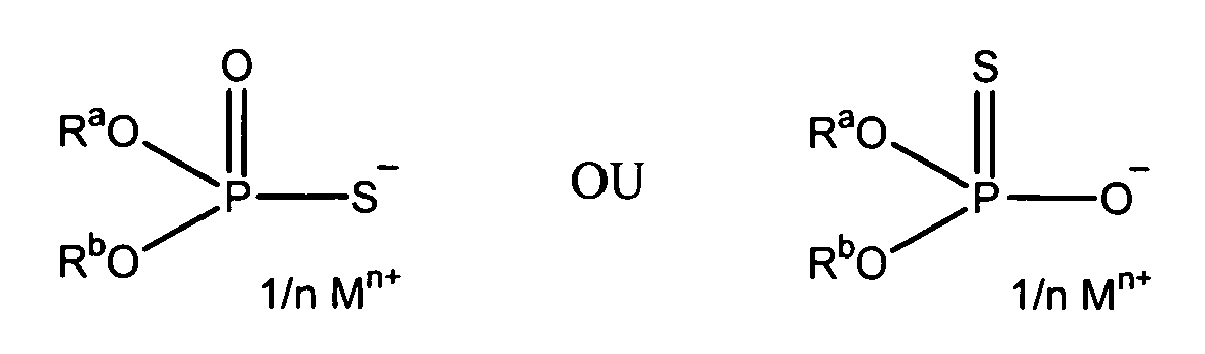
- De façon préférée, l'anion A- est choisi parmi les anions chlorure, bromure, iodure, nitrate, formate ou acétate. De façon très préférée l'anion est choisi parmi les anions chlorure ou bromure.
- De façon préférée, le cation Mn+ est choisi parmi les cations lithium, sodium, potassium, magnésium ou calcium. De façon très préférée, le cation Mn+ est le cation sodium.
- En général, le sel de thiophosphate et le sel de formule générale Q+A- sont présents en quantité stoechiométrique dans la réaction. Cependant dans de nombreux cas, il est préférable d'utiliser un excès molaire du sel de thiophosphate par rapport à la quantité de cation introduite, par exemple dans la plage de 1.00 à 2 équivalents. Le manipulateur expérimenté pourra apprécier la nécessité ou non de faire varier les conditions de réaction et de quantité de matière introduite pour améliorer le rendement en liquide ionique.
- Selon un autre mode de préparation, le liquide ionique selon la présente invention est synthétisé par la réaction entre :
- un sel de formule générale Q+A-, avec Q+ un cation tel que défini précédemment et A- un anion, organique ou inorganique, et
- un acide de formule générale:

- De façon préférée, l'anion A- sera choisi parmi les anions alkylcarbonate, de façon préférée méthylcarbonate, acétate, formate, hydroxyde.
- En général, l'acide de formule générale:

- La synthèse des liquides ioniques décrits dans cette invention peut être réalisée dans une plage de température comprise entre -78°C et 150°C, de façon préférée entre -20°C et 80°C.
- Elle peut être effectuée à l'air ou sous une atmosphère de gaz inerte (azote, argon). De façon, préférée, la synthèse est réalisée sous une atmosphère de gaz inerte.
- La synthèse des liquides ioniques décrits dans cette invention peut être réalisée en l'absence de solvant ou dans un solvant organique. Les solvants organiques pour la synthèse des liquides ioniques décrits dans cette invention peuvent être choisis parmi les hydrocarbures (pentane, hexane, heptane, cyclohexane), les solvants aromatiques (benzène, toluène, xylène), les solvants chlorés (chloroforme, dichlorométhane), les solvants oxygénés (diéthyléther, THF, méthyl-THF, dioxane, diméthoxyéthane), les solvants azotés (acétonitrile, DMF, NMP, pyridine).
- Les liquides ioniques synthétisés selon l'invention peuvent être séparés du milieu réactionnel et/ou purifiés selon les méthodes classiques de la chimie organique. De préférence, les liquides ioniques synthétisés selon l'invention seront séparés du milieu réactionnel par évaporation, par filtration, ou par une combinaison de ces méthodes.
- La présente invention porte également sur l'utilisation des liquides ioniques précédemment décrits comme solvants ou catalyseurs.
- Les liquides ioniques selon la présente invention peuvent être utilisés dans des applications variées, par exemple comme solvant de réaction en chimie organique ou pour les réactions enzymatiques, comme matrice pour des techniques analytiques telles que la spectrométrie de masse MALDI (matrix assisted laser désorption ionisation), comme solvant pour des procédés d'extraction, comme vecteur en chromatographie, comme lubrifiant ou comme fluide hydraulique. Les liquides ioniques peuvent également être utilisés dans le domaine de la catalyse, des piles à combustible, de l'électrochimie, de la solubilisation et de la transformation des biomatériaux.
- De façon préférée, les liquides ioniques selon la présente invention sont utilisés pour la solubilisation et/ou le traitement des polymères, de façon préférée des biopolymères tel que la biomasse lignocellulosique, la cellulose et d'une façon plus générale les matériaux riches en cellulose.
- Plus particulièrement, les liquides ioniques décrits dans la présente invention peuvent servir à solubiliser et à convertir la cellulose en de nombreux produits chimiques. La solubilisation permet notamment la fonctionnalisation de la cellulose comme l'estérification ou l'éthérification qui conduisent à une grande variété de matériaux. Ainsi, les esters de cellulose trouvent de nombreuses applications dans l'industrie du papier, pour la préparation de fibres et de textiles ou encore comme polymères ou films.
- La solubilisation de la cellulose dans les liquides ioniques selon la présente invention permet la fonctionnalisation, par exemple, par des groupements acétyles, tosyles ou trityles.
- Les liquides ioniques revendiqués peuvent également être utilisés comme prétraitement de la biomasse lignocellulosique et ainsi améliorer l'étape associée d'hydrolyse enzymatique dans le schéma général de production de bioéthanol.
- Les liquides ioniques selon la présente invention peuvent également servir dans la production de bioproduits et biocarburants issus de matériaux riches en cellulose, tel que le 5-hydroxyméthylfurfural (HMF), le sorbitol, le diméthylfurane, l'acide lévulinique ou encore les esters et éthers d'HMF.
- Enfin, l'utilisation des liquides ioniques selon l'invention dans le traitement de la biomasse lignocellulosique peut permettre la séparation et la valorisation de la lignine présente dans ces matériaux en produits à valeurs ajoutées (résines, colles, bioplastiques, polyester...) et comme source de biocarburant (après pyrolyse).
- Les exemples ci-après illustrent l'invention sans en limiter la portée.
- Sous argon, dans une solution de 15,64 g (98,6 mmol) d'allyl-3-méthyl-1-imidazolium chlorure dans 150 ml de dichlorométhane anhydre, on ajoute 20,96 g (98,6 mmol) de diéthylthiophosphate de sodium. La suspension est agitée 2 heures à température ambiante. 20 ml d'ether diéthylique sont ensuite ajoutés et la solution est filtrée avec une canule sous argon (papier Whatman n°5). Le filtrat est ensuite évaporé sous vide. On obtient 26,06 g d'un liquide marron-orangé, le rendement est de 90 %.
- 1H RMN (300 MHz, DMSO): δ 9,48 (s, 1H, N-CH-N), 7,78 (s, 1H, N-CH-CH-N), 7,77 (s, 1H, N-CH-CH-N), 6,05 (dt, 1H, CH2-CH-CH2), 5,34 (m, 2H, CH-CH 2), 4,9 (m, 2H, CH 2-CH), 3,9 (s, 3H, N-CH 3), 3,66 (qt, 2H, CH 2-CH3), 1,07 (t, 3H, CH2-CH 3). 31P{H} RMN (300 MHz, DMSO): δ 53,1. 13C{H} RMN (300 MHz, DMSO): δ 137 (N-CH-N), 131,9 (CH-CH2), 123,7 (CH-CH2), 122,2-120 (N-CH-CH-N), 59,4 (O-CH2), 50,6 (N-CH2-CH), 35,7 (N-CH3), 16,3 (O-CH2-CH3).
- 19 g de liquide ionique AMI-DEPS et 1 g de cellulose Avicel PH 101 (Sigma-Aldrich) sont placés dans un ballon de 170 ml et sont agités mécaniquement par des pâles à 70°C pendant 1 h. La cellulose est complètement soluble dans ces conditions.
- 19 g de liquide ionique AMI-DEPS et 1 g de cellulose Avicel PH 101 (Sigma-Aldrich) sont placés dans un ballon de 170 ml et sont agités mécaniquement par des pâles à 70°C pendant 1 h dans un agitateur Tornado© muni d'un carrousel 6 positions (Radleys).
- Après ce prétraitement, le chauffage est coupé et 80 ml d'eau distillée sont ensuite rapidement ajoutés au mélange : la cellulose précipite. La suspension contenant le liquide ionique, l'eau et la cellulose est placée dans un tube à centrifugation et agitée à 9500 tr/min pendant 10 minutes. Le surnageant (ou eau de lavage) contenant le liquide ionique est ensuite éliminé. L'opération est répétée trois fois par addition d'eau distillée sur la partie solide encore présente dans le tube à centrifugation.
- La cellulose dite amorphe récupérée est ensuite utilisée en hydrolyse enzymatique. Le solide récupéré après les lavages à la centrifugeuse est placé dans des flacons Schott de 100 ml. On ajoute 5 ml de tampon acétate, 10 ml d'une solution 1% poids de NaN3 dans de l'eau puis on complète jusqu'à 100 g avec de l'eau distillée. Cette solution est ensuite laissée une nuit à 50°C pour "activation" sous une agitation de 550 tr/min dans un bain marie à sec STEM. On ajoute ensuite à la solution des quantités connues d'enzyme:
- -Cellulases XL508, 10FPU par gramme de matière sèche
- .-β-glucosidases NOVOZYM 188, 25 CBU par gramme de matière sèche
- Les solutions sont ensuite agitées à 400 tr/min à 50°C, toujours dans les bains marie à sec, et des prélèvements sont effectués au bout de 1 h, 4 h, 7 h et 24 h. Ces prélèvements sont placés dans des tubes à centrifuger et rapidement placés 10 minutes dans une huile à 103°C pour neutraliser l'activité enzymatique. Les tubes à centrifuger sont stockés dans un réfrigérateur à 4°C en attendant la mesure en glucose. Ils sont ensuite dilués par 5 avec de l'eau distillée avant d'être dosés à l'aide de l'appareillage analyseur Analox GL6, appelé glucostat, qui mesure par dosage enzymatique la concentration en glucose dans des solutions aqueuses.
- Les résultats sont présentés dans le tableau 1.
- La cellulose Avicel PH 101 (Sigma-Aldrich) est placé dans des flacons Schott de 100 ml. 5 ml de tampon acétate et 10 ml d'une solution 1% poids de NaN3 dans de l'eau sont ajoutés puis la solution est complétée jusqu'à 100 g avec de l'eau distillée. Cette solution est ensuite laissée une nuit à 50°C pour "activation" sous une agitation de 550 tr/min dans un bain marie à sec STEM. On ajoute ensuite à la solution des quantités connues d'enzyme:
- -Cellulases XL508, 10FPU par gramme de matière sèche
- .-β-glucosidases NOVOZYM 188, 25 CBU par gramme de matière sèche
- Les solutions sont ensuite agitées à 400 tr/min à 50°C, toujours dans les bains marie à sec, et des prélèvements sont effectués au bout de 1 h, 4 h, 7 h et 24 h. Ces prélèvements sont placés dans des tubes à centrifuger et rapidement placés 10 minutes dans une huile à 103°C pour neutraliser l'activité enzymatique. Les tubes à centrifuger sont stockés dans un réfrigérateur à 4°C en attendant la mesure en glucose. Ils sont ensuite dilués par 5 avec de l'eau distillée avant d'être dosés à l'aide de l'appareillage glucostat qui mesure la concentration en glucose dans des solutions aqueuses.
- Les résultats sont présentés dans le tableau 1.
Tableau 1: Concentration en glucose obtenu après hydrolyse enzymatique Concentration en glucose dans la solution (mg/dl) 1h 4h 7h 24h Prétraitement AMI-DEPS
(selon exemple 3)152,0 358,5 471,0 694,0 Cellulose native
(selon exemple 4)112,8 248,0 334,0 608,0 - Il s'agit de la concentration en glucose mesurée par dosage glucostat (concentration en glucose en mg/dl) après 1, 4, 7 et 24h d'hydrolyse enzymatique pour la cellulose avicel native (non-traitée) et pour la cellulose prétraitée par l'allyl-3-méthyl-1-imidazolium (AMI-DEPS)
- La concentration en glucose obtenue est nettement supérieure avec le prétraitement au liquide ionique, ainsi après 24h d'hydrolyse 608 mg/dl de glucose théorique est formé dans le cas de la cellulose non-traitée en comparaison avec la concentration de 694 mg/dl associée au prétraitement à l'AMI-DEPS.
les cations phosphonium répondant à l'une des formules générales
PR1R2R3R4+
ou
R1R2P=CR3R4+
ou
R1R2+P=CR3-R7-R3C=P+R1R2
les cations guanidinium de formule
C(NR1R2)(NR3R4)(NR5R6)+
et les cations ammonium quaternaires dérivés d'hétérocycles azotés comportant 1, 2 ou 3 atomes d'azote, de formules générales :

les groupements R1, R2, R3, R4, R5 et R6 identiques ou différents, représentent des radicaux hydrocarbyles ayant de 1 à 30 atomes de carbone, par exemple des groupements alkyles, saturés ou non-saturés, cycloalkyles ou aromatiques, aryles ou aralkyles, éventuellement substitués, comprenant de 1 à 30 atomes de carbone, portant éventuellement une ou plusieurs fonctions choisies parmi les fonctions - CO2R, -C(O)R, -OR, -C(O)NRR', -C(O)N(R)NR'R", -NRR', -SR, -S(O)R, -S(O)2R, - SO3R, -CN, -N(R)P(O)R'R', -PRR', -P(O)RR', -P(OR)(OR'), -P(O)(OR)(OR') dans lesquelles R, R' et R", identiques ou différents, représentent chacun l'hydrogène ou des radicaux hydrocarbyles ayant de 1 à 30 atomes de carbone,
et R7 représente un radical alkylène, préférentiellement un groupement méthylène, éthylène, propylène, ou un radical phénylène.
Claims (16)
- Liquide ionique associant un cation organique Q+ à un anion thiophosphate, répondant à l'une des formules suivantes :
 - Ra et Rb, identiques ou différents, représentent des radicaux hydrocarbyles ayant de 1 à 30 atomes de carbone,de préférence des groupements alkyles, saturés ou non saturés, cycloalkyles ou aromatiques, aryles ou aralkyles, éventuellement substitués,- tout ou partie des hydrogènes des radicaux Ra et Rb pouvant être remplacés par des hétéroatomes, tels que des halogènes,- les radicaux Ra et Rb portant éventuellement une ou plusieurs fonctions choisies parmi les fonctions -CO2R, -C(O)R, -OR, -C(O)NRR', -C(O)N(R)NR'R", -NRR', -SR, - S(O)R, -S(O)2R, -SO3R, -CN, -N(R)P(O)R'R', -PRR', -P(O)RR', -P(OR)(OR'), - P(O)(OR)(OR') dans lesquelles R, R' et R", identiques ou différents, représentent chacun l'hydrogène ou des radicaux hydrocarbyles ayant de 1 à 30 atomes de carbone,le cation Q+ étant choisi parmi les cations phosphonium répondant à l'une des formules générales
PR1R2R3R4+
ou
R1R2P=CR3R4+
ou
R1R2+P=CR3-R7-R3C=P+R1R2
les cations guanidinium de formule
C(NR1R2)(NR3R4)(NR5R6)+
et les cations ammonium quaternaires dérivés d'hétérocycles azotés comportant 1, 2 ou 3 atomes d'azote, de formules générales :
les groupements R1, R2, R3, R4,R5 et R6, identiques ou différents, représentant des radicaux hydrocarbyles ayant de 1 à 30 atomes de carbone, par exemple des groupements alkyles, saturés ou non-saturés, cycloalkyles ou aromatiques, aryles ou aralkyles, éventuellement substitués, comprenant de 1 à 30 atomes de carbone, portant éventuellement une ou plusieurs fonctions choisies parmi les fonctions - CO2R, -C(O)R, -OR, -C(O)NRR', -C(O)N(R)NR'R", -NRR', -SR, -S(O)R, -S(O)2R, - SO3R, -CN, -N(R)P(O)R'R', -PRR', -P(O)RR', -P(OR)(OR'), -P(O)(OR)(OR') dans lesquelles R, R' et R", identiques ou différents, représentent chacun l'hydrogène ou des radicaux hydrocarbyles ayant de 1 à 30 atomes de carbone,
et R7 représentant un radical alkylène, préférentiellement un groupement méthylène, éthylène, propylène, ou un radical phénylène. - Liquide ionique selon la revendication 1 dans lequel le cation ammonium quaternaire est dérivé d'hétérocycle azoté comportant 1, 2 ou 3 atomes d'azote, de formules générales :

- Liquide ionique selon l'une des revendications 1 ou 2 dans lequel les radicaux R1, R2, R3, R4, R5 et R6 sont choisis parmi les radicaux méthyle, éthyle, propyle, isopropyle, butyle primaire, butyle secondaire, butyle tertiaire, amyle, phényle ou benzyle.
- Liquide ionique selon l'une des revendications 1 à 3 dans lequel le cation Q+ est choisi dans le groupe formé par le N-butylpyridinium, le N-éthylpyridinium, l'éthyl-3-méthyl-1-imidazolium, le butyl-3-méthyl-1-imidazolium, l'allyl-3-méthyl-1-imidazolium, le vinyl-3-méthyl-1-imidazolium, le vinyl-3-allyl-1-imidazolium, l'hexyl-3-méthyl-1-imidazolium, le butyl-3-diméthyl-1,2-imidazolium, le cation (hydroxy-2-éthyl)-1-méthyl-3-imidazolium, le cation (carboxy-2-éthyl)-1-méthyl-3-imidazolium, le diéthylpyrazolium, le N-butyl-N-méthylpyrrolidinium, le N-butyl-N-méthylmorpholinium, le tétrabutylphosphonium, le tributyl-tétradécyl-phosphonium.
- Liquide ionique selon l'une des revendications 1 à 4 caractérisé en ce qu'il est choisi dans le groupe constitué de diéthylthiophosphate d'allyl-3-méthyl-1-imidazolium, le diéthylthiophosphate de vinyl-3-méthyl-1-imidazolium, le diéthylthiophosphate d'éthyl-3-méthyl-1-imidazolium, le diéthylthiophosphate de butyl-3-méthyl-1-imidazolium, le diphénylthiophosphate d'allyl-3-méthyl-1-imidazolium, le diphénylthiophosphate de vinyl-3-méthyl-1-imidazolium, le diphénylthiophosphate d'éthyl-3-méthyl-1-imidazolium, le diphénylthiophosphate de butyl-3-méthyl-1-imidazolium, le dibenzylthiophosphate d'allyl-3-méthyl-1-imidazolium, le dibenzylthiophosphate de vinyl-3-méthyl-1-imidazolium, le dibenzylthiophosphate d'éthyl-3-méthyl-1-imidazolium, le dibenzylthiophosphate de butyl-3-méthyl-1-imidazolium.
- Liquide ionique selon la revendication 1 caractérisé en ce qu'il est composé d'un mélange de cations et/ou d'anions tels que définis dans les revendications 1 à 5.
- Procédé de préparation d'un liquide ionique selon l'une des revendications 1 à 6 dans lequel on réalise une réaction de métathèse d'ions entre :- un sel de formule générale Q+A-, avec Q+ un cation tel que défini précédemment et A- un anion, organique ou inorganique, et- un sel de thiophosphate de formule générale:dans laquelle
 - Ra et Rb, identiques ou différents, représentent des radicaux hydrocarbyles ayant de 1 à 30 atomes de carbone,
de préférence des groupements alkyles, saturés ou non saturés, cycloalkyles ou aromatiques, aryles ou aralkyles, éventuellement substitués,- tout ou partie des hydrogènes des radicaux Ra et Rb pouvant être remplacés par des hétéroatomes, tels que des halogènes,- les radicaux Ra et Rb portant éventuellement une ou plusieurs fonctions choisies parmi les fonctions -CO2R, -C(O)R, -OR, -C(O)NRR', -C(O)N(R)NR'R", -NRR', -SR, - S(O)R, -S(O)2R, -SO3R, -CN, -N(R)P(O)R'R', -PRR', -P(O)RR', -P(OR)(OR'), - P(O)(OR)(OR') dans lesquelles R, R' et R", identiques ou différents, représentent chacun l'hydrogène ou des radicaux hydrocarbyles ayant de 1 à 30 atomes de carboneet Mn+ est un cation alcalin ou alcalino-terreux et n= 1 ou 2. - Procédé selon la revendication 7 dans lequel l'anion A- est choisi parmi les anions chlorure, bromure, iodure, nitrate, formate ou acétate.
- Procédé selon la revendication 7 ou 8 dans lequel le cation Mn+ est choisi parmi les cations lithium, sodium, potassium, magnésium ou calcium.
- Procédé de préparation d'un liquide ionique selon l'une des revendications 1 à 6 dans lequel on met en oeuvre une réaction entre :- un sel de formule générale Q+A-, avec Q+ un cation tel que défini précédemment et A- un anion, organique ou inorganique, et- un acide de formule générale:dans laquelle Ra et Rb sont définis comme précédemment.

- Procédé de préparation d'un liquide ionique selon la revendication 10 dans lequel l'anion A- est choisi alkylcarbonate, acétate, formate, hydroxyde.
- Procédé selon l'une des revendications 7 à 11 caractérisé en ce qu'il est réalisé dans une plage de température comprise entre -78°C et 150°C, de façon préférée entre -20 °C et 80 °C, à l'air ou sous atmosphère de gaz inerte, en l'absence de solvant ou dans un solvant organique.
- Procédé selon la revendication 12 dans lequel le solvant est choisi parmi les hydrocarbures tel que le pentane, l'hexane, l'heptane ou le cyclohexane, les solvants aromatiques tels que le benzène, le toluène, ou le xylène), les solvants chlorés tels que le chloroforme ou le dichlorométhane, les solvants oxygénés tels que le diéthyléther, le THF, le méthyl-THF, le dioxane, le diméthoxyéthane, les solvants azotés tels que l'acétonitrile, le DMF, le NMP ou la pyridine.
- Utilisation du liquide ionique selon l'une des revendications 1 à 5 ou préparé selon l'une des revendications 7 à 13 comme solvant ou catalyseur.
- Utilisation selon la revendication 14 dans le traitement et/ou la solubilisation de biomasse lignocellulosique.
- Utilisation selon la revendication 14 dans la production de bioproduits et biocarburants issus de matériaux riches en cellulose, tel que le 5-hydroxyméthylfurfural (HMF), le sorbitol, le diméthylfurane , l'acide lévulinique ou encore les esters et éthers d'HMF.
Applications Claiming Priority (1)
| Application Number | Priority Date | Filing Date | Title |
|---|---|---|---|
| FR0903810A FR2948667B1 (fr) | 2009-07-31 | 2009-07-31 | Nouveaux liquides ioniques a base d'anions thiophosphate et leurs preparations |
Publications (2)
| Publication Number | Publication Date |
|---|---|
| EP2295440A1 true EP2295440A1 (fr) | 2011-03-16 |
| EP2295440B1 EP2295440B1 (fr) | 2017-03-22 |
Family
ID=41479388
Family Applications (1)
| Application Number | Title | Priority Date | Filing Date |
|---|---|---|---|
| EP10290391.1A Not-in-force EP2295440B1 (fr) | 2009-07-31 | 2010-07-13 | Nouveaux liquides ioniques à base d'anions thiophosphate et leurs préprations |
Country Status (2)
| Country | Link |
|---|---|
| EP (1) | EP2295440B1 (fr) |
| FR (1) | FR2948667B1 (fr) |
Citations (4)
| Publication number | Priority date | Publication date | Assignee | Title |
|---|---|---|---|---|
| US5641888A (en) * | 1995-01-25 | 1997-06-24 | Bayer Aktiengesellschaft | Synthesis of an O,O' -diesters of thiophosphoric acid, an O-ester of thiophosphonic acid, or a thiophosphinic acid |
| US6824599B2 (en) | 2001-10-03 | 2004-11-30 | The University Of Alabama | Dissolution and processing of cellulose using ionic liquids |
| WO2007138256A2 (fr) | 2006-05-25 | 2007-12-06 | The Queen's University Of Belfast | Procédé de conversion |
| WO2008090155A1 (fr) | 2007-01-23 | 2008-07-31 | Basf Se | Procédé de production de glucose par hydrolyse enzymatique de cellulose traitée préalablement au moyen d'un liquide ionique comprenant un anion polyatomique |
-
2009
- 2009-07-31 FR FR0903810A patent/FR2948667B1/fr not_active Expired - Fee Related
-
2010
- 2010-07-13 EP EP10290391.1A patent/EP2295440B1/fr not_active Not-in-force
Patent Citations (5)
| Publication number | Priority date | Publication date | Assignee | Title |
|---|---|---|---|---|
| US5641888A (en) * | 1995-01-25 | 1997-06-24 | Bayer Aktiengesellschaft | Synthesis of an O,O' -diesters of thiophosphoric acid, an O-ester of thiophosphonic acid, or a thiophosphinic acid |
| US5641888B1 (en) * | 1995-01-25 | 1999-03-16 | Bayer Ag | Synthesis of an o,o'-diesters of thiophosphoric acid an o-ester of thiophosphonic acid or a thiophosphinic acid |
| US6824599B2 (en) | 2001-10-03 | 2004-11-30 | The University Of Alabama | Dissolution and processing of cellulose using ionic liquids |
| WO2007138256A2 (fr) | 2006-05-25 | 2007-12-06 | The Queen's University Of Belfast | Procédé de conversion |
| WO2008090155A1 (fr) | 2007-01-23 | 2008-07-31 | Basf Se | Procédé de production de glucose par hydrolyse enzymatique de cellulose traitée préalablement au moyen d'un liquide ionique comprenant un anion polyatomique |
Non-Patent Citations (10)
| Title |
|---|
| AKINTONWA D. A. A.: "The synthesis and stereochemical aspects of optically active phosphorothionates", TETRAHEDRON, vol. 34, 1978, pages 959 - 967, XP002563940 * |
| ENCHEV D ET AL: "2,5-dihydro-1,2-oxaphospholene derivatives by the reaction of 1,2-alkadienephosphonates and phosphorus pseudohalogens", PHOSPHORUS, SULFUR AND SILICON AND THE RELATED ELEMENTS, GORDON AND BREACH SCIENCE PUBLISHERS, AMSTERDAM, GB, vol. 57, no. 3-4, 1 January 1991 (1991-01-01), pages 249 - 253, XP009128006, ISSN: 1042-6507 * |
| H. OLIVIER-BOURBIGOU; L. MAGNA: "lonic liquids: perspectives for organic and catalytic reactions", J. MOL. CATAL. A, CHEM., vol. 182, 2002, pages 419 |
| HILGETAG G., LEHMAN G., MARTINI A., SCHRAMM G., TEICHMANN H.: "Über alkylierende esterspaltungen einiger Dialkyl-aryl- und Alkyl-diaryl-thiophosphate", JOURNAL FÜR PRAKTISCHE CHEMIE, vol. 8, no. 3-4, 1959, pages 207 - 223, XP002563941 * |
| JENTZSCH R ET AL: "Quantitative Untersuchungen ueber das Alkylierungsvremoegen kernsubstituierter O,O-dimethyl-o-phenyl-phosphate und -thiophosphate", JOURNAL FUER PRAKTISCHE CHEMIE, WILEY VCH, WEINHEIM, vol. 317, 1 January 1975 (1975-01-01), pages 721 - 732, XP009099637, ISSN: 1436-9966 * |
| M. J. EARLE; K. R. SEDDON: "lonic liquids, green solvent for the future", PURE APPL. CHEM., vol. 72, 2000, pages 1391 |
| P. WASSERSCHEIDT: "lonic liquid- Novel solutions for transition-metal catalysis", ANGEW. CHEM. INT. ED. ENGL., vol. 39, 2000, pages 3772 |
| R. HAGIWARA; Y. ITO: "Room temperature ionic liquids of alkylimidazolium cations and fluoroanions", J. FLUORINE CHEM., vol. 105, 2000, pages 221 - 227, XP004210467, DOI: doi:10.1016/S0022-1139(99)00267-5 |
| R. SHELDON: "Catalytic reactions in ionic liquids", CHEM. COMM., vol. 2399, 2001 |
| T. WELTON: "Room temperature ionic liquids. Solvents for synthesis and catalysis", CHEM. REV., vol. 92, 1999, pages 2071 |
Also Published As
| Publication number | Publication date |
|---|---|
| EP2295440B1 (fr) | 2017-03-22 |
| FR2948667B1 (fr) | 2012-06-08 |
| FR2948667A1 (fr) | 2011-02-04 |
Similar Documents
| Publication | Publication Date | Title |
|---|---|---|
| Zhao et al. | One pot production of 5-hydroxymethylfurfural with high yield from cellulose by a Brønsted–Lewis–surfactant-combined heteropolyacid catalyst | |
| US8710250B2 (en) | Conversion of 5-(chloromethyl)-2-furaldehyde into 5-methyl-2-furoic acid and derivatives thereof | |
| EP2709994B1 (fr) | Procédé de préparation de 5-hydroxyméthylfurfural | |
| CN1836068A (zh) | 用于处理含木质素物质的溶剂 | |
| EP2289899B1 (fr) | Nouveaux liquides ioniques à base d'anions dithiophosphate et leurs préparations | |
| WO2013030131A1 (fr) | Procede de preparation de furfural | |
| US20240150385A1 (en) | Production of Fragments of Lignin with Functional Groups | |
| CN103189118B (zh) | 用于由水性混合物中提取有机化合物的方法 | |
| FR3043081A1 (fr) | Procede de production de 5-hydroxymethylfurfural en presence d'un catalyseur acide de lewis et/ou d'un catalyseur base heterogene et d'un catalyseur organique homogene acide de brønsted en presence d'au moins un solvant polaire aprotique | |
| FR3129955A1 (fr) | Procédé d’électro-oxydation d’un composé furanique | |
| Mbakidi et al. | Dissolution of cellulose and lignin with biobased ionic liquids | |
| JP6073364B2 (ja) | 60℃超200℃未満の沸点(標準圧力で)を有する溶媒(略して低沸点溶媒と称する)の存在下における糖溶液からの5−ヒドロキシメチルフルフラール(hmf)の調製 | |
| US9024047B2 (en) | Methods for furfural production from branched non-fermentable sugars in stillage or syrup | |
| EP2989074B1 (fr) | Procédé de séparation d'acide lévulinique à partir d'un hydrolysat de biomasse | |
| US20170001971A1 (en) | Direct synthesis of bio-based alkyl & furanic diol ethers, acetates, ether-acetates, and carbonates | |
| EP2295440B1 (fr) | Nouveaux liquides ioniques à base d'anions thiophosphate et leurs préprations | |
| Mohammadi-Aghdam et al. | One-pot synthesis of highly regioselective β-azido alcohols catalyzed by Brønsted acidic ionic liquids | |
| FR2983090A1 (fr) | Composition catalytique contenant une fonction acide et procede pour la dimerisation selective de l'isobutene | |
| US20100087674A1 (en) | Method For Isolating Concentrated Paraffin Sulfonic Acids | |
| FR3039150A1 (fr) | Procede de production de 5-hydroxymethylfurfural en presence de catalyseurs organiques de la famille des thiourees | |
| WO2019118476A1 (fr) | Procédés pour l'isolation et la récupération de sucres en c5 | |
| US20210253545A1 (en) | Preparing method for 5-alkoxymethylfurfural | |
| FR3135979A1 (fr) | Procede de separation de l’acide levulinique par separation thermique en presence d’un fluxant | |
| Wang et al. | Preparation of 1, 2-Hexanediol by epoxidation of 1-Hexene catalyzed by functionalized ionic liquid supported modified HPW/UIO-66 | |
| WO2017016923A1 (fr) | Procede de production de 5-hydroxymethylfurfural en presence de catalyseurs organiques phosphores |
Legal Events
| Date | Code | Title | Description |
|---|---|---|---|
| PUAI | Public reference made under article 153(3) epc to a published international application that has entered the european phase |
Free format text: ORIGINAL CODE: 0009012 |
|
| AK | Designated contracting states |
Kind code of ref document: A1 Designated state(s): AL AT BE BG CH CY CZ DE DK EE ES FI FR GB GR HR HU IE IS IT LI LT LU LV MC MK MT NL NO PL PT RO SE SI SK SM TR |
|
| AX | Request for extension of the european patent |
Extension state: BA ME RS |
|
| 17P | Request for examination filed |
Effective date: 20110916 |
|
| 17Q | First examination report despatched |
Effective date: 20130305 |
|
| GRAP | Despatch of communication of intention to grant a patent |
Free format text: ORIGINAL CODE: EPIDOSNIGR1 |
|
| INTG | Intention to grant announced |
Effective date: 20161011 |
|
| GRAS | Grant fee paid |
Free format text: ORIGINAL CODE: EPIDOSNIGR3 |
|
| GRAA | (expected) grant |
Free format text: ORIGINAL CODE: 0009210 |
|
| AK | Designated contracting states |
Kind code of ref document: B1 Designated state(s): AL AT BE BG CH CY CZ DE DK EE ES FI FR GB GR HR HU IE IS IT LI LT LU LV MC MK MT NL NO PL PT RO SE SI SK SM TR |
|
| REG | Reference to a national code |
Ref country code: GB Ref legal event code: FG4D Free format text: NOT ENGLISH |
|
| REG | Reference to a national code |
Ref country code: CH Ref legal event code: EP |
|
| REG | Reference to a national code |
Ref country code: AT Ref legal event code: REF Ref document number: 877633 Country of ref document: AT Kind code of ref document: T Effective date: 20170415 |
|
| REG | Reference to a national code |
Ref country code: IE Ref legal event code: FG4D Free format text: LANGUAGE OF EP DOCUMENT: FRENCH |
|
| REG | Reference to a national code |
Ref country code: DE Ref legal event code: R096 Ref document number: 602010040910 Country of ref document: DE |
|
| REG | Reference to a national code |
Ref country code: NL Ref legal event code: MP Effective date: 20170322 |
|
| PG25 | Lapsed in a contracting state [announced via postgrant information from national office to epo] |
Ref country code: FI Free format text: LAPSE BECAUSE OF FAILURE TO SUBMIT A TRANSLATION OF THE DESCRIPTION OR TO PAY THE FEE WITHIN THE PRESCRIBED TIME-LIMIT Effective date: 20170322 Ref country code: LT Free format text: LAPSE BECAUSE OF FAILURE TO SUBMIT A TRANSLATION OF THE DESCRIPTION OR TO PAY THE FEE WITHIN THE PRESCRIBED TIME-LIMIT Effective date: 20170322 Ref country code: NO Free format text: LAPSE BECAUSE OF FAILURE TO SUBMIT A TRANSLATION OF THE DESCRIPTION OR TO PAY THE FEE WITHIN THE PRESCRIBED TIME-LIMIT Effective date: 20170622 Ref country code: HR Free format text: LAPSE BECAUSE OF FAILURE TO SUBMIT A TRANSLATION OF THE DESCRIPTION OR TO PAY THE FEE WITHIN THE PRESCRIBED TIME-LIMIT Effective date: 20170322 Ref country code: GR Free format text: LAPSE BECAUSE OF FAILURE TO SUBMIT A TRANSLATION OF THE DESCRIPTION OR TO PAY THE FEE WITHIN THE PRESCRIBED TIME-LIMIT Effective date: 20170623 |
|
| REG | Reference to a national code |
Ref country code: LT Ref legal event code: MG4D |
|
| REG | Reference to a national code |
Ref country code: AT Ref legal event code: MK05 Ref document number: 877633 Country of ref document: AT Kind code of ref document: T Effective date: 20170322 |
|
| PG25 | Lapsed in a contracting state [announced via postgrant information from national office to epo] |
Ref country code: BG Free format text: LAPSE BECAUSE OF FAILURE TO SUBMIT A TRANSLATION OF THE DESCRIPTION OR TO PAY THE FEE WITHIN THE PRESCRIBED TIME-LIMIT Effective date: 20170622 Ref country code: SE Free format text: LAPSE BECAUSE OF FAILURE TO SUBMIT A TRANSLATION OF THE DESCRIPTION OR TO PAY THE FEE WITHIN THE PRESCRIBED TIME-LIMIT Effective date: 20170322 Ref country code: LV Free format text: LAPSE BECAUSE OF FAILURE TO SUBMIT A TRANSLATION OF THE DESCRIPTION OR TO PAY THE FEE WITHIN THE PRESCRIBED TIME-LIMIT Effective date: 20170322 |
|
| PG25 | Lapsed in a contracting state [announced via postgrant information from national office to epo] |
Ref country code: NL Free format text: LAPSE BECAUSE OF FAILURE TO SUBMIT A TRANSLATION OF THE DESCRIPTION OR TO PAY THE FEE WITHIN THE PRESCRIBED TIME-LIMIT Effective date: 20170322 |
|
| PG25 | Lapsed in a contracting state [announced via postgrant information from national office to epo] |
Ref country code: ES Free format text: LAPSE BECAUSE OF FAILURE TO SUBMIT A TRANSLATION OF THE DESCRIPTION OR TO PAY THE FEE WITHIN THE PRESCRIBED TIME-LIMIT Effective date: 20170322 Ref country code: RO Free format text: LAPSE BECAUSE OF FAILURE TO SUBMIT A TRANSLATION OF THE DESCRIPTION OR TO PAY THE FEE WITHIN THE PRESCRIBED TIME-LIMIT Effective date: 20170322 Ref country code: AT Free format text: LAPSE BECAUSE OF FAILURE TO SUBMIT A TRANSLATION OF THE DESCRIPTION OR TO PAY THE FEE WITHIN THE PRESCRIBED TIME-LIMIT Effective date: 20170322 Ref country code: SK Free format text: LAPSE BECAUSE OF FAILURE TO SUBMIT A TRANSLATION OF THE DESCRIPTION OR TO PAY THE FEE WITHIN THE PRESCRIBED TIME-LIMIT Effective date: 20170322 Ref country code: IT Free format text: LAPSE BECAUSE OF FAILURE TO SUBMIT A TRANSLATION OF THE DESCRIPTION OR TO PAY THE FEE WITHIN THE PRESCRIBED TIME-LIMIT Effective date: 20170322 Ref country code: CZ Free format text: LAPSE BECAUSE OF FAILURE TO SUBMIT A TRANSLATION OF THE DESCRIPTION OR TO PAY THE FEE WITHIN THE PRESCRIBED TIME-LIMIT Effective date: 20170322 Ref country code: EE Free format text: LAPSE BECAUSE OF FAILURE TO SUBMIT A TRANSLATION OF THE DESCRIPTION OR TO PAY THE FEE WITHIN THE PRESCRIBED TIME-LIMIT Effective date: 20170322 |
|
| RAP2 | Party data changed (patent owner data changed or rights of a patent transferred) |
Owner name: IFP ENERGIES NOUVELLES |
|
| PG25 | Lapsed in a contracting state [announced via postgrant information from national office to epo] |
Ref country code: PT Free format text: LAPSE BECAUSE OF FAILURE TO SUBMIT A TRANSLATION OF THE DESCRIPTION OR TO PAY THE FEE WITHIN THE PRESCRIBED TIME-LIMIT Effective date: 20170724 Ref country code: SM Free format text: LAPSE BECAUSE OF FAILURE TO SUBMIT A TRANSLATION OF THE DESCRIPTION OR TO PAY THE FEE WITHIN THE PRESCRIBED TIME-LIMIT Effective date: 20170322 Ref country code: PL Free format text: LAPSE BECAUSE OF FAILURE TO SUBMIT A TRANSLATION OF THE DESCRIPTION OR TO PAY THE FEE WITHIN THE PRESCRIBED TIME-LIMIT Effective date: 20170322 Ref country code: IS Free format text: LAPSE BECAUSE OF FAILURE TO SUBMIT A TRANSLATION OF THE DESCRIPTION OR TO PAY THE FEE WITHIN THE PRESCRIBED TIME-LIMIT Effective date: 20170722 |
|
| REG | Reference to a national code |
Ref country code: DE Ref legal event code: R097 Ref document number: 602010040910 Country of ref document: DE |
|
| PLBE | No opposition filed within time limit |
Free format text: ORIGINAL CODE: 0009261 |
|
| STAA | Information on the status of an ep patent application or granted ep patent |
Free format text: STATUS: NO OPPOSITION FILED WITHIN TIME LIMIT |
|
| PG25 | Lapsed in a contracting state [announced via postgrant information from national office to epo] |
Ref country code: DK Free format text: LAPSE BECAUSE OF FAILURE TO SUBMIT A TRANSLATION OF THE DESCRIPTION OR TO PAY THE FEE WITHIN THE PRESCRIBED TIME-LIMIT Effective date: 20170322 |
|
| REG | Reference to a national code |
Ref country code: DE Ref legal event code: R119 Ref document number: 602010040910 Country of ref document: DE |
|
| 26N | No opposition filed |
Effective date: 20180102 |
|
| PG25 | Lapsed in a contracting state [announced via postgrant information from national office to epo] |
Ref country code: SI Free format text: LAPSE BECAUSE OF FAILURE TO SUBMIT A TRANSLATION OF THE DESCRIPTION OR TO PAY THE FEE WITHIN THE PRESCRIBED TIME-LIMIT Effective date: 20170322 |
|
| REG | Reference to a national code |
Ref country code: CH Ref legal event code: PL |
|
| GBPC | Gb: european patent ceased through non-payment of renewal fee |
Effective date: 20170713 |
|
| REG | Reference to a national code |
Ref country code: IE Ref legal event code: MM4A |
|
| REG | Reference to a national code |
Ref country code: FR Ref legal event code: ST Effective date: 20180330 |
|
| PG25 | Lapsed in a contracting state [announced via postgrant information from national office to epo] |
Ref country code: IE Free format text: LAPSE BECAUSE OF NON-PAYMENT OF DUE FEES Effective date: 20170713 Ref country code: LI Free format text: LAPSE BECAUSE OF NON-PAYMENT OF DUE FEES Effective date: 20170731 Ref country code: GB Free format text: LAPSE BECAUSE OF NON-PAYMENT OF DUE FEES Effective date: 20170713 Ref country code: DE Free format text: LAPSE BECAUSE OF NON-PAYMENT OF DUE FEES Effective date: 20180201 Ref country code: CH Free format text: LAPSE BECAUSE OF NON-PAYMENT OF DUE FEES Effective date: 20170731 |
|
| PG25 | Lapsed in a contracting state [announced via postgrant information from national office to epo] |
Ref country code: FR Free format text: LAPSE BECAUSE OF NON-PAYMENT OF DUE FEES Effective date: 20170731 |
|
| REG | Reference to a national code |
Ref country code: BE Ref legal event code: MM Effective date: 20170731 |
|
| PG25 | Lapsed in a contracting state [announced via postgrant information from national office to epo] |
Ref country code: LU Free format text: LAPSE BECAUSE OF NON-PAYMENT OF DUE FEES Effective date: 20170713 |
|
| PG25 | Lapsed in a contracting state [announced via postgrant information from national office to epo] |
Ref country code: BE Free format text: LAPSE BECAUSE OF NON-PAYMENT OF DUE FEES Effective date: 20170731 |
|
| PG25 | Lapsed in a contracting state [announced via postgrant information from national office to epo] |
Ref country code: MT Free format text: LAPSE BECAUSE OF FAILURE TO SUBMIT A TRANSLATION OF THE DESCRIPTION OR TO PAY THE FEE WITHIN THE PRESCRIBED TIME-LIMIT Effective date: 20170322 |
|
| PG25 | Lapsed in a contracting state [announced via postgrant information from national office to epo] |
Ref country code: HU Free format text: LAPSE BECAUSE OF FAILURE TO SUBMIT A TRANSLATION OF THE DESCRIPTION OR TO PAY THE FEE WITHIN THE PRESCRIBED TIME-LIMIT; INVALID AB INITIO Effective date: 20100713 Ref country code: MC Free format text: LAPSE BECAUSE OF FAILURE TO SUBMIT A TRANSLATION OF THE DESCRIPTION OR TO PAY THE FEE WITHIN THE PRESCRIBED TIME-LIMIT Effective date: 20170322 |
|
| PG25 | Lapsed in a contracting state [announced via postgrant information from national office to epo] |
Ref country code: CY Free format text: LAPSE BECAUSE OF NON-PAYMENT OF DUE FEES Effective date: 20170322 |
|
| PG25 | Lapsed in a contracting state [announced via postgrant information from national office to epo] |
Ref country code: MK Free format text: LAPSE BECAUSE OF FAILURE TO SUBMIT A TRANSLATION OF THE DESCRIPTION OR TO PAY THE FEE WITHIN THE PRESCRIBED TIME-LIMIT Effective date: 20170322 |
|
| PG25 | Lapsed in a contracting state [announced via postgrant information from national office to epo] |
Ref country code: TR Free format text: LAPSE BECAUSE OF FAILURE TO SUBMIT A TRANSLATION OF THE DESCRIPTION OR TO PAY THE FEE WITHIN THE PRESCRIBED TIME-LIMIT Effective date: 20170322 |
|
| PG25 | Lapsed in a contracting state [announced via postgrant information from national office to epo] |
Ref country code: AL Free format text: LAPSE BECAUSE OF FAILURE TO SUBMIT A TRANSLATION OF THE DESCRIPTION OR TO PAY THE FEE WITHIN THE PRESCRIBED TIME-LIMIT Effective date: 20170322 |