WO2007138256A2 - Conversion method - Google Patents
Conversion method Download PDFInfo
- Publication number
- WO2007138256A2 WO2007138256A2 PCT/GB2007/001859 GB2007001859W WO2007138256A2 WO 2007138256 A2 WO2007138256 A2 WO 2007138256A2 GB 2007001859 W GB2007001859 W GB 2007001859W WO 2007138256 A2 WO2007138256 A2 WO 2007138256A2
- Authority
- WO
- WIPO (PCT)
- Prior art keywords
- acid
- cellulose
- ionic liquid
- water
- cation
- Prior art date
- Legal status (The legal status is an assumption and is not a legal conclusion. Google has not performed a legal analysis and makes no representation as to the accuracy of the status listed.)
- Ceased
Links
Classifications
-
- C—CHEMISTRY; METALLURGY
- C08—ORGANIC MACROMOLECULAR COMPOUNDS; THEIR PREPARATION OR CHEMICAL WORKING-UP; COMPOSITIONS BASED THEREON
- C08B—POLYSACCHARIDES; DERIVATIVES THEREOF
- C08B1/00—Preparatory treatment of cellulose for making derivatives thereof, e.g. pre-treatment, pre-soaking, activation
- C08B1/003—Preparation of cellulose solutions, i.e. dopes, with different possible solvents, e.g. ionic liquids
-
- C—CHEMISTRY; METALLURGY
- C13—SUGAR INDUSTRY
- C13K—SACCHARIDES OBTAINED FROM NATURAL SOURCES OR BY HYDROLYSIS OF NATURALLY OCCURRING DISACCHARIDES, OLIGOSACCHARIDES OR POLYSACCHARIDES
- C13K1/00—Glucose; Glucose-containing syrups
- C13K1/02—Glucose; Glucose-containing syrups obtained by saccharification of cellulosic materials
-
- C—CHEMISTRY; METALLURGY
- C08—ORGANIC MACROMOLECULAR COMPOUNDS; THEIR PREPARATION OR CHEMICAL WORKING-UP; COMPOSITIONS BASED THEREON
- C08B—POLYSACCHARIDES; DERIVATIVES THEREOF
- C08B1/00—Preparatory treatment of cellulose for making derivatives thereof, e.g. pre-treatment, pre-soaking, activation
-
- C—CHEMISTRY; METALLURGY
- C08—ORGANIC MACROMOLECULAR COMPOUNDS; THEIR PREPARATION OR CHEMICAL WORKING-UP; COMPOSITIONS BASED THEREON
- C08B—POLYSACCHARIDES; DERIVATIVES THEREOF
- C08B15/00—Preparation of other cellulose derivatives or modified cellulose, e.g. complexes
-
- C—CHEMISTRY; METALLURGY
- C08—ORGANIC MACROMOLECULAR COMPOUNDS; THEIR PREPARATION OR CHEMICAL WORKING-UP; COMPOSITIONS BASED THEREON
- C08B—POLYSACCHARIDES; DERIVATIVES THEREOF
- C08B15/00—Preparation of other cellulose derivatives or modified cellulose, e.g. complexes
- C08B15/02—Oxycellulose; Hydrocellulose; Cellulosehydrate, e.g. microcrystalline cellulose
-
- C—CHEMISTRY; METALLURGY
- C12—BIOCHEMISTRY; BEER; SPIRITS; WINE; VINEGAR; MICROBIOLOGY; ENZYMOLOGY; MUTATION OR GENETIC ENGINEERING
- C12P—FERMENTATION OR ENZYME-USING PROCESSES TO SYNTHESISE A DESIRED CHEMICAL COMPOUND OR COMPOSITION OR TO SEPARATE OPTICAL ISOMERS FROM A RACEMIC MIXTURE
- C12P7/00—Preparation of oxygen-containing organic compounds
- C12P7/02—Preparation of oxygen-containing organic compounds containing a hydroxy group
- C12P7/04—Preparation of oxygen-containing organic compounds containing a hydroxy group acyclic
- C12P7/06—Ethanol, i.e. non-beverage
- C12P7/08—Ethanol, i.e. non-beverage produced as by-product or from waste or cellulosic material substrate
- C12P7/10—Ethanol, i.e. non-beverage produced as by-product or from waste or cellulosic material substrate substrate containing cellulosic material
-
- Y—GENERAL TAGGING OF NEW TECHNOLOGICAL DEVELOPMENTS; GENERAL TAGGING OF CROSS-SECTIONAL TECHNOLOGIES SPANNING OVER SEVERAL SECTIONS OF THE IPC; TECHNICAL SUBJECTS COVERED BY FORMER USPC CROSS-REFERENCE ART COLLECTIONS [XRACs] AND DIGESTS
- Y02—TECHNOLOGIES OR APPLICATIONS FOR MITIGATION OR ADAPTATION AGAINST CLIMATE CHANGE
- Y02E—REDUCTION OF GREENHOUSE GAS [GHG] EMISSIONS, RELATED TO ENERGY GENERATION, TRANSMISSION OR DISTRIBUTION
- Y02E50/00—Technologies for the production of fuel of non-fossil origin
- Y02E50/10—Biofuels, e.g. bio-diesel
-
- Y—GENERAL TAGGING OF NEW TECHNOLOGICAL DEVELOPMENTS; GENERAL TAGGING OF CROSS-SECTIONAL TECHNOLOGIES SPANNING OVER SEVERAL SECTIONS OF THE IPC; TECHNICAL SUBJECTS COVERED BY FORMER USPC CROSS-REFERENCE ART COLLECTIONS [XRACs] AND DIGESTS
- Y10—TECHNICAL SUBJECTS COVERED BY FORMER USPC
- Y10T—TECHNICAL SUBJECTS COVERED BY FORMER US CLASSIFICATION
- Y10T428/00—Stock material or miscellaneous articles
- Y10T428/31504—Composite [nonstructural laminate]
- Y10T428/31725—Of polyamide
- Y10T428/31768—Natural source-type polyamide [e.g., casein, gelatin, etc.]
- Y10T428/31772—Next to cellulosic
-
- Y—GENERAL TAGGING OF NEW TECHNOLOGICAL DEVELOPMENTS; GENERAL TAGGING OF CROSS-SECTIONAL TECHNOLOGIES SPANNING OVER SEVERAL SECTIONS OF THE IPC; TECHNICAL SUBJECTS COVERED BY FORMER USPC CROSS-REFERENCE ART COLLECTIONS [XRACs] AND DIGESTS
- Y10—TECHNICAL SUBJECTS COVERED BY FORMER USPC
- Y10T—TECHNICAL SUBJECTS COVERED BY FORMER US CLASSIFICATION
- Y10T428/00—Stock material or miscellaneous articles
- Y10T428/31504—Composite [nonstructural laminate]
- Y10T428/31971—Of carbohydrate
Definitions
- the present invention relates to a method of hydrolysing cellulose to generate water soluble monosaccharide, disaccharide and oligosaccharide derivatives thereof.
- Cellulose is the most abundant biorenewable material on earth.
- Cellulose consists of polydisperse linear polymeric chains formed by repeated connection of beta-D-glucose building blocks through a 1-4 glycosidic linkage. These linear polymer chains form hydrogen-bonded supramolecular structures that are insoluble in water and most common organic solvents. It is known that hydrolysis of cellulose generates monosaccharide, disaccharide and oligosaccharide products, with glucose usually being the main hydrolysis product. Such products are capable of being fermented to generate alcohols for use as a fuel or a component of a fuel.
- Glucose in particular is an important intermediate for fermentation to ethanol and other chemicals; therefore, saccharification of cellulose is of interest in the development of biofuels.
- Chemical, enzymatic, microbiological and macrobiological catalysts can be used to accelerate the hydrolysis of cellulose under conditions selected to be thermodynamically favourable to product formation.
- Chemical and enzymatic hydrolysis of cellulose is discussed in "The Encyclopaedia of Polymer Science and Technology", 2nd Ed, J. I. Kroschwitz (Ed in Chief), Wiley (New York), 1985.
- cellulose may be hydrolysed using cellulolytic enzymes (cellulase) or harvested filamentous fungi such as Trichoderma sp.
- cellulolytic enzymes cellulase
- harvested filamentous fungi such as Trichoderma sp.
- hydrolysing cellulose by chemical methods presents many problems.
- dilute acid treatment at high temperatures and pressures (>100°C) and/or concentrated acid pre-treatment, as described in "Cellulose to Ethanol”: A General Review", P. C. Badger, in “Trends in New Crops and New Uses", J. Janick and A. Whipkey (Eds), ASHS Press, Alexandria VA, 2002, 17-21.
- Dilute acid processes are conducted at high temperature under pressure (for example, using 1% sulphuric acid at 237°C). Concentrated acid processing typically starts with an initial acid concentration of 10% which is raised to 70% through dewatering at 100°C and ambient pressure.
- cellulose can be dissolved in certain ionic liquids.
- ionic liquids For example, US 6,824,599 discloses that cellulose can be dissolved in a hydrophilic ionic liquid in the substantial absence of water or a nitrogen-containing base to form an admixture, which is then agitated until dissolution is complete, while WO 2005/017001 discloses that wood, straw and other natural lignocellulosic materials can be dissolved in certain ionic liquids under microwave irradiation and/or under pressure.
- certain ionic liquids containing a certain specific anion can be used in a process for the hydrolysis of cellulose.
- the present invention provides a process for the preparation of water- soluble cellulose hydrolysis products, which comprises admixing cellulose with an ionic liquid capable of solvating or dissolving at least some of the cellulose, said ionic liquid being a compound comprised solely of cations and anions and which exists in a liquid state at a temperature at or below 15O 0 C, and in which the anions are selected from halide and cyanate; and treating the resulting solvate or solution with an acid in the presence of water, said acid having a pKa in water of less than 2 at 25 0 C.
- a preferred embodiment of the process of the invention provides a process for the preparation of water-soluble cellulose hydrolysis products, which comprises admixing cellulose with an ionic liquid in which the cellulose has at least some solubility, said ionic liquid being a compound comprised solely of cations and anions and which exists in a liquid state at a temperature at or below 150 0 C, and in which the anions are selected from halide and cyanate; and treating the resulting solution with an acid in the presence of water, said acid having a pKa in water of less than 2 at 25 0 C.
- cellulose should be understood to include both cellulose itself and cellulose-containing material, either in raw or purified form.
- the cellulose that is to be hydrolysed may be either cellulose which has been refined to any desired degree, or it may be raw or partially-treated cellulosic material, such as cellulosic biomass or municipal waste. It may be used in any form that is amenable to being wetted by a liquid.
- the cellulose may be present in, or derived from, wood (particularly, wood chips and wood pulp), cotton, rayon, cellulose acetate, paper, linters, grasses such as corn stover or switch grass, or bagasse (sugar cane residue).
- the acid used in the process of the invention is a strong acid, having a pKa in water of less than 2, preferably less than 1, preferably 0 or less, at 25°C.
- An acid with a pKa of 0 is fully dissociated in water, and such acids are preferred for use in the present invention.
- the acids used in the invention are of the Br ⁇ nsted (or protonic) type. Suitable acids include for example hydrogen halides, sulfuric acid, nitric acid, halosulfonic acids, tetrafluoroboric acid, heteropolyacids, aryl- and alkyl-sulfonic acids, and halogenated alkyl- and arylsulfonic acids.
- acids include, for example, p- toluenesuifonic acid, trifluoromethanesulfonic acid (triflic acid), trichloromethanesulfonic acid, hydrochloric acid, hydrobromic acid, hydriodic acid, tetrafluoroboric acid, and sulfuric acid.
- triflic acid trifluoromethanesulfonic acid
- trichloromethanesulfonic acid hydrochloric acid
- hydrobromic acid hydrobromic acid
- hydriodic acid tetrafluoroboric acid
- sulfuric acid sulfuric acid and hydrochloric acid.
- the acid may be added in aqueous form, for example dilute aqueous form, or if desired may be anhydrous. Some water is needed in order for the hydrolysis reaction to occur as explained below, and this may either be present in the reaction mixture and/or added along with the acid.
- a mixture of acids may be used provided that at least one acid has the required acid strength, or the mixture has the required acid strength, hi addition to the protonic acid, a Lewis acid may also be added to the reaction mixture if desired.
- Suitable Lewis acids include metal salts of strong protic acids (pKa less than about 0), in which the metal is for example lithium, potassium, magnesium, zinc, copper, aluminum, tin, antimony, iron, nickel or lanthanum.
- Suitable examples of such salts include, for example, metal halides, for example aluminum (III) chloride, gallium (III) chloride, indium (III) chloride and zinc (II) chloride; trifiates, for example lithium triflate, sodium triflate, magnesium triflate, zinc triflate, aluminum triflate, tin(II) triflate, and copper(II) triflate; tetrafluoroborates, for example zinc (II) tetrafluoroborate, silver (II) tetrafluoroborate, iron(II) tetrafluoroborate, and nickel(II) tetrafluoroborate; and sulfonates, for example zinc p-toluenesulfonate.
- metal halides for example aluminum (III) chloride, gallium (III) chloride, indium (III) chloride and zinc (II) chloride
- trifiates for example lithium triflate, sodium triflate, magnesium
- a catalytic amount of the acid is used.
- the concentration of the acid in the reaction mixture may be from 0.1-10 wt%. If the reaction mixture before addition of the acid contains any basic material, some of the acid initially added will be neutralised, and sufficient acid needs to be added taking this into account.
- the process of the invention is suitably carried out until a desired proportion of the cellulose is converted into water soluble derivatives.
- the treatment with the acid proceeds for up to 96 hours, preferably less than 24 hours, more preferably less than 5 hours, and most preferably less than 1 hour.
- the process of the invention may be carried out at any suitable temperature.
- Admixture of the cellulose with the ionic liquid must, of course, be carried out at a temperature at which the ionic liquid is in fact liquid.
- Subsequent reaction with the acid may if desired be accelerated by heating; for example, the reaction may be carried out at a temperature in the range 50 to 200°C, preferably 70 to 150°C, for example 90 to 95 0 C.
- Heating can be accomplished by any suitable method, for example using conventional thermal methods, microwave heating or employing other sources such as ultrasound or infrared radiation.
- the reaction is carried out under atmospheric pressure.
- the ionic liquid used in the process of the invention is a compound that consists of cations and anions and that is in a liquid state at a temperature at or below 150 0 C, preferably at or below 100 °C, for example in the range -100 0 C to 150 0 C, preferably -10 to 100 °C. It is necessary that the ionic liquid should be capable of dissolving at least some of the cellulose, or should be capable of solvating at least some of the cellulose. When the cellulose is used in the form of biomass, solvation generally leads to swelling of the biomass, and this may be a preferred mode of operation when treating biomass. Alternatively, an ionic liquid may be selected in which the cellulose is readily soluble.
- ionic liquid On admixture of the cellulose with the ionic liquid, conditions may be chosen such that the cellulose becomes solvated by the ionic liquid; substantially all of the cellulose dissolves to form a homogeneous solution; or some cellulose dissolves while * some remains undissolved. Particularly in the latter case, residual solid material may if desired be removed from the solution of cellulose in the ionic liquid by any suitable method. Alternatively, the mixture may be used without further treatment.
- an ionic liquid is selected in which simple solvation or dissolution takes place - i.e. solvation or dissolution without cellulose derivatisation.
- the ionic liquid should be adequately inert in the presence of the strong acid used in the process of the invention; ionic liquids containing basic groups which would neutralise the acid are undesirable.
- the anion of the ionic liquid must be halide (chloride, bromide, or iodide) or cyanate (OCN " ).
- the anion is halide, most preferably, chloride.
- ionic liquids for use in the method of the present invention are disclosed in US 6,284,599.
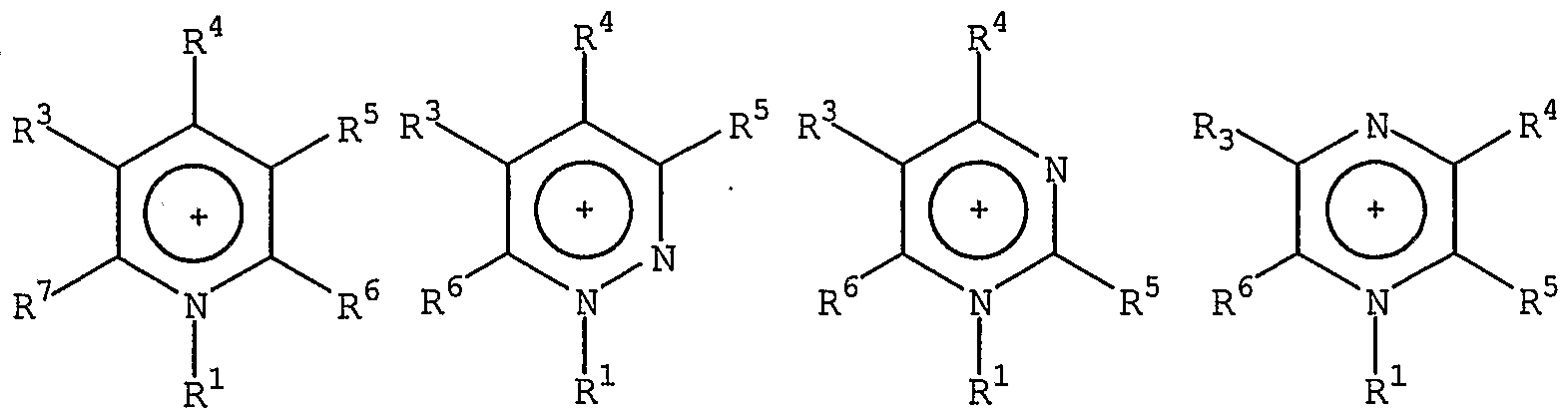
- the cations of the ionic liquid are preferably cyclic, preferably containing an optionally substituted cation selected from pyridinium, pyridazinium, pyrimidinium, pyrazinium, imidazolium, pyraz ⁇ lium, oxazolium, triazolium, thiazolium, piperidinium, pyrrolidinium, quinolinium and isoquinolinium, and preferably correspond in structure to a formula selected from the group consisting of:
- R 1 and R 2 are independently a C 1 -C 6 alkyl group or a Ci-C 6 alkoxyalkyl group
- R 3 , R 4 , R 5 , R 6 , R 7 , R 8 and R 9 (R 3 -R 9 ), when present, are independently selected from a hydrido, a Ci-C 6 alkyl, a Ci-C 6 alkoxyalkyl group or a C 1 -C 6 alkoxy group. More preferably, both R 1 and R 2 groups are C 1 -C 4 alkyl, with one preferably being methyl, and R 3 -R 9 , when present, are preferably hydrido.
- Ci-C 6 alkyl groups include methyl, ethyl, propyl, iso-propyl, butyl, sec-butyl, iso-butyl, pentyl, iso-pentyl, hexyl, 2- ethylbutyl, 2-methylpentyl and the like.
- Corresponding Ci-C 6 alkoxy groups contain the above C 1 -C 6 alkyl group bonded to an oxygen atom that is also bonded to the cation ring.
- An alkoxyalkyl group contains an ether group bonded to an alkyl group, and here contains a total of up to six carbon atoms. It is to be noted that there are two isomeric 1,2,3- triazoles. It is preferred that all R groups not required for cation formation be hydrido.
- a cation that contains a single five-membered ring that is free of fusion to other ring structures is more preferred, for example, an imidazolium cation of Formula A is particularly preferred, wherein R 1 , R 2 , and R 3 -R 5 , are as defined before; preferably the anion of the ionic liquid is one of those given above, especially a halogen or pseudohalogen.
- a l,3-di-(Ci-C6 alkyl or C 1 -C 6 alkoxyalkyl)-substituted-imidazolium ion is a more particularly preferred cation; i.e., an imidazolium cation wherein R 3 -R 5 of Formula A are each hydrido, and R and R are independently each a C 1 -C 6 -alkyl group or a Ci-C 6 alkoxyalkyl group. More preferably still one of the l,3-di-Ci-C 6 alkyl groups R 1 or R 2 is methyl.
- a 1-(Ci-C 6 -alkyl)-3-(methyl)-imidazolium [C n -mim, where n 1-6] cation is most preferred.
- a most preferred cation is illustrated by a compound that corresponds in structure to Formula B, below, wherein R 3 -R 5 of Formula A are each hydrido and R 1 is a Cj-C 6 alkyl group or a Ci-C 6 alkoxyalkyl group.
- pyridinium cations analogous to the imidazolinium cations discussed above, for example l-C 1-6 alkylpyridinium cations.
- especially preferred cations are a l-methyl-3-C 1-6 alkylimidazolium or a l-C 1-6 alkylpyridiniium cation.
- a C 1-6 alkyl group is a C 1-4 alkyl group, for example a methyl or ethyl group.
- cellulose is admixed with the ionic liquid in an amount of at least 5% by weight, preferably in an amount of 5 to about 35% weight, for example 5 to 25 % percent by weight, especially 10 to about 25 % percent by weight.
- the hydrolysis reaction requires the presence of one mole equivalent of water for each monomer unit in the cellulose.
- Cellulose itself contains a certain amount of water, the exact amount depending upon the source and the physical form of the cellulose; usually, prepared cellulose contains at least 10-15% by weight of water. Further water is added to the reaction mixture if aqueous acid is used. However, excessively high amounts of water in the reaction mixture may result in either reduced solubility of the cellulose in the ionic liquid, and/or reduced conversion of cellulose to water-soluble hydrolysis products.
- the total water content of the reaction system is such that the weight ratio of water to cellulose is from 1 : 1 to 1 :20, preferably from 1:5 to 1:15, especially about 1:10.
- an additional co-solvent which is compatible with the ionic liquid may be present in the reaction mixture along with the cellulose and the ionic liquid, for example to modify the viscosity of the reaction mixture.
- Suitable solvents include non-basic polar solvents, for example dimethylsulfoxide, dimethylformamide and sulfolane.
- the cellulose may be either refined or derived directly from cellulosic biomass, municipal waste or other sources.
- the water-soluble products of the hydrolysis of cellulose include (a) water soluble oligosaccharides having 3 to 10 D-glucose units; (b) cellobiose; (c) monosaccharides such as glucose and fructose; and (d) glucose derivatives such as levoglucosan, levoglucosenone, levulinic acid, formic acid, 2-furfural, 5-hydroxymethyl-2-furfural, 5-methyl-2-furfural, 2,3-butanedione, glycolaldehyde, glyoxal, 2-furyl-hydroxymethylketone and pyruval.
- the most desired products obtainable using the process of the invention are glucose and/or its water soluble oligomers.
- the reaction mixture may be worked up by any suitable method.
- water or another solvent for example an alcohol, e.g. ethanol
- an alcohol e.g. ethanol
- an aqueous solution of the ionic liquid and the water-soluble hydrolysis products may be produced.
- the ionic liquid used in the process of the invention is at least partially recovered and reused in the process of the invention.
- any solid material for example comprising undissolved or unconverted cellulose and/or water insoluble cellulose hydrolysis products, may be separated by any suitable method, and if desired, recycled back to the start of the process.
- reaction mixture or any fraction thereof may be used directly in any subsequent step required to process the products of the reaction.
- the invention provides a process for the preparation of one or more alcohols, which comprises admixing cellulose with an ionic liquid capable of solvating or dissolving at least some of the cellulose, said ionic liquid being a compound comprised solely of cations and anions and which exists in a liquid state at a temperature at or below 15O 0 C, and in which the anions are selected from halide and cyanate; and treating the resulting solvate or solution with an acid in the presence of water, said acid having a pKa in water of less than 2 at 25 0 C, and converting at least part of the resulting product into one or more alcohols.
- the water-soluble cellulose hydrolysis products may for example be converted into alcohols by fermentation.
- Fibrous cellulose (2g, Aldrich) was added to molten l-ethyl-3- methylimidazolium chloride ([C 2 -mim]Cl) (25g, Fluka) at 90 0 C in a 250 mL round- bottomed flask equipped with an over-head stirrer and half-moon paddle and stirred at 100 rpm for approximately two hours to give a viscous, homogeneous solution of dissolved cellulose. ImL cone. HCl was added to the stirred cellulose solution, which was then stirred at 400 rpm for 30 minutes. Over this period, the break-down of the long-chain cellulose polymer could be observed directly by the reduction in viscosity of the reaction mixture. A sample was taken from the reaction mixture, quenched with distilled water, and analysed. 45% of the cellulose had been converted into water-soluble products having glucose end-groups.
- Example 2 molten l-ethyl-3- methylimidazolium chloride
- Example 3 Using the same method as Example 1, 2.5 g of fibrous cellulose was dissolved in 25 g of [C 2 -mim]Cl (Fluka, technical grade), the temperature was then reduced to 72 °C, and 1 mL concentrated HCl was added. After 80 minutes, a sample of the reaction mixture was quenched into water and analysed. 37% of the cellulose had been converted into water-soluble products having glucose end-groups.
- [C 2 -mim]Cl Fruka, technical grade
- Example 5 Using the same method as in Example 3, 2.5 g of fibrous cellulose was dissolved in 25 g of [C 2 -mim]Cl (Fluka, technical grade) and then reacted with 1 mL cone. HNO3. After 30 minutes, a sample of the reaction mixture was quenched into water and analysed. 41% of the cellulose had been converted into water-soluble products having glucose end- groups.
- [C 2 -mim]Cl Fluka, technical grade
- Example 6 Using the same method as in Example 3, 2.5 g of fibrous cellulose was dissolved in 25 g ⁇ f [C 2 -mim]Cl (Fluka, technical grade) and then reacted with 1 mL 75wt% aq H 2 SO 4 . After 30 minutes, a sample of the reaction mixture was quenched into water and analysed. 45% of the cellulose had been converted into water-soluble products having glucose end- groups.
Landscapes
- Chemical & Material Sciences (AREA)
- Organic Chemistry (AREA)
- Life Sciences & Earth Sciences (AREA)
- Biochemistry (AREA)
- Health & Medical Sciences (AREA)
- Engineering & Computer Science (AREA)
- Chemical Kinetics & Catalysis (AREA)
- Polymers & Plastics (AREA)
- Materials Engineering (AREA)
- Medicinal Chemistry (AREA)
- General Health & Medical Sciences (AREA)
- Emergency Medicine (AREA)
- Zoology (AREA)
- Wood Science & Technology (AREA)
- General Chemical & Material Sciences (AREA)
- Genetics & Genomics (AREA)
- General Engineering & Computer Science (AREA)
- Bioinformatics & Cheminformatics (AREA)
- Microbiology (AREA)
- Biotechnology (AREA)
- Polysaccharides And Polysaccharide Derivatives (AREA)
- Saccharide Compounds (AREA)
Abstract
Description


Claims


Priority Applications (4)
| Application Number | Priority Date | Filing Date | Title |
|---|---|---|---|
| EP07732880.5A EP2032723B1 (en) | 2006-05-25 | 2007-05-18 | Conversion method |
| BRPI0712345-0A BRPI0712345A2 (en) | 2006-05-25 | 2007-05-18 | Conversion Method |
| US12/303,358 US8637660B2 (en) | 2006-05-25 | 2007-05-18 | Conversion method |
| US13/649,726 US8637661B2 (en) | 2006-05-25 | 2012-10-11 | Conversion method |
Applications Claiming Priority (2)
| Application Number | Priority Date | Filing Date | Title |
|---|---|---|---|
| EP06252728.8 | 2006-05-25 | ||
| EP20060252728 EP1860201A1 (en) | 2006-05-25 | 2006-05-25 | Conversion method |
Related Child Applications (2)
| Application Number | Title | Priority Date | Filing Date |
|---|---|---|---|
| US12/303,358 A-371-Of-International US8637660B2 (en) | 2006-05-25 | 2007-05-18 | Conversion method |
| US13/649,726 Division US8637661B2 (en) | 2006-05-25 | 2012-10-11 | Conversion method |
Publications (2)
| Publication Number | Publication Date |
|---|---|
| WO2007138256A2 true WO2007138256A2 (en) | 2007-12-06 |
| WO2007138256A3 WO2007138256A3 (en) | 2008-01-24 |
Family
ID=37087566
Family Applications (1)
| Application Number | Title | Priority Date | Filing Date |
|---|---|---|---|
| PCT/GB2007/001859 Ceased WO2007138256A2 (en) | 2006-05-25 | 2007-05-18 | Conversion method |
Country Status (6)
| Country | Link |
|---|---|
| US (2) | US8637660B2 (en) |
| EP (2) | EP1860201A1 (en) |
| CN (2) | CN104711377A (en) |
| BR (1) | BRPI0712345A2 (en) |
| MY (1) | MY155044A (en) |
| WO (1) | WO2007138256A2 (en) |
Cited By (8)
| Publication number | Priority date | Publication date | Assignee | Title |
|---|---|---|---|---|
| WO2009047023A1 (en) * | 2007-10-09 | 2009-04-16 | Bioecon International Holding N.V. | Process for the conversion of cellulose in hydrated molten salts |
| WO2009115075A1 (en) * | 2008-03-18 | 2009-09-24 | Studiengesellschaft Kohle Mbh | Method for the depolymerization of cellulose |
| US20100113764A1 (en) * | 2008-11-05 | 2010-05-06 | Blair Richard G | Solid Acid Catalyzed Hydrolysis of Cellulosic Materials |
| FR2948667A1 (en) * | 2009-07-31 | 2011-02-04 | Inst Francais Du Petrole | NOVEL IONIC LIQUIDS BASED ON ANIONS THIOPHOSPHATE AND THEIR PREPARATIONS |
| FR2948668A1 (en) * | 2009-07-31 | 2011-02-04 | Inst Francais Du Petrole | NOVEL IONIC LIQUIDS BASED ON ANIONS DITHIOPHOSPHATE AND THEIR PREPARATIONS |
| US8324376B2 (en) | 2008-06-17 | 2012-12-04 | Wisconsin Alumni Research Foundation | Chemical transformation of lignocellulosic biomass into fuels and chemicals |
| US8722878B2 (en) | 2009-07-01 | 2014-05-13 | Wisconsin Alumni Research Foundation | Biomass hydrolysis |
| US11001776B2 (en) | 2007-07-31 | 2021-05-11 | Richard B. Hoffman | System and method of preparing pre-treated biorefinery feedstock from raw and recycled waste cellulosic biomass |
Families Citing this family (61)
| Publication number | Priority date | Publication date | Assignee | Title |
|---|---|---|---|---|
| US8182557B2 (en) | 2007-02-06 | 2012-05-22 | North Carolina State University | Use of lignocellulosics solvated in ionic liquids for production of biofuels |
| WO2008098036A1 (en) * | 2007-02-06 | 2008-08-14 | North Carolina State University | Product preparation and recovery from thermolysis of lignocellulosics in ionic liquids |
| US7919631B2 (en) | 2007-02-14 | 2011-04-05 | Eastman Chemical Company | Production of ionic liquids |
| US10174129B2 (en) | 2007-02-14 | 2019-01-08 | Eastman Chemical Company | Regioselectively substituted cellulose esters produced in a carboxylated ionic liquid process and products produced therefrom |
| US9834516B2 (en) | 2007-02-14 | 2017-12-05 | Eastman Chemical Company | Regioselectively substituted cellulose esters produced in a carboxylated ionic liquid process and products produced therefrom |
| US7674608B2 (en) | 2007-02-23 | 2010-03-09 | The University Of Toledo | Saccharifying cellulose |
| CN104232704A (en) * | 2007-03-14 | 2014-12-24 | 托莱多大学 | Biomass pretreatment |
| JP4877045B2 (en) * | 2007-04-25 | 2012-02-15 | トヨタ自動車株式会社 | Method for decomposing plant fiber materials |
| JP4240138B1 (en) | 2007-09-05 | 2009-03-18 | トヨタ自動車株式会社 | Method for separating saccharification of plant fiber material |
| EP2033973A1 (en) * | 2007-09-06 | 2009-03-11 | The Queen's University of Belfast | Conversion method |
| EP2033974A1 (en) | 2007-09-06 | 2009-03-11 | The Queens University of Belfast | Conversion method |
| CN101456851B (en) * | 2007-12-12 | 2012-10-24 | 中国科学院大连化学物理研究所 | Method for preparing 5-hydroxymethyl-furfural by microwave promotion |
| US8188267B2 (en) | 2008-02-13 | 2012-05-29 | Eastman Chemical Company | Treatment of cellulose esters |
| US20090203900A1 (en) * | 2008-02-13 | 2009-08-13 | Eastman Chemical Comapany | Production of cellulose esters in the presence of a cosolvent |
| US8158777B2 (en) | 2008-02-13 | 2012-04-17 | Eastman Chemical Company | Cellulose esters and their production in halogenated ionic liquids |
| US8354525B2 (en) | 2008-02-13 | 2013-01-15 | Eastman Chemical Company | Regioselectively substituted cellulose esters produced in a halogenated ionic liquid process and products produced therefrom |
| US9777074B2 (en) | 2008-02-13 | 2017-10-03 | Eastman Chemical Company | Regioselectively substituted cellulose esters produced in a halogenated ionic liquid process and products produced therefrom |
| JP5114298B2 (en) * | 2008-06-03 | 2013-01-09 | トヨタ自動車株式会社 | Method for separating saccharification of plant fiber material |
| JP4609526B2 (en) * | 2008-06-03 | 2011-01-12 | トヨタ自動車株式会社 | Method for separating saccharification of plant fiber material |
| JP4983728B2 (en) * | 2008-06-03 | 2012-07-25 | トヨタ自動車株式会社 | Method for separating saccharification of plant fiber material |
| JP5060397B2 (en) * | 2008-06-03 | 2012-10-31 | トヨタ自動車株式会社 | Method for separating saccharification of plant fiber material |
| JP5040001B2 (en) * | 2008-06-03 | 2012-10-03 | トヨタ自動車株式会社 | Method for separating saccharification of plant fiber material |
| JP5463627B2 (en) * | 2008-06-03 | 2014-04-09 | トヨタ自動車株式会社 | Method for separating saccharification of plant fiber material |
| JP5040003B2 (en) * | 2008-06-06 | 2012-10-03 | トヨタ自動車株式会社 | Method for separating saccharification of plant fiber material |
| JP5040002B2 (en) * | 2008-06-06 | 2012-10-03 | トヨタ自動車株式会社 | Method for separating saccharification of plant fiber material |
| US7999355B2 (en) * | 2008-07-11 | 2011-08-16 | Air Products And Chemicals, Inc. | Aminosilanes for shallow trench isolation films |
| IT1394398B1 (en) * | 2008-12-18 | 2012-06-15 | Eni Spa | PROCEDURE FOR THE PRODUCTION OF BIOMASS SUGARS |
| JP4766130B2 (en) * | 2009-03-06 | 2011-09-07 | トヨタ自動車株式会社 | Method for saccharification of plant fiber materials |
| US8524887B2 (en) | 2009-04-15 | 2013-09-03 | Eastman Chemical Company | Regioselectively substituted cellulose esters produced in a tetraalkylammonium alkylphosphate ionic liquid process and products produced therefrom |
| IT1395912B1 (en) * | 2009-09-29 | 2012-11-02 | Angelini | PROCEDURE FOR THE TOTAL AND EFFICIENT CONVERSION OF ARUNDO DONAX TO GIVE FURALDEHYDE, LEVULIN ACID AND LIGNINIC DERIVATIVES |
| FI20105272L (en) * | 2010-03-18 | 2011-09-19 | Univ Helsinki | Method for fibrillating lignocellulosic material, fibers and their use |
| BR112012032999B1 (en) | 2010-06-26 | 2022-11-29 | Virdia, Llc | LIGNOCELLULOSIS HYDROLYZATE AND ACID HYDROLYSIS AND DEACIDIFICATION METHODS TO GENERATE SUGAR MIXTURES FROM LIGNOCELLULOSE |
| IL206678A0 (en) | 2010-06-28 | 2010-12-30 | Hcl Cleantech Ltd | A method for the production of fermentable sugars |
| US20120000116A1 (en) * | 2010-07-04 | 2012-01-05 | Pedro Brito Correia | Biofuel containing levoglucosone and its production process from cellulose or starch using as a solvent a mixture of an ionic liquid and an alkyl alcohol |
| IL207329A0 (en) | 2010-08-01 | 2010-12-30 | Robert Jansen | A method for refining a recycle extractant and for processing a lignocellulosic material and for the production of a carbohydrate composition |
| IL207945A0 (en) | 2010-09-02 | 2010-12-30 | Robert Jansen | Method for the production of carbohydrates |
| US20140024853A1 (en) * | 2010-11-10 | 2014-01-23 | Microvast, Inc. | Synthesis of Lactic Acid and Alkyl Lactate from Carbohydrate-Containing Materials |
| US20120207525A1 (en) * | 2011-02-14 | 2012-08-16 | Samsung Electronics Co., Ltd. | Resistance heating composition and heating composite, heating apparatus, and fusing apparatus, including resistance heating composition |
| US20120301948A1 (en) * | 2011-03-31 | 2012-11-29 | Sandia Corporation | Novel method of acid hydrolysis of biomass and the recovery of sugars thereof by solvent extraction |
| GB2524906B8 (en) | 2011-04-07 | 2016-12-07 | Virdia Ltd | Lignocellulose conversion processes and products |
| US9096691B2 (en) | 2011-04-13 | 2015-08-04 | Eastman Chemical Company | Cellulose ester optical films |
| CN102925595A (en) * | 2011-08-11 | 2013-02-13 | 天津工业生物技术研究所 | New method for producing fermentable sugar through hydrolyzing biomasses by utilizing ionic liquid |
| US9617608B2 (en) | 2011-10-10 | 2017-04-11 | Virdia, Inc. | Sugar compositions |
| BR112014011672A2 (en) | 2011-11-23 | 2017-05-30 | Segetis Inc | process for preparing levulinic acid |
| WO2013166237A1 (en) | 2012-05-02 | 2013-11-07 | The Regents Of The University Of California | Sugar extraction and ionic liquid recycling using alkaline solutions |
| US9493851B2 (en) | 2012-05-03 | 2016-11-15 | Virdia, Inc. | Methods for treating lignocellulosic materials |
| EP2862890A1 (en) | 2012-05-03 | 2015-04-22 | Virdia Ltd. | Method for the extraction of lignin from biomass |
| CN102690897B (en) * | 2012-05-22 | 2014-04-23 | 中国科学院宁波材料技术与工程研究所 | Two-step hydrolysis method for preparing reducing sugars with cellulose |
| CN102719569A (en) * | 2012-06-11 | 2012-10-10 | 上海大学 | Method for preparing glucose by cellulose hydrolysis in water/ionic liquid binary system |
| WO2013192572A1 (en) * | 2012-06-22 | 2013-12-27 | Suganit Systems, Inc | Method and apparatus for treatment of biomass substrates |
| CN103626650A (en) * | 2012-08-27 | 2014-03-12 | 微宏动力系统(湖州)有限公司 | Preparation method of lactic acid and derivative thereof |
| US9073841B2 (en) | 2012-11-05 | 2015-07-07 | Segetis, Inc. | Process to prepare levulinic acid |
| US9850512B2 (en) | 2013-03-15 | 2017-12-26 | The Research Foundation For The State University Of New York | Hydrolysis of cellulosic fines in primary clarified sludge of paper mills and the addition of a surfactant to increase the yield |
| ES2528394B1 (en) * | 2013-07-08 | 2015-11-18 | Consejo Superior De Investigaciones Científicas (Csic) | Lignocellulosic biomass hydrolysis procedure |
| ITMI20132069A1 (en) | 2013-12-11 | 2015-06-12 | Versalis Spa | PROCEDURE FOR THE PRODUCTION OF BIOMASS SUGARS |
| US9951363B2 (en) | 2014-03-14 | 2018-04-24 | The Research Foundation for the State University of New York College of Environmental Science and Forestry | Enzymatic hydrolysis of old corrugated cardboard (OCC) fines from recycled linerboard mill waste rejects |
| US10112916B2 (en) | 2014-12-23 | 2018-10-30 | The Regents Of The University Of California | HMF production from glucose in ionic liquid media |
| CN104529752B (en) * | 2014-12-30 | 2016-02-03 | 浙江大学 | A kind of Mierocrystalline cellulose continuous degradation in ionic liquid-water medium prepares the technique of levulinic acid |
| US11078548B2 (en) | 2015-01-07 | 2021-08-03 | Virdia, Llc | Method for producing xylitol by fermentation |
| CN106835784B (en) * | 2016-12-21 | 2018-02-23 | 齐鲁工业大学 | A kind of method that nano-cellulose is prepared in AmimCl systems |
| CN110256601A (en) * | 2019-06-12 | 2019-09-20 | 中国科学院广州能源研究所 | A method of levoglucosan is prepared using lignocellulose-like biomass |
Family Cites Families (12)
| Publication number | Priority date | Publication date | Assignee | Title |
|---|---|---|---|---|
| US1943176A (en) * | 1930-09-27 | 1934-01-09 | Chem Ind Basel | Cellulose solution |
| US2752270A (en) * | 1949-01-31 | 1956-06-26 | Bergin Ag Deutsche | Process of hydrolyzing wood in preparing crystalling glucose |
| US3157351A (en) * | 1961-10-19 | 1964-11-17 | William T Sevald | Bearing assembly |
| US4452640A (en) * | 1982-05-11 | 1984-06-05 | Purdue Research Foundation | Quantitative hydrolysis of cellulose to glucose using zinc chloride |
| HU222009B1 (en) * | 1993-12-23 | 2003-03-28 | Controlled Environmental Systems Corporation | Large-scale process for ethanol production |
| JP4011830B2 (en) * | 2000-06-20 | 2007-11-21 | 独立行政法人科学技術振興機構 | N-alkoxyalkylimidazolium salt, ionic liquid and ionic gel comprising the imidazolium salt |
| US6824599B2 (en) * | 2001-10-03 | 2004-11-30 | The University Of Alabama | Dissolution and processing of cellulose using ionic liquids |
| GB0218012D0 (en) * | 2002-08-05 | 2002-09-11 | Ciba Spec Chem Water Treat Ltd | Production of a fermentation product |
| CN1261496C (en) * | 2002-10-22 | 2006-06-28 | 中国科学院化学研究所 | Cellulose solution and its preparing method |
| CN100424259C (en) * | 2002-12-12 | 2008-10-08 | 中国科学院化学研究所 | A kind of room temperature ionic liquid containing unsaturated double bond and its preparation method and application |
| FI115835B (en) * | 2003-08-15 | 2005-07-29 | Kemira Oyj | Resolution Procedure |
| FI116141B (en) * | 2004-01-05 | 2005-09-30 | Kemira Oyj | Depolymerisationsförfarande |
-
2006
- 2006-05-25 EP EP20060252728 patent/EP1860201A1/en not_active Withdrawn
-
2007
- 2007-05-18 CN CN201510087041.3A patent/CN104711377A/en active Pending
- 2007-05-18 BR BRPI0712345-0A patent/BRPI0712345A2/en active IP Right Grant
- 2007-05-18 WO PCT/GB2007/001859 patent/WO2007138256A2/en not_active Ceased
- 2007-05-18 CN CNA2007800278960A patent/CN101495658A/en active Pending
- 2007-05-18 EP EP07732880.5A patent/EP2032723B1/en active Active
- 2007-05-18 MY MYPI20084787A patent/MY155044A/en unknown
- 2007-05-18 US US12/303,358 patent/US8637660B2/en active Active
-
2012
- 2012-10-11 US US13/649,726 patent/US8637661B2/en active Active
Cited By (13)
| Publication number | Priority date | Publication date | Assignee | Title |
|---|---|---|---|---|
| US11001776B2 (en) | 2007-07-31 | 2021-05-11 | Richard B. Hoffman | System and method of preparing pre-treated biorefinery feedstock from raw and recycled waste cellulosic biomass |
| WO2009047023A1 (en) * | 2007-10-09 | 2009-04-16 | Bioecon International Holding N.V. | Process for the conversion of cellulose in hydrated molten salts |
| US8846902B2 (en) | 2007-10-09 | 2014-09-30 | Bioecon International Holding N.V. | Process for the conversion of cellulose in hydrated molten salts |
| WO2009115075A1 (en) * | 2008-03-18 | 2009-09-24 | Studiengesellschaft Kohle Mbh | Method for the depolymerization of cellulose |
| US8324376B2 (en) | 2008-06-17 | 2012-12-04 | Wisconsin Alumni Research Foundation | Chemical transformation of lignocellulosic biomass into fuels and chemicals |
| US8680264B2 (en) | 2008-06-17 | 2014-03-25 | Wisconsin Alumni Research Foundation | Chemical transformation of lignocellulosic biomass into fuels and chemicals |
| US20100113764A1 (en) * | 2008-11-05 | 2010-05-06 | Blair Richard G | Solid Acid Catalyzed Hydrolysis of Cellulosic Materials |
| US8871739B2 (en) * | 2008-11-05 | 2014-10-28 | University Of Central Florida Research Foundation, Inc. | Solid acid catalyzed hydrolysis of cellulosic materials |
| US8722878B2 (en) | 2009-07-01 | 2014-05-13 | Wisconsin Alumni Research Foundation | Biomass hydrolysis |
| FR2948667A1 (en) * | 2009-07-31 | 2011-02-04 | Inst Francais Du Petrole | NOVEL IONIC LIQUIDS BASED ON ANIONS THIOPHOSPHATE AND THEIR PREPARATIONS |
| EP2295440A1 (en) | 2009-07-31 | 2011-03-16 | IFP Energies nouvelles | New ionic liquids based on thiophosphate anions and preparations thereof |
| EP2289899A1 (en) | 2009-07-31 | 2011-03-02 | IFP Energies nouvelles | New ionic liquids based on dithiophosphate anions and preparations thereof |
| FR2948668A1 (en) * | 2009-07-31 | 2011-02-04 | Inst Francais Du Petrole | NOVEL IONIC LIQUIDS BASED ON ANIONS DITHIOPHOSPHATE AND THEIR PREPARATIONS |
Also Published As
| Publication number | Publication date |
|---|---|
| US20090198046A1 (en) | 2009-08-06 |
| CN104711377A (en) | 2015-06-17 |
| US20130034891A1 (en) | 2013-02-07 |
| EP2032723B1 (en) | 2019-03-13 |
| BRPI0712345A2 (en) | 2013-04-09 |
| WO2007138256A3 (en) | 2008-01-24 |
| EP2032723A2 (en) | 2009-03-11 |
| CN101495658A (en) | 2009-07-29 |
| MY155044A (en) | 2015-08-28 |
| US8637660B2 (en) | 2014-01-28 |
| EP1860201A1 (en) | 2007-11-28 |
| US8637661B2 (en) | 2014-01-28 |
Similar Documents
| Publication | Publication Date | Title |
|---|---|---|
| EP2032723B1 (en) | Conversion method | |
| US8721795B2 (en) | Conversion method | |
| CA2698655C (en) | A method for the conversion of cellulose | |
| JP5819292B2 (en) | Biomass hydrolysis | |
| BRPI0712345B1 (en) | PROCESS FOR PREPARATION OF WATER SOLUBLE CELLULOSE HYDROLYSIS PRODUCTS |
Legal Events
| Date | Code | Title | Description |
|---|---|---|---|
| WWE | Wipo information: entry into national phase |
Ref document number: 200780027896.0 Country of ref document: CN |
|
| DPE1 | Request for preliminary examination filed after expiration of 19th month from priority date (pct application filed from 20040101) | ||
| 121 | Ep: the epo has been informed by wipo that ep was designated in this application |
Ref document number: 07732880 Country of ref document: EP Kind code of ref document: A2 |
|
| NENP | Non-entry into the national phase |
Ref country code: DE |
|
| WWE | Wipo information: entry into national phase |
Ref document number: 2007732880 Country of ref document: EP |
|
| WWE | Wipo information: entry into national phase |
Ref document number: 12303358 Country of ref document: US |
|
| ENP | Entry into the national phase |
Ref document number: PI0712345 Country of ref document: BR Kind code of ref document: A2 Effective date: 20081204 |