EP2295425A1 - 1-substituted pyridyl-pyrazolyl amide compounds and uses thereof - Google Patents
1-substituted pyridyl-pyrazolyl amide compounds and uses thereof Download PDFInfo
- Publication number
- EP2295425A1 EP2295425A1 EP09793825A EP09793825A EP2295425A1 EP 2295425 A1 EP2295425 A1 EP 2295425A1 EP 09793825 A EP09793825 A EP 09793825A EP 09793825 A EP09793825 A EP 09793825A EP 2295425 A1 EP2295425 A1 EP 2295425A1
- Authority
- EP
- European Patent Office
- Prior art keywords
- compounds
- general formula
- mmol
- added
- compound
- Prior art date
- Legal status (The legal status is an assumption and is not a legal conclusion. Google has not performed a legal analysis and makes no representation as to the accuracy of the status listed.)
- Granted
Links
- 0 *C(C(C1)N(c(c(Cl)c2)ncc2Cl)NC1=O)=O Chemical compound *C(C(C1)N(c(c(Cl)c2)ncc2Cl)NC1=O)=O 0.000 description 2
- GPYKJDYMMUIUFG-UHFFFAOYSA-N CC(CC(c1ccc[o]1)=O)=O Chemical compound CC(CC(c1ccc[o]1)=O)=O GPYKJDYMMUIUFG-UHFFFAOYSA-N 0.000 description 1
Classifications
-
- C—CHEMISTRY; METALLURGY
- C07—ORGANIC CHEMISTRY
- C07D—HETEROCYCLIC COMPOUNDS
- C07D401/00—Heterocyclic compounds containing two or more hetero rings, having nitrogen atoms as the only ring hetero atoms, at least one ring being a six-membered ring with only one nitrogen atom
- C07D401/02—Heterocyclic compounds containing two or more hetero rings, having nitrogen atoms as the only ring hetero atoms, at least one ring being a six-membered ring with only one nitrogen atom containing two hetero rings
- C07D401/04—Heterocyclic compounds containing two or more hetero rings, having nitrogen atoms as the only ring hetero atoms, at least one ring being a six-membered ring with only one nitrogen atom containing two hetero rings directly linked by a ring-member-to-ring-member bond
-
- A—HUMAN NECESSITIES
- A01—AGRICULTURE; FORESTRY; ANIMAL HUSBANDRY; HUNTING; TRAPPING; FISHING
- A01N—PRESERVATION OF BODIES OF HUMANS OR ANIMALS OR PLANTS OR PARTS THEREOF; BIOCIDES, e.g. AS DISINFECTANTS, AS PESTICIDES OR AS HERBICIDES; PEST REPELLANTS OR ATTRACTANTS; PLANT GROWTH REGULATORS
- A01N43/00—Biocides, pest repellants or attractants, or plant growth regulators containing heterocyclic compounds
- A01N43/48—Biocides, pest repellants or attractants, or plant growth regulators containing heterocyclic compounds having rings with two nitrogen atoms as the only ring hetero atoms
- A01N43/56—1,2-Diazoles; Hydrogenated 1,2-diazoles
-
- A—HUMAN NECESSITIES
- A61—MEDICAL OR VETERINARY SCIENCE; HYGIENE
- A61P—SPECIFIC THERAPEUTIC ACTIVITY OF CHEMICAL COMPOUNDS OR MEDICINAL PREPARATIONS
- A61P3/00—Drugs for disorders of the metabolism
-
- A—HUMAN NECESSITIES
- A61—MEDICAL OR VETERINARY SCIENCE; HYGIENE
- A61P—SPECIFIC THERAPEUTIC ACTIVITY OF CHEMICAL COMPOUNDS OR MEDICINAL PREPARATIONS
- A61P7/00—Drugs for disorders of the blood or the extracellular fluid
Definitions
- the present invention belongs to the field of insecticide or fungicide, relates to a kind of 1-substituted pyridyl-pyrazolyl amide compounds and uses thereof.
- KC 1 1-(3-chloro-5-bromopyridin-2-yl)-pyrazole carboxamide compound
- US 2005/0075372 A1 which is highly effective against armyworm ( Mythimna seperata ) at 50 ppm.
- US 2005/0075372 A1 also disclosed the compound KC 2 which has highly effective against fall armyworm ( Spodoptera frugiperda ) at 10 ppm.
- KC 2 has been commercialized as an insectide, and its common name is chlorantraniliprole.
- the purpose of the present invention is to provide a kind of novel 1-substituted pyridyl-pyrazolyl amide compounds, and their applications for controlling insect or disease in agriculture, forestry or public health.
- alkyl indicates straight-chain or branched alkyl such as methyl, ethyl, n-propyl, i-propyl, n-butyl, i-butyl, s-butyl, t-butyl, n-pentyl, i-pentyl, n-hexyl, etc..
- Cycloalkyl indicates cyclo-chain forms such as cyclopropyl, methylcyclopropyl, cyclopropylcyclopropyl, cyclobutyl, cyclopentyl and cyclohexyl, etc.
- Alkenyl indicates straight-chain or branched alkenes such as 1-propenyl, 2-propenyl, butenyl, pentenyl and hexenyl, etc..
- Alkynyl includes straight-chain or branched alkynes such as 1-propynyl, 2-propynyl, butynyl, pentynyl, hexynyl, etc..
- Alkoxy is that the end of alkyl is oxygen, such as methoxy, ethoxy, n-propyloxy, i-propyloxy, t-butoxy, etc.
- Haloalykoxy is that the end of the alkyl substituted with one or more halogen atoms is oxygen.
- Cyanoalkoxy is that the end of the alkyl substituted with one or more cyano atoms is oxygen.
- Alkenyloxy is that the end of alkenyl is oxygen.
- Alkynyloxy is that the end of alkynyl is oxygen.
- the compounds of general formula II and III are reacted in an appropriate solvent to yield the compounds of general formula I at a certain temperature from -10 °C to boiling point for 30 minutes to 48 hours.
- the appropriate solvent is selected from dichloromethane, chloroform, carbon tetrachloride, hexane, benzene, toluene, ethyl acetate, acetonitrile, tetrahydrofuran, dioxane, N, N -dimethylforinamide or dimethyl sulfoxide etc.
- the appropriate base is advantageous to the reaction.
- the appropriate base is selected from organic base such as triethylamine, N, N -dimethylaniline or pyridine, etc., or inorganic base such as sodium hydroxide, potassium hydroxide, sodium methoxide, sodium tert -butoxide or potassium tert -butoxide, etc..
- the compounds of general formula II can be prepared according to the procedures disclosed in the US2006/079561A1 .
- the compounds of general formula III can be prepared by the following processes:
- the carboxylic acid ester compounds of above general formula IV (When R is C 1 -C 4 alkyl) can be hydrolysised to form the carboxylic acid compounds of general formula IV (R is H) under basic conditions.
- the appropriate bases are selected from alkali metals hydroxide such as alkali metals of lithium, sodium or potassium.
- Carboxylic acid compounds (R is H in compounds of general formula IV )and acyl halide reagents are reacted in an appropriate solvent to yield the compounds of general formula III at a certain temperature from -10 °C to boiling point for 30 minutes to 48 hours.
- the appropriate acyl halide reagent is selected form oxalyl chloride, thionyl chloride, phosphorus trichloride, phosphorus tribromide, phosphorus pentachloride or phosphorus pentabromide, and the mole ratio of carboxylic acid to acyl halide reagents is 1:1-20.
- the appropriate solvent is selected from dichloromethane, hexane, benzene, toluene, acetonitrile, dioxane or liquid acyl halide reagents.
- the compounds of general formula IV can be prepared by the following three processes:
- the compounds of general formula V and the compounds of general formula VI are reacted in an appropriate solvent to yield the compounds of general formula IV at a certain temperature from 0 °C to boiling point for 30 minutes to 48 hours.
- the appropriate solvent is selected from methanol, ethanol, benzene, toluene, acetonitrile, dioxane, tetrahydrofuran or acetic acid.
- the compounds of general formula V can be prepared by ketone reacted with oxalate ester in an appropriate solvent under basic conditions at a certain temperature from -10 °C to boiling point for 30 minutes to 48 hours.
- the appropriate base is selected from alkaline metal alkoxide such as sodium methoxide, potassium methoxide, sodium ethoxide, potassium ethoxide, sodium tert -butoxide, or potassium tert -butoxide etc.
- the appropriate solvent is selected from methanol, ethanol, benzene, toluene, acetonitrile, dioxane or tetrahydrofuran.
- Corresponding ketones and oxalate esters are commercially available.
- the compounds of general formula VI can be prepared by corresponding halogenated pyridine reacted with hydrazine in an appropriate solvent.
- the appropriate solvent is selected from methanol, ethanol, benzene, toluene, acetonitrile, dioxane or tetrahydrofuran.
- the corresponding halogenated pyridine is commercially available.
- the compounds of general formula VII in the solvent with appropriate oxidant is oxidized to form the carboxylic acid compounds of general formula IV (R is H).
- the appropriate oxidant is selected from hydrogen peroxide, organic peroxides, potassium persulfate, sodium persulfate, ammonium persulfate, potassium monopersulfate or potassium permanganate.
- the appropriate solvent is selected from water, acetone, tetrahydrofuran, dioxane, ethyl acetate, N , N -dimethylformamide or acetonitrile, etc..
- the compounds of general formula VI and the compounds of general formula VIII are reacted in the solvent to yield the compounds of general formula VII at a certain temperature from 0 °C to boiling point for 30 minutes to 48 hours.
- the appropriate solvent is selected from methanol, ethanol, benzene, toluene, acetonitrile, dioxane, tetrahydrofuran or acetic acid.
- the corresponding alkyl acyl furans are commercially available.
- the compounds of general formula IX in an appropriate solvent with oxidant are oxidated to yield the compounds of general formula IV under acidic conditions at a certain temperature from 0 °C to boiling point for 30 minutes to 48 hours.
- the appropriate oxidant is selected from hydrogen peroxide, organic peroxides, potassium persulfate, sodium persulfate, ammonium persulfate, potassium monopersulfate or potassium permanganate.
- the appropriate solvent is selected from tetrahydrofuran, dioxane, ethyl acetate, N, N -dimethylformamide, acetonitrile etc..
- the appropriate acid used in the oxidation step is selected from sulfuric acid, phosphoric acid or acetic acid etc..
- the compounds of general formula IV when R 3 is substituted oxygen group can be obtained in an appropriate solvent by the reaction of the compounds of general formula IV ( R 3 is hydroxyl) with halides at a certain temperature from -10 °C to boiling point for 30 minutes to 48 hours.
- the appropriate solvent is selected from dichloromethane, chloroform, carbon tetrachloride, N, N -dimethylformamide, tetrahydrofuran, acetonitrile, dioxane or DMSO, etc..
- the appropriate halides such as iodomethane, allyl bromide or propargyl bromide etc. are commercially available.
- the compounds of general formula IX (R 3 is OH) in an appropriate solvent react with halogenating agent at a certain temperature from -10 °C to boiling point for 30 minutes to 48 hours, and the reaction mixture is neutralized with base to get the corresponding compounds of general formula IX (R 3 is halogen).
- the appropriate halogenating agent is selected from phosphorus oxyhalides, phosphorus trihalides, phosphorus pentahalides, thionyl chloride, dihalotrialkylphosphoranes, dihalodiphenylphosphoranes, oxalyl chloride or carbonyl chloride.
- the appropriate solvent is selected from dichloromethane, chloroform, chlorobutane, benzene, xylene, chlorobenzene, tetrahydrofuran, dioxane, ethyl ether, acetonitrile, N, N -dimethylformamide etc..
- the appropriate base is selected from inorganic base such as sodium bicarbonate, sodium hydroxide, etc., or organic base such as sodium acetate.
- the compounds of general formula VI react with the compounds of general formula X (Such as fumarate or maleate, or their mixture), then acidified with the appropriate acid to yield the compounds of general formula IX in the presence of appropriate solvent and base at a certain temperature from -10 °C to boiling point for 30 minutes to 48 hours.
- the appropriate base is selected from alkali metal alkoxide such as sodium methoxide, potassium methoxide, sodium ethoxide, potassium ethoxide, sodium tert -butoxide or potassium tert -butoxide, ect.
- the appropriate solvent is selected from alcohols such as ethanol or methanol.
- the appropriate acid is selected from organic acids such as acetic acid, etc., or inorganic acids such as hydrochloric acid, or sulfuric acid, etc..
- the compounds of general formula X such as maleate, etc., are commercially available.
- Benzoxazinone XI can be prepared by the following processes:
- the appropriate solvent is selected from chlorobenzene, toluene, ethyl acetate, butyl acetate, acetone, 2-butanone, tetrahydrofuran, dioxane, acetonitrile, dichloromethane or chloroform.
- the anthranilic acids of general formula XII can be prepared according to the method disclosed in US2005075372 .
- the tertiary amine is selected from triethylamine or tributylamine, etc..
- the amines XIII react with the benzoxazinone XI in an appropriate solvent to yield the title compounds of general formula I at a certain temperature from 0 °C to boiling point for 30 minutes to 48 hours.
- the appropriate solvent is selected from tetrahydrofuran, diethyl ether, pyridine, dichloromethane or chloroform, etc..
- the reactions of the benzoxazinone XI with the amines XIII to obtain the anthranilamides are fully disclosed in chemical literature. (See Biorganic and Medicinal Chemistry 2000, 8, 2095-2103 ; and J. Heterocyclic Chemistry, 1999, 36, 563-588 .)
- the corresponding amines are commercially available.
- the 1-substituted pyridyl-pyrazolyl amide compounds in the present invention possess surprisingly high insecticidal activity against the following insect: the order Lepidoptera such as Striped stem borer ( Chilo suppressalis Walker), Yellow stem borer ( Scirpophaga incertulas (Walker)), rice leaf roller ( Cniaphalocrosis medinalis Guenee ), corn borer ( Pyrausta nubilalis (Hubern)), tobacco bud worm ( Heliothis virescens Fabricius), oriental fruit moth ( Grapholitha molesta (Busck)), diamondback moth ( Plutella xylostella Linnaeus), beet armyworm ( Spodoptera exigua Huibner
- the 1-substituted pyridyl-pyrazolyl amide compounds in the present invention possess surprisingly high fungicidal activity, which can control the disease such as rice blast, phytophthora infestans, mould, powdery mildew, downy mildew, anthracnose, etc.. So, the present invention also provides the application of general formula I compounds for combatting diseases.
- the preparation of 1-substituted pyridyl-pyrazolyl amide compounds in the present invention is more convenient, more environmentally friendly.
- the preparation cost is lower. So it can be carried out to control the significant insects or diseases in agriculture, forestry or public health with the lower cost.
- Another embodiment of the present invention includes the insecticidal or fungicidal compositions, in which the compounds of general formula I are active ingredients.
- the weight percentage of active ingredient(s) in the compositions is from 1% to 99%.
- compositions of the present invention can be used in the form of various formulations.
- the compounds of general formula I as the active ingredient can be dissolved in or dispersed in carriers or made to a formulation. So that they can be easily dispersed as an insecticide, or a fungicide such as a wettable powder or an emulsifiable concentrate etc.. Therefore, in these compositions, at least a liquid or solid carrier is added, and usually suitable surfactant(s) can be added when needed.
- the suitably effective dosage of the compounds of the present invention is usually within a range of 10 g/ha to 1000 g/ha, preferably from 20 g/ha to 500 g/ha.
- the suitably effective dosage of the compounds of the present invention is usually within a range of from 10 g/ha to 1000 g/ha, preferably from 20 g/ha to 500 g/ha.
- one or more other fungicides, insecticides, herbicides, plant growth regulators or fertilizer can be added into the insecticidal or fungicidal compositions of the present invention to make additional merits and effects.
- the compounds are dissolved in acetone or dimethyl sulfoxide, and then diluted with 0.1% aqueous solution of Tween 80 to form 50 ml test liquid, the content of acetone or dimethyl sulfoxide in the total solution is not more than 10%.
- the cabbage leaves were perforated to get 1 cm diameter leaf discs by the hole puncher. Certain concentrations of test comopounds were sprayed on both sides of the discs at the spray volume of 0.5 ml by Airbrush. Eight test insects (third instar) were introduced on each treatment after drying. Each treatment repeated 3 times. The treated discs were placed in a chamber of 24 °C, 60%-70% relative humidity, no light. After 96 h, the number of surviving insects was investigated and the mortality was calculated.
- the compounds 1, 3, 9, 15, 18, 19, 22, 26 exhibited mortality 90% or more against beet armyworm at 10 ppm.
- the compounds 3, 9, 18, 19, 22, 26 exhibited mortality 90% or more against beet armyworm at 1 ppm.
- the middle part of fresh corn leaves were chosen and cut into 3 cm sects.
- the sects were dipped into the solution of certain concentration of test comopounds for 10 seconds, dried and placed in 9 cm diameter Petri dish.
- Eight regular health insects (third instar) were introduced on each treatment. Each treatment was repeated for 4 times.
- the pure water was set as CK.
- the treated discs were placed in a chamber of 24 °C, 60%-70% relative humidity and day light. After 72 h, the number of surviving insects was investigated and the mortality rates were calculated.
- the compounds 18, 19 exhibit mortality 90% or more against army worm at 0.4 ppm.
- the leaves of cabbage grown in greenhouse were chosen, removed the surface waxy layer and perforated to get 2 cm diameter leaf discs by the hole puncher.
- the discs were dipped in a solution of certain concentrations of test comopounds for 10 seconds, dried and placed in 9 cm diameter Petri dish.
- Eight regular health insects (third instar) were introduced on each treatment. Each treatment was repeated for 4 times.
- the pure water was set as CK.
- the treated discs were placed in a chamber of 24 °C, 60%-70% relative humidity and day light. After 72 h, the number of surviving insects was investigated and the mortality was calculated.
- the compound 19 exhibit mortality more than 90% against Diamondback moth at 0.8 ppm.
- the 6 well culture plates were chosen, 5 mL artificial feed was added into each well. After the feed solidified, 0.2 mL solution of certain concentrations of test comopounds was added into per well with a continuous sampler and made the uniform film in the feed surface. Eight regular health insects (second instar) were introduced on each treatment after drying. Each treatment was repeated for 4 times. The pure water was set as CK. The treated discs were placed in a chamber of 24 °C, 60%-70% relative humidity and day light. After 72 h, the number of surviving insects was investigated and the mortality was calculated.
- the compounds 18, 19 exhibit mortality 90% or more against striped stem borer at 10 ppm.
- test comopounds were sprayed on leaves at the time of hatching peak of rice leaf folder. Spay volume was 450 L/ha. The section area of rice was 32 m 2 . Each treatment was repeated for 3 times. After 7d, the number of surviving insects was investigated and the mortality was calculated. The result was listed in table 6.
- the melt AEA culture medium was cooled to 60-70 °C, and calculated amount of the test compounds were added according to the designed concentration to prapare compound-containing culture medium, the final content of test compound was 25 ppm.
- tomato late blight pathogen of 0.5 cm diameter was inoculated and placed into the growth oven. The evaluation was performed after 10 days after inoculation. The measurement of the diameter of each colony was carried out and the rate of fungi inhibition was calculated.
- the control efficiency of compound 1 against tomato late blight is more than 90%.
- the protective controlling effect of compound 1 against cucumber anthracnose is more than 90%.
Landscapes
- Health & Medical Sciences (AREA)
- Life Sciences & Earth Sciences (AREA)
- Organic Chemistry (AREA)
- Chemical & Material Sciences (AREA)
- Engineering & Computer Science (AREA)
- General Health & Medical Sciences (AREA)
- Chemical Kinetics & Catalysis (AREA)
- Wood Science & Technology (AREA)
- Medicinal Chemistry (AREA)
- Nuclear Medicine, Radiotherapy & Molecular Imaging (AREA)
- Hematology (AREA)
- Pharmacology & Pharmacy (AREA)
- Diabetes (AREA)
- Animal Behavior & Ethology (AREA)
- Bioinformatics & Cheminformatics (AREA)
- Public Health (AREA)
- Veterinary Medicine (AREA)
- Environmental Sciences (AREA)
- Agronomy & Crop Science (AREA)
- Pest Control & Pesticides (AREA)
- Plant Pathology (AREA)
- Dentistry (AREA)
- General Chemical & Material Sciences (AREA)
- Zoology (AREA)
- Obesity (AREA)
- Plural Heterocyclic Compounds (AREA)
- Agricultural Chemicals And Associated Chemicals (AREA)
Abstract
Description
- The present invention belongs to the field of insecticide or fungicide, relates to a kind of 1-substituted pyridyl-pyrazolyl amide compounds and uses thereof.
- The search for novel and improved insecticidal or fungicidal compounds or compositions is continually needed because of the emergence and development of the insect or fungi resistance to the existing insecticides or fungicides after a period of applications. Simultaneously, with the growing demands for agricultural and animal products, as well as the awareness on the environmental protection, the cost-effective or environmentally friendly novel insecticides or fungicides are always needed.
- The preparation and insecticidal activity of 1-(3-chloro-5-bromopyridin-2-yl)-pyrazole carboxamide compound (KC1) was disclosed in
US 2005/0075372 A1 , which is highly effective against armyworm (Mythimna seperata) at 50 ppm.US 2005/0075372 A1 also disclosed the compound KC2 which has highly effective against fall armyworm (Spodoptera frugiperda) at 10 ppm. KC2 has been commercialized as an insectide, and its common name is chlorantraniliprole.
- Neither the preparation of 1-(3, 5-dichloropyridin-2-yl)-pyrazolyle carboxamide compounds, nor their insecticidal or fungicidal activities according to the present invention are described in state of the arts.
- The purpose of the present invention is to provide a kind of novel 1-substituted pyridyl-pyrazolyl amide compounds, and their applications for controlling insect or disease in agriculture, forestry or public health.
- The technical embodiments of this invention are as follows:
- A kind of 1-substituted pyridyl-pyrazolyl amide compounds as represented by the general formula I:

- R1 is H or C1-C3 alkyl;
- R2 is H, C1-C6 alkyl, C3-C6 alkenyl, C3-C6 alkynyl or C3-C6 cycloalkyl;
- R3 is Cl, Br, CH3, CF3, C1-C3 alkoxy, C1-C3 haloalkoxy, C2-C6 cyanoalkoxy, C3-C6 alkenyloxy or C3-C6 alkynyloxy;
- X is F, Cl, Br or CH3.
- The preferred compounds of the general formula I in the present invention are:
- R1 is H;
- R2 is H, C1-C6 alkyl or C3-C6 cycloalkyl;
- R3 is Cl, Br, CH3, CF3, methoxy, trifluoromethoxy, cyanomethoxy, propenyloxy or propynyloxy;
- X is Cl or CH3.
- Taking the convenient synthesis, preparation cost, environmentally friendliness and other factors into account the more preferred compounds of the general formula I in the invention are:
- R1 is H;
- R2 is H or CH3;
- R3 is Cl or Br;
- X is Cl or CH3.
- In above definations of the compounds of general formula I, the term "alkyl" indicates straight-chain or branched alkyl such as methyl, ethyl, n-propyl, i-propyl, n-butyl, i-butyl, s-butyl, t-butyl, n-pentyl, i-pentyl, n-hexyl, etc.. "Cycloalkyl" indicates cyclo-chain forms such as cyclopropyl, methylcyclopropyl, cyclopropylcyclopropyl, cyclobutyl, cyclopentyl and cyclohexyl, etc.. "Alkenyl" indicates straight-chain or branched alkenes such as 1-propenyl, 2-propenyl, butenyl, pentenyl and hexenyl, etc.. "Alkynyl" includes straight-chain or branched alkynes such as 1-propynyl, 2-propynyl, butynyl, pentynyl, hexynyl, etc.. "Alkoxy" is that the end of alkyl is oxygen, such as methoxy, ethoxy, n-propyloxy, i-propyloxy, t-butoxy, etc.. "Haloalykoxy" is that the end of the alkyl substituted with one or more halogen atoms is oxygen. "Cyanoalkoxy" is that the end of the alkyl substituted with one or more cyano atoms is oxygen. "Alkenyloxy" is that the end of alkenyl is oxygen. "Alkynyloxy" is that the end of alkynyl is oxygen.
- The compounds of general formula I in the present invention can be prepared by the following two methods, and the substituents in the reaction schemes are same as above definitions:
-

- The compounds of general formula II and III are reacted in an appropriate solvent to yield the compounds of general formula I at a certain temperature from -10 °C to boiling point for 30 minutes to 48 hours.
- The appropriate solvent is selected from dichloromethane, chloroform, carbon tetrachloride, hexane, benzene, toluene, ethyl acetate, acetonitrile, tetrahydrofuran, dioxane, N, N-dimethylforinamide or dimethyl sulfoxide etc.
- The appropriate base is advantageous to the reaction. The appropriate base is selected from organic base such as triethylamine, N, N-dimethylaniline or pyridine, etc., or inorganic base such as sodium hydroxide, potassium hydroxide, sodium methoxide, sodium tert-butoxide or potassium tert-butoxide, etc..
- The compounds of general formula II can be prepared according to the procedures disclosed in the
US2006/079561A1 . - The compounds of general formula III can be prepared by the following processes:
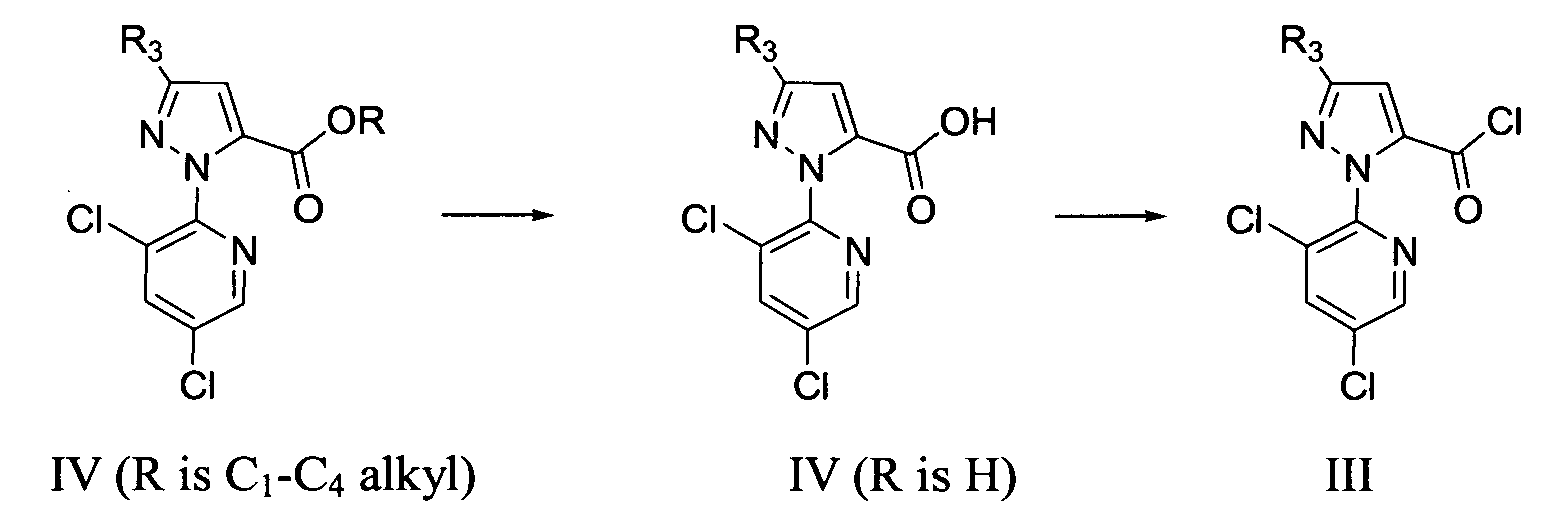
- The carboxylic acid ester compounds of above general formula IV (When R is C1-C4 alkyl) can be hydrolysised to form the carboxylic acid compounds of general formula IV (R is H) under basic conditions. (See T. W. Greene and P. G M. Wuts, Protecting groups in organic synthesis, 2nd ed. John wiley & Sons, Inc., New York. 1991, pp. 224-269: review of the methods). The appropriate bases are selected from alkali metals hydroxide such as alkali metals of lithium, sodium or potassium.
- Carboxylic acid compounds (R is H in compounds of general formula IV )and acyl halide reagents are reacted in an appropriate solvent to yield the compounds of general formula III at a certain temperature from -10 °C to boiling point for 30 minutes to 48 hours. The appropriate acyl halide reagent is selected form oxalyl chloride, thionyl chloride, phosphorus trichloride, phosphorus tribromide, phosphorus pentachloride or phosphorus pentabromide, and the mole ratio of carboxylic acid to acyl halide reagents is 1:1-20. The appropriate solvent is selected from dichloromethane, hexane, benzene, toluene, acetonitrile, dioxane or liquid acyl halide reagents.
- The compounds of general formula IV can be prepared by the following three processes:
-

- The compounds of general formula V and the compounds of general formula VI are reacted in an appropriate solvent to yield the compounds of general formula IV at a certain temperature from 0 °C to boiling point for 30 minutes to 48 hours. The appropriate solvent is selected from methanol, ethanol, benzene, toluene, acetonitrile, dioxane, tetrahydrofuran or acetic acid.
- The compounds of general formula V can be prepared by ketone reacted with oxalate ester in an appropriate solvent under basic conditions at a certain temperature from -10 °C to boiling point for 30 minutes to 48 hours. The appropriate base is selected from alkaline metal alkoxide such as sodium methoxide, potassium methoxide, sodium ethoxide, potassium ethoxide, sodium tert-butoxide, or potassium tert-butoxide etc.. The appropriate solvent is selected from methanol, ethanol, benzene, toluene, acetonitrile, dioxane or tetrahydrofuran. Corresponding ketones and oxalate esters are commercially available.
- The compounds of general formula VI can be prepared by corresponding halogenated pyridine reacted with hydrazine in an appropriate solvent. The appropriate solvent is selected from methanol, ethanol, benzene, toluene, acetonitrile, dioxane or tetrahydrofuran. The corresponding halogenated pyridine is commercially available.
-

- The compounds of general formula VII in the solvent with appropriate oxidant is oxidized to form the carboxylic acid compounds of general formula IV (R is H). The appropriate oxidant is selected from hydrogen peroxide, organic peroxides, potassium persulfate, sodium persulfate, ammonium persulfate, potassium monopersulfate or potassium permanganate. The appropriate solvent is selected from water, acetone, tetrahydrofuran, dioxane, ethyl acetate, N, N-dimethylformamide or acetonitrile, etc..

- The compounds of general formula VI and the compounds of general formula VIII are reacted in the solvent to yield the compounds of general formula VII at a certain temperature from 0 °C to boiling point for 30 minutes to 48 hours. The appropriate solvent is selected from methanol, ethanol, benzene, toluene, acetonitrile, dioxane, tetrahydrofuran or acetic acid. The corresponding alkyl acyl furans are commercially available.
-

- The compounds of general formula IX in an appropriate solvent with oxidant are oxidated to yield the compounds of general formula IV under acidic conditions at a certain temperature from 0 °C to boiling point for 30 minutes to 48 hours. The appropriate oxidant is selected from hydrogen peroxide, organic peroxides, potassium persulfate, sodium persulfate, ammonium persulfate, potassium monopersulfate or potassium permanganate. The appropriate solvent is selected from tetrahydrofuran, dioxane, ethyl acetate, N, N-dimethylformamide, acetonitrile etc.. The appropriate acid used in the oxidation step is selected from sulfuric acid, phosphoric acid or acetic acid etc..
- The compounds of general formula IV when R3 is substituted oxygen group can be obtained in an appropriate solvent by the reaction of the compounds of general formula IV ( R3 is hydroxyl) with halides at a certain temperature from -10 °C to boiling point for 30 minutes to 48 hours. The appropriate solvent is selected from dichloromethane, chloroform, carbon tetrachloride, N, N-dimethylformamide, tetrahydrofuran, acetonitrile, dioxane or DMSO, etc.. The appropriate halides such as iodomethane, allyl bromide or propargyl bromide etc. are commercially available.

- The compounds of general formula IX (R3 is OH) in an appropriate solvent react with halogenating agent at a certain temperature from -10 °C to boiling point for 30 minutes to 48 hours, and the reaction mixture is neutralized with base to get the corresponding compounds of general formula IX (R3 is halogen). The appropriate halogenating agent is selected from phosphorus oxyhalides, phosphorus trihalides, phosphorus pentahalides, thionyl chloride, dihalotrialkylphosphoranes, dihalodiphenylphosphoranes, oxalyl chloride or carbonyl chloride. The appropriate solvent is selected from dichloromethane, chloroform, chlorobutane, benzene, xylene, chlorobenzene, tetrahydrofuran, dioxane, ethyl ether, acetonitrile, N, N-dimethylformamide etc.. The appropriate base is selected from inorganic base such as sodium bicarbonate, sodium hydroxide, etc., or organic base such as sodium acetate.

- The compounds of general formula VI react with the compounds of general formula X (Such as fumarate or maleate, or their mixture), then acidified with the appropriate acid to yield the compounds of general formula IX in the presence of appropriate solvent and base at a certain temperature from -10 °C to boiling point for 30 minutes to 48 hours. The appropriate base is selected from alkali metal alkoxide such as sodium methoxide, potassium methoxide, sodium ethoxide, potassium ethoxide, sodium tert-butoxide or potassium tert-butoxide, ect.. The appropriate solvent is selected from alcohols such as ethanol or methanol. The appropriate acid is selected from organic acids such as acetic acid, etc., or inorganic acids such as hydrochloric acid, or sulfuric acid, etc.. The compounds of general formula X such as maleate, etc., are commercially available.
-
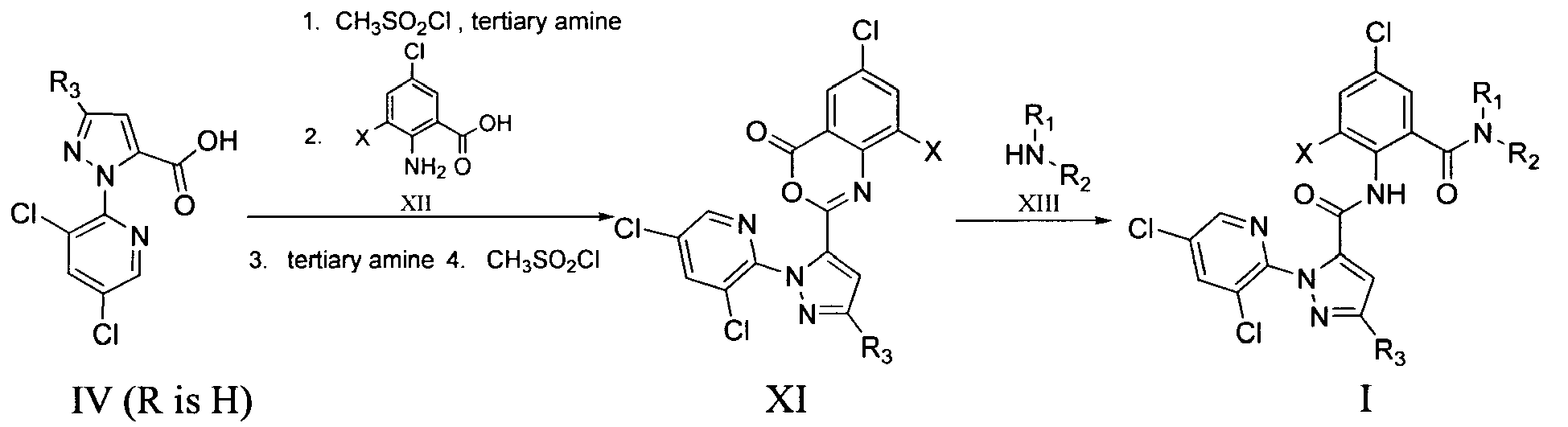
- Benzoxazinone XI can be prepared by the following processes:
- To add a solution of methanesulfonyl chloride into an appropriate solvent and then added sequentially the mixture of the compounds of general formula IV (R is H) and tertiary amine, and anthranilic acid XII. Then tertiary amine and methanesulfonyl chloride are added to the mixture to get the compounds of general formula XI. The appropriate solvent is selected from chlorobenzene, toluene, ethyl acetate, butyl acetate, acetone, 2-butanone, tetrahydrofuran, dioxane, acetonitrile, dichloromethane or chloroform. The anthranilic acids of general formula XII can be prepared according to the method disclosed in
US2005075372 . The tertiary amine is selected from triethylamine or tributylamine, etc.. - The amines XIII react with the benzoxazinone XI in an appropriate solvent to yield the title compounds of general formula I at a certain temperature from 0 °C to boiling point for 30 minutes to 48 hours. The appropriate solvent is selected from tetrahydrofuran, diethyl ether, pyridine, dichloromethane or chloroform, etc.. The reactions of the benzoxazinone XI with the amines XIII to obtain the anthranilamides are fully disclosed in chemical literature. (See Biorganic and Medicinal Chemistry 2000, 8, 2095-2103; and J. Heterocyclic Chemistry, 1999, 36, 563-588.) The corresponding amines are commercially available.
- The table 1 shows the structures and their physical properties of some representative compounds of general formula I:

Table 1 Compound R1 R2 R3 X Appearance (m.p.( °C)) 1 H CH3 CH3 CH3 white solid (196-198) 2 CH3 CH3 CH3 CH3 white solid (197-200) 3 H CH3 CF3 CH3 white solid (213-216) 4 H CH3 OCH3 CH3 white solid(120-122) 5 H CH3 OCH2CF3 CH3 6 H CH3 OCH2CN CH3 7 H CH3 OCF2CF3 CH3 8 H CH3 OCH2CH = CH2 CH3 white solid(205-208) 9 H CH3 OCH2C≡CH CH3 white solid(171-174) 10 H CH3 Cl CH3 white solid(206-209) 11 H CH3 Cl Cl white solid(155-157) 12 H CH3 C! Br 13 H CH3 Cl F 14 H H Br Cl white solid(240-243) 15 H H Br CH3 white solid(253-255) 16 H H Cl Cl white solid(237-240) 17 H H Cl CH3 white solid(245-248) 18 H CH3 Br CH3 white solid(135-138) 19 H CH3 Br Cl white solid(175-178) 20 H CH3 Br Br 21 H CH3 Br F 22 H -CH2CH3 Br CH3 white solid(221-225) 23 H -CH(CH3)2 Br CH3 white solid(223-225) 24 H 
Br CH3 white solid(228-231) 25 H 
Br CH3 white solid(238-241) 26 H -CH2C≡CH Br CH3 white solid(126-129) - Compounds 1H NMR (300MHz, CDCl3) data as follows:
- Compound 1: 9.979 (br s, 1H), 8.393 (d, 1H), 7.833 (d, 1H), 7.220-7.178 (m, 2H), 6.911 (s, 1H), 6.234 (br s, 1H), 2.922 (d, 3H), 2.420 (s, 3H), 2.176 (s, 3H).
- Compound 2: 10.001 (br s, 1H), 8.383 (d, 1H), 7.808 (d, 1H), 7.126 (s, 1H), 7.033-6.931 (m, 2H), 3.061 (s, 3H), 2.754 (s, 3H), 2.403 (s, 3H), 2.018 (s, 3H).
- Compound 3: 10.384 (br s, 1H), 8.400 (d, 1H), 7.877 (d, 1H), 7.642 (s, 1H), 7.099-7.074 (m, 2H), 6.269 (br s, 1H), 2.894 (d, 3H), 2.077 (s, 3H).
- Compound 4: 9.986 (br s, 1H), 8.371 (d, 1H), 7.812 (d, 1H), 7.077-7.065 (m, 2H), 6.636 (s, 1H), 6.455 (br d, 1H), 3.987 (s, 3H), 2.857 (d, 3H) , 2.083 (s, 3H).
- Compound 8:9.996 (br s, 1H), 8.368 (d, 1H), 7.817 (d, 1H), 7.120-7.100 (m, 2H), 6.637 (s, 1H), 6.357 (br s, 1H), 6.140-6.047 (m, 1H), 5.467-5.276 (m, 2H), 4.790 (d, 2H), 2.879 (d, 3H), 2.111 (s, 3H).
- Compound 9: 10.012 (br s, 1H), 8.375 (d, 1H), 7.824 (d, 1H), 7.266-7.163 (m, 2H), 6.627 (s, 1H), 6.208 (br s, 1H), 4.919 (d, 2H), 2.919 (d, 3H), 2.558 (t, 1H), 2.151 (s, 3H).
- Compound 10: 10.194 (br s, 1H), 8.375 (d, 1H), 7.845 (d, 1H), 7.159 (s, 1H), 7.121-7.102 (m, 2H), 6.238 (br s, 1H), 2.896 (s, 3H), 2.044 (s, 3H).
- Compound 11: 9.933 (br s, 1H), 8.388 (d, 1H), 7.849 (d, 1H), 7.319 (s, 1H), 7.263-7.197 (m, 2H), 6.355 (br s, 1H), 3.006 (d, 3H).
- Compound 14: (DMSO-d6) 10.456 (br s, 1H), 8.557 (d, 1H), 8.405 (d, 1H), 7.769-7.502 (m, 4H), 7.408 (s, 1H).
- Compound 15: (DMSO-d6)10.366 (br s, 1H), 8.549 (d, 1H), 8.393 (d, 1H), 7.718 (br s, 1H), 7.448-7.365 (m, 4H), 2.163 (s, 3H).
- Compound 18: 10.208 (br s, 1H), 8.383 (d, 1H), 7.853 (d, 1H), 7.252 (s, 1H), 7.106-7.084 (m, 2H), 6.411 (br s, 1H), 2.903 (d, 3H), 2.085 (s, 3H).
- Compound 19: 10.000 (br s, 1H), 8.395 (d, 1H), 7.856 (d, 1H), 7.311 (s, 1H), 7.223-7.142 (m, 2H), 6.434 (br s, 1H), 2.885 (d, 3H).
- Compound 22: 10.242 (br s, 1H), 8.386 (d, 1H), 7.853 (d, 1H), 7.225 (s, 1H), 7.188-7.158 (m, 2H), 6.159 (br s, 1H), 3.405 (q, 2H), 2.227 (s, 3H), 1.237 (t, 3H).
- Compound 23: 10.328 (br s, 1H), 8.383 (d, 1H), 7.844 (d, 1H), 7.369 (s, 1H), 7.096-7.08 (m, 2H), 6.026 (br s, 1H), 4.158 (m, 1H), 2.089 (s, 3H), 1.137 (d, 6H).
- Compound 24: 10.194 (br s, 1H), 8.394 (d, 1H), 7.849 (d, 1H), 7.347 (s, 1H), 7.143-7.074 (m, 2H), 6.383 (br s, 1H), 2.803-2.768 (m, 1H), 2.163 (s, 3H), 0.900-0.834 (m, 2H), 0.548-0.494 (m, 2H).
- Compound 25: 10.278 (br s, 1H), 8.383 (d, 1H), 7.837 (d, 1H), 7.354 (s, 1H), 7.115-7.082 (m, 2H), 6.095 (br s, 1H), 3.810 (m, 1H), 2.093 (s, 3H), 1.892-1.086 (m, 10H).
- Compound 26: 10.000 (br s, 1H), 8.404 (d, 1H), 7.861 (d, 1H), 7.210-7.192 (m, 2H), 6.494 (br s, 1H), 4.147-4.108 (m, 2H), 2.264 (t, 1H), 2.143 (s, 3H).
- Although the same Group atoms in the Periodic Table possess the similar chemical properties, however there are significant differences in their electronegativity and volume, which makes the different molecules show different liposolubility or mobility in the biological organisms such as insects, or plants. The suitable transportation properties of bioactive molecules play an important role in the biological efficacy. The transportation suitability of molecules is unpredictable, so it only can be discovered through extensively creative investigation.
- Compared with the known compound such as 1-(3-chloro-5-bromopyridin-2-yl) -pyrazole carboxamide or 1-(3-chloro -2-yl)-pyrazole carboxamide, the 1-substituted pyridyl-pyrazolyl amide compounds in the present invention possess surprisingly high insecticidal activity against the following insect: the order Lepidoptera such as Striped stem borer (Chilo suppressalis Walker), Yellow stem borer (Scirpophaga incertulas (Walker)), rice leaf roller (Cniaphalocrosis medinalis Guenee), corn borer (Pyrausta nubilalis (Hubern)), tobacco bud worm (Heliothis virescens Fabricius), oriental fruit moth (Grapholitha molesta (Busck)), diamondback moth (Plutella xylostella Linnaeus), beet armyworm (Spodoptera exigua Huibner), cluster caterpillar (Spodoptera litura Fabricius), corn earworm (Helicoverpa zea Boddie), fall armyworm (Mythimna separata Walker Spodoptera frugiperda J. E. Smith), cabbage looper (Trichoplusiani Huibner), etc.; the order Homoptera such as pea aphid (Acyrthisiphon pisum Harris), Aphis craccivora Koch (cowpea aphid), black bean aphid (Aphis fabae Scopoli), cotton aphid (Aphis gossypii Glover), apple aphid (Aphis pomi De Geer), green peach aphid (Myzus peisicae Sulzer), corn leaf aphid (Rhopalosiphum maidis Fitch), whitefly, leafhopper, lugens, rice delphacid (Sogatodes orizicola Muit), powder scale, ect.; the order Hemiptera such as chinch bug (Blissus leucopterus leucopterus Say), cotton lace bug (Corythuca gossypii Fabricius), tomato bug (Cyropeltis modesta Distant), southern green stink bug (Nezara viridula Linnacus), tice stink bug (Oebalus pugnax Fabricius), ect.; the order Thyasnoptera such as onion thrip (Thrips tabaci Lindeman), westem flower thrip (Frankliniella occidentalis Pergande), soybean thrip (Scirthothnips variabiis Beach), ect.; the order Coleoptera such as Colorado potato beetle (Leptinotarsa decemlineata Say), Athous, ect.; the order Diptera such as fly, mosquito, ect.; The order Hymenoptera such as bee, ant ect.. So, the present invention also provides the application of the general formula I compounds for controlling insects.
- The 1-substituted pyridyl-pyrazolyl amide compounds in the present invention possess surprisingly high fungicidal activity, which can control the disease such as rice blast, phytophthora infestans, mould, powdery mildew, downy mildew, anthracnose, etc.. So, the present invention also provides the application of general formula I compounds for combatting diseases.
- The preparation of 1-substituted pyridyl-pyrazolyl amide compounds in the present invention is more convenient, more environmentally friendly. The preparation cost is lower. So it can be carried out to control the significant insects or diseases in agriculture, forestry or public health with the lower cost.
- Another embodiment of the present invention includes the insecticidal or fungicidal compositions, in which the compounds of general formula I are active ingredients. The weight percentage of active ingredient(s) in the compositions is from 1% to 99%. There are also acceptable carriers in agriculture, forestry or public health in these compositions.
- The compositions of the present invention can be used in the form of various formulations. Usually, the compounds of general formula I as the active ingredient can be dissolved in or dispersed in carriers or made to a formulation. So that they can be easily dispersed as an insecticide, or a fungicide such as a wettable powder or an emulsifiable concentrate etc.. Therefore, in these compositions, at least a liquid or solid carrier is added, and usually suitable surfactant(s) can be added when needed.
- Still also provided by the present invention are the application methods for controlling insects, which is to apply the compositions of the present invention to the growing loci of the insects as mentioned above. The suitably effective dosage of the compounds of the present invention is usually within a range of 10 g/ha to 1000 g/ha, preferably from 20 g/ha to 500 g/ha.
- Also provided by the present invention are the application methods of controlling diseases, which is to apply the compositions of the present invention to the growing loci of the diseases as above mentioned. The suitably effective dosage of the compounds of the present invention is usually within a range of from 10 g/ha to 1000 g/ha, preferably from 20 g/ha to 500 g/ha.
- For some applications, one or more other fungicides, insecticides, herbicides, plant growth regulators or fertilizer can be added into the insecticidal or fungicidal compositions of the present invention to make additional merits and effects.
- It shall be noted that variations and changes are permitted within the claimed scopes in the present invention.
- The following synthesis examples and results of biological tests are used to further illustrate the present invention, but not to limit it.
-

- To a 500 mL flask, 25% sodium methoxide of methanol solution (43.20 g, 0.200 mol), methanol (200 mL) were added , the mixture of dimethyl oxalate (23.60 g, 0.200mol) and acetone (11.60 g, 0.200 mol) were added dropwise at ice-salt bath. The reaction mixture was stirred for 8 hours at 0∼5 °C. The reaction mixture was poured into 200 mL water and extracted with ethyl acetate (150 mL) to remove organic impurity. The aqueous solution was acidified with concentrated hydrochloric acid to pH of 2-3 and extracted with ethyl acetate (3 × 200 mL). The organic layer was washed with water (150 mL), and saturated brine (150 mL), dried over anhydrous magnesium sulfate and concentrated to give the product (25.9 g) as yellow oil in 90% yield. 1H NMR (300MHz, CDCl3): 6.396 (s, 1H, enol isomer), 3.906 (s, 3H), 2.279 (s, 3H).
-

- To a 500 mL flask, 2, 3, 5-trichloropyridine (20.00 g, 0.110 mol), 80% hydrazine (34.30 g, 0.550 mol) and dioxane (200 mL) were added sequentially. The reaction mixture was heated to reflux for 20 hours. Then the reaction mixture was cooled down to room temperature overnight and white crystal was precipitated. The white crystal was isolated via filtration and dried to give the product (14.0 g) as a white solid in 72% yield. Melting point: 187-189 °C. 1H NMR (300MHz, DMSO-d6): 8.123 (d, 1H), 7.849 (d, 1H).
-

- To a 100 mL flask, methyl 2, 4-dioxopentanoate (2.88 g, 0.020 mol), tetrahydrofuran (15 mL), acetic acid (30 mL), and 3, 5-dichloro-2-hydrazinylpyridine (3.56 g, 0.020 mol) were added sequentially. The reaction mixture was heated to reflux for 2 hours and then the mixture was concentrated by rotary evaporator. Then ethyl acetate (150 mL) and water (100 mL) was added, the organic layer was washed with saturated sodium bicarbonate solution (100 mL) and saturated brine (100 mL), dried over anhydrous magnesium sulfate and concentrated by rotary evaporator. The residue was purified by silica gel column chromatography (Fluent: ethyl acetate/petroleum ether=1/5) to give the product (2.9 g) as a white solid in 50% yield. Melting point: 97-98 °C. 1H NMR (300MHz, CDCl3): 8.432 (d, 1H), 7.888 (d, 1H), 6.802 (s, 1H), 3.760 (s, 3H), 2.370 (s, 3H).
-

- To a 100 mL flask, methyl 1-(3,5-dichloropyridin-2-yl)-3-methyl-1H-pyrazole-5-carboxylate (1.00 g, 3.49 mmol), tetrahydrofuran (10 mL), water (10 mL) and sodium hydroxide (0.14 g, 3.49 mmol) were added sequentially. After being strried for 40 minutes at room temperature, all of the starting materials had disappeared. Then water (50 mL) was added. The mixture was extracted with ethyl acetate (30 mL) and the aqueous layer was acidified with concentrated hydrochloric acid to pH of 2∼3, and extracted with ethyl acetate (3 × 80 mL), the organic layer was washed with saturated brine (100 mL), dried over anhydrous magnesium sulfate and concentrated by rotary evaporator to give the product (0.91 g) as a white solid in 96% yield. Melting point: 227-228 °C.
1H NMR (300MHz, CDCl3): 8.448 (s, 1H), 7.908 (s, 1H), 6.901 (s, 1H), 2.400 (s, 3H). -

- To a 100 mL flask, 1-(3,5-dichloropyridin-2-yl)-3-methyl-1H-pyrazole-5-carboxylic acid (0.37 g, 1.38 mmol), dichloromethane (10 mL) and oxalyl dichloride (0.35 g, 2.20 mmol) were added. After a drop of N, N-dimethyl formamide was added, a large number of gas was released. After being stirred for overnight at room temperature, the reaction mixture was concentrated under reduced pressure. Then 10 mL toluene was added, and the mixture was concentrated again under reduced pressure to give the the product (0.40 g) as yellow oil in 100% yield.
-

- To a 100 mL flask, 2-amino-5-chloro-N, 3-dimethylbenzamide (0.27 g, 1.38 mmol, preparaed according to
US2005075372 ), dichloromethane (5 mL) and triethylamine (0.14, 1.38 mmol) were added. Then the solution of 1-(3, 5-dichloropyridin-2-yl)-3-methyl-1H-pyrazole-5-carbonyl chloride (0.40 g, 1.37 mmol) in dichloromethane (5 mL) were added dropwise. The reaction mixture was stirred for 4 hours at room temperature. Then the reaction mixture was poured into water (50 mL), and extracted with ethyl acetate (3×100 mL). The organic layer was washed with water and saturated brine, dried over anhydrous magnesium sulfate and concentrated by rotary evaporator. The residue was purified by silica gel column chromatography (Fluent: ethyl acetate/petroleum ether=1/5) to give the compound 1 (0.41 g) as a white solid in 66% yield. -

- To a 500 mL flask, 2, 3, 5-trichloropyridine (20.00 g, 0.110 mol), 80% hydrazine (34.30 g, 0.550 mol) and dioxane (200 mL) were added sequentially. The reaction mixture was heated to reflux for 20 hours. Then the reaction mixture was cooled down to room temperature overnight and white crystal was precipitated. The white crystal was isolated via filtration and dried to give the product (14.0 g) as a white solid in 72% yield. Melting point: 187-189 °C.
1H NMR (300MHz, DMSO-d6): 8.123 (d, 1H), 7.849 (d, 1H). -

- To a 250 mL flask, 4, 4, 4-trifluoro-1-(furan-2-yl)butane-1,3-dione (5.50 g, 26.7 mmol), 3,5-dichloro-2-hydrazinylpyridine (4.75 g, 26.7 mmol) and glacial acetic acid (100 mL) were added.The reaction mixture was heated to reflux. When the reaction completed, the reaction mixture was concentrated by rotary evaporator. Then ethyl acetate (300 mL) and water (150 mL) was added, the organic extracts were washed with saturated sodium bicarbonate solution (150 mL) and brine (150 mL) in sequence, dried over anhydrous magnesium sulfate and concentrated by rotary evaporator. The residue was purified by silica gel column chromatography (Fluent: ethyl acetate/petroleum ethet=1/5) to give the product (5.66 g) as a yellow oil in 61% yield. 1H NMR (300MHz, CDCl3): 8.514 (d, 1H), 7.974 (d, 1H), 7.362 (d, 1H), 6.917 (s, 1H), 6.388 (dd, 1H), 6.148 (d, 1H).
-

- To a 100 mL flask, 3,5-dichloro-2-(5-(furan-2-yl)-3-(trifluoromethyl)-1H-pyrazol-1-yl)pyridine (1.47 g, 4.22 mmol), acetone (10 mL) and a solution (10 mL) of potassium permanganate (3.33 g, 21.1 mmol) in water were added. The reaction mixture was heated to 65 °C for 4 hours and cooled to room tempeture, then isolated via filtration, a cake is obtained. The cake was washed with hot solution of potassium hydroxide. To the filtrate was added ethyl acetate (80 mL), water (100 mL) and partitioned. The aqueous layer was acidified with concentrated hydrochloric acid to pH of 2-3, and extracted with ethyl acetate (200 mL). The organic extracts were washed with saturated brine (100 mL), dried over anhydrous magnesium sulfate and concentrated by rotary evaporator to give the product (0.80 g) as yellow oil in 58% yield.
1H NMR (300MHz, CDCl3) : 8.480 (d, 1H), 7.969 (d, 1H), 7.345 (s, 1H). -

- To a 100 mL flask, 1-(3,5-dichloropyridin-2-yl)-3-(trifluoromethyl)-1H-pyrazole-5-carboxylic acid (0.40 g, 1.22 mmol), dichloromethane (10 mL) and oxalyl dichloride (0.31 g, 2.44 mmol) were added sequentially. After five drops of N, N-dimethyl formamide were added, a large amount of gas was released. After being stirred for 8 hours at room temperature, the reaction mixture was concentrated under reduced pressure. Then toluene (30 mL) was added, and was concentrated again under vacuum to give the product (0.42 g) as yellow solid in 100% yield.
-

- To a 100 mL flask, 2-amino-5-chloro-N,3-dimethylbenzamide (0.24 g, 1.22 mmol), dichloromethane (20 mL), 1-(3,5-dichloropyridin-2-yl)-3-(trifluoromethyl)-1H-pyrazole-5-carbonyl chloride (0.42 g, 1.22 mmol) and triethylamine (0.12 g, 1.22 mmol) were added sequentially. The reaction mixture was stirred for 3 hours at room temperature. The reaction mixture was poured into water (100 mL) and extracted with ethyl acetate (2×100 mL). The organic layer was washed with saturated sodium carbonate solution and saturated brine, dried over anhydrous magnesium sulfate and concentrated. The residue was purified by silica gel column chromatography to give the compound 3 (0.50 g) as a white solid in 81 % yield.
-

- To a 500 mL flask, 2, 3, 5-trichloropyridine (20.00 g, 0.110 mol), 80% hydrazine (34.30 g, 0.550 mol) and dioxane (200 mL) were added sequentially. The reaction mixture was heated to reflux for 20 hours. Then the reaction mixture was cooled down to room temperature overnight and white crystal was precipitated. The white crystal was isolated via filtration and dried to give the product (14.0 g) as a white solid in 72% yield. Melting point: 187-189 °C.
1H NMR (300MHz, DMSO-d6): 8.123 (d, 1H), 7.849 (d, 1H). -

- To a 500 mL flask, 300 mL anhydrous ethanol, sodium ethoxide (4.1 g, 61 mmol) and 3, 5-dichloro-2-hydrazinylpyridine (10.00 g, 56 mmol) were added. The reaction mixture was heated to reflux for 5 minutes. Diethyl maleate (10.64 g, 61.0 mmol) was added dropwise and heated to reflux for 10 minutes. After being cooled to 65 °C, the reaction mixture was neutralized with glacial acetic acid (13 g, 224 mmol) and diluted with 300 mL water. The mixture was cooled down to room temperature and the aprecipitate formed. The solid was isolated via filtration, washed with 40% aqueous solution of ethanol (3 × 50 mL) and dried to give the product (8.00 g) as an orange solid in 47% yield. Melting point: 105-108 °C.
1H NMR (300MHz, CDCl3): 8.146 (q, 1H), 7.658 (q, 1H), 5.073 (dd, 1H), 4.241 (q, 2H), 3.029 (dd, 1H), 2.721 (dd, 1H), 1.258 (t, 3H). -

- To a 100 mL flask, ethyl 2-(3,5-dichloropyridin-2-yl)-5-oxopyrazolidine-3-carboxylate (4.00 g, 13.15 mmol), acetonitrile (50 mL) and 98% sulfuric acid (2.63 g, 26 mmol) were added. The mixture was stirred for 10 minutes, and then potassium persulfate (5.69 g, 21.04 mmol) was added. The reaction mixture was heated to reflux for 5 hours. The warm (50-65 °C) reaction mixture was filtered, a cake is obtained after filtration. The cake was washed with acetonitrile (10 mL). The filtrate was concentrated to about 10 mL on rotary evaporator. Then water (50 mL) was added. The solid product was isolated by filtration, washed with 25% aqueous solution of acetonitrile (3 × 15 mL) and dried to give the product (3.0 g) as an orange solid in 76% yield. Melting point: 164-167 °C. 1H NMR (300MHz, CDCl3): 8.445 (d, 1H), 7.912 (d, 1H), 6.546 (s, 1H), 4.262 (q, 2H), 1.236 (t, 3H).
-

- To a 100 mL flask, ethyl 1-(3,5-dichloropyridin-2-yl)-3-hydroxy-1H-pyrazole-5-carboxylate (0.7 g, 2.32 mmol), acetonitrile (10 mL),potassium carbonate (0.32 g,2.32 mmol) and 3-bromoprop-1-yne (0.27 g, 2.32 mmol) were added sequentially. The reaction mixture was heated to 60 °C for 2 hours. Then the reaction mixture was poured into water (100 mL), extracted with ethyl acetate (2 × 100 mL). The organic layer was washed with saturated sodium carbonate solution (80 mL) and saturated brine (80 mL), dried over anhydrous magnesium sulfate and concentrated. The residue was purified by silica gel column chromatography to give the compound (0.30 g) as yellow oil in 38% yield.
1H NMR (300MHz, CDCl3): 8.445 (d, 1H), 7.902 (d, 1H), 6.498 (s, 1H), 4.896 (d, 2H), 4.240 (q, 2H), 2.547 (t, 1H), 1.260 (t, 3H). -

- To a 100 mL flask, ethyl 1-(3,5-dichloropyridin-2-yl)-3-(prop-2-ynyloxy)-1H-pyrazole-5-carboxylate (0.3 g, 0.88 mmol), methanol (10 mL), water (10 mL) and sodium hydroxide (0.04 g, 0.88 mmol) were added. The reaction mixture was stirred at room temperature for 1 hour. When reacted completely, water (40 mL) was added. The water (40 mL), ether (50 mL) were added and partitioned, acidified with concentrated hydrochloric acid to pH of 4, extracted with ethyl acetate (150 mL). The organic layer was washed with saturated brine (50 mL), dried over anhydrous magnesium sulfate and concentrated at reduced pressure to give the product (0.27 g) as slight yellow solid in 73% yield. Melting point: 151-157 °C.
1H NMR (300MHz, CDCl3): 8.429 (d, 1H), 7.900 (d, 1H), 6.563 (s, 1H), 4.882 (s, 2H), 2.550 (s, 1H). -

- To a 100 mL flask, 1-(3,5-dichloropyridin-2-yl)-3-(prop-2-ynyloxy)-1H-pyrazole-5-carboxylic acid (0.2 g, 0.64 mmol), dichloromethane (10 mL) and oxalyl dichloride (016 g, 1.2 mmol) were added. After five drops of N, N-dimethyl formamide were added, a large number of gas was released. After being stirred for 8 hours at room temperature, the reaction mixture was evaporated to dryness at reduced pressure. Then 100 mL toluene was added, and the reaction mixture was concentrated again under reduced pressure to give the product (0.21 g) as yellow solid in 100% yield.
-
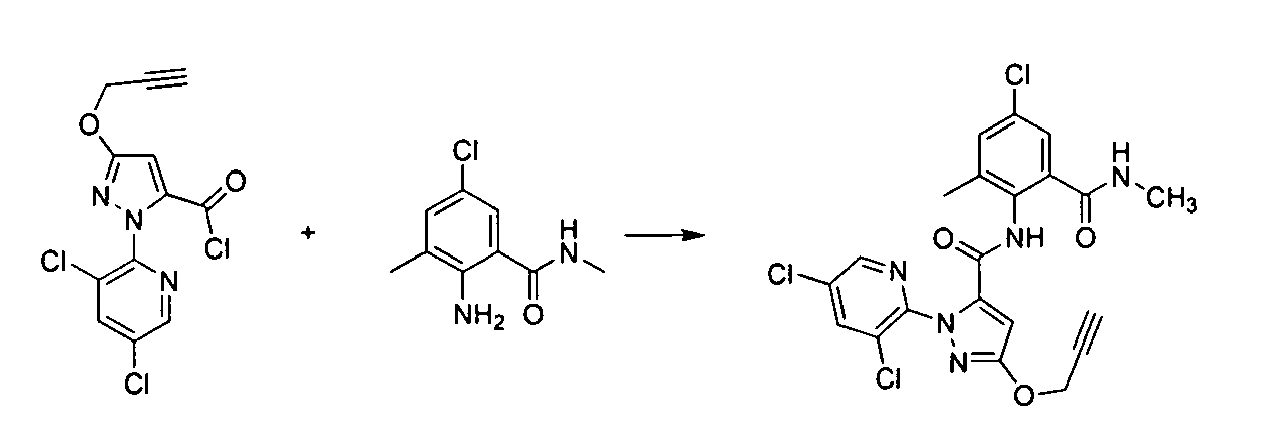
- To a 100 mL flask, 2-amino-5-chloro-N,3-dimethylbenzamide (0.12 g, 0.6 mmol), dichloromethane (20 mL), 1-(3,5-dichloropyridin-2-yl)-3-(prop-2-ynyloxy)-1H-pyrazole-5-carbonyl chloride (0.2 g, 0.6 mmol) and triethylamine (0.06 g, 0.6 mmol) were added. After being stirred for 3 hours at room temperature, the reaction mixture was poured into water (100 mL) and extracted with ethyl acetate (2×100 mL). The organic layer was washed with saturated sodium carbonate solution and saturated brine, dried over anhydrous magnesium sulfate and concentrated. The residue was purified by silica gel column chromatography to give the compound 9 (0.24 g) as a white solid in 81 % yield.
-

- To a 250 mL flask, acetonitrile (65 mL), ethyl 2-(3, 5-dichloropyridin-2-yl)-5 -oxopyrazolidine-3-carboxylate (3.0 g, 9.8 mmol, the product of Step (3), Example 3) and phosphoryl bromide (2.8 g, 9.8 mmol) were added. The reaction mixture was heated to reflux for 2 hours. The reaction mixture was distilled to remove 30 mL solvent and added to the mixture of sodium carbonate (10 g, 120 mmol) and water (40 mL). The mixture was stirred for 20 minutes until no gas released. The reaction mixture was diluted with dichloromethane (100 mL), stirred for 50 minutes and extracted with dichloromethane (3 × 100 mL). The organic layer was washed with water, dried over anhydrous magnesium sulfate, and concentrated under vacuum to give the product (2.4 g) as amber oil in 67% yield.
1H NMR (300MHz, CDCl3): 8.027 (d, 1H), 7.673 (d, 1H), 5.201 (dd, 1H), 4.202 (q, 2H), 3.464 (dd, 1H), 3.248 (dd, 1H), 1.223 (t, 3H). -

- To a 100 mL flask, ethyl 3-bromo-1-(3,5-dichloropyridin-2-yl)-4,5-dihydro-1H-pyrazole-5-carboxylate (2.0 g, 5.4 mmol), acetonitrile (10 mL) and 98% sulfuric acid (1.1 g, 10.9 mmol) were added. The mixture was stirred for a few minutes, and then potassium persulfate (2.4 g, 8.7 mmol) was added. The reaction mixture was heated to reflux for 5 hours. The warm (50-65 °C) reaction mixture was filtered, a cake is obtained. The cake was washed by acetonitrile (10 mL). The filtrate was concentrated to about 10 mL on rotary evaporator. Then water (50 mL) was added. The solid product was isolated by filtration, washed with 25% aqueous solution of acetonitrile (3x15 mL) and dried to give the product (1.6 g) as orange solid in 80% yield.
1H NMR (300MHz, CDCl3): 8.461 (d, 1H), 7.933 (d, 1H), 7.035 (s, 1H), 4.263 (q, 2H), 1.262 (t, 3H). -

- To a 100 mL flask, ethyl 3-bromo-1-(3,5-dichloropyridin-2-yl)-1H-pyrazole-5-carboxylate (2.0 g, 5.5 mmol), methanol (10 mL), water (10 mL) and sodium hydroxide (0.3 g, 5.5 mmol) were added. After being stirred at room temperature for 1 hour, the mixture reacted completely. The reaction mixture was concentrated by rotary evaporator to about 10 mL as a dark brown solution. Then water (40 mL) was added into the dark brown solution. The aqueous solution was extracted with ethyl ether (50 mL) and acidified with concentrated hydrochloric acid to pH of 4. The precipitate was isolated by filtration, washed with water (2 × 50 mL) and dried to give the product (0.97 g) as white solid in 48% yield.
1H NMR (300MHz, DMSO-d6): 8.641 (d, 1H), 8.529 (d, 1H), 7.186 (s, 1H). -

- To a 100 mL flask, 3-bromo-1-(3,5-dichloropyridin-2-yl)-1H-pyrazole-5-carboxylic acid (0.4 g, 1.2 mmol), dichloromethane (10 mL) and oxalyl dichloride (0.31 g, 2.4 mmol) were added. After five drops of N,N-dimethyl formamide was added, a large number of gas was released. After being stirred for 8 hours at room temperature, the reaction mixture was evaporated to dryness at reduced pressure. Then toluene (100 mL) was added, and the reaction mixture was concentrated again under vacuum to give the product (0.42 g) as green solid in 100% yield.
-

- To a 100 mL flask, 2-amino-5-chloro-N,3-dimethylbenzamide (0.34 g, 1.7 mmol), dichloromethane (20 mL), 3-bromo-1-(3,5-dichloropyridin-2-yl)-1H-pyrazole-5-carbonyl chloride (0.60 g, 1.7 mmol) and triethylamine (0.17 g, 1.7 mmol) were added. The reaction mixture was stirred for 3 hours at room temperature, and then poured into water (100 mL), extracted with ethyl acetate (2 × 100 mL), washed with saturated sodium carbonate solution and saturated brine, dried over anhydrous magnesium sulfate and concentrated. The residue was purified by silica gel column chromatography (Fluent: ethyl acetate/petroleum ether=1/2) to give the compound 18 (0.21 g) as white solid in 24% yield.
-

- To a 150 mL flask, methanesulfonyl chloride (1.1 g, 9.8 mmol), acetonitrile (20 mL) was added. Then the mixture of 3-bromo-1-(3,5-dichloropyridin-2-yl)-1H-pyrazole-5-carboxylic acid (3.0 g, 8.9 mmol, the product of step (3), example 4) and triethylamine (0.89 g, 8.9 mmol ) in acetonitrile (30 mL) were added dropwise in 10 minutes at room temperature. The mixture was stirred for 1 hour. 2-Amino-3, 5-dichlorobenzoic acid (1.6 g,17 mmol) was added, and the reaction mixture turned into reddish brown. After being stirred for 30 minutes, the solution of triethylamine (1.8 g, 17 mmol ) in acetonitrile (10 mL) was added dropwise and yellow solid precipitated. The mixture was stirred for 1 hour, another solution of methanesulfonyl chloride (1.1 g, 9.8 mmol) in acetonitrile (10 mL) was added. The reaction mixture turned into yellow and solid was precipitated. After being stirred for 1 hour, another solution of triethylamine (0.89 g, 8.9 mmol ) in acetonitrile (4 mL) was added. Then the reaction mixture was stirred for overnight at room temperature. The reaction mixture was poured into water (100 mL), extracted with ethyl acetate (2 × 100 mL), washed with saturated sodium carbonate solution and saturated brine, dried over anhydrous magnesium sulfate and concentrated. The residue was purified by silica gel column chromatography (Fluent: ethyl acetate/petroleum ether=1/2) to give the product (2.0 g) as a yellow solid in 45% yield.
-

- To a 100 mL flask, 2-(3-bromo-1-(3, 5-dichloropyridin-2-yl)-1H-pyrazol-5-yl)-6, 8-dichloro-4H-benzo[d][1,3]oxazin-4-one (0.3 g, 0.6 mmol), tetrahydrofuran (4 mL) were added. When all starting materials were dissolved, methylamine (0.09 g, 0.9 mmol, 30%) was added dropwise at room temperature. The mixture reacted completely after 30 minutes. The water was added and the mixture was extracted with ethyl acetate. The organic layer was washed with saturated brine, dried over anhydrous magnesium sulfate and concentrated to give the compound 19 (0.14 g) as a white solid in 43% yield.
- According to the solubility of test compounds, the compounds are dissolved in acetone or dimethyl sulfoxide, and then diluted with 0.1% aqueous solution of Tween 80 to form 50 ml test liquid, the content of acetone or dimethyl sulfoxide in the total solution is not more than 10%.
- The cabbage leaves were perforated to get 1 cm diameter leaf discs by the hole puncher. Certain concentrations of test comopounds were sprayed on both sides of the discs at the spray volume of 0.5 ml by Airbrush. Eight test insects (third instar) were introduced on each treatment after drying. Each treatment repeated 3 times. The treated discs were placed in a chamber of 24 °C, 60%-70% relative humidity, no light. After 96 h, the number of surviving insects was investigated and the mortality was calculated.
- Among some of the testing compounds, the compounds 1, 3, 9, 15, 18, 19, 22, 26 exhibited mortality 90% or more against beet armyworm at 10 ppm.
- Among some of the testing compounds, the compounds 3, 9, 18, 19, 22, 26 exhibited mortality 90% or more against beet armyworm at 1 ppm.
- According to above method, compound 18, 19 and KC1 (compound 833 in the patent
US2005/0075372A1 ) were chosen to parallel activity test against beet armyworm. The two test results were listed in Table 3 and Table 4.

- The middle part of fresh corn leaves were chosen and cut into 3 cm sects. The sects were dipped into the solution of certain concentration of test comopounds for 10 seconds, dried and placed in 9 cm diameter Petri dish. Eight regular health insects (third instar) were introduced on each treatment. Each treatment was repeated for 4 times. The pure water was set as CK. The treated discs were placed in a chamber of 24 °C, 60%-70% relative humidity and day light. After 72 h, the number of surviving insects was investigated and the mortality rates were calculated.
- Among some of the testing compounds, the compounds 18, 19 exhibit mortality 90% or more against army worm at 0.4 ppm.
- The leaves of cabbage grown in greenhouse were chosen, removed the surface waxy layer and perforated to get 2 cm diameter leaf discs by the hole puncher. The discs were dipped in a solution of certain concentrations of test comopounds for 10 seconds, dried and placed in 9 cm diameter Petri dish. Eight regular health insects (third instar) were introduced on each treatment. Each treatment was repeated for 4 times. The pure water was set as CK. The treated discs were placed in a chamber of 24 °C, 60%-70% relative humidity and day light. After 72 h, the number of surviving insects was investigated and the mortality was calculated.
- Among some of the testing compounds, the compound 19 exhibit mortality more than 90% against Diamondback moth at 0.8 ppm.
- The 6 well culture plates were chosen, 5 mL artificial feed was added into each well. After the feed solidified, 0.2 mL solution of certain concentrations of test comopounds was added into per well with a continuous sampler and made the uniform film in the feed surface. Eight regular health insects (second instar) were introduced on each treatment after drying. Each treatment was repeated for 4 times. The pure water was set as CK. The treated discs were placed in a chamber of 24 °C, 60%-70% relative humidity and day light. After 72 h, the number of surviving insects was investigated and the mortality was calculated.
- Among some of the testing compounds, the compounds 18, 19 exhibit mortality 90% or more against striped stem borer at 10 ppm.
- According to above method, compound 19 and KC2 (compound 531 in the patent
US2005/0075372A1 ) were choosen to parallel activity test against striped stem borer. The testing result was listed in table 5.
- A certain concentrations of test comopounds were sprayed on leaves at the time of hatching peak of rice leaf folder. Spay volume was 450 L/ha. The section area of rice was 32 m2. Each treatment was repeated for 3 times. After 7d, the number of surviving insects was investigated and the mortality was calculated. The result was listed in table 6.


- The melt AEA culture medium was cooled to 60-70 °C, and calculated amount of the test compounds were added according to the designed concentration to prapare compound-containing culture medium, the final content of test compound was 25 ppm. After the medium cooled down sufficiently, tomato late blight pathogen of 0.5 cm diameter was inoculated and placed into the growth oven. The evaluation was performed after 10 days after inoculation. The measurement of the diameter of each colony was carried out and the rate of fungi inhibition was calculated.
- The control efficiency of compound 1 against tomato late blight is more than 90%.
- Select a uniformly growth of potted cucumber seedlings, neatly cut growing point and two mail leaves reserved. The testing compound solutions were sprayed at 400 ppm. Cucumber anthracnose spore suspension was inoculated at the second day after the treatment of the test materials, then placed in the artificial climate chamber (temperature: 22 °C, relative humidity: >95%) to cultivate, and then placed into greenhouse to cultivate after 1 day. After 5 days the protection and control effect was investigated according to the blank control using visual assessment survey and recorded with 100% to 0, 100% is no disease, 0 indicated that the incidence level of the treatment was same with blank control.
- The protective controlling effect of compound 1 against cucumber anthracnose is more than 90%.
Claims (8)
- A kind of 1-substituted pyridyl-pyrazolyl amide compounds as represented by the general formula I:
 R1 is H or C1-C3 alkyl;R2 is H, C1-C6 alkyl, C3-C6 alkenyl, C3-C6 alkynyl or C3-C6 cycloalkyl;R3 is Cl, Br, CH3, CF3, C1-C3 alkoxy, C1-C3 haloalkoxy, C2-C6 cyanoalkoxy, C3-C6 alkenyloxy or C3-C6 alkynyloxy;X is F, Cl, Br or CH3.
 - The compounds according to the claim 1, characterized in that wherein:R1 is H;R2 is H, C1-C6 alkyl, or C3-C6 cycloalkyl;R3 is Cl, Br, CH3, CF3, methoxy, trifluoromethoxy, cyanomethoxy, propenyloxy or propynyloxy;X is Cl or CH3.
- The compounds having the the general formula I according to the claim 2, characterized in that wherein:R1 is H;R2 is H or CH3;R3 is Cl or Br;X is Cl or CH3.
- The compounds having the the general formula I according to the claim1 are used for controlling insects.
- The compounds having the the general formula I according to the claim1 are used for controlling diseases.
- A insecticidal or fungicidal composition, comprising the compounds of general formula I of the claim 1 and an acceptable carrier in agriculture, forestry or public health, in which the weight percentage of active ingredient(s) is in the range of 1%-99%.
- A method for controlling insects, characterized in that: applying the composition of claim 6 to pests or its growth medium with effective dosage within a range of from 10 g/ha to 1000 g/ha.
- A method for controlling diseases, characterized in that: applying the composition of claim 6 to diseases or its growth medium with effective dosage within a range of from 10 g/ha to 1000 g/ha.
Applications Claiming Priority (2)
| Application Number | Priority Date | Filing Date | Title |
|---|---|---|---|
| CN2008101161984A CN101333213B (en) | 2008-07-07 | 2008-07-07 | 1-substituted pyridyl-pyrazol acid amide compounds and use thereof |
| PCT/CN2009/072612 WO2010003350A1 (en) | 2008-07-07 | 2009-07-03 | 1-substituted pyridyl-pyrazolyl amide compounds and uses thereof |
Publications (3)
| Publication Number | Publication Date |
|---|---|
| EP2295425A1 true EP2295425A1 (en) | 2011-03-16 |
| EP2295425A4 EP2295425A4 (en) | 2011-09-14 |
| EP2295425B1 EP2295425B1 (en) | 2016-09-07 |
Family
ID=40196126
Family Applications (1)
| Application Number | Title | Priority Date | Filing Date |
|---|---|---|---|
| EP09793825.2A Not-in-force EP2295425B1 (en) | 2008-07-07 | 2009-07-03 | 1-substituted pyridyl-pyrazolyl amide compound and uses thereof |
Country Status (8)
| Country | Link |
|---|---|
| US (1) | US8492409B2 (en) |
| EP (1) | EP2295425B1 (en) |
| CN (2) | CN101333213B (en) |
| BR (1) | BRPI0914217B1 (en) |
| ES (1) | ES2605818T3 (en) |
| HU (1) | HUE030741T2 (en) |
| VN (1) | VN26427A1 (en) |
| WO (1) | WO2010003350A1 (en) |
Cited By (1)
| Publication number | Priority date | Publication date | Assignee | Title |
|---|---|---|---|---|
| EP3075729A4 (en) * | 2013-11-25 | 2017-04-19 | Shenyang Sinochem Agrochemicals R & D Co., Ltd. | Pyrazole amide compound and application thereof |
Families Citing this family (155)
| Publication number | Priority date | Publication date | Assignee | Title |
|---|---|---|---|---|
| CN101333213B (en) * | 2008-07-07 | 2011-04-13 | 中国中化股份有限公司 | 1-substituted pyridyl-pyrazol acid amide compounds and use thereof |
| CN101863874B (en) * | 2009-04-14 | 2013-11-06 | 中国中化股份有限公司 | Pyrazole imine compound and application thereof |
| CN101555257B (en) * | 2009-05-18 | 2011-12-14 | 南开大学 | Synthesizing method of 1-aryl-3, 5-dimethyl pyrazole-4-formic acid organotin derivatives and applications |
| CN102020634B (en) * | 2009-09-21 | 2013-05-22 | 中国中化股份有限公司 | Preparation method of N-(w-cyanoalkyl) benzamide compounds |
| CN102020633B (en) * | 2009-09-21 | 2013-08-07 | 中国中化股份有限公司 | Method for preparing 1-(3,5- dichloropyridine-2-yl)-pyrazolecarboxamide compounds |
| CN101717395A (en) * | 2009-12-04 | 2010-06-02 | 南开大学 | Synthesis method of chlorantraniliprole pesticide |
| ES2555260T3 (en) * | 2010-06-15 | 2015-12-30 | Bayer Intellectual Property Gmbh | Diaranic derivatives of anthranilic acid |
| MX2012014574A (en) * | 2010-06-15 | 2013-02-07 | Bayer Ip Gmbh | Anthranilic acid diamide derivatives with cyclical side chains. |
| CN102285963B (en) * | 2010-06-21 | 2014-04-09 | 中国中化股份有限公司 | 3-methoxy pyrazolecarboxamide compound and application thereof |
| CN102285965B (en) * | 2010-06-21 | 2013-11-27 | 中国中化股份有限公司 | N-(cyanoalkyl) benzamide compound and application thereof |
| CN102285964B (en) * | 2010-06-21 | 2013-11-27 | 中国中化股份有限公司 | Cyanobenzamide compound and application thereof |
| EP2638012A1 (en) * | 2010-11-10 | 2013-09-18 | Boehringer Ingelheim International GmbH | Pyridyl ureas as mineralocorticoid receptor antagonists |
| CN102093288B (en) * | 2011-01-11 | 2012-08-29 | 衢州恒顺化工有限公司 | Preparation method of trichlorohydrazinopyridine hydrate |
| CN103702992B (en) * | 2011-07-08 | 2017-02-22 | 拜耳知识产权有限责任公司 | Method for producing tetrazole-substituted anthranilic acid diamide derivatives by reacting pyrazolic acid with anthranilic acid ester |
| CN102285979B (en) * | 2011-07-26 | 2014-05-28 | 贵州大学 | N-(2-(substituted benzothiazol-2-aminobenzoyl)-phenyl)-substituted pyrazolecarboxamide compounds and preparation method and use thereof |
| CN102285966A (en) * | 2011-09-29 | 2011-12-21 | 青岛科技大学 | 3-Fluoro-5-chloropyridylpyrazole amides and their applications |
| CN104304271B (en) * | 2011-12-09 | 2016-08-17 | 沈阳科创化学品有限公司 | A kind of binary pesticide composition and purposes |
| CN104351189B (en) * | 2011-12-09 | 2016-01-20 | 沈阳科创化学品有限公司 | Binary pesticide composition and uses thereof |
| WO2013083084A1 (en) * | 2011-12-09 | 2013-06-13 | 中国中化股份有限公司 | Synergistic composition with insecticidal activity |
| CN103238603B (en) * | 2012-02-01 | 2015-05-27 | 沈阳科创化学品有限公司 | Insecticidal preparation and its application |
| CN102617551A (en) * | 2012-03-08 | 2012-08-01 | 华东理工大学 | Anthranilic diamide compound containing difluoro (methylene) methyl |
| WO2014053407A1 (en) | 2012-10-01 | 2014-04-10 | Basf Se | N-thio-anthranilamide compounds and their use as pesticides |
| WO2014053403A1 (en) | 2012-10-01 | 2014-04-10 | Basf Se | Method of controlling insecticide resistant insects |
| WO2014053406A1 (en) | 2012-10-01 | 2014-04-10 | Basf Se | Method of controlling ryanodine-modulator insecticide resistant insects |
| EP2903438A1 (en) | 2012-10-01 | 2015-08-12 | Basf Se | Pesticidally active mixtures comprising anthranilamide compounds |
| WO2014053401A2 (en) | 2012-10-01 | 2014-04-10 | Basf Se | Method of improving plant health |
| AR093828A1 (en) | 2012-10-01 | 2015-06-24 | Basf Se | ACTIVE MIXTURES AS PESTICIDES, WHICH INCLUDE ANTRANILAMIDE COMPOUNDS |
| US20150250174A1 (en) | 2012-10-01 | 2015-09-10 | Basf Se | Use of n-thio-anthranilamide compounds on cultivated plants |
| WO2014079841A1 (en) | 2012-11-22 | 2014-05-30 | Basf Se | Pesticidal mixtures |
| WO2014079766A1 (en) | 2012-11-22 | 2014-05-30 | Basf Se | Pesticidal mixtures |
| WO2014079820A1 (en) | 2012-11-22 | 2014-05-30 | Basf Se | Use of anthranilamide compounds for reducing insect-vectored viral infections |
| WO2014079774A1 (en) | 2012-11-22 | 2014-05-30 | Basf Se | Pesticidal mixtures |
| WO2014079770A1 (en) | 2012-11-22 | 2014-05-30 | Basf Se | Pesticidal mixtures |
| RU2658997C2 (en) | 2012-11-22 | 2018-06-26 | Басф Корпорейшн | Pesticidal mixtures |
| CN105101797A (en) | 2012-11-22 | 2015-11-25 | 巴斯夫公司 | Pesticidal mixtures |
| US20160100585A1 (en) | 2012-11-22 | 2016-04-14 | Basf Corporation | Pesticidal Mixtures |
| WO2014079772A1 (en) | 2012-11-22 | 2014-05-30 | Basf Se | Pesticidal mixtures |
| WO2014079804A1 (en) | 2012-11-22 | 2014-05-30 | Basf Se | Pesticidal mixtures |
| WO2014079813A1 (en) | 2012-11-23 | 2014-05-30 | Basf Se | Pesticidal mixtures |
| WO2014079752A1 (en) | 2012-11-23 | 2014-05-30 | Basf Se | Pesticidal mixtures |
| JP2016501264A (en) | 2012-12-14 | 2016-01-18 | ビーエーエスエフ ソシエタス・ヨーロピアBasf Se | Malononitrile compounds for controlling animal pests |
| WO2014102244A1 (en) | 2012-12-27 | 2014-07-03 | Basf Se | 2-(pyridin-3-yl)-5-hetaryl-thiazole compounds carrying an imine or imine-derived substituent for combating invertebrate pests |
| CN105638675A (en) * | 2013-01-07 | 2016-06-08 | 陕西汤普森生物科技有限公司 | Insecticide composition with tetra-chlorantraniliprole and synthetic pyrethroid |
| CN105746540A (en) * | 2013-01-18 | 2016-07-13 | 陕西汤普森生物科技有限公司 | Insecticidal composition containing tetrachloro insect amide |
| CN104026156B (en) * | 2013-03-07 | 2016-08-03 | 沈阳科创化学品有限公司 | A kind of binary pesticide composition and application thereof |
| CN104026146B (en) * | 2013-03-07 | 2016-05-18 | 沈阳科创化学品有限公司 | A kind of binary insecticides and purposes |
| ES2630373T3 (en) | 2013-04-19 | 2017-08-21 | Basf Se | N-substituted acyl-imino-pyridine compounds and derivatives to combat animal pests |
| US20160145222A1 (en) | 2013-06-21 | 2016-05-26 | Basf Se | Methods for Controlling Pests in Soybean |
| US9497970B2 (en) | 2013-07-15 | 2016-11-22 | Basf Se | Pesticide compounds |
| CN104412991B (en) * | 2013-09-06 | 2017-01-04 | 沈阳中化农药化工研发有限公司 | Binary pesticide composition and application thereof |
| US10206397B2 (en) | 2013-09-19 | 2019-02-19 | Basf Se | N-acylimino heterocyclic compounds |
| WO2015055497A1 (en) | 2013-10-16 | 2015-04-23 | Basf Se | Substituted pesticidal pyrazole compounds |
| UA121106C2 (en) | 2013-10-18 | 2020-04-10 | Басф Агрокемікал Продактс Б.В. | APPLICATION OF PESTICIDE ACTIVE CARBOXAMIDE DERIVATIVE IN METHODS OF APPLICATION AND TREATMENT OF SEEDS AND SOIL |
| CN105829296A (en) | 2013-12-18 | 2016-08-03 | 巴斯夫欧洲公司 | Azole compounds with imine-derived substituents |
| WO2015091649A1 (en) | 2013-12-18 | 2015-06-25 | Basf Se | N-substituted imino heterocyclic compounds |
| CN103651386A (en) * | 2013-12-19 | 2014-03-26 | 北京燕化永乐生物科技股份有限公司 | Insecticidal composition containing chlorfenapyr |
| CN103651439A (en) * | 2013-12-19 | 2014-03-26 | 北京燕化永乐生物科技股份有限公司 | Insecticidal composition |
| CN104738063B (en) * | 2013-12-31 | 2017-02-15 | 沈阳中化农药化工研发有限公司 | Binary insecticide composition and application |
| WO2015104422A1 (en) | 2014-01-13 | 2015-07-16 | Basf Se | Dihydrothiophene compounds for controlling invertebrate pests |
| CN104003976B (en) * | 2014-05-07 | 2016-03-16 | 肇庆市真格生物科技有限公司 | Polysubstituted pyridine base pyrazole amide and its production and use |
| CN104012539B (en) * | 2014-05-14 | 2015-09-23 | 青岛瀚生生物科技股份有限公司 | Flonicamid and four chlorantraniliprole compounded pesticides |
| CN105613510A (en) * | 2014-11-03 | 2016-06-01 | 中化农化有限公司 | Pesticide composition containing Silvchongxian'an |
| CN105532672B (en) * | 2014-11-03 | 2018-01-19 | 中化农化有限公司 | A composition containing tetrachlorantraniliprole and triazole fungicides and its application |
| CN105613530B (en) * | 2014-11-03 | 2018-04-27 | 中化农化有限公司 | A kind of disinsection prophylaxis composition pesticide containing four chlorantraniliproles and its application |
| CN107001325B (en) * | 2014-11-05 | 2020-06-16 | 江苏中旗科技股份有限公司 | o-formamidobenzamide compounds and their applications |
| US20180368404A1 (en) | 2014-11-06 | 2018-12-27 | Basf Se | 3-pyridyl heterobicyclic compound for controlling invertebrate pests |
| CN104585198B (en) * | 2014-12-28 | 2016-08-24 | 江苏天容集团股份有限公司 | Containing four chlorantraniliprole Pesticidal combinations |
| CN104542607B (en) * | 2014-12-28 | 2017-03-08 | 江苏天容集团股份有限公司 | Four chlorantraniliprole water dispersible granules and preparation method thereof |
| CN105801558A (en) * | 2014-12-29 | 2016-07-27 | 沈阳科创化学品有限公司 | SYP-9080 crystal and preparation method thereof |
| CN105794788B (en) * | 2014-12-30 | 2019-01-08 | 江苏龙灯化学有限公司 | A kind of Pesticidal combination and its method for controlling agricultural pests |
| CN104496967A (en) * | 2015-01-20 | 2015-04-08 | 南开大学 | Substituent N heterozygous aromatic base amide compound and application thereof |
| EP3253209A1 (en) | 2015-02-06 | 2017-12-13 | Basf Se | Pyrazole compounds as nitrification inhibitors |
| US10701937B2 (en) | 2015-02-11 | 2020-07-07 | Basf Se | Pesticidal mixture comprising a pyrazole compound, an insecticide and a fungicide |
| WO2016162371A1 (en) | 2015-04-07 | 2016-10-13 | Basf Agrochemical Products B.V. | Use of an insecticidal carboxamide compound against pests on cultivated plants |
| CN104814022A (en) * | 2015-05-02 | 2015-08-05 | 广东中迅农科股份有限公司 | Insecticidal composition containing tetrachlorantraniliprole and lufenuron |
| WO2016180859A1 (en) | 2015-05-12 | 2016-11-17 | Basf Se | Thioether compounds as nitrification inhibitors |
| WO2016198613A1 (en) | 2015-06-11 | 2016-12-15 | Basf Se | N-(thio)acylimino compounds |
| WO2016198611A1 (en) | 2015-06-11 | 2016-12-15 | Basf Se | N-(thio)acylimino heterocyclic compounds |
| WO2017016883A1 (en) | 2015-07-24 | 2017-02-02 | Basf Se | Process for preparation of cyclopentene compounds |
| CN105175335B (en) * | 2015-08-13 | 2017-11-03 | 南阳师范学院 | A kind of carboxamides derivatives of 3 (3,3 2 chloroallyloxyamino) 1 methylpyrazole 5 and preparation method thereof |
| CN105061396B (en) * | 2015-08-13 | 2017-09-15 | 南阳师范学院 | A kind of amide derivatives and preparation method thereof |
| CN105175336B (en) * | 2015-08-13 | 2017-11-03 | 南阳师范学院 | A kind of carboxamides derivatives of 3 (3,3 2 chloroallyloxyamino) 1 Phenylpyrazole 5 and preparation method thereof |
| CN105130969A (en) * | 2015-09-06 | 2015-12-09 | 青岛科技大学 | N-furfuryl amide insecticide |
| CN105198859A (en) * | 2015-09-21 | 2015-12-30 | 西安近代化学研究所 | Anthranilic diamide compound containing dichloropropene base and application |
| EA201890854A1 (en) | 2015-10-02 | 2018-10-31 | Басф Се | IMINOUNCEMENTS WITH 2-CHLORPYRIMIDIN-5-ILY DEPUTY AS A MEANS OF COMBATING PERSONS |
| CN105254625B (en) * | 2015-11-06 | 2018-07-27 | 青岛科技大学 | One kind class compound of yl-benzamide containing chloro-thiazole and its application |
| WO2017093163A1 (en) | 2015-11-30 | 2017-06-08 | Basf Se | Mixtures of cis-jasmone and bacillus amyloliquefaciens |
| EP3426660A1 (en) | 2016-03-09 | 2019-01-16 | Basf Se | Spirocyclic derivatives |
| CN108697089A (en) | 2016-03-11 | 2018-10-23 | 巴斯夫欧洲公司 | The method for preventing and kill off plant insect |
| MX2018012016A (en) | 2016-04-01 | 2019-01-24 | Basf Se | Bicyclic compounds. |
| AU2017267129A1 (en) | 2016-05-18 | 2018-11-22 | Basf Se | Capsules comprising benzylpropargylethers for use as nitrification inhibitors |
| CN107663189B (en) * | 2016-07-27 | 2020-06-30 | 沈阳中化农药化工研发有限公司 | Polymorphs of benzamide compounds and preparation method and application thereof |
| US20200077658A1 (en) | 2016-12-16 | 2020-03-12 | Basf Se | Pesticidal Compounds |
| CN106748992A (en) * | 2017-01-04 | 2017-05-31 | 安徽国星生物化学有限公司 | A kind of synthetic method of the trichloromethyl pyridine of 3 chlorine, 2 diazanyl 5 |
| WO2018162312A1 (en) | 2017-03-10 | 2018-09-13 | Basf Se | Spirocyclic derivatives |
| WO2018166855A1 (en) | 2017-03-16 | 2018-09-20 | Basf Se | Heterobicyclic substituted dihydroisoxazoles |
| WO2018177781A1 (en) | 2017-03-28 | 2018-10-04 | Basf Se | Pesticidal compounds |
| CN116076518A (en) | 2017-03-31 | 2023-05-09 | 巴斯夫欧洲公司 | Pyrimidinium compounds and mixtures thereof for combating animal pests |
| WO2018192793A1 (en) | 2017-04-20 | 2018-10-25 | Basf Se | Substituted rhodanine derivatives |
| US20200190073A1 (en) | 2017-04-26 | 2020-06-18 | Basf Se | Substituted succinimide derivatives as pesticides |
| US11591335B2 (en) | 2017-05-10 | 2023-02-28 | Basf Se | Bicyclic pesticidal compounds |
| WO2018224455A1 (en) | 2017-06-07 | 2018-12-13 | Basf Se | Substituted cyclopropyl derivatives |
| EP3638677A1 (en) | 2017-06-16 | 2020-04-22 | Basf Se | Mesoionic imidazolium compounds and derivatives for combating animal pests |
| BR112019025191B1 (en) | 2017-06-19 | 2023-11-28 | Basf Se | SUBSTITUTED PYRIMIDINIUM COMPOUNDS, COMPOSITION, METHOD FOR PROTECTING CROPS, COATED SEED, USE OF THE COMPOUNDS AND USE OF A COMPOUND |
| WO2018234488A1 (en) | 2017-06-23 | 2018-12-27 | Basf Se | SUBSTITUTED CYCLOPROPYL DERIVATIVES |
| WO2019042932A1 (en) | 2017-08-31 | 2019-03-07 | Basf Se | Method of controlling rice pests in rice |
| EP3453706A1 (en) | 2017-09-08 | 2019-03-13 | Basf Se | Pesticidal imidazole compounds |
| US11399543B2 (en) | 2017-10-13 | 2022-08-02 | Basf Se | Substituted 1,2,3,5-tetrahydroimidazo[1,2-a]pyrimidiniumolates for combating animal pests |
| CN108084152B (en) * | 2017-11-02 | 2020-06-30 | 浙江工业大学 | Bisamide compound and synthesis method and application thereof |
| WO2019121143A1 (en) | 2017-12-20 | 2019-06-27 | Basf Se | Substituted cyclopropyl derivatives |
| US11512054B2 (en) | 2017-12-21 | 2022-11-29 | Basf Se | Pesticidal compounds |
| KR102705587B1 (en) | 2018-01-09 | 2024-09-10 | 바스프 에스이 | Silylethynyl hetaryl compounds as nitrification inhibitors |
| WO2019137995A1 (en) | 2018-01-11 | 2019-07-18 | Basf Se | Novel pyridazine compounds for controlling invertebrate pests |
| AU2019213694B2 (en) * | 2018-01-30 | 2023-04-06 | Pi Industries Ltd. | Novel anthranilamides, their use as insecticide and processes for preparing the same. |
| CN108358835B (en) * | 2018-02-24 | 2020-04-24 | 利尔化学股份有限公司 | Preparation method of 2,3, 5-trichloropyridine |
| EP3758491A1 (en) | 2018-02-28 | 2021-01-06 | Basf Se | Use of pyrazole propargyl ethers as nitrification inhibitors |
| JP7444780B2 (en) | 2018-02-28 | 2024-03-06 | ビーエーエスエフ ソシエタス・ヨーロピア | Use of N-functionalized alkoxypyrazole compounds as nitrification inhibitors |
| US12075780B2 (en) | 2018-02-28 | 2024-09-03 | Basf Se | Use of alkoxypyrazoles as nitrification inhibitors |
| WO2019175713A1 (en) | 2018-03-14 | 2019-09-19 | Basf Corporation | New catechol molecules and their use as inhibitors to p450 related metabolic pathways |
| WO2019175712A1 (en) | 2018-03-14 | 2019-09-19 | Basf Corporation | New uses for catechol molecules as inhibitors to glutathione s-transferase metabolic pathways |
| WO2019185413A1 (en) | 2018-03-27 | 2019-10-03 | Basf Se | Pesticidal substituted cyclopropyl derivatives |
| CN108484572A (en) * | 2018-04-29 | 2018-09-04 | 江苏省农用激素工程技术研究中心有限公司 | Novel bisamide class compound and its preparation method and application |
| WO2019219529A1 (en) | 2018-05-15 | 2019-11-21 | Basf Se | Mixtures comprising benzpyrimoxan and oxazosulfyl and uses and methods of applying them |
| WO2019224092A1 (en) | 2018-05-22 | 2019-11-28 | Basf Se | Pesticidally active c15-derivatives of ginkgolides |
| WO2020002472A1 (en) | 2018-06-28 | 2020-01-02 | Basf Se | Use of alkynylthiophenes as nitrification inhibitors |
| HUE067997T2 (en) | 2018-07-23 | 2024-12-28 | Basf Se | Use of substituted 2-thiazolines as nitrification inhibitors |
| ES2969872T3 (en) | 2018-07-23 | 2024-05-23 | Basf Se | Use of a substituted thiazolidine compound as a nitrification inhibitor |
| WO2020026259A1 (en) * | 2018-07-31 | 2020-02-06 | Sumitomo Chemical India Ltd. | Ethyl 2-bromo-4-[2-(3-halopyridin-2-yl)-hydrazinyl]-4-oxobutanoate hbr salt, method of preparation and use thereof |
| CN110835330A (en) * | 2018-08-15 | 2020-02-25 | 海利尔药业集团股份有限公司 | Preparation method of substituted pyrazole amide compound with insecticidal activity |
| EP3613736A1 (en) | 2018-08-22 | 2020-02-26 | Basf Se | Substituted glutarimide derivatives |
| US12144349B2 (en) | 2018-09-19 | 2024-11-19 | Basf Se | Pesticidal mixtures comprising a mesoionic compound |
| EP3628156A1 (en) | 2018-09-28 | 2020-04-01 | Basf Se | Method for controlling pests of sugarcane, citrus, rapeseed, and potato plants |
| CA3112042A1 (en) | 2018-09-28 | 2020-04-02 | Basf Se | Method of controlling pests by seed treatment application of a mesoionic compound or mixture thereof |
| EP3628157A1 (en) | 2018-09-28 | 2020-04-01 | Basf Se | Method of controlling insecticide resistant insects and virus transmission to plants |
| EP3628158A1 (en) | 2018-09-28 | 2020-04-01 | Basf Se | Pesticidal mixture comprising a mesoionic compound and a biopesticide |
| EP3643705A1 (en) | 2018-10-24 | 2020-04-29 | Basf Se | Pesticidal compounds |
| WO2020109039A1 (en) | 2018-11-28 | 2020-06-04 | Basf Se | Pesticidal compounds |
| BR112021009395A2 (en) | 2018-12-18 | 2021-08-10 | Basf Se | substituted pyrimidinium compounds, compounds of formula (I), methods for protecting crops, for combating, controlling, preventing or protecting, non-therapeutic method for treating animals, seed and uses of compounds of formula (i) |
| CN113166095A (en) * | 2018-12-24 | 2021-07-23 | Upl有限公司 | Process for preparing anthranilamides |
| EP3696177A1 (en) | 2019-02-12 | 2020-08-19 | Basf Se | Heterocyclic compounds for the control of invertebrate pests |
| EP3769623A1 (en) | 2019-07-22 | 2021-01-27 | Basf Se | Mesoionic imidazolium compounds and derivatives for combating animal pests |
| EP3975718A1 (en) | 2019-05-29 | 2022-04-06 | Basf Se | Mesoionic imidazolium compounds and derivatives for combating animal pests |
| EP3766879A1 (en) | 2019-07-19 | 2021-01-20 | Basf Se | Pesticidal pyrazole derivatives |
| CA3206495A1 (en) | 2021-02-02 | 2022-08-11 | Alexander Wissemeier | Synergistic action of dcd and alkoxypyrazoles as nitrification inhibitors |
| WO2022200364A1 (en) | 2021-03-25 | 2022-09-29 | Syngenta Crop Protection Ag | Insect, acarina and nematode pest control |
| AR125954A1 (en) | 2021-05-21 | 2023-08-30 | Basf Se | USE OF ETHYNYLPYRIDINE COMPOUNDS AS NITRIFICATION INHIBITORS |
| AR125955A1 (en) | 2021-05-21 | 2023-08-30 | Basf Se | USE OF AN N-FUNCTIONALIZED ALCOXY PYRAZOLE COMPOUND AS A NITRIFICATION INHIBITOR |
| US20240309022A1 (en) | 2021-06-21 | 2024-09-19 | Basf Se | Metal-Organic Frameworks with Pyrazole-Based Building Blocks |
| WO2022268813A1 (en) | 2021-06-24 | 2022-12-29 | Syngenta Crop Protection Ag | Insect, acarina and nematode pest control |
| WO2022268815A1 (en) | 2021-06-24 | 2022-12-29 | Syngenta Crop Protection Ag | Insect, acarina and nematode pest control |
| CN113549051B (en) * | 2021-07-22 | 2022-08-16 | 山东省农药科学研究院 | Synthesis method of bisamide insecticide |
| CN114085208B (en) * | 2021-11-30 | 2023-03-14 | 重庆华歌生物化学有限公司 | Preparation method of chlorantraniliprole compound beneficial to recycling of solvent |
| CN116264894B (en) * | 2021-12-17 | 2024-07-09 | 湖南化工研究院有限公司 | Preparation and application of 1-pyridylpyrazole amide compound |
| WO2023203066A1 (en) | 2022-04-21 | 2023-10-26 | Basf Se | Synergistic action as nitrification inhibitors of dcd oligomers with alkoxypyrazole and its oligomers |
| AU2023317620A1 (en) | 2022-08-02 | 2025-02-13 | Basf Se | Pyrazolo pesticidal compounds |
Family Cites Families (9)
| Publication number | Priority date | Publication date | Assignee | Title |
|---|---|---|---|---|
| MY138097A (en) * | 2000-03-22 | 2009-04-30 | Du Pont | Insecticidal anthranilamides |
| MY142967A (en) * | 2001-08-13 | 2011-01-31 | Du Pont | Method for controlling particular insect pests by applying anthranilamide compounds |
| TW200724033A (en) * | 2001-09-21 | 2007-07-01 | Du Pont | Anthranilamide arthropodicide treatment |
| TWI363756B (en) * | 2004-12-07 | 2012-05-11 | Du Pont | Method for preparing n-phenylpyrazole-1-carboxamides |
| CN100427481C (en) * | 2005-05-26 | 2008-10-22 | 沈阳化工研究院 | A kind of aryl ether compound and its preparation and application |
| KR101433395B1 (en) * | 2006-07-19 | 2014-08-26 | 이 아이 듀폰 디 네모아 앤드 캄파니 | Preparation of 3-substituted 2-amino-5-halobenzamide |
| WO2008134969A1 (en) * | 2007-04-30 | 2008-11-13 | Sinochem Corporation | Benzamide compounds and applications thereof |
| WO2008134970A1 (en) * | 2007-04-30 | 2008-11-13 | Sinochem Corporation | Anthranilamide compounds and the use thereof |
| CN101333213B (en) * | 2008-07-07 | 2011-04-13 | 中国中化股份有限公司 | 1-substituted pyridyl-pyrazol acid amide compounds and use thereof |
-
2008
- 2008-07-07 CN CN2008101161984A patent/CN101333213B/en active Active
-
2009
- 2009-07-03 BR BRPI0914217-7A patent/BRPI0914217B1/en not_active IP Right Cessation
- 2009-07-03 ES ES09793825.2T patent/ES2605818T3/en active Active
- 2009-07-03 EP EP09793825.2A patent/EP2295425B1/en not_active Not-in-force
- 2009-07-03 US US12/990,193 patent/US8492409B2/en not_active Expired - Fee Related
- 2009-07-03 VN VN201003054A patent/VN26427A1/en unknown
- 2009-07-03 WO PCT/CN2009/072612 patent/WO2010003350A1/en not_active Ceased
- 2009-07-03 CN CN2009801141979A patent/CN102015679B/en active Active
- 2009-07-03 HU HUE09793825A patent/HUE030741T2/en unknown
Cited By (1)
| Publication number | Priority date | Publication date | Assignee | Title |
|---|---|---|---|---|
| EP3075729A4 (en) * | 2013-11-25 | 2017-04-19 | Shenyang Sinochem Agrochemicals R & D Co., Ltd. | Pyrazole amide compound and application thereof |
Also Published As
| Publication number | Publication date |
|---|---|
| US8492409B2 (en) | 2013-07-23 |
| EP2295425A4 (en) | 2011-09-14 |
| CN101333213B (en) | 2011-04-13 |
| ES2605818T3 (en) | 2017-03-16 |
| HUE030741T2 (en) | 2017-06-28 |
| EP2295425B1 (en) | 2016-09-07 |
| CN102015679A (en) | 2011-04-13 |
| BRPI0914217B1 (en) | 2017-12-12 |
| CN101333213A (en) | 2008-12-31 |
| CN102015679B (en) | 2013-09-18 |
| BRPI0914217A2 (en) | 2015-08-04 |
| WO2010003350A1 (en) | 2010-01-14 |
| US20110046186A1 (en) | 2011-02-24 |
| VN26427A1 (en) | 2011-06-27 |
Similar Documents
| Publication | Publication Date | Title |
|---|---|---|
| US8492409B2 (en) | 1-substituted pyridyl-pyrazolyl amide compounds and uses thereof | |
| JP4931600B2 (en) | 2-Pyridinylethylcarboxamide derivatives and their use as fungicides | |
| Clark et al. | Synthesis of insecticidal fluorinated anthranilic diamides | |
| CN102276580B (en) | Pyrazole formylthiourea derivative and preparation method and application | |
| WO2020177778A1 (en) | 1-pyridylpyrazole amide compound, the preparation method and application thereof | |
| WO2015000392A1 (en) | N-(aryl alkyl) aryloxy phenoxy carboxylic acid amide compound and preparation method and application thereof | |
| WO2015051572A1 (en) | Class of substituted phenyl pyrazole amide derivatives and preparation method and use thereof | |
| CN102993097A (en) | Pyrazole amide compound and application thereof | |
| CN101659655A (en) | Pyrazole amide derivative and application thereof | |
| CN103483313A (en) | Novel hydrazide derivatives as well as preparation method and application thereof | |
| CN102285963B (en) | 3-methoxy pyrazolecarboxamide compound and application thereof | |
| WO2013075645A1 (en) | 6-substituted phenyl quinazolone compound and use thereof | |
| CN102285965B (en) | N-(cyanoalkyl) benzamide compound and application thereof | |
| CN103833639B (en) | pyrazolyl acrylonitrile compound and application thereof | |
| CN113549053B (en) | Pyrazoloquine (azolyl) ether compound and application thereof | |
| CN104892482A (en) | Preparation and application of ester group-containing N substituted aryl pyrrole derivatives | |
| CN101863874B (en) | Pyrazole imine compound and application thereof | |
| EP3733660B1 (en) | N-alkyl-n-cyanoalkylbenzamide compound and use thereof | |
| CN103833638B (en) | Phenylpyrazole base acrylonitrile compound and application thereof | |
| CN103833743B (en) | Thiazolyl pyrazolyl acrylonitrile compound and application thereof | |
| CN103833742B (en) | Pyrazolyl thiazolyl acrylonitrile compounds and application thereof | |
| CN102285971B (en) | Pyrazolyl quinazolinone compound and application thereof | |
| CN112939953B (en) | Benzamide compound and application thereof as herbicide | |
| JPH09169736A (en) | Pyrazole derivative and pest controlling agent | |
| CN105777640A (en) | Pyrazole cyclohexanediol ether compounds and applications thereof |
Legal Events
| Date | Code | Title | Description |
|---|---|---|---|
| PUAI | Public reference made under article 153(3) epc to a published international application that has entered the european phase |
Free format text: ORIGINAL CODE: 0009012 |
|
| 17P | Request for examination filed |
Effective date: 20101029 |
|
| AK | Designated contracting states |
Kind code of ref document: A1 Designated state(s): AT BE BG CH CY CZ DE DK EE ES FI FR GB GR HR HU IE IS IT LI LT LU LV MC MK MT NL NO PL PT RO SE SI SK SM TR |
|
| AX | Request for extension of the european patent |
Extension state: AL BA RS |
|
| A4 | Supplementary search report drawn up and despatched |
Effective date: 20110812 |
|
| RIC1 | Information provided on ipc code assigned before grant |
Ipc: A01P 3/00 20060101ALI20110808BHEP Ipc: C07D 401/04 20060101AFI20110808BHEP Ipc: A01N 43/56 20060101ALI20110808BHEP Ipc: A01P 7/04 20060101ALI20110808BHEP |
|
| DAX | Request for extension of the european patent (deleted) | ||
| RAP1 | Party data changed (applicant data changed or rights of an application transferred) |
Owner name: SHENYANG SCIENCREAT CHEMICALS CO., LTD. |
|
| 17Q | First examination report despatched |
Effective date: 20150526 |
|
| GRAP | Despatch of communication of intention to grant a patent |
Free format text: ORIGINAL CODE: EPIDOSNIGR1 |
|
| INTG | Intention to grant announced |
Effective date: 20160317 |
|
| GRAS | Grant fee paid |
Free format text: ORIGINAL CODE: EPIDOSNIGR3 |
|
| GRAA | (expected) grant |
Free format text: ORIGINAL CODE: 0009210 |
|
| AK | Designated contracting states |
Kind code of ref document: B1 Designated state(s): AT BE BG CH CY CZ DE DK EE ES FI FR GB GR HR HU IE IS IT LI LT LU LV MC MK MT NL NO PL PT RO SE SI SK SM TR |
|
| REG | Reference to a national code |
Ref country code: GB Ref legal event code: FG4D |
|
| REG | Reference to a national code |
Ref country code: CH Ref legal event code: EP |
|
| REG | Reference to a national code |
Ref country code: IE Ref legal event code: FG4D |
|
| REG | Reference to a national code |
Ref country code: AT Ref legal event code: REF Ref document number: 826724 Country of ref document: AT Kind code of ref document: T Effective date: 20161015 |
|
| REG | Reference to a national code |
Ref country code: DE Ref legal event code: R096 Ref document number: 602009041009 Country of ref document: DE |
|
| REG | Reference to a national code |
Ref country code: LT Ref legal event code: MG4D |
|
| REG | Reference to a national code |
Ref country code: NL Ref legal event code: MP Effective date: 20160907 |
|
| PG25 | Lapsed in a contracting state [announced via postgrant information from national office to epo] |
Ref country code: NO Free format text: LAPSE BECAUSE OF FAILURE TO SUBMIT A TRANSLATION OF THE DESCRIPTION OR TO PAY THE FEE WITHIN THE PRESCRIBED TIME-LIMIT Effective date: 20161207 Ref country code: FI Free format text: LAPSE BECAUSE OF FAILURE TO SUBMIT A TRANSLATION OF THE DESCRIPTION OR TO PAY THE FEE WITHIN THE PRESCRIBED TIME-LIMIT Effective date: 20160907 Ref country code: LT Free format text: LAPSE BECAUSE OF FAILURE TO SUBMIT A TRANSLATION OF THE DESCRIPTION OR TO PAY THE FEE WITHIN THE PRESCRIBED TIME-LIMIT Effective date: 20160907 Ref country code: HR Free format text: LAPSE BECAUSE OF FAILURE TO SUBMIT A TRANSLATION OF THE DESCRIPTION OR TO PAY THE FEE WITHIN THE PRESCRIBED TIME-LIMIT Effective date: 20160907 |
|
| REG | Reference to a national code |
Ref country code: AT Ref legal event code: MK05 Ref document number: 826724 Country of ref document: AT Kind code of ref document: T Effective date: 20160907 |
|
| PG25 | Lapsed in a contracting state [announced via postgrant information from national office to epo] |
Ref country code: SE Free format text: LAPSE BECAUSE OF FAILURE TO SUBMIT A TRANSLATION OF THE DESCRIPTION OR TO PAY THE FEE WITHIN THE PRESCRIBED TIME-LIMIT Effective date: 20160907 Ref country code: GR Free format text: LAPSE BECAUSE OF FAILURE TO SUBMIT A TRANSLATION OF THE DESCRIPTION OR TO PAY THE FEE WITHIN THE PRESCRIBED TIME-LIMIT Effective date: 20161208 Ref country code: NL Free format text: LAPSE BECAUSE OF FAILURE TO SUBMIT A TRANSLATION OF THE DESCRIPTION OR TO PAY THE FEE WITHIN THE PRESCRIBED TIME-LIMIT Effective date: 20160907 Ref country code: LV Free format text: LAPSE BECAUSE OF FAILURE TO SUBMIT A TRANSLATION OF THE DESCRIPTION OR TO PAY THE FEE WITHIN THE PRESCRIBED TIME-LIMIT Effective date: 20160907 |
|
| REG | Reference to a national code |
Ref country code: ES Ref legal event code: FG2A Ref document number: 2605818 Country of ref document: ES Kind code of ref document: T3 Effective date: 20170316 |
|
| PG25 | Lapsed in a contracting state [announced via postgrant information from national office to epo] |
Ref country code: RO Free format text: LAPSE BECAUSE OF FAILURE TO SUBMIT A TRANSLATION OF THE DESCRIPTION OR TO PAY THE FEE WITHIN THE PRESCRIBED TIME-LIMIT Effective date: 20160907 Ref country code: EE Free format text: LAPSE BECAUSE OF FAILURE TO SUBMIT A TRANSLATION OF THE DESCRIPTION OR TO PAY THE FEE WITHIN THE PRESCRIBED TIME-LIMIT Effective date: 20160907 |
|
| PG25 | Lapsed in a contracting state [announced via postgrant information from national office to epo] |
Ref country code: AT Free format text: LAPSE BECAUSE OF FAILURE TO SUBMIT A TRANSLATION OF THE DESCRIPTION OR TO PAY THE FEE WITHIN THE PRESCRIBED TIME-LIMIT Effective date: 20160907 Ref country code: BG Free format text: LAPSE BECAUSE OF FAILURE TO SUBMIT A TRANSLATION OF THE DESCRIPTION OR TO PAY THE FEE WITHIN THE PRESCRIBED TIME-LIMIT Effective date: 20161207 Ref country code: BE Free format text: LAPSE BECAUSE OF FAILURE TO SUBMIT A TRANSLATION OF THE DESCRIPTION OR TO PAY THE FEE WITHIN THE PRESCRIBED TIME-LIMIT Effective date: 20160907 Ref country code: PT Free format text: LAPSE BECAUSE OF FAILURE TO SUBMIT A TRANSLATION OF THE DESCRIPTION OR TO PAY THE FEE WITHIN THE PRESCRIBED TIME-LIMIT Effective date: 20170109 Ref country code: CZ Free format text: LAPSE BECAUSE OF FAILURE TO SUBMIT A TRANSLATION OF THE DESCRIPTION OR TO PAY THE FEE WITHIN THE PRESCRIBED TIME-LIMIT Effective date: 20160907 Ref country code: IS Free format text: LAPSE BECAUSE OF FAILURE TO SUBMIT A TRANSLATION OF THE DESCRIPTION OR TO PAY THE FEE WITHIN THE PRESCRIBED TIME-LIMIT Effective date: 20170107 Ref country code: SK Free format text: LAPSE BECAUSE OF FAILURE TO SUBMIT A TRANSLATION OF THE DESCRIPTION OR TO PAY THE FEE WITHIN THE PRESCRIBED TIME-LIMIT Effective date: 20160907 Ref country code: PL Free format text: LAPSE BECAUSE OF FAILURE TO SUBMIT A TRANSLATION OF THE DESCRIPTION OR TO PAY THE FEE WITHIN THE PRESCRIBED TIME-LIMIT Effective date: 20160907 Ref country code: SM Free format text: LAPSE BECAUSE OF FAILURE TO SUBMIT A TRANSLATION OF THE DESCRIPTION OR TO PAY THE FEE WITHIN THE PRESCRIBED TIME-LIMIT Effective date: 20160907 |
|
| REG | Reference to a national code |
Ref country code: DE Ref legal event code: R097 Ref document number: 602009041009 Country of ref document: DE |
|
| REG | Reference to a national code |
Ref country code: HU Ref legal event code: AG4A Ref document number: E030741 Country of ref document: HU |
|
| PLBE | No opposition filed within time limit |
Free format text: ORIGINAL CODE: 0009261 |
|
| STAA | Information on the status of an ep patent application or granted ep patent |
Free format text: STATUS: NO OPPOSITION FILED WITHIN TIME LIMIT |
|
| REG | Reference to a national code |
Ref country code: FR Ref legal event code: PLFP Year of fee payment: 9 |
|
| PG25 | Lapsed in a contracting state [announced via postgrant information from national office to epo] |
Ref country code: DK Free format text: LAPSE BECAUSE OF FAILURE TO SUBMIT A TRANSLATION OF THE DESCRIPTION OR TO PAY THE FEE WITHIN THE PRESCRIBED TIME-LIMIT Effective date: 20160907 |
|
| 26N | No opposition filed |
Effective date: 20170608 |
|
| PG25 | Lapsed in a contracting state [announced via postgrant information from national office to epo] |
Ref country code: SI Free format text: LAPSE BECAUSE OF FAILURE TO SUBMIT A TRANSLATION OF THE DESCRIPTION OR TO PAY THE FEE WITHIN THE PRESCRIBED TIME-LIMIT Effective date: 20160907 |
|
| REG | Reference to a national code |
Ref country code: CH Ref legal event code: PL |
|
| GBPC | Gb: european patent ceased through non-payment of renewal fee |
Effective date: 20170703 |
|
| PG25 | Lapsed in a contracting state [announced via postgrant information from national office to epo] |
Ref country code: LI Free format text: LAPSE BECAUSE OF NON-PAYMENT OF DUE FEES Effective date: 20170731 Ref country code: IE Free format text: LAPSE BECAUSE OF NON-PAYMENT OF DUE FEES Effective date: 20170703 Ref country code: GB Free format text: LAPSE BECAUSE OF NON-PAYMENT OF DUE FEES Effective date: 20170703 Ref country code: CH Free format text: LAPSE BECAUSE OF NON-PAYMENT OF DUE FEES Effective date: 20170731 |
|
| REG | Reference to a national code |
Ref country code: FR Ref legal event code: PLFP Year of fee payment: 10 |
|
| PG25 | Lapsed in a contracting state [announced via postgrant information from national office to epo] |
Ref country code: LU Free format text: LAPSE BECAUSE OF NON-PAYMENT OF DUE FEES Effective date: 20170703 |
|
| PG25 | Lapsed in a contracting state [announced via postgrant information from national office to epo] |
Ref country code: MT Free format text: LAPSE BECAUSE OF NON-PAYMENT OF DUE FEES Effective date: 20170703 |
|
| PG25 | Lapsed in a contracting state [announced via postgrant information from national office to epo] |
Ref country code: MC Free format text: LAPSE BECAUSE OF FAILURE TO SUBMIT A TRANSLATION OF THE DESCRIPTION OR TO PAY THE FEE WITHIN THE PRESCRIBED TIME-LIMIT Effective date: 20160907 |
|
| PG25 | Lapsed in a contracting state [announced via postgrant information from national office to epo] |
Ref country code: CY Free format text: LAPSE BECAUSE OF NON-PAYMENT OF DUE FEES Effective date: 20160907 |
|
| PG25 | Lapsed in a contracting state [announced via postgrant information from national office to epo] |
Ref country code: MK Free format text: LAPSE BECAUSE OF FAILURE TO SUBMIT A TRANSLATION OF THE DESCRIPTION OR TO PAY THE FEE WITHIN THE PRESCRIBED TIME-LIMIT Effective date: 20160907 |
|
| PG25 | Lapsed in a contracting state [announced via postgrant information from national office to epo] |
Ref country code: TR Free format text: LAPSE BECAUSE OF FAILURE TO SUBMIT A TRANSLATION OF THE DESCRIPTION OR TO PAY THE FEE WITHIN THE PRESCRIBED TIME-LIMIT Effective date: 20160907 |
|
| PGFP | Annual fee paid to national office [announced via postgrant information from national office to epo] |
Ref country code: FR Payment date: 20230623 Year of fee payment: 15 |
|
| PGFP | Annual fee paid to national office [announced via postgrant information from national office to epo] |
Ref country code: IT Payment date: 20230623 Year of fee payment: 15 Ref country code: ES Payment date: 20230801 Year of fee payment: 15 |
|
| PGFP | Annual fee paid to national office [announced via postgrant information from national office to epo] |
Ref country code: HU Payment date: 20230824 Year of fee payment: 15 Ref country code: DE Payment date: 20230623 Year of fee payment: 15 |
|
| REG | Reference to a national code |
Ref country code: DE Ref legal event code: R119 Ref document number: 602009041009 Country of ref document: DE |
|
| PG25 | Lapsed in a contracting state [announced via postgrant information from national office to epo] |
Ref country code: HU Free format text: LAPSE BECAUSE OF NON-PAYMENT OF DUE FEES Effective date: 20240704 |
|
| PG25 | Lapsed in a contracting state [announced via postgrant information from national office to epo] |
Ref country code: HU Free format text: LAPSE BECAUSE OF NON-PAYMENT OF DUE FEES Effective date: 20240704 |
|
| PG25 | Lapsed in a contracting state [announced via postgrant information from national office to epo] |
Ref country code: DE Free format text: LAPSE BECAUSE OF NON-PAYMENT OF DUE FEES Effective date: 20250201 |
|
| PG25 | Lapsed in a contracting state [announced via postgrant information from national office to epo] |
Ref country code: FR Free format text: LAPSE BECAUSE OF NON-PAYMENT OF DUE FEES Effective date: 20240731 |
|
| PG25 | Lapsed in a contracting state [announced via postgrant information from national office to epo] |
Ref country code: IT Free format text: LAPSE BECAUSE OF NON-PAYMENT OF DUE FEES Effective date: 20240703 |
|
| REG | Reference to a national code |
Ref country code: ES Ref legal event code: FD2A Effective date: 20250827 |
|
| PG25 | Lapsed in a contracting state [announced via postgrant information from national office to epo] |
Ref country code: ES Free format text: LAPSE BECAUSE OF NON-PAYMENT OF DUE FEES Effective date: 20240704 |