EP2289685A1 - Composite molded article having two-layer structure - Google Patents
Composite molded article having two-layer structure Download PDFInfo
- Publication number
- EP2289685A1 EP2289685A1 EP09754673A EP09754673A EP2289685A1 EP 2289685 A1 EP2289685 A1 EP 2289685A1 EP 09754673 A EP09754673 A EP 09754673A EP 09754673 A EP09754673 A EP 09754673A EP 2289685 A1 EP2289685 A1 EP 2289685A1
- Authority
- EP
- European Patent Office
- Prior art keywords
- resin
- molded article
- thermoplastic resin
- mold
- aliphatic ester
- Prior art date
- Legal status (The legal status is an assumption and is not a legal conclusion. Google has not performed a legal analysis and makes no representation as to the accuracy of the status listed.)
- Granted
Links
Images
Classifications
-
- B—PERFORMING OPERATIONS; TRANSPORTING
- B29—WORKING OF PLASTICS; WORKING OF SUBSTANCES IN A PLASTIC STATE IN GENERAL
- B29C—SHAPING OR JOINING OF PLASTICS; SHAPING OF MATERIAL IN A PLASTIC STATE, NOT OTHERWISE PROVIDED FOR; AFTER-TREATMENT OF THE SHAPED PRODUCTS, e.g. REPAIRING
- B29C45/00—Injection moulding, i.e. forcing the required volume of moulding material through a nozzle into a closed mould; Apparatus therefor
- B29C45/16—Making multilayered or multicoloured articles
- B29C45/1657—Making multilayered or multicoloured articles using means for adhering or bonding the layers or parts to each other
-
- B—PERFORMING OPERATIONS; TRANSPORTING
- B29—WORKING OF PLASTICS; WORKING OF SUBSTANCES IN A PLASTIC STATE IN GENERAL
- B29C—SHAPING OR JOINING OF PLASTICS; SHAPING OF MATERIAL IN A PLASTIC STATE, NOT OTHERWISE PROVIDED FOR; AFTER-TREATMENT OF THE SHAPED PRODUCTS, e.g. REPAIRING
- B29C45/00—Injection moulding, i.e. forcing the required volume of moulding material through a nozzle into a closed mould; Apparatus therefor
- B29C45/14—Injection moulding, i.e. forcing the required volume of moulding material through a nozzle into a closed mould; Apparatus therefor incorporating preformed parts or layers, e.g. injection moulding around inserts or for coating articles
-
- B—PERFORMING OPERATIONS; TRANSPORTING
- B29—WORKING OF PLASTICS; WORKING OF SUBSTANCES IN A PLASTIC STATE IN GENERAL
- B29C—SHAPING OR JOINING OF PLASTICS; SHAPING OF MATERIAL IN A PLASTIC STATE, NOT OTHERWISE PROVIDED FOR; AFTER-TREATMENT OF THE SHAPED PRODUCTS, e.g. REPAIRING
- B29C45/00—Injection moulding, i.e. forcing the required volume of moulding material through a nozzle into a closed mould; Apparatus therefor
- B29C45/14—Injection moulding, i.e. forcing the required volume of moulding material through a nozzle into a closed mould; Apparatus therefor incorporating preformed parts or layers, e.g. injection moulding around inserts or for coating articles
- B29C45/14311—Injection moulding, i.e. forcing the required volume of moulding material through a nozzle into a closed mould; Apparatus therefor incorporating preformed parts or layers, e.g. injection moulding around inserts or for coating articles using means for bonding the coating to the articles
-
- B—PERFORMING OPERATIONS; TRANSPORTING
- B29—WORKING OF PLASTICS; WORKING OF SUBSTANCES IN A PLASTIC STATE IN GENERAL
- B29C—SHAPING OR JOINING OF PLASTICS; SHAPING OF MATERIAL IN A PLASTIC STATE, NOT OTHERWISE PROVIDED FOR; AFTER-TREATMENT OF THE SHAPED PRODUCTS, e.g. REPAIRING
- B29C45/00—Injection moulding, i.e. forcing the required volume of moulding material through a nozzle into a closed mould; Apparatus therefor
- B29C45/17—Component parts, details or accessories; Auxiliary operations
- B29C45/76—Measuring, controlling or regulating
- B29C45/78—Measuring, controlling or regulating of temperature
-
- B—PERFORMING OPERATIONS; TRANSPORTING
- B32—LAYERED PRODUCTS
- B32B—LAYERED PRODUCTS, i.e. PRODUCTS BUILT-UP OF STRATA OF FLAT OR NON-FLAT, e.g. CELLULAR OR HONEYCOMB, FORM
- B32B15/00—Layered products comprising a layer of metal
- B32B15/04—Layered products comprising a layer of metal comprising metal as the main or only constituent of a layer, which is next to another layer of the same or of a different material
- B32B15/08—Layered products comprising a layer of metal comprising metal as the main or only constituent of a layer, which is next to another layer of the same or of a different material of synthetic resin
-
- B—PERFORMING OPERATIONS; TRANSPORTING
- B32—LAYERED PRODUCTS
- B32B—LAYERED PRODUCTS, i.e. PRODUCTS BUILT-UP OF STRATA OF FLAT OR NON-FLAT, e.g. CELLULAR OR HONEYCOMB, FORM
- B32B27/00—Layered products comprising a layer of synthetic resin
- B32B27/36—Layered products comprising a layer of synthetic resin comprising polyesters
-
- B—PERFORMING OPERATIONS; TRANSPORTING
- B32—LAYERED PRODUCTS
- B32B—LAYERED PRODUCTS, i.e. PRODUCTS BUILT-UP OF STRATA OF FLAT OR NON-FLAT, e.g. CELLULAR OR HONEYCOMB, FORM
- B32B7/00—Layered products characterised by the relation between layers; Layered products characterised by the relative orientation of features between layers, or by the relative values of a measurable parameter between layers, i.e. products comprising layers having different physical, chemical or physicochemical properties; Layered products characterised by the interconnection of layers
- B32B7/04—Interconnection of layers
-
- B—PERFORMING OPERATIONS; TRANSPORTING
- B29—WORKING OF PLASTICS; WORKING OF SUBSTANCES IN A PLASTIC STATE IN GENERAL
- B29C—SHAPING OR JOINING OF PLASTICS; SHAPING OF MATERIAL IN A PLASTIC STATE, NOT OTHERWISE PROVIDED FOR; AFTER-TREATMENT OF THE SHAPED PRODUCTS, e.g. REPAIRING
- B29C45/00—Injection moulding, i.e. forcing the required volume of moulding material through a nozzle into a closed mould; Apparatus therefor
- B29C45/14—Injection moulding, i.e. forcing the required volume of moulding material through a nozzle into a closed mould; Apparatus therefor incorporating preformed parts or layers, e.g. injection moulding around inserts or for coating articles
- B29C45/14311—Injection moulding, i.e. forcing the required volume of moulding material through a nozzle into a closed mould; Apparatus therefor incorporating preformed parts or layers, e.g. injection moulding around inserts or for coating articles using means for bonding the coating to the articles
- B29C2045/14319—Injection moulding, i.e. forcing the required volume of moulding material through a nozzle into a closed mould; Apparatus therefor incorporating preformed parts or layers, e.g. injection moulding around inserts or for coating articles using means for bonding the coating to the articles bonding by a fusion bond
-
- B—PERFORMING OPERATIONS; TRANSPORTING
- B29—WORKING OF PLASTICS; WORKING OF SUBSTANCES IN A PLASTIC STATE IN GENERAL
- B29C—SHAPING OR JOINING OF PLASTICS; SHAPING OF MATERIAL IN A PLASTIC STATE, NOT OTHERWISE PROVIDED FOR; AFTER-TREATMENT OF THE SHAPED PRODUCTS, e.g. REPAIRING
- B29C45/00—Injection moulding, i.e. forcing the required volume of moulding material through a nozzle into a closed mould; Apparatus therefor
- B29C45/16—Making multilayered or multicoloured articles
- B29C45/1657—Making multilayered or multicoloured articles using means for adhering or bonding the layers or parts to each other
- B29C2045/1659—Fusion bonds
-
- B—PERFORMING OPERATIONS; TRANSPORTING
- B29—WORKING OF PLASTICS; WORKING OF SUBSTANCES IN A PLASTIC STATE IN GENERAL
- B29C—SHAPING OR JOINING OF PLASTICS; SHAPING OF MATERIAL IN A PLASTIC STATE, NOT OTHERWISE PROVIDED FOR; AFTER-TREATMENT OF THE SHAPED PRODUCTS, e.g. REPAIRING
- B29C2945/00—Indexing scheme relating to injection moulding, i.e. forcing the required volume of moulding material through a nozzle into a closed mould
- B29C2945/76—Measuring, controlling or regulating
- B29C2945/76494—Controlled parameter
- B29C2945/76531—Temperature
-
- B—PERFORMING OPERATIONS; TRANSPORTING
- B29—WORKING OF PLASTICS; WORKING OF SUBSTANCES IN A PLASTIC STATE IN GENERAL
- B29C—SHAPING OR JOINING OF PLASTICS; SHAPING OF MATERIAL IN A PLASTIC STATE, NOT OTHERWISE PROVIDED FOR; AFTER-TREATMENT OF THE SHAPED PRODUCTS, e.g. REPAIRING
- B29C45/00—Injection moulding, i.e. forcing the required volume of moulding material through a nozzle into a closed mould; Apparatus therefor
- B29C45/0001—Injection moulding, i.e. forcing the required volume of moulding material through a nozzle into a closed mould; Apparatus therefor characterised by the choice of material
-
- B—PERFORMING OPERATIONS; TRANSPORTING
- B29—WORKING OF PLASTICS; WORKING OF SUBSTANCES IN A PLASTIC STATE IN GENERAL
- B29C—SHAPING OR JOINING OF PLASTICS; SHAPING OF MATERIAL IN A PLASTIC STATE, NOT OTHERWISE PROVIDED FOR; AFTER-TREATMENT OF THE SHAPED PRODUCTS, e.g. REPAIRING
- B29C45/00—Injection moulding, i.e. forcing the required volume of moulding material through a nozzle into a closed mould; Apparatus therefor
- B29C45/14—Injection moulding, i.e. forcing the required volume of moulding material through a nozzle into a closed mould; Apparatus therefor incorporating preformed parts or layers, e.g. injection moulding around inserts or for coating articles
- B29C45/14778—Injection moulding, i.e. forcing the required volume of moulding material through a nozzle into a closed mould; Apparatus therefor incorporating preformed parts or layers, e.g. injection moulding around inserts or for coating articles the article consisting of a material with particular properties, e.g. porous, brittle
-
- B—PERFORMING OPERATIONS; TRANSPORTING
- B29—WORKING OF PLASTICS; WORKING OF SUBSTANCES IN A PLASTIC STATE IN GENERAL
- B29C—SHAPING OR JOINING OF PLASTICS; SHAPING OF MATERIAL IN A PLASTIC STATE, NOT OTHERWISE PROVIDED FOR; AFTER-TREATMENT OF THE SHAPED PRODUCTS, e.g. REPAIRING
- B29C45/00—Injection moulding, i.e. forcing the required volume of moulding material through a nozzle into a closed mould; Apparatus therefor
- B29C45/16—Making multilayered or multicoloured articles
-
- B—PERFORMING OPERATIONS; TRANSPORTING
- B29—WORKING OF PLASTICS; WORKING OF SUBSTANCES IN A PLASTIC STATE IN GENERAL
- B29C—SHAPING OR JOINING OF PLASTICS; SHAPING OF MATERIAL IN A PLASTIC STATE, NOT OTHERWISE PROVIDED FOR; AFTER-TREATMENT OF THE SHAPED PRODUCTS, e.g. REPAIRING
- B29C45/00—Injection moulding, i.e. forcing the required volume of moulding material through a nozzle into a closed mould; Apparatus therefor
- B29C45/16—Making multilayered or multicoloured articles
- B29C45/1671—Making multilayered or multicoloured articles with an insert
-
- B—PERFORMING OPERATIONS; TRANSPORTING
- B29—WORKING OF PLASTICS; WORKING OF SUBSTANCES IN A PLASTIC STATE IN GENERAL
- B29C—SHAPING OR JOINING OF PLASTICS; SHAPING OF MATERIAL IN A PLASTIC STATE, NOT OTHERWISE PROVIDED FOR; AFTER-TREATMENT OF THE SHAPED PRODUCTS, e.g. REPAIRING
- B29C45/00—Injection moulding, i.e. forcing the required volume of moulding material through a nozzle into a closed mould; Apparatus therefor
- B29C45/16—Making multilayered or multicoloured articles
- B29C45/1679—Making multilayered or multicoloured articles applying surface layers onto injection-moulded substrates inside the mould cavity, e.g. in-mould coating [IMC]
-
- B—PERFORMING OPERATIONS; TRANSPORTING
- B29—WORKING OF PLASTICS; WORKING OF SUBSTANCES IN A PLASTIC STATE IN GENERAL
- B29C—SHAPING OR JOINING OF PLASTICS; SHAPING OF MATERIAL IN A PLASTIC STATE, NOT OTHERWISE PROVIDED FOR; AFTER-TREATMENT OF THE SHAPED PRODUCTS, e.g. REPAIRING
- B29C48/00—Extrusion moulding, i.e. expressing the moulding material through a die or nozzle which imparts the desired form; Apparatus therefor
- B29C48/15—Extrusion moulding, i.e. expressing the moulding material through a die or nozzle which imparts the desired form; Apparatus therefor incorporating preformed parts or layers, e.g. extrusion moulding around inserts
-
- B—PERFORMING OPERATIONS; TRANSPORTING
- B29—WORKING OF PLASTICS; WORKING OF SUBSTANCES IN A PLASTIC STATE IN GENERAL
- B29C—SHAPING OR JOINING OF PLASTICS; SHAPING OF MATERIAL IN A PLASTIC STATE, NOT OTHERWISE PROVIDED FOR; AFTER-TREATMENT OF THE SHAPED PRODUCTS, e.g. REPAIRING
- B29C48/00—Extrusion moulding, i.e. expressing the moulding material through a die or nozzle which imparts the desired form; Apparatus therefor
- B29C48/16—Articles comprising two or more components, e.g. co-extruded layers
-
- B—PERFORMING OPERATIONS; TRANSPORTING
- B29—WORKING OF PLASTICS; WORKING OF SUBSTANCES IN A PLASTIC STATE IN GENERAL
- B29C—SHAPING OR JOINING OF PLASTICS; SHAPING OF MATERIAL IN A PLASTIC STATE, NOT OTHERWISE PROVIDED FOR; AFTER-TREATMENT OF THE SHAPED PRODUCTS, e.g. REPAIRING
- B29C48/00—Extrusion moulding, i.e. expressing the moulding material through a die or nozzle which imparts the desired form; Apparatus therefor
- B29C48/16—Articles comprising two or more components, e.g. co-extruded layers
- B29C48/18—Articles comprising two or more components, e.g. co-extruded layers the components being layers
-
- B—PERFORMING OPERATIONS; TRANSPORTING
- B29—WORKING OF PLASTICS; WORKING OF SUBSTANCES IN A PLASTIC STATE IN GENERAL
- B29K—INDEXING SCHEME ASSOCIATED WITH SUBCLASSES B29B, B29C OR B29D, RELATING TO MOULDING MATERIALS OR TO MATERIALS FOR MOULDS, REINFORCEMENTS, FILLERS OR PREFORMED PARTS, e.g. INSERTS
- B29K2059/00—Use of polyacetals, e.g. POM, i.e. polyoxymethylene or derivatives thereof, as moulding material
-
- B—PERFORMING OPERATIONS; TRANSPORTING
- B29—WORKING OF PLASTICS; WORKING OF SUBSTANCES IN A PLASTIC STATE IN GENERAL
- B29K—INDEXING SCHEME ASSOCIATED WITH SUBCLASSES B29B, B29C OR B29D, RELATING TO MOULDING MATERIALS OR TO MATERIALS FOR MOULDS, REINFORCEMENTS, FILLERS OR PREFORMED PARTS, e.g. INSERTS
- B29K2067/00—Use of polyesters or derivatives thereof, as moulding material
-
- B—PERFORMING OPERATIONS; TRANSPORTING
- B29—WORKING OF PLASTICS; WORKING OF SUBSTANCES IN A PLASTIC STATE IN GENERAL
- B29K—INDEXING SCHEME ASSOCIATED WITH SUBCLASSES B29B, B29C OR B29D, RELATING TO MOULDING MATERIALS OR TO MATERIALS FOR MOULDS, REINFORCEMENTS, FILLERS OR PREFORMED PARTS, e.g. INSERTS
- B29K2067/00—Use of polyesters or derivatives thereof, as moulding material
- B29K2067/04—Polyesters derived from hydroxycarboxylic acids
-
- B—PERFORMING OPERATIONS; TRANSPORTING
- B29—WORKING OF PLASTICS; WORKING OF SUBSTANCES IN A PLASTIC STATE IN GENERAL
- B29K—INDEXING SCHEME ASSOCIATED WITH SUBCLASSES B29B, B29C OR B29D, RELATING TO MOULDING MATERIALS OR TO MATERIALS FOR MOULDS, REINFORCEMENTS, FILLERS OR PREFORMED PARTS, e.g. INSERTS
- B29K2067/00—Use of polyesters or derivatives thereof, as moulding material
- B29K2067/04—Polyesters derived from hydroxycarboxylic acids
- B29K2067/046—PLA, i.e. polylactic acid or polylactide
-
- B—PERFORMING OPERATIONS; TRANSPORTING
- B29—WORKING OF PLASTICS; WORKING OF SUBSTANCES IN A PLASTIC STATE IN GENERAL
- B29K—INDEXING SCHEME ASSOCIATED WITH SUBCLASSES B29B, B29C OR B29D, RELATING TO MOULDING MATERIALS OR TO MATERIALS FOR MOULDS, REINFORCEMENTS, FILLERS OR PREFORMED PARTS, e.g. INSERTS
- B29K2069/00—Use of PC, i.e. polycarbonates or derivatives thereof, as moulding material
-
- B—PERFORMING OPERATIONS; TRANSPORTING
- B29—WORKING OF PLASTICS; WORKING OF SUBSTANCES IN A PLASTIC STATE IN GENERAL
- B29K—INDEXING SCHEME ASSOCIATED WITH SUBCLASSES B29B, B29C OR B29D, RELATING TO MOULDING MATERIALS OR TO MATERIALS FOR MOULDS, REINFORCEMENTS, FILLERS OR PREFORMED PARTS, e.g. INSERTS
- B29K2659/00—Use of polyacetals, e.g. POM, i.e. polyoxymethylene, or derivatives thereof for preformed parts, e.g. for inserts
-
- B—PERFORMING OPERATIONS; TRANSPORTING
- B29—WORKING OF PLASTICS; WORKING OF SUBSTANCES IN A PLASTIC STATE IN GENERAL
- B29K—INDEXING SCHEME ASSOCIATED WITH SUBCLASSES B29B, B29C OR B29D, RELATING TO MOULDING MATERIALS OR TO MATERIALS FOR MOULDS, REINFORCEMENTS, FILLERS OR PREFORMED PARTS, e.g. INSERTS
- B29K2667/00—Use of polyesters or derivatives thereof for preformed parts, e.g. for inserts
- B29K2667/04—Polyesters derived from hydroxycarboxylic acids
-
- B—PERFORMING OPERATIONS; TRANSPORTING
- B29—WORKING OF PLASTICS; WORKING OF SUBSTANCES IN A PLASTIC STATE IN GENERAL
- B29K—INDEXING SCHEME ASSOCIATED WITH SUBCLASSES B29B, B29C OR B29D, RELATING TO MOULDING MATERIALS OR TO MATERIALS FOR MOULDS, REINFORCEMENTS, FILLERS OR PREFORMED PARTS, e.g. INSERTS
- B29K2667/00—Use of polyesters or derivatives thereof for preformed parts, e.g. for inserts
- B29K2667/04—Polyesters derived from hydroxycarboxylic acids
- B29K2667/046—PLA, i.e. polylactic acid or polylactide
-
- B—PERFORMING OPERATIONS; TRANSPORTING
- B29—WORKING OF PLASTICS; WORKING OF SUBSTANCES IN A PLASTIC STATE IN GENERAL
- B29K—INDEXING SCHEME ASSOCIATED WITH SUBCLASSES B29B, B29C OR B29D, RELATING TO MOULDING MATERIALS OR TO MATERIALS FOR MOULDS, REINFORCEMENTS, FILLERS OR PREFORMED PARTS, e.g. INSERTS
- B29K2669/00—Use of PC, i.e. polycarbonates or derivatives thereof for preformed parts, e.g. for inserts
-
- B—PERFORMING OPERATIONS; TRANSPORTING
- B29—WORKING OF PLASTICS; WORKING OF SUBSTANCES IN A PLASTIC STATE IN GENERAL
- B29K—INDEXING SCHEME ASSOCIATED WITH SUBCLASSES B29B, B29C OR B29D, RELATING TO MOULDING MATERIALS OR TO MATERIALS FOR MOULDS, REINFORCEMENTS, FILLERS OR PREFORMED PARTS, e.g. INSERTS
- B29K2995/00—Properties of moulding materials, reinforcements, fillers, preformed parts or moulds
- B29K2995/0037—Other properties
- B29K2995/0059—Degradable
- B29K2995/006—Bio-degradable, e.g. bioabsorbable, bioresorbable or bioerodible
-
- B—PERFORMING OPERATIONS; TRANSPORTING
- B32—LAYERED PRODUCTS
- B32B—LAYERED PRODUCTS, i.e. PRODUCTS BUILT-UP OF STRATA OF FLAT OR NON-FLAT, e.g. CELLULAR OR HONEYCOMB, FORM
- B32B2250/00—Layers arrangement
- B32B2250/02—2 layers
-
- B—PERFORMING OPERATIONS; TRANSPORTING
- B32—LAYERED PRODUCTS
- B32B—LAYERED PRODUCTS, i.e. PRODUCTS BUILT-UP OF STRATA OF FLAT OR NON-FLAT, e.g. CELLULAR OR HONEYCOMB, FORM
- B32B2250/00—Layers arrangement
- B32B2250/24—All layers being polymeric
-
- B—PERFORMING OPERATIONS; TRANSPORTING
- B32—LAYERED PRODUCTS
- B32B—LAYERED PRODUCTS, i.e. PRODUCTS BUILT-UP OF STRATA OF FLAT OR NON-FLAT, e.g. CELLULAR OR HONEYCOMB, FORM
- B32B2307/00—Properties of the layers or laminate
- B32B2307/70—Other properties
- B32B2307/716—Degradable
-
- B—PERFORMING OPERATIONS; TRANSPORTING
- B32—LAYERED PRODUCTS
- B32B—LAYERED PRODUCTS, i.e. PRODUCTS BUILT-UP OF STRATA OF FLAT OR NON-FLAT, e.g. CELLULAR OR HONEYCOMB, FORM
- B32B2307/00—Properties of the layers or laminate
- B32B2307/70—Other properties
- B32B2307/716—Degradable
- B32B2307/7163—Biodegradable
-
- B—PERFORMING OPERATIONS; TRANSPORTING
- B32—LAYERED PRODUCTS
- B32B—LAYERED PRODUCTS, i.e. PRODUCTS BUILT-UP OF STRATA OF FLAT OR NON-FLAT, e.g. CELLULAR OR HONEYCOMB, FORM
- B32B2309/00—Parameters for the laminating or treatment process; Apparatus details
- B32B2309/02—Temperature
-
- B—PERFORMING OPERATIONS; TRANSPORTING
- B32—LAYERED PRODUCTS
- B32B—LAYERED PRODUCTS, i.e. PRODUCTS BUILT-UP OF STRATA OF FLAT OR NON-FLAT, e.g. CELLULAR OR HONEYCOMB, FORM
- B32B2367/00—Polyesters, e.g. PET, i.e. polyethylene terephthalate
-
- B—PERFORMING OPERATIONS; TRANSPORTING
- B32—LAYERED PRODUCTS
- B32B—LAYERED PRODUCTS, i.e. PRODUCTS BUILT-UP OF STRATA OF FLAT OR NON-FLAT, e.g. CELLULAR OR HONEYCOMB, FORM
- B32B2369/00—Polycarbonates
-
- B—PERFORMING OPERATIONS; TRANSPORTING
- B32—LAYERED PRODUCTS
- B32B—LAYERED PRODUCTS, i.e. PRODUCTS BUILT-UP OF STRATA OF FLAT OR NON-FLAT, e.g. CELLULAR OR HONEYCOMB, FORM
- B32B2371/00—Polyethers, e.g. PEEK, i.e. polyether-etherketone; PEK, i.e. polyetherketone
-
- B—PERFORMING OPERATIONS; TRANSPORTING
- B32—LAYERED PRODUCTS
- B32B—LAYERED PRODUCTS, i.e. PRODUCTS BUILT-UP OF STRATA OF FLAT OR NON-FLAT, e.g. CELLULAR OR HONEYCOMB, FORM
- B32B27/00—Layered products comprising a layer of synthetic resin
- B32B27/06—Layered products comprising a layer of synthetic resin as the main or only constituent of a layer, which is next to another layer of the same or of a different material
- B32B27/08—Layered products comprising a layer of synthetic resin as the main or only constituent of a layer, which is next to another layer of the same or of a different material of synthetic resin
-
- B—PERFORMING OPERATIONS; TRANSPORTING
- B32—LAYERED PRODUCTS
- B32B—LAYERED PRODUCTS, i.e. PRODUCTS BUILT-UP OF STRATA OF FLAT OR NON-FLAT, e.g. CELLULAR OR HONEYCOMB, FORM
- B32B27/00—Layered products comprising a layer of synthetic resin
- B32B27/28—Layered products comprising a layer of synthetic resin comprising synthetic resins not wholly covered by any one of the sub-groups B32B27/30 - B32B27/42
- B32B27/285—Layered products comprising a layer of synthetic resin comprising synthetic resins not wholly covered by any one of the sub-groups B32B27/30 - B32B27/42 comprising polyethers
-
- B—PERFORMING OPERATIONS; TRANSPORTING
- B32—LAYERED PRODUCTS
- B32B—LAYERED PRODUCTS, i.e. PRODUCTS BUILT-UP OF STRATA OF FLAT OR NON-FLAT, e.g. CELLULAR OR HONEYCOMB, FORM
- B32B37/00—Methods or apparatus for laminating, e.g. by curing or by ultrasonic bonding
- B32B37/04—Methods or apparatus for laminating, e.g. by curing or by ultrasonic bonding characterised by the partial melting of at least one layer
-
- B—PERFORMING OPERATIONS; TRANSPORTING
- B32—LAYERED PRODUCTS
- B32B—LAYERED PRODUCTS, i.e. PRODUCTS BUILT-UP OF STRATA OF FLAT OR NON-FLAT, e.g. CELLULAR OR HONEYCOMB, FORM
- B32B37/00—Methods or apparatus for laminating, e.g. by curing or by ultrasonic bonding
- B32B37/14—Methods or apparatus for laminating, e.g. by curing or by ultrasonic bonding characterised by the properties of the layers
- B32B37/15—Methods or apparatus for laminating, e.g. by curing or by ultrasonic bonding characterised by the properties of the layers with at least one layer being manufactured and immediately laminated before reaching its stable state, e.g. in which a layer is extruded and laminated while in semi-molten state
-
- C—CHEMISTRY; METALLURGY
- C08—ORGANIC MACROMOLECULAR COMPOUNDS; THEIR PREPARATION OR CHEMICAL WORKING-UP; COMPOSITIONS BASED THEREON
- C08L—COMPOSITIONS OF MACROMOLECULAR COMPOUNDS
- C08L59/00—Compositions of polyacetals; Compositions of derivatives of polyacetals
-
- C—CHEMISTRY; METALLURGY
- C08—ORGANIC MACROMOLECULAR COMPOUNDS; THEIR PREPARATION OR CHEMICAL WORKING-UP; COMPOSITIONS BASED THEREON
- C08L—COMPOSITIONS OF MACROMOLECULAR COMPOUNDS
- C08L67/00—Compositions of polyesters obtained by reactions forming a carboxylic ester link in the main chain; Compositions of derivatives of such polymers
- C08L67/02—Polyesters derived from dicarboxylic acids and dihydroxy compounds
-
- C—CHEMISTRY; METALLURGY
- C08—ORGANIC MACROMOLECULAR COMPOUNDS; THEIR PREPARATION OR CHEMICAL WORKING-UP; COMPOSITIONS BASED THEREON
- C08L—COMPOSITIONS OF MACROMOLECULAR COMPOUNDS
- C08L67/00—Compositions of polyesters obtained by reactions forming a carboxylic ester link in the main chain; Compositions of derivatives of such polymers
- C08L67/04—Polyesters derived from hydroxycarboxylic acids, e.g. lactones
-
- C—CHEMISTRY; METALLURGY
- C08—ORGANIC MACROMOLECULAR COMPOUNDS; THEIR PREPARATION OR CHEMICAL WORKING-UP; COMPOSITIONS BASED THEREON
- C08L—COMPOSITIONS OF MACROMOLECULAR COMPOUNDS
- C08L69/00—Compositions of polycarbonates; Compositions of derivatives of polycarbonates
-
- Y—GENERAL TAGGING OF NEW TECHNOLOGICAL DEVELOPMENTS; GENERAL TAGGING OF CROSS-SECTIONAL TECHNOLOGIES SPANNING OVER SEVERAL SECTIONS OF THE IPC; TECHNICAL SUBJECTS COVERED BY FORMER USPC CROSS-REFERENCE ART COLLECTIONS [XRACs] AND DIGESTS
- Y10—TECHNICAL SUBJECTS COVERED BY FORMER USPC
- Y10T—TECHNICAL SUBJECTS COVERED BY FORMER US CLASSIFICATION
- Y10T428/00—Stock material or miscellaneous articles
- Y10T428/31504—Composite [nonstructural laminate]
- Y10T428/31507—Of polycarbonate
-
- Y—GENERAL TAGGING OF NEW TECHNOLOGICAL DEVELOPMENTS; GENERAL TAGGING OF CROSS-SECTIONAL TECHNOLOGIES SPANNING OVER SEVERAL SECTIONS OF THE IPC; TECHNICAL SUBJECTS COVERED BY FORMER USPC CROSS-REFERENCE ART COLLECTIONS [XRACs] AND DIGESTS
- Y10—TECHNICAL SUBJECTS COVERED BY FORMER USPC
- Y10T—TECHNICAL SUBJECTS COVERED BY FORMER US CLASSIFICATION
- Y10T428/00—Stock material or miscellaneous articles
- Y10T428/31504—Composite [nonstructural laminate]
- Y10T428/31786—Of polyester [e.g., alkyd, etc.]
-
- Y—GENERAL TAGGING OF NEW TECHNOLOGICAL DEVELOPMENTS; GENERAL TAGGING OF CROSS-SECTIONAL TECHNOLOGIES SPANNING OVER SEVERAL SECTIONS OF THE IPC; TECHNICAL SUBJECTS COVERED BY FORMER USPC CROSS-REFERENCE ART COLLECTIONS [XRACs] AND DIGESTS
- Y10—TECHNICAL SUBJECTS COVERED BY FORMER USPC
- Y10T—TECHNICAL SUBJECTS COVERED BY FORMER US CLASSIFICATION
- Y10T428/00—Stock material or miscellaneous articles
- Y10T428/31504—Composite [nonstructural laminate]
- Y10T428/31786—Of polyester [e.g., alkyd, etc.]
- Y10T428/31797—Next to addition polymer from unsaturated monomers
-
- Y—GENERAL TAGGING OF NEW TECHNOLOGICAL DEVELOPMENTS; GENERAL TAGGING OF CROSS-SECTIONAL TECHNOLOGIES SPANNING OVER SEVERAL SECTIONS OF THE IPC; TECHNICAL SUBJECTS COVERED BY FORMER USPC CROSS-REFERENCE ART COLLECTIONS [XRACs] AND DIGESTS
- Y10—TECHNICAL SUBJECTS COVERED BY FORMER USPC
- Y10T—TECHNICAL SUBJECTS COVERED BY FORMER US CLASSIFICATION
- Y10T428/00—Stock material or miscellaneous articles
- Y10T428/31504—Composite [nonstructural laminate]
- Y10T428/31855—Of addition polymer from unsaturated monomers
- Y10T428/31909—Next to second addition polymer from unsaturated monomers
- Y10T428/31928—Ester, halide or nitrile of addition polymer
Definitions
- the present invention relates to a composite molded article having a two-layer structure, which includes a layer comprising a polar thermoplastic resin material and a layer comprising a resin-based material containing an aliphatic ester structure as a main component.
- a preferable embodiment of the present invention is directed to a composite molded article having the above-mentioned two-layer structure, having a high adhesion strength at the interface, and having spectacular mechanical properties.
- biodegradable microorganism-degradable or naturally degradable
- CO 2 emissions are strongly demanded in order to deal with the exhaustion of earth resources and the global warming.
- naturally occurring materials as opposed to petroleum-derived materials, and materials which require a small amount of heat or emit a small amount of CO 2 when being incinerated, are paid attention to.
- polymers having an aliphatic ester structure are biodegradable.
- polymers include poly-3-hydroxybutyrate (PHB) produced by microorganisms, polycaprolactone (PCL) which is a synthetic polymer, polybutylene succinate (PBS) or polybutylene succinate adipate (PBSA) each containing succinic acid and butanediol as main components, polyester carbonate (PEC), polylactic acid (PLA) obtained from L-lactic acid and/or D-lactic acid produced by fermentation as a main starting material, and the like.
- PEC polylactic acid
- PLA polymers having an aliphatic ester structure, except for PLA, generally have properties similar to those of polyethylene and have good moldability and biodegradability.
- Such polymers are not sufficiently strong in a field requiring rigidity or a field requiring tensile strength.
- the rigidity of these polymers may be improved using a filler such as talc or the like or using a nanocomposite forming technology.
- a filler such as talc or the like
- nanocomposite forming technology there are problems including reduction of fluidity, and improvement on this point has been desired.
- improvement in thermal resistance and toughness, and also hydrolysis resistance have been strongly desired.
- polyacetal is a polymer which is of alphatic ether type or contains alphatic ether as a main component, is mainly derived from methanol that is a petroleum-independent raw material, and is considered to have a low environmental load.
- Polyacetal is used as an engineering plastic material having spectacular mechanical properties, sliding properties, friction and abrasion resistance, chemical resistance and the like.
- Polyacetal is widely used for core components of automobiles, office automation devices, and the like. Polyacetal exhibits a high crystallinity because of the regular primary structure thereof, and the fields of use thereof have been expanding from the field of injection molding.
- the present inventors have produced a resin composition of a polymer having an aliphatic ester structure and a polymer having an oxymethylene structure, in which the polymers are highly compatible with each other, and also the crystallinity of the polymer having an oxymethylene structure in the resin composition is low.
- a resin composition expresses a sufficient biodegradability and has beautiful mechanical properties (Patent Document 1). It has been strongly desired to develop a composite molded article formed of layers containing components having spectacular features.
- Patent Documents 2 and 3 There are some disclosures on a laminated film including a biodegradable resin (Patent Documents 2 and 3), but these documents substantially describe a laminated film produced by coextrusion injection of the same type of polyester and do not suggest the improvement in the adhesiveness at the interface.
- the present invention made in light of these problems of the conventional art, has an object of providing a molded article of a composite structure obtained by bonding a polar thermoplastic resin, especially polyacetal, with another resin in a simple manner.
- the present inventors found that where a polar thermoplastic resin (A) and a resin (B) containing an aliphatic ester structure as a main component are used in the state where at least a face at which both of the materials contact each other is in a melted state, a high adhesion strength is expressed, and thus completed the present invention.
- the present invention relates to a composite molded article encompassing multiplayer films, multilayer sheets, composite fibers, films, sheets, insert-molded articles and outsert-molded articles such as injection-molded articles, sandwich-molded articles and weld-molded articles as shown below.
- the present invention encompasses the following embodiments.
- a spectacular composite molded material which is preferable to modify the contact face between a polar thermoplastic resin and a resin containing an aliphatic ester structure as a main component, and has a high adhesion strength at the interface can be provided.
- One embodiment of the present invention is directed to a composite molded article having a two-layer structure obtained by locating a molded article (a) comprising a polar thermoplastic resin (A) inside a mold, plasticizing an aliphatic ester-structured resin (B) at a temperature higher than a melting point of the thermoplastic resin (A), injecting the resin (B) to the inside of the mold, and putting the resin (B) into contact with the molded article (a), wherein the thermoplastic resin (A) is a polyacetal resin.
- Another embodiment of the present invention is directed to a composite molded article having a two-layer structure obtained by locating a molded article (b) comprising an aliphatic ester-structured resin (B) inside a mold, plasticizing a polar thermoplastic resin (A) at a temperature higher than a melting point of the resin (B), injecting the thermoplastic resin (A) to the inside of the mold, and putting the thermoplastic resin (A) into contact with the molded article (b), wherein the thermoplastic resin (A) is a polyacetal resin.
- the polyacetal resin used in the present invention is a polymer having an acetal structure (-O-CRH-) (where R represents a hydrogen atom or an organic group) in repetition.
- R represents a hydrogen atom or an organic group
- an acetal structure in which R is an hydrogen atom, namely, an oxymethylene group (-CH 2 O-) is used as a main structural unit.
- the polyacetal resin used in the present invention is not limited to an acetal homopolymer formed only of this repeat structure and may be a copolymer (for example, block copolymer), a terpolymer or the like further containing at least one type of repeat structural unit other than the oxymethylene group; and also may have a branched or crosslinked structure instead of a linear structure.
- Examples of the structural unit other than the oxymethylene group include oxyalkylene groups which have a carbon number of 2 to 10 such as an oxyethylene group (-CH 2 CH 2 O-), an oxypropylene group (-CH 2 CH 2 CH 2 O-), an oxybutylene group (-CH 2 CH 2 CH 2 CH 2 O-) and the like.
- the oxyethylene group is especially preferable.
- These oxyalkylene groups may have a branched or crosslinked structure having a carbon number of 2 to 6.
- the content of the oxyalkylene structural unit other than the oxymethylene group is preferably 0.2 to 15 mol% with respect to polyacetal. When the content is less than this range, the thermal stability of polyacetal is reduced. By contrast, when the content is greater than this range, the melting point is lowered and so the spectacular mechanical properties, chemical resistance and the like may be spoiled.
- R 0 and R 0 ' each represent a hydrogen atom, an alkyl group, or a phenyl group.
- m represents an integer of 2 to 6.
- the alkyl group include a methyl group, an ethyl group, a propyl group and the like.
- a polyacetal resin containing an oxymethylene group and an oxyalkylene group having a carbon atom number of 2 to 4 as structural units can be produced by copolymerizing the following: a cyclic oligomer of an oxymethylene group such as, for example, a trimer or a tetramer of formaldehyde (trioxane or tetraoxane), and a cyclic oligomer containing an oxyalkylene group having a carbon atom number of 2 to 4, such as ethylene oxide, 1,3-dioxorane, 1,3,6-trioxocane, 1,3-dioxepane or the like.
- a cyclic oligomer of an oxymethylene group such as, for example, a trimer or a tetramer of formaldehyde (trioxane or tetraoxane)
- the polyacetal resin used for the present invention is preferably a copolymer of a cyclic oligomer such as trioxane, tetraoxane or the like and ethylene oxide or 1,3-dioxorane. Among these, a copolymer of trioxane and 1,3-dioxorane is more preferable.
- Such a polyacetal resin preferably has a melting viscosity of 0.01 to 150 g/10 minutes as represented by the melting index (MI) based on ASTM-D1238 (190°C, under a load of 2.16 kg).
- Known additives usable with a polyacetal resin include a heat stabilizer and an antioxidant, which are preferably usable in the present invention.
- the heat stabilizer which may be added or incorporated include amine-substituted triazine compounds such as melamine, melamine resin, methylolmelamine, benzoguanamine, cyanoguanidine, N,N-diarylmelamine, CTU guanamine(3,9-bis[2-(3,5-diamino-2,4,6-triazaphenyl)ethyl]-2,4,8,10-tetraoxaspiro[5,5]undecane), CMTU guanamine(3,9-bis[1-(3,5-diamino-2,4,6-triazaphenyl)methyl]-2,4,8,10-tetraoxaspiro[5,5]undecane), and the like; polyamides; urea derivative; hydrazine derivative, urethanes; and the
- the amount of such an additive is 0.01 to 5.0 parts by weight with respect to 100 parts by weight of polyacetal.
- the amount of such an additive needs to be of a level at which the heat stability of the oxymethylene resin composition to be obtained can withstand the processing conditions, but also needs to be preferably 0.05 parts by weight or less. When the amount is greater than this, the stretchability is lowered.
- antioxidants examples include, for example, sterically hindered phenol.
- phenol-based antioxidant include 1,6-hexanediol-bis[3-(3,5-di-t-butyl-4-hydroxyphenyl)propionate], triethyleneglycol-bis-3-(3-t-butyl-4-hydroxy-5-methylphenyl)propionate, pentaerythrityl-tetrakis-3-(3,5-di-t-butyl-4-hydroxyphenyl)propionate, 2,2'-methylenebis(6-t-butyl-4-methylphenol), 3,9-bis ⁇ 2-[3-(3-t-butyl-4-hydroxy-5-methylphenyl)propionyloxy]-1,1-dimethylethyl ⁇ -2,4,8,10-tetraoxaspiro[5,5]undecane, N,N'-hexane-1,6-diylbis[3-(3,5-
- triethyleneglycol-bis-3-(3-t-butyl-4-hydroxy-5-methylphenyl)propionate, pentaerythrityl-tetrakis-3-(3,5-di-t-butyl-4-hydroxyphenyl)propionate, and 1,6-hexanediol-bis[3-(3,5-di-t-butyl-4-hydroxyphenyl)propionate] are preferably usable.
- the amount thereof is 0.01 to 5 parts by weight, preferably 0.01 to 2.0 parts by weight, and especially preferably 0.02 to 1.0 parts by weight, with respect to 100 parts by weight of oxymethylene copolymer.
- additives and/or fillers may further be added in a range in which the original object of the present invention is not spoiled.
- Usable additives include, for example, crystal nucleators, antioxidants other than the above, plasticizers such as polyalkyleneglycol and the like, matting agents, foaming agents, lubricants, releasing agents, antistatic agents, ultraviolet absorbers, photostabilizers, heat stabilizers, deodorants, flame retarders, sliding agents, perfumes, antibacterial agents, and the like.
- Usable fillers include, for example, glass fiber, talc, mica, calcium carbonate, potassium titanate, whisker, and the like.
- a pigment or a dye may be added to obtain a finish of a desired color tone.
- any of various monomers, a coupling agent, a terminus processing agent, any of other resins, wood flour, starch or the like may be added to cause denaturing.
- aliphatic ester-structured resin (B) in the present invention examples include aliphatic polyesters such as poly-3-hydroxybutyrate (PHB), polycaprolactone (PCL), polybutylene succinate (PBS), polybutylene succinate adipate (PBSA), polylactic acid (PLA) and the like; polyester carbonate (PEC); copolymers thereof; and the like.
- PLB poly-3-hydroxybutyrate
- PCL polycaprolactone
- PBS polybutylene succinate
- PBSA polybutylene succinate adipate
- PLA polylactic acid
- PEC polyester carbonate
- any of various types of additives for example, antioxidants, hydrolysis inhibitors, photostabilizers, heat stabilizers, weather resistant agents, pigments, and lubricants may be added to the above-listed polymers.
- the polar thermoplastic resin (A) and the aliphatic ester-structured resin (B) may be used independently or as a mixture thereof in a uniformly melted state.
- the amount of one of the materials needs to be 50% by volume or less, especially preferably 30% by volume or less.
- the composite molded article according to the present invention has a feature of using a combination of a polar thermoplastic resin (A), especially a polyacetate resin, and an aliphatic ester-structured resin (B).
- a molded article (a) comprising the polar thermoplastic resin (A) is located inside a mold.
- the aliphatic ester-structured resin (B) is plasticized at a temperature higher than a melting point of the thermoplastic resin (A) and injected to the inside of the mold.
- the resin (B) is put into contact with the molded article (a).
- the composite molded article having a two-layer structure is produced.
- a molded article (b) comprising the aliphatic ester-structured resin (B) is located inside a mold.
- the polar thermoplastic resin (A) is plasticized at a temperature higher than a melting point of the resin (B) and injected to the inside of the mold.
- the resin (B) is put into contact with the molded article (a).
- the composite molded article having a two-layer structure is produced.
- the present invention encompasses, for example, multilayer films, multilayer sheets and composite fibers produced by coextrusion; and laminate films and laminate sheets produced by melt-extruding one material on a sheet or film of the other material.
- a composite molded article is preferably produced by insert injection molding.
- insert molding one material which has already been shaped is fixed inside a mold of an injection molding apparatus, and the other material which is different from the one material is injection-molded to bury the one material in the other material.
- Insert molding is commonly used especially as a method which makes good use of a metal material or an inorganic solid material.
- Outsert molding is similar to insert molding, and is also used in order to integrate two different materials. Sandwich molding is usually performed as follows. Two apparatuses each including a heating device for plasticizing materials are prepared. The two apparatuses have a common cavity and a common gate. A material used for forming a skin layer is injected in a predetermined amount, and then a material used for forming a core layer is injected from the same gate.
- the first-injected material forms a skin
- the second-injected material forms a core.
- a composite molded article in which a surface of the core is covered with a different material is formed.
- a face (weld) at which the two materials contact each other is present in the cavity.
- the entirety of the core layer is basically in contact with, and covered with, the skin layer.
- a part of a face at which the two components at least contact each other needs to be put into a melted state.
- a sufficient adhesion strength is not obtained.
- polyacetal and a resin having an aliphatic ester structure are combined, when the melted state is sufficient, it is considered that the two components are mixed together in the vicinity of the interface by setting appropriate injection conditions (temperature of the resin to be injected, injection rate, holding pressure, holding time, temperature of the mold), and thus an eutectic is formed to express a high interface strength.
- the temperature of the resin to be injected is higher than the melting point of the molded article inserted into the mold beforehand.
- the upper limit of the temperature should be higher by about 100°C than the melting point.
- the injection rate, the holding pressure and the holding time are considered to be relevant to mutual invasion through the interface.
- the holding pressure and the holding time are preferably set to be as high as possible in a range in which neither the molding efficiency nor the external appearance of the molded article is influenced.
- the resin materials shown in Table 1 were each put into a melted state on a hot plate heated to 190°C in the manner shown in FIG. 1 . While the resin materials were kept in the melted state, one of the two resin materials was stacked on the other resin material while being turned upside down. The resin materials were thermally pressed (for 10 seconds under a load of 5 kg), and then left to be cooled down. The adhesion state between the two components was observed, and the adhesion strength was graded. It was confirmed that the combination of the polyacetal resin, which is the thermoplastic resin (A), and the aliphatic polyester-structured resin (B) exhibits a high adhesion strength when contacting each other in a melted state.
- the polyacetal resin which is the thermoplastic resin (A)
- the aliphatic polyester-structured resin (B) exhibits a high adhesion strength when contacting each other in a melted state.
- P40B thermoplastic polyester elastomer produced by Toyobo Co., Ltd.; Pelprene * polyethylene terephthalate (PET) and polybutylene terephthalate (PBT) were melted at 300°C.
- each film was prepared by thermally pressing an unrolled film or a pellet using a monoaxial extruder having a diameter of ⁇ 25 mm and a T-die having a width of 200 mm (hanger type).
- the film and the melted resin were put into contact with each other and pressed in the manner shown in FIG. 2 . Namely, the film and the resin put into a melted state were placed separately, and one of the two components was stacked on the other component while being turned upside down.
- the film and the melted resin were thermally pressed (for 10 seconds under a load of 5 kg). The adhesion state onto the film was observed, and the adhesion strength was graded.
- the temperature of the melted resin was set to be higher than the melting point of the film, the surface of the film was partially melted when contacting the melted resin, and so a high adhesion strength was exhibited.
- the temperature of the melted resin needed to be set to be still higher.
- the adhesiveness was improved when PLA of an amount which does not spoil the features of polyacetal was added to the film component to decrease the crystallization degree.
- Film insert molding was performed with the combinations and the injection conditions shown in Table 3.
- the adhesion state of the film was measured by a 90° peel test on the film.
- Sandwich molding was performed with the combinations shown in Table 5 to produce dumbbell-shaped samples.
- a bending test was performed. The bending elasticity and strength relied on the occupying ratio of each component with respect to the cross-section of the test sample. No layer of component was observed as being peeled off at the interface due to the bending stress.
Landscapes
- Engineering & Computer Science (AREA)
- Manufacturing & Machinery (AREA)
- Mechanical Engineering (AREA)
- Injection Moulding Of Plastics Or The Like (AREA)
- Laminated Bodies (AREA)
- Compositions Of Macromolecular Compounds (AREA)
Abstract
Description
- The present invention relates to a composite molded article having a two-layer structure, which includes a layer comprising a polar thermoplastic resin material and a layer comprising a resin-based material containing an aliphatic ester structure as a main component. A preferable embodiment of the present invention is directed to a composite molded article having the above-mentioned two-layer structure, having a high adhesion strength at the interface, and having splendid mechanical properties.
- In light of the recent global environmental problems, it is a target of attention to use biodegradable (microorganism-degradable or naturally degradable) materials in order to prevent environmental pollution caused by industrial waste. Recently, voluntary restraint of CO2 emissions is strongly demanded in order to deal with the exhaustion of earth resources and the global warming. In such a situation, naturally occurring materials as opposed to petroleum-derived materials, and materials which require a small amount of heat or emit a small amount of CO2 when being incinerated, are paid attention to.
It is conventionally known that polymers having an aliphatic ester structure are biodegradable. Representative examples of such polymers include poly-3-hydroxybutyrate (PHB) produced by microorganisms, polycaprolactone (PCL) which is a synthetic polymer, polybutylene succinate (PBS) or polybutylene succinate adipate (PBSA) each containing succinic acid and butanediol as main components, polyester carbonate (PEC), polylactic acid (PLA) obtained from L-lactic acid and/or D-lactic acid produced by fermentation as a main starting material, and the like. Among these, PLA, for example, is a naturally occurring material.
These polymers having an aliphatic ester structure, except for PLA, generally have properties similar to those of polyethylene and have good moldability and biodegradability. However, such polymers are not sufficiently strong in a field requiring rigidity or a field requiring tensile strength. The rigidity of these polymers may be improved using a filler such as talc or the like or using a nanocomposite forming technology. However, there are problems including reduction of fluidity, and improvement on this point has been desired. Regarding PLA, improvement in thermal resistance and toughness, and also hydrolysis resistance have been strongly desired. - There is no specific limitation on the polar thermoplastic resin. For example, polyacetal is a polymer which is of alphatic ether type or contains alphatic ether as a main component, is mainly derived from methanol that is a petroleum-independent raw material, and is considered to have a low environmental load. Polyacetal is used as an engineering plastic material having splendid mechanical properties, sliding properties, friction and abrasion resistance, chemical resistance and the like. Polyacetal is widely used for core components of automobiles, office automation devices, and the like. Polyacetal exhibits a high crystallinity because of the regular primary structure thereof, and the fields of use thereof have been expanding from the field of injection molding.
When a composite of polyacetal and another resin is formed, the high crystallinity of polyacetal is likely to act as an obstacle against the adhesiveness at the interface. A known successful example is merely formation of a polymer alloy material with polyurethane. In addition, since polyacetal has a functional group substantially only at a polymer terminus, the reactivity of a surface of the molded piece is low and so the adhesion strength of polyacetal with another resin and decorability are inferior. In order to improve the adhesiveness at the interface, it has been attempted to use various compatibility improving agents, perform corona discharge, ion etching, and the like, and even to modify the primary structure of the polymer. However, none of such attempts has sufficiently improved the adhesion strength at the interface despite the complicated operations.
The present inventors have produced a resin composition of a polymer having an aliphatic ester structure and a polymer having an oxymethylene structure, in which the polymers are highly compatible with each other, and also the crystallinity of the polymer having an oxymethylene structure in the resin composition is low. Such a resin composition expresses a sufficient biodegradability and has splendid mechanical properties (Patent Document 1). It has been strongly desired to develop a composite molded article formed of layers containing components having splendid features. There are some disclosures on a laminated film including a biodegradable resin (Patent Documents 2 and 3), but these documents substantially describe a laminated film produced by coextrusion injection of the same type of polyester and do not suggest the improvement in the adhesiveness at the interface. - Patent Document 1: Japanese Laid-Open Patent Publication No.
2000-17153 - Patent Document 2: Japanese Laid-Open Patent Publication No.
2005-144726 - Patent Document 3: Japanese Laid-Open Patent Publication No.
2005-219487 - The present invention, made in light of these problems of the conventional art, has an object of providing a molded article of a composite structure obtained by bonding a polar thermoplastic resin, especially polyacetal, with another resin in a simple manner.
- As a result of accumulating active studies, the present inventors found that where a polar thermoplastic resin (A) and a resin (B) containing an aliphatic ester structure as a main component are used in the state where at least a face at which both of the materials contact each other is in a melted state, a high adhesion strength is expressed, and thus completed the present invention.
- Namely, the present invention relates to a composite molded article encompassing multiplayer films, multilayer sheets, composite fibers, films, sheets, insert-molded articles and outsert-molded articles such as injection-molded articles, sandwich-molded articles and weld-molded articles as shown below.
The present invention encompasses the following embodiments. - (1) A composite molded article having a two-layer structure obtained by locating a molded article (a) comprising a polar thermoplastic resin (A) inside a mold, plasticizing an aliphatic ester-structured resin (B) at a temperature higher than a melting point of the thermoplastic resin (A), injecting the resin (B) to the inside of the mold, and putting the resin (B) into contact with the molded article (a), wherein the thermoplastic resin (A) is a polyacetal resin;
- (2) A composite molded article having a two-layer structure obtained by locating a molded article (b) comprising an aliphatic ester-structured resin (B) inside a mold, plasticizing a polar thermoplastic resin (A) at a temperature higher than a melting point of the resin (B), injecting the thermoplastic resin (A) to the inside of the mold, and putting the thermoplastic resin (A) into contact with the molded article (b), wherein the thermoplastic resin (A) is a polyacetal resin;
- (3) The composite molded article according to (1) or (2) above, wherein the molded article (a) is a film, a sheet or a fiber composite;
- (4) The composite molded article according to any one of (1) through (3) above, wherein the polar thermoplastic resin (A) contains a part of the aliphatic ester-structured resin (B) beforehand;
- (5) The composite molded article according to any one of (1) through (3) above, wherein the aliphatic ester-structured resin (B) contains a part of the polar thermoplastic resin (A) beforehand;
- (6) The composite molded article according to any one of (1) through (5) above, wherein the polar thermoplastic resin (A) is polyacetal containing 0.2 to 15 mol (DOL = 0.5 to 43 phr) of an oxyalkylene repeat unit having a carbon number of 2 or greater which is represented by the following formula (1) per 100 mol of an oxymethylene repeat unit:

- (7) The composite molded article according to any one of (1) through (6) above, wherein the aliphatic ester-structured resin (B) is at least one selected from polylactic acid (PLA), polyester carbonate (PEC), polybutylene succinate (PBS), polybutylene succinate adipate (PBSA), and copolymers thereof;
- (8) A method for producing a composite molded article, comprising the steps of locating a molded article (a) comprising a polar thermoplastic resin (A) inside a mold; and plasticizing an aliphatic ester-structured resin (B) at a temperature higher than a melting point of the thermoplastic resin (A), injecting the resin (B) to the inside of the mold, and putting the resin (B) into contact with the molded article (a) to form a two-layer structure; wherein the thermoplastic resin (A) is a polyacetal resin; and
- (9) A method for producing a composite molded article, comprising the steps of locating a molded article (b) comprising an aliphatic ester-structured resin (B) inside a mold; and plasticizing a polar thermoplastic resin (A) at a temperature higher than a melting point of the resin (B), injecting the thermoplastic resin (A) to the inside of the mold, and putting the thermoplastic resin (A) into contact with the molded article (b) to form a two-layer structure; wherein the thermoplastic resin (A) is a polyacetal resin.
- According to the present invention, a splendid composite molded material which is preferable to modify the contact face between a polar thermoplastic resin and a resin containing an aliphatic ester structure as a main component, and has a high adhesion strength at the interface can be provided.
-
-
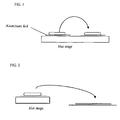
FIG. 1 is a schematic view showing an adhesion test performed in a melted state in Examples 1 through 4 and Comparative examples 1 through 6. -
FIG. 2 is a schematic view showing an adhesion test between a film and a melted resin performed in Examples 5 through 13 and Comparative examples 7 through 13. - Hereinafter, the present invention will be described in detail.
One embodiment of the present invention is directed to a composite molded article having a two-layer structure obtained by locating a molded article (a) comprising a polar thermoplastic resin (A) inside a mold, plasticizing an aliphatic ester-structured resin (B) at a temperature higher than a melting point of the thermoplastic resin (A), injecting the resin (B) to the inside of the mold, and putting the resin (B) into contact with the molded article (a), wherein the thermoplastic resin (A) is a polyacetal resin.
Another embodiment of the present invention is directed to a composite molded article having a two-layer structure obtained by locating a molded article (b) comprising an aliphatic ester-structured resin (B) inside a mold, plasticizing a polar thermoplastic resin (A) at a temperature higher than a melting point of the resin (B), injecting the thermoplastic resin (A) to the inside of the mold, and putting the thermoplastic resin (A) into contact with the molded article (b), wherein the thermoplastic resin (A) is a polyacetal resin. - The polyacetal resin used in the present invention is a polymer having an acetal structure (-O-CRH-) (where R represents a hydrogen atom or an organic group) in repetition. Usually, an acetal structure in which R is an hydrogen atom, namely, an oxymethylene group (-CH2O-) is used as a main structural unit. The polyacetal resin used in the present invention is not limited to an acetal homopolymer formed only of this repeat structure and may be a copolymer (for example, block copolymer), a terpolymer or the like further containing at least one type of repeat structural unit other than the oxymethylene group; and also may have a branched or crosslinked structure instead of a linear structure.
Examples of the structural unit other than the oxymethylene group include oxyalkylene groups which have a carbon number of 2 to 10 such as an oxyethylene group (-CH2CH2O-), an oxypropylene group (-CH2CH2CH2O-), an oxybutylene group (-CH2CH2CH2CH2O-) and the like. The oxyethylene group is especially preferable. These oxyalkylene groups may have a branched or crosslinked structure having a carbon number of 2 to 6. The content of the oxyalkylene structural unit other than the oxymethylene group is preferably 0.2 to 15 mol% with respect to polyacetal. When the content is less than this range, the thermal stability of polyacetal is reduced. By contrast, when the content is greater than this range, the melting point is lowered and so the splendid mechanical properties, chemical resistance and the like may be spoiled. - The polyacetal resin preferable for the present invention contains 0.2 to 15 mol (DOL = 0.5 to 43 phr) of an oxyalkylene repeat unit having a carbon number of 2 or greater which is represented by the following formula (1) per 100 mol of an oxymethylene repeat unit.

- For producing a polyacetal resin, any conventionally known method is usable. For example, a polyacetal resin containing an oxymethylene group and an oxyalkylene group having a carbon atom number of 2 to 4 as structural units can be produced by copolymerizing the following: a cyclic oligomer of an oxymethylene group such as, for example, a trimer or a tetramer of formaldehyde (trioxane or tetraoxane), and a cyclic oligomer containing an oxyalkylene group having a carbon atom number of 2 to 4, such as ethylene oxide, 1,3-dioxorane, 1,3,6-trioxocane, 1,3-dioxepane or the like.
The polyacetal resin used for the present invention is preferably a copolymer of a cyclic oligomer such as trioxane, tetraoxane or the like and ethylene oxide or 1,3-dioxorane. Among these, a copolymer of trioxane and 1,3-dioxorane is more preferable. Such a polyacetal resin preferably has a melting viscosity of 0.01 to 150 g/10 minutes as represented by the melting index (MI) based on ASTM-D1238 (190°C, under a load of 2.16 kg). - Known additives usable with a polyacetal resin include a heat stabilizer and an antioxidant, which are preferably usable in the present invention.
Examples of the heat stabilizer which may be added or incorporated include amine-substituted triazine compounds such as melamine, melamine resin, methylolmelamine, benzoguanamine, cyanoguanidine, N,N-diarylmelamine, CTU guanamine(3,9-bis[2-(3,5-diamino-2,4,6-triazaphenyl)ethyl]-2,4,8,10-tetraoxaspiro[5,5]undecane), CMTU guanamine(3,9-bis[1-(3,5-diamino-2,4,6-triazaphenyl)methyl]-2,4,8,10-tetraoxaspiro[5,5]undecane), and the like; polyamides; urea derivative; hydrazine derivative, urethanes; and the like. Melamine is especially preferable. Usually, the amount of such an additive is 0.01 to 5.0 parts by weight with respect to 100 parts by weight of polyacetal. However, when such an additive is used as a filament material, especially when, among the amine-substituted triazine compounds, a compound bonded with a molecule terminus of formaldehyde or an oxymethylene copolymer to form a crosslinked structure is added, care needs to be taken regarding the amount thereof The amount of such an additive needs to be of a level at which the heat stability of the oxymethylene resin composition to be obtained can withstand the processing conditions, but also needs to be preferably 0.05 parts by weight or less. When the amount is greater than this, the stretchability is lowered. - Examples of the antioxidant include, for example, sterically hindered phenol. Specific examples of generally and commercially available phenol-based antioxidant include 1,6-hexanediol-bis[3-(3,5-di-t-butyl-4-hydroxyphenyl)propionate], triethyleneglycol-bis-3-(3-t-butyl-4-hydroxy-5-methylphenyl)propionate, pentaerythrityl-tetrakis-3-(3,5-di-t-butyl-4-hydroxyphenyl)propionate, 2,2'-methylenebis(6-t-butyl-4-methylphenol), 3,9-bis{2-[3-(3-t-butyl-4-hydroxy-5-methylphenyl)propionyloxy]-1,1-dimethylethyl}-2,4,8,10-tetraoxaspiro[5,5]undecane, N,N'-hexane-1,6-diylbis[3-(3,5-di-t-butyl-4-hydroxyphenyl)propionamide], 1,6-hexanediylester 3,5-bis(1,1-dimethylethyl)-4-hydroxybenzenepropionate, and the like. Among these, triethyleneglycol-bis-3-(3-t-butyl-4-hydroxy-5-methylphenyl)propionate, pentaerythrityl-tetrakis-3-(3,5-di-t-butyl-4-hydroxyphenyl)propionate, and 1,6-hexanediol-bis[3-(3,5-di-t-butyl-4-hydroxyphenyl)propionate] are preferably usable. The amount thereof is 0.01 to 5 parts by weight, preferably 0.01 to 2.0 parts by weight, and especially preferably 0.02 to 1.0 parts by weight, with respect to 100 parts by weight of oxymethylene copolymer. When the amount of the sterically hindered phenol is insufficient, the decomposition at the time of processing causes reduction of the molecular weight of the resin and also contamination with the decomposed gas to an unignorable level. This causes the problem of reduction of processability. By contrast, when the amount of the sterically hindered phenol is excessive, there occurs too much bleed. This spoils the external appearance of the processed item.
- Known additives and/or fillers may further be added in a range in which the original object of the present invention is not spoiled. Usable additives include, for example, crystal nucleators, antioxidants other than the above, plasticizers such as polyalkyleneglycol and the like, matting agents, foaming agents, lubricants, releasing agents, antistatic agents, ultraviolet absorbers, photostabilizers, heat stabilizers, deodorants, flame retarders, sliding agents, perfumes, antibacterial agents, and the like. Usable fillers include, for example, glass fiber, talc, mica, calcium carbonate, potassium titanate, whisker, and the like. In addition, a pigment or a dye may be added to obtain a finish of a desired color tone. Also, any of various monomers, a coupling agent, a terminus processing agent, any of other resins, wood flour, starch or the like may be added to cause denaturing.
- Examples of the aliphatic ester-structured resin (B) in the present invention include aliphatic polyesters such as poly-3-hydroxybutyrate (PHB), polycaprolactone (PCL), polybutylene succinate (PBS), polybutylene succinate adipate (PBSA), polylactic acid (PLA) and the like; polyester carbonate (PEC); copolymers thereof; and the like. When necessary, any of various types of additives, for example, antioxidants, hydrolysis inhibitors, photostabilizers, heat stabilizers, weather resistant agents, pigments, and lubricants may be added to the above-listed polymers.
The polar thermoplastic resin (A) and the aliphatic ester-structured resin (B) may be used independently or as a mixture thereof in a uniformly melted state. In order to make good use of the characteristics of the materials of each of the layers included in the two-layer structured composite material, the amount of one of the materials needs to be 50% by volume or less, especially preferably 30% by volume or less. - As described above, the composite molded article according to the present invention has a feature of using a combination of a polar thermoplastic resin (A), especially a polyacetate resin, and an aliphatic ester-structured resin (B). A molded article (a) comprising the polar thermoplastic resin (A) is located inside a mold. The aliphatic ester-structured resin (B) is plasticized at a temperature higher than a melting point of the thermoplastic resin (A) and injected to the inside of the mold. The resin (B) is put into contact with the molded article (a). Thus, the composite molded article having a two-layer structure is produced.
Alternatively, a molded article (b) comprising the aliphatic ester-structured resin (B) is located inside a mold. The polar thermoplastic resin (A) is plasticized at a temperature higher than a melting point of the resin (B) and injected to the inside of the mold. The resin (B) is put into contact with the molded article (a). Thus, the composite molded article having a two-layer structure is produced.
The present invention encompasses, for example, multilayer films, multilayer sheets and composite fibers produced by coextrusion; and laminate films and laminate sheets produced by melt-extruding one material on a sheet or film of the other material. In the present invention, a composite molded article is preferably produced by insert injection molding. - According to insert molding, one material which has already been shaped is fixed inside a mold of an injection molding apparatus, and the other material which is different from the one material is injection-molded to bury the one material in the other material. Insert molding is commonly used especially as a method which makes good use of a metal material or an inorganic solid material. Outsert molding is similar to insert molding, and is also used in order to integrate two different materials.
Sandwich molding is usually performed as follows. Two apparatuses each including a heating device for plasticizing materials are prepared. The two apparatuses have a common cavity and a common gate. A material used for forming a skin layer is injected in a predetermined amount, and then a material used for forming a core layer is injected from the same gate. Owing to this, the first-injected material forms a skin, and the second-injected material forms a core. Thus, a composite molded article in which a surface of the core is covered with a different material is formed. In the case where the apparatuses have a common cavity but different gates, a face (weld) at which the two materials contact each other is present in the cavity. By contrast, according to sandwich molding, the entirety of the core layer is basically in contact with, and covered with, the skin layer. - When a composite article is formed of the polar thermoplastic resin (A) and the aliphatic ester-structured resin (B), a part of a face at which the two components at least contact each other needs to be put into a melted state. When the melted state is not sufficient, a sufficient adhesion strength is not obtained. For example, where polyacetal and a resin having an aliphatic ester structure are combined, when the melted state is sufficient, it is considered that the two components are mixed together in the vicinity of the interface by setting appropriate injection conditions (temperature of the resin to be injected, injection rate, holding pressure, holding time, temperature of the mold), and thus an eutectic is formed to express a high interface strength.
- For example, in the case of insert molding, when the temperature of the resin to be injected is too low, the surface of a molded article inserted into the mold beforehand is not sufficiently melted, and so a high interface strength cannot be obtained. In the present invention, it is preferable that the temperature of the resin to be injected is higher than the melting point of the molded article inserted into the mold beforehand. However, when the temperature is too high, the shape of the article is destroyed or the mechanical properties thereof are deteriorated. Therefore, the upper limit of the temperature should be higher by about 100°C than the melting point. When the crystallization degree of the inserted molded article is too high, the article needs a large amount of heat to be melted. Therefore, the temperature of the resin to be injected needs to be set to be still higher. The injection rate, the holding pressure and the holding time are considered to be relevant to mutual invasion through the interface. Especially, the holding pressure and the holding time are preferably set to be as high as possible in a range in which neither the molding efficiency nor the external appearance of the molded article is influenced.
- Hereinafter, the present invention will be specifically described by way of examples. The present invention is not limited to any of the following examples.
- The resin materials shown in Table 1 were each put into a melted state on a hot plate heated to 190°C in the manner shown in
FIG. 1 . While the resin materials were kept in the melted state, one of the two resin materials was stacked on the other resin material while being turned upside down. The resin materials were thermally pressed (for 10 seconds under a load of 5 kg), and then left to be cooled down. The adhesion state between the two components was observed, and the adhesion strength was graded.
It was confirmed that the combination of the polyacetal resin, which is the thermoplastic resin (A), and the aliphatic polyester-structured resin (B) exhibits a high adhesion strength when contacting each other in a melted state. -
Table 1: Adhesion test in a melted state Ex. 1 Ex. 2 Ex. 3 Ex. 4 Comparative ex. 1 Comparative ex. 2 Comparative ex. 3 Comparative ex. 4 Comparative ex. 5 Comparative ex. 6 Melted resin (A) POM POM POM POM POM POM POM POM PP PE Melted resin (B) PLA PBS PBSA PEC PET PBT PE PP PLA PLA Adhesion state O O O O X X X X Δ Δ ○: Good; Not peeled off even when the film was pulled out.
Δ: Peeled when the film was pulled out.
X: Not adhered.
* P40B (thermoplastic polyester elastomer produced by Toyobo Co., Ltd.; Pelprene)
* polyethylene terephthalate (PET) and polybutylene terephthalate (PBT) were melted at 300°C. - POM (polyacetal; melting point: 155°C): Iupital V20-HE produced by Mitsubishi Engineering-Plastics Corporation
- PLA (polylactic acid; melting point: 170°C): Terramac TE-2000 produced by Unitika Ltd. PBS (polybutylene succinate; melting point: 114°C): Bionolle #1001 produced by Showa Kobunshi Kabushiki Kaisha
- PBSA (polybutylene succinate adipate; melting point: 95°C): Bionolle #3001 produced by Showa Kobunshi Kabushiki Kaisha
- PEC (polyester carbonate: melting point: 106°C): Iupec PEC350 produced by Mitsubishi Gas Chemical Company Inc.
- P40B (thermoplastic polyester elastomer, melting point: 180°C): Pelprene produced by Toyobo Co., Ltd.
- PET (polyethylene terephthalate; melting point: 270°C): Bellpet IP123A produced by Kanebo Gosen Kabushiki Kaisha
- PBT (polybutylene terephthalate; melting point: 225°C): Novaduran 5010R5 produced by Mitsubishi Engineering-Plastics Corporation
- PE (polyethylene; melting point: 100°C): Hi-Zex 1700J produced by Prime Polymer Co., Ltd.
- PP (polypropylene: melting point: 160°C): Prime Polypro F113G produced by Prime Polymer Co., Ltd.
- Next, a simplified adhesion test was performed on the combinations of films and melted resins shown in Table 2. Each film was prepared by thermally pressing an unrolled film or a pellet using a monoaxial extruder having a diameter of φ25 mm and a T-die having a width of 200 mm (hanger type). The film and the melted resin were put into contact with each other and pressed in the manner shown in
FIG. 2 . Namely, the film and the resin put into a melted state were placed separately, and one of the two components was stacked on the other component while being turned upside down. The film and the melted resin were thermally pressed (for 10 seconds under a load of 5 kg). The adhesion state onto the film was observed, and the adhesion strength was graded.
Since the temperature of the melted resin was set to be higher than the melting point of the film, the surface of the film was partially melted when contacting the melted resin, and so a high adhesion strength was exhibited. When a polyacetal film having a high crystallization degree was used, the temperature of the melted resin needed to be set to be still higher. As shown in Example 7, the adhesiveness was improved when PLA of an amount which does not spoil the features of polyacetal was added to the film component to decrease the crystallization degree. -
Table 2: Adhesion test on the film and melted resin combinations Ex. 5 Ex. 6 Ex. 7 Comparative ex. 7 Comparative ex. 8 Comparative ex. 9 Film (A) POM POM POM/PLA 80/20wt% POM POM POM Melting point 155 155 154 155 155 155 Melted resin (B) PLA PLA PLA PET PE PP Temperature of melted resin 210 200 200 190 190 190 Adhesion state O Δ O X X X Ex. 8 Ex. 9 Ex. 10 Comparative ex. 10 Ex.11 Ex. 12 Ex. 13 Comparative ex. 11 Comparative ex. 12 Comparative 13 Film (B) PLA PLA PLA PLA PBS PBSA PEC PET PE ex. PP Melting point 170 170 170 170 114 95 106 270 100 160 Melted resin (A) POM POM/PLA 80/20wt% POM POM POM POM POM POM POM POM Temperature of melted resin 190 190 180 170 190 190 190 190 190 190 Adhesion state O O Δ X O O O X X X O: Good; Not peeled off even when the film was pulled out.
Δ: Peeled when the film was pulled out.
X: Not adhered. - Film insert molding was performed with the combinations and the injection conditions shown in Table 3. The adhesion state of the film was measured by a 90° peel test on the film.
-
Table 3: Film insert molding Ex. 14 Ex. 15 Ex. 16 Ex. 17 Ex. 18 Film (A) POM POM POM POM POM Melting point °C 155 155 155 155 155 Substrate (B) PLA PLA PLA PLA PLA Molding conditions Injection rate mm/sec 300 300 300 300 500 Temperature of resin to be injected °C 200 210 220 230 230 ΔT °C 45 55 65 75 75 Holding pressure MPa 5 5 5 5 5 Holding time sec 20 20 20 20 20 Temperature of mold °C 30 30 30 30 30 Adhesion strength N/mm 0.04 0.05 0.12 0.12 0.13 Ex. 19 Ex. 20 Ex. 21 Ex. 22 Ex. 23 Film (A) POM POM POM POM POM Melting point °C 165 165 165 165 165 Substrate (B) PLA PLA PLA PLA PLA Molding conditions Injection rate mm/sec 300 300 300 300 500 Temperature of resin to be injected °C 200 210 220 230 230 ΔT °C 35 45 55 65 65 Holding pressure MPa 5 5 5 5 5 Holding time sec 20 20 20 20 20 Temperature of mold °C 30 30 30 30 30 Adhesion strength N/mm 0.02 0.03 0.04 0.07 0.08 Ex. 24 Ex. 25 Ex. 26 Ex. 27 Ex. 28 Film (B) PLA PLA PLA PLA PLA Melting point °C 170 170 170 170 170 Substrate (A) POM POM POM POM POM Molding conditions Injection rate mm/sec 300 100 300 100 300 Temperature of resin to be injected °C 175 180 180 190 190 ΔT °C 5 10 10 20 20 Holding pressure MPa 5 5 5 5 5 Holding time sec 20 20 20 20 20 Temperature of mold °C 30 30 30 30 30 Adhesion strength N/mm Broken on the film side due to excessive adhesion strength - Weld molding was performed with the combinations shown in Table 4 to produce dumbbell-shaped samples. A tensile test was performed, and the broken parts were observed.
-
Table 4: Tensile test on the weld-molded samples Ex. 29 Comparative ex. 14 Comparative ex. 15 Comparative ex. 16 Comparative ex. 17 (A) POM POM PLA POM - (B) PLA POM PLA - PLA Tensile strength [MPa] 51 51 71 50 67 Elongation at break [%] 68 13 3 26 4 Necking Occur Not occur Not occur Not occur Not occur - Sandwich molding was performed with the combinations shown in Table 5 to produce dumbbell-shaped samples. A bending test was performed. The bending elasticity and strength relied on the occupying ratio of each component with respect to the cross-section of the test sample. No layer of component was observed as being peeled off at the interface due to the bending stress.
-
Table 5: Bending test results on the sandwich-molded samples Ex. 30 Ex. 31 Ex. 32 Reference 1 Reference 2 Reference 3 Skin POM PLA POM/PLA 80/20wt% POM PLA POM/PLA 80/20wt% Core PLA POM PLA POM PLA POM/PLA 80/20wt% Bending elasticity 2.2 2.7 2.6 [GPa] (2.3) (2.4) (2.9) 1.4 3.3 2.5 Bending strength 78 77 86 [MPa] (73) (73) (83) 54 93 73 Peel-off at interface at bending stress Not occur Not occur Not occur Not occur Not occur Not occur Numeral in ( ): Value obtained by calculation as an arithmetic average from the skin/core area size of the cross-section, using data on a single component
Claims (9)
- A composite molded article having a two-layer structure obtained by locating a molded article (a) comprising a polar thermoplastic resin (A) inside a mold, plasticizing an aliphatic ester-structured resin (B) at a temperature higher than a melting point of the thermoplastic resin (A), injecting the resin (B) to the inside of the mold, and putting the resin (B) into contact with the molded article (a), wherein the thermoplastic resin (A) is a polyacetal resin.
- A composite molded article having a two-layer structure obtained by locating a molded article (b) comprising an aliphatic ester-structured resin (B) inside a mold, plasticizing a polar thermoplastic resin (A) at a temperature higher than a melting point of the resin (B), injecting the thermoplastic resin (A) to the inside of the mold, and putting the thermoplastic resin (A) into contact with the molded article (b), wherein the thermoplastic resin (A) is a polyacetal resin.
- The composite molded article according to claim 1 or 2, wherein the molded article (a) is a film, a sheet or a fiber composite.
- The composite molded article according to any one of claims 1 through 3, wherein the polar thermoplastic resin (A) contains a part of the aliphatic ester-structured resin (B) beforehand.
- The composite molded article according to any one of claims 1 through 3, wherein the aliphatic ester-structured resin (B) contains a part of the polar thermoplastic resin (A) beforehand.
- The composite molded article according to any one of claims 1 through 5, wherein the polar thermoplastic resin (A) is polyacetal containing 0.2 to 15 mol (DOL = 0.5 to 43 phr) of an oxyalkylene repeat unit having a carbon number of 2 or greater which is represented by the following formula (1) per 100 mol of an oxymethylene repeat unit:

- The composite molded article according to any one of claims 1 through 6, wherein the aliphatic ester-structured resin (B) is at least one selected from polylactic acid (PLA), polyester carbonate (PEC), polybutylene succinate (PBS), polybutylene succinate adipate (PBSA), and copolymers thereof.
- A method for producing a composite molded article, comprising the steps of:locating a molded article (a) comprising a polar thermoplastic resin (A) inside a mold; andplasticizing an aliphatic ester-structured resin (B) at a temperature higher than a melting point of the thermoplastic resin (A), injecting the resin (B) to the inside of the mold, and putting the resin (B) into contact with the molded article (a) to form a two-layer structure;wherein the thermoplastic resin (A) is a polyacetal resin.
- A method for producing a composite molded article, comprising the steps of:locating a molded article (b) comprising an aliphatic ester-structured resin (B) inside a mold; andplasticizing a polar thermoplastic resin (A) at a temperature higher than a melting point of the resin (B), injecting the thermoplastic resin (A) to the inside of the mold, and putting the thermoplastic resin (A) into contact with the molded article (b) to form a two-layer structure;wherein the thermoplastic resin (A) is a polyacetal resin.
Applications Claiming Priority (2)
| Application Number | Priority Date | Filing Date | Title |
|---|---|---|---|
| JP2008140417 | 2008-05-29 | ||
| PCT/JP2009/059565 WO2009145165A1 (en) | 2008-05-29 | 2009-05-26 | Composite molded article having two-layer structure |
Publications (3)
| Publication Number | Publication Date |
|---|---|
| EP2289685A1 true EP2289685A1 (en) | 2011-03-02 |
| EP2289685A4 EP2289685A4 (en) | 2013-10-30 |
| EP2289685B1 EP2289685B1 (en) | 2017-08-02 |
Family
ID=41377038
Family Applications (1)
| Application Number | Title | Priority Date | Filing Date |
|---|---|---|---|
| EP09754673.3A Active EP2289685B1 (en) | 2008-05-29 | 2009-05-26 | Composite molded article having two-layer structure and method for producing the same |
Country Status (6)
| Country | Link |
|---|---|
| US (1) | US9770856B2 (en) |
| EP (1) | EP2289685B1 (en) |
| JP (1) | JP5658560B2 (en) |
| KR (1) | KR101579635B1 (en) |
| CN (2) | CN106863695A (en) |
| WO (1) | WO2009145165A1 (en) |
Families Citing this family (6)
| Publication number | Priority date | Publication date | Assignee | Title |
|---|---|---|---|---|
| CN103068892B (en) * | 2010-08-18 | 2014-09-10 | 积水化学工业株式会社 | Propylene resin micropore film, battery separator, battery and method of manufacturing propylene resin micropore film |
| WO2013047265A1 (en) * | 2011-09-27 | 2013-04-04 | 三菱瓦斯化学株式会社 | Gas separation membrane |
| JP6900331B2 (en) * | 2018-01-31 | 2021-07-07 | 住友重機械工業株式会社 | Injection molding method and mold equipment |
| EP3666492B1 (en) * | 2018-12-14 | 2024-02-07 | BSH Hausgeräte GmbH | Front panel |
| JP7486944B2 (en) * | 2019-12-17 | 2024-05-20 | グローバルポリアセタール株式会社 | Molded body and method for producing the same |
| WO2021193312A1 (en) | 2020-03-27 | 2021-09-30 | 株式会社ユポ・コーポレーション | Adhesive sheet laminate and method for manufacturing same |
Family Cites Families (52)
| Publication number | Priority date | Publication date | Assignee | Title |
|---|---|---|---|---|
| CA1038536A (en) * | 1973-10-08 | 1978-09-12 | Hoechst Aktiengesellschaft | Moulding composition based on poly(oxymethylene) |
| DE2818240A1 (en) * | 1978-04-26 | 1979-11-08 | Hoechst Ag | THERMOPLASTIC MOLDING COMPOUNDS BASED ON POLYOXYMETHYLENE |
| US4873282A (en) * | 1987-05-15 | 1989-10-10 | Mitsubishi Petrochemical Co., Ltd. | Polyacetal resin composition |
| US4957677A (en) * | 1987-12-09 | 1990-09-18 | Mitsubishi Yuka Badische Co., Ltd. | Process for producing composite laminate comprising insert part and injection-molded part |
| US5216050A (en) * | 1988-08-08 | 1993-06-01 | Biopak Technology, Ltd. | Blends of polyactic acid |
| DE3911695A1 (en) * | 1989-04-10 | 1990-10-11 | Inventa Ag | COMPOSITIONS AND THEIR USE |
| US5346966A (en) * | 1991-12-31 | 1994-09-13 | E. I. Du Pont De Nemours And Company | L,d-polylactide copolymers with controlled morphology |
| AU2247295A (en) * | 1994-04-15 | 1995-11-10 | Dana Corporation | A polymeric based composite bearing |
| US5654380A (en) * | 1994-05-23 | 1997-08-05 | Mitsubishi Gas Chemical Company, Inc. | Aliphatic polyester carbonate and process for producing the same |
| JP3108791B2 (en) * | 1994-10-28 | 2000-11-13 | 旭化成工業株式会社 | Polyacetal resin composition |
| DE4439766C1 (en) * | 1994-11-07 | 1996-04-04 | Hoechst Ag | Molded parts made of polyacetal with directly molded functional elements |
| DE19681504B4 (en) * | 1995-09-06 | 2005-12-29 | Asahi Kasei Kabushiki Kaisha | Polyacetal resin composition having high mechanical strength resistance |
| JPH10151715A (en) * | 1996-11-22 | 1998-06-09 | Dainippon Ink & Chem Inc | Heat-fusible lactic acid-based polymer laminate |
| JPH10318268A (en) * | 1997-03-18 | 1998-12-02 | Nippon Seiko Kk | Rolling bearing seal |
| EP0882751A3 (en) * | 1997-06-03 | 1999-02-10 | KABUSHIKI KAISHA KOBE SEIKO SHO also known as Kobe Steel Ltd. | Biodegradable polyester with improved moulding characteristics and its production |
| DE19742613A1 (en) * | 1997-09-26 | 1999-04-01 | Basf Ag | Process for the production of composite molded parts from thermoplastic materials |
| DE19743134A1 (en) * | 1997-09-30 | 1999-04-01 | Hoechst Ag | Molded parts made of polyacetal with directly molded functional elements made of thermoplastic elastomers |
| US5910545A (en) * | 1997-10-31 | 1999-06-08 | Kimberly-Clark Worldwide, Inc. | Biodegradable thermoplastic composition |
| US6652983B1 (en) * | 1998-02-27 | 2003-11-25 | Nissha Printing Co., Ltd. | Sheet for in-mold decorating and in-mold decorated article |
| JPH11320606A (en) * | 1998-05-12 | 1999-11-24 | Polyplastics Co | Polyacetal composite molded article and method for producing the same |
| JP4200340B2 (en) | 1998-06-29 | 2008-12-24 | 三菱瓦斯化学株式会社 | Resin composition and molded body |
| DE19845235C2 (en) * | 1998-10-02 | 2002-05-16 | Ticona Gmbh | Composite body made of polyacetal and styrene-olefin elastomers and process for its production |
| JP4125837B2 (en) * | 1999-03-03 | 2008-07-30 | ユニチカ株式会社 | Antibacterial nonwoven fabric |
| US20030152743A1 (en) * | 1999-04-26 | 2003-08-14 | Atsushi Matsunaga | Base cloth for tufted carpet and tufted carpet using the same |
| JP4053186B2 (en) * | 1999-06-24 | 2008-02-27 | ダイセル・デグサ株式会社 | Polyacetal composite and process for producing the same |
| DE60036845T2 (en) * | 1999-06-25 | 2008-05-21 | Mitsui Chemicals, Inc. | ALIPHATIC POLYESTER COMPOSITION FOR A BASIC MIXTURE AND METHOD FOR PRODUCING AN ALIPHATIC POLYESTER FOIL USING THE COMPOSITION |
| DE10061767B4 (en) * | 1999-12-17 | 2009-10-15 | Asahi Kasei Kabushiki Kaisha | polyacetal resin |
| DE10104565A1 (en) * | 2000-02-02 | 2001-10-31 | Asahi Chemical Ind | Integrated structural parts made of thermoplastic resins |
| JP3912023B2 (en) * | 2000-09-25 | 2007-05-09 | 日本製紙株式会社 | Biodegradable composition and method for producing the same |
| US6607627B2 (en) * | 2001-03-05 | 2003-08-19 | Premark Rwp Holdings, Inc. | Compound injection molded high pressure laminate flooring |
| JP2003001761A (en) | 2001-06-22 | 2003-01-08 | Polyplastics Co | Polyacetal resin / thermoplastic elastomer composite molded article and molding method thereof |
| KR100840219B1 (en) * | 2001-08-03 | 2008-06-23 | 도레이 가부시끼가이샤 | Resin composition and molded articles, films and fibers thereof |
| KR100866367B1 (en) * | 2001-09-06 | 2008-10-31 | 유니티카 가부시끼가이샤 | Biodegradable resin composition for molded product and molded product formed by molding it |
| JP5157035B2 (en) * | 2001-09-27 | 2013-03-06 | 東レ株式会社 | POLYLACTIC ACID RESIN COMPOSITION, PROCESS FOR PRODUCING THE SAME, AND MOLDED ARTICLE |
| US6803008B2 (en) * | 2001-12-11 | 2004-10-12 | Valeo Electrical Systems, Inc. | Method of applying a resin-rich skin on the surface of reinforced material gear or other wear surface |
| US20040121175A1 (en) * | 2002-12-20 | 2004-06-24 | Flexman Edmund A. | Layered articles having polyoxymethylene blend substrates with enhanced surface properties and at least one layer thereon and process for making the same |
| JP4493275B2 (en) * | 2003-01-29 | 2010-06-30 | 旭化成せんい株式会社 | Long fiber nonwoven fabric with excellent transparency |
| US20070099016A1 (en) * | 2003-02-10 | 2007-05-03 | Tamapoly Co., Ltd. | Non-oriented polylactic acid-based multilayer film and mehtod of producing same |
| DE60314783T2 (en) * | 2003-05-12 | 2008-04-10 | Unitika Ltd., Amagasaki | BIODEGRADABLE POLYESTER-CONTAINING COMPOSITION, MANUFACTURING METHOD AND FOAM AND FORM BODY USING THEM |
| KR101118326B1 (en) * | 2003-10-01 | 2012-03-09 | 미쓰비시 쥬시 가부시끼가이샤 | Biodegradable laminated sheet |
| JP2005144726A (en) | 2003-11-12 | 2005-06-09 | Toray Ind Inc | Laminated film |
| WO2005046957A1 (en) * | 2003-11-14 | 2005-05-26 | Ogura Clutch Co., Ltd. | Resin coating method, insert molding, and resin coated metal gears |
| JP2005219487A (en) | 2004-01-06 | 2005-08-18 | Toray Ind Inc | Laminated film |
| DE102004024061A1 (en) * | 2004-05-13 | 2005-12-08 | Ticona Gmbh | Process for the preparation of polyacetal plastic composites and apparatus suitable therefor |
| KR101240218B1 (en) * | 2004-07-22 | 2013-03-07 | 데이진 가부시키가이샤 | Polylactic acid and process for producing the same |
| DE102004047200B4 (en) * | 2004-09-29 | 2010-06-02 | Ticona Gmbh | Composite of polyacetal and thermoplastic vulcanizate elastomer |
| CN101142089A (en) * | 2005-03-23 | 2008-03-12 | 日本着色配料株式会社 | Two-color molded article for laser marking and laser marking method |
| US20070089555A1 (en) * | 2005-10-21 | 2007-04-26 | Koji Tomoda | Composite gear |
| CN101336167B (en) * | 2005-11-30 | 2012-07-18 | 东丽株式会社 | Polylactic acid resin multilayer sheet and molded body made of same |
| JP2007160718A (en) * | 2005-12-14 | 2007-06-28 | Ricoh Co Ltd | Plastic molded product and manufacturing method thereof |
| JP4888030B2 (en) * | 2006-10-11 | 2012-02-29 | トヨタ紡織株式会社 | Method for producing plant composite material molded body, plant composite material molded body, plant composite material production method, and plant composite material |
| US8030382B2 (en) * | 2007-02-23 | 2011-10-04 | Teijin Limited | Polylactic acid composition |
-
2009
- 2009-05-26 US US12/736,940 patent/US9770856B2/en active Active
- 2009-05-26 CN CN201610899899.4A patent/CN106863695A/en active Pending
- 2009-05-26 EP EP09754673.3A patent/EP2289685B1/en active Active
- 2009-05-26 JP JP2010514478A patent/JP5658560B2/en not_active Expired - Fee Related
- 2009-05-26 CN CN2009801197156A patent/CN102066076A/en active Pending
- 2009-05-26 WO PCT/JP2009/059565 patent/WO2009145165A1/en not_active Ceased
- 2009-05-26 KR KR1020107029210A patent/KR101579635B1/en active Active
Also Published As
| Publication number | Publication date |
|---|---|
| WO2009145165A1 (en) | 2009-12-03 |
| US9770856B2 (en) | 2017-09-26 |
| KR101579635B1 (en) | 2015-12-22 |
| CN106863695A (en) | 2017-06-20 |
| JP5658560B2 (en) | 2015-01-28 |
| US20110250456A1 (en) | 2011-10-13 |
| JPWO2009145165A1 (en) | 2011-10-13 |
| KR20110046398A (en) | 2011-05-04 |
| EP2289685A4 (en) | 2013-10-30 |
| EP2289685B1 (en) | 2017-08-02 |
| CN102066076A (en) | 2011-05-18 |
Similar Documents
| Publication | Publication Date | Title |
|---|---|---|
| TW386935B (en) | Process for producing composite articles | |
| EP2289685B1 (en) | Composite molded article having two-layer structure and method for producing the same | |
| KR101484875B1 (en) | Resin sheet for forming and formed object | |
| US20220193982A1 (en) | Filament for 3d modeling, roll, and cartridge for 3d printer | |
| US7829610B2 (en) | Impact-resistant polyoxymethylene molding compositions, use thereof and moldings produced therefrom | |
| TWI238117B (en) | Composite article made from polyacetal and from styrene-olefin elastomers | |
| KR20130079395A (en) | Sheet for cards and card | |
| EP2978809B1 (en) | Composition of reinforced polyalkylene terephthalate, preparation and use thereof | |
| EP3354688B1 (en) | Polyacetal resin composition and molded body thereof | |
| CN101910303B (en) | Polyacetal resin composition and method for producing same | |
| EP2269485B1 (en) | Polyacetal-containing brush | |
| US20070154727A1 (en) | Composite bodies, method for the production thereof and use thereof | |
| US20050173433A1 (en) | Fuel container having contiguous unbonded polyacetal/polyolefin layers | |
| WO2022138954A1 (en) | Filament for three-dimensional shaping | |
| EP2090630B1 (en) | Method for bonding resin materials containing oxymethylene polymer and structures | |
| WO2005007384A1 (en) | Method of making coextruded polyacetal articles with a shaped profile and a melt-bonded thermoplastic elastomer layer, and such an article | |
| US20080036118A1 (en) | Method for the Production of Polyacetal Plastic Composites and Device Suitable for the Same | |
| KR101504676B1 (en) | Glass fiber-reinforced polyoxymethylene-polylatic acid composition | |
| JP2017061650A (en) | Polyacetal resin composite composition | |
| JP7084822B2 (en) | Polyacetal resin composition and molded product | |
| JP7240889B2 (en) | Polyacetal resin composition and molded article thereof | |
| JP6563293B2 (en) | Polyacetal resin composition and molded article thereof | |
| JP2006063319A (en) | Polyacetal resin composition and method for producing the same | |
| EP1086978B1 (en) | Additive-containing molded resin and process for producing the same | |
| JP2020132655A (en) | Resin molded body |
Legal Events
| Date | Code | Title | Description |
|---|---|---|---|
| PUAI | Public reference made under article 153(3) epc to a published international application that has entered the european phase |
Free format text: ORIGINAL CODE: 0009012 |
|
| 17P | Request for examination filed |
Effective date: 20101202 |
|
| AK | Designated contracting states |
Kind code of ref document: A1 Designated state(s): AT BE BG CH CY CZ DE DK EE ES FI FR GB GR HR HU IE IS IT LI LT LU LV MC MK MT NL NO PL PT RO SE SI SK TR |
|
| AX | Request for extension of the european patent |
Extension state: AL BA RS |
|
| DAX | Request for extension of the european patent (deleted) | ||
| A4 | Supplementary search report drawn up and despatched |
Effective date: 20131002 |
|
| RIC1 | Information provided on ipc code assigned before grant |
Ipc: B29K 67/00 20060101ALI20130926BHEP Ipc: B29C 45/78 20060101ALI20130926BHEP Ipc: B29K 59/00 20060101ALI20130926BHEP Ipc: B29C 45/14 20060101AFI20130926BHEP |
|
| 17Q | First examination report despatched |
Effective date: 20150825 |
|
| REG | Reference to a national code |
Ref country code: DE Ref legal event code: R079 Ref document number: 602009047514 Country of ref document: DE Free format text: PREVIOUS MAIN CLASS: B29C0045140000 Ipc: B29C0045780000 |
|
| GRAP | Despatch of communication of intention to grant a patent |
Free format text: ORIGINAL CODE: EPIDOSNIGR1 |
|
| RIC1 | Information provided on ipc code assigned before grant |
Ipc: B32B 15/08 20060101ALI20170119BHEP Ipc: B29C 45/16 20060101ALI20170119BHEP Ipc: B29K 59/00 20060101ALI20170119BHEP Ipc: B29C 45/78 20060101AFI20170119BHEP Ipc: B29C 45/14 20060101ALI20170119BHEP |
|
| INTG | Intention to grant announced |
Effective date: 20170215 |
|
| GRAS | Grant fee paid |
Free format text: ORIGINAL CODE: EPIDOSNIGR3 |
|
| GRAA | (expected) grant |
Free format text: ORIGINAL CODE: 0009210 |
|
| AK | Designated contracting states |
Kind code of ref document: B1 Designated state(s): AT BE BG CH CY CZ DE DK EE ES FI FR GB GR HR HU IE IS IT LI LT LU LV MC MK MT NL NO PL PT RO SE SI SK TR |
|
| REG | Reference to a national code |
Ref country code: GB Ref legal event code: FG4D |
|
| REG | Reference to a national code |
Ref country code: CH Ref legal event code: EP Ref country code: AT Ref legal event code: REF Ref document number: 913965 Country of ref document: AT Kind code of ref document: T Effective date: 20170815 |
|
| REG | Reference to a national code |
Ref country code: IE Ref legal event code: FG4D |
|
| REG | Reference to a national code |
Ref country code: DE Ref legal event code: R096 Ref document number: 602009047514 Country of ref document: DE |
|
| REG | Reference to a national code |
Ref country code: NL Ref legal event code: FP |
|
| REG | Reference to a national code |
Ref country code: AT Ref legal event code: MK05 Ref document number: 913965 Country of ref document: AT Kind code of ref document: T Effective date: 20170802 |
|
| REG | Reference to a national code |
Ref country code: LT Ref legal event code: MG4D |
|
| PG25 | Lapsed in a contracting state [announced via postgrant information from national office to epo] |
Ref country code: LT Free format text: LAPSE BECAUSE OF FAILURE TO SUBMIT A TRANSLATION OF THE DESCRIPTION OR TO PAY THE FEE WITHIN THE PRESCRIBED TIME-LIMIT Effective date: 20170802 Ref country code: NO Free format text: LAPSE BECAUSE OF FAILURE TO SUBMIT A TRANSLATION OF THE DESCRIPTION OR TO PAY THE FEE WITHIN THE PRESCRIBED TIME-LIMIT Effective date: 20171102 Ref country code: FI Free format text: LAPSE BECAUSE OF FAILURE TO SUBMIT A TRANSLATION OF THE DESCRIPTION OR TO PAY THE FEE WITHIN THE PRESCRIBED TIME-LIMIT Effective date: 20170802 Ref country code: HR Free format text: LAPSE BECAUSE OF FAILURE TO SUBMIT A TRANSLATION OF THE DESCRIPTION OR TO PAY THE FEE WITHIN THE PRESCRIBED TIME-LIMIT Effective date: 20170802 Ref country code: AT Free format text: LAPSE BECAUSE OF FAILURE TO SUBMIT A TRANSLATION OF THE DESCRIPTION OR TO PAY THE FEE WITHIN THE PRESCRIBED TIME-LIMIT Effective date: 20170802 Ref country code: SE Free format text: LAPSE BECAUSE OF FAILURE TO SUBMIT A TRANSLATION OF THE DESCRIPTION OR TO PAY THE FEE WITHIN THE PRESCRIBED TIME-LIMIT Effective date: 20170802 |
|
| PG25 | Lapsed in a contracting state [announced via postgrant information from national office to epo] |
Ref country code: IS Free format text: LAPSE BECAUSE OF FAILURE TO SUBMIT A TRANSLATION OF THE DESCRIPTION OR TO PAY THE FEE WITHIN THE PRESCRIBED TIME-LIMIT Effective date: 20171202 Ref country code: LV Free format text: LAPSE BECAUSE OF FAILURE TO SUBMIT A TRANSLATION OF THE DESCRIPTION OR TO PAY THE FEE WITHIN THE PRESCRIBED TIME-LIMIT Effective date: 20170802 Ref country code: GR Free format text: LAPSE BECAUSE OF FAILURE TO SUBMIT A TRANSLATION OF THE DESCRIPTION OR TO PAY THE FEE WITHIN THE PRESCRIBED TIME-LIMIT Effective date: 20171103 Ref country code: ES Free format text: LAPSE BECAUSE OF FAILURE TO SUBMIT A TRANSLATION OF THE DESCRIPTION OR TO PAY THE FEE WITHIN THE PRESCRIBED TIME-LIMIT Effective date: 20170802 Ref country code: BG Free format text: LAPSE BECAUSE OF FAILURE TO SUBMIT A TRANSLATION OF THE DESCRIPTION OR TO PAY THE FEE WITHIN THE PRESCRIBED TIME-LIMIT Effective date: 20171102 Ref country code: PL Free format text: LAPSE BECAUSE OF FAILURE TO SUBMIT A TRANSLATION OF THE DESCRIPTION OR TO PAY THE FEE WITHIN THE PRESCRIBED TIME-LIMIT Effective date: 20170802 |
|
| PG25 | Lapsed in a contracting state [announced via postgrant information from national office to epo] |
Ref country code: RO Free format text: LAPSE BECAUSE OF FAILURE TO SUBMIT A TRANSLATION OF THE DESCRIPTION OR TO PAY THE FEE WITHIN THE PRESCRIBED TIME-LIMIT Effective date: 20170802 Ref country code: DK Free format text: LAPSE BECAUSE OF FAILURE TO SUBMIT A TRANSLATION OF THE DESCRIPTION OR TO PAY THE FEE WITHIN THE PRESCRIBED TIME-LIMIT Effective date: 20170802 Ref country code: CZ Free format text: LAPSE BECAUSE OF FAILURE TO SUBMIT A TRANSLATION OF THE DESCRIPTION OR TO PAY THE FEE WITHIN THE PRESCRIBED TIME-LIMIT Effective date: 20170802 |
|
| REG | Reference to a national code |
Ref country code: DE Ref legal event code: R097 Ref document number: 602009047514 Country of ref document: DE |
|
| PG25 | Lapsed in a contracting state [announced via postgrant information from national office to epo] |
Ref country code: SK Free format text: LAPSE BECAUSE OF FAILURE TO SUBMIT A TRANSLATION OF THE DESCRIPTION OR TO PAY THE FEE WITHIN THE PRESCRIBED TIME-LIMIT Effective date: 20170802 Ref country code: EE Free format text: LAPSE BECAUSE OF FAILURE TO SUBMIT A TRANSLATION OF THE DESCRIPTION OR TO PAY THE FEE WITHIN THE PRESCRIBED TIME-LIMIT Effective date: 20170802 |
|
| PLBE | No opposition filed within time limit |
Free format text: ORIGINAL CODE: 0009261 |
|
| STAA | Information on the status of an ep patent application or granted ep patent |
Free format text: STATUS: NO OPPOSITION FILED WITHIN TIME LIMIT |
|
| 26N | No opposition filed |
Effective date: 20180503 |
|
| PG25 | Lapsed in a contracting state [announced via postgrant information from national office to epo] |
Ref country code: SI Free format text: LAPSE BECAUSE OF FAILURE TO SUBMIT A TRANSLATION OF THE DESCRIPTION OR TO PAY THE FEE WITHIN THE PRESCRIBED TIME-LIMIT Effective date: 20170802 |
|
| REG | Reference to a national code |
Ref country code: CH Ref legal event code: PL |
|
| REG | Reference to a national code |
Ref country code: BE Ref legal event code: MM Effective date: 20180531 |
|
| PG25 | Lapsed in a contracting state [announced via postgrant information from national office to epo] |
Ref country code: MC Free format text: LAPSE BECAUSE OF FAILURE TO SUBMIT A TRANSLATION OF THE DESCRIPTION OR TO PAY THE FEE WITHIN THE PRESCRIBED TIME-LIMIT Effective date: 20170802 |
|
| REG | Reference to a national code |
Ref country code: IE Ref legal event code: MM4A |
|
| PG25 | Lapsed in a contracting state [announced via postgrant information from national office to epo] |
Ref country code: LI Free format text: LAPSE BECAUSE OF NON-PAYMENT OF DUE FEES Effective date: 20180531 Ref country code: CH Free format text: LAPSE BECAUSE OF NON-PAYMENT OF DUE FEES Effective date: 20180531 |
|
| PG25 | Lapsed in a contracting state [announced via postgrant information from national office to epo] |
Ref country code: LU Free format text: LAPSE BECAUSE OF NON-PAYMENT OF DUE FEES Effective date: 20180526 |
|
| PG25 | Lapsed in a contracting state [announced via postgrant information from national office to epo] |
Ref country code: IE Free format text: LAPSE BECAUSE OF NON-PAYMENT OF DUE FEES Effective date: 20180526 Ref country code: FR Free format text: LAPSE BECAUSE OF NON-PAYMENT OF DUE FEES Effective date: 20180531 |
|
| PG25 | Lapsed in a contracting state [announced via postgrant information from national office to epo] |
Ref country code: BE Free format text: LAPSE BECAUSE OF NON-PAYMENT OF DUE FEES Effective date: 20180531 |
|
| PG25 | Lapsed in a contracting state [announced via postgrant information from national office to epo] |
Ref country code: MT Free format text: LAPSE BECAUSE OF NON-PAYMENT OF DUE FEES Effective date: 20180526 |
|
| PG25 | Lapsed in a contracting state [announced via postgrant information from national office to epo] |
Ref country code: TR Free format text: LAPSE BECAUSE OF FAILURE TO SUBMIT A TRANSLATION OF THE DESCRIPTION OR TO PAY THE FEE WITHIN THE PRESCRIBED TIME-LIMIT Effective date: 20170802 |
|
| PG25 | Lapsed in a contracting state [announced via postgrant information from national office to epo] |
Ref country code: HU Free format text: LAPSE BECAUSE OF FAILURE TO SUBMIT A TRANSLATION OF THE DESCRIPTION OR TO PAY THE FEE WITHIN THE PRESCRIBED TIME-LIMIT; INVALID AB INITIO Effective date: 20090526 Ref country code: PT Free format text: LAPSE BECAUSE OF FAILURE TO SUBMIT A TRANSLATION OF THE DESCRIPTION OR TO PAY THE FEE WITHIN THE PRESCRIBED TIME-LIMIT Effective date: 20170802 |
|
| PG25 | Lapsed in a contracting state [announced via postgrant information from national office to epo] |
Ref country code: CY Free format text: LAPSE BECAUSE OF FAILURE TO SUBMIT A TRANSLATION OF THE DESCRIPTION OR TO PAY THE FEE WITHIN THE PRESCRIBED TIME-LIMIT Effective date: 20170802 Ref country code: MK Free format text: LAPSE BECAUSE OF NON-PAYMENT OF DUE FEES Effective date: 20170802 |
|
| P01 | Opt-out of the competence of the unified patent court (upc) registered |
Effective date: 20230515 |
|
| PGFP | Annual fee paid to national office [announced via postgrant information from national office to epo] |
Ref country code: GB Payment date: 20260323 Year of fee payment: 18 |
|
| PGFP | Annual fee paid to national office [announced via postgrant information from national office to epo] |
Ref country code: NL Payment date: 20260408 Year of fee payment: 18 |
|
| PGFP | Annual fee paid to national office [announced via postgrant information from national office to epo] |
Ref country code: IT Payment date: 20260422 Year of fee payment: 18 |
|
| PGFP | Annual fee paid to national office [announced via postgrant information from national office to epo] |
Ref country code: DE Payment date: 20260402 Year of fee payment: 18 |