EP2287052A2 - Method of assembling metal clamp and body springs of wiper blade for vehicle - Google Patents
Method of assembling metal clamp and body springs of wiper blade for vehicle Download PDFInfo
- Publication number
- EP2287052A2 EP2287052A2 EP09175404A EP09175404A EP2287052A2 EP 2287052 A2 EP2287052 A2 EP 2287052A2 EP 09175404 A EP09175404 A EP 09175404A EP 09175404 A EP09175404 A EP 09175404A EP 2287052 A2 EP2287052 A2 EP 2287052A2
- Authority
- EP
- European Patent Office
- Prior art keywords
- clamp
- body springs
- wiper blade
- holes
- protrusions
- Prior art date
- Legal status (The legal status is an assumption and is not a legal conclusion. Google has not performed a legal analysis and makes no representation as to the accuracy of the status listed.)
- Granted
Links
Images



Classifications
-
- B—PERFORMING OPERATIONS; TRANSPORTING
- B60—VEHICLES IN GENERAL
- B60S—SERVICING, CLEANING, REPAIRING, SUPPORTING, LIFTING, OR MANOEUVRING OF VEHICLES, NOT OTHERWISE PROVIDED FOR
- B60S1/00—Cleaning of vehicles
- B60S1/02—Cleaning windscreens, windows or optical devices
- B60S1/04—Wipers or the like, e.g. scrapers
- B60S1/32—Wipers or the like, e.g. scrapers characterised by constructional features of wiper blade arms or blades
- B60S1/38—Wiper blades
- B60S1/3848—Flat-type wiper blade, i.e. without harness
- B60S1/3849—Connectors therefor; Connection to wiper arm; Attached to blade
- B60S1/3851—Mounting of connector to blade assembly
- B60S1/3858—Mounting of connector to blade assembly with protrusions cooperating with holes
-
- B—PERFORMING OPERATIONS; TRANSPORTING
- B60—VEHICLES IN GENERAL
- B60S—SERVICING, CLEANING, REPAIRING, SUPPORTING, LIFTING, OR MANOEUVRING OF VEHICLES, NOT OTHERWISE PROVIDED FOR
- B60S1/00—Cleaning of vehicles
- B60S1/02—Cleaning windscreens, windows or optical devices
- B60S1/04—Wipers or the like, e.g. scrapers
- B60S1/32—Wipers or the like, e.g. scrapers characterised by constructional features of wiper blade arms or blades
- B60S1/40—Connections between blades and arms
-
- B—PERFORMING OPERATIONS; TRANSPORTING
- B60—VEHICLES IN GENERAL
- B60S—SERVICING, CLEANING, REPAIRING, SUPPORTING, LIFTING, OR MANOEUVRING OF VEHICLES, NOT OTHERWISE PROVIDED FOR
- B60S1/00—Cleaning of vehicles
- B60S1/02—Cleaning windscreens, windows or optical devices
- B60S1/04—Wipers or the like, e.g. scrapers
- B60S1/32—Wipers or the like, e.g. scrapers characterised by constructional features of wiper blade arms or blades
-
- B—PERFORMING OPERATIONS; TRANSPORTING
- B60—VEHICLES IN GENERAL
- B60S—SERVICING, CLEANING, REPAIRING, SUPPORTING, LIFTING, OR MANOEUVRING OF VEHICLES, NOT OTHERWISE PROVIDED FOR
- B60S1/00—Cleaning of vehicles
- B60S1/02—Cleaning windscreens, windows or optical devices
- B60S1/04—Wipers or the like, e.g. scrapers
- B60S1/32—Wipers or the like, e.g. scrapers characterised by constructional features of wiper blade arms or blades
- B60S1/38—Wiper blades
- B60S1/3848—Flat-type wiper blade, i.e. without harness
- B60S1/3849—Connectors therefor; Connection to wiper arm; Attached to blade
- B60S1/3851—Mounting of connector to blade assembly
- B60S1/3855—Mounting of connector to blade assembly by welding, gluing or the like
-
- B—PERFORMING OPERATIONS; TRANSPORTING
- B60—VEHICLES IN GENERAL
- B60S—SERVICING, CLEANING, REPAIRING, SUPPORTING, LIFTING, OR MANOEUVRING OF VEHICLES, NOT OTHERWISE PROVIDED FOR
- B60S1/00—Cleaning of vehicles
- B60S1/02—Cleaning windscreens, windows or optical devices
- B60S1/04—Wipers or the like, e.g. scrapers
- B60S1/32—Wipers or the like, e.g. scrapers characterised by constructional features of wiper blade arms or blades
- B60S1/38—Wiper blades
- B60S1/3848—Flat-type wiper blade, i.e. without harness
- B60S1/3874—Flat-type wiper blade, i.e. without harness with a reinforcing vertebra
- B60S1/3875—Flat-type wiper blade, i.e. without harness with a reinforcing vertebra rectangular section
- B60S1/3879—Flat-type wiper blade, i.e. without harness with a reinforcing vertebra rectangular section placed in side grooves in the squeegee
-
- Y—GENERAL TAGGING OF NEW TECHNOLOGICAL DEVELOPMENTS; GENERAL TAGGING OF CROSS-SECTIONAL TECHNOLOGIES SPANNING OVER SEVERAL SECTIONS OF THE IPC; TECHNICAL SUBJECTS COVERED BY FORMER USPC CROSS-REFERENCE ART COLLECTIONS [XRACs] AND DIGESTS
- Y10—TECHNICAL SUBJECTS COVERED BY FORMER USPC
- Y10T—TECHNICAL SUBJECTS COVERED BY FORMER US CLASSIFICATION
- Y10T29/00—Metal working
- Y10T29/49—Method of mechanical manufacture
- Y10T29/49826—Assembling or joining
Definitions
- the present invention relates to a method of assembling a metal clamp and body springs of a wiper blade for vehicles.
- a wiper mounted to a wind shield glass of a vehicle serves to prevent forward visibility of a driver from being disturbed due to rain or snow present on the wind shield glass during driving of the vehicle in rain or in snow and, in addition, to wipe the wind shield glass clean.
- a wiper system is mounted at a predetermined part of a chassis of the vehicle below the wind shield glass of the vehicle, and a wiper blade performs reciprocation, i.e., alternating motions, on the wind shield glass from side to side in a fan shape when the wiper blade is driven by a motor.
- Such a wiper blade for wiping foreign matter off a wind shield glass of a vehicle is disclosed in Korean Patent Application No. 2005-12755 , which has been filed in the name of the applicant of the present application.
- the conventional wiper blade includes body springs integrally formed and having a long groove formed at middle regions of the body springs, such that a fixing coupling member is fitted in the long groove, in the longitudinal direction thereof for supporting the wiper blade, the fixing coupling member fitted in the long groove of the body springs such that a rubber is fixedly coupled to the body springs, the fixing coupling member having clip fitting grooves formed at the upper part thereof and protrusions formed at the lower part thereof such that the protrusions are fitted in fitting grooves formed at the rubber, clips fitted in the clip fitting grooves formed at the upper part of the fixing coupling member for fixing the upper sides of the body springs in a tight contact manner, the rubber having the fitting grooves, in which the protrusions of the fixing coupling member are fitted, formed at the upper part thereof, the lower part of the rubber being in tight contact with a wind shield glass of a vehicle for wiping the wind shield glass clean, and a spoiler having depressions formed at opposite sides thereof in the longitudinal direction of the body springs.
- the rubber is fixedly coupled to the body springs by the fixing coupling member, and the fixing coupling member is in tight contact with the upper sides of the body springs by the clips.
- the number of parts to be assembled is large, and therefore, the structure of the wiper blade is very complicated while manufacturing costs of the wiper blade are greatly increased.
- a process of assembling the wiper blade is also complicated in proportion to the number of parts to be assembled, with the result that assembly productivity is also deteriorated.
- a wiper blade including a clamp, made of a plastic material, to which an adapter mounted to an arm connected to a chassis of a vehicle is detachably mounted and body springs for elastically supporting a rubber configured to wipe a wind shield glass clean, the assembly between the clamp and the body springs being achieved by mounting pins.
- a wiper blade serves to not only wipe rain off a wind shield glass but also remove snow from the wind shield glass.
- the clamp has toughness and ductility lower than those of a clamp which is made of a metal material although the plastic clamp may be easily manufactured by injection molding.
- the conventional wiper blade does not satisfy a snow block test during development of products, and, in addition, the shape of the clamp may be deformed.
- the clamp when the clamp is coupled to the body springs using the mounting pins positioned between the clamp and the body springs, assembly tolerance occurs between the clamp and the body springs. As a result, the coupling between the clamp and the body springs may loosen during use of the wiper blade for a long period of time, and therefore, the wiper blade may malfunction and thus stable use of the wiper blade may not be achieved.
- a pair of support members 133 are configured to support body springs 120 at opposite ends of the body springs 120 in the longitudinal direction of the body springs 120.
- the overall size of the clamp 130 is large, and therefore, material costs are increased.
- each of the body springs 120 it is necessary for each of the body springs 120 to have a predetermined radius of curvature as indicated by a dashed dotted line in FIG. 12 .
- the distance between the support members 133 of the conventional clamp 130, which support the body springs 120 is large.
- the present invention has been made in view of the above problems, and it is an object of the present invention to provide a method of assembling a metal clamp and body springs of a wiper blade for vehicles that is capable of achieving secure coupling between the clamp and the body springs and reducing deformation in shape of the clamp, thereby achieving stable use of a wiper blade in snow as well as in rain and, in addition, improving rigidity of the wiper blade.
- the above and other objects can be accomplished by the provision of a method of assembling a metal clamp and body springs of a wiper blade for vehicles, the wiper blade including a rubber disposed in tight contact with a wind shield glass of a vehicle to which the wiper blade is mounted for wiping foreign matter off the wind shield glass, the body springs elastically supporting the rubber, the body springs being made of a metal material, an adapter mounted to an arm connected to a chassis of the vehicle, and the clamp to which the adapter is detachably mounted, the clamp being made of a metal material, the method including forming a plurality of through holes at major sides of the body springs, forming a plurality of protrusions corresponding to the through holes at a major side of the clamp such that the protrusions extend outward from the major side of the clamp, inserting the protrusions of the clamp into the respective through holes of the body springs, fixing the protrusions, which are located in the respective through holes, in the respective through holes by
- the protrusions of the clamp may be formed in a protruding manner by pressing.
- the method may further include bending the body springs such that each of the body springs has a predetermined radius of curvature after the step of forming the through holes at the body springs.
- FIG. 1 is a perspective view illustrating a wiper blade according to an embodiment of the present invention
- FIG. 2 is an exploded perspective view of the wiper blade according to the embodiment of the present invention shown in FIG. 1 ;
- FIG. 3 is a sectional view taken along line III-III of FIG. 2 ;
- FIG. 4 is an enlarged perspective view, in part, illustrating through holes formed in body springs of the wiper blade according to the embodiment of the present invention shown in FIG. 1 ;
- FIG. 5 is a sectional view illustrating a process for forming protrusions at a clamp of the wiper blade according to the embodiment of the present invention shown in FIG. 1 ;
- FIG. 6 is a perspective view of the clamp manufactured by the process shown in FIG. 5 ;
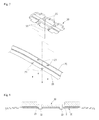
- FIG. 7 is an exploded perspective view illustrating the clamp and the body springs before assembly
- FIG. 8 is a sectional view illustrating a state in which the protrusions of the clamp shown in FIG. 7 are fitted in the respective through holes of the body springs shown in FIG. 7 ;
- FIG. 9 is a sectional view illustrating a process for fixing the protrusions of the clamp in the through holes of the body springs of the wiper blade according to the embodiment of the present invention shown in FIG. 1 by pressure welding;
- FIG. 10 is a perspective view of the clamp and the body springs manufactured by the process shown in FIG. 9 ;
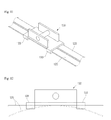
- FIG. 11 is a perspective view illustrating a state in which a conventional clamp is coupled to conventional body springs.
- FIG. 12 is a side view of the clamp and the body springs shown in FIG. 11 .
- FIGS. 1 to 3 illustrate a wiper blade 1 for vehicles according to an embodiment of the present invention.
- the wiper blade 1 for vehicles includes a rubber 10, body springs 20, and a clamp 30.
- the rubber 10 has a predetermined length.
- the rubber 10 is elastically supported by the body springs 20, such that the rubber 10 is in tight contact with a wind shield glass of a vehicle to which the wiper blade for vehicles according to the embodiment of the present invention is applied, for wiping foreign matter off the wind shield glass.
- the rubber 10 is provided at opposite sides of the top thereof with coupling grooves 11, which extend in the longitudinal direction of the rubber 10. The bottom of the rubber 10 is in tight contact with the wind shield glass of the vehicle for securing high forward visibility.
- the body springs 20 are provided in a pair.
- Each of the body springs 20 is configured in the form of a belt having a predetermined length.
- Each of the body springs 20 is made of a metal material.
- the body springs 20 serve to support the wiper blade 1.
- the clamp 30 is coupled to the body springs 20.
- the rubber 10 is coupled to the body springs 20 such that flexibility and elasticity of the rubber 10 are maintained by the body springs 20. Consequently, the body springs 20 serve to enable the rubber 10 to be in tight contact with various types of wind shield glasses.
- Each of the body springs 20 may be bent so as to have a predetermined radius of curvature corresponding to the wind shield glass of the vehicle.
- the clamp 30 is detachably coupled an adapter 5 to which an arm connected to a chassis of the vehicle is mounted.
- the clamp 30 is coupled to the body springs 20.
- the clamp 30 is made of a metal material exhibiting higher toughness and ductility than a conventional plastic material such that the clamp 30 satisfies a snow block test and exhibits reduced deformation in shape.
- a rubber passageway 31 is formed in a depressed manner at a major side of the clamp 30 facing the body springs 20 such that the upper part of the rubber 10 passes through the rubber passageway 31.
- each of the protrusions 33 is configured in the form of a cylinder opened at one end thereof by pressing.
- the protrusions 33 are integrally formed at the major side of the clamp 30 such that the protrusions 33 extend outward from the major side of the clamp 30.
- each of the protrusions 33 has a height greater than the thickness of each of the body springs 20 and, at the same time, a diameter equal to or less than that of each of the through holes 21 of the body springs 20.
- the protrusions 33 integrally formed at the major side of the clamp 30 such that the protrusions 33 extend outward from the major side of the clamp 30 are fixed in the respective through holes 21 of the body springs 20 by pressure welding or riveting using a press or the like.
- the clamp 30 is securely coupled to the body springs 20 without the occurrence of assembly tolerance, and therefore, the coupling between the clamp 30 and the body springs 20 is prevented from loosening even when the wiper blade 1 is used for a long period of time, thereby achieving optimum wiping performance of the wiper blade 1.
- Unexplained reference numeral 40 indicates a pair of spoilers.
- the spoilers 40 surround opposite-side parts of the body springs 20 in a state in which the clamp 30 is disposed between the spoilers 40.
- the spoilers 40 serve to prevent the wiper blade 1 from rising during high-speed travelling, thereby improving wiping efficiency of the wiper blade 1.
- Unexplained reference numeral 50 indicates a pair of end caps.
- the end caps 50 are mounted to opposite ends of the body springs 20 for providing an aesthetically pleasing appearance to the wiper blade 1 at the opposite ends thereof and, in addition, preventing the opposite ends of the body springs 20 from being damaged due to external impact or environmental wear.
- a plurality of through holes 21 are formed at major sides of body springs 20 using a press (not shown).
- a clamp 30 is located on a bed 61a of the press in which a plurality of grooves 63 are formed, and a ram 65a of the press having a plurality of jigs 67a each having an outer diameter less than that of each of the grooves 63 of the bed 61a is lowered toward the bed 61a to form a plurality of protrusions 33 corresponding to the respective through holes 21 of the body springs 20 at a major side of the clamp 30 such that the protrusions 33 extend outward from the major side of the clamp 30, as shown in FIG. 6 .
- each of the protrusions 33 has a height greater than the thickness of each of the body springs 20 and, at the same time, a diameter equal to or less than that of each of the through holes 21 of the body springs 20, by pressing. Also, the protrusions 33 are formed at the major side of the clamp 30 such that the protrusions 33 extend outward from the major side of the clamp 30. Each of the protrusions 33 is configured in the form of a cylinder opened at one end thereof.
- FIG. 7 is an exploded perspective view illustrating the clamp 30 and the body springs 20 before assembly, i.e., before the protrusions 33 of the clamp 30 are inserted into the respective through holes 21 of the body springs 20.
- the body springs 20, to which the clamp 30 is temporarily assembled are disposed between the bed 61b of the press having the jigs 67b, each of which is configured in a shape corresponding to the inner diameter of each of the protrusions 33 and the ram 65b of the press, and the ram 65b of the press is lowered toward the bed 61b of the press such that the protrusions 33 of the clamp 30, which are located in the through holes 21 of the body springs 20, are fixed in the through holes 21 of the body springs 20 by pressure welding.
- the clamp 30 is mounted to the body springs 20.
- the assembly of the metal clamp 30 and the body springs 20 of the wiper blade 1 for vehicles is completed as shown in FIG. 10 .
- the clamp 30 is securely coupled to the body springs 20 without the occurrence of assembly tolerance, and therefore, the coupling between the clamp 30 and the body springs 20 is prevented from loosening even when the wiper blade 1 is used for a long period of time, thereby achieving stable use of the wiper blade 1.
- the clamp 30 is made of a metal material exhibiting higher toughness and ductility than a conventional plastic material. Consequently, the coupling between the clamp 30 and the body springs 20 is achieved without trouble even during pressure welding using the press, thereby exhibiting excellent coupling efficiency, satisfying a snow block test, and exhibiting reduced deformation in shape.
- the body springs 20 may be bent such that each of the body springs 20 has a predetermined radius of curvature corresponding to a wind shield glass of a vehicle to which the present invention is applied.
- end caps 50 are mounted to opposite ends of the body springs 20. In this way, the assembly of the wiper blade 1 is completed.
- a plurality of protrusions are formed at a major side of a clamp, which is made of a metal material, in a protruding manner such that the protrusions correspond to through holes formed in body springs, the protrusions of the clamp are fixed in the corresponding through holes of the body springs by pressure welding or riveting such that the clamp is mounted to the body springs, thereby achieving secure coupling between the clamp and the body springs, reducing deformation in shape of the clamp, and achieving stable use of a wiper blade in snow as well as in rain. Consequently, the present invention with the above-stated construction has industrial applicability.
Landscapes
- Engineering & Computer Science (AREA)
- Mechanical Engineering (AREA)
- Insertion Pins And Rivets (AREA)
- Clamps And Clips (AREA)
- Springs (AREA)
Abstract
Description
- The present invention relates to a method of assembling a metal clamp and body springs of a wiper blade for vehicles.
- [Background Art]
- Generally, a wiper mounted to a wind shield glass of a vehicle serves to prevent forward visibility of a driver from being disturbed due to rain or snow present on the wind shield glass during driving of the vehicle in rain or in snow and, in addition, to wipe the wind shield glass clean. Specifically, a wiper system is mounted at a predetermined part of a chassis of the vehicle below the wind shield glass of the vehicle, and a wiper blade performs reciprocation, i.e., alternating motions, on the wind shield glass from side to side in a fan shape when the wiper blade is driven by a motor.
- Such a wiper blade for wiping foreign matter off a wind shield glass of a vehicle is disclosed in Korean Patent Application No.
2005-12755 - The conventional wiper blade includes body springs integrally formed and having a long groove formed at middle regions of the body springs, such that a fixing coupling member is fitted in the long groove, in the longitudinal direction thereof for supporting the wiper blade, the fixing coupling member fitted in the long groove of the body springs such that a rubber is fixedly coupled to the body springs, the fixing coupling member having clip fitting grooves formed at the upper part thereof and protrusions formed at the lower part thereof such that the protrusions are fitted in fitting grooves formed at the rubber, clips fitted in the clip fitting grooves formed at the upper part of the fixing coupling member for fixing the upper sides of the body springs in a tight contact manner, the rubber having the fitting grooves, in which the protrusions of the fixing coupling member are fitted, formed at the upper part thereof, the lower part of the rubber being in tight contact with a wind shield glass of a vehicle for wiping the wind shield glass clean, and a spoiler having depressions formed at opposite sides thereof in the longitudinal direction of the body springs.
- In the conventional wiper blade, however, the rubber is fixedly coupled to the body springs by the fixing coupling member, and the fixing coupling member is in tight contact with the upper sides of the body springs by the clips. As a result, the number of parts to be assembled is large, and therefore, the structure of the wiper blade is very complicated while manufacturing costs of the wiper blade are greatly increased. In addition, a process of assembling the wiper blade is also complicated in proportion to the number of parts to be assembled, with the result that assembly productivity is also deteriorated.
- In order to solve the above problem, on the other hand, there has been proposed a wiper blade including a clamp, made of a plastic material, to which an adapter mounted to an arm connected to a chassis of a vehicle is detachably mounted and body springs for elastically supporting a rubber configured to wipe a wind shield glass clean, the assembly between the clamp and the body springs being achieved by mounting pins.
- Meanwhile, a wiper blade serves to not only wipe rain off a wind shield glass but also remove snow from the wind shield glass. In the conventional wiper blade including the clamp made of the plastic material, the clamp has toughness and ductility lower than those of a clamp which is made of a metal material although the plastic clamp may be easily manufactured by injection molding. As a result, the conventional wiper blade does not satisfy a snow block test during development of products, and, in addition, the shape of the clamp may be deformed.
- Also, when the clamp is coupled to the body springs using the mounting pins positioned between the clamp and the body springs, assembly tolerance occurs between the clamp and the body springs. As a result, the coupling between the clamp and the body springs may loosen during use of the wiper blade for a long period of time, and therefore, the wiper blade may malfunction and thus stable use of the wiper blade may not be achieved.
- For a
conventional clamp 130 made of a metal material as shown inFIG. 11 , on the other hand, a pair ofsupport members 133 are configured to supportbody springs 120 at opposite ends of thebody springs 120 in the longitudinal direction of thebody springs 120. As a result, the overall size of theclamp 130 is large, and therefore, material costs are increased. Also, in order for a wiper blade to be in tight contact with a wind shield glass of a vehicle, it is necessary for each of thebody springs 120 to have a predetermined radius of curvature as indicated by a dashed dotted line inFIG. 12 . However, the distance between thesupport members 133 of theconventional clamp 130, which support thebody springs 120, is large. When theclamp 130 is coupled to thebody springs 120, therefore, the radius of curvature of each of thebody springs 120 is changed, as indicated by a solid line inFIG. 12 , with the result that opposite ends of the wiper blade are not in tight contact with the wind shield glass of the vehicle, whereby the wiping performance of the wiper blade is deteriorated. - [Disclosure]
- [Technical Problem]
- Therefore, the present invention has been made in view of the above problems, and it is an object of the present invention to provide a method of assembling a metal clamp and body springs of a wiper blade for vehicles that is capable of achieving secure coupling between the clamp and the body springs and reducing deformation in shape of the clamp, thereby achieving stable use of a wiper blade in snow as well as in rain and, in addition, improving rigidity of the wiper blade.
- [Technical Solution]
- In accordance with the present invention, the above and other objects can be accomplished by the provision of a method of assembling a metal clamp and body springs of a wiper blade for vehicles, the wiper blade including a rubber disposed in tight contact with a wind shield glass of a vehicle to which the wiper blade is mounted for wiping foreign matter off the wind shield glass, the body springs elastically supporting the rubber, the body springs being made of a metal material, an adapter mounted to an arm connected to a chassis of the vehicle, and the clamp to which the adapter is detachably mounted, the clamp being made of a metal material, the method including forming a plurality of through holes at major sides of the body springs, forming a plurality of protrusions corresponding to the through holes at a major side of the clamp such that the protrusions extend outward from the major side of the clamp, inserting the protrusions of the clamp into the respective through holes of the body springs, fixing the protrusions, which are located in the respective through holes, in the respective through holes by pressure welding or riveting such that the clamp is mounted to the body springs.
- The protrusions of the clamp may be formed in a protruding manner by pressing.
- The method may further include bending the body springs such that each of the body springs has a predetermined radius of curvature after the step of forming the through holes at the body springs.
- [Advantageous Effects]
- According to the technical solution of the present invention as described above, it is possible to achieve secure coupling between the clamp and the body springs and to reduce deformation in shape of the clamp, thereby achieving stable use of a wiper blade in snow as well as in rain and, in addition, improving rigidity of the wiper blade.
- [Description of Drawings]
- The above and other objects, features and other advantages of the present invention will be more clearly understood from the following detailed description taken in conjunction with the accompanying drawings, in which:
-
FIG. 1 is a perspective view illustrating a wiper blade according to an embodiment of the present invention; -
FIG. 2 is an exploded perspective view of the wiper blade according to the embodiment of the present invention shown inFIG. 1 ; -
FIG. 3 is a sectional view taken along line III-III ofFIG. 2 ; -
FIG. 4 is an enlarged perspective view, in part, illustrating through holes formed in body springs of the wiper blade according to the embodiment of the present invention shown inFIG. 1 ; -
FIG. 5 is a sectional view illustrating a process for forming protrusions at a clamp of the wiper blade according to the embodiment of the present invention shown inFIG. 1 ; -
FIG. 6 is a perspective view of the clamp manufactured by the process shown inFIG. 5 ; -
FIG. 7 is an exploded perspective view illustrating the clamp and the body springs before assembly; -
FIG. 8 is a sectional view illustrating a state in which the protrusions of the clamp shown inFIG. 7 are fitted in the respective through holes of the body springs shown inFIG. 7 ; -
FIG. 9 is a sectional view illustrating a process for fixing the protrusions of the clamp in the through holes of the body springs of the wiper blade according to the embodiment of the present invention shown inFIG. 1 by pressure welding; -
FIG. 10 is a perspective view of the clamp and the body springs manufactured by the process shown inFIG. 9 ; -
FIG. 11 is a perspective view illustrating a state in which a conventional clamp is coupled to conventional body springs; and -
FIG. 12 is a side view of the clamp and the body springs shown inFIG. 11 . - [Best Mode]
- Now, an embodiment of the present invention will be described in detail with reference to the accompanying drawings.
-
FIGS. 1 to 3 illustrate a wiper blade 1 for vehicles according to an embodiment of the present invention. - The wiper blade 1 for vehicles according to the embodiment of the present invention includes a
rubber 10,body springs 20, and aclamp 30. - The
rubber 10 has a predetermined length. Therubber 10 is elastically supported by thebody springs 20, such that therubber 10 is in tight contact with a wind shield glass of a vehicle to which the wiper blade for vehicles according to the embodiment of the present invention is applied, for wiping foreign matter off the wind shield glass. Therubber 10 is provided at opposite sides of the top thereof withcoupling grooves 11, which extend in the longitudinal direction of therubber 10. The bottom of therubber 10 is in tight contact with the wind shield glass of the vehicle for securing high forward visibility. - In this embodiment, the
body springs 20 are provided in a pair. Each of thebody springs 20 is configured in the form of a belt having a predetermined length. Each of thebody springs 20 is made of a metal material. A plurality of throughholes 21, in whichprotrusions 33 of theclamp 30, which will be described later, are fixed by pressure welding or riveting, are formed in the middle of each of thebody springs 20. - The
body springs 20 serve to support the wiper blade 1. Theclamp 30 is coupled to thebody springs 20. At the same time, therubber 10 is coupled to thebody springs 20 such that flexibility and elasticity of therubber 10 are maintained by thebody springs 20. Consequently, thebody springs 20 serve to enable therubber 10 to be in tight contact with various types of wind shield glasses. - Each of the
body springs 20 may be bent so as to have a predetermined radius of curvature corresponding to the wind shield glass of the vehicle. - To the
clamp 30 is detachably coupled anadapter 5 to which an arm connected to a chassis of the vehicle is mounted. Theclamp 30 is coupled to thebody springs 20. Theclamp 30 is made of a metal material exhibiting higher toughness and ductility than a conventional plastic material such that theclamp 30 satisfies a snow block test and exhibits reduced deformation in shape. - A
rubber passageway 31 is formed in a depressed manner at a major side of theclamp 30 facing thebody springs 20 such that the upper part of therubber 10 passes through therubber passageway 31. - Also, a plurality of
protrusions 33 are provided at the major side of theclamp 30 facing thebody springs 20 such that therubber passageway 31 is disposed between theprotrusions 33. Each of theprotrusions 33 is configured in the form of a cylinder opened at one end thereof by pressing. Theprotrusions 33 are integrally formed at the major side of theclamp 30 such that theprotrusions 33 extend outward from the major side of theclamp 30. Preferably, each of theprotrusions 33 has a height greater than the thickness of each of the body springs 20 and, at the same time, a diameter equal to or less than that of each of the throughholes 21 of the body springs 20. - Meanwhile, the
protrusions 33 integrally formed at the major side of theclamp 30 such that theprotrusions 33 extend outward from the major side of theclamp 30 are fixed in the respective throughholes 21 of the body springs 20 by pressure welding or riveting using a press or the like. As a result, theclamp 30 is securely coupled to the body springs 20 without the occurrence of assembly tolerance, and therefore, the coupling between theclamp 30 and the body springs 20 is prevented from loosening even when the wiper blade 1 is used for a long period of time, thereby achieving optimum wiping performance of the wiper blade 1. -
Unexplained reference numeral 40 indicates a pair of spoilers. Thespoilers 40 surround opposite-side parts of the body springs 20 in a state in which theclamp 30 is disposed between thespoilers 40. Thespoilers 40 serve to prevent the wiper blade 1 from rising during high-speed travelling, thereby improving wiping efficiency of the wiper blade 1. -
Unexplained reference numeral 50 indicates a pair of end caps. The end caps 50 are mounted to opposite ends of the body springs 20 for providing an aesthetically pleasing appearance to the wiper blade 1 at the opposite ends thereof and, in addition, preventing the opposite ends of the body springs 20 from being damaged due to external impact or environmental wear. - Hereinafter, a method of assembling a metal clamp and body springs of a wiper blade for vehicles according to an embodiment of the present invention will be described.
- First, as shown in
FIG. 4 , a plurality of throughholes 21 are formed at major sides of body springs 20 using a press (not shown). - Subsequently, as shown in
FIG. 5 , aclamp 30 is located on abed 61a of the press in which a plurality ofgrooves 63 are formed, and aram 65a of the press having a plurality ofjigs 67a each having an outer diameter less than that of each of thegrooves 63 of thebed 61a is lowered toward thebed 61a to form a plurality ofprotrusions 33 corresponding to the respective throughholes 21 of the body springs 20 at a major side of theclamp 30 such that theprotrusions 33 extend outward from the major side of theclamp 30, as shown inFIG. 6 . - At this time, each of the
protrusions 33 has a height greater than the thickness of each of the body springs 20 and, at the same time, a diameter equal to or less than that of each of the throughholes 21 of the body springs 20, by pressing. Also, theprotrusions 33 are formed at the major side of theclamp 30 such that theprotrusions 33 extend outward from the major side of theclamp 30. Each of theprotrusions 33 is configured in the form of a cylinder opened at one end thereof. - Subsequently, as shown in
FIG. 8 , theprotrusions 33 of theclamp 30 are inserted into the respective throughholes 21 of the body springs 20.FIG. 7 is an exploded perspective view illustrating theclamp 30 and the body springs 20 before assembly, i.e., before theprotrusions 33 of theclamp 30 are inserted into the respective throughholes 21 of the body springs 20. - Subsequently, as shown in
FIG. 9 , the body springs 20, to which theclamp 30 is temporarily assembled, are disposed between thebed 61b of the press having thejigs 67b, each of which is configured in a shape corresponding to the inner diameter of each of theprotrusions 33 and theram 65b of the press, and theram 65b of the press is lowered toward thebed 61b of the press such that theprotrusions 33 of theclamp 30, which are located in the throughholes 21 of the body springs 20, are fixed in the throughholes 21 of the body springs 20 by pressure welding. In this way, theclamp 30 is mounted to the body springs 20. - As a result, the assembly of the
metal clamp 30 and the body springs 20 of the wiper blade 1 for vehicles is completed as shown inFIG. 10 . After the assembly, theclamp 30 is securely coupled to the body springs 20 without the occurrence of assembly tolerance, and therefore, the coupling between theclamp 30 and the body springs 20 is prevented from loosening even when the wiper blade 1 is used for a long period of time, thereby achieving stable use of the wiper blade 1. Also, theclamp 30 is made of a metal material exhibiting higher toughness and ductility than a conventional plastic material. Consequently, the coupling between theclamp 30 and the body springs 20 is achieved without trouble even during pressure welding using the press, thereby exhibiting excellent coupling efficiency, satisfying a snow block test, and exhibiting reduced deformation in shape. - After the through
holes 21 are formed in the body springs 20, the body springs 20 may be bent such that each of the body springs 20 has a predetermined radius of curvature corresponding to a wind shield glass of a vehicle to which the present invention is applied. - Subsequently, corresponding edges of the respective body springs 20 are coupled into a pair of the
coupling grooves 11 formed along opposite sides of arubber 10 in a sliding manner to achieve the assembly between the body springs 20 and therubber 10, and a pair ofspoilers 40 are coupled to the body springs 20 while theclamp 30 is disposed between thespoilers 40. - Finally, end caps 50 are mounted to opposite ends of the body springs 20. In this way, the assembly of the wiper blade 1 is completed.
- [Mode for Invention]
- Various embodiments have been described in the best mode for carrying out the invention.
- [Industrial Applicability]
- According to the present invention, as is apparent from the above description, a plurality of protrusions are formed at a major side of a clamp, which is made of a metal material, in a protruding manner such that the protrusions correspond to through holes formed in body springs, the protrusions of the clamp are fixed in the corresponding through holes of the body springs by pressure welding or riveting such that the clamp is mounted to the body springs, thereby achieving secure coupling between the clamp and the body springs, reducing deformation in shape of the clamp, and achieving stable use of a wiper blade in snow as well as in rain. Consequently, the present invention with the above-stated construction has industrial applicability.
- It will be apparent to those skilled in the art that various modifications and variations can be made in the present invention without departing from the spirit or scope of the invention. Thus, it is intended that the present invention cover the modifications and variations of this invention provided they come within the scope of the appended claims and their equivalents.
Claims (4)
- A method of assembling a metal clamp and body springs of a wiper blade for vehicles, the wiper blade comprising a rubber disposed in tight contact with a wind shield glass of a vehicle to which the wiper blade is mounted for wiping foreign matter off the wind shield glass, the body springs elastically supporting the rubber, the body springs being made of a metal material, an adapter mounted to an arm connected to a chassis of the vehicle, and the clamp to which the adapter is detachably mounted, the clamp being made of a metal material, the method comprising: forming a plurality of through holes at major sides of the body springs; forming a plurality of protrusions corresponding to the through holes at a major side of the clamp such that the protrusions extend outward from the major side of the clamp; inserting the protrusions of the clamp into the respective through holes of the body springs; and fixing the protrusions, which are located in the respective through holes, in the respective through holes by pressure welding or riveting such that the clamp is mounted to the body springs.
- The method according to claim 1 , wherein the protrusions of the clamp are formed in a protruding manner by pressing.
- The method according to claim 1, further comprising bending the body springs such that each of the body springs has a predetermined radius of curvature after the step of forming the through holes at the body springs.
- The method according to claim 2, further comprising bending the body springs such that each of the body springs has a predetermined radius of curvature after the step of forming the through holes at the body springs.
Applications Claiming Priority (1)
| Application Number | Priority Date | Filing Date | Title |
|---|---|---|---|
| KR1020090077656A KR101105340B1 (en) | 2009-08-21 | 2009-08-21 | How to Assemble Metal Clamps and Body Springs for Automotive Wiper Blades |
Publications (3)
| Publication Number | Publication Date |
|---|---|
| EP2287052A2 true EP2287052A2 (en) | 2011-02-23 |
| EP2287052A3 EP2287052A3 (en) | 2017-10-11 |
| EP2287052B1 EP2287052B1 (en) | 2019-01-23 |
Family
ID=43067120
Family Applications (1)
| Application Number | Title | Priority Date | Filing Date |
|---|---|---|---|
| EP09175404.4A Not-in-force EP2287052B1 (en) | 2009-08-21 | 2009-11-09 | Method of assembling metal clamp and body springs of wiper blade for vehicle |
Country Status (5)
| Country | Link |
|---|---|
| US (1) | US8839482B2 (en) |
| EP (1) | EP2287052B1 (en) |
| KR (1) | KR101105340B1 (en) |
| CN (1) | CN101992747A (en) |
| CA (1) | CA2685641C (en) |
Cited By (5)
| Publication number | Priority date | Publication date | Assignee | Title |
|---|---|---|---|---|
| WO2012113712A1 (en) * | 2011-02-24 | 2012-08-30 | Robert Bosch Gmbh | Method for producing wiper blades and wiper blade for wiping panes |
| WO2012171700A1 (en) * | 2011-06-15 | 2012-12-20 | Robert Bosch Gmbh | Wiper blade for cleaning windows, in particular of motor vehicles |
| DE102012101338A1 (en) * | 2011-09-16 | 2013-03-21 | Dung Jyuu Enterprise Co., Ltd. | Wiper blade mounting bracket, has pair of vertical parts extending from system parts perpendicular to mounting portion, and collar portion arranged on vertical parts and projecting outwardly from vertical parts |
| CN113281071A (en) * | 2021-06-21 | 2021-08-20 | 中车青岛四方机车车辆股份有限公司 | Vehicle body mounting and debugging structure of railway vehicle |
| CN115609260A (en) * | 2022-11-08 | 2023-01-17 | 四川富士电机有限公司 | Windscreen wiper arm assembly device |
Families Citing this family (33)
| Publication number | Priority date | Publication date | Assignee | Title |
|---|---|---|---|---|
| DE102008000708A1 (en) * | 2008-03-17 | 2009-09-24 | Robert Bosch Gmbh | wiper blade |
| EP2593340B1 (en) * | 2010-07-12 | 2014-01-22 | Federal-Mogul S.a. | A windscreen wiper device |
| US9174609B2 (en) | 2011-04-21 | 2015-11-03 | Pylon Manufacturing Corp. | Wiper blade with cover |
| US9457768B2 (en) | 2011-04-21 | 2016-10-04 | Pylon Manufacturing Corp. | Vortex damping wiper blade |
| CN202186356U (en) * | 2011-06-07 | 2012-04-11 | 宁波市镇海阳光交通器材有限公司 | Energy-saving boneless windshield wiper |
| DE102011078200A1 (en) * | 2011-06-28 | 2013-01-03 | Robert Bosch Gmbh | wiper device |
| CA2843527C (en) | 2011-07-28 | 2018-11-27 | Pylon Manufacturing Corp. | Windshield wiper adapter, connector and assembly |
| US9108595B2 (en) | 2011-07-29 | 2015-08-18 | Pylon Manufacturing Corporation | Windshield wiper connector |
| KR102005798B1 (en) | 2011-12-14 | 2019-07-31 | 페더럴-모걸 엘엘씨 | Windscreen wiper device |
| KR101350277B1 (en) * | 2012-01-27 | 2014-01-14 | 케이씨더블류 주식회사 | Flat wiper blade and flat wiper blade assembly |
| MX385411B (en) | 2012-02-24 | 2025-03-18 | Pylon Mfg Corp | WINDSHIELD WIPER BLADES. |
| US10723322B2 (en) | 2012-02-24 | 2020-07-28 | Pylon Manufacturing Corp. | Wiper blade with cover |
| US20130219649A1 (en) | 2012-02-24 | 2013-08-29 | Pylon Manufacturing Corp. | Wiper blade |
| KR101369629B1 (en) * | 2012-04-06 | 2014-03-04 | 주식회사 캐프 | Wiper device for vehicle |
| USD685713S1 (en) * | 2012-06-27 | 2013-07-09 | Xiamen Fuke Car Accessories Co., Ltd. | Windshield wiper |
| US10829092B2 (en) | 2012-09-24 | 2020-11-10 | Pylon Manufacturing Corp. | Wiper blade with modular mounting base |
| US9925957B2 (en) * | 2012-12-11 | 2018-03-27 | Qinghuai Shen | Windscreen wiper strip support and windscreen wiper blade having same |
| US10166951B2 (en) | 2013-03-15 | 2019-01-01 | Pylon Manufacturing Corp. | Windshield wiper connector |
| US9387829B2 (en) * | 2013-12-13 | 2016-07-12 | Xiamen Fuke Car Accessories Co., Ltd. | Windshield wiper connector |
| US9505380B2 (en) | 2014-03-07 | 2016-11-29 | Pylon Manufacturing Corp. | Windshield wiper connector and assembly |
| WO2017063687A1 (en) * | 2015-10-14 | 2017-04-20 | Federal-Mogul S.A. | Windscreen wiper device |
| US10363905B2 (en) | 2015-10-26 | 2019-07-30 | Pylon Manufacturing Corp. | Wiper blade |
| AU2017268008A1 (en) | 2016-05-19 | 2018-11-22 | Pylon Manufacturing Corp. | Windshield wiper connector |
| US11040705B2 (en) | 2016-05-19 | 2021-06-22 | Pylon Manufacturing Corp. | Windshield wiper connector |
| CN109311450A (en) | 2016-05-19 | 2019-02-05 | 电缆塔制造有限公司 | windshield wiper connector |
| CN109311452A (en) | 2016-05-19 | 2019-02-05 | 电缆塔制造有限公司 | windshield wiper connector |
| EP3458315B1 (en) | 2016-05-19 | 2021-09-08 | Pylon Manufacturing Corp. | Windshield wiper blade |
| CN108685526A (en) * | 2017-04-12 | 2018-10-23 | 上海拓础智能科技有限公司 | Self-navigation sweeping robot |
| CN107378486B (en) * | 2017-09-07 | 2023-07-14 | 浙江兄弟之星汽配有限公司 | Automatic assembly system for boned wiper |
| CN109571015A (en) * | 2019-01-24 | 2019-04-05 | 长沙纽泰自动化科技有限公司 | A kind of rain brush connecting rod assembly line and assembly method |
| CN116788207A (en) * | 2022-03-14 | 2023-09-22 | 丹阳镇威汽配有限公司 | The combined structure of the wiper accessory holder |
| CN114932518B (en) * | 2022-05-24 | 2024-04-19 | 江苏云睿汽车电器系统有限公司 | A jig for assembling boneless ultrasonically welded wiper blades |
| CN117001320B (en) * | 2023-08-23 | 2025-08-22 | 浙江科朗汽车配件有限公司 | An automatic installation system for boneless wipers of new energy vehicles |
Citations (1)
| Publication number | Priority date | Publication date | Assignee | Title |
|---|---|---|---|---|
| KR20050012755A (en) | 2002-05-28 | 2005-02-02 | 코닌클리케 필립스 일렉트로닉스 엔.브이. | Improved efficiency FGST framework employing higher quality reference frames |
Family Cites Families (13)
| Publication number | Priority date | Publication date | Assignee | Title |
|---|---|---|---|---|
| JPH10286726A (en) | 1997-04-14 | 1998-10-27 | Toyota Motor Corp | Press-fit member structure and press-fit control method |
| DE19735300C2 (en) * | 1997-08-14 | 1999-06-02 | Bosch Gmbh Robert | Wiper blade for cleaning windows on motor vehicles |
| US7546660B2 (en) * | 2002-06-28 | 2009-06-16 | Robert Bosch Gmbh | Wiper blade with connecting part |
| US20060026786A1 (en) * | 2004-08-04 | 2006-02-09 | Shu-Lan Ku | Windshield wiper |
| KR100640276B1 (en) * | 2004-08-16 | 2006-10-31 | 이재식 | Press processing method and articles produced by the processing method |
| WO2006088274A1 (en) * | 2005-02-16 | 2006-08-24 | Cap Inc | Blade for windshield wiper of automobile |
| US7587783B1 (en) * | 2005-07-26 | 2009-09-15 | Chin-Lien Lin | Windshield wiper |
| US8037568B2 (en) * | 2005-09-19 | 2011-10-18 | Alberee Products Inc. | Windshield wiper assembly |
| DE102005052258A1 (en) | 2005-11-02 | 2007-05-03 | Robert Bosch Gmbh | Wiper blade for motor vehicle, has spring rails whose ends are connected with each other by strap, where holes are plastically deformed in sides of rails in such a manner that strap is firmly connected with spring rails |
| DE602006015803D1 (en) * | 2006-08-03 | 2010-09-09 | Chin Pech Co Ltd | Bridge element for a windshield wiper connection part |
| DE102006036777A1 (en) * | 2006-08-07 | 2008-02-14 | Robert Bosch Gmbh | wiper blade |
| DE102006038828A1 (en) * | 2006-08-18 | 2008-02-21 | Robert Bosch Gmbh | wiper blade |
| KR100840000B1 (en) * | 2007-04-16 | 2008-06-19 | 동양기전 주식회사 | Blade assembly for car glass cleaning |
-
2009
- 2009-08-21 KR KR1020090077656A patent/KR101105340B1/en active Active
- 2009-11-09 EP EP09175404.4A patent/EP2287052B1/en not_active Not-in-force
- 2009-11-13 CA CA2685641A patent/CA2685641C/en not_active Expired - Fee Related
- 2009-11-15 US US12/618,738 patent/US8839482B2/en active Active
-
2010
- 2010-03-18 CN CN2010101270599A patent/CN101992747A/en active Pending
Patent Citations (1)
| Publication number | Priority date | Publication date | Assignee | Title |
|---|---|---|---|---|
| KR20050012755A (en) | 2002-05-28 | 2005-02-02 | 코닌클리케 필립스 일렉트로닉스 엔.브이. | Improved efficiency FGST framework employing higher quality reference frames |
Cited By (9)
| Publication number | Priority date | Publication date | Assignee | Title |
|---|---|---|---|---|
| WO2012113712A1 (en) * | 2011-02-24 | 2012-08-30 | Robert Bosch Gmbh | Method for producing wiper blades and wiper blade for wiping panes |
| WO2012171700A1 (en) * | 2011-06-15 | 2012-12-20 | Robert Bosch Gmbh | Wiper blade for cleaning windows, in particular of motor vehicles |
| DE102012101338A1 (en) * | 2011-09-16 | 2013-03-21 | Dung Jyuu Enterprise Co., Ltd. | Wiper blade mounting bracket, has pair of vertical parts extending from system parts perpendicular to mounting portion, and collar portion arranged on vertical parts and projecting outwardly from vertical parts |
| CN102991468A (en) * | 2011-09-16 | 2013-03-27 | 东矩工业股份有限公司 | Windshield wiper connecting piece, manufacturing method thereof and windshield wiper connecting piece combination mechanism |
| CN102991468B (en) * | 2011-09-16 | 2015-09-16 | 东矩工业股份有限公司 | Windshield wiper connecting piece, manufacturing method thereof and windshield wiper connecting piece combination mechanism |
| DE102012101338B4 (en) * | 2011-09-16 | 2017-03-23 | Dung Jyuu Enterprise Co., Ltd. | Wiper blade mounting bracket |
| DE102012101338B8 (en) | 2011-09-16 | 2017-10-05 | Dung Jyuu Enterprise Co.Ltd | Wiper blade mounting bracket |
| CN113281071A (en) * | 2021-06-21 | 2021-08-20 | 中车青岛四方机车车辆股份有限公司 | Vehicle body mounting and debugging structure of railway vehicle |
| CN115609260A (en) * | 2022-11-08 | 2023-01-17 | 四川富士电机有限公司 | Windscreen wiper arm assembly device |
Also Published As
| Publication number | Publication date |
|---|---|
| US8839482B2 (en) | 2014-09-23 |
| EP2287052A3 (en) | 2017-10-11 |
| CA2685641C (en) | 2012-10-23 |
| CN101992747A (en) | 2011-03-30 |
| US20110041280A1 (en) | 2011-02-24 |
| KR20110020001A (en) | 2011-03-02 |
| KR101105340B1 (en) | 2012-01-16 |
| EP2287052B1 (en) | 2019-01-23 |
| CA2685641A1 (en) | 2011-02-21 |
Similar Documents
| Publication | Publication Date | Title |
|---|---|---|
| EP2287052B1 (en) | Method of assembling metal clamp and body springs of wiper blade for vehicle | |
| CN100389990C (en) | Wiper blade and method for producing same | |
| KR200449008Y1 (en) | Wiper for vehicle with assembling efficiency enhancement and weight reduction | |
| JP4681603B2 (en) | Windshield wiper blade comprising a support frame, a flat main plate, and a connecting member | |
| US7861363B2 (en) | Beam blade windshield wiper assembly having an airfoil | |
| US9096195B2 (en) | Windscreen wiper device | |
| EP1769987B1 (en) | Wiper blade | |
| EP1985513B1 (en) | Windscreen wiper arm | |
| KR20100002098A (en) | Windscreen wiper device comprising an elastic, elongated carrier element, as well as an elongated wiper blade of a flexible material, which can be placed in abutment with the windscreen to be wiped | |
| EP2760710B1 (en) | Wiper blade for the cleaning of vehicle windows | |
| US20100170055A1 (en) | Windscreen Wiper Device | |
| KR100699187B1 (en) | wiper blade | |
| CN104417498A (en) | Flat Wiper Blade and Coupling Method Thereof | |
| CA2569176C (en) | Wiper blade | |
| EP3416858B1 (en) | A windscreen wiper device | |
| GB2423009A (en) | Wiper assembly for use with different length blades | |
| CN204801728U (en) | Wiper system and windscreen wiper piece subassembly thereof | |
| KR200445232Y1 (en) | Spoiler member and wiper blade with same | |
| EP1647459B1 (en) | A windscreen wiper arm | |
| CN116729315A (en) | Windshield wiper adhesive tape and windshield wiper | |
| JP3115053U (en) | Wiper blade structure for automobile | |
| KR100813645B1 (en) | wiper blade | |
| CN200995667Y (en) | Wiper | |
| KR20130132088A (en) | Wiper blade for automobile | |
| JP2011201445A (en) | Wiper blade |
Legal Events
| Date | Code | Title | Description |
|---|---|---|---|
| PUAI | Public reference made under article 153(3) epc to a published international application that has entered the european phase |
Free format text: ORIGINAL CODE: 0009012 |
|
| AK | Designated contracting states |
Kind code of ref document: A2 Designated state(s): AT BE BG CH CY CZ DE DK EE ES FI FR GB GR HR HU IE IS IT LI LT LU LV MC MK MT NL NO PL PT RO SE SI SK SM TR |
|
| AX | Request for extension of the european patent |
Extension state: AL BA RS |
|
| PUAL | Search report despatched |
Free format text: ORIGINAL CODE: 0009013 |
|
| AK | Designated contracting states |
Kind code of ref document: A3 Designated state(s): AT BE BG CH CY CZ DE DK EE ES FI FR GB GR HR HU IE IS IT LI LT LU LV MC MK MT NL NO PL PT RO SE SI SK SM TR |
|
| AX | Request for extension of the european patent |
Extension state: AL BA RS |
|
| RIC1 | Information provided on ipc code assigned before grant |
Ipc: B60S 1/38 20060101AFI20170901BHEP |
|
| STAA | Information on the status of an ep patent application or granted ep patent |
Free format text: STATUS: REQUEST FOR EXAMINATION WAS MADE |
|
| 17P | Request for examination filed |
Effective date: 20171129 |
|
| RBV | Designated contracting states (corrected) |
Designated state(s): AT BE BG CH CY CZ DE DK EE ES FI FR GB GR HR HU IE IS IT LI LT LU LV MC MK MT NL NO PL PT RO SE SI SK SM TR |
|
| GRAP | Despatch of communication of intention to grant a patent |
Free format text: ORIGINAL CODE: EPIDOSNIGR1 |
|
| STAA | Information on the status of an ep patent application or granted ep patent |
Free format text: STATUS: GRANT OF PATENT IS INTENDED |
|
| INTG | Intention to grant announced |
Effective date: 20180727 |
|
| GRAS | Grant fee paid |
Free format text: ORIGINAL CODE: EPIDOSNIGR3 |
|
| GRAA | (expected) grant |
Free format text: ORIGINAL CODE: 0009210 |
|
| STAA | Information on the status of an ep patent application or granted ep patent |
Free format text: STATUS: THE PATENT HAS BEEN GRANTED |
|
| AK | Designated contracting states |
Kind code of ref document: B1 Designated state(s): AT BE BG CH CY CZ DE DK EE ES FI FR GB GR HR HU IE IS IT LI LT LU LV MC MK MT NL NO PL PT RO SE SI SK SM TR |
|
| REG | Reference to a national code |
Ref country code: GB Ref legal event code: FG4D |
|
| REG | Reference to a national code |
Ref country code: CH Ref legal event code: EP |
|
| REG | Reference to a national code |
Ref country code: AT Ref legal event code: REF Ref document number: 1091205 Country of ref document: AT Kind code of ref document: T Effective date: 20190215 |
|
| REG | Reference to a national code |
Ref country code: IE Ref legal event code: FG4D |
|
| REG | Reference to a national code |
Ref country code: DE Ref legal event code: R096 Ref document number: 602009056803 Country of ref document: DE |
|
| REG | Reference to a national code |
Ref country code: NL Ref legal event code: MP Effective date: 20190123 |
|
| PG25 | Lapsed in a contracting state [announced via postgrant information from national office to epo] |
Ref country code: NL Free format text: LAPSE BECAUSE OF FAILURE TO SUBMIT A TRANSLATION OF THE DESCRIPTION OR TO PAY THE FEE WITHIN THE PRESCRIBED TIME-LIMIT Effective date: 20190123 |
|
| PG25 | Lapsed in a contracting state [announced via postgrant information from national office to epo] |
Ref country code: FI Free format text: LAPSE BECAUSE OF FAILURE TO SUBMIT A TRANSLATION OF THE DESCRIPTION OR TO PAY THE FEE WITHIN THE PRESCRIBED TIME-LIMIT Effective date: 20190123 Ref country code: SE Free format text: LAPSE BECAUSE OF FAILURE TO SUBMIT A TRANSLATION OF THE DESCRIPTION OR TO PAY THE FEE WITHIN THE PRESCRIBED TIME-LIMIT Effective date: 20190123 Ref country code: ES Free format text: LAPSE BECAUSE OF FAILURE TO SUBMIT A TRANSLATION OF THE DESCRIPTION OR TO PAY THE FEE WITHIN THE PRESCRIBED TIME-LIMIT Effective date: 20190123 Ref country code: PT Free format text: LAPSE BECAUSE OF FAILURE TO SUBMIT A TRANSLATION OF THE DESCRIPTION OR TO PAY THE FEE WITHIN THE PRESCRIBED TIME-LIMIT Effective date: 20190523 Ref country code: LT Free format text: LAPSE BECAUSE OF FAILURE TO SUBMIT A TRANSLATION OF THE DESCRIPTION OR TO PAY THE FEE WITHIN THE PRESCRIBED TIME-LIMIT Effective date: 20190123 Ref country code: NO Free format text: LAPSE BECAUSE OF FAILURE TO SUBMIT A TRANSLATION OF THE DESCRIPTION OR TO PAY THE FEE WITHIN THE PRESCRIBED TIME-LIMIT Effective date: 20190423 Ref country code: PL Free format text: LAPSE BECAUSE OF FAILURE TO SUBMIT A TRANSLATION OF THE DESCRIPTION OR TO PAY THE FEE WITHIN THE PRESCRIBED TIME-LIMIT Effective date: 20190123 |
|
| REG | Reference to a national code |
Ref country code: AT Ref legal event code: MK05 Ref document number: 1091205 Country of ref document: AT Kind code of ref document: T Effective date: 20190123 |
|
| PG25 | Lapsed in a contracting state [announced via postgrant information from national office to epo] |
Ref country code: LV Free format text: LAPSE BECAUSE OF FAILURE TO SUBMIT A TRANSLATION OF THE DESCRIPTION OR TO PAY THE FEE WITHIN THE PRESCRIBED TIME-LIMIT Effective date: 20190123 Ref country code: HR Free format text: LAPSE BECAUSE OF FAILURE TO SUBMIT A TRANSLATION OF THE DESCRIPTION OR TO PAY THE FEE WITHIN THE PRESCRIBED TIME-LIMIT Effective date: 20190123 Ref country code: GR Free format text: LAPSE BECAUSE OF FAILURE TO SUBMIT A TRANSLATION OF THE DESCRIPTION OR TO PAY THE FEE WITHIN THE PRESCRIBED TIME-LIMIT Effective date: 20190424 Ref country code: IS Free format text: LAPSE BECAUSE OF FAILURE TO SUBMIT A TRANSLATION OF THE DESCRIPTION OR TO PAY THE FEE WITHIN THE PRESCRIBED TIME-LIMIT Effective date: 20190523 Ref country code: BG Free format text: LAPSE BECAUSE OF FAILURE TO SUBMIT A TRANSLATION OF THE DESCRIPTION OR TO PAY THE FEE WITHIN THE PRESCRIBED TIME-LIMIT Effective date: 20190423 |
|
| REG | Reference to a national code |
Ref country code: DE Ref legal event code: R097 Ref document number: 602009056803 Country of ref document: DE |
|
| PG25 | Lapsed in a contracting state [announced via postgrant information from national office to epo] |
Ref country code: DK Free format text: LAPSE BECAUSE OF FAILURE TO SUBMIT A TRANSLATION OF THE DESCRIPTION OR TO PAY THE FEE WITHIN THE PRESCRIBED TIME-LIMIT Effective date: 20190123 Ref country code: EE Free format text: LAPSE BECAUSE OF FAILURE TO SUBMIT A TRANSLATION OF THE DESCRIPTION OR TO PAY THE FEE WITHIN THE PRESCRIBED TIME-LIMIT Effective date: 20190123 Ref country code: RO Free format text: LAPSE BECAUSE OF FAILURE TO SUBMIT A TRANSLATION OF THE DESCRIPTION OR TO PAY THE FEE WITHIN THE PRESCRIBED TIME-LIMIT Effective date: 20190123 Ref country code: CZ Free format text: LAPSE BECAUSE OF FAILURE TO SUBMIT A TRANSLATION OF THE DESCRIPTION OR TO PAY THE FEE WITHIN THE PRESCRIBED TIME-LIMIT Effective date: 20190123 Ref country code: IT Free format text: LAPSE BECAUSE OF FAILURE TO SUBMIT A TRANSLATION OF THE DESCRIPTION OR TO PAY THE FEE WITHIN THE PRESCRIBED TIME-LIMIT Effective date: 20190123 Ref country code: SK Free format text: LAPSE BECAUSE OF FAILURE TO SUBMIT A TRANSLATION OF THE DESCRIPTION OR TO PAY THE FEE WITHIN THE PRESCRIBED TIME-LIMIT Effective date: 20190123 |
|
| PG25 | Lapsed in a contracting state [announced via postgrant information from national office to epo] |
Ref country code: SM Free format text: LAPSE BECAUSE OF FAILURE TO SUBMIT A TRANSLATION OF THE DESCRIPTION OR TO PAY THE FEE WITHIN THE PRESCRIBED TIME-LIMIT Effective date: 20190123 |
|
| PLBE | No opposition filed within time limit |
Free format text: ORIGINAL CODE: 0009261 |
|
| STAA | Information on the status of an ep patent application or granted ep patent |
Free format text: STATUS: NO OPPOSITION FILED WITHIN TIME LIMIT |
|
| PG25 | Lapsed in a contracting state [announced via postgrant information from national office to epo] |
Ref country code: AT Free format text: LAPSE BECAUSE OF FAILURE TO SUBMIT A TRANSLATION OF THE DESCRIPTION OR TO PAY THE FEE WITHIN THE PRESCRIBED TIME-LIMIT Effective date: 20190123 |
|
| 26N | No opposition filed |
Effective date: 20191024 |
|
| PG25 | Lapsed in a contracting state [announced via postgrant information from national office to epo] |
Ref country code: SI Free format text: LAPSE BECAUSE OF FAILURE TO SUBMIT A TRANSLATION OF THE DESCRIPTION OR TO PAY THE FEE WITHIN THE PRESCRIBED TIME-LIMIT Effective date: 20190123 |
|
| PG25 | Lapsed in a contracting state [announced via postgrant information from national office to epo] |
Ref country code: TR Free format text: LAPSE BECAUSE OF FAILURE TO SUBMIT A TRANSLATION OF THE DESCRIPTION OR TO PAY THE FEE WITHIN THE PRESCRIBED TIME-LIMIT Effective date: 20190123 |
|
| REG | Reference to a national code |
Ref country code: DE Ref legal event code: R119 Ref document number: 602009056803 Country of ref document: DE |
|
| REG | Reference to a national code |
Ref country code: CH Ref legal event code: PL |
|
| PG25 | Lapsed in a contracting state [announced via postgrant information from national office to epo] |
Ref country code: MC Free format text: LAPSE BECAUSE OF FAILURE TO SUBMIT A TRANSLATION OF THE DESCRIPTION OR TO PAY THE FEE WITHIN THE PRESCRIBED TIME-LIMIT Effective date: 20190123 Ref country code: LI Free format text: LAPSE BECAUSE OF NON-PAYMENT OF DUE FEES Effective date: 20191130 Ref country code: CH Free format text: LAPSE BECAUSE OF NON-PAYMENT OF DUE FEES Effective date: 20191130 Ref country code: LU Free format text: LAPSE BECAUSE OF NON-PAYMENT OF DUE FEES Effective date: 20191109 |
|
| REG | Reference to a national code |
Ref country code: BE Ref legal event code: MM Effective date: 20191130 |
|
| PG25 | Lapsed in a contracting state [announced via postgrant information from national office to epo] |
Ref country code: DE Free format text: LAPSE BECAUSE OF NON-PAYMENT OF DUE FEES Effective date: 20200603 Ref country code: IE Free format text: LAPSE BECAUSE OF NON-PAYMENT OF DUE FEES Effective date: 20191109 |
|
| PG25 | Lapsed in a contracting state [announced via postgrant information from national office to epo] |
Ref country code: BE Free format text: LAPSE BECAUSE OF NON-PAYMENT OF DUE FEES Effective date: 20191130 |
|
| PG25 | Lapsed in a contracting state [announced via postgrant information from national office to epo] |
Ref country code: CY Free format text: LAPSE BECAUSE OF FAILURE TO SUBMIT A TRANSLATION OF THE DESCRIPTION OR TO PAY THE FEE WITHIN THE PRESCRIBED TIME-LIMIT Effective date: 20190123 |
|
| PG25 | Lapsed in a contracting state [announced via postgrant information from national office to epo] |
Ref country code: HU Free format text: LAPSE BECAUSE OF FAILURE TO SUBMIT A TRANSLATION OF THE DESCRIPTION OR TO PAY THE FEE WITHIN THE PRESCRIBED TIME-LIMIT; INVALID AB INITIO Effective date: 20091109 Ref country code: MT Free format text: LAPSE BECAUSE OF FAILURE TO SUBMIT A TRANSLATION OF THE DESCRIPTION OR TO PAY THE FEE WITHIN THE PRESCRIBED TIME-LIMIT Effective date: 20190123 |
|
| PG25 | Lapsed in a contracting state [announced via postgrant information from national office to epo] |
Ref country code: MK Free format text: LAPSE BECAUSE OF FAILURE TO SUBMIT A TRANSLATION OF THE DESCRIPTION OR TO PAY THE FEE WITHIN THE PRESCRIBED TIME-LIMIT Effective date: 20190123 |
|
| PGFP | Annual fee paid to national office [announced via postgrant information from national office to epo] |
Ref country code: GB Payment date: 20231201 Year of fee payment: 15 |
|
| PGFP | Annual fee paid to national office [announced via postgrant information from national office to epo] |
Ref country code: FR Payment date: 20231129 Year of fee payment: 15 |
|
| GBPC | Gb: european patent ceased through non-payment of renewal fee |
Effective date: 20241109 |
|
| PG25 | Lapsed in a contracting state [announced via postgrant information from national office to epo] |
Ref country code: GB Free format text: LAPSE BECAUSE OF NON-PAYMENT OF DUE FEES Effective date: 20241109 |
|
| PG25 | Lapsed in a contracting state [announced via postgrant information from national office to epo] |
Ref country code: FR Free format text: LAPSE BECAUSE OF NON-PAYMENT OF DUE FEES Effective date: 20241130 |