EP2282425A1 - Communication device and communication method - Google Patents
Communication device and communication method Download PDFInfo
- Publication number
- EP2282425A1 EP2282425A1 EP10169881A EP10169881A EP2282425A1 EP 2282425 A1 EP2282425 A1 EP 2282425A1 EP 10169881 A EP10169881 A EP 10169881A EP 10169881 A EP10169881 A EP 10169881A EP 2282425 A1 EP2282425 A1 EP 2282425A1
- Authority
- EP
- European Patent Office
- Prior art keywords
- communication module
- transmission
- output
- signal
- level
- Prior art date
- Legal status (The legal status is an assumption and is not a legal conclusion. Google has not performed a legal analysis and makes no representation as to the accuracy of the status listed.)
- Withdrawn
Links
- 238000004891 communication Methods 0.000 title claims abstract description 298
- 238000000034 method Methods 0.000 title claims description 22
- 230000005540 biological transmission Effects 0.000 claims abstract description 250
- 230000005684 electric field Effects 0.000 claims abstract description 83
- 230000008054 signal transmission Effects 0.000 claims abstract description 22
- 230000007613 environmental effect Effects 0.000 description 36
- 230000008569 process Effects 0.000 description 12
- 230000008878 coupling Effects 0.000 description 9
- 238000010168 coupling process Methods 0.000 description 9
- 238000005859 coupling reaction Methods 0.000 description 9
- 238000010586 diagram Methods 0.000 description 7
- 230000006870 function Effects 0.000 description 6
- 230000006872 improvement Effects 0.000 description 6
- 238000005259 measurement Methods 0.000 description 3
- 238000001514 detection method Methods 0.000 description 2
- 238000012986 modification Methods 0.000 description 2
- 230000004048 modification Effects 0.000 description 2
- 230000002093 peripheral effect Effects 0.000 description 2
- 210000004243 sweat Anatomy 0.000 description 2
- 230000009471 action Effects 0.000 description 1
- 230000004075 alteration Effects 0.000 description 1
- 230000008859 change Effects 0.000 description 1
- 238000013461 design Methods 0.000 description 1
- 230000001105 regulatory effect Effects 0.000 description 1
Images


Classifications
-
- H—ELECTRICITY
- H04—ELECTRIC COMMUNICATION TECHNIQUE
- H04B—TRANSMISSION
- H04B13/00—Transmission systems characterised by the medium used for transmission, not provided for in groups H04B3/00 - H04B11/00
- H04B13/005—Transmission systems in which the medium consists of the human body
Definitions
- the present invention contains subject matter related to Japanese Patent Application JP 2009-171084 filed in the Japanese Patent Office on July 22, 2009, the entire contents of which being incorporated herein by reference.
- the present invention relates to a communication device and a communication method which perform communication using electric field coupling.
- RFID Radio Frequency IDentification
- infrared communication and short-range radio communication schemes besides wired communication for a system having a communication device are known. Since non-contact communication by radio waves or the like is possible, the non-contact communication is utilized in various places, for example, such as an event site and a station ticket gate.
- the communication scheme uses the above-described electric field coupling, the communication performance thereof is affected by environmental noise (external noise generated by a peripheral device, noise of a power supply system, or the like).
- environmental noise external noise generated by a peripheral device, noise of a power supply system, or the like.
- a noise level is high, a transmission signal may be buried in the environmental noise. Therefore, there is a problem in that communication performance may be degraded.
- an output level of the transmission signal may be set to be higher than the noise level.
- the output level is set to be high, there is a problem in that a radiated electric field becomes excessively strong and communication is performed even though it is not immediately before a human body is in contact with a receiver, or a transmitter and a receiver directly communicate beyond the human body, thereby establishing communication without passing through the human body in spite of the human body being used for a signal transmission path.
- the transmitter is a portable device which is driven by a battery
- the battery life is shortened when the output level of the transmission signal is set to be simply high.
- the human body itself is affected by environmental noise. This is because the human body itself which is the signal transmission path functions as an antenna and easily picks up the environmental noise.
- the improvement of true communication performance may not be achieved even though it is possible to set an output level of a transmission signal on the basis of a noise level.
- a communication device for communicating with an external device using a human body as a signal transmission path, including: an electric field strength measuring unit configured to measure a noise level from a detected received electric field strength at the time of no signal after the received electric field strength is detected by the communication device when a transmission signal to be output to the external device is absent; a transmission output determination unit configured to determine an output level of the transmission signal to be transmitted to the external device on the basis of the measured noise level; and an output execution unit configured to output a transmission signal of the determined output level to the external device.
- the communication device includes the electric field strength measuring unit, the transmission output determination unit, and the output execution unit.
- the electric field strength measuring unit measures a noise level from the detected received electric field strength at the time of no signal, and outputs the measurement result to the transmission output determination unit.
- the transmission output determination unit determines an output level of the transmission signal to be transmitted to the external device on the basis of the measured noise level, and outputs the determination result to the output execution unit.
- the output execution unit outputs a transmission signal of the determined output level to the external device.
- environmental noise received by the human body itself may be specified in a state in which a transmission signal from the communication device to the external device is absent as described above, it is possible to recognize the environmental noise received by the human body itself when a noise level is measured on the basis of a state in which the transmission signal is absent. Consequently, it is possible to determine the output level of the transmission signal directed to the external device by considering the noise level. As a result, it contributes to the improvement of true communication performance in communication using the human body for the signal transmission path.
- the received electric field strength at the time of no signal may be a received electric field strength at the moment when the human body is in contact with the external device in a state in which the transmission signal directed to the external device is not started up.
- the human body itself functions as an antenna which picks up environmental noise in communication using the human body for the signal transmission path as described above.
- the noise level is particularly increased.
- the transmission output determination unit may determine a high output level when the measured noise level is high, and may determine a low output level when the measured noise level is low.
- the transmission output determination unit determines the output level of the transmission signal directed to the external device by following the measured noise level, thereby setting the output level of the transmission signal to an optimum magnitude commensurate with the noise level. Consequently, the transmission signal directed to the external device is not buried in the environmental noise, and also it is possible to prevent communication which does not pass through the human body as the signal transmission path.
- the output execution unit may output the transmission signal including information of the measured noise level or the determined output level to the external device.
- the output execution unit of the communication device outputs the transmission signal to the external device, but also the transmission signal includes information of the measured noise level or the determined output level. Consequently, for example, the communication device may also use the information for a subsequent determination of the output level or the like, and the external device may also use the information for adjustment or the like upon reception/transmission.
- the external device may be a communication module mounted on the human body, and the mounted communication module may include: a transmission output determination unit configured to determine an output level of a transmission signal to be returned to the communication device on the basis of the information of the measured noise level or the determined output level; and an output execution unit configured to output a transmission signal of the determined output level to the communication device.
- two-way communication is performed between the communication device and the communication module mounted on the human body.
- the communication module mounted on the human body also includes the transmission output determination unit and the output execution unit, but the transmission output determination unit determines the output level of the transmission signal to be returned to the communication device using the information of the noise level measured by the communication device or the output level determined thereby. Accordingly, since it is not necessary to measure the noise level in the mounted communication module, it is possible to simplify the configuration or control thereof.
- the communication module mounted on the human body may be started using the transmission signal from the communication device as a trigger, so that power consumption may be reduced.
- the transmission output determination unit may determine a high output level when the measured noise level or the determined output level is high, and may determine a low output level when the measured noise level or the determined output level is low.
- the transmission output determination unit determines the output level of the transmission signal directed to the communication device by following the measured noise level or the determined output level, it is possible to set the output level of the transmission signal to an optimum magnitude commensurate with the noise level. Consequently, even in two-way communication, the transmission signal directed to the communication device is not buried in the environmental noise, and it is possible to prevent communication which does not pass through the human body as the signal transmission path.
- a received electric field strength of a transmission signal returned from the external device may be further detected, the electric field strength measuring unit may measure a received signal level from the detected received electric field strength of the transmission signal, and the transmission output determination unit may re-determine an output level of a transmission signal to be transmitted to the external device on the basis of the measured received signal and a noise level before or after the received signal is detected.
- the electric field strength measuring unit of the communication device in two-way communication of the communication device and the external device, not only measures the noise level from the received electric field strength at the time of no signal, but also measures the received signal level by the received electric field strength of the transmission signal returned from the external device.
- the transmission output determination unit re-determines the output level of the transmission signal to be transmitted to the external device on the basis of the former noise level and the latter received signal level.
- a high output level is necessary in initial communication when it is possible to re-adjust the output level of the transmission signal directed to the external device by considering an actual communication state as described above.
- a low output level is adequate thereafter, it is possible to avoid transmission by a useless output level and it is possible to reduce power consumption while improving true communication performance.
- An eighth embodiment of the invention is a communication method for communication between a first communication module and a second communication module using a human body as a signal transmission path.
- the communication method includes the steps of: detecting, by the first communication module, a received electric field strength at the time of no signal as the moment when the human body is in contact with the second communication module in a state in which a transmission signal is not started up when the transmission signal is output to the second communication module; measuring, by the first communication module, a noise level from the detected received electric field strength at the time of no signal; following, by the first communication module, a high/low state of the measured noise level and determining an output level of a transmission signal to be transmitted to the second communication module; outputting, by the first communication module, a transmission signal of the determined output level to the second communication module along with information of the measured noise level or the determined output level; following, by the second communication module, a high/low state of the information of the measured noise level or the determined output level and determining an output level of a transmission signal to be returned to the first communication module; and outputting, by the second communication module, a transmission signal of the determined output level to the first communication module.
- the human body itself also has a function as an antenna which picks up environmental noise in communication using the human body for the signal transmission path.
- the noise level is particularly increased.
- the communication performance of communication using the human body as the signal transmission path is significantly improved.
- the first communication module determines the output level of the transmission signal directed to the second communication module by following the measured noise level, it is possible to set the output level of the transmission signal to an optimum magnitude commensurate with the noise level. Consequently, the transmission signal from the first communication module to the second communication module is not buried in the environmental noise, and it is possible to prevent communication which does not pass through the human body as the signal transmission path.
- the first communication module also provides the second communication module with information of the measured noise level or the determined output level. Since the second communication module determines an output level of the transmission signal to be returned to the first communication module using the level information, it is not necessary to measure the noise level in the second communication module and it is possible to simplify the configuration or control thereof.
- the second communication module may be started using the transmission signal from the first communication module as a trigger, thereby reducing power consumption.
- the second communication module determines an output level of the transmission signal directed to the first communication module by following the above-described level information, it is also possible to set the output level of the transmission signal to an optimum magnitude commensurate with the noise level.
- the transmission signal from the second communication module to the first communication module is also not buried in the environmental noise, and it is possible to prevent communication which does not pass through the human body as the signal transmission path.
- a communication device and a communication method capable of recognizing environmental noise received by a human body since a noise level is computed in a state in which a transmission signal from a communication device is absent, and accomplishing the improvement of true communication performance.
- a communication system 1 of an embodiment shown in Fig. 1 is constructed between a door 74 of a building and an employee ID card 82 attached to a human body 80.
- This building internally has a plurality of rooms and the rooms neighboring each other are divided by a wall 72.
- the door 74 of this embodiment is rotatably supported on the wall 72 via a hinge, thereby opening/closing a part of the wall 72.
- a rotatably supported door knob 76 is provided in an appropriate position of the front side of the door 74. As shown in Fig. 1 , the knob 76 extends in a substantially horizontal direction along the front side of the door 74 in a state in which the door 74 is closed.
- the motion of the door knob 76 interlocks with a latch bolt provided on an end face of the door 74.
- the tip end of the latch bolt recedes to be substantially flush with the end face of the door 74.
- the knob 76 returns to a position shown in Fig. 1 by the urging force of a spring. Since the latch bolt is projected from the end face of the door 74, it is possible to temporarily tighten the door 74.
- a dead bolt is provided in the vicinity of the latch bolt.
- the dead bolt has a main tightening function of the door 74.
- the dead bolt In a state in which the door 74 is locked, the dead bolt is projected from the end face of the door 74, and is solidly engaged to the wall 72.
- the tip end of the dead bolt is substantially flush with the end face of the door 74 when the door 74 is unlocked, the main tightening of the door 74 is loosened and a temporarily tightened state is formed by the above-described latch bolt.
- the door 74 is locked or unlocked by communication using electric field coupling.
- a first communication module (communication device) 10 is embedded in the vicinity of the door knob 76 on an inner side of the door 74, and a second communication module (external device) 40 which is driven by a battery is provided on an employee ID card 82 suspended from the neck of the human body 80.
- the first communication module 10 authenticates a unique ID (identification signal) of the second communication module 40, and locks or unlocks the door 74.
- the first communication module 10 is a transceiver, and includes a transmission/reception electrode 12 for human body communication and a GND electrode 24 as shown in Fig. 2 .
- the transmission/reception electrode 12 is arranged in the vicinity of the surface of the door knob 76 which is capable of contacting the hand of the human body 80.
- the GND electrode is the GND of a circuit board and a GND portion extended from the GND of the circuit board.
- the GND electrode 24 is arranged in an appropriate position on a far side from the human body 80 by interposing the transmission/reception electrode 12.
- the transmission/reception electrode 12 is electrically connected to a control unit 14.
- the control unit 14 includes a transmission circuit 16 and a reception circuit 28.
- the transmission circuit 16 outputs a transmission signal to the transmission/reception electrode 12 in a fixed interrupt cycle, and drives the transmission/reception electrode 12 by generating a potential signal at the time.
- a reception signal from the transmission/reception electrode 12 is input to the reception circuit 28 in a fixed interrupt cycle.
- the transmission signal and the reception signal are alternately generated.
- the reception circuit RX is started up.
- the reception circuit RX is shut down.
- the reception circuit RX is started up in an interval (when no transmission signal is present) between the start-up transmission circuit TX and the next start-up transmission circuit TX.
- the transmission/reception electrode 12 detects a received electric field strength in the above-described interval, and outputs the detection result to the reception circuit 28.
- a received electric field strength of this embodiment and a noise level of environmental noise received by the human body 80 are in a substantially proportional relationship.
- a voltage value of a received electric field strength RSSI Receiveived Signal Strength Indication
- a level of a signal input to the first communication module 10 is taken on the horizontal axis
- the level of the signal input to the communication module 10 also becomes high as the received electric field strength becomes high.
- the received electric field strength detected by the communication module 10 corresponds to the noise level of environmental noise received by the human body 80.
- a communication distance by this embodiment is a short distance corresponding to PAN (Personal Area Network) or BAN (Body Area Network), and the communication modules 10 and 40 are in substantially the same environment. That is, the noise level received by the communication module 10 is substantially the same as the noise level received by the second communication module 40.
- PAN Personal Area Network
- BAN Body Area Network
- a value of the received electric field strength of this embodiment is detected by the transmission/reception electrode 12 at the moment when the hand of the human body 80 is in contact with the door knob 76, and is output to an electric field strength measuring unit 32.
- the moment when the hand is in contact with the door knob 76 not only corresponds to a point in time when the hand of the human body 80 is actually in contact with the door knob 76, but also corresponds to a point in time immediately before the hand is in contact with the door knob 76.
- the electric field strength measuring unit 32 is able to constantly measure a noise level of common environmental noise between the communication modules 10 and 40, but a noise level of environmental noise to be particularly measured becomes a particularly high noise level in environmental noise picked up by the human body 80.
- the transmission circuit 16 of this embodiment has a transmission output determination unit 18 or an output execution unit 20.
- the transmission output determination unit 18 determines an output level of a transmission signal on the basis of a noise level measured by the electric field strength measuring unit 32.
- the output execution unit 20 outputs a transmission signal of the determined output level to the second communication module 40.
- the output execution unit 20 also outputs information (for example, an index of level 4 or the like ) of the noise level measured by the electric field strength measuring unit 32 or the output level determined by the transmission output determination unit 18 to the second communication module 40.
- information for example, an index of level 4 or the like
- the first communication module 10 further includes a memory 22.
- the memory 22 stores a unique ID of the module 10.
- the second communication module 40 is also a transceiver, and includes a transmission/reception electrode 42 for human body communication and a GND electrode 54 as shown in Fig. 3 .
- the transmission/reception electrode 42 is arranged on the backside of the employee ID card 82 facing clothing of the human body 80.
- the GND electrode 54 is arranged in an appropriate position of the surface of the employee ID card 82 to which a photo or the like is attached.
- the transmission/reception electrode 42 is electrically connected to a control unit 44.
- the control unit 44 includes a transmission circuit 46 and a reception circuit 58.
- a received signal from the transmission/reception electrode 42 is input to the reception circuit 58 in a fixed interrupt cycle.
- the transmission circuit 46 outputs a transmission signal to the transmission/reception electrode 42 in a fixed interrupt cycle, and drives the transmission/reception electrode 42 by generating a potential signal at the time.
- the received signal of this embodiment is a signal obtained by demodulating the unique ID of the first communication module 10 and the information of the noise level of the environmental noise picked up by the human body 80 and measured by the electric field strength measuring unit 32 or the output level after the determination by the transmission output determination unit 18.
- the transmission level 46 also includes a transmission output determination unit 48 and an output execution unit 50.
- the transmission output determination unit 48 uses the information of the noise level of the environmental noise picked up by the human body 80 and measured by the electric field strength measuring unit 32 or the output level after the determination by the transmission output determination unit 18. In detail, the transmission output determination unit 48 determines an output level of a transmission signal to be returned to the communication module 10 on the basis of the measured noise level or the determined output level.
- the output execution unit 50 outputs a transmission signal of the determined output level to the first communication module 10.
- the second communication module 40 also includes a memory 52.
- the memory 52 stores a unique ID of the module 40.
- the control unit 14 of the first communication module 10 When the control unit 14 of the first communication module 10 has determined that the ID is normal, the second communication module 40 is specified and the door 74 is unlocked.
- FIG. 6 and 7 an operation flowchart of communication in which the human body 80 is set as a signal transmission path by the first communication module 10 and the second communication module 40 is shown.
- the operation according to an embodiment of the present invention of the above-described communication system 1 will be described.
- step S601 of Fig. 6 is when no transmission signal is present in the first communication module 10, that is, a reception state in which the reception circuit RX is started up to detect a signal.
- the transmission/reception electrode 12 detects a received electric field strength at the moment when the hand of the human body 80 is in contact with the door knob 76. Then, the process proceeds to step S602.
- step S602 the electric field strength measuring unit 32 measures a noise level of environmental noise picked up by the human body 80 from the received electric field strength of the above-described moment, and outputs the measurement result to the transmission output determination unit 18. Then, the process proceeds to step S603.
- the transmission output determination unit 18 determines a transmission signal directed to the second communication module 40 as a high output level when the measured noise level is high, and determines the transmission signal as a low output level when the measured noise level is low.
- the transmission output determination unit 18 outputs the determination result to the output execution unit 20. Then, the process proceeds to step S604.
- the output execution unit 20 outputs a transmission signal of the output level after the determination which is a transmission signal in which information of the noise level measured by the electric field strength measuring unit 32 or the output level after the determination by the transmission output determination unit 18 is added to the unique ID of the communication module 10.
- the transmission circuit 16 converts the transmission signal into an electric signal, and the control unit 14 modulates the signal. It escapes from the series of routines by outputting the signal to the second communication module 40 via the transmission/reception electrode 12.
- the control unit 14 has applied a positive charge voltage to the transmission/reception electrode 12, an electric field occurs in the transmission/reception electrode 12.
- the transmission signal from the transmission/reception electrode 12 reaches the hand of the human body 80 in contact with the door knob 76. Since the transmission/reception electrode 12 becomes a positive electrode, negative charges are induced on the hand in contact with the door knob 76 (electric field coupling).
- the second communication module 40 is started when the transmission/reception electrode 42 detects the transmission signal from the first communication module 10 in step S701 of Fig. 7 .
- the reception circuit 58 converts the detected signal into an electrical signal, the control unit 44 demodulates the signal, and the process proceeds to step S702.
- step S702 the transmission output unit 48 acquires information of the noise level of environmental noise picked up by the human body 80 and measured by the electric field strength measuring unit 32 or the output level determined by the transmission output determination unit 18.
- the transmission output determination unit 48 determines a transmission signal to be returned to the first communication module 10 as a high output level when the measured noise level or the determined output level described above is high, and determines the transmission signal to be returned as a low output level when the measured noise level or the determined output level described above is low. Until the process reaches step S703, the control unit 44 determines whether the received ID is a normal ID. When it is determined that the received ID is the normal ID, the first communication module 10 is specified.
- the transmission output determination unit 48 outputs the determination result to the output execution unit 50, and the process proceeds to step S704.
- step S704 the output execution unit 50 outputs a transmission signal of the output level after the determination by the transmission output determination unit 48 in the unique ID of the second communication module 40.
- the transmission circuit 46 converts the transmission signal into an electrical signal, and the control unit 44 modulates the signal.
- the second communication module 40 is in a waiting state when the signal is output to the first communication module 10 via the transmission/reception electrode 42.
- the control unit 44 has applied a positive charge voltage to the transmission/reception electrode 42, an electric field occurs in the transmission/reception electrode 42.
- the transmission signal from the transmission/reception electrode 42 reaches the vicinity of the employee ID card 82 of the human body 80. Since the transmission/reception electrode 42 becomes a positive electrode, negative charges are induced in the vicinity of the employee ID card 82 (electric field coupling).
- step S705 the electric field assigned to the human body 80 is detected by the transmission/reception electrode 12 of the first communication module 10 (step S705).
- a signal detected by the transmission/reception electrode 12 is converted into an electrical signal by the reception circuit 28. Then, the process proceeds to step S706.
- step S706 the control unit 14 demodulates the signal and determines whether or not the received ID is a normal ID.
- the received ID is the normal ID, that is, the determination result is YES
- the process proceeds to step S707. Since the second communication module 40 is specified, the control unit 14 escapes from the series of routines by unlocking the door 74. Thereby, the temporarily tightened state is formed by the above-described latch bolt.
- step S706 the control unit 14 rapidly escapes from the routine and continuously locks the door 74.
- the dead bolt is continuously solidly engaged to the wall 72.
- the electric field coupling from the transmission/reception electrode 12 of the first communication module 10 to the transmission/reception electrode 42 of the second communication module 40 via the human body 80 and the electric field coupling from the transmission/reception electrode 42 of the second communication module 40 to the transmission/reception electrode 12 of the first communication module 10 via the human body 80 serve as signal lines, but the first communication module 10 has a reference line which is electric field coupled to the second communication module 40 via the air or the floor surface 70.
- the signal lines and the reference line form one closed loop.
- the GND electrode 24 of Fig. 2 is electric field coupled to the ground which is the floor surface 70
- the GND electrode 54 of Fig. 3 is electric field coupled to the ground which is the floor surface 70, and they become the negative electrode in this embodiment.
- the electric field coupling from the GND electrode 24 of the first communication module 10 to the GND electrode 54 of the second communication module 40 via the air or the floor surface 70 serves as the reference line.
- an output level of a transmission signal is determined only on the basis of a received electric field strength when no transmission signal of the first communication module 10 is present.
- an output level of a transmission signal directed to the second communication module 40 may be re-determined by also considering a signal from the second communication module 40.
- the transmission/reception electrode 12 detects a received electric field strength even in the example shown in Fig. 8 like the example of Fig. 6 (step S801).
- the electric field strength measuring unit 32 measures a noise level of environmental noise picked up by the human body 80 from the above-described received electric field strength and a received signal level of a transmitted signal returned from the second communication module 40 (step S802).
- the transmission output determination unit 18 determines an output level of a transmission signal to be transmitted to the second communication module 40 (step S803).
- control unit 44 determines whether or not the received ID is the normal ID. When it is determined that the received ID is the normal ID, the second communication module 40 is specified.
- the transmission output determination unit 18 outputs the determination result to the output execution unit 20. Then, the process proceeds to step S804.
- the output execution unit 20 outputs a transmission signal of the re-determined output level which is a transmission signal in which information of the noise level measured by the electric field strength measuring unit 32 or the output level after the determination by the transmission output determination unit 18 is added to the unique ID of the module 10.
- control unit 14 escapes from the series of routines by outputting the transmission signal to the second communication module 40 via the transmission/reception electrode 12 as in the above-described embodiment of Fig. 6 .
- the output level of the transmission signal first set in step S603 of Fig. 6 also considers a change of a transmission signal level in addition to a level considering the noise level, so that it is necessary to set the output level to be slightly high.
- an embodiment shown in Figs. 9 and 10 is communication directed from the second communication module 40 of the employee ID card 82 only to the first communication module 10 of the door 74.
- a second communication module 40 of this embodiment is a transmitter, and includes a transmission/reception electrode 42 for human body communication and a GND electrode 54 as shown in Fig. 9 .
- the transmission/reception electrode 42 is arranged on the backside of the employee ID card 82 facing clothing of the human body 80.
- the transmission/reception electrode 42 is electrically connected to a control unit 44.
- the control unit 44 includes a transmission circuit 46.
- the transmission circuit 46 includes a transmission output determination unit 48 and an output execution unit 50.
- the transmission output determination unit 48 and the output execution unit 50 have the same function as those of the first communication module 10 of Fig. 2 .
- a memory 52 stores a unique ID of the communication module 40.
- the transmission/reception electrode 42 is electrically connected to an electric field strength measuring unit 62.
- the electric field strength measuring unit 62 measures a noise level of environmental noise picked up by the human body 80.
- the measured noise level is output to the transmission output determination unit 48.
- the transmission output determination unit 48 determines an output level of a transmission signal directed to the communication module 10 by following the measured noise level, and the output execution unit 20 outputs a transmission signal of the determined output level to the first communication module 10.
- the transmission circuit 46 converts the transmission signal of the output level after the determination as a transmission signal of a unique ID of the communication module 40 into an electrical signal.
- the control unit 44 modulates the transmission signal, outputs the modulated transmission signal to the transmission/reception electrode 42, and causes the output modulated transmission signal to reach the first communication module 10.
- the operation by the second communication module 40 corresponds to the content of steps S601 to S604 in Fig. 6 .
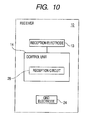
- the first communication module 10 is a receiver. As shown in Fig. 10 , a reception electrode 13 and a GND electrode 24 for human body communication are arranged in the first communication module 10.
- the reception electrode 13 is electrically connected to a control unit 14, and a signal detected by the reception electrode 13 is converted into an electrical signal by a reception circuit 28.
- the control unit 14 demodulates the signal and determines whether or not a received ID is a normal ID. When the control unit 14 has determined that the received ID is the normal ID, the second communication module 40 is specified and the door 74 is unlocked.
- the operation by the first communication module 10 corresponds to the content of steps S705 to S707 in Fig. 7 .
- the first communication module 10 of the above-described first and second embodiments includes the electric field strength measuring unit 32 (62), the transmission output determination unit 18 (48), and the output execution unit 20 (50).
- the electric field strength measuring unit 32 measures a noise level of environmental noise from the received electric field strength detected at the time of no signal, and outputs the measurement result to the transmission output determination unit 18 (48).
- the transmission output determination unit 18 (48) determines an output level of the transmission signal to be transmitted to the second communication module 40 (the first communication module 10) on the basis of the measured noise level, and outputs the determination result to the output execution unit 20 (50).
- the output execution unit 20 (50) outputs a transmission signal of the determined output level to the second communication module 40 (the first communication module 10) via the transmission/reception electrode 12 (42).
- a state in which a transmission signal from the first communication module 10 (the second communication module 40) to the second communication module 40 (the first communication module 10) is absent is a state in which environmental noise received by the human body 80 itself is capable of being specified
- the output level of the transmission signal directed to the second communication module 40 (the first communication module 10) may be determined by considering the noise level. As a result, it contributes to the improvement of true communication performance in communication using the human body 80 as a signal transmission path.
- the human body 80 In communication using the human body 80 for the signal transmission path, the human body 80 itself functions as an antenna which picks up environmental noise, and the noise level is particularly increased at the moment when the hand of the human body 80 is in contact with the door knob 76, that is, the transmission/reception electrode 12 of the first communication module 10.
- the noise level is particularly increased at the moment when the hand of the human body 80 is in contact with the door knob 76, that is, the transmission/reception electrode 12 of the first communication module 10.
- the transmission output determination unit 18 (48) determines the output level of the transmission signal directed to the second communication module 40 (the first communication module 10) by following the measured noise level, it is possible to set the output level of the transmission signal to an optimum magnitude commensurate with the noise level. Consequently, the transmission signal directed to the second communication module 40 (the first communication module 10) is not buried in the environmental noise, and it is possible to prevent communication which does not pass through the human body 80 as the signal transmission path.
- the output execution unit 20 of the first communication module 10 in the first and second embodiments outputs the transmission signal to the second communication module 40, but also the transmission signal includes information of the measured noise level or the determined output level. Consequently, for example, the first communication module 10 may also use the information for a subsequent determination of the output level or the like, and the second communication module 40 may also use the information for adjustment or the like upon reception/transmission.
- two-way communication is performed between the first communication module 10 and the second communication module 40 mounted on the human body 80.
- the second communication module 40 mounted on the human body 80 also includes the transmission output determination unit 48 and the output execution unit 50, but the transmission output determination unit 48 determines an output level of a transmission signal to be returned to the first communication module 10 using the information of the noise level measured by the first communication module 10 or the output level determined thereby. Since it is not necessary to measure the noise level in the second communication module 40, it is possible to simplify the configuration or control of the second communication module 40.
- the second communication module 40 mounted on the human body 80 may be started using the transmission signal from the first communication module 10 as a trigger, so that power consumption may be reduced. As a result, the battery life of the second communication module 40 is also lengthened.
- the transmission output determination unit 48 of the second communication module 40 of the first and second embodiments determines the output level of the transmission signal directed to the first communication module 10 by following the measured noise level or the determined output level, it is possible to set the output level of the transmission signal to be returned to an optimum magnitude commensurate with the noise level. Even in two-way communication of the communication modules 10 and 40, the transmission signal directed to the first communication module 10 is not buried in the environmental noise, and it is possible to prevent communication which does not pass through the human body 80 as the signal transmission path.
- the electric field strength measuring unit 32 not only measures the noise level from the received electric field strength at the time of no signal, but also measures the received signal level by the received electric field strength of the transmission signal returned from the second communication module 40.
- the transmission output determination unit 18 re-determines the output level of the transmission signal to be transmitted to the second communication module 40 on the basis of the former noise level and the latter received signal level.
- a high output level is necessary in initial communication when it is possible to re-adjust the output level of the transmission signal directed to the second communication module 40 by considering an actual communication state as described above.
- a low output level is adequate thereafter, it is possible to avoid the transmission by a useless output level and it is possible to reduce power consumption while improving true communication performance.
- the transmission/reception electrodes 12 and 42 are capacitively coupled to the human body 80, thereby receiving or transmitting a signal from or to the human body 80.
- the GND electrode 24 is capacitively coupled to the GND electrode 54 via the ground which is the air or the floor surface 70. A closed loop is formed by all the electrodes.
- Each of the communication modules 10 and 40 uses an electric field generated by voltage application directed to the human body 80, and uses the human body 80 as a signal transmission path. Since a signal of the above-described method is transmitted through clothing or shoes, the transmission/reception electrodes 12 and 42 or the GND electrodes 24 and 54 may perform non-contact communication without making direct contact with the skin of the human body 80. Consequently, the influence of the sweat of the human body 80 or the like on communication is small and general versatility also increases.
- An electric current scheme may be used in which a human body serves as a signal line and a reference line.
Landscapes
- Engineering & Computer Science (AREA)
- Computer Networks & Wireless Communication (AREA)
- Signal Processing (AREA)
- Near-Field Transmission Systems (AREA)
Abstract
A communication device (10) for communicating with an external device (40) using a human body (80) as a signal transmission path, includes an electric field strength measuring unit (32) configured to measure a noise level from a detected received electric field strength at the time of no signal after the received electric field strength is detected by the communication device (10) when a transmission signal to be output to the external device (40) is absent, a transmission output determination unit (18) configured to determine an output level of the transmission signal to be transmitted to the external device (40) on the basis of the measured noise level, and an output execution unit (20) configured to output a transmission signal of the determined output level to the external device (40).
Description
- The present invention contains subject matter related to Japanese Patent Application
JP 2009-171084 - The present invention relates to a communication device and a communication method which perform communication using electric field coupling.
- In general, RFID (Radio Frequency IDentification), infrared communication, and short-range radio communication schemes besides wired communication for a system having a communication device are known. Since non-contact communication by radio waves or the like is possible, the non-contact communication is utilized in various places, for example, such as an event site and a station ticket gate.
- On the other hand, since devices using radio waves are regulated by law and are easily affected by interference or obstruction from peripheral devices, the techniques of new communication schemes using electric field coupling have been disclosed (for example, see Japanese Patent No.
4074661 2004-153708 - However, even though the communication scheme uses the above-described electric field coupling, the communication performance thereof is affected by environmental noise (external noise generated by a peripheral device, noise of a power supply system, or the like). When a noise level is high, a transmission signal may be buried in the environmental noise. Therefore, there is a problem in that communication performance may be degraded.
- In this case, an output level of the transmission signal may be set to be higher than the noise level. However, when the output level is set to be high, there is a problem in that a radiated electric field becomes excessively strong and communication is performed even though it is not immediately before a human body is in contact with a receiver, or a transmitter and a receiver directly communicate beyond the human body, thereby establishing communication without passing through the human body in spite of the human body being used for a signal transmission path.
- In the case where the transmitter is a portable device which is driven by a battery, there is a problem in that the battery life is shortened when the output level of the transmission signal is set to be simply high.
- Here, in terms of solutions of these problems, it should be noted that the human body itself is affected by environmental noise. This is because the human body itself which is the signal transmission path functions as an antenna and easily picks up the environmental noise.
- That is, when the environmental noise received by the human body is not recognized, the improvement of true communication performance may not be achieved even though it is possible to set an output level of a transmission signal on the basis of a noise level.
- It is desirable to provide a communication device and a communication method capable of solving the above-described problems, recognizing environmental noise received by a human body, and achieving the improvement of true communication performance.
- According to a first embodiment of the invention, there is provided a communication device for communicating with an external device using a human body as a signal transmission path, including: an electric field strength measuring unit configured to measure a noise level from a detected received electric field strength at the time of no signal after the received electric field strength is detected by the communication device when a transmission signal to be output to the external device is absent; a transmission output determination unit configured to determine an output level of the transmission signal to be transmitted to the external device on the basis of the measured noise level; and an output execution unit configured to output a transmission signal of the determined output level to the external device.
- According to the first embodiment of the invention, the communication device includes the electric field strength measuring unit, the transmission output determination unit, and the output execution unit.
- When a transmission signal is output from the communication device to the external device, a received electric field strength at the time of no transmission signal is detected. The electric field strength measuring unit measures a noise level from the detected received electric field strength at the time of no signal, and outputs the measurement result to the transmission output determination unit.
- The transmission output determination unit determines an output level of the transmission signal to be transmitted to the external device on the basis of the measured noise level, and outputs the determination result to the output execution unit. The output execution unit outputs a transmission signal of the determined output level to the external device.
- Since environmental noise received by the human body itself may be specified in a state in which a transmission signal from the communication device to the external device is absent as described above, it is possible to recognize the environmental noise received by the human body itself when a noise level is measured on the basis of a state in which the transmission signal is absent. Consequently, it is possible to determine the output level of the transmission signal directed to the external device by considering the noise level. As a result, it contributes to the improvement of true communication performance in communication using the human body for the signal transmission path.
- According to a second embodiment of the invention in the configuration of the first embodiment of the invention, the received electric field strength at the time of no signal may be a received electric field strength at the moment when the human body is in contact with the external device in a state in which the transmission signal directed to the external device is not started up.
- According to the second embodiment of the invention in addition to the operation of the first embodiment of the invention, the human body itself functions as an antenna which picks up environmental noise in communication using the human body for the signal transmission path as described above. At the moment when the human body is in contact with the external device, the noise level is particularly increased. However, in the invention, it is possible to more reliably recognize environmental noise received by the human body itself since a noise level at the moment is measured.
- According to a third embodiment of the invention in the configuration of the first or second embodiment of the invention, the transmission output determination unit may determine a high output level when the measured noise level is high, and may determine a low output level when the measured noise level is low.
- According to the third embodiment of the invention in addition to the operation of the first or second embodiment of the invention, the transmission output determination unit determines the output level of the transmission signal directed to the external device by following the measured noise level, thereby setting the output level of the transmission signal to an optimum magnitude commensurate with the noise level. Consequently, the transmission signal directed to the external device is not buried in the environmental noise, and also it is possible to prevent communication which does not pass through the human body as the signal transmission path.
- According to a fourth embodiment of the invention in the configuration of the first to third embodiments of the invention, the output execution unit may output the transmission signal including information of the measured noise level or the determined output level to the external device.
- According to the fourth embodiment of the invention in addition to the operation of the first to third embodiments of the invention, not only the output execution unit of the communication device outputs the transmission signal to the external device, but also the transmission signal includes information of the measured noise level or the determined output level. Consequently, for example, the communication device may also use the information for a subsequent determination of the output level or the like, and the external device may also use the information for adjustment or the like upon reception/transmission.
- According to a fifth embodiment of the invention in the configuration of the fourth embodiment of the invention, the external device may be a communication module mounted on the human body, and the mounted communication module may include: a transmission output determination unit configured to determine an output level of a transmission signal to be returned to the communication device on the basis of the information of the measured noise level or the determined output level; and an output execution unit configured to output a transmission signal of the determined output level to the communication device.
- According to the fifth embodiment of the invention in addition to the operation of the fourth embodiment of the invention, two-way communication is performed between the communication device and the communication module mounted on the human body. The communication module mounted on the human body also includes the transmission output determination unit and the output execution unit, but the transmission output determination unit determines the output level of the transmission signal to be returned to the communication device using the information of the noise level measured by the communication device or the output level determined thereby. Accordingly, since it is not necessary to measure the noise level in the mounted communication module, it is possible to simplify the configuration or control thereof.
- The communication module mounted on the human body may be started using the transmission signal from the communication device as a trigger, so that power consumption may be reduced.
- According to a sixth embodiment of the invention in the configuration of the fifth embodiment of the invention, the transmission output determination unit may determine a high output level when the measured noise level or the determined output level is high, and may determine a low output level when the measured noise level or the determined output level is low.
- According to the sixth embodiment in addition to the operation of the fifth embodiment of the invention, since the transmission output determination unit determines the output level of the transmission signal directed to the communication device by following the measured noise level or the determined output level, it is possible to set the output level of the transmission signal to an optimum magnitude commensurate with the noise level. Consequently, even in two-way communication, the transmission signal directed to the communication device is not buried in the environmental noise, and it is possible to prevent communication which does not pass through the human body as the signal transmission path.
- According to a seventh embodiment of the invention in the configuration of the first to fourth embodiments of the invention, a received electric field strength of a transmission signal returned from the external device may be further detected, the electric field strength measuring unit may measure a received signal level from the detected received electric field strength of the transmission signal, and the transmission output determination unit may re-determine an output level of a transmission signal to be transmitted to the external device on the basis of the measured received signal and a noise level before or after the received signal is detected.
- According to the seventh embodiment of the invention in addition to the operation of the first to fourth embodiments of the invention, in two-way communication of the communication device and the external device, the electric field strength measuring unit of the communication device not only measures the noise level from the received electric field strength at the time of no signal, but also measures the received signal level by the received electric field strength of the transmission signal returned from the external device. The transmission output determination unit re-determines the output level of the transmission signal to be transmitted to the external device on the basis of the former noise level and the latter received signal level.
- For example, a high output level is necessary in initial communication when it is possible to re-adjust the output level of the transmission signal directed to the external device by considering an actual communication state as described above. However, in the case where a low output level is adequate thereafter, it is possible to avoid transmission by a useless output level and it is possible to reduce power consumption while improving true communication performance.
- An eighth embodiment of the invention is a communication method for communication between a first communication module and a second communication module using a human body as a signal transmission path.
- The communication method includes the steps of: detecting, by the first communication module, a received electric field strength at the time of no signal as the moment when the human body is in contact with the second communication module in a state in which a transmission signal is not started up when the transmission signal is output to the second communication module; measuring, by the first communication module, a noise level from the detected received electric field strength at the time of no signal; following, by the first communication module, a high/low state of the measured noise level and determining an output level of a transmission signal to be transmitted to the second communication module; outputting, by the first communication module, a transmission signal of the determined output level to the second communication module along with information of the measured noise level or the determined output level; following, by the second communication module, a high/low state of the information of the measured noise level or the determined output level and determining an output level of a transmission signal to be returned to the first communication module; and outputting, by the second communication module, a transmission signal of the determined output level to the first communication module.
- According to the eighth embodiment of the invention, the human body itself also has a function as an antenna which picks up environmental noise in communication using the human body for the signal transmission path. At the moment when the human body is in contact with the external device, the noise level is particularly increased. However, it is possible to more reliably recognize environmental noise received by the human body itself since the noise level of the moment is measured. As a result, the communication performance of communication using the human body as the signal transmission path is significantly improved.
- Since the first communication module determines the output level of the transmission signal directed to the second communication module by following the measured noise level, it is possible to set the output level of the transmission signal to an optimum magnitude commensurate with the noise level. Consequently, the transmission signal from the first communication module to the second communication module is not buried in the environmental noise, and it is possible to prevent communication which does not pass through the human body as the signal transmission path.
- Further, the first communication module also provides the second communication module with information of the measured noise level or the determined output level. Since the second communication module determines an output level of the transmission signal to be returned to the first communication module using the level information, it is not necessary to measure the noise level in the second communication module and it is possible to simplify the configuration or control thereof.
- The second communication module may be started using the transmission signal from the first communication module as a trigger, thereby reducing power consumption.
- Since the second communication module determines an output level of the transmission signal directed to the first communication module by following the above-described level information, it is also possible to set the output level of the transmission signal to an optimum magnitude commensurate with the noise level. The transmission signal from the second communication module to the first communication module is also not buried in the environmental noise, and it is possible to prevent communication which does not pass through the human body as the signal transmission path.
- According to the embodiments of the invention, it is possible to provide a communication device and a communication method capable of recognizing environmental noise received by a human body since a noise level is computed in a state in which a transmission signal from a communication device is absent, and accomplishing the improvement of true communication performance.
-
-
Fig. 1 is a system configuration diagram of the first and second communication modules according to this embodiment. -
Fig. 2 is a schematic configuration diagram of the first communication module ofFig. 1 . -
Fig. 3 is a schematic configuration diagram of the second communication module ofFig. 1 . -
Fig. 4 is a diagram illustrating signals transmitted to and received from the first communication module ofFig. 2 . -
Fig. 5 is a diagram illustrating a noise level of the first communication module ofFig. 2 . -
Fig. 6 is an operation flowchart until a signal is output by the first communication module ofFig. 2 . -
Fig. 7 is an operation flowchart until a signal is output by the second communication module ofFig. 3 and until a process is executed by the first communication module ofFig. 2 . -
Fig. 8 is an operation flowchart until a signal is output by the first communication module of a second embodiment. -
Fig. 9 is a schematic configuration diagram of the second communication module of a third embodiment. -
Fig. 10 is a schematic configuration diagram of the first communication module of the third embodiment. - Hereinafter, preferred embodiments of the present invention will be described on the basis of the drawings.
- For example, a
communication system 1 of an embodiment shown inFig. 1 is constructed between adoor 74 of a building and anemployee ID card 82 attached to ahuman body 80. - This building internally has a plurality of rooms and the rooms neighboring each other are divided by a
wall 72. - When the
human body 80 ofFig. 1 moves from a room having afloor surface 70 to a neighboring room, thedoor 74 is used. Thedoor 74 of this embodiment is rotatably supported on thewall 72 via a hinge, thereby opening/closing a part of thewall 72. - A rotatably supported
door knob 76 is provided in an appropriate position of the front side of thedoor 74. As shown inFig. 1 , theknob 76 extends in a substantially horizontal direction along the front side of thedoor 74 in a state in which thedoor 74 is closed. - The motion of the
door knob 76 interlocks with a latch bolt provided on an end face of thedoor 74. In detail, when thedoor knob 76 is grabbed by the hand of thehuman body 80, and is rotated, for example, in a clockwise direction, as viewed from thehuman body 80, the tip end of the latch bolt recedes to be substantially flush with the end face of thedoor 74. Thereby, the temporary tightening of thedoor 74 is loosened, and thedoor 74 is rotatable toward the room having thefloor surface 70 or toward its neighboring room, and thehuman body 80 is able to move from the room having thefloor surface 70 to the neighboring room. - On the other hand, when the hand of the
human body 80 is separated from thedoor knob 76, theknob 76 returns to a position shown inFig. 1 by the urging force of a spring. Since the latch bolt is projected from the end face of thedoor 74, it is possible to temporarily tighten thedoor 74. - Further, in the end face of the
door 74, a dead bolt is provided in the vicinity of the latch bolt. - The dead bolt has a main tightening function of the
door 74. In a state in which thedoor 74 is locked, the dead bolt is projected from the end face of thedoor 74, and is solidly engaged to thewall 72. On the other hand, since the tip end of the dead bolt is substantially flush with the end face of thedoor 74 when thedoor 74 is unlocked, the main tightening of thedoor 74 is loosened and a temporarily tightened state is formed by the above-described latch bolt. - Here, in this embodiment, the
door 74 is locked or unlocked by communication using electric field coupling. - Specifically, as shown in
Fig. 1 , a first communication module (communication device) 10 is embedded in the vicinity of thedoor knob 76 on an inner side of thedoor 74, and a second communication module (external device) 40 which is driven by a battery is provided on anemployee ID card 82 suspended from the neck of thehuman body 80. - The
first communication module 10 authenticates a unique ID (identification signal) of thesecond communication module 40, and locks or unlocks thedoor 74. - In more detail, the
first communication module 10 is a transceiver, and includes a transmission/reception electrode 12 for human body communication and aGND electrode 24 as shown inFig. 2 . The transmission/reception electrode 12 is arranged in the vicinity of the surface of thedoor knob 76 which is capable of contacting the hand of thehuman body 80. The GND electrode is the GND of a circuit board and a GND portion extended from the GND of the circuit board. - On the other hand, the
GND electrode 24 is arranged in an appropriate position on a far side from thehuman body 80 by interposing the transmission/reception electrode 12. - The transmission/
reception electrode 12 is electrically connected to acontrol unit 14. Specifically, thecontrol unit 14 includes atransmission circuit 16 and areception circuit 28. For example, thetransmission circuit 16 outputs a transmission signal to the transmission/reception electrode 12 in a fixed interrupt cycle, and drives the transmission/reception electrode 12 by generating a potential signal at the time. - On the other hand, a reception signal from the transmission/
reception electrode 12 is input to thereception circuit 28 in a fixed interrupt cycle. The transmission signal and the reception signal are alternately generated. - For example, as shown in
Fig. 4 , when the transmission circuit TX is not started up, the reception circuit RX is started up. Next, when the transmission circuit TX is started up, the reception circuit RX is shut down. - That is, the reception circuit RX is started up in an interval (when no transmission signal is present) between the start-up transmission circuit TX and the next start-up transmission circuit TX.
- The transmission/
reception electrode 12 detects a received electric field strength in the above-described interval, and outputs the detection result to thereception circuit 28. - Here, a received electric field strength of this embodiment and a noise level of environmental noise received by the
human body 80 are in a substantially proportional relationship. - Specifically, as shown in
Fig. 5 , when a voltage value of a received electric field strength RSSI (Received Signal Strength Indication) is taken on the vertical axis and a level of a signal input to thefirst communication module 10 is taken on the horizontal axis, it can be seen that the level of the signal input to thecommunication module 10 also becomes high as the received electric field strength becomes high. - Since the received electric field strength is detected when the transmission signal is not started up as described above, the received electric field strength detected by the
communication module 10 corresponds to the noise level of environmental noise received by thehuman body 80. - For example, a communication distance by this embodiment is a short distance corresponding to PAN (Personal Area Network) or BAN (Body Area Network), and the
communication modules communication module 10 is substantially the same as the noise level received by thesecond communication module 40. - In a state in which the transmission signal is not started up, a value of the received electric field strength of this embodiment is detected by the transmission/
reception electrode 12 at the moment when the hand of thehuman body 80 is in contact with thedoor knob 76, and is output to an electric fieldstrength measuring unit 32. The moment when the hand is in contact with thedoor knob 76 not only corresponds to a point in time when the hand of thehuman body 80 is actually in contact with thedoor knob 76, but also corresponds to a point in time immediately before the hand is in contact with thedoor knob 76. - That is, the electric field
strength measuring unit 32 is able to constantly measure a noise level of common environmental noise between thecommunication modules human body 80. - The
transmission circuit 16 of this embodiment has a transmissionoutput determination unit 18 or anoutput execution unit 20. The transmissionoutput determination unit 18 determines an output level of a transmission signal on the basis of a noise level measured by the electric fieldstrength measuring unit 32. Theoutput execution unit 20 outputs a transmission signal of the determined output level to thesecond communication module 40. - The
output execution unit 20 also outputs information (for example, an index of level 4 or the like ) of the noise level measured by the electric fieldstrength measuring unit 32 or the output level determined by the transmissionoutput determination unit 18 to thesecond communication module 40. - The
first communication module 10 further includes amemory 22. Thememory 22 stores a unique ID of themodule 10. - On the other hand, the
second communication module 40 is also a transceiver, and includes a transmission/reception electrode 42 for human body communication and aGND electrode 54 as shown inFig. 3 . The transmission/reception electrode 42 is arranged on the backside of theemployee ID card 82 facing clothing of thehuman body 80. - On the other hand, for example, the
GND electrode 54 is arranged in an appropriate position of the surface of theemployee ID card 82 to which a photo or the like is attached. - The transmission/
reception electrode 42 is electrically connected to acontrol unit 44. Thecontrol unit 44 includes atransmission circuit 46 and areception circuit 58. For example, a received signal from the transmission/reception electrode 42 is input to thereception circuit 58 in a fixed interrupt cycle. For example, thetransmission circuit 46 outputs a transmission signal to the transmission/reception electrode 42 in a fixed interrupt cycle, and drives the transmission/reception electrode 42 by generating a potential signal at the time. - The received signal of this embodiment is a signal obtained by demodulating the unique ID of the
first communication module 10 and the information of the noise level of the environmental noise picked up by thehuman body 80 and measured by the electric fieldstrength measuring unit 32 or the output level after the determination by the transmissionoutput determination unit 18. - Here, the
transmission level 46 also includes a transmissionoutput determination unit 48 and anoutput execution unit 50. The transmissionoutput determination unit 48 uses the information of the noise level of the environmental noise picked up by thehuman body 80 and measured by the electric fieldstrength measuring unit 32 or the output level after the determination by the transmissionoutput determination unit 18. In detail, the transmissionoutput determination unit 48 determines an output level of a transmission signal to be returned to thecommunication module 10 on the basis of the measured noise level or the determined output level. - The
output execution unit 50 outputs a transmission signal of the determined output level to thefirst communication module 10. - The
second communication module 40 also includes amemory 52. Thememory 52 stores a unique ID of themodule 40. - When the
control unit 14 of thefirst communication module 10 has determined that the ID is normal, thesecond communication module 40 is specified and thedoor 74 is unlocked. - Referring to
Figs. 6 and7 , an operation flowchart of communication in which thehuman body 80 is set as a signal transmission path by thefirst communication module 10 and thesecond communication module 40 is shown. Hereinafter, the operation according to an embodiment of the present invention of the above-describedcommunication system 1 will be described. - First, in a state in which the
door 74 is locked until thefirst communication module 10 outputs a transmission signal to thesecond communication module 40 as shown inFig. 6 , step S601 ofFig. 6 is when no transmission signal is present in thefirst communication module 10, that is, a reception state in which the reception circuit RX is started up to detect a signal. - In this embodiment, the transmission/
reception electrode 12 detects a received electric field strength at the moment when the hand of thehuman body 80 is in contact with thedoor knob 76. Then, the process proceeds to step S602. - In step S602, the electric field
strength measuring unit 32 measures a noise level of environmental noise picked up by thehuman body 80 from the received electric field strength of the above-described moment, and outputs the measurement result to the transmissionoutput determination unit 18. Then, the process proceeds to step S603. - The transmission
output determination unit 18 determines a transmission signal directed to thesecond communication module 40 as a high output level when the measured noise level is high, and determines the transmission signal as a low output level when the measured noise level is low. - Next, the transmission
output determination unit 18 outputs the determination result to theoutput execution unit 20. Then, the process proceeds to step S604. Theoutput execution unit 20 outputs a transmission signal of the output level after the determination which is a transmission signal in which information of the noise level measured by the electric fieldstrength measuring unit 32 or the output level after the determination by the transmissionoutput determination unit 18 is added to the unique ID of thecommunication module 10. - Subsequently, the
transmission circuit 16 converts the transmission signal into an electric signal, and thecontrol unit 14 modulates the signal. It escapes from the series of routines by outputting the signal to thesecond communication module 40 via the transmission/reception electrode 12. - Here, assuming that the
control unit 14 has applied a positive charge voltage to the transmission/reception electrode 12, an electric field occurs in the transmission/reception electrode 12. The transmission signal from the transmission/reception electrode 12 reaches the hand of thehuman body 80 in contact with thedoor knob 76. Since the transmission/reception electrode 12 becomes a positive electrode, negative charges are induced on the hand in contact with the door knob 76 (electric field coupling). - Next, positive charges are induced in the vicinity of the
employee ID card 82 of thehuman body 80. As described above, the electric field assigned to thehuman body 80 is transmitted through its clothing and reaches thesecond communication module 40. - Subsequently, until the second communication module outputs a transmission signal to the
first communication module 10 and thefirst communication module 10 unlocks thedoor 74 as shown inFig. 7 , thesecond communication module 40 is started when the transmission/reception electrode 42 detects the transmission signal from thefirst communication module 10 in step S701 ofFig. 7 . - The
reception circuit 58 converts the detected signal into an electrical signal, thecontrol unit 44 demodulates the signal, and the process proceeds to step S702. - In step S702, the
transmission output unit 48 acquires information of the noise level of environmental noise picked up by thehuman body 80 and measured by the electric fieldstrength measuring unit 32 or the output level determined by the transmissionoutput determination unit 18. - Subsequently, the process proceeds to step S703. The transmission
output determination unit 48 determines a transmission signal to be returned to thefirst communication module 10 as a high output level when the measured noise level or the determined output level described above is high, and determines the transmission signal to be returned as a low output level when the measured noise level or the determined output level described above is low. Until the process reaches step S703, thecontrol unit 44 determines whether the received ID is a normal ID. When it is determined that the received ID is the normal ID, thefirst communication module 10 is specified. - The transmission
output determination unit 48 outputs the determination result to theoutput execution unit 50, and the process proceeds to step S704. - In step S704, the
output execution unit 50 outputs a transmission signal of the output level after the determination by the transmissionoutput determination unit 48 in the unique ID of thesecond communication module 40. - Thereafter, the
transmission circuit 46 converts the transmission signal into an electrical signal, and thecontrol unit 44 modulates the signal. Thesecond communication module 40 is in a waiting state when the signal is output to thefirst communication module 10 via the transmission/reception electrode 42. - Here, assuming that the
control unit 44 has applied a positive charge voltage to the transmission/reception electrode 42, an electric field occurs in the transmission/reception electrode 42. The transmission signal from the transmission/reception electrode 42 reaches the vicinity of theemployee ID card 82 of thehuman body 80. Since the transmission/reception electrode 42 becomes a positive electrode, negative charges are induced in the vicinity of the employee ID card 82 (electric field coupling). - Subsequently, positive charges are induced on the hand of the
human body 80 in the vicinity of thedoor knob 76. As described above, an electric field assigned to thehuman body 80 reaches thefirst communication module 10. - Next, the electric field assigned to the
human body 80 is detected by the transmission/reception electrode 12 of the first communication module 10 (step S705). A signal detected by the transmission/reception electrode 12 is converted into an electrical signal by thereception circuit 28. Then, the process proceeds to step S706. - In step S706, the
control unit 14 demodulates the signal and determines whether or not the received ID is a normal ID. When the received ID is the normal ID, that is, the determination result is YES, the process proceeds to step S707. Since thesecond communication module 40 is specified, thecontrol unit 14 escapes from the series of routines by unlocking thedoor 74. Thereby, the temporarily tightened state is formed by the above-described latch bolt. - On the other hand, when the received ID is not the normal ID in step S706, the
control unit 14 rapidly escapes from the routine and continuously locks thedoor 74. The dead bolt is continuously solidly engaged to thewall 72. - The electric field coupling from the transmission/
reception electrode 12 of thefirst communication module 10 to the transmission/reception electrode 42 of thesecond communication module 40 via thehuman body 80 and the electric field coupling from the transmission/reception electrode 42 of thesecond communication module 40 to the transmission/reception electrode 12 of thefirst communication module 10 via thehuman body 80 serve as signal lines, but thefirst communication module 10 has a reference line which is electric field coupled to thesecond communication module 40 via the air or thefloor surface 70. The signal lines and the reference line form one closed loop. - That is, the
GND electrode 24 ofFig. 2 is electric field coupled to the ground which is thefloor surface 70, theGND electrode 54 ofFig. 3 is electric field coupled to the ground which is thefloor surface 70, and they become the negative electrode in this embodiment. The electric field coupling from theGND electrode 24 of thefirst communication module 10 to theGND electrode 54 of thesecond communication module 40 via the air or thefloor surface 70 serves as the reference line. - Incidentally, in the above-described embodiment, an output level of a transmission signal is determined only on the basis of a received electric field strength when no transmission signal of the
first communication module 10 is present. - However, in two-way communication in which communication is continued even after ID authentication, an output level of a transmission signal directed to the
second communication module 40 may be re-determined by also considering a signal from thesecond communication module 40. - In detail, in communication after the transmission from the
first communication module 10 is performed and the transmission from thesecond communication module 40 is returned (after S704), the transmission/reception electrode 12 detects a received electric field strength even in the example shown inFig. 8 like the example ofFig. 6 (step S801). - Here, the electric field
strength measuring unit 32 measures a noise level of environmental noise picked up by thehuman body 80 from the above-described received electric field strength and a received signal level of a transmitted signal returned from the second communication module 40 (step S802). The transmissionoutput determination unit 18 determines an output level of a transmission signal to be transmitted to the second communication module 40 (step S803). - Until the process reaches step S803, the
control unit 44 determines whether or not the received ID is the normal ID. When it is determined that the received ID is the normal ID, thesecond communication module 40 is specified. - Subsequently, the transmission
output determination unit 18 outputs the determination result to theoutput execution unit 20. Then, the process proceeds to step S804. Theoutput execution unit 20 outputs a transmission signal of the re-determined output level which is a transmission signal in which information of the noise level measured by the electric fieldstrength measuring unit 32 or the output level after the determination by the transmissionoutput determination unit 18 is added to the unique ID of themodule 10. - Thereafter, the
control unit 14 escapes from the series of routines by outputting the transmission signal to thesecond communication module 40 via the transmission/reception electrode 12 as in the above-described embodiment ofFig. 6 . - In actual communication, not only the noise level is changed, but also the level of a signal transmitted via the human body is changed by a posture of the human body or a contact method of the transmission/reception electrode. Thus, the output level of the transmission signal first set in step S603 of
Fig. 6 also considers a change of a transmission signal level in addition to a level considering the noise level, so that it is necessary to set the output level to be slightly high. However, in two-way communication in which communication is continued even after ID authentication, it is possible to suppress a useless output by determining a transmission output level on the basis of the noise level and the received signal level as shown inFig. 8 . - It is possible to detect the noise level before or after the detection of the received signal level.
- On the other hand, an example of two-way communication in each embodiment has been described above, but the present invention is also applicable to other one-way communication.
- Specifically, an embodiment shown in
Figs. 9 and10 is communication directed from thesecond communication module 40 of theemployee ID card 82 only to thefirst communication module 10 of thedoor 74. - A
second communication module 40 of this embodiment is a transmitter, and includes a transmission/reception electrode 42 for human body communication and aGND electrode 54 as shown inFig. 9 . The transmission/reception electrode 42 is arranged on the backside of theemployee ID card 82 facing clothing of thehuman body 80. - The transmission/
reception electrode 42 is electrically connected to acontrol unit 44. Thecontrol unit 44 includes atransmission circuit 46. Thetransmission circuit 46 includes a transmissionoutput determination unit 48 and anoutput execution unit 50. The transmissionoutput determination unit 48 and theoutput execution unit 50 have the same function as those of thefirst communication module 10 ofFig. 2 . Amemory 52 stores a unique ID of thecommunication module 40. - Also, the transmission/
reception electrode 42 is electrically connected to an electric fieldstrength measuring unit 62. In this embodiment, since a value of the received electric field strength of this embodiment is detected by the transmission/reception electrode 42 in a state in which the transmission circuit of thecontrol unit 44 is not started up and thesecond communication module 40 is constantly attached to thehuman body 80, the electric fieldstrength measuring unit 62 measures a noise level of environmental noise picked up by thehuman body 80. - The measured noise level is output to the transmission
output determination unit 48. The transmissionoutput determination unit 48 determines an output level of a transmission signal directed to thecommunication module 10 by following the measured noise level, and theoutput execution unit 20 outputs a transmission signal of the determined output level to thefirst communication module 10. - The
transmission circuit 46 converts the transmission signal of the output level after the determination as a transmission signal of a unique ID of thecommunication module 40 into an electrical signal. Thecontrol unit 44 modulates the transmission signal, outputs the modulated transmission signal to the transmission/reception electrode 42, and causes the output modulated transmission signal to reach thefirst communication module 10. The operation by thesecond communication module 40 corresponds to the content of steps S601 to S604 inFig. 6 . - The
first communication module 10 is a receiver. As shown inFig. 10 , areception electrode 13 and aGND electrode 24 for human body communication are arranged in thefirst communication module 10. - The
reception electrode 13 is electrically connected to acontrol unit 14, and a signal detected by thereception electrode 13 is converted into an electrical signal by areception circuit 28. Thecontrol unit 14 demodulates the signal and determines whether or not a received ID is a normal ID. When thecontrol unit 14 has determined that the received ID is the normal ID, thesecond communication module 40 is specified and thedoor 74 is unlocked. The operation by thefirst communication module 10 corresponds to the content of steps S705 to S707 inFig. 7 . - According to this embodiment as described above, first, the
first communication module 10 of the above-described first and second embodiments (thesecond communication module 40 of the third embodiment) (hereinafter, reference numeral in parentheses corresponds to the configuration of the third embodiment) includes the electric field strength measuring unit 32 (62), the transmission output determination unit 18 (48), and the output execution unit 20 (50). - When a transmission signal is output from the first communication module 10 (the second communication module 40) to the second communication module 40 (the first communication module 10), a received electric field strength at the time of no transmission signal is detected. The electric field strength measuring unit 32 (62) measures a noise level of environmental noise from the received electric field strength detected at the time of no signal, and outputs the measurement result to the transmission output determination unit 18 (48).
- The transmission output determination unit 18 (48) determines an output level of the transmission signal to be transmitted to the second communication module 40 (the first communication module 10) on the basis of the measured noise level, and outputs the determination result to the output execution unit 20 (50). The output execution unit 20 (50) outputs a transmission signal of the determined output level to the second communication module 40 (the first communication module 10) via the transmission/reception electrode 12 (42).
- As described above, since a state in which a transmission signal from the first communication module 10 (the second communication module 40) to the second communication module 40 (the first communication module 10) is absent is a state in which environmental noise received by the
human body 80 itself is capable of being specified, it is possible to recognize the environmental noise received by thehuman body 80 itself when the noise level is measured on the basis of a state in which no transmission signal is present. Consequently, the output level of the transmission signal directed to the second communication module 40 (the first communication module 10) may be determined by considering the noise level. As a result, it contributes to the improvement of true communication performance in communication using thehuman body 80 as a signal transmission path. - In communication using the
human body 80 for the signal transmission path, thehuman body 80 itself functions as an antenna which picks up environmental noise, and the noise level is particularly increased at the moment when the hand of thehuman body 80 is in contact with thedoor knob 76, that is, the transmission/reception electrode 12 of thefirst communication module 10. However, in this embodiment, it is possible to reliably recognize the environmental noise received by thehuman body 80 itself since the noise level of the above-described moment is measured. - Since the transmission output determination unit 18 (48) determines the output level of the transmission signal directed to the second communication module 40 (the first communication module 10) by following the measured noise level, it is possible to set the output level of the transmission signal to an optimum magnitude commensurate with the noise level. Consequently, the transmission signal directed to the second communication module 40 (the first communication module 10) is not buried in the environmental noise, and it is possible to prevent communication which does not pass through the
human body 80 as the signal transmission path. - Further, not only the
output execution unit 20 of thefirst communication module 10 in the first and second embodiments outputs the transmission signal to thesecond communication module 40, but also the transmission signal includes information of the measured noise level or the determined output level. Consequently, for example, thefirst communication module 10 may also use the information for a subsequent determination of the output level or the like, and thesecond communication module 40 may also use the information for adjustment or the like upon reception/transmission. - In the first and second embodiments, two-way communication is performed between the
first communication module 10 and thesecond communication module 40 mounted on thehuman body 80. Thesecond communication module 40 mounted on thehuman body 80 also includes the transmissionoutput determination unit 48 and theoutput execution unit 50, but the transmissionoutput determination unit 48 determines an output level of a transmission signal to be returned to thefirst communication module 10 using the information of the noise level measured by thefirst communication module 10 or the output level determined thereby. Since it is not necessary to measure the noise level in thesecond communication module 40, it is possible to simplify the configuration or control of thesecond communication module 40. - The
second communication module 40 mounted on thehuman body 80 may be started using the transmission signal from thefirst communication module 10 as a trigger, so that power consumption may be reduced. As a result, the battery life of thesecond communication module 40 is also lengthened. - Further, since the transmission
output determination unit 48 of thesecond communication module 40 of the first and second embodiments determines the output level of the transmission signal directed to thefirst communication module 10 by following the measured noise level or the determined output level, it is possible to set the output level of the transmission signal to be returned to an optimum magnitude commensurate with the noise level. Even in two-way communication of thecommunication modules first communication module 10 is not buried in the environmental noise, and it is possible to prevent communication which does not pass through thehuman body 80 as the signal transmission path. - In the
first communication module 10 of the second embodiment, the electric fieldstrength measuring unit 32 not only measures the noise level from the received electric field strength at the time of no signal, but also measures the received signal level by the received electric field strength of the transmission signal returned from thesecond communication module 40. The transmissionoutput determination unit 18 re-determines the output level of the transmission signal to be transmitted to thesecond communication module 40 on the basis of the former noise level and the latter received signal level. - For example, a high output level is necessary in initial communication when it is possible to re-adjust the output level of the transmission signal directed to the
second communication module 40 by considering an actual communication state as described above. However, in the case where a low output level is adequate thereafter, it is possible to avoid the transmission by a useless output level and it is possible to reduce power consumption while improving true communication performance. - The transmission/
reception electrodes human body 80, thereby receiving or transmitting a signal from or to thehuman body 80. TheGND electrode 24 is capacitively coupled to theGND electrode 54 via the ground which is the air or thefloor surface 70. A closed loop is formed by all the electrodes. - Consequently, in an embodiment of the invention as compared to the case using RFID or short-range radio communication, it is possible to connect the
employee ID card 82 by the natural action of holding thedoor knob 76 of thedoor 74 by thehuman body 80, omit a troublesome operation of inserting into a reader, and facilitate use. Since the radio is transmitted several meters even in a weak radio wave and is transmitted in all directions, communication information may be easily intercepted. However, in this embodiment, security is guaranteed without external leaking of information from thehuman body 80 as compared to short-range radio communication or the like. Since a communication distance is short and no radio wave is also emitted, the power consumption of each of thecommunication modules - Each of the
communication modules human body 80, and uses thehuman body 80 as a signal transmission path. Since a signal of the above-described method is transmitted through clothing or shoes, the transmission/reception electrodes GND electrodes human body 80. Consequently, the influence of the sweat of thehuman body 80 or the like on communication is small and general versatility also increases. - The present invention is not limited to the above-described embodiments, and various modifications may be made without departing from the scope of claims.
- An example of implementing unlocking of the
door 74 has been described in each embodiment. Of course, the present invention is applicable even in the case where it is necessary to continuously authenticate applications, for example, a headphone, a portable music player, and the like, used in a communication distance such as the above-described PAN or BAN. - When the electric field scheme of each embodiment described above is used, the influence of the sweat or the like on communication is small and communication via clothing is possible, so that general versatility also increases. An electric current scheme may be used in which a human body serves as a signal line and a reference line.
- Even in any of the cases described above, it is possible to recognize environmental noise received by a human body and achieve the improvement of true communication performance.
- It should be understood by those skilled in the art that various modifications, combinations, sub-combinations and alterations may occur depending on design requirements and other factors insofar as they are within the scope of the appended claims of the equivalents thereof.
Claims (8)
- A communication device (10) for communicating with an external device (40) using a human body (80) as a signal transmission path, comprising:an electric field strength measuring unit (32) configured to measure a noise level from a detected received electric field strength at the time of no signal after the received electric field strength is detected by the communication device (10) when a transmission signal to be output to the external device (40) is absent;a transmission output determination unit (18) configured to determine an output level of the transmission signal to be transmitted to the external device (40) on the basis of the measured noise level; andan output execution unit (20) configured to output a transmission signal of the determined output level to the external device (40).
- The communication device (10) according to Claim 1,
wherein the received electric field strength at the time of no signal is a received electric field strength of the moment when the human body (80) is in contact with the external device (40) in a state in which the transmission signal directed to the external device (40) is not started up. - The communication device (10) according to Claim 1 or 2,
wherein the transmission output determination unit (18) determines a high output level when the measured noise level is high, and determines a low output level when the measured noise level is low. - The communication device (10) according to any one of Claims 1 to 3,
wherein the output execution unit (20) outputs the transmission signal including information of the measured noise level or the determined output level to the external device (40). - The communication device (10) according to Claim 4,
wherein the external device (40) is a communication module (40) mounted on the human body (80), and
wherein the mounted communication module (40) includes:a transmission output determination unit (48) configured to determine an output level of a transmission signal to be returned to the communication device (10) on the basis of the information of the measured noise level or the determined output level; andan output execution unit (50) configured to output a transmission signal of the determined output level to the communication device (10). - The communication device (10) according to Claim 5,
wherein the transmission output determination unit (48) determines a high output level when the measured noise level or the determined output level is high, and determines a low output level when the measured noise level or the determined output level is low. - The communication device (10) according to any one of Claims 1 to 4,
wherein a received electric field strength of a transmission signal returned from the external device (40) is further detected,
wherein the electric field strength measuring unit (32) measures a received signal level from the detected received electric field strength of the transmission signal, and
wherein the transmission output determination unit (18) re-determines an output level of a transmission signal to be transmitted to the external device (40) on the basis of the measured received signal and a noise level before or after the received signal is detected. - A communication method for communication between a first communication module (10) and a second communication module (40) using a human body (80) as a signal transmission path, comprising the steps of:detecting, by the first communication module (10), a received electric field strength at the time of no signal as the moment when the human body (80) is in contact with the second communication module (40) in a state in which a transmission signal is not started up when the transmission signal is output to the second communication module (40);measuring, by the first communication module (10), a noise level from the detected received electric field strength at the time of no signal;following, by the first communication module (10), a high/low state of the measured noise level and determining an output level of a transmission signal to be transmitted to the second communication module (40);outputting, by the first communication module (10), a transmission signal of the determined output level to the second communication module (40) along with information of the measured noise level or the determined output level;following, by the second communication module (40), a high/low state of the information of the measured noise level or the determined output level and determining an output level of a transmission signal to be returned to the first communication module (10); andoutputting, by the second communication module (40), a transmission signal of the determined output level to the first communication module (10).
Applications Claiming Priority (1)
| Application Number | Priority Date | Filing Date | Title |
|---|---|---|---|
| JP2009171084A JP5271183B2 (en) | 2009-07-22 | 2009-07-22 | Communication apparatus and communication method |
Publications (1)
| Publication Number | Publication Date |
|---|---|
| EP2282425A1 true EP2282425A1 (en) | 2011-02-09 |
Family
ID=42989374
Family Applications (1)
| Application Number | Title | Priority Date | Filing Date |
|---|---|---|---|
| EP10169881A Withdrawn EP2282425A1 (en) | 2009-07-22 | 2010-07-16 | Communication device and communication method |
Country Status (3)
| Country | Link |
|---|---|
| US (1) | US8509689B2 (en) |
| EP (1) | EP2282425A1 (en) |
| JP (1) | JP5271183B2 (en) |
Families Citing this family (14)
| Publication number | Priority date | Publication date | Assignee | Title |
|---|---|---|---|---|
| KR20100126958A (en) * | 2009-05-25 | 2010-12-03 | 삼성전자주식회사 | Multi-device control method and apparatus |
| US8774329B2 (en) | 2010-07-01 | 2014-07-08 | Intelleflex Corporation | Variable length correlator |
| JP2013172389A (en) * | 2012-02-22 | 2013-09-02 | Nippon Telegr & Teleph Corp <Ntt> | Hybrid communication device |
| US10009069B2 (en) | 2014-05-05 | 2018-06-26 | Nxp B.V. | Wireless power delivery and data link |
| US10015604B2 (en) | 2014-05-05 | 2018-07-03 | Nxp B.V. | Electromagnetic induction field communication |
| US9812788B2 (en) * | 2014-11-24 | 2017-11-07 | Nxp B.V. | Electromagnetic field induction for inter-body and transverse body communication |
| US10014578B2 (en) | 2014-05-05 | 2018-07-03 | Nxp B.V. | Body antenna system |
| US9819075B2 (en) | 2014-05-05 | 2017-11-14 | Nxp B.V. | Body communication antenna |
| US9819395B2 (en) | 2014-05-05 | 2017-11-14 | Nxp B.V. | Apparatus and method for wireless body communication |
| US9819097B2 (en) | 2015-08-26 | 2017-11-14 | Nxp B.V. | Antenna system |
| JP6047808B1 (en) * | 2015-12-02 | 2016-12-21 | 株式会社eNFC | Transmission apparatus, transmission method, and transmission system |
| US10320086B2 (en) | 2016-05-04 | 2019-06-11 | Nxp B.V. | Near-field electromagnetic induction (NFEMI) antenna |
| JP2018046352A (en) * | 2016-09-13 | 2018-03-22 | ソニーセミコンダクタソリューションズ株式会社 | Communication device and communication system |
| US20190265473A1 (en) * | 2018-02-23 | 2019-08-29 | Oculus Vr, Llc | Apparatus, systems, and methods for enabling low-power communications via wearers' bodies |
Citations (7)
| Publication number | Priority date | Publication date | Assignee | Title |
|---|---|---|---|---|
| US5204672A (en) * | 1989-09-13 | 1993-04-20 | Brooks James E | Keyless entry system |
| EP0843425A2 (en) * | 1996-11-14 | 1998-05-20 | International Business Machines Corporation | Electronic communication apparatus using the human body as a transmission medium |
| JP2004153708A (en) | 2002-10-31 | 2004-05-27 | Nippon Telegr & Teleph Corp <Ntt> | Transceiver |
| EP1598965A1 (en) * | 2003-02-27 | 2005-11-23 | Sony Corporation | Communication system |
| JP2007020124A (en) * | 2005-07-11 | 2007-01-25 | Nippon Telegr & Teleph Corp <Ntt> | Electric field communication system |
| JP2007226560A (en) * | 2006-02-23 | 2007-09-06 | Nippon Telegr & Teleph Corp <Ntt> | IC card system |
| JP4074661B2 (en) | 1995-05-08 | 2008-04-09 | マサチューセッツ・インスティテュート・オブ・テクノロジー | Non-contact detection and signal system using human body as signal transmission medium |
Family Cites Families (23)
| Publication number | Priority date | Publication date | Assignee | Title |
|---|---|---|---|---|
| US6211799B1 (en) * | 1997-11-06 | 2001-04-03 | Massachusetts Institute Of Technology | Method and apparatus for transbody transmission of power and information |
| US6754472B1 (en) * | 2000-04-27 | 2004-06-22 | Microsoft Corporation | Method and apparatus for transmitting power and data using the human body |
| DE60004980T2 (en) * | 2000-06-27 | 2004-07-22 | Matsushita Electric Works, Ltd., Kadoma | Data transmission system using a human body as a signal transmission path |
| DE60102331T2 (en) * | 2000-09-08 | 2005-03-17 | Matsushita Electric Works, Ltd., Kadoma | Data transmission system using a human body as a signal transmission path |
| JP2003008481A (en) * | 2001-06-27 | 2003-01-10 | Denso Corp | ID tag system, ID tag reader and ID tag |
| JP3610496B2 (en) | 2002-07-30 | 2005-01-12 | オリオン電機株式会社 | Soldering structure for printed circuit boards and electronic components |
| JP4507058B2 (en) * | 2003-06-05 | 2010-07-21 | ソニー株式会社 | Distance detection system |
| JP4257361B2 (en) * | 2003-06-30 | 2009-04-22 | 日本電信電話株式会社 | Electric field detection optical device and transceiver |
| US8271093B2 (en) * | 2004-09-17 | 2012-09-18 | Cardiac Pacemakers, Inc. | Systems and methods for deriving relative physiologic measurements using a backend computing system |
| CN1938971B (en) * | 2004-12-02 | 2012-07-18 | 日本电信电话株式会社 | Transmitter and E-field communication transceiver |
| ATE545361T1 (en) * | 2004-12-13 | 2012-03-15 | Koninkl Philips Electronics Nv | MOBILE MONITORING |
| JP4586618B2 (en) * | 2005-04-18 | 2010-11-24 | ソニー株式会社 | Human body communication system and communication apparatus |
| JP4257611B2 (en) * | 2005-05-17 | 2009-04-22 | ソニー株式会社 | Communication apparatus and method, and program |
| CN101032098B (en) * | 2005-07-25 | 2011-11-23 | 索尼株式会社 | Communication apparatus and method |
| KR100723307B1 (en) * | 2005-10-25 | 2007-05-30 | 한국전자통신연구원 | Communication device |
| JP4191736B2 (en) * | 2006-01-11 | 2008-12-03 | 日本電信電話株式会社 | Electric field communication system |
| JP4348637B2 (en) * | 2006-01-16 | 2009-10-21 | ソニー株式会社 | Communication device |
| JP4242912B2 (en) * | 2006-01-25 | 2009-03-25 | 日本電信電話株式会社 | Receiver, transceiver, and electric field communication system |
| US7557712B2 (en) * | 2006-09-29 | 2009-07-07 | Hewlett-Packard Development Company, L.P. | Systems and method for monitoring equipment |
| EP1926223B1 (en) * | 2006-11-21 | 2018-02-28 | Sony Corporation | Communication system and communication apparatus |
| WO2008114729A1 (en) * | 2007-03-16 | 2008-09-25 | Alps Electric Co., Ltd. | Communication system |
| JP5166131B2 (en) * | 2008-06-13 | 2013-03-21 | オンセミコンダクター・トレーディング・リミテッド | Communication system and receiving apparatus used therefor |
| JP2010252279A (en) * | 2009-04-20 | 2010-11-04 | Sony Corp | Communication device |
-
2009
- 2009-07-22 JP JP2009171084A patent/JP5271183B2/en not_active Expired - Fee Related
-
2010
- 2010-07-16 EP EP10169881A patent/EP2282425A1/en not_active Withdrawn
- 2010-07-22 US US12/841,579 patent/US8509689B2/en not_active Expired - Fee Related
Patent Citations (7)
| Publication number | Priority date | Publication date | Assignee | Title |
|---|---|---|---|---|
| US5204672A (en) * | 1989-09-13 | 1993-04-20 | Brooks James E | Keyless entry system |
| JP4074661B2 (en) | 1995-05-08 | 2008-04-09 | マサチューセッツ・インスティテュート・オブ・テクノロジー | Non-contact detection and signal system using human body as signal transmission medium |
| EP0843425A2 (en) * | 1996-11-14 | 1998-05-20 | International Business Machines Corporation | Electronic communication apparatus using the human body as a transmission medium |
| JP2004153708A (en) | 2002-10-31 | 2004-05-27 | Nippon Telegr & Teleph Corp <Ntt> | Transceiver |
| EP1598965A1 (en) * | 2003-02-27 | 2005-11-23 | Sony Corporation | Communication system |
| JP2007020124A (en) * | 2005-07-11 | 2007-01-25 | Nippon Telegr & Teleph Corp <Ntt> | Electric field communication system |
| JP2007226560A (en) * | 2006-02-23 | 2007-09-06 | Nippon Telegr & Teleph Corp <Ntt> | IC card system |
Also Published As
| Publication number | Publication date |
|---|---|
| US20110021148A1 (en) | 2011-01-27 |
| JP2011029752A (en) | 2011-02-10 |
| JP5271183B2 (en) | 2013-08-21 |
| US8509689B2 (en) | 2013-08-13 |
Similar Documents
| Publication | Publication Date | Title |
|---|---|---|
| US8509689B2 (en) | Communication device and communication method | |
| US10008062B2 (en) | Multiple-band identification and ranging | |
| US9554286B2 (en) | Apparatus and method for detecting a location of a wireless device | |
| EP2612795B1 (en) | Wireless communications circuit | |
| EP1982876B1 (en) | Keyless entry system | |
| US20210409896A1 (en) | Electronic apparatus and method for controlling function on basis of location and direction of object | |
| US10124763B2 (en) | Keyless entry apparatus | |
| CN110447054A (en) | Methods for activating vehicle functions | |
| CN104063928A (en) | High-frequency antenna feature discrimination-based smart lock system | |
| JP6895635B2 (en) | Electric lock system and electric lock device | |
| US20210204136A1 (en) | Relay station attack prevention | |
| JP5134560B2 (en) | Entrance / exit management system | |
| EP2799293B1 (en) | Passive entry and passive start system with operator walking detection | |
| CN103971439A (en) | Passive intelligent lock system based on restricted interaction | |
| CN103971438A (en) | Intelligent lock system based on high-frequency antenna feature judgment | |
| CN202177936U (en) | Long-range entrance guard system | |
| KR20150006560A (en) | Battery Lifetime Increasing Method by Using Drease of Power Consumpution of Difital Door Lock and Digital Door lock System thereof | |
| US20210094509A1 (en) | Systems and methods for access control using field strength | |
| US20210142599A1 (en) | Portable machine | |
| US20190066421A1 (en) | Communication device and method for communication | |
| KR20210013438A (en) | Low power smart key lock system using rf signal | |
| US11438028B2 (en) | Communication set-up for wireless communication and method for controlling such a communication set-up | |
| JP2009017052A (en) | Electric field communication system and electric field communication method | |
| KR20160034579A (en) | Transponder, apparatus and method for wireless chaging of using the same, and vehicle using the thereof | |
| KR20180136784A (en) | Digital Door-Lock System |
Legal Events
| Date | Code | Title | Description |
|---|---|---|---|
| PUAI | Public reference made under article 153(3) epc to a published international application that has entered the european phase |
Free format text: ORIGINAL CODE: 0009012 |
|
| AK | Designated contracting states |
Kind code of ref document: A1 Designated state(s): AL AT BE BG CH CY CZ DE DK EE ES FI FR GB GR HR HU IE IS IT LI LT LU LV MC MK MT NL NO PL PT RO SE SI SK SM TR |
|
| AX | Request for extension of the european patent |
Extension state: BA ME RS |
|
| 17P | Request for examination filed |
Effective date: 20110718 |
|
| STAA | Information on the status of an ep patent application or granted ep patent |
Free format text: STATUS: THE APPLICATION HAS BEEN WITHDRAWN |
|
| 18W | Application withdrawn |
Effective date: 20160928 |